Article

Multiple Explainable Approaches to Predict the Risk of Stroke Using Artificial Intelligence

1
Department of Biomedical Engineering, Manipal Institute of Technology, Manipal Academy of Higher Education, Manipal 576104, India
2
Department of Computer Science and Engineering, Manipal Institute of Technology, Manipal Academy of Higher Education, Manipal 576104, India
3
Department of Mechanical and Industrial Engineering, Manipal Institute of Technology, Manipal Academy of Higher Education, Manipal 576104, India
4
Prasanna School of Public Health, Manipal Academy of Higher Education, Manipal 576104, India
*
Authors to whom correspondence should be addressed.
Information 2023, 14(8), 435; https://doi.org/10.3390/info14080435
Submission received: 7 June 2023 / Revised: 5 July 2023 / Accepted: 30 July 2023 / Published: 1 August 2023
(This article belongs to the Special Issue Health Data Information Retrieval)

Abstract

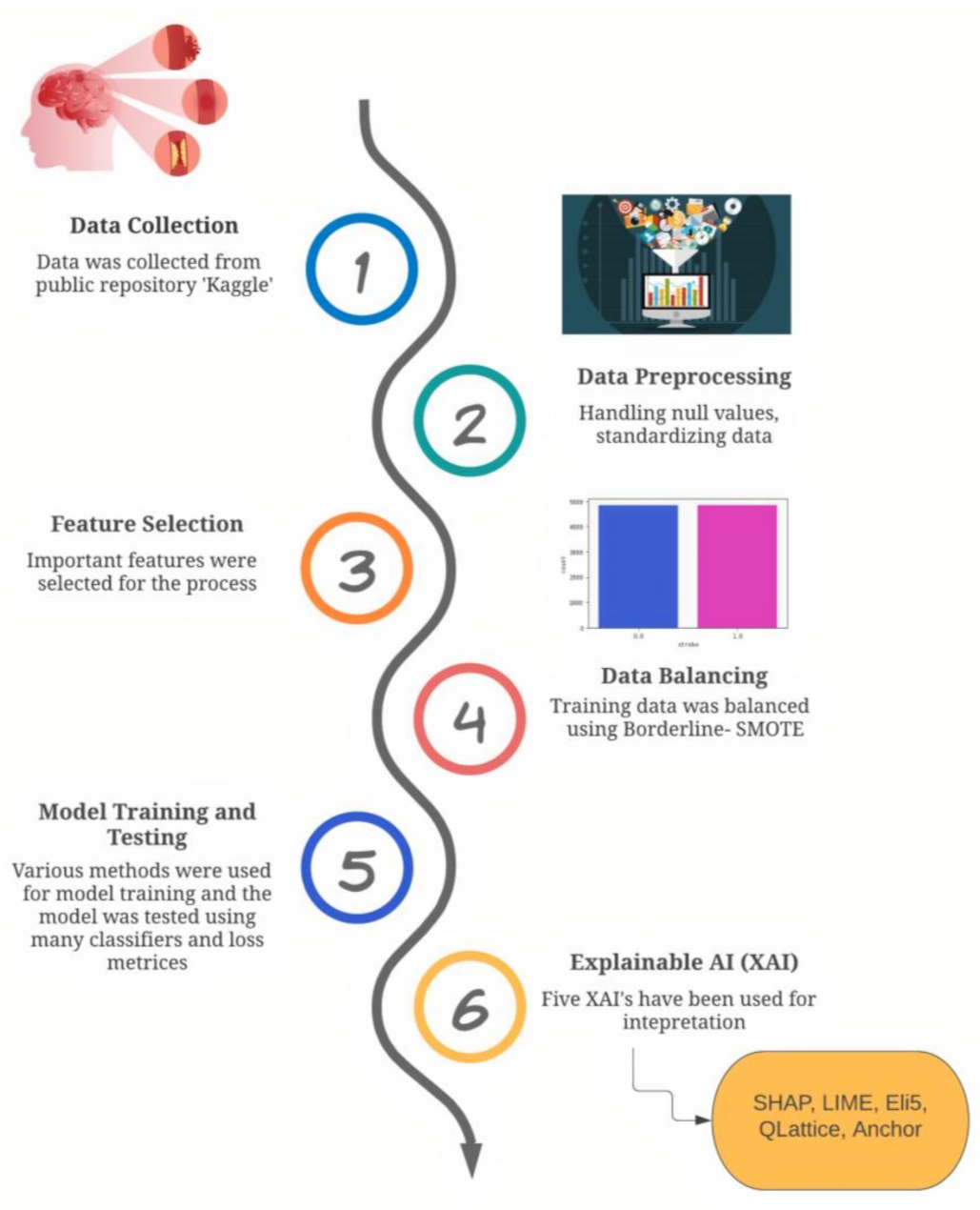
Stroke occurs when a brain’s blood artery ruptures or the brain’s blood supply is interrupted. Due to rupture or obstruction, the brain’s tissues cannot receive enough blood and oxygen. Stroke is a common cause of mortality among older people. Hence, loss of life and severe brain damage can be avoided if stroke is recognized and diagnosed early. Healthcare professionals can discover solutions more quickly and accurately using artificial intelligence (AI) and machine learning (ML). As a result, we have shown how to predict stroke in patients using heterogeneous classifiers and explainable artificial intelligence (XAI). The multistack of ML models surpassed all other classifiers, with accuracy, recall, and precision of 96%, 96%, and 96%, respectively. Explainable artificial intelligence is a collection of frameworks and tools that aid in understanding and interpreting predictions provided by machine learning algorithms. Five diverse XAI methods, such as Shapley Additive Values (SHAP), ELI5, QLattice, Local Interpretable Model-agnostic Explanations (LIME) and Anchor, have been used to decipher the model predictions. This research aims to enable healthcare professionals to provide patients with more personalized and efficient care, while also providing a screening architecture with automated tools that can be used to revolutionize stroke prevention and treatment.
Keywords: anchor; explainable artificial intelligence; Eli5; LIME; machine learning; SHAP; stroke; QLattice anchor; explainable artificial intelligence; Eli5; LIME; machine learning; SHAP; stroke; QLattice