5. Evaluation
To prove that our proposed method can accurately repair missing activity labels in event logs, a large number of experiments were conducted. Overall, we performed two groups of experiments. The first group of experiments compared the performance of our proposed method with existing methods to repair missing activity labels in event logs. The second group of experiments performed further analysis to prove the effectiveness of our method.
We implemented our approach in Python 3.7.1 based on Tensorflow 2.7.0. For the embedding layers, we used the built-in embedding layer in Keras, which requires the categorical variables to be transformed into non-negative integers. In all our experiments, the prefix and suffix lengths were set to five. Zero padding was added if the length of the prefix/suffix was shorter than five (e.g., the event is at the beginning of a trace). In addition, only resources were used as additional attributes to repair missing activities in the experiments of this paper. The dimensions for the embedding layers of the prefix and suffix were set to 100, and the dimension for the embedding layer of resources was set to 16. Probabilistic dropouts of 0.2 were also applied to the outputs of the embedding layers. Moreover, batch normalization was also added to the output vectors of the concatenation layer. Both LSTM networks in our proposed structure contained two layers (32 neurons in the first layers, and 16 neurons in the second layers). During the training process of the model, the training dataset was shuffled first, and 20% of the training dataset was used as the validation set. To minimize the loss, we used the Nadam optimizer. The maximum number of epochs was 100 (Early stop was set to 10 epochs), the batch size was set to 32, and the learning rate was set to 0.002.
To evaluate the performance of our method, we applied the same evaluation matrix as found in [
7,
8,
9], i.e., the success rate. It measures the proportion of missing activity labels repaired successfully to the total number of missing activity labels. Equation (
8) defines the success rate, where
m is the number of activity labels that are repaired successfully, and
n is the total number of missing activity labels.
The experiments utilized several publicly available datasets. In total, our evaluation was based on six publicly available event logs:
The details of all used datasets are presented in
Table 5. For the “Hospital Billing” event log, we filtered out all traces with only one or two events. The “Hospital Billing” event log was filtered in the same way as in [
8]. As shown in
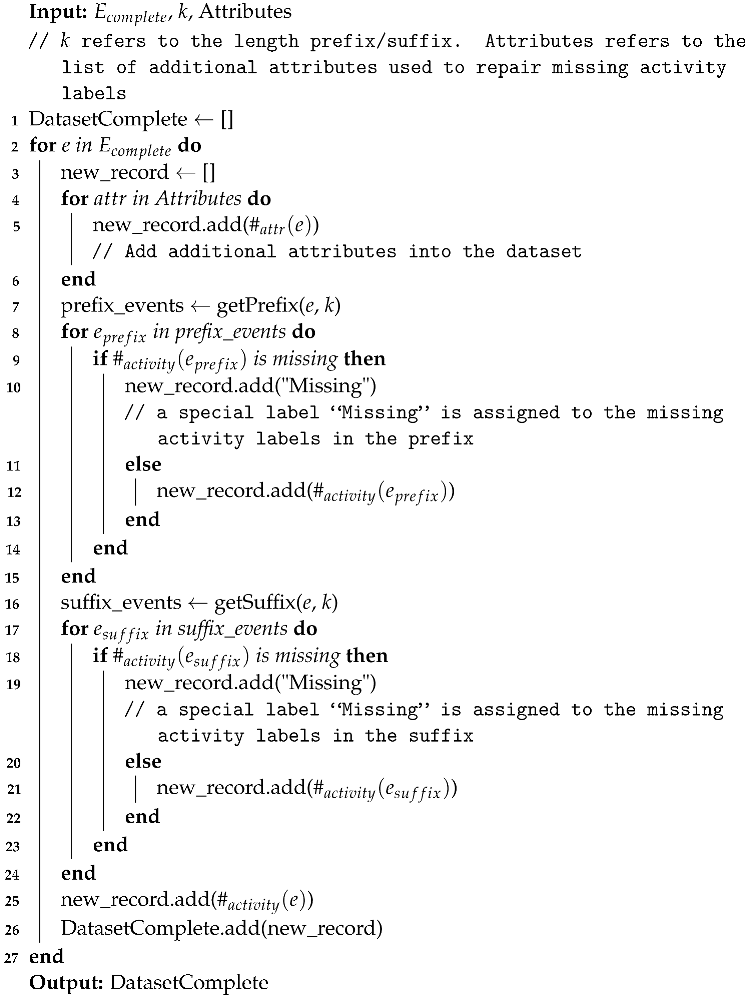
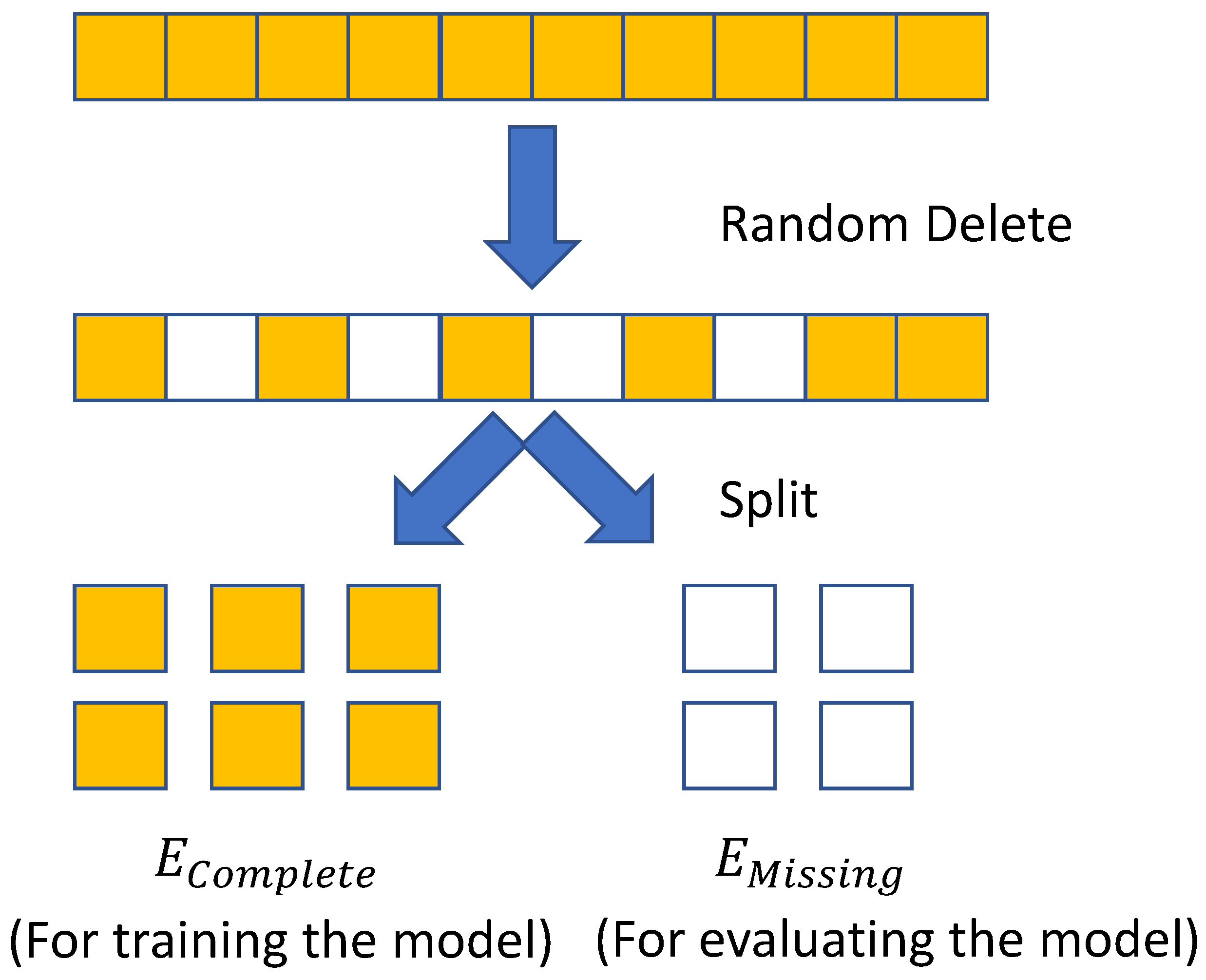
Figure 6, we firstly randomly deleted a number of activity labels from these event logs. Two datasets were then constructed. The dataset constructed from
was used to train the neural network model, and the dataset constructed from
was used to evaluate the model and calculate success rates.
The settings based on those datasets were slightly different in different experiments, which are explained in detail in the following subsections.
Author Contributions
Conceptualization and methodology, Y.L., Q.C., S.K.P.; Development, Y.L.; Validation, Y.L., Q.C., S.K.P.; Writing—original draft preparation: Y.L; Writing—review and editing: Y.L., Q.C., S.K.P.; Supervision: S.K.P. All authors have read and agreed to the published version of the manuscript.
Funding
This research received no external funding.
Institutional Review Board Statement
Not applicable.
Informed Consent Statement
Not applicable.
Data Availability Statement
Datasets used to evaluate the proposed method are publicly-available; please refer to notes for links to access the datasets.
Conflicts of Interest
The authors declare no conflict of interest.
References
- Dumas, M.; La Rosa, M.; Mendling, J.; Reijers, H.A. Fundamentals of Business Process Management; Springer: Berlin/Heidelberg, Germany, 2013; Volume 1. [Google Scholar]
- Van der Aalst, W. Process Mining; Springer: Berlin/Heidelberg, Germany, 2016. [Google Scholar]
- Cai, L.; Zhu, Y. The Challenges of Data Quality and Data Quality Assessment in the Big Data Era. Data Sci. J. 2015, 14, 2. [Google Scholar] [CrossRef]
- Suriadi, S.; Andrews, R.; ter Hofstede, A.; Wynn, M. Event log imperfection patterns for process mining: Towards a systematic approach to cleaning event logs. Inf. Syst. 2017, 64, 132–150. [Google Scholar] [CrossRef]
- Jagadeesh Chandra Bose, R.; Mans, R.; van der Aalst, W.M. Wanna improve process mining results?: It’s high time we consider data quality issues seriously. BPM Rep. 2013, 1302, 127–134. [Google Scholar]
- Rogge-Solti, A.; Mans, R.S.; van der Aalst, W.M.; Weske, M. Repairing Event Logs Using Stochastic Process Models; Universitätsverlag Potsdam: Potsdam, Germany, 2013; Volume 78. [Google Scholar]
- Xu, J.; Liu, J. A profile clustering based event logs repairing approach for process mining. IEEE Access 2019, 7, 17872–17881. [Google Scholar] [CrossRef]
- Liu, J.; Xu, J.; Zhang, R.; Reiff-Marganiec, S. A repairing missing activities approach with succession relation for event logs. Knowl. Inf. Syst. 2021, 63, 477–495. [Google Scholar] [CrossRef]
- Sim, S.; Bae, H.; Choi, Y. Likelihood-based multiple imputation by event chain methodology for repair of imperfect event logs with missing data. In Proceedings of the 2019 International Conference on Process Mining (ICPM), IEEE, Aachen, Germany, 24–26 June 2019; pp. 9–16. [Google Scholar]
- Song, W.; Xia, X.; Jacobsen, H.A.; Zhang, P.; Hu, H. Heuristic recovery of missing events in process logs. In Proceedings of the 2015 IEEE International Conference on Web Services, IEEE, New York, NY, USA, 27 June–2 July 2015; pp. 105–112. [Google Scholar]
- Augusto, A.; Conforti, R.; Dumas, M.; La Rosa, M.; Polyvyanyy, A. Split miner: Automated discovery of accurate and simple business process models from event logs. Knowl. Inf. Syst. 2019, 59, 251–284. [Google Scholar] [CrossRef] [Green Version]
- Van der Aalst, W.; Weijters, T.; Maruster, L. Workflow mining: Discovering process models from event logs. IEEE Trans. Knowl. Data Eng. 2004, 16, 1128–1142. [Google Scholar] [CrossRef]
- De Medeiros, A.A.; van Dongen, B.F.; Van der Aalst, W.M.; Weijters, A. Process Mining: Extending the α-Algorithm to Mine Short Loops; Technische Universiteit Eindhoven: Eindhoven, The Netherlands, 2004. [Google Scholar]
- Guo, Q.; Wen, L.; Wang, J.; Yan, Z.; Philip, S.Y. Mining invisible tasks in non-free-choice constructs. In Proceedings of the International Conference on Business Process Management, Rio de Janeiro, Brazil, 18–22 September 2016; Springer: Berlin/Heidelberg, Germany, 2016; pp. 109–125. [Google Scholar]
- Wen, L.; Wang, J.; van der Aalst, W.M.; Huang, B.; Sun, J. Mining process models with prime invisible tasks. Data Knowl. Eng. 2010, 69, 999–1021. [Google Scholar] [CrossRef]
- Wen, L.; Van Der Aalst, W.M.; Wang, J.; Sun, J. Mining process models with non-free-choice constructs. Data Min. Knowl. Discov. 2007, 15, 145–180. [Google Scholar] [CrossRef]
- Weijters, A.; Ribeiro, J.T.S. Flexible heuristics miner (FHM). In Proceedings of the 2011 IEEE Symposium on Computational Intelligence and Data Mining (CIDM), IEEE, Paris, France, 11–15 April 2011; pp. 310–317. [Google Scholar]
- Weijters, A.; van Der Aalst, W.M.; De Medeiros, A.A. Process mining with the heuristics miner-algorithm. Tech. Univ. Eindh. Tech. Rep. WP 2006, 166, 1–34. [Google Scholar]
- vanden Broucke, S.K.; De Weerdt, J. Fodina: A robust and flexible heuristic process discovery technique. Decis. Support Syst. 2017, 100, 109–118. [Google Scholar] [CrossRef]
- Leemans, S.J.; Fahland, D.; van der Aalst, W.M. Discovering block-structured process models from event logs-a constructive approach. In Proceedings of the International Conference on Applications and Theory of Petri Nets and Concurrency, Milan, Italy, 24–28 June 2013; Springer: Berlin/Heidelberg, Germany, 2013; pp. 311–329. [Google Scholar]
- Leemans, S.J.; Fahland, D.; van der Aalst, W.M. Discovering block-structured process models from event logs containing infrequent behaviour. In Proceedings of the International Conference on Business Process Management, Beijing, China, 26–30 August 2013; Springer: Berlin/Heidelberg, Germany, 2013; pp. 66–78. [Google Scholar]
- Leemans, S.J.; Fahland, D.; van der Aalst, W.M. Discovering block-structured process models from incomplete event logs. In Proceedings of the International Conference on Applications and Theory of Petri Nets and Concurrency, Tunis, Tunisia, 23–27 June 2014; Springer: Berlin/Heidelberg, Germany, 2014; pp. 91–110. [Google Scholar]
- Leemans, S.J.; Fahland, D.; van der Aalst, W.M. Scalable process discovery and conformance checking. Softw. Syst. Model. 2018, 17, 599–631. [Google Scholar] [CrossRef] [PubMed]
- Leemans, S.J.; Fahland, D.; van der Aalst, W.M. Using life cycle information in process discovery. In Proceedings of the International Conference on Business Process Management, Rio de Janeiro, Brazil, 18–22 September 2016; Springer: Berlin/Heidelberg, Germany, 2016; pp. 204–217. [Google Scholar]
- Leemans, M.; van der Aalst, W.M. Modeling and discovering cancelation behavior. In Proceedings of the OTM Confederated International Conferences “On the Move to Meaningful Internet Systems”, Rhodes, Greece, 23–27 October 2017; Springer: Berlin/Heidelberg, Germany, 2017; pp. 93–113. [Google Scholar]
- Lu, Y.; Chen, Q.; Poon, S. A Novel Approach to Discover Switch Behaviours in Process Mining. In Proceedings of the International Conference on Process Mining, Padua, Italy, 4–9 October 2020; Springer: Berlin/Heidelberg, Germany, 2020; pp. 57–68. [Google Scholar]
- Van der Aalst, W.M.; De Medeiros, A.A.; Weijters, A.J. Genetic process mining. In Proceedings of the International Conference on Application and Theory of Petri Nets, Miami, FL, USA, 20–25 June 2005; Springer: Berlin/Heidelberg, Germany, 2005; pp. 48–69. [Google Scholar]
- Buijs, J.C.; van Dongen, B.F.; van der Aalst, W.M. Quality dimensions in process discovery: The importance of fitness, precision, generalization and simplicity. Int. J. Coop. Inf. Syst. 2014, 23, 1440001. [Google Scholar] [CrossRef] [Green Version]
- Van der Werf, J.M.E.; van Dongen, B.F.; Hurkens, C.A.; Serebrenik, A. Process discovery using integer linear programming. In Proceedings of the International Conference on Applications and Theory of Petri Nets, Xi’an, China, 23–27 June 2008; Springer: Berlin/Heidelberg, Germany, 2008; pp. 368–387. [Google Scholar]
- Sommers, D.; Menkovski, V.; Fahland, D. Process discovery using graph neural networks. In Proceedings of the 2021 3rd International Conference on Process Mining (ICPM), IEEE, Eindhoven, The Netherlands, 31 October–4 November 2021; pp. 40–47. [Google Scholar]
- Horita, H.; Kurihashi, Y.; Miyamori, N. Extraction of missing tendency using decision tree learning in business process event log. Data 2020, 5, 82. [Google Scholar] [CrossRef]
- Tax, N.; Verenich, I.; La Rosa, M.; Dumas, M. Predictive business process monitoring with LSTM neural networks. In Proceedings of the International Conference on Advanced Information Systems Engineering, Essen, Germany, 12–16 June 2017; Springer: Berlin/Heidelberg, Germany, 2017; pp. 477–492. [Google Scholar]
- Camargo, M.; Dumas, M.; González-Rojas, O. Learning accurate LSTM models of business processes. In Proceedings of the International Conference on Business Process Management, Vienna, Austria, 1–6 September 2019; Springer: Berlin/Heidelberg, Germany, 2019; pp. 286–302. [Google Scholar]
- Pasquadibisceglie, V.; Appice, A.; Castellano, G.; Malerba, D. A multi-view deep learning approach for predictive business process monitoring. IEEE Trans. Serv. Comput. 2021. [Google Scholar] [CrossRef]
- Lin, L.; Wen, L.; Wang, J. Mm-pred: A deep predictive model for multi-attribute event sequence. In Proceedings of the 2019 SIAM International Conference on Data Mining, SIAM, Calgary, AB, Canada, 2–4 May 2019; pp. 118–126. [Google Scholar]
- Taymouri, F.; La Rosa, M.; Erfani, S.; Bozorgi, Z.D.; Verenich, I. Predictive business process monitoring via generative adversarial nets: The case of next event prediction. In Proceedings of the International Conference on Business Process Management, Seville, Spain, 13–18 September 2020; Springer: Berlin/Heidelberg, Germany, 2020; pp. 237–256. [Google Scholar]
- Pasquadibisceglie, V.; Appice, A.; Castellano, G.; Malerba, D. Using convolutional neural networks for predictive process analytics. In Proceedings of the 2019 International Conference on Process Mining (ICPM), IEEE, Aachen, Germany, 24–26 June 2019; pp. 129–136. [Google Scholar]
- Mehdiyev, N.; Evermann, J.; Fettke, P. A novel business process prediction model using a deep learning method. Bus. Inf. Syst. Eng. 2020, 62, 143–157. [Google Scholar] [CrossRef] [Green Version]
- Hochreiter, S.; Schmidhuber, J. Long short-term memory. Neural Comput. 1997, 9, 1735–1780. [Google Scholar] [CrossRef] [PubMed]
- Guo, C.; Berkhahn, F. Entity embeddings of categorical variables. arXiv 2016, arXiv:1604.06737. [Google Scholar]
- Berti, A.; Van Zelst, S.J.; van der Aalst, W. Process Mining for Python (PM4Py): Bridging the Gap Between Process- and Data Science. arXiv 2019, arXiv:1905.06169. [Google Scholar]
- Huo, S.; Völzer, H.; Reddy, P.; Agarwal, P.; Isahagian, V.; Muthusamy, V. Graph Autoencoders for Business Process Anomaly Detection; Polyvyanyy, A., Wynn, M.T., Van Looy, A., Reichert, M., Eds.; Business Process Management; Springer International Publishing: Cham, Switzerland, 2021; pp. 417–433. [Google Scholar]
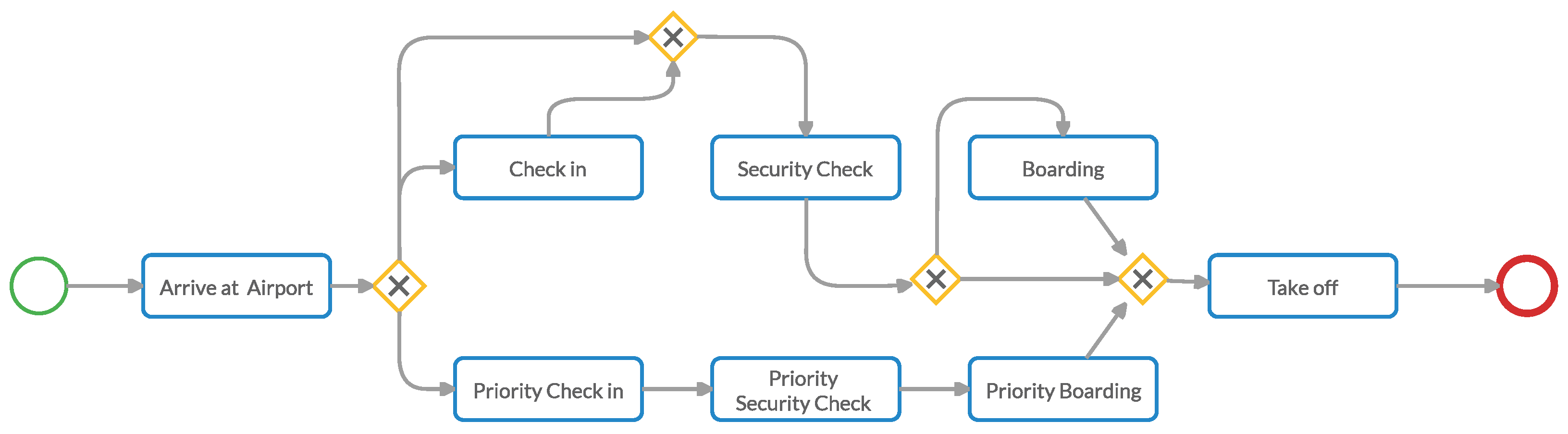
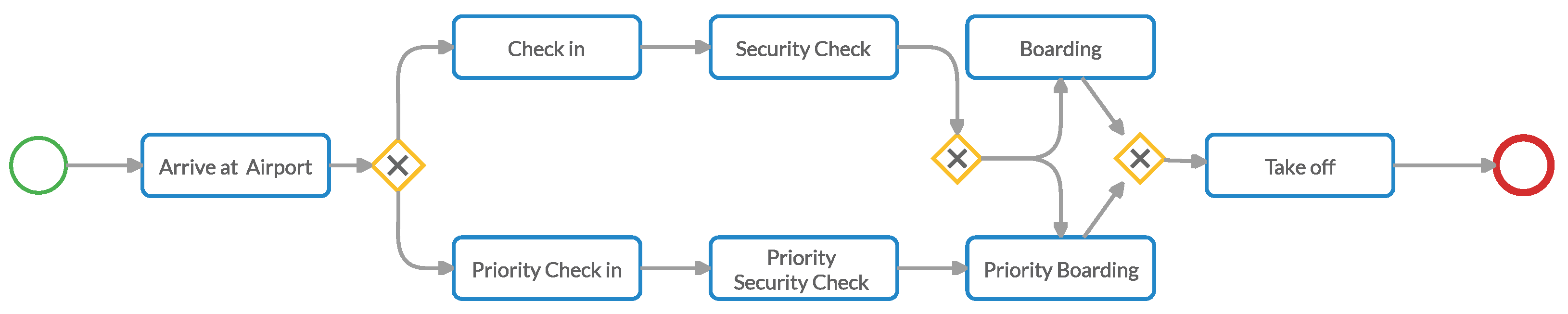
Figure 1.
Process model discovered from .
Figure 2.
Process model discovered from . Events with missing activity labels are removed.
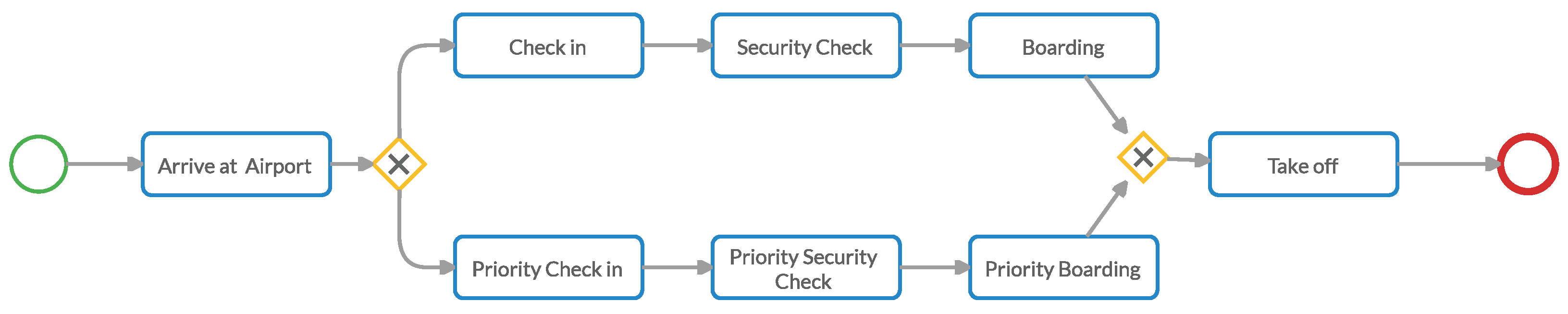
Figure 3.
A process model discovered from . Traces with missing activity labels are removed.
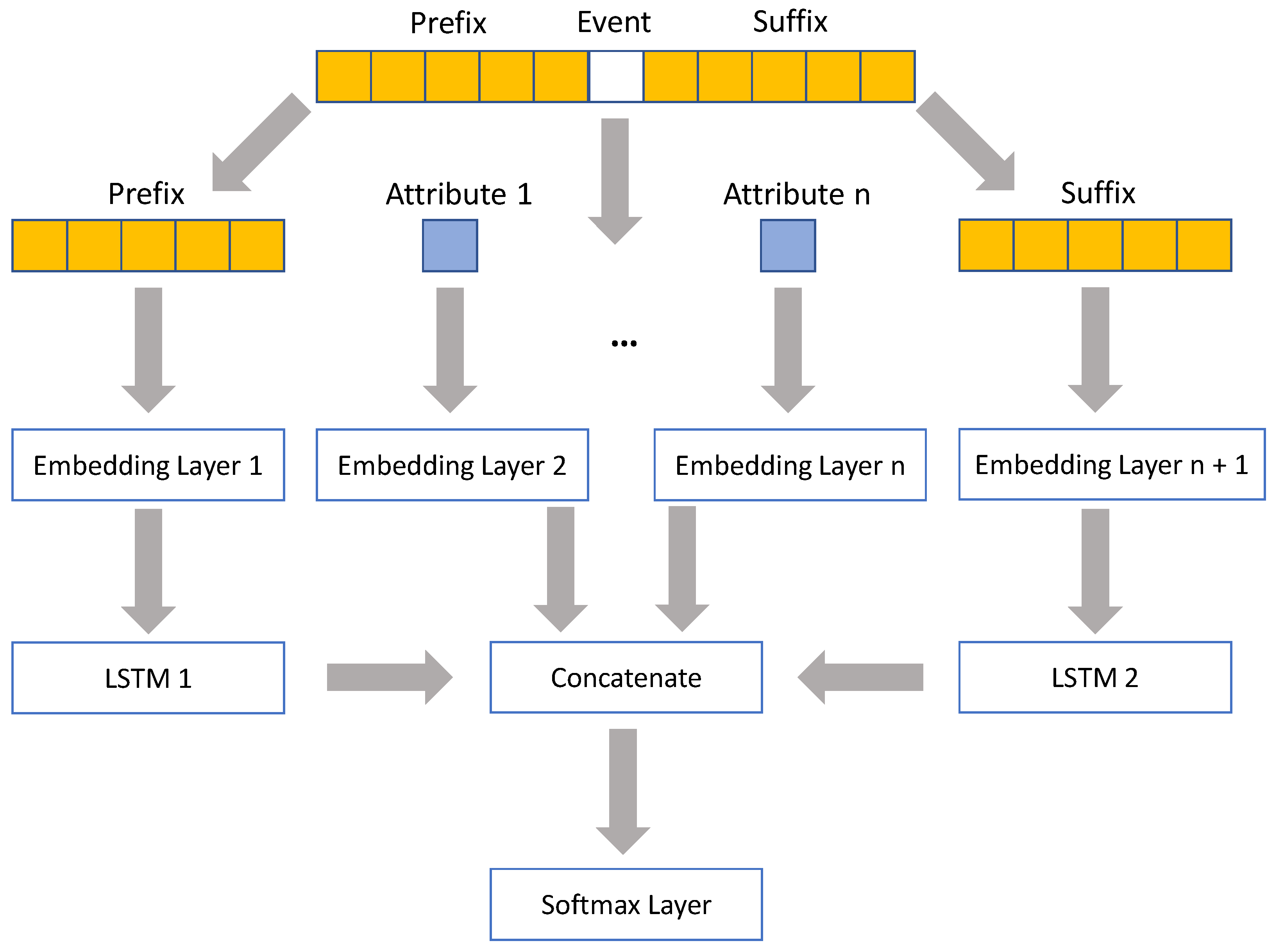
Figure 4.
Architecture of our proposed neural network.
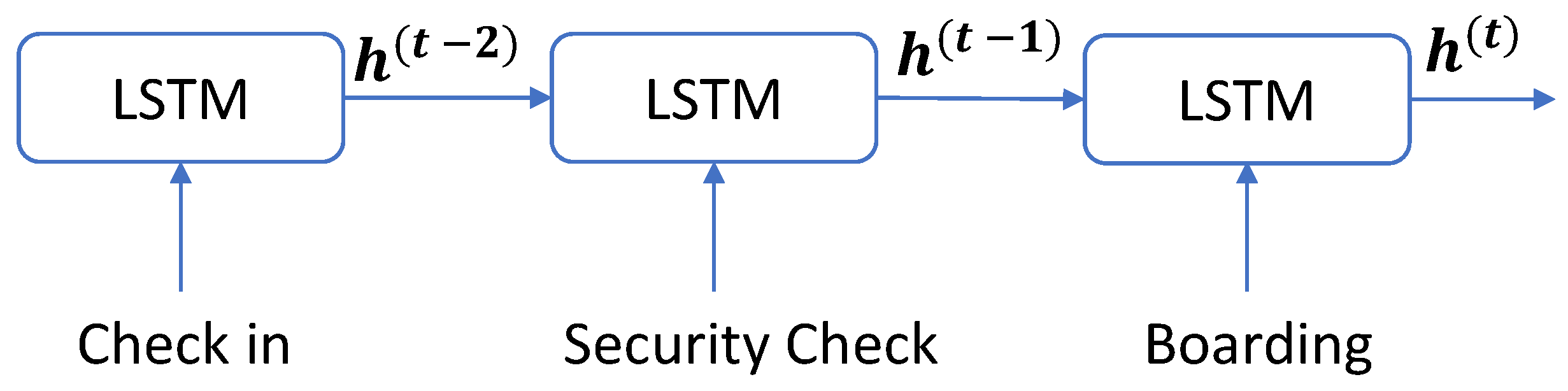
Figure 5.
Unfolded LSTM network for the prefix of , the activities are in vector representations.
Figure 6.
Pre-processing publicly available datasets to evaluate our method.
Figure 7.
Comparison of our method with others.
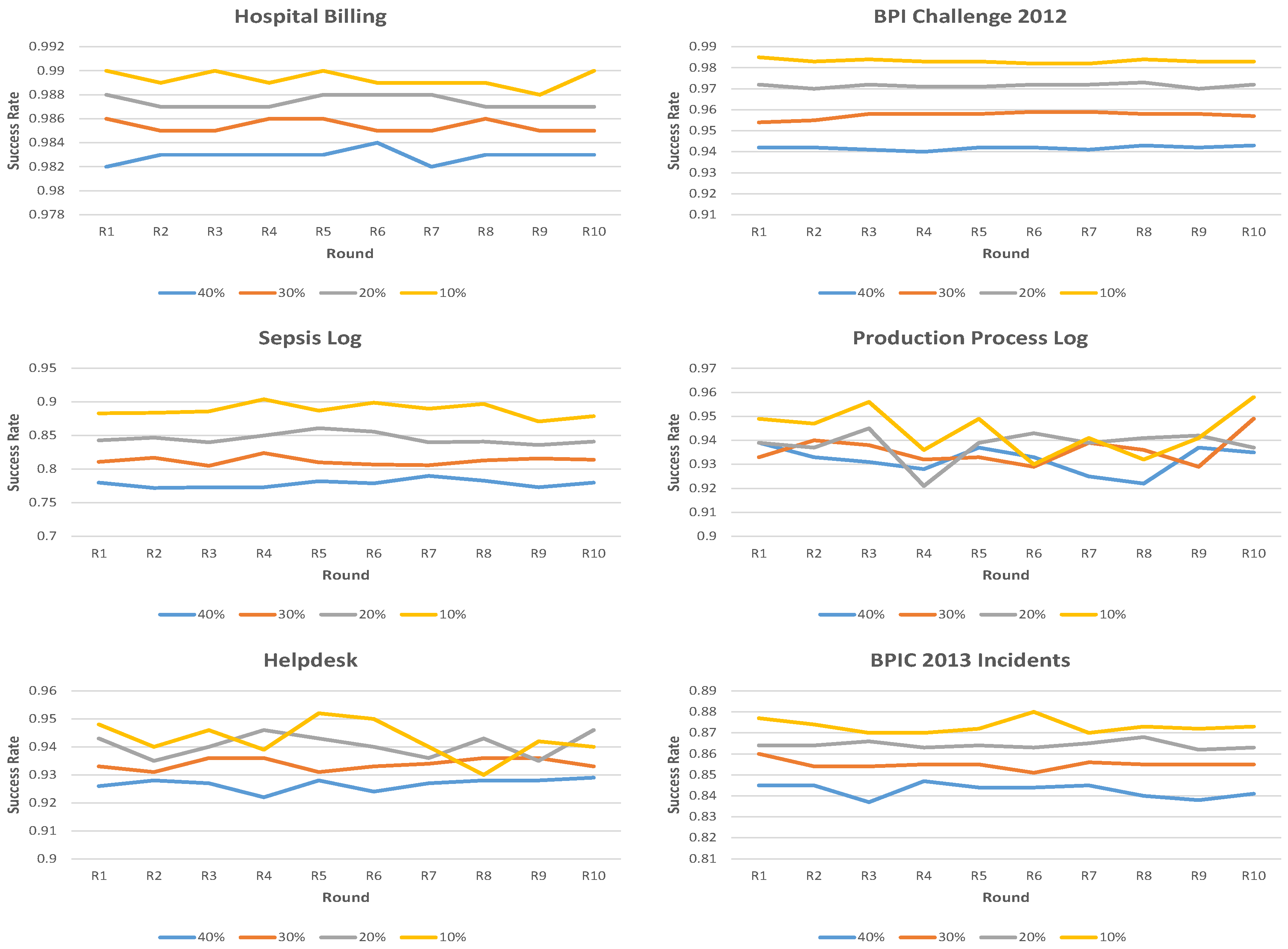
Figure 8.
Successful rates of our method on different datasets in different rounds.
Table 1.
An example event log without missing activity labels.
| Event | Trace Id | Activity | Resource | Timestamp |
|---|
| 1 | Arrive at Airport | Tom | 1/9/2020 12:00:00 |
| 1 | Check in | Jack | 1/9/2020 12:20:00 |
| 1 | Security Check | Thomas | 1/9/2020 12:30:00 |
| 1 | Boarding | Linda | 1/9/2020 14:20:00 |
| 1 | Take off | James | 1/9/2020 15:00:00 |
| 2 | Arrive at Airport | Alice | 2/9/2020 12:10:00 |
| 2 | Priority Check in | James | 2/9/2020 12:20:00 |
| 2 | Priority Security Check | Lucas | 2/9/2020 13:30:00 |
| 2 | Priority Boarding | Linda | 2/9/2020 14:20:00 |
| 2 | Take off | Peter | 2/9/2020 15:00:00 |
| 3 | Arrive at Airport | Steven | 2/9/2020 20:00:00 |
| 3 | Check in | Jack | 2/9/2020 20:20:00 |
| 3 | Security Check | Mark | 2/9/2020 20:25:00 |
| 3 | Priority Boarding | Linda | 2/9/2020 21:00:00 |
| 3 | Take off | Ethan | 2/9/2020 21:30:00 |
Table 2.
An example event log with missing activity labels.
| Event | Trace Id | Activity | Resource | Timestamp |
|---|
| 1 | Arrive at Airport | Tom | 1/9/2020 12:00:00 |
| 1 | Check in | Jack | 1/9/2020 12:20:00 |
| 1 | Security Check | Thomas | 1/9/2020 12:30:00 |
| 1 | Boarding | Linda | 1/9/2020 14:20:00 |
| 1 | Take off | James | 1/9/2020 15:00:00 |
| 2 | Arrive at Airport | Alice | 2/9/2020 12:10:00 |
| 2 | Priority Check in | James | 2/9/2020 12:20:00 |
| 2 | Priority Security Check | Lucas | 2/9/2020 13:30:00 |
| 2 | Priority Boarding | Linda | 2/9/2020 14:20:00 |
| 2 | Take off | Peter | 2/9/2020 15:00:00 |
| 3 | Arrive at Airport | Steven | 2/9/2020 20:00:00 |
| 3 | - | Jack | 2/9/2020 20:20:00 |
| 3 | Security Check | Mark | 2/9/2020 20:25:00 |
| 3 | - | Linda | 2/9/2020 21:00:00 |
| 3 | Take off | Ethan | 2/9/2020 21:30:00 |
Table 3.
The example dataset constructed from .
| Event | Resource | Prefix_1 | Prefix_2 | Prefix_3 | Suffix_1 | Suffix_2 | Suffix_3 | Label (Activity) |
|---|
| Tom | | | | Boarding | Security Check | Check in | Arrive at Airport |
| Jack | | | Arrive at Airport | Take off | Boarding | Security Check | Check in |
| Thomas | | Arrive at Airport | Check in | | Take off | Boarding | Security Check |
| Linda | Arrive at Airport | Check in | Security Check | | | Take off | Boarding |
| James | Check in | Security Check | Boarding | | | | Take off |
| … | … | … | … | … | … | … | … | … |
| Ethan | Missing | Security Check | Missing | | | | Take off |
Table 4.
The example dataset constructed from .
| Event | Resource | Prefix_1 | Prefix_2 | Prefix_3 | Suffix_1 | Suffix_2 | Suffix_3 | Label (Activity) |
|---|
| Jack | | | Arrive at Airport | Missing | Security Check | Missing | _ |
| Linda | Arrive at Airport | Missing | Security Check | | | Take off | _ |
Table 5.
Characteristics of the used publicly available datasets.
| Dataset | Number of Traces | Number of Events | Number of Activities | Number of Resources |
|---|
| Production Process Log | 225 | 4544 | 55 | 31 |
| Hospital Billing (Filtered) | 69,252 | 412,236 | 18 | 1105 |
| BPI Chanllenge 2012 | 13,087 | 262,200 | 24 | 69 |
| Sepsis Log | 1050 | 15,214 | 16 | 26 |
| Helpdesk | 4580 | 21,348 | 14 | 22 |
| BPIC 2013 Incidents | 7554 | 65,533 | 13 | 1440 |
Table 6.
Comparison of our method with PROELR [
7] and SRBA [
8].
| Dataset | Number of Missing Activity Labels | PROELR [7] | SRBA [8] | Our Method |
|---|
| Hospital Billing | 100 | 0.644 | 0.816 | 0.995 |
| 150 | 0.650 | 0.805 | 0.991 |
| 200 | 0.635 | 0.811 | 0.991 |
| 300 | 0.668 | 0.825 | 0.993 |
| BPI Chanllenge 2012 | 100 | 0.441 | 0.800 | 0.993 |
| 150 | 0.463 | 0.790 | 0.996 |
| 200 | 0.432 | 0.772 | 0.992 |
| 300 | 0.438 | 0.760 | 0.994 |
Table 7.
Comparison of our method with the MIEC [
9].
| Dataset | Number of Missing Activity Labels | MIEC [9] | Our Method |
|---|
| Production Process Log | 15% (681) | 0.925 | 0.946
|
| 20% (908) | 0.876 | 0.938 |
| 25% (1817) | 0.837 | 0.937 |
| 30% (1363) | 0.788 | 0.938 |
Table 8.
Further analysis of our method.
| Dataset | Number of Missing Activity Labels | Prefix Only | Suffix Only | Our Method (without Resources) | Our Method |
|---|
| Hospital Billing | 10% (41,223) | | | | |
| 20% (82,447) | | | | |
| 30% (123,670) | | | | |
| 40% (164,894) | | | | |
| BPI Chanllenge 2012 | 10% (26,220) | | | | |
| 20% (52,440) | | | | |
| 30% (78,660) | | | | |
| 40% (104,880) | | | | |
| Sepsis Log | 10% (1521) | | | | |
| 20% (3042) | | | | |
| 30% (4564) | | | | |
| 40% (6085) | | | | |
| Helpdesk | 10% (2134) | | | | |
| 20% (4269) | | | | |
| 30% (6404) | | | | |
| 40% (8539) | | | | |
| BPIC 2013 Incidents | 10% (6553) | | | | |
| 20% (13,106) | | | | |
| 30% (19,659) | | | | |
| 40% (26,213) | | | | |
| Production Process Log | 10% (454) | | | | |
| 20% (908) | | | | |
| 30% (1363) | | | | |
| 40% (1817) | | | | |
Table 9.
Average time used to repair each log.
| Dataset | Number of Missing Activity Labels | Average Time Used by Our Method to Repair Each Log |
|---|
| Hospital Billing | 10% (41,223) | 2190.91 s |
| 20% (82,447) | 1463.12 s |
| 30% (123,670) | 1217.85 s |
| 40% (164,894) | 1093.86 s |
| BPI Challenge 2012 | 10% (26,220) | 1772.21 s |
| 20% (52,440) | 1109.62 s |
| 30% (78,660) | 1000.51 s |
| 40% (104,880) | 899.21 s |
| Sepsis Log | 10% (1521) | 140.69 s |
| 20% (3042) | 89.99 s |
| 30% (4564) | 75.65 s |
| 40% (6085) | 69.66 s |
| Helpdesk | 10% (2134) | 140.40 s |
| 20% (4269) | 89.33 s |
| 30% (6404) | 80.30 s |
| 40% (8539) | 72.96 s |
| BPIC 2013 Incidents | 10% (6553) | 218.59 s |
| 20% (13,106) | 170.65 s |
| 30% (19,659) | 157.66 s |
| 40% (26,213) | 150.10 s |
| Production Process Log | 10% (454) | 40.40 s |
| 20% (908) | 36.38 s |
| 30% (1363) | 32.52 s |
| 40% (1817) | 29.56 s |
Table 10.
F-scores of process models discovered by the inductive miner (infrequent) from the original, problem and repaired event logs. All conformance checking was conducted between discovered process models and the original event logs.
| Dataset | Number of Missing Activity Labels | F-Score (the Original Log) | Average F-Score (the Logs with Missing Activity Labels) | Average F-Score (the Repaired Logs) |
|---|
| Hospital Billing | 10% (41,223) | 0.75 | 0.67 | 0.74 |
| 20% (82,447) | 0.75 | 0.59 | 0.71 |
| 30% (123,670) | 0.75 | 0.57 | 0.71 |
| 40% (164,894) | 0.75 | 0.55 | 0.70 |
| Sepsis Log | 10% (26,220) | 0.77 | 0.62 | 0.72 |
| 20% (52,440) | 0.77 | 0.61 | 0.68 |
| 30% (78,660) | 0.77 | 0.59 | 0.66 |
| 40% (104,880) | 0.77 | 0.58 | 0.65 |
Table 11.
F-scores of process models discovered by the split miner from the original, problem and repaired event logs. All conformance checking was conducted between discovered process models and the original event logs.
| Dataset | Number of Missing Activity Labels | F-Score (the Original Log) | Average F-Score (the Logs with Missing Activity Labels) | Average F-Score (the Repaired Logs) |
|---|
| Hospital Billing | 10% (41,223) | 0.95 | 0.86 | 0.94 |
| 20% (82,447) | 0.95 | 0.85 | 0.94 |
| 30% (123,670) | 0.95 | 0.81 | 0.93 |
| 40% (164,894) | 0.95 | 0.80 | 0.93 |
| Sepsis Log | 10% (26,220) | 0.86 | 0.76 | 0.80 |
| 20% (52,440) | 0.86 | 0.74 | 0.78 |
| 30% (78,660) | 0.86 | 0.72 | 0.77 |
| 40% (104,880) | 0.86 | 0.68 | 0.76 |
| Publisher’s Note: MDPI stays neutral with regard to jurisdictional claims in published maps and institutional affiliations. |
© 2022 by the authors. Licensee MDPI, Basel, Switzerland. This article is an open access article distributed under the terms and conditions of the Creative Commons Attribution (CC BY) license (https://creativecommons.org/licenses/by/4.0/).