1. Introduction
To better understand the relationship between religion and politics, it is necessary to return to the essential lesson of Juan Linz, which represents a milestone in the analysis of this relationship. Linz introduces the fundamental distinction between political religion and politicized religion, corresponding to the two different ways in which political movements and non-democratic regimes legitimize their proposals and their systems. This is a conceptual distinction of the utmost importance, as it makes it possible to grasp the different uses of religion.
In this regard, Linz distinguishes between the religious use of politics and the political use of religion. In the first case, the emergence of political religion is made possible by the conflictual separation between Church and State, in contrast to the liberal model of consensual separation between these two spheres. The State attempts to confine religion to the private sphere of the individual, replacing it with secular models of reference, the totalitarian ideologies of communism and Nazism, which are imposed even within the public religious sphere. In this sense, political religions, functioning as truly pseudo-scientific religious substitutes, enter into competition with preexisting religious traditions to the point of eliminating them.
In the second case, by contrast, the rise of politicized religion stems from the will of political leaders to politicize preexisting religion, transforming the State in a confessional direction, or more simply to strengthen and legitimize their own ideology. Far from being separate, politics and religion are here closely intertwined. It is precisely by virtue of this close connection that religion lends itself to legitimizing not so much the existing social order as, more specifically, a particular vision of the world and of politics. When pushed to its extreme consequences, religion becomes an ideological surrogate in support of political leadership (
Linz 2006).
The vision of the world and of politics, of which religion is an indispensable foundation, should more precisely be defined as identity. The ideology of identity uses religion as a surrogate because, like other identity components, it is capable of defining who we are and of strengthening bonds within the group. Religion becomes a boundary line that helps define an us, a sense of belonging that distinguishes us from others and becomes the most important dimension of life. From a political standpoint, the rediscovery of identity is relatively recent, dating roughly to the early 1990s, and it now stands as one of the most significant dimensions of politics in Western democracies. This occurs above all on the right, in its populist versions, in which the people themselves, as a single and unifying entity, are sacralized. The underlying logic is that of us against them, or of the people against their enemies, who are intent on dividing and desacralizing them.
The aim of this article is to trace, frame, and analyze an emerging form of secularized religiosity within the political language of the populist and radical right. This phenomenon can today be observed within a party family that, since its emergence, has consistently presented itself as the defender of traditional religion in the public sphere, drawing on a set of themes from traditional religion, family being a case in point, that lend themselves particularly well to propagandistic repurposing. This use of traditional religion shapes, to a considerable extent, the political culture of these parties, giving rise to a recognizable identity with clearly defined constitutive principles. The aim pursued here takes into account the scope and complexity of this phenomenon, in which religious discourse functions as a common denominator across otherwise diverse national contexts. This party family is today variously labelled, yet one designation seems to command broad agreement, namely, that of populist, as several authors have underlined (
Betz 2003;
Minkenberg 2011;
Mudde 2004;
Papadopoulos 2000;
Taggart 2000).
2. Theoretical Framework
This dynamic can be situated within the broader literature on the new cleavages that, since the 1990s, are held to have activated new party families across Western Europe. Of particular relevance here is the cleavage produced by processes of globalization, described as generating a dichotomous outcome between “winners” and “losers” (
Kriesi et al. 2006). For the latter, this opposition has triggered a twofold reaction: one tied to material claims following the erosion of socioeconomic status, the other more closely linked to an affective response to the radical transformation of the values that define the national community and its integrity (
Bornschier 2010). The question of values thus becomes central again, as the so-called “losers” of globalization attempt to remain anchored to a system of traditional values in which religion functions as an indispensable pillar, defending stricter moral standards (
Ignazi 2003) against the perceived libertarian drift of the globalized left. This claim should not be read as an attempt to reassert a confessional logic, but rather as a defense of culture and identity pursued through an exclusivist lens (
Arato and Cohen 2017), one in which religious identity is transformed into a discursive stronghold against whoever is made to represent the “other.”
Since right-wing populism cannot exist, in its own logic, without a clearly identifiable collective subject, the question of identity becomes decisive, and its construction cannot do without its principal glue, namely, the appeal to traditional religion. This identitarian glue, tied to a system of religious values, beliefs, rules, and institutions, creates not only a sense of commonality and belonging but, more importantly, defines a boundary between a community, or more precisely a “people,” and those who remain outside it, such as those who do not situate themselves within the traditional religious horizon. What is at stake here is not the influence of religion in its broadest sense, but the use that a given political family makes of religious influence within society. Throughout history, Christianity has been associated with a range of different political ideologies, from the right to Christian socialism, and the notion of influence should accordingly be read in light of the selection that groups, movements, and parties make from the contents of scripture, magisterial teaching, and the messages of religious hierarchies, from which adherence to one theological orientation rather than another may follow (
Stepan 2000). More precisely, the influence of traditional religion on politics can occur in different ways, whereby the sacred exerts influence as a system of values, as religious structures, or through groups, movements, and parties (
Haynes 1997). It is in this latter sense that the present study examines how the parties under analysis exercise their influence through a discourse that places religious beliefs at its center. This does not necessarily make them confessional parties, but parties that constitutively ground their ideology in traditional religion. Their capacity for influence depends on the sensitivity of a more or less significant share of public opinion, depending on national context, to this religious appeal, without disregarding what
Norris and Inglehart (
2007) describe as the persistence of a religious sentiment that continues to pervade human societies. Finally, a public discourse grounded in a religious frame allows access to what
Bourdieu (
2013) calls “symbolic capital,” capable of mobilizing symbolic interests that underlie both political-electoral mobilization and its legitimation (
Roy 2016).
Building on the conceptual distinction outlined above, identity can be understood as the central ideological dimension through which religious references acquire political significance (
Linz 2006). The contemporary political landscape, particularly the “fourth wave” of the populist radical right theorized by
von Beyme (
1988) and
Mudde (
2007), appears to provide a clear illustration of how cultural and symbolic elements are mobilized to define political belonging. Seeking to achieve normalization and present themselves as legitimate actors, these formations seem to have largely marginalized openly racist rhetoric. Instead, as
Wodak (
2015) and
Marzouki et al. (
2016) point out, their discourse has shifted toward debates concerning gender equality, secularism, and religion. Within this context, faith appears to operate less as a strictly theological doctrine and more as a central marker for internal cohesion.
Religious belonging tends to be the strongest and most durable form of identity, and appears to turn the concept of the people into a powerful myth, using highly symbolic narratives to justify a specific sociopolitical order and establish an emotional bond (
Canovan 1981). This process reflects the core of populism, defined as a thin-centered ideology that divides society into two homogeneous and antagonistic groups: the pure people and the corrupt elite (
Mudde 2004). Within this Manichean framework, which has been extensively analyzed by scholars such as
Brubaker (
2017a,
2017b) and
Zúquete (
2017), this dynamic solidifies the people as a sacred entity. Stemming from the national populism described by
Taguieff (
1995), the community is discursively granted a form of salvific sacredness (
Yilmaz and Morieson 2021) and is often portrayed as inherently virtuous, suggesting an instinctive moral compass. This sacralization of politics appears to rely heavily on the figure of the populist leader, a dynamic that
Linz (
2006) alongside
DeHanas and Shterin (
2018) describe as a potential surrogate for traditional religion. Echoing the political theology of
Schmitt (
1922), the leader may act not merely as an institutional delegate but as the physical embodiment of this collective identity (
Pérez-Agote and Aleman 2023).
This worldview seems to fuel a constant tension with anyone perceived as an enemy, driving rigid and antagonistic political orientations (
Urbinati 2020). By claiming the supremacy of the popular will, this ideology defines a “non-people” that includes everything outside the historical, territorial, and cultural homogeneity of the group (
Viviani 2020). In addressing the nature of this homogeneous in-group,
Zanatta (
2023) distinguishes between the profane and the “sacred people.” The latter is central to narratives proposing a new form of religiosity, as it is framed as a natural, homogeneous community permanently united by historical roots and destiny. Conceived as a living organism in the divine image, the sacred people appear to function as a bridge between immanence and transcendence. Within populist frameworks, this vision tends to portray the community as the “chosen” and purest, defined primarily through its stark opposition to perceived “enemies” such as cosmopolitan elites, mass immigration, and secularizing modernity. This exclusionary logic appears to be sustained by an ideological core that intertwines authoritarianism and populism with nativism (
Peker 2022;
Beuter et al. 2023).
Because nativist ideologies inherently view non-native elements as an existential threat to the nation-state (
Mudde 2007), they tend to generate a strong impulse to expel these out-groups from the sociopolitical arena, which may lead to various forms of explicit or latent exclusion (
Betz 2003). To preserve the community against multiculturalist theories and class divisions, this fideistic conception of the people appears to promote ideals of cultural purity (
Diamanti and Lazar 2018;
Mény 2019;
Canovan 1999). The resulting ideological framework is frequently eclectic, attempting to balance modernizing ambitions with the restoration of past models (
Zanatta 2002).
This dynamic can be interpreted in light of broader analyses of conservative political culture. As noted by
Veneziani (
2002), conservative thought is rooted in inherited bonds, beginning with religious affiliation, which provides the foundation for collective identity and social cohesion. Political belonging is thus conceived not merely as an institutional relationship but as an expression of deeper cultural and historical continuity. Within this framework, religion contributes to the construction of a shared symbolic universe that reinforces collective identity and political legitimacy.
A central role within this symbolic structure is played by the family. Conservative political discourse frequently presents the family as the primary site in which identity is formed and transmitted across generations. The family functions as a bridge between individual and collective belonging, linking personal identity to broader cultural and national continuity. As argued by
Lakoff (
2008), the family operates as a powerful cognitive and communicative frame capable of structuring political perception and providing a model through which broader social and political relationships are understood. Because family-based frames are deeply embedded in everyday experience, they possess strong emotional resonance and serve as particularly effective tools for political communication.
Within identity-centered ideological frameworks, family, religion, and homeland form an interconnected symbolic constellation. Religion provides the cultural and moral foundation, the family ensures the transmission of identity, and the homeland represents the territorial space in which this identity is preserved and protected. Together, these elements create a coherent symbolic structure that supports narratives centered on continuity, sovereignty, and collective belonging.
This symbolic configuration seems to acquire particular relevance in contemporary political contexts characterized by advanced secularization. Recent studies highlight the compatibility and growing standardization of this religious resurgence within a highly secularized European landscape (
Marzouki et al. 2016;
Morieson 2021;
Peker 2021;
Grau Innerarity 2023;
Cremer 2023). Although secularization has reduced the direct influence of religious institutions, religious symbols and references continue to play a central role in political communication. As suggested by frame theory, symbolic language rooted in religious and cultural tradition functions as a powerful instrument for shaping political perception, reinforcing collective identity, and mobilizing political support (
Lakoff 2008).
In this sense, religion in contemporary political discourse appears to function primarily as a cultural and symbolic resource rather than as a purely theological system. Often instrumentalized for ideological interests (
Marzouki et al. 2016), religion seems to be used to construct a civilizational framework based on an identitarian Christianity (
Brubaker 2017b;
Giorgi 2022). This appears to create a distinction between a good “us” and a bad “them” (
Roy 2016), defending the Occident against an external “Other” frequently identified as Islam (
Wodak 2015).
This dynamic can be observed across various national contexts, where the public display of religious items serves as a powerful symbolic resource. From Donald Trump’s use of the Bible and Vladimir Putin’s appeals to national orthodoxy, to the rhetoric adopted by Giorgia Meloni, leader of the Italian party Fratelli d’Italia, faith appears to be increasingly utilized as a political tool. As highlighted by
Fatigante (
2023), this instrumentalization of religious references often aims to mobilize popular sentiment and compensate for potential vulnerabilities in political action. This theoretical perspective provides the analytical framework for the empirical analysis that follows.
3. Materials and Methods
The analysis draws on a corpus of documents, including political speeches, electoral programs, and interview excerpts, produced by prominent figures from three European right-wing parties: Fratelli d’Italia (Italy), Alternative für Deutschland (Germany), and Vox (Spain). The figures whose communication was included were selected on the basis of two combined criteria, namely, the occupation of a top position within the party organization and national public visibility. For Fratelli d’Italia this corresponds to Giorgia Meloni, for Alternative für Deutschland to the parliamentary group co-chairs Alice Weidel and Tino Chrupalla, and for Vox to Santiago Abascal. The corpus also includes official party statements and parliamentary initiatives issued under the party’s name, which were included insofar as they reflect the same institutional line of communication.
The selection of these three parties reflects a most-similar-systems logic (
Przeworski and Teune 1970). Fratelli d’Italia, Alternative für Deutschland, and Vox appear as radical right formations that have undergone a broadly comparable process of normalization within consolidated democracies characterized by pluralist media environments (
Mudde 2007), and each mobilizes a civilizational reference to Christianity as part of its identity discourse. Cases such as Hungary’s Fidesz were deliberately left outside this design. In Hungary, Christianity has been nationalized at the constitutional level, with the state exercising a marked degree of control over media and religious institutions (
Ádám and Bozóki 2016), a configuration that seems closer to what
Linz (
2006) describes as political religion than to the politicization of religion within secularized contexts that this study seeks to address.
The corpus covers communication produced between 2017 and 2025, a period that corresponds to the consolidation and electoral rise of the three parties and allows their identity-based communication to be observed across comparable phases of political visibility. It should be noted that the documents were selected on thematic grounds, that is on the basis of their relevance to religion, identity, and cultural belonging, and not through keyword searches. The keyword list described below was applied only to generate the keyword-in-context extractions, and did not serve as a criterion for document inclusion.
The corpus is made up of official party communication produced within this period. For Fratelli d’Italia it includes the programmatic document Le Tesi di Trieste (2017), the 2024 European electoral program, and six public speeches delivered by Meloni between 2022 and 2023, covering party events, electoral campaigns, the programmatic conference, and the investiture speech. For Alternative für Deutschland it includes the 2025 federal electoral programme Zeit für Deutschland, the 2025 Leitantrag, and four press statements issued by Weidel and Chrupalla between March 2018 and July 2024: a parliamentary speech by Chrupalla on migration and the economy (27 March 2018), a statement by Weidel on the government’s migration summit (15 March 2023), a joint statement by Weidel and Chrupalla following the Conference of Minister-Presidents on migration (7 November 2023), and a statement by Weidel on border controls ahead of regional elections (26 July 2024). For Vox it includes the 2023 electoral program, the 2024 European elections program, and a set of party statements and parliamentary initiatives issued between 2021 and 2024, addressing themes such as religious symbolism, religious pluralism policy, and the persecution of Christians abroad.
Social media content was not included, since posts are typically shorter, often produced by party staff rather than by the figures themselves, and shaped by platform-specific dynamics that differ across the three countries, which would make them difficult to compare with the more formal and party-sanctioned communication analyzed here. The corpus thus includes nineteen documents in total, eight for Fratelli d’Italia, six for Alternative für Deutschland, and five for Vox. Since documents were identified on thematic grounds at the outset, all the material initially selected was retained for analysis.
A keyword-in-context (KWIC) analysis served as the starting point for the Qualitative Content Analysis (QCA) and was performed with the R (
R Core Team 2021) package quanteda (
Benoit et al. 2018). Keywords referring to the relationship between politics and religion were identified and analyzed in their immediate textual context in order to examine how related concepts and rhetorical elements were employed in political sources from the three countries under study (
Moreno-Ortiz 2025). QCA was then used to provide a deeper qualitative examination of the textual data through systematic coding and interpretation (
Hsieh and Shannon 2005) using MAXQDA, a software tool for qualitative and mixed-methods data analysis (
VERBI Software 2021), for the Italian and German corpora.
Starting from the keyword-in-context segments, we carried out an initial round of open coding to identify recurrent thematic elements. We did not use factor analysis, since the material consists of qualitatively coded textual segments rather than quantitative variables, and an interpretive, category-building approach fits this kind of data better.
The designed scheme includes seven subcodes distributed across three macro-categories. “Identity and Cultural Frames” groups “West/Civilization Frame,” covering references to national and Western civilization as a shared cultural and value system rooted in the classical and Christian heritage of Europe; “Christian Roots,” covering explicit references to Christianity as a foundational element of national or European identity, often invoked against secularizing pressures; and “Islam as a Cultural Threat,” covering Islam framed as incompatible with national values or as a source of cultural and social risk. “Sovereignty and Supranational Frames” groups “Defense of the Family and National Continuity,” covering the traditional family presented as a pillar of the demographic and cultural continuity of the nation, and “Supranational Identity Standardization,” covering supranational institutions or ideologies framed as flattening national and cultural identities. “Conflict and Defense Frames” groups “Aggression/Invasion Frame,” covering migration or ideological pressure described through the language of invasion or external aggression, and “Defense of the Homeland,” covering calls to protect national territory and borders. The same scheme was applied to all three corpora.
The reliability of the coding process finds further support in the fact that, once the keyword-in-context segments were re-extracted in R, the Italian and German coding was reviewed against this newly extracted material, while the Spanish corpus was coded in its entirety on the original-language text. This process functioned, in effect, as an internal consistency check on how the codebook was applied across the three corpora.
In order to provide the KWIC basis for the analysis in MAXQDA, a set of keywords was identified deductively from the core concepts of the theoretical framework outlined above, namely, religion, family, homeland, identity, civilization, sovereignty, and the construction of an external threat, including references to Islam and migration.
Italian: “aggress*,” “battagli*,” “civiltà,” “Crist*/giudaico-cristian*,” “cultur*,” “Dio,” “famigli*,” “gender,” “identit*,” “immigra*/migra*,” “indipenden*,” “inva*,” “Islam*/musulman*,” “libertà,” “occident*,” “patria,” “popol*,” “radic*,” “religio*,” “sovranis*,” “tradizion*.”
German: “Abendland*/christlich-abendländ*”, “Aggress*”, “Bevölker*/Volk*”, “Christ*/christlich-jüdisch*/jüdisch-christ*”, “Einmarsch*/Invasion*/Überfall*”, “Einwander*/Flüchtling*/Migration*”, “Familie*”, “Freiheit*”, “Gender,” “Gott*”, “Heimat*/Vaterland*”, “Identität*”, “Islam*/Muslim*”, “Kampf*”, “Kultur*”, “Migrant*,” “Religi*”, “Souverän*”, “Tradition*”, “Unabhängig*”, “Wurzel*”, “Zivilisation*”.
Spanish: “agres*,” “batall*/luch*,” “civiliz*,” “crist*/judeocristian*,” “cultur*,” “Dios,” “famili*,” “géner*,” “identi*,” “inmigra*/migra*,” “independen*,” “invas*,” “islam*/musulman*,” “libertad,” “occident*,” “patria,” “pueblo*/popular*,” “raíc**,” “religi*,” “soberan*,” “tradici*.”
For all three corpora, the KWIC analysis was conducted on the texts in their original language, using keyword lists constructed separately for Italian, German, and Spanish. For the Spanish corpus, given that the coder is not a native speaker, an Italian translation was used as a support during coding, while the coded unit always remained the original Spanish segment.
A 10-word window before and after each keyword was selected in order to ensure adequate contextualization. Asterisks were used to capture all morphological variants of the keywords. Associations that were irrelevant to the research focus or too fragmented to allow contextual interpretation were removed, and associations referring to the same textual unit but retrieved through different keywords were counted only once.
The code co-occurrence maps presented in the Results section were generated in R using the igraph (
Csárdi and Nepusz 2006) and ggraph (
Pedersen 2024) packages, based on the co-occurrence matrix of subcodes derived from the coding described above.
4. Results
4.1. Italy
The exploratory KWIC analysis of the Italian corpus identified 389 associations using the “kwic” function provided by quanteda. After data cleaning, 118 valid associations remained. Irrelevant or overly fragmented items were removed, and associations referring to the same textual unit but identified through different keywords were counted only once.
These segments were subsequently subjected to qualitative content analysis with MAXQDA. Multiple codes could be applied to the same segment in order to capture the different dimensions present in the material. Three macro-categories were identified inductively: “Identity and Cultural Frames,” “Sovereignty and Supranational Frames,” and “Conflict and Defense Frames.”
Within “Identity and Cultural Frames,” three subcodes were developed: “West/Civilization Frame,” “Christian Roots,” and “Islam as a Cultural Threat.”
“Sovereignty and Supranational Frames” comprised two subcodes: “Defense of the Family and National Continuity” and “Supranational Identity Standardization.”
Finally, “Conflict and Defense Frames” included two subcodes: “Aggression/Invasion Frame,” referring both to the rhetoric of migration as invasion and to that of ideological attack, and “Defense of the Homeland.”
Subcodes associated with “Identity and Cultural Frames” were applied to 84 segments, making this the most prevalent category. This was followed by “Conflict and Defense Frames,” which accounted for 44 coded segments, and “Sovereignty and Supranational Frames” with 31.
Within “Identity and Cultural Frames,” the most frequently applied subcode was “West/Civilization Frame,” which occurred in 62 segments, followed by “Christian Roots” (14) and “Islam as Cultural Threat” (8).
Regarding “Conflict and Defense Frames,” “Defense of the Homeland” emerged as the most prevalent subcode (34 occurrences), while “Aggression/Invasion Frame” was applied to 10 segments.
Finally, within “Sovereignty and Supranational Frames,” the most frequently used subcode was “Defense of the Family and National Continuity” (18 occurrences), followed by “Supranational Identity Standardization” with 13.
Overall, the Italian corpus shows a marked emphasis on identity-related themes, particularly with regard to references to Western civilization and Italian cultural belonging. Within the category “Conflict and Defense Frames,” “Defense of the Homeland” is the most frequently applied subcode. Likewise, within “Sovereignty and Supranational Frames,” “Defense of the Family and National Continuity” appears as the most frequently used subcode.
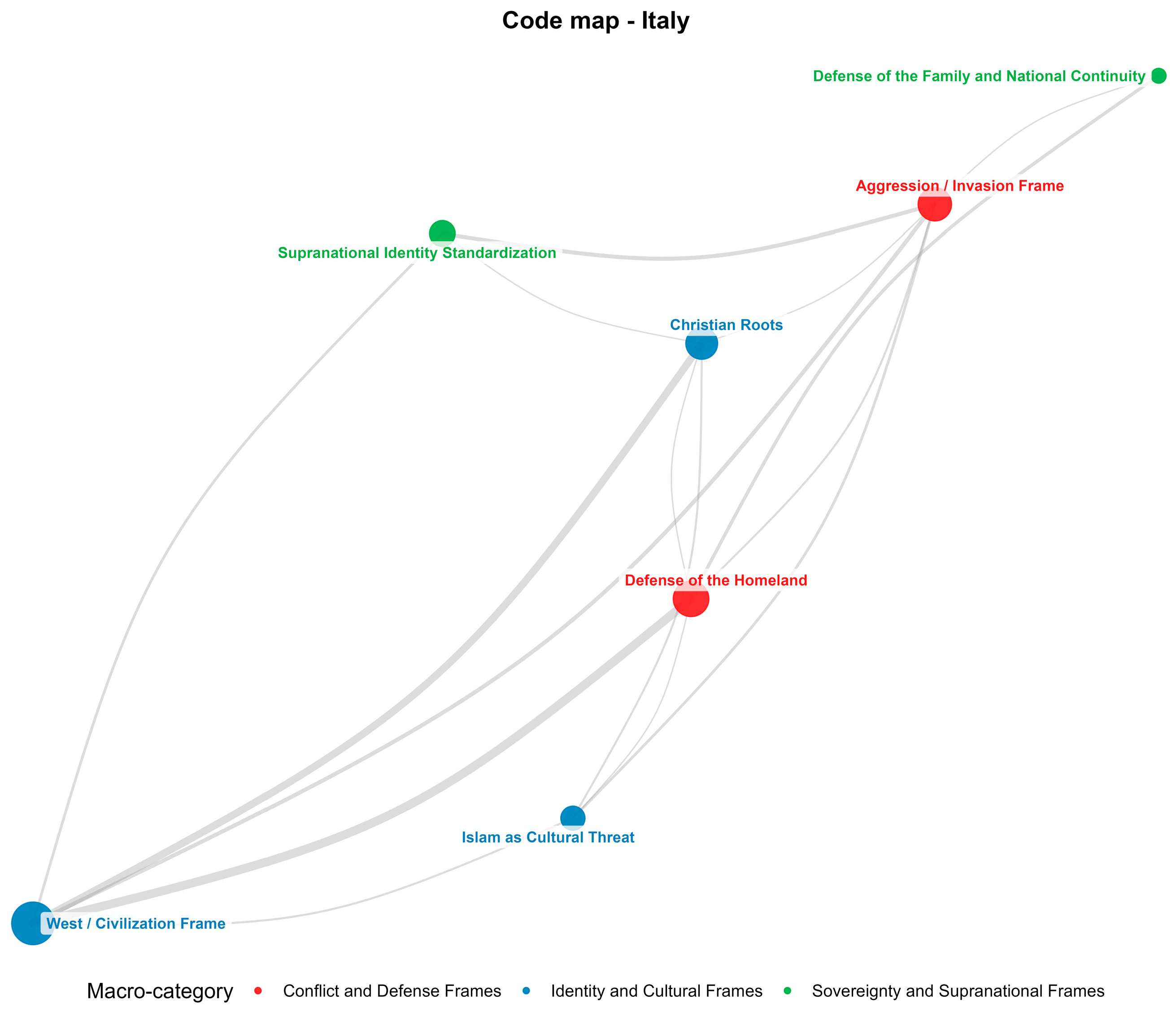
Further insights emerge from the map of the subcodes used for the qualitative content analysis (
Figure 1), which shows the presence of three main clusters. The map is based on code co-occurrence patterns across the corpus: codes that tend to be applied within similar discursive contexts are positioned closer to one another, while those that rarely share such contexts appear farther apart.
A first cluster brings together “West/Civilization Frame,” “Christian Roots,” “Defense of the Homeland,” and “Islam as a Cultural Threat,” which appear closely and repeatedly connected, suggesting a tendency for these subcodes to be applied within the same textual segments; “Aggression/Invasion Frame” also connects into this cluster, though somewhat more loosely, through its links to “Christian Roots” and “Defense of the Homeland.” A second, smaller connection links “Aggression/Invasion Frame” to “Supranational Identity Standardization” and to “Defense of the Family and National Continuity,” the latter appearing at the edge of the map and linked mainly through this single connection rather than to the rest of the network.
4.2. Germany
The “kwic” function extracted a total of 772 associations, reduced to 133 after data cleaning, following the same criteria applied to the Italian corpus. The manual coding process with MAXQDA reflected the prominence of the code “Conflict and Defense Frames,” with 68 coded segments. Specifically, the two subcodes of the category were distributed quite evenly: “Defense of the Homeland” with 38 segments and “Aggression/Invasion Frame” with 30.
The second most used category was “Identity and Cultural Frames,” with 65 coded segments. The most prevalent subcode was “West/Civilization Frame” (40 segments), followed by “Islam as Cultural Threat” (20) and “Christian Roots” (5). “Sovereignty and Supranational Frames” accounted for the lowest number of coded segments (27), distributed as follows: “Defense of the Family and National Continuity” (21) and “Supranational Identity Standardization” (6).
Overall, the German corpus shows a frequent use of subcodes associated with “Conflict and Defense Frames,” which represent the most commonly applied category. Within this category, the two subcodes “Defense of the Homeland” and “Aggression/Invasion Frame” display a relatively similar number of coded segments.
Within “Identity and Cultural Frames,” the most frequently applied subcode is “West/Civilization Frame,” followed by “Islam as Cultural Threat,” while references coded as “Christian Roots” occur less frequently. Regarding “Sovereignty and Supranational Frames,” a higher number of segments were coded with “Defense of the Family and National Continuity” than with “Supranational Identity Standardization.”
The map of subcodes (
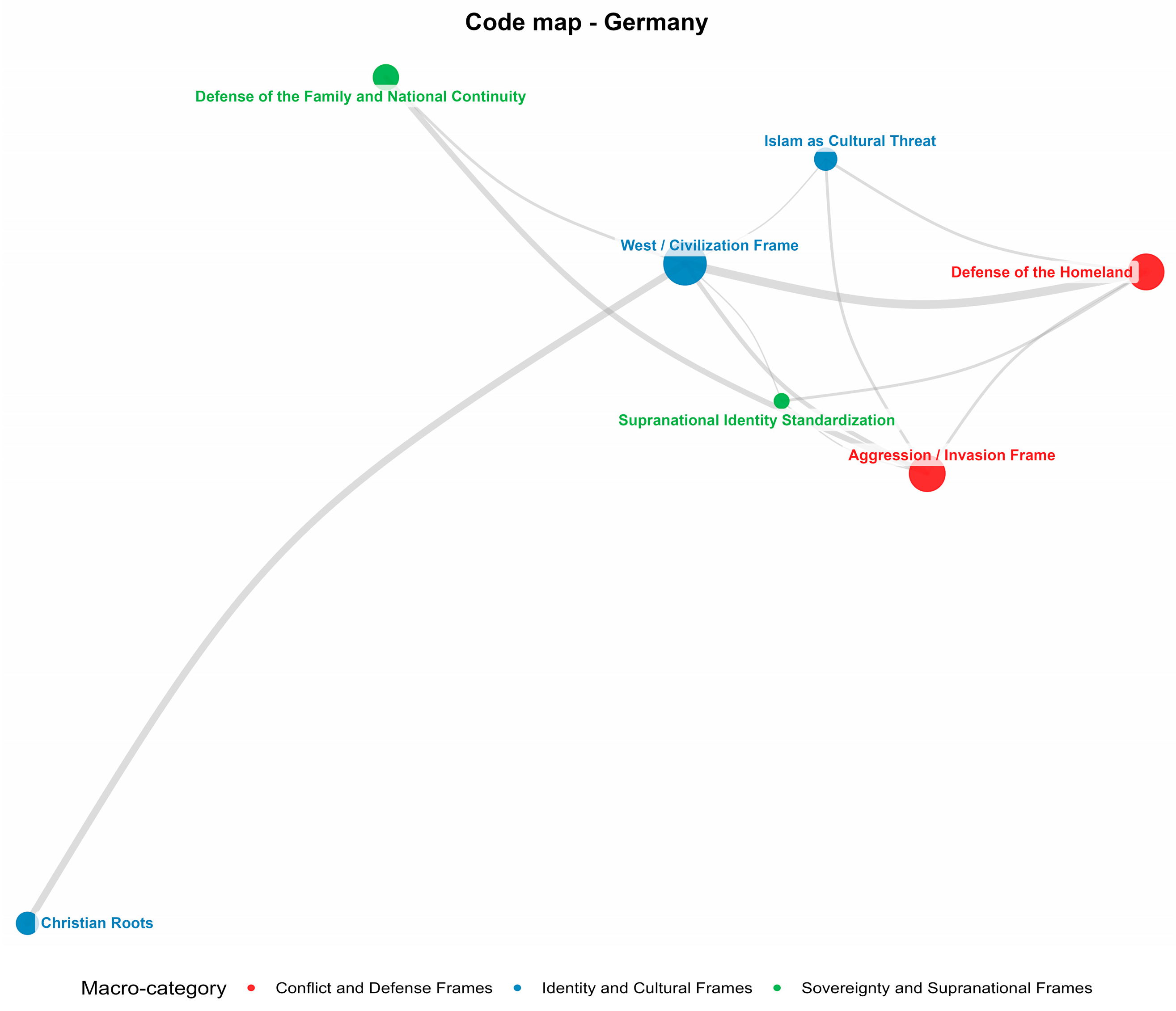
Figure 2) shows the presence of two clusters in the German corpus.
A first cluster brings together “West/Civilization Frame,” “Aggression/Invasion Frame,” and “Supranational Identity Standardization,” which appear closely and repeatedly connected, suggesting these three subcodes are frequently applied within the same textual segments; “Islam as a Cultural Threat” and “Defense of the Homeland” seem to sit at the edge of this same cluster, each linked mainly to “West/Civilization Frame” and “Aggression/Invasion Frame” rather than forming a distinct group of their own. A second, separate cluster includes “Christian Roots” and “Defense of the Family and National Continuity,” which appear notably distant from the rest of the network and do not seem directly linked to one another, suggesting these two subcodes are applied in fairly isolated segments of the German corpus.
4.3. Spain
The KWIC analysis of the Spanish corpus produced a total of 474 associations. After data cleaning, following the same criteria applied to the Italian and German material, 132 valid associations were identified. These associations formed the basis for the qualitative content analysis, which applied the same coding scheme developed for the Italian and German corpora. Given the discontinuation of MAXQDA licensing during the course of the revision, the Spanish segments were coded manually within a structured spreadsheet, following the same codebook and macro-category scheme that had been applied to the Italian and German material.
A total of 62 segments were coded with subcodes related to “Identity and Cultural Frames,” making this the most frequently used category, followed by “Sovereignty and Supranational Frames” with 53 coded segments, and “Conflict and Defense Frames” with 32.
Within “Identity and Cultural Frames,” the most frequently applied subcode was “West/Civilization Frame” (42 occurrences), followed by “Christian Roots” (11) and “Islam as a Cultural Threat” (9).
Regarding “Sovereignty and Supranational Frames,” the most prominent subcode was “Defense of the Family and National Continuity” (27 occurrences), followed by “Supranational Identity Standardization” (26).
Finally, within “Conflict and Defense Frames,” “Aggression/Invasion Frame” was the most frequently applied subcode (17 occurrences), while “Defense of the Homeland” was used in 15 segments.
Overall, the Spanish corpus shows a higher number of coded segments associated with “Identity and Cultural Frames” compared to the other two categories. Within this category, subcodes related to civilizational and religious references are the most frequently applied. “Sovereignty and Supranational Frames” are also applied to a substantial number of segments, with a relatively balanced distribution between “Defense of the Family and National Continuity” and “Supranational Identity Standardization.” By contrast, subcodes associated with “Conflict and Defense Frames” are applied less frequently than those related to identity and sovereignty.
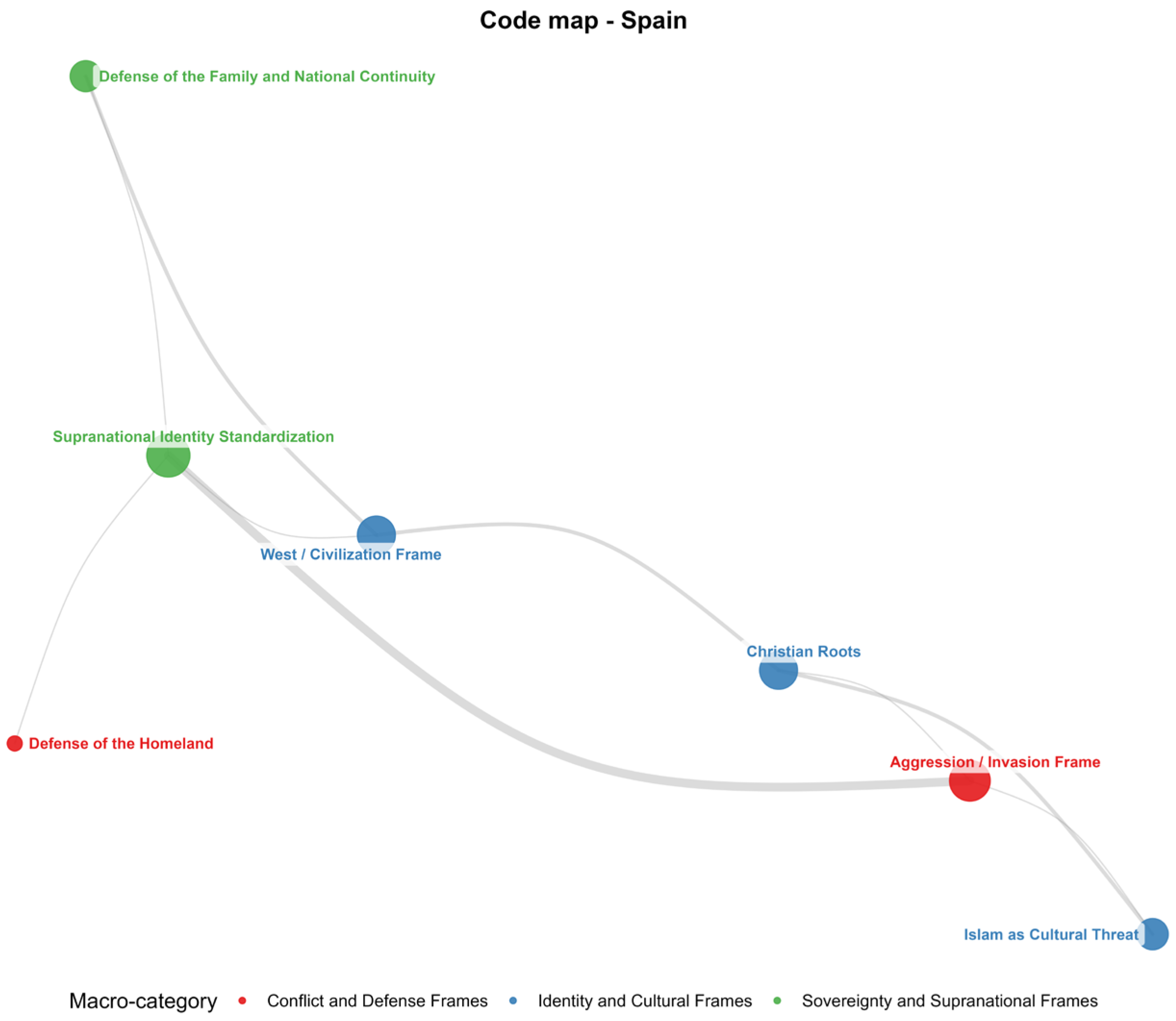
The map of subcodes (
Figure 3) highlights patterns of proximity among the codes applied to the Spanish corpus. Two main clusters can be observed.
A first cluster groups “West/Civilization Frame” and “Christian Roots,” which look closely connected and suggest these two subcodes often show up together in the same segments; “Defense of the Family and National Continuity” seems to sit more at the edge of this cluster, linked mainly to “West/Civilization Frame” rather than to “Christian Roots” directly. A second cluster brings together “Aggression/Invasion Frame” and “Supranational Identity Standardization,” reflecting their recurrent joint use in the material, with “West/Civilization Frame” seeming to bridge this cluster and the first one. Finally, “Islam as a Cultural Threat” and “Defense of the Homeland” sit at the edges of the map and do not appear directly linked to each other; each seems to connect instead into one of the other two clusters, “Islam as a Cultural Threat” toward “Aggression/Invasion Frame” and “Defense of the Homeland” toward “Supranational Identity Standardization.”
Taken together, the results point to both shared patterns and differences across the three national contexts. Identity and cultural frames are more frequently applied within the Italian and Spanish corpora, whereas the German material is characterized by a higher use of conflict- and defense-related framing. References to sovereignty and supranational dynamics are present across all cases, though with varying intensity and thematic focus, with the Spanish corpus showing the highest number of coded segments associated with this category.
6. Conclusions
Drawing on
Linz’s (
2006) distinction between political religion and politicized religion, this article has suggested that contemporary conservative discourse may be contributing to the consolidation of a secularized form of religiosity grounded in identity, national continuity, and shared traditions.
Through the comparative analysis of three European conservative parties, Fratelli d’Italia, Alternative für Deutschland, and Vox, the findings indicate a recurrent interconnection between references to national and Western identity, Christian roots, and the defense of the homeland against perceived threats such as migration and supranational governance. Across contexts, religious references appear less as expressions of theological doctrine and more as symbolic resources used within broader narratives of cultural continuity and collective belonging, in line with what
Haynes (
1997) describes as the exercise of religious influence through parties and movements rather than through institutions or doctrine.
However, this pattern appears to take different forms across the three cases. In the Italian corpus, civilizational and religious references seem closely tied together, with Christian heritage working as the basis of a broader narrative of national and Western continuity, in line with the civilizationism described by
Brubaker (
2017b). In the German material, conflict- and defense-oriented frames appear dominant, while Christian references and family-related themes are used in more limited segments, which may reflect the more mixed confessional setting in which Alternative für Deutschland operates. The Spanish corpus seems to stand in between, with sovereignty-related frames particularly present and civilizational references tying identity claims to a religiously and historically defined national community (
Giorgi 2022). These differences may suggest that the use of religion as identity rather than as belief is filtered through each country’s distinct religious and political history.
Across the three cases, the capacity of religious references to work as symbolic capital (
Bourdieu 2013) appears to be present, building belonging without requiring belief, rather than any shared doctrinal content. This seems in line with what
Roy (
2016) describes as the detachment of Christian identity markers from religious practice, and with the persistence of a diffuse religious sentiment that secularization does not appear to have dissolved (
Norris and Inglehart 2007). In this sense, the communicative frame examined here appears to work as politicized religion in
Linz’s (
2006) sense, where the substitute function of religion seems directed at holding together an identity-based political community.
These findings can also be read as an empirical illustration of how the “losers” of globalization, as theorized by
Kriesi et al. (
2006) and
Bornschier (
2010), pursue not only material but also affective and identity-based forms of compensation. Read through
Ignazi’s (
2003) account of the demand for stricter moral standards, and through
Arato and Cohen’s (
2017) discussion of exclusivist identity politics, the communicative frame identified here appears to translate this broader cleavage into a specific discursive strategy, one in which religion, family, and homeland function as anchors against a perceived loss of both material security and cultural integrity.
Rather than signaling the emergence of a new religion in a doctrinal sense, these patterns suggest a reconfiguration of religion as a cultural and identity-based frame within contemporary political communication. This perspective may contribute to ongoing debates on the transformation of religion in secularized societies and offers a useful analytical lens for examining identity-based political rhetoric in comparative perspective.