Article

Rising Secularism After Secularization? The Determinants of Transcendent and Immanent Worldviews in Germany 1982–2023

1
Department of Sociology and Social Psychology, University of Cologne, 50923 Cologne, Germany
2
GESIS Leibniz-Institute for Social Sciences, 50667 Cologne, Germany
*
Author to whom correspondence should be addressed.
Religions 2026, 17(6), 741; https://doi.org/10.3390/rel17060741
Submission received: 6 March 2026 / Revised: 2 June 2026 / Accepted: 17 June 2026 / Published: 21 June 2026

Abstract

This paper investigates whether transcendent worldviews—those oriented toward a beyond—decline while immanent worldviews—those oriented toward this world—increase. We draw on an inventory spanning positions from theism and deism to naturalism and existentialism, administered seven times in West Germany (1982–2023) and six times in East Germany (1992–2023). In West Germany, existentialist worldviews ranked first, followed by naturalist, theist, and deist ones. While existentialist worldviews remained stable, transcendent worldviews declined and immanent ones grew, producing a substantial and growing advantage for immanent over transcendent orientations. In East Germany, existentialist and naturalist worldviews were markedly dominant, well above transcendent ones throughout the observation period. Both remained stable, while transcendent worldviews increased only minimally, leaving the gap largely intact. To test whether these period effects persist under controls, we employ OLS regressions with robust standard errors, accounting for cohort, age, church attendance and belonging, community size, parenthood, work engagement, education, and gender. In West Germany, transcendent worldviews declined and immanent ones increased non-monotonically. In East Germany, the pattern reversed: transcendent worldviews increased and immanent ones decreased non-monotonically. While mean levels do not differ significantly between the two regions, the direction and structure of effects do. The discussion addresses why transcendent worldviews are better explained than immanent ones, and what accounts for the divergent trajectories between East and West Germany.

1. Introduction: Design of the Study

1.1. Conceptual Background: The Religious Question, Religiosity, Transcendent and Immanent Worldviews

Knowing that they will die, humans cannot avoid asking where life and the world come from—and where they lead. The question puts life and world in a frame beyond the person’s lifespan and can—for this very reason—be called the religious question.1 The answer provides meaning to life and world. Yet, there are many answers. They have historically accumulated from the experiences and arguments exchanged and recorded among the members of a culture. Therefore, answers cannot be personally constructed from scratch but must be drawn from thought systems, that are interrelated propositions accumulated within a culture.
The first thought system to provide an answer—in history and in personal life—is religion (Stark 2014, pp. 303–21; Houtman et al. 2021, pp. 5–10). Religion refers to a frame beyond this world in asking and in answering the religious question—which may equivalently be called transcendent or supernatural. It comprises beliefs and practices. Beliefs are either conceptual or figurative.
Conceptual beliefs refer to ideas about humanity and the world beyond human experience and imagination; they must be explicated, understood and justified analytically to be believed and can be represented symbolically. They rely on arguments and cannot be enacted literally. Examples from Christianity are the creation of the world by God, original sin and redemption, god’s love and men’s unworthiness, guilt and absolution, trinity and omnipotence, the transubstantiation of wine and bread into Christ’s flesh and blood. Figurative beliefs are cast in stories, in pictures or narrations. Stories are still sets of interrelated sentences. But they cannot be justified analytically and must be taken for granted as presented. In order to be believed, they must be represented or reenacted and rest on practices which do so. Examples of pictures from Christianity are angels and devils, heaven and hell, saints and miracles; examples of narrations are Mary’s annunciation and the birth, death, resurrection, and ascension of Christ. As the examples show, conceptual beliefs are a matter of exegesis never definitively settled, but figurative beliefs are pinned down in hundreds of precisely elaborated paintings in—even Protestant—churches. And beliefs of either kind are characteristic of a specific religion and often its distinctive markers against other creeds. To adopt a belief, one must investigate and evaluate, speculate and decide, argue and deliberate about one’s inherited religion or among known religions; in brief, work mentally.
Religious beliefs of either kind are reinforced by religious practices such as prayer and service attendance, which are cast in rituals. They give plausibility to beliefs by enacting or imagining their contents. Although practices assume their specific forms in a given religion, they are as such common to all religions. While beliefs differ between religions, practices are their common structural foundation. In every religion, prayer means addressing an entity beyond this world, and service means devoting time and energy to it. To perform a practice, one must speak or chant inwardly or outwardly, act in sacred places or according to sacred rules; in brief, work physically.
If the figurative elements of religious belief are stripped away, the conceptual ones remain. They can be termed transcendent worldviews (Felling et al. 1987, pp. 41–46). Just as religious beliefs in their full scope, they answer the religious question with reference to a transcendent world. Yet in contrast to figurative beliefs, they rely on arguments rather than stories cast in pictures and narrations. Two examples illustrate this: All that remains of the picture of heaven as a location of eternal life is the expectation of some life after death. And all that remains of the narration of the salvation of every human being through Christ’s death and resurrection is the concept of God’s personal care for everyone.
While figurative belief is strengthened by the practices of a church, conceptual belief no longer needs such support. Transcendent beliefs in Christian populations are Christian beliefs independently of churches; at least, they are more distant from the church than Christian beliefs, but still Christian—in contrast to non-Christian beliefs such as in reincarnation, transmigration, and ghosts, as well as magical practices such as fortune telling and astrology (Pickel et al. 2024, pp. 166–80; Wunder 2024b, pp. 177–78). Knowing that God exists and that he cares for each human being frames this life in a meaningful, transcendent perspective no less than believing in Christ and in heaven does.
If religion is historically the first thought system to provide answers to the religious question for a society’s population at large, it has not remained the only such system. The modernization of Western societies has institutionalized liberty and property rights, increased societal and individual wealth, enthroned science as the means of establishing truth (Stark 2014, pp. 303–21), reduced working in favor of leisure, and introduced compulsory education such that formerly exclusive cultural pursuits became available to everybody (for example, Stark 2014, pp. 325, 340–41). Just as a belief in a world beyond, thus, reasoning and observing can establish convictions about this world which provide meaning to life—without resorting to beliefs on a world beyond. To develop, cultivate and pass down such convictions is the task of secular thought systems, namely philosophy and the sciences.2 Just as the Christian religion explains the world as God’s creation, science explains it as the result of a big bang followed by a permanent expansion and an evolution of species. Just as a meaning of life can be found in the search for redemption, it may be found in envisioning and pursuing personal goals.
Worldviews derived from secular thought systems can be called immanent worldviews (Felling et al. 1987, pp. 43–46, 54). They refer to a frame beyond this world in asking, but not in answering the religious question. They compete with conceptual beliefs in the form of transcendent worldviews in providing meaning in life. They offer themselves as an alternative to religious belief for those who no longer share it or those who were, as in former Communist countries, forced to abandon it. While transcendent worldviews are derived from religion and can be backed by religious practices, immanent worldviews lack a corresponding confirming practice. They remain thought systems and attain plausibility by arguments alone.
Transcendent worldviews strip religious belief of its “second and third-order”—in most cases figurative—“dogmas” and reduce it to its conceptual core (Felling et al. 1987, p. 43); immanent worldviews contradict belief with concepts restricted to this world.3 Both focus on cosmology rather than morality (Stenmark 2025, p. 7). Religious beliefs and transcendent worldviews are closer to each other than transcendent and immanent worldviews. Transcendent and immanent worldviews are often held to be mutually exclusive (Bruce 2002, pp. 106–11; Stark 2014, pp. 303–10; Weir 2026, p. 231). Even more, they are an arena for a “religious-secular competition” where the need to find meaning in life originally served by religion is more and more taken over by science and philosophy; religious beliefs lose plausibility and religious practice lose shares of life time while secular worldviews gain attention in the disenchanted occupational and family life, the growing leisure time, and the expanding mass media (Stolz 2013, pp. 36–38). And competition might become cooperation: In a “postsecular age” (Habermas 2001) “religious and secular worldviews could coexist and even enter into dialogue with one another” (Gorski and Altınordu 2008, p. 56).4
Like religious beliefs, transcendent worldviews are subject to secularization—that is, to the decrease in religious practice and belief in Western countries, Europe and its developed former colonies (Berger 1967, pp. 109–10; Bruce 2002, p. 37; Meulemann and Schmidt-Catran 2025, pp. 9, 19–23).5 Yet immanent worldviews are born secular. They should increase rather than decrease—partly by serving the needs formerly satisfied by transcendent worldviews, partly by marshaling their own intellectual foundations from science and philosophy. While secularization pushes religious practices and beliefs back, secularism aims at advancing on purely intellectual premises.

1.2. Research Questions: Rising Secularism After Secularization?

After decades of survey research, secularization in Western nations is an established fact.6 But what comes after it has, although discussed in philosophy (Stenmark 2025, pp. 3–5) and in “cultural sociology” (Houtman et al. 2021; Watts and Wilkins-Laflamme 2026), to our knowledge never been analyzed in national surveys. Is the decline of religion followed by a rise of secularism?7
The question is narrowed to transcendent and immanent worldviews. If transcendent worldviews are attenuated forms of religious beliefs, they should be reduced by the same factors as religious beliefs, yet possibly less strongly. And as a departure from that tradition, immanent worldviews should be driven by the same forces in the opposite, positive direction, yet with weaker force. The former may be subject to the same secularization process and the latter may rise as a compensatory countermovement. The factors shaping the former may mirror those shaping the latter, but in the opposite direction. This study addresses two research questions: (1) Do transcendent worldviews decrease and immanent ones increase over time in Germany, and does this differ between regions with self-induced versus state-enforced secularization? (2) Are these developments driven by the same individual-level factors as the secularization of religion operating in opposite directions for transcendent and immanent worldviews?

1.3. Prior Research and Research Hypotheses

The question is examined for West Germany from 1982 to 2023 and for East Germany from 1992 to 2023.8 According to “the logic of comparative inquiry” (Przeworski and Teune 1970, p. 11), proper names of macro-units should be substituted by an analytical concept on which they vary. For the two former Germanies this is the relation of the state to religion. In the Federal Republic of Germany (FRG), the state was benign to religion. It did not infringe upon religion, leaving secularization to proceed as a self-induced societal process. In the German Democratic Republic (GDR), the state suppressed religion such that a self-induced process was accelerated by a state-enforced secularization (Stolz et al. 2000).
The state-enforced secularization was at least partly accepted by the people in their allegiances and worldviews—as qualitative interviews suggest (Wohlrab-Sahr et al. 2008, pp. 131, 134–35) and repeated representative population surveys confirm over extended periods after unification. From 1991 over three time points in between to 2010, almost 80% of East Germans, roughly 35 percentage points more than of West Germans, constantly regarded “socialism to be a good idea badly performed”—regardless of its anti-religious stance (Fuchs and Roller 2016, pp. 410–11).
The enduring sympathy of East Germans for an anti-religious state is reflected in large disadvantages of the East Germans in religiosity, as at least three nationally representative survey series show. First, East German church membership, frequency of church attendance, and frequency of prayer, as well as self-reported religiosity and importance of religion in personal life consistently lag behind West Germany from 1992 over five time points in between up to 2012 (Meulemann 2016, pp. 378–82). Second, the East German disadvantage of self-reported religiosity even increased from 2002, 2006, 2010 to 2014 (Pickel 2017, p. 52). Third, large disadvantages of East Germans in terms of church membership and service attendance persisted, and as to belief in God and to the importance of religion in personal life even increased again from 1990, 1992 to 2008 (Müller et al. 2012, pp. 104, 114).
In brief, East Germans have been forced to become, and genuinely became, secular (Froese and Pfaff 2005, pp. 411–14).9 “West Germany” means freedom of religion and worldviews, “East Germany” means—after 1989—the persisting imprints of political repression on religion and, consequently, on worldviews. If people switch from transcendent to immanent worldviews in West Germany, they benefit from the long-established religious freedom and from the accumulated intellectual resources of the Christian religion. If people refuse to use the newly gained religious freedom in East Germany, they voluntarily maintain the secular dispositions instilled by repression of the Christian religion.
The differences of the two worldviews between East and West Germany and their development up to 2012 have been presented in a former publication (Meulemann 2016, pp. 381–82). Transcendent worldviews are considerably stronger in West than in East Germany, and immanent worldviews somewhat lower. In West Germany, transcendent worldviews decreased slightly and immanent ones increased slightly between 1982 and 2012; and in East Germany, transcendent and immanent worldviews remained constant between 1992 and 2012. The present analysis extends the time series from 2012 to 2023 and tests its results statistically. Yet because the secularization of religious belief and practice has developed differently in both regions (Stolz et al. 2000, pp. 633–35; Pickel and Pickel 2024) and the differences persist until today, our study focuses on the developments of worldviews in each region separately. For all predictors, hypotheses are deduced from the existing literature in the next two sections.

1.3.1. Research Hypotheses Related to Time

On the macro level, time refers to societal tendencies; on the micro level, to the age of persons.
Time as Societal Tendency: On the macro level, time catches the modernization of societies. Modernization is a summary term for a broad range of societal developments which can be classified as social differentiation and cultural pluralization, measured in East and West European countries by indicators such as wealth, social security, and inequality as well as by diversity and rationalization.
Secularization theory postulates that the modernization of a society engenders its secularization. Indeed, religiosity is retreating in West and East Germany. The frequency of church attendance decreases in West Germany between 1980, 1991 and 2021, monotonously and almost linearly, from 12 to 10 and 4 weeks per year; and it remains constant in East Germany between 1991 and 2021 at somewhat above 2 weeks per year so that the substantial gap between the two parts of the country narrows to a quarter of its former size by 2021. And the frequency of prayer decreases between 1991, 2008 and 2018 from 88 to 73 days per year in West Germany; and from 31 to 21 in East Germany such that the gap is reduced only slightly from 57 to 54 days. Both decreases are monotonous and almost linear (Pickel and Pickel 2024, p. 162). Together with religious behavior, belief and religious self-identification also decrease. The belief in God or a Higher Power decreases between 1990 and 2021 in West from 48% and in East Germany from 10% by 5 percentage points. And the self-categorization as neither religious nor spiritual increases between 2008 and 2018 in West Germany from 34% by about 4 percentage points and decreases in East Germany from 76% by 4 percentage points (Pickel and Pickel 2024, pp. 165, 167). Thus, religiosity outside formal church affiliation also decreases in both parts of Germany and the gap between both parts largely remains. This can be generalized: Secularization theory also predicts a decrease of conceptual religious belief, specifically transcendent worldviews.
Yet what can it predict on their counterpart, immanent worldviews? The impetus of secularization, modernization, is congenial to immanent worldviews. People experience daily that achievements of modernization—economic growth, extended personal and civil liberties—have created increasingly promising and livable societies. People hear, read and view daily about scientific and technological advances which ease their mundane world and situate it within an expanding immanent universe intelligible and accessible to human reason (Berger 1967, pp. 105–54; Bruce 2002, p. 4; Pollack and Rosta 2015, pp. 72, 247). Immanent societal successes call for immanent personal worldviews. Just as modernization relativizes transcendent worldviews, it should foster immanent ones.
As the benign relation of the state to religion in the FRG allowed self-induced secularization to develop freely, transcendent worldviews could continue to follow their inherent downward trajectory, and immanent worldviews their inherent upward one after unification. Furthermore, as this momentum continues, the increase and decrease should be monotonous. As the oppression of the churches in the GDR had already restricted transcendent and favored immanent worldviews, both will most probably stagnate until 2023. However, East Germany could also join the developmental path of West Germany or even reverse the effects of the enforced secularization; whether and when this might occur is impossible to predict. Thus, the first hypothesis is: In West Germany, transcendent worldviews decrease and immanent ones increase monotonously from 1982 to 2023; in East Germany, transcendent and immanent worldviews stagnate between 1992 and 2023 (H1).10
Time as Age: On the micro level, time defines the age of persons. Yet age is an ambiguous concept. It has different meanings within and between persons.
Within persons, time stands for the aging inherent in the human condition. Humans become increasingly aware of the limitation of their forces and of the inevitability of death. Religion provides a perspective beyond this life, yet does not alleviate the human condition. As most adults have internalized the religion of their origin, they can either cope with the growing awareness of the human condition by intensifying religious beliefs (Jacobi 2024, p. 208), or by becoming disillusioned with religious belief as a false promise. With age, people may turn toward or away from religion. In both cases, linear aging effects are predicted, positive in the first and negative in the second one. Moreover, the effects may change during life such that aging has u-shaped effects with a minimum in midlife, decreasing before and increasing afterwards.
Between persons, age stands for birth cohorts sharing a common experience in the formative age from 16 to 25 in a certain period. If the experience is seen as resulting in distinctive orientation, such as “skeptical” or “lost”, cohorts are also called generations (Mannheim [1928] 1964). Cohort effects that increase or decrease across successive age brackets constitute a positive or negative cohort succession. In the case of secularization, a negative cohort succession on religious beliefs and practices is often described as the declining power of families and of churches to socialize the young into religion.
In one-time surveys, age differences can be interpreted as aging and as cohort succession. Positive age differences reflecting increasing religiosity are fairly often found and, as result of the growing awareness of the human condition, always interpreted as an effect of aging (e.g., Pollack 2008, p. 174; Ebertz 2009, pp. 630–34; Müller et al. 2012, p. 114; Höllinger and Muckenhuber 2019, p. 28; Immerzeel and van Tubergen 2013, p. 366; Jacobi 2024, pp. 214, 216; Pollack and Rosta 2015, Tables 13.1 and 13.2). Negative age differences are rarely found and mostly, in line with secularization theory, interpreted as the waning capacity of religious institutions to socialize the young, that is, as a negative cohort succession (for 2022: Evangelische Kirche in Deutschland (EKD) 2023, pp. 77, 80–82; Jacobi 2024, p. 221); in only two instances are negative differences interpreted as an effect of aging and some form of disillusionment (Jacobi 2024, pp. 215–17; Ebertz 2009, pp. 635–36). Curvilinear age differences have, to our knowledge, never been examined in one-time surveys.
To decide between aging and cohort succession repeated surveys are indispensable. If age differences remain monotonically positive or negative across survey repetitions, aging is at work. If the same pattern of effects is observed in successively younger cohorts, positive or negative cohort succession is at work.
Repeated surveys unavoidably bring societal tendencies into play. A comparison of published regressions of religiosity on age and tendency with the ones on cohorts and tendency can inform about the direction and the consistency of aging and of cohort succession effects. To the best of our knowledge, exactly nine studies are available for this purpose. If not mentioned otherwise, all use large—between 13 and 36—European country samples and all control for many other person-level variables beyond age, most often gender, education, and civil status (Meulemann and Schmidt-Catran 2025, Tables 3 and 4, studies L3 to L10). They report the following results:
On the one hand, five studies examine age and tendency. One study finds no significant effects of age—on church attendance, self-reported religiosity, and belief (Molteni 2017, pp. 170, 191); and four studies find significant positive effects—on Christian and diffuse religiosity (Tromp et al. 2022, pp. 134, 137), on service attendance and self-reported religiosity (Storm 2017, p. 156), on belief (Müller et al. 2014, Appendix III 6–9), and on service attendance and the life importance of religion (Molteni 2021, pp. 109, 111). Only one of the latter (Müller et al. 2014) additionally examines the quadratic effect of age which is significantly positive; religiosity is lowest in early life and increases decreasingly over the whole life course. Age has predominantly a positive effect on religious practice and belief. The positive effect is not, however, consistent across studies. It counteracts the societal tendency of decreasing religiosity. It is a suppressor rather than an explanation of secularization. Were people not inclined to turn to religion as they become aware of the limits of the human condition, secularization would be stronger than actually measured.
On the other hand, five studies examine cohort and tendency. All find negative cohort succession effects—two nationally comparative studies on service attendance and belief (Reynolds 2017, pp. 214–16; Molteni and Biolcati 2018, pp. 424–25), two nationally comparative studies on service attendance and self-reported religiosity, taken as an indicator of belief (Molteni and Biolcati 2018, pp. 424–25; Meulemann and Schmidt-Catran 2019, pp. 248–49), and one German study on church attendance and belief in God (Stolz et al. 2000, pp. 638–39). Cohort succession has consistently a negative effect on religious practice and belief. It seems to be a strong driver of the “secular transition”, the progressive failure of religion to be transmitted from generation to generation, at least in Western nations (Stolz et al. 2000, pp. 626–28). It may serve as an explanation of secularization.11
Two conclusions emerge from this discussion of age within persons: While one-time surveys cannot decide whether age differences represent cohort succession or aging, regressions of religiosity from repeated surveys on societal tendencies and either interpretation show mostly positive effects of aging and consistently negative effects of cohort succession. Of the two interpretations of age, aging appears to be a weaker predictor of secularization than cohort succession; a negative cohort succession predicts a decline of religiosity.
As a reflection of modernization, the negative cohort succession should be pervasive in European societies. But it may not be so, if governments seek to reverse the trend in alliances with religious authorities. If 31 European countries are subdivided into 19 Western and 12 Eastern countries, the negative effects of time and cohort on church attendance and self-reported religiosity persist—so far, they are indeed pervasive (Meulemann and Schmidt-Catran 2023, p. 299, Online appendix table F5, figure F5). But if Western and Eastern countries are further subdivided into Catholic, Orthodox, and Protestant ones, that is, into a total of six groups, the two dependent variables are affected differently by cohort succession and societal tendency (e.g., the period effect). On service attendance, the negative time and cohort effects remain in all, except in the Eastern Orthodox group, which comprises Bulgaria, Romania, and Ukraine.12 On self-reported religiosity, the negative time effect shrinks to zero and the cohort effect becomes positive (Meulemann and Schmidt-Catran 2023, p. 308, Online appendix table F4, figure F4). In these countries, a coalition between state and state religion fought against secularization and succeeded in suppressing socially visible religious practices, such as service attendance, but not private, socially invisible forms such as self-reported religiosity. In sum, if after the demise of state socialism politics do not interfere in favor of the formerly suppressed religion, successive cohorts become and remain increasingly secular.
Time as Aging, Cohort Succession and Societal Tendency: So far two aspects of time have been considered together with societal tendencies: age or cohort succession. Yet each of the three aspects of time has a meaningful and empirically confirmed effect on religiosity. Age mitigates secularization as aging, but propels it as negative cohort succession. And societal tendencies may give some impetus to secularization, even when person-level variables are controlled for. To assess the relative power of aging, cohort succession, and societal tendencies, they must be analyzed simultaneously. But this meets statistical difficulties, the solution of which are presented in Section 2.2. The following section serves only to report the substantive results obtained so far and to derive hypotheses from them.
The three aspects of time—the age of persons A, the societal tendency or period P, and the cohort C—depend linearly on each other. At a given age in a given year, one necessarily belongs to one and only one cohort. This collinearity can be dissolved in a multi-level regression which disentangles the effects of A, P, and C in a hierarchy—H—and is called HAPC-regression. A is a personal quality and fixed on level 1, and P and C are collectives and random on level 2 (Lois 2019, p. 414; 2024, p. 148).
In such an HAPC analysis, Molteni and Biolcati (2023, pp. 2044–45) analyzed service attendance in 29 European countries between 1972 and 2020. They used a model where only age was fixed and cohort as well as period were random. They found no age effects, strong negative cohort effects in the form of a logistic curve, and weak linear effects of period. The random component of cohort succession was overwhelmingly stronger than the one of period. Secularization is predominantly driven by declining power of religion to socialize the young into religion, and only additionally by a gradual waning of religious sympathy across society.
The HAPC regression has been criticized because the random effects of cohorts cannot extract their specific contribution to the dependent variable from their overlapping impact with age such that they underestimate the impact of cohorts in favor of the fixed effects of age. To reduce the overlap between cohort and age and to estimate cohort effects independently from age, the random cohort effects are replaced by a fixed effect of the mean ages in each cohort such that age variance overlapping with cohort variance is partialized out and cohorts are represented by a linear effect. This model is called HAPC-FC (Fixed Cohorts regression, thus, A is fixed on level 1, and P random and C fixed on level 2 (Lois 2024, pp. 149–50)).
In a comparison between a HAPC-model and a HAPC-FC-models, Lois (2024, pp. 155, 157, 158) analyzed church membership in West Germany, which is an ambiguous indicator of religiosity because leaving the church can also be motivated by tax savings. The cohort effect over 18 cohorts born between 1890 and 2002 remained constant but decreased strongly and monotonously in a nearly logistic curve in HAPC-FC. Thus, cohort effects were underestimated as random effects. The period effect decreased nearly monotonously from 1980 to 2021 in HAPC but remained constant until 2010 and decreased strongly afterwards in HAPC-FC. Lois (2024) concluded that period effects were overestimated when cohort effects were modeled via random components. Finally, the age effect was altogether negative in HAPC-FC. Thus, it was strongly overestimated when cohorts were considered random. In sum, treating cohorts as random effects disadvantages them in favor of period and age effects.
The above results of HAPC-models of service attendance in Europe and of church membership in Germany can be summarized as follows. On the one hand, the HAPC-model of service attendance (Molteni and Biolcati 2023) treats a direct behavioral measure of religiosity with a less advanced statistical method which tends to underestimate cohort effects. Yet it shows strong cohort effects which could only become larger once they are corrected for underestimation. On the other hand, the HAPC-FC model of church membership (Lois 2024) treats an ambiguous aspect of religiosity with a more advanced statistical method which corrects for the underestimation of cohort effects. It reveals cohort effects not detected in HAPC and corrects the overestimation of period and age effects in HAPC. Yet both models suggest a strong negative cohort succession, a small societal decline and an uncertain and small negative effect of age. Both confirm the predictions of secularization theory of a negative cohort succession, and the prediction derived from the human condition of a positive aging effect. Finally, both show a rank order of absolute effect sizes: C larger than P larger than A.
We will take these predictions of secularization theory as hypotheses for the analysis of worldviews. The cohort succession should in general be monotonically negative for transcendent worldviews and monotonously positive for immanent ones. This should show up clearly in West Germany. But just as for the societal tendency, the oppressive relation of the former GDR to religion could have been superimposed on the gravity of secularization until unification such that decrease of transcendent worldviews and the increase of immanent worldviews ceases with the last cohort socialized in the GDR and reverses in subsequent cohorts. Thus, the second hypothesis is: In West Germany between 1982 and 2023, cohort succession monotonously decreases transcendent and increases immanent worldviews; in East Germany between 1992 and 2023, the same monotonous developments as in West Germany appear in cohorts socialized before unification while in cohorts socialized after unification they are inverted (H2).
While periods and cohorts are subject to state manipulation, aging is part of the human condition. It brings the finiteness of life to consciousness and favors answers to the religious question beyond this life. It should favor transcendent worldviews and militate immanent ones—equally in West and East Germany. Thus, the third hypothesis is: Aging increases transcendent and decreases immanent worldviews (H3).
Returning to the three hypotheses on time, the oppressive relation of the state to religion in the former GDR could have affected societal tendencies and cohort succession, but not age. Just as age, all further determinants of worldviews are not sensitive to state suppression of religion. Accordingly, all following hypotheses hold equally for both parts of Germany.

1.3.2. Hypotheses for Control Variables

Age, Period, and Cohort can affect any attitude and behavior. What predicts transcendent and its counterpart immanent worldviews? On the one hand, our selection is restrictive in the domain of religion. As beliefs are typical for a specific religion and practices common to all, we ignore beliefs and concentrate on practices. In particular, as worldviews rest on concepts, we ignore figurative beliefs. On the other hand, we concentrate on the needs of human life religion is supposed to serve from cradle to grave. Thus, we consider two predictors: religious practice and the life course.
Religious Practice: Transcendent worldviews can be confirmed by religious practices; immanent worldviews lack a supporting behavioral counterpart. While the whole range of religious beliefs can be corroborated by the same rituals with their rules, requirements, and promises, a secular, scientific or philosophical worldview must be confirmed on its proper ground, by arguing about its internal consistency and by confronting it with reality.
The availability of religious practices makes it easier to form and maintain transcendent worldviews and to abstain from immanent ones; and the lack of corroborating practices makes it more difficult to form and maintain immanent worldviews and defend them against transcendent criticism. Transcendent worldviews share with religion the support through religious practice. Immanent worldviews rest on secular thought systems which aim to validate propositions on this world by methodical reasoning. They are false, at least delusive, under religious premises. Thus, religious practice may favor transcendent worldviews and disfavor immanent ones. As indicator of practice, service attendance is examined. It is the reenactment of figurative belief. It presupposes and reinforces beliefs in biblical stories and religious concepts, as well as in conceptual beliefs such as the existence of God and God’s care for men.
In brief, transcendent worldviews maintain from their religious origin the advantage of being backed by religious practices; historical priority privileges transcendent worldviews over immanent ones. Transcendent worldviews and religious practice rest on the same fundament of belief, immanent worldviews rest on assumptions opposite to belief. Thus, the fourth hypothesis is: The more frequently one attends services (H4), the more strongly one adopts a transcendent worldview; the less strongly an immanent worldview.
The impact of services depends on church13 membership. Membership as such strongly favors transcendent worldviews, and disfavors immanent ones in comparison to no membership.
Furthermore, churches form a hierarchy of strictness—of demands from and control power over their flock—which is reflected in a hierarchy of small effects on worldviews spreading narrowly around the large effect of membership as such. With the successive separation of Christian churches from each other, individual freedom from religious authorities increased and the support of churches from the nation state dwindled. The hierarchy of churches’ strictness thus depends on the specific historical religious configuration. For Germany, this means that the Roman Catholic church and the Orthodox churches remain stricter—prescribing more beliefs and behaviors and imposing stronger sanctions for disobedience—than the Protestant (Lutherans) ones; and the Orthodox churches whose authority domains still overlap with their nation states are stricter than the universal and supranational Roman Catholic. Beyond Christianity, the Islamic religion remains orthopractic and is consequently stricter than all Christian churches.14 In sum, churches have a stronger impact on beliefs and worldviews the stricter they are, the more demands and control they impose on their adherents. And the hierarchy of strictness runs down from Islam, to Orthodox, Roman Catholic, and Protestant. Indeed, the differences in impact among the churches just enumerated on service and self-reported religiosity in 26 European nations including the two parts of Germany from 2002 to 2016 followed this sequence (Meulemann and Schmidt-Catran 2019, pp. 248–50)—as did the differences in impact among Catholics, Protestants and non-members on transcendent worldviews in unified Germany 2023 (Pollack and Rosta 2015, p. 141). Thus, church membership as such strongly increases transcendent, and decreases immanent worldviews. And between churches there are smaller variations around the value of membership as such: transcendent worldviews increase while immanent ones decrease according to the hierarchy of demands and the degree of control churches exercise on their adherents (H5).
The Life Course from Belonging to Choice: The manifold events of the life course are restricted here to the “institutionalized normal biography” (Kohli 1987)15. It is defined as the prescheduled sequence of states from given identities to attained positions, from “quality to performance” or “ascription to achievement” (Parsons et al. 1951, pp. 82–83). It begins with inherited forms of belonging to a religion, a family, a community, a nation—which are subsequently replaced by choices among religions, sexual partners, occupations, and places of residence. In the same manner, it can channel the development of worldviews.
While the impact of a church on its flock is close, specific, and committing, the impact of local communities on their inhabitants is remote, diffuse, and malleable. Because in modern nations larger communities16 offer more cultural diversity and more distraction through alternatives than smaller ones, they contribute dissolving the natural identification with an inherited religion and heightening the appeal of alternatives (Olson et al. 2020). Thus, the size of the local community of residence decreases transcendent worldviews and increases immanent worldviews (H6).
While belonging operates uniformly positively, choices have positive and negative impacts on worldviews. They either actualize or virtualize the religious question, that is, they bring the finitude of personal life into the foreground or push it to the background of consciousness. They favor either transcendent or immanent worldviews.
Three hypotheses on choices within the life course will be tested. On the one hand, parenthood creates an orientation that extends beyond one’s own lifespan such that the religious question is actualized.17 Therefore, parenthood should increase transcendent worldviews and decrease immanent worldviews (H7). On the other hand, work engagement and educational advances focus life on self-interest and successes in this world and virtualize the religious question. Therefore, work engagement and educational advances should decrease transcendent worldviews and increase immanent ones (H8, H9).
Finally, a hypothesis on the effect of belonging can be justified on empirical rather than on theoretical grounds. Women are, across many countries and measures, more religious than men (Voas et al. 2013), though this gap is narrowing (Wunder 2024a). Thus, women should support transcendent worldviews more and immanent ones less strongly than men (H10).
Table 1 provides an overview of the hypotheses. All hypotheses have been confirmed for church attendance and self-reported religiosity in 26 Western and Eastern European countries from 2002 to 2016 (Meulemann and Schmidt-Catran 2019, pp. 248–50) and, we argue, can be generalized to worldviews.
Following the enforced secularization of the GDR, H1 and H2 predict that East Germany, as a whole and in its time-varying macro constituents (cohorts), develops differently from West Germany after unification—these are interaction hypotheses. However, the data allow their examination only for a shorter time period. Therefore, H1 and H2 will be examined as simple main-effect hypotheses for West Germany in the longer period from 1982 onwards, and for East Germany in the shorter common period from 1992 onwards; they will be examined as interaction hypotheses by comparing effects between East and West Germany in the shorter period using the total sample.
Furthermore, H3 to H10 are not expected to differ between the parts of the country. They refer to person-level variables, the impact of which is not contingent on macro-level conditions. Age (the human condition), religious practice and the life course (the transition from belonging to choice, and the forces actualizing or virtualizing the religious question) affect worldviews regardless of the former history and the current stage of secularization in country parts. H3 to H10 predict no interaction with region. They will be examined as simple main-effect hypotheses in West Germany over the longer period, and for East Germany over the shorter period. They will also be examined with region as the interaction term in the shorter period and the total sample.

2. Materials and Methods

2.1. Data

The data are from the German General Social Survey (German acronym: ALLBUS), a nationally representative survey series conducted every two years since 1980 among German residents aged 18 and over (GESIS 2026). Worldviews were surveyed in 1982 (only West Germany), 1992, 2002, 2012, and 2023 with a net sample size of 18,085 respondents, 13,250 in West Germany and 4835 in East Germany (after listwise deletion of missing values). With the exception of regression analyses, in which the differences between the two parts of the country were modeled using dummy variables, all analyses were conducted using the person-level east–west weight (WGHTPEW), which corrects for both the oversampling of East Germany and for household selection probability. To expand the empirical base of the analysis, we merged the German sample of the 2007 Religion Monitor (Bertelsmann Stiftung (2010)) comprising 803 West and 196 East German respondents to the ALLBUS because this survey likewise includes the worldviews and all individual-level covariates needed to test our research hypotheses. The total weighted sample comprises 19,085 respondents, among them 5031 from East Germany. Differing response scales were harmonized with the ALLBUS data.

2.1.1. Dependent Variables: Measurement of Worldviews

Worldviews answer the religious question without a reference to figurative beliefs of a specific religion. They can be classified in a sequence from transcendent to immanent, that is, from theism and deism to naturalism and existentialism. An inventory of pertinent questions has been developed and first applied in the Netherlands in 1979 (Felling et al. 1987, pp. 41–46, 53–61, 138–139); partly, it has been adopted in the ALLBUS (Meulemann 2016) used for the present study. Theism contends that God has created world and humankind and cares for them such that people may speak with him, that is, pray to him. Deism contends that God has created men and the world but does not care for them. Theism and deism share the belief in God but differ in their assumption of God’s presence in human lives. Naturalism identifies the meaning of life with laws and the evolution of nature.18 Existentialism searches for meaning in the self-realization of man. Naturalism and existentialism relocate the source of meaning from God to immanent instances, either nature or the self (Felling et al. 1987, p. 44; Schreuder 1991, p. 385; Meulemann 2010, pp. 16–19; Kelle et al. 2019, pp. 95–104).
To measure these different worldviews, the ALLBUS used the following item wordings:
  • Item, (VARIABLE, worldview):
  • There is a god who is concerned with every human personally (PERSON, Theism).
  • There is a god who will be a god for us (FORUS, Theism).
  • Life has only meaning for me because there is a God (GOD, Deism).
  • Life has a meaning because there is something after death (DEATH, Deism).
  • Human life is ultimately determined by the laws of nature (NATLAW, Naturalism).
  • Life is only a part of the natural evolution (NATEVO, Naturalism).19
  • Life has meaning only if you give meaning to it yourself (SELF, Existentialism).20
The response options for all items were: 5 “Agree fully”, 4 “Tend to agree”, 3 “Have no definite opinion”, 2 “Tend to disagree”, 1 “Disagree fully”. The additional category 6 “Have not yet thought about it” was coded as missing.

2.1.2. Dependent Variables: Development of Worldviews

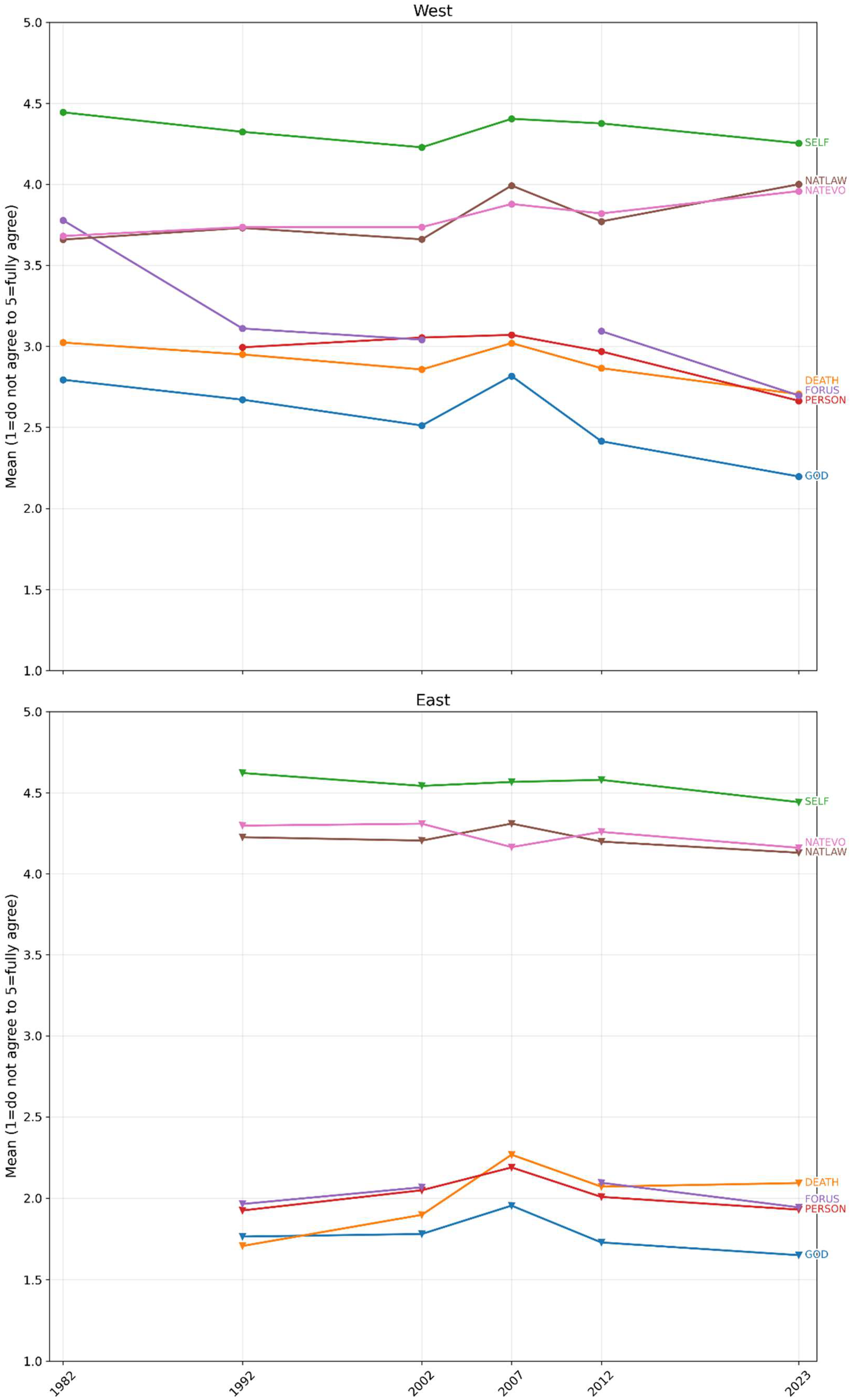
The development of worldviews in West Germany between 1982 and 2023 and in East Germany between 1992 and 2023 is presented in Figure 1.
In West Germany, SELF is by far the most popular worldview. It decreases slightly between 1980 and 2023 from 4.44 to 4.25. It is followed by FORUS (not surveyed in 2007) which decreases from 3.78 to 2.70 and by NATLAW and NATEVO which increase from 3.66 to 4.00 and from 3.68 to 3.96. PERSON decreases from 2.99 in 1992 to 2.66. DEATH and GOD decrease between 1982 and 2023 from 3.02 to 2.70 and from 2.79 to 2.20. Apart from the outlier value of FORUS in 1982, a clear hierarchy and a clear development appear. Existentialism ranks above naturalism which in turn ranks above theism and deism; and the gap between existentialism and naturalism shrinks while the gap between naturalism and the theistic and deistic items widens.
In East Germany, SELF is again the most popular worldview. It likewise decreases slightly between 1980 and 2023 from 4.62 to 4.44. It is followed by NATEVO and NATLAW which decrease slightly from 4.30 to 4.12 and from 4.22 to 4.16. But after a tremendous gap of at least two scale points FORUS and PERSON, GOD and DEATH follow and remain, as a group, constant. Overall, there are only small decreases.
In West and East Germany, the existentialist and naturalist worldviews throughout the observation period consistently rank higher than the theistic and deistic ones—with the only exception of FORUS in 1982 in West Germany. In both parts of Germany, secular worldviews are stronger than transcendent ones; the historical sequence is already reversed in the ranking in every survey wave. Secularization has not only reduced religious belief and practice but also moved worldviews from the beyond to this world.
In West and East Germany, furthermore, the values of almost every item in 2007 are slightly higher than the ones of the neighboring time points 2002 and 2012. Rather than a period, this is an effect of the survey framing. The Religion Monitor of 2007 (Bertelsmann Stiftung 2010) treats religion exclusively while the ALLBUS of all other time points is multi-thematic. A topic put into the foreground gets more positive as well as more negative responses than one addressed in passing.
In summary, despite differences in the level of support for worldviews in the two regions, their hierarchy is and remains the same: Existentialism, then naturalism, then theism and deism; in brief, immanent worldviews before transcendent ones. The predominance of existentialism has been recorded already in the first survey of worldviews in the Netherlands 1979 (Felling et al. 1987, p. 57). Obviously, it is compatible with every other worldview while naturalism and transcendent worldviews are mutually exclusive.
For the further analyses, we compute two composite scores from all items measuring transcendent worldviews (PERSON, FORUS, GOD, and DEATH) and from all items measuring immanent worldviews (NATLAW, NATEVO, and SELF). The scales were constructed based on prior research consistently showing the same factor structure (Felling et al. 1987, p. 141). Cronbach’s Alpha for TRAN is 0.880 for West Germany 1982 to 2023 (n = 13,230) and 0.907 for East Germany 1992 to 2023 (n = 4749); the corresponding values for IMMAN are 0.676 (n = 13,293) and 0.701 (n = 4803). Transcendent worldviews thus show a higher reliability than immanent ones. This is at least partially attributable to TRAN being measured with one more item than IMMAN. While TRAN has high reliability, IMMAN has at least an acceptable reliability. The original scale of the questionnaire from 5 “agree” to 1 “disagree” has been shifted down to from 4 to 0 so that the minimum value reflects the absence of a worldview.
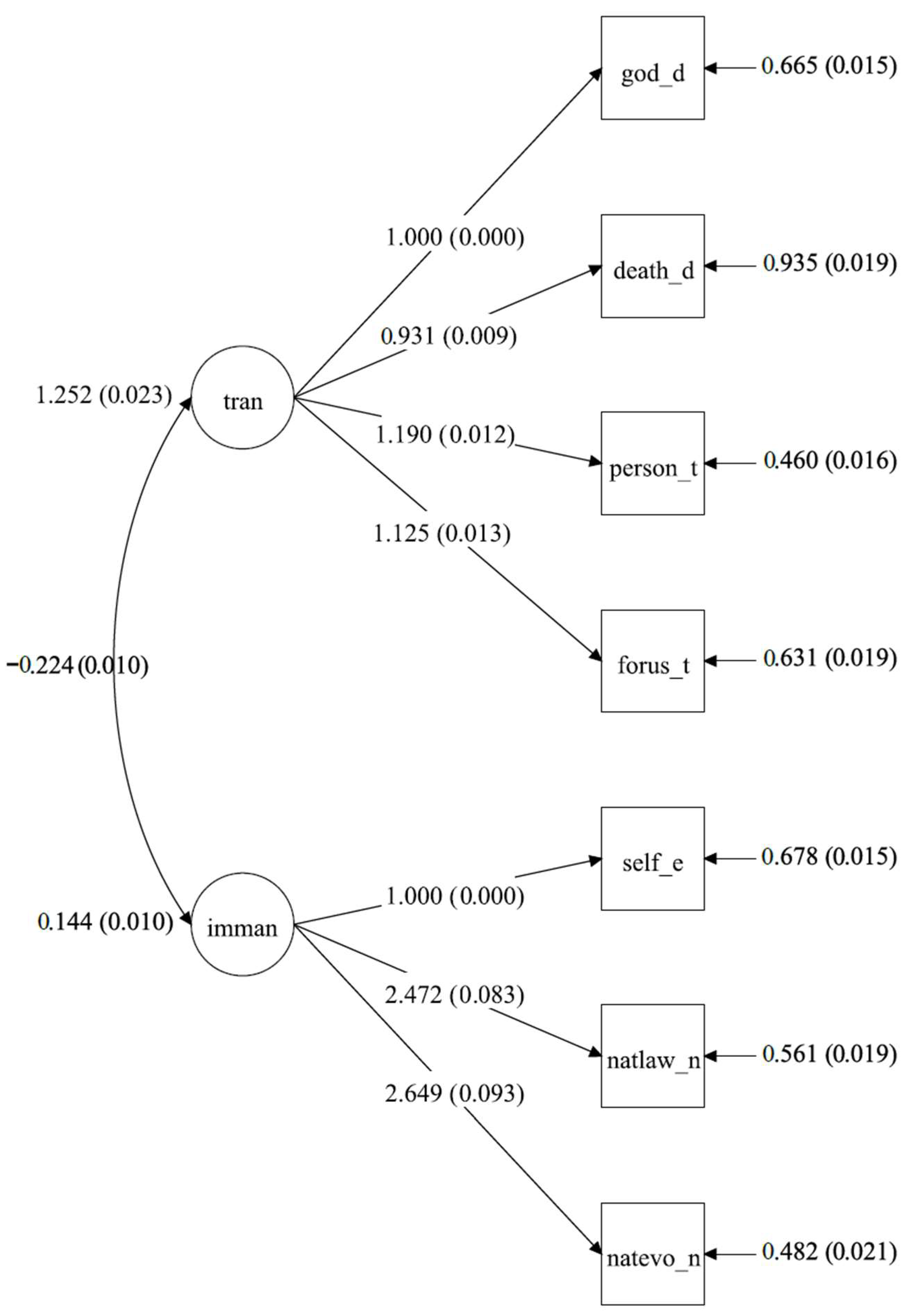
To evaluate whether the theoretical model fits the data, we follow the recommendations proposed by Hu and Bentler (1999), Marsh et al. (2004), and West et al. (2012). Accordingly, we considered RMSEA (root mean square error of approximation) values and SRMR (standardized root mean square residual) values of less than 0.08 and CFI (comparative fit index) values of greater than 0.90 as indicators of reasonable model fit and RMSEA and SRMR values of less than 0.05 and CFI values of greater than 0.95 as indicators of very good model fit. The RMSEA value of our CFA model is 0.065, the CFI is 0.972, and the SRMR is 0.022. Although the values for the SRMR and the CFI show a very good model fit, only the RMSEA shows a reasonable model fit. Thus, the theoretical model fits the data, except that the two deistic items and the two theistic items, which are analytically closely related, load on the same factor (transcendent worldview). The same holds for the existentialist item and the two naturalist items, which load on the other factor (immanent worldview). Hence, people differentiate neither between deism and theism nor between existentialism and naturalism.
Furthermore, immanent worldviews have a much bigger influence on naturalistic items than on existentialistic ones (the factor loadings for naturalistic items are more than twice as high as those for existentialistic ones). Such a differentiation does not hold for transcendent worldviews, where the factor loadings of the theistic items are only slightly larger than the factor loadings of the deistic ones. Finally, the covariance between transcendent and immanent worldviews is significantly negative. The bivariate correlation coefficient is −0.527, which confirms that transcendent and immanent worldviews are not compatible.
Even if the item wordings used in the scales appear somewhat ambiguous, the empirical structure of the measurement model confirms the theoretical expectation. Therefore, we computed two composite scores for our further analyses: one comprising all items that measure transcendent worldviews (PERSON, FORUS, GOD, and DEATH), and one comprising all items that measure immanent worldviews (NATLAW, NATEVO, and SELF).
In order to see whether the structure of the worldviews distinguished above is consistent with the empirical structure reported in the literature (Felling et al. 1987, p. 141), we tested it for the weighted pooled data of the years 1982 (only West Germany), 1992, 2002, 2012, and 2023 via confirmatory factor analysis (CFA). The results are presented in Figure 2.

2.1.3. Independent Variables: Age and Cohorts

Age was computed from the year of birth which ran from 1875 to 2005 for all time points. The mean age was somewhat lower in West Germany with 48.9 than in East Germany with 50.2 years. The standard deviation was similar with 17.8 and 17.5 years, respectively.
The cohorts are defined by the formative years at age 16 and their corresponding birth year. They are separated from each other by political cesuras with consequences for the religious climate. In accordance with cohort analyses of church membership and church attendance in Germany (Lois 2011, p. 172; 2024, p. 153) we did not define separate cohorts for West and East Germany. Rather we specified distinct characterizations for both parts of Germany within C3 and C4 where divergencies may have arisen. Indeed, the Protestant church, to which most of the population of the former GDR belonged after World War II, served as a unifying link between the two parts until it proclaimed, “two churches” and the “church in socialism”, and the state switched from confrontation to cooperation (Henkys 1985) (C4). After that, large parts of the East German Protestant churches were important drivers of the reunification (C5).
The definition of the cohorts is presented in the first to fourth column, their political and religious characterization in the fifth and six columns of Table 2. The distribution of the cohorts in the Western and Eastern samples is shown in the next two columns. In both parts of the country, the two oldest cohorts (C1 and C2) are sparsely represented due to mortality. Overall, however, the cohorts are equally distributed in both parts of the country. The substantive justification for the cohort definitions is provided in the last column.

2.1.4. Independent Variables: Religious Practice

Service attendance has been surveyed among members of Christian denominations and non-members as follows: “How often do you go in general to church services?” For members of non-Christian denominations “resp. in a mosque, synagogue or another house of prayer” was added. The response options 6 “more than once a week”, 5 “once a week”, 4 “one to three times a month”, 3 “several times a year”, 2 “more seldom”, 1 “never” were treated as an interval scale. The lowest—and most often chosen—response category, “never”, increases monotonically in West Germany from 16.3% to 42.6% between 1982 and 2023”, and in East Germany from 58.6 to 67.6% from 1992 to 2023.
Church membership was surveyed in each sample by the question: “May I ask you to which religious community you belong? A The Roman Catholic Church, B The Evangelical Church (without free churches), C An Evangelical Free Church, D Another Christian religious community, E Another non-Christian religious community, F No religious community”; two missing data codes were used: “No answer”, “No” (interviewer may not ask the question). We collapsed Free Churches with the Evangelical Church (mainline Protestants in Germany) because both share the same theological foundations (the principles of sola fide and sola scriptura) and are distinguished from the Catholic (the teaching of transubstantiation) and Orthodox (the teaching of real presence) churches by the same doctrinal differences.
In West Germany, membership in the two Volkskirchen (people’s churches)—Protestant and Catholic—is historically roughly equal. Between 1982 and 2023, it decreases monotonously in both: In the Roman Catholic Church from 42.3% to 38.9%, in the Protestant Church including free churches from 48.6 to 36.2%. The membership in other Christian churches monotonously increases from 1.3 to 2.6%, and in other non-Christian churches from 0.1 to 4.5%. Non-membership increases monotonously from 7.8 to 17.9%.
In East Germany, the Protestant Church historically predominated over the Roman Catholic one. Between 1992 and 2023 membership in the Roman Catholic Church stagnates with tiny fluctuations around a mean of 4.9%; membership in the Protestant Church including the free churches decreases from 28.4 to 14.7%. The membership in other Christian churches increases monotonously from 0.4 to 1.3%, and in other non-Christian churches stagnates at a mean of 0.7%. Non-membership increases nearly monotonously from 66.4 to 77.5%.
In both parts of the country, the Volkskirchen lose members and non-membership increases. The historical differences between them persist and there is no revival of church membership in East Germany. The sharpest cleavage is the one between members and non-members.

2.1.5. Independent Variables: Belonging, Choice and Gender

The community size was operationalized using data on the size of the communities in which the respondents live, available from the sampling procedure. We recoded the variable into three categories. In both parts of Germany, about a third of the samples lived in big cities, a third in middle or small cities, and a third in rural areas.
Parenthood was operationalized as the number of children. For all time points, 35.7 and 27.9% of the respondents had no children in West Germany, respectively, East Germany, 22.0 and 28.2% one child, 27.4 and 30.7% two children, and 14.9 and 13.2% three and more children. Overall, respondents in West Germany had fewer children than in East Germany.
Work engagement was operationalized as a binary variable distinguishing currently employed respondents vs. from all other respondents (including respondents already being retired).
Education was surveyed at each time point as “the highest generally qualifying school certificate” and recoded into three levels treated as centered dummy variables. In West Germany, 1 “none, primary education” decreased from 27.3 to 7.5%, 2 “Mittlere Reife, Realschule” decreased from 60.2 to 46.5%, and 3 “Fach-/Hochschulreife” increased from 13.0 to 46.3%; the corresponding figures in East Germany were: 9.5 to 4.5%, from 54.6 to 48.5%, and from 35.3 to 47.1%. In both parts of the country, the two lower levels decreased and the higher one increased.
Gender was at each timepoint predominantly recorded by the interviewers, and asked of respondents only in cases of uncertainty. In both parts of the country together, 47.9% of the respondents were male, 51.9% female, and 0.1% non-binary (this category was only included in the 2023 questionnaire). In the analyses, the non-binary category was treated as missing given the very small cell size (0.1%) and its restriction to a single survey wave.

2.2. Methods to Analyze Time, Period and Age in Surveys Repeated in Only a Small Number of Time Points

For our empirical analyses we used repeated cross-sectional data from the German ALLBUS. Such combined cross-sectional data have a hierarchical structure. Since our data have too few degrees of freedom for the time periods as well as for the cohorts (cf. Elff et al. 2021), a random effects method (Yang and Land 2008, p. 304; Ziller 2020, p. 468) is not feasible. Hence, we will use a fixed effects approach. As proposed by Snijders and Bosker (2012, p. 48) for small sample sizes at the contextual level, we use the traditional ANCOVA (analysis of covariance). It is a conventional OLS-regression analysis and models contextual heterogeneity of the intercepts and/or slopes of level-one predictors via dummy variables (Steenbergen and Jones 2002, p. 220), in our case the time periods of the survey years. The equation for such an ANCOVA model is:
ANCOVA : Y i = β 0 + β 1 D 1 i + + β 5 D 5 i + β 6 A i + β 7 C 1 i + + β 11 C 5 i + r i
where Yi is the observed value of the dependent variable of respondent i, β is the intercept or the slope of a predictor variable, D is a dummy variable that captures the influence of a survey year on the dependent variable Y, A is the variable for the age of the respondents that captures life-cycle effects, and C is a dummy variable that captures the impact of a respective cohort on the outcome variable. The respondent -specific residual of the regression equation is r. If, as in our case, an ANCOVA model covers six survey years, 5 dummies have to be included in the regression model. By including the macro-level dummy variables D, each time period is allowed to have a different intercept. The same, however, does not apply to the slopes. If the slopes of the predictor variables vary significantly across the survey years, modeling intercept differences alone is insufficient. The remaining heteroscedasticity can be modeled by including interaction effects between the contextual dummy variables D and the other predictor variables.
ANCOVA : Y i = β 0 + β 1 D 1 i + + β 5 D 5 i + β 6 A i + β 7 C 1 i + + β 11 C 5 i + β 12 A i D 1 i + + β 16 A i D 5 i + β 17 C 1 i D 1 i + + β 21 C 5 i D 1 i + +   β 37 C 1 i D 5 i + + β 41 C 5 i D 5 i +   r i
Since for the ANCOVA model of Equation (2) all contextual-level differences are taken into account by dummy variables D and their product terms, all contextual heterogeneity is accounted for, yielding a correctly specified model.
A limitation of this model is that in long time series the oldest cohorts are missing from the most recent surveys while the youngest cohorts were not yet present in the first surveys. Hence, the product term between these cohorts C and the time-period dummies D cannot be computed so that these cohorts cannot be fully incorporated into the ANCOVA model. One possible solution would be to collapse the oldest and the youngest cohorts; this risks, however, losing theoretically important information and underestimating cohort effects. This limitation does not apply to the ANCOVA model without interaction terms with the time-period dummies (Equation (1)). Since our theoretical focus is on age and cohort effects, we will use this model for our analyses.
To solve the heteroscedasticity problem, we will use robust standard errors (also known as Huber–White or Sandwich estimator, cf. Hox et al. 2018, p. 247) that do not model but instead correct for potential heteroscedasticity caused by dependence of contextual residuals (u-terms in the random effects method) on the values of a respective level-1 predictor (Hox et al. 2018, pp. 11–12). Since robust standard errors are partly based on the observed residuals, they need a reasonable sample size to be accurate. For single-level OLS regression the recommended sample size is at least 100 observations (Hox et al. 2018, p. 248), a requirement our data clearly satisfy.

3. Results

Section 3.1 presents the analysis of transcendent and immanent worldviews in West Germany from 1982 to 2023. As worldviews in East Germany were only surveyed after 1992, Section 3.2 presents a comparison of the total sample over the common period from 1992 to 2023.

3.1. Transcendent and Immanent Worldviews in West Germany 1982–2023

The results of regressing transcendent and immanent worldviews on all predictors available for every time point from 1982 to 2023 in West Germany is presented in Table 3. Because all continuous predictors are centered and all dummy predictors are effect-coded, the intercept represents the grand mean of the sample on the scale of the dependent variable which runs from 0 to 4.

3.1.1. Transcendent Worldviews

Regarding the transcendent worldviews, the intercept has a value of 1.966 placing it near the midpoint of the scale of the dependent variable.
The three time-related variables—survey year, cohort, and age—explain about 7.4% of the variance of transcendent worldviews. Hypothesis 1 states that transcendent worldviews decrease globally and monotonically over the observation period. The global decrease is evident in the regression coefficients for the survey years. In 1982, the belief in transcendent worldviews scored highest above the mean (b = 0.129, p ≤ 0.01). The survey year coefficient is significantly below the sample average in 2002, 2012, and 2023, and does not differ from the sample average in 1992 and 2007. The 2007 survey—the Religion Monitor—was explicitly framed with respect to religion, whereas the other surveys—from the ALLBUS series—were multi-thematic. The pattern of decrease is not monotonous. Instead, transcendent worldviews drop significantly between 1982 and 1992 and continue to decline only slightly afterwards.
Regarding cohorts, transcendent worldviews are significantly above average in the oldest cohort (C1), almost identical to the average for the second cohort (C2) and significantly below average in the third (C3) and fourth (C4) cohort. The youngest cohort (C5) is not significantly different from the sample average and most closely resembles the older cohorts (especially C2). Overall, differences between cohorts do not fit the pattern of a monotonous generational replacement. Rather, there is a difference between the pre- and the post-war cohorts. H2 is not supported by our data. As expected in H3, transcendent worldviews increase significantly with age. In sum, the time-related variables show a decline of transcendent worldviews although not in the monotonous way expected. The pattern of the period effects suggests a stepwise change that leveled out in the second decade of the 2000s.
The two aspects of religious practice—church attendance and denomination membership—increase the explained variance considerably to 41%. The frequency of church attendance strongly increases transcendent worldviews—supporting H4. As for membership, belonging to no denomination strongly disfavors transcendent worldviews as expected. Yet against expectation, being Protestant and—non-significantly—Catholic does so as well. Only belonging to other denominations strongly supports transcendent worldviews as expected. Overall, H5 is supported globally but not in the expected order of denominations. As memberships in the two largest churches are often nominal, these denominations exert only modest effects, while the smaller denominations more strongly integrate their members into the community and, by consequence, more strongly support transcendent worldviews.
Adding life-course variables increases the explained variance by only less than one percentage point (to 41.8%). As for community size, inhabitants of small cities more strongly support transcendent worldviews and inhabitants of large cities less. People living in rural areas score close to the sample average. Thus, the differences according to community size are not monotonous as expected in H6. Parenthood significantly increases transcendent worldviews, consistent with H7, yet employment does not decrease them, contrary to H8. Education decreases transcendent worldviews monotonically as H9 expected. Finally, women are more favorably disposed toward transcendent worldviews than men, thus confirming H10.
Comparing the effects between the three groups of predictors, religious practice contributes by far the most to the explanation of the variance. Although transcendent worldviews decrease, they are still supported by church attendance and belonging to a denomination. They are, however, challenged by education virtualizing the religious question.

3.1.2. Immanent Worldviews

Regarding immanent worldviews, the intercept of IMMAN is with a value of 2.953, one scale point higher than the intercept of TRAN.
The three aspects of time—survey year, cohort, and age—explain only 0.9% of the variance of immanent worldviews. According to H1, immanent worldviews should increase with years globally and monotonically. The global increase is presented by the effect of the first year, 1982, against the mean of the effects of all years, printed in italics. It should be negative if the immanent worldviews do increase from 1982 to all other years. Indeed, immanent worldviews are significantly lower in 1982 (−0.070) than the average of all years. However, for this increase to be monotonic, the survey year effects should show successively decreasing negative values followed by increasing positive ones compared to the reference year of 1982. But this is not the case. The effects of years are almost constantly below the average from 1982 to 2002 but increase after that significantly in 2007 (b = 0.175, p ≤ 0.01). The effects for the years 2012 and 2023 are also positive, but do not differ any longer significantly from the average. Thus, H1 is supported globally, yet not fully. As the effect of 1982 is the negative sum of all other year effects, the two tests are statistically redundant; nevertheless, they give different information. The development is the expected negative direction overall but not monotonically such that H1 is disconfirmed.
Cohort effects are tested in the same way as the survey year effects. And almost the same pattern appears. Immanent worldviews are not lower than the average for the oldest cohorts C1 to C3 but higher than the mean of all cohorts. However, only the effect of C2 becomes significant. This also implies that the youngest cohorts C4 to C5 endorse immanent worldviews not more, but less often than the average of the cohorts, although only the effect for C3 is significant. Again, there is a global, but not a monotonous development such that H2 is also disconfirmed. Finally, immanent worldviews do not decrease with age—as expected in H3. In sum, time does not operate monotonously on the societal and not at all at the individual level.
The two aspects of religious practice—church attendance and denomination membership—increase the explained variance considerably to 13.7%. The frequency of church attendance strongly reduces immanent worldviews—as expected in H4. The effects of denomination are tested in the same manner as the ones of year and cohort. Globally, having no denomination increases immanent worldviews against the mean of all other effects significantly by 0.135 scale points consistent with H5. However, the expected ordering of denomination effects does not hold: belonging to the Protestant or Catholic Church increases, rather than decreases, immanent worldviews—contrary to H5. This unexpected pattern arises because the contrast category of other denominations has a strongly positive effect, distorting the ordering. H5 is therefore not supported.
In sum, all four predictors of religious practice significantly determine immanent worldviews, but only two do so in the expected direction. Religious practice rather than church membership works against immanent worldviews. As membership in the Catholic and Protestant church is often formal, it rarely elicits an aversion against immanent worldviews and even welcomes them when committed religiosity, namely church attendance, no longer protects against them. Nominal Christian people lack the rationale to resist non-Christian worldviews. However, membership in non-mainstream denominations is often driven by strong beliefs and obligatory practices, and needs no additional support from religious practice such that the expected negative effect shows up.
The life course and gender increase the explained variance only minimally to 14.0%. The one predictor of life course, community size, is against H6 completely unrelated to immanent worldviews. Of the three predictors of choice, parenthood does not have the negative effect expected in H7, and employment not the positive effect expected in H8. Education decreases immanent worldviews in stark contrast to H9. A possible explanation is that in West Germany, higher secondary education—a higher level was not offered as response option—has been critical rather than friendly to naturalist and existentialist outlooks on the world. For each of the life-course predictors, actualizing or virtualizing the religious question does not affect the adoption of immanent worldviews. Finally, women score lower on immanent worldviews, confirming H10.
If one compares the effects of the three predictor groups on immanent worldviews, religious practice accounts for the largest share of explained variance. Immanent worldviews lack the inherent logic of growth that transcendent worldviews might be expected to lose through a logic of decay; and they are not challenged by the tides of the life course as transcendent worldviews are. But they face resistance from religious practice.

3.2. Transcendent and Immanent Worldviews in East Germany Compared to West Germany 1992–2023

While the determinants of transcendent and immanent worldviews in West Germany from 1982 to 2023 have been presented together in Table 3, they are presented separately for East Germany from 1992 to 2023 in the third column of Table 4 and Table 5. Additionally, Table 4 and Table 5 compare the main effects between both regions in the first and third columns, and test the significance of their differences through the interaction effects of country part and each predictor in the second column.

3.2.1. Transcendent Worldviews

The first and second lines of Table 4 show that East Germany endorses transcendent worldviews slightly, but not significantly, less than West Germany. For all survey years, both parts are similar. But this need not have been so immediately after unification. Have comparatively low transcendent worldviews gained or at least stagnated in East Germany according to H1?
As the survey year effects in the third column show, transcendental worldviews indeed recovered following the collapse of the GDR, which had suppressed them: In 1992 they were significantly lower (b = −0.126) than the mean across all subsequent time points. Thereafter they increase globally, yet not monotonously, particularly in 2023. Therefore, H1 is disconfirmed. According to the studies supporting the stagnation hypothesis cited in Section 1.1, the East Germans were forced away from church membership, service attendance, and self-reported religiosity and they remained so more than 30 years after unification. Obviously, this pattern cannot be generalized to less tangible dimensions of religiosity, in particular conceptual beliefs, such as transcendental worldviews.
The increase of transcendent worldviews is not driven by a positive cohort succession—or at least by a sequence of negative and positive cohort succession, as supposed in H2. Instead, the oldest cohorts C1 and C2 accept transcendent worldviews more strongly than all later ones, which were born after 1930. This result is exactly opposite to the expectation of H2 that transcendent worldviews decrease in the older—GDR-socialized—cohorts and increase in the younger—FRG-socialized—ones. But the divide of cohort effects is the same. Probably, the later East German cohorts are less favorable to transcendent worldviews than the earlier ones because they grew up during the height of the GDR, in a climate of acute antagonism toward Christian belief that first targeted figurative belief—C3—and have never become familiar with the conceptual elements of Christianity captured in transcendent worldviews. In sum, the East German developments do not fit the predictions of year and cohort effect.
As for the person-level predictors, age does not show the positive effect on transcendent worldviews as expected in H3. But religious practice largely does. Church attendance and other denominations strengthen transcendent worldviews, while no denomination weakens them, according to H4 and H5. However, being Protestant or Catholic does not increase transcendent worldview in either region. Community size has no monotonous effects—in contrast to H6. Parenthood does not have the positive effect expected in H7, but employment has the negative one expected in H8. Education monotonously decreases transcendent worldviews in confirmation of H9, and female gender increases them in confirmation with H10.
Many of the East German effects coincide with the West German ones—notably church attendance, no denomination, and other denominations. But some East German effects contrast the West German ones—notably education and being Catholic. However, such a comparison does not indicate whether differences in main effects between regions are significant. Whether they are, must be confirmed by the interaction effects between country part and each predictor, presented in the middle column of Table 4.
As for survey year, the global effect in East Germany (b = −0.12) is significantly more negative than the near-zero global effect in West Germany. And breaking down the global trends reveals: Between 2007 and 2012 both parts of the country follow the same pathways until in 2023 transcendental worldviews gain significantly in East Germany, in strong and significant contrast to the West German immobility. The suppression of transcendent worldviews under the GDR appears to have generated a latent potential for revival. If transcendent worldviews are lost, they need time to be found again. Once broken, such ties to transcendent belief require time to be re-established.
As for cohorts, C1 and C2 do not differ significantly. Yet C3—the very cohort most intensely subject to the GDR socialization—shows a significantly stronger negative effect in East than in West Germany where restoration rather than repression characterize the religious climate. Similar, albeit non-significant, differences appear in C4 and even C5. Thus far, the effects of the time-related predictors differ between East and West Germany. Do person-level predictors, in contrast, have similar effects?
If person-level predictors show significant interactions at all, they catch differences between significant advances in the same direction. This holds for the stronger positive effect of church attendance in the East—confirming H4; the larger absolute negative effect of no denomination in the East—confirming H5; the stronger positive effect of low and the stronger negative effect of high education in the East—confirming H9; and the weaker positive effect of female gender in the East—confirming H10. All these person-level predictors operate equally in East and West but with different success. Catholicism, however, operates differently: it leaves transcendent worldviews unaffected in West against H5, but increases them in East Germany—probably due to its minority position since the times of the GDR.
Summing up the comparison of transcendent worldviews between East and West Germany, the contrast between stagnation in West and the growth in East Germany across the time is the most remarkable result. Although according to the studies reported in Section 1.1 Christian religiosity did not recover after the enforced secularization in the GDR, transcendent worldviews did at least timidly so.

3.2.2. Immanent Worldviews

The first and second rows of Table 5 show that East Germany endorses immanent worldviews slightly, but not significantly less strongly than West Germany, although secular indoctrination should have produced a higher level of immanent worldviews in East Germany. For all survey years, both regions support not only transcendent but also immanent worldviews equally. But have immanent worldviews stagnated in East Germany or did they decrease after the demise of their advocate, the GDR?
As the survey year effects in the third column show, immanent worldviews indeed decreased significantly after the demise of the GDR: In 1992 they were by 0.057 higher than the mean of all later time points. The same does not apply any longer to the following survey years. The non-monotonous decrease persisted until 2012 and was inverted in 2023. Therefore, H1—stagnation—is disconfirmed. Two “narratives” may explain this finding. First, East Germans have been forced to become secular and remained so even after the end of the enforcement but ultimately desisted with a delay of more than 20 years. Immanent worldviews enforced in the GDR withstood the pressure to assimilation 20 years before they gave in. Secularism was forcefully enough engrained to survive for two decades—yet not more. Second, East Germans strove to keep, even to mobilize, their enforced GDR identity as long as possible against what they perceived as a new enforcement of West German impositions.
The decrease of immanent worldviews is not driven by a negative cohort succession—or at least by a sequence of positive and negative cohort succession, as supposed in H2. Instead, the oldest cohort C1 accepts immanent worldviews less strongly than all later ones by −0.386 scale points. C3 and C4 abide significantly to immanent worldviews, which means that the cohorts most strongly formed by the GDR not only refrain from transcendent but also stick to immanent ones. Again, the East German developments do not fit the predictions for year and cohort.
As for the person-level predictors, age shows a positive effect on immanent worldviews in contradiction to H3. Religious practice mostly shows the expected effects. Church attendance and other denominations decrease, and no denomination increases immanent worldviews according to H4 and H5, but being Protestant or Catholic does not decrease them. Community size has no monotonous effects—in contrast to H6. Parenthood and employment do not have the negative resp. positive effects expected in H7 and H8. Education monotonously increases immanent worldviews in confirmation of H9, and female gender decreases them in confirmation with H10.
Again, many of the East German effects align with the West German ones—notably church attendance, no denomination, and other denominations. But some effects in East German differ from the West—notably education. Whether different main effects between country parts are significant must be confirmed by the interaction effects between country part and each predictor, presented in the middle column of Table 5.
As for survey year, its positive global effect in East Germany is significantly bigger by 0.142 scale points than the negative effect in West Germany. In 1992 and 2002 East German increases significantly outsize the West German decreases. In 2007 the differences between both parts of the country are reversed such that West Germans hold more immanent worldviews. In 2012, both parts stagnate. In 2023 the East German decrease contrasts with the West German stagnation. Obviously, the global difference over the whole period follows no monotonous sequence in each part.
As for cohorts, the negative effect of C1 is significantly stronger in East than in West Germany by −0.328 scale points. Only C3 and C4 fit into a stronger positive cohort succession in East Germany. Thus far, the effects of the time-related predictors differ at least globally between East and West Germany. Do person-level predictors, in contrast, have similar effects in both parts?
If person-level predictors show significant interactions at all, they catch differences between significant changes in the same direction. This holds for the smaller negative effect of church attendance in the East—confirming H4, with the stronger positive effect of being Protestant in the East disconfirming H5. However, the effect of education is inverted: It decreases immanent worldviews in West Germany in contradiction to H9 and increases them in East Germany in conformity with H9.
Summing up the comparison of immanent worldviews between East and West Germany, the contrast between decrease in West and growth in East Germany across the time is the most remarkable result. Because the GDR, in favoring immanent worldviews, had increased their level, one should have expected the opposite: a self-induced increase in West and a decrease in East Germany.

4. Discussion and Conclusions

This research addressed two questions. Do transcendent worldviews give way to immanent ones in West Germany between 1982 and 2023 when cohort, age, religious practice and the life course are controlled for? The answer in Table 3 was: Yes, but only globally over the whole observation period, yet not monotonically in the sequence of survey years. And do both worldviews stagnate in East Germany between 1992 and 2023 under the same controls? The answer, in the third column of Table 4 and Table 5, was no. Transcendent worldviews grow, and immanent ones shrink—though again only globally across the time and not monotonically. Although the GDR successfully suppressed religion and indoctrinated some sort of secular religiosity and these successes withstood three decades after the GDR’s demise, transcendent worldviews gained, and immanent ones lost ground until 2023 at the latest. In conclusion, the two worldviews and the effects upon them which have until now been examined separately are compared in West and in East Germany in Section 4.1, the difference between time-related and person-level effects are discussed in Section 4.2, and differences in effect sizes between West and East Germany are summarized in Section 4.3.

4.1. Transcendent and Immanent Worldviews Compared in West and in East Germany

Because transcendent worldviews comprise conceptual beliefs, they have inherited two privileges from religion over immanent worldviews. They have entered history and still enter biography earlier, and they can be backed by religious practices.21 Whether these two—the historical and biographical priority and the privilege of being backed by religious practice—make them also better predictable, can be examined for West Germany by looking back column-wise at Table 3, and for East Germany by comparing the third columns of Table 4 and Table 5.
The historical and biographical priority gives transcendent worldviews more power to stabilize themselves than to defend themselves against their immanent opponents. In social and personal time, thus, they will survive more easily than their secular competitors can establish themselves. We acknowledge that immanent worldviews are not simply a default condition but can be actively transmitted through specific socialization processes. Strhan and Shillitoe (2025) show that children growing up without explicit religious socialization form secular identities through contrast with religious peers and through negotiating sites like religious education rather than receiving straightforward counter-socialization. Their argument underscores the asymmetry in institutional support: while secular socialization does occur, it lacks the structured network of actors, rituals, and organizations that systematically reinforces transcendent worldviews. We therefore expect that alternative pathways into secular worldviews exist but remain minority phenomena.
When comparing the predictors for West Germany in Table 3 that are significant for at least one worldview, the positive or negative effects on transcendent worldviews are almost always larger in absolute terms than the negative or positive ones upon immanent worldviews: for age (0.005 and −0.000), church attendance, no denomination, other denominations, the two higher community sizes, and female gender. However, it is not the case for Catholics and Protestants, among whom, contrary to expectations, mirror-image patterns emerge, nor for education, where transcendent and immanent worldviews also decline contrary to our expectation. As a summary comparison, R2-values are more than twice as high for transcendent than immanent worldviews across each of the three blocks of predictors.
Equally, if in the third columns of Table 4 and Table 5 the predictors which attain significance for at least one worldview are compared, the positive or negative effects on transcendent worldviews are again almost always larger in absolute value than the corresponding effects on immanent worldviews: for church attendance (0.486 and −0.174), no denomination, Catholics, other denominations, medium-sized communities from 5000 to 99,999 inhabitants, each education level, and gender. However, it is not the case for age and Protestants. As a summary comparison for both country parts, R2-values are more than twice as high for transcendent than immanent worldviews on each of the three levels of predictor combinations.
The privilege of being backed by religious practice strengthens transcendent worldviews directly, while life-course dimensions affect worldviews only via their assumed capacity to actualize or virtualize the religious question. Religious practices are learned in life before choices of the life course are made; religious practices survive mentally even when abandoned while life-course choices remain open and revisable. When forms of belonging and choices actualize the religious question, they at the same time actualize transcendent worldviews, but only incidentally affect immanent worldviews. Thus, religious practice will have more power to explain worldviews than life course dimensions.
This is again the case. In Table 3, almost all predictors of religiosity determine both worldviews significantly in the expected direction, but only two of the four concepts of the life course. While religious practice affects immanent worldviews considerably, the life course does so only marginally and in the case of education counter-intuitively. And in Table 4 and Table 5, increases in the R2-value due to the addition of religious practice are substantially larger than those attributable to the life course variables.
In sum, the historical and biographical priority of transcendent worldviews and their privilege of being backed by practices ensure that they can be better explained than immanent ones.

4.2. Effect Sizes of Time-Related and Person-Level Predictors Compared Within West and Within East Germany

The FRG lived through a self-induced secularization which should continue after unification in West Germany. This was indeed the case. Transcendent worldviews shrank (from b = 0.129 in 1982 to b = −0.058 in 2023, see Table 3), immanent ones grew (from b = −0.070 in 1982 to b = 0.042 in 2023, cf. Table 3). The GDR bore an enforced secularization which might persist or be reversed after unification in East Germany. Because many indicators of religiosity persisted for more than two decades, the same has been assumed for worldviews. Yet this was not the case. Instead, trends have been reverted in East Germany. Transcendent worldviews grew (from b = −0.126 in 1992 to b = 0.105 in 2023, cf. Table 4), immanent worldviews shrank (from b = 0.057 in 1992 to b = −0.137 in 2023, cf. Table 5). In West Germany, has the decrease of transcendent worldviews been driven by a negative cohort succession, and the increase of immanent worldviews by a positive one? In East Germany, has the increase of transcendent worldviews been caused by a positive cohort succession, and the decrease of immanent worldviews by negative cohort succession. In brief, are the decreases driven by positive, and the decreases by negative cohort succession? The answer can be found by looking row-wise at Table 3 for West Germany and at the third columns of Table 4 and Table 5 for East Germany.
In West Germany, transcendent worldviews are globally driven by no consistently negative cohort succession (from b = 0.100 for C1 to b = 0.028 for C5). The same applies to immanent worldviews (from b = 0.036 for C1 to b = −0.079 for C5). In East Germany, transcendent worldviews are globally driven by a negative cohort succession (from b = 0.364 for C1 to b = −0.027 for C5) and immanent worldviews by a positive cohort succession (from b = −0.386 for C1 to b = 0.039 for C5). In both parts, thus, cohort succession drives globally—though not monotonically throughout—survey year effects in the expected direction.
Does the same hold for person-level predictors, namely age, religious practice, the life course, and gender? Some considerations argue against this assumption. Whether survey years have positive or negative effects or no effects at all, person-level predictors should affect transcendent worldviews and immanent worldviews in opposite directions as shown in Table 1—although they might differ in absolute size. As described in Section 3.1 for West Germany, and in Section 3.2 for East Germany, this is indeed predominantly the case, though not without exception. In general, person-level predictors operate consistently across survey years.

4.3. Effect Sizes Compared Between West and East Germany

So far, effect sizes on transcendent and immanent worldviews have been compared within both parts of the country in their respective time slots, but not between the five common survey years after unification. Here, interaction effects between predictors with region can be tested, and because pooling survey years masks differences between them, one should expect only minor differences of the main effects between both parts of Germany. Even if the pooled means of both worldviews do not differ between the two regions, the increase of transcendent worldviews after 1992 should be stronger where they had been suppressed before, and the decrease of immanent worldviews should be stronger where they have been favored before—in both cases in the East. Equally, person-level differences should have become rare in the combined sample. Both can be confirmed looking row-wise at the interaction effects in the middle columns of Table 4 and Table 5.
As indicated by the main effects of the West–East dummy variable (second row of Table 4 and Table 5), neither transcendent nor immanent worldviews are endorsed differently in West and East Germany. Furthermore, survey year rows show that the equality over the whole period from 1992 to 2023 hides a significant West German advantage of transcendent worldviews (b = −0.120) and a significant West German disadvantage of immanent worldviews (b = 0.142) in 1992, both of which reverse by 2023. Finally, the cohort rows show that transcendent worldviews are not driven differently by cohort succession between country parts, but the decline of immanent worldviews is considerably less strongly associated with younger cohorts in East Germany (b = −0.328 for C1).
As for person-level predictors, only a few differences are indeed significant. Transcendent worldviews are less strongly increased by church attendance in West Germany than in East Germany, less strongly decreased by belonging to no denomination, more strongly increased by being Catholic, less strongly increased by low and more strongly decreased by medium education, and more strongly increased by gender. Immanent worldviews are more strongly decreased by church attendance in West Germany than in East Germany and more strongly increased by being Protestant.
The results regarding the effects of religious participation on transcendent worldviews have to be interpreted with caution. Cross-sectional designs (even as time series) do not allow for causal inference. While our theoretical model treats religious socialization as antecedent to the formation of transcendent worldviews, the reverse causal direction cannot be excluded: individuals holding transcendent worldviews may also be more likely to maintain church membership and attendance.
The significant interaction effects for low and high education show that the positive effect for low education in West Germany turns to a negative one in East Germany and that the opposite applies to high education. Thus, the pattern of West–East differences is shaped by religious practice and by education, that is, by macro differences of the predecessor states: A positive or negative orientation to the churches, and a liberal or instrumental perspective on education. It is not shaped by the personal choices of parenthood and work engagement which are less directly susceptible to political influence.
Finally, while the confirmatory factor analysis supports the theoretical structure of the worldview items, subtle shifts in the meaning of survey questions—or in how respondents interpret them across different contexts—cannot be ruled out. Future research should examine the measurement equivalence of transcendent and immanent worldview scales more systematically. Such investigations would strengthen confidence in the comparability of worldview measurements over the four-decade observation period.

Author Contributions

Conceptualization, H.M. and P.S.; Methodology, H.M., P.S. and H.D.; Software, H.D.; Formal analysis, H.D.; Data curation, P.S.; Writing—original draft, H.M., P.S. and H.D.; Writing—review and editing, H.M., P.S. and H.D.; Visualization, P.S. All authors have read and agreed to the published version of the manuscript.

Funding

This research received no external funding.

Institutional Review Board Statement

Ethical review and approval were waived for this study because we exclusively analyze previously collected, fully anonymized cross-sectional survey data (ALLBUS and Religion Monitor) with no possibility of identifying participants; therefore, according to applicable institutional and national regulations, formal IRB review and approval were not required.

Informed Consent Statement

Informed consent was obtained from all subjects involved in the study. All participants were informed that their participation is voluntary.

Data Availability Statement

The data analyzed in this study are publicly available. The German General Social Survey (ALLBUS) cumulative dataset 1980–2023 is available from GESIS—Leibniz Institute for the Social Sciences (GESIS 2026), https://doi.org/10.4232/1.14704. The German sample of the Religion Monitor 2008 is available from GESIS (Huber and Stiftung 2010), https://doi.org/10.4232/1.4663.

Conflicts of Interest

The authors declare no conflicts of interest.

Notes

1
Of course, awareness of one’s “mortality” does not imply that one fears death (Zuckerman 2020, pp. 74–86). People can concern themselves with the religious question with different intensities (Zuckerman 2020, pp. 86–93)—up to the point that they “never think about it” (see response option 6 to our dependent variable in Section 2.1).
2
In an online population survey of 5153 adults in the United Kingdom 2021 “people were asked whether they thought that ‘science can answer big questions about life and meaning’, 54% agreed or strongly agreed that it could, compared to only 14% who disagreed or disagreed strongly …. A majority of people see science’s purview and competence being metaphysical as well as just physical” (Spencer and Waite 2025, pp. 9, 123, 258).
3
In order to embrace immanent as well as transcendent worldviews, the religious question could also be called the metaphysical question—literally “above the world”. Religion refers to a supernatural beyond the individual existence and beyond this world. A secular stance refers to the second beyond only. Yet as religion has been historically the first instance to give an answer, we stick to “the religious question”. The historical roots of the “binary opposition of scientific versus Christian”, immanent versus transcendent, worldviews in the 19th century and their later developments are described by Weir (2026, pp. 226–31).
4
There are even attempts to reconcie both worldviews. Prominently, the French Jesuit Pierre Teilhard de Chardin tried between 1920 and 1950 to integrate Darwinian evolution theory into Christian salvation history. He considered evolution to be a divine process of complexity growth (Teilhard de Chardin [1950] 1961, pp. 19−25) aiming at spiritual endpoint “Omega”.
5
Secularization thus is a statement on selected national societes, not on every nation around the world. It started off ideologically with the separation of a secular from the religious order in the 16th and 17th century in Europe and was ascertained practically with the establishment of the state monopoly for the legal notification of life transitions in most Western nations at the end of the 19th century. Then, belief and practice must have been quite common. However, religious belief and practice were no matter of course in the 16th century (Stark 2014, p. 275). If there was ever a revitalization of religion in the masses, it must have taken place between the 16th and 19th century. In comparison with these still rough historical identifications, the time span of the surveys of worldviews in West and East Germany are quite arbitrary.
6
Repeated cross-sectional surveys have shown that church membership (Lois 2011; Schwadel 2013, p. 107; Lois 2024, p. 158), service attendance (Lois 2011), prayer (Meulemann 2016, p. 379), self-reported religiosity (Bréchon 2013, p. 162), and personal life importance of religion (Meulemann 2016, p. 381) erode in Germany; and that church membership (Bréchon 2013, pp. 115, 151), traditional Christian beliefs (sum of hell, heaven, and life after death) (Tromp et al. 2022, pp. 134–36, 139–40), religion broadly conceived (God or some sort of life force) (Tromp et al. 2022, pp. 132, 136–38, 139–40), service attendance (Molteni 2021, p. 111), personal life importance of religion (Molteni 2021, p. 109), and a factor for most of these religiosity measures (Wilkins-Laflamme et al. 2025, pp. 314–15) decrease in West-European countries, including Germany. Further summaries of cross-sectional and longitudinal secularization surveys are in Kasselstrand et al. (2023, pp. 51–96), Meulemann and Schmidt-Catran (2025), and Stolz et al. (2024, pp. 809–10).
7
Kasselstrand et al. (2023, p. 22) provide a “formal definition” of Secularization: “the process of shifting from beliefs, values, and behaviors rooted in the supernatural to beliefs, values, and behaviors rooted in the natural”. The definition has two problems. First, “shifting” hides that two processes are defined as complementary which in fact may develop differently and must be researched separately—as we aspire to do. Second, no range is specified such that the definition applies to every society in the world. They give an operational definition of secularization on the “micro level” (2023, pp. 9–10, 12) as the decrease of the “three Bs”—belief, behavior and belonging—in a society which is in line with our definition of secularization and, we believe, common understanding. Nevertheless, it also lacks a specification of its range and which they follow in their book (2023, pp. 51–96).
8
To our knowledge, only one large sample study has treated worldviews in Germany and, as we suspect, in Western countries generally. It rests one nearly 3.000 Evangelic-Christians and non-denominational respondents (Wohlrab-Sahr and Benthaus-Apel 2006, pp. 283–87). Like our study, it defines worldviews as answers to the religious question of meaning in life.
9
The FRG and the GDR strongly differed even before World War II. The FRG was predominantly Catholic in its West and South, and predominantly Protestant in its North. The GDR was entirely—except the Eichsfeld—Protestant (Dülmer 2005, pp. 35–37). This might have contributed to differences in the endorsement of transcendent worldviews.
10
However, two other developments are conceivable in East Germany. To the degree that the aftermath of the oppression weakens, on the one hand, transcendent worldviews might gain and immanent ones lose. This can be indicated by a shrinking support of socialist successor parties. To the degree that the gravity of secularization is taken over from the West, on the other hand, transcendent worldviews might continue to lose and immanent ones to gain. This can be indicated by a shrinking acceptance of figurative religious beliefs. Depending on the actual results, both interpretations will be discussed.
11
Cohort succession has also a negative effect on church attendance in a study which does not regard it simultaneously with tendency (Stolz et al. 2024, p. 818).
12
Similar results are found in a HAPC regression (which additional to the time and cohort effects also considers age effects, see below) of church attendance in 39 European states between 1973 and 2020 (Molteni and Biolcati 2023, pp. 2044, 2047, 2049). There are no effects of age in the total sample, but strong effects of cohort and time. In Western European nations, large cohort effects go together with varying period effects. But in all Eastern European nations, except Lithuania, small cohort effects go together with large period effects—which hints at the recovery of religions after the demise of state socialism.
13
For the sake of simplicity, we use churches as a general term including religion and denominations.
14
In principle, the hierarchy of strictness of denomination should be measured by an analysis of their scriptures or by an evaluation by experts. Both are not available for Germany. For the USA, Iannaccone (1994) has analyzed expert evaluations of the strictness of 18 denominations. Yet the American results cannot be applied to Germany. Instead, we classified churches, first, according to the sequence to their formation and correspondingly their emphasis on personal freedom, and, second and subsidiarily, according to their independence from the state.
15
In contrast to extraordinary and personal events in life such as turning points and conversion (Pickel et al. 2024, p. 163).
16
Even more as the current belonging to a community, communtiy of residence during the formative years should affect worldviews. This, however, was not available in our data. Unfortunately, stability of residence from youth to later life has not been studied. But stability in later life has. More than 40% of employed persons stay in their occupation, and probably also in their community during 20 years of employment (Stawarz 2019).
17
Arguably, parenthood is an effect rather than a cause of religiosity and implicitly of transcendent worldviews. Genesis 1:28 commands “Be fruitful and multiply”. But the very secularization degrading transcendent worldviews also weakens the power of religious commands.
18
Spencer and Waite (2025, pp. 21, 147–54) also argue that religion goes with “supernaturalist”, that is, transcendent worldviews, and science with naturalist, that is, immanent worldviews. Similarly, their first criterion of religion is “transcendence” and their first criterion of science is “methods” (2025, pp. 20, 134–36). However, they do not survey concepts of religion and of science in the general population, but derive the distinction from expert interviews which may have caused that none of their manifold criteria of science and religion refers to the religious question of the meaning of world and self.—Similarly, Weir (2026, p. 239) cites historal source which see “naturalism” as a marker of immanent worldviews.
19
Examples of naturalist worldviews from qualitative research are found in Zuckerman (2020, p. 81).
20
Felling et al. (1987, p. 46) and Schreuder (1991, p. 495) interpose “Skepticism-agnosticism” between immanent worldviews and nihilism. Because we were restricted to the items replicated in each ALLBUS survey, we could not fully reproduce their worldviews sequence. Furthermore, we had to restrict their “original problems” (1987, p. 43) of worldviews to the cosmological ones and to ignore the moral one of good and evil. Both omissions, however, did not impede the detection of a clear factor structure, as presented in Figure 2.
21
These two advantages are reflected in the fact that TRAN is more reliably measured than IMMAN.

References

  1. Abbe, Thomas, and Rainer Gries. 2006. Die Generationen der DDR und Ostdeutschlands: Ein Überblick. Berliner Debatte Initial 17: 90–109. [Google Scholar]
  2. Berger, Peter L. 1967. The Sacred Canopy: Elements of a Sociological Theory of Religion. Garden City: Anchor Books. [Google Scholar]
  3. Bertelsmann Stiftung. 2010. What the World Believes: Analyses and Commentary of the Religion Monitor 2008. Gütersloh: Verlag Bertelsmann Stiftung. [Google Scholar]
  4. Bréchon, Pierre. 2013. Measuring Religious Indifference in International Sociological Quantitative Surveys (EVS and ISSP). In Religious Indifference: New Perspectives from Studies on Secularization and Nonreligion. Edited by Johannes Quack and Cora Schuh. Cham: Springer, pp. 143–70. [Google Scholar]
  5. Bruce, Steve. 2002. God Is Dead: Secularization in the West. Oxford: Oxford University Press. [Google Scholar]
  6. Dülmer, Hermann. 2005. Die Schätzung von kleinräumigen Kontextinformationen aus Umfragedaten. In Deutschland regional: Sozialwissenschaftliche Daten im Forschungsverbund. Edited by Gerd Grözinger and Wenzel Matiaske. München and Mering: Hampp, pp. 49–62. [Google Scholar]
  7. Ebertz, Michael N. 2009. The Older the More Devout? Religiosity in the Twilight Years. In What the World Believes. Analyses and Commentary on the Religion Monitor 2008. Edited by Bertelsmann Stiftung. Gütersloh: Gütersloher Verlagshaus, pp. 629–39. [Google Scholar]
  8. Elff, Martin, Jan Paul Heisig, Merlin Schaeffer, and Susumu Shikano. 2021. Multilevel Analysis with Few Clusters: Improving Likelihood-Based Methods to Provide Unbiased Estimates and Accurate Inference. British Journal of Political Science 51: 412–26. [Google Scholar]
  9. Evangelische Kirche in Deutschland (EKD). 2023. Wie hältst du’s mit der Kirche? Zur Bedeutung der Kirche in der Gesellschaft. Erste Ergebnisse der 6. Kirchenmitgliedschaftsuntersuchung. Hannover: Evangelische Kirche in Deutschland. [Google Scholar]
  10. Felling, Albert, Jan Peters, and Osmund Schreuder. 1987. Religion im Vergleich: Deutschland und Niederlande. Frankfurt am Main: Lang. [Google Scholar]
  11. Froese, Paul, and Steven Pfaff. 2005. Explaining a Religious Anomaly: A Historical Analysis of Secularization in Eastern Germany. Journal for the Scientific Study of Religion 44: 397–422. [Google Scholar] [CrossRef]
  12. Fuchs, Dieter, and Edeltraud Roller. 2016. Einstellungen zu Demokratie und Sozialstaat. In Datenreport 2016. Ein Sozialbericht für die Bundesrepublik Deutschland. Edited by Statistisches Bundesamt (Destatis) und Wissenschaftszentrum Berlin für Sozialforschung (WZB). Bonn: Bundeszentrale für politische Bildung, pp. 407–15. [Google Scholar]
  13. GESIS—Leibniz Institute for the Social Sciences. 2026. Allgemeine Bevölkerungsumfrage der Sozialwissenschaften ALLBUS—Kumulation 1980–2023 (ZA8834; Version 1.0.0). Dataset. Cologne: GESIS. [Google Scholar] [CrossRef]
  14. Gorski, Philip S., and Ateş Altınordu. 2008. After Secularization? Annual Review of Sociology 34: 5–85. [Google Scholar] [CrossRef]
  15. Habermas, Jürgen. 2001. Glauben und Wissen. Frankfurt: Suhrkamp. [Google Scholar]
  16. Henkys, Reinhard. 1985. Staat und Kirchen in der DDR. Aus Politik und Zeitgeschichte. Available online: https://www.bpb.de/shop/zeitschriften/apuz/archiv/533287/staat-und-kirchen-in-der-ddr/ (accessed on 5 March 2026).
  17. Houtman, Dick, Stef Aupers, and Rudi Laermans. 2021. Introduction: A cultural Sociology of the Authority of Science. In Science Under Siege. Contesting the Secular Religion of Scientism. Edited by Dick Houtman, Stef Aupers and Rudi Laermans. Cham: Springer Nature, pp. 1–36. [Google Scholar] [CrossRef]
  18. Hox, Joop J., Mirjam Moerbeek, and Rens van de Schoot. 2018. Multilevel Analysis: Techniques and Applications. New York: Routledge. [Google Scholar]
  19. Höllinger, Franz, and Johanna Muckenhuber. 2019. Religiousness and Existential Insecurity: A Cross-National Comparative Analysis on the Macro- and Micro-Level. International Sociology 34: 19–37. [Google Scholar] [CrossRef]
  20. Hu, Li-tze, and Peter M. Bentler. 1999. Cutoff Criteria for Fit Indexes in Covariance Structure Analysis: Conventional Criteria versus New Alternatives. Structural Equation Modeling 6: 1–55. [Google Scholar] [CrossRef]
  21. Huber, Stefan, and Bertelsmann Stiftung. 2010. Religionsmonitor der Bertelsmann Stiftung (ZA4663; Version 1.0.0). Dataset. Cologne: GESIS. [Google Scholar] [CrossRef] [PubMed]
  22. Iannaccone, Laurence R. 1994. Why Strict Churches Are Strong. American Journal of Sociology 99: 1180–211. [Google Scholar] [CrossRef] [PubMed]
  23. Immerzeel, Tim, and Frank van Tubergen. 2013. Religion as Reassurance. Testing the Insecurity Theory in 26 European Countries. European Sociological Review 29: 359–72. [Google Scholar]
  24. Jacobi, Christopher. 2024. Religiosität und Kirchlichkeit im Alters- und Generationenvergleich. In Wie hältst du’s mit der Kirche? Zur Relevanz von Religion und Kirche in der pluralen Gesellschaft. Analysen zur 6. Kirchenmitgliedschaftsuntersuchung. Edited by Sozialwissenschaftliches Institut der EKD and Katholische Arbeitsstelle für missionarische Pastoral. Leipzig: Evangelische Verlagsanstalt, pp. 208–29. [Google Scholar]
  25. Kasselstrand, Isabella, Phil Zuckerman, and Ryan T. Cragun. 2023. Beyond Doubt: The Secularization of Society. New York: New York University Press. [Google Scholar]
  26. Kelle, Udo, Bettina Langfeldt, and Brigitte Metje. 2019. “Nun sag, wie hast du’s mit der Religion?”—Eine Mixed-Methods-Untersuchung verschiedener Items zu religiösen Überzeugungen im ALLBUS 2012. In Einstellungen und Verhalten der deutschen Bevölkerung: Analysen mit dem ALLBUS. Edited by Pascal Siegers, Sonja Schulz and Oshrat Hochman. Wiesbaden: Springer Fachmedien, pp. 93–122. [Google Scholar]
  27. Kohli, Martin. 1987. Die Institutionalisierung des Lebenslaufs. Kölner Zeitschrift für Soziologie und Sozialpsychologie 37: 1–29. [Google Scholar]
  28. Lois, Daniel. 2011. Church Membership and Church Attendance across Time: A Trend Analysis Considering Differences between East and West Germany. Comparative Population Studies 36: 161–92. [Google Scholar] [CrossRef]
  29. Lois, Daniel. 2019. Haben hierarchische Alters-Perioden-Kohorten-Modelle eine Zukunft? Eine Simulationsstudie und ein empirisches Beispiel. Kölner Zeitschrift für Soziologie und Sozialpsychologie 71: 409–36. [Google Scholar] [CrossRef]
  30. Lois, Daniel. 2024. Zur Entwicklung der Kirchenmitgliedschaft in Deutschland—Eine aktualisierte Alters-Perioden-Kohorten-Analyse mit ALLBUS-Daten 1980–2021. Kölner Zeitschrift für Soziologie und Sozialpsychologie 76: 145–62. [Google Scholar] [CrossRef]
  31. Mannheim, Karl. 1964. Das Problem der Generationen. In Mannheim; Karl: Wissenssoziologie. Auswahl aus dem Werk. Edited by Kurt H. Wolff. Berlin: Luchterhand, pp. 509–65. First published 1928. [Google Scholar]
  32. Marsh, Herbert W., Kit-Tai Hau, and Zhonglin Wen. 2004. ‘In Search of Golden Rules: Comment on Hypothesis-testing Approaches to Setting Cutoff Values for Fit Indexes and Dangers in Overgeneralizing Findings. Structural Equation Modeling 11: 320–41. [Google Scholar] [CrossRef] [PubMed]
  33. Meulemann, Heiner. 2010. Secularization or the Revival of Religion? Worldviews in 22 Societies. In What the World Believes: Analyses and Commentary of the Religion Monitor 2008. Edited by Bertelsmann Stiftung. Gütersloh: Verlag Bertelsmann Stiftung, pp. 663–90. [Google Scholar]
  34. Meulemann, Heiner. 2016. Religiosität und Säkularisierung. In Datenreport 2016. Edited by Bundeszentrale für politische Bildung. Bonn: Bundeszentrale für politische Bildung. [Google Scholar]
  35. Meulemann, Heiner, and Alexander Schmidt-Catran. 2019. Secularization—Still Going Strong? What Remains When Cross-Sectional Differences Are Eliminated from a Longitudinal Analysis. Journal of Religion in Europe 12: 231–63. [Google Scholar]
  36. Meulemann, Heiner, and Alexander W. Schmidt-Catran. 2023. Is Secularization a Pervasive Trend in Europe? The Effects of the Ideological and Denominational Divides in Europe 2002–2016. Journal of Religion in Europe 16: 288–315. [Google Scholar] [CrossRef]
  37. Meulemann, Heiner, and Alexander W. Schmidt-Catran. 2025. Secularization—Do Countries Matter? Zeitschrift für Religion, Gesellschaft und Politik 9: 493–515. [Google Scholar] [CrossRef]
  38. Molteni, Francesco. 2017. In Need of Religion: Insecurity and Religiosity in Contemporary Europe. Ph.D. thesis, 2017, University of Milan, Milan, Italy, University of Turin, Turin, Italy. [Google Scholar]
  39. Molteni, Francesco. 2021. A Need of Religion: Insecurity and Religiosity in Contemporary Europe. Leiden and Boston: Brill. [Google Scholar]
  40. Molteni, Francesco, and Ferruccio Biolcati. 2018. Shifts in Religiosity across Cohorts in Europe. Social Compass 65: 413–32. [Google Scholar] [CrossRef]
  41. Molteni, Francesco, and Ferruccio Biolcati. 2023. Religious Decline as a Population Dynamic. Social Forces 101: 2034–58. [Google Scholar]
  42. Müller, Olaf, Detlev Pollack D, and Gert Pickel. 2012. The Religious Landscape in Germany: Secularizing West—Secularized East. In The Social Significance of Religion in the Enlarged Europe: Secularization, Individualization and Pluralization. Edited by Detlef Pollack, Olaf Müller and Gert Pickel. Farnham and Burlington: Ashgate Publishing, pp. 95–120. [Google Scholar]
  43. Müller, Tim S., Nan Dirk de Graaf, and Peter Schmidt. 2014. Which Societies Provide a Strong Religious Socialization Context? Journal for the Scientific Study of Religion 53: 739–59. [Google Scholar] [CrossRef]
  44. Olson, Daniel, Joey Marshall, Jong Hyun Jung, and David Voas. 2020. Sacred Canopies or Religious Markets? Journal for the Scientific Study of Religion 59: 227–46. [Google Scholar] [CrossRef]
  45. Parsons, Talcott, Edward A. Shils, Gordon W. Allport, Clyde Kluckhohn, Henry A. Murray, Robert R. Sears, Richard C. Sheldon, Samuel A. Stouffer, and Edward C. Tolman. 1951. Some Fundamental Categories of the Theory of Action: A General Statement. In Toward a General Theory of Action. Edited by Talcott Parsons and Edward A. Shils. New York: Harper and Row, pp. 3–29. [Google Scholar]
  46. Pickel, Gert. 2017. Religiosität in Deutschland und Europa—Religiöse Pluralisierung und Säkularisierung auf soziokulturell variierenden Pfaden. Zeitschrift für Religion, Gesellschaft und Politik 1: 37–74. [Google Scholar] [CrossRef]
  47. Pickel, Gert, and Susanne Pickel. 2024. Religiosity, Non-Denominationalism, and Their Political Consequences in East and West Germany After the Upheaval of 1989. In Thirty Years After the Berlin Wall. German Unification and Transformation Research. Edited by Ayline Heller and Peter Schmidt. Abington: Routledge, pp. 153–78. [Google Scholar]
  48. Pickel, Gert, Daniel Hörsch, Edgar Wunder, Tobias Kläden, and Jan Loffeld. 2024. Ein Rundgang zu Formen der Religiosität in Deutschland. In Wie Hältst du’s Mit der Kirche? Edited by Sozialwissenschaftliches Institut der EKD and Katholische Arbeitsstelle für missionarische Pastoral. Leipzig: Evangelische Verlagsanstalt, pp. 146–74. [Google Scholar]
  49. Pollack, Detlef. 2008. Religious Change in Europe: Theoretical Considerations and Empirical Findings. Social Compass 55: 168–86. [Google Scholar] [CrossRef]
  50. Pollack, Detlef, and Gergely Rosta. 2015. Religion in der Moderne: Ein internationaler Vergleich. Frankfurt am Main: Campus. [Google Scholar]
  51. Przeworski, Adam, and Henry Teune. 1970. The Logic of Comparative Inquiry. New York: Free Press. [Google Scholar]
  52. Reynolds, Caillin. 2017. Religion, Values, and Secularization in Europe. Ph.D. thesis, University of Limerick, Limerick, Ireland. [Google Scholar]
  53. Schreuder, Osmund. 1991. Zur Messung der Religiosität in den Niederlanden. Schweizerische Zeitschrift für Soziologie 17: 484–91. [Google Scholar]
  54. Schwadel, Philip. 2013. Changes in Americans’ Strength of Religious Affiliation, 1974–2010. Sociology of Religion 74: 107–28. [Google Scholar]
  55. Snijders, Tom A. B., and Roel J. Bosker. 2012. Multilevel Analysis: An Introduction to Basic and Advanced Multilevel Modeling, 2nd ed. Los Angeles: Sage. [Google Scholar]
  56. Spencer, Nick, and Hannah Waite. 2025. The Landscapes of Science and Religion: What Are We Disagreeing About? Oxford: Oxford University Press. [Google Scholar]
  57. Stark, Rodney. 2014. How the West Won: The Neglected Story of the Triumph of Modernity. Wilmington: ISI Books. [Google Scholar]
  58. Stawarz, Nico. 2019. Soziale Mobilität in Deutschland: Vom Schuhputzer bis zum Arzt. Demografische Forschung 16: 1–2. [Google Scholar]
  59. Steenbergen, Marco R., and Bradford S. Jones. 2002. Modeling Multilevel Data Structures. American Journal of Political Science 46: 218–37. [Google Scholar] [CrossRef]
  60. Stenmark, Mikael. 2025. Worldviews and Science. Zygon: Journal of Religion and Science 59: 925–48. [Google Scholar] [CrossRef]
  61. Stolz, Jörg. 2013. Entwurf einer Theorie religiös-säkularer Konkurrenz. KZfSS Kölner Zeitschrift für Soziologie und Sozialpsychologie 65: 25–49. [Google Scholar] [CrossRef]
  62. Stolz, Jörg, David Voas, Oliver Lipps, and Jean-Philippe Antonietti. 2024. Can We Explain the Generation Gap in Churchgoing? Journal for the Scientific Study of Religion 63: 809–29. [Google Scholar] [CrossRef]
  63. Stolz, Jörg, Detlef Pollack, and Nan Dirk De Graaf. 2000. Can the State Accelerate the Secular Transition? Secularization in East and West Germany as a Natural Experiment. European Sociological Review 36: 626–42. [Google Scholar]
  64. Storm, Ingrid. 2017. Does Economic Insecurity Predict Religiosity? Evidence from the European Social Survey 2002–2014. Sociology of Religion: A Quarterly Review 78: 146–72. [Google Scholar] [CrossRef]
  65. Strhan, Anna, and Rachel Shillitoe. 2025. Growing Up Godless: Non-Religious Childhoods in Contemporary England. Princeton: Princeton University Press. [Google Scholar]
  66. Teilhard de Chardin, Pierre. 1961. Die Entstehung des Menschen. München: Beck. First published 1950. (In French) [Google Scholar]
  67. Tromp, Paul, Anna Pless, and Dick Houtman. 2022. A Smaller Pie with a Different Taste: The Evolution of Western-European Religious Landscape (European Values Study, 1981–2017). Review of Religious Research 64: 127–44. [Google Scholar] [CrossRef]
  68. Voas, David, Siobhan McAndrew, and Ingrid Storm. 2013. Modernization and the Gender Gap in Religiosity. In Religion und Gesellschaft. Edited by Christof Wolf and Matthias König. Wiesbaden: Springer VS, pp. 259–84. [Google Scholar]
  69. Watts, Galen, and Sarah Wilkins-Laflamme. 2026. The Secular Sacred Canopy: A Paradigm Revision in the Study of Secularization. Sociological Theory, 1–6. [Google Scholar] [CrossRef]
  70. Weir, Todd H. 2026. Forging ‘Worldview’in Modern Culture Wars: The Global History of a Religious-Secular Concept. Religion 56: 220–54. [Google Scholar]
  71. West, Stephen G., Aaron B. Taylor, and Wei Wu. 2012. Model Fit and Model Selection in Structural Equation Modeling. In Handbook of Structural Equation Modeling. Edited by Rick H. Hoyle. New York: The Guilford Press, pp. 209–31. [Google Scholar]
  72. Wilkins-Laflamme, V., David Voas, and Kirstie Hewlett. 2025. Religious Polarization in Europe. Sociology of Religion: A Quarterly Review 86: 303–30. [Google Scholar]
  73. Wohlrab-Sahr, Monika, and Friederike Benthaus-Apel. 2006. Weltsichten. In Kirche in der Vielfalt der Lebensbezüge. Edited by Johannes Friedrich and Peter Steinacker. Gütersloh: Gütersloher Verlagshaus, pp. 281–329. [Google Scholar]
  74. Wohlrab-Sahr, Monika, Thomas Schmidt-Lux, and Uta Karstein. 2008. Secularization as Conflict. Social Compass 55: 127–39. [Google Scholar] [CrossRef]
  75. Wooldridge, Jeffrey M. 2020. Introductory Econometrics: A Modern Approach, 7th ed. Boston: Cengage. [Google Scholar]
  76. Wunder, Edgar. 2024a. Macht Geschlecht noch einen Unterschied? In Wie hältst du’s mit der Kirche? Edited by Sozialwissenschaftliches Institut der EKD and Katholische Arbeitsstelle für missionarische Pastoral. Leipzig: Evangelische Verlagsanstalt, pp. 230–41. [Google Scholar]
  77. Wunder, Edgar. 2024b. Religiös-säkulare Orientierungstypen als Strukturierungshilfe zur Analyse gesellschaftlichen Wandels. In Wie hältst du’s mit der Kirche? Edited by Sozialwissenschaftliches Institut der EKD and Katholische Arbeitsstelle für missionarische Pastoral. Leipzig: Evangelische Verlagsanstalt, pp. 175–91. [Google Scholar]
  78. Yang, Yang, and Kenneth C. Land. 2008. Age–Period–Cohort Analysis of Repeated Cross-Sectional Surveys. Sociological Methods & Research 36: 297–326. [Google Scholar] [CrossRef]
  79. Ziller, Conrad. 2020. Multiple Regression mit voneinander abhängigen Beobachtungen. In Handbuch Methoden der Politikwissenschaft. Edited by Claudius Wagemann, Achim Goerres and Markus B. Siewert. Wiesbaden: Springer VS. [Google Scholar]
  80. Zuckerman, Phil. 2020. Society without God. What the Least Religious Nations Can Tell Us about Contentment, 2nd ed. New York: New York University Press. [Google Scholar]
Figure 1. Worldviews in West Germany 1982–2023 and in East Germany 1992–2023.
Religions 17 00741 g001
Figure 2. Confirmatory Factor Analysis of worldviews in Germany 1982, 1992, 2002, 2012, and 2013. Notes. Confirmatory factor analysis. “Have not yet thought about it” missing. The year 2007 was not included because forus was not surveyed. Listwise exclusion of missing values: N = 11,850, weighted by WGHTPEW, robust standard errors. Reported are unstandardized factor loadings, residual variances and the covariance between the two latent factors. Standard errors in paratheses. All coefficients are significant at the level of 0.01.
Religions 17 00741 g002
Table 1. Hypotheses on effects of time, religious practice, and the life course on transcendent (T) and immanent (I) worldviews, 1982–2023 in West Germany and 1992–2023 in East Germany, if different from West Germany.
West
1982–2023
East
1992–2023
TITI
Time (Age–Cohort–Period, APC)
Period: Secularism after secularization (H1)+00
Cohort succession: Footprint of formative years (H2)+–++–
Aging within cohorts: Acceptance of human condition (H3)+
Religious practice
Acts: Service attendance (H4)+
Church membership: increasing demands of religious practice (H5)+
Life course
 Belonging: Self-evidence of challenges and demands
Community size: increasing challenges of diversity (H6)+
 Choice: Actualizing or virtualizing the religious question
Parenthood: Actualizing (H7)+
Work engagement: Virtualizing (H8)+
Education: Virtualizing (H9)+
 Belonging: Female inclination to religion (H10)+
Note. –+ and +– until last cohort socialized in the GDR and after.
Table 2. Cohorts between 1980 and 2023 in West Germany and between 1992 and 2023 in East Germany: Definition and distribution.
N of YearsBirth YearFormative Years (+16)PoliticsReligious ClimateWest (%)East (%)Substantive Justification
C1251875–19161891–1932WeimarLiberal5.21.2The Weimar republic maintained a liberal religious climate until 1932.
C2111917–19291933–1945National socialismRepressive8.84.7The National socialism functioned in a repressive manner for the churches and religion between 1933 and 1945.
C3201930–19521946–1968Reconstruction
W: Economic Miracle
E: Economic Catchup
Reconstruction
W: Restorative
E: Repressive
31.131.7The reconstruction of the country which elicited the “economic miracle” in the West prompting a competition for an economic catch-up in the East. It was characterized as “reconstruction generation” not only in West but also in East Germany (Abbe and Gries 2006, pp. 94–97). The religious climate was accompanied by a restauration of the churches in the West and their repression in the East between 1945 and 1968.
C4201953–19731969–1989System competition
W: Economic crises
E: Relative Prosperity
“Two churches”
W: Contests
E: Cooperation
35.440.5The system competition under the first economic crises in the West and relative prosperity in the East, accompanied by contestation of the churches and religion in the West; by the establishment of “two churches” in 1969 (a separate Eastern Protestant Church) and of a “church in socialism” (Henkys 1985) as well as a switch from confrontation to cooperation with the church between 1969 and 1989 in the East.
C5201974–20051990–2021Post unificationBenevolent19.521.9The post-unification period which left a benevolent religious climate after the churches’ contribution to unification between 1990 and 2010.
N valid (100%)14,0315016
N Total14,0545031
Table 3. Determinants of transcendent and immanent worldviews in West Germany 1982–2023.
Dependent Variable Transcendent (TRAN) Immanent (IMMAN)
HbtHbt
Intercept 1.96693.890 ** 2.953156.524 **
Time
Survey Year
1982+0.1293.898 **−0.070−2.495 **
1992−0.013−0.546+−0.073−3.429 **
2002−0.038−1.891 *+−0.093−5.139 **
20070.0411.170+0.1756.412 **
2012−0.060−2.646 **+0.0201.047
2023−0.058−1.919 *+0.0421.614
Cohorts
C1 1891–1916+0.1001.821 *0.0360.737
C2 1917–19290.0030.070+0.0963.007 **
C3 1930–1952−0.069−4.349 **+0.0221.588
C4 1953–1973−0.062−2.190 *+−0.076−3.137 **
C5 1974–20040.0280.500+−0.079−1.599
Age (centered)+0.0053.347 **−0.000−0.207
Religious Practice
Church Attendance (centered)+0.43260.446 **−0.221−30.219 **
Denomination
None0.537−25.727 **+0.1357.627 **
Protestant+−0.062−3.808 **0.0654.271 **
Catholic+−0.014−0.8760.0956.140 **
Other+0.61417.673 **−0.295−8.612 **
Life Course
Community Size
<5000 Inhabitants+0.007−0.4540.0120.847
5000–99,999 Inhabitants0.0332.870 **+−0.004−0.364
>99,999 Inhabitants−0.026−1.970 *+−0.008−0.719
Number of Children (centered)+0.0111.577−0.006−0.840
Employed0.0060.590+−0.004−0.511
Education
Low (no, Volks-/Hauptschule)+0.0957.436 **0.0474.254 **
Medium (Mittlere Reife/Realschule)−0.004−0.316+0.0191.783 *
High ((Fach-)Hochschulreife)−0.091−7.022 **+−0.066−5.765 **
Gender (Female: 1)+0.0809.569 **−0.015−2.096 *
Notes: TRAN (n = 13,230): R2: Time: 0.074; Time and Religious Practice: 0.410; Time, Religious Practice, and Life Course: 0.418; IMMAN (n = 13,293): R2: Time: 0.009; Time and Religious Practice: 0.137; Time, Religious Practice, and Life Course: 0.140. ** p ≤ 0.01; * p ≤ 0.05; b-coefficients tested one-tailed; OLS regression with robust standard errors that corrected for heteroscedasticity (Wooldridge 2020, pp. 262–66); survey year, cohorts, denomination, education, employed, and gender are effect coded, age, church attendance, and number of children are centered; for the reference category of categorical predictor variables, they are printed in italics; they amount to the negative sum of the remaining coefficients; their significance levels have been estimated by moving the reference to the last category. Theoretically expected directions of the effects are displayed in the columns for H: –: negative effect, +: positive effect.
Table 4. Determinants of transcendent worldviews in East Germany compared to West Germany 1992–2023.
West GermanyEast Germany
Main EffectInteractionMain Effect
btbtbt
Intercept1.81761.376 ** 1.73733.213 **
West–East Germany (East: 1)−0.080−1.336 0.0801.336
Time
Survey Year
1992−0.006−0.209−0.120−2.438 **−0.126−3.278 **
2002−0.017−0.815−0.039−1.070−0.056−1.912 *
20070.0621.870 *0.0250.4050.0871.646 *
2012−0.028−1.3840.0190.574−0.009−0.328
2023−0.010−0.3470.1142.4570 **0.1052.7970 **
Cohorts
C1 1891–19160.2222.794 **0.1420.9180.3642.735 **
C2 1917–1929−0.063−1.3340.0830.9720.0190.273
C3 1930–1952−0.070−3.001 **−0.130−2.946 **−0.200−5.354 **
C4 1953–1973−0.063−1.830 *−0.093−1.557−0.156−3.185 **
C5 1974–2004−0.025−0.397−0.002−0.017−0.027−0.325
Age (centered)0.0031.681 *−0.0031.109−0.000−0.103
Religious Practice
Church Attendance (centered)0.44754.252 **0.0392.017 *0.48628.207 **
Denomination
None−0.524−23.627 **−0.121−2.483 **−0.646−14.821 **
Protestant−0.072−4.016 **0.0531.183−0.019−0.470
Catholic−0.0110.6170.1762.844 **0.1652.785 **
Other0.60716.692 **−0.108−1.0890.5005.447 **
Life Course
Community Size
<5000 Inhabitants−0.018−1.010−0.010−0.366−0.028−1.432
5000–99,999 Inhabitants0.0352.667 **0.0110.5100.0462.789 **
>99,999 Inhabitants−0.016−1.097−0.001−0.035−0.017−0.955
Number of Children (centered)0.0121.418−0.018−1.285−0.006−0.546
Employed−0.007−0.647−0.020−1.068−0.027−1.878 *
Education
Low (no, Volks-/Hauptschule)0.0966.522 **0.0652.403 **0.1617.124 **
Medium (Mittlere Reife)−0.004−0.252−0.047−2.096 *−0.050−2.902 **
High ((Fach-)Hochschulreife)−0.093−6.607 **−0.018−0.789−0.111−6.034 **
Gender (Female: 1)0.0889.290 **−0.049−3.204 **0.0393.194 **
Notes: R2 (n = 15,115): Time: 0.133; Time and Religious Practice: 0.469; Time, Religious Practice, and Life Course: 0.478. R2 West (n = 10,366): 0.041; 0.396; 0.406, resp.; R2 East (n = 4749): 0.033; 0.454; 0.464, resp. ** p ≤ 0.01; * p ≤ 0.05; b-coefficients tested one-tailed; OLS regression with robust standard errors that corrected for heteroscedasticity (Wooldridge 2020, pp. 262–66); survey year, cohorts, denomination, education, employed, and gender are effect coded, age, church attendance, and number of children are centered; for the reference category of categorical predictor variables, they are printed in italics; they amount to the negative sum of the remaining coefficients; their significance levels have been estimated by moving the reference to the last category.
Table 5. Determinants of immanent worldviews in East Germany compared to West Germany 1992–2023.
West GermanyEast Germany
Main EffectInteraction Effect Main Effect
btbtbt
Intercept3.031117.840 ** 2.99863.771 **
West–East Germany (East: 1)−0.033−0.620 0.0330.620
Time
Survey Year
1992−0.086−3.295 **0.1423.366 **0.0571.700 *
2002−0.110−5.790 **0.1404.448 **0.0301.198
20070.1656.329 **−0.120−2.402 **0.0451.060
20120.0050.3130.000−0.0050.0050.232
20230.0251.080−0.162−4.006 **−0.137−4.142 **
Cohorts
C1 1891–1916−0.057−0.818−0.328−2.446 **−0.386−3.371 **
C2 1917–19290.1603.899 **−0.075−1.0300.0851.425
C3 1930–19520.0492.433 **0.1102.917 **0.1605.003 **
C4 1953–1973−0.082−2.765 **0.1833.494 **0.1012.343 **
C5 1974–2004−0.070−1.2780.1091.1820.0390.528
Age (centered)0.0000.1820.0031.4760.0041.984 *
Religious Practice
Church Attendance (centered)−0.227−26.569 **0.0542.830 **−0.174−10.228 **
Denomination
None0.1256.700 **0.0601.4210.1854.913 **
Protestant0.0523.150 **0.0711.701 *0.1233.198 **
Catholic0.0985.938 **−0.060−1.0760.0380.699
Other−0.275−7.768 **−0.071−0.714−0.3463.746 **
Life Course
Community Size
<5000 Inhabitants0.0231.4320.0030.1310.0261.495
5000–99,999 Inhabitants−0.004−0.327−0.023−1.238−0.027−1.814 *
>99,999 Inhabitants−0.019−1.4470.0200.9610.0010.052
Number of Children (centered)−0.011−1.4230.0171.3610.0060.624
Employed−0.009−0.9180.0060.360−0.003−0.253
Education
Low (no, Volks-/Hauptschule)0.0574.476 **−0.140−5.850 **−0.083−4.095 **
Medium (Mittlere Reife/Realschule)0.0050.4300.0251.2220.0301.836 *
High ((Fach-)Hochschulreife)−0.062−5.056 **0.1155.497 **0.0533.127 **
Gender (Female: 1)−0.016−1.966 *−0.005−0.372−0.021−1.959 *
Notes: R2 (n = 15,211): Time: 0.043; Time and Religious Practice: 0.156; Time, Religious Practice, and Life Course: 0.160. R2 West (n = 10,408); 0.011; 0.142; 0.145, resp.; R2 East (n = 4803): 0.018; 0.097; 0.102, resp. ** p ≤ 0.01; * p ≤ 0.05; b-coefficients tested one-tailed; OLS regression with robust standard errors that corrected for heteroscedasticity (Wooldridge 2020, pp. 262–66); survey year, cohorts, denomination, education, employed, and gender are effect coded, age, church attendance, and number of children are centered; for the reference category of categorical predictor variables, they are printed in italics; they amount to the negative sum of the remaining coefficients; their significance levels have been estimated by moving the reference to the last category.
Disclaimer/Publisher’s Note: The statements, opinions and data contained in all publications are solely those of the individual author(s) and contributor(s) and not of MDPI and/or the editor(s). MDPI and/or the editor(s) disclaim responsibility for any injury to people or property resulting from any ideas, methods, instructions or products referred to in the content.