


Filling in the Blanks: The Material Semiotics of Visual Meditation in the Buddhist Qizil Yoga Manual

Abstract
1. Introduction
2. The Sarvāstivāda and Mahāyāna Influences and the Role of Caves
Structurally, Group A monasteries are the earlier group and are identified with ‘one or more monastic cells and one or more square caves’ and also include undecorated caves (Vignato and Hiyama 2022, pp. 8, 13). Group B monasteries consist ‘of one or more central pillar caves with or without accompanying monastic cells and square caves’ (Vignato and Hiyama 2022, p. 8). The authors extrapolate from these cave groups to describe two distinct traditions of Buddhism, simply called Tradition A and Tradition B. A concentration of Tradition A caves is found at Qizil14 and some of these caves may have been associated with the QYM. Moreover, through analysis of narrative motifs in the cave illustrations, Vignato and Hiyama conclude that Tradition A is closely tied to the Sarvāstivāda Vinaya tradition (Vignato and Hiyama 2022, p. 10) while Tradition B cave art more closely reflects the Mūlasarvāstivāda Vinaya, with the 5th century as an approximate watershed dating between the two traditions (Vignato and Hiyama 2022, pp. 217–18, 254). How the bare meditation caves of Tradition A were connected to the larger, decorated and more collectively oriented caves at Qizil remains unclear, although Vignato and Hiyama suggest that ‘Tradition A’ meditation may have been ‘mainly a collective activity’ while ‘Tradition B’ had a propensity for more isolated meditation in individual cells (Vignato and Hiyama 2022, p. 246). Perhaps the grand caves were a space for a prelude to individual meditation in the cells or reminders of the general milieu of meditation.15 As Vignato and Hiyama show, not all mural images were designed to be viewed, and the restricted movement afforded in some caves indicate that these images were a background to other activities such as ritual worship of a huge Buddha statue that dominated the space of the cave (Vignato and Hiyama 2022, p. 145).Most of [the caves] belong to the first period, a crucial and creative moment characterized by the construction of caves with unique architectural features and arts with distinctive regional characters. The decorated caves display themes and décor closely related to the early Buddhist art of India and Central Asia, generally affiliated to the Sarvāstivāda school. The second period, more limited in scope, is defined by decorated caves carved for the most part in yet unexploited sections of the sites used in previous centuries. Iconography and style show notable similarity to the Buddhist art inspired by Mahāyāna ideals of the Tang.(Vignato and Hiyama 2022, p. 2)
3. Sequence and Temporality: Aśubha, from the Abject to the Sublime
- A corpse that has turned blue (vinīlaka);
- A swollen corpse (vyādhmātaka);
- A festering corpse with rank odour (vipūyaka);
- Disintegrating (vipaḍumaka; vipaṭumaka);
- Turning reddish/bloody (vilohitaka);
- Eaten by worms (vikhādita);
- Bones strewn around (vikṣiptaka);
- Bones bleached as white as shells (śvetāsthi);
- A dust-pile of gradually disintegrating bones27.
- (ś)m(a)śānam iva (as if in a cemetery) (YL 115 V4);
- (u)d[dha]tāni ca marmān[y] (bloated organs/soft tissue) (YL 115 R4);
- vipītakam (yellowing) (YL 116 V5);
- paripava)navac chidrīkṛtaṃ (perforated like a sieve) (YL 116 R3-R4);
- cūrṇīkṛtaṃ bhasma (pulverized to ashes) (YL 116 R4).
This basic observation of how the QYM begins in terms of its sequencing is already revealing. It shows us that QYM is more aligned with the Abhidharma *Mahāvibhāṣā, which starts with meditation on horrors and impurities rather than other options, such as breathing or practice on the elements (which respectively follow the aśubha meditation in the QYM). The way in which the QYM reflects the early layers of Sarvāstivāda Abhidharma, as shown above, concords with Abe’s (2024, pp. 3–5) detailed discussion of ānāpanasati (ānāpānasmṛti) in section two of the Qizil Yoga Manual. Abe identifies the Vibhāṣā as one of the texts that is evidenced in the QYM (Abe 2024) although she argues that the formula for ānāpānasmṛti in the QYM does not follow the ‘highly systematized’ theory found in the Vibhāṣā (Abe 2024, p. 14). It is ultimately difficult to trace the QYM to just one textual tradition because it seems to combine a range of older and younger systems, which produces variations in the sequencing of meditation steps. The fact that the QYM opens with the aśubha sequence shows an early Sarvāstivāda influence, but the vividness of the visualisation technique elsewhere in the QYM reflects Mahāyāna religious developments. Dhammajoti characterises the 5th-century Chinese meditation manuals as being distinct repositories of this kind of fusion:the initial contemplation. That is: the aśubhā precedes all contemplations. The meditators mostly enter into the Noble Path with the aśubhā as the supporting base, not with ānāpānasati or dhātu-bheda contemplation’.(*Abhidharma-mahā-vibhāṣā, 205a21–b9, T27, no. 1545; trans. Dhammajoti 2021, p. 7) (underlining added)
Dhammajoti is inclined to date the QYM somewhat later than the 5th century (Dhammajoti 2021, p. 29), the date that Abe argues for (2024, p. 15).30 Given that the Sarvāstivāda elements are still dominant in the QYM (such as the aśubha meditation and other meditation sequences; see note 18), coinciding with Sarvāstivāda dominance in the region until the 7th century CE (Vignato and Li 2024), and given that the QYM has the hallmark exuberant imagery of texts like the Avataṃsakasūtra,31 the 5th to 7th centuries CE continue to be a reasonable timespan for its composition, with a leaning towards the earlier part of this range.32In the milieu of the 5th century CE, we witness in Chinese translations of the dhyāna-sūtras, proto-Mahāyāna and Mahāyāna texts, an interfusion of Śrāvakayāna doctrinal and meditative concerns with the majestic Mahāyāna buddha-visualization. This was the milieu of increasing popularisation of Mahāyānistic doctrines and practice of buddha-visualization, much of which being centred around the aśubhā praxis.(Dhammajoti 2021, p. 29)29
4. Spatiality: Semiosis as a ‘Global Framework’ of Meaning-Making Through Signs
Since the QYM is constructed according to such habitual configurations of signs, semiotics offers a valuable lens through which we can sharpen our analysis: triadically the text, embodiment and cave environment constitute a relational and encoded structure of experience that provides the conditions for attaining nirvāṇa.Semiotic configurations crystallize only by virtue of habits, but their inner nature is not solid but liquid: chains of signs compose the human universe, and humans themselves are a ring of these chains, struggling to separate themselves from the ocean of signs they are immersed into through the construction of interpretative habits and categorical discourse.(Leone 2014, p. 95)
Kostelnick further qualifies what this means for reading a text: ‘Attention to the visual rhetoric of the document, then, must extend to the whole document—its global framework—not only its internal workings’ (Kostelnick 1996, p. 10).41 My argument is that we should not only be concerned with the conceptual and textual design of the QYM as a meditation manual and a manuscript but also its ‘global framework’, the extended system of signification through the monastic body and via the decorated cave. Only in this expanded and interdependent supra-textual framework does meaning-making about meditation occur. Ontologically, one function of the ‘global framework’ of the system is to re-envisage the subject by dissolving boundaries between self and environment, emphasising interdependence and non-essentialism. I therefore reject any notions of ‘parallelism’ between the cave imagery and mental imagery; rather, they are dynamically interwoven and co-existent via the body.Supra-textual design encompasses the global visual language of a document and operates in three modes: textual, spatial, and graphic. The rhetoric of supra-textual design includes structural functions that provide global organization and cohesion and stylistic functions that affect credibility, tone, emphasis, interest and usability.(Kostelnick 1996, p. 9)
5. The Two Axes of Meaning-Making and Representation
6. The Meditation Syntagm
He sees the earth made from beryl and furnished with diamond thrones made from beryl. In the midst arises the āśraya of the yogin made from diamond and sitting on a diamond throne. Over him pour all beings [bearing all weapons], but they fall [and] turn into flowers below, because that diamond throne is inaccessible to them.
Due sequence is also indicated through other terms such as the standing phrase aṃte sarvam nirudhyate (130R6) or aṃte ca sarvaṃ jṇeyaṃ nābhyāṃ nirudhyate iti vyutthānam (e.g., 139 R3; 147 V4; 152 R3; 155 V2; 165 R5; 166 R5; 167 R3)50, which often appears at the end of a meditation practice to signify that all images are finally dissolved. These meditation syntagms show us that the basis of the Qizil Yoga Manual is to employ a standard meditation formula (especially those found in Mainstream accounts) and to follow its grammar quite strictly. However, we have also examined instances where the standard sequencing has been adjusted or in which the components of the sequence are embellished. Let us move on to the next syntagm to be analysed.On the other diamond thrones appear Buddhas, who emanate in sequence, according to the previous [emergent] visibility of their uṣṇīṣas (protuberances). Through the rays (of their protuberances) the whole world is illuminated in sapphire blue, through the rays of the ūrṇā (circle of hair between the eyebrows) [emanates] moon-white [light], through the rays of limbs [emanates] gold-shining [light] and through the rays of the eight finger-nails [emanates] ruby red light. The Exalted Ones encompass the āśraya of the yogin with … on their heads.(YL 144 V6–144 R2: trs author; Schlingloff 2006, p. 125)49
As the yogin breathes in, a silk scarf radiating blue light (appears); on this sits the above mentioned symbols of mindfulness (smṛtinimittāni): the young boy fades into the gold disc with the beryl roots, etc., and as the yogin breathes out, a white radiating silk scarf (appears), on which sits the symbol of mindfulness: the young boy comes forth with all groups and creates a silk canopy53 over all buddhas. This is repeated several times.
Then the yogin breathes in, and an ascendant blue-lit string of pearls (appears).54 These also fade out.
Even with the dense imagery, each breathing sequence is carefully punctuated by a clarification of the purpose: for the joy of the mind (cittābhipramodanāyām) (127 R1); for the concentration of the mind (cittasamādānāyām) (127 R3); for liberation (vimuktipratisaṃvedanāyām) (127 R6); for sight of impermanence (anityānupaśyanāyām) (128 V1); for abandoning (prahānānupaśyanāyām) (128 V1), for detachment (virāgānupaśyanāyām) (128 V2), for cessation (nirodhānupaśyanāyām) (128 V2).56 What is most interesting here, however, is the explicit use of ‘symbol’ (nimittam which could also be understood as a mark, sign or token) in cases such as the image of the young boy in order to inform the reader/listener that this stands in for ‘the mind’ (citta). If we adhere to the standard distinction between sensory and propositional imagination as ‘imagining perceiving x’ versus ‘imagining that x is F’ (Nanay 2023, p. 165), then we might consider the image of the boy to be part of both sensory and propositional imagination.The yogin breathes out and an ascendant white-lit string of pearls (appears); with all groups he makes a canopy of pearl strings over the buddhas.(127 V4–V6; trs. author; Schlingloff 2006, p. 80)55
7. Visual Punctuation of the Meditation Syntagm
At any point, the components in italics could be substituted (e.g., air could be substituted with water or fire; or the current may exit only through the navel and not through the brow and navel), but there are basic rules to the sequence that remain unvaried. This example suggests a striking connection between punctuation and embodiment in which the syntax of meditation itself highlights the central role of āśraya. The navel acts as embodied punctuation, it is where each visual utterance begins and ends, and it acts as a visual marker that helps us identify the start and close of each syntagm (which is not always easy, given the stream of mental imagery). The punctuation is not just about designating the end of the practice sequence, but the designation itself, dissolution, also signals spiritual awakening, since the ontological dissolution of the self as āśraya is the active acceptance of emptiness (the emptiness of form). Hence, there is an inextricability between ontology and sign, be is a linguistic or visual signifier.[elemental current exits from brow] + [as far as the air circle] + [turns back at ether] + [in through navel] + [out through head] + [to the Aghaniṣṭha gods] + [back in through head] + [out through brow and navel]60
8. Image Substitution and the Meditation Paradigm
This key, which is given to us, helps to understand that in the preceding passage the young boy represents consciousness (vijñāna)63 as does the image of torches in the sea. Without the author’s semiotic key, it is unlikely that we, as modern readers, would be able to distil such clear meanings from the suffusion of imagery. In contrast to the necessity of understanding temporal sequence in the rules of the syntax (i.e., what comes next in the meditation syntagm), the priority here is to grasp the paradigmatic substitution of the image (the young boy) for something intangible like consciousness. In fact, the young boy is a recurrent symbol of consciousness throughout the manual, but the basis of the selection of this image to represent consciousness is not easy to understand. Modern semiotics asserts that the relation of the sign to its meaning is arbitrary,64 and even if we were to try to retrieve the ‘semiotic ideology’ of 5th-century Sanskrit in which signs were posited as non-arbitrary and ‘natural’ (Yelle 2013, p. 5), any such natural connection (of boy to consciousness) is more or less lost on the contemporary reader.Then he sees his own form like a basket (mūta) filled with different sorts of rubbish. Then … he sees … The element of ether is represented by eye sockets, etc., the element of consciousness (vijñāna) by a monkey (markaṭa), a young boy (bāladāraka), a dappled deer (binducit), a torch (ulkā) and so forth (YL 128 R5).(trs. author; Schlingloff 2006, p. 86)62
form (rūpa) is represented by: foam (pheṇapiṇḍa) (132 V3)
feeling (vedanā) is represented by: bubble (budbuda) (132 V4)
wisdom (samjñā) is represented by: ray of light or mirage (marīci) (132 V5)
psychological habit (saṃskāra) is represented by: plantain leaf (kadalīpatra) (132 V5)
Such an explicitly descriptive key embeds the strategy to decode images of foam balls and water bubbles as representing specific skandhas whenever they appear elsewhere in the text without explication. These hermeneutic strategies are, of course, replete in the genre of Buddhist meditation manuals. A third example is found in the list of unique attributes of the Buddha (āveṇikadharmas) in the visual recollection of the Buddha. This standard image key is listed at both 162 V1–V4 on upekṣā and at 165 V4-V6 on buddhānusmṛti.
ten powers (bala) are represented by: Buddhas seated on elephants
four intelligences (vaiśāradya): four preaching buddhas on lion thrones
three kinds of foundations of mindfulness (aveṇikāni smṛtyupasthānāni)66: three
arms-bearing men with oil bowls
As Lamotte points out, this list of the attributes of the Buddha conforms to a standard Sarvāstivādin method (as opposed to the variant Sarvāstivādin list or to a quite different Mahāyāna list) (Lamotte 1970, pp. 1331–33). In all of the above instances, we see how image-substitution keys are provided as standard in meditation manuals and canonical sources, in order to prompt accurate meaning-making.great compassion (mahākaruṇā): a woman of etheric hue
9. Filling in the Readerly Blanks
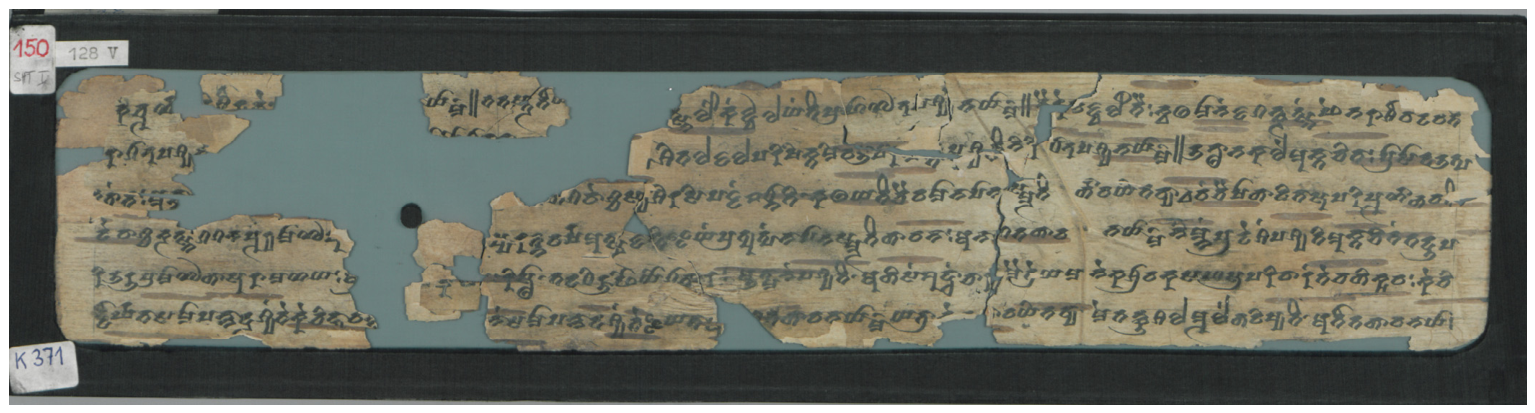
Here, Schlingloff fills in the blanks on a predictive basis (shown by words in square brackets), based on other standing phrases in the text. Indeed, contextual knowledge that these lines appear in the sequence of the abhiṣeka,68 the rain of blessings, enables any reader with an awareness of Buddhist texts to reason that a missing word would be ‘rain’, and that it carries meanings of ‘purification, transformation, or vivification’ (Davidson 2023, p. 30). However, the knowledge that the body emits elemental currents in a certain order is more distinct to the QYM, and, hence, filling in this blank in the tattered manuscript is challenging unless one can recognise the paradigmatic and syntagmatic rules in operation for the QYM’s meditation sequences. Such is the instructive quality of this text as a manual, that we as readers are employed to be especially active. Alongside the historical meditator, we, too, have to visualise the images as they are each described, and to follow or work out the visual logic.69Then from the body of the blessed one [is emitted] [a current] … descends from the sky [a rain] of precious stones and flowers.(154 R2; trs. author; Schlingloff 2006, p. 154)67
10. The Visual Semiotics of Meditation
11. Tri-Relative Logic: Filling in the Bodily Blanks
12. Conclusions
Since the Qizil Yoga Manual signals its ‘paradoxical memory’ of the future reader, the scholar, we can be grateful for the grammar of meditation that helps us to fill in the blanks or empty spaces.A sign doesn’t belong to a solely synchronic slice but […] cuts across it, thereby creating a past-future connection, thus demonstrating its own diachronic dimension as an unorthodox memory including the paradoxical memory of the future.(Semetsky 2019, p. 10)
Funding
Institutional Review Board Statement
Informed Consent Statement
Data Availability Statement
Conflicts of Interest
| 1 | Thank you to the two anonymous reviewers for comments on drafts of this paper, and to Professor Nobuyoshi Yamabe and Dr Henry Albery for generous feedback as guest editors of this special issue. Thanks are also due to the journal editor Margaret Liu for her support. |
| 2 | For a recent and convincing dating of the text to around the 5th century CE, see Abe (2024, p. 1209). Abe bases her analysis on the 16-stages of anāpanasmṛti, addressed in section 2 of the QYM, and argues that the structure follows the Samyuktāgama and older Sarvāstivāda wording, as well as bearing similarities to certain Chinese meditation manuals that help to date it. ‘However, since it does adopt the correlation with the four dhyānas, the order instructed in the Vibhāṣā, and the theory indicated in the Abhidharmakośa, apparently the contents of the anāpanasmṛti were transmitted without the acceptance of a highly systematized Abhidharma theory’ (Abe 2024, p. 1209). What is more speculative in Abe’s paper is that certain visualisations in the QYM (based around images in Śākyamuni’s life) may have influenced the development of esoteric practices such as ‘contemplating oneself as the Buddha’ (Abe 2024, p. 1209). For a further discussion of dating the QYM and other background details of this text, see O’Brien-Kop (2022). For a more recent discussion of the terminus post quem as the 7th century CE, see Albery (2025). |
| 3 | The Sarvāstivāda school with its distinctive doctrines of dharmas (entities) and temporality was one of the sub-schools of Sthaviranikāya (School of the Elders) which split from the Mahāsāṃghika in the centuries after the death of the Buddha. It was an important Mainstream tradition in Kashmir and Gandhara, from which the QYM draws influence (see, for example, Abe 2024) and, according to the Pilgrim Xuangzang, who visited Kucha (close to Qizil) in 630 CE, Sarvāstivāda was the dominant form of Buddhism, even though it existed there alongside Mahāyāna. |
| 4 | It combines many standard Mainstream Sarvāstivāda meditation formulas with the new visualization practices emerging in Mahāyāna, such as buddhānusmṛti. See note 18 for the outline of the QYM. The topic of abhiṣeka is also an important tantric influence (Abe 2024). See Yamabe for a round-up of scholarship on the school affiliation of the QYM as variously Sarvāstivāda and Mūlasarvāstivāda with ‘some apparently Tantric elements’ (Yamabe 2006, p. 326). |
| 5 | Yamabe signals that ‘translation’ is a problematic term in this context and that some Chinese texts may have an apocryphal status. |
| 6 | Following Seyfort Ruegg (1967, p. 162), Yamabe also acknowledges the tantric aspect of the imagery around the abhiṣeka ritual (Yamabe 1999a, pp. 4–17) and across many images of the QYM more generally (Yamabe 1999a, pp. 60–62). Moreover, Yamabe notes that the specific image of the Buddha seated in a kūṭāgāra (vaulted house) is also found in an early tantric Buddhist source (Yamabe 1999a, pp. 52–53). |
| 7 | On this point, McMahan is specifically looking at the Perfection of Wisdom literature, the Ratnaguṇasamcayagāthā Prajñāpāramitā and the Aṣṭasāhasrikā Prajñāpāramitā, as well as the Gaṇḍavyūha Sūtra—all from the first few centuries of the common era. However, we can also add the Saddharmapuṇḍarīka Sūtra from the same period, due to its apparently endless layering and proliferation of splendid images in space as a formal way to express the doctrines of the Buddha’s infinite capacities. As Zhao discusses, the Central Asian recension of this text dates to somewhere between the 5th and 8th centuries CE (Zhao 2018, pp. 9–10), making it concurrent with the window of time for the QYM. For a discussion of the textual culture and literary style of early Mahāyāna in India as characterized by ‘superlative’ forms and by ‘syntagmatic extension’, see O’Brien-Kop (2020). |
| 8 | As Nanay explains, ‘“image,” is not necessarily visual: mental imagery can be auditory, olfactory, and tactile as well: it can happen in all sense modalities, not just in vision’ (Nanay 2023, p. 4). Although this paper focuses solely on visual mental imagery, more research needs to be done into the multi-sensory aspects of the mental imagery of meditation in the QYM—Albery (2025) makes an important contribution. |
| 9 | This extends my 2021 book that investigates cognitive metaphor theory and material culture in relation to the Pātañjalayogaśāstra, the Abhidharmakośabhāṣya, and the Yogācārabhūmiśāstra. |
| 10 | The text is also known as the Meditation Scripture of Dharmatrāta and was translated from Sanskrit to Chinese by Buddhabhadra in the early 5th century (O’Brien-Kop 2021, pp. 77–79). |
| 11 | The Qizil caves ‘have been included in the UNESCO world heritage sites list in 2014’ (Vignato and Hiyama 2022, p. 1). Depending on how they are counted, the Qizil complex contains between 235 and 300 plus caves (Vignato and Hiyama 2022, pp. 8, 18). |
| 12 | Their paper centres on rock monasteries in Kucha (China) and in Termez (Uzbekistan). |
| 13 | These corridors were ‘sometimes more than 10 m deep and a slightly over 2 m wide’ [sic] (Vignato and Li 2024, p. 1003). See also Vignato and Hiyama (2022, pp. 245–46). |
| 14 | And also found at Kumtura South Monastery, and a few monasteries at Subashi and Duldur-Akur (Vignato and Hiyama 2022, p. 10). ‘The highest concentration of “Tradition A” caves is found in the core section of Districts 1 and 3 in Kizil’ (Vignato and Hiyama 2022, p. 155). |
| 15 | ‘The arrangement of the “Tradition A” groups in Kizil would have allowed a monk or a few monks to reside in proximity of the decorated caves. This would have enabled them to perform daily devotions of the caves themselves, as well as the conduct of more solemn activities. The “senses of place” created by these distinct types of décor suggest that different groups of caves were intended for the performance of different activities.’ (Vignato and Hiyama 2022, p. 158). |
| 16 | Vignato and Hiyama also discuss the documented rivalries between Sarvāstivāda and Mahāyāna monks with one pilgrim in the 8th century observing that ‘the local Kuchean monks followed Hīnayāna teachings, while Chinese monks followed Mahāyāna ones’ (Vignato and Hiyama 2022, p. 5). |
| 17 | All quotations from the Qizil Yoga Manual are taken from Schlingloff (2006) (with his reference formats). The critical apparatus is Schlingloff’s in which ellipses show missing text in the fragmentary manuscript and characters in round brackets show semantic suggestions while square brackets indicate reconstruction of missing text, or emendments. V is Vorderseite (recto) and R is Rückseite (verso). I use the reference abbreviation of YL for ‘Yogalehrbuch’ to follow Schlingloff’s given title (2006) for the text that I call the Qizil Yoga Manual. Any unattributed translations are my own. |
| 18 | Here is the outline of the sections of the Qizil Yoga Manual:
|
| 19 | Other texts refer to these practices as aśubhabhāvanā. They form part of the four foundations of mindfulness (satipaṭṭhāna; smṛtyupasthāna)—body, feeling, mind, factors – and are found within the first level, contemplation on the body (kāyānupaśyanā). The cemetery meditation is typically a counterstate (pratipakṣa) for the affliction of passion, rāga. |
| 20 | Also found in the Pāli canon: e.g., Dīgha Nikāya 2, 239ff; Majjhima Nikāya 1, 57ff. |
| 21 | See also Dhammajoti (2021, pp. 8–9) for a discussion of how this meditation on the external body relates generally to contemplation on form (rūpa) and non-form (arūpa) in Saṃghabhadra’s *Nyāyānusāra, as well as a tabulation of how śubhā relates to aśubhā meditation across other schemes such as the liberations (vimokṣas) (Dhammajoti 2021, p. 17). |
| 22 | For a discussion of the aśubha meditation in texts such as Kayāgatāsatisutta and Satipaṭṭhānasutta see Dhammajoti (2009, 2021). |
| 23 | D. Stuart (2015) argues for the Saddharmasmṛtyupasthānasūtra as ‘transitional between an earlier framework of primitive Buddhist practice and a fully developed notion of Mahāyāna practice as exemplified by later stage (bhūmi) texts’ with a central focus on yogācāra techniques of meditation (D. Stuart 2015, p. 30). (For a discussion of early yogācāra and later Yogācāra, see O’Brien-Kop 2021, pp. 75–112). |
| 24 | D. M. Stuart (2017, p. 193, note 4) suggests that the chapter is so disconnected from the other textual witnesses that it merits being a standalone text which he calls the ‘Kāyasmṛtyupasthānasūtra’ and Kritzer (2020, p. 2) agrees that there is a good case for this assertion. Kritzer suggests that the unique descriptions of the aśubha meditation in Chapter 7 of the Saddharmasmṛtyupasthānasūtra are closer to the Chinese manuals Chanfa yaojie (T616) and Chanyao jing (T609) than any other accounts (Kritzer 2020, p. 3). |
| 25 | |
| 26 | For a slightly different sequence of nine stages of decomposition, see Yaśomitra’s Sphuṭārthā Abhidharmakośabhāṣyavyākhyā, or 10 stages in the Dhammasaṅgaṇī and Visuddhimagga (Dhammajoti 2009, p. 258). Further textual variations of the formula are discussed in Dhammajoti 2009, pp. 258–61. For a basic version of this meditation, see the preparatory stage of the ‘Śrāvakabhūmi’ (Schmithausen 2007, pp. 225–29; Deleanu 2012, pp. 15–16). |
| 27 | Another major form found in texts is to visualise a corpse, as follows; (1) A swollen corpse (vyādhmātaka); A corpse that has turned blue (vinīlaka); Decomposing/festering corpse with rank or offensive odour (vipūyaka), (2) Eaten away (khādyamāna) by wild animals, (3) Flesh and blood held by blood vessels, (4) No flesh, smeared with blood, (5) No flesh and blood; held by blood vessels, (6) Skeletal bones strewn around (asthiśamkalikā), (7) Bones bleached as white as shells, (8) Heap of gradual disintegrating bones, (9) Bones dissolves into dust (Dhammajoti 2009). |
| 28 | Here, I follow Dhammajoti’s reference format. |
| 29 | For a more specific argument on the origins of visualization in relation to the Buddha in practices such as buddhānusmṛti (recollection of the Buddha) and buddhamanasikāra (directing the mind to the Buddha), see Zhao (2018). Zhao focuses on the Prajñāparāmitā literature for innovations (identifying a leap from metaphorical seeing to actual seeing of the Buddha’s body) but he also explores the development of such practices in the early first millennium in Abhidharma texts, Mahāyāna treatises such as Asaṅga’s Mahāyānasūtralaṅkāra, as well as certain Yogācāra and Madhyamaka works. Zhao also argues that some of the earliest features of this practice are to be found in the *Mahāvibhāṣa (Zhao 2018, p. 162). |
| 30 | On the basis that it reflects the ‘belief in Maitreya and the seven Buddhas [that] was popular in Central Asia’ before tantric commitments to ‘dhāraṇīs or mantras’ was evident (Abe 2024, p. 15). See also notes 1 and 2 for more on Abe’s position. |
| 31 | Although some scholars think that the Avataṃsakasūtra may be a Central Asian text (e.g., Hamar 2015, 2022), two of the most well known layers, the Daśabhūmikasūtra and the Gaṇḍavyūhasūtra are extant in Sanskrit and date to the c. 2nd century CE. According to tradition, the Avataṃsakasūtra was translated into Chinese by Buddhabhadra in 422, even if Hamar shows this dating to be problematic (Hamar 2022, p. 6). |
| 32 | Without more evidence, it’s difficult to know whether the QYM referenced the radiant light of white bones that Dhammajoti sees as so integral to the development of this corpse meditation into an effulgent Mahāyāna visualization (Dhammajoti 2021, p. 30). It is most likely not the case, given that the aśubha opening reflects an older Sarvāstivāda form of the meditation. |
| 33 | Some caves at Kucha and Qizil do contain images of death, such as skeletons, skulls and corpses (Vignato and Hiyama 2022). However, more research needs to be done to identify the precise relation of such cave images at Qizil to the imagery in the QYM. |
| 34 | Even if the meditative process is one of radical deconstruction and hence would also find a productive theoretical lens in post-structuralist or process semiotics. |
| 35 | Yelle further qualifies ‘semiotic recognition’ as ‘the conscious theorizing of the rhetorical power of poetic and magical performance’ (Yelle 2013, p. 16), both of which, I would argue, apply to the QYM. There is a self-conscious rhetorical quality to the way the text constructs experience through elaborately structured imagery and refrains, while the ‘magical’ aspect of performance (Yelle retrieves the semiotic importance of the word ‘magic’ for historical religion) is evident in the process of conjecturing other bodily selves (āśraya) and vividly drawn worlds. There is also a magical aspect to how this process of transformation through mental imagery takes place in the darkened cave. |
| 36 | Although as Paskaleva (2024) argues, Saussure’s system was more properly known as semiology, while semiotics became associated with the different system of sign analysis of Peirce, semiotics was taken up generally as a term by students of Saussure, including Jakobsen. Therefore, I will use semiotics consistently in this paper to denote my method rather than semiology. |
| 37 | For more on this argument, see O’Brien-Kop (2022). |
| 38 | |
| 39 | |
| 40 | I have chosen supra-textual here rather than para-textual to indicate the larger extra-textual framework of meaning beyond the manuscript itself. The para-textual includes material and aesthetic aspects of the manuscript including its degraded and fragmentary nature. The supra-textual, however, attempts to include all of that plus the cave and the body. For an answer to the questions of what is lost when the aesthetic-material value and context of a text is omitted, or how aesthetic-material cognition of para-textual elements enhance or inform the understanding of core doctrines, see Gibson (2008) and Baumberger (2013). |
| 41 | Kostelnick writes specifically of graphic design, but his point is relevant for considering the materially expansive context of the QYM in terms of its ‘visual rhetoric’, which is produced by a variety of ‘local visual elements’ inside and outside the text (Kostelnick 1996, p. 24). As he notes, ‘supra-textual language conforms to conventional codes and/or creates cohesion across a set or series of documents’ (Kostelnick 1996, p. 24)—and it is this very cohesion that is evidenced in the ‘visual language’ of meditation in the cave complexes on the northern Silk Road. |
| 42 | Jakobsen extended this theory to form the corresponding metonymic and metaphoric poles (Jakobsen 1956). |
| 43 | For brevity I will follow Yamabe’s translation of āśraya as ‘body’ (Yamabe 1999a), finding Schlingloff’s choice of ‘gestalt’ too vague. See Albery for an argument that āśraya indicates individual body and basis for ‘the total incorporation of the perceptual complex’ (Albery 2025, p. 22). |
| 44 | See also Albery (2025) for the argument that, in relation to ‘immeasurable joy’, the Yogalehrbuch reflects a Vaibhāṣika theory of representation and the knowledge that there are ‘various material effects of absorption’ (Albery 2025, pp. 40–41). For an argument about material correspondence between visual images and ethical states, that ‘confirmatory visions’ can indicate something about one’s śīla, see Greene (2016), e.g., that in meditation manuals such as the Central Asian Secret Essential Methods of Meditation (Chan mi yao fa jing) and Secret Essential Methods for Curing Meditation Sickness (Zhi chan bing mi yao fa) (both c. 5th century CE), ‘meditative visions are sometimes the very material stuff out of which one’s śīla is made’ (Greene 2016, p. 150). |
| 45 | While the text does not include an epistemic apparatus for distinguishing gradations of the real and non-real, there are hints that ontologically real images can be distinguished from images that have no real referents (or perhaps even effects), such as a mirage (marīci) which is discussed in the skandhaparīkṣā section (marīcikalāpā QYM 132 V5 and marīcipravāho at 133 V20). See also Schlingloff (2006, p. 96 fn 3) for further intertextual references. |
| 46 | See also the fragmentary mention at QYM 142 R6 and ekakrameṇa at QYM 169 V5. |
| 47 | See also 159 R5. |
| 48 | See also 137 V4 for the sequence of youth, old age and death; 139 R2; 140 R4; 143 V4; 150 R3 [corrected from 150 R2 in Schlingloff’s index]; 151 R3; 154 R5; 165 R4. |
| 49 | vaiḍuryama[yī](ṃ) pṛthivīṃ vaiḍuryama[yava]rāsanaracitāṃ tanmadhye vajrāmayaḥ āśrayo vajrāsanādhirūḍhaḥ yogina utpadyate | tadupari sarvasatv(āḥ sarvaprahara)[ṇā]ni kṣipaṃti tāni puṣpabhūtāni tatra n(i)patanti | tad eva vajrāsanaṃ teṣām aviṣayī bha[vat]i | teṣu cānyeṣu vajrāsaneṣu* buddhā uṣṇīpūrvadarśanāt krameṇodgacchaṃto dṛśyaṃ[t]e( | teṣām uṣṇīṣapra)[bh]ā[y]ā [k]ṛtsnaṃ jagad indranīlābhaṃ dṛ[śya]te | ūrṇāprabhāyā candrāvadātaṃ gātraprabhāy(ā) | kanakaprabhaṃ | ’ṣṭanakhaprabhābhiḥ padmarāgābhaṃ te bhagavaṃtaḥ mūrdhata ekaikaṃ … (yoga)c[ā]r[āś]r(a)yaṃ veṣṭayaṃti [* emended vajra- to vajrā-] |
| 50 | ‘At the end, everything is dissolved’ and ‘At the end, everything knowable (jñeyaṃ) [is brought back] into the navel and dissolved. This completes the meditation.’ |
| 51 | |
| 52 | For a speculation on how the conditions of the cave may produce mental experiences that are structurally similar to clinical accounts of hallucination without the analysis of mental illness, see O’Brien-Kop (2022). |
| 53 | Or parasol. |
| 54 | Schlingloff’s German translation interprets the ‘mounted’ or ‘ascended’ (adhirūḍha) in this line and the next as indicating that a visual symbol, such as ‘the young boy’, is mounted on the pearls—as in the immediately preceding passage (Schlingloff 2006, p. 80). |
| 55 | tataḥ āśvasataḥ n[ī]lābhāḥ paṭṭāḥ tadadhirūḍhāni yathokta[sm]ṛ[ti]nimittāni | bāladārakaś ca vaiḍūryamū[l](ā)dibhiḥ kāṃcanacakram avatarati praśvasataḥ avadātābhāḥ paṭṭāḥ tadadhirūḍhāni | smṛtinimittāni bā[ladārakaś] (c)a sarvaśākhābhi niḥ sarva buddhānām upari paṭṭacchatraṃ kṛtvā tiṣṭhati( | )evaṃ paunaḥpuṇyena | punar āśvasataḥ nīlābhāmuktāhārādhirūḍhāḥ eta evāvarataṃti | praśva(sataḥ) avadātamukt(ā)[hā]rādhirūḍhāh sarvaśākhāsu sarvabuddhānāṃ muktāhāraṃ cchatraṃ [k](ṛtv)[ā] (t)i[ṣṭha]ti |
| 56 | See also YL 118 R2-119 V1 for this sequence. |
| 57 | Thank you to Henry Albery for adding some points of comparison: the Vibhāṣā (T27, no. 1545, p. 205a8-11), itself cites the Jñānaprasthāna (T 1544, p. 926c4-7), in which the yogin is said to fix his mind to the point between the eyebrows (眉間, *bhruvamadhya), when observing the stages of decomposition. The same is also said by Vasubandhu and Saṃghabhadra for the mindfulness of breathing, where the fantastic images of the breath going round the cosmos are also discussed (T 1562, p. 674a8-24). |
| 58 | As Yamabe has argued, these experiences of the meditation practitioner are modelled on what the Buddha or various bodhisattvas are believed to have experienced (Yamabe 1999a, pp. 14–15). Yamabe makes a similar argument in 2010: ‘in Buddhist avadāna and sutra literature, when the Buddha smiles, rays come out of his mouth and go upward to the heavens and downward to the hells. In the Yogalehrbuch, various streams come out of the body of the meditator and go upward and downward in a similar fashion. Also, in the Yogalehrbuch, the meditator sees himself in a crystal temple (kūṭāgāra, vaulted house), as if he had become a Buddha enshrined in a temple’ (Yamabe 2010, pp. 145–46). See also Schlingloff’s (2006, pp. 37–39) discussion. |
| 59 | For the full range of descriptions of pravāha in relation to the body, see Schlingloff’s extensive index entry for *pravāha (Schlingloff 2006, pp. 227–28). |
| 60 | For specific instances of this sequence, see the citation entry for ‘Aghaniṣṭha’ in Schlingloff (2006, p. 190). |
| 61 | For a discussion of visual signs and counterpart signs in the Visuddhimagga as ‘key stages of progress in meditation’ and ‘confirmatory visions’, see Greene (2016, pp. 134–37). Here ‘sign’ is used chiefly in the sense of ‘indicator’ or even ‘signpost’ or ‘omen’ rather than in the semiotic sense more technically. Greene also specifically discusses the role of confirmatory visions that announce a particular level of attainment in the Qizil Yoga Manual (Greene 2016, pp. 150–52). Yamabe (2010) discusses ‘auspicious signs’ in the Brahmā Net Sūtra (Fanwang jing) (Yamabe 2010, pp. 252–53). Albery argues that extrasensory apprehensions (such as divine seeing or hearing) are paradigms of perception that constitute understudied aspects of the ‘phenomenology of meditation’ in contrast to the ‘role of vision and visualisation’ (Albery 2025, p. 27). |
| 62 | tato mūto[ḍ]īvat paripūrṇaṃ nānāprakārair aśucibhiḥ svam āśrayaṃ paśyati | tatra … [raṃ] paśyati | ākāśadhātuḥ cakṣuḥsauśīryādīnāṃ | vijñānadhātuḥ markaṭabāladārakabinducitolkādīṃ |
| 63 | |
| 64 | In his description of semiology, Saussure writes: ‘La sémiologie aura à voir si elle doit s’occuper des signes arbitraires ou des autres; son domaine sera plutôt celui des systèmes de signes arbitraires dont la langue est le principal exemple’. ‘Semiology should consider whether it must focus on arbitrary signs or on some other kind; its realm would be rather that of the systems of arbitrary signs, of which language is the principal example’ (Émile Constantin’s notes from Saussure’s ‘Third Course’, p. 281; trs. Paskaleva 2024, p. 146). |
| 65 | See also more detail on the embodied aspects of the sequence from 132 R1 to 133 V4. This sequence is also found in texts such as the Satipaṭṭhānasutta. |
| 66 | Mindfulness in itself (svabhāva smṛtyupasthāna); mindfulness of connections (saṃsarga smṛtyupasthāna); mindfulness of objects (ālambana smṛtyupasthāna). |
| 67 | tato bhagavataḥ śarīrāt pra(vāho nirgataḥ) […] (rat)n(a)puṣp(a)[v](arṣam āk)[ā]śāṃ patati |
| 68 | Abhiṣeka, which dates back to Vedic kingship ritual, is a ceremony of consecration or initiation by pouring water (O’Brien-Kop 2020, pp. 620–21). Yamabe analyses the legend in which the Buddha was consecrated by Indra and Brahmā after his birth (Yamabe 2010, pp. 243–46). For instances of abhiṣeka in Mahāyāna literature, see Suvarṇabhāsottama in the ‘transfer of vitality from master to disciple’ (Davidson 2023, p. 32) or the tenth level of the bodhisattva in the Daśabhūmikasūtra where it is associated with the cloud of dharma (dharmamegha) and a rain of cosmic blessings (O’Brien-Kop 2020). For canonical instances, see the Mahāvastu. For early Buddhist tantric discussions of abhiṣeka rites in the seventh century CE, see the Dhāraṇīsaṃgraha (T901) (Davidson 2023, pp. 36–37). For a thorough discussion of abhiṣeka in relation to Central Asian Chinese meditation manuals, see Yamabe (2010). |
| 69 | There are many questions about how the details of an image should be visualised. For example: what does it mean when a current emits first from brow, then from navel, then mixed—where does the mixing begin, i.e., at which location: close to the āśraya or at some distance? |
| 70 | Saussure simply referred to this relation of sign and referent as arbitrariness; see note 64. |
| 71 | It is appealing here to try to add Yelle’s concept of the ‘indexical icon’ (developed by Jakobsen’s student Silverstein) as ‘bridging the gap’ between structural analysis (e.g., morphological, semantic or syntactic features of a text) and the pragmatic analysis of how a text interacts with its context (Yelle 2013, p. 8). This would require further study of the painted image of the boy in the cave murals. |
| 72 | Here, Yamabe is referring to the Turfan region more broadly, and not just Kucha. In his 1999b paper, Yamabe discusses this shared visual language across a ‘circle of texts’ such as the milk imagery (milk from the body; milk streams; blood into milk; milk ponds; milk oceans; cooling milk; milk from the brows) or consecration imagery (ambrosia or nectar; jars, vessels, vases; ointments, creams, medicines; sprinkling and streaming liquids, water; mudras; jewels; healing; body openings). He also discusses several other examples. |
| 73 | Some rare material artefacts have been found, such as parts of statuettes and relics. For a list of fragmentary artefacts found in Qizil Cave 60, for example, see Vignato and Hiyama (2022, p. 64). |
| 74 | The question marks are Greene’s since he is reconstructing the Sanskrit from the Chinese. The text is also known as *Yogācārabhūmi of Buddhasena (O’Brien-Kop 2021, pp. 77–79). |
| 75 | Of course, some cave murals form coherent and ordered syntactical signposts, which form narratives (such as the story of King Udrāyana and Queen Candraprabhā) (Vignato and Hiyama 2022, p. 34). |
| 76 | There are limits to how applicable Semetsky’s thinking on archetypes can be here, since it evokes a Jungian system of thought (although Jung himself was influenced by Buddhist and Hindu text and images)—and because they link it to ‘an intermediate realm between micro- and macrocosm called mesocosm’ or a realm of archetypal ideas, which is an ‘in-between world’ (Semetsky 2019, p. 12) of ‘metaphysical necessity’ (Corbin 1972, p. 6). This does not fit with the argument of this present paper, which is for a deeply local reading of the Kucha meditative language. Similarly, Semetsky is drawing on Corbin’s theories of Islam (Corbin 1972), which are not only deeply particular but also partially outdated ways of thinking about religion. |
References
- Abe, Takako. 2024. Ānāpānasmṛti in the Yogalehrbuch: Its Structure and Visualization. Religions 15: 1209. [Google Scholar] [CrossRef]
- Albery, Henry. 2025. Immeasurable Joy: Being One Meditation of a “Bodhisattva Vaibhāṣika”. Religions 16: 967. [Google Scholar] [CrossRef]
- Appadurai, Arjun. 2015. Mediants, Materiality, Normativity. Public Culture 27.2.76: 221–37. [Google Scholar] [CrossRef]
- Arning, Chris. 2009. Into the Realm of Zeroness: Peirce’s Categories and Vipassana Meditation. Semiotica 176: 95–115. [Google Scholar]
- Barthes, Roland. 1993. Mythologies. London: Vintage. [Google Scholar]
- Barthes, Roland. 1995. The Death of the Author. In Authorship: From Plato to the Postmodern, A Reader. Edited by S. Burke. Edinburgh: Edinburgh University Press. [Google Scholar]
- Baumberger, Christoph. 2013. Art and Understanding: In Defence of Aesthetic Cognitivism. In Bilder Sehen: Perspektiven der Bildwissenschaft. Edited by Mark Greenlee, Rainer Hammwohner, Bern Köber, Christoph Wagner and Christian Wolff. Regensburg: Schnell & Steiner, pp. 41–67. [Google Scholar]
- Bloomfield, Leonard. 1958. Language. London: Allen and Unwin. [Google Scholar]
- Bretfeld, Sven. 2003. Visuelle repräsentation im sogenannten “Buddhistischen Yogalehrbuch” aus Qïzïl. In Indien und zentralasien sprach- und kulturkontakt. Edited by S. Bretfeld and J. Wilkins. Wiesbaden: Harrasowitz. [Google Scholar]
- Collins, Steven. 2010. Nirvana: Concept, Imagery, Narrative. Cambridge: Cambridge University Press. [Google Scholar]
- Comeau, Leah Elizabeth. 2020. Material Devotion in a South Indian Poetic World. Bloomsbury Studies in Material Religion. London: Bloomsbury Academic. [Google Scholar]
- Corbin, Henry. 1972. Mundus Imaginalis, or The Imaginary and the Imaginal. Translated by Ruth Horine. New York: Analytical Psychology Club of New York, Inc. [Google Scholar]
- Davidson, Ronald M. 2023. Initiation (Abhiṣeka) in Indian Buddhism. In The Oxford Handbook of Tantric Studies. Edited by Richard K. Payne and Glen A. Hayes. Oxford: Oxford University Press. [Google Scholar] [CrossRef]
- Deleanu, Florin, ed. 2006. The Chapter on the Mundane Path (Laukikamārga): A Trilingual Edition (Sanskrit, Tibetan, Chinese), Annotated Translation and Introductory Study. 2 vol., Tokyo: International Institute for Buddhist Studies. [Google Scholar]
- Deleanu, Florin. 2012. Far from the Madding Strife for Hollow Pleasures: Meditation and Liberation in the Śrāvakabhūmi. Journal of the International College for Postgraduate Buddhist Studies 16: 1–38. [Google Scholar]
- Dhammajoti, K. L. 2009. The aśubhā Meditation in the Sarvāstivāda. Journal of the Centre for Buddhist Studies, Sri Lanka VII: 248–95. [Google Scholar]
- Dhammajoti, K. L. 2021. Meditative Experiences of Impurity and Purity—Further Reflection on the aśubhā Meditation and the śubha-vimokṣa. Religions 12: 86. [Google Scholar] [CrossRef]
- Divino, Federico. 2025. Semiosis and nāmarūpa: Exploring the Early Buddhist Theory of Signs Through Cognitive Semiotics. Philosophies 10: 93. [Google Scholar] [CrossRef]
- Fish, Stanley. 1982. Is There A Text in This Class: The Authority of Interpretive Communities. Harvard: Harvard University Press. [Google Scholar]
- Gibson, John. 2008. Cognitivism and the Arts. Philosophy Compass 3: 573–89. [Google Scholar] [CrossRef]
- Greene, Eric. 2016. Seeing Avijñapti-rūpa—Buddhist Doctrine and Meditative Experience in India and China. In Buddhist Meditative Traditions: Comparison and Dialog (Fo jiao chan xiu chuan tong: Bi jiao yu dui hua 佛教禪修傳統:比較與對話). Edited by Kuo-pin Chuang 莊 國彬. Taipei: Dharma Drum Publishing Corporation, pp. 107–70. [Google Scholar]
- Hamar, Imre. 2015. Buddhāvataṃsaka. In Brill’s Encyclopedia of Buddhism. Edited by Jonathan A. Silk. Leiden: Brill, vol. 1, pp. 87–100. [Google Scholar]
- Hamar, Imre. 2022. The Exegetical Tradition of the Buddhāvataṃsakasūtra. Journal of East Asian Cultures 14: 1–16. [Google Scholar] [CrossRef]
- Howard, Angela F., and Giuseppe Vignato. 2015. Archaeological and visual sources of meditation in the Ancient Kingdom of Kuča. Leiden: Brill. [Google Scholar]
- Jakobsen, Roman. 1956. The Metaphoric and Metonymic Poles. In Fundamentals of Language. Edited by Roman Jakobson and Moris Halle. The Hague: Mouton. [Google Scholar]
- Jakobson, Roman. 1985. Verbal Art, Verbal Sign, Verbal Time. Edited by Krystyna Pomorska and Stephen Rudy. Minneapolis: University of Minnesota Press. [Google Scholar]
- Juschka, Darlene M. 2014. Enfleshing Semiotics: The Indexical and Symbolic Sign-Functions. Religion 44: 106–13. [Google Scholar]
- Kelso, J. A. Scott. 2000. Principles of Dynamic Pattern Formation and Change for a Science of Human Behaviour. In Development Science and the Holistic Approach. Edited by Lars Bergman, Robert Cairins, Lars-Goran Nilsson and Lars Nystedt. Mahwah: Erlbaum. [Google Scholar]
- Kelso, J. A. Scott. 2008. An Essay in Understanding the Mind. Ecological Psychology 20: 180–208. [Google Scholar] [CrossRef] [PubMed]
- Kostelnick, Charles. 1996. Supra-textual Design: The Visual Rhetoric of Whole Documents. Technical Communication Quarterly 5: 9–33. [Google Scholar] [CrossRef]
- Kritzer, Robert. 2020. Meditation on the Body in Chapter 7 of Saddharmasmṛtyupasthānasūtra. Religions 11: 283. [Google Scholar] [CrossRef]
- Lamotte, Étienne. 1970. Le traité de la grande vertu de sagesse de Nāgārjuna (Mahāprajñāpāramitāśāstra) Volume 3. Translated from French by Chodron Gelongma Migme. (2001) as The Treatise on the Great Virtue of Wisdom of Nāgārjuna. Vol III: Chapters XXXI-XLII. Pleasant Bay: Gampo Abbey. [Google Scholar]
- Law, John. 2009. Actor Network Theory and Material Semiotics. In The New Blackwell Companion to Social Theory. Edited by B. Turner. London: Blackwell Publishing. [Google Scholar]
- Leone, Massimo. 2014. The Semiotic Ideology of Semiotics: A Vertiginous Reading. Religion 44: 92–98. [Google Scholar]
- Lettner, Alina Therese. 2021. Peirce’s Semiotic Pragmatism and Buddhist Soteriology: Steps Towards Modelling “Thought Forms” of Signlessness. In Pragmatism, Spirituality and Society. Edited by Ananta Kumar Giri. Singapore: Springer Nature. [Google Scholar]
- Lotman, Yuri. 1990. Universe of the Mind: A Semiotic Theory of Culture. Translated by Ann Shukman. Introduction by Umberto Eco. London and New York: I. B. Tauris & Co., Ltd. [Google Scholar]
- MacEachren, Alan M., Robert E. Roth, James O’Brien, Bonan Li, Derek Swingley, and Mark Gahegan. 2012. Visual Semiotics & Uncertainty Visualisation: An Empirical Study. IEEE Transactions on Visualization and Computer Graphics 18: 2496–505. [Google Scholar] [CrossRef] [PubMed]
- McMahan, David. 2002. Empty Vision: Metaphor and Visionary Imagery in Mahāyāna Buddhism. London: RoutledgeCurzon. [Google Scholar]
- Mori, Miki. 2012. Kummutura sekkutsu dai 75 kutsu no hekiga shudai ni tsuite: Uiguru-ki Kiji Bukkyō no ichi sokumen クムトラ石窟第七五 窟の壁画主題について-ウイグル期亀茲仏教の一 側面 [On the Subject of the Mural Paintings in Qumtura Cave 75]. Bijutsushi kenkyū 美術史研究 [The Study of the History of Art] 50: 125–46. [Google Scholar]
- Nanay, Bence. 2023. Mental Imagery: Philosophy, Pyschology, Neuroscience. Oxford: Oxford University Press. [Google Scholar]
- O’Brien-Kop, Karen. 2020. Dharmamegha in Yoga and Yogācāra: The Revision of a Superlative Metaphor. Journal of Indian Philosophy 48: 605–35. [Google Scholar] [CrossRef]
- O’Brien-Kop, Karen. 2021. Rethinking ‘Classical Yoga’ and Buddhism: Meditation, Metaphors and Materiality. Bloomsbury Advances in Religious Studies. London: Bloomsbury Academic. [Google Scholar]
- O’Brien-Kop, Karen. 2022. Meditation, Idealism and Materiality: Vivid Visualization in the Buddhist “Qizil Yoga Manual” and the Context of Caves. Journal of Indian Philosophy 50: 223–44. [Google Scholar] [CrossRef]
- O’Brien-Kop, Karen. 2023. The Hard Problem of “Pure” Consciousness: Sāṃkhya Ontological Dualism. Religious Studies: An International Journal for the Philosophy of Religion 60: S4–S20. [Google Scholar] [CrossRef]
- Paskaleva, Bogdana. 2024. Pre-structuralist Semiology: Materiality of Language in Ferdinand de Saussure. Semiotica 259: 149–83. [Google Scholar] [CrossRef]
- Peirce, Charles Sanders. 1974. Collected Papers of Charles Sanders Peirce. Volume 5: Pragmatism and Pragmaticism and Volume 6: Scientific Metaphysics. Harvard: Belknap Press. [Google Scholar]
- Schlingloff, Dieter. 1964. Yogavidhi. Indo-Iranian Journal 7: 146–55. [Google Scholar] [CrossRef]
- Schlingloff, Dieter. 2006. Ein Buddhistisches Yogalehrbuch: Unveränderter Ausgabe von 1964 unter Beigabe Aller Seither Bekannt Gewordenen Fragmente. Edited by Jens-Uwe Hartmann and Hermann-Josef Röllicke. Dusseldorf: EKO, Haus der Japanischen Kulture. [Google Scholar]
- Schmithausen, Lambert. 2007. Aspects of Spiritual Practice in Early Yogācāra. Journal of the International College for Postgraduate Buddhist Studies 11: 213–44. [Google Scholar]
- Semetsky, Inna. 2019. Visual Semiotics and Real Events: Exploring the Bricolage of Images. Video Journal of Education and Pedagogy 4: 1–22. [Google Scholar] [CrossRef]
- Seyfort Ruegg, David. 1967. On a Yoga Treatise in Sanskrit from Qizil. Journal of the American Oriental Society 87: 157–65. [Google Scholar] [CrossRef]
- Stuart, Daniel. 2015. A Less Travelled Path: Saddharmasmṛtyupasthānasūtra Chapter 2: Critically Edited with A Study on Its Structure and Significance for the Development of Buddhist Meditation. Volumes 1 and 2. Beijing and Vienna: China Tibetology Publishing House and Austrian Academy of Sciences Press. [Google Scholar]
- Stuart, Daniel M. 2017. Yogācāra Substrata? Precedent Frames for Yogācāra Thought among Third-Century Yoga Practitioners in Greater Gandhāra. Journal of Indian Philosophy 46: 193–240. [Google Scholar] [CrossRef]
- Swenson, Edward. 2024. Infrastructures of Religion and Power: Archaeologies of Landscape, Ritual and Semiotics. Abingdon-on-Thames: Taylor and Francis. [Google Scholar]
- Teiser, Stephen F. 2006. Reinventing the Wheel: Paintings of Rebirth in Medieval Buddhist Temples. Seattle: University of Washington Press. [Google Scholar]
- Vignato, Giuseppe. 2023. Historical Photographs of Kucha: Retracing Lost Caves and Related Thoughts. Religions 14: 903. [Google Scholar] [CrossRef]
- Vignato, Giuseppe, and Satomi Hiyama. 2022. Traces of the Sarvāstivādins in the Buddhist Monasteries of Kucha. Leipzig Kucha Studies 3. New Delhi: Dev Publisher & Distributor. [Google Scholar]
- Vignato, Giuseppe, and Xiaonan Li. 2024. Kucha and Termez—Caves for Mindful Pacing and Seated Meditation. Religions 15: 1003. [Google Scholar] [CrossRef]
- Yamabe, Nobuyoshi. 1999a. The Significance of the “Yogalehrbuch” for the Investigation into the Origin of Chinese Meditation Texts. Bukkyō Bunka 佛教文化 (Buddhist Culture) 9: 1–74. [Google Scholar]
- Yamabe, Nobuyoshi. 1999b. The Sūtra on the Ocean-like Samādhi of the Visualization of the Buddha: The Interfusion of the Chinese and Indian Cultures in Central Asia as Reflected in a Fifth Century Apocryphal Sūtra. Ph.D. dissertation, Yale University, New Haven, CT, USA. [Google Scholar]
- Yamabe, Nobuyoshi. 2004. An examination of the mural paintings by visualising monks in Toyok Cave 42. In Conjunction with the Origin of Some Chinese Texts on Meditation. In Turfan Revisited—The First Century of Research into the Arts and Cultures of the Silk Road. Edited by Desmond Durkin-Meisterernst, Simone-Christiane Raschmann, Jens Wilkens, Marianne Yaldiz and Peter Zieme. Berlin: Dietrich Reimer. [Google Scholar]
- Yamabe, Nobuyoshi. 2006. Fragments of the “Yogalehrbuch” in the Pelliott Collection. In Ein Buddhistisches Yogalehrbuch: Unveränderter Ausgabe von 1964 unter Beigabe Aller Seither Bekannt Gewordenen Fragmente. Edited by J. U. Hartmann, D. Schlingloff and H. J. Röllicke. Dusseldorf: EKO, Haus der Japanischen Kulture. [Google Scholar]
- Yamabe, Nobuyoshi. 2010. Visionary Consecration: A Meditative Reenactment of the Buddha’s Birth. In The Birth of the Buddha: Proceedings of the Seminar Held in Lumbini, Nepal, October 2004. Edited by C. Cueppers, M. Deeg and H. Durt. Lumbini: Lumbini International Research Institute, pp. 239–76. [Google Scholar]
- Yamabe, Nobuyoshi, and Li Zhao. 2023. A Reexamination of Paintings and Inscriptions on the Rear Wall of Qumtura Cave 75 through Digital Restoration in Comparison with Other Relevant Paintings. Arts Asiatiques 78: 27–44. [Google Scholar] [CrossRef]
- Yelle, Robert A. 2013. Semiotics of Religion: Signs of the Sacred in History. London and New York: Bloomsbury Publishing. [Google Scholar]
- Zhao, Wen. 2018. The Conception of Seeing the Buddha and Buddha Embodiments in Early Prajñāpāramitā Literature. Ph.D. dissertation, Ludwig-Maximilians-Universität München, Munich, Germany. [Google Scholar]
Disclaimer/Publisher’s Note: The statements, opinions and data contained in all publications are solely those of the individual author(s) and contributor(s) and not of MDPI and/or the editor(s). MDPI and/or the editor(s) disclaim responsibility for any injury to people or property resulting from any ideas, methods, instructions or products referred to in the content. |
© 2026 by the author. Licensee MDPI, Basel, Switzerland. This article is an open access article distributed under the terms and conditions of the Creative Commons Attribution (CC BY) license.
Share and Cite
O’Brien-Kop, K. Filling in the Blanks: The Material Semiotics of Visual Meditation in the Buddhist Qizil Yoga Manual. Religions 2026, 17, 898. https://doi.org/10.3390/rel17080898
O’Brien-Kop K. Filling in the Blanks: The Material Semiotics of Visual Meditation in the Buddhist Qizil Yoga Manual. Religions. 2026; 17(8):898. https://doi.org/10.3390/rel17080898
Chicago/Turabian StyleO’Brien-Kop, Karen. 2026. "Filling in the Blanks: The Material Semiotics of Visual Meditation in the Buddhist Qizil Yoga Manual" Religions 17, no. 8: 898. https://doi.org/10.3390/rel17080898
APA StyleO’Brien-Kop, K. (2026). Filling in the Blanks: The Material Semiotics of Visual Meditation in the Buddhist Qizil Yoga Manual. Religions, 17(8), 898. https://doi.org/10.3390/rel17080898

