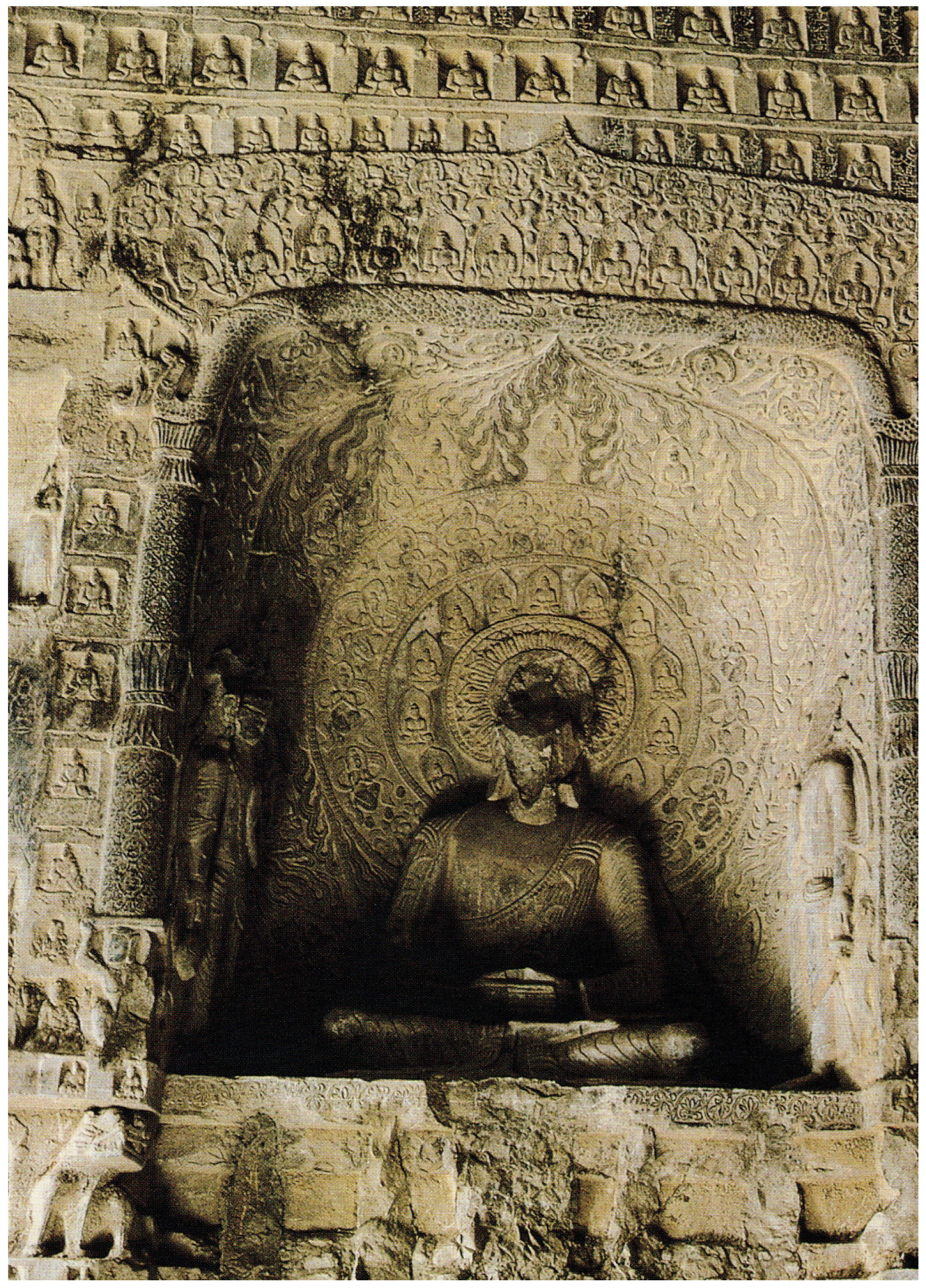
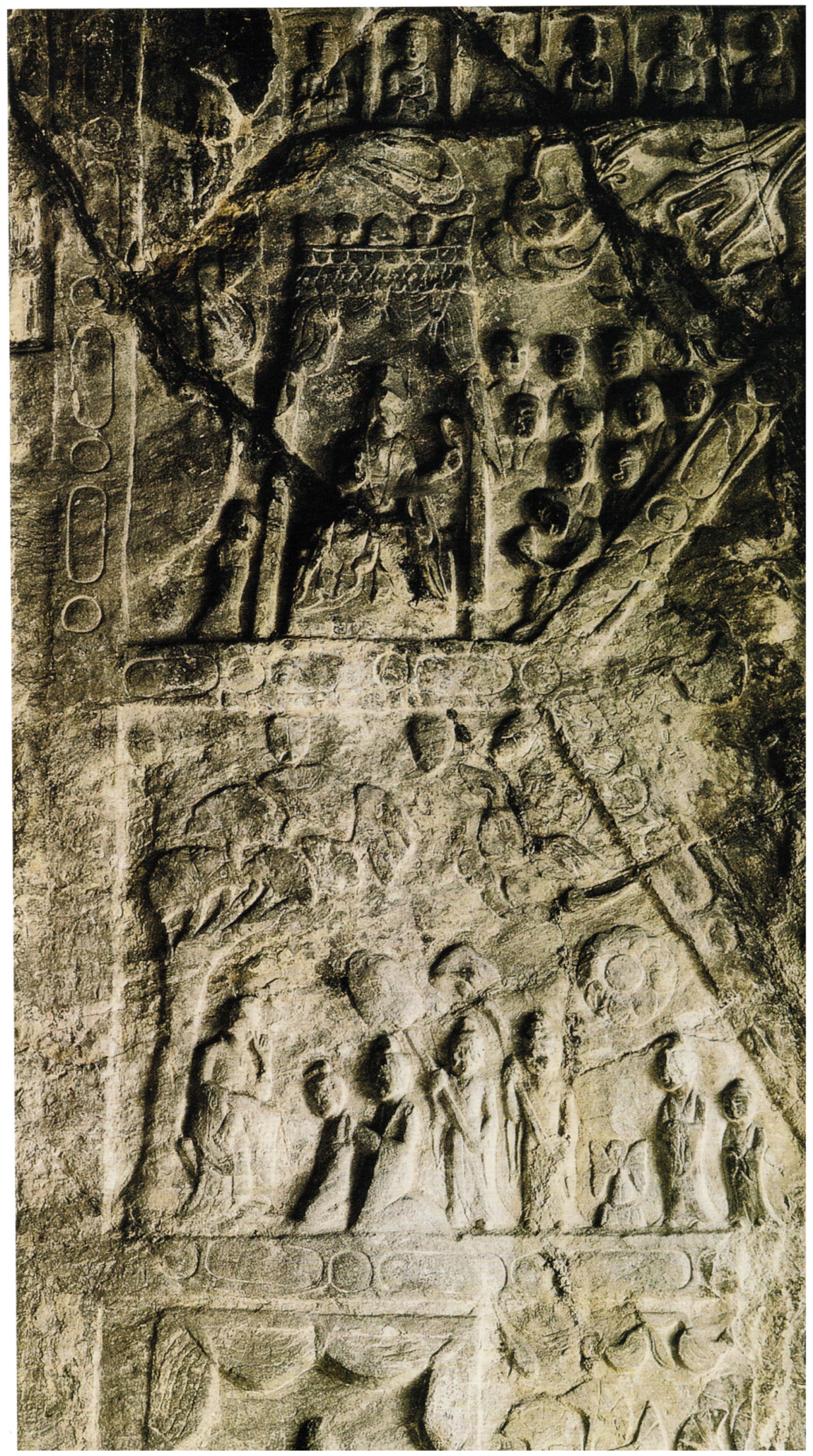
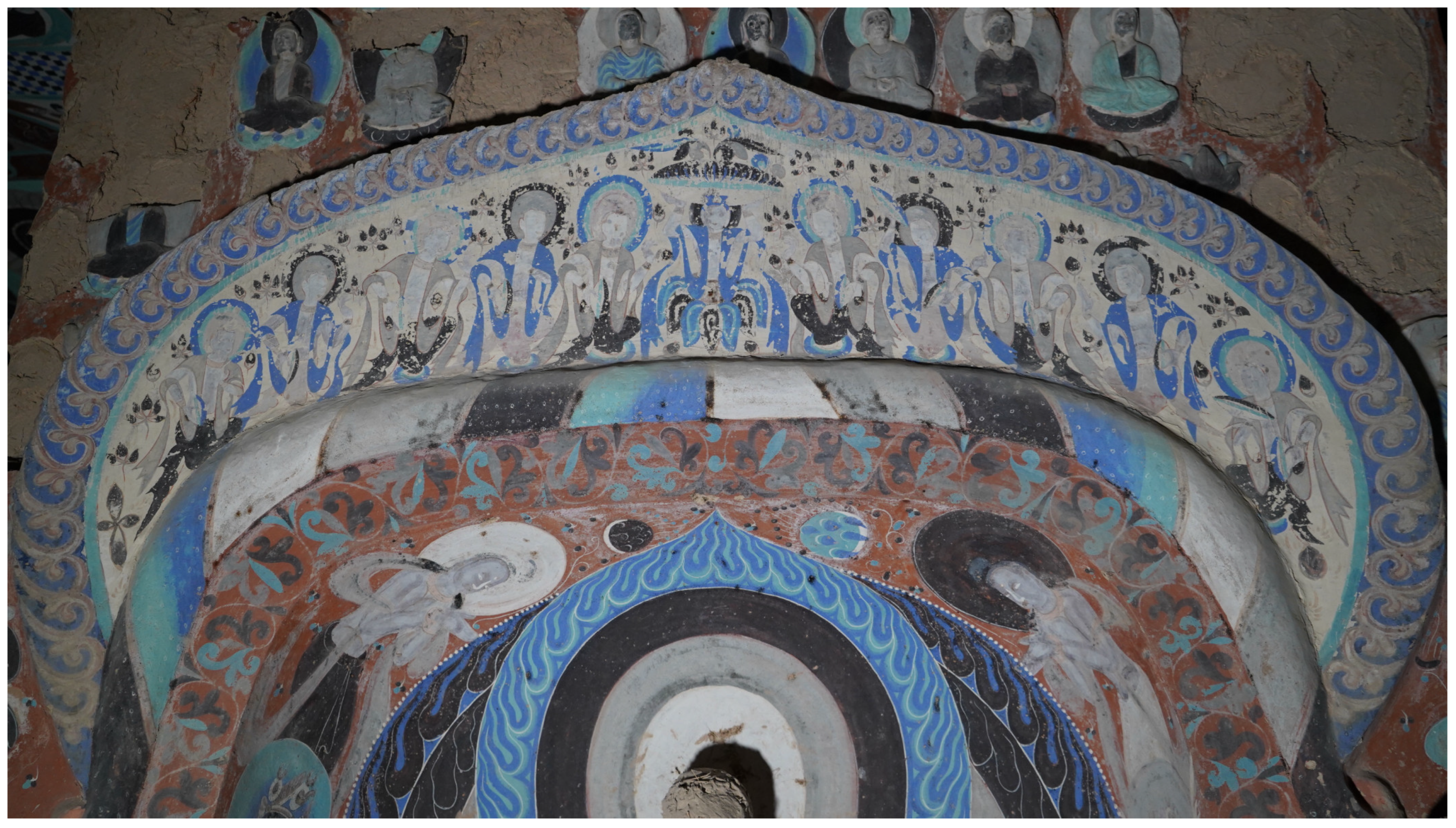
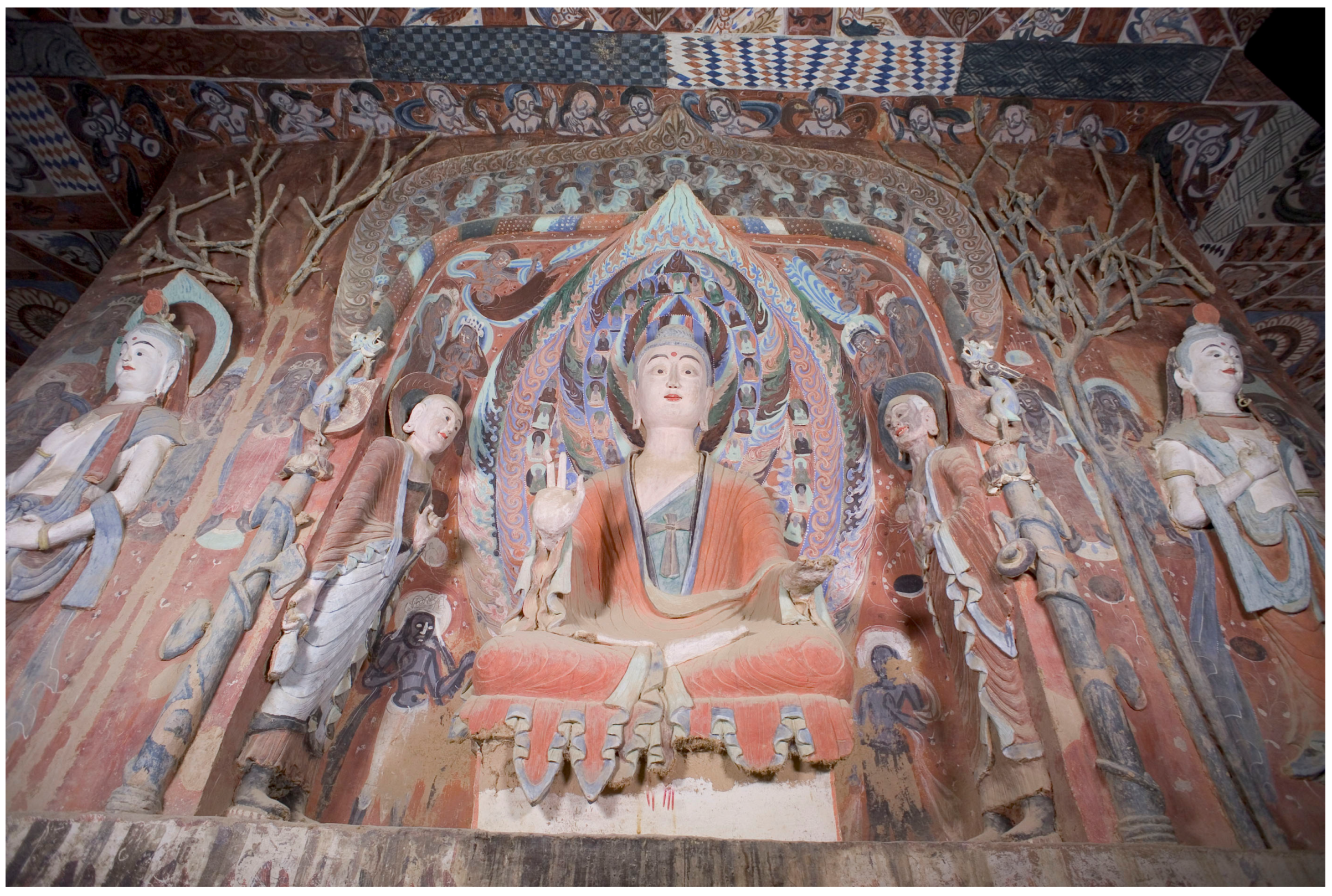
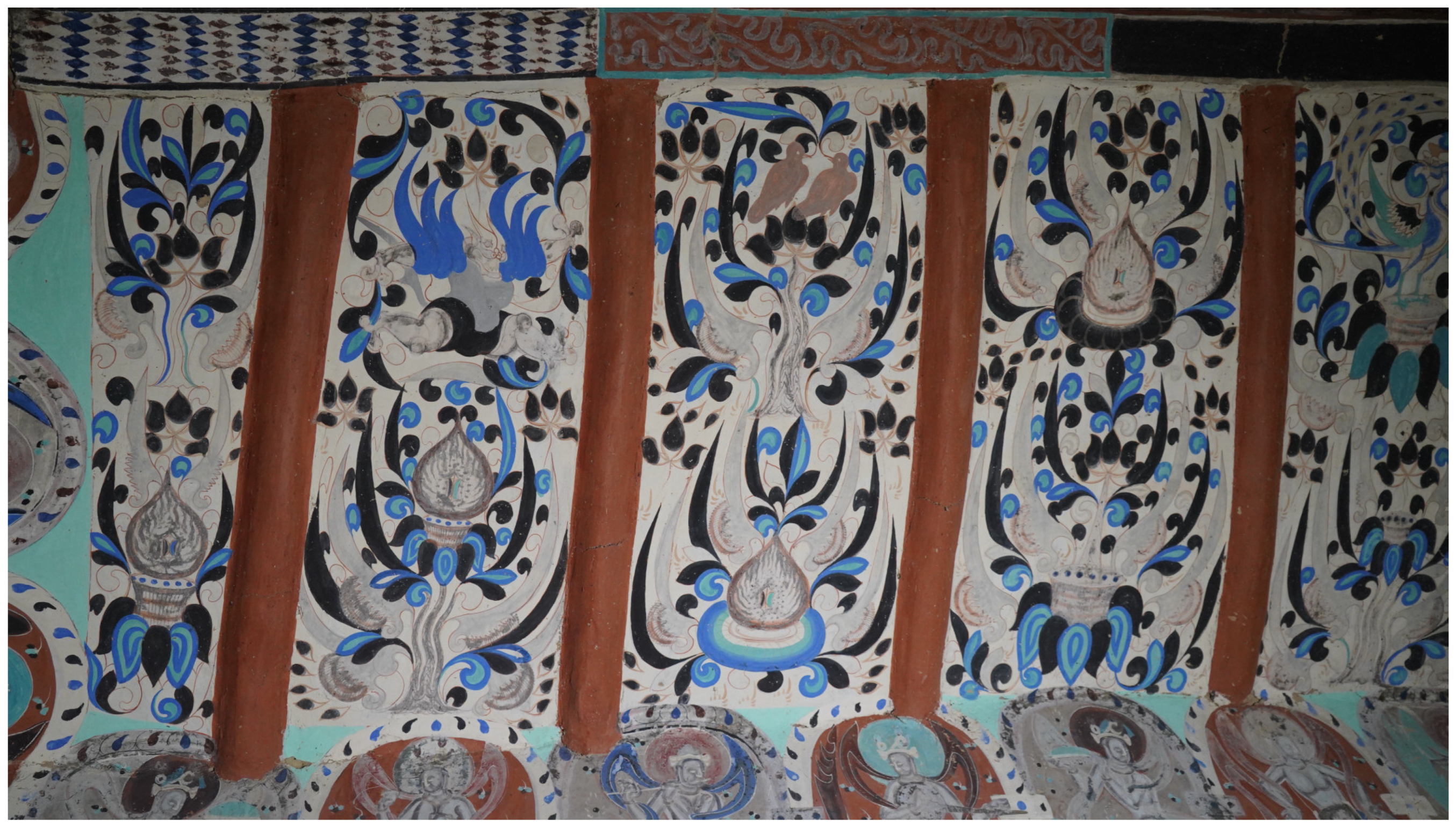
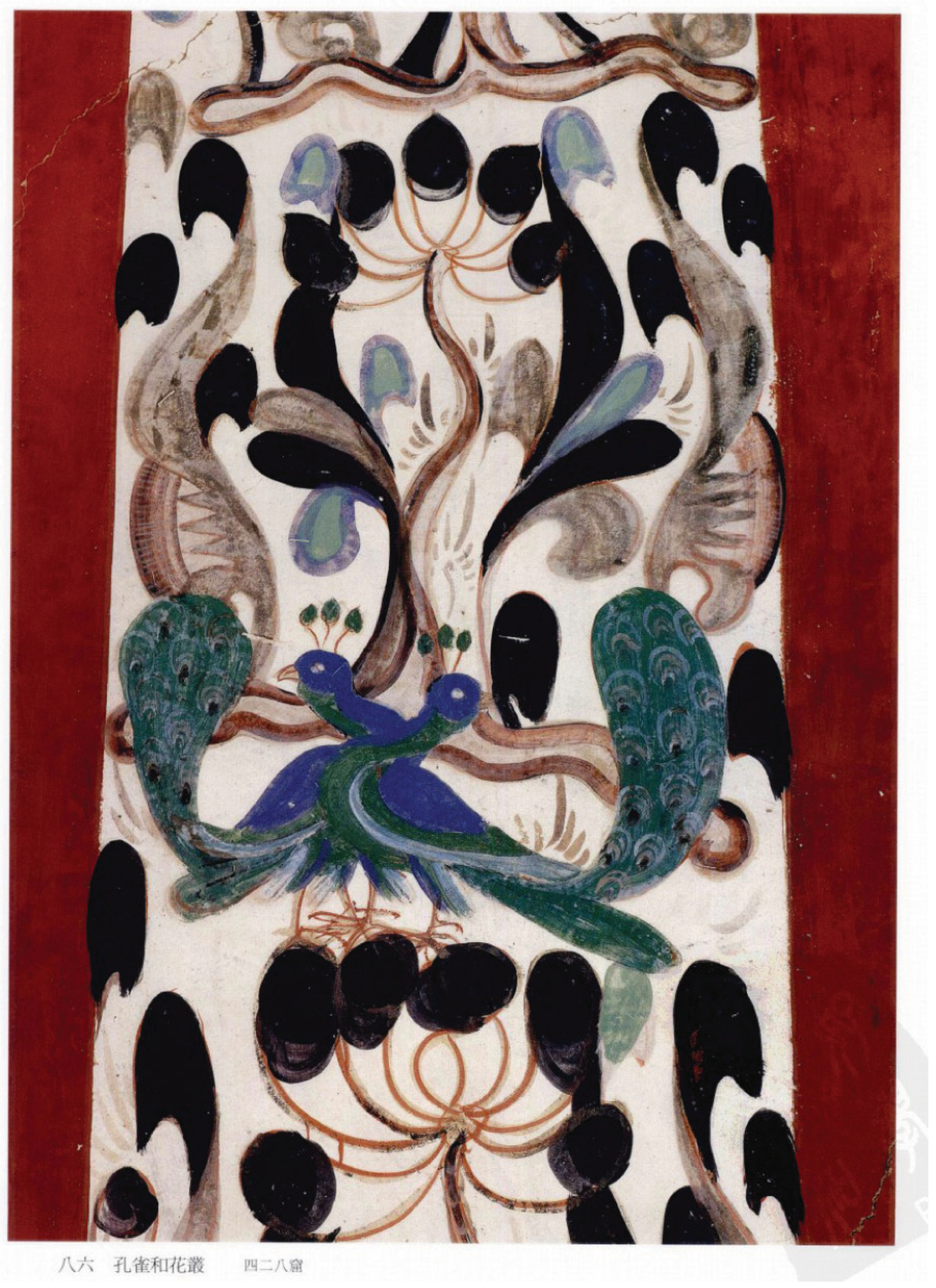
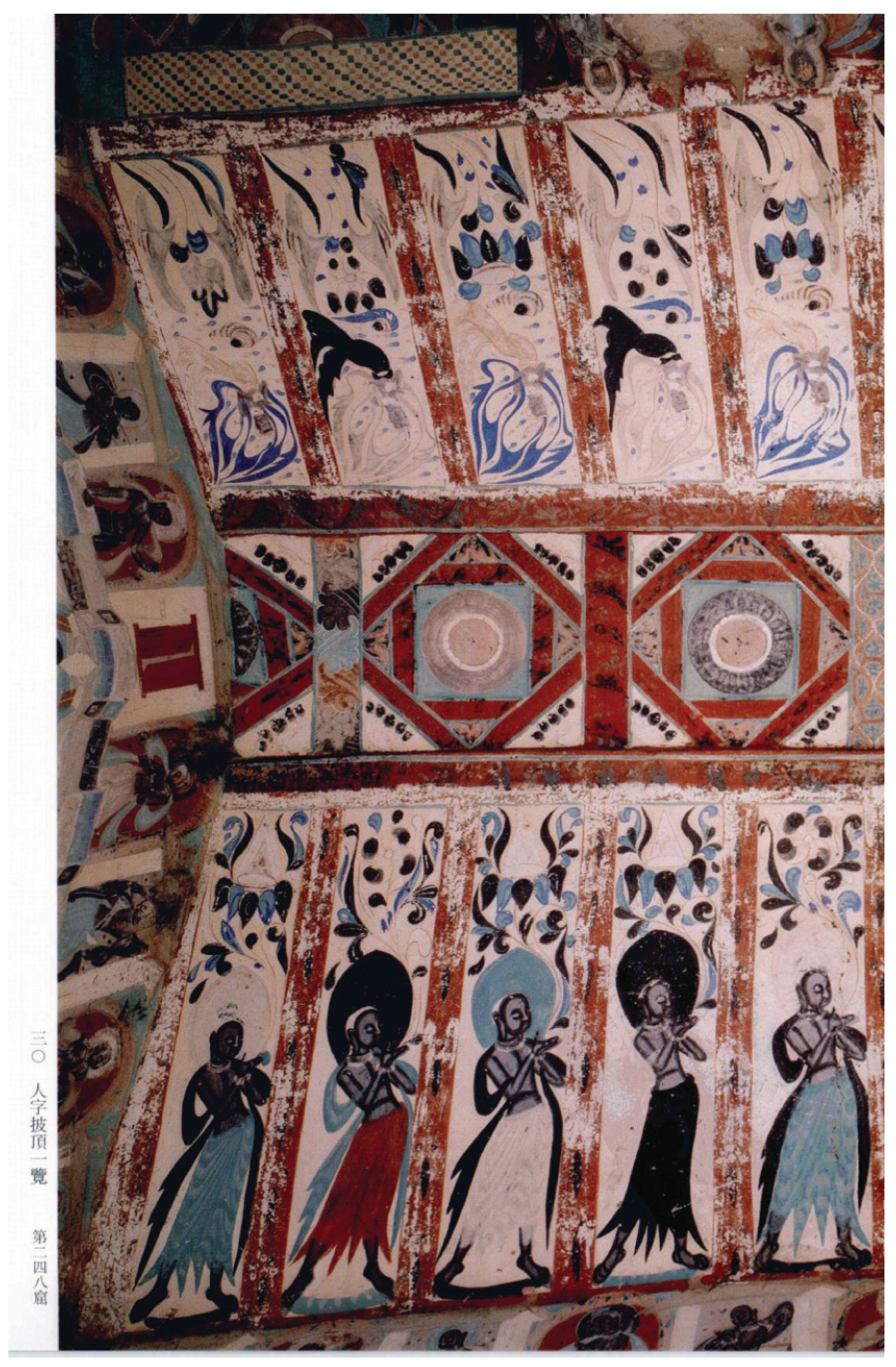
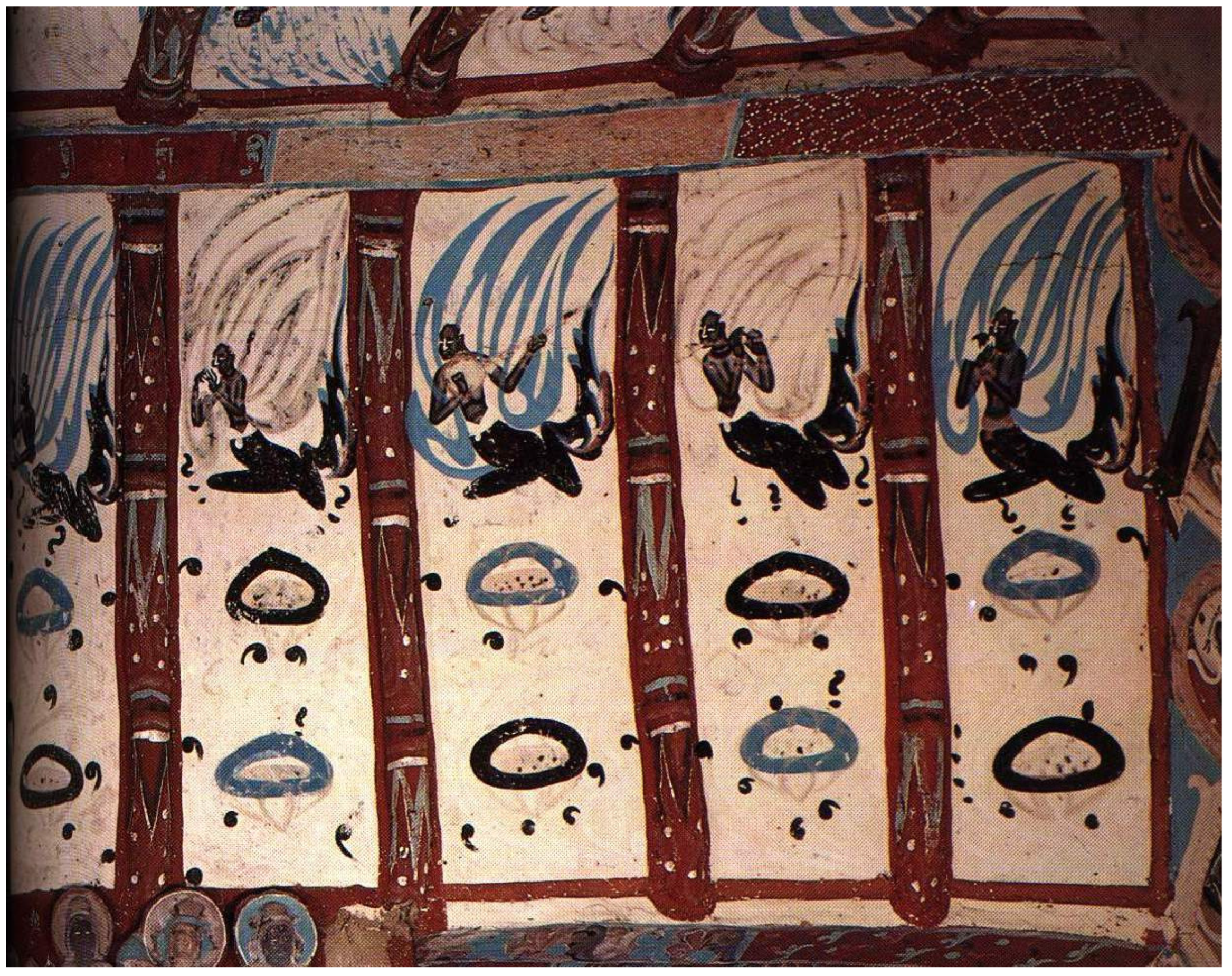
The Symbolic Meaning of the Paired Birds on the Eight Lintels on the Southern and Northern Walls of Mogao Cave 285: Questioning the Meditative Function of the Cave
Abstract
1. Introduction
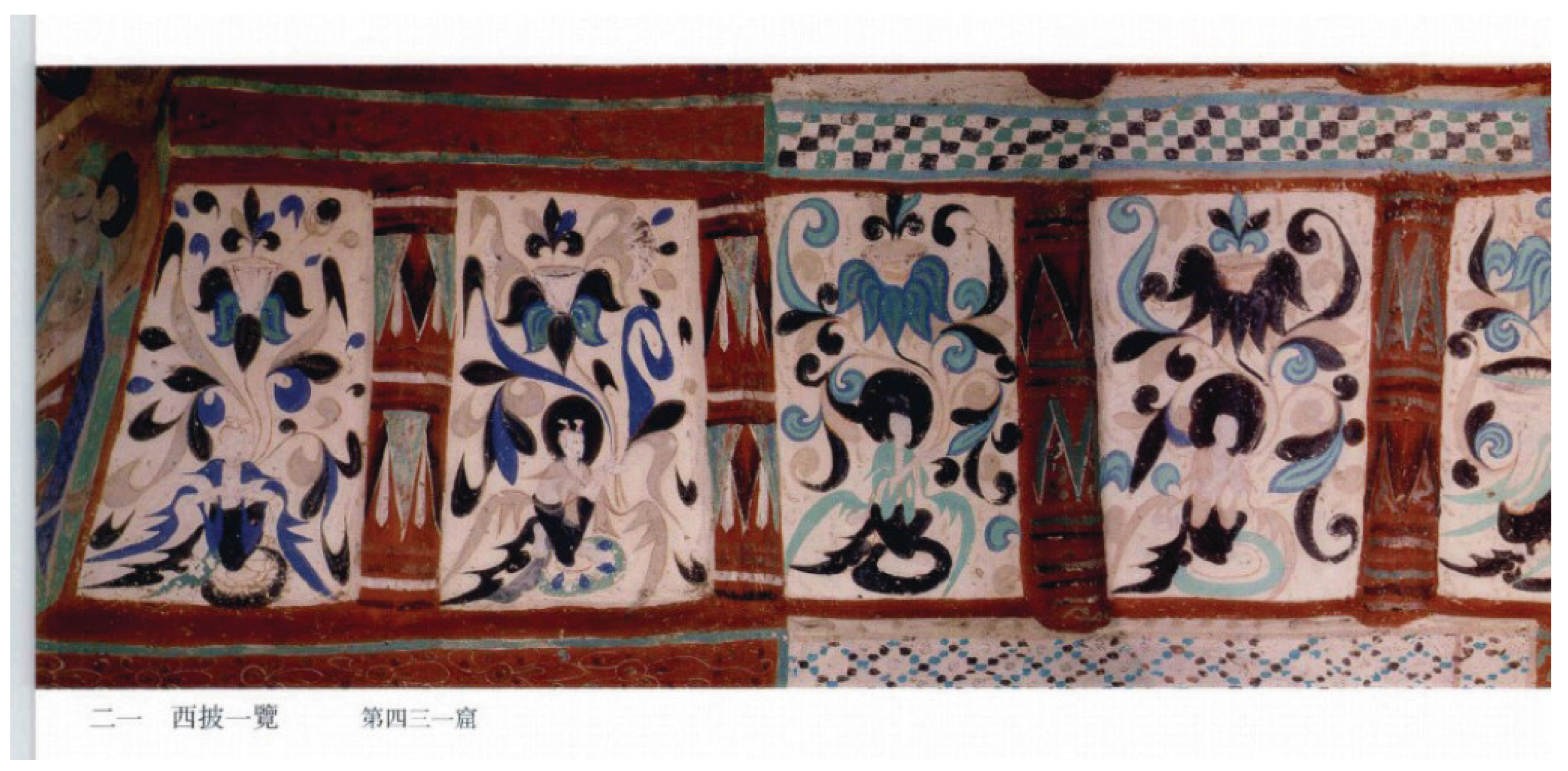
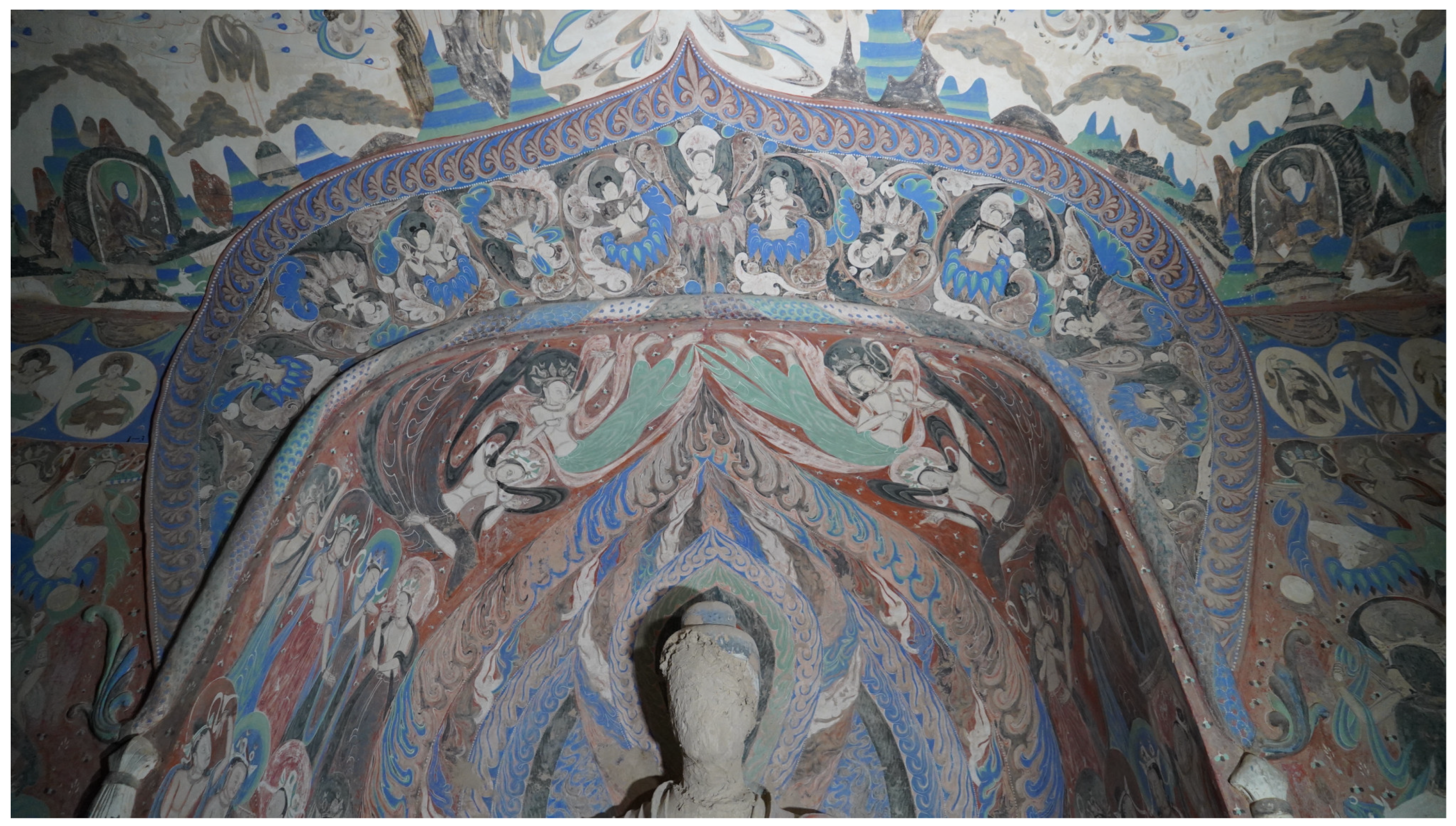
2. Basic Attributes of the Themes of Cave Niche Lintel Imagery
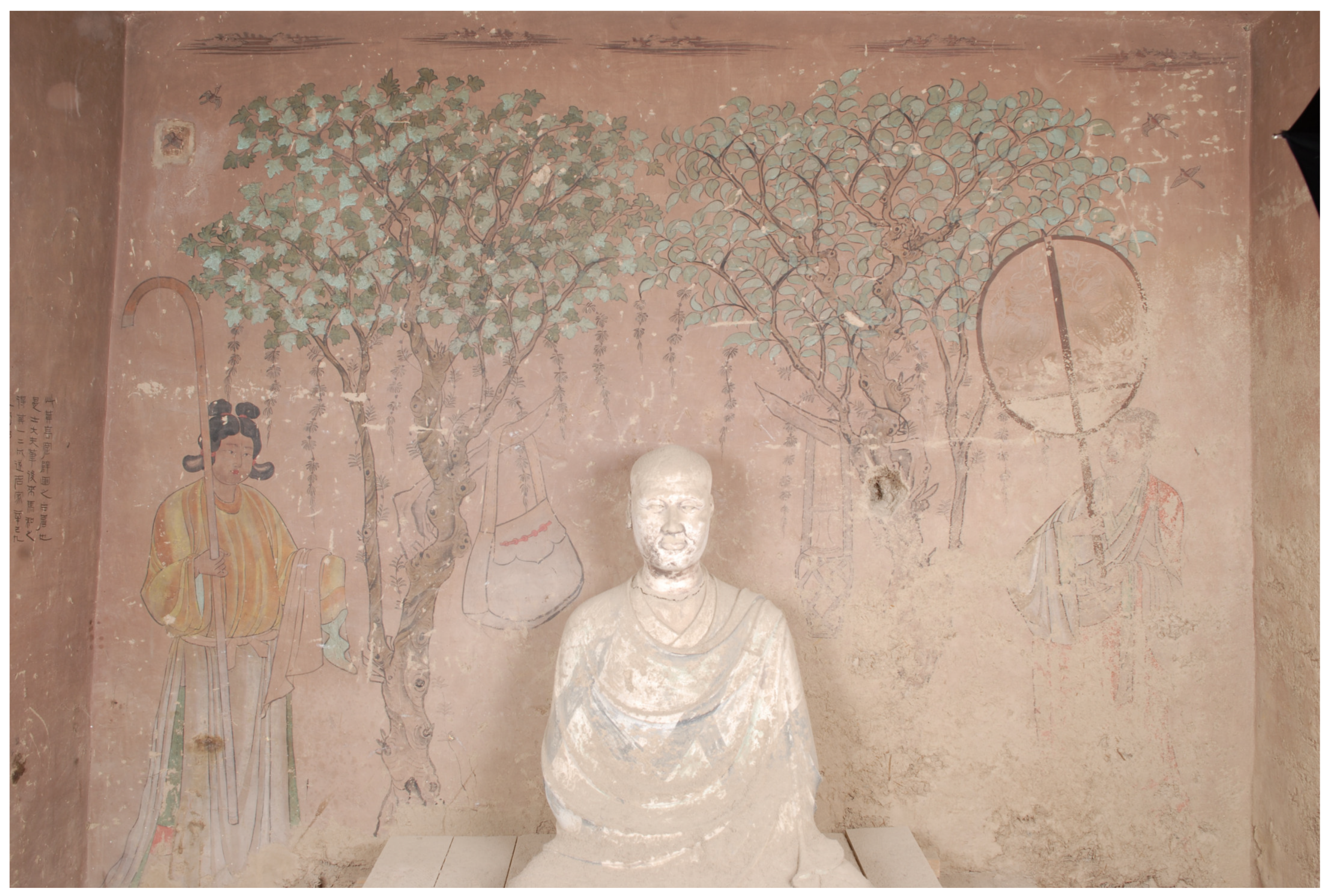
3. The Function of the Eight Small Chambers and the Significance of Their Lintel Imagery
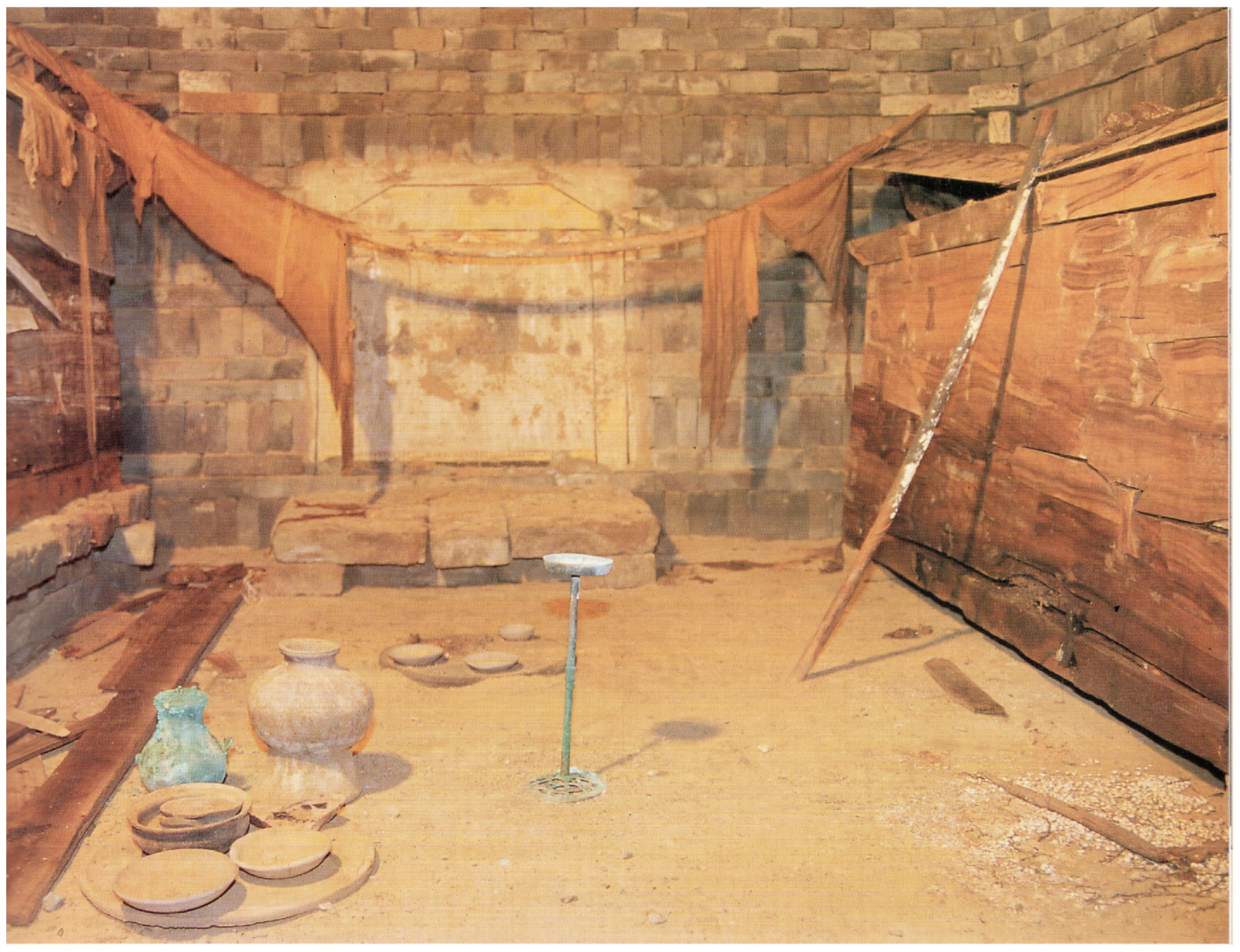
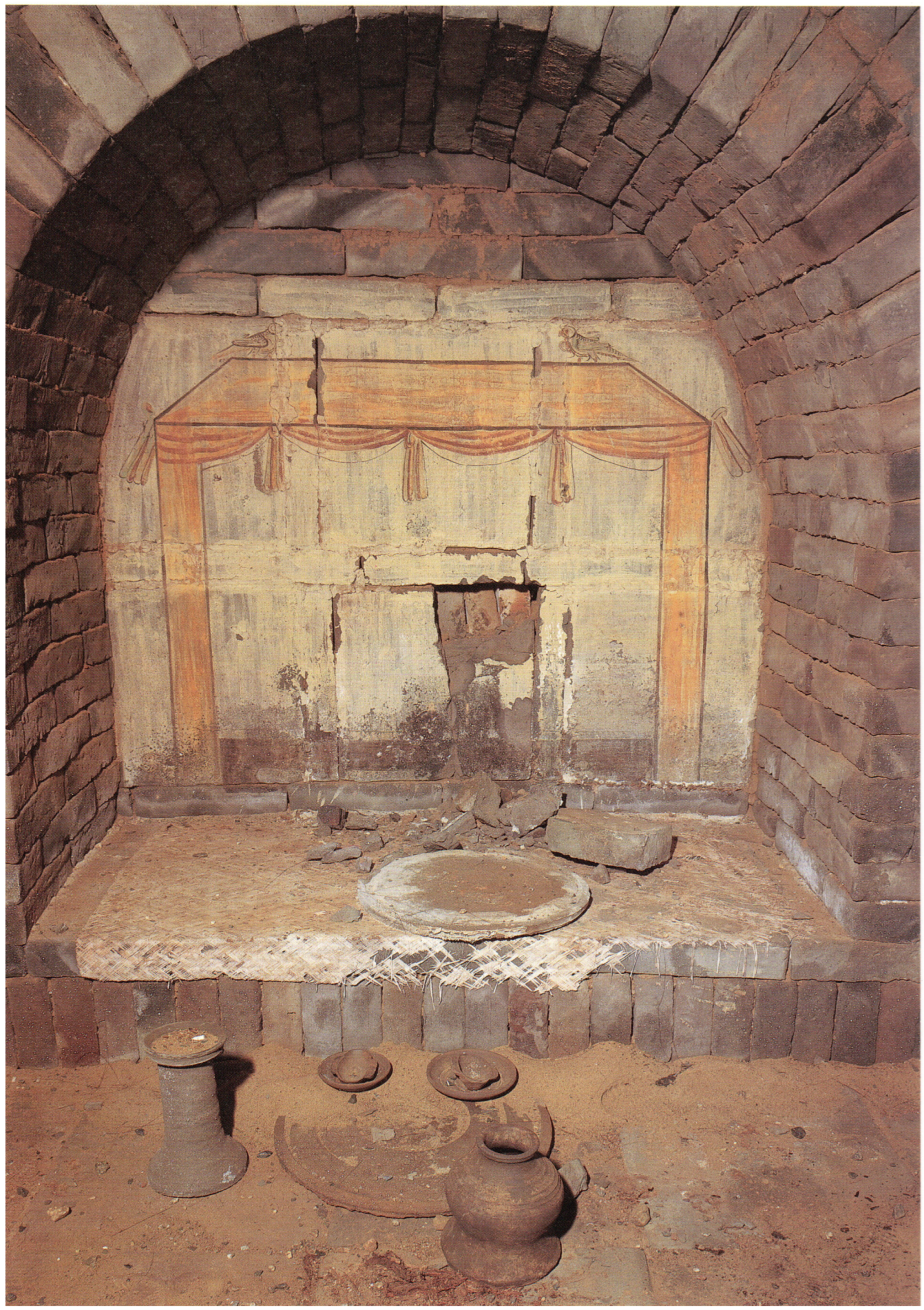
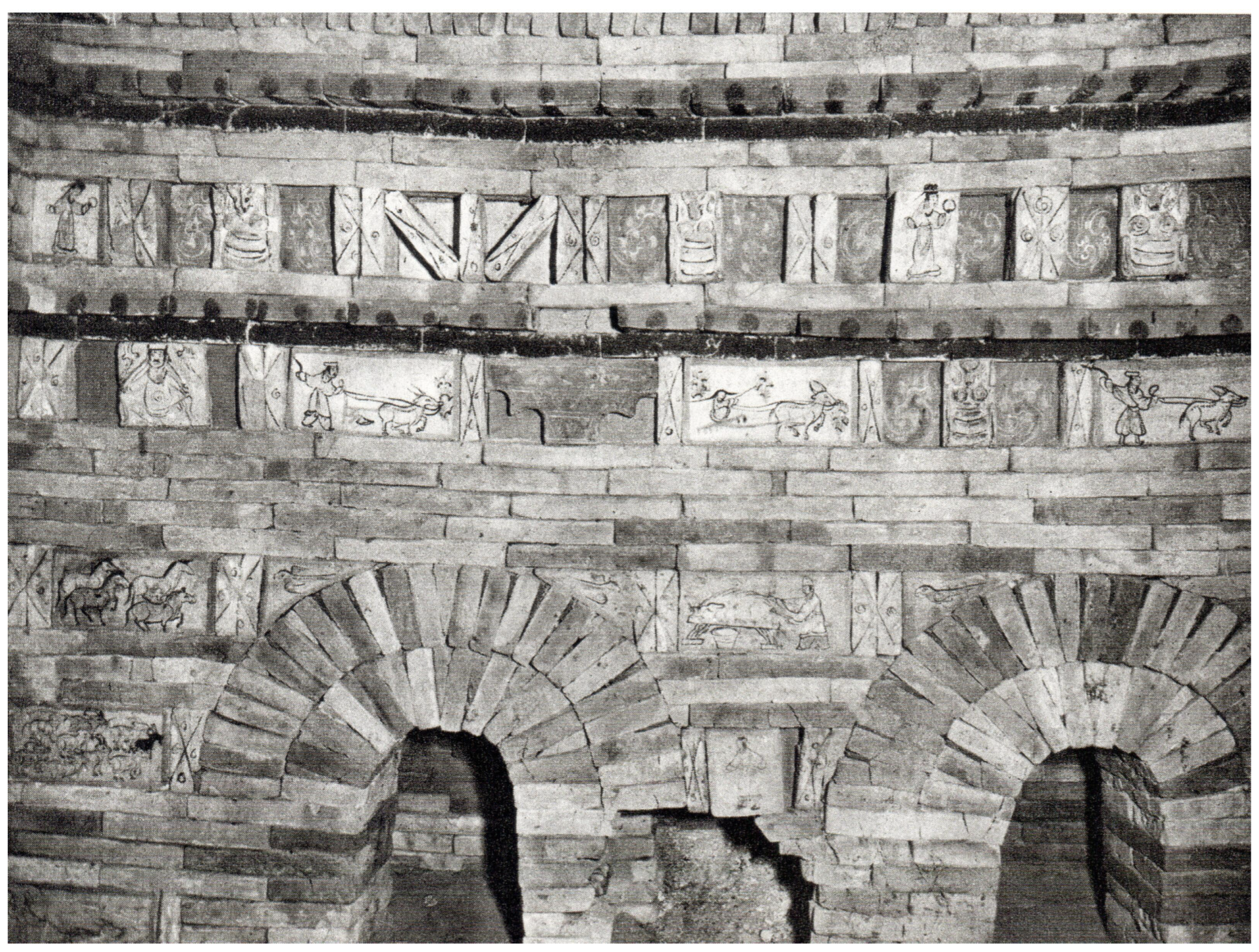
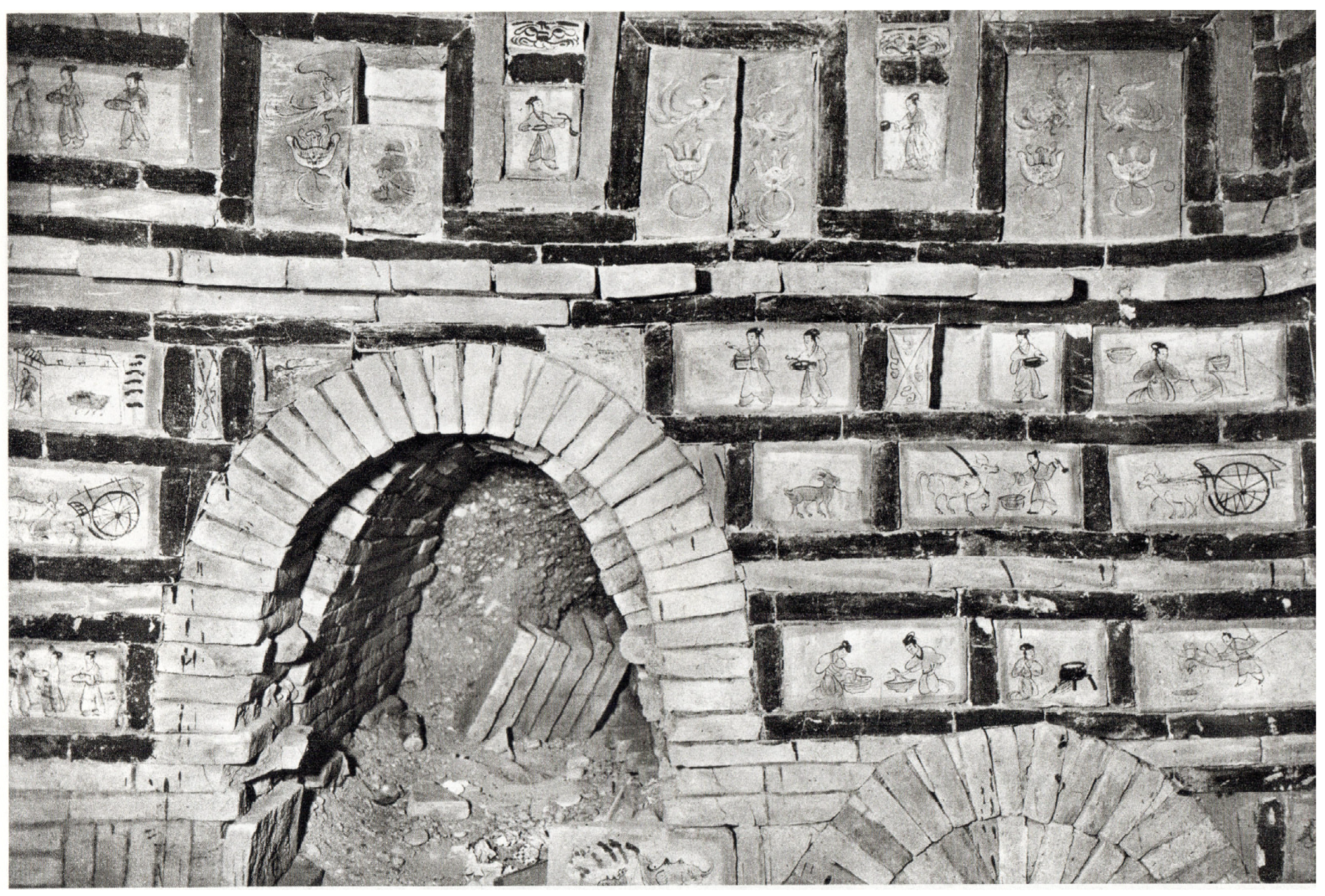
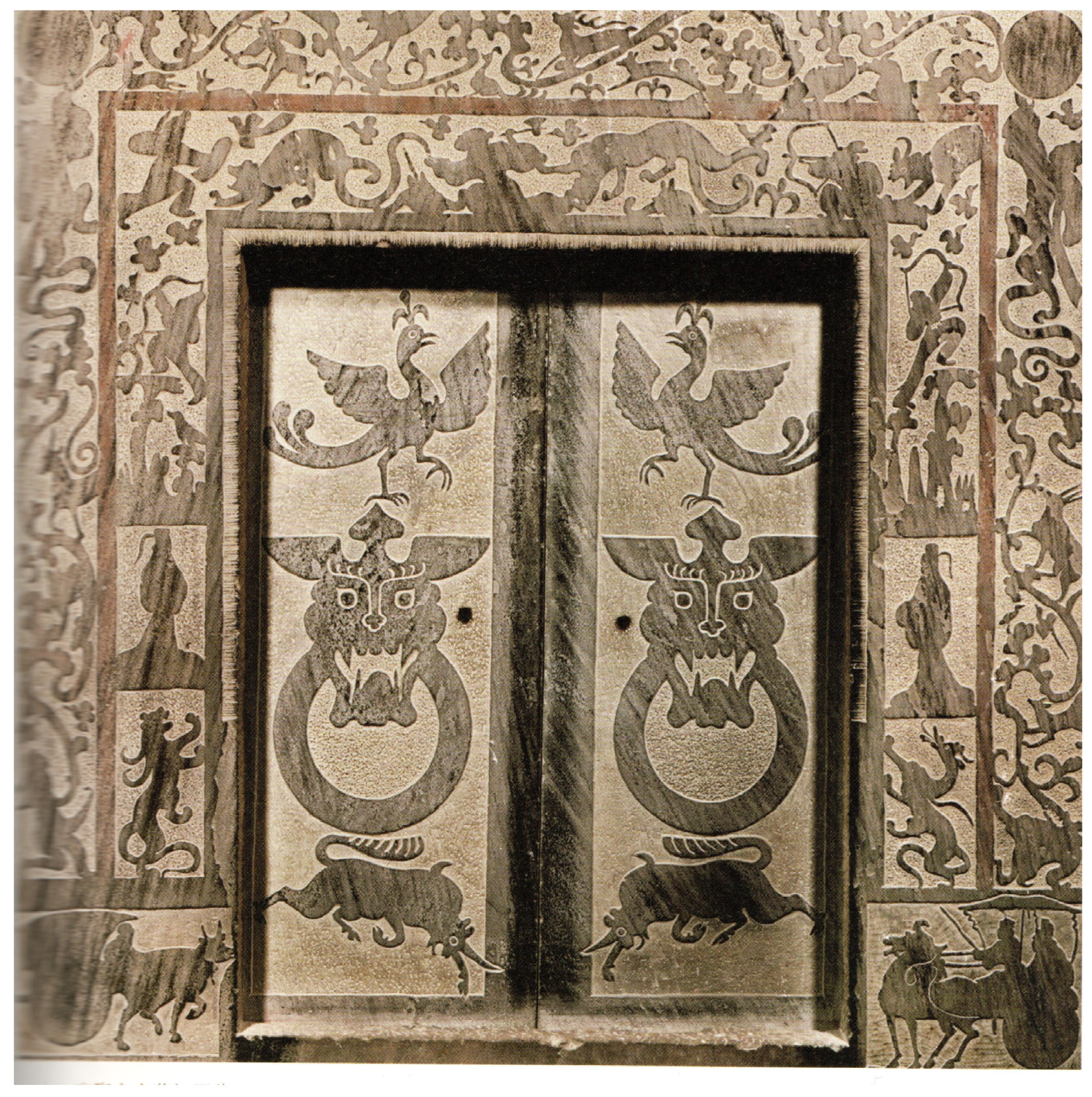
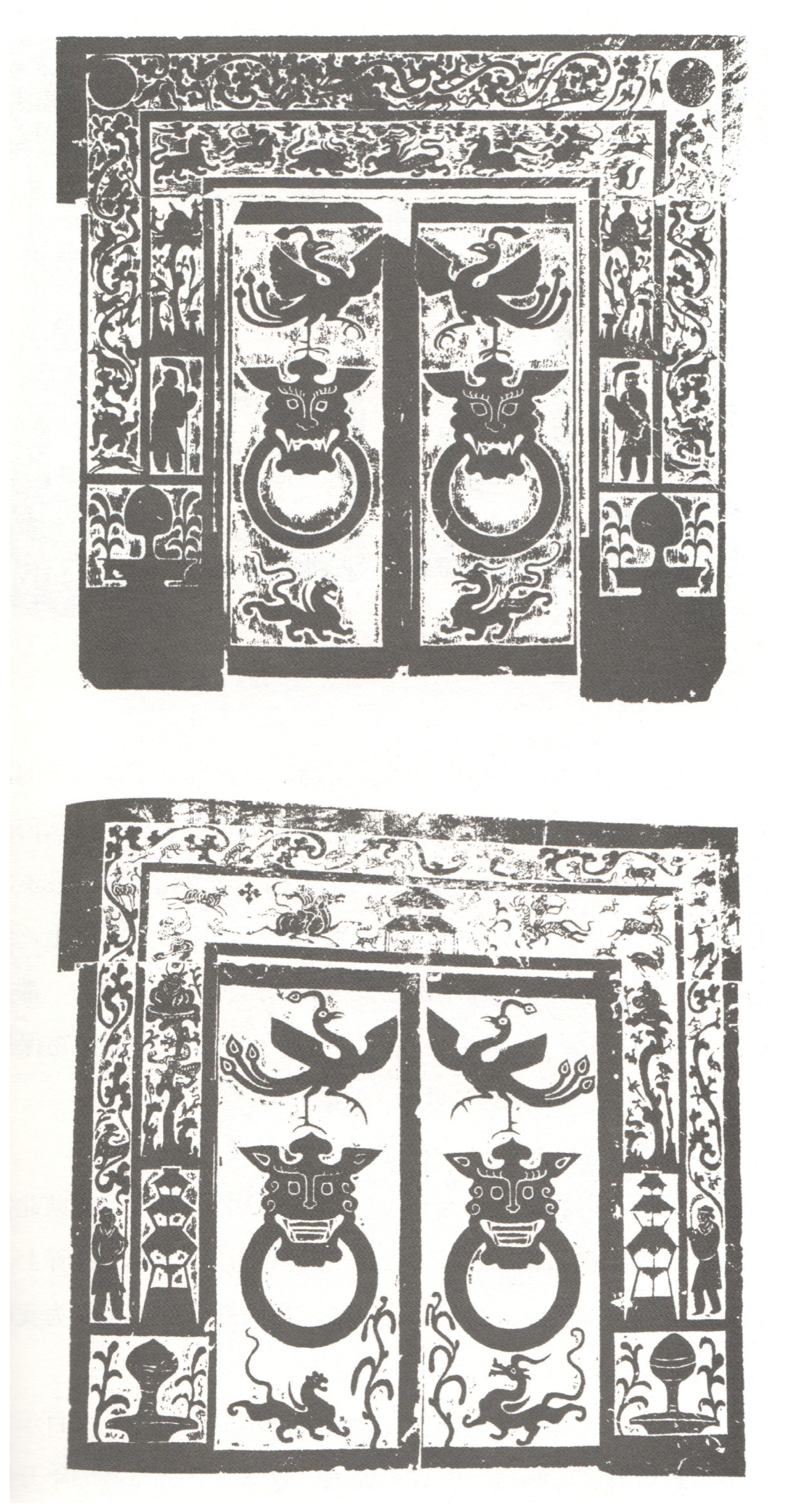
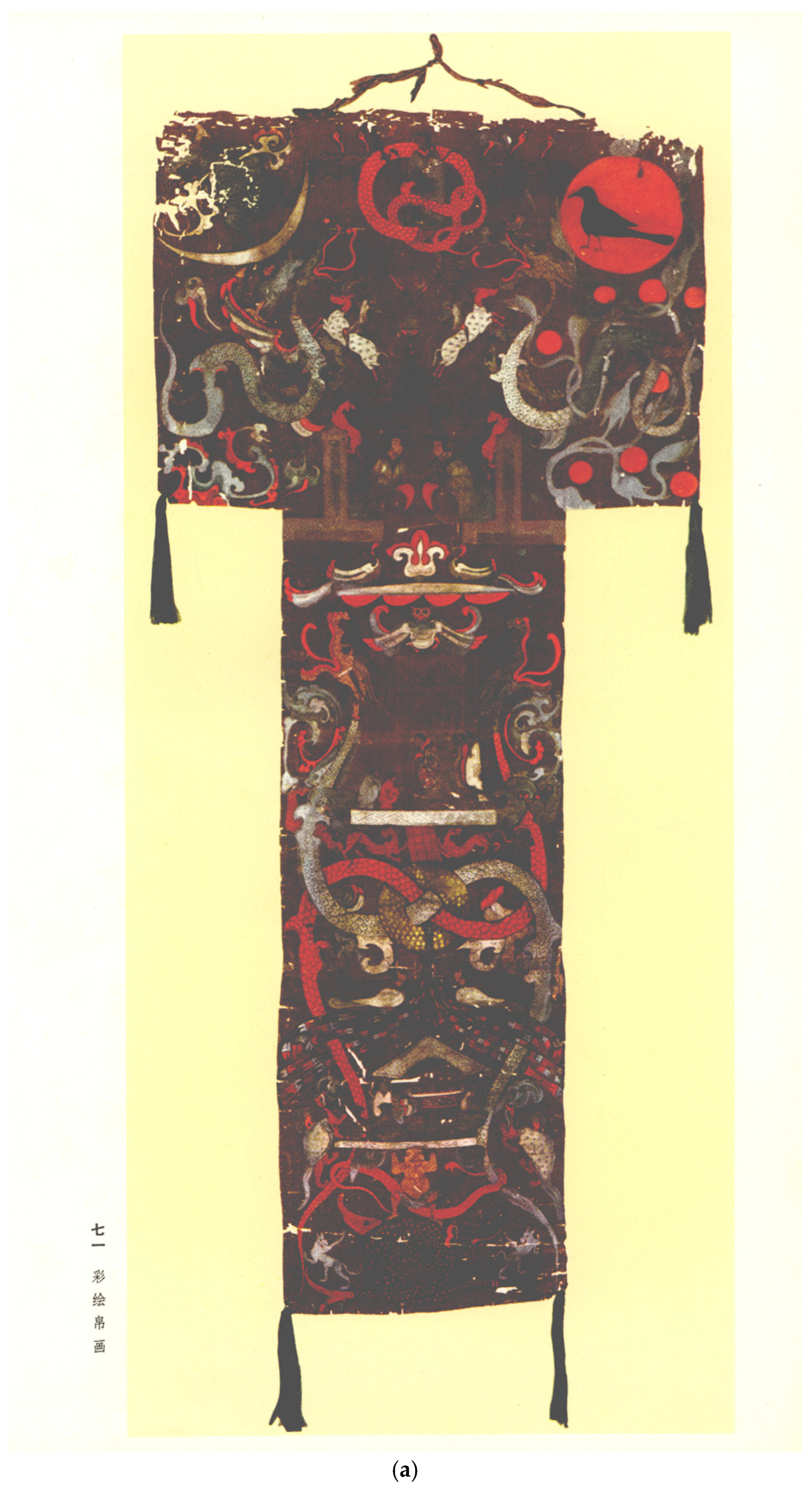
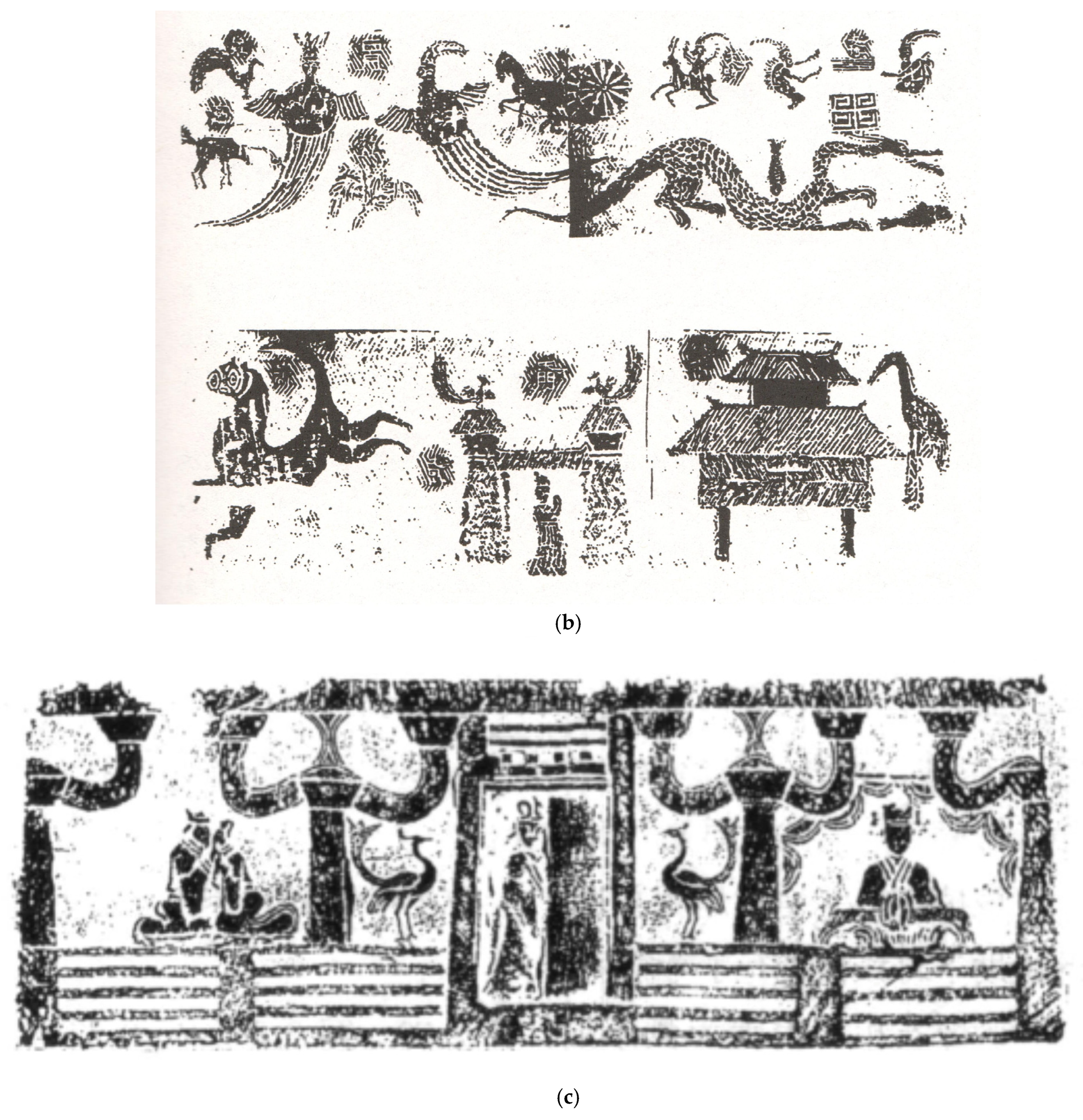
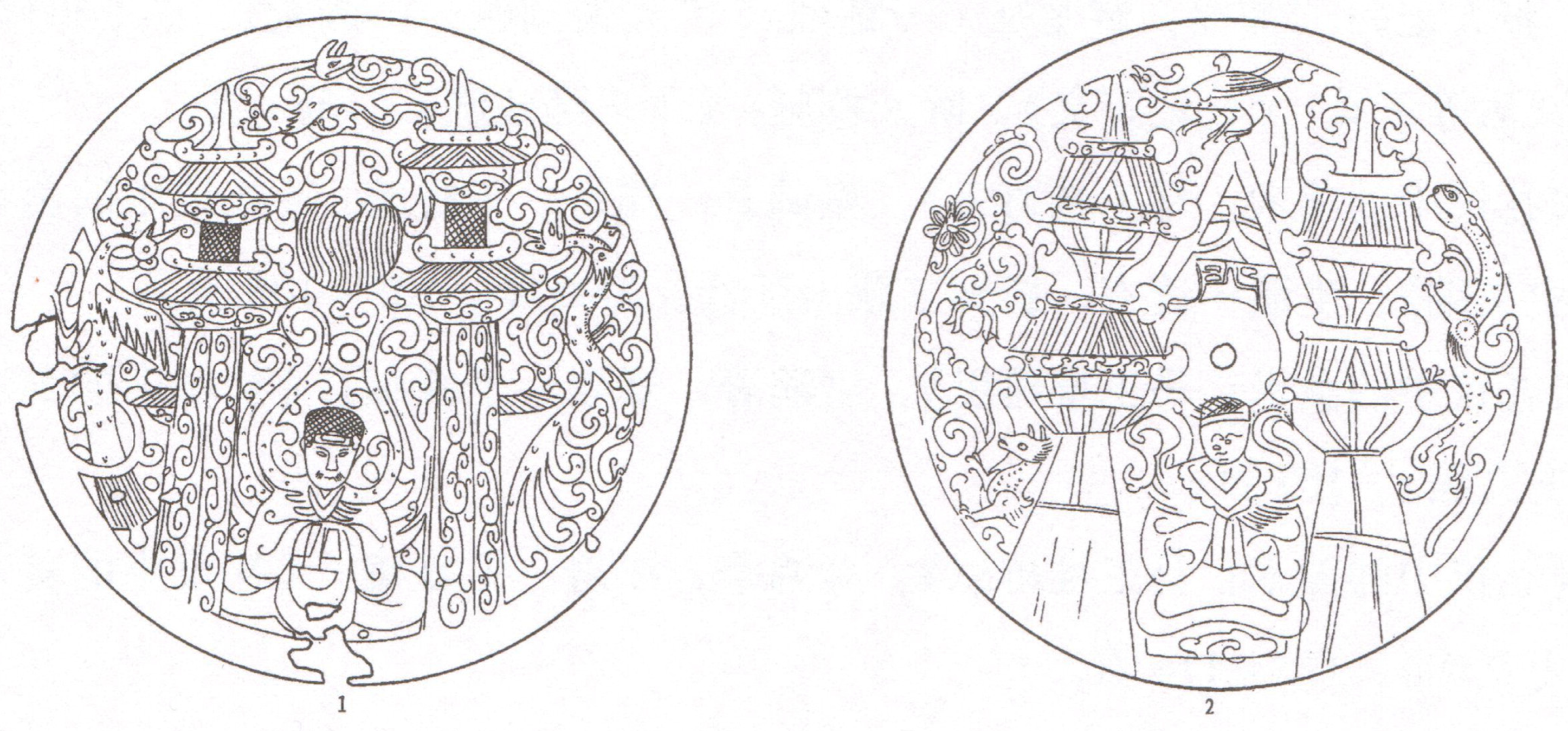
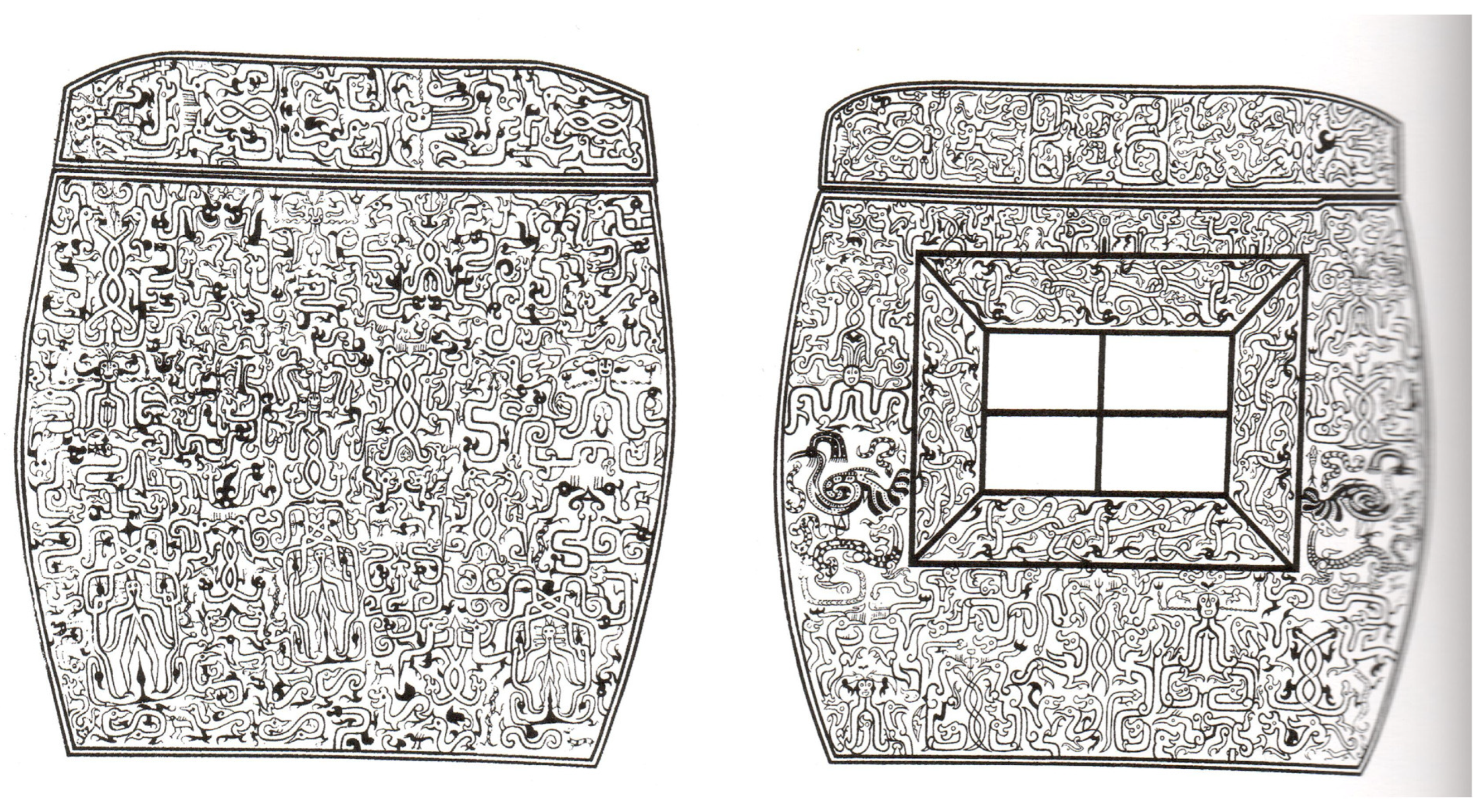
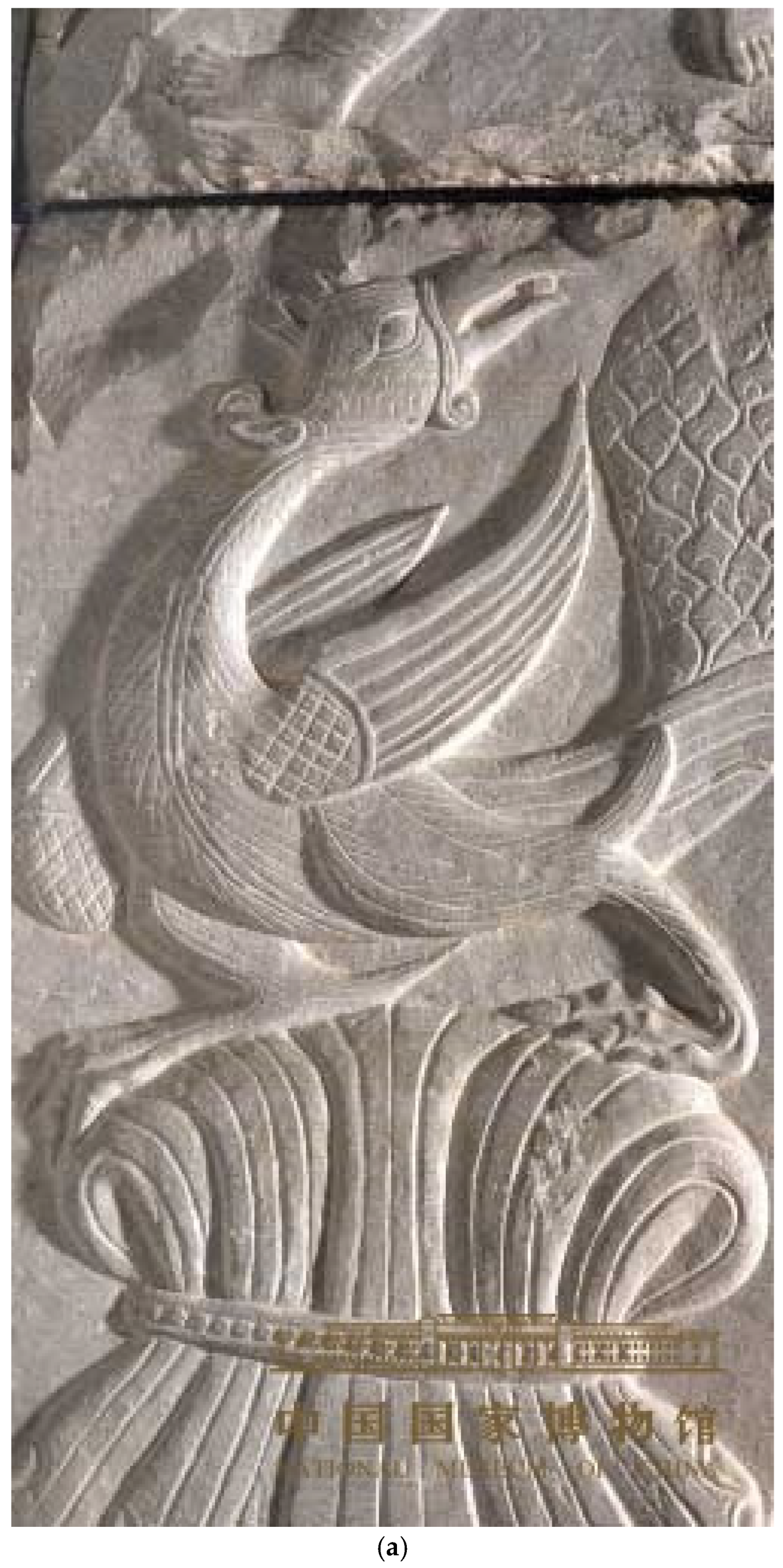
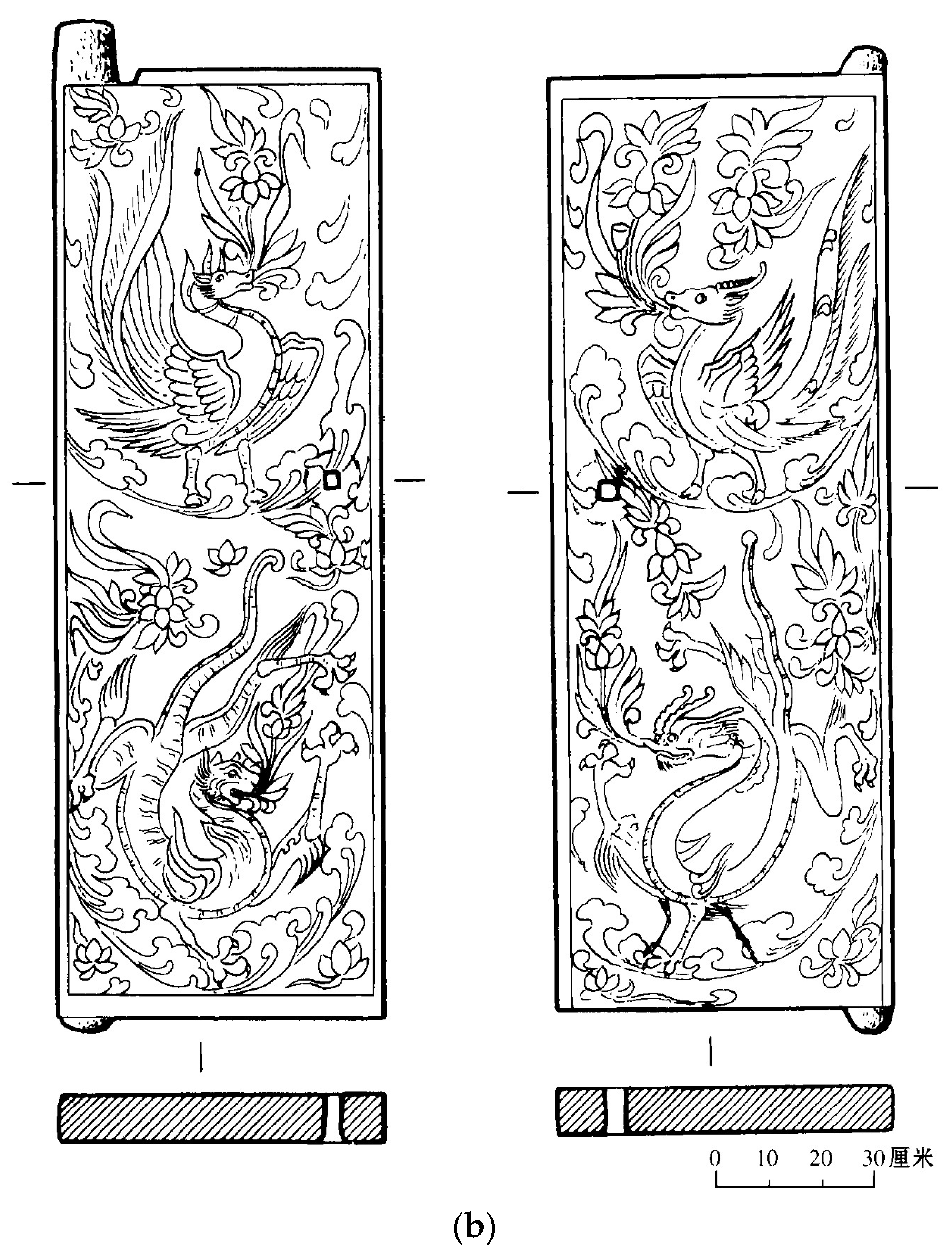
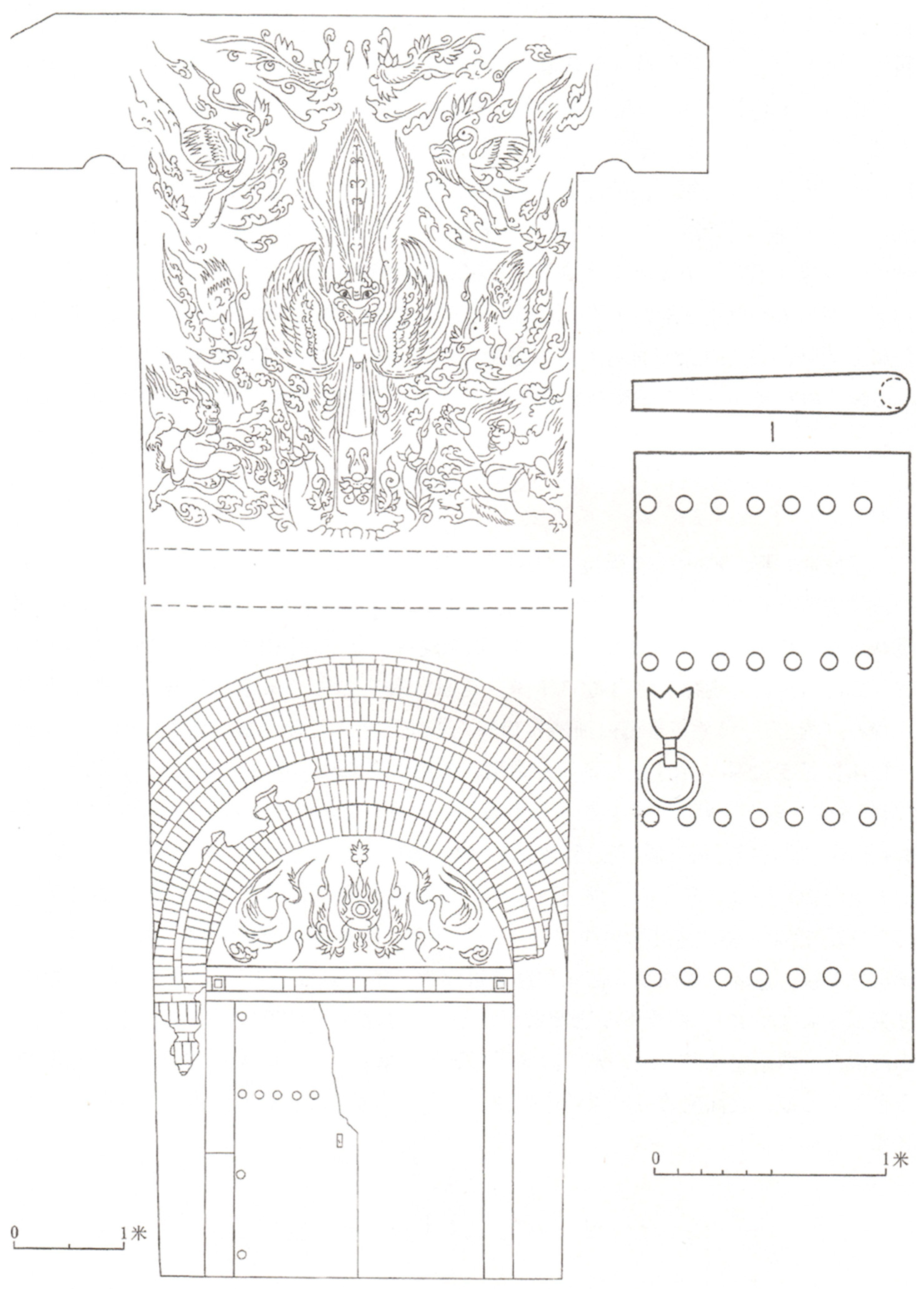
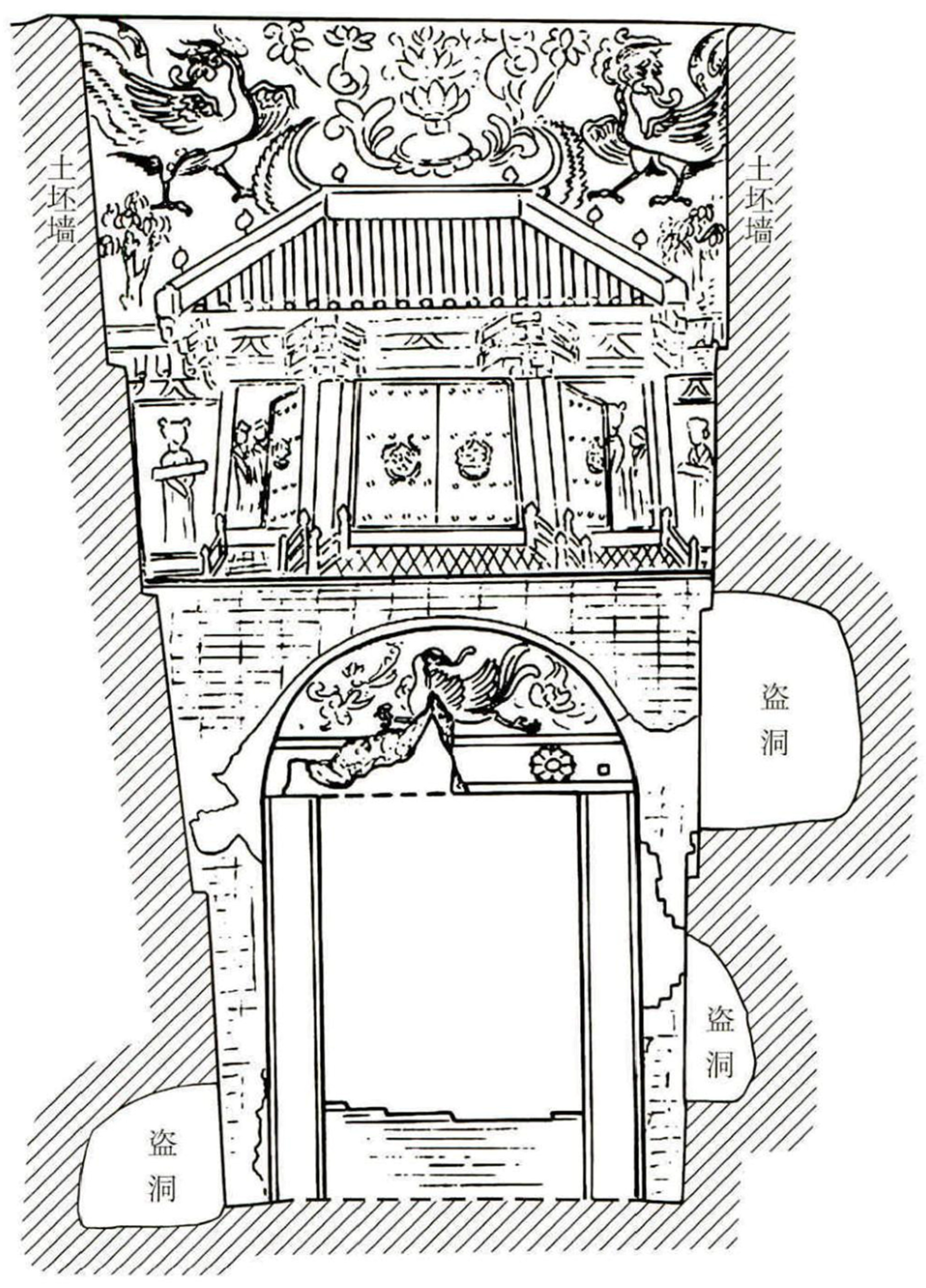
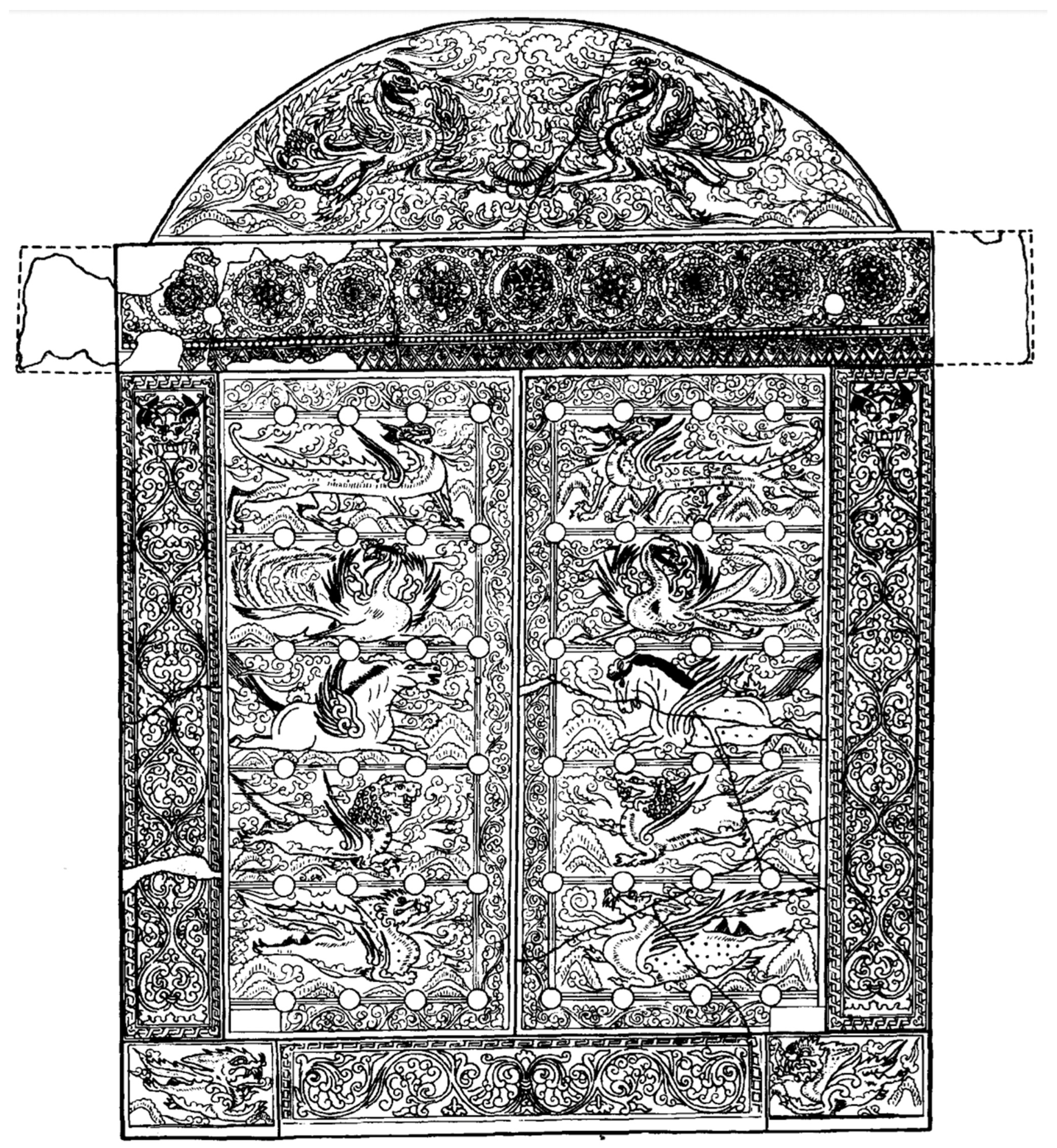
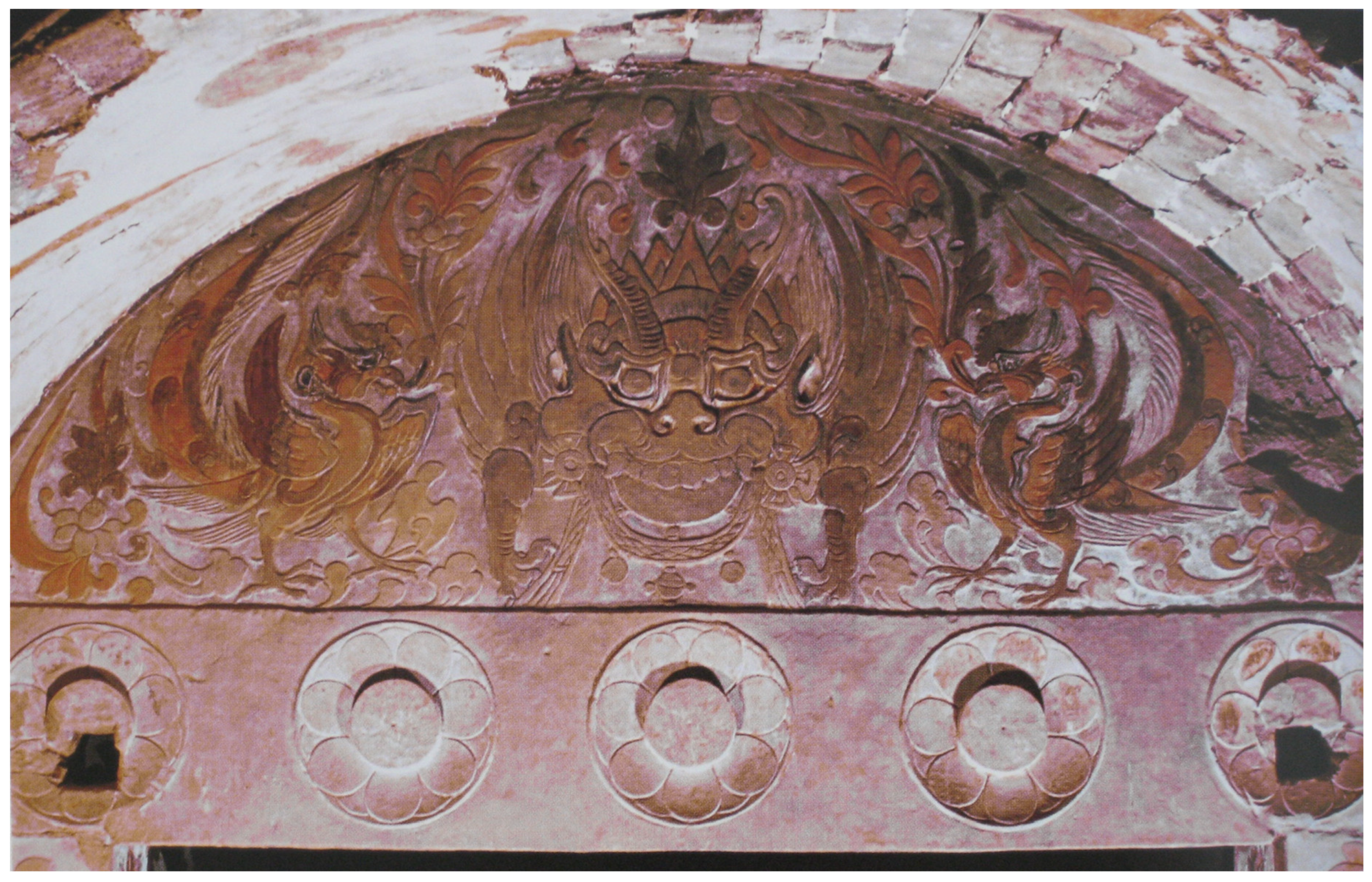
4. Ascending to Immortality: The Imagery of Paired Birds in Secular Tomb Murals
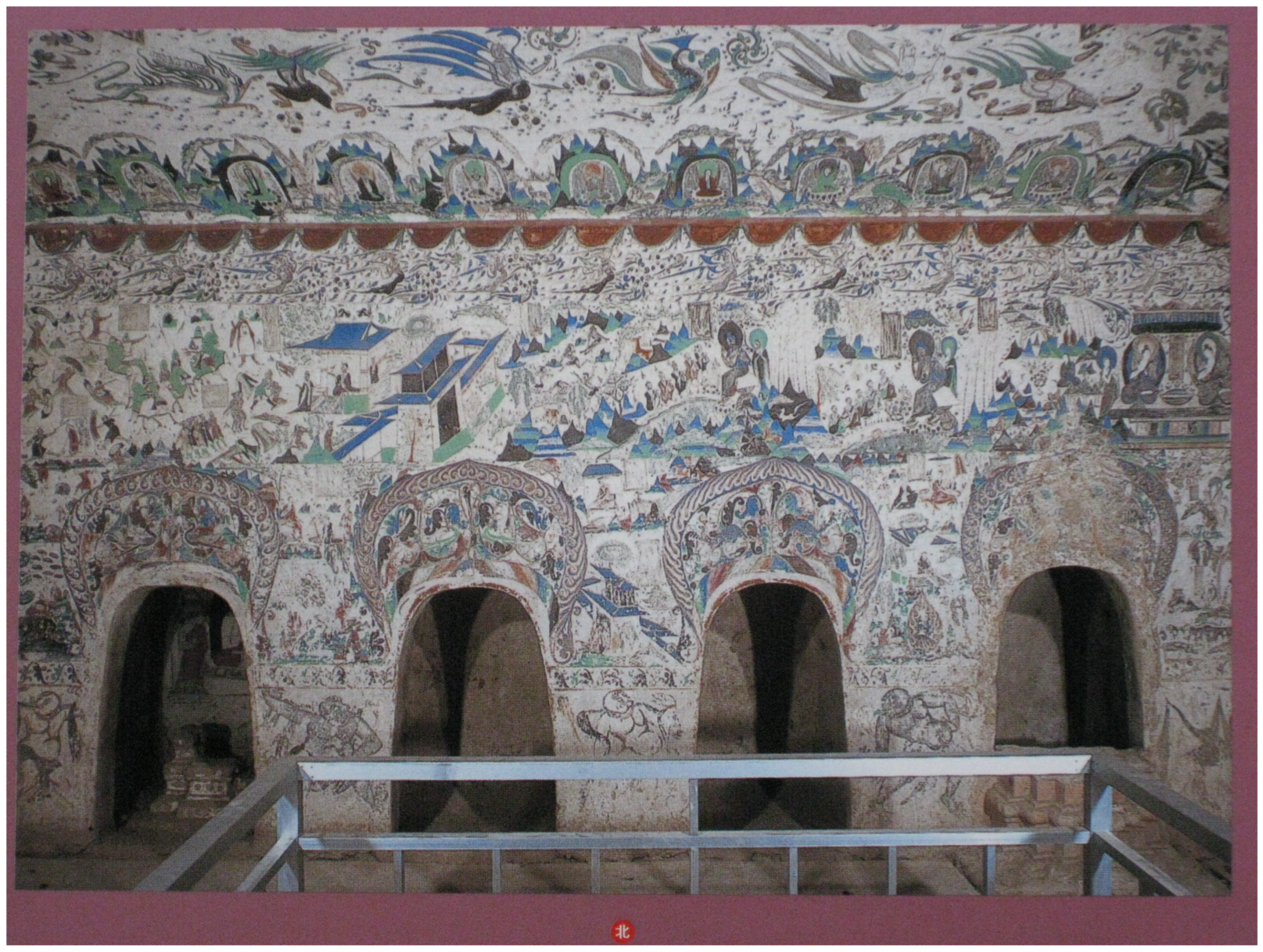
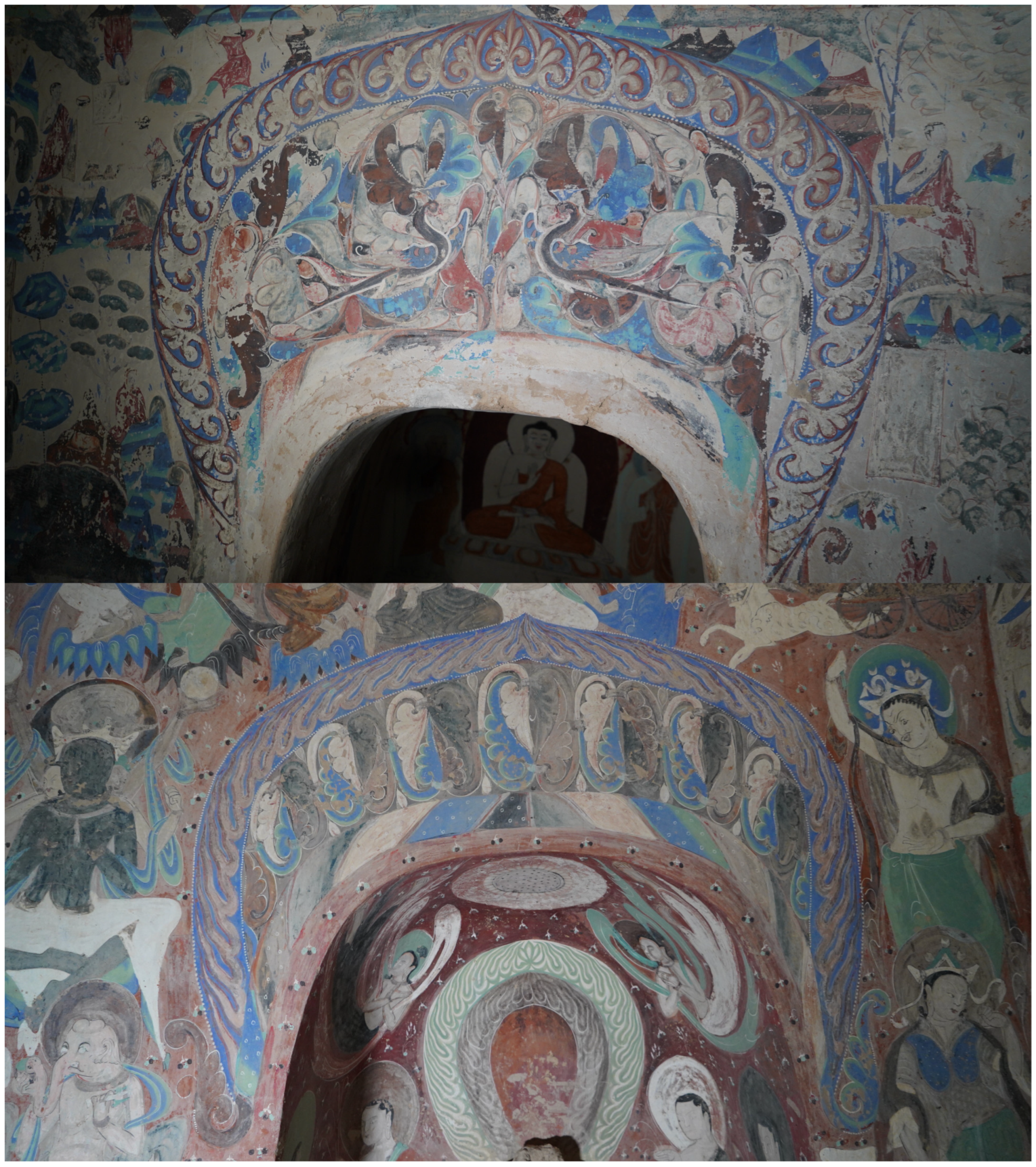
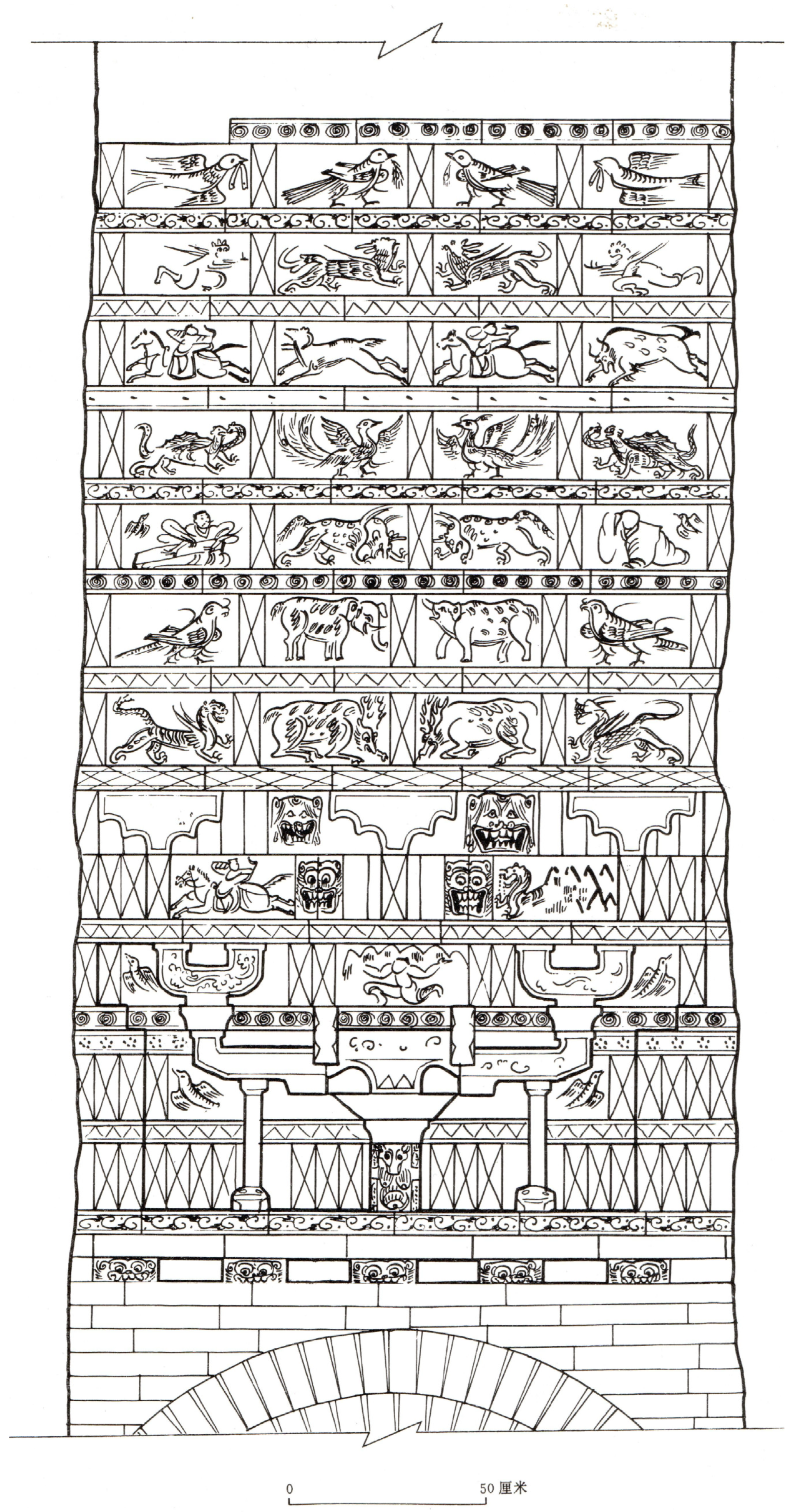
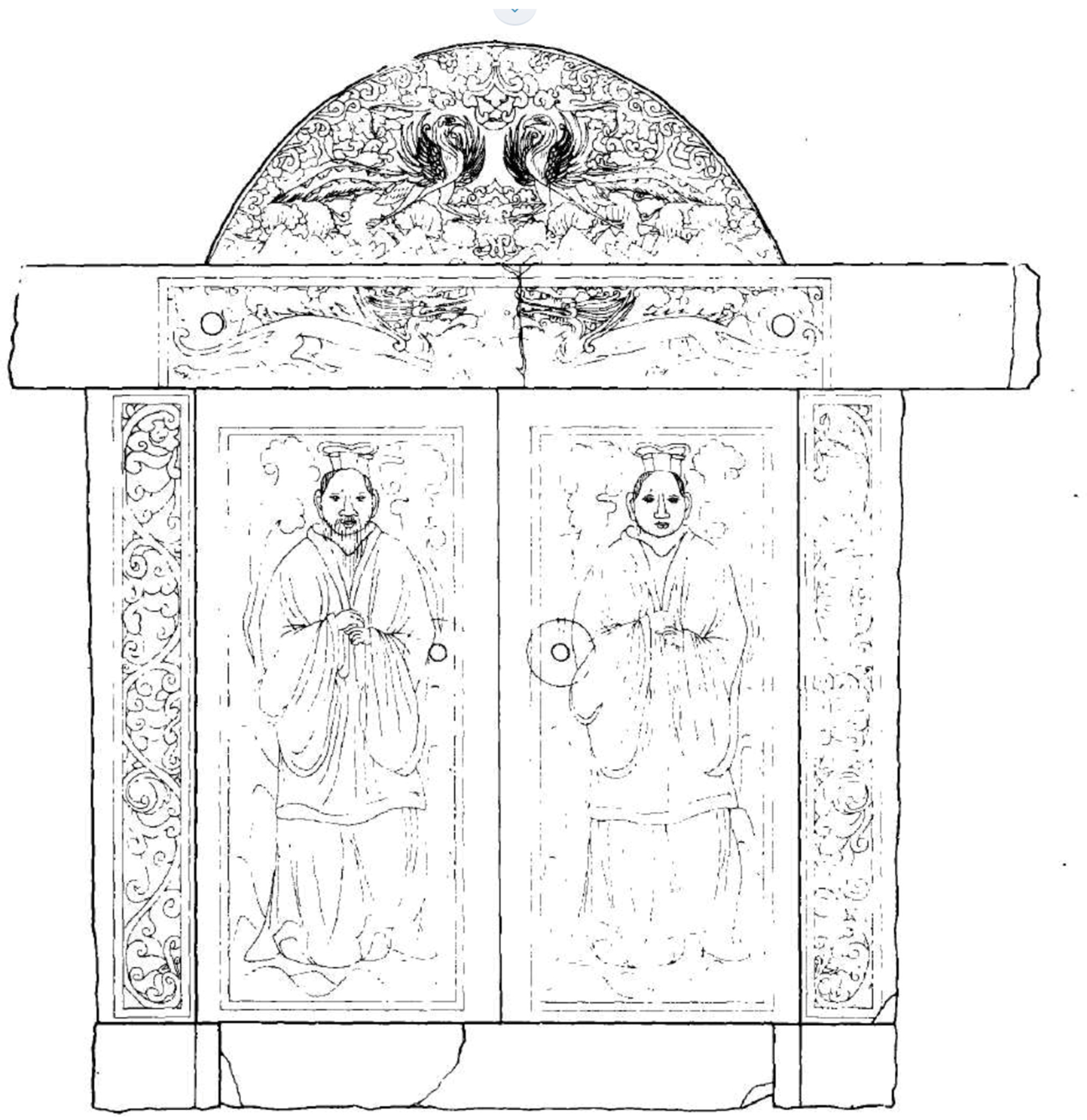
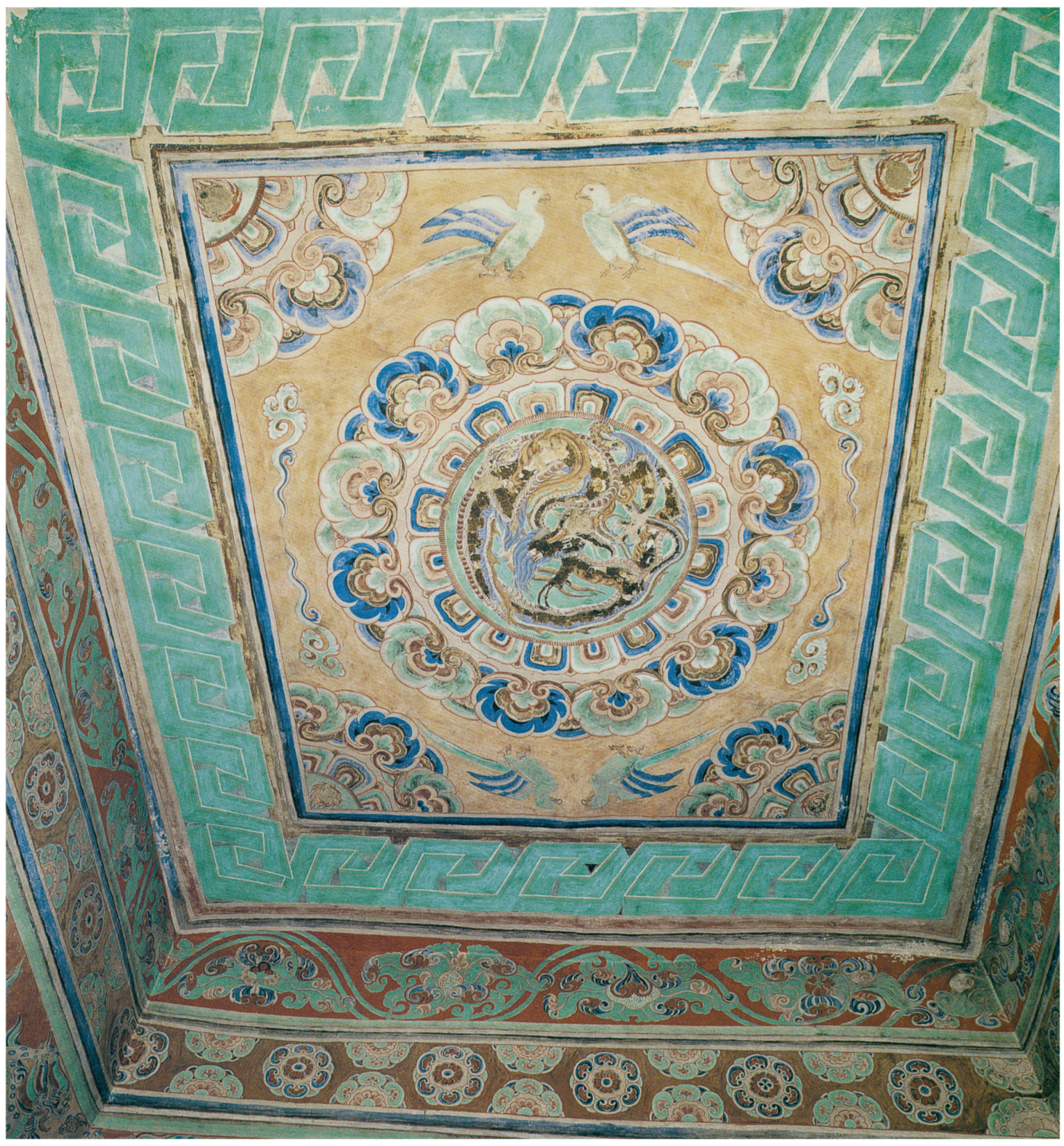
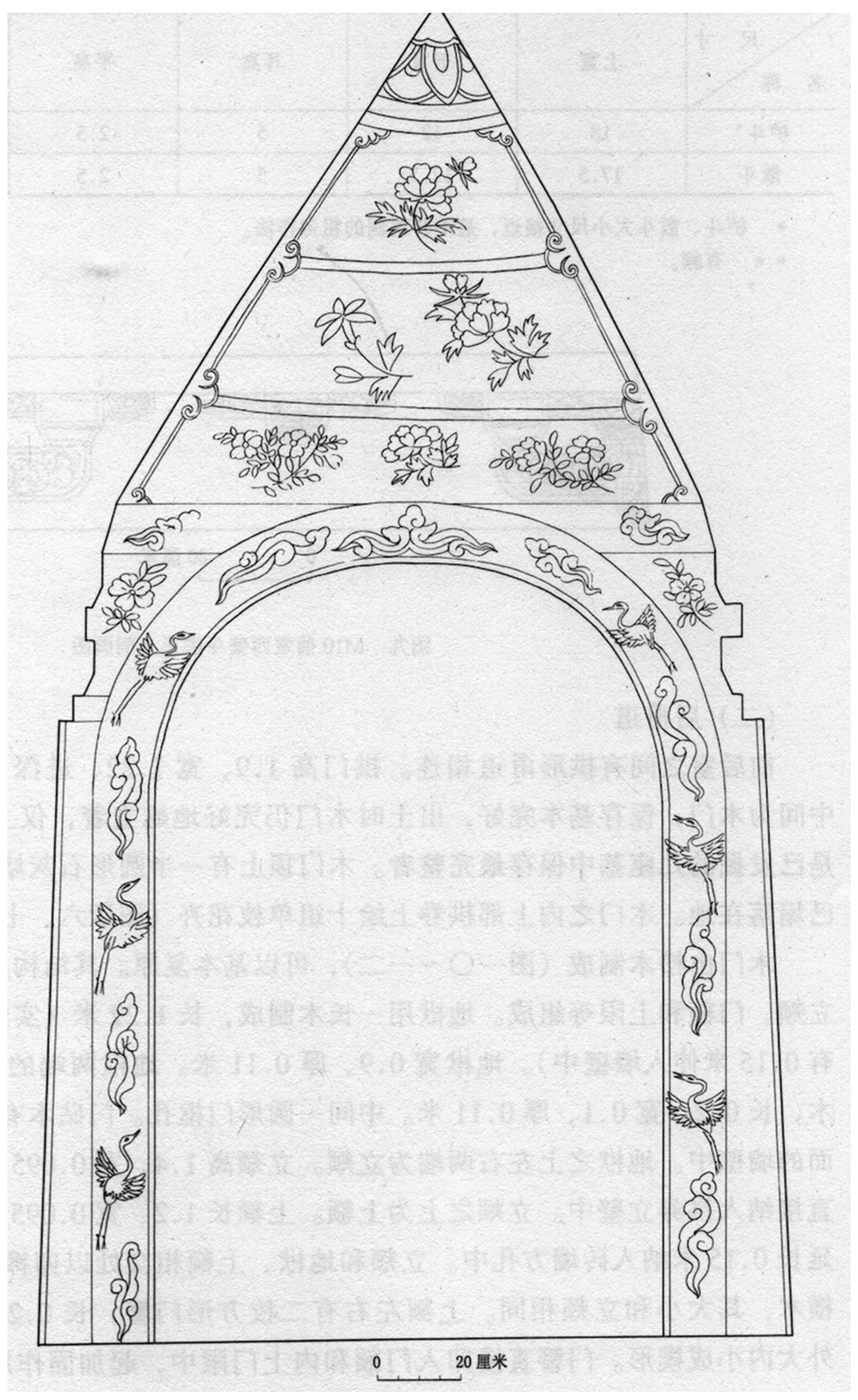
- First Layer: In the center, two divine birds facing each other, each holding a plume; on the outer sides, two mystical birds facing each other, each holding a ribbon.
- Second Layer: In the center, two qilin facing each other; on the outer sides, two creatures receiving blessings.
- Third Layer: On each side, a rider facing backward shooting at a running sheep and bull, respectively.
- Fourth Layer: In the center, two vermillion birds facing each other; on the outer sides, two black tortoises facing each other.
- Fifth Layer: In the center, two celestial deer facing each other; on the outer sides, Boya playing the guqin and Ziqi listening, respectively.
- Sixth Layer: In the center, two elephants facing each other; on the outer sides, two parrots facing each other.
- Seventh Layer: In the center, two great-horned divine deer facing each other; on the outer sides, two blue dragons facing each other.
- Eighth Layer: Three inverted pheasant-shaped architectural elements; in the center, two beast faces.
- Ninth Layer: In the center, two beast faces; on the sides, Li Guang shooting a tiger.
- Tenth Layer: In the center, a strongman holding up a mountain; on the sides, two architectural elements fighting, and the outermost layer has two flying birds.
- Eleventh Layer: Archways connected in the center; the outermost layer has two flying birds.
- Twelfth Layer: Three standing columns; above the center column, a fangxiangshi official.
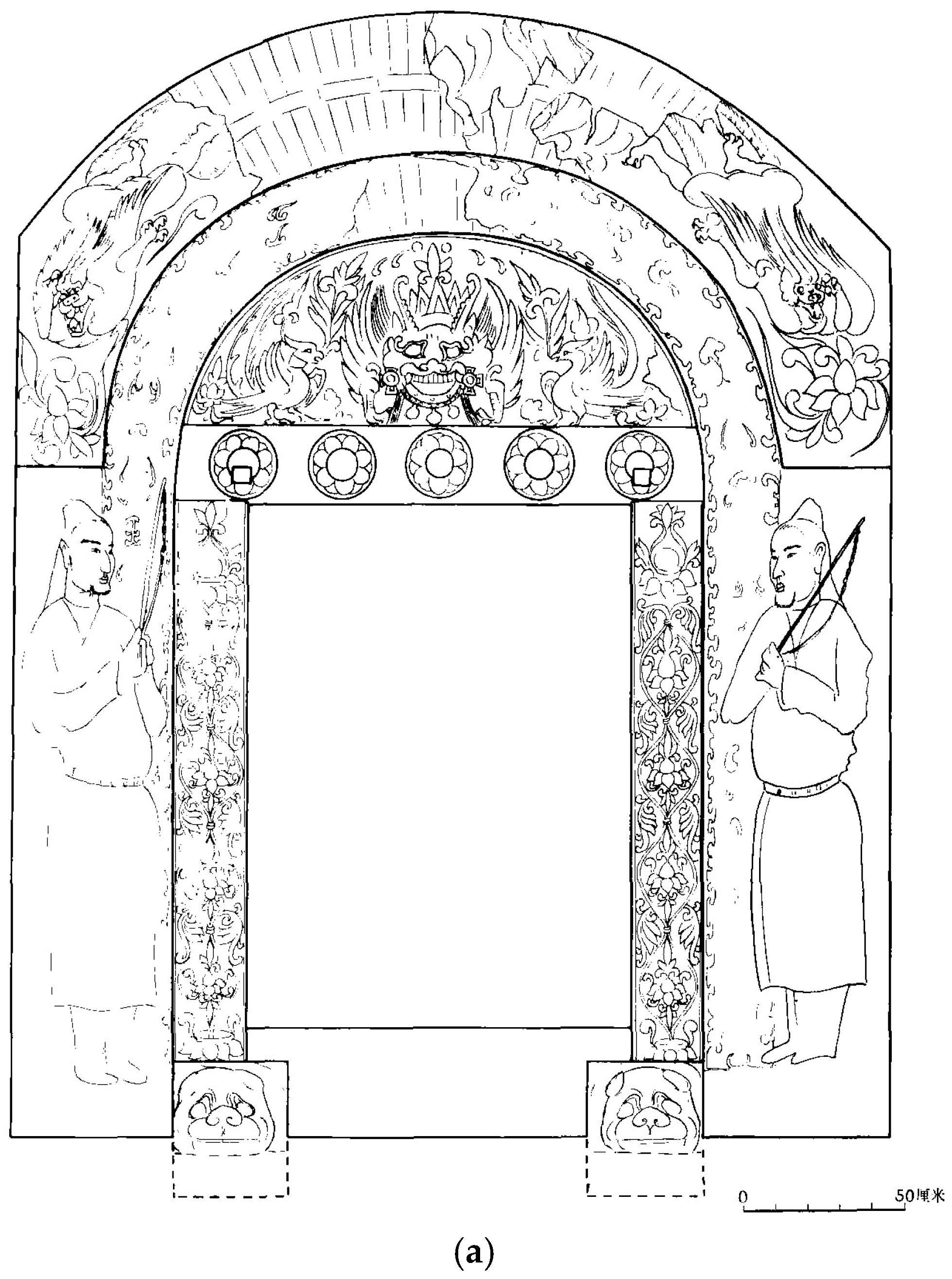
5. Rebirth in the Pure Land: Symbolism of Paired Bird in Buddhist Caves
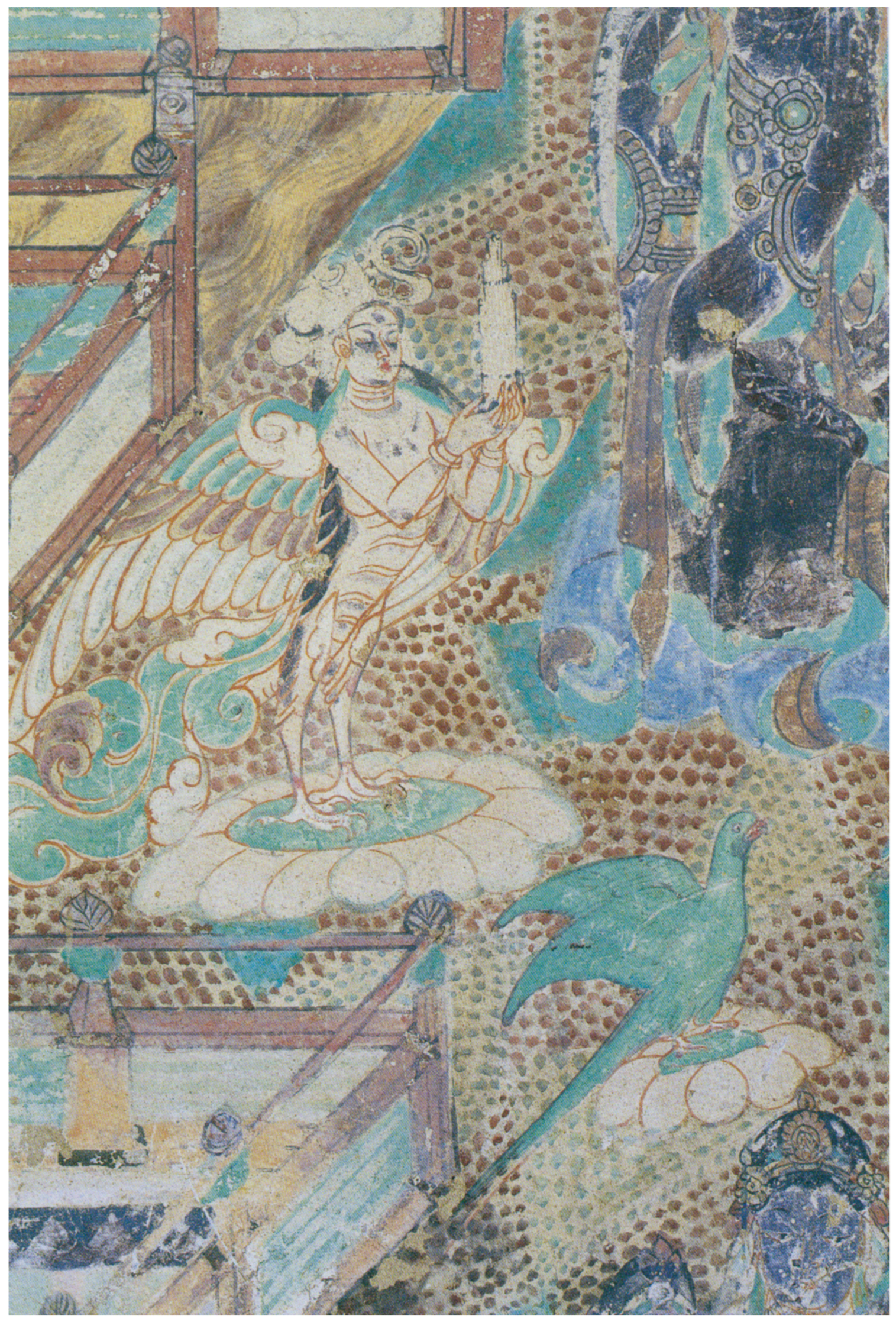
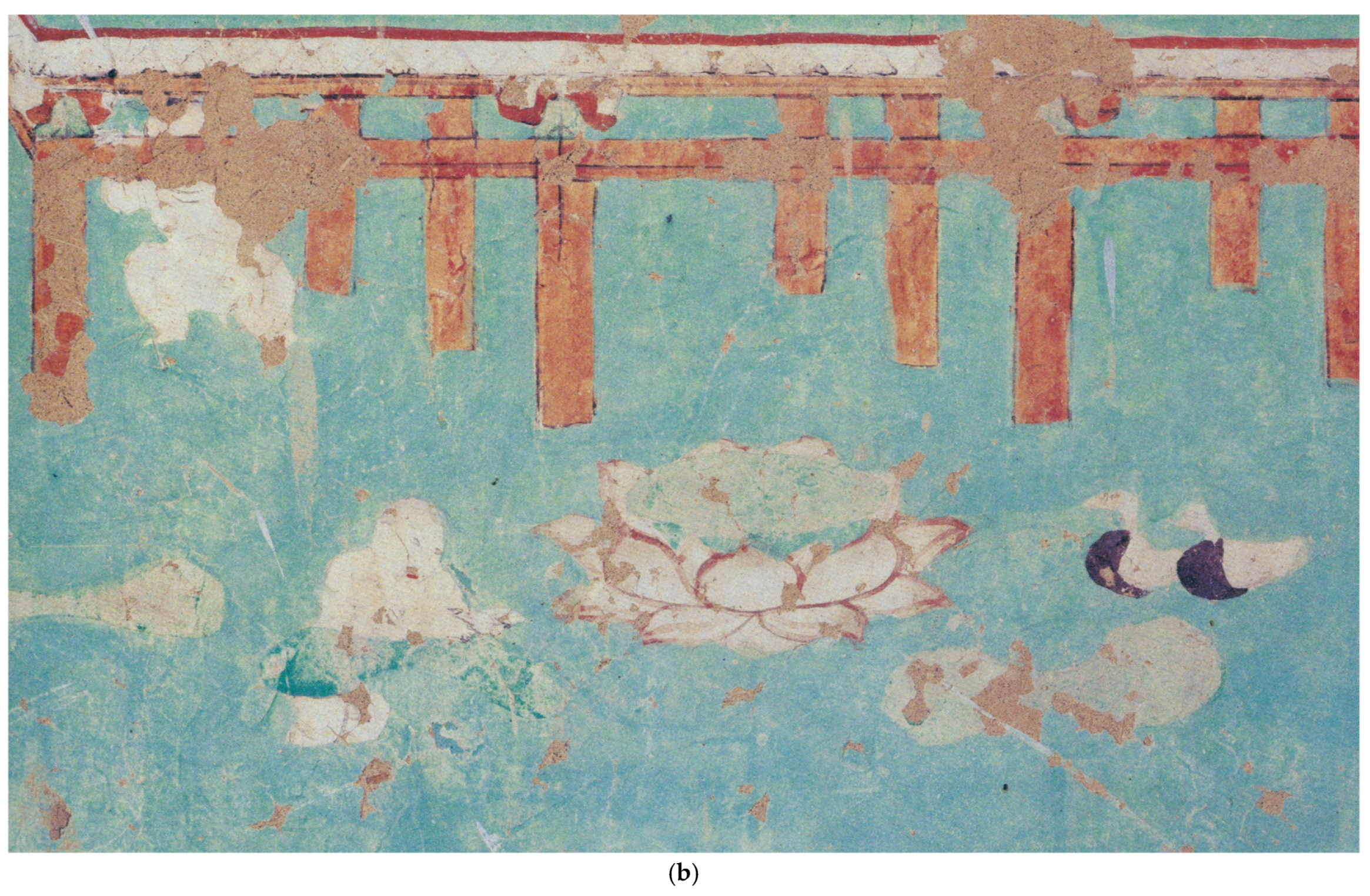
Furthermore, Śāriputra, in the Pure Land of the Blissful World, there are always various marvelous and delightful multicolored birds, including geese, herons, cranes, peacocks, parrots, garuḍas, and two-headed birds, among others. These birds gather together six times a day and night, consistently producing harmonious and elegant sounds. Each species in its own way proclaims the sublime Dharma, including teachings on profound mindfulness, proper elimination [of afflictions], spiritual powers, faculties, powers, factors of enlightenment, and the components of the path—these innumerable wonderful teachings. When the beings of that land hear these sounds, they each receive immeasurable merits from contemplating the Buddha, the Dharma, and the Sangha, thus cultivating their spiritual virtues24.
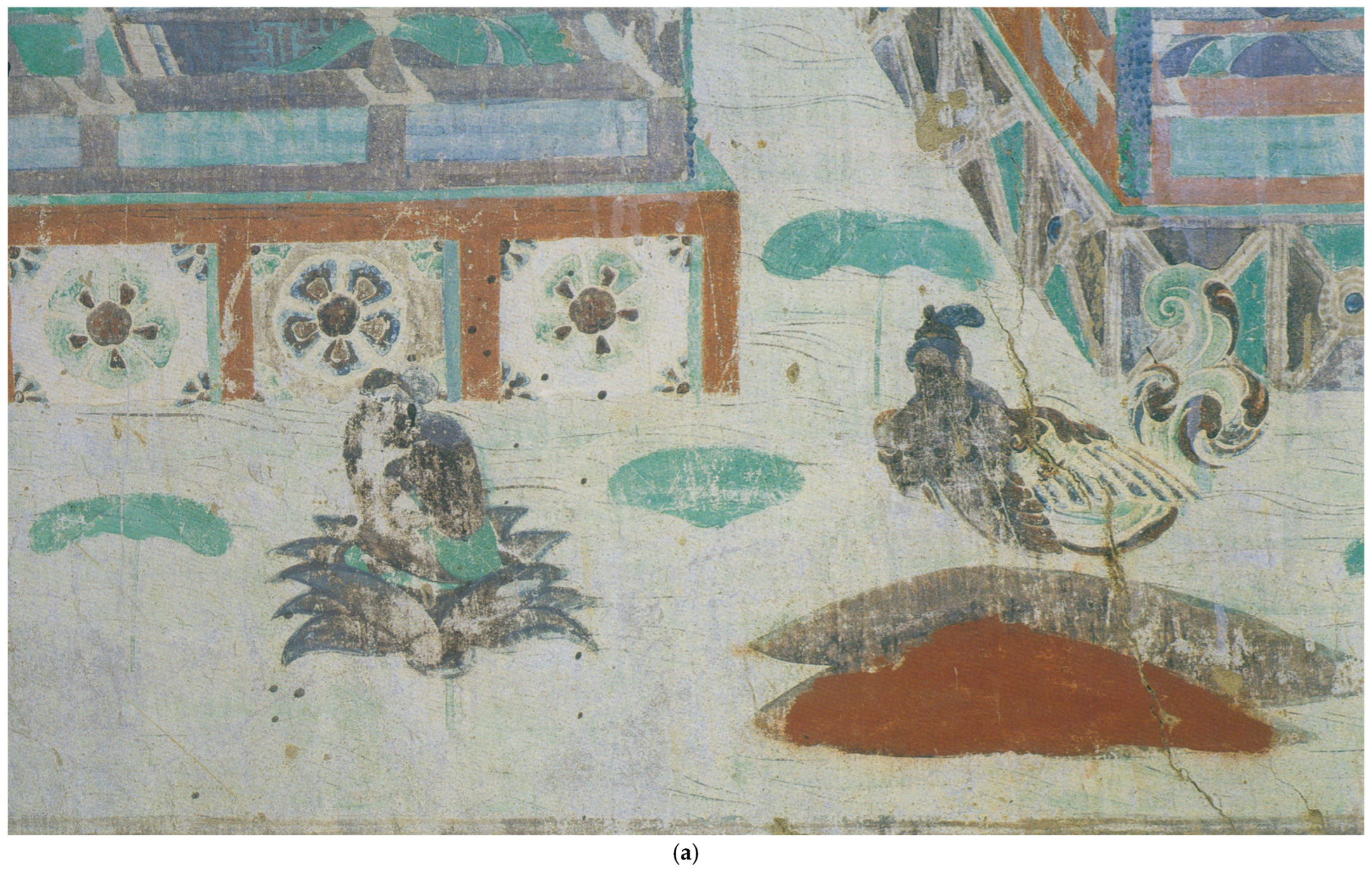
The Buddha said to Rāhula and others: In his ornamental gardens, there were parrots, cormorants, curlews, peacocks, geese, mandarin ducks, kuṇāla birds, heron birds, and various regional birds, all singing sorrowfully with diverse sounds, to entertain Prince Puṇyaraśmi, constantly providing offerings of five hundred flavors25.
Near the snowy mountains, there were ducks, geese, mandarin ducks, eagles, hawks, red-billed parrots, blue jays, mournful phoenixes, and various other birds that came to the king’s palace, residing above the palace halls, near the open windows, doors, and latticed screens, each singing clearly in soft, wonderful, and elegant tones26.
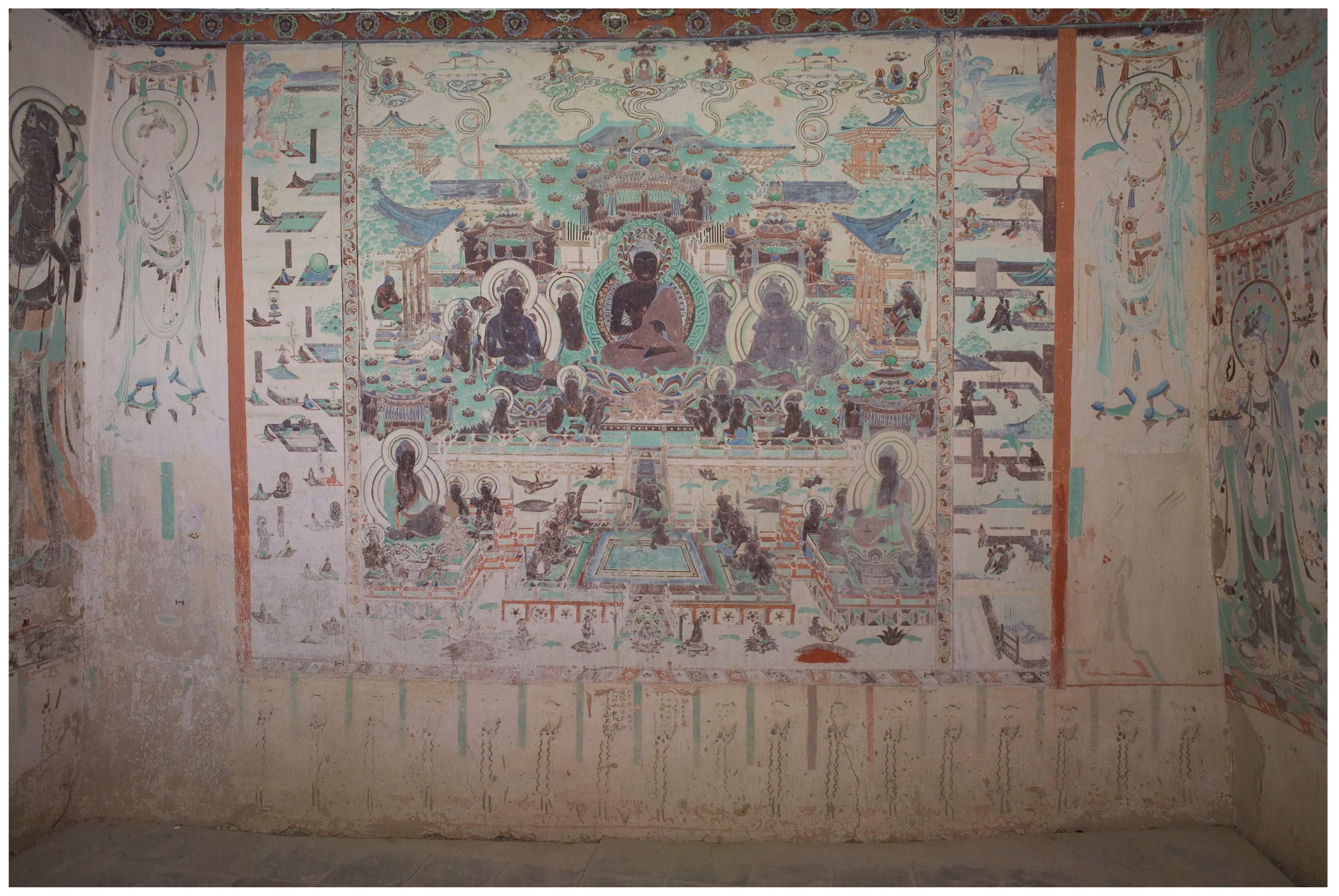
At that time, the Buddha was residing at Gṛdhrakūṭa Mountain in Rājagṛha. This mountain, high and steep, was majestic and pleasing to behold, holding a variety of species as if it were the great earth itself, with all flowers and trees in full flourish. It was also a place frequented by gods, dragons, yakṣas, piśācas, and kiṃnaras. Moreover, there were various kinds of unusual animals, including lions, tigers, wolves, qilins, elephants, horses, bears, and boars inhabiting it. Additionally, there were countless birds in the thousands, such as peacocks, parrots, quails, larks, ducks, geese, mandarin ducks, and birds with two heads, all residing there27.
6. Conclusions
Funding
Data Availability Statement
Conflicts of Interest
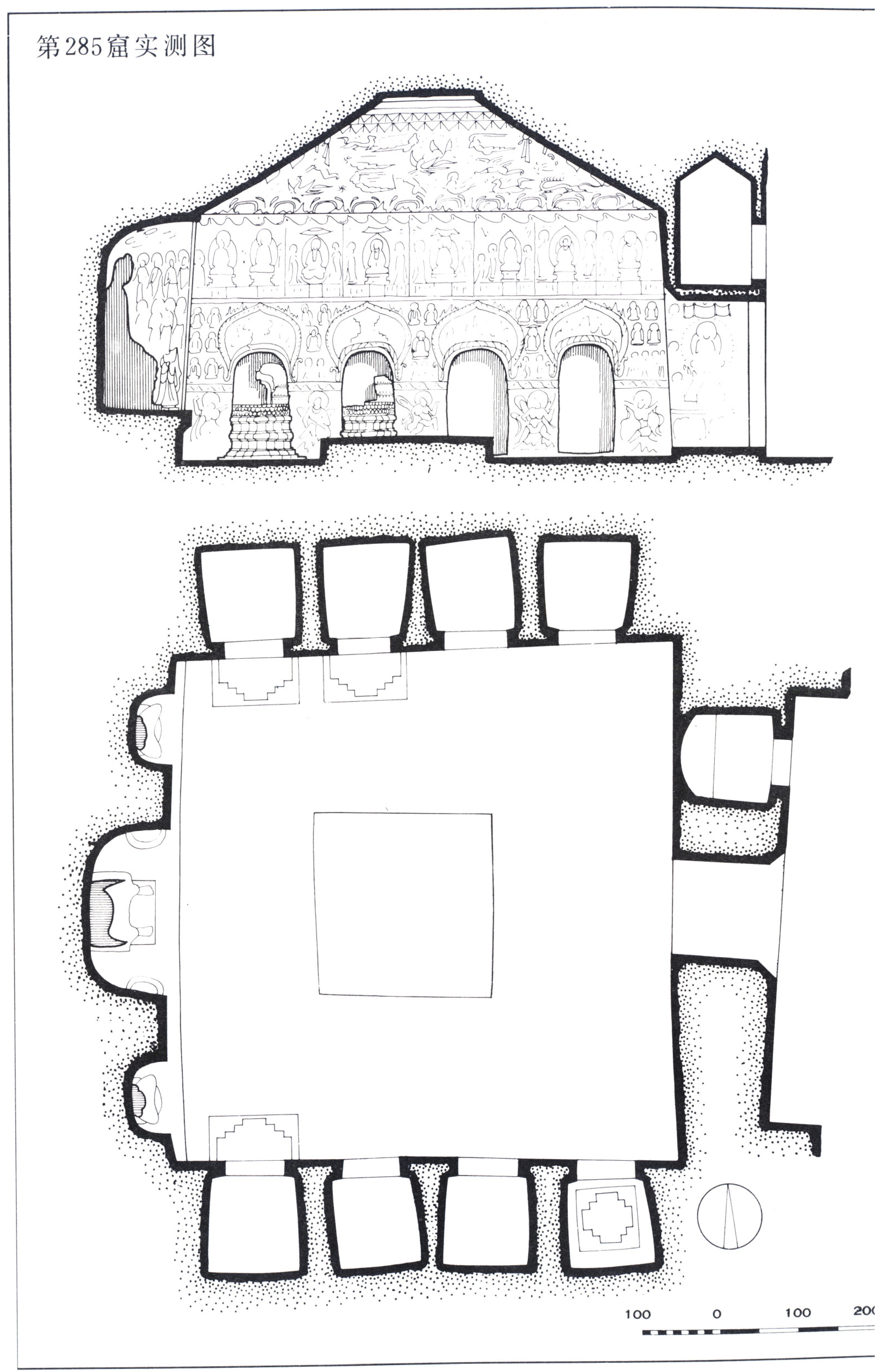
| 1 | This article uses the term “entrance lintel,” whereas current descriptions in Dunhuang-related pictorial catalogs all use the term “niche lintel.” Considering that this feature is an extension and definition of the eight small rooms, meaning that this position forms an integral whole with the corresponding chambers, its naming should be consistent. In academic works such as the Dunhuang Mogaoku neirong zonglu 敦煌莫高窟內容總錄 [Comprehensive Catalog of the Mogao Caves at Dunhuang] and the Dunhuang shiku neirong zonglu 敦煌石窟內容總錄 [Comprehensive Catalog of the Stone Caves at Dunhuang], these eight small chambers in Cave 285 are often referred to as “meditation chambers” or “meditation caves,” with some referring to them as “meditation niches” or “small niches.” However, the position above the entrance is uniformly referred to as “niche lintel.” While the term “niche lintel” does not fundamentally affect the understanding of the small rooms, for more accurate archeological naming, and especially considering the principle of naming consistency in architecture, this article does not consider these eight spaces to be “niches” in the conventional sense, at least to the extent they are distinct from the three niches on the west wall of the same cave, which house the main Buddha and the two meditative monks. Therefore, this article refers to these eight spaces as small chambers, and thus the position above the entrance as “entrance lintel.” While the terminology differs, its spatial connotation and the “niche lintel” in Buddhist caves are analogous and can be compared. The attention given here to the naming of this feature is due to the unique structure of Cave 285, which is rare within the Dunhuang cave complex for having additional small chambers, necessitating careful consideration of its uniqueness. |
| 2 | Illustration references: (Duan 1995; Duan et al. 2001; Editorial Committee of the Complete Collection of Chinese Dunhuang Murals and Duan 2022), Plate 130, 131, 132, 151. Digital Dunhuang website: https://www.e-.com/cave/10.0001/0001.0001.0285 (accessed on 16 June 2024) This information is combined with my numerous on-site investigation records. |
| 3 | (Dunhuang Academy 2003a), Plate 61, 66, pages 85, 86, 87. |
| 4 | (Dunhuang Academy 2000), Plate 35, 36, pages 50, 51. |
| 5 | (Wang and Chen 2022). This is cited from (Huo and Yu 2023). |
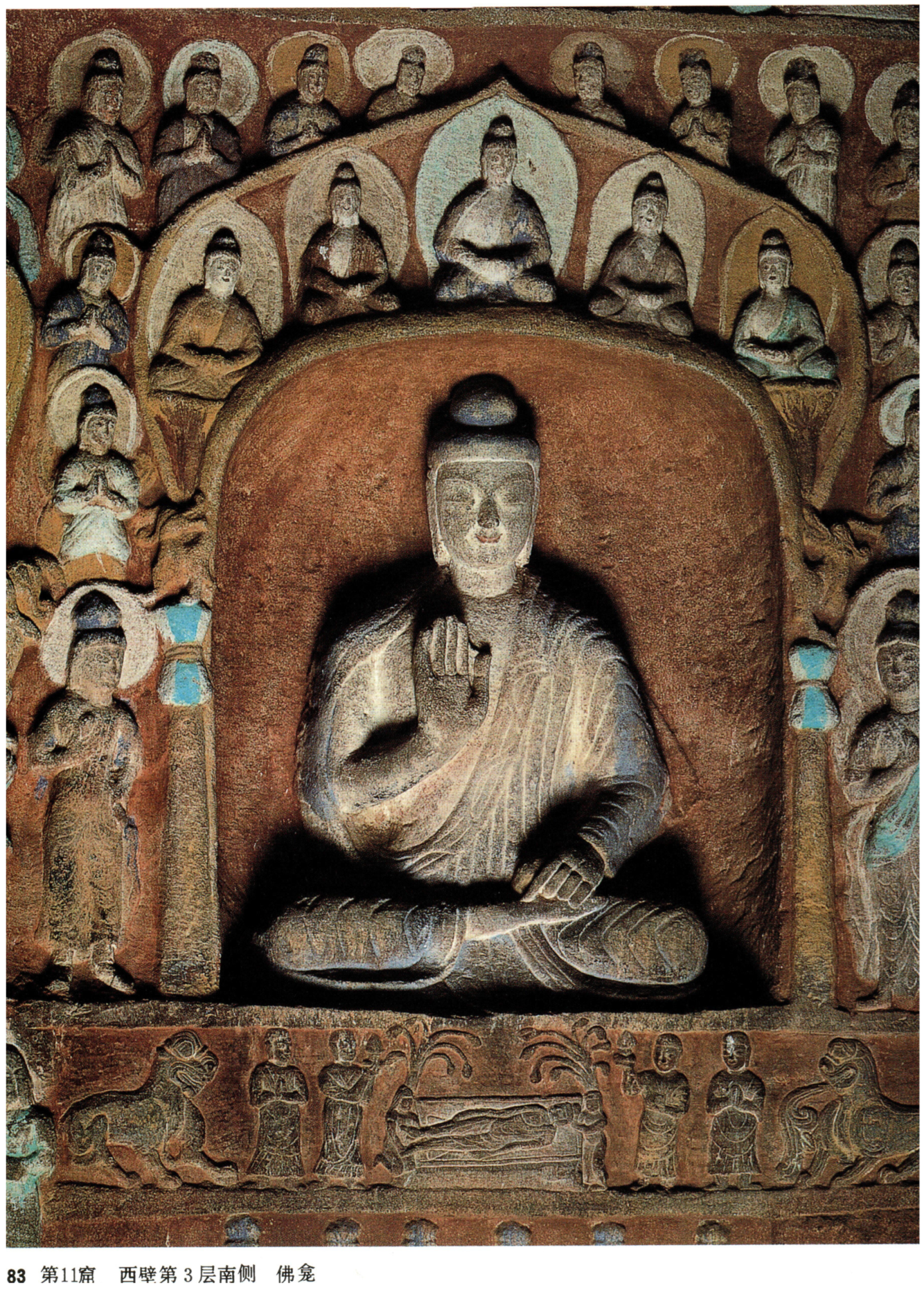
| 6 | For illustrations, see the editorial (do you mean “edited”?) work by the Yungang Grottoes Cultural Relics Custody Institute (1994), plates 83, 110, 137, 138, and 142. |
| 7 | For illustrations, see the editorial work by (Longmen Grottoes Cultural Relics Custody Institute and The Department of Archaeology at Peking University 1991), plates 92, 93, 144, and 177. |
| 8 | (Higashiyama 1996) “Rock-Cut Temples (China)” entry in (Hajime 2002). |
| 9 | See (Yamabe and Zhao 2020). |
| 10 | Refer to (Yoshimura 2001). |
| 11 | The “paired birds” mentioned here are not limited to the birds one might encounter in everyday life, but rather, they encompass a broader definition that includes mythical and legendary birds. |
| 12 | Gansu Provincial Institute of Cultural Relics and Archaeology (1998), Figure 9, Plate 4. |
| 13 | Ibid., Figure 15. |
| 14 | Ibid., Figure 19, Plate 10. |
| 15 | Ibid., Figure 23, Plates 14 and 15. |
| 16 | |
| 17 | (Gansu Provincial Cultural Relics Team et al. 1985), Plates 31 and 34. |
| 18 | Ibid., Plates 15 and 24. |
| 19 | (Hubei Provincial Museum 1989), Volume I, pp. 19, 25, 28, 30, 34, Figures 18, 20. |
| 20 | (Hebei Provincial Institute of Cultural Relics and Archaeology and Institute of Archaeology, Chinese Academy of Social Sciences 2003), p. 12, Figure 9A, Color Plate 62. |
| 21 | Ibid., p. 210. |
| 22 | |
| 23 | The presence of the fierce bird of prey at the location of the chevron-arched ceiling in caves representing the Buddhist Pure Land is due to ancient beliefs that deemed the owl a nocturnal bird of yang (solar) association. This concept dates to the Han Dynasty, where the owl appeared among the auspicious birds and mythical creatures in the celestial mists depicted on the lacquered coffins of the Mawangdui tombs, suggesting ascension to the heavens. See K. Wang (1998). |
| 24 | Translated by Jiayi Zhu. Ibid., vol. 12, p. 349. |
| 25 | Translated by Jiayi Zhu. Ibid., vol. 3, p. 414. |
| 26 | Translated by Jiayi Zhu. Ibid., vol. 3, p. 488. |
| 27 | Translated by Jiayi Zhu. Ibid., vol. 11, p. 2. |
References
Primary Sources
Bodhiruci 菩提流志. Da Bao ji jing 大寶積經 (Mahā ratnakūṭa sūtra), in CBETA, T11, No. 310, (original work completed in 713 AD).Dharmaraksa 竺法護. Foshuo Deguangtaizi jing 佛說德光太子經 (The sutra in which the Buddha speaks of Prince Puṇyaraśmi), in CBETA, T3, No. 170.Dharmaraksa 竺法護. Pu Yao jing 普曜經 (Lalitavistara Sutra), in CBETA, T3, No. 186, (original work completed in 308 AD).Kumārajīva 鳩摩羅什. Foshuo Amituo jing 佛說阿彌陀經 (The Sutra in Which the Buddha Speaks of Amitābha Buddha), in CBETA, T12, No. 366 (original work completed in 402 AD).Xuanzang 玄奘. Chengzan Jingtu Fo shoushou jing 稱讚淨土佛攝受經 (The Sutra on Praise of the Pure Land with the Buddha’s Protection), in CBETA, T12, No. 367 (original work completed in 650 AD).Secondary Sources
- An, Zhimin 安志敏. 1973. Changshan xin faxian de Xihan bohua shitan 長沙新發現的西漢帛畫試探 Exploration of Newly Discovered Western Han Silk Paintings in Changsha. Archaeology 考古 1: 43–53. [Google Scholar]
- Chen, Huaiyu 陳懷宇. 2012. Dongwu yu zhonggu zhengzhi zongjiao zhixu 動物與中古政治宗教秩序 Animals and the Medieval Political and Religious Order. Shanghai: Shanghai Ancient Books Publishing House. [Google Scholar]
- Cheng, Xuehua 程学华, and Ruiping Cheng 程蕊萍. 1996. “Tang Suizhou Sima Dong Wuzhong mu qingli jianbao” 唐遂州司馬董務忠墓清理簡報 Brief Report on the Clearance of the Tomb of Dong Wuzhong, a Sima of Suizhou in the Tang Dynasty. Wenbo 文博 2: 88. [Google Scholar]
- Chongqing Wushan County Cultural Relics Management Office 重慶巫山縣文物管理所, and the Three Gorges Project Team of the Archaeological Institute, and Chinese Academy of Social Science 中國社科院考古所三峽工作隊. 1998. Chongqing Wushan xian Donghan liujin tongpaishi de faxian yu yanjiu 重慶巫山縣東漢鎏金銅牌飾的發現與研究 Discovery and Research of Eastern Han Gilded Bronze Ornaments in Wushan County, Chongqing. Archaeology 考古 2: 77–86. [Google Scholar]
- Cixian Cultural Museum 磁縣博物館. 1984. Hebei Cixian Dongchencun Beiqi Yaojun mu 河北磁縣東陳村北齊堯峻墓 Northern Qi Yao Jun Tomb in Dongchen Village, Cixian, Hebei. Cultural Relics 文物 4: 16–22. [Google Scholar]
- Datong City Museum 大同市博物館, and Shanxi Provincial Cultural Relics Committee 山西省文物工作委員會. 1978. Datong Fangshan Beiwei Yonggu ling 大同方山北魏永固陵 (Fangshan Northern Wei Yonggu Tomb in Datong). Cultural Relics 文物 7: 29–35. [Google Scholar]
- Duan, Wenjie 段文傑, ed. 1995. Dunhuang shiku yishu Mogaoku di 285 ku (Xiwei) 敦煌石窟藝術·莫高窟第二八五窟(西魏) Art of Dunhuang Caves: Mogao Cave 285 (Western Wei). Nanjing: Jiangsu Fine Arts Publishing House. [Google Scholar]
- Duan, Wenjie 段文傑, Jun Ōnuma 大沼淳, Ken Okada 岡田健, Jinshi Fan 樊錦詩, and Yongzeng Liu 劉永増. 2001. Dunhuang shiku 2 Mogaoku di 285 ku 敦煌石窟2莫高窟第二八五窟 Dunhuang Caves 2: Mogao Cave 285. Tokyo: Bunka Gakuen/Bunka Publishing Bureau. [Google Scholar]
- Dunhuang Academy 敦煌研究院. 2000. Dunhuang shiku quanji dongwu huajuan 敦煌石窟全集動物畫卷 Complete Collection of Dunhuang Caves: Animal Painting Volume. Edited by Yuquan Liu 劉玉權. Shanghai: Shanghai Century Publishing Group, Shanghai People’s Publishing House. [Google Scholar]
- Dunhuang Academy 敦煌研究院. 2003a. Dunhuang shiku quanji 13 tu’an juan shang 敦煌石窟全集13圖案卷上 Complete Collection of Dunhuang Caves 13: Pattern Volume (Part 1). Edited by Youhui Guan 關友惠. Hong Kong: Commercial Press. [Google Scholar]
- Dunhuang Academy 敦煌研究院. 2003b. Dunhuang shiku quanji 14 tu’an juan xia 敦煌石窟全集14圖案卷(下) Complete Collection of the Dunhuang Grottoes Volume 14: Patterns Volume (Part 2). Edited by Youhui Guan 關友惠. Hong Kong: Commercial Press, pp. 170–71. [Google Scholar]
- Editorial Committee of the Complete Collection of Chinese Dunhuang Murals 中國敦煌壁畫全集編輯委員會, and Wenjie Duan 段文傑. 2022. Zhongguo Dunhuang bihua quanji 2 xiwei 中國敦煌壁畫全集 2 西魏 Complete Collection of Chinese Dunhuang Murals 2: Western Wei. Shenyang: Liaoning Fine Arts Publishing House. Tianjin: Tianjin People’s Fine Arts Publishing House. [Google Scholar]
- Gansu Provincial Cultural Relics Team 甘肅省文物隊, Gansu Provincial Museum 甘肅省博物館, and Jiayuguan City Cultural Relics Management Office 嘉峪關市文物管理所. 1985. Jiayu Guan bihuamu fajue baogao 嘉峪關壁畫墓發掘報告 Jiayuguan (Be Consistent) Mural Tomb Excavation Report. Beijing: Cultural Relics Publishing House. [Google Scholar]
- Gansu Provincial Institute of Cultural Relics and Archaeology 甘肅省文物考古研究所. 1998. Dunhuang Foyemiao wan Xijin Huaxiangzhuan mu 敦煌佛爺廟灣西晉畫像磚墓 Western Jin Dynasty Painted Brick Tombs at Buddha Father Temple Bay in Dunhuang. Edited by Chunyang Dai 戴春陽. Beijing: Cultural Relics Publishing House. [Google Scholar]
- Gao, Wen 高文, ed. 2000. Zhongguo huaxiangshi quanji 中國畫像石全集 [The Complete Collection of Chinese Portrait Stones]. Zhengzhou: Henan Fine Arts Publishing House, Jinan: Shandong Fine Arts Publishing House, vol. 7. [Google Scholar]
- Guo, Jing 郭靜. 2019. Guazhou Yulin ku di 3 ku shisu tuxiang yanjiu 瓜州榆林窟第3窟世俗圖像研究 Study on Secular Imagery in Cave 3 of the Yulin Caves in Guazhou. Master’s thesis, Shaanxi Normal University, Xi’an, China. [Google Scholar]
- Guo, Qinglin 郭青林, Chun Lu 盧春, Ruiliang Liu 劉睿良, Yanlin Zhao 趙燕林, Jianjun Wang 王建軍, Xiaogang Zhang 張小剛, Fei Feng 鳳飛, Staff Richard, Pollard Mark, Shanlong Yang 楊善龍, and et al. 2018. Fojiao shiku duandai fangfa xin jinzhan: Ruhe jiyu beiyesi moxing he kaogu xinxi tigao tanshisi cenian jingdu 佛教石窟斷代方法新進展:如何基於貝葉斯模型(Ox Cal)和考古信息提高碳十四測年精度 New Advances in Chronological Methods for Buddhist Caves: How to Enhance Radiocarbon Dating Precision Using the Bayesian Model (OxCal) and Archaeological Information. Dunhuang Research 敦煌研究 6: 168–76. [Google Scholar]
- Hajime, Nakamura, ed. 2002. Bukkyō bijutsu jiten 仏教美術事典 [Encyclopedia of Buddhist Art]. Tokyo: Tokyo Shoseki, p. 499. [Google Scholar]
- Hebei Provincial Institute of Cultural Relics and Archaeology 河北省文物研究所. 2001. “Xuanhua Liao Mu: 1974–93 Nian Kaogu Fajue Baogao” 宣化遼墓:1974~1993年考古發掘報告 Xuanhua Liao Tomb: Report on Archaeological Excavations from 1974 to 1993. Archaeology 考古 11: 15+97–100. [Google Scholar]
- Hebei Provincial Institute of Cultural Relics and Archaeology 河北省文物研究所, and Institute of Archaeology, Chinese Academy of Social Sciences 中國社會科學院考古研究所. 2003. Cixian Wan Zhang Beichao bihua mu 磁縣灣漳北朝壁畫墓 Northern Dynasty Mural Tombs at Cixian Wan Zhang. Beijing: Science Press. [Google Scholar]
- Higashiyama, Kengo 東山健吾. 1996. Tonkō san dai sekkutsu 敦煌三大石窟 [Dunhuang’s Three Great Caves]. Tokyo: Kōdansha, p. 83. [Google Scholar]
- Hiromi, Takabayashi 高林弘実, Nakamura Toshio 中村俊夫, Qinglin Guo 郭青林, and Ken Okada 岡田健. 2008. Bakkōkutsu Shoki no Hōshasei Tanso Nendai 莫高窟初期の放射性炭素年代 Early Radiocarbon Dates of the Mogao Caves. In Tonkō hekiga no hogo ni kansuru Nicchū kyōdō kenkyū 2007 敦煌壁畫の保護に関する日中共同研究 2007 Sino-Japanese Joint Research on the Conservation of Dunhuang Murals 2007. Edited by Tokyo Cultural Heritage Research Institute and Dunhuang Academy 敦煌研究院. Tokyo: National Institutes for Cultural Heritage. [Google Scholar]
- Hubei Provincial Museum 湖北省博物館. 1989. Zenghou Yi mu 曾侯乙墓 Tomb of Yi, Marquis of Zeng. Beijing: Cultural Relics Publishing House. [Google Scholar]
- Hunan Provincial Museum 湖南省博物館, and Institute of Archaeology, Chinese Academy of Social Sciences 中國社會科學院考古研究所. 1973. Changsha Mawangdui Yihao Hanmu 長沙馬王堆一號漢墓 Han Tomb No. 1 at Mawangdui, Changsha. Beijing: Cultural Relics Publishing House. [Google Scholar]
- Huo, Wei 霍巍, and Yu Wang 王煜. 2023. Shushan zhuoyu: Sangzang zhidu yu diguo qixiang 蜀山琢玉: 喪葬制度與帝國氣象 Shushan Zhuoyu: Funeral System and Imperial States. Shanghai: Shanghai Ancient Books Publishing House. [Google Scholar]
- Jiang, Xiaochun 蔣曉春. 2007. Youguan liujin shi tongpai de jige wenti 有關鎏金棺飾銅牌的幾個問題 Several Issues Concerning Gilded Coffin Decorations and Bronze Plaques. Archaeology 考古 5: 74–83. [Google Scholar]
- Lai, Pengju 賴鵬舉. 2009. Dunhuang shiku zaoxiang sixiang yanjiu 敦煌石窟造像思想研究 Research on the Ideology of Dunhuang Cave Statues. Beijing: Cultural Relics Publishing House. [Google Scholar]
- Liang, Sicheng 梁思成, Huiyin Lin 林徽因, and Dunzhen Liu 劉敦楨. 1933. Yungang shiku zhong suo biaoxian de Beiwei jianzhu 雲岡石窟中所表現的北魏建築 Architectural Representations in the Yungang Grottoes During the Northern Wei Dynasty. In Collection of the Chinese Architectural Society. Beijing: Buddhist Association of China, vol. 4. [Google Scholar]
- Lin, Sheng-chih 林聖智. 2019. Tuxiang yu zhuangshi de duihua: Muzang zhong de Fojiao yinsu 圖像與裝飾的對話:墓葬中的佛教因素 Dialogue Between Imagery and Decoration: Buddhist Elements in Tombs. In Tuxiang yu Zhuangshi: Beichao muzang de shengsi biaoxiang 圖像與裝飾: 北朝墓葬的生死表象 Imagery and Decoration: The Representation of Life and Death in Northern Dynasties Tombs. Taibei: National Taiwan University Press. [Google Scholar]
- Liu, Mo 劉末. 2012. Longmen Tang Xiao Yuanli qi Zhangshi yiku kaocha zhaji 龍門唐蕭元禮妻張氏瘞窟考察札記 Field Notes on the Investigation of Tang Xiao Yuanli’s Wife Zhang’s Burial Cave at Longmen. Journal of the National Museum of China 中國國家博物館館刊 5: 64–68. [Google Scholar]
- Longmen Grottoes Cultural Relics Custody Institute 龍門石窟文物保管所, and The Department of Archaeology at Peking University 北京大學考古系. 1991. Zhongguo shiku Longmen shiku diyi juan 中國石窟龍門石窟第一卷 Chinese Grottoes: Longmen Grottoes. Beijing: Cultural Relics Publishing House, Tokyo: Heibonsha, vol. 1. [Google Scholar]
- Luo, Erhu 羅二虎. 2002. Handai huaxiang shiguan 漢代畫像石棺 Han Dynasty Portrait Stone Sarcophagi. Chengdu: Bashu Publishing House. [Google Scholar]
- Luoyang Institute of Cultural Relics and Archaeology 洛陽市文物考古研究院. 2006. Luoyang Longmen Tang An Pu fufu mu 洛陽龍門唐安菩夫婦墓 The Couple’s Tomb of An Pu of the Tang Dynasty at Longmen, Luoyang. Beijing: Science Press 科學出版社, pp. 142–43. [Google Scholar]
- Lü, Jinsong 呂勁松, and Chaojie Yang 楊超傑. 1999. Longmen shiku xinfaxian de liangzuo Tangdai yiku 龍門石窟新發現的兩座唐代瘞窟 Two Newly Discovered Tang Dynasty Burial Caves in the Longmen Grottoes. In Cultivation Colloquium. Edited by Luoyang Municipal Bureau of Cultural Relics 洛陽市文物局. Beijing: Science Press, vol. I. [Google Scholar]
- Ma, De 馬德. 1996. Dunhuang Mogaoku shi yanjiu 敦煌莫高窟史研究 A Study on the History of the Mogao Caves at Dunhuang. Lanzhou: Gansu Education Press, pp. 149–50. [Google Scholar]
- Ma, Shichang 馬世長. 2014. Zhongguo Fojiao shiku kaogu wenji 中國佛教石窟考古文集 Collected Papers on the Archaeology of Chinese Buddhist Caves. Beijing: Commercial Press, p. 246. [Google Scholar]
- Nagahiro, Toshio 長廣敏雄. 1937. Guanyu Beiwei tangcaowen de ersan 關於北魏唐草紋的二三 Some Observations on Tang Grass Patterns in the Northern Wei Dynasty. The Kyoto Research Institute of the Institute of Eastern Culture: Journal of Oriental Studies 東方學報 8: 106–7. [Google Scholar]
- Okimoto, Katsumi 沖本克己. 2006. Dunhuang Mogaoku Beiqu Shiku zhi keti 敦煌莫高窟北區石窟之課題 Research Issues in the Northern Area of the Mogao Caves at Dunhuang, Proceedings of the 2004 International Academic Conference on Cave Research. Edited by Dunhuang Academy 敦煌研究院. Shanghai: Shanghai Ancient Books Publishing House, vol. 1. [Google Scholar]
- Sha, Wutian 沙武田. 2022. Juyou dongku kongjian hanyi de tuxiang–Mogaoku di 400 ku Xixia zaojing fengshou longshen tu’an tanwei 具有洞窟空間含義的圖像—莫高窟第400窟西夏藻井鳳首龍身圖案探微 (Imagery Showing the Implicaitons of the Cave SpaceImagery Implying Significance of Cave Space: A Study of the Phoenix-Headed Dragon Pattern in the Western Xia Ceiling of Mogao Cave 400). Journal of National Studies 國學學刊 1: 65–79. [Google Scholar]
- Sha, Wutian 沙武田. 2023. Beichao shengtian chengxian sixiang zai Fojiao shiku zhong de shijian: Tian tuxiang zailiyong yu Mogaoku di 285 ku gongneng zaitan 北朝升天成仙思想在佛教石窟中的實踐: “天”圖像再利用與莫高窟第285窟功能再探 (The Practice of Northern Dynasties’ Ascension and Immortality Concepts in Buddhist Grottoes: Reutilization of ‘Heavenly’ Imagery and Re-examining the Function of Mogao Cave 285), Art History Research Collection, Issue 54. Edited by National Taiwan University 台湾大学编美术史研究集刊. Taipei City: Graduate Institute of Art History, National Taiwan University, pp. 1–118. [Google Scholar]
- Shaanxi Provincial Archaeological Research Institute 陝西省考古研究所. 1999. Tang Huizhuang Taizi mu fajue jianbao 唐惠莊太子墓發掘簡報 Brief Report on the Excavation of the Tomb of Crown Prince Huizhuang of the Tang Dynasty. Archaeology and Cultural Relics 考古與文物 2: 3–11. [Google Scholar]
- Shaanxi Provincial Archaeological Research Institute 陝西省考古研究所, and Shaanxi History Museum 陝西歷史博物館. 1997. Tang Zhaolin Xincheng Zhang Gongzhu mu fajue jianbao 唐昭陵新城長公主墓發掘簡報 Brief Report on the Excavation of Princess Zhang’s Tomb at Tang Zhao Mausoleum, Xincheng. Archaeology and Cultural Relics 考古與文物 3: 3–24. [Google Scholar]
- Shaanxi Provincial Museum 陝西省博物館, and Cultural Management Committee 文管所. 1974. Tang Li Shou mu fajue jianbao 唐李壽墓發掘簡報 Brief Report on the Excavation of Tang Li Shou’s Tomb. Cultural Relics 文物 9: 75–76. [Google Scholar]
- Shanxi Provincial Archaeological Research Institute 山西省考古研究所, and Taiyuan City Cultural Relics and Archaeology Research Institute 太原市文物考古研究. 2003. Taiyuan Beiqi Xu Xianxiu mu fajue jianbao 太原北齊徐顯秀墓發掘簡報 Brief Report on the Excavation of Xu Xianxiu’s Tomb from the Northern Qi in Taiyuan. Cultural Relics 文物 10: 4–40. [Google Scholar]
- Sofukawa, Hiroshi 曾布川寬. 2022. Handai huaxiangshi zhong shengxiantu de xipu 漢代畫像石中升仙圖的系譜 Genealogy of Ascension Images in Han Dynasty Portrait Stones. In Sofukawa Hiroshi 曾布川寬, Zhongguo meishu de tuxiang yu fengge I: Gudai meishushi yanjiu 中國美術的圖像與風格I: 古代美術史研究 Images and Styles in Chinese Art I: Studies in Ancient Art History. Translated by Baoyao Lin 林保堯, Sheng-chih Lin 林聖智, and Shih-wen Kung 龔詩文. Taipei City: New Wenfeng Publishing Company. [Google Scholar]
- Sterckx, Roel. 2002. The Animal and the Daemon in Early China. Albany: State University of New York Press. [Google Scholar]
- Su, Bai 宿白. 1956. Canguan Dunhuang Mogaoku di 285 ku zhaji 參觀敦煌莫高窟第285窟札記 Notes on Visiting Mogao Cave 285 at Dunhuang. Originally published in Cultural Relics Reference Materials, No. 2, cited in Su Bai 宿白. 2019. Zhongguo shikusi yanjiu 中國石窟寺研究 Studies on Chinese Cave Temples. Beijing: SDX Joint Publishing Company. Beijing: Sanlian Bookstore. [Google Scholar]
- Sudo, Hirotoshi 須藤弘敏. 1990. Chanding biqiu tuxiang yu Dunhuang 285 ku 禪定比丘圖像與敦煌285窟 The Image of Meditating Monks and Dunhuang Cave 285. In 1987 Nian Dunhuang Shiku Yanjiu Guoji Taolunhui wenji shiku kaogu bian 1987 年敦煌石窟研究國際討論會文集石窟考古編, Proceedings of the 1987 International Conference on Dunhuang Cave Studies: Archaeology of the Cave Temples. Edited by Dunhuang Academy 敦煌研究院. Shenyang: Liaoning Fine Arts Publishing House, pp. 393–413. [Google Scholar]
- Suide Han Portrait Stone Exhibition Hall 綏德漢畫像石展覽館. 2001. Suide Handai huaxiang shi 綏德漢代畫像石 Suide Han Dynasty Portrait Stones. Edited by Guilong Li 李貴龍 and Jianqin Wang 王建勤. Shanghai: Shaanxi People’s Fine Arts Publishing House. [Google Scholar]
- Sun, Ji 孫機. 2016. Sanzu wu 三足烏 The Three-Legged Crow. In Cong lishi zhong xinglai: Sun Ji tan Zhongguo gu wenwu 從歷史中醒來: 孫機談中國古文物 Awakening from History: Sun Ji on Ancient Chinese Artifacts. Beijing: SDX Joint Publishing Company. [Google Scholar]
- Sun, Yan 孫彥. 2011. Hexi Wei-Jin Shiliuguo bihuamu yanjiu 河西魏晉十六國壁畫墓研究 Research on Mural Tombs of the Hexi Corridor during the Wei, Jin, and Sixteen Kingdoms Periods. Beijing: Cultural Relics Publishing House. [Google Scholar]
- Sun, Zuoyun 孫作雲. 1973. Changsha Mawangdui yihao hanmu chutu bofan kaoshi 長沙馬王堆一號漢墓出土帛幡考釋 Study and Interpretation of the Silk Banners from Han Tomb No. 1 at Mawangdui. Archaeology 考古 1: 54–61. [Google Scholar]
- Taishō, Tripiṭaka. 1924–1934. Taishō shinshū daizōkyō 大正新修大藏經. Tokyo: Taishō Daizōkyō Kankōkai. [Google Scholar]
- Wang, Kunwu 王昆吾. 1998. Chu zongmiao bihua chigui yexian tu 楚宗廟壁畫鴟龜曳銜圖 Turtle that Looks like a Bird Pulling a Ribbon Diagram in Chu Ancestral Temple Murals. In Zhongguo Zaoqi Yishu Yu Zongjiao 中國早期藝術與宗教 Early Chinese Art and Religion. Beijing: Oriental Publishing House. [Google Scholar]
- Wang Tuanzhan 王團戰. 2004. Dazhou Shazhou Cishi Li Wukui mu ji Zhengji dao de sanfang Tangdai muzhi 大周沙州刺史李無虧墓及徵集到的三方唐代墓誌 Tomb of Li Wukui, Governor of Shazhou of the Great Zhou, and Three Collected Tang Dynasty Epitaphs. Archaeology and Cultural Relics 考古與文物 1: 20–26. [Google Scholar]
- Wang, Yanqing 王雁卿. 2017. Beiwei Pingcheng shiqi de zhuangshi wenyang 北魏平城時期的裝飾紋樣 Decorative Patterns During the Pingcheng Period of the Northern Wei Dynasty. In Archaeological Research on Pingcheng of the Northern Wei Dynasty—The Evolution of a Fifth Century Capital in China 北魏平城考古研究—公元五世纪中国都城的演变. Edited by Yintian Wang 王銀田. Beijing: Science Press. [Google Scholar]
- Wang, Yu 王煜, and Shuyi Chen 陳姝伊. 2022. Dunhuang Foyemiao wan Wei-Jin bihuamu yingwu tuxiang chutan 敦煌佛爺廟灣魏晉壁畫墓鸚鵡圖像初探 A Preliminary Study of Parrot Imagery in the Wei and Jin Mural Tombs of Foyemiao wan in Dunhuang. Dunhuang Research 敦煌研究 3: 31–38. [Google Scholar]
- Wu, Hung 巫鴻. 2001. Liyi zhong de meishu: Mawangdui zaisi 禮儀中的美術:馬王堆再思 Art in Ritual: Reconsidering Mawangdui. In Liyi Zhong de Meishu: Wu Hung Zhongguo Meishushi Wenbian 禮儀中的美術: 巫鴻中國美術史文編 Art in Ritual: A Collection of Wu Hung’s Essays on Chinese Art History. Beijing: SDX Joint Publishing Company. [Google Scholar]
- Wu, Hung 巫鴻. 2010. Huangquan xia de meishu–Hongguan Zhongguo gudai muzang 黃泉下的美術—宏觀中國古代墓葬 The Art of the Yellow Springs: Understanding Chinese Tombs. Translated by Jie Shi 施杰. Beijing: SDX Joint Publishing Company, p. 60. [Google Scholar]
- Wu, Hung 巫鴻. 2019. Fojiao meishu ruhe genzhi Zhongguo? 佛教美術如何根植中國? How Did Buddhist Art Take Root in China? In Chaoyue daxian—Wu Hung meishu shi wenji juan er 超越大限—巫鴻美術史文集卷二 Beyond Limits: Collected Essays on Art History by Wu Hung. Edited by Yan Zheng 鄭岩. Shanghai: Shanghai People’s Publishing House, vol. 2. [Google Scholar]
- Xiao, Mo 蕭默. 1989. Dunhuang jianzhu yanjiu 敦煌建築研究 A Study of Dunhuang Architecture. Beijing: Cultural Relics Publishing House, p. 42. [Google Scholar]
- Yamabe, Nobuyoshi 山部能宜, and Li Zhao 趙莉. 2020. Dui Dunhuang shiku yanjiu yingyong duoguangpu paishe he diannao chuli de kenengxing 對敦煌石窟研究應用多光譜拍攝和電腦處理的可能性 The Possibility of Applying Multispectral Photography and Computer Processing in the Study of the Dunhuang Grottoes. In Silk Road Studies Collection. Beijing: Commercial Press, vol. 5, pp. 112–18. [Google Scholar]
- Yin, Xiaqing 尹夏清. 2006. Beichao Sui-Tang shi mumen jiqi xiangguan wenti yanjiu 北朝隋唐石墓門及其相關問題研究 Research on Stone Tomb Doors of the Northern Dynasties, Sui, and Tang and Related Issues. Doctoral dissertation, Sichuan University, Chengdu, China. [Google Scholar]
- Yoshimura, Rei 吉村憐. 2001. Dunhuang shiku zhong tianren xiang de xipu 敦煌石窟中天人像的系譜 The Genealogy of Celestial Beings in the Dunhuang Grottoes. In Tianren dansheng tu yanjiu–Dongya Fojiao meishushi lunwen ji 天人誕生圖研究—東亞佛教美術史論文集 Study of the Birth of Celestial Beings: A Collection of Essays on the History of East Asian Buddhist Art. Translated by Liqiang Bian 卞立強, and Qiong Zhao 趙瓊. Beijing: China Federation of Literary and Art Circles Publishing House. [Google Scholar]
- Yu, Weichao 俞偉超. 1985. Mawangdui yihao Hanmu bohua neirong kao 馬王堆一號漢墓帛畫內容考 Study on the Content of Silk Paintings from Han Tomb No. 1 at Mawangdui. In Xianqin Lianghan kaogu xuelun ji 先秦兩漢考古學論集 Collection of Archaeological Studies on the Pre-Qin and Han Dynasties. Beijing: Cultural Relics Publishing House. [Google Scholar]
- Yungang Grottoes Cultural Relics Custody Institute 雲岡石窟文物保管所. 1994. Zhongguo shiku Yungang shiku 中國石窟雲岡石窟 Chinese Grottoes: Yungang Grottoes. Beijing: Cultural Relics Publishing House. Tokyo: Heibonsha. [Google Scholar]
- Zhang, Naizhu 張乃翥. 1991. Longmen shiku Tangdai yikui de xinfaxian ji qi wenhua yiyi de tantao 龍門石窟唐代瘞窟的新發現及其文化意義的探討 New Discoveries and Cultural Significance of Tang Dynasty Burial Caves in the Longmen Grottoes. Archaeology 考古 2: 160–69. [Google Scholar]
- Zhang, Qingjie 張慶捷, Xibin Zhang 張喜斌, Peilin Li 李培林, and Baojin Ji 冀保金. 2015. Shanxi Xinzhou shi Jiuyuan Gang Beichao Bihua Mu 山西忻州市九原崗北朝壁畫墓 Northern Dynasty Mural Tombs at Jiuyuangang, Xinzhou City, Shanxi. Archaeology 考古 17: 54. [Google Scholar]
- Zhang, Yuanlin 張元林. 2017. Beichao-Sui shiqi Dunhuang Fahua tuxiang yanjiu 北朝—隋時期敦煌法華圖像研究 Study of Lotus Sutra Imagery in Dunhuang during the Northern Dynasties and Sui Period. Lanzhou: Gansu Education Press. [Google Scholar]
- Zhao, Shengliang 趙聲良. 2006. Dunhuang Beichao shiku xingzhi zhu wenti 敦煌北朝石窟形制諸問題 Various Issues on the Forms of Northern Dynasties Caves at Dunhuang. Dunhuang Research 敦煌研究 5: 1–15. [Google Scholar]
- Zheng, Yan 鄭岩. 2016. Wei-Jin Nanbei Chao bihuamu yanjiu (zengding ben) 魏晉南北朝壁畫墓研究(增訂本) Research on Mural Tombs of the Wei, Jin, Southern and Northern Dynasties, rev. ed. Beijing: Cultural Relics Publishing House. [Google Scholar]
- Zhu, Jixiang 朱己祥. 2021. Zhongyuan dongbu Tangdai fotangxing zuheshi zaoxiangta diaocha 中原東部唐代佛堂形組合式造像塔調查 Investigation of Buddha-Hall-Shaped Combined Image Pagodas of the Tang Dynasty in Eastern Central Plains. Lanzhou: Gansu Culture Press. [Google Scholar]
- Zhuang, Chengheng 莊程恆. 2011. Beiqi Jinyang–Yecheng diqu mushi bihua de sangzang zhuti jiqi kongjian yingjian—Yi Beiqi Xu Xianxiu mu wei zhongxin 北齊晉陽—鄴城地區墓室壁畫的喪葬主題及其空間營建—以北齊徐顯秀墓為中心 Funerary Themes and Spatial Construction in the Tomb Murals of the Jinyang-Yecheng Area During the Northern Qi Dynasty—Centered on the Tomb of Xu Xianxiu. Journal of Fine Arts 美術學報 2: 23–32. [Google Scholar]



















Disclaimer/Publisher’s Note: The statements, opinions and data contained in all publications are solely those of the individual author(s) and contributor(s) and not of MDPI and/or the editor(s). MDPI and/or the editor(s) disclaim responsibility for any injury to people or property resulting from any ideas, methods, instructions or products referred to in the content. |
© 2026 by the author. Licensee MDPI, Basel, Switzerland. This article is an open access article distributed under the terms and conditions of the Creative Commons Attribution (CC BY) license.
Share and Cite
Sha, W. The Symbolic Meaning of the Paired Birds on the Eight Lintels on the Southern and Northern Walls of Mogao Cave 285: Questioning the Meditative Function of the Cave. Religions 2026, 17, 89. https://doi.org/10.3390/rel17010089
Sha W. The Symbolic Meaning of the Paired Birds on the Eight Lintels on the Southern and Northern Walls of Mogao Cave 285: Questioning the Meditative Function of the Cave. Religions. 2026; 17(1):89. https://doi.org/10.3390/rel17010089
Chicago/Turabian StyleSha, Wutian. 2026. "The Symbolic Meaning of the Paired Birds on the Eight Lintels on the Southern and Northern Walls of Mogao Cave 285: Questioning the Meditative Function of the Cave" Religions 17, no. 1: 89. https://doi.org/10.3390/rel17010089
APA StyleSha, W. (2026). The Symbolic Meaning of the Paired Birds on the Eight Lintels on the Southern and Northern Walls of Mogao Cave 285: Questioning the Meditative Function of the Cave. Religions, 17(1), 89. https://doi.org/10.3390/rel17010089