3. Morphological Features, Chronological Framework and Evolutionary Lineage
The extant imported Song-style stone lions in Japan are all small to medium-sized sculptures in the round. The total height of most lion statues, including their pedestals, ranges from 36 cm to 73 cm, with a minority of smaller stone lions measuring between 12 cm and 15 cm in total height. Their designs adhere to a relatively uniform basic model: they are arranged in male-female pairs, crafted in a seated or prone posture, with square or Taihu rock 太湖石-shaped pedestals beneath the lion figures. The basic posture of the male lion is holding a brocade ball with both front paws or stepping on a ball with one front paw, its head slightly turned to its right, and its tail curled around its right hind leg. The basic posture of the female lion is embracing a cub with both front paws or one front paw, the head slightly turned to its left, and its tail curled around its left hind leg. Regarding the details of the lion figures, within each pair, one statue has a closed mouth while the other has an open mouth. The manes are of two types: one predominantly featuring curly locks, and the other primarily consisting of straight, bundled or separated strands (except on the cheeks).
Among the round-sculpted stone lions created by Southern Song stonemasons in Japan, the two stone lions at the South Gate of Todai-ji Temple in Nara are large-scale gate guardians. The male lion, including its pedestal, has a total height of 321.5 cm, while the female lion, also with its pedestal, measures 305.5 cm. Both lion statues are sculpted in an upright seated posture without a brocade ball or a cub (
Oe 2012, pp. 11–54). The stone lion at the Aritoshi Shrine in Wakayama, standing at a height of 165 cm,
2 shares the same upright seated posture as the lions at the South Gate of Todai-ji but remains unfinished (
Sato and Sato 2019, pp. 449–56). The relief-carved lion figures on the pedestal of the eastern lion statue at the South Gate of Todai-ji Temple in Nara, as well as those on the stone pedestal at Shindaibutsu-ji Temple in Iga, Mie Prefecture, are most composed with brocade balls, each with a distinct appearance (
Okamoto 2012, pp. 67–70).
Among the extant imported Song-style stone lions in Japan, the date of the two stone lions at Munakata Taisha Shrine 宗像大社 in Fukuoka and the pair at Kumano Gongen-sha Shrine 熊野権現社 in Mitsumi 三隅, Nagato 長門, is relatively clear. The Song-style stone lions at Munakata Taisha Shrine bear an inscription marking the “first year of Ken’nin 建仁元年” (1201),
3 indicating that this pair was produced around 1200. Regarding the dating of the stone lions at Kumano Gongen-sha Shrine in Misumi, Nagato, Japanese scholar Susumu Igata has inferred, based on historical documents and artifact archival records related to Kumano Gongen-sha Shrine and Misumi Hachiman-gu Shrine 三隅八幡宮, that these two stone lions were donated during the Japanese Oei 応永 period (1394–1428) by Qingzai 慶載, a Buddhist monk from Wenzhou 温州, China. Their carving period thus falls within the late 14th to early 15th century (
Igata 2017, pp. 33–50;
2018, pp. 25–48). Undoubtedly, these two pairs of stone lions serve as chronological benchmarks for the imported Song-style stone lions remaining in Japan (
Figure 2 and
Figure 3).
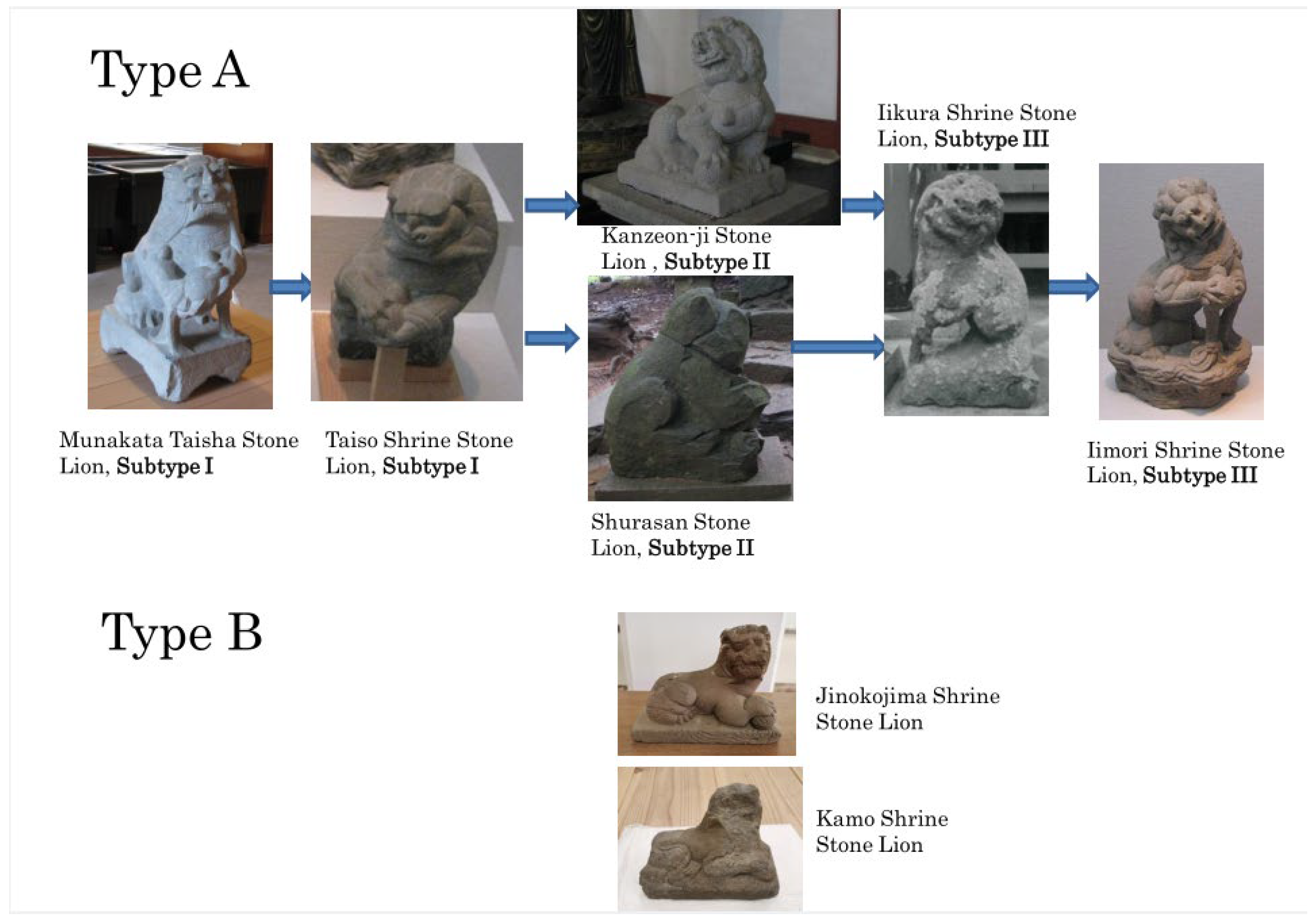
According to Susumu Igata’s opinion, the stone lions of Munakata Taisha Shrine and those of Kumano Gongen-sha shrine occupy the two endpoints of this chronological framework. By comparing their morphological features, one can discern trends in the stylistic evolution of imported Chinese stone lions from around 1200 to the turn of the 14th and 15th centuries. Specifically, early imported Song-style stone lions, represented by the Munakata Taisha examples, feature relatively rigid outlines, sharply defined stonework edges, and a robust overall appearance, with smoothly finished surfaces. Over time, however, the bodily contours of the late-period Song-style stone lions became more softly curved, while surface treatment increasingly sought a textured and rough quality. Furthermore, the pedestals of early Song-style stone lions were carved with decorative protruding feet (圭角) at their four corners, later evolving into simple square slabs and eventually into irregular forms imitating Taihu rock formations. Based on these changes in stylistic characteristics, a chronological sequence of imported Song-style stone lions remaining in Japan can be set up: Munakata Taisha Shrine 宗像大社 stone lions → Taiso Shrine 太祖神社 stone lions/Yuki Shrine 由岐神社 stone lions → Kanzeon-ji Temple 観世音寺 stone lions → Iimori Shrine 飯盛神社 stone lions/Okayama Kumano Shrine 岡山熊野神社 stone lion → Misumi Kumano Gongen-sha Shrine 三隅熊野権現社 stone lions. Among these, the Kanzeon-ji Temple stone lions date to the mid-13th century, while the Iimori Shrine lions (Fukuoka) and Kumano Shrine lions (Okayama) generally fall within the period from the late 13th century to the first half of the 14th century (
Igata 2008, pp. 65–83;
2018, pp. 25–48).
Susumu Igata has traced the stylistic evolution of the imported Song-style stone lions in Japan and also suggested likely positions for the representative Song-style stone lions within the chronological framework. However, the evolutionary trajectory of Song-style stone lions as sketched by Igata still has room for refinement, and his dating of individual examples, such as the Shurasan 首羅山 stone lions (Fukuoka) and the Iikura Shrine 飯倉神社 stone lions of Minamikyushu 南九州 (Kagoshima), remains open to discussion.
In author’s opinion, by applying the research methodology of typological analysis, the imported Song-style stone lions in Japan can be classified into two types: Type A and Type B.
Type A stone lions are sculpted in a seated posture, with a total height ranging from 36 cm to 73 cm. They are typically arranged as a matched pair, where the male lion holds a ball and the female lion cradles a cub.
Type B stone lions are rendered in a prone posture. They are notably small in scale, with a total height between 12 cm and 15 cm. Very few examples of this type remain, of which the two with available data are both male lion figures with their right forepaw resting on a ball.
Moreover, type A stone lions can be further subdivided into three subtypes (I, II, III) that reflect sequential development and show period-specific characteristics.
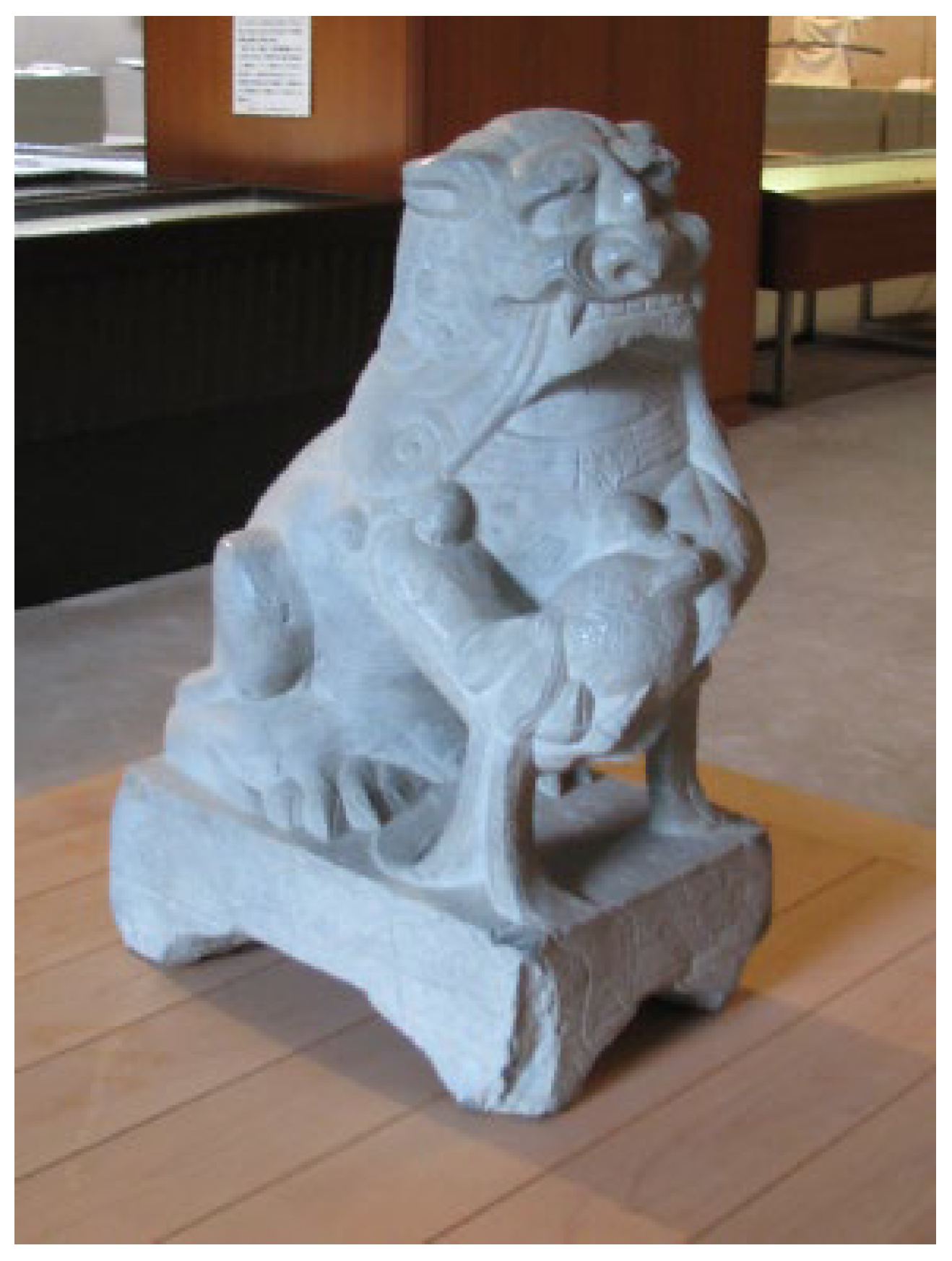
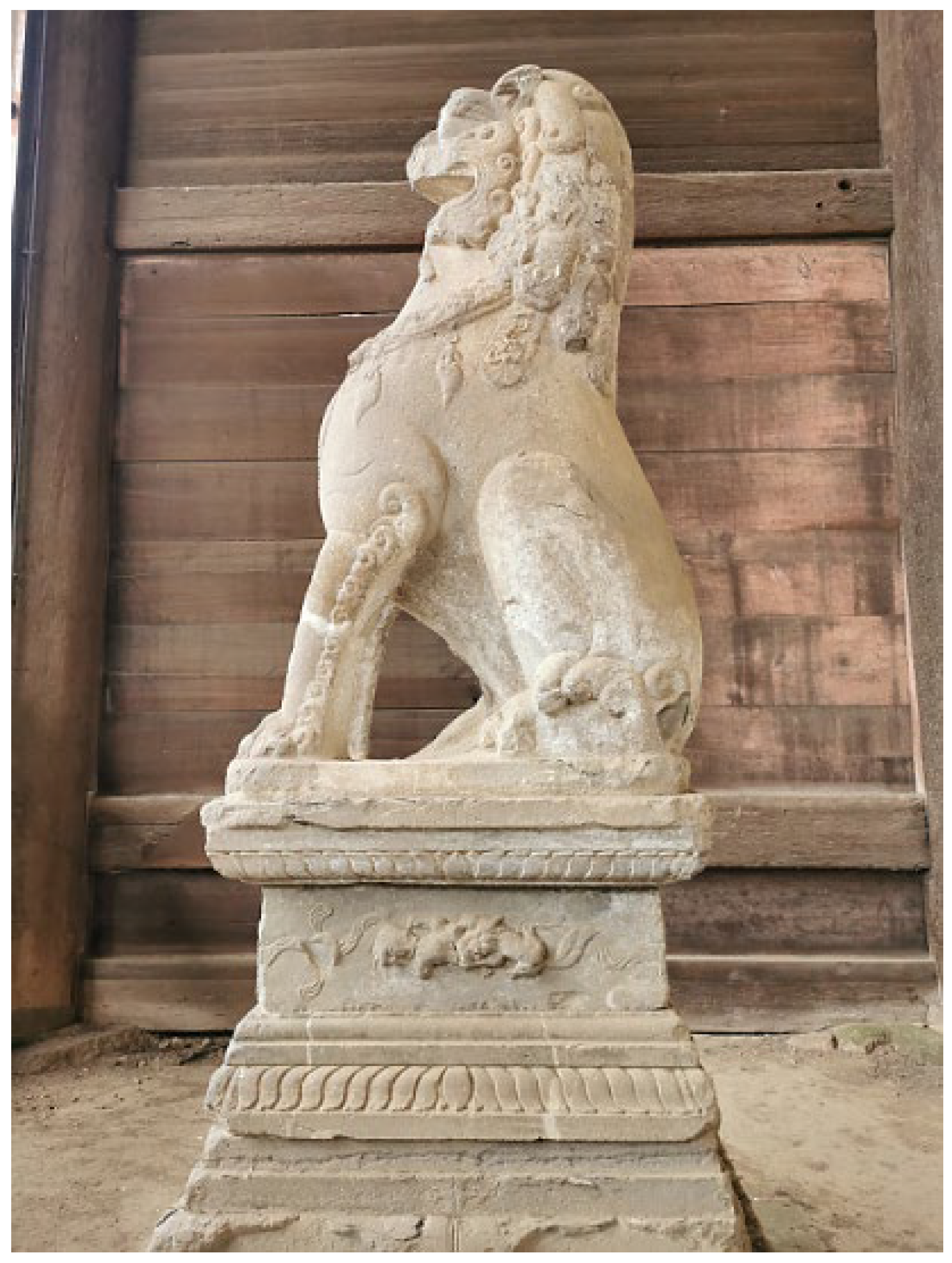
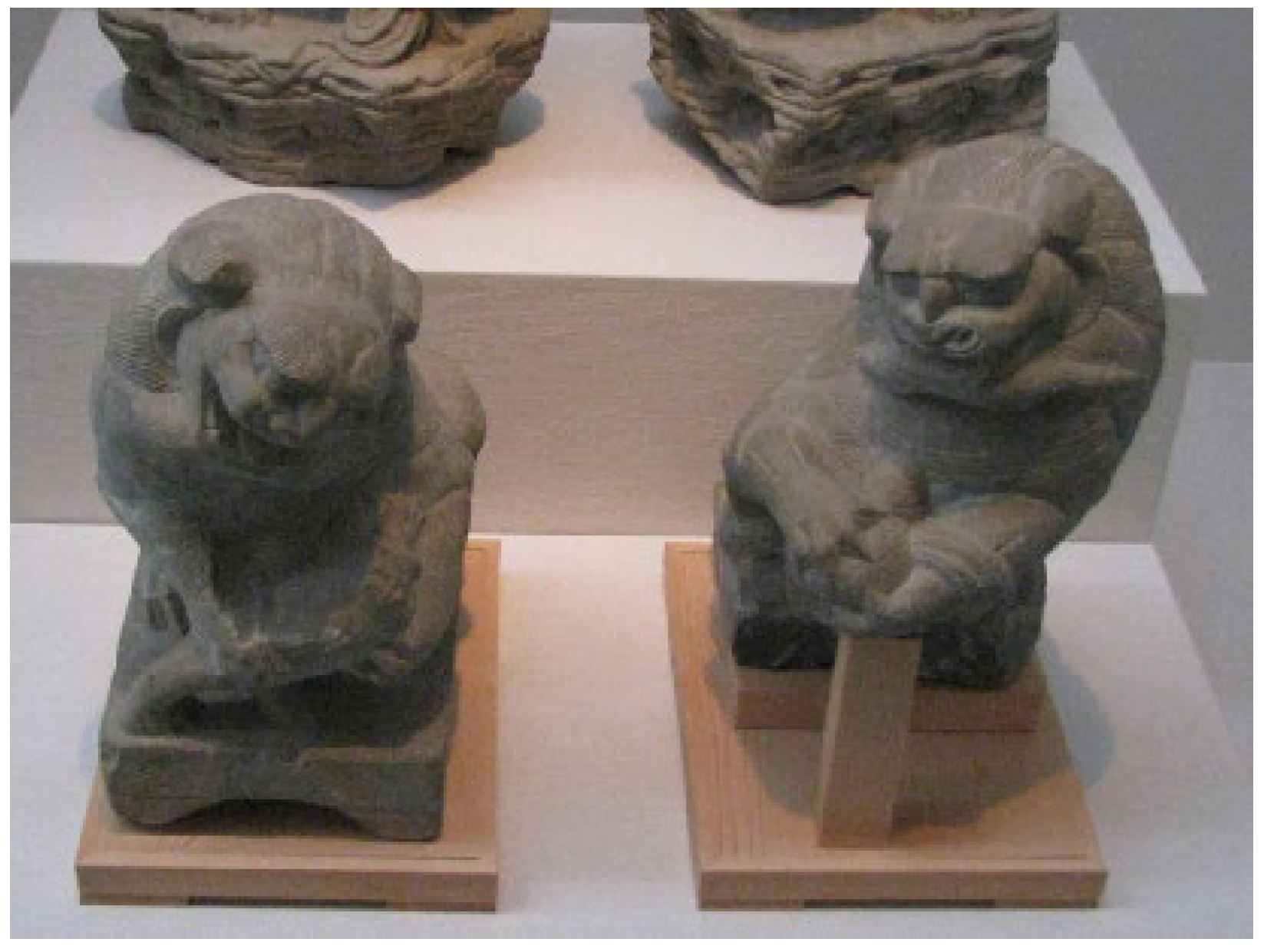
Representative Subtype I works include the stone lions of Munakata Taisha Shrine, Yuki Shrine and Taiso Shrine. These sculptural works exhibit a vigorous style, characterized by relatively large heads, short and thick necks, and robust bodies. Their square pedestals feature protruding feet (圭角) at the four corners. Additionally, the surfaces of the lion statues are finished smooth. The Munakata Taisha stone lions date to around 1200, while the Yuki Shrine and Taiso Shrine stone lions are slightly later, belonging to the early 13th century. The head of the Munakata Taisha stone lion is fashioned with well-defined angular outlines, while the heads of the Yuki Shrine and Taiso Shrine lion statues have relatively softer, more rounded contours. This contrast reflects an emerging trend of stylistic evolution (
Figure 4 and
Figure 5).
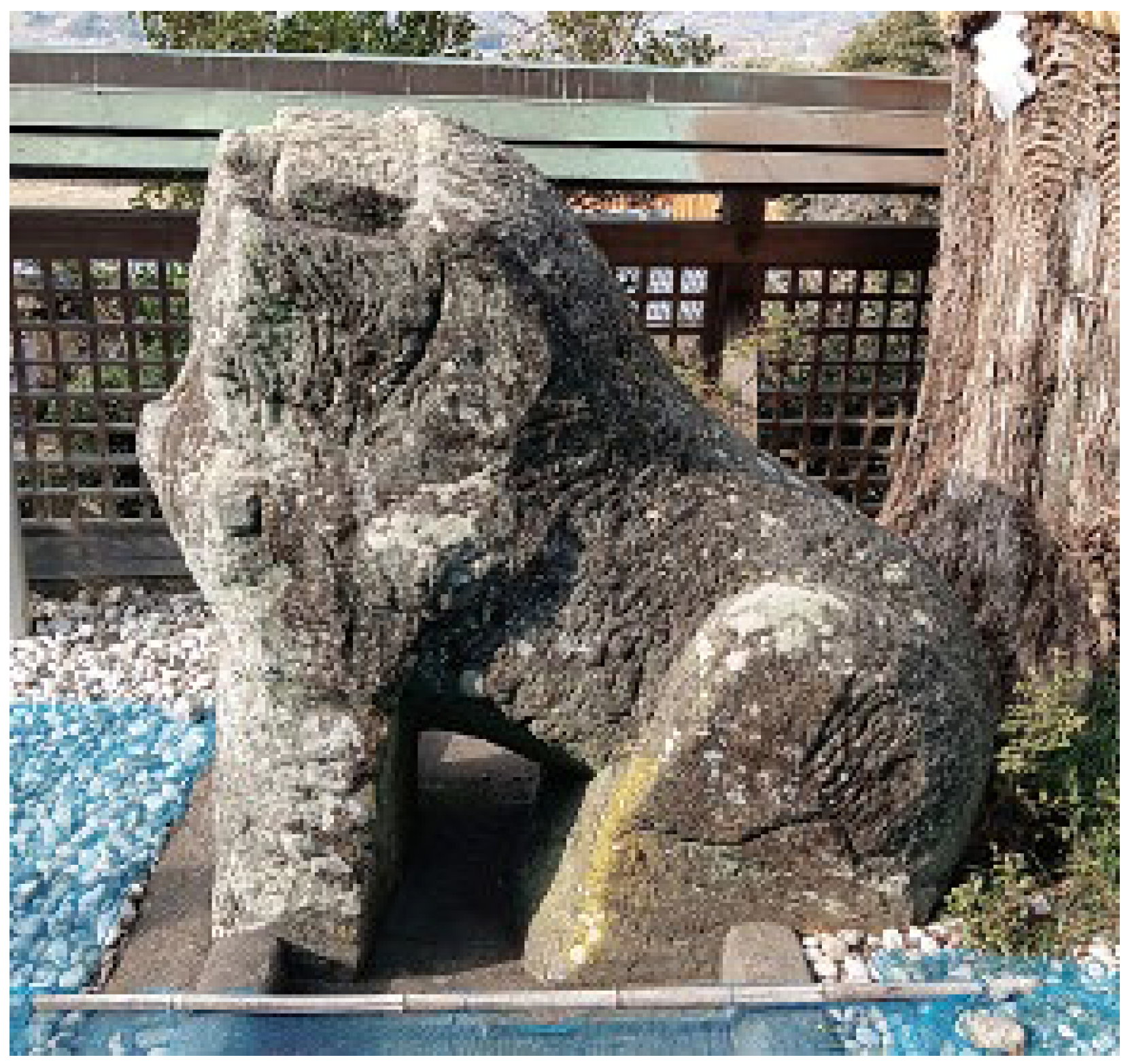
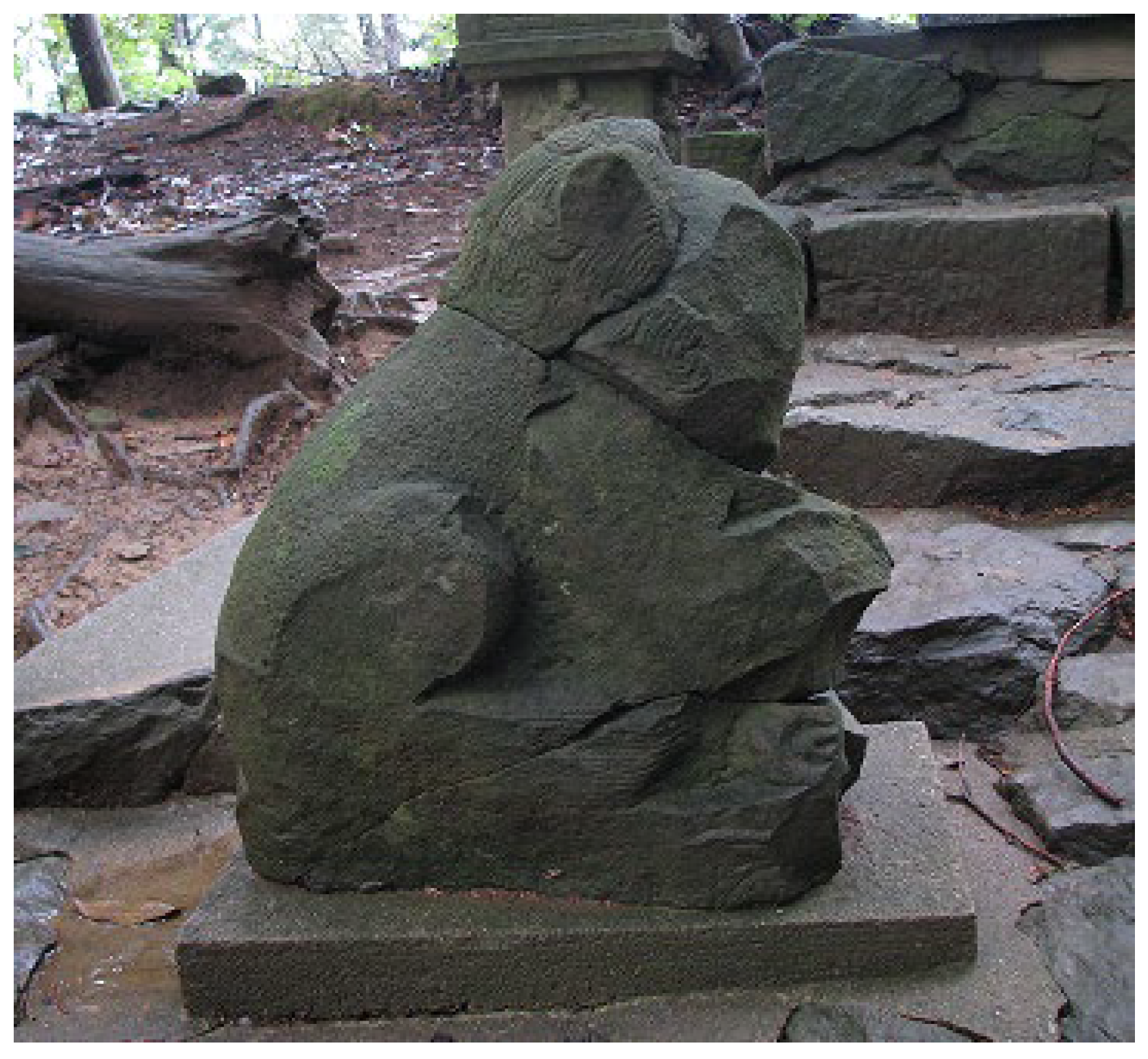
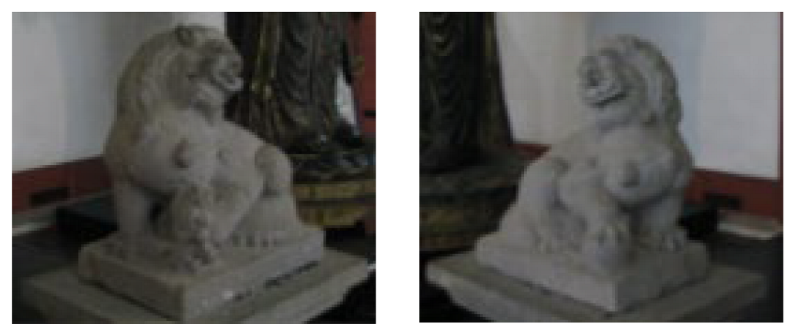
Representative Subtype II sculptures include the stone lions of Shurasan site, Okinomiya shrine of Shijiki-jinja 志々伎神社沖ノ宮, and Kanzeon-ji temple (
Figure 6,
Figure 7 and
Figure 8). Lions of this subtype possess a stout physique with thick, short necks. Their bellies and hindquarters rest flush against the slab pedestal, conveying a strong sense of stability. The contours of the lion heads have become rounded, with the rigid, angular edges of subtype I no longer present. In terms of detail, the manes show gender distinction—male lions exclusively feature curly locks, while female lions have straight, bundled or separated strands (except on the cheeks)—a defining characteristic of Subtype II.
4 Furthermore, the pedestals are simple square slabs. In contrast to the smooth finish of Subtype I lion statues, the surface treatment of Subtype II stone lions is relatively rough. Based on morphological details, the Song-style stone lions from the Umidera-ato site 海寺跡 of Hirado 平戸 (Nagasaki) and those from Kaseda-Masuyama Hachiman-jinja Shrine 加世田益山八幡神社 of Minamisatsuma 南さつま (Kagoshima) likely also belong to Subtype II.
Regarding the chronology of Subtype II stone lions, the author agrees with Igata Susumu’s opinion that the Kanzeon-ji stone lions generally date to the mid-13th century. However, it should be noted that compared with the Kanzeon-ji stone lions, the Shurasan and Okinomiya (Shijiki-jinja) stone lions exhibit proportionally larger heads and shorter bodies—features more closely aligned with several early 13th-century examples. Therefore, they likely predate the Kanzeon-ji stone lions to some extent. Additionally, the Satsuma stone pagodas found adjacent to the Shurasan and Okinomiya (Shijiki Jinja) stone lions are also considered to date from some time before the mid-13th century (
Egami 2018, pp. 101–22).
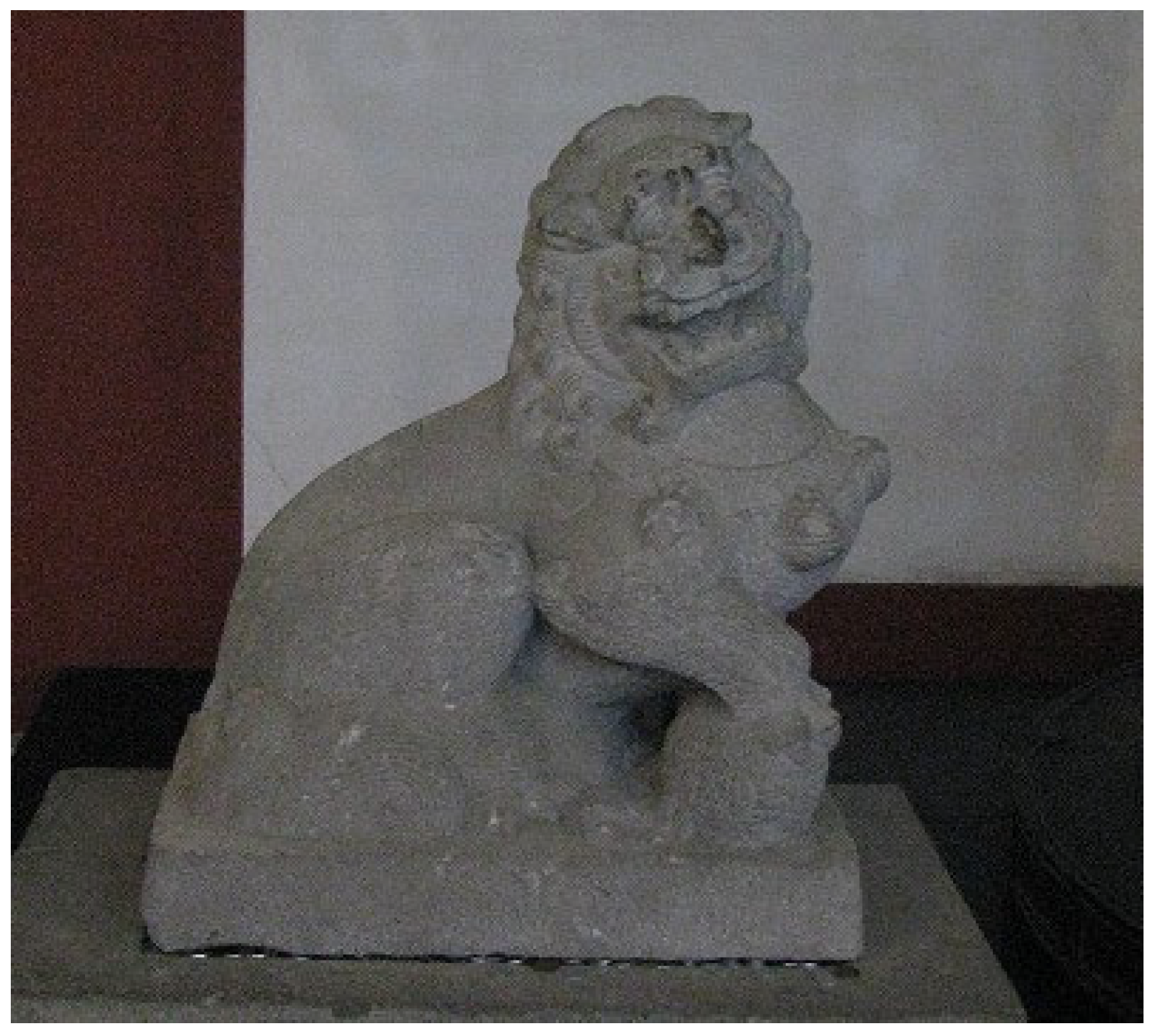
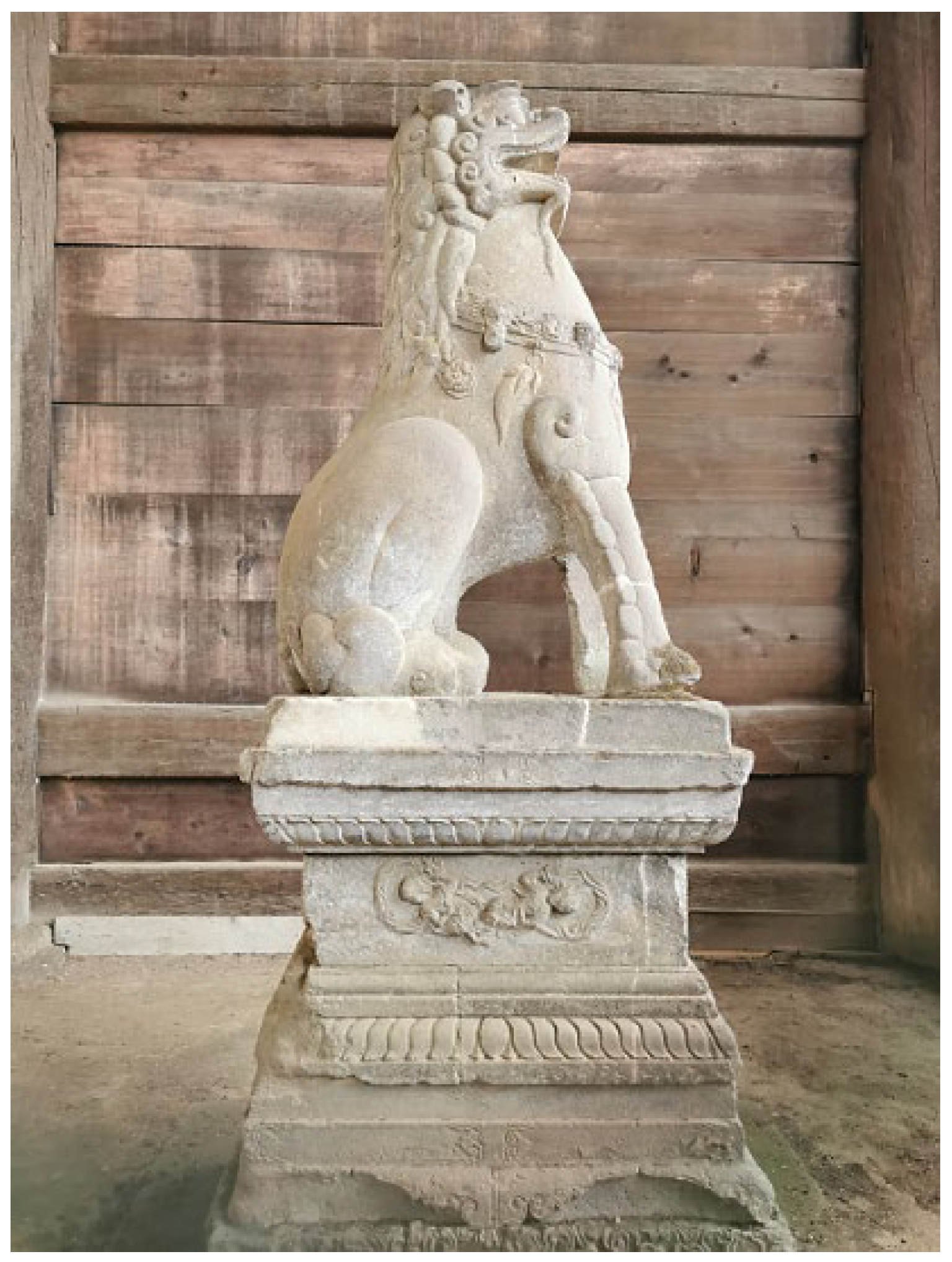
Subtype III stone lions include those at Iimori Shrine (Fukuoka) (
Figure 9), Kumano Shrine (Okayama), the Type A stone lions (one pair) at Kamo Shrine of Tatsuno city たつの市賀茂神社 (Hyogo), and the chronologically later stone lions at Misumi Kumano Gongen-sha Shrine 三隅熊野権現社 (Yamaguchi). Compared with the previous two subtypes, this group features smaller heads in proportion to the body, extended necks, and dynamic torsos elongated in an elegant curve. They are depicted with raised chests and bellies, supported by their hind legs. Their overall form exhibits soft and flowing outlines, lacking the robust and steady characteristic of Subtypes I and II. Most of Subtype III examples mentioned above have similar curly manes, with no distinction between males and females. Their pedestals imitate the form of Taihu rocks, with artificially processed concave and convex surfaces. Like those of Subtype II, the surface texture of Subtype III stone lions is also relatively rough.
If the Iimori Shrine and Kumano Shrine stone lions are taken as typological benchmarks for the late 13th century to the first half of the 14th century, and those of Kumano Gongen-sha as representative at the turn of the 14th and 15th centuries, one might initially conclude that 14th-century imported Chinese stone lion morphology showed little significant change. However, closer observation reveals that the pedestals of the Kumano Gongen-sha stone lions are noticeably taller, their body contours even softer, and their carving treatment displays a tendency toward formulaic execution, lacking the vitality and dynamism seen in the Iimori Shrine stone lions.
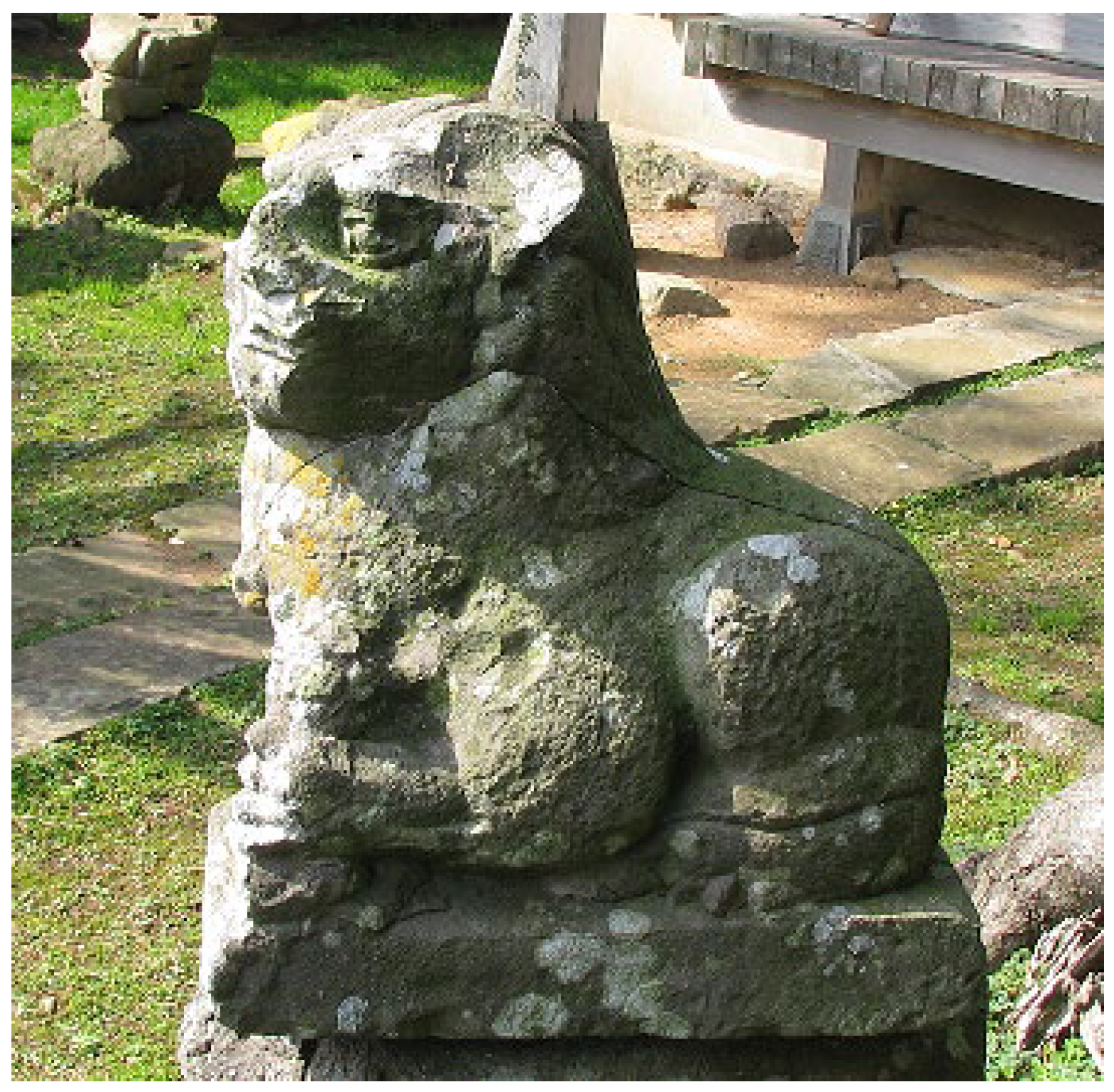
Chronologically, the progressive sequence of Subtype I → Subtype II → Subtype III is beyond doubt. Typologically, however, the morphological evolution between Subtypes II and III appears somewhat abrupt, which may cast doubt on a direct lineage between them. In the author’s view, a transitional form of stone lion from Subtype II to Subtype III likely existed in the latter part of the 13th century, and the Song-style stone lions at Iikura Shrine in Minamikyushu city occupy this transitional position.
Regarding the dating of the Iikura Shrine stone lions, Wataru Hashiguchi橋口亘notes that, like the Satsuma stone pagodas in southern Kyushu, they also are the stone carvings brought by Chinese merchants during Japan’s early medieval period (13th to early 14th century) (
Hashiguchi 2013b, pp. 9–13). Susumu Igata, however, argues that the style of the lion figures and the shape of their pedestals at Iikura Shrine resemble those of the Kumano Gongen-sha lions, suggesting they could be dated to the Ming period (
Igata 2017, pp. 33–50).
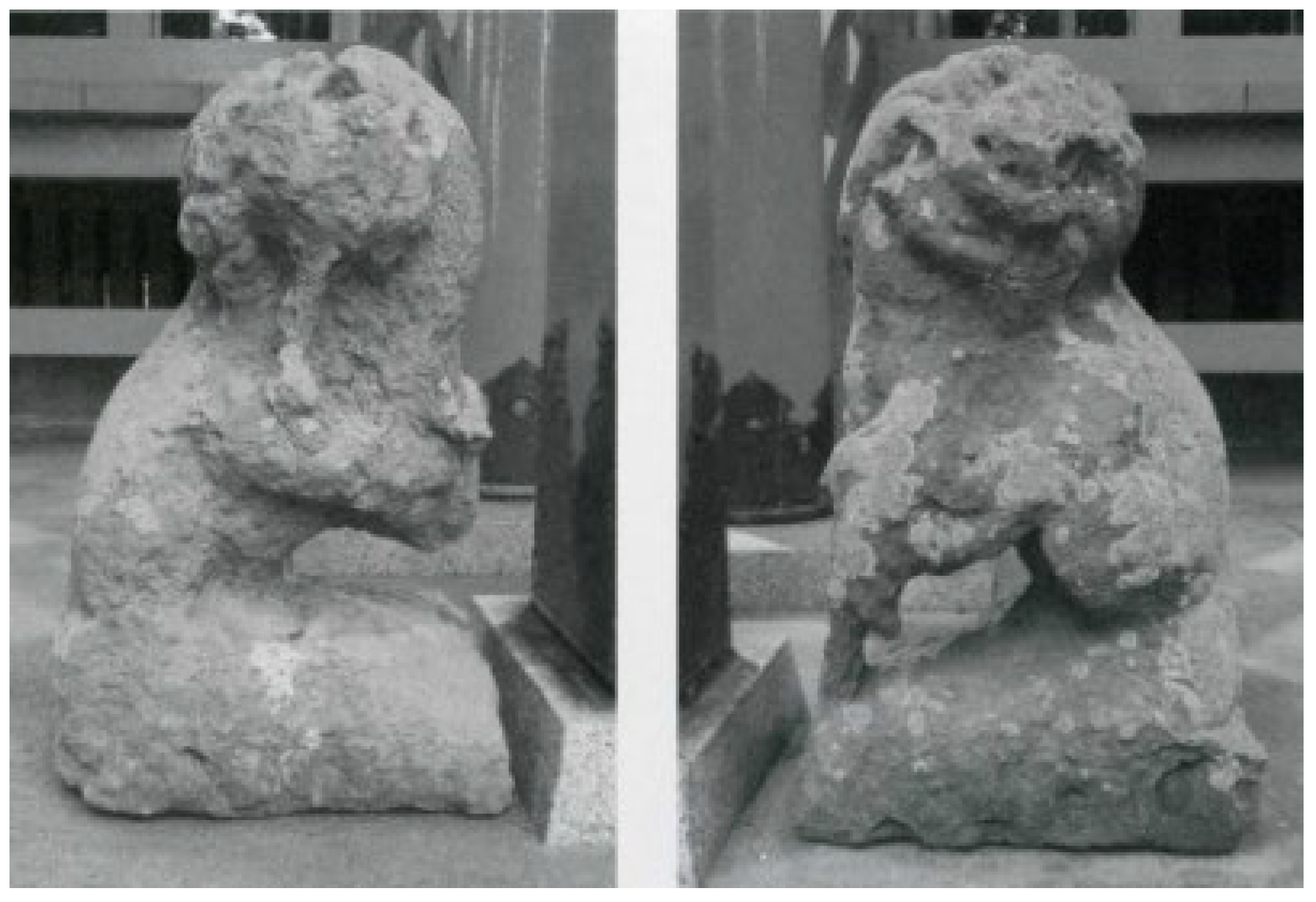
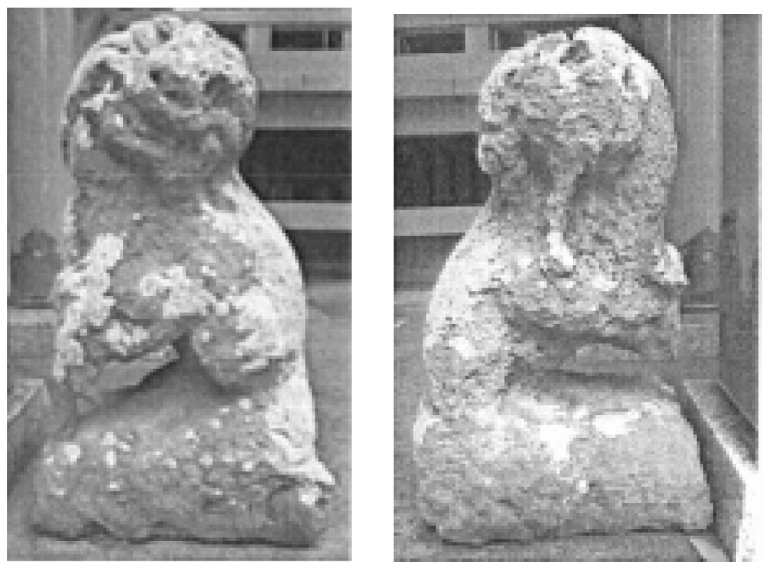
In reality, although the Iikura Shrine stone lions share basic morphological characteristics with Subtype III, they retain several features of Subtype II, as evidenced by: (1) their large heads in proportion to the body, thick short necks, and a body posture less elongated than that of Subtype III lions; (2) the male lion’s curly mane and the female lion’s bundled strands, consistent with Subtype II; and (3) their pedestal, though carved to resemble undulating natural rock, still maintains the basic outline of an early square slab, distinct from the taller Taihu rock-shaped pedestals of Subtype III (
Figure 10).
In light of this, the author concludes that the Iikura Shrine stone lions date to the latter part of the 13th century. They succeed Subtype II, represent works from the late Song to early Yuan period, and belong to the early phase of Subtype III. Close observation of their stylistic features thus aids in understanding the morphological evolution of Song-Yuan stone lions during the 13th–14th centuries.
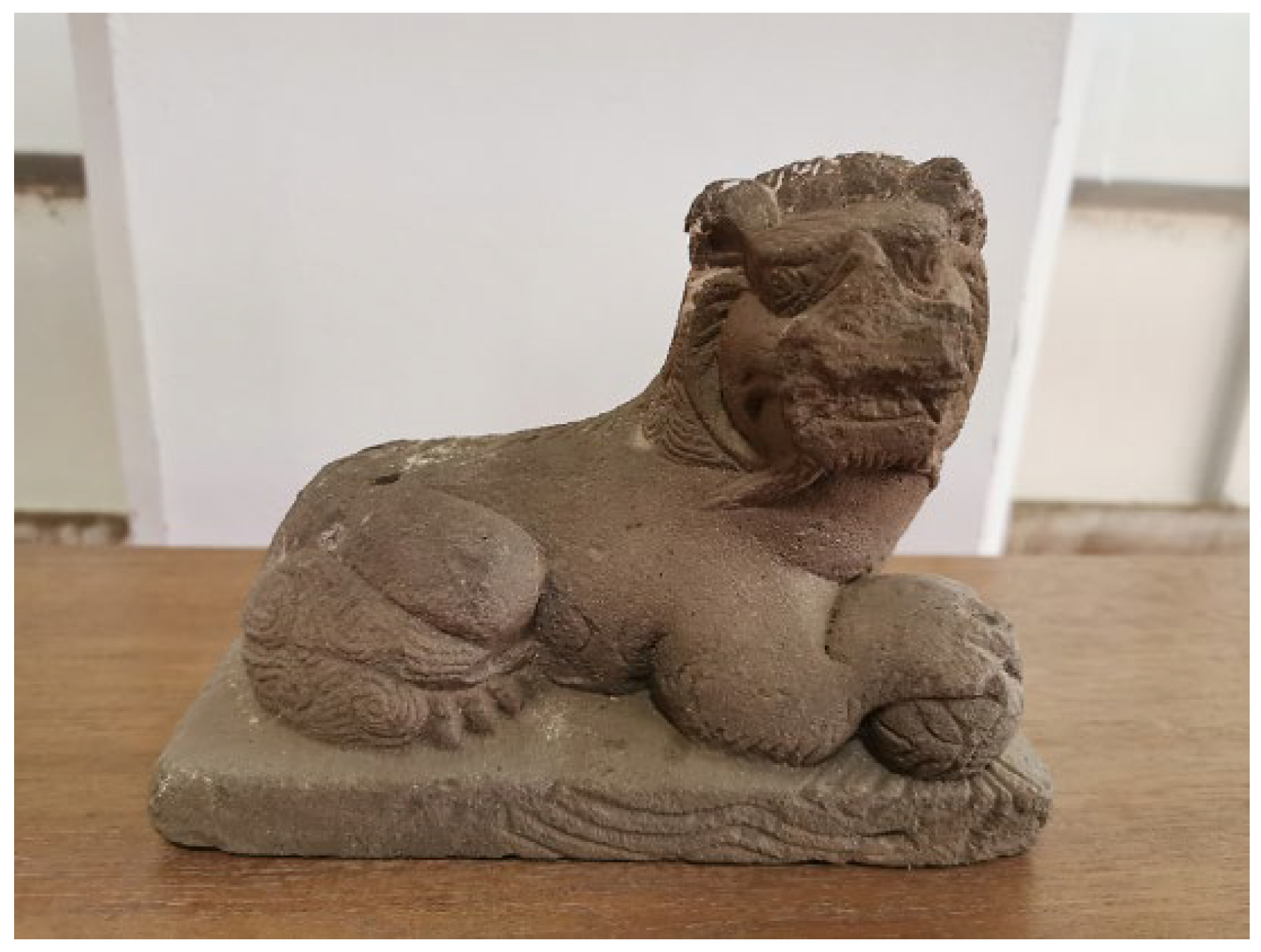
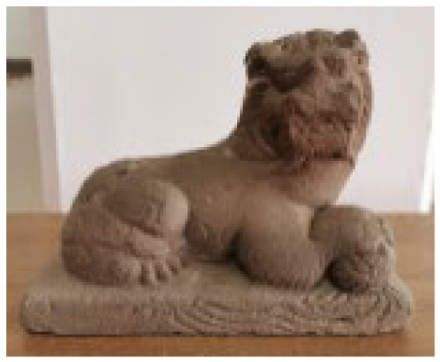
The number of imported Type B Song-style stone lions remaining in Japan is very small. Currently, there are only two examples with published basic information: one housed at Jinokojima Shrine 地ノ神嶋神社 on Ojika Island 小値賀島 (Nagasaki), and the other at Kamo Shrine of Tatsuno city たつの市賀茂神社 (Hyogo). The Jinokojima Shrine stone lion has a total height of 14.5 cm and is well preserved. The stone lion is rendered in a prone posture, with its head turned to its right, and the right forepaw resting on a ball. Its pedestal is a simple square slab (
Figure 11). The Kamo Shrine stone lion measures 12 cm in total height and shows damage to the face, chest and tail. Its figural form and pedestal shape are identical to those of the Jinokojima Shrine lion, and the right side of both pedestals is carved with the streamer of the ball (
Igata 2021, pp. 89–100). The square-slab pedestals of these two small lions match those of Type A—Subtype II. Stylistically, the lion figures closely resemble those of the Subtype II Kanzeon-ji stone lions. Therefore, these two small-size stone lions can be dated to the mid-13th century.
5In the author’s opinion, given the scarcity of clearly dated small to medium-sized round-sculpted stone lions from the Southern Song to Yuan period remaining in China, the chronological framework established for the extant imported Song-style stone lions in Japan is equally applicable to the study of analogous round-sculpted lions in China. Among the stone lions housed in the Tangsong Dongyuan 唐頌東院 Gallery’s collection in Ningbo 寧波 are two Southern Song round-sculpted examples. Although their original locations are unknown, it is highly probable that they were from Ningbo itself. Since Ningbo served as a key gateway for Sino-Japanese exchange during the Song, Yuan, and Ming periods, the significance of Ningbo’s Song-Yuan stone lion examples for understanding the imported Song-style stone lions in Japan is self-evident (
Takatsu 2012, pp. 213–25;
Yamakawa 2012, pp. 303–57).
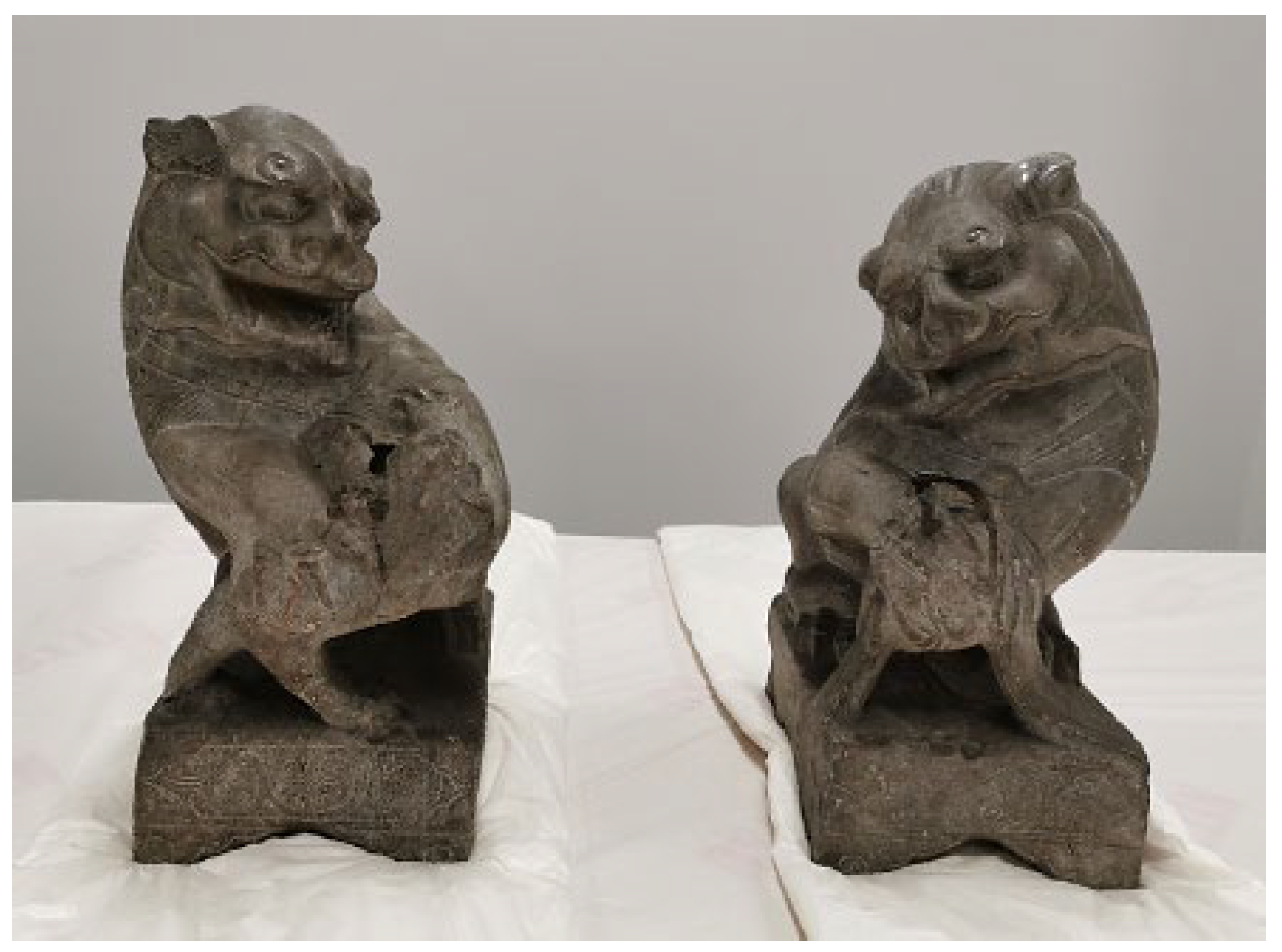
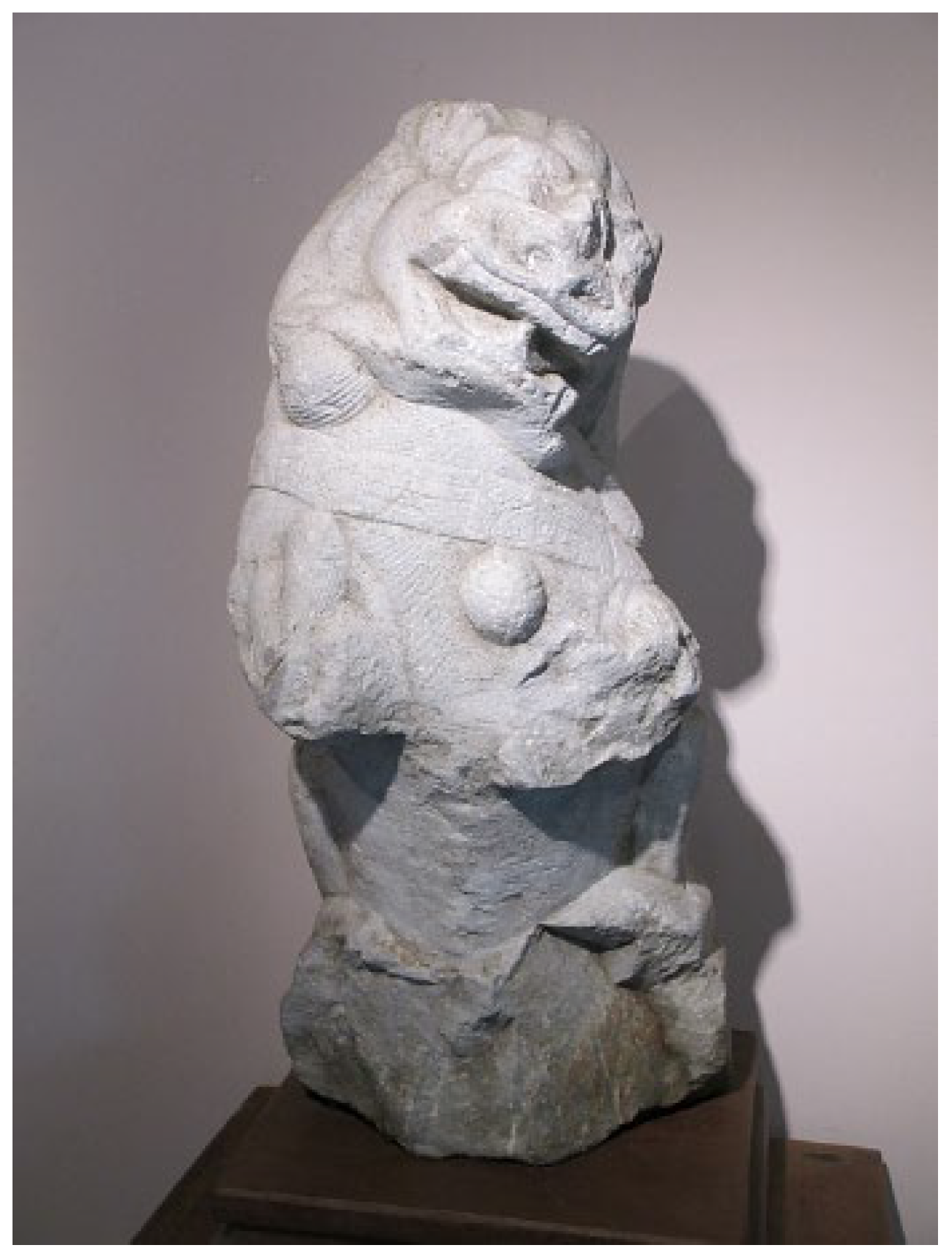
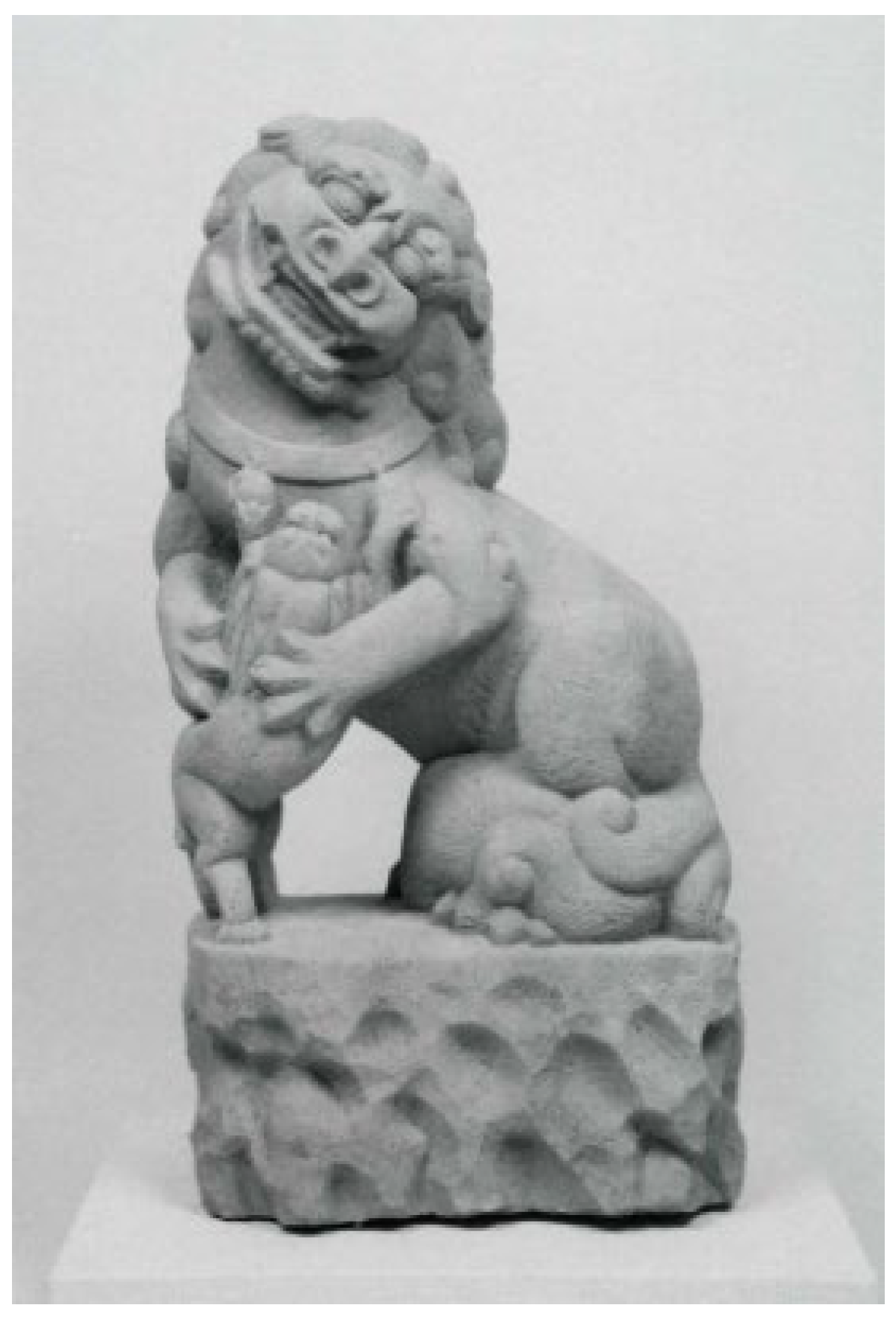
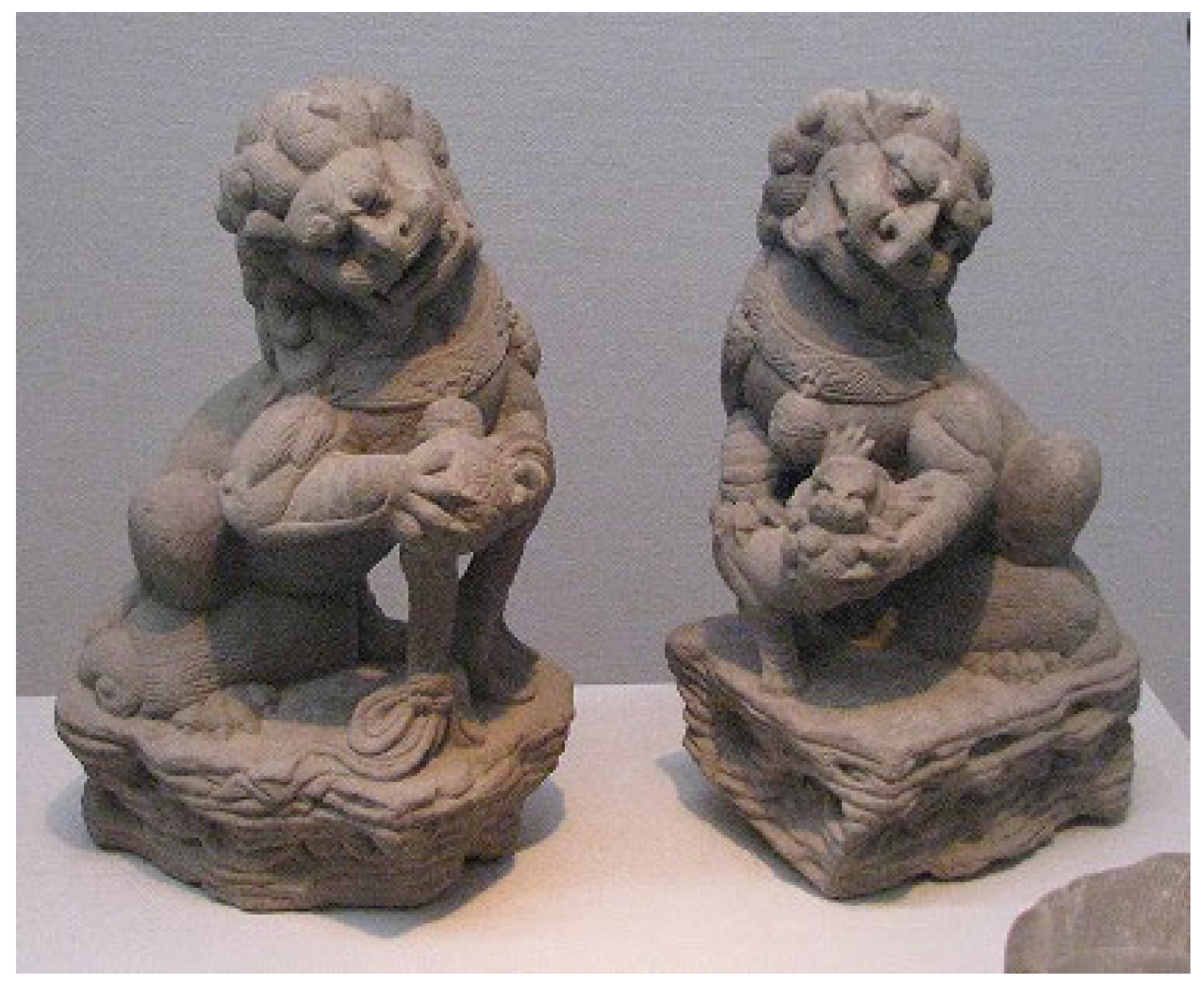
One stone lion in the Tangsong Dongyuan Gallery’s collection, which has a total height of approximately 68 cm including its pedestal, was delicately sculpted in a seated posture holding a cub, though much of both front legs and most of the cub are now missing. It features a large head that is tilted to its left with a wide-open mouth and a thick, short neck that merges with the chest and is adorned with a collar. The pedestal, which is heavily damaged, shows corner remnants that indicate it originally had protruding feet (圭角). This stone lion shares close similarities with the female lion at Munakata Taisha in terms of its head, facial features, collar, cub-holding posture, pedestal form, and overall scale. Even detailed carvings, such as the decorative patterns on the collar and the mane along the body side, are strikingly similar. However, the carving contours of its head and face are slightly softer than those of its Munakata Taisha counterpart. Moreover, its distinctive head tilt is a formal trait that aligns more closely with the cub-holding lions at Yuki Shrine and Taiso Shrine. Therefore, this stone lion can be classified under Subtype I of Type A, to which it bears a chronological proximity—either contemporary with or slightly later than—the Munakata Taisha stone lions, placing it as an early 13th-century work (
Figure 12).
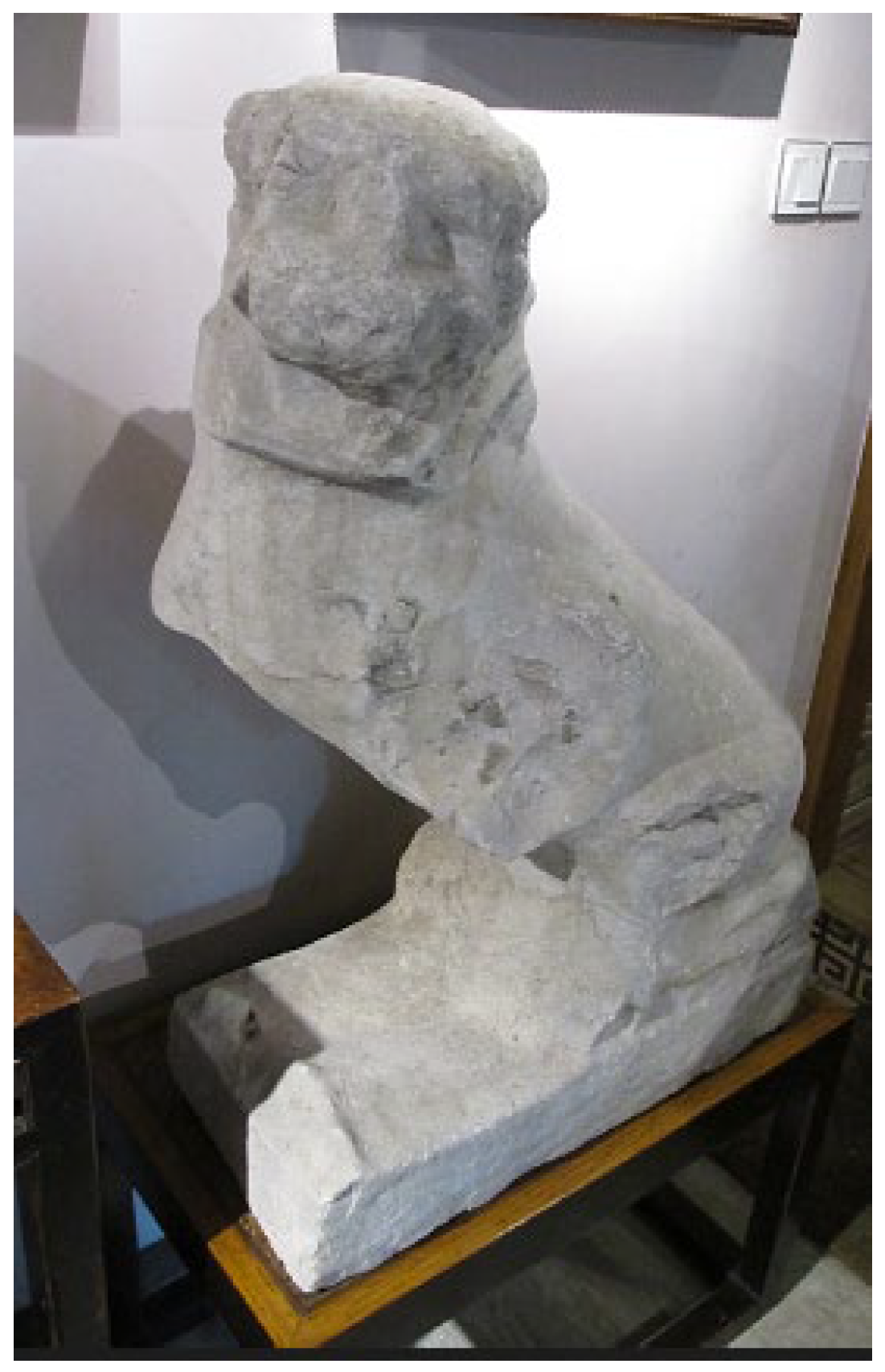
The other stone lion in the Tangsong Dongyuan Gallery’s collection, which has a total height of 87 cm including its pedestal, is depicted in a seated posture holding an object. Most of both hind legs and sections of the front legs of stone line are missing, with its head tilted to its left and severely weathered—retaining only the outlines of the eyes, ears, nose, and open mouth and traces of a mane that was originally composed of spiral curls. A faint collar remains visible on the neck. The pedestal, which is largely intact, takes the form of a thick, square slab. Compared with the previously described Song stone lion, this statue shows a smaller head in proportion to the body, a longer torso, and softer contours—features that align it more closely with the formal style of Subtype III of Type A. Its pedestal, however, retains the earlier square-slab form that differs from the Taihu rock-shaped pedestal typical of Subtype III. On this basis, this lion could be dated to the late 13th century, i.e., the late Song to early Yuan period (
Figure 13).
The discussion above has examined the chronological framework and evolutionary lineage of the imported Song-style stone lions remaining in Japan and compared them with Song-style stone lions found in the Ningbo region. The following section will investigate the stone lion works left by Southern Song stonemasons in Japan.
As noted earlier, only three sites preserve stone lion works carved by Southern Song stonemasons in Japan. Among these, the stone lions at the South Gate of Todai-ji temple in Nara (a pair) have a clear date. According to Todai-ji temple’s historical documents, they were completed in 1196 by stonemasons recruited from the Southern Song dynasty
6 (
Yamakawa 2012, pp. 303–57). With regard to the stone lion at Aritoshi Shrine in Wakayama, Asei Sato proposes that, as an unfinished work, it may represent an experimental piece left by Southern Song stonemasons in the Kinki region shortly after their arrival during the early Kamakura period (
Sato and Sato 2019, pp. 449–56). According to this viewpoint, the Aritoshi Shrine stone lion, which is thus considered a late-12th-century statue, predates the South Gate stone lions of Todai-ji. Iga Shindaibutsu-ji, also known as “Todai-ji Iga Bessho (東大寺伊賀別所)”, was one of the seven branch temples of Todai-ji that were founded by Chogen across Japan. Based on documentary and archaeological sources, it can be inferred that the temple’s relief-carved lion pedestal and the Amida Hall it is housed in were constructed in 1202 (
Araki et al. 1979, p. 44).
The two stone lions of Todai-ji Temple in Nara, which each stand over 300 cm in total height, far exceed the small to medium-sized imported Song-style stone lions in scale. As stone lions of main gate guardian, they convey a solemn and imposing ceremonial presence, and show a quality that distinguishes their stylistic character sharply from the more vernacular appeal of the imported Song-style examples. Although belonging to a distinct category of stone lions and offering little basis for direct comparison, the South Gate stone lions of Todai-ji do exhibit certain morphological features that align with those of Subtype I of Type A imported lion statues. These include a squared contour of the head and a robust, powerfully articulated body—traits that reflect the shared stylistic ethos of Song-period lion sculpture from the late 12th to the early 13th century (
Figure 14 and
Figure 15).
The Aritoshi Shrine stone lion, which shares essentially the same posture as the Todai-ji stone lions, stands 165 cm in height. This figure height closely approaches that of the female Todai-ji lion statue (162.5 cm, excluding the pedestal). Although the stone lion remains unfinished, it clearly displays a large head in proportion to the body, a short thick neck, and a stout torso—features that are fully consistent with the characteristics of Subtype I of Type A imported Song-style stone lions (
Figure 16).
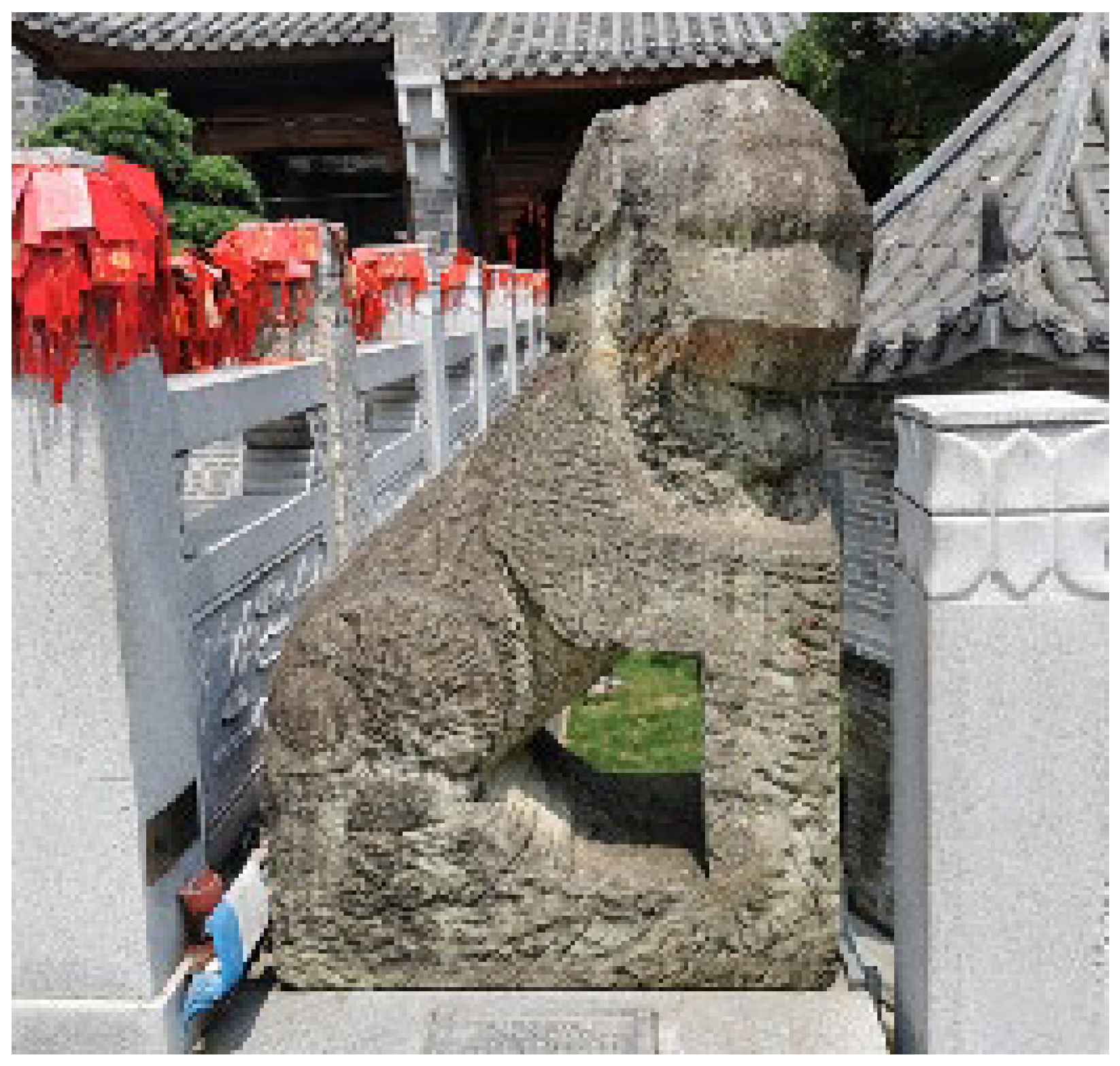
In May 2025, while conducting fieldwork in Nanchang, Jiangxi, the author observed a pair of late Song to early Yuan stone lions in front of the main hall of the Tiezhu Wanshou Gong 鐵柱萬壽宮 (
Figure 17). By coincidence, the two stone lions are also unfinished, with respective heights of 165 cm and 161 cm. Compared with the Aritoshi Shrine lion statue, the Tiezhu Wanshou Gong stone lions exhibit smaller heads in proportion to their bodies, lanky torsos, and softer contours. The stylistic divergence between the two may reflect an evolutionary pattern in large-scale ceremonial stone lions from the late 12th to the late 13th century—a trend in which the head becomes proportionally smaller and the body more slender, coinciding with the changes from Subtype I of Type A to Subtype III of Type A observed among the imported Song-style stone lions in Japan.
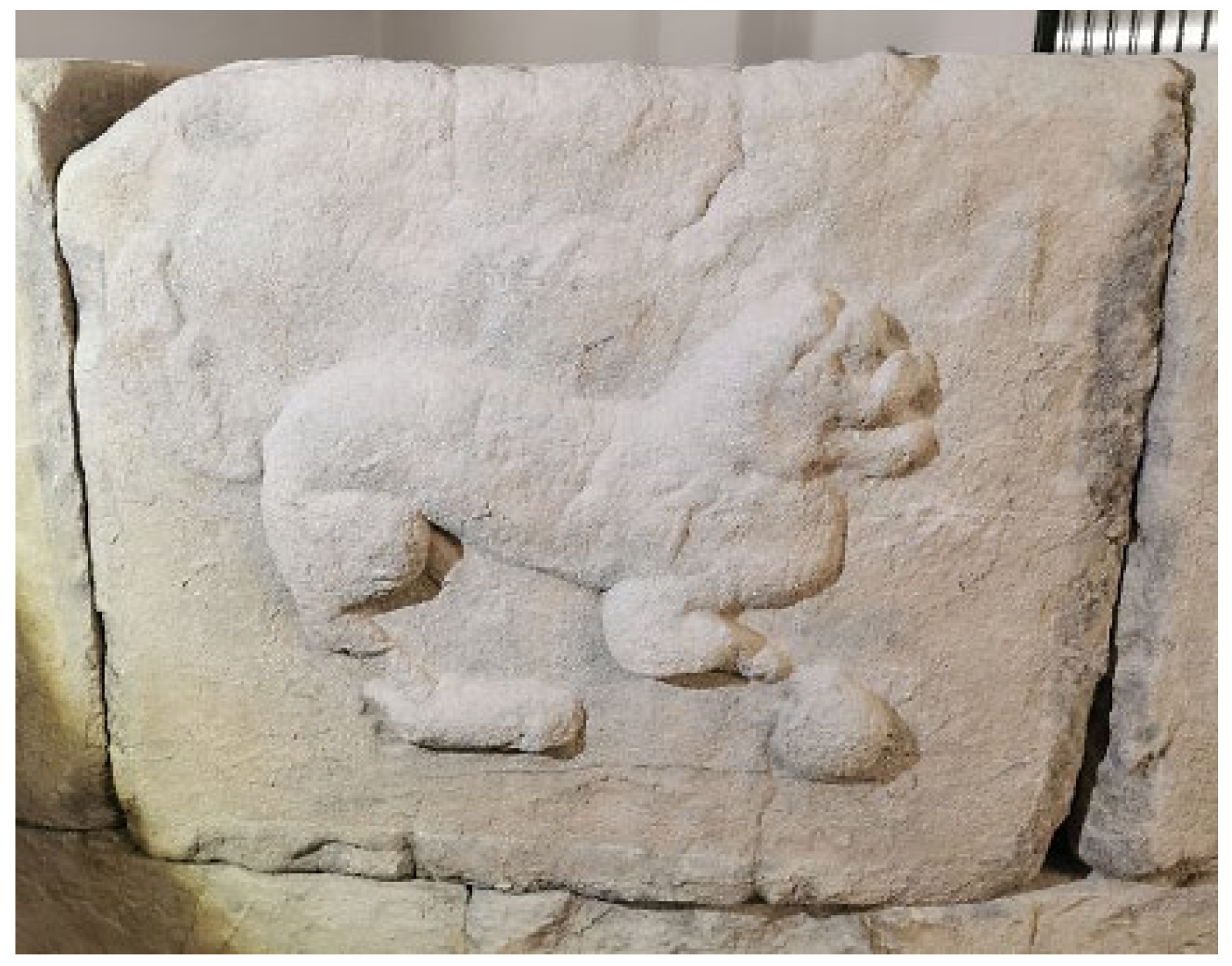
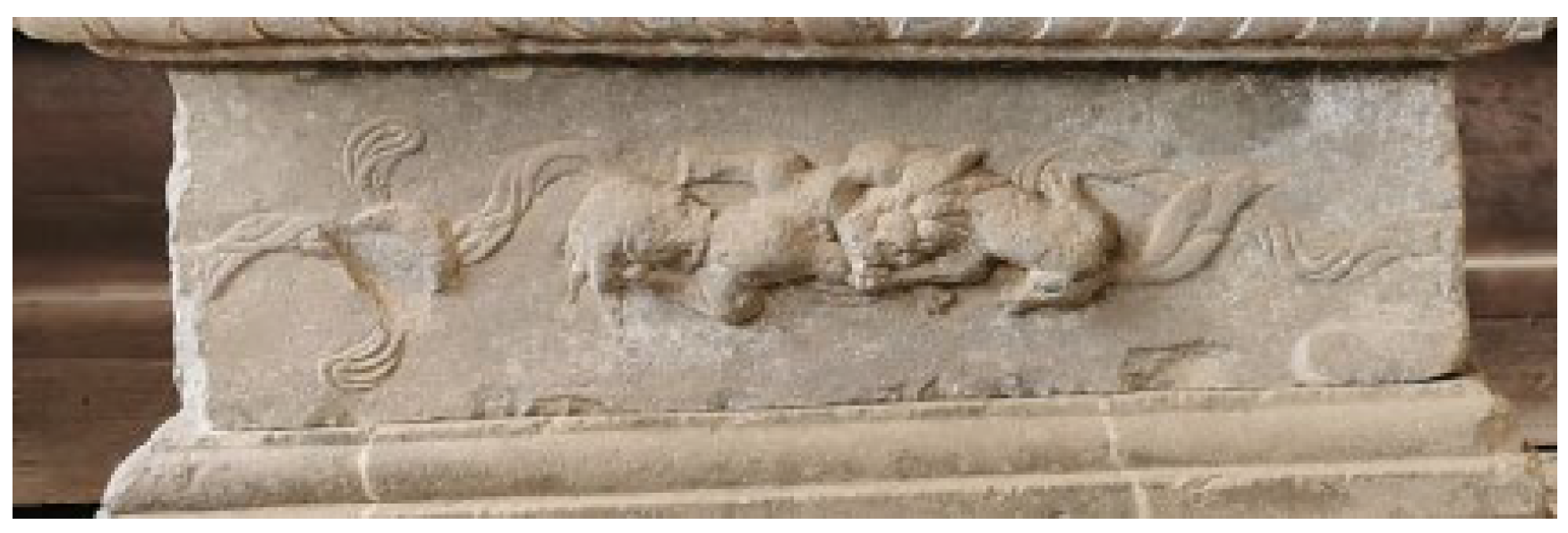
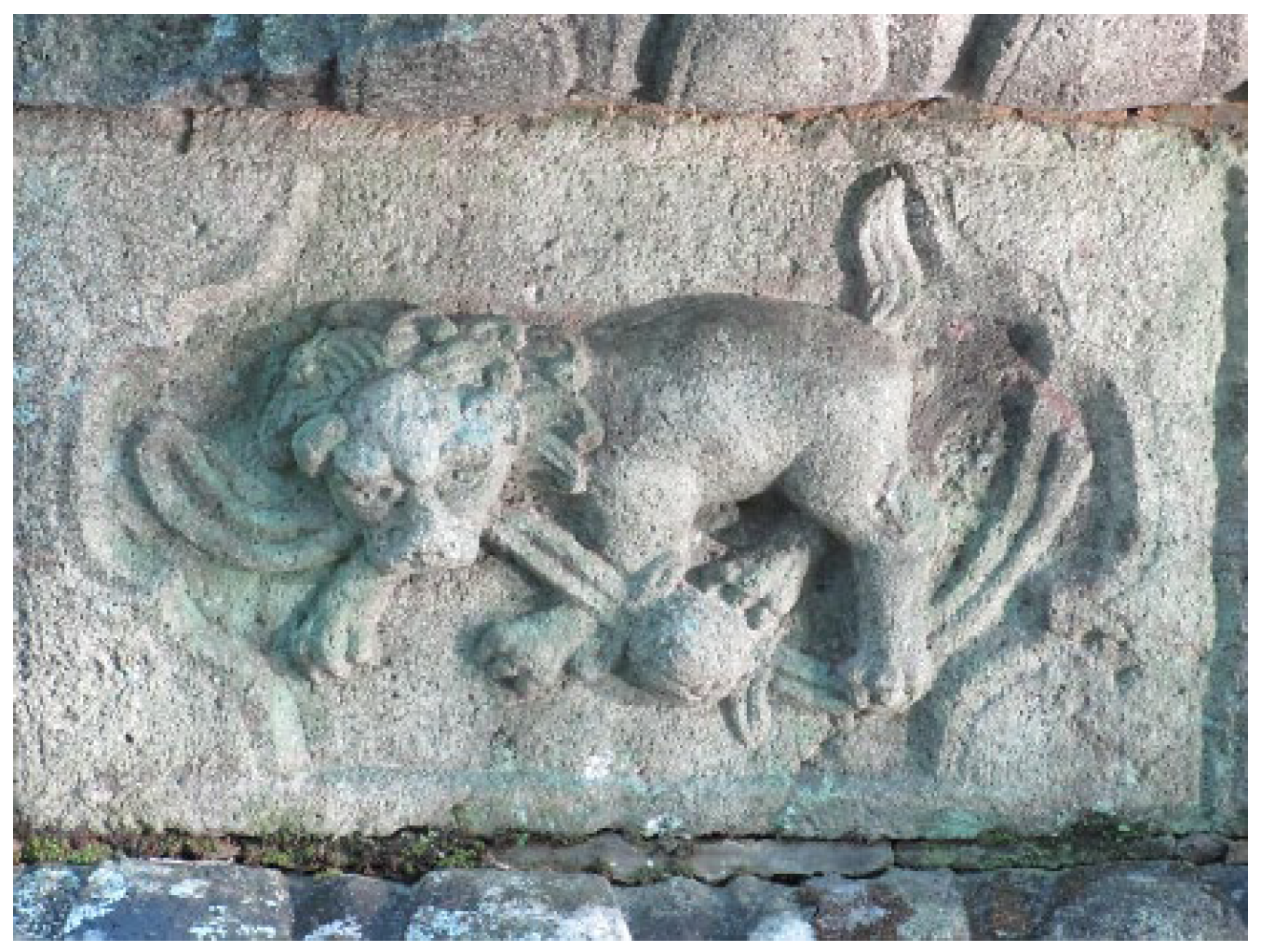
The relief-carved stone lions at Shindaibutsu-ji Temple mostly depict figures chasing a ball, running, or standing (
Figure 18). Reliefs of lions also appear on the Sumeru pedestal of the east stone lion statue at the South Gate of Todai-ji, where they are shown locked in a competitive struggle (
Figure 19). Although not displaying diverse postures as seen on the relief-carved lion images on the pedestal at Shindaibutsu-ji, the relief-carved stone lions of the South Gate of Todai-ji also convey an impressive sense of tension.
In Zhejiang 浙江 and Fujian 福建 regions, which maintained frequent contacts with medieval Japan, comparable examples of relief-carved stone lions are preserved. One such example is found on the waist portion of pedestals of the stupa-style stone pagodas 窣堵波式石塔 at Lingjiu Temple 靈鷲寺 in Lishui 麗水, where the lions are depicted in postures of running or pouncing on a ball (
Figure 20). Since the Lingjiu Temple pagoda dates to the early 13th century (
Wu 2009, pp. 6–14), its pedestal reliefs belong to the same period as those at Shindaibutsu-ji and Todai-ji. These relief-carved stone lions share a set of common features, including a large head in proportion to the body, a robust physique, and a consistently horizontal alignment of the head and torso—a trait that is maintained regardless of the direction in which the head is turned.
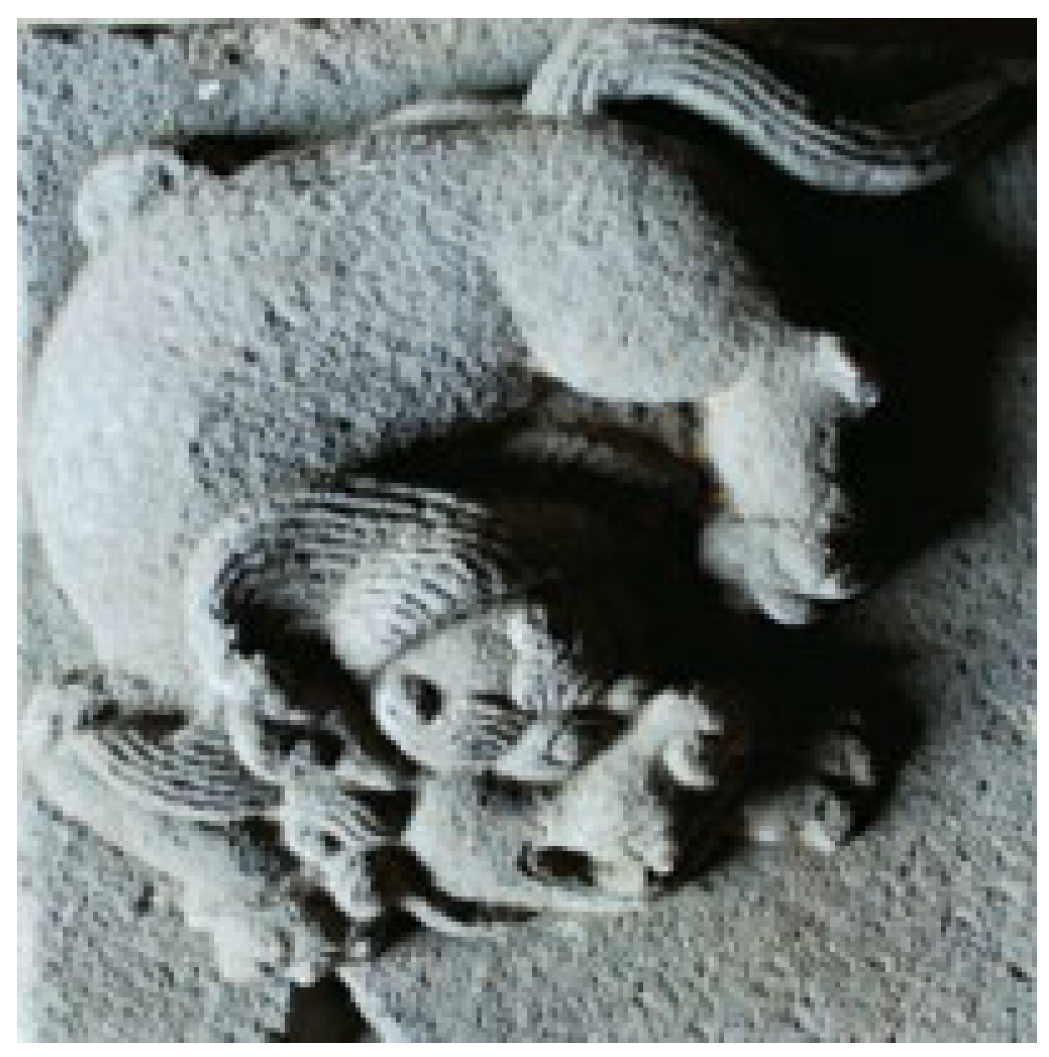
In Zhejiang and Fujian, relief-carved stone lions from the mid and late 13th century have also survived. The mid-13th-century works are exemplified by the relief lion figures on the stupa-style stone pagoda of Xingfu Temple 興福寺 in Rui’an 瑞安, Wenzhou 温州, which depict lions either pouncing downward or leaping upward. Their bodies are elongated, their forms sinuous and rounded, and their postures full of movement (
Figure 21) (
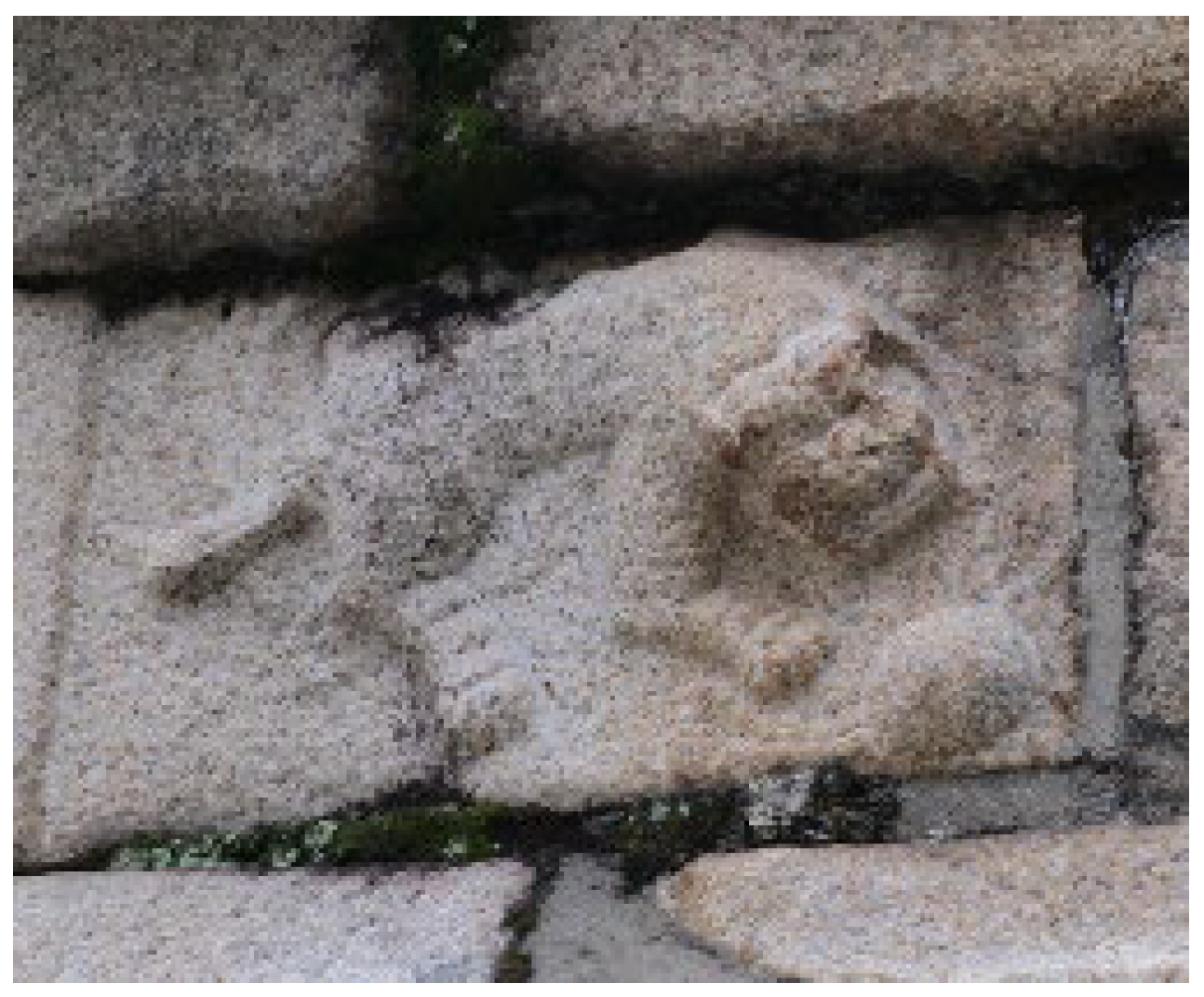
Ye 2011, pp. 49–51). The late-13th-century examples are represented by the relief lion figures on the stupa-style pagoda at Wuta Yan 五塔岩 in Nan’an 南安, Quanzhou 泉州, all of which show lions playing with a ball in various poses—pouncing forward, sideways, twisting in mid-air, or turning to gaze ahead (
Zeng 2016, pp. 60–63). In these images, the head is proportionally smaller, and the body resembles that of a tiger (
Figure 22). A common morphological feature of mid- to late-13th-century relief-carved stone lions is the coiled curve formed by the head, neck and back, which, together with the hind legs, create a C-shaped silhouette—a composition that differs markedly from the horizontally extended head-torso arrangement seen in early-13th-century reliefs.
Moreover, it is worth noting that, from the early to the late 13th century, Southern Song relief lions exhibit a reduction in head proportion and a shift from robust, angular forms toward softer, more curvilinear bodies—a trend that corresponds to the stylistic evolution observed in round-sculpted lion figures.
4. The Stone Materials and Production Places of Extant Song-Style Stone Lions in Japan
Firstly, regarding the Song-style stone lions produced by Southern Song stonemasons in Japan, the sources of their stone material have been identified. Relevant studies show that the stone used for the Aritoshi Shrine stone lion is a local chlorite schist (
Sato and Sato 2019, pp. 454–55). The relief-carved lion pedestal at Shindaibutsu-ji is made of a tuffaceous sandstone quarried near the temple (
Araki et al. 1979, pp. 13–14;
Kuchitsu 2009, pp. 7–8). In contrast, the stone of the Todai-ji South Gate lion statues differs from the above two. it is not of local Japanese origin but has been identified as a type of tuff known as Meiyuanshi stone 梅園石 from the Ningbo 寧波 region of China
7 (
Hattori et al. 2008, pp. 27–34).
The following section will examine the stone materials of the imported Song-style stone lions remaining in Japan, and further explore their probable places of carving. Based on the petrological identification results already achieved by Japanese researchers on the imported Song-style stone carvings in Japan, the following two understandings can be drawn.
First, Subtype I of Type A stone lions (late 12th–early 13th century) were predominantly carved from limestone. Nobuaki Kuchizu employed methods such as microscopic observation and X-ray fluorescence analysis to identify the stone of a group of Song-Yuan stone lions held in Japan, including those from Munakata Taisha Shrine, Yuki Shrine, Taiso Shrine, Kanzeon-ji, Iimori Shrine, and Kumano Shrine. The results indicated that the stone lions of Munakata Taisha, Yuki Shrine, and Taiso Shrine are all made of limestone, whereas the stone lions of Kanzeon-ji and Iimori Shrine are composed of “non-limestone” materials containing fine to very fine sand (
Kuchitsu 2009, pp. 1–10). Furthermore, the Kumano Gongen-sha stone lions—the latest among Japan’s extant imported Chinese stone lions—are also made of a non-limestone material containing homogeneous sandy particles (
Igata 2017, p. 36). This indicates that the predominant stone material for Subtypes II and III of Type A both shifted to non-limestone.
Second, Song-style stone lions that are found at the same sites as the imported Song-style stone pagodas—Satsuma pagodas—are mostly made of Zhejiang tuff, which is the same material used for the pagodas themselves. This is the case for the Song-style lions from the Shurasan site, the Umidera-ato site, and the Okinomiya shrine of Shijiki-jinja. According to macroscopic identification by Kimihiko Oki 大木公彦 and others at Kagoshima University, the stone of these several lion figures should be identified as Meiyuanshi stone 梅園石 (
Takatsu et al. 2010, pp. 25–38;
2012, pp. 29–42). At Mizumoto-jinja shrine水元神社, which preserves one of the largest Satsuma pagodas in southern Kyushu, a fragment of a Song-style stone lion was also discovered. Petrological analysis indicates that its mineralogical characteristics are consistent with those of Meiyuanshi stone (
Oki et al. 2013, pp. 9–24). It should be added that most of these stone lions, which share both site association and material with Satsuma pagodas, belong to Subtype II of Type A. Furthermore, the surface characteristics of the stone lion at Kaseda-Masuyama Hachiman-jinja shrine also resemble those of Meiyuanshi stone (
Hashiguchi 2013a, p. 2). Although the stone used for the Iikura Shrine Song-style stone lions differs slightly in both color tone and sand-grain size from that of the Satsuma pagodas at Bonotsu 坊津, a Zhejiang origin cannot be ruled out (
Hashiguchi 2013b, pp. 9–10). Although no Satsuma pagodas have been found directly associated with the Song-style stone lions at Kaseda-Masuyama Hachiman-jinja shrine or Iikura Shrine, the areas in which they are located—Kaseda in Minamisatsuma City and Kawanabe-cho in Minami-Kyushu City—both preserve Satsuma pagodas.
In addition to the above two points, concerning the stone material of Type B Song-style stone lions (mid-13th century), the author’s first-hand investigation of the examples housed at Jinokojima Shrine and Kamo Shrine of Tatsuno city confirms that both Type B stone lions may be made of tuff. Like those of Subtypes II and III of Type A, Type B Song-style stone lions also lack a smooth surface finish—a characteristic that may be related to the properties of non-limestone materials.
It is a scholarly consensus that the imported Song-style stone lions remaining in Japan were sculpted in China and subsequently transported to Japan by sea. On the one hand, their morphological characteristics display a distinctly Chinese Song dynasty style, which differs markedly from contemporaneous Japanese medieval stone sculptures of lions or komainu. The image of holding a brocade ball or cradling a cub is infused with Song folk culture and aesthetic sensibilities. Among these motifs, the “lion-and-ball” motif became widespread in the Song dynasty (
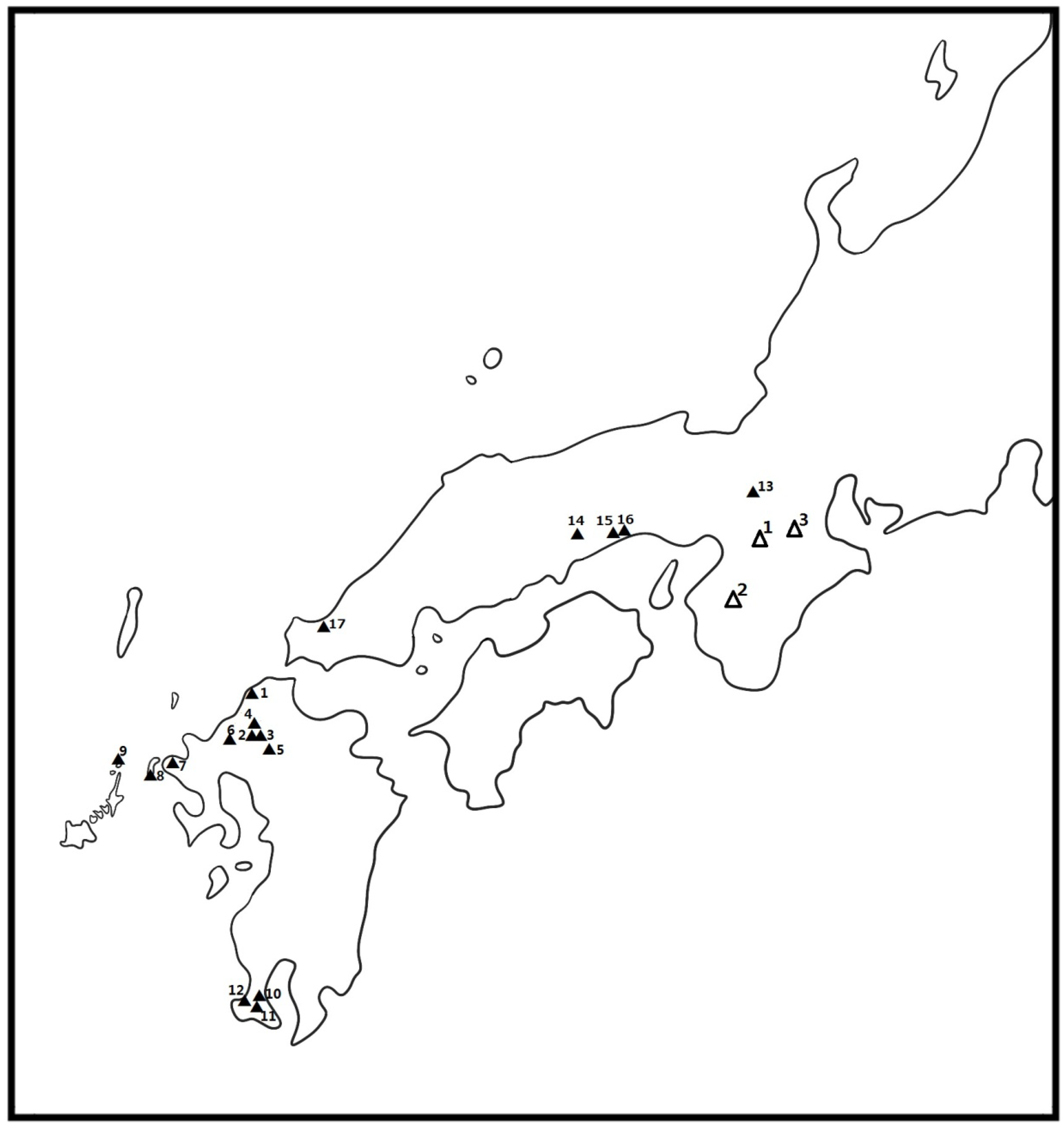
Shang 2014, pp. 48–50). The early square pedestals with four feet (圭角) and the later Taihu rock-shaped pedestals likewise embody a purely Chinese design conception. In terms of detailed ornamentation, collars, bells and other attachments on the lion’s body are common identifiers of Song lions, while decorative elements such as the motif of a round coin with a square hole on the brocade ball belong to typical Song auspicious patterns. These lion figures, which are saturated with Chinese aesthetic taste from the overall form down to the smallest details and show no trace of absorption or compromise with ancient and medieval Japanese lion images, remain essentially outside the Japanese sculptural lineage of stone lions. The logical explanation for this is that the aforementioned Song-style lions were completed in China. On the other hand, geographically, these extant imported Song-style stone lions exhibit a pronounced spatial concentration. The majority are located in northern, northwestern, and southwestern Kyushu—areas that maintained frequent maritime contact with Song-Yuan-Ming China. Their distribution overlaps heavily with that of Satsuma stone pagodas and, also like Satsuma pagodas, leaves central and eastern Kyushu almost entirely blank. Based on the distribution pattern of Song-style stone lions in Kyushu, we can roughly reconstruct the maritime routes through which they were imported into Japan.
The next question is: where in China were these imported Song-style stone lions remaining in Japan actually sculpted? The author propose that the stone lions from sites such as Shurasan site, Umidera-ato, and the Okinomiya shrine of Shijiki-jinja—which have been petrologically identified as made of Ningbo Meiyuanshi stone—were, like the Satsuma pagodas, made using locally sourced stone and sculpted locally in Ningbo before being shipped from the port of Ningbo to Kyushu, Japan. Three reasons support this view. First, quarrying the stone locally and sculpting it on-site represents the most efficient and economical mode of stone-carving production. Second, during the Song and Yuan periods, Ningbo was the production center of stone carving in eastern Zhejiang. Stone-carving craftsmanship in Ningbo was highly developed, as evidenced by the large number of Southern Song stone carvings still preserved there today. Third, Ningbo served as a hub port for Sino-Japanese trade during the Song and Yuan eras, which provided extremely convenient shipping conditions to Japan (
Takatsu et al. 2010, pp. 25–38;
2012, pp. 29–42;
Liu and Chen 2015, pp. 100–6).
The extant imported Song-style stone lions in Japan which are made of other non-limestone materials (predominantly tuff) are difficult to identify a specific place of carving. It is likely, however, that they were produced mainly along the coasts of eastern and southern Zhejiang, as this region yields both tuff and tuffaceous sandstone—the same materials that also predominate in local ancient stone carvings. Eastern Zhejiang and southern Zhejiang possess long-standing traditions of stone carving. Moreover, ports such as Ningbo in Eastern Zhejiang and Wenzhou in southern Zhejiang could offer convenient shipping access for exporting such works. By contrast, the coastal areas of Fujian—which also maintained frequent contact with medieval Japan—primarily used granite and diabase for their stone carvings, whereas none of the extant imported Song-style stone lions in Japan are made of these two rock types (
Sato 2016, pp. 63–74;
Yamaguchi 2019, pp. 85–102;
Liu and Yuan 2024, pp. 65–70, 98–99).
Compared with non-limestone Song-style carvings, determining the source of the stone and the place of production for limestone Song-style carvings is more complex. Limestone typically exhibits similar texture and color, which offers little regional diagnostic value. Also, the high mobility of both the raw limestone and the finished carvings makes it difficult to trace where a specific work was sculpted. Considering the maritime Sino-Japanese exchange conditions and the sources of limestone in 12th-14th centuries, northern Zhejiang, eastern Zhejiang and southern Jiangsu 江蘇 emerge as the most likely production areas for the extant limestone Song-style stone lions in Japan. The Hangzhou 杭州-Huzhou 湖州 region in northern Zhejiang has limestone deposits, where limestone was commonly used for ancient carvings. In addition, the limestone stone from southern Jiangsu represented by Taihu rock of Suzhou 蘇州 were also one of the major stone materials for ancient carvings in the Jiang-Zhe 江浙 region (
Sato 2016, pp. 63–74;
Liu and Yuan 2024, pp. 87–90).
Interestingly, based on a close examination of the Yuki Shrine Song-style stone lions, the author found that this pair of statues was sculpted from Taihu stone
8 (
Sato 2025, pp. 2–6). During the Song and Yuan periods, Taihu stone circulated throughout the Jiang-Zhe region, and Southern Song to Yuan carvings made of this material have been found in the Ningbo-Zhoushan 舟山 area (
Chen 2007, pp. 21–24). Therefore, the Yuki Shrine stone lions could have been sculpted either in the Suzhou region—the source of the Taihu stone—or in Ningbo and the surrounding region which served as the production center of stone carving in eastern Zhejiang and the main trade gateway to Japan during the Song and Yuan periods.
5. The Historical Context of the Transmission of Song-Style Stone Lions and Their Carving Craftsmanship to Japan
In Japan there are 28 extant imported Song-style stone lions (including fragments) with related information published (See
Table 1). Among these, 19 date from around 1200 to the mid-13th century, and the two stone lions from Iikura Shrine belong to the latter part of the 13th century (the late Song to early Yuan period). Thus, the total number of imported stone lions from the Southern Song to the Song-Yuan transition reaches 21—a figure that accounts for 75% of all imported Song-style stone lions. In terms of chronology, these imported stone lions, together with the works left by Southern Song stonemasons in Japan from the late 12th to early 13th century, constitute the truly “Song-style” stone lions in the strict sense. The other seven lions—those preserved at Iimori Shrine (Fukuoka), Kumano Shrine (Okayama), Kamo Shrine of Tatsuno city (Hyogo) and Misumi Kumano Gongen-sha shrine (Yamaguchi)—are Yuan to early Ming works that merely inherit the basic stylistic schema of the Song-style stone lions.
Geographically, among the 21 stone lions dating from around 1200 to the late 13th century (Southern Song to the Song-Yuan transition), 18 are located in Kyushu except the two from Yuki Shrine and the one Type B stone lion from Kamo Shrine of Tatsuno city. Moreover, they are concentrated in northern, northwestern, and southwestern Kyushu—areas that correspond precisely to the primary sphere of activity for Southern Song merchants traveling to Japan (
Liu and Chen 2015, pp. 100–6). It can be inferred that the extant Southern Song stone lions in Kyushu were likely imported directly by Song-Japanese trading vessels, while the three Southern Song stone lions in Honshu were probably transported there secondarily from Kyushu. Of the seven stone lions dating from the late 13th to the 14th century (Yuan to early Ming), five are located in western Honshu. During this period, the number of imported Chinese stone lions decreased markedly, with a distribution no longer focused on Kyushu.
Southern Song stone carvings, including Song-style stone lions and Satsuma pagodas, began to be imported into Kyushu, Japan, in the late 12th century. This timeframe roughly corresponds to, or slightly postdates, the period when Chogen recruited Southern Song stonemasons for the reconstruction of Todai-ji (
Yamakawa 2012, pp. 303–57;
Liu and Yuan 2024, pp. 61–65, 83–87, 97–98). What circumstances, then, led to the importation of Southern Song stone carvings and the related stonemasonry into Japan? The following three aspects can be analyzed.
First, in the late 12th century, Song merchants in Japan gained greater economic capacity and expanded their business scope. Notably, as their wealth accumulated, their land rights increased, enabling them to manage, lease, and even own local land. This development allowed them to construct Song-style religious facilities, especially Buddhist facilities that could embody the spiritual beliefs of their homeland and serve the ritual needs of their own community. These religious facilities, however, were predominantly small-scale, consisting of buildings, structures, installation or other forms of ritual space. The construction of such religious space and facilities by the Song community in Japan became a key driver for the importation of Southern Song stone carvings (
Liu and Yuan 2024, pp. 251–61).
Second, Japanese monks who had studies in Song China and returned in the late 12th century began constructing Song-style Buddhist temples in Japan. Examples include Shofuku-ji temple 聖福寺 and Joten-ji temple 承天寺, both of which were located near the Chinese settlement (Tobo 唐房) in Hakata (
Liu and Yuan 2024, pp. 262–64). These large-scale Song-style temples also needed Song-style stone carvings to create Chinese architectural spaces. In fact, the Song-style temples in Kyushu received patronage from the local Song merchant community. Chogen, the organizer of the Todai-ji temple of Nara reconstruction project, had also studied in the Southern Song. Although the rebuilt Todai-ji did not become a Song-style Buddhist temple, many Song-style elements were incorporated into its timber structure and stonework, thanks to the participation of Southern Song craftsmen (
Liu and Yuan 2024, pp. 265–68, 271–73).
Third, from the late 12th century onward, the Song community in Japan accelerated its process of localization. Its members lived intermingled with the local population, intermarried, and aligned themselves with powerful local temples and shrines in Kyushu to secure their interests. Because these temples and shrines maintained close ties with Southern Song maritime merchants, they actively accepted Chinese artifacts—including Song-style stone lions—into their precincts. (
Liu and Yuan 2024, pp. 292–98).
It should be noted that the number of extant imported Song-style stone lions in Japan is limited, with most concentrated in specific areas of Kyushu. Moreover, no locally carved round-sculpted imitations made of Japanese stone have been discovered to date. This indicates that both the users and the contexts of use for these imported Song-style lions were highly specific. In the following section, we will examine the sites where these stone lions were placed, and through this investigation, explore the nature of their usage.
Of the 21 stone lions dating from around 1200 to the late 13th century, 15 belong to Shinto shrines at present, while 6 belong to Buddhist temples or facilities. All 7 stone lions from the late 13th to the 14th century are Shinto shrine-related now. Although some of these stone lions may have been transferred secondarily, it is clear that in medieval Japan, both Buddhist and Shinto spaces accommodated and made use of imported Song-style stone lions. Furthermore, the following points should be added.
Firstly, seemingly, the number of Song-style stone lions discovered at Buddhist temples or within Buddhist facilities appears to be small, including the two stone lions from the summit of the Shurasan site, the two from Kanzeon-ji, and the two from the Umidera-ato site. In reality, however, Japan had maintained a tradition of shinbutsu shugo 神佛習合 (syncretism of Shinto and Buddhism) since the early 10th century, which meant that most shrines either contained or were adjacent to Buddhist facilities such as Jinguji 神宮寺 (shrine-temples), Buddhist scripture halls or pagodas. Examples of Song-style stone lion sites that were associated with such shrine-temples include Yuki Shrine (Kyoto), as well as Taiso Shrine, Iimori Shrine (Fukuoka), and Kaseda-Masuyama Hachiman-jinja (Minamisatsuma city). Among the other sites housing Song-style stone lions, Munakata Taisha Shrine was home to the renowned Amitabha Sutra stone 阿弥陀経石 (late 12th century) and had a sutra-copying hall during the medieval period (
Igata 2005, pp. 81–98). Meanwhile, the Okinomiya shrine of Shijiki-jinja is where the largest extant Satsuma pagoda in Japan stands, originally estimated at 300 cm in height (
Igata 2018, pp. 73–100).
Some of the Song-style stone lions now housed at Shinto shrines may originally have been placed in the affiliated Buddhist complexes and only later moved secondarily to the shrines. For instance, historical documents indicate that the pair of lions at Misumi Kumano Gongen-sha shrine were donated by Qingzai, who was a Buddhist monk from Wenzhou and had initially copied scriptures at a temple near the shrine
9 (
Igata 2018, pp. 44–45). Hence, it is possible that the pair of stone lions were transferred from a Buddhist temple to the shrine. In any case, the original usage context of many Song-style stone lions now preserved at shrines remains linked to narratives of Buddhist culture.
Additionally, among the Song-style stone lions carved by Southern Song stonemasons in Japan in the late 12th century, apart from the unfinished lion statue placed at Aritoshi Shrine, the stone lions at the South Gate of Todai-ji and the relief-carved stone lions on pedestal at Iga Shindaibutsu-ji are both Buddhist temple carvings. The Southern Song stonemasons who created these Song-style stone lions were also participants in the reconstruction of Todai-ji and the construction of Shindaibutsu-ji. There is no doubt that in the late 12th century, the transmission of the craftsmanship for Song-style Buddhist architecture and facilities to Japan created the opportunity for the arrival of Song-style stone lions.
Secondly, Japanese researchers have suggested that during the early Kamakura period (late 12th-early 13th century) in western Japan, imported pairs of Song-style stone lions were used as substitutes for the wooden or metal lion-komainu sets that had appeared since the Heian period, typically placed on the open-air ground in front of shrine halls (
Fujisawa 2023, pp. 16–19). In reality, the cultural connotations of the Chinese paired male-female lion figures differ profoundly from those of the Japanese lion-komainu combination, making it unlikely that the imported Chinese stone lions would have been adopted as direct substitutes upon their arrival.
As is known, stone lion figure in China served a wide variety of contexts. Song-period paired stone lions functioned as guardians of Buddhist thrones and temples, but were also broadly employed as auspicious beasts in Daoist monasteries, imperial tombs, government offices and residential compounds (
Shang 2014, pp. 43–50). By contrast, medieval Japanese lion-komainu sets appeared primarily at shrines and in architecture with Shinto associations (
Ito 1989, pp. 55–73). While the adaptability of Chinese paired stone lions to different types of spaces made their acceptance at Japanese shrines quite natural, paired stone lions depicted playing with a ball or holding a cub—motifs that are richly imbued with Chinese cultural meaning—differed distinctly from the combination of hornless lion and horned komainu of medieval Japan in both visual form and conceptual content. Therefore, at the time of their importation, they could not have been intended as replacements for the indigenous lion-komainu pair.
Furthermore, the imported Song-style stone lions from around 1200 to early 13th century are all made of limestone and remain in excellent condition, showing no signs of weathering from outdoor exposure. These early examples are now housed as shrine treasures. Among them, the pair at Munakata Taisha bears an inscription on the back: “奉施入宗像宫弟三御前寶前” which indicates that they were dedicated to the Hetsugu’s Third Hall 辺津宮第三宮 of the shrine as offerings (
Igata 2005, pp. 81–98). The detailed decorative patterns remain in perfect condition, as if newly made, demonstrating that they have been kept indoors since their arrival in Japan. Consequently, the view held by some Japanese scholars—that imported Song-style stone lions in the early Kamakura period were used as substitutes for lion-komainu pairs and placed on the open-air ground in front of shrine halls—cannot be sustained.
Lastly, the locations of the extant imported Song-style stone lions in Kyushu can be divided into two categories. The first includes religious places that possess rich historical records of contact with China, such as Kanzeon-ji Temple, the Shurasan site, Munakata Taisha Shrine, and Taiso Shrine. The second comprises sites situated at key points along maritime routes of Sino-Japanese trading vessels, such as the Umidera-ato site and the Okinomiya Shrine of Shijiki-jinja.
It is certain that these imported stone lions were brought to Japan by merchant ships mainly from around 1200 to the 14th century. They comprise two functional types. The first type consists of lion sculptures that were offered or traded as
karamono 唐物 (Chinese treasures/goods) to Japanese temples and shrines, where they were preserved as prized objects over generations, just as precious paintings and high-quality porcelain wares. The recipients valued them primarily as artworks, with less regard for their original cultural context and spiritual significance. For example, the pedestal of the single stone lion originally kept at Taiso Shrine bears an incised inscription: “食天倉不食人家一粒粮 急急如律令”—a Daoist formula
10 (
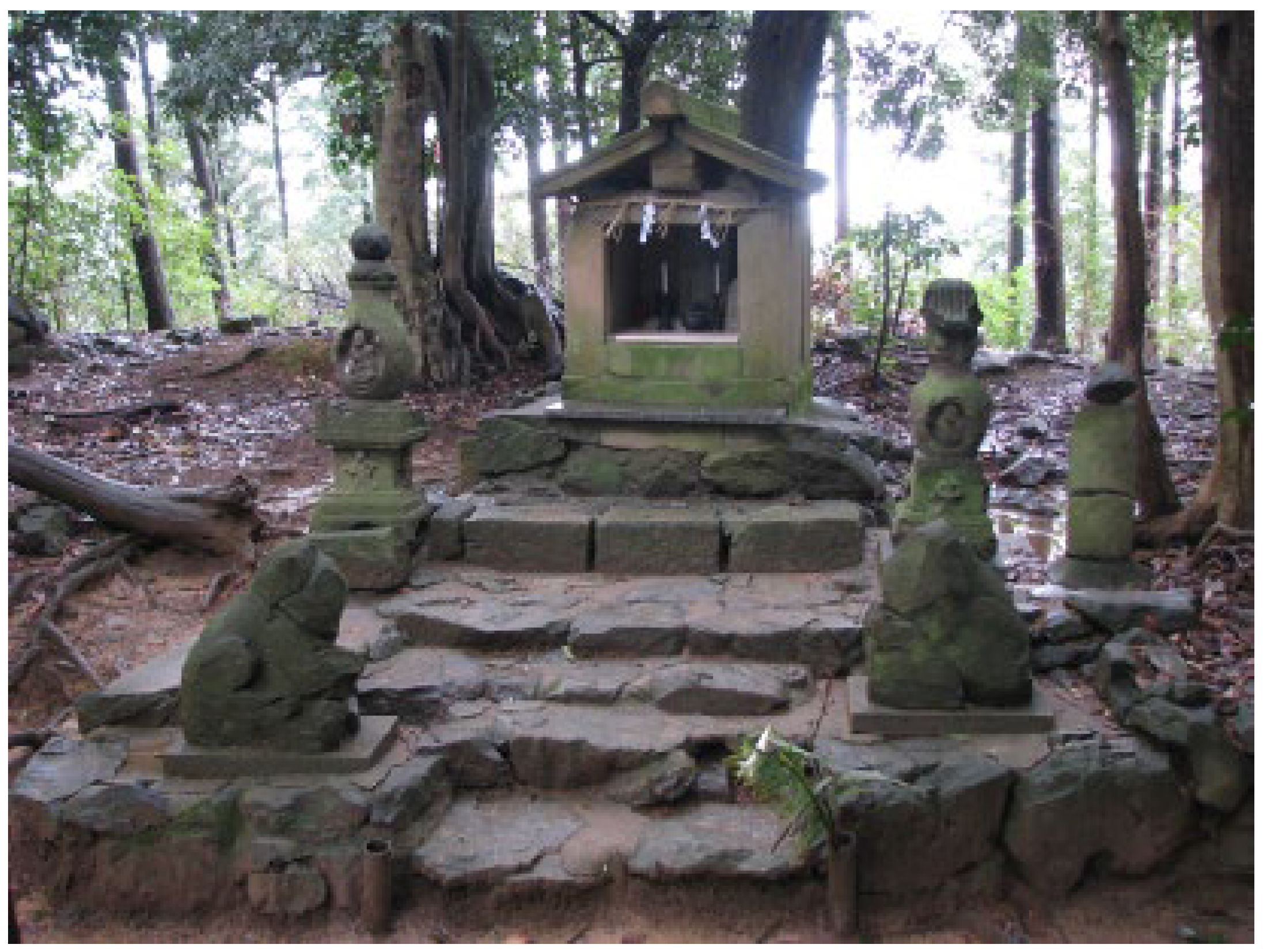
Egami 2015, p. 51) that clearly indicates the stone lion’s original Chinese Daoist context, yet the shrine accepted it nonetheless. The second type comprises stone lions that were imported specifically as structural or symbolic components in the construction of Song-style Buddhist precincts in Japan, thereby serving as carriers of Southern Song Buddhist culture. The Song-style stone lions at the Shurasan site and the Umidera-ato site belong to this category. At Shurasan, the stone lions were erected alongside Song-style Satsuma pagodas,
11 an arrangement that corresponds to the configuration of the relief lion figures on the Sumeru pedestals of Song-Yuan Stupa-style stone pagodas and the stone pagodas themselves (
Figure 23).













 Egami (2015, p. 51)


 Oki et al. (2013, p. 11)
 Hashiguchi (2013b, p. 11)
 Hashiguchi (2013a, p. 3)
 Igata (2017, p. 39)
 Igata (2021, pp. 90, 93)
 Igata (2017, pp. 34–35)