


Abstract
Mount Wutai murals in Dunhuang first appeared in the Tubo period of the Middle Tang Dynasty, and their spread in Dunhuang reflects the faith of Mount Wutai here. Mount Wutai faith appeared in the Northern Dynasties and was gradually combined with Manjusri faith, which was vigorously promoted by Bukong in the Reign of Emperor Daizong in the Tang Dynasty. Bukong infused Esoteric state-protection doctrines into the Mount Wutai Manjusri faith, which took shape during Bukong’s residence in Hexi, was practiced in the reign of Emperor Daizong, and was eventually adopted by the Tubo. The emergence of Mount Wutai murals is a significant manifestation of the process of the spread of this faith. It can thus be seen that Bukong played a crucial role in the process of the iconographic propagation of the Mount Wutai Manjusri faith.
1. Introduction
In the history of Buddhism in China, Bukong 不空 (705–774) ranks among the three founding figures of Esoteric Buddhism in the country and is also counted as one of the Four Great Buddhist Scripture Translators. Research on the Tripitaka Master Bukong can be approached not only from the perspectives of the development history of Esoteric Buddhism and the translation of Buddhist scriptures, but also from Collected Memorials and Edicts Presented by Tripiṭaka Master of Great Dialectical Rectitude and Expansive Wisdom, Posthumously Bestowed the Title of Minister of Works, of the Daizong Reign Period (Daizong Chao Zeng Sikong Dabianzheng Guangzhi Sanzang Heshang Biaozhiji 代宗朝贈司空大辯正廣智三藏和上表制集)1 (hereinafter referred to as Collected Memorials and Edicts of Bukong 不空表制集), a collection compiled by him and his disciples during the reigns of Emperor Suzong 肅宗 (756–762) and Emperor Daizong 代宗 (762–779) of the Tang Dynasty. This collection provides extremely detailed historical materials for studying the relationship between Buddhism and the imperial family, as well as the imperial court.
Apart from recording the congratulatory memorials submitted by Bukong on major national or imperial events, Collected Memorials and Edicts of Bukong mostly documents how Buddhism developed as the country gradually stabilized after the Anshi 安史 Rebellion (755–763). A comprehensive reading of the entire collection readily reveals that the faith in Mount Wutai and Manjusri Bodhisattva was continuously strengthened and propagated under Bukong’s leadership throughout Emperor Daizong’s reign. As we know, a number of Mount Wutai 五臺 murals were created in Dunhuang after the mid-Tang Dynasty. As a type of Buddhist “pictorial topographical gazetteer”, the Mount Wutai iconography was the product of a “sacred mountain construction” movement launched by Buddhist monks in the Central Plains during the medieval period, in which Bukong played an extremely important role—essentially, it was during Bukong’s time that Mount Wutai ultimately achieved its sacred status.
Wutai Mountain is a Buddhist sacred mountain that took shape indigenously in China, and its sacred status was firmly established during the Sui and Tang dynasties. The popularity of the Dunhuang Wutai Mountain murals began in the mid-to-late Tang Dynasty, reflecting the prevalence of the Wutai Mountain belief in the Dunhuang region, as well as the growing influence of the Manjusri belief centered on Wutai Mountain since the Tang Dynasty. This can also be corroborated by the large number of surviving Dunhuang manuscripts related to Wutai Mountain (Du 1991). The Wutai Mountain murals depict the natural geography of Wutai Mountain, its Buddhist monasteries, and various divine manifestations and sacred miracles of Manjusri Bodhisattva on the mountain. Therefore, they hold significant value for research in Chinese Buddhist history, art history, architectural history, and other fields, and have long attracted academic attention, yielding a wealth of research outcomes. The primary research methodology and findings in this area involve using Wutai Mountain-related documents recorded in Dunhuang manuscripts and the Wutai Mountain Paintings preserved in Dunhuang murals to explore the Buddhist cultural exchanges between Dunhuang and the Wutai Mountain region during the late Tang and Five Dynasties periods (Rong 1988; Gong 2009). Yet existing studies have paid insufficient attention to the role played by Buddhist communities in Chang’an—the origin of this belief’s dissemination in Dunhuang.
Collected Memorials and Edicts of Bukong contains important documents regarding the spread of the Wutai Mountain Manjusri faith, thus shedding new light on the intersection between major political events in the Tang dynasty, the migration of Buddhist clerics, and regional religious cultural transformation. This study centers on a pivotal historical clue: having once resided in the Hexi 河西 Region, Bukong disseminated his Esoteric state-protection doctrines. Following his return to Chang’an 长安, he integrated such doctrines with the Mount Wutai Manjusri faith and promoted the combined belief nationwide with the patronage of Emperor Daizong. Centered on the Esoteric state-protection doctrines, the Mount Wutai Manjusri faith was progressively introduced into Tubo 吐蕃 during the mid-to-late Tang Dynasty and subsequently assimilated and restructured within Tubo’s politico-religious system. Preserved in Dunhuang cave dating back to Tubo’s dominion over the region, extant pictorial depictions of Mount Wutai constitute the most tangible material evidence documenting the westward diffusion of the Mount Wutai Manjusri faith into Hexi and Tubo territories. These facts raise a core research question: did an intrinsic connection exist between Bukong and the Dunhuang Mount Wutai murals? If affirmative, through what historical pathways was such a connection established? By sorting out the correlation between Bukong and Dunhuang’s Mount Wutai murals, this research intends to clarify the transmission lineage of the Mount Wutai Manjusri faith stretching from Chang’an to Dunhuang, and further probe the in-depth interplay between eminent Buddhist monks’ religious undertakings and the dissemination of regional religious culture.
Buddhist artworks follow their own inherent laws of emergence and dissemination. Though Bukong was not the direct creator of the Mount Wutai paintings, he personally took part in the renovation of several monasteries on Mount Wutai and vigorously promoted the Mount Wutai Manjusri faith. Therefore, in terms of the formation and circulation of the Mount Wutai paintings, Bukong played a crucial role. However, existing research either focuses solely on Bukong and his value and status in the history of Buddhism (J. Lyu 2010), or studies the Dunhuang paintings of Mount Wutai from different periods in isolation (Su 1951; S. Zhao 1993; Z. Wang 2009). There has been no research that connects these two aspects and clarifies the mechanism underlying their relationship. Therefore, based on the relationship between Bukong and the faith in Mount Wutai and Manjusri Bodhisattva as reflected in Collected Memorials and Edicts of Bukong, this paper attempts to analyze the mechanism behind the connection between Bukong and the Dunhuang Mount Wutai murals.
2. Dunhuang’s Mount Wutai Images in the Tubo Occupation Period
Buddhist imagery2 refers to various paintings and sculptures related to Buddhism, namely the artistic creation and expression of the Buddhist faith. In Chinese historical records, Buddhism also bears an alternative name: “Iconic Teaching” (Xiangjiao 像教), which intuitively illustrates the vital role of Buddhist imagery in the development of Buddhism. By the time Buddhism was introduced to China at the end of the Western Han Dynasty (c. early 1st century CE), it may already have presented a pattern of “simultaneous transmission of scriptures and images”. As recorded in Biographies of Eminent Monks (Gaosengzhuan 高僧傳), during the Yongping 永平 era of Emperor Ming of the Eastern Han Dynasty (Dong Han Mingdi 東漢明帝, 58–75), when Cai Yin 蔡愔 (fl. Emperor Ming of Han, 58–75) was dispatched to Tianzhu 天竺 (ancient India) in search of Buddhist teachings, he “obtained a painted reclining image of Sakyamuni in the Western Regions (Xiyu 西域), which was the fourth creation of the sandalwood-image sculptors of King Udayana”3. This is one of the earliest historical records concerning the painting and dissemination of Buddhist imagery in China, and Buddhist scriptures were introduced alongside these images at that time. Both images and scriptures served as important “cultural transmission symbols” of Buddhism, and an intrinsic relationship of origin and derivation often existed between them (Shang 2018, p. 57). Thus, when a particular scripture gained widespread popularity during a certain period, a large number of relevant images embodying its ideological connotations would emerge in Buddhist art. Both scriptures and images reflect the popular circulation of certain Buddhist thoughts and beliefs of the period.
Among all Buddhist imagery, there exists a special category that does not directly depict objects of worship, such as Buddhas or Bodhisattvas, but rather conveys religious faith in a subtle and metaphorical manner. One subset of this category consists of what can be defined as “Geographically oriented pictorial manuscripts rooted in Chinese encyclopedic indigenous lore” (Shang 2018, p. 58). The emergence of such imagery may be linked to the strong Chan 禪 (Zen) meditation tradition of Buddhism during the Northern Dynasties, which led many monks to withdraw from secular life and build hermitages in remote mountains. As a result, “accounts of famous mountains have always been intertwined with Buddhist history” (Tang 1989, p. 418). Based on this observation, Hu Baoguo identifies this phenomenon as one of the factors contributing to the production of landscape gazetteers during the Wei-Jin period (Hu 2003, p. 171). Cordell D. K. Yee argues that maps did not emerge independently of paintings; in fact, early maps were essentially paintings, and many paintings functioned as maps (Yee 2006, pp. 170–98). Zhang Yanyuan 張彥遠 (815–907), in his work Famous Paintings of All Dynasties (Lidai Minghua Ji 歷代名畫記) (Y. Zhang 1964), also recorded a number of paintings that served as maps, including Picture of Ganquan Palace (Ganquangong Tu 甘泉宮圖), True Form Charts of the Five Great Mountains (Wuyue Zhenxing Tu 五嶽真形圖), Regional Division Map (Fenqu Tu 分區圖), Map of Luoyang 洛陽 by Yang Quanqi 楊佺期 (?–399), Terrestrial Map (Dixing Fangzhang Tu 地形方丈圖) by Pei Xiu 裴秀 (224–271) and Map of Central Tianzhu by Wang Xuance 王玄策 (Lifespan unknown; three diplomatic missions to India, 643–657). The fact that Zhang Yanyuan classified these works as paintings rather than maps indicates that in the Tang Dynasty, maps were still regarded as a genre of painting and had not yet become an independent category. In terms of content, however, such imagery was inherently cartographic in nature.
Of all surviving examples of such imagery, the best-known are the Dunhuang Mount Wutai murals. Stylistically, the Dunhuang Mount Wutai murals can be roughly divided into three types: screen-style, sacred site-style, and sutra illustration-style (Dunhuang Academy 2000, pp. 185–86), with the sacred site-style being the most prevalent. The sacred-site composition centers on Mount Wutai. Within the frame, it fully lays out the layout and orientation of the five peaks, marks temples, sacred relics, and place names across the mountains one by one, and supplements relevant miracle tales of Manjushri’s manifestations. Among all such sacred-site-style Mount Wutai murals preserved in the Mogao Grottoes of Dunhuang, the large-scale mural painted in the Five Dynasties in Cave 61 remains the most intact example. Yet scholars have not reached a consensus regarding the nature of such Mount Wutai Paintings; existing interpretations include “landscape figure painting” (Shanshui Renwu Hua 山水人物畫) (Su 1951), “Buddhist historical site painting” (Fojiao Shiji Hua 佛教史跡畫) (S. Zhao 1993), “religious panoramic painting” (Zongjiao Quanjing Hua 宗教全景畫) (J. Wang 2015), and “sacred map” (Shensheng 神聖輿圖) (S. Zhang 2016), each with its own merits. Setting aside all the additional meanings and classifications attributed to it, this paper regards the work as a type of Buddhist imagery belonging to the category of “geographical gazetteers”. This is because their core function is to mark for devotees the specific locations and spatial distribution of Buddhist sacred sites on Mount Wutai. Essentially, they are geographic images for the spread of faith, originally created to help believers unable to make the pilgrimage grasp the layout of the sacred mountain and build a spatial understanding of the Manjushri faith.
While the Mount Wutai murals of Cave 61 enjoy great fame and importance, it is not the earliest one found in the Mogao Grottoes. The first examples appeared during the Tubo occupation period (786–848) (X. Zhao 2015, p. 228). Statistics compiled based on Comprehensive Catalogue of Contents of the Dunhuang Grottoes (Dunhuang Shiku Neirong Zonglu 敦煌石窟內容總錄) (Dunhuang Academy 1996) show that there are five grottoes dating to the period of Tubo rule that preserve depictions of Mount Wutai, namely Caves 112, 159, 222, 237 and 361. This paper focuses its discussion on these five caves. All of them are constructed in the hall-style form, and their illustrations of Mount Wutai are all subsidiary paintings within the Manjushri transformation scenes. In terms of excavation dates, Cave 112 was dug in the early phase of Tubo rule over Dunhuang (from the late 780s to around 795 CE), making it the earliest among the group. Its depiction of Mount Wutai is painted on the north side below the niche on the west wall, integrated into the Manjushri transformation scene (Figure 1 and Figure 2). The painting does not present a full layout of the five terraces. Instead, it uses continuous layered mountains to indicate the general terrain of Mount Wutai, with scattered small monasteries sketched in simple lines. No place names of the mountain terraces are marked individually. It is the smallest and most schematic representation of Mount Wutai among the five caves.
Figure 1.
Painting of Mount Wutai below the niche on the west wall, Cave 112, Mogao Grottoes, Dunhuang, Gansu Province, China; early period of Tubo rule (late 780s to c. 795 CE). Source: Digital Dunhuang.
Figure 2.
Line drawing of the Mount Wutai Painting, Cave 112, Mogao Grottoes, Dunhuang, Gansu Province, China; early period of Tubo rule (late 780s to c. 795 CE). Source: X. Zhao (2017, pp. 98–99).
Cave 222 was excavated slightly later than Cave 112, dating to the late phase of the early Tubo rule (795–805). Its depiction of Mount Wutai is painted at the bottom of the Manjushri transformation scene on the screen painting to the north of the west wall niche (Figure 3). The five terraces are clearly demarcated, with the Central Terrace standing at the highest point in the center of the composition and the other four terraces arranged around it. The painting features monks and lay pilgrims travelling among the mountains, along with preliminary depictions of scattered auspicious manifestations. Unlike the schematic representation in Cave 112, this work lays greater emphasis on the spatial features for pilgrimage, and has taken initial shape as a map for religious devotion.
Figure 3.
Partial view of the Mount Wutai Painting on the upper south and north sides outside the niche on the west wall, Cave 222, Mogao Grottoes, Dunhuang, Gansu Province, China; period of Tubo rule (795–805). Source: X. Zhao (2017, p. 99).
Cave 159 is a representative grotto of the Tubo rule period, constructed around the fourth year of the Changqing 长庆 reign (c. 824 CE). The east wall bears a painting of the Tubo king paying homage to the Buddha. Its Mount Wutai depiction is located on the lower screen panel within the Manjushri transformation scene to the north outside the west wall niche (Figure 4). The outlines of the Eastern, Southern, Western, Northern and Central Terraces are all distinguishable, with medium and small monasteries scattered across the mountains accompanied by simple inscriptions, some of which are now illegible. Although Cave 159 was built later than Cave 222, the Mount Wutai painting in Cave 222 is evidently more sophisticated.
Figure 4.
Mount Wutai Painting on the lower north side outside the west wall niche and on the north and south screen panels, Cave 159, Mogao Grottoes, Dunhuang, Gansu Province, China; period of Tubo rule (c. 824). Source: X. Zhao (2017, p. 101).
Cave 237 was excavated around the transition between the middle and late phases of Tubo rule over Dunhuang (820–835). Its Mount Wutai painting is situated on the left side of the double-layered screens beneath the Manjushri transformation scene on the west wall (Figure 5). Adopting the spatial layout of the five terraces seen in Cave 222, this work depicts mountains, rivers and paths connecting all terraces. Pilgrims on foot and horseback are shown travelling along mountain trails. As the earliest surviving example featuring a complete pilgrimage route among all Mount Wutai paintings from the Tubo period, this piece boasts greatly enhanced geographical functionality.
Figure 5.
Mount Wutai Painting on the lower north side outside the niche on the west wall, Cave 237, Mogao Grottoes, Dunhuang, Gansu Province, China; period of Tubo rule (820–835). Source: X. Zhao (2017, p. 102).
Cave 361 was excavated in the late phase of Tubo rule over Dunhuang (835–845). Its Mount Wutai painting is executed on the curtained screen panels flanking the main niche on the west wall. This is the most comprehensive depiction of Mount Wutai surviving from the Tubo period (Figure 6). Each of the Five Terraces—Eastern, Southern, Western, Northern and Central Terraces—is clearly labelled with corresponding inscriptions. The monasteries and place names on the terraces can be verified against historical records, laying the foundational framework of the sacred-site style later adopted in Cave 61. Integrated with multiple scenes of Manjushri manifesting amid clouds, mountain sacred relics and Esoteric Buddhist motifs, this painting represents a transitional form: evolving from a subsidiary illustration within transformation scenes into an independent sacred-site map.
Figure 6.
Mount Wutai scenes on the north screen paintings inside the outer niche of the main central niche (West Wall & North Wall), Cave 361, Mogao Grottoes, Dunhuang, Gansu Province, China; period of Tubo rule (835–845). Source: X. Zhao (2017, p. 77).
Overall, all Mount Wutai paintings of the Tubo period were integrated into Manjushri transformation scenes. Most were executed on interior screen panels or beside niches within the grottoes. With relatively simple compositions, they are far smaller in size than the monumental Mount Wutai painting in Cave 61 (Figure 7). These artworks mainly depict the landforms of the Five Terraces and related miracle tales. Their styles evolved from simplicity to complexity, and their attributes as geographical illustrations grew increasingly distinct. This phenomenon reflects how the Manjushri belief centered on Mount Wutai spread under Tubo rule, where paintings took the place of physical pilgrimages. In terms of core compositional elements and stylistic features, early Mount Wutai paintings chiefly represent supernatural sacred sites and auspicious signs, and can therefore be regarded as a genre of Buddhist auspicious paintings (Xu 2013, pp. 149–54). This pictorial form perfectly suited the demands of early Manjushri faith dissemination: it highlighted the supernatural nature of the sacred mountain and deepened devotees’ sense of holiness. Meanwhile, it laid an iconographic foundation for the emergence of large panoramic Mount Wutai paintings in later times.
Figure 7.
Mount Wutai Painting (West Wall), Cave 61, Mogao Grottoes, Dunhuang, Gansu Province, China; period of late Five Dynasties (947–951). Source: Digital Dunhuang.
Regarding the sketches and origins of Mount Wutai paintings dating to the Tubo rule period, academic research traces them back to the small illustrated scroll created by the monk Huize 會賾 during the Longshuo 龍朔 reign of Emperor Gaozong 高宗 (661–663) of the Tang Dynasty (X. Zhao 2010; Xu 2013). Huize, a monk of Huichang 會昌 Temple in Luoyang, was commissioned by Emperor Gaozong and Wu Zetian 武則天. Accompanied by more than ten people, including palace eunuch Zhang Xinghong 張行弘, Lü Xuanlan 呂玄覽 from Wutai County and painter Zhang Gongrong 張公榮, he went to Mount Wutai to inspect its sacred sites, as documented in Biography of Ancient Qingliang 清涼 Mountain. After returning to the imperial capital, Huize reported all auspicious miracles he had witnessed on the mountain to the court. He also “produced a small illustrated scroll of Mount Wutai and compiled a concise biography”. This is the earliest recorded Mount Wutai painting in historical documents. Both Huize’s work and the Dunhuang versions focus primarily on sacred sites and auspicious signs, without presenting a full layout of the mountain’s geography and monasteries. It indicates that the Mount Wutai paintings from the Tubo period in Dunhuang inherited the stylistic tradition of Huize’s scroll and retained the concise feature of highlighting individual sacred sites typical of early examples. Therefore, these paintings stand as evidence of the dissemination of Buddhist iconography from Chang’an to Dunhuang.
It is noteworthy that these Mount Wutai paintings first emerged in Dunhuang in the Tubo rule period. An analysis of the five surviving examples from this era reveals that they carry distinct political implications related to the Tubo royal family’s advocacy of the Manjushri faith. Images of Manjushri had already appeared in Dunhuang as early as the Western Wei Dynasty, exemplified in Cave 249. However, the combination of Manjushri and Mount Wutai iconography did not take shape until Tubo rule. This indicates that the cult of Mount Wutai gained popularity in Dunhuang during this period, largely under the influence of Tubo rulers. The Tubo regime leveraged the sacred legitimacy of Mount Wutai to consolidate its governance over Buddhism in the Hexi region. Nevertheless, the Mount Wutai faith did not originate in Tubo. It had already prevailed in the Central Plains as early as the Northern Dynasties, yet it did not spread to Dunhuang until the mid-Tang Dynasty. Why did the belief gain wide circulation and become closely integrated with the Manjushri faith at that time? Since the emergence of Dunhuang’s Mount Wutai paintings is closely tied to the popularity of this belief, research should not only focus on the artworks themselves but also further explore the historical context behind their creation and dissemination.
The dissemination and popularity of Buddhist imagery were invariably underpinned by human agency. These agents included early missionary monks, envoys and merchants who facilitated cross-border communication, as well as populations displaced by wars and migrations, among others. Some individuals directly participated in the production and dissemination of Buddhist imagery, such as painters and devotees; others indirectly or inadvertently promoted its spread, as the Buddhist doctrines they propagated drove the circulation of related iconographic forms. The emergence of the Dunhuang Wutai Mountain Paintings occurred after the mid-Tang Dynasty, a time period that followed Bukong’s renovation of Buddhist temples on Wutai Mountain and his vigorous promotion of the Manjusri faith. Thus, Bukong is very likely to have been a key human agent behind the creation and popularity of the Dunhuang Wutai Mountain Paintings.
3. The Historical Origin of Bukong and Mount Wutai Manjusri Faith
The Collected Memorials and Edicts of Bukong is a compilation of memorials, imperial edicts, as well as relevant sacrificial texts and epitaphs written by Bukong and his disciples during the reigns of Emperor Suzong and Emperor Daizong of the Tang Dynasty. Compiled by his disciple, the monk Shi Yuanzhao 釋圓照 (c. 7th–8th) of Ximing 西明 Temple, it stands as the most direct documentary record reflecting Bukong’s life experiences and achievements. This collection is now included in Volume 52 of the Taishō Tripiṭaka (Yuanzhao 1934a). According to the Collected Memorials and Edicts of Bukong, Bukong’s major accomplishments in his lifetime can be roughly categorized into four aspects: safeguarding the state, translating Buddhist scriptures, praying for rainfall, and renovating Mount Wutai while promoting the Manjusri belief. Needless to say, translating Buddhist scriptures was a lifelong undertaking for Bukong. The so-called “safeguarding the state” refers to Bukong’s use of Buddhist dharma to protect the empire when wars broke out. The so-called “praying for rain” denotes his performance of Buddhist rituals at the imperial behest during periods of abnormal weather patterns. Renovating Mount Wutai and promoting the Manjusri faith, however, constituted the most significant achievement of Bukong’s later years. These four aspects are closely linked to Bukong’s politico-religious ideology. His ideology represents a two-way interaction: Buddhism lent support to imperial rule, while state patronage in turn facilitated the spread and development of Buddhism. “Safeguarding the state” stood as the core starting point of his politico-religious thought. The translation of scriptures, rain-praying rituals, and the promotion of the Mount Wutai Manjusri faith were the concrete practices implemented under its guidance.
Among them, the cause that consumed most of his time and energy was undoubtedly the promotion of Mount Wutai Manjusri faith. This can be directly observed from the substantial proportion of content dedicated to Mount Wutai and the Manjusri faith in the collection. These documents fully testify to the profound historical ties between Bukong and the Mount Wutai Manjusri faith. They clearly show that it was largely thanks to his vigorous promotion that this belief spread across the country and evolved into a mainstream faith with far-reaching influence. Bukong’s success in advancing the Manjusri cult relied heavily on imperial backing, especially the patronage of Emperor Daizong of the Tang. Leveraging imperial authority, he elevated the cult on Mount Wutai to the status of a national religion. On the other hand, the Tang court’s willingness to cooperate with his promotion was closely bound up with the inherent political attributes of this faith. In Buddhist tradition, Manjusri is venerated for assisting governance and safeguarding the realm, which served to consolidate the legitimacy of imperial rule. Having just endured the Anshi Rebellion, the Tang Dynasty was in urgent need of restoring social and political order. This religious practice that strengthened national identity perfectly catered to the rulers’ political demands, hence the court gave full support to Bukong’s efforts.
The earliest record among them, An Imperial Edict Granting the Robe and Bowl to Assist the Monk Daohuan in Renovating Jinge Temple (Qing She Yibo Zhu Seng Daohuan Xiu Jingesi Zhi Yishou 請舍衣缽助僧道環修金閣寺制一首) (See Appendix A), dates back to the second month of the second year of the Dali 大曆 era during the reign of Emperor Daizong (767). This indicates that Bukong had already begun vigorously advocating for the cult of Wutai Mountain and Manjushri at the latest from this year. This date predates the relevant record of the fourth year of the Dali era (769) found in Biographies of Eminent Monks of the Song Dynasty (Song Gaosengzhuan 宋高僧傳). It also demonstrates that Collection of Memorials and Edicts of Bukong provides a more detailed account of Bukong’s efforts to promote the cult of Wutai Mountain and Manjushri. At that time, Bukong was already over sixty years old, with only seven years left before his parinirvana in the ninth year of the Dali era (774). Yet it was precisely in these final years that Bukong spared no effort to popularize the cult of Wutai Mountain and Manjushri across the entire nation. This is also explicitly confirmed by the Supplement to the Kaiyuan Catalog of Buddhist Scriptures Compiled in the Zhenyuan Era of the Great Tang (Datang Zhenyuan Xu Kaiyuan Shijiao Lu 大唐貞元續開元釋教錄) (Yuanzhao 1934b), which states: “All Buddhist temples across the realm were ordered to enshrine statues of the Great Sage Manjusri Bodhisattva to honor his sacred merits. An imperial edict was also issued to designate Manjusri Bodhisattva as the presiding elder. All these were attributable to the Tripitaka Master of Great Expansive Wisdom (i.e., Bukong).”4 Moreover, Zhao Qian 趙遷, a lay disciple personally taught by Bukong, composed The Life Story of the Venerable Master Bukong, Tripiṭaka Master of Great Dialectical Rectitude and Expansive Wisdom, Posthumously Bestowed the Title of Minister of Works of the Great Tang Dynasty (Datang Gu Dade Zeng Sikong Dabianzheng Guangzhi Bukong Sanzang Xingzhuang 大唐故大德贈司空大辨正廣智不空三藏行狀) (hereinafter referred to as The Life Story of Bukong), which further weaves the connection between Bukong, Mount Wutai and Manjusri faith throughout his entire life (Q. Zhao 1934).
According to The Life Story of Bukong, “The Master was originally from Xiliangfu and descended from a Brahmin clan of North Tianzhu.”5 However, he lived with his mother and maternal uncle after his father passed away at an early age. Given that his mother’s maiden surname was Kang 康, it is suspected that he might have been of Sogdian ethnicity. In addition, the record that “he traveled extensively through Wuwei 武威 and Taiyuan 太原 at the age of ten”6 suggests that he probably accompanied his maternal uncle’s family on trading trips. Yet its mention here also carries an air of inevitability: in later years, apart from Chang’an, Wuwei and Taiyuan also became major missionary strongholds for Bukong. As the political and transportation core of Hexi, Wuwei was an inevitable stop on the journey from Chang’an to Dunhuang and a major base for Buddhist propagation in the Tang. Since Taiyuan adjoined Mount Wutai, Bukong’s youthful travels foreshadowed his enduring bond with the local Manjusri faith.
Bukong first established a genuine connection with the Manjusri cult after he received full monastic vows at the age of twenty, he “recited the Manjusri Vow, which was supposed to take a whole year to complete, yet he finished it in merely two nights”7. Although this anecdote is recounted to illustrate Bukong’s exceptional intelligence and prodigious memory, the deliberate selection of the “Manjusri Vow” as the specific example is noteworthy. Two possibilities may account for this choice: first, the Manjusri Belief was so prevalent in that era that reciting its vows constituted a compulsory practice for monks; second, this reference serves as another narrative foreshadowing. The author argues that while the Manjusri Belief did enjoy considerable popularity in the Tang dynasty, it was by no means the sole dominant faith. Therefore, the deliberate choice of the “Manjusri Vow” as the exemplar here is more likely to reflect the second scenario. Subsequently, Bukong received the transmission of Buddhist doctrines from his master Vajrabodhi (Jingangzhi 金剛智). Later, he embarked for Sri Lanka (Shiziguo 師子國) in accordance with his master’s last wish. Before his departure, during the period when he conferred abhiṣeka and delivered Dharma talks at the residence of Liu Julin 劉巨鱗 in Nanhai 南海 Commandery, he experienced an episode of “Manjusri Bodhisattva manifesting his sacred form”8. In the fifth year of the Tianbao 天寶 era (745), Bukong returned to Chang’an from Tianzhu and was graciously received by Emperor Xuanzong 玄宗, who also received the abhiṣeka ritual from him. However, in the eighth year of the Tianbao era (750), he was exiled back to Tianzhu on account of his implication in Liu Julin’s corruption case9, only to have Geshuhan 哥舒翰 intercede on his behalf. Eventually, in the thirteenth year of the Tianbao era (754), Bukong arrived in Wuwei, where he resided at Kaiyuan 開元 Temple. It was not until the summer of the fifteenth year of the Tianbao era (756) that he was summoned back to the imperial court by an imperial edict issued by Emperor Suzong.
Bukong remained in the Hexi region for nearly two years, during which he actively propagated the Dharma there. As recorded: “From the military governors down to officials holding the lowest rank, all received the abhiṣeka ritual. Among the gentry and commoners, thousands of people attended the Dharma assemblies. He transmitted the Five Sects Dharma to his monastic disciple Hanguang 含光.”10 A more detailed account of this incident is found in The Zhenyuan Revised and Authorized Catalogue of Buddhist Scriptures (Zhengyuan Xinding Shijiao Mulu 貞元新定釋教目錄) (Yuanzhao 1934c). The key discrepancy lies in the fact that this record contains no mention whatsoever of Emperor Xuanzong’s displeasure with or punishment of Bukong. On the contrary, it notes that when Bukong returned to the imperial domain in imperial favor, he fell ill. Geshuhan thereupon submitted a memorial requesting that Bukong be dispatched to “bless the borderlands and battlefields of Hexi”11. En route, Bukong also rested at Baoshou 保壽 Temple in Chang’an for more than a month, where he received imperial rewards, before proceeding to reside at Kaiyuan Temple in Wuwei, Hexi. Consistent with other records, however, it attests to his vigorous propagation of the Dharma in Hexi: “The military governor personally greeted him and supplied him with all necessities. He was invited to translate Buddhist scriptures and preside over abhiṣeka rituals. He expounded the Yoga Tantra and established mandalas; officials from the military governor’s office and the administrative staff all came to receive teachings, and the Five Sects and Three Secrets were realized both in spiritual communion and tangible practice.”12 Yang Zeng argues that it was precisely during this more-than-one-year stay that Bukong “took the opportunity of transmitting Esoteric Buddhism to establish connections with several Sogdian military officers, who in fact could be regarded as his townsfolk and clansmen” (Z. Yang 2016, p. 265). A case in point is Li Yuancong 李元琮. As recorded in The Life Story: “Subsequently, Bukong bestowed the Five Sects abhiṣeka as well as the Great Mandala of the Vajra Realm upon Li Yuancong, the current Director of Merit and Virtue with the rank of Palace Architect.”13 In later years, Li Yuancong, in his capacity as Director of Merit and Virtue, maintained an extremely close relationship with Bukong; indeed, he even took full charge of the funeral arrangements following Bukong’s nirvana. This undoubtedly demonstrates that Bukong’s sojourn in Hexi was far from unproductive—during this period, he not only forged ties with a number of figures who would grow increasingly influential in later years, but also endeavored to explore the practical dimensions of Buddhist doctrines.
During Emperor Suzong’s reign, since the Anshi Rebellion had not yet been fully suppressed, Bukong was unable to accomplish anything of great significance. Nevertheless, he maintained an extremely close relationship with Emperor Suzong, as can be glimpsed from the Memorial of Gratitude for the Imperial Gift of Incense and a Statement of Aspirations (Xie Enci Xiang Chenqing Biao 謝恩賜香陳情表), in The Collected Memorials and Edicts of Bukong, which records: “For ten years, I have cultivated sincerity and repeatedly had the fortune to encounter the sage ruler.”14 Bukong wrote this Memorial of Aspirations in the third year of the Zhide 至德 era (758). If the phrase “ten years” here refers to a literal number rather than a vague approximation, this would date the starting point to the eighth year of the Tianbao era (749)—which coincidentally was exactly the time when Bukong was exiled back to Tianzhu. Furthermore, judging from the fact that after Emperor Suzong ascended the throne in the summer of the fifteenth year of the Tianbao era (756), Bukong was immediately summoned back to the capital by imperial edict and maintained frequent private contacts with the emperor thereafter, it can be generally concluded that the beginning of Bukong’s association with Suzong dates precisely to the eighth year of the Tianbao era (749)—the very time when he was exiled by Emperor Xuanzong. Nevertheless, Emperor Suzong did not show any particularly exceptional favor to Bukong. This is because, besides Bukong, Suzong also maintained close associations with three other monks: Wulou 無漏, Daguang 大光 and Huizhong 慧忠. Compared with the imperial grace bestowed upon these figures, the treatment received by Bukong was by no means distinguished. As for the underlying reasons, according to Lyu Simian’s analysis of Suzong and his patronage of Buddhist affairs (S. Lyu 2009, p. 202), Suzong owed his ascension to the throne to the support of Li Fuguo 李輔國 (683–753) and Zhang Liangdi 張良娣 (?–762). Both of them formed cliques to pursue their own interests and seized control of the court administration; in particular, Li Fuguo held the power to review and approve memorials for a certain period. Furthermore, both of them openly professed their faith in Buddhism, making it impossible to dissociate Suzong’s Buddhist undertakings from their influence. The fact that Bukong submitted a memorial to congratulate Consort Zhang on her enfeoffment as empress is indicative of the connection between them. Li Fuguo, moreover, held the exclusive authority to draft and issue imperial edicts, meaning that Bukong’s submissions to the throne could hardly have escaped his involvement. It is therefore plausible that the growing political influence of Bukong’s religious community prompted Suzong to adopt an ambiguous stance later on, seeking to contain it by fostering the rise of multiple competing Buddhist factions.
In other words, “Bukong’s true rise to prominence, or at the very least the zenith of his Buddhist career, occurred during the reign of Emperor Daizong.” (Z. Yang 2016, p. 269) It was not until this period that Bukong truly launched his Buddhist activities of translating scriptures and constructing temples, while also vigorously propagating the cult of Mount Wutai and the Manjusri Belief. Yet both the Sutra of Benevolent Kings (Renwang Jing 仁王經) translated by Bukong and his enthusiastic promotion of Mount Wutai and the Manjusri Belief were inextricably linked to the Buddhist ideology of safeguarding the state and its practical application. The fundamental reason behind Bukong’s advocacy of the Mount Wutai and Manjusri cult lay precisely in its function of protecting the imperial state. This ideology and its practical application can be summarized as using Esoteric Buddhist tenets to “pray for blessings” and “accumulate merit” for the state (Y. Li 2014, p. 57). It took shape during his stay in the Hexi region and was fully implemented in the reign of Emperor Daizong. When Bukong propagated Esoteric Buddhism in Hexi, he forged ties with several Sogdian military officers under the command of Geshuhan. He set up altars on the battlefield to perform homa rituals, praying for blessings for the soldiers of the three armed forces and dispelling disasters for the nation—this marked the very beginning of putting his Buddhist ideology of safeguarding the state into practice. Later, when Bukong returned to Chang’an, these military officers not only maintained contact with him but also provided support for his Buddhist activities. These Sogdian generals included Li Baoyu 李抱玉, Luo Fumo 羅伏磨, Li Yuancong and Xin Yunjing 辛雲京, all of whom hailed from Liangzhou in the Hexi region. With the backing of the imperial family and the assistance of local military commanders, Bukong further propagated this belief nationwide, laying the political and social foundation for the subsequent iconographic dissemination of the Manjusri Belief centered on Mount Wutai. After Bukong attained nirvana, his disciples who had followed him since his Hexi sojourn—such as Hanguang—continued to promote the faith in Mount Wutai and Manjusri.
Judging from the records in The Collected Memorials and Edicts of Bukong and The Life Story of Bukong, the connections between Bukong, Mount Wutai, and the Manjusri Belief can be traced to the following key chronological nodes: first, his recitation of the Manjusri Vow during his early years of scriptural study; second, his witnessing of the manifestation of Manjusri Bodhisattva in Nanhai Commandery during his youth when he went abroad in search of Dharma; third, the expansion of his Buddhist influence during his sojourn in the Hexi region; fourth, his vigorous promotion of Mount Wutai and the Manjusri Belief during the reign of Emperor Daizong; and fifth, the continued propagation of this cause by his disciples who carried forward his legacy after his nirvana. These points are more or less mentioned in various subsequent records about Bukong, with Song Gaoseng Zhuan (Biographies of Eminent Monks of the Song Dynasty) preserving nearly all of this narrative intact. In contrast, The Collected Memorials and Edicts of Bukong places particular emphasis on the fourth point. It contains a comprehensive collection of Bukong’s memorials and imperial edicts issued by the court, which clearly traces the process of official recognition of this faith and highlights the great significance of its endorsement by the imperial house. From that point onward, the Mount Wutai Manjusri faith was officially integrated into the national religious system. Endowed with high political status during the reign of Emperor Daizong and political connections established during his stay in the Hexi region, Bukong continuously strove to win imperial patronage for the Manjusri faith of Mount Wutai. He not only secured official material supplies for the area, but also vigorously advanced monastery construction and the collation of scriptures and Buddhist icons. Gradually, he built Mount Wutai into the foremost sacred site of Manjusri worship across the country.
The fundamental reason why Bukong spared no effort to promote the Manjusri cult on Mount Wutai during the reign of Emperor Daizong lies in what has been discussed above: this initiative fully conformed to the political demands of the Tang Dynasty at that time and aligned with his own plan for propagating Buddhism. After leaving Hexi for the imperial capital, Bukong served the imperial family by virtue of Esoteric Buddhist teachings and won the full trust of Emperor Daizong. The Tang Dynasty was then plagued with domestic and external unrest. Domestically, it needed to stabilize public sentiment and consolidate its rule; externally, it had to cope with the military pressure exerted by the Tubo forces in Hexi. Under such circumstances, the court naturally turned to religion to forge collective consensus. Elevating the Manjusri cult to a national faith not only fulfilled the imperial court’s aspiration to safeguard the state through Buddhism but also enabled Esoteric Buddhism to occupy a more pivotal position within the religious landscape of the Tang. Moreover, Bukong’s long-term endeavours in Hexi closely linked this promotion to the region’s geopolitics from the very start. The dissemination of the Manjusri faith on Mount Wutai also served to strengthen the people’s allegiance to Tang rule in Hexi and consolidate the religious influence of Bukong’s school across the region. Accordingly, the promotion of the Manjusri cult on Mount Wutai in Emperor Daizong’s reign was never a purely religious act. Instead, it was a deliberate choice driven by clear political intentions and missionary strategies. It also foreshadowed the subsequent spread of this faith to Dunhuang and the emergence of related iconographies of Mount Wutai.
4. Mechanisms of Bukong’s Influence on Mount Wutai Murals in Dunhuang
The worship of mountains in China originated as early as remote antiquity. Archaeological findings from the Neolithic Dawenkou 大汶口 Culture reveal symbols combining the sun, moon and mountains, indicating that mountains had already become objects of worship in that period. On the one hand, mountains were closely intertwined with the daily production and livelihood of early people; on the other hand, due to the towering stature of mountains, ancient people regarded them as one of the pathways connecting human beings with heaven. With the establishment of centralized imperial rule, renowned mountains and sacred mountains became intertwined with the legitimacy of dynastic governance, and gradually evolved into state-level ritual practices such as the worship of the Five Great Mountains (Wuyue 五嶽) and the imperial Fengshan 封禪 ceremonies at Mount Tai 泰. Nevertheless, Mount Wutai was never incorporated into the official national sacrificial system for mountain worship. The fundamental reason lies in the fact that, prior to the Sui and Tang dynasties, the region where Mount Wutai was situated did not belong to the core territory of the Central Plains regimes.
However, Mount Wutai has long been renowned as a celebrated Buddhist sacred site. As pointed out by Cui Zhengsen: “Mount Wutai is a Buddhist sanctuary where both Exoteric and Esoteric Buddhism coexist and diverse religious schools flourish. During the Tang Dynasty, it harbored not only the traditions of Vijnana 唯識, Huayan 華嚴, Pure Land 淨土, Vinaya 律宗, Esoteric 密宗 and Chan 禪 Buddhism, but also the prevalent practice of the Tiantai school 天臺宗.” (Cui 2000, p. 311) Similarly, Chang Zhengrong argues that, as a prominent stronghold of Buddhist culture, Mount Wutai cannot be regarded as the exclusive sanctuary of any single Buddhist sect (Chang 2006, p. 344). Nevertheless, Mount Wutai was not established as a Buddhist sacred mountain from the very beginning (Barrett 2019). During the reigns of Shi Le 石勒 and Shi Hu 石虎 of the Later Zhao 後趙 Dynasty (319–351), Buddhism spread from Luoyang to Shanxi 山西 Province. By the Former Qin 前秦 period (351–394), the Three Treasures of Buddhism—Buddha, Dharma, and Sangha—had become fully established in the Mount Wutai region. In the Northern Wei Dynasty (386–534), the connection between Mount Wutai Buddhism and the imperial court became increasingly close. The first peak of Buddhist development in Mount Wutai emerged during the Northern and Southern Dynasties, driven by the rapid proliferation and prosperity of Buddhism across northern China. Prior to this period, Mount Wutai was merely an ordinary mountain of Taoist lore, regarded as a secluded abode for Taoist practitioners. It was not until the Sui and Tang dynasties that Mount Wutai evolved into a sacred Buddhist mountain, a process intrinsically intertwined with its establishment as the sacred sanctuary of Manjusri Bodhisattva. During this period, the spatial arrangement of pagodas, temples and grottoes transformed Mount Wutai into the abode of Mañjuśrī. In other words, it was monastic architecture itself, rather than scriptures or iconography, that shaped the sacredness of the mountain (Lin 2014).
In Mahayana Buddhism, Manjusri Bodhisattva symbolizes wisdom and is regarded as the teacher of all Buddhas. In A Memorial of Gratitude for the Imperial Edict Establishing Manjusri Bodhisattva Courtyards Throughout the Empire (Including the Imperial Reply) (Xie Chi Zhi Tianxia Wenshushili Pusayuan Biao Yishou Bing Da 謝敕置天下文殊師利菩薩院表一首並答), Bukong also affirmed this viewpoint, stating: “The sage Manjusri is the founder and ancestor of all Buddhas.” (Yuanzhao 1934a, p. 841c). As the teacher of all Buddhas, Manjushri Bodhisattva can manifest himself anywhere in the world to teach the Dharma. It is precisely this concept that has enabled the faith in Manjushri Bodhisattva to take root in China and spread widely among devotees. In the medieval period, Chinese monks reconstructed the traditional sacred site of the Buddhist “Snow Mountain” in Wutai Mountain and established it as the sacred abode of Manjusri Bodhisattva (Z. Li 2021, p. 188). This phenomenon was largely influenced by the dissemination and circulation of the Avatamsaka Sutra (sixty-volume edition) in China. Translated by the Eastern Jin monk Buddhabhadra (Fotobatalu 佛馱跋陀羅), the sutra records: “In the northeast lies a sacred abode of bodhisattvas, known as the Cool Mountain. Since ancient times, numerous bodhisattvas have dwelt there; presently, Manjusri Bodhisattva resides in this place with ten thousand attendant bodhisattvas, perpetually preaching the Dharma.”15 Since Wutai Mountain was also referred to as the Cool Mountain, this canonical account provided Chinese monks with direct textual evidence for establishing Wutai Mountain as the sacred sanctuary of Manjusri.
At a deeper level, as Buddhist traditions in indigenous India gradually declined, Chinese monks sought to reconstruct the Buddhist geographical landscape in China. Their endeavor aimed to transform China’s marginal status in the Buddhist world. This initiative also served as a crucial measure to elevate China’s position within the Buddhist community and consolidate the foothold of Buddhism in Chinese society, corresponding to what scholar Lyu Jianfu termed the “concept of indigenous Buddhist homeland” (J. Lyu 2010, p. 44). The arrival of Manjusri Bodhisattva endowed Wutai Mountain with profound sacred connotations, enabling it to establish an indigenous Buddhist religious space system. This process of sacralization was ultimately accomplished by Bukong, who firmly established Manjusri worship as the core of Wutai Mountain’s Buddhist culture. Having lived through the reigns of Emperor Xuanzong, Emperor Suzong and Emperor Daizong of the Tang Dynasty, Bukong held extraordinary political influence. As recorded in Zizhi Tongjian 資治通鑒 (The Comprehensive Mirror for Governance): “The foreign monk Bukong rose to high official rank, was ennobled as a duke, and freely entered the imperial palace. His power surpassed that of nobles and dignitaries, and vast fertile lands in the capital region were granted to Buddhist temples.”16 Endowed with supreme political power and influence, he was uniquely qualified to complete this pivotal transformation. As the leading exponent of Tang Dynasty Esoteric Buddhism, Bukong consolidated Esoteric doctrines and traditions. According to Lyu Jianfu, besides the Avatamsaka Sutra, Esoteric scriptures also provided direct doctrinal support for Wutai Mountain’s establishment as Manjusri’s sacred abode (J. Lyu 1989).
During the final and most illustrious phase of his life, Bukong devoted himself extensively to promoting the cult of Wutai Mountain and Manjusri. He renovated iconic temples on the mountain, including the Jinge 金閣 Temple and Yuhua 玉華 Temple, personally performed religious rituals in Taiyuan and Wutai Mountain, and constructed a Manjusri Pavilion at Xingshan 興善 Temple in Chang’an. Furthermore, he petitioned the imperial court to authorize the establishment of Manjusri monasteries throughout the realm. Even before his death in 774 AD (the ninth year of the Dali reign), Bukong retained his devotion to Manjusri and left a final testament, advocating the dissemination of sacred scriptures concerning Manjusri’s divine realm and requesting imperial endorsement to propagate these doctrines across the empire.17 These accounts collectively demonstrate the central significance of Wutai Mountain and Manjusri devotion in Bukong’s religious pursuits. Japanese scholar Yoshihiro Hirose regards the completion of Wutai Mountain’s Jinge Temple as one of Bukong’s most significant religious achievements (Hirose 1995, p. 26). Similarly, Western Buddhist scholar Anthony Torra, in his work Manjusri: Origin, Role and Significance, elaborates on the fusion of Manjusri worship with Esoteric Buddhism, affirming Bukong’s pivotal role in elevating the status of Wutai Mountain and consolidating Manjusri devotion in China (Torra 2004, pp. 11–12). After Bukong’s demise, his disciples continued his undertakings on Wutai Mountain. Prominent followers such as Huixiao 慧曉 and Huilang 慧朗 regularly traveled to the mountain to perform religious ceremonies and charitable acts. Among them, Hanguang, Bukong’s most eminent disciple, participated in the early construction of Wutai Mountain’s religious complexes and eventually became the chief abbot of the region. Through the joint efforts of Bukong and his successors, Wutai Mountain evolved into a major Esoteric Buddhist sanctuary. Centered on Manjusri worship and grounded in the political-religious doctrine of “Manjusri safeguarding the nation”, the mountain achieved the definitive integration of Esoteric Buddhism and Manjusri belief.
The prevalence of the Wutai Mountain paintings in Dunhuang was first closely related to the formation and popularization of the Wutai Mountain belief. As sorted out earlier, the Wutai Mountain belief system was finally constructed by Bukong and his disciples during the reign of Emperor Daizong of the Tang Dynasty, with the political-religious concept of “Manjusri Safeguarding the Nation” as its core ideology. Secondly, in terms of time, the earliest Wutai Mountain paintings in Dunhuang appeared during the mid-Tang Dynasty under Tubo rule (approximately the late 8th century to the early 9th century) (X. Zhao 2015). Historical records clearly document that the Tubo sent envoys to the Tang Dynasty to request the Wutai Mountain Map in the fourth year of the Changqing 長慶 reign of Emperor Muzong 穆宗 of the Tang Dynasty (824) (Zha 1998). This was no coincidence: Bukong passed away in the ninth year of the Dali reign of Emperor Daizong of the Tang Dynasty (774). The Wutai Mountain Manjusri belief system and the concept of “Manjusri Safeguarding the Nation” constructed by him, inherited by his disciples and promoted by the court, gradually spread throughout the country during the mid-Tang Dynasty, and this ideology also influenced Tubo. At that time, Dunhuang, under Tubo rule, coincided with the period when the Wutai Mountain Manjusri belief was spreading to Tubo, which directly promoted the painting and circulation of Wutai Mountain paintings in Dunhuang.
During the reign of Emperor Daizong, Bukong constructed and promoted a systematic cult of Manjusri centered on Wutai Mountain, with the core tenet of “Manjusri safeguarding the nation”. Three distinct functional mechanisms enabled this belief system to spread rapidly to Dunhuang under Tubo occupation and inspire the creation of corresponding murals. First comes the official channel of dissemination. The Wutai Mountain belief system forged by Bukong gained full recognition and backing from the Tang imperial court. The Tubo court’s dispatch of envoys to request official illustrated scrolls of Wutai Mountain serves as direct proof that this cult had already reached Tubo’s ruling elite via state diplomatic exchanges. As a major hub of Han Buddhism under Tubo rule, Dunhuang naturally became the first region to receive this religious tradition, giving impetus to local pictorial production. Second, the critical cross-regional communication network consisted of local military governors and monastic practitioners whom Bukong befriended during his sojourn in Hexi. Even after Tubo seized control of Hexi, these long-standing personal ties sustained religious exchanges between Chang’an and the borderlands, serving as a vital bridge for the infiltration of the Wutai Manjusri faith from the imperial capital to Dunhuang. Of particular note is Hanguang, Bukong’s disciple initiated in Wuwei, who later assumed the abbotship of a major monastery on Wutai Mountain in Taiyuan and further consolidated these religious links. As the architect of the integrated Wutai Manjusri belief system, Bukong never traveled to Dunhuang in person. Nevertheless, the doctrinal framework he established spread westward through imperial religious policies and cross-regional monastic exchanges, forming the implicit driving force behind the creation of Wutai Mountain murals in Dunhuang. Third, the core doctrine possessed inherent compatibility with Tubo’s political demands. Bukong’s ideology of “Manjusri safeguarding the nation” perfectly matched the Tubo rulers’ need to consolidate governance through Buddhist faith during their occupation of Dunhuang. This alignment is visually attested by the mural in Mogao Cave 159, which depicts the Tubo Zanpu 贊普 alongside Manjusri Bodhisattva within the same cave space. Accordingly, the pictorial rendering of the Wutai cult won patronage from Dunhuang’s Tubo ruling class, ultimately fueling the prevalence of Wutai-themed murals across the grottoes. Taken together, Bukong paved the way for the spread of the Wutai Manjusri belief to Dunhuang on three dimensions: constructing a complete doctrinal system, building long-distance interpersonal networks, and formulating a core ideology that fit local Tubo ruling demands. Sino-Tibetan political and cultural exchanges ultimately brought Wutai Mountain murals into being and made them prevalent in Dunhuang, and this dissemination route vividly illustrates the cross-regional religious interactions between Chang’an and the Hexi Corridor in the mid-Tang Dynasty.
As the completer of the Wutai Mountain Manjusri belief system, although Bukong never personally went to Dunhuang to participate in the creation of the paintings, the core of the belief and the context of its dissemination laid down by him extended here through the inheritance of believers and political-cultural exchanges, becoming the core implicit driving force behind the generation of the Wutai Mountain paintings in Dunhuang. In addition, the active advocacy of the Wutai Mountain Manjusri belief by the Tibetan rulers provided the social foundation and demand for the Wutai Mountain paintings to enter Dunhuang and take root and circulate there. The reason why Tubo revered the Wutai Mountain belief was, on the one hand, related to the native Bon 苯 religion’s mountain worship, and on the other hand, derived from the reverence for the Manjusri belief. Tubo incorporated Manjusri Bodhisattva into its native belief system, drew on the improved Manjusri Esoteric rituals by Bukong, and prayed for Manjusri’s protection of national peace and the stability of royal power through reciting scriptures, building temples, and painting sacred images. The mural in Cave 159 of Mogao Grottoes, which depicts the Tubo Zanpu and Manjusri Bodhisattva in the same frame, is an intuitive embodiment of this national protection belief, confirming Tubo’s acceptance and practice of the Manjusri national protection ideology. At the same time, drawing on Bukong’s idea of “sacred mountain protecting the nation”, Tubo combined the Wutai Mountain belief with native mountain worship and constructed a local Buddhist sacred space based on the Wutai Mountain Map to strengthen the orthodoxy of its own belief. Tubo consolidated its control over Dunhuang with the cohesion of Buddhism, which was an important political-religious motivation for the prevalence of the Wutai Mountain paintings in Dunhuang during the Tibetan rule period.
It can be said that the emergence of the Wutai Mountain paintings in Dunhuang Grottoes not only reflects the Wutai Mountain belief in the Dunhuang region, but also reflects the close context of Buddhist cultural exchanges between Chang’an and Tubo during the mid-Tang Dynasty. As the core figure who promoted the Wutai Mountain Manjusri belief and improved the Manjusri Esoteric system, Bukong was the key link connecting the construction of the Wutai Mountain belief in Chang’an and the dissemination of the Wutai Mountain paintings in Dunhuang. During his period of translating scriptures and propagating Dharma in Chang’an, Bukong not only improved the ritual system of the Wutai Mountain Manjusri belief, but also shaped it into a national belief with national protection attributes. This belief system, along with Tubo’s acceptance of the Manjusri national protection ideology, spread to Dunhuang through the cultural exchange channels between the Tang Dynasty and Tubo, and finally took the form of paintings in the Mogao Grottoes, leaving us precious physical evidence of the cross-regional dissemination of Buddhist beliefs during the mid-Tang Dynasty.
Therefore, there is ample justification to regard Bukong as the specific human factor underlying the creation and dissemination of Wutai Mountain iconography. Though he was not the direct creator of the Dunhuang Wutai Mountain paintings, he served as their ideological founder and promoter of dissemination. Meanwhile, it is evident that the influence of human agents in the propagation of Buddhist imagery does not always require physical presence in a particular region. Instead, such agents can act as implicit driving forces to facilitate the spread of iconography. Bukong’s influence stands as a quintessential example of such implicit promotion. By constructing a comprehensive belief system, establishing politico-religious doctrines, cultivating successive disciples, and collaborating with imperial authorities, he laid the ideological and religious foundation for the emergence of Dunhuang Wutai Mountain paintings, exerting an even more profound influence than the painters who directly produced these works.
This insight offers significant implications for research on Buddhist iconography. When exploring the origins and diffusion of Buddhist imagery, scholars should consider not only explicit human agents directly associated with visual production—such as painters, grotto builders, and donors—but also implicit contributors who exert influence through ideological dissemination, doctrinal systematization, and cultural promotion. These implicit factors often play a decisive role in the transmission of religious iconography. Bukong’s impact on Dunhuang Wutai Mountain paintings constitutes a core example of such implicit driving forces. Without his systematic restructuring and advocacy of Wutai Mountain worship, the widespread prevalence of this faith across the nation would not have occurred, nor would the proliferation of Wutai Mountain iconography in Dunhuang grottoes. His implicit driving force permeates every stage of the formation and manifestation of Dunhuang Wutai Mountain imagery.
5. Conclusions
As discussed above, Bukong played a crucial role in both the ultimate integration and dissemination of Wutai Mountain and Manjusri beliefs, as well as the influence of the Buddhist ideology of national protection on Tubo. A direct manifestation of this connection is the widespread diffusion of Wutai Mountain paintings in Dunhuang during the Tubo occupation of the Middle Tang Dynasty. This relationship further reveals that the formation and dissemination of Buddhist imagery are governed not only by explicit factors such as craftsmen and artistic styles, but also by underlying implicit factors rooted in social context.
Although Bukong never directly participated in the creation or propagation of Wutai Mountain imagery, the definitive convergence of Wutai Mountain worship and Manjusri faith took place during his tenure. Furthermore, the core ideology of Buddhist protection of the state was fully embodied through the Wutai-Manjusri cult. This ideology was eventually assimilated by Tubo, leading to the dispatch of diplomatic envoys to seek Wutai Mountain paintings, and consequently fostering the proliferation of such imagery in Dunhuang under Tubo rule.
The Mount Wutai Manjusri belief system established by Bukong perfectly met the Tubo’s demands for building its own politico-religious order. By advocating this faith, Tubo inherited the Buddhist narrative of protecting the state, claimed its succession to the orthodox Dharma of the Central Plains, and further consolidated its ruling foundation in the Hexi region. This demonstrates that religious iconographies are never mere artistic creations. They are always products shaped by the integration of specific ideological traditions and political needs. As a preeminent Esoteric Buddhist master of the Tang and a pivotal figure in politico-religious affairs, Bukong was a long-overlooked core hub in the spread of faith and iconographies from Chang’an to Dunhuang. Re-examining this historical thread offers a fresh perspective for understanding Sino-Tibetan Buddhist exchanges in the Tang Dynasty and the formative context of Dunhuang iconographies.
More importantly, despite never regaining the national influence and dominance it held during Bukong’s era, this ideology persisted and continued to spread over time. In medieval Japan, the imagined and symbolized Mount Wutai was employed to establish local Buddhist authority (Quinter 2019). During the Western Xia period, Wutai Mountain paintings remained essential Buddhist iconography, and Wutai Mountain worship was perpetuated throughout the region. The Western Xia even established indigenous sacred Wutai Mountains within their territory (F. Yang 2010). Similarly, the Manjusri and Wutai Mountain beliefs of the Uighurs have long been a key research focus in academia (Hamar 2019). From an origin perspective, however, the propagation of Wutai-Manjusri beliefs and Wutai Mountain imagery is inseparable from Bukong. He accomplished the definitive fusion of these two traditions, vigorously promoted their dissemination, and endowed them with universal national significance through the doctrine of Buddhist national protection. Accordingly, Bukong occupies a pivotal position in the dissemination of Wutai Mountain imagery and constitutes the decisive human factor in its propagation.
Since no historical records document any direct connection between Bukong and Wutai Mountain paintings, his influence is often overlooked and relegated to the historical background. In reality, however, the Wutai Mountain paintings themselves are the ultimate outcome and final manifestation of this historical process. An analysis of the interconnection between Bukong and Wutai Mountain imagery demonstrates that the spread of Buddhist imagery is inherently intertwined with key historical figures. Research must therefore extend beyond superficial evidence to identify the implicit human agents that underpin the dissemination of religious iconography. By examining broader historical contexts and temporal dimensions, we can recognize these pivotal figures who serve as critical nexuses in the evolution of Buddhist visual culture.
Author Contributions
Conceptualization, F.L. and K.L.; methodology, F.L.; investigation, F.L.; resources, K.L.; writing—original draft preparation, F.L.; writing—review and editing, K.L.; project administration, K.L.; funding acquisition, K.L. All authors have read and agreed to the published version of the manuscript.
Funding
This research was funded by National Social Science Fund of China Major Project, grant number 17ZDA272.
Institutional Review Board Statement
Not applicable.
Informed Consent Statement
Not applicable.
Data Availability Statement
No new data were created or analyzed in this study. Data sharing is not applicable to this article.
Conflicts of Interest
The authors declare no conflicts of interest. The funders had no role in the design of the study; in the collection, analyses, or interpretation of data; in the writing of the manuscript; or in the decision to publish.
Appendix A
The contents in the Collected Memorials and Edicts of Bukong that pertain to Mount Wutai and the Manjusri faith include the following pieces:
- An Imperial Edict Granting the Robe and Bowl to Assist the Monk Daohuan in Renovating Jinge Temple (Qing She Yibo Zhu Seng Daohuan Xiu Jingesi Zhi Yishou 請舍衣缽助僧道環修金閣寺制一首)
- An Imperial Edict Granting the Robe and Bowl for Joint Renovation of Shengyuhua Temple (Qing She Yibo Tong Xiu Shengyuhuasi Zhishu Yishou 請舍衣缽同修聖玉華寺制書一首).
- An Imperial Edict Ordering the Selection of Monks for Scripture Recitation During the Three Fasting Months at the Ten Thousand Bodhisattvas Hall of Huadu Temple (Qing Chou Huadusi Wanpusatang Sanchangzhaiyue Niansong Seng Zhi Yishou 請抽化度寺萬菩薩堂三長齋月念誦僧制一首).
- An Imperial Edict Exempting Artisans Engaged in Renovating Jinge Temple and Yuhua Temple on Mount Wutai from Compulsory Conscription (Qing Xiu Taishan Jinge Yuhuasi Deng Qiaojiang Fangmian Zhuihu Zhi Yishou 請修臺山金閣玉華寺等巧匠放免追呼制一首)
- An Imperial Edict Ordering the Ordination of Monks and Selection of Clergy for the Five Temples on Mount Wutai (Qing Taishan Wusi Duren Chou Seng Zhi Yishou 請臺山五寺度人抽僧制一首)
- An Imperial Edict Designating the Eastern Pagoda Courtyard of Guangtian Temple as a Rest Stop for Monks Traveling to and from Mount Wutai (Qing Guangtiansi Dongtayuan Chong Wutaishan Wanglai Tingzhiyuan Zhi Yishou 請光天寺東塔院充五臺山往來停止院制一首)
- An Imperial Edict on Installing Manjusri as the Presiding Elder in the Dining Halls of All Temples Nationwide (Qianxia Si Shitang Zhong Zhi Wenshu Shangzuo Zhi Yishou 天下寺食堂中置文殊上座制一首)
- An Imperial Edict on Holding a Ten-Thousand-Person Feast in Taiyuan on the Fifth Day of the Seventh Month in the Fifth Year of the Dali Era (Dali Wunian Qiyue Wuri Yu Taiyuan She Wanrenzhai Zhi Yishou 大曆五年七月五日於太原設萬人齋制一首)
- An Imperial Handwritten Edict to the Tripitaka Master on the Thirteenth Day of the Seventh Month of the Same Year (Tongnian Qiyue Shisanri Yu Sanzang Shouzhao Yishou 同年七月十三日與三藏手詔一首)
- An Imperial Edict Establishing a Manjusri Courtyard at Zhide Temple of Taiyuan Prefecture (Qing Taiyuanfu Zhidesi Zhi Wenshuyuan Zhi Yishou 請太原府至德寺置文殊院制一首)
- Another Imperial Handwritten Edict Bestowed on the Thirteenth Day of the Seventh Month of the Same Year (Tongnian Jiuyue Siri You Ci Shouzhao Yishou 同年九月四日又賜手詔一首)
- An Imperial Edict for Installing Buddha Statues and Selecting Monks for the Pure Land Courtyard at Haoling Hall of Taiyuan (Qing Taiyuan haolingtang Anxiang Jingtuyuan Chou Seng Zhishu Yishou 請太原號令堂安像淨土院抽僧制書一首)
- An Imperial Edict on Establishing Manjusri Bodhisattva Courtyards Throughout the Empire (Chi Zhi Tianxia Wenshushili Pusayuan Zhi Yishou 敕置天下文殊師利菩薩院制一首)
- A Memorial of Gratitude for the Imperial Edict Establishing Manjusri Bodhisattva Courtyards Throughout the Empire (Including the Imperial Reply) (Xie Chi Zhi Tianxia Wenshushili Pusayuan Biao Yishou Bing Da 謝敕置天下文殊師利菩薩院表一首並答)
- A Memorial Presenting the Sutra of the Merits and Virtues of Manjusri Bodhisattva’s Buddha Realm (Jin Wenshushili Focha Gongde Jingzhuang Yishou 進文殊師利佛刹功德經狀一首)
- A Memorial of Gratitude for the Imperial Bestowal of Red Coins and Cakes for the Beam-Raising Ceremony of Manjusri Pavilion (Including the Imperial Reply) (Enci Wenshuge Shangliao Chiqianbing Dengwu Xiebiao Yishou Bing Da 恩賜文殊閣上梁赤錢餅等物謝表一首並答)
- An Imperial Edict Conferring the Plaque for Manjusri Pavilion (Enci Wenshu Ge’e Zhishu Yishou 恩賜文殊閣額制書一首)
- A Memorial Presenting Details on the Construction of the State-Protecting Pavilion of the Great Sage Manjusri (Jin Zao Da Sheng Wenshu Zhenguge Zhuang Yishou 進造大聖文殊鎮國閣狀一首)
- A Memorial Presenting the Merits and Virtues of the Inner and Outer Halls of Manjusri Pavilion at Xingshan Temple (Including the Imperial Reply) (Jin xingshansi Wenshuge Neiwai Gongdeshu Biao Yishou Bing Da 進興善寺文殊閣內外功德數表一首並答)
- A Memorial Bidding Farewell to the Emperor to Perform Meritorious Deeds on Mount Wutai (Including the Imperial Reply) (Wang Wutaishan Xiugongde Ci Shengsi Biao Yishou Bing Da 往五臺山修功德辭聖思表一首並答)
- A Memorial Presenting the Merits and Virtues of the Fire Rituals Performed for the Protection of Mount Wutai (Including the Imperial Reply) (Jin Wutaishan Xiu Humo Gongde Biao Yishou Bing Da 進五臺山修護摩功德表一首並答)
Notes
| 1 | This collection was compiled by Shi Yuanzhao, a monk at Ximing Temple in Chang’an during the Tang Dynasty. It mainly records the memorials and edicts of Bukong and his disciples during the reigns of Emperor Suzong and Emperor Daizong, serving as important historical materials for the study of Bukong and his disciples, as well as a key document for researching Esoteric Buddhism and the relevant social history of the Tang Dynasty. Long lost in China proper, the collection has been continuously preserved and circulated in Japan. It was later repatriated to China by Yang Shoujing 楊守敬 in the Qing Dynasty, and academic research on it has a history of over a century. The collection is included in the Taishō Tripiṭaka. See Jin (2013, p. 203). |
| 2 | While no dedicated paper has yet elaborated on the definition of Buddhist imagery, a review of relevant studies reveals that two interpretations of this term exist: a narrow one and a broad one. The narrow interpretation of Buddhist imagery refers exclusively to two-dimensional iconographic works, whereas the broad interpretation encompasses three-dimensional sculptures as well. Adopting the broad definition in this paper, we argue that the term “Buddhist imagery” includes both two-dimensional “paintings” and three-dimensional “sculptures”. |
| 3 | The original Chinese passage reads: “於西域得畫釋迦倚像,是優田王旃檀像師第四作也”. See Huijiao (1992, p. 2). |
| 4 | The original Chinese passage reads: “天下梵宇各置大聖文殊菩薩像,以旌聖功也。又詔以文殊師利菩薩為上座。皆大廣智三藏之故也。” See Yuanzhao (1934b, p. 759c). |
| 5 | The original Chinese passage reads: “大師本西良府,北天竺之波羅門族也。” See Q. Zhao (1934, p. 292b). |
| 6 | The original Chinese passage reads: “生年十歲,周遊巡曆武威太原。” See Q. Zhao (1934, p. 292b). |
| 7 | The original Chinese passage reads: “誦文殊願,一載之限,再夕而終。” See Q. Zhao (1934, p. 292c). |
| 8 | The original Chinese passage reads: “文殊師利現身。” See Q. Zhao (1934, p. 292c). |
| 9 | Professor Lyu Jianfu has verified that the reason for Bukong’s exile was his implication in a corruption scandal involving his disciple who had received the abhiṣeka ritual—Liu Julin 劉巨鱗, then Prefect of Nanhai Commandery—who was executed after his crimes came to light. Subsequently, however, the situation took a favorable turn. Nevertheless, Bukong never regained imperial Xuanzong favor thereafter; for the remainder of the Tianbao era, he lived in exile in Shaozhou 韶州 and the Hexi region in succession. See J. Lyu (1995, p. 252). |
| 10 | The original Chinese passage reads: “節度已下,至於一命,皆授灌頂。士庶之類,數千人眾,鹹登道場。與僧弟子含光,授五部法。” See Q. Zhao (1934, p. 293b). |
| 11 | The original Chinese passage reads: “河西邊陲請福疆場。” See Yuanzhao (1934c, p. 881b). |
| 12 | The original Chinese passage reads: “節度使迎候,是物皆供。請譯佛經,兼開灌頂。演瑜伽教置荼羅,使幕官寮鹹皆咨受,五部三密靈往實歸。” See Yuanzhao (1934c, p. 881b). |
| 13 | The original Chinese passage reads: “次與今之功德使開府李元琮,授五部灌頂,並授金剛界大曼茶羅。” See Q. Zhao (1934, p. 293b). |
| 14 | The original Chinese passage reads: “潔誠十年,累會明聖。” See Yuanzhao (1934a, p. 828a). |
| 15 | The original Chinese passage reads: “東北方有菩薩住處,名清涼山,過去諸菩薩常於中住;彼現有菩薩,名文殊師利,有一萬菩薩眷屬,常為說法。” See Buddhabhadra (1934, p. 590a). |
| 16 | The original Chinese passage reads: “胡僧不空官至卿監,爵為國公,出入禁闥,勢移權貴,京畿良田美利多歸僧寺。” See Sima (1987, p. 1533). |
| 17 | The original Chinese passage reads: “不空先進大聖文殊佛刹經,聖情尋許頒示中外。” See Yuanzhao (1934a, p. 846b). |
References
- Barrett, Timothy Hugh. 2019. Northern Wei Wutaishan: An outside view of centres and peripheries. Studies in Chinese Religions 5: 203–14. [Google Scholar] [CrossRef] [Scilit]
- Buddhabhadra 佛馱跋陀羅, trans. 1934. Da Fang Guang Huayan Jing 大方廣佛華嚴經 [Avatamsaka Sutra]. Taishō Shinshū Daizōkyō (Taisho Canon). Edited by Takakusu Junjirō, Watanabe Kaikyoku and Ono Genmyō. Tokyo: Taishō Issaikyō Kankōkai, vol. 9. [Google Scholar]
- Chang, Zhengrong 常崢嶸. 2006. Cong Texing Shuo Wutaishan Wenhua Zhi Wen 從特性說五臺山文化之“文” [On the Cultural Essence of Mount Wutai from Its Characteristics]. Studies in Buddhism 佛學研究 1: 344. [Google Scholar]
- Cui, Zhengsen 崔正森. 2000. Wutai Shan Fojiao Shi 五臺山佛教史 [A History of Wutai Mountain Buddhism]. Taiyuan: Shanxi People’s Publishing House. [Google Scholar]
- Du, Doucheng 杜鬥城. 1991. Dunhuang Wutaishan Wenxian Jiaolu Yanjiu 敦煌五臺山文獻校錄研究 [Collation and Study of Dunhuang Documents Related to Wutai Mountain]. Taiyuan: Shanxi People’s Publishing House. [Google Scholar]
- Dunhuang Academy 敦煌研究院, ed. 1996. Dunhuang Shiku Neirong Zonglu 敦煌石窟內容總錄 [Comprehensive Catalogue of Contents of the Dunhuang Grottoes]. Beijing: Cultural Relics Press. [Google Scholar]
- Dunhuang Academy 敦煌研究院, ed. 2000. Dunhuang Shiku Quanji: Fojiao Dongchuan Gushi Huajuan 敦煌石窟全集: 佛教東傳故事畫卷 [Complete Collection of Dunhuang Grottoes: Scroll Paintings of the Story of Buddhism’s Eastward Spread]. Shanghai: Shanghai People’s Publishing House, pp. 185–86. [Google Scholar]
- Gong, Weizhang 公維章. 2009. Xixia Shiqi Dunhuang De Wutaishan Wenshu Xinyang 西夏時期敦煌的五臺山文殊信仰 [Manjusri Belief of Wutai Mountain in Dunhuang During the Western Xia Dynasty]. Journal of Taishan University 泰山學院學報 2: 14–21. [Google Scholar]
- Hamar, Imre. 2019. The Mañjuśrī Cult in Khotan. Studies in Chinese Religions 5: 343–52. [Google Scholar] [CrossRef] [Scilit]
- Hirose, Yoshihiro 吉田宏皙. 1995. Bukong Sanzang Yu Wenshu Xinyang 不空三藏與文殊信仰 [Bukong and Manjusri Worship]. Wutai Mountain Studies 五臺山研究 1: 26. [Google Scholar]
- Hu, Baoguo 胡寶國. 2003. Hantang Jian Shixue de Fazhan 漢唐間史學的發展 [The Development of Historiography Between the Han and Tang Dynasties]. Beijing: The Commercial Press. [Google Scholar]
- Huijiao 慧皎. 1992. Gaosengzhuan 高僧傳 [Biographies of Eminent Monks]. Beijing: Zhonghua Book Company 中華書局. [Google Scholar]
- Jin, Chengyu 金程宇. 2013. Zhongri Bukong Biaozhiji Wenxianxue Yanjiu Shuping 中日《不空表制集》文獻學研究述評 [A Critical Review of Philological Studies on Bukong’s Epistles and Decrees in China and Japan]. Studies in Chinese Classical Literature 古典文獻研究 0: 203–16. [Google Scholar]
- Li, Yongbin 李永斌. 2014. Bukong de Fojiao Huguo Sixiang Yu Shijian 不空的佛教護國思想與實踐 [Bukong’s Buddhist ideology of safeguarding the state and its practical application]. Wutai Mountain Research 五臺山研究 1: 57. [Google Scholar]
- Li, Zhijun 李智君. 2021. Zhongtu Senglv Goujian Zhongtu Qingliang Shengdi de Fangfa Yanjiu:Yi Chutang Wutaishan Wenshu Daochang Xingcheng de Kongjian Fenxi Weili 中西僧侶建構中土清涼聖地的方法研究——以初唐五臺山文殊道場形成的空間分析為例 [A Study on the Construction Methods of Chinese and Foreign Monks for the Chinese Sacred Land of Coolness: A Spatial Analysis of the Formation of Wutai Mountain’s Manjusri Sanctuary in the Early Tang Dynasty]. Academic Monthly 學術月刊 9: 188. [Google Scholar]
- Lin, Wei-Cheng. 2014. Building a Sacred Mountain the Buddhist Architecture of China’s Mount Wutai, 1st ed. Seattle: University of Washington Press. [Google Scholar]
- Lyu, Jianfu 呂建福. 1989. Wutaishan Wenshu Xinyang Yu Mizong 五臺山文殊信仰與密宗 [Manjusri Worship on Wutai Mountain and Esoteric Buddhism]. Wutai Mountain Studies 五臺山研究 2: 29–32. [Google Scholar]
- Lyu, Jianfu 呂建福. 1995. Zhongguo Mijiao Shi 中國密教史 [A History of Esoteric Buddhism in China]. Beijing: China Social Sciences Press. [Google Scholar]
- Lyu, Jianfu 呂建福. 2010. Lun Bukong de Zhengjiao Sixiang 論不空的政教思想 [On Bukong’s Political and Religious Ideology]. Studies in World Religions 世界宗教研究 4: 39–46. [Google Scholar]
- Lyu, Simian 呂思勉. 2009. Sui Tang Wudai Shi 隋唐五代史 [A History of the Sui, Tang, and Five Dynasties]. Shanghai: Shanghai Guji Chubanshe. [Google Scholar]
- Quinter, David. 2019. Moving monks and mountains: Chōgen and the cults of Gyōki, Mañjuśrī, and Wutai. Studies in Chinese Religions 5: 391–414. [Google Scholar] [CrossRef] [Scilit]
- Rong, Xinjiang 榮新江. 1988. Dunhuang Wenxian He Huihua Fanying de Wudai Songchu Zhongyuan Yu Xibei Diqu de Wenhua Jiaowang 敦煌文獻和繪畫反映的五代宋初中原與西北地區的文化交往 [Cultural Exchanges Between the Central Plains and the Northwest During the Five Dynasties and Early Song Dynasty: Reflected in Dunhuang Documents and Paintings]. Journal of Peking University (Philosophy and Social Sciences Edition) 北京大學學報 (哲學社會科學版) 2: 57–64. [Google Scholar]
- Shang, Yongqi 尚永琪. 2018. Fojiaoshi Yanjiu Zhong de Tuxiang Wenti 佛教史研究中的圖像問題 [Iconographic Issues in Buddhist History Research]. Trends of Chinese Historical Studies 中國史研究動態 6: 57–61. [Google Scholar]
- Sima, Guang 司馬光. 1987. Zizhi Tongjian 資治通鑒 [The Comprehensive Mirror for Governance]. Shanghai: Shanghai Classics Publishing House, p. 1533. [Google Scholar]
- Su, Bai 宿白. 1951. Dunhuang Mogaoku Zhong de Wutaishan Tu 敦煌莫高窟中的“五臺山圖” [The “Painting of Mount Wutai” in the Mogao Grottoes at Dunhuang]. Cultural Relics Reference Materials 文物參考資料 5: 49–67, 69–71, 261–62. [Google Scholar]
- Tang, Yongtong 湯用彤. 1989. Hanwei Liangjin Nanbeichao Fojiaoshi 漢魏兩晉南北朝佛教史 [History of Buddhism in the Han, Wei, Jin, Southern and Northern Dynasties]. Beijing: Zhonghua Book Company, p. 418. [Google Scholar]
- Torra, Anthony 安東尼·托拉巴. 2004. Bukong Yu Wutaishan Wenshu Xinyang 不空與五臺山文殊信仰 [Bukong and Manjusri Belief in Wutai Mountain]. Translated by Peiran Ji. Journal of Xinzhou Normal University 忻州師範學院學報 6: 11–12. [Google Scholar]
- Wang, Jingfen 王靜芬. 2015. Dunhuang 61 Ku Wutaishantu de Zai Tantao 敦煌61窟《五臺山圖》的再探討 [A Re-examination of the Wutai Mountain Painting in Cave 61 of Dunhuang]. In Soochow Cultural Heritage. Translated by Peiran Yi. Shanghai: Shanghai Joint Publishing Press, vol. 5, pp. 135–64. [Google Scholar]
- Wang, Zhongxu 王中旭. 2009. Tubo Shiqi Dunhuang Wutaishanhuaxian Tu Yu Wtaishan Xinyang 吐蕃時期敦煌《五臺山化現圖》與五臺山信仰 [The Painting of Manifestations of Mount Wutai and the Faith in Mount Wutai in Dunhuang During the Tubo Period]. Art Research 美術研究 3: 53–60. [Google Scholar]
- Xu, Dong 許棟. 2013. Lun Zaoqi Wutaishan Tu de Diben Laiyuan: Yi Dunhuang Bihua Zhong de Wutaishan Tu Wei Zhongxin 論早期五臺山圖的底本來源——以敦煌壁畫中的五臺山圖為中心 [On the Origin of the Prototypes of Early Wutai Mountain Paintings: Centering on the Wutai Mountain Paintings in Dunhuang Murals]. Social Sciences Front 社會科學戰線 1: 149–54. [Google Scholar]
- Yang, Fuxue 楊富學. 2010. Xixia Wutaishan Xinyang Zhenyi 西夏五臺山信仰斟議 [Discussion on Wutai Mountain Belief in the Western Xia Dynasty]. Western Xia Research 西夏研究 1: 14–22. [Google Scholar]
- Yang, Zeng 楊增. 2016. Bukong Sanzang Yanjiu Shuping: Yi Su Dai Liangchao de Huodong Wei Zhongxin 不空三藏研究述評:以肅、代兩朝的活動為中心 [A Critical Review of Research on Tripitaka Master Bukong: Focusing on His Activities During the Suzong and Daizong Reign Periods]. Buddhist Culture Research 佛教文化研究 2: 264–96. [Google Scholar]
- Yee, Cordell D. K. 餘定國. 2006. Zhongguo Dituxue Shi 中國地圖學史 [History of Chinese Cartography]. Translated by Daozhang Jiang. Beijing: Peking University Press, pp. 170–98. [Google Scholar]
- Yuanzhao 圓照. 1934a. Daizong Chao Zeng Sikong Dabianzheng Guangzhi Sanzang Heshang Biaozhiji 代宗朝贈司空大辯正廣智三藏和上表制集 [Collected Memorials and Edicts Presented by Tripiṭaka Master of Great Dialectical Rectitude and Expansive Wisdom, Posthumously Bestowed the Title of Minister of Works, of the Daizong Reign Period]. Taishō Shinshū Daizōkyō (Taisho Canon). Edited by Takakusu Junjirō, Watanabe Kaikyoku and Ono Genmyō. Tokyo: Taishō Issaikyō Kankōkai, vol. 52. [Google Scholar]
- Yuanzhao 圓照. 1934b. Datang Zhenyuan Xu Kaiyuan Shijiao Lu 大唐貞元續開元釋教錄 [Continued Kaiyuan Catalog of Buddhist Scriptures Compiled in the Zhenyuan Era of the Great Tang Dynasty]. Taishō Shinshū Daizōkyō (Taisho Canon). Edited by Takakusu Junjirō, Watanabe Kaikyoku and Ono Genmyō. Tokyo: Taishō Issaikyō Kankōkai, vol. 55. [Google Scholar]
- Yuanzhao 圓照. 1934c. Zhenyuan Xinding Shijiao Mulu 貞元新定釋教目錄 [The Zhenyuan Revised and Authorized Catalogue of Buddhist Scriptures]. Taishō Shinshū Daizōkyō (Taisho Canon). Edited by Takakusu Junjirō, Watanabe Kaikyoku and Ono Genmyō. Tokyo: Taishō Issaikyō Kankōkai, vol. 55. [Google Scholar]
- Zha, Luo 紮洛. 1998. Tubo Qiu Wutaishantu Shishi Zakao 吐蕃求《五臺山圖》史事雜考 [Historical Notes on the Tubo Quest for the Wutai Mountain Paintings]. Ethnic Studies 民族研究 1: 95–101. [Google Scholar]
- Zhang, Shubin 張書彬. 2016. Shensheng Daoying Yu Shijue Chaosheng: Dunhuang Mogaoku 61 Ku Wutaishantu De Shikong Luoji 神聖導引與視覺朝聖:敦煌莫高窟61窟《五臺山圖》的時空邏輯 [Sacred Guidance and Visual Pilgrimage: The Spatiotemporal Logic of the Wutai Mountain Painting in Cave 61 of the Mogao Grottoes at Dunhuang]. New Arts 新美術 12: 42–51. [Google Scholar]
- Zhang, Yanyuan 張彥遠. 1964. Lidai Minghua Ji 歷代名畫記 [Famous Paintings of All Dynasties]. Annotated by Jianhua Yu. Shanghai: Shanghai People’s Fine Arts Publishing House. [Google Scholar]
- Zhao, Qian 趙遷. 1934. Datang Gu Dade Zeng Sikong Da Bianzheng Guangzhi Bukong Sanzang Xingzhuang 大唐故大德贈司空大辨正廣智不空三藏行狀 [The Life Story of the Venerable Master Bukong, Tripiṭaka Master of Great Dialectical Rectitude and Expansive Wisdom, Posthumously Bestowed the Title of Minister of Works of the Great Tang Dynasty]. Taishō Shinshū Daizōkyō (Taisho Canon). Edited by Takakusu Junjirō, Watanabe Kaikyoku and Ono Genmyō. Tokyo: Taishō Issaikyō Kankōkai, vol. 50. [Google Scholar]
- Zhao, Shengliang 趙聲良. 1993. Mogaoku Di 61 Ku Wutaishantu Yanjiu 莫高窟第61窟五臺山圖研究 [A Study of the Painting of Mount Wutai in Cave 61 of the Mogao Grottoes]. Dunhuang Research 敦煌研究 4: 88–107, 124–27. [Google Scholar]
- Zhao, Xiaoxing 趙曉星. 2010. Tubo Tongzhi Shiqi Chuanru Dunhuang de Zhongtu Tuxiang: Yi Wutaishantu Weili 吐蕃統治時期傳入敦煌的中土圖像——以五臺山圖為例 [Chinese Mainland Images Introduced to Dunhuang During the Tibetan Rule Period: A Case Study of the Wutai Mountain Paintings]. Literature and Art Studies 文藝研究 5: 118–26. [Google Scholar]
- Zhao, Xiaoxing 趙曉星. 2015. Xixia Shiqi de Dunhuang Wutaishantu: Dunhuang Wutaishan Xinyang Yanjiu Zhiyi 西夏時期的敦煌五臺山圖——敦煌五臺山信仰研究之一 [Dunhuang Wutai Mountain Paintings in the Western Xia Period: A Study of Dunhuang Wutai Mountain Faith (I)]. Western Xia Studies 西夏學 0: 228. [Google Scholar]
- Zhao, Xiaoxing 趙曉星. 2017. Fanshi Shuyan: Dunhuang Mogaoku Di 361 Ku Yanjiu 梵室殊嚴: 敦煌莫高窟第361窟研究 [Magnificent Buddhist Chamber: A Study on Mogao Grottoes Cave 361 at Dunhuang]. Lanzhou: Gansu People’s Publishing House. [Google Scholar]
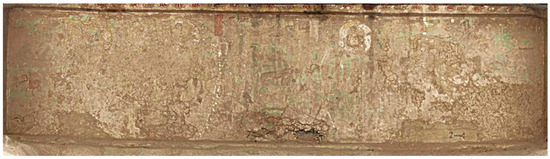
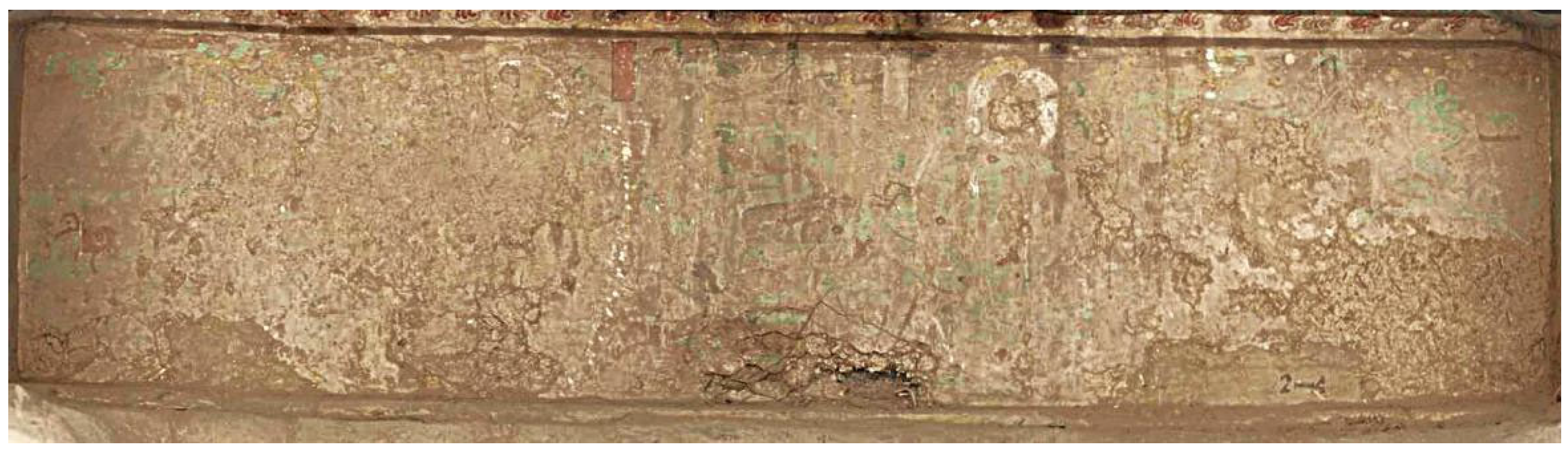
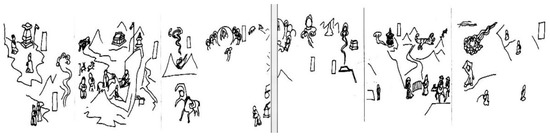
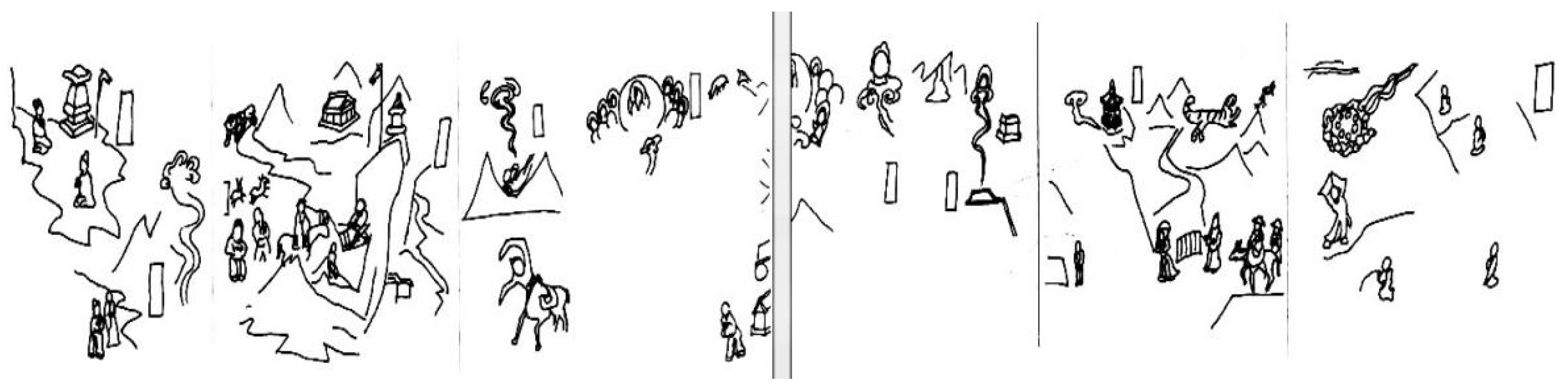
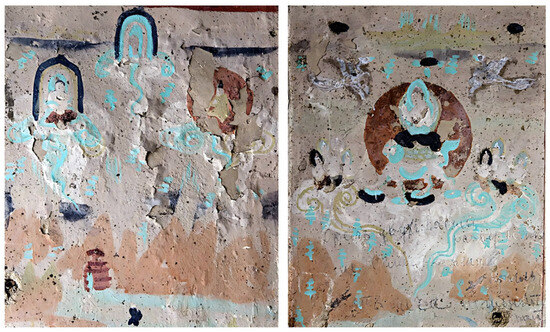
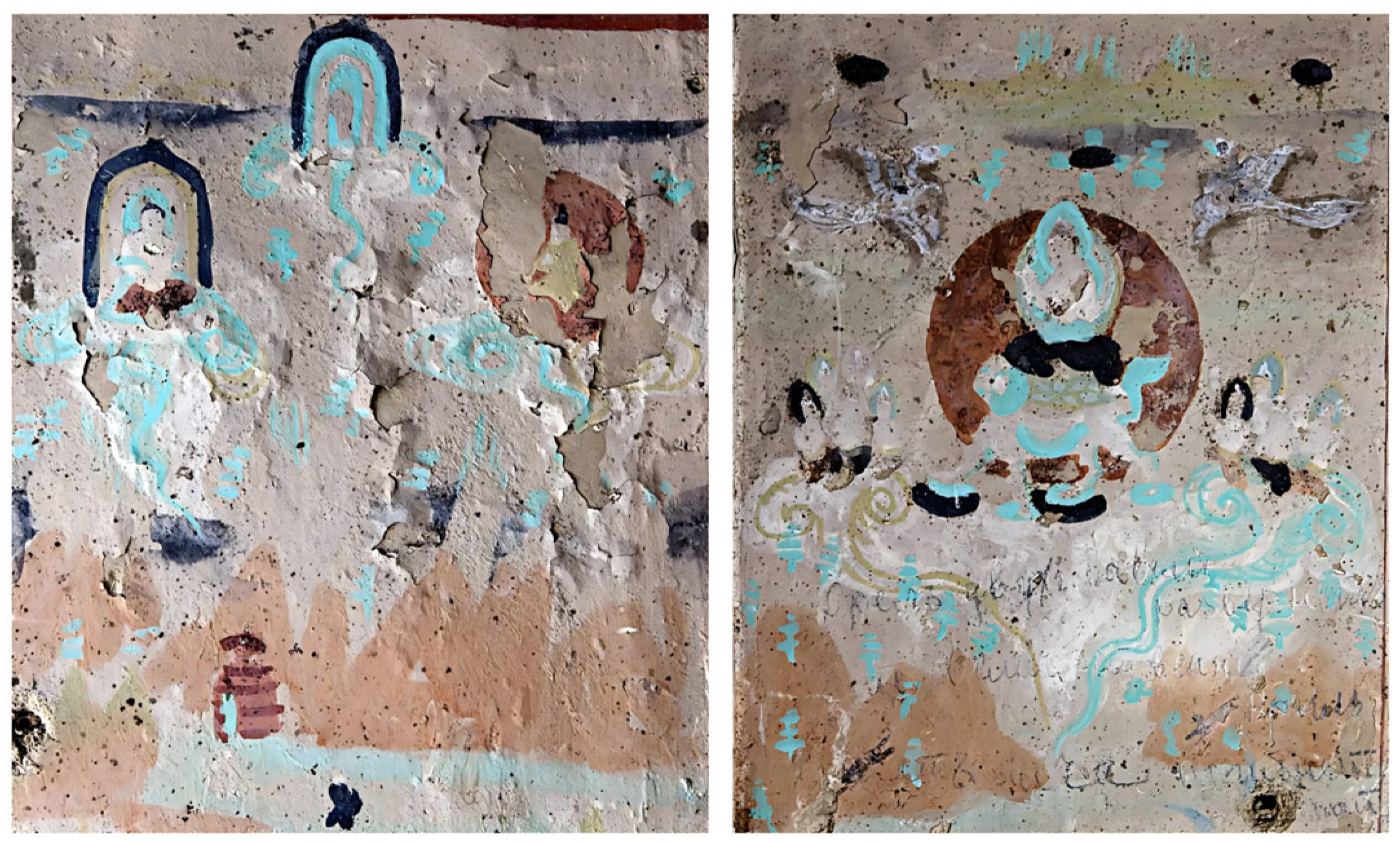
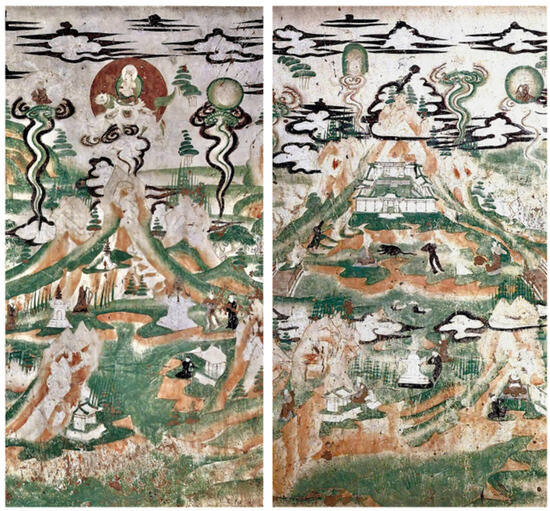
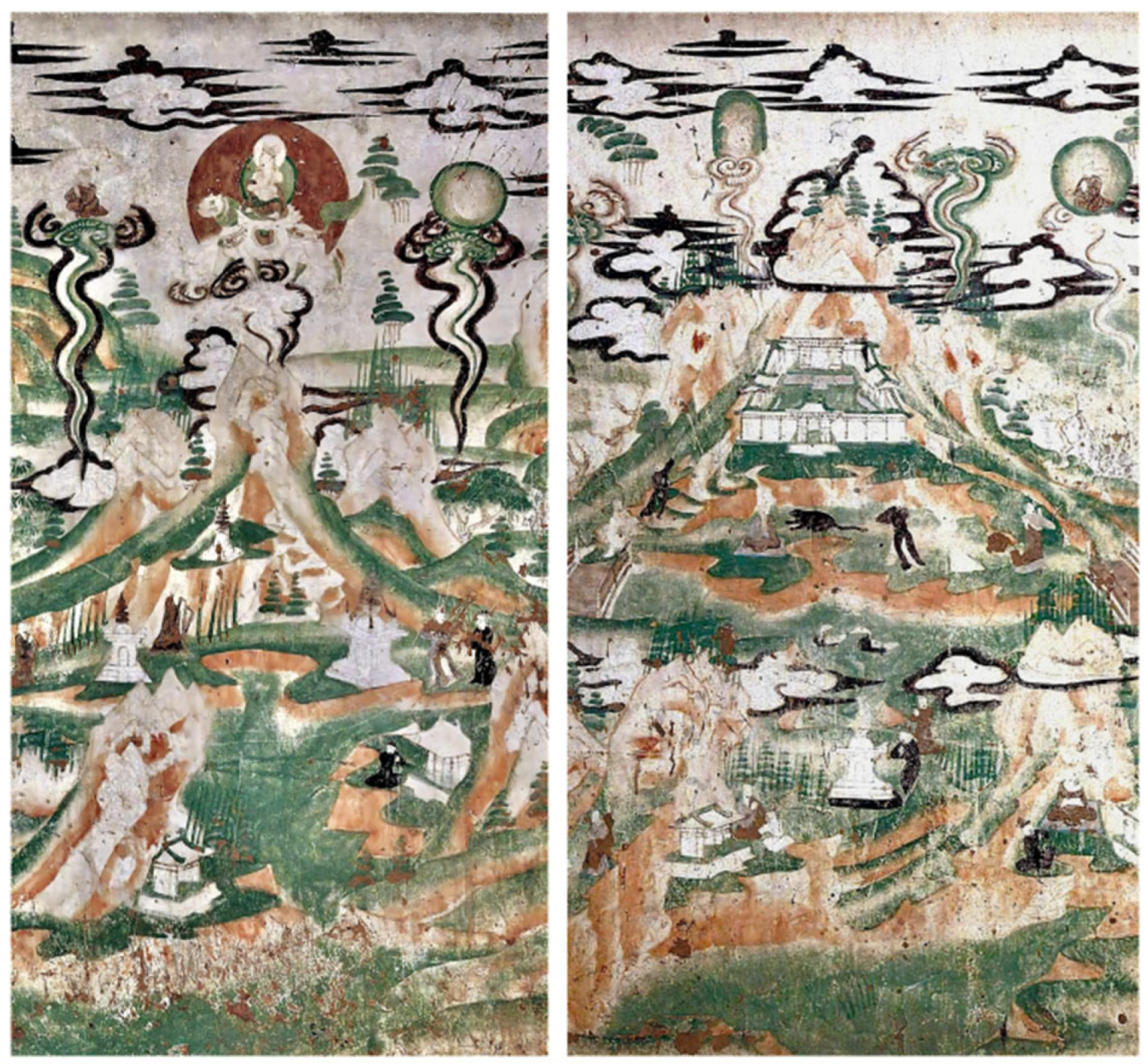
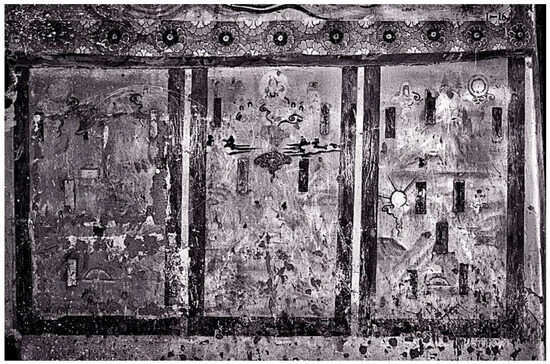
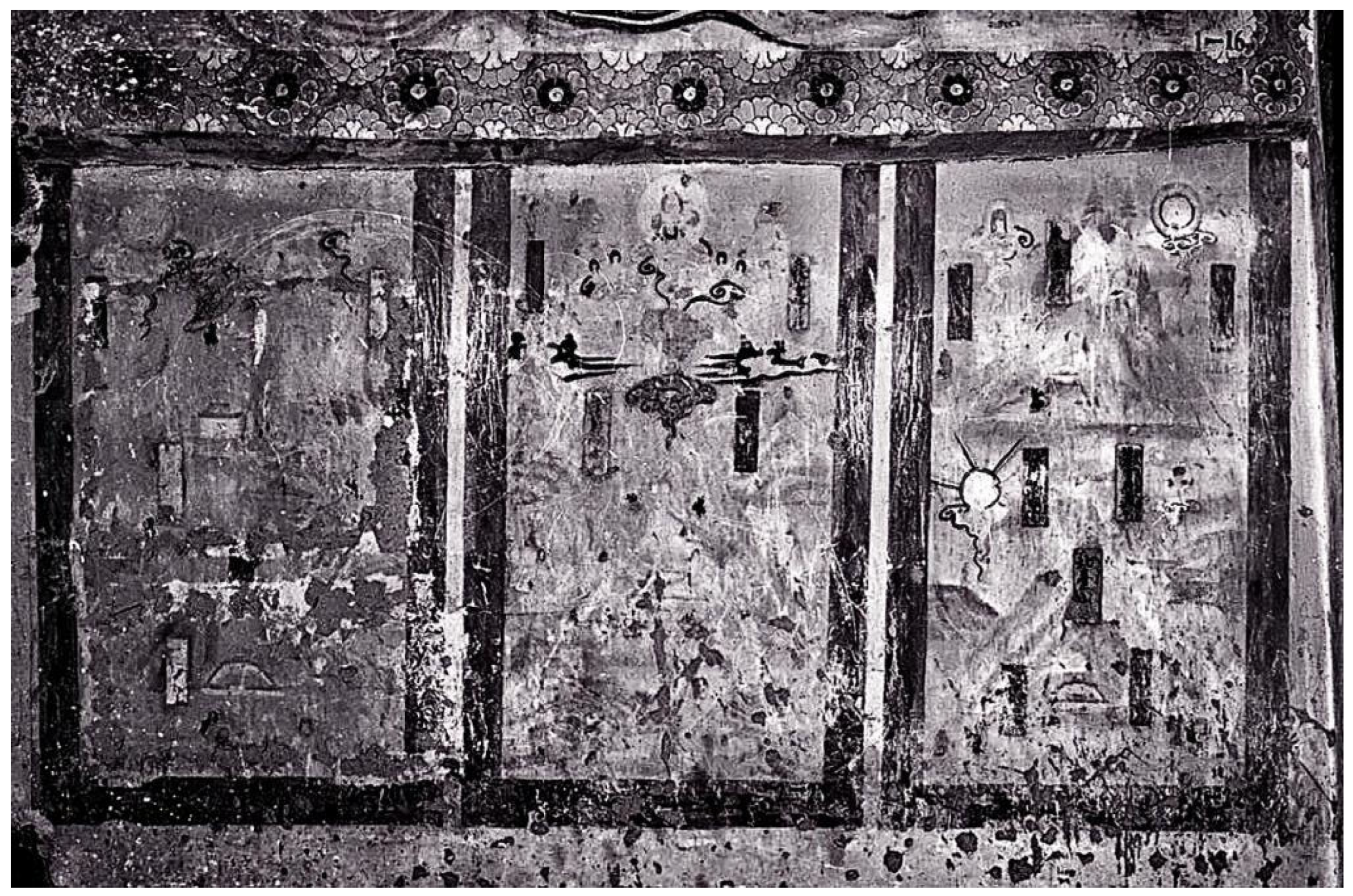
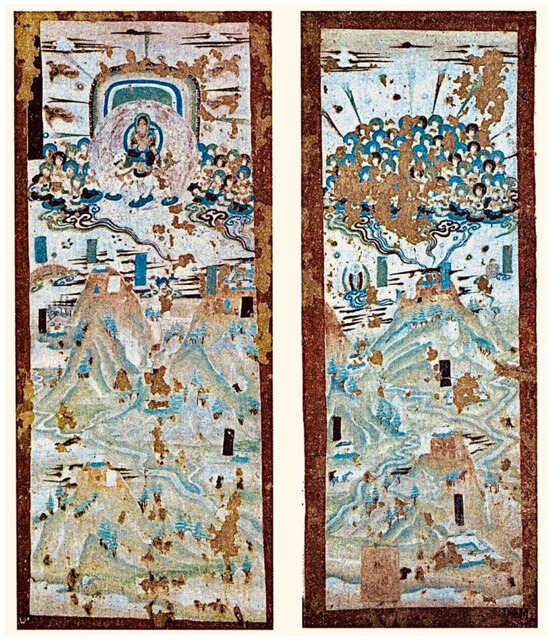
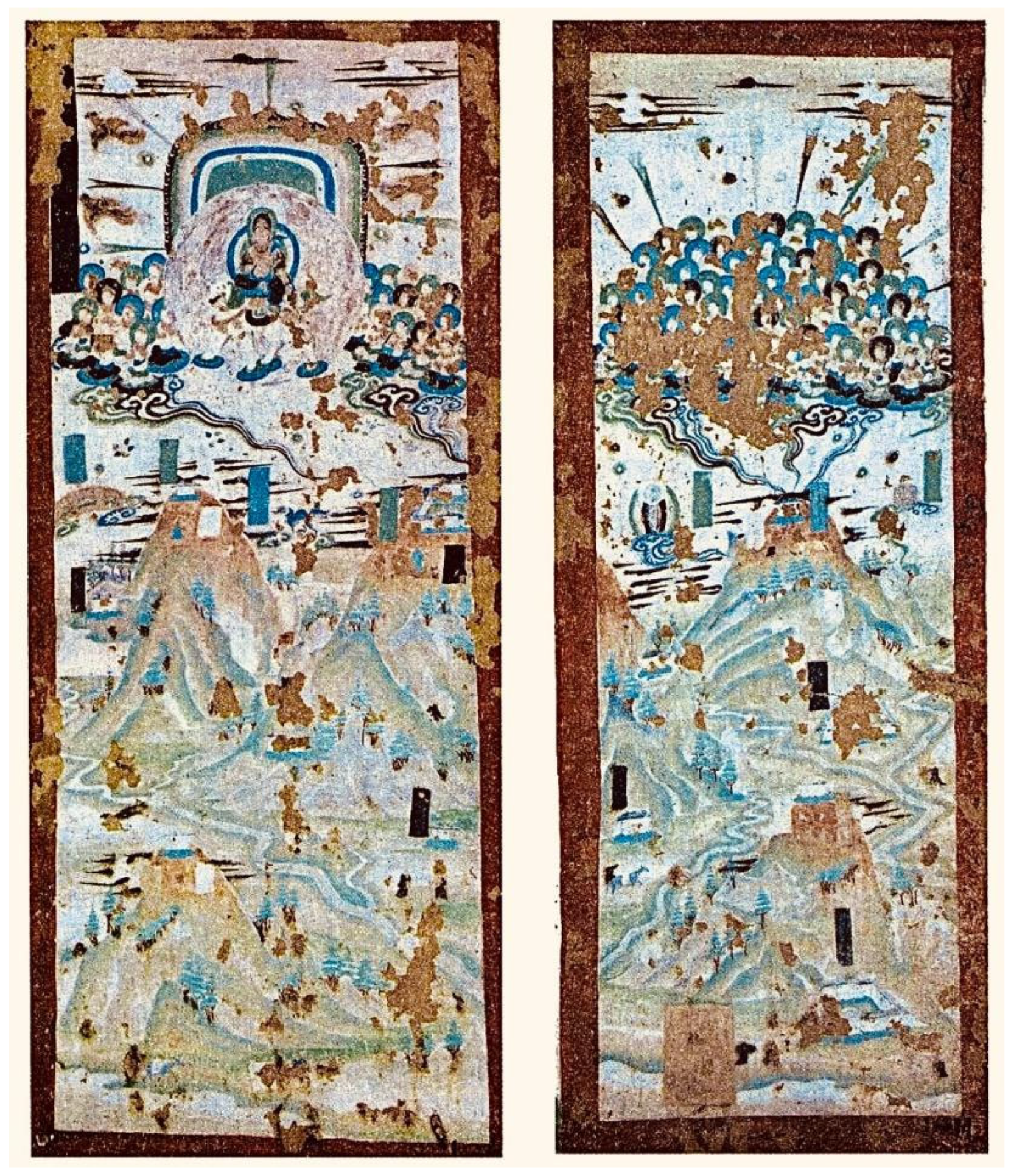
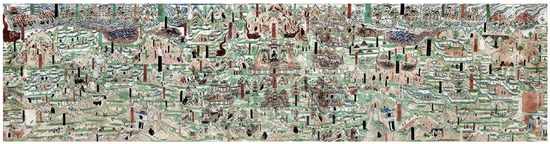
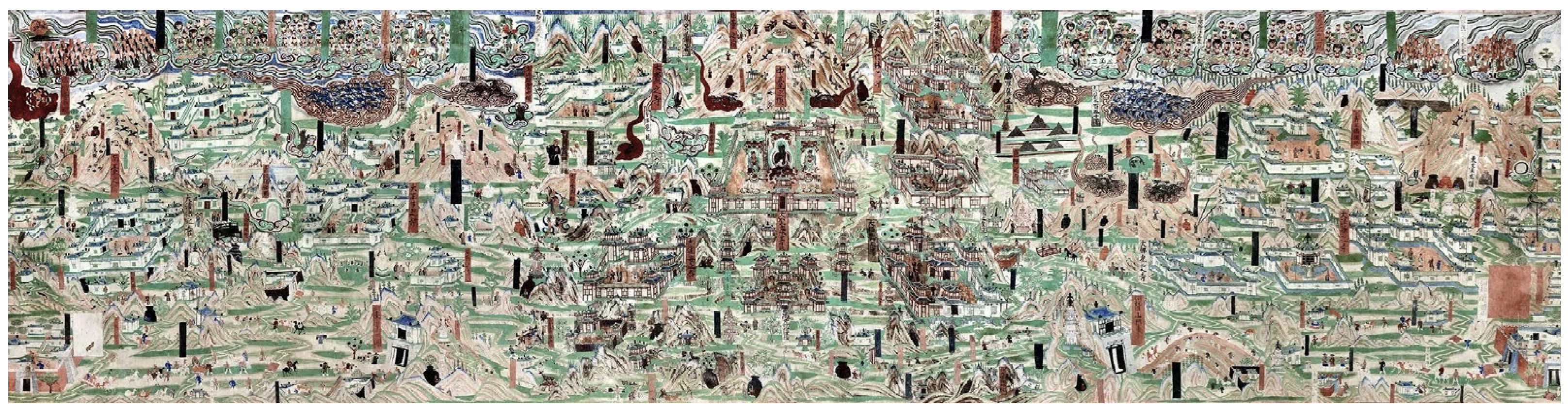
Disclaimer/Publisher’s Note: The statements, opinions and data contained in all publications are solely those of the individual author(s) and contributor(s) and not of MDPI and/or the editor(s). MDPI and/or the editor(s) disclaim responsibility for any injury to people or property resulting from any ideas, methods, instructions or products referred to in the content. |
© 2026 by the authors. Licensee MDPI, Basel, Switzerland. This article is an open access article distributed under the terms and conditions of the Creative Commons Attribution (CC BY) license.