A Biblical Analysis of the Implications of Prophetic Communication in Sustainable Church Leadership


Abstract
1. Introduction
2. Literature Review
2.1. Prophetic Communication in Biblical Tradition
2.2. Prophetic Integrity and Church Leadership Responsibility
2.3. Prophetic Communication as Distinctive Identity
2.4. Sustainable Church Leadership: Contemporary Discourse
2.5. Research Gap and Contribution
3. Materials and Methods
3.1. Lexical-Semantic Analysis
- Hebrew: נְבוּאָה (nebu’ah—prophecy), נָבִיא (nābî—prophet), מַשָּׂא (maśśā’—oracle), חָזָה (chazah—to see/vision)
- Greek: προφητεία (propheteia—prophecy), προφήτης (prophētēs—prophet), παρρησία (parrēsia—boldness/courageous speech), μετάνοια (metanoia—repentance), δικαιοσύνη (dikaiosynē—justice)
3.2. Thematic Synthesis of Contemporary Literature
3.3. Contextual Integration and Model Construction
3.4. Bridging the Hermeneutical Gap: From Biblical Text to Contemporary Practice
3.5. Validation Strategies
3.6. Ethical Considerations
3.7. Limitations of the Methodological Approach
4. Results
4.1. Etymological and Conceptual Foundations
4.2. The Ethical Dimension
4.3. The Transformative Dimension
4.4. The Transcendent Dimension
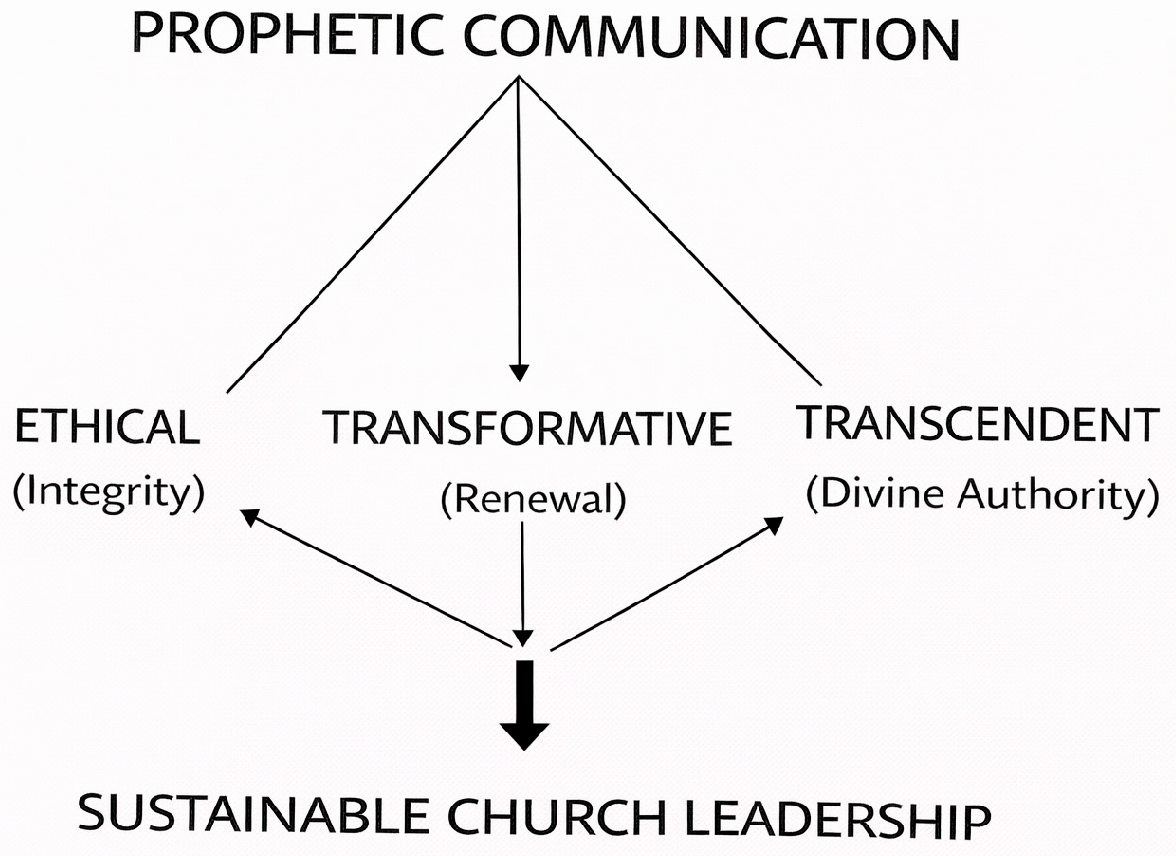
4.5. Summary of the Tri-Dimensional Model
5. Discussion
5.1. Biblical Foundations for Sustainable Leadership
5.1.1. Old Testament Prophetic Leadership
5.1.2. New Testament Prophetic Leadership
5.2. Integration of the Tri-Dimensional Model in Sustainable Leadership
5.2.1. Ethical Dimension and Accountability
5.2.2. Transformative Dimension and Adaptation
5.2.3. Transcendent Dimension and Resilience
5.2.4. Leadership Succession
- The ethical dimension ensures that successors are selected based on character, not merely charisma or connection (1 Timothy 3:1–7; Titus 1:5–9).
- The transformative dimension ensures that succession aims at ongoing renewal, not merely institutional continuity.
- The transcendent dimension ensures that succession depends on the Spirit’s calling and equipping, not merely human planning (Acts 13:2–4).
5.2.5. Empirical and Practical Dimensions
5.3. Challenges and Opportunities in Implementing Prophetic Communication
5.3.1. Ethical and Socio-Cultural Barriers
5.3.2. The Digital Era and Media Complexity
5.3.3. Organisational and Institutional Constraints
- Ethical dimension calls leaders to model integrity within institutional structures, gradually transforming organisational culture through consistent example.
- Transformative dimension calls for systemic renewal, not merely individual adaptation, addressing unjust structures and practices that hinder prophetic witness.
- Transcendent dimension grounds leaders in divine authority, enabling them to resist institutional pressures that would compromise prophetic faithfulness.
5.3.4. Opportunities: Technology and Theological Education
5.4. Implications for Practice
5.4.1. For Church Leaders
5.4.2. For Theological Educators
5.4.3. For Denominational Policymakers
6. Conclusions
Author Contributions
Funding
Data Availability Statement
Acknowledgments
Conflicts of Interest
References
- Alzubi, Ahmad. 2023. The Evolving Relationship between Digital and Conventional Media: A Study of Media Consumption Habits in the Digital Era. The Progress: A Journal of Multidisciplinary Studies 4: 1–13. [Google Scholar] [CrossRef]
- Bauer, Walter. 2010. A Greek-English Lexicon of the New Testament and Other Early Christian Literature, 3rd ed. Chicago: University of Chicago Press. [Google Scholar]
- Bhagwan, James N. 2006. Towards a Contextual Theology of Prophetic Communication. Ph.D. dissertation, Pacific Theological College, Sava, Fiji. Available online: https://asiapacific.anu.edu.au/pambu/catalogue/index.php/towards-a-contextual-theology-of-prophetic-communication-communicating-the-prophetic-voie-of-the-mainline-churches-and-the-prophetic-role-of-the-news-media-in-contemporary-fiji-island-society;isad?sf_culture=nl (accessed on 3 June 2026).
- Blommaert, Jan. 2020. Political Discourse in Post-Digital Societies. Trabalhos Em Linguistica Aplicada 59: 390–403. [Google Scholar] [CrossRef]
- Bowman, Craig. 2004. The Spirit of God in the Ministry of the Old Testament Prophets. Leaven 12: 3. Available online: https://digitalcommons.pepperdine.edu/leaven/vol12/iss3/3 (accessed on 25 February 2026).
- Brown, Francis, Samuel Rolles Driver, and Charles Augustus Briggs. 1996. The Brown-Driver-Briggs Hebrew and English Lexicon. Peabody: Hendrickson Publishers. [Google Scholar]
- Browning, Don S. 1991. A Fundamental Practical Theology. Minneapolis: Fortress Press. [Google Scholar]
- Campbell, Heidi A., and Ruth Tsuria. 2021. Digital Religion: Understanding Religious Practice in Digital Media. New York: Routledge. [Google Scholar]
- Ehusani, Richard. 2025. Prophetic Self-Negation: Validating the Divine Origin of the Word. Religious Studies 2024: 830–35. [Google Scholar] [CrossRef]
- Frahm-Arp, Maria. 2021. Political Activism in Pentecostal Charismatic Evangelical Churches and the 2019 Elections in South Africa. Journal of Religion in Africa 49: 312–36. [Google Scholar] [CrossRef]
- Gesenius, Wilhelm. 1898. A Hebrew and English Lexicon of the Old Testament: With an Appendix Containing the Biblical Aramaic. Oxford: Clarendon Press. [Google Scholar]
- Harvey, Lexie. 2018. Commitment to the Truth: Parrhesiastic and Prophetic Elements of Paul’s Letter to the Galatians. Res Rhetorica 5: 21–34. [Google Scholar] [CrossRef][Green Version]
- Heitink, Gerben. 1999. Practical Theology: History, Theory, Action Domains. Grand Rapids: Eerdmans. [Google Scholar]
- Hilber, John W. 2019. Ancient Prophecy: Near Eastern, Biblical, and Greek Perspectives. University Park: Pennsylvania State University Press. [Google Scholar]
- Hogeterp, Albert. 2018. Prophecy and the Prophetic as Aspects of Paul’s Theology. Stellenbosch Theological Journal 4: 169–96. [Google Scholar] [CrossRef]
- Kesumawati, Kesumawati, and Joni Manumpak Parulian Gultom. 2025. Effective Pastoral Leadership in Church Growth and Renewal. Journal of the American Institute 2: 156–68. Available online: https://www.researchgate.net/publication/389403373_Effective_Pastoral_Leadership_in_Church_Growth_and_Renewal (accessed on 3 June 2026). [CrossRef]
- Koehler, Ludwig, Walter Baumgartner, and Johann J. Stamm. 2001. The Hebrew and Aramaic Lexicon of the Old Testament. Leiden: Brill. [Google Scholar]
- Kretzschmar, Louise. 2023. A Christian Ethical Analysis of the Importance of Prophetic Leadership for Sustainable Leadership. Verbum et Ecclesia 44: a2685. [Google Scholar] [CrossRef]
- Le Duc, Anthony. 2024. Engaging with Stakeholders of the Technological Future Through Prophetic Dialogue: A Catholic Perspective. Jurnal Ledalero 23: 105–25. [Google Scholar] [CrossRef]
- Morgan, David. 2007. Priesthood, Prophethood and Spirit-Led Community: A Practical-Prophetic Pentecostal Ecclesiology. Ph.D. dissertation, Durham University, Durham, UK. Available online: https://etheses.durham.ac.uk/id/eprint/2577/ (accessed on 25 February 2026).
- Newberg, Eric N. 2022. Paradigms of Global Spirit-Empowered Leadership. Spiritus: ORU Journal of Theology 7: 169–98. [Google Scholar] [CrossRef]
- Niemandt, Nelus. 2019. Missional Leadership. Cape Town: AOSIS. [Google Scholar] [CrossRef]
- Nissinen, Martti. 2017. Ancient Prophecy: Near Eastern, Biblical, and Greek Perspectives. Oxford: Oxford University Press. [Google Scholar]
- Obenza, Brandon Nacua. 2025. Book Review: Altar of Secrets: Sex, Politics, and Money in the Philippine Catholic Church (by Aries C. Rufo). Journal of Contemporary Philosophical and Anthropological Studies 3: 1–3. [Google Scholar] [CrossRef]
- O’Brien, Julia M. 2022. Forthtellers Not Foretellers: The Origins of a Liberal Orthodoxy About the Prophets. Religions 13: 298. [Google Scholar] [CrossRef]
- Okobia, Faith Nkem. 2024. Paul’s Church Leadership Style a Road Map for Christian Leaders in Nigeria. International Journal of Culture and Religious Studies 5: 61–71. [Google Scholar] [CrossRef]
- Oliva, Mirela. 2022. The Experience of Prophecy and the Metaphysics of Providence in Aquinas. Religions 13: 921. [Google Scholar] [CrossRef]
- Osmer, Richard R. 2008. Practical Theology: An Introduction. Grand Rapids: Eerdmans. [Google Scholar]
- Pillay, Jerry. 2023. The Kingdom of God and the Transformation of the World: The Call and Role of the Ecumenical Movement. International Review of Mission 112: 355–69. [Google Scholar] [CrossRef]
- Reddy, Mike Megrove, and Angelo Nicolaides. 2022. Jeremiah the Suffering Prophet—His Communication of Judgment and Promise of Blessings. Pharos Journal of Theology 103: 1–15. [Google Scholar] [CrossRef]
- Rengkaningtias, Ayu Usada, Farida Hanum, and Cepi Safruddin Abd Jabar. 2025. Organizational Communication Management in Effective Islamic School. Humanika: Kajian Ilmiah Mata Kuliah Umum 25: 23–34. [Google Scholar] [CrossRef]
- Safri, Arif Nuh. 2012. Otentisitas Risalah Kenabian (Pluralisme dan Kemanusiaan) [The Authenticity of the Prophetic Message (Pluralism and Humanity)]. ESENSIA: Jurnal Ilmu-Ilmu Ushuluddin 13: 167–86. Available online: https://ejournal.uin-suka.ac.id/ushuluddin/esensia/article/view/131-10 (accessed on 3 June 2026). [CrossRef]
- Schlag, Thomas, Gregor Frey, and Kriti Yadav. 2025. Religious Leadership and Digital Innovation: An Explorative Interview Study with Church Actors in the Swiss Context. Religions 16: 491. [Google Scholar] [CrossRef]
- Schwab, Klaus. 2017. The Fourth Industrial Revolution. New York: Currency. [Google Scholar]
- Scott, Robert. 1897. A Greek-English Lexicon. New York: Harper & Brothers. [Google Scholar]
- Sembiring, Jesica Cindini. 2025. Capacity Building of Facilitators in the Context of Pastoral Ministry at St. Joseph Church Tanjung Balai Karimun. Masyarakat Mandiri: Jurnal Pengabdian Dan Pembangunan Lokal 2: 95–105. [Google Scholar] [CrossRef]
- Shao, Yijie. 2020. The Impact of Digital Media on Modern Society and Culture. Communications in Humanities Research 57: 117–22. [Google Scholar] [CrossRef]
- Simamora, Parasian, Andreas Eko Nugroho, and Kornelius Rulli Jonathans. 2025. Penerapan Sistem Manajemen Mutu ISO 9001 dan Kontribusinya Bagi Pertumbuhan Gereja Pentakosta di Cililitan [Implementation of the ISO 9001 Quality Management System and Its Contribution to the Growth of the Pentecostal Church in Cililitan]. Jurnal Teologi Dan Pelayanan Kerusso 10: 131–43. [Google Scholar] [CrossRef]
- Stenschke, Christoph W. 2021. The Prophet Like Moses (Dt 18:15-22): Some Trajectories in the History of Interpretation. Verbum et Ecclesia 42: a1962. [Google Scholar] [CrossRef]
- Thayer, Joseph Henry. 1889. A Greek-English Lexicon of the New Testament. New York: American Book Company. [Google Scholar]
- Tveit, Olav Fykse. 2016. Service and Advocacy: Matters of Faith? The Ecumenical Review 68: 14–26. [Google Scholar] [CrossRef]
- Van der Ven, Johannes A. 1998. Practical Theology: An Empirical Approach. Kampen: Kok Pharos. [Google Scholar]
- Walkonis, Steven R. 2004. The Phenomenon of Power in the Church: An Investigation and Analysis of the Relational Dynamics Experienced in the Context of the Assertion of Authority. Ph.D. dissertation, Andrews University, Berrien Springs, MI, USA. Available online: https://digitalcommons.andrews.edu/dmin/143/ (accessed on 25 February 2026).
- Willimon, William H. 2024. Preaching as Protest Against the Apophatic Silencing of God’s People. Religions 15: 233. [Google Scholar] [CrossRef]
- Wulandari, May Putri, and Hikmatur Romdoni. 2025. The Prophetic Communication in the Book ‘The Prophet’s Methods of Correcting People’s Mistakes’. Jurnal Peurawi: Media Kajian Komunikasi Islam 8: 80–96. Available online: https://comms.ar-raniry.ac.id/peurawi/article/view/179 (accessed on 25 February 2026).


| Language | Term | Transliteration | Meaning | Key References |
| Hebrew | נְבוּאָה | nebu’ah | Prophecy, divine message | Gesenius (1898); Brown et al. (1996) |
| Hebrew | נָבִיא | nābî | Prophet, God’s spokesperson | Koehler et al. (2001) |
| Greek | προφητεία | propheteia | Prophecy, inspired declaration | Thayer (1889); Bauer (2010) |
| Greek | προφήτης | prophētēs | Prophet, divine messenger | Scott (1897) |
Disclaimer/Publisher’s Note: The statements, opinions and data contained in all publications are solely those of the individual author(s) and contributor(s) and not of MDPI and/or the editor(s). MDPI and/or the editor(s) disclaim responsibility for any injury to people or property resulting from any ideas, methods, instructions or products referred to in the content. |
© 2026 by the authors. Licensee MDPI, Basel, Switzerland. This article is an open access article distributed under the terms and conditions of the Creative Commons Attribution (CC BY) license.
Share and Cite
Heryanto, H.; Pramono, R.; Parhusip, A. A Biblical Analysis of the Implications of Prophetic Communication in Sustainable Church Leadership. Religions 2026, 17, 697. https://doi.org/10.3390/rel17060697
Heryanto H, Pramono R, Parhusip A. A Biblical Analysis of the Implications of Prophetic Communication in Sustainable Church Leadership. Religions. 2026; 17(6):697. https://doi.org/10.3390/rel17060697
Chicago/Turabian StyleHeryanto, Heryanto, Rudy Pramono, and Akdel Parhusip. 2026. "A Biblical Analysis of the Implications of Prophetic Communication in Sustainable Church Leadership" Religions 17, no. 6: 697. https://doi.org/10.3390/rel17060697
APA StyleHeryanto, H., Pramono, R., & Parhusip, A. (2026). A Biblical Analysis of the Implications of Prophetic Communication in Sustainable Church Leadership. Religions, 17(6), 697. https://doi.org/10.3390/rel17060697