The Expression of Chan “Emptiness Contemplation” in Hongren’s Landscape Painting


Abstract
1. Introduction
2. The Generative Mechanism of Hongren’s Landscapes and the Aesthetics of Chan “Emptiness Contemplation”
2.1. From Scholar to Monk-Painter: The Intellectual Transformation of Hongren
“Since ancient times, the Chan gates have known no years;/Who passes down the vain words of fifty?/If you wish to know the true message beyond the ordinary,/The sun shines on the clear river, a singular tapestry of brocade./The sun, moon, and stars proclaim the ultimate reality;/Mountains, rivers, and the great earth expound the perfect sound./Adding fire again within the red furnace’s flames,/Fiercely refining the ancient Buddha’s heart. 自古禅门无岁月, 浪言五十是谁传. 要知节外真消息, 日照澄江锦一团. 日月星辰谈实相, 山河大地演圆音. 红炉焰里重添火, 炟赫烹蒸古佛心.”.(Mao 2024, p. 57)
2.2. The Theoretical System and Spiritual Foundation of Chan “Emptiness Contemplation” Aesthetics
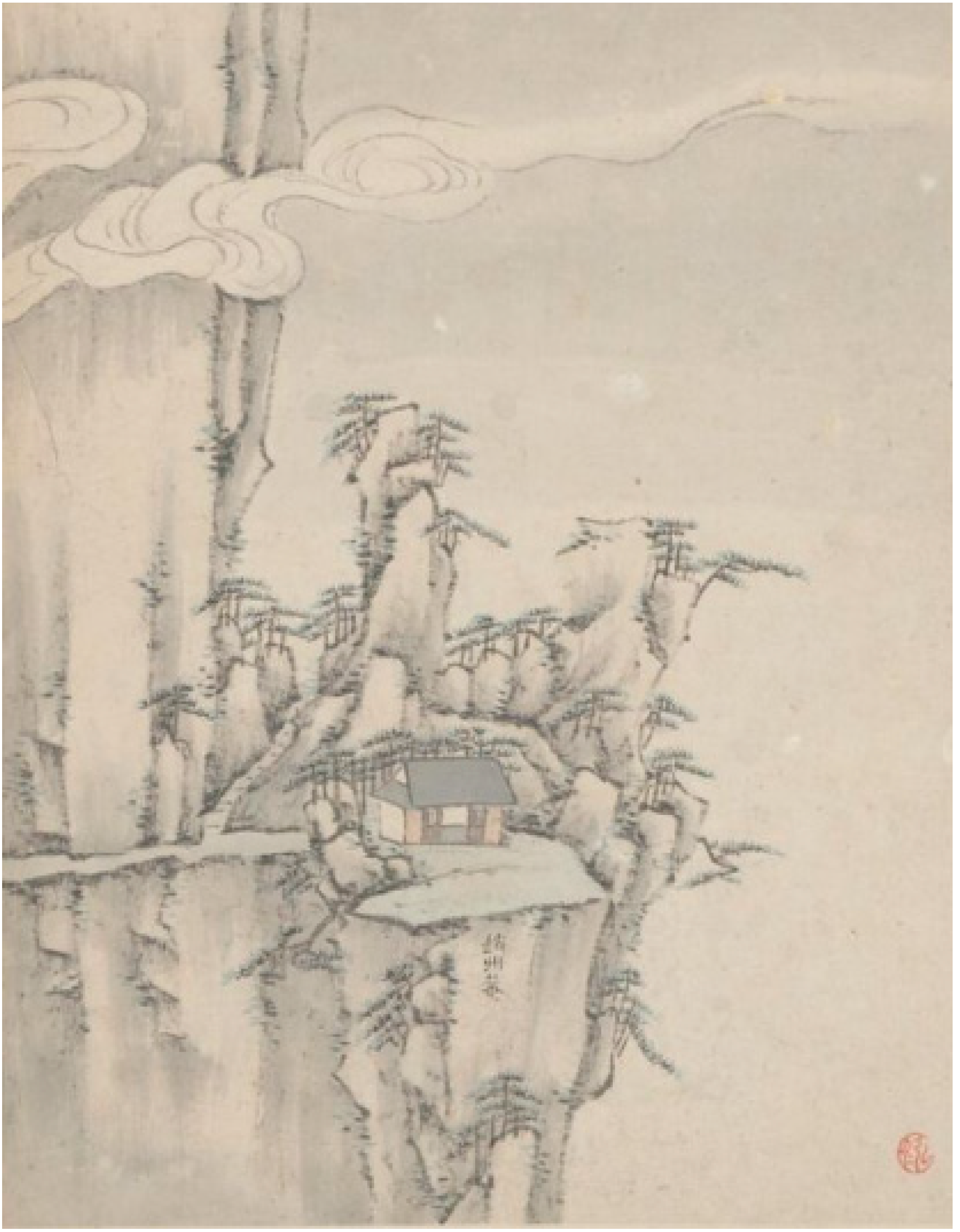
2.3. The Macroscopic Embodiment of “Emptiness Contemplation” in Hongren’s Landscape Painting
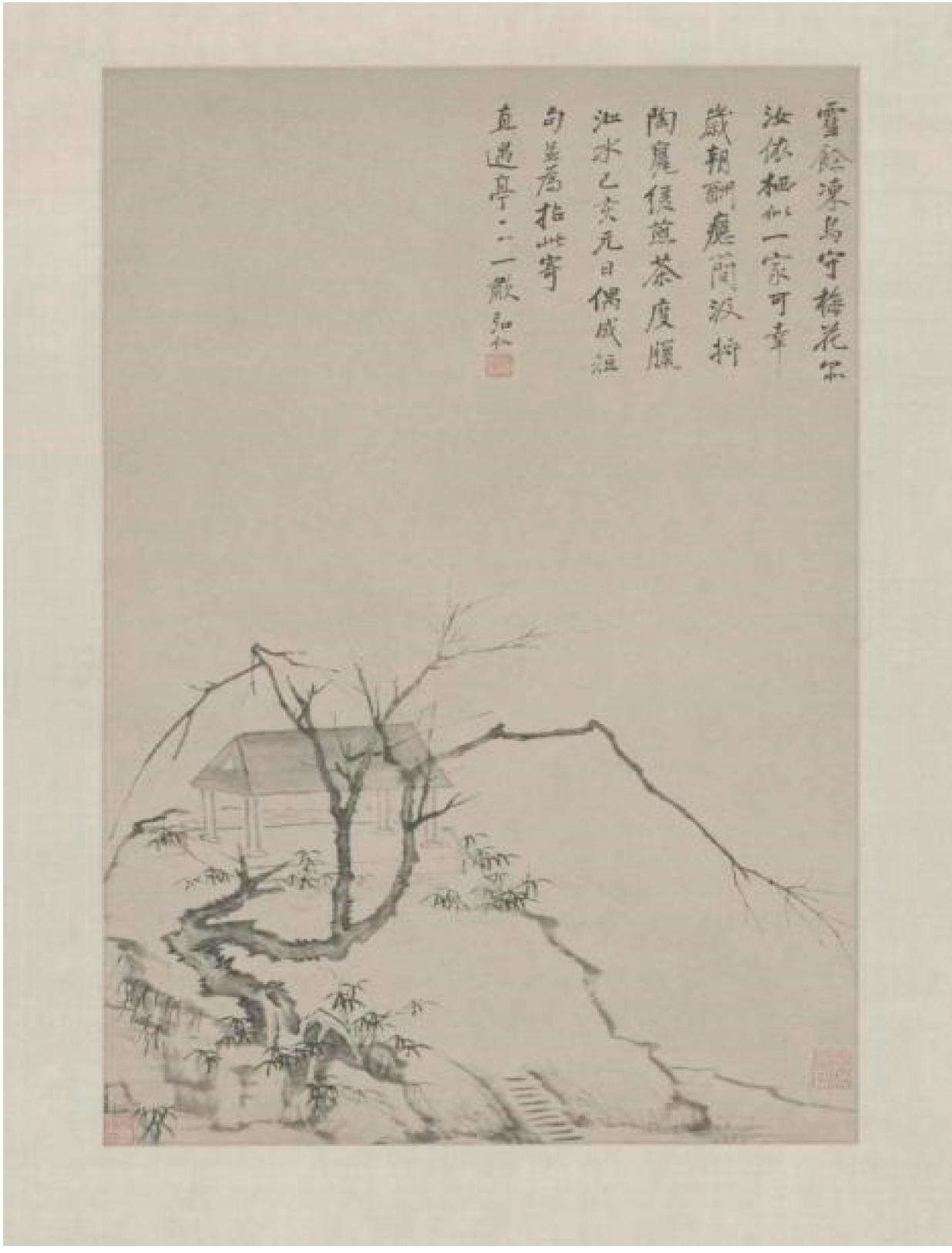
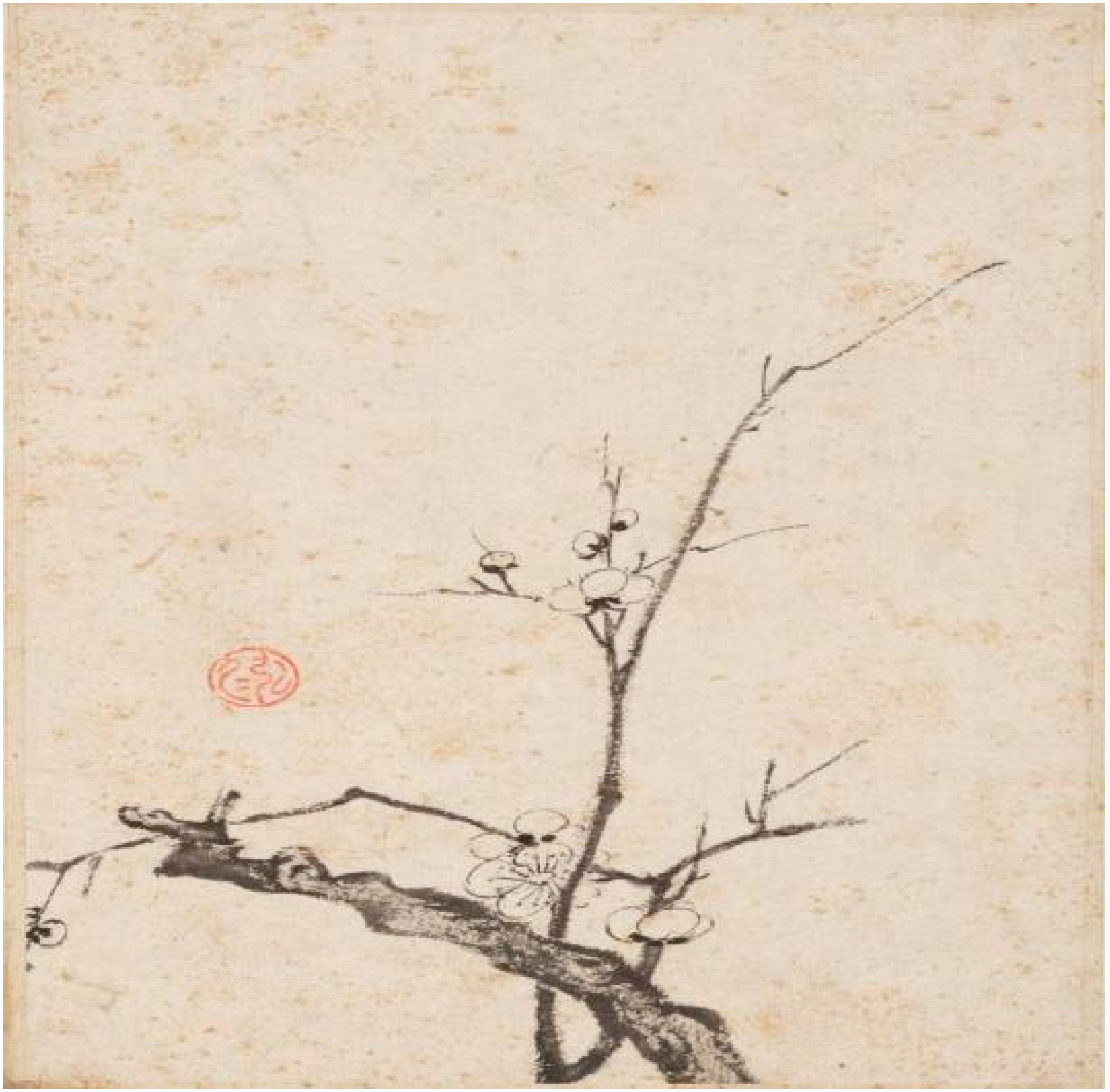
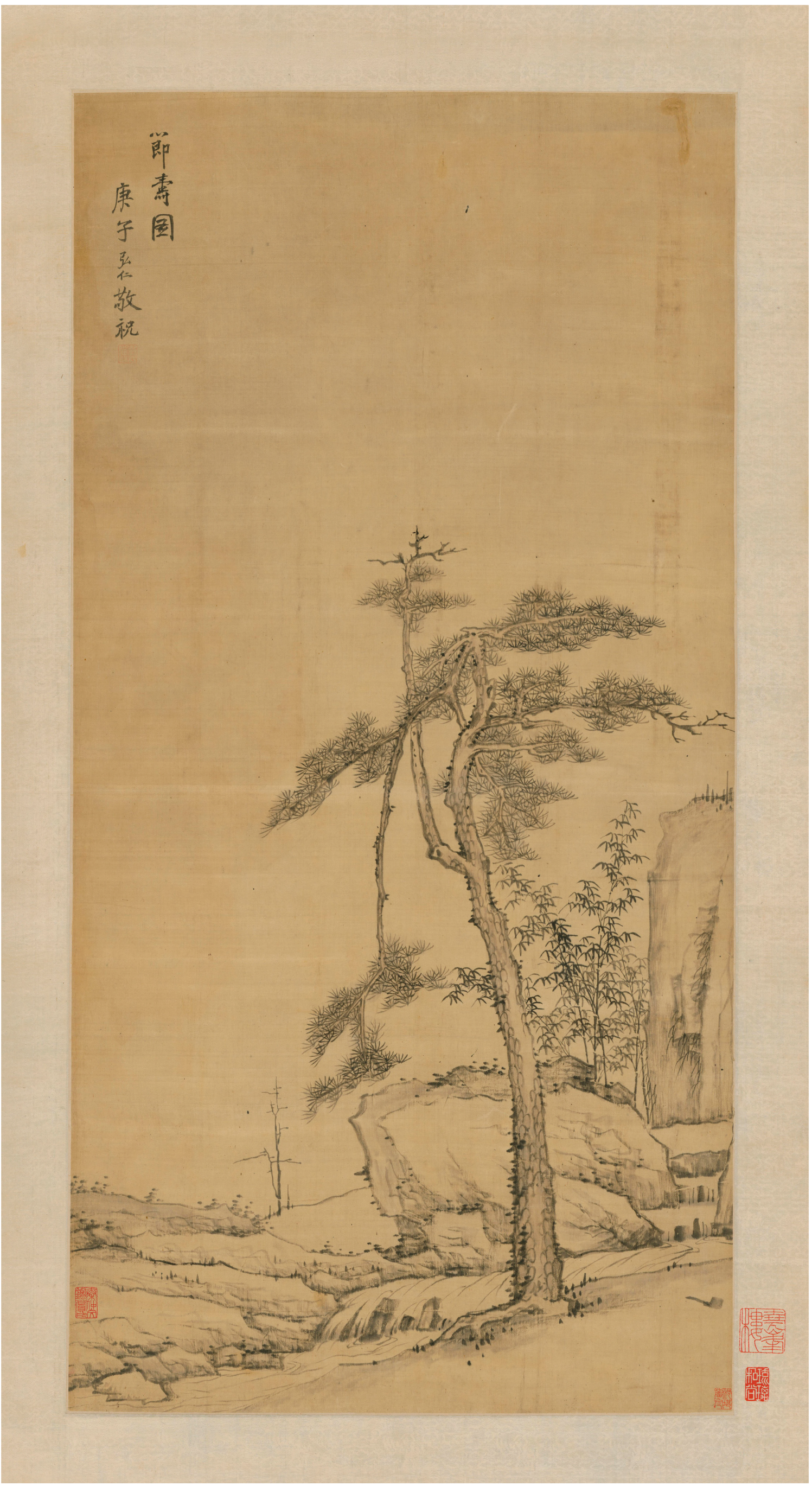
“After the snow, a frozen bird guards the plum blossoms; / You and I rely on each other, dwelling like one family. / Fortunately, social visits are rare on this New Year’s morning; / Drawing water in an earthen jar, I slowly brew tea. 雪馀冻鸟守梅花, 尔汝依栖似一家. 可幸岁朝酬应简, 汲将陶瓮缓煎茶.”
3. The Form of Cultivation: Form and Brushwork in Hongren’s Landscapes
3.1. Emptiness of Form
3.2. Emptiness of Brushwork
4. “Emptiness” in Composition and “Artistic Conception” in Hongren’s Landscape Painting
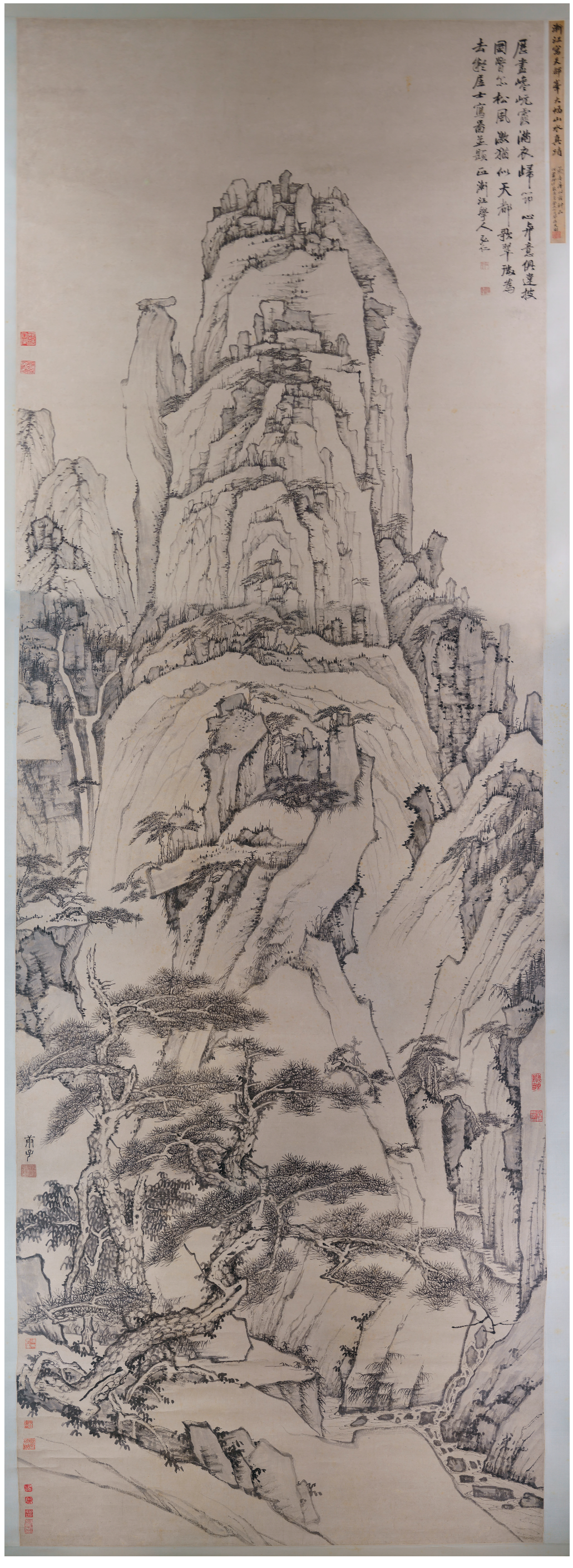
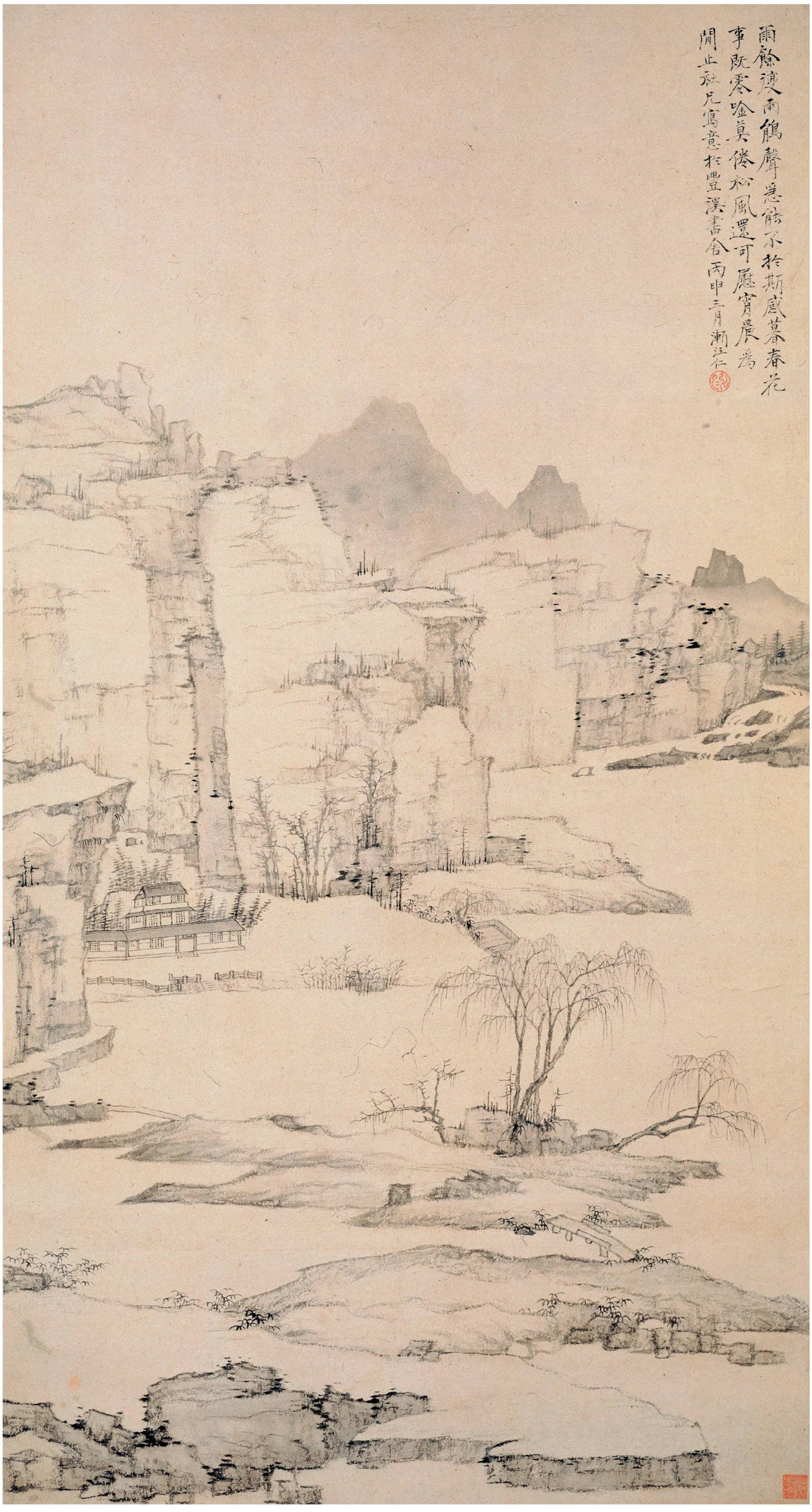
4.1. “Emptiness” in Composition
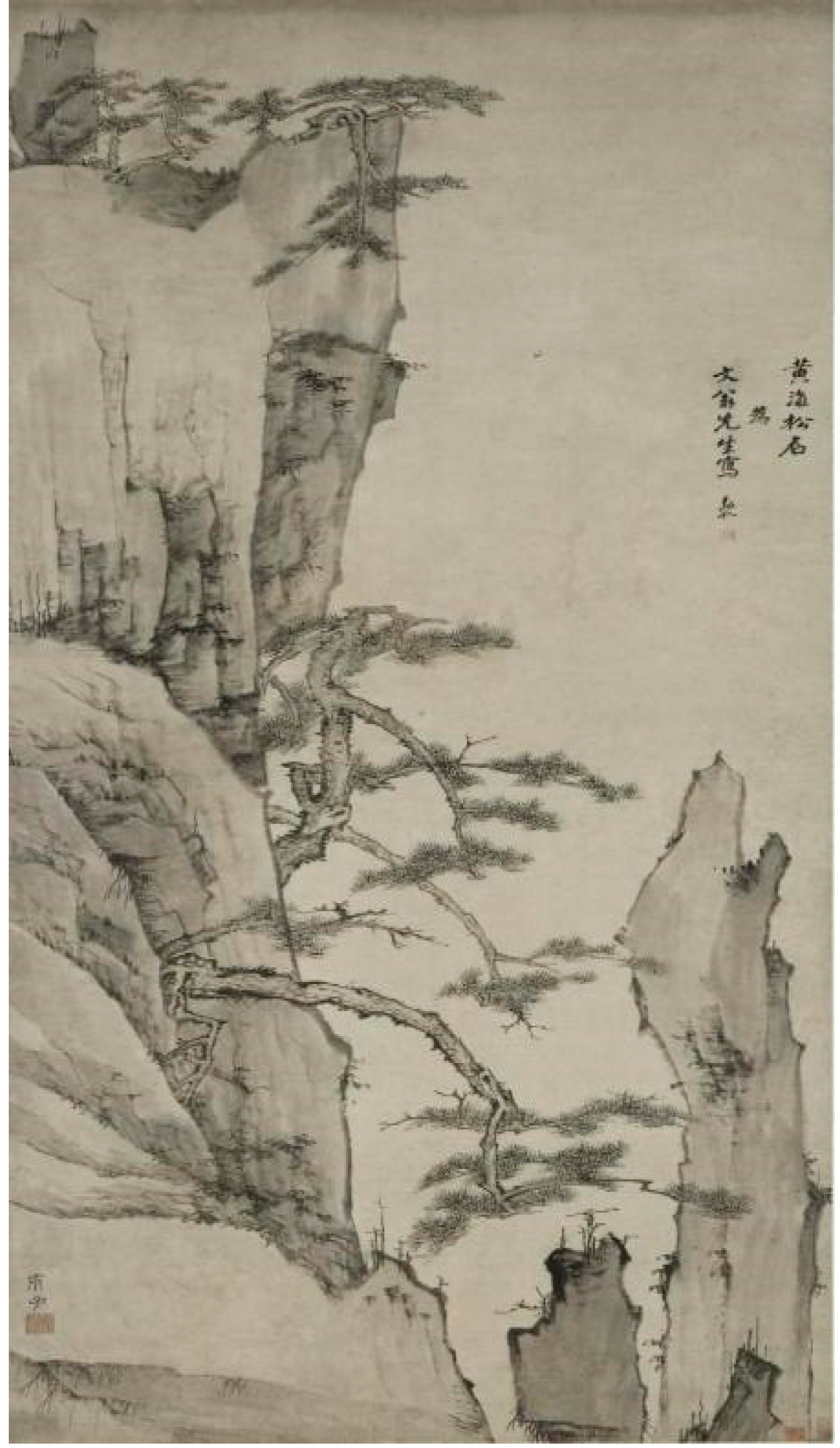
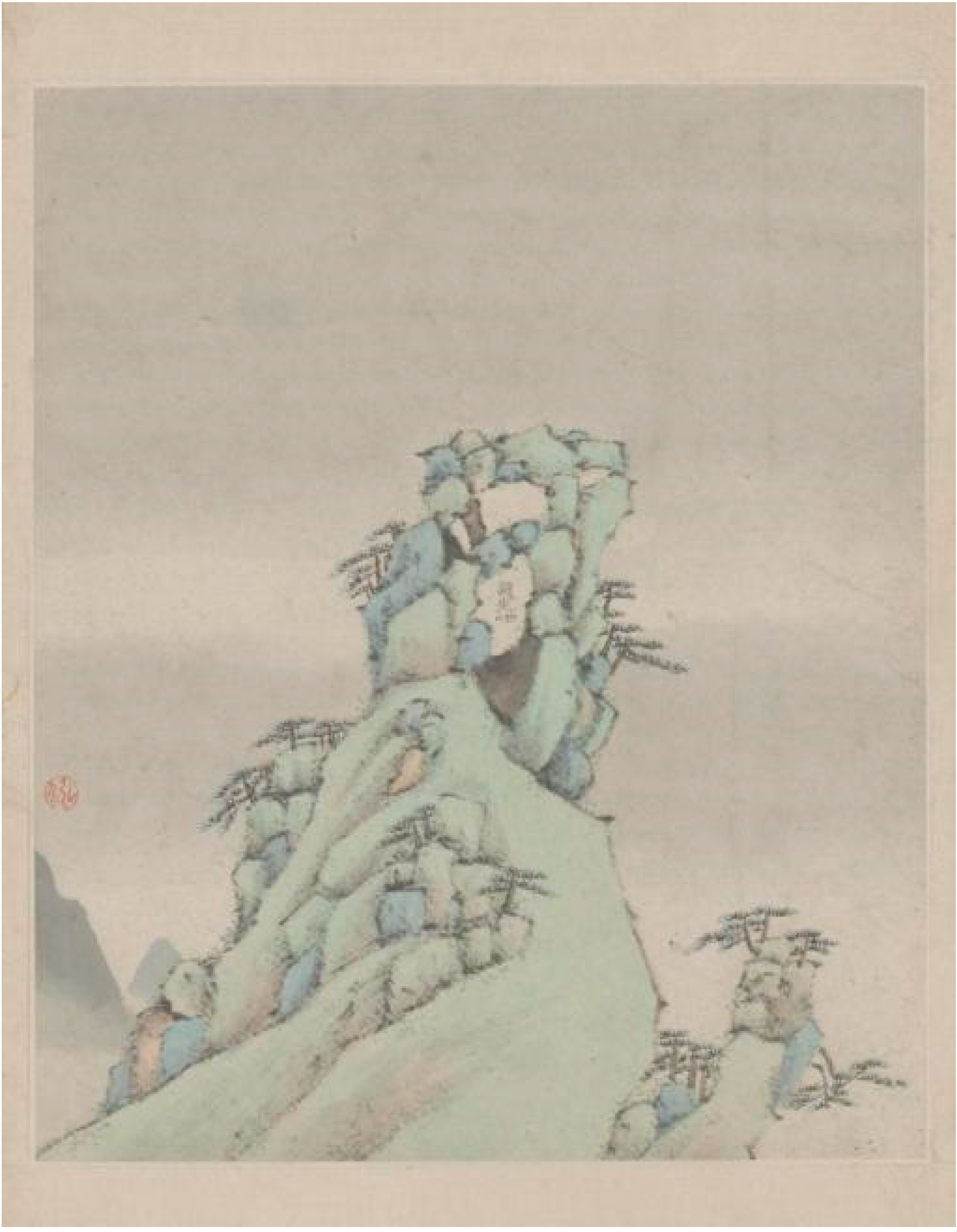
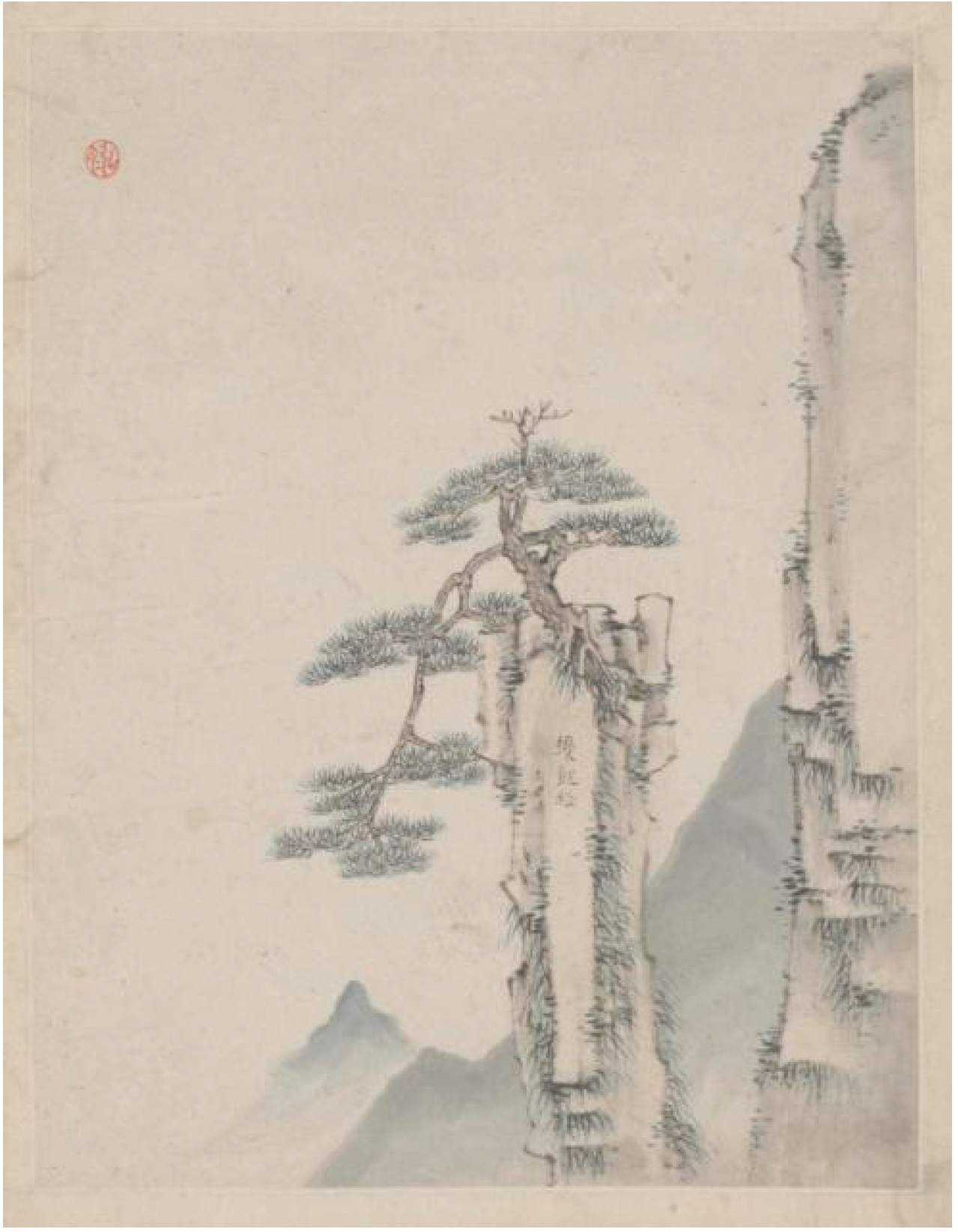
“Having traversed rugged peaks, radiance fills my robe; /Returning with my staff, mind and intent were both unfulfilled. /Unrolling this scroll, suddenly the pine wind surges; /As if I’m still at Tiandu, singing of the verdant slopes. 历尽巉岏霞满衣, 归筇心与意俱违。披图瞥尔松风激, 犹似天都歌翠微”
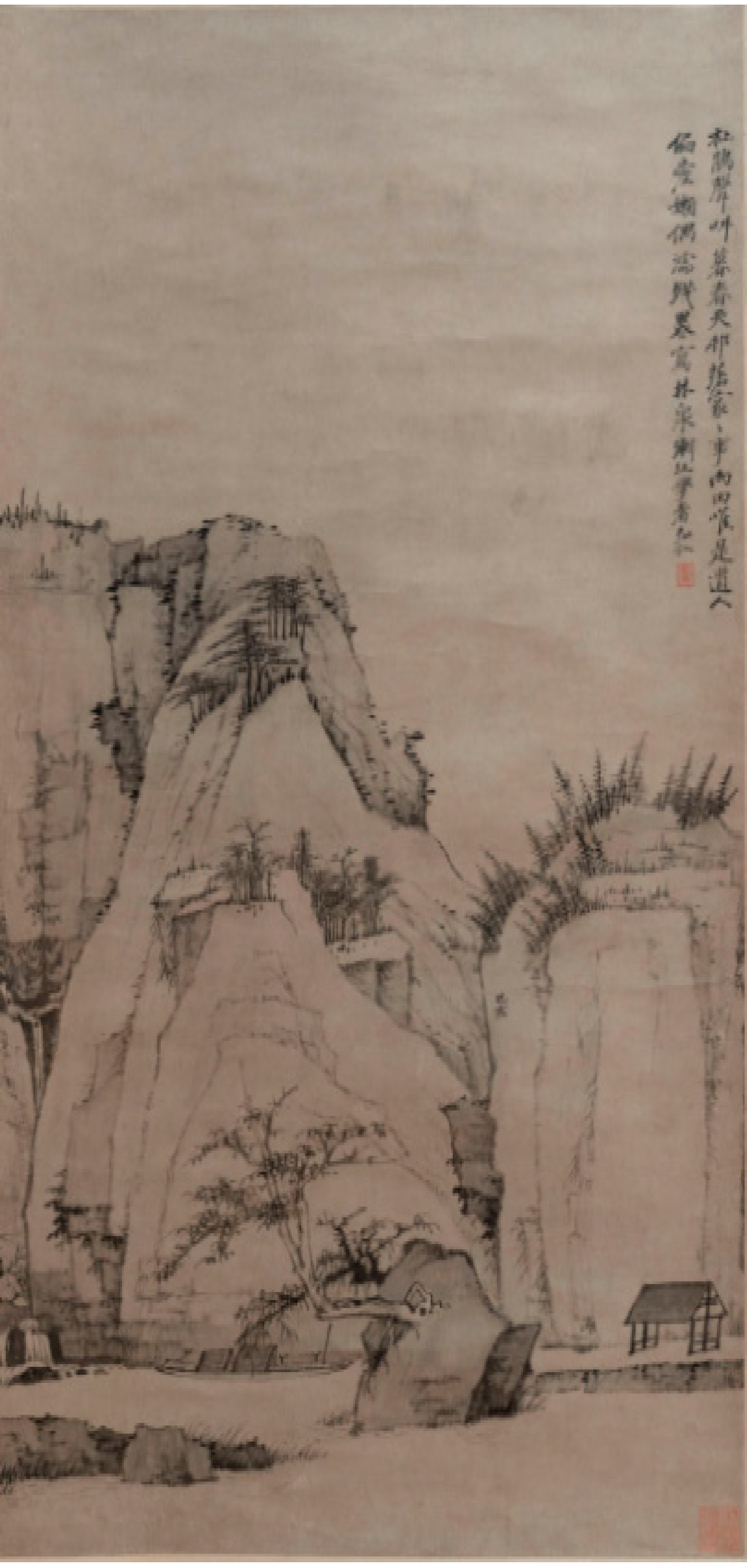
“Shower after shower, the cuckoo’s cry is incessant;/ How can one not lament the late spring here?/ Though the blossoms have scattered, I must not tire of chanting;/ For the breeze through pines can still soothe my mornings and nights. 雨余復雨鹃声急, 能不于斯感暮春。花事既零吟莫倦, 松风还可慰宵晨”
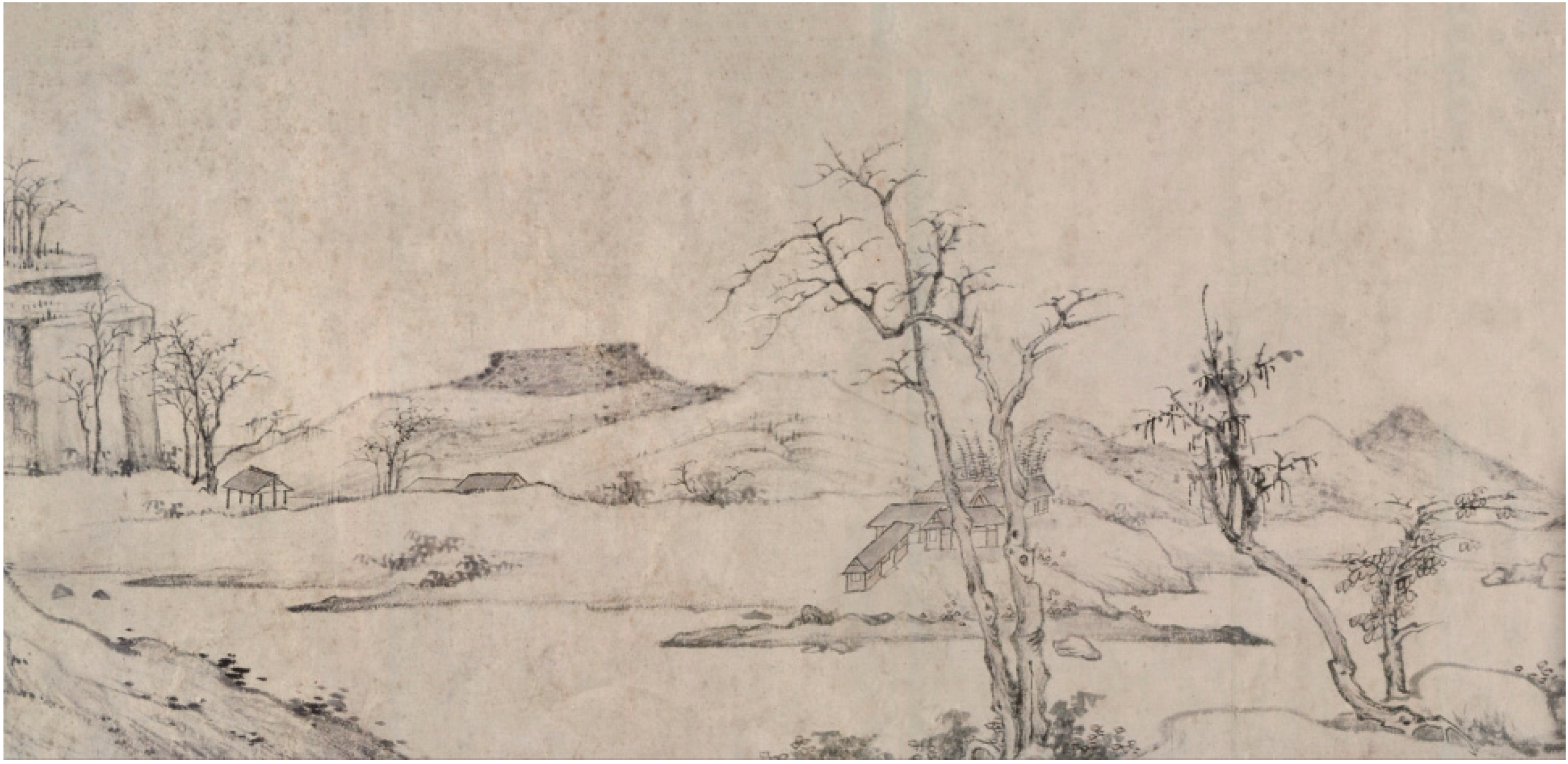
4.2. “Emptiness” in Artistic Conception
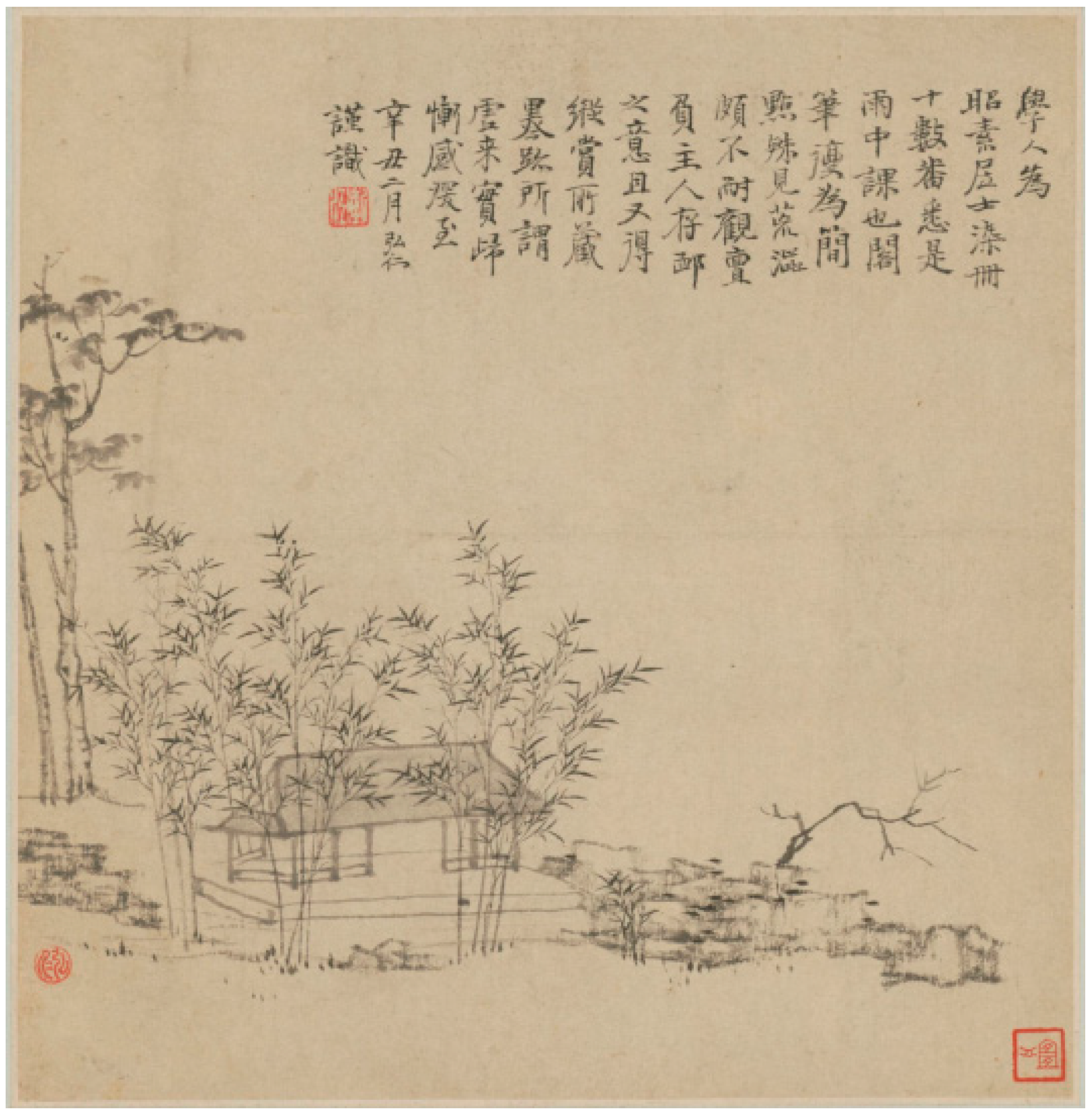
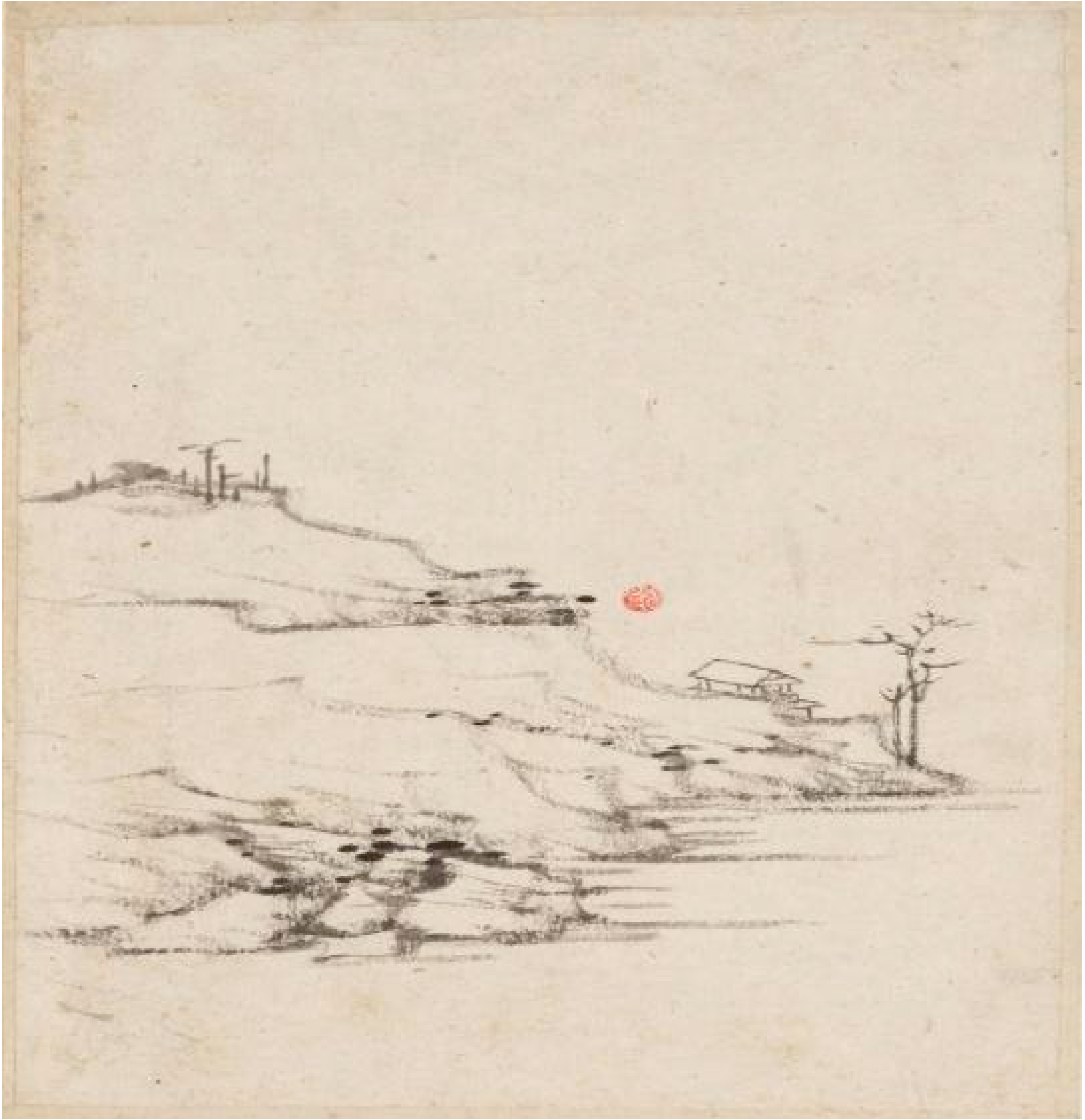
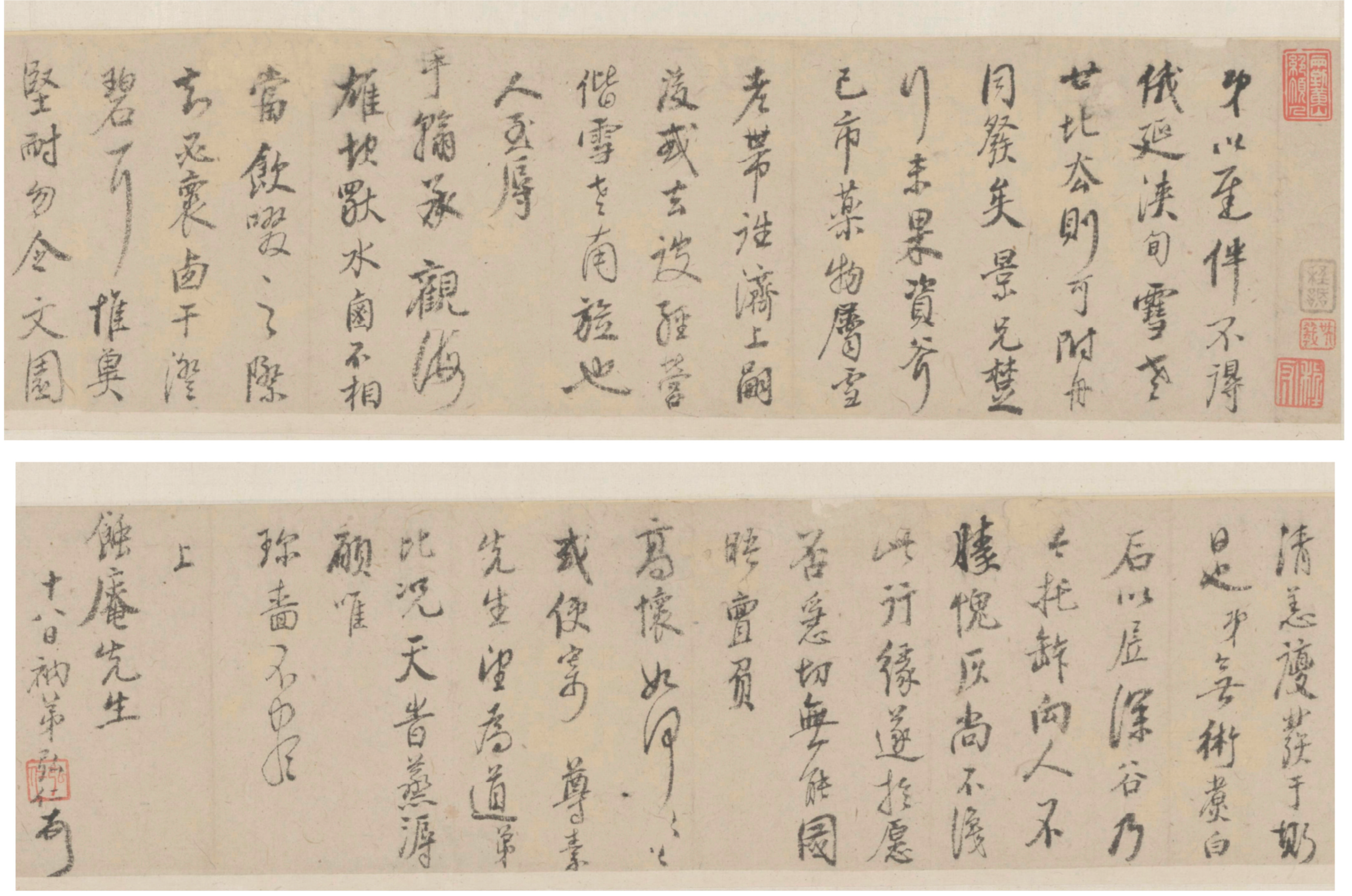
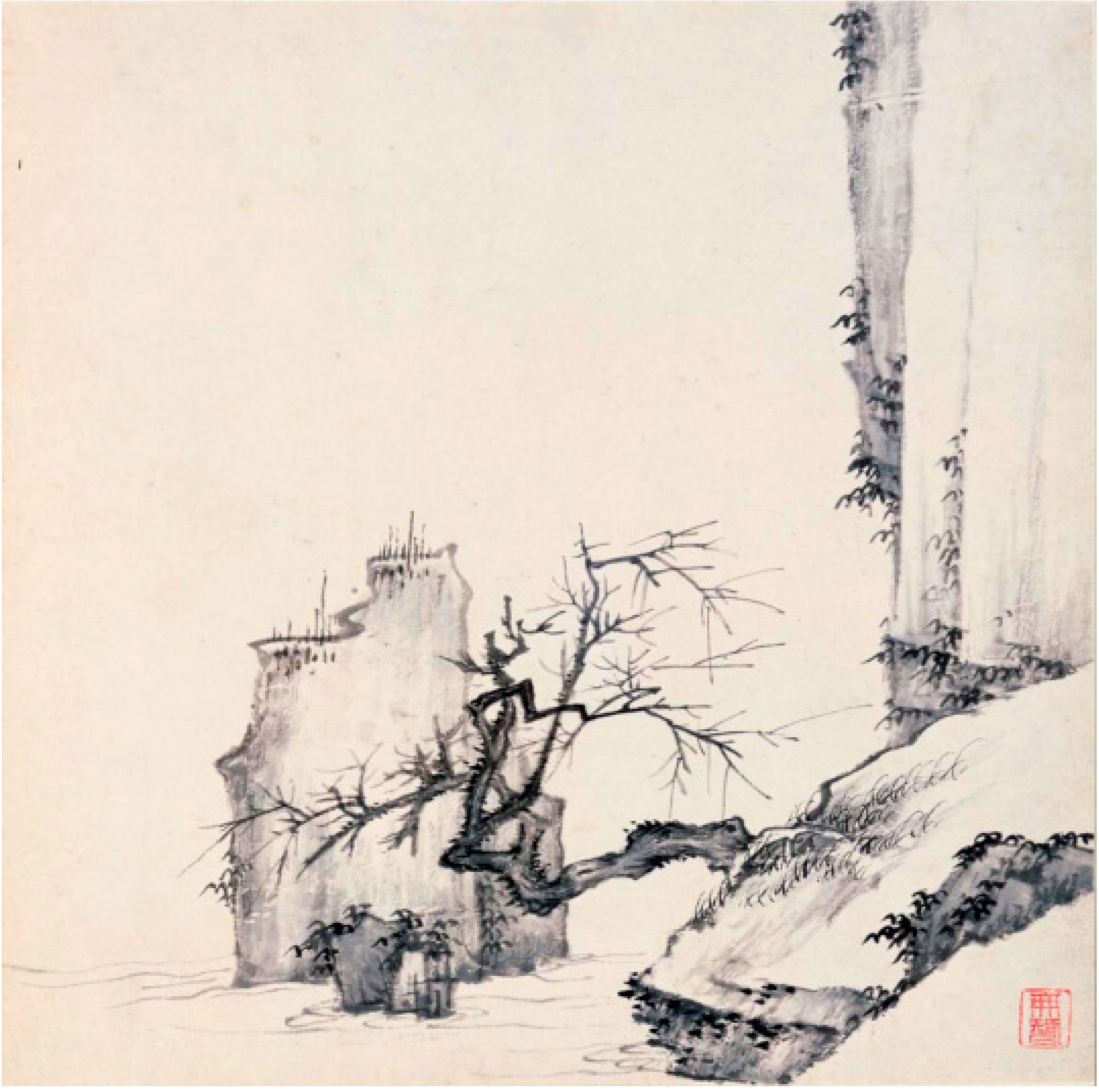
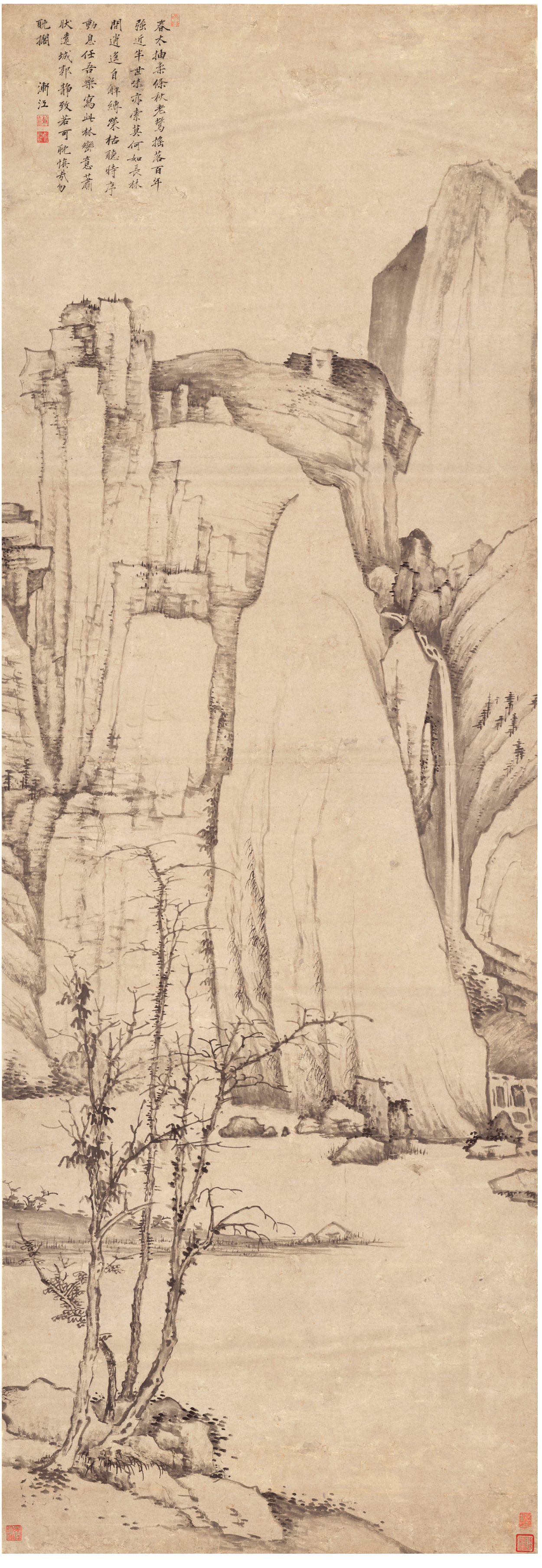
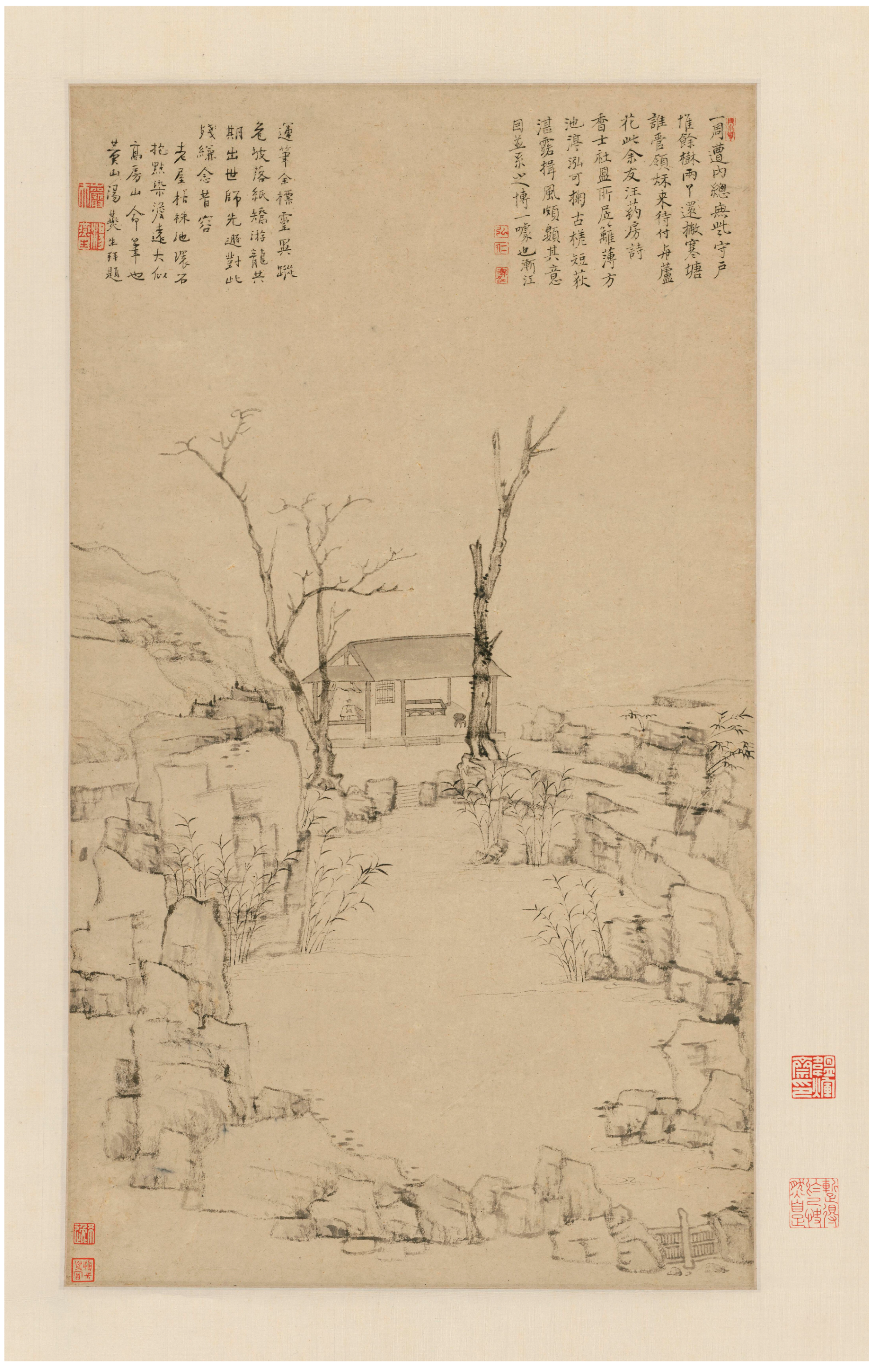
“Within the entire surroundings, there is nothing at all;/only two forked trees remain to guard the gate./Who will take charge of the cold pond left behind?/When autumn comes, it will be entrusted to the reed flowers./This is a poem by my friend Wang Yaofang. My associate Xiangshi’s residence is a place with a thin fence and a square pond, its water clean and deep enough to scoop up by hand. With withered branches and short reeds, soaked in dew and bowing to the wind, it is quite similar to the meaning [of the poem], Thus, I have attached [the poem] here for a smile. 一周遭内总无些, 守户惟余树两丫。还撇寒塘谁管领, 秋来待付与芦花。此余友汪药房诗。香士社盟所居, 篱薄方池, 渟泓可掬, 古槎短荻, 湛露揖风, 颇类其意, 因并系之, 博一噱也”.
5. Conclusions
Author Contributions
Funding
Institutional Review Board Statement
Informed Consent Statement
Data Availability Statement
Conflicts of Interest
| 1. | Hongren (1610–1664), born Jiang Tao, courtesy name Liuqi, also styled Oumeng, dharma name Hongren, and sobriquet Jianjiang, was born into a wealthy merchant family in Huizhou Prefecture during the Wanli period of the Ming dynasty. Huizhou, renowned as the “Zoulu of the Southeast,” had a rich cultural heritage. Hongren received a systematic Confucian education from an early age and studied under the eminent scholar Wang Wuyai, preparing for the imperial examinations. Following the fall of the Ming dynasty, he actively participated in anti-Qing resistance, demonstrating the moral integrity and loyalty characteristic of displaced literati. After the failure of these efforts, he chose to ordain as a Buddhist monk. |
| 2. | Attachment to the Self (Sanskrit: ātma-grāha), a Buddhist term referring to the deeply entrenched belief in the “self” as a substantial, enduring entity, also known as “attachment to person” or “view of self”. Regarded as the root of all afflictions and cognitive hindrances, this concept appears in classical texts such as the Abhidharmakośa-bhāṣya and the Vijñaptimātratāsiddhi-śāstra. It posits that sentient beings fall into delusion by mistakenly identifying the temporary convergence of the Five Aggregates (skandhas) as a real, independent self. |
| 3. | Attachment to Dharma (Sanskrit: dharma-grāha), also known as “attachment to the self of phenomena” or “view of the self of phenomena”, is the counterpart to “attachment to the self” and is one of the two fundamental delusions to be eradicated. While “attachment to the self” refers to the belief in a fixed, substantial human ego, “attachment to dharma” refers to the erroneous belief that the essence of any existence (dharma) possesses a fixed, immutable substance. Overcoming this attachment is a necessary stage of realization, even after severing the initial ignorance of a single thought. |
| 4. | “Technique Ascending to the Dao” originates from Wei Yuan’s (Qing dynasty) Mogu: On Learning II, which states: “Technique can ascend to the Dao, and art can communicate with the divine.” It implies that when technical skill is cultivated to its utmost perfection, it transcends mere craft and accords with the universal principles of the Dao. |
| 5. | True Emptiness and Wondrous Existence, a Buddhist philosophical term succinctly defined as “Existence that is not [ordinary] existence is called Wondrous Existence; Emptiness that is not [absolute] emptiness is called True Emptiness.” Articulated by the Eastern Jin monk Sengzhao in Treatise on the Unreal-Void and Treatise on Prajna without Knowledge, it represents a core concept of Prajna philosophy. It synthesizes the theory of “Emptiness” from the Nature School (Xingzong, 性宗) and “Existence” from the Characteristic School (Xiangzong, 相宗), emphasizing that all things are neither absolute nothingness nor substantial existence, thereby embodying the dialectical relationship of the “non-duality of substance and function”. |
| 6. | Twofold Emptiness of Self and Dharma, also known as the “Twofold Emptiness of Person and Phenomena” or “Twofold Selflessness”, this Buddhist term refers to the collective realization of “Emptiness of Self” and “Emptiness of Dharma.” First appearing in the Yogācārabhūmi-śāstra, its core definition encompasses two aspects of emptiness: the nature of the person (pudgala) being devoid of intrinsic self-nature (Person Emptiness), and the nature of all phenomena (dharmas) being devoid of intrinsic self-nature (Dharma Emptiness). |
| 7. | Selflessness of Persons, a Buddhist term, also known as “Selflessness of Sentient Beings,” “Emptiness of Beings,” “Emptiness of Person,” or “Emptiness of Self,” refers to the absence of a permanent self in the individual. Selflessness of Phenomena, paired with “Selflessness of Persons” as the “Two Selflessness,” refers to the absence of an independent, permanent entity within all conditioned and unconditioned dharmas. As a core Buddhist doctrine, it emphasizes that all phenomena arise from dependent origination and possess neither intrinsic nature nor substantial reality. |
| 8. | Pure Land of Mind-Only, a core term in Chinese Buddhism, emphasizes that the Pure Land manifests from the mind and is inherent in one’s true nature. It asserts that by purifying their own minds, a practitioner can manifest the pure and clear Dharma realm. |
| 9. | The Innate Purity of the Mind, a Buddhist term, refers to the inherently pure and unstained mind that everyone possesses. It is universal, equal, and without differentiation, and is also known as the Tathagatagarbha mind, the True Mind, or Bodhicitta. |
| 10. | Non-abiding and No-form, core Buddhist terms where “Non-abiding” serves as an alias for ultimate reality, signifying that all things lack a fixed essence and arise or cease in dependence on causes and conditions. “No-form” refers to a realized state in which one eliminates attachment to the appearances and breaks through delusive distinctions in cognition to realize the undefined nature of essential reality. |
| 11. | Absence of intrinsic nature is an important concept in Buddhist philosophy for explaining the true reality of all dharmas by dismantling the reified idea of an independent “self-nature” (svabhāva). This idea is conveyed through the kōan teachings of Chan masters such as the Sixth Patriarch Huineng and Mazu Daoyi, revealing that all phenomena arise in dependence on causes and conditions and therefore lack an independent, unchanging essence. |
| 12. | In Buddhism, “dependent origination” means that all things in the world arise from various causes and circumstances. It implies that nothing exists in isolation; rather, everything relies on other factors and conditions to exist and develop. “The nature of Emptiness” builds on this to explain that while phenomena exhibit various differences and manifestations, they essentially lack a fixed, unchanging intrinsic nature. This concept reveals that existence is relative, temporary, and a process of constant change driven by the dynamic interaction of causes and conditions. |
| 13. | Iron-wire Line, one of the “Eighteen Strokes” in traditional Chinese painting, originating between the Wei-Jin and Sui-Tang periods. It utilizes a centered-tip brushwork to delineate lines that are vigorous, uniform, and devoid of variations in thickness, resembling iron wire. |
| 14. | Bent-hairpin Strand, a calligraphic brushwork in running and cursive scripts, referring to the rounded, vigorous arc formed in the turning strokes. Its sense of strength derives from the physical properties of a metal hairpin when bent; the turn should remain smooth, continuous, while embodying internal strength. |
| 15. | The Non-duality of Form and Emptiness, an important concept in Buddhism originating from classic Mahayana doctrines. It signifies that the material world (“form”) and Śūnya (“emptiness”) are not two opposing extremes, but are instead an interdependent and indivisible unity. |
| 16. | Encountering Appearances while Remaining Unattached to Them, Without Mind while in the midst of Mind, an important concept in Chan Buddhism. It refers to the realization that while all things possess appearances (xiang, 相), one should not be bound by them but rather transcend them to perceive their deeper, truer nature. |
| 17. | Breaking Attachment to Appearance, a Buddhist term refers to the breaking through of delusive appearances to reveal the ultimate reality. Its core principle lies in transcending attachment to superficial appearance. |
| 18. | “Illuminate the mind and see one’s true nature” is a core cultivation concept in Chan Buddhism. It refers to the enlightened state of discovering one’s inherent true mind and thoroughly perceiving Buddha-nature through introspective contemplation. It advocates breaking through attachments and afflictions, employing “the union of meditative cultivation and wisdom observation” as its practical method, and emphasizing direct realization over mere intellectual understanding of texts. |
| 19. | “Eliminating defilements to preserve purity” originates from Chapter 35 of The Sutra of Forty-Two Chapters. In this context, “defilement” (gou, 垢) symbolizes the impurities of the mind, while “purity” (jing, 净) refers to the pristine state achieved after such filth is removed. This concept teaches that practitioners must eliminate inner defilement, such as lustful desires, to attain a state of true purity. |
| 20. | Ceasing Delusion to Reveal the True Nature, an important concept in Buddhist cultivation, refers to the process of breaking through false and delusive cognitions and attachments to manifest the inherently complete True Mind and the nature of True Suchness (Tathātā, 真如). |
| 21. | “Precept, Concentration, and Wisdom” collectively form the “Threefold Training”. This is the core cultivation system in Buddhism, designed to remove afflictions and attain liberation from the cycle of reincarnation through progressive practice. |
| 22. | Not Associating with the Myriad Dharmas, a core concept in Chan Buddhism refers to the state of not attaching to any phenomena, transcending the distinction between subject and object, and realizing that all dharmas are inherently empty. It is often discussed alongside the principle of “Not Opposing the Various Dusts,” which signifies not treating delusions and afflictions with hostility, but rather dissolving them with an inclusive mind. This phrase embodies the Chan transcendence of dualistic opposition, emphasizing the direct realization of the absolute reality and the maintenance of awareness without being turned by thoughts. |
| 23. | “Cut off the Myriad Streams” originates from the Chan Buddhist work Compendium of Five Lamps (Wudeng Huiyuan, 五灯会元), specifically attributed to Chan Master Deshan Yuanmi (a Dharma heir of Yunmen Wenyan). Originally describing a meditative state where one removes worldly attachments and discursive thoughts, this idiom has extended to mean transcending conventional thinking to point directly to the ultimate source. |
| 24. | “Without Mind while in the midst of Mind” is a Buddhist term referring to a state of non-attachment. It describes a condition where, when the practitioner reciting the Buddha’s name, his mind remains free from discursive thoughts or intentions, yet the recitation continues uninterrupted. Its core lies in the practical wisdom of maintaining this focus without distraction, thereby attaining a state of mental tranquility and clarity. |
| 25. | A Mind that Embraces the Vast Emptiness; a Heart Boundless as Myriad Worlds. This term originates from the Dharma Gate of the Mind Ground (Xindi Famen, 心地法门). In Buddhism, it is commonly used in temple liturgies for delivering the deceased or averting calamities, serving to express the enlightened state of True Suchness that is perfectly interpenetrated without obstruction. |
| 26. | Defilements and Bodhi Share the Same Essence, an important Buddhist term originating from the Mahāyānasūtrālaṃkāra. It emphasizes the cultivation philosophy that defilements (afflictions) and Bodhi (enlightenment) are essentially non-dual, advocating the attainment of Buddhahood amidst worldly afflictions. |
| 27. | Pure Land, a Buddhist term which, in its narrow sense, specifically refers to the Western Pure Land of Ultimate Bliss (Sukhavati). In this paper, it signifies the inner purity within the mind. |
| 28. | Realm of Tranquil Purity refers to a cultivation state of inner serenity, far removed from the afflictions. It stands in contrast to “vexation” (renao, 热恼). |
| 29. | “Pure Land of Mind-Only” is a Buddhist term asserting that the Pure Land is transformed through the mind alone and remains immanent within the hearts of all sentient beings. |
| 30. | Discussion between Words and Meaning is a philosophical issue in ancient China that explores the relationship between words and meaning, formed in the Wei-Jin dynasties as a systematic reflection on how linguistic symbols convey ideas. It revolves around whether language can fully express meaning and how to apprehend the essential spirit through the classics, involving both epistemological and methodological dimensions. |
References
- Anderson, David. 2025. Jung’s Koan of the Self and a Zen Buddhist Solution. The Journal of Analytical Psychology 70: 182–200. [Google Scholar] [CrossRef] [PubMed]
- Bender, Jacob. 2024. The Non-Duality of the “Conditioned” and “Unconditioned”: Hongzhou Chan Buddhism on Reconciling the Morality/Prudence Distinction. Religions 15: 1064. [Google Scholar] [CrossRef]
- Brinker, Helmut. 1987. Zen in the Art of Painting. New York: ARKANA (Routledge & Kegan Paul Inc.). New York: Methuen Inc Press. [Google Scholar]
- Cage, John. 1961. Silence. Middletown: Wesleyan University Press. [Google Scholar]
- Cahill, James 高居翰. 1985. Lun Hongren Huangshantuce de Guishu 论弘仁黄山图册的归属 [The Attribution of Hongren’s Paintings]. Shanghai: Shanghai Calligraphy and Painting Publishing House 上海书画出版社. [Google Scholar]
- Chen, Yongge 陈永革. 1999. Chanjiao Guijing yu Wanming Fojiao de Pushixing 禅教归净与晚明佛教的普世性 [Chan Buddhism’s Mergence into Pure Land Belief and the Universality of Buddhism of Late Ming]. Religious Studies. Available online: https://kns.cnki.net/kcms2/article/abstract?v=g8n7TwuHW-DI7O5wd2Ac1nU9Ax1zqPnWWQUER3LRiuTRbRXdSjzC8NB5nkyxTGSjc1-j4-QjsB-w6ALnYTiAi9uN9MI9YzpggwDZ5ItZts-BfpCwDmh8Hn4pBoPEQALobvcEDVReV4gfeUlCnuKf2MA1Bzl9xL34gzH7kmGTTPCk76qo-AFC8A==&uniplatform=NZKPT&language=CHS (accessed on 20 April 2026).
- Chen, Yuehua 陈越骅. 2013. Kuawenhua Shiyuzhong de Yanyi zhibian—Gudai Yuyan yu Zhishi de Guanxi Fanshi Xintan 跨文化视域中的言意之辨—古代语言与知识的关系范式新探 [The Discussion Between Words and Meaning in Cross-Cultural Perspective: A New Exploration of Ancient Paradigms of Language and Knowledge]. Academic Monthly 45: 60–66. [Google Scholar]
- Conze, Edward. 1988. Buddhist Wisdom Books: The Diamond and Heart Sutra. Translation and Commentary. London: Unwin. [Google Scholar]
- Dafoding Rulaimiyin Xiuzheng le Yizhu Pusa Wanxing Shouleng Yanjing. 1987. 大佛頂如來密因修證了義諸菩薩萬行首楞嚴經 [The Śūraṅgama Sūtra]. In Zhonghua Canon. Beijing: Zhonghua Book Company 中华书局, vol. 23. [Google Scholar]
- Dazheng, Zang 大正藏. 2004. Taishō Tripiṭaka. Taipei: Chinese Buddhist Electronic Text Association 中华电子佛典协会, vol. 48. [Google Scholar]
- Dharmakṣema 昙无谶, trans. 1982. Daban Niepanjing 大般涅槃经 [Mahāparinirvāṇa Sūtra], Volume 36. In Dazheng Xinxiu Dazangjing 大正新修大藏经 [Taishō Tripiṭaka], Volume 12. Taipei: Shin Wen Feng Publishing 新文丰出版公司. [Google Scholar]
- Faure, Bernard. 1997. The Will to Orthodoxy: A Critical Genealogy of Northern Chan Buddhism. Redwood City: Stanford University Press. [Google Scholar]
- Foulk, T. Griffith. 1987. The “Ch’an school” and Its Place in the Buddhist Monastic Tradition. Ph.D. thesis, The University of Michigan, Ann Arbor, MI, USA. [Google Scholar]
- Foulk, T. Griffith. 2000. Controversies Concerning the ‘Separate Transmission’ of Ch’an. In Buddhism in the Sung. Edited by Peter N. Gregory and Danial A. Getz, Jr. Honolulu: University of Hawai’i Press. [Google Scholar]
- Fu, Songxue 傅松雪. 2008. Chanzong Kongjizhimei de Shijianxing Chanshi 禅宗 “空寂之美”的时间性阐释 [Temporal Interpretation of the “Emptiness and Solitude Beauty in Chan Buddhism”]. Thinking, 76–80. Available online: https://kns.cnki.net/kcms2/article/abstract?v=g8n7TwuHW-C0KD-sazrgYj4ofcdtX_gzXBOeA-m3__nTCxDSo7h-fQxn3yQDofyGeIUY9OZmxAtByTbCYrjWPXDada1KqVAddYo4Pj7ivFaeWaufkzesJ9A9FNEhHvM-pN0zSr1e4JnrTsUXlqFkdri0Q2Vrqz2JsrKMp7YjoIYey4j0rU71gQ==&uniplatform=NZKPT&language=CHS (accessed on 20 April 2026).
- Ge, Zhaoguang 葛兆光. 1995. Zhongguo Chanzong Sixiangshi 中国禅思想史-从6世纪到9世纪 [An Intellectual History of Chan Buddhism in China: From the 6th to the 9th Century]. Beijing: Peking University Press 北京大学出版社. [Google Scholar]
- Hara, Ken’ya 原研哉. 2012. Bai 白 [White]. Nanning: Guangxi Normal University Press 广西师范大学出版社. [Google Scholar]
- Harvey, Peter. 2000. An Introduction to Buddhist Ethics: Foundations, Values, and Issues. Cambridge: Cambridge University Press. [Google Scholar]
- Huineng 惠能. 2010. Tanjing 坛经 [The Platform Sutra]. Changchun: Jilin Literature and History Publishing House 吉林文史出版社. [Google Scholar]
- Huntington, C. W., Jr., and Geshe Namgyal Wangchen. 1989. The Emptiness of Emptiness: An Introduction to Early Indian Madhyamika. Honolulu: University of Hawaii Press. [Google Scholar]
- Huo, Taohui 霍韬晦. 1982. Fojiao de Xiandai Zhihui 佛教的现代智慧 [The Modern Wisdom of Buddhism]. Hong Kong: Chongde Publishing House 香港, 崇德出版社. [Google Scholar]
- Kuo, Jason C. 郭继生. 1991. The Austere Landscape: The Paintings. Washington: University of Washington Press. [Google Scholar]
- Levine, Gregory, and Yukio Lippit. 2007. Awakenings: Zen Figure Paintings from Medieval Japan. New York: Japan Society. New Haven: Yale University Press. [Google Scholar]
- Li, Tiandao 李天道. 2000. Chan: Shengmingzhijing he zuigao Shenmeizhijing 禅: 生命之境和最高审美之境 [Chan Buddhism: The Realm of Life and the Supreme Aesthetic Realm]. Journal of Peking University (Philosophy and Social Sciences), 60–66. Available online: https://kns.cnki.net/kcms2/article/abstract?v=g8n7TwuHW-Cot_usBsQADAjPVNrU_0c47pym4gQrLkbGaXc9Pk3BVMqHKC1dYuMPV0Q-k3zyyXbKQgdYZ0OSxgV-vgkKipBDIZvn9TSTWXQnTClwIgLacpAneytV_Am20em5U9ky7m69IFh50DZoQqtIIUq6ijVsBUg9qBmFbUwEmHmo96MjFw==&uniplatform=NZKPT&language=CHS (accessed on 20 April 2026).
- Li, Zehou 李泽厚. 1994. Zhongguo Gudai Sixiang Shilun 中国古代思想史论 [A History of Ancient Chinese Thought]. Hefei: Anhui Literature and Art Publishing House 安徽文艺出版社. [Google Scholar]
- Liang, Datao 梁达涛, and Yu Kaikai 余凯凯. 2018. Hongren Tihua Shufa de Jing yu Qing 弘仁题画书法的 “静”与“清” [The “Silence” and “Purity” in Hongren’s Calligraphy on Paintings]. Chinese Calligraphy, 90–96. Available online: https://kns.cnki.net/kcms2/article/abstract?v=g8n7TwuHW-BgT6iGpET_SJQPxWrDnP3VpY9DvMk2mSflpz5ft4kqrAPrlFomFHTk4tRqzpB6q4EajLSTF8xp19yZgJw7QhMCMzivHV1ERG33ijuHSaG6VE8gIlStHIjWDfWVebgY7tU8308U4sEagqnLrRGI5ZLzhj3CiCQtX-6j_rwr8aR5Ep8F7twEdfLg&uniplatform=NZKPT&language=CHS (accessed on 20 April 2026).
- Liu, Guirong 刘桂荣, and Fu Juzheng 傅居正. 2014. Chanzong Meixue dui Meiguo Xiandangdai Yishu Chuangzuo Linian de Yingxiang 禅宗美学对美国现当代艺术创作理念的影响. [The Influence of Chan Aesthetics on the Creative Concepts of American Contemporary Art]. Journal of Hebei University (Philosophy and Social Sciences Edition) 39: 149. [Google Scholar]
- Lü, Cheng 吕澂. 1985. Zhongguo Foxue Yuanliu Luejiang 中国佛学源流略讲 [A Brief Account of the Development of Chinese Buddhist Studies]. Taipei: Liren Bookstore 里仁书局. [Google Scholar]
- Mao, Xiaodong 毛小东. 2024. Dierji Wuyichanshi Shi Boshanshiciji 第二辑 无异禅师诗, 博山诗词集 [Volume 2, Poems of Chan Master Wuyi, Collected Poems and Lyrics of Boshan]. Nanchang: Jiangxi People’s Publishing House 江西人民出版社. [Google Scholar]
- McRae, John R. 2003. Seeing Through Zen: Encounter, Transformation, and Genealogy in Chinese Chan Buddhism. Oakland: University of California Press. [Google Scholar]
- Peng, Feng. 2021. Arthur Danto as a Zen Master: An Interpretation of Danto’s Philosophy of Art from a Zen Perspective. Asian Philosophy 31: 42. [Google Scholar] [CrossRef]
- Peng, Xiuyin 彭修银, and Yao Yi 姚羿. 2020. Zhonngguo Chanzong Meixue de Shenmei Yijing yu Shengtai Jingshen 中国禅宗美学的审美意境与生态精神 [The Aesthetic Conception and Ecological Spirit of Chinese Chan Aesthetics]. Hundred Schools in Arts 36: 20. [Google Scholar]
- Puji 普济. 1984. Wudenghui Yuan Juan 五灯会元卷七 [Compendium of the Five Lamps]. Beijing: Zhonghua Book Company 中华书局, vol. 7. [Google Scholar]
- Ran, Xiandong 冉献东. 2013. Qingleng de Xingge Chuancheng—Lun Nizan, Hongren de Bimo Zhixiang 清冷的性格传承—论倪瓒, 弘仁的笔墨指向 [Inheritance of the Aloof Temperament: On the Brushwork Orientation of Ni Zan and Hongren]. Journal of Chinese Culture 7: 145. [Google Scholar]
- Ren, Yimin 任宜敏. 2016. Caodongzong Shouchangxi Famai Kaolue 曹洞宗寿昌系法脉考略 [A Brief Examination of the Dharma Lineage of the Shouchang Branch of the Caodong School]. Zhejiang Academic Journal, 16–26. [Google Scholar] [CrossRef]
- Sengzhao 僧肇. 2004. Zhao Lun 肇论 [The Treatise of Seng Zhao]. In Taishō Tripiṭaka. Taipei: Chinese Buddhist Electronic Text Association, vol. 45. [Google Scholar]
- Sharf, Robert. 2001. Coming to Terms with Chinese Buddhism: A Reading of the Treasure Store Treatise. Honolulu: University of Hawaii Press. [Google Scholar]
- Song, Wei 宋伟. 2023. Chanzong Meixue de Shengming Zhihui:Yuzhou, Shengming yu Yishu de Yuanrong Wuai 禅宗美学的生命智慧: 宇宙, 生命与艺术的圆融无碍 [The Vital Wisdom of Chan Aesthetics: The Perfect Interpenetration of Universe, Life, and Art]. Social Sciences in Chinese Higher Education, 116. Available online: https://kns.cnki.net/kcms2/article/abstract?v=g8n7TwuHW-AmkMoZFa5IETK9UoYRIwKXWLAln8udZAT4fidyPHH8KL3ZjQm5ZPEW6e7TVvyXXyVpeFzboeIvP0XLUVbeufkxOrblf_C7YWQEYz_tDSg6R2QhA-kFqz7TSxdo7VnurX54NZpCvn6Xje0I8pIIRGoyUMSa-Fo7BZszGniPS0ZDMls7O6F_vrhP&uniplatform=NZKPT&language=CHS (accessed on 20 April 2026).
- Suzuki, Daisetz Teitaro. 1970. The Field of Zen. New York: Harper & Row. [Google Scholar]
- Suzuki, Daisetz Teitaro. 1999. The Way to Zen Studies. Translated by Ge Zhaoguang 葛兆光. Shanghai: Shanghai Classics Publishing House. [Google Scholar]
- Tianran, Hanshi 天然函昰. 1976. Zongbao Daodu Chanshi Yulu 宗宝道独禅师语录 [The Recorded Sayings of Chan Master Daodu of Zongbao]. In Manji Zokuzokyo 卍续藏经. Taipei: Shin Wen Feng Publishing 新文丰出版公司, vol. 72. [Google Scholar]
- Wang, Shiqing 汪世清. 1964. Jianjiang Ziliaoji 渐江资料集 [Collection of Jianjiang’s Works]. Hefei: Anhui People’s Publishing House 安徽人民出版社. [Google Scholar]
- Wei, Ran 蔚然. 2023. Qingdai Hangzhou Shihuaseng Shige Yanjiu 清代杭州诗画僧诗歌研究 [A Study on the Poetry of Monk-Painters in Hangzhou during the Qing Dynasty]. Journal of Zhejiang Sci-Tech University (Social Sciences) 50: 453. [Google Scholar]
- Welter, Albert. 2006. Monks, Rulers, and Literati: The Political Ascendancy of Chan Buddhism. Oxford: Oxford University Press. [Google Scholar]
- Wu, Jiang. 2008. Enlightenment in Dispute: The Reinvention of Chan Buddhism in Seventeenth-Century China. London: Oxford University Press. [Google Scholar]
- Wu, Jiang. 2023. Chan Enlightenment and Monastic Debate: The Reconstruction of Chinese Chan Buddhism in the 17th Century. Shanghai: Zhongxi Book Bureau. [Google Scholar]
- Yang, Xin 杨新. 2000. Siseng Huihua 四僧绘画 [Four Monks Painting]. Shanghai: Shanghai Science and Technology Press and Commercial Press (Hong Kong) 上海科学技术出版社商务印书馆(香港)有限公司. [Google Scholar]
- Yin, Shu 殷曙. 1926. Zhuxi Zasu: Jianjiang Shizhuan 竹溪杂述·渐江师传 [Zhuxi Zasu: Biography of Master Jianjiang]. Shanghai: Commercial Press 商务印书局. [Google Scholar]
- Zhang, Yanyuan 张彦远. 2005. Lidai Minghua Ji 历代名画记 [Records of Famous Paintings Through the Ages]. Beijing: People’s Fine Arts Publishing House 人民美术出版社. [Google Scholar]
- Zhao, Jishi 赵吉士. 1700. Huizhou Fuzhi 徽州府志 [Chronicle of Huizhou Prefecture in the Kangxi Era], 2010 ed. Anhui: Huangshan Publishing House 黄山书社出版. [Google Scholar]
- Zhou, Quantian 周全田. 2005. Dui Chanzong Meixue Bentilun de Fansi 对禅宗美学本体论的反思 [Reflection on the Ontology of Chan Aesthetics]. Journal of Zhengzhou University (Philosophy and Social Sciences Edition), 47–51. Available online: https://kns.cnki.net/kcms2/article/abstract?v=g8n7TwuHW-AYMWc_puBfiXcMsZmhC24Wkoa-hEU474itQXmaU1EuJg0BkRWNDwBYrIXmIyD1-RjJof0ryllNeoKBNaNXyQ6Wb-98HH2yf_fFk0aHxsHeMZNTt0HoLh62SOyQ0dw1HcfXkiknEv5SLfJkZYCsxsR1OD9VEffjzthoBakeDmOk6w==&uniplatform=NZKPT&language=CHS (accessed on 20 April 2026).
- Zhu, Cheng. 2025. The Pursuit of Universality in Chinese Buddhism. Religions 16: 452. [Google Scholar] [CrossRef]











Disclaimer/Publisher’s Note: The statements, opinions and data contained in all publications are solely those of the individual author(s) and contributor(s) and not of MDPI and/or the editor(s). MDPI and/or the editor(s) disclaim responsibility for any injury to people or property resulting from any ideas, methods, instructions or products referred to in the content. |
© 2026 by the authors. Licensee MDPI, Basel, Switzerland. This article is an open access article distributed under the terms and conditions of the Creative Commons Attribution (CC BY) license.
Share and Cite
Lu, Q.; Li, J.; Wu, Y.; Zha, Z. The Expression of Chan “Emptiness Contemplation” in Hongren’s Landscape Painting. Religions 2026, 17, 619. https://doi.org/10.3390/rel17050619
Lu Q, Li J, Wu Y, Zha Z. The Expression of Chan “Emptiness Contemplation” in Hongren’s Landscape Painting. Religions. 2026; 17(5):619. https://doi.org/10.3390/rel17050619
Chicago/Turabian StyleLu, Qingning, Jingshu Li, Yueming Wu, and Zhuo Zha. 2026. "The Expression of Chan “Emptiness Contemplation” in Hongren’s Landscape Painting" Religions 17, no. 5: 619. https://doi.org/10.3390/rel17050619
APA StyleLu, Q., Li, J., Wu, Y., & Zha, Z. (2026). The Expression of Chan “Emptiness Contemplation” in Hongren’s Landscape Painting. Religions, 17(5), 619. https://doi.org/10.3390/rel17050619