Article

The Expression of Chan “Emptiness Contemplation” in Hongren’s Landscape Painting

1
School of Philosophy, Wuhan University, Wuhan 430072, China
2
School of Chinese Painting, Hubei Institute of Fine Arts, Wuhan 430072, China
3
Faculty of Innovation and Design, City University of Macau, Macau 999078, China
4
School of Foreign Languages, Beijing Institute of Technology, Beijing 102400, China
*
Author to whom correspondence should be addressed.
Religions 2026, 17(5), 619; https://doi.org/10.3390/rel17050619
Submission received: 31 January 2026 / Revised: 13 May 2026 / Accepted: 14 May 2026 / Published: 20 May 2026

Abstract

This paper focuses on the early Qing monk-painter Hongren 弘仁, systematically exploring the pathways through which the Chan Buddhist “emptiness contemplation” is manifested in his landscape paintings. As a representative monk-painter, Hongren produced works that profoundly embody the Chan contemplation of emptiness, yielding a singular style defined by austere coldness, minimalist simplicity, and profound quietude. Transcending conventional stylistic descriptions in art history and essentialist philosophical deductions, this study adopts a comprehensive empirical approach that integrates poetry, calligraphy, painting, and seals (shi-shu-hua-yin 诗书画印). By adopting an interdisciplinary perspective of philosophy, religion, and art history, this study argues that Hongren’s landscapes are not merely subjective emotional expressions or aesthetic pursuits; rather, they constitute a visual extension and a spiritual externalization of his emptiness contemplation. Through a multi-layered analysis of his form, brushwork, composition, and artistic conception, combined with the mutual corroboration of poetic inscriptions on paintings and textual inscriptions on seals, this paper reveals how the Chan philosophy of “emptiness contemplation” is reflected within his artistic language. While Hongren’s style is the cumulative result of various factors such as the Ming-Qing dynasty transition, his personal life, the inheritance of painting techniques, and the regional culture of Mount Huang, this paper specifically takes Chan thought as its analytical starting point, focusing on its unique expression in his work. Hongren’s path of “Painting-Chan” (hua chan 画禅) not only infused early Qing painting with a sublime spiritual power but also provides a vital religious exegesis of the deep-seated Chinese tradition of “Technique Ascending to the Dao” (ji jin yu dao 技进于道).

1. Introduction

Hongren1 (1610–1664), one of the celebrated “Four Monk-Painters” of the early Qing dynasty, occupies a pivotal position in the history of Chinese art. His landscape paintings, particularly those depicting Mount Huang, are distinguished by their clean compositions, austere brushwork, and an artistic conception of profound silence, qualities that visually manifest a distinct Chan Buddhist spirit. In China, scholarship on Hongren has long been prolific. Foundational contributions by early scholars such as Huang Binhong 黄宾虹, Xu Chengyao 许承尧, and Zhang Daqian 张大千 focused on verifying his biography and authenticating his oeuvre. Later, Wang Shiqing’s 汪世清Collection of Materials on Jianjiang (Wang 1964) established a solid documentary basis for all subsequent research. However, international scholarship focused on Hongren remains relatively limited. Apart from a few dedicated works, such as James Cahill’s The Attribution of Hongren’s Paintings (Cahill 1985, pp. 108–24), and Jason C. Kuo’s The Austere Landscape: The Paintings of Hung-jen (Kuo 1991), most discussions situate him within a broader overview of Chan art. Overall, existing studies remain largely rooted in art-historical perspectives, concentrating primarily on biographical verification, stylistic analysis, authentication of works, and the exploration of aesthetic conception. However, a systematic inquiry into how the Chan “Emptiness Contemplation” functioned as an internal mechanism shaping his artistic creation remains absent.
Although international scholarship on the relationship between Chan Buddhism and the arts has yielded rich results, a notable regional bias persists toward the Japanese Zen tradition. Japanese scholars, most notably Daisetsu Teitaro Suzuki (Suzuki 1970), were instrumental in disseminating Zen thought to the West, sparking a widespread “Zen boom” in Western society during the mid-twentieth century. From the early to mid-twentieth century, Western research focused primarily on the intrinsic connections among the Zen spirit, the painters, and their works, concentrating on the manifestation of Zen philosophy within paintings. In the twenty-first century, however, Western discourse on Zen painting has gradually moved beyond the influence of scholars such as D. T. Suzuki. Gregory Levine and Yukio Lippit have challenged the authoritative interpretations of Zen art provided by Japanese masters like Suzuki and Hisamatsu Shin’ichi, arguing that their frameworks restricted the broader scope of Zen art. By redefining three essential characteristics of Zen art, Levine and Lippit have significantly advanced the depth of research in this field. Within the realm of art history, their co-authored work, Awakenings: Zen Figure Paintings from Medieval Japan (Levine and Yukio 2007), provides an in-depth exploration of the distinctive traits of Zen art throughout its various historical transformations.
Within Chinese academia, however, the field of Chan aesthetics has unfolded across multiple dimensions. In intellectual history, Chen Yongge 陈永革 (Yongge Chen 1999) has elucidated Buddhist ethics and cultivation views, and Wei Ran 蔚然 (Wei 2023) has systematically studied the community of monk-painters in the Qing dynasty, thereby providing a local contextual reference for understanding Chan social practice and monastic creation. In aesthetic theory, Li Zehou 李泽厚 (Z. Li 1994) argues that Chan implies a transcendence of linear temporality, and Ge Zhaoguang 葛兆光 (Ge 1995) interpreted its pursuit of “non-differentiation” as a philosophical resource for understanding the ideals of simplicity and silence in art. Fu Songxue 傅松雪 (Fu 2008) further deepened this inquiry by proposing that within the Chan perspective, “the realm is itself the mind,” a formulation that foregrounds the non-duality of subject and object as the fundamental source of artistic expression. Despite these significant advances, systematic research on Chinese Chan aesthetics, especially its deep integration with the literati landscape tradition, remains relatively underdeveloped.
Regarding the unique group of the “Four Monk-Painters” of the early Qing Dynasty, although their art is uniformly imbued with Chan spirit, their modes of expression and philosophical emphases differ significantly. Bada Shanren 八大山人 (Zhu Da 朱耷), while skilled in landscapes, centered his creative practice on bird-and-flower painting. Moreover, the air of gloomy indignation that permeates his landscapes contrasts sharply with the profound silence found in Hongren’s work. Similarly, the landscapes of Shitao 石涛 and Kuncan 髡残, characterized by dense brushwork and a vigorous atmosphere, express a Chan spirit closer to the “vitality of all dharmas” (wanfa shengji, 万法生机) rather than the “silent illumination of emptiness” (kongguan jizhao, 空观寂照). In contrast, Hongren’s landscapes exhibit highly pure, minimalist, and silent visual characteristics across form, brushwork, composition, and artistic conception. These qualities form a particularly direct and profound structural homology with his practice of Chan “Emptiness Contemplation,” making him the ideal case study for this research.
In summary, while Chinese scholarship remains relatively limited regarding the integration of Chan aesthetics and the landscape painting tradition, international discourse has largely shifted toward a critique of essentialist Zen perspectives. In recent years, scholars have also begun to focus on the historical evolution and visual expression of Chinese Chan Buddhism. For instance, Wu Jiang’s 吴疆 (Wu 2008) in-depth investigation into the reconstruction of Chan during the Ming-Qing transition provides a cross-contextual perspective for understanding the transformation of Chan and its interaction with culture and art in specific historical periods. It should be noted, however, that Wu’s work does not directly address Hongren or offer a case-specific analysis of his paintings; rather, it supplies valuable religious and historiographical context for situating Hongren’s practice of “painting as cultivation” within the broader Chan landscape of the Ming-Qing transition. This study does not intend to engage in metaphysical disputes over “Zen essentialism,” nor does it rely solely on external iconographic or sociological perspectives. Instead, it attempts to supplement case studies of Chan art through a comprehensive empirical analysis of the “emptiness contemplation” in Hongren’s landscape paintings. This methodology, developed from Pan Tianshou’s 潘天寿 “Four Perfections” (siquan 四全) theory and Wang Guowei’s 王国维 “Dual Evidence Method” (erzhong zhengju fa 二重证据法), is particularly applicable to the research of both traditional Chinese painting and literati painting. We contend that understanding the “emptiness contemplation” in Hongren’s landscapes cannot rely on the deduction of philosophical concepts alone; rather, it must return to the material evidence of the artworks themselves. Therefore, by systematically examining the internal connections among poetic inscriptions, seals, brushwork language, and pictorial structures, this study adopts an empirical path of “verifying the painting through poetry and the mind through seals.” This approach objectively analyzes the specific manifestations of emptiness contemplation in his work instead of constructing an abstract “essence of Chan aesthetics.” It should be noted that Hongren’s artistic style resulted from the interplay of multiple factors, including the Ming-Qing dynastic transition, his personal life, the inheritance of painting techniques, the infiltration of Chan thought, and the regional culture of Mount Huang. This study focuses exclusively on the unique expression of Chan thought within his oeuvre to present the historical fusion of Chan spirit and pictorial imagery.
This study contends that Hongren’s painting practice was far more than a mere display of technical skill, as it embodied his lived practice of “emptiness contemplation” and his effort to overcome both “attachment to the self”2 (我执) and “attachment to dharma” 3 (法执). His minimalist compositions, austere lines, geometric mountain forms, and spacious artistic realms were not simply personal aesthetic preferences; rather, they represented mental imagery manifested through the reflection of “emptiness contemplation” within specific historical circumstances. By bridging intellectual history, religious practice, and formal art analysis, this study not only elucidates the visual manifestation of Chan thought in Hongren’s landscape paintings but also offers a religious exegesis, grounded in historical context and material evidence, of the profound Chinese tradition of “Technique Ascending to the Dao”4 (ji jin yu dao, 技进于道).

2. The Generative Mechanism of Hongren’s Landscapes and the Aesthetics of Chan “Emptiness Contemplation”

Serving as the logical foundation for this study, this chapter aims to delineate the intellectual genealogy of Hongren’s ‘aesthetics of Emptiness Contemplation,’ and to objectively present the transformation of his life trajectory from a scholar-official to a monk-painter. Rather than merely recounting biographical facts, this chapter examines the interplay of diverse factors, including the dynastic turmoil of his era, his personal life experiences, the pathways of Chan Buddhist infiltration, the lineage of painting techniques, and the visual inspiration of the Mount Huang region. It analyzes how this identity shift allowed his artistic practice to be permeated by the unique qualities of emptiness contemplation, a characteristic that resulted not from a single influence but from the refraction of multiple historical contexts and individual experiences within his brush and ink. The introduction to Chan aesthetics and emptiness contemplation in this chapter consistently centers on Hongren’s specific case, thereby avoiding the pitfalls of Zen essentialism by employing it as a pivotal perspective for interpreting his visual language rather than as an essentialist framework. Ultimately, this chapter establishes the historical and intellectual foundation for the subsequent micro-analysis of his specific formal languages, particularly his geometric patterns and minimalist brushwork.

2.1. From Scholar to Monk-Painter: The Intellectual Transformation of Hongren

Hongren’s life trajectory evolved from a Confucian scholar, deeply imbued with Confucian ideology and upholding the integrity of a “loyalist” (yimin, 遗民), into a monk-painter who “dwelled in the joy of Chan and dedicated his life to the Dharma.” This profound transition served as the fundamental premise for the spiritual transcendence achieved in his art.
Born into a wealthy merchant family in Huizhou Prefecture during the Wanli reign of the Ming Dynasty, Hongren received a systematic Confucian education from an early age and studied under the renowned Confucian scholar Wang Wuya, dedicating himself to the civil service examinations. Confucian education was instrumental in imbuing Hongren’s work with its profound literati temperament. Following the collapse of the Ming Dynasty, he demonstrated the moral integrity characteristic of loyalist intellectuals by choosing to tonsure and become a monk. Mount Wuyi marked a crucial turning point in his life. According to Zhao Jishi’s 赵吉士 Chronicle of Huizhou Prefecture in the Kangxi Era(《康熙徽州府志》): “In the yǐyǒu year (1645), carrying his books and scrolls, he followed his teacher south into Fujian, traveled to Mount Wuyi, and later relied on Chan Master Guhang to become a monk. 乙酉自负卷轴, 借其师入闽, 游武夷, 后依古航禅师为僧” (Zhao 1700, p. 78). This record confirms that Hongren left Shexian for Fujian with his teacher Wang Wuya in 1645 and subsequently took monastic vows at Mount Wuyi under Chan Master Guhang Daozhou 古航道舟.
This lineage of mentorship was of decisive significance in shaping Hongren’s artistic spirit. Guhang Daozhou was a master of the Caodong school in the late Ming dynasty and a Dharma heir to Master Boshan Yuanlai (Ren 2016, pp. 16–26). As a leading figure in the late Ming revival of the Caodong school, Boshan Yuanlai 博山元来 famously practiced “Emptiness” for five years at Mount Wutai, and his Chan thought was renowned for its profound inquiry into “Emptiness Contemplation.”
In his poetic work Shou Xuan Jing Cheng Zong (Two Poems) 《寿玄镜成宗》(二首), Boshan Yuanlai vividly depicted the state of boundless and unhindered “Kong” (Emptiness) central to his lineage:
“Since ancient times, the Chan gates have known no years;/Who passes down the vain words of fifty?/If you wish to know the true message beyond the ordinary,/The sun shines on the clear river, a singular tapestry of brocade./The sun, moon, and stars proclaim the ultimate reality;/Mountains, rivers, and the great earth expound the perfect sound./Adding fire again within the red furnace’s flames,/Fiercely refining the ancient Buddha’s heart. 自古禅门无岁月, 浪言五十是谁传. 要知节外真消息, 日照澄江锦一团. 日月星辰谈实相, 山河大地演圆音. 红炉焰里重添火, 炟赫烹蒸古佛心.”.
(Mao 2024, p. 57)
These verses profoundly reveal the essential characteristics of the Boshan lineage’s view of emptiness. The opening line, “the Chan gates have known no years,” directly points to the ontological nature of Emptiness that transcends linear time. The imagery of “the sun shining on the clear river” and “mountains, rivers, and the great earth” demonstrates that while all phenomena are inherently empty, daily life and the natural world are themselves manifestations of ultimate reality. This encapsulates the “True Emptiness and Wondrous Existence.” This “ancient Buddha’s heart,” tempered in the blazing furnace of the mundane world, is precisely the mind-dharma of emptiness that Hongren would later pursue in his brush and ink: a state of dispelling worldly distractions and achieving austere clarity.
The “meticulous” style of the Boshan school was reflected not only in its profound study of the philosophy of emptiness, but also in its strict practice of spiritual cultivation. This “meticulous family tradition” was highly praised by the Chan community at that time. Tianran Hanshi 天然函昰, a prominent early Qing monk in the Lingnan region and a subsequent Dharma heir of Boshan lineage, praised his teacher Zongbao Daodu (宗宝道独, a direct descendant of Boshan Yuanlai) in his Account of the Conduct of the Old Monk Changqing 《长庆老和尚行状》: “The meticulous family tradition of Boshan spanning thirty years, the teacher is truly worthy of it” (Tianran 1976, p. 769). This evaluation profoundly reveals the earnestness of the Boshan lineage’s “cultivation-oriented” approach.
T. Griffith Foulk once incisively observed that the notion of “a separate transmission outside the teachings” (jiaowai biechuan, 教外别传) served precisely to guarantee the legitimacy of Chan within an unbroken lineage. Simultaneously, because this mind-to-mind transmission transcended verbal expression, it also brought Chan closer to the essence of Chan practice itself than other Buddhist schools (Foulk 2000, p. 22). The “meticulous family tradition” and the cultivation-oriented spirit embodied by the Boshan lineage stand as a vivid corroboration of Foulk’s insight. What Hongren inherited was not merely the Caodong lineage name, but a Chan transmission that transcended words and pointed directly to the mind. This emphasis on direct realization, unencumbered by verbal elaboration, laid a solid practical foundation for his later internalization of Chan cultivation as the central impetus for his artistic creation.
As a second-generation Dharma heir of the Boshan lineage, Hongren inherited not a generic religious faith, but the orthodox Caodong transmission of “Emptiness Contemplation” grounded in profound theoretical foundations. This provided a legitimate sectarian source for the philosophical core that would later permeate his art.
The Confucian ideals that Hongren had imbibed in his early years completely disintegrated after the traumatic experience of dynastic collapse. This catastrophe compelled him to resolutely turn away from the external pursuit of worldly achievements and toward an internal settlement of the mind and nature.
During the tumultuous transition from the late Ming to the early Qing dynasty, the motivations of monk-painters varied significantly. Some were wholeheartedly devoted to Buddhism, while others became monks primarily to escape the world as loyalists. Regardless of the case, “as monks, their life experiences were generally simple, mostly spent in mountains and forests. Although they occasionally engaged with the secular world, it was never their norm” (Wei 2023, p. 453). However, this “simple” life in the mountains and forests did not necessarily equate to spiritual “purity” or “enlightenment.” As Professor Wu Jiang of the University of Arizona points out in Enlightenment in Dispute: The Reinvention of Chan Buddhism in Seventeenth-Century China, the motivations of many monks of that era were deeply compromised; they often adopted monasticism merely as a guise, “tracing their steps in the dust of the black robe” and treating the kasaya (monastic robe) simply as an expedient garment for escaping the world. In contrast, accounts by Hongren’s contemporaries reveal him to be a practitioner of “pure karma” (jingye, 净业) whose motives were exceptionally singular. Wang Taizheng 王泰徵, in his Biography of Monk Jianjiang 《渐江和尚传》, particularly emphasizes Hongren’s resolute stance of “never marrying nor holding office throughout his life.” This was not merely an expression of political loyalty to the fallen Ming dynasty, but a complete severance of secular attachments. Furthermore, Xu Chu’s许楚 depiction in Outer Biography of Master Jianjiang of Mount Huang 《黄山渐江大师外传》 portrays him as an ascetic monk who “hung a gourd and dragged a staff, resting on no fixed bed,” further corroborating the austerity and detachment of his lifestyle. This life journey, propelled by the trauma of his era and sustained by unalloyed spiritual motivation, elevated Hongren far beyond the status of an ordinary “loyalist-monk,” as he authentically internalized religious cultivation as a lived, existential praxis.
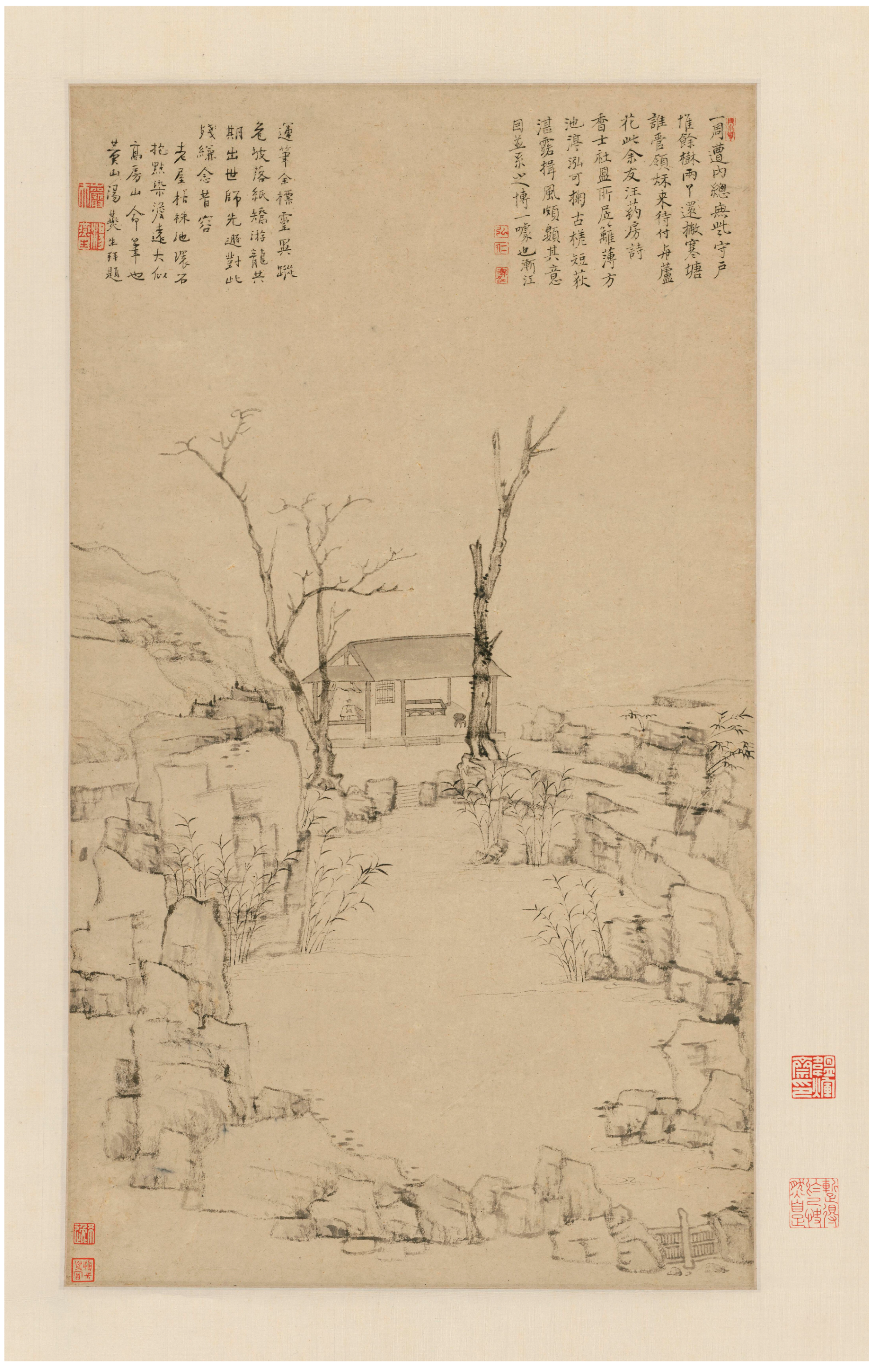
This “asceticism” was no empty claim, but was deeply ingrained in the indigence of Hongren’s daily life. In a letter addressed to his close friend Cheng Zhengkui 程正揆 (style name Shian 蚀庵) (see Figure 1), Hongren candidly revealed both his financial embarrassment and his spiritual steadfastness. This correspondence offers a vivid reconstruction of Hongren’s actual circumstances: as a high-ranking official and celebrated painter, Cheng Zhengkui served as a vital patron for Hongren. Within the text, Hongren admitted that his travel expenses had been exhausted on medicine, forcing him to reluctantly borrow money while expressing profound remorse for his predicament. His self-appellation as “Na di” (monk-brother 衲弟) served as a symbolic marker of the total divestment of his secular identity. Nevertheless, even amidst such dire straits, he still remarked that he was “fortunate enough to find a measure of peace here” (qing zi yu si zu shao shan 庆兹于斯足少善). Such gratitude for the continuity of his spiritual practice far outweighed any complaints regarding material deprivation, providing robust evidence that he was not merely “tracing his steps in the dust of the black robe” (tuoji zichen 托迹缁尘) but was a “pure karma” monk who authentically embodied the rigors of ascetic cultivation.
Chan Buddhism, with its foundational tenet of “direct pointing to the human mind and seeing one’s nature to become a Buddha” (zhizhi renxin, jianxing chengfo 直指人心, 见性成佛), provided him with a path of liberation to transcend worldly suffering and attain ultimate inner peace. Consequently, Hongren’s ordination marked a profound religious turning point that infused his artistic creation with a new spiritual core and an inexhaustible generative power, thereby rooting his painting firmly in profound religious soil.
His early works primarily focused on an in-depth study of the brush-and-ink traditions of Song and Yuan masters, particularly Ni Zan and Huang Gongwang (Wang 1964, p. 1). Works from this period display his imitation of techniques such as Huang Gongwang’s “hemp-fiber strokes” (pima cun, 披麻皴), and their style remains within traditional categories. This can be viewed as a foundational stage of “sharpening one’s mind by borrowing the path of the ancients,” akin to the Chan emphasis on “realizing the doctrinal essence through scriptural teachings” (jie jiao wu zong, 藉教悟宗), honing both spiritual nature and technique through the nourishment of tradition. At the age of thirty, when he participated in the collaborative painting of the Gangling Handscroll 《冈陵图卷》 (now in Shanghai Museum, image not publicly available), his brushwork still appeared immature, and his personal style had not yet emerged.
After becoming a monk in his middle age and undergoing a series of major life transitions, his painting style shifted significantly toward qualities of detachment, simplicity and sparse expansiveness. His brushwork became more restrained, his composition more rational, and the forms of mountains and rocks began to exhibit distinct geometric characteristics. During this period, he traveled frequently to Mount Huang, whose precipitous geological formations provided a natural basis for his geometric language. However, the driving force behind the fundamental transformation of his artistic core was his profound experiential realization of “Emptiness Contemplation” in Chan practice. As Huo Taohui 霍韬晦 (Huo 1982, p. 12) explains: “All existing things arise from dependent origination; therefore, everything is empty in its substance, like an illusion or transformation, with nothing fixed to attach to, and no form to be grasped.” This fundamental realization of the “Dependent Origination and the Nature of Emptiness” (yuanqi xingkong, 缘起性空) became the starting point for Hongren’s reconstruction of his artistic view: since external landscapes are “like illusions and transformations,”painting need not be constrained by “fixation” (dingzhuo, 定着) or “grasping at forms” (quxiang, 取相) of external likeness, but should instead turn toward an exploration of the intrinsic nature of the mind.
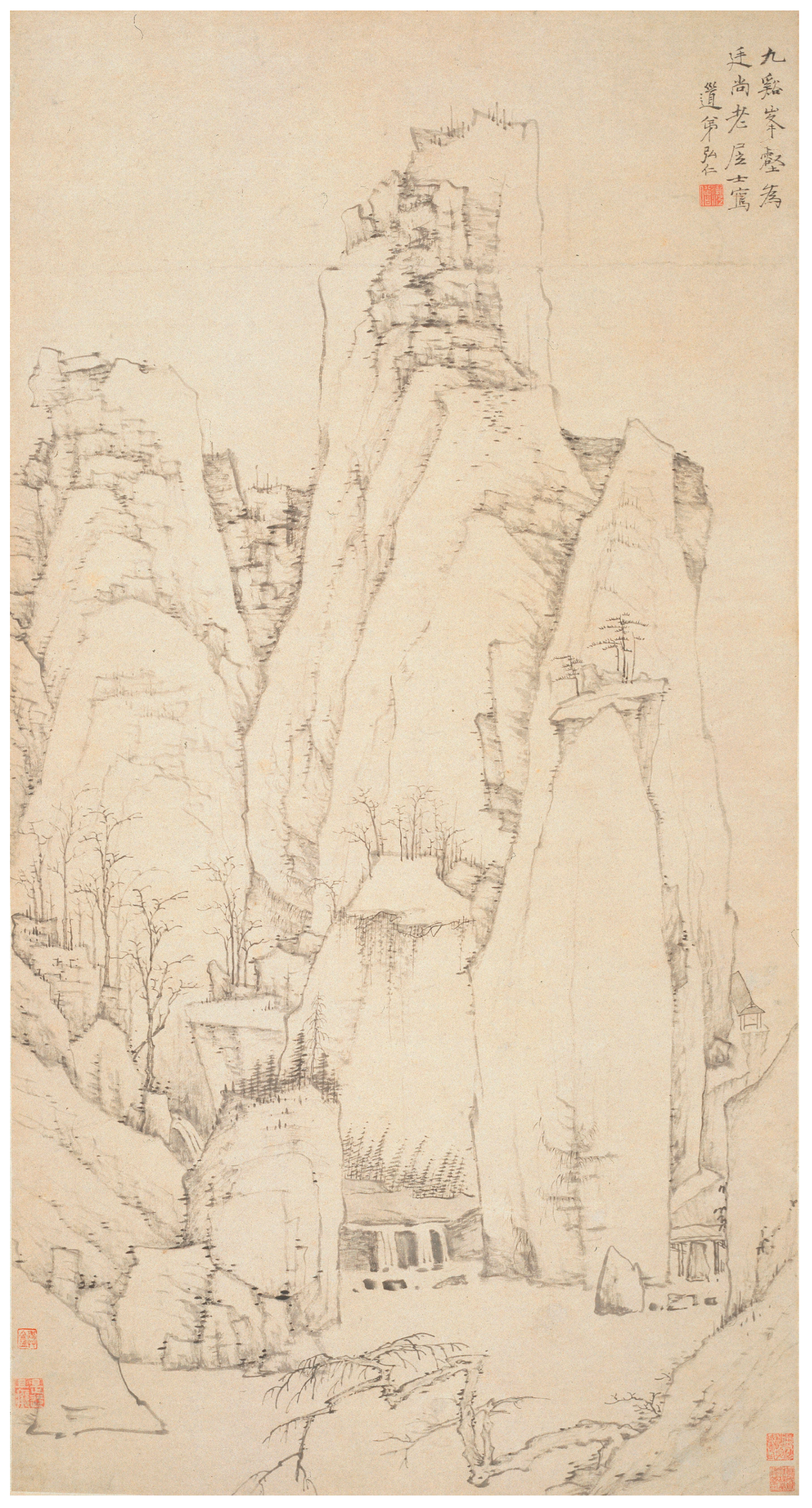
While traces of earlier masters remain discernible in his works, Hongren consistently asserts a distinctive personal style (Liang and Yu 2018, p. 96). This period marks a definitive shift from the imitation of tradition to the refinement and expression of an inner mental landscape. Peaks and Ravines at Jiuxi (Jiuxi Fenghe Tu, 九溪峰壑图) (see Figure 2) is a work from after Hongren’s ordination; although the exact date is unknown, it is inferred from the signature to be a work from before the age of forty-five. Crucially, the work bears a prominent inscription stating that it was painted for “Elder lay Buddhist Tingshang by Dharma-brother Hongren,” accompanied by three seals: “Jianjiang Seng” (Monk Jianjiang 渐江僧), “Xiangcao An” (Xiangcao Hermitage 香草庵), and “Shi Yu Qie Chi” (Obstinate and Foolish 是迂且痴). These inscriptions and seals serve as vital evidence of his authentic monastic identity and spiritual state. The use of “Dharma-brother” (Daodi 道弟) in the signature redefines the relationship between the painter and the recipient within the dimension of the Dao rather than through secular etiquette, highlighting Hongren’s self-identification as a dedicated seeker of Dao. Furthermore, the three seals constitute a progressive declaration of identity: “Jianjiang Seng” signifies the divestment of his mundane identity to reveal his true monastic self; “Xiangcao An” represents the quiet abode for Chan practice and meditation; and “Shi Yu Qie Chi” reclaims self-mockery as a spiritual virtue, signaling a total transcendence of worldly logic and the ultimate realization of Chan emptiness contemplation. This seal directly resonates with his self-appellation as “Na di” (monk-brother 衲弟) in his correspondence, thereby corroborating his genuine commitment to asceticism and his pursuit of spiritual joy amidst material poverty. The aesthetic of “desolate silence” presented in the work is not merely a visual simplicity, but also a reflection of Hongren’s Chan spiritual cultivation. Through a detached, desolate brushwork that reveals Chan illumination within extreme minimalism, the work embodies Hongren’s profound transition from “learning from nature externally” to “seeking the mind’s source internally” after becoming a monk. His fellow townsman and close friend Yin Shu 殷曙, in the Biography of Master Jianjiang 《渐江师传》, offered a precise insight into the relationship between Hongren’s art and practice: “Is it not that he realized painting through mountains, but discussed Chan through painting?” (Yin 1926, p. 22). This observation profoundly highlights the indivisible nature of his painting and Chan, which were seamlessly fused within his lived experience, serving mutually as substance and function.
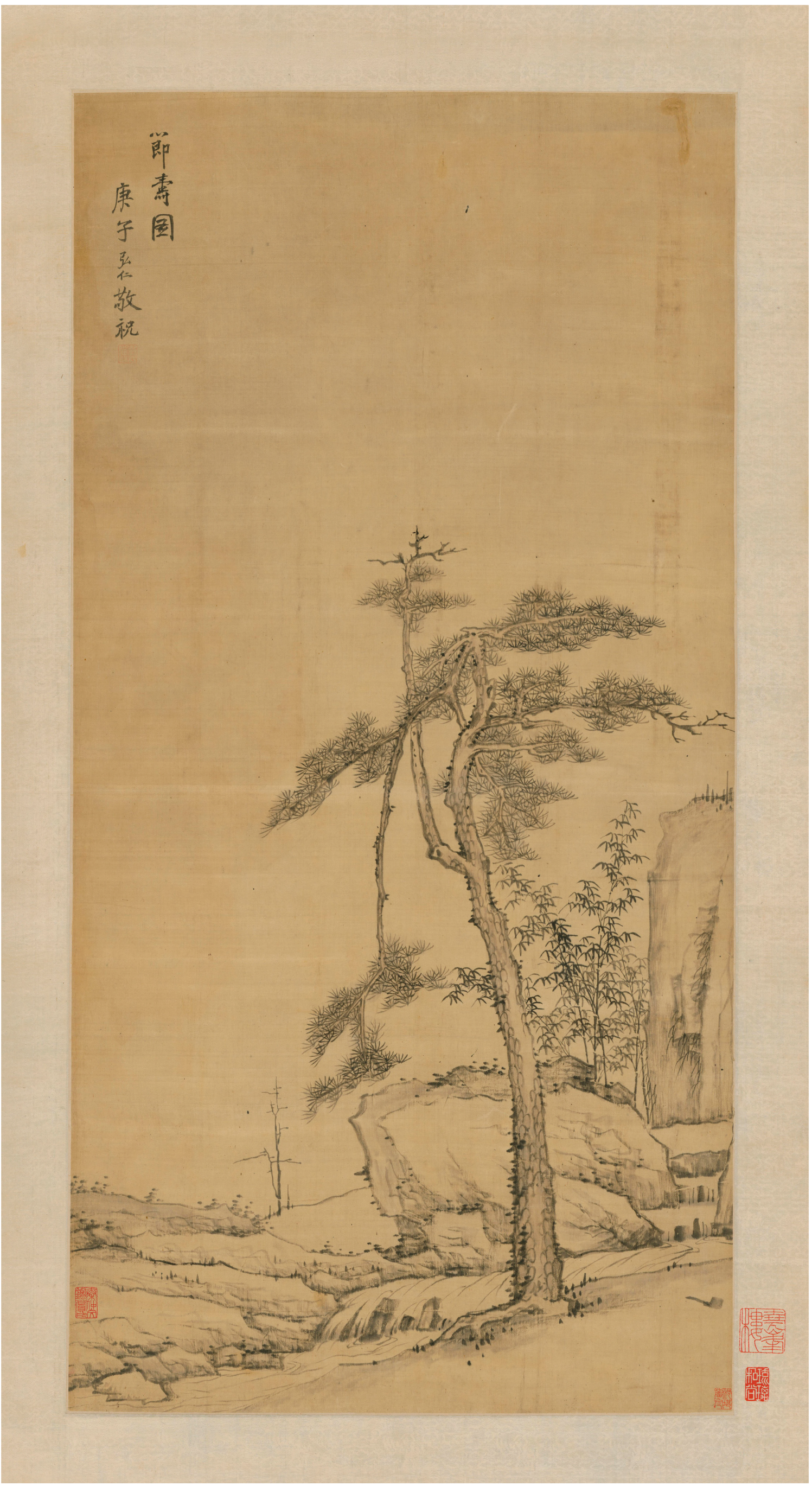
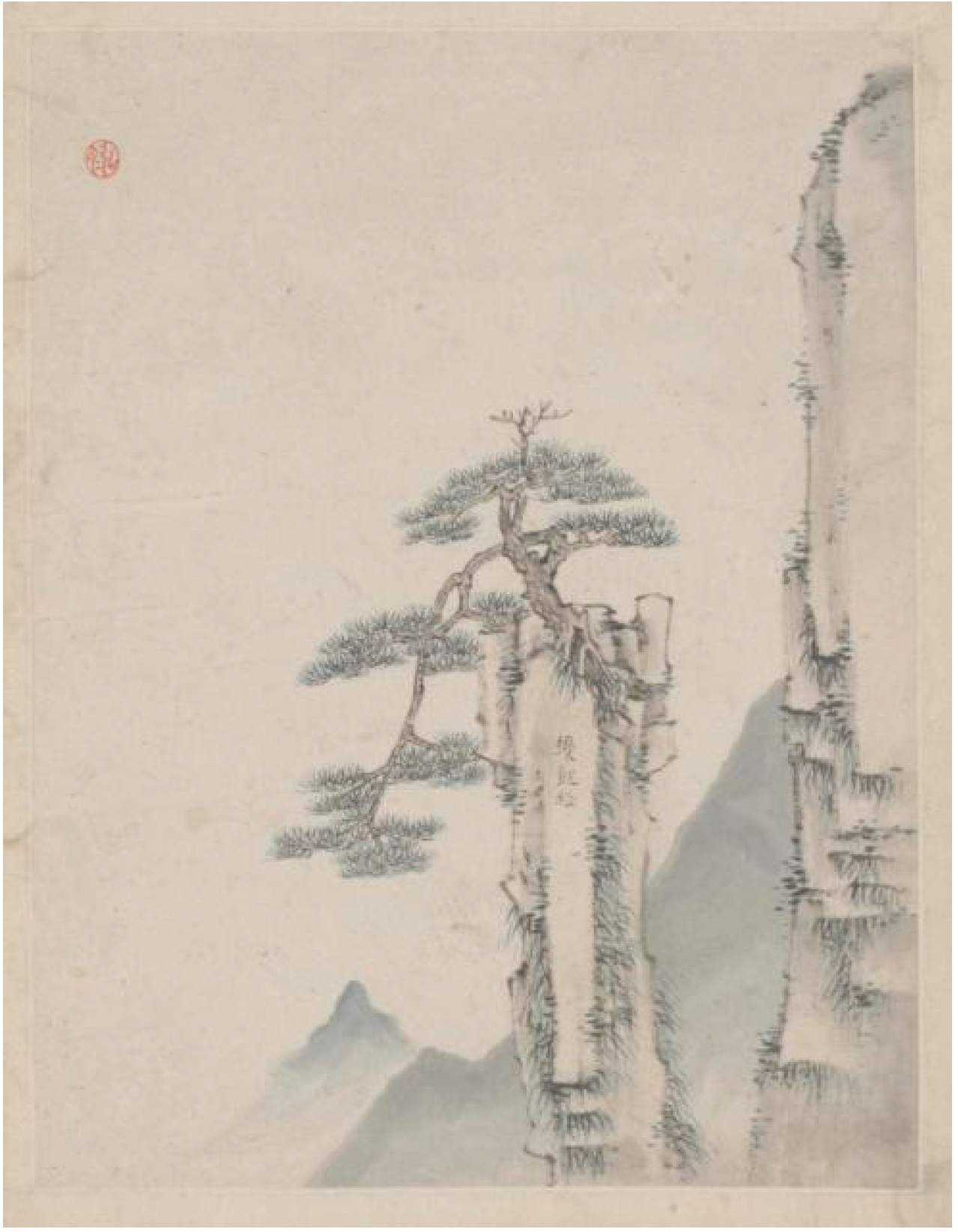
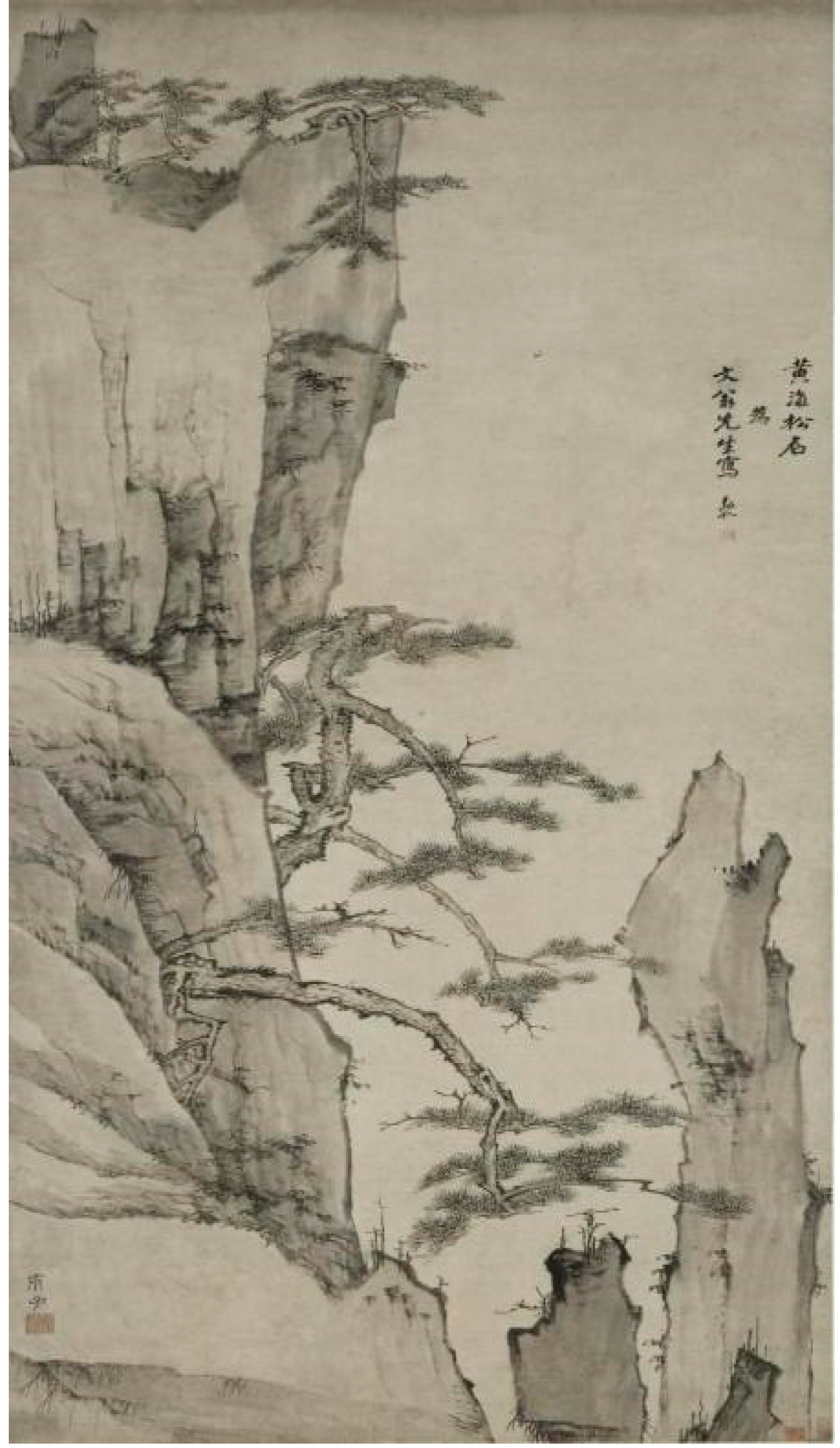
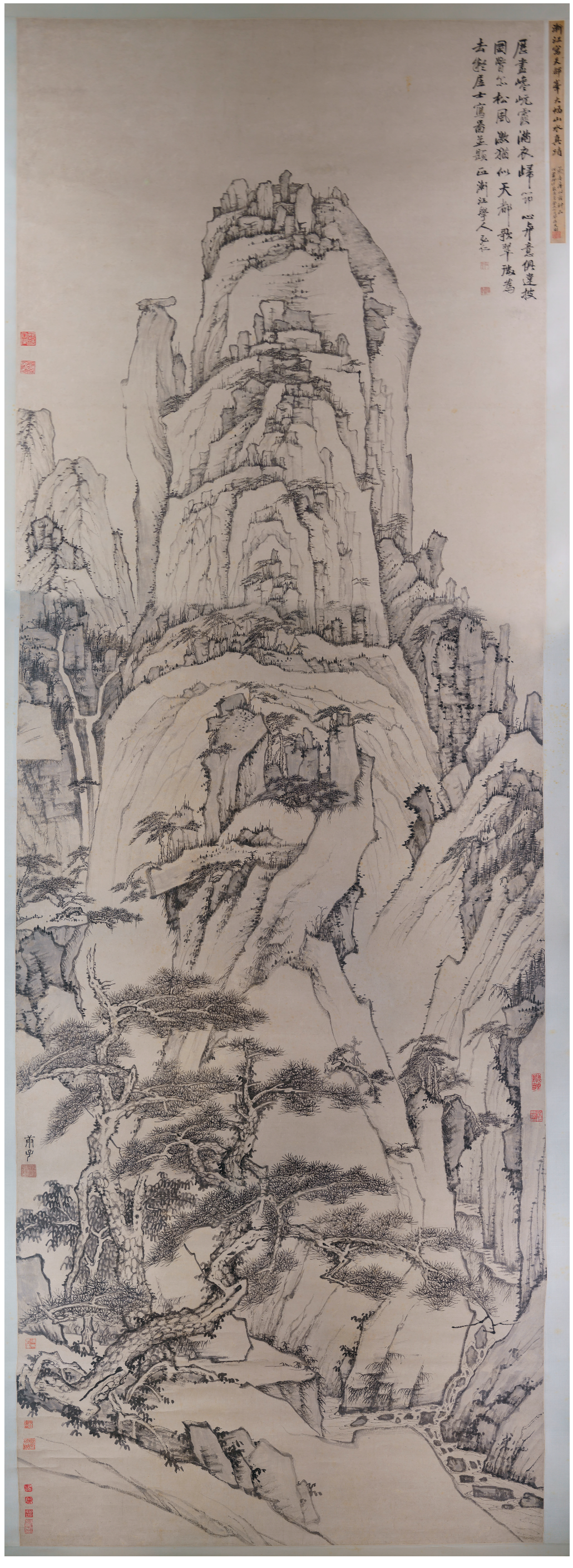
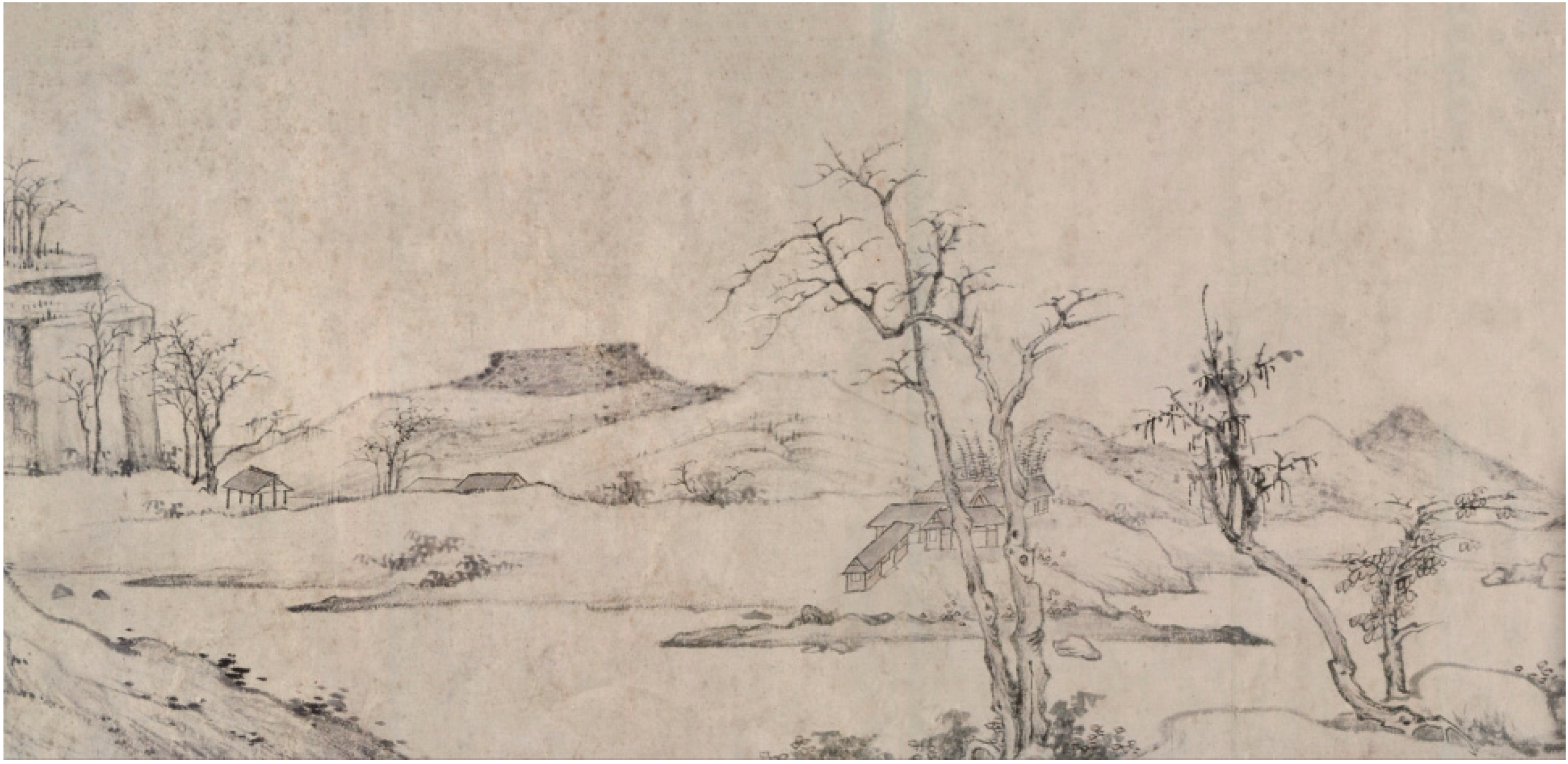
By his late years, Hongren’s style had thoroughly attained the supreme realm of “From True Emptiness Comes Wondrous Existence”5 (zhenkong miaoyou, 真空妙有). The imagery in his paintings became extremely simplified, with geometric characteristics becoming even more pronounced and pure. His brushwork was reduced to the most essential lines and subtle ink nuances, creating spaces that were vast and distant, while the artistic conception presented a quality of purity, detachment, and transcendence. This marked the maturation of his “Emptiness Contemplation” practice and a more profound realization of the “Twofold Emptiness of Self and Dharma”6 (wo fa er kong, 我法二空), enabling him to probe directly into the essential emptiness amidst the myriad phenomena. As the late Ming eminent monk Hanshan Deqing stated, “Enlightenment is a gradual process requiring arduous cultivation” (Wu 2023, p. 41); Hongren’s works stand as visual testimony to this spiritual journey. Just as the depth of Chan practice can be glimpsed from one’s realization of “dwelling places” (chu, 处): “First, birds take the sky as their dwelling; second, Arhats take Nirvana (nihuan, 泥洹) as their dwelling; third, the Dao takes non-being (wuyou, 无有) as its dwelling; and fourth, the Dharma resides in the place of contemplation (guan, 观). 一者飞鸟以空中为处, 二者罗汉以泥洹为处, 三者道以无有为处, 四者法在观处也” (Lü 1985, pp. 30–33). The artistic realm Hongren reached in his later years is precisely one that abides in the Dao of “non-being,” merging with the nature of Dharma through the contemplation of brush and ink. Pines and Rocks of Mount Huang (Huanghai Songshi Tu, 黄海松石图) (see Figure 3) is a representative masterpiece illustrating his art reaching the realm of perfection in his later years. The painting depicts the scenery of Mount Huang, with two pillar-like rocks rising abruptly in the distance and gnarled pines hanging upside down from a large cliff in the foreground. Between the precipices, the roots of old pines strike deep into the rock crevices; their posture is as serene as a Chan monk in meditation, endowing natural objects with the spiritual temperament of a practitioner. The foreground cliff occupies half the composition, echoing the distant stone pillars, creating a layout that opens and closes boldly with a strong contrast between density and sparseness. This visual logic of “rich meaning within simple brushwork” finds rigorous textual corroboration in the painting’s inscription and seal. The inscription, which reads “Pines and Rocks of Mount Huang, painted for the respected Daweng (大翁) by Hongren,” is accompanied by a seal bearing Hongren’s name. As his formal Dharma name received after his ordination, “Hongren” represents his ontological identity as a monk of the Caodong school. When addressing this secular elder Daweng, Hongren did not use his common sobriquet “Jianjiang” nor the seal “Jianjiang Seng” (Monk Jianjiang), both frequently seen in his paintings.
Hongren’s stylistic evolution can be interpreted as a visualized “roadmap of enlightenment.” His works from different periods serve as distinct coordinates of his spiritual journey, marking his path of cultivation. The stylistic evolution of Hongren’s painting is inextricably linked to the profound influence of Chan Buddhist thought. His works from different periods reflect, to varying degrees, his spiritual state at those respective stages of his cultivation. As Helmut Brinker (Brinker 1987, p. 33) observes: “The Zen painting is subjectivised and becomes the evocative Other in a polarity with the beholder. It is then a witness to spiritual origins, a document of personal bonds and experiences, an encouraging pointer to the aim which is enlightenment, a proof of mastery gained, or a spur to private exercise and imitation.” Consequently, Hongren’s artistic practice serves as a visual externalization of Chan philosophy.

2.2. The Theoretical System and Spiritual Foundation of Chan “Emptiness Contemplation” Aesthetics

To fully grasp how Hongren’s art serves as a vehicle for spiritual practice, it is essential to delve into the foundational philosophical framework of his work: the Chan aesthetic of “Emptiness Contemplation.” The theoretical foundation of Chan aesthetics is deeply rooted in the thought of “Emptiness Contemplation” of Mahāyāna Buddhism. As an ontology, this concept is constructed upon distinct modes of cognition: non-logical thinking, fuzzy logic, intuitive enlightenment (wuxing, 悟性), and non-dual thinking (buer siwei, 不二思维). Since “Emptiness” signifies “non-existence” or the absence of intrinsic nature, it functions as a “non-ontological ontology”, meaning an ontology that negates any fixed substance (Zhou 2005, pp. 47–51). Consequently, the ontology of Chan aesthetics is inherently an ontology of this “Emptiness Contemplation.” Philosopher Li Zehou (Z. Li 1994, p. 206) argues that Chan embodies “a certain mystical perception of time,” suggesting this as “one of the philosophical secrets of Chan.” This transcendence of linear temporality is, in essence, the dismantling of all inherent attachments through the realization of “Emptiness Contemplation,” representing a sudden enlightenment regarding the emptiness of both time and space. Regarding the expressive implications of Chan aesthetics, the Japanese graphic design master Kenya Hara 原研哉 offers an illuminating explanation in his aesthetic treatise White (Shiro). Judging solely from its table of contents, the book exemplifies a typical “Emptiness Contemplation” as it comprises only four chapters, devoid of any superfluity or redundancy. The structure consists of Section 1, The Discovery of White; Section 2, Paper; Section 3, Emptiness; and Section 4, Return to White (Hara 2012). This arrangement mirrors the contemplative realm of Chan, which transitions “from non-being to being, and returning to non-being,” suggesting that beauty exists in the liminal space between being and non-being.
Chan Buddhism’s doctrine of Buddha-nature, grounded in the principle of “taking the mind as the fundamental basis” (yixin weiben, 以心为本), maintains that “all sentient beings possess Buddha-nature” (Dharmakṣema 1982, p. 574). Consequently, its cultivation highlights a life attitude of non-attachment and spontaneous freedom (renyun zizai, 任运自在). This cultivation philosophy, rooted in the “fundamental emptiness and quiescence of the original mind” (benxin kongji, 本心空寂), aims to comprehend the intrinsic emptiness of all dharmas through direct spiritual awakening. In its pursuit of “Chan” as an aesthetic realm, Chan aesthetics takes the fulfillment of human value as its primary goal. It thus advocates principles such as “my own mind is itself the Buddha” and maintains that “Chan is inseparable from the mind, and the mind is inseparable from Chan; Chan and mind are one and the same, differing only in name.” From this perspective, the body and mind of sentient beings is originally complete and fully endowed with Chan itself (T. Li 2000, p. 63).
As Huineng 慧能, the Sixth Patriarch, reveals in the Platform Sūtra (《坛经》): “The capacity of the mind is vast and great, like space… The sun, moon, and stars; the great earth with its mountains and rivers; all grasses and trees; evil and good persons alike … all are within space. The emptiness of the nature of worldly people is just like this” (Huineng 2010, p. 24). This passage vividly elucidates the core of the Chan conception of mind-nature: the substance of the mind is boundless like space, capable of embracing all existence, while the essence of all existence is also emptiness (Śūnyatā). Such an understanding provides the psychological foundation and motivating source for expressing Chan insight through painting. It also foreshadows how Hongren, in his painting, transforms external landscapes into a visual reflection of the mind’s contemplation of emptiness.
The dictum “form is emptiness, and emptiness is form. 色即是空, 空即是色” (Dazheng 2004, p. 254) encapsulates the core of “Emptiness Contemplation.” Here, “form” (rūpa) refers generally to all material phenomena; since their nature arises from dependent origination and lacks intrinsic existence (svabhāva), they are termed “empty.” As Conze points out in his analysis of the Heart Sutra, Avalokitesvara is teaching the lesson that the self has no self-existence. All dharmas (things)—both conditioned and unconditioned—are marked by Emptiness. It denies the difference between the conditioned and unconditioned worlds—all are equally marked with Emptiness (Conze 1988, p. 110). However, in Chan Buddhism, “Emptiness Contemplation” is never merely abstract metaphysical speculation. Rather, its fundamental purpose is to counteract attachment. As Huntington affirms, Emptiness has a distinct soteriological purpose within the Buddhistic discourse. It is formulated for a salvific cause—which is to eliminate the problem of clinging. “The concept of emptiness functions as an exhortation to act in a certain way, with a certain attitude of non-clinging…as the expression of an entire form of life” (Huntington and Geshe 1989, p. 59). This mode of life, characterized by “non-clinging”, is precisely the key that allows “Emptiness Contemplation” to transform into a mode of aesthetic contemplation and a principle of artistic creation.
As the great Japanese Zen scholar D.T. Suzuki incisively pointed out, the “Emptiness” of Zen is a state of “no-mind” (wuxin, 无心), a realization of the mind’s inherent freedom that transcends discriminative intellect (Suzuki 1999). However, Suzuki’s interpretation tends to treat “emptiness” as a universal spiritual awakening that transcends specific historical and cultural contexts. Consequently, it overlooks the complex mediation and manifestation of Chan thought within concrete artistic practices and socio-historical frameworks, which remains the primary limitation of his essentialist approach. In contrast to Suzuki’s paradigm, this study does not presuppose “emptiness” as an ahistorical, abstract ontology. Instead, it focuses on the concrete visual manifestation of this concept within Hongren’s work.
Influenced by this concept, the aim of artistic creation is to transform external nature into an internal landscape reflected by the mind. This idea is vividly embodied in the three stages of Chan practice described by Chan Master Qingyuan Weixin: “At first, mountains are mountains and waters are waters; then, mountains are no longer mountains and waters are no longer waters; finally, mountains are just mountains and waters are just waters” (Puji 1984, p. 1135). The progression of these three stages reveals the deepening and transcendence of cognition as the subject undergoes refinement through the “Emptiness Contemplation.”
This resonates with the expression of modern composer John Cage. “And being enlightened is not some spooky unearthly condition. Before studying Zen men are men and mountains are mountains. While studying Zen, things get confused. After studying, Zen men are men and mountains are mountains. No difference except that one is no longer attached” (Cage 1961, p. 143). Cage thus reveals that the essence of enlightenment is not the acquisition of some mystical experience, but rather a return to the state where all things exist as they naturally are, after cleansing away all conceptual attachments.
The “wondrous awakening of the mind’s source” (miaowu xinyuan, 妙悟心源) in Chan aesthetics is essentially a process of clarifying life and the universe, allowing the obscured reality of everyday existence to become clear and illuminated (Liu and Fu 2014, p. 149). This coherent chain of thought and practice establishes a solid theoretical foundation for analyzing the systematic expression of “Emptiness Contemplation” in Hongren’s landscape paintings. As his life demonstrates, guided by the philosophy of “Emptiness Contemplation,” Hongren, through his painting practice, traversed the classic Chan stages of perception: moving from “seeing mountains as mountains” to “seeing mountains not as mountains,” and finally attaining the state of “seeing mountains merely as mountains.” Through this progression, he transmuted his external suffering into a profound internal realization of “true emptiness and wondrous existence.”
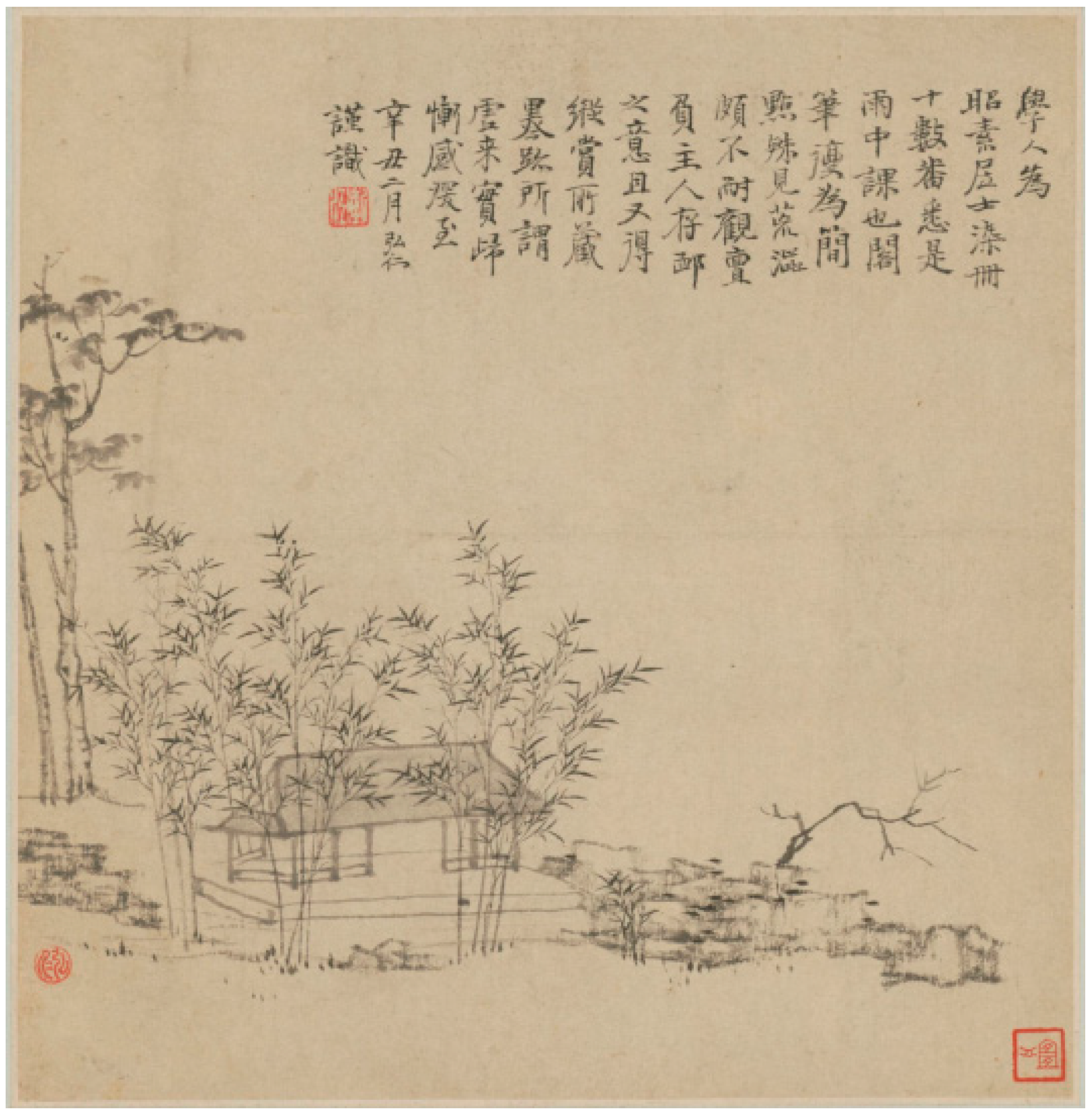
This process of spiritual sublimation finds its perfect closed-loop corroboration through the “four excellences” of poetry, calligraphy, painting, and seals within the inscriptions and seal impressions of the Landscape Album Scroll (Shanshui cehezhuang juan 山水册合装卷, see Figure 4). Hongren’s inscription reads as follows: “I have painted more than ten leaves of this album for Elder Lay Buddhist Zhaosu (Wu Huang 吴熿), all of which were completed as my daily lessons during rainy days. Upon setting down my brush and reviewing them, I find them to be remarkably desolate and dry, truly unpleasing to the eye. I have truly failed the master’s benevolent care, especially since I was granted the privilege of admiring the masterpieces of calligraphy in his collection at my leisure. As the saying goes, I ‘arrived in emptiness but returned with abundance,’ leaving me with a profound sense of both humility and gratitude. Respectfully recorded by Hongren in the second month of the Xinchu year (1661). 学人为昭素居士 (吴熿) 染册十数番, 悉是雨中课也. 阁笔复为简点, 殊见荒涩, 颇不耐观, 亶负主人存恤之意, 且又得纵赏所藏墨迹, 所谓虚来实归, 惭感深至.辛丑二月弘仁谨识.”
First, the phrase “lessons during rainy days” (yuzhong ke 雨中课) in the inscription elevates the act of painting from a mere “literati pastime” to a form of “monastic asceticism.” Within the Chan context, painting is no longer a tool for sensory pleasure, but becomes an uninterrupted “daily lesson” (rike 日课) analogous to chanting or meditation. Second, this meditative mindset is directly reflected in his artistic style, as seen in his self-effacing description of the work as “remarkably desolate and dry” (huangse 荒涩). The term “huangse” denotes both the physical characteristics of his brushwork, characterized by dry brushes, pale ink, and angular lines, and a spiritual steadfastness that rejects worldly sophistication but upholds a detached, uncompromising integrity. Third, the dialectical formulation of “arrived in emptiness but returned with abundance” (xulai shigui 虚来实归) reveals Hongren’s logic of cultivation: he paints with a state of internal emptiness (xu 虚), yet attains spiritual abundance (shi 实) through the creative act.
Finally, the circular seal bearing the name “Hongren” at the end of the scroll deserves significant attention. Within the holistic unity of poetry, calligraphy, painting, and seals, this seal provides the definitive finishing touch. The pale plum blossoms, bamboo, and desolate landscapes represent “form” (se 色). In contrast, the circular shape of the seal symbolizes the Buddhist concepts of “perfection” and “emptiness”. By intentionally selecting a circular seal, Hongren utilizes its visual quality of “perfect interpenetration” (yuanrong 圆融) to govern the “desolateness” of the preceding landscape.

2.3. The Macroscopic Embodiment of “Emptiness Contemplation” in Hongren’s Landscape Painting

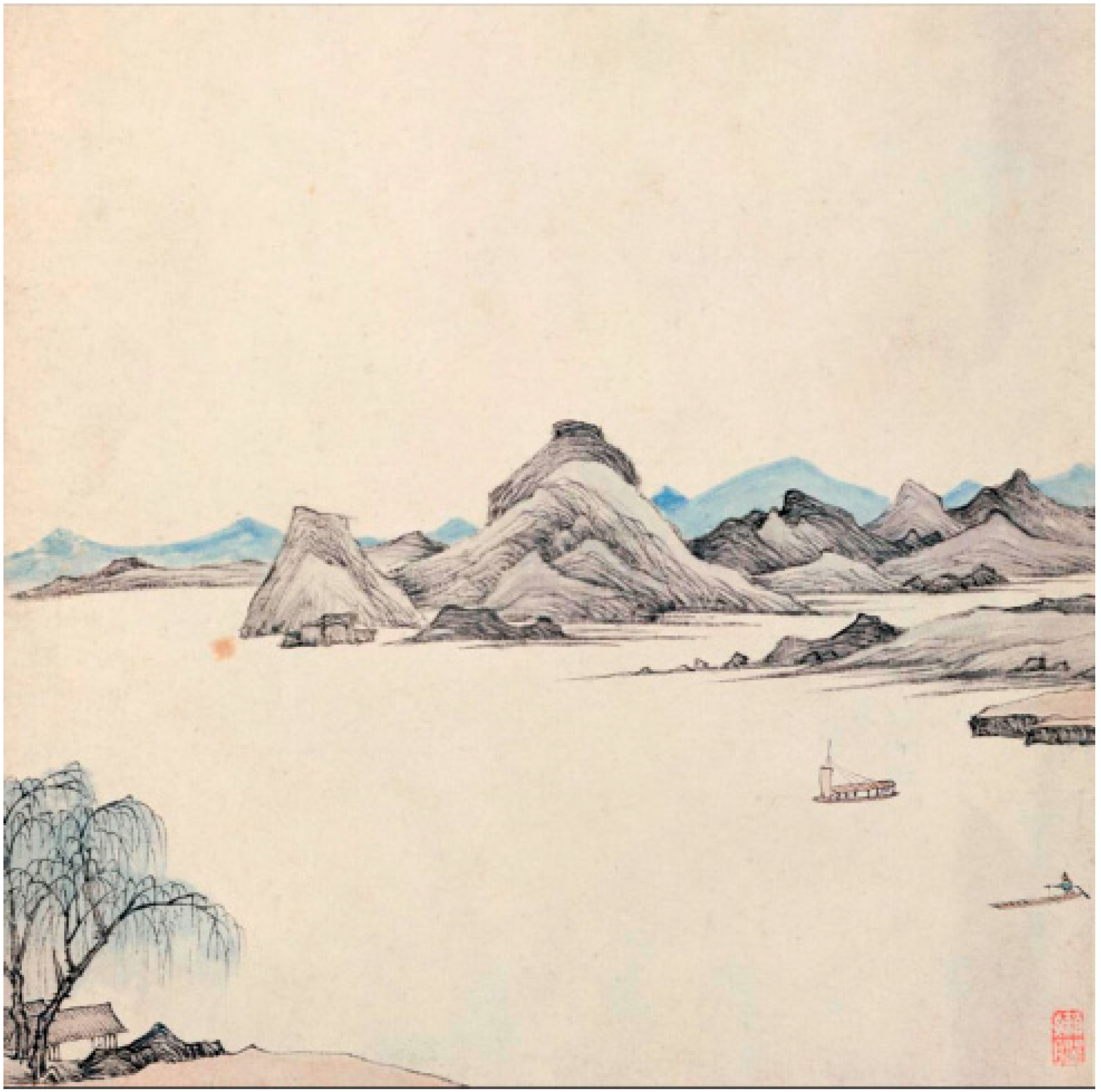
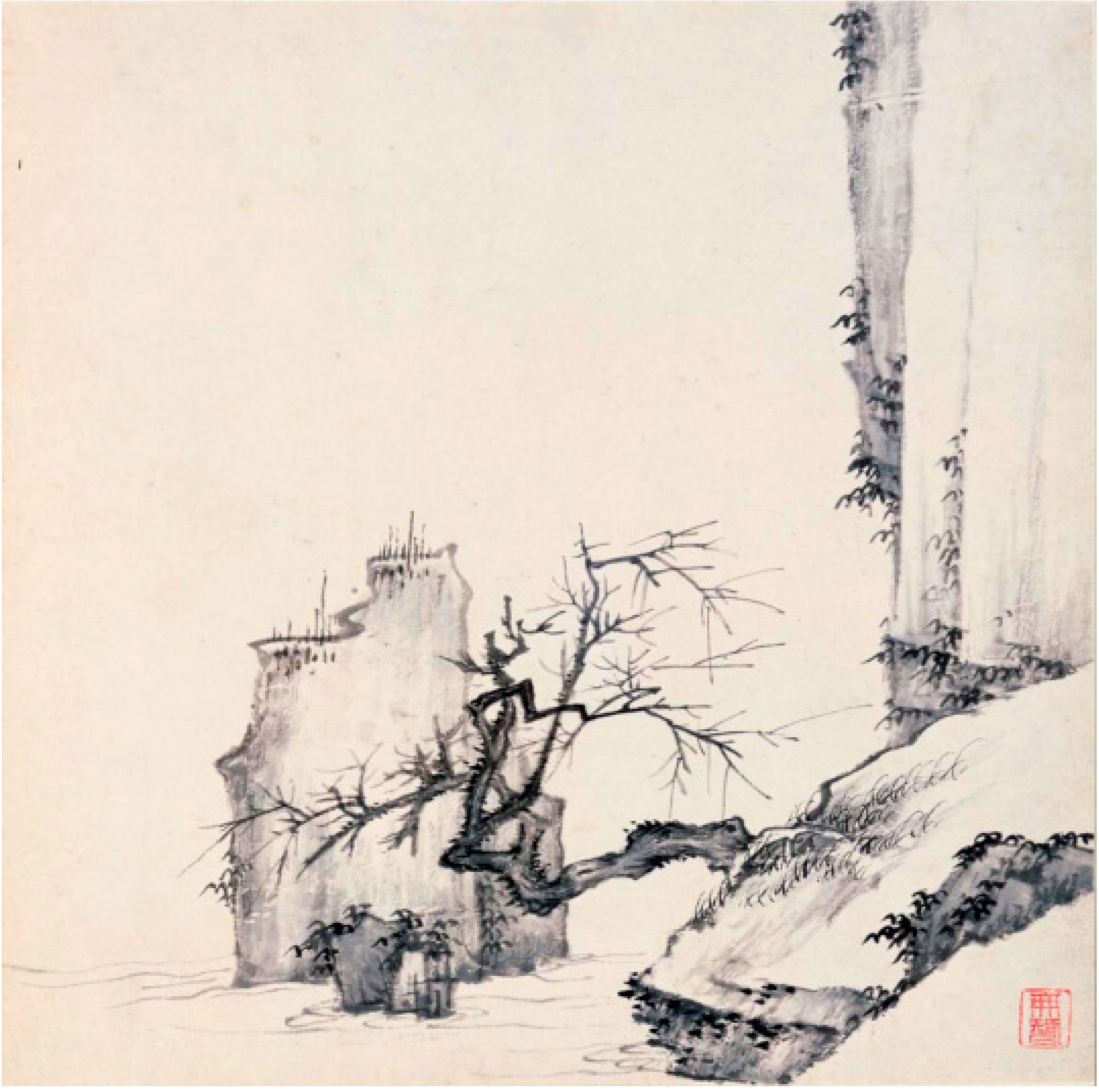
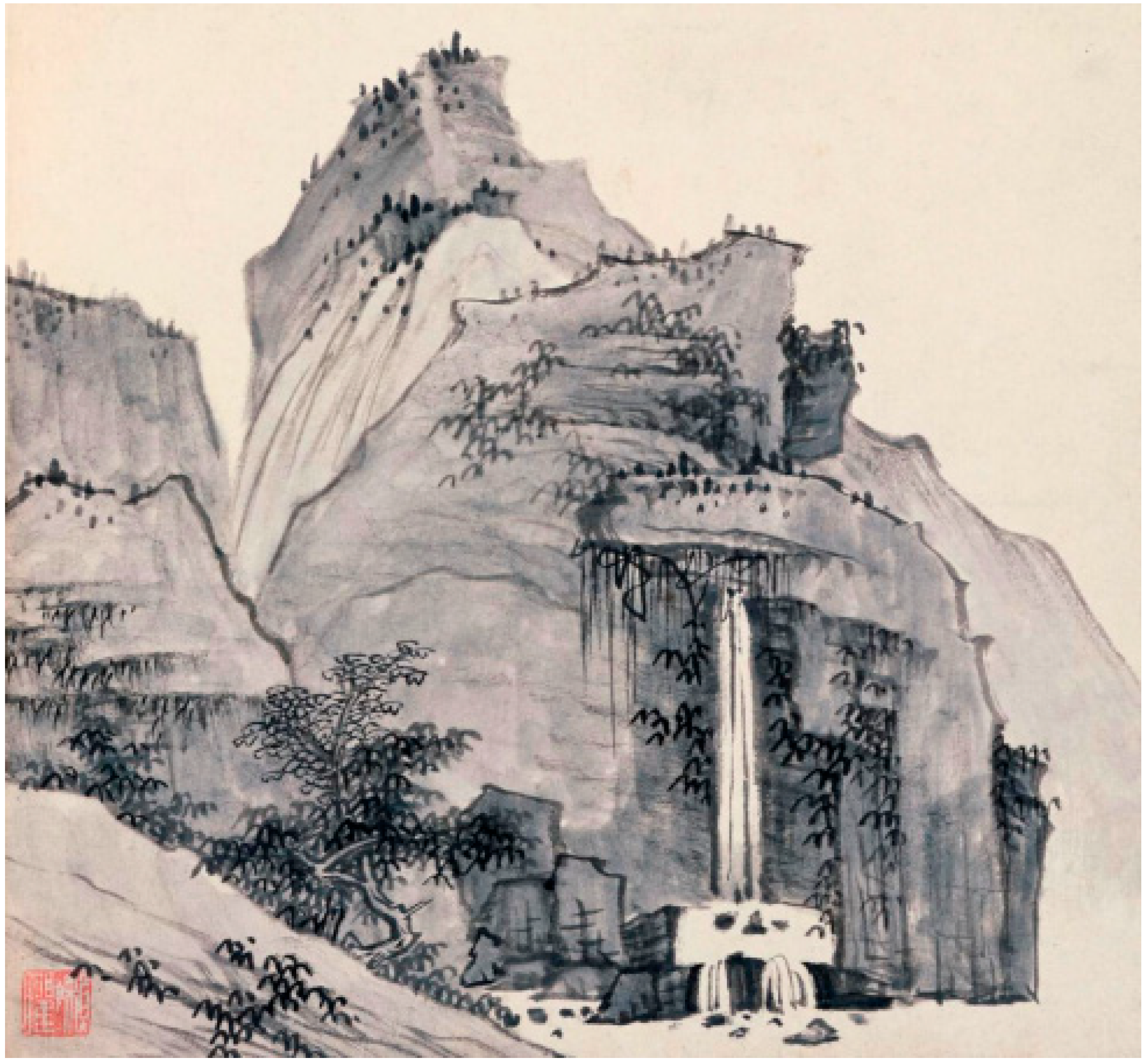
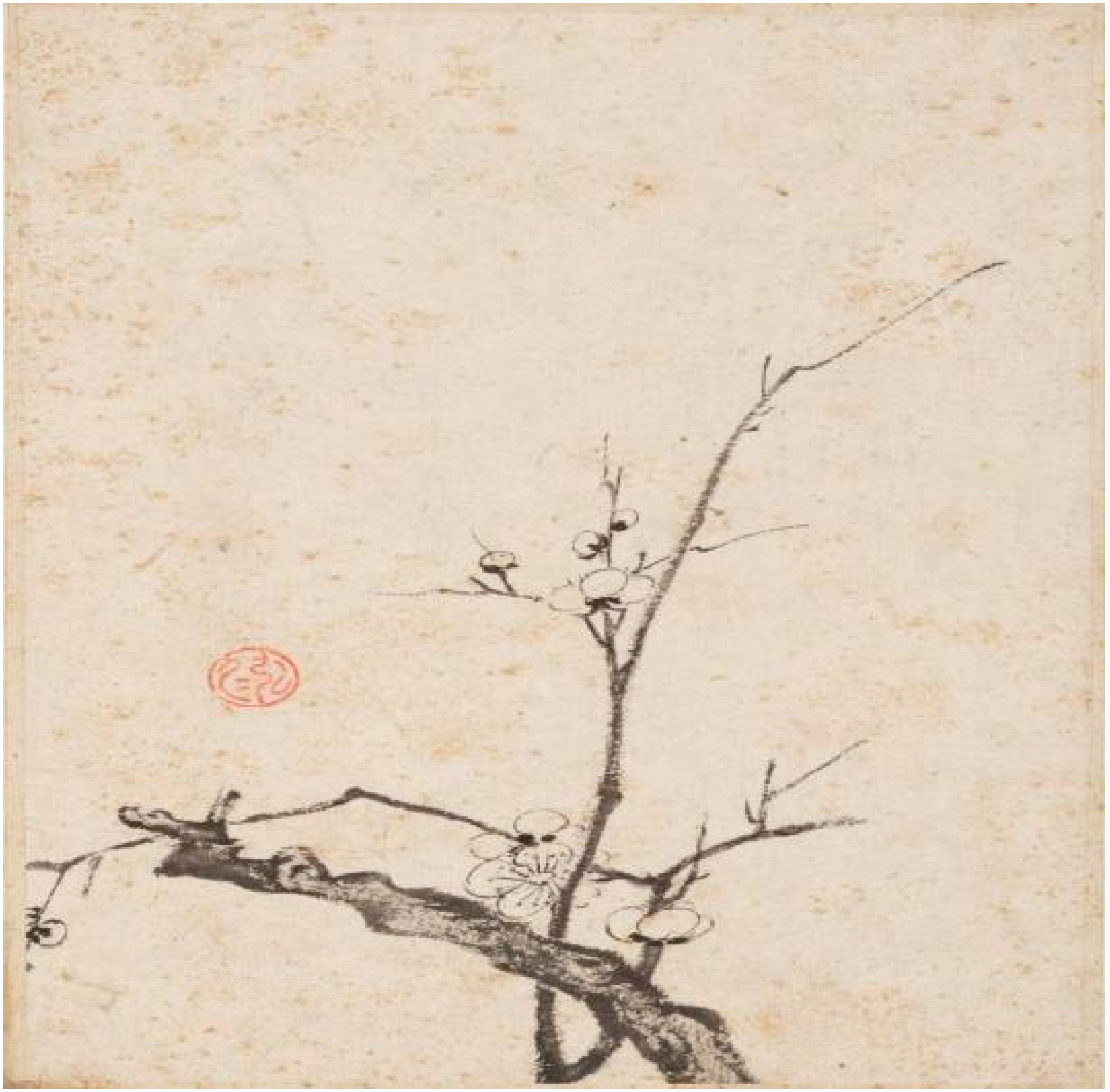
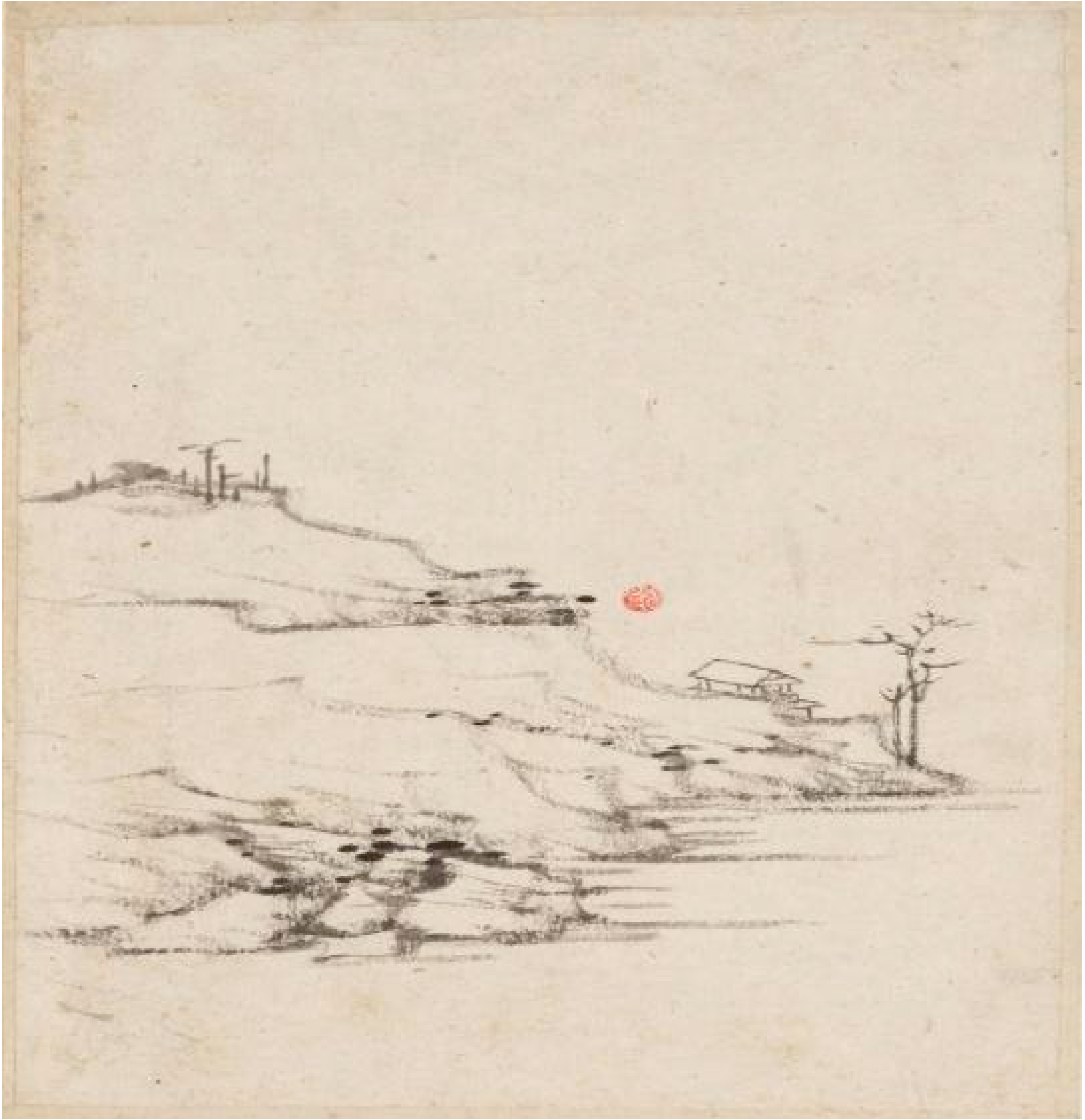
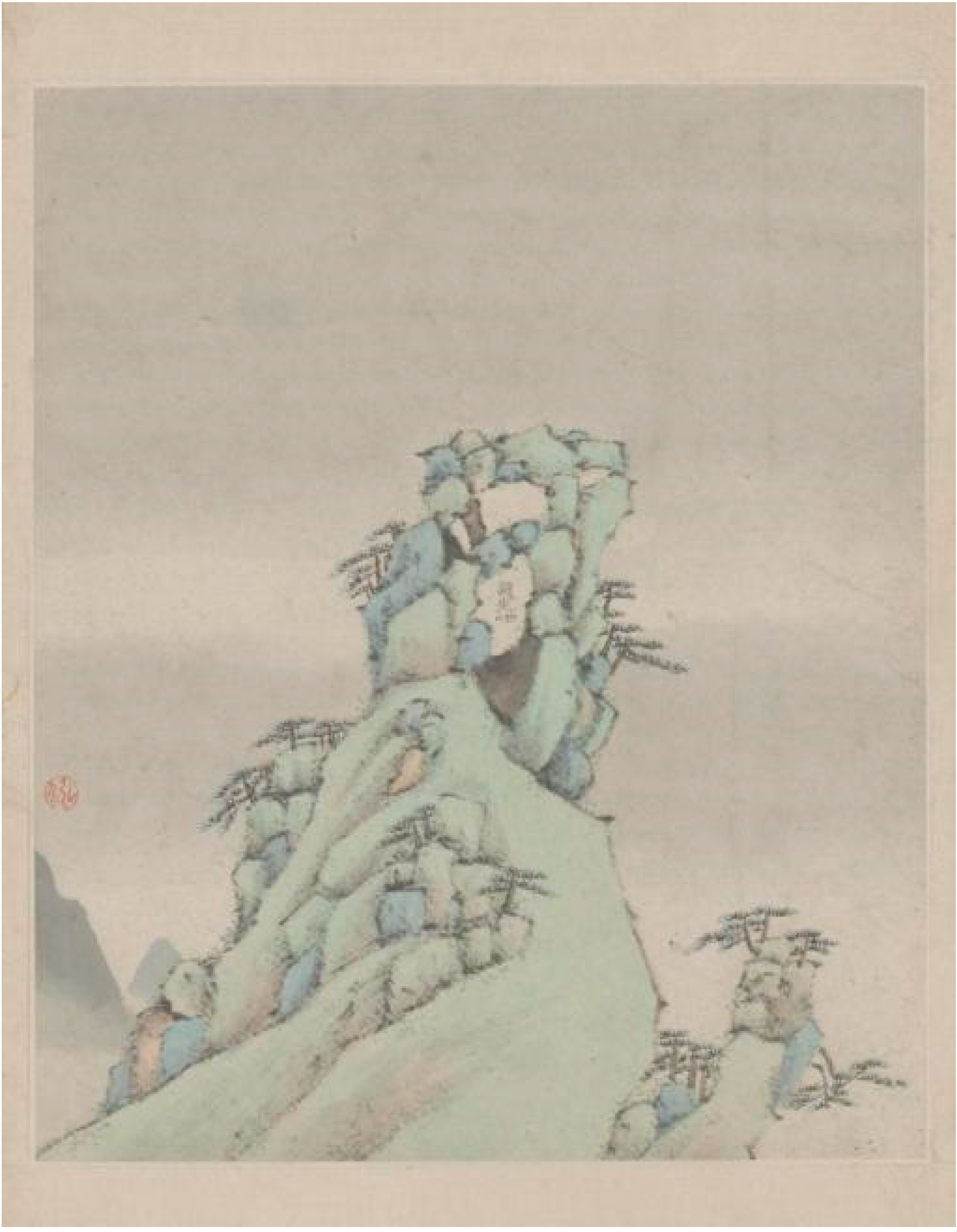
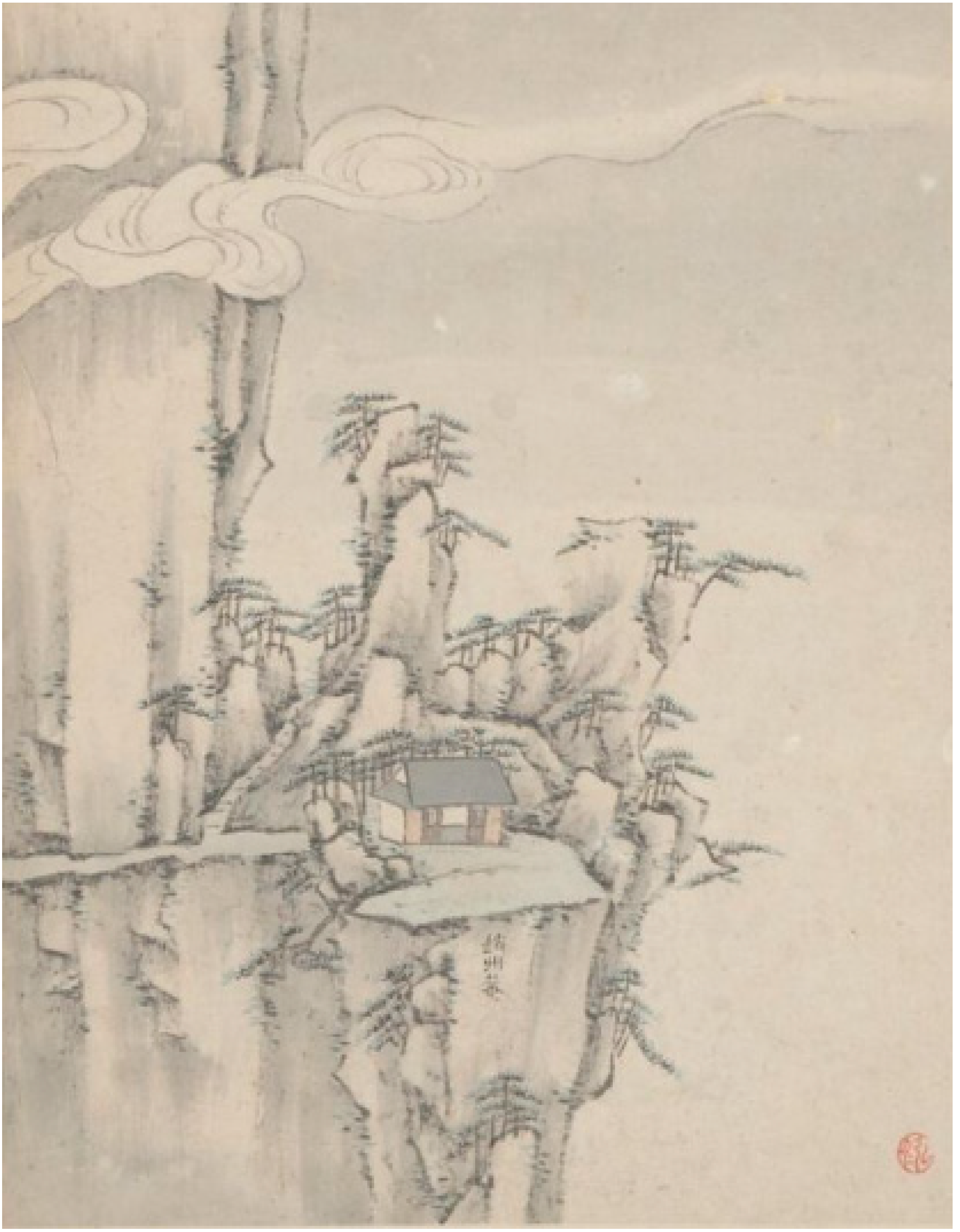
In the Landscape Album (see Figure 5, Figure 6 and Figure 7) produced during his later years, a group of carefully selected seals provides profound corroboration of Hongren’s authentic state of “painting as spiritual cultivation.” Within this album, Hongren utilized three specific seals: “Wu Jiu” (No Blame 无咎), “Lan Chan” (Chan of Laziness 懒禅), and “Lan Qu” (Lazy and Emaciated 懒臞). These are by no means mere leisure seals; instead, they constitute a complete and closed logic of spiritual cultivation.
First, the “Lan Qu” seal serves as evidence of his existence as a “pure karma” monk. The character “qu” (臞) denotes the emaciated physical state resulting from rigorous asceticism, while “lan” (懒) signifies a proactive detachment from worldly fame and success. This seal represents the spiritual foundation of his character, embodying his commitment to adhering to the Dao amidst poverty and his refusal to drift with secular trends.
Second, the seal “Lan Chan” attests to Hongren’s unique method of cultivation. Within the Chan tradition, “laziness” (lan 懒) is often regarded as a high-level state of practice that dismantles “attachment to purposeful action” (gongyong zhizhuo 功用执着). Hongren termed his own realization “Lan Chan,” referring to a mode of contemplation that is spontaneous and natural, eschewing external seeking and reliance on verbal elaboration. This spiritual approach aligns perfectly with the “simplified brushwork” (jianbi 减笔) in his paintings, which rejects complex texture strokes to point directly to the nature of the mind. In this sense, the “simplicity” of his brushwork is the visual manifestation of the “laziness” inherent in his spiritual practice.
Finally, the seal “Wu Jiu” signifies the state of completion achieved through his cultivation. While the term “Wu Jiu” originates from the I Ching (Book of Changes 周易) to mean “with no fault” or “free from calamity,” in a Chan context, it represents the absence of mental hindrances following the dismantling of both “attachment to the self” and “attachment to dharma.” Because he practiced “laziness” in the form of non-action, he created no karma; because he embraced “emaciation” in the form of spiritual emptying, he remained without blemish. This seal reveals the ultimate reason why Hongren’s brushwork attained the realm of “True Emptiness and Wondrous Existence.” The dry and pale brushwork, embodied by the qualities of being “lazy” and “emaciated,” ultimately led to the absolute freedom and peace of his inner spirit, as signified by “no blame.”
These three seals and the brushwork within the album are mutually reinforcing, providing a vivid interpretation of the reality of Hongren’s life, where “the oneness of painting and Chan” (hua-chan yiru 画禅一如). By treating his “lazy and emaciated” body as a site of practice and “Chan of Laziness” as his method, he ultimately attained the liberation of “no blame” through the emptiness contemplation expressed in his brush and ink.
Under the profound influence of “Emptiness Contemplation,” Hongren developed a distinct visual aesthetic system that permeates his landscape painting. This system is defined by four core characteristics: the geometrization and simplification of forms; the extreme restraint and purification of brush and ink; the expansive composition and the deliberate use of negative space; and an artistic conception characterized by “desolate silence,” simplicity, and “From True Emptiness Comes Wondrous Existence.”
However, to profoundly understand the uniqueness of Hongren’s “emptiness, stillness, simplicity, and elegance,” one must situate it within the broader Chinese landscape painting tradition of “cherishing ink” (惜墨) while distinguishing it from the “simplicity” of Ni Zan in the Yuan dynasty. In the history of Chinese landscape painting, Ni Zan and Hongren stand as two peaks of the “minimalist” tradition. Although Hongren inherited certain elements from Ni Zan’s landscape painting, their aesthetic cores reveal an essential divergence: Ni Zan represents the Daoist “ethereal simplicity,” (Piaoyi Jian 飘逸简), whereas Hongren pioneered the Buddhist “spiritual emptiness.” (Kongling Jian 空灵简)
Ni Zan’s “simplicity” is that of a recluse far from the court, imbued with a Daoist celestial air. His signature “one river, two banks” (yishui liangan, 一水两岸) composition, though featuring empty pavilions devoid of human figures, retains profound literati elegance and an expression of individual spirit in its slopes, rocks, and sparse forests. His “simplicity” constitutes an aesthetic “detachment,” aiming to express the noble aloofness and ethereal grace of the high-minded recluse. Furthermore, his paintings still preserve a warm, moist brush-and-ink charm and a “realm with self” (自我之境).
Although Hongren initially studied and imitated Ni Zan’s works, his own “simplicity” embodies the “spiritual emptiness” akin to vast, open mountains, containing profound Chan philosophical implications. For Hongren, simplification was not merely a visual strategy but a form of religious “purification.” As a monk-painter, he stripped away the affective “reclusive air” found in Ni Zan’s paintings, striving instead for an absolute stillness characteristic of the “realm of the non-self” (无我之境). This “emptiness” is not indicative of desolation, but of a clarity achieved by elimination of delusive thoughts; similarly, this “spirituality” is not one of transient agitation, but a meditative state in which all phenomena return to a primordial unity.
It is precisely this qualitative transformation from “Daoist ethereality” to “Buddhist spiritual emptiness” that elevates Hongren’s landscape paintings beyond the conventional aesthetic categories of literati art. This visual system, grounded in the cultivation of “Emptiness Contemplation,” manifests not only in artistic conception but also fundamentally dictates the geometricization of forms, the restraint of brushwork, and the void-oriented nature of the composition. These characteristics collectively constitute the formal expression of his “Emptiness Contemplation” aesthetics, forming a layered and mutually reinforcing system of visual praxis.
First, regarding the choice of subject matter and imagery, Hongren favored painting Mount Huang. This was not only a natural expression of his nostalgic attachment to his homeland at the foot of the mountain but also deeply resonated with his Chan cultivation experience. In Buddhist symbolism, mountains are often viewed as symbols of the “steadfastness of Dharma-nature” and the “sublimity of the Dao.” Consequently, the images of solitary peaks, empty pavilions, desolate forests, and wild waters under his brush transcend their natural physical attributes, sublimating into a series of visual symbols rich in profound religious implication. The solitary peak stands tall, symbolizing the immovable steadfastness of the practitioner’s Dao-mind; the empty pavilion without people points directly to the ultimate truth of emptiness, specifically the “Twofold Emptiness of Self and Dharma”7; and the blank space left for water signifies the inherent desolate silence and luminous awareness (kongji lingming, 空寂灵明) of the mind’s substance. Together, these images construct “Pure Land of Mind-Only”8 (weixin jingtu, 唯心净土) or “The Innate Purity of the Mind”9 (zixing qingjing xin, 自性清净心) in a religious sense.
As Fu Songxue points out: “Chan Buddhism generally advocates the ‘One Aspect of the Dharma Realm,’ where mind and realm merge, and substance and function are one. Thus, the ‘realm’ (jing, 境) is not merely an objectified external world, but the manifestation of the realm of emptiness; the realm is, in fact, the mind.” (Fu 2008, p. 79) The landscapes under Hongren’s brush are precisely the externalization of this “mind-realm.”
Second, regarding the overall temperament of his formal language, Hongren’s works exude a profound “aura of tranquility” (jingqi, 静气). Whether through geometrization of form, slender and wiry lines, pale and ethereal ink tones, or expansive and stable compositions, his art embodies a deep meditative state that transcends emotional fluctuation and technical ostentation. This formal temperament is the natural outflow of his long-term Chan cultivation in “Precepts” (Jie, 戒—restraint in brushwork), “Meditation” (Ding, 定—abiding of the mind), and “Wisdom” (Hu, 慧—illuminating emptiness). As Ge Zhaoguang notes: “The ultimate state of Chan is a broader non-differentiation. Because of this non-differentiation, what it most strictly avoids is ‘discrimination’ and ‘attachment’.” (Ge 1995, p. 161) Hongren’s highly unified formal language, which rejects all superfluous complexity, serves precisely as a visual dismantling of such “discrimination” and “attachment.”
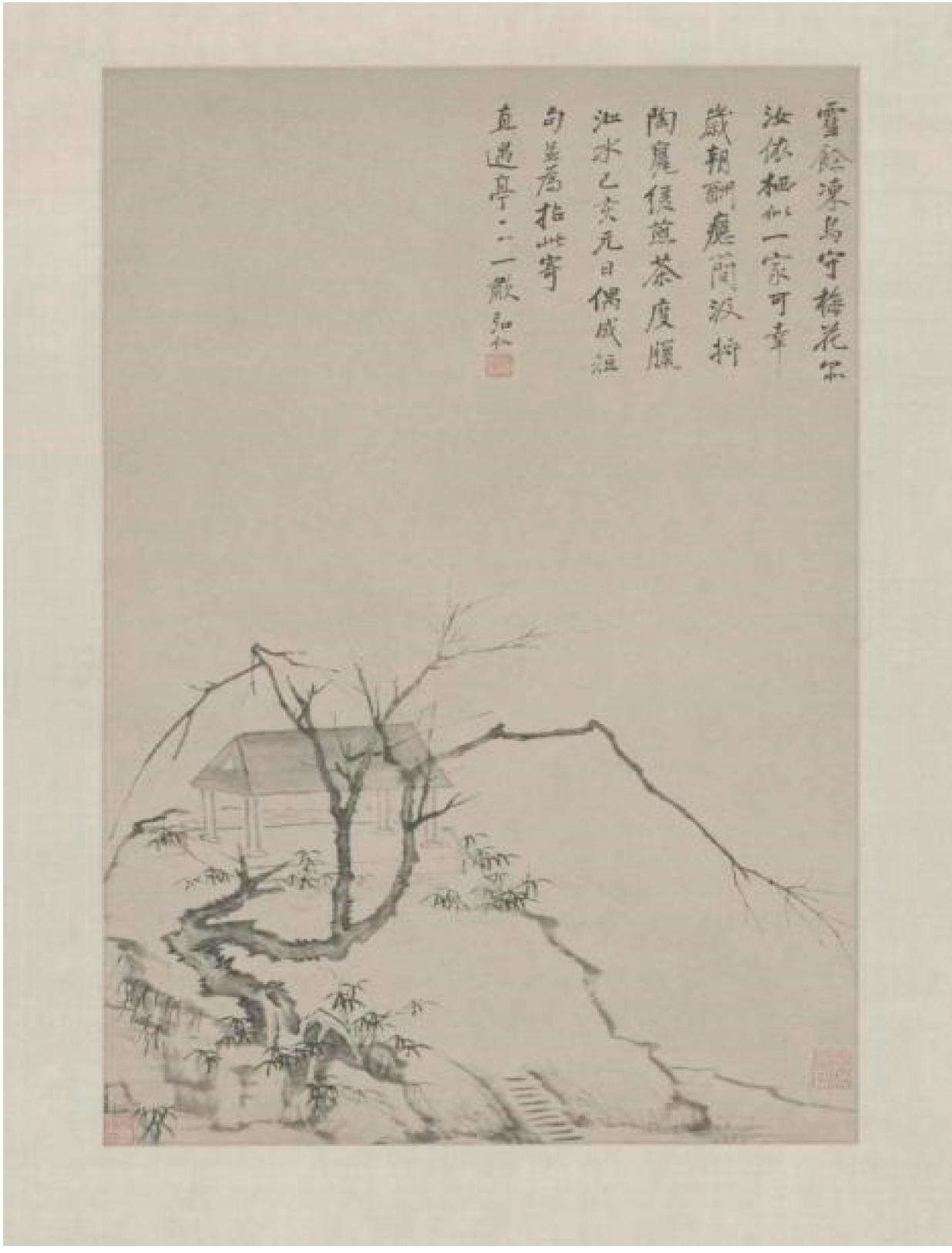
In the painting Plum Blossom Dwelling (Meihua Shuwu Tu 梅花书屋图, see Figure 8), the visual expression of emptiness contemplation attains a state of perfect interpenetration (yuanrong 圆融). According to the inscription, the work was executed on the first day of the Yihai year (1659). While spending the winter months at Qinshui, Hongren composed a short poem and dedicated the painting to a friend at the Zhiyu Pavilion. His inscription reads as follows:
“After the snow, a frozen bird guards the plum blossoms; / You and I rely on each other, dwelling like one family. / Fortunately, social visits are rare on this New Year’s morning; / Drawing water in an earthen jar, I slowly brew tea. 雪馀冻鸟守梅花, 尔汝依栖似一家. 可幸岁朝酬应简, 汲将陶瓮缓煎茶.”
First, although this painting was created during the Lunar New Year (suichao 岁朝), which is the most clamorous moment of the year, Hongren constructed a pure and desolate world where “a frozen bird guard the plum blossoms after the snow.” His gratitude for the fact that “social visits are rare” serves as a direct manifestation of his identity as a “pure karma” monk who purposefully divested himself of secular entanglements. Second, by sending this work to the Zhiyu Pavilion, he intended to share his current state of spiritual cultivation with his friend. The phrase “You and I rely on each other, dwelling like one family” refers not to human companionship but to the seamless fusion between the painter and the frozen bird and plum blossom dwelling within the scene. This state of mutual reliance vividly encapsulates the essence of the “Pure Land of Mind-Only” (weixin jingtu 唯心净土), demonstrating that the Pure Land exists nowhere else but in his silent and settled presence, keeping company with the plum blossoms at this very moment.
The vigorous plum branches contrast with the desolate silence of the house; the ink tones are pale and clear, the composition sparse and open. The extensive use of blank space not only creates visual etherealness but also implies the realization of “non-abiding” (wuzhu, 无住) and “no-form”10 (wuxiang, 无相) in Chan “emptiness contemplation.” The sparse plum blossoms, the humble dwelling, the quiet recluse, and the ritual of tea together construct a highly purified spiritual space isolated from the dust of the world. This “Plum Blossom Dwelling” is not a remote Pure Land on the Other Shore, but a concrete manifestation of the “Pure Land of the Mind.” Through the act of painting, Hongren, during the new year, transformed the hardships of “spending winter months” and the loneliness of his company with the plum blossoms into a site of spiritual peace. This integrated experience of poetry and painting, in which the inscription and the image annotate each other, confirms the essence of “the oneness of painting and Chan” within his artistic realm. Ultimately, through his landscape paintings, Hongren achieved a supreme aesthetic state of “emptiness, stillness, simplicity, and elegance.”
This chapter has explored the theoretical system of Chan aesthetics of “Emptiness Contemplation,” tracing Hongren’s life trajectory from scholar-official to monk-painter and his religious conversion. It has provided a macro-level analysis of the evolution of his landscape style alongside his path of spiritual cultivation, summarizing the holistic embodiment of “Emptiness Contemplation” in his art. This establishes the necessary theoretical background and overarching framework for the subsequent micro-analysis of his specific formal language—form, brushwork, composition, and artistic realm. Based on this, the following chapters will systematically examine how the “Emptiness Contemplation” shaped the visual language system of Hongren’s landscape paintings.

3. The Form of Cultivation: Form and Brushwork in Hongren’s Landscapes

Building upon the preceding discussion of the philosophical foundations of “Emptiness Contemplation,” this chapter shifts to a micro-analysis of Hongren’s formal language. Its primary objective is to demonstrate that Hongren’s geometric modeling and minimalist brushwork far more than mere stylistic innovations, but rather as tangible traces of spiritual practice aimed at dismantling attachment to phenomena (dharma-graha 法执) and self (atma-graha 我执).
Buddhist thought represents a doctrine of liberation that seeks to serve all humanity, reflecting an awareness of the universal destiny shared by all people. Although Chinese Buddhism still fundamentally grounds its liberation-based wisdom in the pursuit of emptiness and quietude, its focus on mind-consciousness as a unifying force exemplifies the distinctively Chinese philosophical trait of grasping the totality of the world through the mind’s intuitive understanding (Zhu 2025, p. 452). For Hongren, painting functions precisely as a method of cultivation for unifying all things with his consciousness and experientially verifying emptiness. This individualized practice of “cultivating through painting” essentially internalizes a central ideal of Buddhist communal cultivation, namely the “Six Concords” (liuhejing, 六和敬): harmony in bodily co-residence, harmony in speech without contention, harmony in mental intention with shared joy, harmony in jointly observing the precepts, harmony in shared understanding of views, and harmony in the equitable sharing of benefits. Whether consciously or unconsciously, Hongren’s artistic practice manifested certain principles reminiscent of the “Six Concords.” It should be emphasized, however, that this comparison is intended strictly as an analogical interpretation.
Thus, form and brushwork became the most direct and delicate manifestations of his cultivation efforts. They serve not only as formal elements constituting his artistic style but also as the trajectory of his practice and the presentation of his spiritual realm in breaking attachments, revealing truth, and subduing the mind. This chapter will explore how his artistic language achieves a deep structural resonance with religious cultivation from the two dimensions of “Emptiness of Form” and “Emptiness of Brushwork.”

3.1. Emptiness of Form

The highly simplified and geometric formal language in Hongren’s landscape paintings is by no means a mere pursuit of formal play or stylistic novelty; it functions as a visual manifestation of his deep cultivation of “Emptiness Contemplation” and his commitment to breaking the “attachment to dharma”. In secular cognition, mountains and rocks are viewed as solid, permanent entities possessing intrinsic nature. However, under the perspective of Prajñā-based contemplation, mountains, rocks, and indeed all forms are merely temporary manifestations arising from dependent origination; their essence is marked by an “absence of intrinsic nature”11 (wu zixing, 无自性)—that is, they are “Empty.” Hongren’s formal practice precisely transforms this profound Buddhist philosophy into a formal language that can be directly grasped visually.
Firstly, Geometric Refinement: from “Forms of Nature” to “Forms of Emptiness”.
Through a gaze of extreme rationality and detachment, Hongren distilled the chaotic flux and complex multiplicity of the natural landscape into clear, hard-edged geometric blocks. As Yang Xin杨新 (Yang 2000, p. 84) observes, Hongren’s depiction of rocks and mountains frequently employs distinct, angular geometric forms, characterized primarily by straight lines and sharp turns, while rarely utilizing soft curves. By doing so, he drastically weakened natural textures and tactile details. He even discarded the conventional technique in traditional landscape painting of “differentiating three faces of a rock” to create volumetric illusion, turning instead to emphasize purity, essentiality, and structural integrity. Visually, this approach parallels the Buddhist practice of “Analytical Emptiness Contemplation” (xikongguan, 析空观), a method of analysis that deconstructs composite entities into their fundamental constituents to reveal the absence of any independent, immutable substance. This is not a negation of natural forms, but rather a transcendence and purification of the secular cognition of the solid, permanent “appearance of rocks” (the very objects of by “attachment to dharma”). He stripped away all redundant elements that might trigger sensory attachment or emotional association, guiding the viewer directly to the structure of “dependent origination and the nature of emptiness”12 (yuanqi xingkong, 缘起性空), thereby visually achieving a preliminary breaking of “attachment to dharma”. This embodies the insight that “all distinct appearances and inferior forms are but illusory colors” (shuxiang liexing jie huanse, 殊相劣形皆幻色): all specific appearances and rough forms are merely illusory manifestations arising from causes and conditions, possessing no independent, immutable substance. Hongren, with the wisdom of such clarity, put this contemplation into practice through his brush.
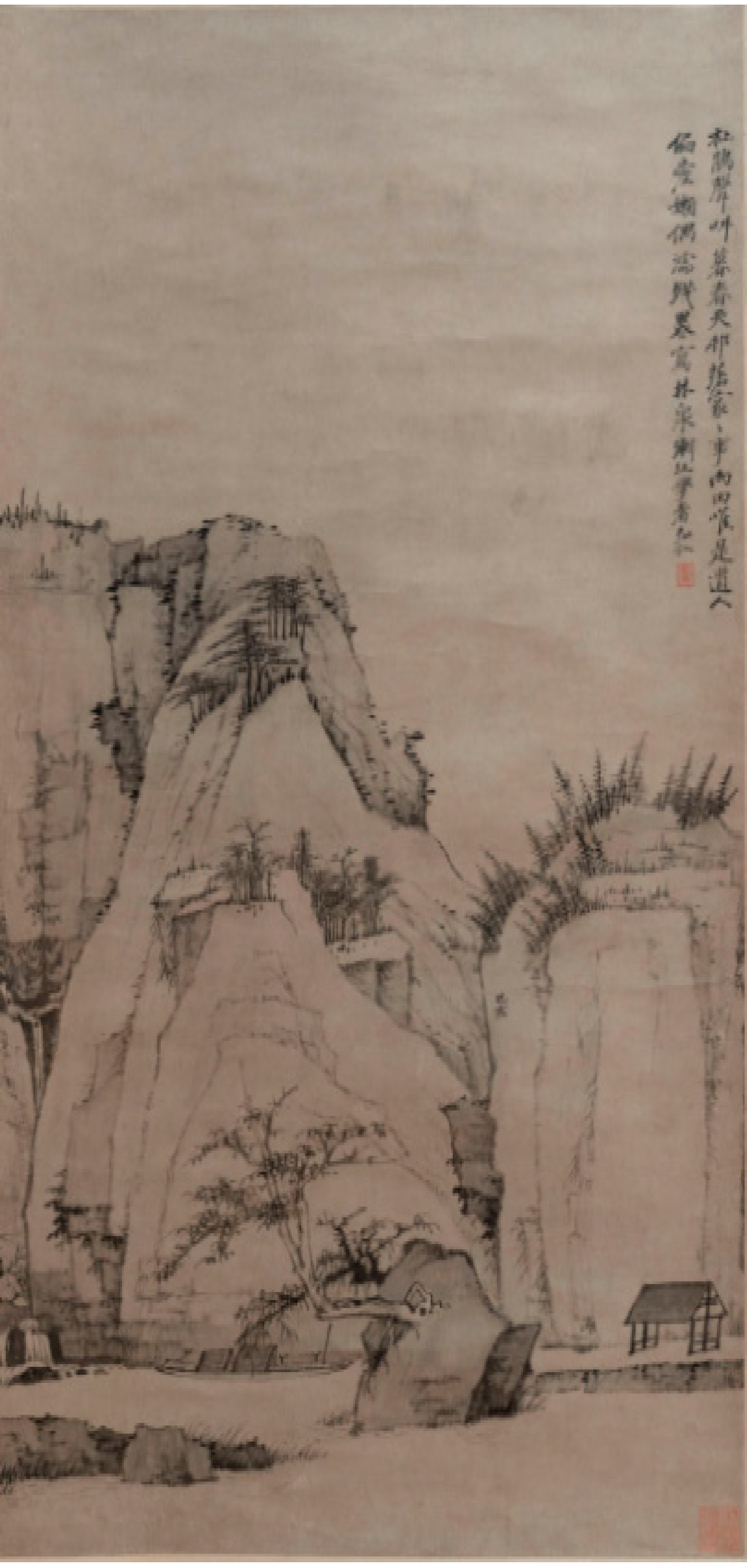
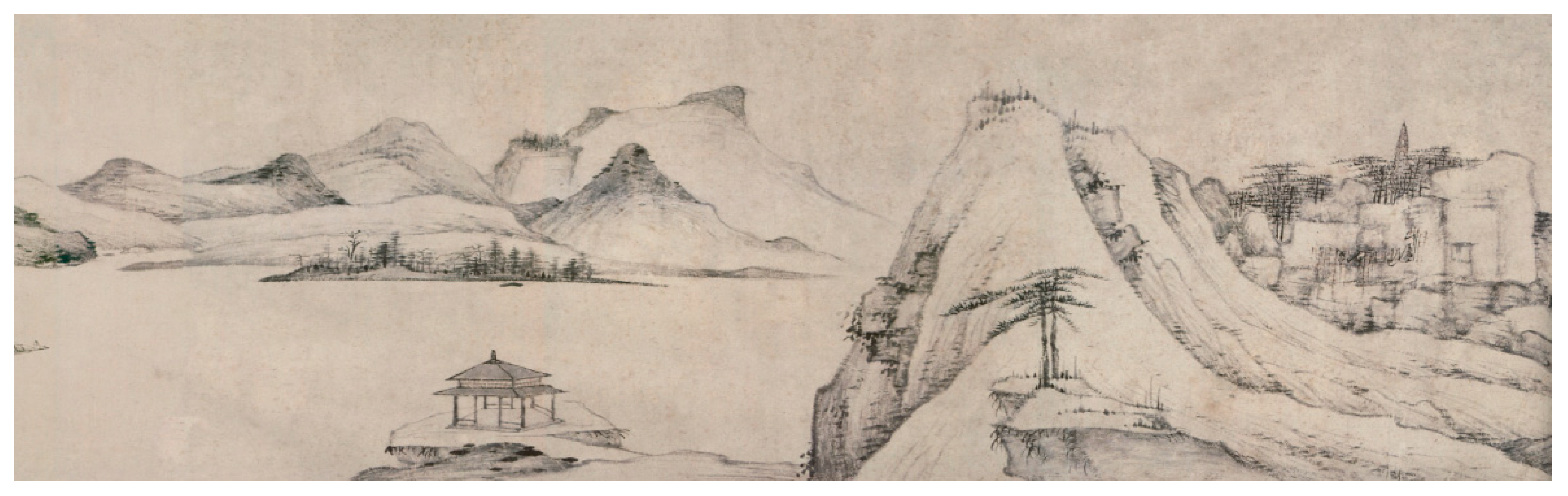
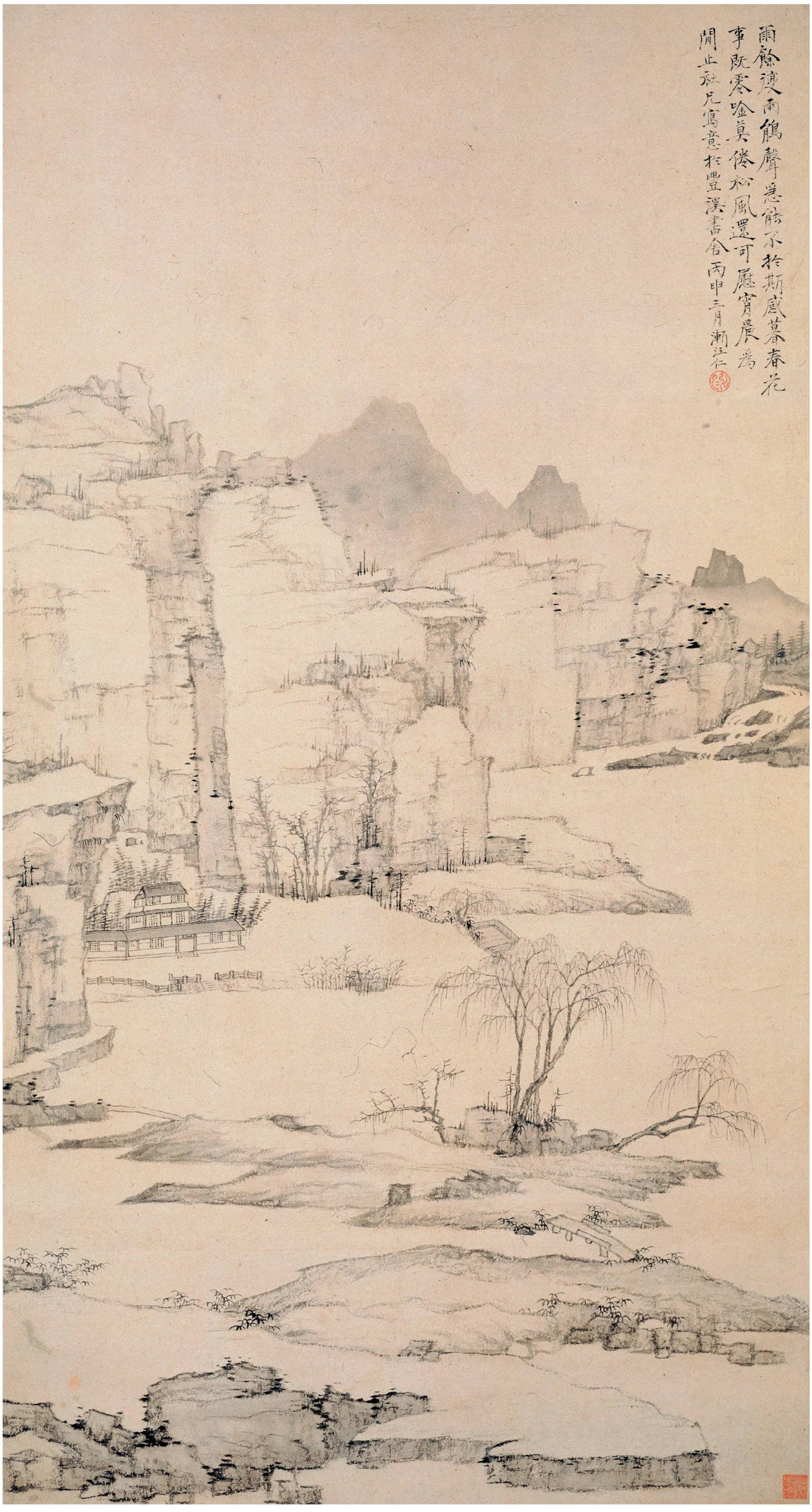
Through careful composition, these geometric blocks, varying in size and shape, produce a visual order that possesses both architectonic stability and a musical sense of rhythm. Such order is not a simple mimetic reproduction of external natural laws; rather, it is an intuitive presentation of the order and harmony of “Dharma-nature”—that is, emptiness itself—perceived after the artist has illuminated all things through “contemplation of emptiness.” As Harvey (Harvey 2000, p. 35) notes, Buddha-nature in Mahāyāna Buddhism functions as “a basis for respecting all beings.” Through geometric refinement, Hongren’s forms not only dismantle “attachment to dharma” regarding natural forms, but also, through the lens of emptiness contemplation, disclose the Buddha-nature inherent in all things. The landscape thus becomes a visual testimony to the equality of all sentient beings and the oneness of Dharma-nature. In doing so, the viewer is guided away from fascination with the rugged surface of rocks or the lushness of vegetation, thus facilitating a further dismantling of such attachment. This geometric conception of form finds vivid embodiment in Woods and Streams in Late Spring (Linquan Chunmu Tu 林泉春暮图) (see Figure 9). In the work, the mountains are naturally segmented into distinct, hard-edged, and angular geometric blocks. The brushwork is sparse yet pregnant with meaning, leaving vast areas untouched to suggest emptiness. It is precisely this refined, detached visual treatment that yields a quiet, numinous Chan atmosphere, evoking a secluded realm beyond the dusty world. This ‘filtered’ visual experience is not merely a refinement of scenery, but may be considered a formal expression of Chan “emptiness contemplation”: by “breaking of appearance” (poxiang 破相) via geometry, the viewers are led beyond surface representation to reach the authentic reality of emptiness. Hongren’s inscription on the painting reads: “The cuckoo cries in the late spring sky/Every family in the village turns to the fields./Only the Daoist is partial to idleness/Occasionally wetting leftover ink to sketch the woods and streams. 杜鹃声叫暮春天, 邦落家家事向田。唯是道人偏爱懒, 偶濡残墨写林泉” The line “Every family… turns to the fields” depicts the secular world following seasonal production and collective busyness, symbolizing a universal, attachment-driven mode of existence (“attachment to dharma”). In contrast, Hongren’s self-description as a “Daoist partial to idleness” signifies a conscious spiritual withdrawal. This “idleness” does not denote indolence, a fact corroborated by his signature, “Hongren, a scholar from Jianjiang,” and his “Jianjiang” seal. His self-appellation as a “scholar” does not refer to the pursuit of secular knowledge but signifies his lifelong cultivation of both Buddhist Dharma and the way of painting as a monk-painter. In the Chan context, “scholar” often denotes a monk devoted to the cultivation of Chan and the investigation of the Dao. This title elevates his painting, described as “occasionally wetting leftover ink”, into a spiritual lesson, which aligns with the logic of the previously discussed “lessons during rainy days.” He is not merely creating a painting; rather, he is practicing a way of contemplating the world. Complemented by the “Jianjiang” seal at the bottom of the work, his name and title form an identity loop of the “practitioner-painter”: while as the painter “Jianjiang,” he remained essentially a cultivator in the role of a “scholar.” His “idleness” was, in essence, a rejection of utilitarian secular painting and a steadfast commitment to the states of “non-abiding” and “non-seeking”, and a transcendence of the collective attachment inherent in mundane life. Accordingly, Woods and Streams in Late Spring stands as a paradigmatic example of Hongren’s “emptiness of form,” demonstrating his artistic pursuit of spiritual purification through formal simplification.
Secondly, Linear Modeling and Blank Space: The Visual Dialectic of the “Non-duality of Form and Emptiness”.
In the structure of his linear modeling, Hongren demonstrates an extremely high degree of restraint and spirituality. He extensively employs clean, slender, vigorous linear elements with centered-tip brushwork (zhongfeng, 中锋). Utilizing techniques akin to the “iron-wire line”13 (tiexian miao, 铁线描) or “bent-hairpin stroke”14 (zhechai gu, 折钗股), he clearly delineates the contours and key internal structural lines of the rocks and mountains. The texture of these lines is lucid yet resilient. This highly controlled linear language itself embodies the “precepts” of a practitioner: the concentration of the mind and the rigor of conduct. It excludes randomness and contingency in formal expression, rendering the visual presentation extremely pure.
What is especially significant is that these clear, assertive contour lines, set against the large expanses of untouched blank space, generate an extraordinarily strong visual contrast and philosophical resonance. The clear “lines” define the presence of “form” (se: phenomena, appearances), while the internal “blankness” directly points to “emptiness” (kong: essence, the absence of intrinsic nature) as their ontological ground. Such “contours without texturing” or “radically minimal texturing” is not a deficiency of expression but a deliberate deployment of “reserved blankness.” By doing so, Hongren transforms “emptiness” from an abstract concept into a tangible, visual presence. Here, “form” (the shapes delineated by linear structuring) and “emptiness” (the void within) are rendered not as opposing, mutually exclusive realms, but as interdependent and mutually constitutive dimensions. The sharply defined boundary of form in fact heightens and secures the purity and presence of “emptiness”, while the internal “emptiness” endows “form” with a lively vitality and a transcendent significance. This configuration offers a powerful visual articulation of the Heart Sūtra’s (《心经》) profound central tenet that “form is precisely emptiness, emptiness is precisely form,” constituting an ongoing visual dialectic of “the non-duality of form and emptiness”15 (sekong buer, 色空不二). As the viewer’s gaze oscillates between lines and blankness, presence and absence, thereby undergoing, within the aesthetic experience, an implicit training in the Chan contemplation of “encountering appearances while remaining unattached to them”16 (yu xiang er li xiang 于相而离相), directly apprehending the reality of all things as “dependently origination and empty in nature.” As a concrete practice of this dialectic between linear modeling and reserved blankness, Hongren’s Landscape Album (see Figure 10 and Figure 11), comprising ten leaves, further demonstrates the purity and spirituality of Hongren’s brush-and-ink language. This album was painted when Hongren, at age forty-nine, was temporarily residing at the home of a layman surnamed Su, created to express gratitude to his host. The painting bears only a circular seal with the name “Hongren” and lacks a written signature. The compositions predominantly feature small, close-range scenes. Objects are outlined with clean, slender, and vigorous centered-tip brushwork; the brushwork is sparse and understated, yet the overall breath is austere and pure. The paulownia, plum, and bamboo stand with an aloof, lofty bearing, while slopes, waters, and rocks configure scenes of stillness and quiet emptiness, together constructing an atmosphere of cultivated detachment. Most strikingly, the sharp contrast between the assertive lines and the large areas of reserved blankness enacts, in miniature, the visual dialectic of “the non-duality of form and emptiness” discussed above: line functions as “form,” delineating appearances; blankness functions as “emptiness,” pointing directly to their groundless nature. Such sparse and distilled brush-and-ink structures not only fulfill the social function of reciprocating kindness, but can also be read as vivid evidence that Hongren, even amid the routines of daily dwelling, continued to practice the “emptiness contemplation” and enacted through his brushwork a vision of “the oneness of form and emptiness.”
Thirdly, Spatial Compression and Planarity: an attempt to Dissolve Attachment to Depth.
In his treatment of space, Hongren’s formal language also reflects the influence of the “Emptiness Contemplation.” He frequently subjects elements of the foreground, middle ground, and background to a unified spatial compression, pulling them toward a shared visual plane. This technique drastically attenuates the illusion of deep distance, typically constructed in traditional landscape painting through atmospheric perspective and size contrast. This deliberate attenuation of three-dimensional depth reinforces the planarity and abstract quality of the painting.
From the perspective of spiritual cultivation, the attachment to “deep space” constitutes another form of “attachment to dharma,” a belief that space is an objective entity, truly existent with direction and measurable distance. By compressing space, Hongren disrupts this habitual mode of spatial cognition, implying that space itself is dependently originated and empty of nature, a mere manifestation of the mind (weixin suoxian, 唯心所现). Objects seem to be extracted from our familiar physical space and suspended in an atemporal, ahistorical abstract realm, which further reinforces their quality of being “illusory and phantasmal” (ruhuan ruhua, 如幻如化). Consequently, the “void” parts between objects are endowed with a status equal to, or perhaps even more significant than, the solid forms themselves. The tangibility and the intangibility generate one another (xushi xiangsheng, 虚实相生), together constituting a complete visual field that embodies “emptiness.”
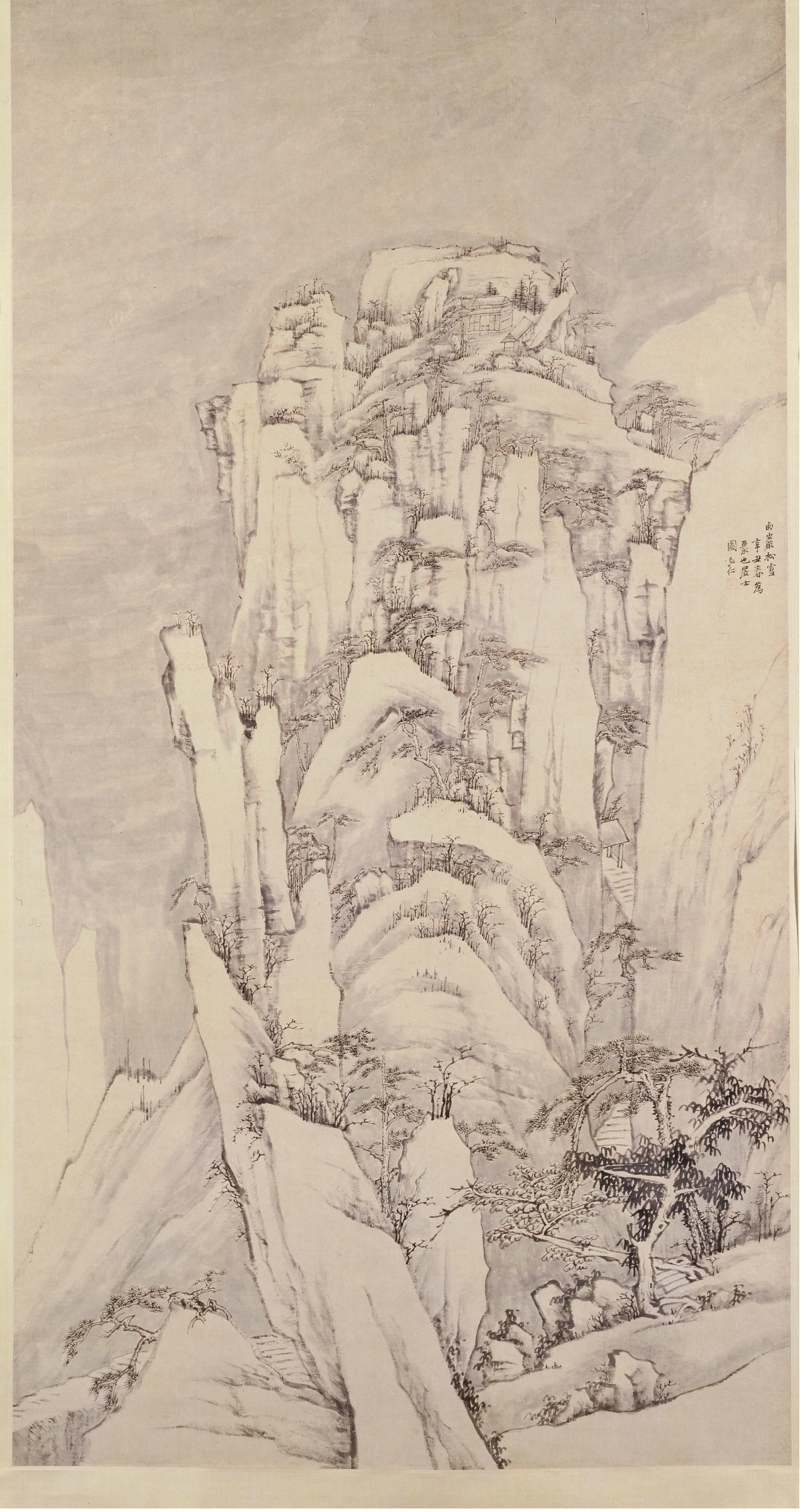
Hongren’s “Emptiness of Form” is a systematic cultivation practice of “breaking attachment to appearance”17 (poxiang, 破相) on the visual level, achieved through radical formal simplification, geometric refinement, the dialectical treatment of line and blank space, and spatial compression. It aims to guide both the creator and the viewer to transcend their attachment to the appearances of landscape, penetrating directly to the empty nature, characterized by an “absence of intrinsic nature.” In Snow on Pine at West Rock (Xiyan Songxue Tu, 西岩松雪图) (see Figure 12), Hongren further puts his philosophy of “Emptiness Contemplation” into practice through a specific treatment of spatial structure. Although the composition presents overlapping mountain ranges, the artist deliberately attenuates atmospheric perspective and the contrast between near and far, compressing foreground, middle ground, and background onto a proximate visual plane. The rocks, pine trees, and dwellings lack a strong sense of depth perception; they appear instead to be situated within an abstract, unified pictorial field, generating a visual effect of “spatial planarity.” This planar, non-narrative spatial structure embodies, in its very composition, the Chan realization of “the mutual identity of form and emptiness” (se kong xiang ji, 色空相即).
The inscription in the upper left of the painting reads: “Snow on Pine at West Rock, painted for Lay Buddhist Xiangye in the spring of the Xinchu year by Hongren,” accompanied by a square white-character seal bearing the name “Hongren.” This inscription and seal provide critical textual corroboration for understanding the emptiness contemplation inherent in his composition. The “Snow on Pine at West Rock” directly identifies the subject, featuring snow-covered cliffs and pines standing on precipices. This imagery points to a realm of empty stillness where mundane clamor is completely cleansed. Within the Buddhist context, “snow” frequently symbolizes “purity without defilement,” which resonates with the Chan concept of emptiness expressed in the verse “originally, there was not a single thing.” The date “Spring of the Xinchu year” (1661) indicates that his art had reached full maturity, and his technique of spatial compression had become more conscious and refined. The recipient mentioned in the phrase “painted for Lay Buddhist Xiangye” was a practitioner of Buddhism living at home. By creating this landscape of emptiness contemplation specifically for a layman, Hongren likely intended to guide the recipient to transcend attachment to “external forms” (wuxiang 物象) and directly realize the reality of the Middle Way and “the non-duality of form and emptiness”. The use of the Dharma name “Hongren” in the seal emphasizes that the painting was a form of Buddhist service (foshi 佛事) rather than a mere artistic endeavor (yishi 艺事).

3.2. Emptiness of Brushwork

If form is the “skeletal” of painting, then brushwork constitutes its “flesh and breath.” “The five colors blind the eye.” For the Chan school, which prioritizes cultivating the mind and seeking enlightenment, ink wash painting that is grounded in black and white undoubtedly offers an excellent path for practitioners to “illuminate the mind and see their true nature”18 (mingxin jianxing 明心见性). Zhang Yanyuan 张彦远 (Zhang 2005, p. 193) long ago offered a profound insight: “If one wields ink well, the five colors are all present; he is said to have attained the essence. But if one’s intent is fixed on the five colors, the images of objects will be distorted! Painting particularly avoids the exhaustive detailing of appearance and brilliant colors, or excessive caution and an outward display of clever intricacy.” This statement profoundly reveals the core orientation of Chinese painting aesthetics: true “attainment of essence” lies not in a colorful form, but in conveying spirit through simplicity and substituting ink for color. To be constrained by the “cautious and clever” of external form would, on the contrary, obscure the inner spirit of the object and the mind of the artist.
The mind, roaming amidst the gradations of black and white, navigates the boundaries between the void and the solid. Free from the intrusion of the five colors and the delusions of worldly appearances, one can realize the profound meaning of “emptiness” in a focused state (Peng and Yao 2020, p. 20). The qualities of simplicity, austerity, ethereality, and lucidity manifested in Hongren’s brush-and-ink language are the natural outflow of his Chan “emptiness contemplation” at the technical level, embodying a highly spiritual and religious form of “discipline” (jie, 戒).
Firstly, Extreme Restraint in Ink: the Visual Practice of “Void and Emptiness.”
Hongren demonstrates a unique aesthetic orientation and a restraint akin to spiritual discipline in his deployment of ink. The vast majority of his works are executed purely in ink wash, with very little use of color. This rejection of color possesses profound symbolic significance. In Buddhist aesthetics, color is often associated with the profusion of material desires and emotional manifestations. Hongren’s exclusive focus on ink wash serves the purpose of “Void and Emptiness,” which strips away external opulence and distraction to penetrate directly into the essence of objects and the original mind. Deriving his ink style from Ni Zan, he refined the use of ink to the “utmost lightness,” yet achieved an effect “abundant in lingering resonance.” As the Qing dynasty critic Yang Han commented: “He reveals richness in extreme spareness, and vigor in extreme slenderness” (Ran 2013, p. 145). This brush-and-ink practice, seeking infinite vitality within extreme restraint, is precisely a visual expression of “Emptiness.” “Emptiness” is not a dead void, but a luminous realm that contains infinite vitality and subtle transformation.
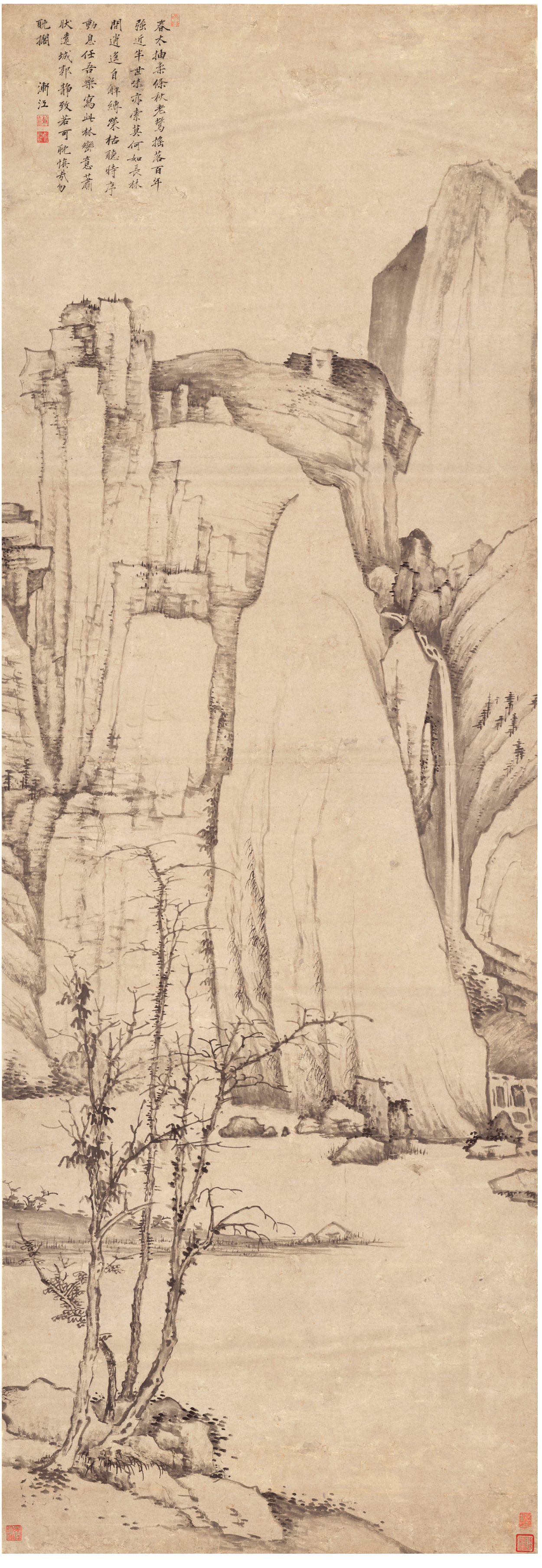
The painting Untrammeled Freedom in the Lofty Forest (Changlin Xiaoyao Tu 长林逍遥图) (see Figure 13) exhibits an extreme restraint in ink. Through the complete corroboration of poetry, calligraphy, painting, and seals, it thoroughly integrates the visual expression of emptiness with the artist’s state of spiritual cultivation. The entire work is rendered solely in ink wash. By completely rejecting color, Hongren used the purest black and white to strip away all material distractions, reaching directly into the fundamental nature of the forest and mountains. Regarding his technique, Hongren primarily utilized light ink, using minimalist ink lines to delineate the contours of the rocks and cliffs. By utilizing the unpainted space of the paper to represent the white of the mountain forms, he hid the main bodies of the mountains within the void, eliminating heavy ink, rich color and complex texture strokes. This approach achieved a state where “simplicity is not truly simple.” He used slightly darker ink only for dotting withered branches and moss, revealing subtle layers of transformation amidst extreme restraint. This serves as a vivid illustration of finding “richness within leanness” and “vigorous strength within extreme delicacy.” Such rigorously restrained ink tones and the desolate blank space of the composition perfectly embody a pure and lofty elegance that arises from the divestment of mundane dust.
The inscription on the painting reads: “In spring, the trees sprout tender twigs; yet in late autumn, I am startled by falling leaves. /My hundred years are nearly half gone; the world has become dull and indifferent. /How could any place compare to the lofty forests, where I am untrammeled and free from the mundane entanglements. /Flourishing or withering follows the seasonal order; movement or rest is left to my own joy. /I paint the essence of these peaks and woods, desolate and far from the city walls. /This quiet realm is indeed worth savoring, yet I must be cautious not to linger in the mundane world. 春木抽柔条, 秋老惊摇落.百年强近半, 世味亦索莫.何如长林间, 逍遥自解缚.荣枯听时序, 动息任吾乐.写此林峦意, 萧然远城郭.静致若可耽, 慎哉勿耽搁.” The poem begins with the cycle of flourishing and withering throughout the seasons, corresponding to the withered trees in the painting where lush leaves are stripped away to reveal only lean branches. By choosing to depict autumnal desolation rather than vernal splendor, Hongren uses the purity of his light ink to echo the emptiness of image, which aligns with the Chan principle of “all things are impermanent” and “the divestment of material desires.” The lines “My hundred years are nearly half gone…where I am untrammeled and free from the mundane entanglements” directly express the artist’s inner state. The distant city walls and desolate mountains, rendered in minimalist pale ink, serve as a spiritual sanctuary where the poet escapes the secular world. In this context, the extreme restraint of the ink serves as a visual manifestation of the mental clarity achieved after being “free from the mundane entanglements.” Furthermore, just as the trees flourish or wither according to the cycles of nature, Hongren’s ink work avoids technical ostentation, reflecting the Chan practice of “following conditions and acting with spontaneity” (suiyuan renyun 随缘任运). The final line clarifies the primary objective of his creation: the desolate peaks and woods captured in pale ink tones are intended to settle a mind that has broken free from worldly fetters and seeks the stillness and quietude of Chan. Ultimately, the extreme restraint of his ink points toward the clarity and emptiness of the realm of spiritual cultivation.
Simultaneously, Hongren executed the poetic inscription in a lean and vigorous semi-cursive calligraphy. The ink tones are similarly pale and restrained, sharing a common structural origin with the linear delineations of the mountains and withered trees. This restrained brushwork and its lofty atmosphere are perfectly integrated with the painting’s cold and detached realm. He applied three seals to the work: “Jianjiang” in red characters (Zhuwen 朱文), “Lan Chan” in white characters (Baiwen 白文) and “Yi Qing Shanshui” (Finding Joy in Mountains and Waters 怡情山水) as the frontispiece seal. The simple, archaic, and unassuming style of these seals creates an isomorphic resonance with the desolate realm expressed through the poetry, calligraphy, and painting. If poetry is the voice of the mind, painting is its image, calligraphy its trace, and seals its verification, then the union of these four elements confirms the profound significance behind Hongren’s restraint of ink. This extreme lightness and emptiness represent far more than technical choices; rather, they constitute a form of cultivation that strips away the mundane world, an untrammeled freedom following the release from secular bonds, and a state of being in which the Chan mind and ink are completely unified. Consequently, the emptiness of his ink ceases to be a mere technique but becomes the act of spiritual cultivation itself, one that is deeply consonant with his emptiness contemplation.
Even in the very few extant blue-and-green landscape works by Hongren, such as a small blue-and-green leaf in the Album of Mount Huang (Huangshan Tu Ce, 黄山图册) (see Figure 14), he departs from the conventional use of heavy, saturated mineral pigments typically associated with this genre. Instead, he applies azurite and malachite in extremely thin, translucent washes over an underlying “ink skeleton” (mogu, 墨骨). This technique achieves a luminous harmony where color does not impede ink and ink does not obscure color. In essence, this constitutes an extension of his “emptiness contemplation” into the domain of color, representing a creative transformation that “attenuates” and “purifies” the blue-and-green tradition.
Within his ink system, the application of ink reaches a level of extreme refinement. Hongren rarely employs heavy applications of “thick black ink” or “overnight ink”; instead, he relies predominantly on light ink, through precise moisture control to reveal rich, nuanced gradations within the lightest washes, truly achieving the ideal that “ink encompasses the five colors.” This pale, ethereal ink tone seems bathed in cool moonlight, creating an atmosphere that is far removed from the mundane life. It is not only an extreme abstraction and purification of light, space, and texture in the natural landscape but also a visual articulation of the philosophical concept of “Emptiness.” Such ultimate control over ink requires the artist to maintain a state of extreme tranquility, clarity, and concentration during the creative process, for any abstraction of mind could disrupt this delicate equilibrium. Another leaf from his The Album of Mount Huang (see Figure 15) vividly embodies this extreme control of ink and the aesthetic of “seeking resonance within lightness.” It serves as further confirmation of his Chan practice of “void and emptiness” and “From True Emptiness Comes Wondrous Existence” upheld through his method of ink application.
Secondly, Extreme Simplification of Texture Strokes: Spiritual Wisdom in the “Subtractive Method”
Hongren undertook a bold and thorough simplification of the texture method (cunfa, 皴法), a critical element in traditional landscape painting. He drastically reduced both the frequency and complexity of their application. Even when employed, he mostly used a dry and pale “dry brush” (kebi, 渴笔), resulting in the traces of the brush that appear barely visible. The ink tone remains ethereal, never disrupting the purity and numinous quality of the rock forms. Traditional techniques such as “hemp-fiber strokes” (pima cun, 披麻皴), “folded-belt strokes” (zhedai cun, 折带皴), and “unraveled-rope strokes” (jiesuo cun, 解索皴) are highly purified and integrated under his brush. He employs only the most essential strokes to suggest structural turns and planar relationships, sometimes leaving vast areas as blank reserves, closely approaching the style of plain line drawing (baimiao, 白描).
This “subtractive method” applied to texture strokes carries profound spiritual implications. In Buddhist cultivation, “eliminating defilements to preserve purity”19 (goujing mingcun 垢净明存) and “ceasing delusion to reveal the true nature”20 (powang xianzhen 破妄显真) are central processes. It requires one to continuously discard attached afflictions (kleshas), habitual tendencies (vasanas), and deluded thoughts to manifest the inherently pure self. Hongren’s subtractive approach to brush-and-ink mirrors this cultivation process. He discards the tendency inherent in traditional texturing methods with triviality, clutter, and the simulation of surface textures. This symbolizes breaking the attachment to subtle “dharmas” in practice. His dry, pale, and ethereal strokes create a visual effect where presence and absence interpenetrate, allowing one to perceive emptiness amidst existence, which perfectly presents the Middle Way reality of “Form is Emptiness” as illuminated by Prajñā wisdom. Brushwork that appears “sparse” thus harbors “abundant” artistic conception and philosophy, achieving the artistic pinnacle of “simplicity of brush, profundity of meaning.” In Hongren’s Birthday Celebration (Jieshou Tu, 节寿图) (see Figure 16), images of pines, bamboo groves, and trickling springs are all outlined with minimalist strokes. Although created as a birthday gift, the work is devoid of any vulgar gaudiness. The ink and brush are reduced to the absolute minimum, using only sparse lines and subtle ink tone to suggest the presence of objects, leaving the scene vast and desolate. This extreme simplicity is not an absence of content but a profound embodiment of his “Emptiness contemplation.” Through the thorough purification of texture strokes and the radical of forms, Hongren enacts the Chan process of “removing defilement to preserve purity” and “ceasing delusion to reveal truth.” While the painting implies human warmth and congratulatory intent, all is illuminated by “Emptiness Contemplation” and unified by “Simplicity.” The secular subject matter is thus sublimated into a tranquil, Chan-imbued spiritual icon that transcends specific occasion. This is a vivid proof of the cultivation of wisdom within the “subtractive method” in creation, demonstrating Hongren’s realm of “Brush-and-Ink Chan,” where religious realization and artistic expression are highly integrated.
Hongren’s “Emptiness of Brushwork” is embodied in his extreme restraint in ink tone, the rationality and equanimity of his brush usage, and the radical simplification of texture strokes. These qualities make his brush-and-ink a visible trace of his meditative state and his cultivation of the “Threefold Training”21 (Precept 戒, Concentration 定, and Wisdom 慧). Form and brushwork complement each other, jointly constructing the visual sacred realm of Hongren’s landscapes that are desolate, detached, empty, silent, and pure.

4. “Emptiness” in Composition and “Artistic Conception” in Hongren’s Landscape Painting

As a continuation of the analysis of his formal language, specifically form and brushwork, the study now concentrates on the expression of “emptiness contemplation” in two macro-dimensions: the overall pictorial structure (composition) and the ultimate spiritual atmosphere (artistic conception). As Peng Feng (Peng 2021, p. 42) observes, “Zen aims at changing the subject, instead of changing the object.” For Hongren, the supreme realm presented in his landscapes stands as visual testimony to the novel worldview attained following such a “change of the subject.” If form and brushwork represent the “traces” (jihua, 迹化) of his spiritual cultivation at the constituent and micro levels, then composition and artistic conception constitute the “perfect manifestation” of his spiritual attainment at the holistic and macro levels. Together, they form the pinnacle of Hongren’s practice of “cultivation through painting.” They mark the “Realm of Emptiness” opened up in visual art after his Chan-enlightened mind achieved deep accord with the true suchness of the cosmos.

4.1. “Emptiness” in Composition

The composition of Hongren’s landscape paintings, particularly in his mature works following his ordination, is far from a simple formal arrangement or visual game. Rather, it is the externalization of a cosmic contemplation and spatial philosophy based on profound Chan enlightenment. The “Emptiness” in his composition is a visual translation of the mental space, cosmic cognition, and inner rhythms attained through meditative cultivation (dhyana, 禅定).
Firstly, Precipitous Verticality and Cropped Composition: the Chan Spirit Standing like a Solitary Peak.
Hongren excelled at and frequently employed precipitous, towering compositions. In his paintings, the main peak often rises almost vertically from the ground, standing majestically at the visual center. In The Tiandu Peak of Mount Huang (Huangshan Tiandu Feng Tu 黄山天都峰图) (see Figure 17), Hongren utilizes precisely this mode of precipitous composition. The main peak thrusts upward nearly vertically, while vast areas of blank space reinforce the painting’s ethereal emptiness and sense of solitary desolation. This “cropped composition” (jiejing 截景) discards detailed texturing and ink gradation, employing instead extremely simplified geometric blocks and linear structures to create a spatial order that is serene, profound, and detached, one that gestures toward the meditative state of “Emptiness Contemplation.” Hongren inscribed a poem on this painting:
“Having traversed rugged peaks, radiance fills my robe; /Returning with my staff, mind and intent were both unfulfilled. /Unrolling this scroll, suddenly the pine wind surges; /As if I’m still at Tiandu, singing of the verdant slopes. 历尽巉岏霞满衣, 归筇心与意俱违。披图瞥尔松风激, 犹似天都歌翠微”
The inscription reads: “Painted and inscribed for Lay Buddhist Quyi. Jianjiang Xueren, Hongren. 为去疑居士写图并题正。渐江学人弘仁”.
The inscription forms an exquisite mutual corroboration with the visual imagery. The first two lines of the poem describe the experience of climbing Mount Huang, where the external journey fails to bring true internal peace, leaving the artist’s “mind and intent were both unfulfilled.” The latter two lines shift focus to the act of “unrolling the scroll” (pitu 披图), both creating and contemplating the painting. By contemplating the artwork, the surging pine wind and the sensation of being at Tiandu Peak lead the artist to the fulfilled experience of “singing of the verdant slopes.” The soaring isolated peak and the vast areas of blank space within the painting serve as a visual bodhimaṇḍas (site of cultivation 道场), allowing the artist to “revisit” the sacred site through the very act of creating and contemplating the painting. The tension between the state of “mind and intent were both unfulfilled” and the joy of “singing of the verdant slopes” is mediated by the desolate composition. In this respect, physical climbing is no longer necessary; instead, one can enter the state of emptiness contemplation through the minimalist ink and blank space. An integrated examination of the poem, signature, and imagery reveals that Hongren frequently adopted the self-appellation “Xuezhe” (student 学者) when painting for lay Buddhists. This choice emphasizes that both the artist and the recipient are fellow cultivators. Ultimately, the inscription reveals that Hongren intended to guide the layman to transcend the attachment to actual scenery and to instead directly explore the nature of the mind through the act of creating and contemplating.
The composition in The Album of Mount Huang (Leaf 3) (see Figure 18) similarly embodies the visual wisdom of “Emptiness Contemplation.” The scene is often sketched with just a few sparse strokes depicting perhaps two hills and a single tree, with the remainder left blank. This highly simplified cropped treatment not only endows the scene with an ethereal and tranquil atmosphere but also achieves a dynamic balance between the tangibility and the intangibility within the structure. It guides the viewers to transcend the surface appearances and enter directly into the Chan experience of the “non-duality of form and emptiness.” The blank space in the composition is not an absence, but a spiritual space where “True Emptiness gives rise to Wondrous Existence.” It reflects Hongren’s pure grasp and spiritual command over the pictorial structure, grounded in his Chan realization.
Interpreted from the perspective of religious cultivation, this towering solitary peak serves precisely as a symbol of Hongren’s own spiritual temperament as a Chan practitioner. It symbolizes the cultivator’s resolute and immovable will of meditative stability, the practice of “stopping” (śamatha, 止) as well as the lofty realization of “not associating with the myriad dharmas”22 (bu yu wanfa wei lü, 不与万法为侣). The “wonder” (qi, 奇) and “perilousness” (xian, 险) of the peak imply that the path to enlightenment is extraordinary and transcends the mundane; meanwhile, its ultimate “stability” (wen, 稳) and “uprightness” (li, 立) embody the absolute “stability” and “determination” of the mind once it abides in Dharma-nature. Furthermore, this composition is often combined with a “cropped” treatment, selecting only the most expressive segment of the mountain while surrounding it with vast blankness. This does not indicate an incomplete painting; rather, it deliberately severs the viewer’s habitual associations with the complete mountain form. It forces the viewer’s attention to focus on the present. This aligns precisely with the Chan method of “Cut off the Myriad Streams”23 (jieduan zhongliu 截断众流), guiding the viewer toward a direct intuitive experience of being “without mind while in the midst of mind” (yu nian er wu nian 于念而无念)24 and “encountering appearances while remaining unattached to them” (yu xiang er li xiang, 于相而离相).
Secondly, Vast Expanses and the Mastery of Blankness: the Spiritual Space of “True Emptiness Giving Rise to Wondrous Existence.”
In addition to precipitous compositions, Hongren demonstrates equal ingenuity in his handling of “level-distance” (pingyuan, 平远) compositions, which reveal an even deeper profundity in his “Emptiness Contemplation.” In Propitious Winds on the Morning River (Xiaojiang Fengbian Tu 晓江风便图) (see Figure 19), Hongren employs a level-distance composition to present expansive waters and misty distant mountains. Through the vast reserved blankness of the river surface and the sparse arrangement of scenery, he creates a spatial atmosphere of vastness and solitude, directly embodying the transcendence of objects and the clarity of mind inherent in “Emptiness Contemplation.” The long inscription at the lower right of the painting reads: “In the eleventh month of the Xinchou year, as Lay Buddhist Boyan prepares for his journey to Guangling, Xueren paints Propitious Winds on the Morning River as a farewell gift. Within a few months, when the peach blossoms first bloom, I shall look forward to your return. Hongren.” This is accompanied by a circular seal in red characters (zhuwen 朱文) reading “Hongren” and a square seal in white characters (baiwen 白文) reading “Jianjiang.” This inscription forms a subtle corroboration with the imagery. The title Propitious Winds on the Morning River (Xiaojiang fengbian 晓江风便) not only identifies the farewell theme but also employs “Propitious Winds” as an allegory for unhindered conditions, resonating with the vast blank space of the river and sky. His self-appellation as a “Xueren” identifies the work as that of a dedicated practitioner. The lines “when the peach blossoms first bloom, I shall look forward to your return” avoid the conventional sentimentality associated with parting. Instead, Hongren utilizes the natural cycle of growth and decay to acknowledge the impermanence of gathering and parting. This represents a transcendence of worldly affairs through emptiness contemplation. The circular seal “Hongren” symbolizes emptiness and perfect interpenetration, while the square seal “Jianjiang”, represents solemn discipline, reflecting the dialectical unity between “emptiness” (the blank space) and “form” (the minimalist distant mountains). Ultimately, the inscription elevates the personal sentiment of farewell into a profound realization of “Dependent Origination and the Nature of Emptiness,” ensuring that this level-distance river landscape serves not only as a visual expanse but also as a sacred act of Dharma-giving (fashi, 法施) rooted in emptiness contemplation through the medium of brush and ink.
After Rain, the Willows (Yuyu Liuse Tu, 雨余柳色图) (see Figure 20) adopts a tripartite composition, organizing objects with concise lines and pale ink tones. The scene is sparse and tranquil, opening up a broad psychological void within the limited view. This further reinforces the aesthetic quality of his composition under the guidance of “Emptiness Contemplation”: controlling the tangibility with the intangibility (yi xu yu shi, 以虚驭实) and embracing existence within emptiness (yi kong na you, 以空纳有). On the upper portion of the work, the poetic inscription reads:
“Shower after shower, the cuckoo’s cry is incessant;/ How can one not lament the late spring here?/ Though the blossoms have scattered, I must not tire of chanting;/ For the breeze through pines can still soothe my mornings and nights. 雨余復雨鹃声急, 能不于斯感暮春。花事既零吟莫倦, 松风还可慰宵晨”
The postscript on the painting reads as follows: “Sketched for Elder Brother Xianzhi at the Fengxi Study in the third month of the Bingshen year (1656) by Jianjiang Ren.” This is accompanied by a circular seal in red characters bearing his name, “Hongren.” Collectively, this postscript and the painting form a sophisticated mutual corroboration: the lines “Shower after shower…” and “blossoms have scattered” depict the phenomenal world of impermanence and decay in late spring, revealing an acute sensitivity to the passage of time. However, “I must not tire of chanting” and “breed through the pines… “mark a turn: artistic creation (“chanting”) and the eternal elements of nature (“breed through the pines”) become his spiritual reliance and consolation. Combined with the visual language of sparsity and tranquility in After Rain, the Willows, it becomes evident that Hongren does not drown in the melancholy of late spring. Instead, through creation, he transforms his emotional “feeling” of external impermanence into a meditative “contemplation” of the inner, empty essence. It is particularly noteworthy that the signature uses the rare designation “Jianjiang Ren.” While Hongren typically signed his works as “Jianjiang,” “Jianjiang the Monk,” or “Hongren,” “Jianjiang Ren” integrates his sobriquet “Jianjiang” with his Dharma name “Hongren.” This unique naming suggests a state in which “Jianjiang”, within his brush and ink—as well as “Hongren”, within his mind-nature—attained a state of perfect non-duality at this very moment. The circular seal reading “Hongren” in red characters further utilizes its rounded form to unify the vast blank space and minimalist brushwork. Collectively, the poetic inscription, signature, seal and the painting itself manifest the actual state of Hongren’s spiritual cultivation in the Bingshen year (1656), when he was forty-six years old. The tranquil space constructed through the willow and the wind through the pines represents the tangible fruit of his efforts to settle his mind through the practice of brush and ink. In these level-distance compositions, Hongren greatly expands the empty parts of the painting. Water is often treated as complete blank space, without a single stroke; distant mountains are outlined only with extremely pale and simple lines, appearing as if suspended in a misty void; the sky is also left largely blank. This strategic management of vastness and blankness is the core embodiment of the “Emptiness” of his composition.
The vast emptiness in Hongren’s composition can be understood as a visual reflection of this inner state of meditative concentration (samadhi, 禅定). It is not a simple reproduction of physical space, but a direct externalization of the enlightened state of mind described as “a Mind that Embraces the Vast Emptiness; a Heart Boundless as Myriad Worlds” (xin bao taixu, liang zhou shajie, 心包太虚, 量周沙界25). This void represents the state of the mind after ultimate purification and expansion, and the vast “Original Mind” realized only after transcending the narrow ego.
These “blank spaces” are by no means a void of nothingness. Illuminated by the wisdom of Chan “Emptiness Contemplation,” this “emptiness” is “True Emptiness,” free from all fixed forms and attachments; yet simultaneously, this “emptiness” is capable of giving rise to “Wondrous Existence,” harboring infinite vitality and creative possibilities. Through the suggestion of surrounding scenery and the viewer’s imagination, the void in the painting is filled with a sense of atmosphere, light, and infinite extension, embodying the profound significance that “wondrous realms arise where the brush has not touched.” Though the water surface is left blank, one senses shimmering ripples and vast misty waves; though the sky is unpainted, one perceives floating clouds and an infinite firmament. This is the perfect embodiment of “True Emptiness giving rise to Wondrous Existence” in composition, where “Emptiness” is not a dead end, but a source brimming with vitality and infinite possibility, symbolizing the ultimate true suchness (Tathātā) of the cosmos.
Thirdly, the Dynamic Balance of Mutual Generation between the Tangibility and the Intangibility: A Visual Manifestation of the “Dharma Gate of Non-duality.”
Hongren demonstrates extraordinary wisdom in handling compositional balance. Even in those steep compositions that seemingly “seek balance in precariousness,” he achieves a subtle visual balance through elements such as slanted pine branches, scattered dwellings, or foreground rocks. This balance is a stability sought within dynamism, a harmony achieved within contradiction. This profoundly embodies the dialectical thinking of “the Dharma Gate of Non-duality” inherent in “Emptiness Contemplation.” Tangibility and Intangibility, existence and non-existence, movement and stillness, precariousness and stability, all these seemingly opposite categories are not severed in Hongren’s compositions; rather, they are interdependent, mutually transforming, and mutually complementing. As stated in the Shurangama Sutra (Vol. 2): “It is like a second moon: who can say which is the moon and which is not? Manjushri, there is only one true moon; within that, there is naturally no question of ‘is the moon’ or ‘is not the moon’. 如第二月, 谁为是月, 又谁非月?文殊, 但一月真, 中间自无是月非月” (Dafoding 1987, p. 492). Hongren’s painting is precisely a visual echo of this wisdom of “non-duality”: the clear lines and the blankness, the towering mountains and the empty sky, are not opposing ones. Rather, they are different manifestations of the same “one true moon;” that is, the Reality of Emptiness. This compositional principle of “the mutual generation of tangibility and intangibility” and “the non-duality of movement and stillness” is a visual interpretation of core Chan doctrines such as “non-duality of form and emptiness” and “Defilements and Bodhi Share the Same Essence” (fannao ji puti, 烦恼即菩提26). It teaches the viewers to transcend dualistic thinking patterns and recognize the reality of the world and the original state of the mind within the unity of contradictions.

4.2. “Emptiness” in Artistic Conception

Artistic conception, the soul of Chinese art, is also the ultimate pursuit of Hongren’s landscape painting. The realm of “emptiness, silence, simplicity, and detachment” he creates is far from a mere aesthetic style; it is the complete, natural, and thorough manifestation in art of the spiritual state realized through his religious cultivation.
First, the uniqueness of Hongren’s artistic conception is rooted in the profound breaking of “attachment to the self” during his life journey. The drastic upheavals of his earlier years, including the cataclysmic changes in his country and family, along with the disillusionment of his personal ideals, prompted him to resolutely walk on the Buddhist monastic path. This momentous decision was itself a decisive transcendence of secular “attachment to the self” (attachment to individual life, emotions, and ambitions) and “attachment to dharma” (attachment to country, sovereign-subject relations, and morality). After ordination, he entrusted his body and mind to the Dharma and painting. Through continuous Chan cultivation and brush-and-ink practice, he constantly cleansed the distracting thoughts of his mind; thus his mental state increasingly approached a state of the “desolate silence” characterized by “no-thought,” “non-abiding”, and “no-form.”
“No-thought” does not imply the absence of thought, but rather that the mind remains unstained, to be “without mind while in the midst of mind.” Reflected in art, this manifests as the thorough stripping away of personal styles, such as the solitary indignation, grievances, or aloofness found in the works of artists like Ni Zan. Hongren’s landscapes are no longer metaphors for his own turbulent life or symbols of personal moral integrity; instead, they present a more pure, universal, and ontological sense of cessation (nirvāna) and cosmic consciousness. The philosophical foundation of this consciousness is deeply rooted in the Chan realization that “subject and object share the same source” (wuwo tongyuan, 物我同源). As Chan Master Shimen Yuncong stated: “Heaven and Earth share the same root as I; all things form one body with me” (Dazheng 2004, p. 38). This statement reveals the essence of the realm of “no-thought”: when the barriers of “attachment to the self” are thoroughly dismantled and the mind returns to its original desolation and clarity, the separation between individual life and the myriad things of the cosmos dissolves. At this moment, the landscape perceived and depicted by the artist is no longer an “object” opposed to the self, but an existence that shares the same root with his own life. This realm corroborates the core insight of Chan: “Whatever Zen realization is about—Being, Truth, nothingness, suchness—it is already there, all around us. That is why Zen masters from Buddha to Huang-po said that there is nothing to be sought. To think that there is something to be sought is misleading. To seek it is to deviate from it (Anderson 2025, p. 182).” For Hongren, the supreme artistic realm is not a goal to be deliberately constructed or sought outwardly. Rather, it is the natural reflection and open presentation of the world’s original “Emptiness” upon the painting, occurring only after “attachment to the self” and “attachment to dharma” have been shattered and the mind has fallen into quiescence. The atmosphere of detachment, purity, and freedom from mundane that permeates his paintings is precisely the manifestation of a state of absolute spiritual freedom and tranquility (the experience of “Nirvana Serenity”) achieved after breaking these attachments. In his later years, he named his dwelling Chengguan Xuan, literally “Pavilion of Clear Contemplation.” The name “Chengguan” serves as the perfect footnote to both his state of mind and his art—only with a clear mind can one truly perceive the Dao. The emptiness and clarity of the mind are the prerequisites for illuminating the true suchness (Tathātā) of the cosmos and reaching the supreme artistic realm.
Second, the religious symbolism of objects and the creation of a “Pure Land”27 (jingtu,净土) represent the spiritual direction that his artistic conception seeks to convey.
In Hongren’s creation of artistic conception, specific objects within the painting are imbued with profound religious symbolic meaning, collectively constructing a spiritual “Pure Land” or “Realm of Tranquil Purity”28 (qingliang jie, 清凉界).
Solitary peaks: As mentioned earlier, they symbolize steadfast spiritual resolve and the state of enlightenment.
Withered trees and dead branches: Rather than decay, they signify “defilements and Bodhi share the same essence;” the apparent lifelessness reveals the inherent stillness and resilience of life, embodying Chan insight of “blowing wind and snow amidst fierce flames.”
Empty pavilions and humble dwellings: These point directly to the realm of “non-abiding”—embodying the realization of “no-self of persons” (that there is no permanent individual self) and “no-self of phenomena” (that all things lack inherent existence). The pavilion is empty of people; the dwelling, though simple, embodies the truth that “originally there is not a single thing.” They transcend attachment to dwelling places, identity, and even the existence of self itself, serving as abodes of absolute spiritual freedom.
Waters and Void: As analyzed in the composition section, these symbolize the intrinsic emptiness of mind, capable of generating all phenomena.
These purified elements are not arbitrarily arranged; rather, based on his enlightenment experience, they are organically organized into a complete, orderly spiritual world. This world, insulated from worldly clamor and desire and is permeated with enduring tranquility and serenity. It is not a simple copy of the Western Pure Land, but the “Pure Land of Mind-Only”29, advocated by Chan Buddhism. According to this teaching, when the mind is purified and awakened to the utmost degree, one’s present environment, whether a corner of Mount Huang or an inner landscape of the mind, will become itself a Pure Land. Through painting, Hongren visualizes and gives concrete form to this inwardly realized “Realm of Tranquil Purity inherent in one’s true nature”, transforming it into a spiritual harbor where viewers may focus their contemplation and cultivate their inner nature.
Third, the non-dual, perfect interpenetration of “True Emptiness” and “Wondrous Existence”: the philosophical core and aesthetic Pinnacle of his artistic conception.
“Emptiness” in Hongren’s artistic conception is an ontological quiescence that emerges only after all worldly anxieties and attachments have been cleansed away. Meanwhile, the vitality contained within the “simplicity and detachment” of his realm—such as short reeds sprouting from rock crevices or wintersweet in secluded valleys—represents “Wondrous Existence,” a life force that arises naturally, without contrivance, from absolute silence. From the perspective of cosmological philosophy, this realm of the perfect interpenetration of non-duality is precisely the destination reached by Chan Buddhism through “silent contemplation.” In this realm, the boundaries between the artist’s individual life, the myriad things under his brush, and the ultimate existence of the cosmos completely dissolve, realizing the “absolute tacit unity where true suchness is identical to the existence of life, the existence of all things, and ultimate existence” (Song 2023, p. 116).
This vitality, flowing naturally from Emptiness, transcends mere naturalistic depiction. It profoundly embodies a fundamental conviction of Mahāyāna Buddhism: “A common feature of many different forms of Mahāyāna Buddhism is the belief that wisdom (the capacity to accurately perceive the co-dependent arising of all things) is identical to compassion (the capacity to spontaneously respond to the particularity of suffering such that this suffering is not only alleviated but that ultimately other persons can also begin to cultivate no-self)” (Bender 2024, p. 9).
In Withered Branches with Short Reeds (Gucha Duandi tu, 古槎短荻图) (see Figure 21), old branches and short reeds coexist, creating an interplay of dead silence and resilient vitality; in Propitious Winds on the Morning River (see Figure 22), the expansive river and sky are composed together with a few distant mountains, allowing infinite void and finite existence to complement one another. On Withered Branches with Short Reeds, Hongren inscribed a poem:
“Within the entire surroundings, there is nothing at all;/only two forked trees remain to guard the gate./Who will take charge of the cold pond left behind?/When autumn comes, it will be entrusted to the reed flowers./This is a poem by my friend Wang Yaofang. My associate Xiangshi’s residence is a place with a thin fence and a square pond, its water clean and deep enough to scoop up by hand. With withered branches and short reeds, soaked in dew and bowing to the wind, it is quite similar to the meaning [of the poem], Thus, I have attached [the poem] here for a smile. 一周遭内总无些, 守户惟余树两丫。还撇寒塘谁管领, 秋来待付与芦花。此余友汪药房诗。香士社盟所居, 篱薄方池, 渟泓可掬, 古槎短荻, 湛露揖风, 颇类其意, 因并系之, 博一噱也”.
The line “Within the entire surroundings…” depicts a realm of extreme simplicity and purity approaching “total emptiness,” with only “two forked trees” guarding the door, and the cold pond eventually entrusted to reed flowers. This is not merely a description of the composition but a direct articulation of the essence of “Form and Emptiness”: discarding all opulence and redundancy to point directly to the most authentic state of objects, which will ultimately return to quiescent emptiness. In the inscription, Hongren explicitly states that this painting is an active emulation and transformation of the artistic conception found in his friend’s simple, desolate, and Chan-imbued living scene of “thin fence, square pond, withered branches, and short reeds.” The words “quite similar to the meaning” (polei qiyi, 颇类其意) indicate that what he sought was not formal likeness, but an accord in inner spirit and interest. His transformation of the poem’s desolate artistic conception (the concept of “Emptiness”) into a visual image is a cultivation practice of “verifying Emptiness through art.”
When facing his paintings, the viewers first experience a thorough purification of the soul and a natural cleansing of worldly dust, as if being led into an eternal realm where all sounds are silenced and time stands still (True Emptiness). Subsequently, within this extreme quietude, they can perceive an inner, undeniable vitality flowing—a clear, cold life-force operating in silence (Wondrous Existence). This process of sublimation in artistic conception, proceeding from “simplicity and paleness” to “True Emptiness,” and then perceiving “Wondrous Existence” within that “True Emptiness,” not only marks the pinnacle of Hongren’s artistic achievement but also fully embodies the complete enlightenment journey of his “Painting Chan” practice: from “breaking attachments” (True Emptiness) to “manifesting function” (Wondrous Existence). This pushes the expression of spirituality in Chinese landscape painting to unprecedented philosophical heights and spiritual depths.

5. Conclusions

While the stylistic evolution of Hongren’s landscape paintings was shaped by multifaceted factors, his oeuvre serves as a profound manifestation of the Chan Buddhist “Emptiness Contemplation.” Through the path of “painting as cultivation,” he achieved a seamless integration between his meditative experience and his artistic creation. Consequently, his works encompass the expressive and lyrical qualities inherent in traditional literati art while simultaneously embodying the rigorous depth of religious practice and spiritual expression.
“Words cannot fully express it, yet without words, it cannot be transmitted” (僧肇 Sengzhao 2004, p. 153). Although the Chan teaching that “enlightenment is transmitted beyond scripture and cannot be captured in words” emphasizes intuitive realization, it never denies the function of language (including artistic language) as a bridge for guidance and transmission. Hongren’s landscape painting is an outstanding embodiment of this dialectical spirit: while not confined to surface appearances or attached to formal likeness, it transforms natural landscapes into reflections of the mind through highly condensed visual language, ultimately reaching the state where “artistic matters are Buddhist matters, and brush-and-ink is cultivation.” As Chen Yuehua (Yuehua Chen 2013, p. 60) points out in addressing the ancient “Discussion between word and meaning”30 (yanyi zhibian 言意之辨), the ultimate goal is not to negate language, but to transcend it, thereby realizing an enlightenment experience of “the non-duality of mind and object” and “the transcendence of both subject and object”. Hongren’s art is an outstanding manifestation of this philosophical concept in the visual realm.
In his austere, detached, pure, and desolate style, the geometric refinement of form, the extreme restraint of brush and ink, the expansive and ethereal composition, and the clear, transcendent artistic conception collectively constitute the visual hallmarks of “Emptiness Contemplation” in Hongren’s landscape paintings. These features do not represent a systematic illustration of Chan doctrines such as the “non-duality of form and emptiness” or “True Emptiness and Wondrous Existence.” Instead, they stand as tangible traces of the artist’s personal realization of emptiness, manifesting naturally through his long-term meditative cultivation and artistic creation. Within the unique historical context of the Ming-Qing dynastic transition, Hongren utilized “painting as cultivation” to settle his turbulent mind through his cold and austere brushwork.
Hongren utilized brush and ink to document the trajectory of his transformation from a scholar-official to a monk-painter, as his work moved from the imitation of ancient masters to the expression of the inner heart. This stylistic evolution proceeded in parallel with the deepening stages of his Chan cultivation. By adopting an empirical methodology that integrates poetry, calligraphy, painting, and seals, this study has analyzed the specific manifestations of emptiness contemplation within his landscape paintings. In doing so, this paper aims to complement existing scholarship by providing an empirical reference firmly grounded in material evidence. However, it is important to recognize that viewing painting as a direct externalization of Chan awakening is a perspective that necessitates careful contextualization within its specific historical setting. The case of Hongren specifically illustrates the complex mediation between artistic expression and religious experience within a specific historical context and individual meditative practice. Ultimately, he distilled his lifetime of cultivation and art creation into a poetic and painterly realm characterized by his own verse: “Painting, Chan, and a passion for poetry provide ample leisure, while distant trees and a solitary pavilion are perfect for late autumn” (Wang 1964, p. 39).
This study provides a preliminary empirical reference for understanding the manifestation of Chan thought in Chinese art, yet the specific mediating mechanisms between the two require further investigation. International scholarship on the history of Chan Buddhism has already yielded robust results. Faure (1997) and McRae (2003) have explored the formation and historical status of the Northern Chan school, significant figures, and the relationship between Chan and politics. Simultaneously, Sharf (2001), Foulk (1987), and Welter (2006) have focused on textual philology, historical evolution, and socio-political analysis. These contributions provide an essential academic background and serve as valuable points of reference and directions for future research for the present study. Future research may further expand upon these foundations. By adopting the critical perspective on historical construction proposed by Faure and McRae, future scholars could investigate how Hongren’s “Painting-Chan” practice was shaped and narrated within the discursive reconstruction of Ming-Qing Chan Buddhism. Drawing upon the research of Sharf (2001) and Foulk (1987) on institutional history and textual traditions, Hongren’s artistic creation could be analyzed within the concrete networks of monastic life and textual circulation. Furthermore, by incorporating Welter’s focus on socio-political history, future studies might explore Hongren’s identity as a loyalist monk and his interactions with the political and regional cultures of the early Qing dynasty. Through such expansions, individual case studies can be connected to broader issues in Chan history, the sociology of art, and institutional history, thereby deepening our understanding of the historical mediating mechanisms of Chan art.

Author Contributions

Conceptualization, Q.L.; methodology, Q.L. and Z.Z.; software, J.L.; validation, Z.Z., Q.L. and Y.W.; formal analysis, J.L.; investigation, Y.W.; resources, Y.W.; data curation, Z.Z.; writing—original draft preparation, Q.L.; writing—review and editing, Q.L.; visualization, Y.W.; supervision, Q.L.; project administration, J.L.; funding acquisition, J.L. All authors have read and agreed to the published version of the manuscript.

Funding

This research received no external funding.

Institutional Review Board Statement

Not applicable.

Informed Consent Statement

Not applicable.

Data Availability Statement

No new data were created or analyzed in this study. Data sharing is not applicable to this article.

Conflicts of Interest

The authors declare no conflicts of interest.

Notes

1.
Hongren (1610–1664), born Jiang Tao, courtesy name Liuqi, also styled Oumeng, dharma name Hongren, and sobriquet Jianjiang, was born into a wealthy merchant family in Huizhou Prefecture during the Wanli period of the Ming dynasty. Huizhou, renowned as the “Zoulu of the Southeast,” had a rich cultural heritage. Hongren received a systematic Confucian education from an early age and studied under the eminent scholar Wang Wuyai, preparing for the imperial examinations. Following the fall of the Ming dynasty, he actively participated in anti-Qing resistance, demonstrating the moral integrity and loyalty characteristic of displaced literati. After the failure of these efforts, he chose to ordain as a Buddhist monk.
2.
Attachment to the Self (Sanskrit: ātma-grāha), a Buddhist term referring to the deeply entrenched belief in the “self” as a substantial, enduring entity, also known as “attachment to person” or “view of self”. Regarded as the root of all afflictions and cognitive hindrances, this concept appears in classical texts such as the Abhidharmakośa-bhāṣya and the Vijñaptimātratāsiddhi-śāstra. It posits that sentient beings fall into delusion by mistakenly identifying the temporary convergence of the Five Aggregates (skandhas) as a real, independent self.
3.
Attachment to Dharma (Sanskrit: dharma-grāha), also known as “attachment to the self of phenomena” or “view of the self of phenomena”, is the counterpart to “attachment to the self” and is one of the two fundamental delusions to be eradicated. While “attachment to the self” refers to the belief in a fixed, substantial human ego, “attachment to dharma” refers to the erroneous belief that the essence of any existence (dharma) possesses a fixed, immutable substance. Overcoming this attachment is a necessary stage of realization, even after severing the initial ignorance of a single thought.
4.
“Technique Ascending to the Dao” originates from Wei Yuan’s (Qing dynasty) Mogu: On Learning II, which states: “Technique can ascend to the Dao, and art can communicate with the divine.” It implies that when technical skill is cultivated to its utmost perfection, it transcends mere craft and accords with the universal principles of the Dao.
5.
True Emptiness and Wondrous Existence, a Buddhist philosophical term succinctly defined as “Existence that is not [ordinary] existence is called Wondrous Existence; Emptiness that is not [absolute] emptiness is called True Emptiness.” Articulated by the Eastern Jin monk Sengzhao in Treatise on the Unreal-Void and Treatise on Prajna without Knowledge, it represents a core concept of Prajna philosophy. It synthesizes the theory of “Emptiness” from the Nature School (Xingzong, 性宗) and “Existence” from the Characteristic School (Xiangzong, 相宗), emphasizing that all things are neither absolute nothingness nor substantial existence, thereby embodying the dialectical relationship of the “non-duality of substance and function”.
6.
Twofold Emptiness of Self and Dharma, also known as the “Twofold Emptiness of Person and Phenomena” or “Twofold Selflessness”, this Buddhist term refers to the collective realization of “Emptiness of Self” and “Emptiness of Dharma.” First appearing in the Yogācārabhūmi-śāstra, its core definition encompasses two aspects of emptiness: the nature of the person (pudgala) being devoid of intrinsic self-nature (Person Emptiness), and the nature of all phenomena (dharmas) being devoid of intrinsic self-nature (Dharma Emptiness).
7.
Selflessness of Persons, a Buddhist term, also known as “Selflessness of Sentient Beings,” “Emptiness of Beings,” “Emptiness of Person,” or “Emptiness of Self,” refers to the absence of a permanent self in the individual. Selflessness of Phenomena, paired with “Selflessness of Persons” as the “Two Selflessness,” refers to the absence of an independent, permanent entity within all conditioned and unconditioned dharmas. As a core Buddhist doctrine, it emphasizes that all phenomena arise from dependent origination and possess neither intrinsic nature nor substantial reality.
8.
Pure Land of Mind-Only, a core term in Chinese Buddhism, emphasizes that the Pure Land manifests from the mind and is inherent in one’s true nature. It asserts that by purifying their own minds, a practitioner can manifest the pure and clear Dharma realm.
9.
The Innate Purity of the Mind, a Buddhist term, refers to the inherently pure and unstained mind that everyone possesses. It is universal, equal, and without differentiation, and is also known as the Tathagatagarbha mind, the True Mind, or Bodhicitta.
10.
Non-abiding and No-form, core Buddhist terms where “Non-abiding” serves as an alias for ultimate reality, signifying that all things lack a fixed essence and arise or cease in dependence on causes and conditions. “No-form” refers to a realized state in which one eliminates attachment to the appearances and breaks through delusive distinctions in cognition to realize the undefined nature of essential reality.
11.
Absence of intrinsic nature is an important concept in Buddhist philosophy for explaining the true reality of all dharmas by dismantling the reified idea of an independent “self-nature” (svabhāva). This idea is conveyed through the kōan teachings of Chan masters such as the Sixth Patriarch Huineng and Mazu Daoyi, revealing that all phenomena arise in dependence on causes and conditions and therefore lack an independent, unchanging essence.
12.
In Buddhism, “dependent origination” means that all things in the world arise from various causes and circumstances. It implies that nothing exists in isolation; rather, everything relies on other factors and conditions to exist and develop. “The nature of Emptiness” builds on this to explain that while phenomena exhibit various differences and manifestations, they essentially lack a fixed, unchanging intrinsic nature. This concept reveals that existence is relative, temporary, and a process of constant change driven by the dynamic interaction of causes and conditions.
13.
Iron-wire Line, one of the “Eighteen Strokes” in traditional Chinese painting, originating between the Wei-Jin and Sui-Tang periods. It utilizes a centered-tip brushwork to delineate lines that are vigorous, uniform, and devoid of variations in thickness, resembling iron wire.
14.
Bent-hairpin Strand, a calligraphic brushwork in running and cursive scripts, referring to the rounded, vigorous arc formed in the turning strokes. Its sense of strength derives from the physical properties of a metal hairpin when bent; the turn should remain smooth, continuous, while embodying internal strength.
15.
The Non-duality of Form and Emptiness, an important concept in Buddhism originating from classic Mahayana doctrines. It signifies that the material world (“form”) and Śūnya (“emptiness”) are not two opposing extremes, but are instead an interdependent and indivisible unity.
16.
Encountering Appearances while Remaining Unattached to Them, Without Mind while in the midst of Mind, an important concept in Chan Buddhism. It refers to the realization that while all things possess appearances (xiang, 相), one should not be bound by them but rather transcend them to perceive their deeper, truer nature.
17.
Breaking Attachment to Appearance, a Buddhist term refers to the breaking through of delusive appearances to reveal the ultimate reality. Its core principle lies in transcending attachment to superficial appearance.
18.
“Illuminate the mind and see one’s true nature” is a core cultivation concept in Chan Buddhism. It refers to the enlightened state of discovering one’s inherent true mind and thoroughly perceiving Buddha-nature through introspective contemplation. It advocates breaking through attachments and afflictions, employing “the union of meditative cultivation and wisdom observation” as its practical method, and emphasizing direct realization over mere intellectual understanding of texts.
19.
“Eliminating defilements to preserve purity” originates from Chapter 35 of The Sutra of Forty-Two Chapters. In this context, “defilement” (gou, 垢) symbolizes the impurities of the mind, while “purity” (jing, 净) refers to the pristine state achieved after such filth is removed. This concept teaches that practitioners must eliminate inner defilement, such as lustful desires, to attain a state of true purity.
20.
Ceasing Delusion to Reveal the True Nature, an important concept in Buddhist cultivation, refers to the process of breaking through false and delusive cognitions and attachments to manifest the inherently complete True Mind and the nature of True Suchness (Tathātā, 真如).
21.
“Precept, Concentration, and Wisdom” collectively form the “Threefold Training”. This is the core cultivation system in Buddhism, designed to remove afflictions and attain liberation from the cycle of reincarnation through progressive practice.
22.
Not Associating with the Myriad Dharmas, a core concept in Chan Buddhism refers to the state of not attaching to any phenomena, transcending the distinction between subject and object, and realizing that all dharmas are inherently empty. It is often discussed alongside the principle of “Not Opposing the Various Dusts,” which signifies not treating delusions and afflictions with hostility, but rather dissolving them with an inclusive mind. This phrase embodies the Chan transcendence of dualistic opposition, emphasizing the direct realization of the absolute reality and the maintenance of awareness without being turned by thoughts.
23.
“Cut off the Myriad Streams” originates from the Chan Buddhist work Compendium of Five Lamps (Wudeng Huiyuan, 五灯会元), specifically attributed to Chan Master Deshan Yuanmi (a Dharma heir of Yunmen Wenyan). Originally describing a meditative state where one removes worldly attachments and discursive thoughts, this idiom has extended to mean transcending conventional thinking to point directly to the ultimate source.
24.
“Without Mind while in the midst of Mind” is a Buddhist term referring to a state of non-attachment. It describes a condition where, when the practitioner reciting the Buddha’s name, his mind remains free from discursive thoughts or intentions, yet the recitation continues uninterrupted. Its core lies in the practical wisdom of maintaining this focus without distraction, thereby attaining a state of mental tranquility and clarity.
25.
A Mind that Embraces the Vast Emptiness; a Heart Boundless as Myriad Worlds. This term originates from the Dharma Gate of the Mind Ground (Xindi Famen, 心地法门). In Buddhism, it is commonly used in temple liturgies for delivering the deceased or averting calamities, serving to express the enlightened state of True Suchness that is perfectly interpenetrated without obstruction.
26.
Defilements and Bodhi Share the Same Essence, an important Buddhist term originating from the Mahāyānasūtrālaṃkāra. It emphasizes the cultivation philosophy that defilements (afflictions) and Bodhi (enlightenment) are essentially non-dual, advocating the attainment of Buddhahood amidst worldly afflictions.
27.
Pure Land, a Buddhist term which, in its narrow sense, specifically refers to the Western Pure Land of Ultimate Bliss (Sukhavati). In this paper, it signifies the inner purity within the mind.
28.
Realm of Tranquil Purity refers to a cultivation state of inner serenity, far removed from the afflictions. It stands in contrast to “vexation” (renao, 热恼).
29.
“Pure Land of Mind-Only” is a Buddhist term asserting that the Pure Land is transformed through the mind alone and remains immanent within the hearts of all sentient beings.
30.
Discussion between Words and Meaning is a philosophical issue in ancient China that explores the relationship between words and meaning, formed in the Wei-Jin dynasties as a systematic reflection on how linguistic symbols convey ideas. It revolves around whether language can fully express meaning and how to apprehend the essential spirit through the classics, involving both epistemological and methodological dimensions.

References

  1. Anderson, David. 2025. Jung’s Koan of the Self and a Zen Buddhist Solution. The Journal of Analytical Psychology 70: 182–200. [Google Scholar] [CrossRef] [PubMed]
  2. Bender, Jacob. 2024. The Non-Duality of the “Conditioned” and “Unconditioned”: Hongzhou Chan Buddhism on Reconciling the Morality/Prudence Distinction. Religions 15: 1064. [Google Scholar] [CrossRef]
  3. Brinker, Helmut. 1987. Zen in the Art of Painting. New York: ARKANA (Routledge & Kegan Paul Inc.). New York: Methuen Inc Press. [Google Scholar]
  4. Cage, John. 1961. Silence. Middletown: Wesleyan University Press. [Google Scholar]
  5. Cahill, James 高居翰. 1985. Lun Hongren Huangshantuce de Guishu 论弘仁黄山图册的归属 [The Attribution of Hongren’s Paintings]. Shanghai: Shanghai Calligraphy and Painting Publishing House 上海书画出版社. [Google Scholar]
  6. Chen, Yongge 陈永革. 1999. Chanjiao Guijing yu Wanming Fojiao de Pushixing 禅教归净与晚明佛教的普世性 [Chan Buddhism’s Mergence into Pure Land Belief and the Universality of Buddhism of Late Ming]. Religious Studies. Available online: https://kns.cnki.net/kcms2/article/abstract?v=g8n7TwuHW-DI7O5wd2Ac1nU9Ax1zqPnWWQUER3LRiuTRbRXdSjzC8NB5nkyxTGSjc1-j4-QjsB-w6ALnYTiAi9uN9MI9YzpggwDZ5ItZts-BfpCwDmh8Hn4pBoPEQALobvcEDVReV4gfeUlCnuKf2MA1Bzl9xL34gzH7kmGTTPCk76qo-AFC8A==&uniplatform=NZKPT&language=CHS (accessed on 20 April 2026).
  7. Chen, Yuehua 陈越骅. 2013. Kuawenhua Shiyuzhong de Yanyi zhibian—Gudai Yuyan yu Zhishi de Guanxi Fanshi Xintan 跨文化视域中的言意之辨—古代语言与知识的关系范式新探 [The Discussion Between Words and Meaning in Cross-Cultural Perspective: A New Exploration of Ancient Paradigms of Language and Knowledge]. Academic Monthly 45: 60–66. [Google Scholar]
  8. Conze, Edward. 1988. Buddhist Wisdom Books: The Diamond and Heart Sutra. Translation and Commentary. London: Unwin. [Google Scholar]
  9. Dafoding Rulaimiyin Xiuzheng le Yizhu Pusa Wanxing Shouleng Yanjing. 1987. 大佛頂如來密因修證了義諸菩薩萬行首楞嚴經 [The Śūraṅgama Sūtra]. In Zhonghua Canon. Beijing: Zhonghua Book Company 中华书局, vol. 23. [Google Scholar]
  10. Dazheng, Zang 大正藏. 2004. Taishō Tripiṭaka. Taipei: Chinese Buddhist Electronic Text Association 中华电子佛典协会, vol. 48. [Google Scholar]
  11. Dharmakṣema 昙无谶, trans. 1982. Daban Niepanjing 大般涅槃经 [Mahāparinirvāṇa Sūtra], Volume 36. In Dazheng Xinxiu Dazangjing 大正新修大藏经 [Taishō Tripiṭaka], Volume 12. Taipei: Shin Wen Feng Publishing 新文丰出版公司. [Google Scholar]
  12. Faure, Bernard. 1997. The Will to Orthodoxy: A Critical Genealogy of Northern Chan Buddhism. Redwood City: Stanford University Press. [Google Scholar]
  13. Foulk, T. Griffith. 1987. The “Ch’an school” and Its Place in the Buddhist Monastic Tradition. Ph.D. thesis, The University of Michigan, Ann Arbor, MI, USA. [Google Scholar]
  14. Foulk, T. Griffith. 2000. Controversies Concerning the ‘Separate Transmission’ of Ch’an. In Buddhism in the Sung. Edited by Peter N. Gregory and Danial A. Getz, Jr. Honolulu: University of Hawai’i Press. [Google Scholar]
  15. Fu, Songxue 傅松雪. 2008. Chanzong Kongjizhimei de Shijianxing Chanshi 禅宗 “空寂之美”的时间性阐释 [Temporal Interpretation of the “Emptiness and Solitude Beauty in Chan Buddhism”]. Thinking, 76–80. Available online: https://kns.cnki.net/kcms2/article/abstract?v=g8n7TwuHW-C0KD-sazrgYj4ofcdtX_gzXBOeA-m3__nTCxDSo7h-fQxn3yQDofyGeIUY9OZmxAtByTbCYrjWPXDada1KqVAddYo4Pj7ivFaeWaufkzesJ9A9FNEhHvM-pN0zSr1e4JnrTsUXlqFkdri0Q2Vrqz2JsrKMp7YjoIYey4j0rU71gQ==&uniplatform=NZKPT&language=CHS (accessed on 20 April 2026).
  16. Ge, Zhaoguang 葛兆光. 1995. Zhongguo Chanzong Sixiangshi 中国禅思想史-从6世纪到9世纪 [An Intellectual History of Chan Buddhism in China: From the 6th to the 9th Century]. Beijing: Peking University Press 北京大学出版社. [Google Scholar]
  17. Hara, Ken’ya 原研哉. 2012. Bai 白 [White]. Nanning: Guangxi Normal University Press 广西师范大学出版社. [Google Scholar]
  18. Harvey, Peter. 2000. An Introduction to Buddhist Ethics: Foundations, Values, and Issues. Cambridge: Cambridge University Press. [Google Scholar]
  19. Huineng 惠能. 2010. Tanjing 坛经 [The Platform Sutra]. Changchun: Jilin Literature and History Publishing House 吉林文史出版社. [Google Scholar]
  20. Huntington, C. W., Jr., and Geshe Namgyal Wangchen. 1989. The Emptiness of Emptiness: An Introduction to Early Indian Madhyamika. Honolulu: University of Hawaii Press. [Google Scholar]
  21. Huo, Taohui 霍韬晦. 1982. Fojiao de Xiandai Zhihui 佛教的现代智慧 [The Modern Wisdom of Buddhism]. Hong Kong: Chongde Publishing House 香港, 崇德出版社. [Google Scholar]
  22. Kuo, Jason C. 郭继生. 1991. The Austere Landscape: The Paintings. Washington: University of Washington Press. [Google Scholar]
  23. Levine, Gregory, and Yukio Lippit. 2007. Awakenings: Zen Figure Paintings from Medieval Japan. New York: Japan Society. New Haven: Yale University Press. [Google Scholar]
  24. Li, Tiandao 李天道. 2000. Chan: Shengmingzhijing he zuigao Shenmeizhijing 禅: 生命之境和最高审美之境 [Chan Buddhism: The Realm of Life and the Supreme Aesthetic Realm]. Journal of Peking University (Philosophy and Social Sciences), 60–66. Available online: https://kns.cnki.net/kcms2/article/abstract?v=g8n7TwuHW-Cot_usBsQADAjPVNrU_0c47pym4gQrLkbGaXc9Pk3BVMqHKC1dYuMPV0Q-k3zyyXbKQgdYZ0OSxgV-vgkKipBDIZvn9TSTWXQnTClwIgLacpAneytV_Am20em5U9ky7m69IFh50DZoQqtIIUq6ijVsBUg9qBmFbUwEmHmo96MjFw==&uniplatform=NZKPT&language=CHS (accessed on 20 April 2026).
  25. Li, Zehou 李泽厚. 1994. Zhongguo Gudai Sixiang Shilun 中国古代思想史论 [A History of Ancient Chinese Thought]. Hefei: Anhui Literature and Art Publishing House 安徽文艺出版社. [Google Scholar]
  26. Liang, Datao 梁达涛, and Yu Kaikai 余凯凯. 2018. Hongren Tihua Shufa de Jing yu Qing 弘仁题画书法的 “静”与“清” [The “Silence” and “Purity” in Hongren’s Calligraphy on Paintings]. Chinese Calligraphy, 90–96. Available online: https://kns.cnki.net/kcms2/article/abstract?v=g8n7TwuHW-BgT6iGpET_SJQPxWrDnP3VpY9DvMk2mSflpz5ft4kqrAPrlFomFHTk4tRqzpB6q4EajLSTF8xp19yZgJw7QhMCMzivHV1ERG33ijuHSaG6VE8gIlStHIjWDfWVebgY7tU8308U4sEagqnLrRGI5ZLzhj3CiCQtX-6j_rwr8aR5Ep8F7twEdfLg&uniplatform=NZKPT&language=CHS (accessed on 20 April 2026).
  27. Liu, Guirong 刘桂荣, and Fu Juzheng 傅居正. 2014. Chanzong Meixue dui Meiguo Xiandangdai Yishu Chuangzuo Linian de Yingxiang 禅宗美学对美国现当代艺术创作理念的影响. [The Influence of Chan Aesthetics on the Creative Concepts of American Contemporary Art]. Journal of Hebei University (Philosophy and Social Sciences Edition) 39: 149. [Google Scholar]
  28. Lü, Cheng 吕澂. 1985. Zhongguo Foxue Yuanliu Luejiang 中国佛学源流略讲 [A Brief Account of the Development of Chinese Buddhist Studies]. Taipei: Liren Bookstore 里仁书局. [Google Scholar]
  29. Mao, Xiaodong 毛小东. 2024. Dierji Wuyichanshi Shi Boshanshiciji 第二辑 无异禅师诗, 博山诗词集 [Volume 2, Poems of Chan Master Wuyi, Collected Poems and Lyrics of Boshan]. Nanchang: Jiangxi People’s Publishing House 江西人民出版社. [Google Scholar]
  30. McRae, John R. 2003. Seeing Through Zen: Encounter, Transformation, and Genealogy in Chinese Chan Buddhism. Oakland: University of California Press. [Google Scholar]
  31. Peng, Feng. 2021. Arthur Danto as a Zen Master: An Interpretation of Danto’s Philosophy of Art from a Zen Perspective. Asian Philosophy 31: 42. [Google Scholar] [CrossRef]
  32. Peng, Xiuyin 彭修银, and Yao Yi 姚羿. 2020. Zhonngguo Chanzong Meixue de Shenmei Yijing yu Shengtai Jingshen 中国禅宗美学的审美意境与生态精神 [The Aesthetic Conception and Ecological Spirit of Chinese Chan Aesthetics]. Hundred Schools in Arts 36: 20. [Google Scholar]
  33. Puji 普济. 1984. Wudenghui Yuan Juan 五灯会元卷七 [Compendium of the Five Lamps]. Beijing: Zhonghua Book Company 中华书局, vol. 7. [Google Scholar]
  34. Ran, Xiandong 冉献东. 2013. Qingleng de Xingge Chuancheng—Lun Nizan, Hongren de Bimo Zhixiang 清冷的性格传承—论倪瓒, 弘仁的笔墨指向 [Inheritance of the Aloof Temperament: On the Brushwork Orientation of Ni Zan and Hongren]. Journal of Chinese Culture 7: 145. [Google Scholar]
  35. Ren, Yimin 任宜敏. 2016. Caodongzong Shouchangxi Famai Kaolue 曹洞宗寿昌系法脉考略 [A Brief Examination of the Dharma Lineage of the Shouchang Branch of the Caodong School]. Zhejiang Academic Journal, 16–26. [Google Scholar] [CrossRef]
  36. Sengzhao 僧肇. 2004. Zhao Lun 肇论 [The Treatise of Seng Zhao]. In Taishō Tripiṭaka. Taipei: Chinese Buddhist Electronic Text Association, vol. 45. [Google Scholar]
  37. Sharf, Robert. 2001. Coming to Terms with Chinese Buddhism: A Reading of the Treasure Store Treatise. Honolulu: University of Hawaii Press. [Google Scholar]
  38. Song, Wei 宋伟. 2023. Chanzong Meixue de Shengming Zhihui:Yuzhou, Shengming yu Yishu de Yuanrong Wuai 禅宗美学的生命智慧: 宇宙, 生命与艺术的圆融无碍 [The Vital Wisdom of Chan Aesthetics: The Perfect Interpenetration of Universe, Life, and Art]. Social Sciences in Chinese Higher Education, 116. Available online: https://kns.cnki.net/kcms2/article/abstract?v=g8n7TwuHW-AmkMoZFa5IETK9UoYRIwKXWLAln8udZAT4fidyPHH8KL3ZjQm5ZPEW6e7TVvyXXyVpeFzboeIvP0XLUVbeufkxOrblf_C7YWQEYz_tDSg6R2QhA-kFqz7TSxdo7VnurX54NZpCvn6Xje0I8pIIRGoyUMSa-Fo7BZszGniPS0ZDMls7O6F_vrhP&uniplatform=NZKPT&language=CHS (accessed on 20 April 2026).
  39. Suzuki, Daisetz Teitaro. 1970. The Field of Zen. New York: Harper & Row. [Google Scholar]
  40. Suzuki, Daisetz Teitaro. 1999. The Way to Zen Studies. Translated by Ge Zhaoguang 葛兆光. Shanghai: Shanghai Classics Publishing House. [Google Scholar]
  41. Tianran, Hanshi 天然函昰. 1976. Zongbao Daodu Chanshi Yulu 宗宝道独禅师语录 [The Recorded Sayings of Chan Master Daodu of Zongbao]. In Manji Zokuzokyo 卍续藏经. Taipei: Shin Wen Feng Publishing 新文丰出版公司, vol. 72. [Google Scholar]
  42. Wang, Shiqing 汪世清. 1964. Jianjiang Ziliaoji 渐江资料集 [Collection of Jianjiang’s Works]. Hefei: Anhui People’s Publishing House 安徽人民出版社. [Google Scholar]
  43. Wei, Ran 蔚然. 2023. Qingdai Hangzhou Shihuaseng Shige Yanjiu 清代杭州诗画僧诗歌研究 [A Study on the Poetry of Monk-Painters in Hangzhou during the Qing Dynasty]. Journal of Zhejiang Sci-Tech University (Social Sciences) 50: 453. [Google Scholar]
  44. Welter, Albert. 2006. Monks, Rulers, and Literati: The Political Ascendancy of Chan Buddhism. Oxford: Oxford University Press. [Google Scholar]
  45. Wu, Jiang. 2008. Enlightenment in Dispute: The Reinvention of Chan Buddhism in Seventeenth-Century China. London: Oxford University Press. [Google Scholar]
  46. Wu, Jiang. 2023. Chan Enlightenment and Monastic Debate: The Reconstruction of Chinese Chan Buddhism in the 17th Century. Shanghai: Zhongxi Book Bureau. [Google Scholar]
  47. Yang, Xin 杨新. 2000. Siseng Huihua 四僧绘画 [Four Monks Painting]. Shanghai: Shanghai Science and Technology Press and Commercial Press (Hong Kong) 上海科学技术出版社商务印书馆(香港)有限公司. [Google Scholar]
  48. Yin, Shu 殷曙. 1926. Zhuxi Zasu: Jianjiang Shizhuan 竹溪杂述·渐江师传 [Zhuxi Zasu: Biography of Master Jianjiang]. Shanghai: Commercial Press 商务印书局. [Google Scholar]
  49. Zhang, Yanyuan 张彦远. 2005. Lidai Minghua Ji 历代名画记 [Records of Famous Paintings Through the Ages]. Beijing: People’s Fine Arts Publishing House 人民美术出版社. [Google Scholar]
  50. Zhao, Jishi 赵吉士. 1700. Huizhou Fuzhi 徽州府志 [Chronicle of Huizhou Prefecture in the Kangxi Era], 2010 ed. Anhui: Huangshan Publishing House 黄山书社出版. [Google Scholar]
  51. Zhou, Quantian 周全田. 2005. Dui Chanzong Meixue Bentilun de Fansi 对禅宗美学本体论的反思 [Reflection on the Ontology of Chan Aesthetics]. Journal of Zhengzhou University (Philosophy and Social Sciences Edition), 47–51. Available online: https://kns.cnki.net/kcms2/article/abstract?v=g8n7TwuHW-AYMWc_puBfiXcMsZmhC24Wkoa-hEU474itQXmaU1EuJg0BkRWNDwBYrIXmIyD1-RjJof0ryllNeoKBNaNXyQ6Wb-98HH2yf_fFk0aHxsHeMZNTt0HoLh62SOyQ0dw1HcfXkiknEv5SLfJkZYCsxsR1OD9VEffjzthoBakeDmOk6w==&uniplatform=NZKPT&language=CHS (accessed on 20 April 2026).
  52. Zhu, Cheng. 2025. The Pursuit of Universality in Chinese Buddhism. Religions 16: 452. [Google Scholar] [CrossRef]
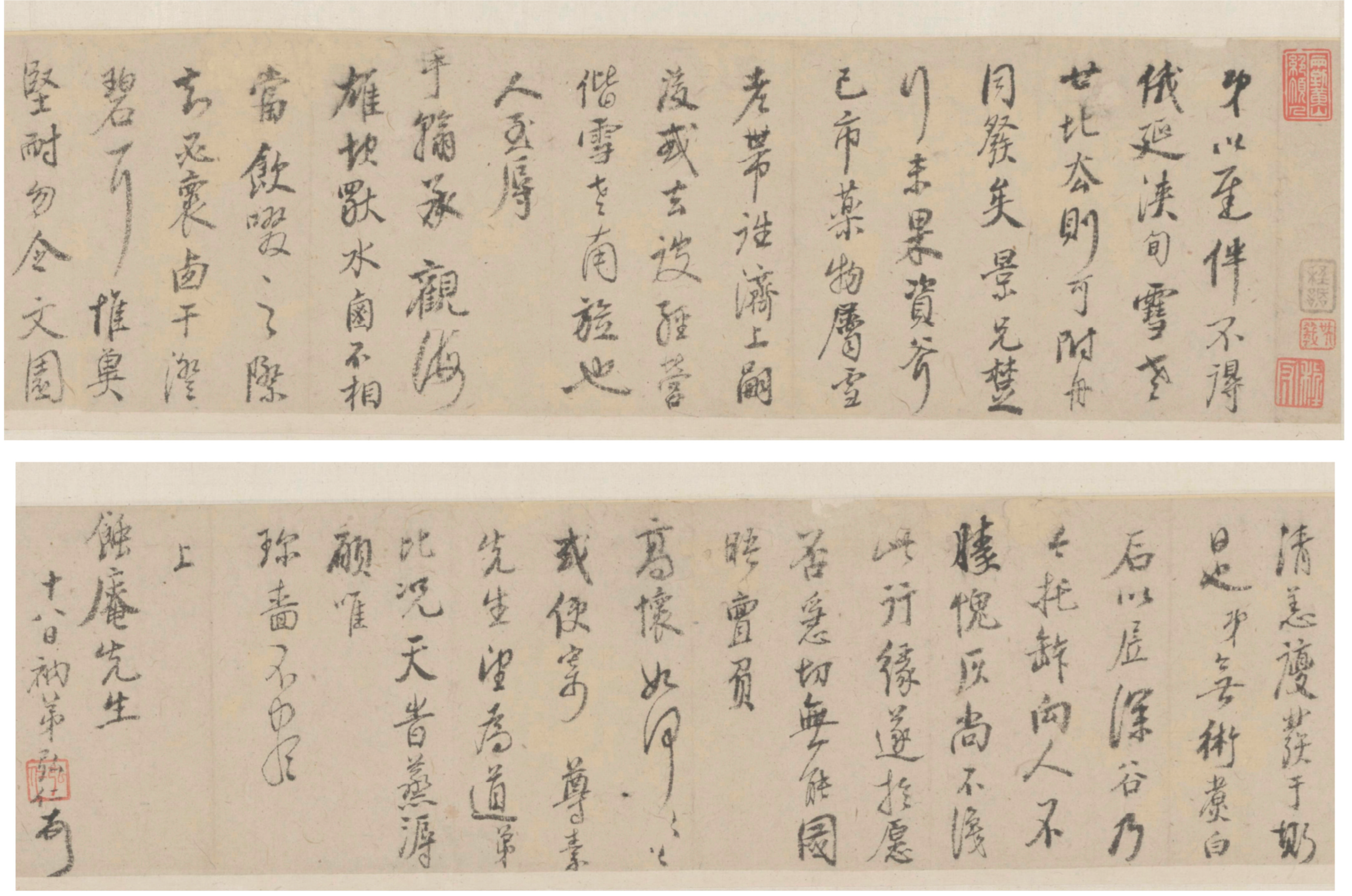
Figure 1. Letter to Shian (致蚀庵札). Ink on paper, 10.5 × 69 cm. Collection of the Palace Museum, Beijing. Image source: National Treasures Museum (Public Domain). Available online: http://g2.ltfc.net/view/SUHA/608a6c0ee11ca96100860413 (accessed on 20 April 2026).
Religions 17 00619 g001
Figure 2. Peaks and Ravines at Jiuxi (九溪峰壑图). Ink on paper, 110.6 × 58.9 cm. Collection of Shanghai Museum. Image source: Shanghai Museum (Public Domain). Available online: https://www.shanghaimuseum.net/mu/frontend/pg/article/id/CI00001008 (accessed on 20 April 2026).
Religions 17 00619 g002
Figure 3. Pines and Rocks of the Yellow Sea (黄海松石图), 1660. Ink on paper, 198.7 × 81 cm. Collection of Shanghai Museum. Image source: Shanghai Museum (Public Domain). Available online: https://www.shanghaimuseum.net/mu/frontend/pg/article/id/CI00004711 (accessed on 20 April 2026).
Religions 17 00619 g003
Figure 4. Landscape Album Scroll (山水册合装卷), 1661. Ink on paper, 23.8 × 23.8 cm. Collection of the Palace Museum, Beijing. Image source: National Treasures Museum (Public Domain). Available online: http://g2.ltfc.net/view/SUHA/6290b899fbf90b76334c8eca (accessed on 20 April 2026).
Religions 17 00619 g004
Figure 5. Landscape Album (山水册), detail 1. Ink on paper, 25.3 × 25.3 cm. Collection of the Shanghai Museum. Image source: National Treasures Museum (Public Domain). Available online: http://g2.ltfc.net/view/SUHA/60d5bc0a1376494a7ff87cf4 (accessed on 20 April 2026).
Religions 17 00619 g005
Figure 6. Landscape Album (山水册), detail 2. Ink on paper, 25.3 × 25.3 cm. Collection of the Shanghai Museum. Image source: National Treasures Museum (Public Domain). Available online: http://g2.ltfc.net/view/SUHA/60d5bc0a1376494a7ff87cf4 (accessed on 20 April 2026).
Religions 17 00619 g006
Figure 7. Landscape Album (山水册), detail 3. Ink on paper, 25.3 × 25.3 cm. Collection of the Shanghai Museum. Image source: National Treasures Museum (Public Domain). Available online: http://g2.ltfc.net/view/SUHA/60d5bc0a1376494a7ff87cf4 (accessed on 20 April 2026).
Religions 17 00619 g007
Figure 8. The Plum Blossom Dwelling (梅花书屋图), 1659. Ink on paper, 59.5 × 40 cm. Collection of the Palace Museum, Beijing. Image source: National Treasures Museum (Public Domain). Available online: http://g2.ltfc.net/view/SUHA/608a6c0ee11ca96100860419 (accessed on 20 April 2026).
Religions 17 00619 g008
Figure 9. Woods and Streams in Late Spring (林泉春暮图). Ink on paper, 89.4 × 41.8 cm. Collection of Shanghai Museum. Image source: Shanghai Museum (Public Domain). Available online: https://www.shanghaimuseum.net/mu/frontend/pg/article/id/CI00000985 (accessed on 20 April 2026).
Religions 17 00619 g009
Figure 10. Hongren, Landscape Album (1) (弘仁山水册) (1). Ink on paper, 25.2 × 25.3 cm. Collection of Shanghai Museum. Image source: Shanghai Museum (Public Domain). Available online: https://www.shanghaimuseum.net/mu/frontend/pg/article/id/CI00004978 (accessed on 20 April 2026).
Religions 17 00619 g010
Figure 11. Hongren, Landscape Album (2) (弘仁山水册) (2). Ink on paper, 25.2 × 25.3 cm. Collection of Shanghai Museum. Image source: Shanghai Museum (Public Domain). Available online: https://www.shanghaimuseum.net/mu/frontend/pg/article/id/CI00004978 (accessed on 20 April 2026).
Religions 17 00619 g011
Figure 12. Snow on Pine at West Rock (西岩松雪图). Ink on paper, 192.5 × 104.5 cm. Collection of the Palace Museum, Beijing. Image source: the Palace Museum (Public Domain). Available online: https://www.dpm.org.cn/collection/paint/231278.html (accessed on 20 April 2026).
Religions 17 00619 g012
Figure 13. Untrammeled Freedom in the Lofty Forest (长林逍遥图). Ink on paper, 203.5 × 70.5 cm. Collection of Anhui Museum. Image source: Anhui Museum (Public Domain). Available online: https://www.ahm.cn/Collection/Details/qtq?nid=563 (accessed on 20 April 2026).
Religions 17 00619 g013
Figure 14. The Album of Mount Huang (1) (黄山图册) (1). Ink on paper, 21.5 × 18.3 cm. Collection of the Palace Museum, Beijing. Image source: National Treasures Museum (Public Domain). Available online: https://g2.ltfc.net/view/SUHA/608a6c0ee11ca96100860449 (accessed on 20 April 2026).
Religions 17 00619 g014
Figure 15. The Album of Mount Huang (2) (黄山图册) (2). Ink on paper, 21.5 × 18.3 cm. Collection of the Palace Museum, Beijing. Image source: National Treasures Museum (Public Domain). Available online: https://g2.ltfc.net/view/SUHA/608a6c0ee11ca96100860449 (accessed on 20 April 2026).
Religions 17 00619 g015
Figure 16. Birthday Celebration (节寿图), 1660. Ink on paper, 102.2 × 51.5 cm. Collection of the Palace Museum, Beijing. Image source: the Palace Museum (Public Domain). Available online: https://www.dpm.org.cn/collection/paint/254929.html (accessed on 20 April 2026).
Religions 17 00619 g016
Figure 17. The Tiandu Peak of Mount Huang (黄山天都峰图), 1660. Ink on paper, 307 × 99.6 cm. Collection of Nanjing Museum. Image source: National Treasures Museum (Public Domain). Available online: http://g2.ltfc.net/view/SUHA/66685f62cb42c2358cad6685 (accessed on 20 April 2026).
Religions 17 00619 g017
Figure 18. The Album of Mount Huang (3) (节寿图) (3). Ink on paper, 21.5 × 18.3 cm. Collection of the Palace Museum, Beijing. Image source: the Palace Museum (Public Domain). Available online: https://www.dpm.org.cn/subject_rivsmounts/rivsmounts_more/246010 (accessed on 20 April 2026).
Religions 17 00619 g018
Figure 19. Propitious Winds on the Morning River (晓江风便图), 1661. Ink on paper, 28 × 243 cm. Collection of Anhui Museum. Image source: National Treasures Museum (Public Domain). Available online: http://g2.ltfc.net/view/SUHA/61c5feed1b5b586e85e6e608 (accessed on 20 April 2026).
Religions 17 00619 g019
Figure 20. After Rain, the Willows (雨余柳色图), 1656. Ink on paper, 84.4 × 45.3 cm. Collection of Shanghai Museum. Image source: Shanghai Museum (Public Domain). Available online: https://www.shanghaimuseum.net/mu/frontend/pg/article/id/CI00001005 (accessed on 20 April 2026).
Religions 17 00619 g020
Figure 21. Withered Branches with Short Reeds (古槎短荻图). Ink on paper, 61.9 × 35.3 cm. Collection of the Palace Museum, Beijing. Image source: National Treasures Museum (Public Domain). Available online: http://g2.ltfc.net/view/SUHA/62b968e8991e933f9b306279 (accessed on 20 April 2026).
Religions 17 00619 g021
Figure 22. Propitious Winds on the Morning River (2) (晓江风便图) (2), 1661. Ink on paper, 28 × 243 cm. Collection of Anhui Museum. Image source: National Treasures Museum (Public Domain). Available online: http://g2.ltfc.net/view/SUHA/61c5feed1b5b586e85e6e608 (accessed on 20 April 2026).
Religions 17 00619 g022
Disclaimer/Publisher’s Note: The statements, opinions and data contained in all publications are solely those of the individual author(s) and contributor(s) and not of MDPI and/or the editor(s). MDPI and/or the editor(s) disclaim responsibility for any injury to people or property resulting from any ideas, methods, instructions or products referred to in the content.