1. The Gap Between Pentecostal Divine Healing Rhetoric and Lived Experience
Despite its diverse expressions (
Wilkinson and Haustein 2023), one of the distinguishing features of the Pentecostal and Charismatic movements around the world is the belief that God still acts among believers to perform divine healing. In common Pentecostal rhetoric about divine healing, there can be a strong, positive expectation that healing is normative (i.e., what is typically expected) and imminent. To distinguish the sub-set of Pentecostals who ascribe to a dominantly “healing normative” version of expectation regarding divine healing, throughout this paper they will be designated as “HN-Pentecostals.” In reality, while millions of people around the world today claim to have experienced a miracle in the name of Jesus (
Keener 2011, locs. 4988–5830;
Pew Research Center 2006), in the balance of healings requested to healings received, divine healing is rare, unpredictable, does not eradicate suffering, and brings temporary benefits (
Keener 2011, loc. 13505). Therefore, the HN-Pentecostal expectation and rhetoric of divine healing do not align with the lived experience of chronic, embodied limitations that persist in most cases.
HN-Pentecostalism’s high expectation of divine healing is founded on the ideas
1 that Jesus secured embodied healing in his atoning death and the New Testament (NT) narratives provide a pattern for contemporary healing expectations (
Thomas 2012, pp. 308–9). Taken together, these ideas lead to believing that divine healing can be secured through faith-motivated prayer (e.g., “
ACC Australian Christian Churches 2023”). In contrast to this high expectation of healing, people can be prayed for many times, be given assurances that God is going to heal them, and yet continue to experience health challenges that cause them ongoing pain, suffering and distress. Even if they feel cared for by their community, their faith can be called into question, and they may learn to be quiet about their ongoing challenges, suffering in silence and leaving their community blind to their experienced reality.
The contrast between the many lived experiences of non-healing and the high expectation of divine healing in the HN-Pentecostal rhetoric evidences a gap in their healing praxis. This gap is the proverbial ‘elephant in the room’ for HN-Pentecostals. They typically believe that God is interested in the health and well-being of his people and that he both wills embodied well-being and miraculously intervenes to bring it about.
2 However, silence around non-healing, accompanied by expectations that healing will occur and that it will occur imminently, can suggest that divine healing is God’s normal response to suffering (
Chant 2014, pp. 70–82;
Hejzlar 2010, pp. 255–67;
Johnson and Clark 2011, pp. 75–153). A normative expectation, however, does not align with what is actually occurring in many people’s lived experiences.
This paper seeks to encourage Pentecostal self-awareness around the divine healing expectation–experience gap. The literature review will consider the nature of the gap, including why HN-Pentecostals avoid addressing it and limit the options provided to suffering people. It will also look at some existing pastorally motivated, theological approaches to facing the gap and why their effectiveness has been limited. The contribution of this paper will be to provide a new perspective to encourage compassionate reflection and grow self-awareness. This perspective engages the testimonies of those who continue to live with embodied limitations and uses Keneth Pargament’s means-and-ends model to consider the psychological impact of HN-Pentecostal religious praxis on coping.
2. The Nature of the Problem
While it is beyond the scope of this paper to survey the historical development of Pentecostalism, it is helpful to briefly note some significant historical milestones and ideas that are foundational to contemporary divine healing praxis. The origins of Pentecostal divine healing praxis can be found in the 19th Century in both the Wesleyan Holiness Movement and the healing ministry and teachings of Australian-born John Alexander Dowie. The Wesleyans emphasised Christian perfectionism and a sanctifying experience of the Holy Spirit. Dowie emphasised divine healing and movement towards holiness as the ongoing work of Jesus, and expressed great hostility towards medicine. Resting on these foundations, Classical Pentecostalism associated sickness with sin and saw healing as secured in the atonement, viewing medicine with suspicion and avoidance (
Chant 2011, pp. 59–68). This perspective was succinctly captured in two of the leading Classical Pentecostal Scriptural axioms “by his stripes we are healed” and “Jesus healed all who came to him.” The perspective positioned God as always willing to heal in the present (
Hardesty 2003, pp. 89–92;
Dayton 1987, p. 89;
Chant 2011, p. 67). Exercising faith that God would heal was an essential aspect of the expected belief (
Dayton 1987, p. 122). It was believed that, because God was willing, deep dedication and commitment were needed by those seeking healing. Necessary prerequisites to receive God’s action of healing included confession of sin (often public); commitment to God; a complete, undoubting and unwavering assurance of God’s will to heal; and a willingness to act on one’s faith—to “stand up and walk” (Acts 3:6). Failure to maintain obedience and good habits was also believed to lead to a loss of healing. Since healing was provided for in the atonement, praying, “If it be your will,”
3 was seen as unbelief, and many were so convinced of this theology that they taught believers to ignore symptoms of sickness (
Hardesty 2003, pp. 94–97;
Chant 2011, p. 114). Finally, with references to some gospel passages (e.g., Jesus’ hometown rejection—Matt. 13:53–58), failure to receive healing was often attributed to unbelief in the person seeking healing (
Hardesty 2003, pp. 94–97, 130–34;
Alexander 2006, p. 238;
Chant 2011, pp. 214–41). When this was not the case, while some acknowledgement was given to God working some benefit through suffering, an appeal was ultimately made to God’s unknowable sovereignty (
Hardesty 2003, pp. 130–34).
An under-acknowledged gap between the described Classical Pentecostal healing theology and lived experience was always part of the movement (
Warrington 2008, pp. 274–77). Many Pentecostals know the story of the Azusa Street, Los Angeles, California revivals in 1906 and the dynamic healing and salvation testimonies that sprung out of that revival and contemporaneous revivals around the world at that time (
Dayton 1987, pp. 119–21). What is far less known and discussed by HN-Pentecostals is that key figures in that revival experienced chronic embodied challenges, some requiring medical aid, which led them to revise their theology of divine healing over time (
Dayton 1987, pp. 119–37). Azusa Street’s founder, William Seymour was disabled—having a glass eye—and he blamed the lack of healing on his own sinful past (
Chism 2023). The first Pentecostal missionaries to Africa vowed to rely only on God and faith for health and all died from treatable illnesses. Occasionally, the movement even faced legal challenges where a denial of medical treatments and lack of divine healing resulted in deaths that might have been prevented with medicine (
Hardesty 2003, pp. 136–44;
Chant 2011, p. 36). However, too many influential testimonies of healing were being reported to quell the movement and its enthusiasm (
Dayton 1987, pp. 119–21;
Hardesty 2003, pp. 143–44).
In contemporary spaces, the gap can be more widely admitted. Nevertheless, HN-Pentecostals can still be confused as to why it exists (
Rhodes 2023, p. 106), and various factors contribute to an avoidance of facing it directly. With both medical healing and divine healing, there can be a high hope for cure that drives up expectations often beyond what can be delivered (
Brown 2011, p. 7). Further, Koenig shows that nurturant religion is generally beneficial to mental and physical health,
4 and Stolz demonstrates the potential for legitimate health gains via placebo in Pentecostal healing services (
Stolz 2011). With high expectations and a theological belief that divine healing is normative, the distinction between these general health benefits and verifiable miracles can be muddy in HN-Pentecostal miracle reports (
Walker 1993, pp. 126–29). Kydd argues that, modelling the gospels, Christians throughout history have taken miracle claims at face value without requiring medical verification. Further, since hope for healing is seen as essential for acquiring it, reported results can inadvertently inflate frequency of occurrence (
Kydd 1998, pp. xxvi–xxxi; See:
Ellington 2001, pp. 245–60;
Wright 1993, p. 78). This desire to nurture faith and hope for healing can lead HN-Pentecostals to exclude the testimony of those who experience chronic embodied challenges and create a cultural rhetoric that struggles to face the fragility of life and the permanence of disability and suffering.
5The gap between high expectations of divine healing and the rarity of healing in lived experience can create a host of problems for people experiencing chronic health challenges. Yong claims that even well-meaning Christian charity organisations have been guilty of setting up one-way “we-the-healthy need to fix you-the-ill” relationships (
Yong 2010, pp. 78, 92). Healing models can be focused on curing symptoms
6 that present obstacles to maximum functionality rather than seeing health as flourishing in character, life, relationships, and society
within one’s embodied limitations (
Clifton 2018, p. 195;
Reinders 2008). Relationships and community are valued in Pentecostalism, but hope for a cure is a draw for people in desperate need, which lends capital to cure as an evangelistic tool. Cure is desired as a matter of course, often without regard to the broader condition or well-being of a person’s life—seeing symptoms disappear is valued more than engaging in the person’s life or tackling the social issues responsible for their needs.
7 Pastoral practices can be limited to little more than persistent prayer (
Menzies 2004, pp. 141–49). Emphasis on prayer for cure is demonstrated by its regular promotion in preaching and time being set aside for it in church services. This emphasis, along with the promotion of cure testimonies, reinforce the normativity of the cured state (
Yong 2010, p. 8). From there, lack of cure is predominantly seen as a result of personal sin, occult involvement or lack of faith (
Yong 2010, pp. 77–80). Such postures marginalise and silence those with ongoing challenges and, worse, can cause religious trauma (e.g., encourage the denial of available medical care, fail to prepare people for death and loss, foster disillusionment, promote denial of reality, inhibit honest speech, and inappropriately blame people for their suffering), (
Crump 2006, p. 154;
Kärkkäinen 2002b, p. 167) and promote shame.
8Moved by concern for the wellbeing of suffering people, many contemporary Pentecostal theologians have presented wider and more nuanced theologies of suffering and healing than those held in Classical Pentecostalism (
Warrington 2008, p. 278;
Warrington 2006, p. 154;
Smail 1994, p. 30;
Kärkkäinen 2002b, p. 167;
Yong 2011, locs. 266–267;
Hill 2013, pp. 9–10;
Onyinah 2006, pp. 119–20). The connection between sin and suffering is maintained, but placed into the broader context of Christ’s reconciliation of humanity with God; Jesus provides the obedience ancient Israel had failed to deliver (
Onyinah 2006, pp. 119–20;
Warrington 2006, pp. 155–56;
Wu and Still 2015, locs. 1254–1285;
Hill 2013, pp. 10–11). Instead of removing human suffering, Jesus enters and redeems it through his faithfulness and obedience to the Father (
Yong 2011, locs. 883–890, 1727;
Hill 2013, pp. 13–15). Faithful suffering becomes Christ’s example for the church to follow (
Magezi and Magezi 2016, pp. 7–8). Attention is drawn to lament psalms that are employed by Jesus, thus validating them as a faithful Biblical response to suffering (
Warrington 2008, p. 278;
Warrington 2006, pp. 155–56;
Nel 2022, pp. 262–64). Jesus transforms suffering from punishment into a crucible for character formation and opportunity to depend on God’s Spirit with both displayed through enduring suffering (See:
Nel 2022, p. 337) and loving others (
Warrington 2008, pp. 278 & 307;
Menzies 2004, pp. 141–49;
Wu and Still 2015, loc. 1988). Healing, which presently is always partial (
Jakob 2004, p. 466), takes on a missional and eschatological role (
Warrington 2006;
Mittelstadt 2004;
Onyinah 2006, pp. 119–20;
Wu and Still 2015, locs. 1849–1899;
Hill 2013, pp. 13–18). Healing shows the uniqueness of Jesus as Messiah (
Yong 2011, loc. 1689;
Hill 2013, pp. 13–15;
Warrington 2006, pp. 157–58), and serves as a sign of the future restoration of creation (
Chant 2014, p. 30). The gospels are not read from a faith-brings-healing view, but from one of miracles-promoting-faith-in-Jesus-as-Messiah (
Thomas 2005, pp. 23–39). The central healing is the reconciliation of humanity to God through Christ (
Jakob 2004, p. 460). This presently results in following Christ into living justly and sacrificially for others (
Warrington 2006, pp. 156–62;
Onyinah 2006, p. 120;
Nel 2022, pp. 337–38), and bringing the marginalised into community (
Yong 2011, locs. 1689–1727;
Wu and Still 2015, locs. 2102–2180;
Hill 2013, pp. 16–18).
These more complex perspectives around suffering and healing are formal theological attempts to address pastoral concerns. However, in taking this approach, little practical advice is given by such authors to people ministering directly to the suffering, and the voices of those who experience chronic suffering are absent once again. It remains unclear how well these kinds of nuanced healing/suffering theologies have been embraced in contemporary Pentecostal praxis. It is also uncertain whether these scholars’ concerns to address the potential negative impacts of narrow classical positions on the unhealed have been realised. This raises the question of what may be done to elicit the kind of self-reflection HN-Pentecostals need to face the gap more squarely and deal with the problems it creates. Rhodes points to the need for a clarity that can speak into Pentecostal confusion around the gap (
Rhodes 2023, p. 106) and Clifton suggests a forward pathway in giving voice to the faithful believers experiencing chronic embodied limitations (
Clifton 2018, pp. 149–50). The research conducted for this paper seeks to pursue both those ends.
3. Methodology
Practical theology was ideally suited to reach the goal of this research. The goal is to provide Pentecostal pastoral caregivers tools for self-reflection around their divine healing praxis, enabling them to better understand what is happening and the impacts of this praxis on those who continue in embodied limitations. The field of practical theology draws widely from Christian tradition, Scripture, theology, and social sciences to observe experience and then examine and review ministry practice in the light of its theological and pastoral reflections (
Cameron et al. 2010, pp. 21–27). Inviting these various disciplines into dialogue, it seeks to gain information about the world that cannot be discerned by theological reflection alone (
Cameron et al. 2010, p. 30; See
Willig 2014, pp. 140–41). It is a model that classically begins in experience and has, at its heart, a desire to speak meaningfully into human experience from a Christian point of view (
Cameron et al. 2010, pp. 29–30). Therefore, a practical theology dialogue can provide tools for self-reflection and awareness, in which the theological, biblical, and historical data surveyed above can be complemented twofold. First, by using social sciences to provide a reference point to reflect on human experiences, and second, by gathering and reflecting on the reported experiences of people directly facing embodied limitations.
Kenneth Pargament is a leader in the social science field of the Psychology of Religion and Coping (
Gall and Guirguis-Younger 2013, p. 349). His work provides two useful tools with which to understand and reflect on embodied limitations:
An understanding of how religious practices can help or hinder coping (
Pargament 1997, pp. 288–99, 315–58).
Pargament’s means-and-ends model suggests that to reach any desired end one needs a means to arrive there. In a Classical Pentecostal framework, the desired end is freedom from disease, and the means is divine healing secured by repentance from sin, faith and persistent prayer. Pargament acknowledges that means may or may not secure the desired ends. When means fail, both means and ends need to be re-evaluated. If one set of means is not arriving at the desired end, then other means need to be explored. If other means also do not arrive at the desired end, then perhaps the desired end needs to be re-evaluated.
Pargament also talks about how religious practices and communities can help and hinder coping inside of this model. People experience difficulty in situations where their circumstances create a loss, or a potential loss, of health, resources, relationships, and functionality. Religion will help coping with difficult situations when it positions suffering and difficulty inside of God’s overall love; acknowledges multiple sources of suffering; provides community support, honest evaluations of means and ends, flexibility and encouragement to explore alternatives when pathways are not working; and helps people accept their circumstances, and face death and loss. Alternatively, religion will hinder coping when it positions suffering as outside of God’s overall love, narrowly and primarily blames the sufferer for their suffering, fails to provide support, is dishonest, blocks evaluating means and ends, does not allow alternatives, resists acceptance, and does not prepare people for death and loss.
Pargament’s tools were used to compose interview questions on coping in the context of Australian Pentecostal healing praxis. Then, interviews were conducted in Australia with 17 Pentecostal pastoral caregivers and 8 recipients of Pentecostal pastoral care to obtain self-reports of pastoral care actions around divine healing of disease when the desired healing was not experienced.
9 Participants were solicited from a flyer describing the research goals that was distributed in the author’s academic and church circles via Facebook and word of mouth. One and a half hour interviews were conducted in offices provided by a church and a bible college, in people’s homes, via phone or video calls, or in coffee shops. Caregivers were interviewed in focus groups—to seek participants espoused expectations, and individually—to seek reflection on actual experiences. Care receivers were interviewed individually.
Table 1 shows the distribution of caregivers by grouping.
Table 2 shows the distribution of care receivers by age and gender. Focus group caregivers were asked to reflect on a hypothetical case of a person with cancer.
Table 3 shows the types of diseases encountered by individual caregivers and experienced by the care receivers. It was hoped that the range of perspectives—espoused and actual, care given and care received—would allow a triangulation of the data within the data set.
In NVivo, Pargament’s tools were used to code the interview data during analysis of the interview transcripts, and to assess the self-reported data for anticipated and actual positive or negative impact on coping with disease. The interview sample size is too small to make generalisations about Pentecostal praxis. The sample provides examples of how the reported praxis impacted coping in the reported cases. These cases can be useful for reflecting on similar yet different experiences within broader contemporary Pentecostal contexts. To help avoid generalisations, the data is ranked, in the following, by most common answers rather than by number of responses. Sample quotes are provided to illustrate the key themes. The interview quotes are tagged with “FC” or “IC” for focus group and individual caregivers, respectively, “R” for care receivers, and then the participant’s gender and age group.
Important ethical considerations were accounted for and include the following. Pastoral care is sensitive and personal, and direct observation could compromise its delivery. Therefore, research participants were asked for self-reports of past care personally given and received. These eye-witness reports were taken at face value, as believed by the participants, and therefore providing “useful information about social and psychological processes”.
10 Participants were given information about counselling services should the interviews result in distress. They were also invited to review the transcripts and given the opportunity to withdraw from the research after the interview if they desired. The interview questions focused on issues of coping but were open to allow the participants to relate their expectations and experiences on their own terms. Finally, it is acknowledged that the participants were brave in sharing very personal and sensitive experiences; therefore, people engaging with this research are asked to be respectful and gracious towards the participants. Critical reflection on this research’s method, and findings is welcome, but gentle consideration is desired towards the participants.
4. Ways Pentecostal Divine Healing Praxis Impacts Coping
The picture that emerges from the sample of Australian Pentecostal healing praxis was consistent across the caregivers’ espoused and actual reports and the care receivers’ reports. The picture has many similarities with Classical and HN-Pentecostalism as well as some modern nuance.
11 A high expectation of divine healing secured by faith and persistent prayer was displayed in the caregivers’ self-reports and the caregiving described by the receivers—though some evidence of recognising enduring suffering was displayed. Blaming the diseased person for non-healing was common both directly and indirectly. When faith, prayer, and blame could not explain the persistence of disease, appeal was made to the incomprehensible mystery of divine sovereignty. Views regarding medicine showed significant divergence from the classical model with more acceptance and value being placed on medicine while still maintaining a lingering suspicion of medical help. The greatest strength of the caregiving was in providing supportive community which was greatly valued by the care receivers when they experienced it. However, this support could be undermined when it was overly focused on divine healing and wanned after initial enthusiasm. These themes will now be explored in more detail followed by a reflection on their impact on care receiver coping.
Despite one receiver reporting that, in their church, healing expectations sat alongside leaders publicly acknowledging that not all are healed, the most common theme in the sample was that caregivers displayed a high expectation of divine healing in pastoral conversation, prayers, scripture use and preaching. This expectation was seen as essential to maintaining the necessary faith and hope required to secure healing. Further, the expectation endured through all evidence that healing had not occurred. These quotes illustrate:
I believe, on perfect examination of Scripture, that we shouldn’t die from sickness. But, of course, we are not perfect. So, we have those with weaknesses in our body, and mind, and spirit—that we don’t always apprehend the fullness of the gospel. But I’m not critical of God for that. I just think that has proved to be the case, and we don’t know why always. IC-M-60+
I will always have an expectation that when I pray, God will do something. Whether he does or doesn’t is up to him. I learnt a long time ago not to try and figure out why some people get healed and others do not… Personally, I would not say anything to someone that would rob any hope they may have in God changing their situation. To say to someone anything is possible and that I believe in a supernatural God who can heal you and then tell them it is unlikely to happen would definitely affect their faith. FC-M-40+
[They tell you], “Doctor’s opinions are never the end. Never the final result… God will heal you.” R-F-20+
If you had a hundred people come for healing and you prayed for the first ninety-nine, and nothing happened, you would ignore what happened to the ninety-nine and pray for the last one, believing they can be healed. FC-F-40+
This high expectation of healing with the goal of faith building could be expressed during praying and ministering to sufferers in confident terms that could guarantee healing. For example, “We were speaking faith to him. We were basically saying, ‘You’re gonna live.’ … The kind of Scriptures we used were things like, ‘You shall not die, but live and declare the works of the Lord.’ Obviously, 1 Peter 2: 24.”
12 IC-F&M-40+ Contrary to these expectations, this person did die from their disease.
Regarding encouraging people to accept their situations of disease, caregivers expressed that sufferers should not accept that sickness was God’s will; that negative medical prognoses are definitive; nor accept blame for their conditions—though the desire to avoid blame was not always born out in praxis. By contrast, one receiver who reported that adjusting to the onset of disease was difficult, requiring time and effort, suggested that, “I’m not sure if telling people they are going to be healed assists with the adjustment process.” R-F-20+
A strong belief that God willed to heal was accompanied by a strong belief that ongoing suffering was the result of human failure. While sin, either personal or generational, had significant mentions, the most mentioned human failure was a lack of faith, effort or supposed desire to be healed. These quotes illustrate:
Why do Christians get sick? Sometimes, I think it’s that they have some sin in their life; they allow things into their lives that they shouldn’t allow... ICG.3-M-60+
I was much keener to get better than they were, and so for them to feel it was all in my mind, I found a bit interesting. They said, “Well, we’ve always had success, so it must be you.” R-M-40+
Human failure translated into direct and indirect blame for not experiencing divine healing. Indirect blame resulted when no other option but divine healing was espoused and yet the healing did not manifest. This was reinforced by pressure to persist in seeking for healing and the positive value ascribed to healing testimonies when they occurred. Direct blame questioned the receivers’ faith, desire to be healed, ongoing sinfulness, or even if the person was attention seeking. When persistence failed, and questions of blame were put aside, recourse was made to God’s sovereign will. Since God’s expressed will was to heal, appeals to sovereignty resulted in presenting God’s will in not healing as beyond the reach of human understanding. The following illustrate:
“Well, obviously there’s something wrong—Your faith is not there—You/they didn’t have enough faith—They need to pray more” and “Yes, we accept that God doesn’t heal, but we’re actually not sure why.”—There was always concerns about why we weren’t seeing more miraculous healings, with no real answers—No one could come up with an answer on that one. R-M-40+
Some actually did say… “If you had more faith, you maybe would be healed.” …that … did impact me a little bit… thinking, “What’s wrong with me? Maybe I’m not spending enough time with God. Maybe I need to fast or do something more to receive this healing… Is there something wrong with me? Is there something I’m doing that isn’t right?” …I … did put blame on myself… Some… said, “Do you believe that you are going to be healed?” And I would say, “Yes,” and then they would pray for me, and nothing would happen, and they would say to me, (sceptical tone): “Do you really believe? Are you really believing?” And I’m like, “Yes, I am! I’m believing! And I know I’m going to be healed!” …They would be like, “Okay, maybe you don’t have enough faith to be healed.”… Once again, that made me feel guilty. I started to blame myself… “Do I have enough faith to be healed? Is it me?” R-F-20+
Believing that human effort, especially faith, was important to receiving healing, significant emphasis was placed on building and encouraging faith that God could and would heal into receivers. Conversely, speech and ideas that were seen to discourage faith for healing were viewed disapprovingly. Some examples:
People can … give that person negative words… Could be from the doctors. Could be from the family. I believe that the negative words will bring a lot of discouragement. There is no hope when you start hearing all these negative words that people are telling you. “You don’t know.” “There is no cure”—things like this. And if the person stopped trusting God and giving up hope. FG.4.1-M-40+
You’ve almost got to deny yourself and that you’re feeling sick, and they would say, “Your confession needs to change,” and that was so hard. R-M-40+
The participants reported a diverse range of views regarding medical intervention. Some caregivers still held some of the legacy prejudice and caution from Classical HN-Pentecostalism. For others a growing value was placed on medical help, though often as a secondary means to divine healing, as this receiver’s comment illustrates:
People …are becoming more aware of the value and the necessity of medical stuff, but there’s still a suspicion towards it… … (some people responded)… “Yeah, you’ve gotta be careful you don’t put too much reliance on that and not give God space.”—So, there was this expectation that medicine is the second or even the lowest … place we should go, and everything spiritual beyond that is actually more important. R-M-40+
The greatest strength reported in the caregiving sampled was the provision of loving community and practical support. Caregivers expressed genuine concern for the people they were ministering to, and, in most cases, the receivers reported feeling significantly cared for, sometimes by the leaders and sometimes by their fellow congregants. The sense of being cared for was a significant contributor for receivers staying in HN-Pentecostal spaces despite the challenges around lack of divine healing. Practical and emotional support could be deep including providing live-in care for a convalescing receiver, and deeply grieving alongside receiver’s losses. Some examples:
These people are amazing; they really care. They have God’s love in them. R-F-40+
I’ve spent evenings in prayer, and I just cried—I’ve just had my pastors in the room, and there’s nothing to say, and I’ve just bawled my eyes out—and it’s a deep cry where the snot is uncontrollable—I cannot put words together—and just to have someone there. R-M-20+
They’ve shown me a lot of love just through their caring about me … It’s demonstrable love—they show you how much God loves you by loving you themselves… The care looked like listening, a lot of listening, a lot of encouraging, a lot of just not walking away. It’s easy enough to get sick of the person—people have done it to me—they don’t want to do it anymore. I don’t want to do it anymore!—I’m tired of it too. I wish I could quit. R-F-20+
Unfortunately, this sense of being cared for could be undermined when words were not followed by actions, care dwindled away after an initial enthusiastic display, or the care was compromised by high expectations of healing that did not manifest. Some examples:
The great thing about a good community is that they come around you… I had a lot of people initially that jumped up and said, “Whatever you need! Whatever you need!” They were on the phone every second or third day… within 4 to 6 weeks, they were gone; they’d forgotten. R-M-40+
A lot of people kept saying…instead of empathising with me and letting me vent a bit… “You’ve been through so much. You’re such a strong person.” So, I did feel a lot of pressure that I had to be strong… (It was) dismissive… In certain situations, nobody really empathised with how I was feeling. Nobody let me have that moment where I was… feeling like I was really struggling R-F-20+
People were quick to respond, but often it was in, “Well, just give it more to God. Give it all to God. Let’s pray more. Let’s lay hands on you. Let’s believe for the immediate miracle.” And only a few people said, “Look, in the midst of the not-miracle, let’s walk with you. Let’s be present.” R-M-40+
When asked about the impact of the care received on the ability to cope with chronic illness, helpful and unhelpful impacts were described, with the unhelpful aspects being more dominant. The dominant themes in receiver reports showed caregiving was most unhelpful in providing tools to manage and accept illness, and a general lack of emotional support. Caregiving was helpful when it provided practical care of day-to-day needs, and worked to encourage faith and a sense that God loves the receiver.
The unhelpful qualities resulted from a narrow perspective focused predominantly on divine healing that was not tracking with the receivers’ lived experiences of ongoing illness. This was exacerbated when caregivers or fellow congregants were dismissive of ongoing struggles, reluctant to talk about them, or even at times becoming personally affronted that the receiver was still struggling. Receivers felt left to work things out on their own, find their own peace with God in accepting their illnesses, and having to hide that acceptance from their fellow church goers. Being able to talk about ongoing suffering was something many felt unable to do at church, except when engaging with the secret society of other sufferers as these quotes illustrate:
I don’t feel I can talk to people in my community about it because what are they gonna do? All I can do is upset them… There’s nothing they can do. There’s nothing I can do… It’s a huge worry. R-F-20+
It was amazing when I got prostate cancer how many people came up and said, “Don’t worry, we’ve been through it”… it was a phenomenal experience to recognise that there are so many stories out there of people who are working through their own struggles. R-M-40+
Care was helpful when caregivers provided genuine interest, time and resources to the receivers. Such genuine and practical help from humans instilled a deep sense of being loved by God. Caregiver love was seen as a tangible display of God’s love. When caregivers were honest about their own struggles and medical experiences, and journeyed alongside of receivers in attending medical appointments and grieving over losses, care was seen as deeply supportive. Unfortunately, such care was not dominant in the receiver’s reports. While seeking to assure people of God’s love and provision, rhetoric that excluded suffering and chronic limitation from that love and provision effectively implied to people experiencing these that God did not love them. This receiver illustrates:
It never helps when people say, “God doesn’t want you to suffer,” and you’re suffering. It’s probably the worst thing you can say to someone. R-F-20+
5. Inviting Pentecostal Self-Awareness
Sincere care for receivers, and a desire for their well-being, which manifested through spiritual and practical help, were clearly the greatest strengths of contemporary Australian Pentecostal caregiving reported in the interview data. Some of the receivers said they would seek practical care and support from nurturing Pentecostals in the future. In contrast, most receivers said they would not seek help from Pentecostals where a healing normative expectation was dominant. This contrast shows the stress that healing normative praxis patterns can place on an otherwise desirable, practical, supportive, caregiving community. This illustrates a disconnect between caregivers and care receivers’ expectations around divine healing, with the receivers being aware of dynamics that elude the awareness of the caregivers.
The difference in awareness is shown in how caregivers and receivers responded differently to the gap between expectation and low manifestation of divine healing. Caregivers worked to reinforce the model while receivers re-evaluated it. In the Pentecostal praxis observed in the interview sample, God was positioned by caregivers as willing and able to heal. Human efforts, such as repentance, hope for healing, and persistent prayer of faith were seen as capable of securing the healing. However, the anticipated healing had not manifested through these means. In Pargament’s model, re-evaluation is necessary when existing means are not reaching desired ends (
Pargament 1997, pp. 106–14). However, the data from the sample shows that when ends were not achieved, re-evaluation was resisted by caregivers and instead, several theological moves were made to fill the gap between expectation and result. First, human effort was reinforced as the means to secure the healing. If healing was not manifesting receivers were blamed for lack of faith, ongoing sin, or lack of desire to be healed. If sufficient sincerity and faith were present, then ongoing persistence was needed. Where human effort and persistence had failed, the gap between God’s supposed will to heal and apparent inaction was put down to God’s inexplicable sovereignty.
At the juncture where HN-Pentecostal means did not result in divine healing, receivers often took a different path and re-evaluated God’s willingness to heal. They moved instead to acceptance of their situation as inside of God’s will. Eaves et al., in their study of the place of hope in dealing with chronic illness (
Eaves et al. 2016), make some important observations relevant to this context. People faced with chronic illness need to balance a variety of ways of hoping in order to cope: enough hope that methods will succeed to avoid despair and activate placebo benefits; tempered by realism to guard against disappointment; negotiated with their community’s social expectations to place their hope in the right things and for a better future; hope that they can enjoy some overall quality of life beyond their illness; and the ability to move beyond pathways that are not working and relocate their hope to alternative pathways.
In the sample, the social pressure created by the instance to keep believing God wants to heal was strongly felt. While the reality of their struggle was the attempt to navigate the balance between despair and disillusionment (
Eaves et al. 2016, p. 38), receivers felt a need to appear conformant to the rhetoric regardless of their actual feelings (See
Eaves et al. 2016, p. 49). The receiver’s expectation could be raised to a very hopeful level. They could do everything they were encouraged to do to clear the potential obstacles—repent, pray, hope, fight—and still not see a divine healing. Then, they could be given no explanation for the paradox between expectation and reality other than the unknown mystery.
Surprisingly, caregivers found this more confusing than receivers. Their orienting system contained the self-reinforcing theology that since the NT, which is our guide for ministry, shows faith leading to miracles, therefore
our faith will lead to miracles. This emphasis on Biblical miracles avoided reflection on contemporary lived experience that might threaten the needed faith. Therefore, it was unable to give them a satisfying understanding of the gap between their expectations of God’s willingness to heal, their belief in the effectiveness of human effort to secure that healing, and the number of occasions divine healing did not manifest in lived experience (See
Rhodes 2023, p. 106). Contrastingly, receiver participants were forced by their enduring situations away from such ideas, to embrace the rarity of healing, and see suffering as part of God’s agenda. However, because of the theological and social pressure, this move was not easily made; it had to be made secretly, and was often birthed after long periods of self-doubt and distress.(See
Eaves et al. 2016, pp. 47–48) This means that there was little support from the community in making these transitions and, further, that such transitions were positioned as a move away from faith in God.
Several specific pressures can be noted in the praxis: faith perspectives contain a built-in scapegoat, divine sovereignty reinforces inflexibility, and God is confusingly positioned as able but passive. Each will be addressed in turn. Repentance from sin, faith, and seeking God through persistent prayer are considered Christian virtues. However, human efforts can become a scapegoat in the praxis when healing is positioned as dependent upon their quality and quantity. Since it is certain that any person will have an imperfect life, some reason will always be available to function as a scapegoat enabling blame when healing does not manifest.
It is important here to reflect on Kärkkäinen’s concern that Pentecostals need to engage well with suffering (
Kärkkäinen 2002b, pp. 173–78) and Pargament’s data on positioning suffering as punishment from God (
Pargament 1997, p. 291). Both scholars anticipate a delicate balance between acknowledging God’s actions of judgment as a call to repentance and self-control, and a propensity to overly blame individuals for their suffering. The healthy response based on Kärkkäinen and Pargament is to see God acting mercifully to inspire righteous living. To make embodied healing—which is rare—the indicator of such a response is to subject people with continuing chronic embodied challenges to the very blame Pargament describes as most costly in terms of guilt and fear. As expected, receivers in the sample who experienced scapegoating of this nature found it extremely distressing.
Dominantly in the sample, God was seen as being willing, able, and even wanting to heal, yet paradoxically, in reality, he did not do so for some hidden, mysterious purpose. God was seen as controlling this choice such that—in effect—he was going against his own will. The believer was asked to trust God despite this contrary way of being. This paradox was never squarely faced or questioned. When appeals to God’s mysterious sovereignty were made, that was the end of the conversation and exploration—the limit of human understanding had been reached. The few rare miracles were loudly expounded as the normal result, the non-healing was dismissed, and the encouragement to keep seeking and believing for healing was reinforced. Entirely because God is positioned as wanting, willing and able to heal, people were asked to persist in believing, acting, seeking, and hoping. This is undauntable optimism in the face of no manifestation of what God is purported to want, which—in many people’s experience—means zero divine healing and even death.
Acknowledging the sovereignty of God in a difficult situation has the potential to be a comfort-giving pathway for emotional control when there are no resources available to a diseased person to take control of their situation (
Janowski et al. 2014, pp. 34–42; See
Kaldor et al. 2010, p. 87;
Swift and Chipperfield 2013, pp. 350–57;
Yasmeen et al. 2015, pp. 483–84). When mystery and sovereignty were used to fill the gap between expectation and lived experience, a potential relief resource was offered to receivers but then held out of their reach. Caregivers were willing to appeal to God’s mysterious sovereignty to justify the praxis not resulting in healing, but caregivers would not accept receivers using God’s mysterious sovereignty as a reason to rest from the imperative to persist in seeking for healing. The receiver had to hold their confidence that God wanted to heal them—and their fighting for that—in tension with their belief that healing is God’s sovereign choice and may not come. Giving up hope for healing was simply not an option—even to rest in the sovereign mystery of God’s apparent inaction. In this manner, the potential for God’s sovereignty to become a resource to aid acceptance, defer uncontrollable situations into his care, and move forward with transformative coping (
Helvik et al. 2011, p. 5;
Jacobsen et al. 2014, p. 466;
Pemberton and Wainwright 2014, p. 220;
Pargament 1997, p. 293) instead becomes a burden. Participants facing this challenge expressed discouragement and weariness that added to the existing burdens of managing their situations.
The way these patterns position God as ‘willing and able, but passive’ warrants ethical reflection. Swinton reflects on the way attempts to explain evil and suffering can be harmful in a pastoral context. Explanations may have a level of intellectual soundness that reconciles certain theological ideas. However, in so doing, they may inadvertently justify and rationalise evil, silence sufferers, and, in so doing, contribute to suffering in the world (
Swinton 2007, loc. 215). The following considerations show how ‘able but passive God’ patterns may participate in harmful practices of this nature.
If God, in being willing to heal, desires asking as a condition of healing appropriation, surely deliverance should immediately, or in short order, follow the asking. Otherwise, any declaration of God’s willingness to heal would be false, or some other hidden obstacle must prevent the healing. If the latter, considering that God is so willing to heal, why would God not make that obstacle known? Why would God say seeking is needed when, in fact, something else is needed? In this framing, God is essentially—though unintentionally—being positioned as either malicious, insincere, or having some hidden agenda that is being covered up by deceitful misdirection.
If these patterns were a purely human transaction, it would be unacceptable to both reason and justice. If a person had power and resources, and a declared will and intention to protect, intervene and make provision immediately; if they asked for someone’s trust on the grounds that they were willing and able to deliver immediately; and then no visible protection, provision or deliverance arrived, this would be intolerable. The person would neither be believed nor trusted. If the person receiving such a promise (the promisee) was then told to maintain their optimistic anticipation of the imminent arrival of their provision, and after many years, it still did not manifest, they would believe they were being duped.
To add to this inaction, the idea that the promise giver was operating somehow in the interests of some other good end for the promisee, which was invisible to the promisee, which they did not explain to the promisee, and which would most likely not be seen until after the promisee’s death is something one could only accept of someone who had the power to raise the dead. This latter request is the very substance of faith in God, but it does not at all resolve the tension of the present ask. Whatever the hidden ends are, these patterns do not fully acknowledge the painfulness of suffering (
Swinton 2007, loc. 229) nor the difficult challenge of reconciling them with faith (
Warrington 2008, p. 278;
Warrington 2006, pp. 155–56;
Nel 2022, pp. 262–64).
In this context, Swinton reflects on the silence and lamenting of Jesus on the cross, and the sense of alienation he felt in his abandonment by God to that suffering. Significantly, he identifies God’s action in Christ—not as rescue—but as one of entering into suffering with humanity. He aptly states,
We may demand a God who reaches into history and frees us from our pain and suffering, but the nature of the cross and the silence of Jesus in the face of evil and suffering would indicate that such a God is not the God of Scripture.
The rhetoric that positions God as ‘able but passive’ suggests a God who desires to act to relieve suffering but, in fact, does not. It then blames the sufferer for this inaction. This is the very opposite of the way Swinton describes Jesus acting in solidarity with suffering people. Swinton expresses concern with framings of suffering that make God complicit in evil, paint a dissonant picture of his love, and silence sufferers through blame and denial of lament (
Swinton 2007, locs. 244 & 269).
Significantly, none of this unsupportive positioning helped realise the desired healing, and the only alternative path in the praxis patterns is blaming the receiver. However, the implications described here do not appear intentional. It does not appear from the caregivers’ expectations of God that they saw him as able but passive, or working against his own interests. It does not appear from their expectations of receivers that they were seeking to blame them—instead, they were attempting to encourage them and lift their faith to enable a breakthrough. It appears that what is really going on is simply an attempt to fill the gap between a high expectation and low experience of miracles with a theology that justifies loyalty to the model. This loyalty to the model ticks all the markers put out by Pargament in his discussion of how religion can fail (
Pargament 1997, pp. 317–54). He warns of the danger where one-sided religion does harm by neglecting human experience, being deceptive, and defending the exclusivity of its promoted ends with righteous conviction when they do not align with how the world actually is. This loyalty may be bolstered by a lack of self-awareness of the patterns in their praxis and the impact of those patterns in lived experience. It is hoped that this research will contribute to such self-awareness and inspire Pentecostal caregivers to re-evaluate HN-praxis that is not achieving what they think it is achieving and is, instead, causing harm as a result.
6. Conclusions and Implications for Pastoral Practice
The research behind this paper aimed to engage practical theology to develop an understanding of praxis patterns in contemporary Australian Pentecostal pastoral care from a sample of experiences of caregivers and care receivers in cases of unrealised divine healing expectations. This goal was founded on the premise that there is a generally under-acknowledged gap between Pentecostal normative expectations of divine healing and what is occurring in lived experience. This research aimed to examine the impact of this praxis on the coping of those sampled with chronic embodied challenges who did not experience the expected divine healing. The research brings some relevant Pentecostal history and theology into dialogue with the psychology of religion and coping, and self-reports of not receiving divine healing. The window into that research, displayed in this paper, is particularly focused on chronic disease but the findings are consistent with the other challenge areas the research explored.
13Despite caregivers’ desire and actions to show sincere love towards people inside the scope of their care, the findings show that the praxis patterns reported created, in the sample, an environment with a dominantly negative impact on coping with chronic disease. This negative impact is the result, first, of a narrowly focused normative expectation of divine healing that does not align with lived experience. Second, it results from praxis that tends to indirectly and directly blame those who do not experience the expected healing and change. Third, the praxis inflexibly resists self-reflection and re-evaluations, and does not engage, or encourage engagement, with available resources to seek out alternative coping strategies.
A comparison of the interview reports with Pargament’s data on religion and coping revealed that showing genuine loving care and support, and giving practical help to receivers and people seeking healing was a potential strength inside the caregiving praxis. However, loyalty to means that were not producing the anticipated healing discouraged an honest, comprehensive, and complex understanding and discussion of suffering and non-healing inside the sample.
The impacts reported by receivers aligned with those anticipated by Pargament’s framework, but where those impacts were negative, receivers in the sample did not fail to cope. Instead—over time—they engaged in transformative coping and took responsibility for their own emotional well-being. While expressing deep gratitude for any genuine care shown to them, receivers embraced medical treatments, sought counselling and education, asked for support, sought for and listened to testimony from others in their situation, set boundaries against harmful praxis in church spaces, practised Christian disciplines, embraced self-acceptance, and explored the Scriptures from alternative points of view. At the same time, their opinion of Pentecostal praxis declined—viewing well-intentioned healing-normative praxis as naively, and dangerously, out of touch with reality.
From this research an invitation is extended to Pentecostal caregivers to be self-reflective and reevaluate their divine healing praxis. The analysis suggests that—in cases resembling the sample—reform is needed in four particular points. Primarily, a growth in understanding that faith and suffering are not mutually exclusive is crucial. People can suffer and faithfully engage with God simultaneously.
Understanding this could lead, second, to greater honesty regarding the frequency of divine healing, and the distinguishing of miracle claims from the psycho-social and general health gains provided by religion. Where typically HN-Pentecostals can accept that acknowledging the rarity of healing miracles does not prevent people seeking them in faith, they would have less reason to deflect attention away from their rarity.
Third, a more expansive engagement with coping resources could come from such a re-evaluation. Within the broader Christian community, there is an abundance of pastoral care tools and theological engagements with suffering available to help people manage embodied limitations, differences, and suffering.
Fourth, by embracing a person-centred care model (
Martin and Félix-Bortolotti 2014) in harmony with the above, typically HN-Pentecostal caregivers could change their caregiving orientation. They could move away from being prescriptive about divine healings, which occur only rarely, and which tend to be more focused on promoting the movement than actually providing what care receivers need. Instead, using person-centred care, they could focus on encouraging care receivers’ agency in their own situations and according to their own faith-directed values, beliefs, and coping strategies.
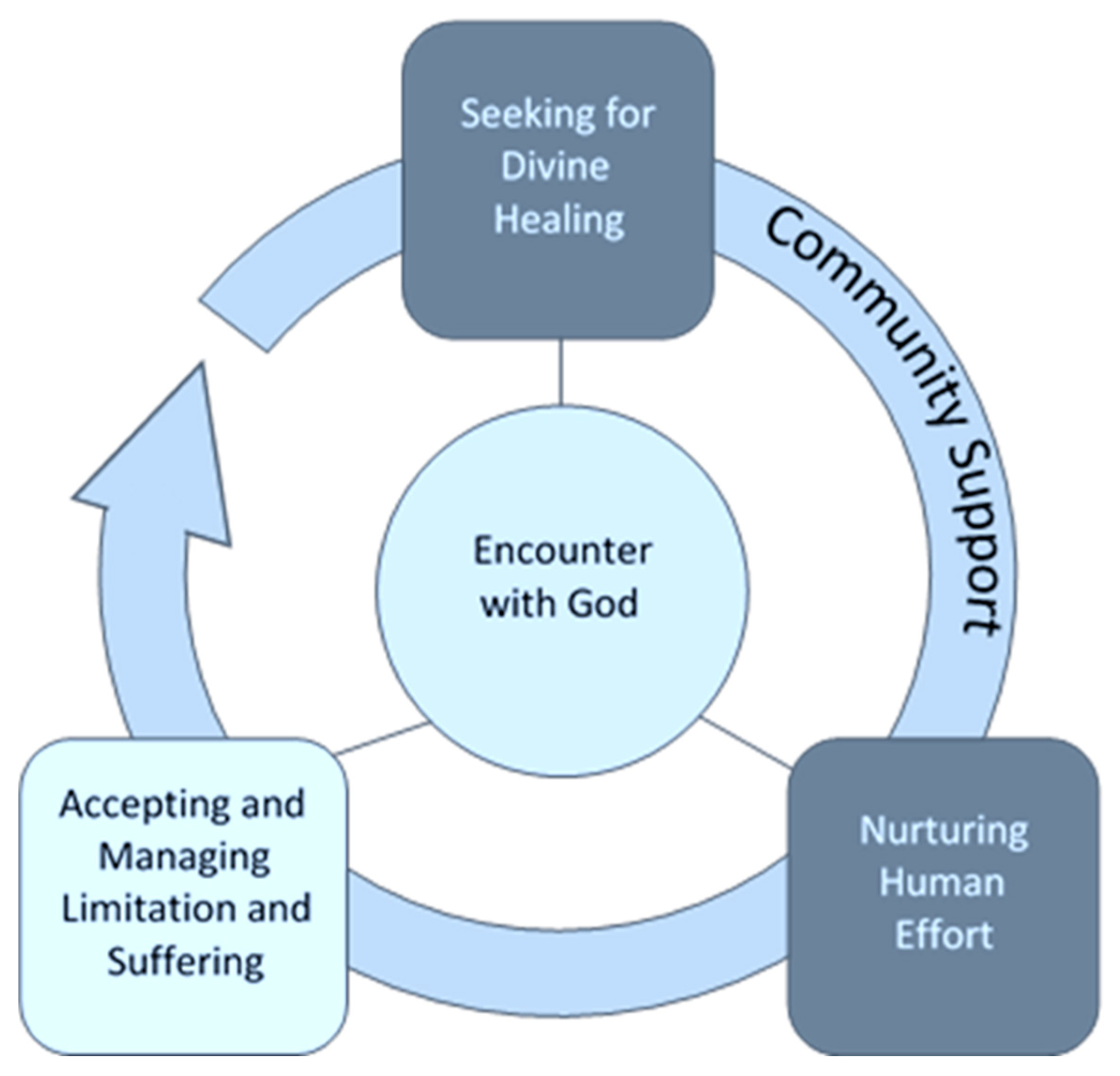
The challenge in seeking a more robust praxis is strengthening what is weak without letting go of what is already strong. In this respect, HN-Pentecostal pastoral care—desiring to nurture encounters with God through the Holy Spirit—can be modelled as a triangle with two strong points and one weakness (
Figure 1).
Historically and in the sample, Pentecostals were strong on (a) seeking divine healing; and (b) encouraging human faithfulness, repentance, Bible study, prayer, and clean living. Where it is lacking, HN-Pentecostals could have a more comprehensive pastoral care praxis that aligns better with lived experience if they could do three things. First, untangle the human effort dimension from the seeking for healing dimension. If divine healing can be viewed as a grace gift from God to be fully realised in the eschaton, and sampled now by occasional miracles, the inaccurate belief that divine healing can always be secured by human effort could be dropped. Human effort in spiritual disciplines and virtues can be valued for their communion with God, and enhancement to justice and quality of life, rather than as means to obtain divine favour. Second, add to the repertoire of human effort and seeking for divine intervention, strength in accepting and managing limitation and suffering—seeking to also encounter God in such spaces. Third, give to this strength of acceptance and management as much community support as the sample shows Pentecostals can give to human efforts and seeking miracles.
A forward pathway of this nature upholds diligent human contribution, trust in a miracle-working God, and care and support for the limitations and embodied challenges and differences all people face. I hope that presenting this research to the Pentecostal community may contribute to the realization of such a forward pathway where it is lacking.