Mental Health Across Religious and Spiritual Categories: A Longitudinal Study Among Parents and Their Children

Abstract
1. Introduction
- Mental Health and Religion/Spirituality
- Depression
- Depression and R/S
- Anxiety
- Anxiety and R/S
- Mechanisms of R/S on Mental Well-Being
- Spiritual but not Religious
- Current Study
- Those who identify as both religious and spiritual (RAS) will have the best mental health (i.e., the lowest levels of depression and anxiety) as compared with those who are spiritual but not religious (SBNR), religious but not spiritual (RBNS), or neither spiritual nor religious (NSNR).
- Those who are neither religious nor spiritual (NRNS) will have the worst mental health.
- Those who identify as either religious but not spiritual (RBNS) or spiritual but not religious (SBNR) will demonstrate levels of mental health between their two counterparts.
- Identifying as spiritual but not religious may be detrimental to mental well-being.
2. Results
2.1. Demographics
2.2. Baseline Depression/Anxiety Levels
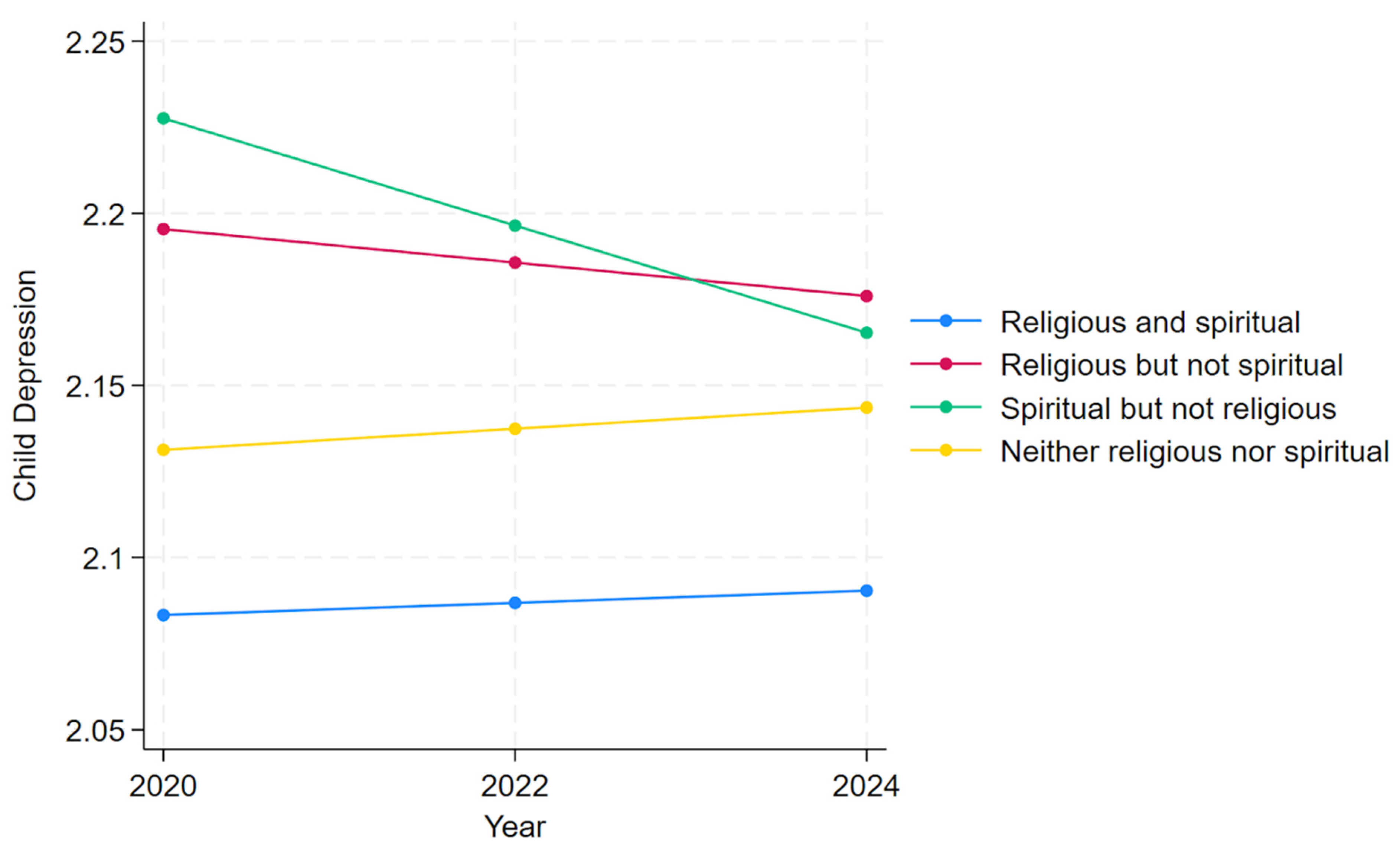
2.3. Child Depression over Time
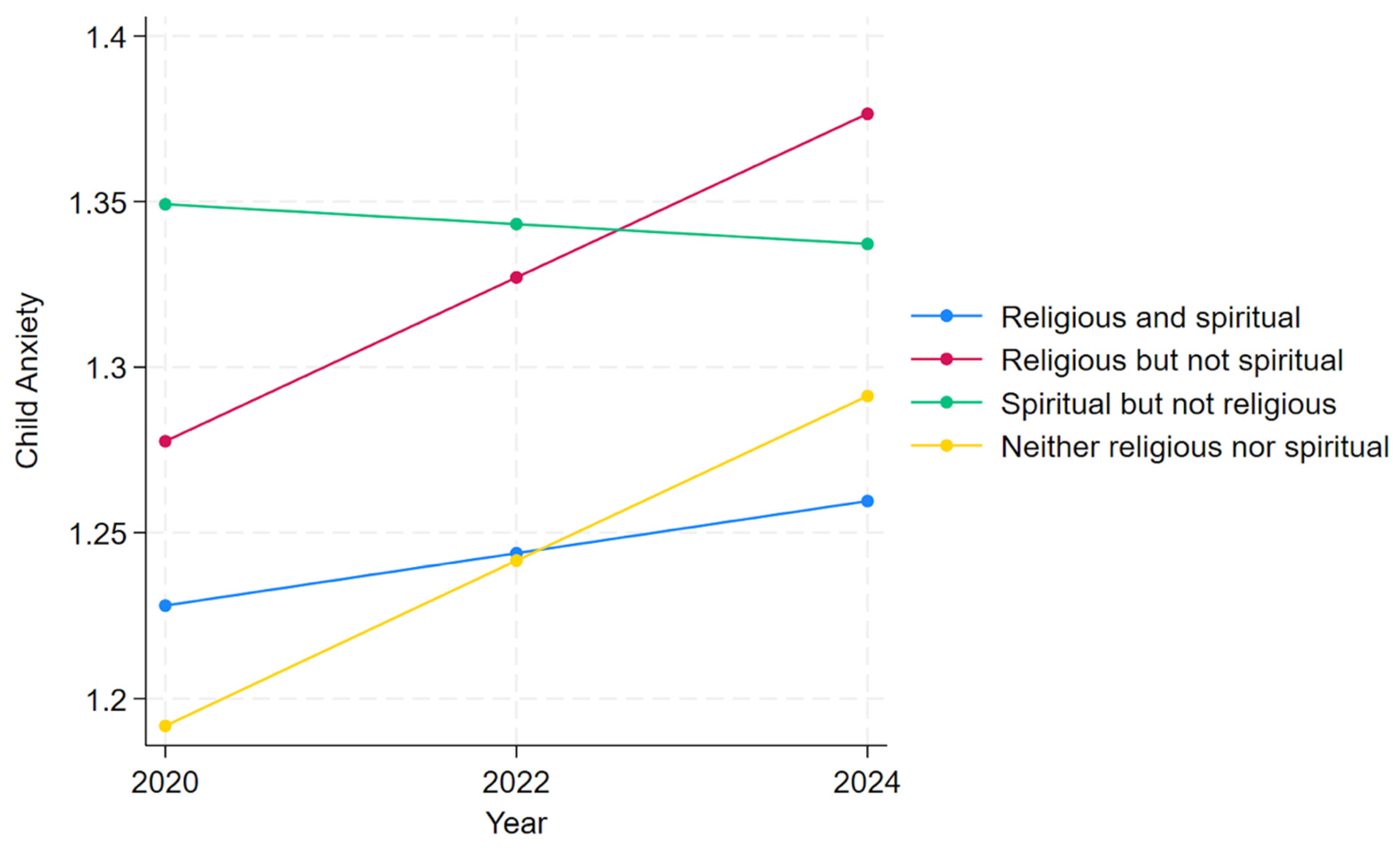
2.4. Child Anxiety over Time
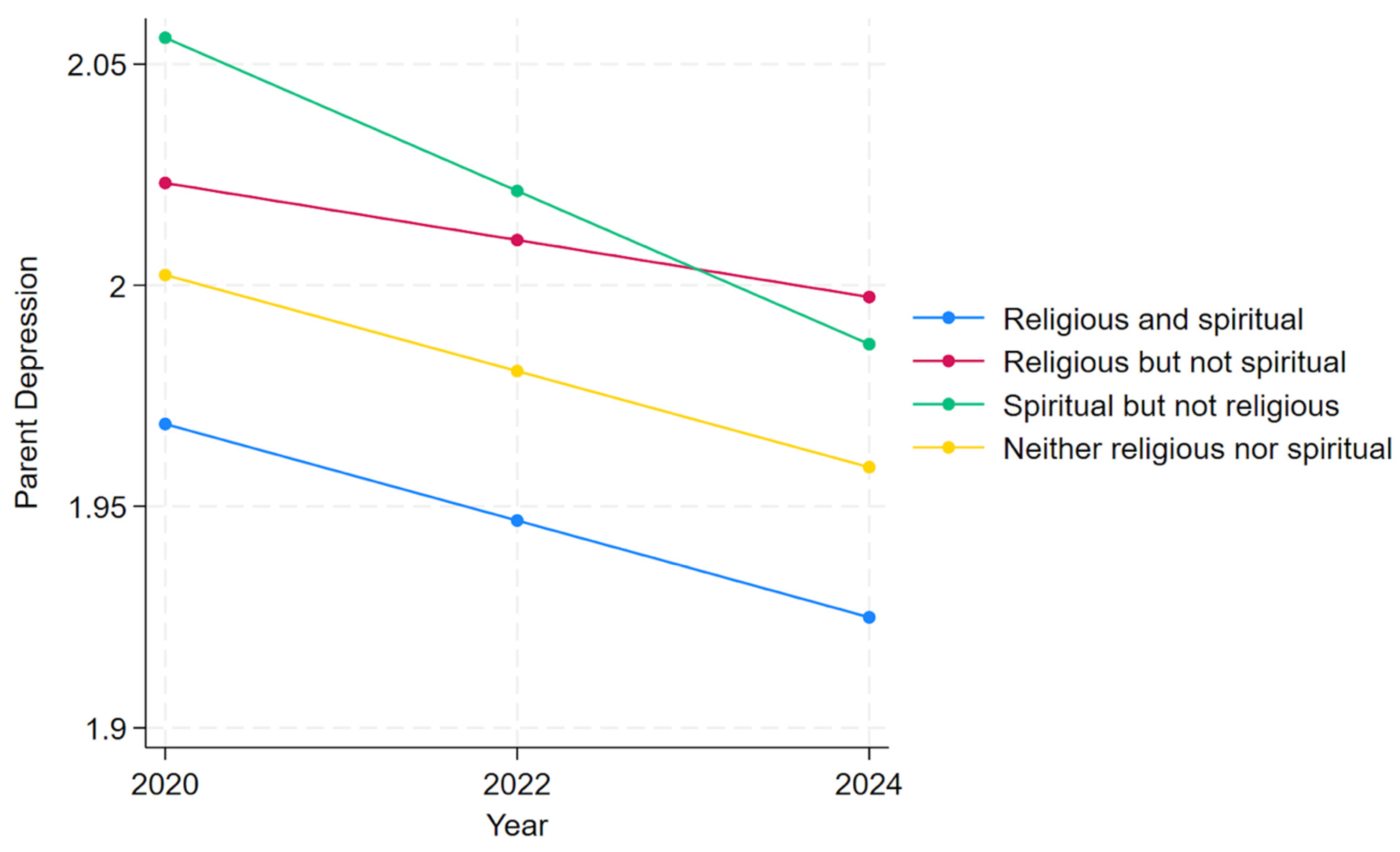
2.5. Parent Depression over Time
2.6. Parent Anxiety over Time
3. Discussion
- Limitations/Future Research
4. Materials and Methods
- Sample
- Measures
5. Conclusions
Author Contributions
Funding
Institutional Review Board Statement
Informed Consent Statement
Data Availability Statement
Conflicts of Interest
Abbreviations
| SBNR | Spiritual but not religious |
| RBNS | Religious but not spiritual |
| RAS | Religious and spiritual |
| NRNS | Neither religious nor spiritual |
| R/S | Religiosity/spirituality |
References
- Aggarwal, Shilpa, Judith Wright, Amy Morgan, George Patton, and Nicola Reavley. 2023. Religiosity and spirituality in the prevention and management of depression and anxiety in young people: A systematic review and meta-analysis. BMC Psychiatry 23: 729. [Google Scholar] [CrossRef] [PubMed]
- Ai, Amy L., Christopher Peterson, Terrence N. Tice, Bu Huang, Willard Rodgers, and Steven F. Bolling. 2007. The influence of prayer coping on mental health among cardiac surgery patients: The role of optimism and acute distress. Journal of Health Psychology 12: 580–96. [Google Scholar] [CrossRef]
- Ai, Amy L., Terrence N. Tice, Christopher Peterson, and Bu Huang. 2005. Prayers, spiritual support, and positive attitudes in coping with the September 11 national crisis. Journal of Personality 73: 763–91. [Google Scholar] [CrossRef]
- American Psychiatric Association. 2022. Diagnostic and Statistical Manual of Mental Disorders, 5th ed. Text Rev. (DSM-5-TR). Washington: American Psychiatric Association. [Google Scholar] [CrossRef]
- Björgvinsson, Thröstur, Sarah J. Kertz, Joe S. Bigda-Peyton, Katrina L. McCoy, and Idan M. Aderka. 2013. Psychometric properties of the CES-D-10 in a psychiatric sample. Assessment 20: 429–36. [Google Scholar] [CrossRef]
- Boelens, Peter A., Roy R. Reeves, William H. Replogle, and Harold G. Koenig. 2009. A randomized trial of the effect of prayer on depression and anxiety. International Journal of Psychiatry in Medicine 39: 377–92. [Google Scholar] [CrossRef]
- Boelens, Peter A., Roy R. Reeves, William H. Replogle, and Harold G. Koenig. 2012. The effect of prayer on depression and anxiety: Maintenance of positive influence one year after prayer intervention. International Journal of Psychiatry in Medicine 43: 85–98. [Google Scholar] [CrossRef]
- Bonelli, Raphael, Rachel E. Dew, Harold G. Koenig, David H. Rosmarin, and Sasan Vasegh. 2012. Religious and spiritual factors in depression: Review and integration of the research. Depression Research and Treatment 2012: 962860. [Google Scholar] [CrossRef] [PubMed]
- Brody, Debra J., and Jeffery P. Hughes. 2025. Prevalence of Depression in Adolescents and Adults: United States, August 2021–August 2023. Hyattsville: National Center for Health Statistics (U.S.). [Google Scholar] [CrossRef]
- Burge, Ryan P. 2021. The Nones: Where They Came From, Who They Are, and Where They Are Going. Minneapolis: Fortress Press. [Google Scholar] [CrossRef]
- Burns, David D. 1989. The Feeling Good Handbook. New York: William Morrow & Co. [Google Scholar]
- Byrd, Kevin R., and AnnDrea Boe. 2001. The correspondence between attachment dimensions and prayer in college students. International Journal for the Psychology of Religion 11: 9–24. [Google Scholar] [CrossRef]
- Captari, Laura E., Joshua N. Hook, William Hoyt, Don E. Davis, Stacey E. McElroy-Heltzel, and Everett L. Worthington, Jr. 2018. Integrating clients’ religion and spirituality within psychotherapy: A comprehensive meta-analysis. Journal of Clinical Psychology 74: 1938–51. [Google Scholar] [CrossRef] [PubMed]
- Chapman, L. Kevin, and Michael F. Steger. 2010. Race and religion: Differential prediction of anxiety symptoms by religious coping in African American and European American young adults. Depression and Anxiety 27: 316–22. [Google Scholar] [CrossRef] [PubMed]
- Chen, Ying, Eric S. Kim, and Tyler J. VanderWeele. 2020. Religious-service attendance and subsequent health and well-being throughout adulthood: Evidence from three prospective cohorts. International Journal of Epidemiology 49: 2030–40. [Google Scholar] [CrossRef] [PubMed]
- Cipriani, Andrea, Toshi A. Furukawa, Georgia Salanti, Anna Chaimani, Lauren Z. Atkinson, Yusuke Ogawa, Stefan Leucht, Henricus G. Ruhe, Erick H. Turner, Julian P. T. Higgins, and et al. 2018. Comparative efficacy and acceptability of 21 antidepressant drugs for the acute treatment of adults with major depressive disorder: A systematic review and network meta-analysis. The Lancet 391: 1357–66. [Google Scholar] [CrossRef]
- Cloninger, Claude Robert. 2006. The science of well-being: An integrated approach to mental health and its disorders. World Psychiatry 5: 71–76. [Google Scholar]
- Dehghani, Khadijeh, Abolfazl Rahimabadi, Zahra Pourmovahed, Hamideh Dehghani, Abolghasem Zarezadeh, and Zahra Namjou. 2012. The effect of prayer on level of anxiety in mothers of children with cancer. Iranian Journal of Pediatric Hematology and Oncology 2: 78–83. [Google Scholar]
- Ellison, Christopher G., Amy M. Burdette, and Terrence D. Hill. 2009. Blessed assurance: Religion, anxiety, and tranquility among US adults. Social Science Research 38: 656–67. [Google Scholar] [CrossRef]
- Flannelly, Kevin J., Kathleen Galek, Christopher G. Ellison, and Harold G. Koenig. 2010. Beliefs about God, psychiatric symptoms, and evolutionary psychiatry. Journal of Religion and Health 49: 246–61. [Google Scholar] [CrossRef]
- Foley, Elizabeth, Andrew Baillie, Malcolm Huxter, Melanie Price, and Emma Sinclair. 2010. Mindfulness-based cognitive therapy for individuals whose lives have been affected by cancer: A randomized controlled trial. Journal of Consulting and Clinical Psychology 78: 72–79. [Google Scholar] [CrossRef]
- Ford, Kristy, and Fernando Garzon. 2017. Research note: A randomized investigation of evangelical Christian accommodative mindfulness. Spirituality in Clinical Practice 4: 92–92. [Google Scholar] [CrossRef]
- Harber, Ian. 2024. TikTok: Now Serving Deconstruction. Endeavor With Us, September 4. Available online: https://www.endeavorwithus.com/deconstructing-faith-on-tiktok (accessed on 22 March 2026).
- Hasin, Deborah S., Aaron L. Sarvet, Jacquelyn L. Meyers, Tulshi D. Saha, W. June Ruan, Malka Stohl, and Bridget F. Grant. 2018. Epidemiology of Adult DSM-5 Major Depressive Disorder and Its Specifiers in the United States. JAMA Psychiatry 75: 336–46. [Google Scholar] [CrossRef] [PubMed]
- Jansen, Kate L., Rebecca Motley, and Joseph Hovey. 2010. Anxiety, depression and students’ religiosity. Mental Health, Religion & Culture 13: 267–71. [Google Scholar] [CrossRef]
- Khan, Ishrat J. 2019. Spirituality and religion: Relevance and assessment in the clinical setting. Current Psychiatry Research and Reviews 15: 80–87. [Google Scholar] [CrossRef]
- King, Michael. 2014. The challenge of research into religion and spirituality (Keynote 1). Journal for the Study of Spirituality 4: 106–20. [Google Scholar] [CrossRef]
- King, Michael, Louise Marston, Sally McManus, Terry Brugha, Howard Meltzer, and Paul Bebbington. 2013. Religion, spirituality and mental health: Results from a national study of English households. British Journal of Psychiatry 202: 68–73. [Google Scholar] [CrossRef] [PubMed]
- Koenig, Harold George. 2008. Concerns About Measuring “Spirituality” in Research. Journal of Nervous & Mental Disease 196: 349–55. [Google Scholar] [CrossRef] [PubMed]
- Koenig, Harold George, Dana King, and Verna B. Carson. 2012. Handbook of Religion and Health. New York: Oxford University Press. [Google Scholar]
- Koenig, Harold George, Lee S. Berk, Noha S. Daher, Michelle J. Pearce, Denise L. Bellinger, Clive J. Robins, Bruce Nelson, Sally F. Shaw, Harvey Jay Cohen, Michael B. King, and et al. 2014. Religious involvement is associated with greater purpose, optimism, generosity and gratitude in persons with major depression and chronic medical illness. Journal of Psychosomatic Research 77: 135–43. [Google Scholar] [CrossRef]
- Koenig, Harold George, Linda K. George, Dan German Blazer, John T. Pritchett, and Keith G. Meador. 1993. The relationship between religion and anxiety in a sample of community-dwelling older adults. Journal of Geriatric Psychiatry 26: 65–93. [Google Scholar]
- Koenig, Harold George, Tyler VanderWeele, and John R. Peteet. 2023. Handbook of Religion and Health, 3rd ed. New York: Oxford University Press. [Google Scholar]
- Koszycki, Diana, Kelley Raab, Fahad Aldosary, and Jacques Bradwejn. 2010. A multifaith spiritually based intervention for generalized anxiety disorder: A pilot randomized trial. Journal of Clinical Psychology 66: 430–41. [Google Scholar] [CrossRef]
- Koukl, Greg. 2022. Social media has amplified deconstruction. Stand to Reason. November 14. Available online: https://www.str.org/w/social-media-has-amplified-deconstruction (accessed on 22 March 2026).
- Li, Shanshan, Olivia I. Okereke, Shun-Chiao Chang, Ichiro Kawachi, and Tyler J. VanderWeele. 2016. Religious service attendance and lower depression among women: A prospective cohort study. Annals of Behavioral Medicine 50: 876–84. [Google Scholar] [CrossRef] [PubMed]
- Little, Todd D. 2024. Longitudinal Structural Equation Modeling. New York: Guilford Publications. [Google Scholar]
- Lloyd, Christopher E. M., Graham Reid, and Joshua Cathcart. 2026. Negotiating Faith in Therapy: A Qualitative Study of Christian Clients in Secular Psychotherapy. Pastoral Psychology. [CrossRef]
- McConnell, Kelly M., Kenneth I. Pargament, Christopher G. Ellison, and Kevin J. Flannelly. 2006. Examining the links between spiritual struggles and symptoms of psychopathology in a national sample. Journal of Clinical Psychology 62: 1469–84. [Google Scholar] [CrossRef]
- Moreira-Almeida, Alexander, Francisco Lotufo Neto, and Harold G. Koenig. 2006. Religiousness and mental health: A review. Revista Brasileira de Psiquiatria 28: 242–50. [Google Scholar] [CrossRef]
- National Institute of Mental Health. n.d. Any Anxiety Disorder. National Institute of Mental Health. Available online: https://www.nimh.nih.gov/health/statistics/any-anxiety-disorder (accessed on 22 March 2026).
- National Institute of Mental Health. 2022. Major Depression. June. National Institute of Mental Health. Available online: https://www.nimh.nih.gov/health/statistics/major-depression (accessed on 22 March 2026).
- Ng, Guan Chong, Salina Mohamed, Ahmad Hatim Sulaiman, and Nor Zuraida Zainal. 2017. Anxiety and depression in cancer patients: The association with religiosity and religious coping. Journal of Religion and Health 56: 575–90. [Google Scholar] [CrossRef]
- Nikfarjam, Masoud, Kamal Solati, Saeid Heidari-Soureshjani, Parvin Safavi, Elham Zarean, Elham Fallah, and Iraj Goudarzi. 2018. Effect of group religious intervention on spiritual health and reduction of symptoms in patients with anxiety. Journal of Clinical and Diagnostic Research 12: VC06–VC09. [Google Scholar] [CrossRef]
- Pargament, Kenneth I., and James W. Lomax. 2013. Understanding and addressing religion among people with mental illness. World Psychiatry 12: 26–32. [Google Scholar] [CrossRef]
- Pargament, Kenneth I., Harold G. Koenig, Nalini Tarakeshwar, and June Hahn. 2004. Religious coping methods as predictors of psychological, physical and spiritual outcomes among medically ill elderly patients: A two-year longitudinal study. Journal of Health Psychology 9: 713–30. [Google Scholar] [CrossRef]
- Paukert, Amber L., Laura Phillips, Jeffrey A. Cully, Sheila M. Loboprabhu, James W. Lomax, and Melinda A. Stanley. 2009. Integration of religion into cognitive-behavioral therapy for geriatric anxiety and depression. Journal of Psychiatric Practice 15: 103–12. [Google Scholar] [CrossRef]
- Peterman, Jeremy S., Denise R. LaBelle, and Laurence Steinberg. 2014. Devoutly anxious: The relationship between anxiety and religiosity in adolescence. Psychology of Religion and Spirituality 6: 113–22. [Google Scholar] [CrossRef]
- Pew Research Center. 2012. The Global Religious Landscape. [Research Report]. Available online: https://www.pewresearch.org/religion/2012/12/18/global-religious-landscape-exec/ (accessed on 22 March 2026).
- Pew Research Center. 2017. The Changing Global Religious Landscape. [Research Report]. Available online: https://www.pewresearch.org/religion/2017/04/05/the-changing-global-religious-landscape/ (accessed on 22 March 2026).
- Pew Research Center. 2019. In U.S., Decline of Christianity Continues at Rapid Pace. [Research Report]. Available online: https://www.pewresearch.org/religion/2019/10/17/in-u-s-decline-of-christianity-continues-at-rapid-pace/ (accessed on 22 March 2026).
- Pew Research Center. 2023. Spirituality Among Americans (Religion & Public Life Project). Available online: https://www.pewresearch.org/religion/2023/12/07/spirituality-among-americans/ (accessed on 22 March 2026).
- Ramirez, Susana P., Danielle S. Macêdo, Paulo Marcelo G. Sales, Saharoff M. Figueiredo, Elizabeth F. Daher, Sônia M. Araújo, Kenneth I. Pargament, Thomas N. Hyphantis, and André F. Carvalho. 2012. The relationship between religious coping, psychological distress and quality of life in hemodialysis patients. Journal of Psychosomatic Research 72: 129–35. [Google Scholar] [CrossRef]
- Razali, Salleh Mohd, Che Ismail Hasanah, Kai Aminah, and Murugan Subramaniam. 1998. Religious—Sociocultural psychotherapy in patients with anxiety and depression. Australian and New Zealand Journal of Psychiatry 32: 867–72. [Google Scholar] [CrossRef]
- Rosmarin, David H., and Harold G. Koenig. 2020. Handbook of Spirituality, Religion, and Mental Health, 2nd ed. Cambridge: Academic Press. [Google Scholar]
- Rosmarin, David H., Elizabeth J. Krumrei, and Gerhard Andersson. 2009. Religion as a predictor of psychological distress in two religious communities. Cognitive Behaviour Therapy 38: 54–64. [Google Scholar] [CrossRef] [PubMed]
- Rosmarin, David H., Joseph S. Bigda-Peyton, Dost Öngur, Kenneth I. Pargament, and Thröstur Björgvinsson. 2013. Religious coping among psychotic patients: Relevance to suicidality and treatment outcomes. Psychiatry Research 210: 182–87. [Google Scholar] [CrossRef] [PubMed]
- Rosmarin, David H., Kenneth I. Pargament, Steven Pirutinsky, and Annette Mahoney. 2010. A randomized controlled evaluation of a spiritually integrated treatment for subclinical anxiety in the Jewish community, delivered via the Internet. Journal of Anxiety Disorders 24: 799–808. [Google Scholar] [CrossRef]
- Sappenfield, Olivia, Cinthya Alberto, Jessica Minnaert, Julie Donney, Lydie Lebrun-Harris, and Reem Ghandour. n.d. Adolescent Mental and Behavioral Health, 2023. Health Resources & Services Administration. Available online: https://www.ncbi.nlm.nih.gov/books/NBK608531/ (accessed on 18 October 2025).
- Schaefer, Charles A., and Richard L. Gorsuch. 1991. Psychological adjustment and religiousness: The multivariate belief-motivation theory of religiousness. Journal for the Scientific Study of Religion 30: 448–61. [Google Scholar] [CrossRef]
- Schieman, Scott, Tetyana Pudrovska, Leonard I. Pearlin, and Christopher G. Ellison. 2006. The sense of divine control and psychological distress: Variations across race and socioeconomic status. Journal for the Scientific Study of Religion 45: 529–49. [Google Scholar] [CrossRef]
- Schottenbauer, Michele A., Stephanie M. Spernak, and Ingrid Hellstrom. 2007. Relationship between family religious behaviors and child well-being among third-grade children. Mental Health, Religion & Culture 10: 191–98. [Google Scholar] [CrossRef]
- Sherman, Allen C., Thomas G. Plante, Stephanie Simonton, Umaira Latif, and Elias J. Anaissie. 2009. Prospective study of religious coping among patients undergoing autologous stem cell transplantation. Journal of Behavioral Medicine 32: 118–28. [Google Scholar] [CrossRef] [PubMed]
- Silton, Nava R., Kevin J. Flannelly, Kathleen Galek, and Christopher G. Ellison. 2014. Beliefs about God and mental health among American adults. Journal of Religion and Health 53: 1285–96. [Google Scholar] [CrossRef]
- Smith, Christian. 2025. Why Religion Went Obsolete. New York: Oxford University Press. [Google Scholar]
- Smith, Christian, Melinda Lundquist Denton, and Melina Lundquist Denton. 2005. Soul Searching: The Religious and Spiritual Lives of American Teenagers. New York: Oxford University Press, Incorporated. [Google Scholar]
- Sternthal, Michelle J., David R. Williams, Marc A. Musick, and Anna C. Buck. 2010. Depression, anxiety, and religious life: A search for mediators. Journal of Health and Social Behavior 51: 343–59. [Google Scholar] [CrossRef] [PubMed]
- Svob, Connie, and Myrna M. Weissman. 2019. The role of religiosity in families at high-risk for depression. Ethics, Medicine and Public Health 9: 1–6. [Google Scholar] [CrossRef] [PubMed]
- Terlizzi, Emily P., and Benjamin Zablotsky. 2024. Symptoms of Anxiety and Depression Among Adults: United States, 2019 and 2022. National Health Statistics Reports 7: CS353885. [Google Scholar]
- Trenholm, Penelope, James Trent, and William C. Compton. 1998. Negative religious conflict as a predictor of panic disorder. Journal of Clinical Psychology 54: 59–65. [Google Scholar] [CrossRef]
- Vaillant, George E. 2013. Psychiatry, religion, positive emotions and spirituality. Asian Journal of Psychiatry 6: 590–94. [Google Scholar] [CrossRef]
- Vicente, Adriano Roberto Tarifa, Érico Castro-Costa, Josélia de Oliveira Araújo Firmo, Maria Fernanda Lima-Costa, and Antônio Ignácio de Loyola Filho. 2018. Religiousness, social support and the use of antidepressants among the elderly: A population-based study. Ciencia & Saude Coletive 23: 963–71. [Google Scholar] [CrossRef]
- Vitorino, Luciano Magalhães, Giancarlo Lucchetti, Frederico Camelo Leão, Homero Vallada, and Mario Fernando Prieto Peres. 2018. The association between spirituality and religiousness and mental health. Scientific Reports 8: 17233. [Google Scholar] [CrossRef] [PubMed]
- Wachholtz, Amy B., and Kenneth I. Pargament. 2005. Is spirituality a critical ingredient of meditation? Comparing the effects of spiritual meditation, secular meditation, and relaxation on spiritual, psychological, cardiac, and pain outcomes. Journal of Behavioral Medicine 28: 369–84. [Google Scholar] [CrossRef] [PubMed]
- Wachholtz, Amy B., and Kenneth I. Pargament. 2008. Migraines and meditation: Does spirituality matter? Journal of Behavioral Medicine 31: 351–66. [Google Scholar] [CrossRef] [PubMed]
- Weinberger, Andrea H., Misato Gbedemah, Adriana Maldonado Martinez, Denis Nash, Sandro Galea, and Renee D. Goodwin. 2018. Trends in depression prevalence in the USA from 2005 to 2015: Widening disparities in vulnerable groups. Psychological Medicine 48: 1308–15. [Google Scholar] [CrossRef]
- Wells, Georgia. 2025. ‘Exmo’ influencers mount a TikTok war against the Mormon Church: The church is facing a 21st-century reckoning, driven by social media—And it is racing to counter the narrative. The Wall Street Journal. Available online: https://www.wsj.com/tech/ex-mormon-tiktok-creators-e9a5b00e (accessed on 22 March 2026).
- Widaman, Keith F., Emilio Ferrer, and Rand D. Conger. 2010. Factorial Invariance Within Longitudinal Structural Equation Models: Measuring the Same Construct Across Time. Child Development Perspectives 4: 10–18. [Google Scholar] [CrossRef]
- Wilson, Sylia, and Nathalie M. Dumornay. 2022. Rising Rates of Adolescent Depression in the United States: Challenges and Opportunities in the 2020s. Journal of Adolescent Health 70: 354–55. [Google Scholar] [CrossRef]
- World Health Organization. 2025. World Mental Health Today: Latest Data. Available online: https://www.who.int/publications/i/item/9789240113817 (accessed on 22 March 2026).



| Child Depression | Child Anxiety | Parent Depression | Parent Anxiety | |
|---|---|---|---|---|
| Religious and spiritual (RAS) | 2.07 All | 1.22 SBNR | 1.93 RBNS,SBNR | 1.52 RBNS,SBNR |
| Religious but not spiritual (RBNS) | 2.17 RAS,SBNR | 1.23 SBNR | 2.01 RAS | 1.64 RAS,NRNS |
| Spiritual but not religious (SBNR) | 2.24 All | 1.37 All | 1.99 RAS | 1.61 RAS,NRNS |
| Neither religious nor spiritual (NRNS) | 2.13 RAS,SBNR | 1.17 SBNR | 1.97 | 1.50 RBNS,SBNR |
| Child Depression | Child Anxiety | Parent Depression | |
|---|---|---|---|
| b(se) | b(se) | b(se) | |
| R/S Groupings a | |||
| Religious but not spiritual (RBNS) | 0.13(0.03) *** | 0.02(0.05) | 0.05(0.04) |
| Spiritual but not religious (SBNR) | 0.18(0.03) *** | 0.14(0.05) ** | 0.10(0.02) *** |
| Neither religious nor spiritual (NRNS) | 0.05(0.03) | −0.07(0.05) | 0.03(0.03) |
| Survey Wave | 0.00(0.00) | 0.02(0.01) * | −0.02(0.00) *** |
| R/S Identification X Wave a | |||
| Religious but not spiritual (RBNS) | −0.01(0.01) | 0.03(0.02) | 0.01(0.01) |
| Spiritual but not religious (SBNR) | −0.03(0.01) *** | −0.02(0.02) | −0.01(0.01) * |
| Neither religious nor spiritual (NRNS) | 0.00(0.01) | 0.03(0.02) * | 0.00(0.01) |
| Male b | −0.10(0.01) *** | −0.34(0.02) *** | -0.01(0.02) |
| Income | 0.00(0.00) * | 0.00(0.00) | −0.01(0.00) *** |
| Family State c | |||
| Arizona | −0.02(0.02) | −0.04(0.03) | 0.00(0.01) |
| California | −0.03(0.02) | −0.05(0.03) | 0.00(0.01) |
| White d | −0.02(0.02) | −0.04(0.03) | 0.02(0.02) |
| Constant | 2.20(0.03) *** | 1.45(0.04) *** | 2.08(0.02) *** |
Disclaimer/Publisher’s Note: The statements, opinions and data contained in all publications are solely those of the individual author(s) and contributor(s) and not of MDPI and/or the editor(s). MDPI and/or the editor(s) disclaim responsibility for any injury to people or property resulting from any ideas, methods, instructions or products referred to in the content. |
© 2026 by the authors. Licensee MDPI, Basel, Switzerland. This article is an open access article distributed under the terms and conditions of the Creative Commons Attribution (CC BY) license.
Share and Cite
Clevenger, A.V.; Dyer, W.J. Mental Health Across Religious and Spiritual Categories: A Longitudinal Study Among Parents and Their Children. Religions 2026, 17, 482. https://doi.org/10.3390/rel17040482
Clevenger AV, Dyer WJ. Mental Health Across Religious and Spiritual Categories: A Longitudinal Study Among Parents and Their Children. Religions. 2026; 17(4):482. https://doi.org/10.3390/rel17040482
Chicago/Turabian StyleClevenger, Addison V., and W. Justin Dyer. 2026. "Mental Health Across Religious and Spiritual Categories: A Longitudinal Study Among Parents and Their Children" Religions 17, no. 4: 482. https://doi.org/10.3390/rel17040482
APA StyleClevenger, A. V., & Dyer, W. J. (2026). Mental Health Across Religious and Spiritual Categories: A Longitudinal Study Among Parents and Their Children. Religions, 17(4), 482. https://doi.org/10.3390/rel17040482