1. Introduction
This article examines how the Marian–Guanyin nexus operates in three situations: Chinese multitraditional contexts, Tokugawa Japan under proscription, and the largely Catholic Philippines. It does not presume doctrinal equivalence. Instead, it uses the Marian–Guanyin pairing as a guiding tool to trace where and how the Virgin Mary and Guanyin can be juxtaposed, substituted, or aligned. In doing so, it treats Marian–Guanyin cross-reading not as an automatic outcome of “syncretism” but as a practice-driven process that works through images, feelings, and small ritual routines shaped by law, dominance, and media. On this basis, it distinguishes three analytic outcome types rather than a single syncretic end. Read this way, the same pair of icons leads to three outcomes: in China, public intericonicity and side-by-side domestic use without creed-level merger; in Japan, type-formation under repression, where Marian devotion is carried by Kannon-readable objects and miniaturized orasho (daily prayers) scripts; in the Philippines, alignment with Catholic social time, as Guanyin is styled in Marian-like ways that allow Chinese and Buddhist actors to move within parish rhythms without doctrinal exchange.
Three questions organize the analysis: (1) where cross-reading actually happens and in which direction it runs; (2) which institutional and social thresholds stop it from turning into doctrinal change, including sacramental discipline, name-reservation, and institutional control over images and teachings; and (3) which mediating mechanisms, such as mother-and-child images, counted prayers, portable statues, and calendrical arrangements, make it teachable across generations.
Section 2,
Section 3 and
Section 4 analyze the three cases; the conclusion draws out the comparative findings and the
Appendix A is the comparative matrix.
Because terms such as “syncretism” and “inculturation” are used unevenly in the literature, this study narrows their scope. “Syncretism” is used descriptively for shared use and mutual understanding; it does not imply an inevitable movement toward doctrinal merger. “Inculturation” means adapting to dominant worship and social rhythms without changing core doctrine.
1 Two analytical concepts are central: functional equivalence (the same act can be carried out in front of two differently named images) and perceptual equivalence (two images can be read through the same maternal or compassionate code). Both stop short of doctrinal substitution.
The argument engages four bodies of scholarship: studies of Guanyin iconography that follow how maternal and child-giving forms developed (
Song 2008;
Chen 2017;
Liu et al. 2025); research on
Kakure Kirishitan (隠れキリシタン) that highlights domestic ritual, underground memory, and portable devotions under persecution (
Nagayama 1927;
Kataoka 1970;
Dougill 2012); work on the histories of Chinese migration, Chinese Buddhism, and Chinese religion in the Philippines (
Wickberg 2000;
C.-m. Shi 2008;
Dy 2013); and scholarship on Chinese Catholicism and its negotiation with local cults and image traditions (
Arnold 1999;
Du Halde 2001–2005;
de las Cortes 2022). Across these studies, the article makes three linked contributions. First, it brings materials from China, Japan, and the Philippines into a single comparative frame and shows that Marian–Guanyin cross-reading leads to coexistence, cover, and alignment rather than to one shared outcome. Earlier studies have usually treated these fields separately. Second, it narrows the use of “syncretism” by distinguishing functional and perceptual equivalence in practice from doctrinal change, and argues that convergence in the Marian–Guanyin case is primarily practical rather than creedal. Third, it proposes a five-variable comparative framework, namely dominant–subaltern relations, legal regime, media, theological thresholds, and intergenerational transmission, that can be used to analyze other cross-reading cases without going beyond what the sources show.
2. China: Intericonicity in a Multitradition Religious Field
The Marian–Guanyin nexus in China can be read as a case of intericonic coexistence without doctrinal merger. The materials do not suggest a single syncretic result. Instead, they show several partly parallel developments that make cross-reading an ordinary practice while catechetical and monastic teachings remain distinct. Earlier work on Marian–Guanyin resemblance in China has mainly focused on well-known images and missionary discourse, especially Jesuit Marian images and their reception in late-Ming and Qing contexts. It has also examined comparative readings of Guanyin and Mary in doctrinal or symbolic terms (
Reis-Habito 1993;
Chen 2017,
2019). The article instead highlights practice-level evidence, namely domestic altars, parish and public rhythms, hospital programs, and civic monuments, because these are the sites where intericonicity can be observed, repeated, and recognized in social life.
2 2.1. Intericonic Coexistence and Household Practice
In domestic settings, Marian and Guanyin images show most clearly how cross-reading actually works in practice and what people do with them. When Marian and Guanyin images appear together in public, we see coexistence on display. Inside the home, we can see how this coexistence is put together and repeated in small, flexible ways. The main point is that viewers and caretakers first read what an image does, for example, by consoling, receiving petitions, or keeping watch over a room or ward, and only later, and often not at all, turn to its doctrinal claims. The priority of image–affect–practice over doctrinal proposition is thus central to the Chinese case and shapes the patterns analyzed below.
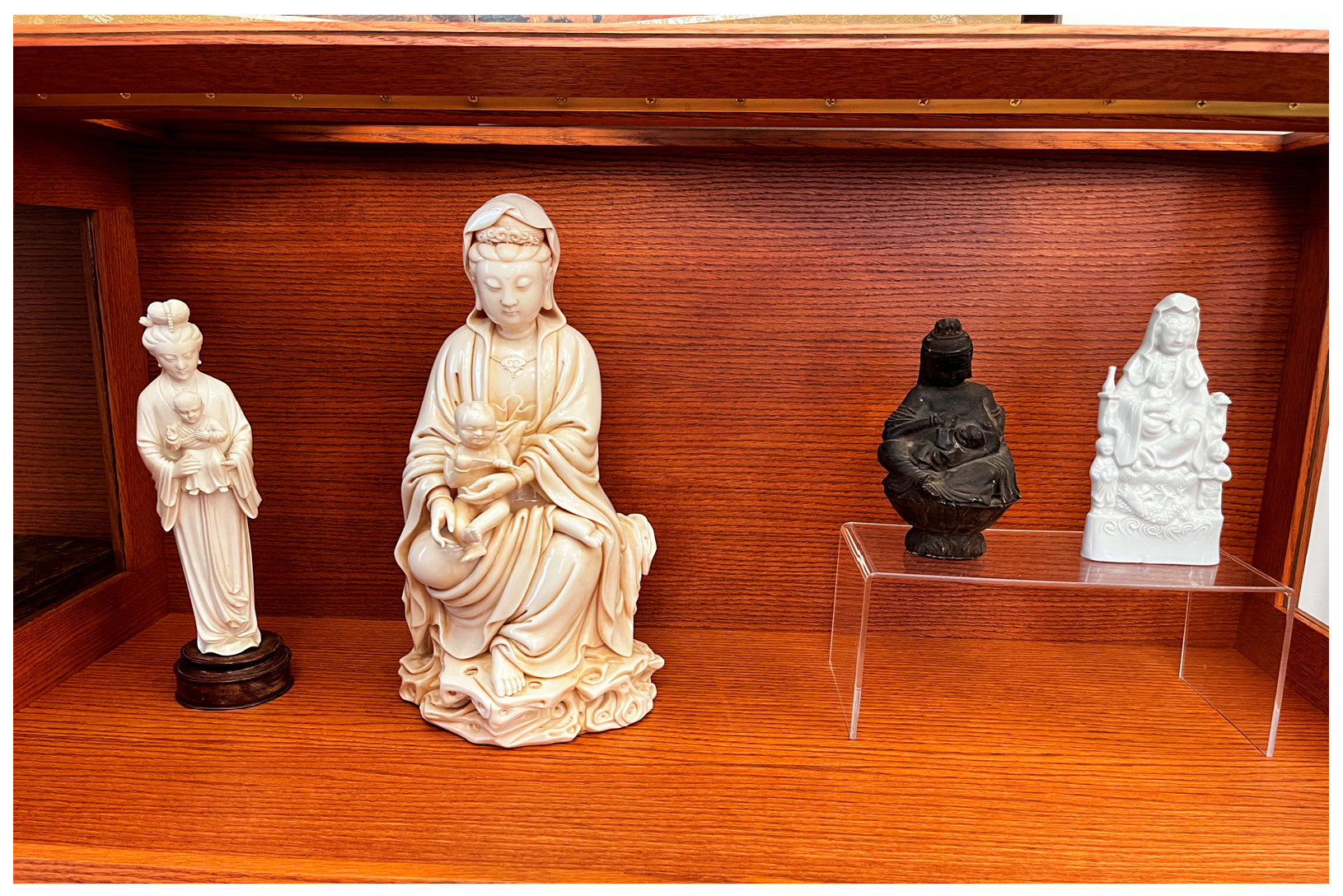
In Chinese cases, three features of images are especially important. Firstly, mother-and-child images mark a stable maternal presence of care and help. In both Marian and Guanyin images, the embrace, the child across the lap, and the close gaze share similar poses that express hope, gratitude, and fear. In Chinese ceramic and sculptural media, exemplified by Dehua Guanyin, quiet poses, smooth robes, and slightly inclined heads create a contemplative stillness. This stillness is closely comparable to that of Marian reliefs and small domestic devotional figures popular in Catholic households. When placed side by side, a Dehua
Guanyin with Child and a small
Virgin and Child statuette can serve as comparative examples. Read together, they display the same pattern of poses and the same material qualities.
3 This visual adjacency was not only a viewerly effect but also a productive option in image-making. Even Catholic-produced images could be drawn into this shared pattern: in Schall von Bell’s
Jincheng shuxiang 進呈書像, Mary in an adoration scene combines features of the Western Madonna-and-Child motif with the Chinese child-giving Guanyin, suggesting that late-imperial artists already worked within a visual space where the two figures could be read side by side (
Song 2025, p. 396). These traits teach a maternal way of coming close and asking for help, which viewers can easily carry from one image tradition to the other. The point is not identity but structural adjacency: viewers can transfer this feeling without altering doctrinal essence.
Secondly, the robes and bodily gestures act as contact zones between viewers and the image. Marian mantles and veils, like Guanyin’s cascading robes, both veil and reveal; iconically they function as mediating surfaces between divine compassion and petitioners’ vulnerability. In domestic settings where touching, clothing, and wreathing are allowed, these surfaces become the main site of exchange between devotee and image. Such interactions support perceptual equivalence: one may approach, adorn, and address either figure with similar bodily gestures while not claiming any doctrinal sameness.
Thirdly, gesture and hand-held objects shape repeated prayer. Rosary-like counters in Marian devotion and Buddhist beads in Guanyin images work as counting tools. Even where beads are absent, hand positions—holding the child, offering a vessel or lotus, extending an open palm—establish recognizable patterns of reception, offering, and rescue. A seventeenth-century Iberian missionary account from Chaozhou notes large bead-strings worn by local devotees around the neck, with 108 beads divided into two groups of 54 by larger separators. One separator even has a small pillar that, if it had a cross-piece, would form a cross. He reports that, when the wearers reached the larger beads, they recited short phrases such as calling on
Amituofo (阿弥陀佛), and he took these phrases to be functionally similar to calling on the holy name of Jesus or Mary. This was an outsider’s comparison that stressed similarity in how people prayed rather than in the exact words they used (
de las Cortes 2022, pp. 144–45). The same report describes a female image “
Juanima” (Guanyin) holding a child, with a rosary hanging from the child’s hand and a dove above. He likens this to a Madonna-and-Child scene, which again suggests that the poses can be read across traditions rather than proving any doctrinal merger (
de las Cortes 2022, p. 159). In short, it is procedural homology, not conceptual identity, that links the two icons. Taken together, these features support the claim that, in Chinese settings, image, affect, and practice precede doctrinal comparison: viewers first learn what to do with an image (how to approach, ask, and thank) and only subsequently, if at all, spell out confessional differences.
If the features of images above explain how cross-reading is possible, spatial organization shows where it becomes routine. As studies of Chinese popular religion, Catholic domestic worship, and household altars have long noted, domestic worship spaces are assembled and adjusted pragmatically rather than according to fixed confessional practices (
Johnson 1995;
Chau 2006;
Amsler 2018). In many households that take part in more than one set of rites, images and spirit tablets are arranged and rearranged according to the kind of help sought (health, childbirth, examination success), the habits of the primary caretaker—often a senior woman of the household (
Amsler 2018, pp. 102–6), and the cycle of anniversaries or crises. Compassionate and protective figures are treated as complementary options. Their side-by-side presence is stabilized through repeated actions such as lighting, bowing, counting, touching, and cleaning, so that effectiveness is learned through practice rather than through formal doctrinal statements. A photograph from the late twentieth century Tibetan areas shows a Catholic mother beside her Buddhist son and daughter-in-law, each holding their own “god”. It points to this intra-household plurality and shows how co-presence operates without creed-level merger (
Lü 2008). This home-based pattern of coexistence, formed at home, also scales into public life and diaspora settings. Overseas Chinese devotional spaces in the Philippines and Singapore often follow the same pragmatic logic of placing and combining images for particular events, as will be discussed below. Yet even there, the operative settlement is co-presence rather than doctrinal synthesis.
2.2. Media of Coexistence: From Household to Civic Space
From household altars outward into civic space, media show where Marian–Guanyin coexistence travels and how it becomes routine, because cross-reading depends on media that can be replicated and that travel. In particular, late-sixteenth-century stories around replicas of the
Salus Populi Romani show how Marian images circulated widely in Ming China as portable devotional objects (
De Caro 2021, p. 150). Copying and gifting moved these images from place to place, while miracle narratives attached efficacy to them before any full doctrinal clarification. Media support Marian–Guanyin cross-reading at different scales, from household to civic space. Print culture spreads Marian and Guanyin imagery in small items for the home, including chromolithographs, calendar leaves, prayer cards, and temple almanacs. Because such prints are portable and inexpensive, they can be put up easily in bedrooms, kitchens, and shop counters—places where people often do not closely examine doctrine but often form strong emotional ties. In these settings, Marian and Guanyin images can appear side by side, and viewers may start to use them in similar ways. Because they usually carry little or no doctrinal text, such printed media are especially mediating: they foreground shared poses, colors, and moods while leaving formal teaching in the background.
Porcelain and small sculpture make physical closeness easier. Dehua Guanyin statuettes are valued for their smooth surface, calm expression, and manageable size. They sit easily on shelves and can be held and handled. Small Marian statues in plaster or resin, commonly bought in parish shops, share the same material qualities. In practice, shared scale and sensory qualities serve as bridges for embodied use prior to doctrinal instruction: figures can be touched, moved, and dressed in similar ways, even when the prayers differ.
Murals in hospitals often present scenes of maternal compassion. In medical settings in Taiwan and mainland China, wall images and decorations often focus on mercy, care, and protection by combining contemporary pictorial devices (soft palettes, back-lighting, stylized flora) with traditional icons. At Taiwan Hualien Tzu Chi Hospital, which belongs to the Humanistic Buddhism tradition, a corridor mural of Guanyin holding an infant reworks a Madonna-and-Child pattern in a Buddhist key. The pose, the gentle light, and the soft colors closely echo a Madonna-and-Child image, but the robes, setting, and inscriptions clearly identify the figure as Guanyin and place the scene within a Buddhist frame (
Schumacher 2003;
Jones 2011). Across such settings, maternal affect is presented as a public good, and for viewers doctrinal boundaries tend to fade into the background behind the more immediate experience of solace and reassurance. In this context, such large-scale, fixed imagery continues to function as a bridge at the level of mood and gesture, even though its textual framing keeps it within a clearly Buddhist doctrinal setting.
Public monuments extend the same logic to civic space. A representative instance is Macau’s waterfront “Western-style Guanyin” (洋觀音): a 20 m bronze statue on an artificial islet off the New Outer Harbour. Its face was designed to signal an ecumenical universality without ethnic markers, and its lotus-shaped base houses a contemplation room.
4 Precisely because confessional labeling is absent, such structures are broadly addressable: citizens and tourists can project Marian or even non-religious maternal meanings onto a Guanyin monument without offense. In this civic setting, the monument encourages intericonic reading while withholding doctrinal claims; what is stabilized is public legibility rather than theological interchangeability. Compared with more explicitly didactic genres such as sermons or doctrinal treatises, these visual and spatial media are thus more conducive to cross-reading: they are widely legible across traditions and invite shared use, but they do not themselves define or change confessional commitments.
2.3. Boundary Work and Misreadings in the Chinese Case
Chinese materials not only make Marian–Guanyin cross-reading possible, they also show very clearly where it stops. The mother-and-child model is a deep, trans-traditional pattern. The fact that it works for petition or consolation tells us little about the different theological reasons that make it effective, such as the Incarnation, Marian intercession, or the bodhisattva vow. In other words, the same pose and affect can travel across images while the doctrinal grounds that justify them remain separate. Wherever this article speaks of “equivalence,” it is functional or perceptual, not dogmatic. One missionary text even read a three-faced icon through a Trinitarian lens, which is evidence of perceptual translation rather than doctrinal convergence (
de las Cortes 2022, p. 159).
Popular speech and visual comparison reinforce this gap between perception and teaching. Studies of everyday practice sometimes report that people call Guanyin the “Chinese Madonna” or describe Mary as a “Western Guanyin.” Early Jesuit and encyclopedic observers likewise read Buddhism through a Catholic lens: because organization and worship “looked familiar,” Buddhism seemed immediately legible as a religion (
Foss 1979, p. 453). Conversely, a late sixteenth-century encyclopedic image in
Dongyi tuxiang 東夷圖像 mislabels a bearded, tonsured friar kneeling before a framed Madonna-and-Child as a monk from Tianzhu (天竺), and the accompanying text confuses Buddhist India with Christian Europe, showing how Catholic imagery itself could be perceived through a Buddhist lens (
Song 2018;
2025, p. 400). All these cases record how people and observers see likeness and make comparisons. A late-Ming Catholic voice, Yang Tingyun (1562–1672), already felt compelled to say that, when the Holy Mother is compared with what common people call Guanshiyin (Guanyin), “they are by no means equivalent,” which only makes sense if the comparison was already circulating (
Yang 1965, p. 592). Yang’s clarification shows that Marian–Guanyin comparisons were vivid at the level of practice and talk, precisely because official teaching did not accept them.
Elite evaluations push this contrast even further.
The Collection of Hong Daeyong’s Letters from Chinese Scholars in the Late 18th Century 中士寄洪大容手札帖 contains letters by figures such as Pan Tingyun, as well as anonymous contributors, that dismiss “the Western teaching of Jesus” as largely fabulous or as not going beyond a lower level of Buddhism, even while admitting Western superiority in mathematics and instruments (
Sungsil University Museum 2016, pp. 131, 239). From this point, Western objects and images can be welcomed and used, while doctrinal equivalence with Chinese traditions remains tightly controlled.
Regional variation further underlines that there is no single “Chinese pattern.” In the materials surveyed here, this coexistence is clearest in coastal areas with a strong missionary presence (Taiwan, Fujian, Guangdong, treaty ports, and overseas Chinese networks), where Catholic presence, Dehua production, and multitradition domestic altars overlapped. It is along this stretch of coast that blanc-de-chine Guanyin, small Marian statuettes, and mixed household shrines are most frequently documented. In inland areas, such combinations appear more loosely or only from time to time, so the coastal pattern is treated here as the primary Chinese case for analysis. In the comparative matrix, therefore, each sub-case is coded along five variables, dominant–subaltern relations, legal regime, media, theological thresholds, and intergenerational transmission, rather than treated as one uniform Chinese model.
Taken together, the Chinese case shows a distinctive pattern of cross-reading. This pattern takes shape above all on household altars and in small civic spaces where Marian and Guanyin images share tasks and positions. It is limited by doctrinal distinctions, prayer formulas, and elite boundary work that keep teachings separate even when practice links the figures. It is carried across generations by repeatable media and domestic routines that make intericonic coexistence feel ordinary without asking for creedal change.
3. Japan: Cover, Type-Formation, and Underground Memory
The Japanese materials are analyzed here as strategies of survival rather than as fusion. Marian devotion is carried under cover on Buddhist-readable surfaces, gathered into repeatable small objects and shortened prayer scripts, and sustained as underground memory in household routines and lay teaching. There is an outer image that can pass inspection, an inner code or reserved name that keeps it clearly tied to Christian meaning. In this way, rosary counting is turned into orasho cycles, and the domestic space teaches concealment as a daily habit. Over time these solutions settle into stable types: figures with very few explicit Christian signs, pocket manuals for contrition and petition, and lay networks that pass on prayers and handling rules to the next generation.
3.1. Law, Surveillance, and the Turn to Cover
In the Japanese case, legal and institutional pressures define the field within which cross-reading can only survive in concealed forms. The Tokugawa ban on Christianity in 1614 removed the missionaries and destroyed the sacramental structures on which Jesuit pastoral work depended (
Nagayama 1927, Part 17). Temple registration
danka (檀家),
fumie (踏絵) inspections, and neighborhood surveillance made any public expression of Christian identity extremely risky (
Nagayama 1927, Parts 39–44;
Kataoka 1969). In this environment, the parish-centered model of Christian life could no longer be reproduced. Access to confession and Eucharist ceased, and as a result, communities later glossed as Kakure Kirishitan (隠れキリシタン)
5 faced a practical question: how to continue to pray and remember without attracting official attention.
Already in 1552, Ōuchi Yoshinaga (大内義長) granted missionaries permission “to build a temple and a house in order to spread the Law of Buddha,” a story that shows how Christianity could only be recognized in official terms within a Buddhist frame (
Haas 1904, p. 52). This kind of misreading, acceptable to officials, foreshadowed the later logic of cover: Christian practice had to pass inspection as Buddhist while retaining its distinct interior aims. Relatedly, early missionaries themselves sometimes mapped Christian ideas onto Buddhist vocabulary, using terms such as
Hotoke (仏, “god”),
Jōdo (浄土, “heaven”), or
Jigoku (地獄, “hell”). This strategy produced “confusion between Christianity and Buddhism” among hearers. After 1555, missionaries instead wrote key terms phonetically in Japanese to stop this semantic bleed, but the social habit of reading Christianity through Buddhist lenses had already taken root (
Jennes 1973, pp. 25–27).
In the surviving material and textual traces, the response was not doctrinal compromise but two parallel strategies: iconic cover and procedural substitution. The rosary persisted as counted prayer and shifted into family orasho. Contrition remained central and was stabilized by pocket handbooks usable without a priest. One such booklet was the vernacular tract
Contriqon (“Contrition”), written in old-style Japanese. It was used together with a small set of prayers in Japanese: Act of Contrition, Pater, Ave, Credo, Salve Regina, and the sign of the cross (
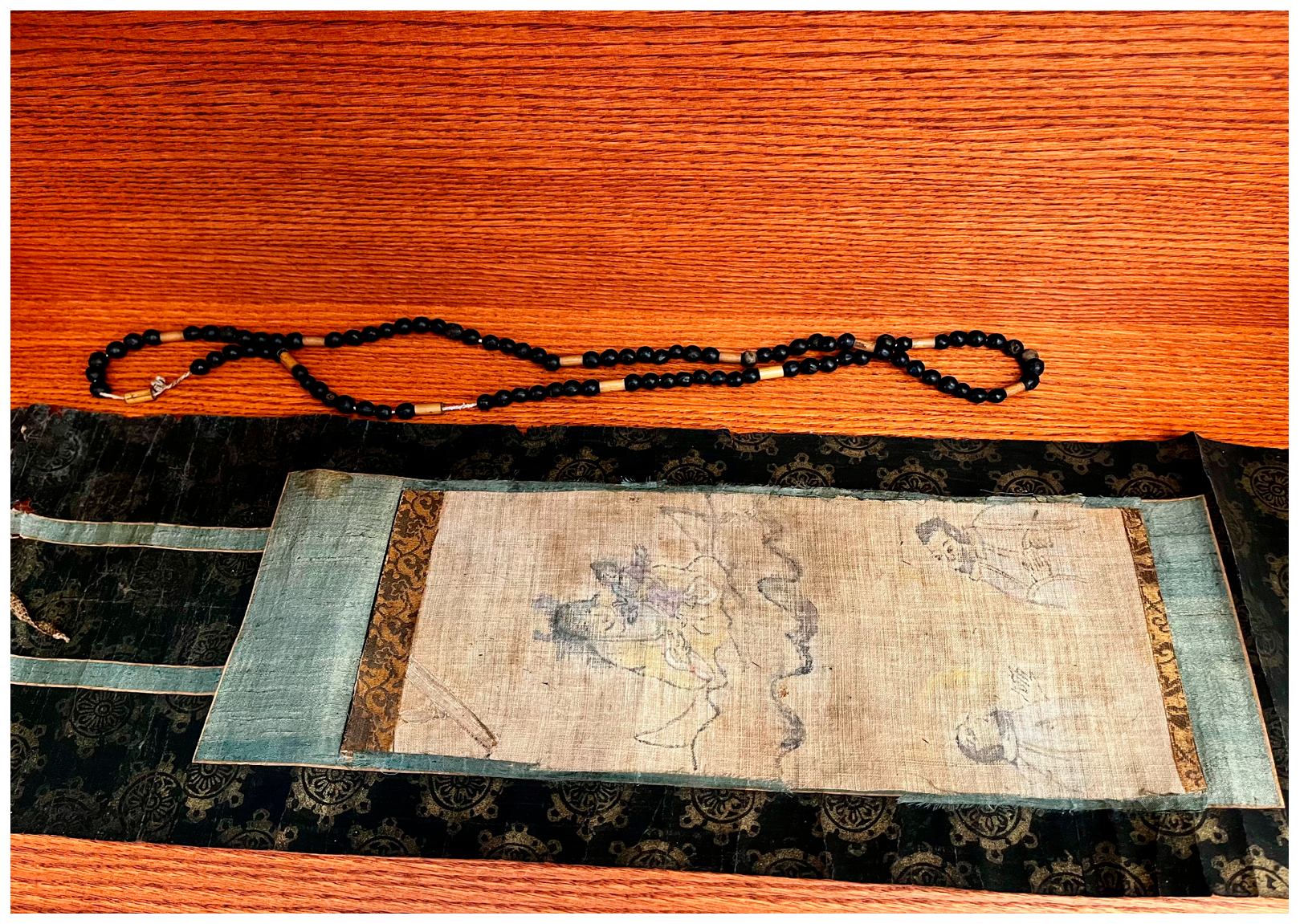
Marnas 1897, p. 514). In some surviving sets, a hanging scroll whose imagery looks typically Buddhist is paired with a rosary, forming a devotional unit that passes as Buddhist décor to outsiders while functioning as Catholic equipment for those who know how to count it (
Figure 1).
This, in turn, helps explain why a Buddhist-looking object could carry Marian work without attracting suspicion during inspections. Contemporary observers had already noticed the visual–procedural homology. Athanasius Kircher (1602–1680), a German Jesuit based in Rome who drew on missionary reports from East Asia, for instance, reports that Japanese devotees carried rosaries “in common with Christians” (
Kircher 1667, Part III, chap. II, p. 139). The same logic of visual and procedural resemblance extended beyond prayer tools to devotional images. Objects later identified as
Maria Kannon (マリア観音), including the examples shown in
Figure 2, give this logic tangible form: they present a Kannon-like surface to inspectors but support Marian devotion for those who know how to read them. A seventeenth-century Jesuit letter from Japan notes with regret that Japanese Christians had been “long deprived of the administration of the sacraments” but still held to their faith despite danger. Because priests were absent, this correspondence shows that lay orasho cycles and passable images became a practical necessity (
Thomas [1679] 1975, p. 80).
Two local religious features made this shift possible. First was
honji suijaku (本地垂迹), the view that buddhas and bodhisattvas are the “original ground” and local
kami are their “manifest traces,” which normalized reading one sacred figure through another without erasing identity. Second was the dominance of Pure Land soteriology (
Shin 2011, pp. 3–4), which oriented popular practice toward reliance, invocation, and rescue. In settings where clear sacramental markers were absent, this everyday religious sense made it easier for Christian petitions to be housed within a Buddhist-looking space. Cover thus became something neighbors and officials could recognize, families could use, and parents could pass on to their children.
3.2. Visual and Procedural Bases of Cover
Against this background, specific visual forms and prayer procedures show how Marian–Kannon cover could still operate in everyday life and why certain media were especially suited to this work. The mother-and-child pattern gives a clear key for reading Marian–Kannon objects. Nagasaki records describe figures that look like Kannon from the outside but are understood as Our Lady within hidden households (
Kataoka 1970, pp. 70–72). Seventeenth-century observers even noted a feminized Amida, “woman-like in form, with ear ornaments that radiate charity and light”, showing that compassion-coded, quasi-feminine Buddhist bodies were already imaginable (
Kircher 1667, Part III, chap. II, p. 142). Holding the child across the body, a downward gaze, and long, flowing robes prepare viewers for consolation and intercession. The point is not that Mary “is” Kannon, but that a Kannon-looking object can do Marian work within a home (
Nagayama 1927, Parts 45–46). The
Kawaguchi Amida case gives this logic in a concrete example: an ordinary Amida statue whose hollowed interior contained a small Marian figure and a crucifix. Here, an outward face for officials and an inward meaning for the faithful create two layers of reading. This split makes the statue a particularly bridging medium: passable as Buddhist in public, yet legible as Marian to those who know what is concealed (
Kawaguchi City Cultural Properties Center 1959).
The same pattern in practice is at work in both the Rosary and the
Taima Mandala (当麻曼荼羅) (
Shin 2011, p. 4). In the Catholic practice, the Fifteen Mysteries surround a central Marian image and function as a visual instruction: the gaze advances panel by panel as the fingers count, linking contemplation with repetitive prayer. In Pure Land visualization, the Taima Mandala lays out Amida’s realm in a series of scenes that guide the mind through the Sixteen Contemplations while the mouth continues its repeated invocation. The two devices are not doctrinally interchangeable, yet they work in very similar ways. Both formats tightly couple image, hand-movement, and voice, so that once the pattern is learned it can be followed even when words are half-remembered or partially translated. In conditions of surveillance, these visual–procedural media are therefore safer bridges for cross-reading than explicit doctrinal texts: they carry habit and affect, while leaving formal teaching less exposed.
3.3. Type-Formation in Objects, Prayers, and Lay Transmission
Over time, repeated reliance on these solutions turned them into stable types of objects, prayers, and spatial routines that could be transmitted across generations. The objects themselves were small and simple, with obvious Christian features minimized and robes and bodily forms treated in ways that reduced confessional visibility. As a result, a statue or print could blend into a Buddhist interior while still evoking Marian devotion for those who knew how to read it. These were not display pieces but household tools for devotion, used both to avoid inspections and to invite prayer in small rooms that might need to be rearranged quickly. Their size and visual ambiguity made them effective bridges: they could move through Buddhist-coded space without drawing attention, yet still anchor distinct Christian memories and practices.
Eyewitness reports note that villagers could recite core doctrines such as Trinity, Incarnation, Redemption, heaven, purgatory, hell, “about as well as the faithful in rural France,” indicating that catechetical memory had been conserved without sacramental administration (
Marnas 1897, p. 510). In Kyushu, especially around Urakami, this replication was not left to individual memory. After persecution scattered believers, local leaders reassembled them into a five-district system, Sato, Hara, Magome, Nakano, and Ieno (里・原・馬込・中野・本原郷), each with a
mizukata (水方) to teach and administer lay baptism and a
kikiyaku (聞役) to connect households; above them stood the
chōkata (帳方), who kept registers and coordinated daily and annual devotions (
Kataoka 1970, pp. 69–70). This quiet chain of transmission made it possible for Marian and orasho practices to survive for generations without a resident priest.
Scripts and textual mediation formed under the same pressure. The Rosary’s structure, with its repeated and fixed counting pattern, survived as family orasho. Its Latin or Portuguese phrases were adapted into local speech and spelling, sometimes thinning in meaning but remaining stubbornly rhythmic (
Reuters Wider Image 2019;
Nippon.com 2024). The pocket manual
Konchirisan no ryaku こんちりさんのりやく (
Essentials of Contrition, 1603) provided a simple set of tools for moral and sacramental practice. In this way, contrition remained something people could actually practice, and Mary’s help could still be felt as close even when no priest was present (
Kawamura 2001, pp. 97–126;
Oka 2014, pp. 83–97). Here, the “bridge-like” quality lies less in images than in rhythm and repeatability: compressed, partially vernacularized phrases and fixed counting schemes are easy to memorize, easy to whisper, and easy to transmit within families, even when access to learned theology and public liturgy has been cut off.
3.4. Boundary Work and Limits of Cover in the Japanese Case
In Japan, the very techniques that enable Marian–Kannon cover also depend on sharp distinctions that set clear limits on what cross-reading can do. Three cautions frame the analysis. First, cover presupposes non-identity. The decision to secrete a Christian object inside a Buddhist statue assumes clear limits between them; otherwise, concealment would be unnecessary. In cases such as the Kawaguchi Amida with a hidden crucifix, the design itself separates roles: a publicly legible Amida surface combined with a hidden Christian object kept for insiders only. Cover works because both layers are intelligible and non-identical—Amida to inspectors, Mary and the crucifix to the community.
Everyday negotiations build on this structure. Where sources report that clerics helped produce apostasy certificates, or that villagers casually described Mary as Kannon (and vice versa), such cases record social negotiation under surveillance rather than formal doctrine from church authorities. For this reason, all claims of “equivalence” are marked as functional or perceptual, not dogmatic.
Images also remain embedded in networks of prayer and time. The persistence of orasho cycles, adapted Lenten food rules, and martyr stories shows that images served as focal points within ritual–text networks. If we isolate an image from its textual and calendrical companions, we risk misreading what actually kept memory alive.
Regional variation again limits any one “Japanese pattern.” Kyushu and Nagasaki, deeply shaped by Portuguese and Spanish missions, show the strongest evidence for Marian–Kannon cover and for hidden Christian artifacts. Elsewhere, traces are thinner or Buddhist–Christian contacts take different forms. For this reason, the comparative matrix codes Japanese sub-cases along the five variables used in the article rather than projecting a single “Japanese pattern.”
The Japanese materials reveal a highly constrained pattern of cross-reading. It takes place mainly in small, passable objects and hidden gatherings. It is bounded by prohibitive law, inspection routines, and the loss of regular sacramental life. It is transmitted through stabilized image types, lay orasho cycles, and household roles that can be taught quietly across generations while keeping Christian and Buddhist identities distinct.
4. The Philippines: Alignment and Practice-Driven Inculturation
This section argues that in the Philippines the Marian–Guanyin nexus is not a strategy of concealment (as in Tokugawa Japan) nor merely a case of parallel co-presence (as in China), but of alignment: Buddhist and Chinese–Filipino communities align their images, prayer routines, and calendars to a publicly dominant Catholic time without surrendering their own doctrinal provenance.
6 At first glance, these arrangements may look like iconographic “assimilation.” They are better understood as a negotiated alignment. Temple and community actors adjust images and rituals to an already open Catholic environment shaped by Marian devotion, so that Guanyin can circulate within parish-centered social time while remaining doctrinally Buddhist.
4.1. Catholic Dominance and Open Devotional Field
In the Philippines, the basic field in which Marian, Guanyin, and other figures meet is shaped largely by who controls the calendar and public institutions. In this context, Catholicism does not drive Chinese and Buddhist practices underground; instead, it provides the public calendar to which other devotions must adjust. Unlike Tokugawa Japan, the Philippine field is neither prohibitive nor clandestine. It also differs from the Chinese case, where a Confucian-led multitradition setting, with Buddhism, Daoism, and popular religion, forms the main background, and Catholicism enters as one more incoming tradition. In the Philippines, by contrast, Catholicism is the dominant framework: it supplies the key institutions and festivals, and Buddhist and Chinese practices must find room within this Catholic-shaped environment. Parishes shape neighborhood life, schools and lay associations extend into civic life, and national observances such as Advent and Christmas (with the Simbang Gabi novena of dawn Masses), Lent and Holy Week, and the May cycle of Flores de Mayo and the Santacruzan procession organize collective time. Within this matrix, Chinese–Filipino (Tsinoy) communities can run temples, family associations, and charity foundations with considerable freedom.
Early Jesuit practice in Manila already shows the centripetal logic. Missionaries were told to learn Chinese rather than Tagalog because of the growing Chinese trader community (the
sangley), and colonial authorities even considered grouping resident Chinese into a Jesuit-served national parish (
de la Costa 1961, pp. 68–69). In the 1620s, Manila was envisioned as a regional Catholic hub from which clergy could be trained for neighboring Asian missions, especially the persecuted Japanese church, confirming an absorptive rather than exclusionary orientation (
de la Costa 1961, pp. 370–71).
The dominant–subaltern relations in this field are therefore centripetal rather than coercive. Catholic forms draw surrounding practices inward through expectation, availability, and prestige, creating conditions for an inculturation that changes practice more than doctrine and aligns other devotions with a publicly legible calendar. Within this Catholic frame, Chinese and Buddhist actors did not simply accept Catholic norms, but looked for workable points of entry and, where useful, refashioned their own images and procedures so that they could move inside Catholic social time. In this way, they sought workable alignments and at times deliberately presented Guanyin in Marian-like forms, while their doctrinal commitments remained Buddhist. The Marian–Guanyin nexus thus appears not as concealment but as a means of survival: a set of semantic and ritual proximities by which Buddhist and vernacular agents synchronize with parish rhythms while retaining their own origins. What looks like assimilation in iconography is, in practice, continuity through adaptation, shaped by calendar, texts, and space.
From the Catholic side, dominance also works through control of language and categories, a mode of cultural re-encoding rather than simple prohibition. Missionary manuals such as
Símbolo de la fe, en lengua y letra China (新刊格物窮理便覽, a 17th-century Chinese adaptation of the
Símbolo de la fe prepared for Chinese-speaking communities in the Philippines) exemplify how Buddhist and Confucian categories were linguistically absorbed into a Christian cosmology, with their moral and metaphysical vocabularies reinterpreted to affirm a hierarchy of divine truth (
Lee et al. 2022, 546 ff.). Such translation did not destroy other traditions but domesticated them within a Catholic frame, turning difference into a pedagogical resource.
4.2. Images, Emotion, and Devotional Rhythms
Within this Catholic-shaped devotional calendar, shared images and emotional rhythms make Marian–Guanyin cross-reading feel natural. In the Philippines, Marian devotion is expressed through highly emotional, domestic imagery, which aligns most closely with Guanyin in terms of image and affect. Household statues of Nuestra Señora (Our Lady) often stand near family photographs, flowers, candles, rosaries, and thank-you notes, while parish sanctuaries and side chapels are crowded with small images. The mother-and-child pattern fills both public and private spaces, from Manila’s Nuestra Señora de Guía to local barrio patrons. Its way of holding the child across the body, the close gaze, and mantle-like robes visually signal care and intercession. Against this backdrop, white-robed and child-giving variants of Guanyin are visually and affectively adjacent. Viewers can approach both figures through the same bodily grammar of lighting candles, touching bases, or whispering petitions without asserting any doctrinal substitution.
The adjacency between Marian and Guanyin devotion is reinforced by counted prayer and small-form media. Parish novenarios, block rosaries, and house-to-house images circulate through capillas (neighborhood chapels) and barangay (village/district) routes. Together they create a domestic rhythm that is similar to chant cycles and bead-counting routines in Chinese temples. Even where texts differ, counting and private practice feel familiar, so people carry the same bodily habits from one setting to another.
Finally, stories of mercy and protection, for example, rescues at sea, recoveries from illness, and deliverances in household crises, are closely linked to Marian images and ex voto plaques (small thanks-offering tablets). Guanyin’s jiuku jiunan (救苦救難) profile follows the same narrative pattern. The ways temple keepers and lay donors present petitions and thanks—a small photo, a short note, a framed token—are forms that Catholics can recognize. At the level of story, the language of appeal and gratitude is effectively bilingual: “I cried out, and she helped.”
4.3. Media and Vernacularization
Concrete media and sites then show how the Marian–Guanyin link is localized and made available to different publics. Here, “media” is used in a broad sense to include not only statues and prints but also altar arrangements, small devotional objects, gestures, and processions as carriers of meaning. A key example is Fazang Temple in Bacolod. There, a white-marble Guanyin was explicitly designed on a Marian model and described as a way to welcome local Catholics. All the main images in the temple are carved from Italian white marble, and this Guanyin has a Western-style female face and hairstyle rather than a traditional Chinese bodhisattva look (
C.-m. Shi 2008, p. 86). The point is not a theological absorption of Mary into Guanyin but a visual hospitality, where an image can look and feel Marian to Catholic viewers while remaining clearly Buddhist in temple liturgy. Because the stone statue is both highly visible and doctrinally silent, it lends itself well to cross-reading: viewers can project Marian meanings onto a clearly Buddhist object without requiring any change in formal teaching.
A stronger example of this pattern appears at Chong Hock Tong Temple in Manila. The main altar places Guanyin, Marian, and
Mazu figures together on a single richly carved altar.
7 A comparable arrangement appears at Pao Ong Hu Temple in Santa Ana, Manila, where Taoist, Catholic, and Buddhist devotions are accommodated within a single temple and in neighboring shrines. The arrangement pushes intericonic adjacency into full view: Buddhist, Catholic, and popular-deity icons are simultaneously available to worshippers and visitors. Yet even here the effect is best read as alignment rather than merger. Different figures attract different offerings and petition methods. Their co-presence indicates an inclusive devotional field in which Chinese–Filipino worshippers can pray at both Catholic and non-Catholic shrines while still keeping the traditions distinct. In this sense, a shared altar is a spatial bridge: it does not fuse the icons but puts them into one visual frame, inviting people to move from one to another in a single, continuous practice.
On the parish side, urban churches sustain open-door devotions, such as public novenas, Perpetual Help Tuesdays, and Simbang Gabi, which non-members can easily join. Chinese–Filipino parishioners, often active in both temple and parish, carry a double set of habits: they wear scapulars and use rosaries, and they also continue incense-offering and donation habits learned in temples. Between temple and parish, small objects regularly move back and forth (flowers, beads, prints), along with gestures (bowing, crossing, placing palms together) that are functionally convertible even as their doctrinal commitments remain separate. These light, inexpensive media—rosaries, incense sticks, plastic flowers, paper images—are mediating because they can be handled in the same way in both settings, and what changes is the name and story attached to them, not the basic bodily routine.
The street, finally, supplies a lesson learned by walking together. Processions associated with Nuestra Señora de Caysasay or local barrio patrons bring together vendors, neighbors, and visiting temple friends. Conversely, temple anniversaries increasingly feature elements also found in parish fiestas, such as marching bands, floral arches, and public feeding. Walking together behind a cart, repeating a chant, and dropping flower petals along the route teach people that they can act in similar ways even when they come from different devotional backgrounds. Here the moving line of bodies functions as a temporal bridge: by synchronizing steps, songs, and stops, processions align participants in shared time without requiring shared doctrine.
A final dimension of this media field is language and signage, where Marian and Guanyin devotions are vernacularized into Tagalog and Chinese everyday speech. Beyond statues, altar layouts, and small objects, dialect and everyday wording also become important tools of alignment. This is sustained by Chinese–Filipino agency within a layered pattern of everyday devotion. In Chinese-run temples that serve mixed neighborhoods, entrances and altars carry bilingual signs, and their thank-you boards use familiar patterns from Catholic ex voto and
panata (vow). Guanyin-oriented petitions addressed to wider Filipino publics are often phrased in everyday Tagalog words of mercy, help, rescue, and prayer (
awa, tulong, pagliligtas, dasal), while stories of Marian help told in Chinese circles use Hokkien or Mandarin words for protection, blessing, and care that temple relatives and friends easily understand (
Dy 2014, pp. 48–51;
Dy 2012, pp. 247–48). Such multilingual address has deep precedents. In the seventeenth century, missionary materials helped codify a Manila Hokkien vernacular used among the sangleys as a working language between Chinese communities and colonial Catholic officials (
Klöter 2011, pp. 176–369). Spoken and written language thus form a softer kind of bridge: shifts in wording and address make it easy for worshippers to carry the same petitions across settings.
4.4. Boundary Work and Alignment in the Philippine Case
In the Philippines, boundaries do not prevent Marian–Guanyin interaction; they channel it into alignment with the Catholic calendar. Catholic dogmas around Mary, such as the Immaculate Conception, Assumption, as well as debates about Mary’s role in redemption, are neither claimed nor implied in temple discourse. Conversely, the bodhisattva vow and Pure Land teaching on salvation are not preached from Catholic pulpits. Temple staffs may authorize practices that look Catholic (lighting candles, leaving a note) without accepting Catholic metaphysics. Parish clergies may welcome non-Catholics to public feasts while maintaining clear sacramental boundaries. Who may teach, under which sign, and with what authority becomes a key threshold that allows for shared practice but not shared dogma.
Sacramental limits reinforce this point. Inculturation does not extend to Eucharistic participation, confession, or anointing. These rites remain under ecclesial discipline. Nor are specifically Buddhist ceremonies turned into parish rites. These sacramental non-equivalences prevent a slide from perceptual to doctrinal equivalence. Institutional background also matters. Images are owned, maintained, and interpreted by their institutions. Even when a Guanyin is read as Marian by a neighborhood, the temple still places her within Buddhist compassion. Even when Mary is sculpted with “Asian” features, the church still places her within Catholic Mariology. Alignment in practice thus coexists with parallel and clearly separated interpretive frameworks.
If not merger, what then is the Philippine outcome? The evidence points to alignment as the operative mode. Scripts, calendars, and objects follow Catholic social time but allow Buddhist and vernacular agents to join without doctrinal exchange (
C.-y. Shi 1989;
C.-m. Shi 2008;
Yu 2000). At the level of script, the novena’s pattern of repeated petition and thanksgiving matches chant cycles that alternate calling and thanking. Fieldwork reports and parish–temple projects describe prayer routines in which Catholic and Chinese practices are scheduled one after another on the same day or share the same commemorative tables, so that Marian and Guanyin images can be approached within a single domestic or communal setting. The sequence is easy to follow from both sides: participants know when to speak, when to pause, and what to hold. In such cases, alignment is produced not by doctrinal fusion but by shared prayer formats such as candles, flowers, thanksgiving notes, and feast-day visits, which make Buddhist and local devotions fit into Catholic social time.
At the level of calendar, temples schedule special Guanyin days (for example, the nineteenth of the second, sixth, and ninth lunar months) so that they do not clash with parish peaks. Parish groups pay courtesy visits to temples during temple feasts and receive water, flowers, and shade in ways that are familiar from parish hospitality. Over time, families build hybrid household calendars, combining, for example, Flores de Mayo and a Guanyin day, or Simbang Gabi and a Lunar New Year blessing. The calendar thus works across these settings without becoming identical.
At the level of objects, small items that can be easily shared, for example, strings of beads, plastic flowers, battery candles, and prayer cards, keep icons portable across spaces. The ex voto practice migrates easily: a photograph of a recovered child or a note about safe travel looks the same on a parish board as on a temple board. Such objects do not collapse identities. They carry proofs of compassion across parish and temple boundaries and normalize intericonic reading as part of everyday routine.
Two counter-pressures complicate this picture. On the one hand, clerical cautions are frequent. Some Catholic priests warn against “double belonging” in doctrinal terms, and some Buddhist monks and lay teachers caution against remaking Guanyin in Christian idiom, reasserting boundaries in homilies and printed guidelines. These interventions rarely halt street-level alignment, but they do shape official print discourse and catechetical speech, keeping confessional lines explicit even where practice blurs them. Historical precedents already appear in Hokkien catechetical manuals produced for Manila’s Chinese communities, such as
Símbolo de la fe, en lengua y letra China 新刊格物窮理便覽 and its companion
Rectificación y Mejora de Principios Naturales 無極天主正教真傳實錄, which adopt Chinese moral and metaphysical terms but limit their doctrinal scope (
Lee et al. 2021,
2022).
On the other hand, we also need to consider regional variation. Manila’s historic parishes, for example, Ermita, home of Nuestra Señora de Guía, Cebu’s Marian cults, and Chinese-dense centers such as Binondo, Bacolod, and Iloilo produce denser Marian–Guanyin adjacency than towns with smaller or more dispersed diaspora presence. Where civic authorities sponsor interfaith events, such as earthquake memorials or hospital blessings, alignment tends to be stronger. Where parish–temple relations are cool, it tends to be weaker. Accordingly, the comparative matrix codes Philippine sub-cases along the same five variables rather than assuming a single “Philippine pattern.”
The Philippine case points to a form of cross-reading tightly tied to Catholic time and space. It takes place where Chinese Buddhist and popular practices plug into parish calendars and devotional formats. It is limited by Catholic sacramental discipline and institutional control over teaching on both sides. It is transmitted through shared festivals, images, and small media that allow scripts to line up in practice while doctrinal sameness is neither sought nor granted.
5. Conclusions and Comparative Synthesis: The Uses and Limits of Syncretism
This article has argued that what is commonly labeled “syncretism” in the Marian–Guanyin archive is better understood as a set of field-shaped processes rather than as a single doctrinal outcome. Reading through five comparative variables—dominant–subaltern relations, legal regime, media (image/ritual/organization/space), theological thresholds, and intergenerational transmission—the same pair of icons performs differently in China, Japan, and the Philippines. These outcomes are not three variants of one underlying model but three distinct ways of solving the problem of unequal religious fields. In China, a multitradition background and flexible domestic altars produce a pattern of intericonic coexistence: icons share space and tasks in publicly legible ways while doctrinal teachings remain distinct. In Tokugawa Japan, proscription and surveillance lead to type-formation under repression: passable objects and miniaturized scripts carry Christian memory while managing risk. In the Philippines, a Catholic public calendar functions as the main point of reference, encouraging an inculturation that works mainly through practice and emotion: Chinese Buddhist and vernacular actors adjust scripts, schedules, and small media to track parish time without claiming doctrinal change. The Chinese pattern depends on a multitradition domestic setting that has no exact counterpart in the Japanese materials; the Japanese pattern presupposes a level of danger and underground organization absent from the Philippine field; the Philippine pattern, in turn, relies on a parish–centered national Catholicism that neither China nor Tokugawa Japan exhibits. In short, the comparison treats the cases as different patterns, not as steps in one shared story. A synoptic comparative matrix is provided in
Appendix A.
“Syncretism” still has explanatory value when it names shared use and partial mutual recognition. The mother-and-child pattern, flowing robes that give a shared look, bead-based counting, ex voto styles, and the regular tasks of the home altar all act as bridges that make cross-reading part of everyday practice. Such bridges structure how households handle illness or examination, how communities teach children what to do before images, and how publics recognize compassion in civic space. At this practical level, functional and perceptual equivalence can be strong enough to sustain parallel practice without triggering confessional alarm.
Yet the same term misleads when it is taken as a story of inevitable doctrinal merger or identity collapse. The corpus examined here shows, in all three fields, that thresholds remain not only in formal teaching but also in concrete rules and control over practice: sacramental discipline in the Philippines, name-reservation and hidden Christian contents in Japan, and distinct prayer formulas on Chinese domestic altars. Where procedures coincide, this study marks similarity; where they diverge, it marks a boundary. If cross-reading really led to sameness, Japanese hiding would be unnecessary, Philippine sacramental limits would have faded, and Chinese co-presence would have ended in creedal synthesis. None of this occurs. “Syncretism” is most useful when it describes patterns of shared use, not when it is treated as a narrative of convergence.
Media and calendars emerge as the main carriers across settings, but they do so with different strengths and in different combinations. The mother-and-child pose offers a cross-traditional pattern that viewers can act on. Veils and robes provide surfaces that invite touch and clothing; beads and small printed cards turn devotion into forms that can be carried; ex voto plaques make gratitude visible in both temple and parish. Likewise, calendars do not merely contain devotion; they compose it. Domestic routines in China, surveillance cycles in Tokugawa Japan, and parish time in the Philippines pull people into repeated sequences of gathering, holding, and moving, which fix a sense of likeness at the level of perception and practice while leaving doctrinal commitments unchanged. In each field, a different factor takes the lead: prohibitive law in Japan, a multitraditional household setting in China, and a Catholic-shaped public calendar in the Philippines. This shows that there is no single “syncretic script” behind the three patterns.
In relation to existing scholarship, this article makes three main contributions. First, it brings Marian–Guanyin relations in China, Japan, and the Philippines into a single comparative frame, rather than treating each national case in isolation. Second, the article reframes Marian–Guanyin relations by distinguishing functional/perceptual equivalence from doctrinal change, and by separating official theology from community narration. Third, methodologically, it offers a transferable framework that reads religious interaction as something that happens through specific media, such as images, calendars, and domestic routines, rather than as a direct referendum on doctrine. This framework is not limited to the Marian–Guanyin pair. It can, in principle, be used to analyze other cross-reading cases, for example, shared use of saints and local spirits, or overlaps between Sufi shrines and Hindu temples. In each case, the question would be how dominance, law, media, thresholds, and transmission are arranged in each field. At the same time, its variables are meant as a set of guiding questions to be tested in new settings, not as a fixed template. Some cases may require adding further dimensions, such as race, class, or citizenship, or may show that media other than images and calendars carry most of the load.
If “syncretism” has often been used as a catch-all word for mixture, naming only a final blended result, in the material examined here it can name, more modestly and more usefully, a set of repeatable ways of getting things done: consoling the sick, petitioning for a child, remembering the martyrs, and feeding a neighborhood with a feast. Coexistence in China shows that icons can work together without saying the same thing; cover in Japan shows that icons can pass together without meaning the same thing; alignment in the Philippines shows that icons can move together in time without teaching the same thing. These are the uses of syncretism. Its limits show how far syncretism can go: rules about sacraments, names, and who may teach keep the two identities clearly separate in both story and practice. Keeping both the uses and the limits in view makes it possible to read unequal religious fields on their own terms and keeps the analysis close to what the sources can actually support. The same approach can travel beyond the Marian–Guanyin link.