


Abstract
The gibbon was an often-mentioned animal in the elite literati world of China, Japan, and the Korean Peninsula during the twelfth to nineteenth centuries, with a large number of poems and paintings touching on the theme of gibbons. The image of the gibbon is often entangled with religion (Daoism and Zen Buddhism), and through the coding of art, it has become a tool for displaying one’s political position. There is also an intertextual phenomenon in the presentation of gibbons from poetry to painting which plays a crucial role in the generation of meaning. This article attempts to answer two questions: (1) why and how the image of a gibbon has become a tool for displaying religious affiliation and one’s political position through the art form of Sinitic poetry; (2) how does the intertextual relationship between poetry and painting affect the creation of meaning?
1. Introduction
The gibbon is often mentioned in Sinitic literature written in East Asian countries. If we take Chinese classical literature as an example, this theme is among the top few in the rankings of most popular animal imagery in classical poetry—there are at least a thousand poems involving gibbons in Quantang shi 全唐詩 [Complete Tang Poetry].1 The cries of the gibbon echo in the poetry and prose of East Asian Sinitic literature. But even though such an animal is familiar to everyone, there are many things about its biological attributes that are still unknown to the general public. For example, gibbons, orangutans, and monkeys, although they belong to the same monkey family, have significantly different biological attributes. In addition, the three subspecies of gibbons (Black-Palmed Gibbon 黑掌長臂猿, White-Palmed Gibbon 白掌長臂猿, and Black-crowned Gibbon 黑冠長臂猿) also differ in body shape, temperament, and geographical distribution. What is even more troublesome is that the ancient Chinese classics have many words regarding the naming of gibbons (such as rou 猱, nao 獶, rou yuan 猱蝯, etc.). Furthermore, records on gibbons do not all come from an author’s actual investigation, and there is often plagiarism. For example, the pictures of the appearance and characteristics of gibbons in the Song Dynasty’s (960–1279) Huitu Erya 繪圖爾雅 [Drawing Erya] and the Ming Dynasty’s (1368–1644) Sancai tuhui 三才圖會 [Three-Realm Illustration Collection] are obviously not based on actual observations, but were more likely copied from previous paintings. Through a large number of representative materials, this paper will reveal the following: first, in the elite literati world of China, Japan, and the Korean Peninsula in the twelfth to nineteenth centuries, there were a large number of poems and paintings on the theme of the gibbon; second, the animal image of the gibbon is often entangled with religion (Daoism and Zen Buddhism), and through the coding of art, it became a tool for displaying political postures; third, there is an intertextual phenomenon in the presentation of gibbons across media (from poetry to painting), which plays a crucial role in the generation of meaning.
In reviewing previous research on gibbon in the fields of East Asian literary history, art history, and political history, the following important achievements must be mentioned: First of all, the legendary Dutch sinologist Robert van Gulik lived and worked in Indonesia, Malaysia, China, Japan, and other places, and he even rescued and raised gibbons. Based on his own experience of raising gibbons and a large number of literature surveys, he wrote the famous book The Gibbon in China: An Essay in Chinese Animal Lore (van Gulik 1967), which clarifies many misunderstandings about gibbons’ biological attributes,2 and sorts out the various aspects of gibbons in Chinese literature and paintings. This text still has high reference value. The author pays attention to relevant documents (especially visual materials) collected in Japan and discusses the issue of gibbon’s physiognomy in Japanese culture, reflecting his perspective on East Asian cultural studies.
After Robert van Gulik, there have been some noteworthy research achievements on the image of the gibbon in East Asian culture, such as Linda Easton’s work in her doctoral dissertation to meticulously trace the process of how the Chinese gibbon was defined and utilized in Chinese culture (Easton 1980). Wu Hung explored the cross-media derivation and cross-regional dissemination process of monkey-themed legends based on archaeological materials (Wu 1987), Fujishima Sachihiko discussed the posture of the gibbon in the paintings of Muqi 牧溪 collected in Japan (Fujishima 1984), and Ekaizu Michihiko discussed patterns in monkey plays in medieval Japan (Ekaizu 2018). These studies, which tend to focus on the presentation and cultural significance of gibbon-themed art in a particular country or region, are quite convincing but their shortcomings are also clear: first, they fail to distinguish gibbons from other monkeys, often confusing them as one species; second, because they focus on a particular country or region, they fail to gain new historical knowledge through cross-regional and cross-media comparisons.
Thomas Geissmann’s research may be an exception: he published an article on the dissemination and evolution of gibbon paintings in East Asia in a continuous journal focusing on gibbons, collecting 818 paintings with a gibbon theme from China, Japan, and the Korean Peninsula, and described the dissemination process of this painting theme in East Asia from the sixteenth to the twentieth centuries through quantitative statistics. He also took ‘Gibbons Grasping for the Reflection of the Moon in the Water’ 水中捉月 as a case study to discuss the differences in the presentation of the same theme in paintings of the three countries (Geissmann 2008). This study is impressive for its quantitative statistics, but there are still areas that leave readers unsatisfied. For example, the study is limited to paintings, yet it ignores such a basic fact that during that period, the main medium for elite literati of East Asia to express their concepts, alongside to painting, was poetry written in Chinese characters. Additionally, and more importantly, this article fails to clearly explain why and how the animal image of the gibbons were adapted into the artistic medium of paintings, and the artistic mechanism and ideological logic behind it.
This article aims to build on previous research and make up for its shortcomings in the following two ways:
- (1)
- In this study, the field of vision expands to the East Asian region centered on China, the Korean Peninsula, and Japan, and the research period is limited to the twelfth to nineteenth centuries, a time when the elite literati of these three areas interacted most closely. This means that I use a lot of materials from China, the Korean Peninsula and Japan, but I consciously abandon materials that are more process-oriented and can show a microscopic perspective of history (such as materials that can reflect personal exchanges, book and art transactions, or literati inscriptions among the three countries in East Asia). Although the topic of East Asian literati exchange is too grand to be solved by a single article, the deeper motivation is to highlight the value of highly finished works (poems and paintings of literati works) of East Asian elites by sacrificing all the details of the process.
- (2)
- This study will focus on the poems and paintings of the elite literati of three East Asian countries that take gibbons as their theme. In the history of East Asian literature and art, it is the elite literati who are best at representing gibbons, rather than people with other identities, such as those who have no or little reading and writing ability, who tend to represent monkeys instead. The literati of the three East Asian countries from the twelfth to the nineteenth centuries are particularly good at expressing their moral ideals, religious positions, and political postures with images of gibbons. In light of this, this paper will consciously select the representative works of those elite literati (such as literati of the Joseon Era [1392–1897] and Japanese monks and poets in the Gozan period [918–1392]) as research material. The so-called ‘representativeness’ here means that these works can embody the common concepts of the contemporary elites, although it does not exclude the uniqueness of the content, technique, and style of the works.
This study attempts to answer these two questions: Firstly, why and how the gibbon animal image has become a tool for displaying religious affiliation and political position through the art form of Sinitic poetry, which pays great attention to ‘economy’ (meaning that Sinitic poetry expresses rich content in a very limited number of words). Secondly, how does the intertextual relationship between poetry and painting affect the generation of meaning. I would like to use this study as a case to demonstrate how ‘Animals in East Asian Religious and Art History’ is an exciting topic and worthy of academic attention.
2. Solitude-Appreciation 幽賞 and Self-Satisfaction 自得: The Establishment of the Model of Gibbon Writing in Chinese Literature
Although there is still some controversy in the scientific community regarding the original origin of gibbons and the situation of biological families, we know that the Chinese noticed the existence of gibbons more than 2000 years ago. By the late Western Zhou Dynasty (1046 BCE–771 BCE), people seemed to be able to distinguish various animals of the primate genus of the monkey family (such as gibbons, macaques, and baboons). As far as the biological attributes of the gibbon itself are concerned, there are probably three points that became the object of attention of future generations: first, its distribution and areas of activity are mainly in southern China; the second is its long arms and habits of living in trees; and the third is its morning and evening crying (van Gulik 1967; Ma 1997; Zhou and Zhang 2013).
Writings on gibbons in Chinese literature began at the latest during the Spring and Autumn Period (770 BCE–476 BCE) and the Warring States Period (475 BCE–221 BCE). The fables of ‘Zhaosan musi’ 朝三暮四 [Morning Three and Evening Four] and ‘Teng yuan’ 騰猿 [Soaring Gibbons] in Zhuangzi 莊子 can roughly indicate the time period. From the pre-Qin Dynasty to the Qin (221 BCE–207 BCE) and Han (202 BCE–220 CE) dynasties, as the vast southern region was increasingly included in the vision of the Central Plains civilization, people’s attention to gibbons seemed to be more focused on their mysterious nature (such as the story of ‘Yuenu’ 越女 [Women of Yue Kingdom] learning swordsmanship from a white gibbon in Wuyue Chunqiu 吳越春秋 [The History of Wu and Yue]). Analogies between gibbons and human morality also feature, as recorded in a story in Taiping yulan 太平御覽 [Taiping Imperial Review] in which people of high status in King Mu of Zhou Dynasty’s 周穆王 army turned into gibbons and cranes, and those of low status into insects and sand. During the Han Dynasty, with people’s in-depth understanding of the south, the image of the gibbon not only established a connection with the long-armed ‘Fei Jiangjun’ 飛將軍 (flying general) Li Guang 李廣 (?–119 BCE), but also established a strong connection to the Three Gorges region of the Yangtze River, especially through the local song ‘The Gibbon in the Three Gorges of Badong Cries Sadly, and the Night Cry Three Tears Stain the Clothes’ (巴東三峽猿鳴悲, 夜鳴三聲淚沾衣)3 (cited in Yuan Song’s 袁崧 (?–401) Yidu ji 宜都記 [The Records of Yidu City]), which gave the gibbon’s cry a sad connotation.4 Since the Wei and Jin dynasties (220–420), appearances of gibbons in literary works continued along the previous two paths: on the one hand, these works continued to emphasize the gentlemanly character of gibbons that distinguishes them from monkeys (such as Wu Yun’s 吳筠 (?–778) ‘Xuanyuan fu’ 玄猿賦 [Rhetoric about Black Gibbons] and Li Deyu’s 李德裕 (787–850) ‘Baiyuan fu’ 白猿賦 [Rhetoric about White Gibbons]). On the other hand, it continues to connect a gibbon’s crying to sadness, such as in the poetry of Bao Zhao 鮑照 (414–466), Xie Tiao 謝眺 (464–499), Xiao Tong 蕭統 (501–531), Yu Xin 庾信 (513–581) and others.
In fact, large-scale writing about gibbons in Chinese literature began in the Tang Dynasty (618–907). In addition to the surge in the number of gibbon-themed poems, more importantly, this time period produced a large number of famous works and sentences about gibbons that became praised by future generations, such as ‘Listening to the sorrow of the gibbons at dusk, the Cangjiang River flows rapidly at night’ (山暝聽猿愁,滄江急夜流);5 ‘The crying gibbon on the edge of Wu Gorge left a few lines of tears, and the geese returning from the sky of Hengyang brought a few letters of longing’ (巫峽啼猿數行淚,衡陽歸雁幾封書);6 ‘The sound of gibbons on both sides of the strait can’t stop crying, and the light boat has crossed tens of millions of mountains’ (兩岸猿聲啼不住,輕舟已過萬重山);7 ‘The wind is fierce, the sky is high, the gibbons are mourning, and the white birds fly back to the clear sand’(風急天高猿嘯哀,渚清沙白鳥飛回);8 ‘The ridge gibbons share the morning and evening, and the rivers and willows share the wind and smoke’ (嶺猿同旦暮,江柳共風煙);9 ‘The gibbon chirps and the bell moves without knowing the dawn, and the cold day is born in the east’ (猿鳴鐘動不知曙,杲杲寒日生於東);10 ‘What do you hear in the meantime? The cuckoo cries and the blood gibbon wails’ (其間旦暮聞何物?杜鵑啼血猿哀鳴);11 and ‘The gibbon cries in the Dongting tree, and the woman is in the Mulan boat’ (猿啼洞庭樹, 人在木蘭舟).12
Although there were many Tang-dynasty poets who featured gibbons, careful observation reveals that most of the works merely incidentally involve gibbons (either seen by the poets themselves in the south or imagined), and generally use gibbons along with other landscapes (such as Dongting trees 洞庭樹[dongting shu], rhododendrons 杜鹃[du juan], temple bells 寺鐘[si zhong], etc.) to create a melancholic and desolate mood. The one poet who truly treated gibbons as an independent aesthetic subject was Li Po 李白 (701–762). We see this reflected in four ways. Firstly, Li Po’s poems about gibbons numbered nearly sixty, far more than other poets.13 Secondly, the variety of gibbons depicted by Li Po was extensive, including the Jiang Gibbon 江猿, Ba Gibbon 巴猿, Jingting Gibbon 敬亭猿, and others. Thirdly, Li Po included detailed description of gibbons’ actions (especially their calls), such as crying 啼, reciting 吟, chirping 鳴, howling 嘯, chirping 啾啾, and shouting 叫聒. The fourth way we see Li Po’s treatment of the gibbon as an independent subject is in the diverse emotions he attributed to gibbons, such as in the Sorrowful Gibbon 哀猿, Melancholic Gibbon 愁猿, Lonely Gibbon 孤猿, Clear Gibbon 清猿, Startled Gibbon 驚猿, Heart-wrenching Gibbon 斷腸猿, and Frost Gibbon 霜猿. These four characteristics, although individually evident in the works of other poets, collectively highlight Li Po’s unique understanding of the habits of gibbons and his meticulous portrayal of them. This is due to Li Po’s diverse cultural background and extensive travels.14 His unique characteristics had a direct effect: on the one hand, later poets who imitate Li Po in writing about gibbons often found it difficult to surpass him; on the other hand, when people talk about Li Po, they often unconsciously associated him with the gibbons he depicted. For example, after viewing a painting of Li Po and Du Fu 杜甫 riding donkeys, as a representative of Japan’s Gozan literature period, Gito Shushin 義堂周信 (1325–1388) couldn’t help but ask: ‘Binge drinking and singing passionately, drunk as mud, yet it doesn’t harm the poem’s name to be equal to Du Fu. A line of poetry was written while riding on a donkey, the Ba Gibbon’s cry echoing in the western Yelang’ (狂歌痛飲醉如泥, 未害詩名與杜齊. 一句胡成驢子上, 巴猿啼在夜郎西.) (1973, 1439). Drunken singing is undoubtedly a characteristic of Li Po’s casual demeanor. However, just like riding a donkey became a representation of Du Fu’s poetry, it seems to Gito that the Ba Gibbon must be a typical representation of Li Po’s poetry.
Additionally, we must consider that although there are numerous works (about forty in total) about gibbons by Du Fu, who was also known as the ‘Sage of Poetry’ (詩聖), he did not become a model for writing about gibbons. In comparing Li Po’s and Du Fu’s writing about gibbons, it is not difficult to find the ways that Li Po was unique. Apart from inheriting the previous writing mode of ‘gibbon–crying–sadness’ commonly used by many poets, Li Po also added a unique connotation to the sound of the gibbon’s cry. Let us take Li Po’s poem ‘Sending to Yuan Liu Linzong on the River’ 江上寄元六林宗 as an example:
The frost falls and the river begins to cool, and the maple leaves are still green. The traveler is sad about the clear autumn, and the long road is hard to reach. The vast waves stretch endlessly, and the sun obscures the horizon. Stopping the boat and leaning against the mountains, the startled gibbons are calling for each other. At night, the river turns, and the sea rises and falls. The cool breeze is so bleak, and the flowing water is lively. The sand by the riverbank is as clean as a wash, and the sea and moonlight are bright enough to pick up. Orchids miss in vain, how can crystal trees relieve lovesickness. The person in Cangzhou has to hold on, time can’t take away this feeling. The appreciation is quite self-satisfied, and who will open it up to you?
霜落江始寒, 楓葉緑未脱. 客行悲清秋, 永路苦不達. 滄波眇川汜, 白日隠天末. 停棹依林巒, 驚猿相叫聒. 夜分河漢轉, 起視溟漲闊. 涼風何蕭蕭, 流水鳴活活. 浦沙净如洗, 海月明可掇. 蘭交空懷思, 瓊樹詎解渇. 朂哉滄洲心, 嵗晚庶不奪. 幽賞頗自得, 興逺與誰豁.(Litaibai quanji jiaozhu 李太白全集校注 2015, p. 1716)
This poem was written by Li Po during his journey to visit and comfort his close friend Yuan Danqiu 元丹丘 (active 710s–760s) in 750 during the Tianbao 天寶 year of Emperor Xuanzong 玄宗 (r. 712–756). The first fourteen lines of the poem describe the sights and feelings of the poet’s journey along the autumn river, accompanied by the loud calls of gibbons and the chill of the clear autumn, which obviously reflect and complement the poet’s inner sadness. However, the poet did not let his emotions stop there, but instead used the ideal of a reclusive scholar to comfort both his friend and himself (Cangzhou 滄洲 was an ancient place of seclusion). Thus, the gibbon calls from before were now given a new emotional connotation of ‘solitude appreciation’ 幽賞 and ‘self-satisfaction’ 自得—gibbons are often lively on the tips of distant trees, free-spirited and carefree, and the secular world often only hears their voices but rarely sees their shadows, let alone being constrained. Therefore, overall, Li Po’s poem on gibbons broke through people’s traditional associations, giving new connotations of seclusion to the gibbon’s calls. Xie Fangde 謝枋得 (1226–1289) rightly said it was ‘elegant in meaning’ (結意閒雅) (Litaibai quanji jiaozhu 2015, p. 1718). And if we look at Du Fu’s works on gibbons, the constant cries of gibbons clearly become the poet’s inner voice of sorrow and distress, as in the line ‘The wind is fierce, the sky is high, and the gibbon howls in decline’ (風急天高猿嘯衰), in which the gibbon is the externalization of the poet’s thoughts of sorrow 苦恨 and dejection 潦倒. This analogy is certainly related to the style of Du Fu’s poetry, which maintains a close focus on reality, but in terms of writing mode, it is still an extension of the traditional pattern of a gibbon crying in sadness and lacks new ideas.
Moreover, it is not difficult to realize that maintaining an attitude of sharing joys and sorrows with national politics is certainly commendable, but in a less clear society, adhering to a state of aloofness and seclusion like a gibbon can also be a wise choice. During the Jin Dynasty (1115–1234), the literary leader Dang Huaiying 黨懷英 (1134–1211), when writing poetry for a painting of a deer and a gibbon, used the gibbon to express his own attitude towards life:
Clouds over mountains, heavy ridges, half-wet oak leaves red with new frost. The stream gibbon is pleased with its own choice, leisurely climbing and hanging in the sunlight. From where does the solitary deer come, silently enduring the wild bamboo wind? Looking up, we meet without measuring, standing proudly like a foolish child. The great birds carry the clouds to the sky, while the small birds perch on reeds. All beings find joy in different things, why do these two insects care?
雲山空, 岡阜重, 槲葉半濕新霜紅. 溪猿得意適其適, 閒攀靜掛晴光中. 孤麕何從來, 寂歷野竹風. 舉頭相見不想測, 昂藏卻立如癡童. 鯤鵬負雲天, 斥鷃處蒿蓬. 萬生所樂自不同, 恝然胡為之二蟲.(Lidai Tihuashi 歷代題畫詩 1994, p. 3505)
That is, compared with the two extreme life choices of Kunpeng 鯤鵬 and Chiyan 斥鷃 in the fable of Zhuangzi, the attitude of gibbons to be happy and adapt to their own preferences is more worthy of attention.
Guan Xiu 貫休 (832–912), a monk and poet at the end of the Tang Dynasty, also expressed the opposition between the reclusive quality represented by the gibbon and those who seek fame and fortune in the poem ‘New Gibbon’ 新猿:
Ordinarily unseen, flowers fall on trees covered in moss. Suddenly bloom on high branches, from where do they come? The wind is clear and the sound is higher, the moon is bitter and the meaning is more sorrowful. How many seekers of fame, year after year, are hurried by you.
尋常看不見, 花落樹多苔. 忽向高枝發, 又從何處來. 風清聲更高, 月苦意彌哀. 多少求名者, 年年被爾催.(Chan yue ji 禪月集 1982–1986, vol. 17)
Li Po’s innovative writing style of gibbons is naturally closely related to his personal religious affiliations, in addition to his unique life experiences and extensive travels. Among Li Po’s religious beliefs (note that here we avoid using the word ‘faith’ because in our view, Li Po did not have a fixed object of faith in his life; his poetry and prose works both mention Daoism and Buddhism), his attention to Daoism is obviously very striking.15 Here, we can still take one of Li Po’s typical works, ‘Sending to Yuan Liu Linzong on the River’ 江上寄元六林宗, as an example to illustrate the connection between Li Po’s new style of writing about gibbons and Daoism.
Yuan Danqiu (a.k.a. Yuan Liu Linzong 元六林宗) was a close friend of Li Po throughout his life. Among the surviving poems of Li Po, there are several dedicated to this friend. According to Yu’s research, Yuan Danqiu was a Daoist recluse, and Li Po met him in the Shu 蜀 area when he was around twenty years old. Later, the two traveled and wandered along the Yangtze River together. Around the twentieth year of the Kaiyuan 開元 (732) era, Yuan Danqiu retreated to Songshan 嵩山, and Li Po followed him there. Later, Yuan Danqiu also retreated separately in places such as Penglai 蓬萊 in Shandong and Shimen Mountain 石門山. After the An Lushan安祿山 (703–757) Rebellion, the whereabouts of Yuan Danqiu became unknown, and Yu speculated that he may have gone to Hengwang Mountain 橫望山 in Dangtu 當塗, Anhui Province (X. Yu 1981, p. 103–9). Overall, it is not difficult to see that Li Po and Yuan Danqiu shared an interest in persistence in Daoist cultivation. This interest was undoubtedly also driven by practical considerations, such as taking advantage of the Tang emperors’ obsession with Daoism and their promotion of it, hoping to gain favor through Daoist cultivation. However, facing a predicament in which his talent was not recognized, Daoism also became one effective way for Li Po to settle his mind. In a poem titled ‘Being Demoted and Exiled Back to the Old Residence at Shimen Mountain’ 下途歸石門舊居, Li Po said:
This heart is heavy and melancholic, who can comprehend it? I feel ashamed to have received the favor of the country’s scholars. The clouds and objects share a three-month wine, and the seasons gather at the gates of five marquis. I envy you for your constant scrolls on the desk, filled with vermilion reflecting the white clouds. I have once learned the way to the dark end of the fishing rod, often wandering in the fairy mountains in dreams. When can I shed my shoes and leave this world? There is another world of time and space in the jar. Bowing and looking up, the world is easy to wither and decay, the five clouds of Zhong Feng are in the window. I regret parting and looking through the jade maiden’s window, coming back and laughing to hold Hongya’s hand.
此心鬱悵誰能論? 有愧叨承國士恩. 雲物共傾三月酒, 歲時同餞五侯門. 羨君素書常滿案, 含丹照白霞色爛. 余嘗學道窮冥筌, 夢中往往游仙山. 何當脫屣謝時去? 壺中別有日月天. 俛仰人間易凋朽, 鐘峰五雲在軒牖. 惜别愁窺玉女窗, 歸來笑把洪崖手.(Litaibai quanji jiaozhu 李太白全集校注 2015, pp. 2694–95)
Here, ‘have received the favor of the country’s scholars’ (叨承國士恩) refers to Li Po becoming favored by Emperor Xuanzong due to their introduction by Princess Yuanzhen 玉真公主, who was fond of Daoism. The two lines ‘The clouds and objects share a three-month wine, and the seasons gather at the gates of five marquis’ (雲物共傾三月酒, 歲時同餞五侯門) describe the scene in the early years of the Tianbao 天寶 era when Li Po participated in gatherings with noble families in Chang’an長安 and enjoyed himself while drinking. Nevertheless, he was still filled with a desire to practice Daoism in his heart. After he encountered personal political setbacks (being demoted and exiled to the remote Yelang 夜郎 region for following the rebellion of Prince Li Lin 李璘 [?–757]), he finally determined to distance himself from politics and live in seclusion to practice Daoism.
During the medieval period, Daoist recluses like Li Po and Yuan Danqiu retreated deep into the mountains, far from the bustling markets. Their living environment was often consistent with the habitat of gibbons, so they were not only familiar with the gibbons’ habits but also consciously incorporated them into their own poetic works. Because they endorsed a Daoist philosophy, when they viewed their own political situation they adopted an attitude of ‘solitude-appreciation’ and ‘self-satisfaction’.
In summary, from his depiction of gibbons in Chinese literature, Li Po ultimately became a paradigm. This paradigmatic status arose from the fact that Li Po not only inherited the cultural connotations of previous gibbon-writings but also endowed gibbons with new religious connotations and political meanings, namely a reclusive political posture analogous to the biological habits of gibbons.
3. Between Official 仕 and Secluded Official 隱: The Combination of ‘Gibbon–Crane’ Images in Goryeo and Korean Literature
Before beginning this section, it is necessary to reveal a seemingly contradictory phenomenon, that is, in terms of the geographical environment of the Korean Peninsula, there are actually no gibbons, but from the Three Kingdoms Period (427–668) to the Joseon Dynasty (1392–1910), there were more than a few poems written about gibbons. During the Joseon Dynasty, Jeong Yakyong 丁若鏞 (1762–1836) once pointed out this phenomenon:
Our country has animals but no gibbons, trees but no osmanthus, yet Lee Gyu-bo wrote poetry, ‘Half the sunset’s glow casts the shadow of birds on the wall, the autumn moon over the mountains makes the gibbon’s cry’, Byeon Gye-ryang wrote poetry, ‘In the clear brook, the firewood is gathered with the old man of the wilderness, in the autumn forest, the fruits are picked with the cold gibbon’, Kim Si-seup wrote poetry, ‘In the spring mountains, alone, I walk, the gibbons follow one after another’, Jeong Yu-gil wrote poetry, ‘Longing for the grove of osmanthus without a day of return, striking the rhythm, singing each word as precious’, Gi Jun wrote poetry, ‘The broken maple and osmanthus forest, in one night, the appearance fades’, etc., using them at will, as if they were inherent. If the Chinese people saw them, they would seek gibbons and ask for osmanthus, how should we respond?
我邦獸而無猿, 木而無桂, 然李奎報詩 ‘半壁夕陽飛鳥影, 滿山秋月令猿聲’, 卞季良詩 ‘晴澗束薪隨野老, 秋林摘實共寒猿’, 金時習詩 ‘春山無伴獨行時, 猿狖雙雙先後隨’, 鄭唯吉詩 ‘長懷叢桂無歸日, 擊節高吟字字珍’, 奇遵詩 ‘蕭蕭楓桂林, 一夕容顔衰’ 等語, 隨手使用, 若固有之. 若使中國人見之, 將求猿而徵桂矣, 何以應之?(Yeoyudang Jeonseo Boyu 與猶堂全書補遺 1973, p. 98)
If we set aside the psychology of national pride in this passage, in fact, it is a common practice for poets on the Korean Peninsula to use allusions and imagery from Chinese poetry. This is also an expression of cultural integration between the two countries. However, as Jeong Yakyong has noted, one perspective is that the depiction of gibbons in the Korean Peninsula has actually gone beyond the limitations of the physical environment and is understood and interpreted exclusively from a cultural level. This is the first impression we can gather about the writing of gibbons by elite literati on the Korean Peninsula throughout history.
Secondly, if one carefully examines the poetic works about gibbons in the literary collections of the Korean Peninsula throughout the ages, it is not difficult to find that the gibbon actually does not appear in poetry and prose in isolation, but is accompanied by the image of a crane 鶴. In other words, the image pairing of ‘gibbon–crane’ has become an important characteristic of writing on gibbons. We should note that although there are also phenomena in the literary writing of China and Japan throughout the ages where the two images of ‘gibbon–crane’ are placed together, they are still relatively few in number, and they are mostly related to a specific allusion (discussed below)—this is the second impression we can obtain.
Before analyzing the image combination of ‘gibbon–crane’, we should first examine how the literary works of the Korean Peninsula have traditionally chosen models for depicting gibbons. Hwang Junryang 黃俊良 (1517–1563) wrote in a poem:
The mountains and rivers from ancient times, the jade flows through the jade-embroidered belt. The melancholic exiled immortal has passed away, the empty forest gibbons and cranes are sorrowful several times.
江山從古地仙區, 亂揷瑤岑帶玉流. 惆悵謫仙今已逝, 空林猿鶴幾回愁.(Geumgye seonsaeng Munjip 錦溪先生文集 1990, p. 29)
Seo Seong 徐渻 (1558–1631) also said in a poem titled ‘Occasional Chanting’ 偶吟:
Li Po rides the whale away, the scenery of Jiangnan is leisurely. The islet is empty, the waves are like brocade, and the Lushan Mountains are layered. Gibbons and cranes are mourning, and the smoke and clouds change shapes. The sorrow of the troubadour through the ages, who can call back the exiled immortal?
李白騎鯨去, 江南風月閒. 鸚洲空錦浪, 廬岳鎻層巒. 猿鶴悲唫處, 煙雲變態間. 騷人今古恨, 誰喚謫仙還.(Yakbong Yugo 藥峰遺稿 1990, p. 144)
In addition, Jeong Jongro 鄭宗魯 (1738–1816) said in a poem entitled ‘Following the Previous Rhythm to Sing about Feelings’ 步前韻詠懷:
The wind sends the cicada’s soul to the heavens and the earth, the millet in the boundless ocean, ten thousand layers of clouds and mountains shut the door alone. The world’s affairs are spread out on three feet of white silk, life is faced with a single lamp of green. Even without Li Po’s flower-painting brush, I would still count the pine trees by the well. White egrets fill the river, gibbons fill the ravine, and it is no hindrance to be intimate with them to spend the rest of my years.
寄蝣天地粟滄溟, 萬疊雲山獨掩扃. 世事膝橫三尺素, 生涯案對一燈靑. 縱無李白生花筆, 肯數張松傍井甁. 白鷺滿江猿滿峽, 不妨相狎度餘齡.(Ipjae seonsaeng Munjip 立齋先生文集 1990, p. 144)
It can be seen from these three examples that, at least in the era of the Joseon Dynasty, the concept of the gibbon (whether referred to as ‘gibbon–crane’ together or separately) was equated with Li Po in the literary consciousness. Therefore, in this sense, when they wrote about the gibbon, their mental paradigm was Li Po. This is obviously a continuation of the Chinese tradition of gibbon writing. However, whether this inheritance is a one-to-one copy is yet to be further investigated.
As mentioned earlier, when writing gibbons in the poetry of the Korean Peninsula, they actually used the ‘gibbon–crane’ image model, which is very rare in Li Po’s existing poems. This prompts us to ask: First, what is the source and cultural connotation of this image-matching model? Second, as a model of writing, what is the limit of Li Po’s influence on the Korean Peninsula?
Seo Geojeong 徐居正 (1420–1488) said in a poem entitled ‘Inscription on the Green Mountain Cloud Residence Painting’ 題青山雲居圖:
In order to repay the smoke and glow, as well as the cranes and gibbons, there is no need to write an announcement. I have now decided to return, and I will first pay tribute to the green mountains and white clouds.
為報煙霞與鶴猿, 年來不必枉移文. 我今已決歸來計, 先向青山禮白雲.(Saga Sijip 四佳詩集 1990, p. 354)
In addition, Kim Yunsik 金允植 (1835–1922) also said in the preface to the ‘North Mountain Collection’ 北山集:
On July fifth, I ascended the Seven Star Temple, and there were six people who attended, all of whom were friends of the Gyeong-dang (d.u.). Half of the wine is thinking of Gyeong-dang, because I think of last autumn, I traveled here with him. Today’s Gyeong-dang is the ‘prime minister’ in Yeong-chun Mountain, personally handling civilian affairs, checking books and accounts, and sweating all day long, which may not be as natural and unrestrained as our generation. Doing so is tantamount to being held back by a meager salary, which let the gibbons and cranes in the mountains, together complain about the emptiness of the orchid curtain, which is really lamentable. Therefore, everyone wrote a poem to express the feelings that arose from seeing ‘the trees next to the Wei River’ and ‘the clouds over the Yangtze River’.
七月五日, 登七星庵, 會者六人, 皆絅堂友也.酒半皆思絅堂, 因想去年秋, 與絅堂共遊于此. 今絅堂作宰于永春山中, 親民事校簿書, 流汗終日, 未必如吾輩之脫灑. 而乃爲五斗所縻, 使山中猿鶴, 共怨蕙帳之空, 是可歎也. 於是各賦一律, 以寫渭樹江雲之懷.(Unyang Jip 雲養集 1990, p. 257)
In these two passages about gibbons, the latter one mentions ‘the trees next to the Wei River’ 渭樹 and ‘the clouds over the Yangtze River’ 江雲, which is from Du Fu’s poem ‘Spring Memory of Li Po’ 春日憶李白. The paradigmatic role of Li Po is self-evident here. What is even more important are the ideas involved in both materials, namely the allusions in the two sentences ‘In order to repay the smoke and glow, as well as the cranes and gibbons, there is no need to write an announcement’ (為報煙霞與鶴猿, 年來不必枉移文) and ‘Let the gibbons and cranes in the mountains together complain about the emptiness of the orchid curtain’ (使山中猿鶴, 共怨蕙帳之空). In fact, ‘announcement’ (移文) here refers to the famous parallel prose ‘North Mountain Announcement’ 北山移文 by Kong Zhigui 孔稚珪 (447–501) of the Southern Dynasties of China, and ‘gibbons and cranes in the mountains’ (山中猿鶴) and ‘complain about the emptiness of the orchid curtain’ (怨蕙帳之空) are borrowed from the famous sentence ‘Orchid curtain empty, night cranes complain, mountain men go, dawn gibbons are startled’ (蕙帳空兮夜鶴怨, 山人去兮曉猿驚) (Wen xuan 文選 1986, p.1960).16
This phenomenon of tracing the tradition of writing about gibbons from Tang Dynasty Li Po back to the Six Dynasties period’s ‘North Mountain Announcement’ is worthy of attention. This demonstrates that Korean peninsula elite literati did not passively accept the influence of Li Po’s gibbon writing model; they also tried to further explore the religious and cultural connotations behind the animals based on their own actual circumstances.
In the medieval period of China, the crane was an animal shared by Buddhism and Daoism. In the Buddhist tradition, the crane has always been considered one of the miraculous scenes of the Buddha’s nirvāṇa: when the Sal tree blooms with white flowers at an irregular time, the whole forest turns pure white, just like a white crane.17 The crane symbolizes nirvāṇa and the wisdom of the Buddha. In the Daoist tradition, the crane is valued for its long limbs and long lifespan and has always been regarded as a symbol of immortals. People believe that the crane’s long neck and long legs help it absorb the true essence of nature. People admire the sound of the crane’s call and its beautiful black and white wings, and even its red crown on the head is considered to contain the elixir of immortality. As quoted from the Baopuzi 抱朴子 chapter ‘Against the World’ 對俗, it says in ‘Records Written on Books Made of Jade’ 玉策記: ‘The crane of a thousand years, at any time it will chirp, can climb trees, and those who have not reached a thousand years will never gather on trees. Its color is pure white, and its brain is fully grown into the elixir of immortality and longevity’ (千歲之鶴, 隨時而鳴, 能登於木, 其未千載者, 終不集於樹上也, 色純白而腦盡成丹) (Baopuzi neipian jiaoshi 抱朴子內篇校釋 1985, p. 47).
The dual religious connotation of the crane is the key to understanding why Korean Peninsula literati chose ‘North Mountain Announcement’ as a writing paradigm. Firstly, the gibbon is also believed to be able to absorb vital energy due to its long arms and thus live a long life, similar to the crane, and thus gibbons and cranes can be grouped together. Secondly, the North Mountain (also known as Zhongshan 鍾山 and Zijin Mountain 紫金山), as a famous mountain to the northeast of the capital city during the Qi 齊 (550–577) and Liang 梁 (502–557) dynasties, was surrounded by Buddhist temples and Daoist temples at that time. Many people (such as the ‘Zhou Zi’ mentioned in the text) took advantage of Emperor Xiaoyan’s 蕭衍 (464–549) belief in Buddhism to try to attract the attention of the emperor through pseudo-reclusion. This is just like the edict mentioned in ‘North Mountain Announcement’ that was used to seek out recluses, written in the shape of cranes, which is full of shape ironic. Therefore, it is obvious that in the ‘gibbon–crane’ combination, the gibbon represents the true recluse, while the crane represents the false recluse. Their juxtaposition shows a common pursuit of preserving oneself in turbulent times, as well as the contradiction between choosing to serve as an official and withdrawing from society to achieve this pursuit. Thirdly, since the era of Goryeo, the Korean Peninsula has always presented a religious belief state of Daoism and Buddhism mixed together (Cha 2005). Against this backdrop of thought, during the Goryeo and Joseon dynasties, the elite literati of the Korean Peninsula intentionally made use of the image of the crane, familiar to both Buddhism and Daoism, both in accordance with reason and showing an innovation based on their own religious tradition.
Understanding the origin of the ‘gibbon–crane’ image pairing pattern is helpful in comprehending the traditional depiction of the gibbon in Korean Peninsula literature. For further illustration, we can cite one more example from Gwon Homun 權好文 (1532–1587) in a poem titled ‘Jo Bong-hwa, Known as Sa-gyeong, Resigned and Wrote Poetry to Celebrate Him’ 贈趙奉化士敬辭職:
He repeatedly applied for resignation, he could look at the nobleman’s horse-drawn carriage and clothes as lightly as dirt. If this heart remains unchanged, why didn’t he come out to serve earlier?
一辭二辭又三辭, 軒冕其能視似泥. 若把此心終莫改, 當初胡不出山遲.
The real ability yet why lived by the lake in the wild, the voice of the answer seems to come from the sky. Please ask the gibbon and crane not to be startled and complain, deciding whether to serve as an official or not based on the situation is the proper behavior for a big man to have.
懷瑾如何老野湖, 應聲當應自天呼. 爲言猿鶴休驚怨, 出處隨時亦丈夫.(Songam seonsaeng Sokjip 松巖先生續集 1990, p. 265)
These two poems are mocking and persuasive. The irony is in the hypocritical attitude of the poet who chose to become an official after resigning three times affectedly to show a noble attitude, but in fact he regards his official position as more important than anything else in his heart. What these lines argue is that people do not need to be overly reserved, regardless of if they are officials or not, being adaptable at any time is the attitude of life that a “big man” should have. In reading these two poems together, it is not difficult to see that they are simply a version of ‘North Mountain Announcement’.
In summary, in terms of the actual writing of gibbons by Korean Peninsula poets, the most common form is the ‘gibbon–crane’ image pairing pattern. In other words, the elite literati of the Korean peninsula only use Li Po and the gibbons in his poems as a tool to connect to the Chinese poetry writing tradition. Their true intention is to use this tool to ‘re-configure’ cultural symbols, and then realize the ‘re-discovery’ of a spiritual temperament. This ‘gibbon–crane’ pattern abandons the Chinese ‘gibbon–crying–sadness’ writing mode and fully demonstrates the ‘solitude-appreciation’ and self-satisfaction’ connotations within the paradigmatic meaning of Li Po and further traces it back to the Southern Dynasties. This theme fits the background of the contradiction faced by elite literati due to the emperors’ belief in Buddhism, which led to the conflict between ‘retirement’ (隱) and ‘service’ 仕, ‘exit’ 出, and ‘stay’ 處. It also combines the ideological background of Daoism and Buddhism in the Korean Peninsula to reconstruct a ‘gibbon–crane–retirement’ writing mode. This mode is both a continuation of the Chinese tradition of writing about gibbons and an innovation based on its own religious thought.
4. Zen’s Perspectives: Gibbon in Japanese Sinitic Poetry and Paintings
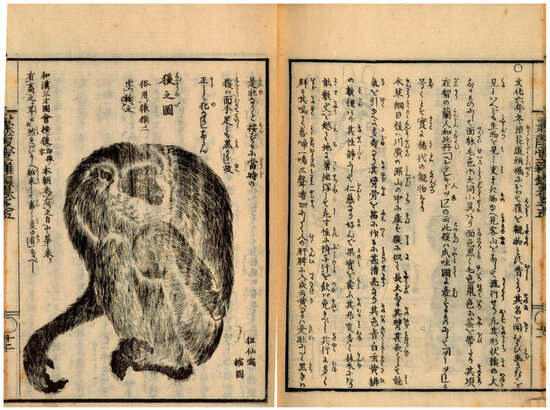
Before discussing the image of gibbons in Japanese Sinitic poetry and paintings, it must also be explained that gibbons are not native to Japan, and until the nineteenth century, Japanese people could only gain understanding of gibbons through paintings of gibbon. Kenkadō zatsuroku 蒹葭堂雜錄 [Kenkadō Miscellaneous Records] once recorded an exciting incident of seeing a live gibbon (Figure 1) (Kenkadō zatsuroku 蒹葭堂雜錄 1859, vol. 5):
In the winter of the 6th year of the Bunka era (1809), a gibbon was shown in Osaka, in the Dotombori ward. Although we have heard the word ‘gibbon’ since olden times, and seen pictures of him, we never seen a live specimen, and therefore a large crowd assembled to see this gibbon. Generally he resembles a large macaque, and figure and fur are very similar. The face is black, the fur grey with a touch of brown. The Hollander ‘Captain’ Hendrik Doeff who was then staying here said that this gibbon occurs on the island of Java where it is called ‘wau-wau’. Truly an extraordinary sight!(translation by Gulik, The Gibbon in China: An Essay in Chinese Animal Lore 1967, pp. 98–99)
Figure 1.
‘Kenkadō zatsuroku’, Compiled by Kimura Kenkadō, Ansei period of Japan, Woodblock print. Image from Kimura (1859, vol. 5). Stored in Bavarian State Library, Germany. Bibliographic ID: L.jap. I 237-1/5.
Later in this record, the author also quoted in the encyclopedia Wakan Sansai Zukai 和漢三才圖會 [Three-Realm Illustration Collection] compiled during the Edo 江戶 period (1603–1868) in Japan: ‘For us Japanese, gibbons are an alien species, which were introduced from China’ (猨肉, 本朝未有之, 自中華來) (Kenkadō zatsuroku 蒹葭堂雜錄 1859, vol. 5).
Therefore, like the people of the Korean Peninsula, the Japanese depict and write about gibbons in a cultural sense, rather than in a realistic sense.
What are the characteristics of the depiction of gibbons in Japanese Sinitic poetry? Based on a comprehensive search of the collections of Japanese Sinitic poetry that involve gibbons, two facts should be noted: first, there is rarely a ‘gibbon crying–sadness’ writing mode found in Japanese Sinitic poetry; second, there is also no ‘gibbon–crane–retirement’ writing mode found in Korean Peninsula. The following gives several examples to demonstrate this:
Kokan Shiren 虎關師煉 (1278–1346) wrote in a poem entitled ‘Misaki’ (三崎):
Odd rocks stand firm, water flows back and forth; Gibbons climb ancient cypresses in the night’s sorrow. Three sounds from the Ba Gorge always hold my attention, but the whale wave doesn’t come back for one.
怪石巖巖水復回, 猿攀老柏入宵哀. 三聲巴峽常關意, 不借鯨波到一回.(Saihoku Shuu 濟北集 1973, p. 102)
Also, Sesson Yuubai 雪村友梅 (1290–1347) wrote in a poem titled ‘Written Orally on August 14 and Sent to “Kando”’ 八月十四夕口佔寄鑑堂:
Half a year old, the cold friendship is like water, folding the pot to cook new sunflower together. Extremely sorry for the dustless ink, not knowing there are ridges in the chest. Solitary in the rock room with the night moon, looking at the smoke boat leaving the mountain stream. Should know the crying gibbons in the Ba Gorges at dawn, dreaming of the dragon spring bamboo in the west at night.
半歲冷交情若水, 折鐺聊共煮新葵. 絕憐筆底無塵滓, 不道胸中有町畦. 寂寂岩房同夜月, 看看煙艇別山溪. 應知巴峽啼猿曉, 夢夜龍泓竹崦西.(Binga Shuu 岷峨集 1973, p. 539)
Moreover, Ryosen Ryozui 龍泉令淬 (?–1365) wrote in a poem entitled ‘According to the Rhyme of the Poem of the Honorable Sha Kogen’s “Visiting the Hakata Seaside”’(謝廣嚴老見次遊博多海濱韻):
The old man once again resides in Kogen City, the neighboring houses must be adorned with golden brightness. The thunder and lightning under the brush are silent in the language, heart-wrenching does not necessarily come from the sound of the gibbon. (老人又住廣嚴城, 鄰屋須分金色明. 筆下風雷默中語, 斷腸未必在猿聲.)(Shouzan Shuu 松山集 1973, p. 633)
Above the three examples, the words ‘gibbon’ 猿, ‘three sounds’ 三聲, ‘cry’ 啼, ‘Ba Gorges’ 巴峽, ‘whale wave’ 鯨波 (subtly referring to Li Po), and ‘heartbreak’ 斷腸 are connected, obviously borrowing from the common expressions of China, but there is no sadness that is often found in Chinese poems. Instead, it invokes a kind of enlightenment and openness, as shown in the sentence ‘heart-wrenching does not necessarily come from the sound of the gibbon’ (斷腸未必在猿聲).
For another example, Ryosen Ryozui wrote in a poem entitled ‘Farewell to Kyo Manju and Return to the East of the Sea Immediately’ 辭京萬壽遂歸海東:
The seasons and circumstances are beyond the world’s concerns, from the other side of the river, they stop with the trend. The swans and cranes know how to welcome and send off, not to mention the gibbons and cranes of the northern mountains.
時節因緣無世情, 從佗坎止與流行. 滿東鷗鷺知迎送, 不辭北山猿鶴聲.(Shouzan Shuu 松山集 1973, p. 645)
In addition, Ryoshu Shutaku 龍秋周澤 (1308–1388) wrote in a poem entitled ‘Mourning the Deer’ 悼鹿:
The Crane Immortal and the Gibbon Elder resign from wealth and honor. Their destinies are full of hardships. Therefore, under the trees, they sing and listen to the verses of the Buddhist scriptures, endless mountains and rivers of sorrow.
鶴客猿翁讓品流, 悲哉命運不能修. 因吟林下聽經句, 無限谿山煙水愁.(Zuitoku Shuu 隨得集 1973, p. 1190)
These two poems, although both have the image combination of ‘gibbon–crane’, and also use words with a sense of seclusion like ‘northern mountains’ 北山 and ‘under the trees’ 林下, as a whole, the meaning of the poems is not to declare a posture of choosing between an official career and seclusion. Instead, it is a kind of insight into the ‘world’s concerns’ 世情 and an understanding of the uncertainty of ‘wealth and honor’ 品流 and ‘destinies’ 命运.
In this way, because the style of writing about gibbons in Japanese Sinitic poetry is not only different from China but also significantly different from the Korean Peninsula, can we extract the overall characteristics of Japanese Sinitic poetry gibbon writing from a small clue?
Carefully examining Japanese Sinitic poetry, especially the works of gibbons written by various families during the Japan’s Gozan Literary Period, we get the impression that these gibbon-related poems have a strong sense of image, which makes it easy for readers to construct a picture in their minds with gibbons as the main object of expression. If you try to compare the above-quoted Kokan Shiren and Ryoshu Shutaku with the ‘Gibbon Play Picture’ 猿戲圖 by Muxi Fachang 牧溪法常 (1210–1275), which will be mentioned later, you will not find that they have a great compatibility in composition and painting.
In fact, there were many people who liked to paint gibbons during the Gozan Literary Period in Japan. The famous poet and monk Saiin Shunsho 西胤俊承 (1358–1422) once wrote a poem inscribed on a painting ‘Cold Shore Gibbon Bird Picture’ 寒岸猿鳥圖, which said:
Old birds in the deep forest let their tails droop as the sun sets, gibbons cry in narrow cliffs under the cold evening clouds. Who could understand why I settle so late, just to paint a picture worth appreciating in my old age?
宿鳥林深落日殘, 啼猿崖窄暮雲寒. 何人知我卜居晚, 為寫新圖到老看.(Shingu kou 真愚集 1973, p. 2783)
In addition, foreign envoys also paid special attention to this phenomenon after coming to Japan, such as the Korean Song Huigyeong 宋希璟 (1376–1446) who once praised a painting of gibbons:
Ascend the dense trees of a thousand peaks, bow before the perilous peaks of ten thousand feet. Link arms to drink from the ravine, command companions to howl at the wind. Draw the bow and offer the ring, call out the time and signal the direction. Originally a wild beast, how can it be called the ‘Gibbon Master’? Looking at its deeds, it is almost the same as humans. Who turned the wheel between the walls, the sound echoing in the picture.
攀千柯之密樹, 俯萬仞之危峯. 連臂飮澗, 命侶嘯風. 拔箭獻環, 報時呼方. 本是野獸, 胡稱猿公? 觀乎事迹, 幾與人同. 誰開軸於壁間, 聲彷彿乎圖中.(Nosong Ilbon Haengrok 老松日本行錄 2015, p. 49)
If the poem is stripped away from the constraints of the subject of praise, it should not prevent the reader from viewing it as an independent and picturesque poem.
In summary, it seems that two preliminary conclusions can be drawn: first, gibbon-related writing during Japan’s Gozan literary period were highly pictorial, and some works were even used directly as annotations for paintings; second, considering the close relationship between gibbon-themed poetry and paintings in the Japan’s Gozan literary period mentioned above, to grasp the characteristics of gibbon writing in Japanese Sinitic poetry one should start by examining the visual materials such as Japanese gibbon paintings.
Japanese gibbon painting originated from imitations of Chinese painters who depicted gibbons, among which the Southern Song Dynasty Chinese monk Muxi Fachang undoubtedly became the model of learning. The works of Muxi, most notably ‘Gibbon Picture’ 猿圖, were brought to the Japanese mainland by the Japanese Rinzai 臨済 school monk Bian Yuan 辨圓 (1202–1208) and caused a great impact, leading to him being called the ‘Great Benefactor of the Painting Path’ (畫道大恩人). Here, I want to explain a phenomenon that seems a bit unreasonable: at that time, the person with the highest reputation and the greatest influence in painting gibbons in the Southern Song Dynasty was actually Yi Yuanji 易元吉 (1001–1065), while Muxi was then a painter who was quite criticized. Xia Wenyan夏文彥 (active 1350s–1370s) commented on Muxi’s painting in Tuhui baojian 圖繪寶鑒 [Treasure Mirror of Painting] as ‘coarse and ugly without ancient methods, truly not elegant for enjoyment’ (粗惡無古法, 誠非雅玩) (Tuhui baojian 圖繪寶鑒 1982–1986, vol. 4), and after many times, Huashi huiyao 畫史會要 [Summary of Painting History] further echoed this evaluation. Therefore, theoretically speaking, Yi may have had more value as a model of learning, but why did the latter become the object of emulation by Japanese painters of gibbons? For this question, it seems insufficient if we only answer that both Muxi and Bian Yuan were monks. We need to add an in-depth analysis from the perspective of the difference in the style of gibbon painting between Muxi and Yi.
There are many records on Yi’s biography and contemporary reviews. Xuanhe huapu 宣和畫譜 [The Compendium of Xuanhe Paintings] states that in order to stand out in a competitive art scene, he ‘roamed between Jinghu, searched for the unusual and visited the ancient, famous mountains and rivers… he almost played with gibbons, macaques, deer, and pigs, so he had a profound understanding of the wonders of the world, which he wrote down with his brush, and it was beyond the understanding of the common people’ (遊於荊湖間, 搜奇訪古, 名山大川…幾與猿狖鹿豕同遊, 故心傳目擊之妙, 一寫於豪端間, 則是世俗之所不得窺其藩也.) (Xuanhe huapu 宣和畫譜 1982–1986, vol. 18). Records in the Xuanhe huapu about Yi’s paintings indicate the imperial household at least collected 103 paintings by Yi related to gibbons, which shows his considerable influence. Guo Ruoxu 郭若虛 (active 970s–1000s) in Tuhua wenjian zhi 圖畫聞見志 [Records of Illustrations and Observations] said: ‘Yuanji’s paintings were unique in style, with both dense and sparse intentions. Although not entirely adhering to his teacher’s methods, he could understand the ancient meanings, which were beyond the contemporary trends and was highly praised’ (元吉平日作畫, 格實不群, 意有疎密, 雖不全拘師法, 而能伏義古人, 是乃超乎時流, 周旋善譽也.) (Tuhua wenjian zhi 圖畫聞見志 1982–1986, vol. 4). If we compare this to the main reason for contemporary criticism of Muxi’s paintings as inferior—‘coarse and ugly without ancient methods’—it seems that the main criterion for contemporary people’s evaluation of painters was first whether they adhered to conventions, followed by their inheritance of the teacher’s methods. Although limited by the available material, it is now impossible to accurately determine the specific meaning of ‘ancient methods’, nor can we ascertain whether there was a teacher-student relationship between Muxi and Yi, but it does not hinder the direct comparison of their works.
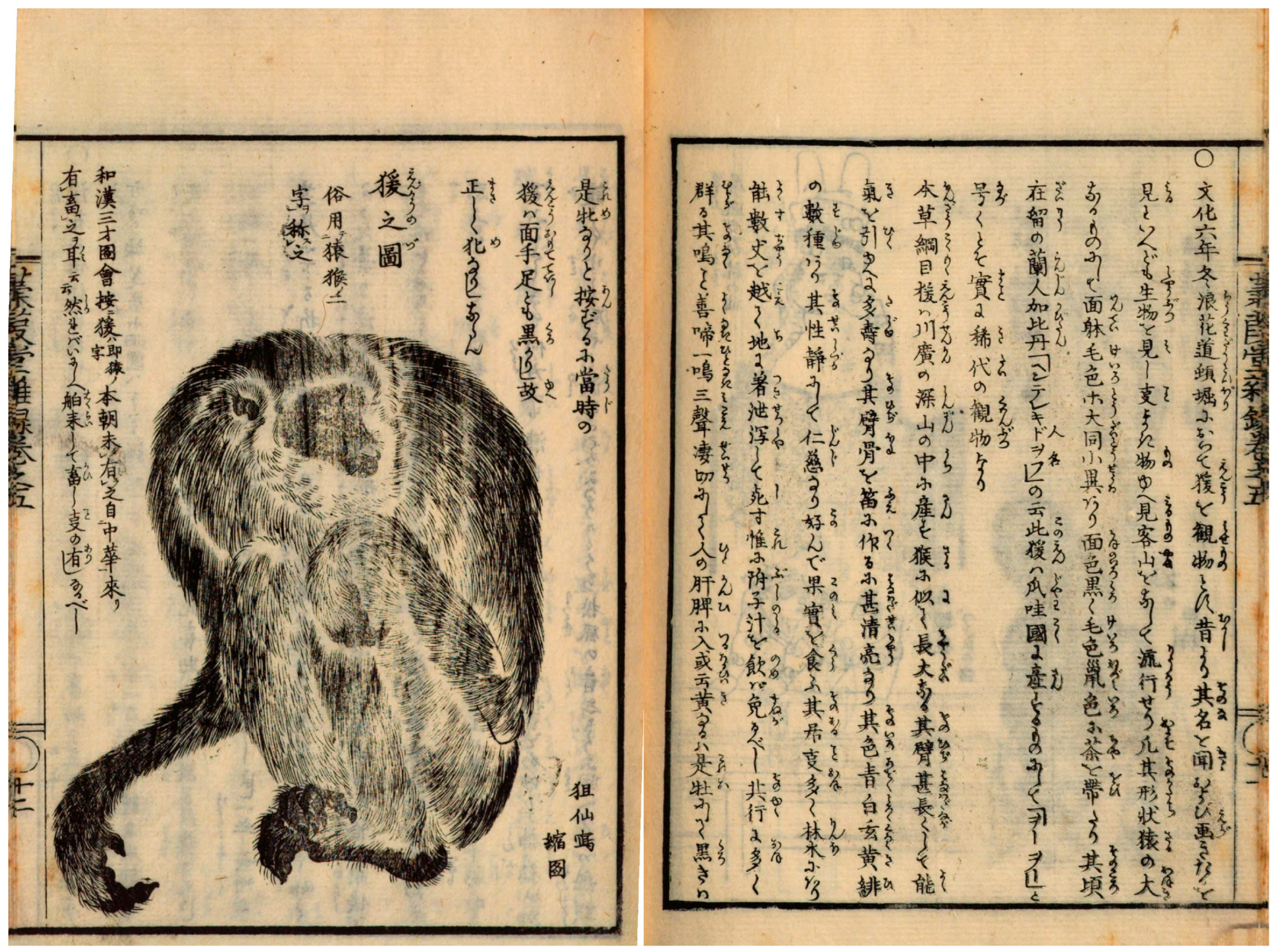
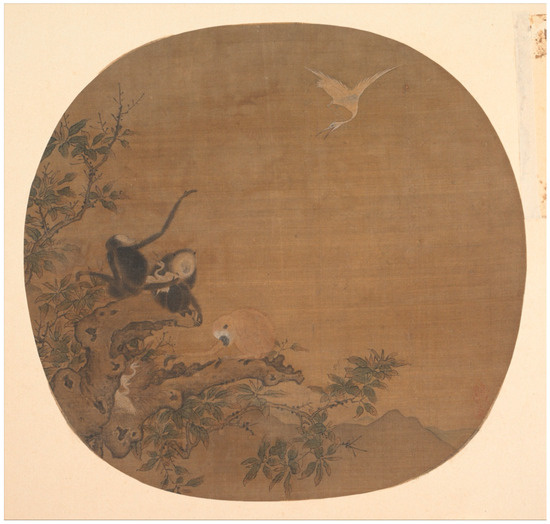
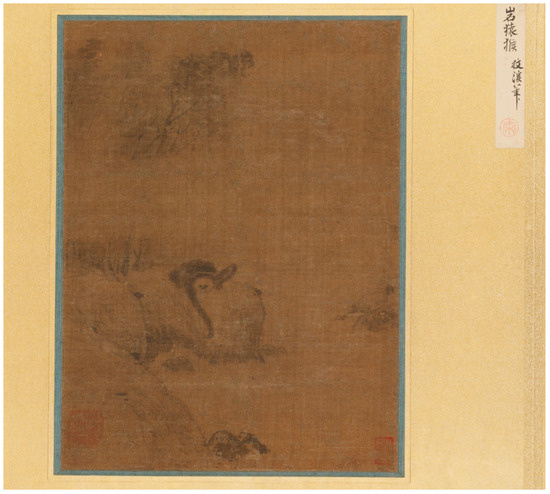
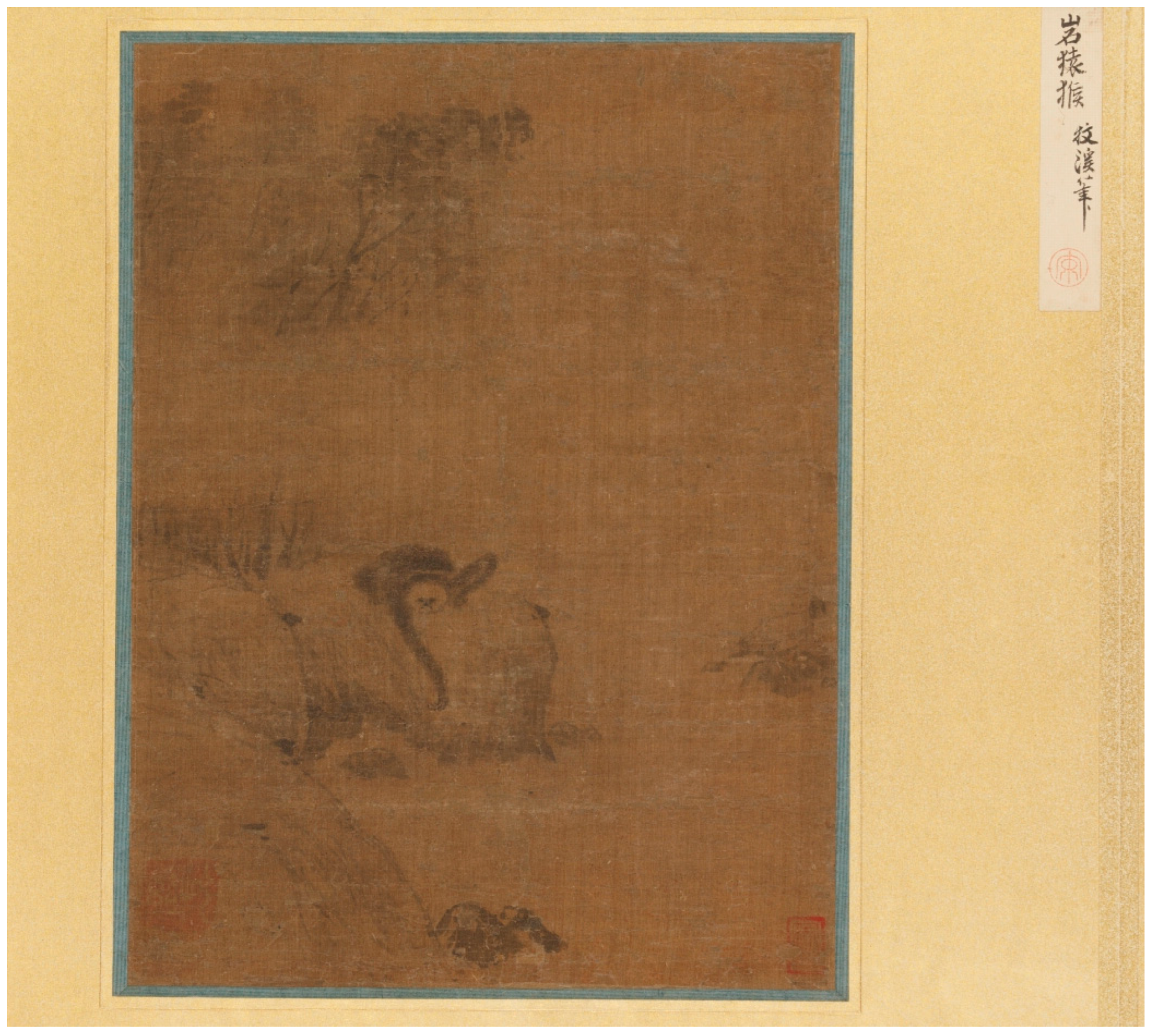
Comparing Yi and Muxi’s depictions of gibbons, what we first notice is that Yi’s compositions are often complex (as shown in ‘Gibbons Raiding an Egret’s Nest’ 三猿得鷺戲) (Figure 2), with the entire painting usually filled in, without any empty space, in contrast to Muxi’s compositions, which are relatively simple (as shown in ‘Gibbon on Rocks’ 岩猿圖) (Figure 3), featuring large areas of empty space. Second, in terms of brushwork, Yi generally uses meticulous line drawings to depict gibbons, while Muxi frequently employs dotting and light outlining. Third, in terms of the overall atmosphere of the paintings, Yi’s works present a tension between the ‘rugged landscape’ 林壑 (where gibbons naturally live) and the ‘temple’ 廟堂 (suggested by the background), reflecting a dialectical relationship between ‘retirement’ 隱 and ‘service’ 仕, which is closely related to the painter’s identity as a court painter and his creative motivations. In contrast, Muxi’s works, through their simple brushstrokes, convey a cold and melancholic style, and are imbued with a strong Zen flavor.
Figure 2.
‘Gibbons Raiding an Egret’s Nest’, Attributed to Yi Yuanji, Southern Song Dynasty, Ink and color on Silk, 24.1 cm × 22.9 cm, © The Metropolitan Museum of Art. Object number: 13.100.104. Open Access. https://www.metmuseum.org/art/collection/search/40071 (accessed on 19 November 2025).
Figure 3.
‘Gibbon on Rocks’, Attributed to Muxi, Yuan Dynasty, Ink on Silk, 37.3 cm × 28.0 cm, © Tokyo National Museum. Object number: E0008210. No known restrictions on publication. https://webarchives.tnm.jp/imgsearch/show/E0008210 (accessed on 19 November 2025).
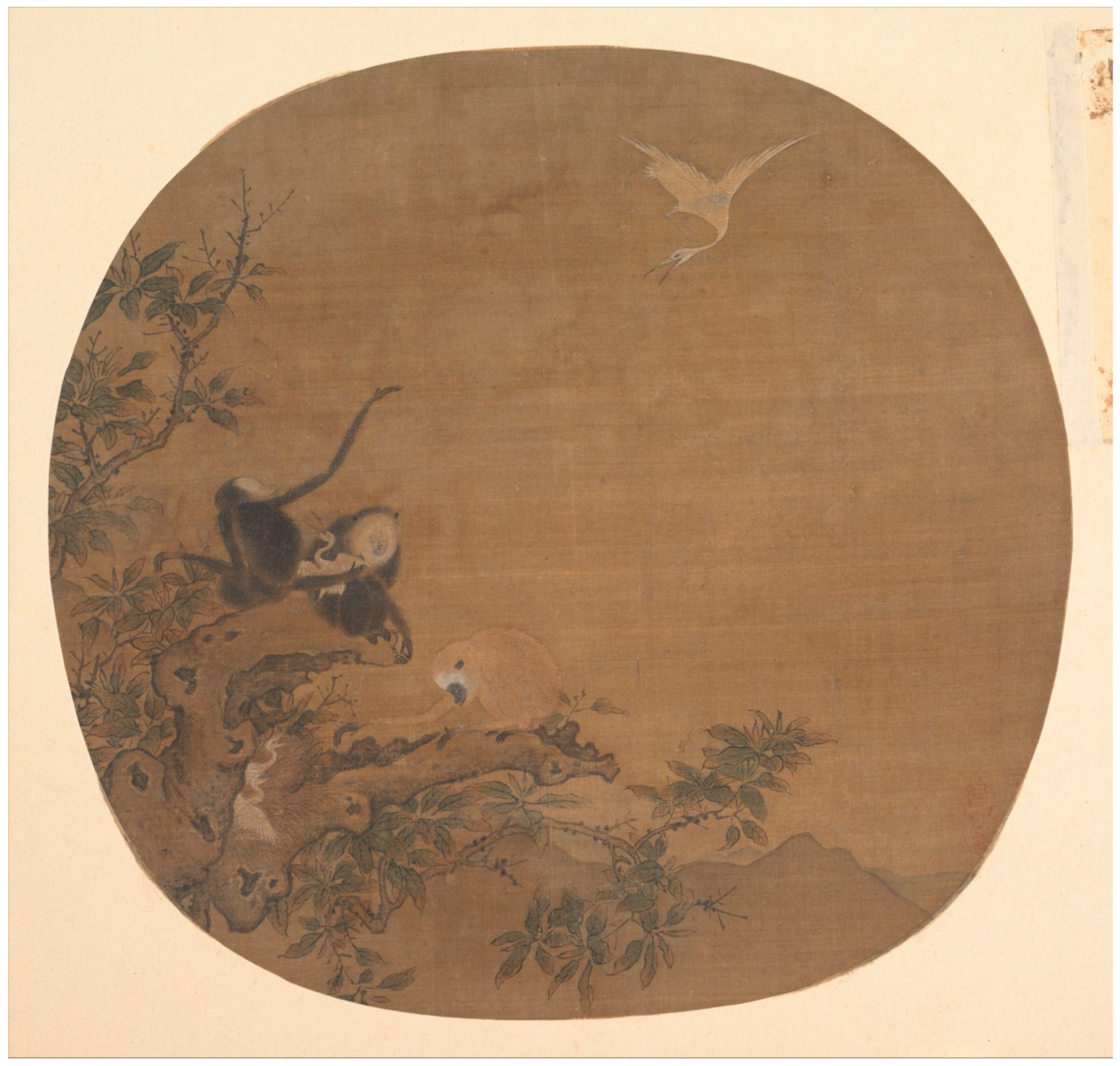
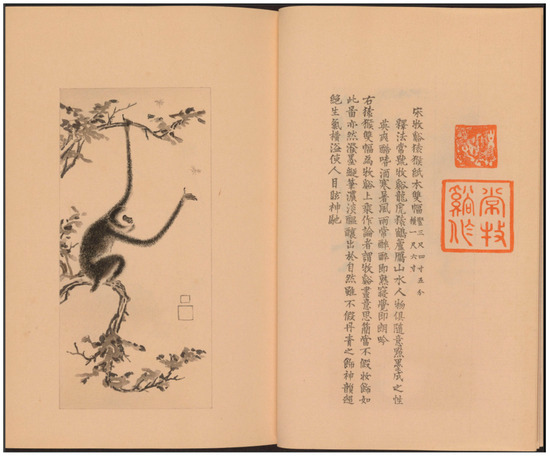
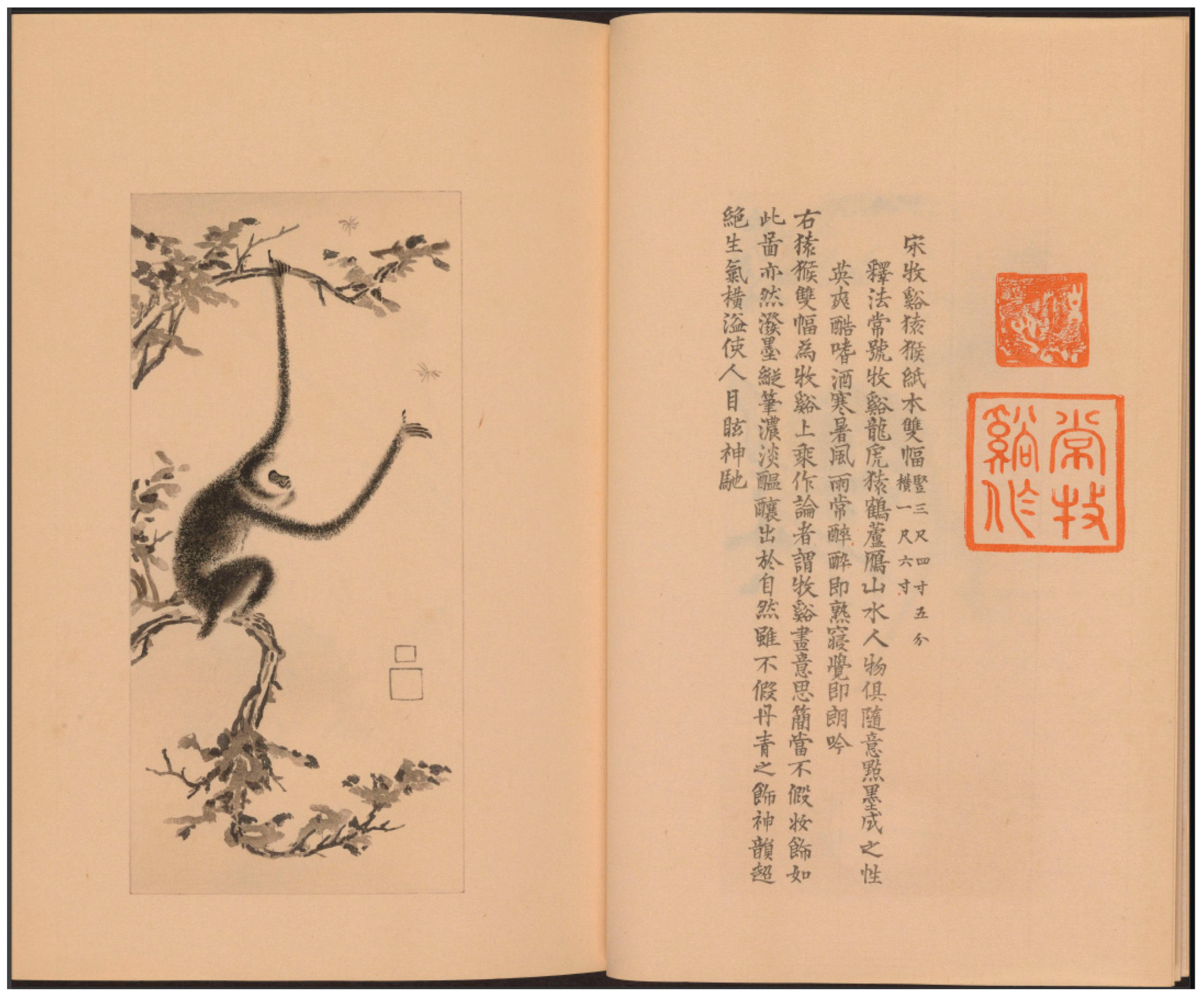
By comparing these three aspects, it is not difficult to understand why Muxi is not highly regarded in China: his paintings differ from the paradigms of court painting academies 宮廷畫院 (where Yi worked). In other words, he chose a method of depicting gibbons inclined towards Zen, implying a detachment from politics. And it is precisely this technique and style that were accepted and emulated by the Japanese, perhaps for this very reason. Here we can note some indirect evidence: during the Meiji period of Japan, Takata Shinzou 高田慎藏 (active 1860s–1920s) sent talented Japanese artisans who were skilled at copying ancient paintings to shrink over a hundred copies of the Chinese Song, Yuan, Ming, Qing dynasties and Japan’s famous calligraphy and painting works, compiling them into Shinka Jyou 心華帖. It includes works by Muxi, and there is an evaluation saying (Figure 4):
The dragon, tiger, gibbon, crane, reed, and wild goose landscapes and figures are all painted with freehand brush strokes, with a personality that is heroic and loves wine, often drunk in all seasons and weathers, drunk and then sleeping soundly, awake and then reciting aloud… At that time, some people said that Muxi’s paintings were simple and appropriate, not needing complex decorations, and so is this painting. This painting dares to use ink, the brush strokes are powerful and sprawling, the ink is very carefully graded, as if it comes naturally, although it does not rely on the decoration of colors, the spirit is transcendent, full of vitality, dazzling and exhilarating.
龍虎猿鶴蘆雁山水人物, 俱隨意點墨成之, 性英爽酷嗜酒, 寒暑風雨常醉, 醉即熟寢, 覺即朗吟…論者謂牧溪畫意思簡當, 不假壯飾, 如此畫亦然, 潑墨縱筆, 濃淡醞釀, 出於自然, 雖不假丹青之飾, 神韻超絕, 生氣橫溢, 使人目眩神馳.(Shinka Jyou 心華帖 1910, vol. C)
Figure 4.
Shinka jyou, Compiled by Takata Shinzou, Meiji period of Japan, Color woodblock print. Image from Takaga (1910, vol. C). Stored in National Diet Library, Japan. Bibliographic ID: 000010704106.
It can be seen that in the eyes of Japanese art critics, it is Muxi, ‘with a personality that is heroic and loves wine’ (性英爽酷嗜酒), a free and easy-going personality, and the painting style of ‘freehand brush strokes’ (隨意點墨), ‘the spirit is transcendent’ (神韻超絕) and ‘full of vitality’ (生氣橫溢) that make people fall in love with it. If we are more specific, these poems have a Zen style similar to Muxi’s gibbon-paintings, which is in line with the previous analysis of the concept conveyed by the poets of the Japanese Gozan Literature about gibbons.
In short, although we have not yet been able to clearly determine who influenced whom in Japanese Sinitic poetry and painting when writing gibbons, it seems to conclude that they are connected in terms of ideological meaning, that is, the pursuit of Zen meaning.
5. Conclusions and Future Topics That Can Be Further Discussed
This article concludes that: (1) Li Po is a model of gibbon-related writing in the Chinese literary tradition, and he not only inherited the cultural connotations of previous writings on gibbons but also endowed gibbons with new religious connotations and political meanings, namely, a reclusive political posture, which has an analogical nature with the biological habits of gibbons. (2) The poets of the Korean Peninsula adopted a ‘gibbons–cranes–retirement’ model for writing on gibbons, which combines the ideological backgrounds of Daoism and Buddhism. It is both a continuation of the Chinese tradition of writing about gibbons and an innovation based on Korean religious thought. (3) Japanese Sinitic poetry and paintings give gibbons a Zen-like appearance according to their own needs, which is essentially a manifestation of political alienation. (4) In East Asian cultural writing about gibbons, the three countries take different angles and reflect distinct cultural attitudes. Beneath these differences, politics clearly emerges as a key force shaping the narratives. Animals and religion appear as closely linked themes—often not for their own sake, but as expressions of political position or displays of cultural capital.
In summary, the gibbon is a typical and richly connotative animal in the East Asian cultural circle. On the one hand, from the twelfth to the nineteenth centuries, Chinese, Korean Peninsula, and Japanese elite literati dealt with the same species while clearly adopting different writing strategies.
There are many animals that are given attention, metaphorized, abstracted, transformed, and utilized by various countries in East Asia from the twelfth to the nineteenth centuries (for example, the crane, which is briefly addressed in this article). Exploration of these animals and their religious, political, and cultural connotations will be able to provide a different perspective for reflecting on the applicability of the ‘Animals and Religion’ theoretical proposition in the study of East Asian culture, as well as the more profound and complex cultural exchange situations within various East Asian countries.
Funding
This research was funded by National Social Science Fund of China, “Research on the Circulation of Books and Literary Interaction in East Asia in the Ming and Qing Dynasties,” grant number 23BZW070.
Institutional Review Board Statement
Not applicable.
Informed Consent Statement
Not applicable.
Data Availability Statement
No new data were created or analyzed in this study. Data sharing is not applicable to this article.
Conflicts of Interest
The author declares no conflict of interest.
Abbreviations
T = Taishō shinshū daizōkyō 大正新修大藏經. See Secondary Sources, Takakusu and Watanabe, eds. (Takakusu and Kaigyoku 1924–1932).
Notes
| 1 | These are preliminary statistics, see N. Yu (2016, pp. 188–209). |
| 2 | As a famous academic work published in the same year, Edward H. Schafer often confuses gibbons with ‘hsing-hsing’ 猩猩 and ‘fei-fei’ 狒狒 in his book The Vermilion Bird: T’ang Images of The South, see Schafer (1967, pp. 231–33). |
| 3 | These two lines in the book Shuijing zhu 水經注 [Notes on the Water Classics] are: ‘The Three Gorges of Bashu, Wuxia Gorge is long, the gibbon’s cry echoes three times, tears wet the skirt’ (巴東三峽巫峽長, 猿鳴三聲淚沾裳). |
| 4 | In the ‘Nü Erzi’ 女兒子 entry of the book Gushi Yuan 古詩源 [Source of Ancient Poetry] by Qing Dynasty (1616–1911) scholar Shen Deqian 沈德潛 (1673–1769), he quoted the saying of Zhijiang 智匠 in Gujin yuelu 古今樂錄 [Records of Music from Ancient to Modern Times]: ‘The Three Gorges refer to Guangxi Gorge, Wu Gorge, and Xiling Gorge. The trees are tall and lush, and the gibbon’s calls are loud. When the climbers hear them, they all miss their hometown. The saying that the sound of gibbons means sadness comes from here’ (三峽謂廣溪峽, 巫峽, 西陵峽. 林木高茂, 猿鳴至清, 行者聞之, 莫不懷土. 說猿聲之悲始於此.). |
| 5 | Meng Haoran’s 孟浩然 (689–740) ‘Sending Autumn to the Distant Master in the Central Region of Qin’ 秦中感秋寄遠上人. |
| 6 | Gao Shi’s 高適 (701–765) ‘See Off Li Xiao Fu to Xiazhong, the Destination for Exile, and See Off Wang Xiao Fu to Changsha, the Destination for Exile’ 送李少府貶峽中, 王少府貶長沙. |
| 7 | Li Po’s 李白 (701–762) ‘Departing from White Emperor City in the Morning’ 朝發白帝城. |
| 8 | Du Fu’s 杜甫 (712–770) ‘Ascending’ 登高. |
| 9 | Liu Zhangqing’s 劉長卿 (726–790) ‘New Year’s Work’ 新年作. |
| 10 | Han Yu’s 韓愈 (768–824) ‘Gift to Zhang Gongcao on the Night of August 15’ 八月十五夜贈張功曹. |
| 11 | Bai Juyi’s 白居易 (772–846) ‘The Song of the Pipa’ 琵琶行. |
| 12 | Ma Dai 馬戴 (799–869) ‘Chu River Nostalgia’ 楚江懷古. |
| 13 | Here, the Quantang shi 全唐詩 [Complete Tang Poetry] is used to gather these statistics. Although there is a possibility of subsequent supplements, the specific number of poems written by each poet about gibbons may not be accurate, but it does not hinder us from understanding the overall situation. |
| 14 | For Li Po’s travels and diverse cultural backgrounds, please see Zhou (2005). |
| 15 | For more on Li Po and Daoism, see Kroll (1986). |
| 16 | In this quotation, the annotated version of the five ministers of ‘Crane’ 鶴 is written as ‘Hu’ 鵠, and the annotated version of the six ministers of ‘gibbon’ 猿 is written as ‘Yuan’ 猨. |
| 17 | Mahaparinirvana-sutra (Ch. Da ban niepan jing 大般涅槃經), ‘Lifespan Chapter’ (‘Shouming pin’ 壽命品): ‘At that time, the forest of the city of Kushina turned white, like a white crane’ (爾時拘尸那城娑羅樹林,其林變白,猶如白鶴). T no. 374, 12: 369. |
References
Primary Sources
Baopuzi neipian jiaoshi 抱朴子內篇校釋 [Baopuzi Inner Chapter Proofreading]. 1985. By Wangming王明. Beijing: Zhonghua shuju 中華書局.Binga Shuu 岷峨集 [Binga Collection]. 1973. By Sesson Yuubai 雪村友梅 (1290–1347). In Gozan bungaku zenshuu 五山文學全集 [The Complete Works of Japan’s Gozan Period Literature]. Kyoto: Shibunkaku 思文閣.Chan yue ji 禪月集 [Zen Moon Collection]. 1982–1986. By Guan Xiu 貫休 (832–912). In Wenyuange sikuquanshu 文淵閣四庫全書 [Wenyuan Pavilion’s Four Libraries Complete Book]. Taipei: Commercial Press 商務印書館.Geumgye seonsaeng Munjip 錦溪先生文集 [The Collected Works of Geumgye]. 1990. By Hwang Junryang 黃俊良 (1517–1563). In Hanguk Munjip Chonggan 韓國文集叢刊 [Korean Anthology Series]. Seoul: Gyeongin Culture Publishing House 景仁文化社, vol. 37.Ipjae seonsaeng Munjip 立齋先生文集 [Ipjae’s Collected Works]. 1990. By Jeong Jongro 鄭宗魯 (1738–1816). In Hanguk Munjip Chonggan 韓國文集叢刊 [Korean Anthology Series]. Seoul: Gyeongin Culture Publishing House 景仁文化社, vol. 253.Kenkadō zatsuroku 蒹葭堂雜錄 [Kenkadō Miscellaneous Records]. 1859. By Kimura Kenkadō 木村蒹葭 (1736–1802). Wood-block print.Kuuge Shuu 空華集 [Kuuge Collection]. 1973. By Gidou Shuushin 義堂周信 (1325–1388). In Gozan bungaku zenshu 五山文學全集 [The Complete Works of Japan’s Gozan Period Literature]. Kyoto: Shibunkaku 思文閣.Lidai Tihuashi 歷代題畫詩 [Inscription Poems of the Past Dynasties]. 1994. Compiled by Chen Bangyan 陳邦彥. Beijing: People’s Fine Arts Publishing House 人民美術出版社.Litaibai quanji jiaozhu 李太白全集校注 [Commentary on the Complete Works of Li Taibai]. 2015. By Yu Xianhao 郁賢皓. Nanjing: Phoenix Publishing House 鳳凰出版社.Nosong Ilbon Haengrok 老松日本行錄 [Nosong’s Journey to Japan]. 2015. By Song Huigyeong 宋希璟 (1376–1446). In Chaoxian tongxinshi wenxian xuanbian 朝鮮通信使文獻選編 [Selected Documents of the Korean Correspondent Envoy]. Shanghai: Fudan University Press 复旦大学出版社.Saga Sijip 四佳詩集 [Four Excellent Poems Collection]. 1990. By Seo Geojeong 徐居正 (1420–1488). In Hanguk Munjip Chonggan 韓國文集叢刊 [Korean Anthology Series]. Seoul: Gyeongin Culture Publishing House景仁文化社, vol. 10.Saihoku Shuu 濟北集 [Saihoku Collection]. 1973. By Kokan Shiren虎關師煉 (1278–1346). In Gozan bungaku zenshuu 五山文學全集 [The Complete Works of Japan’s Gozan Period Literature]. Kyoto: Shibunkaku 思文閣.Shingu kou 真愚集 [Shingu Collection]. By Saiin Shunsho 西胤俊承 (1358–1422). In Gozan bungaku zenshuu 五山文學全集 [The Complete Works of Japan’s Gozan PeriodL]. Kyoto: Shibunkaku 思文閣.Shinka Jyou 心華帖 [Shinka Post]. 1910. Compiled by Takaga Sinkura 高田慎藏 (1852–1921). Color woodblock print.Shouzan Shuu 松山集 [Shouzan Collection]. 1973. By Ryosen Ryozui 龍泉令淬 (?–1365). In Gozan bungaku zenshuu 五山文學全集 [The Complete Works of Japan’s Gozan Period Literature]. Kyoto: Shibunkaku 思文閣.Songam seonsaeng Sokjip 松巖先生續集 [Sequel to Songam’s Poetry Collection]. 1990. By Gwon Homun 權好文 (1532–1587). In Hanguk Munjip Chonggan 韓國文集叢刊 [Korean Anthology Series]. Seoul: Gyeongin Culture Publishing House 景仁文化社, vol. 41.Songhua quanji 宋畫全集 [The Complete Collection of Song Dynasty Paintings]. 2008. Compiled by the Research Center for Ancient Chinese Painting and Calligraphy at Zhejiang University 浙江大學中國古代書畫研究中心. Hangzhou: Zhejiang University Press 浙江大學出版社, vol. 7.Tuhua wenjian zhi 圖畫聞見志 [Records of Illustrations and Observations]. 1982–1986. By Guo Ruoxu 郭若虛 (active 970s–1000s). In Wenyuange Sikuquanshu 文淵閣四庫全書 [Wenyuan Pavilion’s Four Libraries Complete Book]. Taipei: Commercial Press 商務印書館.Tuhui baojian 圖繪寶鑒 [Treasure Mirror of Painting]. 1982–1986. Compiled by Xia Wenyan 夏文彥 (active 1350s–1370s). In Wenyuange sikuquanshu 文淵閣四庫全書 [Wenyuan Pavilion’s Four Libraries Complete Book]. Taipei: Commercial Press 商務印書館.Unyang Jip 雲養集 [The Collection of White Cloud Nourishment]. 1990. By Kim Yunsik 金允植 (1835–1922). In Hanguk Munjip Chonggan 韓國文集叢刊 [Korean Anthology Series]. Seoul: Gyeongin Culture Publishing House 景仁文化社, vol. 328.Wen xuan 文選 [Selected Essays]. 1986. Compiled by Xiao Tong 蕭統 (501–531). Shanghai: Shanghai Ancient Books Publishing House 上海古籍出版.Xuanhe huapu 宣和畫譜 [The Compendium of Xuanhe Paintings]. 1982–1986. Compiled by Anonymous佚名. In Wenyuange Sikuquanshu 文淵閣四庫全書 [Wenyuan Pavilion’s Four Libraries Complete Book]. Taipei: Commercial Press 商務印書館.Yakbong Yugo 藥峰遺稿 [Yakbong’s Posthumous Manuscripts]. 1990. By Seo Seong 徐渻 (1558–1631). In Hanguk Munjip Chonggan 韓國文集叢刊 [Korean Anthology Series]. Seoul: Gyeongin Culture Publishing House 景仁文化社, vol. 63.Yeoyudang Jeonseo Boyu 與猶堂全書補遺 [Supplementary to the Complete Works of Yeoyudang]. 1973. Compiled by Dasan Hakhoe 茶山學會 [Jeong Yakyong Research Association]. Seoul: Gyeongin Culture Publishing House 景仁文化社.Zuitoku Shuu 隨得集 [Suide Collection]. 1973. By Ryoshu Shutaku 龍秋周澤 (1308–1388). In Gozan bungaku zenshuu 五山文學全集 [The Complete Works of Japan’s Gozan Period Literature]. Kyoto: Shibunkaku 思文閣.Secondary Sources
- Cha, Juhwan 車柱環. 2005. Korean Daoist Thought 韓國道教思想 [Hanguo Daojiao sixiang]. Beijing: People’s Literature Publishing House人民文學出版社. [Google Scholar]
- Easton, Linda L. 1980. Mapping Animal and Human Transformations: Yüan Apes in China. Ph.D. dissertation, University of Chicago, Chicago, IL, USA. [Google Scholar]
- Ekaizu, Michihiko 荏開津通彦. 2018. Study on the Pattern of Gibbon Dragging in Medieval Paintings 中世絵画における猿曳の図様に関する研究 [Chuusei kaiga niokeru saruhiki no zuyou ni kansuru kenkiwamu]. The Kajima Foundation for the Arts Annual Report 鹿島美術財団年報 [Kashima biju tsuzaidan nenpou] 36: 378–88. [Google Scholar]
- Fujishima, Sachihiko 藤島幸彦. 1984. Development of the Muxi-style Gibbon in Japan: Focusing on the Appearance of the Gibbon 日本における牧谿風猿図の展開——猿の姿態を中心とし[Nippon ni okeru Muxi fuusaruzu no tenkai——Saru no shitai wo chuushin toshi]. The Study of the History of Art 美術史研究 [Bijutsushi kenkiwamu] 3: 41–61. [Google Scholar]
- Geissmann, Thomas. 2008. Gibbon paintings in China, Japan, and Korea: Historical distribution, production rate and context. Gibbon Journal 4: 1–38. [Google Scholar]
- Kroll, Paul W. 1986. Li Po’s Thranscendent Diction. Journal of the American Oriental Society 106: 99–117. [Google Scholar] [CrossRef] [Scilit]
- Ma, Shilai 馬世來. 1997. Probe on The Chinese Origin of Gibbon 試論長臂猿的中國起源 [Shilun changbiyuan de zhongguo qiyuan]. Acta Theriologica Sinica 獸類學報 [Shoulei Xuebao] 1: 13–23. [Google Scholar]
- Schafer, Edward H. 1967. The Vermilion Bird: T’ang Images of The South. Berkeley: University of California Press. [Google Scholar]
- Takakusu, Junjirō 高楠順次郎, and Watanabe Kaigyoku 渡邊海旭, eds. 1924–1932. Buddhist Canon Compiled under the Taishō Era (1912–1926) 大正新修大藏經 [Taishō shinshū daizōkyō]. 100 vols. Tokyo: Taishō issaikyō kankōkai 大正一切經刊行會. [Google Scholar]
- van Gulik, Robert H. 1967. The Gibbon in China: An Essay in Chinese Animal Lore. Leiden: E. J. Brill. [Google Scholar]
- Wu, Hung. 1987. The Earliest Pictorial Representations of Ape Tales: An Interdisciplinary Study of Early Chinese Narrative Art and Literature. T’oung Pao 73: 86–111. [Google Scholar]
- Yu, Ning 俞寧. 2016. The Crying of Eternal Gibbons: Analyzing the Gibbons in Tang Poetry with Ecological Criticism Theory 萬古猿聲啼不盡:以生態批評理論解析唐詩里的猿 [Wangu yuansheng ti bujin: Yi shengtai piping lilun jiexi tangshi li de yuan]. In Proceedings of the 18th Annual Conference of the Chinese Tang Dynasty Literature Society and the International Symposium on Tang Dynasty Literature 中國唐代文學學會第十八屆年會暨唐代文學國際學術研討會論文集. Edited by the Chinese Tang Dynasty Literature Society中國唐代文學學. Chengdu. [Google Scholar]
- Yu, Xianhao 郁賢皓. 1981. Research on the relationship between Li Bai and Yuan Danqiu 李白與元丹丘交遊考 [Li bai yu Yuan danqiu jiaoyou kao]. Journal of Henan Normal University 河南师大学报 [Henan shida uebao] 2: 103–109. [Google Scholar]
- Zhou, Xunchu 周勛初. 2005. Biography of Li Po 李白評傳 [Li Bai pingzhuan]. Nanjing: Nanjing University Press 南京大學出版社. [Google Scholar]
- Zhou, Yunhui 周運輝, and Peng Zhang 張鵬. 2013. Distribution and Vicissitude of Gibbons (Hylobatidae) in China during the last 500 Years 近五百年來長臂猿在中國的分佈變遷 [Jin wubai nian lai changbiyuan zai zhongguo de fenbu bianqian]. Acta Theriologica Sinica 獸類學報 [Shoulei xuebao] 3: 258–66. [Google Scholar]
Disclaimer/Publisher’s Note: The statements, opinions and data contained in all publications are solely those of the individual author(s) and contributor(s) and not of MDPI and/or the editor(s). MDPI and/or the editor(s) disclaim responsibility for any injury to people or property resulting from any ideas, methods, instructions or products referred to in the content. |
© 2026 by the author. Licensee MDPI, Basel, Switzerland. This article is an open access article distributed under the terms and conditions of the Creative Commons Attribution (CC BY) license.