


Abstract
This comparative study sheds light on the agency of nature and provides a lens through which to examine the intersection of ritual, ecology, and indigenous environmental consciousness in South Asia. The paper argues that the sacred groves are not just passive backdrops for human rituals, but dynamic spaces in which fauna, flora, rocks and other natural entities are actively involved in spiritual practices and ecological processes. We compare two case studies: one from South India (Kerala), the Vallikāṭṭu sacred grove (kāvu), and one from Nepal, the shamanic forests of Nagarkot. While the beliefs and rituals connect people with the environment and impose certain restrictions as to the mode of conduct in the groves, we point to the agency of non-human animals In the case of Vallikāṭṭu we show that while the worshippers and priests of the groves may be inclined to restructure the groves or ritual patterns, the groves’ monkeys are perceived as emissaries of the spiritual-natural forces who preserve the ecosystem of the grove. Similarly, the trees and stones at the sacred sites of Nepal are seen as spiritual guides of the shamans or physical manifestations of the spirit of nature. This ethnographic study, combined with botanical research on plant animal interactions in the groves and philological study of sacred texts of the priests and shamans, highlights the existing indigenous ecological knowledge systems that are inextricably linked to and transmitted through ritual practices, spirit possession, trance and visionary journeys.
Keywords:
ecospirituality; ecology; Tantra; shamanism; India; Kerala; Nepal; animal spirits; sacred groves 1. Introduction
The practices and pathways of ecospirituality1 are part of a renewed interest in indigenous environmental perspectives in anthropology and environmental studies. This paper aims to show how indigenous communities in Nepal and Kerala are enabled, through their use of sacred groves, to manage natural resources through interaction with non-human actors: animals, gods, and trees.
Sacred groves are usually portrayed in popular or academic studies as havens for rare or endangered flora and fauna, acting as biodiversity hotspots protected by traditional practices rather than formal law. Conversely, traditional communities are presented as custodians of extensive knowledge about the medicinal plants found in the groves.
However, as we show in this article, one can also point to the active role of animals, plants, and geological formations (e.g., rocks) in preserving the groves and creating various forms of relationships. The sacred groves are not just passive backdrops for human rituals but dynamic spaces in which fauna, flora, rocks, and other natural entities are actively involved in spiritual practices and ecological processes. It could be said that belief in the active spiritual power of certain trees or animals leads to their protection, which in turn preserves biodiversity. However, it is not only belief but also the material presence and vitality of these entities that evoke feelings, awe, and reactions in people. Stones, trees, animals, and people together form a dynamic field of action in which each element has the power to influence and change the others. Sacred groves thus become places where spirituality and ecology are expressed through the lively participation of all their constituents.
To narrow the scope of this paper, we compare two case studies: one from Kerala, the Vallikāṭṭu sacred grove (kāvu) near Atholi (Calicut), and one from Nepal, the sacred groves and shamanic forests of Nagarkot. This comparative study of selected sacred groves in Nepal and South India sheds light on the agency of nature and provides a lens through which to examine the intersection of ritual, ecology, and indigenous environmental consciousness. Sacred groves, often at the center of Tantric worship and shamanic practices, serve not only as ritual spaces but also as living ecological sanctuaries, sustained by local cosmologies and embodied religious practices. By analyzing these sites across regional contexts, this study shows how indigenous worldviews sacralize nature while preserving biodiversity and responding to the presence and activity of fauna and flora.
The research at Vallikāṭṭu kāvu included an ethnographic survey and an in-depth study on the feeding preferences of bonnet macaque colonies (Macaca radiata) in this sacred grove managed by temple authorities. Observation of the macaques’ feeding patterns during rituals in the grove and analysis of their behavior and diet show that they play a key role as seed dispersers and have also been crucial in the recent regeneration of the forest. We contextualize the study of human–animal–plant interaction patterns by analyzing local beliefs that consider the macaques as part of the goddess’s entourage. In turn, we show how religious beliefs contribute to the protection of the macaque colony. Furthermore, we explain how religious practices embedded in the locally specific understanding of ecology can contribute to wildlife conservation. We compare research findings from Vallikāṭṭu kāvu with those of a case study on the sacred forests near Nagarkot, a place of worship and spiritual practice for shamanic (jhankri) communities in Nepal. The research in Nepal points to the relationship between the people (shamans) and their groves, stones, and trees, which are treated as sentient beings with whom a meaningful relationship can be developed.
I (Maciej) am a European-born scholar of South Asian religious traditions. During my doctoral studies in the Sanskrit language and literature, I conducted field research on Tantric texts and rituals. I also studied Tantric practices with local gurus in Kerala and carried out ethnographic fieldwork among shamans in Nepal. I have conducted research in the textual archives (Sanskrit and Malayalam) of the Brahmins of Kerala and studied how people and nature spirits interact within and on the periphery of the kāvus from a philological and ethnographic perspective. All translations from Sanskrit in this article are my own unless otherwise noted.
I (Prasad) have a doctorate in botany and specialize in the interactions between plants and animals. I hail from Kerala and was traditionally trained in Tantric rituals and spiritual practices from a young age. As a ritual expert (Tantri) in the Vadakara district of Kerala, I assist the local communities with Tantric rituals, astrological consultations, and spiritual teachings. I also conduct rituals in local temples and sacred forests.
We conducted an ethnographic study and combined it with ethnobiological research to show how the thriving and dynamic traditions of sacred groves in Kerala and Nepal are examples of indigenous environmentalism and a way for people to coexist in biospiritual symbiosis with fauna and flora. Through the lens of ecological humanities, we show how traditional rituals are adapted to the needs of local communities and how these practices help people to reinforce their connection to the earth and its web of life. Traditional knowledge systems and resource management practices have the potential to contribute to current understandings of a variety of ecosystems. By comparing the two case studies, we aim to contribute to current conversations about global indigenous ecologies and explore both shared and diverging perceptions of ecospirituality among different ethnic groups.
Guzy (2024) defines ecocosmologies as indigenous knowledge systems about sustainability and worldviews that connect humans to non-human realms such as forests, groves, animals, rivers, and mountains.2 Following Guzy’s definition, we highlight local knowledge systems as cultures of sustainability and view the indigenous ecological knowledge systems we have researched as inextricably linked to and transmitted through ritual practices, spirit possession, trance, visions, and dreams.
2. Kerala: A Grove Sustained by Macaques
This section deals with research in Vallikāṭṭu and its bonnet macaque (Macaca radiata) colonies in relation to indigenous ecocosmologies.
Groves play an important role in the sacred landscapes of Kerala. The Keralan kāvu is often defined as a grove or patch of forest dedicated to certain deities, mainly goddesses, nāgas, or yakṣas.3 Freeman (1999) suggests that the term may be derived from the verbal root kakk (to guard), and thus the noun kāvu may have originally meant a place protected for (or by) the gods. In modern Kerala, a grove may be associated with a shrine or temple, also referred to as a kāvu. In many groves, the main kāvu deity may be represented by a single sculpture or stone image, and in some groves, like in the case of Vallikāṭṭu kāvu (see Figure 2), a saṁkalpa, a conceptual representation of the deity, can be found in various consecrated spots. The divine or spiritual entities themselves are also consecrated in various spots and believed to manifest as rocks or plants (see Figure 1). In some cases, they are said to self-manifest (svayambhū) as oddly shaped trees or stones; in these cases, consecration rites are not needed.
Figure 1.
Representations of gods and goddesses of Vallikāṭṭu kāvu.
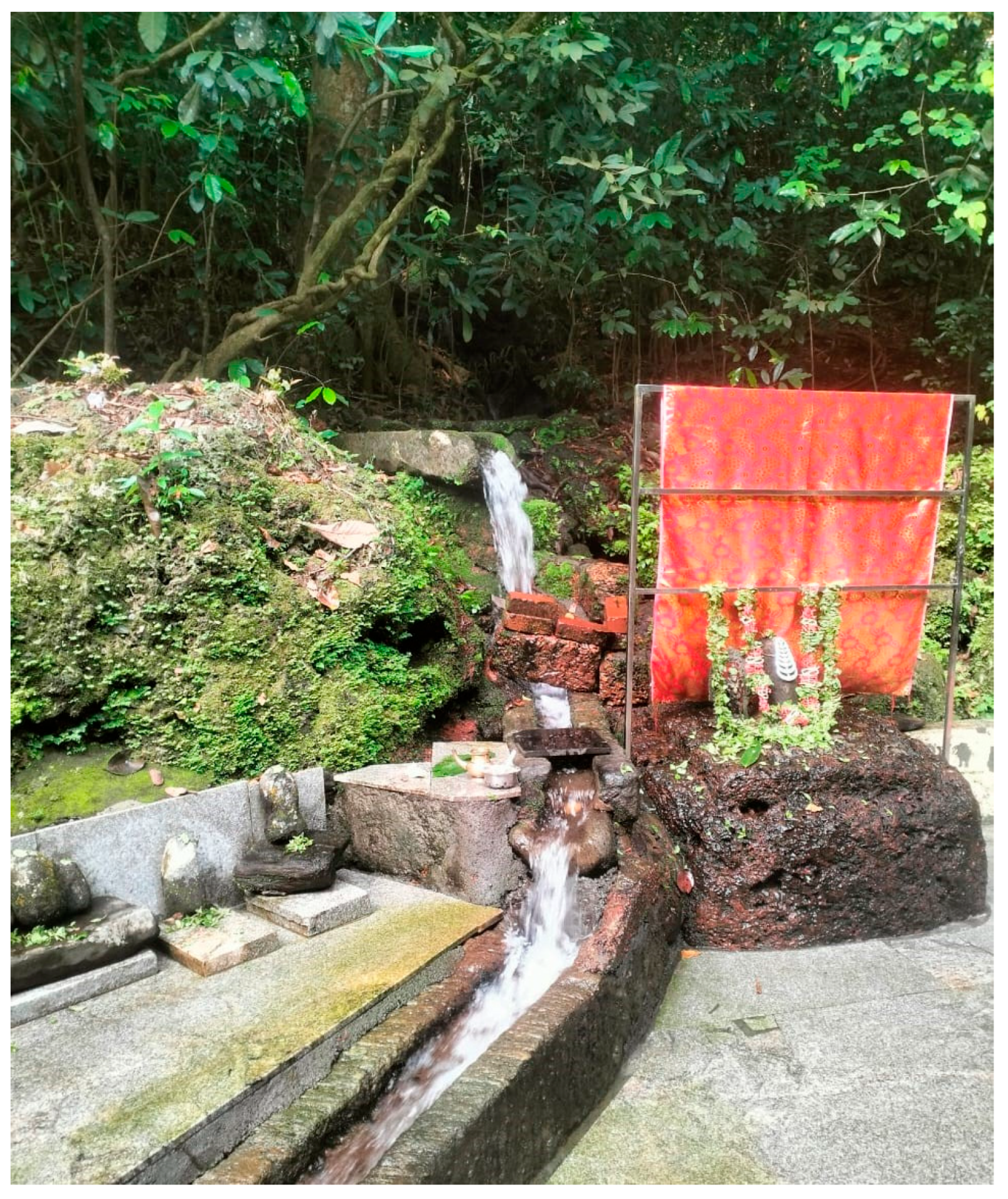
Notermans et al. (2016) observe that a kāvu is often perceived by local religious communities as a relatively undisturbed patch of evergreen vegetation usually dedicated to mother goddesses worshipped by the local population. Various types of medicinal plants grow in these groves, which have been used for centuries by Ayurvedic physicians and local healers as a source for potions. Moreover, endemic plants such as Anaphyllum wightii, Kunstleria keralensis, and Acorus calamus, which are threatened with extinction, are found in the marshes of many sacred groves of Kerala.
Figure 2.
Vallikāṭṭu kāvu.
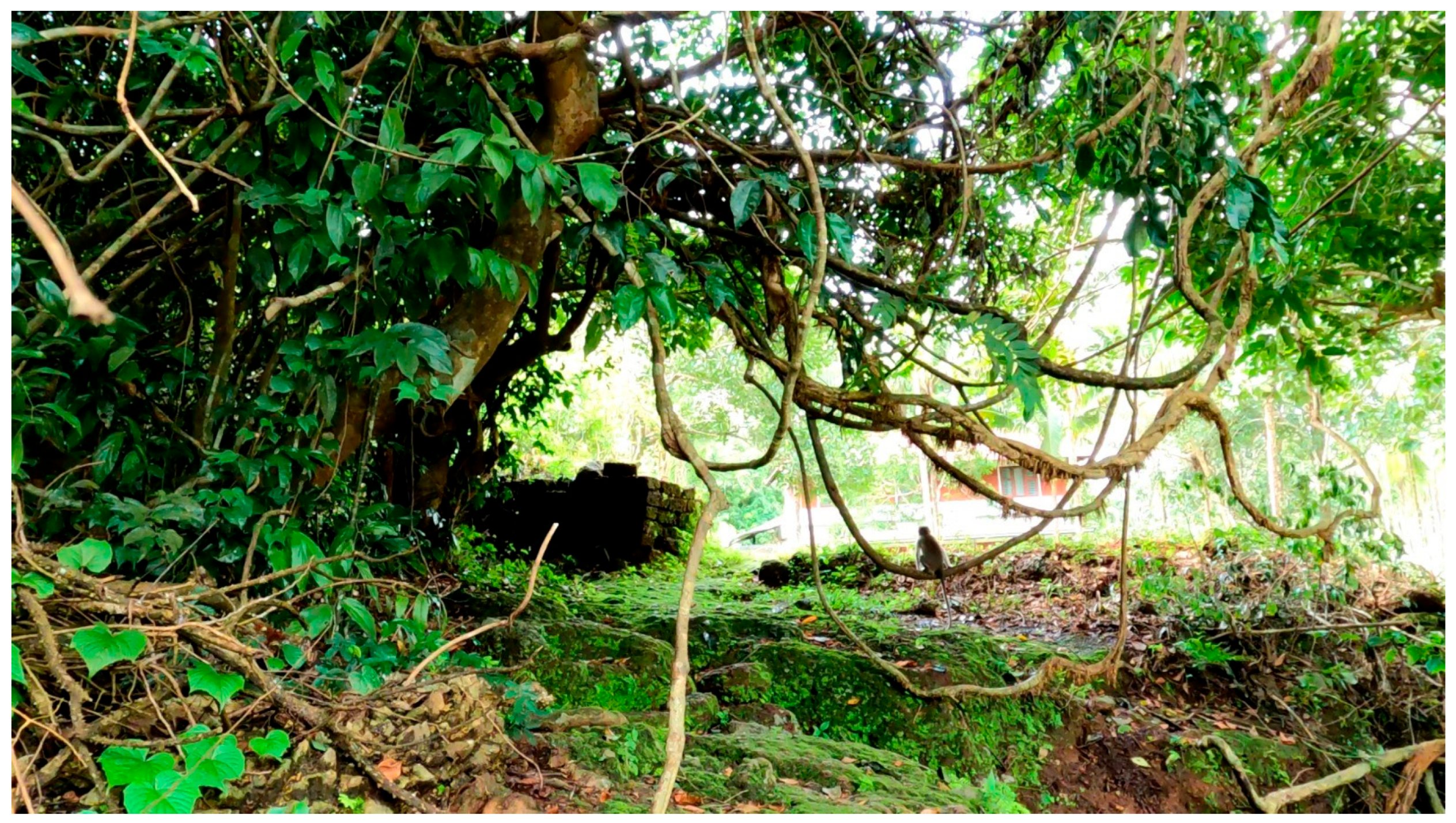
The kāvus are also often home to water resources such as ponds and wetlands with unique fauna and flora. Thus, sacred groves play an important role in protecting local biodiversity, and the religious beliefs and taboos associated with these sites can, to some extent, act to reduce the risk of deforestation (Israel et al. 1997).4 In Kerala, sacred groves can be categorized into three groups according to the system of management, namely management by individual families, by local communities, or by statutory temple management authorities (devaswom boards). Regardless of whether the management responsibility lies with the families or entirely with the devaswom boards, many sacred groves are currently under threat due to changing socioeconomic conditions. Many have changed in terms of size and vegetation structure, and some have been converted into temples with shrines and concrete pathways (Chandrashekara and Sankar 1998). Ritual practices related to veneration of nature and nature spirits in the groves have thus played a crucial role in the preservation of the groves and conservation of their biodiversity (Bhagwat et al. 2005; Bhagwat and Rutte 2006). The North Malabar region, in particular, is known for such sacred groves, and these forest areas are rich in endemic plants, migratory birds, and wild animals. Nevertheless, the role of animals and the function of rituals in sacred groves for the preservation of biodiversity have not yet been fully explored by scholars. This paper attempts to address this by reflecting on the role of rituals, the agency of animals5, and nature as sacred in the preservation of Vallikāṭṭu kāvu.
Vallikāṭṭu kāvu is one of the largest sacred groves in the Calicut (Kozhikode) district, Kerala. It is located 25 km from the town of Calicut, in the village of Thalakkulathur, under Edakkara panchayath (local government). It covers 27 hectares in a marshy area that is home to bonnet macaque colonies and peacocks, wild boars, porcupines, various species of butterflies, and numerous species of orchids. The largest part of the grove is a hillock with a perennial stream flowing through it into a nearby pond: macaques often congregate near the grove’s waterfalls and streams (see Figure 3). Vallikāṭṭu kāvu is traditionally associated with the worship of forest deities led by the fierce goddess Vanadurgā and houses a sacred spot dedicated to her. A visually striking feature of the grove that visitors find enchanting is the intertwined knee roots of various trees. The inhabitants of the surrounding villages believe that Vanadurgā created the roots to protect the villagers from attacks by wild elephants that once roamed the area. The story presents the grove as a space of interaction between humans and non-human, wild, or ambiguous forces –a protected space of encounter with non-human entities, entwined with divinely created moss-covered roots.
Figure 3.
A bonnet macaque in Vallikāṭṭu kāvu.
The kāvu, previously co-owned by three Hindu families, since 1948 has been managed by a board of trustees consisting of five members—two from the hereditary families and three from local government. The committee meets once a month to make decisions regarding temple management and the protection of the grove.6 Priests from Vallikāṭṭu, and Karakkat Nambudiri (Brahmin) families are authorized to perform Tantric rituals in the grove. Acri (2022, p. 1) points out that the term Tantra has a broad meaning and uses it to describe “complex, heterogeneous, and protean” esoteric traditions in Asia. Belief in the omnipotence of Tantric deities and the supernatural power of the masters of Tantric incantations (mantravādin) is woven into the fabric of everyday life in many South Asian communities. In general, Tantric spiritual practices, known for their esotericism and secrecy, in many cases involve self-deification and the use of mantras and other ritual aids for wish fulfillment and to achieve the soteriological realization of divine consciousness and the attainment of mystical powers (siddhis). The tradition of the Nambudiri Brahmins, which is still the most influential religious community in Kerala, is called Vaidika Tantra and is a combination of Vedic orthopraxy and elements of Tantric worship. Nambudiri tradition combines Vedic and Tantric modes of worship. This form of Tantric orthopraxy includes in its worship a number of Brahmanical deities and local mother goddesses, folk gods, and spirits (Pacciolla 2021, p. 187). Tantrasamuccaya, the authoritative ritual manual of the tradition that teaches the main rituals of the Kerala temples, was written by Nārāyaṇa Nambudiri (b. 1426), a Brahmin from the Cennas family, eminent scholar, and well-known poet at the court of the Zamorins of Calicut.7
While the priests are the ritual authorities, the local devotees preserve the various legends, taboos, and customs related to the grove. In fact, to protect the sacred environment, the temple authorities recently restricted access to the grove to devotees only. As mentioned above, the main deity of the grove is Vanadurgā, the fierce forest goddess, but the grove is also marked by sacred spots dedicated to Gaṇapati, Ayyappan, Bhadrakālī, and Vēṭṭaykkorumakan.
Among those retinues of Vanadurgā, Vēṭṭaykkorumakan is an interesting case of a divine protector who embodies both wild and domesticated aspects of nature. He is said to be a son of Lord Śiva in his guise as Kirata (hunter) and Parvatī, who appeared as a woman from a local tribal community (Sarma 2018). According to legend, Vēṭṭaykkorumakan (“son of a hunter”) was a mischievous child with immense strength. His playful but often naughty behavior worried both humans and celestial beings. The gods, disturbed by his antics, asked Lord Viṣṇu to intervene. Viṣṇu appeared as a Brahmin teacher and transformed the unruly Vēṭṭaykkorumakan into a well-behaved and clever young man. Viṣṇu then gave him a golden arrow and, with this symbolic gesture, Vēṭṭaykkorumakan was transformed into a protective deity of hunters and forest dwellers. The legend thus points to a possible Sanskritization of an indigenous deity or to a process of domestication of a wild, forest-dwelling spirit. Vēṭṭaykkorumakan is, therefore, a strong figure in the regional tradition of Kerala and reflects the unique blend of Sanskritic and Dravidian influences in the state.8
In fact, Vallikāṭṭu kāvu and other sacred groves of Kerala can also be seen as liminal spaces where genii locorum are prayed to guard the premises, animals are deified, and deities and spirits take on animal form. While the kāvu or grove may be a separate space, it is often linked to or forms a part of the kṣetra or temple complex. Kāvus have been converted into temples, but the many indigenous groves have retained their arboreal spirituality and feminine spaces, as most groves are dedicated to goddesses associated with the earth, vegetation, and fertility. Moreover, many groves in Kerala in recent times have been converted into temple compounds.9 As Notermans et al. (2016) have noted, the initial fear of the wild and reverence for the sacredness of Kerala’s nature is now “overwritten with rituals of domestication, gentrification and templeization” of the sacred groves.10 Thus, the sacredness of nature is perceived differently from one grove to another in Kerala.11 In some cases, the groves change ownership—the privately owned groves become community owned or end up being managed by temple trusts. In those cases, ritual patterns may be influenced by the beliefs and practices advocated by the new owners: local sacrificial traditions may be replaced with standardized offerings found in most temples. In many cases, a family may still be in charge of special ritual practices while a newly appointed Brahmin priest has the authority to perform daily rituals. In the contemporary imagination, the kāvu of Kerala is an ecological ideal and a space of religious sanctity (Pokkanali 2023, p. 220). The kāvu is consecrated for the use of gods, or more often goddesses, and sometimes heroes or wandering spirits can be emplaced there through a ritual known as kudiyiruttal (emplacement). It is generally believed that once a deity and its energy (śakti) are emplaced there, they reside in the shrine and need to be nurtured through certain daily rituals and special offerings. Furthermore, the power of the deity permeates the surroundings, and consequently, the fauna and flora of the grove are considered the domain of the divine and must be protected or at least treated with respect. When a deity in the kāvu is transferred to another place through the ritual process of kāvumāṭṭam (re-emplacement), a new kāvu is created, which becomes a related domain. Therefore, both the groves and their temple complexes may be connected through the relationships between the deities installed there.
There is a particular interplay of forces from the margins and centers of kāvus: between the deities installed there and the ambiguous wandering spirits of nature that traverse the realms and either are invoked or appear of their own volition to interact with humans. There is also widespread belief in South India that spiritual masters and gurus can appear in the form of a snake, serving as a reminder to visitors to show reverence to serpents and not assume the lowly status of the animals they encounter, no matter how insignificant they may appear. These distinct but interconnected spaces (i.e., kṣetra and kāvu) have often been inspirations for Kerala artists, including devotional (bhakti) poets. (Namboodiri 1989, pp. 216–22). In a sense, the space of the kāvu allows for the expression of devotion to nature and the deity embodied by nature. It can be said to be a space where nature exists as a dynamic unity of human, animal, and spiritual realms.
The Vallikāṭṭu kāvu, like the groves described by Cherusseri, embodies this unity of the realms and provides protection for human and non-human beings. The interaction between the devotees and the natural and supernatural inhabitants of the grove is facilitated by ceremonies and the ceremonial offerings that establish or reaffirm relationships and bonds (Sarma and Barpujari 2011, p. 2). The daily pūjās are Malar Nivedyam (offering of puffed rice) and Nivedya (ceremonial offering of edibles). Trikāla pūjā (worship performed three times a day) is performed as an offering made during the months of Vaiśākha (April–May) and Karkkidaka (July–August), Navarātri (October), and the Maṇḍala period (November–December). The most important offerings (vaḻipāṭu) are rakta puṣpāñjali, puṣpāñjali, trimadhuram, muttarukkal, śarkara pāyasam, and kuṭukkacōru. Kuṭukkacōru is perhaps one of the most important types of offerings and is given with the intention of being blessed with offspring (Sreeja and Unni 2016).
The fierce goddesses, like Vanadurgā, are frequently visualized (in meditations and Tantric rituals of the grove) or presented in iconography (e.g., in temples) as demon slayers, often accompanied by animal retinues or seated on fierce animals.12 In Vallikāṭṭu kāvu, Vanadurgā is worshipped along with a group of macaques that live there. As shown in the following examples, the macaques also partake in the offerings, either receiving them directly or snatching them from shrines or sacred spots, carrying them around the grove, eating some, and leaving the rest for other monkeys to share later. In a way, the macaques mark alternative paths of circumambulation around the grove, distribute the blessed edible offerings, and thereby sanctify various parts of the kāvu. Īśānaśivagurudevapaddhati, a tantric compendium written in Kerala (ninth to twelfth century) by Īśānaśiva, asserts that the offering to and worship of the Forest Durgā leads to protection and removes negative astrological influences:
apāmārga-samidbhiśca rājībhiḥ sarṣapaiḥ tilaiḥ |hutvā grahāṇāṃ mokṣaḥ syān miśritair vanadurgayā |43–41|“Through the offering in the fire of apāmārga twigs, lotus stalks, mustard seeds, and sesame seeds combined with (the worship of) Vanadurgā, one is released from the afflictions of the planets (grahas).”
The offering of trimadhuram, which literally means “three sweets”, is a mixture of three sweet ingredients—mashed banana, ghee, and jaggery—traditionally offered to the deity as naivedya (food offering). Similarly, śarkara pāyasam is an offering of sweet rice pudding with jaggery. The sweet offerings symbolize the sweetness of life, abundance, happiness, prosperity and divine grace. Although non-vegetarian offerings are more commonly made to the fierce deities, the offering of śarkara pāyasam is believed to propitiate the deity, remove difficulties, and bestow blessings on the devotee. Ennavilakku is the offering of an oil lamp, which is usually lit and placed before the deity as an act of devotion, gratitude and request for blessings. The act of preparing and sharing the pāyasam reflects the participation of the community and the sharing of divine grace. The devotees bring oil (usually sesame or coconut oil) to the temple. The oil is poured into a lamp (often a traditional bronze or clay lamp). The lamp is then lit by the devotee or priest who utters prayers or states the saṃkalpa (intention) of the ritual. The burning lamp is then offered to the deity, often in the main shrine or on special lamp stands (vilakkumadam). In case of kuṭukkacōru, the devotees prepare a simple, home-style meal—rice, a curry (such as chammanthi or thoran), pickle, and sometimes a sweet dish. The meal is packed and brought to the temple, where it is offered to the deity and then returned to the devotee as blessed food (prasadam). This homely food symbolizes a close, family-like connection with the deity. Thus, the site of the grove is an ecosystem connected to the domestic offerings and acts of reverence by the devotees, the rituals of the Brahmin priests, and the distribution of sacred food by the macaques.
The main offering prepared during the daily rituals is specially cooked rice, which is blessed and given to both the deities and the macaques. As the priests and devotees believe that the macaques are the guardians of the sacred grove and messengers of the goddess, their colonies are protected and cared for by the local Brahmin communities and devotees from the districts of Calicut.13
Although these are the main and official offerings for the divine beings worshipped in the temple, it is also customary for worshippers visiting the grove to bring a snack for the macaques living there (see Figure 4). The macaques are considered the entourage of the goddess and take advantage of this exalted position. They become aggressive and territorial and readily snatch items from visitors if they are not greeted respectfully and offered food. Thus, while the temple authorities monitor the grove and nearby forest areas, which are protected due to their ecological and religious importance for the local communities, the macaques are also active inhabitants of the grove and, as we show in this paper, help to protect the ecosystem. The devotees who visit the grove form a close bond with the macaques. As with humans who share their habitat with animals, the feelings of grove-goers towards the macaques have different dimensions; they often speak of spiritual and sensory dimensions of bonding (Charles 2014, p. 722). However, the macaques are still ambiguous creatures: they are opportunistic, and their playfulness and cunning are often amusing but sometimes threatening. In a way, they embody the creative divine play, līlā, that is the very essence of the embodied universe (macroscale) and the forest (microscale). Every visit to the grove contributes to the development of a closer relationship (sambandham) with the divine embodied in the various natural entities present there. The macaques are fed (“bribed”) with offerings and are seen as divine agents who can turn vicious in a split second.
Figure 4.
A macaque at Vallikāṭṭu kāvu eating offerings.
Govindrajan, in her study of monkeys in North India as symbols of belonging and foreignness, shows how the villagers claim kinship with the indigenous pahari monkeys, which are considered native species and thus “intrinsically valuable autochthons” that must be protected from the invasive ‘outsider’ monkeys, which are seen as thieves and a threat (Govindrajan 2019, p. 134). The monkeys of Vallikāṭṭu kāvu are unanimously considered local and play an active role in preserving religious and ecological harmony in the grove. Similarly, in his study on the interaction between humans and monkeys in temples in Indonesia (Bali), Fuentes (2010, p. 607) calls sacred spaces like groves or forest temples “naturalcultural contact zones” and observes that “the interface between species constructs mutual ecologies that structure their relationships. In these zones of contact there is an entanglement of economies, bodies, and daily practice.”
The macaques are both observers and observed. They cast darting glances at the humans and vice versa. During the daily rituals, mothers with small children point to the macaques as they lazily eat fruit or the remains of their “offerings”. They watch with innocent curiosity as the macaques pluck the scraps of food from their fur, look around, and disappear into the foliage with a sudden leap, only to appear in the path of another person circling the temple grounds. The mutual act of observing has an undeniable affinity with the act of darśan in the temple, since it is also an act of recognition—the divine, human, and animal eyes recognize the “other” as an actor in the same space and the same religious environment. The grove becomes a space of “interspecies relationality, entanglement, and involvement” (Govindrajan 2019, p. 145) that is marked by the sounds of prayers and the daily liturgy and the chatter of the macaques.14
Like the monkeys in the temples of Bali in Fuentes’s article, the bonnet macaques of Vallikāṭṭu kāvu follow the devotees and observe the daily ceremonies with their whole bodies: they pay attention to every human gesture, smell the ceremonial incense sticks, and listen to the chants, prayers, and conversations, waiting for any gesture that might look like an invitation to share the space and the food. Similarly, the devotees participate in the grove rituals with their bodies—absorbing the religious atmosphere and the fragrant and delectable food offerings. As we show in this paper, during the ritual ceremonies, the worshippers usually leave fruits or plants as offerings for the macaques. Thus, the plant-based food is shared by human devotees, gods, and animals.15 The macaques play a key role as seed dispersers and contribute to the regeneration of the forest. Recent research has shown that fruit-eating animals such as bats and monkeys play an important role in pollination and seed dispersal to maintain the sacred grove ecosystem. Frugivores show a positive relationship with plants, as seed dispersal is an important two-way link between plant and animal systems (Chanthorn et al. 2017; Corlett 2017). Thus, for example, macaques often forage in large groups. The sheer number of seeds dispersed a short distance from the parent tree may indicate an important role for this primate in seed dispersal (McConkey and Brockelman 2011). Seed dispersal by primates plays a crucial role in many ecological processes at different levels of biological organization: from the genetics and demography of plant populations to community assembly and ecosystem function (Andresen et al. 2018).
We observed the feeding behavior of the macaques and examined the food items left for them by temple devotees in Vallikāṭṭu kāvu. We found a variety of plant parts, leaves, flowers, and fruits of various trees from the nearby forests. We carried out a field study at the kāvu over a period of two years (2021–2023) to identify the food plants and seed dispersal of Macaca radiata by direct observation or indirectly by analyzing droppings found on the ground. Over 30 different plant seeds were collected from discarded materials, including chewed fruit, fresh seeds, and fecal material. Fruit plants and seeds that form the diet of the macaques were taxonomically identified, and the parts of the offerings discarded by the macaques, the excreta, and the seeds were collected separately and preserved for further study. Seeds found in the macaques’ fur were also collected and identified. Various small seeds were dispersed with the feces; large seeds were found as partially bitten-off fruits or as scattered seeds (Table 1).
Table 1.
Seed species classified according to dispersal mechanism: endozoochorous, epizoochorous, and non-zoochorous.
Among the ejected seeds, Mangifera indica was the largest. Due to their size, bonnet macaques can bear and transport fruits weighing more than 200 g. In our study, we found that the size and shape of the seeds play a crucial role in the mechanism of seed dispersal. Small seeds can easily pass through the macaques’ intestinal system, potentially increasing the germination rate of the respective species. No germination studies were conducted, but we observed that large seeds are directly dispersed, and also partially eaten fruits we collected had been dispersed by them. We also observed secondary distribution: after the fleshy parts of large, seeded fruits are consumed, the remnants fall into the soil or into watercourses, where the current contributes to seed dispersal. The seeds of Mangifera indica and Anacardium occidentale in particular were spread in this way. Some sticky seeds we collected from the macaques’ fur were not eaten by the animals but rather were transported in the fur as the macaques moved from one place to another. The seeds we collected from fur were Chrysopogon aciculatus, Urena lobata, and Xanthium indicum.
We thus found that seeds were dispersed in different ways according to their size. Smaller seeds were dispersed via the intestinal system after digestion, and larger seeds were discarded into the soil or water. We also observed secondary dispersal as water currents contributed to further dispersal. Species with large seeds are better competitors than species with small seeds, as they have a higher probability of survival and are better able to establish themselves (Murali 1997). Primates are particularly suitable for the dispersal of large-seeded or hard-shelled fruit species that are inaccessible or difficult to process for smaller taxa (Kaplin and Lambert 2002; Chapman and Russo 2007). Once the seed has been sown, proper germination depends on several biotic and abiotic factors, so that only then can the successive growth rate be understood.
In the ecocosmologies of indigenous communities, the world of humans and the world of nature are seen as closely connected. Ritual specialists like Tantric Brahmins and local communities who maintain the difficult and fragile balance of the human–animal world in the grove accept the active role of bonnet macaques and other non-human animals in the preservation of the environment. The concept of ecocosmology can be adopted to refer to such integral models of the human–nature relationship within different indigenous communities. However, apart from human ritual activity, as we point out here, it is worth noting the apparent agency of the environment itself. The belief that spirits can manifest in animals or that animals have a spiritual nature protects them and their role in maintaining the grove. The belief system recognizes certain forms of interaction with the animal world (e.g., offerings) and favors certain individuals (e.g., Brahmin priests, local devotees) as intermediaries between humans and the wilderness. In the following, we would like to compare this pattern of interaction between humans and nature at Vallikāṭṭu in Kerala with a Nepalese temple grove in Nagarkot traditionally associated with a shamanic group (the jhankris).
3. Nepal: When Trees and Stones Talk
This section of the paper is based on my (Maciej’s) field research among Nepali jhankri shamans (August–September 2024). We argue that analyzing the ecospiritual dimensions of Tantric and shamanic rituals and collecting and interpreting stories of shamans’ journeys into the various spiritual realms of the natural environment can inspire alternative readings of ethnically specific indigenous ecologies. The fieldwork took place mainly in districts of the village of Nagarkot, eastern Nepal, in communities of healers and shamans. The field research involved participant observation in healing rituals and interviews with shamans from the Newari and Tamang ethnic groups. In these traditions, embodied mystical experience and the oral transmission of religious knowledge take precedence over the written word, and literary ritual texts are performed and lived through sounds, materiality, and movement. The fieldwork methods, therefore, not only involved participant observation in rituals but also listening to the diverse voices of shamanic communities: their visions of reality, memory, and self-expression.
Ashlesh introduced himself as a jhankri, a Nepalese shaman—or one who trembles when possessed by spirits—of the Tamang community (Figure 5). Although one of the chief shamans of the area and praised for his healing powers, his life events had humbled him—he lost his house to an earthquake and lived in a tiny hut with his family, hardly earning enough to support his children. He looked serene and composed, and happiness made him meditative and thoughtful. We sat on the floor of his modest house in Nagarkot, which was made entirely of corrugated iron. It was the only material they could find after a devastating earthquake had destroyed the family’s previous home. It was a frigid, blustery day, and the wind drummed mercilessly against the doors and windows. Behind the hut, the mountain peaks of Manaslu, Langtang, and Dhaulagiri shimmered in the distance, shrouded in hazy clouds. For the indigenous shamans, these landscapes have their own agency, attracting the eye and luring the daring with their precipitous mountain ranges. These mountain landscapes covered with sacred forests become a canvas on which social practices and rituals are inscribed (Nayak and Jeffrey 2011, p. 293).
Figure 5.
The jhankris during their pilgrimage in the sacred forests of Nagarkot.
Ashlesh sat at a low, rustic table. His ritual utensils were scattered on the ground and covered with tufts of grass. As gusts of wind rattled the thin metal walls of the hut, Ashlesh waved his hands around the utensils: an oil lamp, incense, a yak bone, cups, a drum, and rosaries. “Before I begin the ritual for my ancestors,” he said, “I must ask all these items to come to my table. Let me tell a story about each of them, starting with the lamp and how it lit up my great-grandfather’s life. Let me sing a song for my drum. Only then can I place them on the table, because they need the story to find their place”.
The ritual itself showed how the jhankri’s life and his relationship to his ancestral tradition were held together by his stories. The ritual took place within an indigenous framework of narratives that established relationships between people, the past, objects, and spirits. It can be said that while the jhankri’s ritual tools (the drum, dagger, animal bones, etc.) have their own agency and are enlivened by the spirit visitations, the jhankri also knows and expresses himself through his belongings.
As observed by Armand (2016), at the moment of incorporation of a spirit, the jhankri represents a liminal being who continually crosses the fluid and permeable boundaries between the two universes of his/her humanity and those of the spirit guide or deities. The English word “incorporation” was used by the English-speaking Nepalese shamans with whom I studied. In their interpretation of the term, spirit incorporation refers to a state of close interaction between a shaman and a spirit, where the shaman remains in control and can command the spirit to leave whenever it wishes.
Ashlesh said, “It is important to connect with the natural spirits. Sometimes instead of a drum I may take plants and shake them, use them as a rattle. Jhankris usually use double-headed drums, while people around the Dhoulagiri [mountain] range may use a single-headed drum.” The drum, known as dhyāngro, is a frame drum with heads of animal skin and a handle that is used to hold up the drum, which is struck with a curved cane beater. The handle of the drum is an anchor that grounds the shaman. In a way, it can also be seen as an esoteric Jacob’s staff—orienting the position of the shaman within spheres of spirits and humans and allowing him to navigate through the visible and invisible realms. The handle is often covered with carvings of snakes, birds, or tridents. In its essence, the handle is shaped like a kila—a ritual dagger and can be used in spiritual warfare. The drum itself has two sides—male and female. The female side is the one the shaman beats first: it opens the door to the other realms. The drum heads are not usually vividly decorated but may have depictions of the sun, the moon, and a trident. They correspond to the right, left, and third eyes and thus connote the visionary powers of a jhankri.
At the end of the jhankri’s ritual, the rosary, incense, and cups were placed on the table next to the burning oil lamp. In the world of shamans, everything is alive, even the ritual tools they are using. The tools listen to the shaman’s stories, are invited to take a seat at the table, and become conversation partners. The jhankri’s drum, which normally serves as an instrument to call the spirits and open the channel of communication with them, was also placed on the table. Ashlesh sang a long song to the drum, and then let it respond—he struck it once gently with a drumstick, and the sound echoed through the hut’s mostly empty space.16 Some jhankris who joined us for a while in Ashlesh’s hut talk about an almost vertiginous sense of being suspended in time when they first experience the palpable presence of Kālī and her retinue of spirits. Indeed, in the medieval Kathmandu Valley, Kālī was omnipresent; the various forms of Kālī iconographically presented in temples are visually striking, and their symbolism shows the complexity of the Tantric systems that developed in Nepal. Pangsrivongse (2023, p. 34) notes that the “awe-inspiring form” of the Guhyakālī form of Kālī in particular “straddles the border between the conceivable and inconceivable or the iconic and the aniconic”. While Guhyakālī, who is worshipped in several temples in Nepal, is formless, transcends all conventional reality, and is pure consciousness in nature, she is also depicted and visualized with animal faces.
The animals and birds appear as both symbols and retinues of the goddess. Similarly, the Nepali shaman wears peacock feathers on his/her head and a garland made of animal bones. These ornaments connect him with the tradition but also with the animal helpers—birds and wild game. The peacocks, Ashlesh explains, played a central role in the transmission of shamanic knowledge from Śiva to the practitioners. As the legend goes, at the beginning of time, Śiva revealed the shamanic knowledge and taught the secret practices to a select few adepts who listened to his teachings in a forest clearing. Śiva taught for a long time, through the day and night, and the shamans listened attentively until they finally fell asleep from exhaustion. When they woke up, they were all alone in the forest. Śiva had disappeared after delivering the revelation. Fortunately, peacocks were present at the time of the divine revelation and could remember it, so they were able to tell the shamans the part of Śiva’s teachings they had missed. The story points again to the agency of animals, in this case, peacocks, in preserving traditions and helping humans in the interaction between the natural environment and human society.
As I sat with Ashlesh and listened to his stories, I nodded and bowed to the ancestors and spirits that were invoked and silently wrote down my own story about the event. The story was made up of a patchwork of voices of the past and the present that mingled in the ritual space of the hut in Nagarkot. A half-broken fence separated the jhankri’s courtyard from the forest unfolding gracefully across the nearby hills, mountains, and valleys. The sacred forest, with its numerous natural shrines and places of worship bearing signs visible only to local worshippers, was a complex, living entity shaped by time and sanctified by the obligatory rituals of the jhankri communities. During their healing ceremonies, like the one I had come to attend, Nepalese shamans go on visionary journeys to receive help from spirits and ancestors and to connect with their power animals. The spirit of the shaman, traveling through both the physical and visionary landscapes, may communicate on this journey with supernatural beings who inhabit and represent certain wild lands, forests, groves, and places of special power and significance, such as crossroads. They often mimic the physical world that the shaman knows from his daily wanderings (Desjarlais 1989, p. 290).
Ashlesh points, however, to the different categories of shamans and their ways of connecting with nature and the universe. Dhami, Ashlesh explains, originally meant the purity of a sacred space. The word dhami is nowadays used for a shaman or healer, someone who has purity of heart and thus can be visited by helpful spirits and perform healing with them. Dhamis receive blessings and empowerment from their ancestral spirits and spirit helpers who assisted their forefathers. Thus, the source of their power is described as vertical—it comes down to healers through a lineage and bloodline. Conversely, jhankri is one who trembles in excitement at the presence of the gods and spirits. Traditional shamans also speak of “heat” as being an indication of spirit visitation in the body of a jhankri. While a dhami has a vertical line of empowerment, a jhankri derives his power from their ancestral line but also from the horizontal flow of empowerment—spirits residing in his environment—the animal spirits, spirits of the land, plants, and forest. A jhankri can also be seen as one who guards balance in the wild environment around the human settlements and instructs people in ways of interaction with the natural environment and atonement for disturbing the fine balance. The latter may vary from simple offerings of a portion of a harvest to the wandering spirits to the elaborate rites and chanting of mantras to atone for the killing of snakes, an act that is notorious for cursing generations of descendants of the perpetrators.17 Tantric and jhankri practitioners may also worship half-human, half-animal deities and spirits who, among other traditional roles, visually represent the power of nature and the balance between the animal and human and divine realms.18
The first shaman, according to the Nepali legends, was Ban jhankri (the jhankri of the forest). Ban jhankri has resided in the wild since the beginning of time and, as a spirit entity, taught and helped shamans in their healings. Ban jhankri remains a temporally unbounded shamanic identity. Ban or Van simply means forest in Nepali, which makes the name a suitable moniker for many of the ascetic and solitary shamans. In a way, Ban jhankri manifests in all shamans. The first Ban jhankri lives forever in his own space–time of the Nepali wilderness; he is revered and respected but also feared. Like many mountain and forest beings, he is not to be treated lightly or disrespected.
The mystical forest shaman is known by different names in different shamanic groups and communities of Nepal. The Hyolmo, in the Helambu region, refer to him as ri bombo (forest healer). His connection with the natural world is expressed by his followers also calling him shingben (wood bombo). It is believed that shingben draws his energy from the forest and acts as its guardian. He can appear as a tree in the forest, especially as a surprisingly tall or strangely shaped tree (Torri 2020, p. 64). The forests are indeed the domain of shapeshifters—Tantric or shamanic practitioners and deities who assume animal or plant forms. Similarly, Kerala folklore features a fearsome class of local magicians and shapeshifters, the Oṭiyans, who were particularly feared in the forests of Palakkad and ancient Vaḷḷuvanāṭ kingdoms (central Kerala). According to legend, they had the ability to transform into a wild animal during their nocturnal hunts and attack hikers in the forest. They earned their living as sorcerers, as magical contract killers, and through all kinds of other unsavory practices. For example, they were notorious for killing pregnant women and making magical elixirs from their unborn children.
Jhankris did not have such a bad reputation, but in some remote villages in Nepal, people fear that ban jhankri may abduct young children, boys or girls.19 Even today, it is not uncommon for village children to be abducted by ban jankri for the purpose of initiation into the shamanic craft. When a small child disappears in a village, parents often consult a local shaman to discover if the child was in fact taken by the ban jhankri. If so, they are asked to wait. The ban jankri will keep the abductee in his cave for days, weeks, or months to prepare them for the role of village shaman. Thus, the ban jhankri is not a purely spiritual being but may physically manifest and take different forms. Usually, he is described as a small (2–3.5 feet tall), dwarfish, and fierce shamanic master who wanders around the forest with his drum and a wooden container for milk. Shamans see him as a manifestation of Śiva. According to legends, in time immemorial, the goddess Pārvatī asked Śiva to manifest a healer out of his powers so that humanity could deal with epidemics. That is how the ban jhankri came to be. The ban jhankri does not live alone—in his cave, he shares life with his wife (ban jhākrini), a tall, fearsome-looking medicine woman. When a child is abducted, she sniffs him or her to evaluate the purity of their heart. If there are doubts about the eligibility of the child, the ban jhākrini forces them to perform ablutions in a forest waterfall. Later, the ban jhākrini may deliberately frighten the child, who shakes with fear and falls into a trance. The trembling of the body is a good sign: a jhankri trembles with excitement and is shaken by the spiritual forces into a trance. In their healing sessions, jhankris leave their body to travel to other realms. There are indeed shamanic stories of people who have strayed into other dimensions that are deceptively similar to earthly landscapes but at the same time different from them, just as dreamscapes are based on memories. This forced initiation by the ban jhākrini allows the child to learn the basics of shamanic craft in a trance state and gives them the ability to move safely and naturally between the spirit worlds.
4. Spirits of Stones and Trees: A Walk on a Farm
The timid afternoon sun peeked at us through the small, cobweb-covered windows of the shaman’s hut in Nagarkot. When the ritual was over, Ashlesh invited us for lunch and then for a walk around his farm, which is surrounded by wooded hills. A narrow verdant path led us up the hill where Ashlesh had his farm shed overlooking faraway huts and paddy fields crisscrossed by mountain brooks. We crossed a patchwork of different shades of green, and a brook flowing out of a forked valley led us up to a vegetable patch with tomatoes, okra, and beans smoothly covered with plastic sheeting. The grass seemed to be growing over the path we were following. The blades were heavy with rain and brushed water onto the bare feet of Ashlesh’s children, who followed us cheerfully running and laughing. Ashlesh stopped abruptly and pointed to a pile of stones of various sizes sitting neatly under a bush. At that moment, the kids markedly lowered their voices and quickly disappeared into another part of the garden. These few stones were of utmost importance—they designated a liminal space in between the wilderness and the patches of domesticated plants. These stones can be seen as a space in which human and non-human actors negotiate their influences and connections. To paraphrase Tuck and McKenzie (2014, p. 14), this sacred space is a verb rather than a noun. It opens and affirms dialogue between humans, shamans, plants, animals, and spirits. Ashlesh tells the story of how the largest, moss-covered stone called to him one night from under a clump of trees. At first, he ignored the inner voice, but from then on it woke him up every night, dragging him out of bed and whispering orders to him in a strangely familiar voice.
Ashlesh soon realized that his grandfather’s spirit had taken the form of a moss-covered stone and insisted on staying with the family in this way to oversee the family’s affairs. The stone was cleansed, ceremonially emplaced and blessed, and honored with food and offerings of light and water. For shamans, stones, plants, and everything that can be seen in the garden are equally alive and are to be honored and respected. “We often talk about asking the spirits for help, but we must understand that they also need us,” Ashlesh said. Sometimes he would leave a root next to a stone and pray for advice or a blessing. The stone, the shaman claims, often advises on organizing the garden and choosing vegetables for the family so the children will grow and remain healthy. After hearing such advice, Ashlesh would pick up his rosary and say a prayer that the stone had supposedly told him to say. Through these ritual exchanges of natural products, forest and farm, wild and cultivated landscapes are woven into a shared spiritual ecology. For the shamans, these acts affirm reciprocal bonds with the land, nurturing the balance that allows life to flourish across human and nonhuman domains.
A few days after the consecration of the grandfather’s stone, two more stones called out to Ashlesh to be placed in the same spot. One of the stones was recognized as a representation of Bhume, the male Earth spirit. Such stones are said to appear at the border between forested and cultivated lands. During annual Bhume festivals in Nepal, rituals are performed locally in and around the stone; yellow and red pigments are smeared on it, and a coin and betel are offered. Shamans or the local community select Bhume stones from among the unusual rocks found in a given area. After a stone is ritually selected and installed as the seat of the Bhume deity, the ritual focus expands to include a tree or a ritually constructed, tree-like liṅga, forming an integrated stone–tree sacred complex. While Bhume rituals vary locally, they consistently follow this pattern: ceremonies are conducted either within a sacred grove, beneath a chosen living tree—recognized by the shaman for its distinctive form, size, majesty, and perceived spiritual capacity—or near the village, where a temporary liṅga made from bamboo or a sacred plant is erected in place of a tree, with the stone placed at its base. This tree-like liṅga serves as a ritually animated tree and central ritual pole, allowing the sacred order of the grove to be reproduced within the village. During the ceremony, some shamans enter trance states while worshipping the deities and climb the tree or liṅga, physically enacting a vertical connection between the human, forest, earth, and divine realms, and affirming the communicative relationship between the shaman and the spirit-bearing tree.
Through these ritual actions, the tree or tree-like liṅga and the surrounding area are consecrated as enduringly interconnected spaces. This sacralization has tangible ecological effects: sacred groves are maintained as protected zones of vegetation, the site around the tree is kept clean long after the ritual, and the tree itself must never be cut or pruned. Its branches and leaves are treated with ritual care, and large leaves, when available, are used to make ritual plates for offerings (Banstola 2025, pp. 64–65). In this way, Bhume worship reinforces the ecological importance of sacred groves while extending their sacred logic into the village and ensuring the long-term safeguarding of specific trees, groves, and their immediate landscapes. Bhume, the masculine aspect of Earth, is worshipped during the harvest, while Mother Earth is worshipped before the crops are sown. A pūjā for the nāgas is performed afterward to honor the snake deities and ensure timely rain and prosperity.
The third stone that appeared on Ashlesh’s farm was a form of the ban jhankri, who asked to be honored as a guardian and mediator between the wild spirits of the forest, the shaman’s family, and the spirits living on the farm. He guards the place and is the first to react when wild spirits stray and invade the family’s garden. Every day, an offering of light is performed for these solid, rock-hard guardians. The moment the lamp is lit and prayers are chanted, this tiny piece of land opens up to other realms. The place reminded me of legends of Ayyappankāvus (sacred groves dedicated to the local god Ayyappan) in Kerala, such as Malayil kāvu in Anakkara Panchayath in Palakkad district. It is believed that hundreds of years ago, a woman from a local community wandered into the forest where the grove is located today. When she stopped to sharpen her knife on a rock, the rock itself began to bleed. The devotees immediately called an astrologer from a nearby village, who found that the rock was an incarnation of Lord Ayyappan. Thereafter, the community sanctified this rock as Lord Ayyappan svayambhū (self-manifested) and preserved the place as their local grove and a place of purity. The rock requires light offerings and constant acts of worship and purification. The stone manifestation of divine reality in the case of the rocks of Ayyapan and ban jhankri is as paradoxical as the mountain forms of the gods in Haberman’s (2020, p. 3) study—they enable the worship of an immaterial, limitless entity in its “embodied finite form”; thus, the limited and limitless forms remain ontologically indistinguishable.
Ashlesh lights a lamp in front of the stone and whispers a prayer with his eyes closed. He uses this time and space to mediate between the interconnected worlds—the realm of the forest spirits, the plant realm, the dream world, and the higher and lower shamanic realms. The physical and spiritual realities are never questioned, but seem to interpenetrate and open up to other realms where ancestors, deities and animal spirits roam (Leder 2012, p. 140). Are the wild spirits from the forest invited into Ashlesh’s space? The forest is believed to be inhabited by a motley array of spiritual beings. They seek contact with humans and have much to offer. If the ban jhankri is an archetypal shaman, Bandevi, like Vanadurgā of the Vallikāṭṭu kāvu, is a goddess of the forest. She can take different forms, manifest as a sprout, or take the visitor’s breath away with the amazing vista of the forest in the light of dusk. When a shaman fetches a medicinal herb from the forest, he must ask Bandevi for permission and say exactly what he needs it for. Sometimes Ashlesh places a grain of rice, an egg, or a flower from his garden in the place where he has taken the herb. The first harvest is sacrificed to the Bandevi and the nāgas, serpent deities who live in the nearby wetlands. The vision of a serpent is a powerful omen—for a devotee or a jhankri, it can be a sign of a connection with the nāgas and their realm, but it can also be a warning sign, a visitation of a spirit or a spiritual master who has manifested in this form. Some tantric texts from Nepal contain interpretations of such omens: the vision of a pair of snakes, for example, can warn of impending dangers or disturbances. In such a case, the chanting of mantras praising serpents is recommended. This mantra can also calm fears and bring peace to people and their surroundings.20 Similarly, the Hāhārāvatantra21 describes a common Tantric and shamanic practice of protective spells and the tying of a red thread to a tuft of hair (śikhā) or, as is common in shamanic practice, around the wrist as a form of protective amulet. The mantra is mentioned in the texts as protecting from danger from wild tigers and lions, among other things. Thus, while animals are feared in many cases, they can be “tamed” or appeased with mantras, and shamans can summon spirit animals that have the power of their physical counterparts.22
Ashlesh gives another example of how the forest spirits contribute to human society: when a person feels anxious or insecure, a shaman can call the spirits of the white lion into that person’s body to gain strength and confidence. The white lion is a great helper—if wild animals are harassing farms, it will scare them away and walk around the property to assert the boundaries of the land23.
But the ban jhankri requires constant care—prayers and offerings. In a way, the ban jhankri resembles Kuṭṭiccāttan, who is praised in Kerala as a divine or semi-divine being and spiritual helper and is often worshipped in the sacred groves either in his own shrines or in aniconic form in the groves. Kuṭṭiccāttan is sometimes imagined as a playful and potentially malevolent spirit, often used by local magicians to perform black magic. Some legends say that a Kuṭṭiccāttan grew up in a house of a Brahmin family called Kāḷakāṭṭu illam. He was mischievous, pestered everyone in the household, and killed the farm animals and drank their blood. In a fit of anger, the chief Brahmin of the illam killed him, cut his body into many pieces, and burnt them all in various homakuṇḍas (sacrificial pits). All these pieces became different kinds of Kutticcāttans. Some were burnt, so they came to be known as the karimkuṭṭiccāttan (black ones); some began to fly, the parakkuṭṭi (flying ones); some walked with fire in their bodies, the tīkkutti (blazing ones); and some became flowers, the pūkkuṭṭi (flower-like ones). The story thus links the malevolent spirit with the elemental forces of nature, which cannot be fully tamed but can be harnessed by those who have the ability and knowledge to communicate with them and know rituals that can influence them. Such legends of Kerala and Nepal point to Tantric Brahmins, mantravādins, and shamans as those who can mediate between the realms of nature and interact with the powerful elemental spirits. The Kuṭṭiccāttan story and the ban jhankri story are not legends that refer to ancient times of spirit–human coexistence, but experiential tales that inform about the reality of in-between spaces and forces of nature that cannot be corralled, and even if negotiated with, are inclined to remain mischievous. Nevertheless, wild spirits such as wild (physical) animals “seek immersion in human spaces but also claim freedom from human expectation” (Govindrajan 2019, p. 136).
Remembered Landscapes: Memory, Reciprocity, and Living Groves
The next day, we took a short detour away from Ashlesh’s farm. Instructed by Ashlesh, the driver took us via a winding forest road to a village temple ground that itself is a shamanic meeting point. The temple was called Ratnachudeshwor Mahadev Pokhari Mandir. Like Kerala kṣetra-kāvus, the temple is an ancient holy grove in which several shrines for Hindu gods have been built. According to legend, the temple of the sacred grove was also the place where Śiva stopped after swallowing the kālakūṭa poison. In the well-known myth, many wondrous and dangerous substances appeared during the churning of the cosmic ocean by the devas (gods) and asuras (demons) at the beginning of time. Among them was kālakūṭa (halāhala), a deadly poison that could wipe out all beings in the three worlds. Out of compassion for all creation, Śiva collected the poison and drank it. The poison turned his throat a deep blue color and earned him the epithet Nīlakaṇṭha (the one with the blue throat). Many holy places claim to have been a place where Śiva went afterwards to rest and recover from the effects of the poison, and Ratnachudeshwor Mahadev Pokhari Mandir is one such place (see Figure 6).24 We follow Ashlesh, who walks slowly and scoffs at newly built, pastel-colored ramps surrounding the central ablution pond. We pass by a well (Figure 7) that provides water for consecrations and blessings, and we follow the pradakṣiṇā (circumambulation) path that leads us to a shrine to Hanuman, the monkey god, and then to the celebrated sacred Śiva liṅga in the central pavilion.
Figure 6.
Ratnachudeshwor Mahadev Pokhari Mandir.
Figure 7.
A well at Ratnachudeshwor Mahadev Pokhari Mandir.
Every part of the grove has a story to tell. The shamans gather near the pond to meditate before their annual pilgrimage to Mount Sailung and Kalinchowk. Shamans from different lineages come here with their groups and gurus. The grove provides pilgrims with a physical and geographical link to the past and to the legendary deeds of gods and saints that moved history further into the realm of personal experience. The grove also attracts large gatherings of shamans from different communities and tribes who consider the site a sacred place in their traditions. They share stories and visions and reconstruct the grove on their visionary journeys. Although it is often reported that the Nepalese shaman travels to a lower or an upper world, he or she normally moves along a familiar—albeit spiritually charged and oneiric—earthly path that resembles the geographical area of a particular part of Nepal where the tradition is practiced (Desjarlais 1989, p. 290). At the time of the gathering, the grove’s air is filled with stories told by shamans: they recount their encounters with the guardian spirits, and with the stories told, the boundaries of the temple ground open up to invite the spirits of the ancestors and spirit animals. Ashlesh recalls how he meditated on this occasion and had a vision of a bird. When he opened his eyes, he saw a kingfisher, which later appeared at various times during the pilgrimage and supervised the visit to the sacred mountains. But Ashlesh smiles and shakes his head as I talk about the gathering as if it were a meditative satsang: “It’s hardly a peaceful retreat. You have to be prepared, because the shamans play tricks on each other, test new apprentices, and show off their spiritual prowess. They can charge a stone”—Ashlesh kicks a pebble onto the cobblestones leading to a tree shrine—“and once you step on it, you cannot move until you have answered the questions of someone who has challenged you.” He then tells the story of a young apprentice who came to the gathering with all the shamanic paraphernalia, peacock feathers, daggers, kaṭvaṅga (ritual staff), and whatnot. At the entrance to the grove, he was stopped by some shamans, and they picked on him: “Where did you get that necklace? What is the story behind the snake-shaped dagger behind your belt? Tell me the story of the bird whose feather you are wearing!” The man was speechless, unable to tell the stories, and only survived the competition because he was saved by his guru. The word “survived” is crucial here, as it is implied that someone who loses a shaman’s challenge will suffer dire consequences.
The tradition of visiting the grove goes back to ancient times, pre-dating any of the temple’s erected structures, and the land itself is steeped in long relationships with pilgrims, saints, and spirits. The understanding of collectivity and shared relationships with sacred forests are central attributes of an ontology of the land. The grove remembers—like the shamans and trees—the old stories and is a conduit of memories, participating in creating new narratives of the land. Stories shared in the grove during the shamans’ gatherings are narrative maps. Such shamanic gatherings can be compared and contrasted with community-wide festivals dedicated to Mother Earth in Nepal, which actively reinforce environmental protection through collective ritual practice. Rather than being influenced by notions of spiritual rivalry or hierarchical display, these festivals bring together entire villages, uniting families across lineages and traditions in a shared responsibility for the land. The mother goddess—often invoked as Sanasari Mair (Mother of All Creation)—is worshipped as the life-giving force who ensures ecological balance by granting timely rainfall and abundant harvests.
Celebrated during Baishak, the first month of the Nepali calendar, the festival emphasizes sustainable relationships among people, land, and wilderness. Elders from each household contribute offerings such as dal, vegetables, and eggs, sourced from their own community, reinforcing local self-sufficiency. The eggs, used by shamans for divination, symbolically link the future of each family to the health of the land that sustains them (Banstola 2025).
The ritual culminates in a pūjā held on a hilltop in the nearby sacred grove, a location that physically and symbolically connects human settlements with surrounding ecosystems. During this ceremony, shamans invoke the guardian spirits of forests, mountains, and rivers, addressing them as kin—brothers and sisters—who are invited to join protective deities associated with clans, lineages, and larger territories (such as districts). Through this extension of kinship beyond human society to include forests and natural forces, the ritual affirms a worldview in which environmental well-being and human survival are inseparable.25 These beliefs and practices function as cultural mechanisms that promote the protection of forests and landscapes while sustaining harmony between human communities and their ecological surroundings.
Another shaman, who accompanied us with his medicine bag full of plants and leaves, also told his story, as if he felt the need to keep explaining his excessive attachment to plants. When he was young, he wandered in a forest, guided by an experienced medicine man. There, he was taught how to recognize herbs, but also warned not to be seduced by the power of the plants. “At the time, I didn’t understand the meaning of the warning,” he mused, “but when we ventured into the forest, the plants began to speak to me. Their voices lured me in and whispered, ‘eat me, eat me.’” As we all expected, the shaman’s story was one of temptation and obsession. With the words “eat me” reverberating in his head, he could not help himself and finally took a root and ate it. From then on, he was in constant contact and conversation with the flora.
The plants talked to him directly, addressing the parts of the forest or grove, like the Ratnachudeshwor, that needed to be taken care of—he received instructions on cleaning the foliage, making sure the water from the well was used to water the sprouts, warnings about which trees should be left untouched, and which branches needed cutting. No matter where he wanders, the trees, bushes, and herbs whisper to him and listen to his stories. Shamans are believed to host spirits within themselves and to exchange suffering and memory with gods and beings of the landscape. As a result, forests and sacred groves came to function as places of communication, mutual recognition, collaboration, and the sharing of emotions between humans and the more-than-human world. The case of this particular shaman foregrounds a relational mode of engagement with the environment in which communication operates through both material and immaterial exchanges. Plants, stones, and other elements of the landscape are approached as agents within networks of reciprocity that demand ethical attention and restraint. The gathering of plants from the forest is accompanied by acts of exchange—such as offering seeds, prayers, or blessed roots in return—that acknowledge the removal of living materials while affirming responsibility toward regeneration and protection. At the same time, these encounters involve the sharing of memories, thoughts, intentions, and requests, which are addressed not only to other people but also to fauna and flora. Shamans in Nepal cultivate intimate, sensory relationships with the plants that grow in sacred groves, engaging with them not only through ritual but also through quiet listening. One such plant is the large, poisonous shrub Calotropis gigantea, known locally as Āk. Although toxic, Āk is used in healing practices for fungal infections and rheumatoid joint pain. Shamans also meditate while seated beneath this plant, attuning themselves to its presence. It is believed that mantras murmured under Āk take effect immediately, as the plant is regarded as a dwelling place of powerful spirits and deities. Among them is Karna Piśācinī, a goddess said to approach shamanic practitioners and whisper guidance and wisdom directly into their ears, carried on the breath of the surrounding forest.
Environmental care emerges as a dialogical process in which material resources and lived experiences are continually negotiated within a more-than-human community. In other words, the shamanic path is one of remembrance and reverence, rooted in ancestral knowledge and sustained through engagement with the more-than-human world to restore balance within individuals and the land. The Earth is understood as a sentient and active realm that holds the presence, traces, and ongoing agency of humans, non-human beings, deities, and spirits. As mentioned earlier, for shamans, everything is alive, including the hurtful memories that linger on Earth. Memories of violent events, fear, and trauma are not abstract recollections but are believed to remain embedded in the land itself, continuing to affect those who come into contact with them. The shamans explained that because humans are seen as permeable to these forces, shamans act as mediators who negotiate relationships between people, spirits, and places, safeguarding both human well-being and the integrity of the landscape. This indigenous understanding can be placed in dialogue with Pierre Nora’s concept of lieux de mémoire. For Nora, places of memory are symbolic sites where collective memory is crystallized and preserved when lived, embodied memory is under threat of disappearance (Nora 1989). While Nora’s concept is a theoretical tool developed to describe modern historical consciousness, it offers a useful lens for considering how certain landscapes—such as sacred groves—become dense with remembered meanings. Importantly, however, the shaman did not view or treat memory as solely symbolic or representational: the land is not just a site that signifies memory but a living entity that actively carries, transmits, and responds to it. While Nora’s framework helps articulate how memory becomes anchored in place, the shamanic worldview goes further by attributing agency, vitality, and ethical responsibility to the Earth itself. In this context, memory is not something preserved about the land but something that lives within it, requiring ritual care and mediation to maintain balance between human and more-than-human worlds.
To release and transform harmful energies and painful memories that trouble people and linger in land that has witnessed violent events, shamans create effigies representing malignant forces and place them, along with offerings of clay, fruit, and food, at the edges of forests and sacred groves on the outskirts of villages. These rituals reaffirm respectful boundaries between human and non-human worlds while sustaining an ongoing relationship with the land. Bhūmidevī (Mother Earth), invoked as the source of vitality and healing, receives these offerings and absorbs what is released from afflicted individuals, transmuting it back into balance. Through these practices, indigenous communities guided by their shamans actively protect sacred landscapes.
For Ashlesh, the newly erected shrines at Ratnachudeshwor Mahadev Pokhari Mandir dedicated to Gaṇeśa and Śiva are not as important as the place itself—these gods are all in the stories he heard from his gurus, ancestors, and spirits, and in the space of the grove, they can appear at will as stones, morning mist, or evening wind. But the non-shaman worshippers from the surrounding villages enjoy contemplating the new sculptures of the gods, whose presence is solidified in the rituals of the recently appointed Brahmin. The temple is within walking distance of a local market where vegetables and meat can be bought and butter tea shared with neighbors. Visiting the temple is a custom for some coming down to the village market on weekends. In a way, the new temple committee has Sanskritized local customs by giving some indigenous shamanic practices a modern temple veneer. “Before, there was no Brahmin here, just an old sadhu [ascetic] who lived in a small shed he had built himself at the edge of the grove on the side of a ravine.” One can say that care for the environment for the shamans unfolds as an extension of cultural life itself, sustained by remembered ties and quiet responsibilities, not by written rules or the imposed authority of a particular sacred text or religious authority. Environmental protection in the case of shamanic groves and forests in Nepal, as the examples show, is also linked to attentiveness to the needs of nature and its messengers. The appearance of a kingfisher, peacock, snake, or other creatures should be taken seriously—not as a bad or good omen, but as a message from nature sometimes embodied as Bandevi, Vanadurgā, or simply Bhūmidevī. As we continued our walk through the grove, Ashlesh returned to stories he had shared before: stones that appeared unexpectedly near his farm, kingfishers arriving with messages from the spirit world, and medicinal plants emerging when he needed them during his visit to the outskirts of the Ratnachudeshwor grove. These recollections suggest that the significance of Nepal’s sacred groves cannot be contained within fixed or bounded sites, such as the carefully demarcated kāvus of Kerala. Instead, sacredness flows along forest paths, settles in plants, and spills into cultivated edges, as spiritual presences are understood to dwell within and traverse these living environments. In such a landscape, care for the forest is inseparable from spiritual responsibility, sustained through ongoing shamanic negotiations that guide access and harvesting, allowing boundaries to remain fluid.
On our way out, Ashlesh asked the driver to stop at an apparently important site, even though it seemed to me it was the same road that had led us to the temple. He sprang out of the car and enthusiastically pointed to a tree. He was very sure that this was the tallest tree in the area. He then told us a story about villagers who once wanted to cut it down. When they approached it with an ax, it said to them: “Before you cut me down, come and climb my branches—climb to the top if you dare.” The villagers looked up fearfully and did not try to climb. From what they could see, the tree had no top, as its branches reached far into the clouds. Instead, they looked for wood elsewhere and made offerings to the tall tree.26
In her book, Simard (2021) reflects on the intimate world of trees, which are not just suppliers of wood but form a complex forest network. Forests, and every tree in them, Simard argues, are social, cooperative beings, inextricably connected and exchanging nutrients through subterranean mycorrhizal fungal networks, communicating and sharing their lives with the earth and land creatures.27 Simard’s research suggests that at the center of this forest network of interconnected trees and their symbiosis with fungi lies individual “mother trees” that help coordinate a powerful network that heals, nourishes, and sustains life in the forest. The forest is thus “wired for wisdom, sentience, and healing” (Simard 2021, p. 6). When I look at the imposing tree that Ashlesh showed me, I find it hard not to draw a parallel with Simard’s mother trees. The Nepalese shamans experience their forests as alive, and the trees are no exception—they remember the past and exercise their agency for the future—giving warnings to those who are attuned to them. “They are like humans in their need for social life”—Ashlesh points to the pines leaning in the wind towards the “mother tree”—“and they need friends and neighbors.”28 In his award-winning work The Songs of Trees, which combines scientific and contemplative approaches to the study of trees, Haskell (2017, p. viii) argues that “life is embodied network” where “ecological and evolutionary tensions between cooperation and conflict are negotiated and resolved.” Paying close attention to trees and their surroundings, Haskell describes his research as a conversation with nature, touching a “stethoscope to the skin of a landscape, to hear what stirs below” (p. vii). The shamans can, therefore, be regarded as individuals who are equipped with a better stethoscope, so to speak, than most people. They are attuned to the whispers of the landscape and respond to the voices of the spirits of trees, stones, and animals. The word “whisper” is significant here. As a traveler between worlds and a mediator among beings, the shaman hears what others cannot: not just the wind’s movement, but its summons, carried by elemental spirits and unsettled memories that cling to particular places; not simply the strike of a scythe against stone, but the murmured presence dwelling within the rock, shaped by past events and lingering afflictions. In many shamanic traditions in Nepal, such whispers are understood not only as invitations but also as reminders of troubles that pester people—echoes of illness, loss, or misfortune that remain suspended in the landscape. Whispering also shapes the shaman’s own mode of address when moving beyond the human realm—a subdued, intimate language suited to fragile thresholds and to engaging these restless presences without provoking them. Such journeys are widely regarded as perilous, for those who follow whispers too deeply risk losing their way in the otherworld or becoming entangled in the very troubles they seek to resolve (Rysdyk 2019, p. 21). For this reason, shamans often journey and worship together, relying on one another’s whistles as audible lifelines—sharp calls that cut through the murmurs, disperse lingering influences, and guide the traveler home. Whispering and whistling thus form a shared acoustic register: a subtle, breath-born language through which shamans cultivate attentive contact with the natural world, acknowledge the persistence of past suffering within it, and engage other-than-human beings in ways that emphasize respect, ecological balance, and safe return.
As Tweed suggests, religious traditions focus primarily on dwelling, marking spaces of devotion and creating both theological and social hierarchies, but they are also about the crossing of these same boundaries and movements and trajectories of ideas and practices. Jhankris, dhamis, and Tantric practitioners are all, in a way, liminal figures, often seen as mediators between natural and supernatural worlds, between human and non-human realities. They live at the edge of the human world or at least practice their spiritual craft in the natural environment, in the places where human and non-human actors meet.29
5. From India to Nepal and Back: Concluding Remarks
In a popular Keralan novel, Dattapaharam by V. J. James, the main character is driven by a strong desire to search for rare birds and find a connection with the spiritual dimension of the forest. At one point, he confesses to his friends that he hears the haunting cry of a bird calling him to the Sahyadri (Western Ghats) mountains: “Perhaps it has flown from within me and proceeded to the deep forests” (James 2023, p. 4). This can be read as a metaphor for the intimate connection between nature and the human world that takes place in the sacred forests. Daniel Wildcat (Wildcat 2001, p. 32) notes that indigenous peoples are often credited with the ability to recognize the inherent dynamics of nature and to invoke the powers of their places and harness them in physical and spiritual ways. Like the characters in Dattapaharam, jhankris and other ritual specialists feel the inner connection with the spirit of nature, and through their training, they learn the ability to mediate and communicate with the various aspects of the natural environment. Similarly, the devotees of the groves recognize, to varying degrees, the importance of different patterns of rites that connect them with the past and present of their environment.
In this article, however, we point even more strongly to the importance of the agency of non-human actors, including animals and spirits (including spirit animals), in the creation and maintenance of spaces and ecologies that they share with humans. The role of jhankris as mediators between worlds has been discussed by many scholars. Shamans are able to connect with the natural environment and the spirit realms and travel between worlds to bring healing, find answers and negotiate with other-than-human entities. However, as we have seen in the case of Ashlesh, jhankris are also visited by spirits or entities—they may take the form of a wandering tiger or a moss-covered rock. They often ask to be taken care of or want to join forces with humans to protect the natural environment. As noted earlier, the term jhankri literally means “one who shakes or trembles,” referring to the shaman’s capacity for possession, trance, and the incorporation of spirits. This quality of trembling also links shamans to elements of the natural world regarded as sacred. Certain trees, most notably the pipal, are revered for their association with the sacred realm and believed to tremble even in the absence of wind, underscoring the shaman’s deep connection with trees and the landscape (Maskarinec 1995, p. 168). We believe that these indigenous visions of reality and the unique ways in which spiritual practitioners connect with the non-human world and the natural environment can, to some extent, offer much-needed hope in today’s homogenized global world.
The cases of the sacred groves mentioned in this article reveal tellingly that this spectrum of negotiations and interactions cannot be adequately framed within the monochromatic lens of progress versus preservation. The groves are sites that are changing in multiple ways: they are being reconstructed, built over with shrines, or partially or completely isolated through access restrictions. On the one hand, patterns of interaction with fauna and flora are reinforced by ancient customs, rituals, and beliefs, but these are sometimes simplified or altered by a change in owners or custodians.
In the cases of the Kerala kāvu and Nepali temple grove, we find narratives that connect benevolence towards animals and plants as a form of worship. The animals themselves are more than physical entities—they appear as a part of a god’s retinue or as incarnated, powerful spirits or divine beings. The offerings to the animals are also gifts to nature; in the case of the kāvu, they play a concrete role in the preservation of the fragile ecosystem. The beliefs and rituals connect people with the environment and impose certain restrictions as to the mode of conduct in the groves. However, the agency of the animals in the interaction patterns presented above should not be underestimated. While the worshippers and priests of the groves may be inclined to restructure the groves or ritual patterns, the macaques’ apparent zeal to preserve the groves’ customs and demand food from visitors never wanes. The macaques are seen as emissaries of the spiritual–natural forces that preserve the ecosystem of the grove. Conversely, trees and stones at the sacred sites in Nepal are seen as spiritual guides or physical manifestations of the spirit of nature. Their presence at sacred sites may be accorded a respect that prompts people to treat the respective nature reserve with reverence.
The Kerala and Nepal examples show how devotees and ritual specialists (priests and shamans) see and respond to the acts and requests of natural entities—animals, plants, and even stones. These ecocosmologies represent a “profoundly non-dualistic perspective on human and non-human agencies in a mutually shared world” (Guzy et al. 2024, p. 8). We believe that these often-threatened indigenous cultures offer alternative models of sustainability that can inform contemporary human–environment interactions. They allow for the harmonization of the relationship with spiritual forces that express themselves through the fauna and flora of the groves.
Author Contributions
Conceptualization, M.K. and P.E.; methodology, M.K. and P.E.; formal analysis, M.K.; investigation, M.K. and P.E.; resources, M.K. and P.E.; data curation, M.K. and P.E.; writing—original draft preparation, M.K. and P.E.; writing—review and editing; M.K.; visualization, M.K.; supervision, M.K.; project administration, M.K. and P.E. All authors have read and agreed to the published version of the manuscript.
Funding
This research received no external funding.
Institutional Review Board Statement
Ethical review and approval were not required for this study. In India, national regulations do not require ethics-committee approval for non-clinical, non-interventional social-science or ethnographic research. In Nepal, the Nepal Health Research Council (NHRC) primarily regulates biomedical and health-related studies; this minimal-risk ethnographic project did not fall under categories requiring ethics review, and no local Institutional Review Committee was accessible to the authors. All procedures adhered to established ethical norms, including informed consent, voluntary participation, confidentiality, and anonymization of data.
Informed Consent Statement
All participants provided informed oral consent. Participation was voluntary, and all identifying information has been removed to ensure anonymity.
Data Availability Statement
No new data were created or analyzed in this study. Data sharing is not applicable to this article.
Acknowledgments
We gratefully acknowledge Bhola Nath Banstola for his assistance with fieldwork among shamans in Nepal and for sharing his expertise on jhankri ritual practices. We also thank Vimal K.P. for support with seed identification and Dilip Kurup for assistance with plant identification.
Conflicts of Interest
The authors declare no conflicts of interest.
Notes
| 1 | According to Budha et al. (2025, p. 14), the term ecospirituality “speaks to a deep philosophical and relational perspective on our relationship with the Earth and the environment, one that goes beyond viewing nature merely as a resource for exploitation, control, or human dominance. Ecospirituality has both ethical implications and the potential to reorient environmental thought toward more reciprocal and reverent modes of being with the Earth.” Similarly, we understand ecospirituality as an orientation towards a compassionate approach to the other worlds—both human and more-than-human—that calls for interaction with the environment that is based on care, humility, and understanding. |
| 2 | Similarly, Astor-Aguilera (2010), in his study of Maya culture, uses “cosmology” and “worldview,” drawing on Redfield’s definition of worldview as how people understand themselves in relation to all beings, forces, and things in existence. He shows that in Maya culture, plants, stones, and material objects can be understood as having agency and personhood, functioning as “distributed persons” within a cultural worldview. |
| 3 | Ancient Indian treatises such as the Arthaśāstra distinguish between different types and uses of the forest. As observed by Trautmann, “Forests are put to several purposes, the first mentioned being wildernesses for study of the Veda and soma sacrifices by Brahmin ascetics. Next is an animal park for the king’s pleasure … [where] elephants are not hunted but are used for hunting, as mounts for the king. There should also be an animal sanctuary in which all animals are welcomed as guests (sarvātithimṛgam) and protected” (Trautmann 2019, pp. 155–56). |
| 4 | However, some scholars caution against romanticized readings of sacred groves in Kerala. Freeman (1999) and Kent (2013, p. 85), for example, suggest that certain kāvus—particularly in earlier periods—reflected an agonistic human–nature relationship, as seen in hunting-centered rituals that emphasized the forceful appropriation of forest resources from competing communities, nonhuman creatures, or malevolent spirit entities. From this perspective, some portrayals by NGOs and academics of sacred groves as exemplary forms of traditional community-based natural resource management may reflect an uncritical acceptance of a romanticized view. |
| 5 | In this respect, our paper extends the work of Beaman and Strumos (2024), who advocate equal recognition of animals as relational beings and, consequently, as social actors. Their approach calls attention to the ways in which non-human animals participate in and shape human religious practices, influencing rituals, moral frameworks, and broader ways of being in the world. |
| 6 | This is an example of dēvasvam (lit. God’s own) in Kerala—a concept of the land “belonging to a temple and to the group (government agency, devotees or caste association, families, or individuals) responsible for its management” (Pasty-Abdul Wahid 2025, p. 32, note 39). |
| 7 | The Zamorins were the rulers of the kingdom of Calicut. Under the Zamorins, Calicut became an important trading center on the west coast of India. See Haridas (1998). |
| 8 | In this context, mention should be made of Vēṭṭaykkorumakan pāṭṭu (the song of Vēṭṭaykkorumakan), a religious event celebrated at the Vēṭṭaykkorumakan temple in Kerala in the Nilambur valley and administered by the royal family of Nilambur. The festival is celebrated for six days in the Malayalam month of Dhanu (January–February). The festival is characterized by the participation of the indigenous tribal communities from the forests of Nilambur, who are welcomed by the Nilambur royal family during the celebrations. Through rituals, religious dramas, and performances, the festival establishes various patterns of interaction between the indigenous tribes, the high castes, and the royal patrons of the temple. |
| 9 | The problem of natural spaces (forests, groves, city parks, etc.) being converted into temples or temple-like structures is a global phenomenon. Regarding similar processes in other Indian states, see, for instance, the article by Larios and Rajopadhye (2023) on the Śrī Gurudeva Datta Mandir (Maharashtra), a modern Hindu temple built around an udumbara tree (Ficus racemora) and originally located in a public park. Larios and Rajopadhye examine how, in the case of the Śrī Gurudeva Datta Mandir, the “natural and built environment, along with religious practices, are constantly reconfigured and renegotiated” (2023, p. 185). |
| 10 | Roopesh (2017, p. 12) also observes, “since the late 1960s, a proliferation in temple activities, including the renovation of temples, conversion of non-Brahminical places of worship like kāvus (sacred groves) into the Brahminical temple structure, and several entirely new temple practices.” Similarly, Warrier et al. (2023, p. 176) note: “Transferring deities to concrete or stone structures after offering expensive spiritual rituals and clearing the vegetation was the major threat to sacred groves in the southern parts of Kerala.” |
| 11 | Pokkanali (2023), in his study of Teyyam groves, holds a similar view with regard to the different views on the sacredness of nature in Kerala and the ecological sensitivity of kāvu owners and devotees: “In relation to the broader phenomena of environmental destruction, the kāvu is also a threatened space, more and more of its ecological and cultural idiosyncrasy might be lost, and therefore, in the public imaginary, it is often romanticised, even if it is not always properly preserved” (2023, p. 221). |
| 12 | In a meditative verse (dhyāna śloka) from Vanadurgopaniṣat, the goddess is described in the following manner: riśaṅkhakṛpāṇakheṭabāṇān sadhanuśśūlakatarjanīrdadhānām | bhaja tāṃ mahiṣottamāṅgasaṃsthāṃ navadūrvāsadṛśī śriye’stu durgā || 1 || I venerate Goddess Durgā, Who holds in her many hands the enemy’s conch, sword, shield, arrows, bow, and spear and a makes a warning gesture; Who stands atop the head of the buffalo demon Mahiṣāsura, Who glows with the fresh green hue of young sacred grass (navadūrva); May Durgā always bring you prosperity and auspiciousness. |
| 13 | The interaction between humans and animals in modern India is far from idyllic, and the case of this grove cannot be taken as an overall picture of the relationship between natives and macaques. Anand et al. (2018) suggest from their findings that people in Kerala are less tolerant of macaque predation and their interference in agricultural activities compared to, for instance, farmers in Himachal Pradesh. The researchers note that while participants from Kerala reported modifying their crops to counter predation by macaques, it is likely that many farmers kill problematic macaques in retaliation for crop depredation. |
| 14 | The experience of walking through the sacred groves in Kerala and sensing the soft squeaks of monkeys as they scampered mischievously about the woods, following and watching humans, reminds me of my experience when I (Maciej) traveled through the Muthanga Wildlife Sanctuary in Wayanad district, Kerala. Established in 1973, Muthanga is the second-largest wildlife sanctuary in Kerala and an integral part of the Nilgiri Biosphere Reserve. On my visits to India, I usually fly into the international airport in Bangalore (Karnataka) and take an overnight bus to Calicut (Kerala). The several-hour drive zigzags through the hills of the Muthanga sanctuary, where various species of monkeys, including macaques and langurs, and other wildlife such as elephants and tigers can be encountered. As the law prohibits all travel through the forest during the night, the bus usually stops in the forest enclave for several hours. The bus driver closes all windows tightly and advises passengers not to go outside until dawn. Nevertheless, passengers may not be able to sleep as the monkeys soon begin to explore the bus. They try to break or open the windows, steal anything within their reach, and watch the travelers and try to lure them outside. Like the macaques in the sacred groves, the forest-dwelling monkeys feel like the owners and stewards of the forest, and every visitor must submit to their scrutinizing gaze. |
| 15 | Enrique Salmón (2012, p. 2) discusses eating the landscape as an indigenous practice of inquiry into the space and describes the knowledge he learned from his grandmother and other members of his family as a “trove of culturally accumulated ecological knowledge”. They painstakingly taught him about plants, focusing on their uses, but also on his kinship with them as individual plants. This kinship extended to the land from which the plants emerged so that when his elders taught him about the plants, “they were introducing me to my relatives” (p. 2). This provided Salmón with a reverberating sense of comfort and well-being, a “sense of security that I was bound to everything around me in a reciprocal relationship” (p. 2). |
| 16 | There are many different ways of playing shamanic drums in Nepal, and techniques differ from lineage to lineage. Larry Peters (2016), in his ethnographic study of Tibetan shamanism as practiced in Tashi Palkhiel, a refugee camp near Pokhara (Nepal), describes shamanic healing sessions that practitioners refer to as “wild” because of the way they go into trance by “simultaneously and loudly playing a small two-sided, hourglass-shaped dharu (hand drum) and shang [gshang] (flat bell), one in each hand, sometimes for an hour or longer; dance; channel deities and ferocious animals; suck illness from the patient, often swallowing the polluted substance after extracting it; and demonstrate mastery over fire by handling live coals” (Peters 2016, p. 6). |
| 17 | Allocco (2013, pp. 225–26) notes that the nāga dōṣam or sarpa doṣam (snake curse) is on the increase in South India due to urbanization and the cultivation of land naturally belonging to snakes. Deforestation and the disturbance of forest life are depriving snakes of their natural habitats and restricting forms of traditional worship, and this is believed to be the reason for the rising snake curse. South Indian astrologers agree that nāga dōṣam, when it appears in a person’s astrological chart, causes delayed marriage, infertility, and other negative effects. |
| 18 | Tantric and shamanic pantheons are rich in goddesses and spirits in the form of half-human and half-animal beings. Vārāhī, a boar-headed Tantric goddess, is a fierce mother (Mātṛkā) worshipped in India and Nepal. In Kerala, she is most often invoked in the Śrī Vidyā tradition as the supreme commander of Tripurā and worshipped in the night rites of the tradition. She also has several roles in Nepal, and her devotees gather in various temples, for example, in Tal Barahi in Pokhara. Vajravārāhī was also the predominant wrathful Buddhist Tantric goddess associated with Cakrasaṃvara and was worshipped in the medieval Kathmandu Valley (Pangsrivongse 2023, p. 39). One of the Vārāhītantra ritual manuals found in the manuscript library in Kathmandu prescribes the following expiatory rituals for killings in the forest areas: arhadvauddhavadhe maṃtrī khāddhilakṣaṃ manuṃ japet | vabhrośca śūkarāṇāṃ ca vadhe paṃca sahasrakaṃ || “For the killing of a Jain or a Buddhist the mantra-expert should recite the mantra one hundred thousand times for purification. For the killing of a mongoose or a boar, five thousand recitations are prescribed.” pakṣiṇāṃ hanane maṃtrī dvisahasreṇa śuddhyati | sarpamārjāramatsyānāṃ vadhe vedasahasrakaṃ || “For the killing of birds, the priest performs purification by reciting the mantra two thousand times. For the killing of snakes, cats, or fish, a thousand Veda recitations are required for purification.” |
| 19 | During my research in Nepal, I met both male and female jhankri shamans and was assured that shamanic initiations are not restricted to a particular gender. In practice, however, male and female shamans may encounter different problems during and after their spiritual training. In her research on the shamans of the Kham Magar, an ethnic minority in western Nepal, de Sales (2015, pp. 32–33) found that while shamanic careers within the community are in principle open to both men and women, in practice, young female practitioners are unable to devote the necessary time to their spiritual calling due to family commitments. While the situation seems to have worsened in recent years due to the emigration of young Kham Magar men, the female shamans of the community are trying to adapt their vocation to their living conditions, for example, by simplifying the rituals. Most mantravāda practitioners are male, and many mantravāda traditions are passed on to the eldest son. Similarly, Tantric practices, though in principle open to anyone regardless of caste or gender, are restricted to a particular clan or community that claims authority over initiations, secret mantras, and legitimacy for worshipping a particular family deity. Similarly, in many Śākta Tantra families, initiation into the secret mantras is given to boys during their rites of passage. While some Tantric gurus in Kerala are careful to preserve the tradition only within their family, others teach openly to selected or willing disciples (see Karasinski 2023). |
| 20 | “Now, [I recount] the knowledge of the vision of a pair of serpents. The Lord said, ‘If you see a pair of snakes, you should avert danger. This refers to a disease that has afflicted the person’s body. In this case, one should recite ‘namostu sarpebhyaḥ’ (reverence for snakes) 108 times. This method of eliminating anxiety is the means to victory over death.” atha sarpa-yugma-darśana-jñānam | īśvara uvāca | | sarpa-yugmaṃ yadā paśyet tadā hāniṃ apāyet. arthaṃ nṛtasya śarīre vyādhi-pīḍanaḥ. tatra ca aṣṭottara-śataṃ japyāt ‘namostu sarpebhyaḥ’ iti. gata-cintā-vidhiḥ mṛtyu-jayasya praṇimitram bhavet upajāyate. |
| 21 | The Hāhārāvatantra (the Tantra of the Roaring ‘Haa, Haa’) is preserved in Nepalese manuscripts (Kathmandu Manuscript Library) and teaches the worship of Kaula goddesses, including Guhyakālī, one of the most popular forms of Kālī in the Kathmandu Valley. |
| 22 | siddhaṃ raktasūtreṇa granthivaṃdhena sarvato rakṣati |When [the protective charm] consecrated with a red thread is tied it protects one from all sides. smaraṇamātreṇa jalagataṃ sthalagataṃ raṇāgnigataṃ vyāghracaurāhave viṣasiṃhato rakṣām karoti. By mere remembrance, it grants protection to those in water, on land, in a fiery blaze of battle, in the midst of tigers, thieves, in war, from poison, and from lions. |
| 23 | It is important to emphasize that shamans serve as border-making and border-keeping mediators between the forest and the human world, a role reflected in the double meaning of vāṇ. As Maskarinec (1995, p. 65) notes, Nepali shamans treat spirit-induced illnesses by sucking on patients to remove invisible vāṇ—arrows believed to be discharged by forest spirits when people unknowingly cross into their unseen domains. At the same time, vāṇ also refers to the auxiliary spirits of a deity that shamans deploy in ritual combat against enemies, highlighting how the same term connects dangerous, uncontrolled forest forces with disciplined ritual power in the shaman’s mediating role. |
| 24 | Another interesting example of such a sacred place is the Tiruviḻa Mahādēva Kṣetram in Kerala. Local lore explains that the site was once a forest pond frequented by the Ulladan tribes. Once, a Ulladan woman in search of food struck the pond bed with a stick, causing blood to gush out. Villagers who tried to drain the pond discovered a millstone-shaped rock from which the blood had oozed out. The stone was declared as a Śiva liṅga, and subsequently the pond was filled in, the shrine built, and worship instituted. The temple is known for its unique kaiviṣamōcana (“removal of poison given by hand”) healing rite, in which a herbal medicine prepared by the temple is administered. Devotees—including people from other regions and faiths—visit the temple for ailments that do not respond to modern medicine, particularly mental disorders. |
| 25 | This recalls Rose (1996), who shows that Australian Aboriginal ecological knowledge is rooted in extended kinship systems that include non-human beings and landscape features as relatives. Animals, plants, waterholes, and ancestral sites are connected to humans through shared origins, stories, and obligations. Environmental care, therefore, is not framed as conservation in the Western sense but as ethical conduct toward kin, enacted through ritual practices and storytelling. |
| 26 | Bhatt and Rawat (2020) discuss a similar case of sacred trees of Uttarakhand. The sacred trees in Chamoli district are considered god’s trees and are revered by the locals, leading to the “conservation and regeneration of ecologically and economically valued plants” (2020, p. 237). |
| 27 | Jack Hunter (2021) refers to studies by evolutionary ecologists who claim to gain insight into the deep consciousness of plants through “ritualized encounters with trees” and concludes that traditional ecological knowledge—with its emphasis on the embeddedness of humans in the ecosystem—combined with scientific ecological knowledge can provide fruitful ways to investigate the “sentience of plants and other elements of the living world through a holistic and non-reductive lens” (2021, p. 19). |
| 28 | Beiler et al. (2015, p. 616) refer in another study to the “mother trees” as “network hubs” for the forest: “From the phytocentric perspective, a mycorrhizal network (MN) is formed when the roots of two or more plants are colonized by the same fungal genet. MNs can be modelled as interaction networks with plants as nodes and fungal genets as links.” (2015, p. 169). |
| 29 | In his study of the Kuranko in the northeastern highlands of Sierra Leone, Jackson refers to the indigenous belief that moments of encounter with the unseen spirit world usually take place at a “socio-spatial threshold”—at the edge of a river, a ford, a crossroads, or at the “temporal borderland between the rainy and dry seasons” or between day and night. At these ambiguous thresholds, Jackson muses, “we cease to be recognizable to ourselves yet may see ourselves more completely than at any other time” (Jackson 2016, p. 159). |
References
- Acri, Andrea. 2022. Introduction. In Tantra, Magic, and Vernacular Religions in Monsoon Asia. Edited by Acri, Andrea and Paolo E. Rosati. London and New York: Routledge. [Google Scholar]
- Allocco, Amy L. 2013. Fear, Reverence and Ambivalence: Divine Snakes in Contemporary South India. Religions of South Asia 7: 230–48. [Google Scholar] [CrossRef] [Scilit]
- Anand, Shaurabh, Vilakkathala Vijayan Binoy, and Sindhu Radhakrishna. 2018. The Monkey Is Not Always a God: Attitudinal Differences toward Crop-Raiding Macaques and Why It Matters for Conflict Mitigation. Ambio 47: 711–20. [Google Scholar] [CrossRef] [Scilit]
- Andresen, Ellen, Víctor Arroyo-Rodríguez, and Michelle Ramos-Robles. 2018. Primate seed dispersal: Old and new challenges. International Journal of Primatology 39: 443–65. [Google Scholar] [CrossRef] [Scilit]
- Armand, Fabio. 2016. Chamans du Népal, passeurs intra mundi bistables. De la liminalité d’un «entre-deux» dans la métensomatose. IRIS 37: 177–92. [Google Scholar] [CrossRef] [Scilit]
- Astor-Aguilera, Miguel Angel. 2010. The Maya World of Communicating Objects: Quadripartite Crosses, Trees, and Stones. Albuquerque: University of New Mexico Press. [Google Scholar]
- Banstola, Bhola Nath. 2025. Working with the Elemental Spirits: The Five Elements and Shamanism in Nepal. Kathmandu: BanstolaKul Publications. [Google Scholar]
- Beaman, Lori G., and Lauren Strumos. 2024. Toward Equality: Including Non-Human Animals in Studies of Lived Religion and Nonreligion. Sociology of Religion 85: 447–62. [Google Scholar] [CrossRef] [Scilit] [PubMed]
- Beiler, Kevin J., Suzanne W. Simard, and Daniel M. Durall. 2015. Topology of Tree–Mycorrhizal Fungus Interaction Networks in Xeric and Mesic Douglas-Fir Forests. Journal of Ecology 103: 616–28. [Google Scholar] [CrossRef] [Scilit]
- Bhagwat, Shonil A., and Claudia Rutte. 2006. Sacred groves: Potential for biodiversity management. Frontiers in Ecology and the Environment 4: 519–24. [Google Scholar] [CrossRef] [Scilit]
- Bhagwat, Shonil A., Cheppudira G. Kushalappa, Paul H. Williams, and Nick D. Brown. 2005. A Landscape Approach to Biodiversity Conservation of Sacred Groves in the Western Ghats of India. Conservation Biology 19: 1853–62. [Google Scholar] [CrossRef] [Scilit]
- Bhatt, Vishnu Prasad, and Dinesh Singh Rawat. 2020. God’s Tree: A Culturally Coded Strategy for Conservation (A Case Study of Gairsain Ecoregion of District Chamoli, Uttarakhand). In Medicinal Plants: Biodiversity, Sustainable Utilization and Conservation. Edited by Shaik Mahammad Khasim, Chunlin Long, Kanchit Thammasiri and Henrik Lutken. Singapore: Springer Nature Singapore, pp. 237–47. [Google Scholar]
- Budha, Jag Bahadur, Maya Daurio, and Mark Turin. 2025. Climing Up, Thinking With, Feeling Through: Ritual, Spirituality and Ecoscience in Northwestern Nepal. Religions 16: 660. [Google Scholar] [CrossRef] [Scilit]
- Chandrashekara, U. M., and S. Sankar. 1998. Ecology and Management of Sacred Groves in Kerala, India. Forest Ecology and Management 112: 165–77. [Google Scholar] [CrossRef] [Scilit]
- Chanthorn, Wirong, Thorsten Wiegand, Stephan Getzin, Warren Y. Brockelman, and Anuttara Nathalang. 2017. Spatial Patterns of Local Species Richness Reveal Importance of Frugivores for Tropical Forest Diversity. Journal of Ecology 106: 925–35. [Google Scholar] [CrossRef] [Scilit]
- Chapman, Colin Austin, and Sabrina Russo. 2007. Primate seed dispersal: Linking behavioral ecology with forest community structure. In Primates in Perspective. Edited by Christina Campbell, Agustín Fuentes, Katherine MacKinnon, Melissa Panger and Simon Kenneth Bearder. Oxford: Oxford University Press, pp. 510–25. [Google Scholar]
- Charles, Nickie. 2014. “Animals Just Love You as You Are”: Experiencing Kinship across the Species Barrier. Sociology 48: 715–30. [Google Scholar] [CrossRef] [Scilit]
- Corlett, Richard T. 2017. Frugivory and seed dispersal by vertebrates in tropical and subtropical Asia: An update. Global Ecology and Conservation 11: 1–22. [Google Scholar] [CrossRef] [Scilit]
- de Sales, Anne. 2015. Heroic Destinies and Petty Claims: Women and the Transformation of Shamanic Practices in the Hills of Nepal. Revue d’Études Tibétaines 34: 21–34. Available online: https://d1i1jdw69xsqx0.cloudfront.net/digitalhimalaya/collections/journals/ret/pdf/ret_34_02.pdf (accessed on 17 January 2026).
- Desjarlais, Robert R. 1989. Healing through Images: The Magical Flight and Healing Geography of Nepali Shamans. Ethos 17: 289–307. [Google Scholar] [CrossRef] [Scilit]
- Freeman, John Rich. 1999. Gods, Groves and the Culture of Nature in Kerala. Modern Asian Studies 33: 257–302. [Google Scholar] [CrossRef] [Scilit]
- Fuentes, Agustín. 2010. Naturalcultural Encounters in Bali: Monkeys, Temples, Tourists, and Ethnoprimatology. Cultural Anthropology 25: 600–24. [Google Scholar] [CrossRef] [Scilit]
- Govindrajan, Radhika. 2019. Animal Intimacies: Interspecies Relatedness in India’s Central Himalayas. Chicago and London: University of Chicago Press. [Google Scholar] [CrossRef] [Scilit]
- Guzy, Lidia. 2024. Indigenous Shamanic Worldviews as Eco-cosmologies and Indigenous Knowledge Systems of Sustainability. Religion and Development 2: 418–44. [Google Scholar] [CrossRef] [Scilit]
- Guzy, Lidia, Uwe Skoda, and Stefano Beggiora. 2024. Eco-cosmology, Sustainability, and a Spirit of Resilience: An Introduction. The Oriental Anthropologist 24: 7–10. [Google Scholar] [CrossRef] [Scilit]
- Haberman, David L. 2020. Loving Stones: Making the Impossible Possible in the Worship of Mount Govardhan. New York: Oxford University Press. [Google Scholar] [CrossRef] [Scilit]
- Haridas, V. V. 1998. The Emergence of a Medieval South Indian Kingdom: Calicut Under the Zamorins. Proceedings of the Indian History Congress 59: 393–403. Available online: https://www.jstor.org/stable/44147007 (accessed on 20 December 2025).
- Haskell, David George. 2017. The Songs of Trees: Stories from Nature’s Great Connectors. New York: Penguin Books. [Google Scholar]
- Hunter, Jack. 2021. What About Traditional Ecological Knowledge? Further Thoughts on “Are Plants Sentient?”. EdgeScience 45: 17–19. [Google Scholar]
- Israel, Edoi, Viji Chitra, and D. Narasimhan. 1997. Sacred groves: Traditional ecological heritage. International Journal of Ecology and Environmental Sciences 23: 463–70. [Google Scholar]
- Jackson, Michael. 2016. As Wide as the World Is Wise: Reinventing Philosophical Anthropology. New York: Columbia University Press. [Google Scholar] [CrossRef] [Scilit]
- James, V. J. 2023. Dattapaharam. Translated from the Malayalam by Ministhy Sreenivasan. New Delhi: Penguin Random House India. [Google Scholar]
- Kaplin, Beth A., and Joanna E. Lambert. 2002. Effectiveness of seed dispersal by Cercopithecus monkeys: Implications for seed input into degraded areas. In Seed Dispersal and Frugivory: Ecology, Evolution and Conservation. Edited by Douglas Levey, Wesley Silva and Mauro Galetti. New York: CABI Publishing, pp. 351–64. [Google Scholar]
- Karasinski, Maciej. 2023. The Spectrum of Eclecticism and Conservatism within Kerala’s Tantric Traditions: A Case Study of Meppaṭ Sampradāya. In The Ethnography of Tantra: Textures and Contexts of Living Tantric Traditions. Edited by Carola E. Lorea and Rohit Singh. New York: SUNY Press, pp. 269–95. [Google Scholar] [CrossRef] [Scilit]
- Kent, Eliza F. 2013. Sacred Groves and Local Gods: Religion and Environmentalism in South India. Oxford: Oxford University Press. [Google Scholar]
- Larios, Borayin, and Hemant Rajopadhye. 2023. “Dattātreya‘s Dwelling Place”: Socio-religious Dynamics at a Contemporary Urban Temple under a Holy Tree. Cracow Indological Studies 25: 185–213. [Google Scholar] [CrossRef] [Scilit]
- Leder, Drew. 2012. Embodying otherness: Shape-shifting and the natural world. Environmental Philosophy 9: 123–42. [Google Scholar] [CrossRef] [Scilit]
- Maskarinec, Gregory G. 1995. The Rulings of the Night: An Ethnography of Nepalese Shaman Oral Texts. Madison: University of Wisconsin Press. [Google Scholar]
- McConkey, Kim R., and Warren Y. Brockelman. 2011. Non-redundancy in the dispersal network of a generalist tropical forest tree. Ecology 92: 1492–502. [Google Scholar] [CrossRef] [Scilit] [PubMed]
- Murali, Kallur. 1997. Patterns of seed size, germination and seed viability of tropical tree species in southern India. Biotropica 29: 271–79. [Google Scholar] [CrossRef] [Scilit]
- Namboodiri, Cherusseri. 1989. Kṛṣṇagātha. Edited by Thunchath. Bhaskaran. Trichur: Kerala Sahitya Akademi. [Google Scholar]
- Nayak, Anoop, and Alex Jeffrey. 2011. Geographical Thought: An Introduction to Ideas in Human Geography. Upper Saddle River: Pearson Prentice Hall. [Google Scholar]
- Nora, Pierre. 1989. Between Memory and History: Les Lieux de Mémoire. Representations 26: 7–24. [Google Scholar] [CrossRef] [Scilit]
- Notermans, Catrien, Albertina Nugteren, and Sumay Sunny. 2016. The Changing Landscape of Sacred Groves in Kerala (India): A Critical View on the Role of Religions in Nature Conservation. Religions 7: 38. [Google Scholar] [CrossRef] [Scilit]
- Pacciolla, Paolo. 2021. The Brimming Vessel: An Analysis of the Ritual Repertoire of the Miḻāvu from a Tantric Perspective. Analytical Approaches to World Music 9: 185–225. Available online: https://journal.iftawm.org/previous/vol9no1/pacciolla/ (accessed on 5 January 2026).
- Pangsrivongse, Pongsit. 2023. A Study of the Cult of Guhyakālī in the Medieval Kathmandu Valley through the Manuscripts of the Newars. Ph.D. Thesis, University of Oxford, Oxford, UK. [Google Scholar] [CrossRef]
- Pasty-Abdul Wahid, Marianne. 2025. “It’s Enough That the Goddess Knows”: About Vows and Spectacular Offerings in Popular South Indian Hinduism. Religions 16: 247. [Google Scholar] [CrossRef] [Scilit]
- Peters, Larry. 2016. Tibetan Shamanism: Ecstasy and Healing. Berkeley: North Atlantic Books. [Google Scholar]
- Pokkanali, Jahfar Shareef. 2023. Mediating Śakti: Embodied Dependencies and Senses in Teyyam, Malabar, South India. In Embodied Dependencies and Freedoms: Artistic Communities and Patronage in Asia. Edited by Julia A. B. Hegewald. Berlin and Boston: De Gruyter, pp. 195–238. [Google Scholar] [CrossRef] [Scilit]
- Roopesh, Odakkuzhiyil Balachandran. 2017. When “Anybody Can Be Brahmin”: Appointment of Dalit Priests to Kerala Temples. Economic and Political Weekly 52: 12–15. Available online: https://www.jstor.org/stable/26697579 (accessed on 8 January 2026).
- Rose, Deborah Bird. 1996. Nourishing Terrains: Australian Aboriginal Views of Landscape and Wilderness. Canberra: Australian Heritage Commission. [Google Scholar]
- Rysdyk, Evelyn C. 2019. The Nepalese Shamanic Path: Practices for Negotiating the Spirit World. Foreword by Sandra Ingerman and Bhola Nath Banstola. Rochester: Inner Traditions/Simon & Schuster. [Google Scholar]
- Salmón, Enrique. 2012. Eating the Landscape: American Indian Stories of Food, Identity, and Resilience. Tucson: University of Arizona Press. Available online: https://www.jstor.org/stable/j.ctt1814jdf (accessed on 1 February 2026).
- Sarma, S. Ananda Subrahmanya. 2018. Venerating Vēṭṭaykkorumakan (Son of Śiva and Pārvatī) through Ritual Arts. Cracow Indological Studies 20: 223–57. [Google Scholar] [CrossRef] [Scilit]
- Sarma, Ujjal Kumar, and Indrani Barpujari. 2011. Eco-Cosmologies and Biodiversity Conservation: Continuity and Change among the Karbis of Assam. International Indigenous Policy Journal 2: 10. [Google Scholar] [CrossRef] [Scilit]
- Simard, Suzanne. 2021. Finding the Mother Tree: Discovering the Wisdom of the Forest. New York: Alfred A. Knopf. [Google Scholar]
- Sreeja, Krishnan, and P. N. Unni. 2016. Floristic Diversity of Vallikkaattu Kaavu, a Sacred Grove of Kozhikode, Kerala, India. Journal of Ecology and the Natural Environment 8: 175–83. [Google Scholar] [CrossRef] [Scilit]
- Torri, Davide. 2020. Landscape, Ritual and Identity Among the Hyolmo of Nepal. New York: Routledge. [Google Scholar] [CrossRef] [Scilit]
- Trautmann, Thomas R. 2019. Elephants and Kings: An Environmental History. Chicago: University of Chicago Press. [Google Scholar] [CrossRef] [Scilit]
- Tuck, Eve, and Marcia McKenzie. 2014. Place in Research: Theory, Methodology, and Methods. New York: Routledge. [Google Scholar] [CrossRef] [Scilit]
- Warrier, Kuriakose Chacko Sankaran, Rekha Radhakrishnan Warrier, and Venkatesan Thangavel. 2023. Status of Sacred Groves in India: A Review. International Journal of Environment and Climate Change 13: 170–81. [Google Scholar] [CrossRef] [Scilit]
- Wildcat, Daniel. 2001. Understanding the Crisis in American Education. In Power and Place: Indian Education in America. Edited by Vine Deloria, Jr. and Daniel Wildcat. Golden: Fulcrum Resources, pp. 29–39. [Google Scholar]
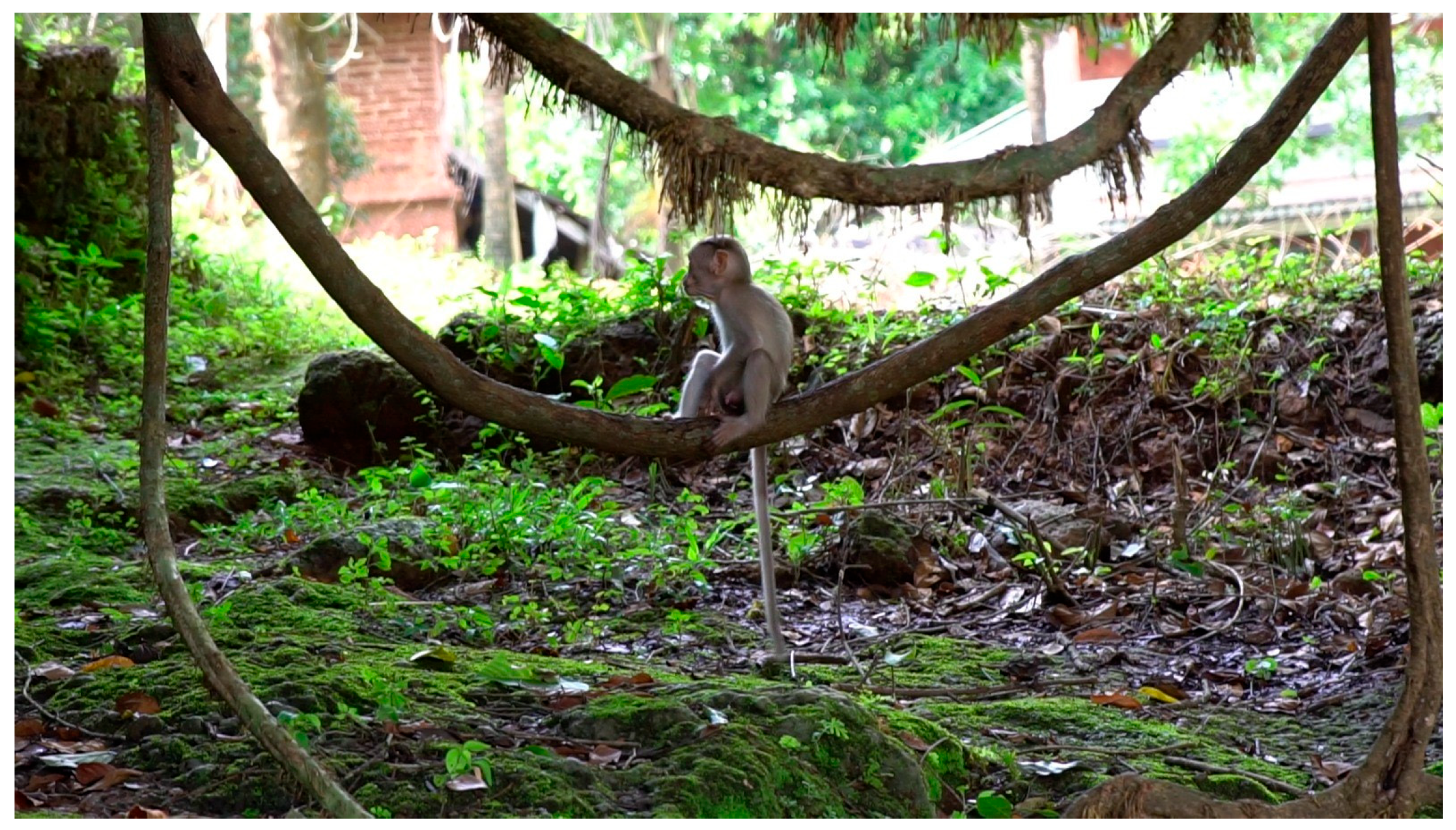
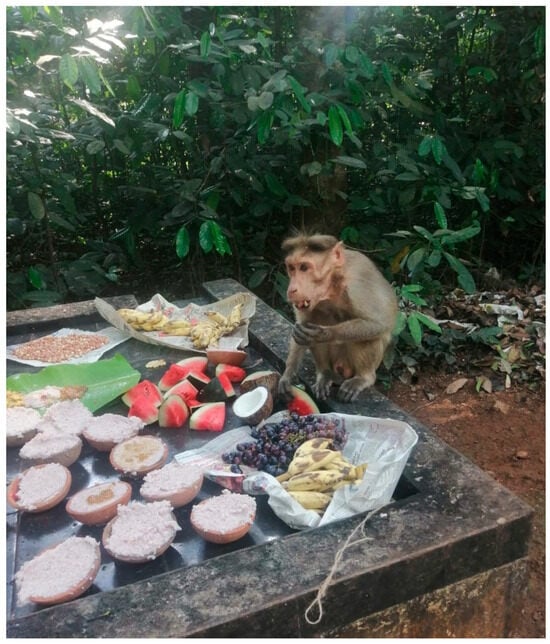
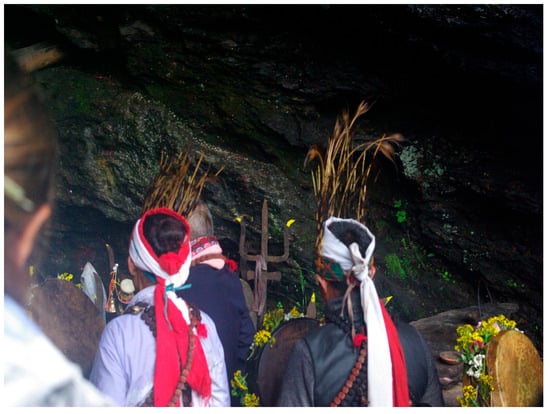
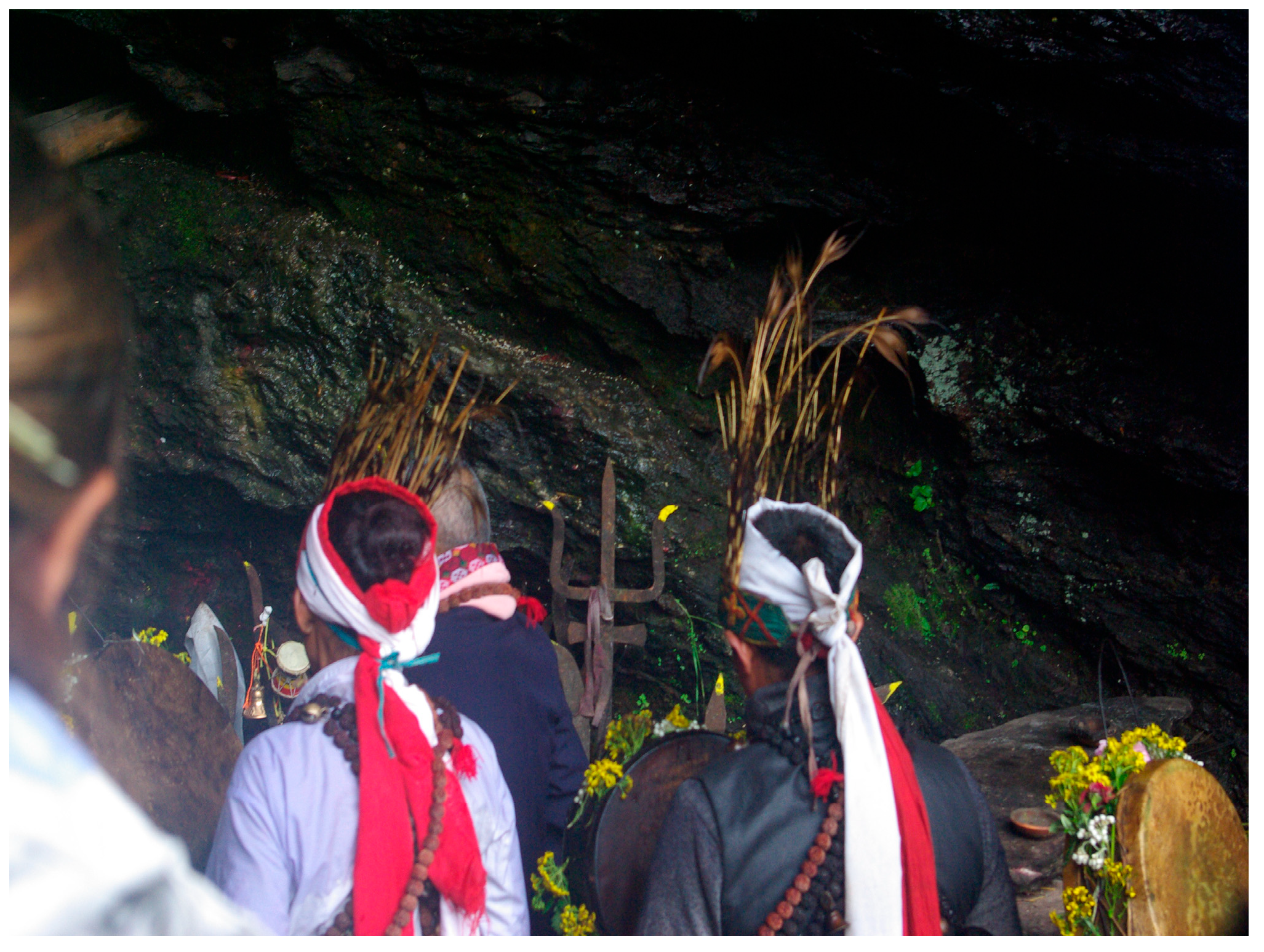
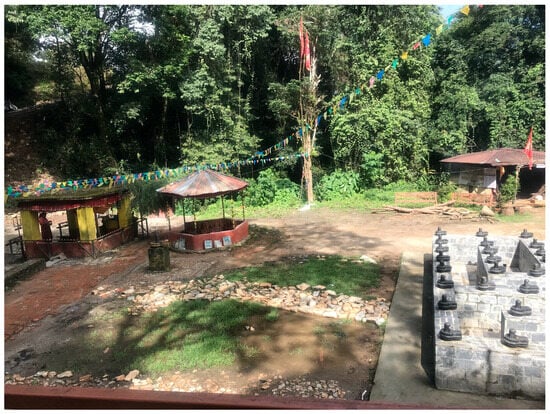
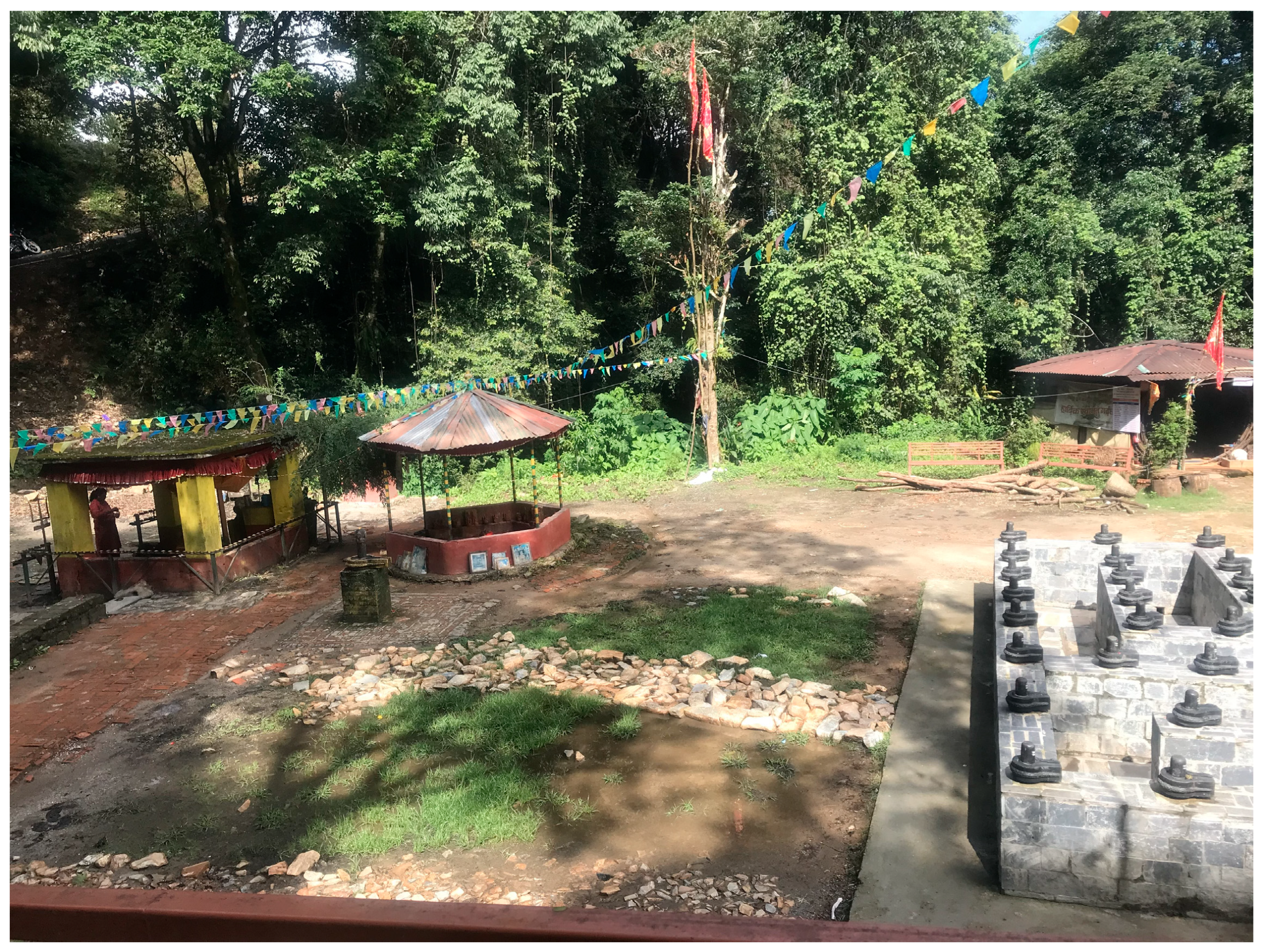
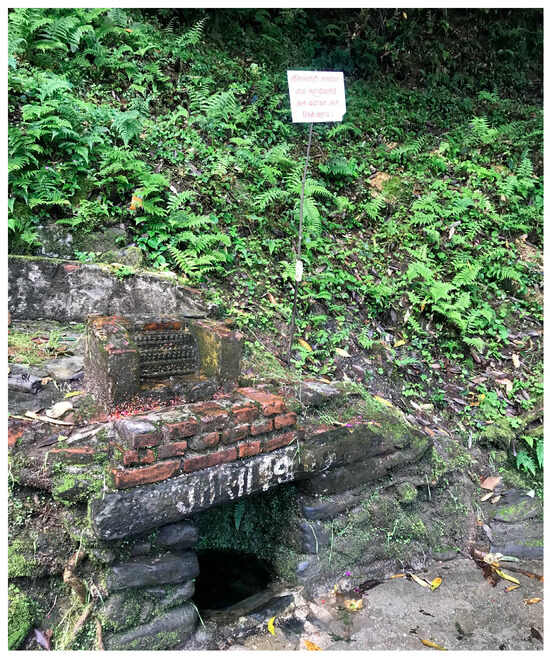
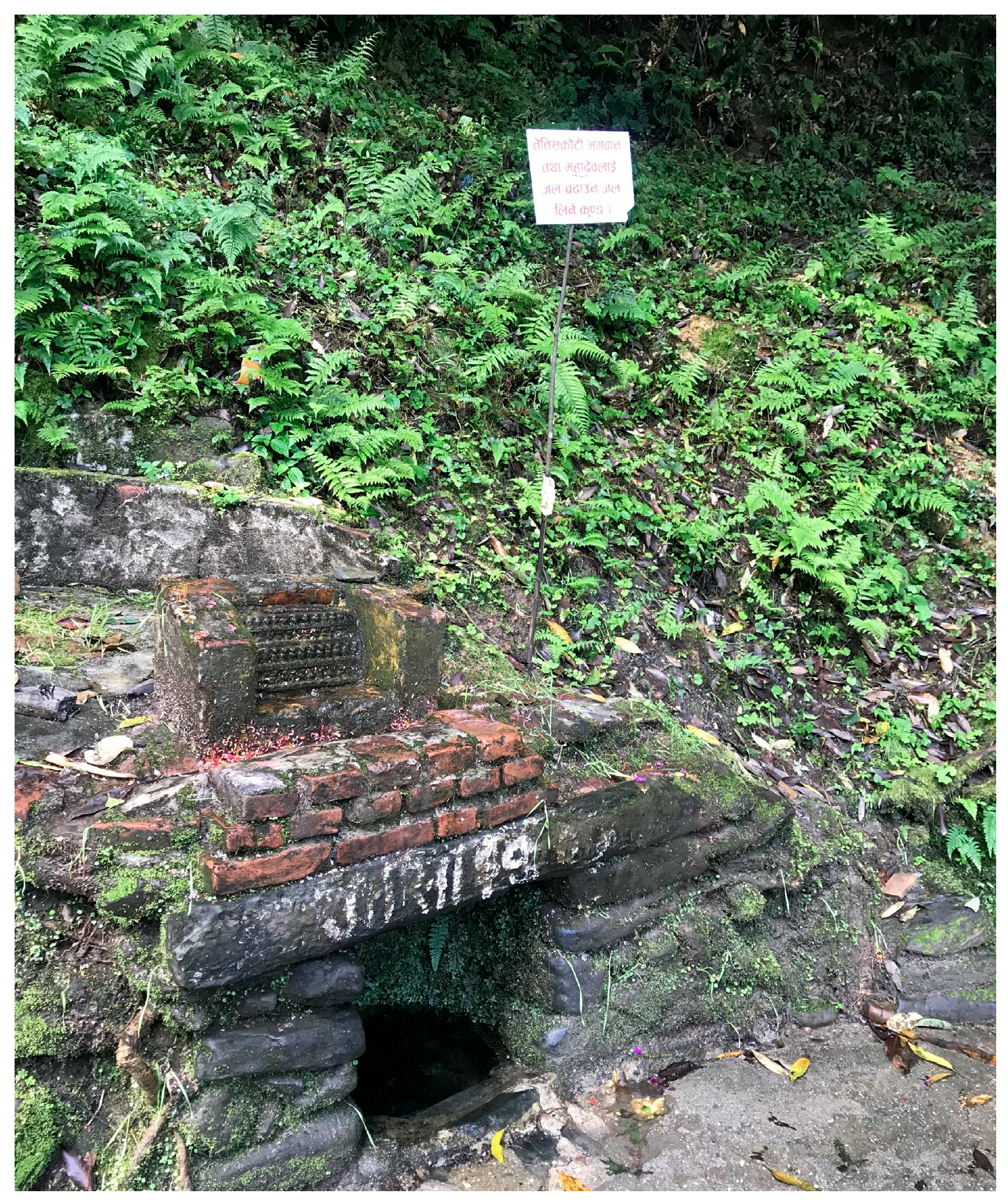

Disclaimer/Publisher’s Note: The statements, opinions and data contained in all publications are solely those of the individual author(s) and contributor(s) and not of MDPI and/or the editor(s). MDPI and/or the editor(s) disclaim responsibility for any injury to people or property resulting from any ideas, methods, instructions or products referred to in the content. |
© 2026 by the authors. Licensee MDPI, Basel, Switzerland. This article is an open access article distributed under the terms and conditions of the Creative Commons Attribution (CC BY) license.