Article

Islamic Social FinTech in Europe: Behavioral Intention to Adopt Blockchain-Based Zakat Platforms

by
Amra Selimović-Fijuljanin
1,
Admir Mešković
2,* and
Šejma Aydin
2
1
Ministry of Foreign Trade and Economic Relations of Bosnia and Herzegovina, 71000 Sarajevo, Bosnia and Herzegovina
2
Faculty of Business and Administration, International University of Sarajevo, Hrasnicka Cesta 15, Ilidža, 71210 Sarajevo, Bosnia and Herzegovina
*
Author to whom correspondence should be addressed.
Religions 2026, 17(1), 78; https://doi.org/10.3390/rel17010078
Submission received: 21 September 2025 / Revised: 14 November 2025 / Accepted: 11 December 2025 / Published: 9 January 2026
(This article belongs to the Special Issue Piety and Ethical Foundations in Islamic Moral Economy)

Abstract

This study examines the behavioral intention of Muslims in Bosnia and Herzegovina to adopt blockchain-based zakat systems. It offers novel insights from a European Islamic context. Prior studies have primarily focused on Southeast Asia and the Middle East. The research develops an SEM model on an extended Unified Theory of Acceptance and Use of Technology framework. Data were collected through a survey of Bosnian Muslims. The aim was to investigate how these factors influence the acceptance of digital zakat platforms. The findings highlight the potential of blockchain to address inefficiencies and trust issues in traditional zakat management. The study shows that performance expectancy, intrinsic religiosity, and trust are significant determinants of adopting blockchain-based zakat platforms. These results emphasize both technological and faith-based drivers of acceptance. Technology can enhance the trustworthiness and inclusivity of zakat administration for a broader group of Muslims in Bosnia and Herzegovina and similar contexts. This work contributes to broader international discussions on the intersection of technology, religion and finance. The article is laying a foundation for the future development of blockchain-based zakat platforms in Muslim societies.

1. Introduction

Zakat is one of the five pillars of Islam and an Islamic social finance instrument. It has an essential role in fighting poverty, promoting social justice, and achieving an equal distribution of wealth. Traditional zakat systems are often seen as ineffective or even mismanaged in many Muslim communities (Owoyemi 2020). A central criticism of contemporary zakat management is the persistent issue of public trust. A lack of trust undermines institutional effectiveness and participation (Mohamed et al. 2023). Poor zakat management can erode public trust in zakat authorities. People often choose to distribute zakat independently. This practice reduces overall institutional participation and collection (Tajuddin and Takril 2023) and limits the wider impact zakat could have in strengthening communities.
Despite some progress in these fields, zakat institutions continue to face challenges related to weak governance structures, limited public trust, inefficient fund distribution, and a lack of long-term strategic planning (Al-Faruq et al. 2025). These concerns are also evident in Bosnia and Herzegovina (B&H), a society with a long tradition of Islamic charitable practices such as zakat and waqf. Historically, these institutions played a central role in social welfare. Today, B&H has a well-organized zakat collection system based on bayt al-mal (Purdić 2023). However, in the contemporary context, marked by expectations of openness and transparency, zakat institutions in B&H largely choose not to share sufficient information about how zakat funds are collected or allocated. As Hasani and Ćeman (2023) concluded in their study, the lack of transparency in zakat expenditures and distributions is the most significant deficiency in zakat management in B&H. Non-transparency and lack of transparency of zakat institutions can lead to the financial inefficiency of such institutions as well (Nasri et al. 2019).
A promising approach to addressing the transparency challenges in zakat management is the adoption of digital technologies. Accountability can be enhanced when zakat institutions provide disclosure of collection and distribution activities (Hadi et al. 2024). Contributors can verify that funds reach intended beneficiaries. Blockchain technology offers a practical solution by creating a tamper-proof and auditable system for tracking cash flows from payer to recipient (Guo and Liu 2025). Any misallocation can be detected. Donors can see how their contributions are used. Empirical research suggests that integrating blockchain into zakat systems has the potential to improve trust and increase zakat collection (Al-Faruq et al. 2025; Azwar and bin Nasir 2025). By embedding blockchain within digital transformation strategies of zakat institutions, Muslim communities can move toward a system that is both technologically resilient and more aligned with contemporary expectations of openness.
Despite extensive discussion of blockchain’s technical merits highlighting transparency, traceability, and auditability (Han et al. 2023; Sedlmeir et al. 2022; Tan et al. 2022), we know far less about how Muslim communities perceive technology–zakat linkages. Recent mappings of the literature show that empirical work on digital or blockchain-enabled zakat is concentrated in Southeast Asia and parts of the Middle East, with Malaysia and Indonesia dominating authorship and cases. These reviews report no studies focused on Europe, including South-Eastern Europe (Rahayu et al. 2025; Farzana et al. 2025).
Adoption studies on digital zakat platforms, typically grounded in Unified Theory of Acceptance and Use of Technology/Technology Acceptance Model, are almost entirely Indonesian or Malaysian (Kasri and Yuniar 2021; Ghofar et al. 2024). This study investigates behavioral intention to adopt blockchain-based zakat platforms among Muslims in B&H. We study zakat attitudes among Bosnian Muslims as an analytically informative European case. B&H hosts an indigenous European Muslim population with six centuries-long presence, embedded in European legal and political institutions (Council of Europe member since 2002 and EU candidate since 2022, with accession talks opened in 2024). Zakat in Bosnia is organized by a unified religious authority—the Islamic Community in B&H. The Islamic Community monitors zakat and sadakatul-fitr collection and administers a Bejtu-l-mal fund. This is a mature, centralized Zakat institution with reach across Europe. This institutional “completeness” makes Bosnia a most-likely European setting for observing how religiosity, institutional trust, and socio-economic factors shape zakat knowledge, compliance, channels, and impact. Following the logic of analytic generalization (Yin 2013) and critical case inference (Flyvbjerg 2006), we generalize from mechanisms observed in B&H to European Muslims more broadly under shared scope conditions (European regulatory context, Sunni majorities, congregational institutions). B&H warrants separate investigation because Europe is an acknowledged blind spot in the blockchain-zakat evidence base, while B&H couples a mature bayt al-māl architecture with a documented transparency deficit. Our model centers trust, making B&H a most-likely case for testing whether transparency-enhancing technologies raise intention to adopt. This combination of a clear evidence gap, salient governance problem, and theory-driven mechanism uniquely qualifies B&H for focused study.
Authors examine determinants of adoption and the extent to which blockchain can address transparency concerns in zakat management. In this study, UTAUT model was extended by including two additional constructs: perceived risk and trust. The goal of this improvement is to provide more comprehensive understanding of user acceptance.
The Unified Theory of Acceptance and Use of Technology (UTAUT) explains why people adopt new systems through four beliefs: performance expectancy (the degree to which using the system helps one achieve desired outcomes), effort expectancy (perceived ease of use), social influence (the extent to which important others think one should use the system), and facilitating conditions (the organizational/technical support available). These beliefs predict behavioral intention and use, and their effects vary by age, gender, experience, and voluntariness of use (Venkatesh et al. 2003). The consumer-focused extension, UTAUT2, adds hedonic motivation, price value, and habit (Venkatesh et al. 2012). Because zakat is a non-profit, religiously motivated activity rather than a consumer purchase, we retain the core UTAUT constructs and extend them with trust, perceived risk, intrinsic religiosity, and digital financial literacy to reflect the Islamic social finance context examined here.
In B&H, debates about zakat routinely turn on the credibility and transparency of formal institutions. Contributors often doubt whether funds are collected and allocated as promised, which depresses participation in official channels. In this setting, trust has two facets we explicitly model: institutional trust as a confidence that recognized religious bodies will exercise amānah (stewardship) and report truthfully; and technology trust in form of confidence that a blockchain-based platform is tamper-evident and auditable, so misallocation would be visible. Perceived risk complements trust by capturing expected loss or harm (e.g., diversion of funds, privacy/security breaches, or perceived Shariah non-compliance) that could steer givers back to informal giving. Because B&H faces acknowledged disclosure shortfalls in zakat reporting, increases in enabling conditions (infrastructure, access) matter only if they translate into credible trust cues; otherwise, residual risk perceptions deter adoption. This is why our model treats trust as a mechanism linking facilitating conditions to intention and includes perceived risk as a potential headwind in the Bosnian case.
Zakat institutions continue to face a credibility and transparency deficit that suppresses participation in formal collection channels. Blockchain promises auditable, tamper-evident reporting, but there is little evidence on whether Muslims in Europe would accept such platforms. Addressing this gap, the study’s objectives are to:
-
Measure behavioral intention to adopt blockchain-based zakat platforms among Muslims in Bosnia and Herzegovina;
-
Test an extended UTAUT model that includes perceived risk and trust, alongside performance expectancy, effort expectancy, social influence, facilitating conditions, digital literacy, and intrinsic religiosity;
-
Examine whether trust mediates the effect of facilitating conditions on intention;
-
Assess the extent to which blockchain’s verifiability and transparency can mitigate longstanding concerns about misuse and opacity;
-
Translate the empirical results into design and policy recommendations for zakat managers and regulators.

2. Theoretical Background

This study applies the maqasid approach to highlight the ethical and religious objectives that shape the use of technology in Islamic social finance. It employs the UTAUT approach as proposed by Venkatesh et al. (2003) to explain adoption intention. It also incorporates an institutional trust perspective, recognizing that acceptance depends not only on technical features but also on confidence in the institution. Digital financial literacy is used to acknowledge that the ability to use and navigate digital financial tools is crucial for the adoption of blockchain-based zakat systems.
Islamic social finance instruments such as zakat, waqf, and ṣadaqah are designed to promote distributive justice. Their effectiveness often depends on public trust and institutional credibility (Abror and Hudayati 2020). Persistent problems of weak governance and limited transparency have been reported across zakat institutions (Alam et al. 2023). Digital transformation is seen as both a managerial necessity and a religious imperative to safeguard the objectives of sharia (maqasid al-sharia). In the context of zakat, this is particularly hifz al-māl (protection of wealth) and hifz al-dīn (protection of religion).
Blockchain is often promoted as a technology that can reduce misuse and fraud in financial transactions (Karadag et al. 2024; Cai and Zhu 2016). Its key features (immutabil-ity, traceability, and auditability) make it suitable for improving transparency (Guo and Liu 2025). In the context of Islamic social finance (ISF), the decision to adopt such technology cannot be reduced to technical efficiency alone. Adoption behavior is shaped by broader social and institutional factors (Usman et al. 2022). This includes values, religiosity, and trust in governing authorities.
By integrating UTAUT constructs with ISF-specific factors, blockchain-based zakat adoption can be conceptualized as the intersection of technological utility (performance and effort expectancy), institutional enablers (facilitating conditions and trust), risk perceptions, religious commitment, and digital capabilities. This extension is theoretically justified because zakat adoption involves both utilitarian evaluations of technology and moral–spiritual evaluations rooted in the maqāṣid al-sharīʿah.
In this research, UTAUT constructs are enriched by the maqāṣid al-sharīʿah. Integrating UTAUT with maqāṣid allows us to formulate propositions about how blockchain-based zakat payment might be evaluated by potential users.
Performance expectancy is often found to be the strongest predictor of behavioral intention (Xue et al. 2024). Prior studies in digital finance suggest that when users perceive new systems as improving efficiency and transparency, adoption likelihood increases. In Islamic social finance context, blockchain may be expected to reduce misallocation, strengthen accountability, and thus support hifz al-māl. Hence, we propose the following:
H1. 
Performance expectancy is positively related to the intention to adopt blockchain-based zakat payment.
Effort expectancy reflects the perceived ease of using technology. Studies indicate that systems that are simpler to use are more readily adopted, particularly by individuals with limited digital experience (Amnas et al. 2023). In the case of zakat, blockchain platforms that appear intuitive and user-friendly may encourage broader participation. This way they support hifz al-ʿaql by reducing cognitive barriers to compliance. Accordingly:
H2. 
Effort expectancy is positively related to the intention to adopt blockchain-based zakat payment.
Social influence emphasizes the role of community expectations and peer endorsement in shaping behavioral intention (Venkatesh et al. 2012). Empirical work in Islamic finance shows that family, friends, and religious leaders can significantly affect decisions (Al Balushi et al. 2019). For zakat, endorsement of blockchain-based platforms may signal legitimacy and strengthen adherence to religious obligations, linking adoption to hifz al-dīn. Thus:
H3. 
Social influence is positively related to the intention to adopt blockchain-based zakat payment.
Facilitating conditions refer to the degree to which users believe that institutional and infrastructural support is available. While prior studies confirm their importance (Venkatesh et al. 2012), scholars also note that trust may play a mediating role in digital finance (Chawla et al. 2023). In zakat, confidence in both the technology and the administering institutions may be necessary for facilitating conditions to translate into intention. We therefore suggest:
H4a. 
Facilitating conditions is positively related to the intention to adopt blockchain-based zakat payment.
H4b. 
Trust mediates the relationship between facilitating conditions and intention to adopt blockchain-based zakat payment.
Perceived risk has been identified as a barrier in many studies of fintech adoption. Concerns about security, misuse, or uncertainty of outcomes tend to lower adoption intentions (Appiah and Agblewornu 2025). In zakat, such risks may discourage formal giving and encourage informal alternatives. This can potentially undermine both hifz al-māl and hifz al-dīn. Accordingly:
H5. 
Perceived risk is negatively related to the intention to adopt blockchain-based zakat payment.
Another relevant factor is religiosity, which has been shown to influence technology adoption in Islamic contexts (Khraim 2010; Ali et al. 2015). Highly religious individuals may be more willing to adopt innovations that help fulfill religious obligations. If blockchain is perceived as enhancing accountability and ensuring Shariah compliance, it may be seen as supportive of hifz al-dīn. Thus, we propose:
H6. 
Intrinsic religiosity is positively related to the intention to adopt blockchain-based zakat payment.
Finally, digital literacy has been linked in prior research to participation in digital finance (Alliance for Financial Inclusion 2021; Islam and Khan 2024). Individuals with higher levels of digital literacy may feel more confident in engaging with blockchain platforms, potentially supporting both hifz al-ʿaql and hifz al-māl. Based on this reasoning:
H7. 
Digital literacy is positively related to the intention to adopt blockchain-based zakat payment.

3. Materials and Methods

The participants of this study were self-declared adult Muslims from B&H. A cross-sectional survey design was used for data collection. The questionnaire was preceded with a cover letter, explaining the purpose of the study, and asking for consent for participation. Participation was voluntary, confidentiality was maintained, and no personal identifiers were collected. All items were mandatory to ensure complete datasets. After data cleaning, only fully completed questionnaires that met inclusion criteria were analyzed.
The participants were selected using non-probability snowball sampling, a common approach in exploratory technology adoption research (Etikan et al. 2016; Baltar and Brunet 2012). This approach was adopted due to lack of access to the list of all Muslim adults in B&H. The participants were contacted in-person, via email and social media. The data were collected in 2025 and after the procedure was completed, it was cleaned to prepare for the analysis, resulting in 255 viable responses. Of the 1440 individuals initially contacted, 255 fully completed and eligible responses were retained for analysis (thus 1185 were excluded). Given the study’s multi-channel recruitment (in-person, email, social media), mandatory items that eliminated partial responses, and the sample’s demographic diversity, material nonresponse bias is unlikely to compromise the findings.
The final sample was diverse in gender, age, and education, with a slight female majority (50.4%) and a large proportion of respondents holding at least an undergraduate degree (43.5%).
Nine different variables were used in this study. As the analysis is grounded in the UTAUT, the original constructs developed by Venkatesh et al. (2003) were used to measure performance expectancy, effort expectancy, social influence, facilitating conditions, and behavioral intention. They were adopted to better capture ISF context. Perceived risk was adopted from fintech literature, specifically, construct developed by Featherman and Pavlou (2003) and trust from banking literature, using constructs by Gefen et al. (2003) and Featherman and Pavlou (2003). Further, intrinsic religiosity was incorporated using established religiosity scales (Allport and Ross 1967; Khraim 2010; Ali et al. 2015), and digital financial literacy relied on OECD (2024) framework.
While digital financial literacy was measured as categorical variable, using frequency scales (daily, weekly, monthly, etc.), the items for rest of the constructs were measured using five-point Likert Scale.
Data were analyzed using a two-stage approach in IBM SPSS 29 and IBM AMOS 28. First, the measurement model was validated. Reliability was confirmed with Cronbach’s alpha values above 0.70, meeting established standards (Taber 2018). Convergent validity was supported by SFL > 0.50, AVE > 0.50, and CR > 0.60 (Bagozzi and Yi 1991). Discriminant validity was established by comparing the square root of AVE with inter-construct correlations (Fornell and Larcker 1981).
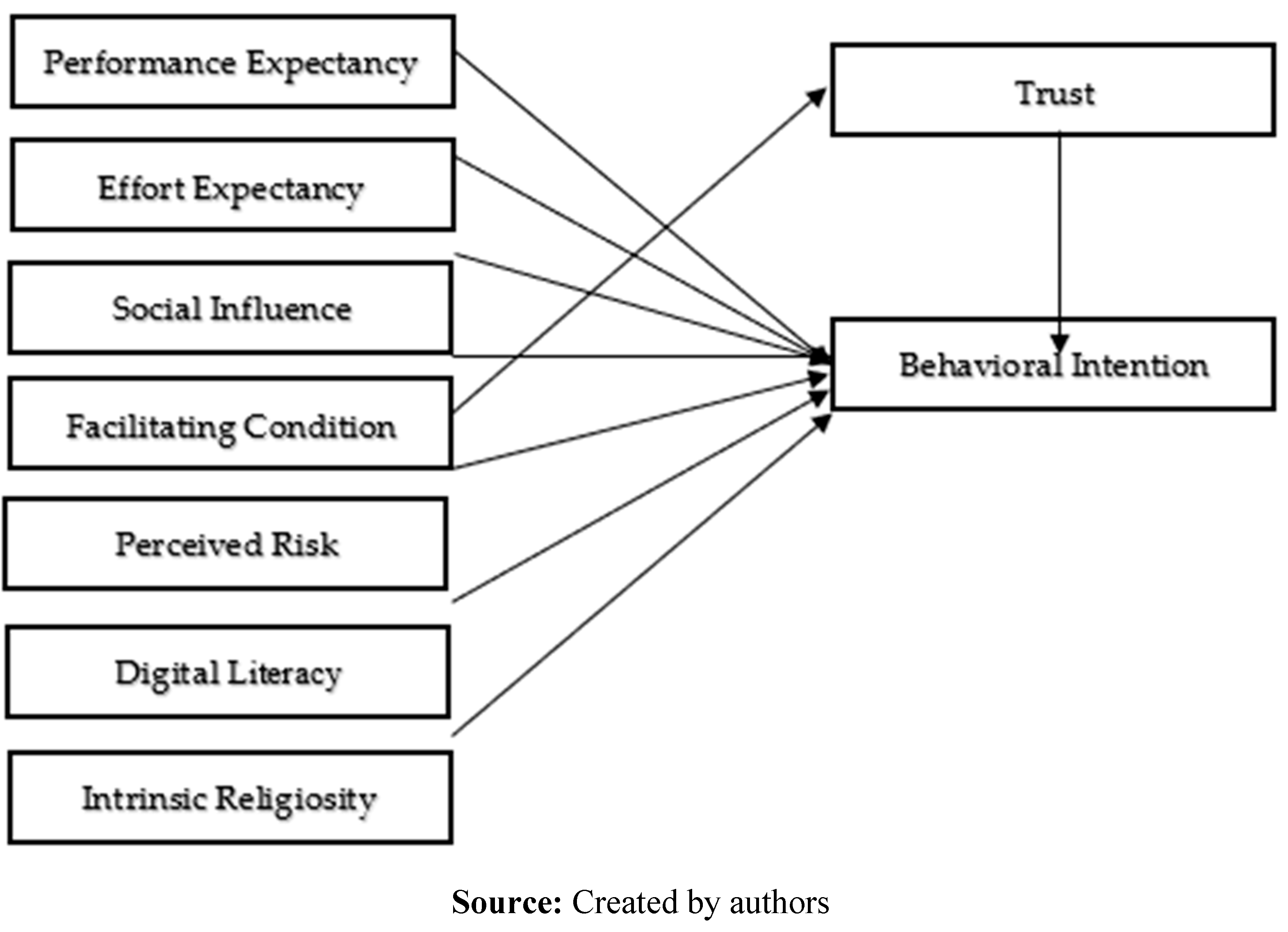
In the second stage, Structural Equation Modeling (SEM) was used to test hypothesized relationships, including direct and indirect effects. SEM was chosen since it allows for simultaneous testing of complex relationships among latent constructs. The mediating role of trust in blockchain-based zakat adoption was also examined. Bootstrapping with 2000 resamples was conducted to assess the significance of indirect paths, ensuring robust mediation analysis. The final model tested the effects of Performance Expectancy, Effort Expectancy, Social Influence, Facilitating Conditions, Perceived Risk, Digital Literacy, Intrinsic Religiosity, and Trust on Behavioral Intention to adopt blockchain-based zakat systems. The conceptual model is presented in Figure 1 and Table 1.

4. Results

The pre-testing stage included descriptive statistics, reliability and validity. The results are presented in Table 2 and Table 3.
Several key conclusions can be drawn from this stage. First, all constructs achieved high internal consistency, with Cronbach’s alpha coefficients exceeding the commonly accepted threshold of 0.70 (Taber 2018). Second, all constructs demonstrated good convergent validity, with standardized factor loadings above 0.50, composite reliability (CR) values above 0.60, and average variance extracted (AVE) above 0.50 (Bagozzi and Yi 1991). Third, discriminant validity was evaluated for all constructs using the Fornell–Larcker criterion, the results show that the square root of AVE was greater than inter-construct correlations in all but one case. Specifically, the square root of AVE for Intrinsic Religiosity (IR) was lower than its correlation with Digital Literacy (DL), which suggests partial overlap between the two constructs. However, this was not confirmed as problematic as the two are theoretically different, and based on the HTMT analysis all these values remained below the liberal threshold of 0.90 (Henseler et al. 2015). Therefore, the constructs demonstrate adequate discriminant validity.
Before testing the hypotheses, model fit was assessed. The fit indices (χ2 = 1413.964, df = 635, χ2/df = 2.227, Tucker–Lewis Index (TLI) = 0.902, Comparative Fit Index (CFI) = 0.912, and Root Mean Square Error of Approximation (RMSEA) = 0.069 with a 90% CI [0.065, 0.074]) indicated an acceptable model fit. Additional indices such as the Normed Fit Index (NFI = 0.851), Relative Fit Index (RFI = 0.835), and Incremental Fit Index (IFI = 0.912) also supported the adequacy of the model.
After confirming an acceptable model fit, the individual relationships between constructs were examined, as outlined in the hypotheses. Table 4 presents the standardized estimates for both direct and indirect effects.
Several conclusions can be drawn based on the values of the standardized path coefficients. First, Performance Expectancy has a significant and positive effect on Behavioral Intention (β = 0.412, p = 0.01), thereby supporting H1. This indicates that individuals are more likely to intend to use the system when they perceive it as beneficial for their performance.
On the contrary, Effort Expectancy (β = 0.149, p = 0.233) and Social Influence (β = 0.023, p = 0.84) are not significant predictors of Behavioral Intention. Hence, H2 and H3 were not supported.
The direct effect of Facilitating Conditions on Behavioral Intention is negative and marginally non-significant (β = −0.380, p = 0.072), leading to the rejection of H4a. However, when mediated by Trust, Facilitating Conditions demonstrate a significant indirect effect on Behavioral Intention (β = 0.363, p = 0.013). This result supports H4b, highlighting that trust plays a critical mediating role in the relationship between facilitating conditions and intention. Given that H4a is rejected and H4b is supported, the results demonstrate full mediation by Trust in the relationship between Facilitating Conditions and Behavioral Intention.
Further, the results also show that Perceived Risk had no significant relationship with Behavioral Intention (β = −0.060, p = 0.114), thus rejecting H5. In contrast, Intrinsic Religiosity was found to be a significant positive predictor of Behavioral Intention (β = 0.311, p = 0.021), supporting H6. Finally, Digital Literacy did not exhibit a significant effect on Behavioral Intention (β = 0.149, p = 0.194), leading to the rejection of H7. The summary of hypotheses testing results is available in Table 5.

5. Discussion

As seen in Table 5, the findings suggest a combination of standard technology drivers and religiously motivated factors. Performance expectancy is a strong positive predictor of intention, echoing evidence from Indonesia (Kasri and Yuniar 2021; Juniati and Widiastuti 2024) and broader technology adoption research (Lai et al. 2009; Ahmad 2014). When users expect the platform to make zakat payments faster and more reliable, they are more inclined to adopt a blockchain-based system.
Intrinsic religiosity shows a significant positive association with intention to use blockchain-based zakat payment systems. Individuals with more profound internal religious commitment assess technologies not only for their practical benefits but also for their spiritual and moral fit (Chaudhuri et al. 2023). In this setting, faith-based motives can be even more influential than purely utilitarian considerations.
Trust plays a central role in how supportive conditions translate into behavior. Trust fully mediates the link between facilitating conditions and intention (H4b), while the direct path from facilitating conditions to intention is not significant (H4a). In other words, infrastructure and institutional support matter because they build trust, and it is trust that ultimately drives the intention to use blockchain-based zakat payment systems. This pattern is consistent with prior work showing that trust mediates the influence of facilitating conditions on behavioral intention (Hooda et al. 2022) and that supportive conditions foster trust, which in turn encourages adoption (Lu et al. 2005). Taken together, the results underscore that trust is the mechanism that converts supportive conditions into actual use.
Another important finding is that several hypotheses were unsupported and warrant discussion. Effort expectancy (H2) is not significantly related to behavioral intention. This could suggest that users no longer perceive blockchain-based services as difficult to use. Usability is no longer a barrier in increasingly digital cultures. Similarly, social influence (H3) was not a significant predictor. This is in line with results from Afifah et al. (2025) for study conducted in Indonesia. Combined with the other findings, the insignificant results may suggest the private and religious nature of zakat. Contrary to expectations from social influence theories, zakat-related decisions are often made independently. They are shaped more by individual beliefs and convictions than by peer behaviors (Hakimi et al. 2021). The observation that effort expectancy and social influence were non-significant echoes UTAUT research in supply chain smart contract adoption, where only performance expectancy predicted intention (Müller 2025).
Perceived risk (H5) was not significantly linked to behavioral intention. Similar findings in mobile banking show that perceived risk often fails to predict behavioral intention (Apaua and Lallie 2022). Likewise, digital literacy (H7) did not significantly influence behavioral intention. This suggests that user-friendly system design reduces the need for high technical skills, with religious motivation and institutional trust playing a stronger role. Recent work also shows that while digital literacy affects effort expectancy, it does not directly shape behavioral intention (Kabakus et al. 2025). Taken together, these results suggest that adoption of blockchain-based zakat platforms is less about overcoming technical or security barriers, and more about aligning with faith-based values and cultivating trust in institutions.
Our sample shows high average ease of use and digital literacy, which likely compresses variance and weakens the unique effects of EE and DL. In fact, both constructs correlate strongly with intention bivariately but lose significance in the full SEM where performance expectancy, trust, and intrinsic religiosity dominate. This is consistent with UTAUT’s view that age moderates EE’s impact and that ease/literacy function as threshold conditions in digitally capable samples
B&H’s setting helps explain our pattern of results and clarifies how this context differs from many Southeast Asian or MENA cases. Social influence did not predict intention (β = 0.023, p = 0.84), whereas intrinsic religiosity (β = 0.311, p = 0.021) and trust were decisive, with facilitating conditions shaping intention only through trust (indirect β = 0.363, p = 0.013). In Bosnia, adoption hinges on institutional credibility and verifiable transparency rather than on peer endorsement. Where communal campaigns are more salient (as often in SEA/MENA), social influence may matter more. The practical implication is to prioritize auditability, disclosure, and Shariah governance features over peer-driven nudges when designing and communicating digital zakat tools for European Muslim users.

Implications

This study advances UTAUT in several ways. First, it highlights the need to account for value-based factors, when considering faith-driven contexts, such as zakat. Second, it demonstrates that trust fully mediates the relationship between facilitating conditions and behavioral intention, showing that institutional support matters only when it instills trust in the system. Third, it shows that adoption dynamics in Muslim-minority context differ from Muslim-majority settings. Specifically, usability, social influence and digital literacy are less relevant, while trust and religiosity dominate. Combined, these results underline the need to adapt technology adoption theories to cultural and religiosity context, ensuring they capture the mechanisms most relevant for ISF.
The findings suggest that promoting blockchain-based technologies in B&H requires more than technical readiness. Usability and peer influence appear secondary to cultivating trust in institutions and promoting religious values. Therefore, zakat authorities and fintech providers should focus on promoting transparency, accountability and shariah compliance. The practical value of this study lies in showing that adoption of blockchain technologies in zakat systems can be more than a technical solution. It can also provide a credible and faith-affirming approach to strengthening zakat systems where trust is fragile.

6. Conclusions

This study examined the behavioral intention to adopt blockchain-based zakat platforms in B&H by extending the UTAUT framework with constructs that reflect the religious and institutional context. Performance expectancy was the strongest predictor of intention. Faith-based motivation shapes technology acceptance in Islamic finance, with more religious individuals more inclined to adopt tools that enhance transparency. Trust proved decisive as well, especially as the mediator between facilitating conditions and intention, suggesting that institutional credibility and reliable technology reduce uncertainty and build the confidence needed for uptake. These patterns translate into clear action points. Zakat institutions and policymakers should prioritize trust-building and transparent reporting to enhance institutional credibility.
Future work should test generalizability through cross-cultural comparisons and use longitudinal or qualitative approaches to track how adoption factors evolve over time. Such studies would deepen our understanding of the socio-religious dimensions of digital technology adoption in Islamic finance.

Author Contributions

Conceptualization, A.M.; methodology, Š.A.; software, Š.A.; investigation (survey organization and distribution), A.M. and A.S.-F.; data curation, A.M.; writing—original draft preparation, A.M. and A.S.-F. (pre-draft); writing—review and editing, Š.A.; project administration, A.M. All authors have read and agreed to the published version of the manuscript.

Funding

This research received no external funding.

Institutional Review Board Statement

The study was conducted in accordance with the Declaration of Helsinki and approved by the Ethics Committee of the Economic and Social Research Institute (protocol code 02-33/2024; approved on 2 April 2024). In addition, institutional ethical clearance was obtained from the International University of Sarajevo Ethical Council (protocol code IUS-REC-01-3446/25).

Informed Consent Statement

Informed consent was obtained from all subjects involved in the study.

Data Availability Statement

Data are contained within the article.

Conflicts of Interest

The authors declare no conflicts of interest.

Abbreviations

The following abbreviations are used in this manuscript:
B&HBosnia and Herzegovina
UTAUTUnified Theory of Acceptance and Use of Technology

References

  1. Abror, Arsyad, and Ataina Hudayati. 2020. The effect of distributive justice on intention to pay zakat through zakat institutions using affective and cognitive trust as intervening variables. Jurnal Ekonomi & Keuangan Islam 6: 24–33. [Google Scholar] [CrossRef][Green Version]
  2. Afifah, Kuni, Mohd Fauzi Abu-Hussin, and Muhammad Bilal Zafar. 2025. Transforming Islamic social finance: Determinants of blockchain technology adoption for zakat payment. Journal of Islamic Accounting and Business Research. ahead-of-print. [Google Scholar] [CrossRef]
  3. Ahmad, Mohammad I. 2014. Unified theory of acceptance and use of technology (UTAUT): A decade of validation and development. Paper presented at the 4th International Conference on ICT in Our Lives, Alexandria, Egypt, December 20–22, ISSN 2314–8942. [Google Scholar]
  4. Alam, Azhar, Ririn Tri Ratnasari, Muhamad Nafik Hadi Ryandono, Ari Prasetyo, and Estina Rahmawati. 2023. Trust Studies of Zakat Institutions: A Systematic Review for Future Research Direction. International Journal of Emerging Issues in Islamic Studies (IJEIIS) 3: 1–15. [Google Scholar] [CrossRef]
  5. Al Balushi, Yasmeen, Stuart Locke, and Zakaria Boulanouar. 2019. Determinants of the decision to adopt Islamic finance: Evidence from Oman. ISRA International Journal of Islamic Finance 11: 6–26. [Google Scholar] [CrossRef]
  6. Al-Faruq, Thanos, Ghaisan Ahmad Hafis, and Latheef Rizwan. 2025. Analysis of the Effectiveness of Zakat Collection Institutions in Managing Islamic Social Funds. Seriat Ekonomisi 2: 9–16. [Google Scholar] [CrossRef]
  7. Ali, Basharat, Nazim Hussain Baluch, and Zulkifli Mohamed Udin. 2015. The Moderating Effect of Religiosity on the Relationship between Trust and Diffusion of Electronic Commerce. Modern Applied Science 9: 176–176. [Google Scholar] [CrossRef]
  8. Alliance for Financial Inclusion. 2021. Digital Financial Literacy: Enhancing Inclusive Finance in the Digital Age. Kuala Lumpur: AFI. [Google Scholar]
  9. Allport, Gordon W., and J. Michael Ross. 1967. Personal religious orientation and prejudice. Journal of personality and social psychology 5: 432. [Google Scholar] [CrossRef]
  10. Amnas, Muhammed Basid, Murugesan Selvam, Mariappan Raja, Sakthivel Santhoshkumar, and Satyanarayana Parayitam. 2023. Understanding the determinants of FinTech adoption: Integrating UTAUT2 with trust theoretic model. Journal of Risk and Financial Management 16: 505. [Google Scholar] [CrossRef]
  11. Apaua, Richard, and Harjinder Singh Lallie. 2022. Measuring user perceived security of mobile banking applications. arXiv arXiv:2201.03052. [Google Scholar] [CrossRef]
  12. Appiah, Thomas, and Veronica Venyo Agblewornu. 2025. The interplay of perceived benefit, perceived risk, and trust in Fintech adoption: Insights from Sub-Saharan Africa. Heliyon 11: 2. [Google Scholar] [CrossRef]
  13. Azwar, Azwar, and Mohd Norzi bin Nasir. 2025. Global publication trends on zakat management strategy: A bibliometric analysis. Review of Islamic Social Finance and Entrepreneurship 4: 17–32. [Google Scholar] [CrossRef]
  14. Bagozzi, Richard P., and Youjae Yi. 1991. Multitrait-multimethod matrices in consumer research. Journal of Consumer Research 17: 426–39. [Google Scholar] [CrossRef]
  15. Baltar, Fabiola, and Ignasi Brunet. 2012. Social research 2.0: Virtual snowball sampling method using Facebook. Internet Research 22: 57–74. [Google Scholar] [CrossRef]
  16. Cai, Yuanfeng, and Dan Zhu. 2016. Fraud detections for online businesses: A perspective from blockchain technology. Financial Innovation 2: 20. [Google Scholar] [CrossRef]
  17. Chaudhuri, Ranjan, Sheshadri Chatterjee, Demetris Vrontis, and Evangelia Siachou. 2023. Examining the impact of intrinsic and extrinsic religiosity on adoption of emerging technologies by entrepreneurs. Journal for Global Business Advancement 16: 440–66. [Google Scholar] [CrossRef]
  18. Chawla, Udit, Rajesh Mohnot, Harsh Vikram Singh, and Arindam Banerjee. 2023. The mediating effect of perceived trust in the adoption of cutting-edge financial technology among digital natives in the post-COVID-19 era. Economies 11: 286. [Google Scholar] [CrossRef]
  19. Etikan, Ilker, Sulaiman Abubakar Musa, and Rukayya Sunusi Alkassim. 2016. Comparison of convenience sampling and purposive sampling. American Journal of Theoretical and Applied Statistics 5: 1–4. [Google Scholar] [CrossRef]
  20. Farzana, Nusrat, Piana Monsur Mindia, Sharifah Norzehan Syed Yusuf, Mohd Nazmul Hoque, Abd Hadi Mustaffa, Mahmood Ahmed, and Md Qamruzzaman. 2025. Analysing a decade of zakat research through bibliometric analysis: Previous achievements, present patterns, and future avenues. Journal of Infrastructure, Policy and Development 9: 10365. [Google Scholar] [CrossRef]
  21. Featherman, Mauricio S., and Paul A. Pavlou. 2003. Predicting e-services adoption: A perceived risk facets perspective. International Journal of Human-Computer Studies 59: 451–474. [Google Scholar] [CrossRef]
  22. Flyvbjerg, Bent. 2006. Five misunderstandings about case-study research. Qualitative Inquiry 12: 219–45. [Google Scholar] [CrossRef]
  23. Fornell, Claes, and David F. Larcker. 1981. Evaluating structural equation models with unobservable variables and measurement error. Journal of Marketing Research 18: 39–50. [Google Scholar] [CrossRef]
  24. Gefen, David, Elena Karahanna, and Detmar W. Straub. 2003. Trust and TAM in online shopping: An integrated model. MIS Quarterly 27: 51–90. [Google Scholar] [CrossRef]
  25. Ghofar, Abdul, Muhammad Fawwaz, Silvi Asna Prestianawati, Muhammad Faraz Mubarak, Asfi Manzilati, and Tsumma Lazuardini Imamia. 2024. Young muslim generation’s preferences for using digital platforms for Zakat payments: A cross-country study of Indonesia and Malaysia. Journal of Infrastructure, Policy and Development 8: 3249. [Google Scholar] [CrossRef]
  26. Guo, Haochen, and Xiaoxing Liu. 2025. Exploring trust dynamics in finance: The impact of blockchain technology and smart contracts. Humanities and Social Sciences Communications 12: 1235. [Google Scholar] [CrossRef]
  27. Hadi, Rahmini, Yoiz Shofwa Shafrani, Dewi Lamela Hilyatin, and Sugeng Riyadi. 2024. Digital zakat management, transparency in zakat reporting, and the zakat payroll system toward zakat management accountability and its implications on zakat growth acceleration. International Journal of Data & Network Science 8: 597–608. [Google Scholar]
  28. Hakim, Fifi, Tika Widiastuti, Muhammad Ubaidillah, and Rizqiyah Al. 2021. Positive effect of attitude, peer influence, and knowledge zakat on zakat compliance behavior: Update in COVID 19. Journal of Islamic Economic Laws 9: 1–16. [Google Scholar] [CrossRef]
  29. Han, Hongdan, Radha K. Shiwakoti, Robin Jarvis, Chima Mordi, and David Botchie. 2023. Accounting and auditing with blockchain technology and artificial Intelligence: A literature review. International Journal of Accounting Information Systems 48: 100598. [Google Scholar] [CrossRef]
  30. Hasani, Mustafa, and Senad Ćeman. 2023. Zakat i sadekatul-fitr u praksi muslimana u Bosni i Hercegovini:-prikaz dijela rezultata provedene ankete. Novi Muallim 24: 21–28. [Google Scholar]
  31. Henseler, Jörg, Christian M. Ringle, and Marko Sarstedt. 2015. A new criterion for assessing discriminant validity in variance-based structural equation modeling. Journal of the Academy of Marketing Science 43: 115–135. [Google Scholar] [CrossRef]
  32. Hooda, Apeksha, Parul Gupta, Anand Jeyaraj, Mihalis Giannakis, and Yogesh K. Dwivedi. 2022. The effects of trust on behavioral intention and use behavior within e-government contexts. International Journal of Information Management 67: 102553. [Google Scholar] [CrossRef]
  33. Islam, KM Anwarul, and Muhammad Saifuddin Khan. 2024. The role of financial literacy, digital literacy, and financial self-efficacy in FinTech adoption. Investment Management & Financial Innovations 21: 370–80. [Google Scholar]
  34. Juniati, Wike, and Tika Widiastuti. 2024. Intention to adopt blockchain technology for zakat management in Indonesia. Paper presented at the 9th International Conference on Electronic Business, Macau, China, November 30–December 4. [Google Scholar]
  35. Kabakus, Ahmet Kamil, Ekrem Bahcekapili, and Ahmet Ayaz. 2025. The effect of digital literacy on technology acceptance: An evaluation on administrative staff in higher education. Journal of Information Science 51: 930–41. [Google Scholar] [CrossRef]
  36. Karadag, Bulut, Akhan Akbulut, and Abdul Halim Zaim. 2024. Blockchain in Finance: A Systematic Literature Review. Journal of Business Economics and Finance 13: 113–29. [Google Scholar] [CrossRef]
  37. Kasri, Rahmatina Awaliah, and Adela Miranti Yuniar. 2021. Determinants of digital zakat payments: Lessons from Indonesian experience. Journal of Islamic Accounting and Business Research 12: 362–79. [Google Scholar] [CrossRef]
  38. Khraim, Hamza. 2010. Measuring religiosity in consumer research from an Islamic perspective. Journal of Economic and Administrative Sciences 26: 52–78. [Google Scholar] [CrossRef]
  39. Lai, Donny CF, Ivan KW Lai, and Ernest Jordan. 2009. An extended UTAUT model for the study of negative user adoption behaviours of mobile commerce. Paper presented at the 9th International Conference on Electronic Business, Macau, China, November 30—December 4. [Google Scholar]
  40. Lu, June, Chun-Sheng Yu, and Chang Liu. 2005. Facilitating conditions, wireless trust and adoption intention. Journal of Computer Information Systems 46: 17–24. [Google Scholar]
  41. Mohamed, Dr, Mohamud Ahmed, Mahad Abdiwali Mohamed, and Omar Ahmed Mohamud. 2023. The role of blockchain technology on zakat institutions, a way forward: Literature review. International Journal of Membrane Science and Technology 10: 1996–2009. [Google Scholar] [CrossRef]
  42. Müller, Wieland. 2025. Determinants of smart contract adoption in supply chains: A UTAUT-based PLS-SEM analysis. Operations Management Research 18: 1113–1124. [Google Scholar] [CrossRef]
  43. Nasri, Rifzaldi, Nur Aeni, and Marissa Grace Haque-Fawzi. 2019. Determination of professionalism and transparency and its implications for the financial performance of zakat institutions. Journal of Islamic Monetary Economics and Finance 5: 785–806. [Google Scholar] [CrossRef]
  44. OECD. 2024. OECD/INFE Survey Instrument to Measure Digital Financial Literacy. Paris: OECD. [Google Scholar]
  45. Owoyemi, Musa Yusuf. 2020. Zakat management: The crisis of confidence in zakat agencies and the legality of giving zakat directly to the poor. Journal of Islamic Accounting and Business Research 11: 498–510. [Google Scholar] [CrossRef]
  46. Purdić, Ahmed. 2023. Fond Bejtul-mal Islamske zajednice u Bosni i Hercegovini: Dostignuća i perspektive. Novi Muallim 24: 29–36. [Google Scholar]
  47. Rahayu, Nurul Widyawati Islami, Nasirudin Al Ahsani, Dhama Suroyya, and Agus Yudiawan. 2025. A bibliometric analysis of blockchain-based zakat system design: Solutions for transparency and oversight of zakat funds in the digital era. Academic Journal of Interdisciplinary Studies 14: 332–344. [Google Scholar] [CrossRef]
  48. Sedlmeir, Johannes, Jonathan Lautenschlager, Gilbert Fridgen, and Nils Urbach. 2022. The transparency challenge of blockchain in organizations. Electronic Markets 32: 1779–94. [Google Scholar] [CrossRef]
  49. Taber, Keith S. 2018. The use of Cronbach’s alpha when developing and reporting research instruments in science education. Research in Science Education 48: 1273–96. [Google Scholar] [CrossRef]
  50. Tajuddin, Teh Suhaila, and Nur Fikhriah Takril. 2023. Trust in zakat authorities and zakat compliance: A conceptual analysis. International Journal of Mosque, Zakat and Waqaf Management (Al-Mimbar) 3: 115–128. [Google Scholar] [CrossRef]
  51. Tan, Evrim, Stanislav Mahula, and Joep Crompvoets. 2022. Blockchain governance in the public sector: A conceptual framework for public management. Government Information Quarterly 39: 101625. [Google Scholar] [CrossRef]
  52. Usman, Hardius, Dipa Mulia, Chairy Chairy, and Nucke Widowati. 2022. Integrating trust, religiosity and image into technology acceptance model: The case of the Islamic philanthropy in Indonesia. Journal of Islamic Marketing 13: 381–409. [Google Scholar] [CrossRef]
  53. Venkatesh, Viswanath, James YL Thong, and Xin Xu. 2012. Consumer acceptance and use of information technology: Extending the unified theory of acceptance and use of technology. MIS Quarterly 36: 157–78. [Google Scholar] [CrossRef]
  54. Venkatesh, Viswanath, Michael G. Morris, Gordon B. Davis, and Fred D. Davis. 2003. User acceptance of information technology: Toward a unified view. MIS Quarterly 27: 425–78. [Google Scholar] [CrossRef]
  55. Xue, Liangyong, Abdullah Mat Rashid, and Sha Ouyang. 2024. The unified theory of acceptance and use of technology (UTAUT) in higher education: A systematic review. Sage Open 14: 21582440241229570. [Google Scholar] [CrossRef]
  56. Yin, Robert K. 2013. Validity and generalization in future case study evaluations. Evaluation 19: 321–32. [Google Scholar] [CrossRef]
Figure 1. Conceptual framework of the study.
Religions 17 00078 g001
Table 1. Integrated framework UTAUT + Maqāṣid.
ConstructDescriptionLinked Maqāṣid Outcomes
Performance expectancyBelief that blockchain improves efficiency, reliability, and transparency.Hifz al-māl (protection of wealth)
Effort expectancyPerceived ease of use and reduced complexity in technology adoption.Hifz al-ʿaql (protection of intellect)
Social influencePerception that peers, family, or community expect zakat adoption.Hifz al-dīn (protection of religion)
Facilitating conditionsAvailability of resources, infrastructure, and institutional support.Hifz al-māl and hifz al-dīn
TrustConfidence in technology (tamper-proof) and institutions (amānah, stewardship).Hifz al-mal and hifz al-dīn
ReligiosityDegree to which religious values guide adoption decisions.Hifz al-dīn
Digital literacyAbility to navigate fintech platforms, verify transactions, and manage funds.Hifz al-ʿaql and hifz al-māl
Perceived riskConcerns about uncertainty, misuse, or negative outcomes.Potential erosion of all maqāṣid if risk deters trust.
Table 2. Descriptive and reliability statistics.
MeanSDαCRAVE√AVE
EE4.0401.1000.9560.8940.7390.860
PE3.7001.3000.9430.9470.7470.864
SI3.5201.4200.8930.9110.7750.880
FC4.0001.0900.8020.8910.6730.821
T3.8001.2100.8880.9100.7170.847
BI3.9101.2100.8840.9460.7450.863
DL3.9701.1200.9170.8960.6330.796
IR3.6401.1600.9080.8160.5300.728
PR2.5101.2200.7000.9180.7900.889
Notes: N = 255; EE—Effort Expectancy, PE—Performance Expectancy, SI—Social Influence, FC—Facilitating Conditions, PR—Perceived Risk, T—Trust, BI—Behavioral Intention, DL—Digital Literacy, IR—Intrinsic Religiosity.
Table 3. Correlation matrix.
EEPESIFCTBIDLIRPR
0.860
0.7420.864
0.5910.7980.88
0.7840.6920.5680.821
0.7470.7790.6670.7190.847
0.6730.7770.6560.6060.8120.863
0.5960.5380.4360.6370.6310.6910.796
0.4560.5270.4500.5330.6160.7190.7760.728
0.1220.1930.0430.1450.1230.1260.1380.2390.889
Table 4. Standardized estimates.
PathEstimatep-ValueNote
PE →BI0.4120.01H1
EE → BI0.1490.233H2
SI → BI0.0230.84H3
FC → BI−0.380.072H4a
FC → T → BI0.3630.013H4b (mediation)
PR → BI−0.060.114H5
IR → BI0.3110.021H6
DL → BI0.1490.194H7
Notes: EE—Effort Expectancy, PE—Performance Expectancy, SI—Social Influence, FC—Facilitating Conditions, PR—Perceived Risk, T—Trust, BI—Behavioral Intention, DL—Digital Literacy, IR—Intrinsic Religiosity.
Table 5. Summary of results.
HypothesesResults
H1: Performance expectancy is positively related to the intention to adopt blockchain-based zakat payment.Supported
H2: Effort expectancy is positively related to the intention to adopt blockchain-based zakat payment.Not supported
H3: Social influence is positively related to the intention to adopt blockchain-based zakat payment.Not supported
H4a: Facilitating conditions is positively related to the intention to adopt blockchain-based zakat payment.Not supported
H4b: Trust mediates the relationship between facilitating conditions and intention to adopt blockchain-based zakat payment.Supported
H5: Perceived risk is negatively related to the intention to adopt blockchain-based zakat payment.Not supported
H6: Intrinsic religiosity is positively related to the intention to adopt blockchain-based zakat payment.Supported
H7: Digital literacy is positively related to the intention to adopt blockchain-based zakat payment.Not supported
Disclaimer/Publisher’s Note: The statements, opinions and data contained in all publications are solely those of the individual author(s) and contributor(s) and not of MDPI and/or the editor(s). MDPI and/or the editor(s) disclaim responsibility for any injury to people or property resulting from any ideas, methods, instructions or products referred to in the content.