Sex work has long been framed through narratives of pathology, victimization, and moral deviance, often excluding the voices and moral reasoning of those who inhabit its realities. Yet within these stigmatized contexts exist profound stories of agency, faith, and congruence that challenge dominant psychological and cultural assumptions.
Bernstein (
2007) and
Sanders (
2005) argue for more nuanced narratives of sex workers, recognizing both agency and constraint.
González-López (
2015) documents the centrality of family, morality, and religious identity in shaping Mexican women’s experiences of sexuality. Virginia Satir’s (
Satir et al. 1991) teachings about the Self, including her Iceberg Metaphor and the Self-Mandala, offer a therapeutic framework for understanding the deep yearnings, beliefs, expectations, perceptions, feelings, and coping ability that underlie human behavior.
Piddocke (
2010) extends this by emphasizing that humans do the best they can, given their context and awareness of possibilities. Perla’s story uniquely integrates these studies into one embodied narrative of spiritual congruence amidst occupational dissonance.
1. Sex Workers
Sex work (SW) is commonly defined in psychological literature as the exchange of sexual services for monetary compensation (
Sawicki et al. 2019). In the prevailing psychological and public health literature, female sex workers (FSWs) are overwhelmingly perceived through the experiential states of suffering and surviving, with minimal recognition of more empowered states such as being in charge of their experiences, creatively engaging life, or achieving a sense of wholeness. This is understandable considering FSWs represent a marginalized population disproportionately affected by a range of intersecting social and health challenges. These include elevated rates of psychological distress, exposure to sexually transmitted infections (STIs) and heightened HIV risk, experiences of violent victimization, substance use disorders, incarceration, and persistent economic instability (
Cepeda and Nowotny 2014;
Sawicki et al. 2019). Within this context, sex workers are largely viewed as either victims trapped in cycles of trauma and health crises (suffering) or as survivors who utilize short-term, often constrained strategies to endure their circumstances (surviving). Some studies note forms of adaptive functioning, such as setting personal boundaries with clients or refraining from substance use, but these are typically framed as risk mitigation rather than expressions of personal agency or congruence.
According to the World Health Organization (WHO), FSWs are 30 times more likely to have HIV as compared to other women of reproductive age (
WHO 2020). This puts the women at greater risk of developing acquired immunodeficiency syndrome (AIDS) and a decreased life expectancy. In addition to physical health issues, FSWs experience an increase in mental health problems, including post-traumatic stress, depression, and anxiety (
Sawicki et al. 2019). Exposure to violence from customers and police, as well as traumas experienced in childhood, increases the likelihood of FSWs developing these mental health problems (
Alschech et al. 2020). FSWs experience sexual violence at a much higher rate than the average population, with one out of every five police reports of sexual assault in a study of an urban U.S. city emergency room being filed by FSWs (
Sawicki et al. 2019;
Katsulis et al. 2010).
2. Satir Transformational Systemic Therapy Model (STST)
STST was selected over other models for this single-case study as a lens to conceptualize mental and spiritual health. While other models bring meaningful strengths, STST is unique in elevating the spiritual dimension of the self as a vital expression of inherent worth and growth (
Koca 2017;
Vriend Fluit 2015). STST integrates intrapsychic dynamics with broader systemic forces through a non-dualistic framework that embraces complexity without collapsing people into diagnostic categories (
Brothers 2019). Its tools (e.g., the Iceberg and Self-Mandala) are particularly suited to illuminate the interplay between visible behaviors and deep spiritual yearnings (
Satir et al. 1991).
Moreover, we chose the STST model because it prioritizes congruence, a concept deeply relevant for individuals whose contexts force moral, relational, or occupational dissonance (
Lee 2002). Satir’s model also supports a strength-based, humanistic stance that allowed us to explore the participant’s narrative without imposing outsider moral frameworks.
Furthermore, STST offers a process of change focused on assisting and empowering clients to make choices that improve self-esteem, foster self-accountability, and move them toward living a more congruent lifestyle with both themself and others (
Sayles 2002;
Rasheed et al. 2010). Satir argues that the physical and emotional cost of eradicating a behavior is very high, and this keeps people from making meaningful changes in their lives. Transformation allows room for certain behaviors but pushes for understanding and discovery of a coping pattern that may not be helpful anymore (
Sayles 2002).
There are two distinct core concepts identified by Satir, which are identifiable throughout her writings. The first of which is that transformational growth is only possible when a person’s self-esteem is solidly grounded in a deep understanding of the core “Self” and its inherent worth (
Wretman 2016). According to Satir, when individuals understand the sacredness and value of all humans, it allows them to honor themselves, others, and be more flexible within relationships and changing contexts (
Satir et al. 1991,
Brothers 2019). This helps to increase and foster positive interactions between family members, friends, and coworkers. A second foundational concept in STST is congruence, which she described as a way of being, a way of understanding one’s experience, and a way of relating to others. Congruence refers to the harmonious alignment of one’s internal experiences, such as intentions, emotions, thoughts, and perceptions, with one’s external expressions, including words, tone, and gestures. It is present when individuals are able to authentically and simultaneously honor their own beliefs, expectations, feelings, and perceptions, while also valuing those of others and responding appropriately to the ever-changing demands of their environment (
Wretman 2016;
Vriend Fluit 2015;
Brothers 2019). Satir viewed congruence not as a fixed state but as a dynamic process, one that fosters psychological flexibility, emotional honesty, and relational clarity. At the heart of her approach to healing and transformation is the creation of open, growth-oriented systems, whether intrapsychic, interpersonal, or familial, that support the unfolding of each person’s unique identity and potential (
Satir and Baldwin 1983;
Wretman 2016).
3. Survival Stances
In STST, survival stances, also known as coping stances, are unconscious, automatic ways people react under stress. They especially become evident when a person feels their self-worth is being threatened. These stances are not signs of pathology, but rather signs of incongruence in efforts to cope. Survival stances act as adaptive strategies developed early in life, often in response to family dynamics or trauma, to protect the self and maintain some form of connection or control (
Satir et al. 1991;
Broide-Miller et al. 2024).
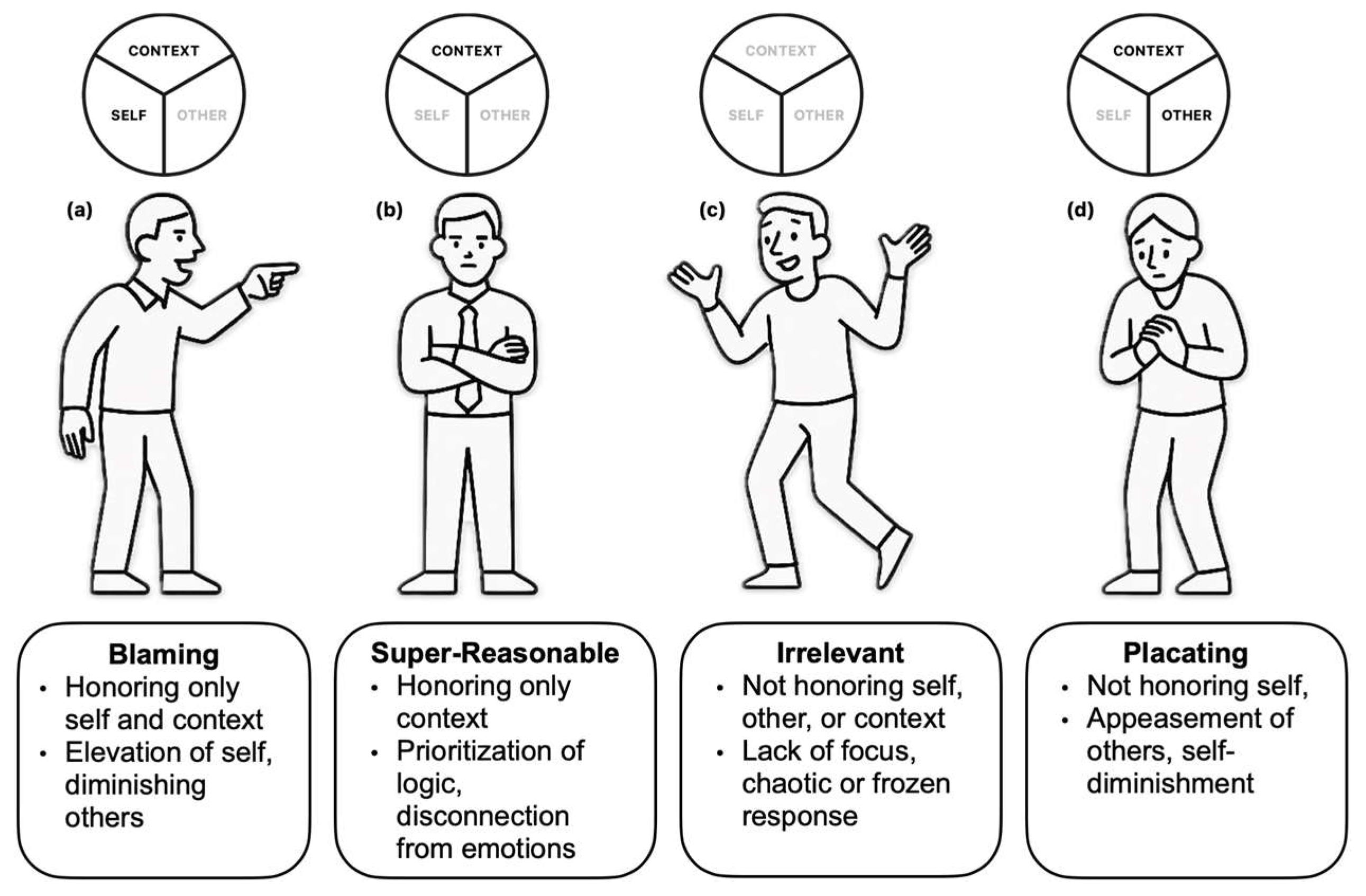
Satir identified four primary survival stances, blaming, super-reasonable, irrelevant, and placating; each reflecting a distinct imbalance among self, other, and context (
Satir et al. 1991;
Broide-Miller et al. 2024).
The blaming stance elevates the self while diminishing others, often through accusations, sarcasm, or harsh tones. Satir portrayed this stance with a stiff posture, pointing finger, and piercing eye contact, signaling control while masking underlying shame and fear of vulnerability (
Figure 1 (a)). The super-reasonable stance emphasizes logic and structure while detaching from emotional or relational input. Individuals speak in monotone, use abstract language, and appear rigid or expressionless, aiming to avoid emotional risk by retreating into intellect and control (
Figure 1 (b)). The irrelevant stance involves disjointed, erratic behavior meant to deflect discomfort or tension. Satir visualized this stance with exaggerated movement and off-topic speech, reflecting internal anxiety and a fear of rejection (
Figure 1 (c)). The placating stance seeks harmony by appeasing others, often through quick agreement, apologies, and self-blame. Satir depicted those who placated with a slouched posture, downcast gaze, and timid voice, embodying a fear of conflict and a diminished sense of self-worth (
Figure 1 (d)).
4. Spirituality and Satir
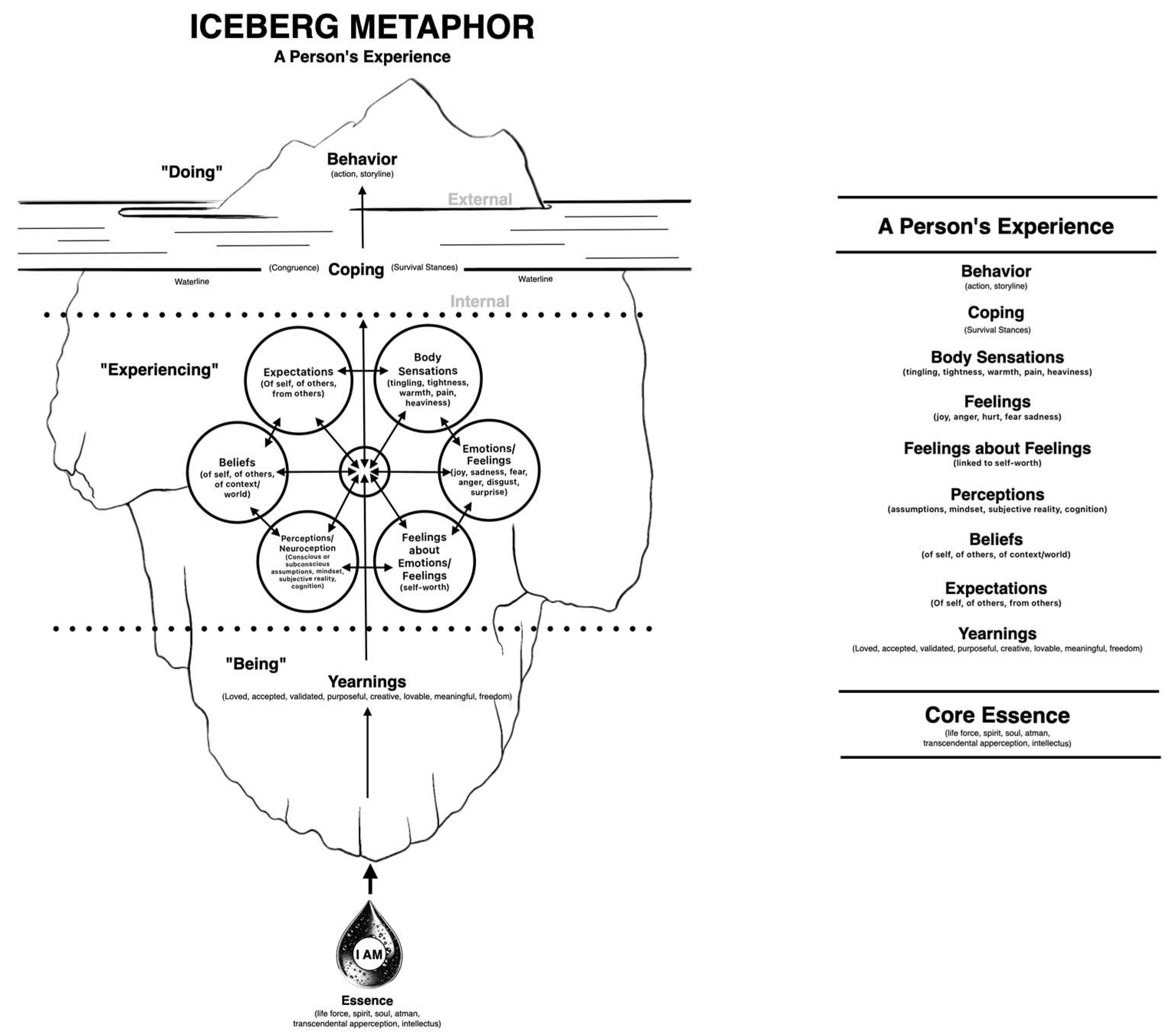
Two of the most influential tools developed by Virginia Satir are the Self-Mandala (
Figure 2) and the Iceberg Metaphor (
Figure 3), both of which serve as foundational tools for understanding the true essence of a person and how they experience themselves. The Self-Mandala illustrates eight dimensions of the “Self,” or what Satir referred to as the “I AM” (
Satir et al. 1991). The physical, intellectual, emotional, sensual, interactional, nutritional, contextual, and spiritual dimensions represent the universal manifestation of personhood (
Brothers 2019). Satir emphasized that just as individuals are cognitive, emotional, and relational beings, they are also inherently spiritual (
Satir 1988). She asserted that the integration and nurturing of all eight dimensions are essential for personal health, internal congruence, and growth (
Vriend Fluit 2015;
Satir et al. 1991).
Satir’s conceptualization is further illuminated through her Iceberg Metaphor, which offers a powerful visual representation of the distinction between a person’s experience of self and their deeper, spiritual essence. The Iceberg is divided into three sections; a person’s external “doing,” their internal “experiencing,” and their sacred “being.” Much like an iceberg, where only the tip is visible above the surface, human behavior is often the only aspect observed by others. Beneath the waterline, however, resides the rich and layered internal world of the individual: bodily sensations, feelings, perceptions, beliefs, expectations, and yearnings (arrows in
Figure 3 denote systemic interaction). At the deepest level lies the “I AM,” the core spiritual self that Satir viewed as the source of a person’s inherent worth and vitality.
This metaphor underscores Satir’s conviction that people are far more than their outward expressions or behavioral symptoms. Rather, they are complex, integrated beings composed of meaning, emotion, and spirit. Even when individuals experience themselves as broken, ashamed, or without value, Satir emphasized that their true worth is not derived from their experiences but from their spiritual core, a place of unchanging dignity and divine origin. For this reason, she championed a holistic and transformational approach to therapy, one that avoids reducing individuals to diagnostic labels or isolated patterns of thought and behavior and instead seeks to honor the fullness of their divine nature (
Vriend Fluit 2015;
Brothers 2019). A central therapeutic goal is to help clients shift from allowing their experiences to define who they are, toward allowing their spiritual essence, their core “I AM,” to inform and transform how they experience the world.
5. Beyond Pathology
This paper presents the case of Perla, a woman raised in a major port city of southern Mexico. While the analysis is not performed on a transcript of a therapy session, her narrative reveals a complex interplay of moral conviction, spiritual agency, and personal congruence. Through an STST lens, Perla’s story becomes a profound illustration of how individuals negotiate oppressive contexts while maintaining a sense of self-worth and spiritual integrity. In clinical research and therapeutic work, sex workers are often pathologized or viewed through reductionist lenses. This case contributes to a growing movement that honors the full humanity and moral reasoning of individuals navigating stigmatized professions. It offers a rich, culturally embedded portrait of one woman’s efforts to live in harmony with her values despite systemic constraints.
6. Study Design
This study employs a qualitative single case study design using narrative thematic analysis as the primary analytic approach. The purpose of this methodology is to explore and interpret the lived experiences of an individual through the lens of Virginia Satir’s Transformational Systemic Therapy (STST) model. A single-case narrative approach allows for an in-depth examination of meaning-making, coping strategies, and congruence in a context marked by cultural, spiritual, and occupational complexity (
Lieblich et al. 1998).
7. Theoretical Framework
The narrative used for this study is not derived from a therapy session; however, the analysis of the interview represents a way a therapeutic case can be conceptualized. The case was analyzed using the core elements of STST, particularly the Iceberg Metaphor and the Self-Mandala. These frameworks emphasize the multidimensional nature of the Self and the interplay between behavior, feelings, perceptions, expectations, yearnings, and context. This model was selected for its unique ability to address human functioning through a systemic, experiential, and growth-oriented lens, especially in contexts involving identity, conflict, and transformation.
8. Participant and Setting
The participant, “Perla,” is a 62-year-old cisgender, heterosexual woman from southern Mexico who has worked in the sex industry for several decades. The interview was originally conducted in Matamoros, Mexico, within a government-regulated zone known locally as the Área de Tolerancia (Tolerance Area), where sex work, though illegal, is informally tolerated and monitored for public health purposes (
Weitzer 2012).
9. Data Collection
The data for this study come from a single in-depth, semi-structured interview conducted in Spanish as part of a larger qualitative research project on the religious and spiritual beliefs of sex workers in northern Mexico. Interviews were conducted in the field by the original principal investigator, a native Spanish speaker with decades of experience conducting research and community-based interviews along the U.S.–Mexico border, with IRB approval from the University of Texas–Pan American (now University of Texas Rio Grande Valley). The present study represents a secondary analysis of this dataset and was approved by the Institutional Review Board at Fuller Theological Seminary.
The participant featured in this analysis, “Perla” (pseudonym), was selected through a convenience sampling strategy. The interviewer approached sex workers individually in a red-light district, walking door to door along a street where each woman rents a room for services. Standing at the threshold of their rooms, the women would call out to potential clients. The interviewer responded by stating (in Spanish): “I am here for the purpose of conducting an interview and will pay your usual rate for your time. There will be no physical contact, only an audio recording, if you consent.” The recording device was offered for inspection, and participants were assured of anonymity, selecting the name by which they wished to be identified.
Perla was selected for in-depth analysis due to the richness, completeness, and coherence of her narrative, which enabled a deeper exploration of emergent themes related to spirituality and resilience. Her interview lasted approximately 45 min, was audio-recorded with consent, and later transcribed verbatim. She was compensated with an amount equivalent to 150% of her typical hourly rate (approximately $60 USD), presented in a sealed envelope after the interview with confirmation of acceptance.
To preserve the integrity of participant meaning, a Bidirectional Translation (BDT) approach was employed. Transcripts were initially produced in Spanish and then translated into English by the interviewer, who is proficient in both Spanish and English. A back-translation process was used to verify semantic and idiomatic accuracy, and discrepancies were resolved through collaborative review. This ensured that the translated text retained the emotional tone and cultural nuance of the original speech.
Although the broader study included multiple interviews, the single-case design used here enables a detailed and contextually rich exploration of one participant’s lived experience. The decision to highlight Perla’s interview was guided by the conceptual depth of her reflections and their particular relevance to the study’s aims. While thematic saturation was not an objective of this case-specific analysis, analytic saturation was considered at the level of category development. Analytical saturation was achieved at the category level when recurring concepts stabilized across coding iterations. Perla’s case was selected because it most clearly illustrates the meaning-making processes that the project sought to understand.
10. Data Analysis
A single case study utilizing narrative thematic analysis was conducted using a hybrid deductive-inductive approach (
Lieblich et al. 1998;
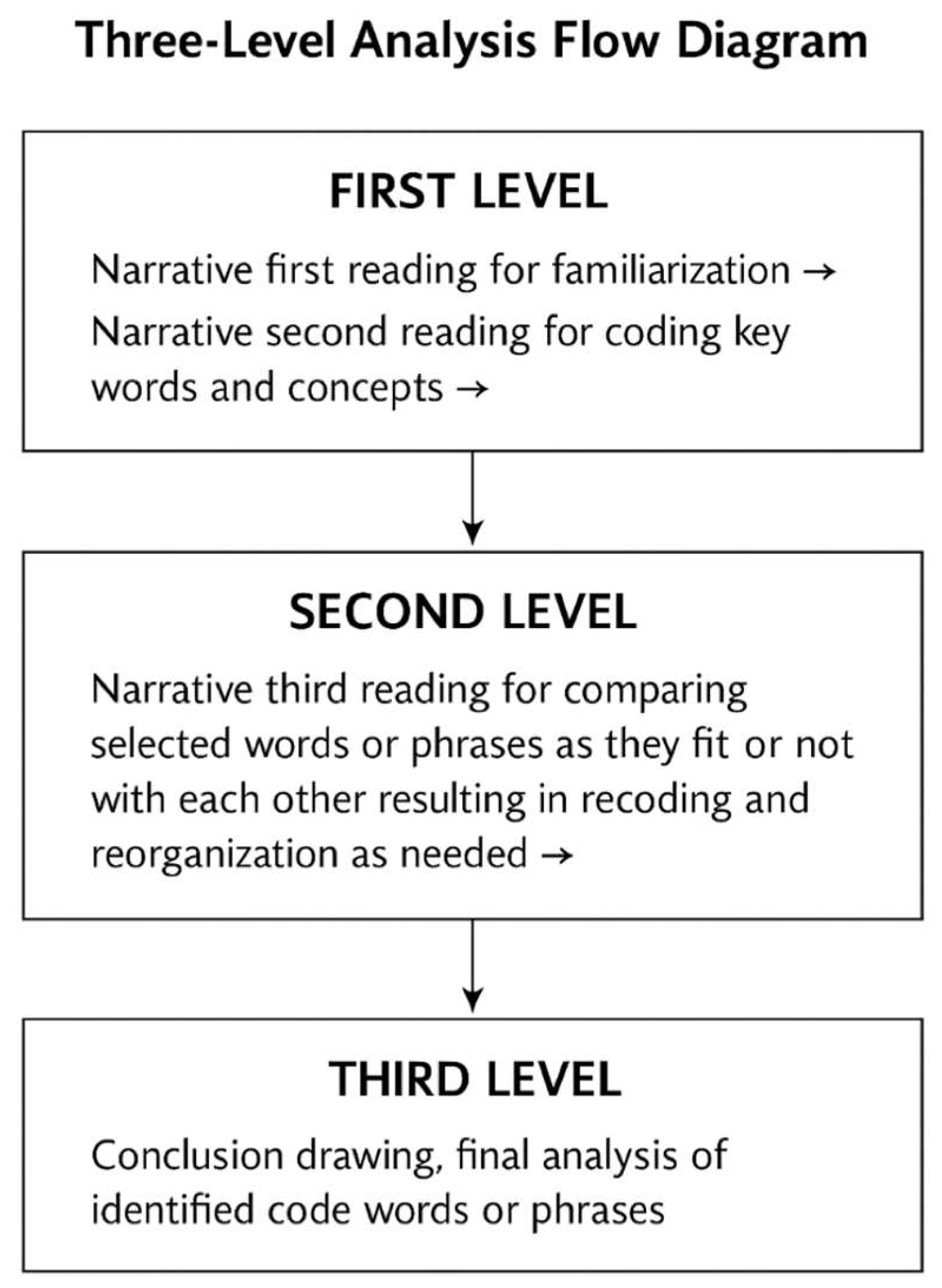
Robinson 2022). To ensure analytical rigor, the research followed a structured, three-level process (
Figure 4) supported by reflective memoing and a second coder for verification. First, the narrative was read in full for initial familiarization. A second reading involved open coding to identify significant words, phrases, and patterns. Initial codes were guided by Virginia Satir’s dimensions of the self (behavior, feelings, perceptions, expectations, yearnings, and spiritual/cultural context) as an analytic lens. These dimensions offered a theoretically grounded framework for identifying surface-level behaviors and underlying psychological structures.
Next, a third reading involved comparing, refining, and reorganizing the codes. Open coding allowed inductive themes to emerge, particularly those tied to Perla’s unique language, metaphors, and meaning-making processes. The process included constant comparison to assess how selected codes aligned with or diverged from each other, leading to theme consolidation and recoding where necessary.
Finally, themes were synthesized into a coherent structure reflecting the multi-layered depth of Satir’s Iceberg Metaphor. This facilitated analysis of how Perla’s coping behaviors related to deeper experiences of vulnerability, spirituality, and cultural identity. The final thematic categories reflect a dynamic interplay between internal and external processes, presented in a narrative synthesis that honors both clinical relevance and lived complexity.
A second coder independently reviewed the transcript and replicated the coding process to enhance dependability. Discrepancies were resolved collaboratively through discussion. Throughout the analysis, reflective memos documented interpretive decisions, thematic shifts, and researcher reflexivity, particularly in relation to gender, power, and cultural dynamics, to ensure fidelity to Perla’s voice.
The primary researcher brings extensive training in STST and currently serves as Director of Education for the Virginia Satir Global Network. The second coder, who conducted the original broader study, was the interviewer for this case, is fluent in Spanish (the participant’s primary language), and has decades of experience translating between Spanish and English. Both coders identify as Latino and have prior experience working with marginalized communities, including those affected by structural vulnerabilities. Their diverse spiritual and cultural commitments were continually examined through a reflexive team-based approach, fostering ongoing dialogue, clarification, and collaborative questioning to mitigate bias. Bracketing memos supported critical reflection on positionality, and language/translation issues were addressed by comparing the original Spanish transcripts with analytic summaries to ensure conceptual accuracy. These practices collectively enhanced the credibility, confirmability, and cultural responsiveness of the analytic process.
11. Ethical Considerations
Due to the sensitive nature of the participant’s profession and the topics discussed, all identifying information was removed or replaced with pseudonyms to protect anonymity. Perla’s case was selected for its depth, coherence, and richness in illustrating the constructs of agency, spirituality, and moral reasoning within lived experience. Consent for secondary analysis was obtained in accordance with the original IRB-approved research protocol.
Compensation for participation was set at approximately 150% of the regional standard hourly rate to acknowledge the emotional labor, vulnerability, and time commitment required. This amount was reviewed and approved by the institutional IRB, which found no evidence of undue inducement. Safeguards were implemented to ensure voluntary participation, including (1) a clearly articulated right to withdraw at any time without penalty; (2) a distinct separation between research activities and any therapeutic, service, or transactional relationships; and (3) enhanced informed consent procedures that explicitly addressed the nature and scope of the research, including how the data might be used in future secondary analyses.
Care was taken to honor the dignity of the participant by situating her voice in its full spiritual and cultural context, and by avoiding reductionistic portrayals. These ethical practices collectively supported a respectful, transparent process aligned with both clinical sensitivity and scholarly ethical standards.
12. Impressions of Perla
Perla was born and raised in a major port city of southern Mexico. Perla is a woman who adheres to a standard of moral integrity and who actively seeks to bring peace and goodness into the world. She experiences a strong sense of agency, consistently describing herself as the primary decision-maker in her own life. While she currently works in the sex industry, she views this occupation as largely incongruent with her values, identity, and long-term aspirations. Her story surfaced dominant themes of personal responsibility, differentiation of self, and reflective self-awareness. These reflect key constructs in STST, namely, the capacity to maintain internal congruence while adapting to external conditions.
Family and Culture. Family emerged as a central organizing value in Perla’s narrative, offering identity, belonging, and purpose. In alignment with broader cultural expectations of Mexican daughters, Perla prioritized caregiving for parents over marriage, a theme interpreted through Satir’s concept of contextual meaning-making. Her cultural loyalty is not perceived as a burden, but as an honorable and conscious choice. Perla stated, “And well, um… in that way I feel at peace, happy… because I gave them what they also gave me—care. I cared for them like they were babies.” This stance became an anchoring theme in the narrative coding.
Prior to Sex Work. Perla’s early adulthood was spent owning a beauty salon. After her parents passed away and financial demands escalated, Perla entered sex work out of economic necessity. Her reflections, “Well, I just came here and my cousin told me, “Start here,” and from what I’ve been earning here, I’ve been paying off what I owed back in my hometown—the things I had to repay them,” demonstrate a thematic pattern of sacrificial decision-making fused with internalized moral reasoning, suggesting a functional coping strategy embedded in familial love and duty.
Coping and Survival. Through narrative analysis, Perla’s predominant survival stance was identified as placating, a term used in STST to describe individuals who prioritize others’ needs at the expense of their own. This was evident in her recollections of placing others’ comfort, dignity, and well-being above her own, often at great personal cost. Perla recounted her first time having sex for money: “it was an older man who came by here… he passed by in his truck, and I had just arrived, and my body caught his attention. He came in with me, and I told him I had never done it before, and he noticed I was nervous—because I really had never done it. That was the first time I did it, and I felt really nervous and everything. And he said, “You’ve never done this before, have you?”…and I said, “No.” He paid me to get naked and all that, and I just felt… well, I feel that way anyway, but still, I have to work.” Yet, in the context of continued sex work, she described a subtle but significant shift. Initially driven by survival, her engagement in the industry gradually evolved into a space where she claimed a measure of control, dignity, and emotional protection. She described the evolution, “whoever comes here (now), I attend to them. They come to my door and say, “Can you see me?” and I say, “Of course,” and I welcome them with a kiss, a hug, and that’s it… My clients who come from out of town also like the way I am, and well, you see how I welcome them…that’s just how I am. I’m someone who leads with my heart, very sensitive… If you speak to me harshly, I’ll start crying because I’m not the kind of person who… I’m just like that.”
Her narratives (e.g., welcoming clients with a hug and kiss) were coded as attempts to assert control, reduce risk, and promote interpersonal peace. This intentional choice to perform her work with “tenderness” reflects a search for congruence within an incongruent context. Her reinterpretation of how she could receive men as a symbol of love and peace emerged as a dominant metaphor and turning point in the thematic coding.
Yearnings. Perla’s story revealed enduring yearnings for love, connection, safety, and significance; core themes in STST. Despite articulating a sense of self-agency and adaptive functioning, her narrative disclosed unmet relational needs, including the desire for a life companion and a stable home. Quotes such as, “Because I said to myself (when a man passed by) I saw (him) over there as (he) went by, and I thought, someone like that… that’s what I would want. And I stayed there thinking, God, I wish I could have a man like that… A man who is respectful and who would value me for who I am…a woman,” exemplify a dual longing to be seen and loved for who she truly is, and to exit sex work in favor of a more peaceful life. The theme of waiting for a moral “rescuer” was not simply romantic; it represented a deeper symbolic yearning for deliverance from internal dissonance. Perla further reflected, “Well I look (for a husband to rescue her), if the moment does not arrive, I have asked that He (God) maintains my health… if not, then that He finds a way for me to get into a retirement home.
Expectations. Perla operates under the self-imposed expectation that she alone must meet her needs; a stance that both empowers and burdens her. This belief mirrors Satir’s description of individuals who transform dysfunctional coping into a means of survival through positive life energy and self-worth. Her decision to remain in the sex industry, despite moral tension, is presented in her narrative as a calculated trade-off: financial security and the ability to care for herself outweigh the emotional and spiritual costs. She expresses hope that one day she can leave sex work, but in the absence of alternative viable options or a trustworthy partner, she chooses stability. Her plans to secure a place in a retirement home reflect anticipatory self-care grounded in pragmatism rather than fantasy.
Spiritual Expectations and Moral Reasoning. A dominant theme throughout Perla’s narrative is her deep and abiding faith in God. Her Catholic identity is rich with ritual and reverence, even as it becomes a source of moral and spiritual tension. Through the lens of STST, Perla’s spiritual identity reflects a powerful internal resource that fosters resilience. She lights candles, attends Mass, and prays regularly, but abstains from receiving the Eucharist as a self-imposed boundary reflecting her perceived moral incongruence. She states, “I confessed to him (God), but never… but I will not take the eucharist until I am until one day when I am not in this, and I will then confess, and I will say that in reality what I am doing and everything and that he cleanses me of everything.” This internal boundary aligns with the STST dimension of expectations: she believes that until she exits sex work and seeks full confession, she should not take God into her body. Despite this, she holds firmly to the belief that God is loving, forgiving, and ever-present—“I know that He has not abandoned me, I feel him mmm.. because every morning I wake up since I was a little girl eh.. I have always given thanks to God for another day because of his ray of light and the sun… and he gives me health and strength to get ahead- always every day.”
Perceptions: Congruence vs. Incongruence. Perla’s narrative offers a vivid portrait of the psychological balancing act between congruence and incongruence. Raised in a devout Catholic household and steeped in the traditions of Mexican cultural morality, Perla experiences her profession as misaligned with who she is and what she believes. Yet she does not allow this incongruence to define her entirely; this is her experience, it is not who she is. She actively constructs alternative meanings, re-narrates her role, and sustains spiritual practices that affirm her dignity and identity. She sees God not as punitive, but as sustaining and protective. She explains her refusal to take communion as a way to protect the sanctity of the Eucharist, not to deny her worthiness. This reflects an empowered moral agency, not shame. Her choice to maintain boundaries with clients who use drugs or alcohol, and her pride in avoiding vices herself, reflect further congruence with her core values.
Family Secrecy and Legacy. While Perla altered her religious practices in response to her profession, she also maintained family boundaries around disclosure. She justified not telling her brother about her work as an act of love and protection, a theme coded under “relational safeguarding.” Her narrative of legacy (e.g., raised on bone broth and breast milk, caring for her parents into their old age and reflecting with peace on the sacrifices made) reveals a strong sense of purpose and narrative coherence.
Feelings and Feelings About Feelings. Perla expresses deep emotional insight, describing herself as sensitive, devoted, and grateful. She speaks of her life with pride and does not regret foregoing marriage to care for her parents. Her reflection, “I feel peace, happy… because I gave them what they gave to me,” illustrates an internal coherence and affective alignment; markers of congruence in STST.
13. Interdisciplinary Implications
Perla’s story is not one of fragmentation but of intricate meaning-making. Through a narrative thematic analysis shaped by the STST model, her coping strategies, spiritual beliefs, moral reasoning, and yearnings are illuminated as expressions of a unified self, navigating cultural, emotional, and spiritual complexity with grace and resilience.
Perla’s case provides several valuable clinical insights, particularly for clinicians, chaplains, and missionaries working with clients navigating cultural expectations, moral incongruence, and stigmatized identities. Viewed through STST, Perla’s story underscores the importance of attending to the full humanity of individuals, which includes their spirituality, cultural values, coping strategies, and internal yearnings, to support healing and growth.
This case illustrates the therapeutic power of honoring spirituality and narrative agency. Perla’s ability to reframe her experience in the sex industry as a context in which she has maintained dignity, choice, and relational integrity speaks to the potential for individuals to find congruence even in morally ambiguous situations. Clinicians and clergy who work with marginalized populations can benefit from creating space for a struggling individual to reinterpret their life story in ways that affirm their strengths, align with their values, and support their innate worth as a person.
The case also demonstrates the utility of Satir’s Iceberg Metaphor in guiding clinical exploration. By understanding Perla’s behavior (e.g., how she welcomes clients), feelings (e.g., sensitivity, pride, longing), perceptions (e.g., views of herself as moral and spiritually grounded), expectations (e.g., self-reliance, closeness to God), and yearnings (e.g., connection, peace, a loving partner), clinicians and clergy can engage those they serve holistically rather than pathologically. This approach also helps those who are trying to be helpful to avoid imposing their own moral frameworks on people whose values may differ due to cultural or spiritual context.
Additionally, Perla’s experience challenges clinicians and clergy to develop cultural humility and sensitivity when working across socio-spiritual and economic divides. For example, what may appear externally as dissonance or dysfunction (e.g., a devout Catholic working in the sex industry) may actually reflect a deeply coherent and contextually adaptive strategy for surviving and thriving. Satir’s emphasis on the inner resources and positive intentions of all human beings can help therapists remain curious rather than judgmental.
This case also highlights the role of spirituality not merely as a coping mechanism but as a primary source of meaning and transformation. Perla’s religious practices of prayer, ritual, and self-imposed moral boundaries reflect a spiritual intelligence that guides her choices and offers her a sustained sense of peace. Therapists and clergy should explore the spiritual beliefs and practices of people they serve as legitimate dimensions of therapeutic meaning-making and sources of resilience.
Finally, the case encourages the helping community to reflect on the intersections of systemic oppression, gendered expectations, and personal empowerment. Perla’s decisions cannot be fully understood without examining the broader social and economic structures that limited her choices. Yet within these limitations, she exercises agency, adapts congruently, and constructs a morally grounded life. This invites therapists and clergy to balance empathy with inquiry, and to support those they serve in exploring new possibilities without undermining the integrity of the survival strategies they have already developed.
14. Limitations
This study draws from a single, in-depth interview and does not seek to generalize across all sex workers’ experiences. Rather, the purpose of this narrative case study is to offer clinicians an alternative lens for conceptualizing client experiences, particularly using the strength-based, humanistic principles of STST. The decision to focus on one richly detailed account reflects a deliberate shift away from pathologizing or deficit-oriented portrayals often found in the literature on sex workers.
That said, the absence of triangulation with additional participants, settings, or data sources limits the scope of the findings. Although the broader project included multiple interviews, this secondary analysis centers on Perla’s narrative due to its coherence and conceptual richness. While analytic saturation was achieved at the category level through rigorous thematic development and second-coder verification, methodological saturation was not pursued.
This focus on depth over breadth is a strength for clinical insight, but readers should remain aware of the contextual nature of the findings. Future research could extend this work through multi-case comparisons, diverse cultural contexts, or complementary methods to deepen and broaden understandings of how spiritual resilience manifests among marginalized populations.