Religious Governance and Canon Compilation: The Inclusion of the Fozu Tongji in the Ming Buddhist Canon

Abstract
1. Introduction
2. The Original Source of the Tripitaka Edition of the Fozu Tongji
In the spring of the year ji mao 己卯, after the reign era was changed in a certain year of the Ming dynasty (大明□□改元己卯春), the emperor, who cherished Buddhist teachings, ordered the re-engraving of the Buddhist canon and issued an edict permitting the inclusion of texts related to the transmission and propagation of Buddhism from various Buddhist schools.4
In the winter of the xinsi year during the Hongwu era (洪武辛巳冬), as the court was about to complete the engraving of the sūtras, vinayas, and śāstras sections of the Buddhist canon, the emperor specially issued an edict to the Buddhist Registry Office, requiring that the most essential texts from each Buddhist school be included in the canon according to their respective categories.(Juding 居頂. 2020. Yuan an ji 圓庵集 [Collected Works of Yuan’an]. Volume.4. In Xi jian Ming dai si bu cong kan稀見明代四部輯刊 [Collectanea of Rare Ming Dynasty Texts in Four Categories]. Taiwan: Jingxue Book Co., Ltd. 經學文化事業有限公司. 2nd collection. Vol. 49. p. 94)
On the eighteenth day of the twelfth lunar month, (the 18th year of the Yongle era, 1420), Left jue yi 左覺義 (Assistant of Monastic Instruction, lit. “enlightener”)Hui Jin 慧进 of the Buddhist Registry Office and others respectfully submitted a memorial stating: regarding the transcription of the Buddhist canon, apart from the parts already transcribed, organized, and proofread, it has been verified that texts such as the Lianzhu songgu 聯珠頌古 are new additions to the Nanjing edition of the canon (nan jing zang 南京藏). A decision is requested on whether these should be excluded or retained for publication. To this end, the names and volumes of the related texts are listed below, and this is respectfully reported... (the listed books mention) the Fozu tongji, forty-five volumes, compiled by the monk Zhipan during the Jingding 景定 years (1260–1264) of the Southern Song dynasty. It is now managed by the monk Baocheng, who has raised funds to have it engraved and included in the canon. On the 19th day, by imperial decree, these texts shall not be included in the Buddhist canon. The emperor’s decree ends here.(Ge yinliang 葛寅亮. 2011. Jinling fancha zhi 金陵梵剎志 [Gazetteer of Buddhist Monasteries in Jinling]. Nanjing: Nanjing Publishing House 南京出版社. pp. 85–6)
3. Puqia and the Inclusion of the Fozu Tongji in the Buddhist Canon of the Ming Dynasty
3.1. Puqia as the Primary Advocate for the Inclusion of the Fozu Tongji in the Buddhist Canon
3.2. Puqia’s Official Position Changes and the Dissemination of the Fozu Tongji
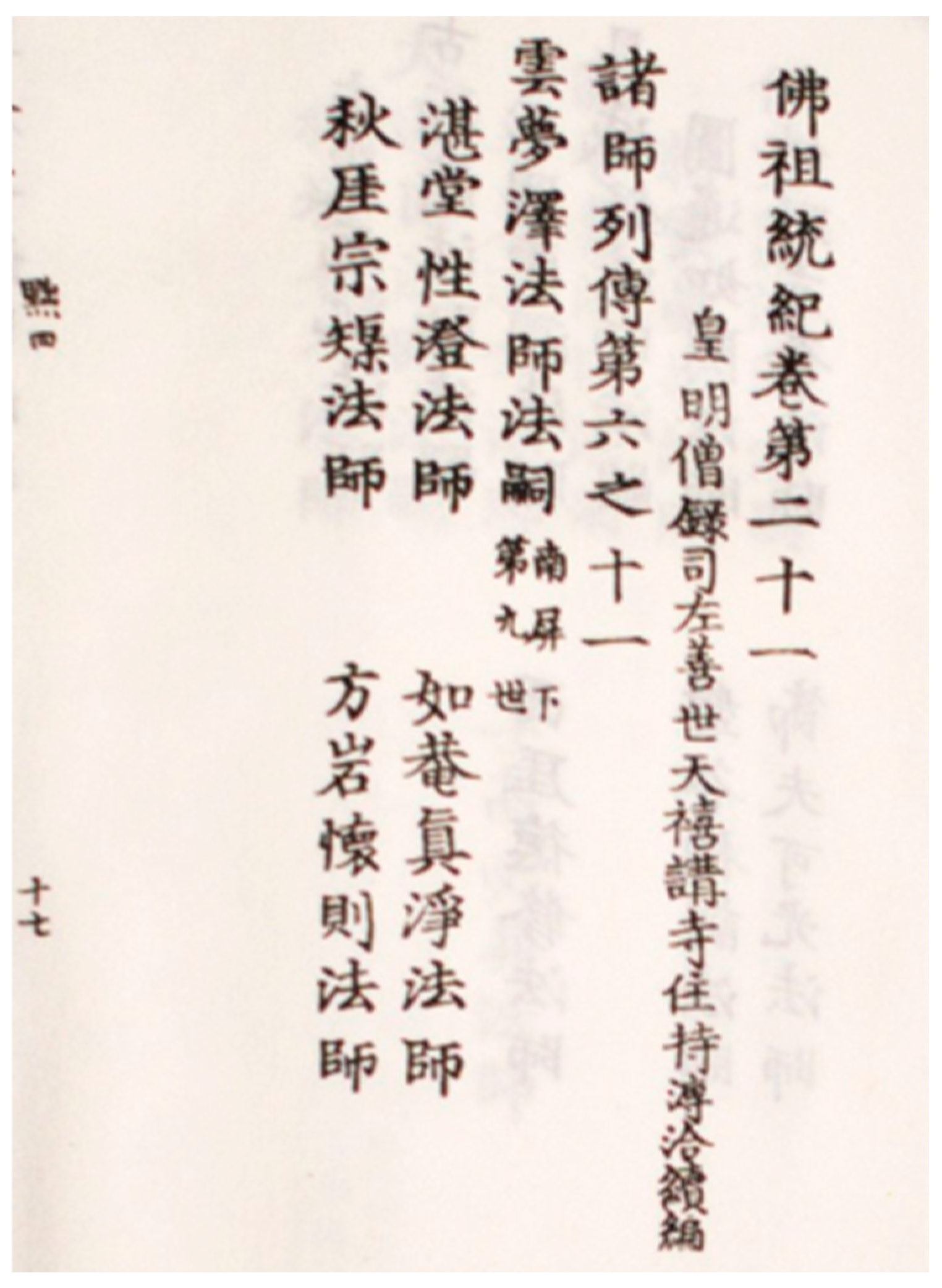
During the Jingnan Campaign 靖難之役 initiated by the Emperor Taizong 太宗 (Zhu Di) of the Ming dynasty, Master Dao Yan 道衍 (Yao Guangxiao 姚廣孝) rendered significant auxiliary services. Upon ascending to the throne, Zhu Di summoned Dao Yan to Beijing and appointed him to oversee Buddhist affairs. Puqia proposed that Dao Yan assume the position of left shanshi, while he was willingly demoted to right shanshi. The Chengzu Emperor praised Puqia for his humility and approved his request. In the fourth year of the Yongle era (1406), the court issued an edict to reconstruct the Buddhist pagoda at Tianxi Temple in Nanjing. When the reconstruction was completed and the inauguration ceremony held, the Chengzu Emperor personally inspected the site and ordered Puqia to preside over the Dharma assembly. On that day, the pagoda was adorned with auspicious light, and thousands of people gathered to witness the event, which greatly pleased the emperor. However, a monk holding the position of Jueyi 覺義 became jealous of Puqia’s favor and fabricated charges against him, leading to Puqia’s demotion to Right Jueyi 右覺義.(Yang shiqi 楊士奇. Dong li wen ji 東里文集 [Collected Works of Dongli]. p. 377)
4. Reconsidering the Claim That Puqia Concealed the Jianwen Emperor
4.1. Dubious Points Recorded in the Mingshi’s Yao Guangxiao Biography
4.2. The Evolution of the Narrative of Puqia and the Jianwen Emperor
Yao Guangxiao fell seriously ill. His procession stopped at the city gate without entering. He ordered his attendants to pitch a tent, saying, “The Emperor will come to see me.” Soon, the Ming Chengzu Emperor arrived. The Emperor showed great concern for Yao Guangxiao, granting him a gold spittoon and inquiring about his last wishes. Yao Guangxiao, folding his hands, replied, “This monk has no requests, but hopes Your Majesty will pardon the virtuous monk Nan Zhou 南洲 (Puqia’s alias), who has been imprisoned for years.” The Emperor immediately ordered Puqia’s release. Puqia, a renowned monk from Wu吳 and former left shanshi of the Buddhist Registry Office, had been imprisoned for angering the Emperor. On the day of his release, Puqia knelt to thank the Emperor. Due to his long imprisonment, he had not shaved his hair, and it now hung over his forehead. A few days later, the Emperor visited Yao Guangxiao again, after which Yao passed away.(Wang Ao. 2014. Zhen ze ji wen 震澤紀聞 [Records of Zhenze]. Beijing: Zhong hua shu ju 中華書局 [Zhonghua Book Company]. p. 84)
Puqia, also known as Nan Zhou, was from Shanyin 山阴, Zhejiang 浙江. In the early Hongwu period of the Ming dynasty, he was recommended as an eminent monk and entered the capital, where he rose to the position of left shanshi. During the Jingnan Campaign, he performed a Pharmaceutical Buddha Lamp Ritual 藥師燈 for Emperor Jianwen and cursed the Ming Chengzu Emperor (Zhu Di, Chang Ling 長陵). After the fall of Jin Chuan Gate 金川門, he shaved the Jianwen Emperor’s head, disguising him as a monk. Upon hearing of this, the Chengzu Emperor imprisoned Puqia for over a decade. When the Rong Guo Duke 榮國公 (Yao Guangxiao) fell critically ill, the emperor sent someone to ask about his last wishes. Yao Guangxiao pleaded for Puqia’s release, which the emperor granted. Upon release, Puqia had white hair several inches long covering his forehead. He went straight to Da Xinglong Temple 大興隆寺, knelt before Yao Guangxiao’s memorial tablet, and said, “My remaining life is a gift from the Shaoshi 少師 (Yao Guangxiao).” After the Ming Renzong Emperor 明仁宗 ascended the throne, Puqia’s official position was restored. He passed away at the age of eighty-two.(Zheng xiao 鄭曉. 1984. Jinyan 今言 [Contemporary Records]. Beijing: Zhong hua shu ju 中華書局 [Zhonghua Book Company]. p. 129)
5. Textual Changes to the Fozu Tongji After Its Inclusion in the Buddhist Canon
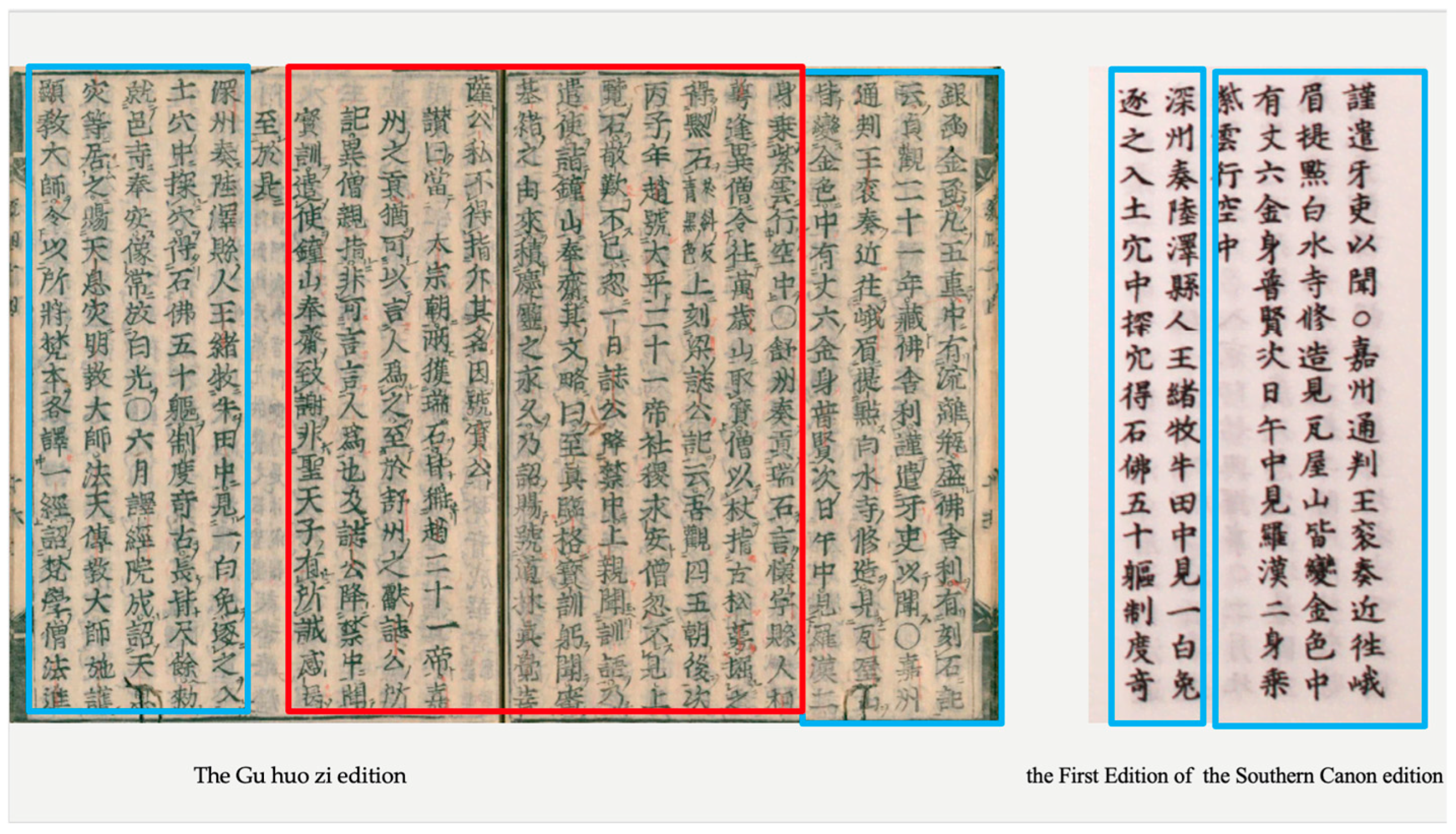
An official from Shuzhou 舒州 (modern Qianshan 潜山 in Anhui 安徽) presented an auspicious stone to the court. He reported that a man named Ke’e 柯萼 from Huaining 懷寧 county encountered a strange monk who guided him to Wan Sui Mountain 萬歲山 to search for treasure. The monk pointed at an ancient pine tree with his tin staff. Ke dug there and found a black stone inscribed with a prophecy by the eminent monk Bao zhi 寶志, from the Southern Liang 梁 dynasty. The inscription read, “I observe that after four or five dynasties, in the next year of bingzi 丙子, a golden age of peace will emerge under the Zhao 趙 dynasty. The dynasty will last through twenty-one emperors, and the nation will enjoy eternal peace and prosperity.” The monk then vanished. Upon seeing the stone, the emperor was filled with reverence and admiration. One day, Monk Zhi gong 志公 miraculously appeared in the palace, and the emperor personally heard his admonitions. Consequently, the emperor sent envoys to Zhongshan 鍾山 (modern Zijin Mountain in Nanjing, the burial site of Baozhi) to conduct a fast and sacrifice. The emperor decreed that Bao zhi be posthumously honored as the “Dao lin zhen jue Bodhisattva 道林真覺菩薩” and mandated that neither official nor commoner should speak his name directly. Since then, he has been respectfully referred to as “Baogong 寶公.”(Zhipan. Fozu tongji. Vol. 44. p. 15. This edition, housed in the National Diet Library of Japan, is an exact replica edition of the Gu huo zi version)
Those who create prophecies (chen wei 讖緯), heretical books (yao shu 妖書), or inflammatory content (yao yan 妖言), or use such materials to incite the public, shall be executed. Those who privately possess heretical books, conceal them, or fail to report them to the authorities will be given 100 strokes of the bastinado and sentenced to three years of penal servitude.12
6. Conclusions
Funding
Institutional Review Board Statement
Informed Consent Statement
Data Availability Statement
Conflicts of Interest
| 1 | The three scholars mentioned here conducted early research on the Fozu tongji, elucidating both its philological value and historiographical significance. For detailed information, see (Y. Chen 2005, pp. 96–101; Jan 1963a, pp. 61–82; Jan 1963b; Schmidt-Glintzer 1982). |
| 2 | Jan Yun-hua (Jan 1963b) completed the first annotated English translation of the Song dynasty section within the Fayun tongsai zhi, followed by his translation of its Sui-Tang dynasty portion in 1966. More recently, Thomas Jülch (Jülch 2019, 2021, 2024) has produced a comprehensive translation of the entire Fayun tongsai zhi, incorporating the latest scholarly advancements in the field. |
| 3 | For fundamental information on the historical development of the Chinese Buddhist Canon, see (Long and Chen 2019). |
| 4 | The engraving details (e.g., carvers’ names, production dates) of the First Edition of Southern Canon preserved at Sichuan Provincial Library 四川省圖書館 in China have not yet been published; this historical record is cited from (Li and He 2003, p. 382). |
| 5 | Ding Yuan (Ding 2024, pp. 11–20) argues that no new engraving of the Buddhist Canon occurred during the Yongle period; instead, the wood blocks from the Hongwu era were reused. Nozawa (2008, pp. 443–59) posits that the wood blocks of the First Edition of Southern Canon were not entirely destroyed. Both perspectives require further scholarly investigation. |
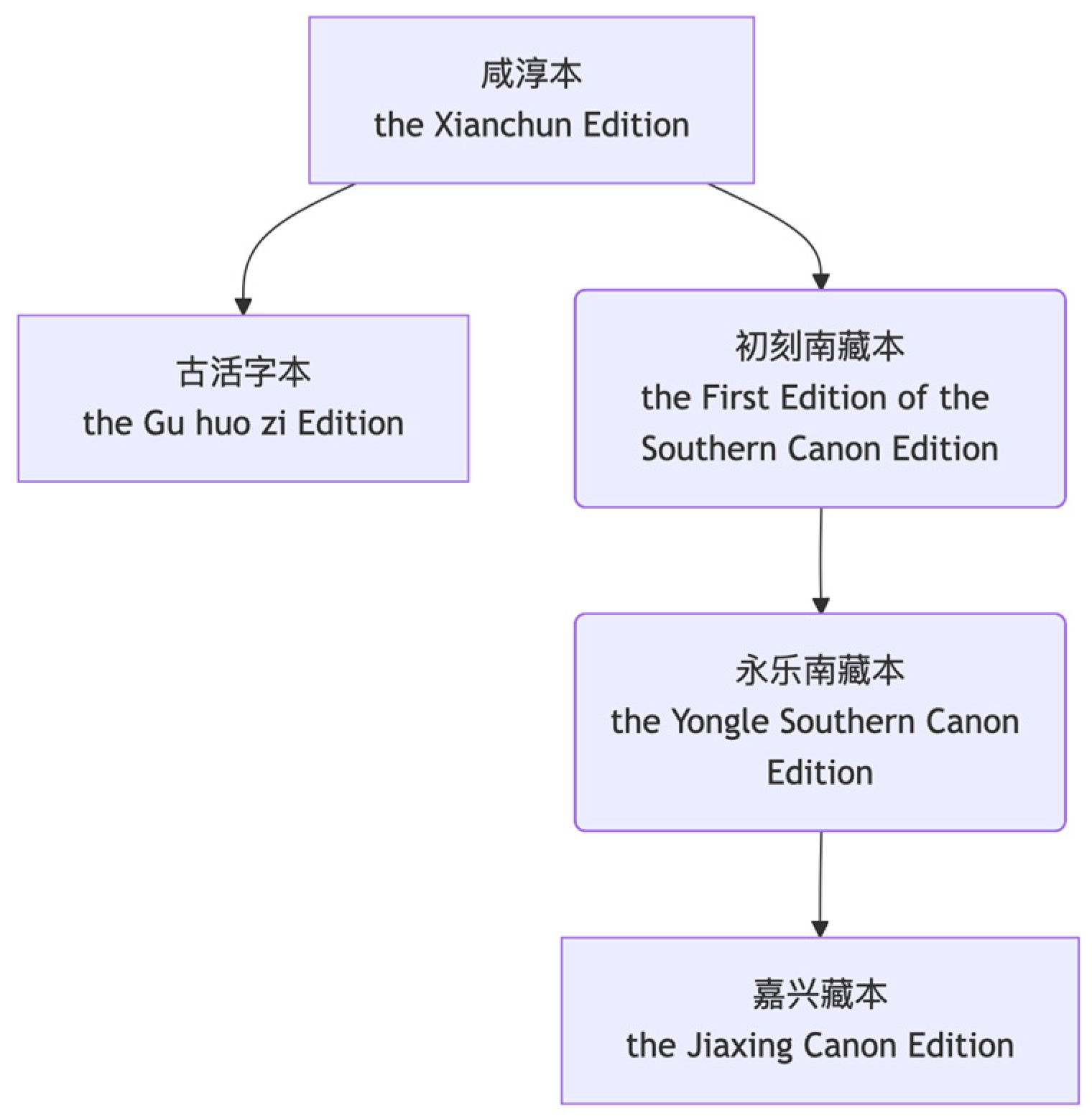
| 6 | In the Xianchun 咸淳 edition (1265–1274) of the Fozu tongji, this fascicle contains only the title with no textual content. Zhipan. 1997. Fozu tongji. In Si ku quan shu cun mu cong shu 四庫全書存目叢書. Jinan: Qi lu shu she 齊魯書社. Vol. 254. p. 146. |
| 7 | The primary sources that substantiate this argument are the following three key pieces of evidence. The 30th volume of the Taizong wenhuangdi shilu 太宗文皇帝實録 records under the entry of April 2nd, Yongle 2nd year: “ (Emperor Chengzu) issued an edict appointing the left Shanshi of the Buddhist Registry Office, Daoyan, as tai zi shao shi 命僧録司左善世道衍爲太子少師.” (Li shimian 李時勉. 1962. Ming taizong shilu 明太宗實録. Taiwan: Institute of History and Philology. p. 534.) Li Zhen 李震’s Xue xuan cheng chan shi zhi lue 雪軒成禪師志略 records under the entry of Yongle 1st year (1403): “Emperor Chengzu, considering Japan’s geographical isolation across the seas and its reverence for Buddhism, specially appointed the virtuous monk Daocheng to carry the imperial edict as an envoy to Japan... The following year, Daocheng returned from Japan. Japan subsequently dispatched envoys to present tribute and express gratitude. Wenmiao 文廟 was greatly pleased and promoted Daocheng to left shanshi of the Buddhist Registry Office 永樂改元之初, 太宗文皇帝謂日本國在鯨波萬里外, 俗尚佛乘, 以師道行尊宿, 命捧璽書往諭之……明年, 師還, 而國人入貢稱謝者即至。文廟大悅, 陞師左善世.” (Ge yinliang: Jinling fancha zhi. Vol. 2. p. 349.) Yao Guangxiao’s Tian jie si pi lu ge bei 天界寺毗盧閣碑 briefly records the life of Chan Master Daocheng, stating: “The Chan Master styled Jiufeng (Vulture Peak) with the dharma name Daocheng... served as right Chanjiao of the Buddhist Registry Office. Due to his impartial management of monastic affairs and maintenance of peace within the temples, Emperor Chengzu commended his administrative achievements and specially promoted him to Left Shanshi by imperial grace 禪師字鷲峰, 道成其諱也……前爲僧録司右闡教, 政平僧安。上喜, 恩陛左善世云.” (Ge Yinliang: Jinling fancha zhi. vol. 2. p. 328). |
| 8 | The 11th volume of the Xu zhiyue lu records the demotion of Daocheng: “After Emperor Taizong ascended the throne, he ordered Daocheng to serve as an envoy to Japan to promote the virtuous influence of the Ming dynasty. Daocheng returned in Yongle 2nd year... In Yongle 4th year, due to false accusations from colleagues, Daocheng was imprisoned for over a hundred days. However, he remained composed throughout. Upon realizing his innocence, Emperor Chengzu pardoned him 太宗嗣位, 奉使日本, 命師往宣聖化, 至永樂二年回……四年, 以僚佐譖繫囹圄百餘日。師坦然無慮, 上知其非罪, 宥之.” (Nie xian 聶先. 2018. Xu zhi yue lu 續指月録. Chengdu:Ba shu shu she 巴蜀書社. p. 244. |
| 9 | It’s a movable-type edition printed in Japan during the Keichō 慶長 and Genwa 元和 periods. |
| 10 | |
| 11 | The critiques by Song Confucian scholars led to the loss of legitimacy in apocryphal prophecies (chenwei). Recent studies reveal that, on the one hand, the decline of chenwei after the Song dynasty was gradual. On the other hand, despite official prohibitions against prophetic rhetoric, such beliefs retained significant influence across many domains. (H. Liu 2023, pp. 335–50). |
| 12 | The Da Ming lu was first compiled in 1367 and underwent three subsequent revisions before its content was largely standardized after the Hongwu 30th year (1397). For further information, see (Zhang 2021, pp. 283–85). |
| 13 | For further discussion on this topic, see (Twitchett and Fairbank 1988, pp. 746–54). |
| 14 | Detailed information can be found in (H. Liu 2023). |
| 15 | For further discussion on this topic, see (Wu and Chia 2020, pp. 36–38). |
| 16 | For detailed information, see (Lan 2000, pp. 167–78). |
| 17 | A detailed examination of existing editions of the Buddhist canon reveals varying inclusion standards, indicating that research on the inclusion of Buddhist texts requires more case studies. Professor Chi limei 池麗梅 has conducted research on the processes of inclusion in the Buddhist canon for various Buddhist texts. Her published articles in this field include the following (Chi 2022a, pp. 313–25; Chi 2022b, pp. 173–79; Chi 2023, pp. 91–110; Chi 2024, pp. 85–109). |
| 18 | For further discussion on this topic, see (Wu and Chia 2020, pp. 219–46). |
| 19 | Chün-fang Yü provided a general introduction to Buddhism in the early Ming period; for details, see (Twitchett and Fairbank 1998, pp. 899–917). |
| 20 | Chün-fang Yü provides a relatively detailed introduction to the major Buddhist policies of the Ming Dynasty; for specifics, see (Yü 2021, pp. 145–69). |
| 21 | Based on the research of Timothy Brook (Brook 2005, pp. 159–62) and Edward L. Farmer (Farmer 1990, pp. 103–25), we argue that the concept of heterodoxy is not static but rather constrained by human agency. Zhu Yuanzhang, the founding emperor of the Ming Dynasty, consolidated imperial power by defining orthodoxy and heterodoxy through regulations and prohibitions across multiple domains, thereby reinforcing his authority. |
| 22 | Langlois and Sun (1983) and Y.-N. Chen (2011, pp. 6–27) both argue that Zhu Yuanzhang emphasized Buddhism’s role in maintaining social stability and made the consolidation of imperial power the core consideration in his policies. |
References
Primary Sources
Baocheng 寶成. 1993. Shi shi yuan liu 釋氏源流. Beijing: Zhong guo shu dian 中國書店.Da Ming lu 大明律. 1998. Beijing: Fa lu chu ban she 法律出版社.Ge yinliang 葛寅亮. 2011. Jinling fancha zhi 金陵梵剎志. Nanjing: Nanjing Publishing House 南京出版社.Juding 居頂. 2020. Yuan an ji 圓庵集. Volume. 4. In Xi jian Ming dai si bu cong kan 稀見明代四部輯刊. Tanwan: Jingxue Book Co., Ltd. 經學文化事業有限公司. 2nd collection. Vol. 49.Li shimian 李時勉. 1962. Ming taizong shilu 明太宗實録. Taiwan: Institute of History and Philology.Li yanshou 李延壽. 1975. Nanshi 南史. Beijing: Zhong hua shu ju 中華書局.Nie xian 聶先. 2018. Xu zhi yue lu 續指月録. Chengdu: Ba shu shu she 巴蜀書社.Ruxing 如惺. 1993. Ming gao seng zhuan. 明高僧傳. In Zhong hua da zang jing 中華大藏經. Beijing: Zhong hua shu ju 中華書局. Vol. 62.Wang ao 王鏊. 2014. Zhen ze ji wen 震澤紀聞. Beijing: Zhong hua shu ju 中華書局.Yang shiqi 楊士奇. 1998. Dong li wen ji 東里文集. Beijing: Zhong hua shu ju 中華書局.Zhang ting yu 張廷玉. 1974. Ming shi 明史. Beijing: Zhong hua shu ju 中華書局.Zheng xiao 鄭曉. 1984. Jinyan. Beijing: Zhong hua shu ju 中華書局.Zhipan. 1997. Fozu tongji. In Si ku quan shu cun mu cong shu 四庫全書存目叢書. Jinan: Qi lu shu she 齊魯書社. Vol. 254.Secondary Sources
- Brook, Timothy. 2005. The Chinese State in Ming Society, 1st ed. London: Routledge. [Google Scholar]
- Chen, Yuan 陳垣. 2005. Zhong guo fo jiao shi ji gai lun 中國佛教史籍概論 [An Introduction to Chinese Buddhist Historical Texts]. Shanghai: Shanghai shudian chu ban she 上海書店出版社. [Google Scholar]
- Chen, Yuh-Neu. 2011. Buddhism and Society in the Ming Dynasty. Beijing: Peking University Press. [Google Scholar]
- Chi, Li Mei 池麗梅. 2022a. Li tongxuan zhuzuo qun zhi ru zang shi mo yu hai wai liu chuan:yi fu zhouban he lun shi san han wei Zhong xin 李通玄著作群之入藏始末與海外流傳:以福州版合論十三函爲中心 [The Inclusion and Overseas Dissemination of Li Tongxuan’s Works: Focusing on the Fuzhou Edition of the Compendiumin Thirteen Cases]. Journal of the Institute for Chinese Classics Studies Nanjing University 古典文獻研究 25: 313–25. [Google Scholar]
- Chi, Li Mei 池麗梅. 2022b. Tiantai jiao dian de hai wai hui liu ji ru zang shi mo 天台教典的海外回流及入藏始末 [The History of the Return of Tiantai Canon from Abroad to Xizang]. The World Religious Cultures 世界宗教文化 6: 173–79. [Google Scholar]
- Chi, Li Mei 池麗梅. 2023. Qisong er zuo zhi ru zang shi mo:jian lun Fuzhou er zang zhi mu lu fen qi 契嵩二作之入藏始末——兼論福州二藏之目録分歧 [The Inclusion of Qisong’s Two Works into the Buddhist Canon and Differences between the Catalogues of Two Fuzhou Canons]. Wen shi 文史 3: 91–110. [Google Scholar]
- Chi, Li Mei 池麗梅. 2024. Dahui chanshi yulu zhi ru zang shi mo ji qi yiyi. 大慧禪師語録之入藏始末及其意義 [The Process and Significance of the Inclusion of the Dahui Chan Master’s Recorded Sayings in the Buddhist Canon]. Journal of Chinese Literature and History 中華文史論叢 4: 85–109. [Google Scholar]
- Ding, Yuan 定源. 2024. Hongwu zang yu Jianwen zang xin zhi 洪武藏與建文藏新識 [New Research on Hongwu Tripitaka and Jianwen Tripitaka]. Studies in World Religions 世界宗教研究 9: 11–20. [Google Scholar]
- Farmer, Edward L. 1990. Social Regulations of the First Ming Emperor: Orthodoxy as a Function of Authority. In Orthodoxy in Late Imperial China. Edited by Kwang-Ching Liu. Oakland: University of California Press, pp. 103–25. [Google Scholar]
- Jan, Yun-Hua. 1963a. The Fo-tsu-tung-chi, a Biographical and Bibliographical Study. Oriens Extremus 10: 61–82. [Google Scholar]
- Jan, Yun-Hua. 1963b. Vicissitudes of Buddhism in China: A Critical Study of Fo-Tsu-Tung-Chi by Chih-Pan. Santiniketan: Visva-Bharati University. [Google Scholar]
- Jülch, Thomas. 2019. Zhipan’s Account of the History of Buddhism in China. Volume 1: Fozu tongji, juan 34–38: From the Times of the Buddha to the Nanbeichao era. Leiden: Brill. [Google Scholar]
- Jülch, Thomas. 2021. Zhipan’s Account of the History of Buddhism in China. Volume 2, Fozu tongji, juan 39–42: From the Sui dynasty to the Wudai Era. Leiden: Brill. [Google Scholar]
- Jülch, Thomas. 2024. Zhipan’s Account of the History of Buddhism in China. Volume 3 Fozu tongji, juan 43–48: The Song dynasty. Leiden: Brill. [Google Scholar]
- Lan, Jifu 藍吉富. 2000. Kan ban da zang jing zhi ru zang wen ti chu tan 刊版大藏經之入藏問題初探 [A Preliminary Study on the Canonical Inclusion Criteria in Printed Editions of the Buddhist Canon]. Journal of Chinese Buddhist Studies 中華佛學學報 13: 167–78. [Google Scholar]
- Langlois, John D., Jr., and K’o-K’uan Sun. 1983. Three Teachings Syncretism and the Thought of Ming T’ai-tsu. Harvard Journal of Asiatic Studies 43: 97–139. [Google Scholar] [CrossRef]
- Li, Fuhua 李富華, and Mei He 何梅. 2003. Han wen fo jiao da zang jing yan jiu 漢文佛教大藏經研究 [Research on the Chinese Buddhist Tripitaka]. Beijing: Zongjiao wenhua chuban she 宗教文化出版社. [Google Scholar]
- Lian, Haochen 廉皓晨. 2025. Fozu tongji de wenxianxue yanjiu 佛祖統紀的文獻學研究 [A Philological Study of the Fozu tongji]. Ph.D thesis, School of Literature, Zhejiang University, Hangzhou, China. [Google Scholar]
- Liu, Haiwei. 2023. Apocalyptic Belief and Prophecy: Constructing Political Legitimacy During the Yuan-Ming Transition. JRAS, Series 3. Cambridge: Cambridge University Press, vol. 33, pp. 335–50. [Google Scholar]
- Liu, Junwei 劉俊偉. 2011. Wang ao yan jiu 王鏊研究. Ph.D thesis, School of Literature, Zhejiang University, Hangzhou, China. [Google Scholar]
- Long, Darui, and Jinhua Chen, eds. 2019. Chinese Buddhist Canons in the Age of Printing, 1st ed. London: Routledge. [Google Scholar]
- Nishiwaki, Tsuneki. 2009. Chūgoku koten shakai ni okeru Bukkyō no shosō 中國古典社會における佛教の諸相 [Aspects of Buddhism in Classical Chinese Society]. Kyoto: Chisen Shokan 知泉書館. [Google Scholar]
- Nozawa, Yoshimi. 2008. Ming chu de liang bu nan zang:zan lun cong Hongwu nanzang dao Yongle nanzang 明初的兩部南藏——再論從洪武南藏到永樂南藏 [The Two Southern Canons of the Early Ming: A Re-examination from the Hongwu Southern Canon to the Yongle Southern Canon]. Zang wai fo jiao wen xian 藏外佛教文獻. Beijing: China Renmin University Press, vol. 10, pp. 443–59. [Google Scholar]
- Schmidt-Glintzer, Helwig. 1982. Die Identität der buddhistischen Schulen und die Kompilation buddhistischer Universalgeschichten in China: Ein Beitrag zur Geistesgeschichte der Sung-Zeit. Wiesbaden: Franz Steiner. [Google Scholar]
- Twitchett, Denis, and John K. Fairbank, eds. 1988. The Cambridge History of China. Volume 7, The Ming Dynasty, Part 1. Cambridge: Cambridge University Press. [Google Scholar]
- Twitchett, Denis, and John K. Fairbank, eds. 1998. The Cambridge History of China. Volume 8, The Ming Dynasty, Part 2. Cambridge: Cambridge University Press. [Google Scholar]
- Wang, Chong Wu 王崇武. 2024. Ming jing nan shi shi kao zheng gao 明靖難史事考證稿 [A Study on the Historical Events of the Jingnan Campaign in the Ming Dynasty]. Beijing: The Commercial Press 商務印書館. [Google Scholar]
- Wu, Jiang, and Lucille Chia. 2020. Spreading Buddha’s Word in East Asia: The Formation and Transformation of the Chinese Buddhist Canon. New York: Columbia University Press. [Google Scholar]
- Xing, Lili 邢莉莉. 2010. Ming dai fo zhuan gu shi hua yan jiu 明代佛傳故事畫研究 [Investigation of Ming Dynasty Murals Illustrating the Life of the Buddha]. Beijing: Xian zhuang shu ju 綫裝書局. [Google Scholar]
- Yoshimitsu, Aitani 會谷佳光. 2009. Mindai ni okeru Bussotōki no ryūden to shuppan 明代における仏祖統紀の流伝と出版 [The Circulation and Publication of the Fozu tongji in the Ming Dynasty]. Nishōgakusha Daigaku Higashi Ajia Gakujutsu Sōgō Kenkyūjo Shūkan 二松学舍大学東アジア学術総合研究所集刊 39: 43–66. [Google Scholar]
- Yü, Chün-Fang. 2021. The Renewal of Buddhism in China. New York: Columbia University Press. [Google Scholar]
- Zhang, Boyuan 張伯元. 2021. Fa lu wen xian xue 法律文獻學 [The Study of Legal Literature]. Shanghai: Shanghai renmin chu ban she 上海人民出版社. [Google Scholar]


Disclaimer/Publisher’s Note: The statements, opinions and data contained in all publications are solely those of the individual author(s) and contributor(s) and not of MDPI and/or the editor(s). MDPI and/or the editor(s) disclaim responsibility for any injury to people or property resulting from any ideas, methods, instructions or products referred to in the content. |
© 2025 by the author. Licensee MDPI, Basel, Switzerland. This article is an open access article distributed under the terms and conditions of the Creative Commons Attribution (CC BY) license.
Share and Cite
Lian, H. Religious Governance and Canon Compilation: The Inclusion of the Fozu Tongji in the Ming Buddhist Canon. Religions 2026, 17, 44. https://doi.org/10.3390/rel17010044
Lian H. Religious Governance and Canon Compilation: The Inclusion of the Fozu Tongji in the Ming Buddhist Canon. Religions. 2026; 17(1):44. https://doi.org/10.3390/rel17010044
Chicago/Turabian StyleLian, Haochen. 2026. "Religious Governance and Canon Compilation: The Inclusion of the Fozu Tongji in the Ming Buddhist Canon" Religions 17, no. 1: 44. https://doi.org/10.3390/rel17010044
APA StyleLian, H. (2026). Religious Governance and Canon Compilation: The Inclusion of the Fozu Tongji in the Ming Buddhist Canon. Religions, 17(1), 44. https://doi.org/10.3390/rel17010044