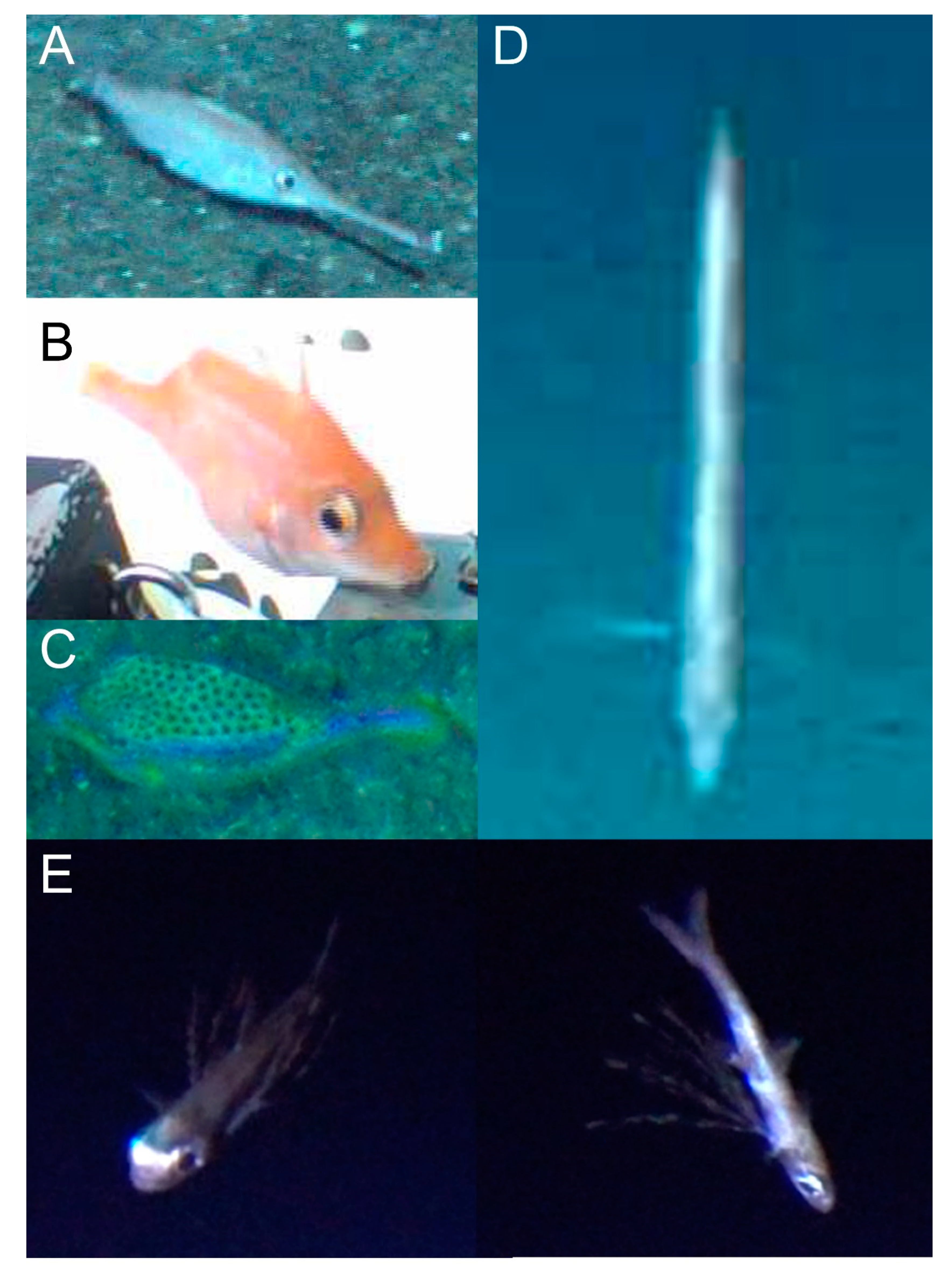
Deep-Sea Fish Fauna on the Seamounts of Southern Japan with Taxonomic Notes on the Observed Species
 , ,
, ,
Abstract
1. Introduction
2. Materials and Methods
2.1. Study Area
2.2. Observation and Collection Methods
2.3. Species List
3. Results and Discussions
Taxonomic Notes
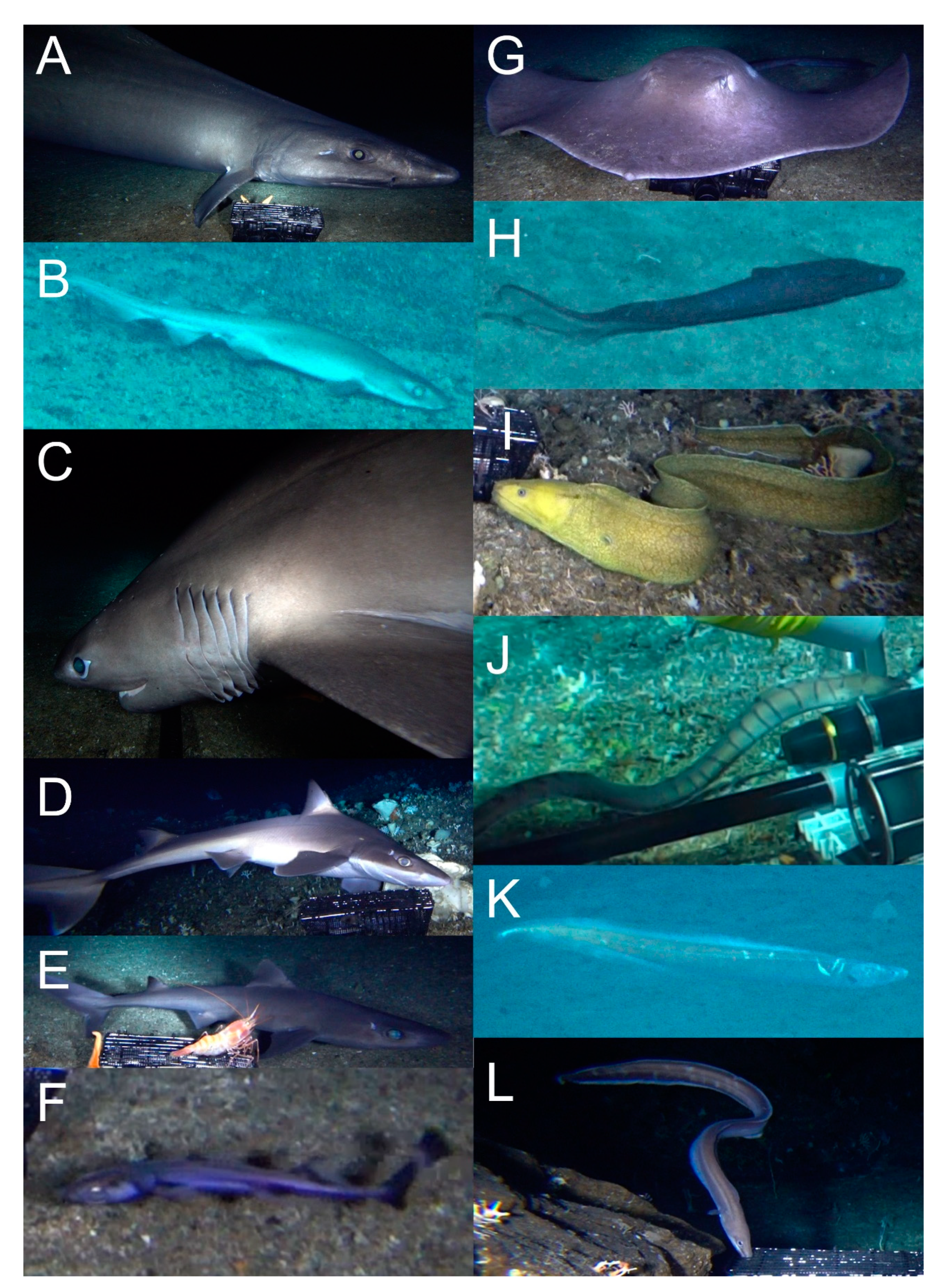
- Pseudotriakis microdon de Brito Capello 1868 (Pseudotriakidae; Figure 2A): Two large females and males of this species were observed using BC in a patchy sandy bottom in a rocky area at 603 m and 696 m depths of the Ritto Seamount, respectively. This species has previously been reported to be distributed on the continental shelf in Japanese waters; however, it was recorded for the first time on a seamount far separated from the shelf.
- Hexanchus griseus (Bonnaterre 1788) (Hexanchidae; Figure 2B): Two large individuals of this species were observed through BC in a rocky area at 471 m depth of the Shotoku Seamount and 603 m on the Ritto Seamount. This species has previously been reported to be distributed on the continental shelf; however, it was recorded for the first time on a seamount far separated from the shelf.
- Unidentified species, Squalus sp. (Squalidae; Figure 2E): A single individual of this species was captured by BC in a patchy sandy bottom on a rocky area at 603 m depth on the Ritto Seamount. This species belongs to the family Squalidae because it lacks a concave caudal-fin outer margin. However, this species is unique in having a dark body (no white ventral), dusky dorsal fins, blunt snout, and a lack of white margin on the caudal fin.
- Gymnothorax intesi (Fourmanoir and Rivaton 1979) (Muraenidae; Figure 2I): Several individuals of this species were recorded by ROV and BC in a rocky area at 330 m depth on the Shotoku Seamount. This species was previously reported only in the Ryukyu Archipelago and Kagoshima in Japanese waters, and the distribution depth range was shallower than 200 m. The present observations represent a new distributional record for the deepest sighting of the species.
- Gymnothorax ypsilon Hatooka and Randall 1992 (Muraenidae; Figure 2J): A single individual of this species was observed using the ROV in a rocky area at 330 m depth on the Shotoku Seamount. The distribution depth range of the species was earlier reported to be shallower than 200 m.
- Histiobranchus bathybius (Günther 1877) (Synaphobranchidae; Figure 2K): A single individual of this species was observed by the ROV in a sandy area at 2012 m depth on the Shoho Seamount. This species has previously been recorded south of Tosa Bay and is known as a cold-water species that is mainly distributed in the northern Pacific. The present observations represent the southernmost distribution of this species.
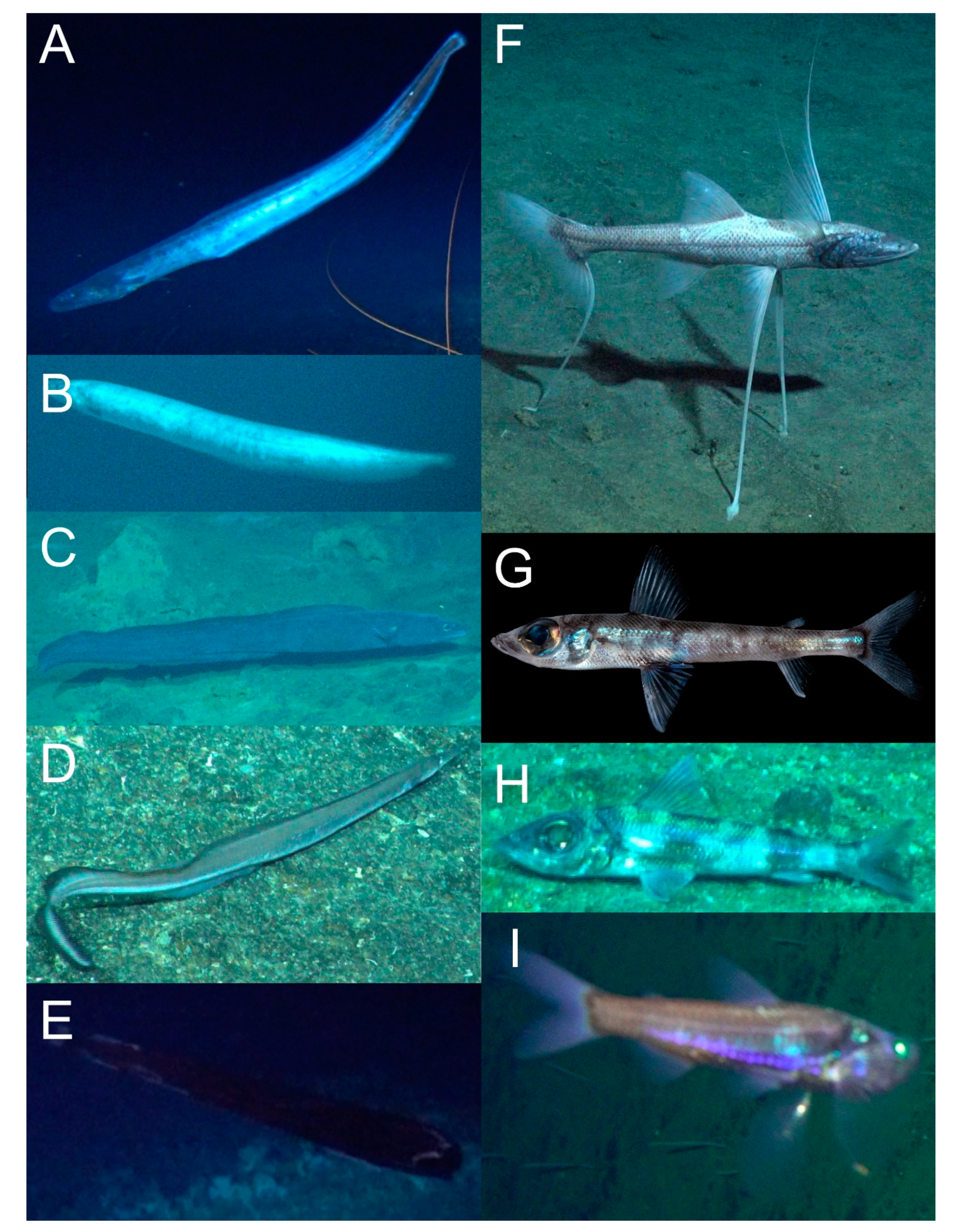
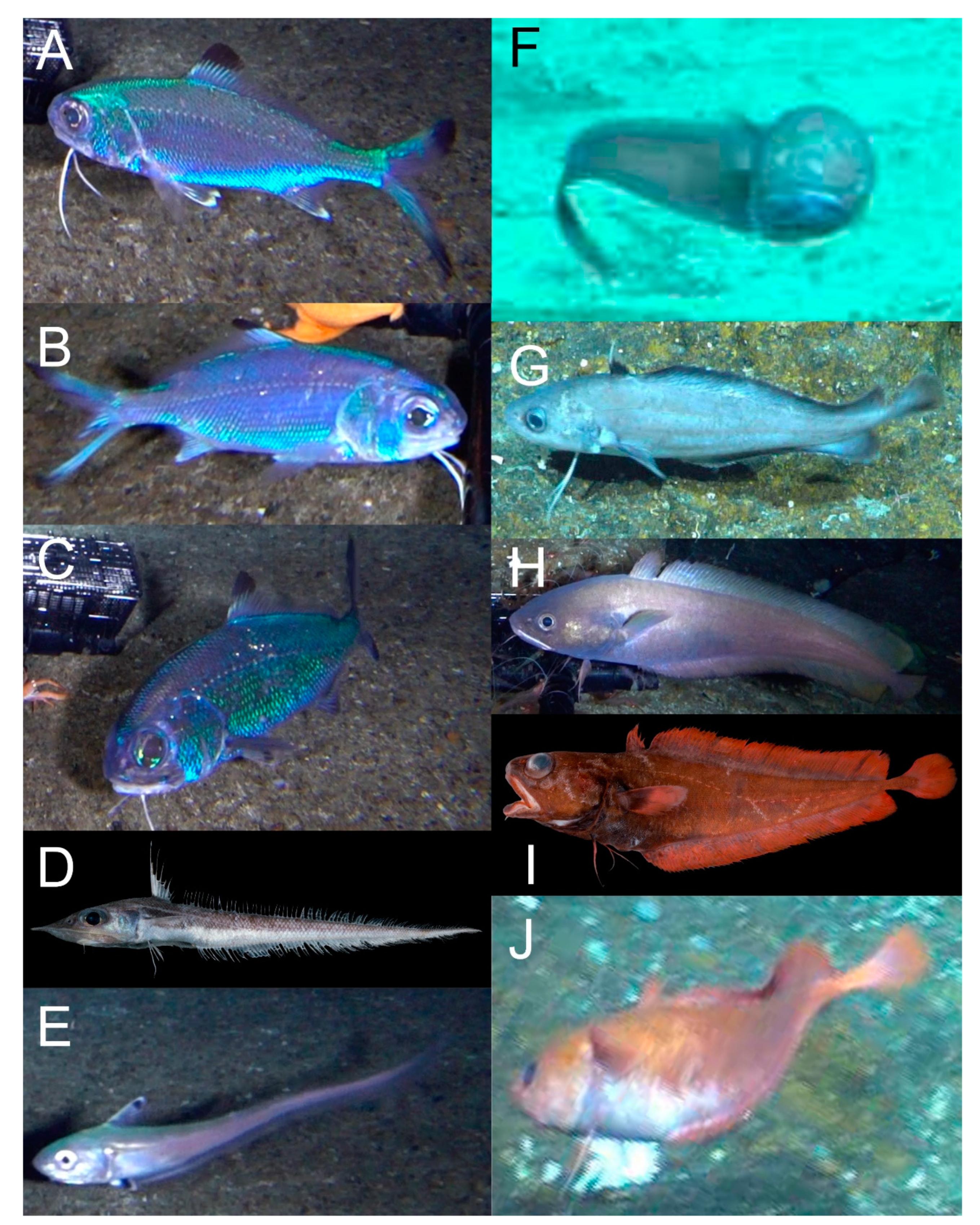
- Bathypterois grallator (Goode and Bean 1886) (Ipnopidae; Figure 3F): A single individual of this species was observed using the ROV in a sandy area at 2002 m depth on the Nikko Seamount. This species was previously reported to inhabit only the south of Tosa Bay and the Ryukyu Archipelago in Japanese waters. The present observations represent a new distributional record for this species.
- Chlorophthalmus sp. (Chlorophthalmidae; Figure 3H): Several individuals of this species were recorded by ROV and AUV in sandy areas or patchy sand bottoms of rocky areas at a depth of around 460 m on the Ritto and Nikko Seamounts. This species matches well with Chlorophthalmus sp. 2 sensu Nakabo and Kai [12] as both have large and thick bodies, large eyes, and curved pelvic fin tips. This species was previously reported only to be present in the Kyushu-Palau Ridge, Tosa Bay, Kumano-nada Sea, and Amami-Oshima Islands [13]. Thus, the present observations represent a new distributional record of this species.
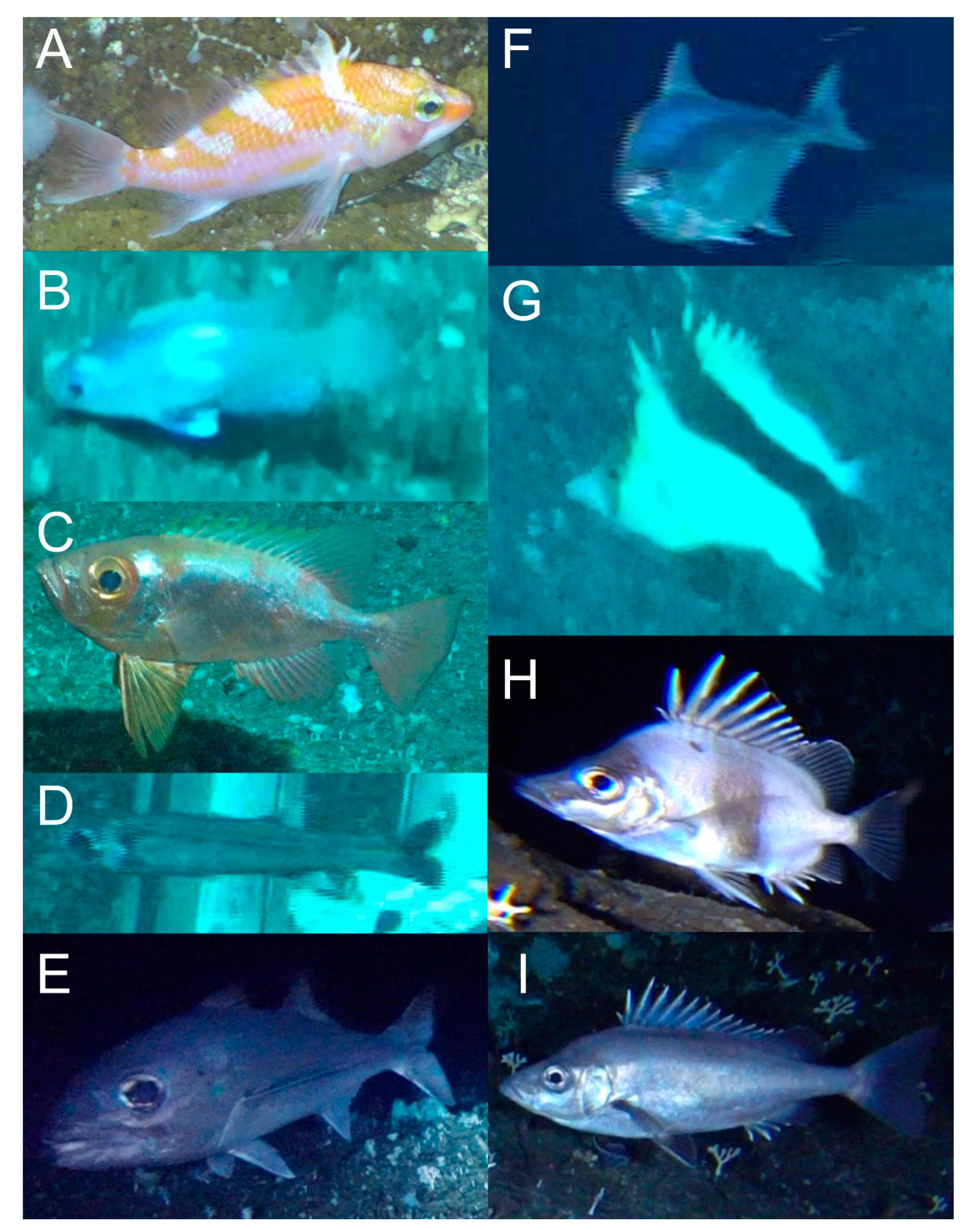
- Polymixia sazanovi Kotlyar 1992 (Polymixiidae; Figure 4C): Several individuals of this species were observed using BC in sandy bottoms of rocky areas at 603 m depth on the Ritto Seamount. This species was previously reported to exist only on the Kyushu-Palau Ridge, Atsumi Peninsula, Yoron-jima Island in the Amami Islands, Ishigaki-jima Island in the Yaeyama Islands, and in southern Taiwan [14,15]. The present observations represent a new distributional record of this species. Polymixia japonica Günther 1877 and Polymixia berndti Gilbert 1905 were observed in the same area in the present study, indicating that these similar congeners can share their habitat.
- Coelorinchus hubbsi Matsubara 1936 (Macrouridae; Figure 4D), specimen No. KM#125-PI 01, 246.7 mm TL: A single specimen was collected by the ROV in patchy sand bottoms of rocky areas at 431 m depth on the Shoho Seamount. This species has previously been reported to be distributed on the continental shelf; however, it was recorded for the first time from a seamount far separated from the shelf.
- Laemonema robustum Johnson 1862 (Moridae; Figure 4G): Several individuals of this species were recorded by ROV and AUV in rocky areas ranging from 380 to 500 m depths on the Ritto and Nikko Seamounts. This species was previously reported only on the Kyushu-Palau Ridge, Yokohama in the Kanagawa Prefecture, and Amami-oshima Islands in Japanese waters. The present observations represent a new distributional record of this species.
- Physiculus rhodopinnis Okamura 1982 (Moridae; Figure 4I), specimen No. KM#132-PI 03, 156.4 mm SL: This was one of the most abundant species recorded by ROV and AUV in rocky areas ranging from 380 to 500 m depths on the Ritto and Nikko Seamounts. This species was previously reported only on the Kyushu-Palau Ridge in Japanese waters. The present observations represent a new distributional record of this species.
- Physiculus yoshidae Okamura 1982 (Moridae; Figure 4J): Several individuals of this species were observed in rocky areas at a depth of 310–500 m on the Ritto and Nikko Seamounts, but with comparatively lower abundance than that of P. rhodopinnis. This species was previously reported only on the Kyushu-Palau Ridge, in the East China Sea, and southern Vietnam. The present observations represent a new distributional record of this species.
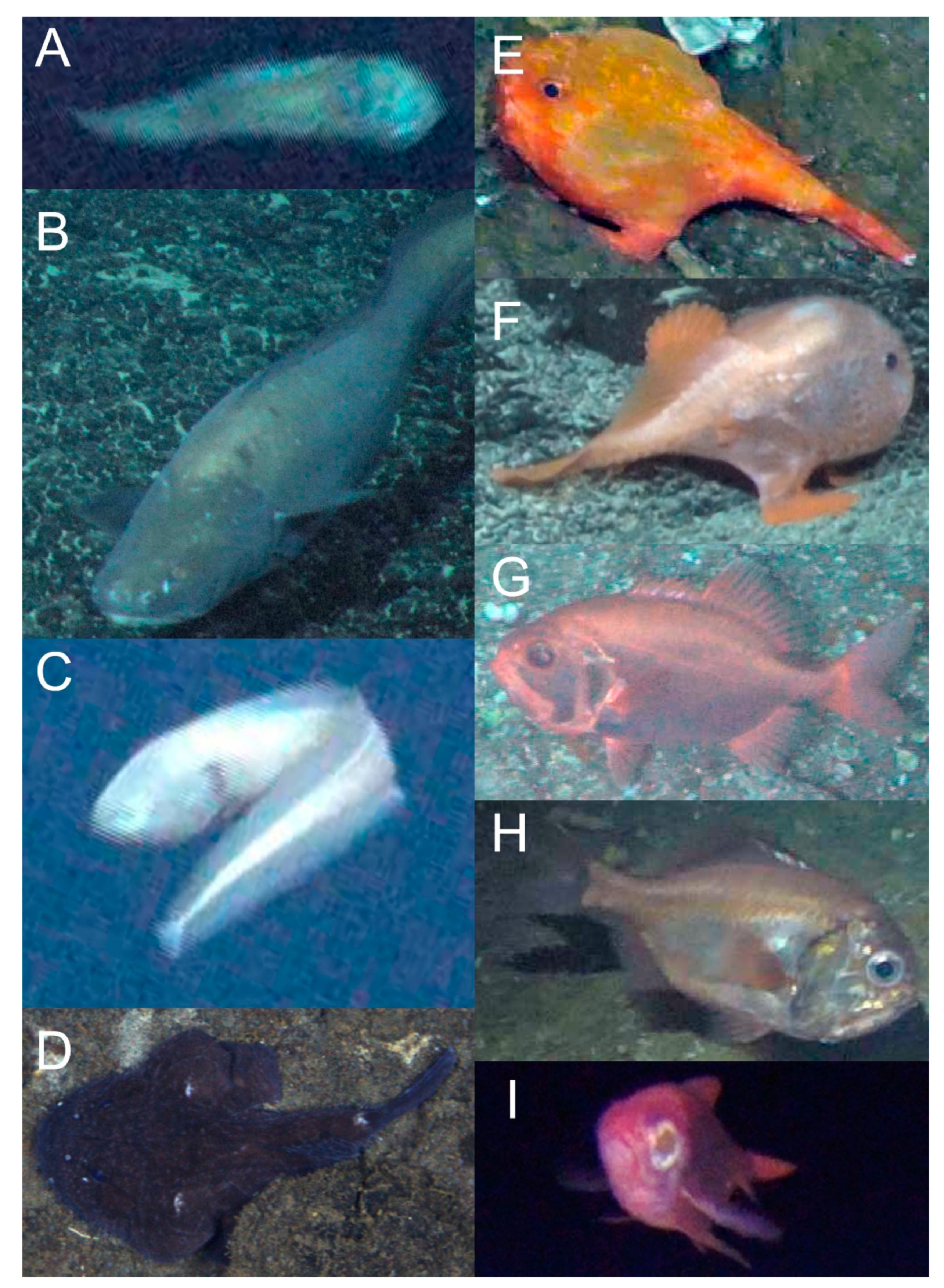
- Acanthonus armatus Günther 1878 (Ophidiidae; Figure 5A): A single individual of this species was recorded by the ROV in a sandy area at 2016 m depth on the Shoho Seamount. This species was previously recorded only in Suruga Bay in Japanese waters. The present observation represents its second locality record in Japan.
- Bassogigas gilli Goode and Bean 1896 (Ophidiidae; Figure 5B): Two individuals of this species were recorded by the ROV in a sandy area at depths of 1917 m and 1919 m of the Ritto Seamount. This species was previously reported only in the Okinawa Trough in Japanese waters. The present observations represent a new distributional record of this species.
- Unidentified species, Chaunacops sp. (Chaunacidae; Figure 5F): A single individual of this species was observed by the ROV in a rocky area at 1884 m depth of the Ritto Seamount. This species seems to be similar to Chaunacops coloratus (Garman, 1899), which is mainly found in the eastern Pacific Ocean [16,17]. Although specimens need to be identified at the species level, fishes of this genus have never been recorded in Japanese waters. Therefore, the present observation represents the first record of this genus from Japan.
- Unidentified species, Hoplostethus sp. (Trachichthyidae; Figure 5H): Two individuals of this species were recorded by the ROV in a rocky area at 530 m and 580 m depths on the Ritto Seamount. This species has a significantly larger body (estimated to be 20–30 cm standard length) than the known Japanese species.
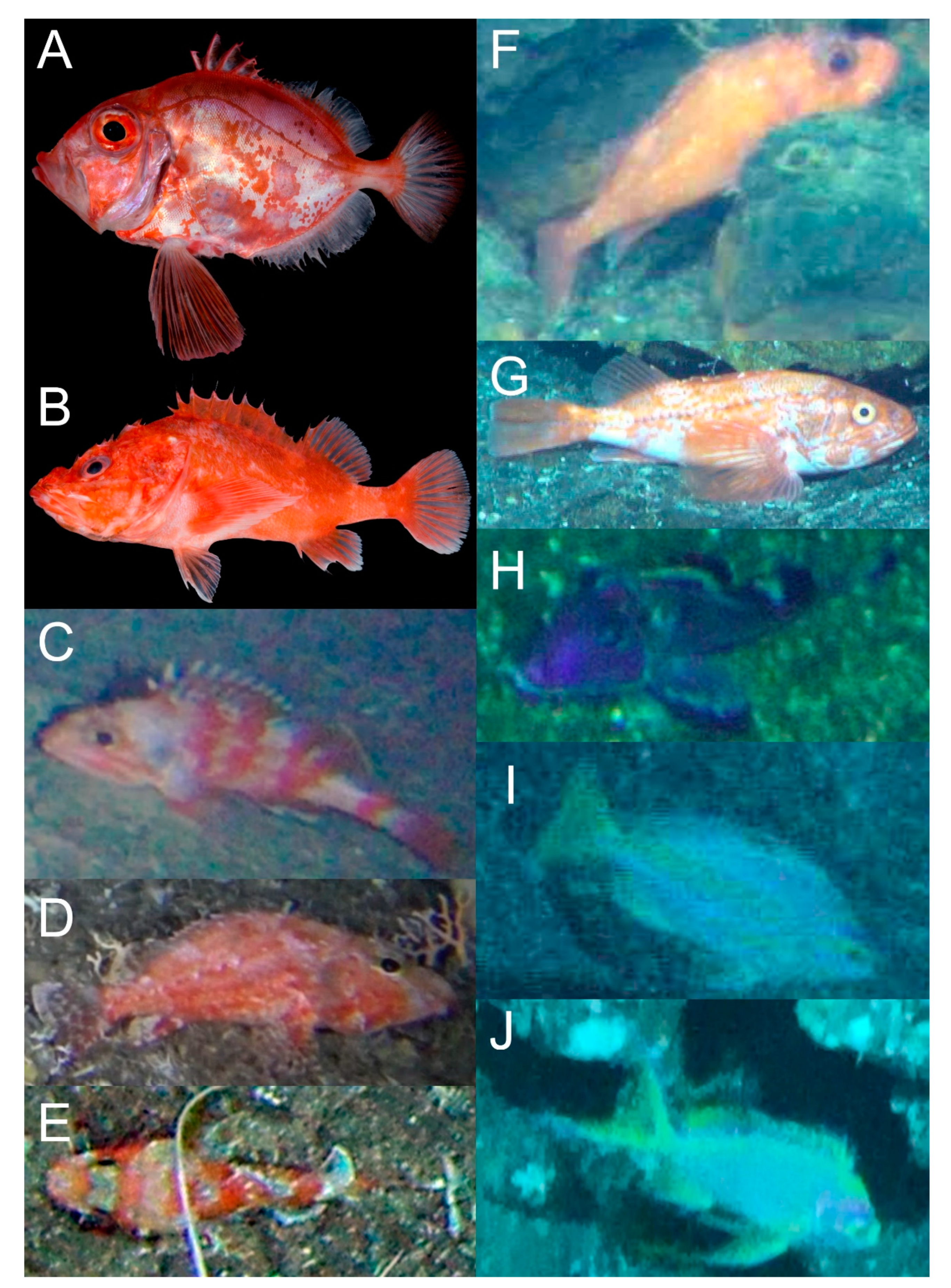
- Stethopristes sp. (Parazenidae; Figure 6A), specimen No. KM#132-PI 01, @@ mm SL: Two individuals of this species were observed by ROV in the rocky area at 380 m and 390 m depths on the Ritto Seamount. The genus contains only a single species Stethopristes eos Gilbert 1905 which known from Hawaiian Islands and off Chile, and have never been recorded in Japanese waters [18]. The taxonomy of this specimen is currently under study by the first author.
- Idiastion pacificum Ishida and Amaoka 1992 (Scorpaenidae; Figure 6B), specimen No. KM#132-PI 02, 95.7 mm SL: Several individuals of this species were recorded by ROV and AUV at the rocky area that ranges from 380 to 500 m depth on the Ritto Seamount, and a single specimen was collected at 410 m depth. This species was previously reported only on the Kyushu-Palau Ridge and Emperor Seamount Chain. The present observations and the specimen represent a new distributional record of the species.
- Unidentified species, Odontanthias sp. (Serranidae; Figure 6J): Several individuals of this species were observed by the ROV in a rocky area at a depth of approximately 328 m on the Shotoku Seamount. This species belongs to Odontanthias based on its body and fin shape; however, its unique coloration and well-elongated anteriormost pelvic-fin ray, and upper and lowermost caudal-fin rays do not match with any known species from this genus.
- Unidentified species, Plectranthias sp. (Serranidae; Figure 7A): A single individual of this species was observed through the ROV in a rocky area at 360 m depth on the Shoho Seamount. Although this species is similar to Plectranthias purpuralepis Tang, Lai, and Ho 2020, which was recently described at 200 m depth in northern Taiwan, it differs in its coloration and a few other characteristics. This species is going to be described as a new species by Wada and Senou [19].
- Unidentified species, Grammatonotus sp. (Callanthiidae; Figure 7B): Several individuals of this species were recorded by the ROV in a rocky area at around 328 m depth on the Shotoku Seamount (sympatric with Odontanthias sp.). This species is similar to Grammatonotus surugaensis Katayama, Yamakawa, and Suzuki 1980 as it shares the elongated caudal-fin rays; however, the unidentified species has a shallower body depth than that of G. surugaensis. In addition, the distinct light-colored blotch observed on Grammatonotus sp. is unique and has not been found in any other known species of the genus.
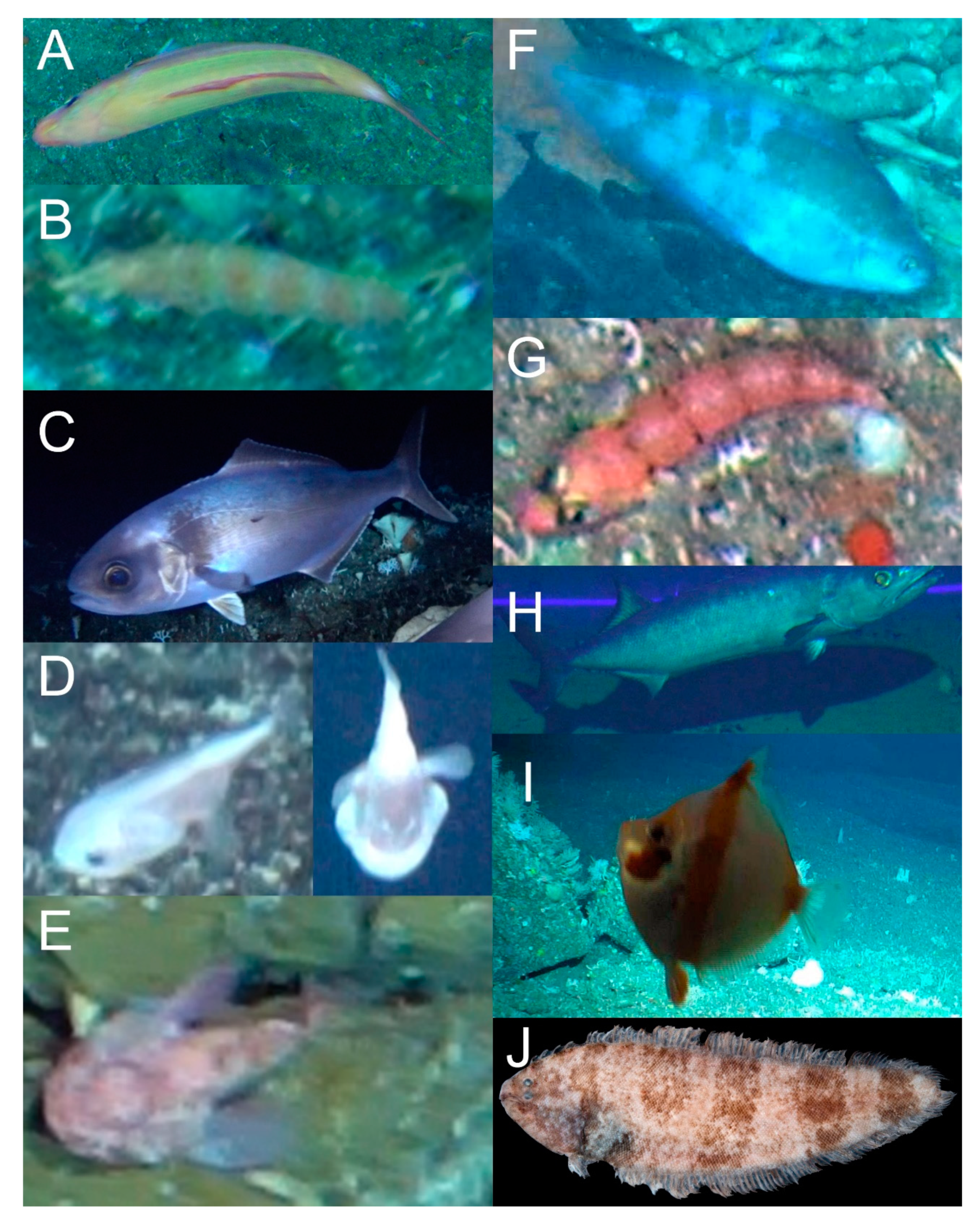
- Unidentified species, Psychrolutes sp. (Psychrolutidae; Figure 8D): A single individual of this species was observed using the ROV in a rocky area at 2053 m depth on the Ritto Seamount. Although specimens need to be identified at the species level, the species of this genus are known as cold-water deep-sea fishes.
- Unidentified species, Zoarcidae gen sp. (Zoarcidae; Figure 8F): Several individuals of this species were observed by the ROV in a rocky area at 508 m depth on the Ritto Seamount. This species probably belongs to Ophidiidae with similar connected dorsal, caudal, and anal fins, simple pectoral fins (not as Liparidae), lacking or with very short pelvic fins (not as Ophidiidae), and blunt snout. Although most of the genera of Zoarcidae have an elongated body, Bothrocarina has a comparatively deeper body than the present unidentified species.
- Parapercis macrophthalma (Pietschmann 1911) (Pinguipedidae; Figure 8G): A single individual of this species was observed using AUV in a rocky area at 270 m depth of Shotoku Seamount. This species was previously reported only on Susami in Wakayama Prefecture, Yamaguchi Prefecture, Tosa Bay, Kagoshima Bay, and Taiwan. The present observations and the specimen represent a new distributional record of the species.
- Symphurus thermophilus Munroe and Hashimoto 2008 (Cynoglossidae; Figure 8J), specimen No. KM#133-PI 01–04, 74.0–95.7 mm SL (four specimens): A large number of individuals were recorded by the ROV in the sandy bottom at the caldera of the Nikko Seamount and a few of them were collected. Some individuals were also observed by the AUV in a patchy sandy bottom at a rocky area at the outer slope of the seamount. Although this species was rarely observed outside the caldera, several individuals were recorded by the AUV on the sandy bottom in the rocky area.
- Kentrocapros flavofasciatus (Kamohara 1938) (Aracanidae; Figure 9C), male: A single individual of this species was recorded by the AUV in a rocky area at 270 m on the Shotoku Seamount. This was the first recording of this species, previously reported as being distributed on the continental shelf, on a seamount far separated from the shelf.
- Unidentified family (Figure 9D): A single individual of this species was captured by the ROV in a sandy area at 2015 m depth on the Shoho Seamount. This individual displayed a unique habit of adopting a head-down tail-up position and hovering almost 2 m from the sea bottom. Although at least two dorsal fins, a long body with low body depth throughout, pointed snout, and a forked caudal fin were confirmed, it was difficult to identify the specimen down to the family level.
- Unidentified family (Figure 9E): A single individual of this species was observed in a rocky area at 330 m depth of the Shoho Seamount using the BC. This individual is unique, with long pelvic fin rays (estimated to be more than 50% of its body length), which have never been reported in any other family, including in larval stages. Two dorsal fins, forked caudal fin, short pectoral fin, and rounded snout, similar to Epigonidae, were confirmed but could not be identified to the family level.
Author Contributions
Funding
Institutional Review Board Statement
Informed Consent Statement
Data Availability Statement
Acknowledgments
Conflicts of Interest
References
- Machida, Y. A new deep-sea ophidiid Fish, Bassozetus levistomatus, from the Izu-Bonin Trench, Japan. Jpn. J. Ichthyol. 1989, 36, 187–189. [Google Scholar] [CrossRef] [Scilit]
- Fujii, T.; Jamieson, A.J.; Solan, M.; Bagley, P.M.; Priede, I.G. A large aggregation of Liparids at 7703 meter and a reappraisal of abundance and diversity of hadal fish. BioSience 2010, 60, 506–515. [Google Scholar] [CrossRef] [Scilit]
- Ohashi, S.; Shinohara, G. An Additional Record of Bassozetus levistomatus Machida, 1989 from the Western North Pacific (Teleostei, Ophidiiformes, Ophidiidae). Bull. Natl. Mus. Nat. Sci. Ser. A 2015, 41, 69–75. [Google Scholar]
- Okamura, O.; Amaoka, K.; Mitani, F. Fishes of the Kyushu-Palau Ridge and Tosa Bay; Japan Fisheries Resource Conservation Association: Tokyo, Japan, 1982; 435p, (In Japanese and English). [Google Scholar]
- Fujikura, K.; Okutani, T.; Maruyama, T. Deep-Sea Life-Biological Observations Using Research Submersibles; Tokai University Press: Hadano, Japan, 2012; 487p. (In Japanese) [Google Scholar]
- Ministry of the Environment. Mid-Ocean Ridge/West Mariana Ridge Northern Offshore Seafloor Natural Environment Conservation Area Designation and Conservation Plan; Ministry of the Environment: Tokyo, Japan, 2020; 8p. (In Japanese)
- Ministry of the Environment. West Seven Island Ridge Offshore Submarine Natural Environment Conservation Area Designation and Conservation Plan; Ministry of the Environment: Tokyo, Japan, 2020; 8p. (In Japanese)
- Nakabo, T. Fishes of Japan with Pictorial Keys to the Species, 3rd ed.; Tokai University Press: Hadano, Japan, 2013; 2428p. (In Japanese) [Google Scholar]
- Eschmeyer’s Catalog of Fishes. Available online: https://researcharchive.calacademy.org/research/ichthyology/catalog/fishcatmain.asp (accessed on 4 October 2021).
- Motomura, H. List of Japan’s All Fish Species; The Kagoshima University Museum: Kagoshima, Japan, 2020; 558p, (In Japanese and English). [Google Scholar]
- Munroe, T.A.; Hashimoto, J. A new western Pacific Tonguefish (Pleuronectiformes: Cynoglossidae): The first Pleuronectiform discovered at active hydrothermal vents. Zootaxa 2008, 1839, 43–59. [Google Scholar] [CrossRef] [Scilit]
- Nakabo, T.; Kai, Y. Chlorophthalmidae. In Fishes of Japan with Pictorial Keys to the Species, 3rd ed.; Nakabo, T., Ed.; Tokai University Press: Hadano, Japan, 2013; pp. 429–430, 1853–1854. (In Japanese) [Google Scholar]
- Hata, H.; Yamaguchi, M.; Iwatsubo, H.; Motomura, H. First records of a species of Chlorophthalmus (Chlorophthalmidae) from the Ryukyu Islands, Japan. Nat. Kagoshima 2016, 42, 33–37. (In Japanese) [Google Scholar]
- Koeda, K.; Hirasaka, H. Records of two deep-sea fishes, Beryx splendens (Beryciformes; Berycidae) and Polymixia sazonovi (Polymixiiformes; Polymixiidae), collected from off Ishigaki-jima Island. Kuroshio Biosph. 2021, 18, 29–37, (In Japanese with English abstract). [Google Scholar]
- Koeda, K. Polymixiidae. In Fishes of Southern Taiwan; Koeda, K., Ho, H.-C., Eds.; National Museum of Marine Biology & Aquarium: Pingtung, Taiwan, 2019; pp. 342–345, (In English and Chinese). [Google Scholar]
- Lundsten, L.; Johnson, S.B.; Cailliet, M.G.; Developer, A.P.; Clague, D.A. Morphological, molecular, and in situ behavioral observations of the rare deep-sea anglerfish Chaunacop scoloratus (Garman, 1899), order Lophiiformes, in the eastern North Pacific. Deep Sea Res. I 2012, 68, 46–53. [Google Scholar] [CrossRef] [Scilit]
- Ho, C.-H.; McGrouther, M. A new anglerfish from eastern Australia and New Caledonia (Lophiiformes: Chaunacidae: Chaunacops), with new data and submersible observation of Chaunacops melanostomus. J. Fish Biol. 2015, 86, 940–951. [Google Scholar] [CrossRef] [Scilit] [PubMed]
- Tyler, J.C.; O’Toole, B.; Winterbottom, R. Phylogeny of the genera and families of Zeiform fishes, with comments on their relationships with Tetraodontiforms and Caproids. Smithsonian Contri. Zool. 2003, 618, 1–110. [Google Scholar] [CrossRef] [Scilit]
- Wada, H.; (Kanagawa Prefectural Museum, Odawara, Japan); Senou, H.; (Kanagawa Prefectural Museum, Odawara, Japan). Personal communication, 2021.


| Name of Seamounts | Latitude | Longitude | Depth Range (m) | Hydrothermal Vent | Research Period | ROV Operation (h) | |
|---|---|---|---|---|---|---|---|
| Shallow | Deep | ||||||
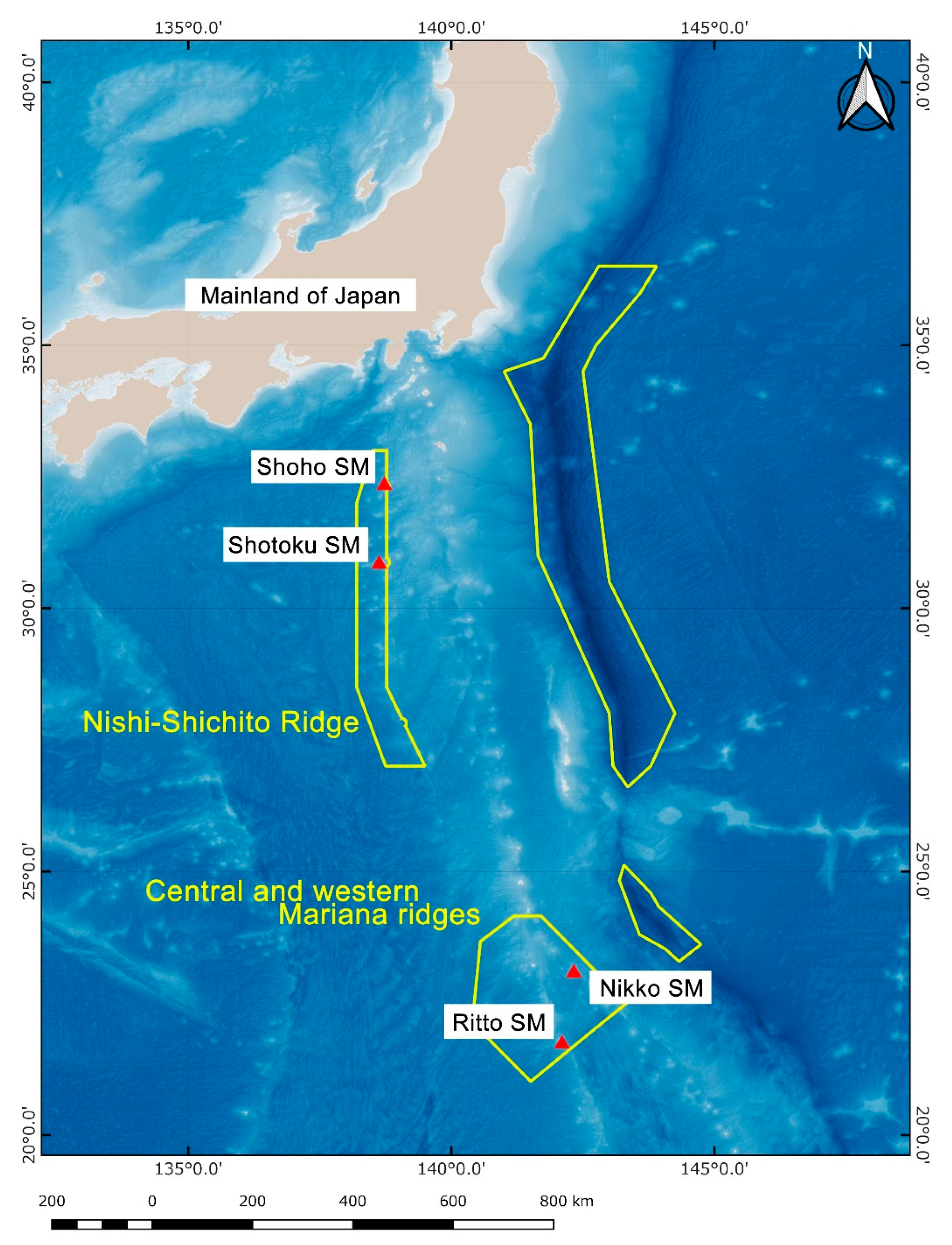
| Shoho | 32°09’ N–32°29’ N | 138°34’ E–138°54’ E | 375–3300 | Absent | 27–30 Nov. 2020 | 3 (11.6) | 1 (5.3) |
| Shotoku | 30°37’ N–30°57’ N | 138°23’ E–138°43’ E | 270–3750 | Absent | 1–2 Dec. 2020 | 3 (7.7) | 0 (0) |
| Ritto | 21°37’ N–21°57’ N | 141°53’ E–142°13’ E | 504–3300 | Absent | 5–8 Dec. 2020 | 3 (11.8) | 1 (4.8) |
| Nikko | 22°53’ N–23°13’ N | 142°10’ E–142°30’ E | 392–3300 | Present | 9–11 Dec. 2020 | 2 (7.8) | 1 (3.3) |
| Taxon | Standard Japanese Name | Figure | Nishi-Shichito Ridge | Central and Western Mariana Ridges | ||||||
|---|---|---|---|---|---|---|---|---|---|---|
| Shoho SM | Shotoku SM | Ritto SM | Nikko SM | |||||||
| S | D | S | D | S | D | S | D | |||
| Carcharhiniformes | ||||||||||
| Pseudotriakidae | ||||||||||
| Pseudotriakis microdon de Brito Capello 1868 | Chihirozame | Figure 2A | B | |||||||
| Lamniformes | ||||||||||
| Pentanchidae | ||||||||||
| Galeus sauteri (Jordan & Richardson 1909) | Taiwan-yamorizame | Figure 2B | R/A/B | |||||||
| Hexanchiformes | ||||||||||
| Hexanchidae | ||||||||||
| Hexanchus griseus (Bonnaterre 1788) | Kagurazame | Figure 2C | B | B | ||||||
| Squaliformes | ||||||||||
| Squalidae | ||||||||||
| Squalus mitsukurii Jordan & Snyder 1903 | Futo-tsunozame | Figure 2D | R/B | R/B | R/B | |||||
| Squalus sp. | Figure 2E | B | ||||||||
| Etmopteridae | ||||||||||
| Etmopterus lucifer Jordan & Snyder 1902 | Fujikujira | Figure 2F | B | |||||||
| Myliobatiformes | ||||||||||
| Plesiobatidae | ||||||||||
| Plesiobatis daviesi (Wallace 1967) | Usuei | Figure 2G | R/A/B | |||||||
| Albuliformes | ||||||||||
| Halosauridae | ||||||||||
| Halosauropsis macrochir (Günther 1878) | Kurobi-tokagegisu | Figure 2H | R | |||||||
| Anguilliformes | ||||||||||
| Muraenidae | ||||||||||
| Gymnothorax intesi (Fourmanoir & Rivaton 1979) | Minamimizore-utsubo | Figure 2I | R/B | |||||||
| Gymnothorax ypsilon Hatooka & Randall 1992 | Okinoshima-utsubo | Figure 2J | R | |||||||
| Synaphobranchidae | ||||||||||
| Histiobranchus bathybius (Günther 1877) | Soko-anago | Figure 2K | R | |||||||
| Meadia abyssalis (Kamohara 1938) | Hirejiro-anago | Figure 2L | B | B | R | |||||
| Synaphobranchus kaupii Johnson 1862 | Irako-anago | Figure 3A | R/B | |||||||
| Synaphobranchus sp. | Figure 3B | R | ||||||||
| Congridae | ||||||||||
| Conger erebennus (Jordan & Snyder 1901) | Dainan-anago | Figure 3C | B | R | ||||||
| Nettastomatidae | ||||||||||
| Nettastoma sp. | Figure 3D | R | ||||||||
| Stomiiformes | ||||||||||
| Melanostomiidae | ||||||||||
| Melanostomias sp. | Figure 3E | B | ||||||||
| Stomiiformes sp. | R | |||||||||
| Aulopiformes | ||||||||||
| Ipnopidae | ||||||||||
| Bathypterois grallator (Goode & Bean 1886) | Oitohikiiwashi | Figure 3F | R | |||||||
| Chlorophthalmidae | ||||||||||
| Chlorophthalmus albatrossis Jordan & Starks 1904 | Aomeeso | Figure 3G | R * | |||||||
| Chlorophthalmus sp. | Bake-aomeeso | Figure 3H | R/A | R/A | ||||||
| Myctophiformes | ||||||||||
| Neoscopelidae | ||||||||||
| Neoscopelus microchir Matsubara 1943 | Sango-iwashi | Figure 3I | R/A | |||||||
| Myctophidae | ||||||||||
| Myctophidae gen. sp. | R | R/B | R | R/B | ||||||
| Polymixiiformes | ||||||||||
| Polymixiidae | ||||||||||
| Polymixia berndti Gilbert 1905 | Arame-gimme | Figure 4A | B | |||||||
| Polymixia japonica Günther 1877 | Gimmedai | Figure 4B | R/A/B | |||||||
| Polymixia sazanovi Kotlyar 1992 | Okamura-gimme | Figure 4C | B | |||||||
| Gadiformes | ||||||||||
| Macrouridae | ||||||||||
| Coelorinchus hubbsi Matsubara 1936 | Moyouhige | Figure 4D | R * | |||||||
| Ventrifossa sp. | Figure 4E | R/A/B | R/A | |||||||
| Macrouroididae | ||||||||||
| Squalogadus modificatus Gilbert & Hubbs 1916 | Bakedara | Figure 4F | R | R | ||||||
| Moridae | ||||||||||
| Laemonema robustum Johnson 1862 | Kurodara | Figure 4G | R/A/B | R/A | ||||||
| Physiculus japonicus Hilgendorf 1879 | Chigodara | Figure 4H | R/B | R | ||||||
| Physiculus rhodopinnis Okamura 1982 | Aka-chigodara | Figure 4I | R * | R | ||||||
| Physiculus yoshidae Okamura 1982 | Oshare-chigodara | Figure 4J | R/A | R/A | ||||||
| Ophidiiformes | ||||||||||
| Ophidiidae | ||||||||||
| Acanthonus armatus Günther 1878 | Hanatoge-ashiro | Figure 5A | R | |||||||
| Bassogigas gilli Goode & Bean 1896 | Oitachiuo | Figure 5B | R | |||||||
| Ophidiidae gen sp. | Figure 5C | R | ||||||||
| Lophiiformes | ||||||||||
| Lophiidae | ||||||||||
| Lophiodes sp. | Figure 5D | A | R/A | |||||||
| Chaunacidae | ||||||||||
| Chaunax penicillatus McCulloch 1915 | Hanaguro-fusaanko | Figure 5E | R | |||||||
| Chaunacops sp. | Figure 5F | R | ||||||||
| Beryciformes | ||||||||||
| Trachichthyidae | ||||||||||
| Gephyroberyx darwinii (Johnson 1866) | Hashikinme | Figure 5G | R | |||||||
| Hoplostethus sp. | Figure 5H | R | ||||||||
| Berycidae | ||||||||||
| Beryx splendens Lowe 1834 | Kimmedai | Figure 5I | R/A/B | |||||||
| Zeiformes | ||||||||||
| Parazenidae | ||||||||||
| Stethopristes sp. | Figure 6A | R* | ||||||||
| Perciformes | ||||||||||
| Scorpaenidae | ||||||||||
| Idiastion pacificum Ishida & Amaoka 1992 | Kakure-kasago | Figure 6B | R */A | |||||||
| Helicolenus hilgendorfii (Döderlein 1884) | Yume-kasago | Figure 6C | B | |||||||
| Pontinus macrocephalus (Sauvage 1882) | Hiodoshi | Figure 6D | B | |||||||
| Scorpaenidae gen sp. 1 | R | |||||||||
| Scorpaenidae gen sp. 2 | Figure 6E | R/A | ||||||||
| Scorpaenidae gen sp. 3 | Figure 6F | R | ||||||||
| Setarchidae | ||||||||||
| Setarches guentheri Johnson 1862 | Shiro-kasago | Figure 6G | R | R | R | |||||
| Triglidae | ||||||||||
| Lepidotrigla sp. | Figure 6H | A | ||||||||
| Serranidae | ||||||||||
| Caprodon schlegelii (Günther 1859) | Akaisaki | Figure 6I | R | |||||||
| Hyporthodus octofasciatus (Griffin 1926) | Mahatamodoki | R | ||||||||
| Odontanthias sp. | Figure 6J | R | ||||||||
| Plectranthias kelloggi azumanus (Jordan & Richardson 1910) | Azuma-hanadai | R | ||||||||
| Plectranthias sp. | Figure 7A | R * | ||||||||
| Callanthiidae | ||||||||||
| Grammatonotus sp. | Figure 7B | R | ||||||||
| Priacanthidae | ||||||||||
| Cookeolus japonicus (Cuvier 1829) | Chikame-kintoki | Figure 7C | R/A | |||||||
| Epigonidae | ||||||||||
| Epigonus sp. | Figure 7D | R/A | R | |||||||
| Scombropidae | ||||||||||
| Scombrops boops (Houttuyn 1782) | Mutsu | Figure 7E | B | |||||||
| Bramidae | ||||||||||
| Eumegistus illustris Jordan & Jordan 1922 | Chikame-echiopia | Figure 7F | R | |||||||
| Emmelichthyidae | ||||||||||
| Emmelichthyidae gen sp. | R | |||||||||
| Lutjanidae | ||||||||||
| Etelis carbunculus Cuvier 1828 | Hachijo-akamutsu | A | ||||||||
| Pristipomoides argyrogrammicus (Valenciennes 1832)** | Hanafuedai | A | ||||||||
| Chaetodontidae | ||||||||||
| Prognathodes guyotensis (Yamamoto & Tameka 1982) | Urashima-chochouo | Figure 7G | R | |||||||
| Pentacerotidae | ||||||||||
| Pentaceros japonicus Steindachner 1883 | Tsubodai | Figure 7H | R/B | R/B | ||||||
| Pentaceros wheeleri (Hardy 1983) | Kusakari-tsubodai | Figure 7I | B | |||||||
| Labridae | ||||||||||
| Bodianus tanyokidus Gomon & Madden 1981 | Zunaga-akabo | Figure 8A | A | |||||||
| Labridae gen sp. | Figure 8B | A | ||||||||
| Centrolophidae | ||||||||||
| Hyperoglyphe japonica (Döderlein 1884) | Medai | Figure 8C | R/B | R/B | ||||||
| Psychrolutidae | ||||||||||
| Psychrolutes sp. | Figure 8D | R | ||||||||
| Psychrolutidae gen sp. | Figure 8E | |||||||||
| Zoarcidae | ||||||||||
| Zoarcidae gen sp. | Figure 8F | R | ||||||||
| Pinguipedidae | ||||||||||
| Parapercis macrophthalma (Pietschmann 1911) | Shizukutoragisu | Figure 8G | A | |||||||
| Gempylidae | ||||||||||
| Ruvettus pretiosus Cocco 1833 | Baramutsu | Figure 8H | A/B | A | ||||||
| Caproidae | ||||||||||
| Antigonia capros Lowe 1843 | Hishidai | Figure 8I | R/B | |||||||
| Pleuronectiformes | ||||||||||
| Cynoglossidae | ||||||||||
| Symphurus thermophilus Munroe & Hashimoto 2008 | Ideyu-ushinoshita | Figure 8J | R */A | |||||||
| Tetraodontiformes | ||||||||||
| Triacanthodidae | ||||||||||
| Macrorhamphosodes uradoi (Kamohara 1933) | Fuekawamuki | Figure 9A | R/A/B | |||||||
| Triacanthodes anomalus (Temminck & Schlegel 1850) | Benikawamuki | Figure 9B | R/A/B | R/A/B | ||||||
| Aracanidae | ||||||||||
| Kentrocapros flavofasciatus (Kamohara 1938) | Kisuji-itomakifugu | Figure 9C | A * | |||||||
| Order unknown | ||||||||||
| Unidentified species 1 | Figure 9D | R | ||||||||
| Unidentified species 2 | Figure 9E | B | ||||||||
| Name of SM | Number of Species | Overlapped with | |||
|---|---|---|---|---|---|
| Shoho | Shotoku | Ritto | Nikko | ||
| Shoho | 13 | - | 6 (46.2) | 4 (30.8) | 2 (15.4) |
| Shotoku | 30 | 6 (20.0) | - | 4 (13.3) | 2 (6.7) |
| Ritto | 35 | 4 (11.4) | 4 (11.4) | - | 11 (31.4) |
| Nikko | 14 | 2 (14.3) | 2 (14.3) | 11 (78.6) | - |
Publisher’s Note: MDPI stays neutral with regard to jurisdictional claims in published maps and institutional affiliations. |
© 2021 by the authors. Licensee MDPI, Basel, Switzerland. This article is an open access article distributed under the terms and conditions of the Creative Commons Attribution (CC BY) license (https://creativecommons.org/licenses/by/4.0/).
Share and Cite
Koeda, K.; Takashima, S.; Yamakita, T.; Tsuchida, S.; Fujiwara, Y. Deep-Sea Fish Fauna on the Seamounts of Southern Japan with Taxonomic Notes on the Observed Species. J. Mar. Sci. Eng. 2021, 9, 1294. https://doi.org/10.3390/jmse9111294
Koeda K, Takashima S, Yamakita T, Tsuchida S, Fujiwara Y. Deep-Sea Fish Fauna on the Seamounts of Southern Japan with Taxonomic Notes on the Observed Species. Journal of Marine Science and Engineering. 2021; 9(11):1294. https://doi.org/10.3390/jmse9111294
Chicago/Turabian StyleKoeda, Keita, Soutarou Takashima, Takehisa Yamakita, Shinji Tsuchida, and Yoshihiro Fujiwara. 2021. "Deep-Sea Fish Fauna on the Seamounts of Southern Japan with Taxonomic Notes on the Observed Species" Journal of Marine Science and Engineering 9, no. 11: 1294. https://doi.org/10.3390/jmse9111294
APA StyleKoeda, K., Takashima, S., Yamakita, T., Tsuchida, S., & Fujiwara, Y. (2021). Deep-Sea Fish Fauna on the Seamounts of Southern Japan with Taxonomic Notes on the Observed Species. Journal of Marine Science and Engineering, 9(11), 1294. https://doi.org/10.3390/jmse9111294