Article

Uncertainty Quantification in Mooring Cable Dynamics Using Polynomial Chaos Expansions


by
Guilherme Moura Paredes
1,*,
Claes Eskilsson
1 and
Allan P. Engsig-Karup
2,3
1
Department of Civil Engineering, Aalborg University, DK-9220 Aalborg∅, Denmark
2
Department of Applied Mathematics and Computer Science, Technical University of Denmark, DK-2880 Kgs. Lyngby, Denmark
3
Center for Energy Resources Engineering, Technical University of Denmark, DK-2880 Kgs. Lyngby, Denmark
*
Author to whom correspondence should be addressed.
J. Mar. Sci. Eng. 2020, 8(3), 162; https://doi.org/10.3390/jmse8030162
Submission received: 1 February 2020 / Revised: 21 February 2020 / Accepted: 24 February 2020 / Published: 2 March 2020
(This article belongs to the Special Issue De-Risking Marine Renewable Energy: Testing and Modelling Challenges)

Abstract

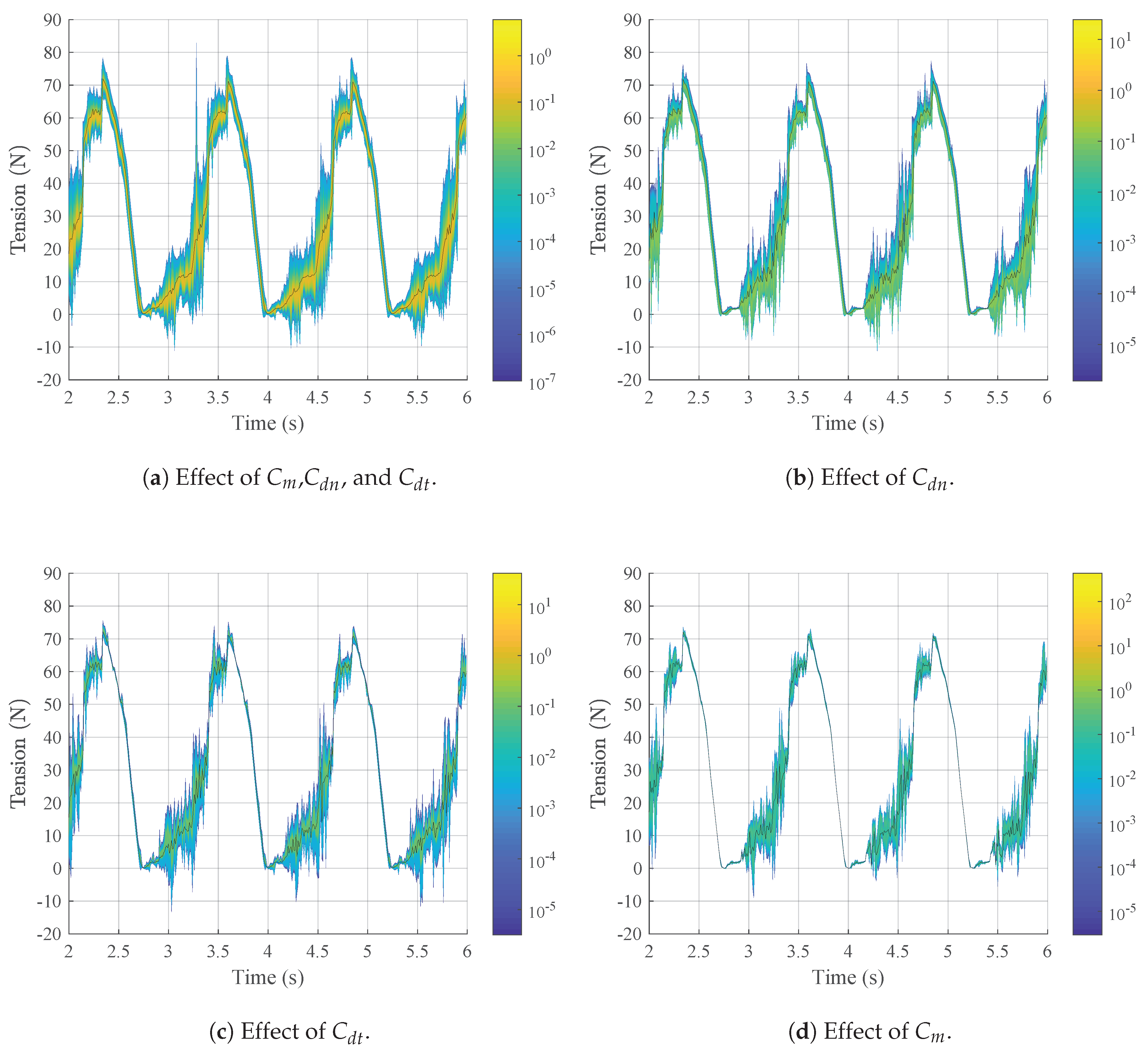
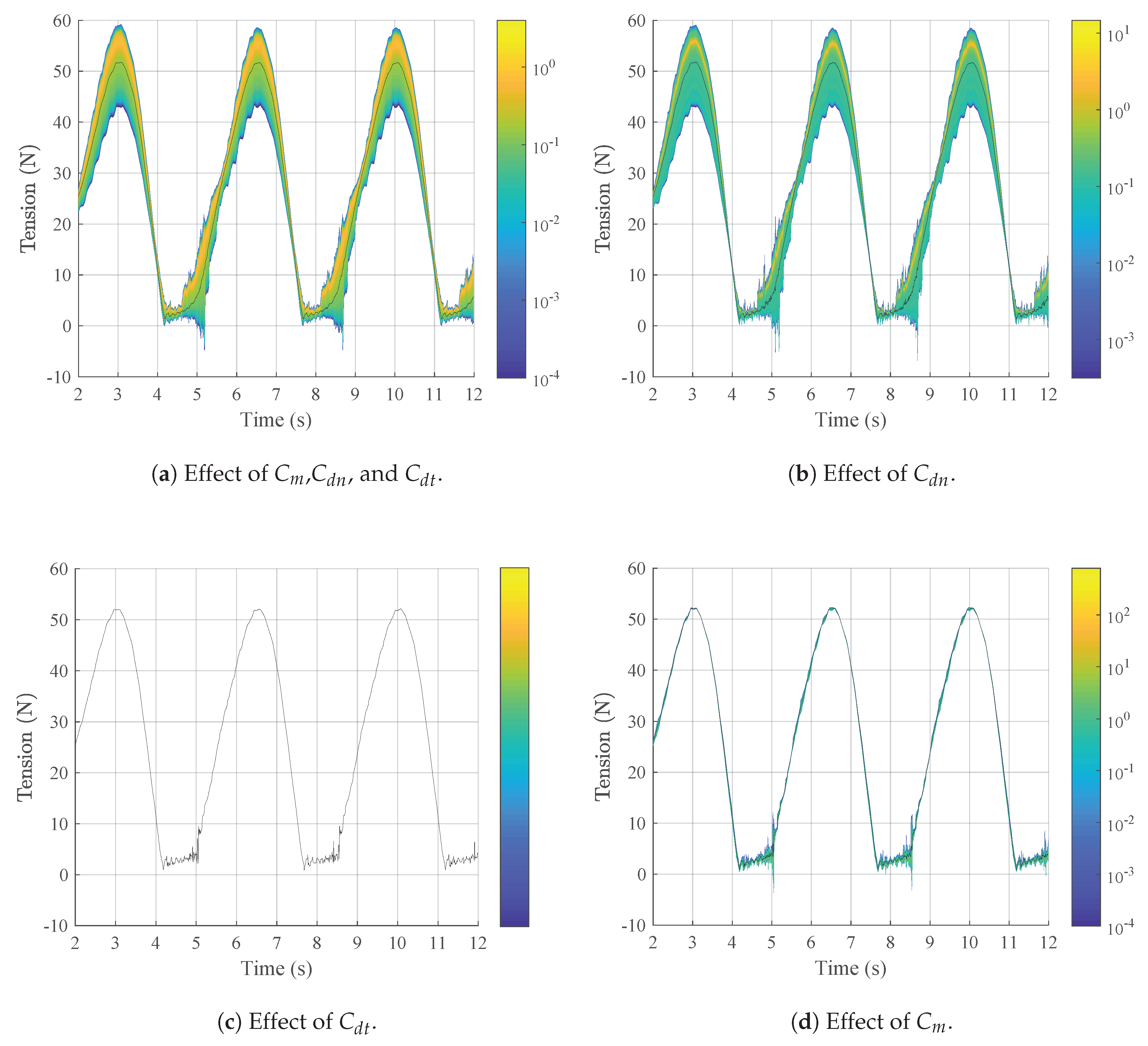
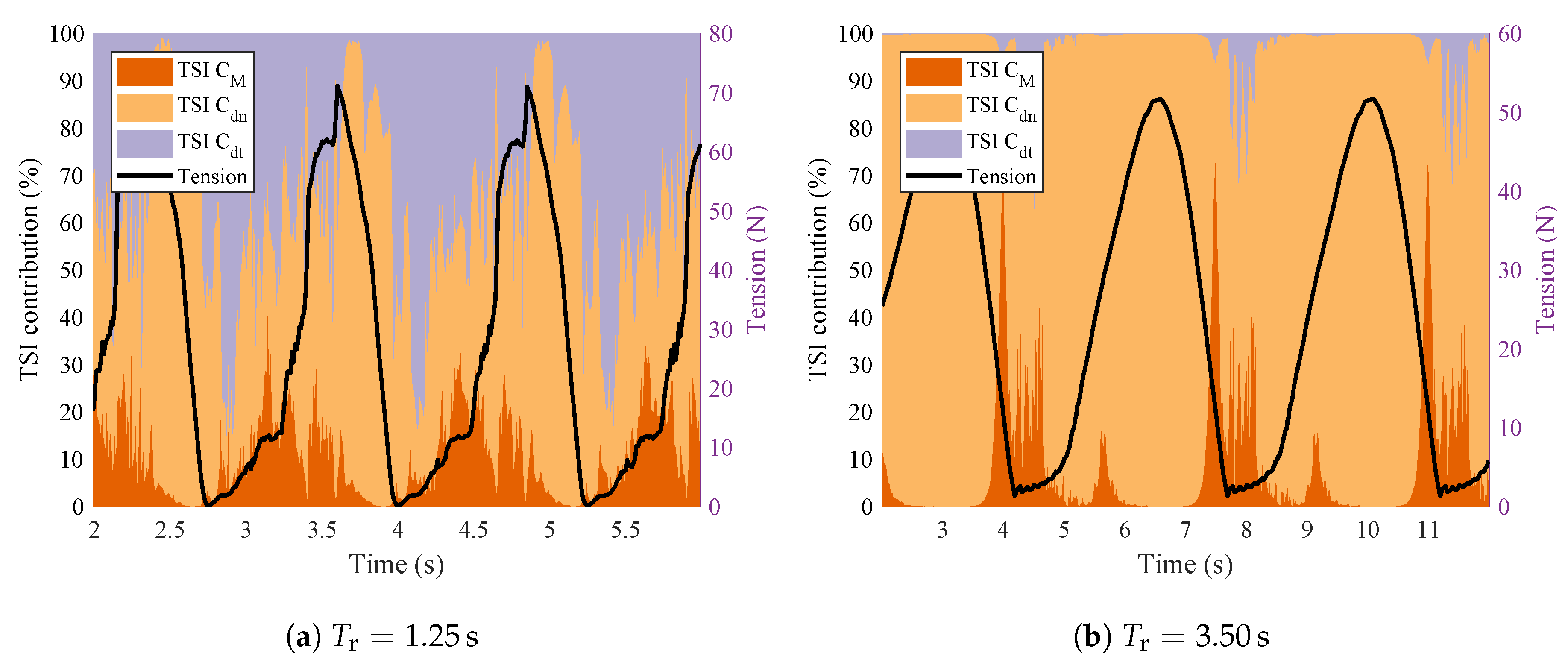
Mooring systems exhibit high failure rates. This is especially problematic for offshore renewable energy systems, like wave and floating wind, where the mooring system can be an active component and the redundancy in the design must be kept low. Here we investigate how uncertainty in input parameters propagates through the mooring system and affects the design and dynamic response of mooring and floaters. The method used is a nonintrusive surrogate based uncertainty quantification (UQ) approach based on generalized Polynomial Chaos (gPC). We investigate the importance of the added mass, tangential drag, and normal drag coefficient of a catenary mooring cable on the peak tension in the cable. It is found that the normal drag coefficient has the greatest influence. However, the uncertainty in the coefficients plays a minor role for snap loads. Using the same methodology we analyze how deviations in anchor placement impact the dynamics of a floating axi-symmetric point-absorber. It is shown that heave and pitch are largely unaffected but surge and cable tension can be significantly altered. Our results are important towards streamlining the analysis and design of floating structures. Improving the analysis to take into account uncertainties is especially relevant for offshore renewable energy systems where the mooring system is a considerable portion of the investment.
Keywords: mooring system dynamics; mooring cables; floating structure dynamics; uncertainty quantification; generalized polynomial chaos mooring system dynamics; mooring cables; floating structure dynamics; uncertainty quantification; generalized polynomial chaos