1. Introduction
The Sea–Land Breeze (SLB) circulation is a mesoscale meteorological phenomenon which is driven by temperature difference between the land and the sea [
1]. The SLB has a significant impact on the climate, environment, and socio-economic conditions of coastal areas [
2]. During the daytime, as per classical theory, the land heats up faster than the sea, and this causes the formation of a wind called a sea breeze, which moves from the sea to the land. Conversely, at night, a land breeze occurs. Since the mid-20th century, this classical thermal theory has been well-known and studied according to the literature [
3,
4,
5]. The SLB, which is a typical local circulation, significantly influences the coastal climate characteristics, dispersion of pollutants, and ecological system, as well as socio-economic activities like fisheries, shipping, and tourism [
6,
7,
8,
9,
10,
11,
12]. The SLB activity is modulated by many factors, like the land–sea temperature difference, presence of background weather system, and topography of the region [
13,
14]. In tropical regions, the SLB is present throughout the year. However, in mid-latitude regions, such as the coast of China, it has clear seasonal features and is strongest in summer [
15,
16]. Previous studies have also primarily focused on the separation of SLB signals in mid-latitude regions [
14].
The study of the SLB under the influence of large-scale monsoonal background and its impact on nearshore currents is limited. Existing research has predominantly focused on the impact of SLB on air quality in specific urban agglomerations, such as Shanghai and Taipei, or on mechanistic analyses under weak background wind conditions [
12,
17,
18,
19,
20]. This knowledge gap is mainly due to the lack of in situ observational data with sufficient spatial coverage to capture SLB-induced currents. The standard means of observation, like the Acoustic Doppler Current Profiler (ADCP) or a drifting buoy, do not have adequate spatial coverage and they cannot resolve currents driven by the SLB. Satellite observations cover a large area although they cannot give total surface currents in real time [
21,
22,
23]. High-Frequency (HF) radar has become an essential instrument for mapping ocean surface current with higher resolution over a large area at a high spatial and temporal resolution [
24,
25]. Due to its ability to explain mesoscale to submesoscale processes, it is suitable for accounting for the variability of wind-driven currents. For example, the SLB-induced diurnal currents were measured by HF radar in Monterey Bay, USA, with velocities of up to 20 cm/s [
26,
27]. Similarly, applications in the Gulf of the Farallones [
28] and the Iroise Sea [
29] have shown its ability to capture tidal and wind-driven current structures.
Despite this progress, the research on using of HF radar currents to investigate the SLB-current couple system under strong large-scale monsoon background is limited [
30,
31]. Most previous literatures have focused on tidal residual separation or general circulation, while insufficient efforts made to diurnal signals caused by local diurnal wind [
32,
33]. It removes it from our understanding of air-sea interactions of monsoon-dominated regimes. Moreover, HF radar was used in the SLB studies mostly in areas where winds are weak or light [
34]. It is rarely found in areas of strong monsoon where there is strong background currents and complex wind field. Modeling studies suggest that elevated background wind speeds greatly reduce sea breeze vertical depth and duration, affecting the transport pathways and accumulation effects of pollutants [
35,
36]. This suggests that the SLB structure and its marine environmental impacts in the Taiwan Strait may differ significantly during the winter monsoon months as compared to the summer months or other non-monsoon months.
The southwestern Taiwan Strait is located in an important area of the East Asia monsoon, where the influence of the SLB system is evident. The complex dynamics of the Taiwan Strait are governed by two predominant, interacting factors: its distinctive topography, and the strong seasonally-reversing monsoon. First, the strait acts as a topographic constriction between the Taiwan Island and the China Mainland. This narrowing geometry forces both oceanic and atmospheric flows, leading to pronounced channeling and acceleration effects. Second, this topographic channel is subjected to the monsoonal background. During the winter, strong, persistent north-easterly winds dominate, creating a high-energy, high-noise environment [
37,
38,
39,
40]. The development of a local circulation pattern may occur under these circumstances. The strong background wind field belonging to the winter monsoon interacts markedly with the local SLB. However, it is still not clear whether the SLB has a comprehensive influence on diurnal tidal as well as residual currents in this complex location. While the existence of SLB in winter has been established [
41], quantifying its direct forcing on the ocean surface remains a challenge in regions dominated by strong, variable background winds like the winter monsoon. Traditional signal processing techniques, such as standard band-pass filtering or harmonic analysis, may be insufficient as they can be confounded by the high energy of the synoptic-scale background flow and the non-stationary nature of the diurnal signal amplitude. Therefore, a method capable of sequentially isolating the background flow and then precisely extracting the time-varying diurnal component is required to advance from qualitative recognition to quantitative analysis of the SLB-current coupling under these conditions. To address this gap, this study utilizes ocean surface current data from HF radar, buoys, and reanalysis data for analyzing coupled system of the SLB and diurnal currents in strong monsoonal seas. This research is expected to reveal the mechanisms of current modulation resulting from the winter monsoon and the SLB by accurately identifying SLB days and extracting diurnal signals from the currents. The aim of this work is to enhance our understanding of meso- and small-scale air-sea-current coupling processes based on scientific data so as to better qualitative predictions of the marine environment, in addition to improving the safety of fisheries and assessing the transport of pollutants in this area.
The remaining structure of this article is outlined as follows:
Section 2 introduces the materials and methods,
Section 3 presents the results,
Section 4 delves into the discussion, and
Section 5 concludes the study.
2. Materials and Methods
2.1. Region and Winter Monsoon
The Taiwan Strait is a body of water found on the continental shelf of Southeast Asia. The climate of the Taiwan Strait shares the characteristics of the subtropical maritime monsoon climate with marked seasonal differences between the winter and summer monsoons. The strait runs in a north-east south-west orientation. It has a funnel-shaped topography and is wider in the south and narrower in the north. The mountains and hills surrounding an area follow a north–south direction that strongly resembles it. The special topographical features give rise to a strong channeling effect which constricts and speeds-up the flow of air resulting in generally strong winds, high waves and vigorous currents with the frequent influence of typhoons.
As a representative area of the East Asian monsoon system, the wind field over the Taiwan Strait exhibits significant seasonal variability. Northeasterly winds dominate during the winter monsoon, while southwesterly or southerly winds prevail in the summer monsoon. The winter season, spanning from December to February (often extending into March), features the highest average wind speeds of the year.
The combination of southward-moving cold air masses and the region’s specific geomorphology renders winter the windiest season. The channeling effect is particularly effective in enhancing the northeasterly winds as they are funneled through the constricted topography, resulting in peak wind speeds in the central part of the strait [
35]. During this period, the average wind speed in the strait generally ranges from 11 to 13 m/s, with extreme conditions potentially reaching up to 16 m/s. The intensity of winter winds is approximately three times greater than that of the summer southwesterly winds, which have average speeds from only approximately 5 to 7 m/s. The southwestern Taiwan Strait, which is the focus of this study, experiences slightly lower average wind speeds compared to the central region of the strait.
2.2. HF Radar Surface Currents
HF radar-derived surface currents are important to the present study because they provide essential high-resolution ocean surface measurements that cannot be obtained from point-based observing systems (moorings or drifters). The main aim of this study is to sample and quantify the spatially diurnal currents forced by the SLB. The currents might be exhibiting substantial variations over short distances (a few km) and short temporal (hours) scales.
This study uses OSMAR071 radar current data to check the influence of the SLB on ocean surface currents (more details of OSMAR071 can be found in [
42,
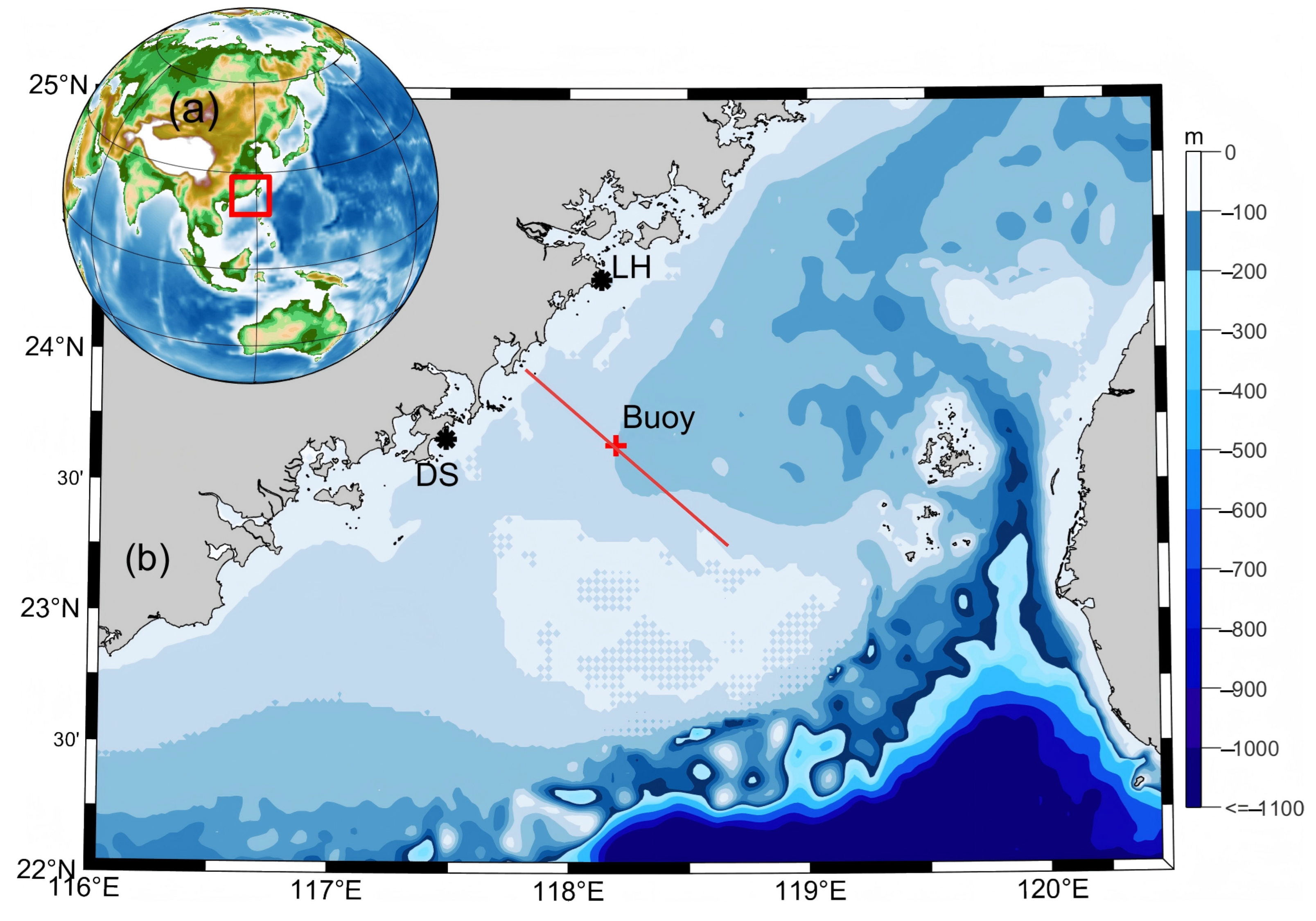
43]). The monitoring system was set up at two observing sites, Dongshan (23.6575° N, 117.4863° E) and Longhai (24.2674° N, 118.1353° E), and their locations are identified by black stars in
Figure 1.
The radar system operated at a frequency of 7.8 MHz. As an array-based High-Frequency Surface Wave Radar, effectively monitored radial current states remain in the target area. The system had a beam scanning range of 150 degrees capable of resolving the radial current direction at 1.5 degrees accuracy. The distance between the two sites, Dongshan and Longhai, is about 90 km, and each site has a maximum detection range of 200 km. With the radial currents, of two independent directions, collected within their overlapping area, vector current information at any location can be derived through spatial geometry. To ensure reliability of the observations, a stringent quality control protocol was implemented to screen and remove anomalous data [
44]. After referring to the literature on HF radar quality control [
45,
46,
47], the specific methods are as follows. First, the outliers will be removed for every time step and the value that deviates most from the current field average will be excluded. In Equation (
1),
signifies the current velocity measured at any point in space at the moment of time. The term
refers to the average current velocity in the entire field at that moment in time.
is the standard deviation of the current velocities at all points in space at the moment in time. Using this technique, points in space where the deviation from the mean current velocity is greater than two times the standard deviation are excluded. Secondly, the time series at each spatial point has been examined on the time scale. If the value at a particular time step exceeds (in absolute value) the average value of that point on the observation period, plus or minus twice the standard deviation, then the value at that time step of that point is also eliminated. Finally, on the time scale, they fill the gap by cubic spline interpolation function. Spatial ranges with a data sampling rate exceeding 70% are then selected for subsequent research.
Between 29 January and 26 March 2013, vector current data were obtained continuously over 57 days. The dataset (5 km spatial resolution and 10 min temporal resolution) provides an analysis of current dynamics in the southwestern Taiwan Strait. The radial and vector current data were validated using comparisons with Acoustic Doppler Current Profiler (ADCP) and buoy measurements. Refer to the work of Xu Quanjun et al. for specific validation procedures [
48]. Specifically, The same dataset from this deployment (from 29 January to 26 March 2013) was used by [
48] to perform a long-term validation of the system’s accuracy against co-located ADCP measurements, demonstrating a high correlation coefficient of 0.80. This prior validation provides confidence in the quality of the foundational data used in the present study.
This study focuses on extracting the diurnally varying component from the residual current field for correlation analysis with the wind field. Given that the Taiwan Strait is characterized by high tidal energy, the T_TIDE toolbox was employed to perform harmonic analysis on the vector current fields at various measurement points, thereby isolating the tidal constituents [
49]. The residual current was obtained by removing the tidal components from the total vector currents, and the diurnal current signal was subsequently extracted from this residual currents.
The core methodology of this study was designed as a two-stage process to address the specific challenge of detecting a weak, diurnal signal embedded in a powerful, aperiodic background flow. The first stage aims to precisely demodulate the residual diurnal signal of interest, and the second stage aims to remove the dominant low-frequency background.
In studies of ocean currents, diurnally varying currents are separated using a band-pass filter. The performance characteristics of the filter will greatly impact how effective this method is. To reduce filter performance-related artefact, the current study implemented the Complex Demodulation Spectrum Shifting technique. By applying this approach, the band-pass filtering design can be transformed into low-pass filtering. The specific procedure is as follows:
where
is the diurnal currents driven by the SLB,
is the angular frequency, and
u and
v are the east and north components of the ocean current, respectively. A Lanczos filter is used in this process, and the range of low-pass filtering is set to 0.1 cpd. The Length/Weight Number is determined by the Lanczos filter function’s internal implementation. The complex exponential carrier wave was defined as exp(−2 × pi × 1i × (1/86,400) × t), where t is the time vector in seconds relative to this reference.
The radial currents measured by the HF radar system represent the velocity of the ocean surface, corresponding to a depth-average over the effective sampling depth of the radio waves. For the 7.8 MHz frequency used in this study, the effective sampling depth is approximately 0.5–1 m in the coastal waters of the southwestern Taiwan Strait, following the principle of half-space attenuation. It is important to note that the measured velocity is a combination of the Eulerian current and the wave-induced Stokes drift. Therefore, the results presented herein characterize the surface layer dynamics forced by the SLB.
2.3. Wind Observation and Reanalysis Data
As shown in
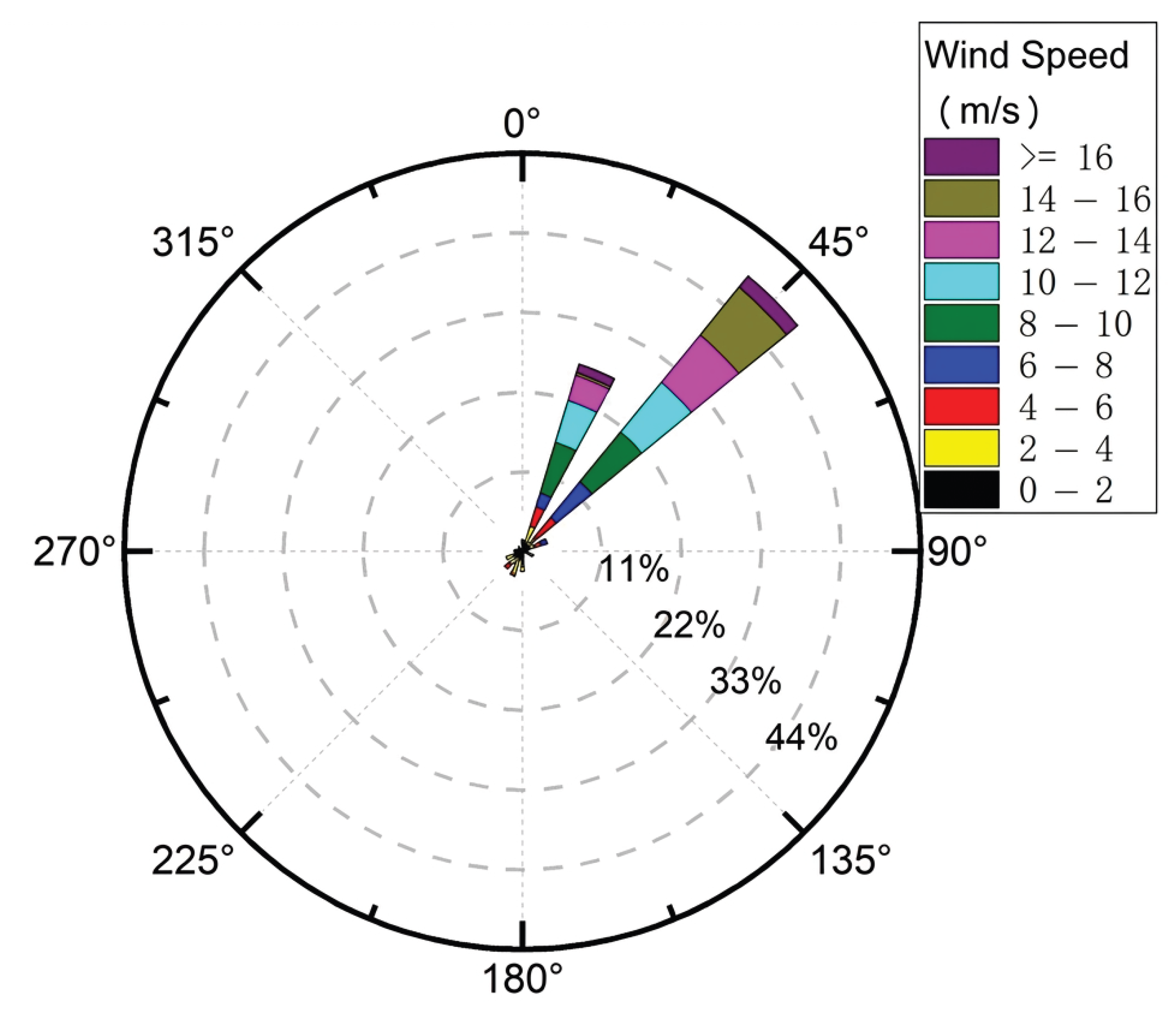
Figure 1, a buoy (indicated by a red plus sign at 23.46° N, 118.33° E) operated by the Fujian Marine Forecasting Station was employed to monitor sea surface wind conditions. The buoy recorded wind speed and direction at a height of 10 m above sea level at 30 min intervals. The instrument has a wind speed measurement accuracy of ±5% within a range of from 0.5 to 60 m/s, and a wind direction accuracy of ±10° across a full scale of from 0 to 360°. According to the wind direction frequency distribution illustrated in
Figure 2, northeasterly winds predominated during the observation period, with measured wind speeds ranging from 0 to 16 m/s. The prevailing wind directions were concentrated around 22.5° and 45° (northeast), with reference to true north (0°).
This study investigates the influence of hydro-meteorological factors, including sea surface temperature and near-surface air temperature, on the development of SLB. Hourly ERA5 reanalysis data from the European Centre for Medium-Range Weather Forecasts (ECMWF) were utilized. The dataset comprises wind speed at a height of 10 m, air temperature, sea surface temperature, and total cloud cover, featuring a spatial resolution of 0.25° × 0.25° and an hourly temporal resolution. These data were employed for comparison and validation against in situ observations.
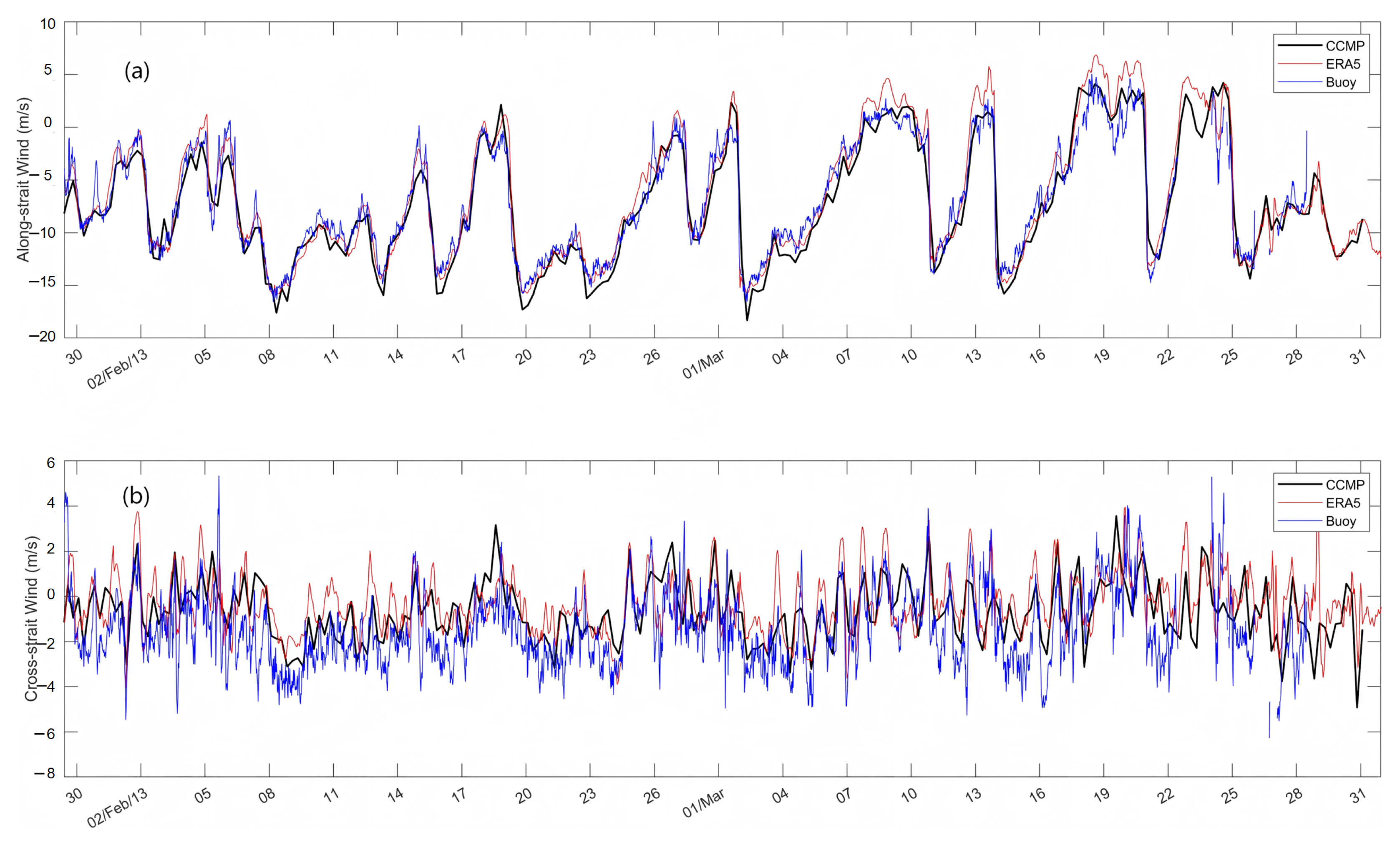
To evaluate the accuracy of the ERA5 and Cross-Calibrated Multi-Platform (CCMP) wind products, CCMP wind data over the southwestern Taiwan Strait were obtained. To ensure consistency with the buoy records, the CCMP wind time series at the buoy location were interpolated to an hourly resolution using a cubic spline method. After resampling the buoy wind data to an hourly interval, we calculated the root mean square error (RMSE) and correlation coefficient between the buoy measurements and the ERA5 wind data. As illustrated in
Figure 3, the RMSE and correlation for the eastward component were 1.35 m/s and 0.93, respectively, while those for the northward component were 1.72 m/s and 0.94. These results indicate that the ERA5 wind product exhibits high accuracy within the radar coverage area of this study. Therefore, the ERA5 data were adopted as the reference wind field for the subsequent analysis of the spatial characteristics of wind and ocean surface currents.
To quantitatively characterize the intensity of the winter monsoon background during the research period, we calculated several key wind field parameters. As illustrated in
Figure 2 and
Figure 3a, a total of ten significant monsoon onsets were recorded during the approximately two-month observation period. The duration in which the surface wind speeds exceeded 10.8 m/s (equivalent to level 6 wind) surpassed 18%, with the maximum wind speed observed during this period reaching 18 m/s. These statistical characteristics collectively define the ’strong winter monsoon background field’ discussed in this study.
2.4. Definitions and Extracting Local Winds
The SLB is defined based on the perpendicular component of the wind relative to the coastline: a sea breeze is identified when the wind has an onshore component (directed toward the land), while a land breeze corresponds to an offshore component. In the southwestern Taiwan Strait—the study area of this paper—the coastline is highly irregular. Based on local orientation, winds from the east to south sectors are classified as sea breezes, and those from the west to north sectors are regarded as land breezes. Building on the recent work of Huang and referring to established criteria for identifying SLB days in the literature [
41], we propose a modified identification method suitable for the strong monsoon climate of the Taiwan Strait. This method was used to extract local small-scale SLB circulation signals by effectively removing the influence of the large-scale background wind field. Specifically, the approach can separate the small-scale SLB system from the dominant winter monsoon winds. The method, referred to in Shen’s work as the Separation of the Regional Wind Field(SRWF) [
12], is applied as follows:
where
is the wind observation,
represents the daily mean of the 24 h U-component, and
is the hourly observed wind, which consists of the large-scale wind (
) and small-scale local wind (
), and
is the residual local wind fluctuation, which is the target of our extraction. More specifically, in this decomposition,
physically represents the daily-averaged, large-scale monsoon background flow, while
constitutes the residual local wind perturbation. The primary objective of the SRWF method is to isolate
, which contains the diurnal signal driven by the land–sea thermal contrast, i.e., the SLB. As to SRWF daily-mean sliding-window length, a 24 h centered moving average was applied to the original wind data to define the background field. The same procedure is applied to the V-component. In the following equations, the variable
u refers specifically to the zonal (east-west) component.
After extracting the local wind components, the following three criteria are applied to identify an SLB day, adapted from regional studies:
During the sea breeze period (12:00–18:00 local time), the cumulative duration of sea breeze occurrence must exceed 4 h, while land breeze occurrence during the same period should not exceed 2 h.
During the land breeze period (03:00–09:00 local time), the cumulative duration of land breeze occurrence must exceed 4 h, and sea breeze occurrence should not exceed 2 h.
The speed of the extracted local wind (Ulocal) must not exceed 6 m/s to minimize contamination by strong background winds, and the land–sea surface air temperature difference must be greater than 2 °C to ensure sufficient thermal forcing.
This method allows for identification of SLB days under the complex wind regime of the Taiwan Strait winter monsoon.
2.5. Sensitivity Analysis of Filter Parameters and SRWF
The complex demodulation spectrum shifting technique given in Equation (
2) uses a Lanczos low-pass filter for isolating the diurnal harmonics of the current signals, which has a cut-off frequency of 0.1 cycles per day (cpd). This cut-off frequency was selected to retain the daily (24 h) signal well and remove higher-frequency noise and lower-frequency synoptic scale signal well. In order to assess the impact of the selection of filter parameters on extracted diurnal signals and correlation analyses, a sensitivity test was performed. The cut-off frequency of the low-pass filter was systematically varied about a nominal value of 0.1 cpd. A range of cut-off frequencies was considered for the testing (i.e., 0.05 cpd, 0.1 cpd, 0.2 cpd, 0.3 cpd). The complete signal extraction and correlation calculation were repeated for each cut-off frequency. To assess the robustness of our findings, we compared the spatial structures of the correlation coefficient of the SLB with the amplitude of the extracted diurnal currents in this set-up.
It is acknowledged that the 24 h mean may incompletely filter lower-frequency synoptic variability (2–7 days), which could influence the absolute magnitude of the derived
. A potential theoretical limitation of using a 24 h mean as the background field
is its inability to fully remove lower-frequency synoptic-scale variability (e.g., 2–7 day periods), which might alias into the diurnal
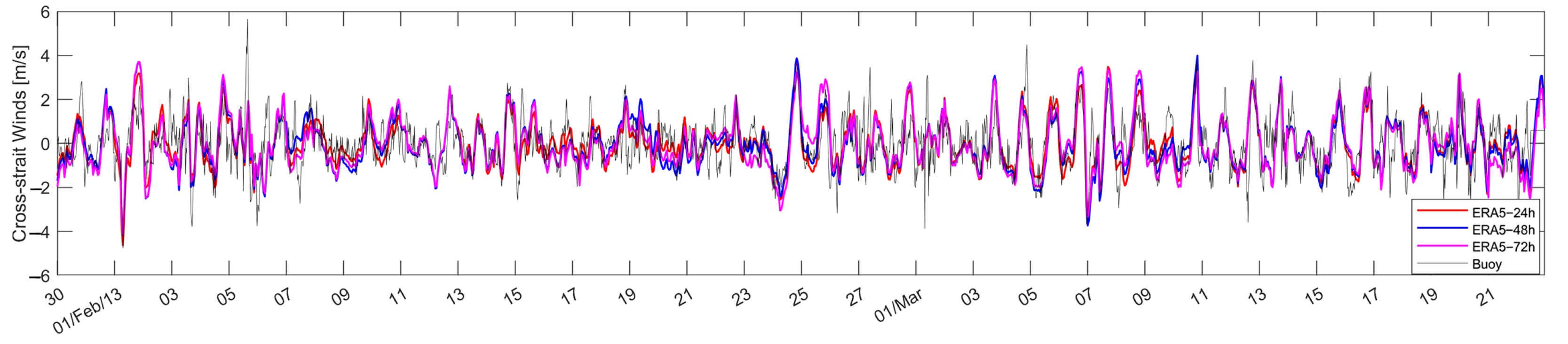
signal. To assess the sensitivity of our core results to this definition, we conducted a comparative test using 48 h and 72 h centered moving averages to compute
. As demonstrated in
Figure 4, the temporal structure of the diurnal oscillations—and consequently the identification of SLB event days—is remarkably consistent across all three definitions. While instantaneous amplitudes of
can vary slightly during periods of strong synoptic forcing, the key statistics of SLB frequency and trend analyzed in this study remain unaffected. Therefore, the simpler 24 h mean is deemed adequate and is used for all primary analyses presented.
2.6. Statistical Significance Assessment
The statistical significance of the correlation coefficients was assessed using a two-tailed Student’s
t-test [
50] (See Chapter 19, specifically Section 19.3). To account for the inflation of effective sample size due to autocorrelation in the hourly time series, the effective degrees of freedom (
) were calculated prior to testing. We employed the formula
, where N is the original sample count, and
and
are the lag-1 autocorrelation coefficients of the SLB wind and diurnal current series, respectively.
3. Results
3.1. Existence and Extraction of the SLB
The horizontal extent of a pure SLB can reach several tens of kilometers, and its influence may even extend up to 100 km offshore in tropical or some other regions. The period of the SLB is a standard diurnal cycle (24 h). Harmonic analysis was performed for the principal diurnal tidal constituents (notably and ), which are known to be dominant in this region. Their standard astronomical periods are used as defined within the tidal analysis formalism. The periods of the principal diurnal tidal constituents—the closest matching astronomical cycles—are distinct: 25.8193 h for , 23.9345 h for , and 24.0659 h for .
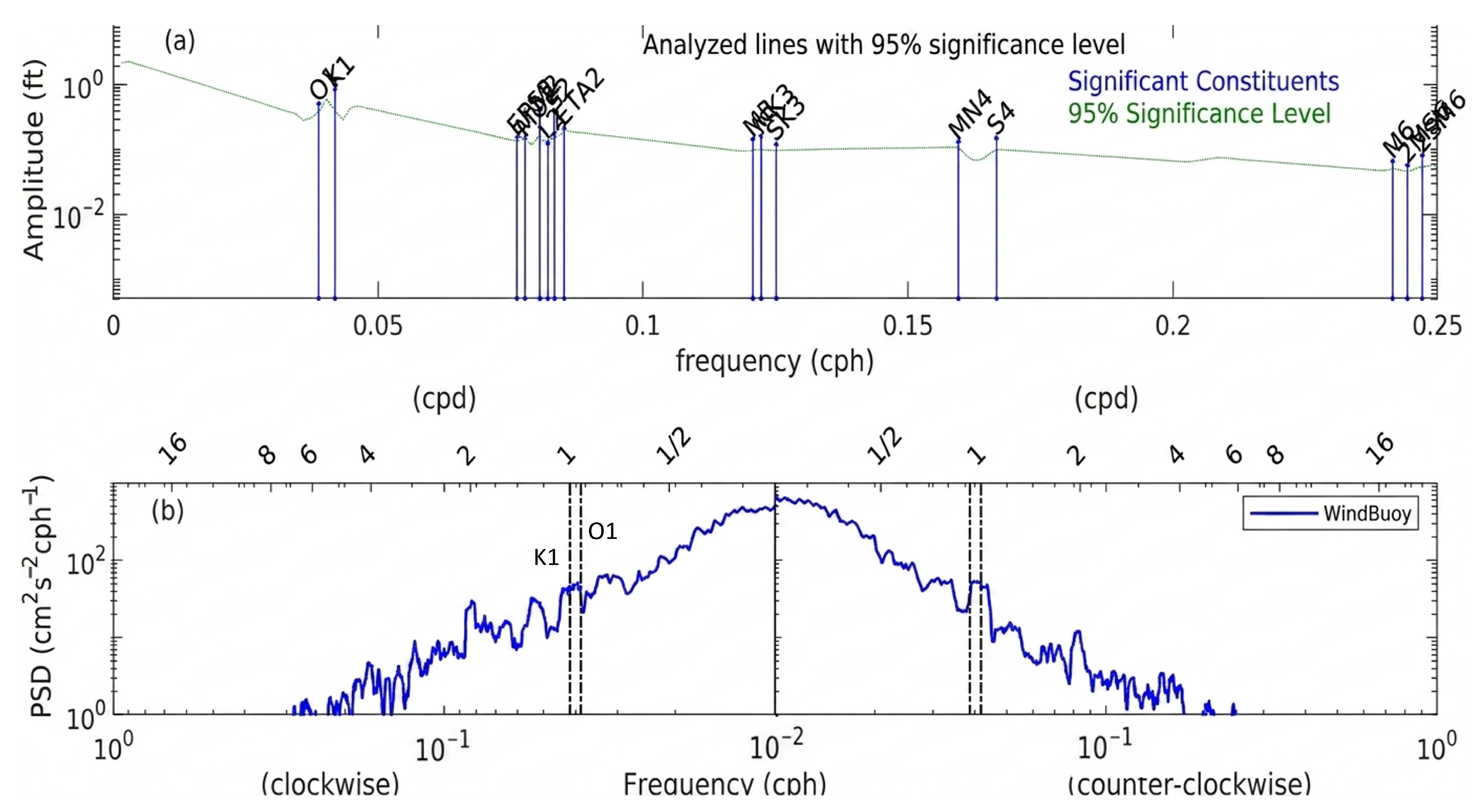
To confirm the presence of the SLB, a spectral analysis was performed on the wind data observed by the buoy at 10 m above sea level. The buoy is located approximately 57 km from the coast. The wind data were first subjected to harmonic analysis using the T_TIDE toolbox to isolate tidal constituents. The results of this analysis are illustrated in the corresponding
Figure 5. In
Figure 5a, the energy of the wind is predominantly concentrated at low frequencies. The only significant peaks correspond to the
and
tidal constituents; no energetically significant peaks are identified at frequencies higher than the diurnal band.
Figure 5b presents the rotary spectrum analysis of the vector wind. Although Doppler broadening is evident around the 1 cycle-per-day (cpd) frequency, a distinct spectral peak remains observable at this fundamental diurnal period.
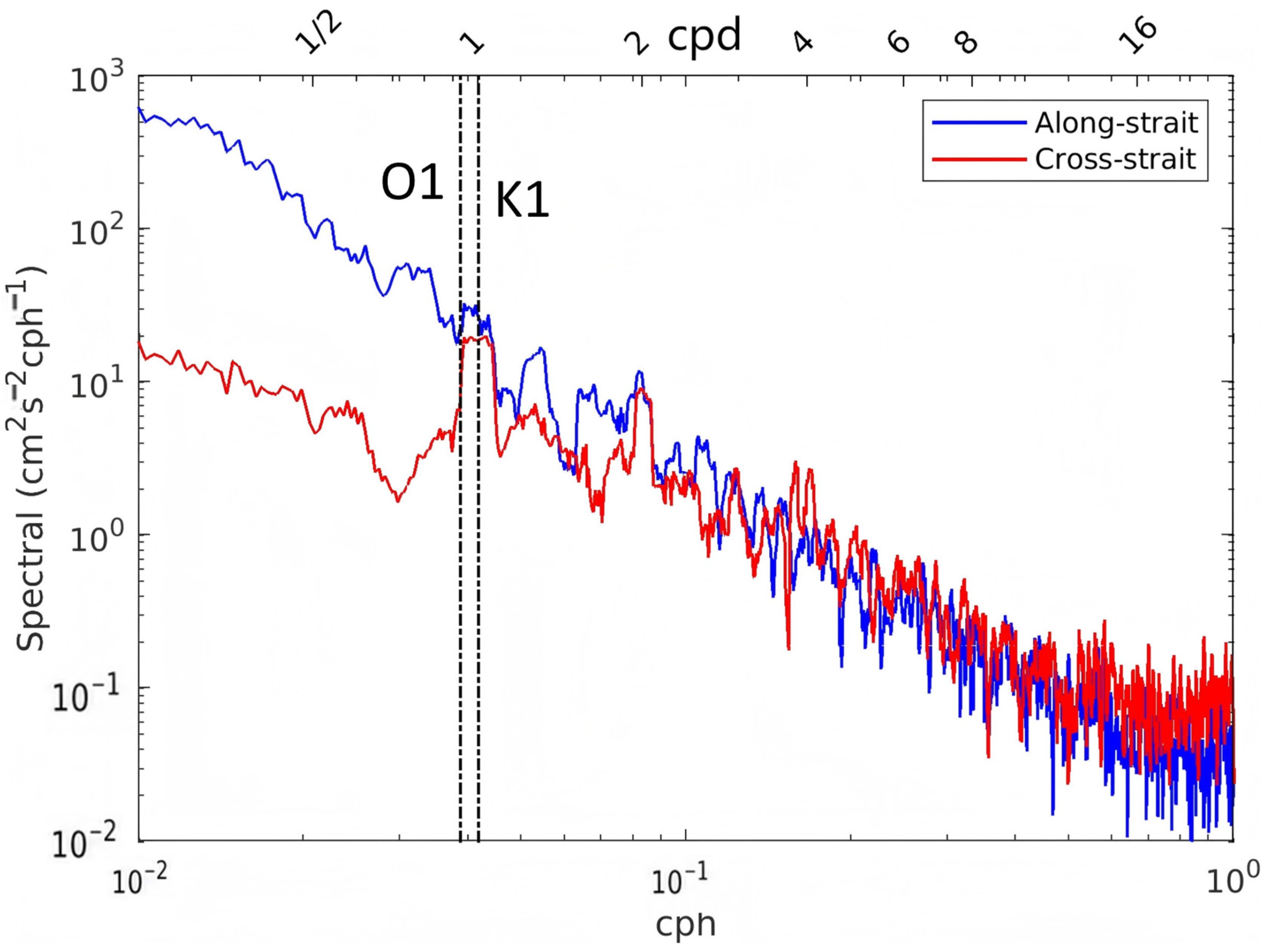
For a more detailed examination of the SLB signal under the influence of the northeasterly monsoon in the Taiwan Strait, the observed vector wind at the buoy location was decomposed into along-strait and cross-strait components. A separate spectral analysis was then conducted for each component. The results are shown in
Figure 6. The blue curve represents the along-strait wind component, while the red curve represents the cross-strait component. The analysis reveals a significant spectral peak precisely at 1 cpd in the cross-strait component. Conversely, no such prominent peak is observed at the diurnal frequency in the along-strait component, indicating that the diurnal signal is primarily manifest as an onshore/offshore oscillation characteristic of the SLB.
To determine the physical nature of the diurnal peak identified in the temporal spectra (
Figure 5 and
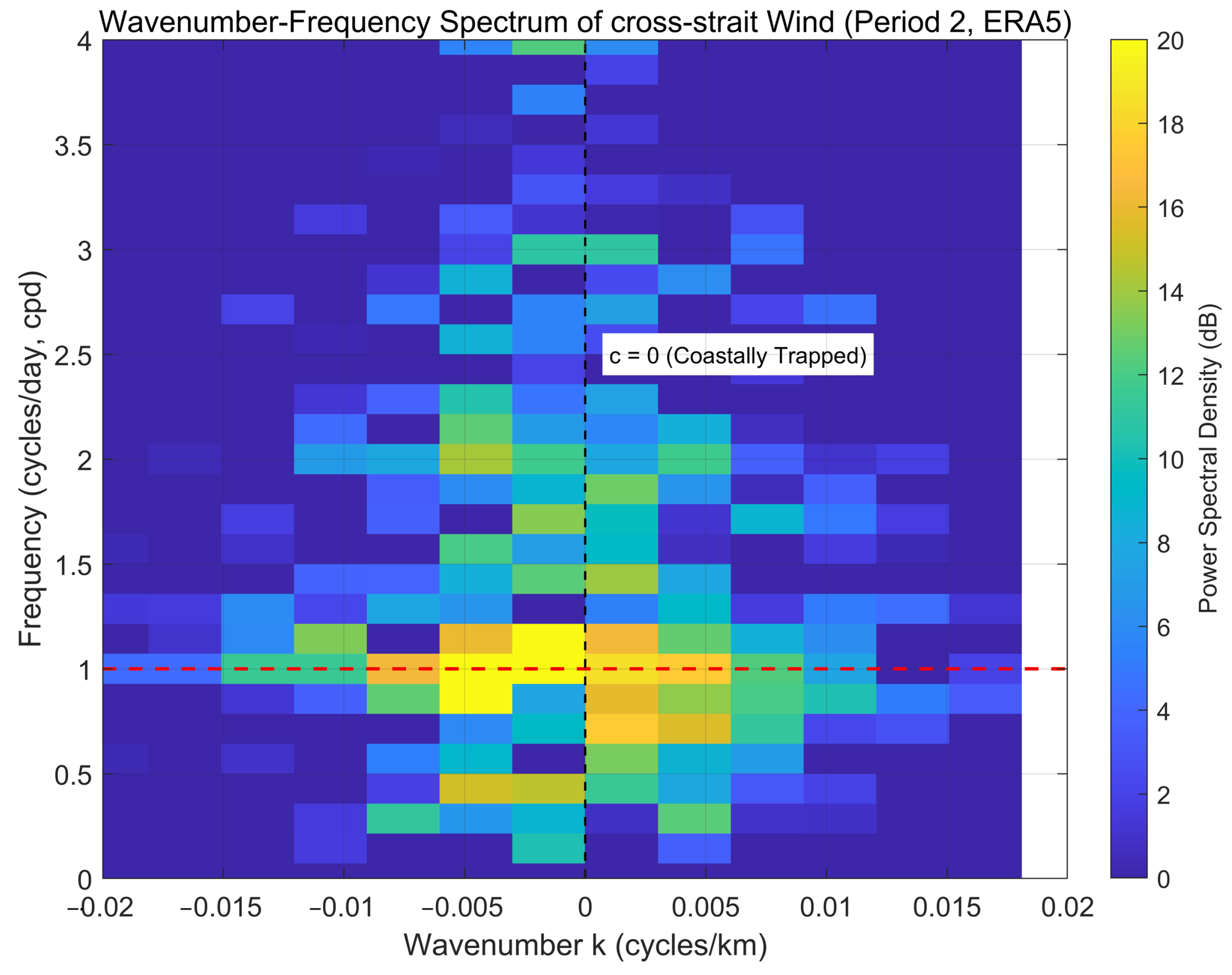
Figure 6), a wavenumber-frequency spectral analysis was conducted. As shown in
Figure 7, the spectral energy exhibits a significant peak at frequency
cpd. The peak is distributed along the wave number axis around
, and the corresponding phase velocity approaches zero. This spectral feature—with high energy and no propagation at daily frequency—is a typical sign of stationary, coastal captured sea land wind circulation, thus confirming in observations that the extracted signal is a locally thermally forced SLB, rather than a propagating weather scale wave with obvious phase velocity. This pattern is a hallmark of a coastally trapped, stationary mode like the SLB, effectively ruling out a significant contribution from propagating synoptic waves.
As illustrated in
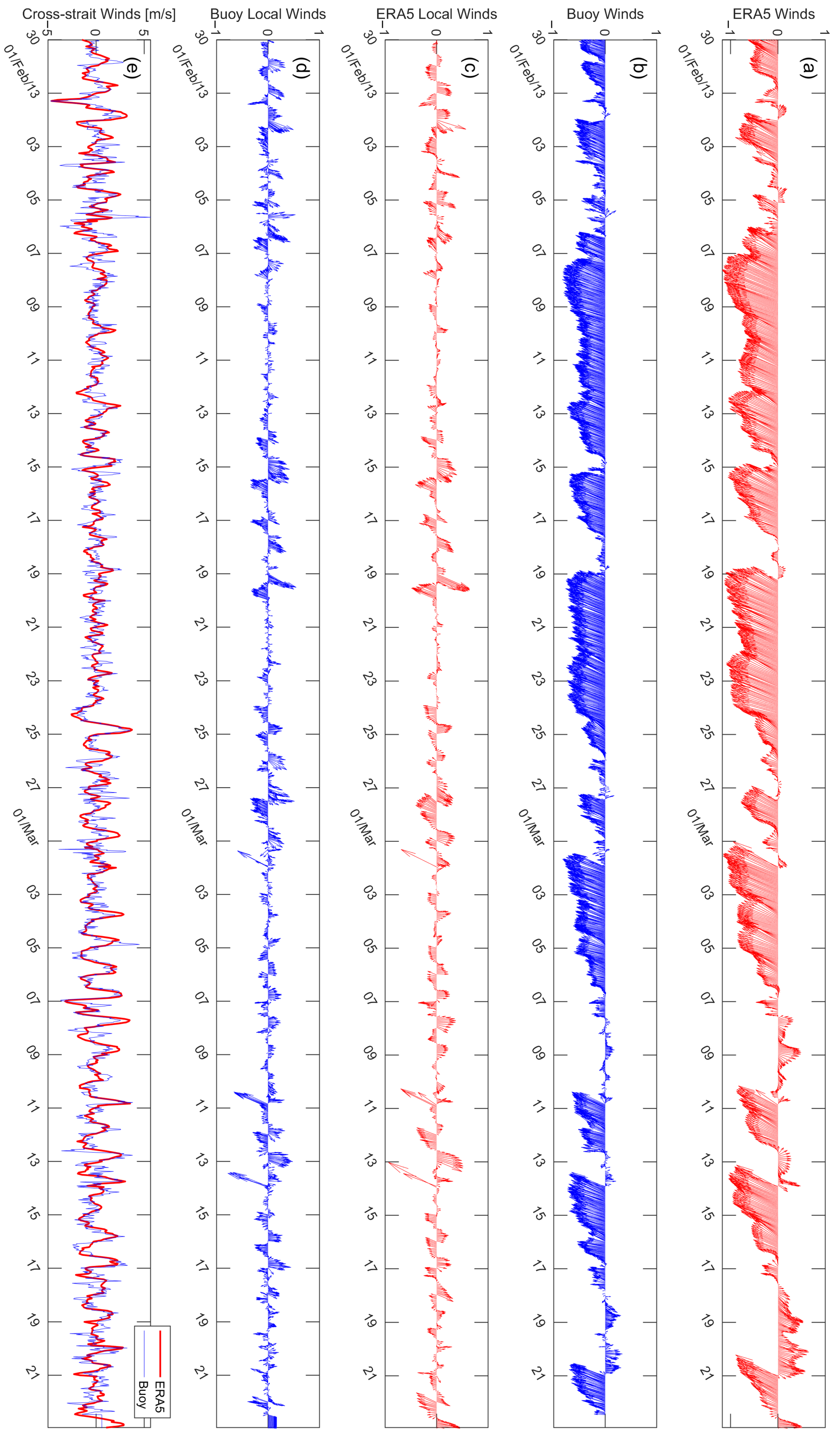
Figure 8a,b, the surface wind field during the study period was predominantly governed by the northeasterly East Asian Monsoon. The monsoon exhibited repeated onset events, interspersed with brief relaxation periods. The SRWF method, as described in
Section 2, was applied to both the ERA5 reanalysis data and the in situ buoy wind data to extract the local wind components.
After applying the SRWF methodology to remove the large-scale background monsoon wind field, the extracted local wind components from both datasets show good agreement, as evidenced in
Figure 8c,d. This consistency is particularly notable during periods of rapid wind speed changes. A clear diurnal oscillation with an amplitude of approximately 3 m/s is identifiable in the cross-strait component of the isolated local wind, as presented in
Figure 8e.
To investigate the impact of the SLB on diurnal ocean currents, the complex demodulation spectrum shifting technique was employed to extract the diurnal signal from the residual currents at all spatial grid points.
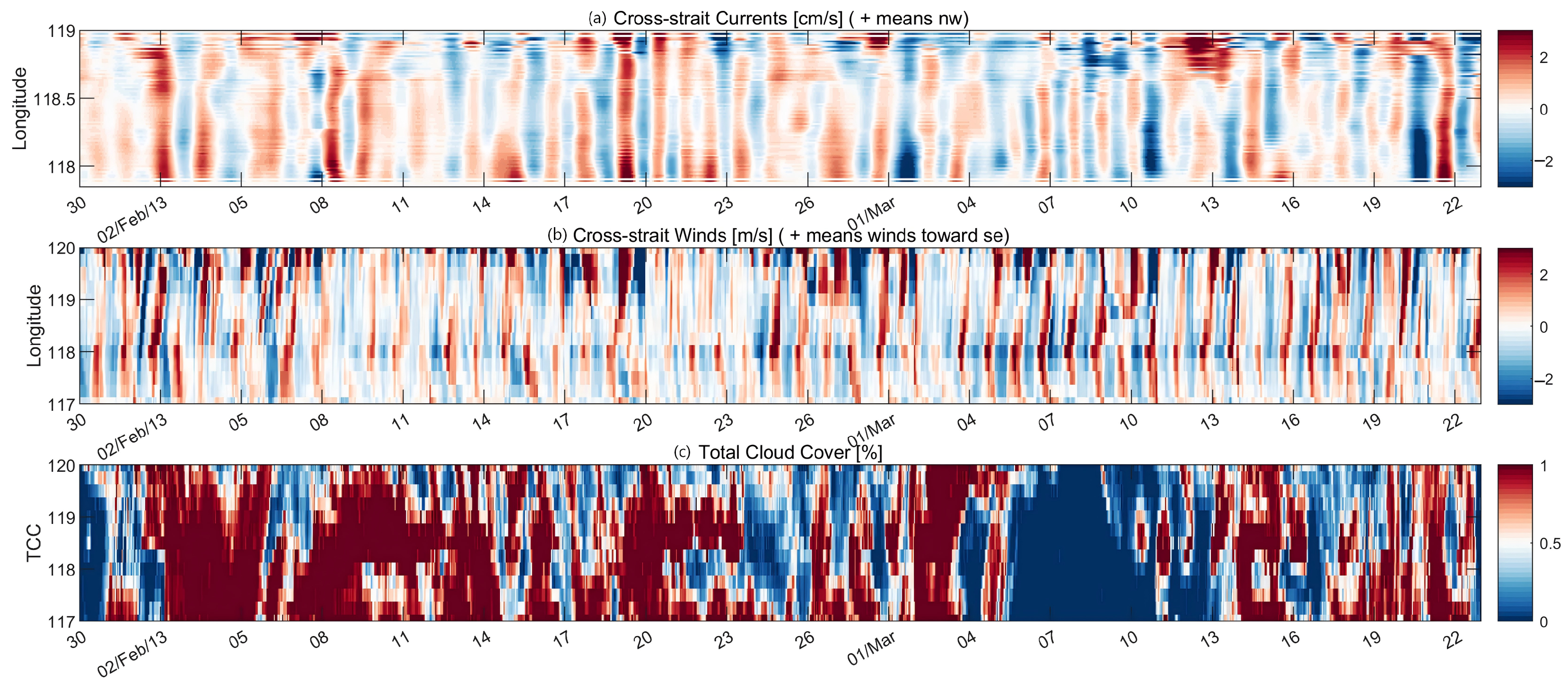
Figure 9 presents the cross-strait components of the SLB-induced diurnal current and the local wind for each grid point along the red line shown in
Figure 1.
Temporally, the amplitude of the SLB-induced diurnal current component in the cross-strait direction remained within 3 cm/s, while the speed of the local wind field varied within 3 m/s. Spatially, the wind speed generally exhibited a pattern of being higher in the eastern part of the study area and lower in the west. Regarding synoptic conditions, the total cloud cover exceeded 70% for most of the experimental period. However, it dropped below 30% from 3 March to 13 March. A separate period from 24 February to 28 February also experienced low cloud cover (below 30%) at some spatial points.
3.2. The Spatio-Temporal Characteristics
After confirming the existence and successful extraction of the SLB from the winter monsoon, we next proceed to characterize the spatial and temporal characteristics of the identified SLB.
To highlight the characteristics of the diurnal oscillation,
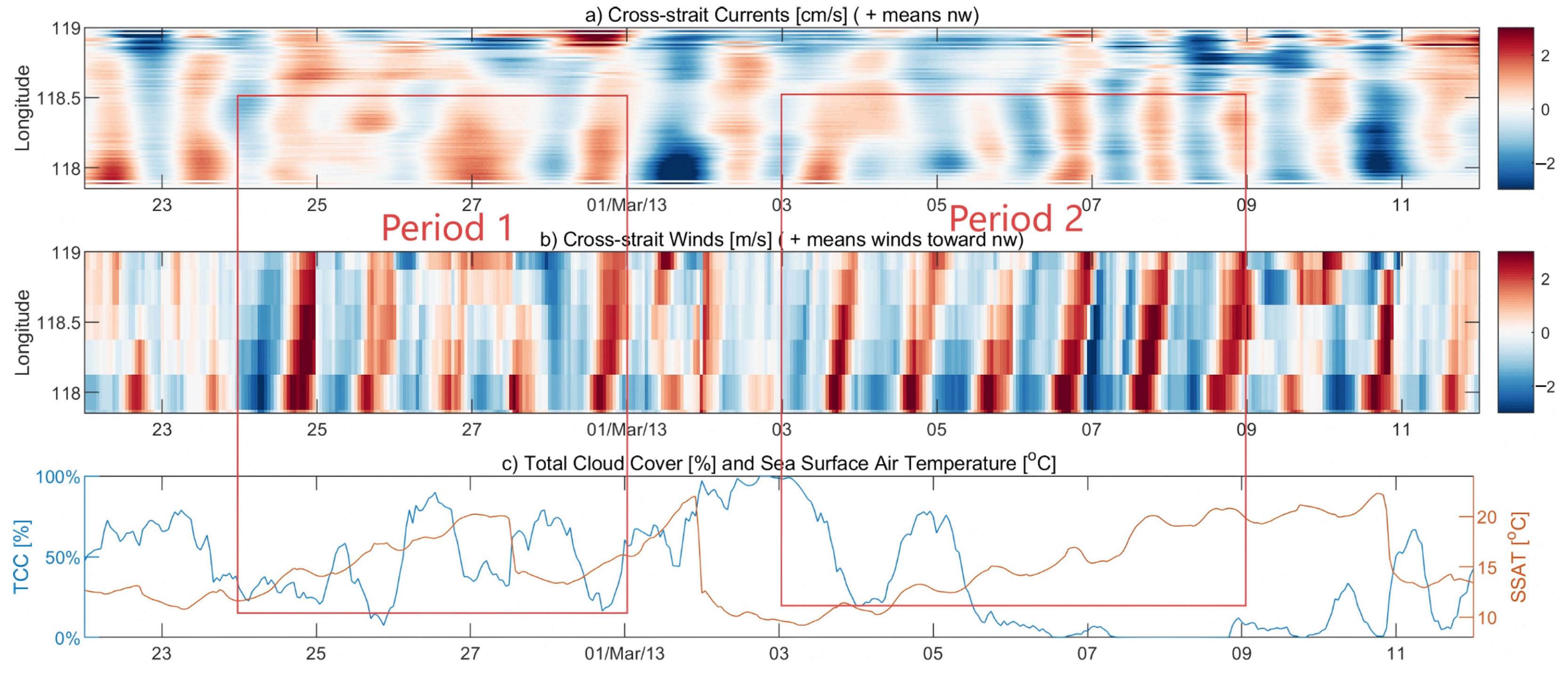
Figure 10 presents the time series of SLB-induced residual currents and local winds from 22 February to 12 March. As illustrated in
Figure 10c, the sea surface air temperature exhibits a close inverse relationship with total cloud cover. When total cloud cover reaches 100%, the sea surface air temperature drops to its minimum of approximately 10 °C. Conversely, as the cloud cover gradually decreases, the temperature progressively rises to around 20 °C. This increase in temperature amplifies the land–sea thermal contrast, thereby providing the primary forcing mechanism for the development of the SLB circulation. Based on the SLB identification criteria outlined in the
Section 2 and supported by the patterns shown in
Figure 8 and
Figure 9, two distinct periods were identified as SLB days: 24–28 February and 3–9 March. These two periods, totaling 12 days, represent relatively sustained SLB events during the winter observation period. Given their prolonged duration within the winter context, they were selected as two representative Periods for detailed analysis. Although sporadic and short-lived diurnal oscillations were observed at other times, they were less persistent. This is likely attributable to the strong background winter monsoon wind, which tends to suppress or disrupt the formation and maintenance of localized SLB circulation. In contrast, SLB days are expected to be more frequent during the summer season when the background monsoon is generally weaker than that in winter and the land–sea thermal contrast is more pronounced.
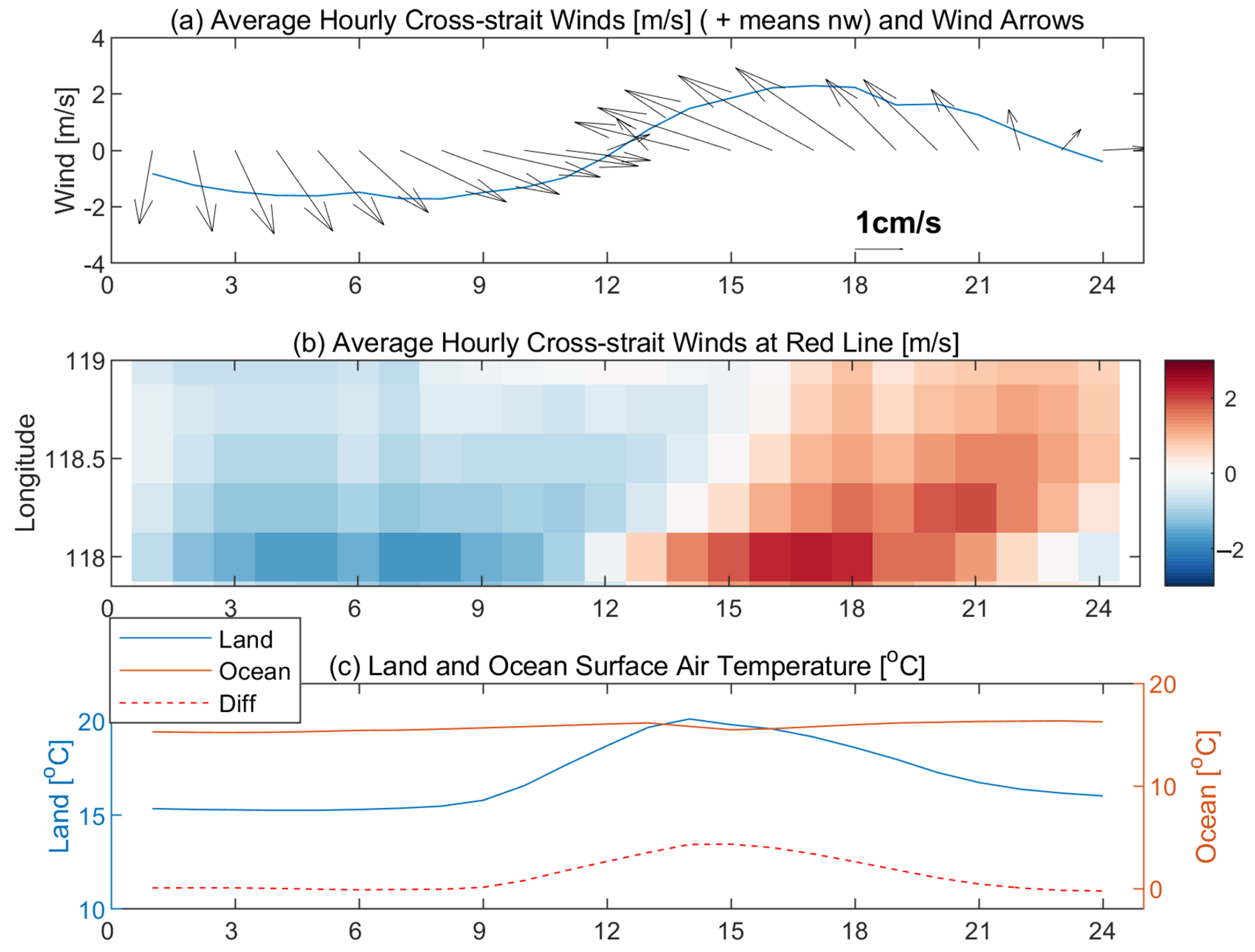
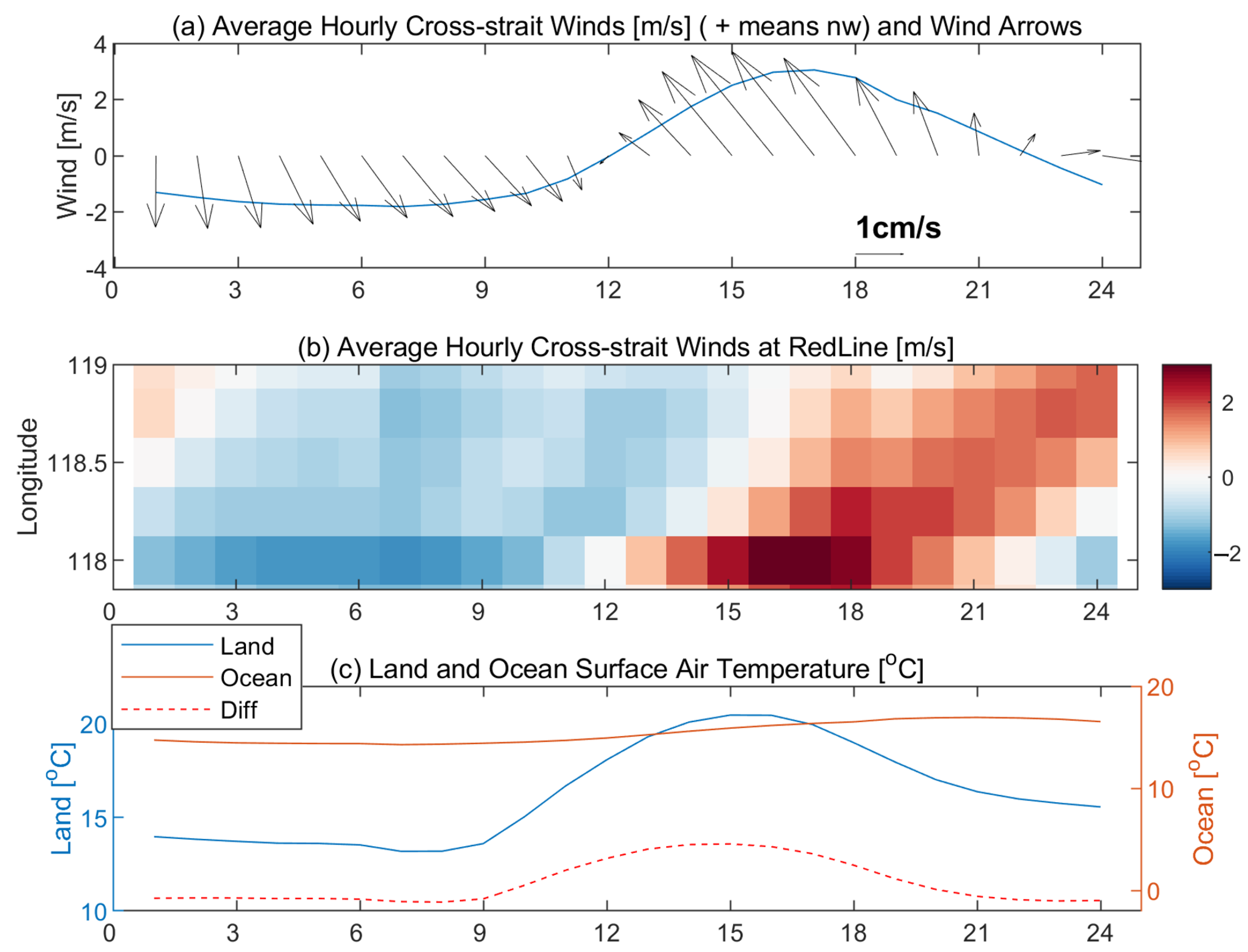
After identifying the two sustained SLB periods, we calculated the composite diurnal cycle of the wind for these periods, as illustrated in
Figure 11 and
Figure 12.
Figure 11 presents the average results for the 5-day Period 1, while
Figure 12 shows those for the 7-day Period 2.
The spatial distribution of the composite diurnal cycle of near-surface wind during Period 1 (
Figure 11b) indicates that the transition from land breeze to sea breeze occurred at approximately 12:30 local time. Following this transition, the sea breeze intensified gradually, reaching its peak intensity of 2.2 m/s around 17:00 local time. The subsequent shift from sea breeze back to land breeze occurred around local midnight (24:00). The land breeze then strengthened, achieving its maximum speed of about 1.8 m/s at 06:00 local time. The maximum land–sea temperature difference occurred at 14:00 local time, coinciding with the peak land air temperature (19.5 °C), while the maximum sea air temperature lagged slightly, peaking around 15:00 local time.
During Period 2, the land breeze to sea breeze transition occurred earlier, at about 12:00 local time. The sea breeze intensified thereafter, peaking at a higher intensity of 2.5 m/s by 16:30 local time. The reversion to land breeze also commenced earlier, at approximately 23:00 local time, with the land breeze reaching its maximum strength of 2.0 m/s around 07:00 local time. Similar to Period 1, the maximum land–sea temperature contrast was observed at 14:00 local time, concurrent with the maximum land air temperature of 20.0 °C, while the maximum air temperature over the sea occurring near 15:00 local time, which is the same as that during Period 1.
3.3. Sensitivity of Results to Filter Parameters
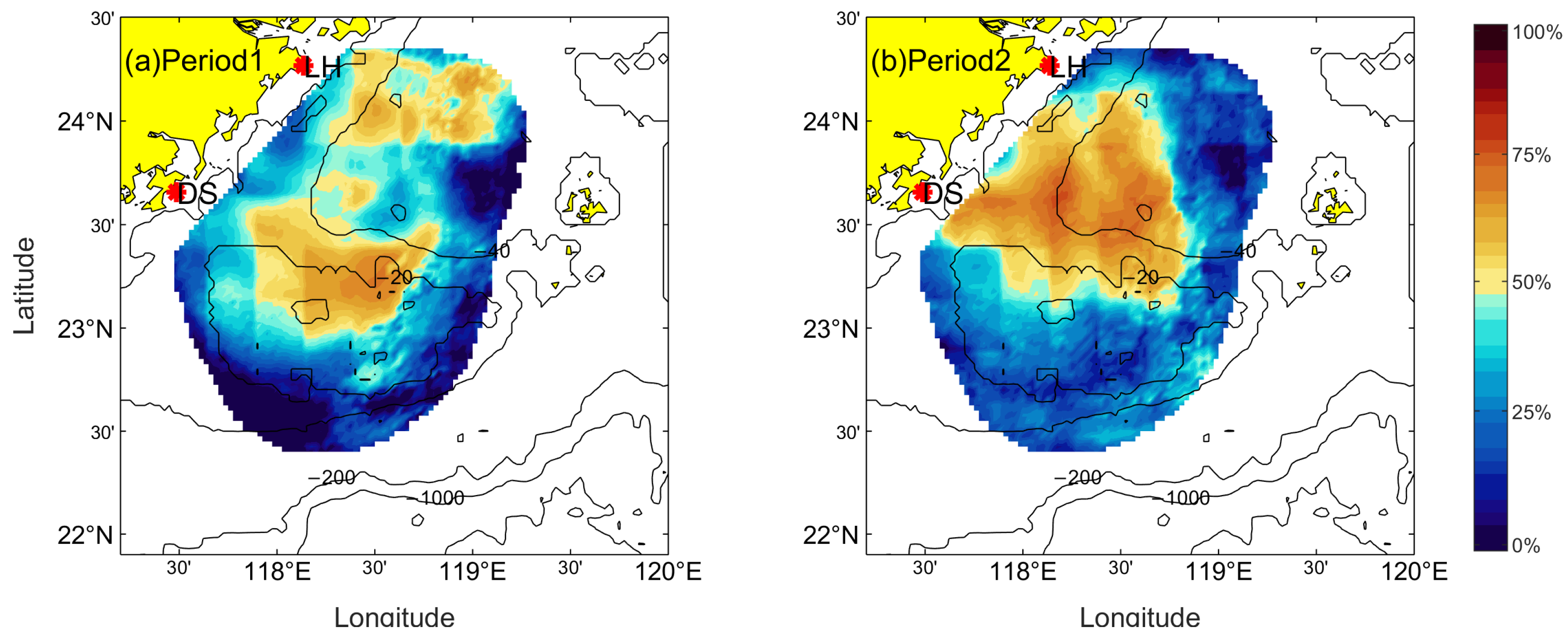
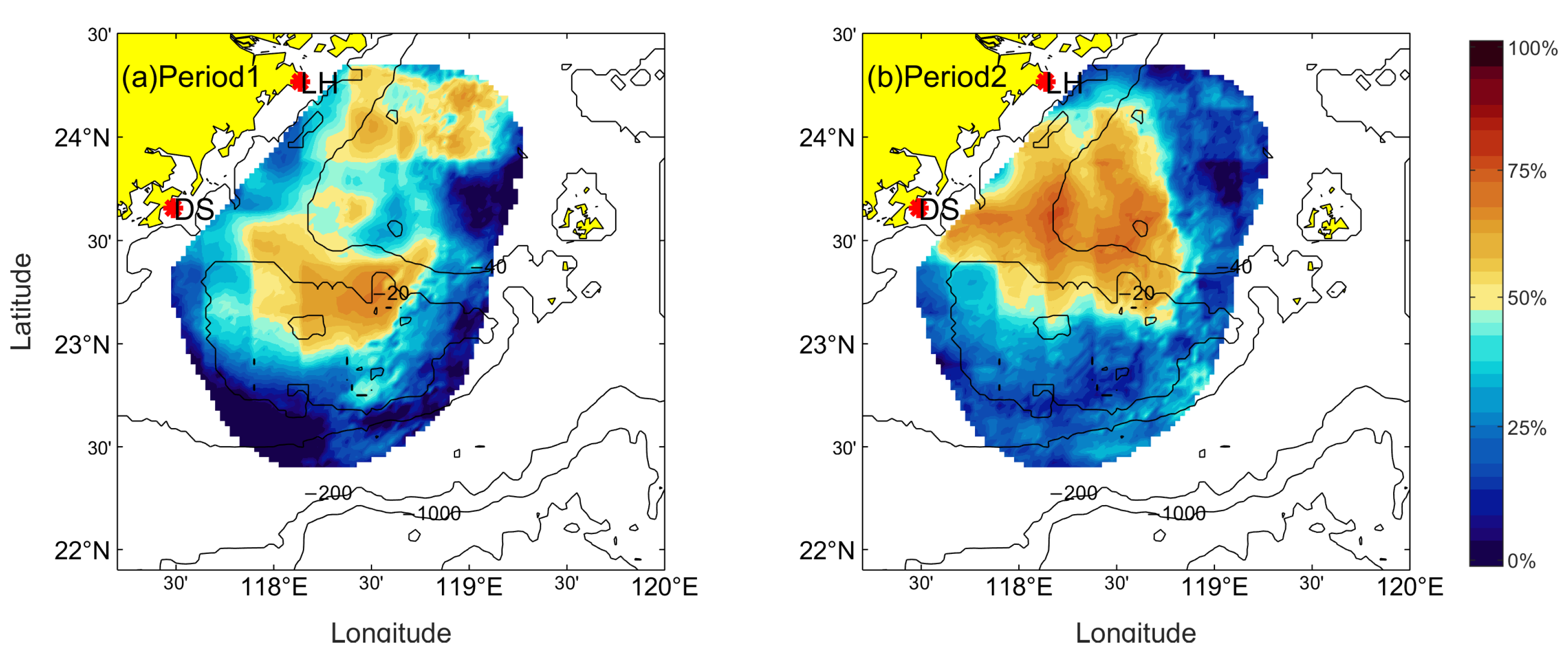
The sensitivity test shows that the results of this study are robust to reasonable variations in the filter parameter. As can be seen in
Figure 13,
Figure 14,
Figure 15 and
Figure 16, spatial patterns of the correlation coefficients of the SLB and diurnal currents are not much different for the tested cut-off frequencies, i.e., 0.05 cpd, 0.2 cpd, and 0.3 cpd. The central coastal area high-correlation regions of Period 2 (>70%) remain the same regardless of the cutoff frequency. The highest correlation coefficient only varied slightly within the range of from 71% to 75%. Offshore extent of significant SLB influence (up to ∼110 km) was a persistent feature (110 km). The maximum amplitude of extracted diurnal current varies little with a ultimate value of ∼2.2 ± 0.1 cm/s. The diurnal wave component cutoff of 0.1 cpd gave a minimum amplitude. The cutoff of 0.05 cpd was considered too restrictive since it resulted in an overall attenuation of the signal at this more stringent cutoff. The cutoff of 0.3 cpd was considered too permissive since it introduced more and more high-frequency noise. Thus, stringent and permissive high-frequency noise cutoffs validated the selection of 0.1 cpd as an optimal one for the diurnal wave component.
3.4. The Driving Effect of the SLB on Surface Ocean Currents
The wintertime features of the SLB mentioned earlier are regular enough to test their potential ocean forcing. In this section, we quantify the response of the surface currents to the SLB using the HF radar currents.
Under the strong monsoon condition, this study identified significant diurnal components within the wind field using spectral analysis based on ERA5 reanalysis data and buoy observations. Furthermore, the local wind field over the southwestern Taiwan Strait was extracted by applying the SRWF method. By integrating the local winter monsoon context and established criteria for identifying SLB days, we confirmed the occurrence of SLB days even during the winter season. A total of 12 SLB days were identified in February and March 2013.
Two specific periods, 24–28 February (Period 1) and 3–9 March (Period 2), were selected for detailed analysis. Composite diurnal cycles of hourly averaged winds and the extracted diurnal currents were calculated and analyzed for these periods. During both periods, the sea breeze was slightly stronger than the land breeze. The transition from land breeze to sea breeze occurred around local noon (12:00 local time), while the reversal from sea breeze to land breeze typically happened between 23:00 and 24:00 local time. The maximum amplitude of the SLB circulation did not exceed 2.5 m/s, and the corresponding diurnal current speed remained below 2.2 cm/s.
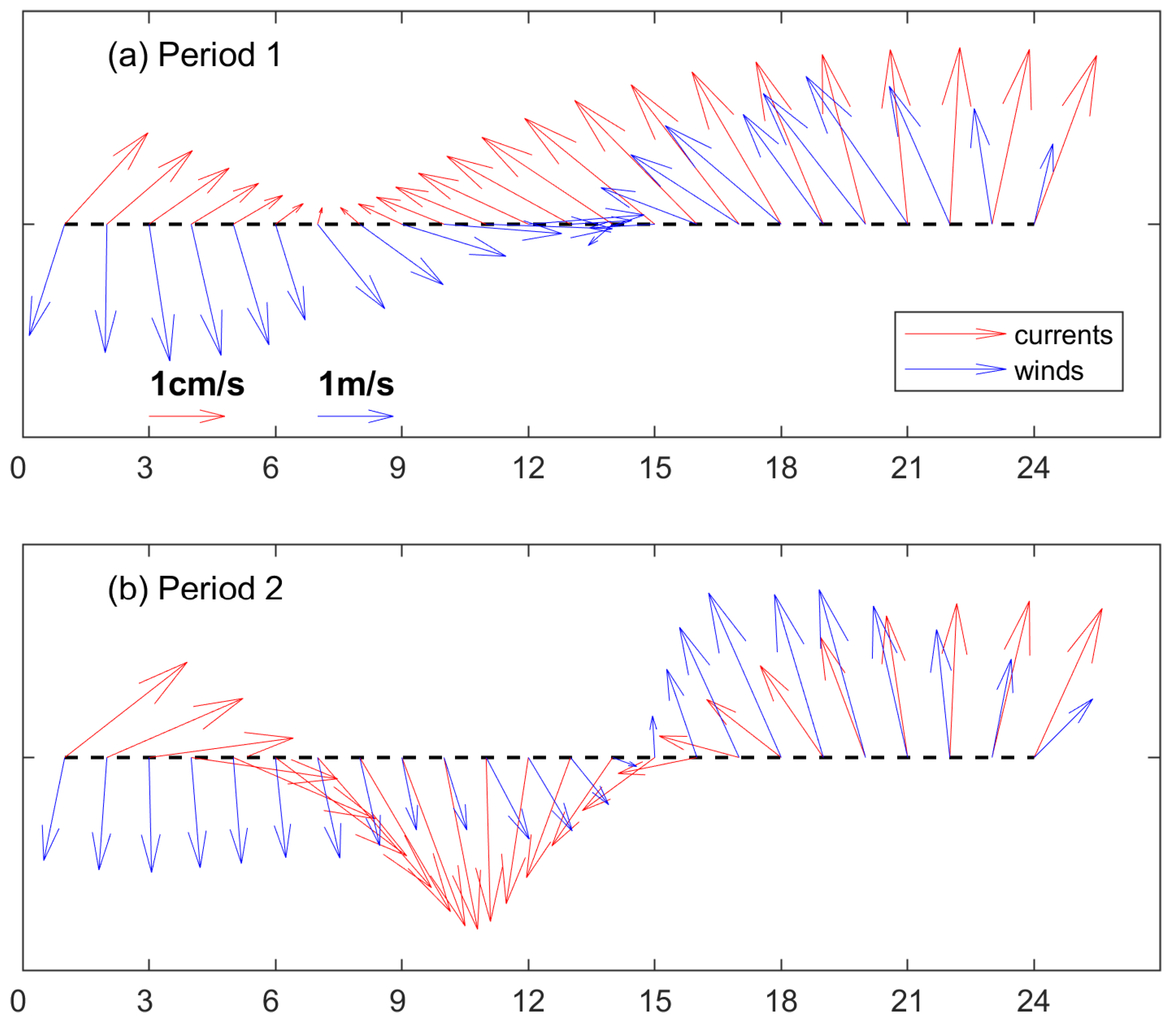
When the background wind field was weak, the local SLB circulation dominated, generating corresponding local surface currents. In contrast, during periods of strong background winds, such as the winter northeasterly monsoon, the SLB embedded in the northeasterly monsoon, potentially altering the effective wind stress structure and subsequently influencing the spatial pattern of the SLB-induced diurnal currents. To quantitatively assess the extent and spatial characteristics of this influence, we analyzed the hourly averaged winds and SLB-induced diurnal currents for both periods (e.g.,
Figure 17). Analysis of
Figure 17a for Period 1 reveals that the turning direction of the SLB-induced diurnal current was not synchronous with the SLB wind. Specifically, during the land breeze, the direction of the wind and the current were not aligned. This suggests that while the SLB (blue arrows in
Figure 17) was not the dominant factor driving the surface currents (red arrows in
Figure 17), it likely played a role in impeding the offshore return currents. Moreover, the impact of the land breeze on the surface current was relatively weak, with the SLB-induced diurnal current amplitude merely decreasing as the land breeze weakened. During the sea breeze phase, however, the current variation trended consistently with the wind, and the current reached its maximum amplitude of 2.1 cm/s within this period. In Period 2, the agreement between the wind and current was better than in Period 1. The directional shift of the current coincided with the land-to-sea breeze transition around 15:00 local time. Interestingly, the maximum current amplitude (2.2 cm/s for Period 2) was observed at 11:00 local time during the land breeze phase.
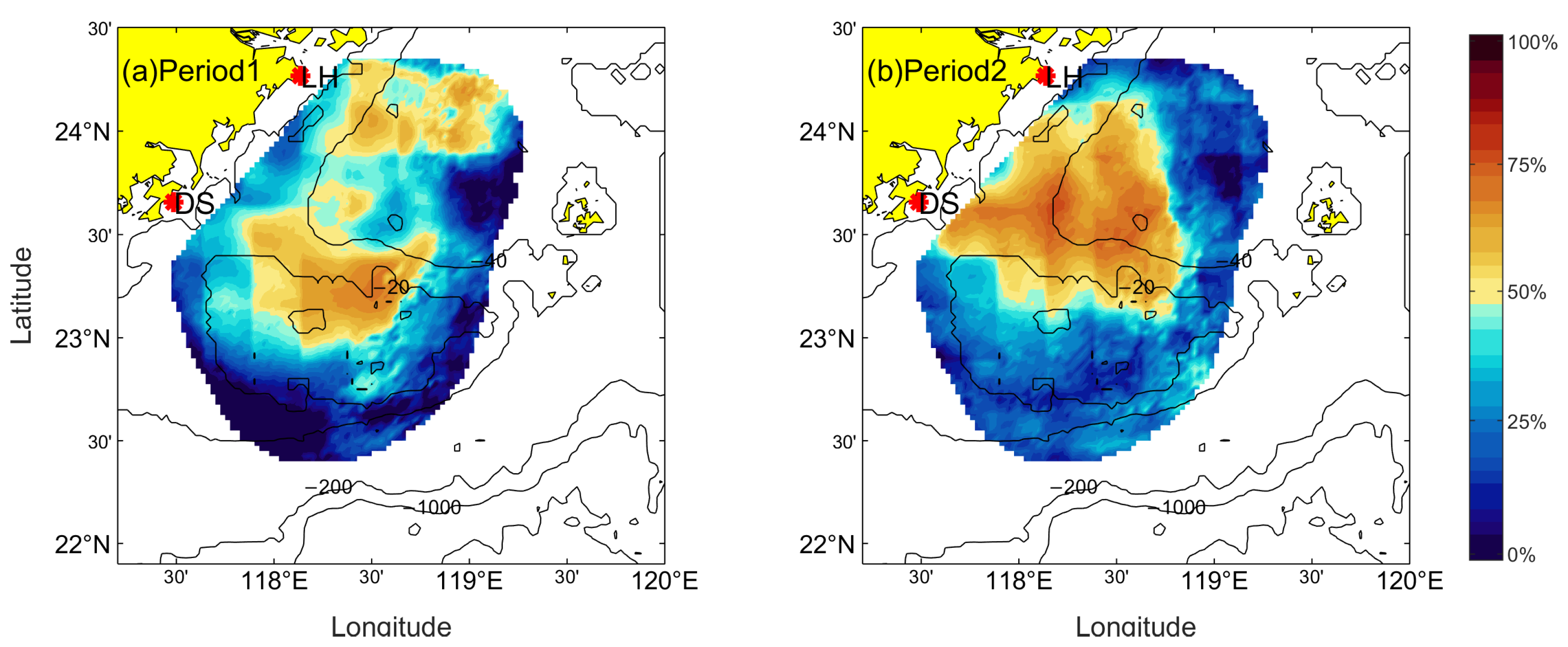
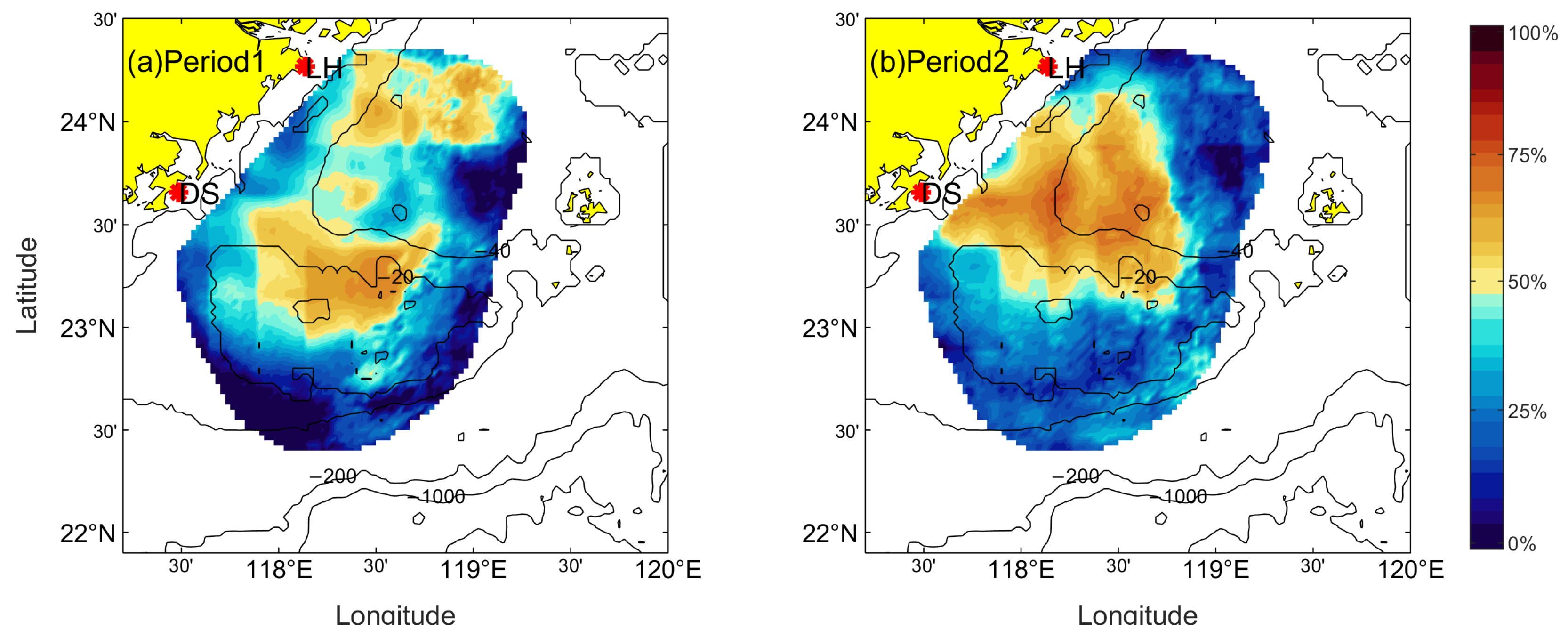
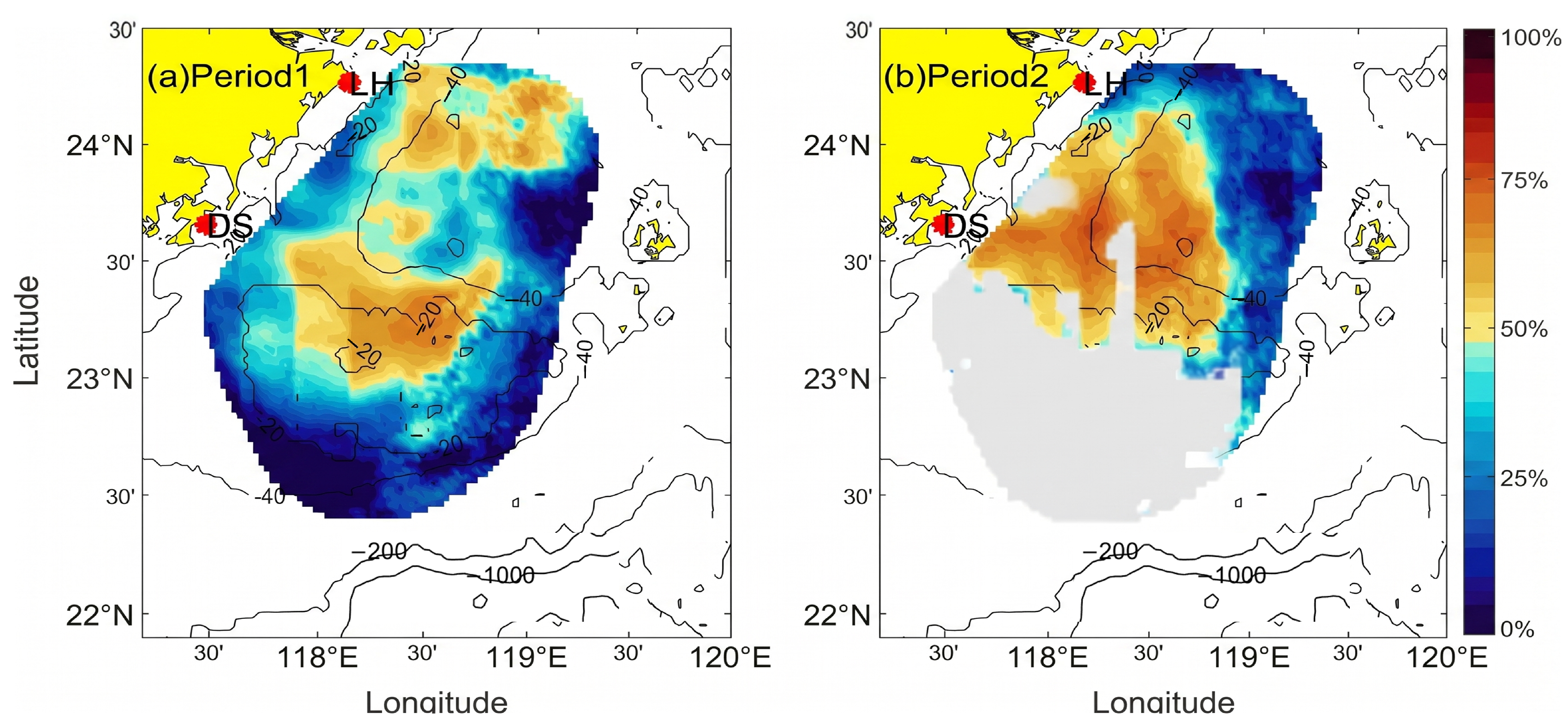
Additionally, we computed the spatial distribution of the correlation coefficients between the SLB-induced diurnal currents and the local winds (
Figure 18). The correlation coefficients during Period 1 were generally lower than those during Period 2. Two specific areas, identified as XPD and the northern part of TWB, exhibited correlation coefficients exceeding 50%. The maximum correlation coefficient of 61% was located over the northern part of the Taiwan Bank. This suggests that the shorter-duration SLB event in Period 1 did not exert a dominant influence on the ocean surface currents.
Period 1 lasted for 5 days, whereas Period 2 persisted for 7 days. During Period 2, the areas with higher correlation coefficients were primarily distributed in the central region closer to the coastline, with a maximum value reaching 73%. This spatial pattern indicates that the influence of the SLB can extend offshore up to a distance of approximately 110 km.
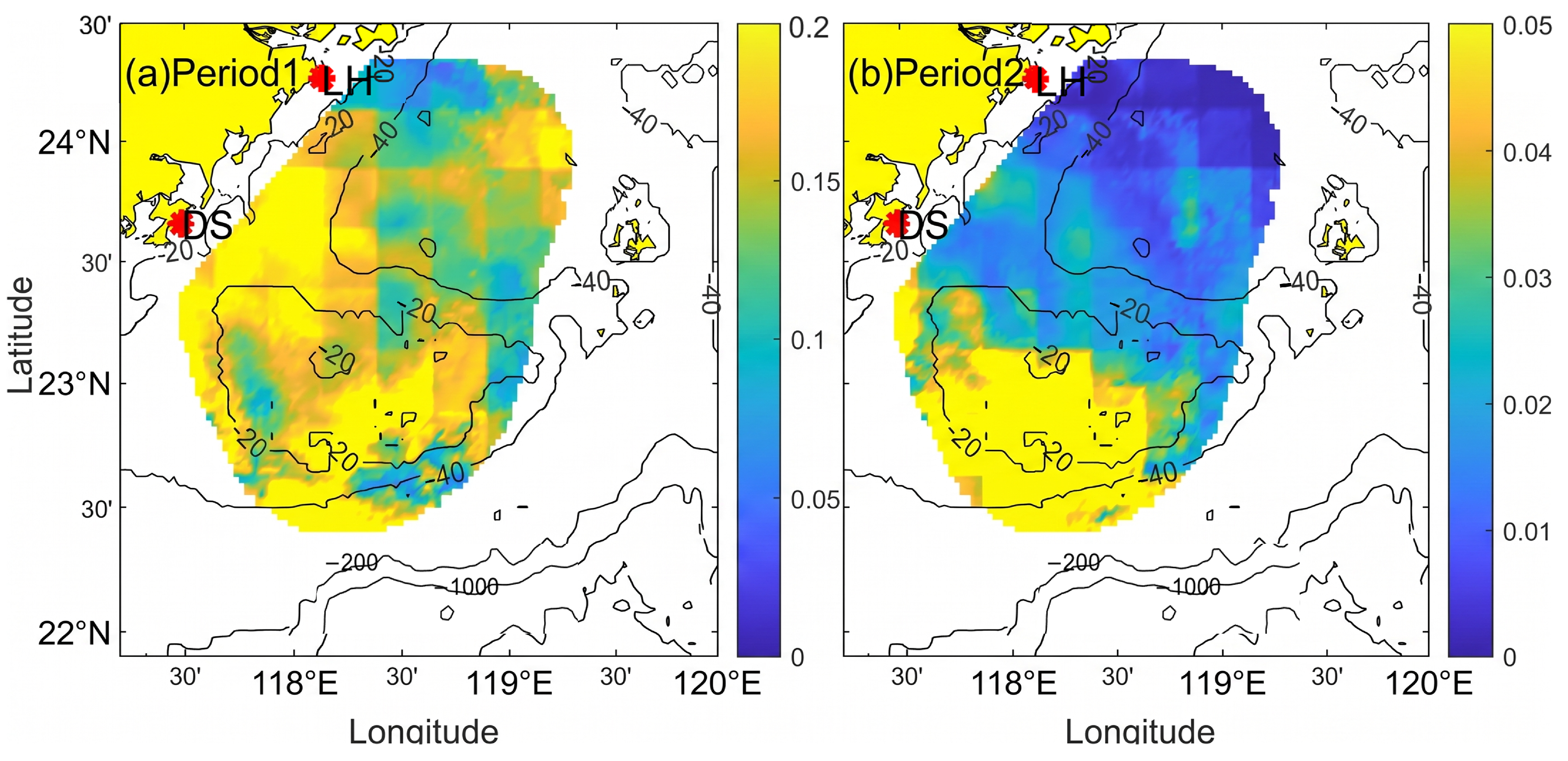
Figure 19 shows the spatial distribution of
p-values for the SLB-current correlation after correcting for autocorrelation. In Period 2 (
Figure 18b), the high-correlation regions coincide with areas of high statistical significance (
p < 0.01), confirming the robustness of the coupling.
Spatial correlation patterns differ markedly between the two periods. During Period 1 (
Figure 18a), although areas with correlation magnitudes exceeding 0.5 are observed, these correlations are not statistically significant (
p > 0.01) after adjusting for the low effective degrees of freedom (
), as seen in
Figure 19a. This suggests that the observed pattern may be influenced by noise or by short-lived, incoherent forces. In contrast, for Period 2, the strong (r > 0.7) and spatially coherent correlations in the south-eastern sector remain statistically significant (
p < 0.01) even under the conservative constraint of
(
Figure 18a,b and
Figure 19b). This stark contrast underscores that a robust and widespread SLB-current coupling was a distinctive feature of the longer-lasting Period 2 event.
A maximum correlation of r = 0.73 (explaining ∼53% of the variance) indicates that the SLB is a dominant forcing mechanism for diurnal currents in the significant region, a substantial effect given the multitude of processes influencing ocean currents.
3.5. Influence of the SLB on Diurnal Tidal Currents
The results definitively show SLB-driven currents. However, we must determine whether this diurnal variability might also result from, or interact with, the astronomical diurnal tides. As a result, we analyze the possible effect of SLB on the main diurnal tidal constituents.
To determine whether the SLB influences the
and
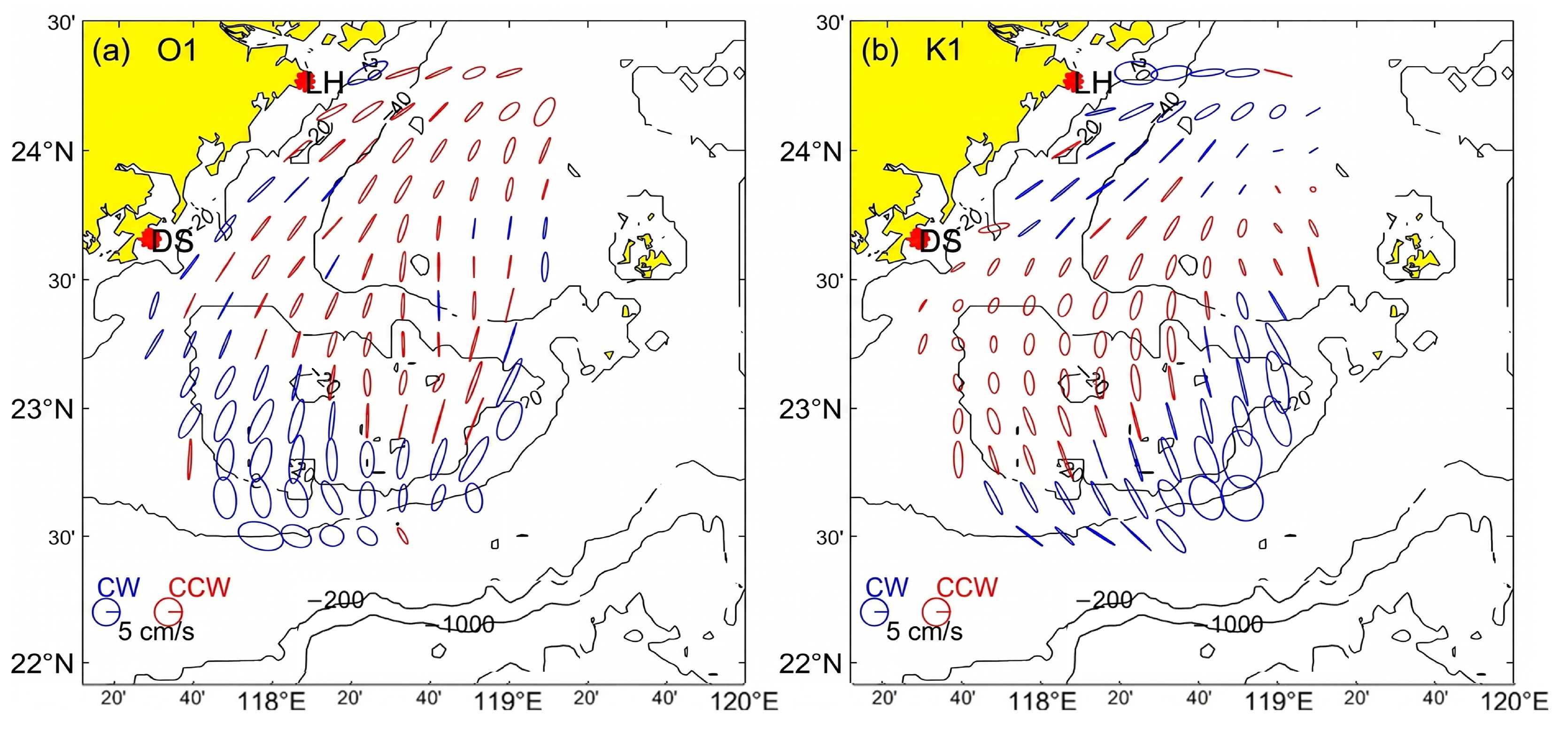
tidal constituents in the near-shore ocean surface currents, a harmonic analysis was performed on the total vector surface currents. The
Figure 20 presents the spatial distribution of the tidal ellipses for the
and
constituents. It is important to note that the SLB-induced diurnal currents generated by the SLB are superimposed upon the astronomical diurnal tides, presenting a significant challenge for the precise separation of the pure tidal signals.
A spectral analysis (
Section 3) of the wind data observed by the buoy confirmed a distinct diurnal variation, which could potentially generate a significant
-like signal in the currents. This is due to the close proximity of the SLB period (24 h) to the
tidal period (23.9345 h). Although the period difference between
(25.8193 h) and the SLB is larger than that between
and the SLB, making the SLB’s influence on the
constituent less likely, the separation remains complex. Analysis of the tidal ellipse maps indicates that the
and
ellipses do not appear anomalously large. Additionally, no significant trend of amplification for the
ellipses was observed closer to the coastline. The inclination angles of the ellipses were predominantly parallel to the coast rather than oriented in the cross-strait direction. Therefore, based on the spatial characteristics of the tidal ellipses and the period disparity, it is concluded that the influence of the SLB on the
and
tidal constituents is likely minimal.
3.6. Quantitative Comparative Analysis with Other Coastal Regions
To highlight the unique characteristics of the SLB in the southwestern Taiwan Strait (SWTS), we conduct a quantitative comparison with the findings of [
26,
27,
41] for coastal China and other classic study regions. Key metrics are summarized in
Table 1.
Table 1 Quantitative comparison of SLB characteristics across different coastal regions. The SLB Intensity Index is the average diurnal amplitude of the cross-shore wind. Normalized Penetration Distance is the offshore extent of significant SLB influence normalized by the local Rossby radius. Background Flow Intensity Ratio is the mean monsoon wind speed divided by the SLB Intensity Index. The comparisons reveal that the SLB in the SWTS is distinctive: it is weaker in intensity but propagates much farther offshore, and it develops under the overwhelming influence of a strong background flow. This unique combination is a direct consequence of the regional physiography and the winter monsoon climate.
The comparison presented in
Table 1 highlights two critical factors that set the southwestern Taiwan Strait apart from other well-studied coastal regions: intense background interference and pronounced topographic constraint. First, the exceptionally high Background Flow Intensity Ratio (∼5.5) in our study region quantifies the dominance of the winter monsoon over the local SLB signal. This ratio is more than double that of summer-dominant regimes like the Yangtze River Delta or Monterey Bay, where background winds are weaker and more variable. This strong interference creates a “high-noise” environment where the SLB signal would be masked in conventional analyses. Our methodology successfully isolates the SLB forcing under this condition, revealing that despite the overwhelming background flow, SLB can still generate a coherent, measurable current response (∼2.2 cm/s). It demonstrates a survival mechanism for coastal diurnal processes within intense, persistent flows, which is a phenomenon not quantitatively addressed in previous studies. Second, the Strait Topographic Constraint Index (∼0.51) reflects the channeling effect of the narrow Taiwan Strait. Unlike the open coastlines of the deltas or the semi-enclosed Monterey Bay, the Taiwan Strait’s geometry funnels both the background monsoon and the SLB circulation, contributing to the observed extensive offshore influence (∼110 km). This distance surpasses the typical scale reported for open coasts, underscoring how topography can modulate the spatial footprint of sea land interactions.
The study in Southwest Australia, a region known for its strong sea breezes [
18], is also included in the
Table 1. While the SLB and current intensities there are comparable to or even exceed those in Monterey Bay, both regions share a low Background Flow Intensity Ratio and lack significant topographic constraint, standing in clear contrast to the regime dominating the wintertime Taiwan Strait.
4. Discussion
The estimated amplitude of the SLB-induced diurnal current (∼2.2 cm/s) is notably smaller than values reported in summer or low-wind environments, which can exceed 20 cm/s [
26,
27]. This order-of-magnitude difference, however, is scientifically significant. Firstly, it successfully demonstrates that the SLB-current coupling persists throughout the year, even during the strong winter monsoon when background conditions are highly unfavorable. The ability to detect and map this weak but coherent signal represents a methodological advancement in extracting subtle physical processes from high-energy environments. Secondly, the attenuated current amplitude serves as a direct quantitative measure of the modulating effect exerted by the powerful winter monsoon background flow on local air-sea momentum transfer. This observation provides a valuable benchmark for model validation. Finally, despite their small speed, these persistent currents are ecologically and practically relevant, capable of significantly influencing the dispersal of plankton, pollutants, and heat over regional scales during sustained SLB events.
Having established the characteristics of SLB and its correlation with surface currents, we now discuss the underlying mechanisms and broader implications of these findings. A simple linear Ekman model is used to estimate the theoretical surface current response to the SLB wind stress. According to the linear Ekman theory, as to the classical steady-state, linear Ekman model for an infinitely deep, homogeneous ocean, ocean surface current
could be obtained as follow
where
is the wind stress,
is water density,
h is the Ekman depth, and
is the Coriolis parameter. Wind stress can be calculated from the observed SLB wind speed (∼2.5 cm/s) using a drag coefficient
, yielding
. The Ekman depth is using a typical vertical eddy viscosity
, giving
. After substituting these values, the theoretical surface current amplitude is
cm/s. The theoretically estimated current amplitude of ∼1.5 cm/s is in remarkable agreement with our observed maximum value of 2.2 cm/s, well within an order of magnitude. This agreement strongly supports the physical plausibility of our results. It demonstrates that the observed SLB-induced diurnal currents are of the correct magnitude to be explained by a direct, linear Ekman-type response to the imposed wind stress of the SLB.
The significant difference in SLB-current correlation between the two periods is primarily attributed to the weakened SLB forcing during Period 1 due to cloud cover. Satellite observations (
Figure 9c) show increased cloudiness, which dampens the diurnal heating contrast and reduces the intensity and spatial coherence of the SLB winds. This direct attenuation of the forcing mechanism resulted in a weaker surface current response, making it indistinguishable from the background noise at the 99% confidence level. The shorter 5-day duration of Period 1 further limited the time available for the ocean to respond to this already subdued forcing, contributing to the lack of statistical significance. Through this process, it indirectly weakens the spatial coherence of the SLB driven diurnal currents which makes the more fragmented spatial pattern appears in
Figure 18a.
We assume that the local inertia period, approximately 30 h at our research latitude, represents the fundamental time scale governing the efficiency of wind energy transfer to the ocean. A 5-day SLB event encompasses approximately 4 inertia periods, which may suffice to trigger inertial oscillations. We hypothesize that the enhanced correlation observed in the 7-day event is attributable to the fact that this event includes approximately 5.6 inertia periods, thereby providing a longer and more persistent forcing window. This extended duration facilitates a more complete excitation of inertial oscillations, resulting in higher and more stable amplitudes. Consequently, this leads to the generation of stronger and more spatially coherent ocean currents that exhibit a greater correlation with wind power.
The correlation between SLB currents in Period 2 is stronger and more spatially coherent than Period 1 because of the stability of the background monsoon wind field and longer duration of events in Period 2. The stability allowed for a greater development of the SLB circulation, while the long duration (7 inertial cycles) allowed for a more complete establishment of the oceanic inertial response (
Section 3.4). This interpretation is dynamically reasonable, as the measured current amplitude of ∼2.2 cm/s is consistent with a linear Ekman response to the SLB wind stress (
Section 4). However, it is an order of magnitude too small to modify the energetic diurnal tidal constituents significantly, thus explaining the observed non-impact on
/
tides.
The finding that the SLB has no significant impact on the diurnal tidal constituents (
and
) can be attributed to the differences in temporal scale and generating mechanisms between the SLB and diurnal tides. The most critical reason lies in the temporal scale mismatch. The tidal ellipse characteristics of diurnal constituents such as
and
, revealed by harmonic analysis, represent a long-term average over the entire observation period (e.g., 57 days). In contrast, the SLB identified in this study lasted only about 13 days, accounting for about 22.8% of the total record. This implies that, from a temporal perspective, the local, meteorologically driven SLB perturbations are effectively “smoothed out” in the averaging process of harmonic analysis. Consequently, they cannot significantly alter the climatically determined tidal dynamical structure governed by diurnal tidal forcing (
Figure 20). Additionally, the generating mechanisms differ profoundly. The SLB is primarily driven by the pressure gradient force resulting from the local thermal contrast between land and sea, constituting a mesoscale weather phenomenon. Its energy is relatively weak and confined to coastal areas. Although the period of the SLB (approximately 24 h) is close to those of the
(23.93 h) and
(25.82 h) tidal constituents, subtle but crucial frequency discrepancies exist. This frequency mismatch prevents an effective resonant coupling between the SLB and these tidal constituents. Thus, the energy of the SLB acts more as “noise” or a “perturbation” within the diurnal frequency band.
A known limitation of harmonic analysis with a 57-day record is the imperfect spectral separation of the solar diurnal frequency from the nearby
tidal frequency (23.93 h), raising the possibility of spectral leakage. Furthermore, harmonic analysis cannot discern potential nonlinear interactions where the SLB might modulate the
tide. Therefore, we do not claim a perfect separation. However, the conclusion that the wind-forced response is dominant is robustly supported by the high spatial correlation between the extracted diurnal current and the SLB wind field (
Figure 18).
Acknowledging the Rayleigh criterion, the 57-day record length does not provide sufficient frequency resolution to perfectly separate the solar diurnal (
, 24-h) and principal lunar diurnal (
, 23.93-h) signals in the spectral domain, and some spectral leakage is possible. However, the conclusion that the extracted signal is predominantly wind-forced remains robust. First, the key evidence is the spatially coherent correlation with the SLB wind pattern (
Figure 14), a relationship unlikely to arise from tidal leakage. Second, a quantitative estimation suggests any leakage contamination is small: the
tidal current amplitude in the region is
cm/s. Even assuming a conservative leakage of 20% of the
energy into the diurnal band extracted by our harmonic analysis, the resulting current (∼0.2–0.4 cm/s) is substantially smaller than the observed SLB-driven current amplitude of ∼2.2 cm/s. Therefore, while perfect spectral separation is not claimed, the SLB is identified as the dominant source of the observed diurnal current signal during the study period.
Previous studies have prioritized signal separation in summer or mid-latitude regions, this work investigates SLB-current coupling under strong winter monsoons, addressing a gap in high-wind conditions [
27]. The study shows that the SLB and surface SLB-induced diurnal currents are related under strong winter monsoons, providing an important supplementary case for the classical SLB theory. According to early research in weak wind background regions like the Monterey Bay, SLB can cause significant diurnal variations in ocean current, which can reach an amplitude of about 20 cm/s [
26,
27]. This research is different because the SLB-current coupling is validated under strong winter monsoons whereas the other studies have been undertaken for the summer season or in mid-latitude regions where background wind field is weak, thus not relevant in the cases of monsoon-dominated seas.
The SLB signals used in the SRWF method were still able to isolate significant winter wind speeds reaching 11–13 m/s in the Taiwan Strait despite a maximum of about 2.2 cm/s which indicates a driving effect on SLB-induced diurnal currents. This finding broadens the application of SLB study’s research. In other words, under the large-scale wind field, the local SLB could affect the oceanic dynamic processes through some specific mechanisms. Compared with the study by Shen et al. in Shanghai sea area the SLB in this study under strong wind conditions is different [
17]. In and around Shanghai area, the SLB mainly affect the ocean currents at about 10–20 km distance from the coast whereas in the Taiwan Strait lie up to 110 km. This discrepancy may be due to the narrow channel topography of the Taiwan Strait which enhances the circulation of the SLB, as well as more pronounced air-sea interactions under strong winter monsoon conditions.
It should be noted that the errors in the correlation coefficients between the extracted local winds and SLB-induced diurnal currents during SLB days primarily stem from two sources. First, the limited duration of the time series (5-day and 7-day periods) is insufficient to fully characterize the impact of SLB on ocean currents throughout the entire winter season, especially since winter SLB signals are generally less pronounced than their summer counterparts. Second, the performance limitations of the filter used to extract the SLB-induced diurnal residual current signal may result in the incomplete removal of non-diurnal residual and tidal components. Consequently, under the influence of background currents and frictional effects, not all spatially extracted SLB-induced diurnal residual currents across the study area exhibit a pure diurnal oscillation throughout the entire experimental period. It is likely that only the most distinct and significant diurnal signals were successfully isolated. The sensitivity analysis performed strengthens the reliability of our conclusions. Our core results-the spatial correlation pattern and the current amplitude-are insensitive to moderate variations in the key filter parameter. The findings robustly demonstrate that the SLB exerts a significant influence on ocean surface layer currents within a range of at least 110 km from the coast. Although the effective sample size for the 7-day SLB event was reduced to approximately 25, the maximum correlation remained statistically significant at the
p < 0.01 level (
Figure 19b). This underscores that the identified relationship is not an artifact of autocorrelation but a robust feature of the air-sea interaction during prolonged SLB events.
The strong and dominating winter monsoon requires an application of these SLB identification criteria which needs to be cautiously performed. The main difficulty is that the strong background winds may suppress the local SLB circulation. The metrics deployed in this study, specifically the wind speed threshold for (<6 m/s), effectively overlook periods where the local thermal forcing dominance is not excessive enough to produce a distinctive SLB signal, separable from the monsoon background. Although this may result in fewer identified SLB days in seasons with weak background winds, it does ensure that the identified events have clear and dominating local forcing which already ensures confidence in the SLB-current coupling under these conditions.
We note that the unavailability of co-located ADCP measurements during the study period precludes a direct point-by-point validation of the HF radar-derived residual currents. However, the strong physical coherence between the extracted SLB-induced diurnal current and the SLB wind field, along with spectral analyses arguing against significant tidal leakage, provides strong indirect evidence for the validity of our results.