Article

Asymmetric Response of a Mesoscale Eddy Dipole to Typhoon Ma-on (2011)

1
Marine Science and Technology College, Zhejiang Ocean University, Zhoushan 316022, China
2
State Key Laboratory of Satellite Ocean Environment Dynamics, Second Institute of Oceanography, Ministry of Natural Resources, Hangzhou 310012, China
3
Southern Marine Science and Engineering Guangdong Laboratory (Zhuhai), Zhuhai 519082, China
*
Author to whom correspondence should be addressed.
J. Mar. Sci. Eng. 2026, 14(9), 830; https://doi.org/10.3390/jmse14090830
Submission received: 30 March 2026 / Revised: 28 April 2026 / Accepted: 28 April 2026 / Published: 30 April 2026
(This article belongs to the Section Physical Oceanography)

Abstract

Typhoon passages typically induce significant upper-ocean responses, especially on the right side of the typhoon track. However, how mesoscale eddies modulate this left–right asymmetry remains insufficiently understood. Using high-resolution remote sensing data and reanalysis datasets, this study examines the impacts of a mesoscale eddy dipole influenced by Typhoon Ma-on (2011). The study finds that: (1) The eddy responses exhibit significant asymmetry: during Typhoon Ma-on (2011), the amplitude, circulation speed, and radius of the left side cyclonic eddy (CE) showed anomaly increases of 8.6 cm, 4.3 cm/s, and 54.3 km, respectively, whereas those of the right-side anticyclonic eddy (AE) showed anomaly decreases of 2.9 cm, 4.8 cm/s, and 13.9 km. (2) Mesoscale eddies modulate sea surface cooling with significant left–right asymmetry, differing from the conventional pattern of stronger right-side cooling. The left side CE enhanced surface cooling by up to 2.38 °C, while the right-side AE exerted a suppressing effect, with a cooling magnitude of 0.96 °C. (3) Within the CE, a significant negative temperature anomaly develops below about 20 m. Despite a relatively high Richardson number ( R i ) and weak vertical shear that suppress excessive turbulent mixing, negative W s -driven upwelling dominates, allowing cold water to be efficiently uplifted and maintaining or intensifying surface cooling. In contrast, the AE exhibits surface cooling but persistent positive anomalies below about 40 m, reflecting the partial retention of its subsurface warm water. In this case, reduced R i and enhanced shear instability promote stronger vertical mixing, enabling subsurface heat to be transported upward, thereby offsetting and weakening the surface cooling signal.

1. Introduction

The western North Pacific is the most active basin globally for typhoon activity [1,2,3]. The passage of a typhoon can induce pronounced upper-ocean responses, including sea surface temperature (SST) cooling, sea level anomaly (SLA) variations, and deepening of the ocean mixed layer. Sun et al. [4] showed that Typhoon Namtheun (2004) generated a negative SLA of approximately 6 cm and a thermocline cooling signal of 0.5–1.0 °C, with the SLA persisting for at least 15 days. Globally, the mean amplitude and radius of mesoscale eddies are approximately 8 cm and 90 km, respectively [5]. Even relatively weak or fast-moving typhoons can induce maximum SLA anomalies of up to 5 cm, comparable to the amplitude of weak eddies [5,6,7]. Previous studies on typhoon–eddy interactions have primarily focused on how mesoscale eddies modulate upper-ocean thermal responses and typhoon intensity [8,9,10,11]. However, satellite altimetry-based analyses indicate that slow-moving or intense typhoons can significantly alter the amplitude, radius, and eddy kinetic energy of AEs [12]. Gordon et al. [13] further demonstrated that typhoon forcing can rapidly weaken the amplitude of anticyclonic warm-core eddies and induce secondary eddy structures within the thermocline at depths of 30–150 m. Under the combined effects of wind stress-driven Ekman transport, pressure gradient forces, and enhanced turbulent mixing, typhoons can induce substantial vertical adjustments, including enhanced mixing and upper-ocean cooling extending to depths of about 100 m [14,15,16,17]. AEs generally suppress surface cooling by deepening the mixed layer through downwelling and accumulating heat [9,18,19], whereas CEs enhance vertical mixing and surface cooling via upwelling [20,21].
The oceanic response to typhoons exhibits pronounced spatial asymmetry. In particular, under slow-moving typhoons, the right-hand side of the track typically experiences stronger SST cooling, larger SLA decreases, and slower recovery than the left-hand side [22,23,24]. This asymmetry has traditionally been attributed to wind stress forcing and the translation speed of the typhoons. Meanwhile, mesoscale eddies with distinct thermal structures have been identified as important factors regulating the magnitude and spatial pattern of typhoon-induced ocean responses [12,25,26]. Cyclonic (cold-core) eddies tend to enhance SST cooling, whereas AE eddies tend to suppress it [25,26,27]. However, most previous studies have focused on the effects of eddy polarity on ocean thermal responses or have treated eddies as a homogeneous background field.
Recent studies suggest that the impact of eddies is not uniform but strongly depends on their position relative to the typhoon track. Cyclonic eddies located on the right-hand side of the track can significantly enhance cooling and SLA reduction over a broad area, whereas AEs on the same side may weaken or even disrupt the cooling pattern [12,28,29]. He et al. [30], using Typhoon Kalmaegi (2014) as a case study, showed that an anticyclonic eddy (AE1) located on the left periphery of the track intensified, whereas another anticyclonic eddy (AE2) near the track center weakened. These findings suggest that both eddy polarity and relative position must be considered to fully understand their modulation of typhoon-induced responses [22,25,30].
Despite these advances, the mechanisms through which eddy polarity (cyclonic and anticyclonic) and their relative position jointly regulate asymmetric surface and vertical ocean responses remain incompletely understood. In this study, we use multi-source satellite observations and reanalysis data to investigate the asymmetric modulation of typhoon-induced ocean responses by mesoscale eddies of different polarities located on different sides of the track of Typhoon Ma-on (2011). It is important to clarify from the outset that this study is based on a single case: Typhoon Ma-on (2011) interacting with a specific mesoscale eddy dipole (cyclone on the left, anticyclone on the right) under a particular geometry and storm evolution. While this case provides a valuable opportunity to examine polarity-dependent modulation mechanisms with high-resolution observations and a realistic ocean model, the findings cannot be generalized without further testing. The goal of this work is not to claim universal behavior but to propose a physically plausible asymmetry mechanism that can be tested in future statistical or modeling studies.
To clarify the novelty of this study, its main contributions can be summarized as follows. (1) Unlike previous studies that focused on isolated eddies, this work examines the interaction between Typhoon Ma-on (2011) and a mesoscale eddy dipole—a cold-core cyclone paired with a warm-core anticyclone. This dipole configuration, combined with the typhoon’s southeastward turning, enables a comparative assessment of how eddy polarity and relative position modulate ocean responses. (2) A key finding is that the asymmetric ocean response is not simply controlled by typhoon forcing asymmetry (right–left bias) but is significantly modified by the polarity of the underlying eddy. Specifically, the cold-core eddy enhances cooling on one flank, while the warm-core eddy suppresses it on the other—an effect that cannot be captured by single-eddy or no-eddy frameworks. (3) Beyond sea surface responses, this study reveals distinct vertical structure changes within each eddy of the dipole, which are polarity-dependent. These three-dimensional adjustments provide a more complete picture of typhoon–eddy interaction than previous surface-focused analyses. These results have implications for ocean model parameterizations of typhoon-induced cooling, particularly in regions where eddy dipoles are common. The polarity-dependent modulation identified here suggests that eddy dipole structures should be resolved or represented to accurately simulate upper-ocean heat content changes during typhoon passage.
The paper is organized as follows. Section 2 introduces the data and methods. Section 3 presents the results, including the evolution of Typhoon Ma-on and mesoscale eddy dipole, the eddy dipole response and the ocean response modulated by the eddy dipole. Section 4 provides discussion, and Section 5 provides the conclusions.

2. Data and Methods

2.1. Data

Typhoon track data are obtained from the International Best Track Archive for Climate Stewardship (IBTrACS). It is a comprehensive global typhoon and tropical cyclone (TC) database developed by the National Hurricane Center (NHC) of the U.S. National Weather Service (NWS), in collaboration with multiple international meteorological agencies. The dataset provides consistent, long-term records of global typhoon tracks, dating back to the 1950s, and is widely used in climate research and meteorological modeling [31,32,33,34,35]. The dataset includes 3-hourly records, including typhoon center positions, radius of maximum wind, cyclone classification, maximum sustained wind speeds, and minimum sea level pressure.
Daily SLA and geostrophic current data are provided by the Archiving, Validation, and Interpretation of Satellite Oceanographic Data (AVISO), obtained from the Copernicus Marine Environment Monitoring Service (CMEMS), with a spatial resolution of 1/4° × 1/4°. The Mesoscale Eddy Trajectories Atlas (META3.2 DT version) is produced by SSALTO/DUACS and distributed by AVISO+ with support from CNES, in collaboration with IMEDEA. Eddies are detected by satellite-derived SLA data. An automated tracking algorithm identifies CE and AE centers as local SLA minima and maxima, respectively. Owing to its global coverage and long temporal span, this dataset has been widely used in research on mesoscale eddies and their interactions with TCs [1,28,36,37].
Daily global high-resolution SST data are obtained from the Group for High Resolution Sea Surface Temperature (GHRSST), provided by the Jet Propulsion Laboratory (JPL) of the National Aeronautics and Space Administration (NASA) [38]. This dataset integrates SST observations from multiple satellite sensors operated by agencies including NASA, the Japan Aerospace Exploration Agency (JAXA), the U.S. Navy, and the National Oceanic and Atmospheric Administration (NOAA), along with in situ measurements. The GHRSST dataset has a spatial resolution of 0.01° × 0.01° and is characterized by high resolution, broad coverage, and strong consistency, making it well suited for capturing TC-induced SST cooling.
The surface wind speed data used in this study are obtained from the ERA5 reanalysis product provided by the European Center for Medium-Range Weather Forecasts (ECMWF). Specifically, we utilized 10 m zonal and meridional wind components with a spatial resolution of 1/4° × 1/4° and a temporal resolution of 6 h.
Vertical temperature and salinity data used in this study were obtained from the Hybrid Coordinate Ocean Model (HYCOM). The dataset has a horizontal resolution of 0.08° × 0.08°, with 40 vertical levels spanning 0–5000 m and a temporal resolution of 3 h. The global HYCOM system assimilates a wide range of observations, including satellite- and in situ-derived sea surface temperature, satellite altimetry, and vertical profiles of temperature and salinity from moored buoys and Argo profiling floats.
Mixed layer depth data are obtained from the GLORYS12V1 reanalysis product, also developed by CMEMS. GLORYS12V1 provides a high-resolution global ocean physical and sea ice reanalysis dataset, with a horizontal resolution of 1/12° × 1/12°. In this study, the mixed layer depth from GLORYS12V1, defined based on potential density (sigma-theta), is used in the main analysis, as it accounts for both temperature and salinity effects. The high temporal and spatial resolution of GLORYS12V1 enables a detailed representation of mesoscale ocean processes. Previous validation studies have shown good consistency with satellite remote sensing observations [39,40].

2.2. Methods

The oceanic response to typhoon forcing is quantified using anomaly-based metrics defined as:
S S T   =   S S T p o s t     S S T r e f
S L A = S L A p o s t S L A r e f
where S S T p o s t and S L A p o s t represent 3–5 days averages of SST and SLA following typhoon passage; S S T r e f and S L A r e f denote baseline conditions, calculated as 5–10 days averages preceding typhoon impact. This timing captures the strongest cooling signal, considering the delayed upper-ocean response to typhoon-induced mixing and upwelling [41]. This anomaly calculation approach effectively isolates typhoon-induced signals from background oceanic variability.
To quantify typhoon-induced upwelling, we calculated the Ekman pumping velocity ( W E ) using ERA5 wind field data:
W E   =   c u r l τ ρ 0 f
here, ρ 0 is the seawater density, taken as 1025 kg/m3; f is the Coriolis parameter; and τ   =   ρ a C D U 10 U 10 denotes the wind stress; ρ a is the air density, taken as 1.293 kg/m3; U 10 and U 10 represent the wind speed and vector at 10 m height, respectively. C D , the drag coefficient, is defined as follows [42]:
C D × 10 3   =       1.2 U 10 11   m / s     0.49   +   0.065 U 10 11 < U 10 19   m / s 1.364   + 0.0234 U 10     0.0002 U 10 2   19 < U 10 100   m / s  
To investigate the vertical oceanic transport responses of two different types of eddies to typhoon forcing, we quantified the associated upwelling and downwelling using the parameterized typhoon-driven pumping velocity ( W s ) proposed by Jaimes and Shay [11]. This parameter accounts not only for Ekman pumping but is also influenced by the vorticity of the background geostrophic flow.
W s = W E R o g δ U h + U O M L
Here, W E denotes the Ekman pumping velocity; R o g δ U h + U O M L represents the correction to the Ekman pumping velocity due to the combined effect of the typhoon’s translation speed and ocean mixed-layer dynamics. R o g = ζ f is the Rossby number; ζ = v x u y denotes the relative vorticity; the aspect ratio is calculated by δ = h R m a x ; h represents the mixed layer depth; R m a x is the radius of maximum wind and averaged over daily intervals. Daily averaged R m a x is used to reduce high-frequency fluctuations in best-track estimates and ensure temporal consistency with other daily resolved variables; U h is the translation speed of the typhoon; U O M L = τ R m a x ρ h U h represents the Ekman pumping velocity within the ocean mixed layer.
In the stratified fluid, enhanced vertical shear can trigger flow instabilities, which may evolve into turbulence and ultimately lead to irreversible mixing. A key parameter governing the stability of stratified shear flows is the Richardson number ( R i ), defined as the ratio of buoyancy frequency to vertical shear:
R i = N 2 U z 2
here N 2 = g ρ 0 ρ z is the buoyancy frequency; U = u 2 + v 2 is the horizontal velocity magnitude, and U z represents the vertical shear. According to the classical criteria of Miles and Howard [43,44], a necessary condition for flow instability in a laminar, steady, inviscid shear layer is that R i < 0.25 .

3. Results

3.1. Evolution of Typhoon Ma-on and the Mesoscale Eddy Dipole

Typhoon Ma-on (2011) was an intense TC with a complex track over the western North Pacific (Figure 1a). It originated from a tropical disturbance around 10 July and developed into a tropical storm on the same day, followed by gradual intensification between 12 and 13 July, and was upgraded to a TC. The TC continued to strengthen over the western North Pacific, reaching typhoon intensity at 20:00 on 14 July and attaining its peak intensity around 16 July, with a maximum sustained wind speed of approximately 45 m/s and a minimum central pressure of about 940 hPa. Subsequently, Ma-on moved northwestward while maintaining high intensity. On 19 July, the typhoon made landfall over Japan. After 20 July, it turned southeastward and moved away from Japan while remaining at TC intensity, during which it interacted with two mesoscale eddies of opposite polarity. Throughout its lifecycle, Typhoon Ma-on exerted significant impacts on regional wind fields, precipitation, and the ocean background, making it an ideal case for investigating typhoon-induced ocean responses.
Figure 1b–g illustrate the evolution of a CE and an AE within the study region over their respective lifecycles. The CE formed on 11 April 2011 and dissipated on 2 August 2012, with a lifespan of 480 days. During this period, it traveled approximately 3200.4 km, with a mean propagation speed of 7.7 cm/s, an average radius of 123.5 km, and a mean amplitude of about 19 cm, indicating a relatively large, strong, and long-lived eddy. In contrast, the AE had a shorter lifespan of 218 days, forming on 12 May 2011 and dissipating on 15 December 2011. It propagated over a distance of 1487.5 km, with a mean speed of 7.9 cm/s, an average radius of 90.1 km, and a mean amplitude of 7.3 cm, reflecting a smaller and weaker structure compared to the CE. On 20 May 2011 (Figure 1b), both eddies were in their growth stage and spatially separated, located at (147.8° E, 31.8° N) and (143.2° E, 28.6° N), respectively, with a distance between the two eddy centers of approximately 568.0 km. By 20 June 2011 (Figure 1c), both eddies exhibited a clear westward propagation consistent with the β-effect, with mean translation speeds of about 7–8 cm/s, indicating that, in the absence of strong external forcing, mesoscale eddies primarily propagate westward under the influence of planetary vorticity gradients and background currents. By 20 July 2011 (Figure 1d), both eddies had reached maturity, characterized by larger spatial scales, well-defined structures, and intensified circulation.
As the typhoon entered the study region, the initially independent eddies of opposite polarity rapidly approached each other and formed a pronounced dipole structure near the typhoon center. The dipole axis was approximately aligned with the typhoon track, with the CE located on the left-hand side and the AE on the right-hand side. One month after the typhoon passage (Figure 1e), the dipole structure gradually disintegrated under strong wind forcing, and the two eddies separated again. The CE exhibited an increase in spatial extent and circulation strength, whereas the AE showed a marked weakening. This contrast indicates a pronounced asymmetric modulation of eddy structures by typhoon forcing. Three months after the typhoon (Figure 1f,g), the AE continued to weaken and eventually dissipated on 15 December 2011, whereas the CE maintained stronger structural stability and persisted throughout its long lifespan of 480 days.

3.2. Asymmetric Structural Responses of the Eddy Dipole to Typhoon Forcing

Mesoscale eddies, as fundamental components of the ocean dynamical system, can be significantly impacted by typhoon forcing, leading to pronounced changes in their structural properties and thermohaline characteristics. To quantitatively characterize the eddy response to typhoon forcing, we analyze the temporal evolution of key structural parameters—including eddy amplitude, circulation speed, radius, and nonlinearity—for both CE and AE. In addition, temperature–salinity (T–S) relationships are examined to reveal the evolution of water mass properties within eddies of different polarities under typhoon forcing.
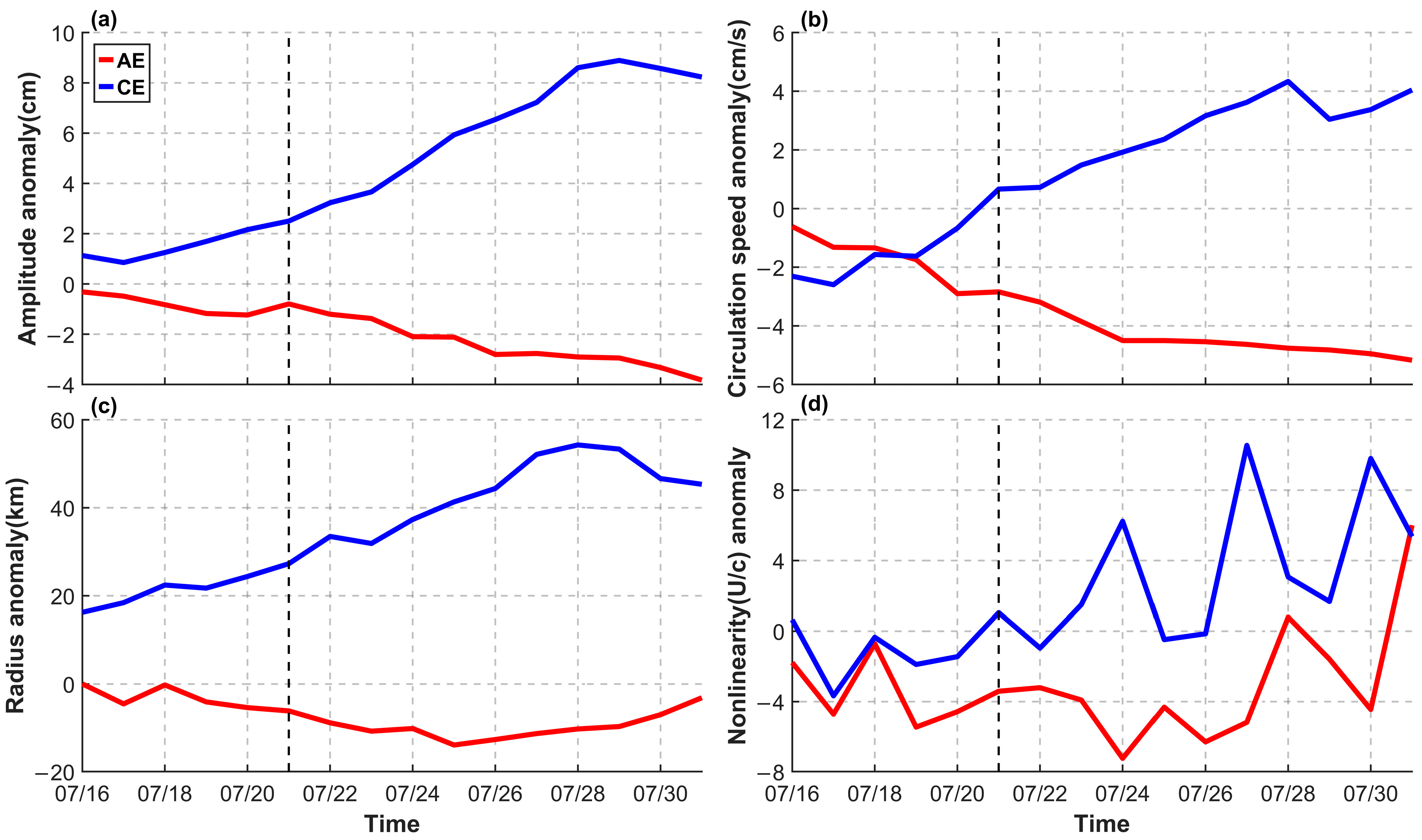
Given that mesoscale eddies typically evolve on relatively long timescales [5], the mean state during the 5–10 days (11 July to 16 July) prior to the typhoon passage is used as a reference to represent the quasi-steady background condition. This approach effectively highlights rapid anomalies induced by the typhoon, distinguishing them from the intrinsic, gradual evolution of the eddies. The impacts of the typhoon on eddy structural properties differ markedly between the two polarities (Figure 2a–c). Following the typhoon passage, the CE exhibits a continuous increase in amplitude, circulation speed, and radius, reaching peak anomalies around day 6 (28 July) after Ma-on (2011), with anomaly increases of approximately 8.6 cm, 4.3 cm/s and 54.3 km, respectively. In contrast, the AE shows a weakening trend, with its amplitude, circulation speed and radius anomalies decreasing by approximately 2.9 cm, 4.8 cm/s and 13.9 km, respectively, by day 4 (25 July). These contrasting responses indicate that the typhoon intensifies the CE while disrupting the structure of the AE. Eddy nonlinearity (U/c), defined as the ratio of circulation speed to propagation speed, reflects the relative importance of rotational motion versus translation and thus determines eddy stability and evolution. Significant changes in nonlinearity are observed for both eddies following the typhoon passage (Figure 2d). For the CE, enhanced energy input likely increases its rotational strength, leading to higher nonlinearity. However, this increase may also be influenced by a reduction in the propagation speed (c), which can occur during the interaction between the CE and the approaching typhoon circulation or the adjacent AE. This increase tends to lead to irregular expansion or distortion of its boundary after the typhoon. In contrast, the AE exhibits a reduction in nonlinearity, indicating a weakening of rotational dominance and a transition toward structural contraction or decay.
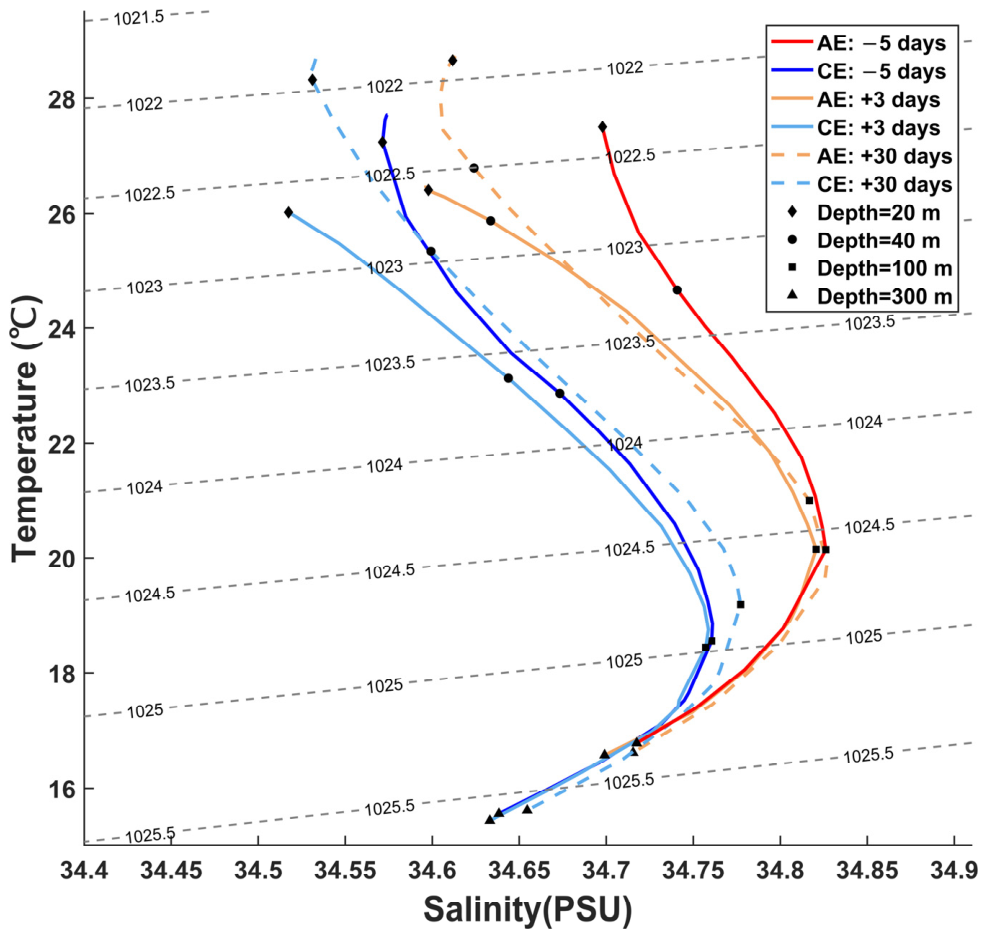
Figure 3 illustrates the evolution of T–S characteristics within the CE and AE at three stages: 5 days before, 3 days after, and 30 days after the typhoon passage. The two eddies exhibit markedly different thermohaline responses under typhoon forcing, with clear depth-dependent variations. Prior to the typhoon (−5 days), the T–S curve within the CE is shifted toward lower temperature and lower salinity, reflecting the typical cold-water structure associated with upwelling. This feature is particularly evident at intermediate depths (40–100 m), where colder and fresher waters dominate. In contrast, the AE exhibits higher temperature and salinity throughout the upper and intermediate layers, especially above 100 m, consistent with a warm-core structure maintained by downwelling. Three days after the typhoon passage, the T–S relationship within the CE shows relatively minor changes across depths, suggesting that its pre-existing stratification provides a stabilizing constraint against typhoon-induced perturbations. In contrast, the AE exhibits a pronounced shift in its T–S structure, particularly in the upper layers (above 20 m), where salinity decreases significantly. This indicates that strong wind stress and enhanced vertical mixing effectively erode the shallow saline layer. At greater depths (100–300 m), the T–S curves show comparatively smaller changes, suggesting that the typhoon-induced perturbation is primarily confined to the upper ocean in the eddies. By 30 days after the typhoon passage, the T–S structure within the CE largely returns to its pre-typhoon state across all depths, indicating relatively rapid recovery and structural resilience. In contrast, although the layers (above 100 m) within the AE show a temperature increase, the water still exhibits noticeable deviations from the pre-typhoon condition. This suggests that the typhoon-induced perturbation has a longer-lasting impact on the salinity structure of the AE, especially below the mixed layer. This asymmetry is likely linked to the modulation of near-inertial wave dynamics and vertical transport by eddy polarity [23]. However, the specific role of near-inertial waves cannot be explicitly resolved in this study.

3.3. Ocean Response Modulated by the Eddy Dipole

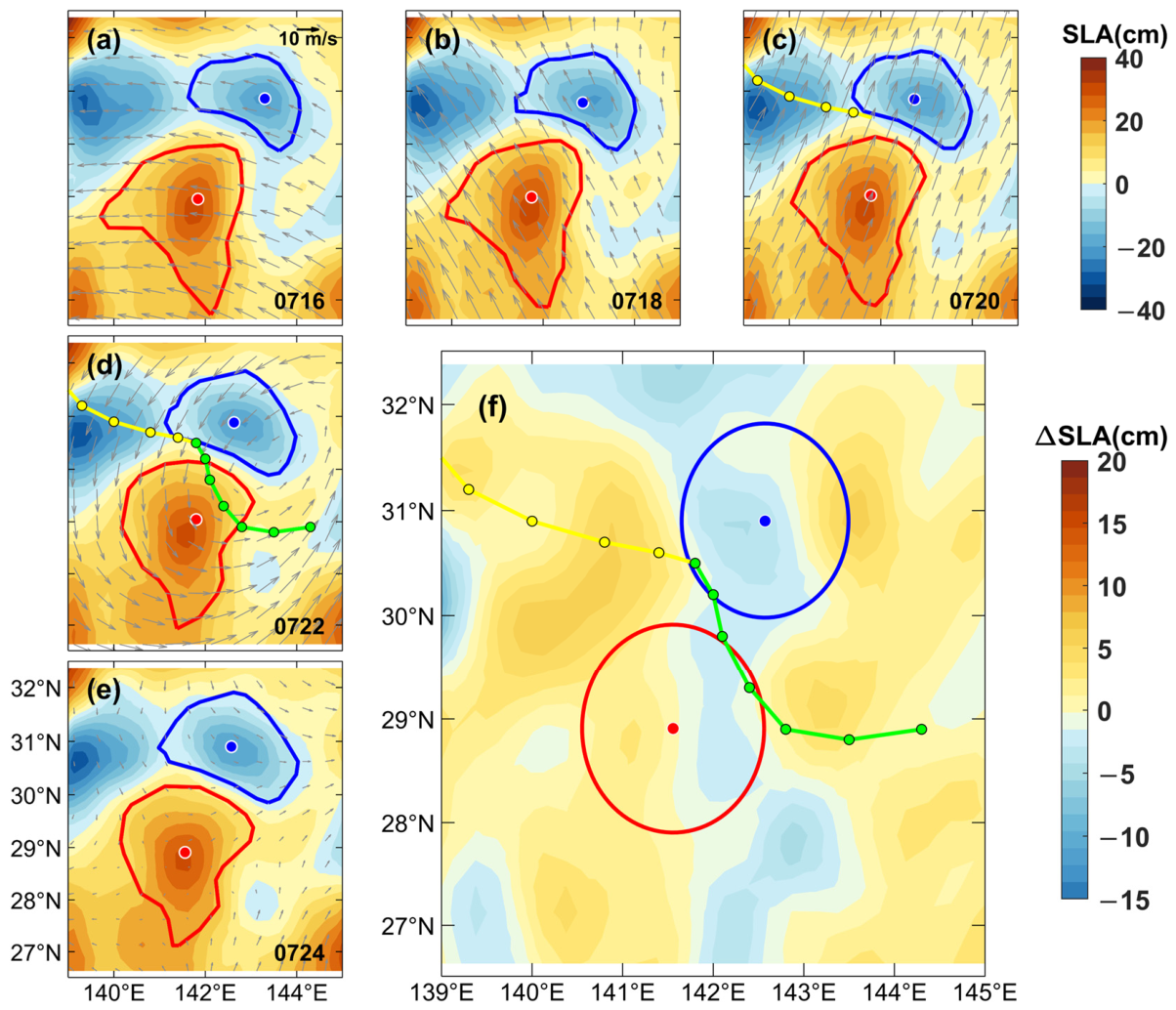
Under typhoon forcing, mesoscale eddies not only undergo substantial changes in their intrinsic properties and thermohaline structures but also play a crucial role in modulating the oceanic response to the typhoon. During the approach stage of the typhoon (Figure 4a), well-defined mesoscale eddy structures are already present in the study region. The CE is associated with negative SLA, while the AE corresponds to positive SLA, both exhibiting clear morphology and coherent structures. At this stage, the typhoon is located to the northwest of the eddies, and the spatial distribution of SLA is primarily governed by the background mesoscale dynamics. As the typhoon moves southeastward and passes directly over the two eddies (Figure 4b–e), it subsequently turns northward and dissipates on 23 July. The SLA difference before and after the typhoon passage (ΔSLA; Figure 4f) reveals a pronounced negative anomaly band along the typhoon track. This negative ΔSLA signal is particularly strong within the CE region, while it is comparatively weaker within the AE. Given that eddy amplitude is defined as the absolute difference between the SLA at the eddy center and its periphery, the increase in CE amplitude (∼8.6 cm) is substantially larger than the decrease observed in the AE (∼2.9 cm; Figure 2a). This asymmetry can be attributed to the constructive interaction between eddy-induced upwelling within the CE and typhoon-driven Ekman pumping, both of which enhance surface divergence and further amplify the reduction in SLA.
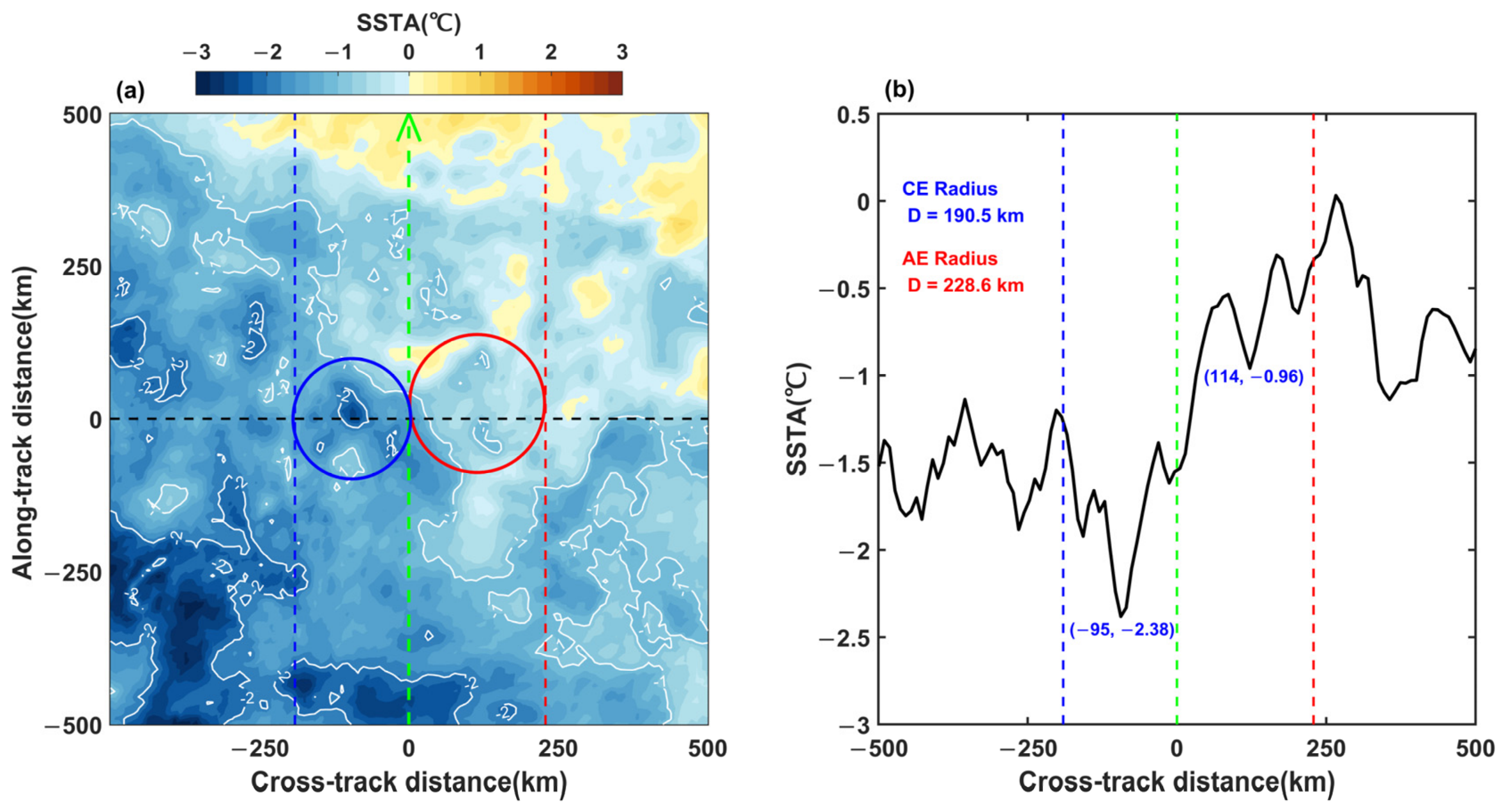
When mesoscale eddies are located near the typhoon track, the structure of the cooling center is significantly modified. Within the CE, enhanced upwelling and intensified vertical mixing lead to stronger SST cooling, reinforcing the cooling center. In contrast, the AE is characterized by a warm, deep, and relatively homogeneous water column, where mixed-layer cooling is primarily driven by transient wind forcing rather than sustained vertical exchange, resulting in a weaker cooling signal [45]. Figure 5 presents the spatial distribution and radial cross-sections of typhoon-induced sea surface temperature anomalies (SSTA) under mesoscale eddy modulation. A pronounced cooling signal is observed within the CE on the left-hand side of the typhoon track, with a minimum SSTA of −2.38 °C located approximately 95 km from the track. In contrast, the cooling within the AE on the right-hand side is substantially weaker, with a minimum SSTA of −0.96 °C at a distance of about 114 km. Previous studies have generally attributed stronger SST cooling to the right-hand side of the typhoon track due to asymmetric wind stress forcing and storm translation effects [22,46]. However, in this case (Figure 5b), the maximum cooling occurs on the left-hand side and is closely aligned with the core of the CE. This result indicates that the spatial pattern and magnitude of SST cooling are primarily controlled by the eddy structure rather than by wind asymmetry alone, highlighting the dominant role of mesoscale eddies in regulating the intensity and spatial distribution of typhoon-induced ocean responses.
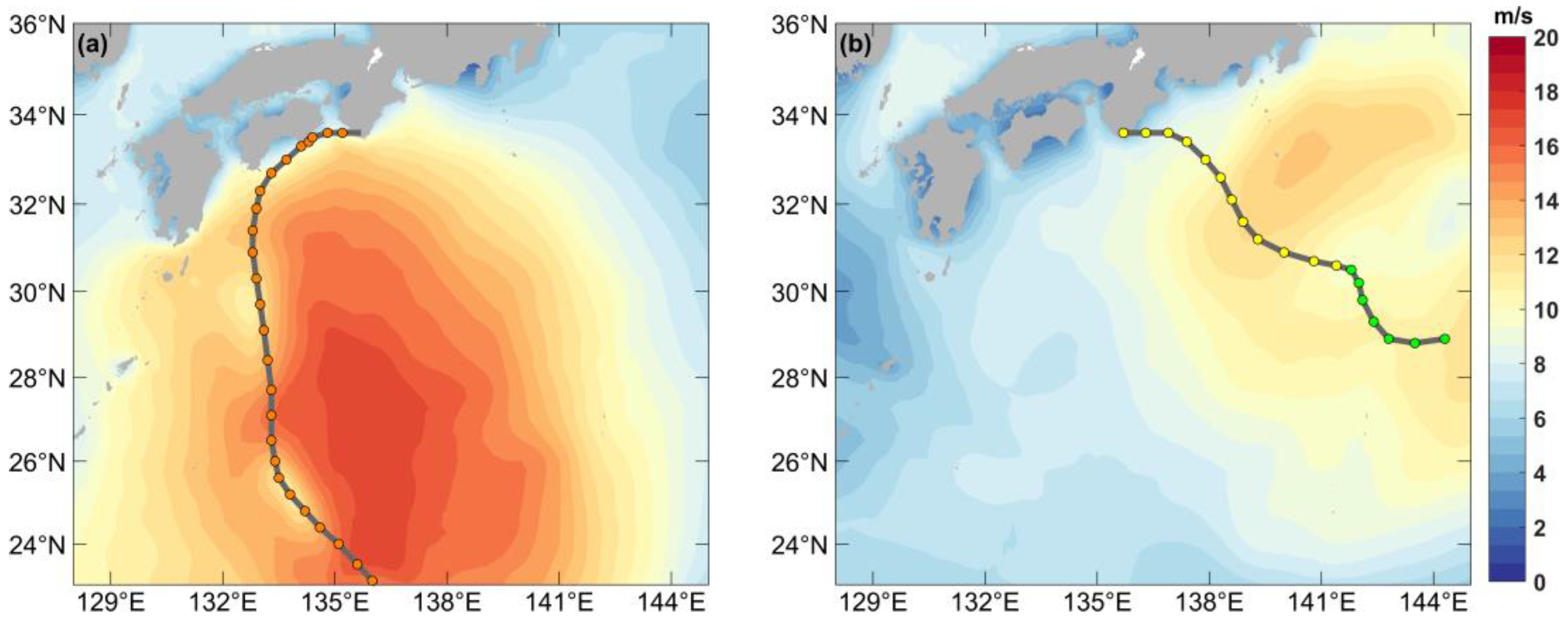
To further examine the potential impact of the typhoon’s track change on the asymmetric ocean response, we analyze the spatial distribution of wind speed before and after the southeastward turning of Typhoon Ma-on (Figure 6). Prior to the turning, the storm moves predominantly northwestward, and the maximum wind speed is distributed on the right side of the track. After the southeastward turn (20–23 July), wind speeds on the left side of the typhoon track (16–18 m/s) are substantially higher than on the right side (8–12 m/s). The evolution of the mean wind speed shows that the change in wind field geometry alters the SST cooling pattern, indicating that the spatial distribution of the cooling asymmetry is primarily controlled by wind forcing associated with the typhoon track. However, the magnitude of the cooling also depends on the eddy dipole structure (Figure 5). The CE, located in the strong wind region on the left-hand side of the track, exhibits significantly enhanced cooling, with SSTA reaching −2.38 °C. In contrast, the AE, situated in a relatively weaker wind region on the right-hand side, shows reduced cooling (−0.96 °C). This contrast suggests that although wind forcing determines the large-scale pattern of the asymmetry, eddy polarity further modulates the intensity of the ocean response.

4. Discussion

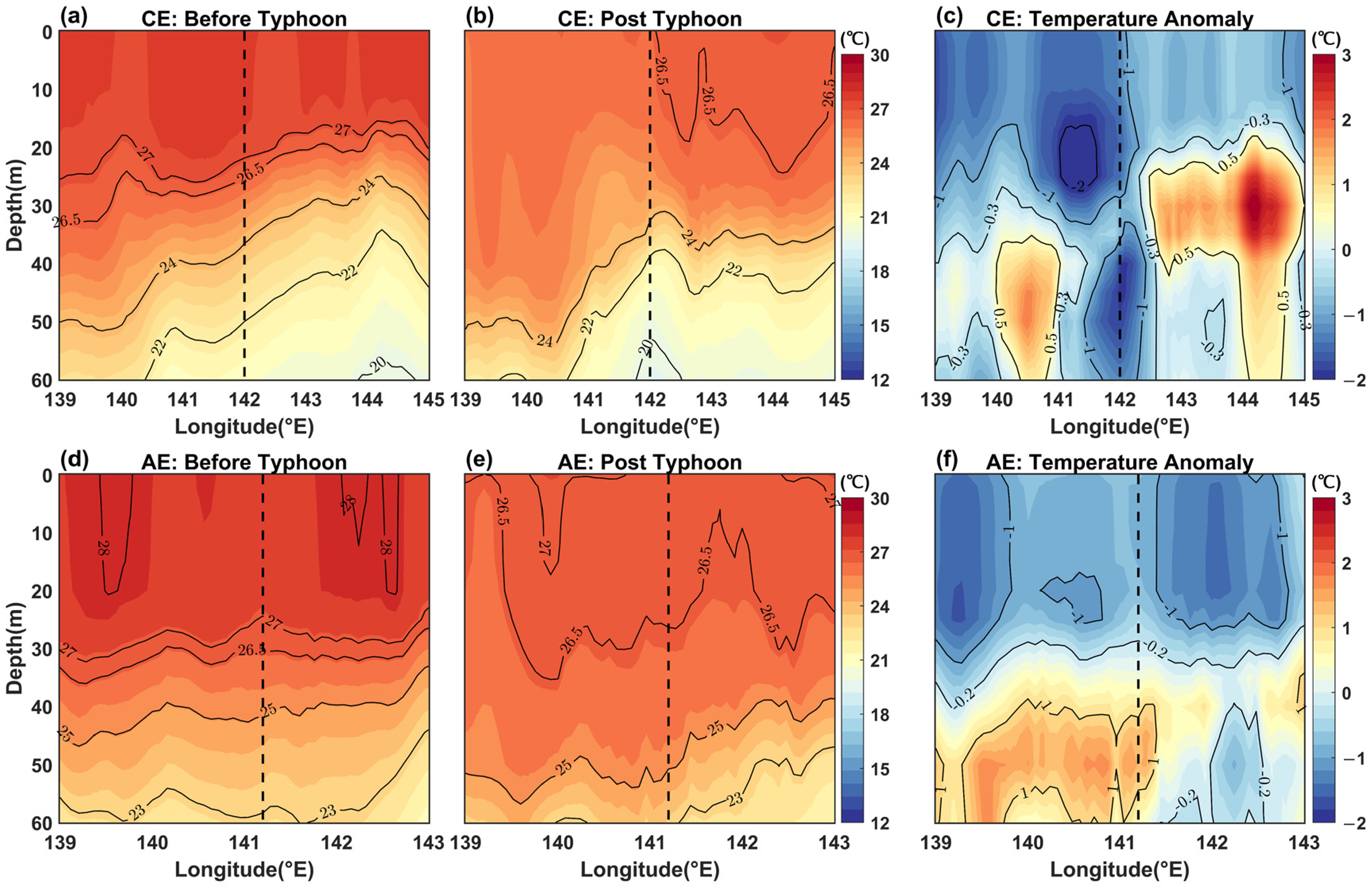
The above results demonstrate that typhoon passage induces pronounced dynamical and thermodynamical adjustments within mesoscale eddies, with systematic differences between the CE and AE. Specifically, the CE exhibits strengthening in amplitude, circulation speed, radius, and nonlinearity, whereas the AE shows more substantial perturbations in thermohaline structure and a delayed recovery. From the perspective of vertical thermal structure (Figure 7), the two eddies display fundamentally different response patterns. Prior to the typhoon, isotherms within the CE are uplifted, with the 22 °C and 24 °C isotherms doming upward near the eddy center, indicating a typical cold-core upwelling structure. In contrast, the AE exhibits depressed isotherms (e.g., 23 °C and 25 °C), consistent with a warm-core downwelling structure. Following the typhoon passage, the thermocline within the CE shoals further, indicating enhanced upward transport of subsurface cold water. The corresponding temperature anomaly section shows a pronounced negative anomaly below about 20 m at the eddy center, with cooling reaching approximately −2 °C. In contrast, the AE is characterized by a deeper pre-existing warm layer. After the typhoon passage, isotherms in the upper 0–30 m shift upward, accompanied by widespread negative temperature anomalies, while below about 40 m the isotherms deepen and positive temperature anomalies emerge. This vertical dipole structure indicates that the typhoon erodes the pre-existing warm-core structure, redistributing heat through enhanced vertical mixing. However, the deeper layers of the AE remain influenced by background downwelling.
This contrasting behavior suggests that vertical mixing and shear play a key role in modulating eddy responses under typhoon forcing. Strong wind forcing significantly alters both vertical shear and stratification in the upper ocean, and their relative balance determines the intensity of turbulent mixing and, consequently, the thermodynamic response within eddies. Richardson number ( R i ) provides an integrated measure of the competition between stratification and shear and is therefore a key parameter for diagnosing flow stability and mixing processes.
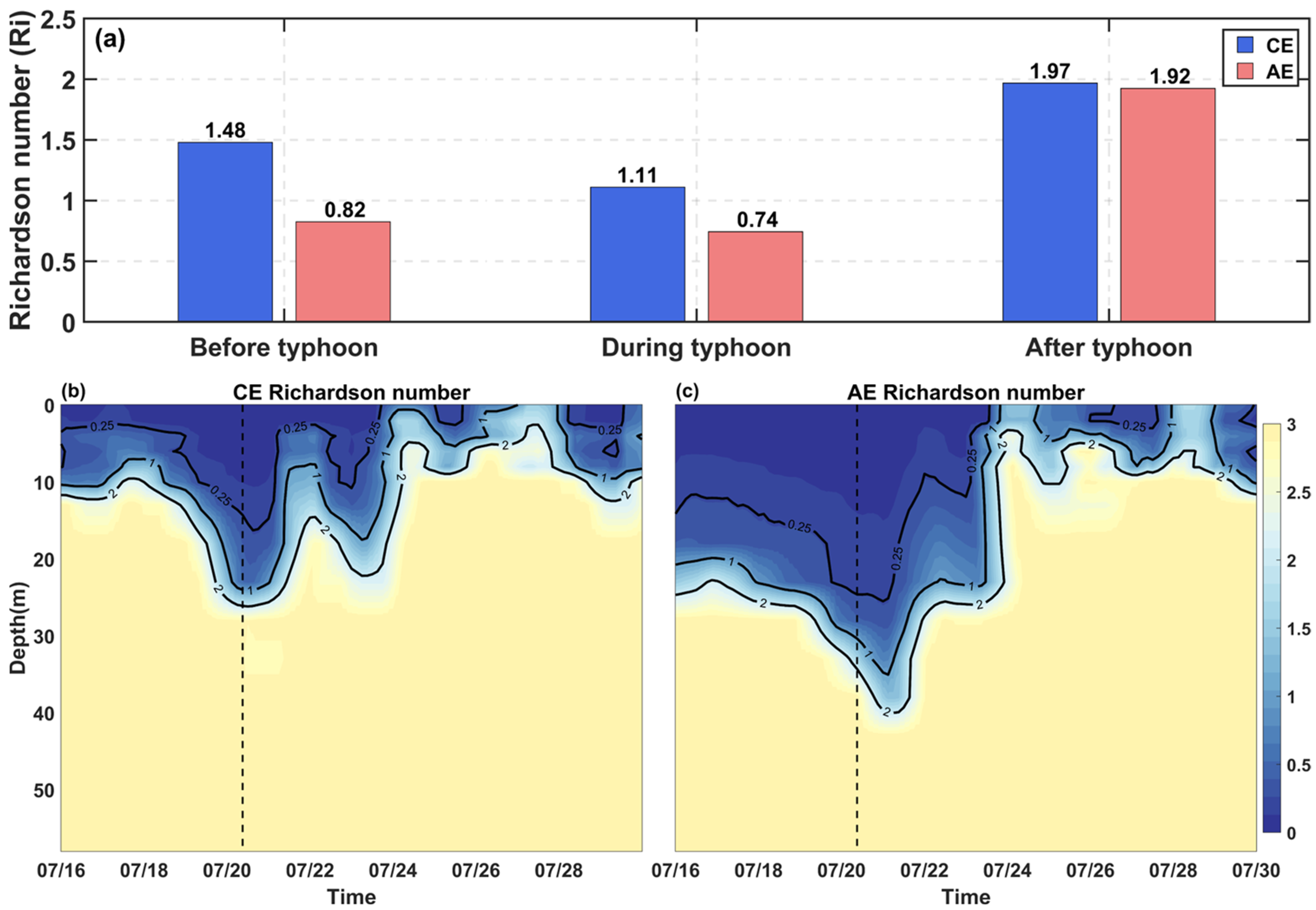
During the typhoon passage, the mean R i in both the AE and CE decreased, dropping from 1.48 to 0.82 before the typhoon to 1.11 and 0.74, respectively, indicating that the typhoon enhanced vertical mixing in the ocean. After the typhoon, the mean R i in both eddies increased significantly, suggesting a recovery toward the pre-typhoon stratified state (Figure 8a). Specifically, before the typhoon passage (16–19 July), the CE exhibits R i < 0.25 primarily within the upper 10 m. During and after the typhoon (19–29 July), low- R i regions extend downward but remain mostly confined above about 30 m, while waters below about 40 m retain relatively high stability. In contrast, the AE shows significantly deeper low- R i regions both before and after the typhoon, with more pronounced deepening during the forcing period. Within the CE, upwelling elevates the thermocline and enhances stratification, forming a relatively stable shallow layer. During the peak forcing period (20–22 July), R i decreases sharply in both eddies, highlighting the strong modulation of flow stability by typhoon forcing, yet with clear polarity-dependent differences. In the AE, background downwelling weakens upper-ocean stratification and reduces the presence of a stable barrier layer, making the water column more susceptible to mixing. The low- R i region ( R i < 0.25) extends downward to approximately 20 m. Notably, the vertical temperature anomaly structure (Figure 7f) provides direct evidence of enhanced mixing within the AE and its role in buffering surface cooling. After the typhoon passage, the AE exhibits significant negative temperature anomalies near the surface, while positive anomalies appear at depths of 40–60 m. This indicates that the typhoon not only induces surface cooling but also disrupts the original warm-core structure maintained by downwelling, leading to intensified vertical exchange between cold surface waters and warmer subsurface waters. Combined with the R i distribution (Figure 8), the AE is characterized by lower R i (0.74 during the typhoon), stronger vertical shear, and weaker stratification, all of which favor turbulent mixing. Under such conditions, typhoon-induced surface cooling signals can penetrate downward, while subsurface warm waters are entrained into the mixed layer, partially offsetting surface cooling. In contrast, although the CE also experiences significant cooling, its response is dominated by enhanced upwelling of cold water. The relatively higher R i (1.11 during the typhoon) and stronger stratification suppress excessive vertical mixing, thereby allowing the cooling signal to be maintained and even intensified at the surface.
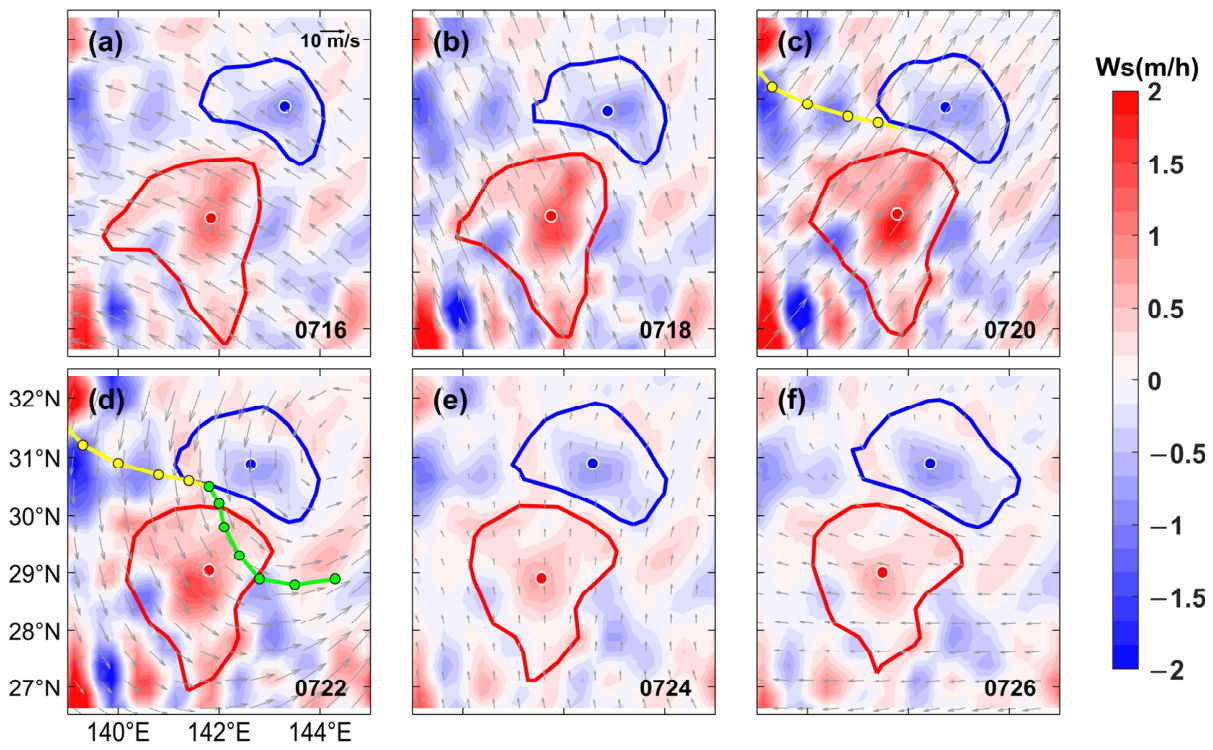
Building upon the above analysis of vertical thermal structure and mixing stability, the asymmetric ocean response within the eddy dipole can be further understood from the perspective of vertical motion. Since vertical transport serves as the key link between wind stress forcing, geostrophic eddy structure, and upper-ocean heat redistribution, Ekman pumping alone is insufficient to explain the observed differences under varying background vorticity. Therefore, we introduce the typhoon-induced pumping velocity W s , which incorporates both wind forcing and background vorticity effects, to better quantify the vertical motion under TC–eddy coupling. Figure 9 shows the spatiotemporal evolution of W s before and after the typhoon passage. Prior to the typhoon (before 20 July), the W s field primarily reflects the intrinsic vertical structure of the eddies, with strong and concentrated downwelling in the AE that exceeds the upwelling intensity in the neighboring CE. During the typhoon passage (20–22 July), upwelling within the CE shows relatively minor changes, whereas the strong downwelling within the AE weakens, with some regions near the eddy periphery even transitioning to weak upwelling. After the typhoon (24–26 July), the upwelling structure within the CE persists, leading to an overall upward displacement of isotherms and the formation of a pronounced negative temperature anomaly below about 20 m at the eddy center. This indicates that the temperature response in the CE is primarily driven by upwelling-induced cold-water entrainment rather than mixing-dominated heat redistribution (Figure 7). In contrast, the AE exhibits a substantially weakened downwelling signal compared to pre-typhoon conditions. Consistent with Figure 7d,e, isotherms above about 30 m rise, suggesting that Ekman-induced upwelling is largely confined to the upper layer, while persistent downwelling below suppresses the upward transport of subsurface cold water. Meanwhile, the presence of a warm core below about 40 m, combined with strong vertical mixing inferred from low R i , promotes the entrainment of subsurface warm water into the upper layer. This process mitigates surface cooling and contributes to a slower post-typhoon recovery.
Overall, the spatial asymmetry of typhoon-induced ocean responses fundamentally arises from the combined modulation of vertical dynamical processes—namely stratification stability, shear instability, and pumping intensity—by eddy polarity. These results highlight that ocean responses to typhoon forcing are not solely determined by atmospheric forcing but are strongly dependent on the background eddy field, which regulates vertical transport and mixing processes, ultimately shaping the asymmetric thermal response on either side of the typhoon track.

5. Conclusions

Using Typhoon Ma-on (2011) and a mesoscale eddy dipole with opposite polarities located on either side of the typhoon track as a representative case, this study analyzed the asymmetric modulation of oceanic dynamical and thermohaline responses by mesoscale eddies of different polarities and relative positions. Contrary to the conventional expectation of stronger cooling on the right-hand side of a typhoon track, the presence of mesoscale eddies induces pronounced polarity-dependent asymmetry: the left-hand CE enhances surface cooling, whereas the right-hand AE suppresses it.
Regarding eddy structural responses, Typhoon Ma-on (2011) exerted distinct and opposite modulation effects on the two eddies. The CE exhibited strengthening, characterized by anomaly increases in amplitude, circulation speed, and radius, along with an increase in nonlinearity. This suggests enhanced boundary expansion with morphological distortion. In contrast, the AE showed weakening, with decreases in amplitude, circulation speed, and radius, accompanied by reduced nonlinearity, structural contraction, and gradual decay. These contrasting responses demonstrate the polarity-dependent dynamical modulation imposed by typhoon forcing.
The evolution of T–S structure further reveals differences in the redistribution of heat and salt within the two eddies. Prior to the typhoon, the CE exhibits T–S curves shifted toward lower temperature and salinity, reflecting the typical uplifted cold-core structure, whereas the AE shows high-temperature, high-salinity T–S characteristics indicative of a warm-core downwelling structure. Three days after the typhoon, T–S variations within the CE remain relatively minor, with density stratification providing stabilizing constraints against wind forcing. In contrast, the upper low-density water within the AE experiences substantial decreases in both temperature and salinity, indicating that strong wind stress and enhanced vertical mixing disrupt the pre-existing warm-core structure and induce mixing of the heat stored within the eddy. By 30 days post-typhoon, the CE’s T–S structure largely recovers to pre-typhoon conditions, whereas the AE exhibits deviations from its pre-typhoon state, characterized by relatively higher temperature and lower salinity.
Under the modulation of the mesoscale eddy dipole, the CE exhibits a pronounced cooling enhancement with a maximum ΔSST of −2.38 °C, whereas the AE demonstrates a suppressed cooling response with a maximum ΔSST of only −0.96 °C. Integrating vertical temperature anomalies, Ri and W s analyses reveal that differences in vertical stability, turbulent mixing intensity, and the direction of heat transport between the two eddies are key mechanisms underlying the observed asymmetric oceanic response. Within the left-hand CE, significant negative temperature anomalies appear below about 20 m post-typhoon. The relatively high Ri and stable stratification reduce vertical shear and suppress turbulent mixing, allowing cold-water upwelling to persist. Negative W s -driven upwelling further enhances the upward transport of cold water, effectively maintaining or strengthening surface cooling. This indicates that high Ri and vertical stability within CE are critical for preserving cooling signals by limiting turbulent mixing and promoting cold-water accumulation. In contrast, within the right-hand AE, the vertical temperature profile shows surface cooling but retains positive anomalies below about 40 m, reflecting the persistence of a warm-core structure. The eddy exhibits strong, concentrated downwelling dominated by positive W s , combined with lower Ri and weaker stratification, which enhances vertical shear, promotes subsurface heat mixing, and mitigates surface cooling. The polarity- and position-dependent contrast between the CE and AE underscores the crucial role of eddy characteristics in regulating typhoon-induced oceanic responses.
In summary, typhoon-induced ocean responses are not solely determined by wind stress or storm translation but are strongly modulated by the polarity and relative position of background mesoscale eddies. In particular, differences in vertical dynamical structure within the eddy dipole profoundly influence upper-ocean heat redistribution, shaping the spatially asymmetric response following typhoon passage. While this study provides a detailed case-based analysis of eddy modulation, statistical representativeness remains limited. Future work should involve composite analyses over longer timescales and larger samples, integrating eddy polarity, dynamical structure, geometric relationships with the typhoon track, storm intensity, and translation speed to quantify the relative contributions of each factor and better constrain typhoon-induced ocean cooling. Such efforts will provide robust theoretical support for model evaluation and observational studies.

Author Contributions

Conceptualization, X.L. and X.Z.; methodology, X.L. and X.Z.; software, X.L. and X.Z.; validation, Y.L. and X.Z.; formal analysis, X.Z. and G.H.; investigation, X.Z. and X.L.; resources, X.L.; data curation, X.Z., X.L. and J.X.; writing—original draft preparation, X.L. and X.Z.; writing—review and editing, X.L. and H.Z.; visualization, X.Z.; supervision, X.L.; project administration, X.L.; funding acquisition, X.L., Y.L. and G.H. All authors have read and agreed to the published version of the manuscript.

Funding

This research has been supported by the Project of State Key Laboratory of Satellite Ocean Environment Dynamics (SOEDZZ2532); the Scientific Research Fund of the Second Institute of Oceanography, MNR (SOEDZZ2506); the National Natural Science Foundation of China (42376004, 42206005, 42206004 and 42530402); the Innovation Group Project of the Southern Marine Science and Engineering Guangdong Laboratory (Zhuhai) (311024001); the Southern Marine Science and Engineering Guangdong Laboratory (Zhuhai) (SML2021SP207, SML2024SP012); and the Oceanic Interdisciplinary Program of Shanghai Jiao Tong University (SL2023MS016); the Zhejiang Provincial Natural Science Foundation of China (LR26D060001); the Key R&D Program of Zhejiang Province (2024C03257); the National Key R&D Program of China (2023YFF0805300, 2023YFF0805301).

Data Availability Statement

Typhoon track data (IBTrACS) are available online at https://www.ncei.noaa.gov/products/international-best-track-archive (accessed on 25 February 2025). Daily SLA and geostrophic current data are provided by AVISO, available at https://marine.copernicus.eu/ (accessed on 11 December 2020). Mesoscale Eddy Trajectories Atlas can be accessed at https://aviso.altimetry.fr (accessed on 29 July 2024). Sea surface temperature data (GHRSST) are available at https://doi.org/10.5067/GHGMR-4FJ04 (accessed on 9 March 2026). The surface wind speed data are obtained from the ECMWF ERA5, available at https://doi.org/10.24381/cds.adbb2d47 (accessed on 13 July 2024). Temperature and salinity data are from HYCOM, available at http://www.hycom.org (accessed on 15 January 2025). Mixed layer depth data are obtained from the GLORYS12V1 reanalysis product, available at https://www.copernicus.eu/en (accessed on 9 August 2024).

Conflicts of Interest

The authors declare no conflicts of interest.

References

  1. Zhan, W.; He, Q.; Zhang, Y.; Zhan, H. Anticyclone Eddies Favor the Genesis of Off-Season Tropical Cyclone in the Western North Pacific. J. Geophys. Res. Atmos. 2023, 128, e2022JD036945. [Google Scholar] [CrossRef]
  2. Guan, S.; Jin, F.-F.; Tian, J.; Lin, I.-I.; Pun, I.-F.; Zhao, W.; Huthnance, J.; Xu, Z.; Cai, W.; Jing, Z.; et al. Ocean Internal Tides Suppress Tropical Cyclones in the South China Sea. Nat. Commun. 2024, 15, 3903. [Google Scholar] [CrossRef]
  3. Gray, W.M. Global View of the Origin of Tropical Disturbances and Storms. Mon. Weather Rev. 1968, 96, 669–700. [Google Scholar] [CrossRef]
  4. Sun, L.; Yang, Y.-J.; Xian, T.; Wang, Y.; Fu, Y.-F. Ocean Responses to Typhoon Namtheun Explored with Argo Floats and Multiplatform Satellites. Atmos.-Ocean 2012, 50, 15–26. [Google Scholar] [CrossRef]
  5. Chelton, D.B.; Schlax, M.G.; Samelson, R.M. Global Observations of Nonlinear Mesoscale Eddies. Prog. Oceanogr. 2011, 91, 167–216. [Google Scholar] [CrossRef]
  6. Xu, L.; Li, P.; Xie, S.-P.; Liu, Q.; Liu, C.; Gao, W. Observing Mesoscale Eddy Effects on Mode-Water Subduction and Transport in the North Pacific. Nat. Commun. 2016, 7, 10505. [Google Scholar] [CrossRef] [PubMed]
  7. Lu, Z.; Wang, G.; Shang, X. Strength and Spatial Structure of the Perturbation Induced by a Tropical Cyclone to the Underlying Eddies. J. Geophys. Res. Ocean. 2020, 125, e2020JC016097. [Google Scholar] [CrossRef]
  8. Shay, L.K.; Goni, G.J.; Black, P.G. Effects of a Warm Oceanic Feature on Hurricane Opal. Mon. Weather Rev. 2000, 128, 1366–1383. [Google Scholar] [CrossRef]
  9. Lin, I.-I.; Wu, C.-C.; Emanuel, K.A.; Lee, I.-H.; Wu, C.-R.; Pun, I.-F. The Interaction of Supertyphoon Maemi (2003) with a Warm Ocean Eddy. Mon. Weather Rev. 2005, 133, 2635–2649. [Google Scholar] [CrossRef]
  10. Jaimes, B.; Shay, L.K. Mixed Layer Cooling in Mesoscale Oceanic Eddies during Hurricanes Katrina and Rita. Mon. Weather Rev. 2009, 137, 4188–4207. [Google Scholar] [CrossRef]
  11. Jaimes, B.; Shay, L.K. Enhanced Wind-Driven Downwelling Flow in Warm Oceanic Eddy Features during the Intensification of Tropical Cyclone Isaac (2012): Observations and Theory. J. Phys. Oceanogr. 2015, 45, 1667–1689. [Google Scholar] [CrossRef]
  12. Sun, L.; Li, Y.-X.; Yang, Y.-J.; Wu, Q.; Chen, X.-T.; Li, Q.-Y.; Li, Y.-B.; Xian, T. Effects of Super Typhoons on Cyclonic Ocean Eddies in the Western North Pacific: A Satellite Data-Based Evaluation between 2000 and 2008. J. Geophys. Res. Ocean. 2014, 119, 5585–5598. [Google Scholar] [CrossRef]
  13. Gordon, A.L.; Shroyer, E.; Murty, V.S.N. An Intrathermocline Eddy and a Tropical Cyclone in the Bay of Bengal. Sci. Rep. 2017, 7, 46218. [Google Scholar] [CrossRef]
  14. Wang, G.; Wu, L.; Johnson, N.C.; Ling, Z. Observed Three-Dimensional Structure of Ocean Cooling Induced by Pacific Tropical Cyclones. Geophys. Res. Lett. 2016, 43, 7632–7638. [Google Scholar] [CrossRef]
  15. Lei, F.; Dai, H.; Shang, S.; He, Z.; Yang, S. Analysis of the Dynamic Mechanisms of Upwelling in Deep Ocean Water Caused by Typhoons. Ocean Dyn. 2023, 73, 517–529. [Google Scholar] [CrossRef]
  16. Falor, D.; Gayen, B.; Sengupta, D.; Chaudhuri, D. Enhanced Ocean Mixing during the Passage of Tropical Cyclone. Geophys. Res. Lett. 2024, 51, e2024GL111925. [Google Scholar] [CrossRef]
  17. Han, C.; Bowen, M.; Sutton, P. The Response of the Upper Ocean to Tropical Cyclones in the South Pacific. J. Geophys. Res. Ocean. 2024, 129, e2023JC020627. [Google Scholar] [CrossRef]
  18. Bai, L.; Lü, H.; Huang, H.; Muhammad Imran, S.; Ding, X.; Zhang, Y. Effects of Anticyclonic Eddies on the Unique Tropical Storm Deliwe (2014) in the Mozambique Channel. J. Mar. Sci. Eng. 2023, 11, 129. [Google Scholar] [CrossRef]
  19. Maneesha, K.; Ratheesh, S.; Bhaskar, T.V.S.U. Impact of the Upper Ocean Processes on Intensification of Cyclone Amphan. J. Indian Soc. Remote Sens. 2023, 51, 289–298. [Google Scholar] [CrossRef]
  20. Cui, Y.; Liu, Z.; Shan, Z.; Shi, D.; Ding, X.; Lü, H. A Case Study on the Dynamics of Phytoplankton Blooms Caused by Tropical Cyclones in the Southeastern Arabian Sea. Tellus Dyn. Meteorol. Oceanogr. 2022, 74, 318–332. [Google Scholar] [CrossRef]
  21. Xing, X.; Luo, S.; Zhang, H.; Shi, J.; Lü, H. Phytoplankton Blooms Triggered by Anticyclonic Eddy and Cyclonic Eddy during Tropical Cyclone Nada. Tellus Dyn. Meteorol. Oceanogr. 2023, 75, 10–23. [Google Scholar] [CrossRef]
  22. Lin, S.; Zhang, W.-Z.; Wang, Y.; Chai, F. Mechanism of Oceanic Eddies in Modulating the Sea Surface Temperature Response to a Strong Typhoon in the Western North Pacific. Front. Mar. Sci. 2023, 10, 1117301. [Google Scholar] [CrossRef]
  23. Lu, X.; Dong, C.; Zhang, H.; Lim Kam Sian, K.T.C.; Yang, J.; Xu, Z.; Li, G.; Wang, Q.; Cao, Q.; You, Z.; et al. Observational Analysis of Vertical Heat Flux Caused by Typhoon-Induced near-Inertial Waves under the Modulation of Mesoscale Eddies. J. Geophys. Res. Ocean. 2024, 129, e2024JC021053. [Google Scholar] [CrossRef]
  24. Sanabia, E.R.; Jayne, S.R. Ocean Observations under Two Major Hurricanes: Evolution of the Response across the Storm Wakes. AGU Adv. 2020, 1, e2019AV000161. [Google Scholar] [CrossRef]
  25. Lin, I.-I.; Wu, C.-C.; Pun, I.-F.; Ko, D.-S. Upper-Ocean Thermal Structure and the Western North Pacific Category 5 Typhoons. Part I: Ocean Features and the Category 5 Typhoons’ Intensification. Mon. Weather Rev. 2008, 136, 3288–3306. [Google Scholar] [CrossRef]
  26. Ma, Z.; Fei, J.; Liu, L.; Huang, X.; Li, Y. An Investigation of the Influences of Mesoscale Ocean Eddies on Tropical Cyclone Intensities. Mon. Weather Rev. 2017, 145, 1181–1201. [Google Scholar] [CrossRef]
  27. Sun, L.; Yang, Y.; Xian, T.; Lu, Z.; Fu, Y. Strong Enhancement of Chlorophyll a Concentration by a Weak Typhoon. Mar. Ecol. Prog. Ser. 2010, 404, 39–50. [Google Scholar] [CrossRef]
  28. Ma, Z.; Fei, J.; Huang, X.; Cheng, X. Modulating Effects of Mesoscale Oceanic Eddies on Sea Surface Temperature Response to Tropical Cyclones over the Western North Pacific. J. Geophys. Res. Atmos. 2018, 123, 367–379. [Google Scholar] [CrossRef]
  29. Yu, J.; Lin, S.; Jiang, Y.; Wang, Y. Modulation of Typhoon-Induced Sea Surface Cooling by Preexisting Eddies in the South China Sea. Water 2021, 13, 653. [Google Scholar] [CrossRef]
  30. He, Y.; Lin, X.; Han, G.; Liu, Y.; Zhang, H. The Different Dynamic Influences of Typhoon Kalmaegi on Two Pre-Existing Anticyclonic Ocean Eddies. Ocean Sci. 2024, 20, 621–637. [Google Scholar] [CrossRef]
  31. Bloemendaal, N.; Haigh, I.D.; De Moel, H.; Muis, S.; Haarsma, R.J.; Aerts, J.C.J.H. Generation of a Global Synthetic Tropical Cyclone Hazard Dataset Using STORM. Sci. Data 2020, 7, 40. [Google Scholar] [CrossRef] [PubMed]
  32. Dang-Quang, N.; Renwick, J.; McGregor, J. On the Presence of Tropical Vortices over the Southeast Asian Sea–Maritime Continent Region. J. Clim. 2016, 29, 4793–4800. [Google Scholar] [CrossRef]
  33. Hodges, K.I.; Emerton, R. The Prediction of Northern Hemisphere Tropical Cyclone Extended Life Cycles by the ECMWF Ensemble and Deterministic Prediction Systems. Part I: Tropical Cyclone Stage. Mon. Weather Rev. 2015, 143, 5091–5114. [Google Scholar] [CrossRef]
  34. Schreck, C.J.; Knapp, K.R.; Kossin, J.P. The Impact of Best Track Discrepancies on Global Tropical Cyclone Climatologies Using IBTrACS. Mon. Weather Rev. 2014, 142, 3881–3899. [Google Scholar] [CrossRef]
  35. Zhong, Q.; Li, J.; Zhang, L.; Ding, R.; Li, B. Predictability of Tropical Cyclone Intensity over the Western North Pacific Using the IBTrACS Dataset. Mon. Weather Rev. 2018, 146, 2741–2755. [Google Scholar] [CrossRef]
  36. Ma, Z.; Zhang, Z.; Fei, J.; Wang, H. Imprints of Tropical Cyclones on Structural Characteristics of Mesoscale Oceanic Eddies over the Western North Pacific. Geophys. Res. Lett. 2021, 48, e2021GL092601. [Google Scholar] [CrossRef]
  37. You, X.; Wang, Y.; Ben Ismail, S.; Lin, S.; Khamis, Z.A.; Hamouda, A.Z.; El-Gharabawy, S.; Zhang, R.; Chai, F. Global Eddy-Induced Variation in the Intensities of Tropical Cyclones. Environ. Res. Commun. 2025, 7, 035028. [Google Scholar] [CrossRef]
  38. NASA/JPL. GHRSST Level 4 MUR Global Foundation Sea Surface Temperature Analysis (v4.1); NASA Physical Oceanography Distributed Active Archive Center: Pasadena, CA, USA, 2015. [Google Scholar] [CrossRef]
  39. Artana, C.; Ferrari, R.; Bricaud, C.; Lellouche, J.-M.; Garric, G.; Sennéchael, N.; Lee, J.-H.; Park, Y.-H.; Provost, C. Twenty-Five Years of Mercator Ocean Reanalysis GLORYS12 at Drake Passage: Velocity Assessment and Total Volume Transport. Adv. Space Res. 2021, 68, 447–466. [Google Scholar] [CrossRef]
  40. Xia, Q.; Li, G.; Dong, C. Global Oceanic Mass Transport by Coherent Eddies. J. Phys. Oceanogr. 2022, 52, 1111–1132. [Google Scholar] [CrossRef]
  41. Lu, Z.; Wang, G.; Shang, X. Inner-Core Sea Surface Cooling Induced by a Tropical Cyclone. J. Phys. Oceanogr. 2021, 51, 3385–3400. [Google Scholar] [CrossRef]
  42. Oey, L.-Y.; Ezer, T.; Wang, D.-P.; Fan, S.-J.; Yin, X.-Q. Loop Current Warming by Hurricane Wilma. Geophys. Res. Lett. 2006, 33, L08613. [Google Scholar] [CrossRef]
  43. Miles, J.W. On the Stability of Heterogeneous Shear Flows. J. Fluid Mech. 1961, 10, 496–508. [Google Scholar] [CrossRef]
  44. Howard, L.N. Note on a Paper of John W. Miles. J. Fluid Mech. 1961, 10, 509–512. [Google Scholar] [CrossRef]
  45. Jaimes, B.; Shay, L.K.; Halliwell, G.R. The Response of Quasigeostrophic Oceanic Vortices to Tropical Cyclone Forcing. J. Phys. Oceanogr. 2011, 41, 1965–1985. [Google Scholar] [CrossRef]
  46. Lu, Z.; Shang, X. Limited Width of Tropical Cyclone–Induced Baroclinic Geostrophic Response. J. Phys. Oceanogr. 2024, 54, 1071–1088. [Google Scholar] [CrossRef]
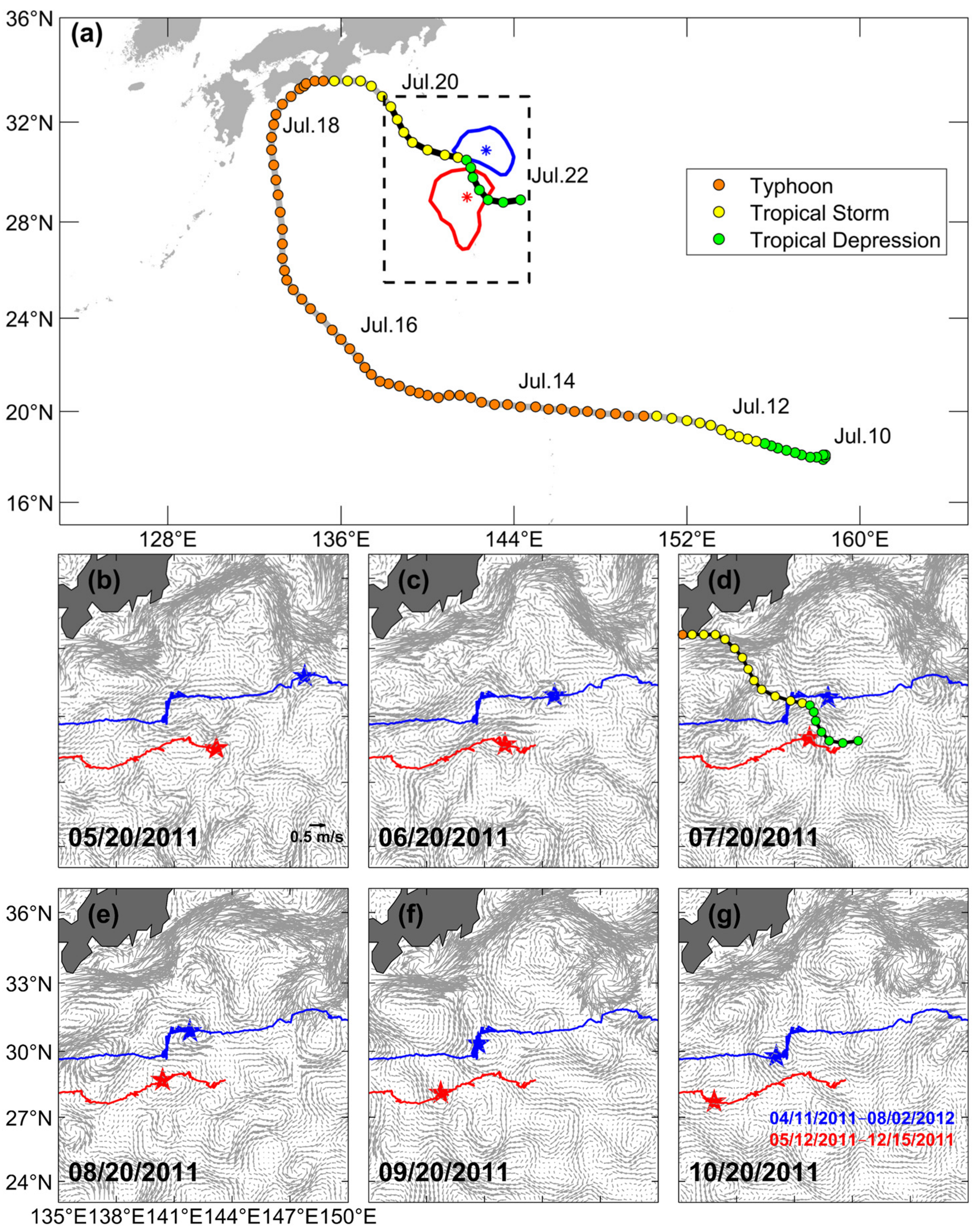
Figure 1. Track and intensity evolution of Typhoon Ma-on (a) and the evolution of mesoscale eddies (bg). In panel (a), the black dashed rectangle indicates the study region during the interaction between the typhoon and eddies. Closed contours denote eddy boundaries; stars indicate eddy centers; blue color denotes the CE and red denotes the AE. Typhoon tracks are overlaid with colored dots representing intensity classifications: green for severe tropical depressions, yellow for tropical storms, and orange for typhoons. In panels (bg), the background shows surface ocean current vectors; solid lines represent eddy trajectories; pentagrams indicate eddy centers; blue color denotes the CE and red denotes the AE.
Jmse 14 00830 g001
Figure 2. Time series of eddy characteristic anomalies: (a) amplitude anomaly, (b) circulation speed anomaly, (c) radius anomaly, and (d) nonlinearity anomaly. Blue lines represent the CE, and red lines represent the AE. The black dashed line indicates the time when the typhoon center is closest to the eddy centers. The nonlinearity parameter (U/c) is defined as the ratio of the eddy circulation speed (U) to the eddy propagation speed (c).
Jmse 14 00830 g002
Figure 3. Temperature–salinity (T–S) characteristics of water masses within the eddies 5 days before (−5 days), 3 days after (+3 days), and 30 days after (+30 days) the typhoon passage. Depth information at 20 m, 40 m, 100 m, and 300 m is indicated by filled black diamonds, circles, squares, and triangles, respectively.
Jmse 14 00830 g003
Figure 4. Spatial evolution of SLA (ae) and the spatial distribution of ΔSLA (f). In panels (ae), the red and blue closed contours represent the AE and CE, respectively, and arrows indicate wind vectors. In panel (f), the red and blue circles indicate the mean positions and mean radius of the AE and CE, averaged over 3–5 days after the typhoon passage, with dots marking the eddy mean centers, based on the satellite altimetry eddy detection product. Typhoon tracks are overlaid with colored dots representing intensity classifications: green for severe tropical depression and yellow for tropical storm.
Jmse 14 00830 g004
Figure 5. SSTA induced by typhoons. (a) The blue dashed line and the red dashed line represent the diameters of the CE and the AE, respectively. The red and blue circles indicate the mean positions and mean radius of the AE and CE, averaged over 3–5 days after the typhoon passage. Green arrows indicate the direction of typhoon motion, and the horizontal black dashed line marks the cross-sectional transect shown in panel (b). (b) Cross-typhoon-track profiles of SSTA, calculated as the difference between the 3–5 days post-typhoon average and the 5–10 days pre-typhoon reference mean.
Jmse 14 00830 g005
Figure 6. Mean wind speed (a) before the typhoon turning (16–19 July) and (b) after the typhoon turning (20–23 July). Typhoon tracks are overlaid with colored dots representing intensity classifications: green for severe tropical depression, yellow for tropical storms and orange for typhoons.
Jmse 14 00830 g006
Figure 7. Vertical sections of temperature before and after the typhoon passage and the corresponding temperature anomalies within the CE (ac) and AE (df). Panels (a,d) show the mean temperature structure 5–10 days before the typhoon, (b,e) 3–5 days after the typhoon, and (c,f) the temperature anomalies (post minus pre). The dashed vertical line indicates the longitude of the eddy center.
Jmse 14 00830 g007
Figure 8. (a) The mean Richardson number ( R i ) within the upper 40 m of the eddy before (16–19 July), during (20–23 July), and after (24–30 July) the typhoon passage. (b,c) Temporal evolution of the R i within the CE and AE. The black dashed line indicates the time when the typhoon center is closest to the eddy centers.
Jmse 14 00830 g008
Figure 9. Typhoon-driven pumping velocity ( W s ). Panels depict the evolution of W s before (a,b), during (c,d), and after (e,f) the typhoon. In the background field, positive values correspond to downwelling, while negative values correspond to upwelling. The background shading represents W s , while gray arrows indicate surface wind vectors. AE and CE are marked by red and blue closed contours, respectively, with dots denoting the corresponding centers of the eddies. Typhoon tracks are overlaid with colored dots representing intensity classifications: green for severe tropical depression and yellow for tropical storms.
Jmse 14 00830 g009
Disclaimer/Publisher’s Note: The statements, opinions and data contained in all publications are solely those of the individual author(s) and contributor(s) and not of MDPI and/or the editor(s). MDPI and/or the editor(s) disclaim responsibility for any injury to people or property resulting from any ideas, methods, instructions or products referred to in the content.