Article

Joint Optimization of Yard Slot Allocation and Cooperative Scheduling of Dual Yard Cranes in Automated Container Terminals Considering Relay Operations


1
School of Transportation and Logistics Engineering, Wuhan University of Technology, Wuhan 430063, China
2
State Key Laboratory of Maritime Technology and Safety, Wuhan University of Technology, Wuhan 430063, China
*
Author to whom correspondence should be addressed.
These authors contributed equally to this work.
J. Mar. Sci. Eng. 2026, 14(9), 822; https://doi.org/10.3390/jmse14090822
Submission received: 2 April 2026 / Revised: 28 April 2026 / Accepted: 28 April 2026 / Published: 29 April 2026
(This article belongs to the Section Ocean Engineering)

Abstract

As global shipping expands, Automated Container Terminals (ACTs) are vital for port competitiveness. However, modern three-stage yard layouts often suffer from spatio-temporal conflicts between dual yard cranes during relay operations, while uncoordinated container placement causes localized overloads and safety hazards. To address these issues, this study proposes a multi-objective mixed-integer linear programming (MILP) model integrating three-stage operations with spatio-temporal mutual exclusion constraints. The model minimizes makespan, external truck waiting time, and inventory disparities across landside bays. To solve this NP-hard problem, an Improved Octopus Optimization Algorithm (IOOA) is developed, featuring discrete space mapping, Euclidean-based state determination, integer flight steps, and local fine-tuning. Numerical experiments demonstrate that this approach significantly reduces the total makespan and truck waiting times while ensuring a highly uniform container distribution across bays. Ultimately, this study mitigates safety risks associated with space overloads and isolated stack collapses, providing a robust decision-making framework to enhance the efficiency and safety of next-generation ACTs.

1. Introduction

In today’s globalized economic system, maritime transport undertakes more than 80% of international trade transportation tasks. As critical nodes and logistics hubs in the global supply chain, the operational efficiency of container ports directly affects the fluidity of international trade and national economic competitiveness [1]. With the intensifying trend of mega-ships and the continuous climb in container throughput, terminal operators have begun to focus more on terminal operational efficiency [2]. Characterized by intelligence and unmanned operations, the new generation of Automated Container Terminals (ACTs) has overcome the difficult-to-control high error rates typical of traditional manual terminal operations while addressing multiple challenges such as rising labor costs, operational efficiency bottlenecks, and the pressure of around-the-clock operations [3]. Through the deep integration of the Internet of Things (IoT) and automatic control technologies, ACTs not only completely liberate human labor from hazardous environments and achieve uninterrupted high-efficiency operations all day, but also demonstrate transformative advantages in operational precision, safety standardization, and green, low-carbon emission reductions, making them an inevitable trend in the transformation and upgrading of the global port and shipping industry [4]. In fact, this developmental trajectory of alleviating peak operational loads and enhancing green sustainability through intelligent control strategies has also become a prevalent consensus across modern generalized transportation and energy systems [5]. From Euromax in Rotterdam to Yangshan Phase IV in Shanghai, China, the successful practices of these world-class hub ports indicate that ACTs are reshaping the operational paradigm of the global maritime industry [6].
As a highly complex logistics mega-system, the operational efficiency of a container terminal heavily relies on the close coordination of core resources such as berths, quay cranes, trucks, and the yard [7]. At the seaside, the precise perception of vessel dynamics in complex waters and the forecasting of spatial–temporal trajectories have become the foundation for proactive terminal scheduling [8]. Meanwhile, internally, the container yard acts as the core buffering hub connecting seaside vessel loading and unloading with landside distribution. It is not only the physical carrier of port throughput capacity but also the critical spatial resource determining overall operational fluidity and resource turnover rates. However, under the ACT yard operational system, slot planning and scheduling decisions remain predominantly rule-based, showing insufficient adaptability to dynamic operational scenarios. Mismatches easily occur between automated horizontal transport equipment and yard operational sequences, and inbound and outbound container flows still suffer from path interlacing and operational interference within the yard [9]. This not only severely limits yard space utilization and rehandling efficiency, harboring significant safety risks from human–vehicle mixed traffic, but also makes it difficult to cope with the extreme peak operational pressures brought by the concentrated calling of mega-ships in the modern shipping industry.
To resolve these yard operational challenges, the yard operating systems of ACTs have undergone a fundamental paradigm shift. Modern ACTs universally adopt rail-mounted automated yard cranes to replace traditional rubber-tired gantry cranes, achieving closed management of operational areas through physical isolation. This significantly enhances the high-density storage capacity and millimeter-level precise positioning of containers while fundamentally eliminating the safety risks of human–machine mixed traffic. To further break through the operational efficiency bottlenecks of single equipment and maximize yard throughput capacity, advanced ACTs typically deploy two cooperative automated yard cranes on the same track within a single block [10]. However, this high-density unmanned equipment configuration also introduces highly challenging spatio-temporal interference problems. Because the running trajectories of dual yard cranes highly overlap in physical space, the absence of precise physical anti-collision and mutual exclusion mechanisms can easily lead to severe equipment deadlocks and collisions. Furthermore, in a fully automated environment, the operational efficiency of yard cranes is deeply dependent on the rationality of container placement decisions. Myopic or globally uncoordinated spatial allocation of containers not only leads to long-distance ineffective empty travel of yard cranes but also drastically increases the mutual waiting and cross-avoidance times between equipment on the same track [11]. Therefore, unilateral equipment time sequencing or isolated slot spatial allocation can no longer meet the efficient operational demands of modern ACTs. Breaking down the barriers between spatial decisions and temporal scheduling to achieve their deep joint optimization has become a core pain point urgently needing to be overcome in current ACT operational management.
However, despite the significant progress made by the industry in the introduction of automated equipment, existing theoretical research still exhibits several obvious limitations and research gaps when addressing the complex joint operational scenarios of modern high-level ACTs. First, most studies separate the physical slot allocation decision of containers from the temporal scheduling of yard cranes, failing to logically achieve a deep joint optimization in both spatial and temporal dimensions, which easily leads to long-distance ineffective empty travel of cranes and crossing avoidance between co-rail equipment. Second, the coordination mechanisms for co-rail dual yard cranes mostly rely on simplified safety distances and fail to accurately characterize the equipment conflicts and operational stagnation risks generated in the transfer zone by high-frequency relay operations under a three-block physical layout. Finally, the objectives of existing scheduling models are too singular, often focusing only on maximizing internal mechanical operational efficiency while ignoring the unbalanced tier heights across bays and local yard space overload that may be triggered by local scheduling, which not only increases safety hazards in severe weather but also fails to meet the demand for improving the service quality of external trucks.
More crucially, with modern logistics’ increasing demands for service quality and sustainable development, the objectives of port operations have shifted from solely maximizing internal equipment efficiency to achieving synergistic internal and external benefits and spatial balance from a global perspective. On the one hand, the waiting time of external trucks at the port has become an important indicator for measuring port service levels and green, low-carbon attributes [12]. On the other hand, traditional scheduling models often neglect the long-term physical contour balance and safety status of the yard. The lack of a global perspective in controlling container inventory balance easily leads to severely imbalanced stacking heights across bays; such isolated high stacks lack adjacent support, have extremely poor wind resistance, and can even trigger severe safety accidents like a domino-style collapse of containers under severe weather conditions. Therefore, this study is dedicated to solving the collaborative and trade-off difficulties of multiple management objectives in automated ACT yards. Breaking away from the confinement of the single metric of minimizing the maximum makespan, this paper explores how to balance three mutually restricting optimization objectives, namely makespan, external truck waiting time, and the difference in landside container inventory, within complex operational flows. The problem is systematically approached from the three dimensions of equipment operational efficiency, external truck service levels, and internal yard inventory balance. Finally, addressing the inherent high-dimensional, strongly constrained, and NP-hard characteristics of this joint scheduling problem, this study proposes an improved intelligent solving algorithm, aiming to provide robust theoretical support and feasible technical solutions for the refined and safe management of ACTs under complex business scenarios.
To bridge the aforementioned research gaps and respond to practical operational needs, the main novelty and contributions of this paper are as follows:
(1) It innovatively formulates a multi-objective mixed-integer linear programming (MILP) model integrating a three-stage layout and dual-crane relay operations. The model successfully incorporates the balance of container inventory across landside bays as a core optimization objective, eliminating potential local congestion triggered by scheduling decisions.
(2) It proposes an Improved Octopus Optimization Algorithm (IOOA) that integrates discrete space mapping, state determination based on Euclidean distance, integer flight steps, and a local fine-tuning mechanism. This algorithm successfully bridges the gap by mapping continuous meta-heuristic algorithms to discrete combinatorial optimization solutions. It effectively overcomes the defects of standard OOA, such as invalid spatial jitter and late-stage convergence stagnation when handling strongly constrained joint scheduling problems, and significantly enhances the algorithm’s global exploration and local refined optimization capabilities under complex physical anti-collision constraints.
(3) It validates the significant advantages of the proposed model and algorithm through numerical experiments, providing not only new insights for solving complex dual yard crane spatio-temporal coupled scheduling problems but also scientific decision support and theoretical bases for the refined and balanced management of ACTs in complex operational scenarios.
The remainder of this paper is organized as follows: Section 2 reviews relevant literature; Section 3 describes the research problem and formulates the corresponding joint allocation and scheduling model; Section 4 proposes the IOOA; Section 5 conducts numerical experiments and results analysis; and Section 6 summarizes the entire paper and outlines future research directions.

2. Literature Review

2.1. Yard Space Planning and Container Slot Allocation

For a long time, academic research on yard storage planning has been rooted in traditional manual terminal scenarios, aiming to resolve the contradiction between limited storage resources and growing freight demands. Early studies mostly focused on the core objective of improving land utilization; Jiang et al. [13] proposed a space-sharing strategy that significantly improved yard utilization without increasing the rehandling rate by dynamically adjusting the allocation of sub-blocks. Addressing the volatility of market demands, scholars introduced uncertainty modeling methods. Zhen [14] constructed a stochastic programming model encompassing both dedicated and shared modes to cope with random fluctuations in vessel loading and unloading volumes, while He et al. [15] further proposed the concept of resilient yard templates, evaluating the templates’ adaptability to demand fluctuations by quantifying the risk of having no available container slots. At the template design level, Tan et al. [16] innovatively proposed a flexible yard template strategy, allowing different yards to choose differentiated spatial pairing combinations, and demonstrated significant advantages in reducing transportation costs and yard crane movements through integrated optimization with yard crane scheduling. With the improvement of terminal automation, the objectives of yard planning have become more diversified and refined. On the one hand, multi-period planning and traffic congestion issues have garnered attention. Zhen et al. [17] considered the reality of inconsistent vessel arrival cycles, formulating a multi-period model and introducing traffic flow limits to alleviate intra-yard congestion; Hu et al. [18] innovatively incorporated the impact of road congestion on carbon emissions into the objective function within a stochastic programming model, expanding the green dimension of yard planning. On the other hand, yard planning began to be deeply integrated with upstream decisions like berth planning. Jin et al. [19] proposed an integrated tactical-level model that simultaneously optimized berth and yard templates using a column generation algorithm, aiming to balance seaside workloads and reduce intra-yard transportation costs. Additionally, automated equipment characteristics have been factored in; Huang et al. [20] used stacks as the allocation unit to design more refined yard templates for automated rail-mounted gantry cranes, validating its advantages in multi-objective optimization via an improved Benders decomposition algorithm. These studies collectively outline a clear trajectory wherein yard storage planning has evolved from solely pursuing space utilization to a complex decision-making problem balancing efficiency, costs, congestion, emissions, and equipment synergy.

2.2. Single Equipment Scheduling in Automated Container Terminals

Research on ACTs has mostly concentrated on the scheduling and optimization of terminal resources. Existing studies primarily focus on the independent scheduling optimization of single equipment types such as berths, quay cranes, and AGVs, improving single-machine operational efficiency through refined algorithms and models. Regarding AGV scheduling, scholars have focused not only on task assignment but also deeply considered path planning and conflict avoidance. Cao et al. [21] established a bi-level mixed-integer programming model to simultaneously optimize AGV assignment and bidirectional conflict-free routing to minimize the makespan of all tasks. Yue et al. [22] focused on dynamic environments, grouping containers and adopting a rolling rescheduling strategy, combining the Dijkstra algorithm with Q-Learning for path planning to handle uncertainties like path node failures or conflicts. At the yard equipment scheduling level, research has expanded from single machines to dual-machine collaboration. Kovalyov et al. [23] studied the scheduling problem of dual non-passing yard cranes in yards involving only inbound or only outbound containers, analyzing the computational complexity under different task assignment strategies and proposing polynomial-time and approximation algorithms. Putri et al. [24] focused on the operational efficiency of dual automated stacking cranes under dynamic handover zone strategies, verifying through simulation experiments that dynamically adjusting handover zone locations based on the ratio of inbound to outbound containers can effectively reduce equipment empty travel. In terms of quay crane scheduling, research objectives have expanded from pure efficiency to multiple objectives. Tan et al. [25] first studied the scheduling problem of automated quay cranes, revealing a non-linear trade-off relationship between operational time and energy consumption by decomposing their operational processes. Building upon this, Wei et al. [26] further introduced time window constraints for operational tasks, making the model more aligned with the physical container retrieval time limits in actual production. Moreover, some studies optimize resource scheduling from the perspective of information coordination. Wasesa et al. [27] proposed an improved scheme based on an auction mechanism for truck appointment systems, achieving decentralized coordination among multiple stakeholders through cost-oriented and service-oriented mechanisms, significantly shortening truck turnaround times at the port and reducing carbon emissions. At the yard strategy level, Kim et al. [28] adopted a scoring function-based storage strategy and utilized genetic algorithms to optimize weights, proposing a context-adaptive storage strategy that can be dynamically adjusted according to seaside operational workloads. These studies collectively reflect the trend toward collaborative, intelligent, and green development in ACT resource scheduling optimization across equipment, routing, strategy, and information coordination dimensions.

2.3. Multi-Equipment Integration and Collaborative Scheduling

With the deepening of research, an increasing number of scholars have begun to focus on cooperative scheduling among multiple types of equipment. This line of research aims to achieve seamless transitions among equipment through the joint operation of quay cranes, trucks, and yard cranes, thereby enhancing the overall operational efficiency of the terminal system. Chen et al. [29] modeled the scheduling of quay cranes and AGVs in ACTs as a multi-robot task allocation problem, precisely coordinating the spatio-temporal paths of the equipment by constructing a spatio-temporal network and an ADMM-based decomposition algorithm. Also focusing on automated scenarios, Li et al. [30] considered conditions of sudden quay crane breakdowns, rescheduling quay cranes, AGVs, and yard cranes via a two-stage NSGA-II algorithm to minimize the impact of breakdowns on handling efficiency. Regarding equipment configuration, Hsu et al. [31] proposed a hybrid optimization framework utilizing a load-balancing heuristic and a sub-population particle swarm optimization algorithm to synchronously optimize the operational sequences of yard cranes and trucks for outbound containers. Kong et al. [32] focused on quay cranes capable of executing dual-container operations, designing a multi-start local search algorithm to optimize AGV assignment and routing while considering AGV path conflicts and yard buffer capacity constraints. Addressing AGV operational characteristics, Sun et al. [33] introduced AGV charging constraints and pooling strategies under a dual-cycling operational mode, constructing a blocking hybrid flow shop model to cooperatively schedule quay cranes, AGVs, and yard cranes. Zhang et al. [34] and Zhu et al. [35] both studied the cooperative problem between dual yard cranes and AGVs in automated yards; the former introduced handover zone design to reduce dual yard crane interference, while the latter simultaneously considered handover zone locations, buffer capacities, and AGV assignment, designing heuristic strategies and a discrete particle swarm optimization algorithm for optimization. Additionally, Luo et al. [36] established an integrated scheduling model for quay cranes and IGVs from an energy-saving perspective, considering the impact of actual vessel stowage and container weight on the operational sequence. These studies collectively constitute an in-depth exploration of the cooperative scheduling of multiple equipment types in ACTs.

2.4. Collaborative Scheduling of Automated Yard Cranes

Focusing on yard crane scheduling research in ACTs, academia has gradually shifted from single-equipment sequence optimization to joint explorations of multi-yard-crane spatio-temporal coordination in recent years. Boysen et al. [37] proposed a general classification framework, laying the foundation for systematically categorizing and positioning scheduling problems involving crane interference. Distinct from multi-crane scenarios, Zheng et al. [38] focused on the scheduling of a single yard crane under uncertain container retrieval task release times, handling uncertainties through a two-stage stochastic programming model. For multi-crane cooperative problems, Nossack et al. [39] considered the scheduling of crossing yard cranes under inbound container sequences with the objective of minimizing the makespan, employing a logic-based Benders decomposition within a branch and cut framework to solve it. Eilken [40] addressed dual non-passing automated yard cranes, proposing a branch and bound method that decomposes the NP-hard problem into assignment sequencing and exact scheduling subproblems. Also targeting dual-crane configurations but allowing cooperative operations, Kress et al. [41] designed an exact dynamic programming algorithm to minimize seaside makespan while satisfying landside time windows. For a novel U-shaped ACT layout, Tang et al. [42] researched the real-time scheduling of dual-cantilever rail-mounted gantry cranes, employing deep reinforcement learning to train optimal hybrid rule strategies while considering dynamic task arrivals and energy consumption.

2.5. Literature Summary

In summary, although existing literature has yielded fruitful results in yard space planning and automated equipment scheduling, there remain three key limitations concerning the complex operational scenarios of modern advanced ACTs. First, most studies separate physical container placement decisions from yard crane time scheduling, failing to achieve a logical joint optimization of space and time. Second, cooperative mechanisms for dual yard cranes on the same track mostly rely on simplified safety distances, failing to accurately depict equipment conflicts and operational stagnation risks generated by high-frequency relay operations in the transfer zone under a three-stage physical layout. Third, the objectives of existing scheduling models predominantly focus on single mechanical operational efficiency, and the localized planning of models may induce local space overloads in the yard and imbalances in container stacking heights across bays. To address these deficiencies, this paper formulates a MILP model integrating a three-stage layout, dual-crane relay interactions, and absolute mutual exclusion constraints in the transfer zone. Furthermore, the extreme difference in container inventory across landside bays is incorporated into the core optimization scope. Under the triple objectives of jointly minimizing overall makespan, total external truck waiting time, and extreme differences in container inventory, this study fundamentally harmonizes short-term operational efficiency, external truck service levels, and the long-term safety of the yard’s physical contours.

3. Problem Description and Model Construction

3.1. Problem Description

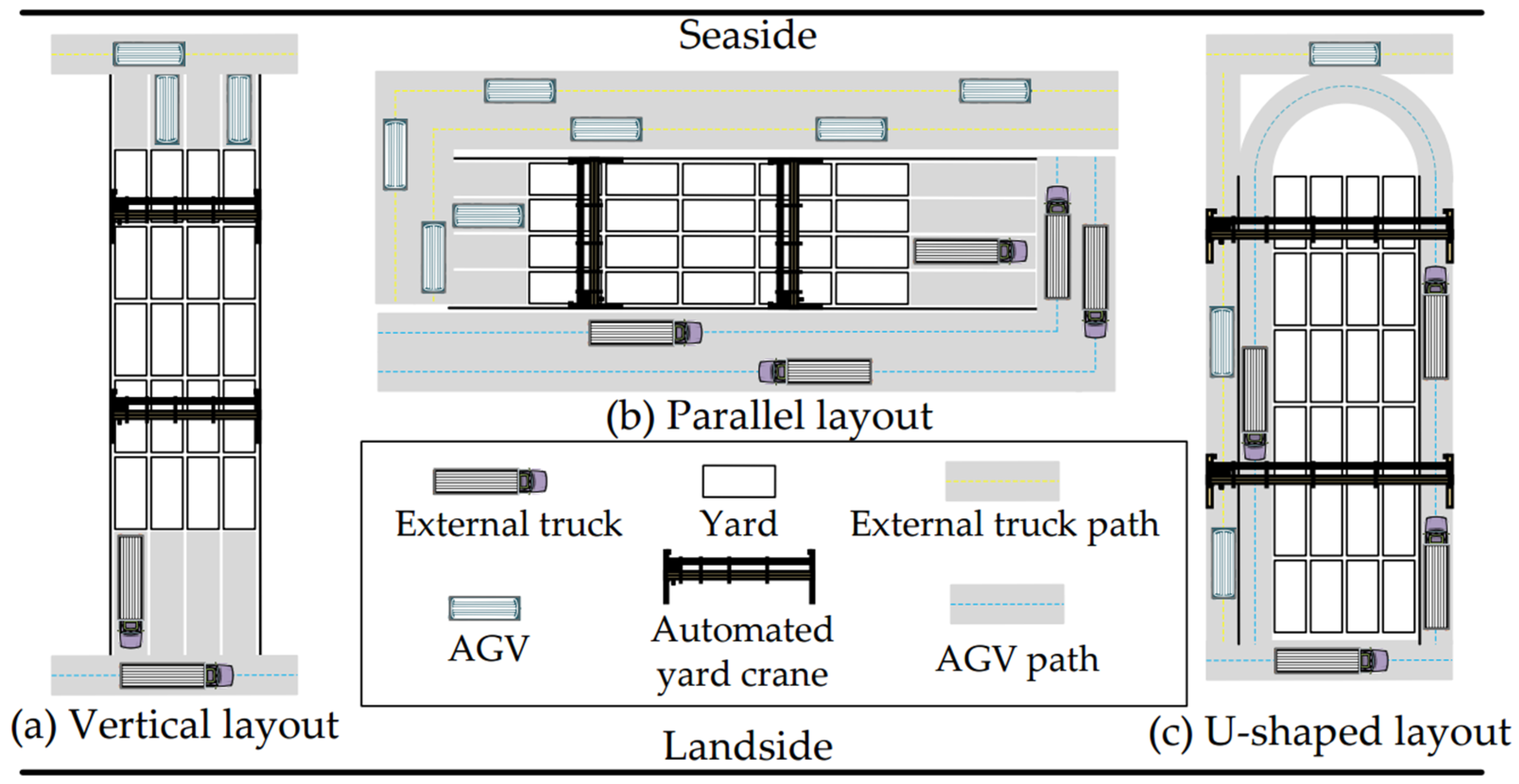
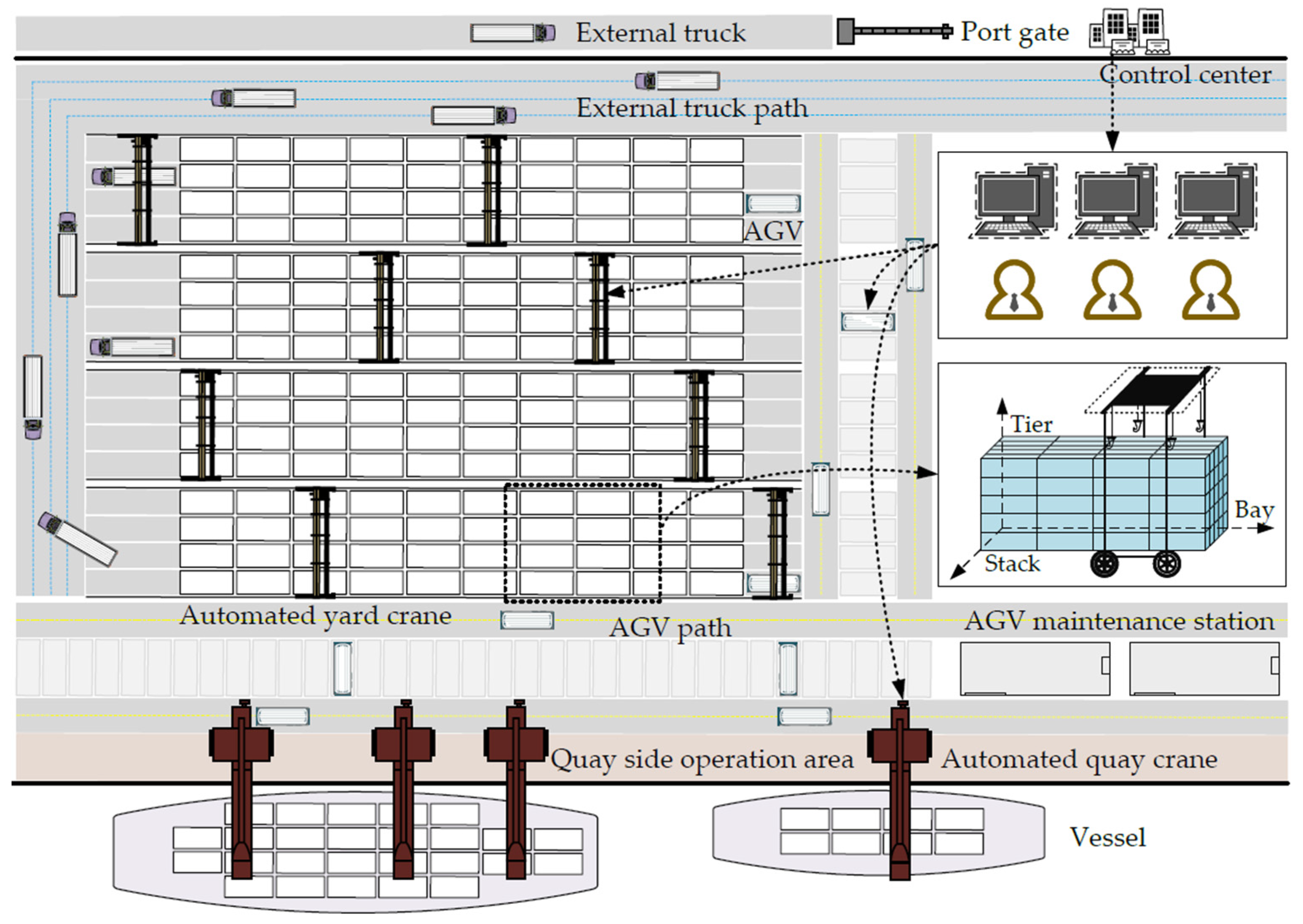
The overall operational efficiency of ACTs depends largely on their underlying physical layout. Currently, the mainstream global ACT yard layouts are primarily classified into parallel, vertical, and emerging U-shaped layouts [43], as shown in Figure 1. The blocks in a parallel layout are arranged parallel to the coastline. The advantage of this layout is that it can fully utilize the shoreline depth of original traditional terminals for automated upgrading and reconstruction, and it facilitates the efficient circulation of Automated Guided Vehicles (AGVs) and external trucks within their respective dedicated lanes. In a vertical layout, the blocks are perpendicular to the coastline. The seaside and landside handover zones are located at opposite ends of the blocks, achieving physical isolation of internal and external truck operations, although the horizontal transportation distance is relatively long. The U-shaped layout features a U-shaped lane design that allows external and internal trucks to be separated three-dimensionally and driven directly into the sides of the blocks. This significantly reduces the traveling distance of yard cranes, but it imposes extremely high requirements on infrastructure and control systems. Comprehensively considering the universality of modern port upgrading and reconstruction, this paper focuses its research background on ACTs with parallel layouts.
In parallel ACTs, the circulation of containers relies on the seamless connection of various automated equipment. Taking export operations as an example, an external truck loaded with an export container first arrives at the landside handover zone of the yard. An automated yard crane then picks up the container from the truck and accurately places it into a designated bay within the yard for temporary storage. Once the target vessel berths and the loading command is received from the Terminal Operating System (TOS), the yard crane retrieves the export container from the yard and transports it to the seaside handover zone. Subsequently, the seaside horizontal transportation equipment, specifically the AGV, takes over the container and transports it along a predetermined path to the area beneath the quay crane. Finally, the automated quay crane lifts and loads it into the designated slot on the vessel. The process for import operations proceeds in a fundamentally reverse manner, as illustrated in Figure 2. In this multi-link logistics chain, the container yard serves not only as a physical buffer zone absorbing the operational rate difference between the seaside and landside but also as the core bottleneck for the spatial resource allocation and equipment time scheduling of the entire terminal.
To further break through the efficiency ceiling of a single yard crane in traditional parallel yards and to completely decouple the operational conflicts between the seaside and landside, the yard investigated in this paper adopts an advanced three-stage physical layout and a dual yard crane cooperative configuration. Specifically, a single block is strictly divided along its physical depth into three functional zones, which are the landside storage zone, the fixed transfer zone, and the seaside storage zone. Simultaneously, each block is equipped with two automated yard cranes sharing the same track, namely the landside yard crane on the left and the seaside yard crane on the right. The configuration of dual non-passing co-rail yard cranes is selected in this study because it highly aligns with the current industry standards and mainstream construction trends of large automated container terminals. Compared to the highly expensive and operationally complex dual-tier passing cranes, non-passing co-rail cranes offer significant advantages, such as lower infrastructure costs and superior mechanical stability. However, they simultaneously introduce highly challenging requirements for physical anti-collision and spatial–temporal interference control. The left yard crane is primarily responsible for the interaction between the landside storage zone and external trucks, while the right yard crane mainly handles the interaction between the seaside storage zone and AGVs. The two yard cranes share the same running track, and their operational ranges overlap in the fixed transfer zone, thereby forming a complex spatio-temporal coupled system that features both independent operations and close collaboration.
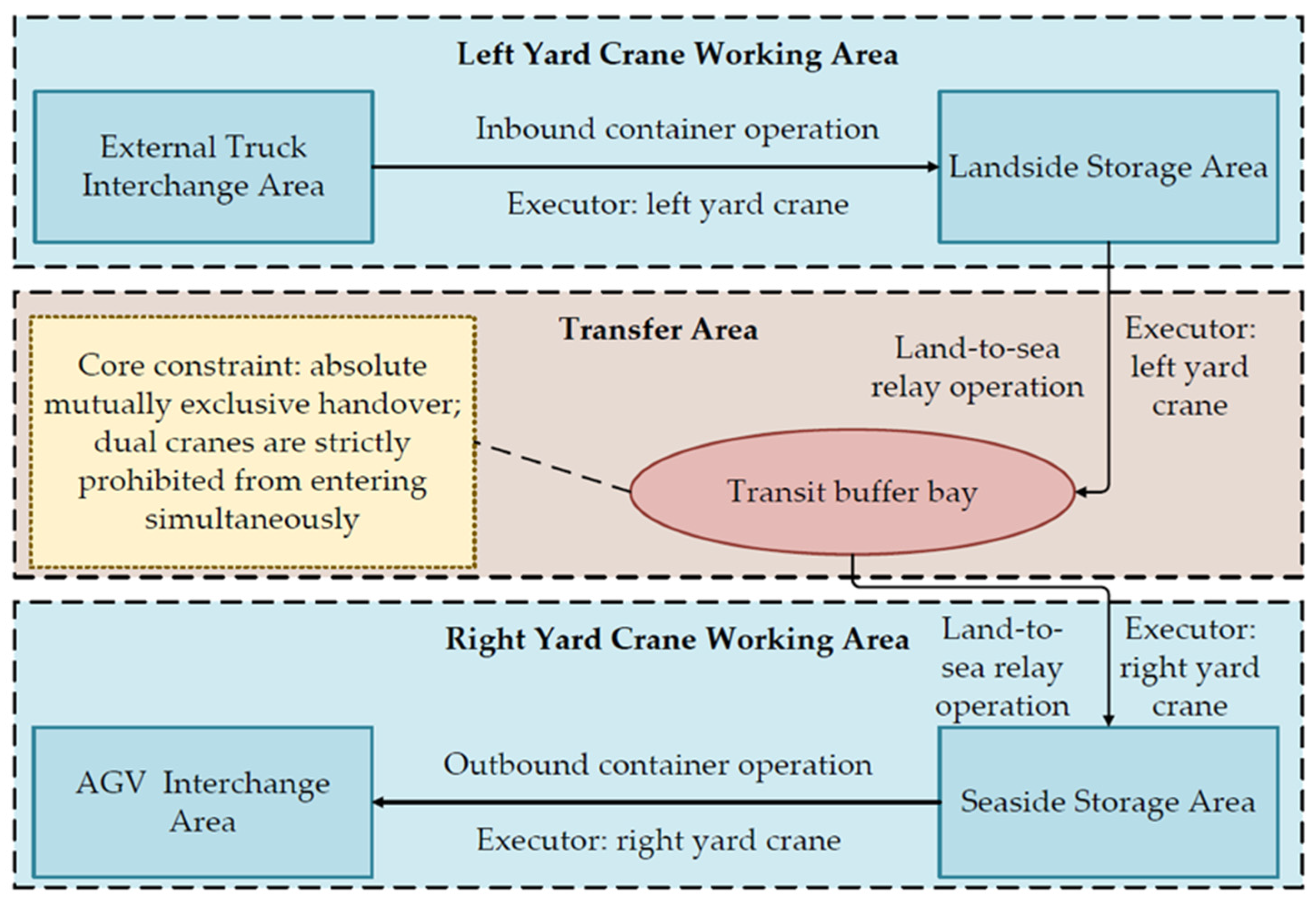
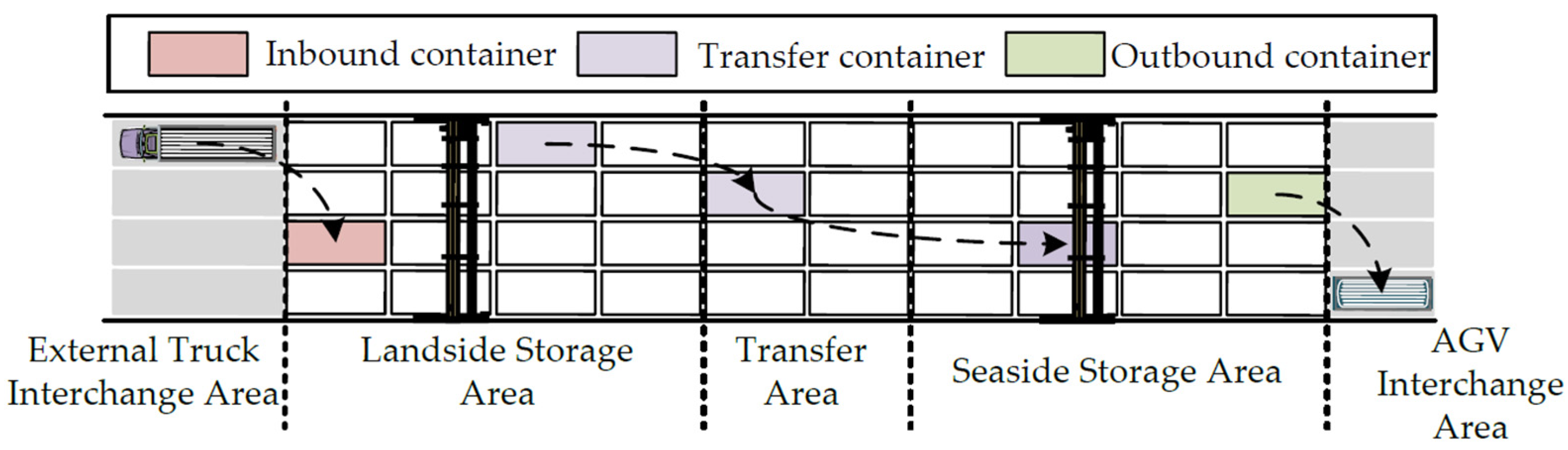
Under this refined three-stage architecture, the operational tasks within the yard are assigned a highly specialized circulation logic. This paper comprehensively considers three core operational flows. The first is the operation of export containers delivered by external trucks, referred to as inbound containers. The left yard crane waits at the landside handover zone for randomly arriving external trucks, picks up the export container, and places it into the target bay within the landside storage zone. The second is the land-to-sea relay export operation, involving transfer containers. The left yard crane first picks up a transfer container from a landside bay and transports it to the transfer zone for stable placement. The transfer zone is configured with a specific number of bays, and the distance the yard crane enters the transfer zone is calculated as the average bay distance. Subsequently, the right yard crane picks it up in a relay manner from the transfer zone and accurately transports it to a seaside target bay pre-designated by the system based on stowage attributes such as the destination port and weight class of the container, thereby facilitating subsequent efficient vessel loading and export. The third is the seaside direct outbound operation for export containers already stored in the seaside storage zone, referred to as outbound containers. The right yard crane must retrieve these containers within a strict time window specified by the quay crane and transport them to the rightmost seaside gate for vessel loading. It is worth noting that to ensure the absolute physical safety of the equipment, the left and right yard cranes are strictly prohibited from appearing in the transfer zone simultaneously at any time. This mutual exclusion of handover based on the transfer zone constitutes the core safety constraint for equipment scheduling in this paper, as detailed in Figure 3. Under the traditional single-crane operational mode, a container typically requires only two handling moves. In contrast, the three-block relay mode adopted in this paper increases the handling steps for a transfer container to four or five moves. Although the absolute number of mechanical operations per container increases, this multi-step relay mechanism presents significant advantages at the macroscopic system level: it effectively decouples the seaside and landside operational flows through the buffering effect of the transfer area. Seaside operations are highly time-sensitive, whereas the arrivals of external trucks are inherently characterized by strong randomness. By introducing the relay operation, the left yard crane can pre-stage export containers into the transfer area during seaside idle periods. Consequently, when the seaside loading peak arrives, the right yard crane can focus exclusively on high-frequency handling over very short distances, avoiding long trips to the landside interchange area. This mechanism effectively eliminates the severe equipment interference and mutual waiting issues caused by a single crane operating across the entire block in the customary 2-move mode. Thus, by sacrificing local handling steps, it achieves a substantial improvement in the overall terminal throughput and the absolute fluency of seaside operations.
To intuitively clarify the highly complex operational logic described above and to avoid comprehension difficulties caused by the intersection of multiple tasks and equipment, this paper further extracts the core logistics processes of ACT yard operations and constructs a conceptual scheme of operational flows, as shown in Figure 4. This diagram clearly illustrates the flow paths of the three core tasks, namely inbound, transfer, and outbound containers, across different physical zones, as well as the independent execution and relay collaboration relationships between the left and right yard cranes during different task stages.

3.2. Model Construction

3.2.1. Assumptions

To construct a rigorous mixed-integer linear programming (MILP) model that is solvable within a reasonable timeframe, and under the premise of maintaining generality and aligning with the actual physical operational rules of ACTs, this paper proposes the following basic assumptions:
It is assumed that all inbound containers, transfer containers, and outbound containers involved in the current scheduling cycle are uniformly sized 40-foot standard containers.
It is assumed that all relevant information regarding operational tasks is known and deterministic within the current planning and scheduling cycle.
It is assumed that the gantry travel speed of the automated yard cranes on the track is constant, ignoring the minor and brief acceleration and deceleration fluctuations during the starting and braking phases.
It is assumed that a yard crane cannot be forcibly interrupted or preempted by other tasks during the entire process of executing a single task.
It is assumed that all automated yard cranes, quay cranes, AGVs, and related communication networks maintain a completely flawless working condition. Abnormal operational interruptions caused by sudden mechanical equipment failures, power outages, or extreme severe weather conditions are not considered.

3.2.2. Model Parameters

  • Sets:
B : Set of blocks, indexed by b , where b { 1 , 2 , , n } ;
K L : Set of bays in the landside storage zone, where k { 1 , 2 , , N 1 } ;
K S : Set of bays in the seaside storage zone, where k { N 2 + 5 , , N } ;
I : Set of inbound container tasks to be allocated in the current cycle, indexed by i ;
E L : Set of transfer container tasks requiring relay from the landside storage zone to the seaside storage zone, indexed by e ;
E S : Set of outbound containers already stored in the seaside storage zone, indexed by v ;
V L : Set of all tasks handled by the landside yard crane, where V L = I E L , indexed by u ;
V R : Set of all tasks handled by the seaside yard crane, where V R = E L E S , indexed by w .
  • Parameters:
K i n : Location of the landside external truck handover zone;
L o c T : Fixed average bay location of the transfer zone;
B a y o u t : Location of the seaside AGV handover zone;
L B e : Current block of transfer container e ;
L K e : Current bay location of transfer container e in the landside storage zone;
S B v : Current block of outbound container v ;
L K v : Current bay location of outbound container v in the seaside storage zone;
T B e : Target bay location of transfer container e in the seaside storage zone;
A T i : Estimated arrival time of inbound container i at the yard handover zone via an external truck;
E T e : Planned retrieval time for transfer container e ;
D T v : Available handover time of outbound container v with an AGV;
t o : Average operational time required for an automated yard crane to perform one pick or drop operation;
t c : Time taken for an automated yard crane to move across one bay;
t s : Fixed preparation time before an automated yard crane moves;
I N b , k : Initial inventory in bay k of block b ;
C : Maximum capacity of a single bay;
Ω : A sufficiently large positive number used to linearize logical constraints.
  • Variables:
X i , b , k 0 , 1 : Equals 1 if inbound container i is allocated to landside bay k of block b , and 0 otherwise;
S i P L : Time when the left yard crane starts picking up inbound container i ;
S e P L : Time when the left yard crane starts picking up transfer container e ;
S e P R : Time when the right yard crane starts picking up transfer container e from the transfer zone;
S v P R : Time when the right yard crane starts picking up direct outbound container v from the seaside storage zone;
T max : Maximum completion time or makespan;
I n v b max : Maximum container inventory among all bays in the landside storage zone of block b ;
I n v b min : Minimum container inventory among all bays in the landside storage zone of block b ;
β u 1 , u 2 L { 0 , 1 } : Equals 1 if task u 1 is executed before task u 2 given both are left yard crane tasks in the same block, and 0 otherwise;
β w 1 , w 2 L { 0 , 1 } : Equals 1 if task w 1 is executed before task w 2 given both are right yard crane tasks in the same block, and 0 otherwise;
Z e 1 , e 2 K T 0 , 1 : Anti-collision lock for the transfer zone within the same block, which equals 1 if transfer container e 1 occupies the transfer zone first, and 0 if e 2 occupies it first;
μ i , b 0 , 1 : Equals 1 if inbound container i is assigned to block b , and 0 otherwise;
P i : Assigned landside storage zone bay number for inbound container i ;
I n v b , k : Final container inventory of bay k in the landside storage zone of block b ;
S i D L : Time when the left yard crane stably places inbound container i and hoists the spreader;
S e D L : Time when the left yard crane stably places transfer container e into the transfer zone and hoists the spreader;
S e D R : Time when the right yard crane stably places transfer container e and hoists the spreader;
S v D R : Time when the right yard crane stably places outbound container v and hoists the spreader;
W T i : Waiting time of the external truck corresponding to inbound container i .

3.2.3. Objective Function

The refined operation of ACTs faces multiple conflicting management objectives. To guarantee the overall operational efficiency of the port, decision-makers not only pursue minimizing the makespan of all tasks to enhance the operational efficiency of internal machinery but also must pay high attention to the service experience of external customers. This involves minimizing the waiting time of external trucks at the landside handover zone to alleviate gate congestion pressure and reduce carbon emissions. When simultaneously considering the physical characteristics of unmanned high-density yards, maintaining the spatial balance of container inventory across landside bays in each block is crucial. This balance prevents local space overloads, avoids the domino-like collapse of containers under severe weather conditions, and ensures the long-term physical safety and stability of the terminal. Therefore, this paper aims to identify the optimal placement decisions for inbound containers and the collision-free optimal cooperative scheduling scheme for dual yard cranes through scientific algorithms. The goal is to achieve a balance among operational efficiency, external truck service levels, and the physical safety of yard space, providing a solid theoretical basis and decision support for the refined management of next-generation ACTs.
However, because the three sub-objectives mentioned above exhibit significant differences in physical dimensions and numerical magnitudes, directly applying a linear weighted sum would inevitably cause objectives with large numerical values to exert a dominating influence [44]. This would consequently mask the optimization trends of objectives with smaller magnitudes.
To eliminate the computational bias caused by different dimensions and magnitudes, this paper introduces a normalization method based on theoretical constant boundaries to pre-process each sub-objective into a dimensionless form before constructing the comprehensive objective function [45]. Specifically based on the actual physical scenarios and shift plans of terminal scheduling, this paper extracts the total duration of the current planning cycle as the ultimate reference value for the time dimension and extracts the total number of landside bays in the entire yard as the base scale for the spatial dimension. By normalizing the actual solved values through division by their corresponding known constant benchmarks, the model successfully maps the time span and spatial range into comparable numerical intervals.
The final comprehensive objective function is formulated as Equation (1). The first part represents the normalized maximum completion time, the second part represents the normalized total waiting time of external trucks, and the third part represents the normalized maximum difference in landside container inventory.
M i n   Z = T max T P + i I W T i T P + b B ( I n v b max I n v b min ) n N 1

3.2.4. Constraints

Equations (2)–(7) represent the constraints regarding spatial allocation and internal block balance. Specifically, Equation (2) ensures that each inbound container is exclusively allocated to a unique bay in the landside storage zone. Equation (3) defines the block allocation indicator for inbound containers. Equations (4) and (5) define the relevant intermediate variables. Inequality (6) stipulates that for any bay, the sum of newly placed containers and the existing containers must absolutely not exceed its maximum capacity. Inequality (7) defines the bounds for the maximum and minimum container inventories among the landside storage bays in block b .
b B k K L X i , b , k = 1 i I
μ i , b = k K L X i , b , k i I , b B
P i = b B k K L k X i , b , k i I
I n v b , k = I N b , k + i I X i , b , k b B , k K L
I n v b , k C b B , k K L
C I n v b m a x , I n v b m a x I n v b , k , I n v b m i n I n v b , k , I n v b m i n 0 b B , k K L
Equations (8)–(11) represent the constraints for task start times and waiting times. Inequality (8) indicates that the left yard crane must wait until the external truck arrives before initiating the pick-up operation for an inbound container. Equation (9) defines the waiting time of the external truck. Inequality (10) ensures that the left yard crane cannot retrieve a transfer container from the landside storage zone in advance. Inequality (11) states that the time the right yard crane retrieves an outbound container must be strictly later than or equal to the designated handover time.
S i P L A T i i I
W T i = S i P L A T i i I
S e P L E T e e E L
S v P R D T v v E S
Equations (12)–(16) denote the derivation of operational durations and the handover constraints in the transfer zone. Equation (12) calculates the time when the left yard crane finishes placing an inbound container into the landside storage zone. Equation (13) calculates the time when the left yard crane stably places a transfer container into the transfer zone. Inequality (14) ensures that for the same transfer container e , the right yard crane must strictly wait until the left yard crane stably places it in the transfer zone and completely hoists its spreader away before the right yard crane can lower its spreader. This strictly forbids both machines from grabbing the same container simultaneously. Equation (15) formulates the time when the right yard crane stably places a transfer container from the transfer zone into the seaside storage zone. Equation (16) determines the time when the right yard crane stably places an outbound container. Inequalities (17) and (18) ensure that the left and right yard cranes cannot be present in the transfer zone at the same time.
S i D L = S i P L + t o + t s + t c P i i I
S e D L = S e P L + t o + t s + t c ( L o c T L K e ) e E L
S e P R S e D L + t o e E L
S e D R = S e P R + t o + t s + t c ( T B e L o c T ) e E L
S v D R = S v P R + t o + t s + t c ( N + 1 L K v ) v E S
S e 2 P R S e 1 D L + t o Ω 1 Z e 1 , e 2 K T e 1 e 2 E L , L B e 1 = L B e 2
S e 1 D L S e 2 P R + t o Ω Z e 1 , e 2 K T e 1 e 2 E L , L B e 1 = L B e 2
Inequalities (19) to (23) represent the empty travel scheduling sequence constraints for the left yard crane. Inequality (19) states that if the left yard crane decides to finish placing inbound container i 1 before picking up inbound container i 2 , then the time it picks up i 2 must be later than the completion time of placing i 1 and hoisting the spreader plus the time consumed by traveling empty from bay P i 1 back to the handover zone. Inequalities (20) and (21) stipulate that if the left yard crane’s next task after placing inbound container i is to transfer container e , it must travel from the bay of the newly placed inbound container P i to the initial location of the transfer container L K e . Inequality (22) ensures that if the left yard crane’s next task after delivering transfer container e to the transfer zone is to pick up inbound container i , it must return from the transfer zone to the external truck handover zone. Inequality (23) specifies that after the left yard crane places a transfer container e 1 in the transfer zone and turns back to pick up the next transfer container e 2 , it must travel leftward from the transfer zone to the bay location of the second transfer container.
S i 2 P L S i 1 D L + t o + t s + t c P i 1 Ω ( 3 μ i 1 , b μ i 2 , b β i 1 , i 2 L ) i 1 i 2 I , b B
S e P L S i D L + t o + t s + t c ( L K e P i ) Ω ( 2 μ i , L B e β i , e L ) i I , e E L
S e P L S i D L + t o + t s + t c ( P i L K e ) Ω ( 2 μ i , L B e β i , e L ) i I , e E L
S i P L S e D L + t o + t s + t c L o c T Ω ( 2 μ i , L B e β e , i L ) i I , e E L
S e 2 P L S e 1 D L + t o + t s + t c ( L o c T L K e 2 ) Ω ( 1 β e 1 , e 2 L ) e 1 e 2 E L , L B e 1 = L B e 2
Inequalities (24) to (28) represent the empty travel scheduling sequence constraints for the right yard crane. Inequality (24) indicates that if the right yard crane’s next task after placing transfer container e 1 is to transfer container e 2 , it needs to travel empty back to the transfer zone. Inequalities (25) and (26) signify that if the right yard crane’s next task after placing transfer container e is to pick up outbound container v , it must travel from the bay of the recently placed transfer container to the bay of the outbound container. Inequality (27) specifies that if the right yard crane’s next task after completing the one with outbound container v is to transfer container e , it must travel back to the transfer zone from the AGV handover location. Inequality (28) denotes that if the right yard crane’s next task after unloading outbound container v 1 is to unload outbound container v 2 , it must travel leftward back to the bay of the next outbound container.
S e 2 P R S e 1 D R + t o + t s + t c ( T B e 1 L o c T ) Ω ( 1 β e 1 , e 2 R ) e 1 e 2 E L , L B e 1 = L B e 2
S v P R S e D R + t o + t s + t c ( S K v T B e ) Ω ( 1 β e , v R ) e E L , v E S , L B e = S B v
S v P R S e D R + t o + t s + t c ( T B e S K v ) Ω ( 1 β e , v R ) e E L , v E S , L B e = S B v
S e P R S v D R + t o + t s + t c ( N + 1 L o c T ) Ω ( 1 β v , e R ) e E L , v E S , L B e = S B v
S v 2 P R S v 1 D R + t o + t s + t c ( N + 1 S K v 2 ) Ω ( 1 β v 1 , v 2 R ) v 1 v 2 E S , S B v 1 = S B v 2
Equations (29)–(33) represent the task sequence and completion time constraints. Equations (29) and (30) dictate that for any two machine tasks assigned to the same block, they cannot overlap in time and must have a determined execution sequence. Inequalities (31) to (33) define the maximum completion time.
β u 1 , u 2 L + β u 2 , u 1 L = 1 u 1 u 2 V L
β w 1 , w 2 R + β w 2 , w 1 R = 1 w 1 w 2 V R
T m a x S i D L + t o e E S
T m a x S e D R + t o e E L
T m a x S v D R + t o e E S

4. Algorithm Introduction

The Octopus Optimization Algorithm (OOA), a cutting-edge meta-heuristic algorithm newly proposed in 2025, simulates the foraging and survival behaviors of octopuses in nature. It constructs a unique hierarchical search architecture consisting of an octopus head, tentacles, and scouts. This algorithm possesses significant advantages including high optimization accuracy, strong robustness, and the effective avoidance of premature convergence [46]. In particular, its mechanism combining multi-thread parallel exploration with global information interaction naturally matches the dual requirements of wide-area spatial search and local fine exploitation in complex scheduling problems. Thus, it is highly suitable as a foundational framework for solving this type of multi-objective combinatorial optimization problem [47].
Every individual in the OOA population embodies the adaptive and problem-solving characteristics observed in octopuses. The algorithm divides the octopuses into two groups, namely predators and scouts. In the algorithm, predators are the main force for local exploitation and global search, while scouts are responsible for wide-range exploration to locate missed prey.
The initialization phase is identical to that of other optimization algorithms, adopting random initialization as shown in Equation (34). Here, s i j represents the j -th dimensional coordinate of the i -th individual, r is a random number, and U B j and L B j represent the upper and lower bounds of the search space, respectively.
s i j = r ( U B j L B j ) + L B j
Following initialization, the population is divided into two parts, specifically predators and scouts, with quantities conforming to Equation (35). In this equation, N is the total population size, N h is the number of predators, and N s is the number of scouts.
N = N h 9 + N s
The process then enters the predation phase, where the eight tentacles of each predator move according to the current global optimum. At this time, based on a transfer factor, two strategies exist, which are fine predation and exploratory movement. The algorithm determines which strategy to execute through the transfer factor t r a n s , calculated as shown in Equation (36). Here, r a n d is a random number in [ 0 , 1 ] , and l d is a field-of-view attenuation factor that changes with the number of iterations.
t r a n s = ( 2 r a n d 1 ) l d
Setting the grasping range parameter as l l , when t r a n s l l , it indicates that at least one tentacle is within the grasping range of the prey. At this moment, the tentacle initiates fine predation toward the global optimal position, as shown in Equation (37).
T i , j n e w = T i , j + r a n d ( P b e s t T i , j ) L F
When t r a n s > l l , it signifies that the prey is beyond the reach of the tentacles. In this scenario, the tentacles perform exploratory movements around the predator’s head, as shown in Equation (38).
T i , j n e w = H i h + r a n d ( H i h T i , j ) L F
In these formulas, T i , j is the j -th tentacle of the i -th predator, P b e s t is the global optimal position, H i h is the position of the predator’s head, and L F is the Lévy flight function. After each iteration, the head of each predator moves to the position with the best fitness among its eight tentacles.
In the scout phase, N s positions are selected from the heads of all predators, and the scout position is updated as shown in Equation (39). Here, S z is the scout’s position, and H z h is the selected predator’s head position. If the fitness of a certain scout is superior to that of the corresponding predator’s head, the scout transforms into a new predator’s head, and eight new tentacles are generated for this new head.
S z = H z h + r a n d l d ( U B + L B 2 H z h )
The standard OOA is primarily used to solve continuous numerical optimization problems, and the position coordinates generated by individuals moving in the search space are often continuous values with decimals. However, the dual yard crane joint scheduling model for automated terminals constructed in this paper is a typical discrete optimization problem, as containers can only be allocated to specific integer bays. If the standard algorithm is used directly, the generated decimal coordinates lack practical significance in the physical yard, and the algorithm is prone to producing invalid micro-movements within the same bay. Therefore, this paper makes targeted improvements to the standard algorithm and proposes the IOOA.
First, addressing the issue that continuous coordinates cannot be directly applied to bay allocation, the improved algorithm introduces a continuous-to-discrete mapping mechanism. In the standard OOA, the new position generated by tentacle movement is a continuous real number. Before calculating the objective function, IOOA converts it into the nearest integer bay number through a mapping formula, as detailed in Equation (40). To maintain the continuous search dynamic characteristics of the algorithm during iteration and avoid invalid continuous calculations by individuals within the same integer bay, the algorithm further re-anchors the discretized integer bay back to the physical center point of the grid. This allows the algorithm to focus on effective spatial exploration across bays.
k = m i n ( m a x ( r o u n d ( x ) , 1 ) , N 1 )
Second, the formula for the trigger condition of the predator’s behavioral state is improved. In OOA, whether a predator executes precise encirclement or large-scale exploration depends on the magnitude relationship between t r a n s and l l . Because t r a n s contains completely random variables, this judgment lacks true perception of spatial location. IOOA cancels this random judgment formula and instead directly calculates the Euclidean distance between the current tentacle’s discrete position and the global optimal solution’s position. Simultaneously, it defines a discrete grasping threshold that dynamically shrinks with l d . When the true distance is less than this threshold, precise convergence operations are forcibly executed; when the distance is greater than this threshold, wide-range exploratory movements are executed. This judgment formula based on true physical distance greatly improves the algorithm’s directional convergence efficiency in discrete space.
Third, the movement step size formula suitable for discrete space is redesigned. The Lévy flight mechanism used by OOA during exploration frequently generates extremely small continuous steps. These small steps often become zero when converted into integers, causing the algorithm to stagnate in the middle and late stages. To counter this, IOOA introduces a scaling factor α to replace the original continuous step size with an integer jump step size Δ k . To guarantee the ability to jump out of local optima with large spans in the early stages while preventing excessively large steps from destroying high-quality allocation schemes found in the late stages, the algorithm sets a dynamic maximum jump boundary S max based on the iteration progress. The final discrete position update formulas are shown in Equations (41)–(43).
Δ k = r o u n d ( α L F ( d i m ) )
S m a x = m a x ( 1 , r o u n d ( S m a x l d ) )
k n e w = k c u r r e n t + m i n ( m a x ( Δ k S m a x ) , S m a x )
Finally, a mathematical mechanism for local fine-tuning is introduced into the algorithm’s main loop. After every fixed number of iterations, IOOA applies local perturbations to the currently found global optimal solution. This is similar to the mutation operation in the Genetic Algorithm (GA) [48]. If the adjusted new scheme can obtain a better solution, the fine-tuning result is accepted. This combination of global formula exploration and local fine-tuning significantly improves the algorithm’s solving accuracy under strict physical constraints.
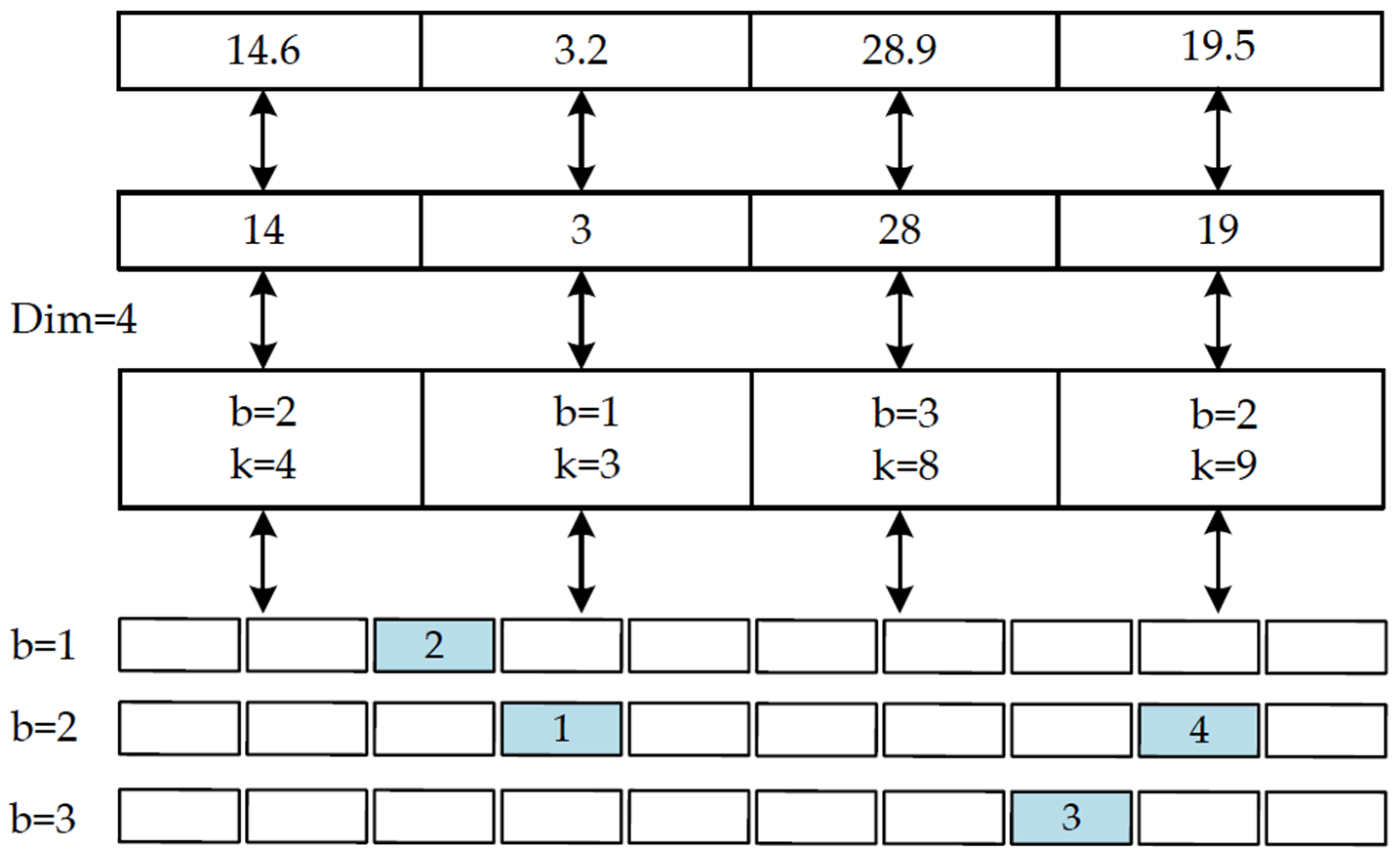
This paper adopts a one-dimensional real number vector encoding strategy to substantially reduce the algorithm’s search redundancy. Each individual in the algorithm represents a complete global spatial allocation scheme for inbound containers. The number of dimensions of this vector strictly equals the total number of inbound containers to be allocated within the current planning cycle. The i -th dimension in the position vector corresponds to the final allocation result of the i -th inbound container.
To enable the algorithm’s search space to completely and non-overlappingly cover all available bays in the yard, this paper performs a linearized dimensionality reduction splicing of the landside storage zones in each independent block. There are a total of n blocks, and the landside storage zone of each block contains N 1 bays, making the total number of assignable landside bays across the entire yard n × N 1 . Accordingly, the lower bound of the individual search vector is set to 1, and the upper bound is set to n × N 1 + 0.9999 . During the algorithm’s initialization phase, to guarantee the uniformity and broadness of the initial population’s distribution throughout the entire physical yard, the system first randomly generates continuous position coordinates for the inbound containers in each dimension within the aforementioned upper and lower bounds. Subsequently, a round-down operation is introduced to forcibly convert the generated continuous vector into a legal discrete integer encoding. Through this mechanism, any random real number in the continuous space can be mapped with equal probability and uniquely to a discrete integer interval. This produces a one-dimensional discrete integer sequence representing the absolute physical bay numbers across the entire yard.
After obtaining the one-dimensional discrete integer encoding V i , the algorithm needs to reversely restore it into specific three-dimensional physical coordinates in the yard through deterministic mathematical decoding rules. This allows it to be substituted into the fitness function to accurately calculate the travel time of the yard cranes and the extreme differences in container inventory across bays. The algorithm first calculates the assigned target block number b for the inbound container via a round-up operation. Following this, by subtracting the cumulative number of bays from preceding blocks, it accurately extracts the specific landside bay number k for the container within the target block b . The decoding mapping rules for block number b and bay number k are shown in Equation (44) and Equation (45), respectively, and a schematic diagram of the encoding and decoding mechanism is illustrated in Figure 5.
b = V i N 1
k = V i ( b 1 ) × N 1
Based on the aforementioned discretization mapping, dynamic step size adjustment, and local fine-tuning mechanisms, the complete execution procedure of the IOOA for solving the joint scheduling problem of dual yard cranes is presented in the pseudocode of Algorithm 1.
Algorithm 1: Improved Octopus Optimization Algorithm (IOOA) for the Joint Scheduling Problem
Input: Number of inbound containers to be allocated I , population size N , maximum number of iterations M a x _ I t e r , total number of physical bays n × N 1 , upper and lower bounds of parameters.
Output: The optimal container spatial allocation scheme, corresponding dual-crane scheduling sequence, and comprehensive objective function value.
Initialization phase:
Generate a continuous initial population using Equation (34), and map it to discrete physical bay center points using Equation (40).
Decode the initial individuals using Equations (44) and (45).
Calculate the fitness value of each individual and record the global best solution P b e s t .
While t < M a x _ I t e r do:
  Divide the population into predators N h and scouts N s according to Equation (35).
  For i N h do:
    Calculate the Euclidean distance between the current individual’s position and P b e s t .
    Calculate l d and S max .
    IF Euclidean distance catching threshold then
      Generate a new discretized integer position using Equations (37) and (41)–(43).
    Else
      Generate a new position using Equations (38) and (41)–(43).
    End If
    Evaluate the fitness of the new positions of the eight tentacles, and move the predator’s head to the optimal tentacle position.
  End For
  For z N s do:
    Randomly generate a brand-new discretized container allocation scheme according to Equation (39).
    If the fitness of the new scheme is better than that of the original predator, replace the predator to maintain population diversity.
  End For
  Apply a random mutation perturbation to the current global best solution P b e s t .
  If the fitness of the perturbed new scheduling scheme is better, accept it and update P b e s t .
   t = t + 1
End While
Return the global optimal solution P b e s t .

5. Empirical Analysis

To validate the effectiveness and engineering practical value of the proposed three-stage joint scheduling model and IOOA, this section conducts numerical experiments based on randomly generated small-scale instances derived from the physical layout characteristics of an ACT. Such a small-scale data setting aims to balance the testing of the algorithm’s optimization capabilities under complex constraints while reducing the computational running time to a certain extent. The experimental scenario is set as a parallel yard system comprising 8 independent blocks. Each block has 50 bays along the track direction, and the 4 fixed middle bays are designated as the transfer handover zone to isolate seaside and landside operations. The maximum physical storage capacity limit of a single bay is uniformly set to 24 standard units. Within a static planning and scheduling period of 8 h, the system extracted a total of 453 real container handling tasks. These tasks specifically cover three core business flows, namely 143 inbound container placement tasks, 158 transfer container relay tasks, and 152 outbound container loading tasks. The operational parameters of the automated yard cranes are calibrated with reference to relevant studies [49]. The time consumed by a yard crane to perform a single pick or drop operation is set to 0.5 min, the fixed startup preparation time before gantry movement is 0.08 min, and the uniform travel time across a single bay distance is 0.028 min.
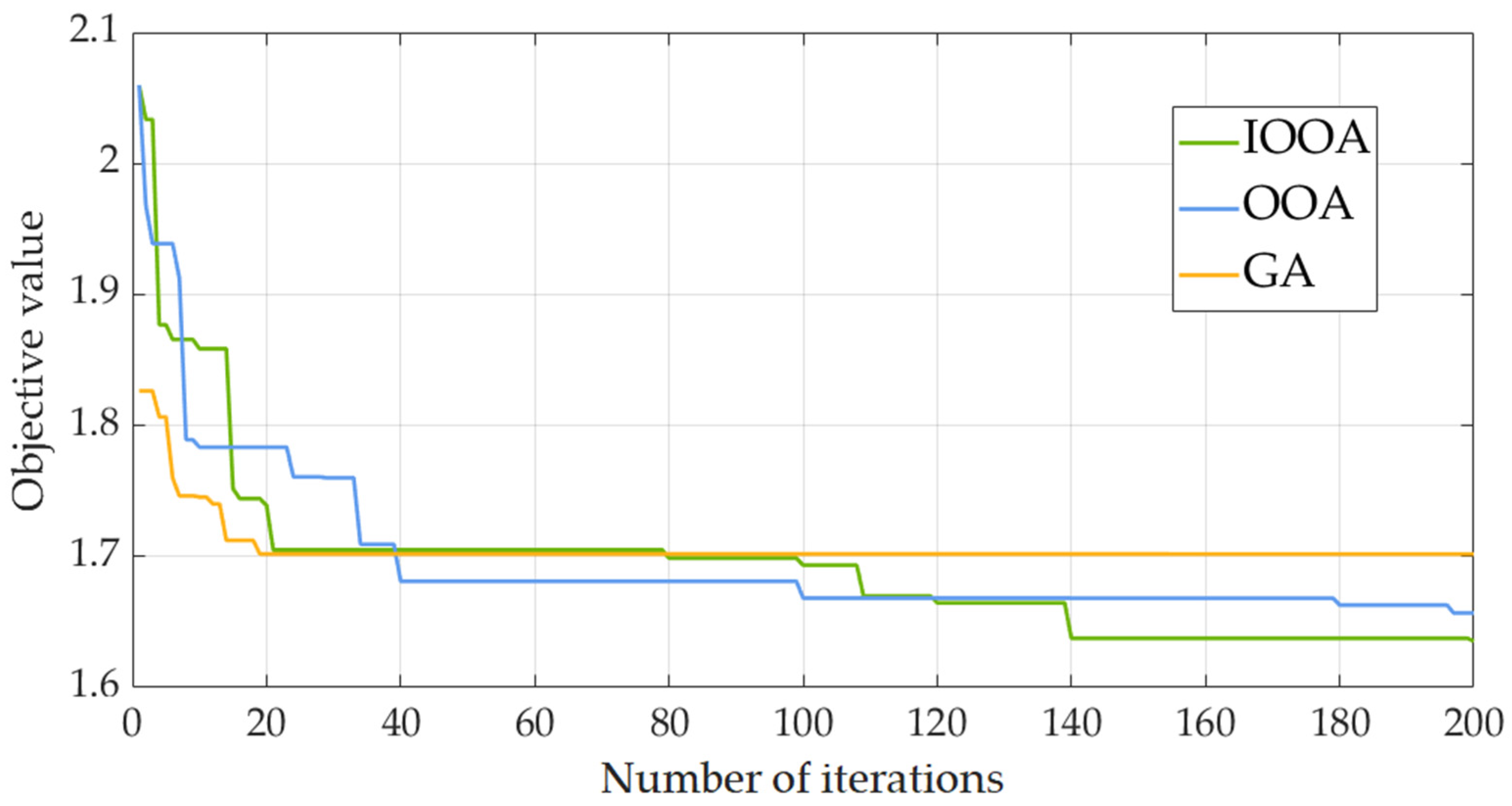
To fully verify the performance advantages of the proposed IOOA in solving this high-dimensional and strongly spatio-temporal coupled scheduling problem, the experiment selected the standard OOA and the improved algorithm for comparison. Given that the GA possesses strong global search capabilities and a mature population evolution mechanism, and has been widely and successfully applied to solving complex models related to terminal yard scheduling [50,51], the classic GA is also introduced as an external benchmark algorithm. The operational parameters of each algorithm are set according to the optimal parameter configurations recommended in the literature. The detailed optimization results of the three algorithms on the sub-objectives of maximum completion time, external truck waiting time, and extreme difference in container inventory are compared in Table 1. To intuitively reflect the actual physical efficacy of the scheduling schemes, the values listed in the table have been restored from normalized results to their original physical dimensions. The population size and maximum number of iterations for all algorithms are uniformly set to 200, and the comparison of the global optimization iteration convergence curves of the algorithms is shown in Figure 6.
As can be seen from the comparison of the algorithm optimization results shown in Table 1, the IOOA proposed in this paper demonstrates absolute dominance in comprehensive solving performance, with its global objective function value significantly outperforming both the standard OOA and the classic GA. Specifically regarding each physical sub-objective, in terms of the maximum completion time representing internal mechanical efficiency, IOOA achieves an optimal result of 482.9 min, which is 11.57 min shorter than the GA. This proves its high efficiency in the anti-collision mutual exclusion and spatio-temporal cooperative scheduling of dual yard cranes. Regarding the total waiting time of external trucks representing the external service level, the advantage of IOOA is even more extremely significant, recording only 54.59 min, which is a massive reduction of approximately 29.5% compared to the 77.42 min of the GA. What warrants in-depth discussion is the sub-objective of the extreme difference in container inventory. Although the GA obtains a slightly lower absolute value on this metric, combining it with the other two metrics easily reveals that the GA falls into a severe imbalance. Its forced attempt to assemble the spatial balance of the yard leads to extremely severe stagnation and cross-waiting in equipment scheduling, causing truck queuing times to surge. In contrast, while maintaining an excellent state of yard spatial balance, the IOOA perfectly harmonizes internal operational efficiency with the external truck experience. This fully proves that the IOOA possesses exceptionally outstanding global coordination and trade-off capabilities when handling highly conflicting multi-objective joint optimization problems.
Figure 6 further intuitively reveals the global optimization and dynamic convergence processes of the three algorithms within 200 iteration cycles. It can be clearly observed in the figure that the classic GA exhibits an extremely fast descent speed in the early stages of iteration. However, due to its lack of an underlying repair mechanism targeting strong constraint MILP problems, it prematurely falls into a local optimum around the 20th generation. Its search over the subsequent 180 generations remains stagnant, presenting a phenomenon of premature convergence. Although the standard OOA successfully breaks through the GA’s bottleneck around the 40th generation, the invalid jitter of continuous steps in discrete space causes its search capability to severely degrade in the middle and late stages, eventually stagnating near 1.657. In sharp contrast, the IOOA proposed in this paper demonstrates a highly potent step-like downward breakthrough capability. Near the 80th, 110th, and 140th generations, IOOA exhibits significant vertical leaps in the objective value. This excellent optimization trajectory is precisely attributed to the innovatively designed integer Lévy flight mechanism with dynamic boundaries and the local fine-tuning framework. The former ensures that the algorithm retains the large-span escape capability to cross discrete bays in the middle and late stages, while the latter enables it to acutely capture and repair minor collision-avoidance spatial deadlocks. The synergistic exertion of both allows IOOA to continuously jump out of local extremum traps, ultimately locking precisely onto the global optimal solution of 1.635 at the 140th generation.
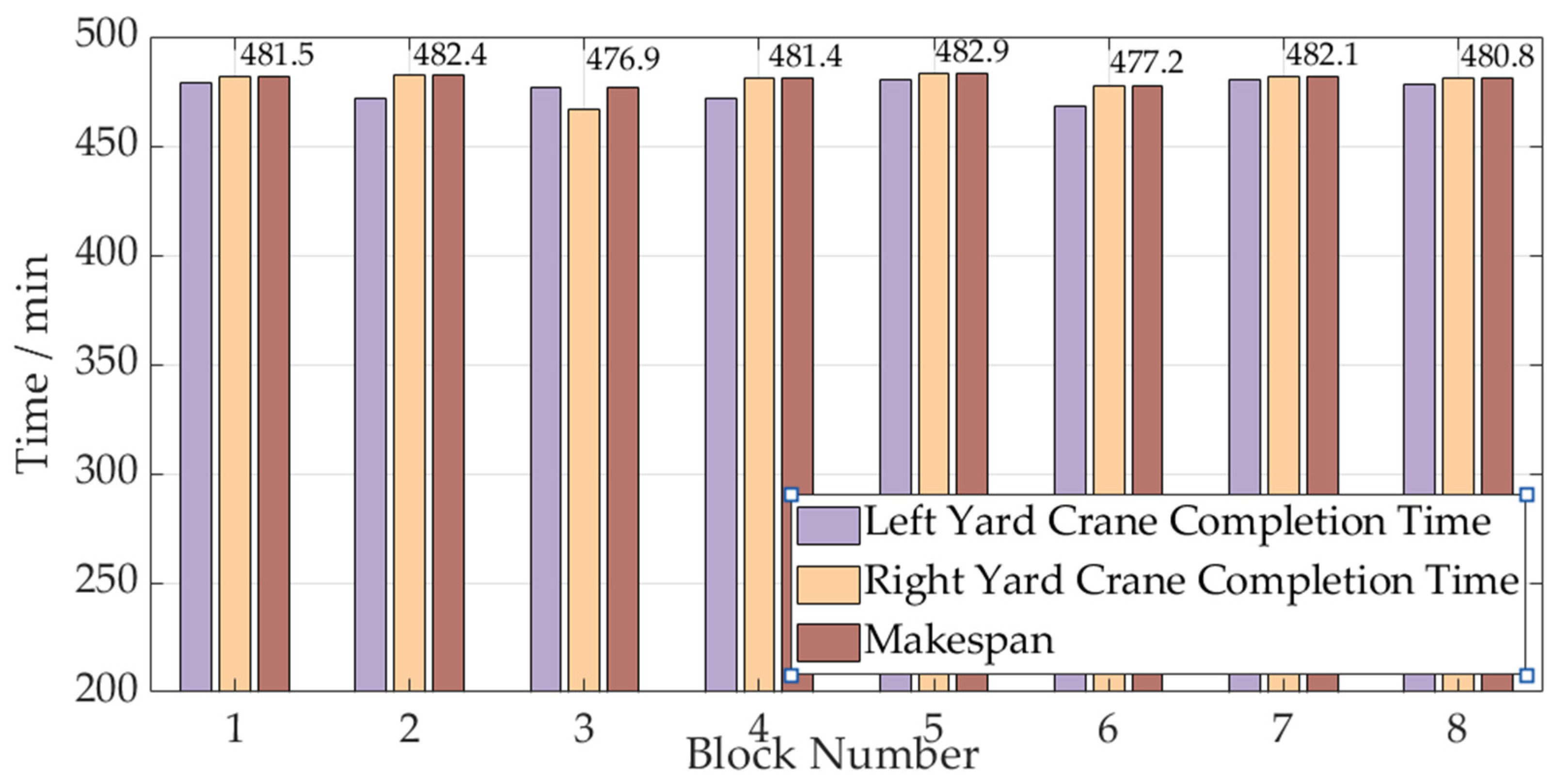
The highest global efficiency does not solely depend on the absolute operating speed of single equipment units but relies on the operational workload balance between different blocks and between the two yard cranes within the same block. If local physical congestion or severe unilateral equipment overload occurs, it will cause massive mechanical idling and waiting, thereby dragging down the overall operational capacity of the terminal. Therefore, to further verify the resource coordination and load balancing capabilities of the IOOA under multi-equipment and multi-region cooperative operations, this paper extracts and profoundly analyzes the independent completion times of the left and right yard cranes in each block, as well as the maximum completion time of each block, as shown in Figure 7.
From the macroscopic perspective across blocks, the distribution of maximum completion times among the 8 blocks is stable, exhibiting an extremely high degree of spatial balance. The maximum completion time for the entire yard is 482.9 min, while the minimum completion time is 476.9 min, resulting in a time difference between all blocks of only 6 min. Within an 8 h planning cycle, such a small difference ratio proves that the sub-objective of balancing the extreme difference in landside container inventory introduced into the objective function plays a decisive guiding role. IOOA distributes the randomly arriving inbound containers extremely evenly across the 8 blocks, perfectly diluting the fixed transfer and outbound operational pressures on the seaside. This reduces the hidden danger of local blocks becoming bottlenecks for the entire yard due to task accumulation. From the microscopic perspective of cross-equipment within blocks, the completion times of the left yard crane and the right yard crane within every single independent block are almost perfectly leveled. This result indicates that IOOA not only achieves ultimate balance at the spatial allocation level but also realizes highly efficient synchronous collaboration in dual yard crane operations at the underlying equipment time scheduling level. There are no occurrences of equipment on either side waiting idle for extended periods due to conflicts in the transfer zone.
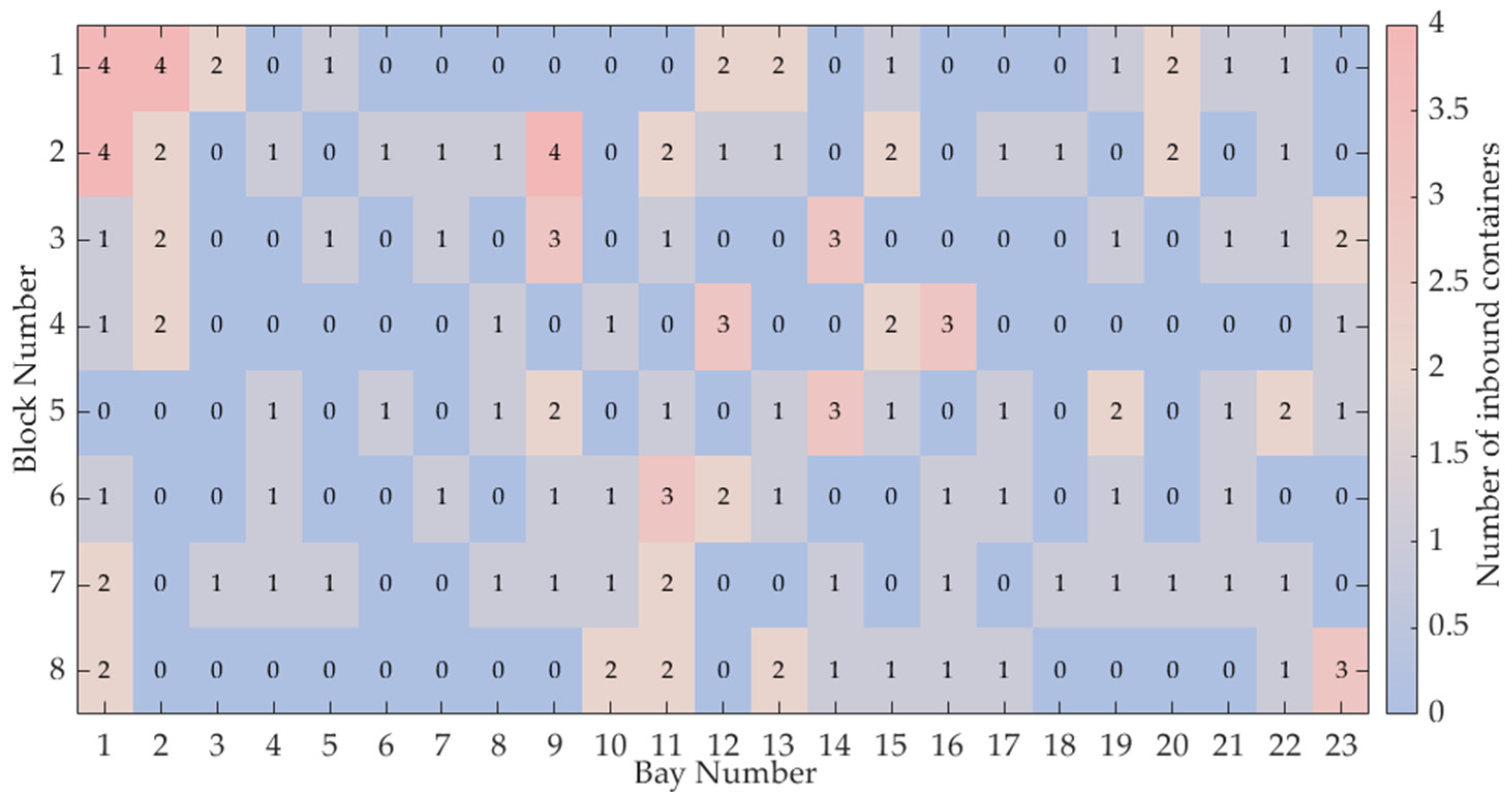
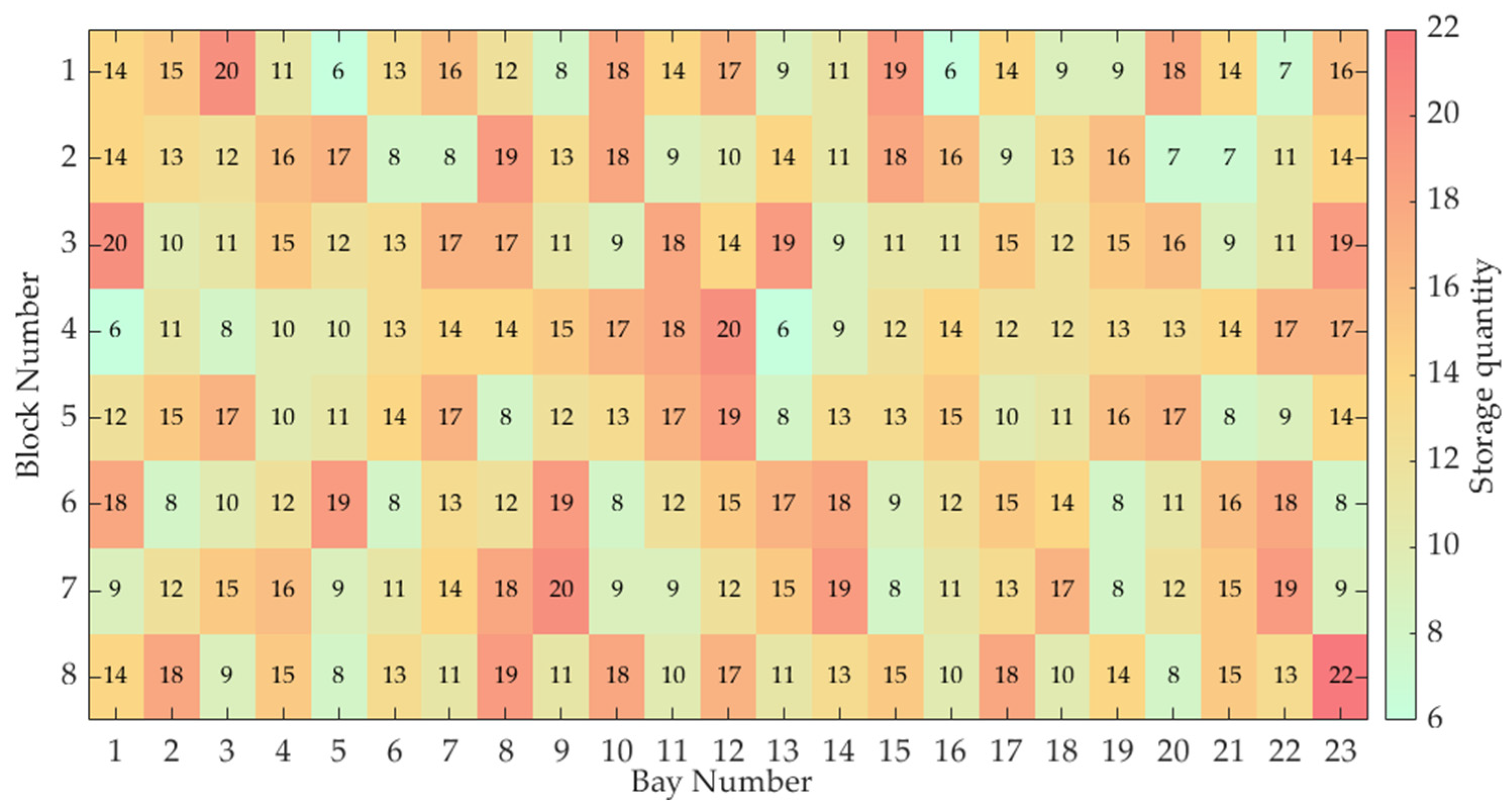
To intuitively verify the rationality of the scheduling logic and resource allocation of the proposed model and IOOA in the spatial dimension, this paper further extracts the placement allocation scheme for inbound containers and the final inventory status of the landside storage zone for visual analysis, as shown in Figure 8 and Figure 9.
From the perspective of the inbound container allocation heatmap, it can be seen that when handling the placement of randomly arriving inbound containers, IOOA completely abandons the limited strategy of pouring them intensively toward areas close to the landside handover zone. The newly added inbound containers are extremely dispersed and precisely embedded into the vast physical space of the entire yard. The maximum allocation volume for a single bay is strictly limited to 4 units or fewer, and it presents a clear characteristic of directional leveling. This refined spatial scattering strategy directly determines the macroscopic health of the final inventory heatmap. After superimposing the initial storage volume of each bay and the throughput changes of inbound and outbound tasks within the current cycle, the final inventory of landside bays across the entire yard is extremely stably controlled between 6 and 22 standard containers. No single bay touches or breaks through the capacity limit of 24 units. More crucially, the relatively high-inventory areas and relatively low-inventory areas in the final inventory heatmap present a highly uniform intertwined distribution state in the spatial matrix. There is neither overall overloading of a single block in the horizontal direction nor the formation of high container stack isolation walls near the handover zone in the vertical direction. This extremely gentle spatial load topology perfectly proves the effectiveness of the landside container inventory extreme difference balance objective in the model. This mechanism forces the algorithm to spread containers evenly, reducing the safety hazards of local space overloads and the collapse of isolated high stacks, and laying a solid foundation for the long-term structural stability of the ACT yard and future low-reshuffling-rate container retrievals.
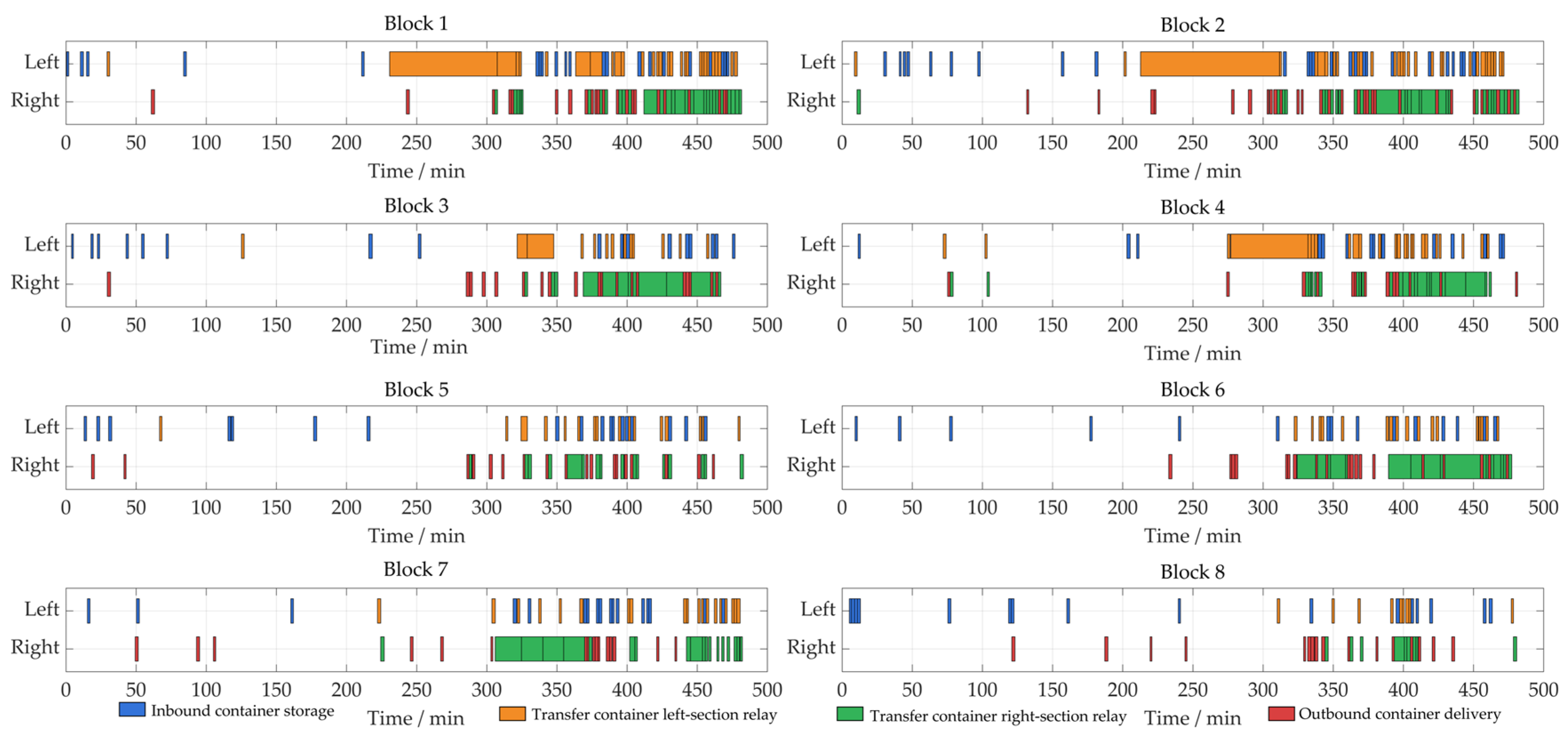
To deeply verify the constraint satisfaction and equipment collaboration efficacy of the model at the micro-scheduling level, this paper extracts and analyzes the Gantt charts of left and right yard crane operations in each block optimized by the IOOA, as shown in Figure 10.
Two important conclusions can be drawn from the temporal distribution characteristics of the Gantt charts. First, the left and right yard cranes in each block have achieved strict professional division of labor in the execution of task types, and they maintain a high degree of continuity and compactness during the peak operational period lasting several hours. Extended equipment idling caused by improper scheduling rarely occurs. Second, by comparing the orange and green blocks within the same block, the safety barrier of dual yard crane relay interactions can be clearly observed. For any single transfer task, the right yard crane’s picking operation time strictly lags behind the left yard crane’s dropping operation. This phenomenon intuitively and forcefully proves that the spatio-temporal mutual exclusion constraints for the transfer zone constructed in this paper play a precise control role. The algorithm perfectly staggers the handover time windows of the two large machines, fundamentally guaranteeing equipment operational safety in a purely unmanned environment.
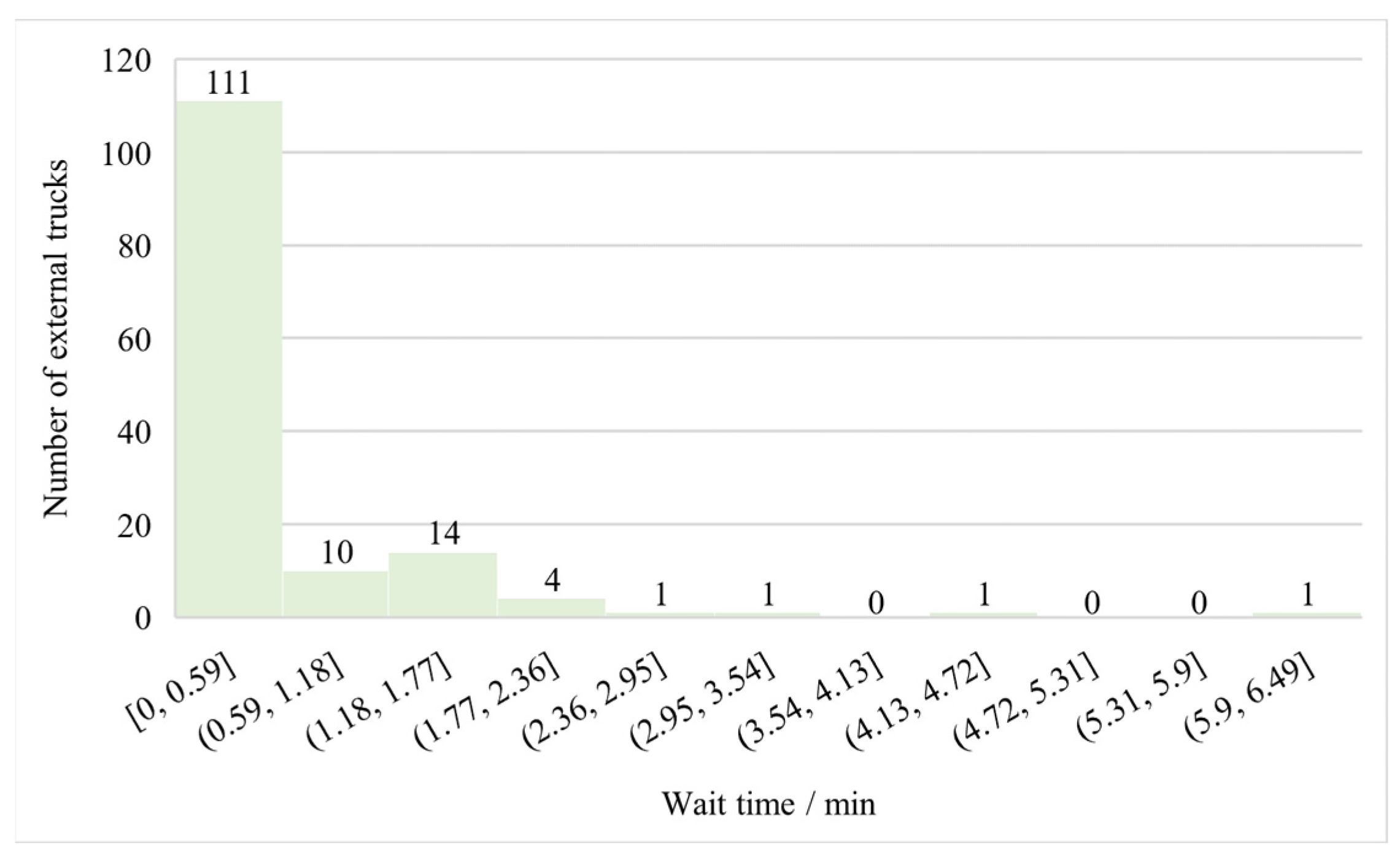
Besides the cooperative efficiency of internal equipment, another core metric measuring the comprehensive operational quality of ACTs is the response speed and service level for external trucks. To evaluate the optimization performance of the proposed model in the external truck service dimension, Figure 11 presents a detailed frequency distribution histogram of the waiting times for 143 external trucks at the landside handover zone.
While the numerical experiments above successfully validate the proposed model and IOOA using small-scale instances, modern ACTs frequently face extreme peak operational pressures from the concentrated arrival of mega-ships. Therefore, a brief discussion on the computational scalability and processing time of the IOOA for large-scale, real-world datasets is necessary. Unlike exact MILP solvers, whose computational time grows exponentially with the problem size, IOOA is a population-based meta-heuristic algorithm. Its time complexity is primarily determined by the population size, the maximum number of iterations, and the fitness evaluation steps, exhibiting polynomial growth rather than an exponential explosion as the task volume increases. Furthermore, the individual evaluations within the IOOA population are highly parallelizable. In a practical Terminal Operating System, when facing thousands of container handling tasks, the algorithm does not need to statically solve all tasks for an entire shift at once; instead, it can dynamically optimize manageable batches of tasks. Supported by modern multi-core parallel computing, this deployment strategy ensures that the processing time of IOOA remains within an acceptable range, thereby fully satisfying the real-time scheduling requirements of ACTs during peak hours.

6. Conclusions

Aiming at the collaborative configuration problem of core resources under the three-stage yard layout of parallel ACTs, this paper breaks the traditional limitation of separating spatial decisions from time scheduling and conducts an in-depth joint optimization study. The main research findings obtained are as follows:
(1) A MILP model integrating spatial placement decisions and dual yard crane cooperative scheduling is formulated. The model precisely depicts the high-frequency relay interaction logic and the absolute spatio-temporal mutual exclusion constraints of the transfer zone under the three-stage physical layout, strictly preventing the risks of equipment collision and operational stagnation. Simultaneously, it innovatively incorporates the balance of the extreme difference in container inventory across landside bays into the optimization scope, achieving the joint optimization of internal maximum completion time, total external truck waiting time, and long-term yard spatial balance.
(2) An IOOA is proposed for solving the constructed model. Addressing the defects of standard meta-heuristic algorithms being prone to falling into invalid spatial jitter and mid-to-late stage convergence stagnation when handling discrete combinatorial optimization problems, this paper innovatively designed the IOOA by integrating discrete space mapping, state determination based on Euclidean distance, integer flight steps, and a local fine-tuning mechanism. These improvements enable OOA to successfully solve discrete optimization models, substantially enhancing the algorithm’s global exploration efficiency and local refined optimization accuracy under stringent physical anti-collision constraints.
(3) The empirical analysis based on operational data verifies the effectiveness and excellence of the proposed joint scheduling scheme. Comparative experiments show that the IOOA significantly outperforms the standard OOA and GA in balancing capability and convergence stability. In terms of actual physical efficacy, the optimized scheme not only substantially compresses the total makespan of dual yard crane collaboration and strictly controls external truck waiting times within an extremely short response interval, but also achieves a highly uniform spread of container inventory across all landside bays at the macro-level. This scheduling scheme contributes to eliminating the safety hazards brought by local space overloads and isolated high stacks, achieving a comprehensive improvement in internal operational efficiency, external service levels, and spatial structural stability of the terminal.
The findings of this study also provide multi-faceted managerial implications for the refined operations and safety control of ACTs. First, port managers should break down the traditional management silos that separate spatial allocation from time scheduling in the yard. Through spatio-temporal joint optimization, they can not only maximize the cooperative efficacy of dual yard cranes on the same track but also effectively avoid equipment cross-waiting and transfer zone operational blockages caused by a lack of global coordination. Second, while pursuing equipment turnover efficiency, the long-term safety of the yard must be incorporated into the core key performance indicator system. Strict control over the difference in container inventory across bays can fundamentally prevent the risk of domino-style container collapses triggered by inventory imbalance while significantly reducing future ineffective rehandling costs. Finally, embedding the response priority of external trucks into the scheduling system helps systematically reduce the stagnation time of trucks at the port. This not only alleviates traffic congestion pressure in the port’s landside collection and distribution network but also highly aligns with the strategic requirements of the global port and shipping industry’s transition toward green, low-carbon, and sustainable development.
Although this paper has made beneficial explorations in ACT scheduling, it still holds certain limitations that need further expansion in future work. First, the mathematical model formulated in this paper is based on static and deterministic information assumptions. In the actual port environment, the arrival times of external trucks often exhibit high randomness, and equipment such as yard cranes faces the risk of abnormal interruptions like sudden mechanical failures. To cope with these uncertainties, future research could integrate real-time rolling-horizon scheduling strategies, breaking down long-term static planning into dynamically updated short-term subproblems to continuously reschedule based on the latest arriving trucks and task information. Meanwhile, incorporating robust optimization methods to reserve reasonable spatio-temporal buffers when generating the initial scheduling plans will significantly enhance the anti-interference and adaptive capabilities of the scheduling schemes in dynamic and abnormal environments, further strengthening the practical application value of the model. Second, to focus on macroscopic spatial balance and dual yard crane cooperative scheduling, this study performed a homogeneous abstraction on the physical specifications of containers, assuming all handled units are 40-foot standard containers. In actual complex yards, containers of different sizes, such as 20-foot and 40-foot units, are frequently stored in a mixed manner. To adapt the proposed MILP model to such mixed-stowage scenarios, several key structural adjustments would be required. Specifically, the spatial set index of the bays must be further refined to differentiate between full 40-foot slots and the front and rear 20-foot half-slots. Meanwhile, capacity constraints similar to Equation (6) in this paper would need to shift from counting physical containers to calculating TEUs. More critically, the model must introduce strict stacking logic constraints, such as utilizing inequalities to strictly prohibit placing a 40-foot container on top of two 20-foot containers with uneven heights or weights. Integrating these complex constraints into the existing scheduling model constitutes an important direction for future in-depth research. Third, the research boundary of this paper concentrates on the internal yard subsystem. Future attempts could be made to fully integrate the loading and unloading sequence allocation of automated quay cranes with the dynamic routing of AGVs across the entire chain, aiming to approach the absolute maximization of the macro-system efficacy of the entire automated container terminal. Fourth, while this study has theoretically demonstrated the internal efficiency of the proposed three-stage dual-crane relay system, future research will endeavor to construct corresponding mathematical models for “normal setups” of traditional container terminals. Conducting a comprehensive and quantitative comparative analysis between our proposed approach and traditional yard setups will be a crucial next step to benchmark its broad competitiveness under varying operational scales.

Author Contributions

Conceptualization, Y.L., H.W. and S.W.; methodology, Y.L., H.W. and S.W.; software, Y.L. and Y.S.; validation, Y.L., H.W. and S.W.; formal analysis, Y.L., H.W. and S.W.; investigation, Y.L., H.W. and S.W.; resources, Y.L., H.W. and S.W.; data curation, Y.L. and Y.S.; writing—original draft preparation, Y.L., H.W. and S.W.; writing—review and editing, Y.L., H.W. and S.W.; visualization, Y.L., H.W., S.W. and Y.S.; supervision, H.W. and S.W.; project administration, Y.L. and H.W.; funding acquisition, H.W. and S.W. All authors have read and agreed to the published version of the manuscript.

Funding

The research is financially supported by the National Key Research and Development Program of China (No. 2020YFB1712400), the National Natural Science Foundation of China (No. 52272423) and the Shandong Province Transportation Science and Technology Plan Project (No. 2023B97-02).

Data Availability Statement

The data that support the findings of this study are available from the corresponding author upon reasonable request.

Conflicts of Interest

The authors declare no conflicts of interest.

Abbreviations

The following abbreviations are used in this manuscript:
ACTAutomated container terminal
OOAoctopus optimization algorithm
IOOAImproved octopus optimization algorithm
GAGenetic Algorithm
MILPMulti-objective mixed-integer linear programming

References

  1. Ma, M.; Fan, H.; Jiang, X.; Guo, Z. Truck arrivals scheduling with vessel dependent time windows to reduce carbon emissions. Sustainability 2019, 11, 6410. [Google Scholar] [CrossRef]
  2. Zhu, H.; Ji, M.; Guo, W.; Wang, Q.; Yang, Y. Mathematical formulation and heuristic algorithm for the block relocation and loading problem. Nav. Res. Logist. (NRL) 2019, 66, 333–351. [Google Scholar] [CrossRef]
  3. Wang, Y.; He, J.; Zhang, L.; Yan, W. Improvement of container dynamic allocation for automated container terminals in the post-epidemic era. J. Mar. Sci. Eng. 2024, 12, 863. [Google Scholar] [CrossRef]
  4. Chen, J.; Du, W.; Wang, H.; Guo, D. Research on integrated scheduling optimization of double-trolley quay crane and AGV in automated terminal. IOP Conf. Ser. Mater. Sci. Eng. 2020, 790, 012071. [Google Scholar] [CrossRef]
  5. Li, Y.; Pu, Z.; Liu, P.; Qian, T.; Hu, Q.; Zhang, J.; Wang, Y. Efficient predictive control strategy for mitigating the overlap of EV charging demand and residential load based on distributed renewable energy. Renew. Energy 2025, 240, 122154. [Google Scholar] [CrossRef]
  6. He, J.; Xiao, X.; Yu, H.; Zhang, Z. Dynamic yard allocation for automated container terminal. Ann. Oper. Res. 2024, 343, 927–948. [Google Scholar] [CrossRef]
  7. Cahyono, R.T.; Kenaka, S.P.; Jayawardhana, B. Simultaneous allocation and scheduling of quay cranes, yard cranes, and trucks in dynamical integrated container terminal operations. IEEE Trans. Intell. Transp. Syst. 2021, 23, 8564–8578. [Google Scholar] [CrossRef]
  8. Chen, X.; Wu, P.; Wang, Z.; Feng, Z.; Luo, L.; Zhang, H.; Biancardo, S.A. MKG-GNN: Maritime Knowledge Graph and GNN Framework for ship speed forecasting in port. Ocean Eng. 2026, 355, 125179. [Google Scholar] [CrossRef]
  9. Zhou, C.; Lee, B.K.; Li, H. Integrated optimization on yard crane scheduling and vehicle positioning at container yards. Transp. Res. Part E Logist. Transp. Rev. 2020, 138, 101966. [Google Scholar] [CrossRef]
  10. Zhang, X.; Li, H.; Sheu, J.B. Integrated scheduling optimization of AGV and double yard cranes in automated container terminals. Transp. Res. Part B Methodol. 2024, 179, 102871. [Google Scholar] [CrossRef]
  11. Wen, L.; Ren, Q.; Li, J. Hainan Port Logistics Supply Chain and Its Flexible Operation Mechanism considering Digital Visual Remote Control. Mob. Inf. Syst. 2022, 2022, 4642103. [Google Scholar] [CrossRef]
  12. He, J.; Zhang, L.; Deng, Y.; Yu, H.; Huang, M.; Tan, C. An allocation approach for external truck tasks appointment in automated container terminal. Adv. Eng. Inform. 2023, 55, 101864. [Google Scholar] [CrossRef]
  13. Jiang, X.; Lee, L.H.; Chew, E.P.; Han, Y.; Tan, K.C. A container yard storage strategy for improving land utilization and operation efficiency in a transshipment hub port. Eur. J. Oper. Res. 2012, 221, 64–73. [Google Scholar] [CrossRef]
  14. Zhen, L. Container yard template planning under uncertain maritime market. Transp. Res. Part E Logist. Transp. Rev. 2014, 69, 199–217. [Google Scholar] [CrossRef]
  15. He, J.; Tan, C. Modelling a resilient yard template under storage demand fluctuations in a container terminal. Eng. Optim. 2019, 51, 1547–1566. [Google Scholar] [CrossRef]
  16. Tan, C.; He, J.; Wang, Y. Storage yard management based on flexible yard template in container terminal. Adv. Eng. Inform. 2017, 34, 101–113. [Google Scholar] [CrossRef]
  17. Zhen, L.; Xu, Z.; Wang, K.; Ding, Y. Multi-period yard template planning in container terminals. Transp. Res. Part B Methodol. 2016, 93, 700–719. [Google Scholar] [CrossRef]
  18. Hu, H.; Mo, J.; Zhen, L. Improved Benders decomposition for stochastic yard template planning in container terminals. Transp. Res. Part C Emerg. Technol. 2021, 132, 103365. [Google Scholar] [CrossRef]
  19. Jin, J.G.; Lee, D.H.; Hu, H. Tactical berth and yard template design at container transshipment terminals: A column generation based approach. Transp. Res. Part E Logist. Transp. Rev. 2015, 73, 168–184. [Google Scholar] [CrossRef]
  20. Huang, M.; He, J.; Yu, H.; Yan, W.; Tan, C. Improved Benders decomposition for stack-based yard template generation in an automated container terminal. Transp. Res. Part E Logist. Transp. Rev. 2024, 188, 103607. [Google Scholar] [CrossRef]
  21. Cao, Y.; Yang, A.; Liu, Y.; Zeng, Q.; Chen, Q. AGV dispatching and bidirectional conflict-free routing problem in automated container terminal. Comput. Ind. Eng. 2023, 184, 109611. [Google Scholar] [CrossRef]
  22. Yue, L.; Fan, H. Dynamic scheduling and path planning of automated guided vehicles in automatic container terminal. IEEE/CAA J. Autom. Sin. 2022, 9, 2005–2019. [Google Scholar] [CrossRef]
  23. Kovalyov, M.Y.; Pesch, E.; Ryzhikov, A. A note on scheduling container storage operations of two non-passing stacking cranes. Networks 2018, 71, 271–280. [Google Scholar] [CrossRef]
  24. Putri, M.M.; Rusdiansyah, A.; Nurminarsih, S. Model of Twin Automatic Stacking Crane Operation Strategy with Dynamic Handshake Area in an Automated Container Terminal. J. Ind. Eng. Res. Appl./J. Tek. Ind. 2023, 25, 79–96. [Google Scholar] [CrossRef]
  25. Tan, C.; Yan, W.; Yue, J. Quay crane scheduling in automated container terminal for the trade-off between operation efficiency and energy consumption. Adv. Eng. Inform. 2021, 48, 101285. [Google Scholar] [CrossRef]
  26. Wei, M.; He, J.; Tan, C.; Yue, J.; Yu, H. Quay crane scheduling with time windows constraints for automated container port. Ocean Coast. Manag. 2023, 231, 106401. [Google Scholar] [CrossRef]
  27. Wasesa, M.; Rizaldi, A.; Stam, A.; Zuidwijk, R.; Van Heck, E. Advancing Smart Sustainable Seaports: Auction-Based Truck Appointment System for Automated Container Terminal. IEEE Access 2024, 12, 116384–116397. [Google Scholar] [CrossRef]
  28. Kim, T.; Ryu, K.R. Deriving situation-adaptive policy for container stacking in an automated container terminal. Appl. Sci. 2022, 12, 3892. [Google Scholar] [CrossRef]
  29. Chen, X.; He, S.; Zhang, Y.; Tong, L.C.; Shang, P.; Zhou, X. Yard crane and AGV scheduling in automated container terminal: A multi-robot task allocation framework. Transp. Res. Part C Emerg. Technol. 2020, 114, 241–271. [Google Scholar] [CrossRef]
  30. Li, T.; Dong, Q.; Sun, X. Integrated Scheduling of Handling Equipment in Automated Container Terminal Considering Quay Crane Faults. Systems 2024, 12, 450. [Google Scholar] [CrossRef]
  31. Hsu, H.P.; Tai, H.H.; Wang, C.N.; Chou, C.C. Scheduling of collaborative operations of yard cranes and yard trucks for export containers using hybrid approaches. Adv. Eng. Inform. 2021, 48, 101292. [Google Scholar] [CrossRef]
  32. Kong, L.; Ji, M.; Yu, A.; Gao, Z. Scheduling of automated guided vehicles for tandem quay cranes in automated container terminals. Comput. Oper. Res. 2024, 163, 106505. [Google Scholar] [CrossRef]
  33. Sun, B.; Zhai, G.; Li, S.; Pei, B. Multi-resource collaborative scheduling problem of automated terminal considering the AGV charging effect under COVID-19. Ocean Coast. Manag. 2023, 232, 106422. [Google Scholar] [CrossRef]
  34. Zhang, Q.; Hu, W.; Duan, J.; Qin, J. Cooperative scheduling of AGV and ASC in automation container terminal relay operation mode. Math. Probl. Eng. 2021, 2021, 5764012. [Google Scholar] [CrossRef]
  35. Zhu, J.; Ma, F. Scheduling of twin automatic stacking cranes and automated guided vehicle considering buffer mode on automated container terminal. Comput. Ind. Eng. 2024, 193, 110271. [Google Scholar] [CrossRef]
  36. Luo, Y.; Liang, X.; Zhang, Y.; Tang, K.; Li, W. Energy-aware integrated scheduling for quay crane and igv in automated container terminal. J. Mar. Sci. Eng. 2024, 12, 376. [Google Scholar] [CrossRef]
  37. Boysen, N.; Briskorn, D.; Meisel, F. A generalized classification scheme for crane scheduling with interference. Eur. J. Oper. Res. 2017, 258, 343–357. [Google Scholar] [CrossRef]
  38. Zheng, F.; Man, X.; Chu, F.; Liu, M.; Chu, C. A two-stage stochastic programming for single yard crane scheduling with uncertain release times of retrieval tasks. Int. J. Prod. Res. 2019, 57, 4132–4147. [Google Scholar] [CrossRef]
  39. Nossack, J.; Briskorn, D.; Pesch, E. Container dispatching and conflict-free yard crane routing in an automated container terminal. Transp. Sci. 2018, 52, 1059–1076. [Google Scholar] [CrossRef]
  40. Eilken, A. A decomposition-based approach to the scheduling of identical automated yard cranes at container terminals. J. Sched. 2019, 22, 517–541. [Google Scholar] [CrossRef]
  41. Kress, D.; Dornseifer, J.; Jaehn, F. An exact solution approach for scheduling cooperative gantry cranes. Eur. J. Oper. Res. 2019, 273, 82–101. [Google Scholar] [CrossRef]
  42. Tang, G.; Guo, Y.; Qi, Y.; Fang, Z.; Zhao, Z.; Li, M.; Zhen, Z. Real-time twin automated double cantilever rail crane scheduling problem for the U-shaped automated container terminal using deep reinforcement learning. Adv. Eng. Inform. 2025, 65, 103193. [Google Scholar] [CrossRef]
  43. Li, X.; Peng, Y.; Huang, J.; Wang, W.; Song, X. Simulation study on terminal layout in automated container terminals from efficiency, economic and environment perspectives. Ocean Coast. Manag. 2021, 213, 105882. [Google Scholar] [CrossRef]
  44. Marler, R.T.; Arora, J.S. The weighted sum method for multi-objective optimization: New insights. Struct. Multidiscip. Optim. 2010, 41, 853–862. [Google Scholar] [CrossRef]
  45. Ishibuchi, H.; Doi, K.; Nojima, Y. On the effect of normalization in MOEA/D for multi-objective and many-objective optimization. Complex Intell. Syst. 2017, 3, 279–294. [Google Scholar] [CrossRef]
  46. Song, M.; Lin, J.; Liu, X.; Jia, H.; Luo, S. Octopus optimization algorithm: A novel single-and multi-objective optimization algorithm for optimization problems. Clust. Comput. 2025, 28, 484. [Google Scholar] [CrossRef]
  47. Wang, K.; Abualigah, L.; Smerat, A.; Li, J.; Wu, X.; Liu, H.; Shao, Z.; Mirjalili, S. A nature recoil mechanism-based Octopus Optimization Algorithm for solving the global and constraint optimization from engineering structural design problems. J. Comput. Des. Eng. 2025, 13, 123–232. [Google Scholar] [CrossRef]
  48. Holland, J.H. Genetic algorithms. Sci. Am. 1992, 267, 66–73. [Google Scholar] [CrossRef]
  49. Fan, H.; Zhang, X.; Ma, M.; Liu, W.; Wang, C.; Ma, X. Storage Space Allocation and Yard Crane Scheduling for U-shaped Container Terminals Considering No-showing Container Delivery Trucks. Ind. Eng. Manag. 2025, 30, 89–103. Available online: https://link.cnki.net/urlid/31.1738.T.20250613.1007.006 (accessed on 1 April 2026).
  50. Bazzazi, M.; Safaei, N.; Javadian, N. A genetic algorithm to solve the storage space allocation problem in a container terminal. Comput. Ind. Eng. 2009, 56, 44–52. [Google Scholar] [CrossRef]
  51. Kaveshgar, N.; Huynh, N.; Rahimian, S.K. An efficient genetic algorithm for solving the yard crane scheduling problem. Reliab. Eng. Syst. Saf. 2012, 111, 162–171. [Google Scholar] [CrossRef]
Figure 1. Layout diagrams of different types of ACT yards.
Jmse 14 00822 g001
Figure 2. Operational flowchart of parallel ACTs.
Jmse 14 00822 g002
Figure 3. Schematic diagram of the three-stage yard layout and dual yard crane cooperative operations in parallel ACTs.
Jmse 14 00822 g003
Figure 4. Conceptual Diagram of Dual Yard Crane Collaboration in Automated Terminal Yard.
Jmse 14 00822 g004
Figure 5. Schematic diagram of the encoding and decoding mechanism.
Jmse 14 00822 g005
Figure 6. Comparison of iterative convergence curves among algorithms.
Jmse 14 00822 g006
Figure 7. Comparison of left and right yard crane completion times and maximum completion time in each block.
Jmse 14 00822 g007
Figure 8. Heatmap of inbound container allocation.
Jmse 14 00822 g008
Figure 9. Heatmap of landside storage zone inventory.
Jmse 14 00822 g009
Figure 10. Gantt charts of left and right yard crane operations in each block.
Jmse 14 00822 g010
Figure 11. Distribution map of external truck waiting times.
Jmse 14 00822 g011
Table 1. Comparison of optimization results among algorithms.
AlgorithmObjective ValueF1F2F3
IOOA1.635482.954.5999
OOA1.657487.3355.46101
GA1.702494.4777.4298
Disclaimer/Publisher’s Note: The statements, opinions and data contained in all publications are solely those of the individual author(s) and contributor(s) and not of MDPI and/or the editor(s). MDPI and/or the editor(s) disclaim responsibility for any injury to people or property resulting from any ideas, methods, instructions or products referred to in the content.