1. Introduction
The massive arrival of
Sargassum algae, issued from the Atlantic Ocean surface, between Africa and South America, poses a critical problem for most Caribbean countries [
1]. To contain algae, living organisms drifting on the sea surface with their self-buoyancies, floating barrages are suitable [
2]. Such barrages, known as booms by the oil-spill community, are designed to collect and prevent the beaching of pollutants [
3]. However, when the sea current exceeds a certain threshold, the pollution containment fails, and additionally, the barrage could break [
4]. In cases of strong currents, operators can orient the
Sargassum barrage at an angle to the flow, analogous to oil-spill booms, in order to reduce the drag [
5]. This deflects algae to barges or collect points near shore [
6].
The two main countermeasures to physically contain algae on the sea surface are booms and fishing nets. Barrage management and best practices rise [
7,
8]. Low-draught oil-spill booms exist for algae containment [
9]. A preliminary study was conducted for booms moored in Puerto Morelos of the Yucatan region [
10]. More precisely, the investigation used elastic string finite elements and focused on drag, buoyancy and hydrodynamic loadings. An optimization process followed, giving the best anchoring orientation in the reef lagoon.
To our knowledge, no study has addressed the structural analysis of net-barrages during algae containment.
Nets are widely studied in various contexts—such as boulder containment, avalanche protection, or trash blocking. Let us focus on maritime applications, specifically on fishing nets and aquaculture cages. We highlight biofouling more precisely.
Sargassum barrages are designed as permanent structures, unlike oil-spill booms, which are temporary and used only during accidents and pollution recovery. The long-term presence of these barrages, however, promotes fouling. This necessitates costly maintenance, including disassembly, cleaning, and reassembly. Without continuous maintenance, fouling can significantly increase both the barrage’s weight and its hydrodynamic drag [
11]. Booms are made of coated fabric, whereas net-barrages often use fishing materials, including those made from recycled sources.
Our structural study on net-barrages will therefore benefit from hydrodynamic results regarding biofouling. Biofouling effect primarily affects structure roughness and increases the drag coefficient [
12] and mass [
13]. Physical model tests assess the blocking effect of fouling on hydrodynamic drag and water exchange across netting [
14]. A numerical model evaluates biofouling effects on a floating fish cage and mooring system under wave and sea current forcings [
15]. After three months of fouling growth, malfunction of a net-barrage, or a fish cage begins (Hodson et al., 1997) [
16]. A coated fabric skirt should be less favorable to fouling.
Our study focuses on the structural analysis of a net-barrage designed to contain drifting algae within a reef lagoon. We highlight the originality in this situation of using a dedicated fishing net. Notably, its fouling introduces additional hydrodynamic loads upon the barrage. To evaluate mooring tensions and buoyancy forces, we use a non-linear elastic membrane model. A case study supported by satellite imagery illustrates the study. It combines numerical modeling with remote sensing data. The empirical evaluation of algae catch pressure on the barrage requires consideration of several a priori hypotheses regarding catch loading. Considering several scenarios about the catch enhances the reliability of our approach. The study provides a preliminary assessment of net shape, stresses within the barrage and forces on buoy mooring heads, ensuring long-term structural integrity.
To achieve this, we employ a non-linear large-displacement membrane model [
17]. The constitutive material is modeled as linear–elastic. We suppose a static regime, excluding dynamic forces [
18]. A four-node bilinear quadrilateral finite-element mesh discretizes the membrane surface [
19]. We assume the material to be isotropic, unlike orthotropic cable patterns proposed for trawl nets [
20]. This assumption diverts the analysis by treating the material as homogenous, thereby providing natural and unbiased mechanical stress distribution across the membrane.
The paper is organized as follows. First, we present the satellite imagery context and the principal mechanical assumptions. Second, we present the structural model of the barrage, including the fluid-algae/structure interaction within an uncertain hydrodynamic environment. Next, we outline the hypotheses taken for the case study. Finally, we discuss the numerical results for various hydrodynamic loading scenarios induced by catch.
2. Problem Statement
Satellite imagery—such as data from Copernicus or Google Earth—enables the identification of both Sargassum rafts and barrages. These visualizations are publicly accessible and can improve preparedness. Let us give the following illustration.
Using satellite data [
21],
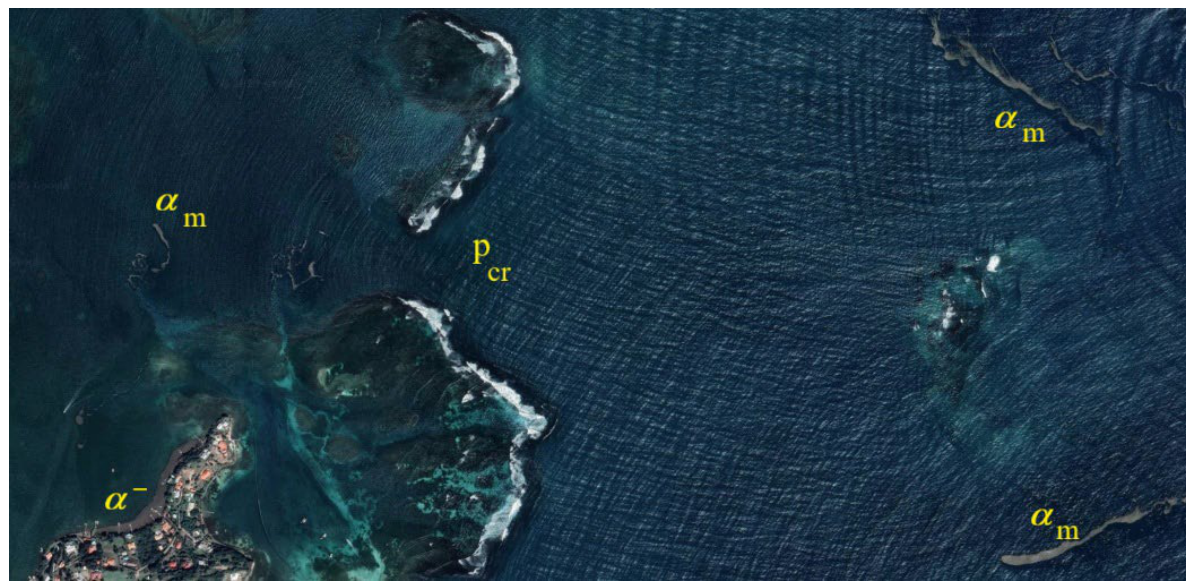
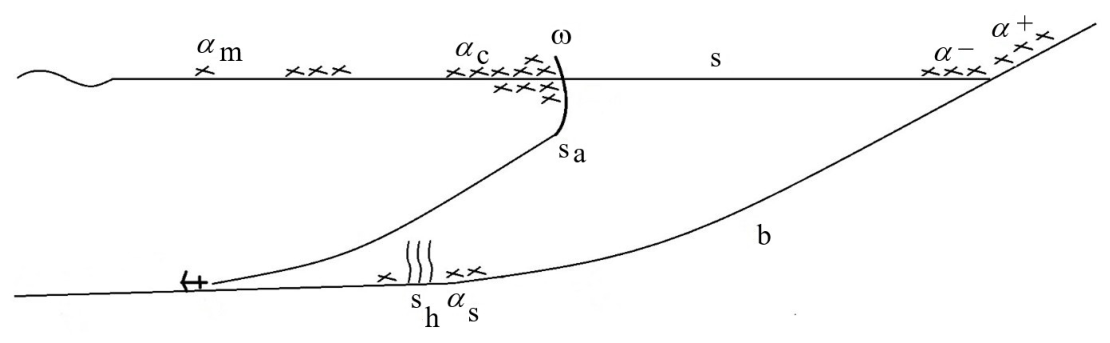
Figure 1 illustrates three drifting algae rafts
and a narrow coral reef pass
. The site is located off
Pointe Cerisier on the eastern coast of Martinique Island. Raft boundaries can appear either smooth or non-smooth, whether in the open ocean, through the coral reef pass, or within the lagoon. For instance, the raft in the bottom-right corner of
Figure 1 exhibits a smooth boundary [
22]. Additionally, a significant accumulation of beached algae
, still partially submerged in seawater, is visible in the bottom-left corner of
Figure 1.
Two regions—one is Yucatán, Mexico, and the other is Martinique, France—currently use floating containment devices to manage Sargassum arrivals. To our knowledge, a sole region exists where net-barrages have been deployed to contain Sargassum, i.e., Le François lagoon in Martinique (French West Indies). Our case study focusses on this lagoon, already named Cap Est.
Computational Fluid Dynamics (CFD) and flume-tank tests are outside the scope of this paper. To handle the catch pressure profile on the barrage, we use a priori hypotheses. Initially, we state a uniform pressure that subsequently is concentrated using an invariant principle. Pressure concentrations toward the barrage top and barrage center are investigated, vertically and horizontally.
Remark 1. Our study does not contain in situ measurements nor an experiment at a reduced scale. During this preliminary study, there was no fluid mechanics instrumentation, stress sensing or underwater photography. Consequently, the proposed structural computations have no experimental validation. Nevertheless, computed buoyancy forces exist with a possible comparison with devices installed. We interpret our study as a numerical reconstitution of the maximal structural loading for a net-barrage. The net-barrage advancement would be construed as non-mature.
We explain the assumption on a linear–elastic isotropic constitutive material to obtain the natural orientations of the stress inside the barrage surface as results. An orthotropic material could introduce a bias.
Filet Drom is a net-barrage manufacturer. Net-barrage can be made of a polyethylene grid completed by a trawl net to increase mechanical resistance. The mesh size of the grid can be lower than the mesh size of the trawl. The trawl part can be higher than the grid. Both the grid and trawl parts cross the sea surface. Two to three reinforcement horizontals lines or ropes are added to absorb the large horizontal stress compared to the vertical stress. Horizontal twine stress and vertical twine stress can differ. The barrage is weighed down by its bottom line with metal rods. The barrage buoyancy is fitted with cubic floating system. The barrage materials’ behavior will be a complex set of non-linear stress–strain relations, including anisotropy, orthotropy, viscoelastoplasticity and knot resistance. Before designing, we propose to compute the natural stress or intrinsic stress inside a homogeneous elastic surface made of two identical net-faces (Maurin and Motro, 1998) [
23]. This avoids introducing any bias or initial design dependency. This homogeneity corresponds to an idealized material and not to a real material. Based on natural stress, in a second stage not elaborated here, parameters for the first design and a preliminary installation check in terms of the given conditions could be given. It would be the maximal acceptable loading conditions with supportable algae arrivals.
We neglect the stiffness introduced by fouling and catch on the barrage. The fouling modulus depends on different species of varying sizes and stiffnesses over time (Halvey et al., 2019) [
24]. Benthic algae uses either flexural stiffness or buoyancy in terms of its flow habitat (Stewart, 2006) [
25]. The stiffness of the catch may result from the entanglement in the algae and their hydrodynamic compaction, which is not studied here.
Another mechanical aspect—though not explored further here—is the weathering of netting twines in coastal marine environments, which degrades material elasticity and strength. Natural weathering significantly reduces the breaking strength of polyethylene twines (Sandhya et al. 2025) [
26]. Seawater, light and temperature further alter the resistance and elongation properties of twines and fishing nets (Halim et al. 2021) [
27].
4. Case Study
This section presents a case study focusing on a standard barrage section under a priori hypotheses on loadings. We simplify the methodology by not incorporating hydrodynamic modeling of coastal water [
38], drag measurements on algae specimens and barrage structures [
39], or satellite imagery of polluted lagoons [
40].
4.1. Geometry
Net-barrages generally possess two juxtaposed nets forming a double-layer system. The first layer provides structural stiffness, while the second, designed to be more hermetic, i.e., with more solidity, with the lowest mesh size, less stiffness and less height, crosses the free surface to catch algae. Additional complementary lines reinforce longitudinal stiffness, and extra mass and buoyancy elements may be added.
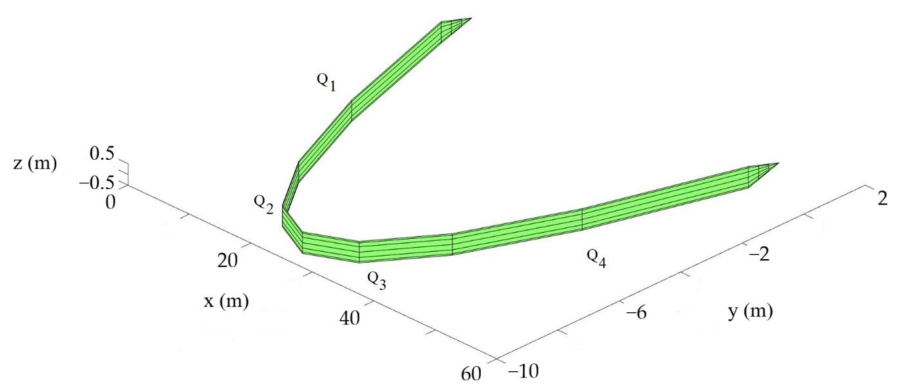
To simplify the generation of the two nets, we construct the barrage mesh from a flattened oil-spill boom, modeled as a cylinder enclosed by two cones. A standard barrage section is defined by a cylinder that is 50 m long with a diameter of 1 m and cones that are 1 m in height. The two triangles, initially represented as cones, are folded 90° along their bases to form the two mooring devices connecting the barrage to the anchoring line heads sa.
The flattened cylinder intersects the sea surface s. We obtain a closed surface ω composed of two net-faces, one upstream and another one downstream, connected at the top and bottom. Contact and friction between the net-faces are neglected in this study.
The surface ω, defining both the barrage and its mooring devices, is without a boundary
This property arises because a cylinder closed at both ends, here, by two cones, forms a closed surface. The flattening process, being continuous, preserves the topology and thus maintains the closed nature of ω. This topological property ensures that the mesh remains without artificial free boundaries, facilitating better convergence of the solver.
To reduce the internal stress , we apply the standard ratio of 7% between the barrage curve length and its chord length, as shown in Equation (12). The initial shape is parabolic, hence avoiding catenary curves. The chord length is 50 m with a curve length of 53.5 m and a sag of −9.52 m along the y-direction. This preliminary study assumes an invariant initial geometry. A sensitivity analysis on the natural stress is not addressed here, e.g., for instance, for the initial sag value.
The undeformed quadrilateral finite-element mesh is illustrated in
Figure 3.
To present the results subsequently, the barrage section is divided into four quarters, denoted
, as shown in
Figure 3.
4.2. Boundary Conditions
4.2.1. Kinematics
To ensure perfect buoyancy, the displacement in the z-direction of the nodes located at the sea surface s is blocked
The presence of neighboring barrage sections prompts the blocking of the x-displacement at extremities
The behavior of the mooring lines is neglected, and the anchoring lines heads
are treated as fixed points of the anchor buoy system
4.2.2. Reaction Forces
The Dirichlet boundary conditions, shown in Equations (20)–(22), yield resultants opposed to reaction forces. The following are the component results along each axial direction:
Buoyancy force , shown in Equations (20) and (22): This force, acting in the z-direction, defines the exact buoyancy balancing external forcings and internal stresses on the barrage and the mooring line heads of the anchor buoy system;
Longitudinal tension , shown in Equations (21) and (22): This represents the summation of the x-direction resulting forces, and characterizes the load transfer between adjacent barrage sections. It estimates the working force deployed by operators during deployment or dismantling;
The anchoring force , shown in Equation (22): Acting in the y-direction at the anchoring points , this force results from the fixed boundary condition imposed on the upper end of the anchor buoy system.
4.3. Hydrodynamic
We assume zero porosity of the barrage with respect to the flow [
41], meaning total net saturation due to algae catch and fouling [
42]. The clogging of the algae aggregates with the solidity of the panel [
14], which turns into a hermetic media. This is consistent with the closed-surface topology of ω, as shown in Equation (19). The drag coefficient considered is set to 1.65, as for hermetic vertical skirts [
43].
We neglect the effects of the seabed b, waves and wind [
44] on the forcings as well as weather variability and cyclonic conditions. Along the y-direction, two uniform sea current velocities are considered:
More precisely, oil viscosity and density bear on the velocity limit of containment by the barrage. However, algae raft density and internal algae cohesion remain topics for future study. Notably, leakage appears at
0.15 m∙s
−1 for highly viscous oils. Previous studies on rigid and flexible barriers have focused on a mean approaching flow velocity of
0.2 m∙s
−1 [
46]. Additionally, experimental and numerical analyses of aquaculture cage moorings have been conducted for current velocities below
0.25 m∙s
−1 [
47].
Remark 3. From a hydrostatic point of view, we assume that the gravity force balances the buoyancy force in Equation (3). Consequently, the vertical resultant force
arises solely from the hydrodynamic pressure. The gravity force gathers the barrage, and fouling and intertwined algae catch in the nets.
4.4. Material
The nets are composed of polyethylene. The stress–strain relationship of the nets entangling intertwined algae is considered linear, elastic and isotropic. We assume a low Young’s modulus, with a strain of 2% corresponding to a force of 1000 N required to stretch a 5 cm wide band. We consider the same elastic properties on the two net-faces. The knot resistance between net twines is not studied here.
Table 1 gives the barrage properties used.
4.5. Numeric Stability
To stabilize the two net-faces of the cylindrical mesh, a disjoint thickness of 1 × m is introduced. The usage of a flattened and a closed surface is numerically justified. An elastic surface without free boundaries favors the convergence of the non-linear equilibrium solution. Otherwise, the membrane would be prone to flapping instabilities.
Due to the zero initial stress condition on σ, a scaling factor is applied on the first Newton–Raphson updates bounded by 0.05 m nodal displacements. The non-linear elastic membrane, shown in Equation (18), is solved to machine precision 1 × N for the out-of-balance force using eight iterations for the flow velocity 0.05 m∙s−1 and ten iterations for 0.35 m∙s−1. Only the first iteration of the fluid–structure interaction, shown in Equation (10), is performed in this study.
4.6. In Situ Example
This sub-section presents an illustration of an existing net-barrage deployed in the
Antilles Françaises—French West Indies.
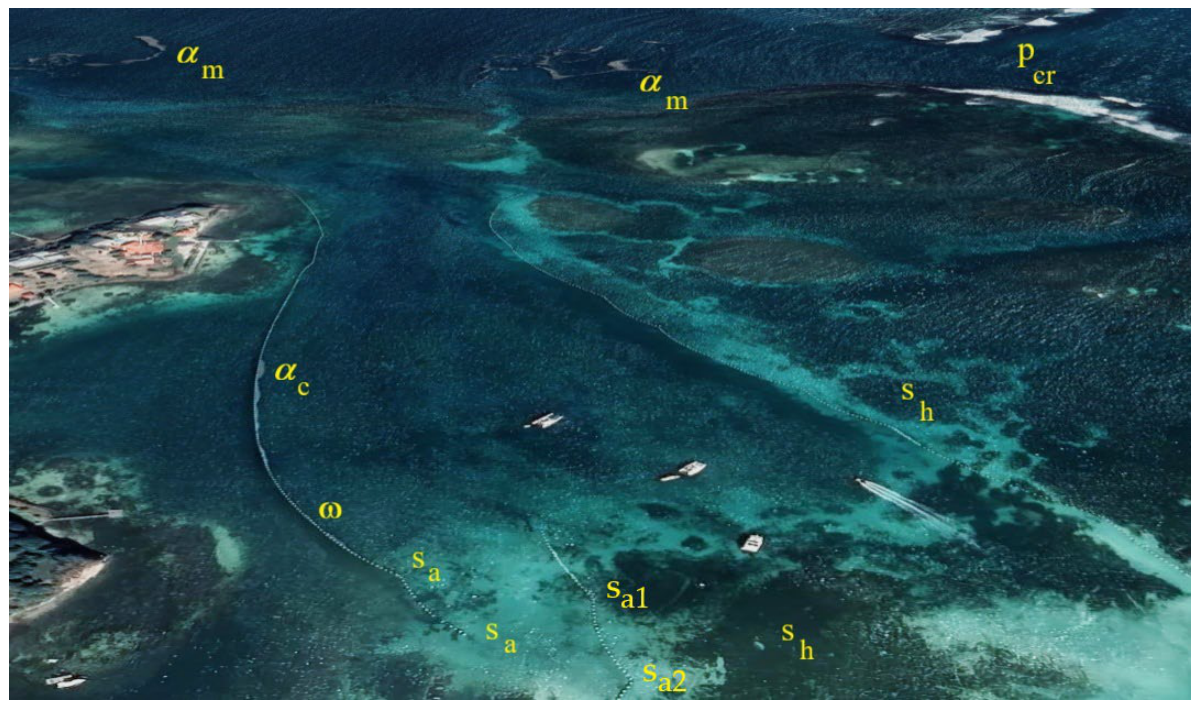
Figure 4 provides a 3D view of the
Sargassum barrage surface ω, which spans a total length of 611.5 m as sum of section chord lengths. The barrage is moored north of
Pointe Madeleine and south of
Pointe Cerisier in Martinique. The lagoon is open to the northeast through a coral reef pass
, located at Lat 14°35′58″ N, Lon 60°50′46″ W, as shown in
Figure 4. On the left side of
Figure 4, an algae catch
is visible along the surface ω. Two mooring line heads
at the southern end of the barrage are equally shown.
North of the mooring points
in
Figure 4, a long curve of the barrage is visible. It may exhibit the drifting feature of mooring masses, until the barrage tension primarily acts on the moorings at the southern and northern sections, which are stronger.
The coordinates of the northern mooring point
of the barrage section illustrated in
Figure 4 are Lat 14°35′29″ N, Lon 60°50′58″ W. The southern mooring point
is located at Lat 14°35′28″ N, Lon 60°50′57″ W. This section has a chord length of 44.98 m. The barrage section length is 45.4 m, giving a slack ratio of 0.93%, which is below the standard value, as defined in Equation (12).
The large-scale hydrodynamic study of Martinique Island, published in 1992, reports current velocities of 0.1 to 0.2 m∙s
−1 at the
La Caravelle site [
48]. However, this study harnesses the large scale and dismisses lagoon bay specificity.
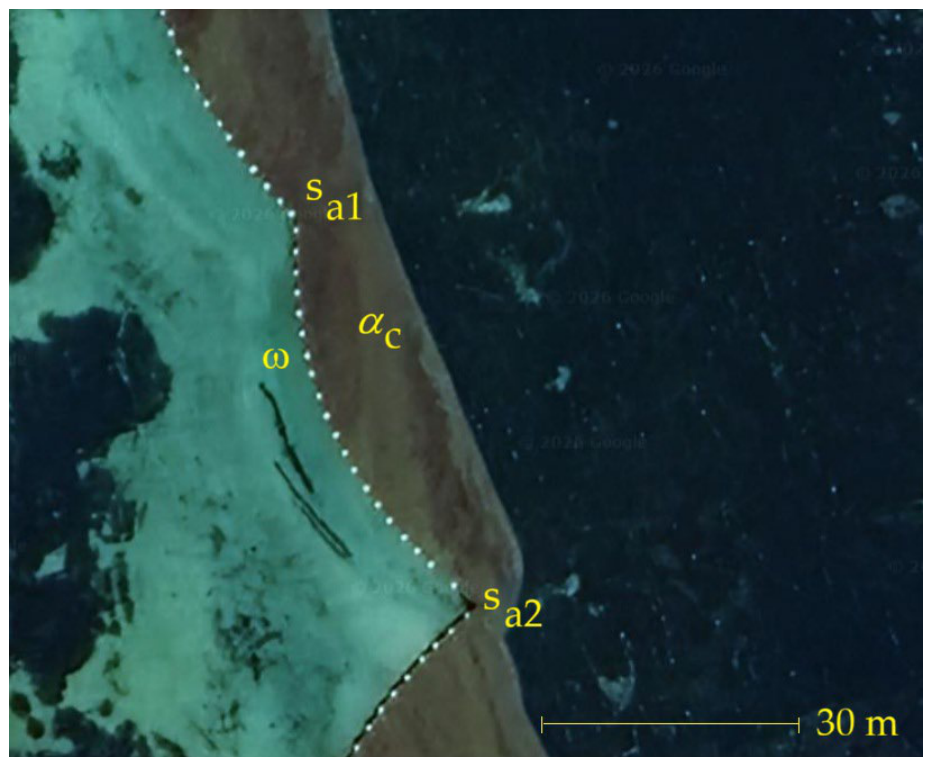
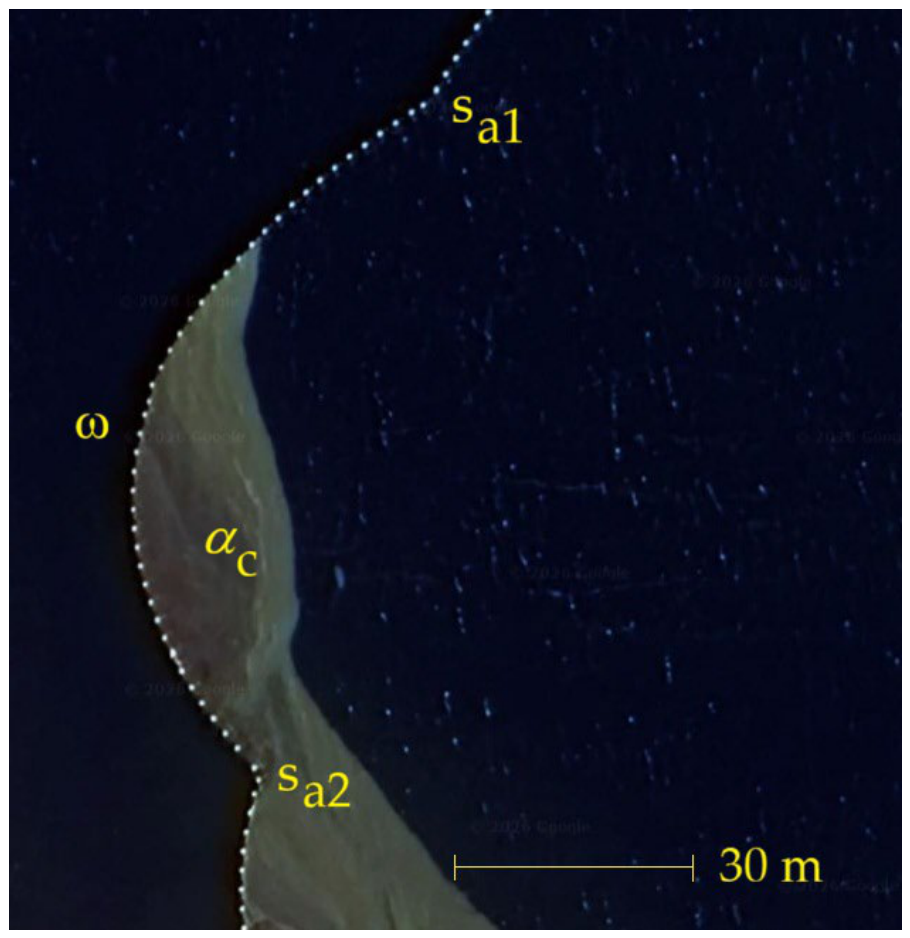
Remark 4. On the right side of Figure 4, seagrass loss under another Sargassum barrage is visible, with two remaining “herbiers marins” . This loss of seagrass beds depends on the lack of light, favored by algae accumulation and reduced photosynthesis. The movement of anchors and chains may damage seagrass beds. The effects of drift “deradage” and chafe “ragage” of dead masses, anchors and mooring blocks on the seabed b and seagrasses , are not detailed in this study. There are nearly 47 net-barrage sections deployed off the Cap Est site. A statistical analysis on satellite images of these sections is outside the study, despite it being able to handle situational variance. For instance,
Figure A1—
Appendix B—depicts a saturated net-barrage on a satellite image, showing catch symmetry. However,
Figure A2—
Appendix B—outlines a flow angulation to the normal vector at the barrage section chord, exhibiting a non-symmetry that is not studied here. Symmetry favors checking numerical implementation. Saturated loading harnesses the safety of physical implementation. Satellite images allow for preliminary real-world validation.
5. Results
This study presents three situations. The first focuses on a uniform distribution of catch and fouling along the barrage under both low and moderate velocities. Then, two situations handle non-uniform distributions. One allows for vertical variation, treating two distinct cases. The other points out horizontal variation, also involving two cases. Both non-uniform situations consider moderate velocity without fouling.
5.1. Uniform Catch and Fouling Distribution at Low and Moderate Velocities
The hydrodynamic pressure is uniform vertically for both flow velocities. To present the results, the barrage is divided into four quarters, denoted
, as shown in
Figure 3. It defines five positions, as detailed in
Table 2. Symmetry is preserved to validate the consistency of the results.
The barrage mid-section springs back, and likewise, the initial parabola unbalances the hydrodynamic pressure. Under low or high velocities, the sag point y-coordinate delivers unimportant variations compared to the initial parabola. Following a one-way coupling can highlight rigid displacements and elastic strains that do not significantly alter the initial hydrodynamic loads. A two-way coupling will have a reduced effect on the equilibrium geometry.
The resulting vertical buoyancy force becomes negative at both end-nodes at the top of the barrage, particularly at moderate velocity. We suggest adding adequate ballasting loads to sink the barrage at its ends.
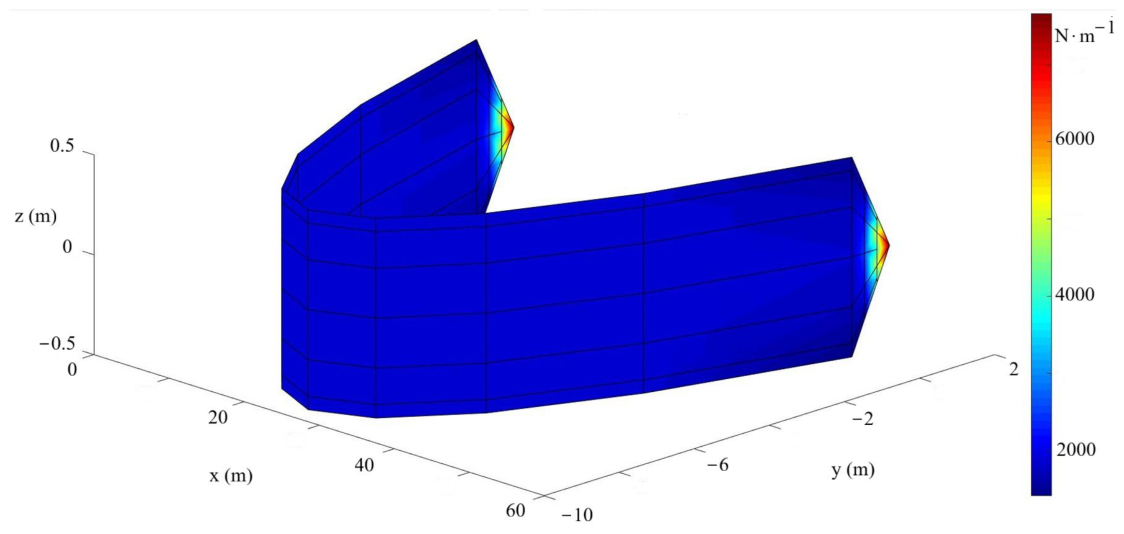
The hydrodynamic flow stresses the two mooring line heads. The anchoring resultant causes the strength level of the mooring to drift. The longitudinal tensions between adjacent sections reach 58.95 and 2842 N respectively at low and moderate velocities.
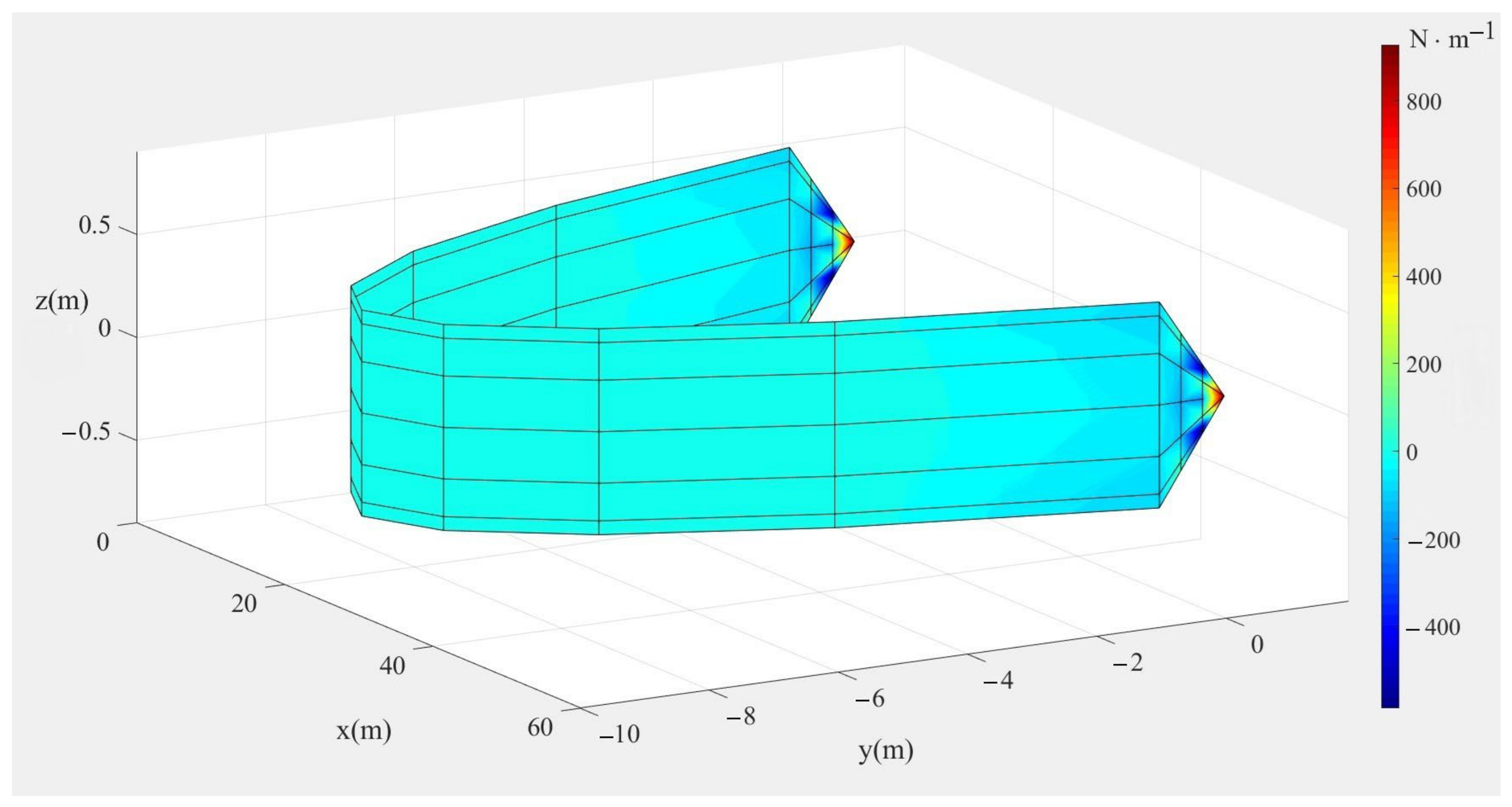
Figure 5 illustrates the stress distribution in the barrage and its mooring devices at 0.35 m∙s
−1. The maximum principal stress is localized at both mooring line heads. The figure color scale is N∙m
−1.
The maximal stress component is principally horizontal and uniform on the barrage and exhibits stress singularity at mooring points. We did not investigate the geometric singularity near the flattened cone heads. We point out that a concentrated load can induce a singularity on a membrane (Leissa, 2001) [
49]. However, no such load appears outside moorings in our study.
The minimal stress component is essentially vertical and yields the buoyancy forces. Using a membrane model is more valuable than using a string model because it gives the vertical stress and hints at the buoyancy of the barrage, particularly outside mooring points.
The non-uniformity of the minimal stress component observed in
Figure 6 may be a proxy of the net-barrage part, where the material homogeneity assumption is unlikely. This concerns the section ends and mooring devices.
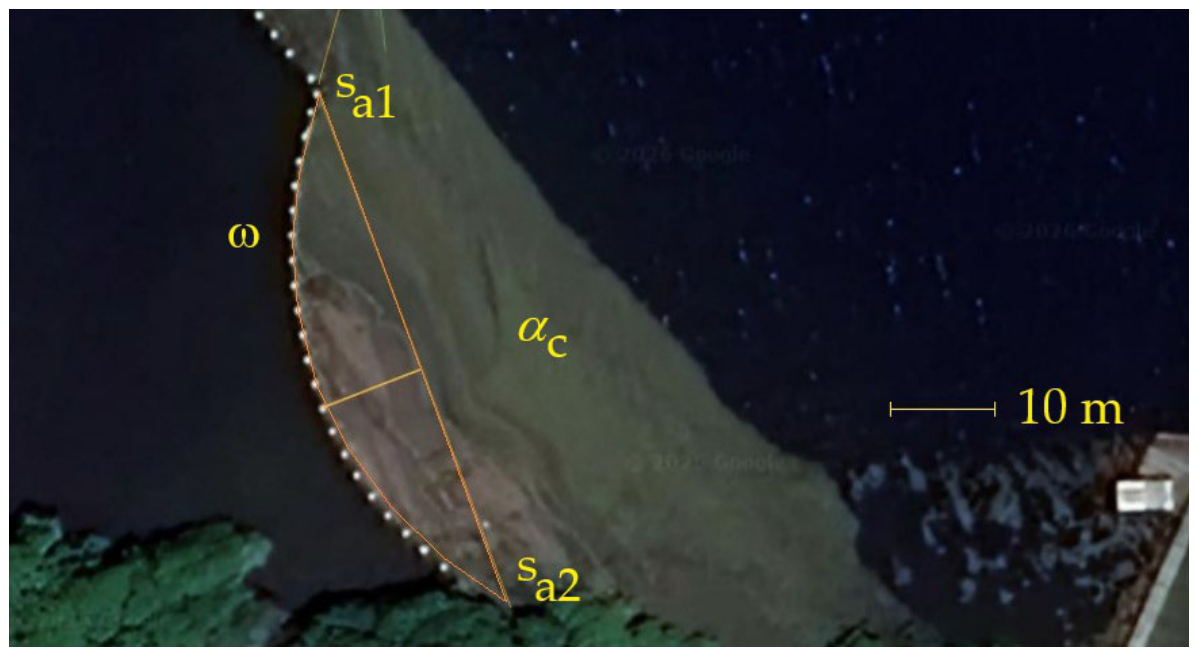
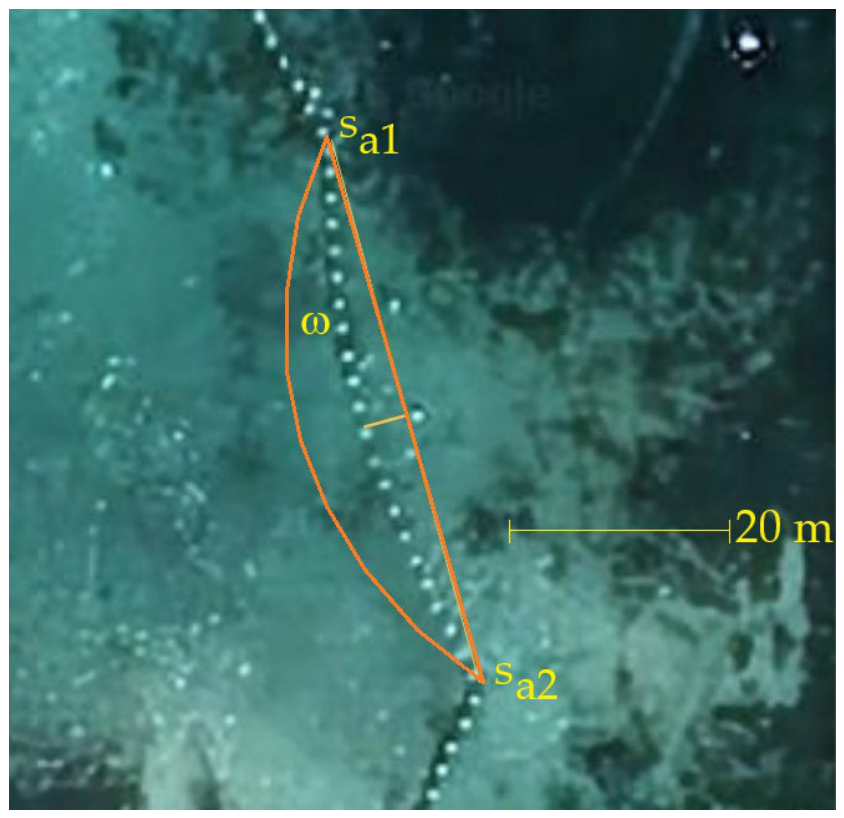
Figure 7 compares the real barrage section
with the computed surface obtained for a velocity of 0.35 m∙s
−1. The real geometry is given by the sequence of white circles, already shown at the bottom of
Figure 4. The computed geometry is given by the orange polygon. The associated surface has already been shown in
Figure 5 under another viewpoint.
The length of the real section is ~50 m (the same computed), oriented at ~165°. The real section has a vertex-chord distance “sag” of ~3.94 m (9.49 m computed,
Table 2), oriented at ~75°. We principally observe the sag difference between the real and computed geometries. Our interpretation comes from three differences between the real situation and the computation hypotheses:
There is no catch in reality. There is a uniform large pressure from the current, catch and fouling in the computation;
The real barrage has been deployed with a slack ratio lower than 1.07, given by Equation (12). This ratio is followed by the computed barrage. A barrage will respect this ratio when it suffers large loading;
The real loading and fouling state are unknown.
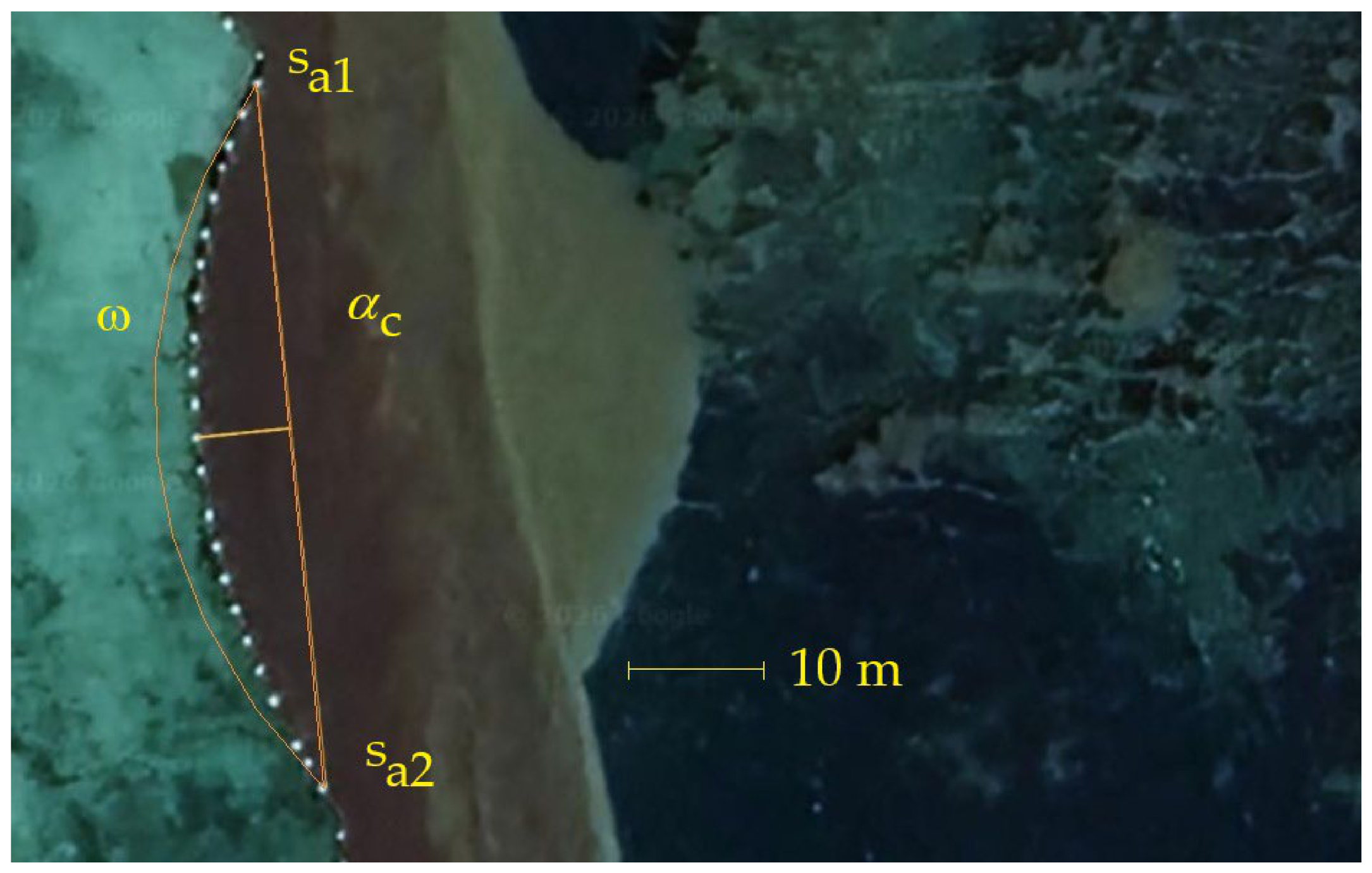
In the studied region, there are other barrage sections where massive catches can be observed by satellite imagery and where the slack ratio tends to 1.07.
Figure A3—
Appendix B—gives the superposition of a real section and the same computed result as above. The real sag increases to ~6.74 m. The real barrage contains a massive
Sargassum catch. The catch seems to be under extension, and the flow direction from the right to the left is along the normal direction to the barrage chord. The geometrical difference between the real situation and the computational result regresses compared to that of
Figure 7. A massive
Sargassum catch is present in both situations, and the flow direction is approximatively similar. The slack ratio remains larger solely in the computation.
Finally,
Figure A4—
Appendix B—gives a comparison of the same computed result again with a real barrage section, where the sag rises to ~9.8 m, which is of the order of the value 9.49 m resulted in the computation. A massive
Sargassum catch can be observed. The barrage geometry exhibits a small difference toward the bottom of
Figure A4 in
Appendix B. It is explained by the observation of the flow direction having a low north–south component compared to the normal of the barrage direction. A small non-symmetry occurs in the catch, contrary to the computation. The vegetation blocks the mooring head
, and a non-uniform current can happen in the vicinity of the shoreline.
As shown in
Figure 7 and
Figure A3 and
Figure A4—
Appendix B, the real and computed geometries exhibit similarity, proving that the hypotheses, notably the slack ratio, are the same.
In the next section, we study the non-uniformity of vertical pressure, with it being horizontally uniform, because non-uniform horizontal distributions staying vertically uniform are presented afterward.
5.2. Two Vertically Non-Uniform Catch Distributions at Moderate Velocity
The vertical distribution of hydrodynamic pressure is difficult to handle in tests and in situ measurements on a barrage with fouling and catch. We note a non-uniform vertical pressure distribution for floating oil contained by booms, with a notable concentration near the skirt top [
50]. Additionally, catch in fishing nets locally impacts the flow near the deformed surface [
51]. Finally, we determine uncertainties regarding raft depths during successive algae arrivals [
22] and regarding mat accumulation heights [
52].
The following a priori hypotheses define two cases of vertically non-uniform pressure. Firstly, we transfer the hydrodynamic pressure from the lower half of the barrage, i.e., equaling zero on this part, and add it to that of the upper half. Secondly, we continue this transfer of pressure from the bottom of the upper half, where the pressure will become zero, and add it to the highest part of the barrage, the “top band” of finite elements. In the first case, the resultant external force remains unchanged, with the two half parts having the same surface. In the second case, the resultant external force will decrease because of the low height of the “top band” of finite elements. These transfers are defined on both the upstream and downstream net-faces. On the two net-faces, the sign of the pressure changes because the normal vector directions are opposite.
We compare these cases with the uniform pressure in
Table 3. We present the principal stress for a central and vertical band of finite elements (elements 67 to 78 in
, adjacent to
). The flow velocity is 0.35 m∙s
−1.
The pressure transfer to the upper-half part has minimal impact on horizontal displacement. The y-coordinate of the barrage center remains at −9.49 m. Along the central band of the mesh, the vertical distribution of principal stress varies within the range [1680, 2017] N∙m
−1 instead of being 1849.7 N∙m
−1, as shown in
Table 3. When the pressure acts exclusively on the upper-half part, it significantly influences the z-direction buoyancy forces
, particularly around the mooring nodes.
Table 4 compares these z-direction buoyancy forces along the floating line nodes for different pressure distributions.
Buoyancy variations are primarily localized near the moorings, as shown in
Table 4. Additional results for the pressure transfer to the “top band” of finite-elements include the weak influence on the y-coordinate of the barrage center, positioned at −9.43 m, and the stress vertical repartition with a range of [654, 969] N∙m
−1 from the bottom to the top of the barrage, as shown in
Table 3. We recall that, in this case, the overall resultant force is reduced.
We interpret and discuss the results on the vertical pressure distributions. Our motivation came from the difficulty of handling the vertical and horizontal dimensions of an algae catch. We investigated two redistributions of the sea current pressure through algae catch behavior on the net-barrage.
The pressure case on upper-half part corresponds to a catch partially in contact with the barrage skirt. Our main observation on the pressure distribution is the invariance of the net structure geometry, despite significant impacts on the vertical stress distribution, as shown in
Table 3, and the buoyancy near the moorings, as shown in
Table 4. Deeper positioning of the mooring line heads below the sea surface could amplify these effects.
The pressure concentrated on the “top band” is a limit case where a low catch thickness occurs. In this situation, the barrage stress varies vertically, as shown in
Table 3. The net-barrage should be designed with a stiffer upper part if this case of catch is encountered. If this situation is rare, a uniform net structure is suggested.
5.3. Two Horizontally Non-Uniform Catch Distributions at Moderate Velocity
In this case, the vertical section remains relatively straight, while the horizontal one exhibits significant curvature. It favors catch concentration in the center of the barrage. This horizontal catch distribution can be observed on the sea surface, for example, on the left side of
Figure 4. Nevertheless, an uncertainty persists in terms of net obstruction by catch. The hydrodynamic pressure could vary in terms of captured raft sizes. Therefore, we present two a priori hypotheses handling non-uniform horizontal pressure distributions. Two basic symmetrical mathematical functions with equal summation are studied: a Heaviside–rectangular distribution and a triangular pressure distribution. These choices hint at the barrage behavior when the catches are centered.
We present two case studies with variable horizontal pressure distributions, each corresponding to different catch domain geometries. Firstly, the catch pressure is considered to vanish on the left and right horizontal quarters of the barrage, and . We suppose a hypothetical concentration of the catch at the barrage center, resulting in a doubled catch pressure over the two central quarters, and . We define a density function distributing the previously used uniform barrage pressure. This Heaviside density equals 0 in quarters and and 2 in quarters and .
The second case uses a triangular density function, increasing linearly from 0.25, 0.75, 1.25 until 1.75 along the finite-element vertical bands and across and . By symmetry, the density decreases linearly from 1.75, 1.25, 0.75 to 0.25 on and . The catch forcing follows a triangular continuous density that is maximal at the barrage center and minimal at its boundaries.
The summation of the Heaviside and triangular density functions along the barrage
x-axis is equal to 1. The flow velocity considered in both cases remains moderate at 0.35 m∙s
−1.
Table 5 compares the z-direction buoyancy forces
along the barrage at the sea surface.
The buoyancy forces increase significantly with the Heaviside density compared to the uniform density. This suggests that large catch concentration could lift the barrage center and exhibit leakage beneath them. In the Triangular repartition case, the forces increase slightly and only at the barrage ends, as compared to the uniform case.
In all cases, the principal stress in the netting structure remains nearly constant along the barrage. However, compared to the uniform case, a slight variance appears longitudinally for the two non-uniform densities. At the barrage center, the stress reaches 2575 N∙m−1 in the Heaviside case and 2286 N∙m−1 in the triangular case compared to 1849.7 N∙m−1 in the uniform case. This suggests that a uniform catch repartition decreases stress.
In the uniform case, the barrage center position on the sea surface is −9.49 m on the y-axis. This position reaches −10.13 m in the Heaviside case and −9.99 m in the Triangular case. A barrage is a flexible structure, and consequently, its equilibrium geometry exhibits a strong dependency on the horizontal repartition of catch.
In the uniform case, the y-direction anchoring force at the anchoring line heads is −2387.2 N. The result is −2402.3 N in the Heaviside case and −2458.9 N in the Triangular case. This suggests a reduced mooring tension when a uniform catch repartition occurs.
Remark 5. We dispose of an insufficient number of data to deliver a stress safety factor between loading and resistance histograms for a Sargassum barrage. Naval operations under uncertainties apply a safety factor of 7. In the case of harsh oceanic and atmospheric conditions or extremely wide catch, the operators could unlock one barrage mooring. The barrage moves to a “flag position”. Appendix B, Figure A1, shows a Sargassum saturation allowing for an extremely wide catch in terms of barrage length. The catch depth could reach 0.7–0.8 m [53]. Regarding the risk of algae leakage beneath the barrage caused by horizontal non-uniformity of catch distribution, we present a speculative analysis. We refer to oil containment by a boom, despite algae being non-fluidic. Along the vertical direction, the leakage mode is entrainment (Dagorn and Dumont, 2012) [
54]. This results in an upstream decohesion of an algal catch from the catch–water interface. Living
Sargassum adapts their density close to 0.95. The thickness is higher for an algae raft than for an oil slick. The raft windage is large. Horizontally, several arrival times can produce internal interfaces that distinguish catch types in terms of weathering (Rutten et al., 2021) [
52].
6. Discussion
6.1. Novelties
The Sargassum catch caught by two net-face barrages is modeled by using a continuous membrane instead of a string or cable approach. The novelty lies in the approach used to handle a complete flow interruption induced by catch and fouling. We use a topologically closed domain to ensure that the numerical mesh remains representative and without artificial boundaries.
To estimate the anchoring forces on Sargassum barrages, we use a non-linear membrane model, allowing for large displacements and small strains. We consider several a priori hydrodynamic forcings. We yield consistent and stable finite-element computations and handled multiple hazards and uncertainties harnessing Sargassum containment. We address the uncertainty in catch size by assuming multiple a priori hypotheses on catch loading. This approach reduces complexity while retaining sufficient accuracy for the loading scenarios.
Our study proposes a preliminary analysis on algae containment by moored floating nets. We indicate stress levels, which could benefit a preliminary barrage design. The numerical results assess the mooring tension and buoyancy force incrementations resulting from an algae catch. For saturated nets, i.e., fully hermetic by algae catch and fouling, we obtain a y-direction anchoring force amplitude of 2387.2 N at 0.35 m∙s−1 (48.8 N at 0.05 m∙s−1). We discuss the impact of horizontal and vertical variations in catch geometry, under varying horizontal pressure patterns, on the resulting stresses, buoyancy and anchoring forces. Under uniform catch distribution along the barrage, the two superposed net-faces are stressed from 1842.7 to 1854 N∙m−1 at 0.35 m∙s−1, promoting uniform algae distribution to minimize structural stress.
The above selected velocities represent typical operational conditions. This consideration is equally present in the satellite image usage, where spatial resolution allows the curved shape of the Sargassum barrages to be observed.
6.2. Limitations
Beyond satellite images delivering barrage geometries, in situ measurement lacks knowledge of effects on stresses, lagoon hydrodynamics [
55], forcings and catch behavior. The limitation of the study lies in the intertwined algae behaviors. This living organism assemblage possesses internal and external interfaces. The smoothness of these interfaces pertains to aerodynamic and hydrodynamic drags and internal friction.
Catches, rafts and barrages can be identified in satellite images at the same revisit time and given location. In the laboratory, to refine the hydrodynamic forcing, we could observe the internal mechanics in the catch and the boundary layer on its bottom. Experimental data can focus on raft volume, sea current and mooring tension evaluations.
It could be valuable to study the convergence of the membrane model solution toward a cable model solution. Our membrane model has intrinsic limitations regarding the behavior of knots and twines. The isotropic assumption differs from netting conditions. It allows for a baseline mechanical analysis that can later be compared when setting orthotropic effects.
Assuming a linear–elastic material to identify intrinsic stress in the barrage reveals a limitation of the study regarding realistic netting panel behavior. A large community of researchers elaborate experimental and numerical models for tensile tests on fishing nets (Morvan et al., 2016) [
56]. Non-exhaustive potential behaviors include non-linear elasticity, viscosity, plasticity, specific stiffness of knots, and more short-term and long-term aspects. Contrary to fishing nets, net-barrages are permanent structures. They can be made of used devices. Another study limitation is the absence of a comparison of intrinsic stress with that of recycled nets throughout their lifetime.
Wave action could also be taken into account. Considering less calm water with waves will imply a dynamic analysis of mooring lines, buoys and floating nets. Adding moorings can be achieved by repeating an alternance of direct anchor and anchor buoy systems. A dynamic analysis would integrate horizontal forcing of catch and a vertical porpoising effect (French: marsouinage) in large currents. A fatigue analysis on nets and moorings and an optimal barrage position would benefit from the existence of an operational modeling of physical oceanographic variables. It would include environmental uncertainties in the lagoon and give algae trajectory predictions.
6.3. Generalization
Dynamic analysis would necessitate adding mooring lines in the model and considering wave action. The boundary condition at the mooring hooks, as shown in Equation (22), will be renounced.
Appendix B,
Figure A2, shows a barrage with a non-orthogonal angle to the flow. Computing an angled barrage will be initialized by a parabola carrying a tangent vector normal to the current at its vertex. The boundary condition at the section extremities, as shown in Equation (21), will be updated to the flow direction.
Another case study can provide some insight regarding barrage logistics at sea toward an operational site. A launch or motor-boat could tow the net-barrage using a flag position (Dagorn and Dumont, 2012) [
54]. At a high towing speed, there could be a large fatigue cycle for the netting material. To adapt the boat speed and to also take into account the net-barrage length, we suggest using a dynamometer on the towing system to reduce the cyclic strain range and preserve the material from accelerated aging.
Generalization to barrage skirts made of coated fabric can involve a risky and rare event. Harsh conditions, or a lack of care during installation, may favor a critical situation for the material. The risk happens when the barrage center flips vertically during a slack state followed by a stress state. When the longitudinal tension restarts, the upper and bottom reinforcement lines can cross each other, generating an hourglass phenomenon. A high friction force occurs at the contact points and damages the material. We suggest investigating both classical cycles and exceptional loadings when studying the aging of the material of such a barrage.
An empirical stress estimation arises by considering a half-cylinder of 1 m height as the barrage geometry. The product of the half-cylinder radius by the normal pressure suggests the internal material tension, i.e., the y-direction anchoring force. This relationship—pressure by radius equals tension per meter height—at a low velocity 0.05 m∙s
−1 gives, from
Table 1, a 25 m radius and an empiric anchoring force of 52.85 N, comparable to the obtained value of 48.8 N.
We consider safety implementation. Net-barrages allow for algae containment with a resistance that is as small as possible to the flow that carries them. A first recommendation would be to avoid installation of barrages in a coral reef pass, like at the time of the Wakashio accident off Mauritius island (Rajendran et al., 2021) [
57]. The oil pollutant flowed in the pass into the lagoon, but a too large current entrained oil beneath the barrage there.
User and stakeholder observations in lagoons may figure out the zone boundary with a small current. To anticipate the steady growing of
Sargassum arrivals observed over the last decade, studying algae recovery at sea would provide a complementary dynamic approach (Gray et al. 2021) [
6].
Two important safety specificities are the usage of a safety hook for mooring point unlocking if devastating loadings are forecasted and defining the barrage swing radius in terms of environmental conditions (Lušić and Pušić, 2023) [
58].
6.4. Ecological Impacts
Oil-spill booms prevent oil beaching, which can generate up to ten times more waste by weight. In contrast, keeping algae at sea and collecting them enhances public health. When beached, their decomposition releases noxious gases, harming the population (Wang et al., 2019; Resiere et al., 2018) [
1,
59]. Additionally, stranded algae may leach heavy metals (Murthy et al., 2026) [
2]. The health impacts of hydrogen sulfide H
2S and ammonia NH
3 are documented (Resiere et al., 2025) [
60], such as the generation of copper corrosion (Ahmed et al., 2023) [
61].
A study conducted at Cap Est on Martinique Island, in the vicinity of our case study, rejects a serious secondary effect of
Sargassum contained in net-barrages. The Metallic Trace Element (MTE) concentration is unaffected by Sargassum accumulation along the floating barrier [
62]. In a reef lagoon (Puerto Morelos, Mexico), the natural removal of beached
Sargassum depends on hydrometeorological conditions [
52].
Trace elemental arsenic exhibits a large concentration in Sargassum wrack (Abdool-Ghany et al., 2026; Gray et al. 2021) [
6,
63]. Management practices on Sargassum catch can be guided by recommendations on beached
Sargassum. Regarding the Sargassum Inundation Risk (SIR), a review of 25 monitoring and forecasting systems identifies the most valuable predictions: detection, movement and growth rate [
64].
The devastating impacts of
Sargassum on the economy and social life are documented. Environmental impacts of barrage and algae catch exist. Spats, mussel stakes, reveal a habitat and an ecosystem (Halvey et al., 2019) [
24]. Sargassum rafts can move away some species or carry bodies, for instance, fishes and turtles. We emphasize that net-barrages are not considered Fish-Aggregating Devices (FADs) [
65].
Decomposition of weathered catch produces the sinking of algae, which results in covering seagrass meadows. Seagrass loss induced by Sargassum containment is a major drawback. Seagrass meadows suffer reduced brightness due to algae accumulation and due to the sweepings induced by mooring chain displacement. The sustainability of the permanent deployment of polyethylene material into protected environments remains to be assessed.
6.5. Future Research Work
Looking ahead, an optimization problem arises in the deployment of barrages in terms of algae arrivals and forecasting nautical conditions. A multi-objective optimization problem exists in terms of make decisions for oil-spill boom deployment in order to minimize economic and ecological losses during oil film dynamics [
66].
Further non-exhaustive research works are enumerated in
Table A2,
Appendix C, with a suggestion of two key first aspects. A biofouling study could delimit the hydrodynamic regime and added mass magnitude as well as ecological impacts. Future hydrodynamic models could be represented in 2D in either the vertical or horizontal dimensions, and they are able to show the underwater catch surface and upstream frontline asymmetry. The solidity index is a geometric ratio of netting panels, representing the projected area of its solid part—including fouling—to the outline area of the panel. Solidity values depend on fouling species, their ageing and the uniformity of the panel. An emergent feature of the drag coefficient’s relationship with solidity concerns two-net-faced panels. Solidity hysteresis remains after panel cleaning because the removal of encrustation is not perfect. The panel appears less clean than when in its initial state.
Dynamic analysis of barrages will include the catch and fouling masses, and it will integrate the behavior of buoys and mooring lines. In situ measurements of sea currents and waves could be achieved in a case study in the future. A dynamometer fixed at a mooring point could deliver the anchoring tension, and an acoustic Doppler current profiler could reveal the flow velocity pattern near the sea surface. Long-term environmental data will allow for stochastic analyses, which are necessary for fatigue forecasting and safety coefficient assessment.
The future development of an operational oceanographic model dedicated to a reef lagoon will involve several Lagrangian tracers to depict the flow trajectories which entrain algae rafts. As a consequence, an optimal position for a barrage can be foreseen. Current forecasting allows for safely positioning a barrage far away from large flow velocities in the vicinity of coral reef passes.
Sargassum arrivals follow variable annual cycles, which can be more severe, e.g., in the spring and summer seasons, in Martinique. Massive
Sargassum arrivals have increased significantly during last few years (Wang et al., 2019) [
1]. This should be specified in further fatigue analyses of net-barrages. Historical sea current measurements will be utilized to analyze the safety factor on stress.
A conceptual model for catch will model the accumulation, aggregation and weathering of algae (Rutten et al., 2021) [
52]. The catch colors observable in
Appendix B,
Figure A1 and
Figure A2, suggest the presence of non-uniform properties and horizontally stratified zones. Algae collection must be achieved as quickly as possible (Debue et al., 2025) [
67]. In the future, the containment and collection stages can be solved together (Gray et al., 2021) [
6]. Circular beams near the seabed influence particle dynamics and the catch efficiency of fishing gear [
68]. We have not specifically considered beams for ballasting and mooring the bottom line of net-barrages.
7. Conclusions
An elastic membrane model was developed to successfully handle the deformed geometry and natural stress of moored net-barrages for containing Sargassum arrivals. Instead of a string model using a one-dimensional domain, a two-dimensional surface provides noteworthy curvilinear coordinates depicting structural equilibrium. Satellite observations, e.g., from the nadir direction—yielded the first instance of validation of the computed barrage geometry under catch loading. To circumvent potentially unstable boundaries of a two-net-face barrage, we elaborated the finite-element mesh from a flattened cylinder. The model infers the mooring tension in terms of the current velocity. The resulting buoyancy forces deliver the second instance of model validation.
Further features emerge from this preliminary study. Model enrichments were identified in terms of to improving the fluid and solid mechanics behavior as well as environmental issues. Satellite observations across seasons will permit the classification of net-barrage configurations. The hidden internal interfaces of algae in the catch, i.e., their underwater surfaces, either free or in contact with the barrage, are challenging measurements for laboratory experiments and in situ observations. For instance, the solid state of a catch made of Sargassum is specific. The steadily growing maximum amount of Sargassum necessitates the development of science-based adaptive strategies.