Article

Obstacle-Controlled Lagrangian Pathways and Fate in Low-Volume Lock-Exchange Gravity Currents

1
National Key Laboratory of Water Disaster Prevention, Hohai University, Nanjing 210098, China
2
College of Water Conservancy and Hydropower Engineering, Hohai University, Nanjing 210098, China
*
Author to whom correspondence should be addressed.
J. Mar. Sci. Eng. 2026, 14(9), 801; https://doi.org/10.3390/jmse14090801
Submission received: 15 March 2026 / Revised: 18 April 2026 / Accepted: 20 April 2026 / Published: 28 April 2026
(This article belongs to the Section Physical Oceanography)

Abstract

Finite-volume gravity currents frequently encounter bottom obstacles, particularly in underwater environments such as lakes and oceans. However, how obstacle–current interactions reorganize Lagrangian transport pathways and ultimately determine the fate of fluid elements over the full current life cycle remains unclear. Using large-eddy simulations, we focus on a low-volume lock-exchange gravity current impinging on an isolated two-dimensional triangular obstacle. Fluid-element trajectories are tracked from collapse through propagation, obstacle interaction, and final dilution and decay, and are classified using K-means clustering into five transport modes linked to characteristic flow structures. We find that increasing obstacle slenderness strengthens upstream reflection and reduces downstream overflow, thereby shifting the fate of tracer particles from downstream delivery toward upstream retention. In addition, the obstacle standoff distance controls the dynamical state of the current at impact, producing systematic yet non-monotonic changes in the fractional population of the transport modes. This study establishes an explicit correspondence between evolving flow structures and clustered Lagrangian pathways. Comparative cases with varying geometric configuration, density contrast, flow depth, and release volume indicate that the identified transport patterns are reasonably robust. Therefore, the present results provide a fate-oriented predictive framework and theoretical basis for the transport of finite-volume gravity currents near obstacles, with important implications for engineering applications.

1. Introduction

Gravity currents occur widely in lacustrine, estuarine, and marine environments and often act as efficient carriers of dense fluids and associated materials [1,2,3]. These flows play a crucial role in processes such as sediment redistribution, seabed morphodynamics, and material exchange across continental shelves. In practice, gravity currents frequently interact with complex boundaries and obstacles [4,5,6], which can significantly influence their transport pathways and the eventual fate of the conveyed material. Bedforms such as dunes and ripples, topographic bumps, vegetation layers, and obstacle arrays can all modify the dynamics of these flows.
Over the past decades, the interaction between gravity currents and obstacles has been extensively investigated using theoretical analyses, laboratory experiments, and numerical simulations [7,8,9,10,11,12,13,14,15,16,17,18,19]. Most of these studies have adopted an Eulerian framework, in which the flow is characterized through spatially distributed fields such as velocity and density. Although certain diagnostics, such as front position and front velocity, involve tracking the evolution of specific flow features, they are still fundamentally inferred from Eulerian flow fields. This perspective has proven particularly effective in elucidating instantaneous flow structures in key regions, including obstacle crests, wakes, and downstream reattachment zones. For example, Zhou et al. [9,10,14,15] systematically examined the effects of obstacle height and arrangement on gravity current propagation and identified distinct flow regimes within obstacle arrays. Laboratory experiments have further revealed enhanced entrainment, flow reflection, and downstream flow reestablishment induced by obstacle interactions [20,21,22]. However, Eulerian-based approaches have inherent limitations in directly describing the spatiotemporal trajectories of individual fluid elements and their eventual fate.
In recent years, Lagrangian approaches have gained increasing attention as powerful diagnostic tools for investigating complex flow dynamics. Xiao et al. [23] used hydrodynamic modeling and particle tracking to quantify river–floodplain connectivity under different hydraulic conditions, highlighting the utility of Lagrangian metrics such as particle travel distance and residence time for characterizing transport behavior. Guyenne & Kalisch [24] showed that, under the combined influence of currents and waves, Lagrangian tracers can reveal transport pathways and mixing processes that are difficult to identify from Eulerian fields alone. For gravity-current systems, the motion pathways and temporal evolution of fluid can be directly characterized by tracking the trajectories of individual fluid elements. In laboratory experiments, dyes [25,26] and hollow glass beads [27] are commonly used to trace and visualize the motion of gravity currents, while in numerical simulations, passive tracers have been introduced to examine specific flow regions, such as the head of gravity currents [28]. For coastal plumes, Zhou et al. [29] used passive tracers to identify three dispersal pathways of the San Francisco Bay plume. Lagrangian approaches have been applied more extensively to turbidity currents, including their propagation along flat boundaries or over localized topographic features such as seabed Gaussian bumps [30,31]. However, these studies have predominantly emphasized the final spatial distribution of deposited sediments, with comparatively less attention paid to the full spatiotemporal evolution of fluid-element trajectories throughout the flow lifecycle. Xie et al. [32] employed particle trajectories to investigate the auto-suspension mechanism of turbidity currents propagating down an inclined slope, yet a comprehensive statistical characterization of all particle trajectories was not performed.
Gravity currents are of concern in both environmental and engineering settings. Salt intrusion can adversely affect water resource utilization and ecological systems [3], while submarine gravity currents may pose risks to offshore pipelines and other infrastructures [33,34,35,36]. In practical applications, the deployment of obstacle structures can regulate nearshore transport processes, guide sediment redistribution, or mitigate the impact of density currents on critical areas and engineering structures. In such contexts, accurately characterizing the origins, pathways, and eventual fate of fluid elements and the materials they transport is essential for evaluating the effectiveness of obstacle-based control strategies. However, a systematic understanding of the linkage between Lagrangian particle behavior and flow evolution during interaction with obstacles remains lacking.
Motivated by these gaps, this study revisits the propagation of gravity currents interacting with obstacles, with particular emphasis on low-volume releases. In the existing literature, lock-exchange gravity currents are commonly categorized as large-volume or low-volume releases based on the lock aspect ratio [37,38]. Large-volume releases ( L lock / H 1 ) are well suited for investigating gravity currents with a prolonged slumping phase sustained by a continuous supply of dense fluid. By contrast, low-volume releases ( L lock / H = O ( 1 ) ) undergo a complete life cycle, from initial collapse and propagation to dilution and eventual decay. Low-volume releases are therefore adopted here to provide a clearer framework for analyzing the full evolution of fluid elements, rather than focusing solely on early-stage dynamics. In the numerical model, Lagrangian tracer particles are introduced and tracked throughout the full time series, and the trajectories of all particles are analyzed using clustering techniques to identify representative transport pathways. Although this study focuses on low-volume release scenarios, the correspondence between obstacle-induced particle motion and characteristic flow structures provides qualitative insight applicable to more complex cases. The Lagrangian framework not only complements traditional flow diagnostic methods but also offers a more intuitive and physically meaningful description of transport processes under the interaction between gravity currents and topography.
The paper is organized as follows. Section 2 presents the numerical model setup and the analysis methods. Section 3 presents the simulation results, focusing on the motion of Lagrangian tracer particles and the effects of obstacle properties. Section 4 discusses the underlying hydrodynamic mechanisms and their implications for particle fate, and conclusions are summarized in Section 5.

2. Numerical Modeling and Analysis Approach

2.1. Model Description

The numerical simulation of gravity currents is based on the unsteady three-dimensional Navier–Stokes equations, together with the continuity and density transport equations. Turbulence is modeled using large-eddy simulation (LES) [39,40]. Under the Boussinesq approximation, the spatially filtered governing equations can be written in tensor form as
u i t + ( u i u j ) x j = 1 ρ 0 p x i + ν 2 u i x j x j g ρ ρ 0 δ i 3 τ i j S G S x j ,
u i x i = 0 ,
ρ t + ( ρ u j ) x j = κ 2 ρ x j x j χ j S G S x j ,
where u i denote the Cartesian components of the filtered velocity field, p is the filtered pressure, and ρ is the filtered density. Here, ρ 0 is a reference density, g denotes the gravitational acceleration, and δ i 3 is the Kronecker delta. The parameters ν and κ represent the kinematic viscosity and the molecular diffusivity of the dissolved species responsible for the density variation, respectively. The spatial filtering operation is omitted for clarity. Time is denoted by t, and the index i = 1 , 2 , 3 corresponds to the streamwise (x), spanwise (y), and vertical (z) directions. The molecular Schmidt number is defined as S c = ν / κ . Typically in saline experiments, S c 700 , but it has been observed by many researchers [30,41,42] that the influence of Schmidt number on the dynamics of the gravity current is weak as long as S c O ( 1 ) or larger. Since the present study does not specifically discuss the effect of S c on the dynamics of gravity currents, S c is set to unity here, following common practice in numerical simulations of gravity currents [10,43,44].
The numerical simulations are carried out using the incompressible multiphase-flow solver within the OpenFOAM framework [45]. Spatial discretization of the governing equations employs the finite volume method, with diffusion terms discretized using the second-order Gauss van Leer scheme, advection using Gauss linearUpwind grad(U), gradients using Gauss linear, and Laplacians using the modified Gauss linear scheme. For velocity–pressure coupling, we use the PIMPLE iterative algorithm for coupling momentum and mass conservation equations. The PIMPLE is a combination of PISO (Pressure Implicit and Splitting of Operators) and SIMPLE (Semi-Implicit Method for Pressure-Linked Equations). The time step is adaptively controlled, on the order of 1.0 × 10 5 s, keeping the Courant number below unity.
The subgrid-scale (SGS) stress tensor τ i j S G S and the SGS scalar flux vector χ j S G S in Equations (1) and (3) are parameterized using the Smagorinsky model [46]. This model uses a linear turbulent eddy viscosity, ν t , to model the SGS motions. ν t is defined as
ν t = ( C S Δ ) 2 2 S i j S i j ,
where Δ is usually taken as the grid size, S i j is the strain-rate tensor and C S is the Smagorinsky constant having a typical value in the range of 0.1–0.2. In this study, the default value in OpenFOAM, C S = 0.167 , is adopted.

2.2. Model Validation

The computational approach and model are validated against the laboratory experiments of Nicholson et al. [47], who investigated finite-volume lock-exchange gravity currents over sinusoidal topography (spanwise uniform) in a two-layer ambient. Previous studies have shown that 2D simulations yield gravity-current dynamics comparable to those of 3D simulations, while avoiding the high computational cost of fully 3D simulations [9,48,49,50]. Moreover, the present study considers spanwise-uniform obstacles, which correspond to underwater barriers in realistic scenarios. Therefore, all simulations are conducted in two dimensions. Spanwise homogeneity is imposed, effectively restricting the simulation to the streamwise-vertical (x-z) plane. The top boundary is treated as a slip rigid lid, and solid surfaces as no-slip walls without explicit roughness. A Cartesian mesh with 0.0083 H resolution is used in the x-z plane.
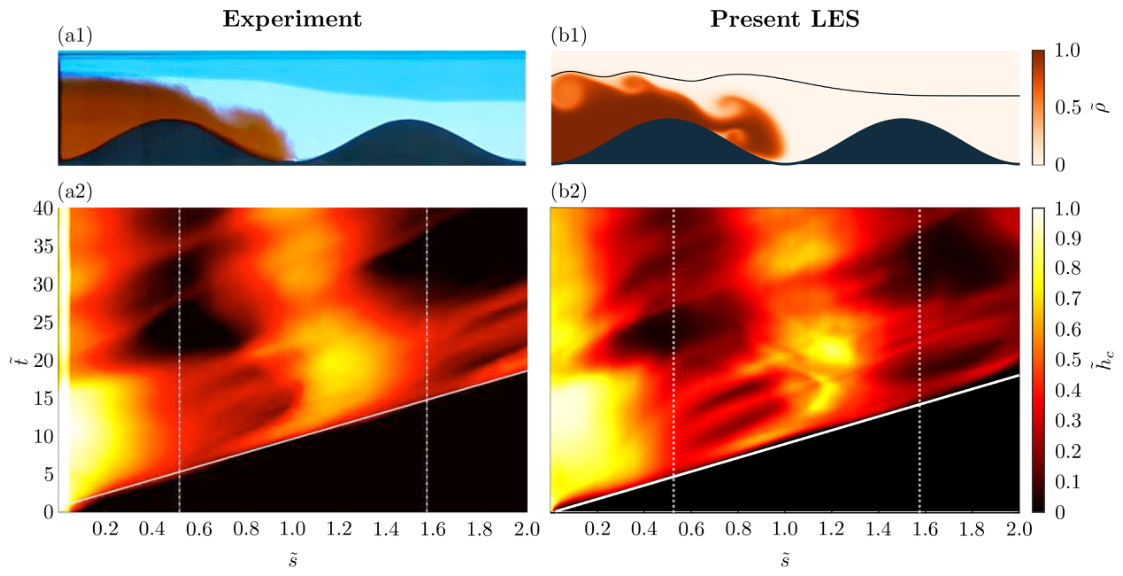
Figure 1(a1,b1) compare snapshots of the laboratory flow field with our LES results. The simulation accurately reproduces the front position, the current–ambient interface, and the ambient internal interface, showing close agreement with the measurements. Furthermore, we quantitatively evaluated the spatiotemporal distribution of the effective thickness ( h c = ρ d z ) of the gravity current. The numerical results show overall good agreement with the experimental measurements (see Figure 1(a2,b2)). Consistent with the experimental observations, the development of vortex structures, the accumulation of dense fluid between adjacent crests, and the reduced presence of dense fluid near the crests jointly contribute to variations in the distribution of h ˜ c . The dimensionless time-averaged front speed obtained from the along-slope front trajectory (white solid line in Figure 1(a2,b2)) is 0.329, which is in close agreement with the experimental value of 0.336. Model validation is conducted using a more complex topography than the isolated triangular obstacle considered in this study. Even under this challenging setting, the simulations accurately reproduce the key flow features of gravity-current propagation over the topography. The mesh resolution is determined based on a mesh-independence test. Although not shown here, the flow structures do not change significantly when the mesh spacing is halved. Considering computational cost, this study adopts the same mesh resolution as used in the model validation case.
In addition to the Smagorinsky model, we also test two alternative SGS closures, namely WALE and kEqn, to assess the sensitivity of the validation results to SGS parameterization. The three SGS models show slight differences in local small-scale vortical structures. The flow features relevant to the present study are robust with respect to the choice of SGS closure. For consistency, the Smagorinsky model is adopted in the main simulations.
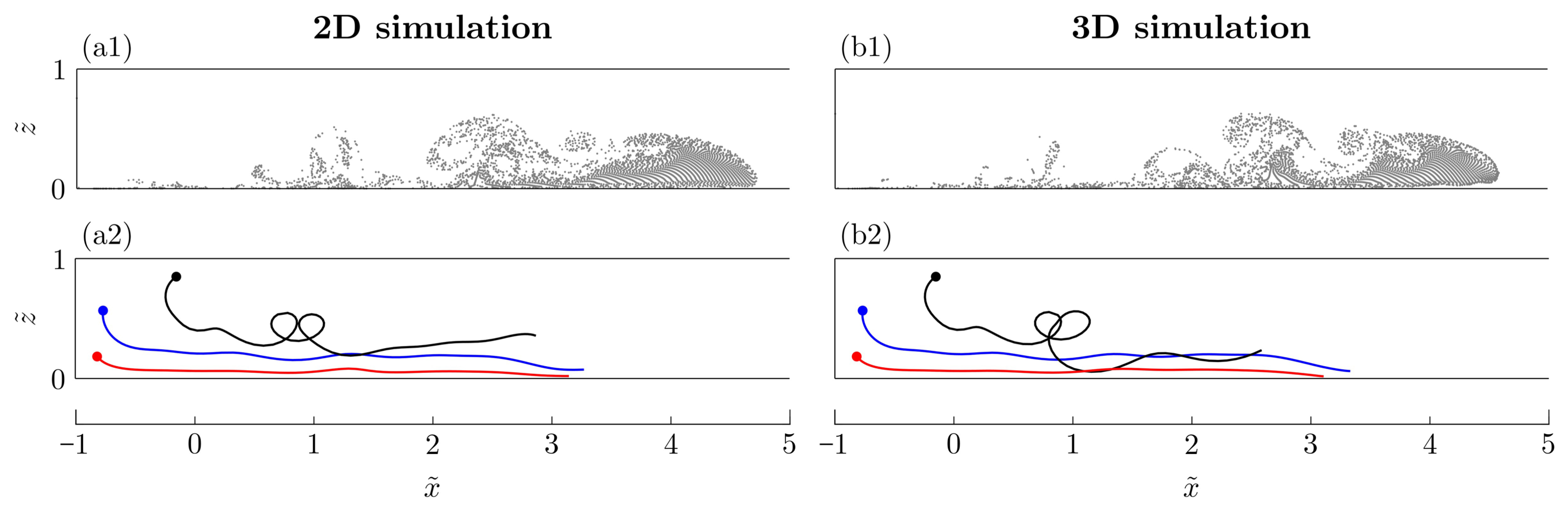
The present simulations are conducted within a 2D framework, whereas gravity currents in natural settings exhibit three-dimensional instabilities and turbulence, which may affect Lagrangian trajectories. To evaluate the relevance of the 2D simulation, the trajectories of tracer particles in the flat-bed case are compared between 2D and 3D simulations. As shown in Figure 2, the particle motion in the x-z plane exhibits little difference between the two simulations, indicating that, for the laterally uniform obstacles considered here, the streamwise-vertical dynamic features of the flow can be reasonably captured in 2D simulation.

2.3. Simulation Setup

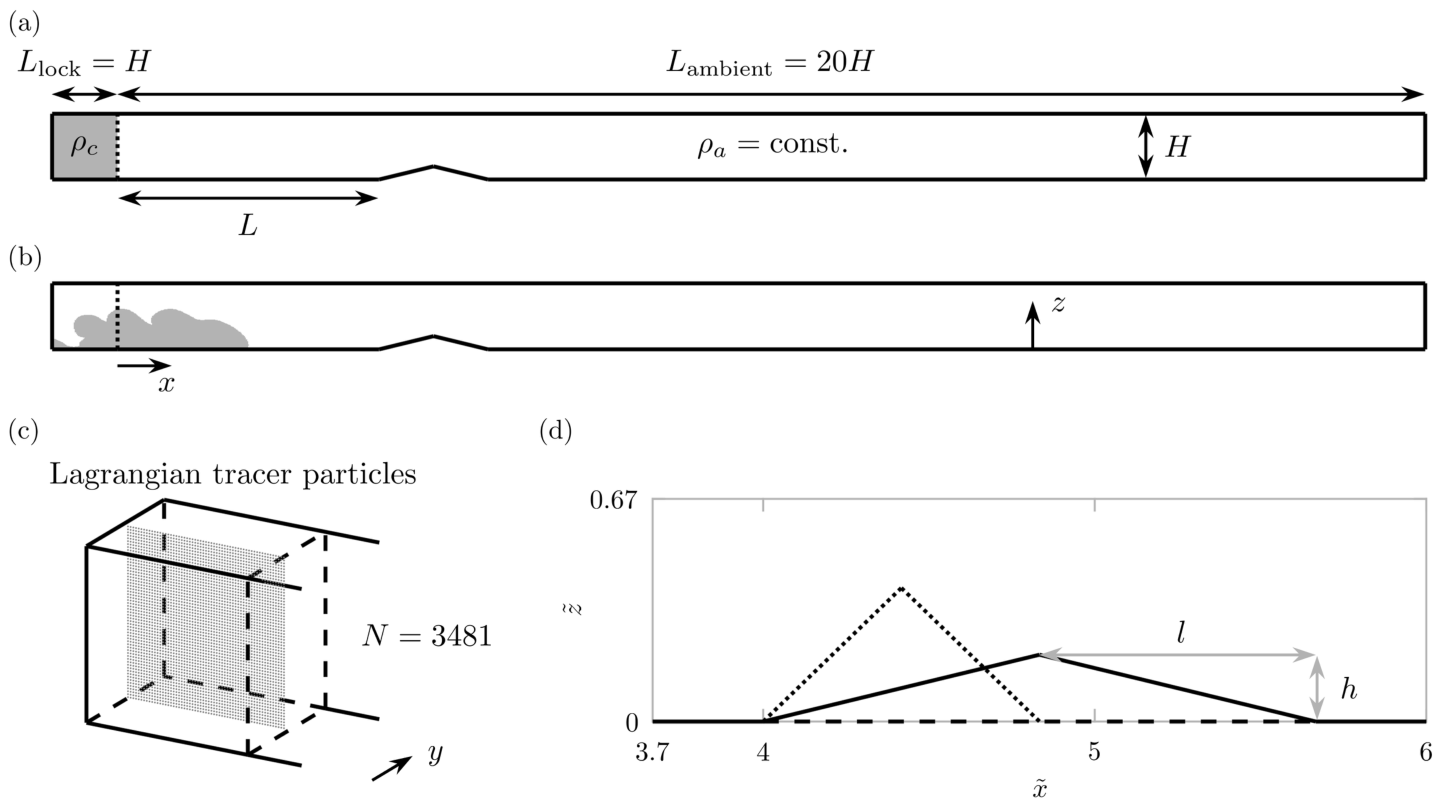
Figure 3 illustrates the numerical tank configuration used in this study for a bottom-boundary Boussinesq gravity current propagating over an isolated triangular obstacle under a full-depth lock-exchange setup. All simulations employ the same boundary conditions and mesh resolution as those used in the model validation. The total water depth is H, consisting of a lock region of length L l o c k ( L l o c k = H ) and an ambient region of length L a m b i e n t ( L a m b i e n t = 20 H ). The initial maximum and minimum densities in the lock and ambient regions are denoted by ρ c and ρ a , respectively, and the reduced gravity is defined as g = g ( ρ c ρ a ) / ρ c .
Upon removal of the vertical gate at x = 0 , the denser fluid forms a gravity current that propagates rightward along the channel bed. After traveling a distance L, the current encounters a bottom-mounted triangular obstacle, uniformly distributed along the spanwise direction. The isosceles obstacle is characterized by its height h and the horizontal distance l from the toe to the crest (see Figure 3d). In this study, the product l h is held constant. The channel Reynolds number is R e H = u b H / ν , where u b = g H is the buoyancy velocity. The detailed model parameters are summarized in Table 1.
To examine gravity-current motion, functionality from the solidParticleCloud class is incorporated into the existing OpenFOAM solver to enable the introduction of tracer particles into the model. The motion of particles in fluids is described in a Lagrangian way. The tracer particles are assumed to have negligible volume and inertia, and are one-way coupled with the flow, such that their influence on the fluid flow is negligible. Initially, particles are uniformly seeded in the x-z plane at the spanwise center of the lock region (see Figure 3c), with a particle spacing of δ x = δ z = 0.017 H . Subsequently, particle positions and velocities are determined by solving Newton’s second law of motion. A total of N = 3481 markers are tracked throughout the simulation to record trajectories. Particle trajectories provide an intuitive representation of the motion of fluid elements within the plane, thereby delineating the regions reachable by the gravity current from given initial locations.
In all LES runs, the buoyancy velocity u b and the flow depth H are used as the characteristic velocity and length scales, respectively. All variables are nondimensionalized as t ˜ = t u b / H , z ˜ = z / H , x ˜ = x / H , l ˜ = l / H , h ˜ = h / H , L ˜ = L / H , and h ˜ c = h c / H . Tildes denote nondimensional quantities. Density is nondimensionalised as ρ ˜ = ( ρ ρ a ) / ( ρ c ρ a ) [ 0 , 1 ] , where ρ is the absolute density.

2.4. Clustering Methodology

A range of methods is available for identifying clusters from vector data. Among them, the K-means algorithm [51] is a widely used clustering technique and has been extensively applied in marine meteorology, particularly for the analysis of cyclone trajectories [52,53,54]. The method partitions the data into k clusters by maximizing the variance between clusters relative to the variance within each cluster, as measured with respect to the cluster centroids in the feature space.
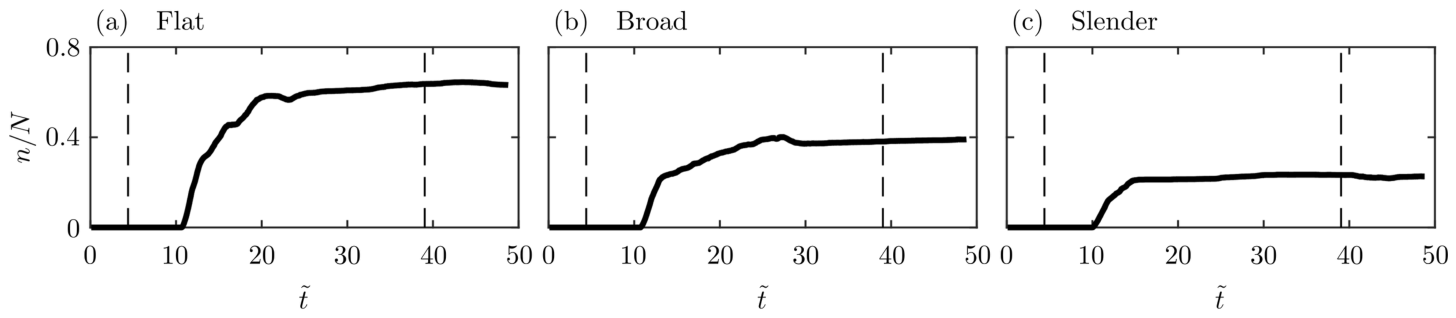
Here, K-means clustering is applied to classify the trajectories of Lagrangian tracer particles. Particle motion is represented by time series of streamwise (x) and vertical (z) displacements, describing their spatiotemporal evolution. To exclude the initial transient associated with lock collapse, clustering is initiated at t ˜ = 4.39 , by which time the dense fluid has fully collapsed and a canonical gravity-current structure is established.The clustering analysis is terminated at t ˜ = 39.04 , at which point the number of particles ( n / N ) that have passed over the obstacle crest and are located on the downstream side has become stable (see Figure 4a–c). The selected time interval is sufficient to represent the complete evolution of the gravity current. During the propagation of the gravity current, variations in the streamwise displacement are much larger than those in the vertical displacement. To ensure comparable contributions of both variables in the clustering analysis, the data matrix is standardized to have zero mean and unit variance.
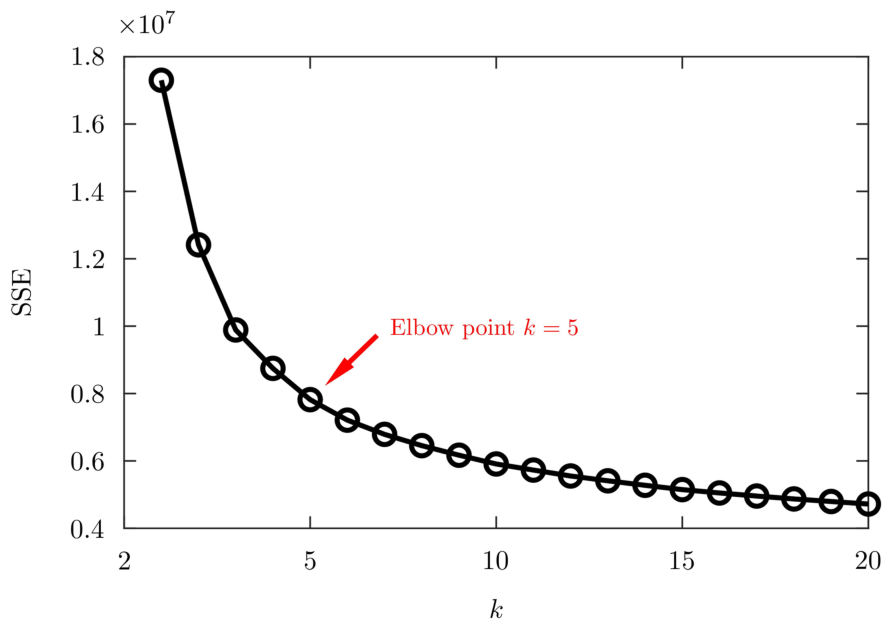
Selecting an appropriate number of clusters is crucial. A larger number of clusters is not necessarily better. Too many clusters are not beneficial for induction. The Elbow Method provides a simple yet effective way to determine this optimal number. As the number of clusters (k) increases, the sample partition becomes more refined, the compactness within each cluster improves, and the sum of squared errors (SSE) gradually decreases. However, after a certain point, the rate of decrease slows, forming an elbow shape on the graph. This elbow indicates the optimal value of k. In Figure 5, the elbow point corresponds to k = 5 , which is therefore selected as the optimal number of clusters in this study. The K-means algorithm is implemented in MATLAB R2023b. The K-means implementation in MATLAB R2023b allows multiple runs with random initialization of cluster centroids, in which the algorithm is initialized with different centroids to reduce the risk of convergence to a local optimum.

3. Results

3.1. Clustering-Based Lagrangian Transport Pathways

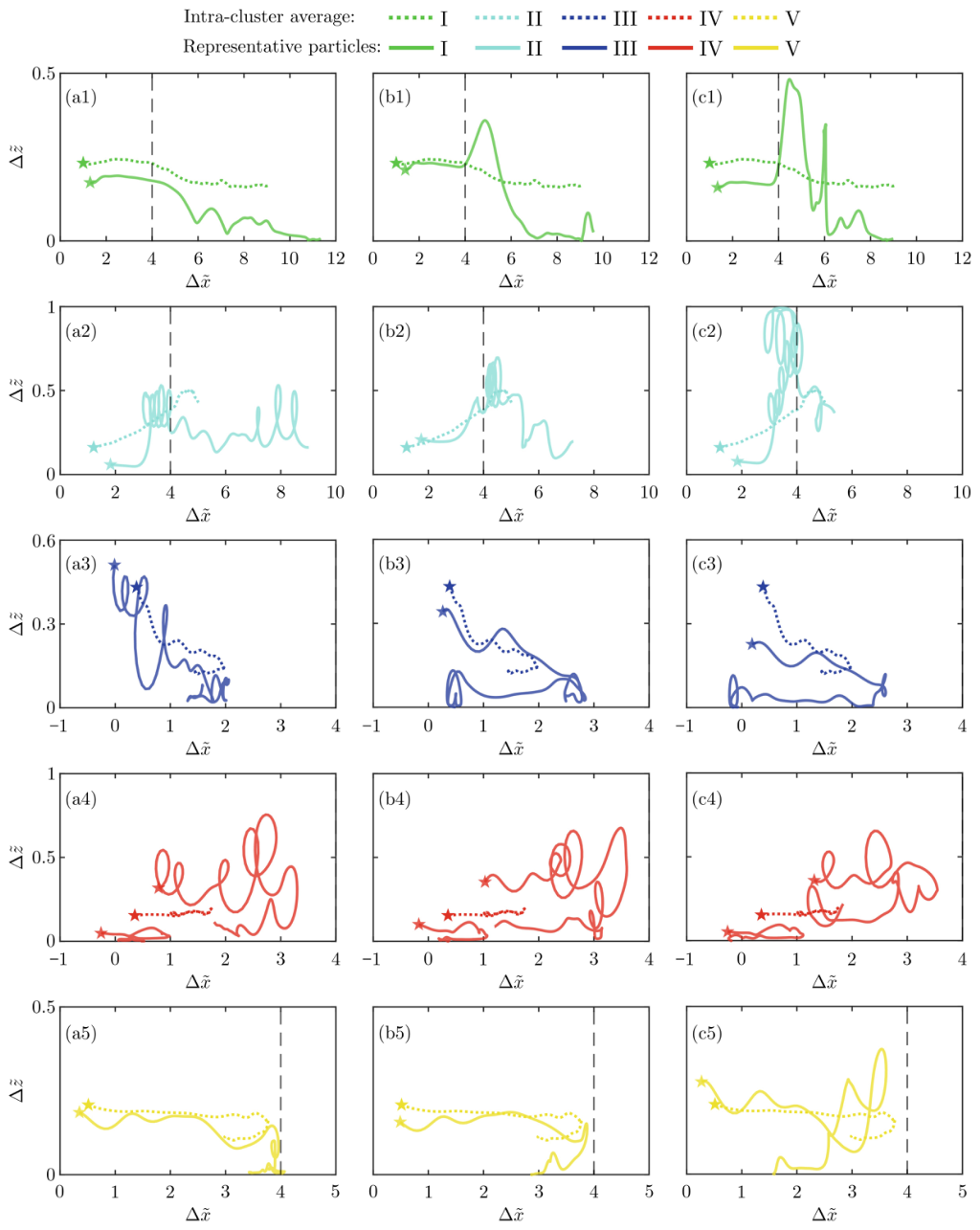
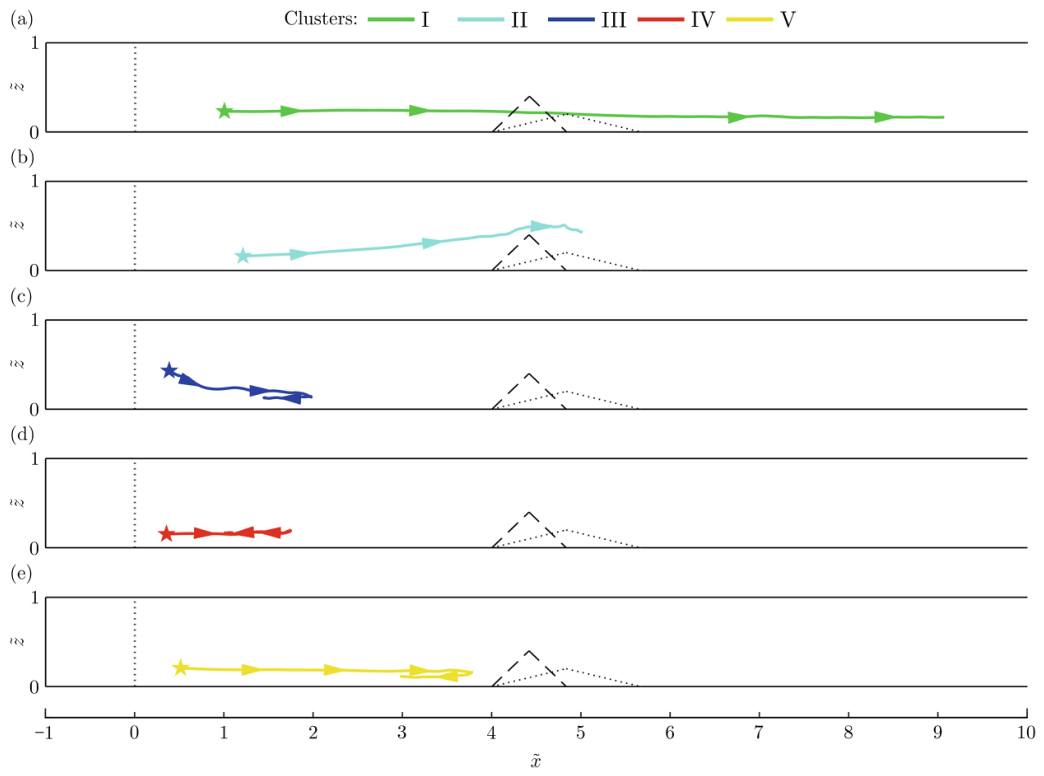
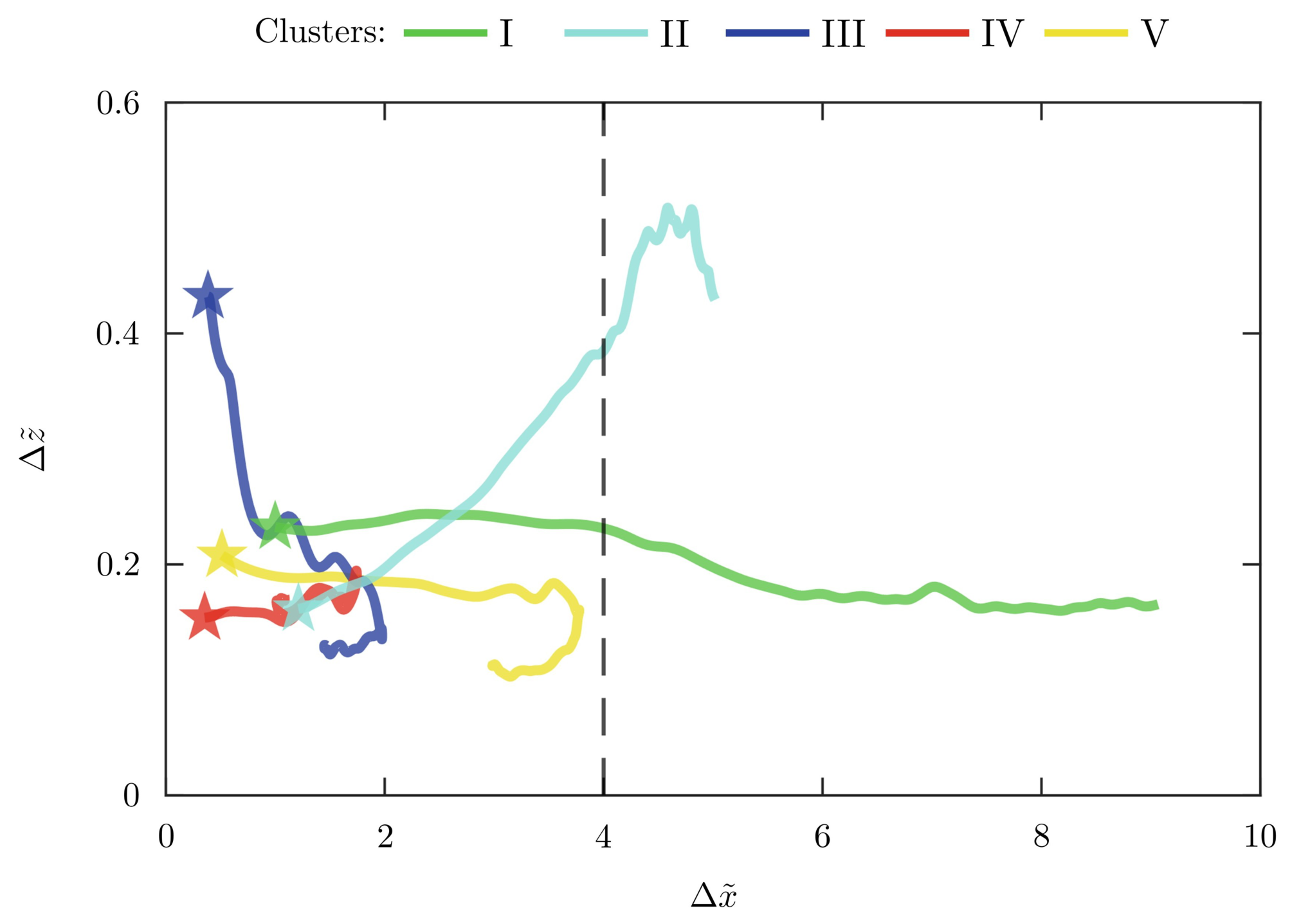
Using the above method, the displacement data of tracer particles are analyzed by clustering. The mean trajectories of particles in each cluster are shown in Figure 6 in the x ˜ - z ˜ coordinate system. The five clusters characterize the motion trajectories of gravity current fluid elements with distinct features. Clusters I (green) and II (cyan) are the only two clusters whose particles are able to reach to the downstream side of the obstacle. Among them, Cluster I exhibits the largest positive streamwise displacement and travels farthest downstream, whereas Cluster II is characterized by the strongest upward (positive z-direction) motion, ascending along the flow direction as it passes over the obstacle. Cluster III (blue) originates from higher water layers and descends along the flow path, whereas Cluster IV (red) originates near the bottom and shows little variation in elevation during downstream motion. Particles in Clusters III and IV undergo a reversal of motion after traveling a certain downstream distance. Cluster V (yellow) moves downstream toward the upstream slope of the obstacle but does not overtop it, instead reversing direction and migrating upstream. To further illustrate the motion characteristics of each cluster, Figure 7 presents the evolution of the mean particle displacement in the ( Δ x ˜ , Δ z ˜ ) coordinate system relative to the absolute coordinate origin, and the displacement trends are consistent with the behaviors described above. We consider different numbers of clusters and find that when k = 4 , the clustering merges the motion characteristics of Cluster IV and Cluster V particles into a single cluster. When k = 6 , Cluster I particles are split into two clusters with similar motion characteristics, both being transported a considerable distance downstream past the obstacle.
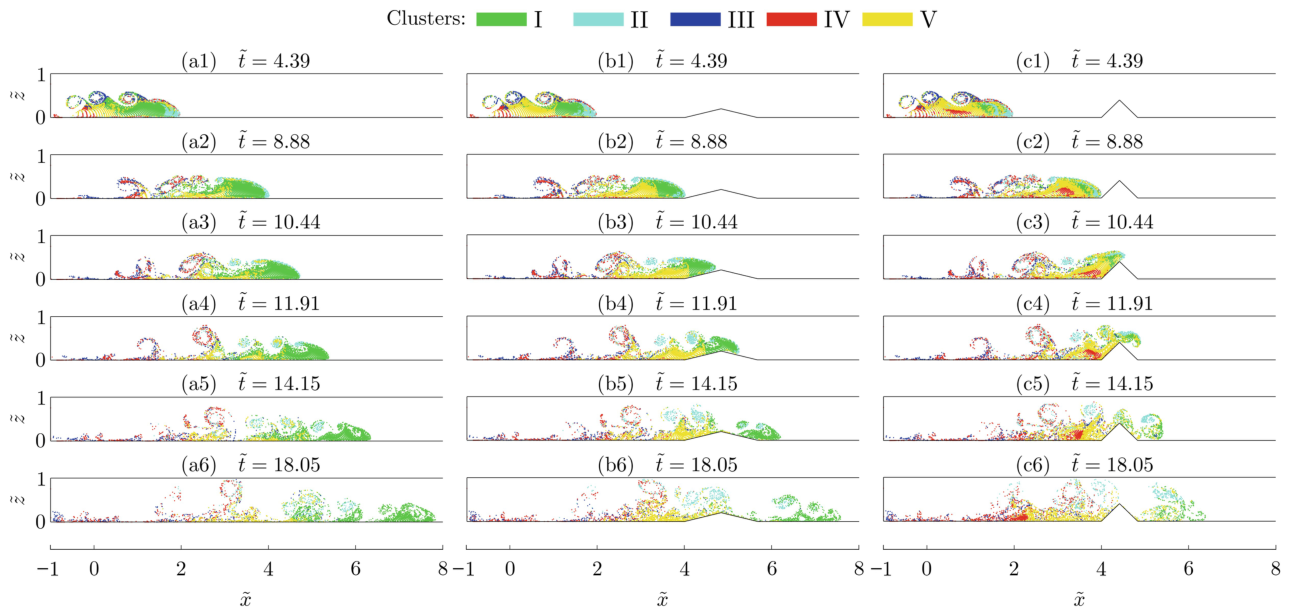
Figure 8 illustrates the temporal evolution of particle motion for different triangular-obstacle aspect ratios. At the initial stage (Figure 8(a1,b1,c1)), the dense fluid collapses and the gravity current subsequently begins to propagate. Here, the gravity-current head refers to the leading coherent body of dense fluid, whereas the front denotes the foremost tip of the current. Particles in Cluster I are primarily located within the body of the gravity current, biased toward the head region. The gravity-current front is composed of particles from Cluster II together with particles from Cluster IV distributed along the interface with the ambient fluid, with Cluster II occupying the main frontal body and Cluster IV concentrated near the interfacial region. A fraction of Cluster IV particles is also found in the tail of the gravity current. The influence of two-dimensional start-up vortices is evident, with particles in Cluster III being trapped and advected by these vortical structures. Cluster V particles are located between the red particles in the tail region and the green particles in the body of the current.
As the gravity current propagates, particles in Cluster II gradually migrate toward the upper vortex, whereas particles in Cluster III move downward. As a result, both clusters exhibit pronounced vertical displacements (see Figure 7), with Cluster II showing positive motion in the z-direction and Cluster III showing negative motion. With further evolution, particles in Clusters III and IV tend to remain in the tail region; consequently, their net streamwise displacements are relatively small (see Figure 7).
For the runs with an isolated triangular obstacle on the bottom, when the current reaches the upstream slope of the obstacle (Figure 8(a2,b2,c2)), particles from Cluster I migrate toward the head region, leading to an increased contribution of Cluster I particles at the leading edge compared with the initial stage (Figure 8(a1,b1,c1)). This behavior reflects the relatively high streamwise velocities within the core of the gravity current, which is separated from both the bottom boundary layer and the upper mixing layer with the ambient fluid. As a result, when the current encounters the obstacle, particles originating from the core region are more effective in maintaining forward momentum, with Cluster I particles traveling the farthest downstream.
For the low-volume-release gravity currents considered in this study, the absence of a sustained supply of dense fluid implies that part of the current lacks sufficient buoyancy forcing to overcome the topographic barrier. Consequently, particles in Cluster V reverse their motion after reaching the upstream slope of the obstacle and migrate upstream, as indicated by the decrease in Δ x ˜ of the yellow curve in Figure 7.
The spatiotemporal evolution of particles highlights pronounced differences induced by the obstacle aspect ratio. As the flow continues to evolve from the early stages (Figure 8(a1,b1,c1)) through the interaction with the obstacle (Figure 8(a2,b2,c2)) and toward later times, these differences become increasingly evident. By comparing Figure 8(a6,b6,c6), a clear reduction in the horizontal propagation speed and a decrease in the number of particles transported to the downstream side of the obstacle can be observed. In addition, both the spatial distribution of particles and the relative population among different clusters exhibit noticeable variations.

3.2. Effect of Obstacle Aspect Ratio

To further examine the influence of the obstacle on the motion characteristics of particles in different clusters, a more intuitive description based on individual particle trajectories is adopted. Accordingly, the temporal evolution of the displacements of representative particles from each cluster is shown in Figure 9. As discussed above, particles in Cluster I form the primary component that overtops the obstacle and continues to propagate downstream. As the configuration transitions from a flat bed to a broad obstacle and further to a slender obstacle, with both the upstream slope and obstacle height increasing simultaneously, the blocking effect becomes progressively stronger. Over the same time interval, the positive streamwise (x-direction) displacement of Cluster I particles decreases, while their upward (positive z-direction) displacement increases markedly as they pass over the obstacle (compare Figure 9(a1,b1,c1)). Cluster II particles migrate from the frontal region of the gravity current toward the interfacial vortex; for the slender-obstacle case (Figure 9(c2)), the vortex is more intense, leading to the strongest vertical displacement. Cluster III particles advance downstream with the gravity current, transitioning from higher interfacial vortices toward the lower tail region of the current.
After encountering the upstream face of the obstacle, particles in Cluster V begin to migrate in the negative x-direction (corresponding to Figure 9(b5,c5)) and subsequently induce particles in Cluster IV located further upstream to also move in the negative x-direction (corresponding to Figure 9(b4,c4)). This reverse streamwise motion is more pronounced for the slender obstacle (cf. Figure 9(b5,c5), as well as Figure 9(b4,c4)). The enhanced reversal arises from the larger slope and height of the slender obstacle, which cause Cluster V particles to descend along the slope from a higher elevation (see Figure 9(c5)), thereby exerting a stronger backward influence on upstream particles. As a consequence, more particles exhibit reduced net displacement in the x-direction, and some particles originally classified as Cluster V are reassigned to Cluster IV under the influence of the slender obstacle (see Figure 8(c1–c6)).
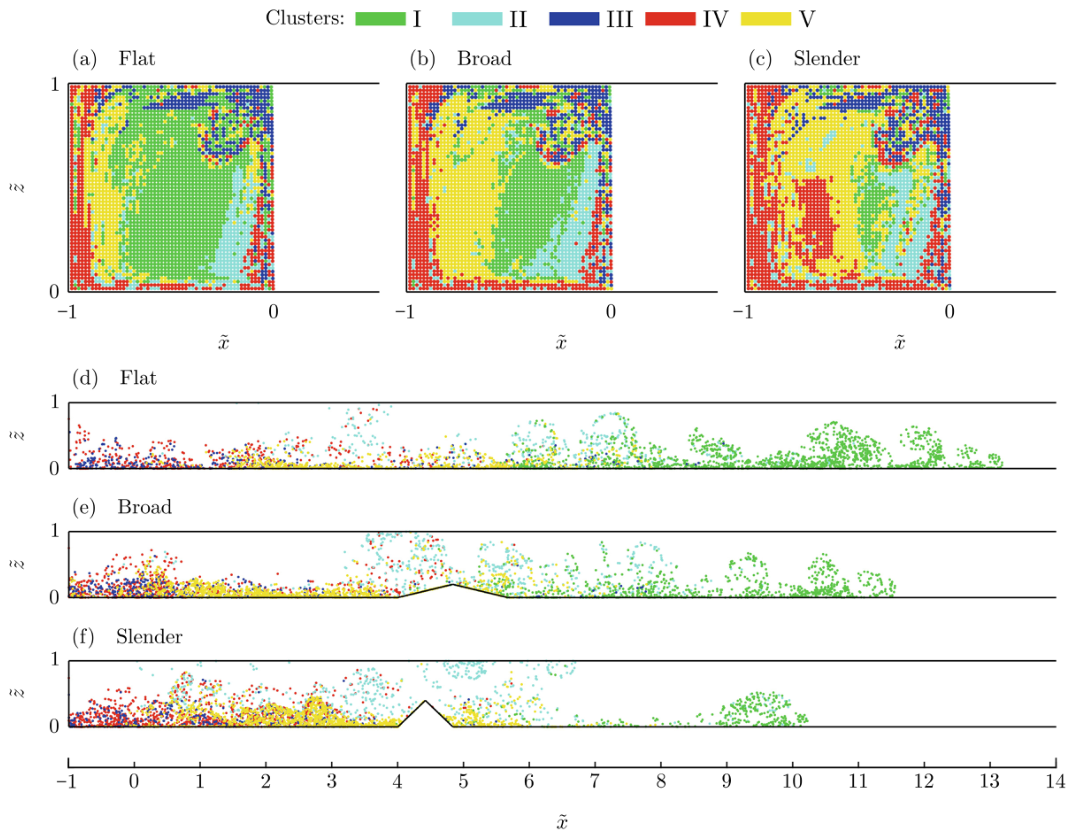
Next, Figure 10 illustrates the relationship between particle fate and their initial positions within the lock region, allowing an assessment of whether particles released from specific locations are preferentially transported to particular regions during the evolution of the gravity current. For all runs, Cluster I particles, which travel the farthest downstream and ultimately overtop the obstacle, originate predominantly from the central region of the lock. Cluster II particles are initially released from the right side of the lock and form the gravity-current front at the onset of the clustering analysis, which starts at t ˜ = 4.39 to exclude the initial lock-collapse stage (see Figure 8), and are found near the obstacle at the final stage (Figure 10d–f). Blue particles from the upper boundary of the lock (Cluster III) and red particles from the left and right boundaries (Cluster IV) tend to accumulate in the tail region of the current, a tendency that is more pronounced for the slender-obstacle case (see Figure 10f). Cluster V particles are distributed on the upstream side of the obstacle at the final time; compared with Clusters III and IV, which are also located upstream, Cluster V particles remain closest to the obstacle, occupying the region immediately adjacent to the upstream slope.
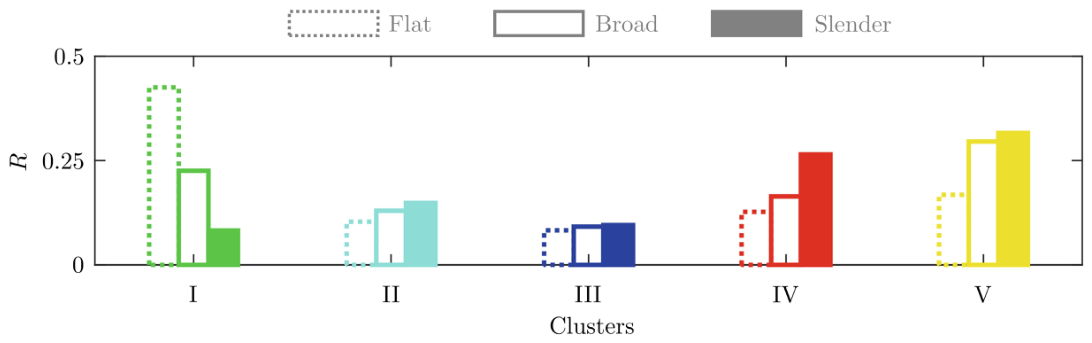
An analysis of the particle fractions in each cluster (Figure 11) shows that, as the upstream slope and height of the obstacle increase simultaneously, the fraction of Cluster I particles transported to the downstream side of the obstacle decreases markedly. Correspondingly, the fractions of particles in Clusters II, IV, and V increase. Variations in obstacle aspect ratio exert only a weak influence on Cluster III, which exhibits a slight increase in particle fraction. Meanwhile, the magnitudes of the changes among different clusters are not uniform when transitioning from a flat bed to a broad obstacle and from a broad obstacle to a slender obstacle. These discrepancies are closely related to differences in flow evolution, as discussed in Section 4.1.

3.3. Effect of Obstacle Standoff Distance

To control the dynamical state of the gravity current at the moment of impact, and thereby disentangle the effects of along-path evolution from those of obstacle geometry (see Section 3.2), we keep its shape fixed as a broad obstacle while varying the standoff distance. The standoff distance is defined as the flat-bed length between the lock gate and the upstream toe of the obstacle ( L ˜ ). Its influence on particle transport is examined by systematically comparing simulations with different values of L ˜ .
For different values of L ˜ , the late-stage organization of particle clusters remains qualitatively similar to that described in Section 3.2. In all cases, particles associated with Clusters III and IV predominantly occupy the trailing part of the gravity current, whereas Clusters V, II, and I are distributed progressively farther downstream. This observation indicates that varying L ˜ does not fundamentally modify the overall structure of the gravity current at late times.
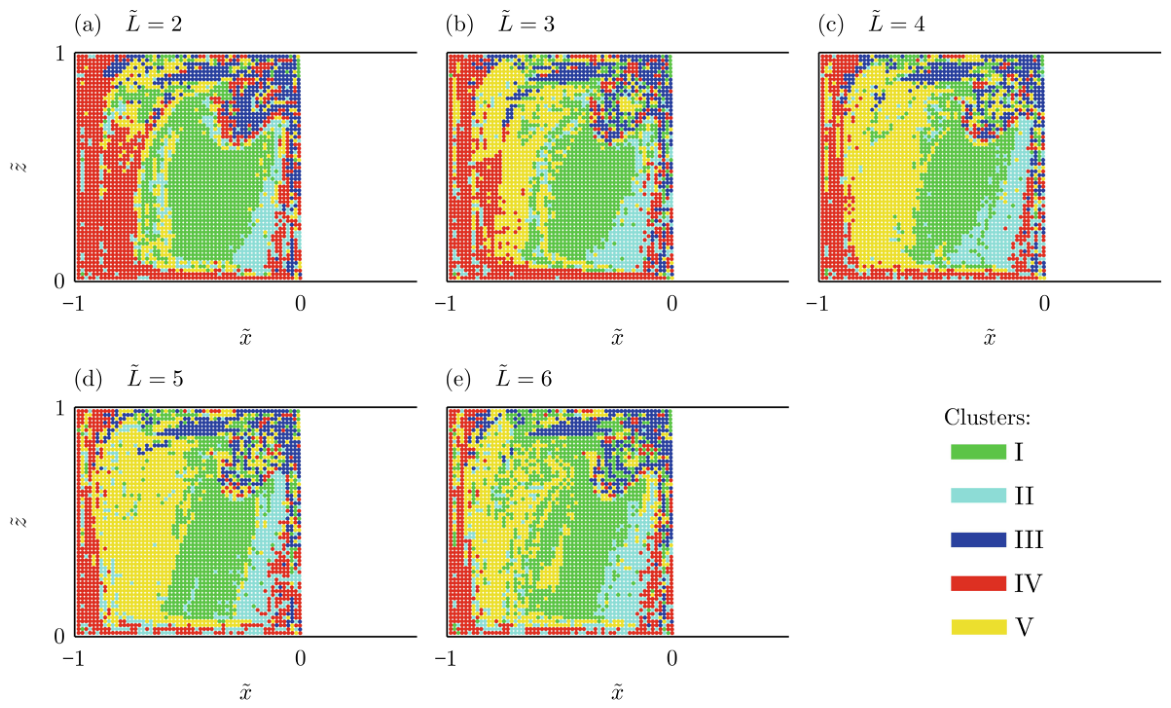
However, this similarity in the final configuration masks substantial differences in particle origin and population associated with different standoff distances. To reveal these differences, we first examine the distribution of particles from each cluster within the initial lock region. As shown in Figure 10a–c and Figure 12, variations in L ˜ do not change the relative spatial arrangement of clusters within the lock. Specifically, Cluster I particles originate primarily from the central region of the lock; Cluster II particles from the lower-right region; Cluster III particles from the upper region; Cluster IV particles from the left boundary, right boundary, and bottom boundary; and Cluster V particles from the left side of the lock, located between the regions occupied by Clusters I and IV.
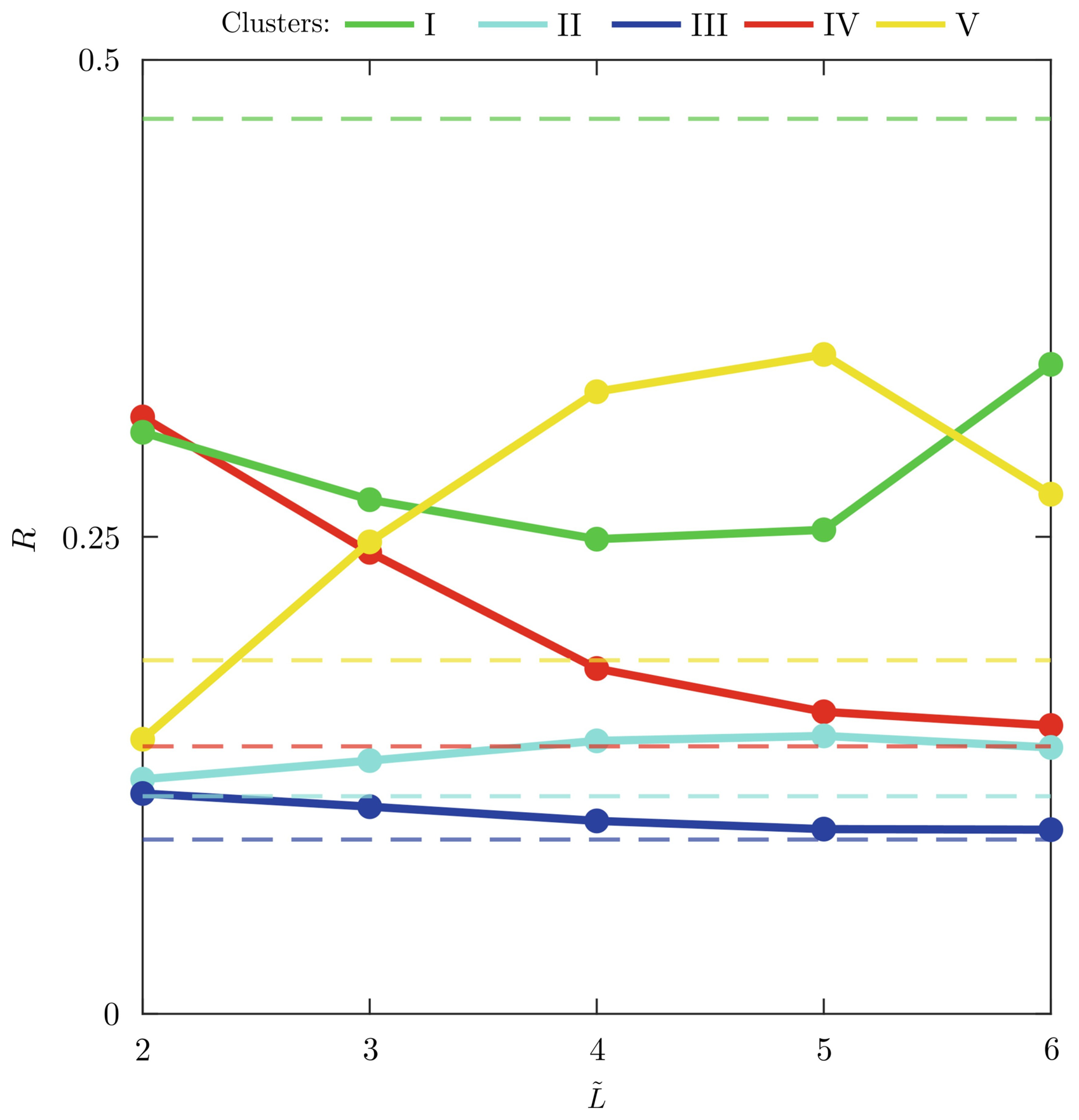
Although the spatial origin of each cluster remains robust, changing L ˜ leads to pronounced variations in the relative populations of the clusters. This sensitivity reflects differences in the dynamical state of the gravity current at the moment it encounters the obstacle, rather than changes in the initial spatial organization of the flow. To quantify these effects, we compute the fraction of particles in each cluster as a function of L ˜ , as shown in Figure 13.
The response of particle populations to variations in L ˜ differs markedly among the clusters. The influence of L ˜ on Clusters II and III is relatively weak, with their populations remaining close to those in the flat-bed reference case and exhibiting only modest overall variations. As L ˜ increases, the number of Cluster II particles shows a non-monotonic trend, first increasing and then decreasing, whereas the number of Cluster III particles decreases monotonically. In contrast, Clusters I and V exhibit much stronger sensitivity to L ˜ and display opposite trends. With increasing L ˜ , the population of Cluster I particles initially decreases and then increases, while that of Cluster V particles increases first and then decreases. Although the presence of an obstacle consistently reduces the number of particles transported to the far downstream region, a shorter standoff distance does not necessarily correspond to fewer particles in Cluster I. The population of Cluster IV particles decreases monotonically with increasing L ˜ , indicating a progressive redistribution of particles between Clusters IV and V, as illustrated by the confinement of Cluster IV particles from a broad left-side region of the lock at small L ˜ to the left boundary at larger L ˜ (Figure 12). Together, these results demonstrate that particle fate is strongly dependent on the dynamical stage of the gravity current at the moment of impact, rather than solely on obstacle presence. The relationship between flow structures and particle trajectories under different standoff distances will be further discussed in Section 4.1.

4. Discussion

4.1. Flow-Structure Control of Clustered Lagrangian Pathways and Fate

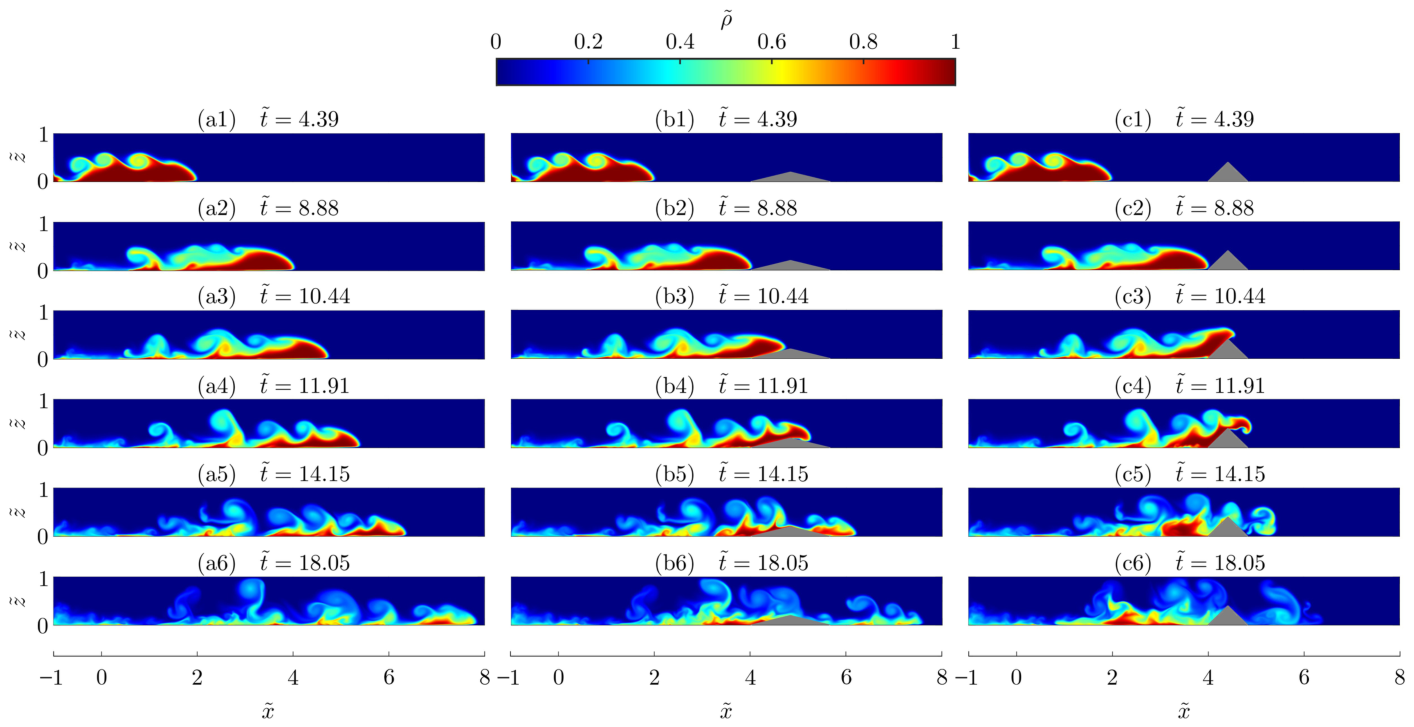
The trajectories of Lagrangian tracer particles are governed by the underlying flow field. To interpret how an isolated triangular obstacle regulates particle transport in a gravity current generated by a low-volume release, we examine the evolution of the dominant flow structures and relate them to particle motion. Following gate removal, the dense fluid collapses beneath the lighter ambient fluid and forms a gravity current that propagates along the bottom, developing a characteristic head followed by a tail (see Figure 14(a1,b1,c1)). During propagation, entrainment of ambient fluid increases the volume of the current while reducing its mean density, and Kelvin–Helmholtz (K-H) instabilities develop near the rear of the head, promoting mixing. Although the obstacle geometry considered here is idealized, it captures key processes common to gravity-current interactions with isolated topographic features, including upstream reflection, partial overflow, and flow separation.
The interaction between the gravity current and the obstacle can be divided into three successive stages: approach, collision, and reattachment. During the approach stage, the gravity current remains largely unaffected by the obstacle (see Figure 14(b1,b2,c1,c2)), and its structure resembles that over a flat bed. In this stage, particles associated with Cluster II are progressively entrained into vortical structures near the head, whereas particles in Cluster IV tend to migrate toward the tail of the current, consistent with the particle distributions shown in Figure 8(b1,b2,c1,c2). The collision stage begins when the gravity-current head reaches the upstream slope of the obstacle and is deflected upward. A portion of the current, carrying predominantly Cluster I particles, surmounts the obstacle (corresponding to Figure 14(b3,b4,c3,c4), as well as Figure 8(b3,b4,c3,c4)) and continues to propagate downstream (see Figure 14(b5,b6,c5,c6), as well as Figure 8(b5,b6,c5,c6)), marking the onset of the reattachment stage. In this stage, the overflow persists as a gravity current downstream of the obstacle, while the remainder is reflected upstream as a bore or hydraulic jump, as reported in previous studies [55,56]. The evolution of the density field upstream of the obstacle (Figure 14(b5,b6,c5,c6)) clearly illustrates this reflected motion. This reflected motion induces upstream-directed displacement of particles in Clusters III, IV, and V, as shown in Figure 6 and Figure 7.
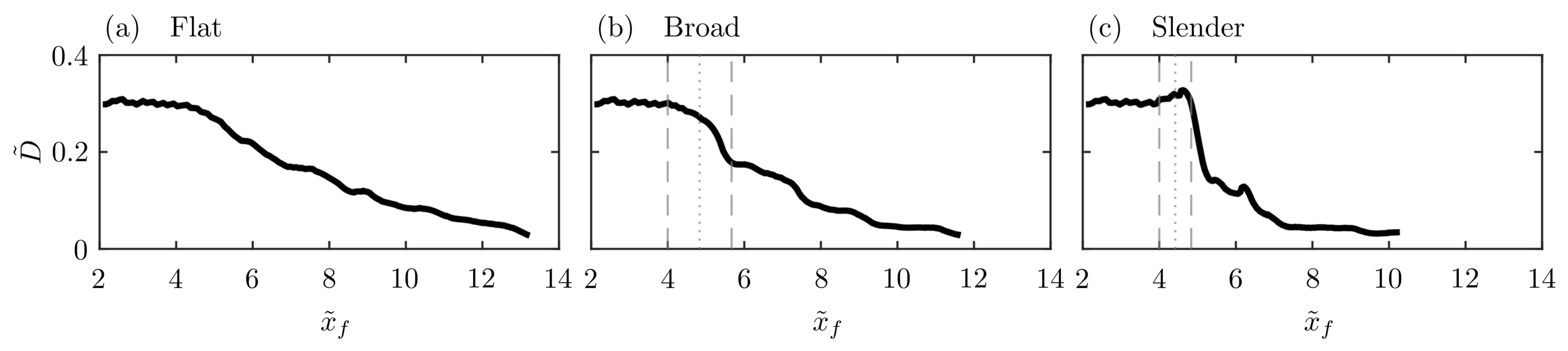
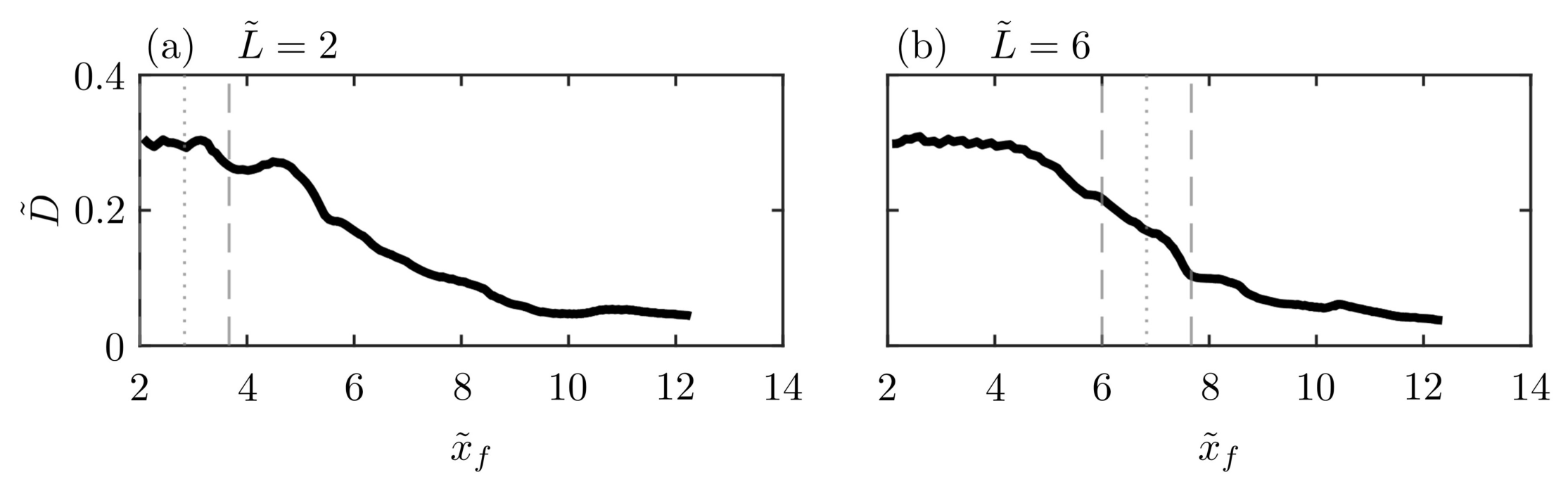
When the current surmounts the obstacle, intensified mixing develops near the head immediately downstream of the crest, associated with a separation vortex beneath the overflowing current [56]. The vortex traps a substantial amount of ambient fluid and promotes the rapid dilution of the downstream-propagating current. In this study, the dilution effect is quantified by calculating the density variation at the front of the gravity current, expressed as D = 0 H x f H x f ρ d x d z , where x f denotes the front position of the gravity current, and D is nondimensionalized by the flow depth H. Figure 15 shows the variation of D ˜ with front position. Under the flat-bed condition, the gravity current gradually dilutes along its path after propagating a certain distance. On the upstream side of an isolated obstacle, the dilution pattern is similar to that of the flat-bed case, whereas on the downstream side dilution is enhanced. For the taller obstacle with steeper slope, accumulation at the upstream side of the current causes a slight increase in D ˜ (see Figure 15c), while a more pronounced downstream vortex leads to a rapid decrease in D ˜ , with the front moving closer to the upstream over the same duration (see Figure 15c). These obstacle-controlled flow-structure changes are directly reflected in the particle statistics: the number of Cluster I particles reaching the downstream side of the obstacle decreases substantially for more slender obstacles, whereas the population of Cluster II particles rising along the intensified vortices increases correspondingly (Figure 11).
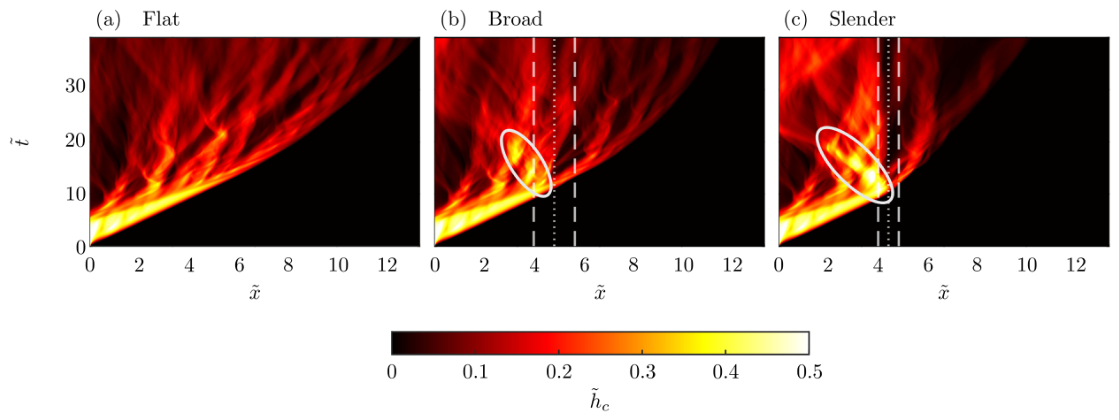
The influence of obstacle aspect ratio on these processes is further illustrated by the effective thickness of the gravity current (Figure 16). In low-volume, full-depth releases, the gravity current exhibits a regime of nearly uniform frontal velocity until reflected disturbances from the upstream boundary overtake the front. In the presence of an obstacle, increases in effective thickness near the upstream toe indicate reflection of the incoming current, while reduced effective thickness downstream reflects partial overflow following collision. For the broad obstacle, the reflected current corresponds to an increase in the number of Cluster IV particles (Figure 11), whereas for the slender obstacle this reflection effect is stronger, allowing dense fluid to propagate farther upstream and facilitating transformation of particles from Cluster V to Cluster IV (see Figure 8c). The varying intensity of reflection thus explains the differences in particle populations among clusters shown in Figure 11.
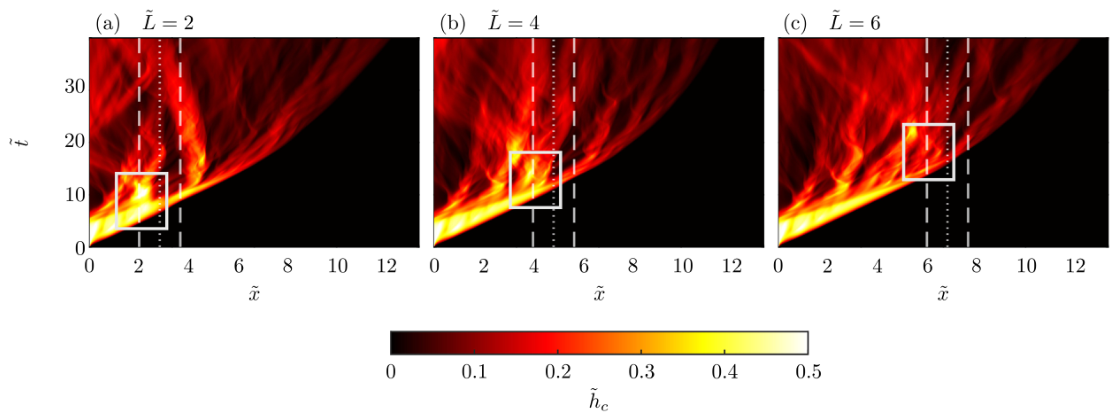
Finally, the non-monotonic influence of the standoff distance L ˜ on particle transport can be interpreted in terms of the dynamical state of the gravity current at the moment of impact (Figure 17). For small L ˜ , the gravity current approaches the obstacle with relatively strong buoyancy forcing (as indicated by the white outlines in Figure 17a), enabling a larger fraction of the current to overcome the along-slope resistance and surmount the obstacle. The growth, saturation, and eventual breakdown of K-H vortices enhance along-path mixing in the gravity current. As L ˜ increases, the effective buoyancy forcing at the head during impact is reduced, thereby strengthening the blocking effect of the obstacle and decreasing the downstream transport of Cluster I particles (Figure 13). With further increase in L ˜ , the influence of the obstacle on the gravity-current head weakens, and along-path mixing becomes the dominant control. Similarly, we quantify the dilution effect at the front of the gravity current. As shown in Figure 18, for smaller L ˜ , the front maintains a relatively high D ˜ while surmounting the obstacle. For larger L ˜ , the dilution pattern of the gravity current front resembles that of the flat-bed case (compare Figure 15a and Figure 18b), and D ˜ has already decreased markedly by the time the front surmounts the obstacle. Ultimately, as L ˜ increases, particle populations in all clusters gradually converge toward those observed in the flat-bed case (Figure 13). These results indicate that particle fate is controlled not only by obstacle geometry but also by the stage of gravity-current development at the moment of collision.

4.2. Implications for Lagrangian Fate Prediction and Control

Previous studies have extensively documented how isolated obstacles modify the instantaneous flow structure of gravity currents from an Eulerian perspective. In contrast, the present study focuses on the motion of fluid elements and their ultimate fate. Consistent with Guyenne & Kalisch [24], our results show that a Lagrangian perspective can capture key kinematic features of highly transient and nonlinear gravity-current systems. A similar pathway-based view was adopted by Zhou et al. [29], who revealed the dispersal pathways, fate, and zone of impact of the San Francisco Bay plume. Together, these results highlight that, although Eulerian diagnostics are effective for describing local flow features near obstacles, only a Lagrangian framework can directly link fluid origin, transport pathway, and eventual fate.
The results of this study provide practical guidance for mitigating gravity currents using bottom obstacles, a challenge commonly encountered in both natural and engineered environments [57,58]. In estuarine settings, topographic barriers can limit the extent and intensity of salt intrusion, thereby protecting freshwater intakes and maintaining ecological conditions [3]. From a marine engineering perspective, artificial structures such as submerged sills, offshore platforms, and subsea pipelines or immersed tunnels inevitably interact with density-driven currents. The deployment of barriers can effectively weaken the intensity of bottom gravity currents and mitigate their impact on critical infrastructure. Although Eulerian fields provide information on local flow structures, analyses from a Lagrangian perspective offer a more direct basis for optimizing the design of submerged barrier structures, and the qualitative trends identified in this study can serve as preliminary design guidelines. Within the present idealized configuration, the results indicate that obstacle aspect ratio and standoff distance are key controlling parameters. As shown by the variation in the number of Cluster I particles (Figure 11), more slender barriers enhance downstream dilution and reduce the transport of dense fluid. Furthermore, barrier placement should avoid positions too close to the initial high-density release region. Allowing the gravity current to propagate a certain distance before encountering the barrier more effectively weakens the flow, meaning that intermediate L ˜ maximizes barrier effectiveness, whereas overly short L ˜ allows more dense fluid to surmount the barrier and overly long L ˜ reduces the barrier’s influence. This is consistent with the non-monotonic relationship between Cluster I particle numbers and the standoff distance (Figure 13).
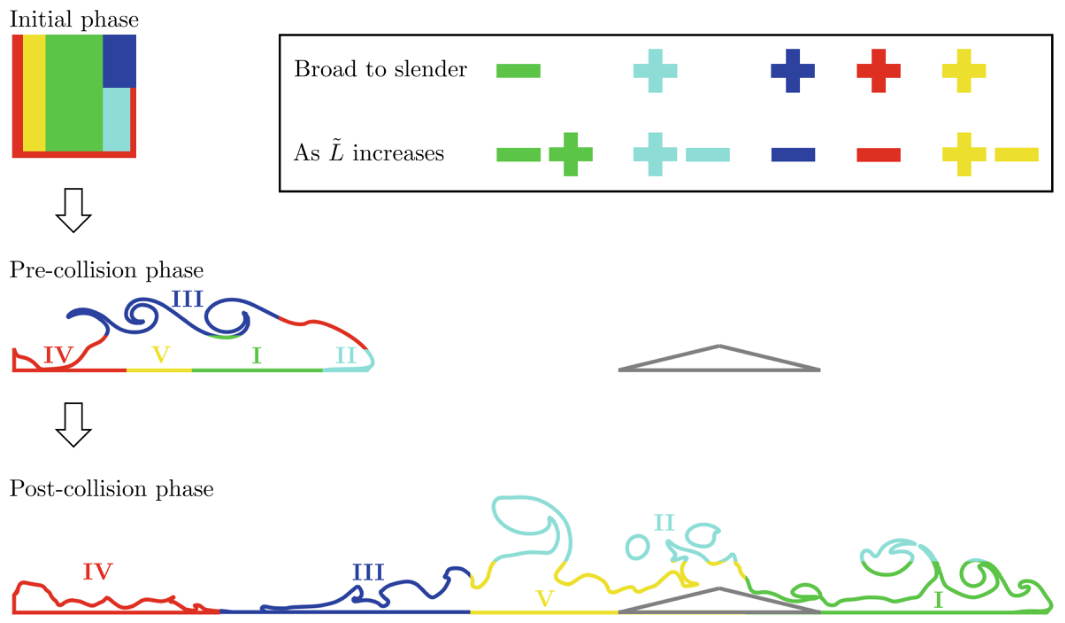
Particle trajectories illustrated in Figure 6, together with the schematic summary in Figure 19, demonstrate how fluid elements evolve through successive stages of collapse, propagation, obstacle interaction, and eventual dissipation. The present framework should therefore be understood primarily as a mechanistic and physically interpretable description of source–pathway–fate relationships under the idealized conditions considered here, rather than as a fully validated predictive tool with quantified uncertainty bounds.
Low-volume, localized gravity-current releases occur in a wide range of contexts, including terrestrial hazards such as avalanches, debris flows, and dam-break floods, as well as sudden pollutant releases in marine and coastal environments. In marine environments, accidental releases of dense substances, such as those resulting from submarine pipeline ruptures, fuel leakage, drilling fluid discharge, or industrial accidents, may generate dense gravity currents that propagate along the seafloor. By combining release location data with topographic characteristics, the Lagrangian framework allows preliminary prediction of possible pollutant transport pathways and impact extent. Compared with purely Eulerian diagnostic approaches, trajectory-based analyses provide more intuitive and operational tools for emergency response planning, environmental risk assessment, and the design of monitoring strategies.
Finally, repeated interactions between gravity currents, particularly turbidity currents, and seafloor topography play a fundamental role in shaping patterns of erosion and deposition, contributing to the formation of fans, lobes, gullies, and levees [59,60]. Although this study focuses on passive tracer particles and does not account for processes such as particle inertia, settling velocity, or resuspension, the existing Lagrangian framework provides a novel perspective for identifying material sources and transport pathways in long-term geomorphic processes. The Lagrangian trajectories identified here can be regarded as an upper-bound estimate of transport potential.

4.3. Robustness of Lagrangian Clusters Under Varying Parameters

To further assess the robustness of the clustered Lagrangian framework, supplementary simulations are conducted for alternative geometric configurations, flow depths, initial density ratios, and release volume. These additional cases are intended to examine whether the transport modes identified in the reference low-volume lock-exchange case remain meaningful when the topographic setting or characteristic flow parameters are modified. Detailed parameter settings for these simulations are summarized in Table 2.
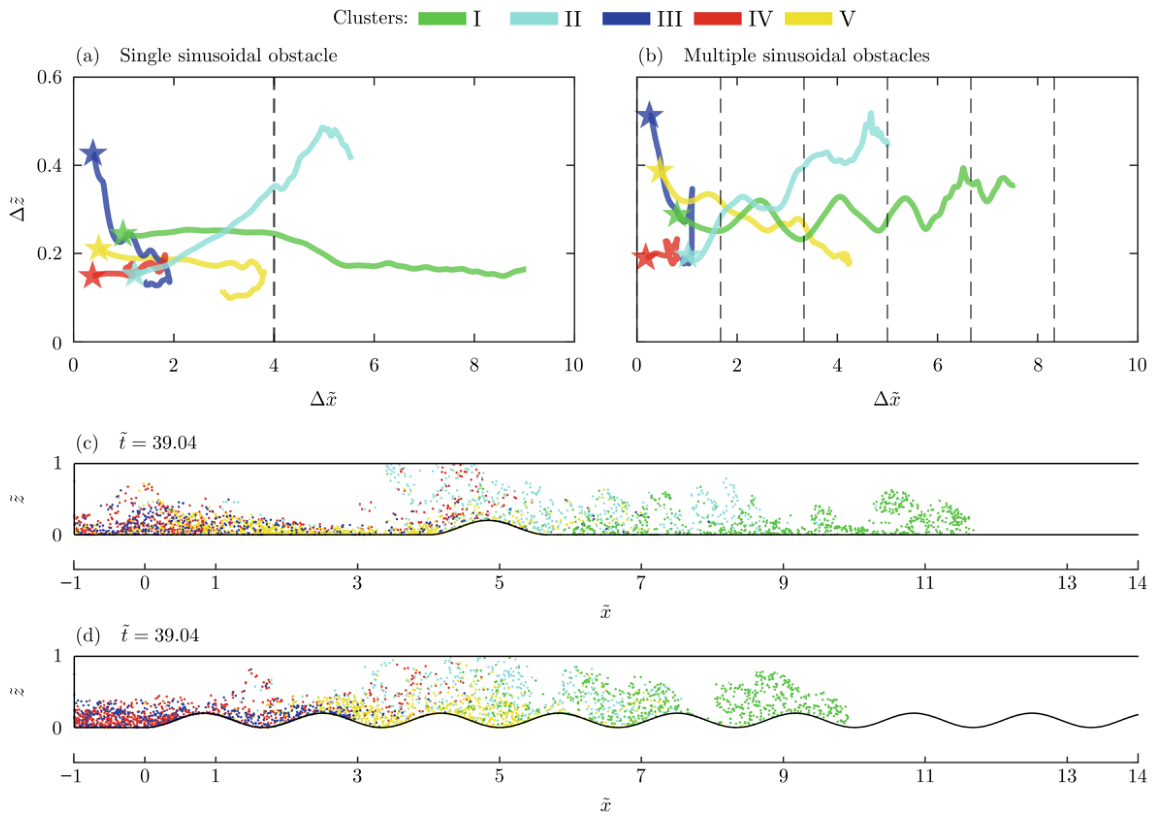
Figure 20 compares the motion characteristics of tracer particles under single and multiple sinusoidal obstacles. For a single sinusoidal obstacle, the mean displacement curve is largely similar to that observed in the previously discussed isolated triangular configuration (see Figure 7 and Figure 20a). Cluster analysis indicates that a portion of the particles can still overcome the obstacle and continue downstream, while others accumulate near the obstacle or move upstream. A smoother sinusoidal obstacle reduces flow separation, resulting in increased x-direction displacement for particles in Cluster II. In the presence of multiple sinusoidal obstacles, the continuous topography induces alternating increases and decreases in the z-direction displacement of Cluster I particles and reduces their downstream x-direction displacement. The mean displacement also shows a weakened upstream reverse motion for particles located near the upstream side. From the spatial distribution of particles under the two topographies (Figure 20c,d), the distribution pattern of each cluster from upstream to downstream remains unchanged, in the order IV, III, V, II, I. However, multiple obstacles exert a stronger hindering effect, causing more particles to be retained upstream. These results indicate that increasing topographical complexity can still allow the identification of particle motion characteristics using the Lagrangian analysis framework.
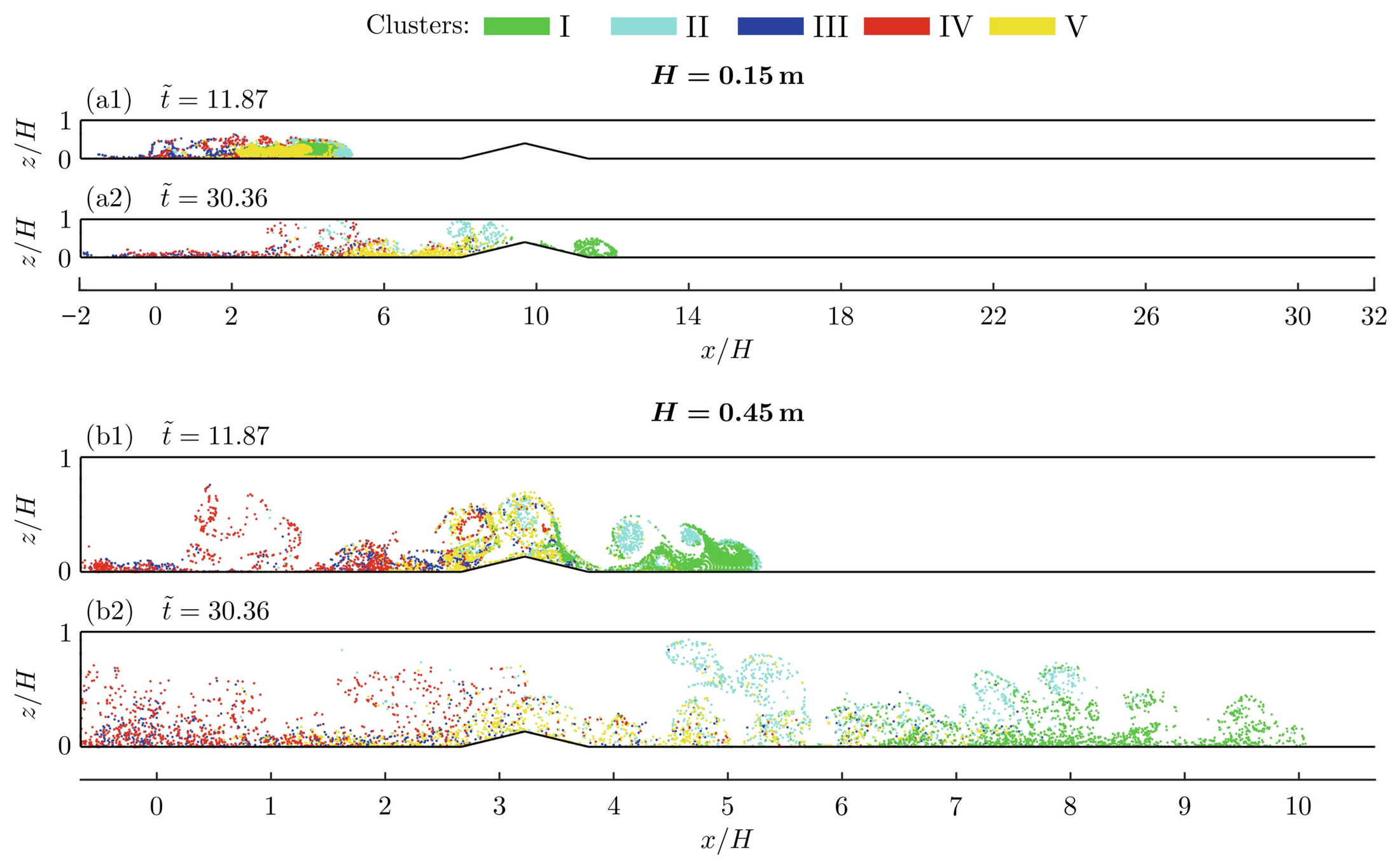
The influence of flow depth is examined in Figure 21. Taking the broad configuration as an example, variations in H alter the Reynolds number, and the corresponding flow depths are used for nondimensionalization. In both cases, the overall structure of tracer particles remains qualitatively similar. Cluster I particles constitute the primary downstream-moving portion, Cluster II particles are associated with vortical structures behind the current head, Clusters III and IV form the tail of the current, and Cluster V particles concentrate near the obstacle. In summary, the five Lagrangian pathways identified in the reference case remain distinguishable.
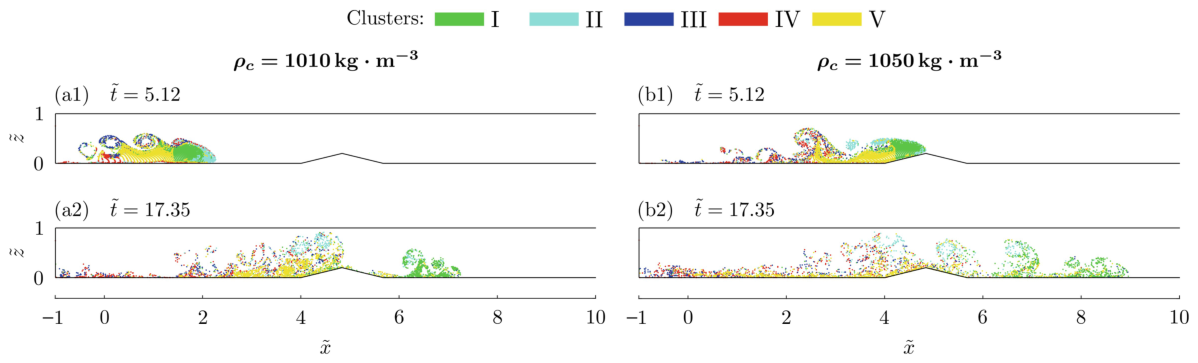
To assess the effect of initial density differences on fluid motion, we take the broad configuration as an example and introduce two additional cases with different density ratios. Figure 22 shows the spatiotemporal distribution of tracer particles. Larger density differences strengthen buoyancy forcing, accelerating the motion of particles downstream, whereas smaller density differences result in a pronounced temporal delay. Nevertheless, the spatial distribution of tracer particles and the main features of their trajectories are generally similar in both cases. The initial density ratio primarily governs the rate of development of the identified motion patterns, while exerting relatively minor influence on the qualitative spatial distribution of the particles.
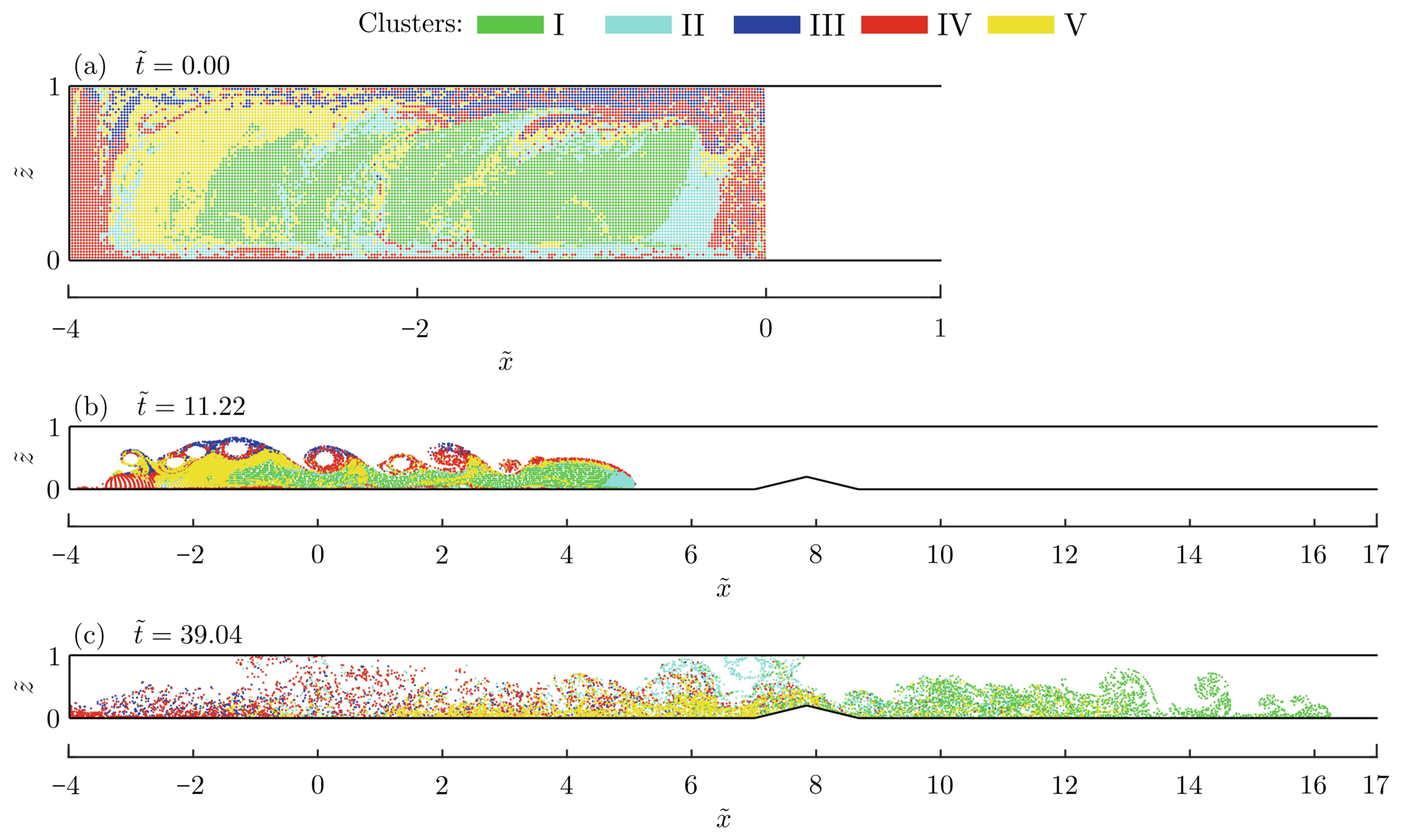
Figure 23 presents a case with a larger-volume release to evaluate the effect of the release conditions. Based on cluster analysis, the relative spatial distribution of clusters within the initial lock remains largely unchanged (see Figure 10a–c, Figure 12 and Figure 23a), but the relative proportions of the clusters vary: the number of Cluster I particles increases markedly, while Cluster V particles correspondingly decrease. Compared with the reference low-release case, the larger supply of dense fluid sustains a stronger and more persistent advancing front. A larger fraction of particles maintains sufficient forward momentum to overcome the obstacle and continue downstream. As shown in Figure 23b,c, the larger-volume release reduces the relative importance of upstream reflection and reverse motion near the obstacle. Nonetheless, the correspondence between the five clusters and flow structures remains essentially consistent with previous observations: Cluster I particles occupy the front of the propagating current, Cluster II particles move toward the interface vortices as the current advances, Cluster III particles are initially located at interface vortices and later form the tail with Cluster IV, while Cluster V particles reside in the midsection of the current.
Overall, these supplementary cases indicate that variations in characteristic parameters modulate the relative proportion and spatial behavior of each cluster. However, the Lagrangian clustering framework employed in this study remains an effective analytical tool, and the main motion patterns identified are qualitatively robust. A key direction for future work is to conduct a more comprehensive parametric study and assess how these mechanisms extend to more realistic seabed topography.

5. Conclusions

This study develops a hydrodynamic numerical model and focuses on large-eddy simulations of a two-dimensional gravity current generated by a low-volume release propagating over an isolated triangular bottom obstacle. By incorporating Lagrangian tracer particles, we track the evolution of fluid elements over the complete life cycle of the gravity current, from the initial collapse to dilution and deceleration. Particular attention is paid to how obstacle aspect ratio and standoff distance regulate particle (fluid elements) motion and transport pathways.
Based on K-means clustering of particle trajectories, five characteristic modes of Lagrangian transport are identified (Figure 6), each associated with distinct flow features such as vortical structures and reflected bores. The presence of an isolated obstacle significantly modifies the downstream transport capacity of a low-volume-release gravity current. For obstacles with the same streamwise geometric extent, a more slender configuration enhances the blocking effect, reducing the fraction of particles that surmount the obstacle and propagate downstream while increasing upstream retention and reverse motion induced by reflected flows. The standoff distance exerts a non-monotonic control on particle transport: when the obstacle is close to the lock, strong buoyancy forcing allows more particles to overcome the topographic barrier; at intermediate distances, along-path mixing weakens the effective buoyancy forcing and maximizes the blocking effect; at sufficiently large distances, the influence of the obstacle diminishes and particle behavior approaches that of the unobstructed reference case. These results demonstrate that particle (fluid elements) fate depends not only on obstacle geometry but also on the dynamical state of the gravity current at the moment of impact.
A Lagrangian analysis further shows that particles released from different regions of the lock follow systematically distinct transport pathways, thereby establishing a causal mapping among fluid-element origin, transport trajectory, and final fate across the stages of collapse, pre-collision propagation, and post-collision adjustment (Figure 19). Comparative cases with variations in geometric configuration, flow depth, density contrast, and release volume further suggest that these five transport modes retain qualitative physical meaning beyond the reference low-volume lock-exchange case.
A key contribution of this study is the development of a physically structured, cluster-based analytical framework for interpreting obstacle–current interaction, rather than a universally validated predictive tool. Achieving operational predictive capability will require the incorporation of uncertainty quantification and rigorous predictive validation in future work.

Author Contributions

Conceptualization, J.Z.; methodology, Y.C. and J.Z.; software, Y.C.; validation, Y.C.; resources, J.Z.; data analysis, Y.C. and J.Z.; writing—original draft preparation, Y.C. and J.Z.; writing—review and editing, J.Z.; visualization, Y.C. and J.Z.; supervision, J.Z.; funding acquisition, J.Z. All authors have read and agreed to the published version of the manuscript.

Funding

This work was supported by the National Natural Science Foundation of China (grant number 52209085); and the Natural Science Foundation of Jiangsu Province (grant number BK20252048).

Institutional Review Board Statement

Not applicable.

Informed Consent Statement

Not applicable.

Data Availability Statement

The original contributions presented in this study are included in the article. Further inquiries can be directed to the corresponding author.

Conflicts of Interest

The authors declare no conflicts of interest.

References

  1. Simpson, J.E. Gravity currents in the laboratory, atmosphere, and ocean. Annu. Rev. Fluid Mech. 1982, 14, 213–234. [Google Scholar] [CrossRef]
  2. Skevington, E.W.; Hogg, A.J. The unsteady overtopping of barriers by gravity currents and dam-break flows. J. Fluid Mech. 2023, 960, A27. [Google Scholar] [CrossRef]
  3. Geerts, S.J.; van der Sande, W.M.; Hulscher, S.J.; Geurts, B.J.; Roos, P.C. Sand dunes as a nature-based solution to mitigate salt intrusion in stratified estuaries. J. Geophys. Res. Oceans 2025, 130, e2024JC021103. [Google Scholar] [CrossRef]
  4. Zhou, J.; Stacey, M.T.; Holleman, R.C.; Nuss, E.; Senn, D.B. Numerical investigation of baroclinic channel-Shoal interaction in partially stratified estuaries. J. Geophys. Res. Oceans 2020, 125, e2020JC016135. [Google Scholar] [CrossRef]
  5. Zhou, J.; Stacey, M.T. Residual sediment transport in tidally energetic estuarine channels with lateral bathymetric variation. J. Geophys. Res. Oceans 2020, 125, e2020JC016140. [Google Scholar] [CrossRef]
  6. Zhou, J.; Tang, H.; Liu, J.; Zhang, W.; Chen, Y.; Stacey, M.T. Cross-sectional coupling between salinity and sediment gradients modulates estuarine lateral circulation. J. Geophys. Res. Oceans 2025, 130, e2024JC022205. [Google Scholar] [CrossRef]
  7. Nasr-Azadani, M.; Meiburg, E. Turbidity currents interacting with three-dimensional seafloor topography. J. Fluid Mech. 2014, 745, 409–443. [Google Scholar] [CrossRef]
  8. Tokyay, T.; Constantinescu, G. The effects of a submerged non-erodible triangular obstacle on bottom propagating gravity currents. Phys. Fluids 2015, 27, 056601. [Google Scholar] [CrossRef]
  9. Zhou, J.; Venayagamoorthy, S.K. Numerical simulations of intrusive gravity currents interacting with a bottom-mounted obstacle in a continuously stratified ambient. Environ. Fluid Mech. 2017, 17, 191–209. [Google Scholar] [CrossRef]
  10. Zhou, J.; Cenedese, C.; Williams, T.; Ball, M.; Venayagamoorthy, S.K.; Nokes, R.I. On the propagation of gravity currents over and through a submerged array of circular cylinders. J. Fluid Mech. 2017, 831, 394–417. [Google Scholar] [CrossRef]
  11. Nasr-Azadani, M.M.; Meiburg, E.; Kneller, B. Mixing dynamics of turbidity currents interacting with complex seafloor topography. Environ. Fluid Mech. 2018, 18, 201–223. [Google Scholar] [CrossRef]
  12. Wu, C.S.; Ouyang, H.T. Flow morphology in bottom-propagating gravity currents over immersed obstacles. AIP Adv. 2020, 10, 115103. [Google Scholar] [CrossRef]
  13. Köllner, T.; Meredith, A.; Nokes, R.; Meiburg, E. Gravity currents over fixed beds of monodisperse spheres. J. Fluid Mech. 2020, 901, A32. [Google Scholar] [CrossRef]
  14. Zhou, J.; Venayagamoorthy, S.K. Impact of ambient stable stratification on gravity currents propagating over a submerged canopy. J. Fluid Mech. 2020, 898, A15. [Google Scholar] [CrossRef]
  15. Zhou, J.; Venayagamoorthy, S.K. How does three-dimensional canopy geometry affect the front propagation of a gravity current? Phys. Fluids 2020, 32, 096605. [Google Scholar] [CrossRef]
  16. Lin, Y.T.; Ye, Y.Q.; Han, D.R.; Chiu, Y.J. Propagation and separation of downslope gravity currents over rigid and emergent vegetation patches in linearly stratified environments. J. Mar. Sci. Eng. 2022, 10, 308. [Google Scholar] [CrossRef]
  17. Maggi, M.R.; Negretti, M.E.; Hopfinger, E.J.; Adduce, C. Turbulence characteristics and mixing properties of gravity currents over complex topography. Phys. Fluids 2023, 35, 016607. [Google Scholar] [CrossRef]
  18. Meredith, A.; McConnochie, C.; Nokes, R.; Cenedese, C. Transient behavior of overflowing gravity currents interacting with a roughness array. Phys. Rev. Fluids 2025, 10, 0333801. [Google Scholar] [CrossRef]
  19. Li, Y.; Zhao, G.; Xiao, L.; Xu, L. Experimental Study on Plume Diffusion Characteristics of Particle-Driven Gravity Current Under Wall Confinement. J. Mar. Sci. Eng. 2026, 14, 295. [Google Scholar] [CrossRef]
  20. Wilson, R.I.; Friedrich, H.; Stevens, C. Turbulent entrainment in sediment-laden flows interacting with an obstacle. Phys. Fluids 2017, 29, 036603. [Google Scholar] [CrossRef]
  21. De Falco, M.; Adduce, C.; Maggi, M. Gravity currents interacting with a bottom triangular obstacle and implications on entrainment. Adv. Water Resour. 2021, 154, 103967. [Google Scholar] [CrossRef]
  22. Bardoel, S.L.; Cheng, S.; Chamorro, L.P.; Fernando, H.J. Gravity currents past thin two-dimensional obstacles. J. Fluid Mech. 2025, 1012, A15. [Google Scholar] [CrossRef]
  23. Xiao, Y.; Liu, J.; Gualtieri, C.; Fu, J.; Gu, R.; Wang, Z.; Zhang, T.; Zhou, J. The effect of natural and engineered hydraulic conditions on river-floodplain connectivity using hydrodynamic modeling and particle tracking analysis. J. Hydrol. 2022, 615, 128578. [Google Scholar] [CrossRef]
  24. Guyenne, P.; Kalisch, H. Impact of mean water level on particle drift in shallow and intermediate depth. J. Fluid Mech. 2025, 1020, A22. [Google Scholar] [CrossRef]
  25. An, S.; Julien, P.Y.; Venayagamoorthy, S.K. Numerical simulation of particle-driven gravity currents. Environ. Fluid Mech. 2012, 12, 495–513. [Google Scholar] [CrossRef]
  26. Adduce, C.; Maggi, M.R.; De Falco, M.C. Non-intrusive density measurements in gravity currents interacting with an obstacle. Acta Geophys. 2022, 70, 2499–2510. [Google Scholar] [CrossRef]
  27. Balasubramanian, S.; Zhong, Q. Entrainment and mixing in lock-exchange gravity currents using simultaneous velocity-density measurements. Phys. Fluids 2018, 30, 056601. [Google Scholar] [CrossRef]
  28. Dai, A.; Huang, Y.L. The flow within the head of a gravity current. J. Fluid Mech. 2024, 997, A42. [Google Scholar] [CrossRef]
  29. Zhou, J.; Izett, J.G.; Edwards, C.A.; Damien, P.; Kessouri, F.; McWilliams, J.C. Modeling the dispersal of the San Francisco Bay plume over the northern and central California shelf. Estuar. Coast. Shelf Sci. 2023, 287, 108336. [Google Scholar] [CrossRef]
  30. Necker, F.; Härtel, C.; Kleiser, L.; Meiburg, E. Mixing and dissipation in particle-driven gravity currents. J. Fluid Mech. 2005, 545, 339–372. [Google Scholar] [CrossRef]
  31. Nasr-Azadani, M.M.; Meiburg, E. Influence of seafloor topography on the depositional behavior of bi-disperse turbidity currents: A three-dimensional, depth-resolved numerical investigation. Environ. Fluid Mech. 2014, 14, 319–342. [Google Scholar] [CrossRef]
  32. Xie, J.; Hu, P.; Zhu, C.; Yu, Z.; Pähtz, T. Turbidity currents propagating down an inclined slope: Particle auto-suspension. J. Fluid Mech. 2023, 954, A44. [Google Scholar] [CrossRef]
  33. Mosher, D.; Monahan, P.; Barrie, J.; Courtney, R. Coastal submarine failures in the Strait of Georgia, British Columbia: Landslides of the 1946 Vancouver Island earthquake. J. Coast. Res. 2004, 20, 277–291. [Google Scholar] [CrossRef]
  34. Randolph, M.F.; White, D.J. Interaction forces between pipelines and submarine slides—A geotechnical viewpoint. Ocean Eng. 2012, 48, 32–37. [Google Scholar] [CrossRef]
  35. Zhang, M.; Xie, A.; He, H.; Lu, R.; Tang, M. Mechanism of deep-water international submarine cables damage: Submarine earthquakes. J. Mar. Sci. 2024, 42, 100–113. [Google Scholar]
  36. Zhang, C.; Tang, T.; Zhang, F.; Ren, C.; Zhang, H.; Wu, G. A State-of-the-Art Review of the Hydrodynamics of Offshore Pipelines Under Submarine Gravity Flows and Their Interactions. J. Mar. Sci. Eng. 2025, 13, 1654. [Google Scholar] [CrossRef]
  37. Ooi, S.K.; Constantinescu, G.; Weber, L. Numerical simulations of lock-exchange compositional gravity current. J. Fluid Mech. 2009, 635, 361–388. [Google Scholar] [CrossRef]
  38. Tokyay, T.; Constantinescu, G.; Meiburg, E. Lock-exchange gravity currents with a low volume of release propagating over an array of obstacles. J. Geophys. Res. Oceans 2014, 119, 2752–2768. [Google Scholar] [CrossRef]
  39. Zhou, J.; Venayagamoorthy, S.K. Near-field mean flow dynamics of a cylindrical canopy patch suspended in deep water. J. Fluid Mech. 2019, 858, 634–655. [Google Scholar] [CrossRef]
  40. Zeng, C.; Zhang, Y.; Hu, Y.; Zhou, J.; Wang, L. On the wake-induced galloping of one-fixed-one-free tandem cylinders at subcritical Reynolds numbers. Phys. Fluids 2025, 37, 105168. [Google Scholar] [CrossRef]
  41. Cantero, M.I.; Lee, J.R.; Balachandar, S.; Garcia, M.H. On the front velocity of gravity currents. J. Fluid Mech. 2007, 586, 1–39. [Google Scholar] [CrossRef]
  42. Bonometti, T.; Balachandar, S. Effect of Schmidt number on the structure and propagation of density currents. Theor. Comput. Fluid Dyn. 2008, 22, 341–361. [Google Scholar] [CrossRef]
  43. Dai, A. High-resolution simulations of downslope gravity currents in the acceleration phase. Phys. Fluids 2015, 27, 076602. [Google Scholar] [CrossRef]
  44. Lam, W.K.; Chan, L.; Sutherland, D.; Manasseh, R.; Moinuddin, K.; Ooi, A. Effect of stratification on the propagation of a cylindrical gravity current. J. Fluid Mech. 2024, 983, A43. [Google Scholar] [CrossRef]
  45. Weller, H.G.; Tabor, G.; Jasak, H.; Fureby, C. A tensorial approach to computational continuum mechanics using object-oriented techniques. Comput. Phys. 1998, 12, 620–631. [Google Scholar] [CrossRef]
  46. Smagorinsky, J. General circulation experiments with the primitive equations: I. The basic experiment. Mon. Weather Rev. 1963, 91, 99–164. [Google Scholar] [CrossRef]
  47. Nicholson, M.; Flynn, M.R. Gravity current flow over sinusoidal topography in a two-layer ambient. Phys. Fluids 2015, 27, 096603. [Google Scholar] [CrossRef]
  48. Ooi, S.K.; Constantinescu, G.; Weber, L.J. 2D large-eddy simulation of lock-exchange gravity current flows at high Grashof numbers. J. Hydraul. Eng. 2007, 133, 1037–1047. [Google Scholar] [CrossRef]
  49. Nourazar, S.; Safavi, M. Two-dimensional large-eddy simulation of density-current flow propagating up a slope. J. Hydraul. Eng. 2017, 143, 04017035. [Google Scholar] [CrossRef]
  50. Marques, G.M.; Wells, M.G.; Padman, L.; Özgökmen, T.M. Flow splitting in numerical simulations of oceanic dense-water outflows. Ocean Modell. 2017, 113, 66–84. [Google Scholar] [CrossRef]
  51. McQueen, J.B. Some methods of classification and analysis of multivariate observations. In Proceedings of the 5th Berkeley Symposium on Mathematical Statistics and Probability, Berkeley, CA, USA, 27 December 1967; pp. 281–297. [Google Scholar]
  52. Nakamura, J.; Lall, U.; Kushnir, Y.; Camargo, S.J. Classifying North Atlantic tropical cyclone tracks by mass moments. J. Clim. 2009, 22, 5481–5494. [Google Scholar] [CrossRef]
  53. Wang, L.; Gu, X.; Gulakhmadov, A.; Li, J.; Slater, L.J.; Zhang, Q.; Luo, M.; Ren, G.; Kong, D.; Lai, Y.; et al. An analysis of translation distance of tropical cyclones over the western North Pacific. J. Clim. 2022, 35, 7643–7660. [Google Scholar] [CrossRef]
  54. Yin, Y.; Yong, Y.; Qi, S.; Yang, K.; Lan, Y. Cluster analyses of tropical cyclones with genesis in the South China Sea based on K-means method. Asia-Pac. J. Atmos. Sci. 2023, 59, 433–446. [Google Scholar] [CrossRef]
  55. Lane-Serff, G.; Beal, L.; Hadfield, T. Gravity current flow over obstacles. J. Fluid Mech. 1995, 292, 39–53. [Google Scholar] [CrossRef]
  56. Tokyay, T.; Constantinescu, G.; Meiburg, E. Lock-exchange gravity currents with a high volume of release propagating over a periodic array of obstacles. J. Fluid Mech. 2011, 672, 570–605. [Google Scholar] [CrossRef]
  57. Oehy, C.D.; Schleiss, A.J. Control of turbidity currents in reservoirs by solid and permeable obstacles. J. Hydraul. Eng. 2007, 133, 637–648. [Google Scholar] [CrossRef]
  58. Yaghoubi, S.; Afshin, H.; Firoozabadi, B.; Farizan, A. Experimental investigation of the effect of inlet concentration on the behavior of turbidity currents in the presence of two consecutive obstacles. J. Waterw. Port Coast. Ocean Eng. 2017, 143, 04016018. [Google Scholar] [CrossRef]
  59. Kuenen, P.H.; Migliorini, C. Turbidity currents as a cause of graded bedding. J. Geol. 1950, 58, 91–127. [Google Scholar] [CrossRef]
  60. Zhang, R.; Tian, D.; Li, X.; Aziz, T.; Wu, J.; Jiang, T.; Lu, G.; Xie, X. Channel Confinement Drives Unidirectional Migration: Coupling of Flow Structure and Sedimentary Evolution in Combined Turbidity–Bottom Current Flows. J. Mar. Sci. Eng. 2026, 14, 152. [Google Scholar] [CrossRef]
Figure 1. Model validation. (a1,a2) Experimental results from Figure 14 of Nicholson et al. [47]. (b1,b2) Corresponding LES results under the same configuration. In (b1), the solid line indicates the ambient internal interface. In (a2,b2), the vertical dotted lines mark the crests of the sinusoidal topography, and the slope of the diagonal white solid line denotes the front velocity averaged along the sinusoidal path.
Jmse 14 00801 g001
Figure 2. Particle evolution in the flat-bed case (2D vs. 3D simulations). (a1,b1) Spatial distribution of particles at the same time (uniform coloring). (a2,b2) Trajectories of particles released from the same initial positions in the x ˜ - z ˜ coordinate system. Circles denote the starting positions, with red, black, and blue marking corresponding pairs between the 2D and 3D simulations.
Jmse 14 00801 g002
Figure 3. Computational domain of the model. (a,b) Initial release and fully developed collapse stages, respectively. (c) Initial distribution of Lagrangian tracer particles in the lock (particle spacing in the plane: δ x = δ z = 0.017 H ). (d) Geometric parameters of the triangular obstacle; solid and dotted outlines correspond to the broad and slender obstacles, respectively (see Table 1).
Jmse 14 00801 g003
Figure 4. Temporal evolution of the number of particles passing over the top of the obstacle. (a) Flat bed, (b) broad obstacle, and (c) slender obstacle. The two dashed lines indicate the start and end times of the clustering analysis, respectively.
Jmse 14 00801 g004
Figure 5. Sum of squared errors (SSE) versus the number of clusters (k). The arrow indicates the elbow point, i.e., the optimal k. SSE = i = 1 k x C i x μ i 2 , where C i represents the i-th cluster, μ i is the centroid of cluster i, and x is a data point.
Jmse 14 00801 g005
Figure 6. Mean trajectories of particle clusters in the x ˜ - z ˜ coordinate system. Panels (ae) correspond to Clusters I–V, respectively. Vertical dotted lines mark the gate location. Pentagrams denote the mean starting positions, and arrows indicate the direction of motion.
Jmse 14 00801 g006
Figure 7. Mean displacement of particle clusters in the ( Δ x ˜ , Δ z ˜ ) coordinate system relative to the absolute coordinate origin ( x ˜ , z ˜ ) = (0, 0) at the bottom of the lock. Pentagrams denote the mean starting positions. The vertical dashed line indicates the upstream toe of the obstacle.
Jmse 14 00801 g007
Figure 8. Spatiotemporal evolution of tracer particles under different obstacle aspect ratios. (a1a6) Flat bed, (b1b6) broad obstacle, and (c1c6) slender obstacle. Within each column, panels are arranged from top to bottom in chronological order.
Jmse 14 00801 g008
Figure 9. Displacement of representative particles relative to the absolute coordinate origin. (a1a5) Flat bed, (b1b5) broad obstacle, and (c1c5) slender obstacle. Within each column, panels are arranged from top to bottom in the order of Clusters I–V. Solid lines show representative individual particles, while dotted lines denote the corresponding intra-cluster mean displacements (see Figure 7). Pentagrams mark starting positions. The vertical dashed line indicates the upstream toe of the obstacle. Note that two representative particles from the same cluster are shown in panels (a4,b4,c4).
Jmse 14 00801 g009
Figure 10. Comparison of tracer-particle distributions between the initial lock configuration and the final state of the clustering analysis for different obstacle aspect ratios. (ac) Initial distribution before gate removal: (a) flat bed, (b) broad obstacle, and (c) slender obstacle. (df) Final distribution at the end of clustering analysis: (d) flat bed, (e) broad obstacle, and (f) slender obstacle. Note that the clustering analysis is initiated at t ˜ = 4.39 (see Figure 8).
Jmse 14 00801 g010
Figure 11. Fraction of particles in each cluster for different obstacle aspect ratios. R = N i / N , where N i is the number of particles in the i-th cluster and N is the total number of particles.
Jmse 14 00801 g011
Figure 12. Comparison of tracer-particle distributions in the initial lock configuration for different broad-obstacle standoff distances. Panels (ae) correspond to L ˜ = 2 , 3 , 4 , 5 , 6 , respectively.
Jmse 14 00801 g012
Figure 13. Fraction of particles in each cluster as a function of broad-obstacle standoff distance. The horizontal dashed line denotes the flat-bed case. The fraction R is defined in the same way as in Figure 11.
Jmse 14 00801 g013
Figure 14. Spatiotemporal evolution of the fluid density field for different obstacle aspect ratios. (a1a6) Flat bed, (b1b6) broad obstacle, and (c1c6) slender obstacle. Within each column, panels are arranged from top to bottom in chronological order. The snapshots are taken at the same times as in Figure 8.
Jmse 14 00801 g014
Figure 15. Dilution of the gravity current front as a function of front position for different obstacle aspect ratios. (a) Flat bed, (b) broad obstacle, and (c) slender obstacle. The dotted line indicates the front reaching the obstacle crest, while the dashed lines indicate the front reaching the upstream toe and then the downstream edge of the triangular obstacle.
Jmse 14 00801 g015
Figure 16. Spatiotemporal distribution of the effective thickness ( h ˜ c ) for different obstacle aspect ratios. (a) Flat bed, (b) broad obstacle, and (c) slender obstacle. The circled regions indicate reflected currents. The dotted line marks the obstacle crest, while the dashed lines denote the upstream toe and downstream edge of the triangular obstacle.
Jmse 14 00801 g016
Figure 17. Spatiotemporal distribution of the effective thickness ( h ˜ c ) for different standoff distances. (a) L ˜ = 2 , (b) L ˜ = 4 , and (c) L ˜ = 6 . The regions enclosed by the white outlines indicate the strength of the buoyancy forcing associated with the gravity-current head at the moment of impact with the broad obstacle. The dotted and dashed lines have the same meanings as in Figure 16.
Jmse 14 00801 g017
Figure 18. Dilution of the gravity current front as a function of front position for different standoff distances. (a) L ˜ = 2 and (b) L ˜ = 6 . The dotted and dashed lines have the same meanings as in Figure 15.
Jmse 14 00801 g018
Figure 19. Schematic summary of the correspondence between particle clusters and the successive stages of gravity-current evolution, from the initial phase before gate removal, through the pre-collision propagation stage, to the post-collision stage in which the gravity current interacts with the obstacle and continues to propagate downstream. Colored “+” and “−” symbols, shown in the same colors as the corresponding particle clusters, indicate increasing or decreasing trends in the fractional population of each cluster under variations in obstacle geometry and placement.
Jmse 14 00801 g019
Figure 20. Motion characteristics of tracer particles for different geometric configurations. (a,c) Single sinusoidal obstacle: (a) mean displacement of particle clusters and (c) particle distribution. (b,d) Multiple sinusoidal obstacles: (b) mean displacement of particle clusters and (d) particle distribution. The pentagram marks the mean initial position in the same coordinate system as Figure 7. In (a), the vertical dashed line indicates the upstream toe of the obstacle, whereas in (b), the vertical dashed lines indicate the bases of the multiple obstacles.
Jmse 14 00801 g020
Figure 21. Spatiotemporal evolution of tracer particles for different flow depths. (a1,a2) H = 0.15 m ; (b1,b2) H = 0.45 m . Note that all parameters in the figures are nondimensionalized using the corresponding flow depth.
Jmse 14 00801 g021
Figure 22. Spatiotemporal evolution of tracer particles for different initial density ratios. (a1,a2) ρ c = 1010 kg · m 3 and (b1,b2) ρ c = 1050 kg · m 3 .
Jmse 14 00801 g022
Figure 23. Spatiotemporal evolution of tracer particles for a larger-volume release. Panels (ac) correspond to t ˜ = 0.00 , 11.22 , 39.04 , respectively.
Jmse 14 00801 g023
Table 1. Model parameters in this study. There are a total of 1 (flat bed) + 1 (broad obstacle) + 1 (slender obstacle) + 4 (standoff distance variations) = 7 highly resolved cases. The variations in L ˜ are conducted based on the broad-obstacle configuration.
Cases ρ c (kg m−3) ρ a (kg m−3)H (m) L ˜ l ˜ h ˜
Flat bed103010000.30
Broad obstacle103010000.3040.830.2
Slender obstacle103010000.3040.4150.4
Varying standoff distance103010000.302, 3, 4, 5, 60.830.2
Table 2. Parameter settings for the supplementary cases. There are a total of 6 (single sinusoidal obstacle) + 1 (multiple sinusoidal obstacles) + 1 (small flow depth) + 1 (large flow depth) + 1 (low ρ c ) + 1 (high ρ c ) + 1 (large-volume release) = 12 highly resolved cases. Here, λ denotes the wavelength of the sinusoidal obstacle.
Cases ρ c (kg m−3) ρ a (kg m−3) L lock (m)H (m) L ˜ λ ˜ l ˜ h ˜ Obstacle Geometry
Broad obstacle103010000.300.3041.670.2Sinusoidal
Slender obstacle103010000.300.3040.8350.4Sinusoidal
Varying standoff distance103010000.300.302, 3, 4, 5, 61.670.2Sinusoidal
Multiple obstacles103010000.300.3041.670.2Sinusoidal
Small H103010000.300.1540.830.2Triangular
Large H103010000.300.4540.830.2Triangular
Low ρ c 101010000.300.3040.830.2Triangular
High ρ c 105010000.300.3040.830.2Triangular
Large-volume release103010001.200.3040.830.2Triangular
Disclaimer/Publisher’s Note: The statements, opinions and data contained in all publications are solely those of the individual author(s) and contributor(s) and not of MDPI and/or the editor(s). MDPI and/or the editor(s) disclaim responsibility for any injury to people or property resulting from any ideas, methods, instructions or products referred to in the content.