Article

A Study on the Container Consolidation Problem in Container Terminals

1
Logistics Engineering College, Shanghai Maritime University, Shanghai 201306, China
2
Shanghai Shengdong International Container Terminal Co., Ltd., Shanghai 201306, China
*
Author to whom correspondence should be addressed.
J. Mar. Sci. Eng. 2026, 14(9), 797; https://doi.org/10.3390/jmse14090797
Submission received: 10 March 2026 / Revised: 14 April 2026 / Accepted: 21 April 2026 / Published: 27 April 2026
(This article belongs to the Section Coastal Engineering)

Abstract

This study investigates the Container Consolidation Problem (CCP), a critical operational challenge in container terminals where containers with specific attributes must be relocated during yard crane idle periods. The primary objective is to maximize yard space availability for incoming vessels by strategically grouping containers, thereby alleviating storage pressure and enhancing throughput. A mixed-integer programming model is formulated to minimize the total handling time, incorporating complex constraints related to crane availability, relocation sequencing, and slot assignment. Due to the combinatorial complexity inherent in large-scale yard operations, a comprehensive optimization framework is proposed. This framework balances computational efficiency with solution quality, offering a robust approach to solve large-scale instances within practical time limits. Computational experiments demonstrate that the proposed methodology consistently yields high-quality solutions, effectively resolving the trade-off between solution speed and optimality. The research provides not only a novel methodological perspective for solving this NP-hard problem but also offers significant practical value. By optimizing crane scheduling, the model directly contributes to reducing operational costs, improving the turnover rate of yard space, and strengthening the overall efficiency of the maritime supply chain.

1. Introduction

The global container shipping industry has witnessed substantial growth in recent years. In 2023, global container throughput reached 866 million TEUs, with Chinese ports contributing 310.34 million TEUs, representing a 4.9% year-on-year increase [1]. While this expansion manifests robust trade dynamics, it has precipitated systemic spatial congestion crises across major port facilities globally. Terminals throughout Europe, North America, and the Asia-Pacific region confront analogous yard saturation predicaments. Such pervasive international pressures accentuate the exigency of optimizing extant storage resource utilization rather than resorting to capital-intensive capacity augmentation. Despite this upward trend, port operations continue to face critical efficiency challenges. Among these, limited yard space utilization and disordered stacking practices have emerged as key bottlenecks. Two primary factors contribute to these inefficiencies: (1) the widespread use of first-come, first-served storage policies results in spatial fragmentation and low stacking densities, leading to suboptimal yard capacity usage; and (2) the adoption of random stacking strategies—often aimed at short-term unloading efficiency—increases container reshuffling operations and crane travel distances during retrieval, thereby exacerbating handling delays and reducing overall operational performance. These issues underscore the need for more systematic yard planning and optimization-driven container relocation strategies.
In many Chinese ports, actual throughput has significantly exceeded designed capacity in recent years. For example, Shanghai Port handled approximately 33.38 million TEUs in 2013—despite a nominal design capacity of 23 million TEUs [2]—and this figure rose to 49 million TEUs by 2023, with little corresponding expansion in physical capacity. This phenomenon is not unique to China; the preponderance of ports worldwide grapples with commensurate challenges. As yard space remains constrained while container volumes continue to grow, terminals face increasing operational pressure. Efficient utilization of limited storage resources has thus become a critical concern. In this context, container consolidation represents a key operational strategy: by systematically relocating dispersed containers within the yard, spatial fragmentation can be mitigated, leading to improved stacking density and enhanced yard throughput capacity.
Despite its practical significance, container consolidation has received limited attention in the academic literature. This study addresses this gap by developing effective optimization methods to support consolidation decisions, thereby offering data-driven tools for terminal managers and contributing to more sustainable port operations. The remainder of the paper is structured as follows: Section 2 reviews the relevant literature; Section 3 introduces the problem formulation and mathematical model; Section 4 presents the algorithmic framework; and Section 5 provides computational results and case analysis.

2. Literature Review

In the existing literature, studies specifically focusing on container consolidation are relatively scarce, with most related research concentrated in three key areas: (1) housekeeping, which emphasizes the daily optimization of yard storage operations [3,4,5,6,7,8,9,10]; (2) pre-marshaling, which aims to systematically organize containers prior to vessel loading [11,12,13,14,15,16,17,18,19,20,21,22,23,24,25]; and (3) rehandling, which focuses on minimizing unnecessary container movements [26,27,28,29,30]. It is worth noting that optimization in pre-marshaling can reduce the need for housekeeping operations, and a coordinated approach to both can significantly lower rehandling frequency. This interrelationship provides an essential theoretical foundation for the systematic study of container consolidation.
In maritime container terminals, the repositioning of containers within the yard is commonly referred to as housekeeping. The main objective is to enhance storage and retrieval efficiency, thereby improving overall terminal performance. For example, Legato and Mazza [3] developed a discrete-event simulation model embedded within a local search heuristic to optimize the scheduling of multi-trailer systems and straddle carriers, significantly reducing vehicle wait times and routing distances, thus enhancing terminal throughput. Cordeau and Legato [4] proposed a heuristic algorithm combining discrete-event simulation with local search to manage the routing of straddle carriers and trailers, demonstrating its effectiveness in reducing congestion and improving operational efficiency. Yu and Qi [5] introduced two optimization methods aimed at minimizing external truck waiting times caused by inefficient container storage: optimizing yard space allocation for inbound containers and performing overnight reshuffling after partial retrieval. Recognizing the NP-hardness of the problem, they developed a heuristic approach. Ehleiter and Jaehn [6] proposed both a dynamic programming-based exact method and a greedy heuristic to utilize a second crane for predictive repositioning, thereby reducing rehandling operations without interfering with the primary crane. In July 2021, Qin and Su [7] presented an integer programming model combined with a metaheuristic to address housekeeping for inbound containers, incorporating simulation modules to enhance the adaptability and effectiveness of the model under uncertainty. Park and Choe [8] proposed an online search algorithm capable of generating and evaluating storage strategy variations in real time, adapting dynamically to operational changes and proving more effective than offline optimization. Zähringer and Böse [9] formulated an integer programming model and developed a two-phase search algorithm to address the Import Container Unloading and Storage Problem (ICUSP), optimizing unloading sequences and yard distribution to reduce rehandling, with results showing that optimal solutions could be obtained in polynomial time. Park and Cho [10] introduced a two-module approach: the first used Gaussian Mixture Models (GMMs) for container weight classification, and the second applied data-driven online algorithms for dynamic storage decisions, enhancing terminal competitiveness through real-time adaptability.
The container pre-marshaling problem aims to rearrange containers with minimal movements and is an operation to optimize container layout. Its purpose is to reduce vessel handling time before the ship’s arrival by repositioning containers in advance, thereby improving port operational efficiency and minimizing container rehandling during loading and unloading processes. Bortfeldt and Forster [11] employed a deep learning-assisted heuristic tree search method to enhance pre-marshaling efficiency. Huang and Lin [12] developed two heuristic algorithms (Heuristic-A and Heuristic-B) to sort and move containers based on priority and target position. Addressing the sequential decision nature of the Container Pre-Marshaling Problem (CPMP), Wang Z and Zhou C et al. [13] formulated the problem as a Markov Decision Process and proposed a Policy-guided Monte Carlo Tree Search (P-MCTS) algorithm. By integrating composite reshuffling rules with a modified Upper Confidence Bound mechanism, their approach effectively mitigates the chain effect induced by individual relocations, achieving significant reductions in reshuffling moves across both distinct-priority and shared-priority scenarios. Lee and Chao [14] proposed an integer programming model with a neighborhood search algorithm to minimize container moves and eliminate the need for rehandling. Tierney and Pacino [15] utilized A* and IDA* algorithms with novel branching and symmetry-breaking rules, demonstrating superior optimality compared to existing A* techniques. The branch-and-bound algorithm is widely used in pre-marshaling. For instance, Parreño-Torres and Alvarez-Valdés [16] proposed an integer linear model incorporating crane movement times and showed that crane times and rehandling are not directly correlated. De and Toulouse [17] applied mixed-integer programming (MIP) and the branch-and-bound algorithm (B&B) to tackle both pre-marshaling and segmented relocation. Ahn and Kim [18] developed an iterative deepening B&B algorithm with new heuristics and rules. Tanaka and Tierney [19] introduced two novel lower bounds and generalized dominance rules to tighten the search space and efficiently solve previously intractable instances. Jin and Yu [20] analyzed inconsistencies in dominance rules and proposed a lexicographic dominance principle to ensure correctness. Parreño-Torres et al. [21] developed and tested integer linear models with iterative solution procedures, showing superior performance. Expósito-Izquierdo and Melián-Batista [22] proposed a heuristic solution method along with an instance generator considering container occupancy and priority mismatches. Araya and Matsatsinis [23] introduced fast greedy algorithms for pre-marshaling. Hottung and Tierney [24] employed a Biased Random-Key Genetic Algorithm (BRKGA) with a novel decoder for yard sorting. Jovanovic and Tuba [25] proposed a four-phase greedy heuristic framework, each allowing for multiple heuristic strategies. Hottung and Tanaka [26] developed Deep Learning Heuristic Tree Search (DLTS), which integrates deep neural networks into tree search, producing near-optimal solutions with less than 2% deviation from the optimum. Wang N and Yang R [27] pioneered the introduction of the Same-Group Exclusive (SGE) strategy and systematically investigated the Container Pre-Marshaling Problem under uncertain intra-group priorities (termed CPMP-SGE). By developing dual mathematical formulations and a Target-Guided Greedy and Correction (TGGC) algorithm, their study established a novel theoretical framework and solution methodology for robust pre-marshaling scheduling of multiple container groups in yard operations.
Rehandling, a core issue in yard management, aims to improve handling efficiency and reduce costs by minimizing unnecessary container moves. It is typically modeled as an optimization problem with objectives such as minimizing the number of rehandles, cost, or total handling time. Zeng and Feng [28] proposed a rehandling optimization method that integrates partial truck arrival information to jointly optimize pickup sequences and rehandling strategies, achieving significant efficiency gains. Zhao and Goodchild [29] used simulation to assess the impact of different information levels on rehandling performance, demonstrating that even limited information can substantially reduce rehandling, thus supporting managerial decision-making. Chen and Zhao [30,31] developed a Seq2Seq-based prediction model to estimate rehandling probabilities and guide storage allocation. They further proposed a Multi-Domain Merging Adaptation (MDMA) framework to handle data distribution shifts across yard blocks, significantly enhancing predictive performance. Kim and Yi [32] leveraged diverse truck arrival data to reduce rehandles for import containers. Heuristic algorithms were developed for locating and pre-mixing import containers, with simulations confirming that the approach reduced truck system time and rehandling by an average of 47% and 98%, respectively. Addressing the rehandling problem in RoRo ships during sequential port calls, Lee et al. [33] proposed a backtracking-based conflict-aware stowage planning method. By constructing a disjoint subgraph model to identify cargo groups that can be assigned without conflicts and integrating an affinity-driven cargo ordering strategy with a backtracking-based Conflict-Free Block (CFB) selection mechanism, their approach systematically reduces rehandling operations. Experimental results demonstrate that the method reduces rehandling instances by up to 65% and total cargo handling operations by approximately 18% across various loading scenarios.
Distinct from the three aforementioned problems, container consolidation is a yard operation executed during idle periods of yard cranes, aiming to group containers with the same bill of lading or similar properties into the minimal number of sequences with the least operational time. This approach not only maximizes the release of storage space but also effectively reduces external truck wait times and yard crane travel distances, thereby enhancing overall terminal efficiency. The differences among these four problems are further elaborated as follow Table 1.
Housekeeping focuses on the local stacking optimization of container yards, primarily addressing short-term (hour-level) yard reorganization tasks. Its core objective is to enhance yard operation efficiency by optimizing the sequence of container movements. Pre-marshaling is devoted to medium-term (day-level) global optimization based on vessel loading plans, aiming to achieve optimal alignment with the loading sequence through systematic rearrangement, thereby improving overall operational efficiency. Rehandling mainly addresses real-time (minute-level) blockage issues arising during container retrieval operations. It is a reactive research direction, with emphasis placed on determining optimal temporary relocation strategies under unexpected blocking conditions. In contrast, consolidation concentrates on merging containers with similar properties within the same yard block.
Notwithstanding the extensive research on housekeeping, pre-marshaling, and rehandling, a significant gap remains in the systematic optimization of container consolidation strategies that leverage yard crane idle time. While existing studies effectively address specific operational phases, few have comprehensively formulated the consolidation problem as a holistic optimization task that simultaneously considers crane availability constraints, dynamic relocation sequencing, and slot assignment during non-peak hours. This study aims to bridge this gap by offering the following distinct contributions:
  • Novel Problem Formulation: We propose a comprehensive Mixed-Integer Programming (MIP) model specifically designed for the Container Consolidation Problem (CCP). Unlike traditional models focused on single aspects of reshuffling, this study explicitly incorporates complex operational constraints—such as crane scheduling and spatial fragmentation—to minimize total handling time while maximizing yard space availability.
  • Advanced Algorithmic Framework: To address the combinatorial complexity and NP-hard nature of the large-scale CCP, we develop a robust optimization framework integrating Branch-and-Bound (BNB), Beam Search (BS), and Adaptive Large Neighborhood Search (ALNS). This hybrid approach balances computational efficiency with solution optimality, enabling the resolution of large-scale instances within practical time limits.
  • Practical and Theoretical Value: By transforming idle crane time into productive consolidation opportunities, this research provides terminal managers with a data-driven decision-making tool. It not only offers a novel methodological perspective for solving complex yard management problems but also demonstrates significant practical value in reducing operational costs and enhancing the overall efficiency of maritime supply chains.

3. Problem Description and Mathematical Model

3.1. Problem Description

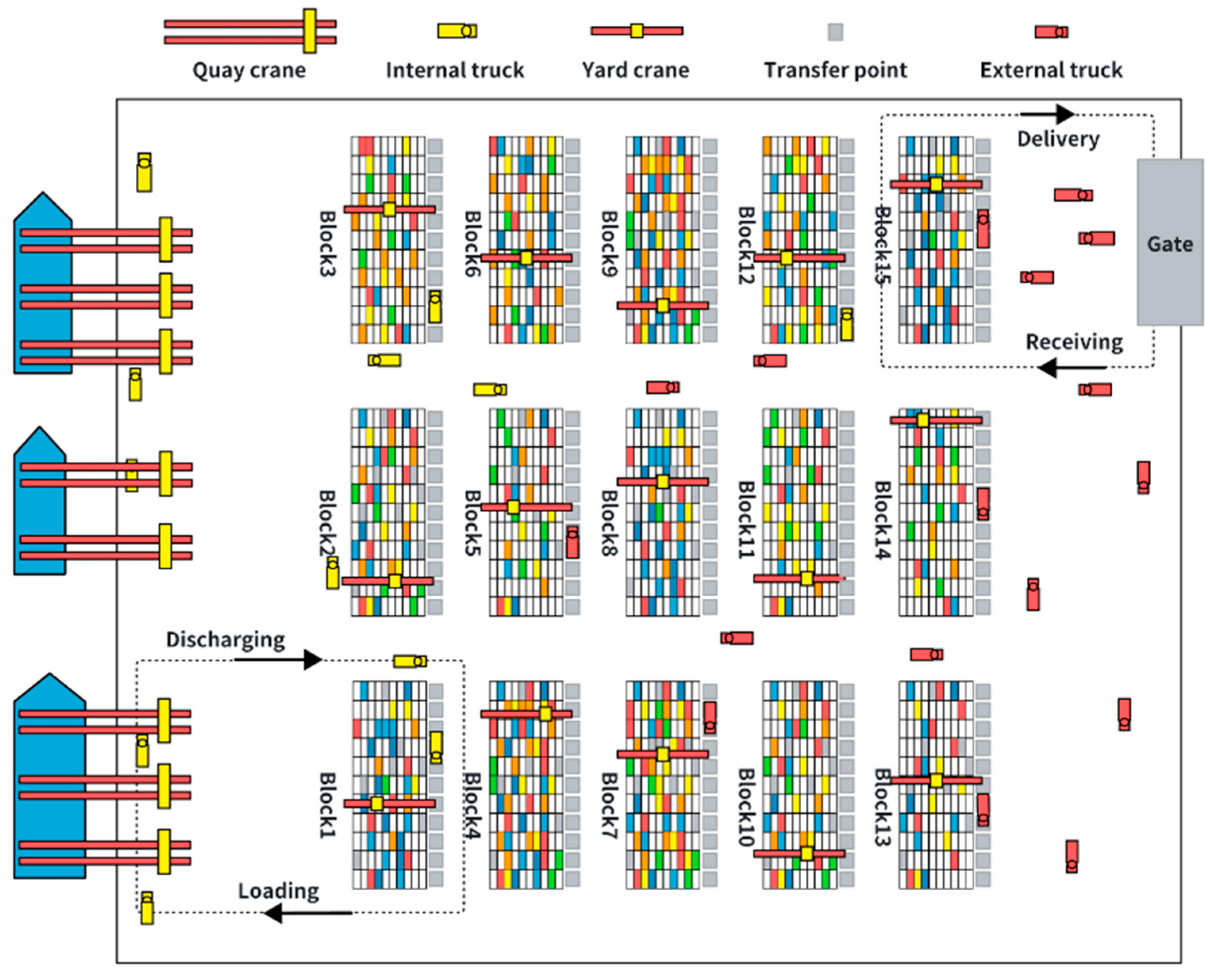
Figure 1 illustrates a typical layout of a container terminal, which generally consists of berths, internal truck lanes, container yards, and external truck access zones. As a prerequisite step for container consolidation, the discharging operation is carried out first after the vessel berths. The quay crane unloads containers from the ship, which are then transported by internal trucks to the yard, where yard cranes stack them into designated slots within the container blocks.
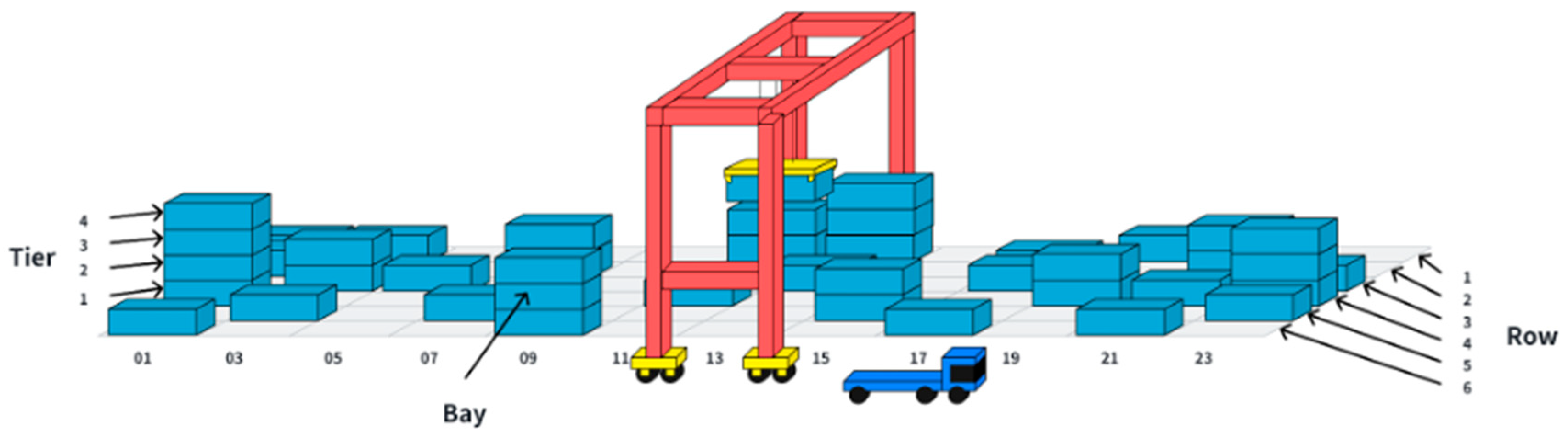
In container terminals, the yard is divided into multiple uniquely numbered blocks, each further structured by bays, rows, and tiers; Figure 2 shows one of the blocks. Bays are aligned along the longitudinal axis of the containers, with odd numbers typically used for 20-foot containers and the intervening even numbers reserved for 40-foot containers. Rows are arranged perpendicular to bays and are commonly organized into six rows per block. Each storage slot has a stacking capacity defined by tiers, with the maximum stack height usually set at four tiers.
However, due to port operation strategies such as first-come first-served and proximity-based stacking, container yards often suffer from fragmentation and dispersion. As a result, when external trucks enter the terminal for container delivery, yard cranes require longer operation times, which in turn increases the waiting time for external trucks.
Container consolidation involves relocating scattered and fragmented containers within the yard—those belonging to the same bill of lading or possessing similar attributes—into designated slot groups. This operation typically comprises three key steps: first, selecting the target slots, which serve as the designated stacking positions (bay and row) for consolidation, while considering both yard capacity constraints and stacking concentration; second, determining the consolidation sequence, which aims to minimize total operation time and equipment movements by optimizing the order in which containers are relocated; and third, assigning each container to the most suitable position within its target slot, thereby minimizing the yard crane’s travel time.
By adopting well-designed consolidation strategies, ports can effectively reclaim fragmented yard space, enhance the coordination between yard cranes and external trucks, and ultimately improve the overall throughput and operational efficiency of container terminals.

3.2. Mathematical Model

3.2.1. Assumptions

Merge operations are typically temporary tasks assigned to idle yard cranes. In such cases, the yard crane usually operates alone in an idle container block. In the vast majority of situations, regardless of whether the container is 20-foot or 40-foot, the yard crane handles only one container at a time per operation. Therefore, container size has no substantial impact on merge operations. Based on the above circumstances, the following assumptions are made:
  • Consolidation is performed within a single yard block, and only one yard crane is available for the consolidation operation.
  • All containers are of the same size.
  • All containers in the yard block share the same bill of lading or similar attributes.

3.2.2. Notations

B = 1 ,   2 ,   3 ,   . . . ,   B : Set of bay positions in the yard; indexed by b , b ; total of B bays.
R = 1 ,   2 ,   3 ,   . . . ,   R : Set of row positions in the yard; indexed by i , i ; total of R rows.
H = 1 ,   2 ,   3 ,   . . . ,   H : Set of tier positions in the yard; indexed by j , l ; total of H tiers.
C = 1 ,   2 ,   3 ,   . . . ,   C : Set of containers; indexed by c ;   total of C containers.
S = 1 ,   2 ,   3 ,   . . . ,   S : Set of consolidation stages (one container per stage); indexed by s , with S C .
D i n i t : Initial bay position of the yard crane before consolidation begins.
E i n i t : Initial row position of the yard crane before consolidation begins.
T m : Time required for the yard crane to move by one bay.
T n : Time required for the yard crane to move by one row.
P 0 : Average time required to pick up a container within a bay.
P 1 : Average time required to drop off a container within a bay.
X b i j b i l c s { 0 ,   1 } : equals 1 if container c is moved from position ( b , i , j ) to position ( b , i , l )   in stage s , and 0 otherwise.
y b i { 0 ,   1 } : equals 1 if bay b , row i is within the target consolidation area, 0 otherwise.
W b i j c s { 0 ,   1 } : equals 1 if container c is located at b , i , j in stage s , and 0 otherwise.
T o c s : Start time of consolidation for container c in stage s .
T e c s : Completion time of consolidation for container c in stage s .
Y c s : Bay position of the yard crane at the start of stage s for container c .
Z c s : Row position of the yard crane at the start of stage s for container c .
E b i s { 0 ,   1 } : equals 1 if bay b , row i is empty in stage s ; 0 otherwise.

3.2.3. Objective Function

The objective of the model is to consolidate all containers into designated target slots while minimizing the total operation time of the yard crane. Therefore, the objective function is as follows:
m i n m a x c C T e c S

3.2.4. Constraints

The container consolidation problem involves three major decision components: the yard crane’s movement and scheduling, the sequencing and placement of containers, and the assignment of target slots. Accordingly, the constraints are grouped into three categories: Yard Crane Constraints, Container Constraints, and Target Slot Constraints.
  • Yard Crane Constraints:
Y c 1 = D i n i t         c C
Z c 1 = E i n i t   c C
T o c s 0         c C , c C , s = 1
T o c s T e c s 1         c C , c C , s { 2 , . . . , S 1 }
T e c s T o c s + Y c s 1 b × T m + b b × T m + Z c s 1 i × T n + i i × T n + P 0 + P 1         c , c C , c c , s S
Y c ( s + 1 ) = b = 1 B i = 1 R j = 1 H b = 1 B i = 1 R l = 1 H X b i j b i l c s   · b             c C , s 1 , , S 1
Z c ( s + 1 ) = b = 1 B i = 1 R j = 1 H b = 1 B i = 1 R l = 1 H X b i j b i l c s   · i             c C , s 1 , , S 1
Constraints (2) and (3) set the crane’s initial bay and row positions. Constraints (4) and (5) ensure that the start time of each consolidation stage is not earlier than the end of the previous stage. Constraint (6) calculates the completion time as the sum of movement and handling durations. Constraints (7) and (8) update the crane’s position for the next stage based on the previous movement.
  • Container Constraints:
b = 1 B i = 1 R j = 1 H W b i j c s = 1         c C , s S
c = 1 C W b i j c s 1         s S , b B , i R , j H
E b i s = 1 c C W b i 1 c s         s S , b B , i R
c = 1 C W b i j c s c = 1 C W b i j + 1 c s         b B , i R , j { 1,2 , . . . , H 1 } , s S
W b i j c s = W b i j c s 1 + X b i l b i j c s 1 X b i j b i l c s 1         c C , b B , i R , j H , s { 2 , . . . , S }
b B i R j H b B i R l H X b i j b i l c s 1         c C , s S
c = 1 C X b i j b i l c s s = 1 S c = 1 C j = 1 j 1 X b i j b i l c s         s S , b B , i R , j H , b B , i R , l H
Constraints (9) and (10) are designed to ensure that each container is assigned to exactly one storage position, and that each storage position accommodates no more than one container. Constraint (12) enforces stacking from the bottom up. Constraint (13) ensures consistency in container placement across stages. Constraint (14) restricts each container to a single movement per stage. Constraint (15) enforces that containers can only be stacked above others if the lower levels are occupied.
  • Target Slot Constraints:
b i y b i = C H
c C j H W b i j C S H 1         s S , b B , i R
b B i R j H W b i j C S = C       s S
W b i j C S y b i         b B ,   i R , j H
X b i j b i l c s y b i         c C , s S , b B , i R , j H , b B , i R , l H
X b i j b i l c s 1 y b i         c C , s S , b B , i R , j H , b B , i R , l H
Constraint (16) limits the number of target slots to the minimum needed based on stacking height. Constraint (17) ensures no slot exceeds the tier limit. Constraints (18) and (19) ensure all containers are consolidated into target slots. Constraint (20) restricts container movement to designated target slots. Constraint (21) prevents containers already in target slots from being moved elsewhere.

4. Algorithm Description

4.1. Adaptive Large Neighborhood Search Algorithm

ALNS is an efficient heuristic optimization method demonstrating superior performance in complex combinatorial problems. By dynamically combining various destroy and repair operators, it explores the solution space with the core advantage of adaptively adjusting operator weights based on search progress. It has been widely applied in vehicle routing and scheduling optimization. Unlike BNB and BS requiring predefined target slots, ALNS iteratively searches for and identifies better target slot solutions.
For the container consolidation problem, ALNS employs multi-strategy destroy–repair operator combinations with a tabu search mechanism, maintaining search diversity while effectively avoiding local optima. The algorithm minimizes crane operation time through three-layer optimization: dynamic target slot adjustment, intelligent consolidation solution reorganization, and operation sequence optimization. The temperature parameter, inspired by simulated annealing cooling schedules, adaptively regulates acceptance criteria, while historical best solution guidance ensures effective search direction. This multi-dimensional strategy achieves a favorable balance between solution quality and computational efficiency.

4.1.1. Flowchart of Adaptive Large Neighborhood Search Algorithm

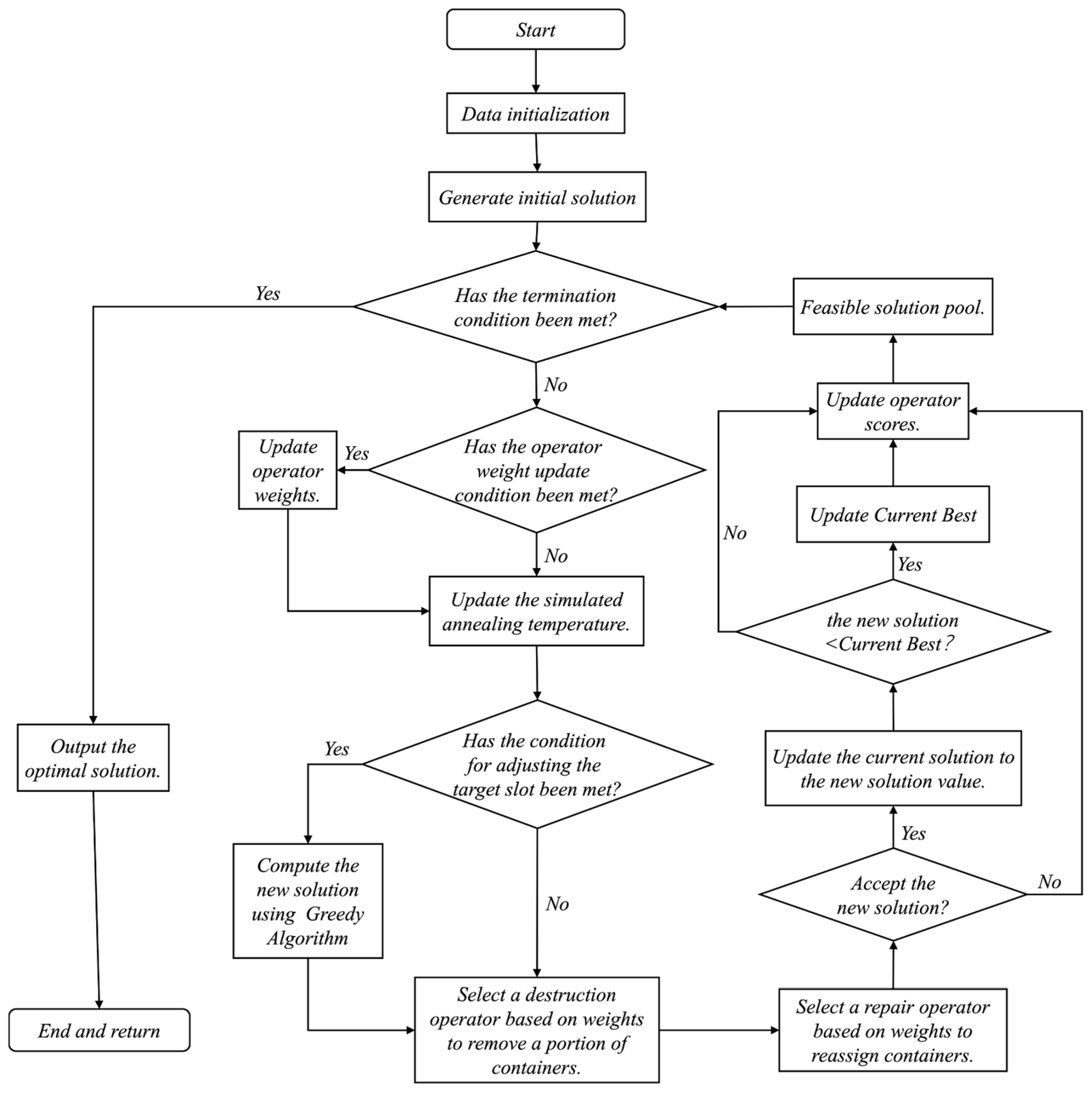
As shown in Figure 3, ALNS integrates local search, tabu search, and path reconstruction techniques to minimize crane travel time. After initializing parameters including temperature, iteration count, cooling rate, and destruction ratio, the greedy algorithm generates an initial solution set as both current and best solutions. A high-weight destroy operator is selected to remove containers forming a partial solution; then a high-weight repair operator reallocates removed containers to target slots, producing a new solution.
New solution acceptance follows simulated annealing criteria: always accepted if superior to the current solution or probabilistically accepted otherwise (probability increasing with temperature). The current solution is updated upon acceptance, and the best solution is updated if improved. Operator scores are updated based on new solution quality: 50 points for improving the best solution, 15 for accepted but non-improving, and 5 for rejected solutions. Weights are smoothly updated combining historical weights with current scores, followed by temperature recalculation according to the annealing schedule.
Upon completing the main loop, the algorithm checks whether the target slot adjustment iteration count is reached; if so, a new initial solution is generated to restart the main loop. Termination criteria including maximum iterations or minimum temperature are verified. Local search, tabu search, and path reconstruction are periodically applied to further enhance solution quality. The algorithm outputs the best solution upon meeting termination conditions.

4.1.2. Algorithm Encoding Method

Algorithm implementation begins with the construction of an initial solution. First, the required number of target slots K is calculated as K = C e i l ( C c o u n t h ) , where C c o u n t denotes the total number of containers and h represents the maximum stacking height per slot. The initial target bays are determined by selecting the K slots with the largest number of pre-positioned containers. If the number of slots with the same container count exceeds the required number, a random selection is made among these to meet the target number while ensuring no duplication of slots. Subsequently, by comparing the performance of three different initialization strategies in terms of computational time and initial objective function values (the experimental comparison results are presented in the Appendix A), the greedy strategy was selected as the initialization scheme for the algorithm. A greedy strategy is employed to generate the initial operation sequence, where the crane prioritizes moving the nearest container into the nearest non-full target slot that is not yet full. This design not only provides a high-quality starting point for the search but also significantly enhances the algorithm’s convergence efficiency.
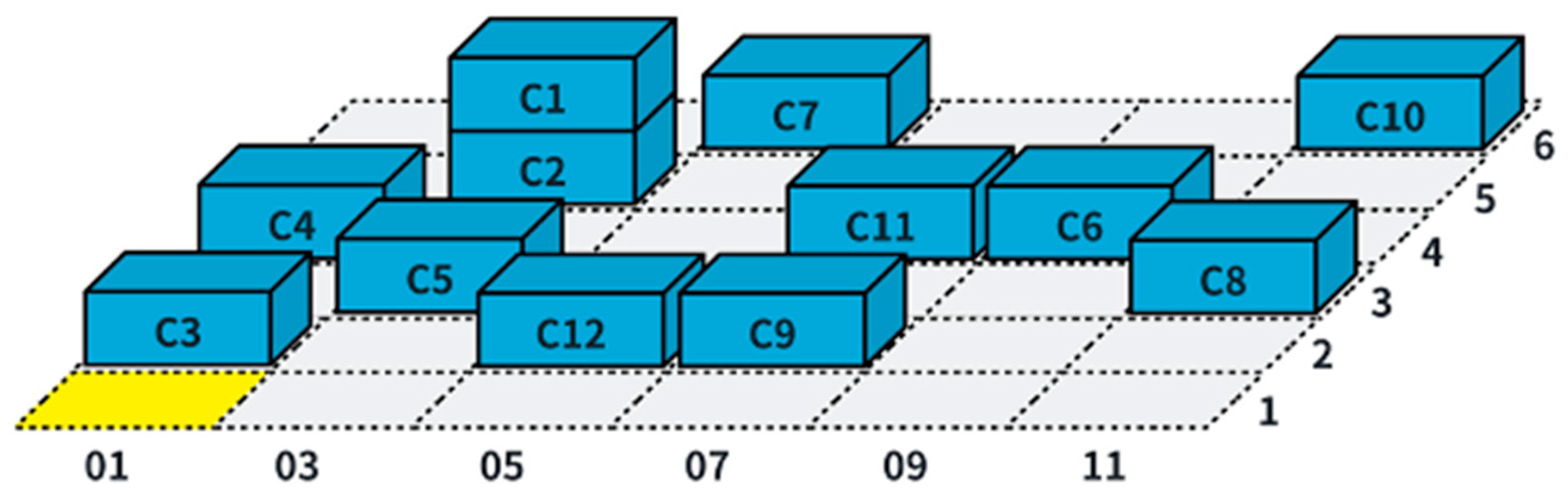
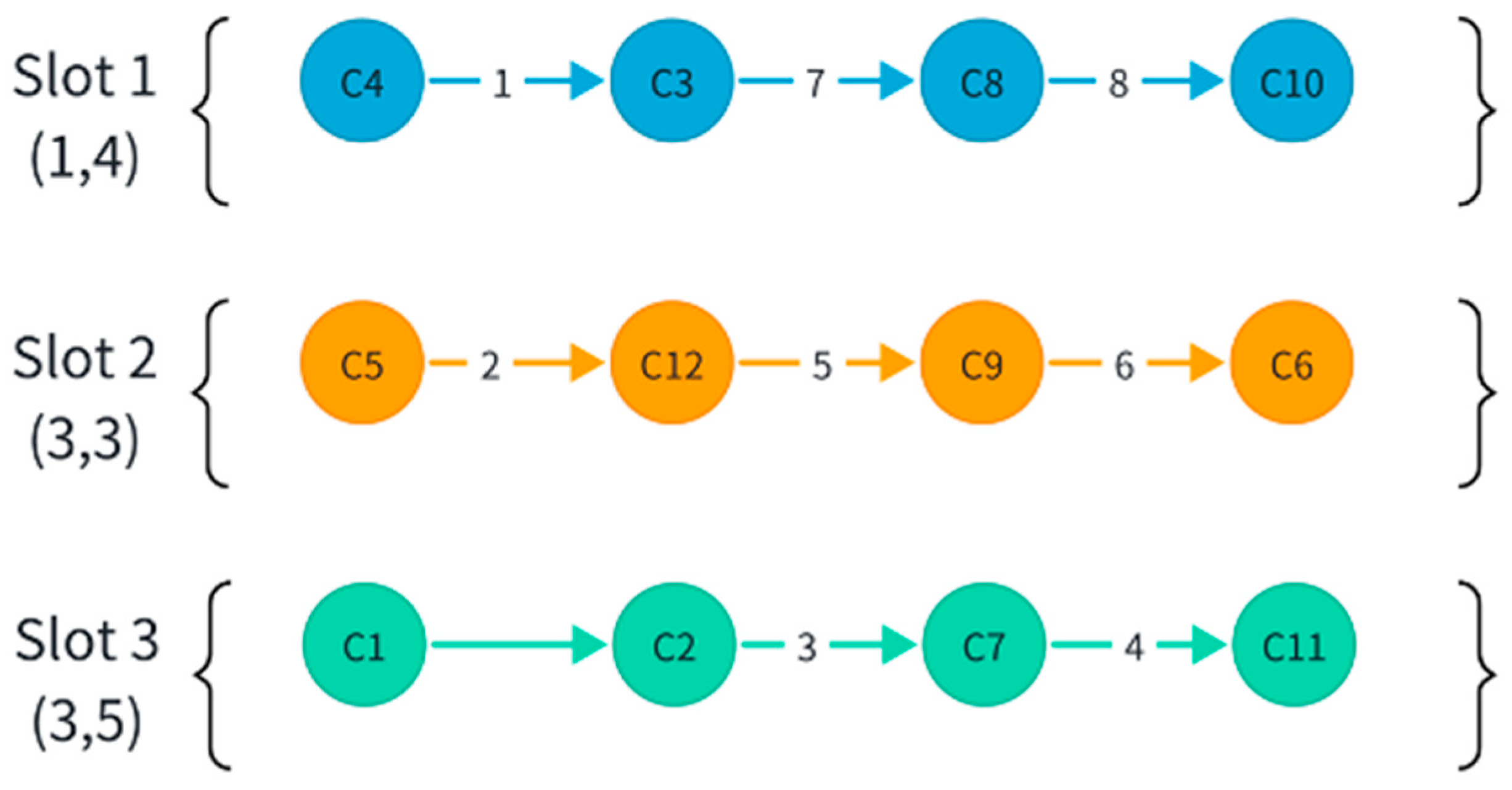
As shown in Figure 4, the initial target slots are determined as (3, 5), (1, 4), and (3, 3). According to the greedy algorithm, the yard crane always selects the nearest container awaiting consolidation and assigns it to the nearest non-full target slot. Following this rule, an initial feasible solution is obtained, as depicted in Figure 5. Slot 1, Slot 2, and Slot 3 denote the three initially selected target slots, respectively. The containers listed in parentheses represent the ultimate configuration within each slot. Specifically, C4, C5, C1, and C2 remain unmoved as they are already situated in their target slots. The notation C4-C3-C8-C10 for Slot 1 (1, 4) indicates that these four containers constitute the final stacking configuration in Bay 1, Row 4. The numerical values annotating the arrows signify the consolidation sequence of the respective containers. For instance, the arrow from C4 to C3 bearing the numeral “1” denotes that C3 is the first container to be consolidated, with its destination being the second tier of Slot 1. This results in a total consolidation time of 801 s.
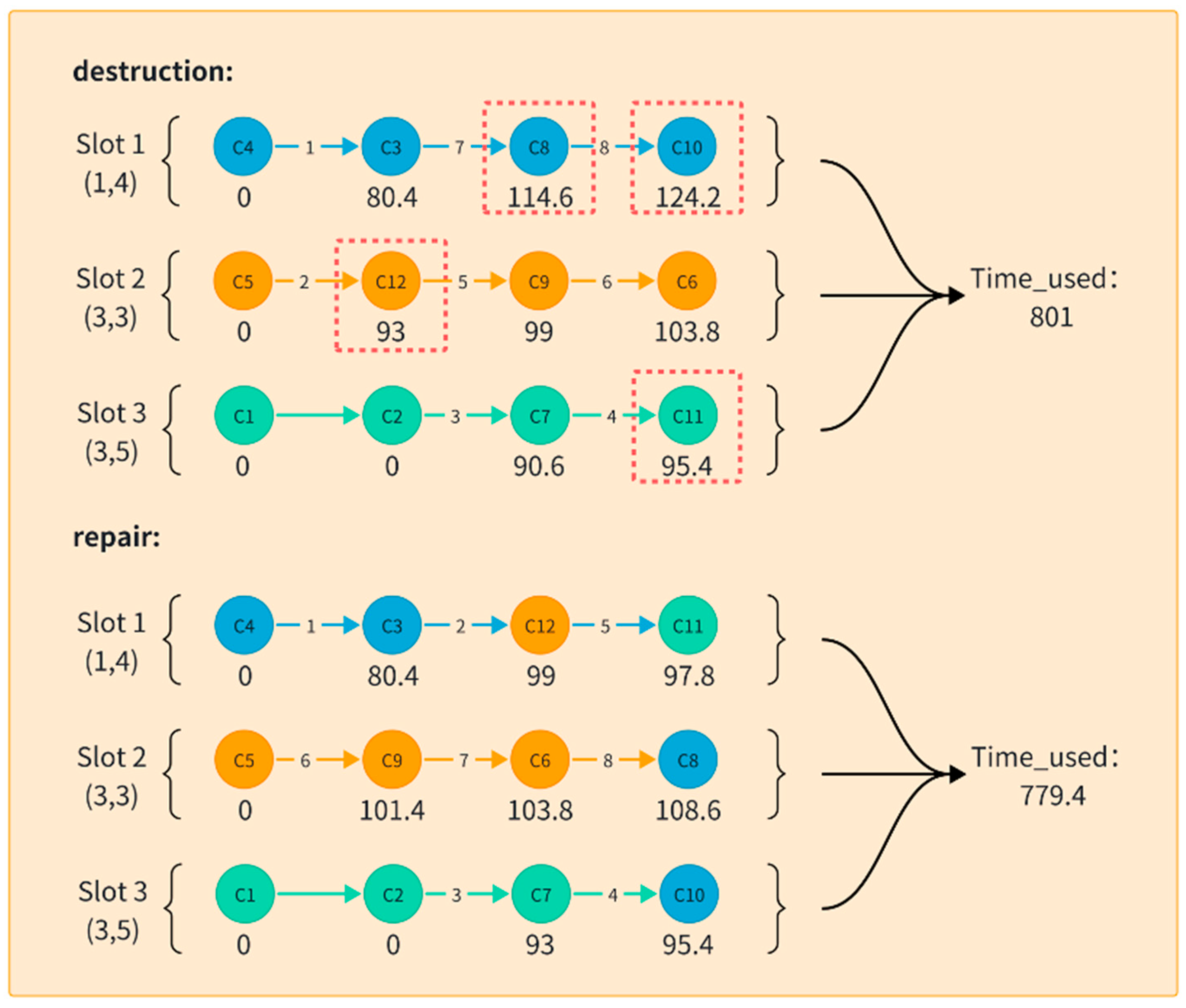
After obtaining the initial solution, the algorithm enters the main loop of destruction, repair, target slot adjustment, and operator weight updating. Before reaching the target slot adjustment threshold, the algorithm searches for improved solutions through destruction and repair operations. As shown in Figure 6, assuming a random destroy operator and global optimization repair operator with a 35% destruction ratio, 4 out of 12 containers are destroyed (C8, C10, C12, and C11). The repair operator minimizes total relocation time by enumerating target slot and sequence combinations: C8 is reassigned from Slot 1 to Slot 2, C10 to Slot 3, while C12 and C11 are consolidated in Slot 1. The optimized consolidation time decreases from 801 to 779.4 s; this new solution is accepted, updating the current best solution and operator scores accordingly.
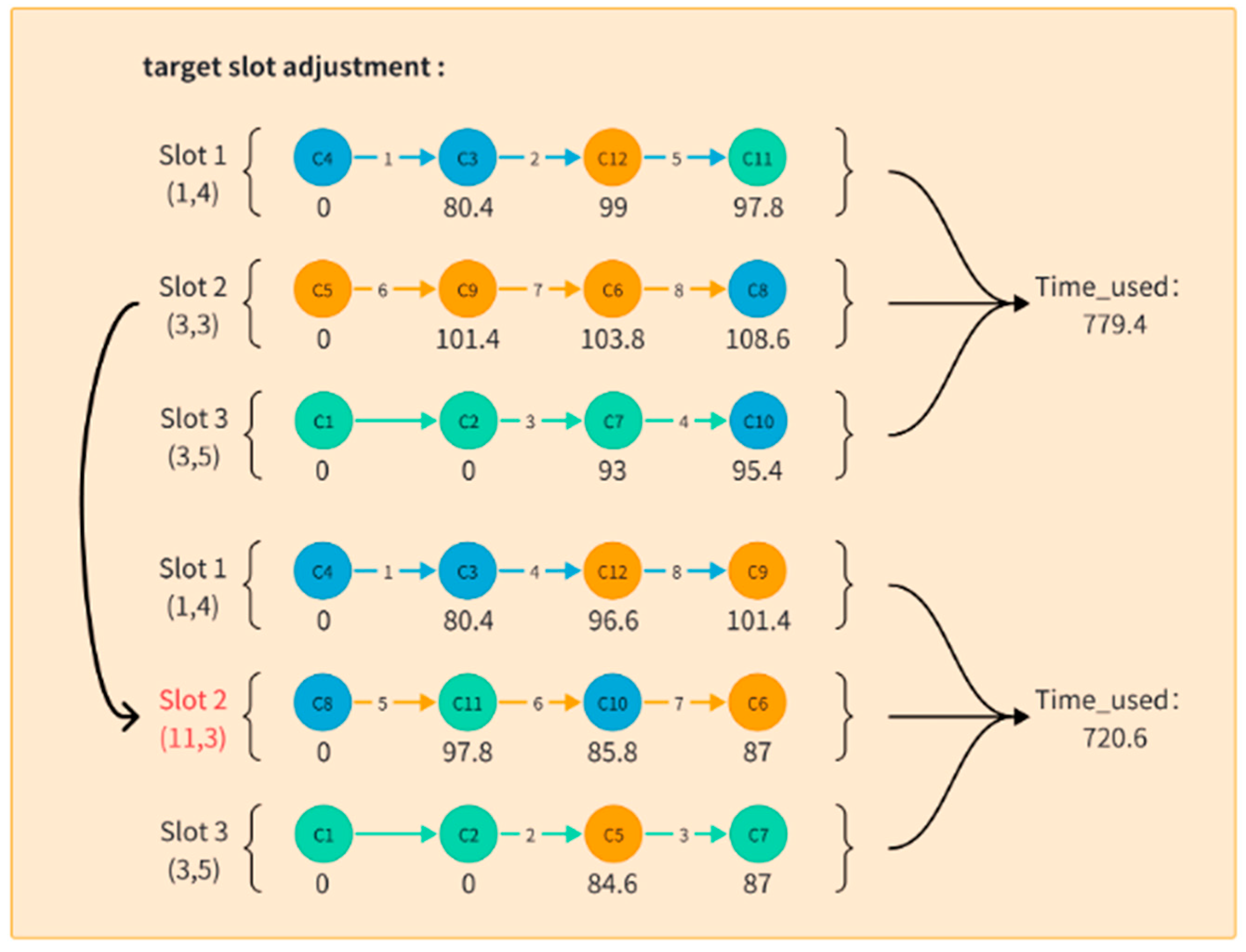
Upon reaching the target slot adjustment iteration count, the algorithm explores alternative target slots based on container distribution density. A new solution is generated using the greedy algorithm with updated slots; if accepted, destruction and repair operations continue until the next adjustment threshold. In Figure 7, the target slot (3, 3) is adjusted to (11, 3) based on distribution density, yielding 720.6 s via the greedy algorithm—superior to the current best and thus accepted. High-weight operators are subsequently selected for destruction and repair to generate new solutions and update scores. This cycle continues until termination criteria are satisfied.

4.2. Two-Stage Algorithm

In the two-stage algorithm, the first stage involves predicting the distribution positions of the target slots. Given the known locations of these target slots, various algorithms are then applied in the second stage to determine container grouping and consolidation sequences.

4.2.1. Estimation of Target Slots (First Stage)

(1)
Container pre-grouping
Container pre-grouping aims to ensure spatial compactness within each group, thereby guaranteeing a relatively reasonable estimation of target slot positions and minimizing the consolidation time. The final grouping results, however, still depend on subsequent algorithmic optimization.
  • Step 1: Calculating the Required Number of Slots
Based on the total container count C c o u n t and the maximum stacking height per slot h , the required number of target slots is calculated as K = C e i l ( C c o u n t h ) . This value represents the minimum number of independent slots needed to accommodate all containers without exceeding the stacking height limit.
  • Step 2: Preliminary Container Grouping
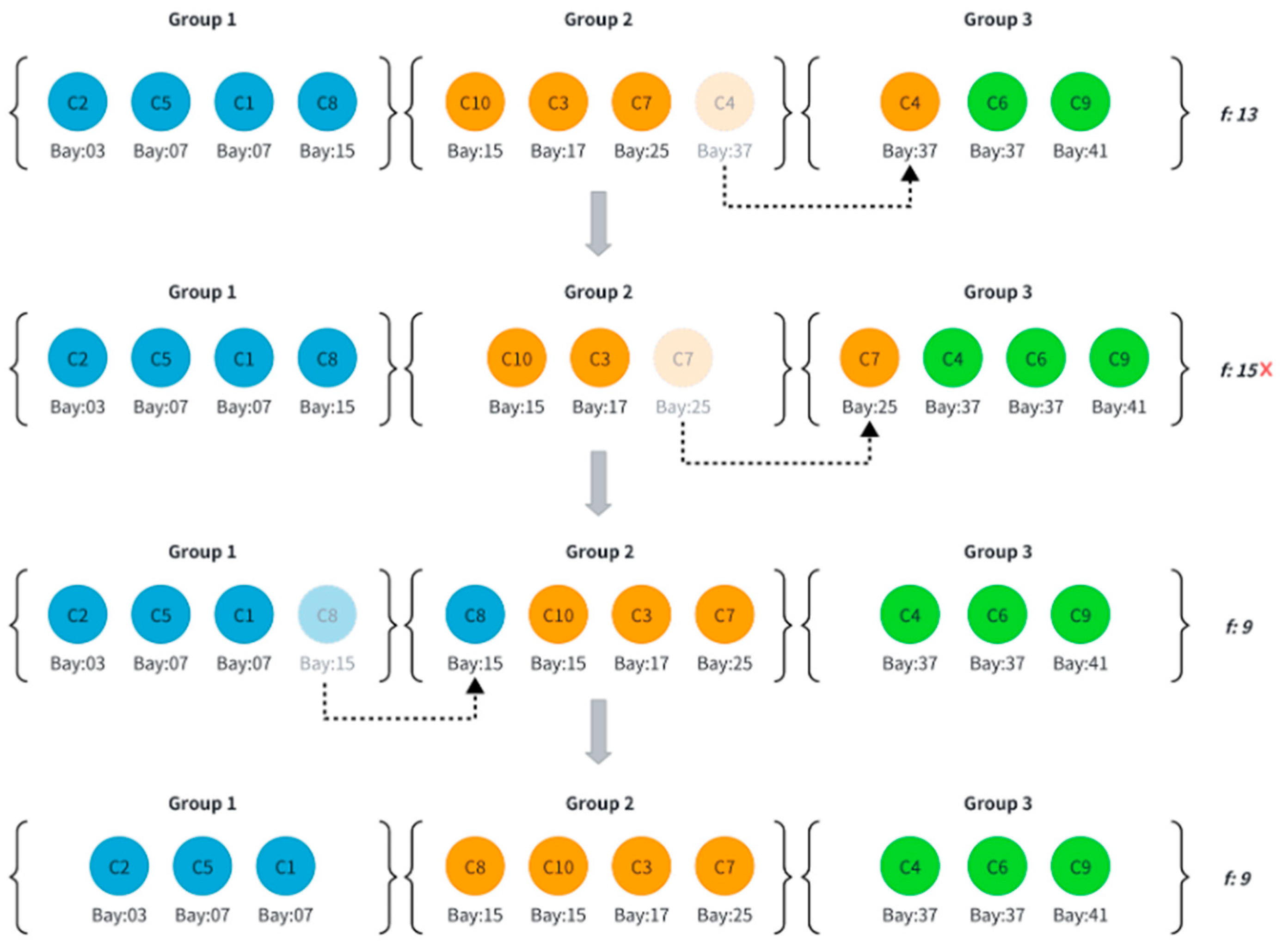
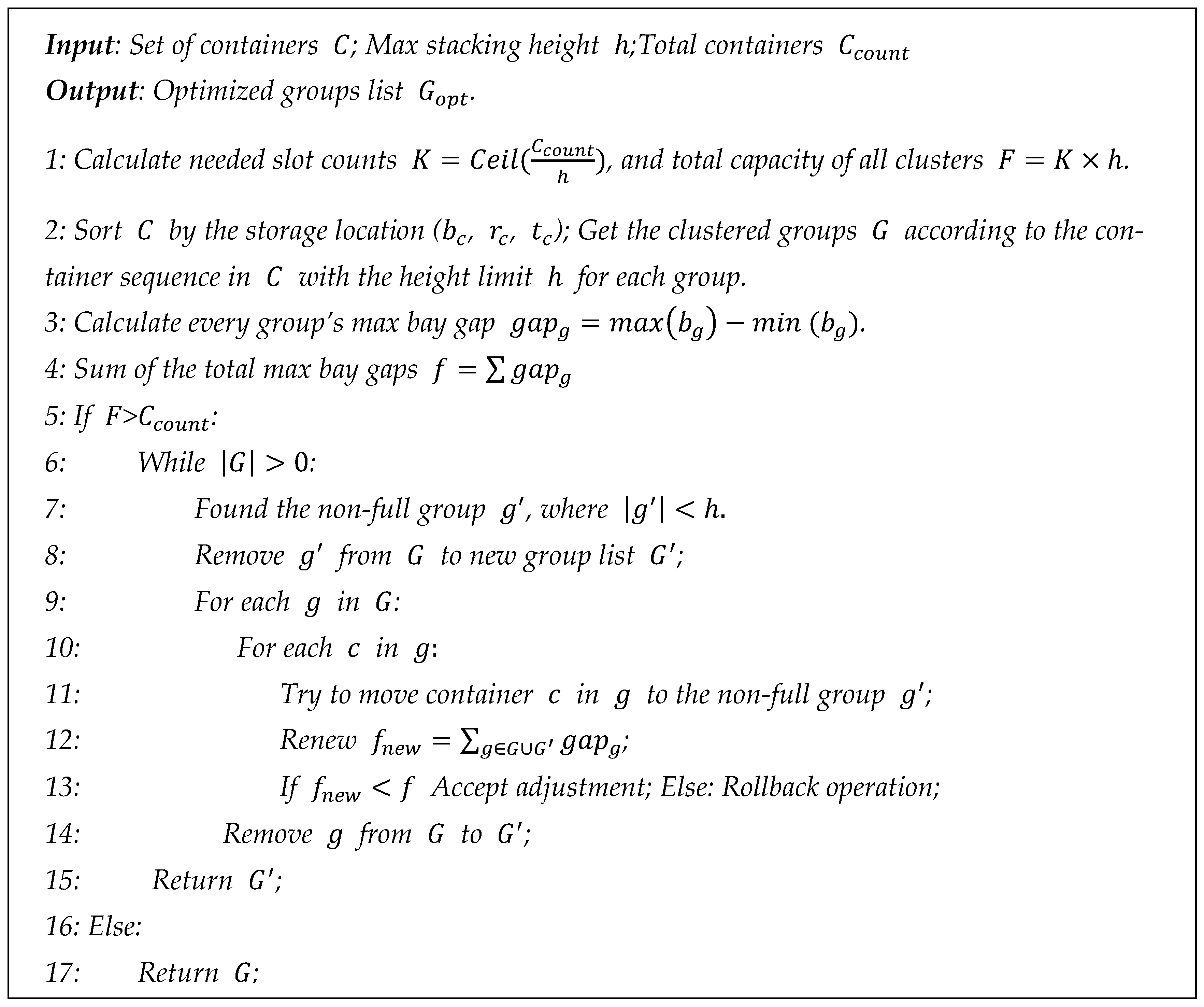
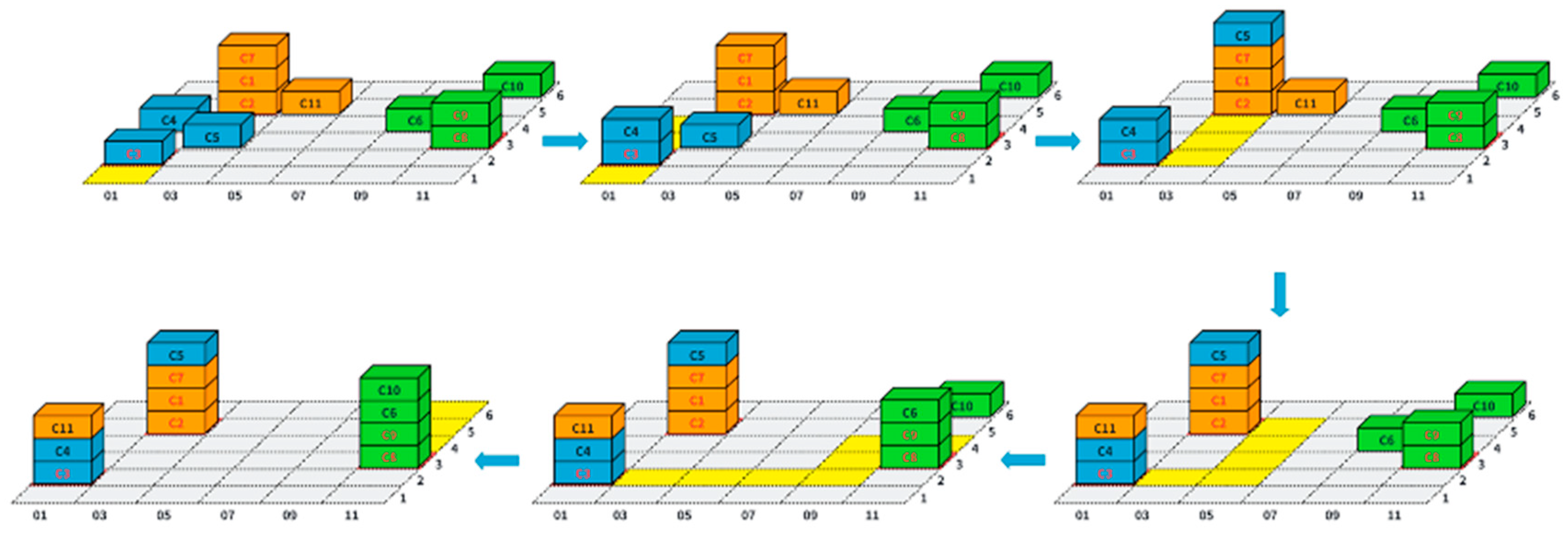
All containers are first sorted in ascending order based on their bay positions. Within the same bay, containers are further sorted in ascending order of row number, and finally, within the same bay and row, they are sorted in descending order of tier number. Based on this sorted sequence, containers are grouped sequentially according to a maximum group capacity of H containers per sequence. Table 2 presents the basic grouping results for 10 containers dispersed across the container yard. For each group, the maximum intra-group bay span g a p g is calculated, as well as the total bay span across all groups, denoted by f . This approach enables rapid initialization of container grouping and ensures a relatively high spatial density within each group, thus providing a structural basis for subsequent consolidation scheduling. However, due to possible spatial dispersion among containers within a group, further adjustment and optimization may still be required.
  • Step 3: Intra-Group Container Optimization and Adjustment
When the total capacity of all groups exceeds the number of containers to be consolidated, this indicates that the last group still has available space for additional containers. f is first calculated. Then, the last container from the preceding group is moved into the final group, and the new f is recalculated. If f is reduced, the new grouping is retained; otherwise, the algorithm continues to search backward for the next non-full group and repeats the procedure. This process is iterated until all non-full groups have been evaluated. Figure 8 illustrates the optimization process applied to the container groups listed in Table 2.
  • Grouping Pseudocode
The pseudocode for Grouping is presented in Figure 9.
(2)
Compute the Group Centers
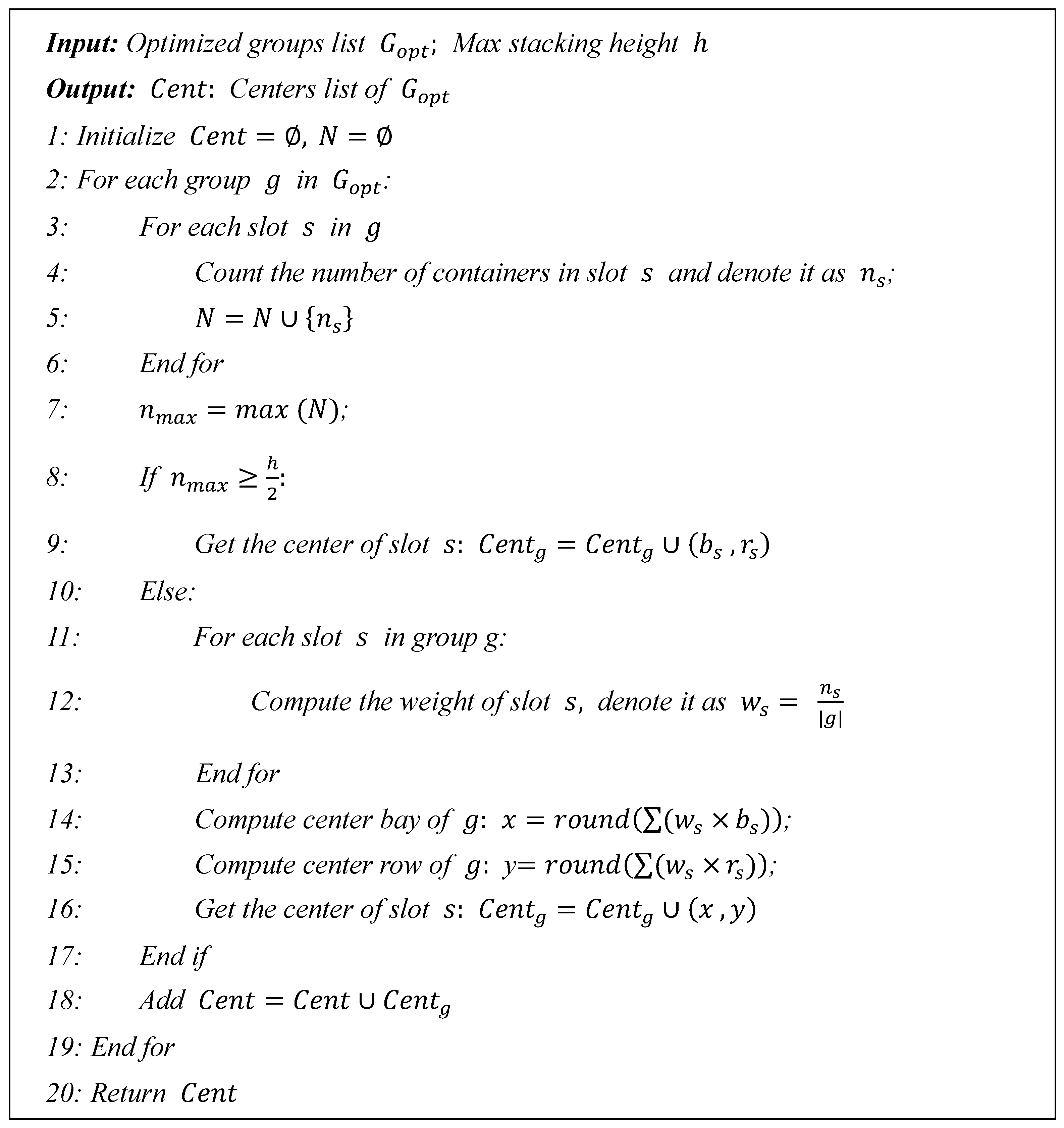
The center of each group serves as an approximate representation of the spatial center of the containers within that group. Determining the group center as a candidate target slot ensures the rationality of target slot selection.
  • Step 1: Identify High-Frequency Slots as Group Centers
By counting the number of containers in each slot within a group, if any slot contains a number of containers greater than or equal to half the stack height, it implies that at most only half of the containers in that group require consolidation. This significantly reduces the yard crane’s consolidation time. Therefore, the location of that slot is directly designated as the group center.
  • Step 2: Compute Weighted Geometric Center for each Group
If no slot in the group satisfies the threshold, the weighted geometric center C e n t g is computed. Let the number of containers in slot s of group g be n s ; let the number of containers in all groups be n g , with coordinates b s , r s representing the bay and row positions, respectively. Let w s denote the weight of slot s . The weighted geometric center is calculated as follows:
C e n t g =   w s × b s , w s × r s
where w s = n s n g .
After computing the center coordinates, the bay position is rounded up to the nearest odd number equal to or greater than the calculated value, and the row position is rounded to the nearest integer, ensuring both lie within valid operational bounds.
For example, let us consider the groupings Group 1: [C2, C5, C1], Group 2: [C8, C10, C3, C7], and Group 3: [C4, C6, C9]. None of the groups have a slot exceeding half the stacking height. For Group 1, Slot 1 (3, 1) has a weight w 1 = 1 1 + 1 + 1 = 1 3 , and Slot 2 (7, 2) has a weight w 1 = 2 1 + 1 + 1 = 2 3 . The weighted geometric center is calculated as follows:
C e n t 1 = 1 3 3 + 2 3 7 , 1 3 1 + 2 3 2 = 17 3 , 5 3 . After adjusting to valid coordinates, the center is set as (7, 2). Similarly, the centers for Group 2 and Group 3 are calculated as (19, 3) and (39, 5), respectively.
  • Pseudocode for Computing Group Center
The pseudocode for Computing Group Center is presented in Figure 10.
(3)
Estimation of Candidate Target Slot Solutions
Evaluating the cost of designating each slot and the group center as a potential target slot within each group ensures a more rational prediction of the final target slot configuration.
  • Step 1: Estimate Costs for Each Slot and the Center within Each Group
An ideal target slot location should minimize the total yard crane operation time. As consolidation involves the crane moving from its current position to a container’s location, picking it up, and then moving it to the target slot, the cost estimation procedure is as follows:
Determine the number of containers to be consolidated.
Compute the handling cost as: Number of containers × (picking time + placing time).
Compute the distance cost by calculating the total travel time required for moving all containers in the group to the candidate target slot.
Total cost = handling cost + distance cost.
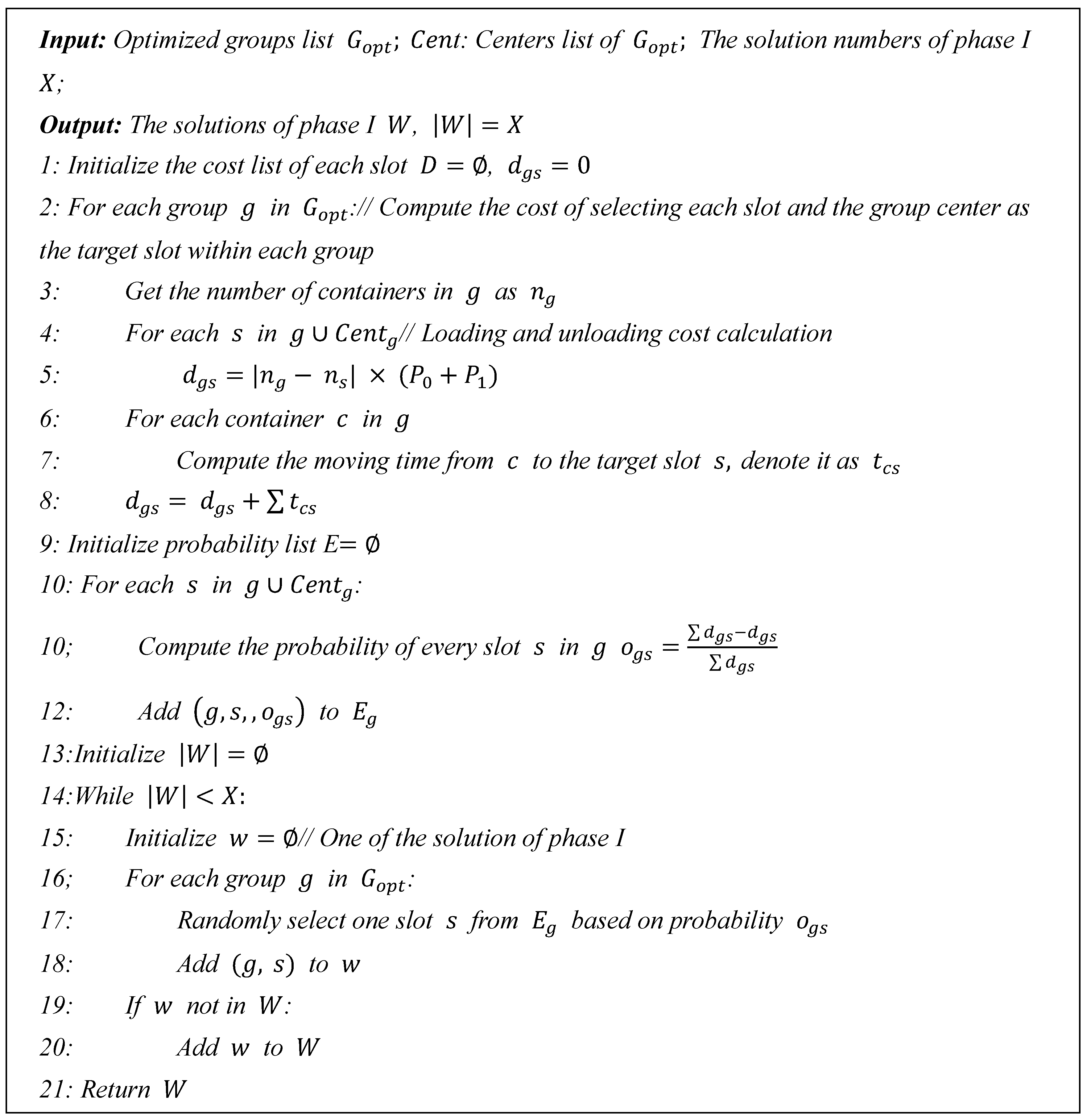
  • Step 2: Probabilistic Selection of N s o l u Candidate Target Slot Solutions
After computing the cost of each candidate slot and the center within each group, the selection probability for each candidate is determined based on the principle that higher cost corresponds to lower selection probability. Subsequently, for each group, one candidate is probabilistically selected, and a total of N s o l u distinct combinations of K target slots are generated as potential target slot solutions.
  • Pseudocode for Estimating Target Slot Solutions
The pseudocode for Estimating Target Slot Solutions is presented in Figure 11.

4.2.2. Determining the Consolidation Solution (Second Stage)

(1)
Greedy Algorithm
The Greedy Algorithm is a heuristic method that, at each decision step, selects the locally optimal option, with the expectation that a sequence of such local optima will collectively lead to a globally optimal solution. When applied to the consolidation problem, the GA can rapidly generate a reasonable and feasible solution, which can then serve as the initial upper bound for the BNB algorithm, thereby significantly reducing computational overhead.
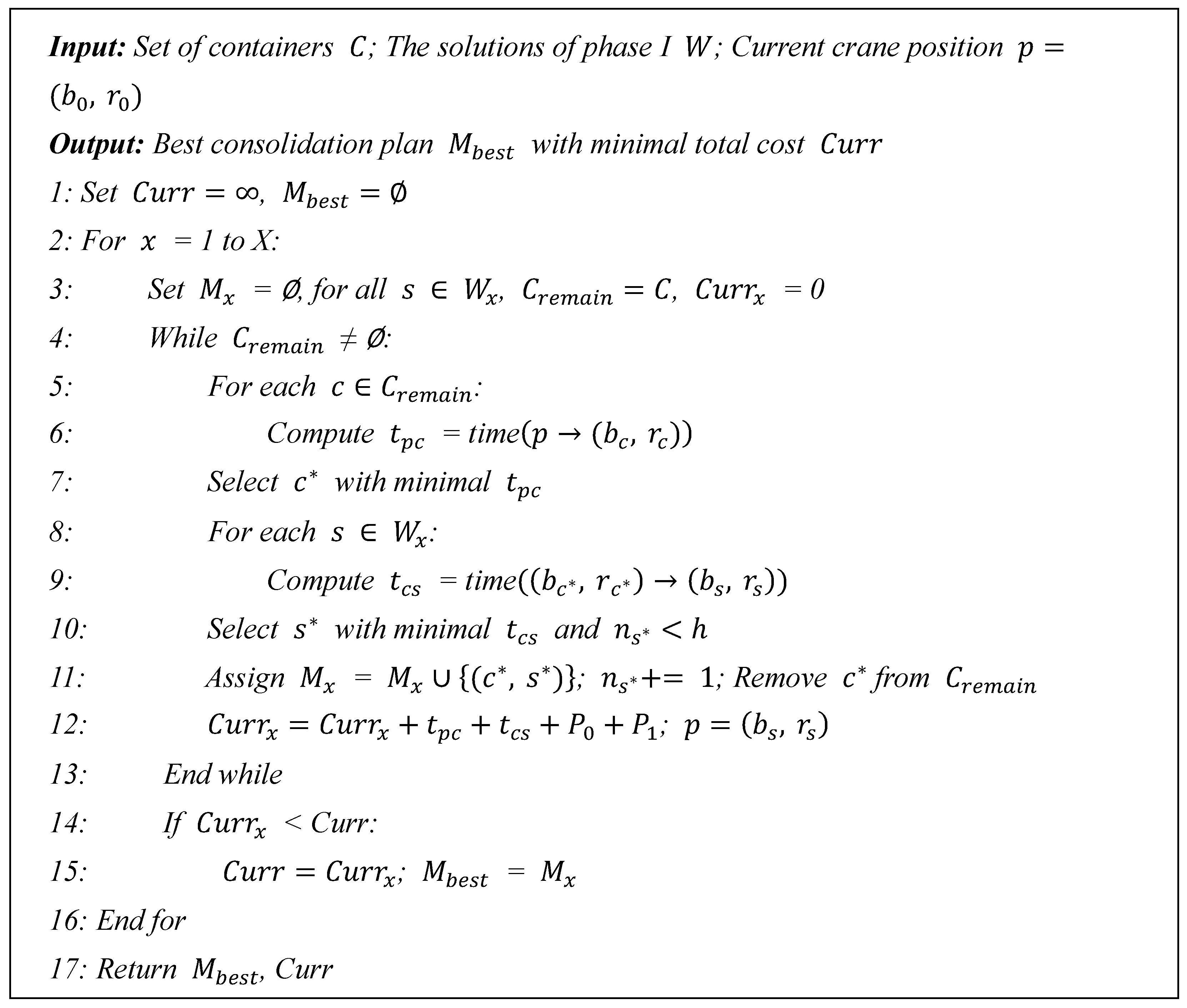
In this approach, the candidate target slot solutions are first determined based on Figure 9, Figure 10 and Figure 11. The GA is then employed to compute the final consolidation plan. During the consolidation process, the yard crane always moves from its current position to the nearest container, retrieves it, and consolidates it into the nearest non-full target slot.
For example, if the crane initially starts at position (1, 1) and the target slots are (1, 2), (3, 5), and (11, 3), the greedy algorithm will first move the crane to the closest container, say C4. After retrieving C4, it will be consolidated into the nearest non-full target slot, in this case (1, 2). The crane then updates its position to (1, 2). From there, it proceeds to the next closest container, say C5, and assigns it to the nearest feasible target slot, which may now be (3, 5). This process continues iteratively until all containers have been successfully consolidated into their respect target slots. The consolidation sequence is illustrated in Figure 12.
  • Pseudocode for Greedy Algorithm
The pseudocode for the Greedy Algorithm is presented in Figure 13.
(2)
Branch and Bound Algorithm
Upper and Lower Bound Estimation
The upper bound ( U B ) is estimated using the GA, which rapidly computes a feasible solution. This solution serves as the initial upper bound for the BNB procedure.
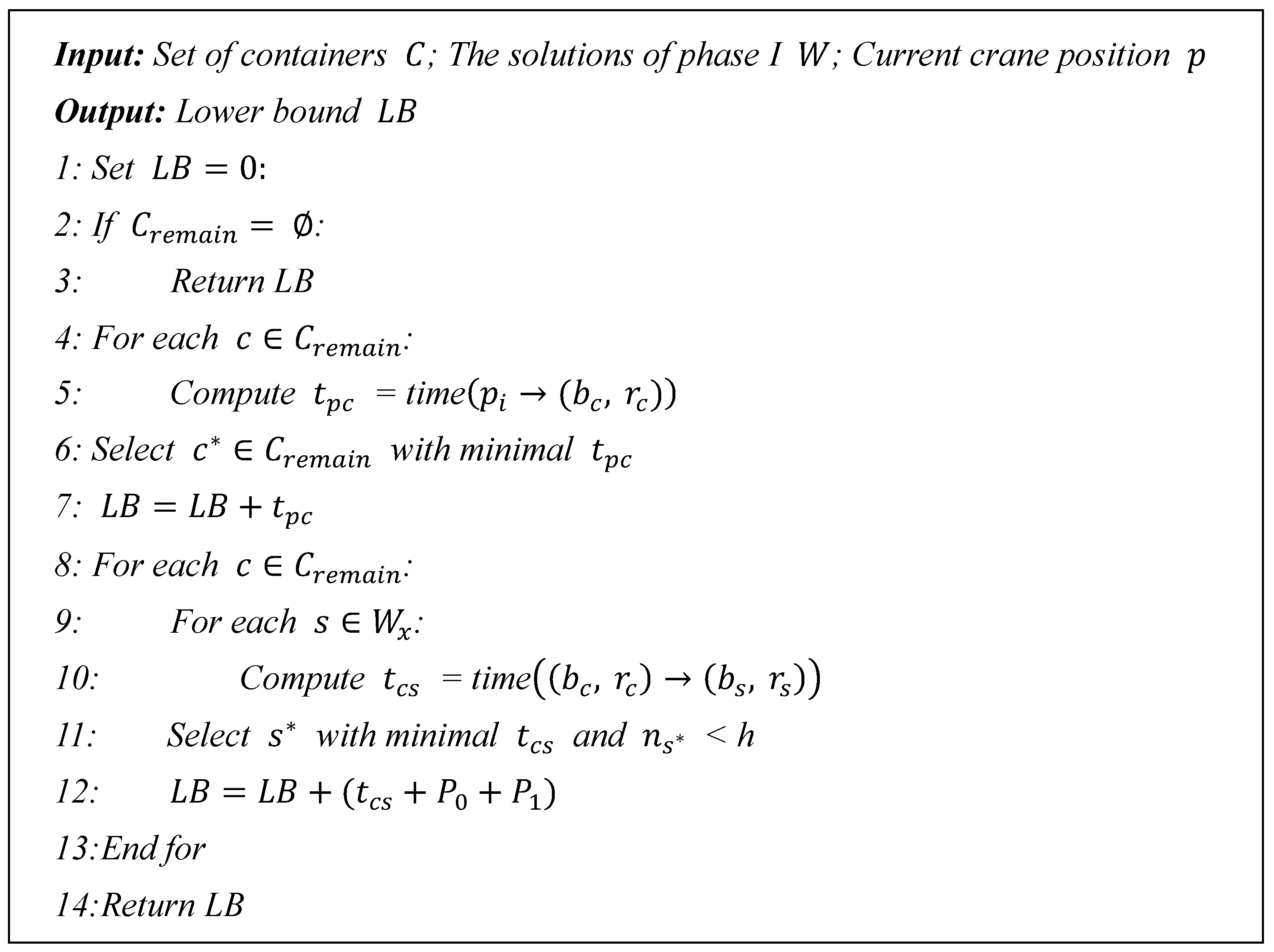
For the lower bound ( L B ), since the container consolidation process requires relocating all target containers to designated slots, each consolidation stage includes the time taken for the yard crane to move from its current location to the container’s position and perform the pickup operation, as well as the time required to transport the container to its nearest non-full target slot and complete the placement operation.
  • Pseudocode for Lower Bound estimation
  • The pseudocode for the Lower Bound estimation is presented in Figure 14.
Figure 14. The pseudocode for the Lower Bound estimation.
Jmse 14 00797 g014
Branch and Prune
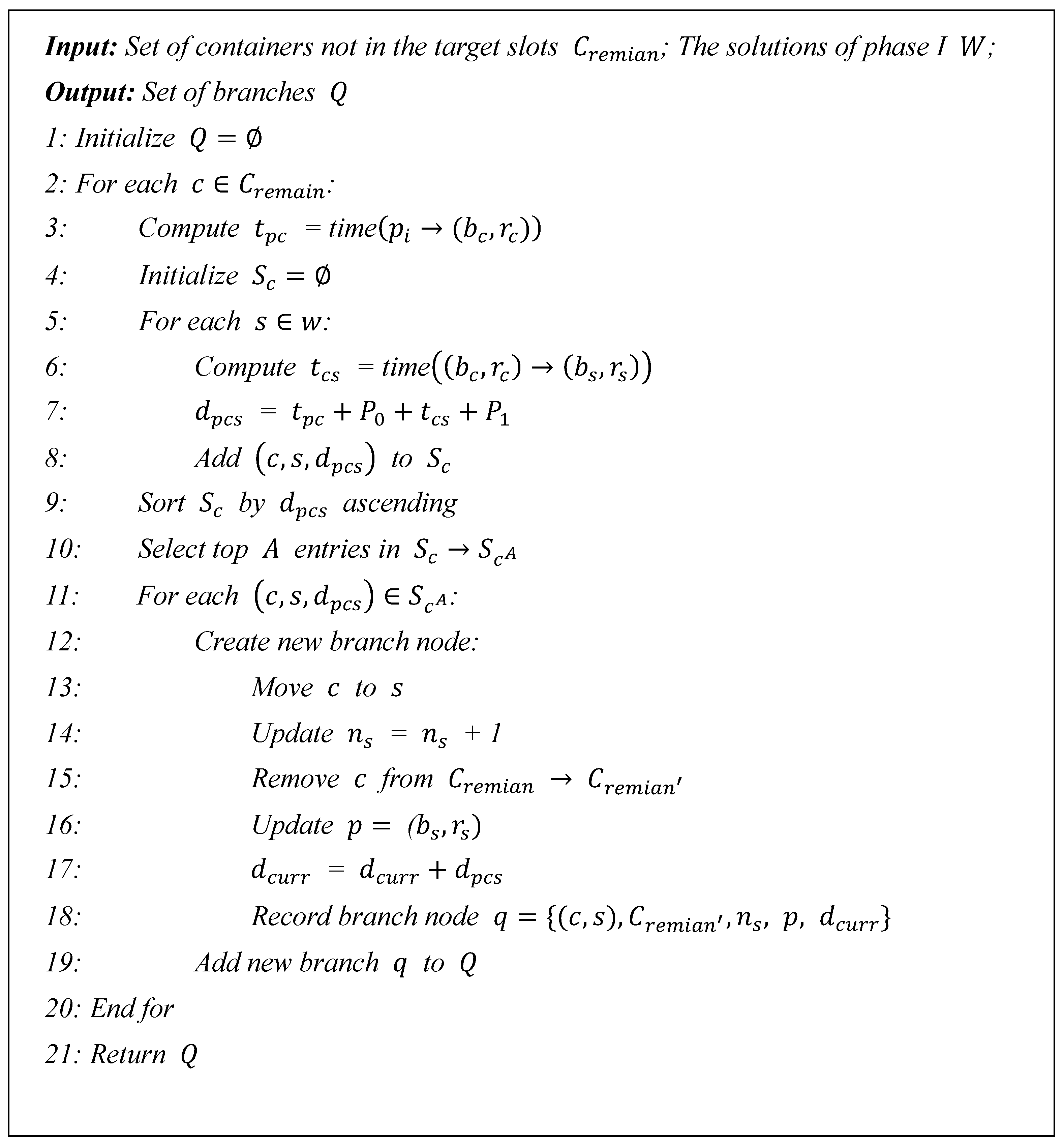
When using the BNB algorithm to solve the consolidation problem, branch generation is primarily based on identifying which target slots the containers to be consolidated can be moved into. Specifically, the algorithm iterates through all unassigned containers and attempts to assign each of them to all feasible target slots. Given that the container consolidation problem is inherently many-to-many mapping, the number of target slots increases with the number of containers, and the possible allocation combinations between containers and target slots grow exponentially. To reduce computational complexity, based on the number of target slots, the allocation of containers in their current state is restricted to only the N nearest non-full target slots (where N is less than or equal to the actual number of target slots). For example, let us consider three target slots initially identified as (1, 4), (3, 5), and (7, 2), and four containers to be moved: C2, C3, C9, and C10; if containers are limited to be consolidated only into their two nearest non-full target slots, then at the initial node branching, container C2 can only be assigned to (1, 4) and (3, 5), but not (7, 2). This restriction reduces the number of branches with high time costs and accelerates the algorithm’s computation.
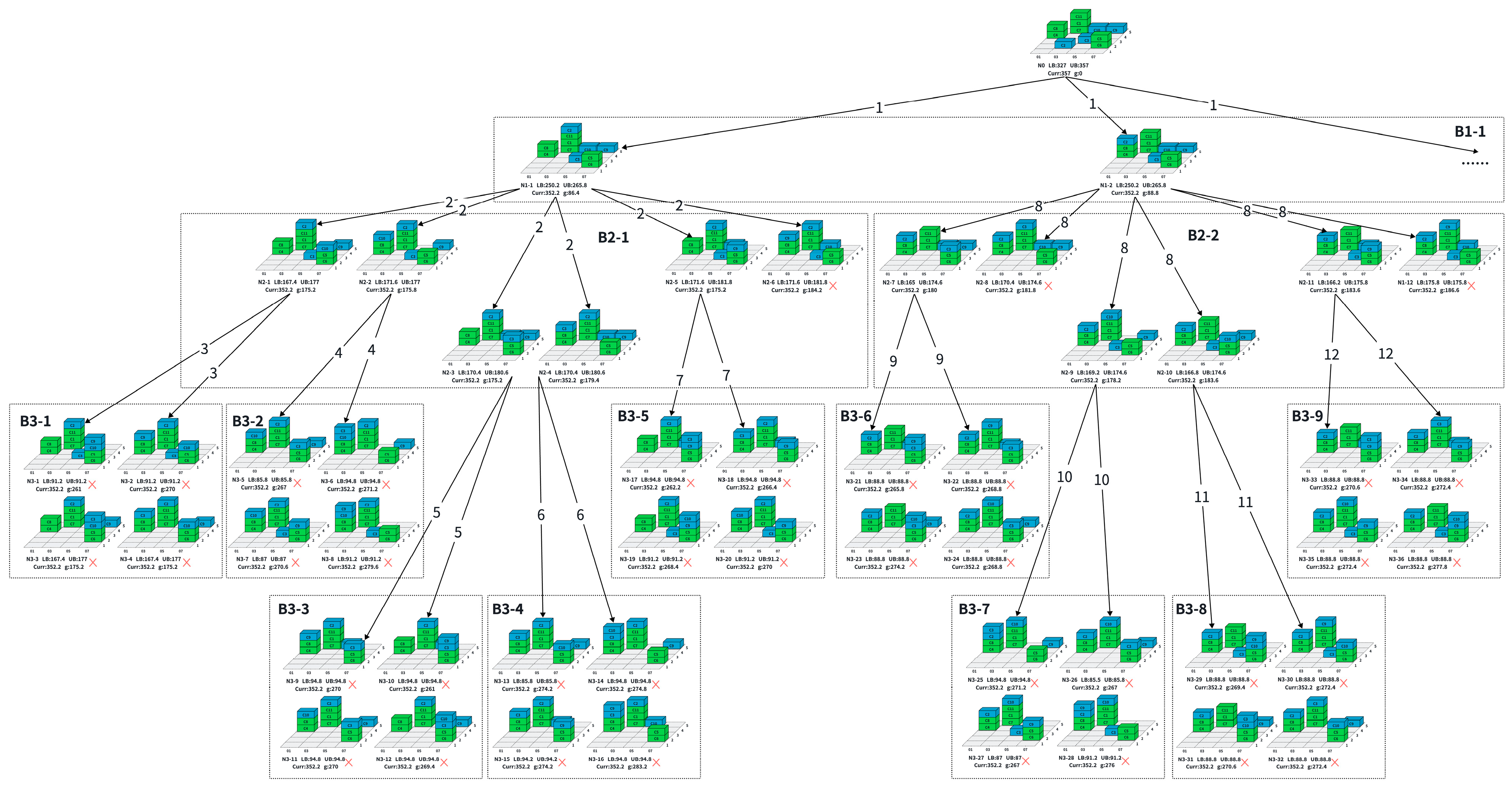
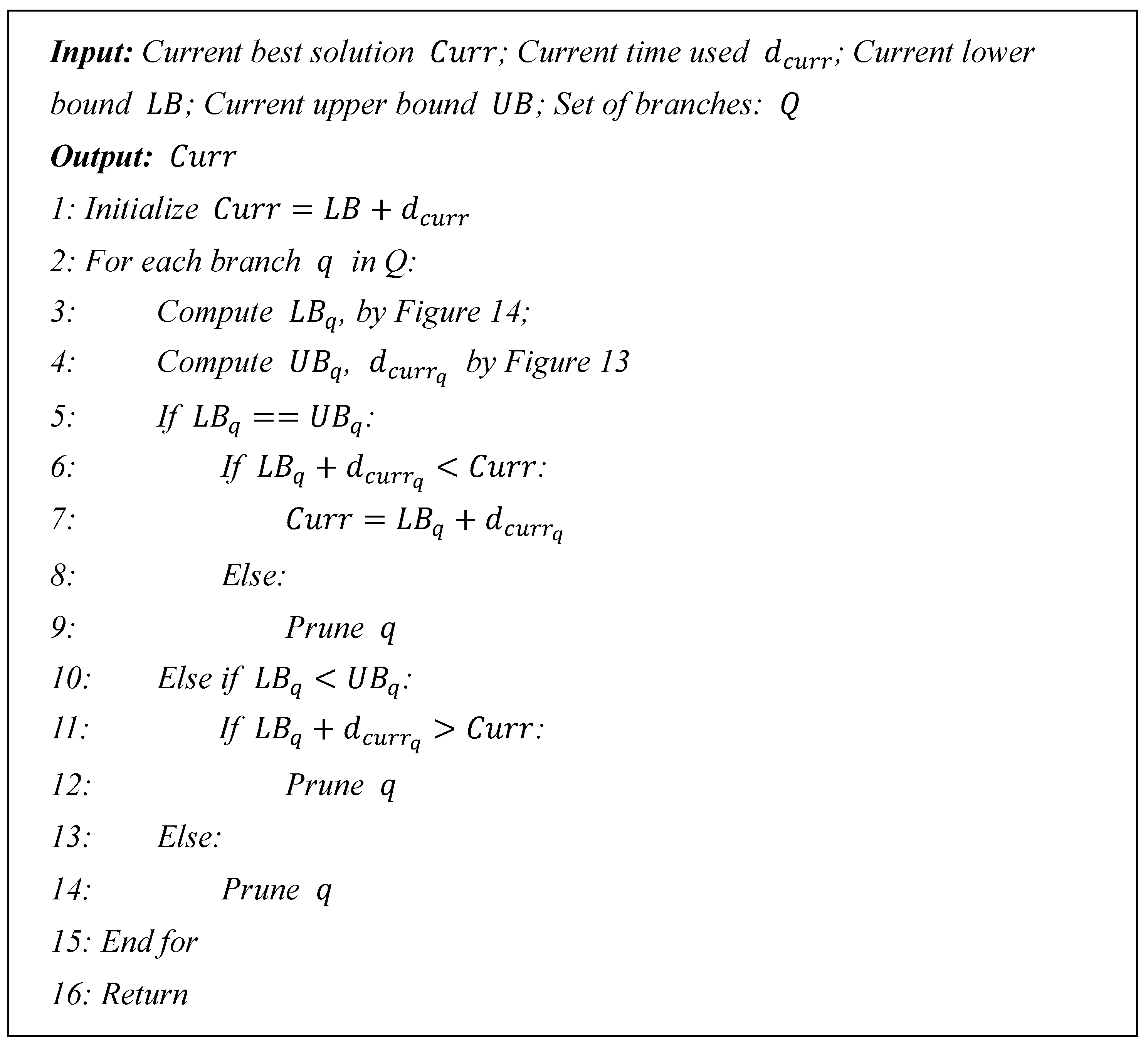
During pruning in BNB, the L B and U B of the initial solution node are first calculated, with the initial Current best set to the initial U B . After branching from the initial solution node, new L B and U B values are computed for each child branch. If a child branch has L B equal to U B , it indicates that a local optimum has been found and branching is stopped. At this point, the sum of L B and d c u r r (time used) is compared with C u r r (Current best). If L B + d c u r r C u r r , the local optimum is worse than the Current best, and the branch is pruned; if L B + d c u r r < C u r r , the local optimum is better, and Current best is updated to L B + d c u r r . When L B is less than U B , the relationship between L B + d c u r r and Current best is checked: if L B + d c u r r C u r r , the branch is pruned; if L B + d c u r r < C u r r , branching continues. The specific branch-and-bound pruning process is illustrated in Figure 15.
Figure 15 shows an example of BNB algorithm branching and pruning.
  • Branching Pseudocode
The pseudocode for the Branching is presented in Figure 16.
  • Pruning Pseudocode
The pseudocode for the Pruning is presented in Figure 17.
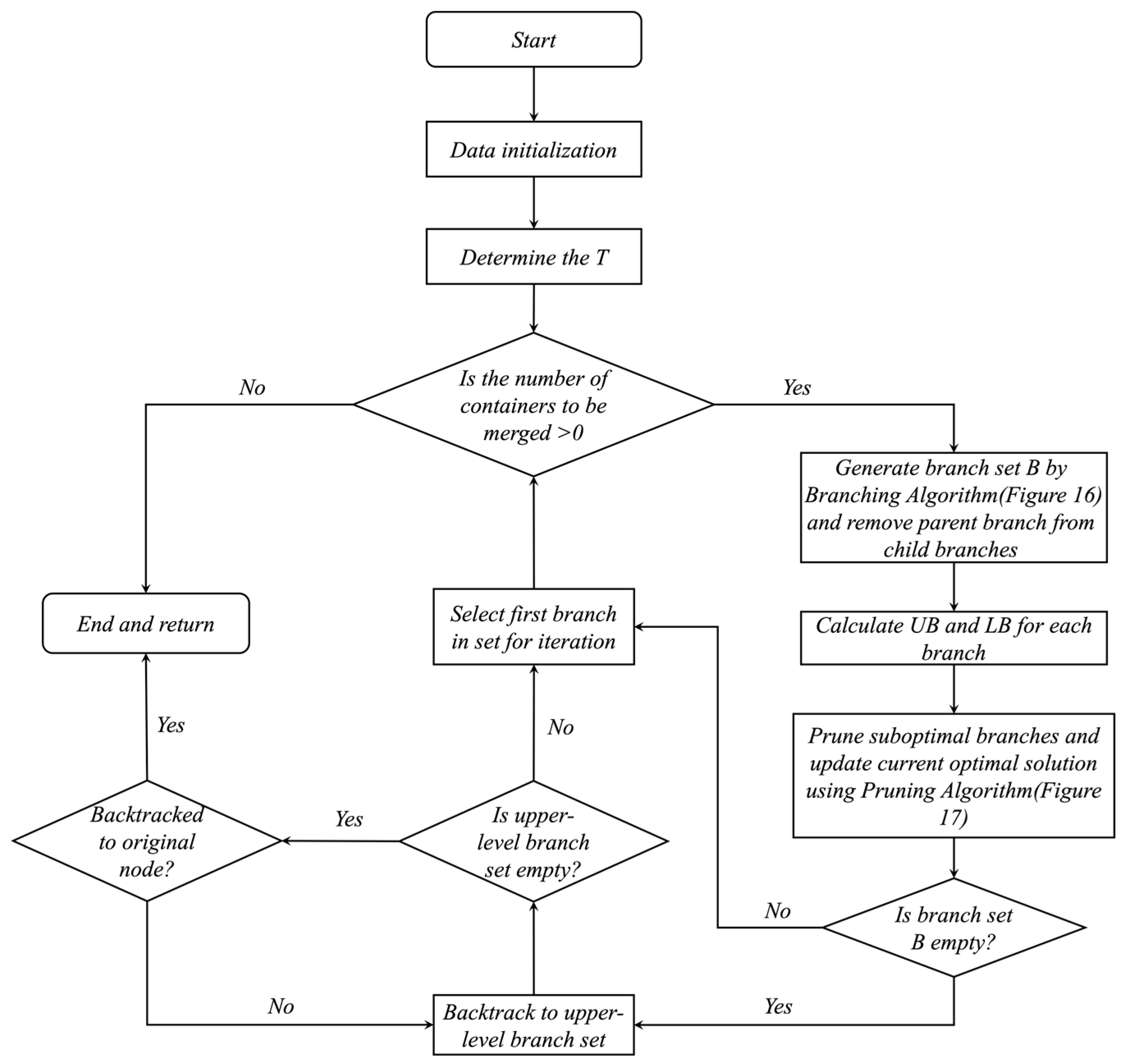
Branch-and-Bound Algorithm Procedure
Figure 18 illustrates the complete process of the BNB algorithm. After the algorithm is initiated, it first performs initialization by setting the positions and number of containers as well as the initial location of the yard crane, and determines the target slots using Figure 9, Figure 10 and Figure 11. Since containers already located in their target slots do not require relocation, it is necessary to identify those that are not yet positioned correctly. If the number of containers to be relocated is zero, indicating that all containers are already in their designated target slots, no consolidation operation is required, and the algorithm terminates immediately with the current solution returned. If the number of containers to be relocated is greater than zero, the consolidation procedure begins for those containers.
During the consolidation process, the initial U B and L B are first computed. Then, using Figure 16, the current node is branched to generate a set of child nodes denoted as set B . Processed sub-branches are removed from the set, and new U B and L B estimates are computed for the remaining branches in B . Subsequently, Figure 17 is applied to perform pruning operations across the branch set, during which the current best solution is dynamically updated.
After pruning, it is necessary to check whether the current branch set B is empty. If B is not empty, the algorithm proceeds by selecting the first unprocessed branch in the set to continue the next iteration; if B is empty, this indicates that all branches have either been explored or pruned, and the algorithm must backtrack to the previous level in the branch hierarchy.
During backtracking, the algorithm first checks whether there are unprocessed branches remaining in the upper-level branch set. If such branches exist, the first one is selected to proceed with the next round of iterations; if not, the algorithm continues backtracking to higher-level branch sets. If backtracking eventually reaches the root node and no branches are left for further exploration, this indicates that the entire feasible solution space has been traversed. The algorithm then terminates and returns the best solution obtained thus far.
(3)
Beam Search Algorithm
As a heuristic search strategy, the Beam Search Algorithm has been widely applied in the field of combinatorial optimization, demonstrating unique advantages in solving complex problems such as scheduling and logistics. In the context of container consolidation, when faced with N containers to be consolidated into S target slots, the traditional BNB approach may encounter exponential complexity with up to   S n branches in the worst case. While this method can efficiently obtain optimal solutions for small-scale problems, its computational efficiency deteriorates rapidly as the problem scale increases, making it unsuitable for real-time applications.
To address this challenge, this study innovatively introduces the BS Algorithm for solving the container consolidation problem. The core of the algorithm lies in designing a directional evaluation function to guide the search trajectory and applying a fixed beam width to restrict the number of branches retained at each level, thereby effectively controlling the size of the search space.
Branching and Pruning Strategy
In terms of branching strategy, BS adopts the same branch generation mechanism as the BNB method (Figure 10), but fundamentally differs in how branches are managed. Instead of treating branches generated by individual nodes independently, BS treats all branches generated at a given level as a unified set. This global perspective allows the algorithm to retain only the most promising branches based on comparative evaluation.
The design of the directional evaluation function is crucial to the algorithm’s success. Considering that the primary objective of consolidation operations is to minimize total crane operating time, this study proposes the evaluation function f = d c u r r + U B , where d c u r r represents the time used, and UB is the estimated remaining operation time obtained via the GA. This design accurately reflects the potential total operation time of each branch, ensuring that branches with lower overall costs are prioritized. For instance, if the beam width is set to 2, the algorithm retains the two branches with the lowest evaluation values at each level while pruning all others. This strategy ensures computational efficiency while obtaining high-quality approximate solutions, thereby achieving a balance between solution quality and computational effort.
Through this systematic branching and pruning strategy, the BS algorithm is capable of effectively handling large-scale container consolidation problems.
Beam Search Algorithm Procedure
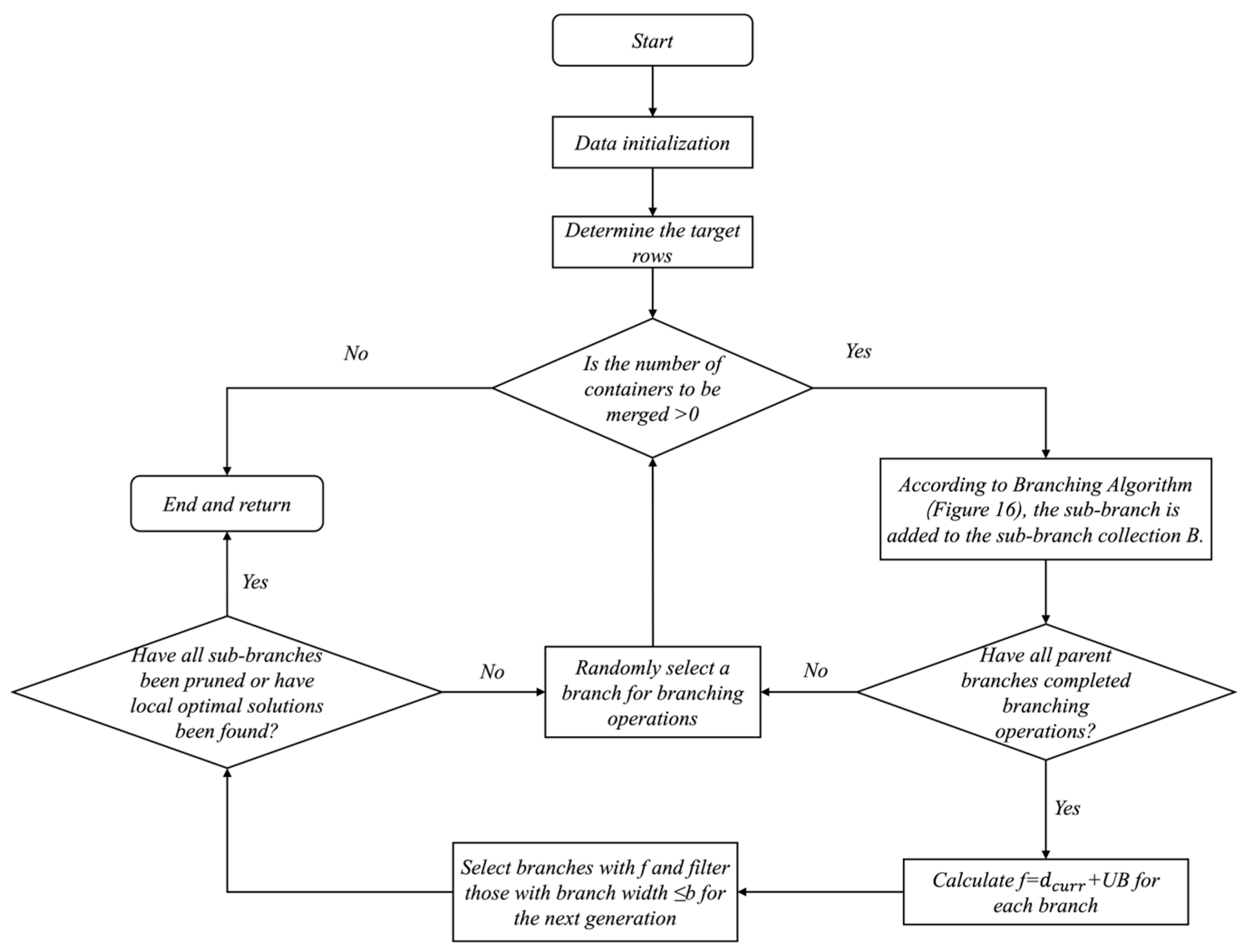
Figure 19 illustrates the complete procedure of the BS algorithm. Upon initialization, the algorithm first processes the container locations, total container count, and crane position, and determines the target slots using Figure 9. Since containers already located in the target slots do not require relocation, only those not yet in target positions—referred to as movable containers—are considered. If there are no movable containers, the consolidation task is unnecessary, and the algorithm terminates immediately and returns. If movable containers exist, the consolidation process begins.
During the consolidation process, the current node is branched using Figure 10 to generate a set of child branches B, which are added to the global branch set. The algorithm then checks whether all parent nodes have completed the branching operation. If some parent nodes have not yet been branched, one is randomly selected to proceed. This continues until all parent nodes have generated branches. Once this is complete, the directional evaluation function f = d c u r r + U B is applied to retain only b branches that conform to the predefined beam width. These selected branches form the next generation of parent nodes and proceed to the next iteration. The algorithm continues until either all branches at a given level are pruned or all consolidation operations are completed, at which point the algorithm terminates.


5. Case Study and Analysis

This chapter provides a systematic analysis of the performance of the BS algorithm and the ALNS algorithm under varying parameter configurations and problem scales. The purpose of this analysis is to optimize the parameter settings for both algorithms and establish a reference baseline for subsequent comparisons of the computational efficiency of the GA, BNB, BS, and ALNS across problems of different scales. The algorithms were implemented using the Python 3.12 development platform. All experiments were conducted on a MacBook Air (2022) equipped with an Apple M2 chip (8-core CPU and 10-core GPU), 8 GB of unified memory, and running macOS Ventura 13.3.1.
Given that this study focuses on operations involving a single gantry crane, and taking into account practical terminal conditions such as yard scale, crane travel speed, and bay–row distances, the yard layout is set to 50 bays, 10 rows, and 4 tiers. The crane’s travel speed is assumed to be 100 m per minute. Each bay spans 7 m, and each row 3 m. Accordingly, the time required for the crane to move across one bay is calculated as 7 × 60/100 = 4.2 s, and across one row as 3 × 60/100 = 1.8 s. Additionally, container pickup and placement times are set at 40 s and 35 s, respectively, for the purpose of parameterization.

5.1. Beam Search Case Analysis

To investigate the impact of search width and the number of candidate target slot solutions on the performance of the BS algorithm in solving the container consolidation problem, this study conducts a series of parameterized experiments. Given the exponential growth in branching during the container consolidation process, the experiments focus on small, medium, and large-scale container instances to ensure a comprehensive evaluation. The specific experimental design is as follows: for each container scale N c , 30 instances are generated. During algorithm execution, each container in the yard is allowed to consolidate into the five nearest non-full target slots. The experiments systematically compare the optimization results under varying search widths b (ranging from 10 to 100) and numbers of candidate target slot solutions N s o l u (ranging from 3 to 10). The relevant performance metrics and analysis are summarized in Table 3.
Table 3 focuses on the trade-off between solution quality and computation time and reports the gap values under various beam widths relative to the baseline of b = 100. The results show that the maximum observed gap across all problem sizes is only 4.29%, indicating that beam width has a limited impact on solution quality, but a significant impact on CPU computation time. Similarly, when the number of candidate target slot solutions N s o l u increase from 3 to 10, the objective value decreases slightly, but the CPU time increases significantly.
For a fixed number of containers N c , both the objective value and CPU time exhibit systematic variations with beam width b and the number of candidate target slot solutions N s o l u . Overall, increasing N s o l u offers a better cost–performance ratio than increasing beam width b. For example, when N c is 20, N s o l u is 10 and b is 25 the objective value better and the CPU time is shorter compared to a beam width of 100 and N s o l u is 3.
Considering the trade-off between optimization performance and computational efficiency, the following parameter settings are recommended: small-scale applications should adopt N s o l u = 10 and search width b=100; medium-scale applications are advised to use N s o l u = 5 with b = 25; larger-scale applications are recommended to employ N s o l u = 3 with b = 10.

5.2. Analysis of ALNS Instances

Table 4 reports the subject and corresponding computation times across different container scales N c and iteration limits N i t e r . The results show that subject quality improves incrementally with higher iteration counts, albeit at the cost of increased computational time. Notably, for a fixed number of iterations, the computation time for large-scale instances ( N c = 80) is approximately 40 times that of small-scale instances ( N c = 20). In contrast, for a fixed problem size, increasing N c from 500 to 5000 leads to only an eightfold increase in computation time. These findings suggest that problem size (i.e., number of containers) is the primary driver of computational complexity, outweighing the effect of iteration count. Given its flexibility, ALNS can be adapted to different problem scales by tuning the iteration count accordingly—favoring higher iterations for small instances to enhance solution quality, and fewer iterations for large instances to maintain computational tractability.
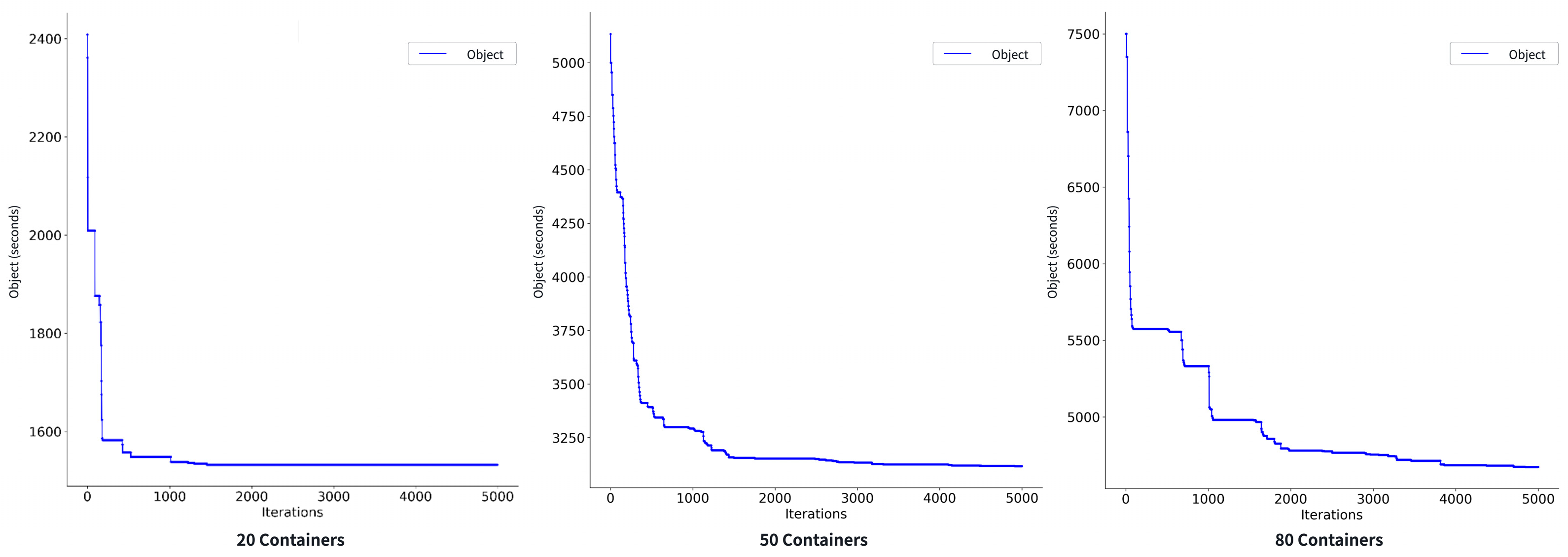
Figure 20 illustrates the single-run behavior of the ALNS algorithm over 5000 iterations for problem instances involving 20, 50, and 80 containers. The results indicate that problem size has a pronounced impact on both convergence rate and final object quality. For the 20-container instance, the objective value stabilizes rapidly within the first 500 iterations. In contrast, the 50-container case exhibits slower convergence, requiring approximately 2000 iterations to reach a plateau. For the 80-container instance, the object continues to improve gradually throughout the entire 5000-iteration horizon. These observations highlight the sensitivity of ALNS performance to problem scale and provide a quantitative reference for understanding its convergence characteristics in different operational contexts.

5.3. Algorithm Comparison Analysis

To evaluate the effectiveness and computational performance of the proposed model and algorithms, a set of 20 benchmark instances was constructed based on real-world terminal operations, covering two distinct problem scales. For each scale, 10 instances were generated to ensure statistical robustness. Detailed characteristics of all instances are summarized in Table 5.
Additionally, through preliminary experiments testing the destruction ratio, we found that 35% achieves an optimal balance between solution space exploration intensity and computational efficiency and therefore selected 35% as the destruction ratio for the ALNS algorithm.

5.3.1. Comparative Analysis of Small-Scale Instances

To systematically assess the optimization performance and computational efficiency of the BNB, BS, ALNS, and GA methods in the context of container rescheduling, extensive experiments were conducted on problem instances of varying scales. For each algorithm, the average objective value and average computation time were recorded across different container quantities. Table 6 summarizes the results for small-scale instances. Every Case was evaluated on a common set of 50 randomly generated and validated test cases to ensure consistency and comparability.
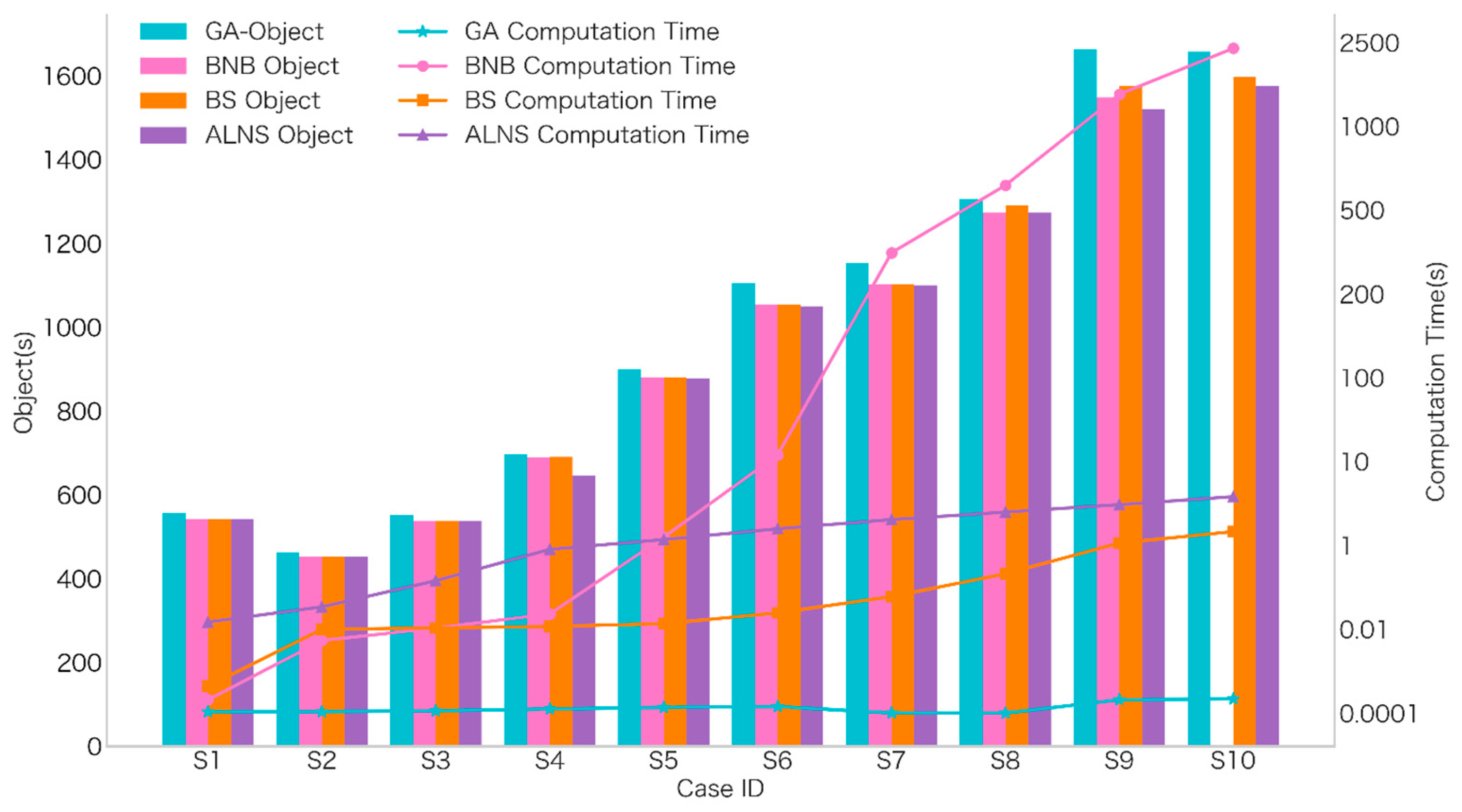
Table 6 and Table 7 and Figure 21 jointly report the average objective values and computation times of the four algorithms on small-scale instances, along with the relative optimality gaps with respect to ALNS. In terms of solution quality, ALNS consistently outperforms the algorithms in the two-stage framework. Among them, the Greedy Algorithm (GA) yields the lowest-quality solutions but operates with the shortest computation time. This performance gap becomes more evident as the number of containers exceeds 12, indicating that the GA is better suited for scenarios where computational speed is prioritized over solution quality.
The Branch-and-Bound (BNB) algorithm achieves near-optimal solutions, second only to ALNS. However, its computation time increases rapidly with problem size, reflecting its sensitivity to combinatorial growth and confirming its suitability primarily for small-scale instances. Beyond average runtime, the standard deviation (Std) across independent runs provides a critical lens into algorithmic stability. The GA exhibits negligible variance (Std < 0.0002 s), confirming its deterministic execution. BS similarly demonstrates high consistency (Std < 0.17 s), ensuring predictable response times. Notably, ALNS maintains a remarkably stable Std ranging from 0.31 to 0.36 s regardless of instance scale, highlighting the robustness of its adaptive neighborhood search mechanism. In stark contrast, BNB’s Std escalates dramatically for instances with ≥14 containers (peaking at 78 s for S9), underscoring the inherent volatility of exact methods when confronting combinatorial explosion; their runtime becomes highly sensitive to unpredictable branch-and-bound tree traversal and pruning efficiency.
As heuristic approaches, both Beam Search (BS) and ALNS offer a favorable trade-off between object quality and computational efficiency. For instance sizes ranging from 12 to 20 containers, ALNS generally produces superior solutions compared to BS, albeit with a moderate increase in computation time. This reflects the classic balance in heuristic algorithm design between solution-space exploration and time efficiency.
Notably, when the number of containers falls within the range of 8 to 12, all algorithms yield comparable solutions, suggesting a performance transition threshold. Below this scale, exact methods such as BNB are more advantageous, whereas beyond this threshold, heuristic methods like BS and ALNS demonstrate greater practical viability. Collectively, the low and scale-invariant standard deviations of ALNS and BS further reinforce their suitability for real-world terminal operations, where runtime predictability is as crucial as solution optimality for reliable production scheduling.

5.3.2. Comparative Analysis of Large-Scale Instances

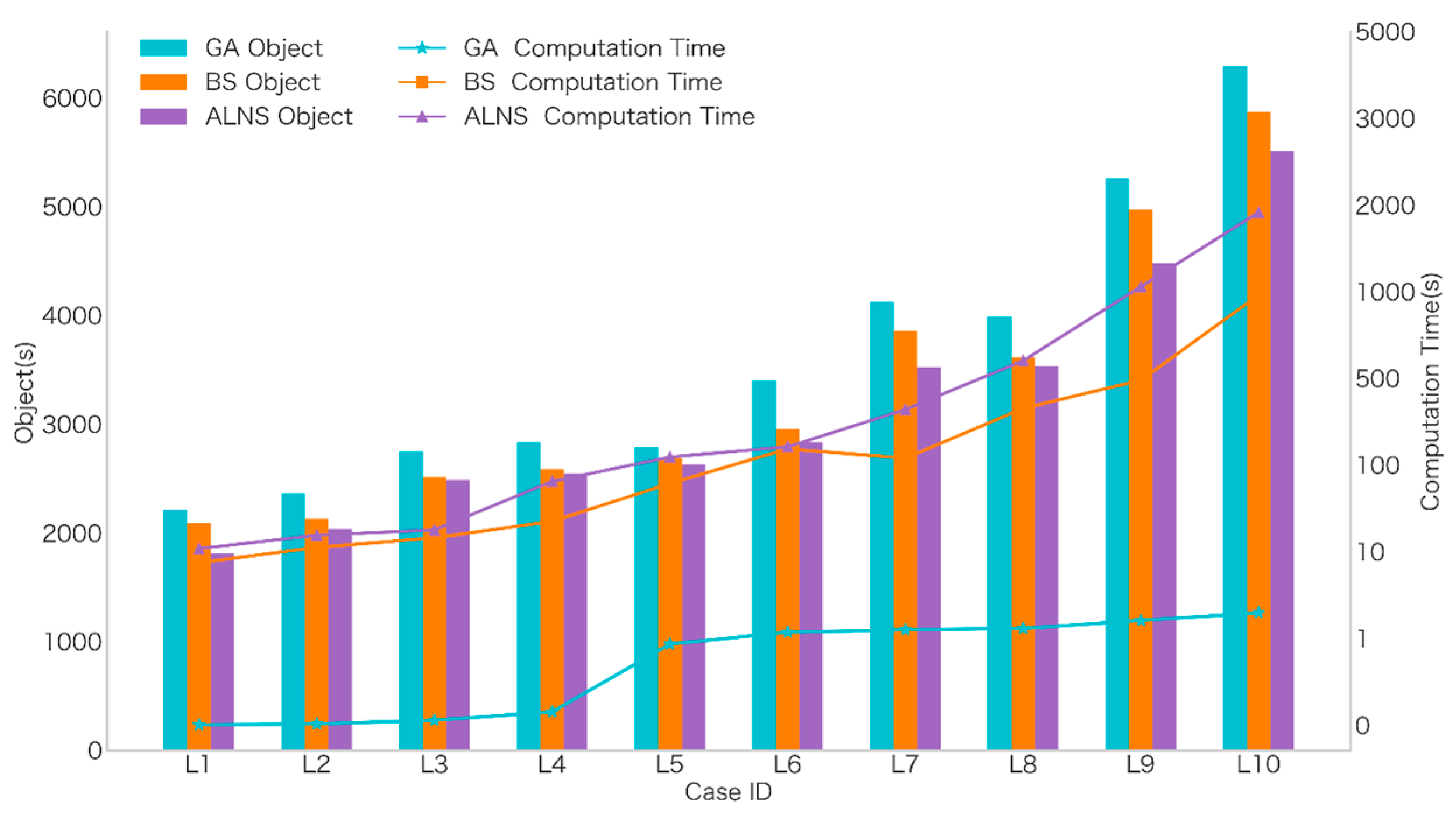
A detailed examination of Table 8 and Table 9 and Figure 15 reveals notable performance disparities among the four algorithms (GA, BNB, BS, and ALNS) across problem instances ranging from 25 to 100 containers. In terms of solution quality, ALNS consistently achieves the best performance, with its relative advantage becoming increasingly significant as the problem size exceeds 50 containers (L6).
Table 8 demonstrates that ALNS consistently achieves the lowest objective values across all medium- to large-scale instances, establishing a robust benchmark for solution quality. Beam Search (BS) ranks second with relative optimality gaps ranging from 1.16% to 15.75%, maintaining competitive performance in mid-scale scenarios (L3–L5) before the gap slightly widens in larger instances. Conversely, the GA exhibits the largest deviations (6.19–22.34%), reflecting its tendency to converge to local optima as problem complexity increases. Notably, the BNB algorithm fails to yield feasible solutions within the time limits for all large-scale cases, confirming its computational intractability beyond small-scale validation.
Table 9 reveals a distinct time–quality trade-off alongside exceptional algorithmic stability for the heuristic methods. While the GA operates nearly instantaneously (0.007–3.66 s) and BS demonstrates a clear efficiency advantage over ALNS in the 60–100 container range (e.g., completing L10 in 981 s vs. 1916 s), the standard deviation metrics provide critical insights into reliability. The GA and BS maintain negligible variance (Std < 0.90 s), confirming their deterministic or highly constrained search nature. Remarkably, ALNS exhibits scale-invariant stability with standard deviations tightly controlled between 0.44 and 1.43 s, indicating that its adaptive operators effectively suppress stochastic volatility regardless of instance size—a crucial feature for predictable production scheduling.
Figure 22 visually synthesizes these findings, highlighting the diverging trajectories of solution quality and computational cost. The bar chart illustrates the widening absolute gap in objective values between ALNS and the GA as instance size grows, with BS consistently bridging the intermediate space. Meanwhile, the line chart emphasizes that while ALNS requires more computational resources, its growth curve remains controlled and manageable, avoiding the exponential explosion characteristic of exact methods. A practical crossover threshold emerges around the 50–60 container mark (L6–L7), where BS’s time advantage becomes visually pronounced, suggesting a decision boundary for selecting between the superior quality of ALNS and the rapid response of BS.

5.3.3. Analysis of Wilcoxon Test Results

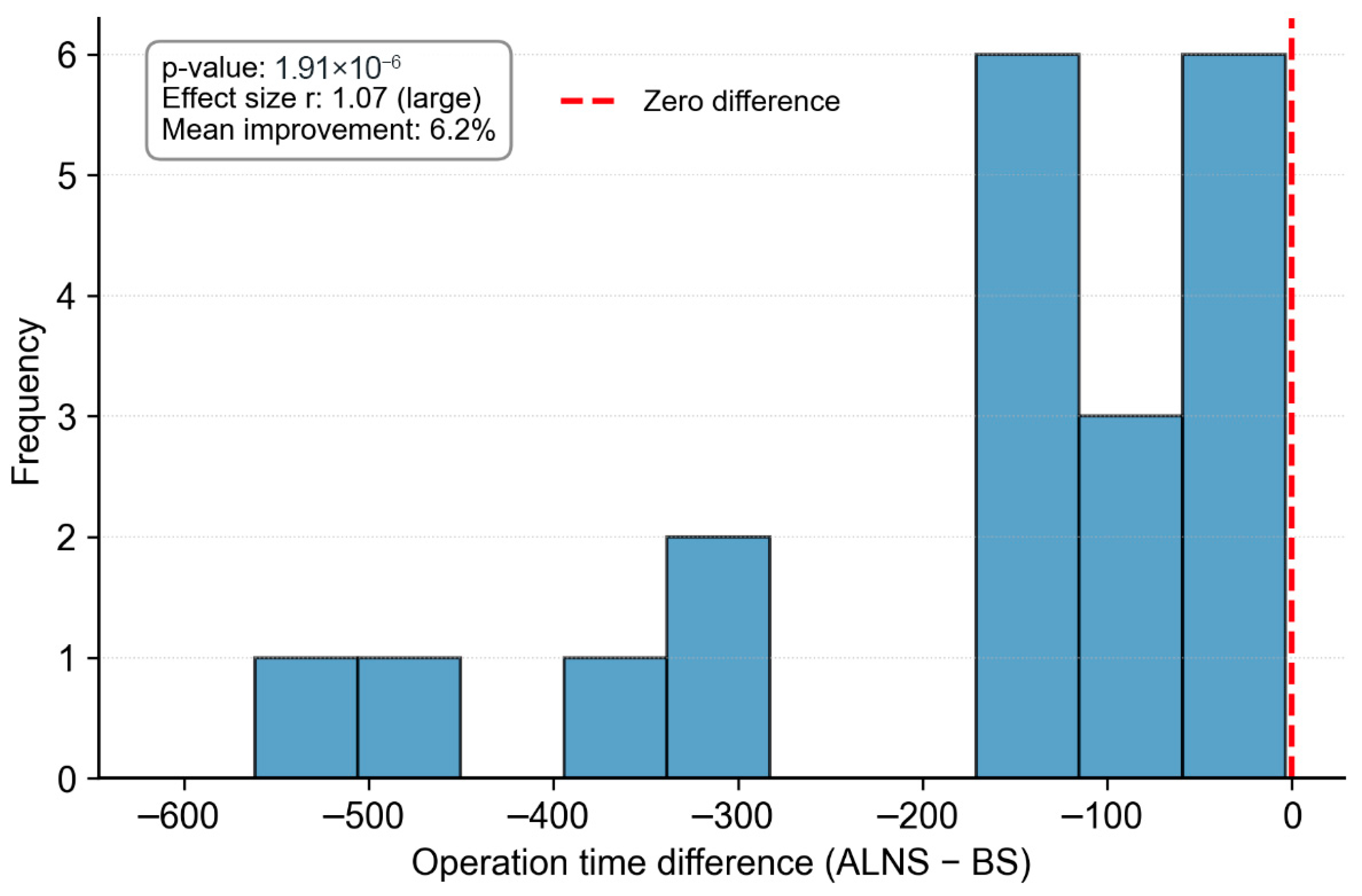
To evaluate the relative performance of the ALNS algorithm and the BS algorithm, 20 sets of test instances with different container scales were selected. Each instance was run 20 times, and the average results for each set were used to conduct the Wilcoxon test. The final test results are shown in Figure 23.
A systematic comparative analysis was conducted between the proposed ALNS algorithm and the baseline strategy (BS) using the Wilcoxon signed-rank test, with yard crane operation time as the primary performance metric. The results demonstrate that ALNS consistently achieves shorter operation times across all 20 test instances, yielding a 100% win rate. The histogram of performance differences is entirely concentrated to the left of the zero-difference line, confirming the algorithm’s robustness and directional superiority. The extremely low p-value (1.9 × 10⁻⁶) provides strong evidence against the null hypothesis of no difference, establishing the statistical significance of ALNS’s improvements at a level far beyond conventional thresholds. In terms of practical impact, ALNS reduces the mean operation time by 169.27 (s), corresponding to an average relative improvement of 6.19%. The rank-biserial effect size (r = 1.07) indicates a large-magnitude effect, underscoring that the observed gains are not only statistically reliable but also operationally meaningful for terminal efficiency. The distribution of differences exhibits a concentration of moderate improvements alongside a long tail of substantial reductions, suggesting that while ALNS delivers steady benefits under typical yard conditions, it is particularly advantageous in highly fragmented or complex scenarios where baseline heuristics struggle to identify efficient consolidation sequences. Collectively, these statistical findings support the conclusion that ALNS represents a superior and robust strategy for container yard consolidation, effectively minimizing crane operation time and contributing to enhanced terminal throughput.

5.3.4. Comprehensive Comparative Analysis

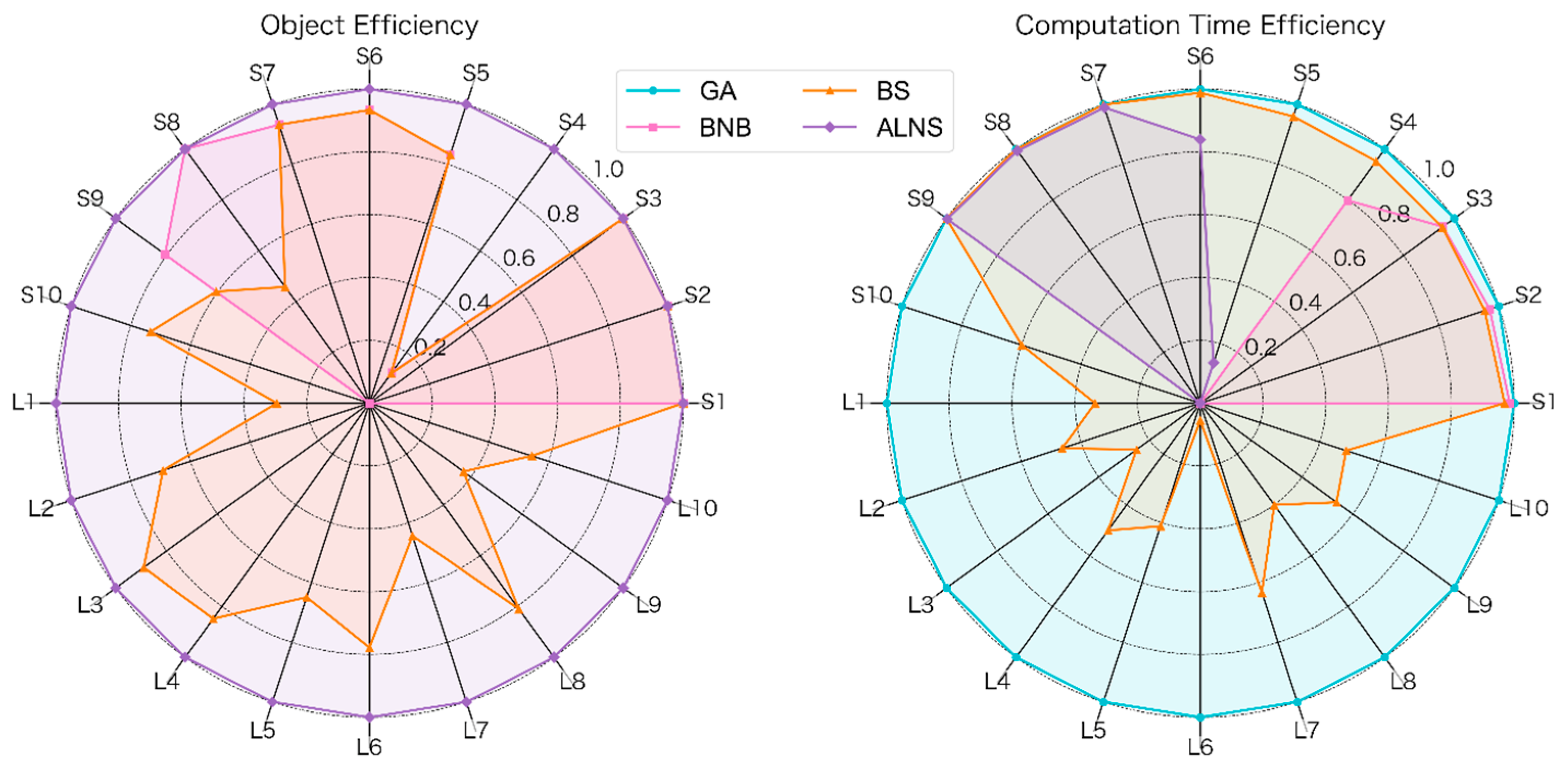
To facilitate a more intuitive assessment of algorithmic improvement efficiency across different container scales, this study consolidates experimental results from both small-scale (S1–S10) and large-scale (L1–L10) instances. For each instance, the best-performing solution among the four algorithms is treated as the theoretical optimal, while the worst-performing solution defines the lower bound of performance. The maximum improvement potential is thus defined as the difference between these two extremes. For each algorithm, the improvement value is computed as the difference between its solution and the worst solution, and the improvement efficiency is expressed as the ratio of this improvement value to the maximum improvement potential. A similar methodology is applied to assess improvement efficiency in terms of computation time. The corresponding evaluation results are visualized in Figure 24.
Figure 23 presents a comparative analysis of the four algorithms in terms of solution quality improvement efficiency and computational time improvement efficiency across varying container scales, encompassing small-scale instances (S1–S10) and large-scale instances (L1–L10). With respect to solution quality improvement efficiency, ALNS consistently achieves the highest performance, underscoring its superior optimization capability. In contrast, the GA exhibits the lowest improvement efficiency across all instance sizes. BNB performs competitively for instances involving 16 containers (S8), while BS shows notable fluctuations in performance as problem scale increases.
In terms of computational time improvement efficiency, the GA demonstrates a clear advantage, rapidly generating feasible solutions with minimal runtime. BS exhibits time efficiency comparable to the GA in small-scale instances; however, its relative performance diminishes as the problem size increases. BNB achieves favorable time efficiency for instances with up to eight containers but experiences a steep decline beyond this threshold. ALNS maintains relatively stable time efficiency in the 8–18 container range (S4–S9) but is outperformed by both the GA and BS in larger-scale settings.
From a comprehensive perspective, ALNS and the GA represent two ends of the performance spectrum: ALNS prioritizes solution quality at the expense of computation time, while the GA emphasizes time efficiency with limited solution quality. BNB strikes a balance between quality and efficiency only for very small-scale problems. BS demonstrates the most robust overall performance, maintaining a reasonable trade-off between solution quality and computational efficiency across a wide range of problem scales.
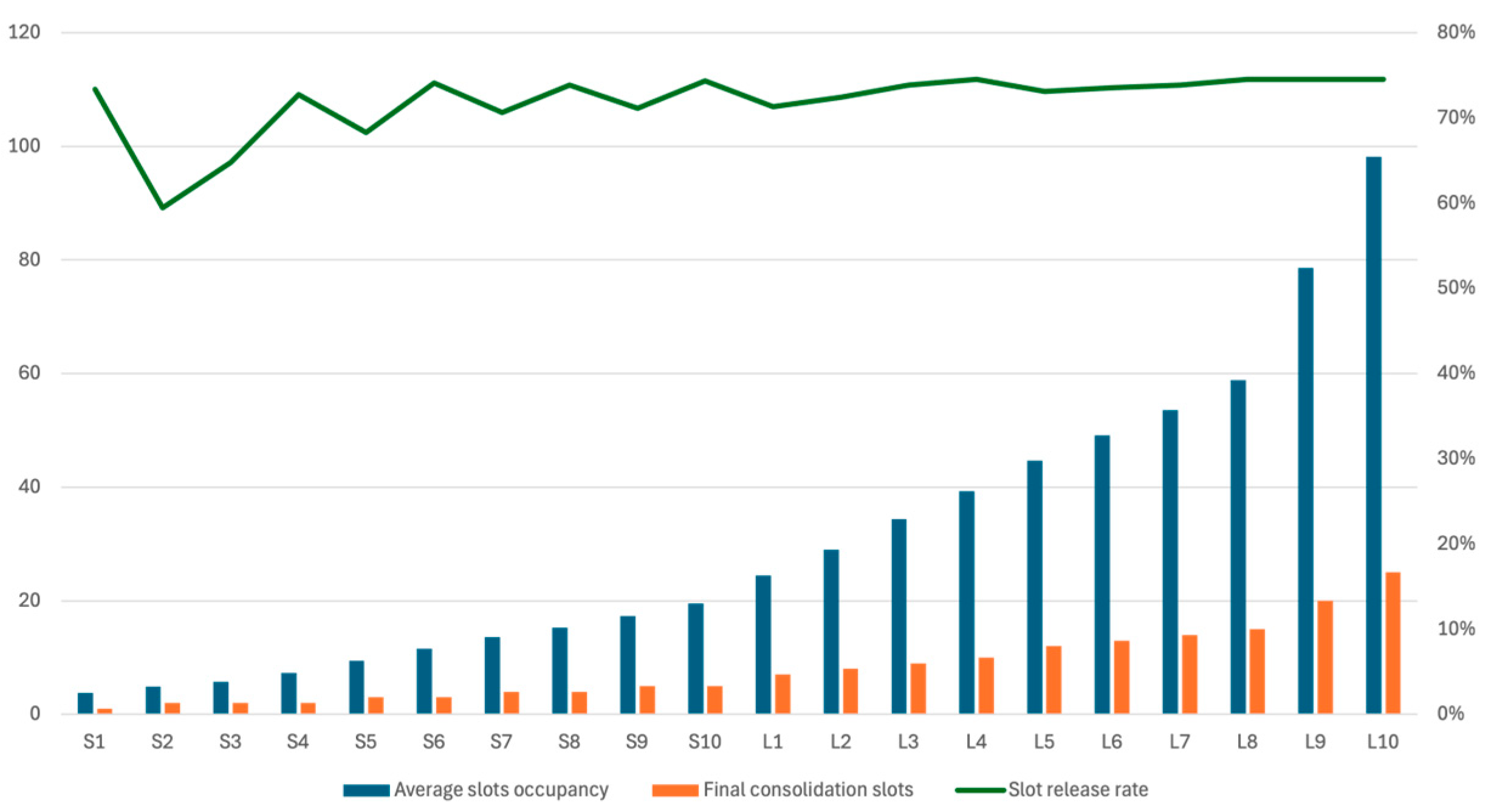
Figure 25 illustrates the spatial optimization efficacy of container consolidation operations across instances ranging from S1 to L10. Specifically, the bar chart compares the average number of initially occupied slots versus the average number of slots after consolidation, while the green line quantifies the empty slot release rate as a core performance indicator.
From an evolutionary perspective, both the initial and target slot counts exhibit approximately linear growth as problem scale increases, indicating that the complexity of consolidation operations is positively correlated with total container volume. Notably, the empty slot release rate remains consistently above 70% (averaging approximately 75%), approaching 80% in most large-scale instances. This high release rate substantiates the significant efficacy of consolidation operations in compressing redundant space and enhancing yard storage utilization.
Further analysis reveals that the strategic value of this approach manifests across multiple operational dimensions: First, by integrating fragmented yard blocks, it reduces the reshuffling frequency and crane movement required for subsequent retrieval operations, directly curtailing equipment energy consumption. Second, the released empty slots can be transformed into buffer space, alleviating external truck queuing congestion and shortening vessel turnaround time. Third, executing consolidation during idle crane periods achieves temporal resource multiplexing without additional capital investment. In summary, this consolidation strategy delivers both spatial restructuring benefits and operational synergy value, providing quantifiable decision support for lean yard management.

6. Conclusions

This study originates from our field observations and profound concerns regarding the global yard saturation crisis in container terminals. We focus on “container consolidation”—a long-neglected operational optimization domain—where scattered containers sharing identical bills of lading are merged into minimal target slots during rare yard crane idle windows, achieving dual improvements in space release and handling efficiency.
To tackle this NP-hard challenge, we explored two complementary technical pathways. The Adaptive Large Neighborhood Search (ALNS) demonstrates remarkable exploratory resilience through its dynamic destroy-and-repair mechanism; meanwhile, the two-stage heuristic framework provides algorithmic flexibility for diverse decision scenarios via “pre-grouping and refined optimization”. The Greedy Algorithm (GA) excels in speed, Branch-and-Bound (BNB) preserves exactitude for small-scale instances, and Beam Search (BS) seeks pragmatic balance between quality and efficiency. This “toolbox-style” methodological design reflects our respect for port operational complexity: there is no universally optimal solution, only contextually adapted optimal choices.
However, we must candidly acknowledge the structural limitations of our current research and actively transform them into falsifiable scientific agendas. Our core simplifying assumptions—physical homogeneity (uniform container types), attribute singularity (single bill of lading), resource isolation (single yard crane), and environmental statics (fixed task set)—while providing necessary methodological purity for algorithmic validation, constitute barriers to real-world operational deployment. Specifically, four explicit research gaps demand urgent attention:
First, dynamic online consolidation for multi-attribute heterogeneous containers. When containers carry multi-dimensional attributes (weight, vessel schedule, destination port) and tasks arrive dynamically, would “soft-clustering” consolidation strategies based on attribute similarity outperform “hard-partitioning” strategies with strict BOL matching? We hypothesize the former’s superiority in long-run time-average performance, falsifiable through discrete-event simulation using historical arrival streams from a hub port’s TOS as input, comparing soft/hard strategies’ distributional differences in cumulative operation time and reconfiguration frequency.
Second, collaborative scheduling optimization under multi-crane interference. In multi-crane shared-yard environments, would distributed optimization frameworks incorporating spatial–temporal decoupling constraints achieve superior solution quality to centralized scheduling within reasonable computational time limits? We hypothesize affirmative, testable through developing multi-agent simulation platforms, calibrating conflict probability models with actual interference event logs, and examining both paradigms’ Pareto frontiers under peak throughput scenarios.
Third, classified consolidation for multi-BOL containers within the same block. Our current research assumes containers within a block share a single bill of lading, whereas practical operations often involve mixed BOL containers in the same block. Future research could explore intelligent classification rules based on BOL similarity, vessel schedule urgency, and destination port consistency; design flexible “same-block, different-BOL” consolidation strategies; and evaluate the trade-off effects between space utilization and operational complexity, validated through comparison with actual yard storage data.
Fourth, green consolidation with energy-efficiency bi-objectives. Would “slow–direct” path strategies considering yard crane movement energy consumption (dependent on acceleration and velocity profiles) significantly outperform time-optimal “fast–detour” strategies in total energy efficiency (TEU·m/kWh) with acceptable time loss thresholds? We hypothesize so, verifiable by collaborating with OEMs to obtain powertrain physical models, embedding energy integral terms into ALNS evaluation functions, and validating bi-objective solution dominance relationships on real energy consumption data.
Looking forward, we anticipate advancing three directions: constructing dynamic consolidation models integrating stochastic programming and robust optimization to embrace rather than evade uncertainty; developing multi-objective coordination frameworks seeking Pareto frontiers across operation time, energy consumption, and equipment wear dimensions; and deeply collaborating with Terminal Operating System (TOS) vendors to embed algorithmic kernels into real-time decision flows, completing the critical leap from academic prototype to engineering implementation. We firmly believe that the ultimate value of container consolidation research lies not in numerical improvements on paper, but in every slot released, every second of waiting saved, and every smoother vessel departure achieved.

Author Contributions

N.Z. proposed the optimization ideas, conducted the experiments. R.D. and X.Y. conceived the ALNS, BNB and BS algorithms. W.Q. and Y.H. proposed the container consolidation problem. All authors contributed to the writing and review of the paper. All authors have read and agreed to the published version of the manuscript.

Funding

This research was supported by the Shanghai Shengdong International Container Terminal Co., Ltd. with grant number [H20230365], China.

Data Availability Statement

The datasets used and/or analyzed during the current study are available from the corresponding author upon reasonable request.

Acknowledgments

The authors would like to express their sincere gratitude to Shanghai Shengdong International Container Terminal Co., Ltd. for the financial support.

Conflicts of Interest

The authors declare that the Shanghai Shengdong International Container Terminal Co., Ltd. had no role in the design of the study; in the collection, analysis, or interpretation of data; in the writing of the manuscript, and in the decision to publish the results.

Appendix A

Table A1. Pseudocode for experimental comparison of ALNS initialization strategies.
N c Random InitializationThe Greedy StrategyDensity-Based Clustering Initialization
Object (s)Computation Time (s)Object (s)Computation Time (s)Object (s)Computation Time (s)
202854.40.00142467.00.00132502.80.0025
506024.21.73355306.61.63165562.61.7420
808202.22.55697508.82.65357991.82.8680

References

  1. Drewry Maritime Research, Container Forecaster: Issue 1 of 4 (2025); Drewry Shipping Consultants Limited: London, UK, 2025.
  2. Yang, X.; Mi, W.; Tao, Q. Design and Simulation of Automated Container Terminals; Shanghai Scientific and Technical Publishers: Shanghai, China, 2016. [Google Scholar]
  3. Legato, P.; Mazza, R.M.; Trunfio, R. Medcenter Container Terminal SpA Uses Simulation in Housekeeping Operations. Interfaces 2013, 43, 313324. [Google Scholar] [CrossRef]
  4. Cordeau, J.F.; Legato, P.; Mazza, R.M.; Trunfio, R. Simulation based optimization for housekeeping in a container transshipment terminal. Comput. Oper. Res. 2015, 53, 8195. [Google Scholar] [CrossRef]
  5. Yu, M.; Qi, X. Storage space allocation models for inbound containers in an automatic container terminal. Eur. J. Oper. Res. 2013, 226, 3245. [Google Scholar] [CrossRef]
  6. Ehleiter, A.; Jaehn, F. Housekeeping: Foresightful container repositioning. Int. J. Prod. Econ. 2016, 179, 203211. [Google Scholar] [CrossRef]
  7. Qin, H.; Su, X.; Li, G.; Jin, X.; Yu, M. A Simulation Based Metaheuristic Approach for the Inbound Container Housekeeping Problem in the Automated Container Terminals. Marit. Policy Manag. 2021, 50, 515–537. [Google Scholar] [CrossRef]
  8. Park, T.; Choe, R.; Kim, Y.H.; Ryu, K.R. Dynamic adjustment of container stacking policy in an automated container terminal. Int. J. Prod. Econ. 2011, 133, 385392. [Google Scholar] [CrossRef]
  9. Zhu, H.; Ji, M.; Guo, W. Two stage search algorithm for the inbound container unloading and stacking problem. Appl. Math. Model. 2020, 77, 1000–1024. [Google Scholar] [CrossRef]
  10. Park, H.J.; Cho, S.W.; Nanda, A.; Park, J.H. Data driven dynamic stacking strategy for export containers in container terminals. Flex. Serv. Manuf. J. 2022, 35, 170195. [Google Scholar] [CrossRef]
  11. Bortfeldt, A.; Forster, F. A tree search procedure for the container pre-marshalling problem. Eur. J. Oper. Res. 2012, 217, 531540. [Google Scholar] [CrossRef]
  12. Huang, S.H.; Lin, T.H. Heuristic algorithms for container pre-marshalling problems. Comput. Ind. Eng. 2012, 62, 1320. [Google Scholar] [CrossRef]
  13. Wang, Z.; Zhou, C.; Che, A.; Gao, J. A policy-based Monte Carlo tree search method for container pre-marshalling. Int. J. Prod. Res. 2024, 62, 4776–4792. [Google Scholar] [CrossRef]
  14. Lee, Y.; Chao, S.L. A neighborhood search heuristic for pre-marshalling export containers. Eur. J. Oper. Res. 2009, 196, 468475. [Google Scholar] [CrossRef]
  15. Tierney, K.; Pacino, D.; Vo, S. Solving the Pre-marshalling Problem to Optimality with A and IDA. Flex. Serv. Manuf. J. 2014, 29, 223–259. [Google Scholar] [CrossRef]
  16. Parreño-Torres, C.; Alvarez-Valdes, R.; Ruiz, R.; Tierney, K. Minimizing crane times in pre-marshalling problems. Transp. Res. Part E Logist. Transp. Rev. 2020, 137, 101917. [Google Scholar] [CrossRef]
  17. Silva, M.d.M.d.; Toulouse, S.; Calvo, R.W. A new effective unified model for solving the Pre-marshalling and Block Relocation Problems. Eur. J. Oper. Res. 2018, 271, 40–56. [Google Scholar] [CrossRef]
  18. Tanaka, S.; Tierney, K. Solving real-world sized container pre-marshalling problems with an iterative deepening branch and bound algorithm. Eur. J. Oper. Res. 2018, 264, 165–180. [Google Scholar] [CrossRef]
  19. Tanaka, S.; Tierney, K.; Parreño-Torres, C.; Alvarez-Valdes, R.; Ruiz, R. A branch and bound approach for large pre-marshalling problems. Eur. J. Oper. Res. 2019, 278, 211–225. [Google Scholar] [CrossRef]
  20. Jin, B.; Yu, M. Note on the dominance rules in the exact algorithm for the container pre-marshalling problem by Tanaka & Tierney (2018). Eur. J. Oper. Res. 2021, 293, 802–807. [Google Scholar] [CrossRef]
  21. Parreño-Torres, C.; Alvarez-Valdes, R.; Ruiz, R. Integer programming models for the pre-marshalling problem. Eur. J. Oper. Res. 2018, 274, 142–154. [Google Scholar] [CrossRef]
  22. Expósito-Izquierdo, C.; Melián-Batista, B.; Moreno-Vega, M. Pre-marshalling Problem: Heuristic solution method and instances generator. Expert Syst. Appl. 2012, 39, 8337–8349. [Google Scholar] [CrossRef]
  23. Araya, I.; Toledo, M. A fill-and-reduce greedy algorithm for the container pre-marshalling problem. Oper. Res. 2023, 23, 51. [Google Scholar] [CrossRef]
  24. Hottung, A.; Tierney, K. A biased randomkey genetic algorithm for the container pre-marshalling problem. Comput. Oper. Res. 2016, 75, 83–102. [Google Scholar] [CrossRef]
  25. Jovanovic, R.; Tuba, M.; Voss, S. A MultiHeuristic Approach for Solving the Pre-marshalling Problem. Cent. Eur. J. Oper. Res. 2014, 25, 1–28. [Google Scholar] [CrossRef]
  26. Hottung, A.; Tanaka, S.; Tierney, K. Deep learning assisted heuristic tree search for the container pre-marshalling problem. Comput. Oper. Res. 2020, 113, 104781. [Google Scholar] [CrossRef]
  27. Wang, N.; Yang, R.; Chen, J.; Bao, J. Container Pre-Marshalling Problem Under the Same-Group Exclusive Strategy. Asia-Pac. J. Oper. Res. 2026, 43, 2550020. [Google Scholar] [CrossRef]
  28. Zeng, Q.; Feng, Y.; Yang, Z. Integrated optimization of pickup sequence and container rehandling based on partial truck arrival information. Comput. Ind. Eng. 2019, 127, 366–382. [Google Scholar] [CrossRef]
  29. Zhao, W.; Goodchild, A.V. The impact of truck arrival information on container terminal rehandling. Transp. Res. Part E 2010, 46, 327–343. [Google Scholar] [CrossRef]
  30. Chen, G.; Zhao, W.; Liu, X.; Wei, M. Container Rehandling Probability Prediction Model Based on Seq2Seq Network. IEEE Trans. Reliab. 2024, 73, 12. [Google Scholar] [CrossRef]
  31. Chen, G.; Zhao, W.; Liu, X.; Wei, M.; Gao, G. Multi-Domain Merging Adaptation for Container Rehandling Probability Prediction. IEEE Trans. Intell. Transp. Syst. 2024, 25, 19796–19809. [Google Scholar] [CrossRef]
  32. Kim, K.H.; Yi, S. Utilizing information sources to reduce relocation of inbound containers. Marit. Econ. Logist. 2021, 23, 726–749. [Google Scholar] [CrossRef]
  33. Lee, C.M.; Lee, H.; Kim, W.S. Rehandling-aware stowage planning for RoRo ships using exclusive subgraph modeling and affinity-based cargo ordering. Sci. Rep. 2026, 16, 2995. [Google Scholar] [CrossRef] [PubMed]
Figure 1. Layout of container terminal.
Jmse 14 00797 g001
Figure 2. Container yard schematic diagram.
Jmse 14 00797 g002
Figure 3. Flowchart of ALNS algorithm.
Jmse 14 00797 g003
Figure 4. Container distribution diagram.
Jmse 14 00797 g004
Figure 5. Initial solution of ALNS algorithm.
Jmse 14 00797 g005
Figure 6. Illustration of destruction and repair process.
Jmse 14 00797 g006
Figure 7. Illustration of target slot adjustment.
Jmse 14 00797 g007
Figure 8. Example of grouping rules.
Jmse 14 00797 g008
Figure 9. The pseudocode for Grouping.
Jmse 14 00797 g009
Figure 10. The pseudocode for Computing Group Center.
Jmse 14 00797 g010
Figure 11. The pseudocode for Estimating Target Slot Solutions.
Jmse 14 00797 g011
Figure 12. Example of consolidation using GA.
Jmse 14 00797 g012
Figure 13. The pseudocode for the Greedy Algorithm.
Jmse 14 00797 g013
Figure 15. Example of BNB algorithm branching and pruning.
Jmse 14 00797 g015
Figure 16. The pseudocode for the Branching.
Jmse 14 00797 g016
Figure 17. The pseudocode for the Pruning.
Jmse 14 00797 g017
Figure 18. BNB algorithm flowchart.
Jmse 14 00797 g018
Figure 19. BS algorithm flowchart.
Jmse 14 00797 g019
Figure 20. Single-run convergence curves of the ALNS algorithm for container instances of different scales.
Jmse 14 00797 g020
Figure 21. Comparison chart of algorithms for small-scale instances.
Jmse 14 00797 g021
Figure 22. Comparison chart of algorithms for large-scale instances.
Jmse 14 00797 g022
Figure 23. Distribution of operation time (s) differences (ALNS minus BS) across 20 instances.
Jmse 14 00797 g023
Figure 24. Comprehensive comparison chart of different algorithms.
Jmse 14 00797 g024
Figure 25. Empty slot release under different case.
Jmse 14 00797 g025
Table 1. Comparative summary of related research directions.
HousekeepingPre-MarshalingRehandlingConsolidation
DefinitionPerform local stacking rearrangement of yard containers.Conduct global pre-adjustment of container positions based on the vessel loading planReassign positions for blocking containers in the event of retrieval obstructionConsolidate containers of the same type that are dispersed across the yard
Time ScaleShort-term (hour level)Mid-term (day level)Real-time (minute level)Utilize idle time of yard cranes
OptimizationLocal stacking optimizationGlobal stowage sequence adaptationReal-time blockage resolutionSpace consolidation
FocusContainer movement sequencePriority planningTemporary storage location decisionStorage and movement planning
Table 2. Illustration of initial container grouping.
Container NodeBayRowTierGroup g a p g f
C20311Group 1518
C50722
C10721
C81551
C101531Group 211
C31731
C72511
C43721
C63761Group 32
C94161
Table 3. Results of BS algorithm under different parameters for containers sizes.
N s o l u N c b = 10b = 25b = 50b = 100
O b j 1  (s) T i m e 1 (s) G a p 1 O b j 2 (s) T i m e 2 (s) G a p 2 O b j 3 (s) T i m e 3 (s) G a p 3 O b j 4 (s) T i m e 4 (s)
3201650.50.371.57%1627.90.810.18%1625.31.630.18%1625.03.04
503466.216.522.40%3425.137.101.18%3387.772.241.18%3385.1130.26
805435.4120.221.89%5403.6256.761.30%5349.7516.731.30%5334.41036.13
5201630.60.640.34%1627.21.310.14%1625.32.770.14%1625.05.20
503447.824.112.90%3414.455.951.90%3355.3103.121.90%3350.6195.07
805379.7203.212.97%5323.2446.361.89%5254.4916.131.89%5224.41731.16
10201627.91.430.84%1615.52.720.07%1614.65.560.07%1614.310.01
503401.247.284.29%3349.492.892.70%3270.6170.832.70%3261.4335.78
805303.2383.662.19%5276.4726.111.68%5210.51562.231.68%5189.42950.27
Note: G a p 1 = ( O b j 1 O b j 4 ) / O b j 4 × 100 % ; G a p 2 = ( O b j 2 O b j 4 ) / O b j 4 × 100 % ; G a p 3 = ( O b j 3 O b j 4 ) / O b j 4 × 100 % .
Table 4. Iteration results of ALNS algorithm for containers of different scales.
N c N i t e r = 500 N i t e r = 1000 N i t e r = 2000 N i t e r = 5000
O b j 1  (s) T i m e 1  (s) O b j 2  (s) T i m e 2  (s) O b j 3  (s) T i m e 3  (s) O b j 4  (s) T i m e 4  (s)
201580.56.081570.910.921566.921.361560.643.74
503348.564.523285.1157.103127.7302.243117.5636.26
805535.4203.224913.6396.364779.7776.784673.71601.30
Table 5. Experimental setup.
Case ID N c GABNBBSALNS
N s o l u N s o l u N s o l u b N i t e r
Small scaleS1433325300
S2555525300
S3655525300
S4855525300
S51088825300
S61288825500
S71488825500
S81688825500
S91810101025500
S102010101025500
Larger scaleL125101010501000
L230101010501000
L335101010501000
L440101010501500
L545101010501500
L650101010501500
L755101010302000
L860101010302500
L980101010153000
L10100101010154000
Note: GA denotes Greedy Algorithm; BNB denotes Branch-and-Bound Algorithm; BS denotes Beam Search Algorithm; ALNS denotes Adaptive Large Neighborhood Search Algorithm.
Table 6. Comparison of algorithms’ average objective values on small-scale instances.
Case IDALNSTwo-States
O b j A L N S O b j G A G a p O G A O b j B N B G a p O B N B O b j B S G a p O B S
(s)(s) (s) (s)
S1543.0557.22.62%543.00.00%543.00.00%
S2453.6462.61.98%453.60.00%453.60.00%
S3538.2552.62.68%538.20.00%538.20.00%
S4646.8696.47.67%690.46.74%690.66.77%
S5877.2898.62.44%880.80.41%880.80.41%
S61050.61104.65.14%1054.20.34%1054.20.34%
S71099.21152.24.82%1102.80.33%1102.80.33%
S81273.01306.22.61%1273.00.00%1291.01.41%
S91520.81662.09.28%1548.21.80%1576.63.67%
S101575.61657.25.18%/ 1597.21.37%
Note: G a p O G A = ( O b j G A O b j A L N S ) / O b j A L N S × 100 % ; G a p B N B = ( O b j B N B O b j A L N S ) / O b j A L N S × 100 % ; G a p B S = ( O b j B S O b j A L N S ) / O b j A L N S × 100 % .
Table 7. Comparison of algorithms’ average computation time on small-scale instances.
Case IDALNSTwo-States
T A L N S S t d A L N S T G A S t d G A T B N B S t d B N B T B S S t d B S
(s) (s) (s) (s)
S10.09820.36470.00030.00010.00170.00020.00330.0005
S20.27730.32440.00030.00010.00870.0010.01330.002
S30.58640.35420.00040.00010.02630.0030.02770.004
S40.95630.35700.00060.00010.19380.020.04610.007
S51.65320.33010.00080.00011.91050.20.07810.012
S62.81000.34610.00090.000117.495920.20600.03
S73.79850.35130.00130.0001348.4627170.39830.06
S84.60290.33530.00120.0002649.4366320.66830.11
S95.40250.31760.00170.00021577.3326781.27760.16
S106.26240.35330.00180.0002>2400 2.50920.17
Table 8. Comparison of algorithms’ average objective values on large-scale instances.
Case IDALNSTwo-States
O b j A L N S O b j G A G a p O G A O b j B N B G a p O B N B O b j B S G a p O B S
(s)(s) (s) (s)
L11809.02213.222.34%//2094.015.75%
L22033.42357.615.94%//2133.04.90%
L32487.02748.210.50%//2515.81.16%
L42543.42836.411.52%//2587.81.75%
L52628.02790.66.19%//2685.02.17%
L62834.43398.019.92%//2959.84.42%
L73521.44122.817.08%//3856.29.51%
L83534.63986.212.78%//3620.42.43%
L94477.85262.017.51%//4971.611.03%
L105512.26297.214.24%//5870.46.50%
Note: G a p O G A = ( O b j G A O b j A L N S ) / O b j A L N S × 100 % ; G a p B N B = ( O b j B N B O b j A L N S ) / O b j A L N S × 100 % ; G a p B S = ( O b j B S O b j A L N S ) / O b j A L N S × 100 % .
Table 9. Comparison of algorithms’ average computation time on large-scale instances.
Case IDALNSTwo-States
T A L N S S t d A L N S T G A S t d G A T B N B S t d B N B T B S S t d B S
(s) (s) (s) (s)
L113.35610.55610.00660.0005>2400/8.88180.18
L227.20790.59320.01650.0006>2700/14.60340.28
L332.75680.66210.05840.0012>3000/24.53660.25
L483.13160.44290.15520.0008>3300/41.62790.25
L5137.03880.75030.93570.0047>3600/81.00110.45
L6284.50371.04351.65600.0062>3900/174.45460.65
L7356.29520.72781.90220.0038>4200/131.94270.30
L8601.77631.43232.04030.0049>4800/361.81820.80
L91057.60010.73172.89040.0029>6000/491.55520.45
L101915.53250.89273.66200.0037>7200/981.14640.90
Disclaimer/Publisher’s Note: The statements, opinions and data contained in all publications are solely those of the individual author(s) and contributor(s) and not of MDPI and/or the editor(s). MDPI and/or the editor(s) disclaim responsibility for any injury to people or property resulting from any ideas, methods, instructions or products referred to in the content.