Article

Electromagnetic Field Generated by UUV-Propeller System Wake in Stable Stratified Flow

1
College of Naval Architecture and Ocean Engineering, Dalian Maritime University, Dalian 116026, China
2
Dalian Scientific Test and Control Technology Institute, Dalian 116013, China
*
Author to whom correspondence should be addressed.
J. Mar. Sci. Eng. 2026, 14(9), 790; https://doi.org/10.3390/jmse14090790
Submission received: 2 April 2026 / Revised: 19 April 2026 / Accepted: 22 April 2026 / Published: 25 April 2026
(This article belongs to the Special Issue Remote Sensing for Marine Environmental Applications)

Abstract

With advancements in weak magnetic detection technology, the electromagnetic wake signals induced by UUVs in stratified seawater are becoming stable interference sources for detection equipment. This study developed a numerical model combining fluid dynamics and electromagnetism to examine the electromagnetic wake evolution of the UUV system under varying propeller propulsion coefficients, and formation mechanism of the wake electromagnetic field is revealed. The flow field results were validated using PIV and relevant literature. The flow characteristics of the near-field wake are analyzed by visualizing the vortex structure. Additionally, this study investigates the attenuation law of far-field wake using electromagnetic field intensity attenuation curves. The wake’s electromagnetic field frequency characteristics were examined through the normalized amplitude spectrum. Results indicate that the near-field wake vortex structure resembles a propeller’s topological structure. The electric field intensities in the near-field and far-field are approximately on the order of 10−4 V/m and 10−5 V/m, respectively, while the magnetic field intensities are around 10−10 V/m and 10−11 V/m. The electromagnetic interference spectrum within the wake typically shows high intensity in the low-frequency band. A high-precision magnetometer can detect the electromagnetic field’s intensity and frequency characteristics. It offers theoretical support for developing advanced anti-interference algorithms in engineering practice.

1. Introduction

In marine exploration, Unmanned Undersea Vehicles (UUVs) are crucial for modern exploration and development, becoming a key focus in marine technology competition globally. As detection targets diversify, relying solely on acoustic detection methods proves limiting and reduces efficiency. Electromagnetic detection, known for its signal stability and precise positioning, is emerging as a research hotspot compared to other non-acoustic technologies [1]. Consequently, UUV technology has advanced rapidly, with sensors becoming more varied and precise. Modern UUVs typically feature a range of detection devices, including acoustic sensors, Magnetic Anomaly Detection (MAD), laser detection devices, electric field sensors, and optical imaging systems, enabling comprehensive underwater environment perception. The magnetic anomaly detector, a well-established non-acoustic technology, detects underwater targets by identifying changes in the Earth’s magnetic field. It offers high detection accuracy, strong recognition capabilities, and minimal environmental interference, making it widely used in anti-submarine aircraft, surface ships, and UUV platforms.
Magnetic detection technology encompasses synthetic aperture radar (SAR) [2], magnetic anomaly detection (MAD) [3], and wake detection. SAR detection reduces the radar cross section (RCS) and absorbed scattering (AS) [4,5] by using hull designs that deflect or reflect radiation. This is enhanced with radar absorbing structures (RAS) and materials (RAM). In MAD, the UUV’s surface coating undergoes demagnetization, often using a composite material with electromagnetic wave absorption (EWA) properties. This material is hydrophobic and chemically stable in seawater and strong alkalis, effectively diminishing the magnetic field anomalies caused by the submarine’s ferromagnetic materials. It also rapidly reduces electromagnetic interference generated by UUV surfaces in marine environments [6]. The electromagnetic signal from wake induction fields is unique: it remains unaffected by UUV demagnetization or non-magnetic materials. Additionally, electromagnetic wakes retain their shape in the ocean, providing a consistent source of interference for UUV sensors.
The rapid advancement of weak magnetic detection technologies, including Germany’s LTs-SQUID full-tensor magnetic gradient detection system, Australia’s GETMAG system, and the United States’ HTS-SQUID system, has been notable. The HTS-SQUID system achieves sensitivity at the pT level [7]. Jiang Min’s team at the University of Science and Technology of China has advanced quantum precision measurement of extremely weak magnetic fields, achieving a magnetic field amplification factor exceeding 5000 times and single measurement accuracy at the 0.1 fT level [8]. This progress suggests a more precise sensitivity limit for weak magnetic detection technology.
Electromagnetic Compatibility (EMC) issues in UUVs are crucial constraints on detection capability. Electromagnetic interference from UUVs can significantly lower sensor signal-to-noise ratios. The propeller’s movement, a major interference source, generates both hydrodynamic noise and complex electromagnetic signals, impacting high-sensitivity sensors like magnetic anomaly detectors. This interference reduces target detection range, positioning accuracy, and can cause false alarms or missed detections. During weak magnetic signal detection, UUV-generated interference may completely obscure real target signals, leading to system failure. Thus, understanding electromagnetic wake generation and its sensor impact is vital for enhancing UUV detection performance.
Seawater in non-uniform environments shows distinct stratification due to variations in temperature and density. These density differences limit vertical mixing, impacting the diffusion and speed of UUV wake. Additionally, salinity changes directly influence seawater’s electrical conductivity, a crucial factor in the intensity and propagation of induced electromagnetic fields. Salinity variations determine conductivity levels. Tong et al.’s method translates microscopic ion concentration data into observable macroscopic conductivity data using a specific transfer mechanism [9]. This conductivity distribution affects the magnitude and direction of induced currents, shaping the characteristics of the electromagnetic field.
The vehicle’s turbulent wake during underwater navigation disrupts the stratified environment, altering temperature, salinity, and conductivity distributions. Additionally, the propeller’s rotation impacts the stratification. As the conductive seawater in the wake moves through the geomagnetic field, it drives charged ions to move, generating a moving current. This process forms an induced electromagnetic field related to seawater’s velocity. Researchers confirmed this phenomenon in the last century through quantitative measurements [10]. The Saynisch team used an advanced coupling model to compare five climate stages, concluding that combining electrical conductivity and ocean tidal speed demonstrates that seawater’s environmental magnetic field generates measurable electromagnetic signals [11].
Numerous studies have historically examined the far-field Kelvin wake [12,13,14], internal waves [15], and thermal wake produced by underwater vehicles operating near the surface. A thermal wake arises from the interaction between the wake and the surrounding water temperature. To detect this wake, it must penetrate the water–air interface. The origins of thermal wakes fall into three main categories. First, the heat from the vehicle’s power supply dissipates, transferring residual heat to the water surface. Second, factors like hull volume, propeller rotation, and wake turbulence can bring groundwater of varying temperatures to the surface. For instance, Chen used the RANS (Reynolds Average Navier–Stokes) method and identified a notable cold wake on the sea surface in conditions with a negative Shear Stress Transfer gradient [16]. Third, the wake effect influences the temperature of the water surface boundary layer. Luo et al., for example, employed numerical simulations and experiments with DES (Detached-Eddy Simulation) and VOF (Volume of Fluid) methods to study how underwater vehicle wakes affect the temperature of the surface boundary layer [17].
Current research on how temperature, salinity, and ions in stratified seawater affect the wake-induced electromagnetic field remains insufficiently explored. Some studies consider seawater stratification when modeling, but a comprehensive understanding of how convection, temperature, and electromagnetic fields interact is lacking. The processes by which multi-physical field wakes are generated and evolve under these influences are not fully understood. Therefore, analyzing the speed, temperature, and conductivity of underwater vehicles in stratified seawater contrails is crucial. This analysis can improve the understanding of electromagnetic contrail evolution and enhance the accuracy and reliability of UUV detection.
Previous studies have often simplified and assumed various factors when determining seawater velocity fields. Common assumptions include ignoring seawater viscosity and rotation, assuming irrotational flow, applying linear wave theory, or simplifying underwater object geometry. Research on the wake magnetic field of underwater vehicles has primarily focused on disturbances caused by the hull’s volume effect on the water surface. Potential flow theory, used in these studies, simplifies geometry and fluid viscosity assumptions. Fallah examined wake waveforms from catamaran movement and developed a mathematical model to describe their wake fields’ electromagnetic characteristics [18]. This model determines flow field and velocity by solving the basic hydrodynamic model, specifically the Kelvin wake in linear wave theory. Yaakobi et al. simulated the motion of a slender body using point sources and derived the induced electromagnetic field by solving Maxwell’s equations with appropriate boundary conditions. Inaccurate calculations of seawater velocity fields have led to imprecise simulations and analyses of wake electromagnetic fields [19].
Chen et al. employed the LES method to examine the amplitude and range of wave and magnetic field characteristics in the near-field wake, both with and without propellers. They performed dynamic analysis using power spectral density [20,21,22]. The near-field wake of a scaled suboff hull without propellers was experimentally validated through towing. Meanwhile, Huang’s team developed a theoretical model incorporating ion separation to analyze the magnetic field in the submarine wake [23]. They used multi-physics simulation methods with dynamic overlapping grids to determine the amplitude and frequency characteristics of the submarine’s near-field wake magnetic field [24]. Additionally, they conducted numerical simulations of the far-field wake of underwater vehicles in unstratified seawater conditions [25].
Current research shows that when UUVs conduct detection tasks, the magnetic anomaly signals from targets like sunken ships, mines, or submarines are extremely weak, often at the nT level or lower. The electromagnetic interference from the propeller can be much stronger than the target signal, masking useful information with background noise. This masking effect becomes more pronounced when detecting distant or low-magnetic targets. UUV radiated noise is highly unstable and dynamically variable, influenced by operational conditions and marine environmental factors. As a result, traditional signal processing struggles to extract weak signals from strong interference. Additionally, research on the electromagnetic field characteristics of the far-field wake generated by underwater vehicle propeller systems is limited. There is a notable lack of comprehensive studies integrating the velocity, temperature, and electromagnetic fields affected by propeller movement.
This research enhances scientific understanding of fluid–structure–electromagnetic coupling mechanisms and supports designing low electromagnetic interference UUV platforms. It also aids in developing advanced anti-interference algorithms for engineering. Further exploration of these topics can advance electromagnetic field calculations for underwater vehicle wakes and assist in applying non-acoustic detection technologies. Thus, studying the electromagnetic fields induced by underwater vehicle wakes and building a precise multi-physics field coupling model holds significant theoretical and practical value.

2. Multi-Physics Field Coupling Theory

2.1. Theoretical Background

When UUV navigates through the geomagnetic field, its hull intersects Earth’s magnetic field lines, creating an induced electromotive force. Faraday’s law of electromagnetic induction explains that this force, resulting from the conductor’s motion relative to the magnetic field, generates an alternating electromagnetic field around the vessel. Simultaneously, the propeller’s rotation vigorously stirs the surrounding seawater, causing charged ions, such as Na+ and Cl, to move directionally, leading to the ion polarization effect. This ionic movement produces a weak current, which induces a corresponding electromagnetic field. This effect is amplified in seawater due to its conductivity. The periodic motion of the propeller blades alters the charge distribution in the seawater cyclically. This electromagnetic field propagates through the water and is detected by the UUV’s onboard electromagnetic sensors. Together, these factors influence the formation and evolution of the UUV’s multi-physics wake.
The rotational speed of a propeller directly influences the intensity of the electromagnetic interference it produces. Typically, as rotational speed increases, the rate at which magnetic field lines are cut also rises, leading to a stronger induced electromotive force. This relationship establishes a clear correlation between rotational speed and electromagnetic interference, offering a theoretical foundation for identifying and mitigating such interference. In practical measurements, researchers have observed that the electromagnetic interference spectrum from UUV propellers often shows higher energy distribution in the low-frequency band. This distribution aligns with the propeller’s rotation frequency and its harmonic components.

2.2. Control Equations and Turbulence Models

The navigation of underwater vehicles alters the flow field structure and energy dissipation, presenting a flow heat transfer issue in fluid dynamics. To address this, the control equation system must include the mass continuity equation, the momentum equation, and the energy equation. This comprehensive system of equations is essential for analyzing the flow heat transfer problem.
ρ t + ρ u i x i = 0
ρ u i ¯ t + ρ u i ¯ u j ¯ x j = 2 μ S i j ¯ x j + ρ g i p ¯ x i τ i j x j
ρ h s ¯ p ¯ t + ρ u i ¯ h s ¯ x i p ¯ x i = λ T ¯ x i x i + h j J J ρ u i ¯ h s ¯ u s ¯ h s ¯ x j
Equations (1)–(3) represent the continuity, momentum, and energy equations, respectively. Here, ρ denotes density, while the velocity components are in the x, y, and z directions. The symbol P stands for hydrostatic pressure, and T represents temperature in Kelvin (K).
The standard k-ε model introduced the turbulent dissipation rate ε resulting in the following formula:
ρ k t + ρ k u i x i = x j μ + μ i σ k k x j + G k + G b ρ ε Y M + S k
ρ ε t + ρ ε u i x i = x j μ + μ t σ s ε x j + C 1 s ε k G k + C 3 s G b C 2 s ρ ε 2 k + S s
G k = μ u i u i x j + u j x i u i x j
Among them, some constant values are as follows: C 1 s = 1.44 ,   C 2 s = 1.92 ,   C μ 1 = 0.99 ,   σ k = 1.0 ,   σ s = 1.3 . In incompressible flow, G b = 0 ,   P r t = 0.85 ,   Y M = 0 .
The realizable k-ε model adjusts the turbulent kinetic energy k and dissipation rate ε using the standard k-ε model. Its transport equation is:
ρ k t + ρ k u i x i = x j μ + μ t σ k k x j + G k ρ ε
ρ ε t + ρ ε u i x i = x j μ + μ t σ ε ε x j + ρ C 1 E ε ρ C 2 ε 2 k + ν ε
Among them: σ k = 1.0 ,   σ ε = 1.2 ,   C 2 = 1.9
C 1 = m a x 0.43 , η η + 5 E i j = 1 2 u i x j + u j x i C μ = 1 A 0 + A 5 U * k / ε
A 0 = 4.0 A s = 6 c o s ϕ = 1 3 c o s 1 6 W
η = 2 E i j E i j 1 / 2 k ε μ t = ρ C μ k 2 ε
W = E i j E j k E k j E i j E i j 1 / 2 U * = E i j E i j + Ω i j * Ω i j *
Ω i j * = Ω i j 2 ε i k ω k Ω i j = Ω i j ε i j k ω k
The interaction between the fluid flow field and the magnetic field consists of two main components: the induction of current due to conductive seawater moving in the magnetic field and the Lorentz force from this electrical effect, which influences the flow field. Typically, induced currents and Lorentz forces inversely relate to their generating mechanisms. Consequently, the Lorentz force systematically hinders the motion that initiates electromagnetic induction. When navigating within the geomagnetic field, UUVs experience electromagnetic induction. Their propellers stir the fluid, generating Lorentz forces.
Maxwell’s equations describe the electromagnetic field:
B = 0
× E = B t
D = q
× H = j + D t
B (T) denotes magnetic induction intensity (magnetic flux density), and E (V/m) signifies electric field intensity. H and D represent magnetic field intensity and electric field flux density (electric displacement vector), respectively. q (C/m) indicates charge density, while j (A/m) refers to current density. In a magnetic induction field, H and D are defined as follows:
H = 1 μ B
D = 1 ε e l E
μ and ε e l respectively represent magnetic permeability and dielectric constant.
The magnetic induction equation originates from Ohm’s Law and Maxwell’s equations, linking the flow field with the magnetic field. Ohm’s Law, which defines current density, is typically expressed as:
j = σ E
σ represent electrical conductivity. Under the influence of a magnetic field, Ohm’s law for the fluid velocity field is expressed as follows:
j = σ E 0 + U × B
j = 1 μ × B
According to Ohm’s law and Maxwell’s equations, the induction equation can be derived as follows:
b t + U b = 1 μ σ 2 B + B 0 + b U U B 0
The current density is given by the following formula:
j = 1 μ × B 0 + b
Assuming the UUV’s movement solely drives the seawater flow, other marine phenomena can be ignored. The focus is on solving the induced magnetic and electric fields ( b   a n d   E ). In Fluent software, a user-defined function (UDF) sets the scalar transport equation’s variables and parameters.
The three components in the magnetic induction Equations (23) and (24) are solved separately using user-defined scalar transport equations. The convection term, diffusion term, and transient term are defined by the DEFINE_UDS_FLUX, DEFINEDIFFUSIVITY, and DEFINE_UDS_UNSTEADY functions respectively, while the source term is added via DEFINE_SOURCE. For solid regions or scenarios without fluid velocity terms, velocity terms can be neglected. Boundary conditions for the hull and propeller are imposed as insulating walls using DEFINE_PROFILE. At the start of each iteration, user-defined variables (such as induced current density and Lorentz force) are updated through the DEFINE_ADJUST function. Finally, Lorentz force is incorporated into the fluid momentum equation as a source term via DEFINE_SOURCE to simulate electromagnetic field-fluid interaction. External magnetic field and water material properties are initialized using the DEFINE_INIT function.
This approach solves the electromagnetic induction equation, addressing the coupling of the flow and electromagnetic fields, and ultimately determines the induced electromagnetic field.

3. Numerical Model

3.1. Test Instance Description

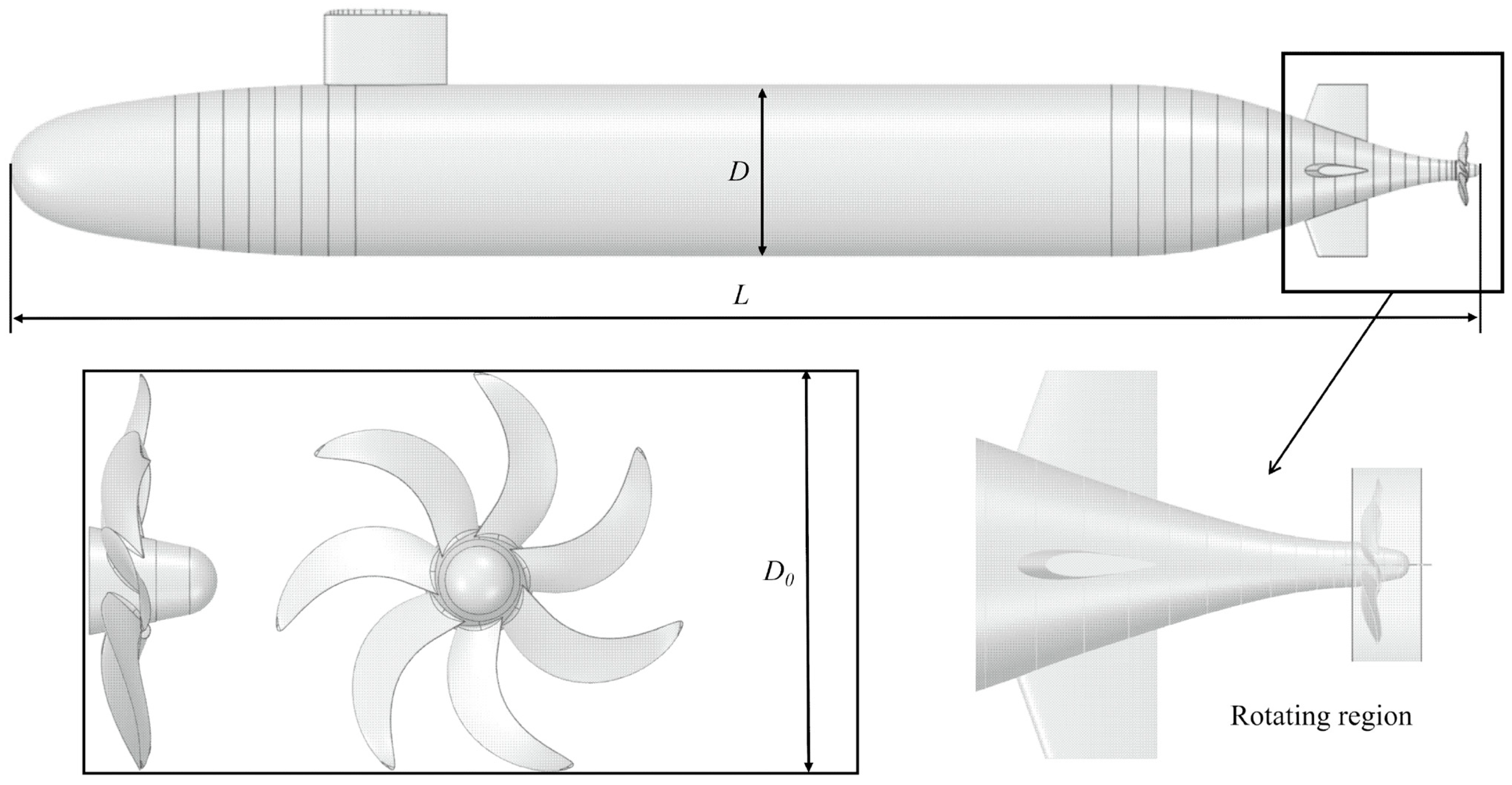
This study’s simulation uses a UUV propeller system comprising the DARPA SUBOFF scale submarine model and the experimental seven-blade propeller INSEAN E1619. The SUBOFF model measures 4.356 m in length, 0.508 m in hull width, and 0.368 m in command console length. It features an outwardly protruding top cover and is scaled up by a factor of 1:10. The geometric data for the SUBOFF model are sourced from reference [26]. The INSEAN E1619 propeller, known for its highly curved blades, is a well-established reference submarine propeller with extensive numerical and experimental data. Its model is detailed in [27], and the relevant parameters are provided in Figure 1 and Table 1.

3.2. Numerical Set Up

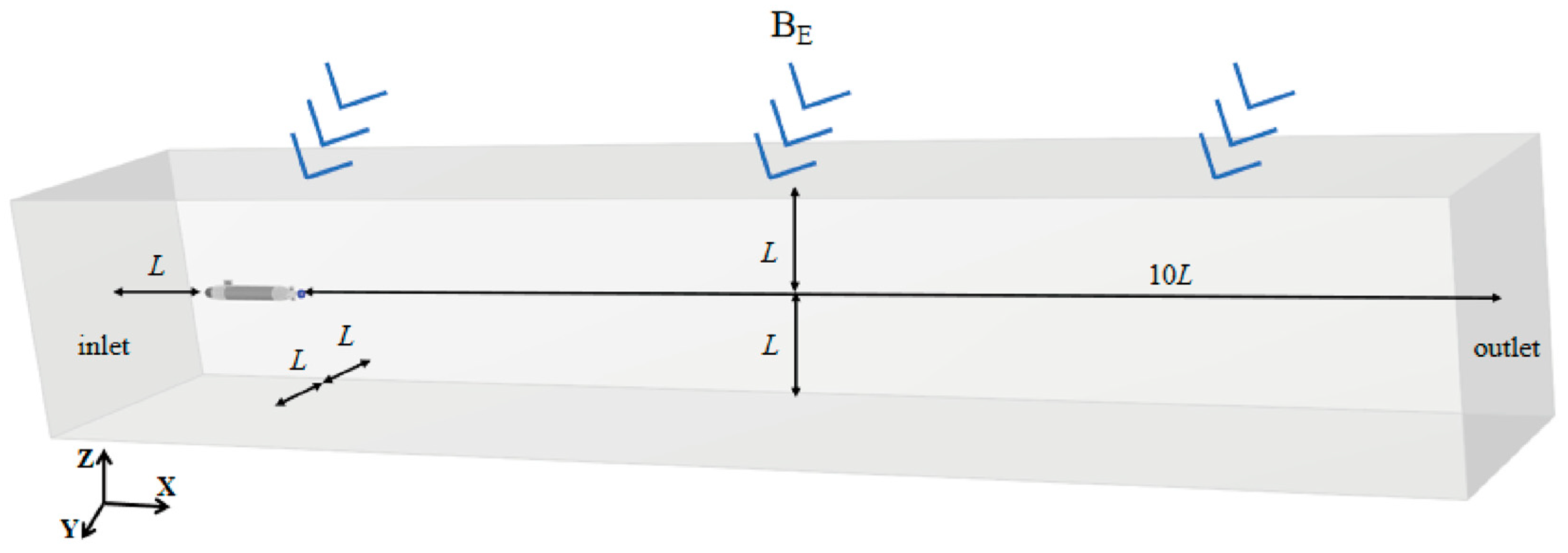
To accurately simulate both the near-field and far-field electromagnetic wakes of a UUV, selecting the right basin size and boundary conditions is crucial. In this study, the model is placed in a rectangular basin, with the propeller situated in a cylindrical rotational domain. As depicted in Figure 2, the entrance surface is positioned one boat length from the model’s head, while the exit surface is ten boat lengths downstream. The basin’s width and height are each twice the model’s length, with the model centrally located. The boundary conditions are established as follows:
(1) The velocity inlet boundary condition is applied at the end face of the incoming flow section, matching the submarine’s speed of 4 m/s. (2) A free outflow boundary condition is set at the outflow section’s end face, assuming the flow field is fully developed at 12 times the boat’s length. (3) The three surfaces surrounding the propeller’s rotational domain are designated as interfaces. The rotational domain and basin exchange data through the Interface boundary due to the propeller’s presence. (4) Non-slip wall boundary conditions are applied to both the hull and propeller surfaces. (5) Sliding wall boundary conditions are set for the end faces around the entire basin. These faces are sufficiently distant from the submarine, allowing the assumption that normal gradients of all variables are zero. (6) All six basin surfaces and all UUV surfaces are designated as magnetic insulating surfaces.
B E = F i c o s I c o s D + j c o s I s i n D k s i n I
In this study, the geomagnetic field within the computational domain is constant, matching the direction and magnitude of a specific location in the South China Sea. The unit coordinate vectors i , j , k represent the three coordinate directions. The magnetic inclination angle I is the angle between the geomagnetic field’s total intensity vector and the horizontal plane. The magnetic declination angle, γ , indicates the deviation between magnetic north and the axis ( I = 23.2 ° , γ = 87.55 ° ) and UUV’s heading is northward. The magnitude of BE is F = 38,110 nT. Thus, the geomagnetic field’s three components are Bx = 1500 nT, By = 35,000 nT, and Bz = 15,000 nT. The magnetic permeability is set at 1.257 × 10⁻⁶ H/m.
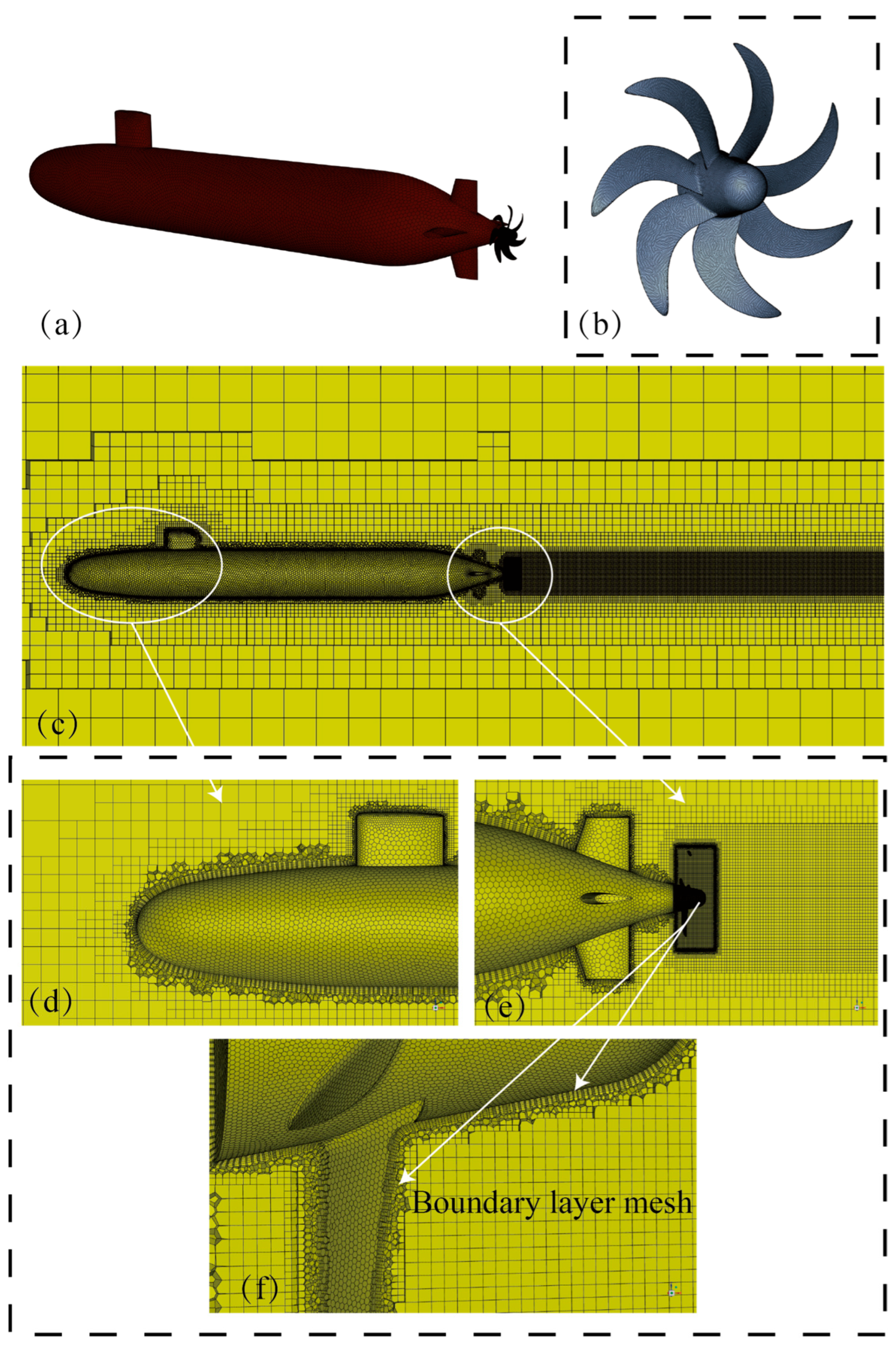
Given the propeller’s complex shape, this model employs a hybrid mesh approach. Polyhedral meshes cover the hull and propeller surfaces, while structured meshes are applied elsewhere. This ensures over 95% of the meshes have a quality rating above 0.9. Grid layout and scale are carefully chosen to balance calculation accuracy and efficiency. Figure 3a,b. illustrate the surface meshes of the hull and propeller, along with the computational domain meshes. The grid is locally densified around the hull, propeller, and wake, with the propeller boundary layer depicted in Figure 3f.
This study utilizes three sets of grid densities, as detailed in the table. Each set increases the number of nodes following the same grid division rules. These grids are employed to solve the blade system’s flow field and wake magnetic field. The grid’s impact on the results is assessed by comparing flow field velocity and electric field intensity at the submarine’s rear. Table 2 shows that the second and third grid sets yield consistent results within a specific range. For improved efficiency, the second grid set is chosen to simulate the blade system’s wake magnetic field.
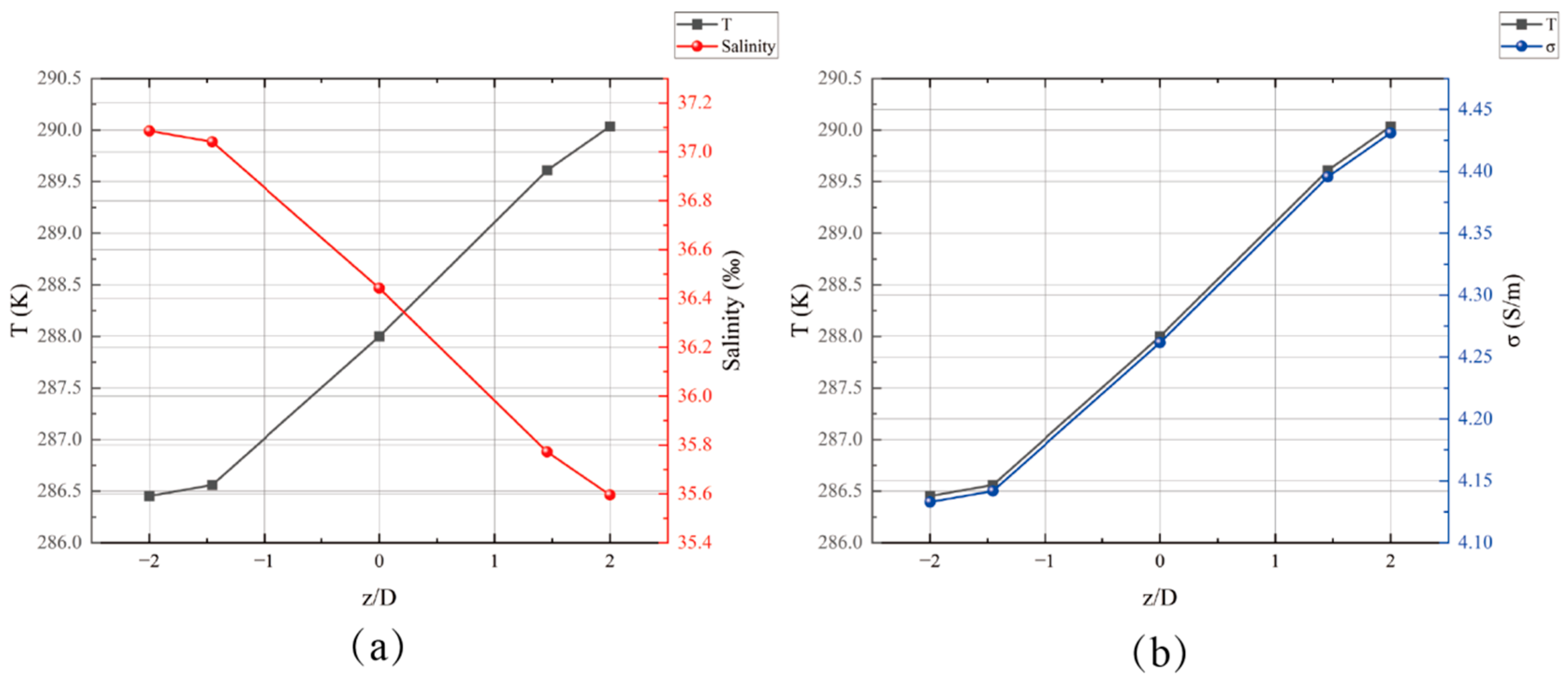
This study uses ANSYS Fluent R2022 and the finite volume method (FVM) to discretize fluid and electromagnetic control equations. Semi-implicit (Coupled) algorithm is employed for the pressure-linked equation as the pressure-based solver. Turbulence closure is achieved through the k-ε model. During initialization, the Patch function stratifies temperature, salinity, and conductivity based on actual conditions in a specific South China Sea area. Figure 4a,b respectively illustrate the distributions of temperature and salinity, as well as temperature and conductivity, near the hull. Initially, the multi-reference frame model (MRF) be used for a steady-state solution. Then, switch to the Moving Mesh model for an extended unsteady solution period. This combination effectively simulates the propeller’s rotational motion, enhancing convergence speed and computational efficiency. To examine the wake evolution of UUVs under various propulsion coefficients, this study performs calculations at U = 4 m/s for three conditions: Ja = 0.5, Ja = 0.625, and Ja = 0.833, corresponding to propeller speeds of n = 150 rpm, n = 120 rpm, and n = 90 rpm, respectively.
J a = U n D 0
k T = T h p n 2 D 2
k Q = Q t p n 2 D 2
η = k T L t 2 π k Q
In the formula, n denotes the rotational speed in revolutions per second (r.p.s), and D0 indicates the propeller’s diameter. The thrust coefficient Tk, torque coefficient kQ, and efficiency η can be derived from the axial force component (Th) and the rotational moment (Qt).

3.3. Generation Mechanism of Wake Electromagnetic Fields

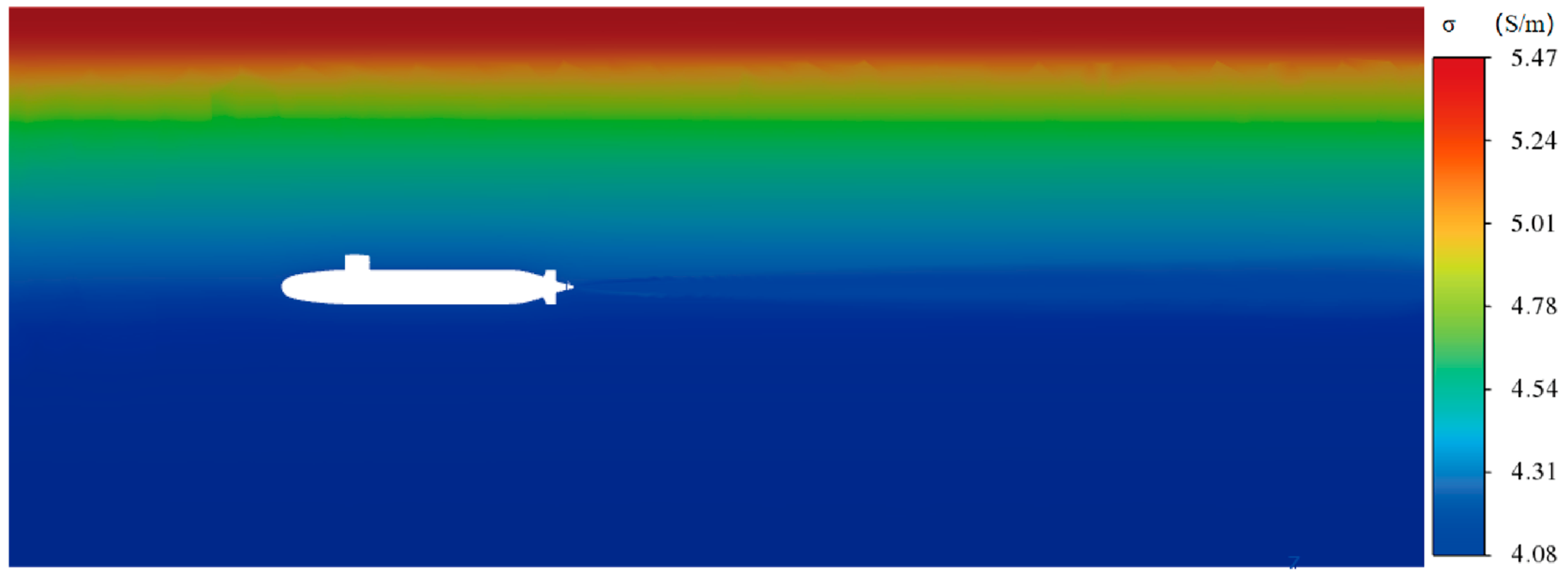
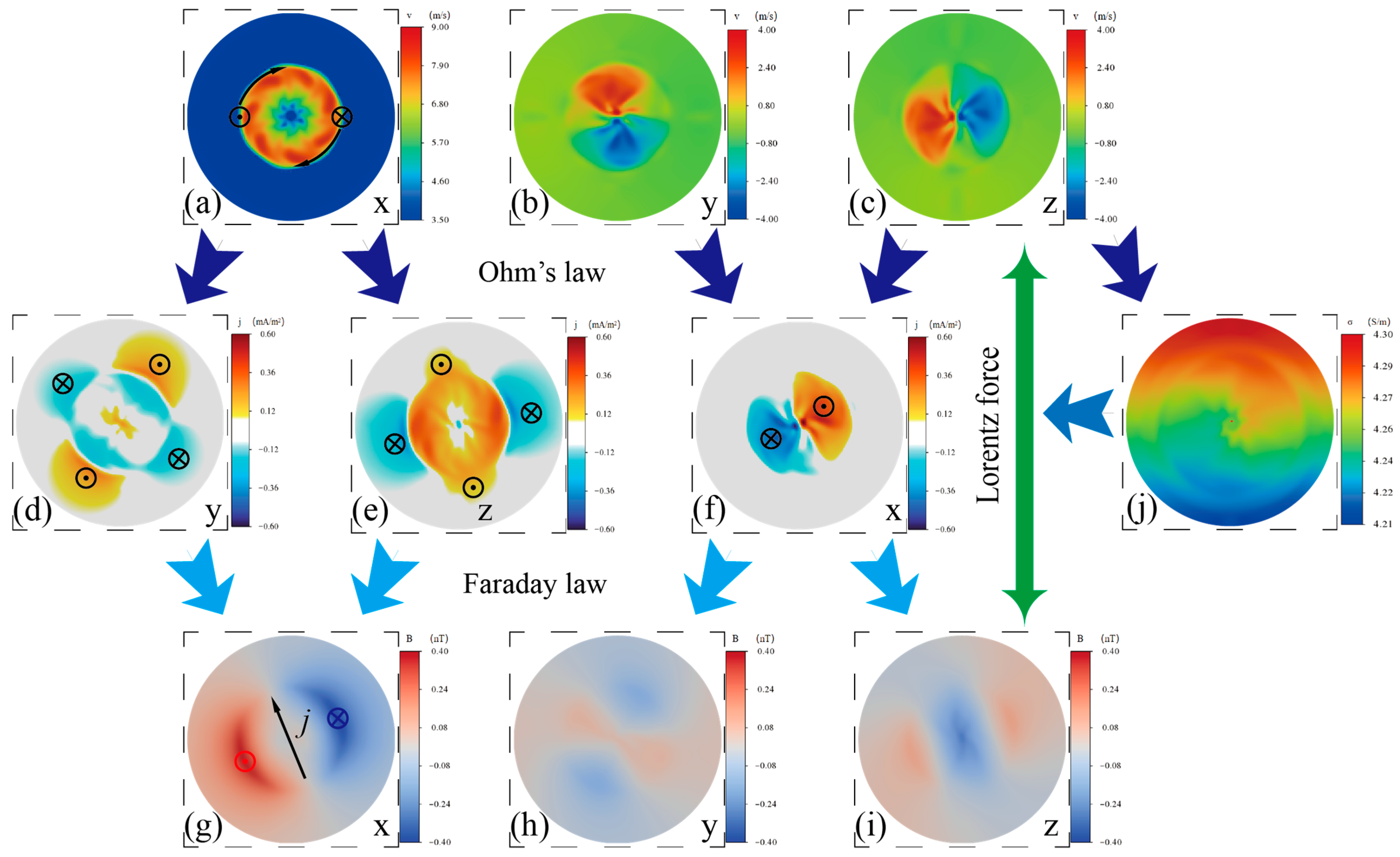
The UUV wake magnetic field arises from the interaction between the velocity field and the geomagnetic field. Its spatial structure depends on the velocity field distribution, geomagnetic field direction, and electromagnetic induction principles, resulting in a complex three-dimensional pattern. The analysis focuses on the y-z plane at x = 0 from the hub’s top. In this fully coupled process, conductivity governs the conversion efficiency at each stage: higher σ values enable stronger current generation at equivalent speeds, which in turn induces stronger magnetic fields and generates enhanced feedback forces. These forces tightly interconnect Vx, Vy, and Vz through induced magnetic fields. However, disturbances from the propeller disrupt the stable conductivity stratification, resulting in macroscopic value inversion as Figure 5 illustrated. The nonlinear conductivity distribution within the wake flow Figure 6j subsequently affects the induced electromagnetic field. When the UUV moves along the negative X-axis, as depicted in Figure 6d,e, the hull generates a current density field in the opposite direction nearby. The x-direction velocity component of the wake field is predominant. According to Ohm’s Law, this velocity component interacting with the geomagnetic field induces a current density. These induced currents, all under 0.6 mA/m2, are perpendicular to the plane formed by the geomagnetic field and velocity direction. Thus, the interaction primarily generates induced current densities in the y and z directions.
According to the right-hand helix rule, these current densities generate an induced magnetic field, known as the wake magnetic field, around them. Figure 6f illustrates this using a current density in the y direction. The magnetic field lines encircle the current direction, typically creating a positive magnetic field area on the lower left and a negative area on the upper right of the current distribution. Together, these form a pair of conjugated magnetic dipole structures. This spatial distribution aligns with Ampere’s loop law in classical electromagnetic theory.
During normal navigation, the wake field of a UUV is divided into vx, vy, and vz components as shown in Figure 6a–c. When the X direction velocity component vx exists, it first “cuts through” the initial geomagnetic field’s Y and Z components, inducing current densities jy along the Y axis and jz along the Z axis, as illustrated in Figure 6d,e. These currents immediately generate their own induced magnetic fields: jy flowing along the Y axis produces an induced field with the Y axis as its axis of rotation, while jz flowing along the Z axis generates an induced field with the Z axis as its axis of rotation. Together, these components form the X direction component of the induced magnetic field, as depicted in Figure 6g. These induced fields couple with the original vx field and the initial geomagnetic field again, creating a positive feedback loop. Simultaneously, these induced fields interact with the current densities themselves, producing weak Lorentz forces that exert counteracting effects on the flow field. Similarly, the vy and vz components of the wake interact with the existing X-component of the geomagnetic field, generating X direction currents jx as shown in Figure 6f. These jx currents further establish new induced magnetic fields with magnetic flux lines circling the X axis, primarily producing Y and Z direction components as illustrated in Figure 6h,i. These components then interact with Vy and Vz to form closed loops. Unlike vx-dominated coupling, vy and vz primarily generate axial currents jx, whose induced magnetic fields predominantly feed back laterally, forming a cross-coupling mechanism of “lateral velocity → axial current → lateral induced magnetic field.”

4. Numerical Method Validation

4.1. PIV Experimental Verification

Limited experimental research on wake electromagnetic fields in UUV systems means there is insufficient data to directly verify wake magnetic field calculation methods. The accuracy of these simulations heavily relies on precise flow field calculations, which in turn depend on accurately simulating UUV hydrodynamic properties. Therefore, validating wake EMF simulations requires first ensuring the reliability of the flow field’s numerical solutions. To address this, our study employs the Particle Image Velocimetry (PIV) method and integrates relevant literature data to systematically verify flow field calculations. This approach provides substantial indirect evidence supporting the validity of the wake magnetic field solution.
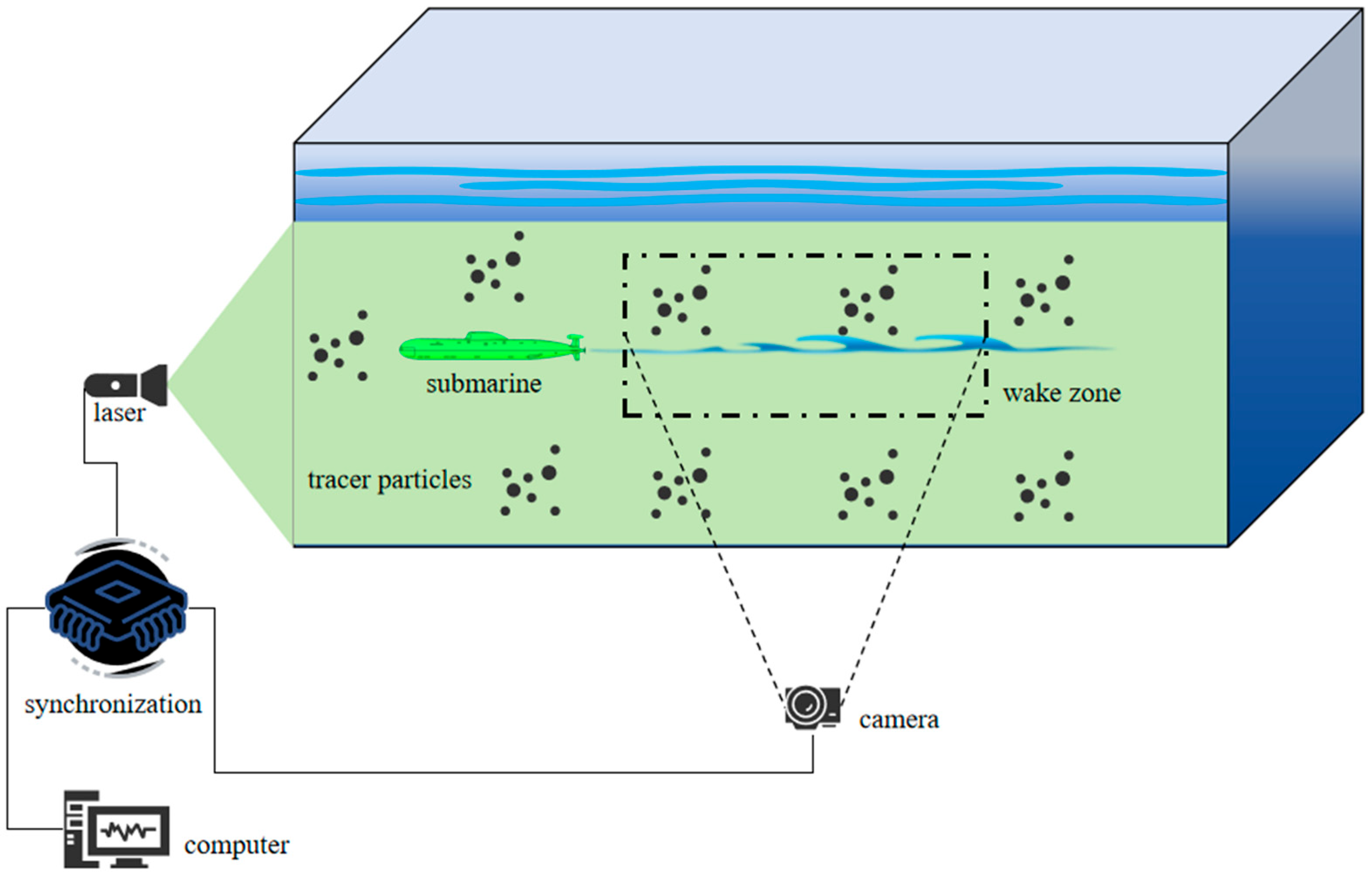
The PIV measurement system used in this study, as shown in Figure 7, primarily consists of dual-pulse laser, digital camera, and synchronization controller. During testing, the Vlite-500 laser emits dual-pulse laser signals into the water tank. The experiment utilized tracer particles of model MV-HO520 with particle sizes ranging from 5 to 20 μ m , density comparable to water, and primarily composed of SiO2. The autonomous model maintained its navigation depth and trajectory through a combination of a fixed frame and high-strength flexible lines. During navigation, the model disrupted the uniformly distributed tracer particles in the water, with their pulsed light signals being captured by the camera system. The camera system employs a Mioropulse725 synchronization controller to synchronize laser emission frequency with CCD camera acquisition rate. The camera performs continuous image capture at a full-resolution rate of 17 frames per second in the wake region.
Figure 7 shows the schematic diagram of the flow field measured in this experiment. Based on the Froude similarity principle, the sailing speed is set at 0.53 m/s, utilizing a self-propelled propulsion method. The model parameters are detailed in the accompanying Table 3.
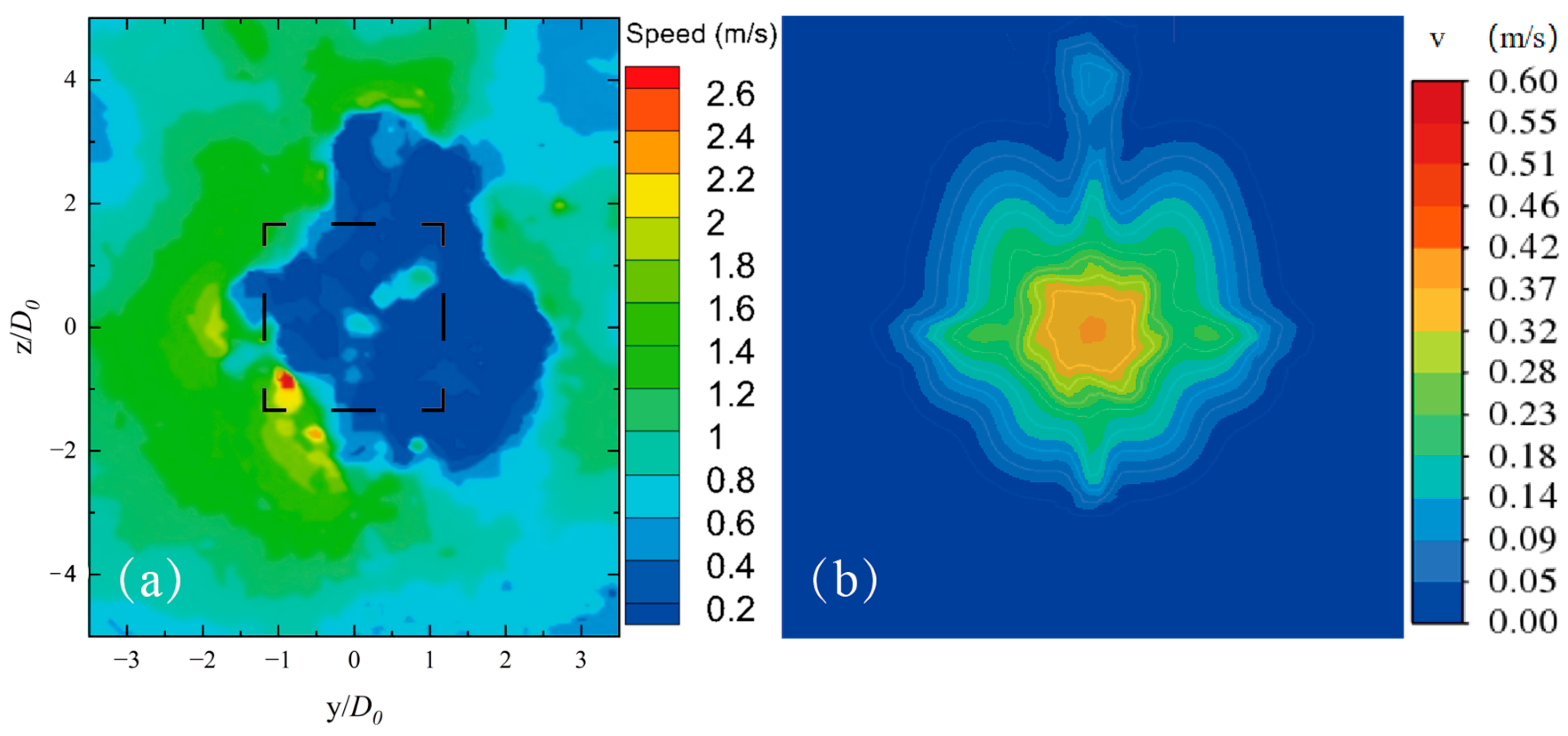
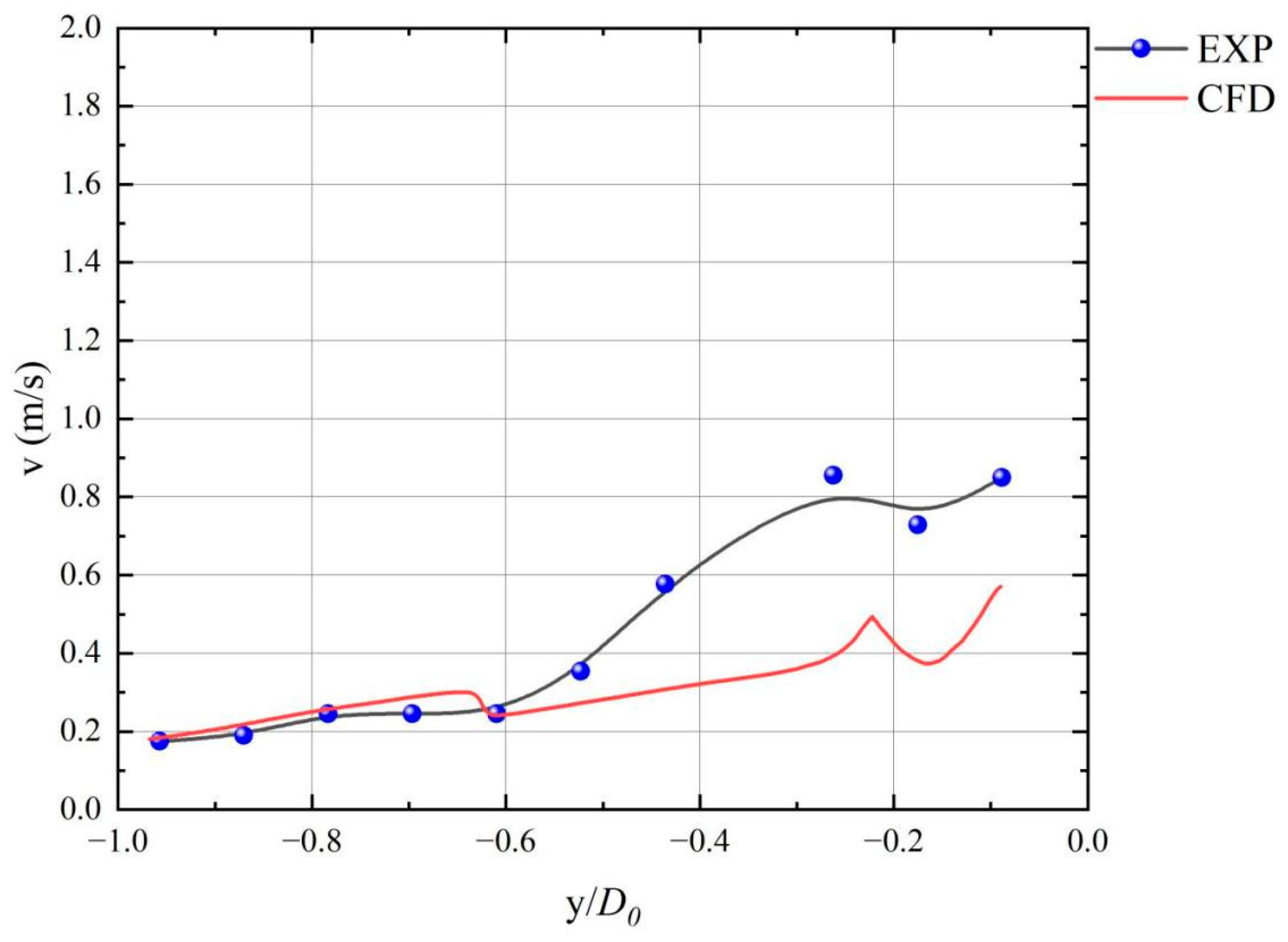
To clearly illustrate the differences and consistency between simulation and experimental results, data is collected at a specific radial position on the propeller blade. The results are shown in Figure 8a,b, and the dashed box indicates the corresponding simulation area.. This position is on the left half of the propeller’s rotation plane at a sufficient depth. Data points are chosen along a radial axis extending from the hub’s center, precisely at x = 50 mm. Detailed flow field or physical parameter data is extracted around this point, covering a spatial range twice the propeller’s diameter. This analysis focuses on local flow field velocity. The systematic comparative analysis reveals an average relative error of 25.8%, indicating high consistency between the experiment and simulation.
μ = 1 n i = 1 n 1 x C F D x E X P
Ten measurement points were established at critical locations, with a total quantity of n = 10. For each measurement point, x E X P and x C F D represent the experimentally measured actual velocity values and the theoretically calculated velocity values obtained through numerical simulation methods, respectively. Substitution into Equation (31) yields an average error of 25.8%. In the non-propeller rotation center region (−D0, −0.5 D0), where the flow is relatively steady, the experimental values exhibit high consistency with simulation results, with an average error of only 10.4%, see Figure 9.

4.2. Literature Experimental Validation

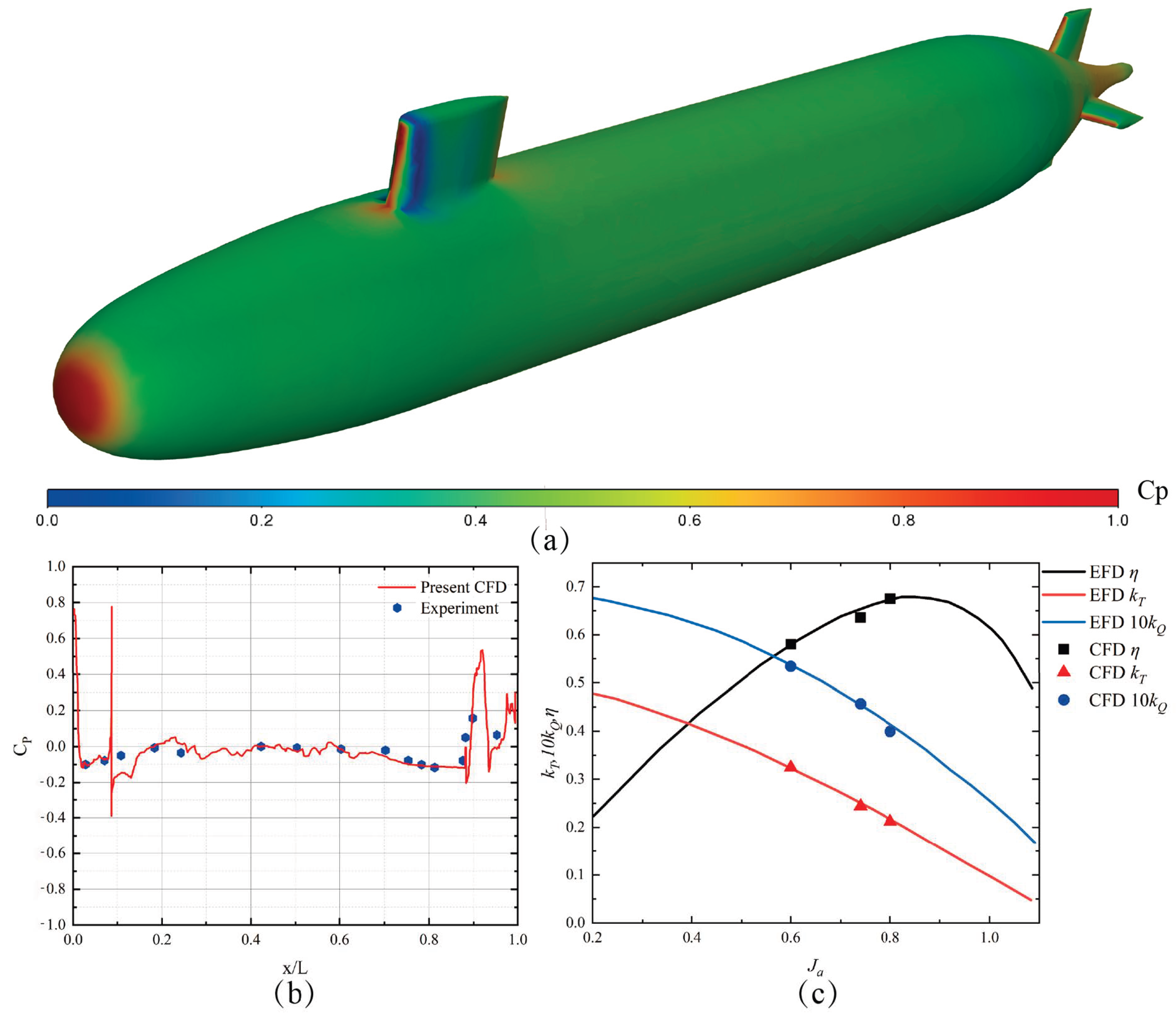
Figure 10a,b compare the pressure coefficient values from simulations with experimental data. This coefficient integrates pressure, velocity, and density. The results confirm that the model scale (SUBOFF), mesh division method, mesh count, and chosen turbulence model and calculation parameters are suitable. This supports the accuracy and reliability of the Computational Fluid Dynamics (CFD) method used in this study fora practical applications. The three main propulsion coefficients (Ja = 0.6, 0.74, 0.8) for the propeller configuration were calculated. The thrust kT and torque coefficients kQ, were compared with experimental data from published literature [27], as shown in Figure 10c.
C p = 2 P / ρ ν 2
This study evaluated the drag of the SUBOFF submarine model at a speed of 5 m/s, comparing it with experimental results from the David Taylor Dock Experiment Center in the United States. Table 4 presents a comparison between the hull’s total resistance from numerical simulation and the test values. The table indicates that the simulated total resistance closely matches the experimental results.
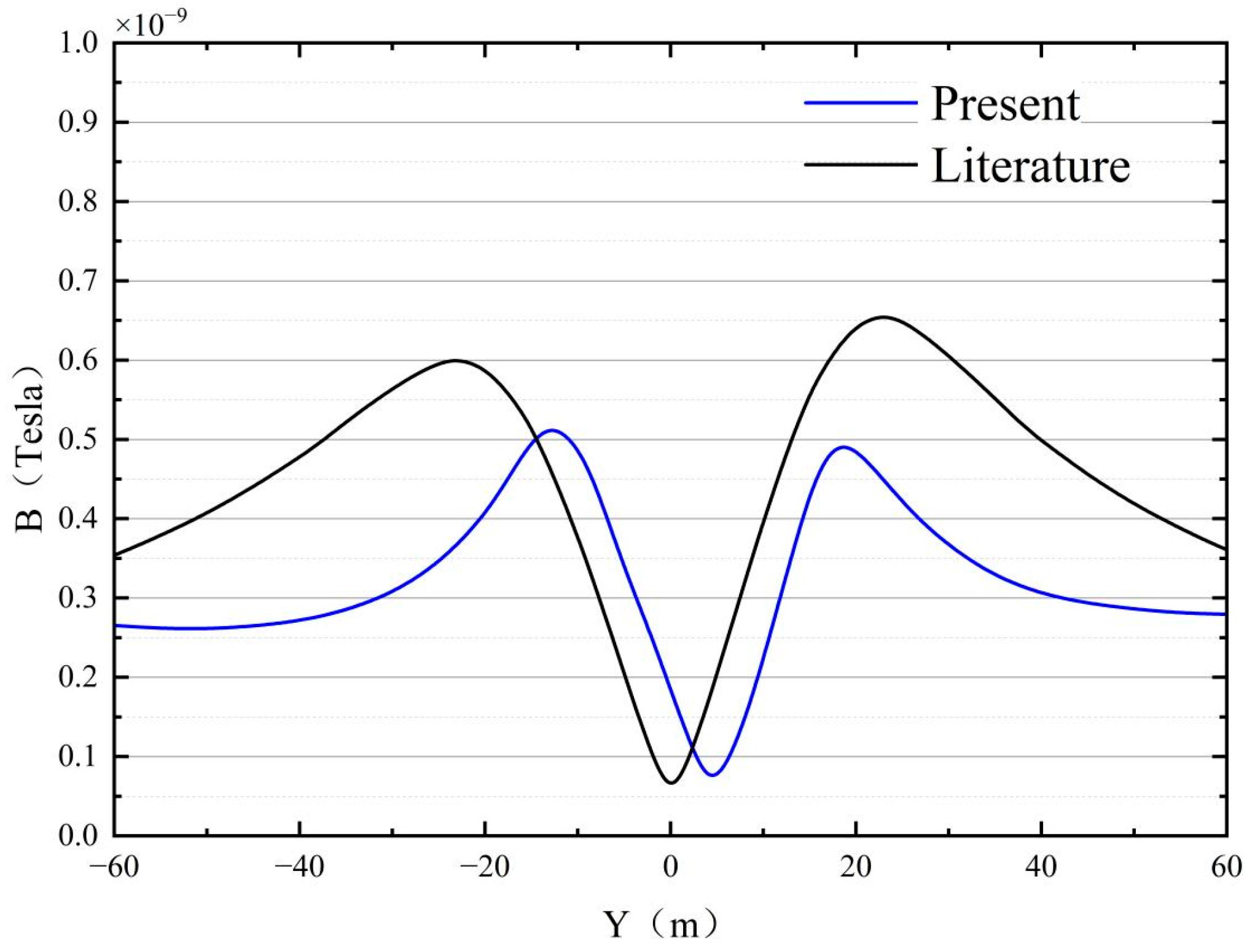
The SUBOFF hull and five-blade propeller system described in the literature [25] serves as the reference geometric model. As shown in Figure 11, the magnetic field distribution 600 m behind the propeller exhibits a distinct bimodal structure consistent with the literature findings, with both the low-field minimum and high-field maximum values stabilizing at the 10−11 T and 10−10 T orders of magnitude, respectively. This demonstrates high consistency in spatial distribution patterns and magnitude orders. The model maintains robust performance even in long-range wake propagation simulations, confirming that the electromagnetic model employed in this study maintains excellent numerical accuracy and stability under extended-range and weak-signal conditions.

5. Results and Discussion

This study examined how electromagnetic fields are generated by UUV systems in a geomagnetic environment, focusing on near-field and far-field wake magnetic fields. This study assessed the far-field spatial distributions of the flow field, induced electric field, and wake magnetic field across three propulsion coefficients. It detailed the longitudinal variations in wake velocity, electric, and magnetic fields. Additionally, It explored the attenuation pattern of the far-field wake magnetic field. Lastly, It analyzed the frequency characteristics of the induced electromagnetic field’s amplitude spectrum.

5.1. The Evolution of Near-Field Wake and Far-Field Electromagnetic Wake Along the Navigation Direction

Figure 12 presents a side view of the UUV system’s three-dimensional vortex structure. This visualization uses the isosurface of the Q criterion [28], defined as follows:
Q = 1 2 u x 2 + v y 2 + w z 2 u y v x + u z w x + v z w y
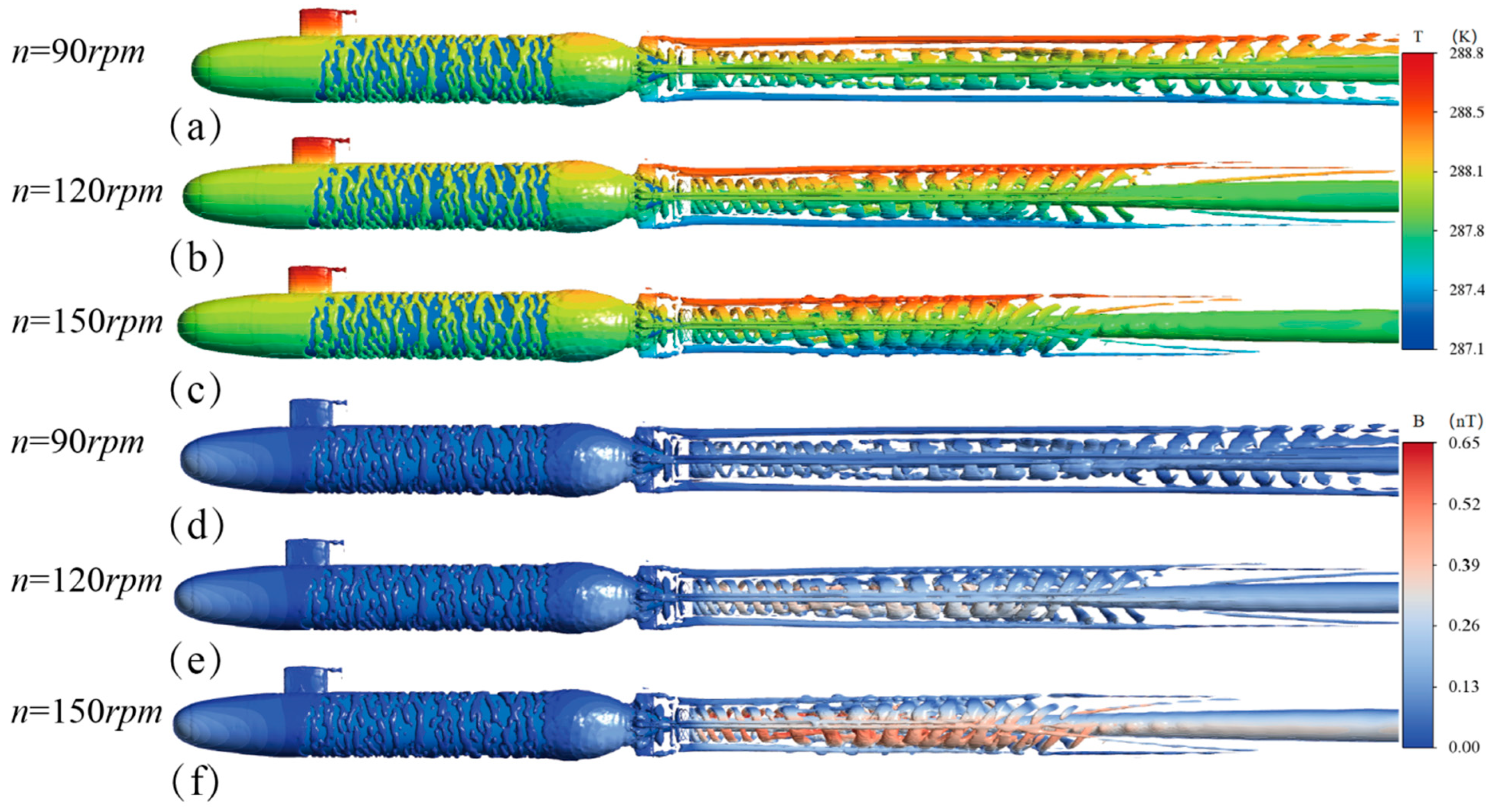
Figure 12 illustrates that numerous vortex structures cluster at the boat’s head and gradually disperse along its surface. In the wake region, the vortex structure related to the propeller divides into three parts: stable, transitional, and unstable regions. The side view’s instantaneous Q isosurfaces are colored to represent fluid temperature and induced magnetic field. The temperature stratification is disrupted, and a high magnetic field intensity appears on the tip vortex structure. Increased velocity causes instability in the stable wake region, disrupting the equilibrium of the stable tip vortex system, as shown in Figure 12a–c. This instability shortens the stable region, causing the tip vortex structure to break prematurely. As the tip vortex system moves downstream, secondary vortices merge with adjacent tip vortices, further deforming the system and causing the vortex structure to diverge.
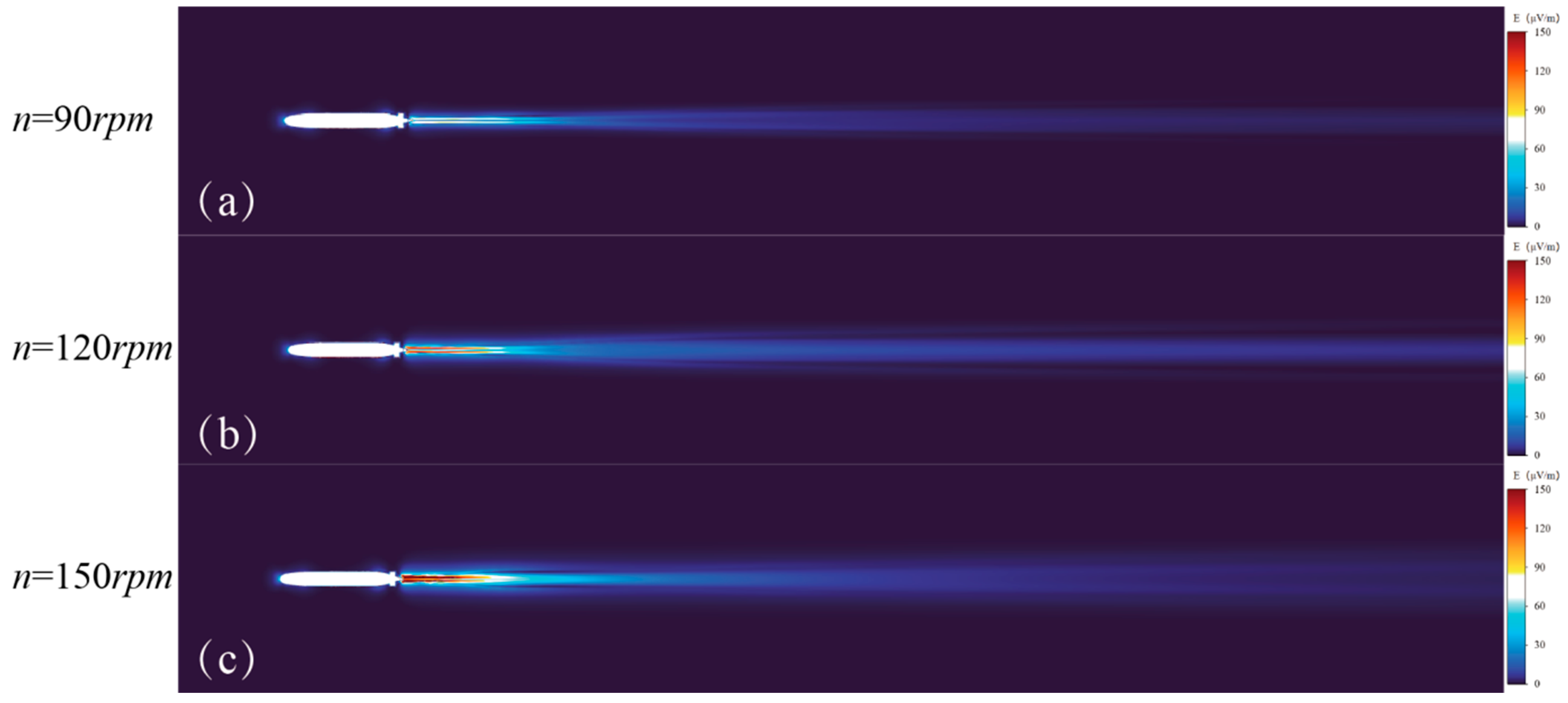
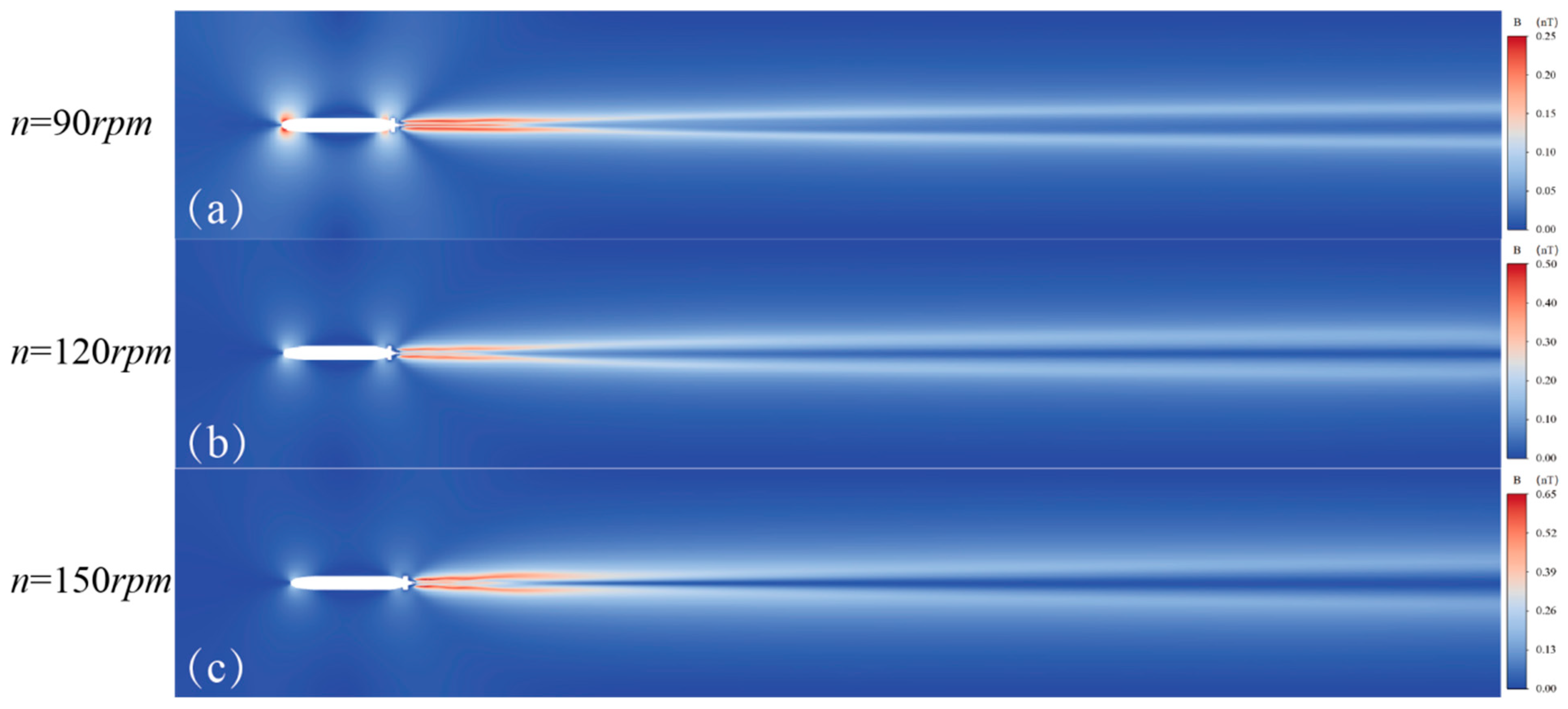
Figure 13 illustrates that the far-field electric wake from the UUV system, at various rotational speeds, is primarily concentrated around 75 μ V / m . As distance increases, the wake’s diameter expands, and the electric field intensity diminishes. Figure 13 and Figure 14 reveal that both the induced magnetic field intensity and the induced electric field share similar spatial distributions and far-field evolution patterns. They are symmetrical along the central axis of the flight path, forming a V-shaped diffusion. As the range extends, the induced magnetic field’s intensity gradually decreases, maintaining around 0.1 nT near the wake. Additionally, a magnetic field intensity pattern, akin to a magnetic dipole, emerges in the bow and stern areas of the hull.
Figure 14a–c show that as the wake velocity field increases, both the peak magnetic field intensity and the diffusion range of the near-field wake expand. In conjunction with Figure 13a–c, it is evident that the electric field intensity pattern of the far-field wake broadens with increased propeller speed. This leads to a wider formation range of the induced magnetic field, while the attenuation rate significantly decreases.
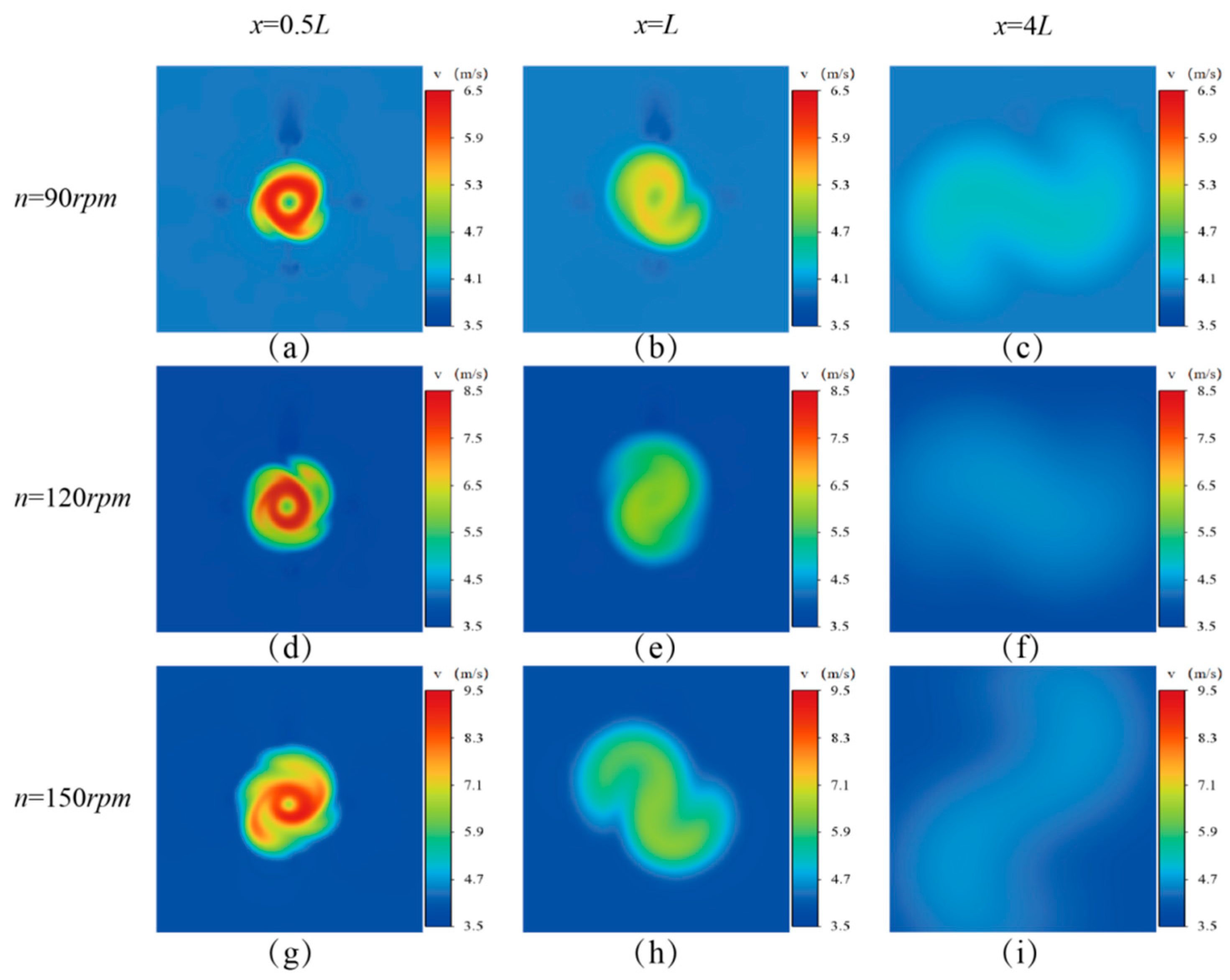
Figure 15 illustrates the velocity distribution at various points behind the UUV. As distance increases, the wake’s speed decreases while its affected area expands. At x = L, the wake velocity distribution reveals two trailing vortex tips, resembling a propeller’s structure. With increased rotational speed, this structure spreads outward. Near x = 4L, changes in the wake velocity distribution diminish, suggesting a weakened disturbance effect from the propeller in this range.
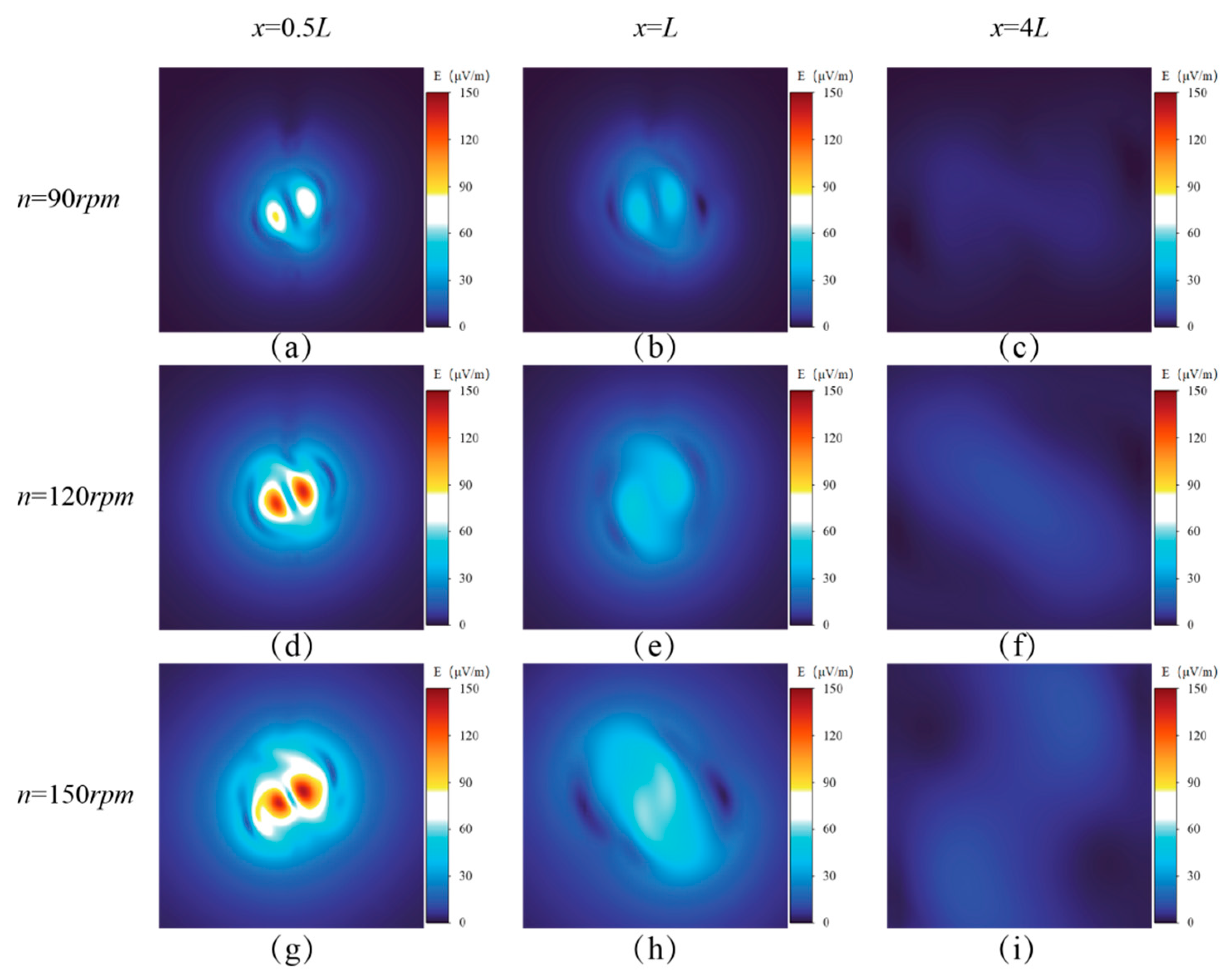
Figure 16 illustrates the electric field intensity distribution at various positions behind the UUV. To examine how different speeds affect the electric field, all figures are scaled from 0 μ V / m to 150 μ V / m . At x = 0.5L, the wake’s electric field intensity splits into two asymmetrical parts in both magnitude and shape. By x = L, these intensities diminish rapidly, with peak values near 60 μ V / m . At x = 4L, the field’s range expands significantly, and the peak drops to about 30 μ V / m . As speed increases, the electric field intensity at the same position diffuses in a highly nonlinear manner, with varying forms.
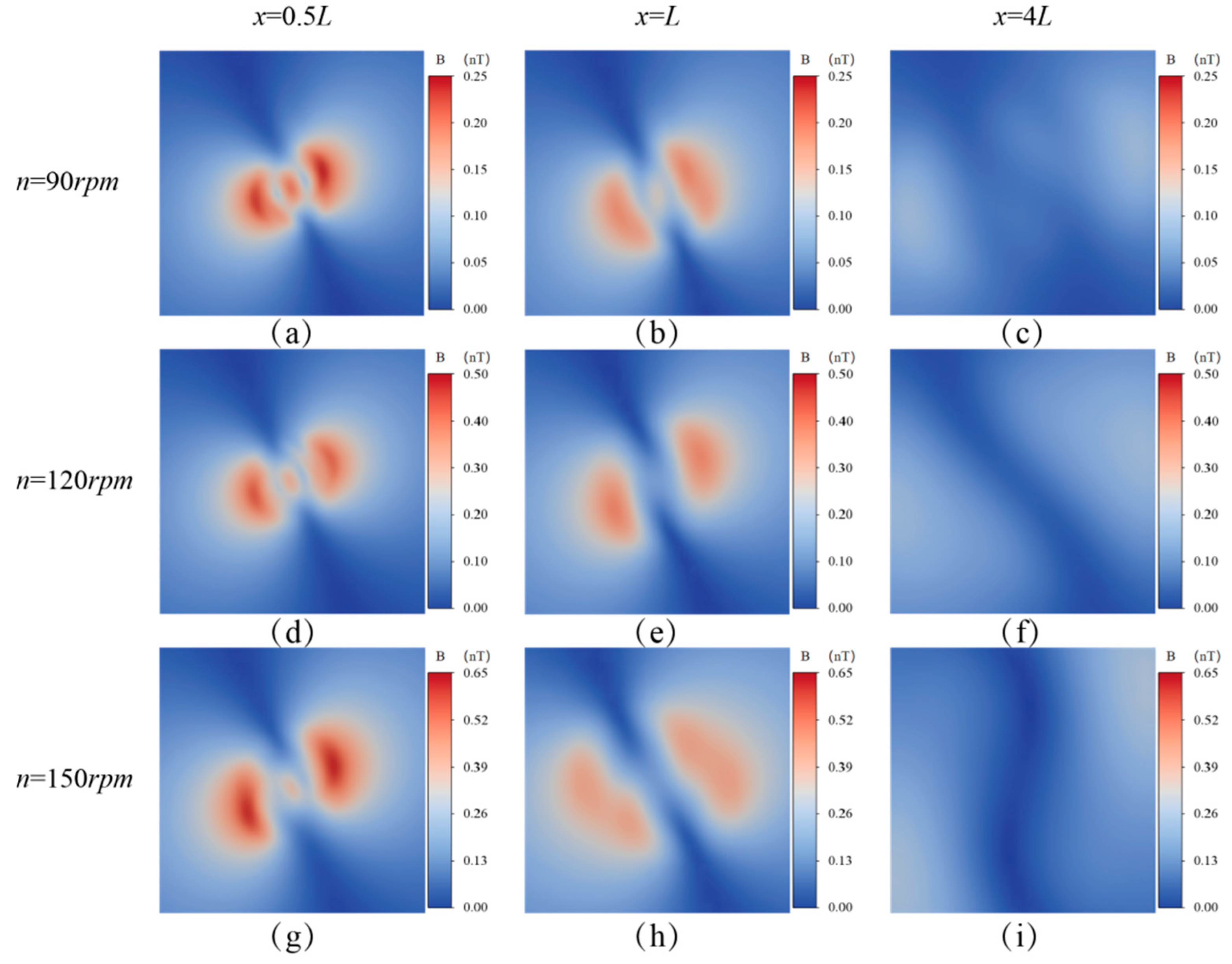
The magnetic field intensity distribution, depicted in Figure 17, is influenced by both the wake velocity field and the electric field. As distance increases, the absolute magnitude of the magnetic field decreases to around 0.1 nT, while its distribution range expands. Initially, the induced magnetic field consists of two separate symmetrical annular spaces, as shown in Figure 6a. At x = 0.5L, the magnetic field forms an ellipsoid at a specific angle, mirroring the electric field distribution in the far field. The shape and angle of the induced magnetic field in the y-z plane are determined by the direction of the background magnetic field.

5.2. Far Field Attenuation Process of Electromagnetic Field in Wake

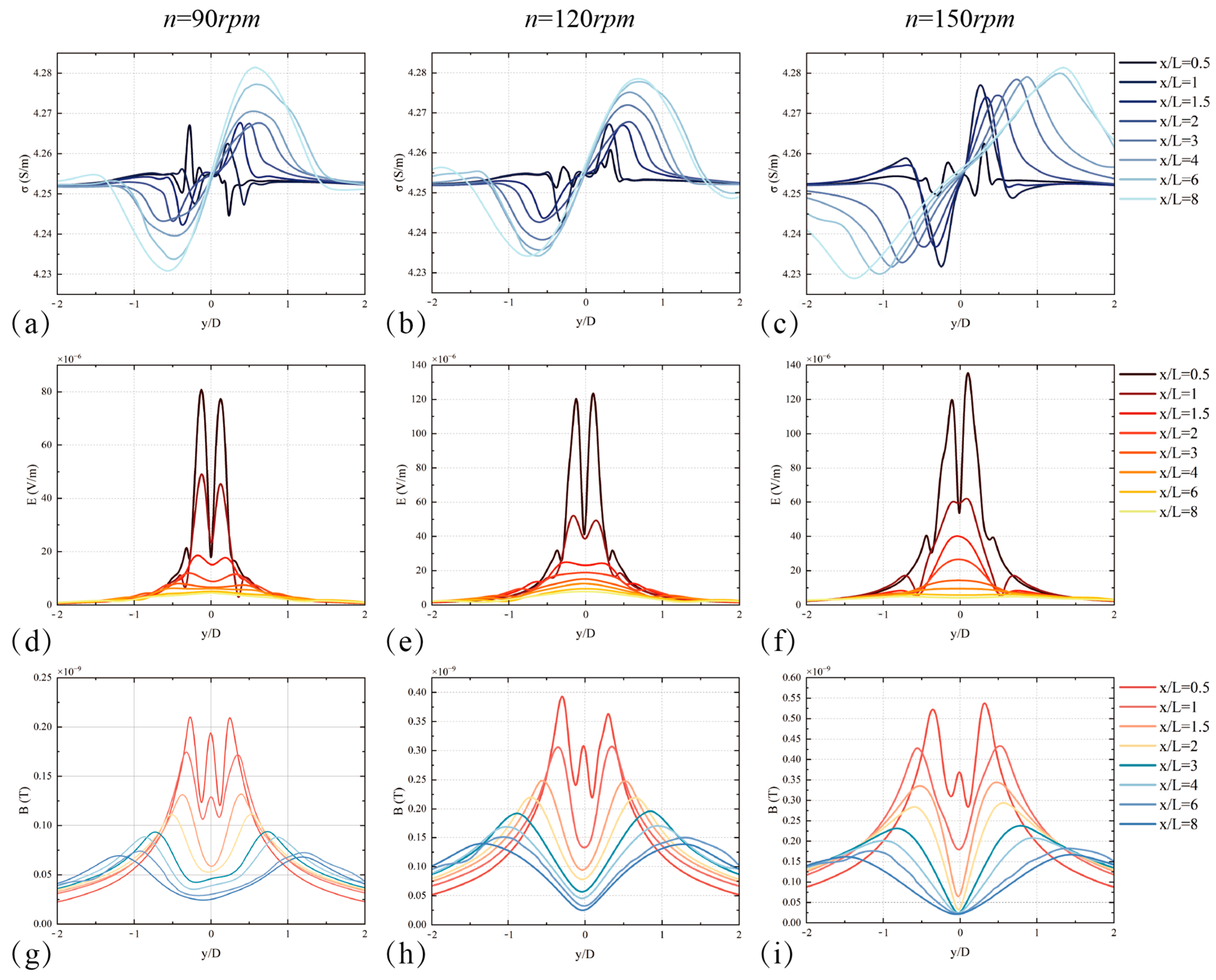
In stratified seawater, electrical conductivity significantly influences electromagnetic wake formation. Figure 18a–c illustrate its diffusion along the horizontal y-axis at various x positions behind the UUV system. The measured y-direction length is 2D, twice the boat’s width. These diffusion characteristics impact both the electric and magnetic fields.
Beyond the qualitative analysis of the UUV system’s wake electromagnetic field, this study conducts a detailed quantitative examination of its distribution. Figure 18d–f illustrate the electric field fluctuations and distribution patterns at various longitudinal distances and rotational speeds. The figures reveal that the wake’s electric field peaks near the central axis, forming a high-intensity core. In the horizontal Y direction, the intensity decreases rapidly, indicating strong lateral dissipation. Conversely, in the propulsion (X) direction, the wake’s velocity decreases gradually, showing a slow attenuation rate. This suggests good longitudinal persistence, aligning closely with the wake velocity field. Increased speed amplifies the electric field’s strength at the central axis, especially between x = L and x = 2L, suggesting a tendency for the electric field regions to merge.
Figure 18g,h,i illustrate a three-peak structure in the near-field wake magnetic field distribution. As rotational speed decreases, the distance from the axis (y = 0) to the central peak increases. Beyond x = 2L, two symmetrical magnetic field intensity peaks appear on either side of the far-field wake center-line. These peaks are approximately located laterally between D and 2D from the propeller, where D represents the UUV hull diameter. As the X direction distance increases, these magnetic field peaks gradually weaken, indicating a clear pattern of longitudinal diffusion.
The spatial distribution of the far-field wake magnetic field behind the UUV system is examined using two axial measurement lines. One line is positioned at the tail flow’s center-line (y = 0, z = 0), and the other is directly above it (y = 0, z = 0.9R). The origin of the coordinates is at the top of the propeller hub. Each measurement line extends 10L (450 m).
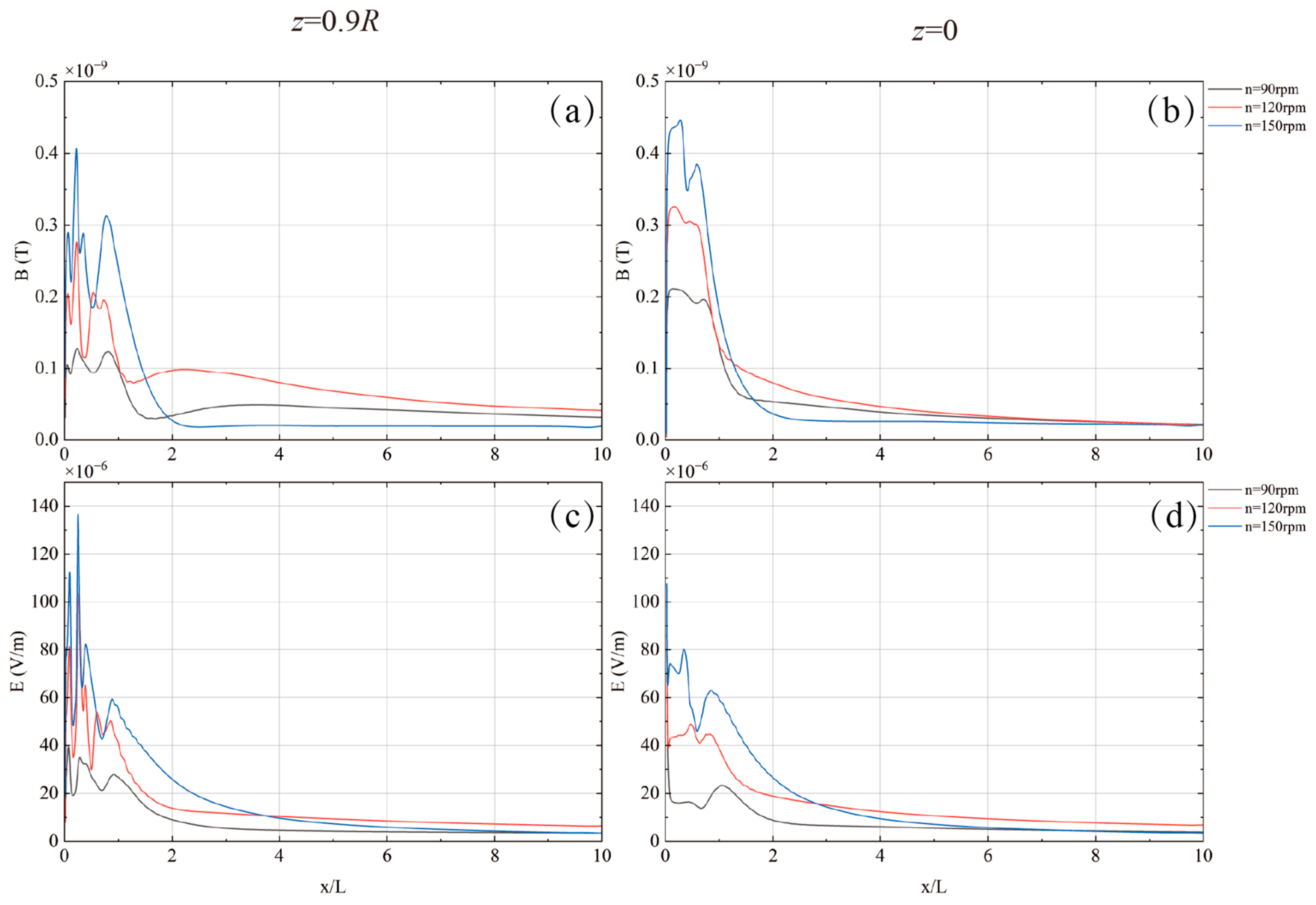
Figure 19a,b illustrate the axial magnetic field intensity distribution along two measurement lines. The electric field intensity fluctuates sharply in the near-field region due to the complex wake structure. Beyond x = 2L, the far-field intensity follows a nonlinear attenuation pattern. On the central measurement line, this attenuation levels off after x = 2L. Similarly, after x = 2.5L, the electric field intensity on the z = 0.9R line peaks and then levels off. Figure 19c,d depict the axial electric field intensity distribution at corresponding positions, showing a stable attenuation trend at x = 4L on both measurement lines.
In the near-field region, increasing rotational speed boosts both electric and magnetic field intensities. However, as the wake develops downstream, the flow field structure has a greater impact on field strength than velocity magnitude. Figure 19b illustrates that at n = 120 rpm, the far-field intensity is significantly higher than at other speeds.
The spatial asymmetry of the wake velocity field structure and the background geomagnetic field cause differences in the electromagnetic field values on the two measurement lines. Despite the rapid decay of the far-field wake magnetic field with distance, its magnitude remains around 0.01 nT. This suggests it could still interfere with detection equipment on UUVs.

5.3. Dynamic Analysis of Electromagnetic Field in Wake

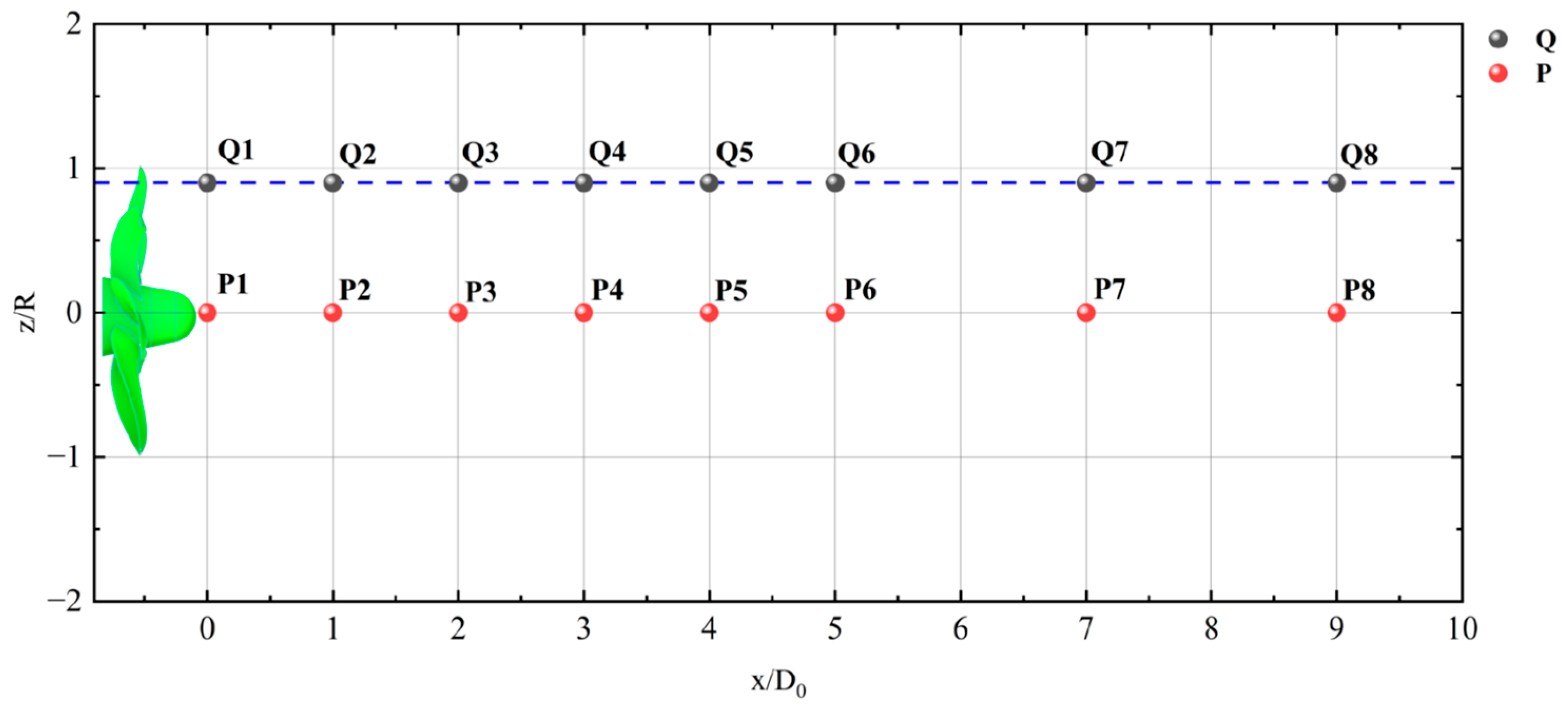
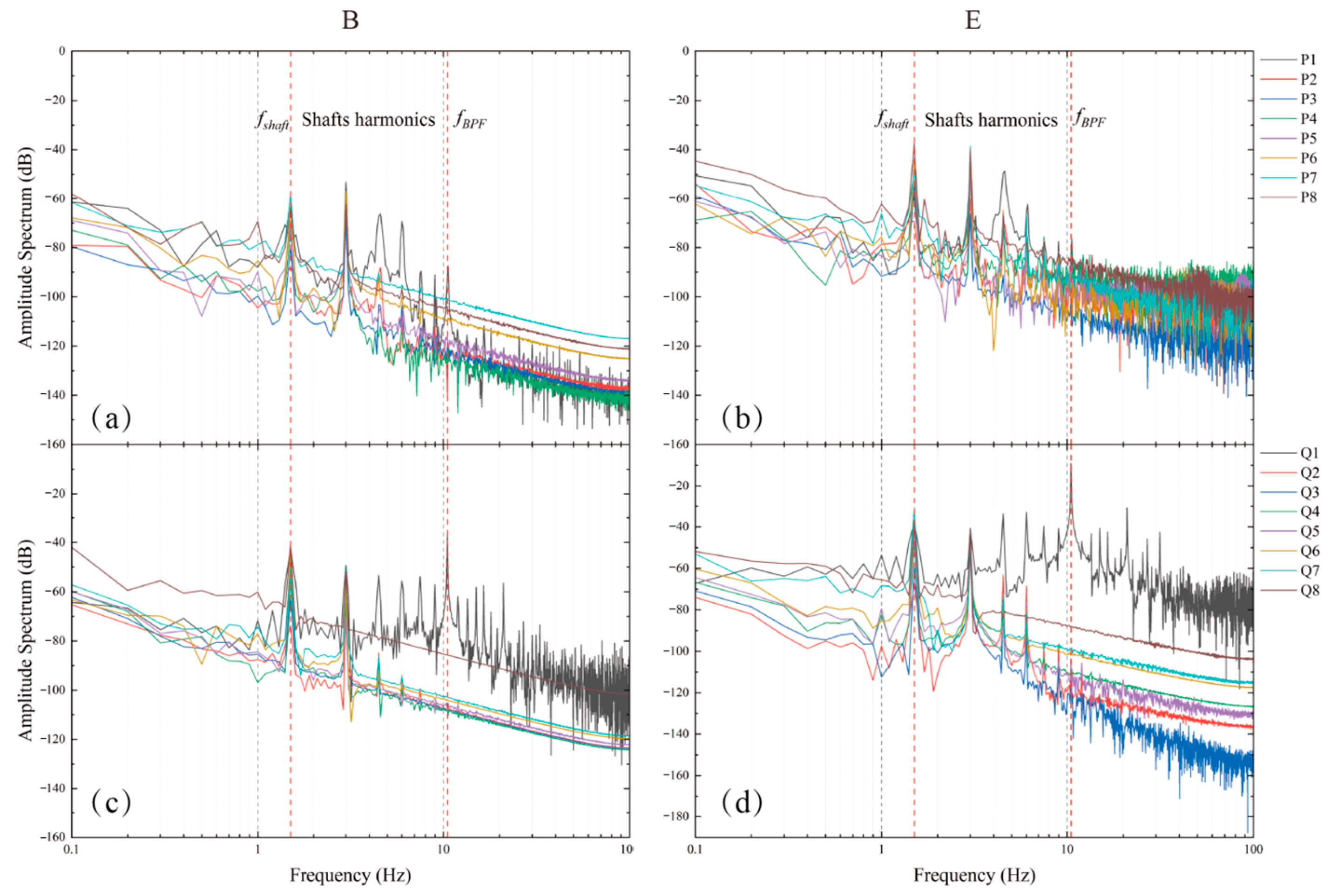
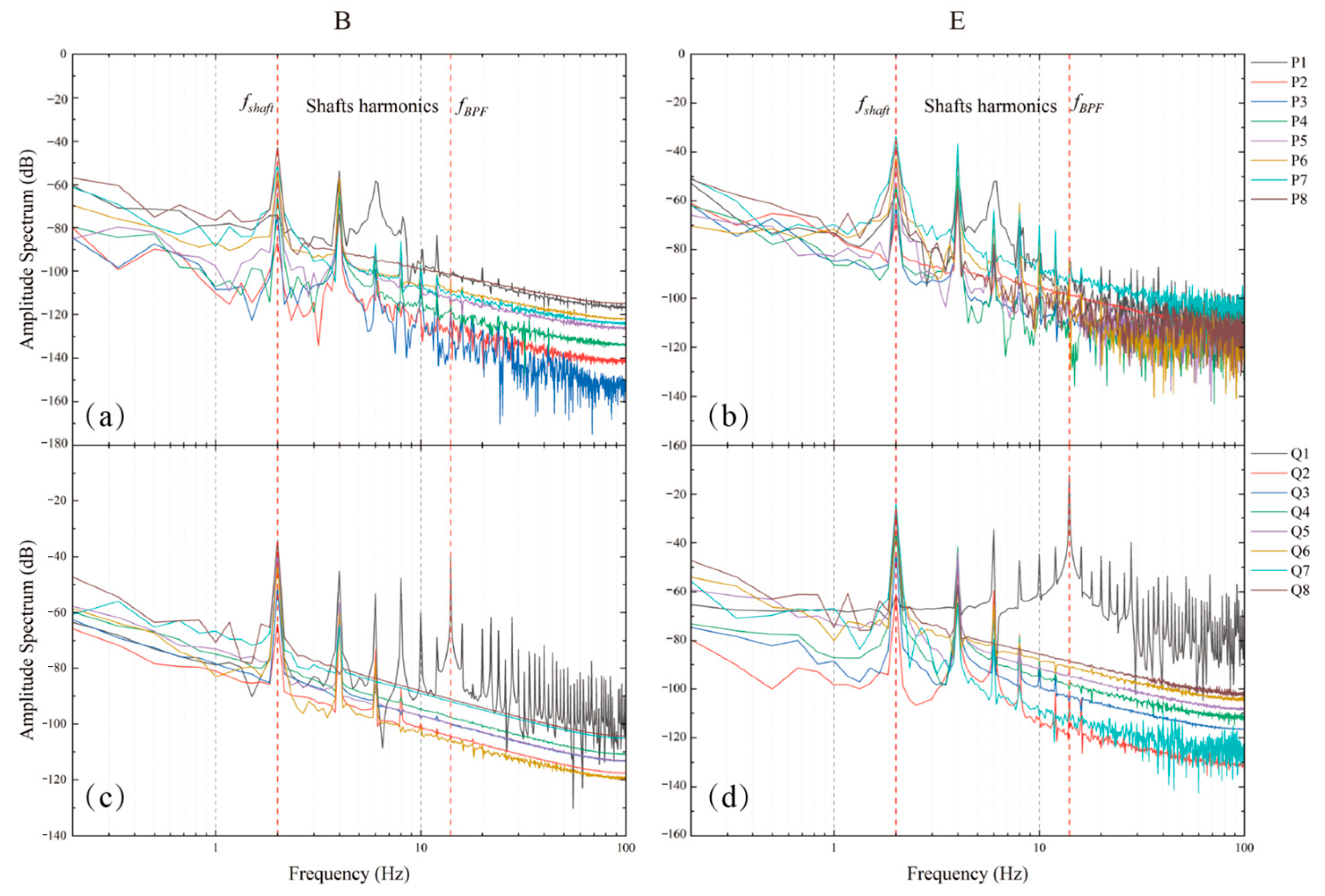
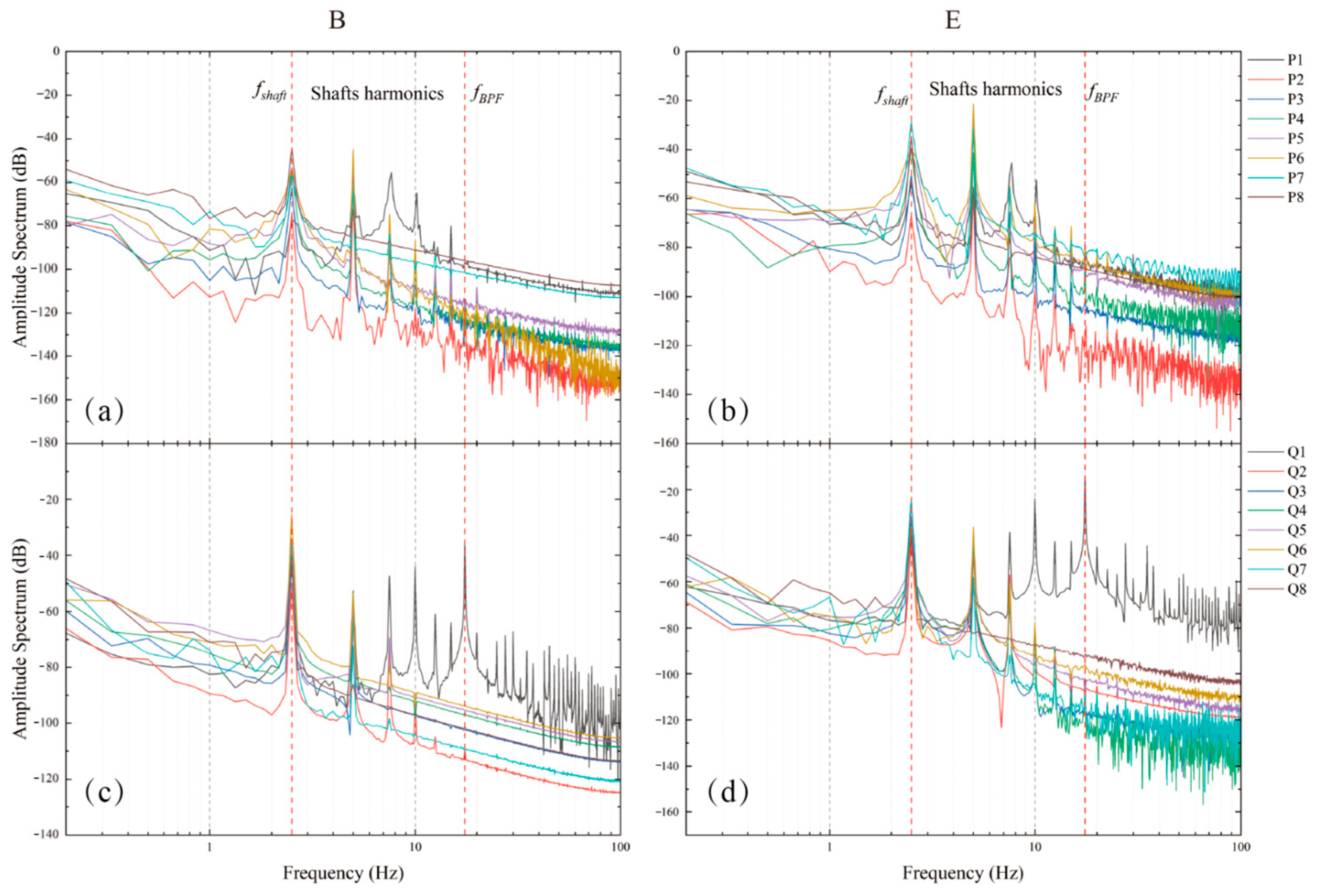
To study the dynamic behavior and patterns of electromagnetic wake evolution, probes were placed along the flow direction downstream of the UUV system to collect transient response data. Figure 20 shows the probes arranged in two key areas: behind the propeller hub (probes P1 to P8) and at the radial position of z = 0.9R downstream of the propeller blade tip wake area (probes Q1 to Q8). This setup ensures accurate capture of representative electromagnetic field information. All time-varying electromagnetic field signals from the probes were recorded and converted to the frequency domain using FFT. Subsequent analysis included spectral analysis and characteristic frequency extraction.
Normalized amplitude spectra are commonly used for spectral visualization. When a signal undergoes an FFT to convert it to the frequency domain, the resulting graph showing amplitude changes with frequency represents the signal’s amplitude spectrum. To determine the signal’s energy distribution at each measurement point, this spectrum is normalized in dB.
dB normalized = 20 × log 10 X [ k ] max X
Figure 20, Figure 21, Figure 22 and Figure 23 present the normalized amplitude spectrum analysis of the electric and magnetic fields at detection points. The near-field wake’s frequency characteristics primarily include the rotational frequency ( f shaft ), the blade frequency ( f BPF ), and their harmonics. At varying rotational speeds, the harmonic components between the rotational and blade frequencies show the most significant amplitude. Meanwhile, the intensity of high-frequency signals tends to decrease. As the wake develops downstream, the rotational frequency’s harmonic components become dominant. This electromagnetic signal fluctuates periodically with the propeller’s rotation frequency and its harmonics, creating an electromagnetic interference source with distinct spectral characteristics.

6. Conclusions

Significant advancements in weak magnetic detection have made the electromagnetic field signals generated by UUV systems in stratified seawater potential stable interference sources for detection equipment. In response, this study developed a multi-physics coupling model to simulate the electromagnetic wake produced by UUV systems under real marine conditions. This study solved control equations related to flow, eddy current structure, electrochemistry, and electromagnetism through a coupling calculation method by using ANSYS Fluent software. Then, the formation mechanism of wake electromagnetic field has been revealed. To verify the model’s accuracy, experimental section used PIV technology and consulted relevant literature to confirm the UUV system’s flow field. Finally, it analyzed the evolution characteristics of both near-field and far-field wakes under propeller propulsion coefficients of 0.5, 0.625, and 0.833. The conclusions are as follows:
(1)
The near-field wake vortex structure resembles a propeller’s topology. A pair of conjugated magnetic dipole structures form between the hull’s bow and stern. As rotational speed rises, the electromagnetic field distribution at the same position diffuses nonlinearly.
(2)
When the UUV system travels at a speed of 8 knots, the electric field intensities generated in the near-field and far-field regions are respectively within the order of 10−4  V / m and 10−5  V / m . The magnetic field intensities range from 10−10 to 10−9 T. The distribution of electric and magnetic fields in wake is highly correlated with the velocity field.
(3)
During the far-field attenuation of the electromagnetic field, the electric field intensity fluctuates sharply in the near-field region along the measurement line. Beyond x = 2L, the far-field intensity follows a nonlinear attenuation pattern. The near-field wake magnetic field displays a three-peak structure. As the rotational speed decreases, the distance of the peak at the axis (y = 0) increases. A stable low point emerges at the axis after x = 1.5L.
(4)
This study dynamically analyzed the wake magnetic field’s frequency characteristics using the normalized amplitude spectrum in dB. The electromagnetic interference spectrum from the UUV system typically shows high intensity in the low-frequency band, aligning with the propeller’s rotation frequency and its harmonics. The harmonic components’ amplitude intensity between the rotational and blade frequencies is most pronounced under varying rotational speeds.
These characteristics of electromagnetic wake evolution are anticipated to advance UUV electromagnetic interference research in both space and frequency domains. This progress will offer valuable insights for improving the accuracy of non-acoustic detection of underwater targets.

Author Contributions

Conceptualization, D.J. and C.J.; methodology, C.J. and D.J.; software, C.J.; validation, S.C. and C.J.; formal analysis, C.J. and D.J.; investigation, C.J. and D.J.; resources, S.C.; data curation, C.J.; writing—original draft preparation, C.J. and D.J.; writing—review and editing, S.C. and C.J.; visualization, S.C. and C.J.; supervision, S.C.; project administration, S.C.; funding acquisition, D.J. All authors have read and agreed to the published version of the manuscript.

Funding

This work was supported by the National Natural Science Foundation of China under Grant U257220016.

Data Availability Statement

The original contributions presented in this study are included in the article.

Acknowledgments

The Author Contributions or Funding sections have covered all support.

Conflicts of Interest

The authors declare that they have no known competing financial interests or personal relationships that could have appeared to influence the work reported in this paper.

References

  1. Li, K.; Liu, Q.Q.; Li, X. Key Technologies and Evaluation of a Mini SAR Experimental System for Unmanned Underwater Vehicle Detection. Sensors 2023, 23, 2490. [Google Scholar] [CrossRef] [PubMed]
  2. Li, X.C.; Wu, P.; He, Y.F.; Chen, K. A Compact Seafloor Electromagnetic Receiver for Ship Electromagnetic Signature Measurement. IEEE Trans. Instrum. Meas. 2025, 74, 9523611. [Google Scholar] [CrossRef]
  3. Jin, H.H.; Guo, J.; Wang, H.B.; Zhuang, Z.H.; Qin, J.; Wang, T.L. Magnetic Anomaly Detection and Localization Using Orthogonal Basis of Magnetic Tensor Contraction. IEEE Trans. Geosci. Remote Sens. 2020, 58, 5944–5954. [Google Scholar] [CrossRef]
  4. Ullah, M.U.; Latef, T.B.; Othman, M.; Hussein, M.I.; Alkhoori, H.M.; Yamada, Y.; Kamardin, K.; Khalid, R. A progression in the techniques of reducing RCS for the targets. Alex. Eng. J. 2024, 100, 153–169. [Google Scholar] [CrossRef]
  5. Syahroni, N.; Suparno, H.W.; Budiman, H. Characteristics of RAMS Coatings using Non-Ferrous Materials for AUVs. In Proceedings of the 18th IEEE International Electronics Symposium (IES) 2016, Bali, Indonesia, 29–30 September 2016; IEEE: New York, NY, USA, 2016. [Google Scholar]
  6. Tao, J.Q.; Zhou, J.T.; Yao, Z.J.; Wang, J.; Xu, L.L.; Tao, X.W.; Wu, H.J. Multi-Field Coupled Motion Induces Electromagnetic Wave Absorbing Property Regeneration of Elastomer in Marine Environment. Adv. Funct. Mater. 2024, 34, 2310640. [Google Scholar] [CrossRef]
  7. Tsukamoto, A.; Hato, T.; Adachi, S.; Motoori, M.; Sugisaki, M.; Tanabe, K. Development of Magnetic Prospecting System with HTS SQUID Gradiometer for Exploration of Metal Resources. In Proceedings of the 15th International Superconductive Electronics Conference (ISEC), Nagoya, Japan, 6–9 July 2015; IEEE: New York, NY, USA, 2015. [Google Scholar]
  8. Jiang, M.; Huang, Y.; Guo, C.; Su, H.; Wang, Y.; Peng, X.; Budker, D. Observation of magnetic amplification using dark spins. Proc. Natl. Acad. Sci. USA 2024, 121, e2315696121. [Google Scholar] [CrossRef]
  9. Tong, Z.-X.; He, Y.-L.; Tao, W.-Q. A review of current progress in multiscale simulations for fluid flow and heat transfer problems: The frameworks, coupling techniques and future perspectives. Int. J. Heat Mass Transf. 2019, 137, 1263–1289. [Google Scholar] [CrossRef]
  10. Fraser, D.C. The Magnetic Fields of Ocean Waves. Geophys. J. Int. 1996, 11, 507–517. [Google Scholar] [CrossRef]
  11. Saynisch, J.; Petereit, J.; Irrgang, C.; Thomas, M. Impact of oceanic warming on electromagnetic oceanic tidal signals: A CMIP5 climate model-based sensitivity study. Geophys. Res. Lett. 2017, 44, 4994–5000. [Google Scholar] [CrossRef]
  12. Li, D.; Yang, Q.; Zhai, L.; Wang, Z.; He, C.-l. Numerical investigation on the wave interferences of submerged bodies operating near the free surface. Int. J. Nav. Archit. Ocean Eng. 2021, 13, 65–74. [Google Scholar] [CrossRef]
  13. Liu, S.; He, G.; Wang, Z.; Luan, Z.; Zhang, Z.; Wang, W.; Gao, Y. Resistance and flow field of a submarine in a density stratified fluid. Ocean Eng. 2020, 217, 107934. [Google Scholar] [CrossRef]
  14. Ma, W.; Li, Y.; Ding, Y.; Duan, F.; Hu, K. Numerical investigation of internal wave and free surface wave induced by the DARPA Suboff moving in a strongly stratified fluid. Ships Offshore Struct. 2019, 15, 587–604. [Google Scholar] [CrossRef]
  15. Wang, H.; Chen, K.; You, Y. An investigation on internal waves generated by towed models under a strong halocline. Phys. Fluids 2017, 29, 065104. [Google Scholar] [CrossRef]
  16. Chen, S.; Zhong, J.; Sun, P. Numerical simulation and experimental study of the submarine’s cold wake temperature character. J. Therm. Sci. 2014, 23, 253–258. [Google Scholar] [CrossRef]
  17. Luo, F.; Shuai, C.; Du, Y.; Ma, J. Thermal characteristics of vehicle wake induced by the interaction between hydrodynamic wake and cold skin. Ocean Eng. 2023, 267, 113272. [Google Scholar] [CrossRef]
  18. Fallah, M.A.; Abiri, H. Electromagnetic Fields Induced by the Motion of Di-Hull Bodies in a Conducting Fluid. IEEE Trans. Magn. 2013, 49, 5257–5263. [Google Scholar] [CrossRef]
  19. Yaakobi, O.; Zilman, G.; Miloh, T. Detection of the electromagnetic field induced by the wake of a ship moving in a moderate sea state of finite depth. J. Eng. Math. 2010, 70, 17–27. [Google Scholar] [CrossRef]
  20. Chen, Q.; Xuan, Y.; Lin, Q.; Han, Y.; Wei, K. Evolutions of hydrodynamic and electromagnetic wakes induced by underwater vehicles. Appl. Ocean Res. 2023, 140, 103750. [Google Scholar] [CrossRef]
  21. Chen, Q.; Xuan, Y.; Lin, Q.; Han, Y. Evolutions of the electromagnetic signatures induced by the propagating wake behind a submerged body. Int. J. Heat Mass Transf. 2022, 194, 123105. [Google Scholar] [CrossRef]
  22. Chen, Q.; Xuan, Y.; Lin, Q.; Han, Y.; Wei, K. Investigation on the induced electrical wakes generated by underwater vehicles. Ocean Eng. 2024, 308, 118292. [Google Scholar] [CrossRef]
  23. Xu, Y.; Zhang, Q.; Pan, M.; Ding, Q.; Huang, B.; Chen, D.; Liu, Z. Analysis of ion separation magnetic field induced by submarine hydrodynamic perturbations. In Proceedings of the OCEANS 2021, San Diego, Porto, San Diego, CA, USA, 20–23 September 2021; IEEE: New York, NY, USA, 2021; pp. 1–5. [Google Scholar] [CrossRef]
  24. Huang, B.; Liu, Z.; Xu, Y.; Ding, Q.; Pan, M.; Hu, J.; Zhang, Q. Characteristics of Magnetic Fields Induced by the Wake of an Underwater Vehicle. Appl. Sci. 2022, 12, 7964. [Google Scholar] [CrossRef]
  25. Huang, B.; Liu, Z.; Xu, Y.; Pan, M.; Hu, J.; Zhang, Q. Far-field characteristics and evolutions of electromagnetic field induced by the wake of underwater vehicles. Appl. Ocean Res. 2024, 145, 103933. [Google Scholar] [CrossRef]
  26. Groves, N.C.; Huang, T.T.; Chang, M. Geometric Characteristics of DARPA Models (DTRC Model Nos. 5470 and 5471), DTRC/SHD-1298-01; DTIC: Fort Belvoir, VA, USA, 1989. [Google Scholar]
  27. Di Felice, F.; Felli, M.; Liefvendahl, M.; Svennberg, U. Numerical and experimental analysis of the wake behavior of a generic submarine propeller. In Proceedings of the First International Symposium On Marine Propulsors, Trondheim, Norway, 22–24 June 2009; MARINTEK (Norwegian Marine Technology Research Institute): Trondheim, Norway, 2009. [Google Scholar]
  28. Hunt, J.C.; Wray, A.A.; Moin, P. Eddies, streams, and convergence zones in turbulent flows. In Proceedings of the 1988 Summer Program (Studying Turbulence Using Numerical Simulation Databases, 2), Center for Turbulence Research, Moffett Field, CA, USA, 27 June–22 July 1988; Stanford University: Stanford, CA, USA, 1988. [Google Scholar]
Figure 1. Geometric model.
Jmse 14 00790 g001
Figure 2. The size of the river basin and the location of the model.
Jmse 14 00790 g002
Figure 3. Surface grid and the result of grid division in the basin: (a) Hull surface grid; (b) Propeller surface grid; (c) Basin grid distribution; (d) Grid distribution at the front of the hull; (e) Rotation zone grid; (f) Boundary layer mesh.
Jmse 14 00790 g003
Figure 4. Longitudinal stratification curves of temperature, salinity, and conductivity: (a) Temperature and Salinity Stratification; (b) Temperature and Conductivity Stratification.
Jmse 14 00790 g004
Figure 5. Stratification structure of water body conductivity.
Jmse 14 00790 g005
Figure 6. Electromagnetic field generation process at hub x = 0: (a) Velocity component in the x-direction; (b) Velocity component in the y-direction; (c) Velocity component in the z-direction; (d) Current density component in the y-direction; (e) Current density component in the z-direction; (f) Current density component in the x-direction; (g) Magnetic field component in the x-direction; (h) Magnetic field component in the y-direction; (i) Magnetic field component in the z-direction; (j) Electrical conductivity distribution.
Jmse 14 00790 g006
Figure 7. Schematic diagram of PIV measurement.
Jmse 14 00790 g007
Figure 8. Experiment and simulate the velocity distribution at the position x = 50 mm behind the propeller: (a) PIV Experimental Results; (b) CFD simulation result.
Jmse 14 00790 g008
Figure 9. Comparison chart of the experiment and simulation at the left position x = 50 mm behind the propeller.
Jmse 14 00790 g009
Figure 10. Hydrodynamic verification results of hull and propeller. (a) Pressure Force Distribution; (b) Pressure Force Curve; (c) Propeller Verification Results.
Jmse 14 00790 g010
Figure 11. Comparison of magnetic field distribution at x = 600 m position behind the propeller.
Jmse 14 00790 g011
Figure 12. View of the instantaneous Q isosurface ( Q D 2 / U 2 = 1 × 10⁻⁵) illustrating fluid temperature and the coloring of the induced magnetic field. (a) Temperature distribution under a condition of n = 90 rpm; (b) Temperature distribution under a condition of n = 120 rpm; (c) Temperature distribution under a condition of n = 150 rpm; (d) Magnetic field distribution under a condition of n = 90 rpm; (e) Magnetic field distribution under a condition of n = 120 rpm; (f) Magnetic field distribution under a condition of n = 150 rpm.
Jmse 14 00790 g012
Figure 13. Instantaneous visualization of electric field intensity distribution at water level z = 0: (a) Distribution under the condition of n = 90 rpm; (b) Distribution under the condition of n = 120 rpm; (c) Distribution under the condition of n = 150 rpm.
Jmse 14 00790 g013
Figure 14. Instantaneous visualization of induced magnetic field intensity distribution at water level z = 0: (a) Distribution under the condition of n = 90 rpm; (b) Distribution under the condition of n = 120 rpm; (c) Distribution under the condition of n = 150 rpm.
Jmse 14 00790 g014
Figure 15. Spatial distribution of wake velocity field in three different y-z planes: (a) Distribution at x = 0.5L under n = 90 rpm conditions; (b) Distribution at x = L under n = 90 rpm conditions; (c) Distribution at x = 4L under n = 90 rpm conditions; (d) Distribution at x = 0.5L under n = 120 rpm conditions; (e) Distribution at x = L under n = 120 rpm conditions; (f) Distribution at x = 4L under n = 120 rpm conditions; (g) Distribution at x = 0.5L under n = 150 rpm conditions; (h) Distribution at x = L under n = 150 rpm conditions; (i) Distribution at x = 4L under n = 150 rpm conditions.
Jmse 14 00790 g015
Figure 16. Spatial distribution of electric field intensity across three distinct y-z planes: (a) Distribution at x = 0.5L under n = 90 rpm conditions; (b) Distribution at x = L under n = 90 rpm conditions; (c) Distribution at x = 4L under n = 90 rpm conditions; (d) Distribution at x = 0.5L under n = 120 rpm conditions; (e) Distribution at x = L under n = 120 rpm conditions; (f) Distribution at x = 4L under n = 120 rpm conditions; (g) Distribution at x = 0.5L under n = 150 rpm conditions; (h) Distribution at x = L under n = 150 rpm conditions; (i) Distribution at x = 4L under n = 150 rpm conditions.
Jmse 14 00790 g016
Figure 17. Spatial distribution of magnetic field intensity across three distinct y-z planes: (a) Distribution at x = 0.5L under n = 90 rpm conditions; (b) Distribution at x = L under n = 90 rpm conditions; (c) Distribution at x = 4L under n = 90 rpm conditions; (d) Distribution at x = 0.5L under n = 120 rpm conditions; (e) Distribution at x = L under n = 120 rpm conditions; (f) Distribution at x = 4L under n = 120 rpm conditions; (g) Distribution at x = 0.5L under n = 150 rpm conditions; (h) Distribution at x = L under n = 150 rpm conditions; (i) Distribution at x = 4L under n = 150 rpm conditions.
Jmse 14 00790 g017
Figure 18. The distribution of conductivity, electric field intensity, and magnetic field intensity along the y-axis at different x positions behind the UUV system: (a) Conductivity distribution curve under n = 90 rpm; (b) Conductivity distribution curve under n = 120 rpm; (c) Conductivity distribution curve under n = 150 rpm; (d) Electric field distribution curve under n = 90 rpm; (e) Electric field distribution curve under n = 120 rpm; (f) Electric field distribution curve under n = 150 rpm; (g) Magnetic field distribution curve under n = 90 rpm; (h) Magnetic field distribution curve under n = 120 rpm; (i) Magnetic field distribution curve under n = 150 rpm.
Jmse 14 00790 g018
Figure 19. The attenuation curves of electric field and magnetic field intensity on the last two measuring lines of UUV system: (a) Magnetic field attenuation curve at z = 0.9R; (b) Magnetic field attenuation curve at z = 0; (c) Electric field attenuation curve at z = 0.9R; (d) Electric field attenuation curve at z = 0.
Jmse 14 00790 g019
Figure 20. The measurement point location for dynamic analysis of electromagnetic field in wake.
Jmse 14 00790 g020
Figure 21. Amplitude Spectrum of Electric Field and Magnetic Field at the Detection Point (n = 90 rpm): (a) Magnetic field frequency characteristic curve of the P series; (b) Electric field frequency characteristic curve of the P series; (c) Magnetic field frequency characteristic curve of the Q series; (d) Electric field frequency characteristic curve of the Q series.
Jmse 14 00790 g021
Figure 22. Amplitude Spectrum of Electric Field and Magnetic Field at the Detection Point (n = 120 rpm). (a) Magnetic field frequency characteristic curve of the P series; (b) Electric field frequency characteristic curve of the P series; (c) Magnetic field frequency characteristic curve of the Q series; (d) Electric field frequency characteristic curve of the Q series.
Jmse 14 00790 g022
Figure 23. Amplitude Spectrum of Electric Field and Magnetic Field at the Detection Point (n = 150 rpm). (a) Magnetic field frequency characteristic curve of the P series; (b) Electric field frequency characteristic curve of the P series; (c) Magnetic field frequency characteristic curve of the Q series; (d) Electric field frequency characteristic curve of the Q series.
Jmse 14 00790 g023
Table 1. Model parameters.
ParameterSymbolUnitNumerical Value
Hull lengthLm43.56
Hull diameterDm5.08
Hull heightL1m7.76
Length of the sailL2m3.68
Propeller diameterD0m3.2
Number of bladesN/7
Table 2. Variables velocity and electric field intensity at x = 0.5L location behind the submarine for the evaluation of grid resolutions.
GridElement NumbersVelocity (m/s) Electric   Field   Intensity   ( μ V / m )
Coarse9 M6.38551.658
Medium14 M6.79854.905
Fine32 M6.73753.664
Table 3. EXP Model Parameters.
ParameterUnitNumerical Value
Hull lengthmm755
Hull diametermm111.7
Hull heightmm86.5
Propeller diametermm32
Number of blades/7
Table 4. Experimental results of drag compared with the simulation results.
Resistance (N)
Present CFDExperimentRelative error
282.852840.4%
Disclaimer/Publisher’s Note: The statements, opinions and data contained in all publications are solely those of the individual author(s) and contributor(s) and not of MDPI and/or the editor(s). MDPI and/or the editor(s) disclaim responsibility for any injury to people or property resulting from any ideas, methods, instructions or products referred to in the content.