1. Introduction
The East China Sea Shelf Basin is a Mesozoic–Cenozoic petroliferous basin located along the eastern continental margin of China [
1,
2]. Its tectonic evolution has been primarily influenced by the subduction of the Izanagi, Pacific, and Philippine Sea plates [
3,
4,
5]. The basin generally trends NE and is structurally characterized by a “one uplift sandwiched between two depressions” configuration, comprising, from west to east, the western depression belt, the central uplift belt, and the eastern depression belt [
6]. Owing to its unique tectonic setting, abundant hydrocarbon resources, and major strategic importance, the basin has attracted extensive attention from both domestic and international geologists and hydrocarbon explorationists [
7,
8].
The Xihu Sag is one of the most structurally complex regions within the East China Sea Shelf Basin, where a variety of structural styles have developed, including strike-slip structures, extensional structures, and structural transfer zones [
9,
10,
11]. After more than 40 years of exploration, over 100 wells have been drilled, and proven natural gas reserves have reached several hundred billion cubic meters, demonstrating its considerable exploration potential [
12,
13]. Within the sag, the western slope belt and the central inversion belt are the most favorable zones for hydrocarbon accumulation. In the western slope belt, traps are relatively small and scattered, whereas the central inversion belt is characterized by larger anticlines and more extensive reservoir distribution [
14], although it is also more challenging to explore. The Ningbo structure is located in the central part of the central inversion belt and represents the largest anticline developed in the sag, with an area exceeding 500 km
2 [
15,
16]. Clarifying its genetic mechanism and principal controlling factors is therefore of great significance for future hydrocarbon exploration.
Previous studies have investigated the formation mechanism of the Ningbo structure. Qin et al. (2019) [
17] suggested that the NNE-trending faults developed in the Ningbo structure underwent three stages of evolution. In the first stage, the faults were normal faults active during deposition of the Pinghu Formation and older strata, acting as growth faults that controlled sedimentation in the sag center. In the second stage, corresponding to the Huagang Movement, the earlier normal faults experienced weak inversion, cutting downward into the lower part of the Huagang Formation but not extending upward to the palaeosurface. In the third stage, corresponding to the Longjing Movement, strong inversion occurred, during which the pre-existing fault planes were reactivated, propagated upward into the Longjing Formation, and formed anticline structures. Meanwhile, Zou et al. (2021) [
18], based on seismic interpretation and numerical modeling, proposed that basement heterogeneity and pre-existing basement faults influenced the development of the central inversion belt in the Xihu Sag. Accordingly, the Ningbo structure is considered to have undergone progressive evolution under the influence of rigid basement anomalies. During the early stage of compressional inversion, anticlines were mainly small to medium in size and distributed in a scattered manner. In the later stage, under continued compressional stress, the synclinal saddles that acted as separators gradually disappeared and ultimately linked to form a single large inversion anticline belt. Zhou et al. (2024) [
19] proposed that fault development in the Ningbo structure primarily occurred in three stages. First, the NE–NNE-trending master faults remained active during the extensional stage, whereas the secondary faults developed discontinuously in the N–S direction. Second, during the early stage of compressional inversion, the master faults were inverted and NWW–NW-trending accommodation faults developed. Finally, in the late stage of compressional inversion, fault activity became relatively stable. Tang et al. (2025) [
20] suggested that inversion intensity and deformation characteristics vary among the southern, central, and northern segments of the Ningbo structure. They attributed these differences mainly to variations in pre-existing basement faults and to local stress concentrations caused by a highly magnetic rigid basement, which resulted in strong uplift of the central segment and drove the originally independent southern and northern segments to become uplifted as well.
In summary, most existing studies have interpreted the formation of the Ningbo structure from the perspective of early extension superimposed by later coaxial compressional inversion and have emphasized the controlling role of pre-existing basement structures and faults in its development [
21]. However, this framework cannot adequately explain the genetic mechanism of the shallow NNW-trending en echelon fold structures and therefore does not allow accurate prediction of the distribution patterns of hydrocarbon traps. To address this issue, this study clarifies the strike-slip genesis and evolutionary process of the Ningbo structure from the perspectives of regional geodynamic evolution and structural deformation characteristics. It further applies sandbox analogue modeling to comparatively analyze the genetic mechanisms of inversion structures. On this basis, a three-dimensional evolutionary model of the Ningbo structure is established, providing a theoretical framework for genetic analysis of the central inversion belt in the Xihu Sag.
2. Geological Setting
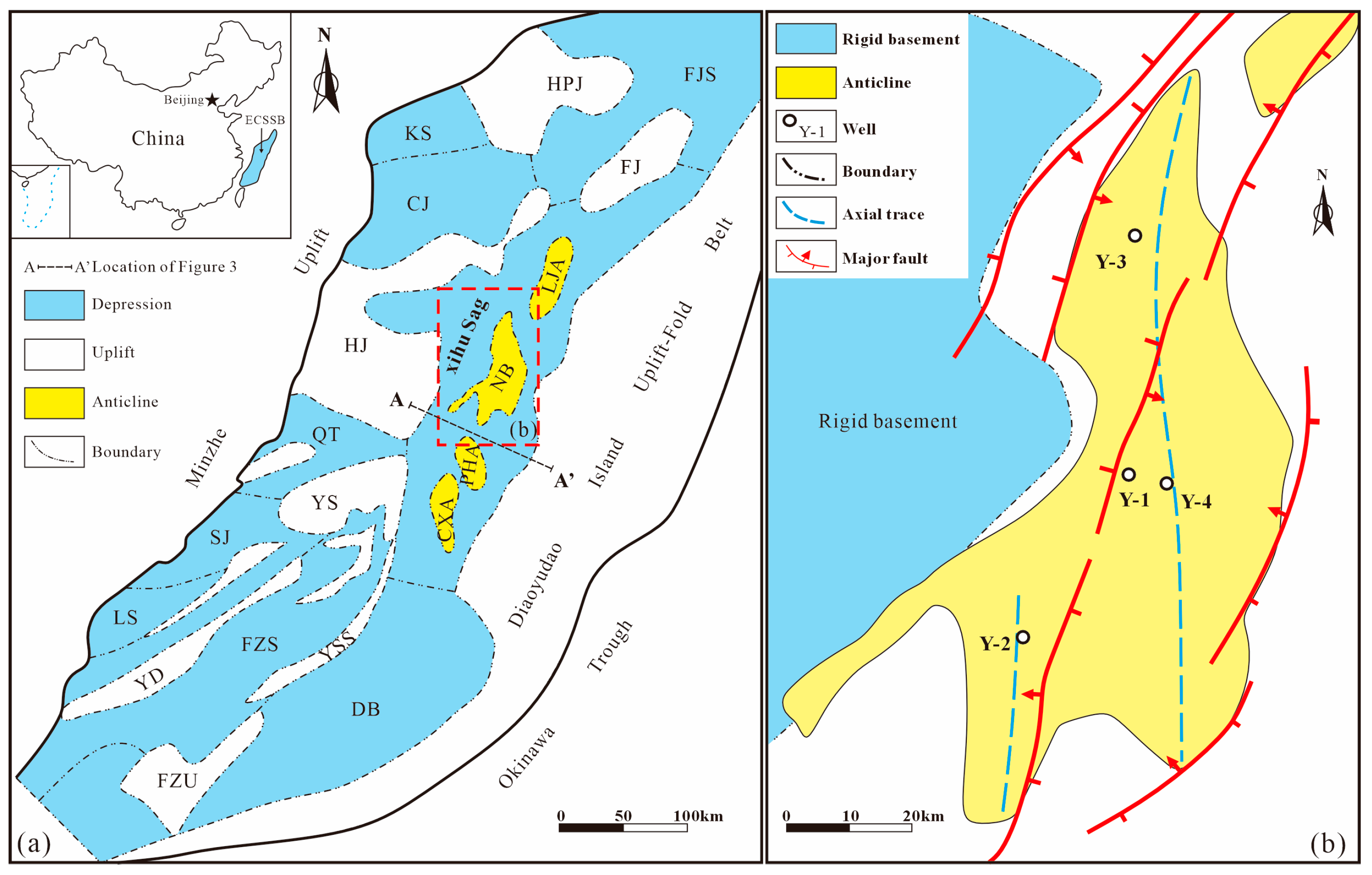
The Xihu Sag is located within the eastern depression belt of the East China Sea Shelf Basin and trends overall in a NNE direction. It is approximately 440 km long from north to south and 70–130 km wide from east to west, with a total area of approximately 59,000 km
2 [
22]. To the south, it is adjacent to the Diaobei Sag, Yushan Lower Uplift, Qiantang Sag, Haijiao Uplift, Changjiang Depression, Hupijiao Uplift, and Fujiang Sag, while to the east, it borders the Diaoyu Island fold-uplift belt [
6] (
Figure 1a). Its formation and evolution were controlled by the regional geodynamic setting of the East China Sea Basin [
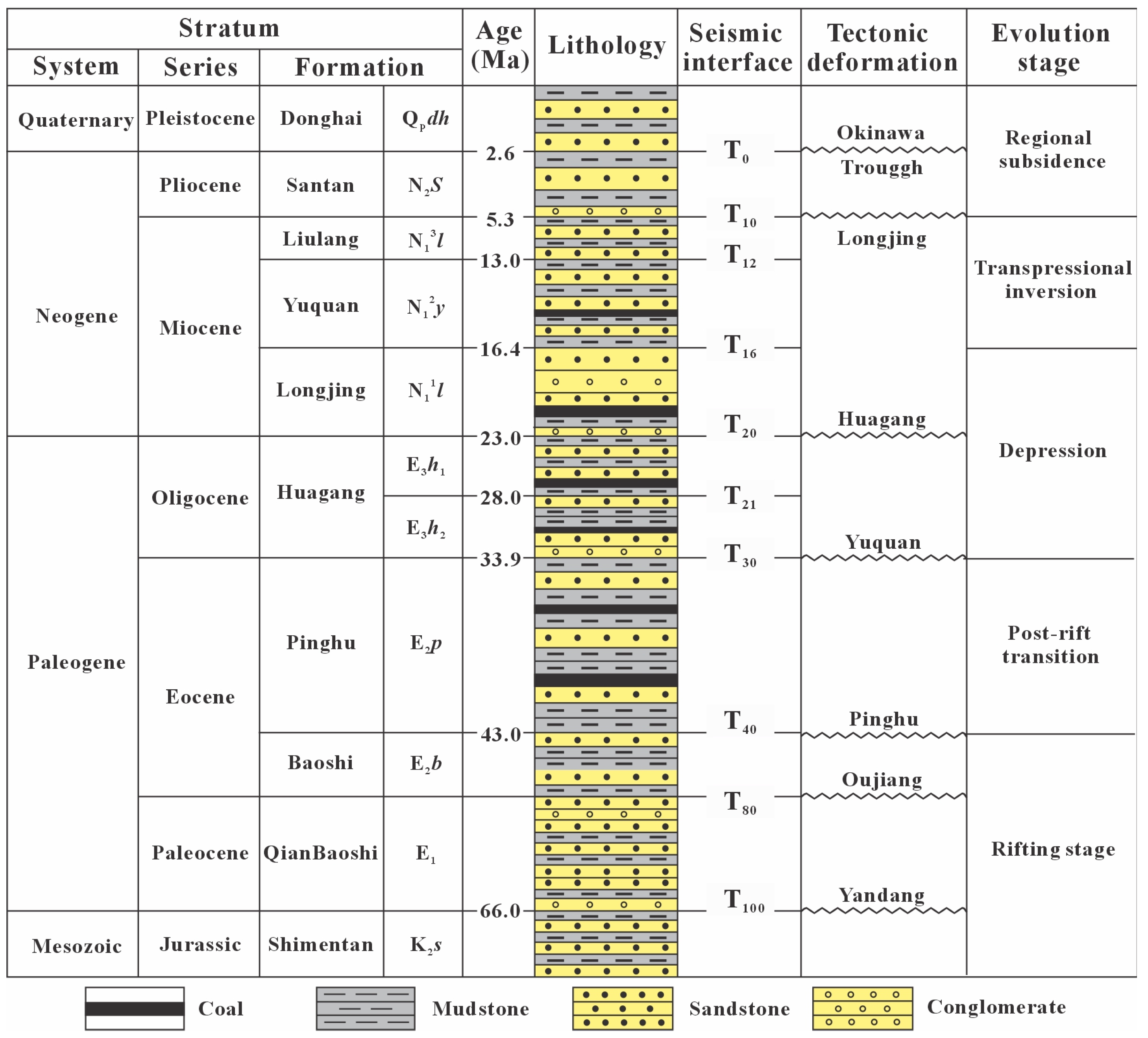
23]. The Xihu Sag is dominated by Cenozoic clastic sedimentation and, from bottom to top, comprises the Paleogene Pre-Baoshi Formation, Baoshi Formation, Pinghu Formation, and Huagang Formation, followed by the Neogene Longjing Formation, Yuquan Formation, Liulang Formation, Santan Formation, and the Quaternary Donghai Group [
22] (
Figure 2).
In plan view, the Xihu Sag is characterized by east–west zonation and north–south segmentation and can be subdivided into the western slope belt, the central depression belt, and the eastern fault-step belt [
15] (
Figure 1a). In vertical profile, the Paleogene strata display an east-faulted and west-overlapping half-graben geometry, whereas the Neogene strata exhibit an inverted anticline geometry [
12]. The study area is located in the middle part of the central depression belt of the Xihu Sag, at the structural center of the sag, and is characterized by a double-anticline configuration, in which the southern anticline is larger and the northern one is smaller, and the two are connected to each other (
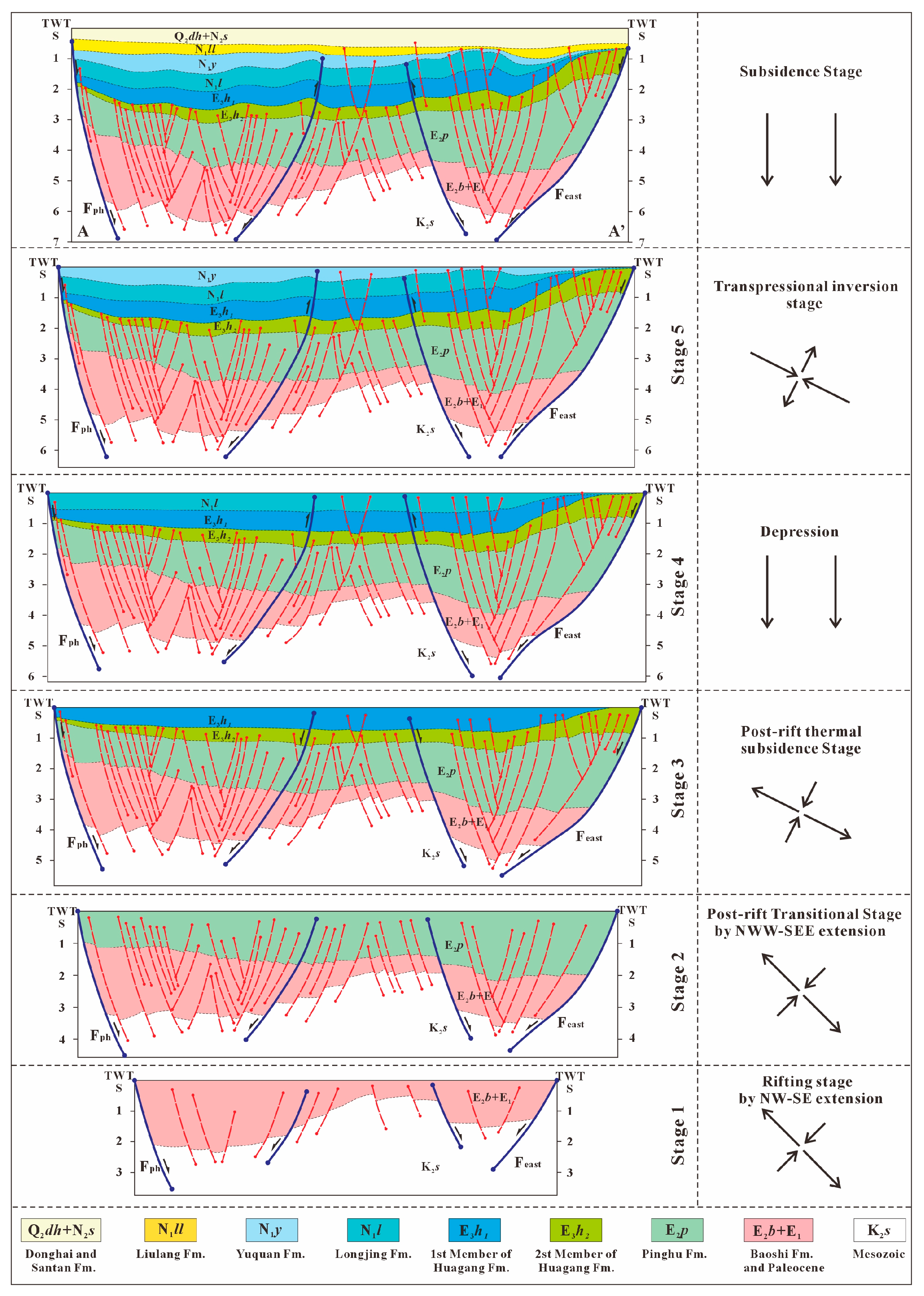
Figure 1b). The Xihu Sag experienced multiple tectonic episodes, and, based on the regional geodynamic setting and structural characteristics, its tectonic evolution can be divided into five stages: the extensional rift stage, the rift–sag transition stage, the sagging stage, the transpressional inversion stage, and the subsidence stage (
Figure 3).
Figure 2.
Generalized tectonostratigraphic column showing lithology, seismic interfaces, and tectonic evolution stages in the Xihu Sag.
Figure 2.
Generalized tectonostratigraphic column showing lithology, seismic interfaces, and tectonic evolution stages in the Xihu Sag.
Early extensional rift stage (66–43 Ma): At the initial stage of tectonic evolution, the Pacific Plate interacted with the Eurasian Plate, followed by rollback subduction of the Pacific Plate toward the NNW [
5]. This process triggered the upwelling of deep material beneath the western depression belt of the East China Sea Shelf Basin, initiating its development; fault activity reached its maximum intensity during the Paleocene, and secondary faults were widely developed. Meanwhile, subduction of the Pacific Plate beneath the Eurasian Plate induced mantle flow from west to east, whereas the Indian Plate moved NNE relative to the Eurasian Plate. Under the combined influence of these factors, large-scale magmatism and strong extensional tectonism occurred along the eastern continental margin of China. The eastern depression belt of the East China Sea Shelf Basin entered an extensional rifting stage, during which boundary faults developed on both the eastern and western sides, and extensional faults also formed in the central part. During this time, the Xihu Sag was subjected to SE–NW-directed stress and began to receive sedimentation, forming strata such as the Pre-Baoshi and Baoshi formations. The strata did not undergo significant compressional folding; however, continued rifting caused partial tilting. Extensional faults developed mainly on both sides. The western side was controlled by faults of the western slope belt, characterized by relatively large throws and dominated by extensional structural styles such as synthetic fault-step systems and grabens, thereby forming a double-fault structural pattern.
Figure 3.
Sequential schematics illustrating the evolution of the Xihu Sag from the Cenozoic to the present (see
Figure 1 for section locations). Arrows indicate the direction of the applied regional stress.
Figure 3.
Sequential schematics illustrating the evolution of the Xihu Sag from the Cenozoic to the present (see
Figure 1 for section locations). Arrows indicate the direction of the applied regional stress.
Post-rift transition stage (43–33.9 Ma): As time progressed, plate interaction gradually weakened, and the extensional stress acting on the Xihu Sag progressively declined. This stage corresponds to the depositional period of the Pinghu Formation. During this time, the extensional rift stage was approaching its end and transitioning into the sagging stage. Because the influence of the regional stress field on the study area was relatively weak, the strata did not undergo significant changes, whereas faults continued to develop along pre-existing fault traces.
Depression (33.9–23 Ma): During this stage, tectonic stress was relatively weak, and the strata underwent slow subsidence, during which the Huagang to Longjing formations were deposited.
Transpressional inversion stage (16.4–5.3 Ma): Interaction between the Pacific Plate and the Eurasian Plate weakened further, whereas interaction between the Philippine Sea Plate and the Eurasian Plate became increasingly significant. The Philippine Sea Plate imposed SEE–NWW-directed compressional stress on the plate boundary zone and adjacent areas, while NE-directed stress transmitted from the Indian Plate to the Eurasian Plate also propagated into the Xihu Sag [
24]. Under this complex stress regime, the central tectonic belt of the Xihu Sag underwent dextral strike-slip movement along pre-existing faults.
Regional subsidence stage (5.3 Ma to present): With continued rollback of plate subduction, the subduction rate of the Philippine Sea Plate decreased, and the strata in the Xihu Sag were characterized by regionally stable sedimentation accompanied by gradual subsidence.
3. Data and Methodology
The seismic data used in this study were collected by the CNOOC Shanghai Branch in 2022. The study area covers ~1000 km2, with a vertical sampling rate of 2 ms, a dominant frequency of 25 Hz, a vertical resolution of 15–30 m, and inline and crossline spacings of 12.5 m × 25 m. Overall, the seismic data used in this study have been well collected and processed, meeting the precision requirements of this study.
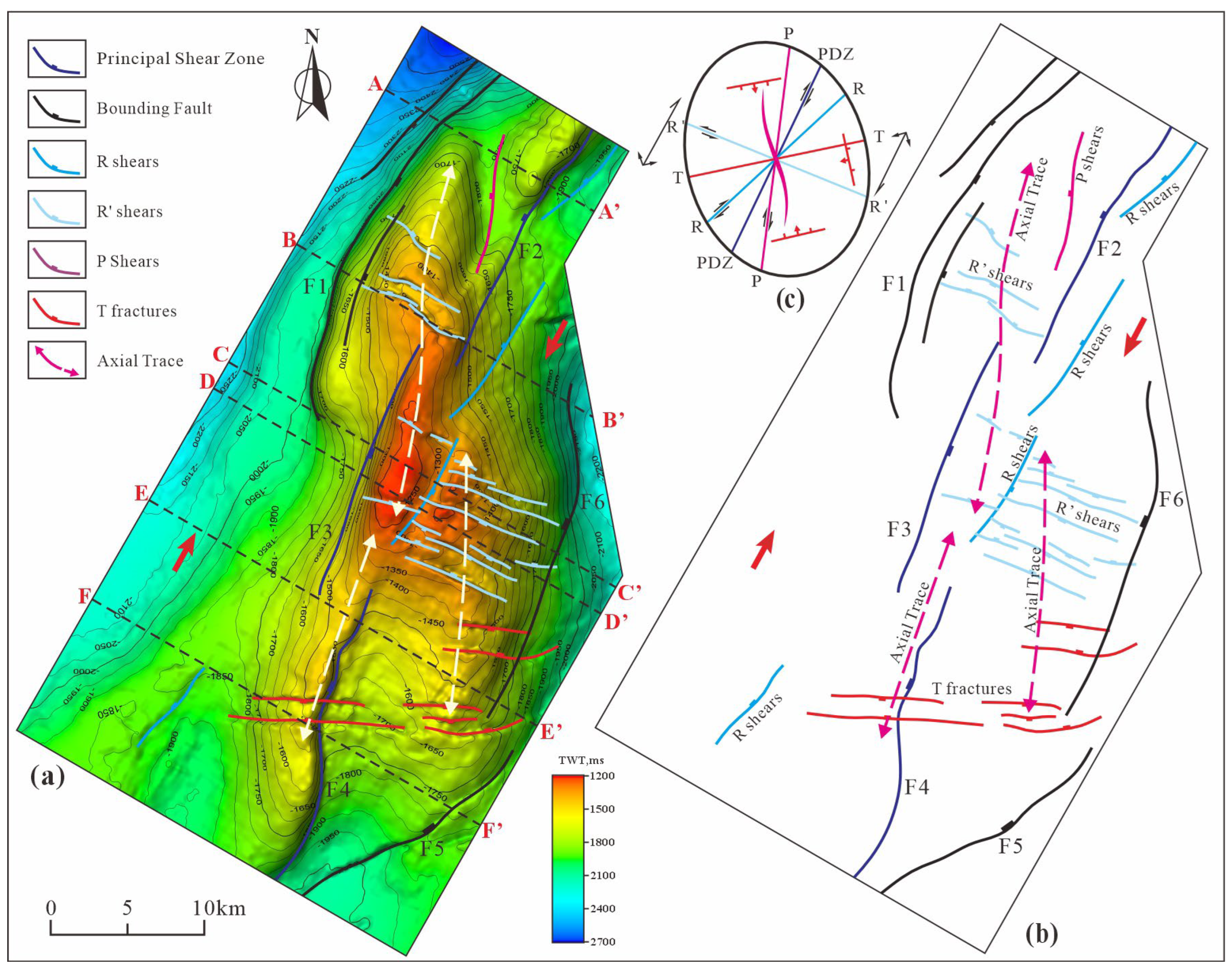
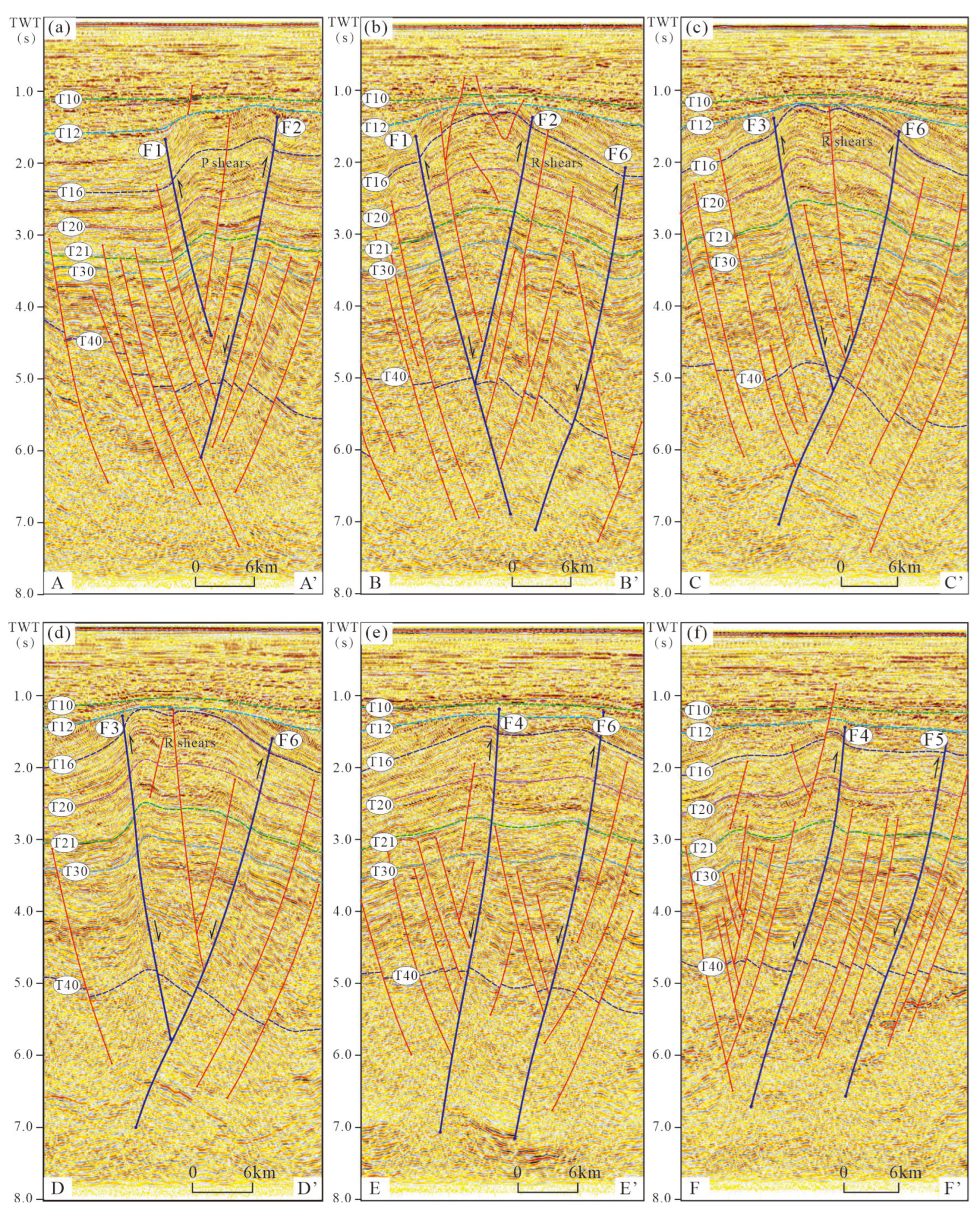
Detailed interpretation of seismic profiles across the entire study area was conducted using Petrel 2021 software, on the basis of which a structural map of the top T16 horizon was compiled, and six major faults (F1–F6) were identified as the principal internal faults of the Ningbo structure. Move 2018 software was used to constrain the evolutionary stages of the Xihu Sag (
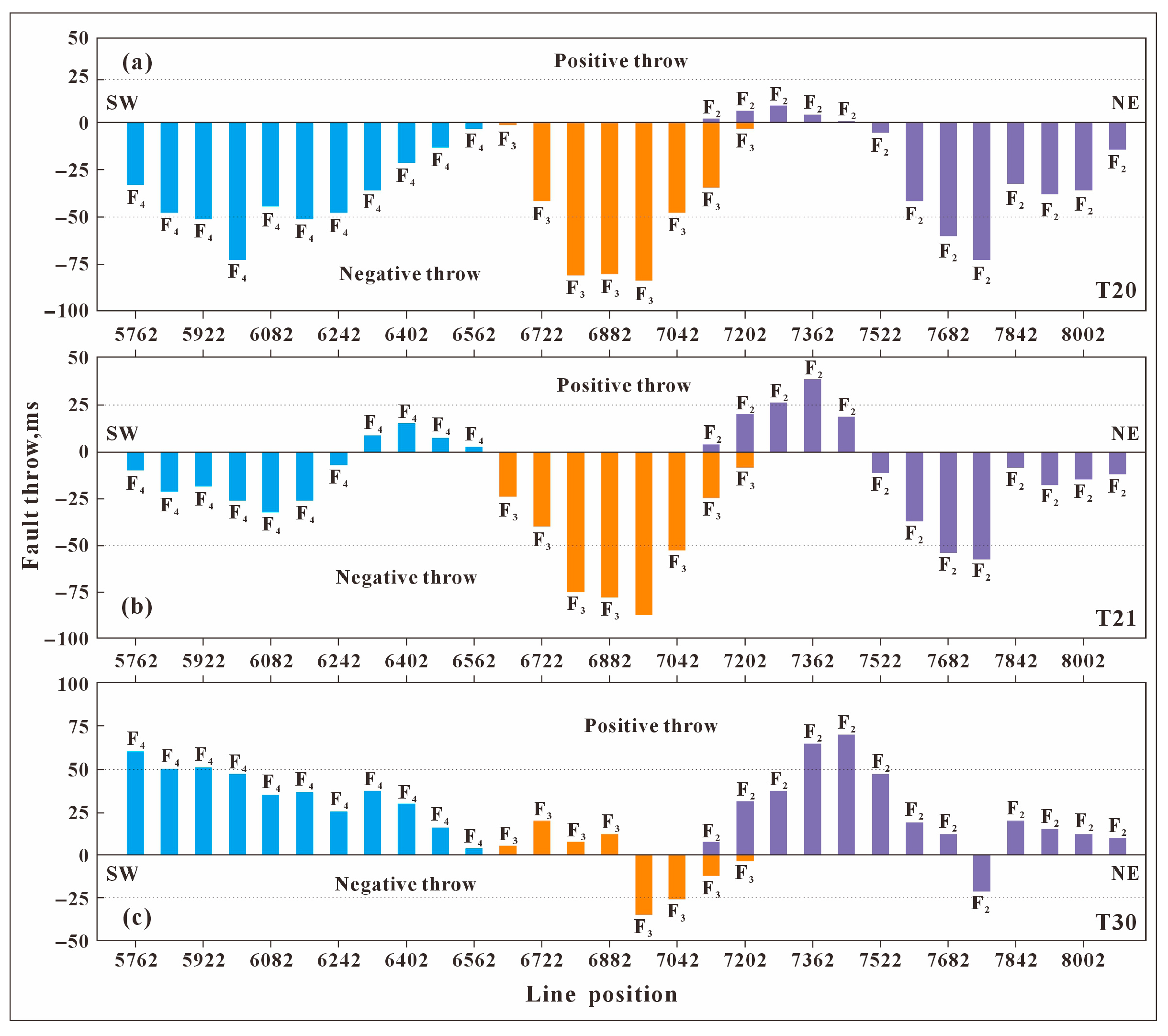
Figure 3). A strike-slip structural assemblage model was established based on the map-view and cross-sectional deformation styles, together with the throw–displacement characteristics of faults F2–F4 (
Figure 4,
Figure 5 and
Figure 6). Physical analogue modeling was then conducted using sand layers scaled according to similarity principles (
Figure 7). The specific experimental parameters are listed in
Table 1 and
Table 2. Scan Studio software (Version: Ultra) was employed to scan the top surfaces of the experimental models to characterize their structural geometries, and the models were subsequently sliced for analysis of cross-sectional deformation styles (
Figure 8,
Figure 9,
Figure 10,
Figure 11,
Figure 12 and
Figure 13). Based on the resulting structural evolution, deformation characteristics, and basement geometries, a three-dimensional evolutionary model of the Ningbo structure was established (
Figure 14,
Figure 15 and
Figure 16).
5. Analogue Modeling
Sandbox analogue modeling is an important approach for forward modeling of tectonic evolution, as it can reproduce brittle deformation in the shallow crust under controlled conditions and can be used to investigate its kinematic and mechanical mechanisms [
32,
33,
34]. Considering that late-stage faults are commonly constrained by pre-existing structures, pre-existing basement faults were explicitly incorporated into the experiments, allowing natural boundary conditions to be more realistically approximated and their genetic significance to be better revealed [
35]. Based on the above analysis of the structural deformation and evolutionary characteristics of the Ningbo structure, one reference experiment and two comparative experiments were designed in accordance with similarity principles. In these experiments, only the distribution pattern of the paired basement blocks was varied, whereas all other conditions were kept identical to simulate the evolution of the structural belt since the Cenozoic. Comparative analysis of the experimental results can not only provide strong evidence for the genetic interpretation of the Ningbo structure but can also constrain the spatial relationship of the paired basement faults, thereby improving our understanding of the original structural configuration of the study area.
5.1. Experimental Setup and Kinematics
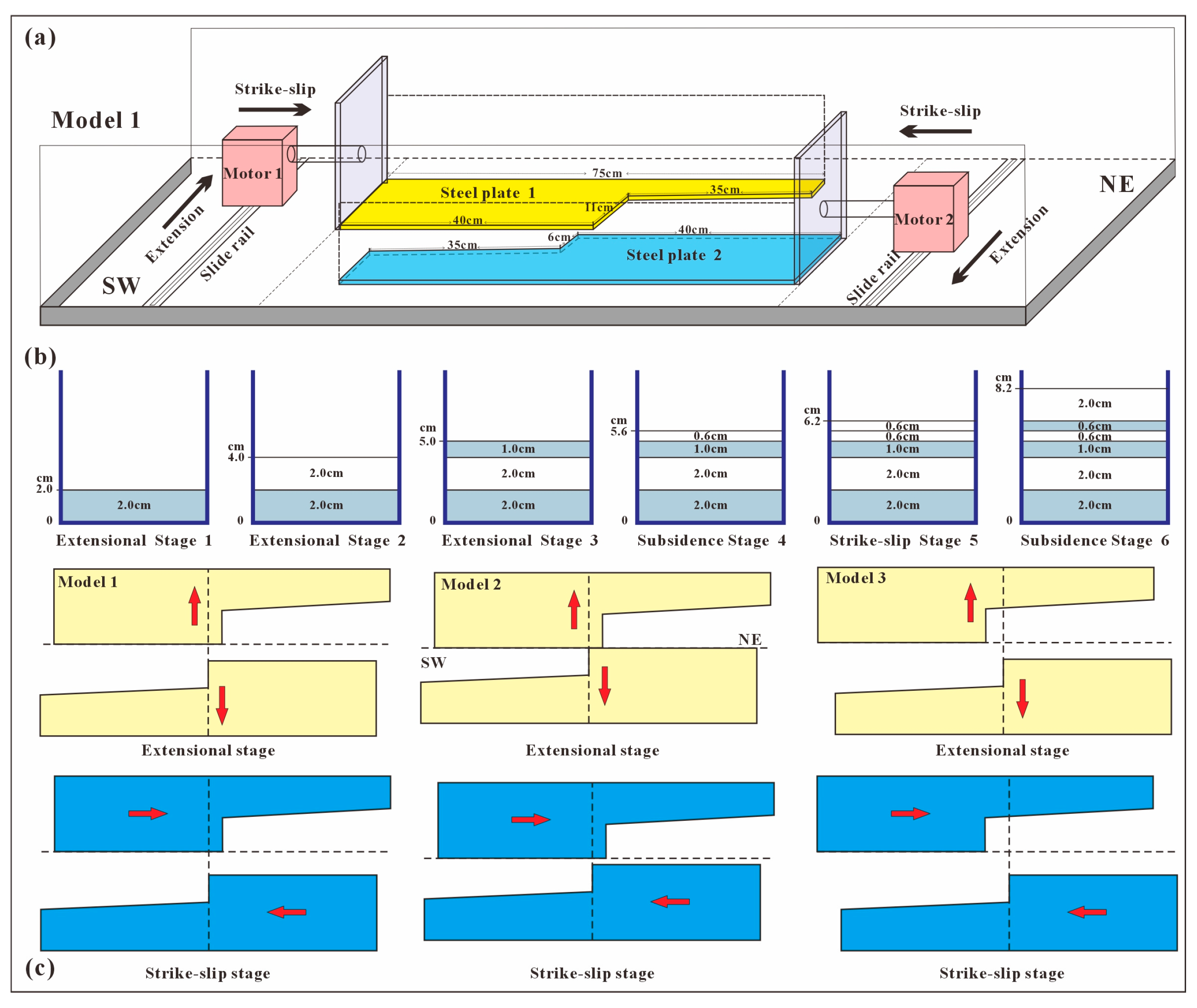
The experiment using Model 1 was conducted in a semi-enclosed sandbox with plan dimensions of 100 × 70 cm. The apparatus mainly consisted of sidewalls, basement steel plates, motors, and guide rails. Two basement steel plates were placed at the base of the experimental area, each measuring 75 × 30 cm. The plates were arranged as left-stepping en echelon basement faults, with an overlap of 3 cm in the NE–SW direction and a spacing of 4 cm in the NW–SE direction. These were designed to simulate pre-existing faults within the structural zone. The basement steel plates were fixed to L-shaped sidewalls, and movement along the guide rails, driven by motors, was used to simulate the extensional and strike-slip stages.
The experimental procedure was designed to be fully consistent with the tectonic evolutionary stages inferred from the natural geological model. The experiment for Model 1 was conducted in six stages. In Stage 1, a 2.0 cm thick layer of loose quartz sand was placed at the base of the model to represent the sedimentary strata of the Baoshi Formation. After a 0.02 cm thick colored quartz-sand marker layer was spread on the surface, synchronous extension in the SE–NW direction was applied over a distance of 0.4 cm. In Stage 2, another 2.0 cm thick layer of loose quartz sand was added to simulate the sedimentary strata of the Pinghu Formation. After a 0.02 cm thick colored quartz-sand marker layer was placed on the surface, synchronous extension in the SE–NW direction was again applied over a distance of 0.4 cm. In Stage 3, an additional 1.0 cm thick layer of loose quartz sand was added to simulate the sedimentary strata of the Huagang Formation. After a 0.02 cm thick colored quartz-sand marker layer was spread on the surface, synchronous extension in the SE–NW direction was applied over a distance of 0.2 cm. In Stage 4, a 0.6 cm thick layer of loose white quartz sand was placed above the deformed strata to represent the sedimentary strata of the Longjing Formation, and a 0.02 cm thick colored quartz-sand marker layer was spread on its surface. In Stage 5, another 0.6 cm thick layer of loose white quartz sand was placed above the deformed strata to represent the sedimentary strata of the Yuquan Formation, and a 0.02 cm thick colored quartz-sand marker layer was spread on the surface. A dextral strike-slip process along a NE trend was then imposed, with a total displacement of 15 cm. Finally, in Stage 6, after simulating erosion of the deformed strata, a 2.0 cm thick layer of loose white quartz sand was deposited to represent freely subsiding sedimentary strata, including the Liulang Formation, following erosion of the top surface of the Yuquan Formation. All design parameters are listed in
Table 1.
The main purpose of Models 2 and 3 was to determine the basement configuration of the Ningbo structure by comparing the different anticline geometries produced by varying spatial arrangements of pre-existing faults during strike-slip deformation. Therefore, only five experimental stages were carried out, which were the same as those of Model 1. The difference is that, in Model 2, the paired basement plates overlap by 3 cm in the NE–SW direction and have 0 cm spacing in the NW–SE direction. In Model 3, the paired basement plates are separated by 3 cm in the NE–SW direction and by 4 cm in the NW–SE direction. After completion of the experiment, the top surface was scanned and modelled. A 2 cm thick sand layer was then spread to cover the model and uniformly sprayed with water. The model was left undisturbed for one day to preserve the internal deformation within the sandbox, after which it was cut at equal intervals, and representative sections were interpreted and analyzed. All design parameters are listed in
Table 1.
Table 1.
Kinematic settings for structural analogue modeling.
Table 1.
Kinematic settings for structural analogue modeling.
| Deformation Stage | Moving Types | Direction | Total Amount, cm | Total Model Thickness, cm |
|---|
| Model 1 | Model 2 | Model 3 |
|---|
| 1 | 1 | 1 | Extension | NW-SE | 0.4 | 2.0 |
| 2 | 2 | 2 | Extension | NW-SE | 0.4 | 4.0 |
| 3 | 3 | 3 | Extension | NW-SE | 0.2 | 5.0 |
| 4 | 4 | 4 | Subsidence | | | 5.6 |
| 5 | 5 | 5 | Strike-slip | NE-SW | 15 | 6.2 |
| 6 | | | Subsidence after denudation | | | 8.2 |
5.2. Scaling
The overall length, width, and height of the model were designed at a geometric scale of 1:10,000, and the thicknesses of the sand layers in the experiments were arranged according to the same similarity ratio (
Figure 7), such that 1 cm in the model represents 1 km of sedimentary strata in nature. In this study, dry quartz sand with a density of 2.3 g/cm
3, an internal friction angle of 37°, and an internal friction coefficient of approximately 0.74 was used to simulate brittle processes such as fracturing and slip in sedimentary strata under stress. According to the Coulomb failure criterion, this material is suitable for modeling deformation of brittle sediments in the upper crust [
36,
37]. Therefore, the similar material properties ensure that the sandbox experiments approximate the real geological processes. The detailed sand-layering sequence of the model is shown in
Figure 8, and all scaling parameters used in the models are listed in
Table 2.
Table 2.
Scale parameters of structural analogue modeling.
Table 2.
Scale parameters of structural analogue modeling.
| Scaling Parameter | Model | Nature | Model/Nature Ratio |
|---|
| Length l, m | 0.01 | 1000 | 1 × 10⁻⁵ |
| Density of sand ρ, kg/m3 | 2300 | 2700 | 0.85 |
| Gravitational acceleration g, m/s2 | 9.81 | 9.81 | 1 |
| Friction angle, ° | 37 | 40 | 0.925 |
| Internal friction μ | 0.74 | 0.84 | 0.88 |
| Cohesion τ0, Pa | 110–140 | 107 | (1.1–1.4) × 10−5 |
The laboratory model and the natural prototype follow a dimensionless scaling relationship based on Cauchy kinematics, through which the natural system is scaled down to a laboratory analogue model [
38]. The dimensionless scaling parameters remain constant, as expressed by
In this equation, the parameters σ*, ρ*, g*, and l* represent the ratios of cohesion, density, gravitational acceleration, and length, respectively, between the experimental model and the natural geological prototype. Under normal conditions, sandbox experiments are conducted under Earth’s gravity; therefore, g* = 1. In the experimental model, 1 cm corresponds to 1 km in nature, and thus the geometric similarity ratio is l* = 1 × 10⁻⁵. The density of the quartz sand used in the experimental model is approximately 2.3 g/cm3, whereas the density of the natural strata is approximately 2.7 g/cm3; therefore, ρ* = 0.85. Based on these values, the similarity factor is calculated as σ* = 0.85 × 10⁻⁵.
5.3. Model Results
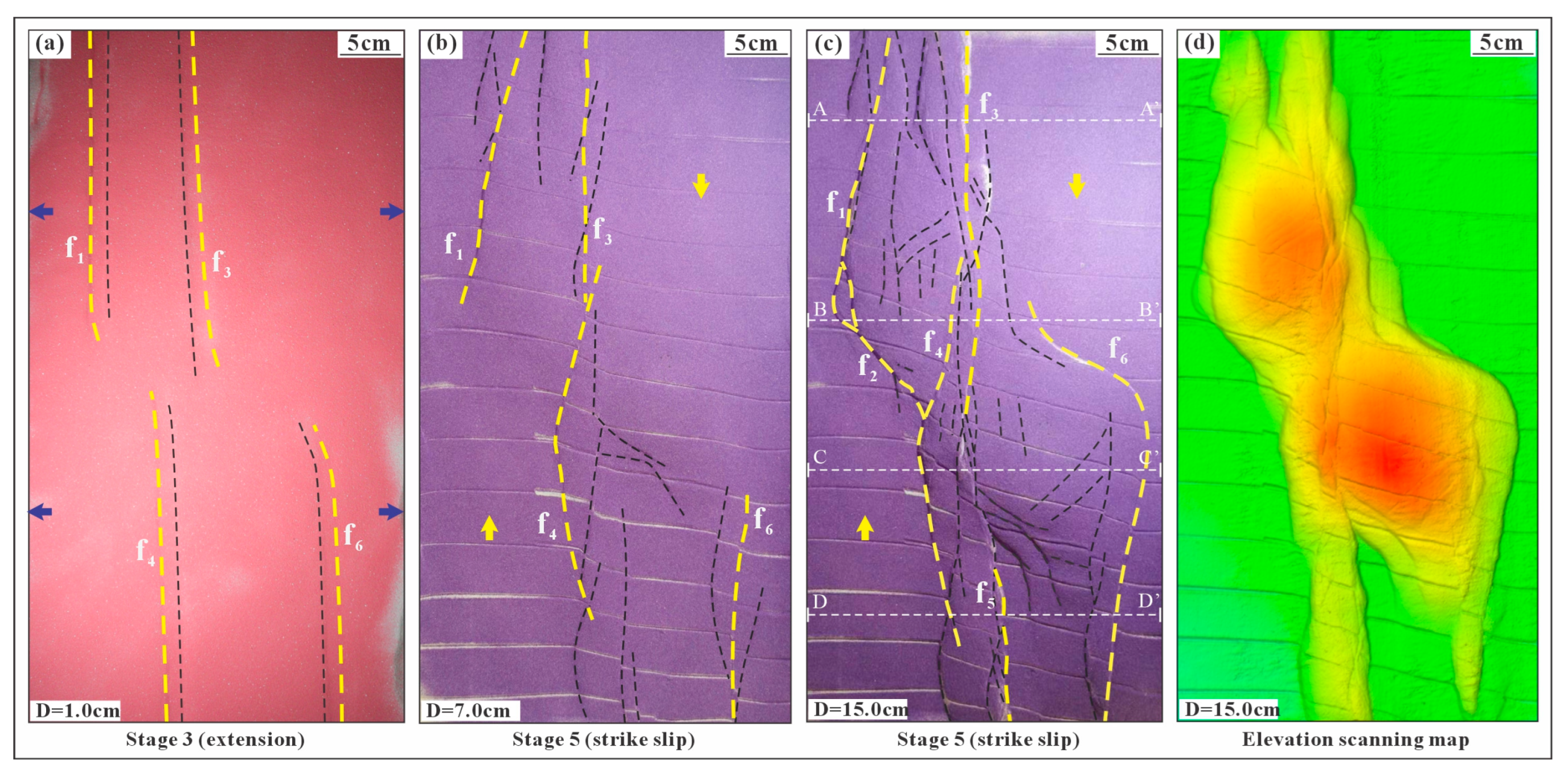
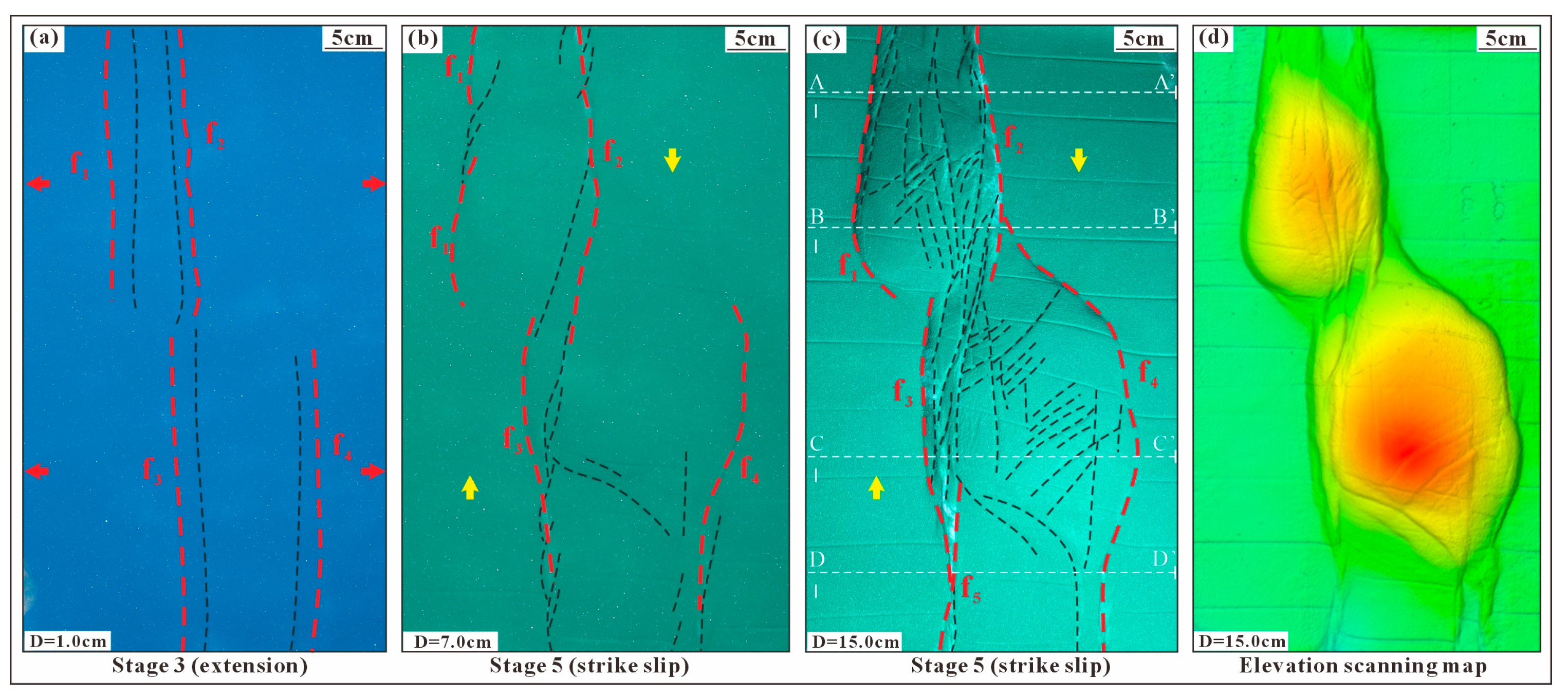
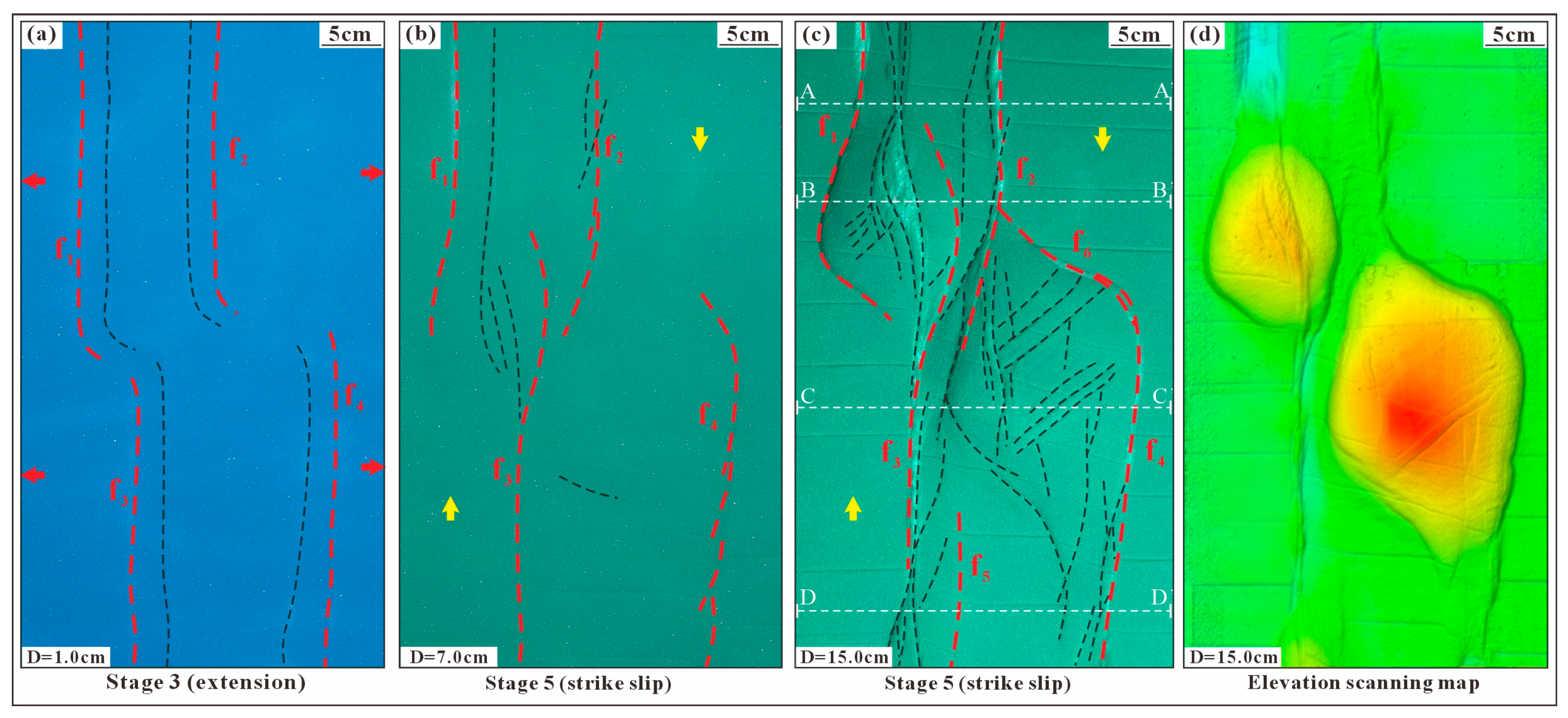
Under identical material properties and loading conditions, all three models exhibit a two-stage evolutionary process characterized by early extension followed by later transpressional inversion (
Figure 8,
Figure 9,
Figure 10,
Figure 11,
Figure 12 and
Figure 13). Stages 1–3 correspond to the extensional phase (
Figure 8a,
Figure 10a and
Figure 12a). Under NW–SE extensional stress, the sand layers initially developed two sets of left-stepping en echelon high-angle master boundary normal faults. Between the corresponding paired faults, a graben–horst–graben structural pattern developed successively. As a result, a narrow, elongated belt formed, which in vertical section can be interpreted as a combination of steeply dipping normal faults, corresponding to the deep graben structures observed in the cross-sectional results. In plan view, the differences are mainly expressed in two aspects: the spacing between the boundary faults and their linkage geometry. First, the spacing between the boundary faults in Models 1 and 3 is broadly similar, whereas that in Model 2 is significantly smaller. Second, Model 1 does not show an obvious fault-linkage relationship. In Model 2, boundary faults f2 and f3 are linked, showing an oppositely directed cross-linkage pattern. In Model 3, boundary faults f1 and f3 are linked, whereas f2 and f4 are close to linkage, showing a same-direction linkage pattern.
Figure 8.
(a–c) Top views (photographs and line drawings) of different stages of Model 1; (d) Elevation scanning map; D represents displacement distance, and arrows indicate movement direction.
Figure 8.
(a–c) Top views (photographs and line drawings) of different stages of Model 1; (d) Elevation scanning map; D represents displacement distance, and arrows indicate movement direction.
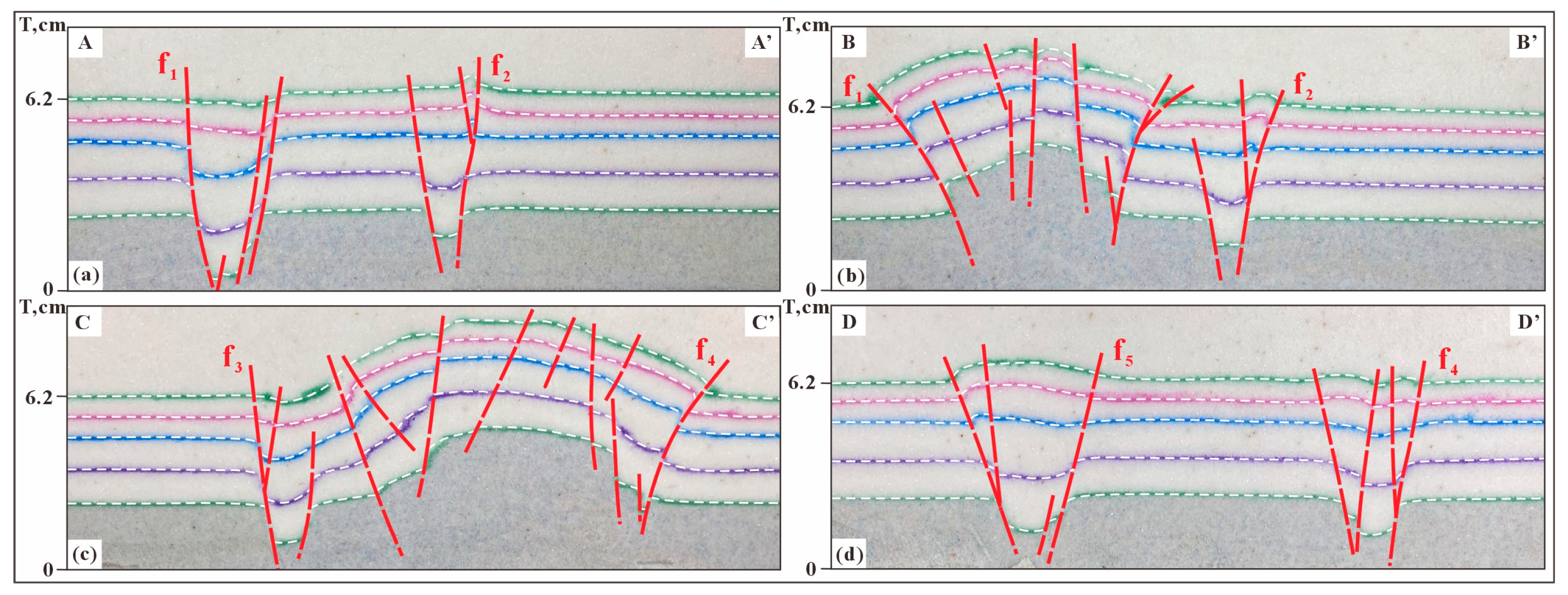
Figure 9.
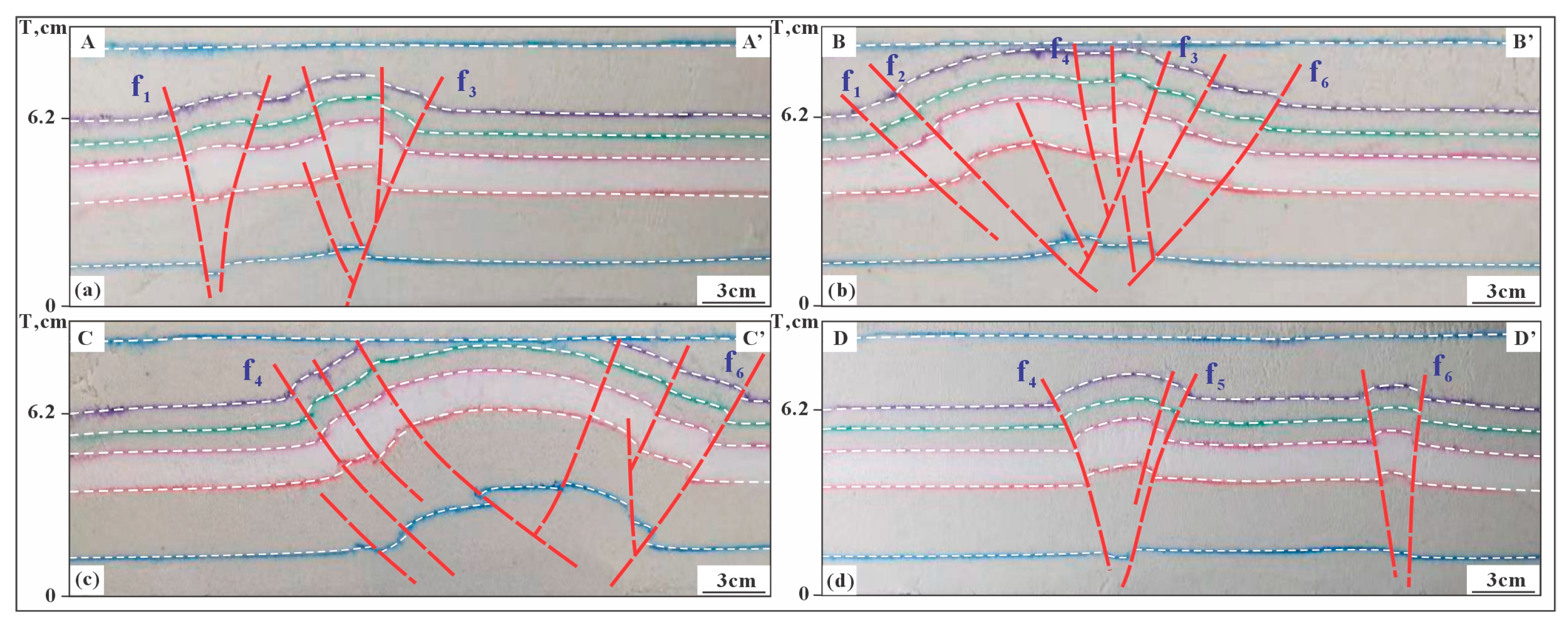
Cross-section interpretations (photographs and line drawings) of the final stage of Model 1, showing deformation styles (for cross-section locations, see
Figure 8c). T represents the total thickness of the sand layer. (
a) The position of A-A’; (
b) The position of B-B’; (
c) The position of C-C’; (
d) The position of D-D’.
Figure 9.
Cross-section interpretations (photographs and line drawings) of the final stage of Model 1, showing deformation styles (for cross-section locations, see
Figure 8c). T represents the total thickness of the sand layer. (
a) The position of A-A’; (
b) The position of B-B’; (
c) The position of C-C’; (
d) The position of D-D’.
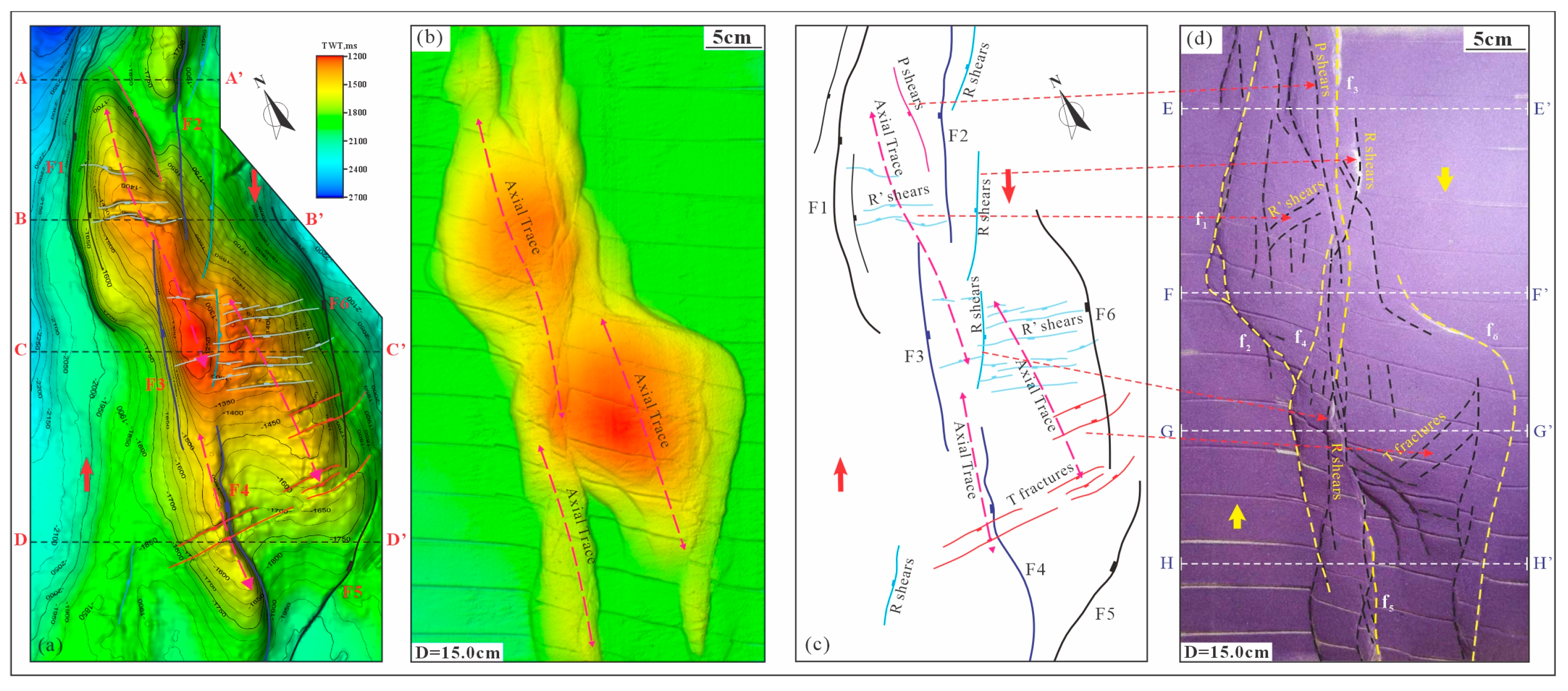
Stage 5 corresponds to the dextral transpressional phase. During the intermediate stage (
Figure 8b,
Figure 10b and
Figure 12b), the early normal faults in Models 1 and 2 were first reactivated within the central linkage zone, where R shears developed. Because both shear and compressional components were concentrated there, dextral strike-slip displacement developed in the models, resulting in a belt-like initial push-up ridge. In Model 3, an uplifted anticline first developed in the linkage segment between f1 and f3, while R shears developed around f2 and f4. During the final stage (
Figure 8c,
Figure 10c and
Figure 12c), all three models developed R shears, T fractures, and a PDZ formed through progressive linkage, together with associated anticline structures under the control of the master faults. In Model 1, the early-formed anticline was segmented by an uplift belt controlled by F3 and F4, forming an anticline–uplift belt–anticline structural configuration. In Model 2, the early anticline was directly offset, forming an anticline–anticline structural geometry. Finally, in Model 3, the early anticline was segmented by f2 and f3, resulting in alternating anticline–syncline–anticline structures. Scanned top-surface models (
Figure 8d,
Figure 10d and
Figure 12d) provide a clearer representation of the plan-view structural characteristics.
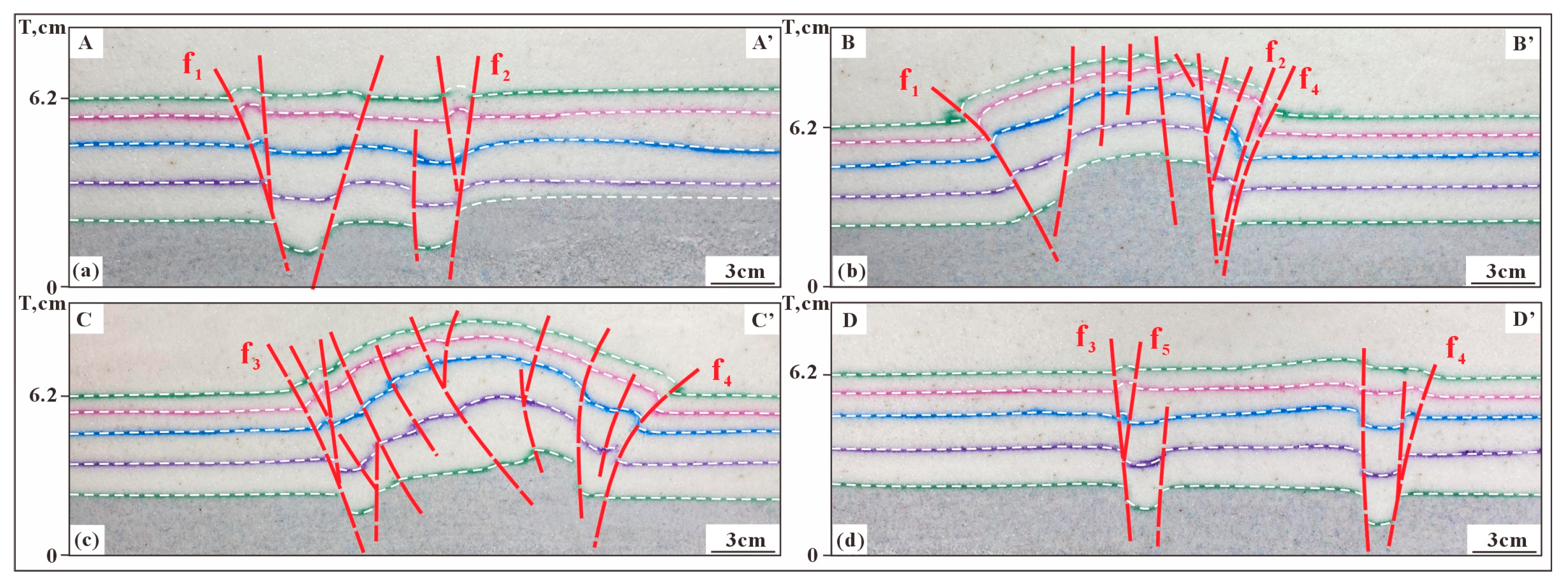
In cross-section (
Figure 9,
Figure 11 and
Figure 13), the uplifted zones display Y-shaped and flower structures, with the overlying strata arched upward. The deep strata retain graben geometries, and, owing to the erosional treatment applied in Stage 6, clear erosion is observed in the uppermost layer of Model 1.
Figure 10.
(a–c) Top views (photographs and line drawings) of different stages of Model 2; (d) Elevation scanning map; D represents displacement distance, and arrows indicate movement direction.
Figure 10.
(a–c) Top views (photographs and line drawings) of different stages of Model 2; (d) Elevation scanning map; D represents displacement distance, and arrows indicate movement direction.
Figure 11.
Cross-section interpretations (photographs and line drawings) of the final stage of Model 2, showing deformation styles (for cross-section locations, see
Figure 10c). T represents the total thickness of the sand layer. (
a) The position of A-A’; (
b) The position of B-B’; (
c) The position of C-C’; (
d) The position of D-D’.
Figure 11.
Cross-section interpretations (photographs and line drawings) of the final stage of Model 2, showing deformation styles (for cross-section locations, see
Figure 10c). T represents the total thickness of the sand layer. (
a) The position of A-A’; (
b) The position of B-B’; (
c) The position of C-C’; (
d) The position of D-D’.
6. Discussion
6.1. Comparison Among Modeling Results
Under identical transpressional displacement, the differences among the three models are controlled solely by the spatial arrangement of the basement blocks and, based on this controlled comparison, can be reduced to two geometric parameters: the degree of overlap in the NE–SW direction and the spacing in the NW–SE direction. In Model 1, the basement blocks are arranged in an overlapping configuration with a NW–SE spacing of 4 cm. Reactivation and linkage of the boundary faults progressed gradually, and the development of through-going segments and the PDZ occurred slightly later than in Model 2, broadly in step with the elongation of the central uplift. In plan view, the central segment shows good continuity and moderate width, whereas several unlinked zones remain at both ends. In cross-section, flower structures are clearly developed.
Figure 12.
(a–c) Top views (photographs and line drawings) of different stages of Model 3; (d) Elevation scanning map; D represents displacement distance, and arrows indicate movement direction.
Figure 12.
(a–c) Top views (photographs and line drawings) of different stages of Model 3; (d) Elevation scanning map; D represents displacement distance, and arrows indicate movement direction.
Figure 13.
Cross-section interpretations (photographs and line drawings) of the final stage of Model 3, showing deformation styles (for cross-section locations, see
Figure 12c). T represents the total thickness of the sand layer. (
a) The position of A-A’; (
b) The position of B-B’; (
c) The position of C-C’; (
d) The position of D-D’.
Figure 13.
Cross-section interpretations (photographs and line drawings) of the final stage of Model 3, showing deformation styles (for cross-section locations, see
Figure 12c). T represents the total thickness of the sand layer. (
a) The position of A-A’; (
b) The position of B-B’; (
c) The position of C-C’; (
d) The position of D-D’.
Model 2 has the same NE–SW overlap configuration as Model 1 but no spacing in the NW–SE direction. During the extensional stage, the boundary faults in Model 2 linked earlier in an opposing manner. During the strike-slip stage, the central linkage zone was the first to be reactivated, and the tips of adjacent en echelon faults linked early to form through-going strike-slip fault segments, thereby generating the PDZ at an earlier stage. In plan view, the central segment is characterized by a narrow, continuous compressional uplift belt; in cross-section, shallow and deep faults display good vertical connectivity, and flower structures are mainly concentrated in the central segment.
In Model 3, the basement blocks are arranged without overlap, but the NW–SE spacing is the same as that in Model 1 (
Figure 8 and
Figure 12). During the extensional stage, the boundary faults in Model 3 linked earlier in the same direction. During the strike-slip stage, shear strain in Model 3 was not concentrated along the structural belt, the linkage zone was reactivated at a later stage, and the formation of through-going segments and/or the PDZ was delayed and limited in scale. In plan view, uplift in the central segment is discontinuous, whereas in cross-section, flower structures are poorly developed and vertical connectivity between shallow and deep faults is relatively weak.
The experimental results indicate that increased overlap promotes strain localization in the central segment, earlier fault linkage, and the development of a narrower, more continuous uplift belt. By contrast, increased lateral spacing causes deformation to become more dispersed, delays fault linkage, and results in a more discontinuous uplift pattern. These two geometric parameters therefore constitute the principal controlling factors governing differences in deformation patterns among the experiments.
6.2. Comparison Among Modeling Results and Nature
Transpressional inversion structures and positive inversion structures may display broadly similar geometries in cross-section; however, the fundamental difference lies in their stress regimes. Inversion structures are generally formed by a polarity reversal in tectonic movement, which reflects a coaxial change in the applied stress field. For example, when an extensional stress field is reversed into compressional stress acting in the same direction, the resulting structure is referred to as a positive inversion structure [
39,
40]. By contrast, the essential difference in the genetic mechanism between transpressional inversion and positive inversion is that, in the former, the later compressional stress is non-coaxial with the earlier extensional stress. As a result, a strike-slip component is superimposed on the original inversion deformation [
41,
42]. In positive inversion structures, fault strikes are generally oriented perpendicular to the principal stress direction, whereas transpressional inversion involving a strike-slip component may generate faults with a wider range of orientations, including R shears, P shears, and T fractures. These observations indicate that the shallow NWW-trending faults in the Ningbo structure, which intersect the principal faults at high angles, were formed during late-stage transpressional deformation.
The strike-slip-derived results of Model 1 were compared with the structural elements of the T16 horizon in the study area (
Figure 14). The double-anticline geometry developed in Model 1 in plan view, together with the narrow fold belt in the central segment, agrees closely with the geological model. At the same time, the associated fault assemblages, including R shears, P shears, and T fractures, show a one-to-one correspondence in both fault orientation and the angle between the fold axial traces and the PDZ. These relationships are highly consistent with the Riedel shear strike-slip model. A cross-sectional comparison (
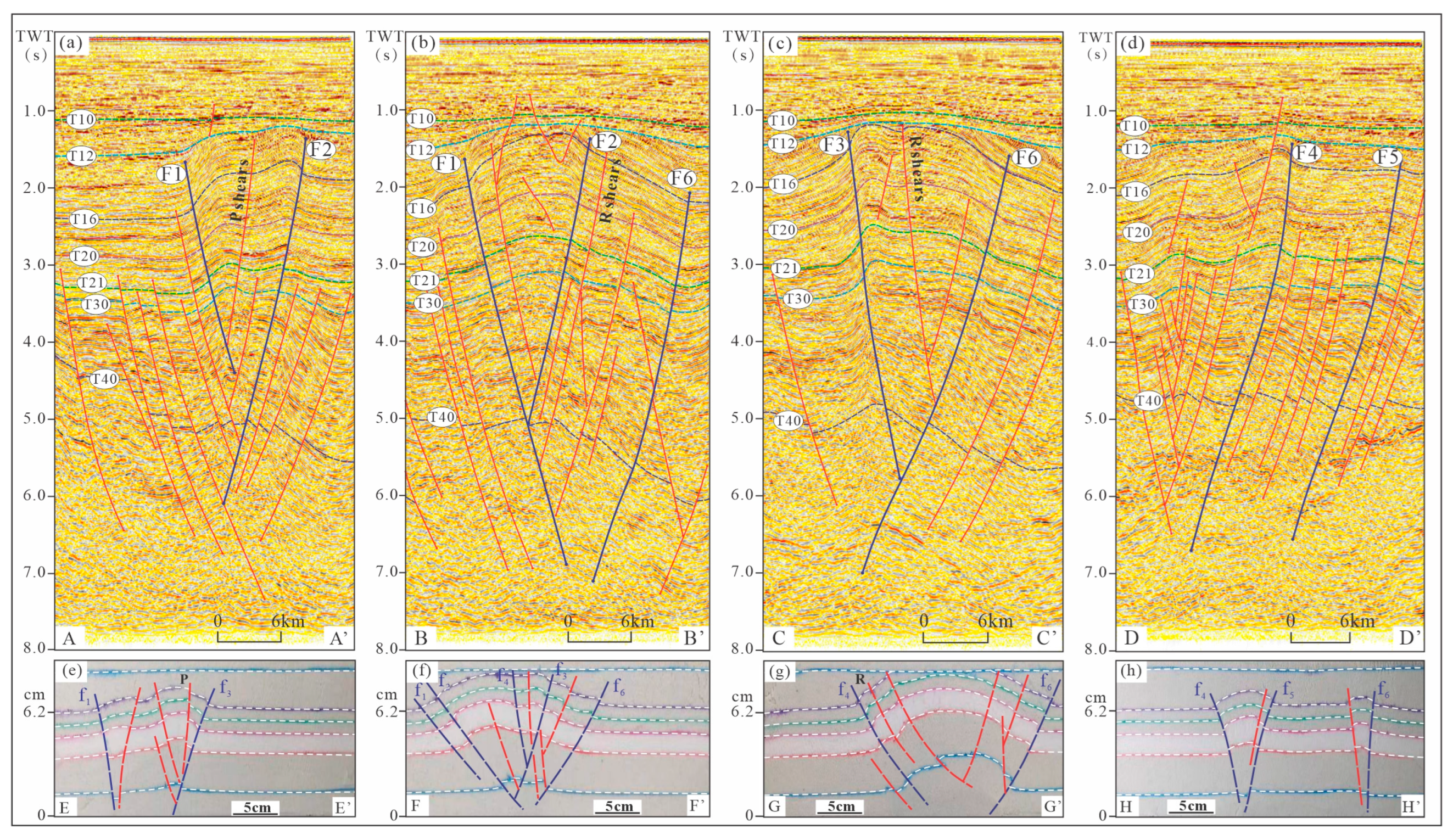
Figure 15) further shows that the bidirectional double-uplift geometry and flower structures in
Figure 15a, controlled by F1 and F2; the single high uplift and inverted Y-shaped and X-shaped structural styles in
Figure 15b, controlled by F1, F2, and F6; the high uplift and Y-shaped structural style in
Figure 15c, controlled by F3 and F6; and the single-anticline geometry and flower structures in
Figure 15d, controlled in the same direction by F4 and F5, all correspond in sequence to the experimental results of Model 1 (
Figure 15e–h). Importantly, the principal faults can be traced continuously from the extensional stage through to the strike-slip–transpressional stage while maintaining the same geometric control. This indicates that inversion in the study area represents reactivation of pre-existing extensional faults. When considered together with the regional geological background, independent evidence for multi-stage extension–inversion and episodic strike-slip deformation along the East China Sea margin provides a geodynamic constraint supporting the consistency between the experiments and the natural example. Specifically, the degree of basement overlap and lateral spacing determines where strain is first localized and when the PDZ forms, thereby controlling the position and scale of anticline development. This one-to-one match validates the effectiveness of the experimental design and further indicates that the basement configuration of the study area is consistent with that of Model 1.
Figure 14.
Comparison between the results of Model 1 and natural seismic characteristics: (a) Structural characteristics of the T16 horizon; (b) Scan image of the plan-view experimental result of Stage 5 in Experiment 1; (c) Fault distribution map of the T16 horizon; (d) Plan-view experimental result of Stage 5 in Experiment 1.
Figure 14.
Comparison between the results of Model 1 and natural seismic characteristics: (a) Structural characteristics of the T16 horizon; (b) Scan image of the plan-view experimental result of Stage 5 in Experiment 1; (c) Fault distribution map of the T16 horizon; (d) Plan-view experimental result of Stage 5 in Experiment 1.
Figure 15.
Comparison between the results of Model 1 and natural seismic characteristics: (
a–
d) Natural seismic section characteristics (see
Figure 14a for section locations); (
e–
h) Experimental cross-sectional results of Experiment 1 (see
Figure 14d for section locations).
Figure 15.
Comparison between the results of Model 1 and natural seismic characteristics: (
a–
d) Natural seismic section characteristics (see
Figure 14a for section locations); (
e–
h) Experimental cross-sectional results of Experiment 1 (see
Figure 14d for section locations).
6.3. Three-Dimensional Tectonic Evolution Model
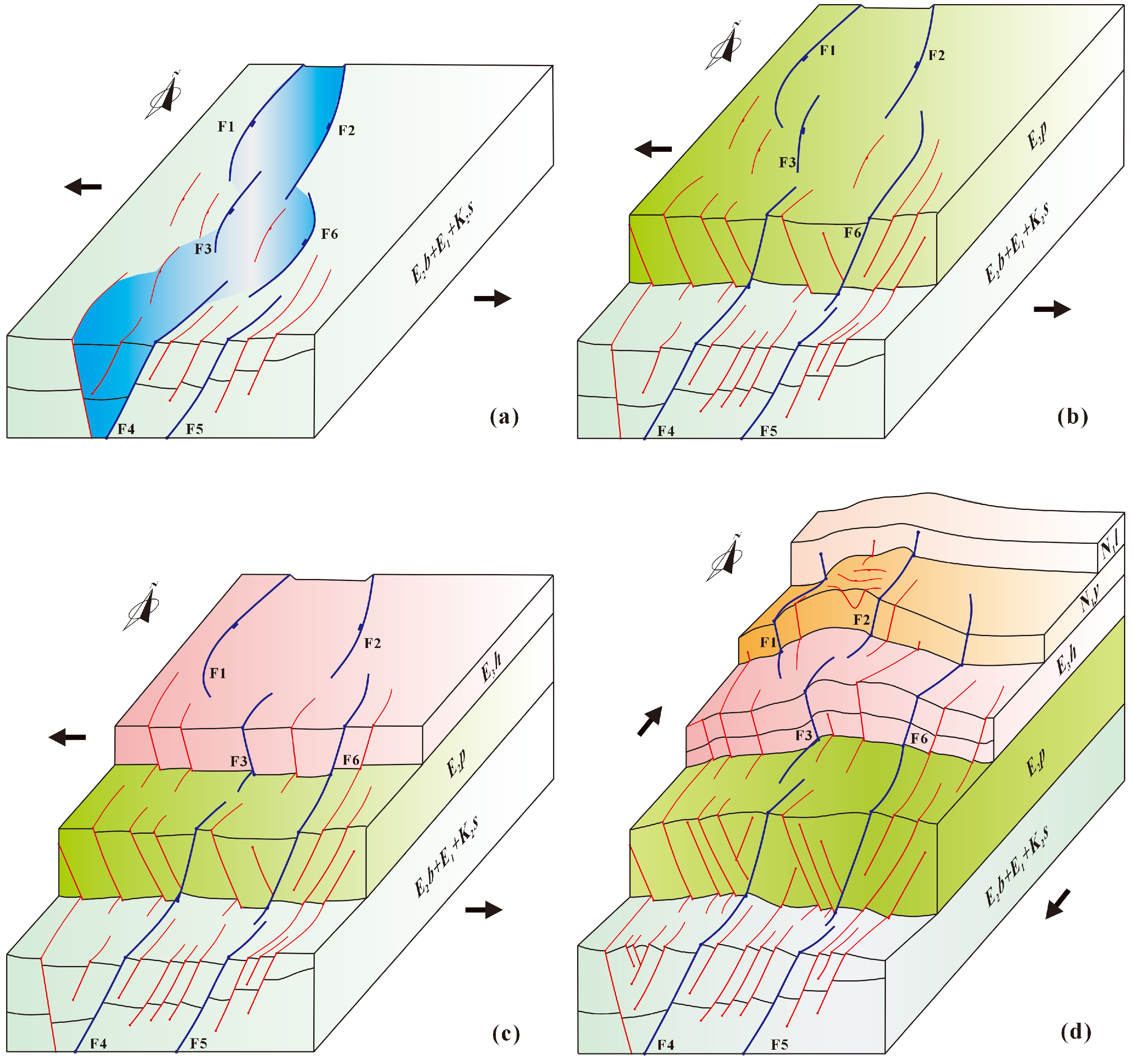
Based on the deformation characteristics and comparison results described above, and in conjunction with the basement arrangement represented by Model 1, the evolution of the Ningbo structure can be summarized as a continuous process (
Figure 16). In the early stage, a geometric framework composed of two en echelon sets of normal faults and their linkage zones provided the pre-existing fault conditions for subsequent shear deformation. When dextral transpressional deformation was superimposed, deformation first became concentrated along the central linkage zone. The original normal faults were reactivated and underwent dextral offset, causing the tips of adjacent faults to progressively connect into through-going segments and thereby integrate into a PDZ. As the PDZ propagated along strike, the overlying strata were uplifted and bent parallel to the structural trend. The central uplift evolved from a single high point into a continuous, ridge-like structure. At the same time, synthetic shear faults cut the uplifted body, and the double anticlines were progressively established while maintaining traceable geometric consistency and vertical connectivity across different horizons. At a later stage, secondary fractures on both sides of the PDZ became distributed in belts, controlling local minor subsidence and uplift. This caused the double anticlines to exhibit rhythmic along-strike variation from continuous to discontinuous and then back to continuous. Throughout this process, the central segment remained the principal zone of displacement and uplift.
Figure 16.
Tectonic evolution model of the Ningbo structure in the Xihu Sag: (a) rift stage; (b) post-rift transition stage; (c) depression; (d) strike-slip stage.
Figure 16.
Tectonic evolution model of the Ningbo structure in the Xihu Sag: (a) rift stage; (b) post-rift transition stage; (c) depression; (d) strike-slip stage.
The key aspect of this model is that it integrates basement configuration, tectonic evolutionary deformation, and double-anticline geometry into a unified framework. The overlap and lateral spacing of the basement blocks jointly constrain the long-term stability and linkage style of the central segment in the study area. These factors, in turn, determine the position of the PDZ, the continuity of the uplift belt, and the geometric characteristics of the double anticlines. At the same time, the model explicitly represents the key structural elements in both map view and cross-section, including the PDZ, the arch-like uplift belt, synthetic shear faults, and the connectivity between deep and shallow faults. These elements can be matched one-to-one with the measured horizon-scale structures and cross-sectional geometries. The model therefore successfully reproduces the structural deformation and evolutionary history of the study area.