Article

An Analytical Solution for Free Vibration Research of Coupled Rectangular Plate–Cylindrical Shell Structures


1
School of Energy and Power Engineering, Jiangsu University of Science and Technology, Zhenjiang 212000, China
2
National Key Laboratory of Ship Vibration and Noise, China Ship Scientific Research Center, Wuxi 214082, China
*
Author to whom correspondence should be addressed.
J. Mar. Sci. Eng. 2026, 14(8), 718; https://doi.org/10.3390/jmse14080718
Submission received: 11 March 2026 / Revised: 31 March 2026 / Accepted: 7 April 2026 / Published: 13 April 2026
(This article belongs to the Section Ocean Engineering)

Abstract

Shell structures with built-in plates are widely used in engineering. This paper presents a unified analytical method for the dynamic stiffness model of coupled plate–shell structures, considering the effect of internal plates on the vibration characteristics of the assembled system. The coupled structure is decomposed along the plate–shell interface. Using Gorman’s superposition method and structural symmetry, the boundary displacement solution of the full structure is simplified to a quarter-structure problem. The dynamic stiffness matrices of substructures are derived and assembled to establish the analytical model. Numerical examples are conducted to investigate the dynamic behaviors of the coupled system, and the convergence and accuracy of the proposed method are verified against numerical simulations. Furthermore, a test rig is established for a rectangular plate–cylindrical shell structure, and modal experiments are carried out. The measured natural frequencies and mode shapes agree well with theoretical predictions. The proposed method provides a general theoretical approach for the vibration analysis of plate–cylindrical shell coupled structures.

1. Introduction

In engineering practice, plate and shell structures are extensively employed in aircraft fuselages and underwater vehicles, owing to their geometric simplicity, high stability, and excellent mechanical properties. As illustrated in Figure 1, the typical framework mainly consists of coupled plate components and cylindrical shell structures. When the structure is subjected to mechanical excitation, elastic waves will propagate, reflect, and transmit at the coupling boundaries between the plates and the cylindrical shells, forming a complex relationship of vibration energy transfer. Understanding such vibration transfer laws is extremely important for the optimization design of structural vibrations, so the dynamic modeling and characteristic analysis of such coupled structures have received extensive attention from scholars. Therefore, how to construct a dynamic model that takes into account both computational efficiency and accuracy, and systematically study its complex vibration characteristics, is a very valuable engineering problem.
A series of commercial software packages developed based on the finite element method (FEM) has emerged as indispensable computational analysis tools in various engineering fields [1]. Commercial software holds the benefit of wide applicability when tackling complex coupled structures, but its computational efficiency is relatively low. On the other hand, analytical methods have the characteristics of high computational efficiency and good convergence. By simplifying complex models, they can efficiently investigate dynamic characteristics. Tian et al. [2] studied research for the dynamic properties of rotating shell–plate composite structures based on the energy equation. Mellouli et al. [3] examined the free vibration of functionally graded shells via the meshless radial point interpolation method. Chen et al. [4] investigated the dynamic behavior of arbitrarily layered composite shells by means of the meshless method. When analyzing energy flow characteristics for a plate–shell assembled system, Chen et al. [5] decomposed the structure’s general solution into a Fourier series and a set of supplementary functions. The vibration equation is then solved using the Rayleigh-Ritz method. For the coupled rotating plate–shell structures, Ma et al. [6] provided a unified solution by applying an improved Fourier-Ritz method. By using the spectro-geometric method, Xu et al. [7] developed an analytical model for the coupled plate–shell foundation, with concurrent studies on structural vibration control strategies. In the above research, the vibration solutions are obtained by solving the integral governing equation that incorporates boundary information, which is a weak-form solution method. However, the weak-form solution method is prone to loss of accuracy when solving via integral equations, and it also incurs high computational costs. In contrast, the strong-formulation algorithm directly solves the differential governing equation and then applies the structural boundary conditions, which offers higher computational accuracy and convergence.
Irie [8] studied the vibrational behavior of cylindrical shells with non-circular cross-sections and longitudinal internal diaphragms, utilizing the circumferential transfer matrix. Xie et al. [9] studied the vibrational behavior of a double concentric shell connected via annular plates based on the wave method. Zhang et al. [10] investigated the vibration characteristics of coupled conically stiffened cylindrical–conical shells under general boundary constraints. It is important to note that in the aforementioned investigations, the solution focused solely on the vibration of the rotating shell. Because the circumferential displacement for a rotating shell is continuous and periodically distributed, it can be decomposed into a trigonometric series form, making the solution process relatively simple. When a flat plate structure is embedded inside the rotating shell, the rotating shell is divided into several open shell structures by the flat plate, making the solution more difficult. To address this issue, Chen et al. [11,12] employed the Flügge shell theory and power series method to depict the vibration characteristics of the cylindrical shell, while modeling the non-axisymmetric internal substructures using the FEM. Tian et al. [13] proposed a hybrid analytical–numerical method that combines the characteristics of strong and weak form solution methods and applied it to analyze the dynamic properties of a cylindrical shell incorporating internal plate structures. Wang et al. [14] used the receptance substructure formulation to investigate the vibrational performance of rectangular plate–cylindrical shell structures. To facilitate the calculation, the cylindrical shell is provided with simply supported edges. When solving the vibration solution for a composite coupled shell–plate structure under moving excitation, Shao et al. [15] also adopted the shear diaphragm supported boundary conditions. Hong [16] investigated the third-order shear deformation theory effects on thick functionally graded material plate–cylindrical shells under thermal vibration using the generalized differential quadrature method. Chen et al. [17] employed the first-order shear deformation theory to formulate a generalized model of a laminated open cylindrical shell coupled with rectangular plates. Gong et al. [18] established a dynamic analysis model for a cylindrical shell–embedded rectangular plate coupling structure with distributed dynamic vibration absorbers. Chen et al. [19] proposed a semi-analytical method to analyze the coupling vibration characteristics of a partially liquid-filled cylindrical shell with an internal horizontal plate. Synthesizing the aforementioned studies, although numerous strong-form solution methods have been developed to conduct extensive research on the dynamic characteristics of coupled cylindrical shell structures, most studies are constrained by special boundary conditions and coupling forms, resulting in significant limitations of these methods in practical applications.
In recent years, a high-precision computational technique called the dynamic stiffness method (DSM) has been well developed. The DSM was first proposed by Wittrick and Williams [20], and has since been widely applied to the dynamic modeling and structural analysis of members such as beams, rods, plates, and shells [21]. Liu and Banerjee [22,23] proposed a new spectral dynamic stiffness method (S-DSM) to investigate the vibrational behavior of thin plates under diverse boundary constraints. Based on Gorman’s superposition method [24], Nefovska-Danilovic et al. [25,26] developed the DSM to study the vibrational characteristics of a rectangular plate. Zhang et al. [27] employed the DSM to study the dynamic responses of assembled plates. Wu et al. [28] explored the free vibration performance of a coupled Levy plate using the DSM. Meanwhile, the DSM has also been continuously developed and improved in studies on the vibration behaviors of shell elements. Kolarević et al. [29] investigated the vibration characteristics of circular cylindrical shells based on the DSM. Kolarević and Nefovska-Danilović [30] developed the DSM for vibration modeling of the open shell structure by combining Gorman’s superposition method. Li et al. [31] applied a generalized superposition method [32] to the DSM to study the free dynamic characteristics of combined shells. Both Gorman’s superposition method and the generalized superposition method are used to establish the dynamic stiffness matrix. The basis functions of Gorman’s superposition method are a linear combination of the exact solutions that satisfy the control equations and are classified according to symmetry. For the generalized superposition method, when setting the basis functions, boundary conditions are pre-defined, essentially being a direct two-dimensional function series expansion.
To enrich the modeling approaches for dynamic characteristic analysis of cylindrical shell structures with embedded plates, this study develops a dynamic stiffness (DS) model for the coupled rectangular plate–cylindrical shell structure based on Gorman’s superposition method. On this basis, free vibration analysis of the coupled structure is carried out. The layout of the article is as follows. Section 2 presents the dynamic stiffness modeling method for the rectangular plate and open shell. The overall dynamic stiffness matrix of the coupled structure is assembled according to the continuity of boundary forces and displacements. In Section 3, a convergence study and accuracy validation of the presented method are performed, and then numerical simulations are performed to analyze the effects of geometric parameters on the vibration characteristics of the coupled structure. Meanwhile, a test model is constructed, and a modal test is performed. The presentation is summarized with conclusions in Section 4.

2. Theoretical Formulation

2.1. Description of the Coupled Structure

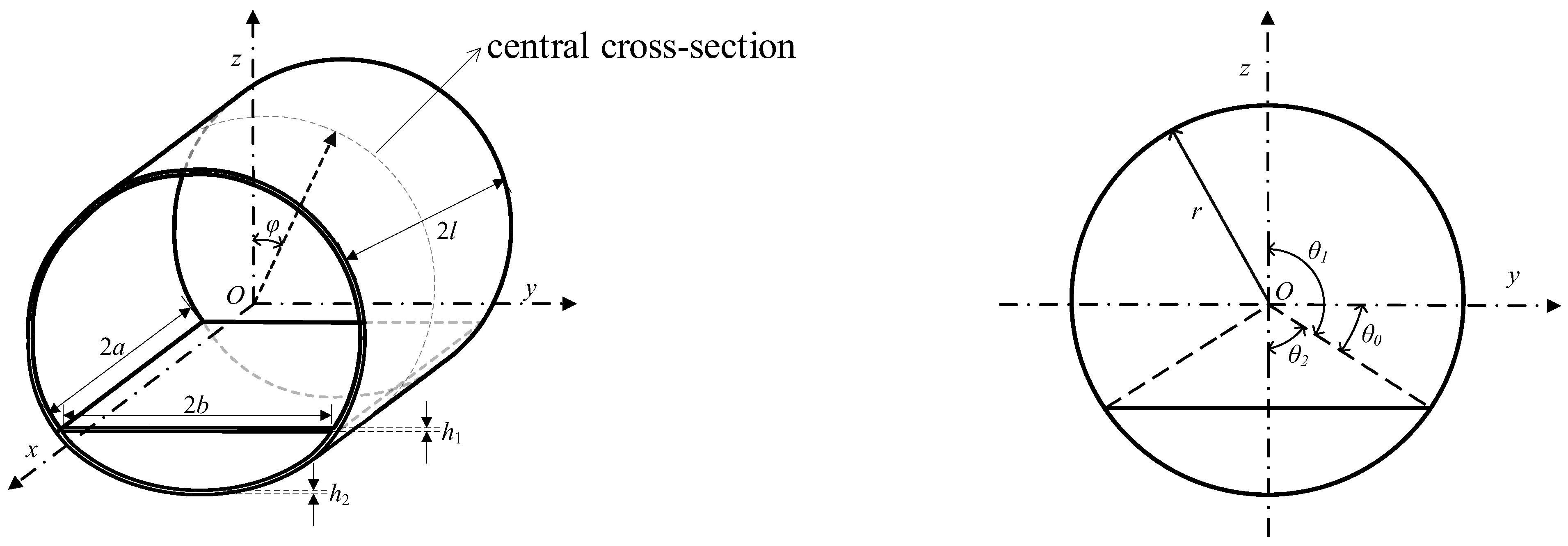
Figure 2 illustrates the schematic of the coupled rectangular plate–cylindrical shell and its central cross-section. The three-dimensional coordinate system O-xyzφ is established with its origin O located at the central position of the cylindrical shell. The coupled system comprises a rectangular plate and a cylindrical shell. The rectangular plate is positioned at an angular coordinate θ0 with a length of 2a, a width of 2b, and a thickness h1. The cylindrical shell is defined by a radius r, length 2l, and thickness h2. Then the cylindrical shell is divided into two open shells, which are the upper shell with an opening angle of 2θ1 and the lower shell with an opening angle of 2θ2. The structure is composed of isotropic elastic materials, having a uniform thickness that is small in comparison to other dimensions, which fulfills the prerequisites for thin-shell theory. The substructures are rigidly connected to ensure displacement and rotation continuity at the interfaces.

2.2. Governing Equations for a Plate Element

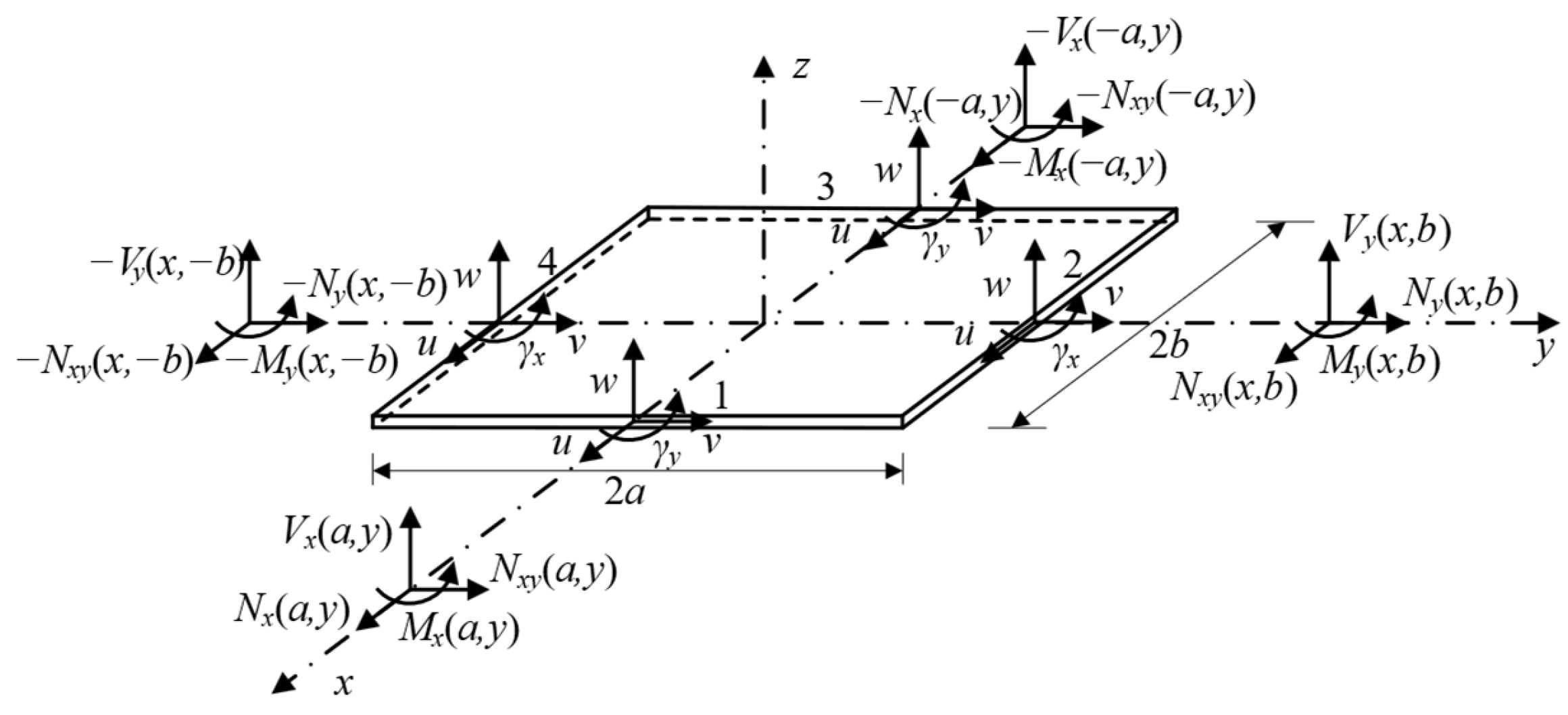
Figure 3 illustrates the displacements, forces, and moments along the four edges of the rectangular plate within the plate unit coordinate system. The displacement fields are denoted by the notations u, v, and w; γx(y) is the rotation. Vx(y), Nx(y), Nxy, and Mx(y) represent the transverse force, normal force, tangential force, and bending moment, respectively, and the detailed formulas have been included in Appendix A. The vibration equation based on Kirchhoff’s thin plate theory in the frequency domain is given as follows:
D 1 4 w x 4 + 2 4 w x 2 y 2 + 4 w y 4 ρ 1 h 1 ω 2 w = 0 2 u x 2 + a 1 2 u y 2 + a 2 2 v x y 1 μ 1 2 ρ 1 ω 2 E 1 u = 0 2 v x 2 + a 1 2 v y 2 + a 2 2 u x y 1 μ 1 2 ρ 1 ω 2 E 1 v = 0
where ρ1, μ1, and E1 are, respectively, the density, Poisson’s ratio, and Young’s modulus of the rectangular plate. ω is the circular frequency, and D1 = E1h13/[12(1 − μ12)] is the flexural stiffness of the rectangular plate. a1 = (1 − μ1)/2, a2 = (1 + μ1)/2.

2.3. Governing Equations for an Open Shell Element

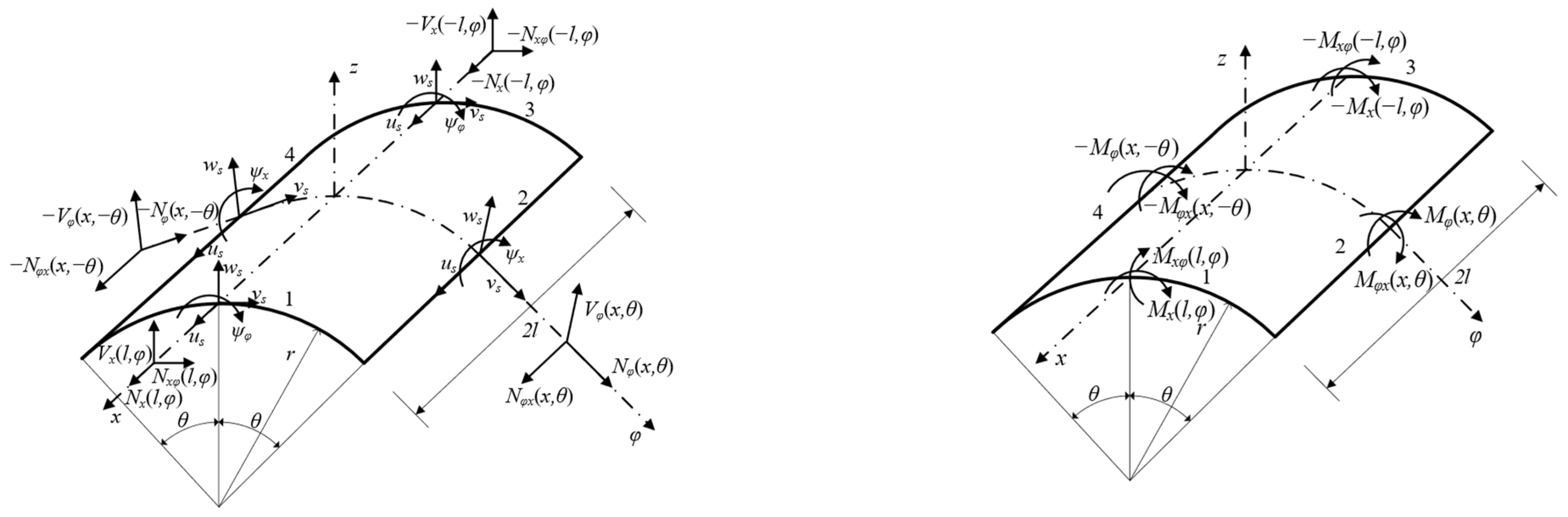
Figure 4 illustrates components of displacement and force at the boundaries of the open shell in the shell unit coordinate system. The displacement fields are denoted by u, v, and w, ψx(φ) are rotations. Vx(φ) are transverse shear forces, Nx(φ), N, and Nφx are in-plane membrane forces, Mx(φ), M, and Mφx are out-of-plane bending and twisting moments. Detailed expressions are provided in Appendix A. Based on the Flügge thin shell theory, the vibration equation for an open shell structure in the frequency domain is as follows:
x 2 + c 1 φ 2 c 2 ω 2 c 3 x φ c 4 x + c 5 x 3 + c 6 x φ 2 c 3 x φ c 7 φ 2 + c 8 x 2 c 2 ω 2 c 7 φ + c 9 x 2 φ c 4 x + c 5 x 3 + c 6 x φ 2 c 7 φ + c 9 x 2 φ k x 4 + 2 c 7 x 2 φ 2 + c 9 x 2 φ + c 7 + c 2 ω 2 + 2 c 10 φ 2 + c 10 u ( x , φ ) v ( x , φ ) w ( x , φ ) = 0 0 0
The coefficients in Equation (2) are expressed as follows:
c 1 = 1 μ 2 2 r 2 1 + κ D 2 r 2 , c 2 = ρ 2 h 2 D 2 , c 3 = 1 + μ 2 2 r , c 4 = μ 2 r , c 5 = κ D 2 r c 6 = 1 μ 2 2 r 3 κ D 2 , c 7 = 1 r 2 , c 8 = 1 μ 2 2 1 + 3 κ D 2 r 2 , c 9 = 3 μ 2 2 κ D 2 r 2 , c 10 = κ D 2 r 4
where ρ2, μ2, and E2 are the density, Poisson’s ratio, and Young’s modulus of the open shell, respectively. ω is the circular frequency, κ = E2h23/[12(1 − μ22)] is the flexural stiffness. D2 = E2h23/(1 − μ22) is the membrane stiffness, k = h22/12.

2.4. DS Matrices for Substructures

Given the demonstrated similarity in deriving dynamic stiffness matrices for rectangular plates and open shells [22,30], this section focuses exclusively on outlining the methodology for formulating the dynamic stiffness matrix. A unified derivation process is presented herein: for rectangular plates, the displacement field is given in the rectangular coordinate system (x, y, z). For open shells, the transverse spatial variable y is replaced by the angular coordinate φ in the polar coordinate system, while the treatments of governing equations and boundary conditions remain unchanged.
The displacement field (u, v, w) in the frequency domain, denoted as u ^ ( x , y , ω ) , is decomposed via the superposition principle into four symmetry groups based on symmetric (S) and antisymmetric (A) boundary conditions: S-S, S-A, A-S, and A-A.
u ^ ( x , y , ω ) = u ^ S S ( x , y , ω ) + u ^ S A ( x , y , ω ) + u ^ A S ( x , y , ω ) + u ^ A A ( x , y , ω )
Since the solution processes for each displacement component in the displacement field u are almost identical, a unified expression will be provided herein. Moreover, the derivation processes for each symmetric case are highly similar; thus, only the S-S component will be taken as an example for detailed discussion. To satisfy the symmetry requirement, its expression is assumed as follows:
  • For a rectangular plate,
u ^ S S p ( x , y ) = m = 0 U SS m p 1 ( y ) cos ( α m x ) + m = 0 U SS m p 2 ( x ) cos ( β m y )
  • For an open shell,
u ^ S S s ( x , φ ) = m = 0 U SS m s 1 ( φ ) cos ( α m x ) + m = 0 U SS m s 2 ( x ) cos ( β m φ )
where αm and βm are the wave numbers on the corresponding boundaries. In the actual derivation process, the number of basis function terms in the general solution is truncated to M terms.
In the formulation, only a quarter of the substructures needs to be considered. According to Equations (5) and (6), the boundary displacements and forces can be expressed in the following vector form:
  • For a rectangular plate,
q S S p T = u S S p ( a , y ) , v S S p ( a , y ) , w S S p ( a , y ) , γ x S S p ( a , y ) , u S S p ( x , b ) , v S S p ( x , b ) , w S S p ( x , b ) , γ y S S p ( x , b ) Q S S p T = N x S S p ( a , y ) , N x y S S p ( a , y ) , V x S S p ( a , y ) , M x S S p ( a , y ) , N x y S S p ( a , y ) , N y S S p ( a , y ) , V y S S p ( x , b ) , M y S S p ( x , b )
  • For an open shell,
q S S s T = u S S s ( l , φ ) , v S S s ( l , φ ) , w S S s ( l , φ ) , ψ φ S S s ( l , φ ) , v S S s ( x , θ ) , u S S s ( x , θ ) , w S S s ( x , θ ) , ψ x S S s ( x , θ ) Q S S s T = N x S S s ( l , φ ) , N ¯ x φ S S s ( l , φ ) , Q ¯ x S S s ( l , φ ) , M x S S s ( l , φ ) , N φ S S s ( x , θ ) , N φ x S S s ( x , θ ) , Q ¯ φ S S s ( x , θ ) , M φ S S s ( x , θ )
where
N ¯ x φ S S s = N x φ S S s + M x φ S S s r ; Q ¯ x S S s = Q x S S s + M x φ S S s r φ ; Q ¯ φ S S s = Q φ S S s + M φ x S S s x
The displacement and force vectors q S S p / s and Q S S p / s are functions of spatial coordinates x and φ. The projection method is applied to eliminate the spatial independence of boundary forces and displacements:
q ^ S S p / s = 2 L s H S S p / s q S S p / s d s = D S S p / s C S S p / s , Q ^ S S = 2 L s H S S p / s Q S S p / s d s = P S S p / s C S S p / s
where the superscripts p/s denote plate and shell, respectively. q ^ S S p / s and Q ^ S S p / s are the projection displacement and force vectors, and HSS is the matrix of projection functions. By eliminating the constant CSS in Equation (10), the governing equation of motion corresponding to the S-S displacement component in transverse vibration can be obtained:
Q ^ S S p / s = K S S p / s q ^ S S p / s
where KSS = PSSDSS−1 denotes the dynamic stiffness matrix. Using the same line of reasoning, the equations of motion corresponding to the remaining three sets of displacement components can be derived:
Q ^ S A p / s = K S A p / s q ^ S A p / s , Q ^ A S p / s = K A S p / s q ^ A S p / s , Q ^ A A p / s = K A A p / s q ^ A A p / s
By assembling the four component matrices, the complete dynamic stiffness matrices of substructures under free boundary conditions can be obtained, expressed as follows:
Q ^ 0 p / s = K 0 p / s q ^ 0 p / s
where
Q ^ 0 p / s = Q ^ S S p / s Q ^ S A p / s Q ^ A S p / s Q ^ A A p / s , q ^ 0 p / s = q ^ S S p / s q ^ S A p / s q ^ A S p / s q ^ A A p / s , K 0 p / s = K S S p / s 0 0 0 0 K S A p / s 0 0 0 0 K A S p / s 0 0 0 0 K A A p / s
Similarly, after obtaining the dynamic stiffness matrices of substructures, the boundary displacement and force vectors of substructures are readjusted in order to facilitate the coupling of subsequent boundaries. Then the final expression is written as follows:
q ^ p / s = 1 2 T p / s q ^ 0 p / s , Q ^ p / s = T p / s T Q ^ 0 p / s , K p / s = Q ^ p / s q ^ p / s 1 = 1 2 T p / s T K S S p / s 0 0 0 0 K S A p / s 0 0 0 0 K A S p / s 0 0 0 0 K A A p / s T p / s
where T is the transfer matrix, as detailed in Ref. [27]. Using the transfer matrix, the displacement and forces are readjusted into vector form along the four boundary edges. The specific components of the projection vectors for the boundary forces and displacements are as follows:
q ^ p / s T = q ^ p / s 1 q ^ p / s 2 q ^ p / s 3 q ^ p / s 4 , Q ^ p / s T = Q ^ p / s 1 Q ^ p / s 2 Q ^ p / s 3 Q ^ p / s 4
From Equations (9)–(16), the dynamic equation of substructures can be obtained as follows:
Q ^ p / s = K p / s q ^ p / s
where
Q ^ p / s 1 Q ^ p / s 2 Q ^ p / s 3 Q ^ p / s 4 = K 11 p / s K 12 p / s K 13 p / s K 14 p / s K 21 p / s K 22 p / s K 23 p / s K 24 p / s K 31 p / s K 32 p / s K 33 p / s K 34 p / s K 41 p / s K 42 p / s K 43 p / s K 44 p / s q ^ p / s 1 q ^ p / s 2 q ^ p / s 3 q ^ p / s 4
where each of the Kij sizes is 8M + 3.

2.5. The Whole Dynamic Stiffness Matrix of the Coupled Plate–Shell Structure

The dynamic stiffness matrices of the plate element and shell element are developed in their respective local coordinate systems. The whole dynamic stiffness matrix for the coupled structures will be assembled after transforming the matrices in local coordinates into an overall coordinate system.

2.5.1. Transformation of Coordinates for the Dynamic Stiffness Matrices

As shown in Figure 2, the coordinates of the plate element are chosen as the global coordinate system of the coupled structure. Therefore, only the coordinate system of the open shells needs to be transformed. Zhang et al. [27] have derived the coordinate transformation matrix for coupled structures in the DS formulation, and the principle of coordinate transformation used for the coupled structure is basically the same. For brevity, only the main process is described here.
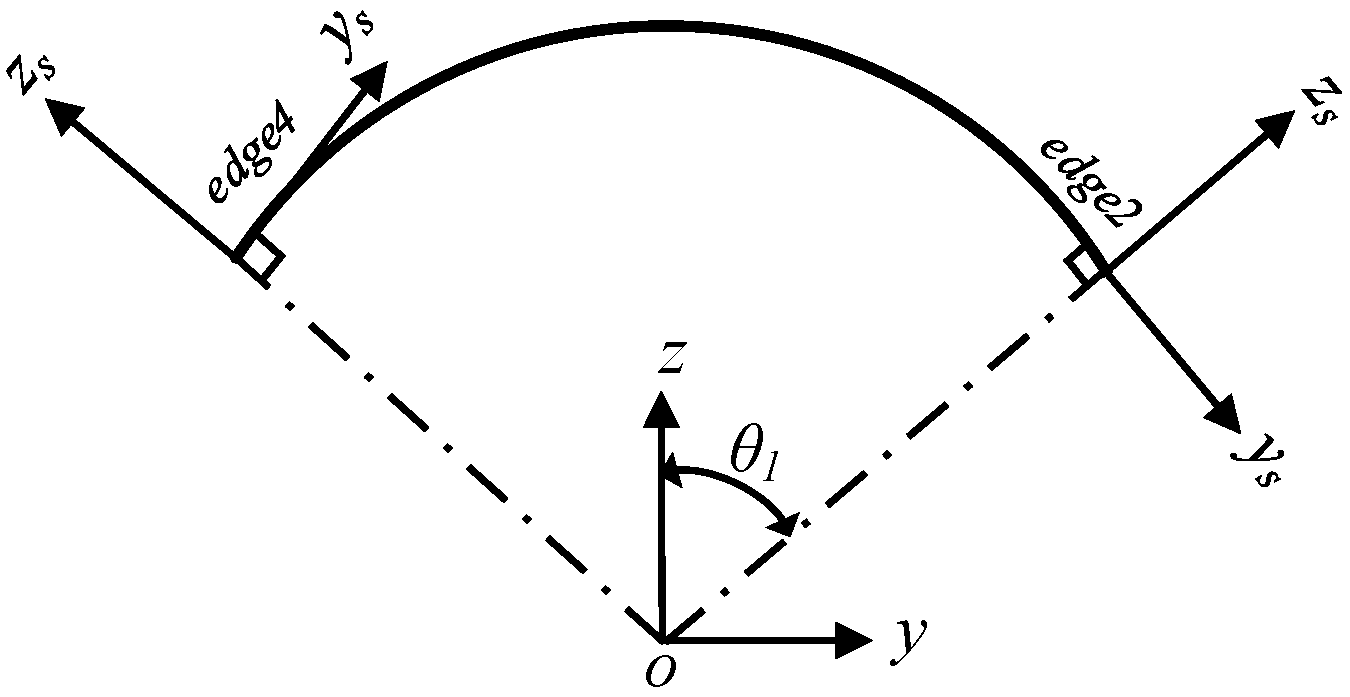
As shown in Figure 5, assuming that the axis of symmetry of the open shell is the z-axis in the global coordinate system, the coupled angle between the open shell and rectangular plate is θ1. According to the displacement/force relationship along the coupling boundary, the following expressions can be obtained:
q ¯ i = T d i q ¯ s i Q ¯ i = T F i Q ¯ s i , i = 2 , 4
where
q ¯ i = u i v i w i ψ i ; q ¯ s i = u S i v S i w S i ψ S i ; Q ¯ i = N φ x i N φ i V φ i M φ i ; Q ¯ s i = N φ x S i N φ S i V φ S i M φ S i
The expression for the transformation matrix T at the edges 2 and 4 of the open shell is as follows:
T d 2 = T F 2 = I 0 0 0 0 I cos θ 1 I sin θ 1 0 0 I sin θ 1 I cos θ 1 0 0 0 0 I ; T d 4 = T F 4 = I 0 0 0 0 I cos θ 1 I sin θ 1 0 0 I sin θ 1 I cos θ 1 0 0 0 0 I
where u i , v i , w i and ψ i are the projection vectors of displacement and force for the ith edge, respectively. I is the identity diagonal matrix. Icos and Isin are diagonal matrices whose elements are cosθ1 and sinθ1, respectively.
As a result, with reference to Equations (19)–(21), the vibration equation for an open shell in the overall coordinate will be formulated as follows:
Q ¯ = K q ¯
where
K = T F 1 K S T d , T d = I 1 0 0 0 0 T d 2 0 0 0 0 I 3 0 0 0 0 T d 4 , T F = I 1 0 0 0 0 T F 2 0 0 0 0 I 3 0 0 0 0 T F 4

2.5.2. Assembly of the Global DS Matrix

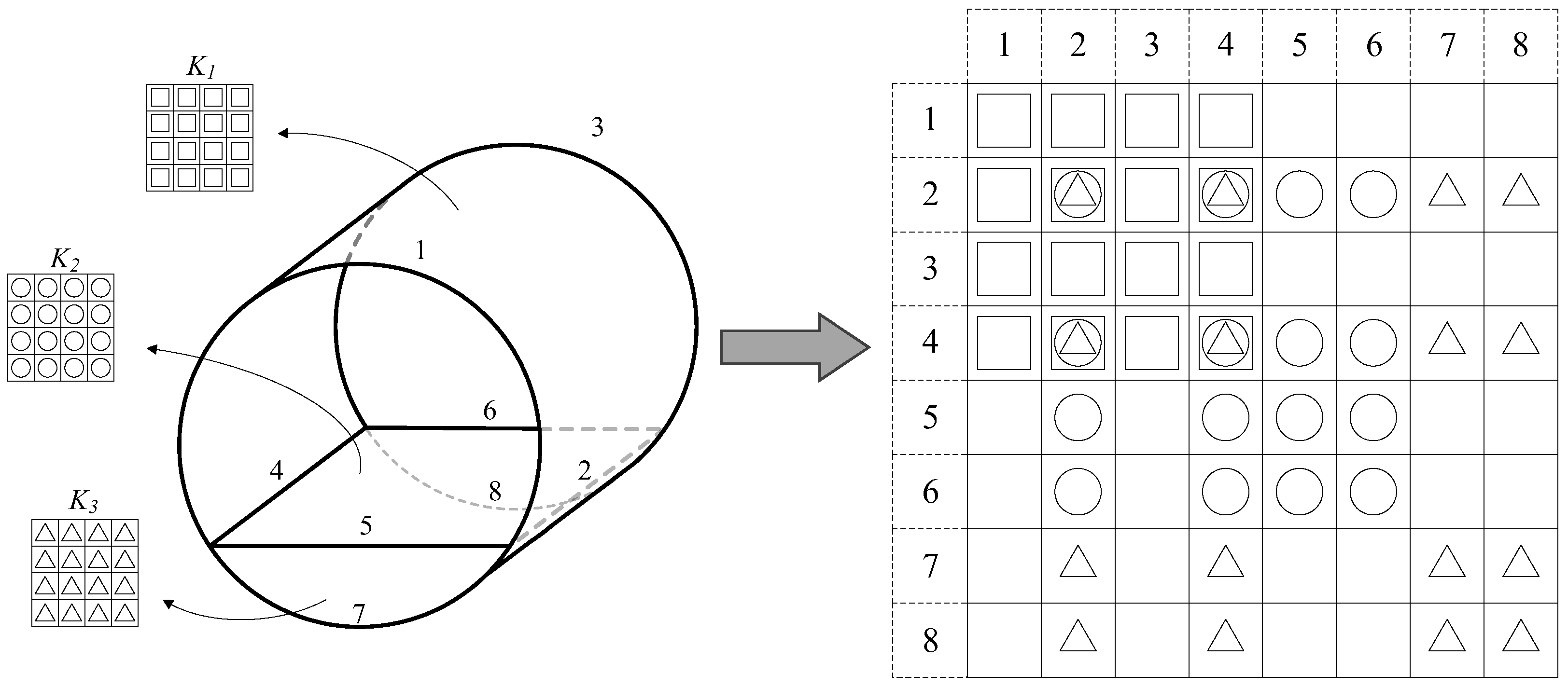
The global DS matrix of the coupled structure is assembled from the DS matrices of the plate and the open shell structure in the overall coordination system, respectively. For intuitive understanding, Figure 6 gives the sketch map of the assembly of the DS matrix for this coupled system. First, the cylindrical shell structure with embedded plates is decomposed into two open shell segments and one rectangular plate element, and the boundaries of each substructure are numbered orderly. The three substructures are coupled at boundaries 2 and 4, so the corresponding elements in the dynamic stiffness matrices of these substructures are superimposed accordingly.
Consequently, the vibration equation for the coupled rectangular plate–cylindrical shell is derived as follows:
K w d w = f w
where Kw is the global DS matrix, dw and fw indicate the global displacement and force vectors.

2.6. Boundary Conditions, Solution of Natural Frequencies

Four typical boundary constraints are employed in this article: free boundary (F), clamped boundary (C), simply supported boundary (S), and shear diaphragm boundary (SD). The application of boundary conditions refers to Ref. [30]. The order of applying boundary conditions should follow the sequence of boundary numbers in Figure 6, which is 1-3-5-6-7-8.
  • F-supported: u , w , v , ψ 0
  • S-supported: u = w = v = 0
  • SD-supported: w = v = 0
  • C-supported: u = w = v = ψ = 0
To apply boundary conditions, one can set the displacements of the corresponding boundary elements in Figure 6 according to the specific constraints of each boundary.
Natural frequencies are computed from the following equation:
det K w ( ω ) = 0
To circumvent numerical difficulties encountered when solving the characteristic equation, the natural frequency is calculated by calculating the maximum values of the function:
g ω = log 1 det K w ( ω )

3. Numerical Application and Discussion

With this section, the vibration solution model of the coupled structure is implemented in MATLAB R2022a software, providing a highly accurate and efficient numerical solving approach for vibration analysis of coupled structures. In Section 3.1, the convergence of the present solution is validated by comparing the obtained results with the converged values obtained by the FEM. In Section 3.2, a parametric study is conducted on the coupled rectangular plate–cylindrical shell structures under various parameter conditions. In Section 3.3, an experimental model is built, and the vibration test is performed.

3.1. Convergence Verification

First, the accuracy and convergence of this method are validated through numerical examples. Under different boundary conditions, the natural frequencies of the structure presented in Figure 2 are computed. Moreover, the relevant boundary constraints have been detailed in Section 2.6. The structural geometric parameters are specified as follows: E1 = E2 = 210 GPa, ρ1 = ρ2 = 7800 kg/m3, ν = 0.3, h1 = h2 = 0.01 m, θ0 = 0°, θ1 = θ2 = 90°, r = 2 m, 2l = 2a = 3 m, 2b = 2r = 4 m. To verify the method’s reliability in a more robust manner, a relative error is utilized, defined as follows:
Δ = f p f R f R × 100 %
where fp indicates the frequency calculated by the present method, and fR stands for the reference frequency acquired through the FEM solution.
As presented in Table 1, the first six natural frequencies of the coupled structure under five typical boundary conditions are calculated. The finite element analysis is performed using the SHELL element in COMSOL Multiphysics 6.3 software. Two mesh densities are adopted in the calculation. In the first mesh case, the rectangular plate is discretized with 40 parts along both its length and width, and the cylindrical shell is discretized with 40 parts in the axial direction and 160 parts in the circumferential direction, corresponding to a total of 8000 elements. For the other, the rectangular plate is discretized with 50 parts along both its length and width, and the cylindrical shell is discretized with 50 parts in the axial direction and 200 parts in the circumferential direction, corresponding to a total of 12,500 elements. As evident from the results, when the number of truncated series (M) reaches up to 20, the natural frequencies steadily tend toward convergence. Furthermore, the results show strong agreement with the converged values solved using the FEM. Therefore, the accuracy of the established dynamic stiffness model is verified.

3.2. Parameter Study

Subsequently, three examples are presented to study the vibration behaviors of the coupled shell. In these examples, we analyze the effects of degrees of freedom, varying coupled angles, and varying horizontal positions of the flat plate on the vibration behaviors of the coupled structure.

3.2.1. Example 1: Coupled Plate–Shell Structures with Different Degrees of Freedom

Grounded on the coupled structure model shown in Figure 2, the effect of different degrees of freedom on the natural frequencies of the free vibration of the coupled structure is studied. The structural geometric parameters are specified as follows: E1 = E2 = 210 GPa, ρ1 = ρ2 = 7800 kg/m3, ν = 0.3, h1 = h2 = 0.01 m, θ0 = 30°, θ1 = 120°, θ2 = 60°, r = 2 m, 2l = 2a = 3 m, 2b = 2rcos(θ0) m.
By examining the data in Table 2, it can be observed that when additional boundary constraints are applied to the coupled structure, there is a significant increase in the natural frequencies. This is mainly because, as the degrees of freedom of the system decrease, the overall bending stiffness in the boundaries increases, which is particularly evident when comparing the first boundary condition with the second boundary condition. Since the central angle of the shell in the upper part of the coupled structure is larger, fixing the upper arc edge has a more pronounced impact on the overall stiffness of the substructure, which brings about a more significant change in the natural frequencies.

3.2.2. Example 2: Coupled Plate–Shell Structures with Different Coupled Angles

Keeping the basic form of the structure constant, the influence of different coupled angles on the free vibration behaviors of the coupled structure is investigated. The structural geometric parameters are specified as follows: E1 = E2 = 210 GPa, ρ1 = ρ2 = 7800 kg/m3, ν = 0.3, h1 = h2 = 0.008 m, r = 0.6 m, 2l = 2a = 1.5 m, 2b = 2rcos(θ0). All boundaries of the coupled structure are fixed supports.
It can be observed from the natural frequency results in Table 3 that as the coupled angle between the rectangular plate and open shell increases, the first 6 natural frequencies of the coupled structure also increase continuously. This phenomenon is more pronounced when the coupled angle changes from 30° to 45°. This is because, as the coupling angle increases, the flat plate’s vertical position shifts continuously downward, while its size also decreases. When moving downward, the geometric stiffness of the rectangular plate and the lower part of the open shell increases, which in turn leads to an increase in the natural frequencies.

3.2.3. Example 3: Coupled Plate–Shell Structures with the Flat Plate at Different Horizontal Positions

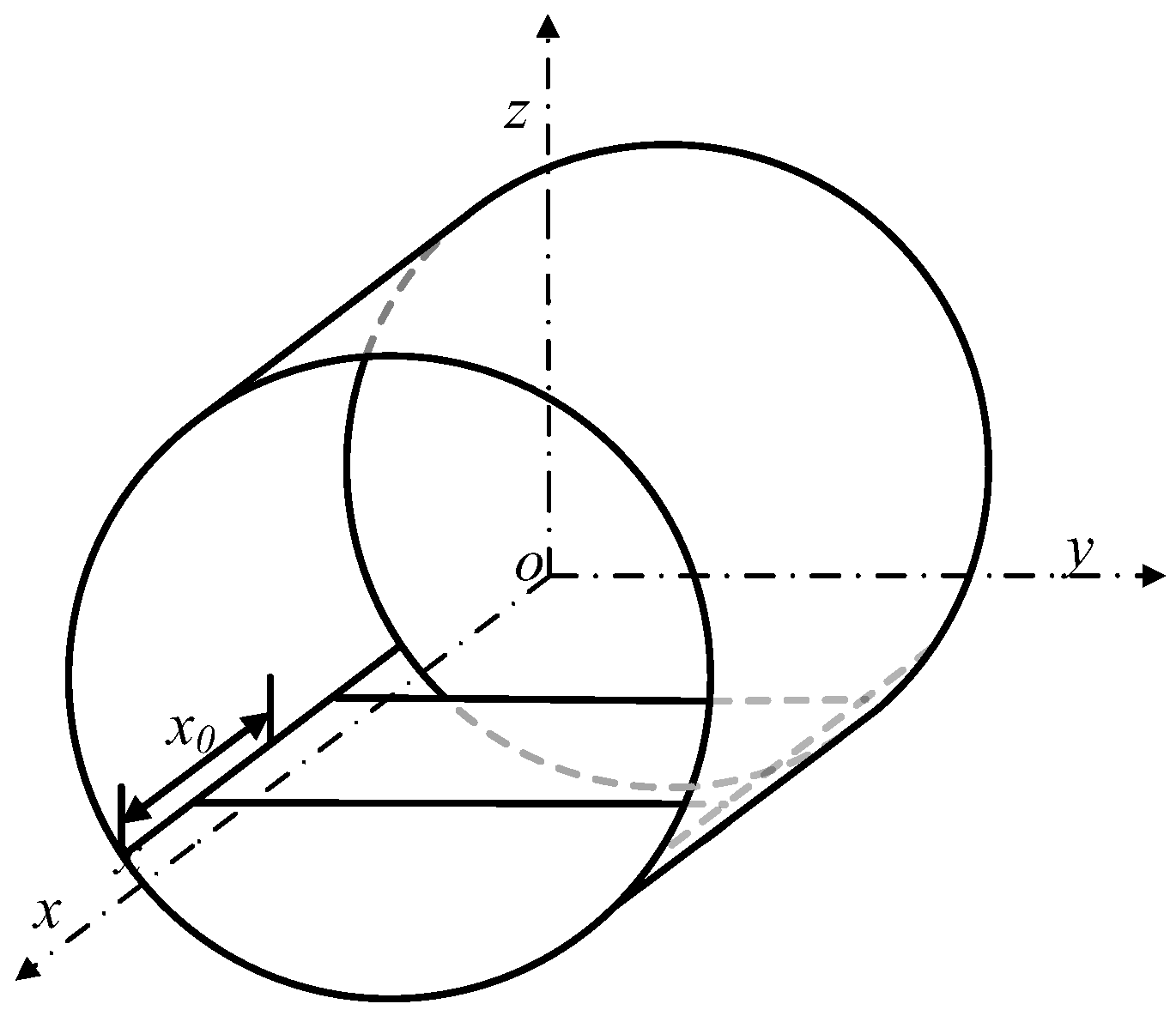
In this example, the influence of the horizontal position of the rectangular plate on the coupled structure is studied. It is assumed that the distance between the midpoint of the long side of the rectangular plate and the edge of the shell is x0, as shown in Figure 7. The horizontal location of the flat plate inside the shell is dictated by changing the value of x0. The structural geometric parameters are specified as follows: E1 = E2 = 210 GPa, ρ1 = ρ2 = 7800 kg/m3, ν = 0.3, h1 = h2 = 0.01 m, θ0 = 30°, θ1 = 120°, θ2 = 60°, r = 2 m, 2l = 4.5 m, 2a = 2 m, 2b = 2rcos(θ0). The arc edges of the coupled structure are fixed, while the edges of the rectangular plate are free. Due to the symmetry of the structure, only the case where the center of the rectangular plate is located on the positive semi-axis of the x-axis is considered.
From the results in Table 4, it can be observed that as the rectangular plate moves from the edge of the cylindrical shell toward its center, the natural frequencies of the structure decrease accordingly. When the rectangular plate is positioned in the middle of the shell, its constraining effect on the shell is relatively weak. In contrast, when the plate is close to the edge of the cylindrical shell, it cooperates with the rigid boundary to form a stronger local constraint, thereby enhancing the equivalent bending stiffness of the shell.

3.3. Experimental Validation

3.3.1. Experimental Model and Testing System

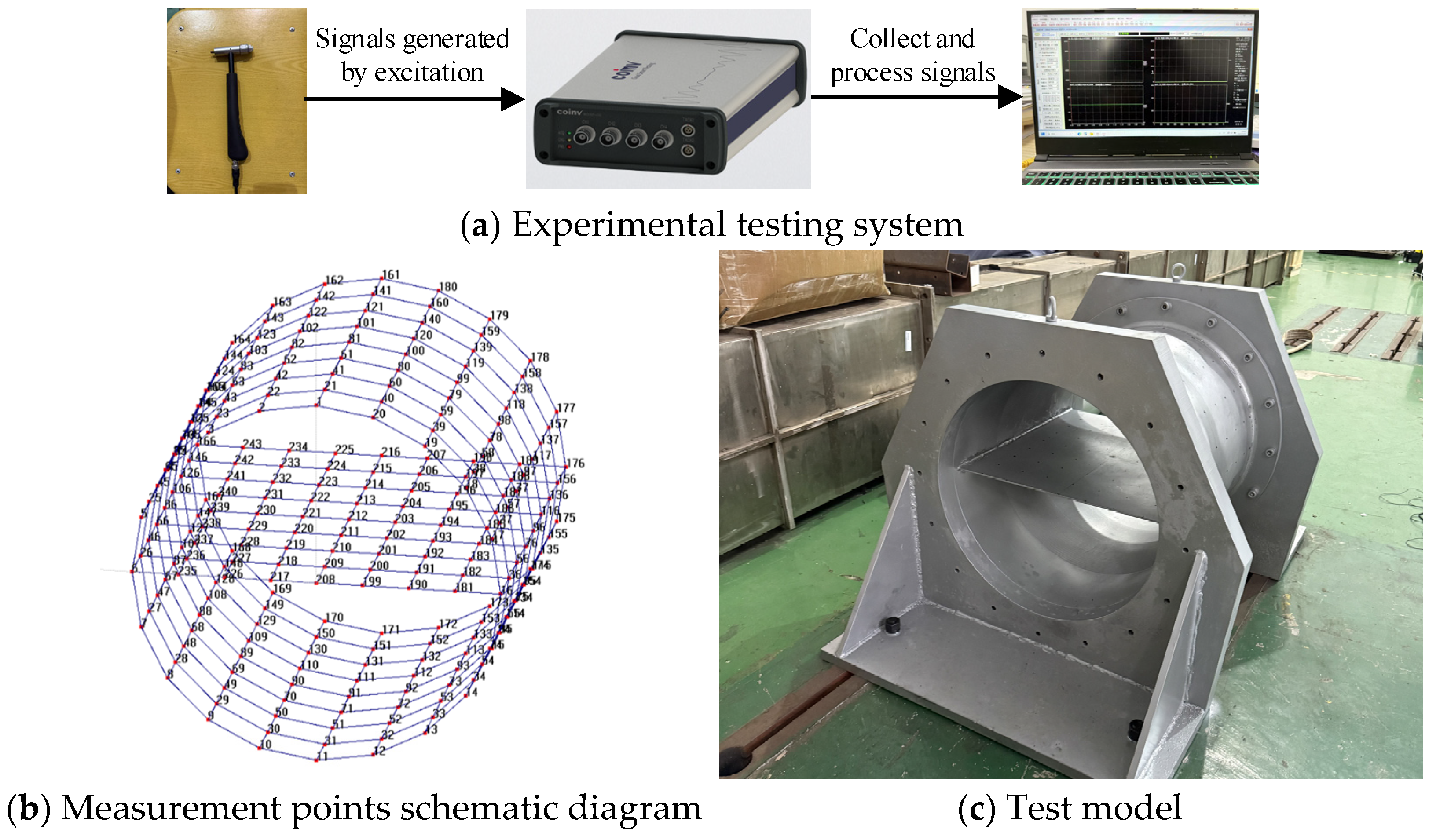
In this section, an experimental model is constructed based on the theoretical model shown in Figure 2. The experimental model is presented in Figure 8. Both the rectangular plate and cylindrical shell are made of Q235 steel. A rectangular plate is welded at the horizontal center position inside the cylindrical shell. Full penetration welding is adopted to couple the embedded plate with the cylindrical shell. After welding, the welds are ground flush with the base metal, and annealing treatment is carried out to relieve residual stress, thus minimizing the influence of welding on structural dynamic characteristics. Two flanges with 2 cm thickness are welded to the arc edges on both sides of the shell. Then, the coupled plate–shell structure is connected to a 6 cm-thick rigid base via these flanges using 16 bolts. Meanwhile, the bottom of the base is fixed to the ground track with bolts. The design of the above device can effectively realize clamped boundary conditions for the cylindrical shell. After conducting multiple measurements with a tape measure, a vernier caliper, and an ultrasonic thickness gauge and averaging the results, the size parameters of the rectangular plate and the cylindrical shell were obtained. These parameters have undergone strict calibration to meet the requirements of the experimental model. The specific parameters are as follows: E1 = E2 = 210 GPa, ρ1 = ρ2 = 7800 kg/m3, ν = 0.3, h1 = 0.0045 m, h2 = 0.0041 m, θ0 = 0°, θ1 = θ2 = 90°, 2r = 2b = 0.594 m, 2l = 2a = 0.6 m.
The experimental system consists of a test computer, a data acquisition instrument, an impact hammer, and a vibration acceleration sensor. The data acquisition and processing are implemented by COINV DASP V11 software. The specific positions of the test points are shown in Figure 8b. The modal test is carried out using the multi-point excitation and single-point response method. The response point is selected at the center of the plate (Point No. 212). Each measuring point is sequentially excited by the impact hammer along the transverse direction. The corresponding vibration response data are acquired by the data acquisition instrument and further processed for modal analysis in the DASP V11 dynamic analysis software to obtain the modal characteristics of the test structure.

3.3.2. Experimental Results and Analysis

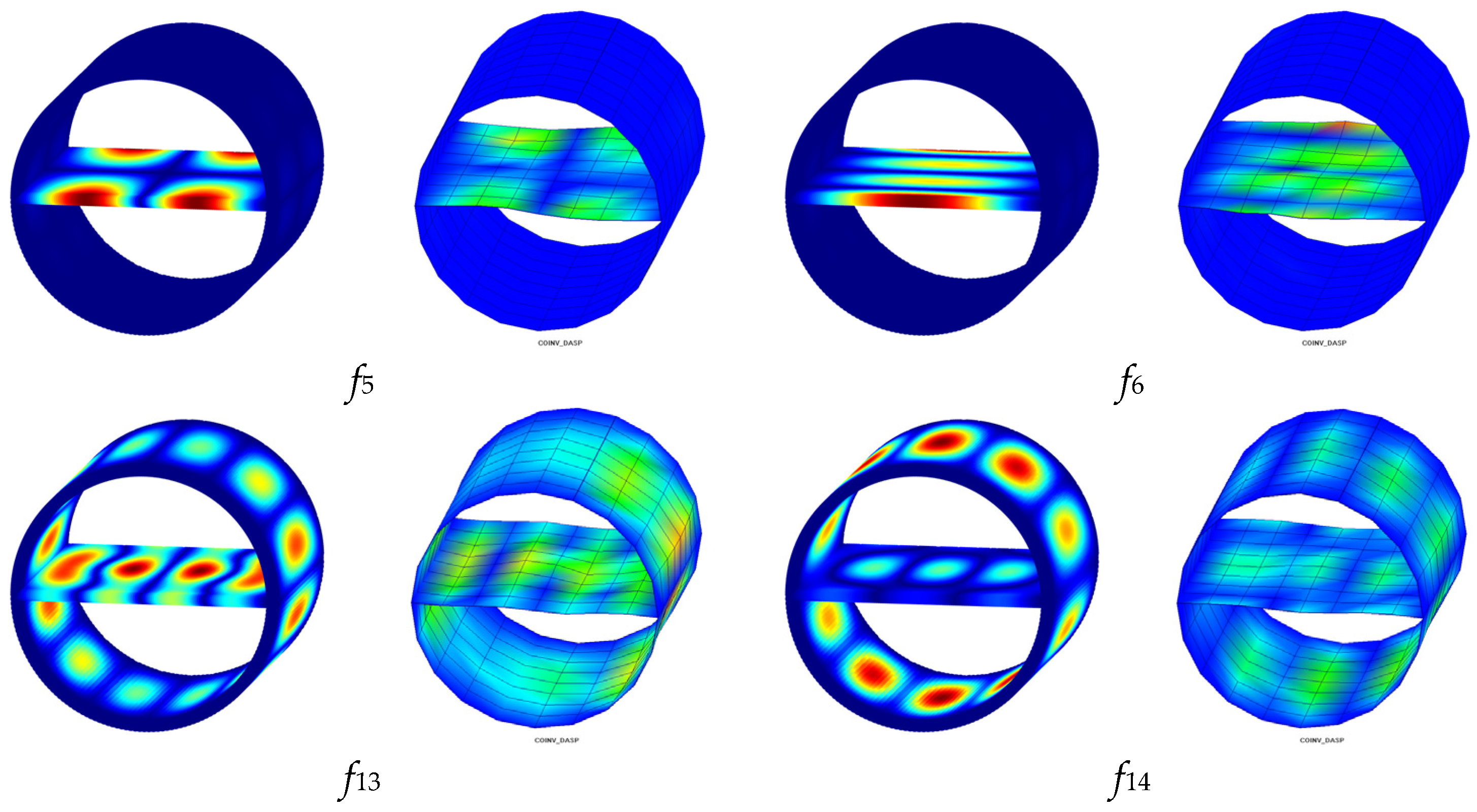
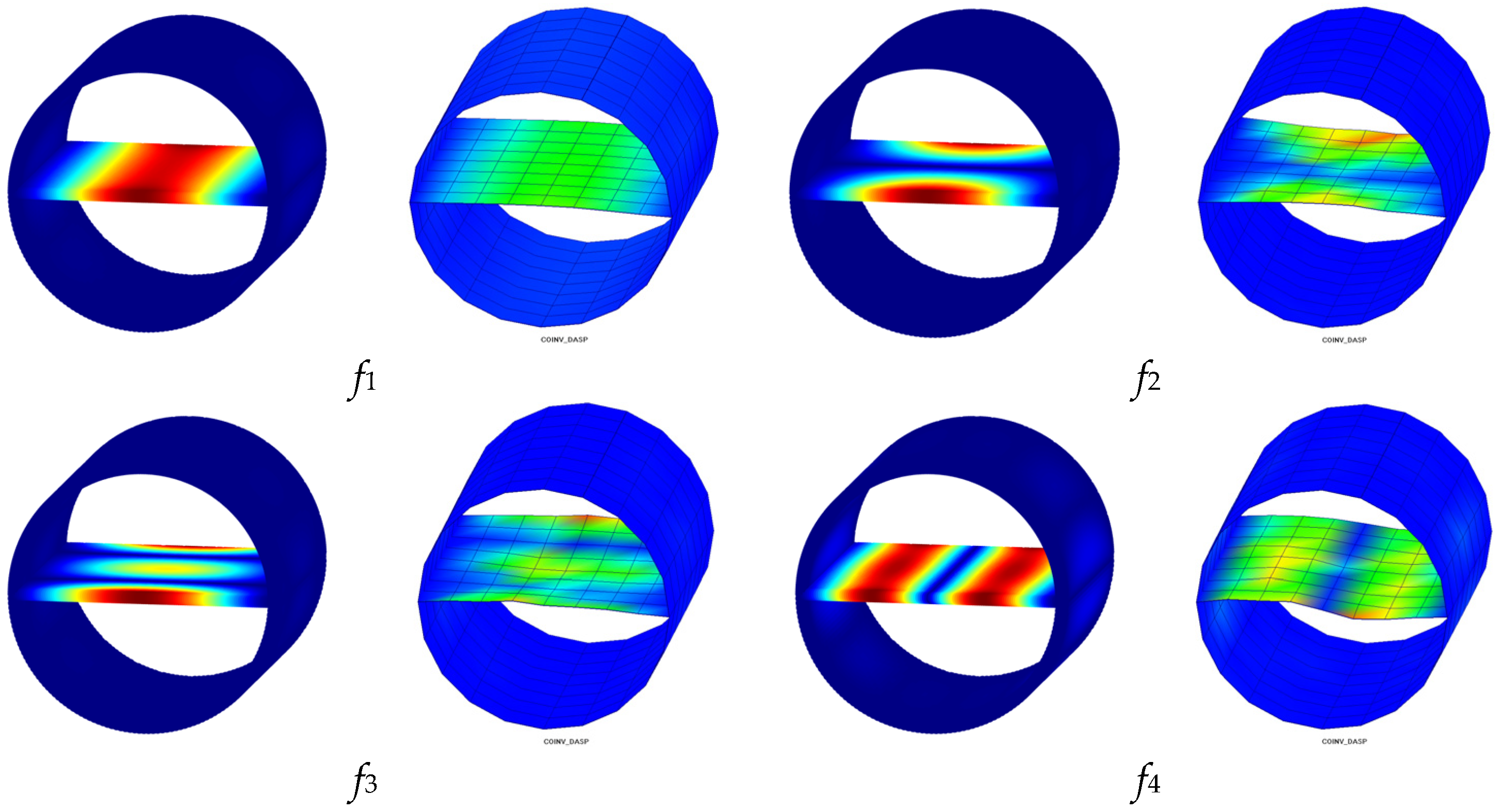
Table 5 presents a comparison between the experimental results of the first 14 natural frequencies of the coupled structure and the analytical results obtained from the model established in this study. For illustrative purposes, some representative modes obtained by the present results and experimental results are compared in Figure 9
By examining the data in Table 5, it is observed that the frequencies calculated using the method proposed in this study are in good agreement with the experimental results, and the errors are all below 3%. This error may be due to the fact that the rigidity of the simulated rigid boundary through the base does not meet the theoretical requirements. Therefore, the natural frequencies obtained from the experiment at high frequencies are slightly lower than the theoretically calculated ones. However, the first three frequencies obtained from the experiment are slightly higher than the present values. This is because the first few orders of natural frequencies of the coupled structure are mainly dominated by the rectangular plate, and the error arises due to the uneven thickness of the rectangular plate in the experimental structure.
Figure 9 presents a comparison between the mode shapes obtained by the present method and those from the experimental test. For each mode shape plot, the result on the left is from the present method, and the one on the right is the experimental result. It can be observed from the comparison that the mode shapes of the 1st to 6th orders are mainly exhibited in the rectangular plate structure. In fact, until the 13th order mode, significant deformation of the shell structure occurred.
This is because the stiffness of the plate is not sufficiently high, and the circumferential vibration of the shell is restricted by the coupling with the flat plate. Due to the minimal bending of the flat plate in the tested structure caused by thermal expansion and contraction during the welding and cooling process, the symmetry of the modes is affected. Additionally, the number of measuring points is limited, resulting in unsmooth and uneven vibration modes obtained from the test. But the vibration modes obtained by theoretical calculation and experiment are almost coincident, which demonstrates the validity of the vibration solution.

4. Conclusions

The dynamic stiffness solution for the coupled rectangular plate–cylindrical shell structure is proposed in this paper, and this model has been successfully applied to investigating the vibration behaviors of coupled rectangular plate–cylindrical shell structures of different dimensions and coupled angles. The numerical results show that after applying more boundary constraints to the coupled structure, the degree of freedom of the system decreases accordingly, and the overall bending stiffness increases, leading to a significant rise in frequencies of the structure. Since the first six-order modes are located at the rectangular plate, the boundary conditions of the rectangular plate have a more substantial impact on the natural frequency. The coupled angle between the rectangular plate and the open shell of the coupled structure also affects the frequency of the entire system. When the coupled angle increases, the vertical position of the rectangular plate moves downward continuously, which causes the geometric stiffness of the rectangular plate and the lower part of the open shell to increase gradually, thereby leading to an increase in the natural frequency. This paper also studies the influence of the horizontal position of a rectangular plate in the middle position of a cylindrical shell on the vibration of the coupled structure. When the rectangular plate is arranged at the middle of the cylindrical shell, its constraint on the shell is weak. As the plate is close to the edge of the shell, it forms a more intense local constraint alongside the rigid boundary, which notably elevates the shell’s equivalent bending stiffness and, in turn, brings about an increase in the natural frequency.
Compared with the traditional finite element method, the dynamic stiffness model proposed in this paper features a more intuitive, convenient modeling process and a wider scope of application, making it particularly suitable for modeling large-scale shell–plate coupled structures. The reason lies in the fact that the general solutions of all basic elements in this model are strictly derived from the structural governing equations, and this rigorous derivation process directly ensures the model’s advantages in terms of accuracy and convergence.
Based on the presented work, the dynamic stiffness model of a cylindrical shell with embedded plates under fluid loading can be further established, and its sound and vibration characteristics can be investigated.

Author Contributions

Conceptualization, Y.S.; Methodology, Y.S. and C.Z.; Software, Y.X.; Validation, Y.X. and Z.P.; Writing—original draft, Y.S. and Y.X.; Writing—review & editing, C.Z., Z.P. and K.S.; Supervision, Z.P.; Funding acquisition, C.Z. and K.S. All authors have read and agreed to the published version of the manuscript.

Funding

This research was funded by the National Natural Science Foundation of China (Nos. 52305110 and 52405107), the Natural Science Foundation of Jiangsu Province (No. BK20241013), and the Research Project of State Key Laboratory of Mechanical System and Vibration grant number MS 202409. And The APC was funded by the authors themselves.

Data Availability Statement

The original contributions presented in this study are included in the article. Further inquiries can be directed to the corresponding author.

Conflicts of Interest

The authors declare no conflict of interest.

Abbreviations

For the rectangular plate
2aLength
2bWidth
h1Thickness
ρ1Density
μ1Poisson’s ratio
E1Young’s modulus
D1Flexural stiffness
up, vp, wpLinear displacement
γx(y)Rotation
Vx(y)Transverse force
Nx(y)Normal force
NxyTangential force
Mx(y)Bending moment
a1, a2Coefficients of the governing equation
For the open shell
2lLength
rRadius
h2Thickness
θ0Coupling Angle
2θ1, 2θ2Opening Angle
ρ2Density
μ2Poisson’s ratio
E2Young’s modulus
ωCircular frequency
κFlexural stiffness
D2Membrane stiffness
u, v, wLinear displacement
ψx(φ)Rotation
Vx(φ)Transverse shear forces
Nx(φ), N, NφxIn-plane membrane forces
Mx(φ), M, MφxOut-of-plane bending and twisting moments
k, c1c10Coefficients of the governing equation
Derivation process of the dynamic stiffness matrix
u ^ p/sDisplacement field
αm, βmWave numbers
q SS p , Q SS p Displacement and force at the boundary of the rectangular plate
q SS s , Q SS s Displacement and force at the boundary of the open shell
q ^ p / s Projection displacement
Q ^ p / s Projection force
Hp/sMatrix of projection functions
Kp/sDynamic stiffness matrices
Tp/sCoordinate transformation matrix
MTruncation series

Appendix A

For a rectangular plate,
  • Out of plane
γ x = w y ; γ y = w x ; D o u t = E 1 h 1 3 12 1 μ 1 2
M x = D out 2 w x 2 + μ 1 2 w y 2 ; M y = D out 2 w y 2 + μ 1 2 w x 2
V x = D out 3 w x 3 + 2 μ 1 2 w x y 2 ; V y = D out 3 w y 3 + 2 μ 1 2 w y x 2
  • In-plane
D in = E 1 h 1 1 μ 1 2 ; N x = D in u x + μ 1 v y ; N y = D in v y + μ 1 u x N x y = N y x = D i n a 1 u y + v x
For an open shell,
ψ φ = w x ; ψ x = v r w r φ
M x = κ 2 w x 2 + μ 2 r 2 2 w φ 2 v φ 1 r u x ; M φ = κ 1 r 2 2 w φ 2 + w + μ 2 2 w x 2
M x φ = κ 1 μ 2 r 2 w x φ v x ; M φ x = κ 1 μ 2 2 r 2 2 w x φ v x + 1 r u φ
N x = D 2 u x + μ 2 r w + v φ κ r 2 w x 2 ; N φ = D 2 1 r w + v φ + μ 2 u x + κ r 3 2 w φ 2 + w
N x φ = D 1 μ 2 2 1 r u φ + v x + κ 1 μ 2 2 r 2 v x 2 w x φ
N φ x = D 2 1 μ 2 2 1 r u φ + v x + κ 1 μ 2 2 r 2 1 r u φ + 2 w x φ
V x = M x x + 1 r M φ x φ ; V φ = 1 r M φ φ + M x φ x ;

References

  1. Fu, Z.; Xi, Q.; Li, Y.; Huang, H.; Rabczuk, T. Hybrid FEM–SBM Solver for Structural Vibration Induced Underwater Acoustic Radiation in Shallow Marine Environment. Comput. Methods Appl. Mech. Eng. 2020, 369, 113236. [Google Scholar] [CrossRef]
  2. Tian, Y.; Kai, Y.; Hong, W.; Xin, W. Study on theoretical modeling and vibration performance of an assembled cylindrical shell-plate structure with whirl motion. Appl. Math. Model. 2022, 110, 618–632. [Google Scholar] [CrossRef]
  3. Mellouli, H.; Jrad, H.; Wali, M.; Dammak, F. Free vibration analysis of FG-CNTRC shell structures using the meshfree radial point interpolation method. Comput. Math. Appl. 2020, 79, 3160–3178. [Google Scholar] [CrossRef]
  4. Chen, W.; Luo, W.; Chen, S.; Peng, L. A FSDT Meshfree Method for Free Vibration Analysis of Arbitrary Laminated Composite Shells and Spatial Structures. Compos. Struct. 2022, 279, 114763. [Google Scholar] [CrossRef]
  5. Chen, Y.; Jin, G.; Liu, Z. Vibrational energy flow analysis of coupled cylindrical shell-plate structure with general boundary and coupling conditions. Proc. Inst. Mech. Eng. Part C J. Mech. Eng. Sci. 2015, 229, 1727–1744. [Google Scholar] [CrossRef]
  6. Ma, X.; Jin, G.; Shi, S.; Ye, T.; Liu, Z. An analytical method for vibration analysis of cylindrical shells coupled with annular plate under general elastic boundary and coupling conditions. J. Vib. Control 2017, 23, 305–328. [Google Scholar] [CrossRef]
  7. Xu, Y.; Yang, T.; Fuller, C.; Sun, Y.; Liu, Z. A theoretical analysis on the active structural acoustical control of a vibration isolation system with a coupled plate-shell foundation. Int. J. Mech. Sci. 2020, 170, 15334. [Google Scholar] [CrossRef]
  8. Irie, T.; Yamada, G.; Kobayashi, Y. Free vibration of non-circular cylindrical shells with longitudinal interior partitions. J. Sound Vib. 1984, 96, 133–142. [Google Scholar] [CrossRef]
  9. Xie, K.; Chen, M. Wave based method for vibration analysis of double-walled cylindrical shells. Appl. Acoust. 2018, 139, 293–306. [Google Scholar] [CrossRef]
  10. Zhang, C.; Jin, G.; Wang, Z.; Sun, Y. Dynamic stiffness formulation and vibration analysis of coupled conical-ribbed cylindrical-conical shell structure with general boundary condition. Ocean Eng. 2021, 234, 109294. [Google Scholar] [CrossRef]
  11. Chen, M.; Zhang, L.; Xie, K. Vibration analysis of a cylindrical shell coupled with interior structures using a hybrid analytical-numerical approach. Ocean Eng. 2018, 154, 81–93. [Google Scholar] [CrossRef]
  12. Jia, W.; Chen, M.; Xie, K.; Dong, W. Experimental and analytical investigations onvibro-acoustic characteristics of a submerged submarine hull coupled with multiple inner substructures. Ocean Eng. 2022, 259, 111960. [Google Scholar] [CrossRef]
  13. Tian, L.; Jin, G.; He, T.; Ye, T.; Liu, Z.; Khadimallah, M.A.; Li, Z. A hybrid analytic-numerical formulation for the vibration analysis of a cylindrical shell coupled with an internal flexural floor structure. Thin-Walled Struct. 2023, 183, 110382. [Google Scholar] [CrossRef]
  14. Wang, Z.; Xing, J.; Price, W.G. A study of power flow in a coupled plate-cylindrical shell system. J. Sound Vib. 2004, 271, 863–882. [Google Scholar] [CrossRef]
  15. Shao, D.; Li, B.; Cao, Y.; Tao, Y.; Sun, N.; Shi, Y. Dynamic responses of composite plate-shell coupled structures under moving excitations. Int. J. Mech. Sci. 2024, 265, 108884. [Google Scholar] [CrossRef]
  16. Hong, C. Advanced dynamic thermal vibration of thick FGM plates-cylindrical shells. Ocean Eng. 2022, 266, 112701. [Google Scholar] [CrossRef]
  17. Chen, Z.; Qin, B.; Wang, Q.; Zhong, R.; Wang, A. Vibration analysis of laminated open cylindrical shell coupled with rectangular plates. Compos. Struct. 2022, 292, 115607. [Google Scholar] [CrossRef]
  18. Gong, Q.; Teng, Y.; Ma, B.; Li, X.; Guo, S. Study on the dynamic behavior of distributed dynamic vibration absorber coupled structure of cylindrical shell and rectangular plate. Thin-Walled Struct. 2025, 208, 112853. [Google Scholar] [CrossRef]
  19. Chen, S.; Han, Y.; Zhu, X.; Li, T.; Zhong, K. Coupled vibration analysis of partially liquid-filled cylindrical shells with internal horizontal plates. Thin-Walled Struct. 2024, 200, 111884. [Google Scholar] [CrossRef]
  20. Williams, F.; Wittrick, W. An automatic computational procedure for calculating natural frequencies of skeletal structures. Int. J. Mech. Sci. 1970, 12, 781–791. [Google Scholar] [CrossRef]
  21. Banerjee, J. The dynamic stiffness method: Theory, practice and promise. Comput. Technol. Rev. 2015, 11, 31–57. [Google Scholar] [CrossRef]
  22. Banerjee, J.; Papkov, S.; Liu, X.; Kennedy, D. Dynamic stiffness matrix of a rectangular plate for the general case. J. Sound Vib. 2015, 342, 177–199. [Google Scholar] [CrossRef]
  23. Liu, X. Spectral dynamic stiffness formulation for inplane modal analysis of composite plate assemblies and prismatic solids with arbitrary classical/nonclassical boundary conditions. Compos. Struct. 2016, 158, 262–280. [Google Scholar] [CrossRef]
  24. Gorman, D. Vibration Analysis of Plates by the Superposition Method; World Scientific Publishing Company: Singapore, 1999. [Google Scholar]
  25. Kolarević, N.; Nefovska-Danilović, M.; Petronijevic, M. Dynamic stiffness elements for free vibration analysis of rectangular Mindlin plate assemblies. J. Sound Vib. 2015, 359, 84–106. [Google Scholar] [CrossRef]
  26. Kolarević, N.; Marjanović, M.; Nefovska-Danilovic, M.; Pertronijevic, M. Free vibration analysis of plate assemblies using the dynamic stiffness method based on the higher order shear deformation theory. J. Sound Vib. 2016, 364, 110–132. [Google Scholar] [CrossRef]
  27. Zhang, C.; Jin, G.; Ye, T.; Zhang, Y. Harmonic Response Analysis of Coupled Plate Structures Using the Dynamic Stiffness Method. Thin-Walled Struct. 2018, 127, 402–415. [Google Scholar] [CrossRef]
  28. Wu, W.; Yin, X.; Li, H.; Zhong, K. Power flow analysis of built-up plate structures using the dynamic stiffness method. J. Vib. Control 2017, 24, 2815–2831. [Google Scholar] [CrossRef]
  29. Kolarević, N.; Nefovska-Danilović, M.; Petronijević, M. Dynamic stiffness method in the vibration analysis of circular cylindrical shell. Građevnski Mater. Konstr.-Build. Mater. Struct. 2016, 59, 45–61. [Google Scholar] [CrossRef]
  30. Kolarević, N.; Nefovska-Danilović, M. Dynamic stiffness-based free vibration study of open circular cylindrical shells. J. Sound Vib. 2020, 486, 115600. [Google Scholar] [CrossRef]
  31. Li, Z.; Ye, T.; Jin, G.; Yang, T.; Tian, L.; Chen, Y. Dynamic Stiffness Formulation for Vibration Analysis of an Open Cylindrical Shell and Its Coupling Structures Based on a Generalized Superposition Method. J. Sound Vib. 2022, 538, 117237. [Google Scholar] [CrossRef]
  32. Yu, S.; Yin, X. A generalized superposition method for accurate free vibration analysis of rectangular plates and assemblies. J. Acoust. Soc. Am. 2019, 145, 185–203. [Google Scholar] [CrossRef] [PubMed]
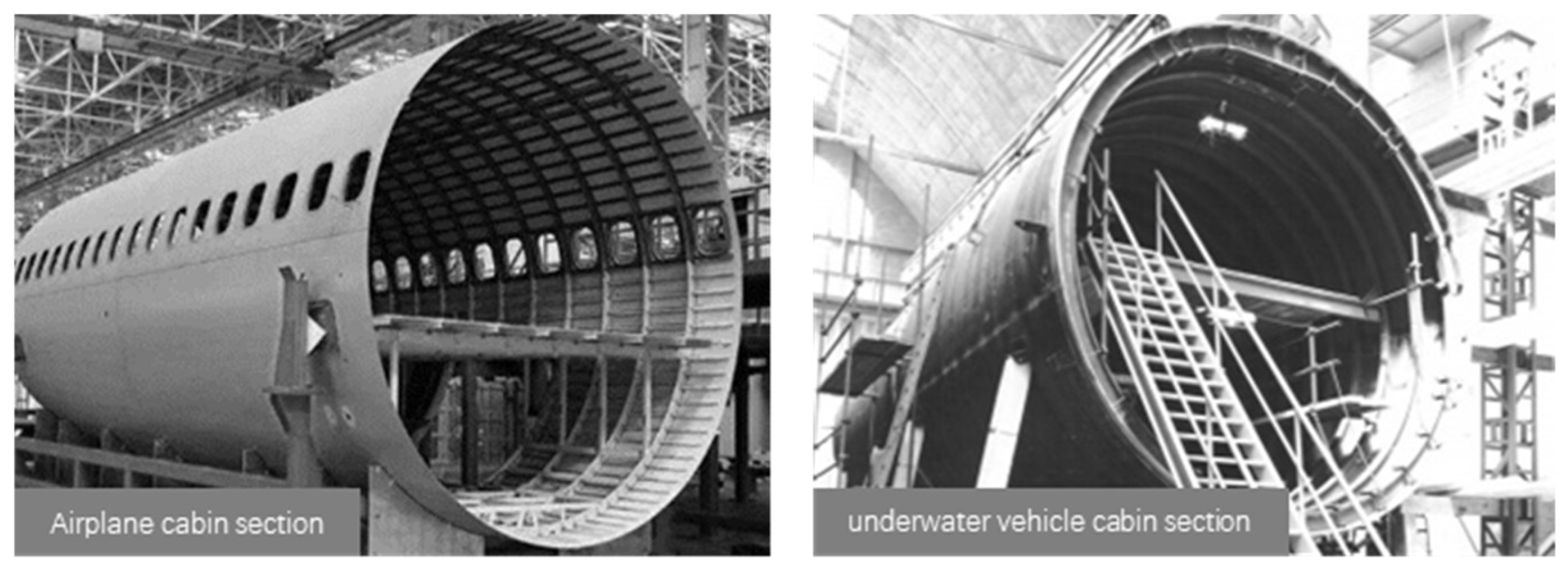
Figure 1. Coupled structure engineering model (source: Internet).
Jmse 14 00718 g001
Figure 2. Schematic of rectangular plate–cylindrical shell coupled structure and central cross-section.
Jmse 14 00718 g002
Figure 3. Representation of the coordinate system, displacements, and forces corresponding to the rectangular plate.
Jmse 14 00718 g003
Figure 4. Representation of the coordinate system, displacements, and forces corresponding to the open shell.
Jmse 14 00718 g004
Figure 5. Schematic diagram of the shell coordinate transformation relationship.
Jmse 14 00718 g005
Figure 6. Assembly of dynamic stiffness matrices.
Jmse 14 00718 g006
Figure 7. Schematic diagram of the horizontal movement of a rectangular plate inside a cylindrical shell.
Jmse 14 00718 g007
Figure 8. Schematic Diagram of the Experimental Process.
Jmse 14 00718 g008
Figure 9. Mode shapes obtained by theoretical calculation and experiment.
Jmse 14 00718 g009aJmse 14 00718 g009b
Table 1. Verification of the natural frequency of vibration in coupled structures/Hz.
BCModePresentFEM Δ%
M = 8M = 10M = 15M = 208000 Elements12,500 Elements
C-C-
C-C-
C-C
17.87.87.87.87.87.80.00
212.812.812.812.812.812.80.00
318.618.618.618.618.718.70.53
421.221.321.321.321.121.10.95
523.423.423.423.423.423.40.00
631.431.431.431.431.331.30.32
F-F-
C-C-
C-C
12.62.62.62.62.62.60.00
25.95.95.95.95.75.73.51
36.06.06.06.06.16.11.64
47.87.87.87.87.87.80.00
510.510.510.510.510.610.60.94
612.612.011.411.110.810.82.78
S-S-
S-S-
S-S
15.25.25.35.35.35.30.00
211.211.211.211.211.211.20.00
313.013.013.013.013.013.00.00
418.718.718.718.718.718.70.00
519.619.920.020.020.020.00.00
626.526.526.526.526.526.50.00
SD-SD-
C-C-
SD-SD
17.87.87.87.87.87.80.00
212.812.812.812.812.712.70.79
318.618.618.618.618.618.60.00
421.121.221.221.220.920.91.44
523.423.423.423.423.323.30.43
631.431.431.431.431.231.20.64
C-C-
C-S-
S-S
16.46.36.36.36.36.30.00
211.911.911.911.911.911.90.00
315.615.615.615.615.615.60.00
420.420.520.620.620.520.50.49
520.920.920.920.920.820.80.48
629.429.429.429.429.329.30.34
Table 2. Vibration frequencies of the coupled structure with different degrees of freedom/Hz.
BCModePresentFEMΔ%
M = 8M = 10M = 15M = 20
C-C-
C-C-
C-C
18.78.68.58.58.50.00
215.415.415.415.415.40.00
319.319.319.319.319.30.00
425.925.825.825.825.80.00
526.826.626.726.526.50.00
635.635.535.735.735.60.28
F-F-
C-C-
C-C
11.21.21.21.21.20.00
22.72.72.72.72.70.00
33.03.03.03.02.93.45
45.65.65.65.65.60.00
58.18.17.56.05.83.45
68.78.68.48.48.40.00
S-S-
S-S-
S-S
15.76.16.26.26.20.00
213.813.813.813.813.80.00
314.214.014.014.014.00.00
421.521.521.521.521.50.00
526.426.825.325.425.60.78
627.227.527.227.227.20.00
SD-SD-
C-C-
SD-SD
18.78.68.58.58.50.00
215.515.515.515.515.31.31
319.319.419.219.319.30.00
425.825.825.825.825.70.39
527.526.526.726.526.21.15
635.635.735.735.735.60.28
C-C-
C-S-
S-S
16.97.17.27.17.21.39
214.814.814.814.814.61.37
316.416.416.416.416.30.61
423.523.523.523.523.40.43
526.928.926.525.426.02.31
631.331.531.231.231.20.00
Table 3. Vibration frequencies of the coupled structure with different coupled angles (C-C-C-C-C-C)/Hz.
θ0ModePresentFEMΔ%
M = 8M = 10M = 15M = 20
138.438.538.538.538.60.26
271.171.171.171.171.10.00
386.086.086.086.086.00.00
4117.7117.7117.7117.7117.50.17
5122.6122.6122.6122.6122.50.08
6155.2155.4155.4155.4155.50.06
15°140.040.140.240.240.20.00
272.572.572.572.572.50.00
390.990.990.990.990.80.11
4122.7122.7122.6122.6122.50.08
5123.9123.9123.9123.9123.80.08
6164.4164.7164.9164.9164.80.06
30°146.046.146.246.246.20.00
277.777.777.777.777.70.00
3108.6108.6108.6108.6108.40.18
4128.7128.7128.7128.7128.50.16
5140.7140.6140.6140.6140.40.14
6189.6189.6189.6189.6189.40.11
45°161.061.261.461.461.30.16
291.891.891.891.891.70.11
3140.0140.1140.2140.2141.10.64
4150.1150.1150.1150.1149.80.20
5185.8185.8185.8185.8185.40.22
6207.6207.7207.7207.7207.00.34
Table 4. Vibration frequencies of the coupled structure with the flat plate at different horizontal positions (C-C-F-F-C-C)/Hz.
x0 (m)ModePresentFEMΔ%
M = 8M = 10M = 15M = 20
114.44.44.44.44.32.32
26.76.76.76.76.70.00
312.012.012.012.011.81.69
415.715.715.715.715.60.64
519.519.318.318.118.00.56
622.622.622.622.623.22.59
1.62514.34.24.24.24.20.00
26.76.76.76.76.61.52
311.911.911.911.911.71.71
415.615.615.615.615.50.65
517.216.718.418.218.01.11
623.523.523.523.522.92.62
2.2514.24.24.24.24.20.00
26.76.76.76.76.61.52
311.911.911.911.911.62.59
415.615.615.615.615.50.65
517.216.818.518.118.00.56
623.523.423.423.422.82.63
Table 5. Frequencies of the coupled structure obtained by the present method and experiment/Hz.
ModePresentExperimentalΔ/%ModePresentExperimentalΔ/%
163.965.52.448346.0341.11.44
279.180.61.869377.7374.90.75
3133.1134.00.6710381.2378.30.77
4176.5171.82.7411425.7420.71.19
5200.9201.00.0512442.3438.60.84
6246.9244.50.9813515.1513.90.23
7264.6265.00.1514521.6518.00.69
Disclaimer/Publisher’s Note: The statements, opinions and data contained in all publications are solely those of the individual author(s) and contributor(s) and not of MDPI and/or the editor(s). MDPI and/or the editor(s) disclaim responsibility for any injury to people or property resulting from any ideas, methods, instructions or products referred to in the content.