Article

Dynamic Underway Replenishment Route Optimization for Naval Formations Considering Formation Stability

Integrated Transport Institute, Dalian Maritime University, Dalian 116026, China
*
Author to whom correspondence should be addressed.
J. Mar. Sci. Eng. 2026, 14(8), 714; https://doi.org/10.3390/jmse14080714
Submission received: 31 December 2025 / Revised: 30 March 2026 / Accepted: 9 April 2026 / Published: 12 April 2026
(This article belongs to the Special Issue Advancements in Maritime Safety and Risk Assessment)

Abstract

To enhance fleet replenishment efficiency and ensure navigational safety, this paper investigates the Underway Replenishment Routing Problem (URRP), focusing on the dynamic characteristics of receiving ships. Mathematical models for replenishment ship travel time and formation vessel speed adjustment are formulated, explicitly considering navigational state transitions and formation stability (risk control). Consequently, a dynamic route optimization model is constructed to provide intelligent decision support for fleet commanders. An intelligent optimization algorithm, the Hybrid Genetic Algorithm with Adaptive Variable Neighborhood Search (HGA-AVNS), is proposed to solve this model. Computational results demonstrate that the proposed approach outperforms the traditional empirical replenishment strategy, validating its effectiveness in enhancing maritime safety and operational efficiency. Extensive sensitivity analyses further reveal that under the strict premise of maintaining formation stability, appropriately reducing the cruise speed can offset the increase in overall speed over ground (SOG) induced by following ocean currents, thereby preventing systematic time loss. Additionally, fine-tuning the execution timing of sudden tactical turning based on the replenishment ship’s real-time operational status can further maximize overall replenishment efficiency without compromising navigational safety.

1. Introduction

In complex maritime environments, navigational safety constitutes the primary prerequisite for naval formations to execute their missions effectively [1]. The material foundation for maintaining this safety and sustained combat capability lies in reliable logistical support. Underway Replenishment (UNREP), as the principal means of delivering this support, serves as a vital guarantee for the fleet’s continuous and safe operation in deep waters [2]. However, this operation is inherently characterized by complex multi-vessel coordination and high-speed maneuvering, presenting significant operational risks and causing structural disturbances to formation stability. Improper planning of replenishment routes not only diminishes logistical efficiency but also exacerbates these risks by prolonging the formation’s exposure to hazardous states. Therefore, investigating the Underway Replenishment Routing Problem (URRP) to develop an intelligent decision support system that balances operational efficiency with risk control is of great theoretical and practical significance for modern maritime transportation systems.
UNREP serves as the primary method of maritime replenishment for naval formations engaged in blue-water operations [3]. It enables the provision of material support without interrupting the formation’s cruising mission, thereby extending the formation’s operational endurance. Typically, conducted by a replenishment ship sailing alongside the formation, this method transfers essential materials to combatant ships through a dedicated replenishment system, allowing the formation to receive supplies without returning to base [4,5]. Unlike replenishment operations targeting offshore islands [6,7], the objects involved in naval formation underway replenishment possess mobility characteristics. Scholars have conducted some beneficial explorations into the optimization of this problem. Wu Chong [8], based on the traveling parson replenishment strategy, introduced an “efficiency-time ratio” and established route optimization models for both peacetime and wartime scenarios. Dong Peng [9], utilizing the newsboy delivery strategy, developed a two-stage optimization model to obtain the optimal replenishment plan. Wei Zhenkun [10] investigated the replenishment optimization problem involving multiple replenishment ships, establishing a dual-objective model aiming for the shortest replenishment time and minimal replenishment ship involvement. Considering the impact of sea conditions on replenishment operations, Zhang Quanxian [11] incorporated time window constraints into the problem, making the optimized plans more aligned with the actual conditions of naval battlefield replenishment.
In the aforementioned studies, scholars abstracted the naval formation underway replenishment optimization problem as variants of the Traveling Salesman Problem (TSP) or the Vehicle Routing Problem (VRP), providing valuable experience for researching the problem. However, assumptions such as “the positions of the replenished ships remain unchanged” or “the replenishment points are known” set during the modeling phase fail to fully consider the impact of target mobility. To better reflect the dynamic characteristics of formation underway replenishment, this problem can be abstracted as a Moving Target Traveling Salesman Problem (MT-TSP) [12,13]. Unlike the traditional TSP [14,15], the MT-TSP considers dynamic service targets, where the distance between the salesman and the targets is time-dependent [13,16,17,18]. Zhang [19,20] studied the scheduling of emergency materials for offshore oil spill response, considering the drift and diffusion characteristics of oil slicks. Wang [13] investigated the route optimization problem for maritime helicopters verifying suspicious vessels, incorporating the relative motion characteristics between target vessels and the escort formation. Granado [21] studied the route optimization for fishing vessel operations, considering the mobility characteristics of drifting fish aggregating devices. Unlike the studies referenced above, the URRP for naval formations entails particular complexities due to its dynamic nature. This dynamicity stems from two principal sources: the continuous movement of the ships being serviced and their required speed adjustments. During a replenishment operation, all vessels remain under way. As the replenishment ship attends to the current receiving ship, its distance to the next receiving ship evolves over time, which gives rise to time-varying distances between the replenishment ship and all receiving ships. Moreover, within a single replenishment cycle, a receiving ship undergoes sequential transitions through distinct navigational states—namely, from cruising to replenishment, and then to station recovery. Each of these state transitions necessitates an immediate shift in speed among the predefined cruise, replenishment, and tactical speeds.
A naval formation constitutes a predefined tactical spatial configuration of vessels during navigation, designed to counter multi-dimensional threats from air, surface, and underwater domains through scientifically optimized station distribution. This configuration is essential for maximizing combat effectiveness and safeguarding the flagship. During cruising missions, the formation typically transits while maintaining this established tactical structure, with each escort vessel holding its designated station relative to the flagship. In this context, formation stability inherently encompasses two dimensions: the effective maintenance of the tactical configuration in space, and the prompt restoration of the prescribed formation in time. However, during operations, the formation is inevitably subject to perturbations caused by variable sea states, obstacle avoidance, or replenishment maneuvers. Such structural disturbances can induce gaps in the defensive screen, thereby significantly increasing the flagship’s risk exposure. Consequently, formation stability is paramount to the defensive integrity and operational efficacy of the naval formation.
In light of these challenges, addressing the dynamic characteristics of vessels in the URRP for naval formation, this paper proposes a dynamic replenishment routing optimization methodology. This approach comprehensively integrates dynamic factors—including vessel navigation states and speed adjustments—with the critical impact of replenishment operations on formation stability. The main contributions of this paper are summarized as follows:
(1)
A novel dynamic routing optimization framework integrating system resilience is proposed. We quantify the tactical concept of “Formation Stability” into a core optimization constraint, embedding it within the Moving Target Traveling Salesman Problem (MT-TSP) model. This framework simultaneously characterizes the “service dynamics” of replenishment operations and “systemic structural risks” within a unified model, offering a generalized modeling paradigm for analyzing the resilience of cooperative mobile platform operations in complex maritime environments.
(2)
Hybrid Genetic Algorithm with Adaptive Variable Neighborhood Search (HGA-AVNS) tailored for high-dynamic problems is designed. Addressing the computational challenges posed by strong model nonlinearity and time-varying parameters, the algorithm achieves a dynamic balance between global exploration and local exploitation through the deep fusion of chaotic initialization, multi-modal neighborhood search, and adaptive mechanisms. Furthermore, the structural superiority of the proposed HGA-AVNS is rigorously validated through an in-depth effectiveness analysis of its core algorithmic operators. This algorithm not only provides an efficient solution for the specific problem addressed but also serves as a robust tool for solving a class of combinatorial optimization problems characterized by high dynamics and strong constraints.
(3)
The operational mechanisms of key parameters on system efficacy are elucidated through systematic numerical experiments. Beyond verifying the superiority of the proposed approach, the study employs in-depth sensitivity analysis to clarify the quantitative impacts of key operational parameters and dynamic environmental disturbances—specifically, formation cruise speed, ocean currents, and sudden tactical turning—on overall replenishment efficiency. These insights provide command decision-makers with theoretical grounds and quantitative references for resilient decision-making that transcend traditional empirical judgment in complex maritime scenarios.
To systematically address the aforementioned challenges, the remainder of this paper is organized as follows: Section 2 presents the detailed problem description and the formulation of the dynamic optimization model. Section 3 elaborates on the design of the HGA-AVNS. Section 4 validates the effectiveness of the proposed approach through numerical case studies and sensitivity experiments under various dynamic disruptions, while also elucidating the influence mechanisms of key parameters. Finally, Section 5 summarizes the main conclusions of this study.

2. Problem Description and Mathematical Formulation

2.1. Problem Description

The Underway Replenishment Routing Problem (URRP) can be described as follows: A naval formation, comprising one replenishment ship and multiple combatant ships (acting as receiving ships), executes a cruise mission in a designated maritime area, where the replenishment ship provides accompanying logistical support. Within a single replenishment cycle, the replenishment ship services the receiving ships sequentially according to a pre-planned schedule. The objective is to determine an optimal service sequence that minimizes the replenishment cycle time, subject to satisfying replenishment demands and operational constraints.
During the execution of cruise missions, the naval formation advances in a designated tactical configuration, where each vessel maintains a fixed cruise station relative to the flagship. To safeguard operational objectives and navigational safety, maintaining formation stability during underway replenishment is critical. Specifically, disturbances caused by replenishment operations must be minimized to avoid creating vulnerabilities in the defensive barrier. Consequently, the operation adheres to two stability constraints: first, while a receiving ship is being serviced, all other vessels must remain in their designated stations; second, upon service completion, the receiving ship is required to recover its cruise station as promptly as possible. Mathematically, formation stability is explicitly defined as the capability to strictly maintain the tactical configuration in space, while minimizing the duration of perturbations in time. Guided by this definition, the underway replenishment procedure is outlined as follows:
  • Step 1: At the onset of the replenishment cycle, the target receiving ship maintains its cruise station, proceeding at a constant cruise speed and heading. Simultaneously, the replenishment ship travels toward the target receiving ship at a constant tactical speed.
  • Step 2: Upon rendezvous, the replenishment ship decelerates from tactical speed to replenishment speed, while the receiving ship adjusts from cruise speed to replenishment speed. Replenishment operations are then conducted while both vessels maintain a synchronized speed and heading, consistent with the formation’s original course.
  • Step 3: Upon completion of the operation, the vessels disengage. The receiving ship accelerates from replenishment speed to tactical speed to recover its cruise station, subsequently decelerating back to cruise speed. Concurrently, the replenishment ship accelerates from replenishment speed to tactical speed and proceeds toward the subsequent receiving ship.
  • Step 4: Once all receiving ships in the naval formation have been serviced, the replenishment ship returns to its original cruise station, thereby concluding the replenishment cycle.
To align the mathematical formulation with real-world naval tactical doctrines and physical realities, the model is established based on the following operational premises:
(1)
The flagship is positioned at the geometric center of the naval formation. According to modern naval defensive doctrines, all other vessels are distributed across three concentric defensive zones (far, medium, and near) relative to the core, in accordance with their cruise missions. To ensure maximum navigational security, the replenishment ship is typically designated as a High Value Unit (HVU) alongside the flagship, necessitating its deployment within the innermost defensive screen. Consequently, the model assumes that the replenishment ship’s cruise station coincides with the formation center.
(2)
The time consumed by speed adjustments is negligible relative to the total replenishment cycle time. Based on the principle of time-scale decoupling in Operations Research, such minute-level transient maneuvering processes are omitted from the macroscopic system optimization without undermining the operational validity of the resulting decisions.
(3)
During replenishment operations, both the replenishment ship and the receiving ship are classified as Vessels Restricted in their Ability to Maneuver (RAM), meaning their maneuvering capabilities are severely limited. To ensure the absolute navigational safety of the engaged vessels, prevent complex relative motion conflicts within the formation, and rigorously preserve the established tactical configuration, the entire naval formation must uniformly adhere to a designated base course. Therefore, by abstracting away minor course corrections for the purpose of macroscopic optimization, it is assumed that the entire formation advances in a straight line with a constant heading throughout the replenishment cycle.
(4)
Supported by modern naval integrated logistics information systems and tactical data links, the flagship can accurately monitor and aggregate the real-time inventory and consumption status of all vessels within the formation. Consequently, at the initial stage of replenishment decision planning, the material demands of each receiving ship are precisely calculated and treated as deterministic inputs. Given the relatively short duration of a single replenishment cycle and the strict adherence to the designated replenishment quotas during execution, this model disregards stochastic demand fluctuations during the operation, treating them as static parameters in the macroscopic route optimization.
The notation and definitions used throughout this paper are presented in Table 1.

2.2. Travel Time Model

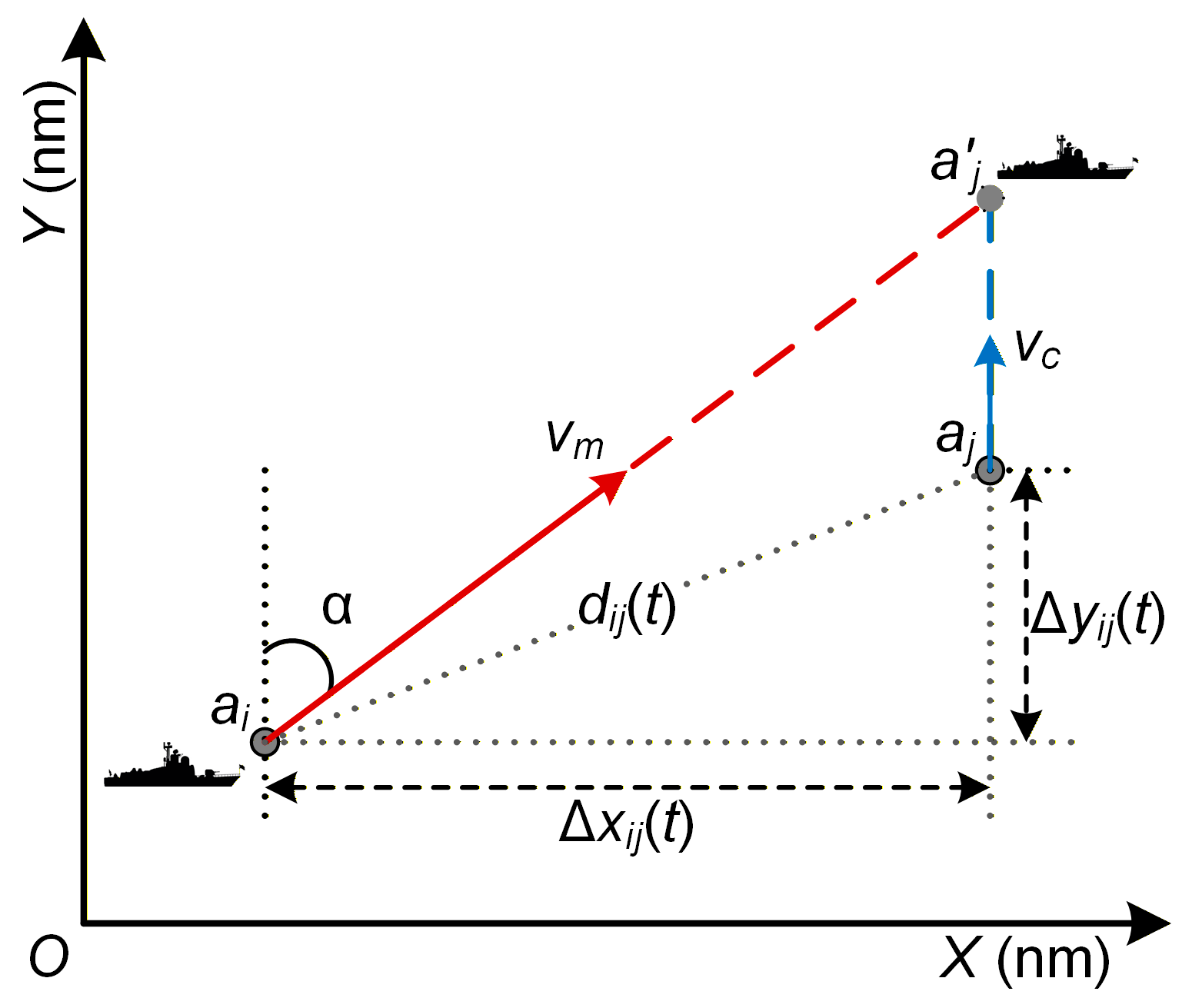
To accurately calculate the travel time t i j required for the replenishment ship to transit from vessel i to vessel j, a Cartesian coordinate system is established. The origin O is defined as the starting position of the replenishment ship at the beginning of the service cycle, with the positive Y -axis aligned with the naval formation’s cruising heading. The kinematic relationship between the nodes is illustrated in Figure 1. Suppose the replenishment ship completes its service for vessel i at time T i e . At this moment, the replenishment ship and the subsequent target vessel j are located at points a i and a j , with coordinates x i ( T i e ) , y i ( T i e ) and x j ( T i e ) , y j ( T i e ) , respectively. The differences in their X and Y coordinates are denoted as Δ x i j ( T i e ) and Δ y i j ( T i e ) , respectively, and the Euclidean distance is d i j ( T i e ) .
Vessel j continues to advance along the positive Y-axis at the formation’s cruise speed v c . Simultaneously, the replenishment ship travels at the tactical speed v m , with a heading α relative to the positive Y -axis. The two units rendezvous at point a j after a travel time of t i j .
Based on Figure 1, the relationship between the position coordinates of the vessel nodes and the travel time is formulated as shown in Equation (1):
v m t i j sin α = Δ x i j ( T i e ) v m t i j cos α = v c t i j + Δ y i j ( T i e )
By solving the system of Equation (1), the expression for the travel time t i j is derived as a function of T i e , as shown in Equation (2):
t i j = F ( T i e ) = v c Δ y i j ( T i e ) + v m 2 [ d i j ( T i e ) ] 2 v c 2 [ Δ x i j ( T i e ) ] 2 v m 2 v c 2
To ensure the kinematic feasibility and numerical stability of the travel time calculation in Equation (2), this model strictly assumes that the tactical speed of the replenishment ship is greater than the cruise speed of the formation ( v m > v c ). This fundamental tactical premise guarantees that the denominator ( v m 2 v c 2 ) is non-zero, thereby avoiding numerical edge cases such as division by zero. Furthermore, it ensures that the discriminant under the square root is always positive, guaranteeing that a unique positive real root always exists for the interception process.

2.3. Speed Adjustment Model

Within a single underway replenishment cycle of a naval formation, the operational behaviors of the vessels are categorized into distinct navigational states.
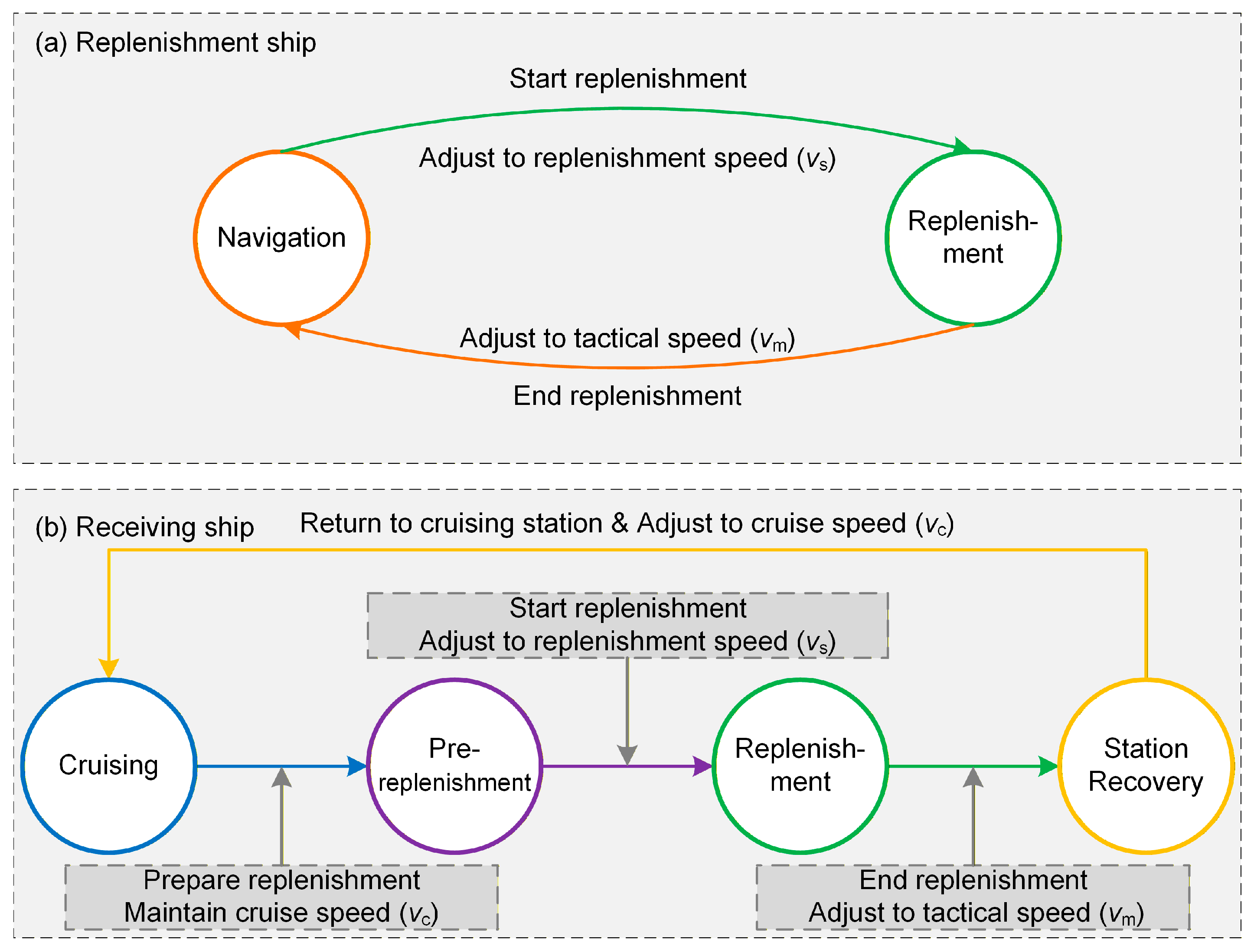
The replenishment ship operates in two primary navigational states, as illustrated in Figure 2a:
Navigation State: At the start of the cycle or upon completion of servicing the current vessel, the replenishment ship adjusts its speed to the tactical speed and proceeds toward the next receiving vessel. During this phase, it strictly adheres to navigational safety protocols and prepares for the upcoming replenishment operations. Alternatively, after servicing the final vessel, it returns to its designated cruise station at tactical speed.
Replenishment State: The replenishment ship maneuvers to the replenishment position, adjusts to the replenishment speed, and establishes a physical connection with the receiving vessel to execute replenishment operations.
Correspondingly, each receiving vessel undergoes four primary navigational states, as depicted in Figure 2b:
Cruise State: The vessel maintains its cruise station and cruise speed, ensuring the overall progression efficiency and tactical security of the formation.
Pre-replenishment State: The crew prepares for the impending operation by calibrating communication and navigation systems to ensure precise alignment with the replenishment ship. Safety equipment, such as guardrails and lines, is deployed to prevent accidents. Crucially, throughout this phase, the vessel maintains its cruise station and speed to preserve the formation stability.
Replenishment State: A physical connection is established between the receiving vessel and the replenishment ship to conduct the transfer. To ensure efficiency and safety, the vessel adjusts to the replenishment position and maintains the replenishment speed.
Station Recovery State: Upon completion of the replenishment operation, the vessel accelerates to the tactical speed to recover its designated cruise station within the formation. Subsequently, it transitions back to the Cruise State to resume the mission.
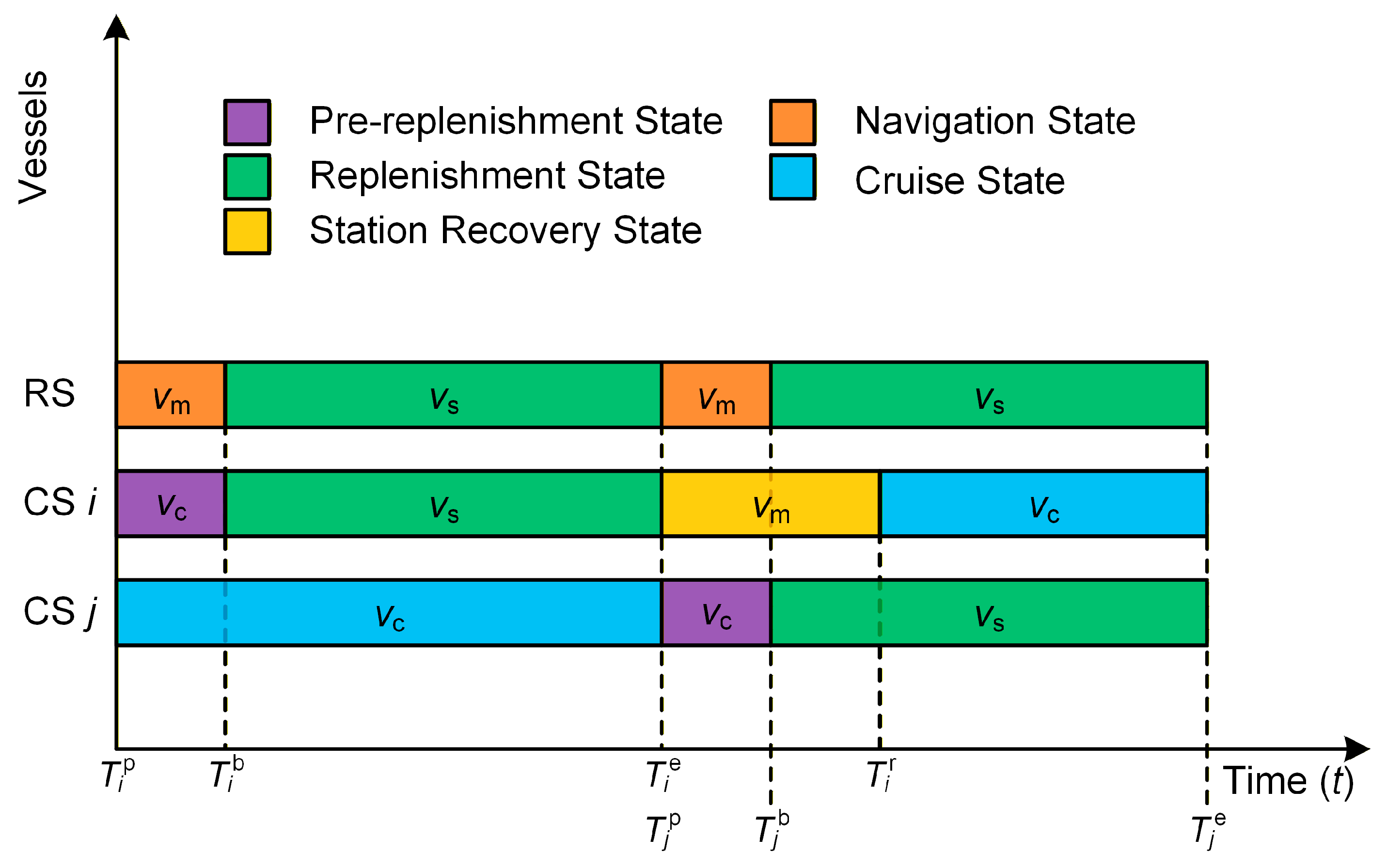
To explicitly illustrate the state transitions of the vessels and their correspondence, a timeline diagram of vessel states is constructed. This diagram takes the start time T i p of the pre-replenishment state for the current receiving vessel i as the origin and the service completion time T j e of the subsequent receiving vessel j as the endpoint, as illustrated in Figure 3.
As detailed in the diagram, the timeline unfolds as follows:
Receiving ship i initiates pre-replenishment operations at time T i p while maintaining the cruise speed v c . At time T i b , it rendezvouses with the replenishment ship to commence the operation, shifts to the replenishment speed v s , and enters the Replenishment State. At time T i e , following the conclusion of the operation, the vessel accelerates to the tactical speed v m and enters the Station Recovery State. Finally, at time T i r , it returns to its designated cruise station, shifts back to the cruise speed v c , and transitions to the Cruise State.
Concurrently, the replenishment ship departs for vessel i at time T i p , entering the Navigation State at the tactical speed v m . At time T i b , it rendezvouses with vessel i to commence the service, shifts to the replenishment speed v s , and enters the Replenishment State. At time T i e , following the conclusion of the operation, the ship accelerates back to the tactical speed v m , re-entering the Navigation State to proceed toward the subsequent vessel j .
Synthesizing the preceding analysis with the operational logic illustrated in Figure 1 through Figure 3, the speed adjustment models for the vessels are formulated as follows:
(1)
Replenishment Ship Speed Adjustment Model: This model characterizes the relationship between the positional coordinates and speed of the replenishment ship during the replenishment cycle. Its formal expression is given in Equation (3).
x 0 ( t ) = x 0 ( t ) + v 0 ( t ) ( t t ) sin α , x 0 ( t ) , t [ T i p , T i b ) t [ T i b , T i e ) y 0 ( t ) = y 0 ( t ) + v 0 ( t ) ( t t ) cos α , y 0 ( t ) + v 0 ( t ) ( t t ) , t [ T i p , T i b ) t [ T i b , T i e ) v 0 ( t ) = v m , v s , t [ T i p , T i b ) t [ T i b , T i e ) ,   i V .
(2)
Receiving Ship Speed Adjustment Model: This model characterizes the relationship between the positional coordinates and speed of the receiving vessel i during the replenishment cycle. Its formal expression is given in Equation (4).
x i ( t ) = x i ( t ) ,   t , t T , t > t y i ( t ) = y i ( t ) + v i ( t ) ( t t ) ,   t , t T , t > t v i ( t ) = v c , v s , v m , t [ 1 , T i b ) [ T i r , L ]   t [ T i b , T i e )   t [ T i e , T i r ) , i V
Crucially, Equation (4) serves as the explicit state constraint for formation stability. By mandating that the receiving ships strictly maintain or promptly recover their cruise speed ( v c ) outside of the necessary replenishment window, the mathematical model rigorously preserves the tactical configuration of the formation in space.

2.4. Underway Replenishment Optimization Model

Based on the preceding problem analysis and assumptions, the dynamic route optimization model is established. During formation cruising, the risk exposure caused by formation perturbations is directly proportional to the duration of the replenishment maneuvers. Therefore, the replenishment cycle time serves as the explicit metric to quantify formation stability.
Objective Function:
min Z = i , j U τ i j z i j
Equation (5) presents the objective term, which aims to minimize the replenishment cycle time for the formation. Given that the service time and speed parameters for each receiving vessel are constant, this is equivalent to minimizing the total travel time of the replenishment ship. Crucially, from a tactical perspective, minimizing this temporal metric directly corresponds to maximizing the overall formation stability, as it strictly minimizes the duration of perturbations in time.
Model Constraints:
j V z 0 j = 1
i U z i h j U z h j = 0 , h V
i V z i 0 = 1
Equations (6) and (8) mandate that the replenishment ship departs from its designated cruise station, and returns to it after completing the replenishment services for the entire formation. Equation (7) represents the flow conservation constraint.
T i b = t T t B i ( t ) , i V
T i e = t T t E i ( t ) , i V
Equations (9) and (10) define the start time and end time of the replenishment service for each vessel, respectively.
t i j = F ( T i e ) , i , j V
Equation (11), based on the relative motion kinematics in Equations (1) and (2), acts as the explicit kinematic stability constraint. It mathematically enforces the tactical premise that the receiving ships hold their courses while the replenishment ship conducts the interception, thereby calculating the required travel time without disrupting the prescribed tactical configuration.
To synchronize the continuous physical movement with the logical state transitions defined in the subsequent temporal constraints, a Continuous–Discrete Hybrid Time Framework is introduced. Specifically, the continuous time domain is discretized into the time period set T with a fine-grained time step ( Δ t ) of 0.01 h (36 s). To ensure strict dimensional consistency within the discrete state-machine, the continuous travel time ( t i j ) calculated by Equation (2) and the continuous service time ( s i ) must be mapped onto this discrete temporal grid as integer step indices. A conservative ceiling function is adopted for this parameter transformation:
τ i j = t i j Δ t
γ i = s i Δ t
Operationally, this upward rounding strategy inherently resolves the numerical edge cases at the discrete grid boundaries (e.g., when a continuous physical time falls between two discrete time steps). It acts as a safety margin, ensuring that the subsequent replenishment state is triggered strictly after the physical rendezvous is fully accomplished. Furthermore, given the remarkably fine-grained Δ t , the maximum synchronization delay per transit is strictly bounded to less than one minute. For a typical fleet replenishment cycle spanning 40 to 50 h, this accumulated temporal perturbation (less than 0.02%) is negligible. Mathematically, such a micro-perturbation is insufficient to alter the topological structure of the optimal routing sequence, thereby preserving the rigorousness of the model constraints while ensuring the structural stability of the macroscopic optimization results.
γ i = t T R i ( t ) , i V
Equation (14) specifies the service time required by vessel i.
T i e = T i b + γ i , i V
T i e + τ i j M ( 1 z i j ) T j b , i , j V
Equation (15) computes the service end time for vessel i, which equals its service start time plus the required service time. Equation (16) determines the arrival time at vessel j, defined as the departure time from vessel i plus the travel time from i to j. Crucially, this also serves as the subtour elimination constraint. In the mathematical formulation, M represents a sufficiently large positive constant utilized to activate or deactivate the logical constraints (e.g., Equations (15) and (16)). To preserve the tightness of the mathematical model and prevent numerical instability during the solution process, the value of M must be carefully calibrated rather than set to an arbitrarily large number. The rationale for choosing the Big-M value in this study is to strictly bound it by the maximum possible temporal span of the discrete state-machine. Consequently, M is set equal to the maximum discrete step index L (which directly corresponds to the planning horizon H ), serving as the tightest valid upper bound for all step-based temporal variables.
t T B i ( t ) = 1 , i V
t T E i ( t ) = 1 , i V
Equations (17) and (18) ensure that vessel i can only commence or conclude service within a single, specific time period.
t = 1 t 1 R i ( t ) M ( 1 B i ( t ) ) , i V , t [ 2 , L ]
t = t L R i ( t ) M ( 1 E i ( t ) ) , i V , t [ 1 , L ]
Equations (19) and (20) guarantee that each vessel remains in a non-service state both before its service commences and after its service concludes.
R i ( t ) 1 M ( 1 B i ( t ) ) , i V , t T
Equation (21) indicates that if vessel i initiates service at time t, it immediately transitions into the service state.
R i ( t ) + R i ( t 1 ) R i ( t ) 1 , i V , t [ 2 , L ] , t [ t + 1 , L ]
Equation (22) ensures the continuity of service for each vessel once it has commenced.
B i ( t ) , E i ( t ) , R i ( t ) , z i j { 0 , 1 } , i , j V , t T .
Equation (23) defines the domains and properties of the decision variables.

3. Solution Method

The URRP constitutes a complex extension of the mTSP, incorporating the dynamic characteristics of the vessels, such as changes in the navigational states and speed adjustments, as well as the impact of replenishment operations on the naval formation. Consequently, the model involves nonlinear constraints and time-varying parameters, classifying the problem as NP-hard. Due to this high computational complexity, exact algorithms are often computationally prohibitive, while traditional heuristics frequently struggle to yield satisfactory solutions within a reasonable timeframe.
Genetic Algorithms (GAs) have demonstrated strong applicability in solving mTSP variants, owing to their superior global search capabilities [16]. However, they are prone to slow convergence and entrapment in local optima. Conversely, Variable Neighborhood Search (VNS) employs diverse neighborhood structures to conduct systematic searches, thereby exhibiting robust local search performance. Leveraging the strengths of both methodologies, this study proposes a Hybrid Genetic Algorithm with Adaptive Variable Neighborhood Search (HGA-AVNS) to address the URRP.
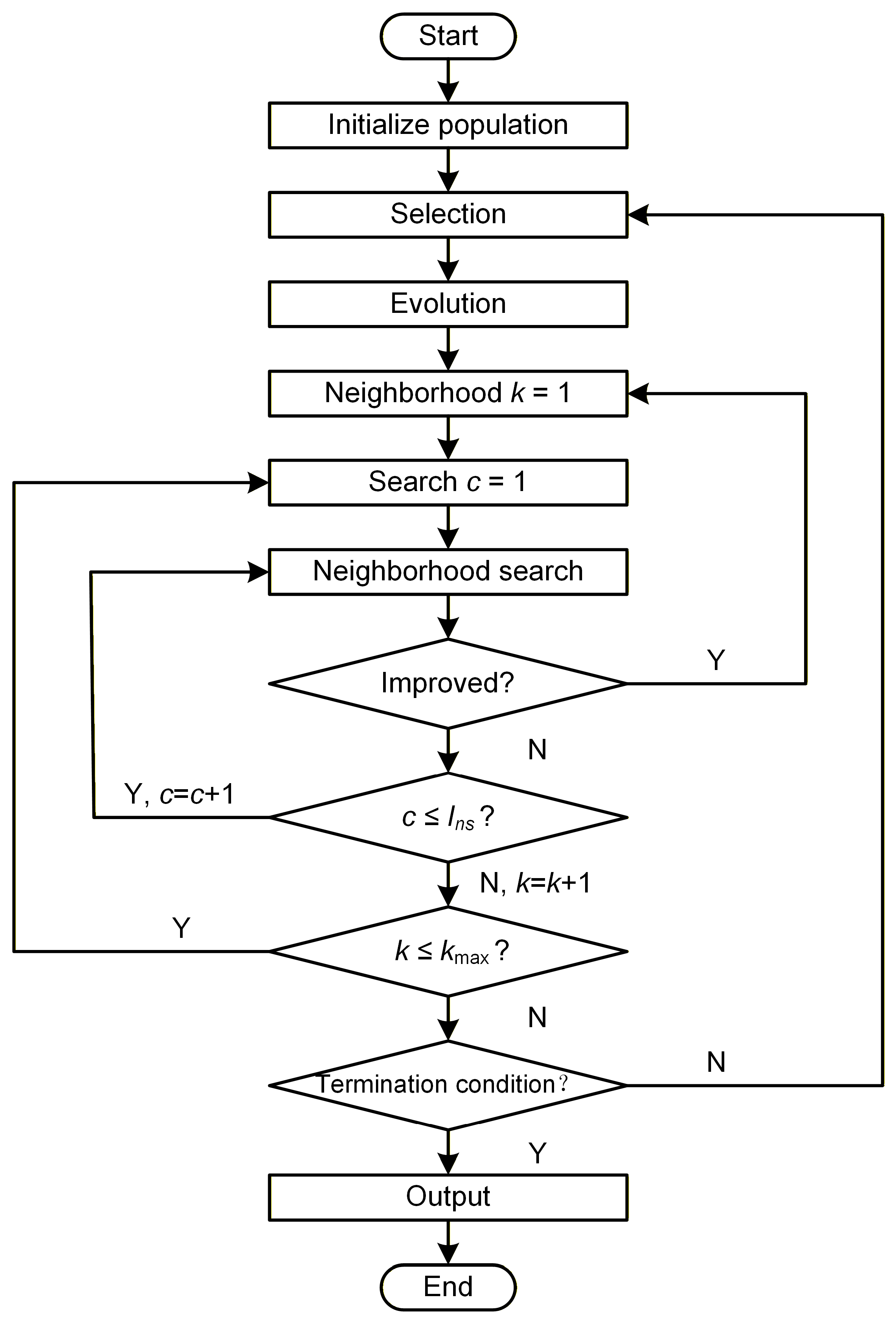
The overall algorithmic procedure is illustrated in Figure 4. This framework integrates GA-based global exploration (selection and evolution) with AVNS-based local exploitation (neighborhood searches). During the local search phase, the algorithm iteratively explores a set of neighborhood structures. Specifically, k denotes the current neighborhood structure index, and k max represents the total number of available structures. The search within each neighborhood k is governed by an iteration counter c , which advances until it reaches the maximum allowed iterations per generation ( I ns ). Finally, the algorithm terminates and outputs the optimal solution when either the predefined maximum number of generations ( G max ) is reached, or the consecutive non-improvement threshold ( G stop ) is met.

3.1. Initialization

This study employs an integer encoding scheme for the chromosomes to represent the service sequence of the replenishment ship. To ensure high randomness and diversity within the initial population, the Chaotic Logistic Map method is utilized. Theoretically derived from the foundational prior art in evolutionary computation [22], chaotic sequences exhibit profound ergodicity and non-periodicity. These mathematical properties therefore guarantee that the generated initial solutions are distributed more evenly across the search space, inherently mitigating the risk of premature convergence. Furthermore, the effectiveness of this chaotic initialization mechanism has been extensively described and validated in the recent literature addressing complex vehicle routing problems [23,24]. The mathematical expression of the Logistic map is presented in Equation (22):
λ n + 1 = r λ n ( 1 λ n ) , n = 1 , 2 , 3 ,
where λ n [ 0 , 1 ] and the control parameter r ( 3.57 , 4 ] . The procedure for generating the initial population via the Chaotic Logistic Map is outlined as follows:
  • Step 1: Initial Value Setting. A random initial value λ 0 within the interval [0, 1] is assigned to each individual.
  • Step 2: Sequence Generation. The Chaotic Logistic Map is applied to the initial value λ 0 of each individual. Through multiple iterations, a chaotic data sequence of length n is generated.
  • Step 3: Individual Generation. The values in the generated sequence are sorted. The indices of these sorted values serve as the gene encoding, thereby forming the chromosomal structure of the individual.
  • Step 4: Population Generation. Steps 1 through 3 are repeated to generate a chaotic initial population characterized by high randomness and diversity.

3.2. Selection Operation

The fitness function of a chromosome is defined as the reciprocal of the objective function. To balance exploration and exploitation, the selection operation employs a hybrid strategy combining Stochastic Universal Sampling (SUS) with an elitist strategy. Theoretically derived from the foundational prior art of Baker [25], SUS fundamentally achieves zero bias and minimum spread. This low-variance selection mechanism, furthermore, is extensively described and validated in the literature addressing complex combinatorial optimization and routing problems [26]. SUS, an enhancement over traditional Roulette Wheel Selection (RWS), operates by placing multiple equally spaced pointers across a selection interval proportional to cumulative fitness. This mechanism ensures that the probability of selecting a chromosome remains strictly proportional to its fitness while mitigating random fluctuations inherent in single-pointer methods, thereby bolstering selection stability and efficiency. Under this framework, chromosomes with higher fitness possess a greater probability of selection. Concurrently, the elitist strategy preserves the optimal individual from the current generation, directly transferring it to the next generation to replace the least fit individual. This guarantees the inheritance of superior genetic traits. The integration of these two methods yields synergistic benefits: SUS fosters global search capability, while the elitist strategy prevents the loss of high-quality solutions. This combined approach, consequently, guarantees both population diversity and selection stability, accelerating the algorithm’s convergence.

3.3. Evolutionary Operation

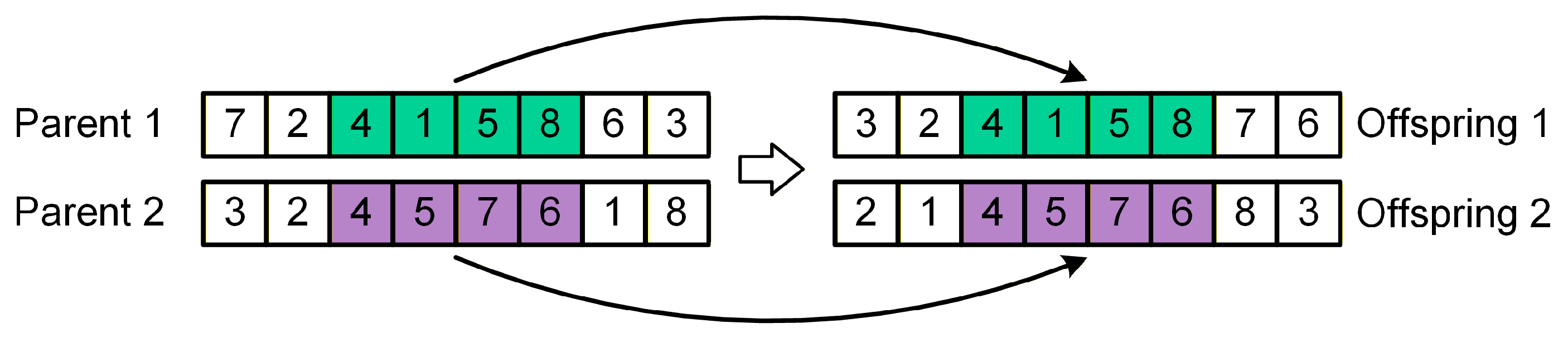
The evolutionary operation utilizes a sequential crossover operator [27]. As illustrated in Figure 5, when performing sequential crossover on Parent 1, an individual is randomly selected from the population as Parent 2. To generate Offspring 1, two cut points are randomly chosen in Parent 1. The elements between the two cut points are copied directly to the offspring. The remaining elements are filled from the beginning of Parent 2, maintaining their relative order while omitting any elements already present in the segment copied from Parent 1. Subsequently, Offspring 2 is generated using the same procedure with the parental roles reversed.

3.4. Neighborhood Search Strategy

3.4.1. Neighborhood Structures

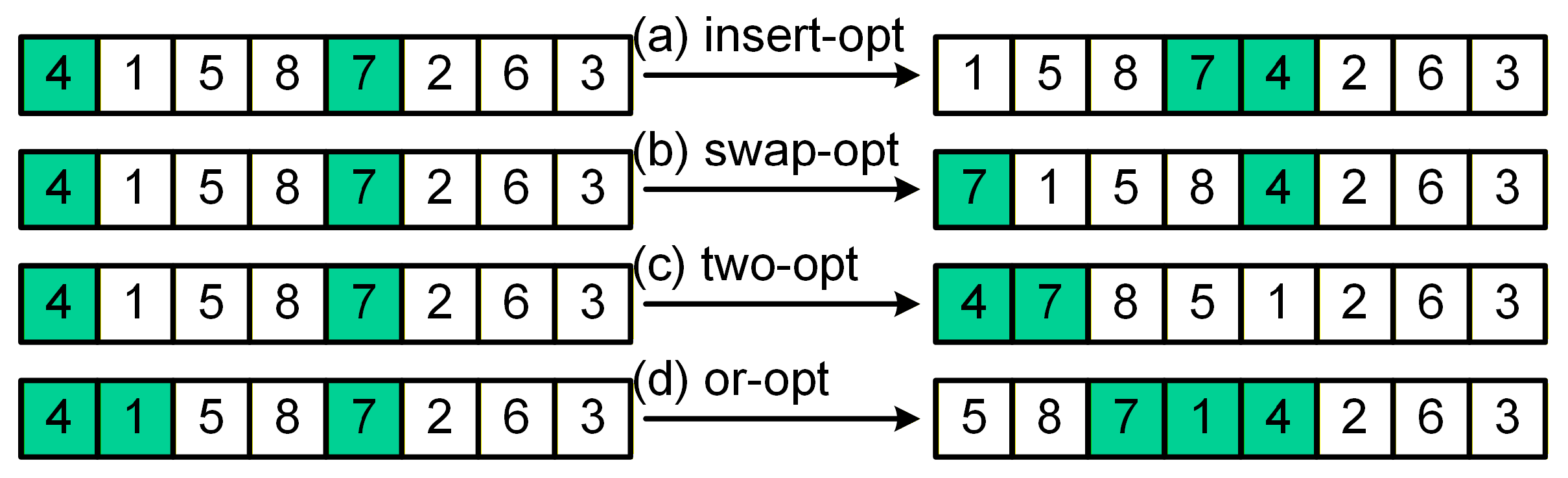
Four neighborhood structures are adopted to enhance the algorithm’s local search capability, as illustrated in Figure 6.
  • Insert-opt: Two elements i and j are randomly selected, and element i is inserted after element j . As shown in Figure 6a, elements 4 and 7 are randomly chosen, and element 4 is inserted after element 7.
  • Swap-opt: Two elements i and j are randomly selected, and their positions are swapped. As shown in Figure 6b, the positions of elements 4 and 7 are exchanged.
  • Two-opt: Two elements i and j are randomly selected, and the subsequence between them is reversed. As shown in Figure 6c, the position of element 4 remains unchanged, while the subsequence containing elements 1, 5, 8, and 7 is reversed.
  • Or-opt: Two consecutive elements i and j are randomly selected, reversed in order, and inserted after a randomly chosen element h . As shown in Figure 6d, the consecutive elements 4 and 1 are selected, reversed in order, and inserted after element 7.
Figure 6. Schematic diagrams of the four neighborhood structures utilized in the local search phase. The green blocks highlight the specific target elements (vessel nodes) selected for positional transformations. Specifically, (a) insert-opt relocates a single node after a target position; (b) swap-opt exchanges the positions of two selected nodes; (c) two-opt reverses the sequence of the sub-tour bounded by the target edges; and (d) or-opt relocates two consecutive nodes to a new position while simultaneously reversing their internal order.
Jmse 14 00714 g006

3.4.2. Adaptive Mechanism

During the iterative process, the frequency of neighborhood searches significantly influences the algorithm’s search capability and overall performance. In the initial stage of iteration, a reduced number of searches facilitates the population’s rapid convergence toward the optimal solution. As the iteration progresses, progressively increasing the search frequency effectively enhances the algorithm’s exploration capability, thereby optimizing overall performance. The adaptive search strategy is formulated as shown in Equation (25):
I ns = φ 1 + φ 2 G max g e n G max .
where I ns denotes the neighborhood search count at generation g e n , G max represents the preset maximum number of iterations, φ 1 and φ 2 are strategy parameters, and x and x denote the floor (rounding down) and ceiling (rounding up) functions, respectively.

3.4.3. New Solution Acceptance Mechanism

To enhance the algorithm’s ability to escape local optima, a new solution acceptance strategy is designed by incorporating the Metropolis criterion from Simulated Annealing (SA). The acceptance probability is calculated as shown in Equation (26):
P acc = 1 , if   Δ f < 0 exp Δ f T e m p , if   Δ f 0
The temperature value T e m p at generation g e n decays according to Equation (27):
T e m p = T e m p 0 exp ( η g e n ) .
where Δ f denotes the difference in objective function values between the new solution and the current solution; T e m p 0 and η represent the preset initial temperature and cooling rate for this mechanism, respectively.

4. Computational Experiment and Analyses

The numerical experiments were organized into three distinct sets. The first set presented a case study analysis, utilizing a formation composed of one replenishment ship and twelve combatant ships as a representative scenario to analyze the dynamic service process of the replenishment ship during underway replenishment. The second set focused on a comparative algorithmic analysis, benchmarking the proposed HGA-AVNS against traditional heuristic algorithms to evaluate their respective performance. The third set performed a sensitivity analysis to investigate the impact of replenishment speed and cruise speed on the formation’s replenishment cycle time.
All numerical experiments were executed in a Python 3.12 environment. The computational experiments were conducted on a platform equipped with an Intel(R) Xeon(R) W-2102 CPU @ 2.90 GHz (Intel Corporation, Santa Clara, CA, USA) and 16 GB of RAM. Following extensive parameter tuning, the core algorithmic parameters for HGA-AVNS were configured as follows: population size P size = 100 ; initialization parameter r = 3.99 ; adaptive parameters φ 1 = 1 , φ 2 = 0.01 ; and acceptance parameters T e m p 0 = 4.8 , η = 0.05 . To ensure a computationally fair comparison, the stopping criteria were scientifically tailored to the convergence characteristics and per-generation complexity of each algorithm. Specifically, the proposed HGA-AVNS incorporates an intensive local search within each iteration, leading to deeper spatial exploration but a higher computational load per generation. Thus, it terminates either when the maximum number of iterations reaches G max = 500 or when the early stopping threshold is triggered (i.e., no improvement for G stop = 100 consecutive generations). Meanwhile, considering that traditional GA and VNS lack embedded deep-search mechanisms and have much lower per-generation complexity, they naturally require more iterative steps to fully explore the solution space. To guarantee them ample search opportunities, their stopping criteria were correspondingly relaxed: the maximum number of iterations was extended to G max = 1000 , and the early stopping threshold was set to G stop = 200 . This configuration explicitly balances the total computational time budget, ensuring that all algorithms are evaluated near their maximum convergence potential.

4.1. Case Description

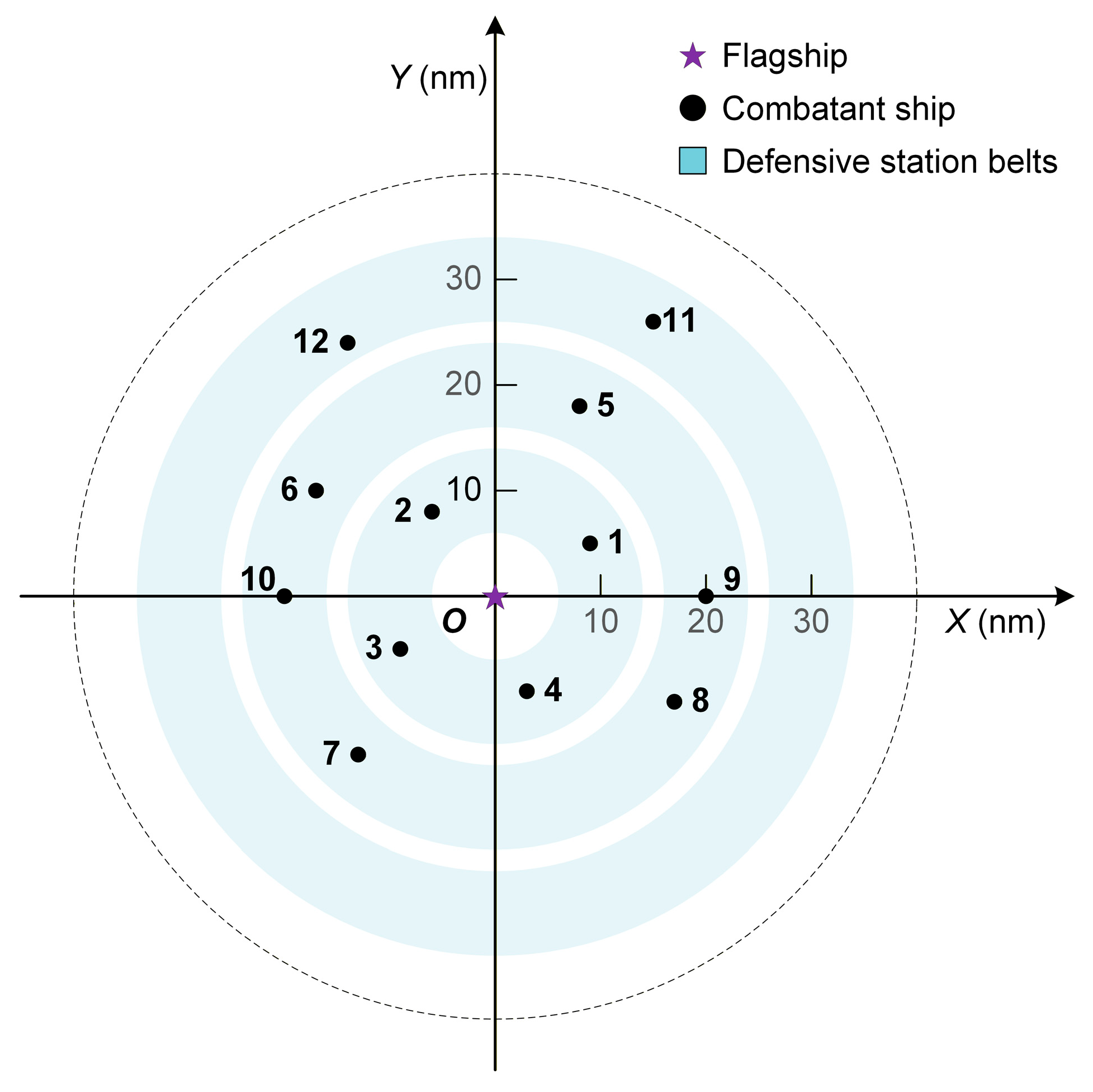
Using an aircraft carrier formation as a representative case, the formation configuration positions the aircraft carrier as the flagship at the center, surrounded by dispersed combatant ships. Typically, the formation establishes three defensive station belts (designated as the 10, 20, and 30 nm belts), which span distances of 8–12 nm, 18–22 nm, and 28–32 nm from the aircraft carrier, respectively.
A two-dimensional Cartesian coordinate system is defined with the aircraft carrier’s cruising station as the origin and the formation’s cruising direction as the positive Y-axis. To generate test instances of varying scales, a predetermined number of station points are randomly generated within these three belts to serve as the cruising stations for the combatant ships. The explicit mathematical procedure used to synthesize these multi-scale test instances is detailed in Algorithm A1 (see Appendix A). To facilitate reproducibility, a set of representative benchmark instances generated by this procedure is provided in the Supplementary Materials (Data S1). Table 2 presents the detailed specifications of these instances. The parameter settings for the instances are as follows: replenishment speed of 12 kn, cruise speed of 16 kn, tactical speed of 24 kn, and required service time per vessel of 2 h. Additionally, the planning horizon length H is dynamically pre-estimated based on the scale of the instance to ensure that all feasible service sequences are fully enclosed. For instance, H is set to 50 h for the 12-ship instances, which correspondingly determines the size of the discrete time set as L = H / Δ t = 5000 .

4.2. Optimization Results

To validate the proposed model and demonstrate its effectiveness, the HGA-AVNS algorithm was applied to test instance S12-1. This yielded an optimal replenishment strategy, which was subsequently compared with traditional ones. The station distribution of each vessel in this instance is illustrated in Figure 7. Point O represents the aircraft carrier’s cruising station, and the positive direction of the Y -axis indicates the formation’s heading. The initial position data for each vessel is detailed in Table 3.
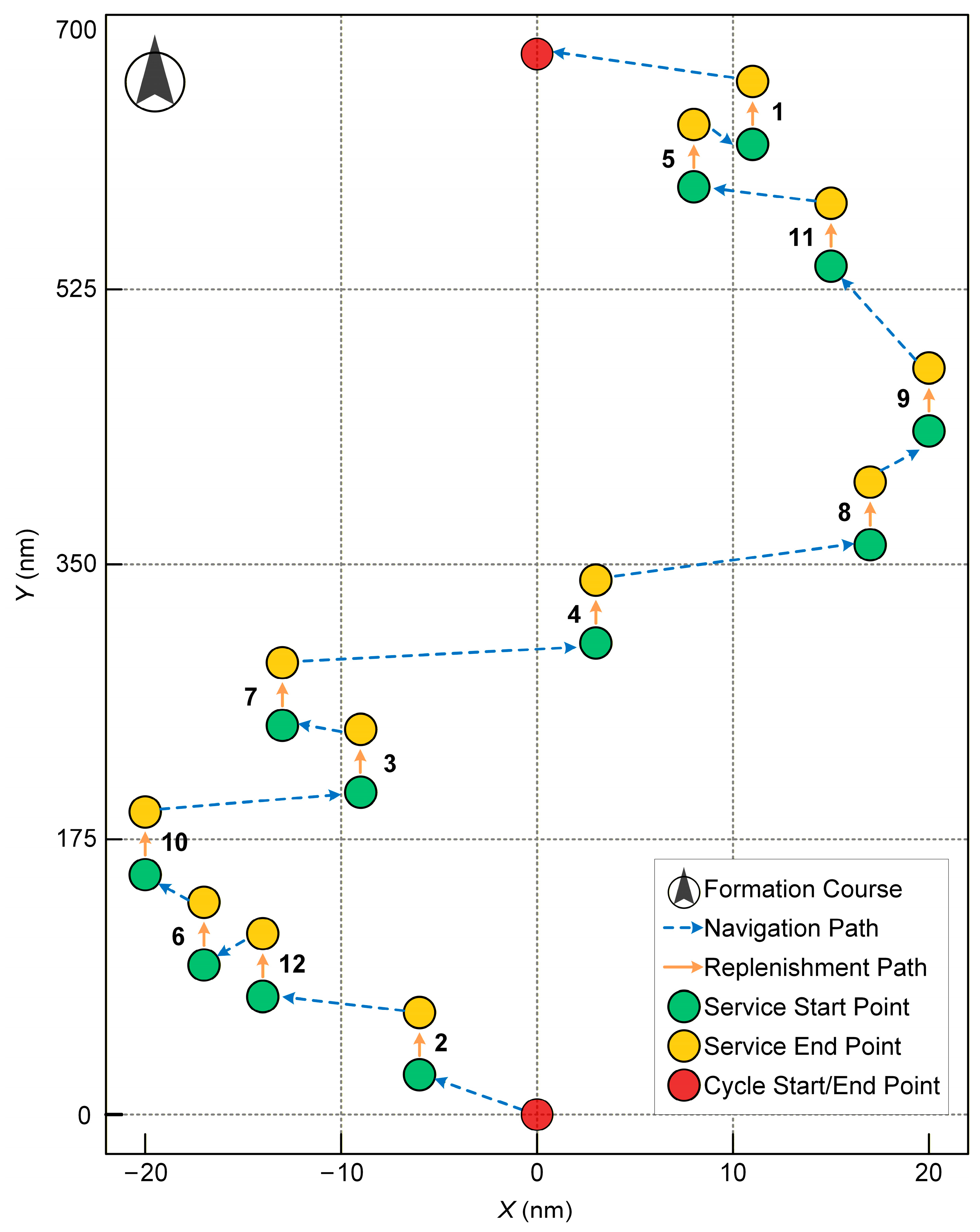
The computed optimal solution, derived from the stability-aware model, is depicted in Figure 8. Under this strategy, the replenishment ship follows the service route 2-12-6-10-3-7-4-8-9-11-5-1, resulting in a replenishment cycle time of 40.61 h. Figure 8 visualizes the dynamic service process of the replenishment ship during the formation’s underway replenishment operation, with specific service details listed in Table 4.
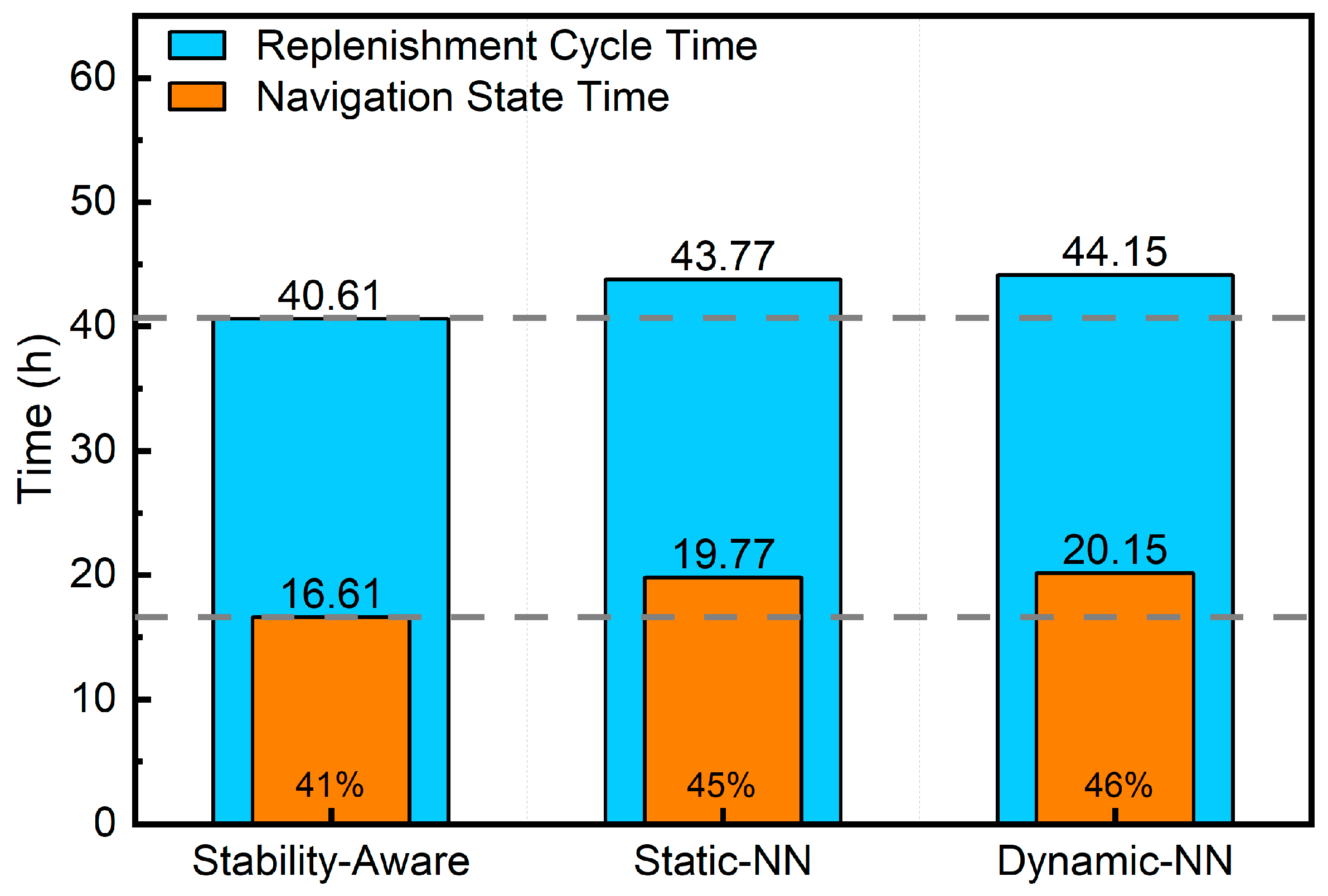
Furthermore, the stability-aware strategy was benchmarked against two traditional empirical replenishment methods, with the comparative results presented in Figure 9. The Static-NN strategy represents a static mode where the next service target is selected solely based on the initial vessel positions, employing a “nearest neighbor” logic. The Dynamic-NN strategy represents a dynamic mode that accounts for vessel mobility; here, the replenishment ship selects the nearest available vessel as the next target immediately after completing the current service.
As illustrated in Figure 9, compared to the two traditional strategies, the proposed stability-aware strategy achieves the shortest replenishment cycle time and the lowest travel time for the replenishment ship. Notably, the proportion of time spent in the navigation state is minimized to 41%. These results demonstrate that the proposed strategy effectively reduces the replenishment cycle duration and significantly enhances the formation’s replenishment efficiency.

4.3. Test the Performance of the Algorithm

To rigorously evaluate the performance of the proposed HGA-AVNS, the computational experiments are structured progressively. The effectiveness of the core algorithmic operators is first validated in Section 4.3.1 to establish a solid foundation. Subsequently, the overall algorithmic performance is benchmarked against existing methods across small-scale and multi-scale instances in Section 4.3.2 and Section 4.3.3, respectively.
To ensure consistency and clarity across all test instances, the statistical metrics reported in the subsequent comparative experiments (Section 4.3.2 and Section 4.3.3) are formally defined as follows:
  • O P T : The exact objective value (optimal solution) obtained via the Enumeration Method for small-scale instances.
  • B e s t : The optimal objective value (i.e., the shortest replenishment cycle time) obtained over 30 independent runs.
  • A v g : The average objective value achieved over 30 independent runs.
  • C P U : The average computational time (in seconds) consumed per run.
  • D e v : The variability metric used to quantify the algorithmic stability, calculated as the relative deviation between the average and the best values: D e v = [ ( A v g B e s t ) / B e s t ] × 100 % . A smaller D e v value indicates higher stability.
  • G a p : The relative deviation of the average objective value from a reference benchmark, used to evaluate solution quality. For small-scale instances, the exact solution ( O P T ) serves as the benchmark, calculated as G a p = [ ( A v g O P T ) / O P T ] × 100 % . For multi-scale instances, where exact solutions are computationally prohibitive to obtain, the proposed HGA-AVNS serves as the benchmark, calculated as G a p = [ ( A v g baseline A v g HGA ) / A v g HGA ] × 100 % where A v g baseline represents the average objective value of the comparison algorithm (i.e., GA or VNS).

4.3.1. Effectiveness Validation of the Algorithmic Operators

Comparative experiments were designed to validate the effectiveness of the population initialization operator based on the Logistic map and the selection operator based on Stochastic Universal Sampling (SUS). These experiments were conducted on a large-scale instance L48-2 (n = 48). Core modules, including the Adaptive Variable Neighborhood Search (AVNS), remained unchanged to ensure a fair comparison. Three algorithms were configured for comparison by substituting the population initialization and selection operators:
  • HGA-AVNS-V1: Random initialization + Roulette Wheel Selection (RWS);
  • HGA-AVNS-V2: Logistic map initialization + Roulette Wheel Selection (RWS);
  • HGA-AVNS (Proposed Algorithm): Logistic map initialization + Stochastic Universal Sampling (SUS).
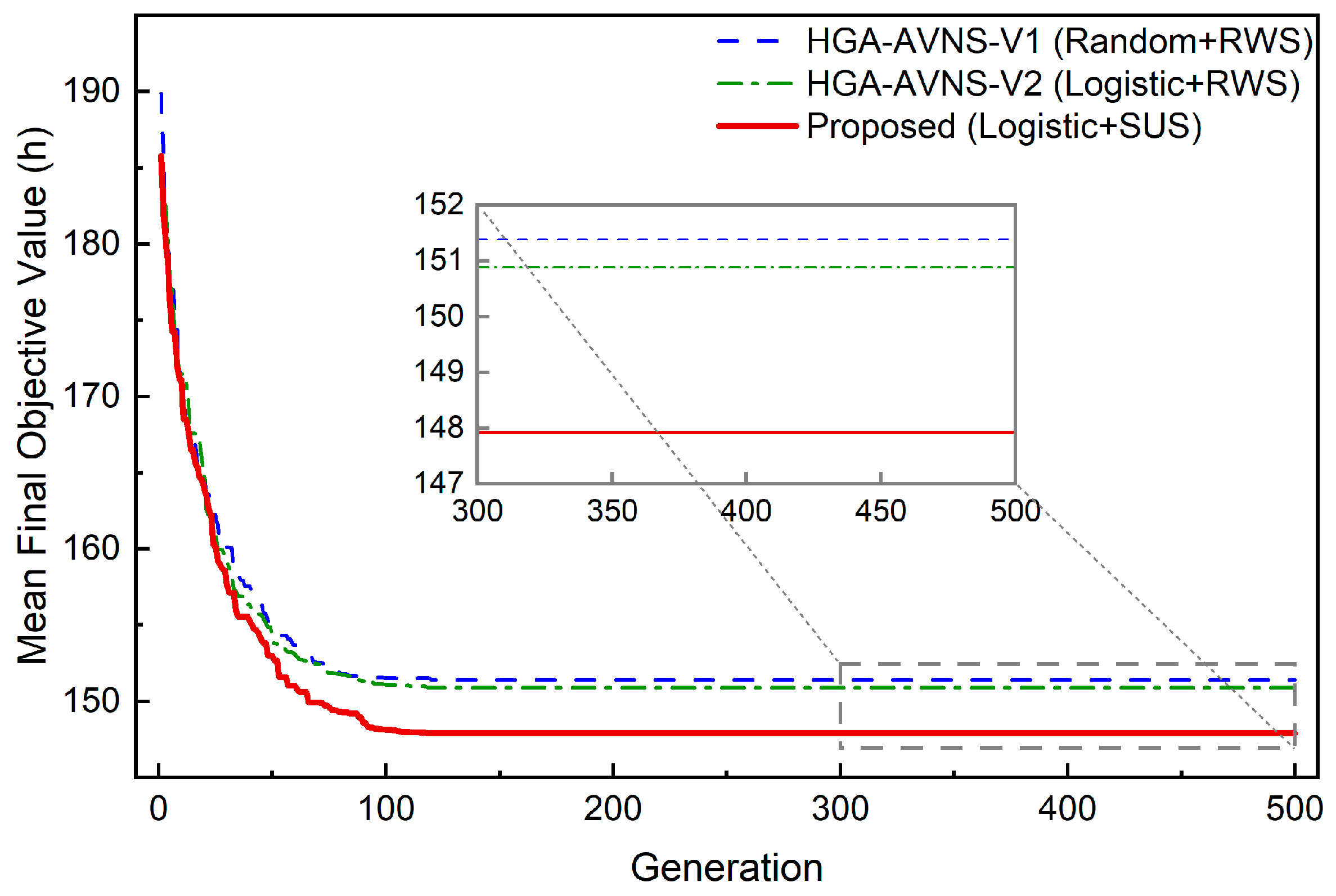
Table 5 summarizes the statistical metrics from 30 independent runs for each algorithm, while Figure 10 depicts the average convergence curves.
The performance of the initialization operators can be evaluated by comparing V1 and V2, with the selection operator fixed as RWS. The introduction of the Logistic map increased the standard deviation of the initial population’s objective values ( σ init ) in V2 from 4.20 to 21.29, compared to the random initialization in V1. The proposed algorithm similarly reached 21.21. The ergodicity of the Logistic map therefore distributes the initial population more evenly within the solution space. This mechanism significantly improves initial population diversity.
Evaluating the SUS selection operator requires comparing V2 and the proposed algorithm, maintaining the Logistic map initialization as a fixed baseline. Figure 10 reveals that algorithms employing RWS (V1 and V2) stagnated in local optima during iterations. The proposed algorithm, conversely, converged to a lower final objective value. Statistical metrics (Table 5) corroborate this visual trend. The proposed algorithm achieved the best mean final objective value ( μ final = 148.77 h) across 30 independent runs, yielding the smallest standard deviation ( σ final = 0.59 ). A lower mean value directly reflects stronger global search capabilities. The minimized standard deviation, furthermore, demonstrates stability in the optimization results.
The calculation results from these comparative experiments objectively validate the algorithmic design choices. Introducing the Logistic map method effectively enhances initial population diversity. The SUS operator, subsequently, fortifies both the global search capability and the stability of the final solutions. The integration of these two operators into the proposed framework is rigorously justified.

4.3.2. Small-Scale Test Instances

To validate the effectiveness of the HGA-AVNS algorithm, a comparative study was conducted using small-scale instances. The Enumeration Method (ENUM) was first employed to determine the exact solution (OPT) for these instances. Subsequently, both the traditional Genetic Algorithm (GA) and the proposed HGA-AVNS were applied to solve the same instances, with each algorithm executed for 30 independent runs. The comparative results are summarized in Table 6.
As evidenced by Table 6, compared to the traditional GA, the HGA-AVNS algorithm demonstrates the capability to obtain high-quality solutions within a shorter computational time. The deviation from the exact solution is minimal, with an average gap of only 0.07%, thereby confirming the algorithm’s validity and efficiency.

4.3.3. Multi-Scale Test Instances

To demonstrate the superiority of the HGA-AVNS algorithm, comparative experiments were conducted using test instances of varying scales. The proposed HGA-AVNS was benchmarked against the GA and VNS. Each algorithm was executed for 30 independent runs on each instance. A comparative summary of the results is presented in Table 7.
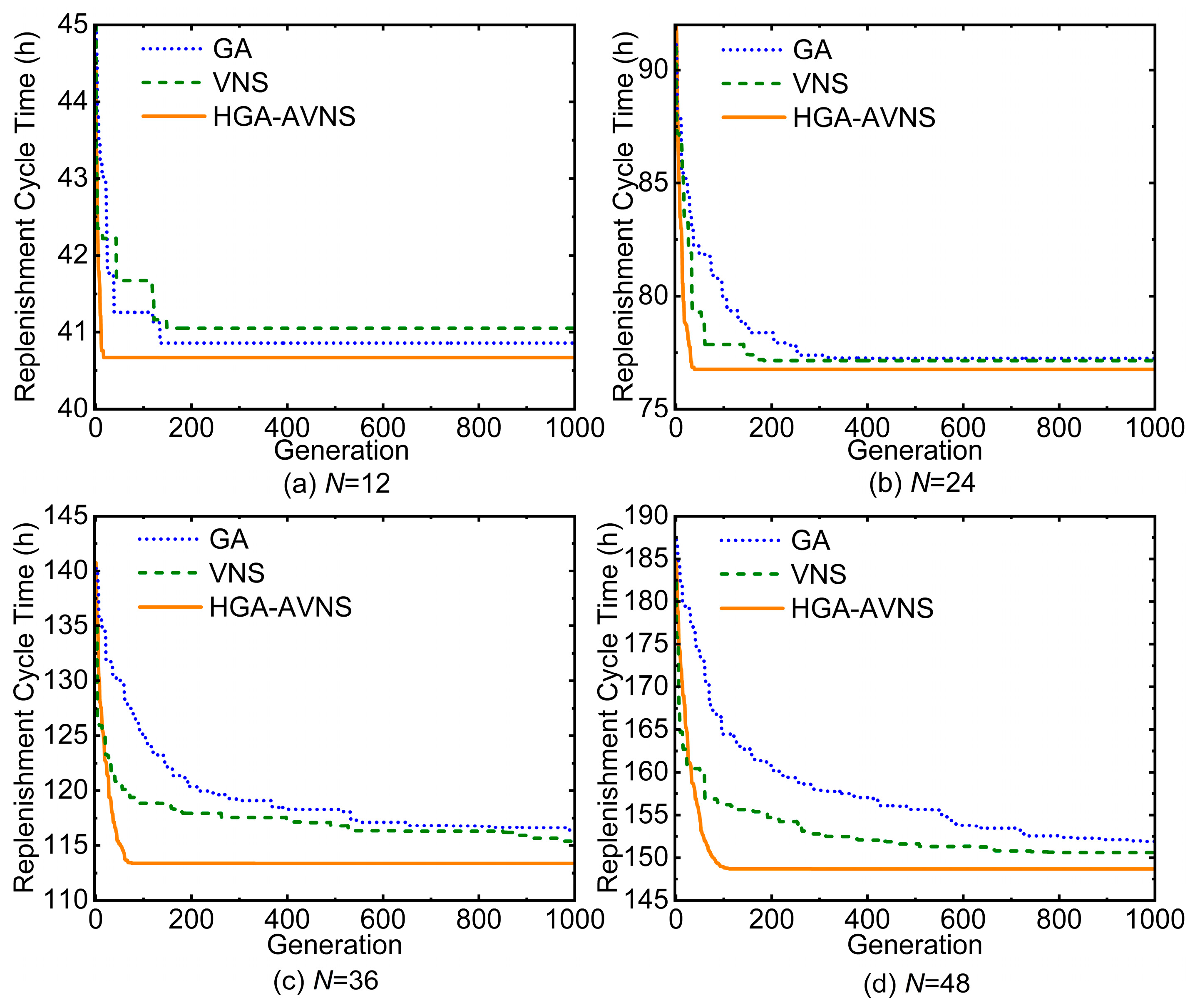
To further analyze convergence behavior, representative instances of different scales were selected and solved using the three methods. The resulting convergence curves are illustrated in Figure 11.
Discussion of Results: As indicated in Table 7, while all three algorithms successfully obtained feasible solutions (satisfactory solutions) across instances of varying scales, the computational time naturally increased with the instance size. Notably, the HGA-AVNS algorithm demonstrated the ability to obtain high-quality solutions significantly faster than the other two methods.
The Gap metrics reveal that the solutions obtained by HGA-AVNS consistently outperformed those of the other two algorithms across all scales. The deviations for GA and VNS relative to the proposed algorithm ranged from 0.15% to 3.62% and 0.15% to 2.66%, respectively. Furthermore, the Dev results demonstrate that the stability of the proposed algorithm—with values ranging between 0.07% and 0.77%—is superior to that of the comparison methods.
As illustrated in Figure 11, across different scale scenarios, the HGA-AVNS algorithm exhibits a faster convergence rate and achieves superior objective values compared to both GA and VNS after a designated number of iterations. In summary, the HGA-AVNS algorithm surpasses both GA and VNS in terms of computational speed and solution quality, demonstrating higher efficiency and stability in solving the problem.

4.4. Sensitivity Analyses

The preceding experiments evaluated the algorithmic performance under deterministic settings. However, actual maritime operations involve variable operational configurations and inevitably encounter complex marine conditions and random events. To analyze the impact of these practical factors on the replenishment cycle time, this section conducts sensitivity analyses across three dimensions. Specifically, we investigate the sensitivity of the cycle time to internal kinematic parameters (speed configurations, Section 4.4.1), external marine conditions (ocean currents, Section 4.4.2), and sudden random events (tactical turning, Section 4.4.3).

4.4.1. Sensitivity to Speed Configurations

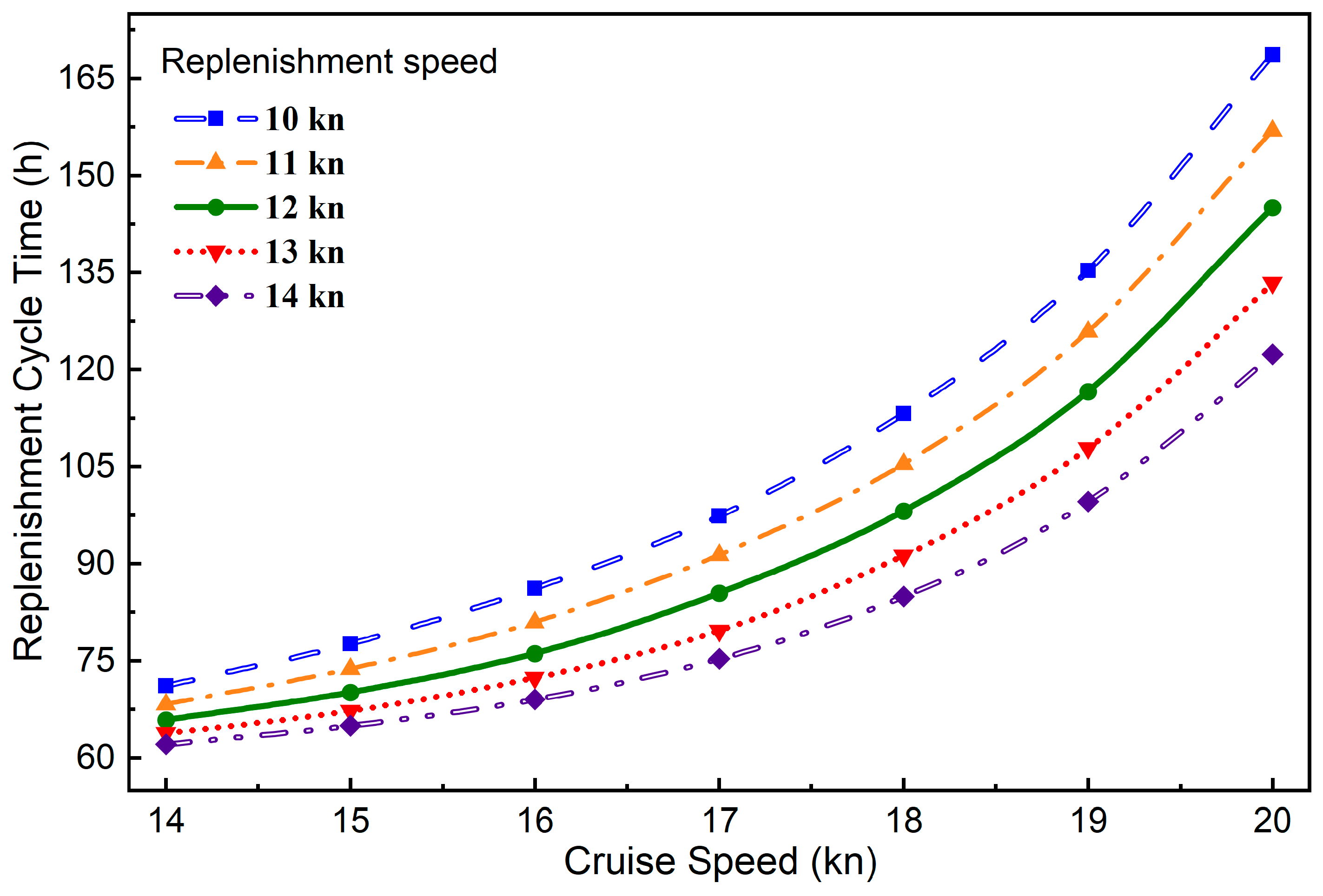
To investigate the sensitivity of the formation’s replenishment cycle time to variations in cruise and replenishment speeds, comparative experiments were conducted using test instance M24-2. The cruise speed was varied within the range of 14–20 kn, and the replenishment speed within 10–14 kn. Figure 11 illustrates the replenishment cycle time under these varying conditions.
Key observations from Figure 12 include:
Impact of Replenishment Speed: With the cruise speed held constant, an increase in replenishment speed yields a reduction in cycle time. For instance, at a fixed cruise speed of 16 kn, the differential in cycle time between replenishment speeds of 10 kn and 14 kn is 17.08 h.
Impact of Cruise Speed: An increase in the formation’s cruise speed, conversely, results in a prolonged replenishment cycle time when the replenishment speed is fixed. Taking a replenishment speed of 12 kn as a baseline, the cycle time disparity between cruise speeds of 14 kn and 20 kn amounts to 79.21 h.
Mechanism Analysis: These phenomena are attributed to the relative motion dynamics between vessels. A higher replenishment speed paired with a lower cruise speed effectively shortens the relative distance the replenishment ship must traverse to intercept the next target. This reduces the navigation time required for transit, thereby decreasing the overall cycle duration.
Conclusion: The data indicate that at lower cruise speeds, the sensitivity of the total time to replenishment speed variations is relatively minor. Appropriately reducing the formation’s cruise speed, provided operational missions remain uncompromised, is therefore conducive to significantly shortening the replenishment cycle duration.

4.4.2. Sensitivity to Ocean Currents

In actual maritime operations, naval formations inevitably encounter complex environmental disturbances, such as ocean currents and waves, which introduce significant uncertainty into travel and operational times. To quantify the impact of such disturbances on the replenishment cycle time, a sensitivity analysis focusing on ocean currents is conducted in this section. The optimal baseline solution obtained in Section 4.1 (baseline replenishment cycle time of 40.61 h) serves as the test subject. Current vectors with varying speeds ( v cur = 1 , 2 , 3 , 4 knots) and four discrete relative current angles ( δ = 0 ° , 45 ° , 135 ° , 180 ° ) are introduced as environmental perturbations. Within this configuration, speeds from 1 to 3 knots simulate typical current conditions, whereas a speed of 4 knots serves as a stress test under extreme environments. The angle δ , meanwhile, defines the angle between the current direction and the formation’s baseline heading. Encountering significant pure beam currents ( δ = 90 ° ) forces vessels to maintain large yaw angles to resist lateral drift. This drastically deteriorates the hydrodynamic interactions between two ships during close-quarters alongside replenishment. Strong beam current conditions, given the extremely high risks of control loss and collision, lack safe operational feasibility. Such scenarios are thus excluded a priori from the time efficiency analysis of this study.
Physically, maintaining the designated route and formation stability requires each vessel to dynamically adjust its yaw angle to counteract current-induced lateral drift. Based on the principles of ship kinematics and vector composition, this anti-drift manipulation directly reshapes the formation’s actual Speed Over Ground (SOG). The replenishment speed (12 kn) and tactical speed (24 kn), as rigid operational constraints, remain strictly constant during this process. The former guarantees the safety of the alongside operation; the latter ensures the controllability of the rendezvous time, thereby supporting the coordinated execution of subsequent replenishment procedures.
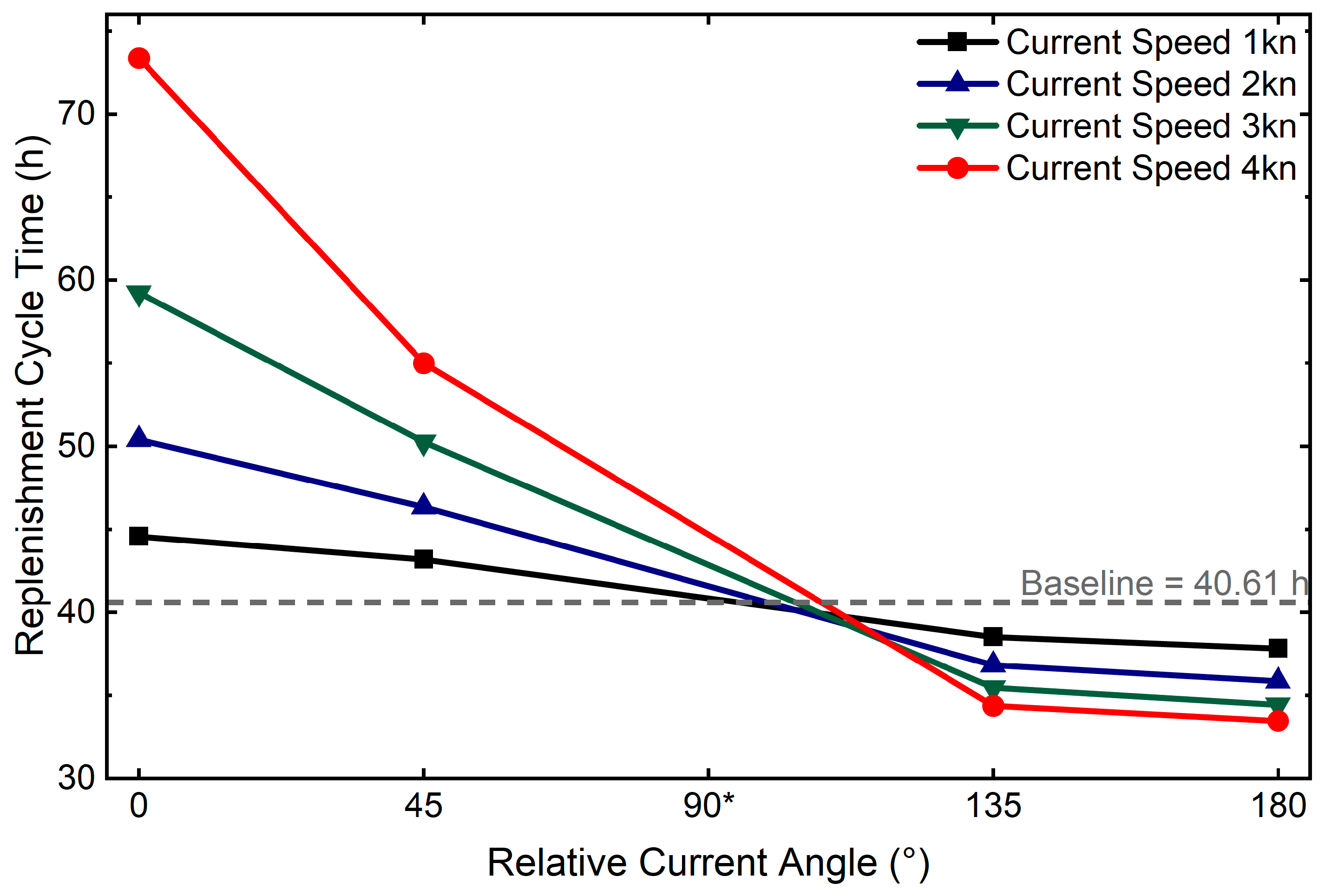
Table 8 and Figure 13 illustrate the impact of varying current conditions on the replenishment cycle time.
The experimental results identify ocean currents as a critical environmental factor affecting formation replenishment efficiency, exhibiting clear angle dependency and speed amplification effects. Within the tested typical speed range (1–3 knots), the total replenishment cycle time increases by up to 45.95% (relative to the baseline) under a 3-knot following current and decreases by up to 15.19% under a 3-knot head current. These data visually reveal the operational boundaries of the generated optimization solution under current influences, verifying the necessity of incorporating real-time current data into route planning. Specifically, guided by formation stability considerations, ocean currents alter the formation’s overall SOG. This alteration directly extends or shortens the travel time required for the replenishment ship to chase between service nodes, with quantitative findings as follows:
(1)
Cycle Time Extension under Following and Quartering Currents. Encountering following ( δ = 0 ° ) or quartering ( δ = 45 ° ) currents elevates the formation’s overall SOG via a forward superposition effect of the current. The replenishment ship, constrained by a constant tactical speed, consequently requires more travel time to reach the receiving ships operating at higher actual ground speeds. The results show that speed increases yield evident time consumption growth: under a 3-knot following current, the total time extends to 59.27 h (a 45.95% increase from the baseline); under the 4-knot extreme following current test, the time further increases to 73.38 h (an 80.69% increase).
(2)
Cycle Time Reduction under Head and Bow Quartering Currents. Conversely, head ( δ = 180 ° ) or bow quartering ( δ = 135 ° ) currents reduce the formation’s overall SOG due to a reverse superposition effect of the current. The replenishment ship, maintaining its constant tactical speed, catches up more easily with receiving ships traveling at reduced cruise speeds. This effectively shortens the travel time. Higher speeds produce more pronounced time reductions. Under the 4-knot extreme head current condition, the total replenishment cycle time drops to a global minimum of 33.47 h (a 17.58% reduction from the 40.61 h baseline).
(3)
Asymmetrical Distribution of Current Impacts. Combining the values in Table 8 with the trends in Figure 13 reveals an asymmetrical effect. The time increase magnitude triggered by forward currents ( 0 ° , 45 ° ) is significantly larger than the time reduction magnitude induced by reverse currents ( 180 ° , 135 ° ). At a speed of 4 knots, for instance, the absolute added time from the following current (+32.77 h) substantially outweighs the time saved by the head current (−7.14 h).
In summary, marine environmental factors trigger substantial fluctuations in actual replenishment operational times. The fundamental premise of the aforementioned current impact mechanisms lies in this study’s core optimization constraint: formation stability. Without the combat context of maintaining formation, receiving ships could simply execute head-on maneuvers to drastically shorten rendezvous times. Under the rigid requirements of holding defensive stations, however, target vessels must strictly maintain their designated cruise headings and speeds. Based precisely on this combat-oriented stability premise, commanders can counteract the severe cycle extension risks induced by forward currents. They can achieve this by uniformly and moderately reducing the formation’s Speed Through Water (STW) to offset the passive elevation of the overall SOG caused by the current’s forward superposition. This tactical adjustment effectively suppresses the divergence of travel chase times while guaranteeing formation stability, thereby avoiding systematic time losses.

4.4.3. Sensitivity to Tactical Turning

In actual maritime operations, naval formations frequently encounter sudden random events such as tactical evasion. To analyze the impact of such random events on the replenishment cycle time of the formation, this section conducts a sensitivity analysis concerning sudden formation turning maneuvers. Based on the optimal baseline solution obtained in Section 4.1 (with a baseline replenishment cycle time of 40.61 h), this experiment introduces sudden right-turning commands with varying angles ( θ = 10 ° , 20 ° , 30 ° ) at different mission stages (i.e., command issue times at 10, 20, 30, and 40 h). Considering the high risks associated with alongside navigation during underway replenishment, the course plan adheres to the strict safety principle of “Operation First, Execute Later.” If a turning command is issued while the replenishment ship is in an active replenishment state (e.g., at 10 h and 20 h), the actual turning action of the formation is deferred through the coordination of the replenishment plan and the course plan, executing only after the current replenishment service is safely completed.
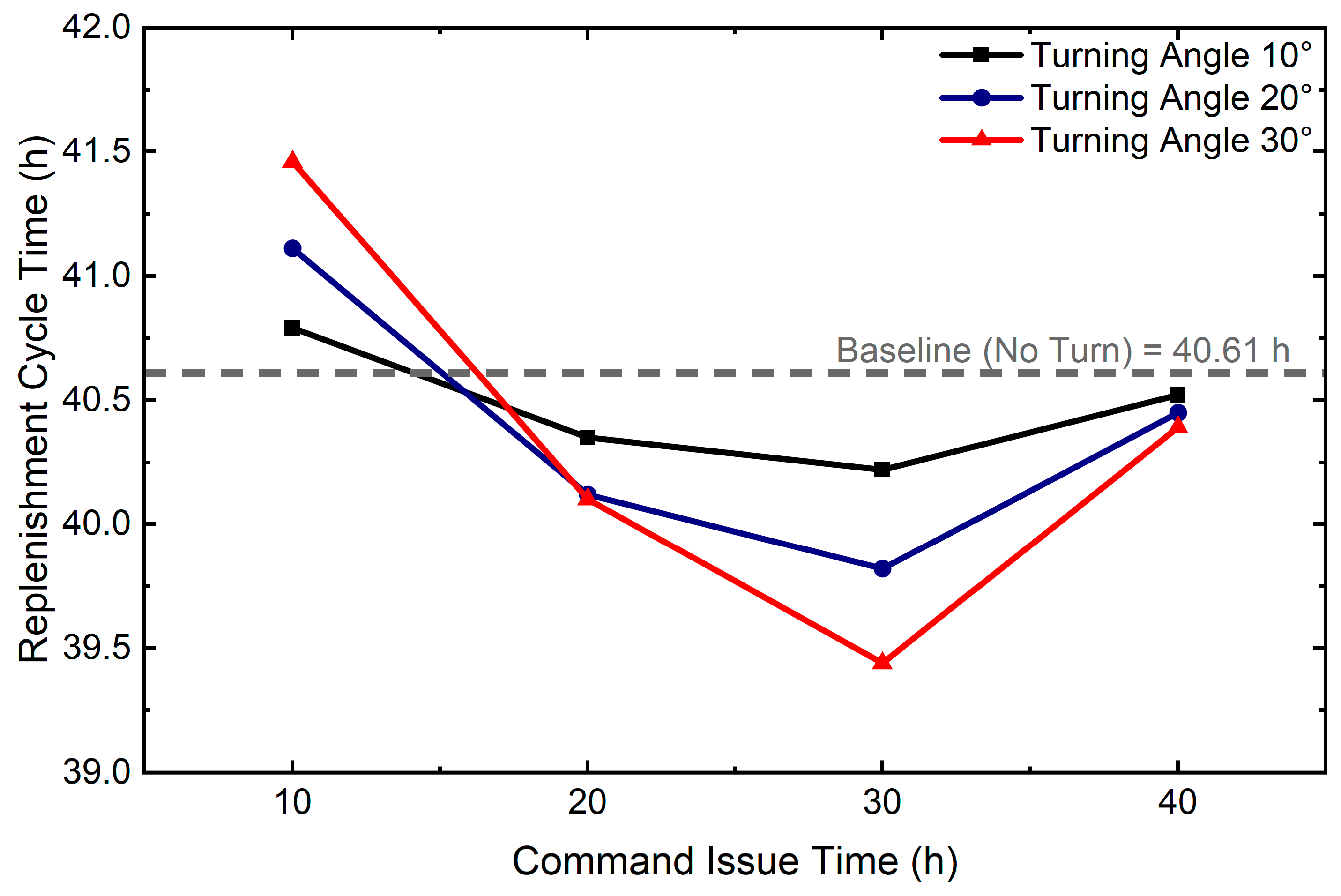
Table 9 and Figure 14 present the impact of navigational disturbances caused by formation turns on the replenishment cycle time.
The experimental results demonstrate that the established optimized replenishment schedule exhibits an exceptionally high execution fault tolerance. Across all test scenarios involving formation turns from 10° to 30°, the fluctuations in the replenishment cycle time are strictly bounded within ± 3 % of the baseline (40.61 h), with a maximum delay of 0.85 h and a maximum time reduction of 1.17 h. This verifies the practical applicability of the optimized replenishment solution generated by the proposed model when subjected to sudden turning disturbances.
The data further reveal that the timing and angle of the formation turn exert varying degrees of impact on the replenishment cycle time. This specific impact is observed in the following three aspects:
(1)
Early-stage time delay: When a turn occurs early in the mission (e.g., at 10 h), the overall deflection of the formation increases the relative travel distance between the replenishment ship and the subsequent receiving ships, resulting in a time delay. A larger turning angle in this phase causes a greater distance increase, leading to a more pronounced delay (reaching a maximum delay of 0.85 h at θ = 30°).
(2)
Mid-stage time reduction: When the turn is executed during the mid-mission phase (e.g., at 30 h), the overall deflection of the formation conversely shortens the relative travel distance between the replenishment ship and the subsequent receiving ship (e.g., Ship 11), leading to a time reduction. Furthermore, a larger turning angle produces a more significant time reduction (achieving a maximum reduction of 1.17 h at θ = 30°).
(3)
Late-stage system immunity: When a turn happens in the final mission stage (e.g., at 40 h), the majority of replenishment tasks have already been completed, leaving the turning operation with a highly limited effect on the total path distance. The impact on the replenishment cycle time remains negligible across all tested turning angles (fluctuations 0.22 h).
Fleet commanders can therefore ensure navigational safety and further enhance overall replenishment efficiency during actual maritime cruising missions by fine-tuning the execution timing of sudden turning commands according to the current task state of the replenishment ship.

5. Conclusions

This study investigated the Underway Replenishment Routing Problem (URRP) for naval formation through mathematical modeling, algorithmic development, and experimental analysis. The core conclusions are summarized as follows:
(1)
The proposed dynamic route optimization model, incorporating formation stability constraints, proves effective. By encoding “system resilience” as a core optimization constraint, the model successfully resolves the time-varying and coordination challenges that render traditional static models inadequate. It provides, consequently, a reliable theoretical tool for characterizing the coordinated operations of mobile platforms in complex maritime environments.
(2)
The proposed Hybrid Genetic Algorithm with Adaptive Variable Neighborhood Search (HGA-AVNS) delivers highly competitive comprehensive performance. Validated through an explicit effectiveness analysis of its core operators, computational results across multi-scale instances confirm that HGA-AVNS structurally outperforms conventional methods—specifically, the traditional Genetic Algorithm (GA) and Variable Neighborhood Search (VNS)—in solution quality, convergence speed, and stability. By deeply fusing chaotic initialization with adaptive search mechanisms, the algorithm achieves a precise balance between global exploration and local exploitation. This structural synergy therefore provides a robust solver for highly dynamic and strictly constrained combinatorial optimization problems.
(3)
Systematic sensitivity analysis elucidates the impact mechanisms of key operational parameters and dynamic environmental factors on system effectiveness. The study reveals a strong coupling effect among the formation’s cruise speed, the replenishment speed, and external disturbances. Specifically, under the strict premise of maintaining formation stability, a strategic reduction in cruise speed can offset the increase in overall speed over ground (SOG) induced by following ocean currents, thereby preventing systematic time loss. Furthermore, fine-tuning the execution timing of sudden tactical turning based on the replenishment ship’s real-time operational status can effectively enhance the overall replenishment efficiency. These findings provide a quantitative reference for balancing mission efficacy and logistical risk in practical command decision-making.

Supplementary Materials

The following supporting information can be downloaded at https://www.mdpi.com/article/10.3390/jmse14080714/s1: Data S1: URRPLIB Benchmark Instances Archive (ZIP).

Author Contributions

Conceptualization, W.Y. and R.Z.; methodology, W.Y. and R.Z.; software, W.Y.; validation, W.Y.; formal analysis, W.Y.; investigation, W.Y.; resources, X.X.; data curation, W.Y.; writing—original draft preparation, W.Y., R.Z. and X.X.; writing—review and editing, W.Y., R.Z. and X.X.; visualization, W.Y.; supervision, X.X.; project administration, X.X.; funding acquisition, R.Z. All authors have read and agreed to the published version of the manuscript.

Funding

This research was funded by the National Natural Science Foundation of China, grant numbers 72204035 and 72574035.

Institutional Review Board Statement

Not applicable.

Informed Consent Statement

Not applicable.

Data Availability Statement

The original contributions presented in the study are included in the article/Supplementary Materials. Further inquiries can be directed to the corresponding author.

Acknowledgments

The views presented in this paper are those of the authors, who are responsible for the facts and accuracy of the information.

Conflicts of Interest

The authors declare no conflicts of interest.

Appendix A. URRPLIB Instance Generation Procedure

Algorithm A1 details the explicit mathematical procedure used to synthesize the multi-scale naval formation instances evaluated in Section 4.1.
Algorithm A1 URRPLIB Instance Generation Procedure
Input: Number of vessels deployed in each defensive belt: n 10 , n 20 , n 30 (where n b = N )
Output: Initial coordinate set of all combatant ships P = { ( X i , Y i ) i = 1 , 2 , , N }
1: Initialize: Generated point set P
2: Define discrete angle space:  Θ = { 0 ° , 5 ° , 10 ° , , 85 ° }
3: Define quadrant phase shifts:  Φ = { 0 ° , 90 ° , 180 ° , 270 ° }
4: Define radial feasible sets:  R 10 = { 8 , 9 , , 12 } , R 20 = { 18 , 19 , , 22 } , R 30 = { 28 , 30 , 32 }
5: for each defensive belt b { 10 , 20 , 30 } do
6:       Determine quadrant quotas Q b = { q 1 , q 2 , q 3 , q 4 } satisfying k = 1 4 q k = n b and max ( Q b ) min ( Q b ) 1
7:       for each quadrant k { 1 , 2 , 3 , 4 } with phase shift ϕ k Φ do
8: c 0
9:           while  c < q k do
10:               Sample radius r ~ U ( R b )
11:               Sample base angle θ b a s e ~ U ( Θ )
12: θ θ b a s e + ϕ k
13: X round ( r cos ( θ ) )
14: Y round ( r sin ( θ ) )
15:              /* Strict non-collinear and minimum safety distance constraint */
16:              if X 0 Y 0 ( ( X j , Y j ) P : X X j Y Y j ( X X j ) 2 + ( Y Y j ) 2 3 ) then
17: P P { ( X , Y ) }
18: c c + 1
19:              end if
20:           end while
21:        end for
22: end for
23: return  P

References

  1. Yuan, S.; Li, Y.; Bao, F.; Xu, H.; Yang, Y.; Yan, Q.; Zhong, S.; Yin, H.; Xu, J.; Huang, Z.; et al. Marine environmental monitoring with unmanned vehicle platforms: Present applications and future prospects. Sci. Total Environ. 2023, 858, 15. [Google Scholar] [CrossRef] [PubMed]
  2. Brown, G.G.; DeGrange, W.C.; Price, W.L.; Rowe, A.A. Scheduling combat logistics force replenishments at sea for the US Navy. Nav. Res. Logist. 2017, 64, 677–693. [Google Scholar] [CrossRef]
  3. McTaggart, K.; Cumming, D.; Hsiung, C.C.; Li, L. Seakeeping of two ships in close proximity. Ocean Eng. 2003, 30, 1051–1063. [Google Scholar] [CrossRef]
  4. Huang, Y.; Hu, Y.; Wu, J.; Zeng, C. Observer-based motion control system for the approach ship with propeller and rudder in the process of underway replenishment. Ocean Eng. 2021, 222, 108586. [Google Scholar] [CrossRef]
  5. Wu, W.; Peng, Z.; Wang, D.; Liu, L.; Gu, N. Anti-disturbance leader-follower synchronization control of marine vessels for underway replenishment based on robust exact differentiators. Ocean Eng. 2022, 248, 110686. [Google Scholar] [CrossRef]
  6. Wu, D.; Ji, X.; Xiao, F.; Sheng, S. A Location Inventory Routing Optimisation Model and Algorithm for a Remote Island Shipping Network considering Emergency Inventory. Sustainability 2022, 14, 5859. [Google Scholar] [CrossRef]
  7. Zhang, J.; Cui, Y.; Li, G.; Ren, J. Dynamic Path Planning Algorithm for Unmanned Surface Vehicle Under Island-Reef Environment. IEEE Trans. Aerosp. Electron. Syst. 2023, 59, 7252–7268. [Google Scholar] [CrossRef]
  8. Wu, C.; Dong, P.; Yu, P. Marine supply planning of formation under circuit riders strategy. J. Dalian Marit. Univ. 2020, 46, 89–96. [Google Scholar] [CrossRef]
  9. Dong, P.; Huang, J.; Shi, H. Research on alongside replenishment planning at sea based on two-stage optimization model. Fire Control Command Control 2021, 46, 64–70. [Google Scholar] [CrossRef]
  10. Wei, Z.; Zhao, S.; Li, Y.; Guo, Z. Marine supply path planning of warship formation with multi supply ship. Fire Control Command Control 2021, 46, 41–45+52. [Google Scholar] [CrossRef]
  11. Zhang, Q.; Zeng, B. Research on Underway Replenishment Path Planning Considering Time Window. In Proceedings of the 2020 Chinese Control and Decision Conference (CCDC), Hefei, China, 22–24 August 2020; IEEE: New York, NY, USA, 2020. [Google Scholar]
  12. Stieber, A.; Fügenschuh, A.; Epp, M.; Knapp, M.; Rothe, H. The multiple traveling salesmen problem with moving targets. Optim. Lett. 2015, 9, 1569–1583. [Google Scholar] [CrossRef]
  13. Wang, Y.; Wang, N. Moving-target travelling salesman problem for a helicopter patrolling suspicious boats in antipiracy escort operations. Expert Syst. Appl. 2023, 213, 118986. [Google Scholar] [CrossRef]
  14. Kim, S.; Moon, I. Traveling Salesman Problem With a Drone Station. IEEE Trans. Syst. Man Cybern. Syst. 2019, 49, 42–52. [Google Scholar] [CrossRef]
  15. Pop, P.C.; Cosma, O.; Sabo, C.; Sitar, C.P. A comprehensive survey on the generalized traveling salesman problem. Eur. J. Oper. Res. 2024, 314, 819–835. [Google Scholar] [CrossRef]
  16. de Moraes, R.S.; de Freitas, E.P. Experimental analysis of heuristic solutions for the moving target traveling salesman problem applied to a moving targets monitoring system. Expert Syst. Appl. 2019, 136, 392–409. [Google Scholar] [CrossRef]
  17. Groba, C.; Sartal, A.; Vázquez, X.H. Integrating forecasting in metaheuristic methods to solve dynamic routing problems: Evidence from the logistic processes of tuna vessels. Eng. Appl. Artif. Intell. 2018, 76, 55–66. [Google Scholar] [CrossRef]
  18. Philip, A.G.; Ren, Z.Q.; Rathinam, S.; Choset, H. C: A New Bounding Approach for the Moving-Target Traveling Salesman Problem. IEEE Trans. Robot. 2025, 41, 4663–4678. [Google Scholar] [CrossRef]
  19. Zhang, L.; Lu, J.; Yang, Z. Dynamic optimization of emergency resource scheduling in a large-scale maritime oil spill accident. Comput. Ind. Eng. 2021, 152, 107028. [Google Scholar] [CrossRef]
  20. Zhang, L.; Lu, J.; Yang, Z. Optimal scheduling of emergency resources for major maritime oil spills considering time-varying demand and transportation networks. Eur. J. Oper. Res. 2021, 293, 529–546. [Google Scholar] [CrossRef]
  21. Granado, I.; Hernando, L.; Uriondo, Z.; Fernandes-Salvador, J.A. A fishing route optimization decision support system: The case of the tuna purse seiner. Eur. J. Oper. Res. 2024, 312, 718–732. [Google Scholar] [CrossRef]
  22. Caponetto, R.; Fortuna, L.; Furuhashi, T.; Xibilia, M.G. Chaotic sequences to improve the performance of evolutionary algorithms. IEEE Trans. Evol. Comput. 2003, 7, 289–304. [Google Scholar] [CrossRef]
  23. Ren, X.; Fan, H.; Ma, M.; Fan, H.; Yue, L. Time-dependent hydrogen fuel cell vehicle routing problem with drones and variable drone speeds. Comput. Ind. Eng. 2024, 193, 110330. [Google Scholar] [CrossRef]
  24. Ren, X.; Fan, H.; Fan, H.; Ma, M. Time-dependent electric vehicle-drone routing problem for scheduled deliveries and on-demand pickups considering variable drone speeds and no-fly zones. Comput. Oper. Res. 2025, 182, 107141. [Google Scholar] [CrossRef]
  25. Baker, J.E. Reducing bias and inefficiency in the selection algorithm. In Proceedings of the Second International Conference on Genetic Algorithms on Genetic Algorithms and Their Application, Cambridge, MA, USA, 28–31 July 1987; pp. 14–21. [Google Scholar]
  26. Baker, B.M.; Ayechew, M.A. A genetic algorithm for the vehicle routing problem. Comput. Oper. Res. 2003, 30, 787–800. [Google Scholar] [CrossRef]
  27. Kaya, M. The effects of two new crossover operators on genetic algorithm performance. Appl. Soft Comput. 2011, 11, 881–890. [Google Scholar] [CrossRef]
Figure 1. Schematic diagram of the spatial kinematics for calculating navigation time. a i : starting position of the replenishment ship; a j : initial position of the subsequent receiving vessel j ; a j : rendezvous point for underway replenishment; v m : tactical speed of the replenishment ship; v c : cruise speed of the receiving vessel; α : heading angle of the replenishment ship relative to the formation’s cruise direction (positive Y -axis); d i j ( t ) , Δ x i j ( t ) , and Δ y i j ( t ) : relative Euclidean, X -axis, and Y -axis distances between a i and a j , respectively. This diagram illustrates the dynamic intercept trajectory required for the replenishment ship to service moving targets within the naval formation.
Jmse 14 00714 g001
Figure 2. State transition diagrams for the vessels during a single underway replenishment cycle. (a) The replenishment ship alternates between the Navigation State (at tactical speed v m ) and the Replenishment State (at replenishment speed v s ). (b) The receiving ship sequentially transitions through the Cruise State ( v c ), Pre-replenishment State ( v c ), Replenishment State ( v s ), and Station Recovery State ( v m ) before returning to its designated cruising station. The specific speed adjustment actions triggered by each state transition are annotated on the respective arrows.
Jmse 14 00714 g002
Figure 3. Timeline Gantt chart illustrating the temporal synchronization of state transitions across multiple vessels during a continuous service sequence. The timeline maps the coordinated operations among the replenishment ship (RS), the current combatant ship acting as the receiving ship (CS i ), and the subsequent target receiving ship (CS j ). Colored blocks represent distinct navigational states, with their corresponding cruising or tactical speeds annotated internally (e.g., v c , v m , v s ). Key temporal nodes on the horizontal axis ( T i p , T i b , T i e , T i r ) demarcate the exact moments of state transitions and physical rendezvous/separation.
Jmse 14 00714 g003
Figure 4. Detailed flowchart of the proposed Hybrid Genetic Algorithm with Adaptive Variable Neighborhood Search (HGA-AVNS). This iterative process combines GA-based global exploration (Selection and Evolution) with AVNS-based local exploitation (Neighborhood searches). k max : total number of neighborhood structures; k : current neighborhood structure index; I ns : maximum allowed iterations for neighborhood search in the current generation; c : current search iteration counter. The algorithm’s termination condition is triggered either by reaching the maximum number of generations ( G max ) or consecutive generations without improvement ( G stop ).
Jmse 14 00714 g004
Figure 5. Schematic diagram of the sequential crossover operator. The diagram illustrates the bilateral inheritance mechanism: Offspring 1 inherits a continuous segment from Parent 1 (green blocks) and fills the remaining empty positions sequentially from left to right using available genes from Parent 2. Symmetrically, Offspring 2 inherits a segment from Parent 2 (purple blocks) and is filled based on the sequence of Parent 1.
Jmse 14 00714 g005
Figure 7. Initial spatial distribution of the vessel cruising stations (Instance S12-1). The origin O represents the cruising station of the flagship, with the positive Y -axis indicating the formation’s heading. The shaded concentric rings delineate the 10, 20, and 30 nm defensive belts, respectively, where the 12 combatant ships (nodes 1–12) are stationed.
Jmse 14 00714 g007
Figure 8. Optimal dynamic service route of the replenishment ship (Stability-aware strategy for Instance S12-1). The X and Y axes represent the spatial coordinates in nautical miles (nm). The red node denotes the start and end position of the cycle (i.e., flagship cruising station). The green and yellow nodes indicate the positions where the replenishment services for each respective combatant ship commence and conclude.
Jmse 14 00714 g008
Figure 9. Comparison of the replenishment cycle time and navigation state time across different strategies. The stability-aware strategy denotes the optimal dynamic route derived from the formulated model, while the Static-NN and Dynamic-NN strategies refer to traditional nearest-neighbor logic based on initial and real-time positions, respectively. The horizontal dashed lines indicate the baseline performance of the proposed strategy.
Jmse 14 00714 g009
Figure 10. Comparison of convergence behaviors among the three algorithmic variants for the large-scale instance L48-2 (n = 48).
Jmse 14 00714 g010
Figure 11. Convergence performance of HGA-AVNS, GA, and VNS across representative instances of varying scales: (a) Instance S12-1 (n = 12); (b) Instance M24-2 (n = 24); (c) Instance M36-3 (n = 36); and (d) Instance L48-2 (n = 48). The vertical axis represents the replenishment cycle time (h). The steep descent and early stabilization of the solid orange curves demonstrate that the proposed HGA-AVNS consistently achieves superior solution quality and faster convergence rates compared to the baseline algorithms across all problem sizes.
Jmse 14 00714 g011
Figure 12. Sensitivity analysis of the replenishment cycle time with respect to varying replenishment and cruise speeds. The results are derived from the representative instance M24-2 (n = 24).
Jmse 14 00714 g012
Figure 13. Impact of ocean currents on replenishment cycle time. The dashed line represents the baseline optimal time (40.61 h) without ocean current disturbances. * The pure beam current scenario (90°) is excluded a priori due to prohibitive operational risks.
Jmse 14 00714 g013
Figure 14. Impact of tactical turning on replenishment cycle time. The dashed line represents the baseline optimal time (40.61 h) without tactical turning disturbances.
Jmse 14 00714 g014
Table 1. Parameters and variables.
CategorySymbolDefinition
Sets T Set of discrete time periods with a fine-grained time step of h, spanning the entire planning horizon length H (where H = L × Δ t .), T = { 1 , 2 , , L }
V Set of combatant ships, V = 1 , 2 , , n
U Set of all vessels, U = { 0 } V , where node 0 denotes the replenishment ship and also represents its cruising station (the start and end point of the replenishment cycle)
Parameters v c Cruise speed
v s Replenishment speed
v m Tactical speed
s i Service time required by vessel i
Auxiliary Variables x i ( t ) , y i ( t ) Position coordinates of vessel i at time t
v i ( t ) Speed of vessel i at time t
d i j ( t ) Distance between vessel i and vessel j at time t
Δ t Fine-grained time step for the discrete state-machine (e.g., 0.01 h)
H Total length of the planning horizon
γ i Discrete service time steps required by vessel i
t i j Travel time of the replenishment ship from vessel i to vessel j
τ i j Discrete travel time steps of the replenishment ship from vessel i to vessel j
T i p Start time of the pre-replenishment operations for vessel i
T i b Start time of the replenishment service for vessel i
T i e End time of the replenishment service for vessel i
T i r Time when vessel i returns to its cruising station
B i ( t ) Whether vessel i starts service at time t (1 if yes; 0 otherwise)
E i ( t ) Whether vessel i ends service at time t (1 if yes; 0 otherwise)
R i ( t ) Whether vessel i s in the replenishment state at time t (1 if yes; 0 otherwise)
Decision Variables z i j Whether the replenishment ship travels from vessel i to vessel j (1 if yes; 0 otherwise)
Table 2. Tactical configurations and defensive belt distributions of the generated test instances.
InstancenSpatial Distribution
(Defensive Belts)
InstancenSpatial Distribution
(Defensive Belts)
10 nm20 nm30 nm10 nm20 nm30 nm
S08-18440S12-112462
S08-28440S12-212462
S08-38440S12-312642
S09-19450M24-1248124
S09-29450M24-2248124
S09-39540M24-3241284
S10-110460M36-13612186
S10-210460M36-23612186
S10-310640M36-33618126
S11-111461L48-14816248
S11-211461L48-24816248
S11-311641L48-34824168
Note: The test instances are designated using a format combining scale, number of vessels (n), and variant index. The prefixes S, M, and L denote small-, medium-, and large-scale problem instances, respectively, where larger instances are specifically designed to stress-test the algorithm’s scalability. Furthermore, the 10, 20, and 30 nm column headers refer to the designated defensive station belts, spanning distances of 8–12 nm, 18–22 nm, and 28–32 nm from the flagship, respectively. The values in these columns indicate the precise count of combatant ships deployed within each belt.
Table 3. Positions of combatants.
Combatant Ship IDRelative PositionCoordinates (nm)Defensive Belt
1Ahead(9, 5)10
2Ahead(−6, 8)10
3Astern(−9, −5)10
4Astern(3, −9)10
5Ahead(8, 18)20
6Ahead(−17, 10)20
7Astern(−13, −15)20
8Astern(17, −10)20
9Starboard(20, 0)20
10Port(−20, 0)20
11Ahead(15, 26)30
12Ahead(−14, 24)30
Table 4. Service process information for Combatants.
Combatant Ship IDService Time (h)Position Coordinates (nm)
StartEndStartEnd
21.093.09(−6.00, 25.44)(−6.00, 49.44)
126.158.15(−14.00, 122.40)(−14.00, 146.40)
68.3410.34(−17.00, 143.44)(−17.00, 167.44)
1010.4712.47(−20.00, 167.52)(−20.00, 191.52)
313.2815.28(−9.00, 207.48)(−9.00, 231.48)
715.4517.45(−13.00, 232.20)(−13.00, 256.20)
419.5321.53(3.00, 303.48)(3.00, 327.48)
822.8324.83(17.00, 355.28)(17.00, 379.28)
927.1029.10(20.00, 433.60)(20.00, 457.60)
1133.3735.37(15.00, 559.92)(15.00, 583.92)
535.7737.77(8.00, 590.32)(8.00, 614.32)
137.9039.90(9.00, 611.40)(9.00, 635.40)
Table 5. Performance comparison of different algorithmic variants to validate the effectiveness of the initialization and selection operators (30 independent runs, n = 48).
Algorithmic VariantInitialization
Operator
Selection
Operator
Initial
Std. Dev.
σinit
Mean
Final Objective Value
μfinal (h)
Final
Std. Dev.
σfinal
HGA-AVNS-V1RandomRWS4.20149.510.69
HGA-AVNS-V2Logistic MapRWS21.29148.930.65
HGA-AVNS (Proposed)Logistic MapSUS21.21148.770.59
Note: σinit represents the average standard deviation of the initial population’s objective values across 30 independent runs, serving as a quantitative metric for initial population diversity. μfinal is the mean of the final best objective values (i.e., the replenishment cycle times) obtained over the 30 runs, indicating the algorithm’s global optimization capability. σfinal denotes the standard deviation of these 30 final best values, reflecting the algorithmic robustness and stability.
Table 6. Computational results and comparisons for small-scale instances.
InstancenENUMGAHGA-AVNSGap
OPT
(h)
CPU
(s)
Best
(h)
Avg
(h)
Dev
(%)
CPU
(s)
Best
(h)
Avg
(h)
Dev
(%)
CPU
(s)
GA
(%)
HGA
(%)
S08-1827.74727.7427.760.071227.7427.740.0060.070.00
S08-2827.04627.0427.090.181227.0427.040.0060.180.00
S08-3827.35627.3527.350.001227.3527.350.0050.000.00
S09-1930.346330.3430.360.071330.3430.340.0070.070.00
S09-2930.026130.0230.080.201330.0230.020.0060.200.00
S09-3930.346330.3430.360.071330.3430.340.0060.070.00
S10-11033.3969933.3933.430.121433.3933.390.0060.120.00
S10-21032.9669832.9632.980.061432.9632.960.0070.060.00
S10-31032.9369532.9332.950.061432.9332.930.0070.060.00
S11-11136.83811036.8336.890.161636.8336.850.0580.160.05
S11-21136.86843436.8637.000.381536.8636.900.1180.380.11
S11-31136.49859836.4936.500.031636.4936.500.0380.030.03
S12-11240.617150040.6140.850.591740.6140.790.4480.590.44
S12-21240.676944540.6740.880.521740.6740.790.3090.520.30
S12-31240.676980340.6740.920.611740.6740.700.0780.610.07
Mean--- - - - -0.210.07
Note: The formal definitions and calculation formulas for the statistical metrics ( O P T , B e s t , A v g , D e v , G a p ) are detailed at the beginning of Section 4.3. Bold values indicate the exact optimal solutions and the best performance metrics among the compared methods.
Table 7. Computational results and statistical comparisons for multi-scale instances.
InstancenGAVNSHGA-VNSGap
Best
(h)
Avg
(h)
Dev
(%)
CPU
(s)
Best
(h)
Avg
(h)
Dev
(%)
CPU
(s)
Best
(h)
Avg
(h)
Dev
(%)
CPU
(s)
GA
(%)
VNS
(%)
S12-11240.6140.850.591640.6140.850.591240.6140.790.4470.150.15
S12-21240.6740.880.511640.6740.850.441240.6740.790.2980.220.15
S12-31240.6740.920.611640.6741.000.801240.6740.700.0780.540.74
M24-12476.6777.451.013676.5177.331.063675.6576.150.66211.711.55
M24-22476.3477.491.483476.6177.461.103775.6276.170.72201.731.69
M24-32476.5677.411.103476.4977.671.523575.6776.160.64181.641.98
M36-136113.61115.251.4260113.19114.491.1473112.66112.860.18432.121.44
M36-236113.81115.431.4064113.43114.721.1273112.38112.710.29442.411.78
M36-336113.88115.621.5062113.44114.981.3474112.51112.910.35362.401.83
L48-148151.92154.031.3796150.14151.821.11111147.50148.650.77813.622.13
L48-248150.85153.711.8691150.17151.941.16111147.87148.910.70973.222.03
L48-348150.72153.471.7996150.50152.131.07111147.90148.190.20683.562.66
Mean--1.22---1.04---0.44 1.941.51
Maximum--1.86---1.52---0.77 3.622.66
Minimum--0.51---0.44---0.07 0.150.15
Note: The formal definitions and calculation formulas for the statistical metrics ( O P T , B e s t , A v g , D e v , G a p ) are detailed at the beginning of Section 4.3. Bold values indicate the exact optimal solutions and the best performance metrics among the compared methods.
Table 8. Impact of ocean currents on replenishment cycle time.
Relative Current Angle 1
δ (°)
Total Replenishment Cycle Time (h) (Δ% deviation) 2
1 kn2 kn3 kn4 kn
044.57 (+9.75%)50.40 (+24.11%)59.27 (+45.95%)73.38 (+80.69%)
4543.18 (+6.33%)46.36 (+14.16%)50.26 (+23.76%)55.02 (+35.48%)
13538.51 (−5.17%)36.84 (−9.28%)35.46 (−12.68%)34.39 (−15.32%)
18037.84 (−6.82%)35.87 (−11.67%)34.44 (−15.19%)33.47 (−17.58%)
1 The pure beam current scenario (δ = 90°) is a priori excluded from this analysis due to the prohibitive risk of collision and loss of control caused by excessive lateral forces. 2 The baseline replenishment cycle time under still water conditions is 40.61 h. Values in parentheses indicate the percentage deviation from the baseline.
Table 9. Impact of tactical turning on replenishment cycle time.
Command Issue
Time (h)
Actual Execution
Time 1 (h)
Replenishment Ship
Status
Turning
Angle (°)
Replenishment
Cycle Time (h)
Time Deviation 2
(h)
1010.34Replenishing Vessel 61040.790.18
2041.110.5
3041.460.85
2021.53Replenishing Vessel 41040.35−0.26
2040.12−0.49
3040.10−0.51
3030Cruising to Vessel 111040.22−0.39
2039.82−0.79
3039.44−1.17
4040Cruising to formation station1040.52−0.09
2040.45−0.16
3040.39−0.22
1 If a maneuver command is issued during an active replenishment state (e.g., at 10.00 h and 20.00 h), the actual execution of the formation turn is deferred until the current operation is completed to ensure physical safety. 2 The baseline replenishment cycle time without tactical turning is 40.61 h.
Disclaimer/Publisher’s Note: The statements, opinions and data contained in all publications are solely those of the individual author(s) and contributor(s) and not of MDPI and/or the editor(s). MDPI and/or the editor(s) disclaim responsibility for any injury to people or property resulting from any ideas, methods, instructions or products referred to in the content.