1. Introduction
Maritime transport, as a cornerstone for sustained global economic growth, represents the most environmentally friendly and economically efficient modality for international freight transportation. Statistics indicate that in 2024, it carried approximately 85% of global trade goods, with a total volume exceeding 12,720 million tons [
1]. Concurrently, the maritime industry is experiencing a paradigm shift marked by the development of larger, more intelligent, and increasingly autonomous cargo ships [
2,
3,
4]. Autonomous cargo ships, formally defined as ships operating independently under scalable human supervision frameworks, have been developed primarily aimed at enhancing safety and preventing environmental pollution. A fundamental technical milestone in intelligent ships is to achieve full-path autonomous navigation, encompassing all operational phases: open-ocean voyages, coastal navigation, port entry and exit, berthing and unberthing, and anchoring [
5].
Considerable attention has been directed toward autonomous navigation in open and coastal waters, with substantial progress in areas such as collision avoidance, path optimization, and trajectory control for berthing operations [
6,
7,
8]. However, investigations into autonomous anchoring scenarios have received comparatively limited scholarly focus. Anchoring is a critical and complex maneuver within a ship’s navigation path, presenting unique challenges that are distinct from underway navigation. As a ship approaches an anchorage, its speed decreases sharply, leading to a rapid deterioration of maneuverability due to reduced rudder and propeller effectiveness [
9]. This inherent low-speed operational regime becomes further complicated by environmental constraints, including restricted navigable water width, shallow water effects, and the coexistence of dynamic and static obstacles (including other anchored ships), rendering precise track-keeping and final positioning particularly arduous [
10]. Conventional anchoring practices typically depend on empirical decision-making processes wherein anchor site selection and the anchoring maneuver rely heavily on the experience and judgment of seafarers. This human-centric approach inherently introduces risks associated with human error, which can lead to incidents such as improper anchor positioning, anchor dragging, chain failure events, or secondary collision occurrences [
11,
12].
Therefore, developing automated anchoring systems is imperative to enhance maritime safety and operational reliability. Such systems must comprehensively account for anchorage area characteristics, the fundamental constraints of ship maneuvering at low speeds, and adherence to the International Regulations for Preventing Collisions at Sea (COLREGs) alongside established principles of good seamanship.
Research on autonomous ship anchoring intersects several domains including anchorage safety assessment, low-speed ship maneuvering, and intelligent navigation decision-making. Ref. [
13] demonstrates improved team building, leadership, and communication outcomes through the anchor handling simulator. To characterize anchoring procedures and typical human errors, ref. [
14] research causative factors in marine accidents related to the anchoring of vessels and their maneuvering within anchorage areas. With increasing port traffic complexity, ref. [
15] proposes a novel anchorage collision risk model specifically designed for anchorage environments, which provides quantitative risk identification capabilities. This model serves as a reference for port traffic safety and assist while assisting maritime surveillance operators in collision risk monitoring of port traffic to enhance overall traffic safety management.
A core challenge for autonomous anchoring lies in the severe degradation of ship maneuverability at low speeds, particularly during the final approach phase [
16]. The anchoring operation itself is a structured process, typically described in phases such as approach, positioning, and anchor release [
17]. Expert knowledge systems and hydrometeorological parameters have been identified as crucial factors in planning and executing these procedures [
18]. This research demonstrates that successful anchoring constitutes a complex maneuver requiring precise kinetic energy modulation and attitude control under environmental disturbances, rather than being solely a trajectory tracking problem.
Research on the path planning for autonomous navigation has increasingly explored in methods such as the Artificial Potential Field [
19], Line of Light [
20], and Fast Marching Square algorithm [
21] and so on. For complex dynamic environments, recent studies have concentrated on developing adaptive decision-making systems that comply with navigation rules (COLREGs) while accounting for motion uncertainty [
22,
23,
24,
25]. Although these approaches demonstrate effectiveness for vessels underway in open or coastal waters, they are not specifically designed to address the terminal-phase challenge of navigating to and securing a static point within a bounded, congested anchorage area.
A review of the literature reveals a notable gap in developing integrated systems for autonomous anchoring. While component technologies—including anchor holding models, low-speed dynamics, and generalized path planning—have been extensively investigated, limited research has addressed the combined challenge of (a) dynamically selecting an optimal anchor position within a crowded anchorage in real-time, and (b) generating complete, robust trajectory from the approach phase to the anchor drop, specifically accounting for reduced low-speed maneuverability. This study aims to bridge this gap by proposing a cohesive system that links perception, optimized decision-making, and robust trajectory planning tailored for autonomous anchoring operations. To tackle these challenges, this paper focuses on the autonomous anchoring problem for large cargo ships. The study presents an integrated decision-making and planning architecture comprising three fundamental components: (1) a quantitative methodology for dynamic safety anchorage area computation based on ship parameters and environmental forces; (2) a grid-based optimization algorithm for identifying available and optimal anchor positions with maximized safety margins; and (3) a novel multi-level guided trajectory planning algorithm that generates a complete anchoring path through strategically determined turning, decelerating, and stopping guidance points. The proposed system is validated through digital simulations employing a high-fidelity ship motion model under complex anchorage geometries and environmental conditions. This work aims to provide a theoretical foundation and outline a practical technical approach to advance autonomous decision-making and safety control capabilities for intelligent ships during anchoring operations.
2. Ship Safety Anchoring Positioning
Anchoring operations present significant challenges for autonomous execution due to their operational complexity and multifaceted procedural requirements. When a cargo ship enters an anchorage, its speed decreases sharply, which results in diminished maneuverability [
26]. Achieving accurate positioning at the designated anchor position, frequent adjustments to the engine and rudder are required, which induce perturbations in the ship’s hydrodynamic coefficients. As speed continues to decrease, the ship becomes increasingly susceptible to large drifting motions caused by wind and current disturbances, often leading to loss of rudder effectiveness. Reliable autonomous anchoring implementation therefore requires an integrated methodology integrating robust trajectory optimization with established maritime navigation practices, while simultaneously compensating for environmental disturbances and maintaining precise regulation of approach angle, speed, and final position.
The operational environment in which this operation occurs—the anchorage—represents inherently structured and constrained maritime zones specifically allocated for ship anchoring, emergency maneuvering, and storm refuge. These areas’ spatial configurations are determined by factors such as port scale, traffic composition and density characteristics, and the local hydrological conditions. Consequently, optimal anchoring decision-making processes should systematically evaluate anchorage geometric parameters, bathymetric constraints, and real-time environmental variables to identify viable drop positions within dynamically computed safe anchorage envelopes.
In practice, anchorage management adheres to established protocols that influence decision-making. While local maritime authorities formally delineate anchorage zones, ship anchoring arrangements typically follow first-come, first-served principles through either designated position anchoring or unrestricted area anchoring systems [
27]. Under fixed-point anchoring regimes, Ship Traffic Service Centres assign specific coordinates to ships. In contrast, free anchoring operations depend on the judgment of seafarers who select optimal positions considering hydrographic conditions, spatial availability, and navigational accessibility. The selection of the center point within the largest contiguous safe water area represents a widely adopted heuristic approach for determining optimal anchorage locations. This research seeks to formalize and automate this expert judgment, developing a systematic decision-making method that enhances safety and operational efficiency for autonomous cargo ships.
2.1. Calculation of the Ship’s Safety Anchorage Area
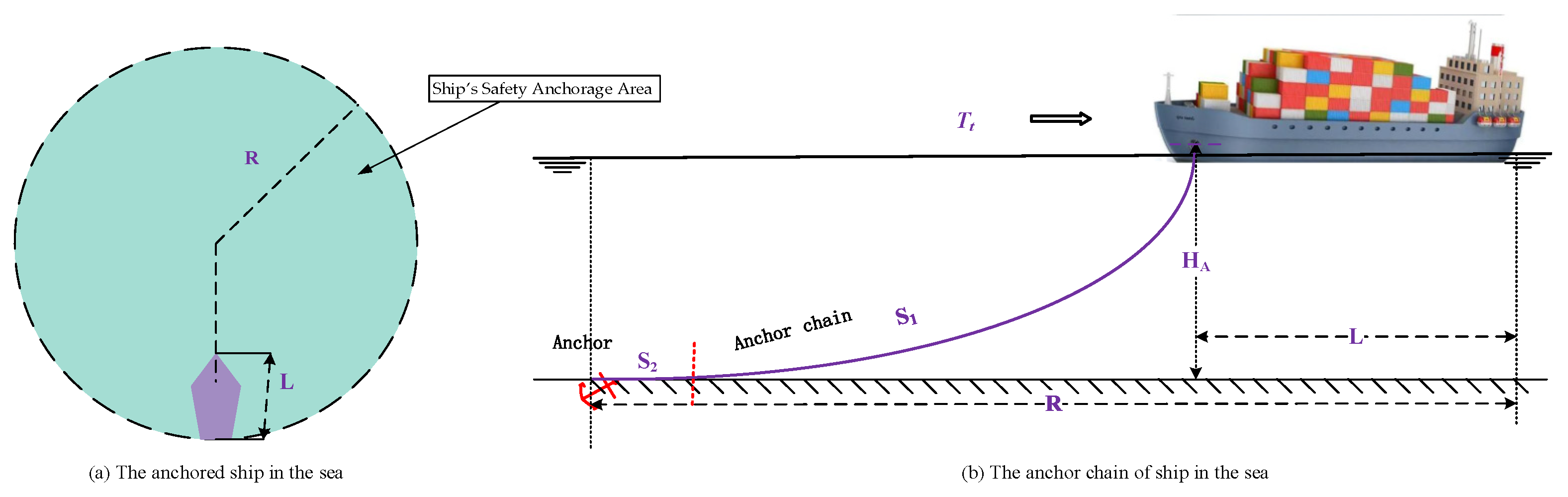
When a ship is anchored, it may swing under the combined influence of wind, current, and tidal forces, centered at the anchor fluke’s position on the seabed [
28]. Its position is constrained within a certain range
by the anchor chain, as illustrated in
Figure 1a, which is called the ship’s safety anchorage area. For single-anchor configurations in a cargo ship, determining the requisite anchor chain length—an essential requirement for anchoring safety—involves consideration of multiple variables: external environmental forces (wind and current), anchorage characteristics (layout, water depth, seabed composition), and the ship’s loading conditions. As illustrated in
Figure 1b, the bedded anchor chain
includes suspended length
and bed length of the ship’s anchor chain
, respectively [
29]. And
denotes the environmental disturbance.
To ensure holding security and prevent anchor dragging, a fundamental equilibrium condition must be satisfied: the total holding force generated by the anchor and chain must equal or exceed the resultant external forces (primarily from wind and current loads) acting on the anchored ship [
29]. Once deployed, the holding capacity of the anchor flukes remains largely constant. Therefore, the deployed anchor chain length becomes the primary variable for establishing this equilibrium. Insufficient chain length reduces the effective holding capacity, whereas excessive length may produce an undesirably large swing radius or increase the risk of anchor dragging. Consequently, precise determination of anchor chain length is essential and can be derived as follows.
where
represents the weight of the anchor flukes,
denotes the anchor holding power coefficient (ranging from 4 to 6, where it correlates with the anchor type).
signifies the weight per unit length of the anchor chain,
indicates the holding power coefficient for the bedded anchor chain.
denotes water depth of the anchorage. And the resultant force
represents the total environmental disturbance—primarily from wind and current—acting on the anchored ship.
Wind loads significantly affect a vessel’s maneuverability, causing violent rolling that may lead to yawing. The calculation of sea wind loads is as follows:
where
and
represent the wind forces acting on the bow and beam directions, respectively.
denotes air density, while
represents relative wind speed, i.e., the vector sum of true wind and apparent wind.
and
denote the ship’s lateral and frontal projected areas above sea level, respectively.
and
represent the longitudinal and transverse wind pressure coefficients, respectively.
Similarly, the calculation of the current forces acting on the anchored vessel is as follows:
where
represents flow velocity,
denotes the direction of flow velocity,
is the density of water.
is the ship’s wet surface area, which can be calculated using Taylor’s formula.
and
are the longitudinal surface friction coefficient and longitudinal form resistance coefficient of the hull.
is the transverse flow resistance coefficient acting on the ship.
and
are the propeller resistance coefficient and the propeller blade area, respectively.
refers to the draft of the cargo ship.
To simplify calculations, this study references relevant research with practical anchoring experience, adopting the following formula for determining anchor chain release length [
30,
31]:
where
denotes water depth of the anchorage, referring to the vertical distance from the sea surface to the seabed at the planned anchor position. It range from 10 to 30 m, which consists of the water depth characteristics of coastal anchorages for large cargo ships.
Accordingly, the safe anchorage area is geometrically defined as a circular region centered on the projected anchor position, which satisfies the following condition:
where
represents the ship’s position, and
denotes the direction of the combined forces from wind, currents, and other environmental factors.
2.2. Available Anchor Position Determination Algorithm
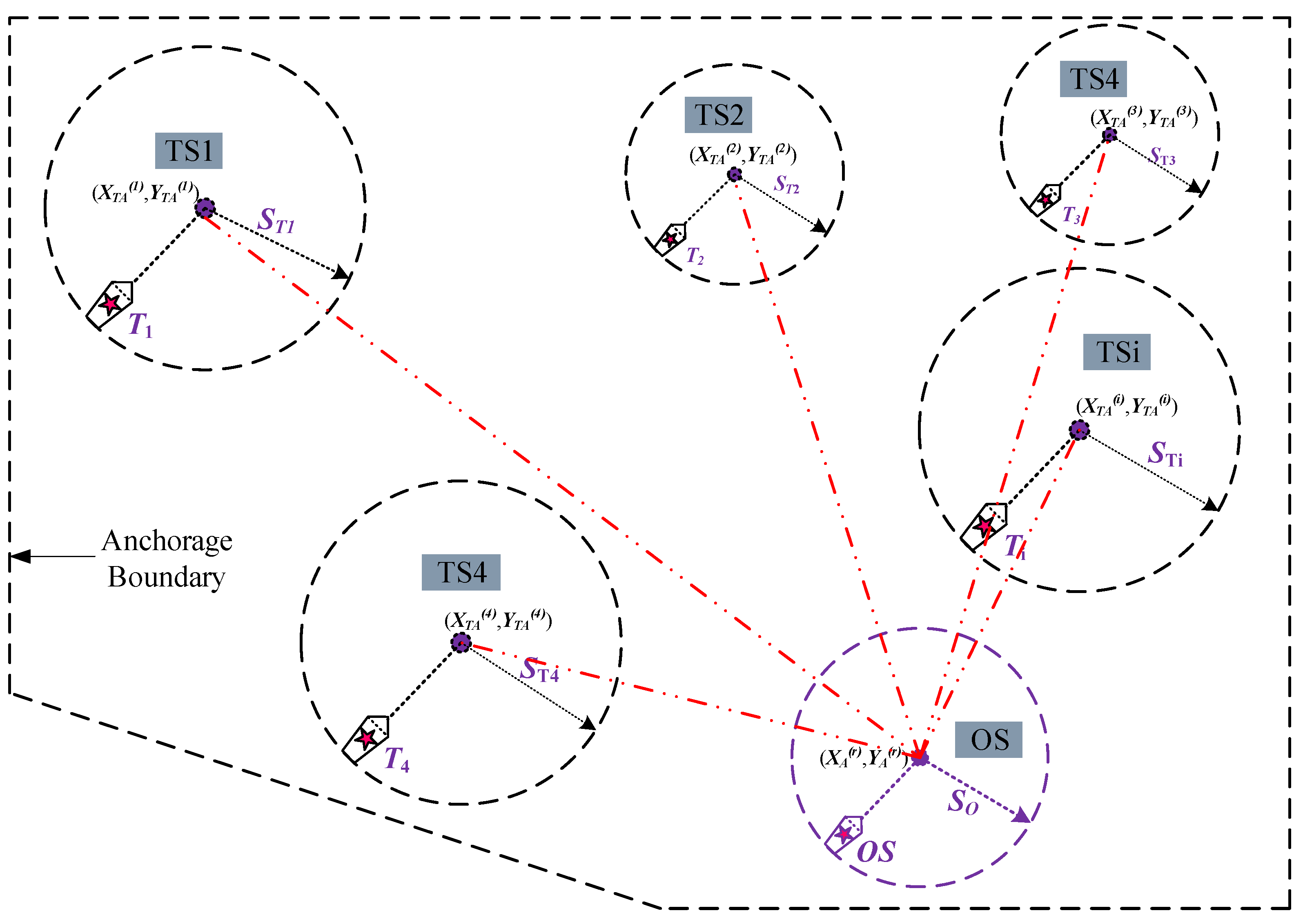
When selecting an appropriate anchorage position within a designated anchorage area, a ship must account for both local hydrographic conditions and maintain adequate separation distances from other anchored ships. Therefore, identifying a feasible anchorage essentially involves integrating the predefined safe anchorage area to locate a position that meets all safety constraints within the limited available space. As demonstrated in
Figure 2, in scenarios where an anchorage accommodates multiple target ships (TS1, TS2, …), the own ship (OS) must identify an available position that ensures safe clearance from all ships already at anchor.
Where the pentagram indicates the ship’s position, and the dotted circle delineates the boundary of the ship’s required safe anchorage area.
The positions and dimensions of the anchored ships in the fixed coordinate system (i = 1, 2, …, m) are denoted by
, which are derived from navigation sensors including ECDIS, AIS, etc. These include the positions, lengths, and headings of these ships. Positional measurements obtained from marine navigation systems typically represent the geometric centroids of the ships. To determine the actual point where the anchor rests on the seabed—which is the true reference for the safety swinging radius—a geometric conversion is required. This conversion, which accounts for the ship’s length and heading, is given as follows. And all spatial calculations in this section use UTM Zone 51N Cartesian coordinates, converted from WGS84 latitude/longitude via the simplified total formula in
Section 4.1.
where
means the coordinates of the anchored ship’s anchor position.
is the bow direction of the anchored ship, which can be shown as follows
Following the aforementioned procedure, the safe waters for each target vessel can thus be determined, as visualized in
Figure 2. Provided the wind force remains below Beaufort scale 7 during the operation, the corresponding safety radius for each vessel can be calculated using the formula
. It is important to clarify that key parameters of target ships (e.g., LOA, Beam, Draft) are directly acquired from AIS static data—an authoritative and widely used data source in maritime operations and research [
32]. For scenarios with missing AIS static data, the Random Forest-based LOA estimation method proposed in [
32] provides an effective solution with an RMSE of 10.34, ensuring accurate calculation of ship swing circles even with incomplete parameter information. As defined in
Section 2.1, each anchored ship’s activity range is strictly constrained to a fixed swing circle, with the radius calculated based on its LOA and anchor chain length.
Therefore, the feasible anchorage position is determined by the following formula.
where
denotes the shortest distance from the boundary of the preselected anchorage area to the target ship’s anchorage area.
represents the ship’s safe anchorage zone, while
indicates the anchorage area.
It is important to clarify that key parameters of target ships (e.g., LOA, Beam, Draft) are directly acquired from AIS static data [
32], ensuring accurate calculation of fixed swing circles. To comply with COLREGs, the following constraints are explicitly encoded in the anchor position selection logic:
(1) Collision avoidance constraint (aligned with COLREGs Rule 8 on action to avoid collision and Rule 16 on give-way vessel obligations): A safety distance threshold—consistent with maritime industry practice for anchoring operations—is defined. Any candidate position that cannot maintain this distance from other vessels’ swing circles or anchorage boundaries is eliminated.
(2) Navigation obstruction avoidance (COLREGs Rule 9): The algorithm prioritizes anchor positions with sufficient maneuvering space for both the own ship and adjacent vessels, ensuring the selected position does not impede the approach, departure, or swinging of other ships.
Additionally, real-time data from AIS and environmental sensors is integrated to fulfill COLREGs Rule 5 (effective lookout), dynamically updating the status of surrounding vessels and adjusting candidate positions to avoid emerging conflicts during the decision-making process.
2.3. Optimal Anchor Position Determination Algorithm
While an available anchor position satisfies the basic safety requirements for anchoring, the optimal position should maximize the achievable safety margin. In practice, under free anchoring regulations, experienced mariners typically select locations offering maximum separation distances from neighboring ships and geographical constraints to mitigate risks associated with anchor dragging incidents or swing circle intersections [
33]. This operational practice is systematically formulated in this study through the implementation of anchorage selection methodology that optimizes spatial safety buffers.
It is important to clarify that key parameters of target ships (e.g., LOA, Beam, Draft) are directly acquired from AIS static data—an authoritative and widely used data source in maritime operations and research. As defined in
Section 2.1, each anchored ship’s activity range is strictly constrained to a fixed swing circle, with the radius calculated based on its LOA and anchor chain length. Under normal anchoring conditions (without extreme events such as anchor dragging or weighing anchor), target ships will only swing within this predefined circle and will not exceed its boundary.
Thus, the static decision-making framework of this study is scientifically credible: by avoiding the fixed swing circles of all target ships, the selected optimal anchor position inherently accounts for all potential movements of adjacent vessels within their safe operational ranges. This design eliminates the need for complex future occupancy prediction in typical scenarios, while maintaining computational efficiency critical for real-time decision-making. For extreme scenarios involving anchor dragging or sudden ship movements, we plan to incorporate real-time anomaly detection based on AIS dynamic data in subsequent research.
For the scope of this study, we assume no overlap of vessel swing circles in the anchorage. The scenario of overlapping swing circles in highly congested waters, which requires dynamic prediction of adjacent ships’ swinging ranges and adaptive adjustment of safety constraints, will be addressed in subsequent research.
Assume there are
available anchor positions within the anchorage, denoted as
, where
. The initial safe anchorage radius for each candidate position is defined as
, following the simplified model presented in
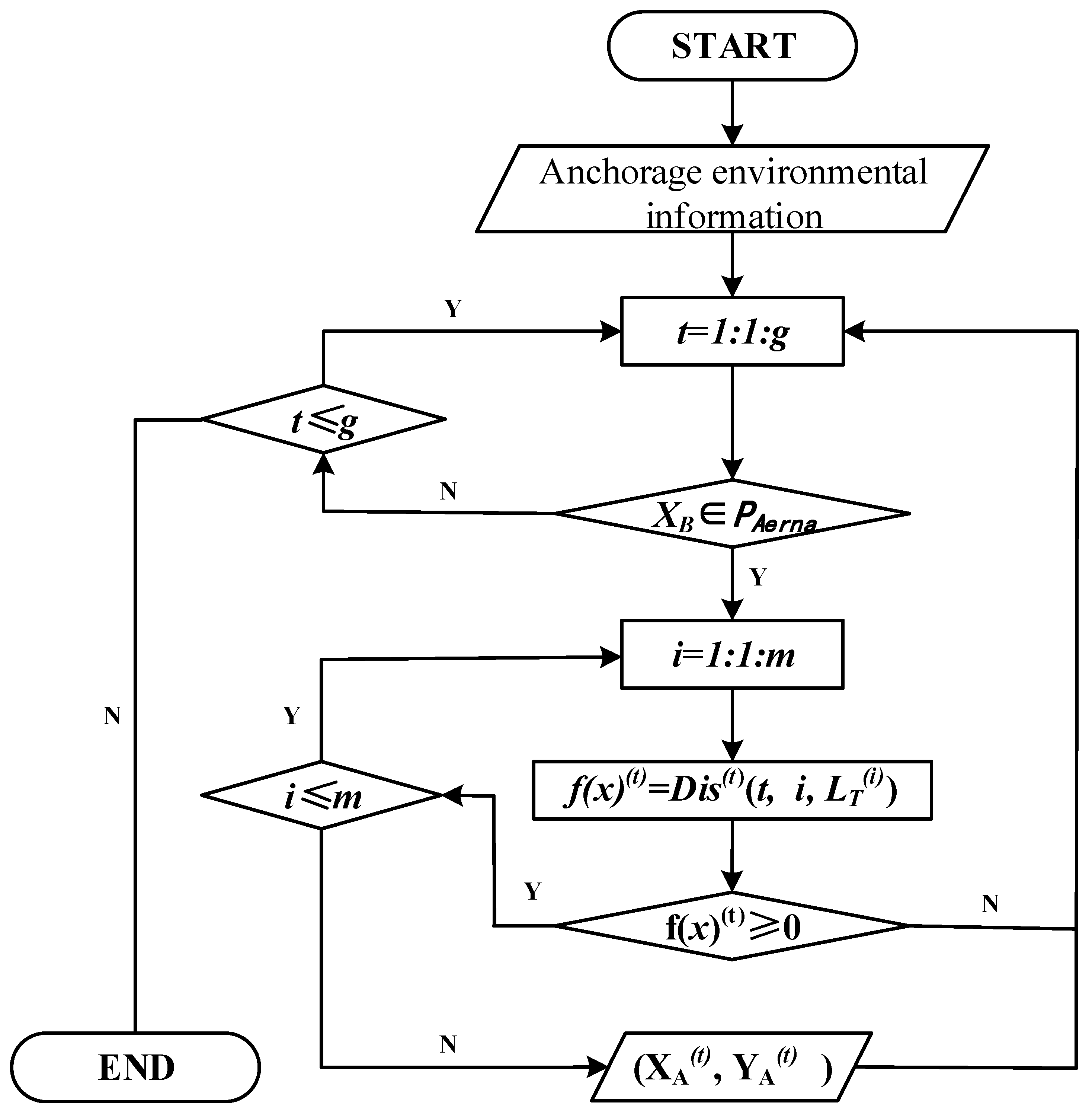
Section 2.2. To account for spatial interdependencies among potential anchor positions, this study implements a grid-based discretization method for candidate locations. Therefore, for each available anchor position, gradually increase the safe anchorage radius is incrementally expanded outward from the center until either spatial conflict occurs with previously allocated anchorage zones or the anchorage boundaries are exceeded. This process determines the maximum safe anchorage range for each available anchor position. The entire computational methodology is summarized in
Figure 3.
Where denotes the minimum distance between the available anchorage’s safe water area and the target ship’s anchorage safe water area. represents the available anchor positions and their corresponding maximum safe water radius calculated through the aforementioned process. Finally, the available anchorage corresponding to the maximum value is selected as the optimal anchor position.
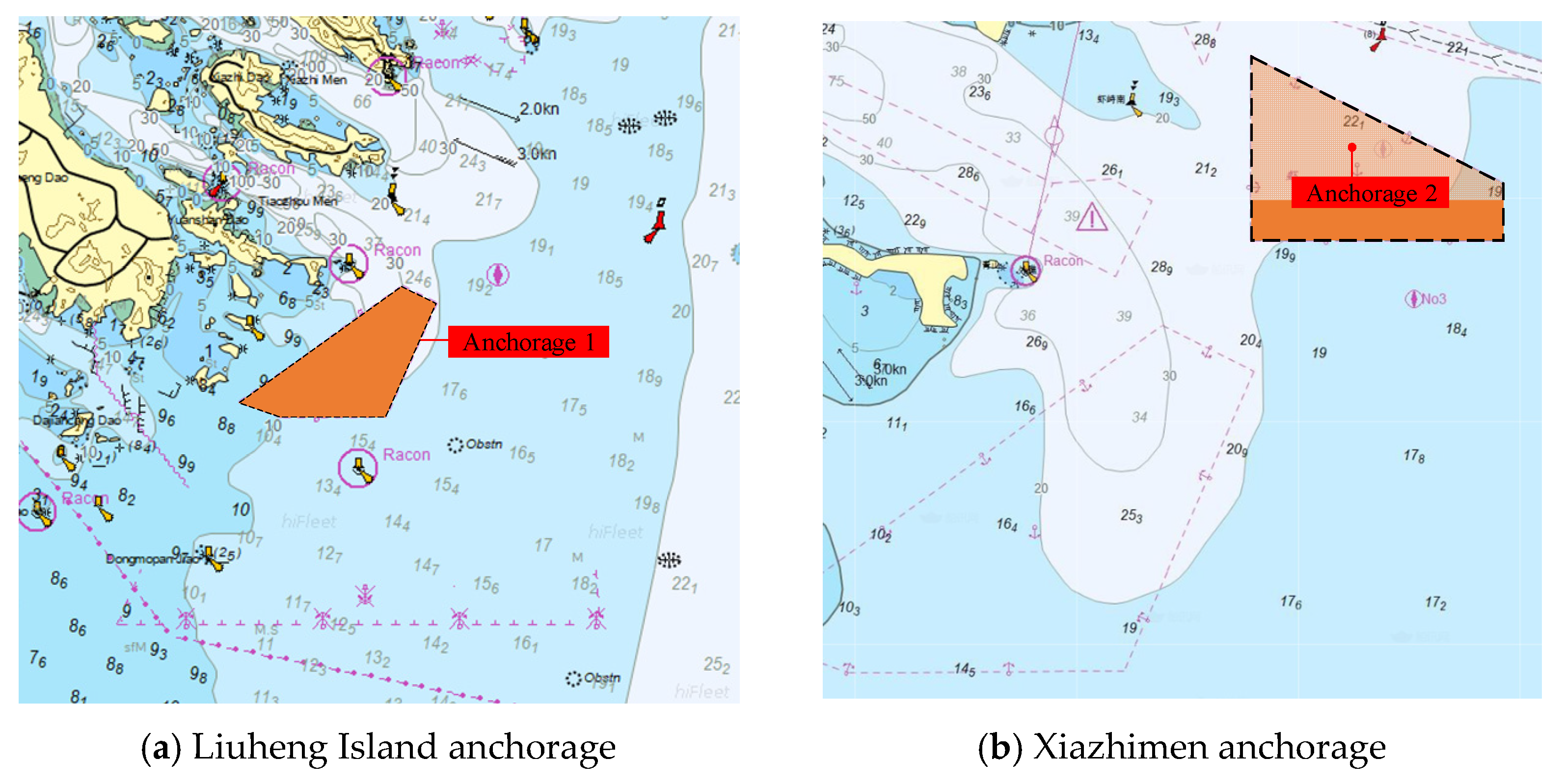
Given the spatial interdependence of potential anchor positions, this study employs a grid-based approach to discretize candidate locations, with key parameters tailored to balance computational efficiency and positioning accuracy. The grid cell size is set to 20 m × 20 m, which aligns with the length scale of large cargo ships (200–300 m) and ensures the optimal anchor position is resolved within a reasonable precision range. The radius expansion step size is defined as 5 m per step, smaller than the grid cell size to avoid missing critical safety boundaries and ensure smooth expansion of the safe water radius. For boundary handling, two termination conditions are applied during radius expansion: the expanded safe circle either touches the predefined anchorage boundary (
Table 1) or overlaps with the safe water area of other anchored ships (calculated via Equation (7)), with expansion stopping immediately upon meeting either condition to maintain feasibility. The computational complexity of the algorithm is expressed as O(w × m × k), where w denotes the number of available anchor positions (typically 50–200 in congested anchorages), m is the number of anchored target ships (10 in the case study), and k is the average number of expansion steps (30–80 steps). This linear complexity with respect to key variables ensures real-time performance, with a computation time of less than 2 s for the case study, meeting the requirements of autonomous anchoring decision-making.
In the optimal anchor position selection, the swinging behavior of other anchored ships is simplified into a predefined circular safety domain, which is a reasonable and efficient processing method for short-duration anchoring scenarios. This circular domain is designed based on the maximum possible swinging range of large cargo ships—referring to practical maritime observations and literature [
28,
34], the maximum swing angle of anchored ships under normal coastal environmental conditions (wind force ≤ Beaufort 5, current speed no more than 0.6 m/s) is within ±15°, and the corresponding maximum horizontal displacement caused by swinging is no more than 0.5 times the ship’s length. Therefore, the safety radius of each target ship has fully incorporated this maximum swinging displacement, ensuring that no matter how other anchored ships swing, their entire motion range is contained within this circular domain. This simplification not only avoids the complexity of dynamic swing trajectory calculations but also guarantees the safety of the selected anchor position by covering the extreme swing scenario, striking a balance between computational efficiency and safety reliability.
3. Autonomous Anchoring Decision-Making and Planning System
Upon securing the optimal anchorage position, the critical challenge for an intelligent cargo ship lies in verifying completion of the anchoring task and planning its trajectory within the environmental constraints of the anchorage area.
3.1. Ship Anchoring Procedure
Prior to arrival, a comprehensive anchoring plan is formulated incorporating the ship’s principal dimensions (e.g., length overall, draft), anchor equipment configuration, and the hydrographic and environmental conditions of the anchorage. This plan specifies the selection of an appropriate anchoring methodology, which can be broadly classified as single-anchor or double-anchor operations depending on the intended maneuvering strategy and equipment configuration [
35]. Specifically, double-anchor operations may be categorized by the direction of chain deployment into single-line, double-line, and parallel anchoring, while single-anchor operations are distinguished by water depth into deep-water and shallow-water anchoring—the latter further subdivided into forward-deployment and backwards-deployment methods [
36].
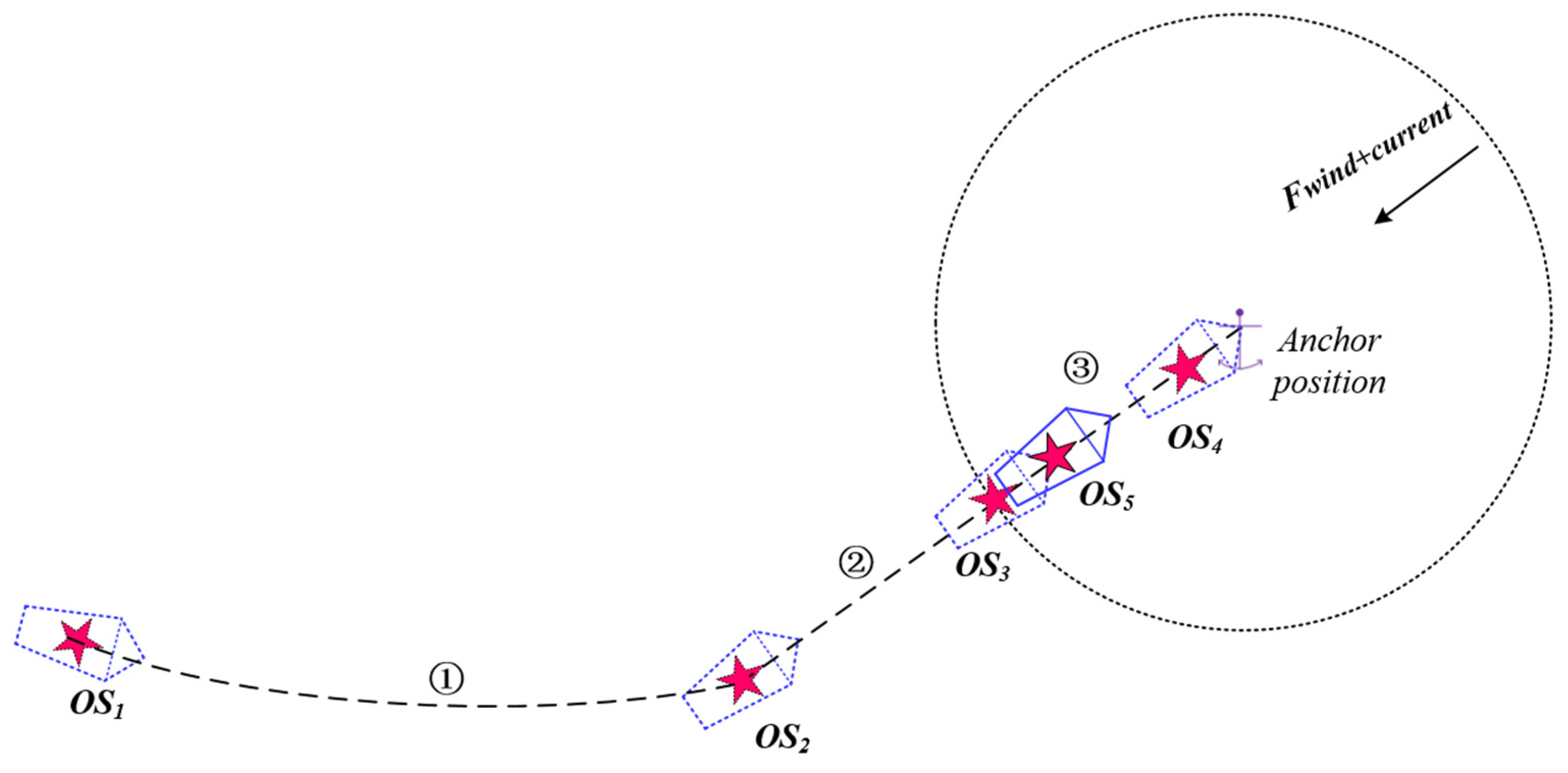
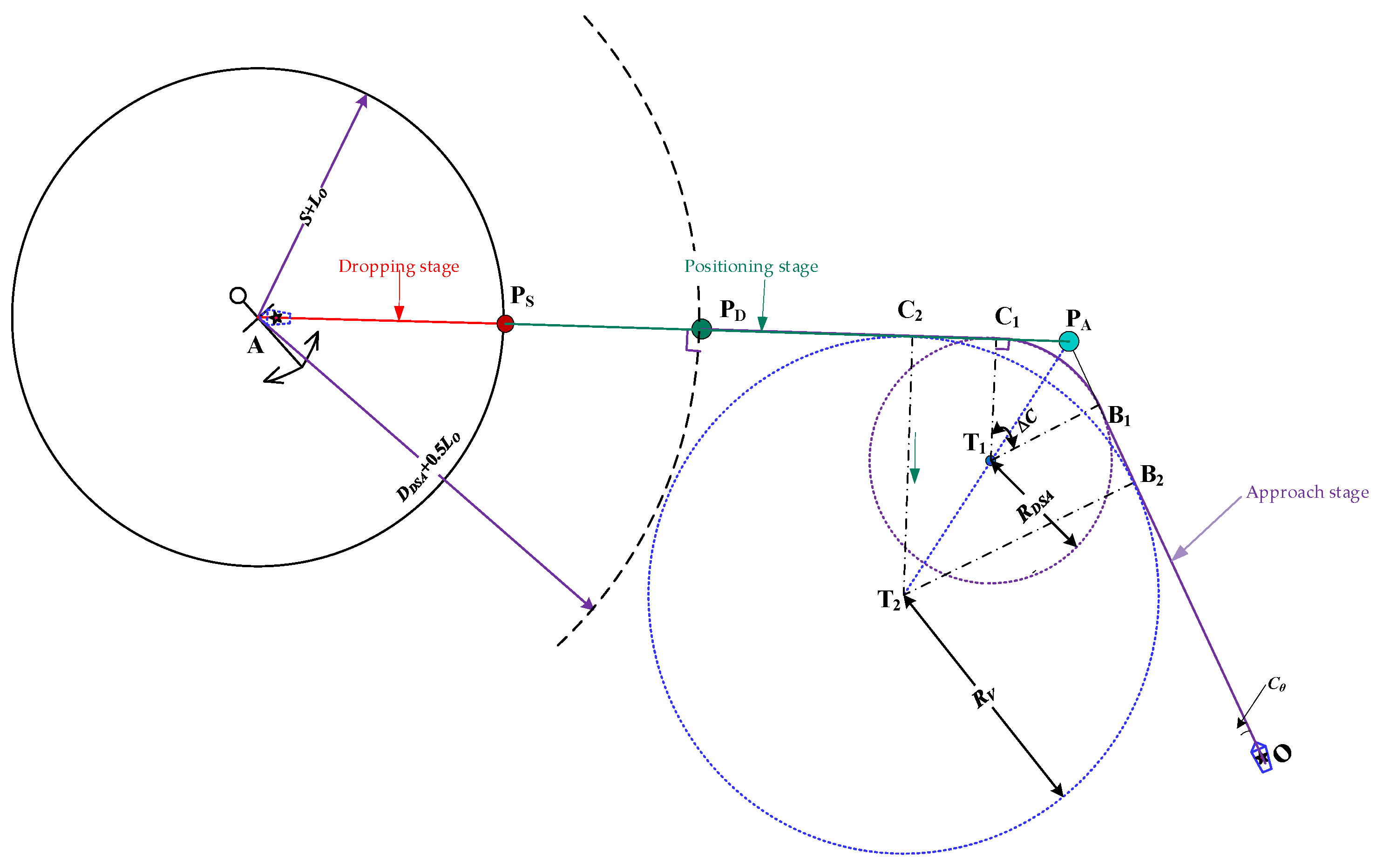
The present study focuses on large cargo ships, which predominantly utilize the single-anchor backwards-deployment method in practice—that is, releasing the anchor while the vessel moves astern at low speed. The complete anchoring process can be systematically described in three consecutive stages [
13], as illustrated in
Figure 4:
(1) Approach stage
The ship navigates from nearshore waters toward the anchorage area, adjusting its heading and speed to establish an initial condition conducive to subsequent precise, low-speed maneuvering. A critical challenge during this phase is that large cargo ships are prone to considerable drift angles at low speeds under environmental disturbances such as wind and currents, which can severely compromise their track-keeping ability. To mitigate this issue and preserve steering efficacy, established seamanship protocol dictates aligning the ship’s heading with the direction of the resultant environmental force (combined wind and current). This reference heading can be determined through theoretical computations or by observing the alignment of other vessels already at anchor.
(2) Positioning stage
The ship proceeds toward the predetermined anchor position while accounting for environmental factors such as wind and current, with speed controlled according to stopping distance. Maintaining precise speed control constitutes a critical aspect of anchoring operations. In practice, the captain maneuvers the cargo ship to sustain the minimum speed required for effective rudder control during anchorage approach. This enables identification of the optimal moment to stop, utilizing the ship’s momentum to drift to the designated anchorage position. If premature engine shutdown occurs, the vessel cannot reach the anchorage solely through residual motion and must employ intermittent kick-ahead maneuvers to maintain forward progress. Conversely, delayed deceleration results in excessive approach velocity requiring sustained high-gear reverse thrust for rapid speed reduction. However, prolonged astern propulsion generates significant lateral forces causing bow deflection, which produces an unfavorable anchoring attitude that fails to meet operational requirements.
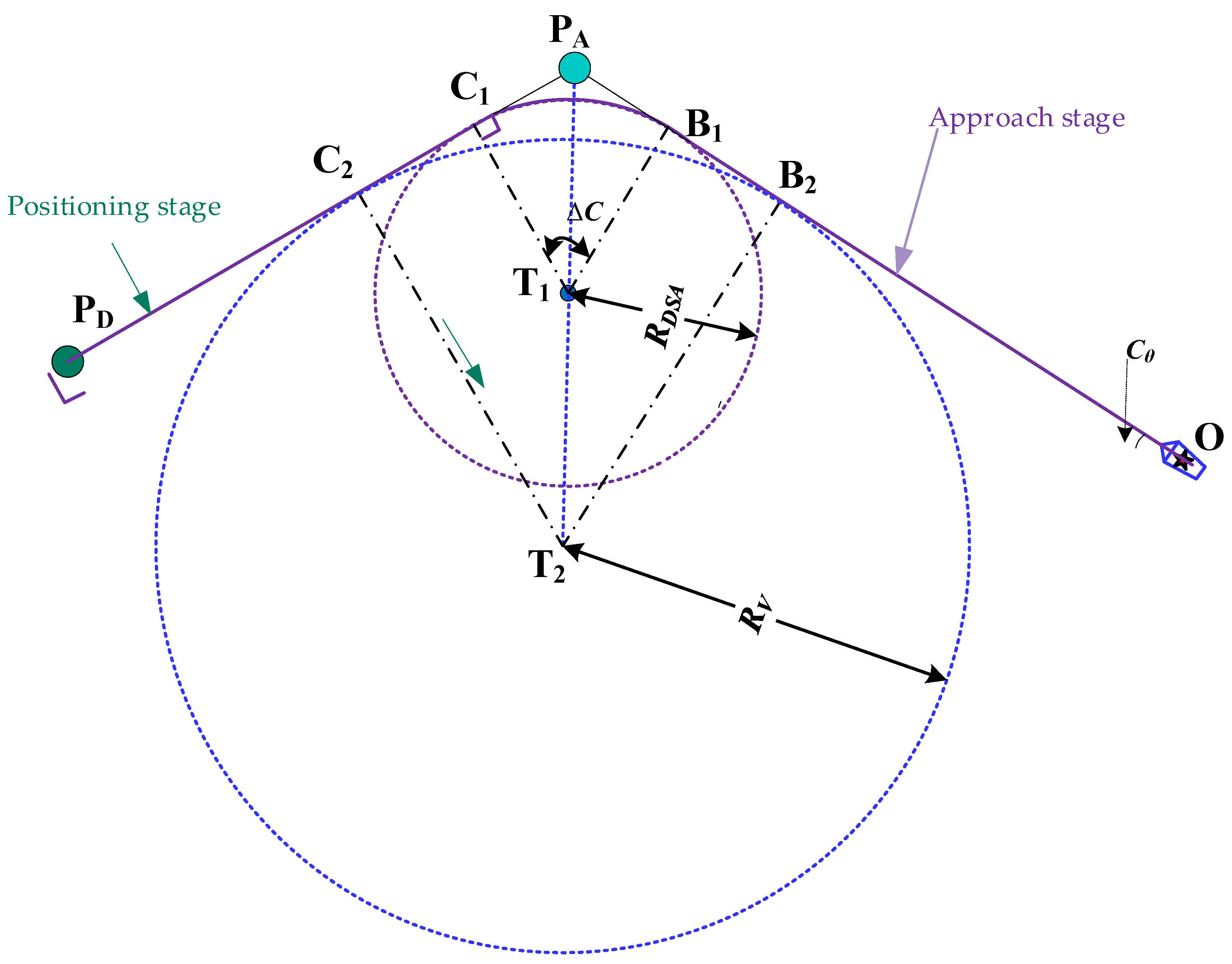
In
Figure 4, point
represents the planned stopping position, determined by the ship’s stopping distance. During the anchoring process, the ship’s speed must be reduced to the minimum speed necessary to ensure effective maneuverability prior to reaching
.
(3) Dropping stage
Upon reaching the target position, the anchor is released with a predetermined length of chain through manual or remote-controlled operations, thereby completing the anchoring operation [
37]. When approaching an anchorage area, a cargo ship can detects potential anchorage positions and identifies static or dynamic obstacles based on the traffic environment. Considering the ship’s dimensions and the constraints of water depth and environmental forces, the system evaluates whether a designated anchorage position can guarantee secure anchoring whilst accommodating spatial limitations and environmental perturbations. The optimal anchorage position is subsequently selected from the feasible set [
38]. Following this selection, the most appropriate anchoring methodology is determined based on bathymetric characteristics and the available safe water area. Finally, the anchor deployment process is executed according to the sequence diagrammed in
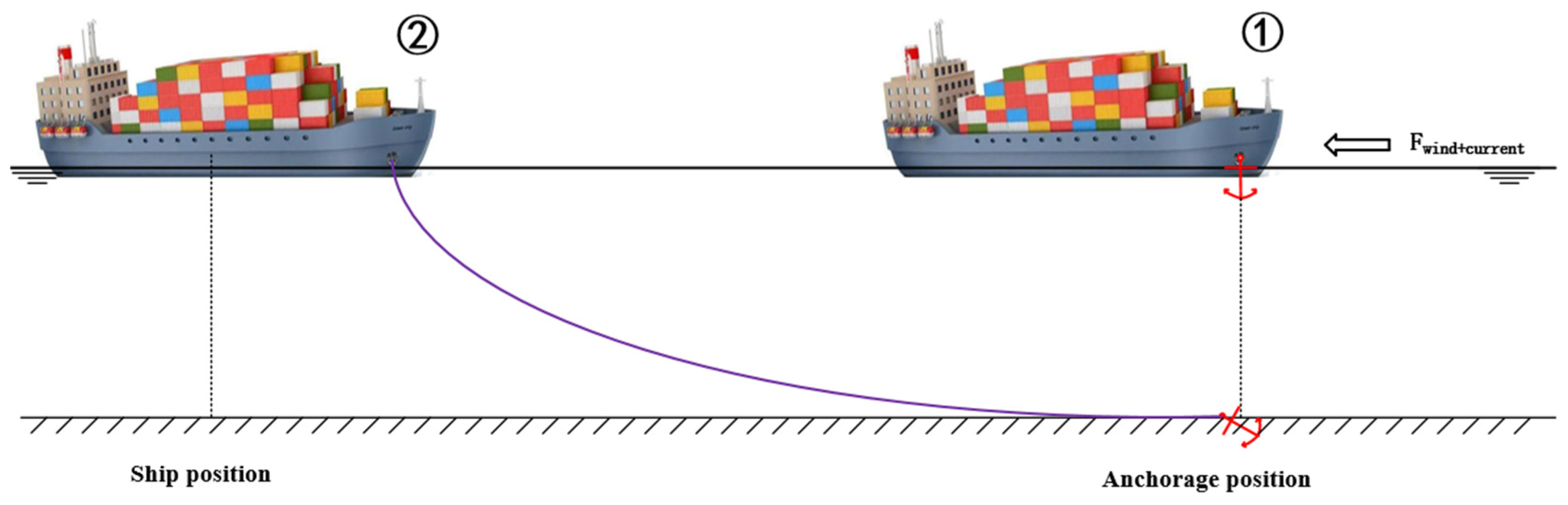
Figure 5.
A critical geometric relationship defines this final phase. The “anchor position (Position ①)” refers to the seabed location of the anchor fluke, which is operationally defined as the position of the ship’s bow at the moment of release. It is important to note that the ship’s position (typically determined via GPS and approximating the geometric center, Position ②) and the bow position are offset. This relationship is defined as:
where
represents the ship’s position,
denotes the ship’s bow direction at
, and
indicates the location of the anchor arrangement.
3.2. Algorithm for Ship Anchoring Trajectory Planning Based on Multi-Level Guided
Building upon the anchoring procedure detailed in
Section 3.1, this section presents a multi-level guided algorithm for ship anchoring trajectory planning. Large cargo ships operating at low speeds are particularly susceptible to significant drift angles induced by environmental disturbances, which severely compromise effective track-keeping capabilities [
39]. To address this challenge, the proposed algorithm systematically integrates the three critical phases of the anchoring process—turning, decelerating, and stopping—into a cohesive trajectory planning framework, while incorporating a real-time rolling optimization mechanism to mitigate low-speed maneuverability degradation and drift.
The algorithm comprises three interconnected components: the ship stopping guidance point
, ship decreasing guidance point
, and the ship’s altering guidance point
, and point A indicates the optimal anchor position. These components correspond to the three sequential phases of the anchoring procedure as shown in
Figure 6: the approach phase corresponds to the ship turning guidance point, the positioning phase corresponds to the segment from the ship stopping guidance point to the ship stopping guidance point, and finally, the anchoring phase encompasses the segment between the ship stopping guidance point to the optimal anchor position. For intelligent cargo ships, the algorithm determines optimal turning and stopping points by incorporating environmental factors such as wind and current conditions. This integrated methodology ensures that external forces do not adversely influence the vessel’s motion dynamics during each maneuvering phase. Through systematic integration of these sequential stages, the algorithm generates an optimized anchoring trajectory that minimizes drift displacement, enhances safety, and maximizes operational efficiency throughout the complete anchoring sequence.
3.2.1. Ship Stopping Guidance Point
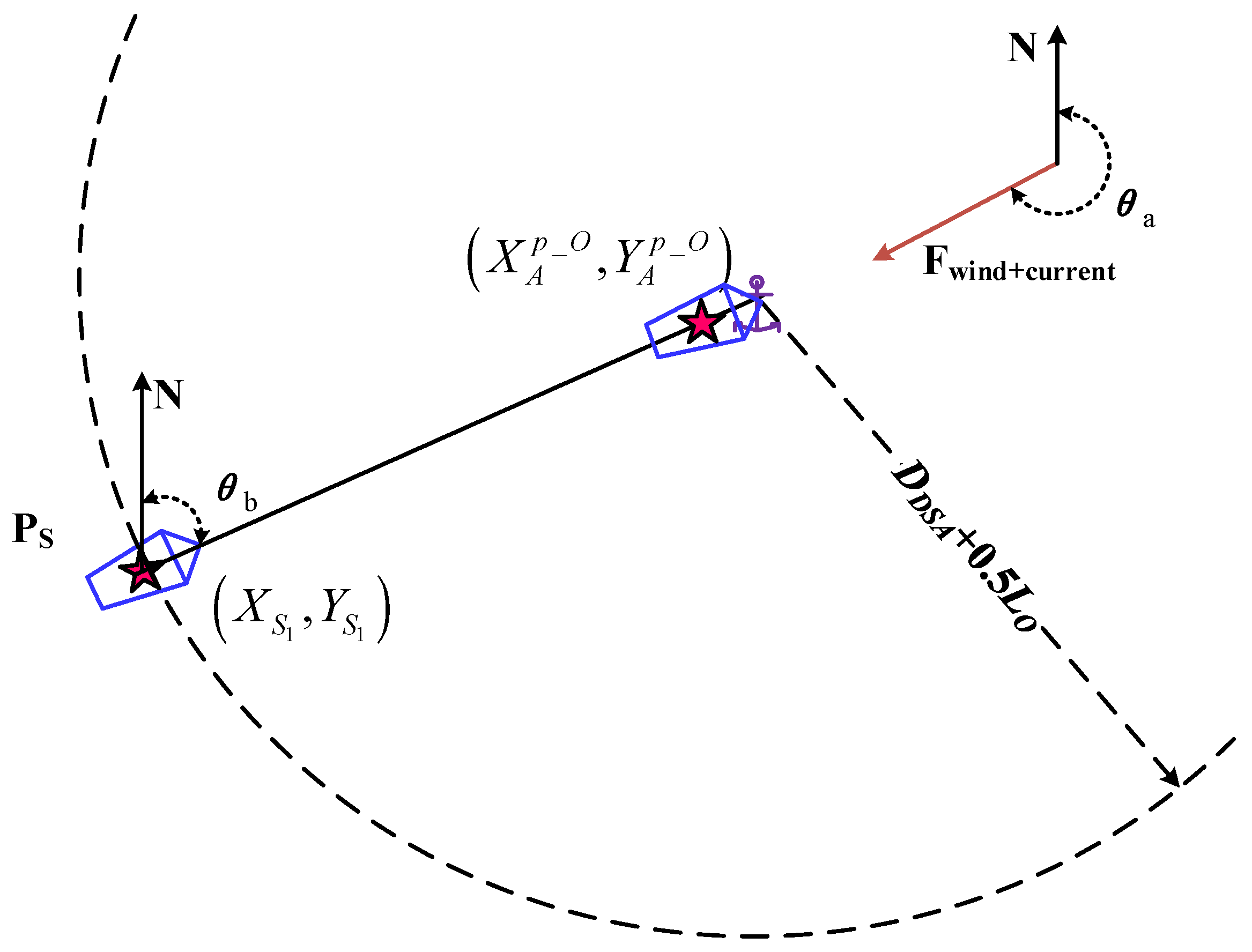
The ship stopping guidance point is defined as the position where a cargo ship executes the stopping order subsequent to the completion of attitude adjustments. This parameter’s determination depends on both anchor position and the ship’s stopping distance [
40].
Prior to operational deployment, the ship’s stopping distance and turning circle parameters can be obtained through sea trials, under various engine commands. It is recommended that these data be plotted and subsequently displayed in a prominent location on the bridge, thus enabling the captain and pilot to access them intuitively. During actual anchoring operations, stopping distance selection considers environmental factors and the ship’s main engine order. For analytical consistency in this study, the stopping distance
as determined by the dead slow ahead for main engine command has been adopted. The determination of the stopping guidance point
is subsequently determined through consideration of the combined wind-current force direction
, as illustrated in
Figure 7:
The position
of the ship’s stopping guidance point, determined by combining the optimal anchorage position with the direction of the combined wind and current forces, and the angle
at which the ship is guided into the berth, is illustrated as follows:
3.2.2. Ship Decreasing Guidance Point
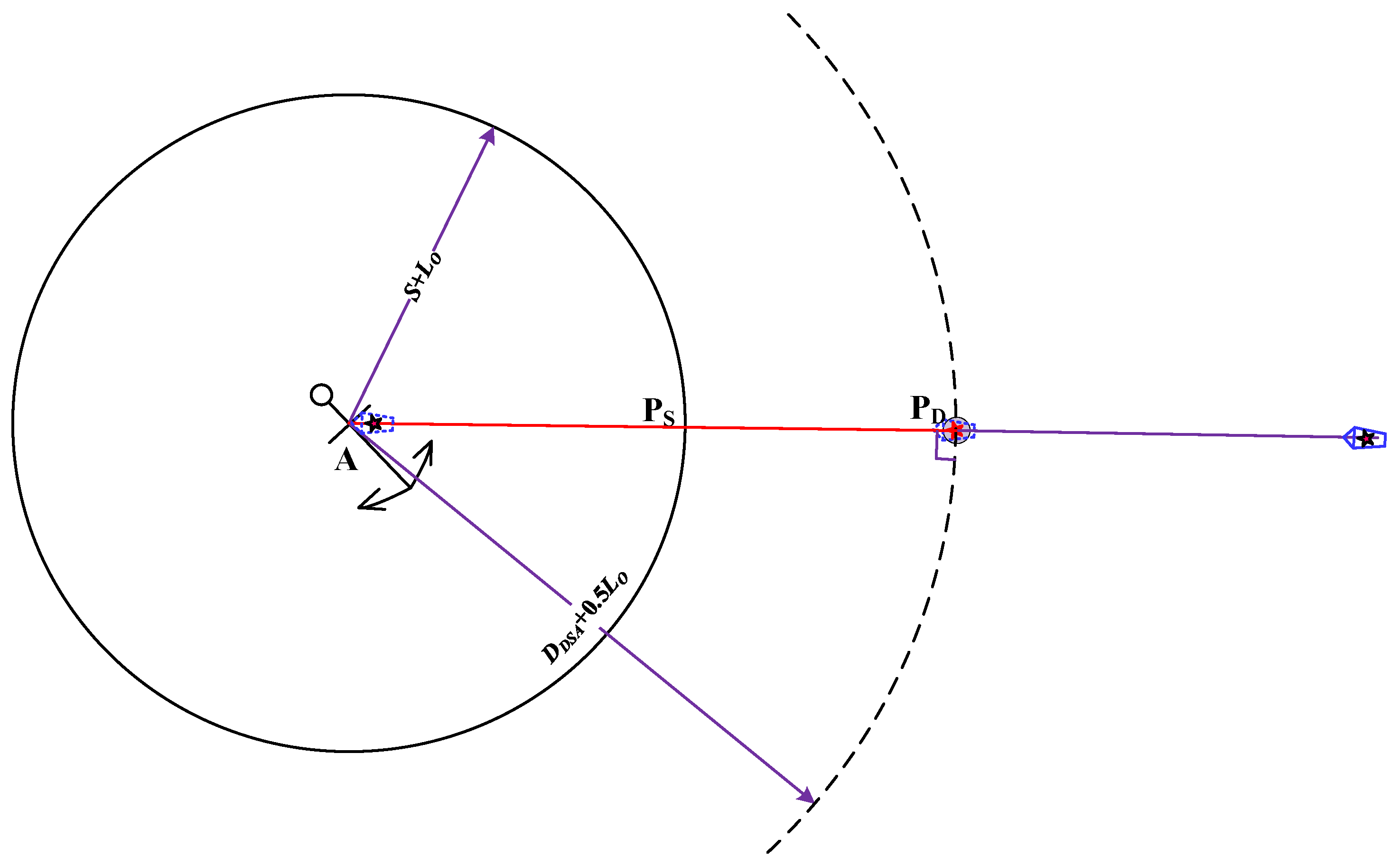
Within the practice of anchoring, the captain implements a strategy to mitigate risks associated with frequent engine usage, including potential main engine failure or wind-current interference at low speeds. This strategy involves the limitation of engine orders issued, thereby reducing the overall demand on the engine system. Ship’s deceleration guidance point is defined as a critical reference location with its center at the designated anchor position and radius
, ensuring the ship achieves an appropriate anchoring speed when reaching this specified geographical coordinate (see
Figure 8).
3.2.3. Ship Altering Guidance Point
During navigation towards a designated stopping guidance point at the minimum steerable speed, a ship’s trajectory is susceptible to disturbances from dynamic and static targets, navigational obstructions, and other environmental factors within the waterway. To ensure the cargo ship arrives at the stopping guidance point in the specified orientation, the anchorage turning guidance point must be determined through integrated analysis of turning circle parameters combined with real-time positional data, heading information, and additional operational variables.
The altering guide points are indicated as shown in
Figure 9. Initially, the optimal anchorage position
and the ship’s stopping guide point
are integrated. Subsequently, the intersection point
of the two courses is then calculated based on the ship’s current position
and heading
. This results in the location
being determined. This methodology ensures the vessel can execute anchoring maneuvers along the prescribed trajectory
or
within its maneuverability constraints. Herein, (
or
) denotes the turning guidance point corresponding to different main engine commands for the cargo ship.
The formula for calculating the altering radius
is as follows, where
and
represent the ship’s speed before turning and during steady turning, respectively.
Given that vessels navigating towards anchorage positions may be subject to environmental disturbances including wind and current effects, this study employs the turning circle generated during the vessel’s dead-slow-ahead maneuver as the course alteration reference circle. This methodology guarantees sufficient straight-line running duration for speed stabilization following course adjustments. The designated turning reference point B, situated within the anchorage maneuvering zone, has spatial coordinates
determined through the subsequent calculation procedure:
where
represents the distance from point
to the steering reference point
.
for the turning angle, and
indicates the radius of steady turning for the simulated ship under the dead slow ahead command, which can be obtained from the ship’s turning performance parameter chart.
3.3. Decision-Making Method for Cargo Ship Safe Anchoring
When an autonomous cargo ship approaches the designated anchorage area, the required safety area for anchoring is preliminarily calculated based on the ship’s displacement, draft, anchor equipment specifications, and water depth. Subsequently, the occupied anchorage areas of vessels already at anchor are determined by considering their dimensions, headings, and positions within the anchorage. Following this assessment, the optimal anchorage position is identified using the available anchor position determination program and the optimal anchorage position determination program, as introduced in
Section 3.1.
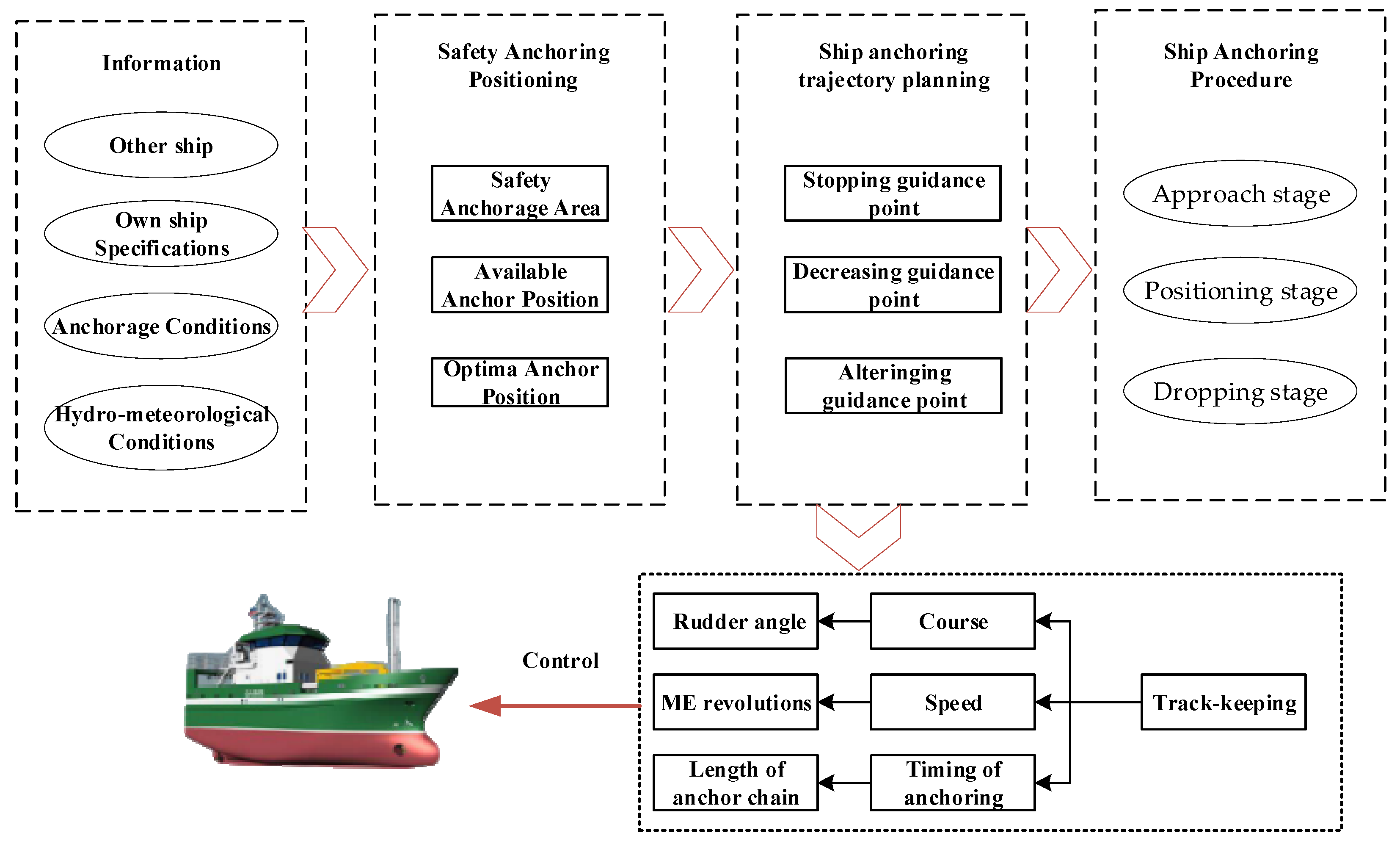
Concurrently, a suitable automated anchoring protocol is selected based on the derived optimal anchorage coordinates and prevailing hydrometeorological conditions. Thereafter, in accordance with the ship’s current position and target ship parameters, and in combination with the optimal anchorage position and selected anchoring methodology, a multi-level guided anchoring planning trajectory is formulated under dynamic constraints imposed by the vessel’s maneuverability limits and prescribed approach angle requirements. Finally, through the course and speed control system, the anchoring task is completed with the assistance of a remote anchoring system. The complete decision-making framework for safe ship anchoring is illustrated in
Figure 10.
The core mechanism of this module lies in dynamically adjusting the next motion state by comparing the ship’s real-time actual state with the predicted state from the previous planning step, ensuring the vessel meets the required anchoring speed (<1.0 knot) upon reaching the target anchor position. During anchoring execution, onboard sensors (GPS, AIS, gyrocompass, speed log, and propulsion monitors) collect key state data—including real-time position, heading, speed over ground, and thrust output—at a 1 Hz sampling frequency, forming a closed-loop feedback with the trajectory planning module.
The correction logic is centered on state deviation mitigation: if the ship’s real-time speed exceeds the predicted speed from the previous step by more than 0.2 knot, or if the position/heading deviation (relative to the planned trajectory) exceeds 10 m/5°, the system immediately recalculates the next turning, decelerating, or stopping guidance points. The updated guidance points prioritize speed control: for example, advancing the deceleration guidance point by 15–20% if real-time speed is higher than predicted, or adjusting the thrust output coefficient to extend the slow-down phase. This rolling adjustment avoids cumulative errors from environmental disturbances (e.g., wind drift) or hydrodynamic parameter changes (e.g., shallow water effects), ensuring the ship converges to the anchor position with speed strictly compliant with anchoring requirements.
Notably, the mechanism maintains computational efficiency by limiting recalculation to the subsequent guidance point rather than the full trajectory. This design balances real-time responsiveness and operational precision, perfectly aligning with the critical demand for speed control in low-speed anchoring maneuvers.
5. Discussions and Analysis
This study presents the development and validation of an integrated autonomous anchoring decision-making system through simulations conducted in two realistic anchorage scenarios. The system’s performance can be evaluated across three interrelated dimensions: the effectiveness of the optimal positioning algorithm, the robustness of the multi-level trajectory planning, and the synergistic advantages derived from their integration within a comprehensive autonomy framework.
(1) Performance of the Optimal Anchor Positioning Algorithm
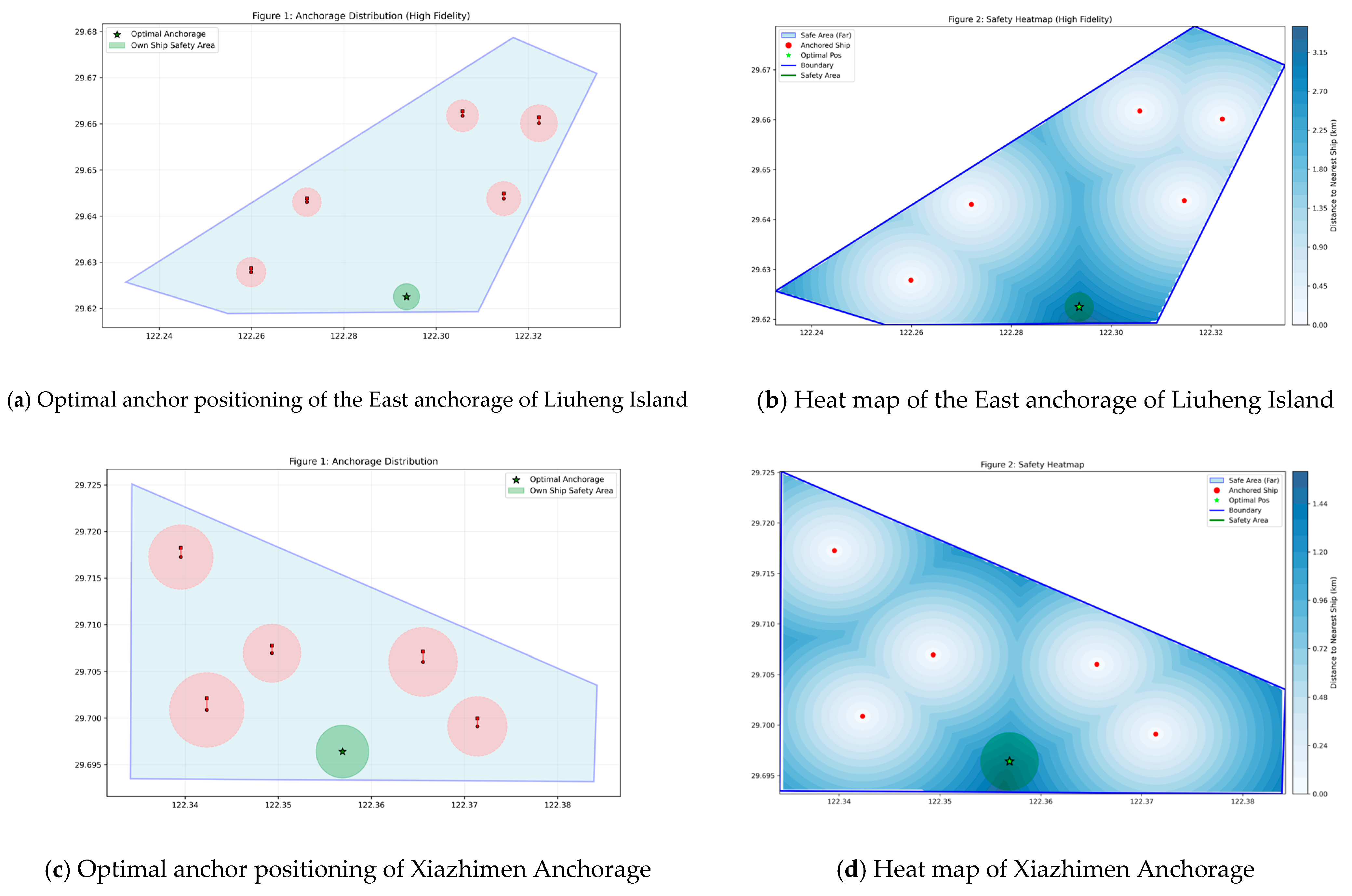
The proposed algorithm simultaneously accounts for both static constraints (anchorage boundaries) and dynamic obstacles (other ships’ safe water areas) to identify the globally optimal anchoring point within complex and crowded anchorage environments, rather than simply selecting the geometric center or the nearest vacant spot. This novel grid-based optimization approach successfully determines anchor positions that maximize safety buffers in congested anchorages, as demonstrated in
Figure 12. Its core strength lies in formalizing the expert heuristic of selecting the “center of the largest available safe water radius.” As demonstrated in
Section 4.2, the algorithm did not default to geometric centers but instead identified positions that optimally balanced distances from other ships and anchorage boundaries. A safety margin heat map serves as a valuable visual tool, transparently illustrating the quantitative safety landscape of the anchorage to support decision-making.
In the scenario with 10 target ships, the algorithm achieves a computation time of less than 5 seconds on a standard workstation (CPU: Intel Core i7-12700H, 14 cores/20 threads; RAM: 32 GB DDR5-4800 MHz) with a 20 m × 20 m grid, fully meeting real-time decision-making requirements. Its grid-based framework enables seamless integration with Electronic Chart Display and Information System (ECDIS) data, highlighting strong engineering applicability. Beyond efficiency, the algorithm avoids local optimal and subjective biases inherent in experience-based traditional anchor position selection, providing autonomous ships with an objective, quantifiable, and safety-prioritized decision-support tool for anchoring positioning.
(2) Robustness of the Multi-level Guided Trajectory Planning
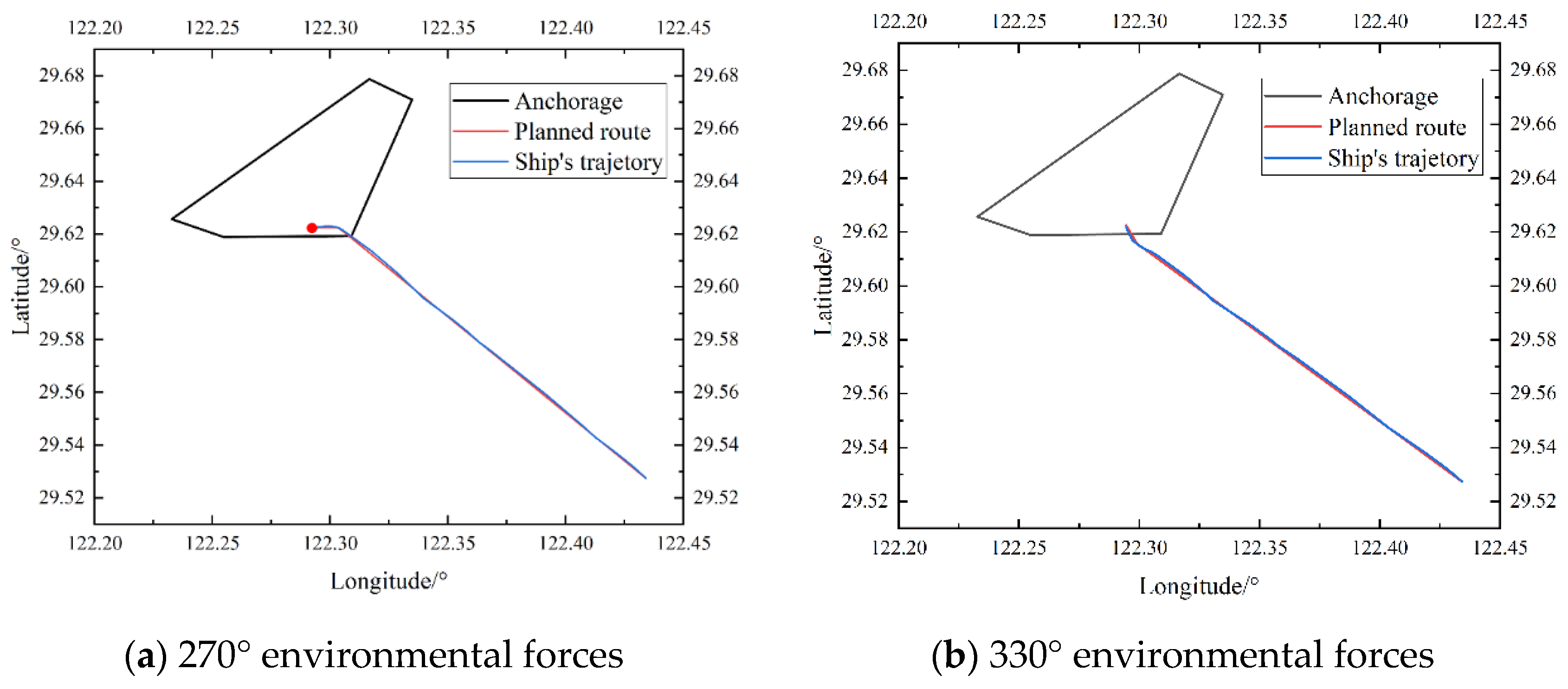
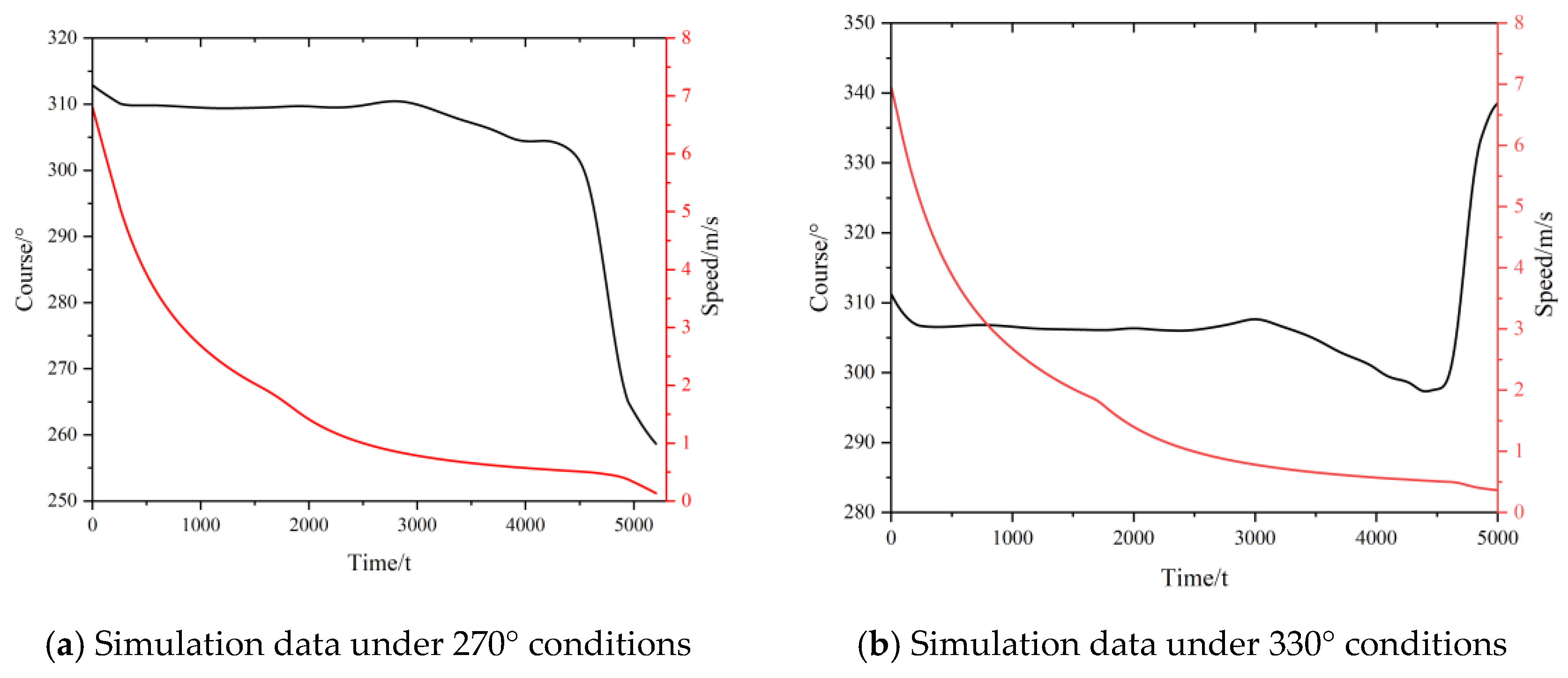
The trajectory planning algorithm exhibited robust performance under two distinct environmental conditions (270° and 330°), as shown in
Figure 13 and
Figure 14. By decomposing the complex maneuver into sequential phases governed by turning, decelerating, and stopping guidance points, the method effectively addressed the critical challenge of low-speed controllability degradation. The close alignment between the planned and actual simulated trajectories, particularly during the critical final approach, validates the guidance point calculation methodology and its integration with the ship’s maneuvering model. The speed profile in
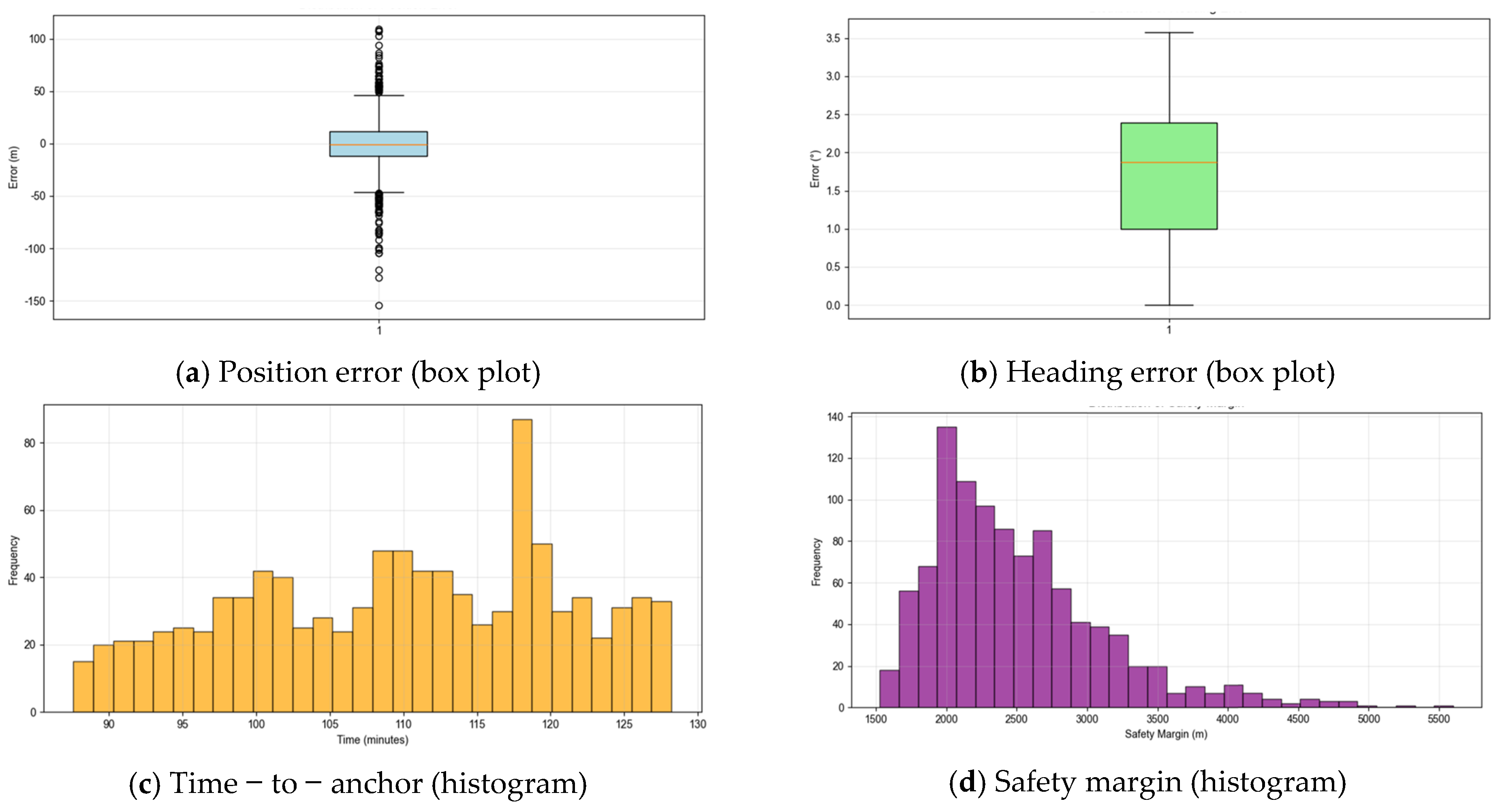
Figure 15 clearly shows the algorithm’s capability to execute necessary “kick-ahead” maneuvers for maintaining steerage, culminating in a final speed below 1.0 knot. The final state parameters (position error of 35–42 m, heading error within 15°, speed < 1 kn, as shown in
Table 4) satisfied the stringent success criteria derived from seamanship practices. This indicates that the algorithm not only generates geometrically feasible paths but also produces dynamically executable maneuvers incorporating kinetic energy management and environmental forces.
(3) Comparative Analysis with Occupancy Modeling
This study focuses on optimal anchor position selection for autonomous cargo ships in relatively resource-abundant anchorages, where core constraints lie in low-speed maneuverability degradation and static spatial conflicts between vessels’ swing circles—rather than high-density occupancy pressure or data incompleteness. Against this background, we align our methodological choices with practical operational needs, while acknowledging the value of advanced approaches proposed in [
32] as complementary extensions for complex scenarios.
Our grid-based discretization method is tailored to the real-time decision-making demands of anchoring operations, maintaining computational simplicity and efficiency (computation time < 5 s) while ensuring sufficient safety margins. This design is well-suited for resource-abundant environments, where the primary goal is reliable identification of safe anchor positions without excessive computational overhead. In contrast, the hexagonal occupancy modeling method in [
32]—which enhances spatial utilization and safety margins by 10.3%—is more optimized for high-density anchorages where space efficiency is critical. While both methods can effectively identify valid anchor positions in our target scenarios, our grid-based approach strikes a pragmatic balance between safety and executability, avoiding the increased complexity of hexagonal modeling. Similarly, the PIANC-based dynamic turning radius adjustment in [
32] addresses environmental adaptability in crowded conditions, which we plan to integrate in future work to expand applicability to variable wind and seabed conditions.
Regarding vessel parameter acquisition, our study leverages complete Length Overall (LOA) records from high-quality AIS static data, enabling direct and accurate swing circle calculations. This eliminates the need for indirect estimation methods, such as the Random Forest-based LOA inference proposed in [
32] (which addresses missing AIS data with an RMSE of 10.34). By using direct data acquisition, we avoid potential errors from predictive modeling, enhancing the reliability of our static spatial constraint logic. We recognize the utility of LOA estimation for scenarios with incomplete sensor data, positioning it as a key supplement for future extensions of our system to complex real-world environments.
In terms of occupancy forecasting, the stacked ensemble learning framework in [
39] achieves exceptional predictive accuracy (MAPE = 0.59%) for dynamic anchorage occupancy, making it ideal for high-density ports where short-term traffic fluctuations impact decision-making. However, our static decision-making framework is sufficiently robust for resource-abundant anchorages: anchored vessels’ swing circles are fixed by LOA and anchor chain length, and avoiding these circles inherently accounts for all normal movements. This design simplifies computation without compromising safety, meeting the core demand for stable and efficient anchoring in typical scenarios. The stacked ensemble forecasting method will be integrated in future research to address high-density anchorage dynamics, extending our system’s adaptability beyond the current study scope.
In summary, our methodological choices are closely aligned with the practical needs of our target scenarios, prioritizing real-time performance, reliability, and operational feasibility. The advanced approaches in [
32]—hexagonal occupancy modeling, LOA estimation for missing data, and stacked ensemble forecasting—are not substitutes but valuable complements, addressing complex edge cases beyond our current focus. This division of focus ensures our study validates a core solution for common anchoring scenarios, while embracing complementary methods to tackle high-density, data-scarce environments in future work.
(4) System Integration and Practical Implications
The primary scholarly contribution of this work lies in achieving seamless integration of position optimization and trajectory planning within a unified decision-making framework (
Figure 10, schematic). The optimized anchor positioning strategy incorporates both static and dynamic constraints, while the multi-level guided trajectory provides a safe and feasible navigation toward the designated location. This end-to-end automation addresses the stated gap in research for autonomous anchoring scenarios. From an operational perspective, the proposed methodology offers a standardized and reproducible framework that reduces reliance on seaman’s experience, thereby mitigating human error-induced incidents such as suboptimal site selection or anchor dragging events. The approach is constructed upon conventional ship parameters and COLREGs-compliant decision logic, enabling retrofitting capabilities for existing fleets undergoing automation modernization. The simulation-based validation using a high-fidelity MMG model under realistic anchorage geometries and traffic conditions strongly supports its engineering applicability.
The simplified anchor chain release formula (Equation (3))—core to safety anchorage area calculation—applies exclusively to traditional cargo ships adopting single-anchor mooring and is not suitable for typhoon shelters. Aligned with standard seamanship principles and the General Design Code for Seaports (JTS 165-2013) [
43], it covers 1000–150,000 DWT medium-to-large cargo ships (bulk carriers, container ships) commonly using coastal anchorages. The formula incorporates wind dependency with Beaufort 7 (15.5–20.7 m/s) as the adjustment threshold, and its maximum applicable wind speed is limited to less than 24 m/s (below Beaufort 10), as typhoon-grade winds exceed its safety margin.
For typical coastal anchorage depths (10–30 m), the derived scope ratio (6:1–18.5:1) meets single-anchor mooring requirements, while the fixed chain segment (90 m/145 m) ensures stable seabed contact. It is optimized for medium-hard seabeds (sand, gravel); soft seabeds require a 20–30% longer chain, and hard rock seabeds demand additional measures (e.g., rock anchors). Ultra-shallow (<10 m) or deep-water (>30 m) anchorages require parameter adjustments (e.g., modifying the HA coefficient) due to the fixed segment’s proportional impact. This rational simplification balances computational efficiency and safety, avoiding complex dynamic environmental calculations while covering extreme swinging scenarios within applicable limits.
6. Conclusions
This study presents an integrated autonomous anchoring decision-making system for cargo ships, addressing the critical challenge of reliable low-speed anchoring operations within spatially constrained and dynamically evolving anchorage environments. The proposed system combines an optimal anchor positioning algorithm with a multi-level guided trajectory planning method, validated through high-fidelity simulations in realistic anchorage scenarios. The grid-based positioning algorithm effectively formalizes expert seamanship heuristics, identifying anchor locations that maximize the safety buffer relative to adjacent ships and anchorage boundaries. The trajectory planning algorithm component, structured around turning, decelerating, and stopping guidance points, demonstrated robust performance through the generation of executable navigation paths that effectively compensated for speed loss and environmental drift forces, thereby ensuring precise arrival at designated positions with controlled vessel orientation and minimal residual velocity. The final state in all simulated cases met stringent criteria derived from practical anchoring standards, thereby validating both system efficacy and engineering practicality.
This research makes three distinct contributions: (1) establishing a systematic, quantifiable framework for anchor position selection that enhances situational awareness and safety over experiential judgment; (2) proposing a novel phased trajectory planning approach that explicitly addresses the low-speed maneuverability degradation of large cargo ship; and (3) creating an integrated autonomous anchoring workflow that unifies perception, decision-making, planning, and control functions, providing experimentally validated technical foundations for achieving full-path ship autonomy.
This study acknowledges specific limitations that highlight potential avenues for future research. The present model simplifies the complex dynamic swinging behavior of anchored vessels by representing it as a fixed circular domain—a design validated to encompass the maximum possible swing range of large cargo ships under normal environmental conditions, thereby ensuring computational efficiency and safety margins. However, this approach does not incorporate temporal variations in swing characteristics (e.g., time-dependent changes in swing amplitude induced by fluctuating environmental forces). Additionally, the system’s operational efficacy under extreme high-density anchorage scenarios or emergency conditions requires systematic evaluation. Subsequent research will prioritize the incorporation of time-varying environmental models, the formulation of dynamic swing simulation frameworks accounting for real-time environmental perturbations and seabed friction coefficients, and the expansion of decision-making algorithms to accommodate broader anchoring configurations.