Dynamic Underway Replenishment Route Optimization for Naval Formations Considering Formation Stability

Abstract
1. Introduction
- (1)
- A novel dynamic routing optimization framework integrating system resilience is proposed. We quantify the tactical concept of “Formation Stability” into a core optimization constraint, embedding it within the Moving Target Traveling Salesman Problem (MT-TSP) model. This framework simultaneously characterizes the “service dynamics” of replenishment operations and “systemic structural risks” within a unified model, offering a generalized modeling paradigm for analyzing the resilience of cooperative mobile platform operations in complex maritime environments.
- (2)
- Hybrid Genetic Algorithm with Adaptive Variable Neighborhood Search (HGA-AVNS) tailored for high-dynamic problems is designed. Addressing the computational challenges posed by strong model nonlinearity and time-varying parameters, the algorithm achieves a dynamic balance between global exploration and local exploitation through the deep fusion of chaotic initialization, multi-modal neighborhood search, and adaptive mechanisms. Furthermore, the structural superiority of the proposed HGA-AVNS is rigorously validated through an in-depth effectiveness analysis of its core algorithmic operators. This algorithm not only provides an efficient solution for the specific problem addressed but also serves as a robust tool for solving a class of combinatorial optimization problems characterized by high dynamics and strong constraints.
- (3)
- The operational mechanisms of key parameters on system efficacy are elucidated through systematic numerical experiments. Beyond verifying the superiority of the proposed approach, the study employs in-depth sensitivity analysis to clarify the quantitative impacts of key operational parameters and dynamic environmental disturbances—specifically, formation cruise speed, ocean currents, and sudden tactical turning—on overall replenishment efficiency. These insights provide command decision-makers with theoretical grounds and quantitative references for resilient decision-making that transcend traditional empirical judgment in complex maritime scenarios.
2. Problem Description and Mathematical Formulation
2.1. Problem Description
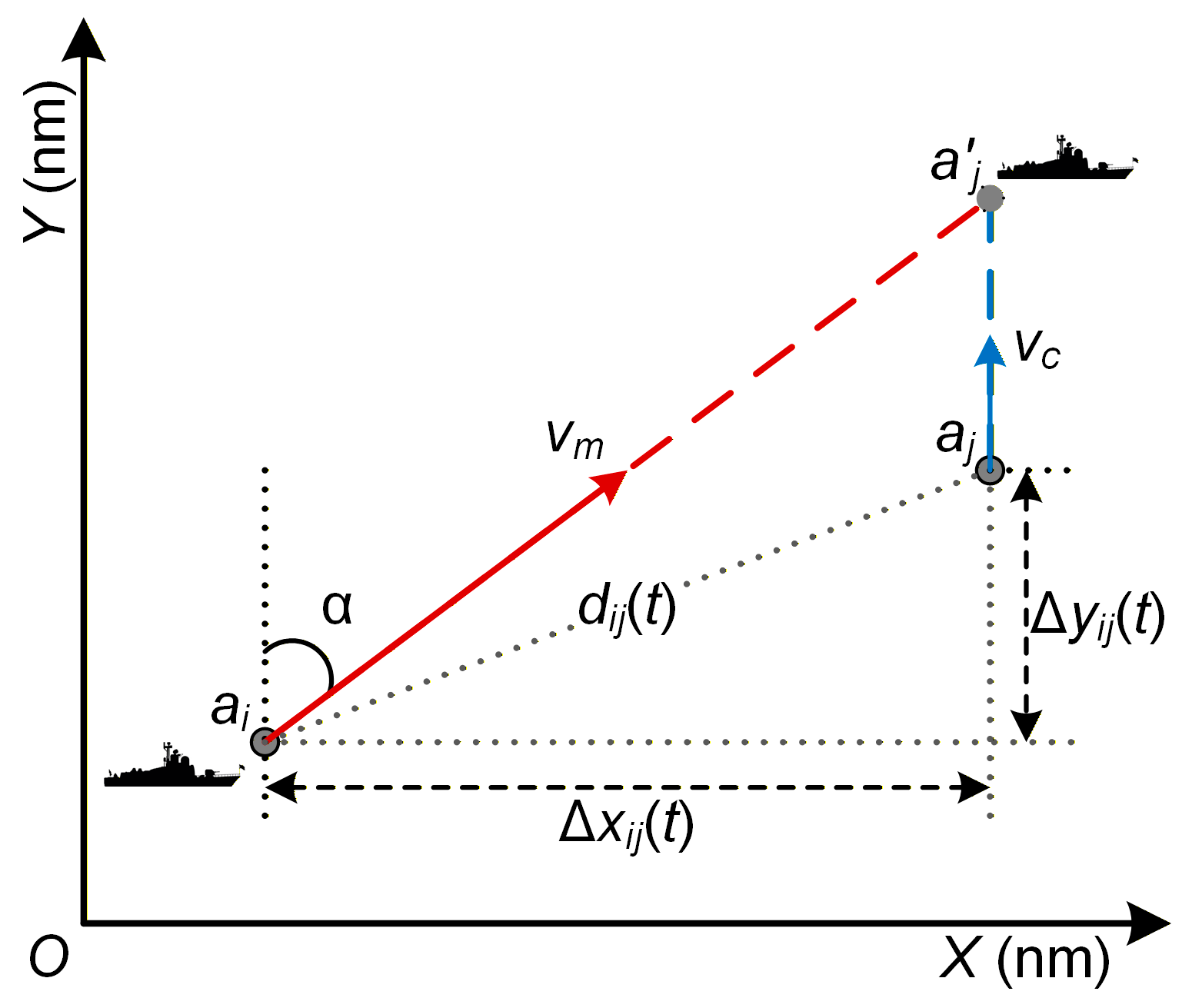
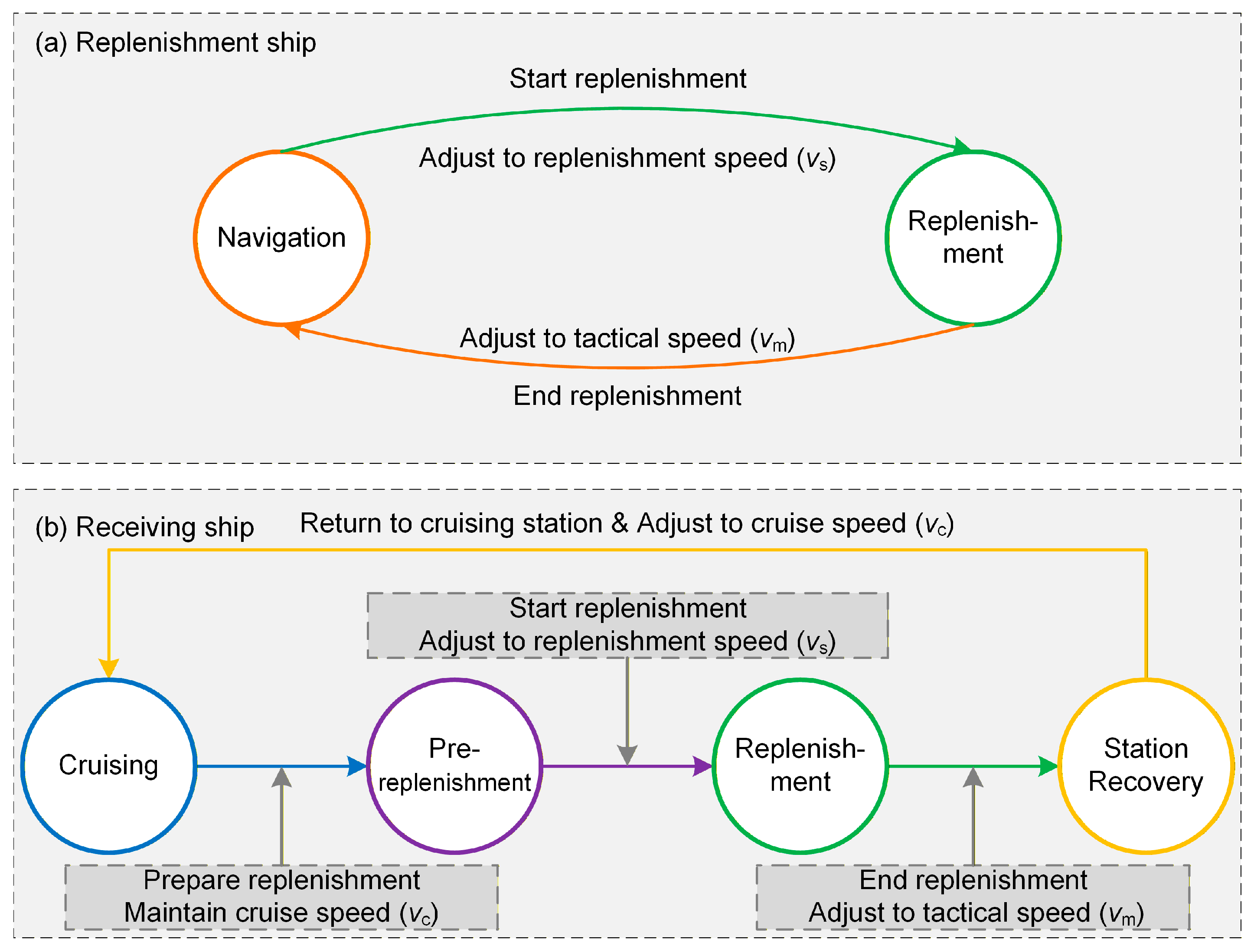
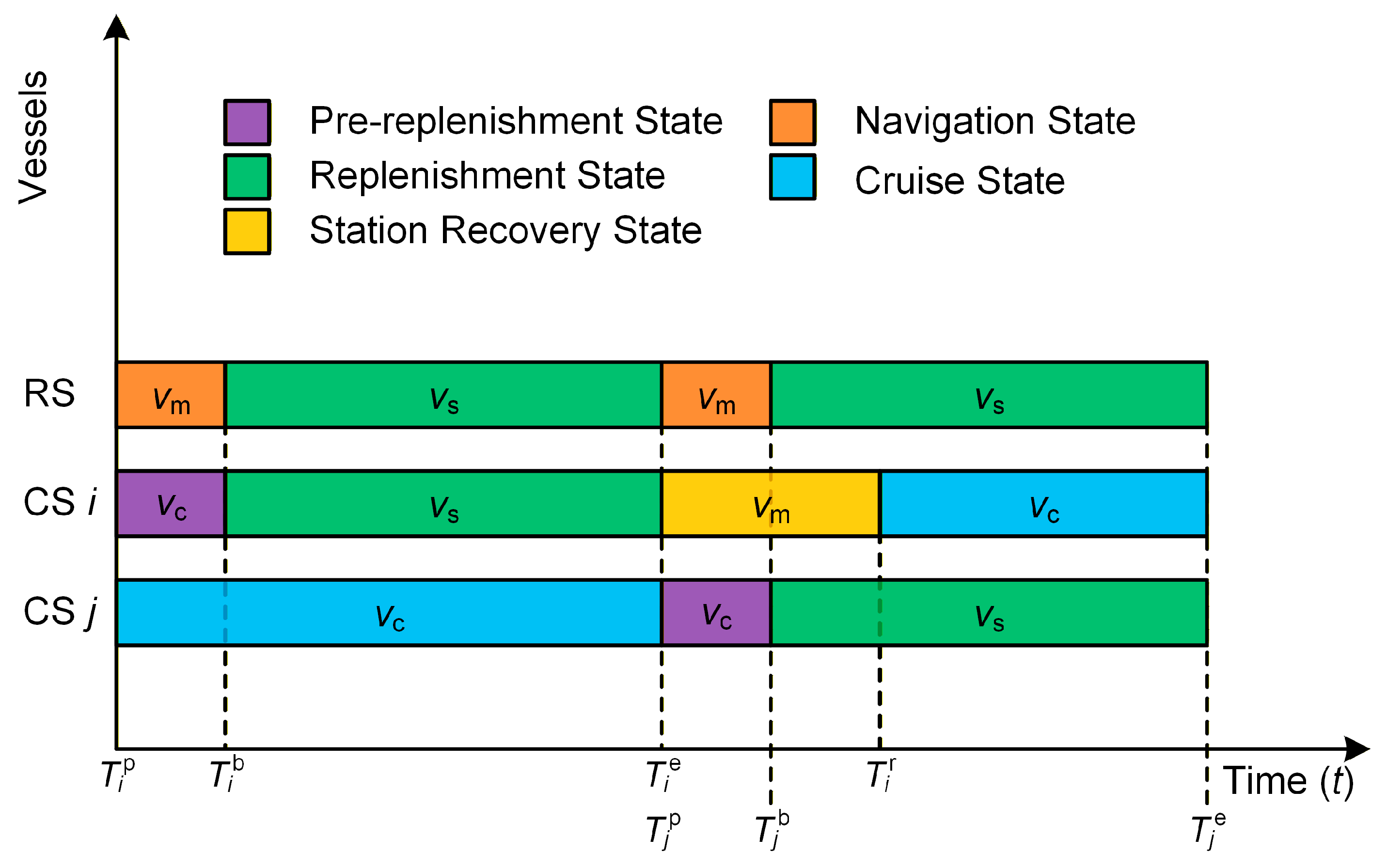
- Step 1: At the onset of the replenishment cycle, the target receiving ship maintains its cruise station, proceeding at a constant cruise speed and heading. Simultaneously, the replenishment ship travels toward the target receiving ship at a constant tactical speed.
- Step 2: Upon rendezvous, the replenishment ship decelerates from tactical speed to replenishment speed, while the receiving ship adjusts from cruise speed to replenishment speed. Replenishment operations are then conducted while both vessels maintain a synchronized speed and heading, consistent with the formation’s original course.
- Step 3: Upon completion of the operation, the vessels disengage. The receiving ship accelerates from replenishment speed to tactical speed to recover its cruise station, subsequently decelerating back to cruise speed. Concurrently, the replenishment ship accelerates from replenishment speed to tactical speed and proceeds toward the subsequent receiving ship.
- Step 4: Once all receiving ships in the naval formation have been serviced, the replenishment ship returns to its original cruise station, thereby concluding the replenishment cycle.
- (1)
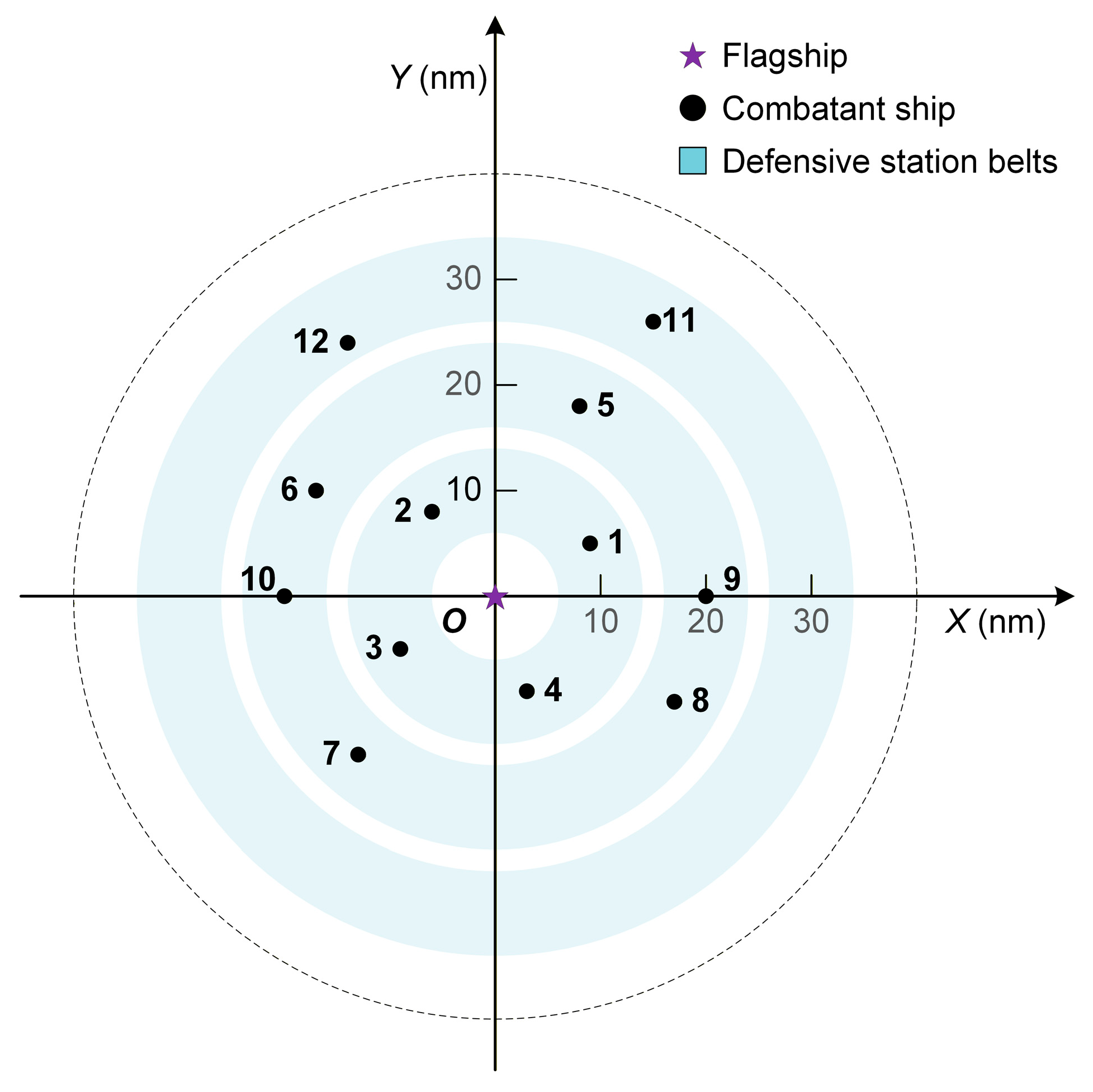
- The flagship is positioned at the geometric center of the naval formation. According to modern naval defensive doctrines, all other vessels are distributed across three concentric defensive zones (far, medium, and near) relative to the core, in accordance with their cruise missions. To ensure maximum navigational security, the replenishment ship is typically designated as a High Value Unit (HVU) alongside the flagship, necessitating its deployment within the innermost defensive screen. Consequently, the model assumes that the replenishment ship’s cruise station coincides with the formation center.
- (2)
- The time consumed by speed adjustments is negligible relative to the total replenishment cycle time. Based on the principle of time-scale decoupling in Operations Research, such minute-level transient maneuvering processes are omitted from the macroscopic system optimization without undermining the operational validity of the resulting decisions.
- (3)
- During replenishment operations, both the replenishment ship and the receiving ship are classified as Vessels Restricted in their Ability to Maneuver (RAM), meaning their maneuvering capabilities are severely limited. To ensure the absolute navigational safety of the engaged vessels, prevent complex relative motion conflicts within the formation, and rigorously preserve the established tactical configuration, the entire naval formation must uniformly adhere to a designated base course. Therefore, by abstracting away minor course corrections for the purpose of macroscopic optimization, it is assumed that the entire formation advances in a straight line with a constant heading throughout the replenishment cycle.
- (4)
- Supported by modern naval integrated logistics information systems and tactical data links, the flagship can accurately monitor and aggregate the real-time inventory and consumption status of all vessels within the formation. Consequently, at the initial stage of replenishment decision planning, the material demands of each receiving ship are precisely calculated and treated as deterministic inputs. Given the relatively short duration of a single replenishment cycle and the strict adherence to the designated replenishment quotas during execution, this model disregards stochastic demand fluctuations during the operation, treating them as static parameters in the macroscopic route optimization.
2.2. Travel Time Model
2.3. Speed Adjustment Model
- (1)
- Replenishment Ship Speed Adjustment Model: This model characterizes the relationship between the positional coordinates and speed of the replenishment ship during the replenishment cycle. Its formal expression is given in Equation (3).
- (2)
- Receiving Ship Speed Adjustment Model: This model characterizes the relationship between the positional coordinates and speed of the receiving vessel during the replenishment cycle. Its formal expression is given in Equation (4).
2.4. Underway Replenishment Optimization Model
3. Solution Method
3.1. Initialization
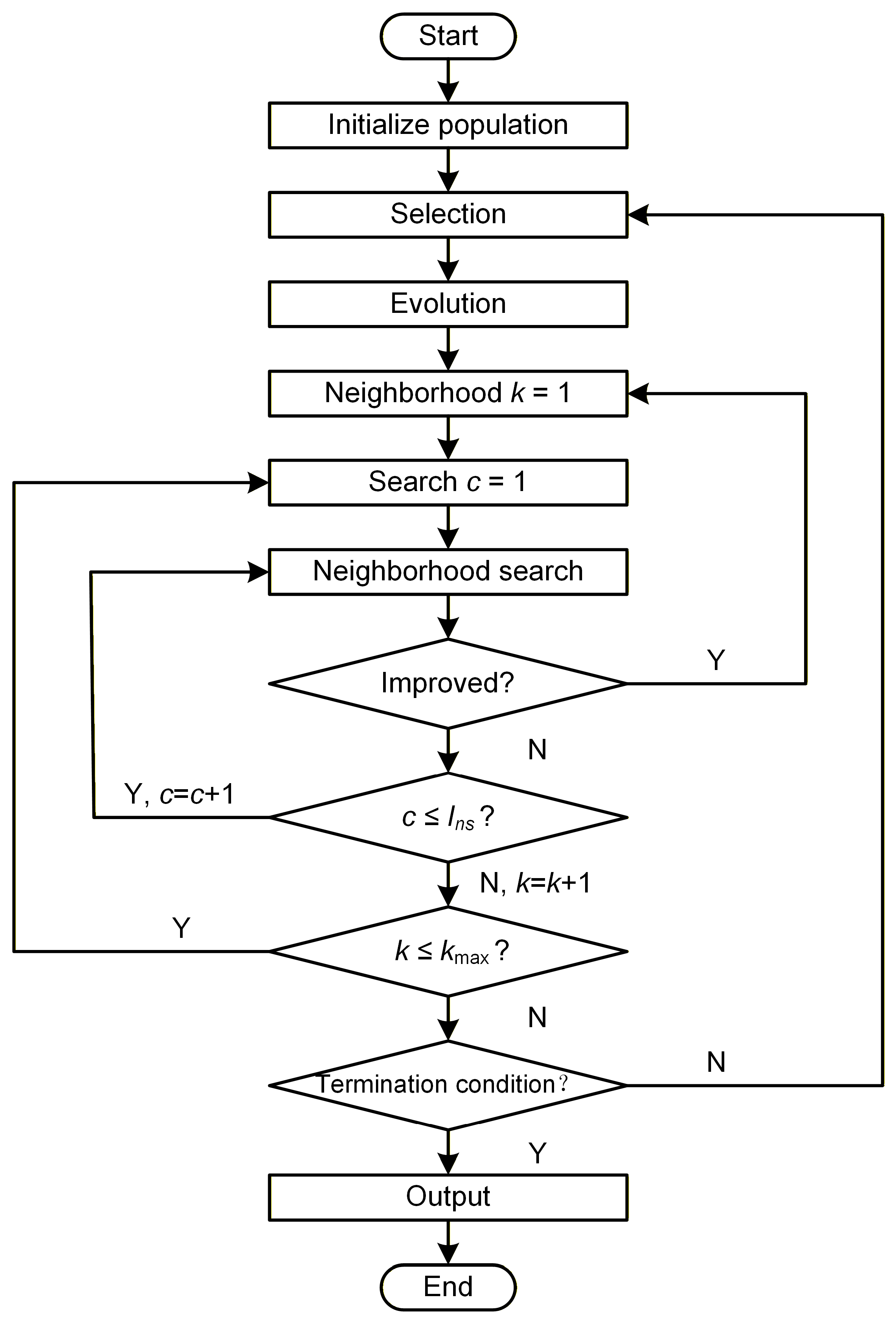
- Step 1: Initial Value Setting. A random initial value within the interval [0, 1] is assigned to each individual.
- Step 2: Sequence Generation. The Chaotic Logistic Map is applied to the initial value of each individual. Through multiple iterations, a chaotic data sequence of length is generated.
- Step 3: Individual Generation. The values in the generated sequence are sorted. The indices of these sorted values serve as the gene encoding, thereby forming the chromosomal structure of the individual.
- Step 4: Population Generation. Steps 1 through 3 are repeated to generate a chaotic initial population characterized by high randomness and diversity.
3.2. Selection Operation
3.3. Evolutionary Operation
3.4. Neighborhood Search Strategy
3.4.1. Neighborhood Structures
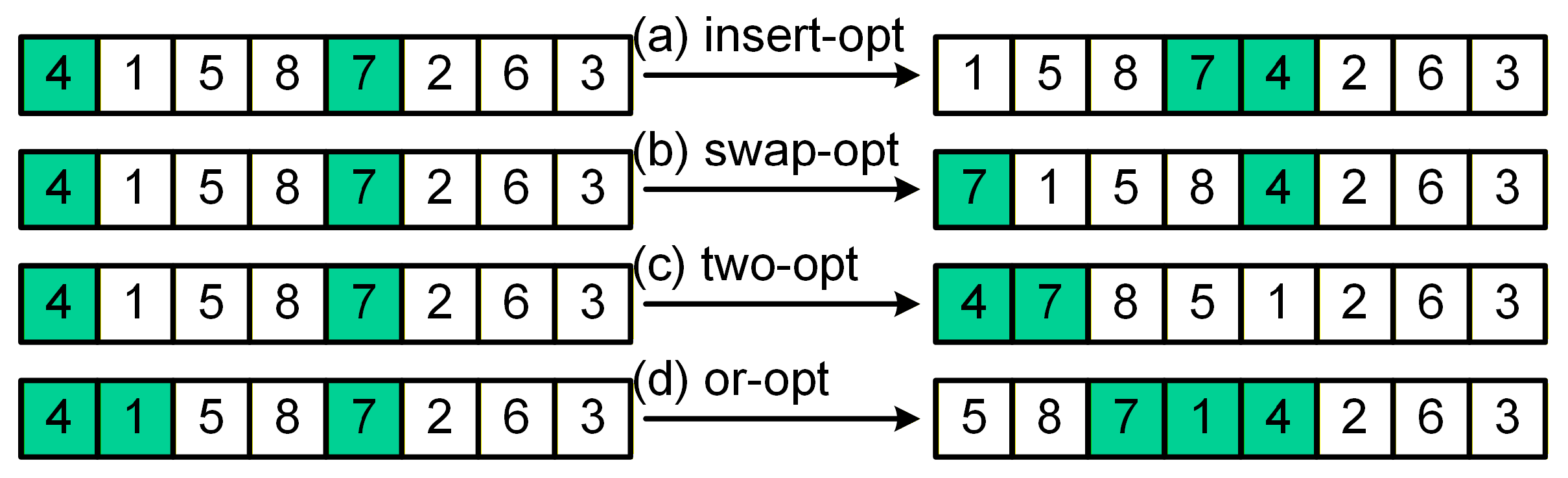
- Insert-opt: Two elements and are randomly selected, and element i is inserted after element . As shown in Figure 6a, elements 4 and 7 are randomly chosen, and element 4 is inserted after element 7.
- Swap-opt: Two elements and are randomly selected, and their positions are swapped. As shown in Figure 6b, the positions of elements 4 and 7 are exchanged.
- Two-opt: Two elements and are randomly selected, and the subsequence between them is reversed. As shown in Figure 6c, the position of element 4 remains unchanged, while the subsequence containing elements 1, 5, 8, and 7 is reversed.
- Or-opt: Two consecutive elements and are randomly selected, reversed in order, and inserted after a randomly chosen element . As shown in Figure 6d, the consecutive elements 4 and 1 are selected, reversed in order, and inserted after element 7.

3.4.2. Adaptive Mechanism
3.4.3. New Solution Acceptance Mechanism
4. Computational Experiment and Analyses
4.1. Case Description
4.2. Optimization Results
4.3. Test the Performance of the Algorithm
- : The exact objective value (optimal solution) obtained via the Enumeration Method for small-scale instances.
- : The optimal objective value (i.e., the shortest replenishment cycle time) obtained over 30 independent runs.
- : The average objective value achieved over 30 independent runs.
- : The average computational time (in seconds) consumed per run.
- : The variability metric used to quantify the algorithmic stability, calculated as the relative deviation between the average and the best values: . A smaller value indicates higher stability.
- : The relative deviation of the average objective value from a reference benchmark, used to evaluate solution quality. For small-scale instances, the exact solution () serves as the benchmark, calculated as . For multi-scale instances, where exact solutions are computationally prohibitive to obtain, the proposed HGA-AVNS serves as the benchmark, calculated as where represents the average objective value of the comparison algorithm (i.e., GA or VNS).
4.3.1. Effectiveness Validation of the Algorithmic Operators
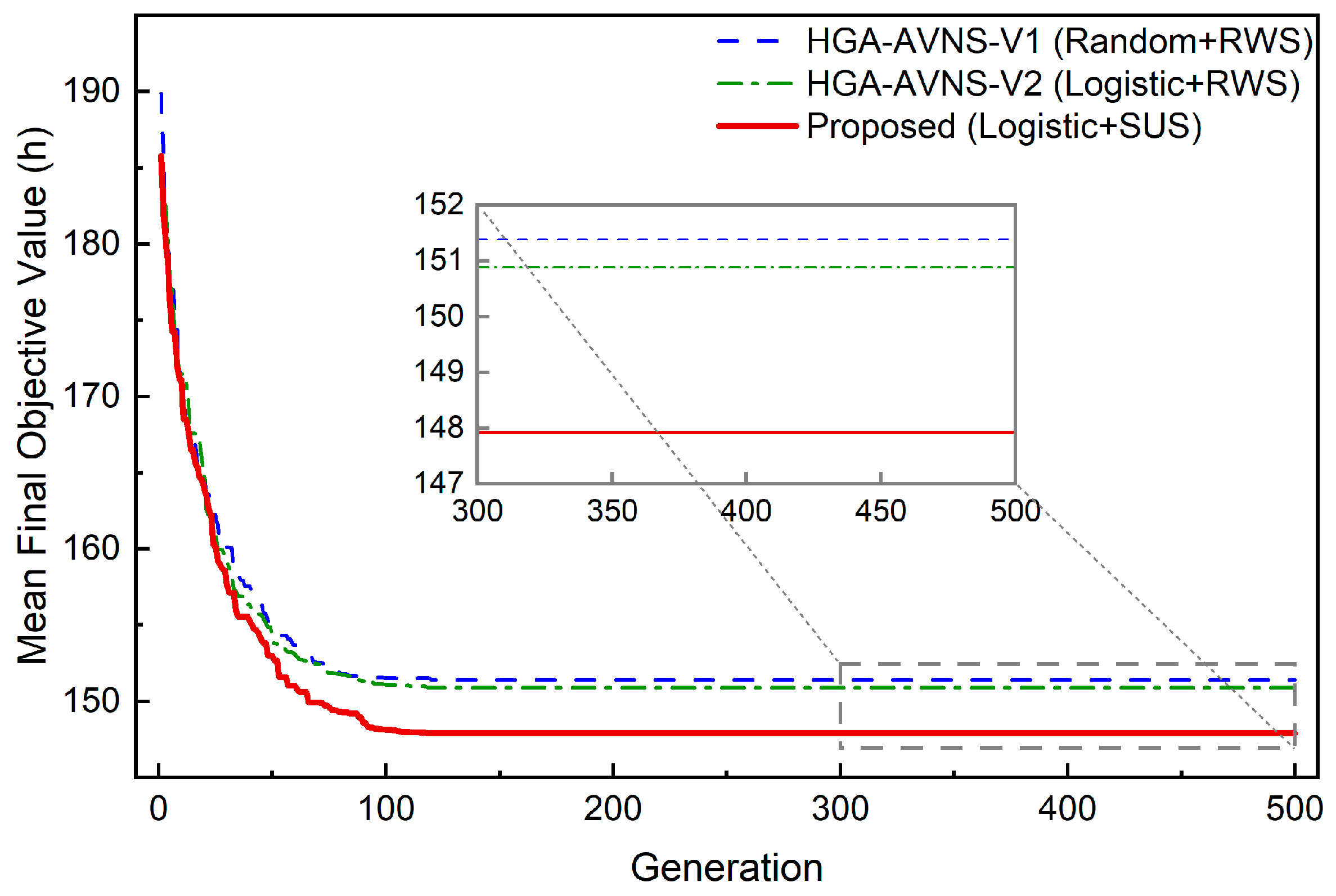
- HGA-AVNS-V1: Random initialization + Roulette Wheel Selection (RWS);
- HGA-AVNS-V2: Logistic map initialization + Roulette Wheel Selection (RWS);
- HGA-AVNS (Proposed Algorithm): Logistic map initialization + Stochastic Universal Sampling (SUS).
4.3.2. Small-Scale Test Instances
4.3.3. Multi-Scale Test Instances
4.4. Sensitivity Analyses
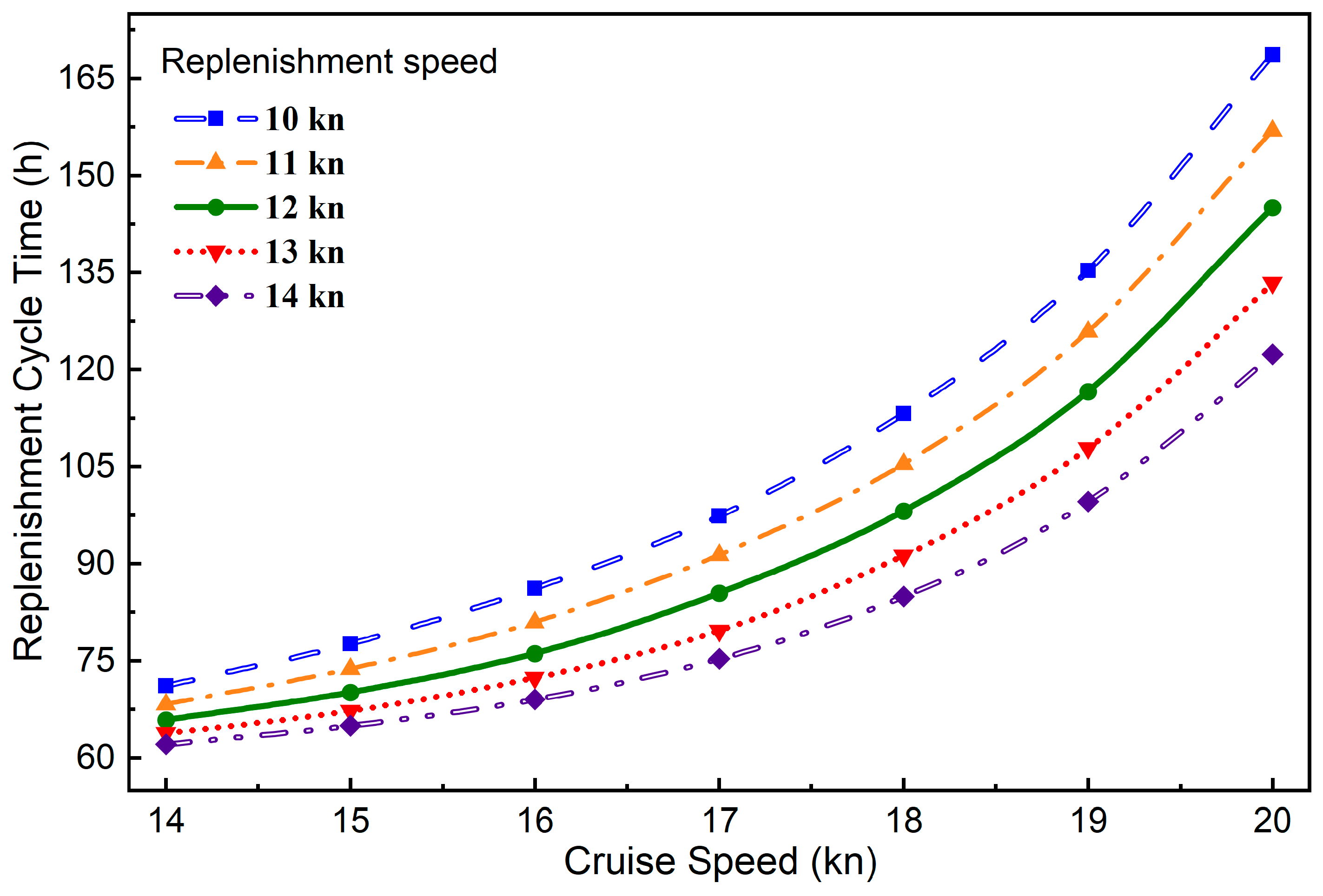
4.4.1. Sensitivity to Speed Configurations
4.4.2. Sensitivity to Ocean Currents
- (1)
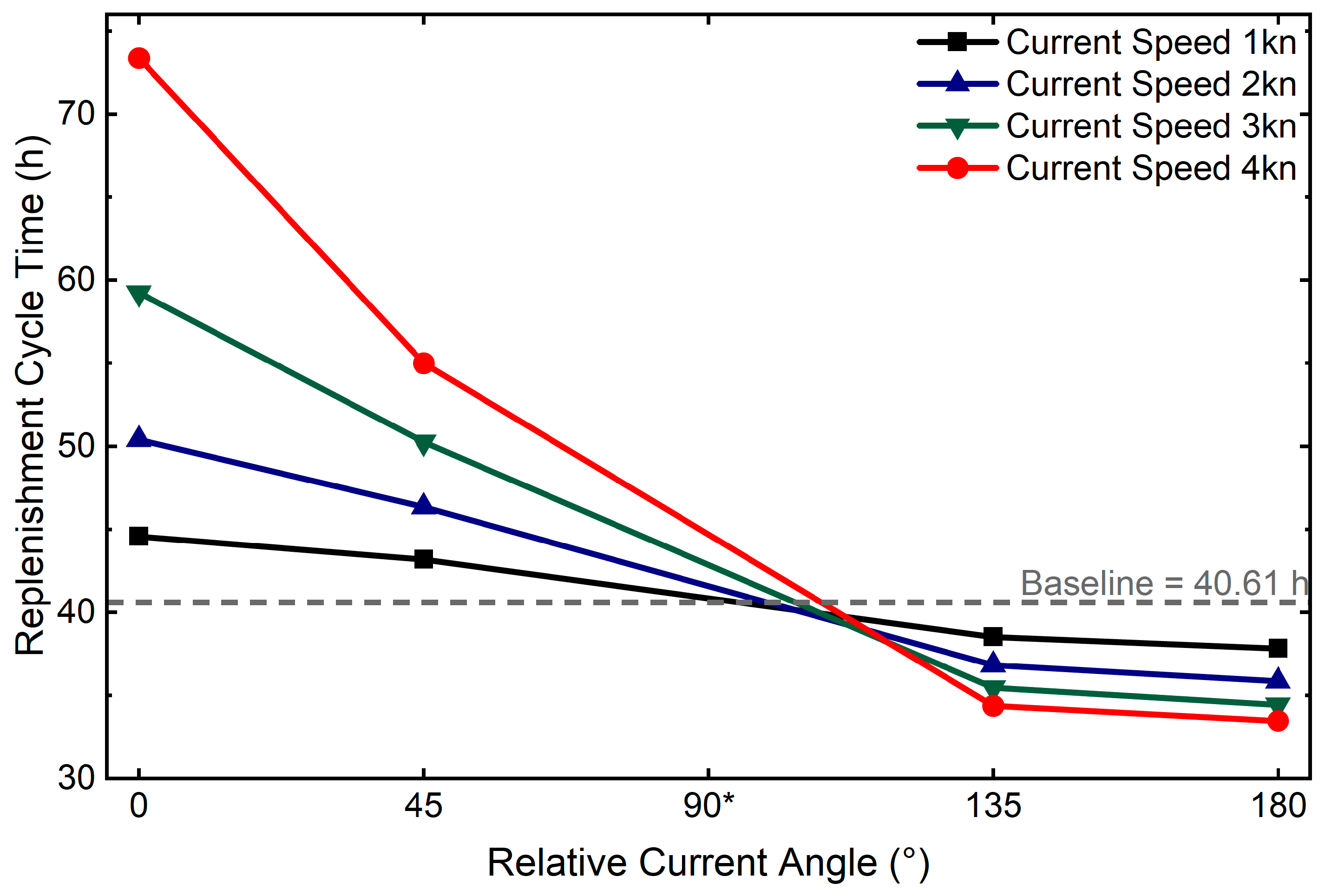
- Cycle Time Extension under Following and Quartering Currents. Encountering following () or quartering () currents elevates the formation’s overall SOG via a forward superposition effect of the current. The replenishment ship, constrained by a constant tactical speed, consequently requires more travel time to reach the receiving ships operating at higher actual ground speeds. The results show that speed increases yield evident time consumption growth: under a 3-knot following current, the total time extends to 59.27 h (a 45.95% increase from the baseline); under the 4-knot extreme following current test, the time further increases to 73.38 h (an 80.69% increase).
- (2)
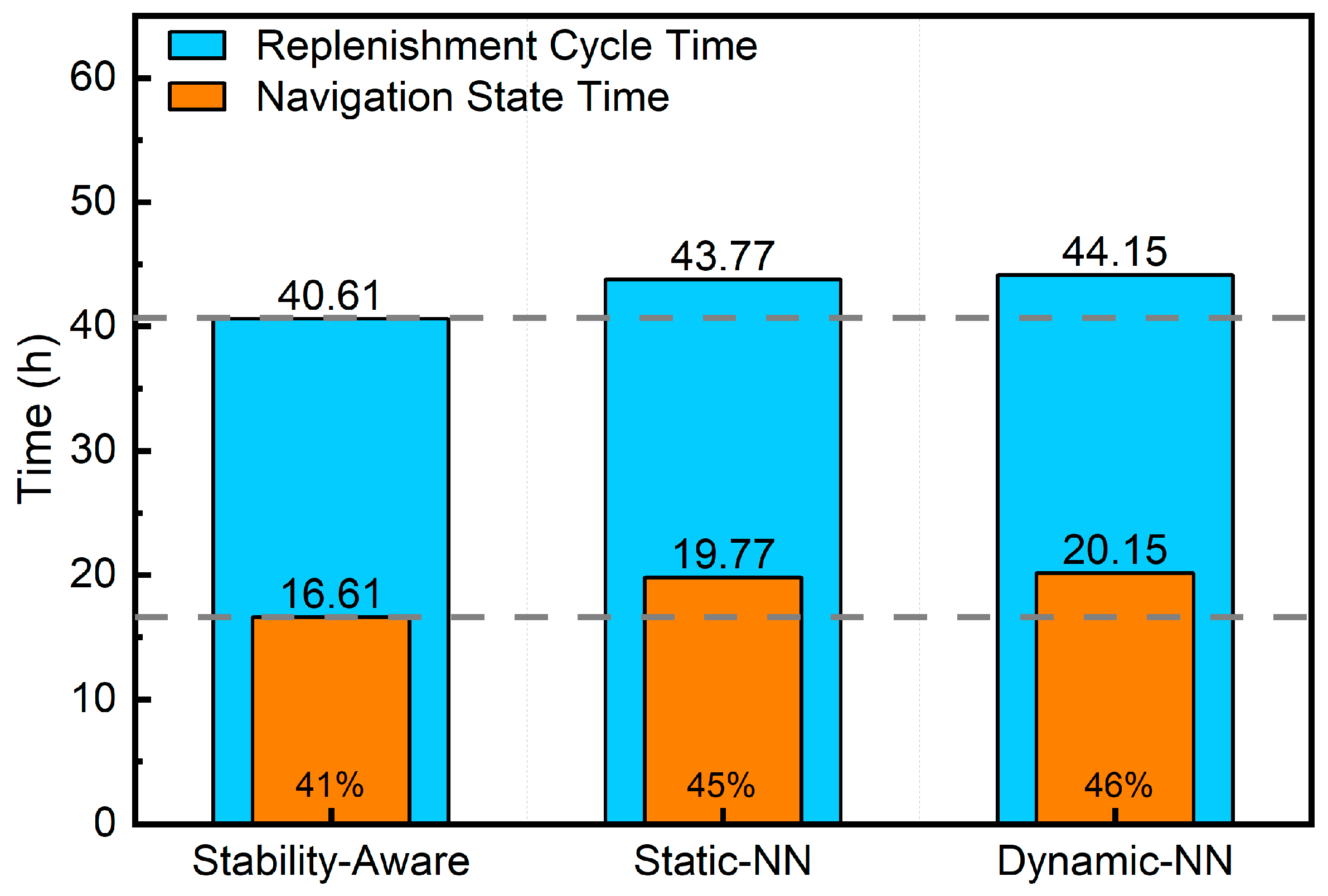
- Cycle Time Reduction under Head and Bow Quartering Currents. Conversely, head () or bow quartering () currents reduce the formation’s overall SOG due to a reverse superposition effect of the current. The replenishment ship, maintaining its constant tactical speed, catches up more easily with receiving ships traveling at reduced cruise speeds. This effectively shortens the travel time. Higher speeds produce more pronounced time reductions. Under the 4-knot extreme head current condition, the total replenishment cycle time drops to a global minimum of 33.47 h (a 17.58% reduction from the 40.61 h baseline).
- (3)
- Asymmetrical Distribution of Current Impacts. Combining the values in Table 8 with the trends in Figure 13 reveals an asymmetrical effect. The time increase magnitude triggered by forward currents () is significantly larger than the time reduction magnitude induced by reverse currents (). At a speed of 4 knots, for instance, the absolute added time from the following current (+32.77 h) substantially outweighs the time saved by the head current (−7.14 h).
4.4.3. Sensitivity to Tactical Turning
- (1)
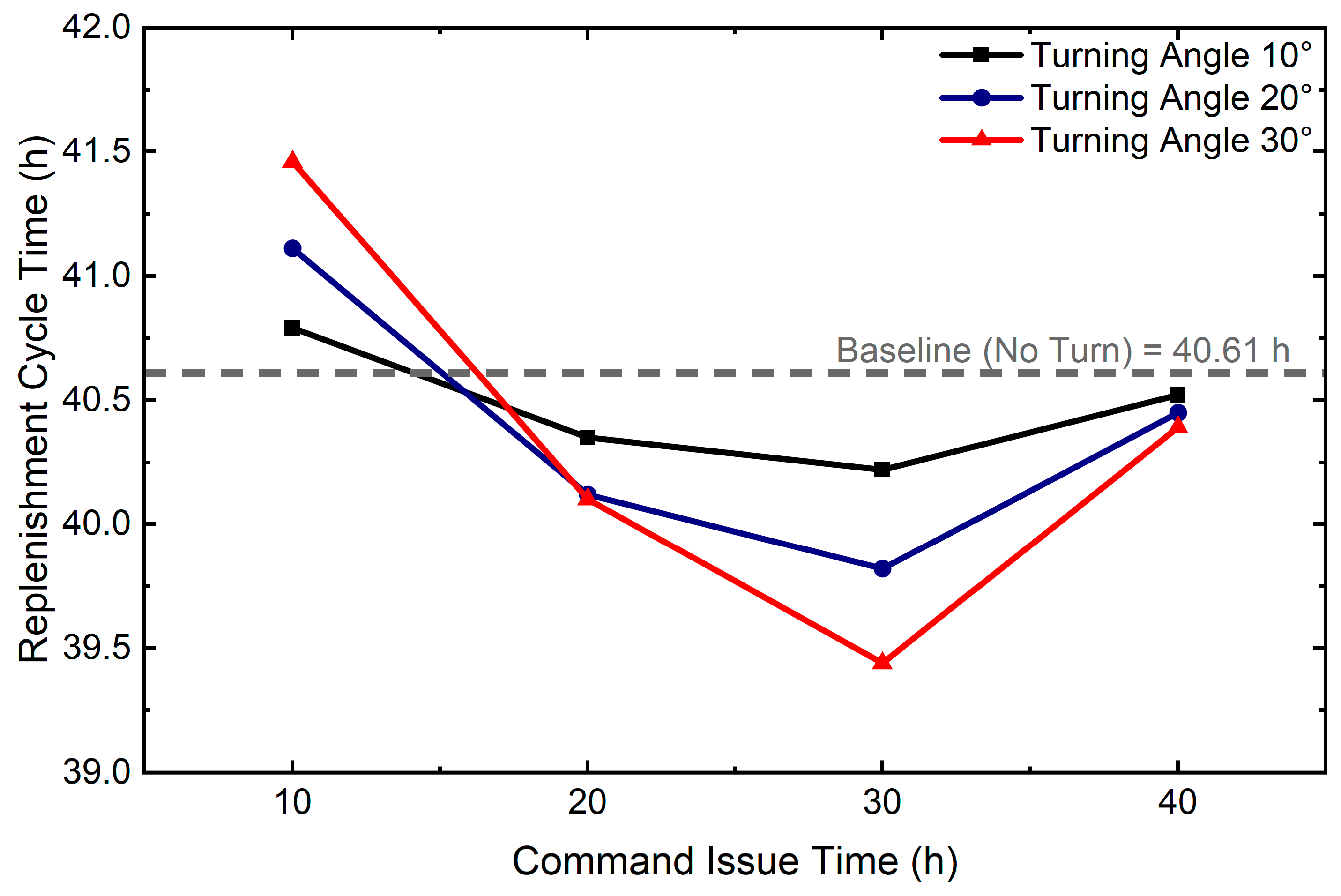
- Early-stage time delay: When a turn occurs early in the mission (e.g., at 10 h), the overall deflection of the formation increases the relative travel distance between the replenishment ship and the subsequent receiving ships, resulting in a time delay. A larger turning angle in this phase causes a greater distance increase, leading to a more pronounced delay (reaching a maximum delay of 0.85 h at = 30°).
- (2)
- Mid-stage time reduction: When the turn is executed during the mid-mission phase (e.g., at 30 h), the overall deflection of the formation conversely shortens the relative travel distance between the replenishment ship and the subsequent receiving ship (e.g., Ship 11), leading to a time reduction. Furthermore, a larger turning angle produces a more significant time reduction (achieving a maximum reduction of 1.17 h at = 30°).
- (3)
- Late-stage system immunity: When a turn happens in the final mission stage (e.g., at 40 h), the majority of replenishment tasks have already been completed, leaving the turning operation with a highly limited effect on the total path distance. The impact on the replenishment cycle time remains negligible across all tested turning angles (fluctuations h).
5. Conclusions
- (1)
- The proposed dynamic route optimization model, incorporating formation stability constraints, proves effective. By encoding “system resilience” as a core optimization constraint, the model successfully resolves the time-varying and coordination challenges that render traditional static models inadequate. It provides, consequently, a reliable theoretical tool for characterizing the coordinated operations of mobile platforms in complex maritime environments.
- (2)
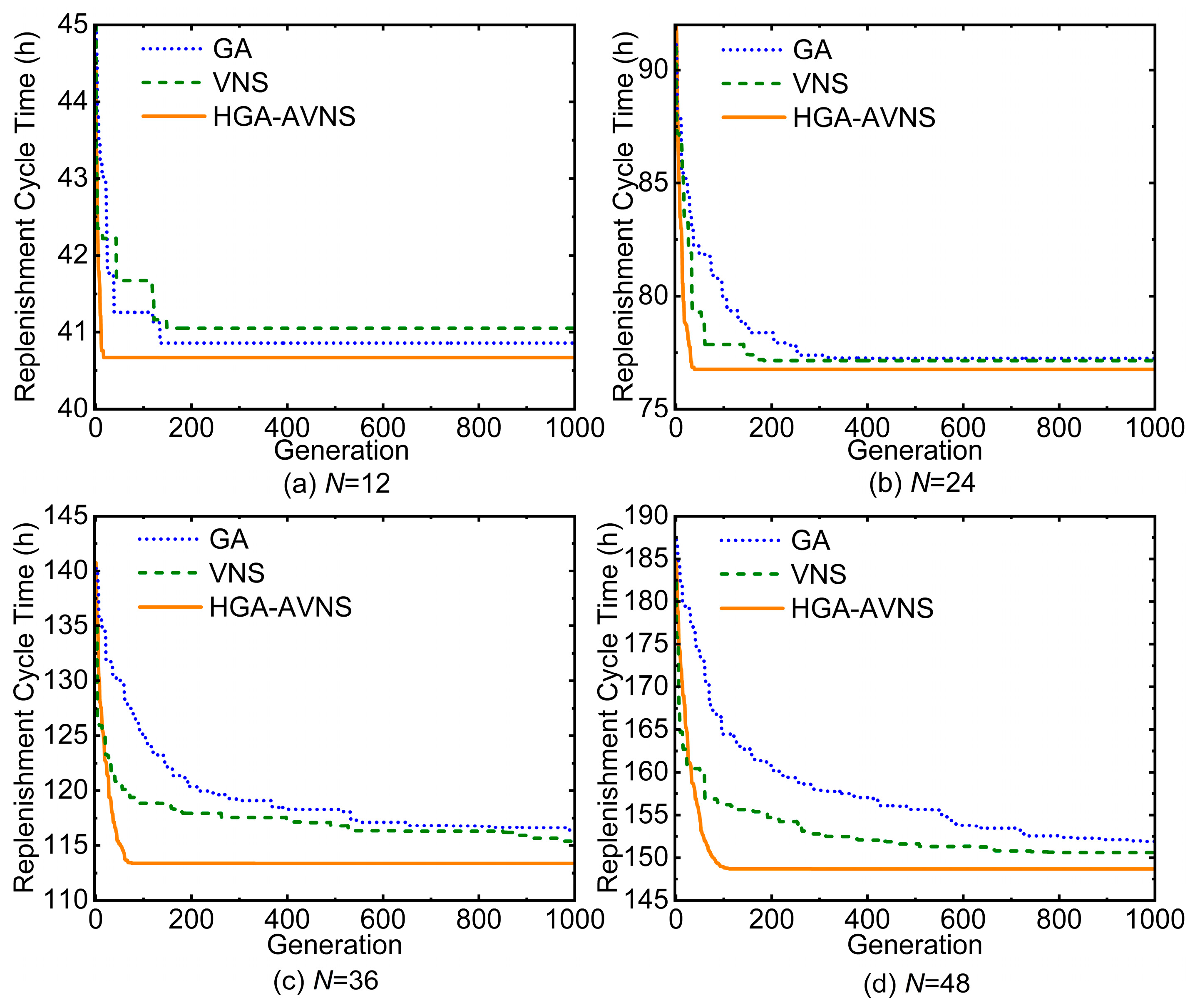
- The proposed Hybrid Genetic Algorithm with Adaptive Variable Neighborhood Search (HGA-AVNS) delivers highly competitive comprehensive performance. Validated through an explicit effectiveness analysis of its core operators, computational results across multi-scale instances confirm that HGA-AVNS structurally outperforms conventional methods—specifically, the traditional Genetic Algorithm (GA) and Variable Neighborhood Search (VNS)—in solution quality, convergence speed, and stability. By deeply fusing chaotic initialization with adaptive search mechanisms, the algorithm achieves a precise balance between global exploration and local exploitation. This structural synergy therefore provides a robust solver for highly dynamic and strictly constrained combinatorial optimization problems.
- (3)
- Systematic sensitivity analysis elucidates the impact mechanisms of key operational parameters and dynamic environmental factors on system effectiveness. The study reveals a strong coupling effect among the formation’s cruise speed, the replenishment speed, and external disturbances. Specifically, under the strict premise of maintaining formation stability, a strategic reduction in cruise speed can offset the increase in overall speed over ground (SOG) induced by following ocean currents, thereby preventing systematic time loss. Furthermore, fine-tuning the execution timing of sudden tactical turning based on the replenishment ship’s real-time operational status can effectively enhance the overall replenishment efficiency. These findings provide a quantitative reference for balancing mission efficacy and logistical risk in practical command decision-making.
Supplementary Materials
Author Contributions
Funding
Institutional Review Board Statement
Informed Consent Statement
Data Availability Statement
Acknowledgments
Conflicts of Interest
Appendix A. URRPLIB Instance Generation Procedure
| Algorithm A1 URRPLIB Instance Generation Procedure |
| Input: Number of vessels deployed in each defensive belt: (where ) Output: Initial coordinate set of all combatant ships 1: Initialize: Generated point set 2: Define discrete angle space: 3: Define quadrant phase shifts: 4: Define radial feasible sets: , , 5: for each defensive belt do 6: Determine quadrant quotas satisfying and 7: for each quadrant with phase shift do 8: 9: while do 10: Sample radius 11: Sample base angle 12: 13: 14: 15: /* Strict non-collinear and minimum safety distance constraint */ 16: if then 17: 18: 19: end if 20: end while 21: end for 22: end for 23: return |
References
- Yuan, S.; Li, Y.; Bao, F.; Xu, H.; Yang, Y.; Yan, Q.; Zhong, S.; Yin, H.; Xu, J.; Huang, Z.; et al. Marine environmental monitoring with unmanned vehicle platforms: Present applications and future prospects. Sci. Total Environ. 2023, 858, 15. [Google Scholar] [CrossRef] [PubMed]
- Brown, G.G.; DeGrange, W.C.; Price, W.L.; Rowe, A.A. Scheduling combat logistics force replenishments at sea for the US Navy. Nav. Res. Logist. 2017, 64, 677–693. [Google Scholar] [CrossRef]
- McTaggart, K.; Cumming, D.; Hsiung, C.C.; Li, L. Seakeeping of two ships in close proximity. Ocean Eng. 2003, 30, 1051–1063. [Google Scholar] [CrossRef]
- Huang, Y.; Hu, Y.; Wu, J.; Zeng, C. Observer-based motion control system for the approach ship with propeller and rudder in the process of underway replenishment. Ocean Eng. 2021, 222, 108586. [Google Scholar] [CrossRef]
- Wu, W.; Peng, Z.; Wang, D.; Liu, L.; Gu, N. Anti-disturbance leader-follower synchronization control of marine vessels for underway replenishment based on robust exact differentiators. Ocean Eng. 2022, 248, 110686. [Google Scholar] [CrossRef]
- Wu, D.; Ji, X.; Xiao, F.; Sheng, S. A Location Inventory Routing Optimisation Model and Algorithm for a Remote Island Shipping Network considering Emergency Inventory. Sustainability 2022, 14, 5859. [Google Scholar] [CrossRef]
- Zhang, J.; Cui, Y.; Li, G.; Ren, J. Dynamic Path Planning Algorithm for Unmanned Surface Vehicle Under Island-Reef Environment. IEEE Trans. Aerosp. Electron. Syst. 2023, 59, 7252–7268. [Google Scholar] [CrossRef]
- Wu, C.; Dong, P.; Yu, P. Marine supply planning of formation under circuit riders strategy. J. Dalian Marit. Univ. 2020, 46, 89–96. [Google Scholar] [CrossRef]
- Dong, P.; Huang, J.; Shi, H. Research on alongside replenishment planning at sea based on two-stage optimization model. Fire Control Command Control 2021, 46, 64–70. [Google Scholar] [CrossRef]
- Wei, Z.; Zhao, S.; Li, Y.; Guo, Z. Marine supply path planning of warship formation with multi supply ship. Fire Control Command Control 2021, 46, 41–45+52. [Google Scholar] [CrossRef]
- Zhang, Q.; Zeng, B. Research on Underway Replenishment Path Planning Considering Time Window. In Proceedings of the 2020 Chinese Control and Decision Conference (CCDC), Hefei, China, 22–24 August 2020; IEEE: New York, NY, USA, 2020. [Google Scholar]
- Stieber, A.; Fügenschuh, A.; Epp, M.; Knapp, M.; Rothe, H. The multiple traveling salesmen problem with moving targets. Optim. Lett. 2015, 9, 1569–1583. [Google Scholar] [CrossRef]
- Wang, Y.; Wang, N. Moving-target travelling salesman problem for a helicopter patrolling suspicious boats in antipiracy escort operations. Expert Syst. Appl. 2023, 213, 118986. [Google Scholar] [CrossRef]
- Kim, S.; Moon, I. Traveling Salesman Problem With a Drone Station. IEEE Trans. Syst. Man Cybern. Syst. 2019, 49, 42–52. [Google Scholar] [CrossRef]
- Pop, P.C.; Cosma, O.; Sabo, C.; Sitar, C.P. A comprehensive survey on the generalized traveling salesman problem. Eur. J. Oper. Res. 2024, 314, 819–835. [Google Scholar] [CrossRef]
- de Moraes, R.S.; de Freitas, E.P. Experimental analysis of heuristic solutions for the moving target traveling salesman problem applied to a moving targets monitoring system. Expert Syst. Appl. 2019, 136, 392–409. [Google Scholar] [CrossRef]
- Groba, C.; Sartal, A.; Vázquez, X.H. Integrating forecasting in metaheuristic methods to solve dynamic routing problems: Evidence from the logistic processes of tuna vessels. Eng. Appl. Artif. Intell. 2018, 76, 55–66. [Google Scholar] [CrossRef]
- Philip, A.G.; Ren, Z.Q.; Rathinam, S.; Choset, H. C∗: A New Bounding Approach for the Moving-Target Traveling Salesman Problem. IEEE Trans. Robot. 2025, 41, 4663–4678. [Google Scholar] [CrossRef]
- Zhang, L.; Lu, J.; Yang, Z. Dynamic optimization of emergency resource scheduling in a large-scale maritime oil spill accident. Comput. Ind. Eng. 2021, 152, 107028. [Google Scholar] [CrossRef]
- Zhang, L.; Lu, J.; Yang, Z. Optimal scheduling of emergency resources for major maritime oil spills considering time-varying demand and transportation networks. Eur. J. Oper. Res. 2021, 293, 529–546. [Google Scholar] [CrossRef]
- Granado, I.; Hernando, L.; Uriondo, Z.; Fernandes-Salvador, J.A. A fishing route optimization decision support system: The case of the tuna purse seiner. Eur. J. Oper. Res. 2024, 312, 718–732. [Google Scholar] [CrossRef]
- Caponetto, R.; Fortuna, L.; Furuhashi, T.; Xibilia, M.G. Chaotic sequences to improve the performance of evolutionary algorithms. IEEE Trans. Evol. Comput. 2003, 7, 289–304. [Google Scholar] [CrossRef]
- Ren, X.; Fan, H.; Ma, M.; Fan, H.; Yue, L. Time-dependent hydrogen fuel cell vehicle routing problem with drones and variable drone speeds. Comput. Ind. Eng. 2024, 193, 110330. [Google Scholar] [CrossRef]
- Ren, X.; Fan, H.; Fan, H.; Ma, M. Time-dependent electric vehicle-drone routing problem for scheduled deliveries and on-demand pickups considering variable drone speeds and no-fly zones. Comput. Oper. Res. 2025, 182, 107141. [Google Scholar] [CrossRef]
- Baker, J.E. Reducing bias and inefficiency in the selection algorithm. In Proceedings of the Second International Conference on Genetic Algorithms on Genetic Algorithms and Their Application, Cambridge, MA, USA, 28–31 July 1987; pp. 14–21. [Google Scholar]
- Baker, B.M.; Ayechew, M.A. A genetic algorithm for the vehicle routing problem. Comput. Oper. Res. 2003, 30, 787–800. [Google Scholar] [CrossRef]
- Kaya, M. The effects of two new crossover operators on genetic algorithm performance. Appl. Soft Comput. 2011, 11, 881–890. [Google Scholar] [CrossRef]







| Category | Symbol | Definition |
|---|---|---|
| Sets | Set of discrete time periods with a fine-grained time step of h, spanning the entire planning horizon length (where .), | |
| Set of combatant ships, | ||
| Set of all vessels, , where node 0 denotes the replenishment ship and also represents its cruising station (the start and end point of the replenishment cycle) | ||
| Parameters | Cruise speed | |
| Replenishment speed | ||
| Tactical speed | ||
| Service time required by vessel | ||
| Auxiliary Variables | Position coordinates of vessel at time | |
| Speed of vessel at time | ||
| Distance between vessel and vessel at time | ||
| Fine-grained time step for the discrete state-machine (e.g., 0.01 h) | ||
| Total length of the planning horizon | ||
| Discrete service time steps required by vessel | ||
| Travel time of the replenishment ship from vessel to vessel | ||
| Discrete travel time steps of the replenishment ship from vessel to vessel | ||
| Start time of the pre-replenishment operations for vessel | ||
| Start time of the replenishment service for vessel | ||
| End time of the replenishment service for vessel | ||
| Time when vessel returns to its cruising station | ||
| Whether vessel starts service at time (1 if yes; 0 otherwise) | ||
| Whether vessel ends service at time (1 if yes; 0 otherwise) | ||
| Whether vessel s in the replenishment state at time (1 if yes; 0 otherwise) | ||
| Decision Variables | Whether the replenishment ship travels from vessel to vessel (1 if yes; 0 otherwise) |
| Instance | n | Spatial Distribution (Defensive Belts) | Instance | n | Spatial Distribution (Defensive Belts) | ||||
|---|---|---|---|---|---|---|---|---|---|
| 10 nm | 20 nm | 30 nm | 10 nm | 20 nm | 30 nm | ||||
| S08-1 | 8 | 4 | 4 | 0 | S12-1 | 12 | 4 | 6 | 2 |
| S08-2 | 8 | 4 | 4 | 0 | S12-2 | 12 | 4 | 6 | 2 |
| S08-3 | 8 | 4 | 4 | 0 | S12-3 | 12 | 6 | 4 | 2 |
| S09-1 | 9 | 4 | 5 | 0 | M24-1 | 24 | 8 | 12 | 4 |
| S09-2 | 9 | 4 | 5 | 0 | M24-2 | 24 | 8 | 12 | 4 |
| S09-3 | 9 | 5 | 4 | 0 | M24-3 | 24 | 12 | 8 | 4 |
| S10-1 | 10 | 4 | 6 | 0 | M36-1 | 36 | 12 | 18 | 6 |
| S10-2 | 10 | 4 | 6 | 0 | M36-2 | 36 | 12 | 18 | 6 |
| S10-3 | 10 | 6 | 4 | 0 | M36-3 | 36 | 18 | 12 | 6 |
| S11-1 | 11 | 4 | 6 | 1 | L48-1 | 48 | 16 | 24 | 8 |
| S11-2 | 11 | 4 | 6 | 1 | L48-2 | 48 | 16 | 24 | 8 |
| S11-3 | 11 | 6 | 4 | 1 | L48-3 | 48 | 24 | 16 | 8 |
| Combatant Ship ID | Relative Position | Coordinates (nm) | Defensive Belt |
|---|---|---|---|
| 1 | Ahead | (9, 5) | 10 |
| 2 | Ahead | (−6, 8) | 10 |
| 3 | Astern | (−9, −5) | 10 |
| 4 | Astern | (3, −9) | 10 |
| 5 | Ahead | (8, 18) | 20 |
| 6 | Ahead | (−17, 10) | 20 |
| 7 | Astern | (−13, −15) | 20 |
| 8 | Astern | (17, −10) | 20 |
| 9 | Starboard | (20, 0) | 20 |
| 10 | Port | (−20, 0) | 20 |
| 11 | Ahead | (15, 26) | 30 |
| 12 | Ahead | (−14, 24) | 30 |
| Combatant Ship ID | Service Time (h) | Position Coordinates (nm) | ||
|---|---|---|---|---|
| Start | End | Start | End | |
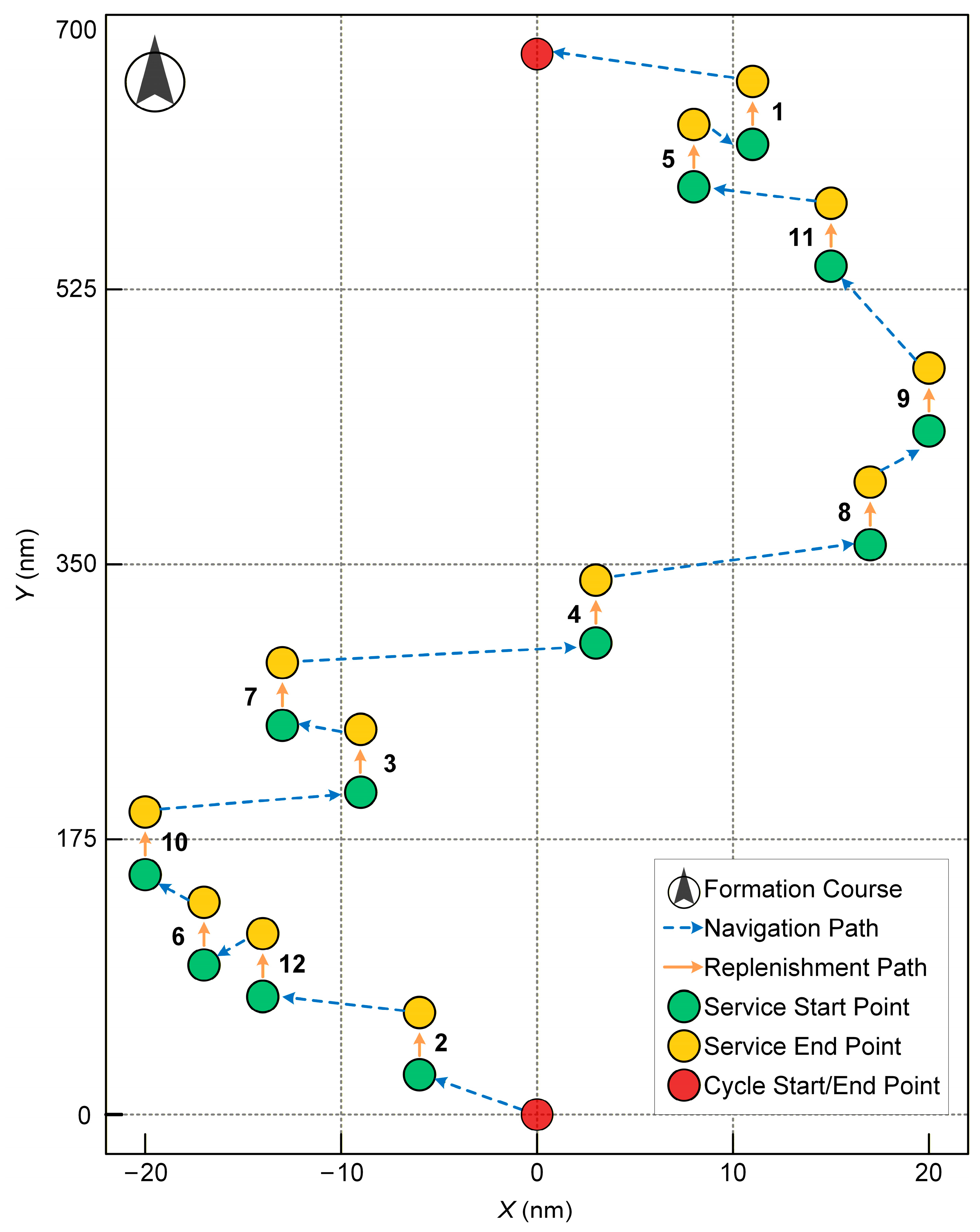
| 2 | 1.09 | 3.09 | (−6.00, 25.44) | (−6.00, 49.44) |
| 12 | 6.15 | 8.15 | (−14.00, 122.40) | (−14.00, 146.40) |
| 6 | 8.34 | 10.34 | (−17.00, 143.44) | (−17.00, 167.44) |
| 10 | 10.47 | 12.47 | (−20.00, 167.52) | (−20.00, 191.52) |
| 3 | 13.28 | 15.28 | (−9.00, 207.48) | (−9.00, 231.48) |
| 7 | 15.45 | 17.45 | (−13.00, 232.20) | (−13.00, 256.20) |
| 4 | 19.53 | 21.53 | (3.00, 303.48) | (3.00, 327.48) |
| 8 | 22.83 | 24.83 | (17.00, 355.28) | (17.00, 379.28) |
| 9 | 27.10 | 29.10 | (20.00, 433.60) | (20.00, 457.60) |
| 11 | 33.37 | 35.37 | (15.00, 559.92) | (15.00, 583.92) |
| 5 | 35.77 | 37.77 | (8.00, 590.32) | (8.00, 614.32) |
| 1 | 37.90 | 39.90 | (9.00, 611.40) | (9.00, 635.40) |
| Algorithmic Variant | Initialization Operator | Selection Operator | Initial Std. Dev. σinit | Mean Final Objective Value μfinal (h) | Final Std. Dev. σfinal |
|---|---|---|---|---|---|
| HGA-AVNS-V1 | Random | RWS | 4.20 | 149.51 | 0.69 |
| HGA-AVNS-V2 | Logistic Map | RWS | 21.29 | 148.93 | 0.65 |
| HGA-AVNS (Proposed) | Logistic Map | SUS | 21.21 | 148.77 | 0.59 |
| Instance | n | ENUM | GA | HGA-AVNS | Gap | ||||||||
|---|---|---|---|---|---|---|---|---|---|---|---|---|---|
| OPT (h) | CPU (s) | Best (h) | Avg (h) | Dev (%) | CPU (s) | Best (h) | Avg (h) | Dev (%) | CPU (s) | GA (%) | HGA (%) | ||
| S08-1 | 8 | 27.74 | 7 | 27.74 | 27.76 | 0.07 | 12 | 27.74 | 27.74 | 0.00 | 6 | 0.07 | 0.00 |
| S08-2 | 8 | 27.04 | 6 | 27.04 | 27.09 | 0.18 | 12 | 27.04 | 27.04 | 0.00 | 6 | 0.18 | 0.00 |
| S08-3 | 8 | 27.35 | 6 | 27.35 | 27.35 | 0.00 | 12 | 27.35 | 27.35 | 0.00 | 5 | 0.00 | 0.00 |
| S09-1 | 9 | 30.34 | 63 | 30.34 | 30.36 | 0.07 | 13 | 30.34 | 30.34 | 0.00 | 7 | 0.07 | 0.00 |
| S09-2 | 9 | 30.02 | 61 | 30.02 | 30.08 | 0.20 | 13 | 30.02 | 30.02 | 0.00 | 6 | 0.20 | 0.00 |
| S09-3 | 9 | 30.34 | 63 | 30.34 | 30.36 | 0.07 | 13 | 30.34 | 30.34 | 0.00 | 6 | 0.07 | 0.00 |
| S10-1 | 10 | 33.39 | 699 | 33.39 | 33.43 | 0.12 | 14 | 33.39 | 33.39 | 0.00 | 6 | 0.12 | 0.00 |
| S10-2 | 10 | 32.96 | 698 | 32.96 | 32.98 | 0.06 | 14 | 32.96 | 32.96 | 0.00 | 7 | 0.06 | 0.00 |
| S10-3 | 10 | 32.93 | 695 | 32.93 | 32.95 | 0.06 | 14 | 32.93 | 32.93 | 0.00 | 7 | 0.06 | 0.00 |
| S11-1 | 11 | 36.83 | 8110 | 36.83 | 36.89 | 0.16 | 16 | 36.83 | 36.85 | 0.05 | 8 | 0.16 | 0.05 |
| S11-2 | 11 | 36.86 | 8434 | 36.86 | 37.00 | 0.38 | 15 | 36.86 | 36.90 | 0.11 | 8 | 0.38 | 0.11 |
| S11-3 | 11 | 36.49 | 8598 | 36.49 | 36.50 | 0.03 | 16 | 36.49 | 36.50 | 0.03 | 8 | 0.03 | 0.03 |
| S12-1 | 12 | 40.61 | 71500 | 40.61 | 40.85 | 0.59 | 17 | 40.61 | 40.79 | 0.44 | 8 | 0.59 | 0.44 |
| S12-2 | 12 | 40.67 | 69445 | 40.67 | 40.88 | 0.52 | 17 | 40.67 | 40.79 | 0.30 | 9 | 0.52 | 0.30 |
| S12-3 | 12 | 40.67 | 69803 | 40.67 | 40.92 | 0.61 | 17 | 40.67 | 40.70 | 0.07 | 8 | 0.61 | 0.07 |
| Mean | - | - | - | - | - | - | - | 0.21 | 0.07 | ||||
| Instance | n | GA | VNS | HGA-VNS | Gap | ||||||||||
|---|---|---|---|---|---|---|---|---|---|---|---|---|---|---|---|
| Best (h) | Avg (h) | Dev (%) | CPU (s) | Best (h) | Avg (h) | Dev (%) | CPU (s) | Best (h) | Avg (h) | Dev (%) | CPU (s) | GA (%) | VNS (%) | ||
| S12-1 | 12 | 40.61 | 40.85 | 0.59 | 16 | 40.61 | 40.85 | 0.59 | 12 | 40.61 | 40.79 | 0.44 | 7 | 0.15 | 0.15 |
| S12-2 | 12 | 40.67 | 40.88 | 0.51 | 16 | 40.67 | 40.85 | 0.44 | 12 | 40.67 | 40.79 | 0.29 | 8 | 0.22 | 0.15 |
| S12-3 | 12 | 40.67 | 40.92 | 0.61 | 16 | 40.67 | 41.00 | 0.80 | 12 | 40.67 | 40.70 | 0.07 | 8 | 0.54 | 0.74 |
| M24-1 | 24 | 76.67 | 77.45 | 1.01 | 36 | 76.51 | 77.33 | 1.06 | 36 | 75.65 | 76.15 | 0.66 | 21 | 1.71 | 1.55 |
| M24-2 | 24 | 76.34 | 77.49 | 1.48 | 34 | 76.61 | 77.46 | 1.10 | 37 | 75.62 | 76.17 | 0.72 | 20 | 1.73 | 1.69 |
| M24-3 | 24 | 76.56 | 77.41 | 1.10 | 34 | 76.49 | 77.67 | 1.52 | 35 | 75.67 | 76.16 | 0.64 | 18 | 1.64 | 1.98 |
| M36-1 | 36 | 113.61 | 115.25 | 1.42 | 60 | 113.19 | 114.49 | 1.14 | 73 | 112.66 | 112.86 | 0.18 | 43 | 2.12 | 1.44 |
| M36-2 | 36 | 113.81 | 115.43 | 1.40 | 64 | 113.43 | 114.72 | 1.12 | 73 | 112.38 | 112.71 | 0.29 | 44 | 2.41 | 1.78 |
| M36-3 | 36 | 113.88 | 115.62 | 1.50 | 62 | 113.44 | 114.98 | 1.34 | 74 | 112.51 | 112.91 | 0.35 | 36 | 2.40 | 1.83 |
| L48-1 | 48 | 151.92 | 154.03 | 1.37 | 96 | 150.14 | 151.82 | 1.11 | 111 | 147.50 | 148.65 | 0.77 | 81 | 3.62 | 2.13 |
| L48-2 | 48 | 150.85 | 153.71 | 1.86 | 91 | 150.17 | 151.94 | 1.16 | 111 | 147.87 | 148.91 | 0.70 | 97 | 3.22 | 2.03 |
| L48-3 | 48 | 150.72 | 153.47 | 1.79 | 96 | 150.50 | 152.13 | 1.07 | 111 | 147.90 | 148.19 | 0.20 | 68 | 3.56 | 2.66 |
| Mean | - | - | 1.22 | - | - | - | 1.04 | - | - | - | 0.44 | 1.94 | 1.51 | ||
| Maximum | - | - | 1.86 | - | - | - | 1.52 | - | - | - | 0.77 | 3.62 | 2.66 | ||
| Minimum | - | - | 0.51 | - | - | - | 0.44 | - | - | - | 0.07 | 0.15 | 0.15 | ||
| Relative Current Angle 1 δ (°) | Total Replenishment Cycle Time (h) (Δ% deviation) 2 | |||
|---|---|---|---|---|
| 1 kn | 2 kn | 3 kn | 4 kn | |
| 0 | 44.57 (+9.75%) | 50.40 (+24.11%) | 59.27 (+45.95%) | 73.38 (+80.69%) |
| 45 | 43.18 (+6.33%) | 46.36 (+14.16%) | 50.26 (+23.76%) | 55.02 (+35.48%) |
| 135 | 38.51 (−5.17%) | 36.84 (−9.28%) | 35.46 (−12.68%) | 34.39 (−15.32%) |
| 180 | 37.84 (−6.82%) | 35.87 (−11.67%) | 34.44 (−15.19%) | 33.47 (−17.58%) |
| Command Issue Time (h) | Actual Execution Time 1 (h) | Replenishment Ship Status | Turning Angle (°) | Replenishment Cycle Time (h) | Time Deviation 2 (h) |
|---|---|---|---|---|---|
| 10 | 10.34 | Replenishing Vessel 6 | 10 | 40.79 | 0.18 |
| 20 | 41.11 | 0.5 | |||
| 30 | 41.46 | 0.85 | |||
| 20 | 21.53 | Replenishing Vessel 4 | 10 | 40.35 | −0.26 |
| 20 | 40.12 | −0.49 | |||
| 30 | 40.10 | −0.51 | |||
| 30 | 30 | Cruising to Vessel 11 | 10 | 40.22 | −0.39 |
| 20 | 39.82 | −0.79 | |||
| 30 | 39.44 | −1.17 | |||
| 40 | 40 | Cruising to formation station | 10 | 40.52 | −0.09 |
| 20 | 40.45 | −0.16 | |||
| 30 | 40.39 | −0.22 |
Disclaimer/Publisher’s Note: The statements, opinions and data contained in all publications are solely those of the individual author(s) and contributor(s) and not of MDPI and/or the editor(s). MDPI and/or the editor(s) disclaim responsibility for any injury to people or property resulting from any ideas, methods, instructions or products referred to in the content. |
© 2026 by the authors. Licensee MDPI, Basel, Switzerland. This article is an open access article distributed under the terms and conditions of the Creative Commons Attribution (CC BY) license.
Share and Cite
Yu, W.; Zhao, R.; Xie, X. Dynamic Underway Replenishment Route Optimization for Naval Formations Considering Formation Stability. J. Mar. Sci. Eng. 2026, 14, 714. https://doi.org/10.3390/jmse14080714
Yu W, Zhao R, Xie X. Dynamic Underway Replenishment Route Optimization for Naval Formations Considering Formation Stability. Journal of Marine Science and Engineering. 2026; 14(8):714. https://doi.org/10.3390/jmse14080714
Chicago/Turabian StyleYu, Wenzhang, Ruijia Zhao, and Xinlian Xie. 2026. "Dynamic Underway Replenishment Route Optimization for Naval Formations Considering Formation Stability" Journal of Marine Science and Engineering 14, no. 8: 714. https://doi.org/10.3390/jmse14080714
APA StyleYu, W., Zhao, R., & Xie, X. (2026). Dynamic Underway Replenishment Route Optimization for Naval Formations Considering Formation Stability. Journal of Marine Science and Engineering, 14(8), 714. https://doi.org/10.3390/jmse14080714