1. Introduction
The dynamic response and safety assessment of ship hull structures under the transient strong shock loads induced by underwater explosions are crucial to ship survivability. Accurately obtaining the shock environment and dynamic response at key local positions (such as equipment foundations, bulkhead connections, etc.) serves as the fundamental basis for structural shock-resistant design, equipment safety assessment, and damage prediction [
1,
2,
3,
4,
5,
6]. However, in practical engineering, constraints such as limited space at critical locations, abrupt geometric changes in structure, or anticipated large plastic deformations often prevent the direct installation of sensors for measurement. This leads to a knowledge gap regarding the shock dynamic characteristics of such “blind spots”—that is, critical local areas where response data cannot be directly obtained, such as equipment bases and bulkhead joints—which has become a technical bottleneck hindering the accurate assessment of the overall shock resistance of the equipment.
To address the engineering problem where responses at key structural locations cannot be directly measured, existing research methods are primarily divided into three categories: physical model-based reconstruction methods (e.g., finite element model updating) rely on accurate constitutive parameters, yet high-fidelity modeling under strong shock loads remains extremely difficult [
7,
8,
9,
10]; system identification techniques (e.g., transfer function analysis) typically assume linear or weakly nonlinear characteristics, making them difficult to apply to strongly nonlinear transient responses; and data-driven methods (e.g., neural networks) rely on extensive training data and lack physical interpretability, which limits their generalization to scenarios beyond the training conditions [
11,
12].
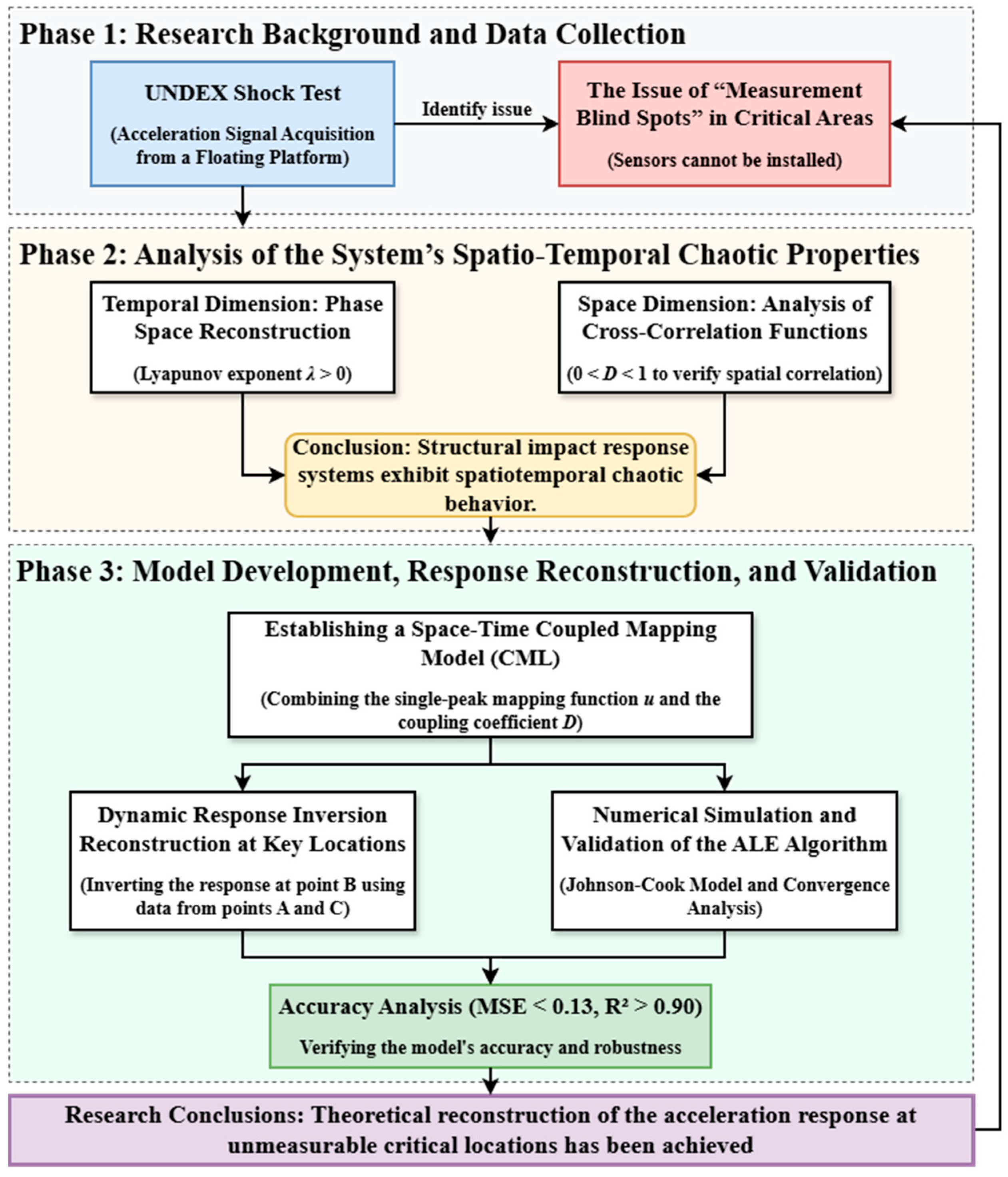
To address the aforementioned issues, this paper proposes a method for reconstructing key local responses based on the analysis of chaotic-like nonlinear transient behavior and dynamic inversion of the system. In this study, the structural dynamic response system under strong shock is regarded as a nonlinear dynamic system, whose response contains rich spatiotemporal evolution information. First, by performing spatiotemporal discretization and phase space reconstruction on the acceleration response signals from measurable points, the system motion trajectory is characterized in the reconstructed two-dimensional phase space. A nonlinear mapping function describing the system’s motion evolution is identified and established, with its control parameters used to characterize the system’s inherent nonlinear dynamic characteristics. Furthermore, moving beyond the limitations of single-point time series analysis, a spatiotemporal coupled mapping model for spatial state points is established based on spatiotemporal dynamic equations, quantitatively describing the correlation and evolution patterns of structural responses in space. Finally, using this coupled mapping model, the acceleration responses at unmeasurable key locations are theoretically inverted and reconstructed by leveraging the structural responses from measurable points as drivers and constraints.
The method proposed in this study provides a novel perspective and tool for analyzing the dynamic characteristics of “blind spot” locations in structures under strong shock environments. The core innovations of this research are reflected in three aspects: First, a paradigm shift in the research approach from “signal fitting” toward “system reconstruction,” which extracts the inherent evolutionary laws of the system through phase space, thereby enhancing physical interpretability and generalization capability. Second, the quantitative characterization and utilization of the chaotic-like nonlinear transient behavior; specifically, by calculating the Maximum Lyapunov Exponent (λ > 0) and the cross-correlation function (0 < D < 1), the chaotic-like features of strong shock responses are verified for the first time, based on which the critical predictability time is defined to provide a physical basis for signal segmentation. Third, the construction and inversion of the spatiotemporal coupled mapping model, which overcomes the limitations of single-point time series analysis by integrating temporal evolution with spatial coupling, enabling the theoretical reconstruction of responses at blind spots using neighboring measurable points.
2. Transient Strong Shock Test
In practical measurement engineering, due to extreme conditions such as confined spaces, high temperature and pressure, moving components, or localized damage, it is difficult or even impossible to install sensors at critical positions on the hull structure, making it unfeasible to extract dynamic response signals from such key locations. Currently, most approaches involve deploying measurement points in the vicinity of critical positions, aiming to infer local dynamic characteristics through the dynamic response signals from neighboring areas for equipment safety assessment [
13]. However, under transient strong shock loads, typified by underwater explosion loads, the hull structural response constitutes a complex nonlinear dynamic behavior resulting from multi-physics coupling. Structural responses at different spatial locations exhibit strong nonlinear features, characterized by complexity, sensitivity to initial conditions, and non-stationary behavior. Even minor disturbances can cause bifurcation and abrupt changes in the motion evolution of structural responses at different spatial points, indicating that the entire shock response system possesses chaotic-like nonlinear transient behavior. Consequently, relying solely on the structural response features from neighboring measurement points cannot accurately represent the dynamic behavior at critical locations. This significantly compromises the safety assessment of shipboard equipment, ultimately affecting the survivability and safety of the vessel.
As an evaluation tool for medium- and large-scale shipboard equipment, offshore floating platforms are used to simulate shock environments similar to those in actual ship experiments, thereby completing the assessment of the equipment’s anti-shock performance [
14,
15,
16]. The shipboard equipment is fixed to the deck of the floating platform via a foundation. Sometimes, due to space constraints, acceleration sensors can only be installed on the deck adjacent to the foundation, and the shock response from these neighboring positions is used as the shock input to evaluate the equipment. This section takes the offshore floating platform as an example to conduct an underwater explosion shock test on the floating platform. Acceleration response signals from measurement points in the vicinity of key locations are extracted to study the nonlinear dynamic characteristics of the structural response under underwater explosion shock loads.
For the structural design of the offshore floating platform, it is essential to ensure that the platform possesses sufficient stiffness. Specifically, under the conditions specified in MIL-S-901D [
17], it must have adequate strength to withstand the shock of underwater explosion loads while simultaneously providing the shock environment required by BV043/85 for equipment testing [
18,
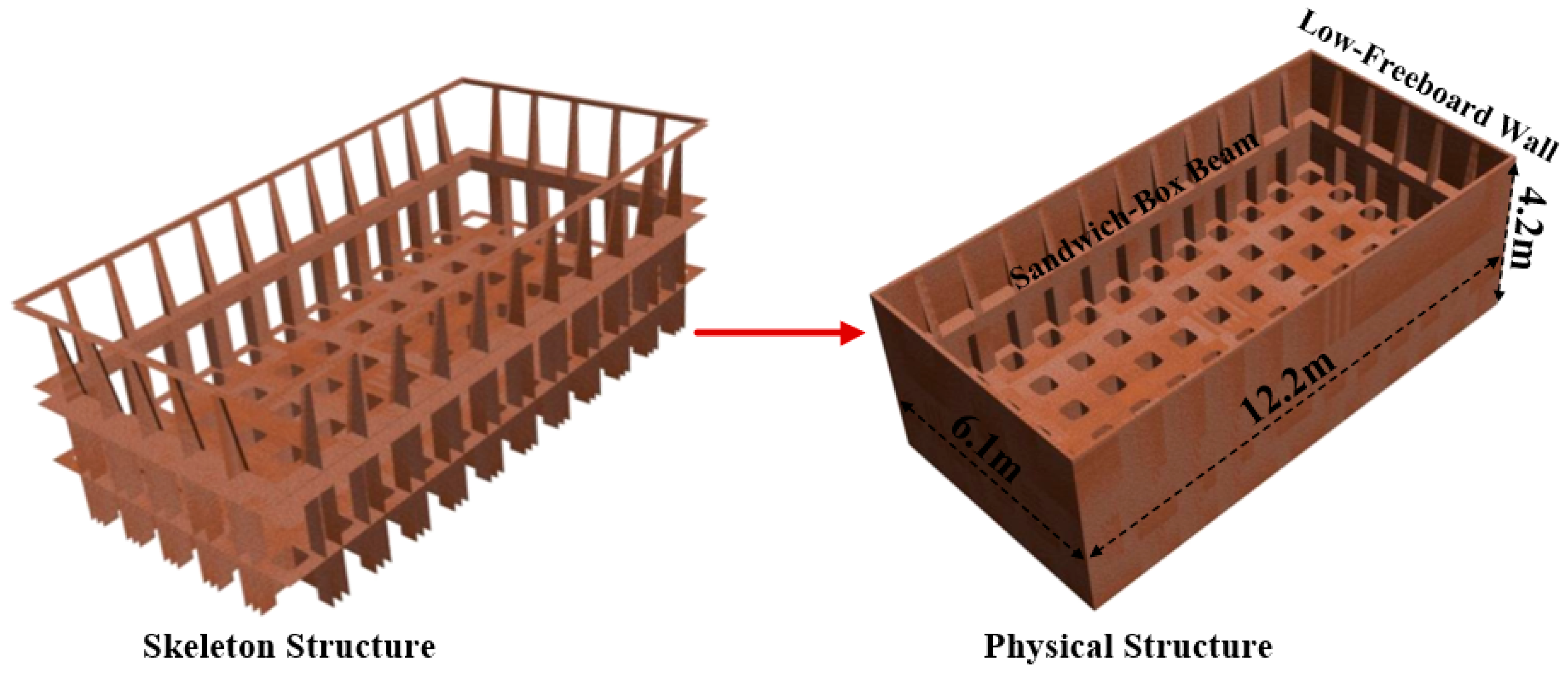
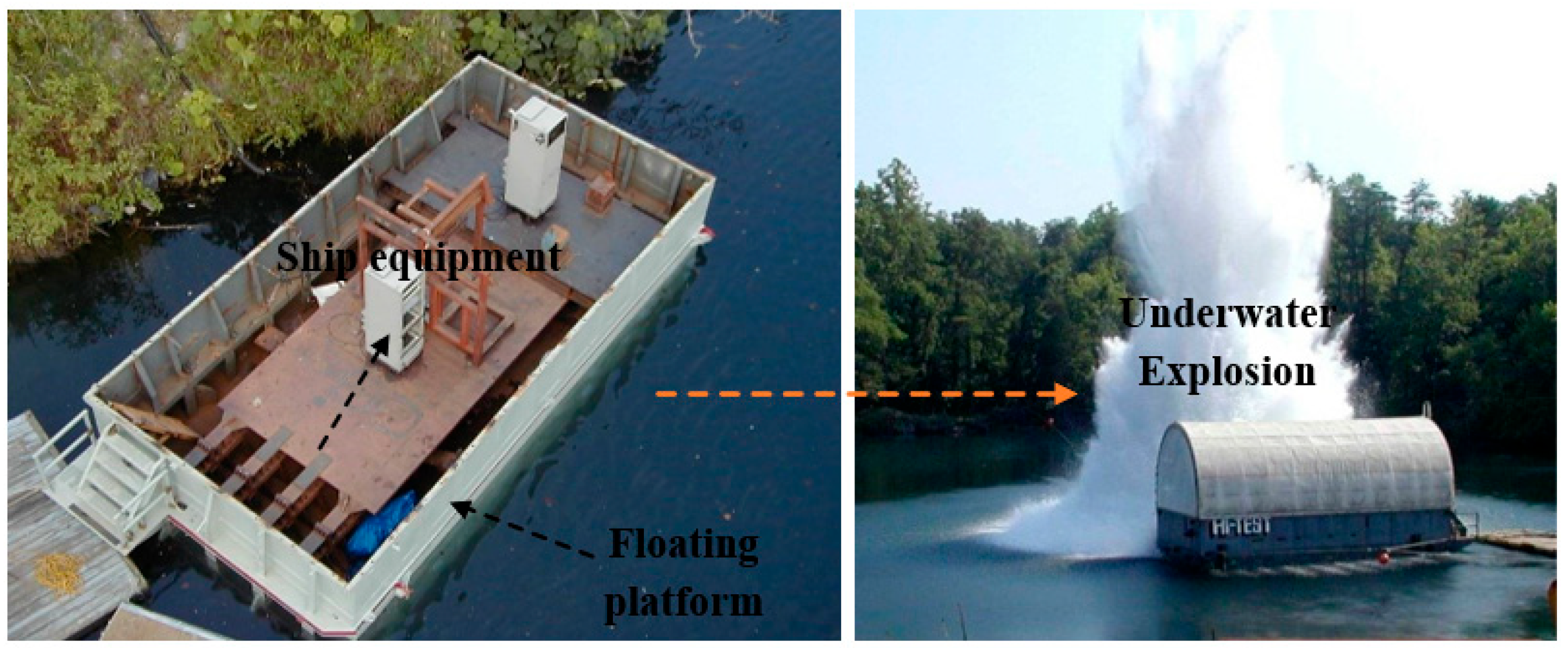
19]. Based on the main dimensions of a certain type of offshore floating platform and referring to the structural configuration of typical floating platforms, as shown in
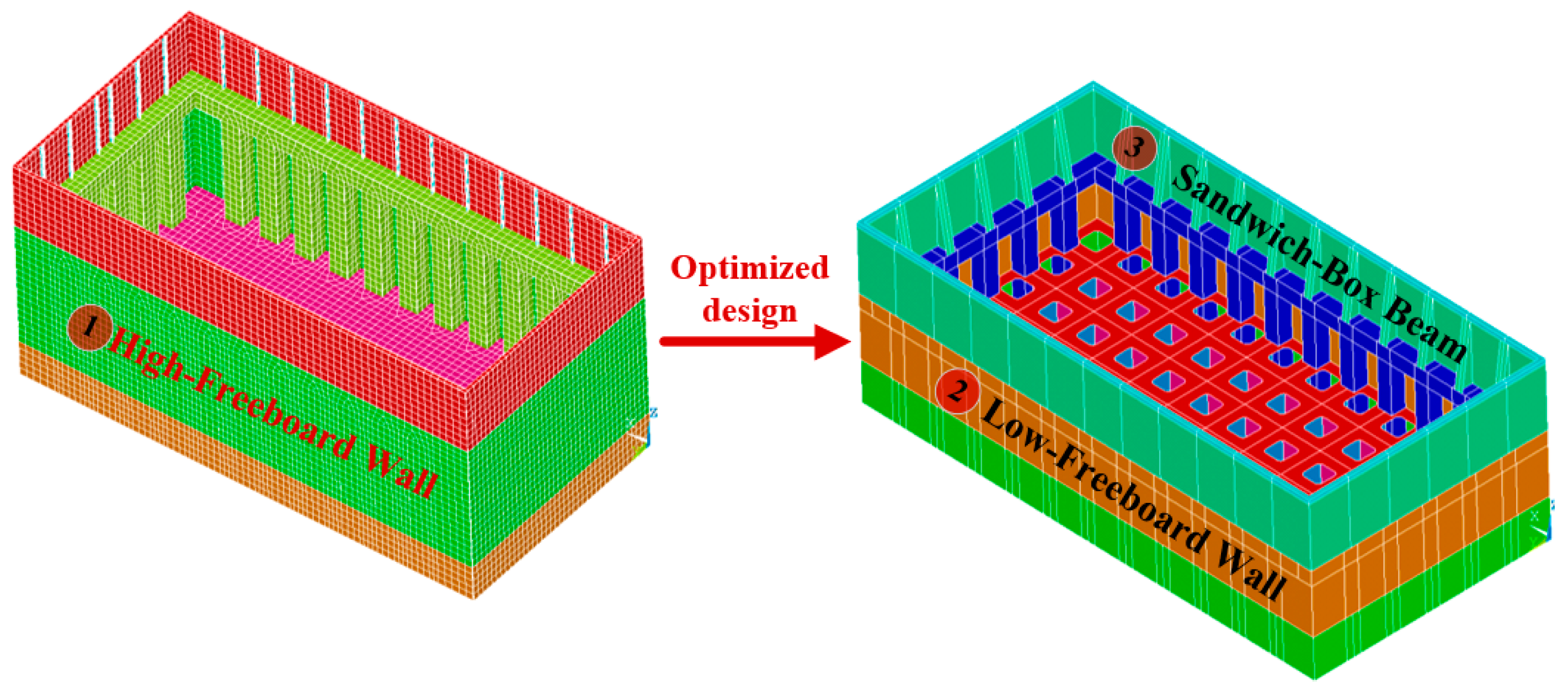
Figure 1, this paper designs an offshore floating platform with a low-freeboard wall-box beam structure. This design is intended for conducting multiple underwater explosion shock tests on the floating platform, aiming to investigate the nonlinear dynamic characteristics and motion evolution patterns of the structural response.
To prevent the maximum deformation of the floating platform from occurring at the freeboard wall under strong shock loads, the height of the freeboard wall is reduced by adopting a low-freeboard wall design. This ensures that the maximum deformation appears on the shock-resistant bulkhead located on the side facing the explosion. To enhance the structural strength of this shock-resistant bulkhead, a sandwich-type design is employed for the bulkhead. Additionally, several small holes are opened in the platform’s inner bottom plate to reduce the overall weight of the platform. This forms a sandwich-box beam structure, as shown in
Figure 2, ensuring that the shock-resistant bulkhead of the floating platform meets the strength requirements under strong shock loads.
The floating platform with a low-freeboard wall-sandwich box beam structure measures 12.2 m × 6.1 m × 4.2 m. It is constructed from 921A steel, with an overall structural mass of 92 t and a maximum load capacity of 113 t. The physical structure is shown in
Figure 3.
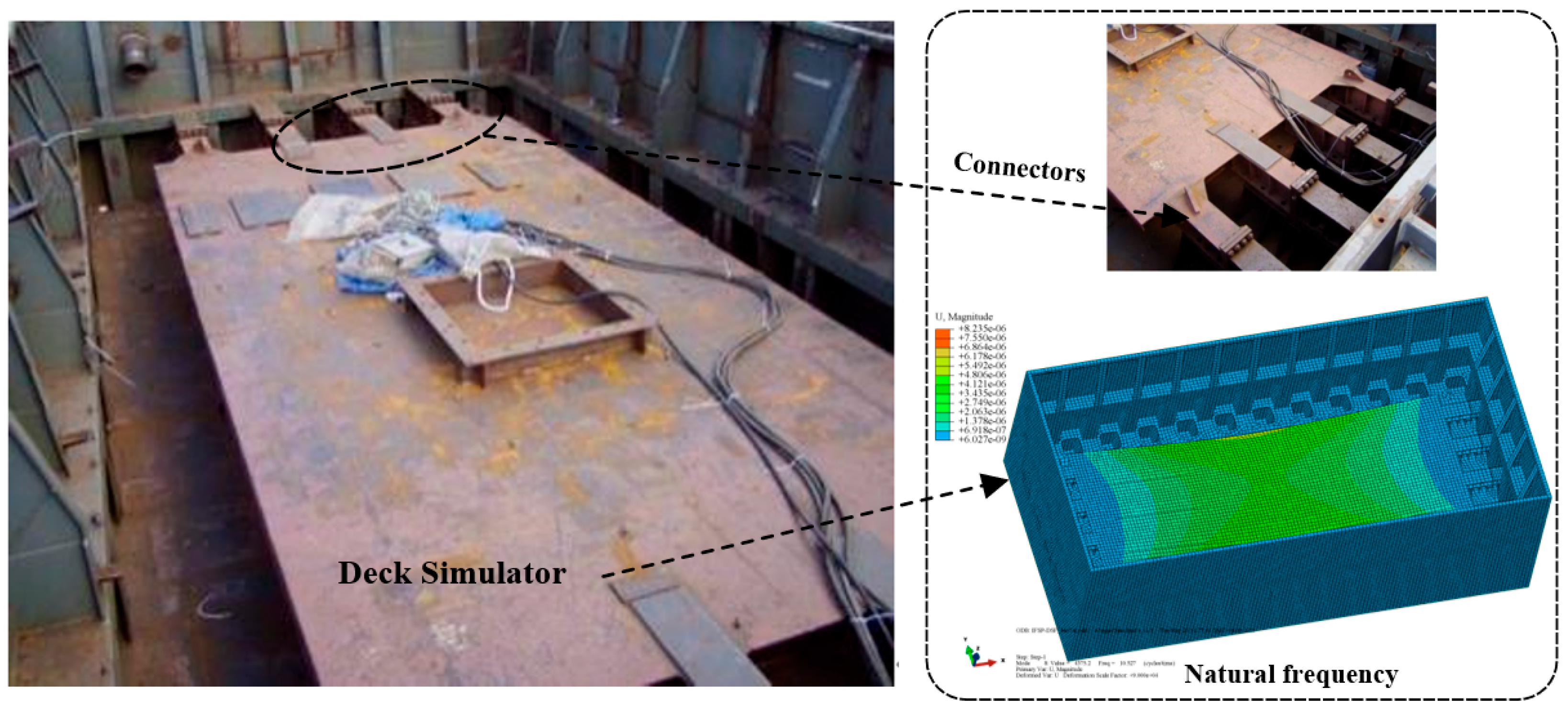
Connectors are used to install a deck simulator on the inner bottom plate of the floating platform to replicate the deck structure of an actual ship. A modal analysis is performed on the deck simulator, revealing a vertical first-order natural frequency of 10 Hz, as shown in
Figure 4. This meets the requirements for simulating a more realistic shock environment under the strong shock loads of underwater explosions experienced by actual ships.
Using the same charge weight (
W), the stand-off distance (
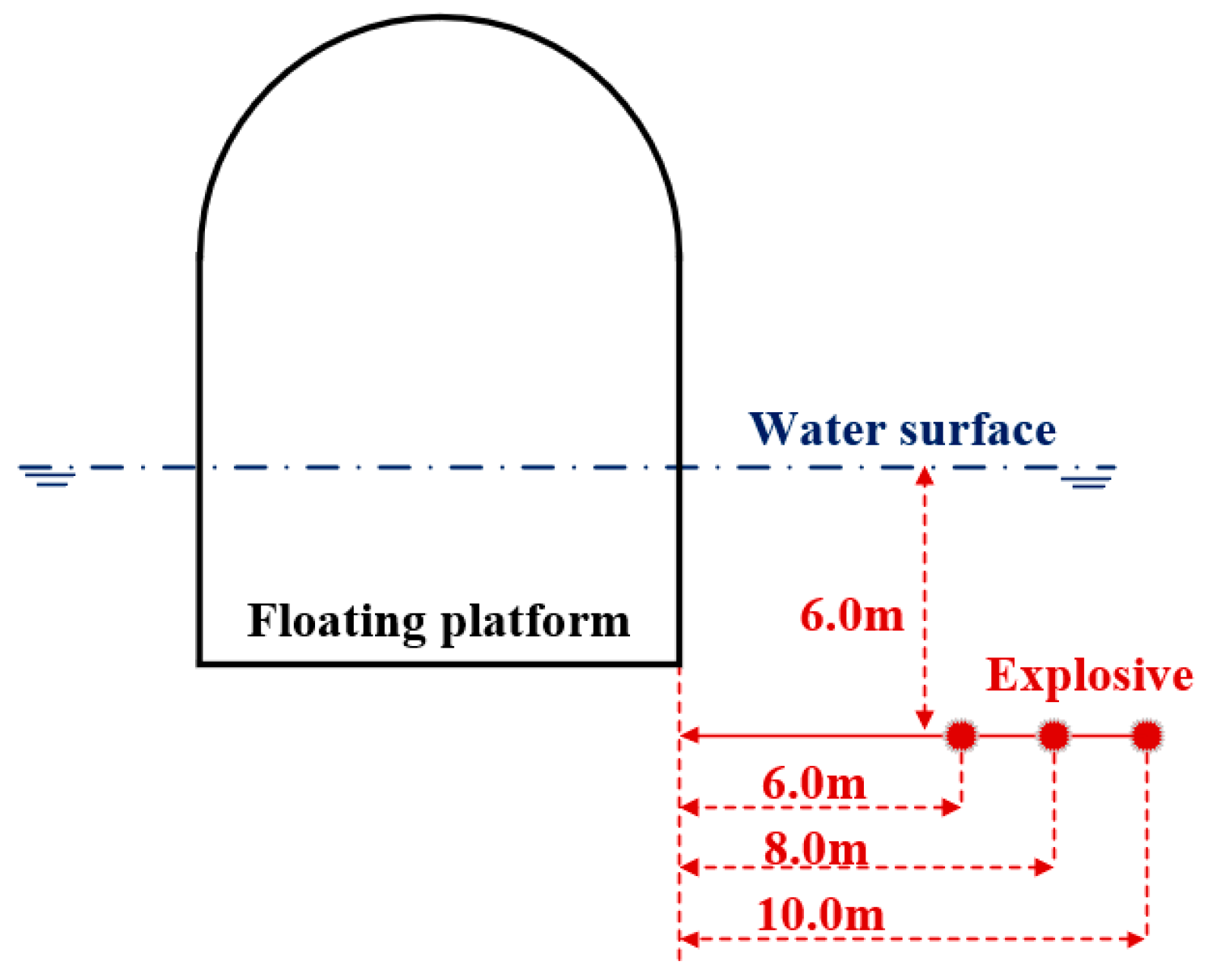
R) is adjusted to vary the shock factor, thereby conducting shock tests on the floating platform under different conditions in the explosion test basin. In the test system, the spatial arrangement of the explosive charges is shown in
Figure 5, and the test conditions are summarized in
Table 1.
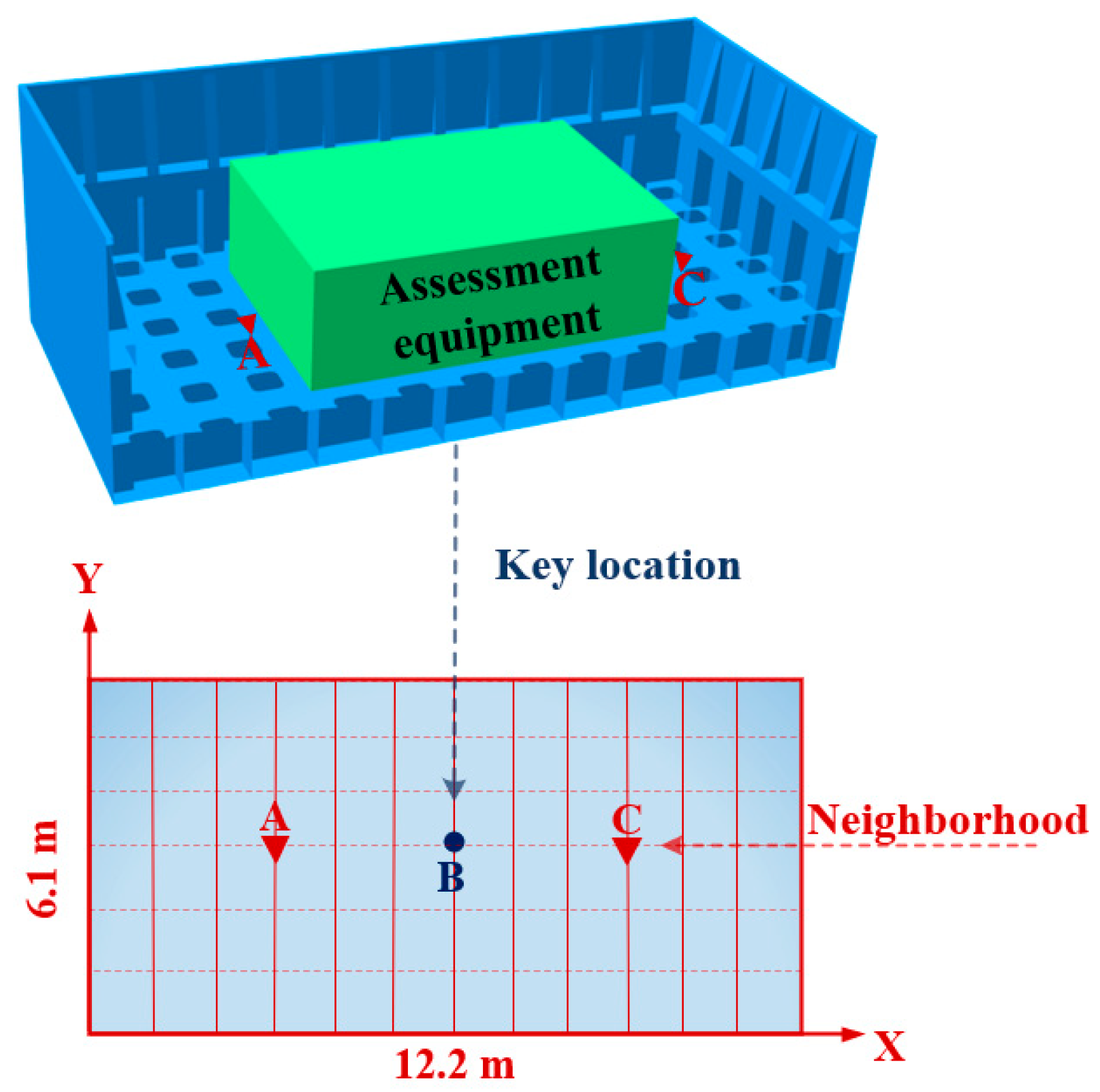
The assessment equipment is fixed to the deck of the floating platform. The structural response of the deck in this local area serves as the actual shock input for the shipboard equipment. Specifically, the area of measurement point B in
Figure 6 is defined as the key location. However, due to space constraints, acceleration sensors cannot be installed directly at this key location. Therefore, measurement points are deployed in the neighboring area of the key location, such as measurement points A and C shown in
Figure 6. The acceleration response signals collected by acceleration sensors at points A and C are typically regarded as the shock input for the shipboard equipment. In this study, the experimental conditions only include three standoff distances (6.0 m, 8.0 m, and 10.0 m), while the charge weight is kept constant (27.2 kg); a wider range of conditions, such as different charge weights and various structural types, has not yet been covered. Furthermore, this paper only conducts experiments for the specific structural layout of the floating platform deck and the sensor configuration at neighboring measurement points A and C for key target point B, without involving more complex structural forms or sensor networks. The applicability of this method in broader engineering scenarios remains to be further verified through subsequent physical model tests.
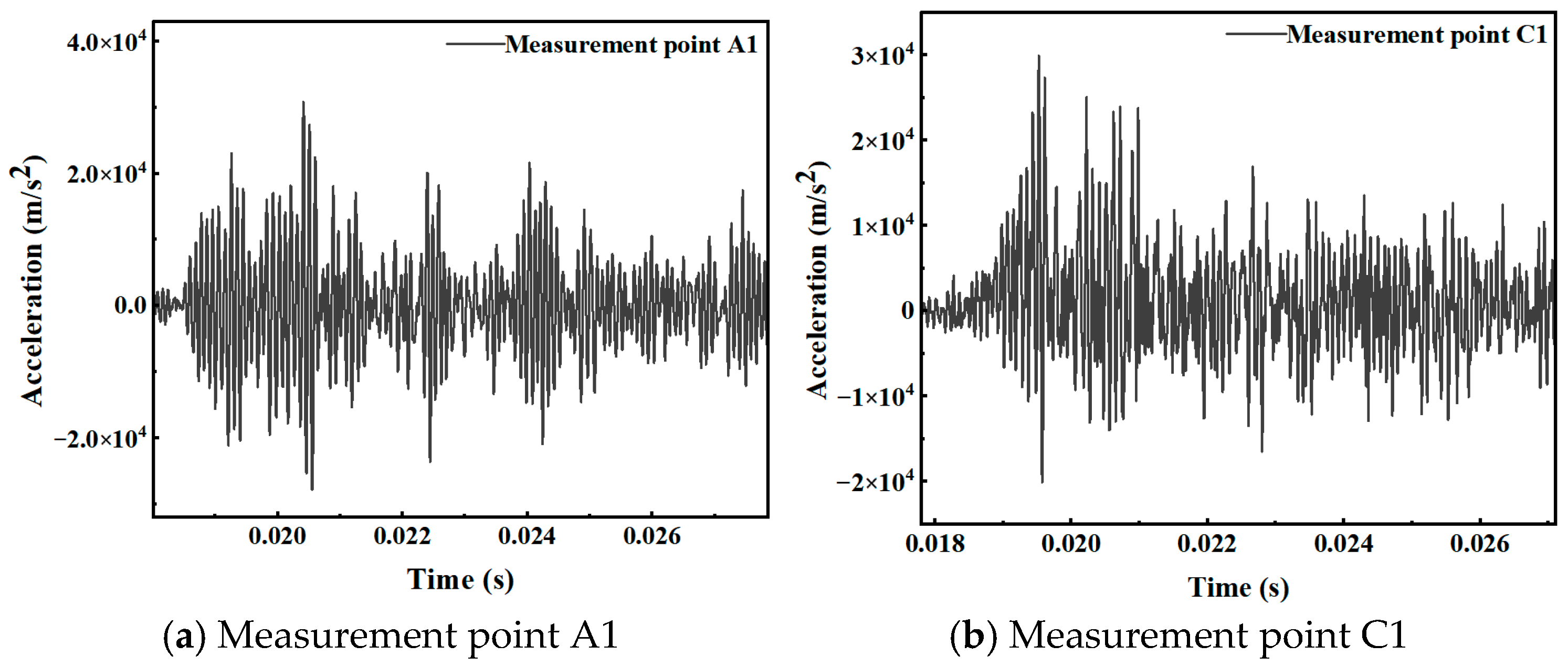
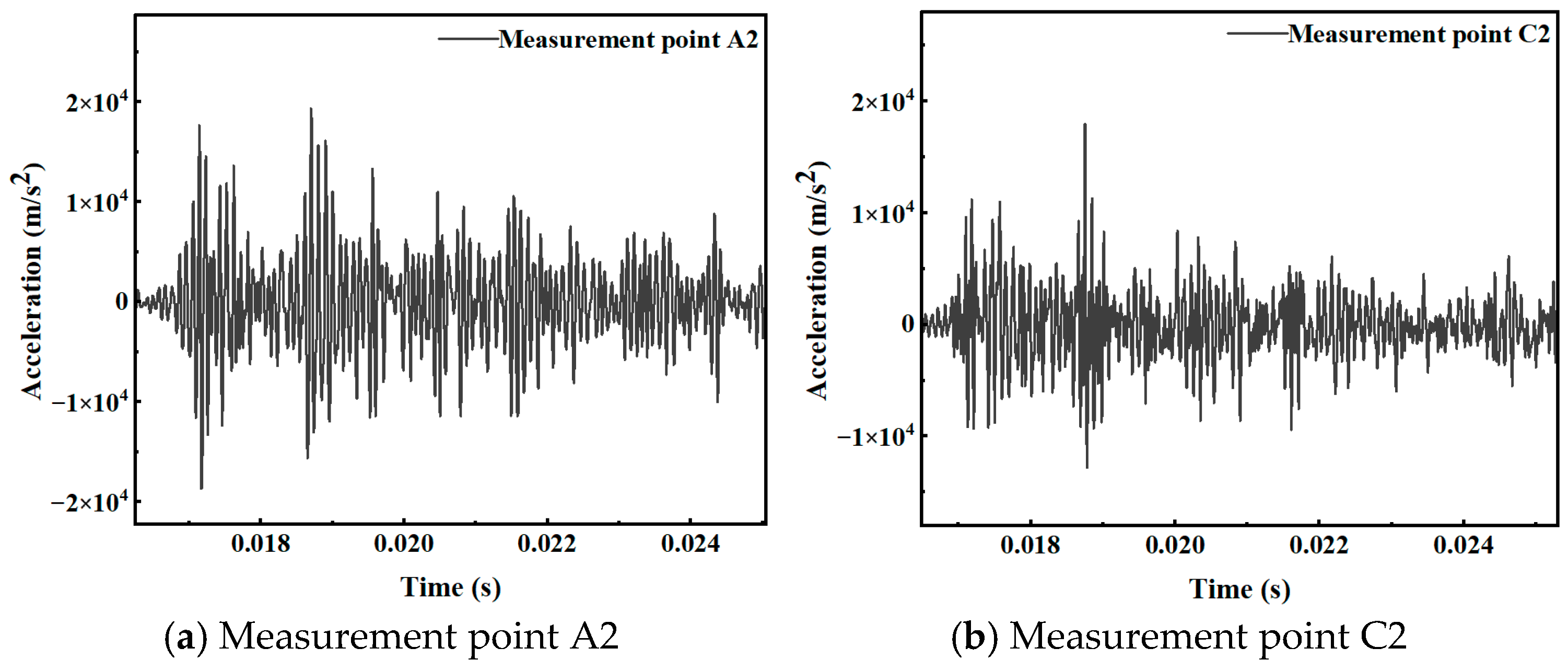
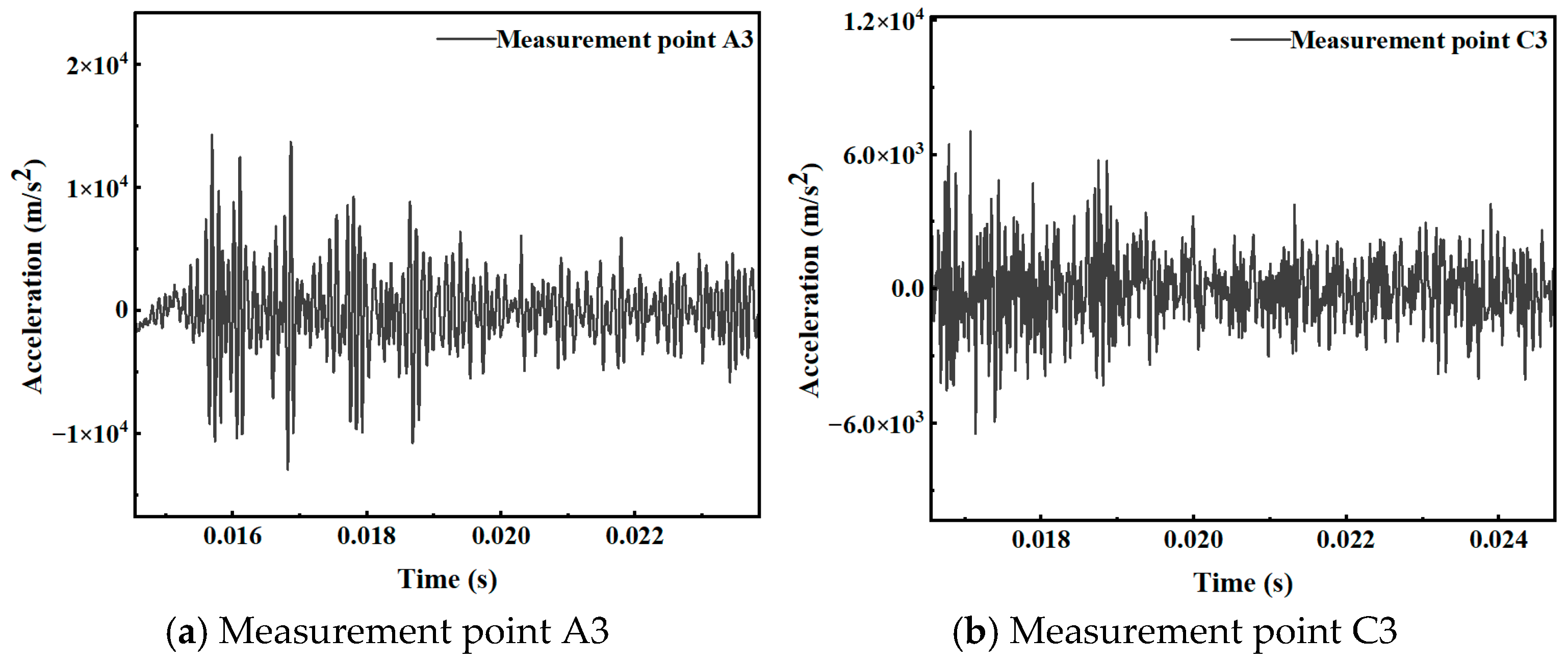
Under the action of underwater explosion loads, the acceleration response signals at measurement points A and C of the floating platform under different test conditions are extracted, as shown in
Figure 7,
Figure 8 and
Figure 9, respectively.
The figure above indicates that under strong shock loads, the acceleration responses of the floating platform across different spatial regions exhibit characteristics such as high frequency, rapid response, and irregular amplitude variations. The motion evolution of the entire dynamic system appears complex, non-stationary, and sensitive to initial conditions.
3. Spatiotemporal Chaotic Characteristics of Structural Response
The underwater explosion shock tests on the floating platform indicate that the motion evolution of the acceleration response at any measurement point over time is complex, non-stationary, and sensitive to initial conditions. Furthermore, the dynamic characteristics of the structural response system differ across various measurement points. This section investigates the dynamic behavior of the structural response system under a transient strong shock, exploring the chaotic-like nonlinear transient behavior of the spatial structure subjected to such loads.
Under underwater explosion loads, the structural dynamic response system constitutes a multi-dimensional, complex nonlinear dynamic system, making it difficult to construct a dynamic model for the evolution of structural responses. In this section, the time variables in the structural dynamic response system are discretized. Using the phase space reconstruction method [
20,
21], an equivalent phase space of the original dynamic system is constructed from the one-dimensional acceleration time series, as shown in Equation (1). The motion trajectory of the dynamic system evolving in this phase space is represented as
Xi = (
xi,
xi+τ, …,
xi+(m−1)τ).
By embedding the motion states of the time series
x(
t) at different delay intervals
τ into an
m-dimensional state space, a phase space is reconstructed. This phase space is topologically conjugate to the state space of the original dynamical system, allowing the motion trajectory of the single-variable time series in the phase space to reflect the dynamical behavior of the entire system [
22].
The selection of the delay amount
τ and the embedding dimension
m is crucial. Choosing an appropriate delay amount can better reflect the motion characteristics of the system, while ensuring that the dimension of the phase space is sufficiently large allows the system’s motion trajectory to fully unfold. Since the autocorrelation function can compute the autocorrelation of trajectory points in the time series, reflecting the system’s motion characteristics under different delay amounts [
23,
24], this paper determines the optimal delay amount
τ for the time series using the autocorrelation function method, as shown in Equation (2).
In the above equation,
N represents the length of the time series, and the magnitude of
C(
τ) indicates the degree of correlation between motions at two time points separated by a delay of
τ. Specifically, the smaller
τ is, the larger
C(
τ) becomes, indicating that
x(
t) and
x(
t +
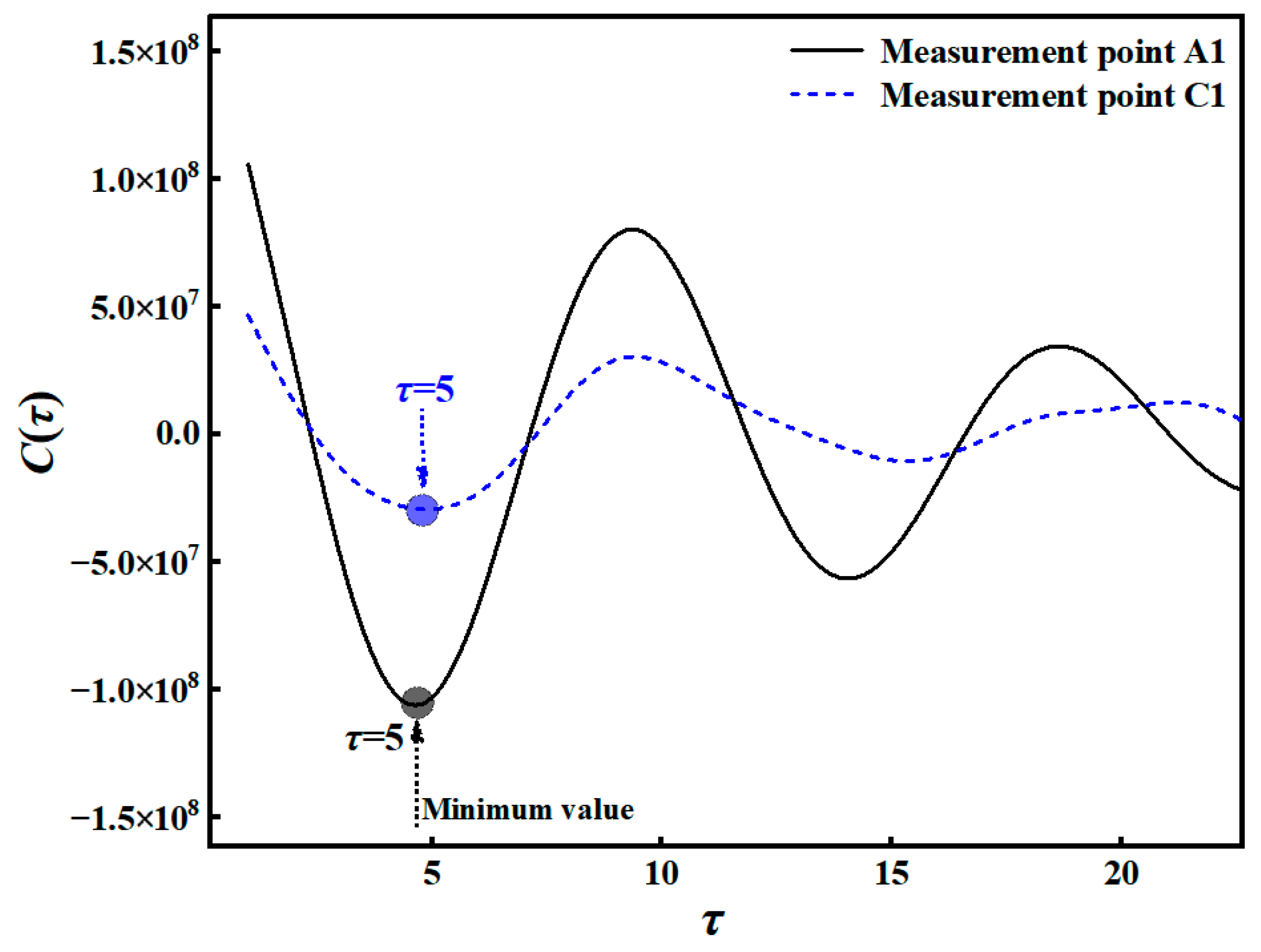
τ) are more similar. Taking the acceleration response signals from measurement point A1 and measurement point C1 under Test Condition 1 as an example (see
Figure 7), the optimal delay amount for the acceleration time series is calculated using the autocorrelation function method based on Equation (2), as shown in
Figure 10.
To ensure that the motions at two time points separated by a time difference
τ possess independent characteristics, it is necessary to keep
C(
τ) relatively small, while also avoiding an excessively large
τ value, which would hinder the accurate characterization of the motion trajectory features. Therefore, the
τ value corresponding to the point where
C(
τ) drops from
C(0) to its first minimum is taken as a measure of the temporal correlation within the time series, referred to as the system’s correlation time—i.e., the optimal delay amount, as illustrated in the figure above. For the acceleration time series at measurement point A1 and measurement point C1 under Test Condition 1, the optimal delay amount for both is 5. The optimal delay amounts for acceleration time series at different measurement points under other test conditions are calculated using the same method, with specific values provided in
Table 2.
To fully unfold the motion trajectory of the system, it is necessary to determine an appropriate embedding dimension
m. In the
m-dimensional phase space, assume two adjacent motion trajectories are
Xi and
Xj, where
Xi and
Xj are defined as shown in Equation (3).
In the
m-dimensional phase space, the distance between the two motion trajectories is denoted as
Rm(
t) = ‖
Xi(
t) −
Xj(
t)‖. When the dimension increases from
m to
m + 1, the distance between them changes, as expressed in Equation (4).
If
Rm+1(
t) changes significantly compared to
Rm(
t), it indicates that two adjacent motion trajectories in the higher-dimensional phase space become false nearest neighbors when projected into the lower-dimensional phase space [
25]. Let
S′ denote the ratio of the distances between the two adjacent motion trajectories in the (
m + 1)-dimensional and
m-dimensional phase spaces, as expressed in Equation (5).
Let the empirical threshold be
S, defined within the range 10 ≤
S ≤ 50. If
S′ >
S, then
Xi is considered a false nearest neighbor of
Xj. When the number of such nearest neighbors no longer decreases with an increase in the embedding dimension
m, the motion trajectory of the system is considered fully unfolded. The corresponding dimension
m at this point is identified as the optimal embedding dimension [
26].
Based on the autocorrelation function method, the optimal delay amount
τ for the acceleration time series is known (see
Figure 10 and
Table 2). With the empirical threshold set at
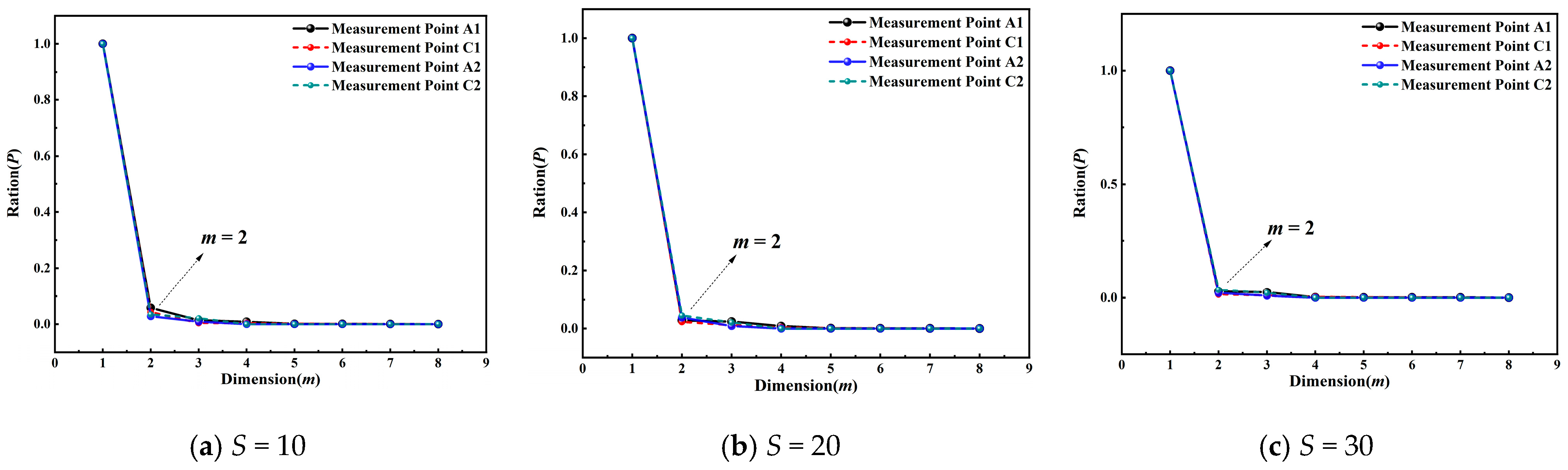
S = 50, the embedding dimension
m for the acceleration time series at different measurement points under various test conditions is determined according to Equation (5), as shown in
Figure 11. Here, the horizontal coordinate
m represents the dimension of the phase space, and the vertical coordinate
P is the proportion of neighboring points calculated based on their quantity. The threshold
S is a critical parameter for identifying false neighbors by measuring the relative increase in distance when the embedding dimension increases from
m to
m + 1. Following the geometrical construction proposed by Kennel et al., a sensitivity analysis was conducted by adjusting the value of
S from 10 to 50. The results are shown in
Figure 11.
The figure above indicates that when the embedding dimension m = 2, the proportion of neighboring points undergoes a sudden change. For m > 2, the proportion of neighboring points drops to nearly zero and remains constant. This suggests that the dimension is now greater than or equal to the dimension of the motion trajectory, allowing the trajectory to be embedded in a two-dimensional Euclidean space without intersections. Therefore, the dynamic characteristics of the structural response’s motion evolution can be analyzed in a two-dimensional phase space.
In the two-dimensional phase space, assuming the initial deviation between two adjacent motion trajectories is
δ0, that is:
When
Xi and
Xj evolve along their respective trajectories by one time step Δ
t, the deviation between them becomes
δ1. After
n time steps, their deviation becomes
δn.
Assuming that adjacent motion trajectories in the structural dynamic response system deviate exponentially, the relationship between
δn and
δ0 is given by Equation (8).
Taking the logarithm of both sides of the above equation yields the deviation index
λ for adjacent motion trajectories of the system, as shown in Equation (9).
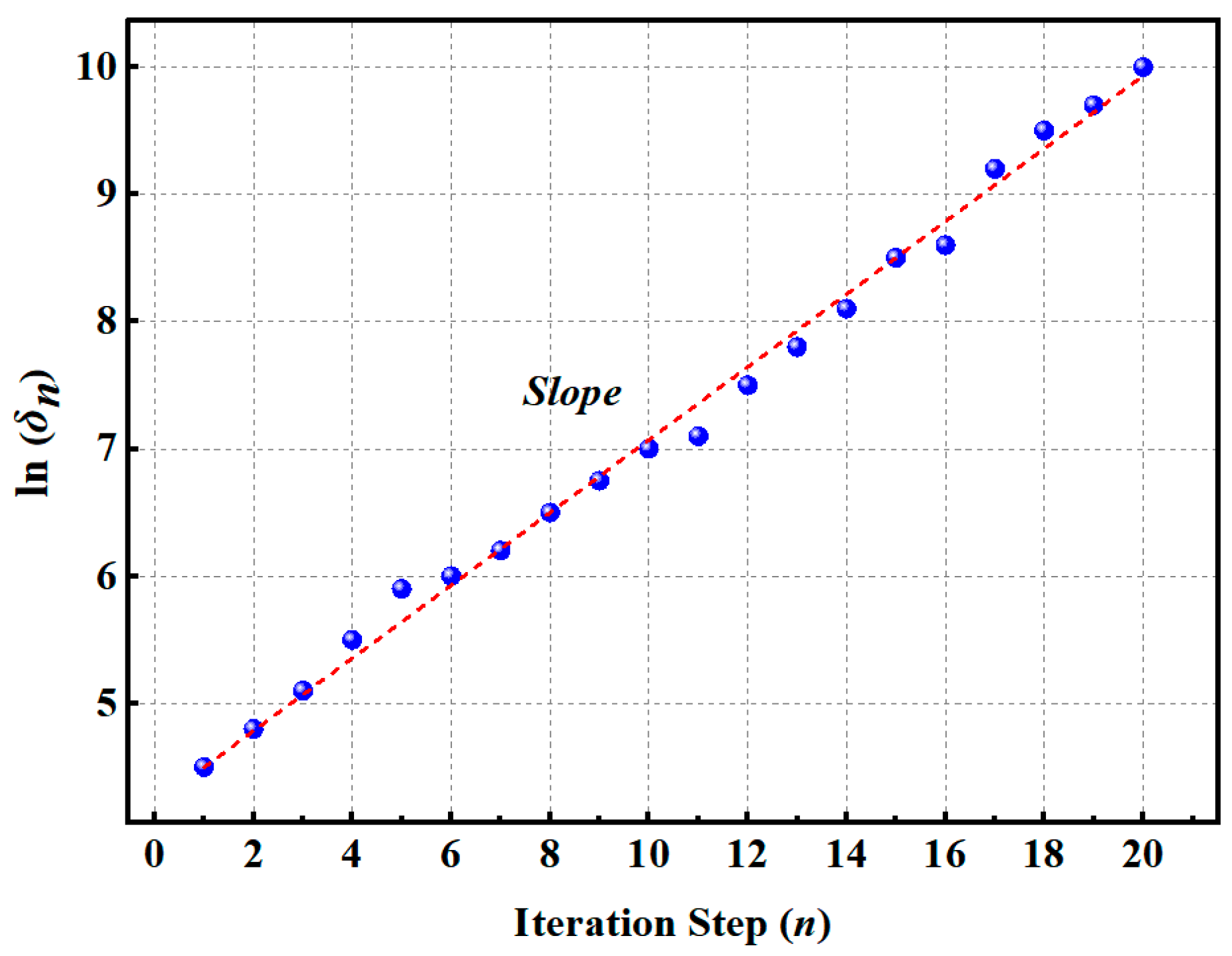
As the value of
n gradually increases, the average logarithmic distance ln(
δn) for all adjacent motion trajectories is calculated. The slope of the curve of ln(
δn) with respect to
n represents the maximum orbital deviation index
λ, i.e., the maximum Lyapunov exponent [
27,
28,
29].
Based on the above analysis, taking the acceleration response signal from measurement point A1 under Test Condition 1 as an example, the maximum orbital deviation index
λ for the system’s motion evolution is calculated, as shown in
Figure 12.
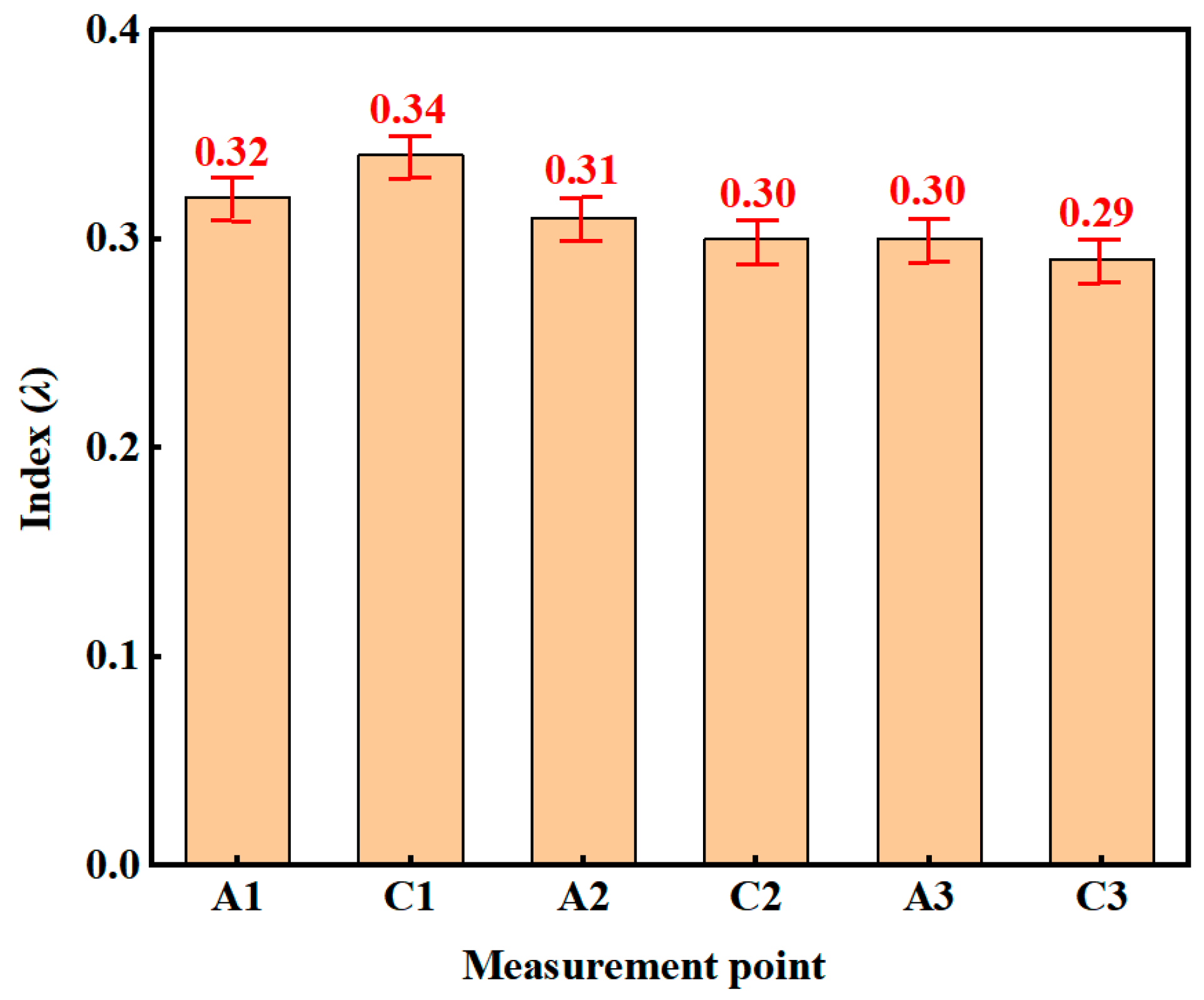
Similarly, the maximum orbital deviation index
λ for different measurement points under various test conditions is calculated, as shown in
Figure 13.
Figure 13 indicates that under underwater explosion loads, the orbital deviation index
λ of the structural dynamic response system is consistently greater than 0. This demonstrates that the system is highly sensitive to initial conditions. When there is even a slight deviation in the initial conditions, adjacent motion trajectories separate exponentially over time, leading to bifurcation or even abrupt changes in the evolution of the dynamic system. Therefore, the structural dynamic response system exhibits nonlinear characteristics in the temporal dimension.
The above analysis is based on the autocorrelation function, which examines the correlation between a one-dimensional time series and its own values at different time lags to determine the optimal delay amount for the time series. Similarly, the cross-correlation function [
30,
31] is employed to analyze the linear correlation between time series from different spatial measurement points at varying time lags, as shown in Equation (10).
In the above equation,
x(
t) is treated as the acceleration time series of measurement point A, and
y(
t) as the acceleration time series of measurement point C. The magnitude of
D(
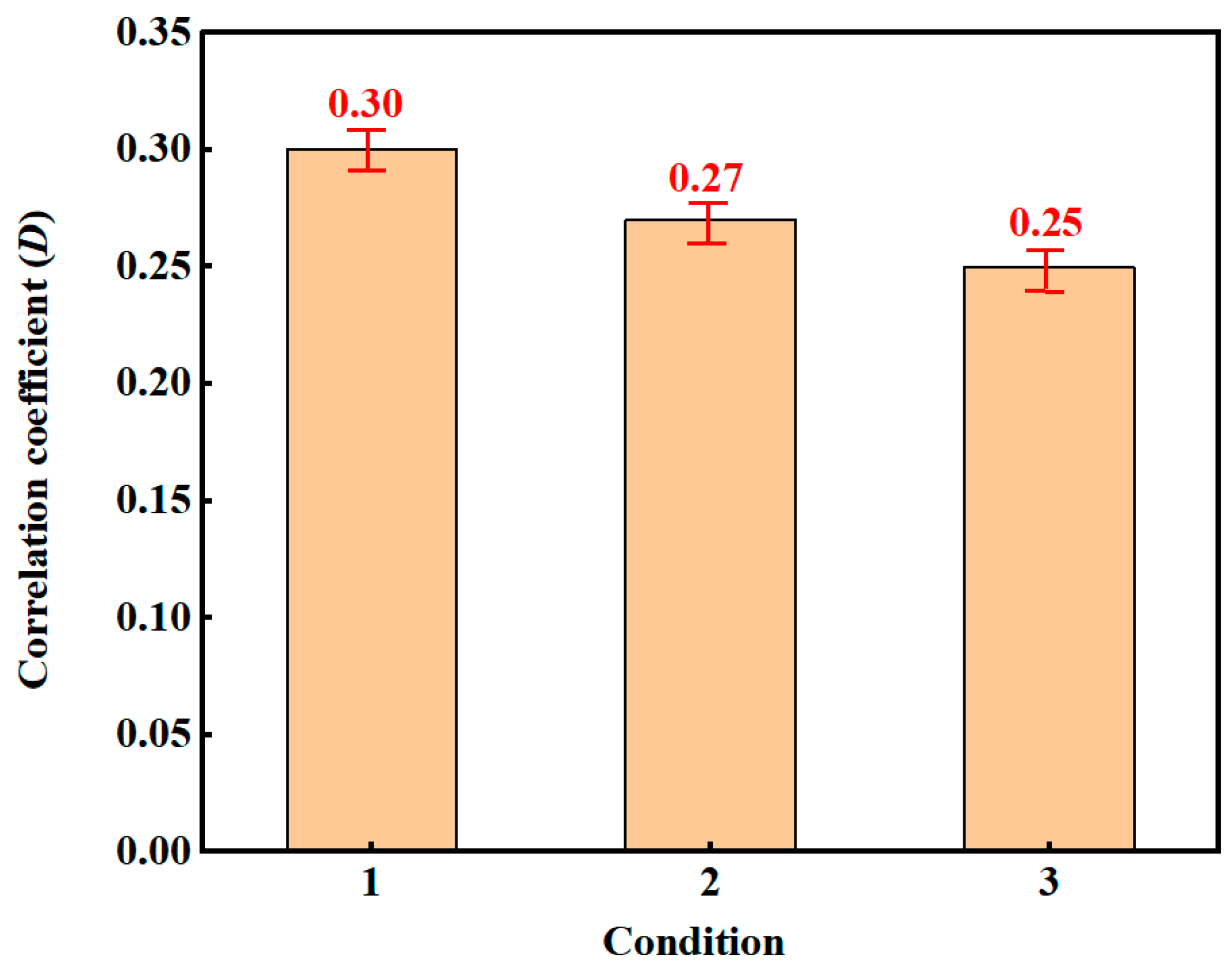
τ) reflects the linear correlation between the time series from different spatial measurement points. Based on Equation (10), the cross-correlation coefficients for measurement points A1 and C1 under Test Condition 1 are calculated and denoted as
D1; similarly, the coefficients for A2 and C2 under Test Condition 2 are calculated as
D2, and for A3 and C3 under Test Condition 3 as
D3, as shown in
Figure 14.
As shown in
Figure 14, the cross-correlation coefficients between the time series satisfy 0 <
D < 1, indicating that the dynamic characteristics represented by different spatial measurement points are neither fully independent nor entirely linearly correlated. The motion evolution of the spatial structural responses is mutually coupled and interacting, exhibiting nonlinear characteristics in the spatial dimension.
Although the orbit deviation index and the cross-correlation coefficient indicate that the overall structural dynamic response system exhibits chaotic-like nonlinear transient behavior, its evolutionary motion remains complex, non-stationary, and sensitive to initial conditions. However, according to the fractal theory of strongly nonlinear dynamic systems, within an extremely short time frame, the dynamic behavior of the system shows a certain degree of self-similarity to its initial motion state, manifesting certain regularities and predictability. This time duration is defined as the critical time, tc. Therefore, when t ≤ tc, the motion evolution of the system follows certain patterns, with each stage demonstrating self-similar regularity. When t > tc, the motion evolution enters a state of complete chaos, and the dynamic behavior turns unpredictable.
It is defined that at time
t, the uncertainty of the system’s motion state is denoted as
ε(
t), as shown in Equation (11).
When
ε(
t)/
ε(0) exceeds the specified critical value
c, the motion evolution of the system enters a state of complete chaos, with unpredictable dynamic behavior. Thus, the expression for the critical time
tc is given by Equation (12).
Here,
c represents the threshold for the allowable amplification factor of the prediction error; its value determines the length of the predictable time. When the initial information decays to 1/e of its original value, the system is considered to have essentially lost its predictability; therefore, the empirical threshold
c = e is adopted. Thus, the maximum critical time
tc for which the shock response system remains predictable is given by Equation (13).
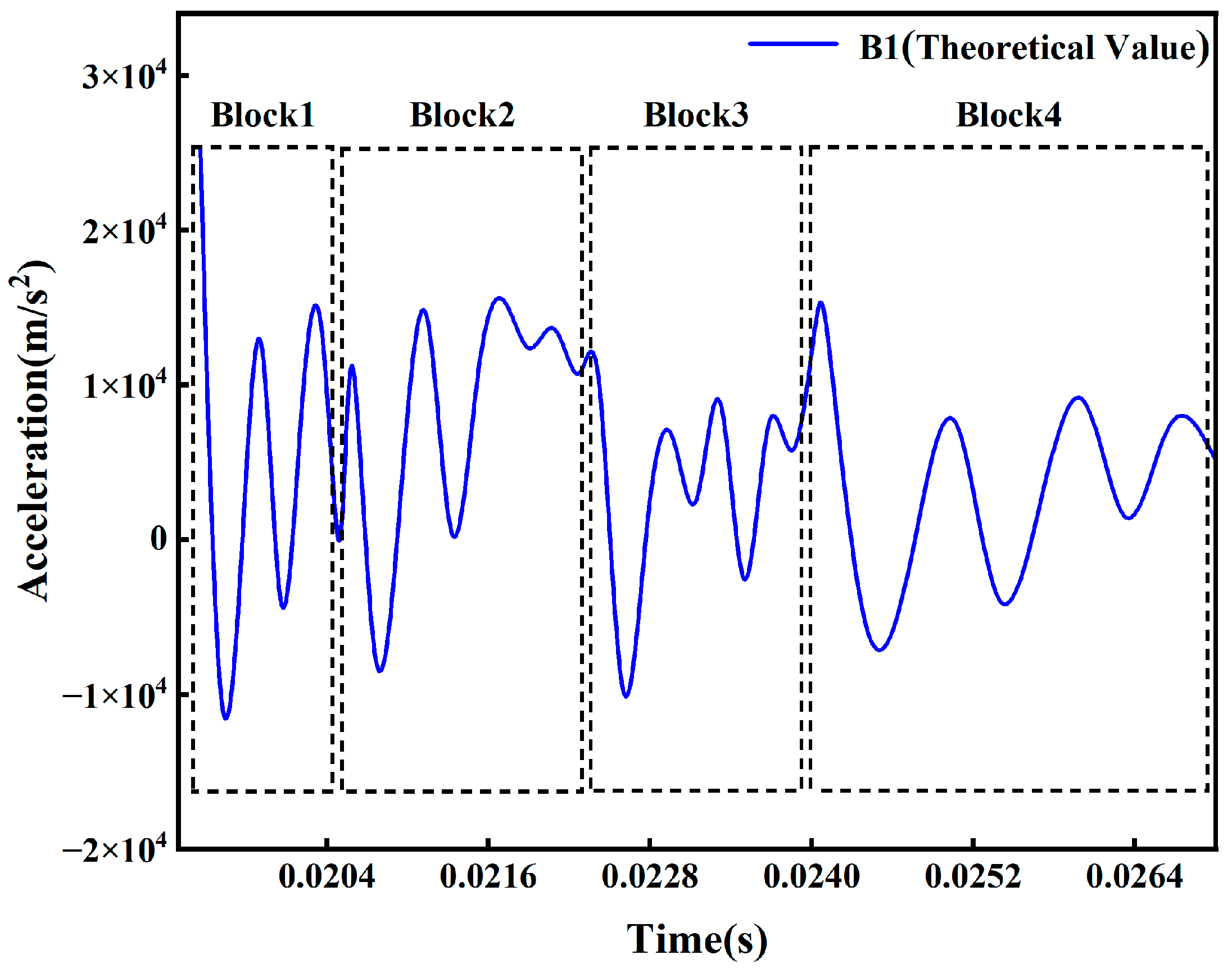
According to the calculation results in
Figure 13 of this paper,
λmax at each measurement point remains stable within the range of 290~340 s
−1 (0.29–0.34 ms
−1). Substituting these values into Equation (13) yields a theoretical prediction time
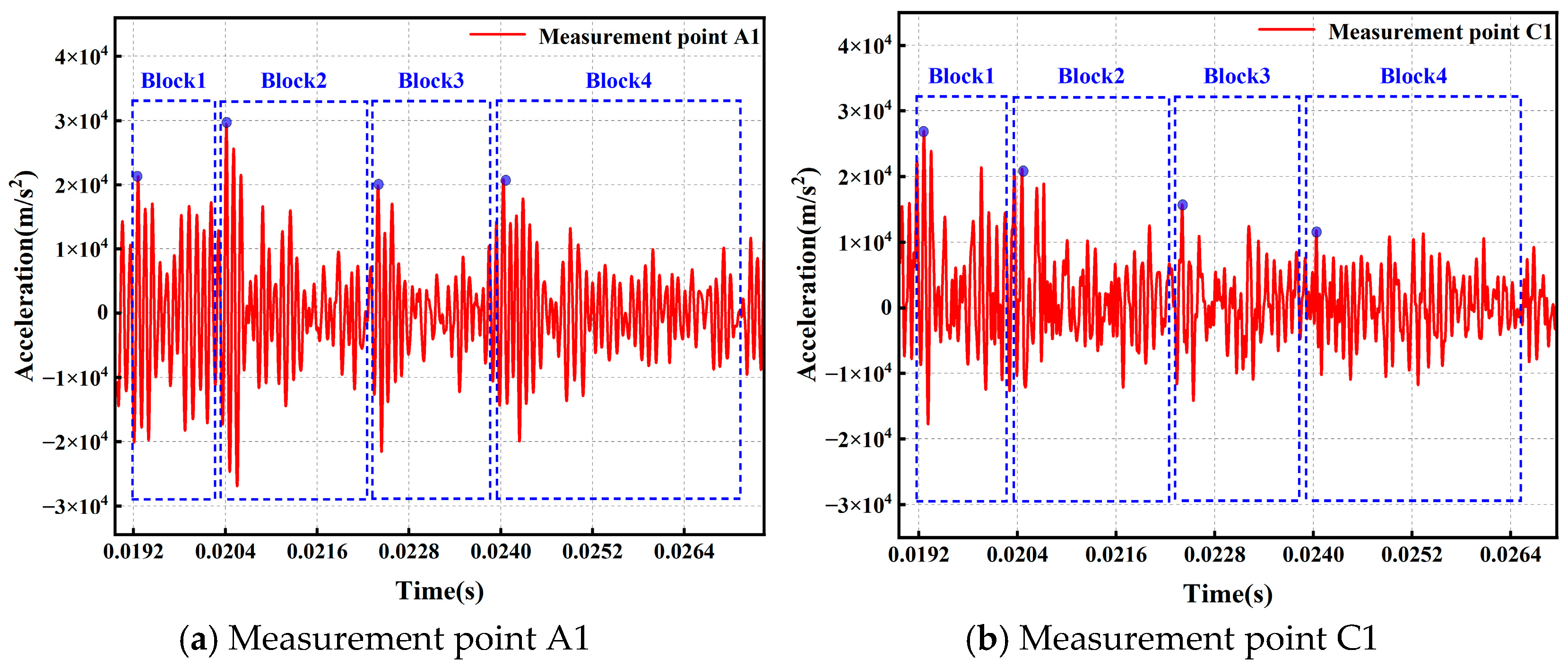
tc of 2.94~3.45 ms. Therefore, using
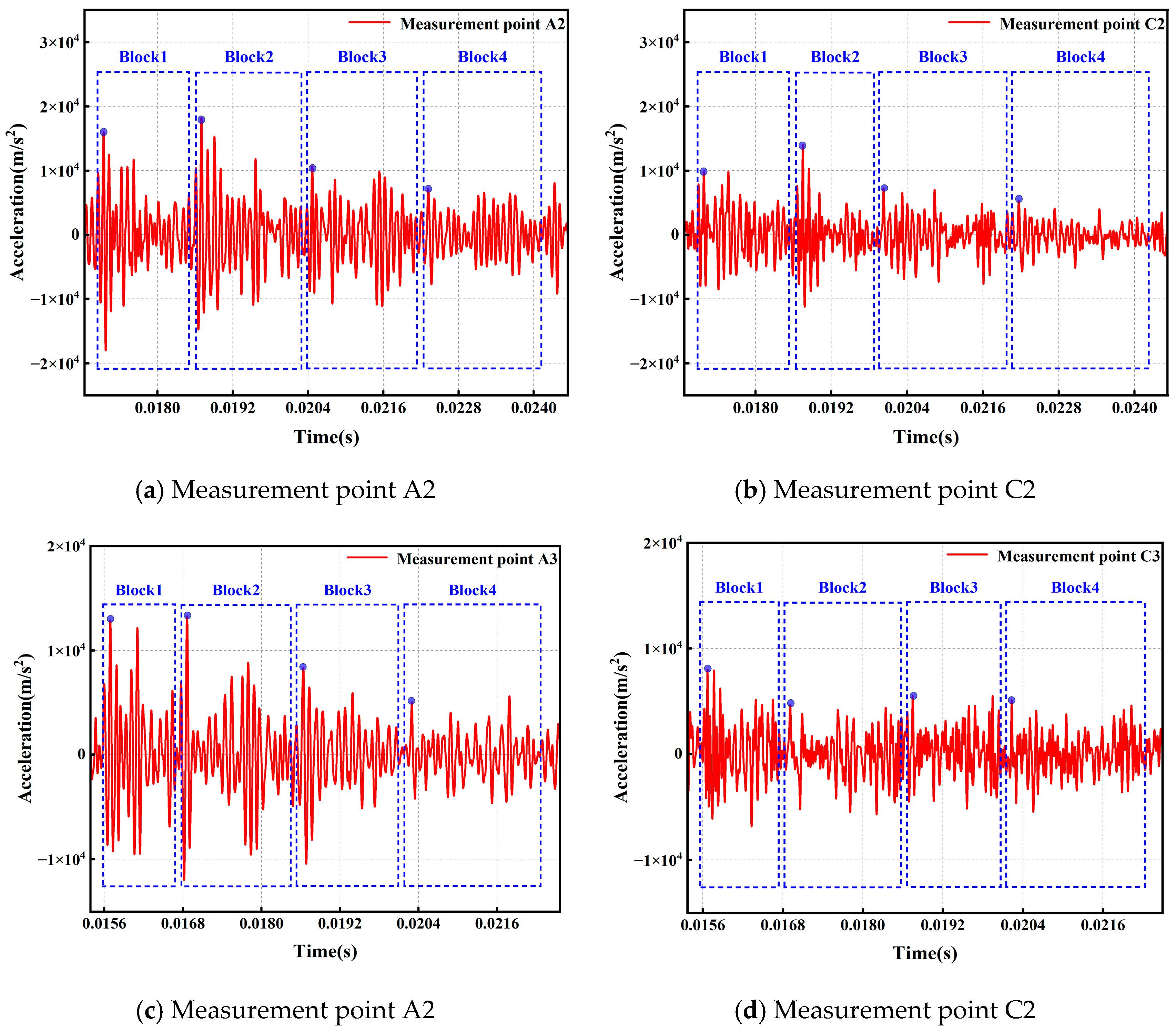
tc = 3 ms as the benchmark, the transient strong-shock-induced nonlinear and non-stationary structural response signals are segmented into blocks, ensuring that the duration of each block is less than the critical time
tc. This facilitates subsequent investigation into the spatiotemporal evolution patterns of the structural response within each block. The acceleration response signals at various measurement points under different test conditions are segmented. The segmentation results of the time series under Condition 1 are shown in
Figure 15, and the segmentation results for Condition 2 and Condition 3 are presented in
Appendix A.
This section maps the multi-dimensional and complex strong-shock response system into a low-dimensional phase space. Through the motion trajectory deviation index λ and the cross-correlation coefficient D, the chaotic-like nonlinear transient behavior of the strong-shock response system are revealed. Building on this, the predictable critical time for nonlinear dynamic systems is proposed, and the transient, strongly nonlinear, and non-stationary structural response signals are segmented, ensuring that the dynamic behavior within each segment exhibits a certain degree of regularity and predictability. Accordingly, for the dynamic behavior of the system within each segment, follow-up research will be conducted to investigate the motion evolution patterns of the strong-shock response system, establish a spatiotemporal dynamic model for the system’s motion evolution, and thereby achieve the theoretical inversion of the structural response at key locations.
4. Spatiotemporal Dynamics Model of Structural Response
Based on the chaotic-like nonlinear transient behavior of the structural dynamic response system under strong shock loads, this paper proposes a segmentation method for strongly nonlinear and non-stationary structural response signals. This method ensures that the dynamic behavior within each segment exhibits a certain degree of regularity and predictability. Additionally, a correlation coefficient for the structural responses at different spatial measurement points is introduced to characterize the degree of coupling in the spatial dimension. Therefore, this section first explores the mapping function that describes the evolution of the structural response over time under strong shock. Building on this, a spatiotemporal dynamics model of the structural dynamic response system is constructed according to the coupling degree among different spatial measurement points. This establishes a reconstruction method for the dynamic response at key spatial structural locations.
4.1. Mapping Function
For each acceleration response signal
a(
t) within a given segment, the maximum absolute amplitude
Amax = max{|
a(
t)|} is first extracted. Then, the response value at each discrete time point
ti is normalized according to Equation (14):
In the above equation,
xi ∈ (−1, 1). This normalization procedure ensures that the response signals within all segments are uniformly mapped into the same amplitude range, thereby maintaining the consistency of the mapping function identification. Using the phase space reconstruction method, the motion trajectory of the structural response within each segment is constructed as [
xi,
xi+τ, …,
xi+nτ]. Taking
xi as the horizontal coordinate and
xi+τ as the vertical coordinate, the return map, as shown in Equation (15), is applied to iteratively map the data trajectory of the system’s motion evolution. This allows for the analysis of the mapping function that describes the evolution of the structural response in the phase space.
To determine the optimal form of the mapping function
f(
xi), four candidate maps were initially selected: the unimodal map (Logistic-type), the tent map, the shift map, and the cubic map. Their functional forms and characteristics are summarized in
Table 3.
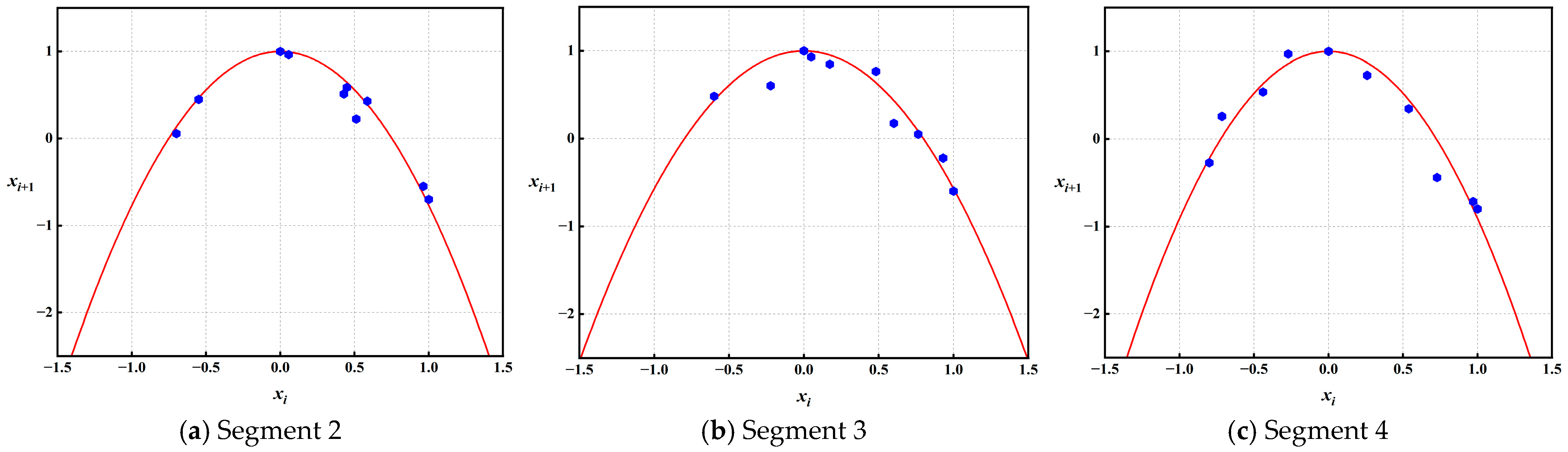
Taking the acceleration response of segment 1 at measurement point A1 under Condition 1 as an example, the return mapping points of the response signal in the two-dimensional phase space were fitted against the four mapping functions. The results are shown below:
As shown in
Table 4, the unimodal map achieves the highest coefficient of determination (R
2 = 0.961), and its bifurcation structure (from period-doubling to chaos) is consistent with the measured response data. The tent and shift maps exhibit lower fitting accuracy and fail to reflect the period-doubling bifurcation path of the dynamic system, while the cubic map ranks second in accuracy.
From a physical mechanism perspective, under strong shock loads, the relationship between the system’s restoring force and displacement is nonlinear. After discretization, adjacent states typically exhibit a power-law relationship: xi+1 = a·xi + b·xi2 + c·xi3 +…. Through center manifold reduction, the high-dimensional dynamic system can be compressed into a low-dimensional phase space (embedding dimension m = 2). In this state, the quadratic mapping xi+1 = a·xi + b·xi2 is topologically conjugate to the standard unimodal map xi+1 = 1 − uxi2, meaning they are mathematically identical in essence. Therefore, the unimodal mapping function is adopted in this study to describe the evolutionary motion of the system.
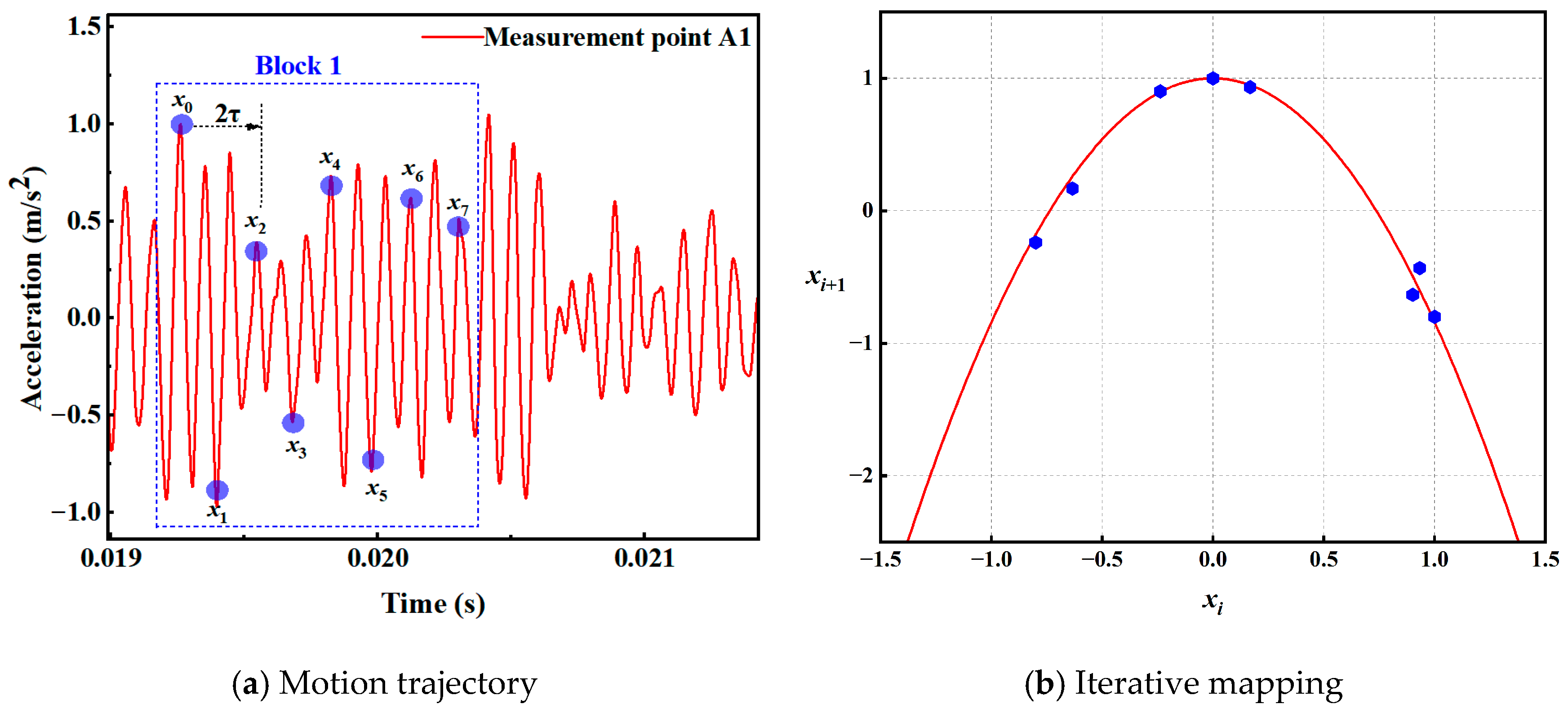
Using the acceleration response signal of measurement point A1 within segment 1 under Condition 1 as an example, with the maximum amplitude point as the starting point and the optimal delay amount determined as
τ = 5, the motion trajectory of the acceleration response in the phase space [
x0,
x1,
x2,
x3,
x4,
x5,
x6,
x7] is characterized, as shown in
Figure 16a. Taking
x0 = 1 as the initial value, iterative fitting of the trajectory points was performed based on the unimodal map, as shown in
Figure 16b.
Similarly, within other segments at measurement point A1, the motion trajectory of the acceleration response in the phase space is determined. After normalization, iterative mapping and fitting are performed to conduct an overall analysis of the mapping function describing the evolution of the acceleration response in the phase space, as shown in
Figure 17a–c.
As shown in
Figure 16 and
Figure 17, the motion evolution of the acceleration response at measurement point A1 in the phase space satisfies a unimodal mapping function, as expressed in Equation (16).
For the acceleration response signals at each measurement point under different test conditions, the same method described above was applied to perform iterative fitting of their motion trajectories in phase space within each segment. The results show that the motion evolution of the acceleration responses for all measurement points in phase space within each segment consistently follows the aforementioned single-peak mapping function; the corresponding mapping function parameters
u are summarized in
Table 5.
In summary, under underwater explosive loading, the motion evolution of the floating platform’s acceleration response in phase space satisfies the unimodal mapping described in Equation (16). Here, the mapping function parameter
u represents the comprehensive parameter of the structural dynamic response system and serves as a characteristic parameter of the system’s dynamic behavior. Taking the motion trajectory point
xi as the vertical coordinate and the mapping function parameter
u as the horizontal coordinate, where
xi ∈ [−1, 1] and
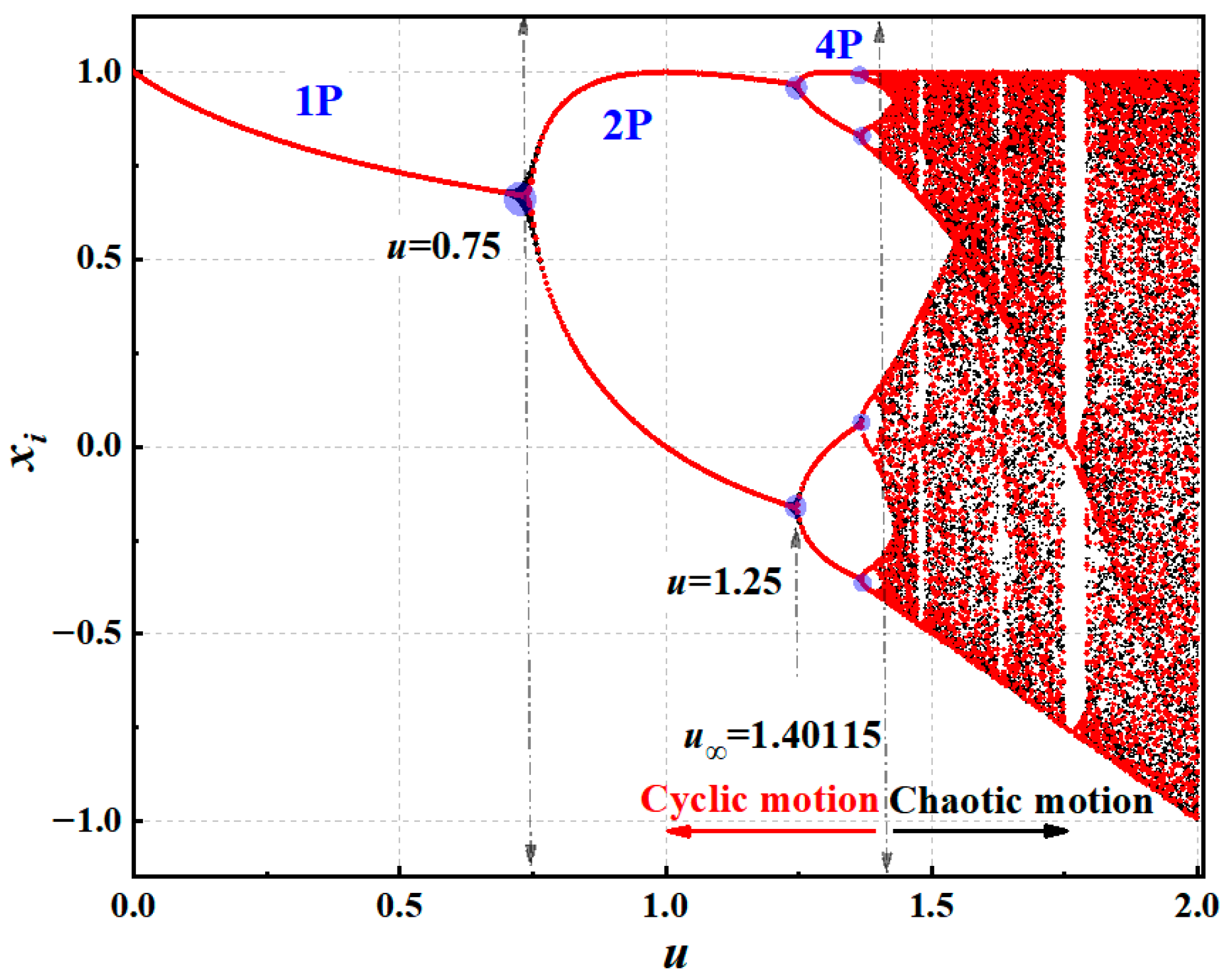
u ∈ (0, 2], an arbitrary initial value
x0 is iterated to generate the bifurcation diagram of the mapping function [
32], as shown in
Figure 18. This allows for the analysis of the dynamic behavior of the structural dynamic response system under varying parameters
u.
In the bifurcation diagram, within Interval 1, the system exhibits single-period motion, denoted as 1P. The fixed-point equation and stability condition for the system at this stage are given by Equations (17) and (18), respectively.
By combining Equations (17) and (18), the parameter
u of the mapping function for single-period motion is solved, as shown in Equation (19).
At the parameter
u1* = 0.75, the motion state of the system undergoes a period-doubling bifurcation, transitioning from single-period motion to 2-period motion. In Interval 2 of the bifurcation diagram, the system exhibits 2-period motion, denoted as 2P. At this stage, the fixed-point equation and stability condition for the system are given by Equations (20) and (21), respectively.
By combining Equations (20) and (21), the parameter
u of the mapping function for 2-period motion is solved, as shown in Equation (22).
At the parameter u2* = 1.25, the system’s motion state undergoes another period-doubling bifurcation, transitioning from 2-period motion to 4-period motion, denoted as 4P. During the process where the system’s motion state changes from 2n period to 2n+1 period, the bifurcation extends across increasingly smaller parameter intervals, ultimately converging at u∞ = 1.40115. When u > u∞, the system no longer possesses stable periods, and its dynamic behavior becomes disordered, which is defined as chaotic motion. Here, u∞ = 1.40115 is the boundary between the system’s periodic and chaotic motion.
(1) In the interval 1.5437 < u < 2.0, the system’s motion lies in Band I chaos.
(2) In the interval 1.4304 < u < 1.5437, the system’s motion lies in Band II chaos.
(3) In the interval 1.40115 <
u < 1.4304, the system’s motion lies in the 2
n chaotic bands, as shown in
Figure 18.
The mapping function parameter
u corresponding to each system motion state is summarized in
Table 6.
As indicated in
Table 6, the mapping function parameter
u for the motion evolution of the floating platform’s acceleration response in phase space satisfies the following relationship:
In summary, the structural dynamic response system of the floating platform under underwater explosion loads exhibits chaotic effects. The system’s dynamic behavior is highly complex, where even minor disturbances can lead to bifurcations in its motion trajectory over time and abrupt changes in motion states, demonstrating transient strong nonlinearity.
4.2. Coupled Mapping Model
Under underwater explosion loads, the motion evolution of the floating platform’s acceleration response in phase space satisfies a unimodal mapping, with the mapping function parameter u greater than u∞, revealing that the structural dynamic response system exhibits chaotic characteristics in the temporal dimension. Meanwhile, the mapping function parameters for the acceleration responses at different measurement points on the floating platform also differ. Combined with the cross-correlation coefficient D, these findings collectively indicate that the structural dynamic response system also demonstrates chaotic characteristics in the spatial dimension.
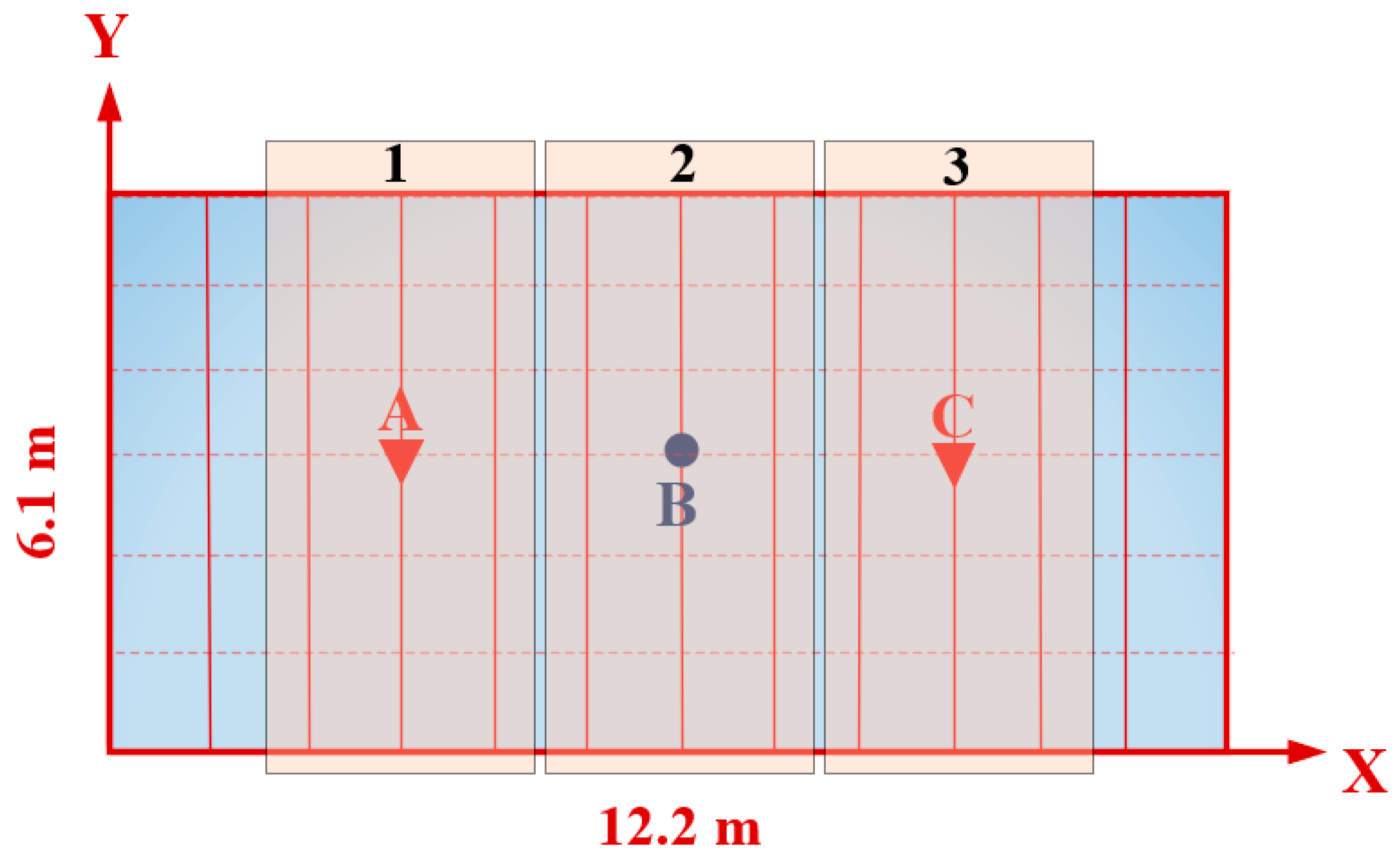
For structural dynamic response systems exhibiting chaotic-like nonlinear transient behavior, it is necessary to discretize not only the continuous time variables—that is, to perform phase space reconstruction and segmentation analysis on time series—but also the spatial variables. This involves truncating the multi-dimensional dynamic system and partitioning it according to the spatial structure to simplify the entire spatiotemporal response system. In this section, based on the spatial regions where the measurement points are located, the deck spatial structure of the aforementioned floating platform is divided into three zones, as shown in
Figure 19. The area where measurement point B is located is a “blind spot”—due to spatial constraints, sensors cannot be installed directly at this location, and its shock response data cannot be obtained directly.
The motion state within each spatial zone is represented by measurement points, which are regarded as state points. First, a nonlinear mapping is applied to each state point, while the coupling effects between each state point and other state points in adjacent spatial zones are calculated [
33,
34], as shown in Equation (24).
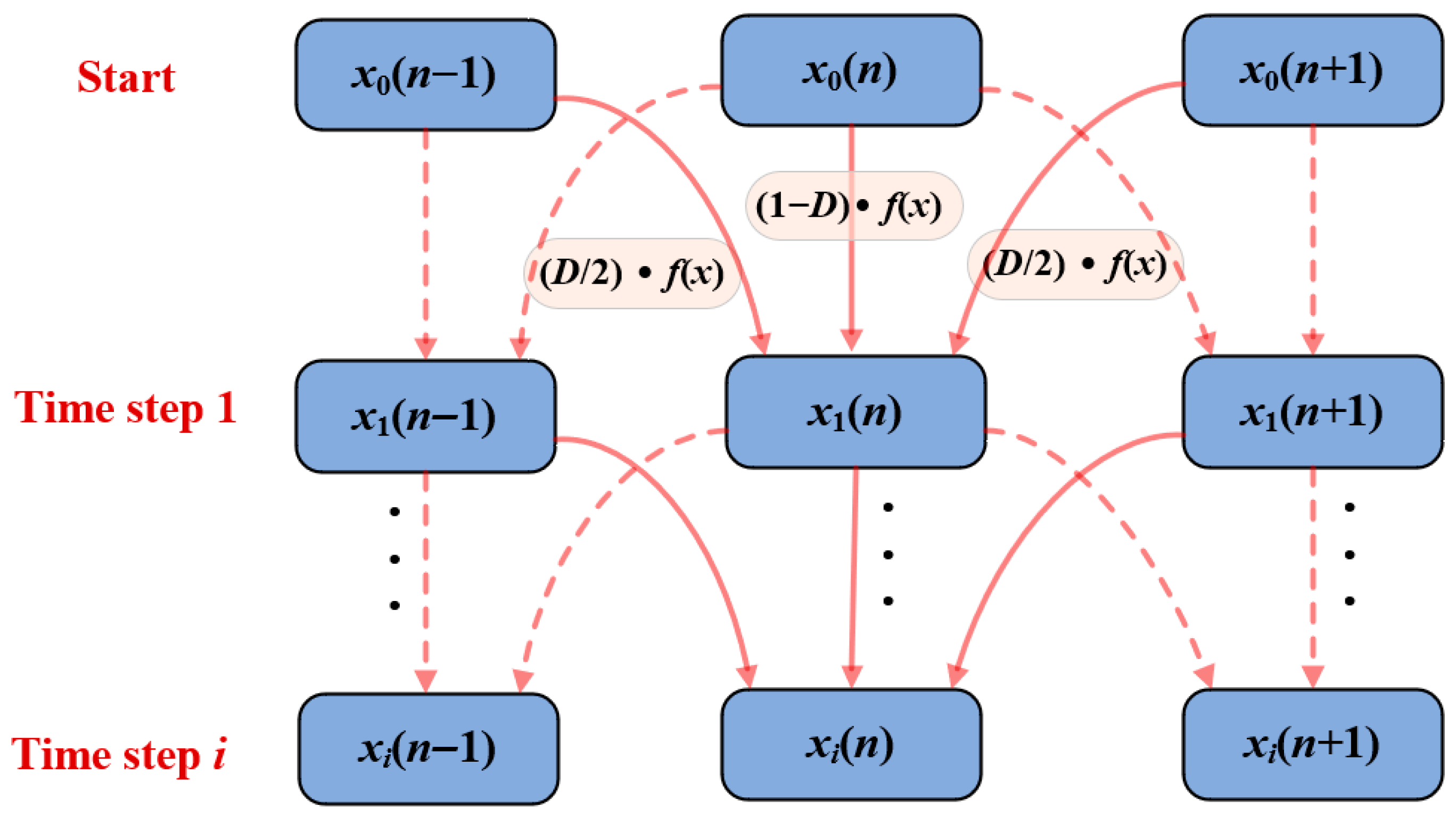
In the above equation, xi represents the system state variable, i.e., the structural response. n denotes the spatial zone, and based on the spatial zones where the measurement points are located, this paper divides them into three zones, i.e., n = 1, 2, 3. δ represents the coupling coefficient, i represents the iterative process of the state variable, i = 1, 2, …. The core idea of this model is that the response xi+1(n) of a point in space (such as the measurement blind spot B) at the next time step is determined jointly by its own mapping evolution f at the current time step and its coupling δ∇2 with neighboring points in space (the measurable points A and C). Therefore, when the responses of the measurable points in the neighborhood are known, the response at the blind spot can be inferred using this model.
In the proposed model, the physical determination and selection of the coupling coefficient
δ are of critical importance. In structural dynamics, the degree of correlation between responses at different spatial locations is collectively determined by the local stiffness distribution, mass distribution, boundary conditions, and complex stress wave propagation paths of the structure. The cross-correlation function is a classical tool in signal processing for measuring the degree of linear correlation between two time series, providing an objective reflection of the statistical dependence between structural responses at different measurement points. When the cross-correlation coefficient
D is large, it indicates a high degree of synchronicity or consistency between the responses at two locations, corresponding to physically strong spatial energy transfer and coupling; conversely, it indicates weak coupling. Therefore, the cross-correlation coefficient
D between the acceleration responses of different measurement points calculated in
Section 2 (see
Figure 14) is adopted as the spatial coupling coefficient
δ for the spatiotemporal model, thereby avoiding the uncertainty associated with subjective empirical parameter settings.
For continuous structures such as floating platforms, the interaction between spatially adjacent regions can be described by second-order spatial derivatives (the Laplacian operator). To adapt to the discrete characteristics of sensor placement, this study employs a discrete Laplacian operator to characterize this spatial diffusion effect. Assuming the system only considers one-dimensional spatial conduction (along the direction of the deck’s primary stiffness or the sensor layout direction), the diffusion term can be expressed as Equation (25):
Combining Equations (24) and (25), and setting the cross-correlation coefficient
D equal to the spatial coupling coefficient
δ, the coupled mapping model for the structural dynamic response system is obtained, as shown in Equation (26).
where
f is the mapping function, as shown in Equation (16), which represents the mapping function for the motion evolution of state points in segment
n, given by the following expression:
Thus, under the mutual coupling effects of state points within the spatial domain, the spatiotemporal dynamics model for the motion evolution of a specific state point on the floating platform is given by Equation (28).
Considering the region
n as a key area of the spatial structure, and regions
n − 1 and
n + 1 as its adjacent areas, the above equation demonstrates that the motion evolution of structural responses in the key region and its neighboring areas are mutually coupled and can be inversely inferred from one another. Therefore, based on the degree of coupling among structural responses in adjacent spatial regions and their inherent mapping patterns, a spatiotemporal dynamic model of the structural dynamic response system can be established. This enables the reconstruction of the structural response at key spatial locations using data from adjacent areas, with its dynamic evolution mechanism illustrated in
Figure 20.
5. Structural Response Reconstruction and Verification
Using the phase space reconstruction method, the structural dynamic response system is discretized in the temporal dimension to establish a mapping function that describes the motion evolution of the structural response within the phase space. Simultaneously, by discretizing the spatial dimension and integrating it with the mapping function from the temporal dimension, a coupled dynamic model for the spatiotemporal evolution of the structural response is established. In the underwater explosion shock test on the floating platform, measurement point B is a key location within the structural dynamic response system. However, due to spatial constraints, it is difficult to obtain acceleration response signals directly from this measurement point. Therefore, based on the aforementioned spatiotemporal dynamic model, the acceleration response at measurement point B can be reconstructed using data from measurement points A and C.
A numerical calculation of the structural response of the floating platform under underwater explosion loading is conducted, and the acceleration response signal at measurement point B is extracted. A comparative analysis is performed between the numerical simulation results and the theoretical inversion results to verify the accuracy of the spatiotemporal dynamic model of the structural dynamic response system under strong shock loads.
5.1. Theoretical Inversion
Under Test Condition 1, the acceleration response of the floating platform in spatial region 1—specifically, the acceleration response at measurement point A1—is represented by the state variable
xi(1), with an initial value of
x0(1). The acceleration response of the floating platform in spatial region 3—that is, the acceleration response at measurement point C1—is represented by the state variable
xi(3), with an initial value of
x0(3). The mapping function parameter
u is taken as the average of the sum of the corresponding parameters of the two within their respective segments (see
Table 5). The coupling coefficient
D is obtained from
Figure 14. Treating
n as 2 and setting the initial value
x0(2) = {
x0(1) +
x0(3)}/2, the state variable
xi(2) is theoretically inverted by substituting these values into the aforementioned spatiotemporal dynamic model, as shown in Equation (28). The evolution mechanism is illustrated in
Figure 20, representing the acceleration response of the floating platform in spatial region 2—that is, reconstructing the acceleration response at measurement point B1, as shown in
Figure 21.
Under Test Condition 2, the acceleration response of the floating platform in spatial region 1—that is, the acceleration response at measurement point A2—is represented by the state variable
x’i(1). Similarly, the acceleration response of the floating platform in spatial region 3—specifically, the acceleration response at measurement point C2—is represented by the state variable
x’i(3). Based on the spatiotemporal dynamic model, a theoretical inversion is performed to obtain the state variable
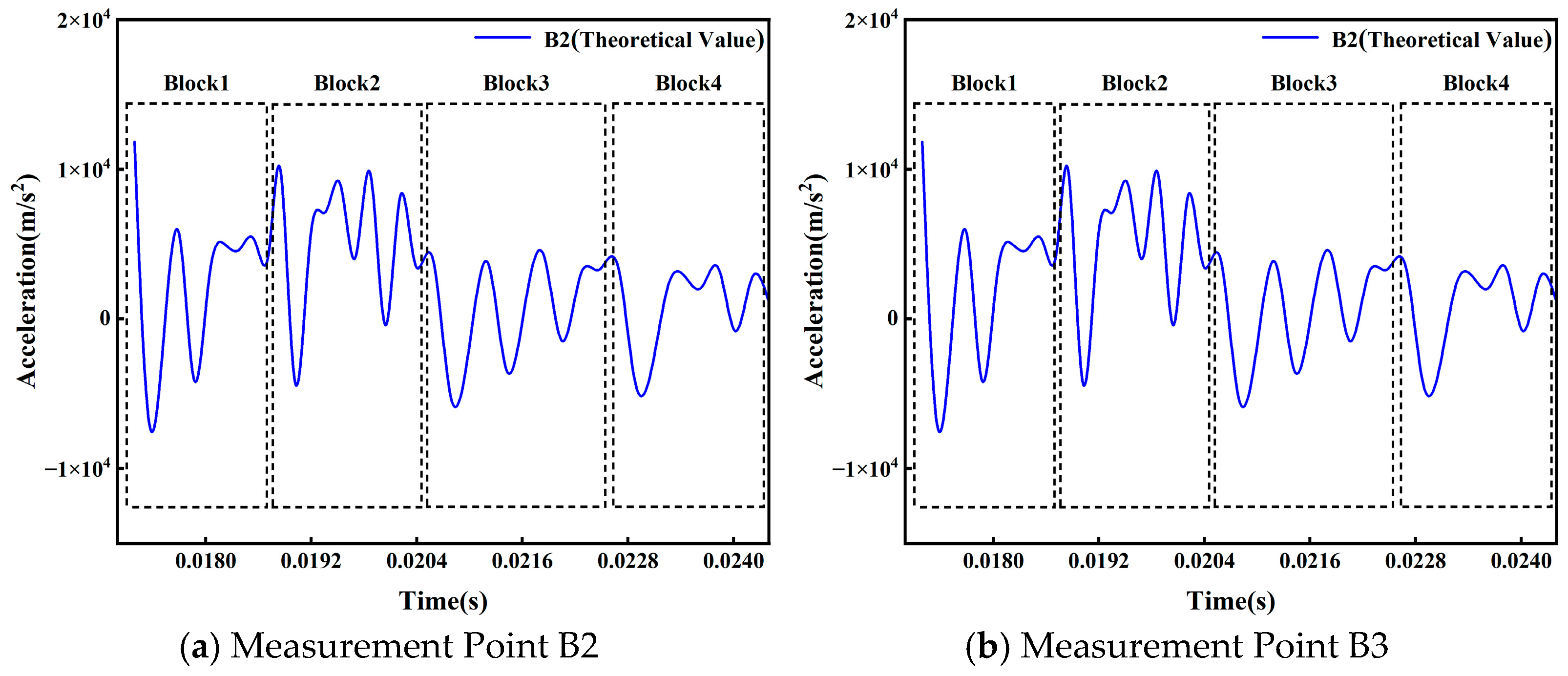
x’i(2), which represents the acceleration response of the floating platform in spatial region 2—that is, the acceleration response at measurement point B2. Similarly, following the same reconstruction process, the acceleration response
x″i(2) at measurement point B3 is obtained through theoretical inversion, as shown in
Figure 22.
5.2. Comparative Verification
The underwater shock test system of the aforementioned floating platform was simplified for numerical simulation. To ensure the accuracy of numerical verification, the Arbitrary Lagrangian-Eulerian (ALE) method was employed to simulate the underwater explosion process. The 921A steel structure was modeled using the Johnson-Cook constitutive relationship, as shown in Equation (29):
In the above equation,
σs represents the yield stress,
A is the quasi-static yield stress,
B is the strain hardening constant,
n is the strain hardening exponent,
C is the strain rate sensitivity coefficient,
m is the thermal softening exponent,
ε0 is the reference strain rate,
Tr is the reference temperature, and
Tm is the melting point of the material. The model parameters are listed in
Table 7.
The properties of water and the Gruneisen equation of state (EOS) were defined to simulate the high-pressure behavior of water under strong shock. The initial density of water is 1000 kg/m
3, and the dynamic viscosity is 0.0001. During the detonation process, the high-temperature and high-pressure detonation products compress the surrounding water, propagating outward as a shock wave. During this compression phase, the EOS of water is expressed as Equation (30). Following the passage of the shock wave, the water pressure near the structural surface drops rapidly, forming bubbles or cavitation regions. In this expansion phase, the EOS is expressed as Equation (31).
In the equations above,
μ is the volumetric compression ratio, defined as
μ =
ρ/
ρ0 − 1, where
ρ and
ρ0 are the current and initial densities, respectively.
C is regarded as the speed of sound, set to 1480 m/s
2.
S1,
S2, and
S3 are slope coefficients;
S1 is set to 2.56 to define the linear relationship between shock velocity and particle velocity, while
S2 and
S3 are set to 0 for simplified calculation.
γ0 is the Gruneisen gamma, set to 0.28, and
a is the volume correction coefficient, typically set to 0. The properties of air and the LINEAR_POLYNOMIAL EOS were defined, with an initial air density of 1.2 kg/m
3. The EOS is shown in Equation (32):
In the above equation, μ is the volumetric compression ratio, defined as μ = ρ/ρ0 − 1. C4 and C5 represent the internal energy coefficients, set as C4 = C5 = 0.4. E0 represents the initial internal energy, set to 0.25 MPa to simulate standard atmospheric conditions.
The material properties of the explosive and the JWL EOS were defined to describe the expansion process of the high-energy explosive detonation products. The initial density of the explosive is 1630 kg/m
3, the initial detonation velocity is 6930 m/s, and the initial detonation pressure is 2.1 × 10
10 Pa. The EOS is expressed as Equation (33):
In the above equation, V is the relative volume of the detonation products, V = ρ0/ρ. E represents the internal energy per unit volume of the detonation products, set to 7.0 × 10¹⁰ J/m3. R1 is the first volume constant, set to 4.15, and R2 is the second volume constant, set to 0.95. ω is the Gruneisen coefficient, set to 0.3. A is the pressure constant for the high-pressure term, set to 3.74 × 10¹² Pa, and B is the pressure constant for the medium-pressure term, set to 3.75 × 10¹⁰ Pa.
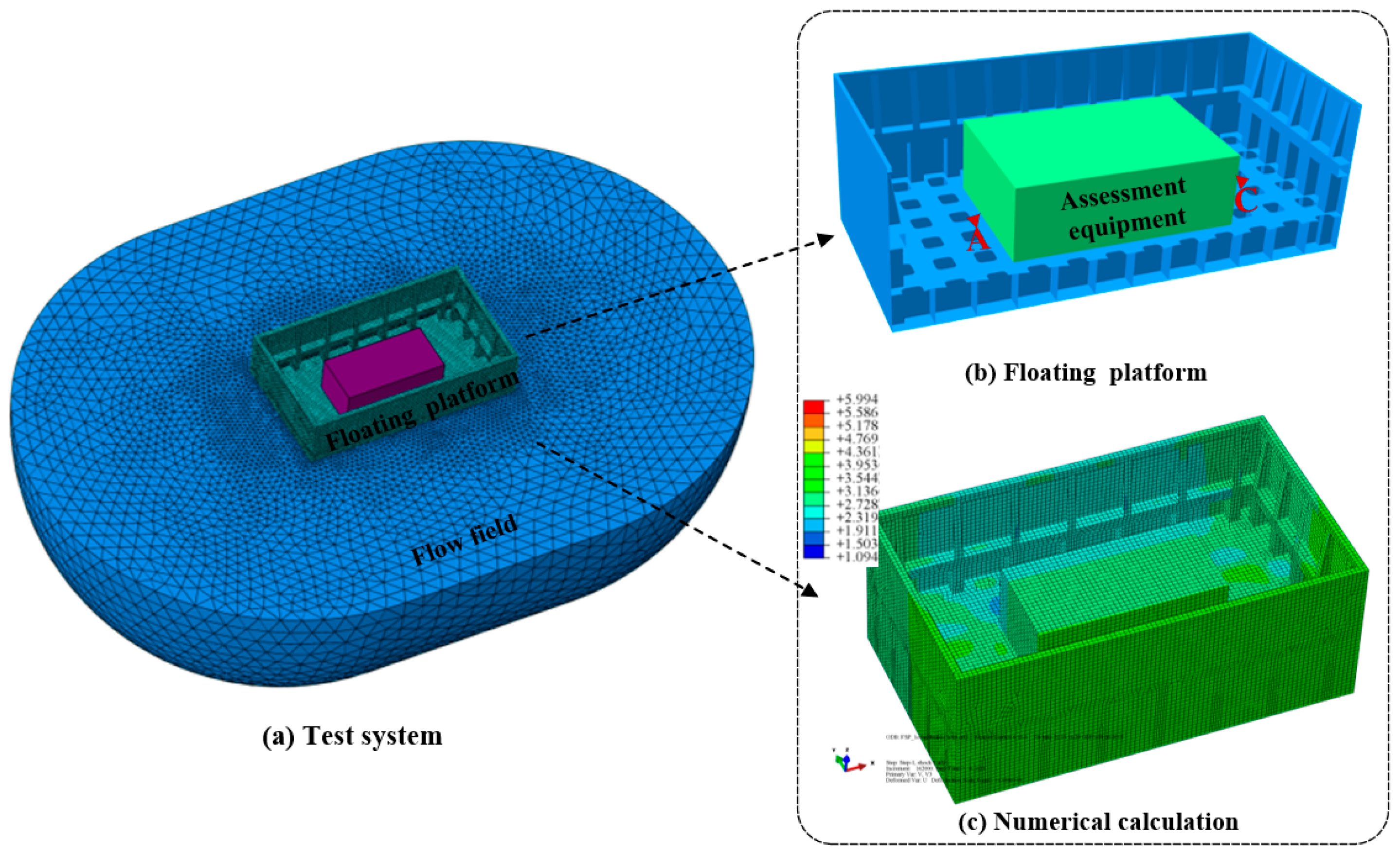
Based on the structural dimensions, a coarse mesh is initially selected to establish the simulation model. The mesh is gradually refined according to the geometric features of the floating platform, generating multiple sets of simulation models. A mesh sensitivity analysis is conducted to ensure the convergence and reliability of the computational results, ultimately determining a mesh size of 50 mm. Following the test conditions described in
Table 1, numerical calculations for the underwater explosion shock test on the floating platform are carried out, as shown in
Figure 23.
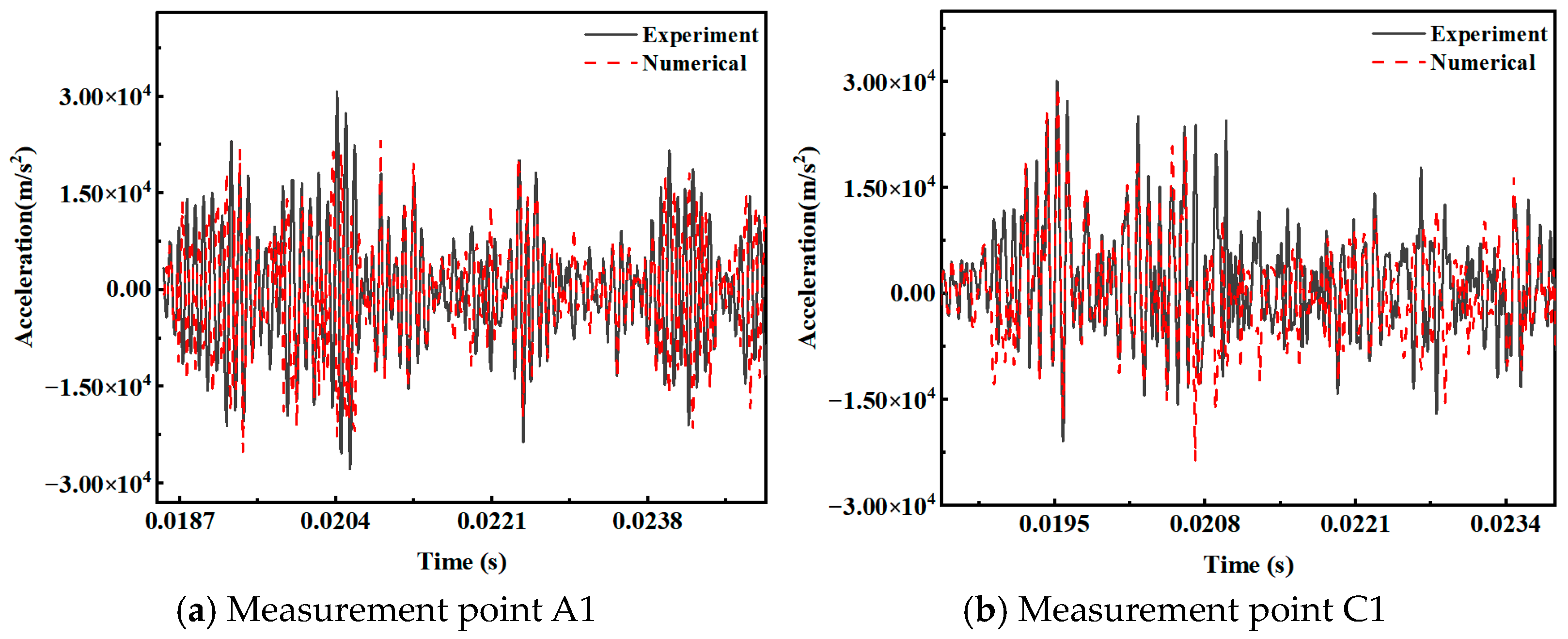
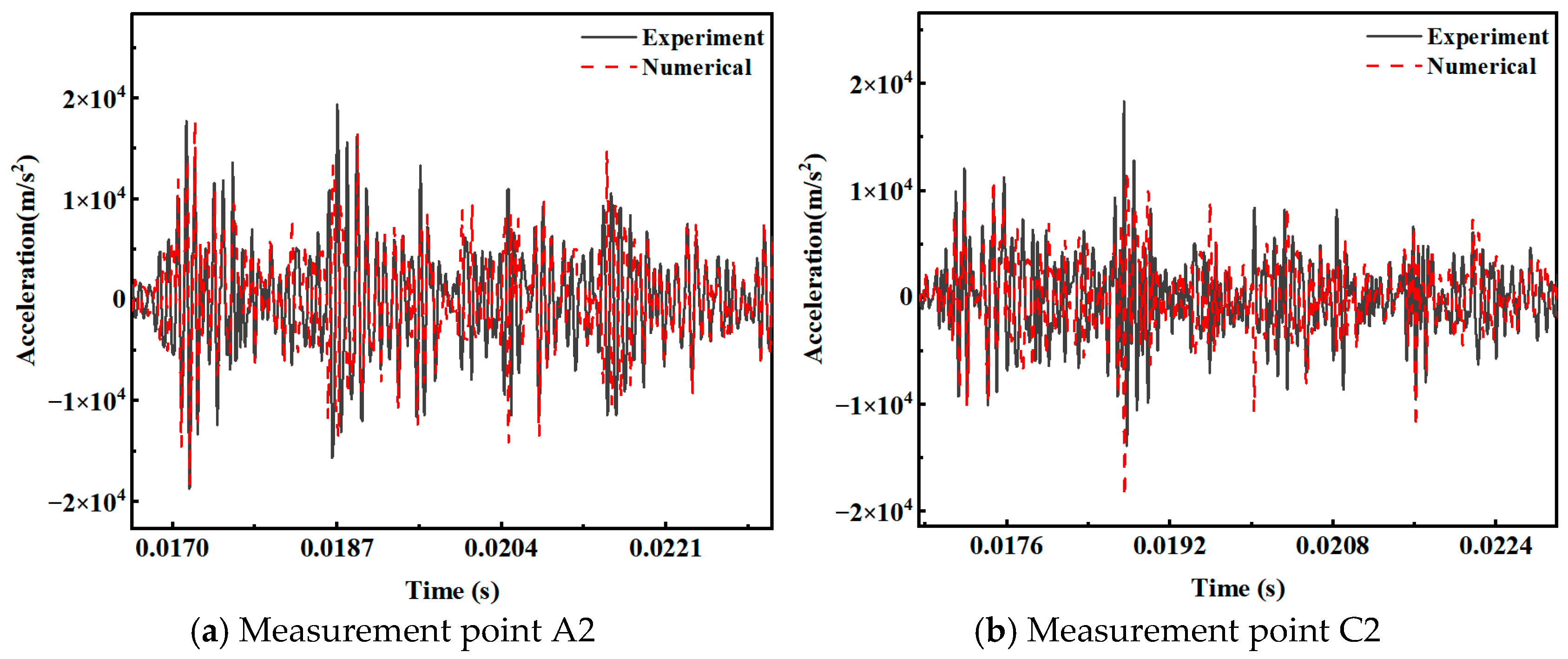
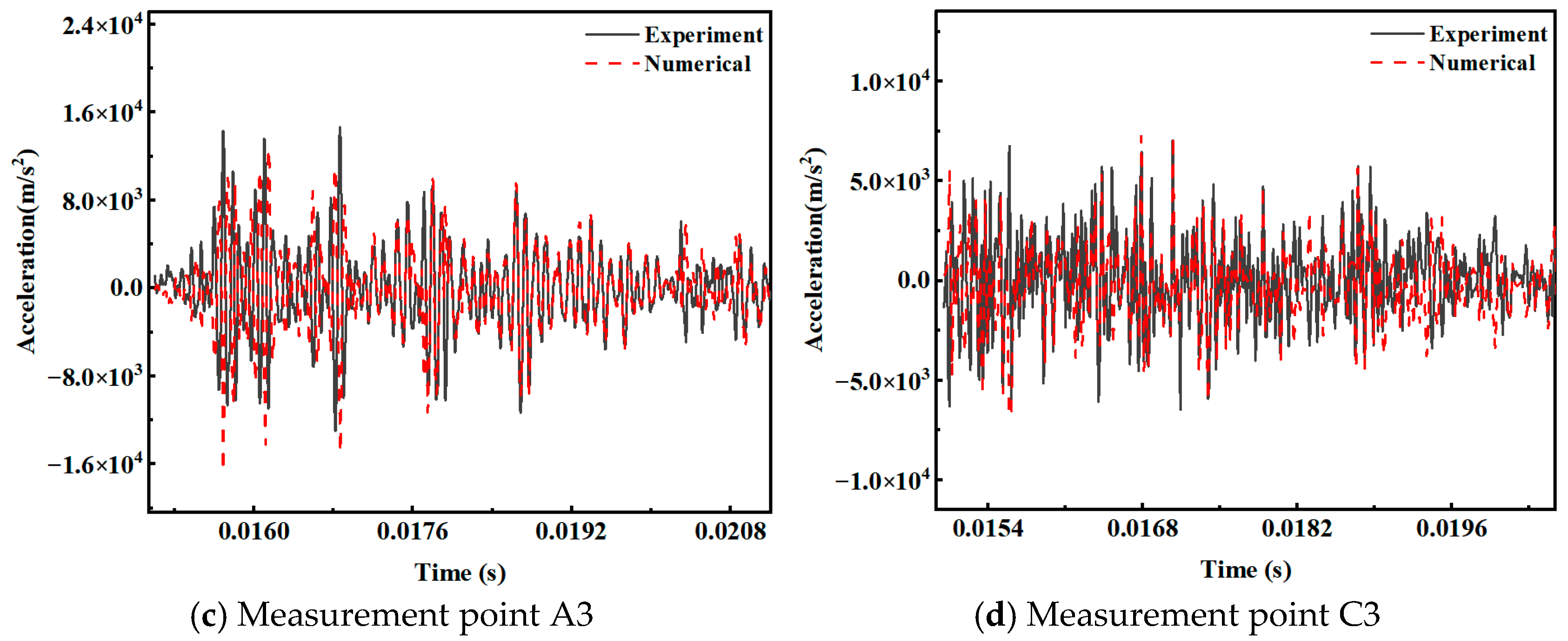
The acceleration response numerical results at measurement points A, B, and C of the floating platform under different test conditions are extracted. To verify the reliability of the numerical model, the numerical results for measurement points A and C are compared with the experimental results. Taking measurement point A1 under Test Condition 1 as an example, the amplitude error between the two was 8.7%, and the phase error was less than 5%; for measurement point C1, the amplitude error was 9.2%, and the phase error was less than 6%. Under other test conditions, the errors were all kept within 15%. This comparison indicates that the established numerical model effectively reproduces the response characteristics of the actual physical system, providing a reliable benchmark for subsequent inversion verification. The comparison of the measurements at points A1 and C1 with the test results is shown in
Figure 24; the comparison of results under other test conditions is shown in
Appendix B.
Based on the aforementioned numerical calculations, the acceleration response signals at measurement points B1, B2, and B3 of the floating platform are obtained. Using the spatiotemporal dynamic model, the theoretical acceleration response at measurement point B1 is derived through theoretical inversion based on the acceleration responses from measurement points A1 and C1. Similarly, the theoretical acceleration responses at measurement points B2 and B3 are reconstructed. In summary, the complete reconstruction process—from signal acquisition at measurable points to response inversion at blind spots—is shown in
Figure 25.
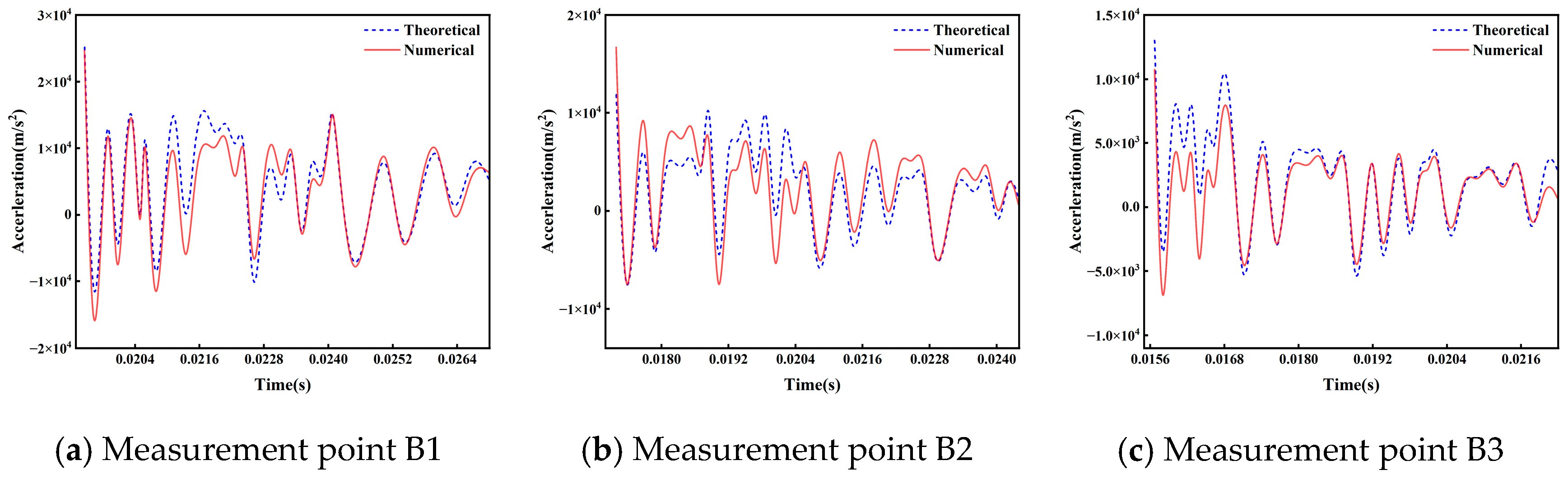
The numerical calculation results are compared with the theoretical inversion results, as shown in
Figure 26a–c, to validate the correctness of the method for reconstructing the structural response at key spatial locations using the spatiotemporal dynamic model.
Statistical analysis of the results from theoretical inversion and numerical calculation was performed using the Mean Squared Error (MSE) and the Coefficient of Determination (R
2). Specifically, MSE measures the magnitude of the absolute error, while R
2 evaluates the quality of the trend fitting. These two metrics complement each other by accounting for both numerical accuracy and waveform similarity, making them suitable for assessing the dynamic reconstruction performance of non-stationary signals such as shock responses.
In the equations above,
xi represents the theoretical inversion value, and
yi represents the numerical calculation value. Their Mean Squared Error (MSE) and Coefficient of Determination (R
2) are presented in
Table 8, as given in the above equations.
As shown in
Table 5, for the acceleration responses at measurement point B under different test conditions, the Mean Squared Error (MSE) between the theoretical inversion and numerical calculation results is less than 0.13, and the Coefficient of Determination (R
2) exceeds 0.90.
To further evaluate the reconstruction accuracy, the absolute error at each time point for each measurement point,
ei = |
xi −
yi|, was calculated, and the error distribution characteristics were statistically analyzed, as shown in
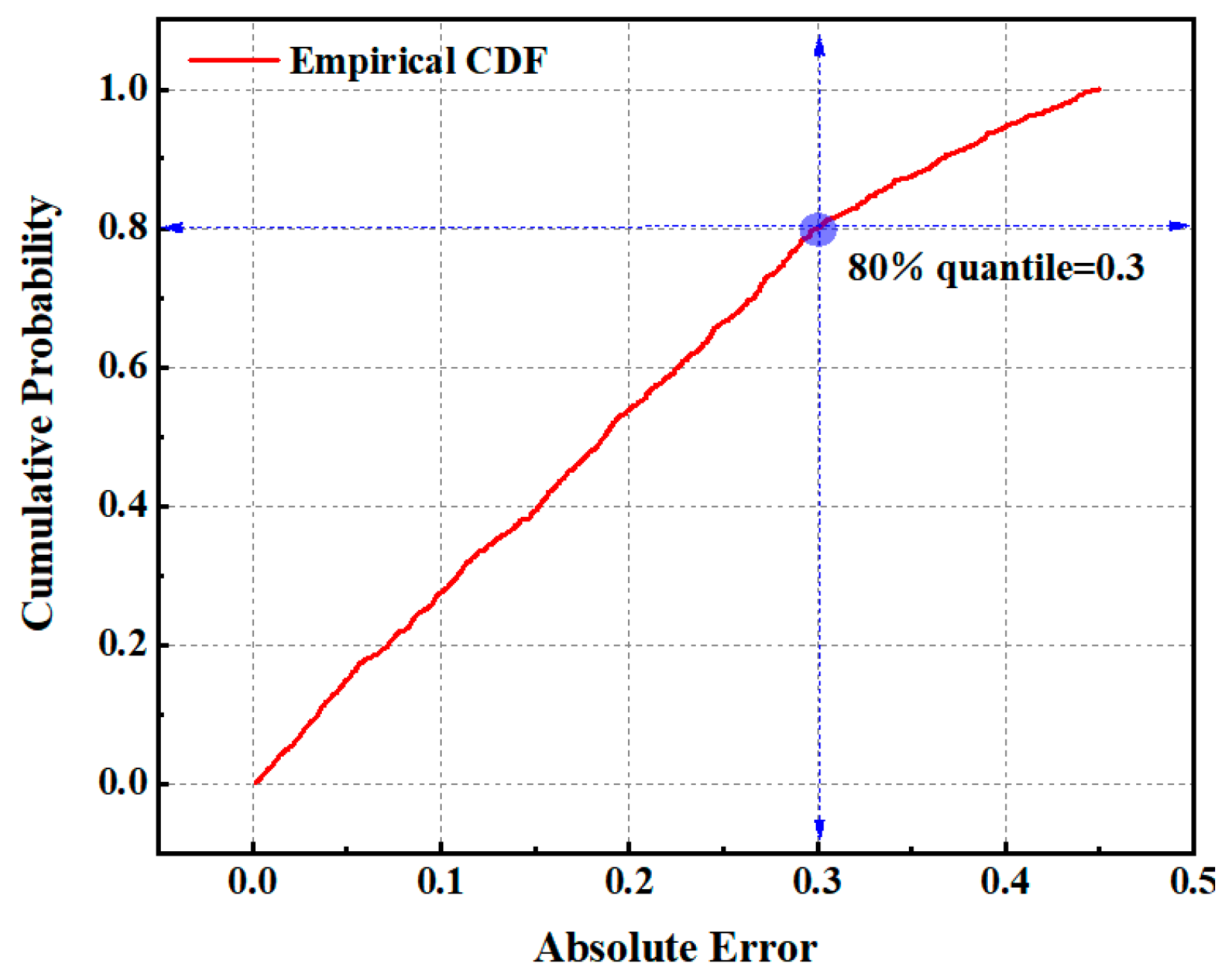
Table 9. For each measurement point, the absolute error at more than 80% of the time points is less than 0.30. The error distribution is concentrated with no significant outliers; larger errors are primarily concentrated near the response peaks, which is consistent with the physical characteristic that reconstruction is more challenging in strongly nonlinear regimes.
Taking measurement point B1 under Condition 1 as an example, the Cumulative Distribution Function (CDF) of the error is shown in
Figure 27.
To evaluate the robustness of the model to key parameters, taking measurement point B1 under Condition 1 as an example, the sensitivity of the reconstruction accuracy (R
2) to the mapping function parameter
u and the coupling coefficient
D was analyzed. The results are shown in
Table 10. The model exhibits good robustness to deviations of
u and
D within reasonable ranges. Compared to
D, R
2 demonstrates higher sensitivity to
u, which confirms the importance of accurately characterizing the local nonlinear dynamic behavior.
Furthermore, to evaluate the impact of noise, Gaussian white noise with different Signal-to-Noise Ratios (SNRs) was added to the signals. When SNR ≥ 20 dB, the decrease in reconstruction accuracy was controlled within 20%, indicating that the method possesses a certain degree of noise resistance. When SNR < 15 dB, the accuracy declined significantly, necessitating the use of filtering preprocessing. Future research will focus on the in-depth optimization of noise robustness.
The above results indicate that the spatiotemporal dynamic model can accurately capture the peak values of the structural response at key spatial locations and reflect the overall trend of the structural response. The results validate the correctness of the key location structural response reconstruction method based on the spatiotemporal dynamic model, providing theoretical support for the dynamic characteristics analysis of structures at critical positions under strong shock loads, characterization of the shock environment, and shock safety assessment and design of equipment.
It should be noted that the validation work in this study is primarily based on high-fidelity numerical simulations rather than physical prototype experimental data. Since both the reconstruction results and the reference data originate from the same set of modeling assumptions (including material constitutive models, equations of state, and fluid–structure interaction algorithms), a potential homologous error may exist between them, which, to some extent, weakens the independence of the validation. Therefore, the validation in this paper primarily demonstrates the feasibility of the method in a numerical sense; its predictive capability in real physical environments remains to be further verified through subsequent physical model tests.
5.3. Comparative Analysis with Traditional Reconstruction Techniques
Regarding the reconstruction of structural dynamic responses, various standard methods have been proposed in academia. However, under the condition of strong shock loads from underwater explosions, the method presented in this paper demonstrates unique advantages and applicability.
First, modal-based reconstruction methods achieve extremely high accuracy during the elastic small-deformation stage. However, once the 921A steel enters the stage of large plastic deformation, the presence of the strain rate sensitivity term (1 + Clnε*) in the Johnson-Cook constitutive model causes the stiffness matrix of the structure to change drastically over time. Consequently, the traditional linear mode orthogonality no longer holds, leading to significant phase deviations in modal expansion methods. In contrast, the method in this paper directly extracts the inherent manifold of nonlinear evolution through phase space reconstruction, without relying on linear assumptions.
Second, the Inverse Finite Element Method (iFEM) performs excellently in full-field monitoring, but it is highly dependent on the spatial coverage of measurement points. In the scenarios addressed in this paper, such as “sensor installation failure” or “measurement blind spots,” only a limited number of neighboring measurement points are available. In such cases, iFEM often faces ill-posed problems due to the lack of basis functions, resulting in low reliability of the reconstruction results. The method in this paper utilizes the spatiotemporal coupled mapping model (CML) to perform inversion based on the chaotic-like nonlinear transient behavior of local measurement points, effectively solving the reconstruction challenge under sparse measurement points.
In summary, although a large-scale accuracy comparison with traditional methods was not conducted in this study, from the perspective of physical mechanisms and application scenarios, the proposed method serves as a specialized solution for extreme conditions involving strong nonlinearity, transient effects, and sparse measurement points. Future research will further carry out quantitative comparisons with more standard methods to more comprehensively evaluate the performance boundaries of the method presented in this paper.