Article

Typhoon-Induced Asymmetric Responses of Mesoscale Eddies in the South China Sea

1
School of Marine and Meteorology, Guangdong Ocean University, Zhanjiang 524088, China
2
School of Electronics and Information Engineering, Guangdong Ocean University, Zhanjiang 524088, China
3
Department of Earth System Science, Tsinghua University, Beijing 100084, China
*
Author to whom correspondence should be addressed.
J. Mar. Sci. Eng. 2026, 14(8), 699; https://doi.org/10.3390/jmse14080699
Submission received: 3 February 2026 / Revised: 2 April 2026 / Accepted: 7 April 2026 / Published: 9 April 2026
(This article belongs to the Section Physical Oceanography)

Abstract

In recent years, typhoon activity over the South China Sea (SCS) has intensified, and interactions between typhoons and mesoscale eddies profoundly regulate the regional oceanic environment and air–sea energy exchange. To systematically investigate the position- and polarity-dependent eddy responses to typhoon forcing, we developed a typhoon–eddy spatial matching algorithm and analyzed the global mesoscale eddy dataset (2006–2020) combined with China Meteorological Administration (CMA) best-track typhoon records. Composite and correlation analyses were employed to examine variations in the eddy surface available potential energy (SAPE) and sea-surface temperature (SST) within a 7-day window before and after typhoon passage, with the typhoon power dissipation index (PDI) used to quantify storm intensity. Composite results reveal distinct dual-asymmetric responses: (1) Energetically, eddies on the left side of typhoon tracks exhibit overall weakening, with anticyclonic eddies (ACEs) showing more pronounced energy decay; in contrast, right-side eddies undergo significant intensification, and cyclonic eddies (CEs) display stronger enhancement than ACEs. (2) Thermally, all eddy types experience net cooling after typhoon passage, with right-side eddies showing stronger SST reductions than left-side ones, and CEs exhibiting more intense cooling than ACEs. Time-scale correlation analyses further demonstrate that the eddy energy change rate (EECR) of left-side CEs, right-side CEs, and right-side ACEs is positively correlated with PDI, whereas left-side ACEs show no significant correlation. For the SST change rate (SSTCR), all types of eddy events exhibit significant negative correlations with PDI, with weaker correlations for CEs and stronger correlations for ACEs. This study demonstrates that the track-relative position of tropical cyclones and the polarity of pre-existing mesoscale eddies exert a systematic control on the observed eddy responses to tropical cyclone forcing in the SCS. These results provide observational constraints on the asymmetric oceanic responses induced by tropical cyclones and offer insights into the interpretation of typhoon–ocean interaction diagnostics in marginal seas.

1. Introduction

The South China Sea (SCS) is the largest marginal sea in the western Pacific, covering an area of approximately 3.5 × 10⁶ km2, with an average depth of about 1200 m and a maximum depth exceeding 5000 m. Serving as a key hydrological conduit linking the Indian and Pacific Oceans, the SCS plays a critical role in regulating the East Asian climate system and supporting the regional marine ecosystem. Mesoscale eddies are highly active in the SCS [1,2]. Previous studies have indicated that eddy activity in the SCS is primarily concentrated in three core regions. The first region lies on the western side of the central SCS (east of Vietnam), where eddy activity is jointly driven by coastal upwelling off Vietnam and the SCS monsoon. The second region is located in the northeastern SCS, a key area influenced by the intrusion of Kuroshio branches, where eddy generation is closely linked to Kuroshio energy transport. The third region is situated on the eastern side of the SCS, where eddy activity is strongly modulated by the SCS throughflow and the associated western boundary currents [3,4].
The SCS also experiences frequent typhoon activity [5], with an average of approximately 12 typhoons passing through the region each year since 2000 [6]. Ocean warming driven by the greenhouse effect tends to enhance typhoon intensity [7], making typhoons traversing the SCS increasingly severe in recent years. During their evolution, most typhoons interact with mesoscale ocean eddies [8]. Typhoon impacts on eddies are primarily manifested in two aspects. First, typhoon passage can induce the formation of new eddies. For example, satellite observations by Hu et al. [9] showed that cyclonic eddies (CEs) commonly appear beneath tropical cyclones. Sun et al. [10] further confirmed the excitation of CEs by typhoons. Li et al. [11] found that strong typhoon-induced upwelling can trigger the generation of CEs. Second, typhoons can alter the intensity and structure of pre-existing eddies along their tracks, either weakening or strengthening them. Lu et al. [12] indicated that CEs intensify under typhoon forcing and exhibit notable changes in their three-dimensional structure. Quantitative analysis by Yu et al. [13] demonstrated that not all eddies strengthen under typhoon influence. Zhang et al. [14] observed that the dissipation of numerous eddies is directly associated with tropical cyclone activity. Ma et al. [15] reported that CEs tend to intensify significantly, whereas anticyclonic eddies (ACEs) tend to weaken. Moreover, satellite-based analysis by Ni et al. [16] further revealed that hurricanes can enhance CEs and weaken ACEs in the Gulf Stream region through the injection of potential vorticity.
Oceanic eddies also modulate the upper-ocean response induced by typhoons, thereby affecting air–sea heat flux exchanges and feeding back onto typhoon intensity. Due to their polarity, CEs and ACEs exhibit markedly different impacts on typhoon-induced oceanic responses and subsequent typhoon intensity changes [8,17,18,19]. Numerous observational and modeling studies have demonstrated that CEs can enhance typhoon-induced sea-surface cooling, suppressing oceanic heat supply to the storm and consequently weakening its intensity, a negative feedback effect [20,21,22,23]. In contrast, ACEs tend to reduce sea-surface cooling, provide additional heat to typhoons, and thus help maintain or even strengthen storm intensity, representing a positive feedback mechanism [24,25,26,27].
Considerable progress has been made in understanding the evolution of oceanic eddies under typhoon forcing. Some studies have focused on case-specific or typical event analyses [9,12,18], documenting localized oceanic responses and physical processes associated with tropical cyclone forcing on mesoscale eddies. Other studies have adopted statistical approaches to examine all eddies within the typhoon-affected region [10,13,14,15,16], thereby evaluating the overall impacts of typhoons on eddy activity across broader spatial and temporal scales. However, a systematic understanding of how the responses of pre-existing mesoscale eddies to tropical cyclone forcing depend on the track-relative position and eddy polarity remains limited, especially in marginal seas such as the SCS. Owing to its semi-enclosed nature, complex bathymetry, and strong coastal and boundary effects, the eddy responses in the SCS may not be fully representative of those in the open ocean. This lack of observational constraints hinders a comprehensive characterization of the asymmetric oceanic responses induced by tropical cyclones.
To investigate whether mesoscale eddies with different polarities and located on different sides of the typhoon track exhibit distinct oceanic responses under typhoon forcing in the SCS, and to further examine the role of typhoon intensity in modulating the responses of these eddies, this study conducted the following analyses. We conducted a systematic matching analysis of oceanic eddies located near the tracks of typhoons that affected the SCS during 2006–2020. We focused primarily on the eddy response in terms of surface available potential energy (SAPE) and sea-surface temperature (SST), examining changes within a 7-day window before and after typhoon passage. To further explore how typhoon intensity influences eddy energetics and SST variations, the power dissipation index (PDI) was introduced as a measure of storm intensity. Correlation analysis was then employed to quantitatively assess the statistical relationships between typhoon PDI and eddy energy as well as SST changes.

2. Data and Methods

2.1. Data

This study employs the best-track tropical cyclone dataset compiled by the CMA (https://tcdata.typhoon.org.cn/ (accessed on 1 March 2025)) [28,29]. The dataset provides detailed 6-hourly records of all tropical cyclones occurring over the western North Pacific since 1949, including key parameters such as cyclone center location, minimum central sea level pressure, and maximum sustained wind speed. These data offer a reliable foundation for analyzing typhoon tracks and intensity.
Oceanic eddy information is obtained from the newly released global mesoscale eddy trajectory atlas produced by AVISO (META3.2 DT all-sat, https://www.aviso.altimetry.fr/ (accessed on 1 March 2025)). This product is generated from multi-mission satellite altimetry observations spanning the past three decades and is provided at a daily temporal resolution [30,31]. It provides detailed physical characteristics of eddies, including eddy center position, amplitude, effective area, and effective radius, making it highly suitable for mesoscale eddy identification and statistical analysis.
To investigate the SST response within eddy regions during typhoon passage, we further use the MW_IR multisensor SST product provided by Remote Sensing Systems (https://www.remss.com/ (accessed on 1 March 2025)) [32]. This dataset integrates microwave and infrared satellite observations from 2002 to the present, with a spatial resolution of 9 km and a temporal resolution of 1 day. Its high temporal–spatial consistency and broad data coverage enable accurate detection of SST variability within eddy regions. Although this dataset reduces cloud-related data gaps compared to infrared-only products, intense typhoon conditions may still introduce uncertainties due to heavy precipitation affecting microwave retrievals and thick cloud cover obscuring infrared measurements. In some cases, optimal interpolation beneath the storm core may smooth short-term extreme cooling signals. Despite these limitations, the MW_IR product has undergone rigorous quality control and has been widely validated for climate and mesoscale air–sea interaction studies. Moreover, because our analysis is based on multi-event composites and statistical averaging, random errors at individual times or locations are likely to be partially reduced. Therefore, we consider the MW_IR dataset suitable for supporting the statistical conclusions of this study, while acknowledging the associated uncertainties.
All data processing in this study was performed using MATLAB (version R2022a).

2.2. Methods

2.2.1. Typhoon–Eddy Co-Occurrence Events

Based on the datasets described above, typhoons and mesoscale eddies in the SCS during 2006–2020 were matched. We considered only cases where the period of a typhoon’s passage through the SCS overlapped temporally with the lifetime of an eddy. A time–space matching algorithm was applied to identify typhoon–eddy co-occurrence events. The matching procedure first involved temporal alignment between typhoons and oceanic mesoscale eddies. Although the AVISO eddy dataset has a daily temporal resolution, whereas the CMA tropical cyclone best-track data are available at 6 h intervals, this difference does not affect the temporal matching because the matching time unit is defined on a daily basis. After temporal matching, the geographical distance between the typhoon center and the eddy center was calculated for each matched day using their respective longitude and latitude positions. A typhoon–eddy co-occurrence event was identified when the typhoon–eddy distance was smaller than 200 km on at least one day during the matched period. The day on which the minimum typhoon–eddy distance occurred was defined as the encounter day (t = 0).
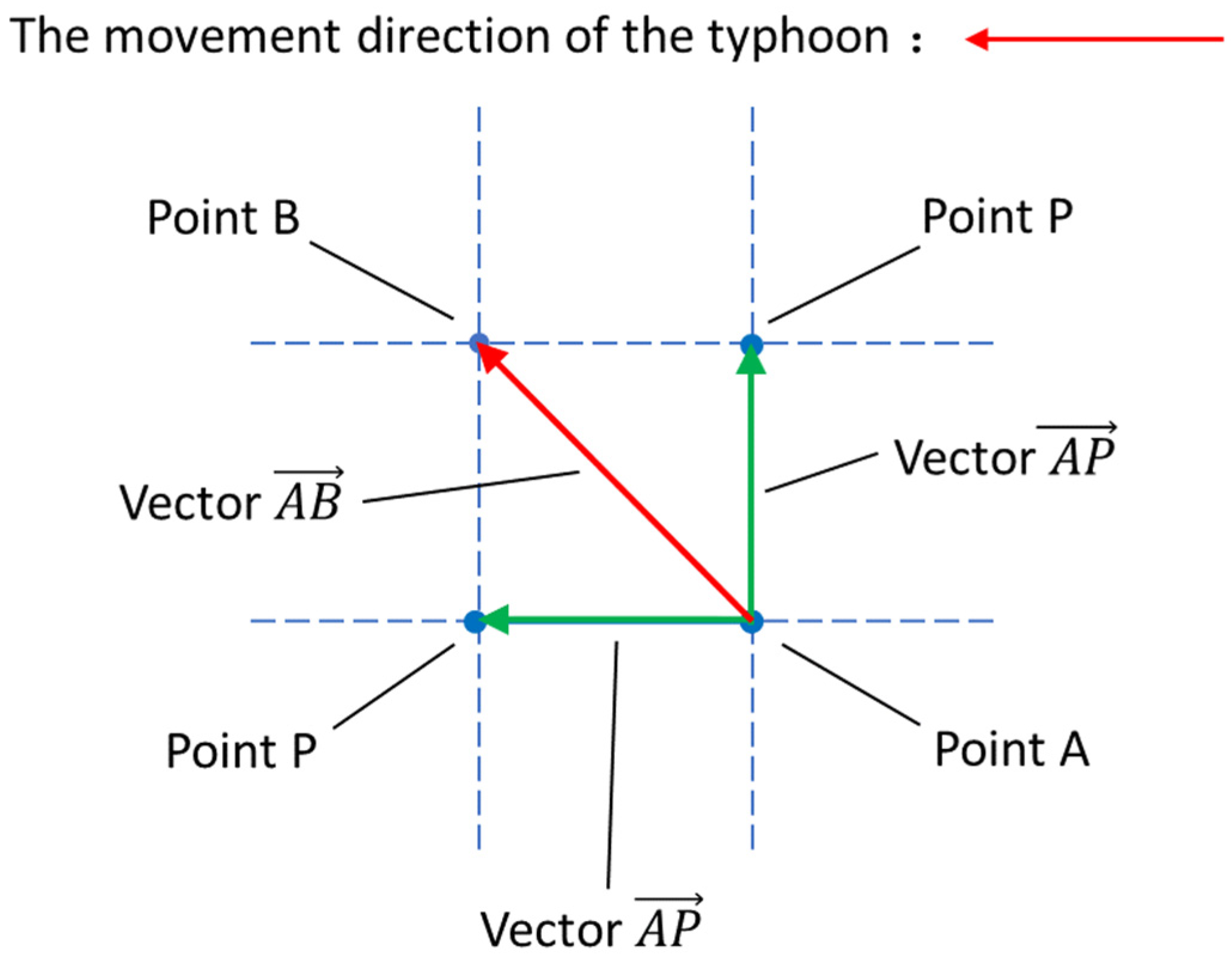
The next step of the matching algorithm was to determine the position of the eddy relative to the typhoon track. The classification of left-side and right-side eddies was based on the typhoon propagation direction. Specifically, a typhoon motion vector was constructed using the typhoon center positions on the encounter day (t = 0) and the following day (t = 1). Another vector was defined from the typhoon center to the eddy center on the encounter day. The sign of the cross product of these two vectors was then used to determine the relative position of the eddy with respect to the typhoon track. Accordingly, the matched eddies were classified as left-side eddies, right-side eddies, or eddies directly crossed by the typhoon. Eddies directly crossed by the typhoon were defined as cases in which the minimum typhoon–eddy distance on the encounter day was less than 50 km. It should be noted that this study focuses on eddies located on the two sides of the typhoon track and their responses to typhoon forcing. During the sample selection process, we found that the number of eddies directly intersected by typhoon tracks is too limited to support reliable statistical analysis. Therefore, to ensure the robustness of the statistical results, eddies directly crossed by the typhoon track were excluded, and only eddies located within 50–200 km from the typhoon track were included in the analysis. Ultimately, four types of typhoon–eddy co-occurrence events were retained for this study: left-side CEs, right-side CEs, left-side ACEs, and right-side ACEs. A schematic diagram illustrating the typhoon–eddy matching and quadrant classification is provided in Figure 1. In addition, the typhoon–eddy interaction period is defined as the time interval during which the distance between the centers of the typhoon and the eddy is less than or equal to 800 km. This period is used to calculate the PDI of the typhoon for each typhoon–eddy co-occurrence event.

2.2.2. Extraction of Eddy-Representative SST

To accurately capture the representative SST of each eddy, we construct a square sampling window with a side length of 2r based on the eddy center coordinates and its effective radius r. This window fully covers the eddy’s effective influence area while matching the grid structure of the SST dataset, thereby reducing sampling errors. SST fields retrieved from satellite remote sensing are clipped using this sampling window, and all SST grid points within the eddy domain are extracted. The arithmetic mean of these grid values is then calculated and used as the representative SST for the eddy on that day. This procedure is applied in batch mode to all eddies within the 7-day periods before and after each target typhoon during 2006–2020, resulting in a comprehensive dataset describing the daily SST evolution of eddies under typhoon influence.

2.2.3. Evaluation Index

(1)
PDI
PDI is an integrated intensity metric used to quantify the total wind energy dissipated by a tropical cyclone over its entire lifetime [33]. We assess typhoon intensity based on the PDI (unit: m3 s−2). Each typhoon is represented by one PDI, and the PDI is computed as follows:
P D I = τ 1 τ 2 V m a x 3 d t
where τ1 and τ2 represent the start and end times of the typhoon–eddy encounter (unit: s), and Vmax denotes the maximum sustained wind speed (unit: m s−1). For an individual tropical cyclone, PDI is accumulated from its first CMA best-track record to the last record before extratropical transition. The annual accumulated PDI represents the sum of all typhoons in a specific region over the course of a year.
(2)
SAPE
Oceanic eddies store energy in the form of available potential energy, defined as the gravitational potential energy difference between an eddy state and a reference state [34]. Here, SAPE represents the available potential energy associated with perturbations in ocean density and sea-surface height, and can be regarded as the portion of potential energy stored in the eddy system that is available for conversion into kinetic energy [35]. In this study, SAPE (unit: J) is used to evaluate the energy distribution of oceanic eddies under typhoon forcing. SAPE is expressed as:
S A P E = 1 2 ρ g η e d d y 2 d A
where ρ is seawater density (1.025 × 10³ kg m−3), g is gravitational acceleration (9.8 m s−2), ηeddy is eddy amplitude (unit: m), and A is the eddy area (unit: m2).
(3)
EECR
The eddy energy change rate (EECR, unit: W) is introduced to quantitatively assess the magnitude of eddy energy variation during typhoon passage. EECR describes the relative change in eddy energy over a predefined time window before and after typhoon influence. A negative EECR indicates energy decay (with larger absolute values representing more rapid decay), whereas a positive EECR reflects energy enhancement (with larger values indicating stronger intensification). This metric allows for the identification of regions where mesoscale eddy energy exhibits enhanced sensitivity to tropical cyclone forcing and provides insight into the spatial variability of typhoon-induced eddy energy responses.
E E C R = S A P E l a s t S A P E f i r s t T i m e l a s t T i m e f i r s t = Δ S A P E Δ T i m e
where SAPEfirst and SAPElast represent the SAPE values on the first and last days within the 7-day window before and after the typhoon–eddy encounter, respectively. ΔSAPE denotes the change in SAPE, while Timefirst and Timelast refer to the corresponding dates of SAPEfirst and SAPElast, respectively. ΔTime represents the time difference.
(4)
SSTCR
To quantify SST variability in eddy regions under typhoon forcing, the SST-change rate (SSTCR, unit: °C day−1) is introduced. SSTCR represents the rate of change of the representative SST of an eddy per unit time. A negative SSTCR indicates cooling (with larger absolute values representing stronger cooling), whereas a positive SSTCR indicates warming (with larger values representing stronger warming). This metric enables an objective assessment of the thermal responses of mesoscale eddies to tropical cyclone forcing and facilitates the characterization of typhoon-induced upper-ocean thermal variability.
S S T C R = S S T l a s t S S T f i r s t T i m e l a s t T i m e f i r s t = Δ S S T Δ T i m e
where SSTfirst and SSTlast denote the eddy-representative SST on the first and last days within the 7-day window before and after the typhoon–eddy encounter, respectively. ΔSST denotes the change in SST, while Timefirst and Timelast refer to the corresponding dates of SSTfirst and SSTlast, respectively. ΔTime represents the time difference.

3. Typhoon–Eddy Co-Occurrence Analysis

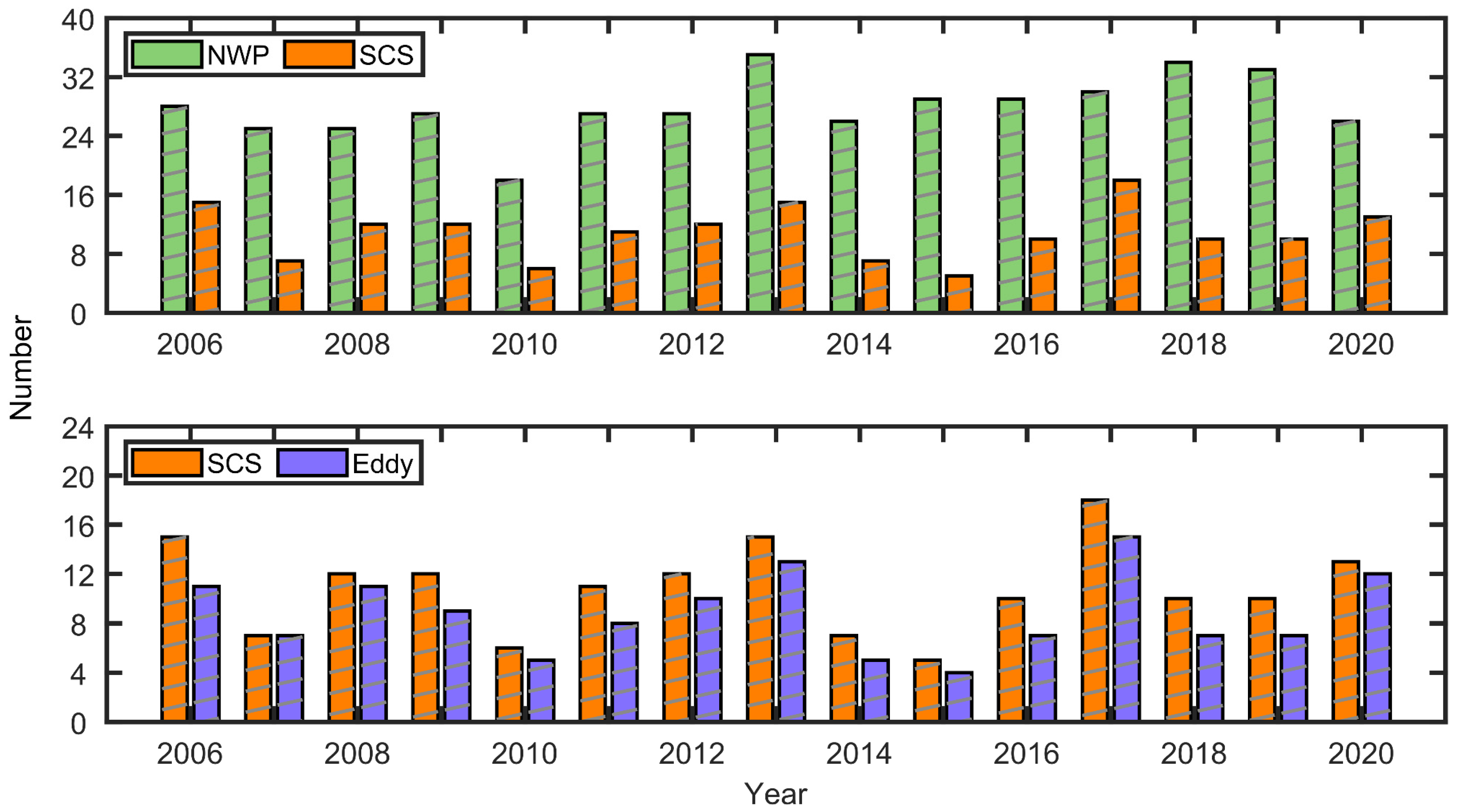
Although the SCS is a marginal sea, a considerable number of tropical cyclones traverse this region each year, and many of them interact with mesoscale eddies. This provides a relatively sufficient number of typhoon–eddy co-occurring events for statistical analysis and facilitates investigation of the asymmetric eddy responses under typhoon forcing in a marginal-sea environment. Therefore, we statistically analyzed the number of tropical cyclones generated in the North Pacific that subsequently passed through the SCS and interacted with mesoscale eddies (Figure 2). The tropical cyclone dataset was obtained from CMA, and detailed information is provided in Section 2.1. The upper part of Figure 2 illustrates the frequency of typhoons passing through the northwest Pacific and SCS between 2006 and 2020. During this 15-year period, a total of 419 typhoons occurred in the northwest Pacific, with 163 entering the SCS, accounting for approximately 38.90%. This indicates that about one-third of typhoons in the northwest Pacific affect the SCS. Despite the SCS being a semi-enclosed marginal sea, it is significantly influenced by frequent typhoons. The lower part of Figure 2 further shows the frequency of typhoons passing through the SCS and their interactions with oceanic eddies during the same period. Among the 163 typhoons, 131 interacted with oceanic eddies, accounting for approximately 80.37% of the total, suggesting a high frequency of typhoon–eddy interactions in the SCS. Previous studies have highlighted the important role of oceanic eddies in energy and material transport in the SCS [36,37,38]. Due to the region’s complex bathymetry and dynamic environment, the physical characteristics of the eddies in the SCS exhibit distinct regional specificity, influencing energy and material transport in unique ways. Under typhoon forcing, the structure and evolution of these eddies can directly affect key oceanic variables such as the flow field and thermohaline structures, potentially leading to significant changes in energy and material transport processes. Therefore, it is crucial to explore the response and evolution of mesoscale oceanic eddies in the SCS under typhoon disturbances to improve our understanding of mesoscale ocean dynamics in marginal seas.
It is necessary to clarify the sample size shown in Figure 2. Although the upper panel of Figure 2 indicates that the number of typhoons passing through the SCS was relatively low in 2010, 2014, and 2015, the lower panel shows that the proportion of typhoons interacting with ocean eddies remains generally stable across years. Therefore, despite the smaller absolute sample sizes in certain years, their relative characteristics are consistent. Including these years in the long-term statistical analysis (2006–2020) does not introduce systematic bias into the overall results. Table 1 provides a systematic summary of the annual distribution of different types of typhoon–eddy co-occurrence events from 2006 to 2020.
Based on the eddy dataset (2006–2020) and the CMA best-track typhoon records, and using the threshold of <200 km for the minimum distance between a typhoon center and an eddy center, a total of 335 valid typhoon–eddy co-occurrence events was identified. These events were further categorized by eddy polarity and their position relative to the typhoon track into four subgroups: 103 CEs on the left side of the track, 88 CEs on the right side, 83 ACEs on the left side, and 61 ACEs on the right side. The relatively balanced sample sizes across categories ensure the robustness of subsequent statistical analyses.

4. Composite Analysis

Most typhoons affecting the SCS originate from the Philippine Sea in the western North Pacific and generally propagate westward. Previous studies have indicated that typhoons affecting the SCS predominantly pass through the central and northeastern regions of the SCS [6]. When considered together with the core regions of mesoscale eddy activity, the western side of the central SCS, the northeastern SCS, and the eastern SCS, it becomes evident that typhoon–eddy co-occurrence events occur predominantly in the northeastern SCS. This region coincides with both high tropical cyclone activity, and a pronounced accumulation of mesoscale eddies, providing favorable spatial conditions for examining the responses of pre-existing eddies to tropical cyclone forcing.

4.1. SAPE Response

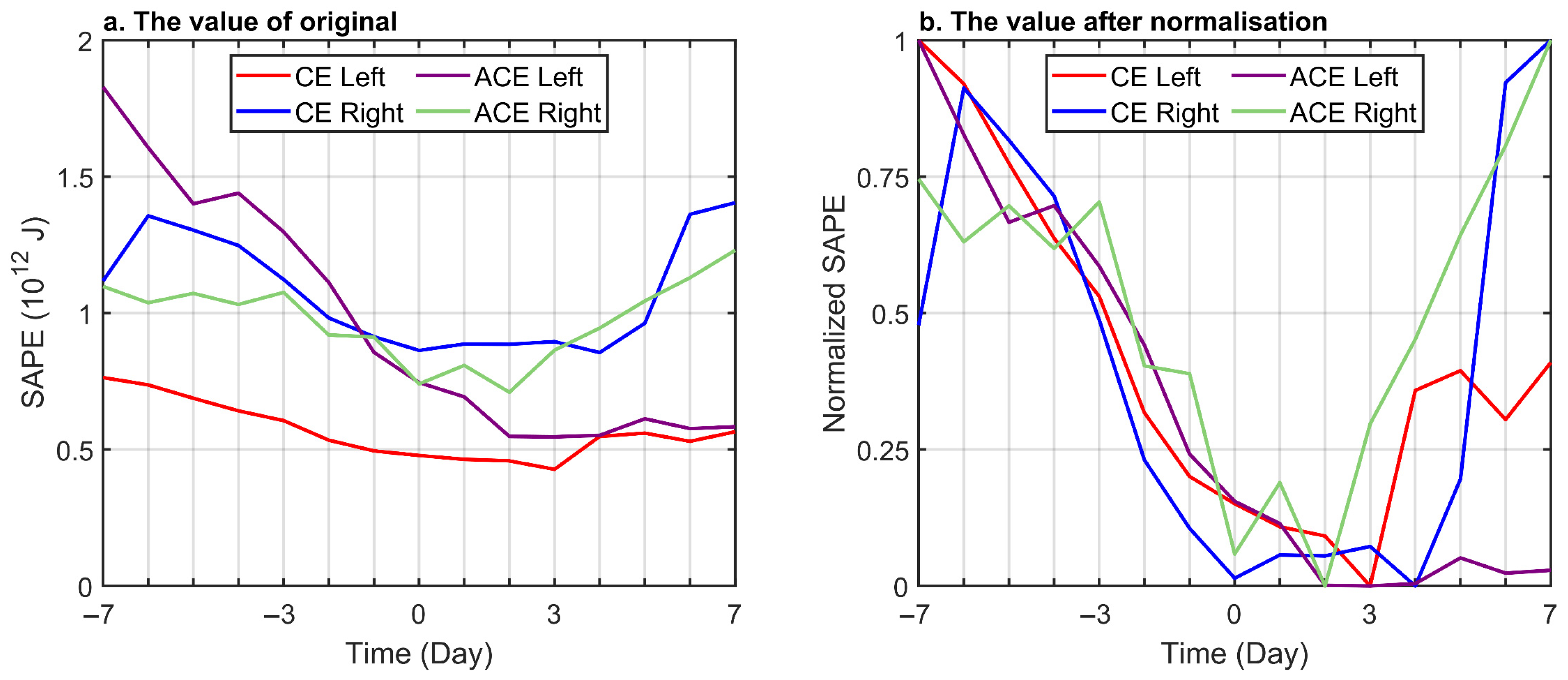
To explore the distinct energy evolution characteristics of eddies located on different sides of typhoon tracks, composite analyses of eddy SAPE are conducted for the four categories of typhoon–eddy co-occurrence events identified above, as presented in Figure 3a. Considering that the original SAPE values differ in magnitude across eddies, a [0,1] normalization is applied to facilitate intercomparison among eddies of different polarities. Additionally, because SAPE has a large absolute magnitude and exhibits relatively small temporal fluctuations, simple de-meaning is insufficient to highlight key variations. Normalization allows the temporal evolution and cross-polarity differences in eddy energy responses to be more clearly identified (Figure 3b).
As shown in Figure 3, prior to the typhoon–eddy encounter (t = −7 to t = 0), the SAPE of left-side eddies (both cyclonic and anticyclonic) exhibits a clear, monotonic decrease. Specifically, left-side CEs and left-side ACEs decrease by 0.27 × 10¹² J and 1.06 × 10¹² J, respectively. Although right-side eddies also show an overall decrease (with right-side CEs decreasing by 0.25 × 10¹² J and right-side ACEs by 0.35 × 10¹² J), their temporal fluctuations are more complex. Right-side CEs intensify before t = −6 and subsequently weaken, whereas right-side ACEs alternately strengthen and weaken, though with a predominant net decay.
After the typhoon encounter (t = 0 to t = 7), SAPE increases for left-side CEs, right-side CEs, and right-side ACEs by 0.08 × 10¹² J, 0.53 × 10¹² J, and 0.48 × 10¹² J, respectively. In contrast, left-side ACEs continue to weaken, decreasing by 0.15 × 10¹² J. Notably, the minimum SAPE does not occur at t = 0 (the encounter day), but around t ≈ 3, after which SAPE rebounds. This delayed minimum suggests a lagged weakening effect of typhoon forcing on mesoscale eddies.
Over the full period (t = −7 to t = 7), left-side eddies undergo a net energy reduction (−0.19 × 10¹² J for cyclonic and −1.21 × 10¹² J for ACEs), whereas right-side eddies undergo a net energy enhancement (+0.28 × 10¹² J for cyclonic and +0.13 × 10¹² J for ACEs). Moreover, the recovery of eddy energy on the right side is substantially greater than on the left side.
The composite SAPE analysis thus demonstrates a pronounced lateral asymmetry in eddy energetic responses to typhoon passage. Eddies on the left side of the track undergo overall weakening, with left-side ACEs exhibiting a significantly larger decay than left-side CEs, indicating that left-side CEs are relatively more stable (or that left-side ACEs are more sensitive to typhoon-induced perturbations). In contrast, right-side eddies undergo overall strengthening, with right-side CEs intensifying more than right-side ACEs, indicating that right-side ACEs are relatively more stable (or that right-side CEs respond more strongly to typhoon forcing). The strong wind field of the typhoon drives the horizontal movement of the upper ocean through the Ekman pumping mechanism, which induces vertical exchange. On the typhoon’s right side, the strong wind field causes surface waters to be drawn upward, forming Ekman pumping and promoting cold water upwelling. For the CEs on the right side, this mechanism enhances the SAPE. In contrast, for the ACEs on the right side, although eddy polarity suggests a decrease in SAPE, the complex interaction between the wind field inside and outside the typhoon causes most of the right-side ACE cases to be located outside the wind field, leading to an enhancement of SAPE for these right-side ACEs as well. On the left side of the typhoon, Ekman sinking occurs, causing warm water to sink and thus reducing SAPE for the left-side CE. However, because of the influence of the wind field, most of the left-side ACE cases may lie within the wind field, causing the SAPE for the left-side ACE to show a weakened trend. A more detailed discussion of the typhoon wind-field impacts is provided in the Section 5, focusing on the relevant characteristics of PDI and EECR.

4.2. SST Response

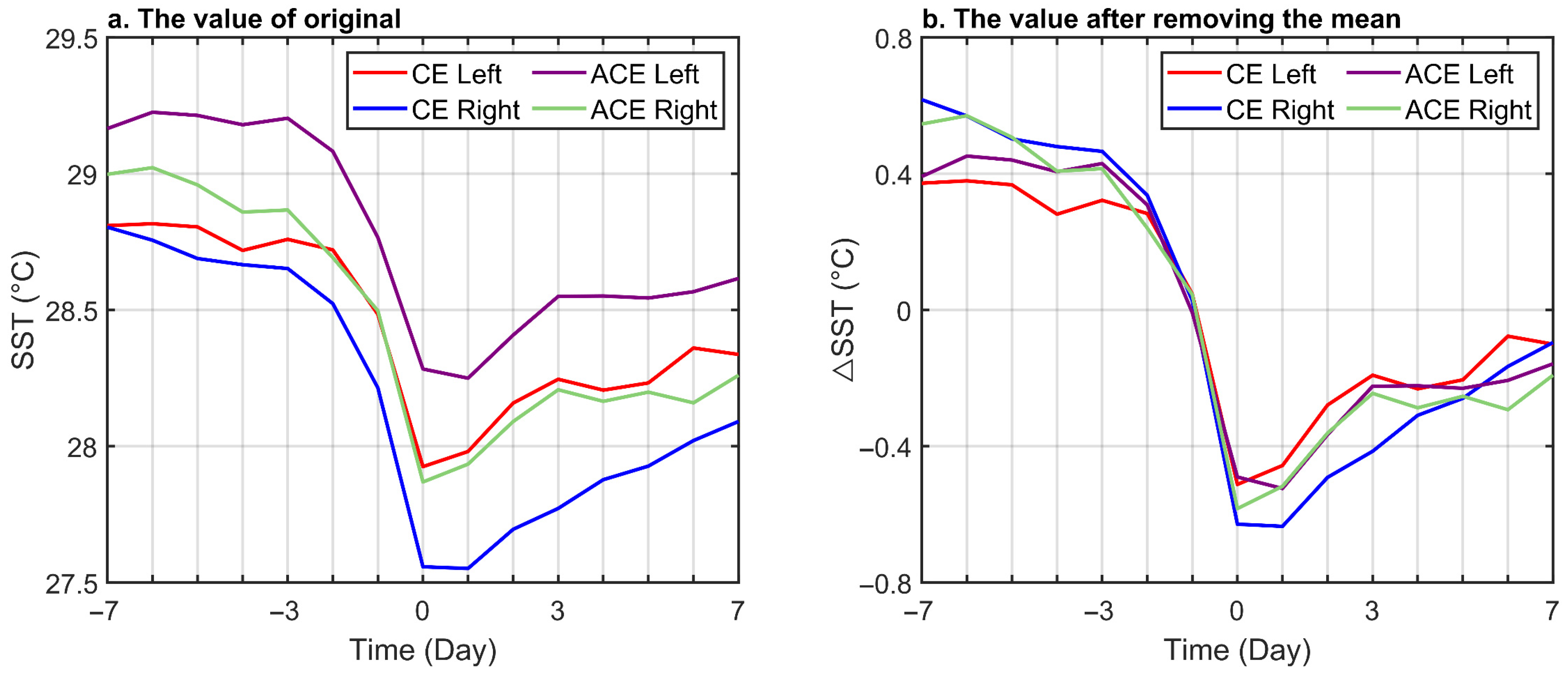
Typhoon passage typically induces pronounced sea-surface cooling in the vicinity of its track [32,39,40,41,42,43]. The polarity of mesoscale eddies, as well as their relative position with respect to the typhoon track, can modulate this typhoon-induced thermal response in distinct ways. Following the analytical framework of SAPE response, composite analyses of SST are performed for the four categories of typhoon–eddy co-occurrence events (Figure 4a).
Figure 4a illustrates the SST variability of the four eddy categories during the 7-day period before and after typhoon passage. All eddies exhibit a cooling trend prior to the typhoon–eddy encounter, followed by a gradual warming thereafter; however, the overall evolution from t = −7 to t = 7 is still dominated by net cooling. To eliminate the influence of seasonal and interannual background SST variations and to better reveal the differences among the four eddy types, the SST data are demeaned, with the resulting anomalies shown in Figure 4b.
During t = −7 to t = −3, all eddies exhibit weak cooling except for left-side ACEs, which show a slight warming of 0.04 °C. Left-side CEs cool by 0.05 °C, right-side CEs by 0.15 °C, and right-side ACEs by 0.13 °C. Overall, left-side eddies cool less than right-side eddies. During t = −3 to t = 0, the critical period of typhoon influence, all four eddy types experience pronounced cooling, with temperature drops that are 7–17-times larger than those in the earlier stage. Specifically, SST decreases by 0.83 °C for left-side CEs, 1.09 °C for right-side CEs, 0.92 °C for left-side ACEs, and 1.00 °C for right-side ACEs, again showing slightly stronger cooling on the right side of the track.
Considering the entire pre-encounter period (t = −7 to t = 0), cumulative cooling amounts to 0.88 °C for left-side CEs, 1.24 °C for right-side CEs, 0.88 °C for left-side ACEs, and 1.13 °C for right-side ACEs. These results reveal two consistent patterns: (1) right-side eddies cool more than left-side eddies, and (2) CEs cool more than ACEs.
After the typhoon encounter (t = 0 to t = 7), SST generally rebounds across all eddy types, with warming of 0.41 °C for left-side CEs, 0.53 °C for right-side CEs, 0.33 °C for left-side ACEs, and 0.39 °C for right-side ACEs. The magnitude of recovery again follows the pattern “right > left” and “cyclonic > anticyclonic”.
Across the entire period (t = −7 to t = 7), all four eddy categories exhibit net cooling. The net SST decreases are 0.47 °C for left-side CEs, 0.71 °C for right-side CEs, 0.55 °C for left-side ACEs, and 0.74 °C for right-side ACEs. In all cases, the cooling during typhoon impact outweighs the subsequent warming, highlighting the pronounced cold-water effect induced by typhoon forcing in eddy regions.
The composite analysis reveals that both CEs and ACEs on either side of the typhoon track experience overall cooling, and that this cooling exhibits two distinct asymmetry patterns. First, for eddies of the same polarity, SST cooling is consistently stronger on the right side of the typhoon track than on the left side. Second, across different polarities, CEs display a stronger SST response to typhoon forcing than ACEs. Due to Ekman pumping induced by the typhoon’s wind stress, surface mixing is enhanced, and deep cold water rises. This mechanism generally leads to a decrease in SST on both sides of the typhoon. For CEs, due to polarity differences, the SST on both sides of the CE is reduced. However, as mentioned earlier in the SAPE discussion, the SAPE decreases on the left side of the CE and increases on the right side. Therefore, the cooling effect on the left-side CE is usually weaker than that on the right-side CE. For ACEs, the SST prior to the typhoon is generally higher than that of CE, so the cooling effect after typhoon passage is more significant for ACE than for CE. The phenomenon whereby the right-side ACE exhibits enhanced SAPE but still shows a stronger cooling effect than the left-side ACE will be explained in the following section.
It is noteworthy that when examining the relationships between eddy SAPE and SST in the SCS, the right-side ACEs tended to exhibit enhanced SAPE under typhoon forcing (which theoretically corresponds to warming), yet SST still showed an overall cooling; similarly, left-side CEs exhibited SAPE weakening (which theoretically corresponds to warming) but still displayed net cooling. This inconsistency cannot be attributed solely to a cold wake effect but instead reflects the integrated upper-ocean response to tropical cyclone forcing. For ACEs on the right side of a typhoon track, the coexistence of increased SAPE and decreased SST reflects different dynamical and thermal responses. Strong winds enhance mixed-layer deepening and vertical mixing, generating pronounced cold-wake cooling that is typically stronger on the right side due to storm translation effects. This explains the overall SST decrease within right-side ACEs. In contrast, SAPE primarily reflects changes in sea level anomaly (SLA) and upper-ocean dynamical adjustment. Typhoon-induced wind-stress curl can drive Ekman convergence and downwelling (negative Ekman pumping), elevating SLA and intensifying the anticyclonic eddy, leading to increased SAPE. This dynamic amplification can coexist with surface cooling driven by mixing. Consistent with this interpretation, previous studies have shown that typhoon-induced eddy intensity changes are closely linked to wind-stress-curl-driven Ekman pumping and subsequent quasi-geostrophic adjustment [44]. Furthermore, the negative vorticity within ACEs reduces the effective Coriolis frequency, favoring the trapping and downward propagation of near-inertial energy, which may further modify upper-ocean structure and support SLA/SAPE enhancement [45].
For CEs on the left side of a typhoon track, the concurrent decrease in SAPE and SST is dynamically consistent. Although winds are typically stronger on the right side of typhoon in the Northern Hemisphere, the left side of typhoon still experiences sufficient wind stress to deepen the mixed layer and enhance vertical mixing, producing surface cooling and cold-wake signatures [39]. Dynamically, CEs are characterized by positive vorticity and negative sea level anomalies (SLA). Typhoon-induced wind-stress curl superimposed on this background favors positive Ekman pumping, which strengthens upper-ocean divergence, uplifts the thermocline, and further reduces SLA amplitude, leading to weakened eddy intensity and decreased SAPE. Meanwhile, upwelling transports colder subsurface water upward, reinforcing SST cooling. In addition, the higher effective Coriolis frequency in CEs inhibits near-inertial energy trapping, allowing wind-forced energy to disperse more readily. As a result, left-side CEs tend to exhibit a coherent response of surface cooling accompanied by eddy weakening under typhoon forcing. These wind-driven processes generally exert a stronger cooling influence on SST than can be offset by adjustments in the eddy’s intrinsic thermal structure, resulting in an overall SST decrease even when SAPE changes would suggest warming [46].

5. Correlation Analysis

5.1. Time-Scale Correlation Analysis Between PDI and EECR

Previous studies have demonstrated a strong correlation between typhoon PDI and variations in the eddy field within the Gulf Stream region [16]. Building on this understanding, the present study employs the Pearson correlation coefficient (PCC) to systematically examine the statistical relationships between the PDI of typhoons traversing the SCS and interacting with oceanic eddies and the EECR for eddies located on different sides of the typhoon track. The results are shown in Figure 5 (CEs) and Figure 6 (ACEs).
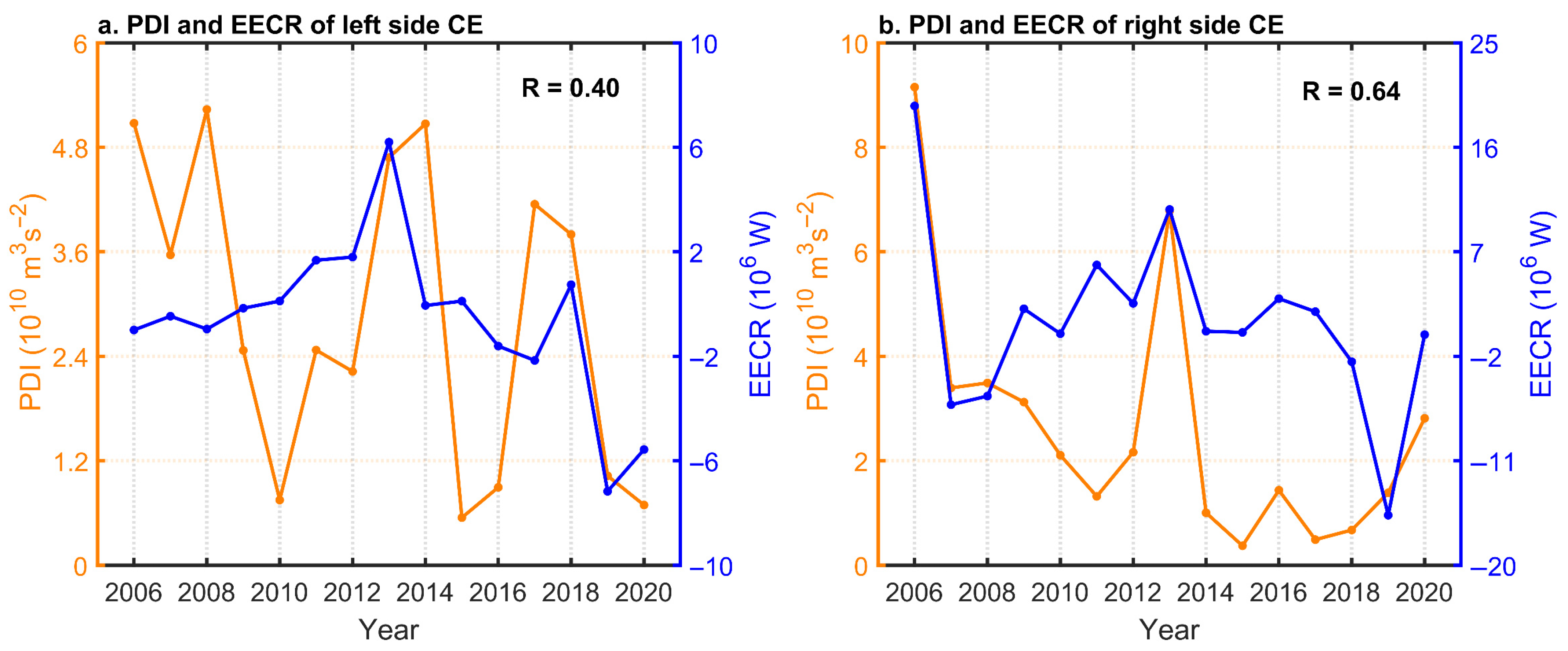
For CEs, typhoon PDI exhibits considerable interannual variability during 2006–2020, while the total EECR of left-side CEs follows an inverted V-shaped pattern (Figure 5a). The two variables exhibit a positive but weak correlation (R = 0.40, p > 0.05). In most years, EECR values for left-side CEs are negative, consistent with the composite analysis showing that typhoons tend to weaken left-side eddies. The EECR remains positive during 2010–2014, as well as in 2015 and 2018 (corresponding to the PDI peak around 2013), indicating that strong typhoons may reverse the weakening trend of left-side CEs. After 2014, EECR becomes negative and shows a decrease trend, while PDI, although relatively high, gradually decreases during the same period. This implies that the weakening effect on left-side CEs becomes more pronounced as typhoon intensity diminishes.
Figure 5b shows that both typhoon PDI and the total EECR of right-side CEs display a fluctuating decrease, with a significant positive correlation between them (R = 0.64, p < 0.05). In most years, the EECR of right-side CEs is positive, consistent with the composite analysis result that typhoons tend to enhance right-side eddies. During the high-PDI periods in 2006 and 2013, the EECR remains positive and relatively large, indicating that strong typhoons can substantially increase the SAPE of right-side CEs. During 2007–2012 and 2014–2017, when the PDI is relatively low and shows limited variability, the corresponding EECR fluctuations are also weak. After 2017, EECR becomes negative and shows a decreased trend, with a brief rebound in 2019, while PDI increases slightly but remains at a comparatively low level. This demonstrates that weaker typhoons are insufficient to enhance right-side CEs and may even cause their decay.
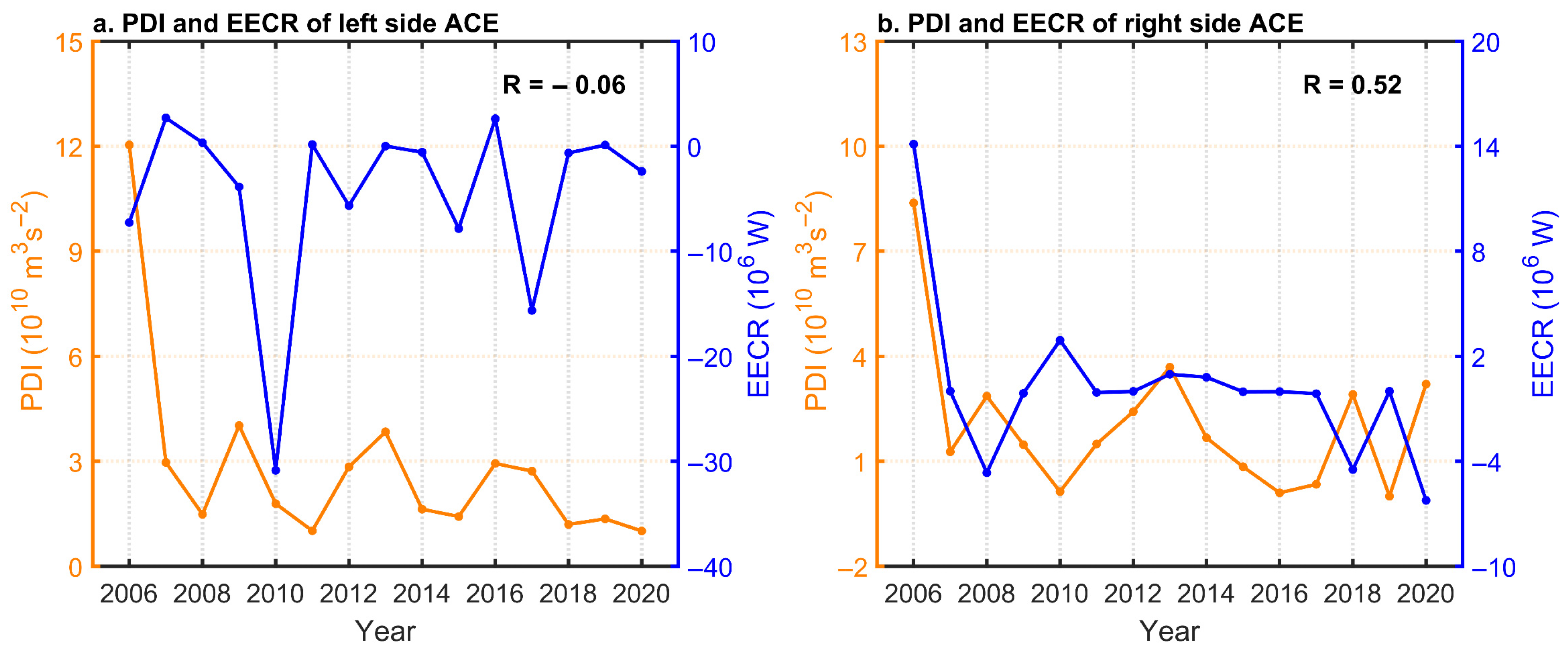
Figure 6a shows that the typhoon PDI exhibits a fluctuating downward trend, whereas the total EECR of left-side ACEs displays pronounced variability. No significant correlation is detected between the two variables (R = −0.06, p > 0.05). In most years, the EECR of left-side ACEs remains negative, indicating that their SAPE is consistently weakened by typhoon forcing, and that typhoon intensity does not exert a significant regulatory effect on the magnitude of this weakening. This may be attributed to the fact that left-side ACEs are more frequently located on the outer flank of the typhoon wind field, where typhoon-induced forcing is relatively weak [8].
Figure 6b shows that both the typhoon PDI and the total EECR of right-side ACEs exhibit an overall decrease trend. A significant positive correlation is found between them (R = 0.52, p < 0.05). In most years, EECR values for right-side ACEs are positive, consistent with the composite analysis indicating that typhoons enhance right-side eddies. During the high-PDI periods (2006 and 2013), EECR is generally positive and relatively large, implying that strong typhoons exert a pronounced intensifying effect on right-side ACEs. During 2007–2012, both EECR and PDI exhibit a fluctuating upward trend. After 2014, EECR shows a fluctuating downward trend, whereas PDI exhibits a slightly fluctuating upward trend. This divergence may be associated with enhanced cold-wake processes or with right-side ACEs being more frequently located within the interior of the typhoon wind field, both of which could suppress their energy enhancement.
Overall, eddies located on the left side of the typhoon track (both CEs and ACEs) predominantly exhibit energy decay, whereas eddies on the right side generally experience energy enhancement. However, the regulatory effect of typhoon intensity varies among different eddy types. Statistical analyses show that the EECR of left-side CEs, right-side CEs, and right-side ACEs is significantly and positively correlated with typhoon PDI, indicating that stronger typhoons tend to promote eddy energy enhancement, while weaker typhoons are more likely to intensify energy decay (R = 0.40, 0.64, and 0.52, respectively). In contrast, no significant relationship is observed between EECR and PDI for left-side ACEs (R = −0.06, p > 0.05). Although several of these relationships are statistically significant, the overall correlation coefficients remain moderate, suggesting that eddy energy responses are not governed solely by typhoon intensity but are instead influenced by multiple confounding factors.
First, the diversity in eddy scale and structure plays a critical role in determining the efficiency with which eddies absorb typhoon-induced kinetic energy. Variations in eddy size, morphology, and evolutionary stage lead to pronounced heterogeneity in eddy responses to typhoon forcing; in particular, smaller or structurally weaker eddies may not fully absorb the energy input from strong typhoon winds, thereby weakening the linear correspondence between EECR and PDI. Second, background circulation conditions—such as monsoon-driven flows, warm currents, and associated shear—can modulate eddy energy evolution and obscure the direct influence of typhoon intensity. Moreover, as a typical marginal sea, the study region is characterized by complex coastline geometry and pronounced bathymetric variability, which may limit the effective transmission of typhoon-induced kinetic energy into eddies and the deeper ocean. In this study, regions with water depth ≤ 200 m in the SCS are defined as shallow-water areas (continental shelf regions), while regions with water depth > 200 m are defined as deep-water areas (regions outside the continental shelf). Among all the typhoon–eddy co-occurrence events analyzed, approximately 77% of the eddy events occurred in deep-water regions, while about 23% occurred in shallow water regions. In shallow-water and continental shelf regions, a substantial fraction of the typhoon energy input can be rapidly dissipated through bottom friction and enhanced local mixing, further reducing the linear correlation between EECR and PDI. Previous studies have demonstrated that marginal-sea environments and water-depth conditions play an important role in modulating eddy dynamical responses to atmospheric forcing [47,48].
The effects of typhoon secondary circulation also differ substantially between its inner and outer regions. In the inner region, CEs enhance sea-surface cooling and suppress typhoon development, while ACEs maintain elevated SST and promote typhoon intensification; the outer region exhibits the opposite behavior [8,24,25]. This pattern implies that the mechanisms governing eddy energy responses may inherently differ between eddies located inside versus outside the typhoon wind field. For example, Yu et al. [13] demonstrated that not all eddies intensify under typhoon forcing. He et al. further showed that warm eddies situated along the outer boundary of the typhoon wind field tend to strengthen after typhoon passage, whereas those located closer to the typhoon center (within the inner wind field) weaken significantly [44]. These findings imply that the distinct energy responses of eddies on the two sides of typhoon tracks may be closely related to their relative position within the typhoon wind structure (inner vs. outer region). This hypothesis highlights an important direction for future studies aimed at further resolving the physical processes underlying the observed typhoon-induced eddy responses.

5.2. Time-Scale Correlation Analysis Between PDI and SSTCR

Building on previous numerical modeling results showing that CEs on the right side of typhoon tracks undergo more pronounced cooling [17], the present study further applies the Pearson correlation coefficient (PCC) to examine the relationship between typhoon PDI and the SSTCR of mesoscale eddies. This analysis aims to elucidate the regulatory role of typhoon intensity in shaping the thermal response of eddies. The results are presented in Figure 7 (CEs) and Figure 8 (ACEs).
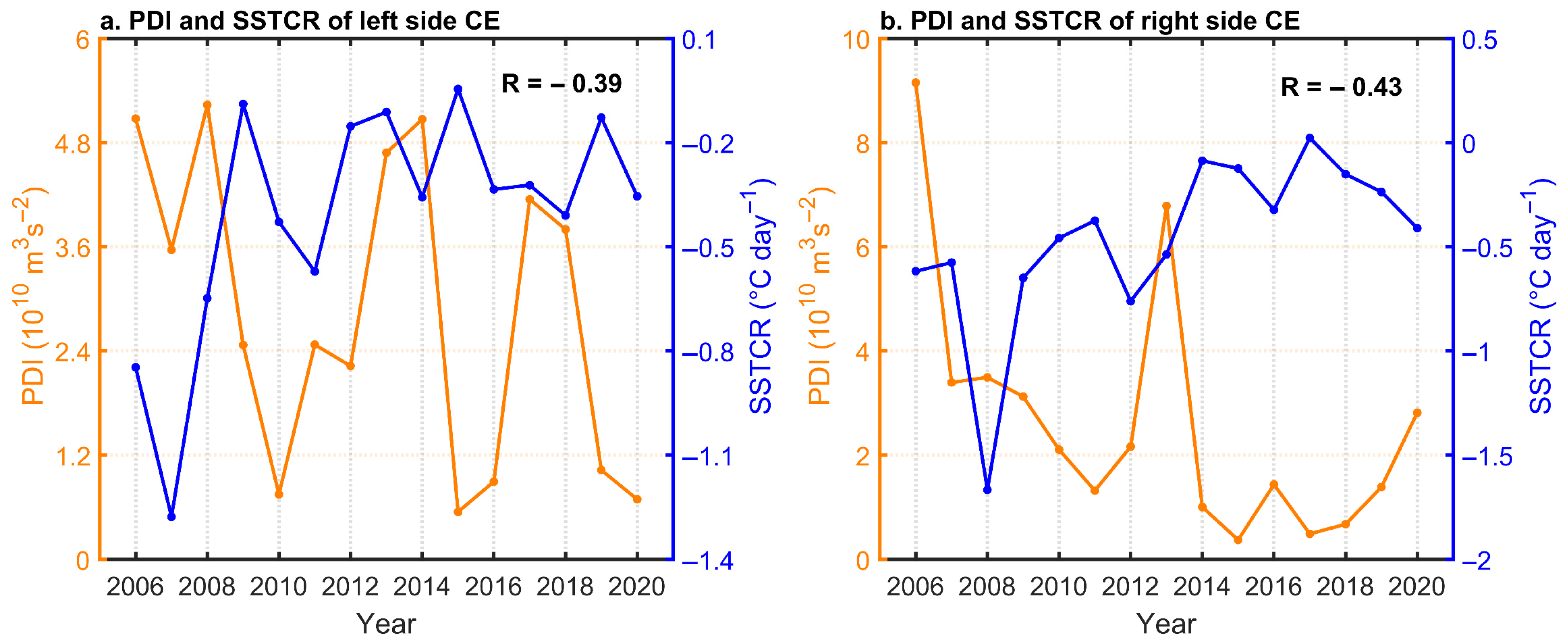
Figure 7a shows that typhoon PDI exhibits pronounced interannual fluctuations, whereas the total SSTCR for left-side CEs displays an overall increase, with a marked rise before 2009 followed by small-amplitude oscillations. A negative but weak correlation is observed between the two variables (R = −0.39, p > 0.05). In all years, SSTCR values for left-side CEs remain negative, consistent with the composite analysis indicating that typhoons induce cooling within eddies. However, typhoon intensity does not exert a significant regulatory effect on the magnitude of this cooling. After 2009, the cooling of left-side CEs exhibits only weak variability, which may be linked to greenhouse warming and enhanced upper-ocean stratification that suppress typhoon-induced vertical mixing [7].
Figure 7b shows that typhoon PDI exhibits a general decrease, while the total SSTCR for right-side CEs shows an upward trend over the same period. A negative but weak correlation is observed between the two variables (R = −0.43, p > 0.05). Except for 2017, the SSTCR of right-side CEs remains negative in all other years, which is consistent with the composite analysis results. Before 2008, SSTCR shows a decreased trend, whereas after 2008 it exhibits a fluctuating increase trend. In contrast, PDI shows a marked fluctuation in 2013 but overall exhibits a decrease trend. However, typhoon intensity does not exert a significant regulatory effect on the magnitude of this cooling.
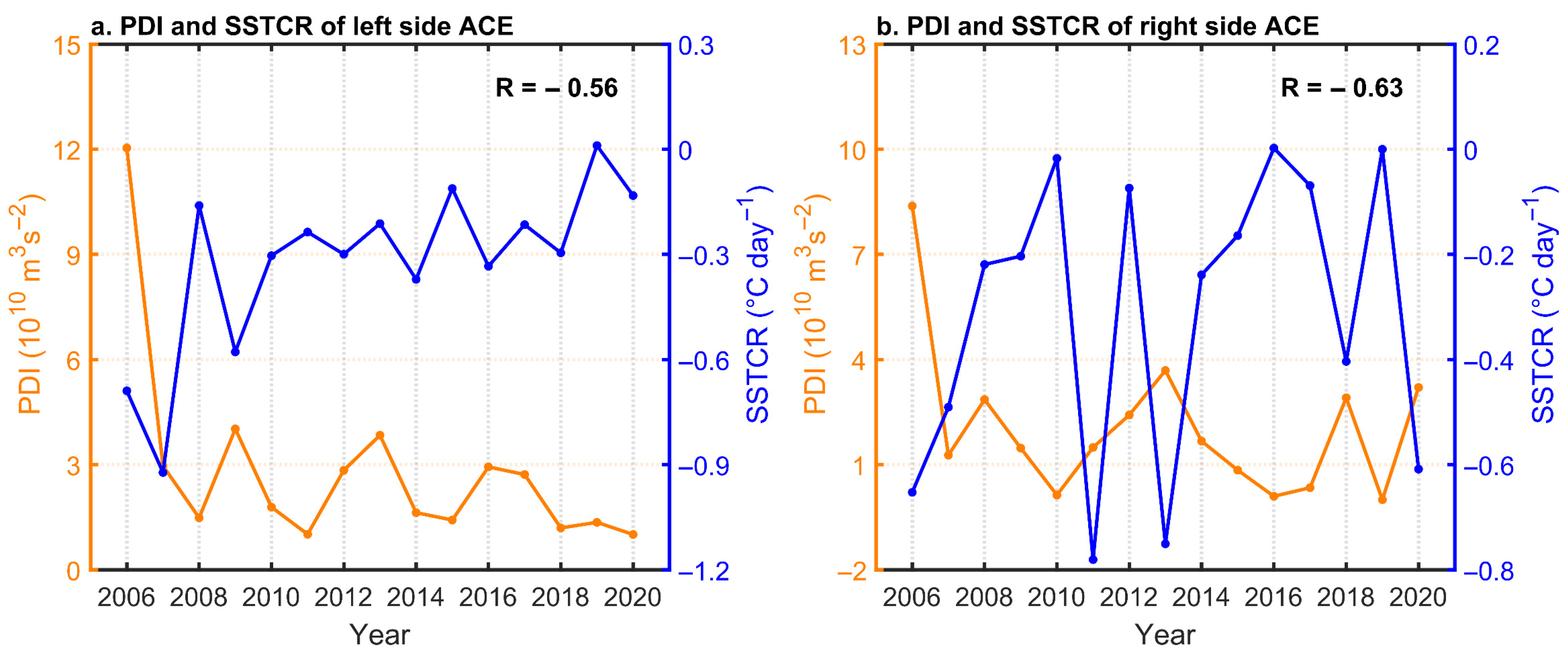
Figure 8a shows that the typhoon PDI exhibits an overall fluctuating decrease trend, whereas the SSTCR of left-side ACEs shows an overall fluctuating increase trend. A significant negative correlation is found between the two (R = −0.56, p < 0.05). Except for 2019, the SSTCR of left-side ACEs remains negative in all other years, and the cooling effect is closely tied to typhoon intensity: the high PDI in 2006 corresponds to a relatively large absolute SSTCR, indicating a strong cooling effect. In contrast, during 2007–2020, the PDI generally decreases with fluctuations and remains at relatively low levels, while SSTCR stays close to zero, suggesting a weakened cooling response.
Figure 8b shows that the typhoon PDI exhibits an overall decrease trend with slight fluctuations, whereas the SSTCR of right-side ACEs shows an overall increase trend with relatively large variability. A significant negative correlation is again observed (R = −0.63, p < 0.05). Except for 2016 and 2019, the SSTCR of right-side ACEs remains negative in all other years. During periods of relatively high PDI (e.g., 2006, 2013, 2018, and 2020), SSTCR displays large absolute values, indicating strong cooling, whereas during low-PDI years (e.g., 2010, 2016–2018, and 2019), SSTCR approaches zero, reflecting a weakened cooling effect.
Compared with EECR, the absolute values of the correlation coefficients between eddy-scale SSTCR and typhoon PDI are generally higher, indicating that upper-ocean thermal responses are more directly and sensitively linked to typhoon intensity. Both CEs and ACEs exhibit pronounced SST cooling under typhoon forcing; however, their responses to typhoon intensity differ markedly depending on eddy polarity and relative position. Specifically, weak negative correlations are found for both left-side and right-side CEs, with correlation coefficients of −0.39 and −0.43, respectively (p > 0.05), whereas significant negative correlations are observed for both left-side and right-side ACEs, with correlation coefficients of −0.56 and −0.63, respectively (p < 0.05). This contrast likely arises because CEs are more strongly influenced by local background circulation, stratification, and pre-existing upwelling, which collectively weaken the linear SST response to variations in typhoon intensity. In contrast, the thermal responses of ACEs are more directly controlled by typhoon wind forcing and the associated enhancement of vertical mixing.
SST variations are widely regarded as a sensitive indicator of typhoon intensity, particularly during the development of eddy-scale cold wakes. Eddy SSTCR reflect the combined effects of air–sea heat exchange and wind-driven vertical mixing in the upper ocean. Strong typhoon winds and associated Ekman pumping transport colder subsurface water upward into the mixed layer, where it mixes with warmer surface water, leading to pronounced SST reductions within and around eddies. Compared with adjustments in eddy energy, such thermally driven cooling processes tend to be more immediate and of larger magnitude. Moreover, SSTCR is not solely governed by typhoon intensity but is also strongly modulated by local water depth, ocean stratification, and the intrinsic thermal structure of eddies. Previous studies have demonstrated that bathymetry and eddy thermal characteristics play an important role in regulating the magnitude of typhoon-induced SST responses [49,50].

5.3. Relationships Between PDI, EECR, SSTCR and Sample Size

To further assess the robustness of the results, we examined the relationships between PDI, EECR, SSTCR, and sample size. In this study, each typhoon–eddy co-occurrence event corresponds simultaneously to one eddy sample and one tropical cyclone sample. Therefore, the numbers of eddy samples and tropical cyclone samples are in a one-to-one correspondence and are both equal to the total number of co-occurrence events. Based on this data structure, the number of typhoon–eddy co-occurrence events is adopted as a unified metric to represent sample size. The relationships between PDI, EECR, SSTCR, and the number of co-occurrence events are then analyzed (Figure 9, Figure 10 and Figure 11).
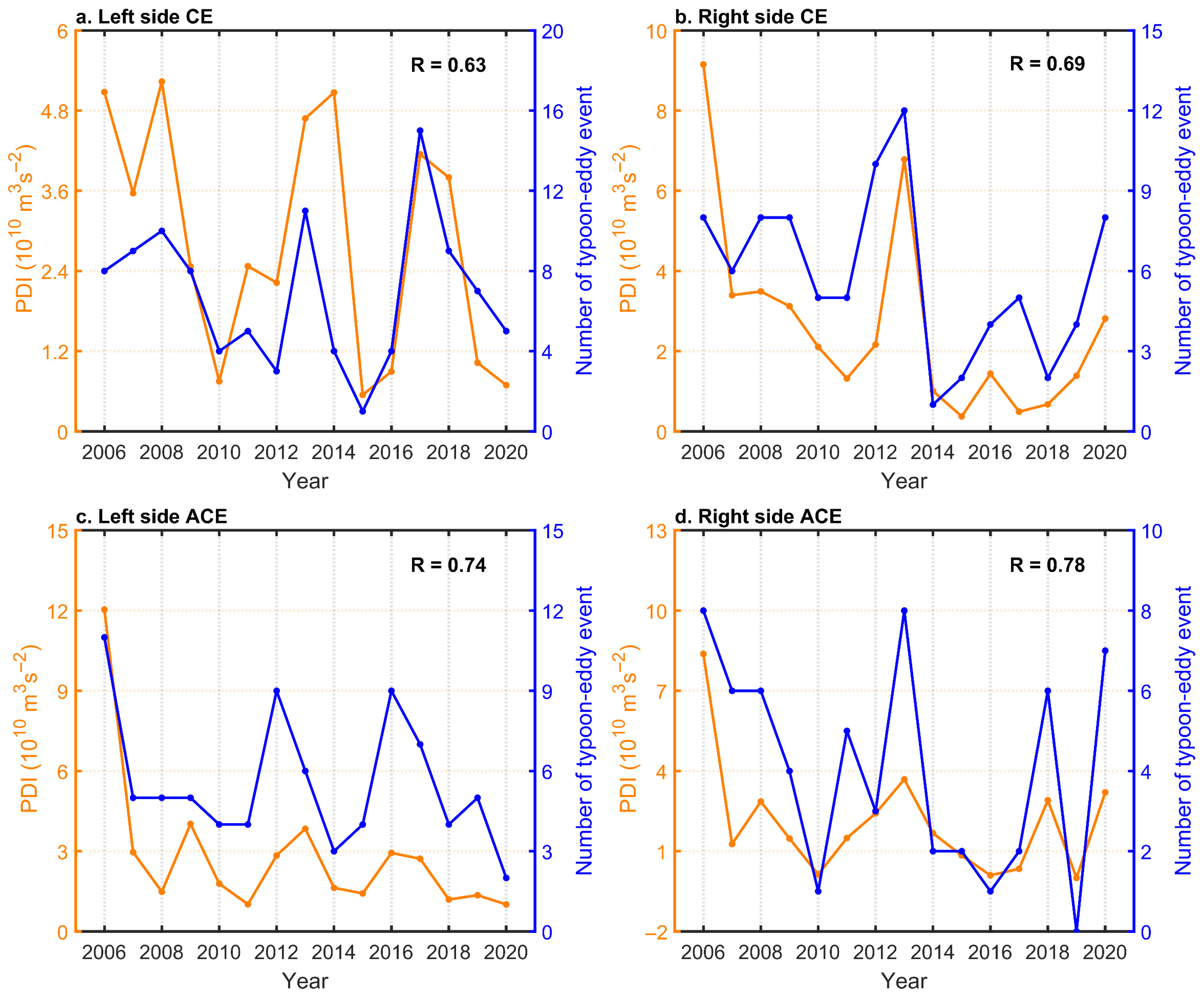
Figure 9 illustrates the relationship between typhoon PDI and the number of four types of typhoon–eddy co-occurrence events. As shown in Figure 9a, both the PDI of typhoons associated with left-side CE events and the corresponding event counts exhibit pronounced fluctuations, with notable peaks in 2013 and 2017. A significant positive correlation is observed between the two variables (R = 0.63, p < 0.05). In Figure 9b, the PDI and event counts for right-side CE events generally show a fluctuating decrease trend, with a marked variation in 2013. These two variables are also significantly positively correlated (R = 0.69, p < 0.05).
Figure 9c indicates that both the PDI and event counts for left-side ACE events exhibit a fluctuating decrease trend. The event counts show substantial variability in 2012 and 2016, accompanied by corresponding fluctuations in PDI, resulting in a significant positive correlation (R = 0.74, p < 0.05). As shown in Figure 9d, the PDI for right-side ACE events exhibits a relatively smooth decrease trend, while the event counts also decline overall, but with notable fluctuations in 2013 and 2018. A significant positive correlation is also found between these two variables (R = 0.78, p < 0.05).
Overall, all four types of typhoon–eddy co-occurrence events show positive correlations between PDI and the corresponding event counts, suggesting that tropical cyclone intensity is closely related to the frequency of typhoon–eddy co-occurrence events.
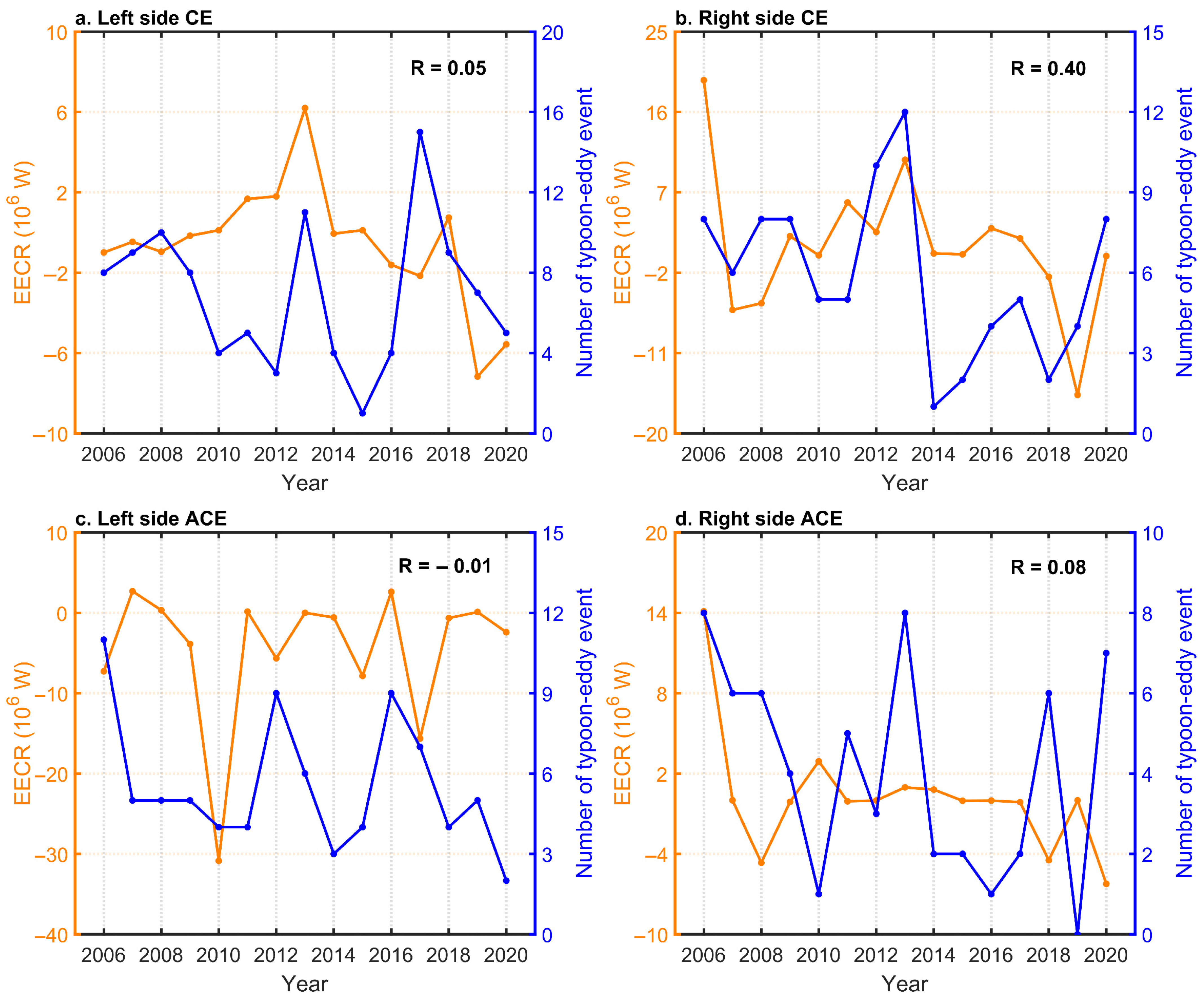
Figure 10 illustrates the relationship between eddy EECR and the number of four types of typhoon–eddy co-occurrence events. As shown in Figure 10a, the EECR of left-side CE events exhibits a “first increase and then decrease” pattern (increase before 2013 and decrease thereafter), while the corresponding event counts show pronounced variability. No significant correlation is found between the two variables (R = 0.05, p > 0.05). In Figure 10b, both the EECR and event counts for right-side CE events generally show a fluctuating decrease trend, with notable variations in 2013. A positive but weak correlation is observed (R = 0.40, p > 0.05).
Figure 10c indicates that the EECR of left-side ACE events exhibits considerable variability, with larger fluctuations in 2010 and 2017, whereas the event counts show an overall decrease trend with notable variations in 2012 and 2016. No significant correlation is found between the two variables (R = −0.01, p > 0.05). As shown in Figure 10d, the EECR of right-side ACE events exhibits a relatively smooth decrease trend, while the corresponding event counts also decrease overall but with pronounced fluctuations in 2013 and 2018. The correlation between the two variables is not significant (R = 0.08, p > 0.05).
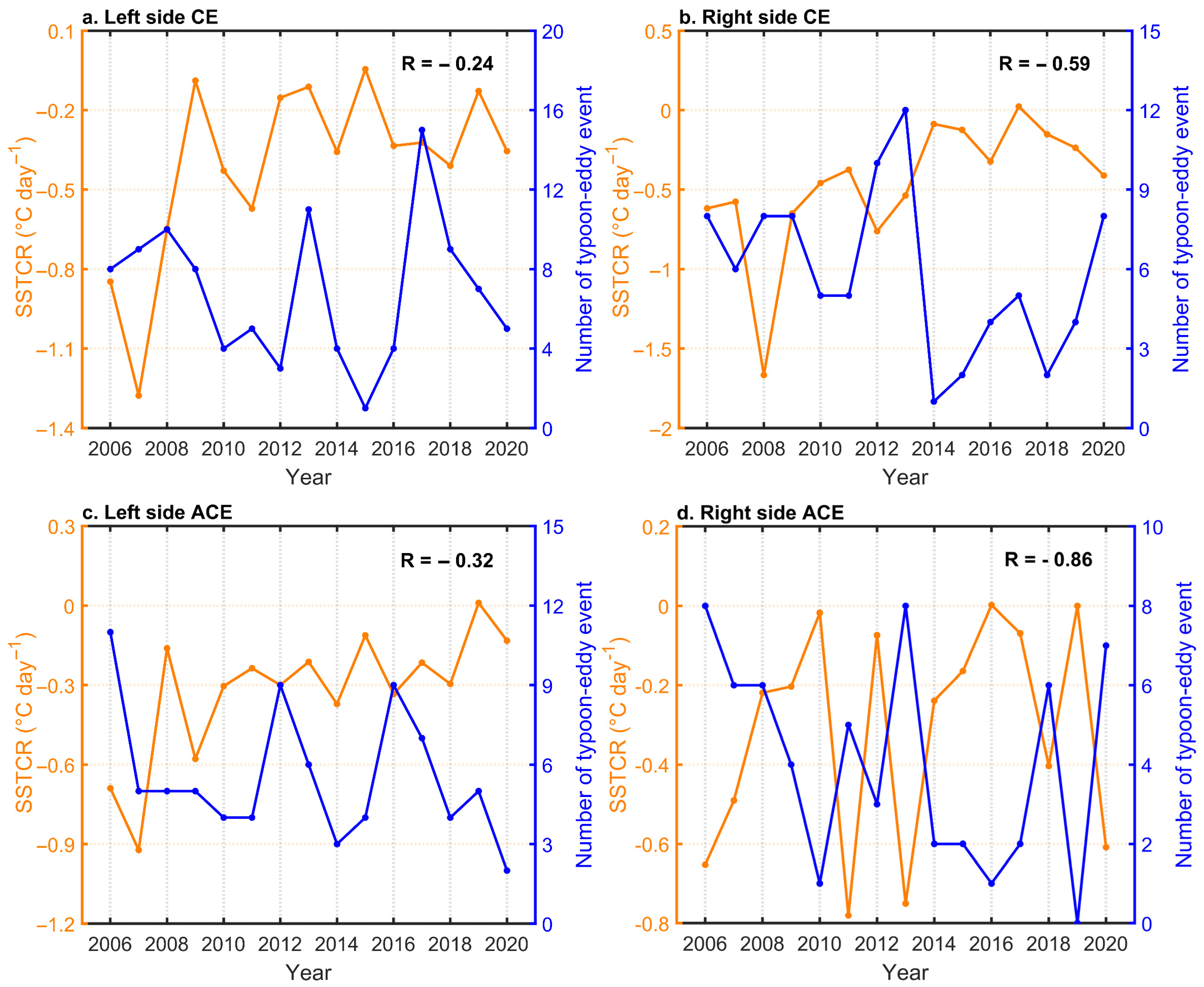
Figure 11 illustrates the relationship between eddy SSTCR and the number of four types of typhoon–eddy co-occurrence events. As shown in Figure 11a, the SSTCR of left-side CE events exhibits a fluctuating increase trend, while the corresponding event counts show pronounced variability. No significant correlation is found between the two variables (R = −0.24, p > 0.05). In Figure 11b, the SSTCR of right-side CE events shows a fluctuating increase trend, whereas the event counts exhibit a fluctuating decrease trend, with notable variations in 2013. A significant negative correlation is observed (R = −0.59, p < 0.05).
Figure 11c indicates that the SSTCR of left-side ACE events exhibits a fluctuating increase trend, while the event counts show an overall decrease trend with pronounced fluctuations in 2012 and 2016. A negative but weak correlation is found between the two variables (R = −0.32, p > 0.05). As shown in Figure 11d, the SSTCR of right-side ACE events exhibits a fluctuating increase trend, while the corresponding event counts also decrease overall, with relatively large variability. A significant negative correlation is observed (R = −0.86, p < 0.05).
Overall, PDI exhibits a positive correlation with the number of events across all four types of typhoon–eddy co-occurrence cases. In terms of the eddy energy response (EECR), the correlations with event number are generally weak, with only right-side CEs showing a weak positive relationship. For the eddy thermal response (SSTCR), negative correlations with event number are observed for most categories. Specifically, except for left-side CEs, which show no significant correlation, the other types (right-side CEs, left-side ACEs, and right-side ACEs) all exhibit varying degrees of negative correlation.

5.4. Sensitivity Analysis of Time-Window Selection

To evaluate the influence of time-window selection on the time-scale correlation analysis, in addition to the main analysis using a ±7-day window, we further performed the same analysis using ±5-day and ±10-day windows for comparison. The corresponding results are shown in Table 2.
Overall, the correlation results obtained under different time windows show a certain degree of consistency, although the magnitudes of the correlation coefficients vary. Compared with the ±7-day window, the ±5-day window generally yields lower correlation coefficients between typhoon PDI and eddy EECR, whereas the correlations between typhoon PDI and eddy SSTCR are slightly higher in some cases, although the overall differences are limited. This suggests that a shorter time window can reflect the rapid response around tropical cyclone passage, but may be insufficient to fully capture the adjustment and evolution of ocean eddies under tropical cyclone forcing. In contrast, under the ±10-day window, the correlation coefficients between typhoon PDI and both eddy EECR and SSTCR are generally lower than those obtained with the ±7-day window, indicating that an excessively long time window may introduce more background variability unrelated to the direct impact of tropical cyclones and thus weaken the identification of typhoon–eddy interaction signals. In addition, given that the time-scale correlations already show a weakening tendency under the ±10-day window, further extending the time window (e.g., to ±15 day) may introduce more background variability unrelated to the direct impact of typhoons. Therefore, no further extension of the analysis window was performed in this study.
Taken together, these comparisons suggest that the ±5-day window may be insufficient to fully characterize the eddy response before and after tropical cyclone passage, whereas the ±10-day window may include additional background signals. By comparison, the ±7-day window provides a relatively reasonable balance between capturing the evolution of eddy responses around tropical cyclone forcing and limiting the inclusion of unrelated variability. Therefore, the ±7-day window was adopted as the primary analysis window in this study, while the ±5-day and ±10-day results are presented as sensitivity tests for comparison.

5.5. Direct Correlation Analysis of PDI with EECR and SSTCR

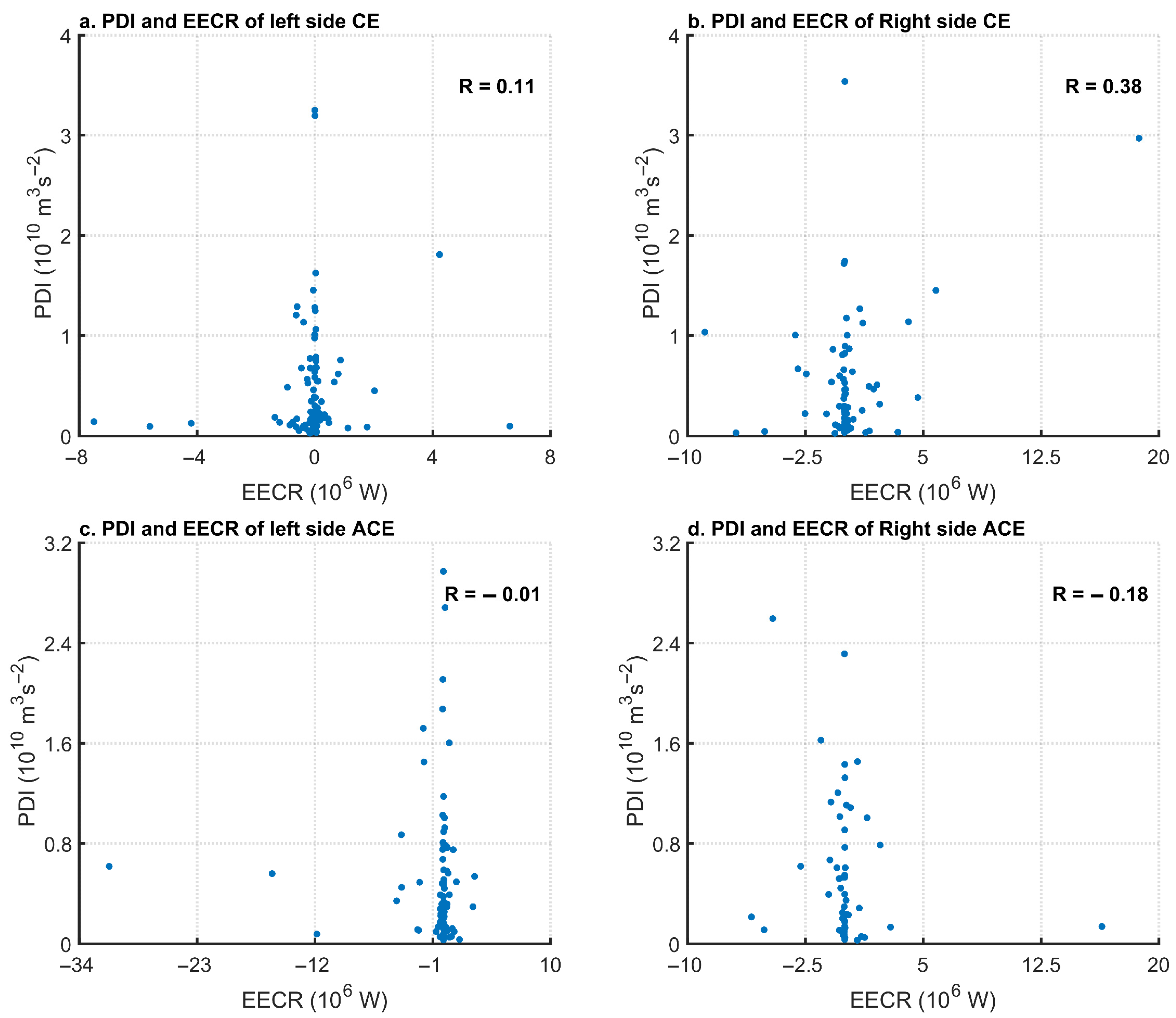
To further examine whether tropical cyclone PDI is directly related to eddy EECR and SSTCR, a direct correlation analysis was conducted at the individual-event level rather than using annual aggregation. The results are shown in Figure 12 and Figure 13.
Figure 12 shows the relationship between tropical cyclone PDI and eddy EECR. For the left-cyclonic-eddy cases (Figure 12a), most samples are clustered around EECR values close to zero, whereas the corresponding PDI values are widely scattered, indicating no significant correlation between the two variables (R = 0.11, p > 0.05). For the right-cyclonic-eddy cases (Figure 12b), most samples are distributed within the EECR range of −2.5 to 5, and PDI tends to increase slightly with increasing EECR, suggesting a significant but weak positive correlation (R = 0.38, p < 0.05). For the left-anticyclonic-eddy cases (Figure 12c), most samples are also concentrated around EECR values close to zero, while the PDI values remain highly dispersed, resulting in no significant correlation (R = −0.01, p > 0.05). For the right-anticyclonic-eddy cases (Figure 12d), although most samples fall within the EECR range of −2.5 to 5, a large proportion is still concentrated near EECR = 0, and no clear variation pattern is evident in PDI; therefore, no significant correlation is found in this case either (R = −0.18, p > 0.05).
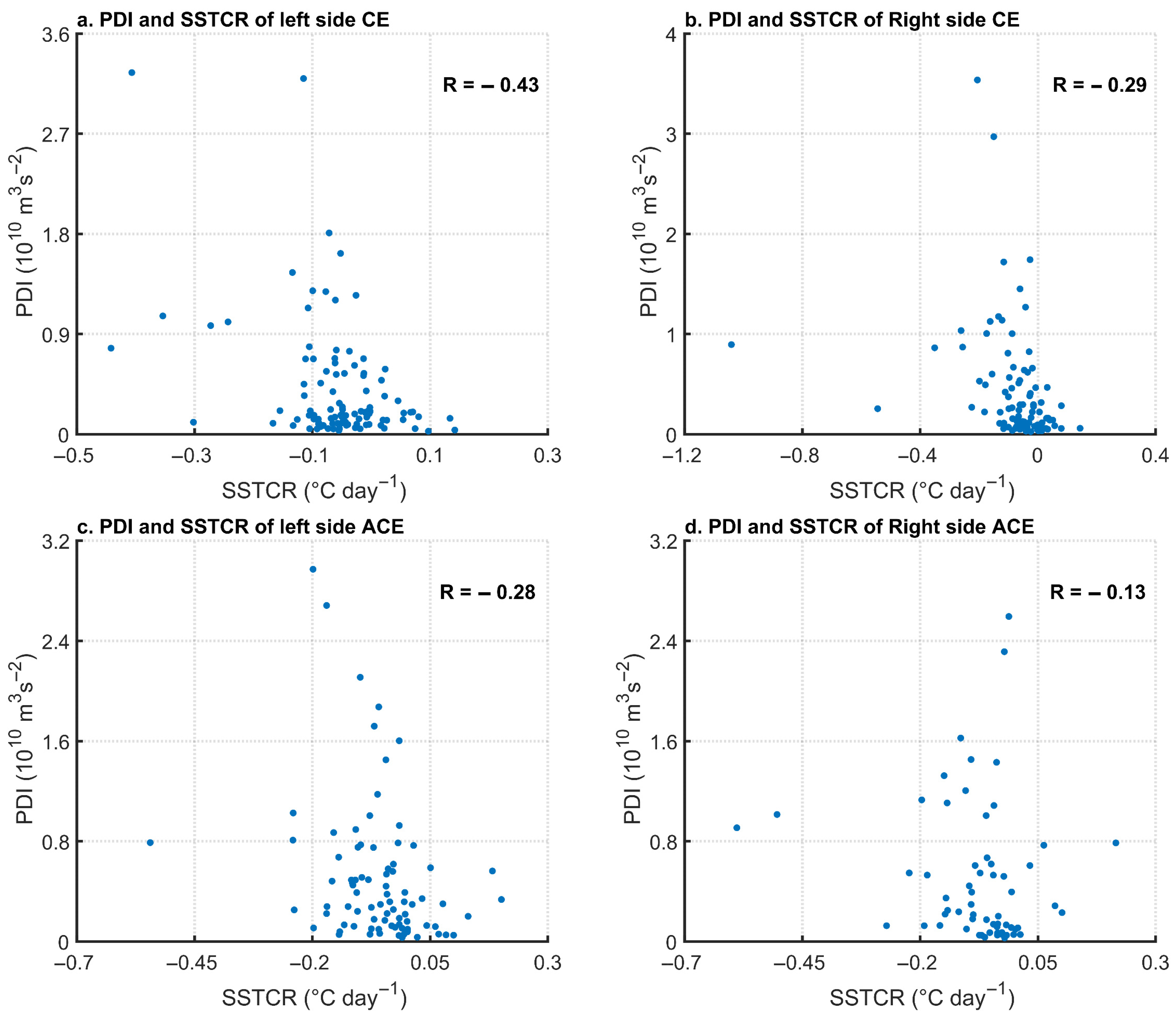
Figure 13 shows the relationship between tropical cyclone PDI and eddy SSTCR. For the left-cyclonic-eddy cases (Figure 13a), most samples are distributed within the SSTCR range of −0.1 to 0.1, and an overall decrease in PDI with increasing SSTCR can be identified, indicating a significant negative correlation (R = −0.43, p < 0.05). For the right-cyclonic-eddy cases (Figure 13b), most samples fall within the SSTCR range of −0.4 to 0, and PDI shows a slight decreasing tendency with increasing SSTCR, indicating a significant but weak negative correlation (R = −0.29, p < 0.05). For the left-anticyclonic-eddy cases (Figure 13c), most samples are distributed within the SSTCR range of −0.2 to 0.05, and PDI likewise tends to decrease with increasing SSTCR, yielding a significant but weak negative correlation (R = −0.28, p < 0.05). For the right-anticyclonic-eddy cases (Figure 13d), the samples are also mainly distributed within the SSTCR range of −0.2 to 0.05, but the PDI values are widely scattered, and no significant correlation is detected (R = −0.13, p > 0.05).
Overall, the direct event-based correlation analysis indicates that the relationships of tropical cyclone PDI with eddy EECR and SSTCR are generally weak, and statistical significance is reached only for some eddy categories. In contrast, the time-scale aggregated analysis (Section 5.1 and Section 5.2) yields relatively higher correlation coefficients. This suggests that the physical relationships reflected at different analysis scales are not entirely equivalent: the direct relationship at the event level is limited, whereas the time-scale correlation may reflect a broader integrated response under interannual variability. Therefore, these two types of correlations are discussed separately in the Section 6 to avoid interpreting time-scale statistical correspondence as a purely direct relationship between the variables.

6. Conclusions

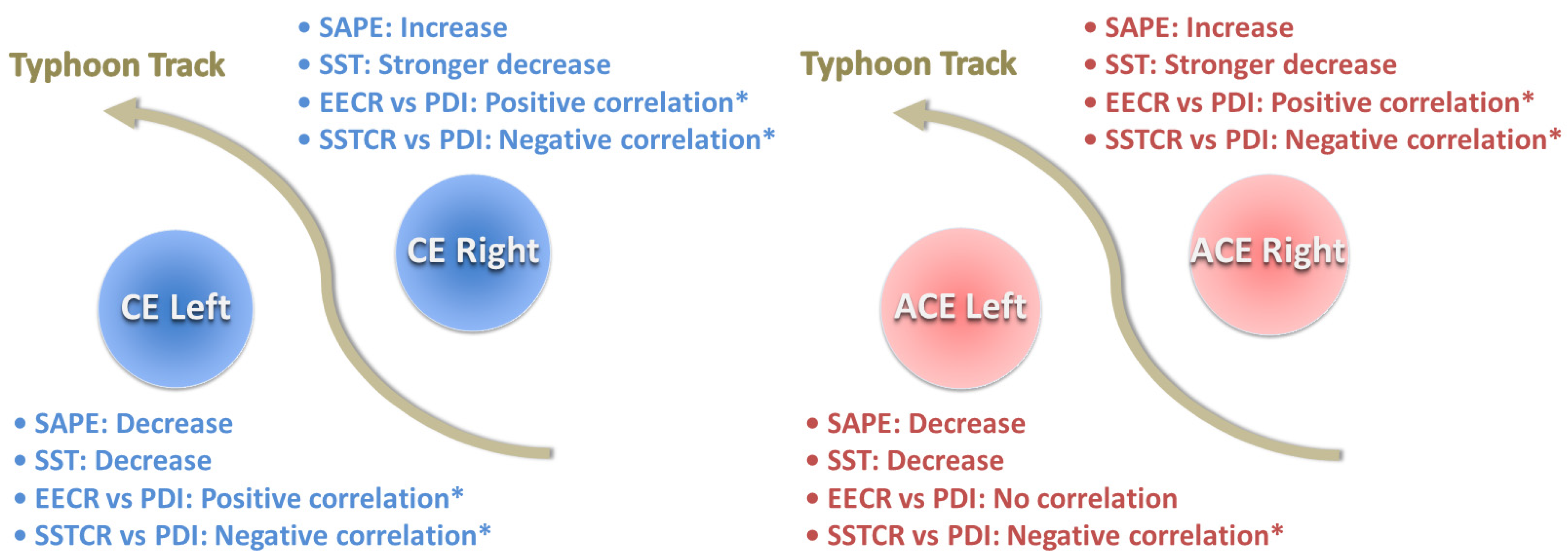
Using the 2006–2020 mesoscale eddy dataset and typhoon best-track records, we identified the typhoon–eddy co-occurrence events. Through composite and Pearson correlation analyses, we systematically examined the 7-day eddy responses before and after typhoon passage in the SCS from the perspectives of eddy energetics and thermodynamic state. The regulatory role of typhoon intensity in shaping these responses was also elucidated. Figure 14 summarizes the various responses and their associated asymmetries exhibited across the four categories of typhoon–eddy co-occurrence events identified in this study.
Composite analysis shows that left-side eddies weaken overall, with ACEs decaying more than CEs, whereas right-side eddies intensify, particularly CEs. This azimuth–polarity dual asymmetry in eddy energy response represents a newly identified pattern revealed by this study. Following typhoon passage, all four eddy categories experience significant net cooling, which is consistent with previous studies. Beyond this general cooling signal, our analysis further demonstrates that right-side eddies cool more strongly than left-side eddies. At the same lateral position, CEs exhibit stronger cool and post-event recovery than ACEs, underscoring the key role of eddy polarity in modulating thermal responses. Time-scale correlation analysis quantifies the relationship between typhoon PDI and eddy responses. This quantitative characterization of this intensity–response coupling adds a new dimension to a deeper understanding of eddy characteristics under typhoon forcing. EECR is positively correlated with PDI for left-side CEs, right-side CEs, and right-side ACEs, indicating stronger typhoons enhance (or reduce decay of) energy in these eddies, whereas left-side ACEs show no significant dependence. For thermal responses, SSTCR is negatively correlated with PDI for left-side CEs, right-side CEs, left-side ACEs, and right-side ACEs, implying stronger typhoons induce greater cooling. The sample-size correlation analysis shows that PDI is positively correlated with the number of events for all four eddy types. In contrast, the relationship between EECR and event number is generally weak, with only the right-side CEs showing a relatively more noticeable correlation. For SSTCR, negative correlations with event numbers are found for all eddy types except the left-side CEs. Direct correlation analysis indicates that the relationship between PDI and EECR is generally weak, with a significant positive correlation found only for the right-side CEs. For SSTCR, weak negative correlations with PDI are identified for the left-side CEs, right-side CEs, and left-side ACEs, while no significant relationship is found for the right-side ACEs.
In summary, typhoon passage significantly perturbs the energy structure and SST fields of mesoscale eddies in the SCS, and the eddy responses exhibit pronounced “position-polarity” asymmetry. Although the energetic and thermal responses of the four eddy categories are not perfectly synchronized with typhoon intensity, typhoons remain the dominant driver of eddy energy variability and SST anomalies. This study provides observational constraints on how pre-existing mesoscale eddies in the SCS respond to tropical cyclone forcing, highlighting the systematic dependence of eddy energy and thermal responses on track-relative position and eddy polarity. By characterizing the asymmetric nature of typhoon-induced eddy responses, our results contribute to a clearer interpretation of observed oceanic variability associated with tropical cyclone passages in marginal seas.
It should be noted that the applicability of the present findings may be influenced by the unique environmental conditions of the SCS, which differs from the open ocean in several important aspects. First, water depth plays a crucial role in regulating eddy evolution. In relatively shallow marginal seas, enhanced bottom friction and stronger topographic constraints may accelerate the decay of eddy energy. As a result, the decline rate of SAPE in shallow regions may be faster than that in the deep open ocean, potentially leading to differences in composite and correlation analyses of SAPE responses. Second, the SCS is characterized by strong seasonal stratification and complex bathymetry, including extensive continental shelves and steep slopes. These factors can modulate the vertical mixing induced by typhoon forcing and alter the balance between dynamical intensification and thermally driven contraction of eddies. In contrast, in deep open-ocean basins where stratification structure and bottom influence differ, the relative contributions of wind-driven Ekman pumping and steric effects may vary. Furthermore, the SCS is a semi-enclosed basin influenced by monsoonal circulation and intermittent Kuroshio intrusion, which may precondition eddy structures prior to typhoon passage. Therefore, while the asymmetric responses identified in this study may reflect general dynamical processes associated with tropical cyclone forcing, the quantitative magnitude of eddy energy and temperature changes should be interpreted with caution when extending these conclusions to other oceanic regions. Future comparative studies across different basins would be valuable to assess the universality of the dual-asymmetry pattern reported here.
Additional clarification on eddy SAPE is needed. In this study, SAPE is estimated using a fixed-density, two-dimensional surface framework, which may not fully capture typhoon-induced vertical mixing and stratification changes that modify eddy baroclinic structure. This assumption could underestimate vertical energy redistribution. However, as the South China Sea is a semi-enclosed marginal sea with relatively stable background density conditions, and SAPE (~1012 J) shows only modest variability. Therefore, at the regional statistical scale considered here, the fixed-density assumption is unlikely to affect the main conclusions. Nonetheless, resolving three-dimensional energy redistribution during typhoon events requires full-depth observations or numerical simulations in future work. Furthermore, the spatiotemporal matching method can be further improved. The cyclone propagation direction is currently determined using the displacement between the interaction day and the following day, which is adequate for statistical purposes. However, short-term track curvature may introduce uncertainty. Future work will incorporate ±12 h or higher-resolution averaged tracks to enhance robustness.
In addition to expanding the geographical scope, further investigating eddy SAPE characteristics, and improving the matching algorithm, future studies should also further elucidate the underlying physical mechanisms governing typhoon-induced eddy variability across different forcing conditions. Specifically, future work may further examine the contrasting responses of eddies located inside versus outside the tropical cyclone wind field, with particular emphasis on resolving the physical processes underlying the observed energetic and thermal adjustments. Systematic classification and quantification of these track-relative differences will help refine conceptual frameworks for interpreting typhoon-induced oceanic responses and support more detailed investigations of eddy–typhoon interactions in both observational and modeling studies.

Author Contributions

Conceptualization, G.X., H.X. and D.F.; data curation, J.W.; formal analysis, J.W. and G.X.; funding acquisition, G.X. and D.F.; investigation, J.W., Y.S. and S.Z.; methodology, J.W., S.Z. and G.X.; writing—original draft, J.W.; writing—review and editing, J.W., S.Z., G.X., H.X. and D.F. All authors have read and agreed to the published version of the manuscript.

Funding

This research was funded by the National Key Research and Development Program of China (2023YFC3008200), and the Open Fund Project of Key Laboratory of Marine Environmental Information Technology, Ministry of Natural Resources of the People’s Republic of China.

Data Availability Statement

Publicly available datasets were analyzed in this study. The best-track tropical cyclone dataset can be found here: https://tcdata.typhoon.org.cn/ (accessed on 1 March 2025). The global mesoscale eddy trajectory atlas can be found here: https://www.aviso.altimetry.fr/ (accessed on 1 March 2025). The SST data can be found here: https://www.remss.com/ (accessed on 1 March 2025).

Conflicts of Interest

The authors declare that they have no known competing financial interests or personal relationships that could have appeared to influence the work reported in this paper.

References

  1. Liu, Q.; Kaneko, A.; Jilan, S. Recent Progress in Studies of the South China Sea Circulation. J. Oceanogr. 2008, 64, 753–762. [Google Scholar] [CrossRef]
  2. Xiu, P.; Chai, F.; Shi, L.; Xue, H.; Chao, Y. A Census of Eddy Activities in the South China Sea during 1993–2007. J. Geophys. Res. Oceans 2010, 115, 2009JC005657. [Google Scholar] [CrossRef]
  3. He, Q.; Zhan, H.; Cai, S.; He, Y.; Huang, G.; Zhan, W. A New Assessment of Mesoscale Eddies in the South China Sea: Surface Features, Three-Dimensional Structures, and Thermohaline Transports. J. Geophys. Res. Oceans 2018, 123, 4906–4929. [Google Scholar] [CrossRef]
  4. Wang, H.; Du, Y.; Liang, F.; Sun, Y.; Yi, J. A Census of the 1993–2016 Complex Mesoscale Eddy Processes in the South China Sea. Water 2019, 11, 1208. [Google Scholar] [CrossRef]
  5. Wang, G.; Su, J.; Ding, Y.; Chen, D. Tropical Cyclone Genesis over the South China Sea. J. Mar. Syst. 2007, 68, 318–326. [Google Scholar] [CrossRef]
  6. Le, M.D.; Vlasova, G.; Nguyen, D.T.T. Distribution Features of the Typhoons in the South China Sea. Russ. J. Earth Sci. 2021, 21, 1–8. [Google Scholar] [CrossRef]
  7. Xu, J.; Wang, Y.; Tan, Z.-M. The Relationship between Sea Surface Temperature and Maximum Intensification Rate of Tropical Cyclones in the North Atlantic. J. Atmos. Sci. 2016, 73, 4979–4988. [Google Scholar] [CrossRef]
  8. Ma, Z.; Fei, J.; Liu, L.; Huang, X.; Li, Y. An Investigation of the Influences of Mesoscale Ocean Eddies on Tropical Cyclone Intensities. Mon. Weather Rev. 2017, 145, 1181–1201. [Google Scholar] [CrossRef]
  9. Hu, J.; Kawamura, H. Detection of Cyclonic Eddy Generated by Looping Tropical Cyclone in the Northern South China Sea: A Case Study. Acta Oceanolog. Sin. 2004, 23, 213–224. [Google Scholar]
  10. Sun, L.; Li, Y.; Yang, Y.; Wu, Q.; Chen, X.; Li, Q.; Li, Y.; Xian, T. Effects of Super Typhoons on Cyclonic Ocean Eddies in the Western North Pacific: A Satellite Data-based Evaluation between 2000 and 2008. J. Geophys. Res. Oceans 2014, 119, 5585–5598. [Google Scholar] [CrossRef]
  11. Li, J.; Yang, Y.; Wang, G.; Cheng, H.; Sun, L. Enhanced Oceanic Environmental Responses and Feedbacks to Super Typhoon Nida (2009) during the Sudden-Turning Stage. Remote Sens. 2021, 13, 2648. [Google Scholar] [CrossRef]
  12. Lu, Z.; Wang, G.; Shang, X. Response of a Preexisting Cyclonic Ocean Eddy to a Typhoon. J. Phys. Oceanogr. 2016, 46, 2403–2410. [Google Scholar] [CrossRef]
  13. Yu, F.; Yang, Q.; Chen, G.; Li, Q. The Response of Cyclonic Eddies to Typhoons Based on Satellite Remote Sensing Data for 2001–2014 from the South China Sea. Oceanologia 2019, 61, 265–275. [Google Scholar] [CrossRef]
  14. Zhang, Y.; Zhang, Z.; Chen, D.; Qiu, B.; Wang, W. Strengthening of the Kuroshio Current by Intensifying Tropical Cyclones. Science 2020, 368, 988–993. [Google Scholar] [CrossRef]
  15. Ma, Z.; Zhang, Z.; Fei, J.; Wang, H. Imprints of Tropical Cyclones on Structural Characteristics of Mesoscale Oceanic Eddies Over the Western North Pacific. Geophys. Res. Lett. 2021, 48, e2021GL092601. [Google Scholar] [CrossRef]
  16. Ni, X.; Zhang, Y.; Wang, W. Hurricane Influence on the Oceanic Eddies in the Gulf Stream Region. Nat. Commun. 2025, 16, 583. [Google Scholar] [CrossRef]
  17. Ma, Z.; Fei, J.; Huang, X.; Cheng, X. Modulating Effects of Mesoscale Oceanic Eddies on Sea Surface Temperature Response to Tropical Cyclones Over the Western North Pacific. J. Geophys. Res.: Atmos. 2018, 123, 367–379. [Google Scholar] [CrossRef]
  18. Li, J.; Zhang, H.; Liu, S.; Wang, X.; Sun, L. The Response and Feedback of Ocean Mesoscale Eddies to Four Sequential Typhoons in 2014 Based on Multiple Satellite Observations and Argo Floats. Remote Sens. 2021, 13, 3805. [Google Scholar] [CrossRef]
  19. Yu, J.; Lin, S.; Jiang, Y.; Wang, Y. Modulation of Typhoon-Induced Sea Surface Cooling by Preexisting Eddies in the South China Sea. Water 2021, 13, 653. [Google Scholar] [CrossRef]
  20. Zheng, Z.; Ho, C.; Zheng, Q.; Lo, Y.; Kuo, N.; Gopalakrishnan, G. Effects of Preexisting Cyclonic Eddies on Upper Ocean Responses to Category 5 Typhoons in the Western North Pacific. J. Geophys. Res. Oceans 2010, 115, 2009JC005562. [Google Scholar] [CrossRef]
  21. Ning, J.; Xu, Q.; Zhang, H.; Wang, T.; Fan, K. Impact of Cyclonic Ocean Eddies on Upper Ocean Thermodynamic Response to Typhoon Soudelor. Remote Sens. 2019, 11, 938. [Google Scholar] [CrossRef]
  22. Wada, A. Roles of Oceanic Mesoscale Eddy in Rapid Weakening of Typhoons Trami and Kong-Rey in 2018 Simulated with a 2-Km-Mesh Atmosphere-Wave-Ocean Coupled Model. J. Meteorolog. Soc. Jpn. 2021, 99, 1453–1482. [Google Scholar] [CrossRef]
  23. Li, X.; Cheng, X.; Fei, J.; Huang, X. A Numerical Study on the Role of Mesoscale Cold-Core Eddies in Modulating the Upper-Ocean Responses to Typhoon Trami (2018). J. Phys. Oceanogr. 2022, 52, 3101–3122. [Google Scholar] [CrossRef]
  24. Lin, I.-I.; Wu, C.-C.; Emanuel, K.A.; Lee, I.-H.; Wu, C.-R.; Pun, I.-F. The Interaction of Supertyphoon Maemi (2003) with a Warm Ocean Eddy. Mon. Weather Rev. 2005, 133, 2635–2649. [Google Scholar] [CrossRef]
  25. Wu, C.-C.; Lee, C.-Y.; Lin, I.-I. The Effect of the Ocean Eddy on Tropical Cyclone Intensity. J. Atmos. Sci. 2007, 64, 3562–3578. [Google Scholar] [CrossRef]
  26. Wang, G.; Zhao, B.; Qiao, F.; Zhao, C. Rapid Intensification of Super Typhoon Haiyan: The Important Role of a Warm-Core Ocean Eddy. Ocean Dyn. 2018, 68, 1649–1661. [Google Scholar] [CrossRef]
  27. Sun, J.; Wang, G.; Xiong, X.; Hui, Z.; Hu, X.; Ling, Z.; Yu, L.; Yang, G.; Guo, Y.; Ju, X.; et al. Impact of Warm Mesoscale Eddy on Tropical Cyclone Intensity. Acta Oceanolog. Sin. 2020, 39, 1–13. [Google Scholar] [CrossRef]
  28. Ying, M.; Zhang, W.; Yu, H.; Lu, X.; Feng, J.; Fan, Y.; Zhu, Y.; Chen, D. An Overview of the China Meteorological Administration Tropical Cyclone Database. J. Atmos. Ocean. Technol. 2014, 31, 287–301. [Google Scholar] [CrossRef]
  29. Lu, X.; Yu, H.; Ying, M.; Zhao, B.; Zhang, S.; Lin, L.; Bai, L.; Wan, R. Western North Pacific Tropical Cyclone Database Created by the China Meteorological Administration. Adv. Atmos. Sci. 2021, 38, 690–699. [Google Scholar] [CrossRef]
  30. Mason, E.; Pascual, A.; McWilliams, J.C. A New Sea Surface Height–Based Code for Oceanic Mesoscale Eddy Tracking. J. Atmos. Ocean. Technol. 2014, 31, 1181–1188. [Google Scholar] [CrossRef]
  31. Pegliasco, C.; Delepoulle, A.; Mason, E.; Morrow, R.; Faugère, Y.; Dibarboure, G. META3.1exp: A New Global Mesoscale Eddy Trajectory Atlas Derived from Altimetry. Earth Syst. Sci. Data 2022, 14, 1087–1107. [Google Scholar] [CrossRef]
  32. Wentz, F.J.; Gentemann, C.; Smith, D.; Chelton, D. Satellite Measurements of Sea Surface Temperature Through Clouds. Science 2000, 288, 847–850. [Google Scholar] [CrossRef]
  33. Emanuel, K. Increasing Destructiveness of Tropical Cyclones over the Past 30 Years. Nature 2005, 436, 686–688. [Google Scholar] [CrossRef]
  34. Xu, C.; Shang, X.-D.; Huang, R.X. Estimate of Eddy Energy Generation/Dissipation Rate in the World Ocean from Altimetry Data. Ocean Dyn. 2011, 61, 525–541. [Google Scholar] [CrossRef]
  35. Luecke, C.A.; Arbic, B.K.; Bassette, S.L.; Richman, J.G.; Shriver, J.F.; Alford, M.H.; Smedstad, O.M.; Timko, P.G.; Trossman, D.S.; Wallcraft, A.J. The Global Mesoscale Eddy Available Potential Energy Field in Models and Observations. J. Geophys. Res. Ocean. 2017, 122, 9126–9143. [Google Scholar] [CrossRef]
  36. Zhang, Z.; Tian, J.; Qiu, B.; Zhao, W.; Chang, P.; Wu, D.; Wan, X. Observed 3D Structure, Generation, and Dissipation of Oceanic Mesoscale Eddies in the South China Sea. Sci. Rep. 2016, 6, 24349. [Google Scholar] [CrossRef] [PubMed]
  37. Jin, Y.; Jin, M.; Wang, D.; Dong, C. Statistical Analysis of Multi-Year South China Sea Eddies and Exploration of Eddy Classification. Remote Sens. 2024, 16, 1818. [Google Scholar] [CrossRef]
  38. Fan, B.; Qin, Z.; Wang, X.; Li, R. Spatiotemporal Characteristics of Mesoscale Eddies in the South China Sea and the Influence Mechanism of Eddy Kinetic Energy. Atmospheric Research 2024, 310, 107652. [Google Scholar] [CrossRef]

  39. Price, J.F. Upper Ocean Response to a Hurricane. J. Phys. Oceanogr. 1981, 11, 153–175. [Google Scholar] [CrossRef]
  40. Monaldo, F.M.; Sikora, T.D.; Babin, S.M.; Sterner, R.E. Satellite Imagery of Sea Surface Temperature Cooling in the Wake of Hurricane Edouard (1996). Mon. Weather Rev. 1997, 125, 2716–2721. [Google Scholar] [CrossRef]
  41. Lin, I.; Liu, W.T.; Wu, C.; Wong, G.T.F.; Hu, C.; Chen, Z.; Liang, W.; Yang, Y.; Liu, K. New Evidence for Enhanced Ocean Primary Production Triggered by Tropical Cyclone. Geophys. Res. Lett. 2003, 30, 2003GL017141. [Google Scholar] [CrossRef]
  42. Walker, N.D.; Leben, R.R.; Balasubramanian, S. Hurricane-forced Upwelling and Chlorophyll a Enhancement within Cold-core Cyclones in the Gulf of Mexico. Geophys. Res. Lett. 2005, 32, 2005GL023716. [Google Scholar] [CrossRef]
  43. Zheng, Z.; Ho, C.; Kuo, N. Importance of Pre-existing Oceanic Conditions to Upper Ocean Response Induced by Super Typhoon Hai-Tang. Geophys. Res. Lett. 2008, 35, 2008GL035524. [Google Scholar] [CrossRef]
  44. He, Y.; Lin, X.; Han, G.; Liu, Y.; Zhang, H. The Different Dynamic Influences of Typhoon Kalmaegi on Two Pre-Existing Anticyclonic Ocean Eddies. Ocean Sci. 2024, 20, 621–637. [Google Scholar] [CrossRef]
  45. Peng, Y.; Tian, D.; Zhou, F.; Zhang, H.; Yuan, S.; Chen, Z.; Ye, R. Reflections of Tropical Cyclone-Generated near-Inertial Internal Waves within an Anticyclonic Eddy in the Southern Bay of Bengal. Deep. Sea Res. Part I Oceanogr. Res. Pap. 2025, 224, 104576. [Google Scholar] [CrossRef]
  46. Son, J.-H.; Heo, K.-Y.; Choi, J.-W.; Kwon, J. Long-Lasting Upper Ocean Temperature Responses Induced by Intense Typhoons in Mid-Latitude. Sci. Rep. 2022, 12, 5752. [Google Scholar] [CrossRef]
  47. D’Asaro, E.A.; Sanford, T.B.; Niiler, P.P.; Terrill, E.J. Cold Wake of Hurricane Frances. Geophys. Res. Lett. 2007, 34, 2007GL030160. [Google Scholar] [CrossRef]
  48. Huipeng, W.; Jiagen, L.; Junqiang, S.; Hongze, L.; Kaijun, R.; Huizan, W.; Ze, Z.; Hanshi, W.; Chunming, W.; Jie, Y.; et al. Different Mechanisms for Enhanced Ocean Response and Feedback during Sequential Super Typhoons. Deep Sea Res. Part I Oceanogr. Res. Pap. 2024, 210, 104351. [Google Scholar] [CrossRef]
  49. He, S.; Cheng, X.; Fei, J.; Li, X.; Wei, Z.; Huang, X. Thermal Response to Sequential Tropical Cyclone Passages: Statistic Analysis and Idealized Experiments. Front. Earth Sci. 2023, 11, 1142537. [Google Scholar] [CrossRef]
  50. Ni, Q.; Zhai, X.; Yang, Z.; Chen, D. Generation of Cold Anticyclonic Eddies and Warm Cyclonic Eddies in the Tropical Oceans. J. Phys. Oceanogr. 2023, 53, 1485–1498. [Google Scholar] [CrossRef]
Figure 1. Schematic illustration of the method used to determine the relative position of mesoscale eddies with respect to a tropical cyclone track. Point A denotes the typhoon center on the encounter day, point B denotes the typhoon center on the day after the encounter, and point P denotes the eddy center on the encounter day. The relative position of the eddy is determined based on the sign of the cross product between vectors AB (red arrow) and AP (green arrow).
Jmse 14 00699 g001
Figure 2. Typhoon passage in the Northwestern Pacific and the SCS and encounters with oceanic eddies (2006–2020). The green bars indicate the number of tropical cyclones passing through the Northwest Pacific (NWP), the orange bars indicate those passing through the South China Sea (SCS), and the purple bars indicate the number of tropical cyclones that pass through the SCS and interact with oceanic eddies (Eddy).
Jmse 14 00699 g002
Figure 3. Comparison of SAPE evolution for four categories of typhoon–eddy co-occurrence events during the 7-day period before and after typhoon passage. (a) Variations in SAPE during the 7 days before and after typhoon passage over the SCS from 2006 to 2020. The red line represents left-side CEs, the blue line represents right-side CEs, the purple line represents left-side ACEs, and the green line represents right-side ACEs. (b) Same as (a), but normalized SAPE is shown for the four categories of typhoon–eddy events. Each subplot includes the event classification legend in the upper right corner. In (a), the solid lines represent the mean SAPE values of different types of eddies obtained from the composite analysis.
Jmse 14 00699 g003
Figure 4. Comparison of SST evolution for four categories of typhoon–eddy co-occurrence events during the 7-day period before and after typhoon passage. (a) Variations in SST during the 7 days before and after typhoon passage over the SCS from 2006 to 2020. The red line denotes left-side CEs, the blue line denotes right-side CEs, the purple line denotes left-side ACEs, and the green line denotes right-side ACEs. (b) Same as (a), but with demeaned SST for the four categories of typhoon–eddy events. Each subplot includes the classification legend for the four event types in the upper right corner. In (a), the solid lines represent the mean SST values of different types of eddies obtained from the composite analysis.
Jmse 14 00699 g004
Figure 5. Comparison of typhoon intensity and EECR of CEs during the 7-day period before and after typhoon passage. (a) Total typhoon PDI (1010 m3 s−2, orange) after typhoon passage over the SCS and subsequently interacted with left-sided CE from 2006 to 2020, together with the total EECR (106 W, blue) of left-side CEs during the 7 days before and after typhoon–eddy encounters. (b) Same as (a), but for the right-side CEs (106 W, blue). The correlation coefficient R is shown in the upper-right corner of each panel.
Jmse 14 00699 g005
Figure 6. Comparison of typhoon intensity and EECR of ACEs during the 7-day period before and after typhoon passage. (a) Total typhoon PDI (1010 m3 s−2, orange) after typhoon passage over the SCS and subsequently interacted with left-sided ACE from 2006 to 2020, together with the total EECR (106 W, blue) of left-side ACEs during the 7 days before and after the encounters. (b) Same as (a), but for the right-side ACEs (106 W, blue). The correlation coefficient R is indicated in the upper-right corner of each panel.
Jmse 14 00699 g006
Figure 7. Comparison of typhoon intensity and SSTCR of CEs during the 7-day period before and after typhoon passage. (a) Total typhoon PDI (1010 m3 s−2, orange) after typhoon passage over the SCS and subsequently interacted with left-sided CE from 2006 to 2020, together with the total SSTCR (°C day−1, blue) of left-side CEs during the 7 days before and after the encounters. (b) Same as (a), but for the right-side CEs (°C day−1, blue). The correlation coefficient R is shown in the upper-right corner of each panel.
Jmse 14 00699 g007
Figure 8. Comparison of typhoon intensity and SSTCR of ACEs during the 7-day period before and after typhoon passage. (a) Total typhoon PDI (1010 m3 s−2, orange) after typhoon passage over the SCS and subsequently interacted with left-sided ACE from 2006 to 2020, together with the total SSTCR (°C day−1, blue) of left-side ACEs during the 7 days before and after the encounters. (b) Same as (a), but for the right-side ACEs (°C day−1, blue). The correlation coefficient R is shown in the upper-right corner of each panel.
Jmse 14 00699 g008
Figure 9. Comparison between tropical cyclone PDI and the number of typhoon–eddy co-occurrence events. (a) PDI (1010 m3 s−2, orange) and the corresponding number of left-side CE co-occurrence events (blue) during 2006–2020; (bd) same as (a), but for right-side CEs (b), left-side ACEs (c), and right-side ACEs (d), respectively. The correlation coefficient R is shown in the upper-right corner of each panel.
Jmse 14 00699 g009
Figure 10. Comparison between eddy EECR and the number of typhoon–eddy co-occurrence events within 7 days before and after typhoon passage. (a) EECR (106 W, orange) and the corresponding number of left-side CE co-occurrence events (blue) during 2006–2020; (bd) same as (a), but for right-side CEs (b), left-side ACEs (c), and right-side ACEs (d), respectively. The correlation coefficient R is shown in the upper-right corner of each panel.
Jmse 14 00699 g010
Figure 11. Comparison between eddy SSTCR and the number of typhoon–eddy co-occurrence events within 7 days before and after typhoon passage. (a) SSTCR (°C day−1, orange) and the corresponding number of left-side CE co-occurrence events (blue) during 2006–2020; (bd) same as (a), but for right-side CEs (b), left-side ACEs (c), and right-side ACEs (d), respectively. The correlation coefficient R is shown in the upper-right corner of each panel.
Jmse 14 00699 g011
Figure 12. Comparison of typhoon PDI and EECR of eddies during the 7-day period before and after typhoon passage. (a) The correlation between typhoon PDI and the corresponding EECR for left-side CE events. (bd) same as (a), but for right-side CEs (b), left-side ACEs (c), and right-side ACEs (d), respectively. The correlation coefficient R is shown in the upper-right corner of each panel.
Jmse 14 00699 g012
Figure 13. Comparison of typhoon PDI and SSTCR of eddies during the 7-day period before and after typhoon passage. (a) The correlation between typhoon PDI and the corresponding SSTCR for left-side CE events. (bd) same as (a), but for right-side CEs (b), left-side ACEs (c), and right-side ACEs (d), respectively. The correlation coefficient R is shown in the upper-right corner of each panel.
Jmse 14 00699 g013
Figure 14. Schematic of asymmetric responses of pre-existing mesoscale eddies to typhoon forcing. Blue circles represent CEs, red circles represent ACEs, while tan curved arrows indicate the typhoon tracks. The asterisk (*) in the figure indicates a correlation between the two variables.
Jmse 14 00699 g014
Table 1. Statistics of annual typhoon–eddy co-occurrence events from 2006 to 2020.
YearCE_LeftCE_RightACE_LeftACE_Right
200688118
20079656
200810856
20098854
20104541
20115545
201231093
2013111268
20144132
20151242
20164491
201715572
20189246
20197450
20205827
Table 2. Time-scale correlation analysis results under different time windows (±5, ±7, and ±10 days).
Comparison ObjectEvent Type±5-Day±7-Day±10-Day
PDI vs. EECRCE_LeftR = 0.48,
p = 0.07
R = 0.40,
p = 0.14
R = 0.24,
p = 0.40
CE_RightR = −0.10,
p = 0.72
R = 0.64,
p = 0.01
R = 0.33,
p = 0.22
ACE_LeftR = −0.01,
p = 0.98
R = −0.06,
p = 0.82
R = −0.04,
p = 0.88
ACE_RightR = 0.47,
p = 0.08
R = 0.52,
p = 0.04
R = 0.26,
p = 0.36
PDI vs. SSTCRCE_LeftR = −0.43,
p = 0.11
R = −0.39,
p = 0.15
R = −0.29,
p = 0.30
CE_RightR = −0.63,
p = 0.01
R = −0.43,
p = 0.11
R = −0.34,
p = 0.21
ACE_LeftR = −0.57,
p = 0.03
R = −0.56,
p = 0.03
R = −0.37,
p = 0.18
ACE_RightR = −0.62,
p = 0.01
R = −0.63,
p = 0.01
R = −0.61,
p = 0.02
Disclaimer/Publisher’s Note: The statements, opinions and data contained in all publications are solely those of the individual author(s) and contributor(s) and not of MDPI and/or the editor(s). MDPI and/or the editor(s) disclaim responsibility for any injury to people or property resulting from any ideas, methods, instructions or products referred to in the content.