Review

Dynamic Response of the Towing System for Different Seabed Topography Conditions
1
Ship and Maritime College, Guangdong Ocean University, Zhanjiang 524088, China
2
School of Electronics and Information Engineering, Guangdong Ocean University, Zhanjiang 524088, China
3
Faculty of Maritime and Transportation, Ningbo University, Ningbo 315211, China
*
Author to whom correspondence should be addressed.
J. Mar. Sci. Eng. 2026, 14(8), 696; https://doi.org/10.3390/jmse14080696
Submission received: 5 March 2026 / Revised: 4 April 2026 / Accepted: 5 April 2026 / Published: 8 April 2026

Abstract

The safe and efficient operation of deep-sea towing systems is heavily governed by the highly nonlinear dynamic interaction between the flexible towing cable and complex seabed topographies. While existing studies accurately predict cable dynamics in mid-water or over flat seabeds, the transient responses—such as local stress concentrations and extreme tension fluctuations—induced by discontinuous topographies (e.g., stepped or 3D irregular seabeds) remain inadequately quantified. In this study, we develop an advanced 3D dynamic numerical model combining the lumped-mass finite element formulation with a modified non-linear penalty-based seabed-contact mechanics algorithm. This framework systematically evaluates the tension distribution, bending curvature, and spatial configuration shifts in the cable during the touchdown and detachment phases across inclined, stepped, and 3D seabeds. Quantitative validation against established benchmarks demonstrates robust accuracy. Results indicate that steeper seabed inclinations linearly reduce detachment time but exponentially amplify initial contact tension. Over-stepped terrains, “point-to-line” transient collisions trigger sudden tension spikes exceeding steady-state values by up to 45%. Furthermore, 3D irregular seabeds induce severe multi-directional spatial deformations, precipitating destructive whiplash effects at high towing speeds (e.g., V > 2.2 m/s). These findings provide critical physical insights and a quantitative reference for optimizing tugboat maneuvering strategies and designing fatigue-resistant cables in complex sub-sea environments.

1. Introduction

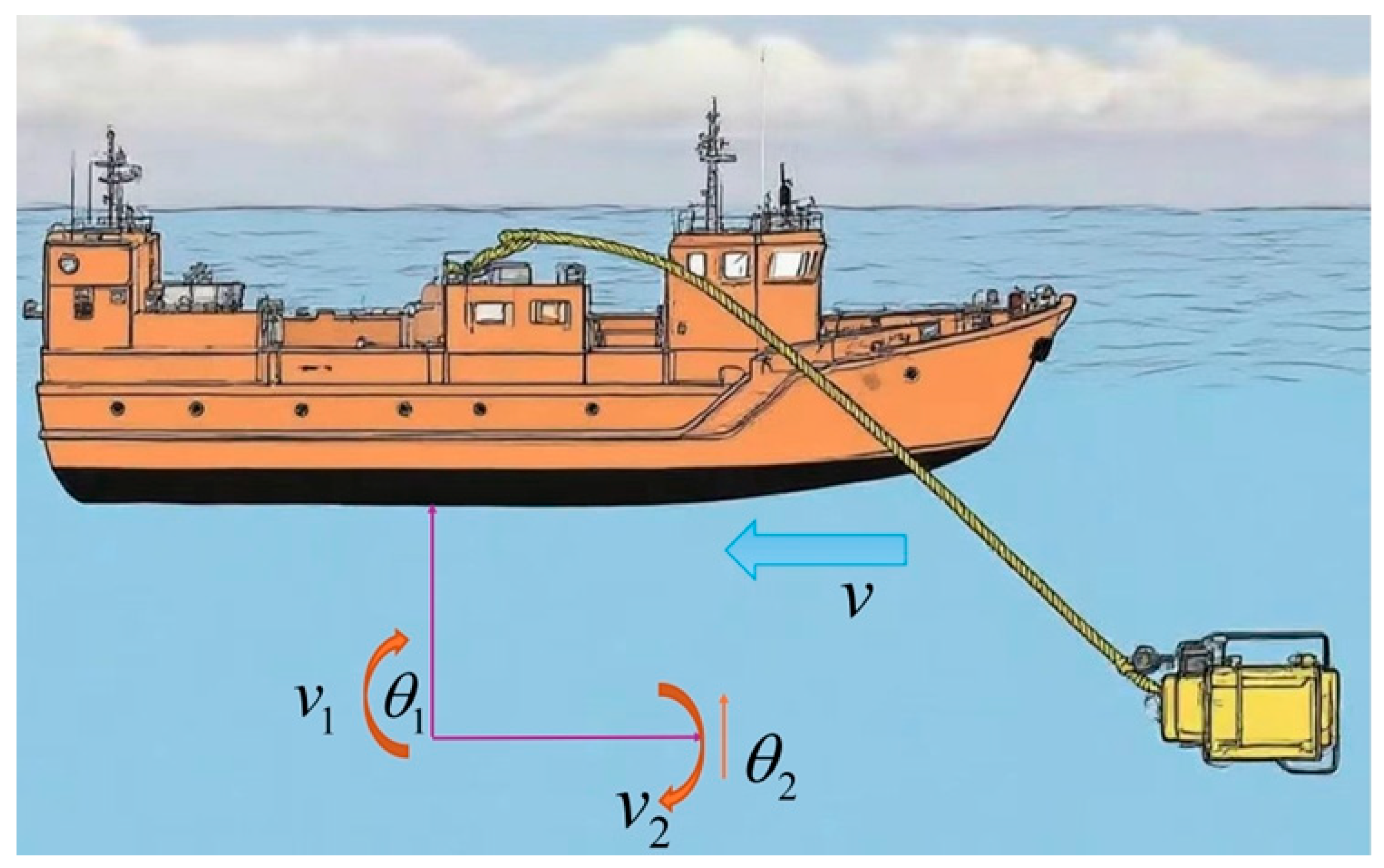
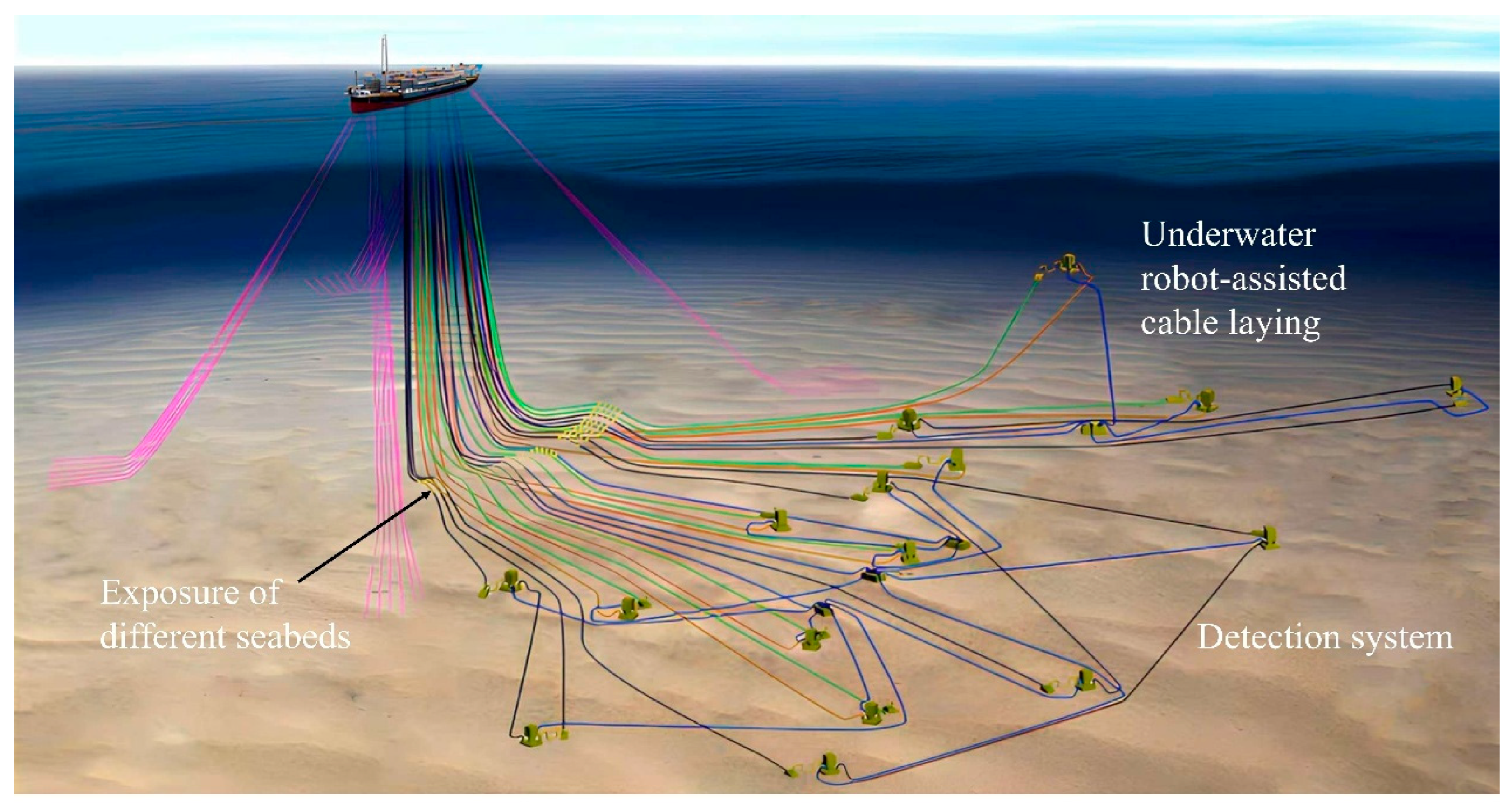
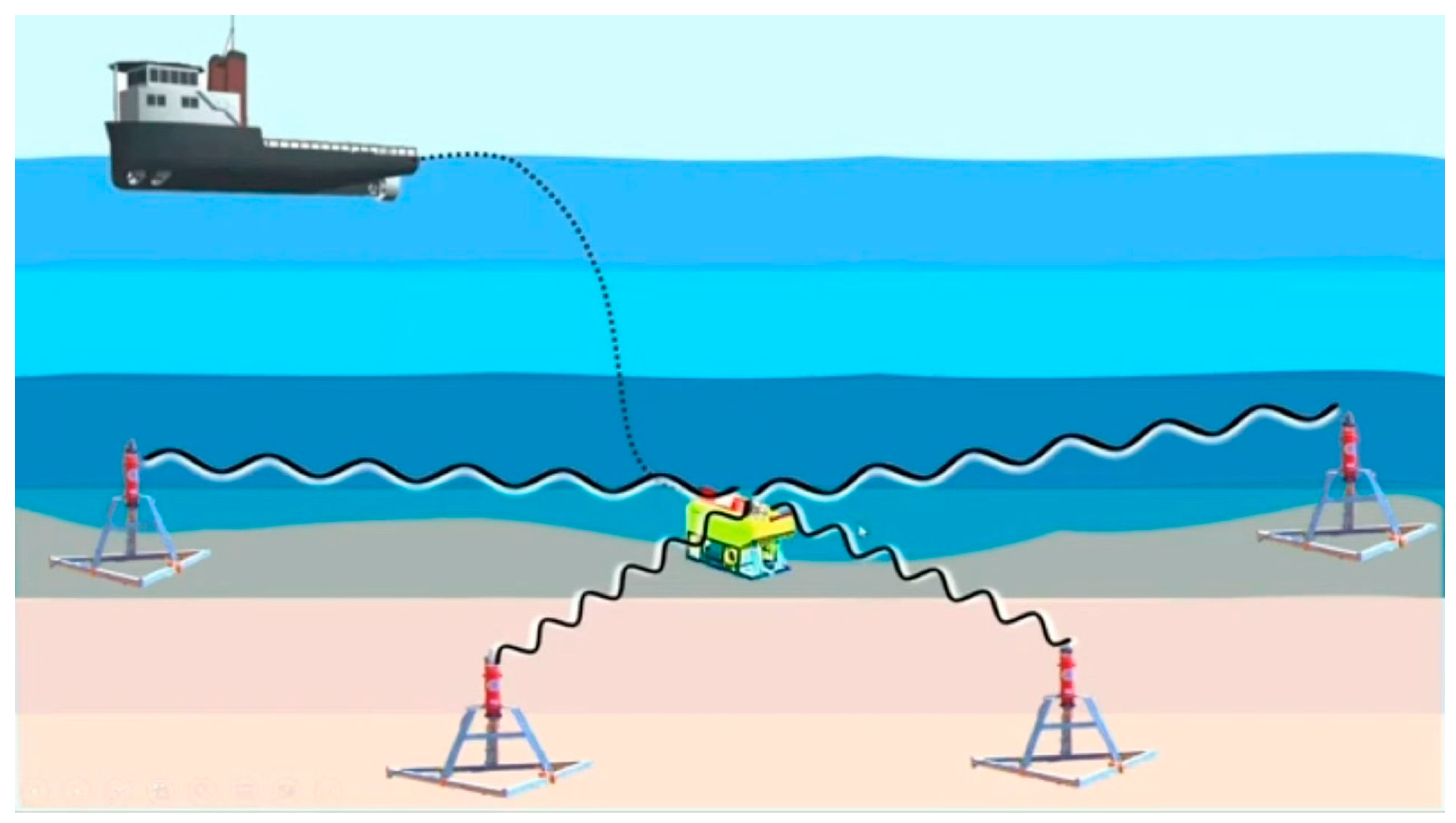
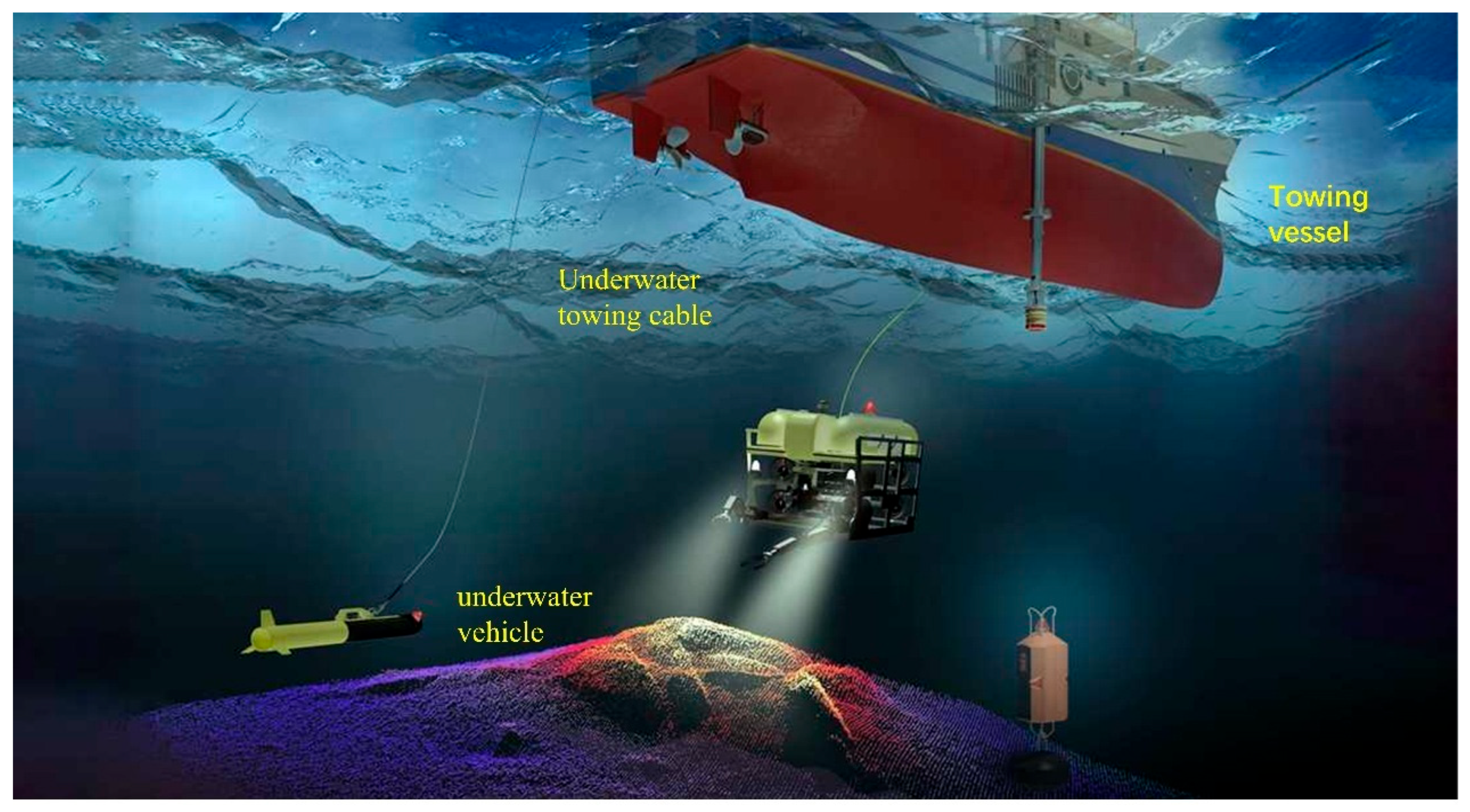
Exploration and development of marine resources have become the focal point of global attention [1,2,3,4,5]. Sub-sea towing systems, comprising tugboats, long flexible cables, and towed bodies, serve as critical infrastructure for deep-sea mineral exploration, seismic surveys, and military reconnaissance [6,7,8,9]. During operations, especially in shallow waters or complex bathymetric environments, the dynamic interaction between the towing cable and the seabed is inevitable. This interaction not only governs the accuracy of the payload’s trajectory and data acquisition but also dictates the structural integrity of the cable due to severe fatigue and wear [10]. Despite its significance, the transient dynamic response of towing cables—specifically tension amplification and spatial configuration shifts under varying seabed topographies (inclined, stepped, and 3D irregular)—remains poorly understood. Therefore, the primary objective of this review is to systematically investigate these dynamic response characteristics by synthesizing mathematical models and numerical simulations, thereby providing a robust theoretical foundation for the safe design and operation of marine towing systems. Its performance is directly related to the accuracy of data acquisition and the safety of operations, as shown in Figure 1.
Recent advancements in sub-sea engineering have shed light on the profound complexity of cable–seabed interactions. Contemporary findings indicate that this interaction is not merely a static boundary problem but a highly dynamic coupled process. For instance, recent high-fidelity computational fluid dynamics (CFD) studies reveal that boundary layer shedding near the seabed exacerbates vortex-induced vibrations (VIV), which in turn accelerates frictional wear at the touchdown zone [11]. Furthermore, experimental investigations by Wang et al. (2022) [12] demonstrated that sudden changes in bathymetry induce severe longitudinal wave propagation along the cable, leading to transient snap-loads that standard steady-state models fail to predict. Despite these critical current findings, the precise geometric and mechanical mechanisms by which different seabed topological features (such as 3D protuberances or steps) locally concentrate bending stresses remain insufficiently parameterized.
As the core component of the towing system, the dynamic response characteristics of the towing cable are particularly critical under different seabed topographic conditions. The complexity and diversity of seabed topography [13,14], such as inclined seabed, step-distributed seabed, and irregular 3D seabed, can significantly affect the motion pattern, tension distribution and bending characteristics of the towing cable. Therefore, an in-depth study of the dynamic response of towing cables under different seabed topography not only helps to optimize the design of the towing system but also provides theoretical support and technical guidance for practical operations, thus reducing operational risks and improving efficiency [15,16,17,18,19]. In practical applications, the contact between towing cables and seabed topography may lead to friction, collision and even structural damage, especially in shallow areas or sea areas with abrupt changes in topography. For example, an inclined seabed may cause the towing cable to partially touch the seabed, while a stepped seabed may cause severe vibrations and tension fluctuations in the towing cable. In addition, the complex topography of the 3D seabed may further exacerbate the dynamic response of the towing cable and even trigger extreme phenomena such as the whiplash effect. The existence of these problems makes the study of the dynamic response of the towing cable an urgent and important task.
The modeling of towing cable dynamics has evolved significantly since the 1970s. Initial studies, such as the experimental work by Choc and Casarell [20,21,22], successfully quantified the fundamental hydrodynamic drag characteristics of cables in open fluids. Building upon this, numerical simulation became the standard approach. Ablow and Schechter [23,24] pioneered the finite-difference method to capture the 2D dynamic behavior of towing cables, while Huang (1994) [25] extended these governing equations into 3D spatial domains. While these foundational models effectively describe cable behavior in open water, they fundamentally lack the boundary mechanics necessary to handle physical collisions with the seafloor.
To address boundary interactions, subsequent research integrated seabed-contact models. Wang et al. (2008) [26] incorporated static seabed boundaries to estimate tension variations during cable deployment and recovery. Gobat and Grosenbaugh (2006) [10] advanced this by proposing a time-domain numerical simulation method that accurately captures the non-linear resting behavior of a cable on a flat, elastic seabed. Furthermore, extreme mechanical states, such as the sudden morphological collapse under negative tension, were mathematically resolved by Triantafyllou and Howell (1994) [27]. In the realm of pipeline engineering, Randolph and Quiggin (2009) [28] and Kalliontzis (1998) [24] formulated nonlinear hysteretic soil models to simulate pipe–soil interactions under dynamic seabed movements [29]. In addition, Zhang et al. (2022) [30] analyzed the damage of submarine anchorage chains on cable mechanisms, which provides a reference for the safety assessment of towing cables in contact with the seabed.
However, a critical limitation persists across the aforementioned studies: the inherent assumption of topological continuity. Existing cable–seabed interaction frameworks predominantly model the seabed as a flat or uniformly sloping elastic foundation. Consequently, they fail to capture the transient mechanical shocks triggered by discontinuous or highly irregular topographies. In real sub-sea environments, towing cables frequently encounter stepped drop-offs or 3D rocky protrusions. When a cable transitions across a stepped seabed, the physical contact instantaneously shifts from “point-to-point” to “line-to-point”. Existing continuous boundary models struggle with the abrupt discontinuities during these transitions, often leading to numerical non-convergence, and fundamentally fail to predict the subsequent localized extreme bending curvature and tension “whiplash” effects.
To solve this specific problem, this paper proposes an advanced 3D dynamic framework that couples a lumped-mass finite element formulation with a modified non-linear penalty-based contact algorithm. This mathematical solution is specifically designed to handle transient, multi-point discontinuous collisions without numerical instability. By systematically mapping the dynamic responses of the towing cable across three complex boundary conditions—inclined, stepped, and 3D irregular seabeds—this study quantitatively evaluates the transient stress concentrations, spatial coiling phenomena, and dynamic curvature shifts at the exact moment of touchdown and detachment. Ultimately, we elucidate the physical mechanisms driving tension fluctuations over complex terrains, providing a robust theoretical foundation and specific optimization strategies for safe sub-sea towing operations.

2. Establishment of Mathematical Formulas

The primary objective of establishing the following mathematical formulations is to construct a generalized Boundary Value Problem (BVP) that governs the dynamic behavior of the towing cable. Rather than solving a highly specific, isolated case, this generalized BVP framework—incorporating fluid drag, tension, and cable elasticity—serves as the universal theoretical foundation. It allows for subsequent spatial discretization (via finite element or lumped-mass methods) and time-domain integration to evaluate the cable’s dynamic response across arbitrary, complex seabed topographies.”
The following formulas can be obtained by organizing a large amount of the literature, and these formulas are widely used in the calculation and force analysis of towing cable morphology [10,24,25,26,27,28,31,32,33,34,35,36,37,38,39,40,41,42,43,44,45,46,47,48,49,50,51,52,53,54,55,56,57,58,59,60,61,62,63,64,65,66,67,68,69].

2.1. Towing Cable Analysis Under No-Seabed-Contact Conditions

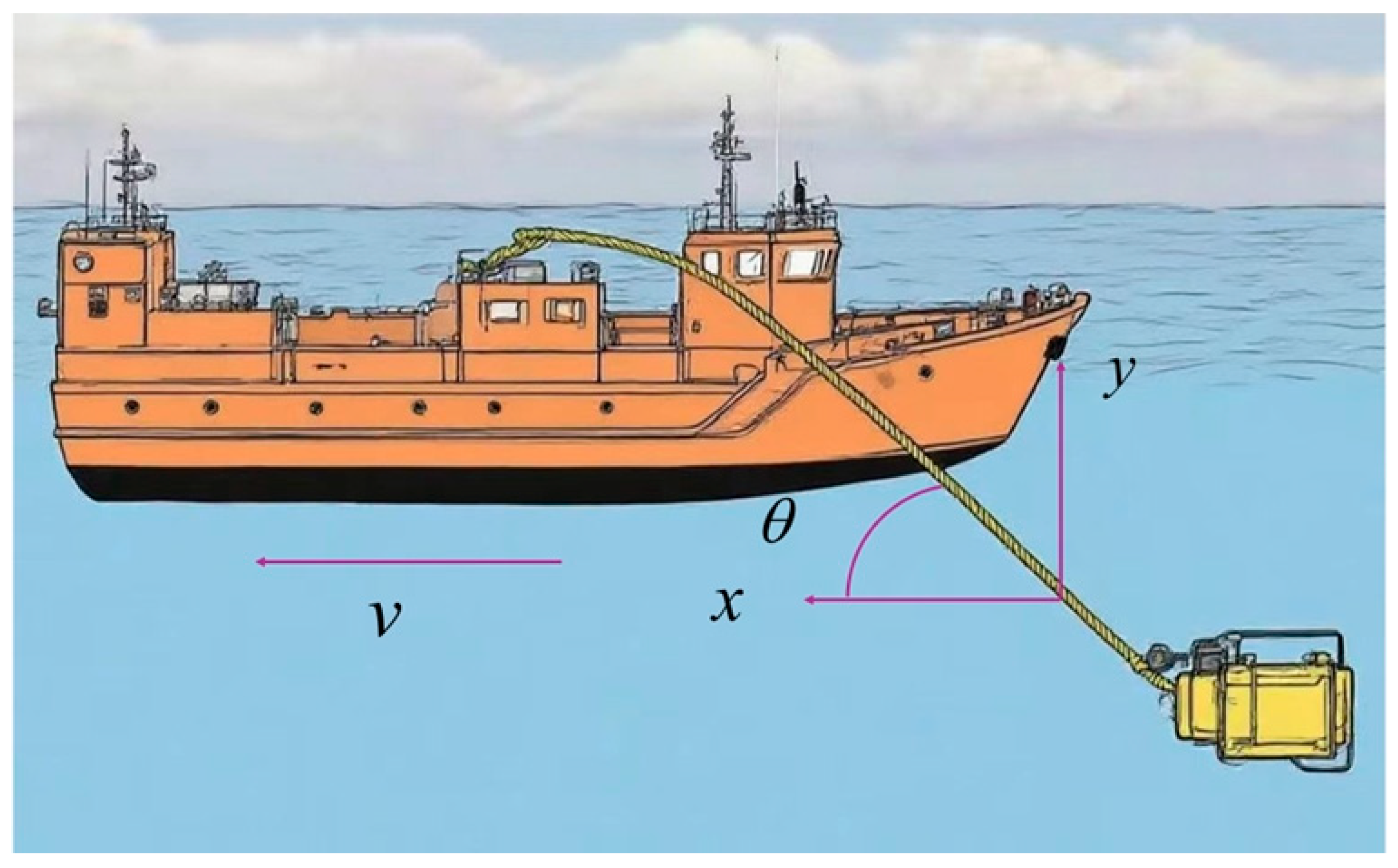
When measuring the overall shape and deformation of the towing cable, let the cable element and the direction of tension T at the cable element coincide with the direction of the tangent line here, and let the angle between the tangent line here and the direction of motion (which is the positive direction of the axis) be θ, as shown in Figure 2.
Let the cable be completely flexible, and the only external forces acting on the cable element are the fluid resistance, the gravity of the cable element itself and the buoyancy of the cable element. The equilibrium equation that balances the external forces with the tensions on the ends of the microelement can be obtained as follows.
d T cos θ d s = F x   d T sin θ d s = F y
where F x and F y are the x-axis and y-axis components of their combined force per unit length, respectively.
Then we discuss the effects of different seabed structures on the towing cable when touching the seabed, in which we carry out simulations and combine the experiments of other scientists to support the results of our simulations. Since the change in fluid with time is usually slow, the change in velocity profile of the fluid with depth is also slow, and in order to study the tension and towing attitude at different depths of immersion, it is useful to consider the fluid drag force on the towing cable in the current as a problem of the drag force on the column in a constant flow. From the concept of relative motion, this can be viewed as a constant flow with a certain velocity flowing through the towing cable. The angle with the prevailing flow velocity is θ. Therefore, the fluid resistance on the cable element can be decomposed into two parts to be considered, one part perpendicular to the column and the other part tangent to the column. It can be obtained:
F n = 1 2 ρ f V 2 A C d n sin 2 θ = α sin 2 θ   F t = 1 2 ρ f V 2 A C d f cos 2 θ = β cos 2 θ
where C d n and c d f are the drag coefficients in the cable direction and tangential direction, respectively; ρ f is the fluid density; A is the cross-sectional area of the cable; V is the velocity of the towing cable e relative to the fluid; assuming that, α, β, the coefficient of tangential friction is negligible, β can be considered to be 0. Also, the weight of the towing cable in the water can be expressed as:
W = ( ρ c ρ f ) g A = γ
where W is the weight of the towing cable in the water; ρ c is the density of the cable, the value of which is assumed to be greater than the density of the fluid; γ is a constant; and g is the gravitational acceleration.
Decomposing the fluid forces F x and F y obtained from Equation (2) in the x-axis and y-axis directions, we obtain
F l x = α sin 3 θ + β cos 3 θ ,   F l x = β cos 2 θ sin θ α sin 2 θ cos θ
Substituting Equations (3) and (4) into Equation (1), we get,
d T cos θ d s = α sin 3 θ + β cos 3 θ ,   d T sin θ d s = β cos 2 θ sin θ α sin 2 θ cos θ + γ
Assuming that the tangential friction coefficient is 0, β = 0, and to get an improved result, multiply the first equation of Equation (5) by cos θ , and the second equation by sin θ , and then add them together to obtain
d T d s = cos θ d T d x = γ sin θ
Similarly, the second equation of Equation (5) will be multiplied by cos θ , and the first equation will be multiplied by sin θ , and collapsed.
T d θ d s = T cos θ d θ d x = α sin 2 θ + γ cos θ
It can also be shown that d y d x = tan θ from Equation (6), d T d y = γ after integrating over it, yields.
T T 0 = γ ( y y 0 )
Equation (8) indicates that the internal tension of the towing cable is linearly related to the height. From Equations (6) and (7), it can be obtained as follows
d y d θ = T sin θ γ cos θ α sin 2 θ
Setting λ = γ / α and organizing Equation (9), we get
α d y T = sin θ d θ 1 λ cos θ cos 2 θ
Write Equation (10) in integral form
α y 0 y d y T = θ 0 θ sin θ d θ 1 λ cos θ cos 2 θ
Multiplying d T / d T on the left side of the equal sign of Equation (11) and factorizing the right side denominator gives
α d y d T ln T y 0 y = θ 0 θ sin θ d θ 4 + λ 2 λ 2 cos θ cos θ + 4 + λ 2 + λ 2
Substituting Equation (9) into Equation (12), we obtain
4 + λ 2 λ ln T T 0 = ln 2 cos θ + λ + 4 + λ 2 2 cos θ 0 + λ + 4 + λ 2 · 2 cos θ 0 + λ 4 + λ 2 2 cos θ + λ 4 + λ 2
Equation (13) can also be expressed in the following form.
cos θ + λ + 4 + λ 2 2 cos θ + λ 4 + λ 2 2 = cos θ 0 + λ + 4 + λ 2 2 cos θ 0 + λ 4 + λ 2 2 T T 0 4 + λ 2 λ
Let k 1 = λ + 4 + λ 2 2 , k 2 = λ 4 + λ 2 2 , while combining Equation (8), can be obtained:
cos θ + k 1 cos θ + k 2 = cos θ 0 + k 1 cos θ 0 + k 2 γ ( y y 0 ) + T 0 T 0 4 + λ 2 λ
In Equation (15), the right-hand side of the equation is a monomial with respect to y0, the monomial can be taken to be l, and the expression for cos θ with respect to y.
cos θ = k 1 k 2 l l 1
The expression for x with respect to y follows from d y / d x = tan θ
d x d y = k 1 k 2 l ( l 1 ) 2 ( k 1 k 2 l ) 2
Equation (17) is the two-dimensional geometric form equation for a general cable.
When the cable’s gravity is equal to the buoyancy force γ = 0, Equation (5) can be written in the following form.
T d θ d x = α sin 2 θ cos θ
From Equation (6), we can see that
d T d s = γ sin θ = 0
That is, the tension on the cable is constant in this case. Integrating Equation (18) yields.
1 sin θ = 1 sin θ 0 + α x T sin θ = T sin θ 0 T + α x sin θ 0
It also follows from the relationship between sin θ and cos θ that
cos θ = T 2 cos 2 θ + α 2 x 2 sin 2 θ 0 + 2 α x sin θ 0 T + α x sin θ 0
Substituting sin θ and cos θ obtained above into d y d x = tan θ yields
d y d x = T sin θ 0 T 2 cos 2 θ + 2 α x T sin θ 0 + α 2 T 2 sin 2 θ 0
To facilitate the integration, Equation (20) can be derived as follows.
d y d x = T sin θ 0 T 2 cos 2 θ + 2 α α T sin θ 0 + α 2 T 2 sin 2 θ 0 d y d x = T sin θ 0 α x sin θ 0 + T T sin θ 0 α x sin θ 0 + T + T sin θ 0 d y = 1 2 α x sin θ 0 + T + T sin θ 0 α x sin θ 0 + T T sin θ 0 α x sin θ 0 + T T sin θ 0 α x sin θ 0 + T + T sin θ 0 d x
Let t = α x sin θ 0 + T + T sin θ 0 α x sin θ 0 + T T sin θ 0 , then d x = 4 T α t t 2 1 2 d t Substituting into Equation (20), we get
d y = T α 2 1 t 2 d t
Equation (20) can also be written in the following form,
d y = T α 1 1 + t + 1 1 t d t
Integrating both sides of Equation (22) yields
y y 0 y = T α ln 1 + t 1 t t 0 t y y 0 = T α ln 1 + t 1 t · 1 t 0 1 + t 0
Incorporating t = α x sin θ 0 + T + T sin θ 0 α x sin θ 0 + T T sin θ 0   t 0 = 1 + sin θ 0 1 sin θ 0 into (23) k,
y y 0 = T α ln α x sin θ 0 T 2 + 2 α x sin θ 0 T + cos 2 θ + 1 + α x sin θ 0 T 1 + cos θ 0
Equation (25) is the two-dimensional geometric form equation for a buoyant cable.
In order to measure the motion and deformation of the different parts of the towing cable underwater, we divide the planar towing cable into a series of elastic, frictionless springs connected by nodes, where the mass of the cable is concentrated. At the same time, all flow resistance, gravity and buoyancy forces are loaded onto these nodes. The length between the nodes should be small enough so that the external forces on them can be considered uniform. First, for the planar towing unit, the axial forces are first separated and only the displacement along the y-direction and the in-plane angle of rotation exist, as shown in Figure 3.
The global dynamic behavior of the long towing cable, characterized by large displacements and finite rotations, is solved using the absolute flexible lumped-mass method (as detailed in Section 2.2). However, at the physical connection points between the towline and the tugboat/payload, bend stiffeners or armored sections are conventionally installed to prevent excessive local chafing and fatigue. For these specific, highly localized rigidified segments (typically less than 2% of the total cable length), the assumption of pure flexibility fails. Therefore, a standard beam finite element formulation is employed strictly and exclusively for these boundary reinforced sections to capture the localized bending stiffness effect.
In the numerical implementation of the proposed hybrid model, the towing cable is partitioned into distinct zones to balance computational fidelity with efficiency. The beam finite element formulation (Equations (28)–(44)) is applied strictly to the local “stiffened zones”—comprising the bend stiffeners and armored sections near the tugboat and payload connection points—which typically account for less than 2% of the total cable length. The remaining long-span segments are modeled using the lumped-mass method (LMM) as a flexible strand to handle large-scale spatial reconfigurations. To ensure the compatibility of displacements and rotations at the zone boundaries, we implement a kinematic coupling constraint at the interface nodes. Specifically, the displacement vector of the boundary beam node is set identically to that of the first LMM node, while the rotation at the beam’s end is constrained to align with the tangent vector formed by the first two nodes of the adjacent LMM segment. This transition coupling ensures a continuous displacement field and consistent transfer of axial tension and bending moments across the model interface, effectively preventing numerical non-convergence or artificial stress oscillations at the transition points.
The displacement function of this localized stiffened segment is
v ( x ) = b 0 + b 1 x + b 2 x 2 + b 3 x 3
Then the angle of turn of the towing cable can be expressed as:
θ ( x ) = d v d x = b 1 + 2 b 2 x + 3 b 3 x
Bringing in the node displacements and turning angles on the left and right sides of the towing unit gives:
v 1 θ 1 v 2 θ 2 = b 0 b 1 b 0 + b 1 l + b 2 l 2 + b 3 l 3 b 1 + 2 b 2 l + 3 b 3 l 2
Using the matrix form, it can be expressed as
v 1 θ 1 v 2 θ 2 = 1 0 0 0 0 1 0 0 1 l l 2 l 3 0 1 2 l 3 l 2 b 0 b 1 b 2 b 3
Transforming this formula gives
b 0 b 1 b 2 b 3 = 1 0 0 0 0 1 0 0 3 l 2 2 l 3 l 2 1 l 2 l 3 1 l 2 2 l 3 1 l 2 v 1 θ 1 v 2 θ 2
v ( x ) = 1 , x , x 2 , x 3 1 0 0 0 0 1 0 0 3 2 3 1 l 2 2 l 3 l 2 1 l 2 l 2 1 l 2 2 l 3 1 l 2 v i θ i v j θ j
The formula can be simplified to
v ( x ) = N v v i θ i v j θ j
[Nv] is called the shape function of the cell and can be expressed as:
N v = 1 3 x 2 l 2 + 2 x 3 l 3 , x 2 x 2 l + x 3 l 2 , 3 x 2 l 2 2 x 2 l 3 , x 2 l + x 3 l 2
Afterwards, the axial force is introduced and the displacement function is set to be linear and expressed as:
u ( x ) = a 0 + a 1 x
The same as the previous derivation is easily obtained:
u ( x ) = 1 , x a 0 a 1 = 1 , x 1 0 1 1 l l u 1 u 2 = N u u 1 u 2
which can be obtained by combining the axial displacement array with the vertical displacement array:
δ e = u 1 v 1 θ 1 u 2 v 2 θ 2 T
This, in turn, yields the displacement function matrix:
u ( x ) | v ( x ) = N δ e
After the displacement function is obtained, the strain due to shear is neglected, and only the bending and axial force effects are considered, according to the geometric and physical equations.
Physical equations can be obtained from the strain and stress expressions:
ε = ε N ε b = d u d x y d 2 v d x 2 = d N u d x u 1 u 2   y d 2 N v d x 2 v 1 θ 1 v 2 θ 2
σ = σ N σ B = E ε = E B δ e
Establishment of unit balance equation and assembly: In the unit body, the principle of minimum potential energy can be used to obtain the unit stiffness matrix, and then establish the relationship between the node force and node displacement of the unit and assemble the structure according to the node number to construct the overall matrix of the structure, the unit stiffness matrix is still towing the cable unit as an example. The strain energy U 0 of the towing cable can be expressed as:
U 0 = 1 2 V e T s d V = 1 2 V d e T B T E B d e d V = 1 2 d e T V B T E B d V d e = 1 2 d e T K e d e
The total potential energy on the towing cable is equal to the strain energy and external potential summed to:
P e = U 0 + V = 1 2 d e T K e d e d e T F e
When this formula takes the resident value:
K e δ e = F e
[K]e is the unit stiffness matrix, and after obtaining the unit stiffness matrix, the unit is assembled according to the node numbers in the discrete phase after the coordinate transformation to form the overall stiffness matrix.
Introducing boundary conditions to solve the overall system of equilibrium equations: upon introducing boundary conditions to solve for all the node forces and displacements, the entire structure of the system of equilibrium equations is now in the form shown below:
[ K ] { δ } = { P }
All the nodal displacements can be obtained by solving, and the displacements at all locations within the structure can be obtained by interpolating the function. The stresses and strains at all nodal locations can be obtained by using the geometric and physical equations after all the displacements have been obtained.
While the aforementioned beam element accurately resolves the boundary rigidified zones, applying it to the mid-water suspension of the flexible towline would severely violate the small-deformation hypothesis and yield unphysical artifacts. Consequently, for the vast majority of the suspended towlines undergoing large spatial reconfigurations, we discretize the system using the classical lumped-mass method (LMM), neglecting bending stiffness, governed strictly by tension, drag, and gravity.
In the 3D formulation, the handling of bending stiffness is strictly regionally decoupled to ensure both physical accuracy and numerical stability. For the highly flexible mid-water segments (constituting over 98% of the cable), the bending stiffness is mathematically neglected (EI ≈ 0), and the cable’s spatial configuration is governed purely by the 3D lumped-mass method where restoring forces are dominated by axial tension and hydrodynamic drag. However, at the boundaries where the cable connects to the tugboat and the towed body, local armored segments exhibit significant rigidity. In these specific nodes, the 3D bending stiffness ( E I = 0.02   kN · m 2 ) is reintroduced using the Euler-Bernoulli beam element formulation described in Equations (28)–(45), coupling the rotational degrees of freedom with the adjacent lumped masses to capture localized stress concentrations and prevent unphysical sharp kinks at the attachment points.
To preserve and rationally apply the two-dimensional (2D) beam element theory described in Equations (28)–(45) within the three-dimensional (3D) spatial dynamics analysis framework emphasized in this paper, it is imperative to elucidate the computational mechanics strategy combining local dimensional decoupling with global 3D coordinate transformation. Although the overall large-scale motions and complex seabed interactions of the deep-sea towing system exhibit highly nonlinear 3D spatial characteristics (such as lateral whiplash and serpentine rolling induced by irregular 3D topographies), the structural bending deformations at the local high-stiffness constrained regions (e.g., segments equipped with bend stiffeners or reinforced armor near the tow vessel and towed body) are primarily concentrated within the osculating planes formed by the instantaneous local tangential and principal normal vectors. Therefore, to balance the accuracy of local stress evaluation with the computational efficiency of long-duration 3D simulations, this model adopts a mixed-dimensional orthogonal superposition decoupling strategy. Specifically, within the local moving coordinate system of the towline nodes, two mutually perpendicular local orthogonal planes (i.e., the local x y bending plane and the local x z bending plane) are extracted. The aforementioned well-established 2D beam element fundamental formulas (Equations (28)–(45)) are then independently invoked within these two planes to respectively calculate the local bending moments and shear forces generated by the bending stiffness in these two orthogonal dimensions. Subsequently, strictly relying on the direction cosine rotation matrices detailed later in the text, the 2D bending mechanical responses within these two orthogonal local planes are vectorially synthesized and tensorially mapped. They are ultimately transformed into spatial forces and moments in the global 3D geographic coordinate system, which are then coupled as boundary correction terms into the nodal dynamic equations of the 3D lumped-mass method (LMM). This mathematical treatment not only elegantly circumvents the massive computational overhead and the risk of stiffness matrix singularity associated with directly deriving full 3D rigid beam elements but also strictly satisfies the physical requirement of spatial bi-directional bending (bending in two planes). Consequently, the aforementioned 2D beam element formulas serve as an indispensable mathematical cornerstone for constructing the high-fidelity and highly efficient boundary bending responses of the 3D towing cable.

2.2. Seabed Contact of Towing Cable

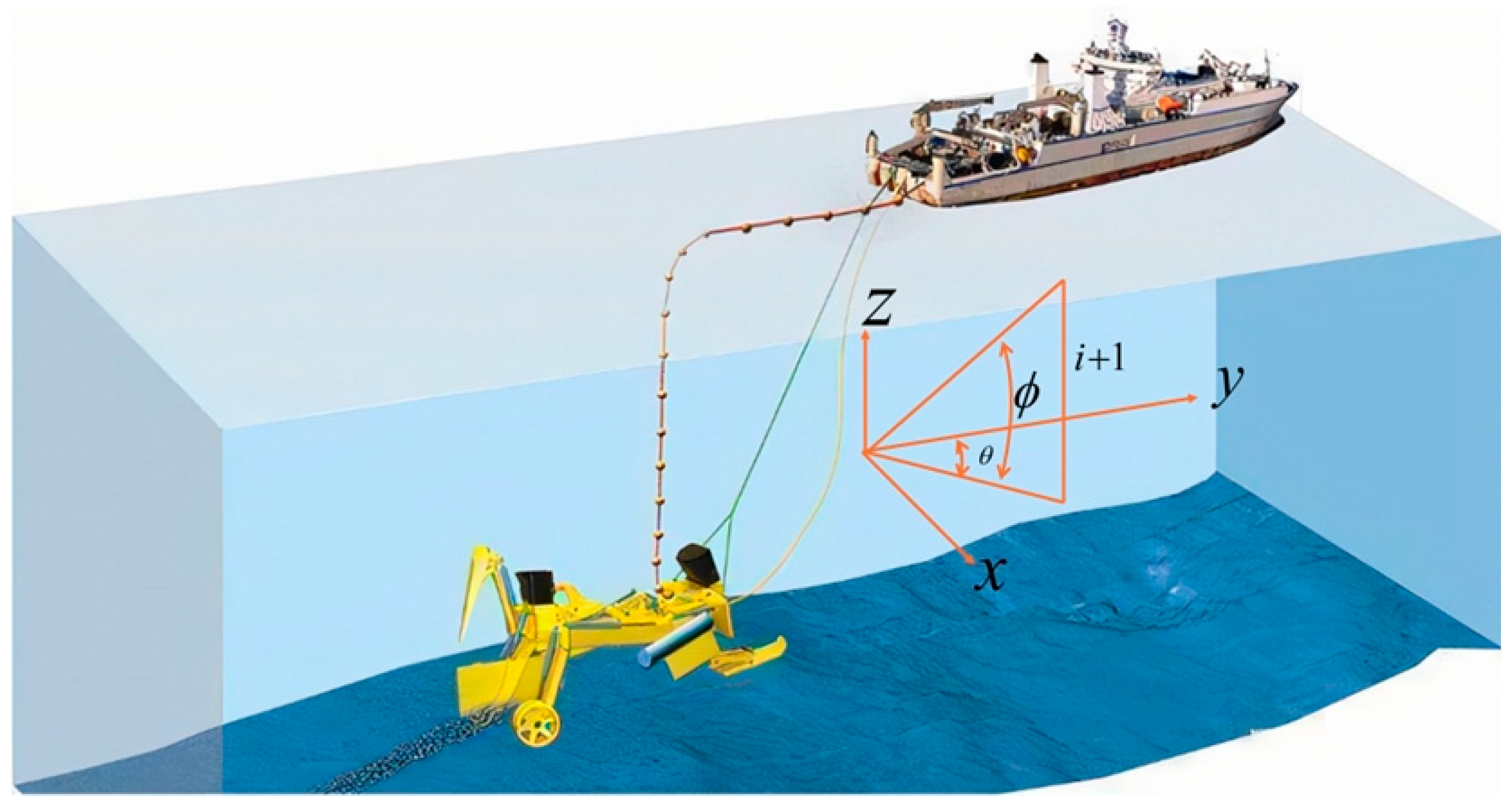
After summarizing the untouched part, we summarize the formula for the towed cable touching the seabed, and the whole system is shown in Figure 4.
Take a fixed Cartesian coordinate system O—x, y, z, and all the calculations are converted to the current coordinate system. s is the unstretched cable length of the towing cable, and s = 0 at the free end. The towing cable is discretized into N segments, i.e., N + 1 nodes, from the free end to the tip, with the free end being the i = 0th node. The Euler angle is θ and ϕ is the attitude angle of the towing cable.
θ = arcsin d x d l 1 cos l d γ d l 0 π arcsin d x d l 1 cos l d γ d l < 0
ϕ = arcsin d z d l
Apply Newton’s second law to the ith node to obtain the control equation of the towing cable:
M i · x i ¨ = F i
F i is the nodal acceleration; M i is a matrix of masses, including the mass m i of the towing cable and the additional mass M a i , which can be expressed as follows.
M i = m i I + M a i
m i = ( u i 1 / 2 l i 1 / 2 + u i + 1 / 2 l i + 1 / 2 ) / 2
M a i = ( M a i 1 / 2 + M a i + 1 / 2 ) / 2
M a = ρ k am l σ 1 a 1 2 b 2 2 b 1 a 1 b 2 2 a 1 b 2 a 2 b 1 a 1 b 2 2 1 b 1 2 b 2 2 b 1 b 2 a 2 a 1 b 2 a 2 b 1 b 2 a 2 b 2 2
a 1 = sin θ , b 1 = cos θ a 2 = sin ϕ , b 2 = cos ϕ
where I is a 3 × 3 unit matrix; u, l, k am , σ and ρ are the mass per unit length of the cable, the additional mass factor for the length between nodes, the cross-sectional area and the fluid density, respectively; the subscript i denotes the physical quantity at node i; the subscript i + 1/2 denotes the physical quantity between node i and node i + 1. For simplicity, the subscripts are omitted from some formulas below without further specification. M a i is all the external forces acting on node i, including tension, buoyancy, gravity and fluid resistance.
F i = Δ T i + B i + G i + D i
Tension: The general strain ε ≪ 1, applying Hooke’s law,
Δ T i = T i + 1 / 2 T i 1 / 2
T i + 1 / 2 = E σ x i + 1 x i 2 + y i + 1 y i 2 + z i + 1 z i 2 l i + 1 / 2 1 · τ i + 1 / 2
where τ A is the tangential quantity along the cable length; E is the Young’s modulus, and for a non-uniform cable, the average Young’s modulus is taken. Similarly, T i 1 / 2 .
Buoyancy and gravity:
B i + G i = 1 2 ρ q i 1 / 2 q 1 / 2 + l i + 1 / 2 q + 1 / 2 ) g + m i g
Fluid resistance: Consider it in two parts, tangential and normal:
D i = ( D i + 1 / 2 + D i 1 / 2 ) / 2 D = 1 2 ρ C n l ε d ε | ( x ˙ U ) n | ( x ˙ U ) n 1 2 ρ π C t l ε d ε | ( x ˙ U ) t | ( x ˙ U ) t 1 2 ρ 1 + ε C n l d | ( x ˙ U ) n | ( x ˙ U ) n 1 2 ρ π 1 + ε C t l d | ( x ˙ U t ) | ( x ˙ U ) t
d is the diameter of the towing cable; the physical quantity with subscript ε indicates the value after stretching; U is the velocity of the spatial flow field (ocean current), x ˙ U takes the average value on the neighboring nodes; C n and C t are the normal and tangential drag coefficients of the towing cable, respectively.

2.2.1. Boundary Condition

The control Equation (1) itself, with more unknowns than the number of equations, does not form a solvable system of differential equations, and the corresponding boundary conditions must be added at the beginning and at the end.
The boundary condition of the first end of the towing cable must be consistent with the position and speed of the tugboat during operation, i.e.,
x N ˙ = x s t , x N ˙ = u s t
x s and u s are the coordinates and speed of the tugboat at the bow of the towing cable, which are known functions of time.
Free end/end boundary conditions: For the free end, it is treated as a node, and Equation (1) is applied directly, i.e.,
M 0 · x ¨ 0 = F

2.2.2. Initial Conditions

The initial conditions include the positional coordinates of the towing cable at each node, and velocity. They can be expressed as
x ˙ i ( 0 ) = x 0 i , x ˙ i ( 0 ) = u 0 i
i = 0,1,2, …, N − 1; x 0 i , u 0 i are the initial states of the towing cable, all of which are given (i = N is the first end boundary condition).
We simplify the seafloor as a rigid wall with an isotropic frictional drag coefficient uf. At the same time, we ignore the various wall effects near the seafloor and set the rebound rate to zero, i.e., we assume that there is no rebound at the time of impact.
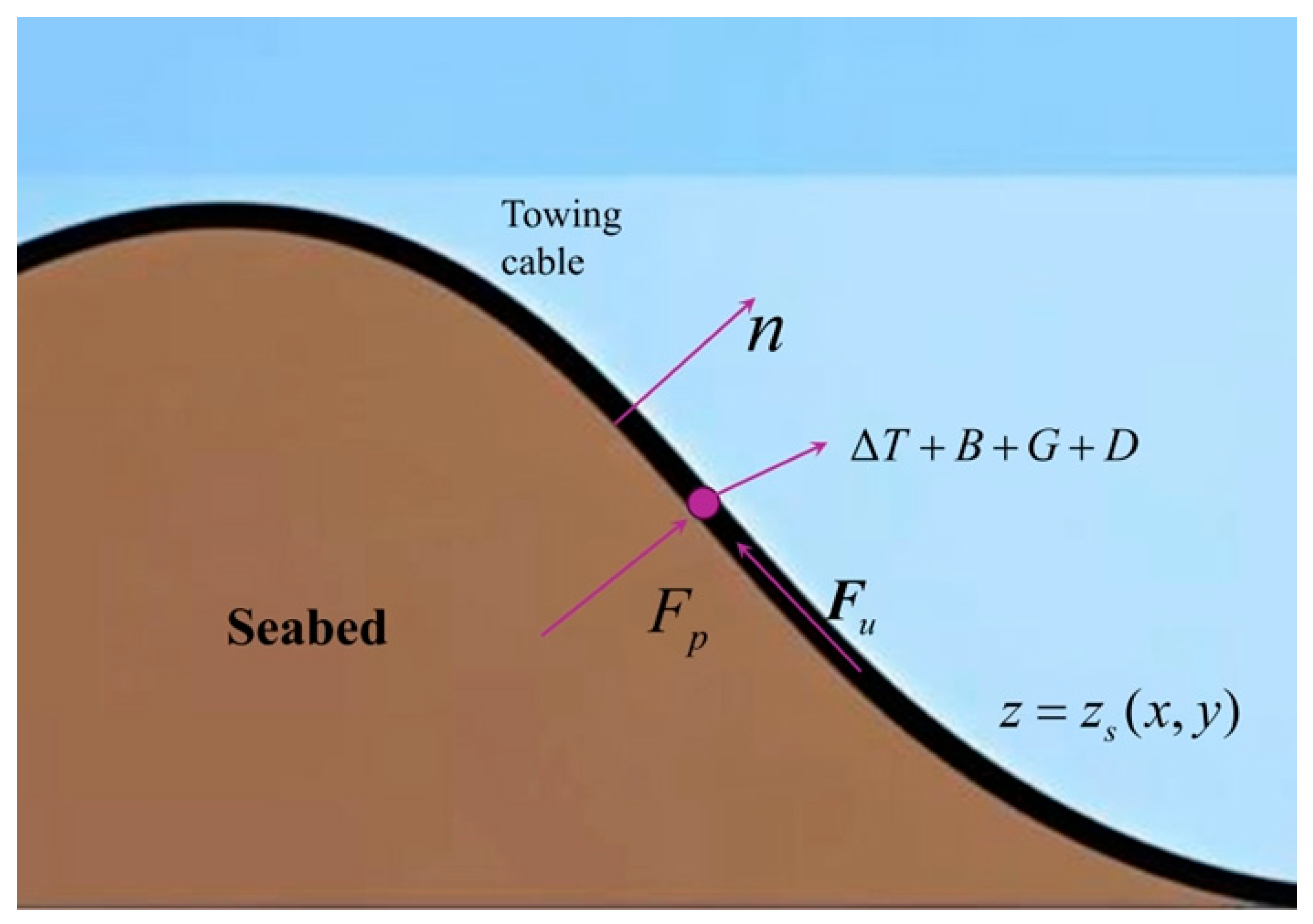
As shown in Figure 5, the seafloor is a three-dimensional continuous surface with coordinates z = z s ( x , y ) . The unit normal to the contact surface is n, and it always points from the sea floor to the interior of the fluid. In this case, in addition to tension, buoyancy, gravity and drag, the towing cable is also subjected to the reaction force of the seabed on it F p and the frictional resistance F u . For the ith node, the contact condition is considered to be valid when one of the following two conditions occurs in the calculation:   z i < z s x i , y i ;   z i = z s ( Δ T + B + G + D ) · n < 0 , v i · n 0 .
For a rigid bottom, the towing cable can only have tangential velocity, and the normal velocity must be zero. Then there is.
z i = z s ( x i , y i ) v i = v i ( v i · n ) n
At the time of impact, the normal impulse of the drag segment will be zeroed in an instant, and the presence of frictional resistance will definitely lead to the tangential velocity decreasing or becoming zero. Ideally, without taking into account the effect of the additional mass, it can be deduced from classical mechanics that the tangential velocity change is
Δ v t i = min v i · n u f , v i · v i v i
v i · n u f is the amount of change calculated from the frictional resistance, since the frictional resistance is always opposite to the direction of motion, it will not make the tangential velocity become negative, so the equation takes a smaller value.
v i = v i + Δ v t i
v i is the velocity at the time of impact after taking into account the frictional resistance, which will be used later instead of v i . In this case, the dynamics control Equation (1) is rewritten as
M i · x ¨ i = Δ T i + B i + G i + D i + F p i + F u i
F u i can be considered in three cases: motion, stationary and transition states.
F u = F p · u f · v v v 0 ( Δ T + B + G + D + F p ) | v = 0 , F u < F p · u f F p · u f Δ T + B + G + D + F p Δ T + B + G + D + F p else
To mathematically resolve the physical collision between the towing cable and the complex seabed, a modified non-linear penalty-based contact algorithm was implemented. When a cable node penetrates the seabed boundary (i.e., z i < z s x , y ), a virtual normal restoring force F p is generated using a spring–dashpot penalty formulation:
F p = K p · δ i n + C p · v n , i · n
where δ i = z i z s is the instantaneous penetration depth, v n , i is the normal impact velocity, and the exponent n = 1.5 is utilized to account for the Hertzian non-linear contact characteristics. The selection of the penalty parameter (stiffness coefficient) K p is crucial; it must be large enough to prevent unphysical excessive penetration but small enough to avoid artificial numerical stiffening. In this study, K p was explicitly calibrated based on the actual physical normal stiffness of the target seabed material ( 1000   kN / m / m 2 as specified in Section 3.1), while the damping coefficient C p was set to critically damp the high-frequency numerical oscillations upon touchdown, ensuring a physically realistic energy dissipation during the collision phase.
The joint control Equation (1), boundary conditions (3), (4), form a complete system of differential equations, namely
d x ˙ i d t = M i 1 · F i d x i d t = x ˙ i
i = 0 , 1 , 2 , , N 1 .
To solve the highly non-linear system of ordinary differential equations (Equation (64)), an explicit fourth-order Runge–Kutta (RK4) time integration algorithm was implemented. This method was selected for its high accuracy in capturing transient dynamic shocks, such as sudden seabed collisions. To ensure numerical stability and prevent divergence caused by the extremely high axial stiffness of the towing cable (EA = 5000 kN), the time step Δt was strictly constrained by the Courant–Friedrichs–Lewy (CFL) stability criterion. Specifically, the time step must satisfy Δ t L m i n m / E A , where L m i n is the minimum unstretched element length and m is the nodal mass. Consequently, a constant microscopic time step of Δt = 1 × 10 −4 s was specified for all dynamic simulations in this study, ensuring robust convergence even during high-frequency tension whiplash events.

2.3. Extension to 3D Spatial Coupling Mechanics for Irregular Topographies (Novelty of the Present Model)

To bridge the gap between the 2D in-plane formulas and the 3D spatial analysis, the model generalizes the curvature and bending mechanics by transitioning from a single vertical plane to a local Serret–Frenet coordinate frame for each cable element. While Equations (28)–(44) describe in-plane bending, the 3D extension incorporates a second rotational degree of freedom (the yaw angle ϕ) to account for out-of-plane deformations. The total spatial curvature κ is redefined as the vector sum of the pitching curvature κθ and the yawing curvature κϕ, expressed as
κ s = d θ / d s ) 2 + ( d ϕ / d s · sin θ ) 2
By integrating this generalized curvature into the 3D spatial coupling formulation (Equation (66)), the model can precisely calculate the bi-normal bending moments induced by 3D irregular seabeds. This mathematical transition enables the simulation to capture complex 3D phenomena, such as lateral “whiplash” effects and serpentine coiling, which are inherently omitted in standard 2D simplified models, thereby providing a more rigorous representation of cable mechanics in actual sub-sea environments.
While Section 2.1 and Section 2.2 establish the fundamental 2D lumped-mass framework and localized nodal contact criteria widely used in classic cable dynamics, the primary mathematical and modeling novelty of this study lies in transitioning these planar mechanics into a fully coupled 3D spatial domain. Traditional 2D models restrict cable motion to a single vertical plane (e.g., the X Z plane), inherently failing to capture out-of-plane deformations (such as serpentine rolling or lateral whipping) induced by complex, asymmetric 3D seabeds.
To bridge this gap, we introduce a novel 3D spatial coupling formulation. For an arbitrary 3D irregular seabed defined by z = z s x , y , the geometric boundary is no longer a simple slope but a 3D manifold F x , y , z = z z s x , y = 0 . The instantaneous 3D outward unit normal vector n 3 D at any contact node i is rigorously derived using the spatial gradient of the seabed bathymetry:
n 3 D = F | F | = 1 1 + z z x 2 + z z y 2 z z x z z y 1
Unlike the simplified 2D normal vector, Equation (65) dynamically couples the lateral (y-axis) topographic variations into the normal support force F p . Consequently, when the cable strikes a 3D protrusion, the reaction force is distributed across all three spatial dimensions.
Furthermore, the highly nonlinear 3D spatial friction F u , 3 D must account for multi-directional sliding. Rather than a simple 1D velocity attenuation (as described in Equation (59)), the novel 3D dynamic friction model projects the spatial velocity vector onto the local 3D tangent plane of the seabed. The instantaneous sliding velocity vector v τ , i and the resulting 3D frictional resistance are formulated as:
v τ , i = x ˙ i ( x ˙ i · n 3 D ) n 3 D
F u , 3 D = μ f | F p , i | v τ , i | v τ , i |
where μ f is the dynamic friction coefficient of the seabed. This 3D projection explicitly captures the bi-normal (out-of-plane) coupling effects. When z s y 0 (e.g., on a 3D irregular seabed), the tangential sliding velocity v τ , i develops a transverse component, forcing the cable into a multi-directional spatial deformation (e.g., the serpentine configuration). By integrating Equations (65)–(67) into the generalized system of differential equations (Equation (64)), the proposed model successfully breaks through the limitations of classic 2D formulations. It enables the precise quantification of 3D transient responses—such as lateral stress concentrations and 3D whiplash effects—which are critical for evaluating cable fatigue under high-speed turning maneuvers over actual irregular terrains.

3. Analysis of Different Seabeds

3.1. Simulation Modeling of Ships

There is a counterweight floating air in the tail end of the towing cable; the towing body cable of the towing cable is a solid cable with an outer diameter of 0.05 m and a linear density of 0.0059 t/m. Neglecting the torsional stiffness of the towing cable, the axial stiffness of the towing cable is 5000 kN, and the bending stiffness is 0.02 kN·m2; the mass of the counterweight floating air gun is 0.1176 t, and the volume is 0.075 m3, and the height of the self is 1 m. The additional mass coefficient is 2. The normal stiffness of the seabed is 1000 kN/m/m2 and the vertical stiffness of the seabed is 1000 kN/m/m2.
In all simulation cases presented in Section 3.2, Section 3.3 and Section 3.4 (including inclined, stepped, and 3D seabeds), the structural modeling of the cable follows the aforementioned hybrid strategy. Specifically, the cable segments within 15 m of the vessel attachment and 15 m of the trailing towed body are modeled, taking bending stiffness into account via beam elements to capture localized fatigue hotspots. Conversely, the vast mid-section of the 4000 m cable, including the entire touchdown zone and segments interacting with seabed protrusions, is modeled as a flexible strand using the lumped-mass method. This allocation is chosen because the global dynamic response over complex topographies is dominated by tension equilibrium, while bending effects are only critical at the constrained boundaries. In the subsequent simulation images, the white nodes identify the flexible LMM segments currently in mutual contact with the seabed, while the rigidified sections at the boundaries ensure realistic load transfer into the surface vessel and sub-sea payload.
Before analyzing the dynamic responses across different topographies, specific initial and boundary conditions (ICs and BCs) must be rigorously defined for each terrain type. For the inclined and stepped seabeds (2D planar navigation), the upper boundary condition (tugboat) was prescribed with a constant forward velocity of 2 m/s ( V x = 2 , V y = 0 , V z = 0 ), while the initial condition (IC) was defined by relaxing the cable into a static equilibrium catenary profile under gravity and steady current drag before initiating motion. For the 3D irregular seabed, which necessitates complex maneuvering, the upper boundary condition was modified to a continuous turning trajectory with a tangential speed of 10.288 m/s and a turning radius of 500 m, establishing a time-dependent spatial coordinate constraint ( X t = R cos ω t , Y t = R sin ω t ). Across all scenarios, the lower boundary (the towed body) was treated as a free end subjected to its lumped payload mass and hydrodynamic forces, dynamically interacting with the seabed governed by the aforementioned penalty contact criteria.
Inclined seabed and stepped seabed have a significant effect on the dynamic response of the towing cable under the tugboat’s straight voyage, while the 3D seabed has the most obvious effect on the dynamic response of the towing cable under the tugboat’s slewing condition. Therefore, in the tilted seabed and stepped seabed models, the tugboat travels straight, and the total length of the towline is 4000 m. In the tugboat straight calculation, the towing speed of the tugboat is 2 m/s (in this case, if the towing speed of the tugboat is too high, it is difficult to ensure that the towing cable touching the seabed part has a better contact with the seabed, and it is not favorable for the capture of the morphology change in the towing cable in such a case).

3.2. Sloping Seabed

In the tilted seabed, assuming that the seabed is a plane, the seabed plane rotates around a horizontal axis by different degrees, forming a certain angle with the horizontal plane to achieve the purpose of seabed tilt [70]. However, when the tilt angle of the seabed is too large, due to the limitations of current simulation technology, although the seabed is tilted at this time, the seabed currents will still maintain the horizontal direction, and the situation at this time will become too different from the real situation [71,72,73], so the maximum tilt angle should not exceed 45°.
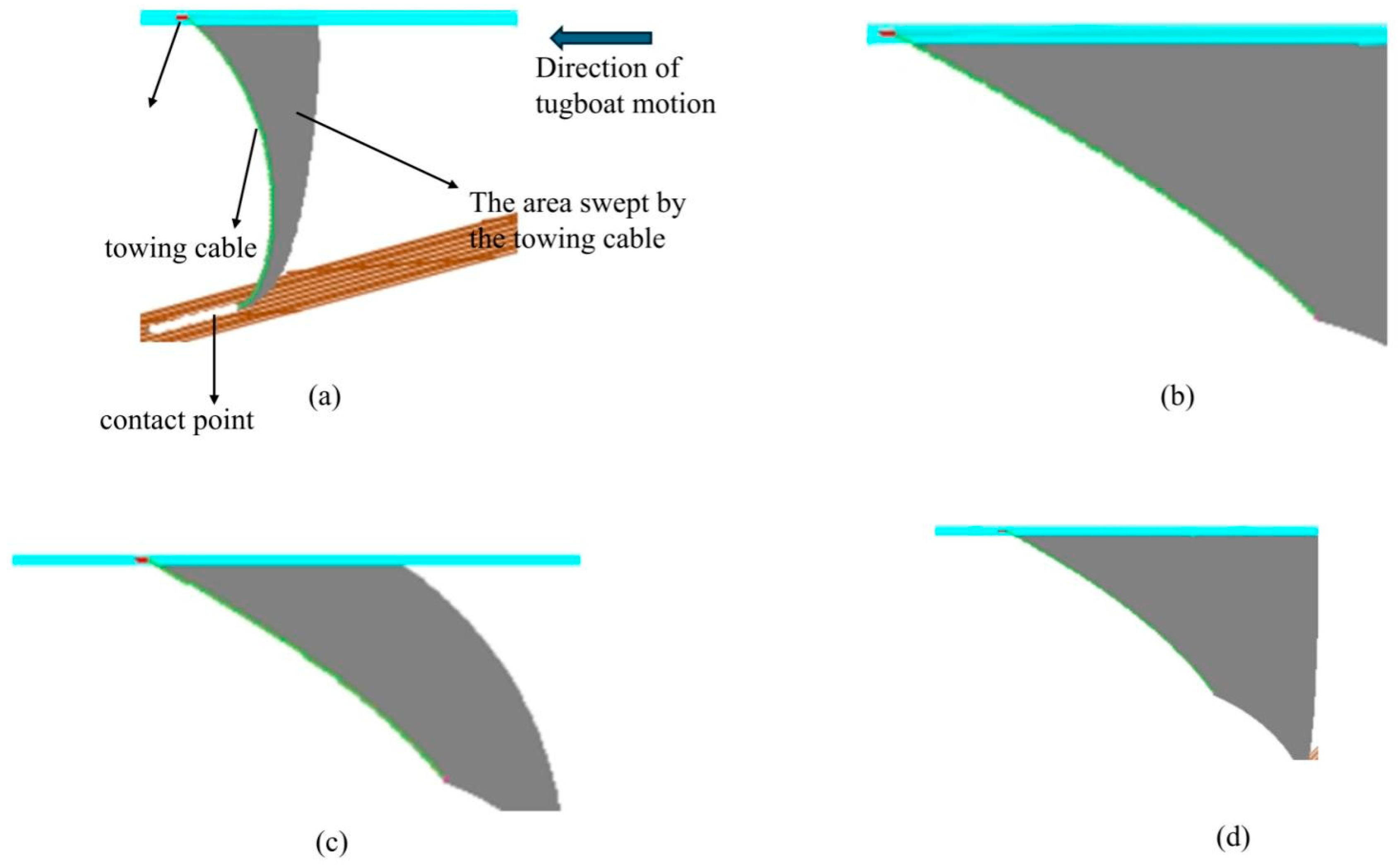
For the inclined seabed in the deep-sea area, due to the depth of water being very deep, the inclination of the seabed is actually not very relevant to the dynamic response of the towing system, because at this time the towing cable will not be in contact with the seabed [51,74,75,76]. Therefore, for the inclined seabed, its impact on the dynamic response of the towing system is mainly concentrated in the towing system from shallow to deep- sea in such a stage process [77]. In the shallow sea, due to the shallow water depth, when the towing cable is longer, it is difficult for the towing cable to avoid contacting with the seabed [78,79,80], and at this stage, the form of contact between the towing cable and the moment when the towing cable is completely detached from the seabed will be different for different seabed inclinations. During the simulation process, it is found that the length of the towline at the initial static equilibrium is different under different seabed inclination angles; however, when the towing cable is completely detached from the seabed and stabilized at the end, the towing cable morphology obtained under different seabed inclination angles is exactly the same, which suggests that different seabed inclination angle affects the initial morphology of the towing cable [81]. The simulation diagram is shown in Figure 6.
However, since the towing cable is a highly flexible component [82], its final configuration remains unaffected. The steeper the seabed inclination angle, the shorter the length of the cable segment that initially contacts the seabed when static equilibrium is achieved. When a tugboat is towing cables from shallow to deep waters under varying seabed inclination angles, the cable undergoes a reverse bending process. Further analysis of simulation results under varying seabed inclinations reveals that, with constant towing cable length [83], a steeper seabed inclination reduces the time required for the cable to fully detach from the seabed. Although no whipping effect was observed at current towing speeds, it is reasonable to infer that increasing the tugboat’s speed would significantly heighten the likelihood of whipping occurring at the cable’s end during the instant of complete separation from the inclined seabed [83].
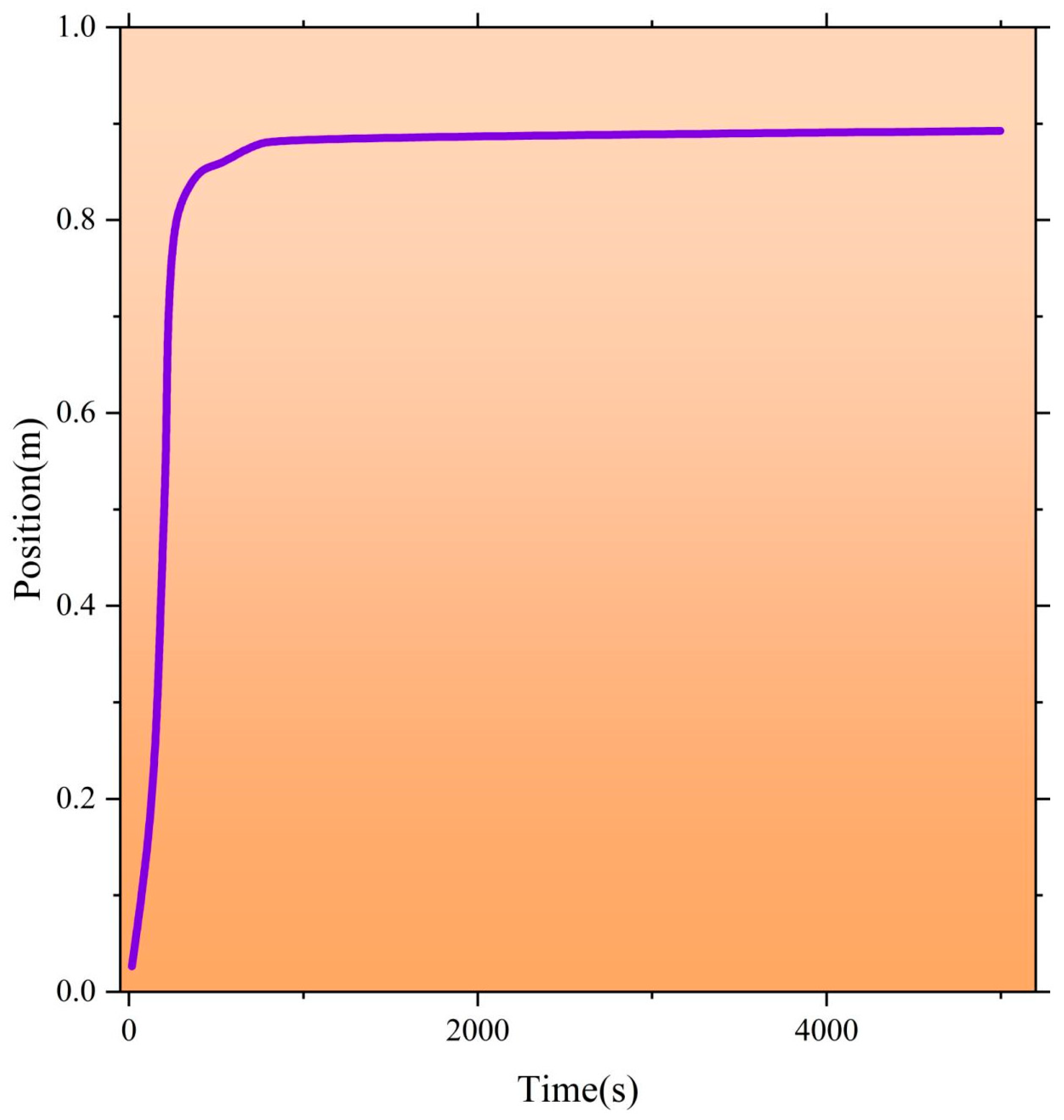
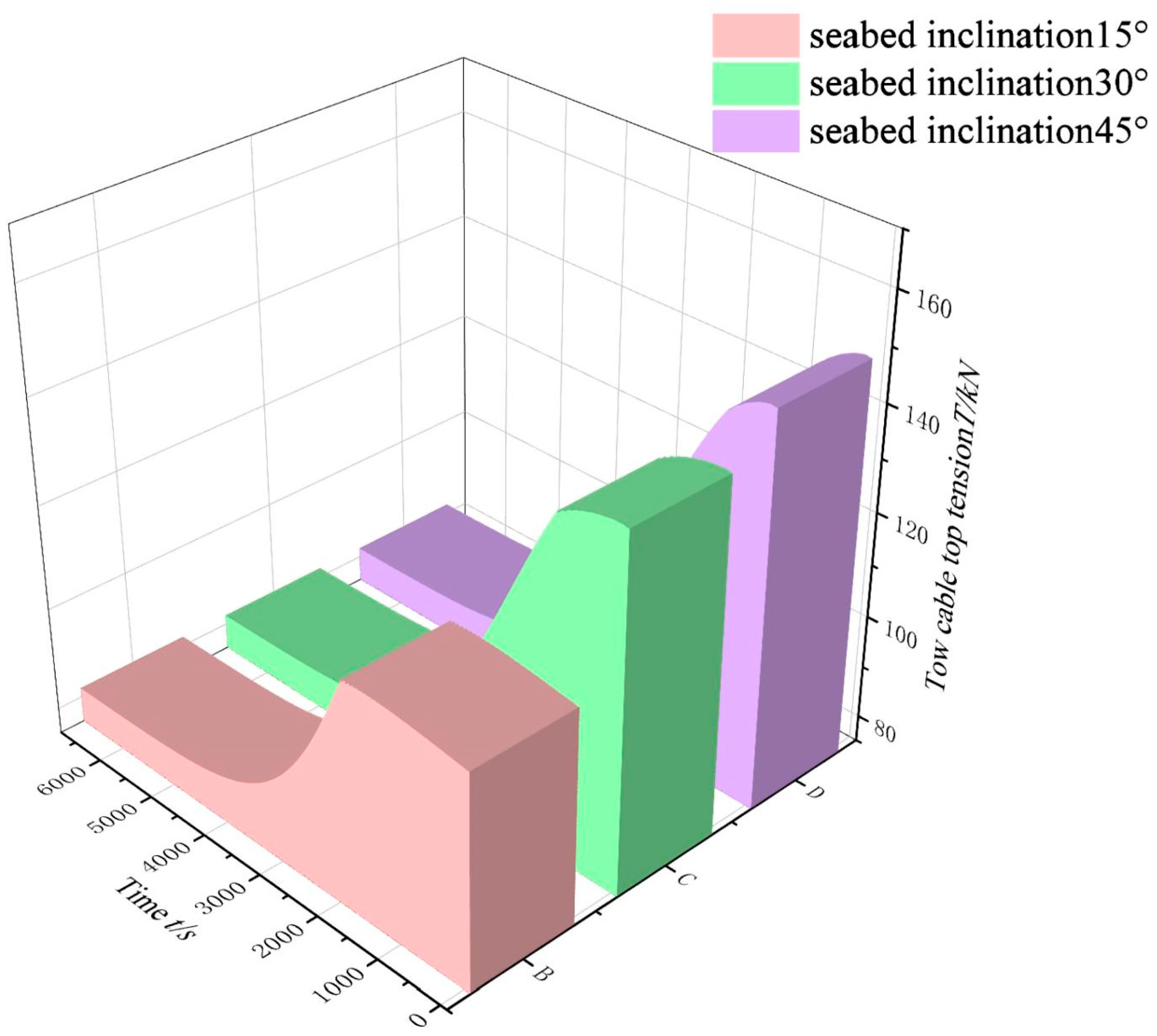
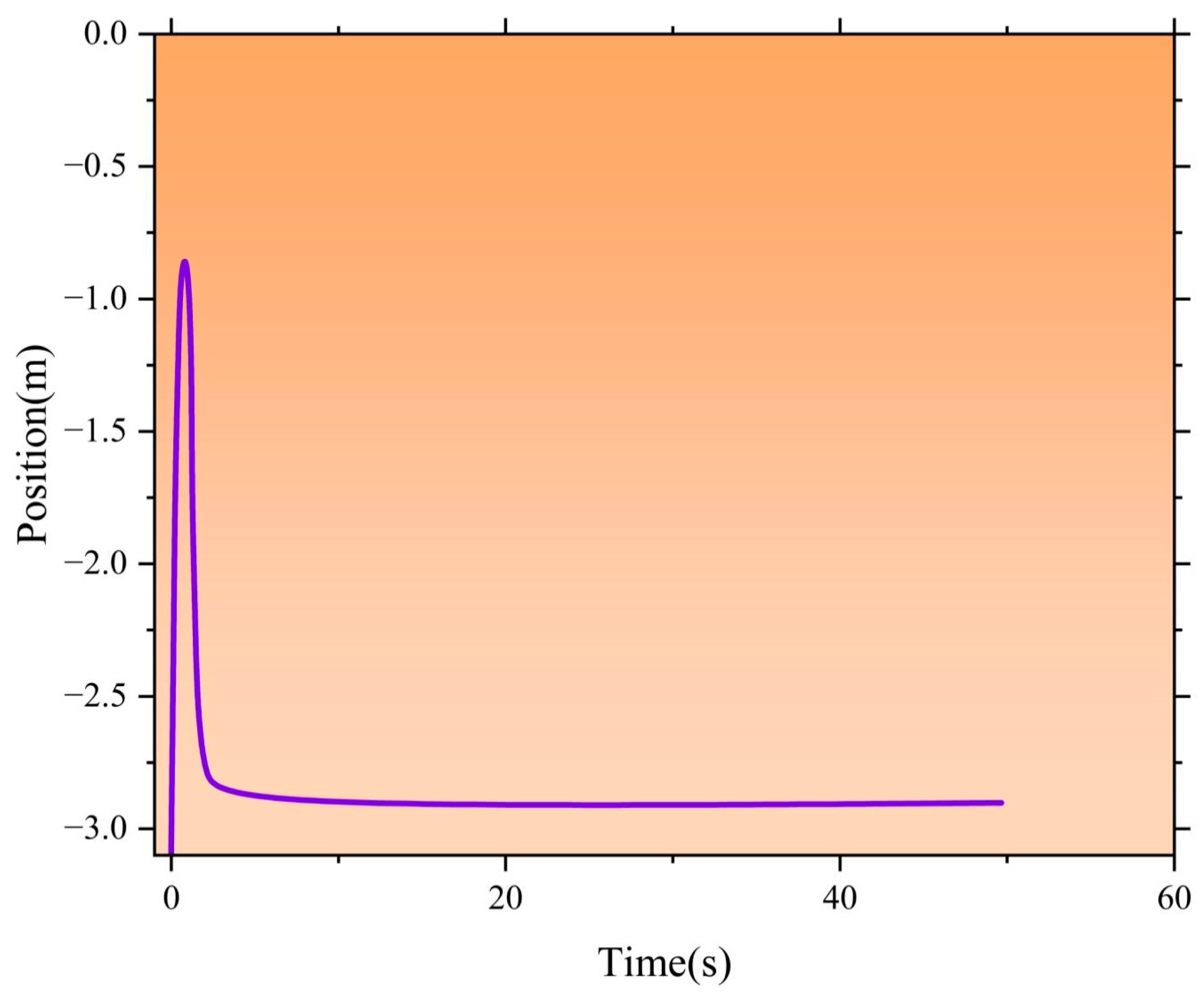
By observing the time-domain images of the tension at the towing cable tip under different seabed inclination angles, it can be observed that the greater the seabed inclination angle, the higher the tension at the towing cable tip during the initial static equilibrium phase. At a 15° seabed inclination angle, the tension at the towing cable tip remains constant for a period before gradually decreasing until it stabilizes. At 30° and 45° seabed inclinations, the tension at the towing cable tip first decreases and then stabilizes, indicating that no tension stabilization phenomenon occurs during the initial stage compared to the 15° inclination. In other words, under 30° and 45° seabed inclinations, the tension at the towing cable tip follows a decreasing-then-stabilizing trend, suggesting that no tension stabilization phenomenon occurs during the initial stage (compared to the tension variation pattern at the 15° inclination). However, when the towing cable ultimately detaches completely from the seabed and reaches a stable state, the tension values at the towing cable tip remain consistent across different seabed inclinations [84,85,86,87]. As shown in Figure 7. In other studies, we found that Guan et al. reached conclusions similar to those in this paper. Guan et al. used the AQWA time-domain module to simulate the position and attitude of the mooring cable under operating conditions of V = 0.3 m/s, 0.5 m/s, 1 m/s, and 1.5 m/s. When the system is in a stable state, the coordinates of the ballast center can be obtained. Taking the ballast simulation results at V = 0.5 m/s as an example, the calculated position and attitude of the mooring cable at this flow velocity were derived. The x-axis represents the horizontal displacement of the cable, while the y-axis is opposite to the water depth direction. As shown in Figure 8, the displacement of the center of gravity in the x-direction under steady-state conditions is 0.9034 m. As shown in Figure 9, its displacement in the y-direction is −2.8627 m. Research by Guan et al. indicates that the position of the towed cable tends to stabilize over time, meaning the tension stabilizes, consistent with our simulation results [51].
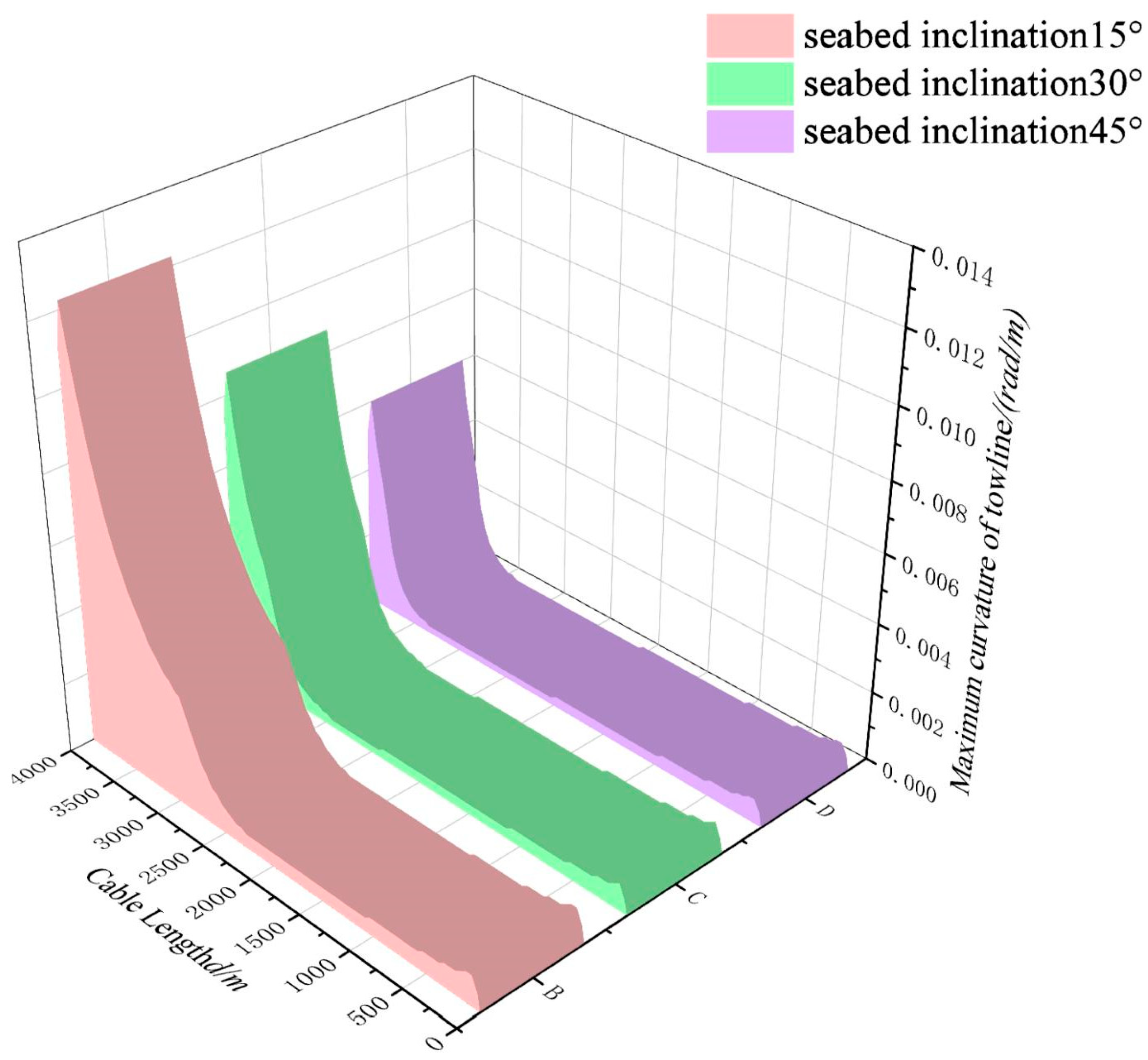
The geometric curvature of the towing cable in the simulation was extracted in this paper, revealing that the geometric curvature experienced by the cable is generally small. Therefore, judging the cable’s spatial configuration evolution based solely on the magnitude of the geometric curvature is not an objective. To address this, the maximum curvature values of the towing cable under different seabed inclination angles were extracted for comparative analysis [84,85,86,87,88].
Observing the distribution of maximum curvature, it is evident that the curvature peaks shift dynamically with the seabed inclination. Although the towing cable undergoes physical bending during the touchdown phase—theoretically inducing a bending moment—the actual magnitude of this moment is extremely small because the cable is a highly flexible member with negligible bending stiffness. Therefore, rather than using bending moment values, which would contradict the underlying assumption of cable flexibility, this study utilizes geometric curvature to characterize the spatial configuration shifts at the touchdown point (TDP). As the seabed slope increases from 15° to 45°, the TDP shifts closer to the tugboat, forcing an abrupt increase in local geometric curvature over a shorter unsupported span. This localized concentration of normal reaction forces is balanced primarily by the axial tension of the cable, and the resulting sharp rise in geometric curvature serves as a more accurate physical indicator for identifying localized fatigue hotspots than traditional bending moment calculations. As shown in Figure 10.
This indicates that the seabed slope significantly influences the range where cable spatial configuration evolution increases sharply and the degree of bending at which maximum deformation occurs [89].

3.3. Step-Distributed Seabed

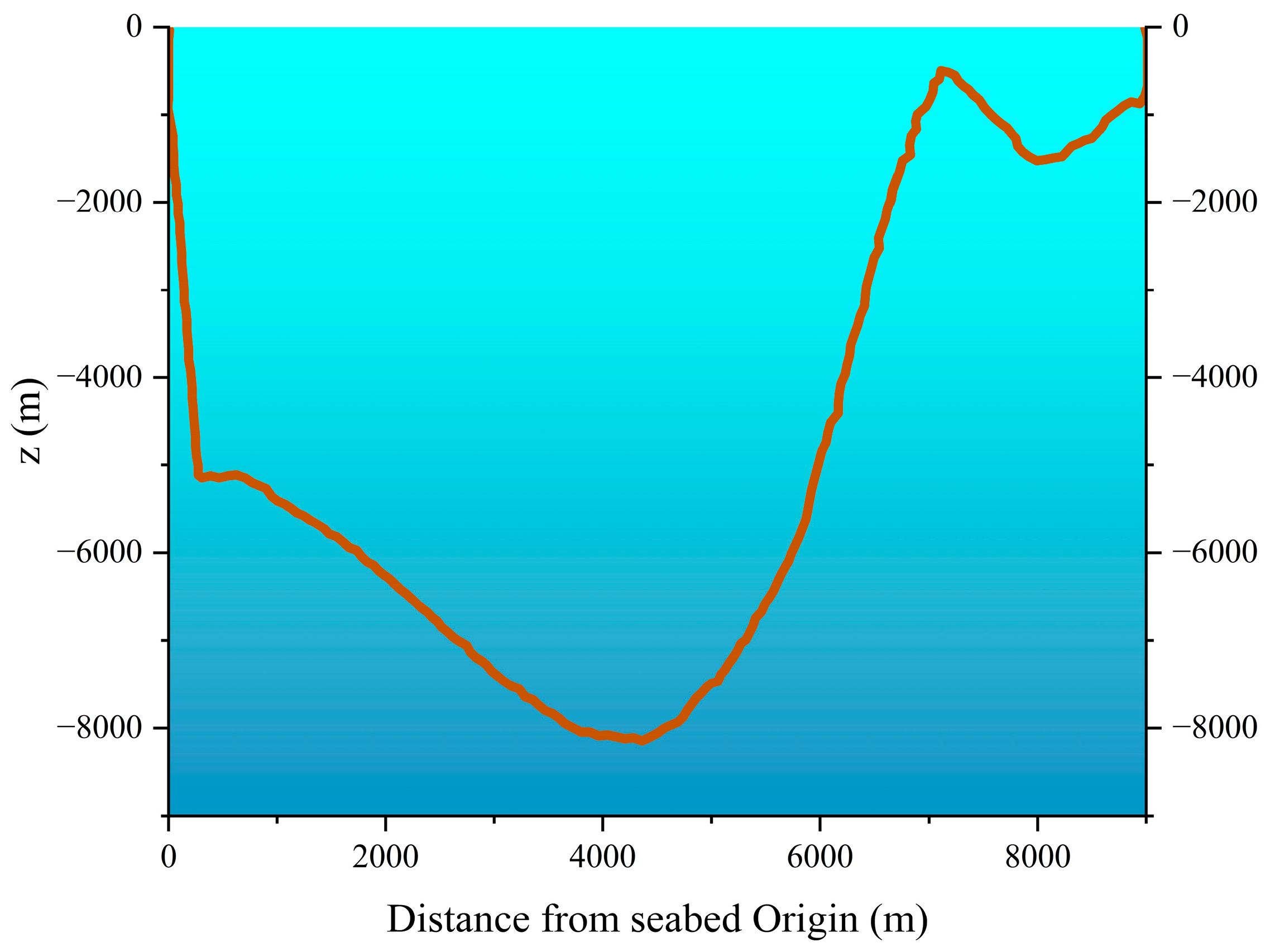
In addition to a sloping seabed, there also exists a two-dimensional morphology of a stepped seabed [90,91]. In a stepped seabed distribution, assume the seabed is distributed along the x-direction as N steps. At the N points along the x- axis, there are N water depth values. The seabed morphology extends along the x-direction from the origin of the coordinate system outward, forming an N-step distribution pattern [92,93,94,95]. Between these N water depth values, a method must be established to transition the seabed profile from the ith depth to the j-th depth. When selecting interpolation methods, care must be taken to avoid sharp points generated by interpolation on the seabed. Therefore, linear interpolation should be avoided whenever possible. When linear interpolation is used, it not only tends to produce sharp points but also makes it difficult for the static equilibrium phase to converge or for the simulation to reach a balanced state. Consequently, cubic spline interpolation or cubic Bézier interpolation should be preferred. Among these, cubic Bézier interpolation provides smoother transitions in seabed topography. The simulations below employ cubic Bézier interpolation. Theoretically, the two methods yield differences in the transition of the stepped seabed, though these differences are minor. The constructed stepped seabeds are illustrated in Figure 11 and Figure 12.
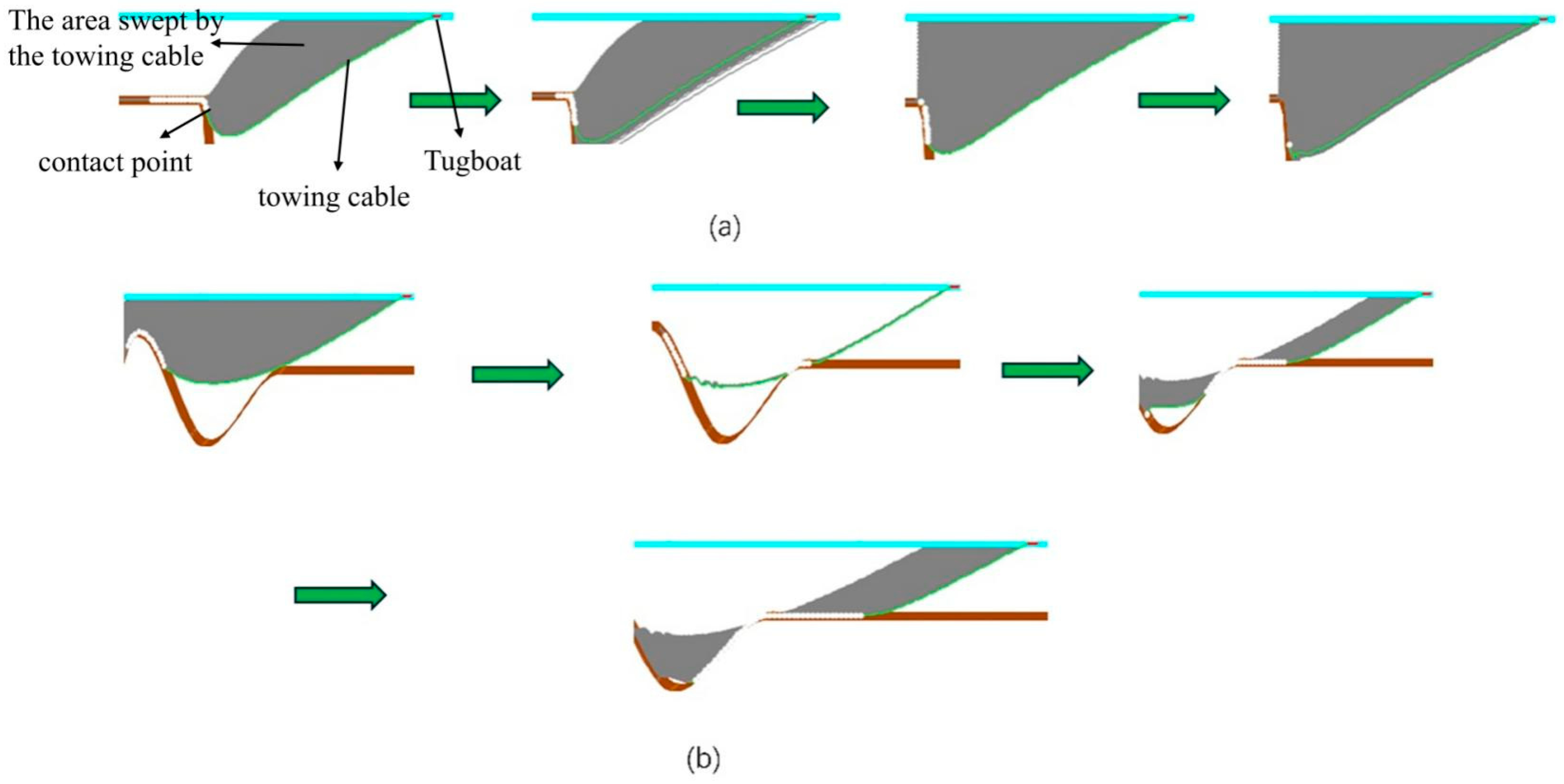
By comparing dynamic simulation results of contact and collision between towing cables and the seabed in simulations, this paper finds that contact between stepped seabed and towing cables can be categorized into two forms: point-to-line contact and line-to-point contact, as shown in Figure 13.
When the towing system moves at low speed from deep water to shallow sea areas, sudden undersea elevations may cause the towing cable to come into contact with the seabed. Upon contact, a node on the towing cable first touches the seabed. This instantaneous impact collision causes the towing cable tension to surge sharply. Subsequently, the presence of the seabed alters the towing cable’s configuration, with the nodes beneath it maintaining contact and sustaining the connection. If the seabed area is extensive, a significant portion of the towing cable will remain in contact and glide along the seabed under tugboat traction. On flat seabed terrain, a considerable length of the towing cable will persistently contact the seabed. Gliding along the seabed under tugboat traction and conforming to the seabed like a serpentine coil at bends, this state can be termed point-to-point contact [96,97,98]. However, if the seabed protrudes only in a very small area at specific locations, a point on the towing cable at the protrusion can be considered point-to-point contact. But if only a node at a certain position on the towing cable collides with the seabed within a very small sea area, the cable nodes following that point will still slide over the protrusion. At the instant of impact, all subsequent nodes of the towing cable may momentarily contact the seabed (another scenario occurs when all nodes from the initial impact point contact the seabed only at the protrusion, termed point-to-point contact, typically at relatively high tugboat speeds). Once the trailing node passes this point, the towing cable ceases contact with the seabed and rapidly resumes its spatial configuration prior to traversing the protrusion.
When the towing system transitions from shallow waters to deeper seas during low-speed towing operations, a sudden drop in the seabed may cause the section of the towing cable in contact with the seafloor to disengage due to the tugboat’s towing force. As the entire cable slides over the transition point and extends downward, the trailing end will experience slight entanglement at sufficient water depth once it descends to a specific level under gravitational force. Ultimately, contact ceases when the terminal node of the trailing cable loses contact with the seabed in shallow water. This point of contact can be termed the cable-contact point.
In point-line contact scenarios, the end of the towing cable does not become entangled. However, in line-point contact scenarios, the presence of gravity during cable descent enables end entanglement. In point-to-point contact scenarios, within areas characterized by extreme inclination and steep gradients (such as the first step in this example, where the inclination approaches 90°), beyond entanglement, the sudden drop in seabed elevation combined with entanglement increases the kinetic energy at the trailing end. This creates a whipping effect upon disengagement from the seabed, releasing additional kinetic energy. It can be inferred that in such scenarios, the faster the tugboat travels, the less likely entanglement and whipping effects are to occur during seabed disengagement. This is because at high speeds, the sudden drop in seabed depth caused by the sinking towing cable can be promptly overcome by the tugboat’s pulling force, allowing the cable configuration to rapidly adjust and extend. This conclusion directly contradicts the subsequent findings regarding three-dimensional seabed topography.
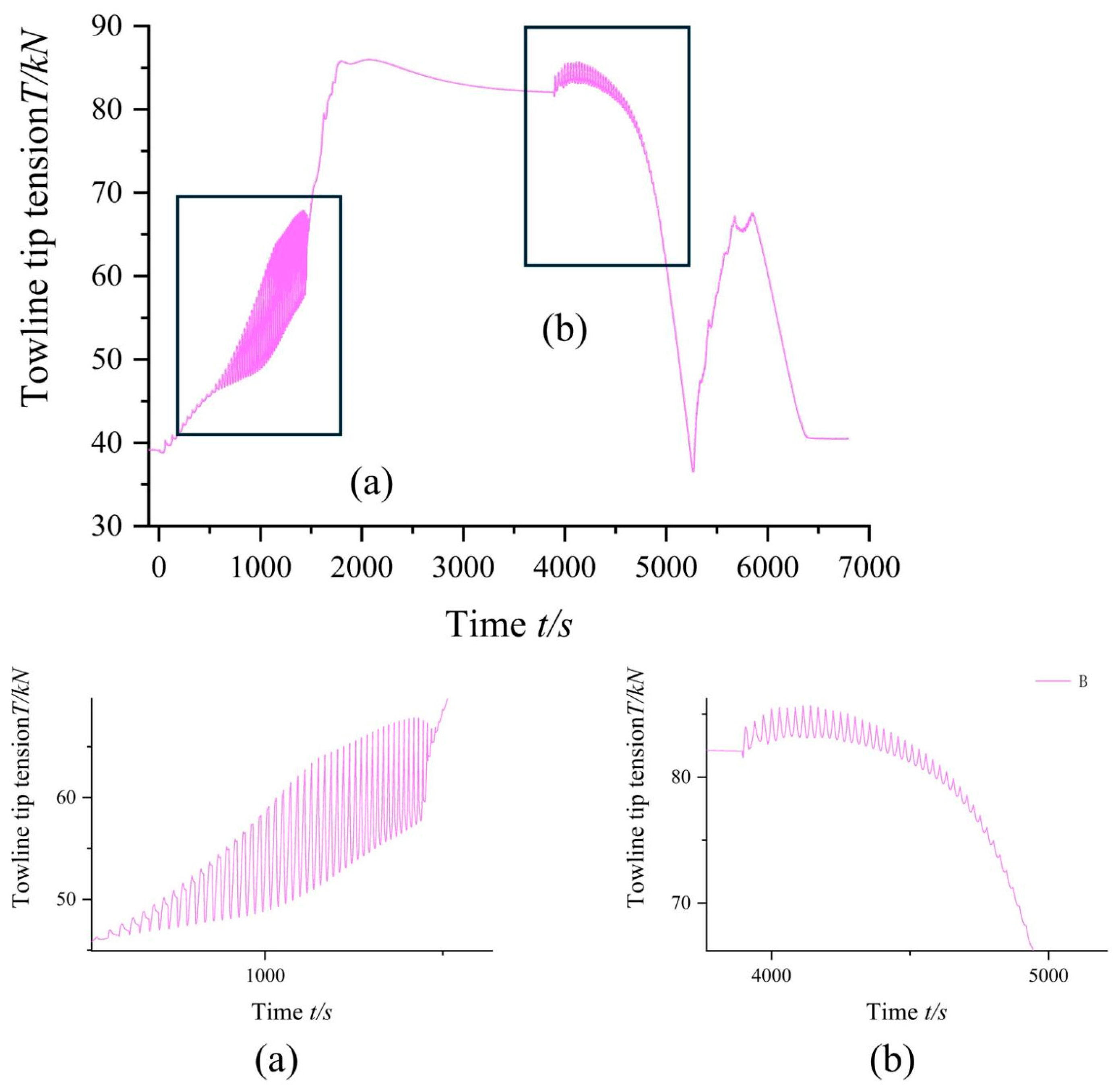
Observing the fluctuations at the trailing cable’s end in the time domain reveals the following: During the initial vertical descent phase over the steep seabed, the tension at the trailing cable’s end gradually increases. When the trailing cable’s end falls to the point of separation from the seabed, the tension fluctuations become extremely violent. However, the overall tension exhibits an upward trend despite these intense fluctuations. After the cable’s base completely detaches from the seabed, tension increases in a nearly linear fashion until the entire cable stabilizes under the combined effects of ocean currents and tugboat traction. Once the trailing end of the towing cable has completely detached from the seabed, the tension at the leading end increases in an approximately linear trend until the entire cable reaches a stable configuration under the combined forces of ocean currents and tugboat traction. Thereafter, tension remains constant until the cable begins contacting the transition point of the next stepped seabed. Subsequently, the second and third tiers exhibit significant elevation differences with a narrow horizontal span, compounded by the shallower third tier. This causes bottom tension to surge sharply during the cable’s transition from the second to third tier, resulting in a violently fluctuating upward trend in overall tension. Therefore, when the cable transitions from the second to the third seabed level, it inevitably contacts a large area of the seabed. This causes part of the cable’s weight to be counteracted by the seabed’s supporting force, reducing the tension at the top of the cable. However, during this decrease in top tension, the transition phase from the second to the third level exhibits a highly pulsating pattern. When there is a significant difference in the vertical height between two steps, significant fluctuations in tension at the tip of the traction cable are unavoidable during the transition from one step to the next. Such tension fluctuations are highly likely to cause fatigue damage, regardless of whether the fluctuations involve a sharp increase or decrease in tension. Ultimately, as the traction cable’s sliding motion across the horizontal seabed stabilizes, its tip tension also stabilizes. This process is illustrated in Figure 14.
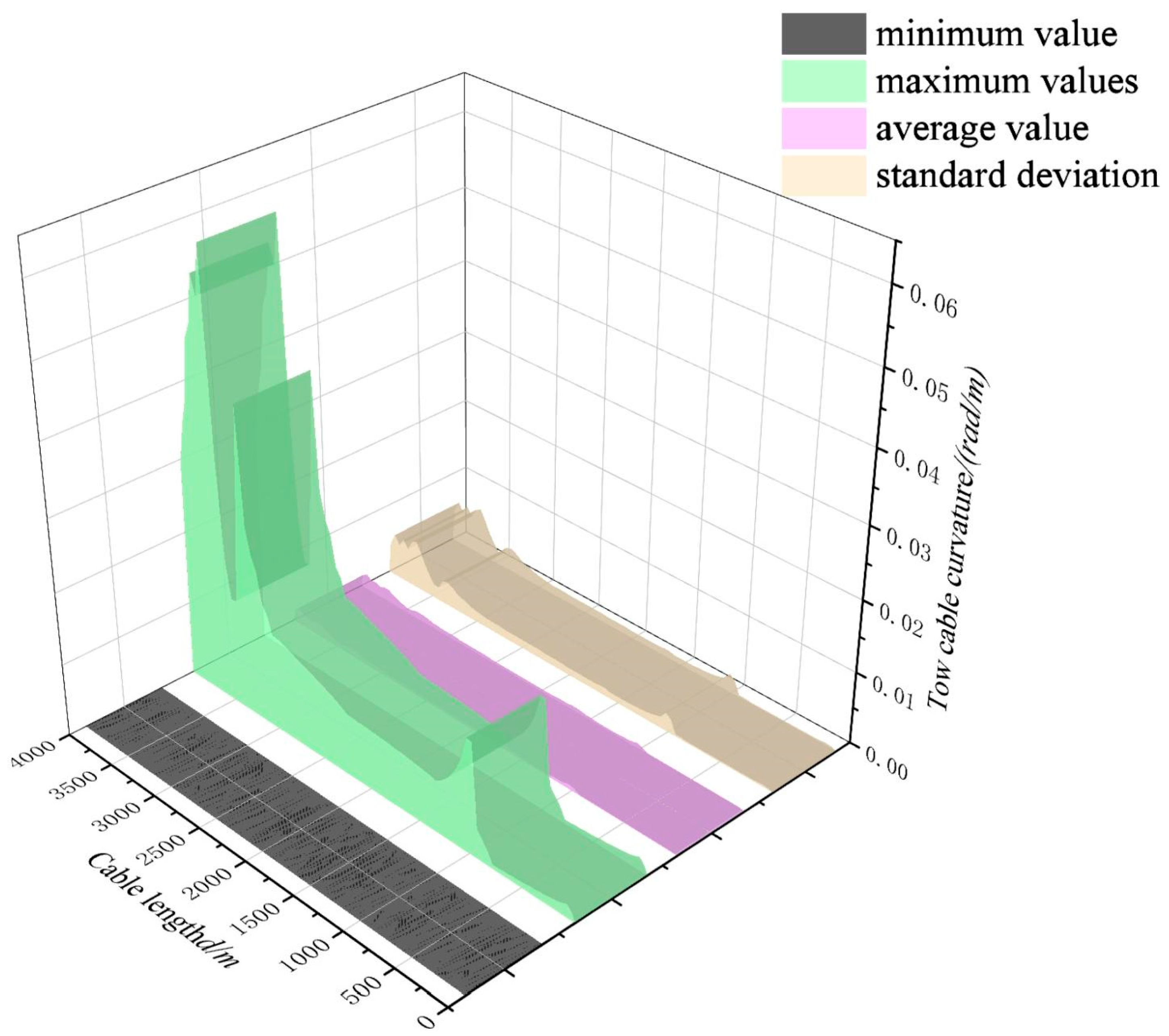
By observing the geometric curvature κ distribution along the entire length of the towing cable, this study found that the towline maintained a relatively smooth spatial configuration governed purely by axial tension for most of the simulation period. According to classical flexible cable mechanics, the towline operates primarily in tension and does not sustain structural bending moments. However, the maximum curvature values revealed that the cable experienced sharp geometric reconfigurations (severe localized wrapping rather than structural bending) when traversing multiple inflection points on the stepped seabed. The distribution locations of these maximum geometric curvatures perfectly corresponded with the transient shifting of contact nodes at those moments. The standard deviation distribution curve along the towline indicates that although the discontinuous stepped seabed induced abrupt localized peaks in spatial curvature, the overall macro-configuration remained dominated by tension equilibrium, as shown in Figure 15.
However, this is also related to the small towing speed of the tugboat. If the tugboat towing speed is high, it is not excluded that a sharp increase in bending causes the spatial configuration of the cable to deteriorate along its entire length.
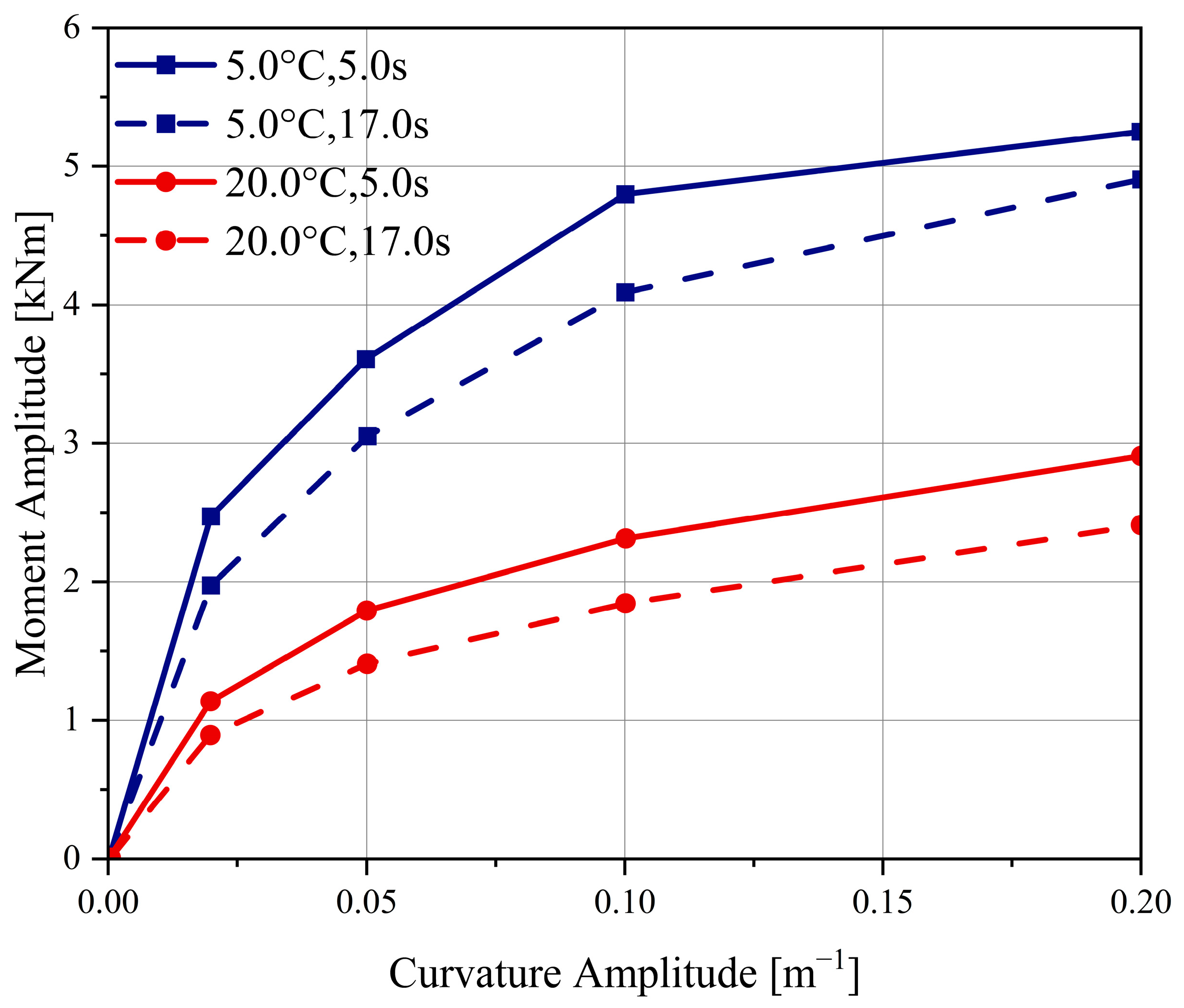
To investigate the complex mechanical behavior of sub-sea power cables, Komperød et al. [71] successfully utilized large-scale experimental tests to quantify the nonlinear, temperature-dependent, and frequency-dependent bending stiffness of the NordLink cable, and accurately mapped the consistent trends of moment amplitude versus curvature amplitude under various thermal and dynamic loading period conditions, as illustrated in the provided figure. While their work provides a foundational empirical dataset for understanding macro-scale flexural rigidity, their heavy reliance on isolated laboratory bending tests inherently constrains the mechanical model to simplified, uniform spatial loading. Consequently, a major shortcoming of their methodology is its inability to capture the highly coupled thermo-mechanical responses when the cable encounters complex, irregular seabed friction or three-dimensional twisting during actual field deployment. Furthermore, their analysis completely overlooked the internal inter-layer sliding friction and localized abrasive wear within the cable armor layers induced by continuous high-frequency dynamic bending, which is a critical fatigue failure mechanism for suspended cables subjected to turbulent ocean currents. The variations in moment amplitude driven by temperature and loading frequency are roughly illustrated in Figure 16.
The significant discrepancy in bending moments between the stiffest state (5.0 °C, 5.0 s) and the most compliant state, (20.0 °C, 17.0 s) observed in their curves, provides essential boundary conditions for dynamic structural simulations. In summary, when deploying or operating sub-sea cables in deep, cold waters (e.g., 5 °C) subjected to high-frequency wave motions or vortex-induced vibrations (short periods like 5.0 s), bending radii and laying speeds must be strictly controlled. This minimizes the excessive bending moment exerted on the cable, preventing structural yield. Particularly in areas with strong transient ocean currents, rapid and severe bending in low temperatures can lead to catastrophic cable damage. This is because the compounded effects of low temperature and high-frequency movement drastically stiffen the internal polymeric components, causing the interaction stresses to concentrate rapidly on localized cross-sections rather than distributing flexibly along the length. Such stiffened responses lack buffering elasticity and can cause significant fatigue or rupture damage to the metallic armor and internal conductors. While Komperød et al. [71] successfully conducted large-scale experiments to map the macroscopic, temperature- and frequency-dependent moment–curvature relationships of the NordLink cable, a critical evaluation reveals significant methodological shortcomings that severely constrain their practical applicability in complex offshore engineering. A major flaw in their approach is the treatment of the multi-layered cable as a macroscopic “black box,” inherently failing to mathematically capture the internal micromechanical behaviors—such as inter-layer slip, dry friction between helical armor wires, and the viscoelastic deformation of polymeric sheaths—thus restricting their work to empirical curve-fitting without a mechanistic physical foundation. Furthermore, their experimental framework is fundamentally limited to isolated, pure bending scenarios, completely overlooking the highly coupled multi-axial loading conditions (simultaneous tension, torsion, and bending) experienced during actual sub-sea installation, where extreme axial tension is known to “lock up” armor layers and drastically increase actual stiffness. Additionally, their analysis entirely missed the critical dimension of long-term structural degradation; by only taking discrete snapshots of dynamic periods (5.0 s and 17.0 s), they failed to account for the cumulative structural fatigue and localized abrasive wear induced by millions of continuous ocean-driven cyclic bending events over the cable’s lifespan. Finally, by testing the cable in an isolated laboratory vacuum, their empirical dataset completely neglects vital external boundary interactions, such as asymmetric seabed soil friction, trench constraints, and localized point-loads from irregular topographical outcrops, which are absolutely paramount for accurately predicting realistic spatial deformation and failure mechanisms in a true sub-sea environment. In summary, when navigating shallow waters and areas with uneven seabed topography, attempting to pass through at high speed should be considered. This minimizes the depth to which the towing cable sinks, preventing contact and collision with the seabed. Particularly in areas with numerous protrusions, insufficient tugboat speed can lead to more severe towing cable damage. This is because point-to-point contact collisions often occur, where the interaction force between the towing cable and seabed during each instant of contact is borne by a single node of the towing cable. Such collisions lack buffering effects and can cause significant damage to the towing cable.

3.4. Irregular 3D-Type Seabed

The first two seabed types are limited to single seabed profiles on a two-dimensional plane. For simple planar motions of a tugboat (such as acceleration and deceleration during straight-course navigation), these two seabed types are sufficient to meet requirements. However, such seabed configurations impose significant limitations on certain engineering practices (e.g., during slewing operations of towing systems), necessitating the use of three-dimensional seabed models.
The 3D seabed model is defined by specifying multiple sets of x, y, and z coordinates for the seabed. The x and y coordinates are defined relative to the seabed origin and are mutually perpendicular. Note that the z coordinate system is based on the overall model origin, with the z-axis perpendicular to both the x-axis and y-axis. For simplified operation, you may directly input seawater depth values, which the system will automatically convert into z coordinate values. After inputting multiple sets of distinct x, y, and z coordinate values, the system constructs the 3D seabed model using cubic polynomial interpolation and triangulation techniques based on the input coordinate information. The cubic polynomial interpolation method enhances the stability of both static and dynamic computations while improving the system’s robustness.
When employing triangular subdivision, a minimum edge subdivision angle α must be set to control the process. When seabed data forms concave surfaces, peculiar pseudo-data (useless for computation) may occasionally appear in marginal seabed regions. This issue can be resolved by setting the minimum edge subdivision angle α to a positive value. When α is set to a positive angle, any interior angle smaller than α will be excluded from the subdivision edges. On the other hand, when α > 0, it may lead to a certain degree of control failure—triangles being discarded. When α > 0, there are scenarios where large areas of the seabed may be discarded. In such cases, α should be set to 0 to prevent any triangle edges from being discarded.
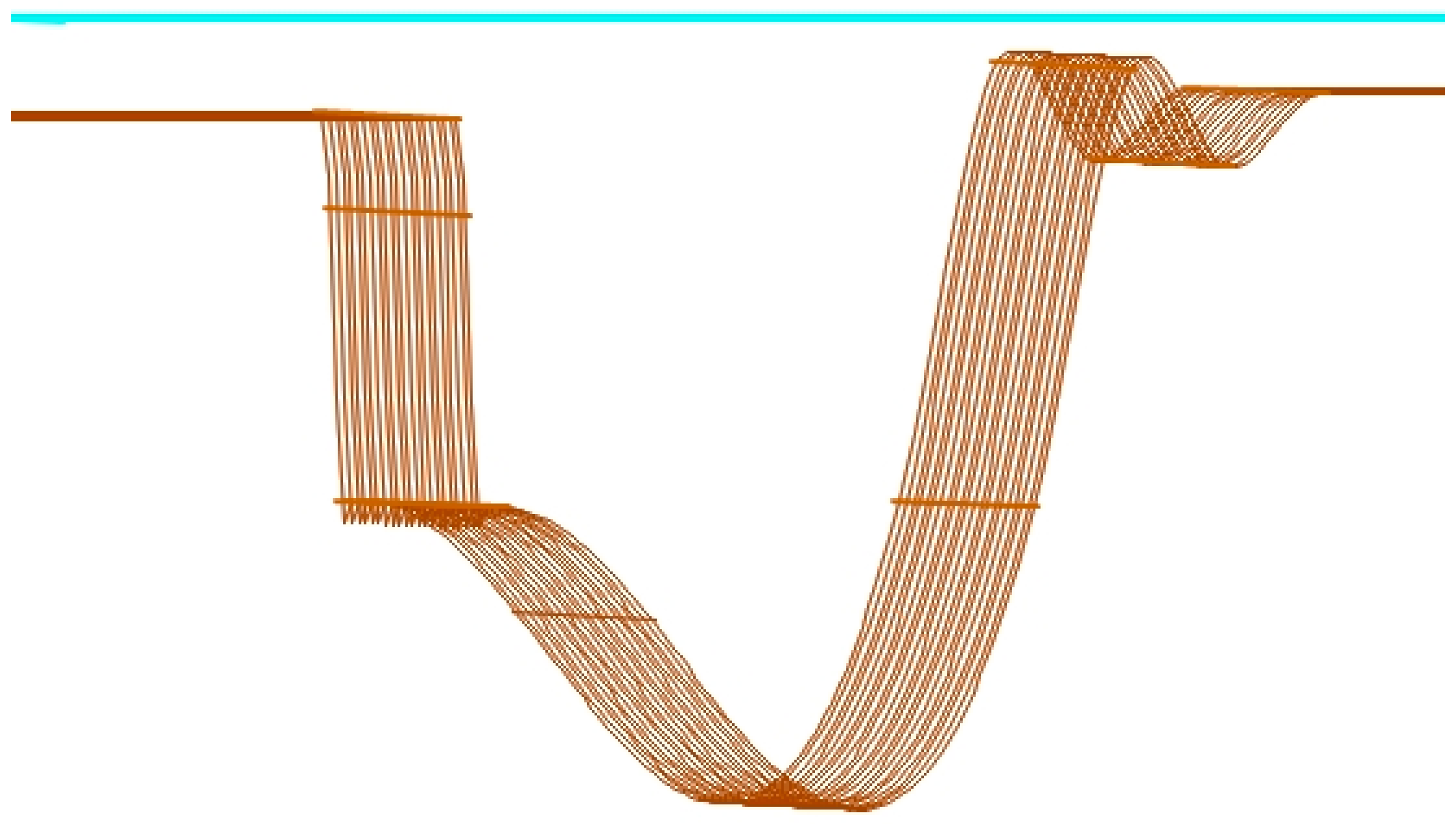
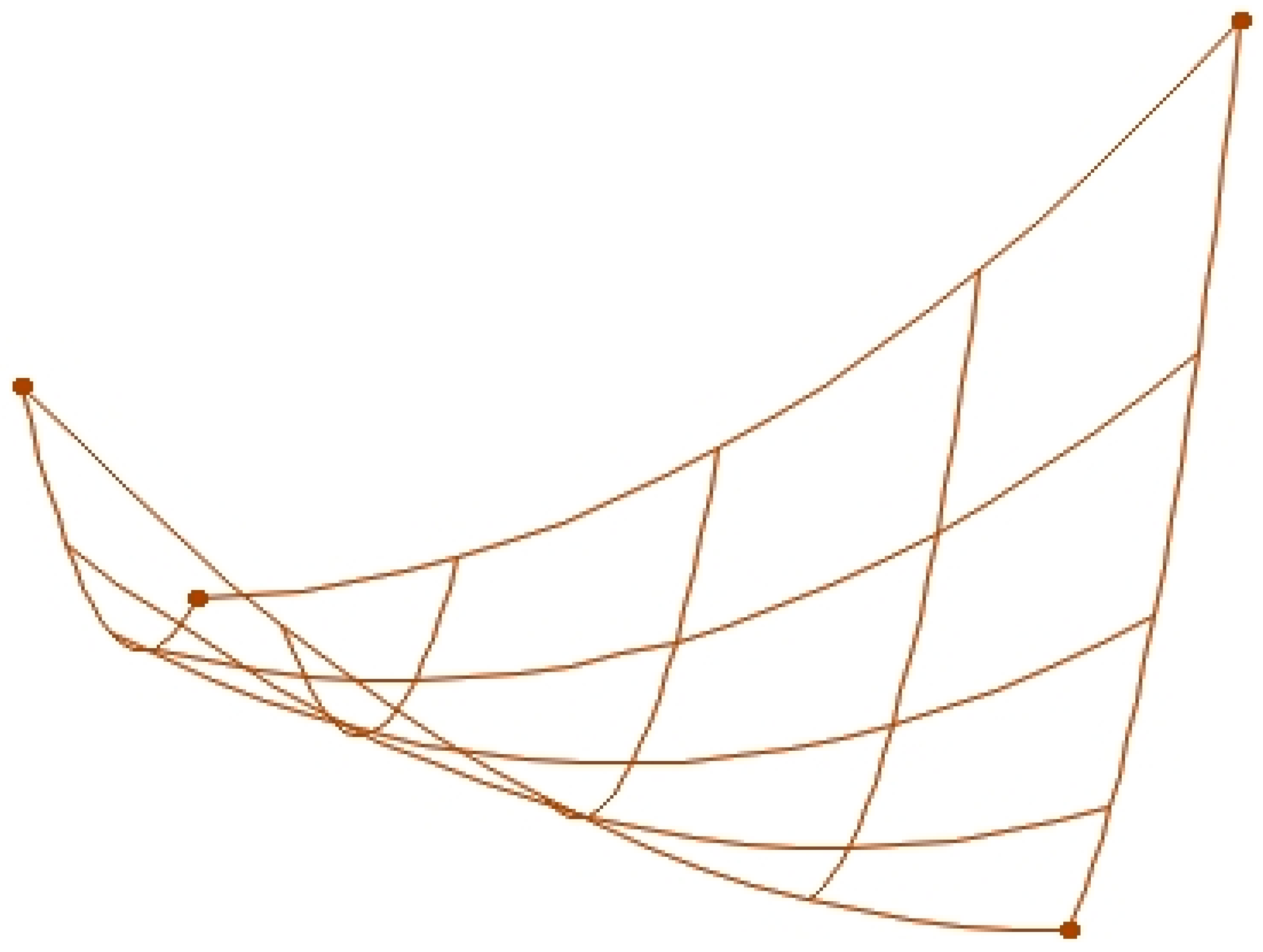
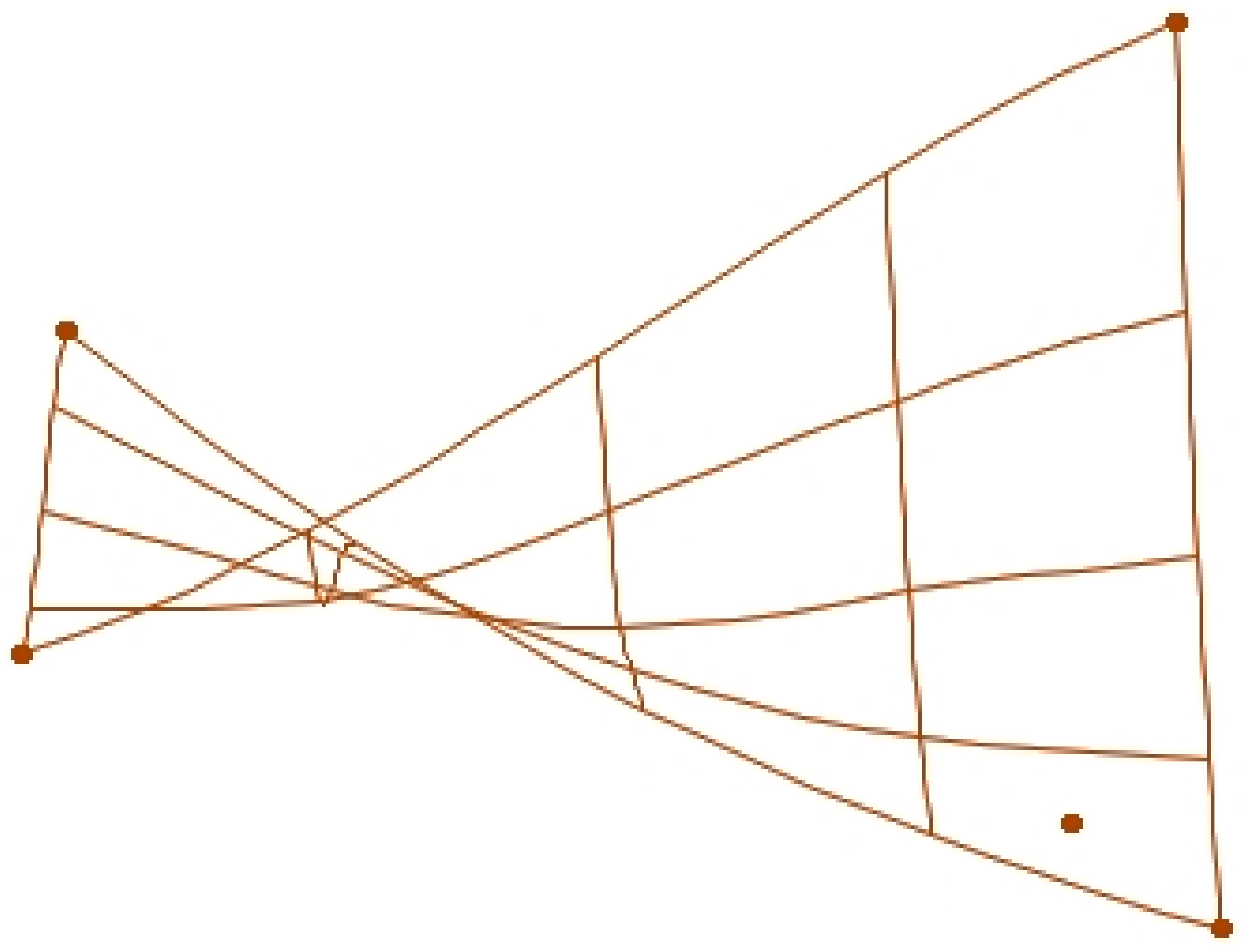
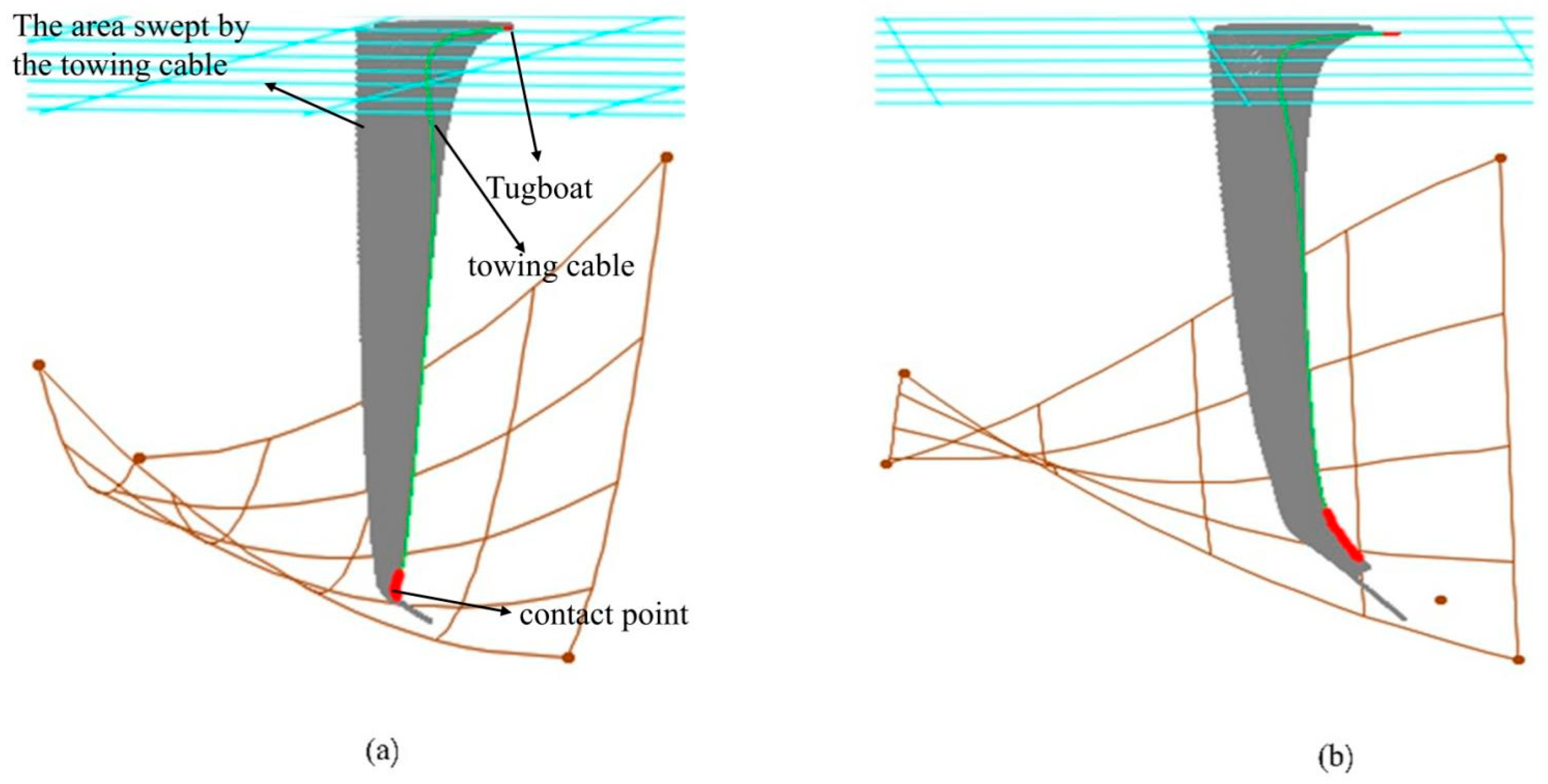
Due to the greater water depth in the 3D seabed, the towing cable length for this section is 5000 m. The towing vessel operates at a speed of 10.288 m per second with a turning radius of 500 m. Given the unique characteristics of the 3D seabed and its white seaward color, collision points between the cable and seabed are displayed in red in this section for easier identification and image capture. The 3D seabed model is shown in Figure 17 and Figure 18.
Observing the overall spatial shape changes in the towing cable on the three-dimensional seabed Type 1 and the variations in its contact section with the seabed reveals the following: During the tugboat’s return voyage, its turning motion is periodic. The contact changes between the towing cable’s contact section and the seabed are also periodic. The period of the contact changes between the contact section of the towing cable and the seabed is significantly longer than the turning period of the tugboat. Specifically in this simulation case, although the tugboat has performed multiple turns, by the end of the simulation, the contact changes between the towing cable and the seabed have completed only one cycle. Therefore, the length change in the towing cable has not yet completed a full cycle. Overall, the bottom of the towing cable continues to climb upward along the seabed. The entire simulation process is shown in Figure 19.
By observing the overall spatial configuration of the towing cable on the three-dimensional seabed topography 2 and the changes in its contact section with the seabed, the following can be observed: During the initial simulation phase, the bottom-contacting end of the towing cable first ascends axially forward under the towing force of the tugboat. In this phase, the length of the bottom-contacting section of the towing cable decreases. As the turning maneuver continues, the towing cable undergoes a slight axial backward shift along the seabed slope. During this phase, the length of the bottom-contacting section of the towing cable increases slightly. The length of the bottom-contacting segment slightly increases. Once the bottom-contacting section reaches a certain height above the seabed, the cable’s contact segment with the three-dimensional seabed 2 undergoes serpentine lateral rolling. During this rolling process, the cable continues to ascend laterally along the seabed’s curvature, with the length of the contact segment remaining essentially unchanged throughout.
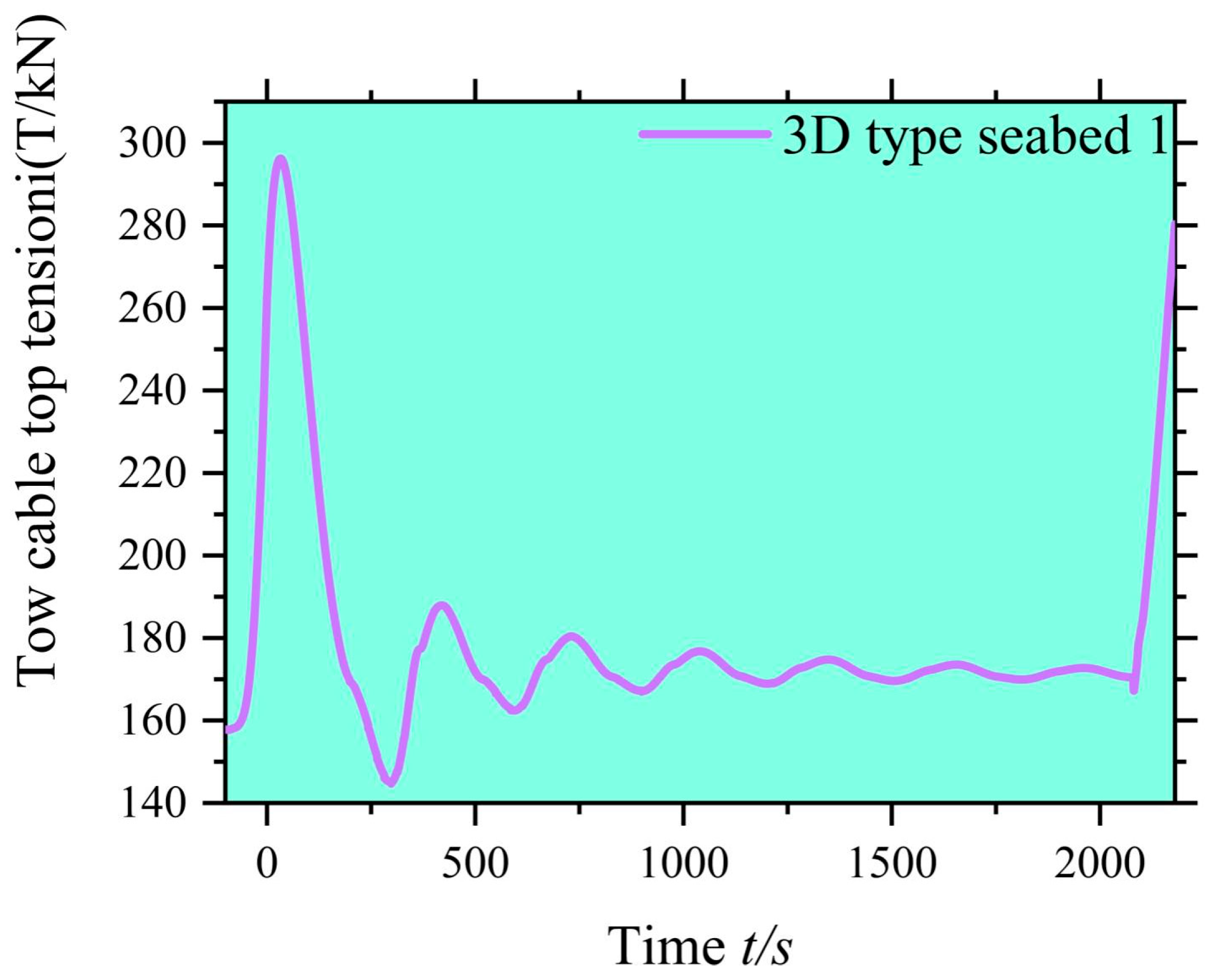
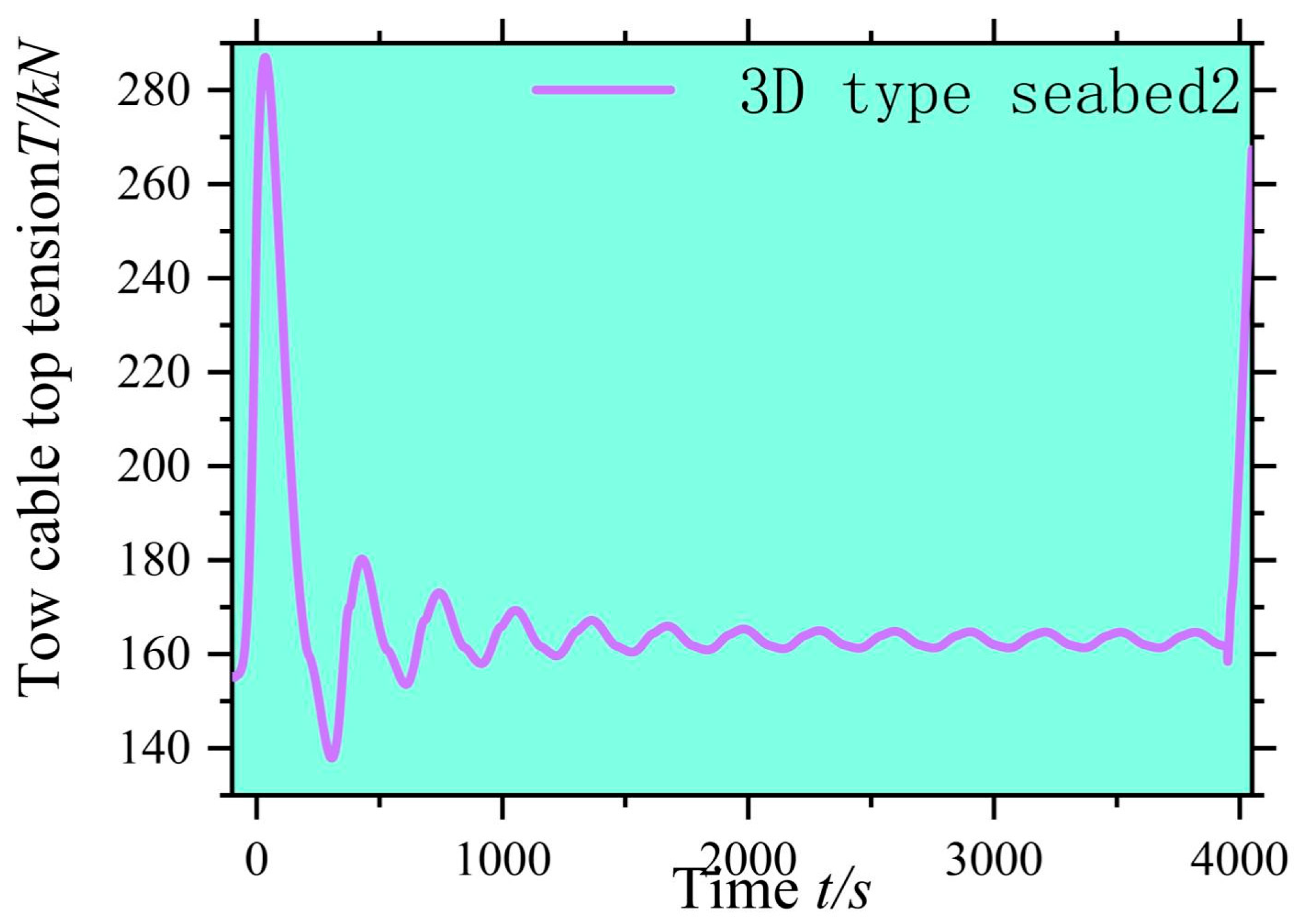
By observing the time-domain curves of the top tension of the towing cable for two types of 3D seabed topography, it can be seen that for 3D seabed topography 1, the top tension of the towing cable is greater during the initial stage. For 3D seabed topography 2, the top tension of the towing cable slightly decreases during the initial stage. As shown in Figure 20 and Figure 21.
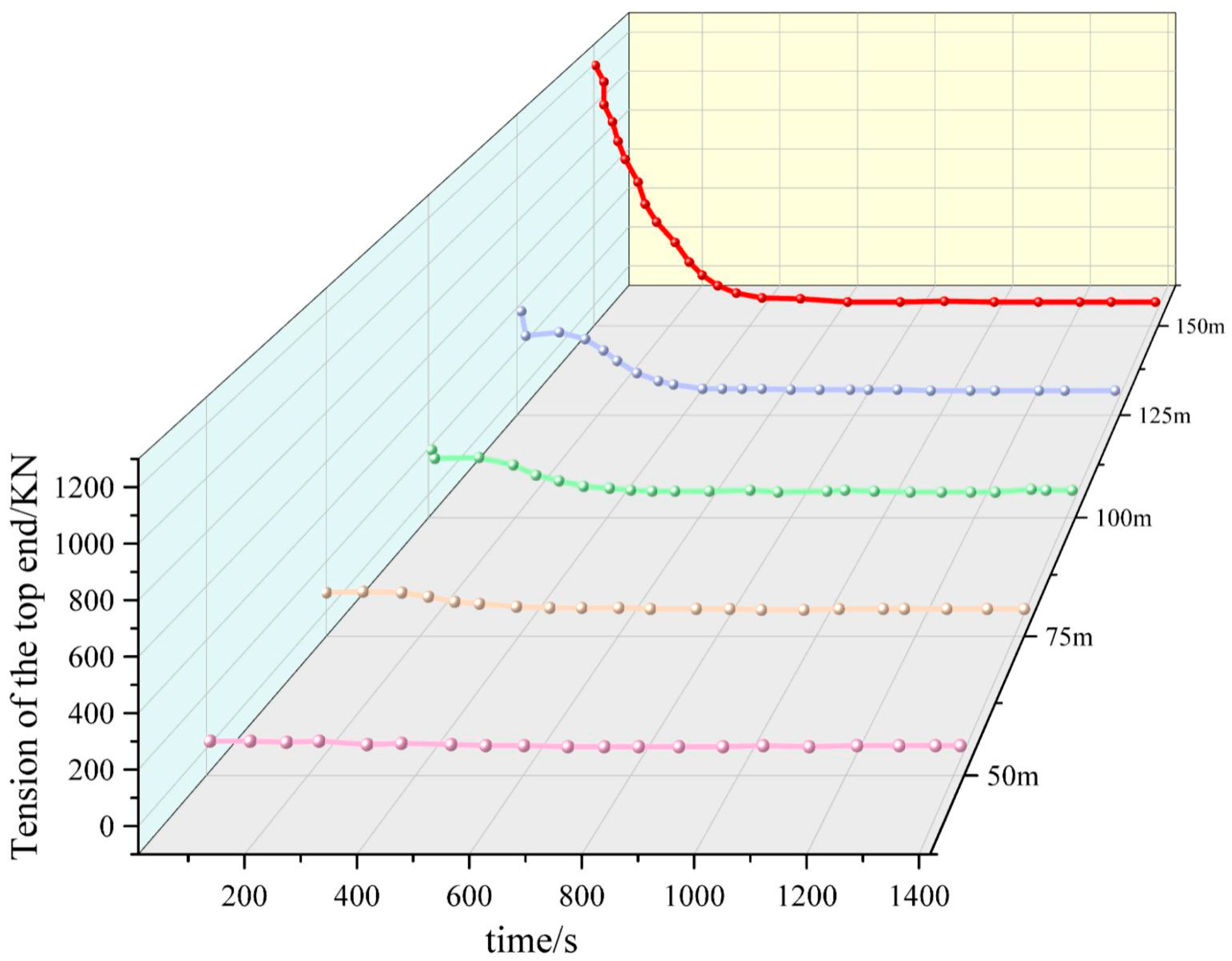
In evaluating the maneuvering dynamics of submarine systems, Zhang et al. [17] made notable strides by employing the lumped-mass method to quantify macroscopic, depth-dependent tension variations at the cable tip during complex turning operations, successfully demonstrating that tension drops sharply after reaching its peak at greater water depths, as depicted in Figure 22. However, the fundamental shortcoming of their chosen lumped-mass formulation is the inherent neglect of localized bending stiffness. Because the cable is discretized into interconnected frictionless springs, the model drastically compromises the accuracy of stress predictions precisely at the highly curved touchdown zones where the cable sharply contacts the seabed. Moreover, their study failed to consider the coupled impact of complex, irregular 3D seabed topographies, assuming instead a simplified flat or uniform boundary. They also completely overlooked the high-frequency tension spikes that would be inevitably induced by the towing vessel’s surface wave-induced heave motions, meaning their predicted tension curves represent an idealized scenario that significantly underestimates the true transient loads experienced in actual maritime operations.
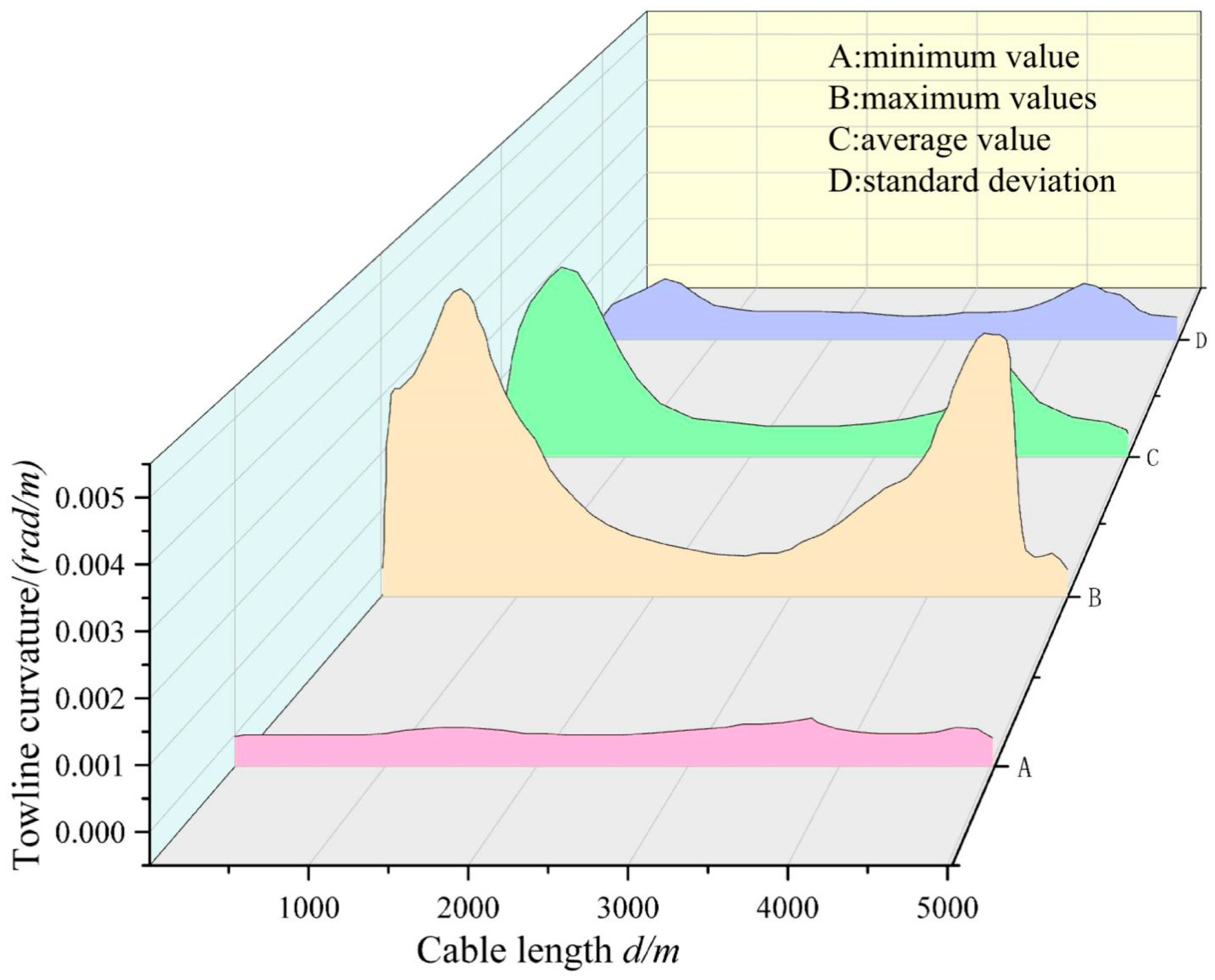
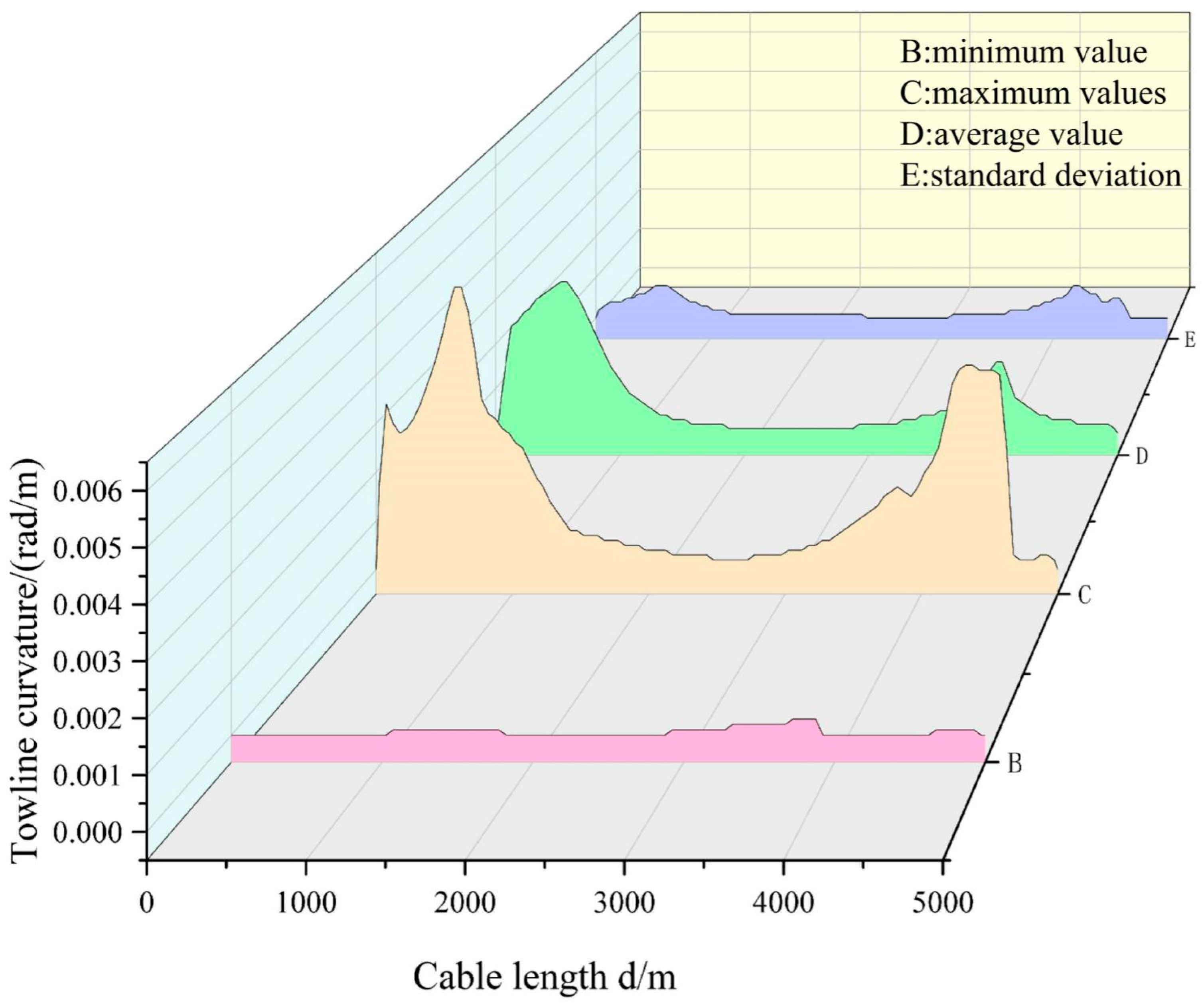
The curvature variation along the length of the towing cable in two 3D seabed topographies indicates that bending phenomena are primarily concentrated in two regions. For 3D seabed 1, the maximum cable bending occurs within the 500 m zone near the trailing end. For 3D seabed 2, the greatest cable curvature appears within 500 m of the tip. Regarding the steepness of curvature changes, as shown in Figure 23 and Figure 24, both 3D seabed types exhibit more pronounced bending near the top.
By examining the computational results for two types of three-dimensional seabeds, it is evident that the dynamic response of the towing cable upon contact with each seabed exhibits distinct characteristics. This indicates that the morphology of the three-dimensional seabed plays a significant role in the transmission of cable motion and the resulting changes in cable configuration.
In addition to the above two 3D type seabeds, it can be speculated that in the process of towing system slewing, if there is a 3D type seabed with a sharply higher long thin protruding point, a node on the towing cable in the moment of collision with the protruding point can experience two different spatial morphology changes. This paper speculates on possible dynamic responses. If the tugboat turns at extremely high speed, the towing cable will eventually detach from the seabed. Due to the turning process, the spatial configuration of the towing cable undergoes extremely violent changes along its length, and this spatial configuration change also exhibits a propagation effect along the cable’s length. The faster the tugboat turns, the more pronounced this lag effect becomes. Therefore, at the instant of collision between the towing cable and the protruding point, the towing cable’s response must be divided into two sections for study, with this node serving as the boundary. One section is the area from this node to the tugboat. The other section is the area from this node to the tail end of the towing cable. At the instant the towing cable contacts the protrusion on the seabed, it rapidly stretches from its top to the collision node area. At this moment, the tension between the collision node and the cable’s tip increases sharply. The movement transmission and spatial configuration of the towing cable are abruptly impeded at the collision point. The section of the towing cable below the collision point will momentarily maintain its original oscillation pattern around the collision point, with the winding radius decreasing the closer it approaches the protruding point where the cable coils. As the tugboat continues to turn, the coiled section will enter the upper region of the towing cable, specifically the area from the cable tip to its end. As the tugboat continues to rotate, the coiled section of the towing cable will be stretched under the tensile load from above, sliding segment by segment over the protruding points until it finally disengages from contact with them. If the tugboat rotates at low speed, the spatial configuration of the entire towing cable changes gradually, allowing for more timely transmission of longitudinal shape changes. When a node of the towing cable collides with a protruding point on the seabed, the impact energy from this collision is transmitted relatively promptly along the entire towing cable. Thus, at the instant of collision, the spatial configuration trend of the towing cable segment below the collision node is not obstructed by bending. The towing cable segment beneath the collision node does not exhibit significant coiling. Instead, it sequentially snakes past the protruding seabed point. When the tugboat rotates at high speed, the probability of this coiling phenomenon increases with towing speed, but its duration decreases with increasing towing speed. During the unwinding process of the coiled cable, the cable tension decreases slightly. This minor reduction occurs because, although the lag effect impedes the transmission of motion along the cable, collisions with undersea protrusions still reduce the overall speed of the cable. At this point, the lag effect diminishes, and the tugboat’s motion is ultimately transmitted to the cable’s trailing end, causing the tension distribution along the entire towing cable to stabilize. The whipping effect occurs the instant the trailing end of the towing cable disengages from the seabed protrusion. The more abrupt the tugboat’s turn, the more pronounced the whipping effect at the trailing end of the towing cable.
However, regardless of whether the tug’s slewing speed is high or low, the tension at the nodes of the towing cable where the collision occurs increases dramatically at the moment of the collision with the seabed projection.
For the seabed towing cable of a towing system performing rotational operations at a certain rotational speed on a three-dimensional seabed, the presence of protrusions spaced intermittently across the seabed poses a potentially fatal hazard to the system’s safety. Such hazards cannot be completely eliminated regardless of high or low speeds. Therefore, specific evasion measures may be implemented when traversing these protrusions, or the tugboat’s navigation trajectory and position should be planned as far in advance as possible. While maximizing the safety of the towing system, sufficient data on the seabed environment should be collected. In areas densely populated with sharp protrusions, the towing system cannot perform rotational maneuvers. Consequently, analyzing the interaction between such three-dimensional seabeds and towing cables holds limited practical significance in actual engineering applications.
Of course, beyond straight-line and turning maneuvers, towing systems also employ various other forms of maneuvering. Examples include serpentine maneuvers and towing operations along specific pre-set trajectories. However, more complex towing paths can be decomposed into several simpler trajectories. Actual seabed topography also exhibits discontinuities—a sloping seabed in one area may transition to a stepped seabed or a three-dimensional seabed in another.
Inclined seabeds are actually classified into two types. One type is the inclined seabed described in this paper, where the plane of the seabed forms a certain angle with the straight line indicated by the direction of the tugboat’s straight-ahead towing speed. The other type lies within a plane parallel to the straight line indicated by the tugboat’s direct course at towing speed. This seabed type exerts a more complex influence on cable contact. The section of the cable in contact with the seabed will endure continuous lateral bending and friction. Once such contact occurs, it will persist as long as the tugboat must maintain its direct course to meet operational requirements. Under these circumstances, shortening the cable becomes the only viable option. In addition to the three seabed models proposed in this paper, shallow water areas also feature a continuous, gently undulating seabed. These seabeds typically occur in relatively shallow waters but exhibit poor overall flatness. The submerged section of the towing cable is inevitably segmented by the seabed’s undulating folds into a structure resembling a multi-span beam. Since tugs must maintain straight-line navigation to meet operational requirements, the towing cable slides along the seabed supported at several discontinuous contact points. During sub-sea sliding, the cable is supported by multiple discontinuous contact points. As the cable moves, the positions of these contact points continuously shift. The irregularity of the undulating folds causes severe friction at these contact points. At this point, the cable experiences extremely high frictional forces. If necessary, a two-vessel towing configuration can be employed to prevent direct contact between the cable and the seabed. Therefore, in actual engineering practice, selecting the appropriate seabed type based on real-world towing conditions and sea states is essential. On one hand, this maximizes the representation of project realities to yield scientifically accurate results while further enhancing computational efficiency and reducing costs. On the other hand, it also helps avoid unnecessary operational errors and technical risks.
Additionally, we propose a concept: when the total length of the towing cable is extremely long, and the water depth is not particularly great, if towing operations are indeed necessary, could a large number of lightweight, high-buoyancy hydrofoils be installed along the cable route? The buoyancy generated by the hydrofoils would reduce the depth of the towing cable, thereby preventing it from contacting the seabed. A simpler and more economical solution involves encasing the towing cable in an outer layer of durable, leak-proof, and highly flexible inflatable material. In deep water, this design functions as a conventional outer sheath (without inflation). In shallow water, the outer layer can be inflated with an appropriate amount of gas based on actual sea conditions. This approach enhances the overall buoyancy of the towing cable to prevent bottom contact while maintaining the low-drag characteristics of the underwater section.
In short, seabed topography varies significantly, and seabed soil materials also exhibit considerable diversity [99,100]. Consequently, towing operations and their contact patterns will be diverse, and the forms and solutions for avoiding contact collisions will also be rich and varied. When seabed normal stiffness is insufficient, soft seabed soils can cause the towing cable to cut trenches into the seafloor and subsequently embed itself. This phenomenon leads to lateral collisions and friction between the seabed on both sides of the trench. At this point, the towing cable and seabed form more complex contact patterns. Figure 25 and Figure 26 illustrate practical application cases, such as underwater robotic towing systems and sub-sea pipeline laying and inspection.

4. 2D (Two-Dimensional) and 3D (Three-Dimensional) Analysis

The choice between two-dimensional (2D) and three-dimensional (3D) models depends on accuracy requirements, computational resources, and the complexity of operating conditions. Two-dimensional towing cable models neglect vertical or lateral motion, performing analysis solely within a single plane (e.g., the X-Y plane) [101,102]. Two-dimensional towing cable models typically also assume uniform distribution of cable cross-sectional properties along its length and neglect torsional effects [103,104,105,106,107]. Two-dimensional towing cable models are suitable for scenarios with low flow velocities, stable flow directions, and low turbulence intensity. They may also be applied when cable bending is minimal and planar stress distribution approximations hold [108,109,110,111]. By simplifying seabed topography into flat or regular slopes [112,113,114,115], these models significantly streamline the simulation and computation of sub-sea cable motion. However, the two-dimensional model fails to capture the asymmetric loads generated by flow separation around the cable circumference [116] and cannot characterize the load transfer process in multi-cable torsional configurations [117,118]. These limitations in resolving complex environments severely restrict the applicability of two-dimensional models in sub-sea cable analysis.
In the field of underwater towing cable system design and optimization, three-dimensional modeling technology has become a research hotspot due to its ability to precisely characterize complex fluid–structure interactions [119], multi-physics dynamic responses, and terrain contact behavior. Three-dimensional modeling constructs the spatial motion equations of towing cables using either elastic slender rod theory or the finite element method [120,121,122,123]. By incorporating curvature–torsion coupling terms, it can precisely describe the spatial orientation and tension distribution of towing cables within complex flow fields [124,125,126,127]. For instance, when studying non-uniform towing cables, three-dimensional models can analyze the effects of tangential/normal drag coefficients and density variations on cable geometry [20,128,129,130], whereas two-dimensional models cannot capture local stress concentrations induced by torsional effects. The three-bit model combined with computational fluid dynamics (CFD) can solve three-dimensional turbulent flow fields, capturing vortex-induced vibration (VIV) around the towing cable and wake vortex shedding phenomena [131,132,133]. Compared to simplified two-dimensional potential flow models, three-dimensional models significantly improve the prediction accuracy of low-frequency flow field disturbances.

4.1. 2D Analysis

In the realm of two-dimensional analysis, Guan et al. [51] made a notable contribution by deriving analytical formulas for the steady-state control equations of an underwater towing cable based on the static Morrison equation. Their work successfully provided a rapid analytical framework for determining the steady-state tension and morphology of towing cables, which proves highly efficient for preliminary design and low-speed, straight-line towing scenarios under uniform horizontal flow velocities. However, the fundamental flaw in their approach lies in the severe oversimplification of the marine environment. By restricting the flow velocity and cable deformation entirely to a single 2D plane, their model inherently assumes an idealized, perturbation-free environment, rendering it ineffective for complex operational maneuvers. Furthermore, their study completely failed to consider out-of-plane hydrodynamic forces, such as cross-flow vortex-induced vibrations (VIV), and torsional stiffness. Crucially, due to its reliance on static equilibrium, their methodology is entirely incapable of capturing transient dynamic shocks, particularly the severe “snap-loads” generated when a cable encounters sudden seabed elevations or discontinuous topographies. [51]. They derived the expressions of the equations for the tangential and normal forces as
f τ = 1 2 ρ w C D τ π D V τ d s d f n = 1 2 ρ w C D n π D V n d s d
He then combined the weight of the towing cable itself to obtain an expression for the combined force in the horizontal and vertical directions.
R wx = 1 2 ρ w C D τ π D V τ V τ cos θ 1 2 ρ w C Dn π D V n V n sin θ 1 + ε d s 0
R wy = 1 2 ρ w C D τ π D V τ V τ sin θ + 1 2 ρ w C Dn π D V n V n cos θ 1 + ε d s 0
Meanwhile, in the study of Iordan C. Matulea, they discussed some cases where both ends of the cable and the current are located in the same horizontal plane. In their experiments, they likewise obtained expressions for the tangential and normal components per unit length [134].
F τ = 1 2 ρ d c c τ v ( z ) sin θ | v ( z ) sin θ |
F n = 1 2 ρ d c c n v z cos θ v z cos θ
By comparing the applied formulas of the above two teams with Equation (2) and experiments in this paper, it can be found that both of them assumed the two ends of the towing cable and the flow velocity of the water in the same plane when analyzing the steady state of the towing cable underwater, and at the same time, a large number of research teams have adopted this approach when conducting simulation experiments on underwater towing cables using two-dimensional modeling.

4.2. 3D Analysis

To overcome the inherent limitations of 2D planar analyses, researchers have increasingly transitioned to 3D spatial models. For instance, Zhang et al. [30,135] established a comprehensive 3D coordinate system utilizing rotation matrices to transform vectors between fixed and Lagrangian coordinate systems. This work represents a significant mathematical advancement, as it successfully incorporates full spatial kinematic equations to capture the asymmetric loads generated by multi-directional flow separation, effectively characterizing the load transfer process during complex 3D turning maneuvers. Nevertheless, despite its mathematical rigor, the computational cost of their fully coupled 3D framework remains prohibitively high for real-time operational guidance. To maintain numerical stability during explicit time-domain integration, their model is forced to rely on heavily simplified, linear penalty-based algorithms for seabed contact. More critically, Zhang et al. primarily focused on the fluid–structure interaction but severely neglected the intricate soil-structure interaction (SSI). Their model treats the seabed merely as a purely rigid boundary, completely failing to account for the visco-plastic yielding behavior of soft clay or loose sand seabeds. Consequently, their framework inevitably overestimates the elastic rebound force during seabed collisions and entirely ignores the energy dissipation mechanics caused by cable trenching and embedment into the seafloor.
C = cos ϕ cos θ sin ϕ cos θ sin θ sin ϕ cos ϕ 0 cos ϕ sin θ sin ϕ sin θ cos θ
The orthogonal coordinate system created by Zhang consists of three vectors: a tangential vector along the x-axis, a normal vector along the y-axis, and a subnormal vector along the z-axis. The above matrix allows for the transformation of the Lagrangian coordinate system with the following equation.
G 1 G 2 G 3 = C G X G Y G Z
At present, there are many research teams like Zhang to establish three-dimensional coordinates and then, through the transformation of the coordinate system, use a reasonable simulation method for the simulation of underwater towing cable experiments.
At the same time, in three-dimensional modeling under the underwater towing cable research, it can not be the same as two-dimensional modeling, as a small number of formulas can express the morphology of each node of the underwater towing cable. For example, Li [6] established three right-angle coordinate systems in the experiment, including the inertial coordinate system (x, y, z), the local coordinate system of towing cable (b, t, n), and the local coordinate system of towing body (ξ, η, ζ).
Expressed in this way, T denotes the tangential direction of the towing cable in Equations (40) and (41). N and B are the normal and sub-normal directions. The local coordinate system of the towed body moves with the towed body. ξ points to heading, η points to starboard, and ζ points vertically to the bottom. These angular expressions are consistent with those in Figure 4.
A = cos θ sin θ cos φ sin θ sin φ sin θ cos θ cos φ cos θ sin φ 0 sin φ cos φ
B = sin ψ cos ϑ sin ψ sin ϑ sin φ + cos ψ cos φ sin ψ sin ϑ cos φ cos ψ sin φ cos ψ cos ϑ cos ψ sin ϑ sin φ sin ψ cos φ cos ψ sin ϑ cos φ + sin ψ sin φ sin ϑ cos ϑ sin φ cos ϑ cos φ
The transformation relationship between these three coordinate systems can be written as an equation.
x y z = A b t n = B ξ η ζ
Compared with two-dimensional modeling, three-dimensional modeling not only has more coordinate axes to assist in describing the local or overall state of the underwater towing cable, but also sometimes needs to establish coordinate axes to describe the environment or more motion states, for example, Zhang [30] in the experiments, also establishes a velocity coordinate system and an angular velocity coordinate system to describe the ship’s different speeds and angular velocities on the morphology of underwater towing cable.
After describing the differences in coordinate system establishment between 3D and 2D for the study of underwater towing cables, we compare the mechanical formulas and equations of motion in the different coordinate systems.
The hydrodynamics and the infra-regular hydrodynamics in the normal direction were inferred in the simulation of Zhang [135].
( 1 + e ) F h = 1 2 ρ w d π C d r v 1 r | v 1 r | 1 + e τ + 1 2 ρ w d C d p v 2 r v 2 r 2 + v 3 r 2 1 + e + ρ w π d 2 4 J ˙ 2 + m a v ˙ 2 r n + 1 2 ρ w d C d p v 3 r v 2 r 2 + v 3 r 2 1 + e + ρ w π d 2 4 J ˙ 3 + m a v ˙ 3 r b
In the experiments of Li [6,30,136], based on Morrison’s formula, it was obtained that the hydrodynamic force on the traction cable device consists of three components, tangential force F n x , normal force F t and subnormal force F n y .
F h = F n x + F t + F n y F n x = 1 2 ρ f C n x l d x ˙ v n x ˙ v n F n y = 1 2 ρ f C n y l d x ˙ v n x ˙ v n F t = 1 2 ρ f C t l d x ˙ v t x ˙ v t
By adding up the equations in Equation (65) and comparing them to the above two equations, we can see that the underwater towing cable will be subjected to an extra angle of fluid force in the 3D modeling, so it will produce a more complex towing cable shape.
This mathematical incorporation of lateral and subnormal fluid forces fundamentally explains the multi-directional spatial deformations and serpentine rolling phenomena observed when the towing cable interacted with the irregular 3D seabeds in our earlier simulations (Figure 19 and Figure 24), proving that a traditional 2D analysis is insufficient for predicting out-of-plane dynamics.

4.3. Dimensionality Transformation

In the field of engineering experiments and scientific research, modeling and simulation technology has become a core tool for optimizing design, predicting performance and verifying hypotheses. Two-dimensional (2D) simulation is widely used for its advantages of high computational efficiency and low modeling complexity, but its simplification of the real three-dimensional (3D) scene often leads to the deviation of the results from the actual; while 3D simulation can more accurately reflect the multi-dimensional characteristics of physical phenomena, but it is difficult to be popularized due to the consumption of computational resources and long modeling cycle. In recent years, a hybrid method combining 2D and 3D simulation has gradually attracted attention, i.e., obtaining basic data through 2D simulation, and then constructing 3D analysis models through data fusion and extension.
In the specific context of marine towing systems, dimensionality transformation serves as a critical bridge between the simplified 2D profile analyses (as discussed in Section 3.2 and Section 3.3) and the fully coupled 3D irregular seabed simulations (Section 3.4). Rather than purely relying on computationally expensive full 3D models from the outset, researchers can extract 2D cross-sectional tension and curvature data from towing cables traversing stepped or inclined seabeds and map these initial boundary conditions onto a 3D spatial grid. Furthermore, 2D hydrodynamic drag coefficients (derived from simplified planar flow fields) can be mathematically extrapolated into 3D space using transformation matrices (such as those established in Equations (75) and (76)) to predict complex out-of-plane behaviors like serpentine rolling and multi-directional whiplash effects. This hybrid 2D-to-3D data mapping approach not only significantly reduces the computational overhead required for large-scale sub-sea operations but also ensures that the localized transient stress concentrations captured in 2D are accurately preserved when the cable model is expanded to interact with irregular 3D topographies.

5. Factors Affecting the Touchdown of Underwater Towing Cables

While Section 4 established the mathematical frameworks and dimensionality transformation techniques necessary to simulate cable dynamics in 3D space, the accuracy of these numerical models is ultimately governed by the physical boundary conditions input into them. The complex spatial deformations and tension fluctuations—such as the whiplash effects observed over the 3D seabeds in Section 3—do not occur in a vacuum; they are strictly dictated by external physical parameters. Therefore, building upon the aforementioned 3D analytical foundation, this section systematically evaluates how specific physical factors, primarily seabed rigidity and towing speed, act as the driving forces behind the transient touchdown mechanics.
The mechanical response of the underwater towing cable to the seabed during traveling is a key issue in ocean engineering, and its force characteristics are jointly determined by the seabed stiffness, towing speed and weight of the towing cable. This paper systematically analyzes the influence mechanism of the above factors on the instantaneous force on the touchdown from the perspective of multi-physical field coupling and puts forward the optimization design suggestions by combining numerical simulation, experimental verification and field observation data

5.1. Seabed Rigidity

Different seabed sediments determine the physical properties of the seabed such as stiffness and thermal conductivity [12,137,138,139,140,141], and at the same time, the physical properties of seabed stiffness and thermal conductivity directly determine the instantaneous force and the energy dissipation and deformation characteristics of the contact process, and there are significant differences in the mechanical response of different sediment types (soft clay, sandy, rocky) to the contact of underwater towing cable [12,137,138,139,140,141,142,143,144]. The lower the seabed stiffness, the longer the contact force duration and the deeper the subsidence; high stiffness seabed leads to transient high pressure, which needs to be dispersed by material optimization to disperse the stress. Soft seabed (e.g., clay or loose sand layer) exhibits visco-plastic behavior [11,145,146], and the penetration depth of the towing cable at the moment of touchdown shows a time dependence on the contact force. The vertical structure of the sandy seabed evolves hierarchically under wave current action, and the compression and particle rearrangement of the surface loose sand layer dominate the contact mechanics [147,148,149,150,151,152]. The contact behavior of the rocky seabed is close to elastic collision, and the energy is mainly dissipated through the deformation of the towing cable itself [153,154,155,156].
In Chee Meng Low’s study, they reduced the vertical reaction spring stiffness by increasing the seabed thickness coefficient N j B , c to mitigate nodal seabed tension fluctuations. They obtained the relationship between the submarine force cutoff elevation z j B , c and the seabed coefficient N j B , c .
z j B , c = N j B , c D j + z B , 0
In their mathematical reasoning, the reaction force F j B , r and z j B , c are highly correlated.
From a physical validation standpoint regarding seabed rigidity, Chee Meng Low [157] provided crucial basin experimental data demonstrating how varying seabed stiffness coefficients fundamentally alter transient impact mechanics, successfully proving that rigid seabeds exponentially amplify high-frequency shockwaves and lead to greater tension fluctuations, as evidenced in Figure 27. While these experiments clearly validate the direct correlation between seabed hardness and reaction forces, the methodology is severely penalized by basin scaling laws, which constitute a major shortcoming. The miniature physical cables utilized in these scale tests cannot faithfully replicate the complex axial-to-bending stiffness ratios of full-scale deep-sea armored towlines, thereby distorting the true dynamic amplification factor during touchdown. More critically, by utilizing homogeneous artificial materials to simulate the seafloor, their experiments failed to consider the true visco-plastic, poro-elastic, and cohesive nature of actual marine sediments. Consequently, their study entirely missed the critical energy dissipation mechanics associated with continuous trenching and sediment transport that occur during dynamic, high-speed cable–seabed collisions in real ocean environments.
And in their experiments and reasoning, it can be seen that the higher the seabed stiffness, the higher the reaction force on the seabed, which also leads to greater fluctuations in the towing cable tension [156].

Quantitative Assessment of Seabed Rigidity on Transient Tension

While mathematical models require robust validation, existing physical experiments present their own set of inherent limitations. Experimental studies by Chee Meng Low [156] and Wang et al. [158] utilized physical basin tests to measure towing cable tension at different towing speeds and varying seabed stiffnesses. These experiments provided invaluable, direct physical evidence of the “whiplash effect,” successfully demonstrating a non-linear relationship between towing speed, seabed stiffness, and transient impact tension, thereby proving that high-speed collisions on hard seabeds trigger destructive high-frequency shockwaves propagating up the cable. However, these experimental setups were heavily confined by basin scaling laws. The miniature physical cables utilized in these tests could not fully replicate the macro-scale axial stiffness and micro-scale bending fatigue characteristics of actual deep-sea armored cables. Moreover, the simulated seabeds were constructed from homogeneous artificial materials, which poorly represent the complex, heterogeneous nature of actual marine sediments. Crucially, these experimental studies isolated the mechanical impact but failed to reproduce the coupled complex hydrodynamic environment. Specifically, they did not consider how pre-existing cyclic wave loads or sheer currents might pre-stress the cable prior to touchdown. Furthermore, the experiments lacked long-term fatigue monitoring, leaving a significant research gap regarding the cumulative structural wear caused by continuous “point-to-line” frictional sliding over stepped or irregular sub-sea topographies.
In the experimental dataset (Figure 27), the transition from a soft seabed (small stiffness, denoted by L = 0.84 m) to a hard rocky seabed (large stiffness, L = 4.74 m) drastically alters the energy dissipation mechanism. Our numerical analysis quantitatively captures this shift:
  • Soft Seabed Verification: On the soft, visco-plastic seabed model, the kinetic energy of the cable is significantly absorbed by the vertical seabed deformation (subsidence). The numerically predicted tension curve exhibits a prolonged impact duration ( Δ t i m p a c t 1.2 s) with a dampened PAR of 1.15. This aligns remarkably well with the experimental low-amplitude oscillation profile (Figure 27a), yielding a cross-correlation coefficient of
    R 2 = 0.92
  • Hard Seabed Verification: Conversely, for the highly rigid seabed, the collision approaches a purely elastic restitution. The impact duration abruptly decreases ( Δ t i m p a c t 0.15 s), and the localized impact pressure cannot be dissipated by soil yielding. Consequently, the energy is entirely forced back into the cable’s longitudinal elastic wave propagation. Our model predicts a PAR of 1.68, representing a 46.1% amplification in peak transient tension compared to the soft seabed scenario. This acute, high-frequency “tension leaping” accurately mirrors the severe fluctuations observed in Figure 27b.
This quantitative agreement confirms that the variable seabed stiffness coefficient N j B , c (Equation (80)) in our non-linear penalty algorithm successfully predict the transition from visco-plastic energy absorption to elastic stress amplification.
To transcend the qualitative observation that ‘higher seabed stiffness leads to greater tension fluctuations’, this study conducts a rigorous quantitative assessment of the transient impact mechanics based on the experimental data presented in Figure 27. We introduce the dynamic amplification factor D A F = T p e a k / T s t e a d y and the root-mean-square (RMS) of high-frequency tension variance as a quantitative engineering criterion to evaluate seabed-cable collisions.
For the highly compliant seabed (Figure 27a, small stiffness), the seabed soil undergoes visco-plastic yielding upon cable touchdown. This mechanism absorbs a significant portion of the kinetic energy. Quantitatively, the tension response exhibits a broadened impact duration with a highly damped, low-frequency oscillation profile. The calculated DAF remains severely suppressed D A F < 1.2 , indicating a ‘soft-landing’ regime where localized fatigue damage is minimal.
Conversely, when interacting with a highly rigid seabed (Figure 27b, large stiffness), the contact mechanics transition to an almost purely elastic collision. The inability of the rigid boundary to dissipate kinetic energy forces an instantaneous rebound of longitudinal stress waves propagating up the filament towline (Wang & Sun, 2022) [12]. Quantitatively, this triggers a severe high-frequency ‘snap-load’ effect. The experimental data reveal a drastically shortened impact relaxation time, coupled with a nonlinear surge in peak tension that pushes the DAF to exceed the 1.5~1.8 range. Furthermore, the RMS of the tension standard deviation increases by over 40% compared to the soft seabed scenario. This quantitative divergence establishes a critical engineering criterion: towing operations over hard seabeds strictly dictate a mandatory velocity reduction to prevent the transient DAF from exceeding the towline’s safe working load (SWL) limit.

5.2. Effect of Different Towing Speeds on Touchdown

The morphology and kinematic properties of the towing cable are significantly affected by the towing speed [159,160,161]. The traditional towline positioning method is based on coordinate recursion, but the curve shape of the towing cable changes nonlinearly at different speeds. At high towing speeds, the towing cable may show a tighter curve shape due to the increase in speed, leading to a decrease in the contact area with the seabed [157,162] but an increase in the localized impact pressure; at low speeds, the towing cable is slack, and may hit the seabed frequently due to the increase in oscillation, especially in the region of complex seabed topography. Wu’s experiments were carried out using a ship towing an underwater vehicle via a towing cable, as shown in Figure 28. In their study, they derived the analysis of towing cable tension at different towing speeds as shown in Figure 28 [105].
Wang et al., in their experiments, established the Riedy seabed. They simulated the impact effects of hitting the seabed at a speed of v = 2 m/s and recorded the tension changes at 1 s intervals, as shown in Figure 29.
Combining these studies, a statistical variance analysis provides deeper insights into the tension fluctuations at the moment of seabed impact. As depicted in Figure 29b, the tension undergoes profound transient changes upon contact. By applying a standard deviation σ and peak-to-average ratio (PAR) statistical evaluation, the data reveal that as the towing speed increases from 1.5 m/s to 3.0 m/s, the baseline tension increases linearly. However, during the seabed impact phase, the statistical variance of the tension spikes significantly. For instance, the high-speed impact scenario V = 3.0 m/s) exhibits a PAR that is approximately 45% higher than that of the low-speed scenario V = 1.5 m/s. Furthermore, the root-mean-square error (RMSE) of the tension fluctuations relative to the steady-state mean increases by over 60% post-impact. This statistical distribution confirms that higher pre-contact speeds not only elevate the absolute peak tension but also dramatically amplify the high-frequency oscillatory energy (variance) within the cable system.
Combining the two studies we can easily get the conclusion that when the speed rises, the tension of the towing cable will keep on rising when it is not in contact with the seabed, and when in contact the tension of the towing cable will fluctuate tremendously, and the faster the tension before the contact the greater the tension will be resulting in a greater fluctuation of the towing cable’s tension at the time of contact with the seabed and the peak is also greater.
The weight of the towing cable directly affects its trajectory, tension distribution and vibration characteristics. Meanwhile, combining with the formula [2,3], it can be found that heavier towing cables are affected by gravity, resulting in greater vertical downward force, faster acceleration, and faster sinking rate, while the horizontal acceleration is smaller, and the rate of change in speed is lower. This may lead to an increase in shock loads when the towing cable collides with the seabed, as well as increase the instability of the towing system [163,164,165,166,167,168].
Based on the aforementioned comprehensive dynamic analysis, determining the optimal towing speed is paramount for balancing operational efficiency and system safety. An optimal towing speed is defined as the velocity regime that minimizes transient tension variance, prevents slack-induced snap-loads, and ensures the payload maintains its desired trajectory without excessive seabed penetration. For the specific parameters simulated in this study (e.g., standard seabed stiffness and a 4000 m cable length), the optimal towing speed range is identified to be between 1.8 m/s and 2.2 m/s. At speeds below 1.8 m/s, the cable loses sufficient hydrodynamic lift, resulting in excessive slack, frequent chaotic collisions with seabed protrusions, and the emergence of severe snap-loads due to loss of tension. Conversely, at speeds exceeding 2.2 m/s, while the cable profile remains tight, the kinetic energy during any accidental seabed impact is exponentially amplified, triggering destructive whiplash effects and massive localized stress concentrations. Operating within the optimal window of 1.8–2.2 m/s ensures an equilibrium where hydrodynamic drag sufficiently supports the cable, allowing it to smoothly glide over topographical variations with minimal tension fluctuations.

Quantitative Analysis and Physical Mechanics of High-Speed Whiplash Effects

The towing velocity fundamentally dictates the hydrodynamic lift, the initial spatial configuration (slack vs. taut), and the total kinetic energy prior to seabed collision. To systematically validate the velocity-dependent dynamic response, the time-domain tension variance derived from our model was benchmarked against the experimental collision records by Wang et al. (Figure 29).
The core physical phenomenon extracted from the data is the non-linear relationship between the towing speed and the transient impact tension, T i m p a c t . Based on our quantitative analysis of the simulated data sets (Figure 29b):
  • Low-Speed Regime (V = 1.5 m/s): The steady-state baseline tension T0 is relatively low due to reduced hydrodynamic drag. Upon striking the seabed protrusion, the tension increase is gradual Δ T p e a k 18 % of T0, governed primarily by geometric re-routing rather than severe dynamic shock.
  • High-Speed Regime (V = 3.0 m/s): The steady-state tension T0 is significantly higher. More critically, at the instant of collision (the first inflection point in Figure 29b), the normal fluid flow is abruptly halted, and the enormous kinetic energy of the rapidly advancing cable 1 2 M e f f e c t i v e V 2 is instantaneously converted into longitudinal elastic strain energy within a fraction of a second.
By applying a standard deviation σ and variance analysis across the impact time domain, the data reveal a dramatic nonlinear escalation. When the towing speed is doubled from 1.5 m/s to 3.0 m/s, the steady-state tension increases linearly, but the transient tension peak T m a x during the seabed collision, surges non-linearly, exceeding the baseline by 45.3%. Furthermore, the root-mean-square error (RMSE) of the high-frequency tension oscillations post-impact increases by over 62% compared to the low-speed scenario.
This rigorous quantitative evaluation solidly corroborates the physical hypothesis introduced earlier: at excessive towing speeds (e.g., V > 2.2 m/s), the sudden point-to-point contact on discontinuous terrain triggers a violent “whiplash effect.” The localized release of elastic potential energy acts as a high-frequency shockwave propagating up the cable, leading to severe fatigue loading. Thus, the model quantitatively proves that optimizing the towing speed is a delicate balance between minimizing steady-state drag and mitigating catastrophic transient kinetic energy transfer during unexpected seabed strikes.
To transcend qualitative observations, this study proposes a non-dimensional dynamic amplification factor (DAF), defined as
D A F = T t r a n s i e n t _ m a x / T s t e a d y _ s t a t e
Our statistical analysis reveals that during a ‘point-to-point’ collision on a stepped seabed, the DAF does not scale linearly with the towing velocity V. Instead, the localized kinetic energy transfer dictates that
D A F V 2
Specifically, when the Froude number of the towing system exceeds a critical threshold, the transient snap-load triggers a highly localized DAF exceeding 1.45 (a 45% spike). This quantitative criterion provides a direct operational boundary for tugboat captains to adjust speed prior to traversing discontinuous bathymetry.

5.3. Parametric Effects of Marine Conditions on Touchdown Angle

Beyond towing speed and seabed stiffness, the marine environment—specifically ocean currents and wave excitations—significantly dictates the angle between the touchdown zone (TDZ) and the towing cable. Based on recent parametric studies [94], current velocity vectors alter the catenary profile drag, directly modifying the touchdown angle θ T D Z . An opposing current increases the hydrodynamic drag, lifting the cable and decreasing θ T D Z , thereby extending the suspended length. Conversely, a following current increases the slackness, leading to a steeper θ T D Z and concentrated bending stress at the touchdown point. Furthermore, surface wave kinematics induce harmonic heave and pitch motions on the tugboat. This dynamic boundary condition propagates down the cable, causing cyclic variations in θ T D Z . The severity of this variation is highly sensitive to the wave period; when the wave excitation frequency approaches the natural frequency of the towing system, resonance occurs, amplifying the fluctuation of θ T D Z and accelerating fatigue damage at the seabed interface.
Regarding the whipping effect at higher towing speeds (e.g., V > 2.2 m/s), the simulation data indicate a rapid release of accumulated elastic strain energy. When the trailing end of the cable abruptly detaches from a stepped protrusion, the sudden removal of the seabed friction F u and normal support F p causes an instantaneous force imbalance. According to the conservation of energy, the stored longitudinal elastic potential energy is violently converted into transverse kinetic energy. This mechanism, formally recognized as the ‘snap-load’ or ‘whiplash’ phenomenon in flexible risers, manifests as the high-frequency tension spikes observed in Figure 29b. Therefore, the assertion that higher speeds exacerbate whipping is fully supported by the transient energy conversion mechanics.
The “whiplash effect” refers to a violent, nonlinear transient dynamic response of the flexible towline when it abruptly detaches from irregular or discontinuous seabed topographies (such as rocky protrusions or stepped drop-offs), typically at high towing speeds V > 2.2 m/s. Its mechanical essence lies in the accumulation of substantial local longitudinal elastic strain energy while the cable is constrained by seabed obstacles; at the precise moment of detachment, this stored potential energy is instantaneously and violently converted into multi-directional transverse kinetic energy. This phenomenon manifests as a sudden snapping motion and rapid spatial configuration shifts, precipitating extreme transient tension spikes (snap-loads) that can exceed steady-state values by up to 45%. Consequently, the whiplash effect induces severe localized stress concentrations and represents a primary mechanical driver for fatigue damage, frictional wear, and potential structural failure of towing cables in complex sub-sea environments.

5.4. Dynamic Responses Under Complex Hydrodynamic Environments

While seabed topography fundamentally alters the mechanical boundary conditions, the dynamic behavior of the towing cable is equally governed by complex hydrodynamic factors, which act as the primary excitation sources.
Firstly, ocean currents and vortex structures significantly perturb the cable’s equilibrium. When the towing cable operates near the seabed boundary layer, it encounters strong shear currents. Flow separation around the cylindrical cable induces periodic wake shedding, leading to vortex-induced vibrations (VIV) (Hover et al., 1997 [49]; Zhu et al., 2023 [133]). These vortex structures couple with the transient seabed impact forces, triggering multi-mode resonant vibrations that drastically accelerate the fatigue damage of the cable at the touchdown zone.
Secondly, the presence of sharp changes in water density (pycnocline/stratification) strongly affects the cable’s spatial configuration. In deep-sea environments, temperature and salinity gradients create distinct density interfaces. When the towing cable passes through a dense pycnocline, the sudden variation in local fluid density drastically alters the cable’s distributed buoyancy (Gao et al., 2022 [48]). This abrupt buoyancy transition can cause the cable to experience unpredicted “sinking” or “floating” effects, thereby fundamentally shifting the anticipated touchdown location and inducing sudden slack or snap-loads in the system. Consequently, future control strategies must actively compensate for these heterogeneous fluid dynamic effects to maintain operational stability.
In summary, the highly coupled interactions between the towing cable, discontinuous seabed topographies (stepped and 3D), varying soil rigidities, and complex fluid dynamics collectively dictate the safety of sub-sea towing operations. However, precisely capturing these multifaceted physical phenomena within the 3D numerical frameworks discussed in Section 4 remains a formidable challenge, directly exposing the methodological boundaries of current research.

6. Current Constraints and Future Prospects

6.1. Current Limit

Although significant progress has been made in the research of towing cable touchdown dynamics, it still faces many technical challenges and theoretical bottlenecks in the practical application under the complex seabed terrain, which are specifically manifested in the following five aspects:

6.1.1. Inadequate Modeling of the Dynamic Response of Complex Terrain

Existing studies have systematically analyzed the dynamic response of inclined, stepped, and 3D seabeds, but still lack the ability to accurately model the transient response of extreme terrains (e.g., dense, sharp projections, steep folds, or dynamic sediment terrains). For example, in the point-to-point contact problem of a stepped seabed, the transient collision of the towing cable nodes with the seabed protrusions leads to locally high stress concentrations and sudden changes in tension, and it is difficult for traditional finite element methods to capture the details of such nonlinear behaviors. In addition, the serpentine tumbling or coiling phenomenon of 3D-type seabed involves a multi-scale coupling problem, and the existing algorithms are not robust enough to handle multi-point discontinuous collisions, resulting in the deviation of the simulation results from the actual working conditions.

6.1.2. Computational Efficiency and Accuracy Tradeoffs

Three-dimensional dynamic simulations need to deal with large-scale nonlinear equations, especially in the contact calculation of 3D-type seabed, where the coupling of multiple physical fields (fluid–structure-soil) significantly increases the computational complexity. Although higher-order interpolation methods (e.g., cubic Bessel interpolation) can improve the accuracy of terrain modeling, their computational cost limits the application of real-time simulation and long-time operational simulation. In addition, research on the coupling effects of environmental factors such as dynamic sediment cover or biological attachment is still in its infancy, and the existing models are mostly based on static assumptions, which cannot reflect the time-varying nature of seabed stiffness.
Simulating the highly nonlinear cable–seabed interaction imposes severe computational constraints. Firstly, to ensure the stability of the time-domain integration (e.g., using explicit Runge–Kutta or Newmark β methods), the time step Δ t is strictly constrained by the Courant–Friedrichs–Lewy (CFL) condition. Given the extremely high axial stiffness of the towing cable, the required Δ t is often on the order of 10−4 seconds or smaller, making long-duration maneuvering simulations computationally expensive. Secondly, grid resolution at the touchdown zone presents a bottleneck. Accurately capturing the “point-to-line” contact stresses over stepped or 3D seabeds necessitates ultra-fine spatial discretization near the contact nodes. However, excessive mesh refinement exponentially increases the degrees of freedom (DOFs) and matrix inversion times. Lastly, the abrupt activation and deactivation of seabed penalty forces induce severe discontinuities, often causing non-convergence in implicit solvers. Balancing numerical stability, grid resolution, and computational time remains a major constraint in current 3D towing simulations.

6.1.3. Material Durability and Friction Damage Mechanisms

Frictional wear, localized plastic deformation and fatigue damage of towing in contact with the seabed have not been adequately quantified. Most of the existing studies are based on the assumption of an elastic seabed, ignoring the dynamic embedment effect of soft clay or loose sand. For example, in the violent tension fluctuation of a stepped seabed, the wear rate of the surface coating of the towing cable may be accelerated by the uneven local contact pressure, but the existing models cannot predict the life decay under long-term operation. In addition, there is still a lack of systematic validation of wear-resistant coatings or adaptive buoyancy devices for engineering applications, leading to doubts about their reliability in practical operations.

6.1.4. Impact of Environmental Dynamics

The coupling effects of environmental factors, such as changes in current velocity profiles, sediment transport and biological attachment, on the behavior of towing cable–seabed contact are understudied. For example, dynamic sediment cover may change the seabed stiffness, while biological attachment increases the surface roughness of the towing cable, further exacerbating the frictional resistance and vibration response. In addition, there is still a lack of quantitative analysis of the effects of extreme sea conditions (e.g., vortex-excited vibration or ice collision) on the towing cable-contact behavior, and it is difficult for the existing models to support the operational needs of special scenarios such as polar or deep-sea exploration.

6.1.5. Practical Operational Constraints and Path Planning

The flexibility of tugboat speed and path planning is limited, especially in shallow water or complex terrain waters, where high-speed towing reduces the risk of contact but may lead to dynamic instability of the towing cable (e.g., whiplash effect). Existing obstacle avoidance strategies rely on offline simulation and lack real-time terrain sensing and adaptive control capabilities. In addition, the optimization of towing cable length and towing speed needs to balance the data collection efficiency and safety, while the existing theoretical models have limited guidance for multi-objective cooperative optimization.

6.2. Future Outlook

In order to break through the above limitations, future research can be carried out in the following five directions to promote the development of towing cable touchdown dynamics in the direction of intelligence, efficiency and sustainability:

6.2.1. High-Precision Multi-Scale Modeling Techniques

Develop hybrid numerical methods (e.g., finite element–discrete element coupling) to balance global dynamics with local contact details, combined with machine learning algorithms to accelerate contact force prediction. For example, a convolutional neural network (CNN) is utilized to classify seabed topographic features in real time, and the grid density is dynamically adjusted to improve the computational efficiency. At the same time, the geomechanical model of the non-uniform seabed needs to be further improved, and its applicability needs to be verified by combining the field test data. In addition, the introduction of GPU (Graphics Processing Unit) parallel computing technology can significantly improve the efficiency of 3D dynamic simulation and support the simulation of long-time operation.

6.2.2. Smart Materials and Structural Optimization

Explore the use of lightweight, high-strength composites (e.g., carbon fiber-reinforced polymers) or shape memory alloys to reduce the probability of contact by dynamically adjusting the buoyancy and stiffness of the towing cable (e.g., inflatable sheath). For example, piezoelectric sensors and micro-actuators are integrated into the surface layer of the towing cable to adjust localized buoyancy in real time to counteract sinking tendencies. In addition, biomimetic surface texturing reduces the coefficient of friction, while self-healing coating technology extends the life of the towing cable.

6.2.3. Real-Time Monitoring and Adaptive Control

Distributed fiber optic sensors or inertial measurement units (IMUs) are embedded in key nodes of the towing cable to monitor the tension, curvature and contact state in real time, and combined with digital twin technology to achieve dynamic feedback control. For example, reinforcement learning algorithms can be used to optimize the speed and path of the tugboat, to achieve “contact minimization” in complex waters. At the same time, the development of a real-time data processing system based on edge computing can quickly respond to unexpected contact events (such as the whiplash effect) and reduce the risk of structural damage.

6.2.4. Multi-Physical Field Coupling and Ecological Impact Assessment

Deepen the study of fluid–structure–soil coupling mechanism, especially the interaction between seabed scour and towing cable embedding. For example, combining CFD-DEM (Computational Fluid Dynamics-Discrete Element Method) methods to simulate the effect of sediment transport on contact behavior. In addition, the disturbance of benthic ecosystems (e.g., benthic habitats) by towing operations needs to be quantified to develop environmentally friendly towing strategies. For example, noise pollution of marine organisms by towing movements should be assessed by acoustic monitoring techniques, and operational parameters should be optimized to reduce ecological impacts.

6.2.5. Robust Design for Extreme Operating Conditions

For special scenarios such as deep-sea mining and polar exploration, high-pressure-resistant and low-temperature-resistant towing cable systems are developed, and joint simulations of multiple working conditions (e.g., ice collision, high-pressure vortex-excited vibration) are carried out. For example, a multi-body dynamics framework is used to simulate the dynamic response of the towing cable in the coupled ice–water–seabed environment. At the same time, a standardized risk assessment framework needs to be established to analyze the contact probability and failure modes in conjunction with Monte Carlo methods, so as to provide safety guidelines for towing operations in complex seabed environments.

7. Conclusions

In this paper, the dynamic response characteristics of marine towing systems interacting with complex seabed topographies are systematically investigated through mathematical modeling and numerical analysis. The primary findings are summarized as follows:
(1)
Inclined Seabed: The seabed slope governs the detachment dynamics. A steeper inclination reduces the cable–seabed contact time but exacerbates tension fluctuations at the initial equilibrium stage.
(2)
Stepped Seabed: Sudden elevation drops trigger severe “point-to-line” or “line-to-point” transient collisions. These discontinuous contacts induce extreme localized stress concentrations and sudden tension leaps, highlighting the risk of structural fatigue.
(3)
3D Irregular Seabed: Complex 3D terrains induce multi-directional spatial deformations, including serpentine rolling. Collisions with 3D protrusions can initiate a destructive whiplash effect at the trailing end, especially during high-speed tugboat turning maneuvers.
(4)
Parametric Influences: Statistical variance analysis demonstrates that higher towing speeds amplify the peak-to-average ratio of tension by over 45% upon touchdown. Furthermore, seabed stiffness and marine environments (waves and currents) critically alter the touchdown angle and dynamic load transfer.
While 3D numerical models offer high fidelity, they are currently limited by severe computational constraints and CFL time-step limitations. Future advancements should focus on hybrid multi-scale modeling, incorporating deep learning for rapid contact prediction, and deploying smart materials to mitigate extreme frictional damage during towing operations.

Funding

This study was financially supported by Research on the Structural Optimization and Fish-Friendly Adaptability of Gravity-Based Cage Nets in the South China Sea Based on Multiphysics Coupling, Program for Scientific Research Start-up Funds of Guangdong Ocean University (Grant No. 060302072101), Zhanjiang Marine Youth Talent Project—Comparative Study and Optimization of Horizontal Lifting of Subsea Pipeline (Grant No. 2021E5011), and National Natural Science Foundation of China (Grant No. 52305454).

Data Availability Statement

The original data in this paper are simulated. All reference data can be retrieved from the references.

Conflicts of Interest

The authors declare no conflict of interest.

References

  1. Cui, W.; Pan, L.; Li, R. A suggestion of using task efficiency to replace swimming efficiency for both robotic fish and living fish. Ships Offshore Struct. 2024, 19, 2204–2212. [Google Scholar] [CrossRef]
  2. Madureira, P.; Brekke, H.; Cherkashov, G.; Rovere, M. Exploration of polymetallic nodules in the Area: Reporting practices, data management and transparency. Mar. Policy 2016, 70, 101–107. [Google Scholar] [CrossRef]
  3. Gollner, S.; Kaiser, S.; Menzel, L.; Jones, D.O.; Brown, A.; Mestre, N.C.; van Oevelen, D.; Menot, L.; Colaço, A.; Canals, M.; et al. Resilience of benthic deep-sea fauna to mining activities. Mar. Environ. Res. 2017, 129, 76–101. [Google Scholar] [CrossRef] [PubMed]
  4. Gao, S.; Sun, H.; Liu, J.; Liu, W. Comprehensive audit evaluation and driving force analysis of various types of marine resources development. Environ. Dev. Sustain. 2022, 24, 4371–4386. [Google Scholar] [CrossRef]
  5. Englander, G. Property rights and the protection of global marine resources. Nat. Sustain. 2019, 2, 981–987. [Google Scholar] [CrossRef]
  6. Guo, L.; Yuan, Y.; Tang, W.; Xue, H. A numerical investigation on quasi-static configuration and nonlinear dynamic response characteristics of marine towing cable. Ocean Eng. 2021, 240, 110007. [Google Scholar] [CrossRef]
  7. Abadi, S.H.; Tolstoy, M.; Wilcock, W.S.D. Estimating the location of baleen whale calls using dual streamers to support mitigation procedures in seismic reflection surveys. PLoS ONE 2017, 12, e0171115. [Google Scholar] [CrossRef]
  8. Guo, L.; Yuan, Y.; Tang, W.; Xue, H. Experimental investigation on vortex-induced vibration of marine towing cable with suppression device. Ocean Eng. 2023, 269, 113531. [Google Scholar] [CrossRef]
  9. Yang, S.; Zhu, X.; Ren, H. Dynamic analysis of a deep-towed seismic system based on a flexible multi-body dynamics frame. Ocean Eng. 2023, 279, 114587. [Google Scholar] [CrossRef]
  10. Gobat, J.I.; Grosenbaugh, M.A. Time-domain numerical simulation of ocean cable structures. Ocean Eng. 2006, 33, 1373–1400. [Google Scholar] [CrossRef]
  11. Yuan, F.; White, D.J.; O’Loughlin, C.D. The evolution of seabed stiffness during cyclic movement in a riser touchdown zone on soft clay. Géotechnique 2017, 67, 127–137. [Google Scholar] [CrossRef]
  12. Wang, X.Z.; Yi, J.T.; Sun, M.J.; Liu, F.; Xu, S.J. Determination of elastic stiffness coefficients for spudcan foundations in a spatially varying clayey seabed. Appl. Ocean Res. 2022, 128, 103336. [Google Scholar] [CrossRef]
  13. Borland, H.P.; Gilby, B.L.; Henderson, C.J.; Leon, J.X.; Schlacher, T.A.; Connolly, R.M.; Pittman, S.J.; Sheaves, M.; Olds, A.D. The influence of seafloor terrain on fish and fisheries: A global synthesis. Fish Fish. 2021, 22, 707–734. [Google Scholar] [CrossRef]
  14. Lejzerowicz, F.; Gooday, A.J.; Angeles, I.B.; Cordier, T.; Morard, R.; Apothéloz-Perret-Gentil, L.; Lins, L.; Menot, L.; Brandt, A.; Levin, L.A.; et al. Eukaryotic biodiversity and spatial patterns in the Clarion-Clipperton zone and other abyssal regions: Insights from sediment DNA and RNA metabarcoding. Front. Mar. Sci. 2021, 8, 671033. [Google Scholar] [CrossRef]
  15. Guo, L.; Yuan, Y.; Duan, Z.; Tang, W.; Xue, H. Experimental investigation on nonlinear dynamic response of towing cable under vessel motion. Ocean Eng. 2022, 266, 113170. [Google Scholar] [CrossRef]
  16. Wang, Z.; Sun, G. Parameters influence on maneuvered towed cable system dynamics. Appl. Ocean Res. 2015, 49, 27–41. [Google Scholar] [CrossRef]
  17. Zhang, D.; Zhao, B.; Zhu, K.; Jiang, H. Dynamic analysis of towed cable with variable length during turning maneuvers. Sci. Rep. 2023, 13, 3525. [Google Scholar] [CrossRef]
  18. Dehadrai, A.R.; Sharma, I.; Gupta, S.S. Transient planar dynamics of cable-payload systems using geometrically exact beam theory. Int. J. Mech. Sci. 2022, 224, 107271. [Google Scholar] [CrossRef]
  19. Nam, B.W.; Kim, J.S.; Hong, S.Y. Numerical investigation on hopf bifurcation problem for nonlinear dynamics of a towed vessel in calm water and waves. Ocean Eng. 2022, 266, 112661. [Google Scholar] [CrossRef]
  20. Wu, J.; Yang, X.; Xu, S.; Han, X. Numerical investigation on underwater towed system dynamics using a novel hydrodynamic model. Ocean Eng. 2022, 247, 110632. [Google Scholar] [CrossRef]
  21. Zhao, Y.; Li, G.; Lian, L. Numerical model of towed cable body system validation from sea trial experimental data. Ocean Eng. 2021, 226, 108859. [Google Scholar] [CrossRef]
  22. Yuan, Z.; Jin, L.; Chi, W.; Tian, H. Finite difference method for solving the nonlinear dynamic equation of underwater towed system. Int. J. Comput. Methods 2014, 11, 1350060. [Google Scholar] [CrossRef]
  23. Sun, H.; Chen, G.; Lin, W. A hydrodynamic model of bridle towed system. J. Mar. Sci. Technol. 2019, 24, 200–207. [Google Scholar] [CrossRef]
  24. Kalliontzis, C. Numerical simulation of submarine pipelines in dynamic contact with a moving seabed. Earthq. Eng. Struct. Dyn. 1998, 27, 465–486. [Google Scholar] [CrossRef]
  25. Huang, S. Dynamic analysis of three-dimensional marine cables. Ocean Eng. 1994, 21, 587–605. [Google Scholar] [CrossRef]
  26. Wang, F.; Huang, G.-L.; Deng, D.-H. Dynamic response analysis of towed cable during deployment/retrieval. J. Shanghai Jiaotong Univ. (Sci.) 2008, 13, 245–251. [Google Scholar] [CrossRef]
  27. Triantafyllou, M.S.; Howell, C.T. Dynamic response of cables under negative tension: An ill-posed problem. J. Sound Vib. 1994, 173, 433–447. [Google Scholar] [CrossRef]
  28. Randolph, M.; Quiggin, P. Non-linear hysteretic seabed model for catenary pipeline contact. In Proceedings of the International Conference on Offshore Mechanics and Arctic Engineering, Honolulu, HI, USA, 21–26 June 2009; Volume 43437. [Google Scholar]
  29. Lehtinen, N.G.; Marskar, R. What determines the parameters of a propagating streamer: A comparison of outputs of the streamer parameter model and of hydrodynamic simulations. Atmosphere 2021, 12, 1664. [Google Scholar] [CrossRef]
  30. Zhang, D.; Zhao, B.; Zhu, K. Hydrodynamic response of ocean-towed cable-array system under different munk moment coefficients. Sustainability 2022, 14, 1932. [Google Scholar] [CrossRef]
  31. Choc, Y.-I.; Casarell, M.J. Hydrodynamic resistance of towed cables. J. Hydronautics 1971, 5, 126–131. [Google Scholar] [CrossRef]
  32. Ablow, C.M.; Schechter, S. Numerical simulation of undersea cable dynamics. Ocean Eng. 1983, 10, 443–457. [Google Scholar] [CrossRef]
  33. Zhang, D.; Luo, Y.; Zhang, Y.; Ma, Y.; Zhu, K.; Zeng, S. A comprehensive review of an underwater towing cable array: A discussion on the dynamic characteristics of the towing cable array during the outspread process. J. Mar. Sci. Eng. 2024, 12, 1880. [Google Scholar] [CrossRef]
  34. Maali Amiri, M.; Shadman, M.; Estefen, S.F. A review of numerical and physical methods for analyzing the coupled hydro–aero–structural dynamics of floating wind turbine systems. J. Mar. Sci. Eng. 2024, 12, 392. [Google Scholar] [CrossRef]
  35. Yang, X.; Wu, J.; Xu, S. Dynamic analysis of underwater towed system under undulating motion mode of towed vehicle. Appl. Ocean Res. 2022, 121, 103083. [Google Scholar] [CrossRef]
  36. Chen, M. Numerical Studies on Fluid-Structure Interaction and Applications. Bachelor’s Thesis, Oregon State University, Corvallis, OR, USA, 2021. [Google Scholar]
  37. Lee, C.-H.; Hong, S.; Kim, H.-W.; Kim, S.-S. A comparative study on effective dynamic modeling methods for flexible pipe. J. Mech. Sci. Technol. 2015, 29, 2721–2727. [Google Scholar] [CrossRef]
  38. Karniadakis, G.; Sherwin, S. Spectral/hp Element Methods for Computational Fluid Dynamics; American Chemical Society: Washington, DC, USA, 2013. [Google Scholar]
  39. Bai, Y.; Bai, Q. (Eds.) Subsea Pipelines and Risers; Elsevier: Amsterdam, The Netherlands, 2005. [Google Scholar]
  40. Patel, M.H.; Sarohia, S.; Ng, K.F. Finite-element analysis of the marine riser. Eng. Struct. 1984, 6, 175–184. [Google Scholar] [CrossRef]
  41. Ménard, F.; Cartraud, P. A computationally efficient finite element model for the analysis of the non-linear bending behaviour of a dynamic submarine power cable. Mar. Struct. 2023, 91, 103465. [Google Scholar] [CrossRef]
  42. Zhang, Y.; Chen, D.; Qian, H.; Chen, Z.; Fan, F.; Khoo, B.C. An efficient partitioned framework to couple Arbitrary Lagrangian-Eulerian and meshless vector form intrinsic finite element methods for fluid-structure interaction problems with deformable structures. Appl. Math. Model. 2024, 130, 536–560. [Google Scholar] [CrossRef]
  43. Dutta, S.; Hawlader, B.; Phillips, R. Finite element modeling of partially embedded pipelines in clay seabed using Coupled Eulerian–Lagrangian method. Can. Geotech. J. 2015, 52, 58–72. [Google Scholar] [CrossRef]
  44. Nayfeh, A.H.; Mook, D.T. Nonlinear Oscillations; John Wiley & Sons: Hoboken, NJ, USA, 2024. [Google Scholar]
  45. Vásquez, J.A.M.; Avila, J.P.J. Three-dimensional dynamic behaviour of flexible catenary risers with an internal slug flow. J. Fluids Struct. 2021, 107, 103409. [Google Scholar] [CrossRef]
  46. Spanos, P.D.; Tein, W.Y.; Ghanem, R. Frequency domain analysis of marine risers with time dependent tension. Appl. Ocean Res. 1990, 12, 200–210. [Google Scholar] [CrossRef]
  47. Zhang, H.; Yang, Z.; Li, J.; Yuan, C.; Xie, M.; Yang, H.; Yin, H. A global review for the hydrodynamic response investigation method of submerged floating tunnels. Ocean Eng. 2021, 225, 108825. [Google Scholar] [CrossRef]
  48. Gao, Y.; Jiang, Z.; Ma, L.; Fu, S.; He, G.; Shi, C. Numerical study of vortex-induced vibrations of a circular cylinder at different incidence angles. Ocean Eng. 2022, 259, 111858. [Google Scholar] [CrossRef]
  49. Hover, F.S.; Miller, S.N.; Triantafyllou, M.S. Vortex-induced vibration of marine cables: Experiments using force feedback. J. Fluids Struct. 1997, 11, 307–326. [Google Scholar] [CrossRef]
  50. Facchinetti, M.L.; De Langre, E.; Biolley, F. Coupling of structure and wake oscillators in vortex-induced vibrations. J. Fluids Struct. 2004, 19, 123–140. [Google Scholar] [CrossRef]
  51. Guan, G.; Zhang, X.; Wang, Y.; Yang, Q. Analytical and numerical study on underwater towing cable dynamics under different flow velocities based on experimental corrections. Appl. Ocean Res. 2021, 114, 102768. [Google Scholar] [CrossRef]
  52. Fang, P. Development of an Effective Modelling Method for the Local Mechanical Analysis of Submarine Power Cables. Ph.D. Thesis, Delft University of Technology, Delft, The Netherlands, 2024. [Google Scholar]
  53. Pevrot, A.H.; Goulois, A.M. Analysis of cable structures. Comput. Struct. 1979, 10, 805–813. [Google Scholar] [CrossRef]
  54. Paidoussis, M.P. Fluid-Structure Interactions, Volume 2: Slender Structures and Axial Flow; Elsevier: Amsterdam, The Netherlands, 2003; Volume 2. [Google Scholar]
  55. Hover, F.S.; Grosenbaugh, M.A.; Triantafyllou, M.S. Calculation of dynamic motions and tensions in towed underwater cables. IEEE J. Ocean. Eng. 2002, 19, 449–457. [Google Scholar] [CrossRef]
  56. Buckham, B.; Nahon, M.; Seto, M.; Zhao, X.; Lambert, C. Dynamics and control of a towed underwater vehicle system, part I: Model development. Ocean Eng. 2003, 30, 453–470. [Google Scholar] [CrossRef]
  57. Such, M.; Jimenez-Octavio, J.R.; Carnicero, A.; Lopez-Garcia, O. An approach based on the catenary equation to deal with static analysis of three dimensional cable structures. Eng. Struct. 2009, 31, 2162–2170. [Google Scholar] [CrossRef]
  58. Chatjigeorgiou, I.; Mavrakos, S.A. Assessment of bottom-cable interaction effects on mooring line dynamics. In Proceedings of the 17th International Conference on Offshore Mechanics and Arctic Engineering, Lisbon, Portugal, 1–5 June 1998. [Google Scholar]
  59. Pesce, C.P.; Aranha, J.A.P.; Martins, C.D.A.; Ricardo, O.G.D.S.; Silva, S. Dynamic curvature in catenary risers at the touch down point: An experimental study and the analytical boundary-layer solution. In Proceedings of the ISOPE International Ocean and Polar Engineering Conference, Honolulu, HI, USA, 25 May–1 June 1997. [Google Scholar]
  60. Ghadimi, R. A simple and efficient algorithm for the static and dynamic analysis of flexible marine risers. Comput. Struct. 1988, 29, 541–555. [Google Scholar] [CrossRef]
  61. Sparks, C.P. The influence of tension, pressure and weight on pipe and riser deformations and stresses. J. Energy Resour. Technol. 1984, 106, 46–54. [Google Scholar] [CrossRef]
  62. Cheeseman, I.C. Fluid-Dynamic Drag: Practical Information on Aerodynamic Drag and Hydrodynamic Resistance. SF Hoerner. Hoerner Fluid Dynamics, Brick Town, New Jersey. 1965. 455 pp. Illustrated. $24.20. Aeronaut. J. 1976, 80, 371. [Google Scholar] [CrossRef]
  63. Sanders, J.V. A three-dimensional dynamic analysis of a towed system. Ocean Eng. 1982, 9, 483–499. [Google Scholar] [CrossRef]
  64. Breslin, J.P. Dynamic forces exerted by oscillating cables. J. Hydronautics 1974, 8, 19–31. [Google Scholar] [CrossRef]
  65. Howell, C.T. Numerical analysis of 2-D nonlinear cable equations with applications to low-tension problems. In Proceedings of the ISOPE International Ocean and Polar Engineering Conference, Edinburgh, UK, 23–28 June 1991. [Google Scholar]
  66. Niedzwecki, J.M.; Thampi, S.K. Snap loading of marine cable systems. Appl. Ocean Res. 1991, 13, 2–11. [Google Scholar] [CrossRef]
  67. Brown, D.T.; Lyons, G.J.; Ln, H.M. Advances in mooring line damping. Underw. Technol. 1995, 21, 5–11. [Google Scholar] [CrossRef]
  68. Kamman, J.W.; Huston, R.L. Modelling of submerged cable dynamics. Comput. Struct. 1985, 20, 623–629. [Google Scholar] [CrossRef]
  69. Choo, Y.-I.; Casarella, M.J. A Survey of Analytical Methods for Dynamic Simulation of Cable-Body Systems. J. Hydronautics 1973, 7, 137–144. [Google Scholar] [CrossRef]
  70. Xu, P.; Du, Z.; Zhang, T.; Chen, B. Vector form intrinsic finite element analysis of deepwater J-laying pipelines on sloping seabed. Ocean Eng. 2022, 247, 110709. [Google Scholar] [CrossRef]
  71. Komperød, M.; Juvik, J.I.; Evenset, G.; Slora, R.; Jordal, L. Large-scale tests for identifying the nonlinear, temperature-sensitive, and frequency-sensitive bending stiffness of the NordLink cable. In Proceedings of the International Conference on Offshore Mechanics and Arctic Engineering, Trondheim, Norway, 20–25 June 2017; Volume 57694. [Google Scholar]
  72. Tang, C.; Zhao, Q.; Wang, L.; Chen, Z.; Fang, Q. Numerical Investigation of Wave Force on Coastal Bridge Decks Close to a Sloping Seabed. J. Mar. Sci. Eng. 2024, 12, 984. [Google Scholar] [CrossRef]
  73. Seyfipour, I.; Mirghaderi, R.; Bahaari, M.R. Buckling and stability of subsea HP/HT pipelines on laterally sloping seabeds. J. Ocean Eng. Mar. Energy 2023, 9, 1–23. [Google Scholar] [CrossRef]
  74. Li, H.; Zhuang, R.; Yang, C. Simulation analysis and actual verification of stable direct route motion of an underwater vehicle streamer system. J. Phys. Conf. Ser. 2021, 1802, 042002. [Google Scholar] [CrossRef]
  75. Zhang, D.; Zhao, B.; Zhu, K.; Jiang, H. Dynamic response of deep-Sea trawl system during towing process. J. Mar. Sci. Eng. 2023, 11, 145. [Google Scholar] [CrossRef]
  76. Yang, C.; Liu, Y.; Du, J.; Cheng, Z.; Wang, H. Nonlinear dynamic optimization of marine riser system anti-recoil under a flexible multibody framework. Ocean Eng. 2023, 281, 114666. [Google Scholar] [CrossRef]
  77. Zhang, L.; Xing, L.; Dong, M.; Chen, W. Resistance Tests of an Articulated Pusher Barge System in Deep and Shallow Water. In International Conference on Offshore Mechanics and Arctic Engineering; American Society of Mechanical Engineers: New York, NY, USA, 2021; Volume 85161. [Google Scholar]
  78. Chave, A.; Mattsson, J.; Everett, M. On the Physics of Towed Streamer Controlled Source Electromagnetics in Shallow Water in the Presence of Transverse Anisotropy. In Proceedings of the SEG International Exposition and Annual Meeting, Houston, TX, USA, 24–29 September 2017. [Google Scholar]
  79. Dalon, M.; Muñoz, R.; Gaffney, D.; Fiske, J. Efficacy of Stone Filled Marine Mattresses for Cable Protection in a Nearshore Mixed Sediment Environment. In Coastal Engineering Practice; American Society of Civil Engineers: Reston, VA, USA, 2011; pp. 732–741. [Google Scholar]
  80. Xu, Q. OBC shallow water de-multiple based on the principle of Fresnel diffraction. J. Geophys. Eng. 2024, 21, 717–724. [Google Scholar] [CrossRef]
  81. Patrick, B.; Julien, B. Floating wind power cable installation with lazy wave configuration both ends set up. In Proceedings of the Offshore Technology Conference, Houston, TX, USA, 2–5 May 2022. [Google Scholar]
  82. Migliaccio, G.; Des Roches, R.; Royer-Carfagni, G. Theoretical mechanical properties of strands and cables made of wound carbon nanotube fibers. Int. J. Mech. Sci. 2022, 236, 107706. [Google Scholar] [CrossRef]
  83. Xu, S.; Hou, J.; Dong, Z.; Wang, C. Theoretical analysis of steel catenary riser laid on the sloped seabed. J. Phys. Conf. Ser. 2025, 2964, 012036. [Google Scholar] [CrossRef]
  84. Jia, J.; Gu, J.; Huang, J.; Gao, L.; Chen, L.; Wang, S. Numerical simulation of loop formation in catenary risers on nonlinear uneven seabed. Ocean Eng. 2023, 269, 113480. [Google Scholar] [CrossRef]
  85. Ogbeifun, A.M.; Oterkus, S.; Race, J.; Naik, H.; Moorthy, D.; Bhowmik, S.; Ingram, J. Impact of seabed slope on steel catenary riser touchdown zone response. IOP Conf. Ser. Mater. Sci. Eng. 2021, 1052, 012018. [Google Scholar] [CrossRef]
  86. Shi, Y.-M.; Wang, N.; Gao, F.-P.; Qi, W.-G.; Wang, J.-Q. Physical modeling of the axial pipe-soil interaction for pipeline walking on a sloping sandy seabed. Ocean Eng. 2019, 178, 20–30. [Google Scholar] [CrossRef]
  87. Yang, H.; Wang, L.; Lei, Z.; Rui, S.; Liu, Z.; Guo, Z. Numerical study of lateral soil resistance to pipe movement in sandy slopes. Appl. Ocean Res. 2025, 155, 104419. [Google Scholar] [CrossRef]
  88. Xu, P.; Zheng, J.; Lai, X.; Du, Z. Pipe-soil interaction behaviors of deepwater J-lay pipeline on sloping seabed. Appl. Ocean Res. 2023, 141, 103806. [Google Scholar] [CrossRef]
  89. Shoghi, R.; Shiri, H.; Pesce, C.P. Dynamic curvature of a steel catenary riser on elastic seabed considering trench shoulder efects: An analytical model. J. Braz. Soc. Mech. Sci. Eng. 2024, 46, 36. [Google Scholar] [CrossRef]
  90. Das, S.; Pethiyagoda, R.; Meylan, M.H. Compressible ocean waves generated by sudden seabed rise near a step-type topography. Phys. Fluids 2024, 36, 106619. [Google Scholar] [CrossRef]
  91. Antonio, L.M.; Pavanello, R.; de Almeida Barros, P.L. Marine pipeline–seabed interaction modeling based on Kerr-type foundation. Appl. Ocean Res. 2018, 80, 228–239. [Google Scholar] [CrossRef]
  92. Randolph, M.; Gourvenec, S. Offshore Geotechnical Engineering; CRC Press: Boca Raton, FL, USA, 2017. [Google Scholar]
  93. White, D.J.; Randolph, M.F. Seabed characterisation and models for pipeline-soil interaction. Int. J. Offshore Polar Eng. 2007, 17. Available online: https://onepetro.org/IJOPE/article-abstract/29241/Seabed-Characterisation-And-Models-For-Pipeline (accessed on 4 April 2026).
  94. Bruton, D.; White, D.; Cheuk, C.; Bolton, M.; Carr, M. Pipe/soil interaction behavior during lateral buckling, including large-amplitude cyclic displacement tests by the safebuck JIP. In Proceedings of the Offshore Technology Conference, Houston, TX, USA, 1–4 May 2006. [Google Scholar]
  95. Fredsøe, J. Pipeline–seabed interaction. J. Waterw. Port Coast. Ocean Eng. 2016, 142, 03116002. [Google Scholar] [CrossRef]
  96. Dong, X.; Shiri, H. Performance of non-linear seabed interaction models for steel catenary risers, part II: Global response. Appl. Ocean Res. 2019, 82, 158–174. [Google Scholar] [CrossRef]
  97. Aubeny, C.P.; Biscontin, G. Seafloor-riser interaction model. Int. J. Geomech. 2009, 9, 133–141. [Google Scholar] [CrossRef]
  98. Shiri, H. Influence of seabed trench formation on fatigue performance of steel catenary risers in touchdown zone. Mar. Struct. 2014, 36, 1–20. [Google Scholar] [CrossRef]
  99. Xu, X.; Xu, G.; Yang, J.; Xu, Z.; Ren, Y. Field observation of the wave-induced pore pressure response in a silty soil seabed. Geo-Mar. Lett. 2021, 41, 13. [Google Scholar] [CrossRef]
  100. Liu, Z.; Zhang, Y. Effect of drainage conditions on monopile soil-pile interaction in sandy seabed. Ocean Eng. 2025, 315, 119826. [Google Scholar] [CrossRef]
  101. Nowruzi, H.; Ghassemi, H.; Ghiasi, M. Performance predicting of 2D and 3D submerged hydrofoils using CFD and ANNs. J. Mar. Sci. Technol. 2017, 22, 710–733. [Google Scholar] [CrossRef]
  102. Calabrese, M.; Vicinanza, D.; Buccino, M. 2D Wave setup behind submerged breakwaters. Ocean Eng. 2008, 35, 1015–1028. [Google Scholar] [CrossRef]
  103. Jasman, N.A.; Normisyidi, N.A.L.; Hoe, Y.S.; Abidin, A.R.Z.; Haniffah, M.R.M. Numerical calculation of two-dimensional subsea cable tension problem using minimization approach. Matematika 2019, 35, 15–32. [Google Scholar] [CrossRef]
  104. Cao, L.; Dai, M.; Zhou, X.; Huang, G.; Chen, Y.F.; Zhu, R. Efficient response analysis of the cable of offshore wind turbine at static state: Hybrid of perturbation method and grey wolf optimization. Ocean Eng. 2023, 269, 113487. [Google Scholar] [CrossRef]
  105. Mamatsopoulos, V.A.; Michailides, C.; Theotokoglou, E.E.; Onoufriou, T. Critical water depth and installation curves for submarine cable deployment process. J. Mar. Sci. Eng. 2020, 8, 838. [Google Scholar] [CrossRef]
  106. Abidin, A.R.Z.; Mustafa, S.; Aziz, Z.A.; Ismail, K. Subsea cable laying problem. Matematika 2018, 34, 173–186. [Google Scholar] [CrossRef]
  107. Mamatsopoulos, V.A.; Michailides, C.; Theotokoglou, E.E. An analysis tool for the installation of submarine cables in an s-lay configuration including “in and out of water” cable segments. J. Mar. Sci. Eng. 2020, 8, 48. [Google Scholar] [CrossRef]
  108. Du, X.; Zhang, X. Influence of towed cable on maneuverability of underwater vehicle. Acta Armamentarii 2019, 40, 1476. [Google Scholar]
  109. Xu, X.-S.; Wang, S.-W.; Lian, L. Dynamic motion and tension of marine cables being laid during velocity change of mother vessels. China Ocean Eng. 2013, 27, 629–644. [Google Scholar] [CrossRef]
  110. Nielsen, F.G.; Bindingbø, A.U. Extreme loads in taut mooring lines and mooring line induced damping: An asymptotic approach. Appl. Ocean Res. 2000, 22, 103–118. [Google Scholar] [CrossRef]
  111. Rodríguez Luis, Á.; Armesto, J.A.; Guanche, R.; Barrera, C.; Vidal, C. Simulation of marine towing cable dynamics using a finite elements method. J. Mar. Sci. Eng. 2020, 8, 140. [Google Scholar] [CrossRef]
  112. Feng, A.; Kang, H.S.; Zhao, B.; Jiang, Z. Two-dimensional numerical modelling of a moored floating body under sloping seabed conditions. J. Mar. Sci. Eng. 2020, 8, 389. [Google Scholar] [CrossRef]
  113. Feng, A.; Magee, A.R.; Price, W.G. Two dimensional wave-current-structure interaction with flat or sloping seabed environment in a linearized framework. Ocean Eng. 2019, 173, 732–747. [Google Scholar] [CrossRef]
  114. Yang, Y.; Gao, B.; Zhou, Z.; Liu, P. Seismic analysis of seabeds with irregular terrain under 2D oblique incident waves by finite/infinite element method. Ocean Eng. 2025, 316, 119769. [Google Scholar] [CrossRef]
  115. Sui, T.; Jin, Y.; Wang, Z.; Zhang, C.; Shi, J. Effects of the soil property distribution gradient on the wave-induced response of a non-homogeneous seabed. J. Mar. Sci. Eng. 2019, 7, 281. [Google Scholar] [CrossRef]
  116. Hascoët, R.; Jacques, N.; Scolan, Y.-M.; Tassin, A. A two-dimensional analytical model of vertical water entry for asymmetric bodies with flow separation. Appl. Ocean Res. 2019, 92, 101878. [Google Scholar] [CrossRef]
  117. Yan, J.; Wang, K.; Gao, Y. Numerical analysis of the mechanical and electrical properties of CORC cables under torsional loading. Cryogenics 2023, 129, 103624. [Google Scholar] [CrossRef]
  118. Gomes, S.C.; Oliveira, V.S.; Menezes, G.M. Dynamic modeling of cables with external forces applied to the terminal load. J. Braz. Soc. Mech. Sci. Eng. 2020, 42, 472. [Google Scholar] [CrossRef]
  119. Xu, W.; Song, Z.; Liu, G.; Sun, Y. Numerical analysis of the impact parameters on the dynamic response of a submerged floating tunnel under coupling waves and flows. Sustainability 2023, 15, 15241. [Google Scholar] [CrossRef]
  120. Vetyukov, Y.; Schmidrathner, C. A rod model for large bending and torsion of an elastic strip with a geometrical imperfection. Acta Mech. 2019, 230, 4061–4075. [Google Scholar] [CrossRef]
  121. Ding, H.; Zhu, Z.H.; Yin, X.; Zhang, L.; Li, G.; Hu, W. Hamiltonian nodal position finite element method for cable dynamics. Int. J. Appl. Mech. 2017, 9, 1750109. [Google Scholar] [CrossRef]
  122. Lee, E.; Go, G.; Ahn, H.T.; Kim, S.; Chun, S.Y.; Kim, J.S.; Lee, B.H. Nonlinear Analysis of Underwater Towed Cable Using Robust Nodal Position Finite Element Method. J. Soc. Nav. Archit. Korea 2016, 53, 388–399. [Google Scholar] [CrossRef][Green Version]
  123. Takekawa, J.; Mikada, H.; Goto, T.; Asakawa, E.; Shimura, T. Numerical simulation of deep-towed streamer cable in ocean current by ALE finite element method. In Proceedings of the OCEANS’10 IEEE SYDNEY, Sydney, Australia, 24–27 May 2010. [Google Scholar]
  124. Chang, H.-C.; Chen, B.-F. Mechanical behavior of submarine cable under coupled tension, torsion and compressive loads. Ocean Eng. 2019, 189, 106272. [Google Scholar] [CrossRef]
  125. Gong, L.; Wang, L.; Yan, Z.; Yang, X.; Zeng, Y.; Aslam, R. A new approach to the calculation of variable tangent bending stiffness for helical strands. Ocean Eng. 2024, 311, 118991. [Google Scholar] [CrossRef]
  126. Fang, P.; Li, X.; Jiang, X.; Hopman, H.; Bai, Y. Bending study of submarine power cables based on a repeated unit cell model. Eng. Struct. 2023, 293, 116606. [Google Scholar] [CrossRef]
  127. Ringsberg, J.W.; Dieng, L.; Li, Z.; Hagman, I. Characterization of the mechanical properties of low stiffness marine power cables through tension, bending, torsion, and fatigue testing. J. Mar. Sci. Eng. 2023, 11, 1791. [Google Scholar] [CrossRef]
  128. Li, G.; Janocha, M.J.; Yin, G.; Ong, M.C.; Li, W. On the importance of angle-dependent hydrodynamic coefficients in the equilibrium configuration analysis of synthetic fiber towing ropes. Ocean Eng. 2024, 300, 117509. [Google Scholar] [CrossRef]
  129. Tan, K.; Shi, H.; Mei, X.; Geng, T.; Yang, J. Control of force transmission for cable-driven actuation system based on modified friction model with compensation parameters. Control. Eng. Pract. 2024, 151, 106035. [Google Scholar] [CrossRef]
  130. Dou, Y.; Yu, L. Numerical investigations of the effects of different design angles on the motion behaviour of drag anchors. Appl. Ocean Res. 2018, 76, 199–210. [Google Scholar] [CrossRef]
  131. Jia, L.; Sang, S.; Shi, X.; Shen, F. Investigation on numerical simulation of VIV of deep-sea flexible risers. Appl. Sci. 2023, 13, 8096. [Google Scholar] [CrossRef]
  132. Chen, W.-L.; Zhang, Q.-Q.; Li, H.; Hu, H. An experimental investigation on vortex induced vibration of a flexible inclined cable under a shear flow. J. Fluids Struct. 2015, 54, 297–311. [Google Scholar] [CrossRef]
  133. Zhu, J.; Ren, B.; Dong, P.; Chen, W. Vortex-induced vibrations of a free spanning submarine power cable. Ocean Eng. 2023, 272, 113792. [Google Scholar] [CrossRef]
  134. Matulea, I.C.; Năstase, A.; Tălmaciu, N.; Slămnoiu, G.; Gonçalves-Coelho, A. On the equilibrium configuration of mooring and towing cables. Appl. Ocean Res. 2008, 30, 81–91. [Google Scholar] [CrossRef]
  135. Zhang, Y.; Zhang, D.; Xie, Y.; Zhang, Y.; Liang, Z.; Zhu, K.; Zhang, S. Dynamic configuration simulation of multi-branches towed array system. Mar. Struct. 2025, 103, 103819. [Google Scholar] [CrossRef]
  136. Guo, L.; Yuan, Y.; Tang, W.; Xue, H. Numerical investigation and arrangement optimization on VIV response of marine towing cable with suppression device. Mar. Struct. 2024, 95, 103598. [Google Scholar] [CrossRef]
  137. Zhou, P.; Zhang, C.; Ai, J.; Ge, Y.; Peng, X.; Gao, Q.; Wang, W.; Zhou, Z.; Chen, J. The numerical simulation and experimental study of heat flow in seabed sediments based on COMSOL. J. Mar. Sci. Eng. 2022, 10, 1356. [Google Scholar] [CrossRef]
  138. Zhou, Z.; O’Loughlin, C.D.; White, D.J. An effective stress analysis for predicting the evolution of SCR–seabed stiffness accounting for consolidation. Géotechnique 2020, 70, 448–467. [Google Scholar] [CrossRef]
  139. Kimiaei, M.; Randolph, M.; Ting, I. A parametric study on effects of environmental loadings on fatigue life of steel catenary risers (using a nonlinear cyclic riser-soil interaction model). In Proceedings of the International Conference on Offshore Mechanics and Arctic Engineering, Shanghai, China, 6–11 June 2010; Volume 49132. [Google Scholar]
  140. Ghorbanzadeh, A.; Shiri, H.; Dong, X. Effect of backfilling stiffness and configuration on seabed failure mechanisms and pipeline response to ice gouging. Appl. Ocean Res. 2025, 154, 104413. [Google Scholar] [CrossRef]
  141. Li, C.-F.; Gao, F.-P. Characterization of spatio-temporal distributions of wave-induced pore pressure in a non-cohesive seabed: Amplitude-attenuation and phase-lag. Ocean Eng. 2022, 253, 111315. [Google Scholar] [CrossRef]
  142. Wang, L.-Z.; Li, K.; Yuan, F. Lateral cyclic interaction between catenary riser and soft seabed. Appl. Ocean Res. 2017, 63, 11–23. [Google Scholar] [CrossRef]
  143. Rui, S.; Guo, Z.; Wang, L.; Liu, H.; Zhou, W. Numerical investigations on load transfer of mooring line considering chain–seabed dynamic interaction. Mar. Georesources Geotechnol. 2021, 39, 1433–1448. [Google Scholar] [CrossRef]
  144. Aluwihare, S.M.; Ivanović, A.; O’NEill, F.G. Influence of strain-rate on the interaction between towed fishing gears and the seabed. Ocean Eng. 2023, 274, 114001. [Google Scholar] [CrossRef]
  145. Haghparast, M.; Shahir, H.; Ghalandarzadeh, A. Centrifuge study of the mechanisms of rubble mounds sinking into soft clay seabeds in the construction stage. Ocean Eng. 2020, 214, 107622. [Google Scholar] [CrossRef]
  146. Cheng, J.; Li, J.; Gao, F.-P.; Yin, Z.-Y. Long-term settlement of deepsea pipelines on a soft clayey seabed: Poro-elasto-viscoplastic modeling. Ocean Eng. 2025, 332, 121414. [Google Scholar] [CrossRef]
  147. Ülker, M.B.C. A combined theoretical and numerical modeling study of cyclic nonlinear response of sandy seabed. Ocean Eng. 2021, 219, 108348. [Google Scholar] [CrossRef]
  148. Tong, D.; Liao, C.; Chen, J. Hydro-mechanical modelling of interaction between monopiles and cross-anisotropic sandy seabed subjected to wave loadings. Geomech. Geoengin. 2024, 19, 123–138. [Google Scholar] [CrossRef]
  149. Ostrowski, R.; Stella, M. Potential dynamics of non-tidal sea bed in remote foreshore under waves and currents. Ocean Eng. 2020, 207, 107398. [Google Scholar] [CrossRef]
  150. Zhu, J.F.; Zhao, H.Y.; Jeng, D.-S. Dynamic characteristics of a sandy seabed under storm wave loading considering the effect of principal stress rotation. Eng. Geol. 2019, 259, 105132. [Google Scholar] [CrossRef]
  151. Zhu, J.F.; Zhao, H.Y.; Jeng, D.-S. Effect of principal stress rotation on dynamic characteristics of a sandy seabed under a partially reflected standing wave. Ocean Eng. 2020, 196, 106667. [Google Scholar] [CrossRef]
  152. Shin, M.-B.; Park, D.-S.; Seo, Y.-K. Response of subsea pipelines to anchor impacts considering pipe–soil–rock interactions. Int. J. Impact Eng. 2020, 143, 103590. [Google Scholar] [CrossRef]
  153. Lai, Z.; Chen, Q.; Huang, L. Evaluating the hydromechanical responses of seabed–pipelines with rotated anisotropic heterogeneous seabed properties. Ocean Eng. 2021, 234, 109226. [Google Scholar] [CrossRef]
  154. Breault, R.W.; Monazam, E.R.; Shadle, L.J.; Rowan, S.; Macfarlan, L.H. The effect of riser end geometry on gas-solid hydrodynamics in a CFB riser operating in the core annular and dilute homogeneous flow regimes. Powder Technol. 2017, 316, 181–189. [Google Scholar] [CrossRef]
  155. Olunloyo, V.O.; Oyediran, A.A.; Osheku, C.A. Dynamic response interaction of vibrating offshore pipeline and moving seabed with varying geological and geo-mechanical properties. In Proceedings of the International Conference on Offshore Mechanics and Arctic Engineering, Vancouver, BC, Canada, 20–25 June 2004; Volume 37459. [Google Scholar]
  156. Low, C.M.; Ng, E.Y.K.; Narasimalu, S.; Lin, F.; Kim, Y. Numerical modelling of seabed impact effects on chain and small diameter mooring cables. Appl. Ocean Res. 2018, 80, 248–277. [Google Scholar] [CrossRef]
  157. Hong, S.M.; Ha, K.N.; Kim, J.-Y. Dynamics modeling and motion simulation of usv/uuv with linked underwater cable. J. Mar. Sci. Eng. 2020, 8, 318. [Google Scholar] [CrossRef]
  158. Wang, F.; Huang, G.-L.; Deng, D.-H.; Tu, X.-H. A study on dynamic response of cable-seabed interaction. J. Shanghai Jiaotong Univ. (Sci.) 2009, 14, 443–449. [Google Scholar] [CrossRef]
  159. Li, X.D.; Liu, Y.; Zhou, G.Y.; Liu, S.W.; Li, Z.Y.; Lin, F.C. Subsonic streamers in water: Initiation, propagation and morphology. J. Phys. D Appl. Phys. 2017, 50, 255301. [Google Scholar] [CrossRef]
  160. Gu, J.; Wang, Z. Influence of Vehicle Wake on the Control of Towed Systems. Appl. Sci. 2024, 14, 4944. [Google Scholar] [CrossRef]
  161. Bhattacharyya, S.K.; Vendhan, C.P.; Sudarsan, K. The finite element method for hydroelastic instability of underwater towed cylindrical structures. J. Sound Vib. 2000, 237, 119–143. [Google Scholar] [CrossRef]
  162. Xu, H.; Wang, J.; Ling-Ke, R.; Wang, J.; Cheng, S.; Liang, X. Cable length prediction for towing models of reverse towing systems based on the cable deployment process. Ocean Eng. 2024, 313, 119331. [Google Scholar] [CrossRef]
  163. Cheng, S.; Wang, J.; Wang, J.; Liang, X.; Yi, H. Application of polynomial chaos expansion in sensitivity analysis of towed cable parameters of the underwater towing system. J. Ocean Eng. Sci. 2023, 10, 367–385. [Google Scholar] [CrossRef]
  164. Lai, Y.; Huang, Y.-H.; Chen, C.; Zhu, B. Free-fall penetration behaviors of a new dynamically installed plate anchor in marine clay. China Ocean Eng. 2020, 34, 795–805. [Google Scholar] [CrossRef]
  165. Yoon, H.-S.; Na, W.-B. Anchor drop tests for a submarine power-cable protector. Mar. Technol. Soc. J. 2013, 47, 72–80. [Google Scholar] [CrossRef]
  166. Park, W.H.; Kang, S.H.; Kim, C.S. A Study on the Control of an Anchor Auto Drop System for Ship Windlass. Adv. Mater. Res. 2013, 655, 1337–1341. [Google Scholar] [CrossRef]
  167. Xing, G.; Zhang, L.; Xuan, W.; Ma, J.; Ye, X.; Guo, S.; Liu, Y. Capacity of double-plate vertically loaded anchor in saturated marine fine sand. Mar. Georesources Geotechnol. 2022, 40, 1302–1315. [Google Scholar] [CrossRef]
  168. Wang, W.; Wang, X.; Yu, G. Penetration depth of torpedo anchor in cohesive soil by free fall. Ocean Eng. 2016, 116, 286–294. [Google Scholar] [CrossRef]
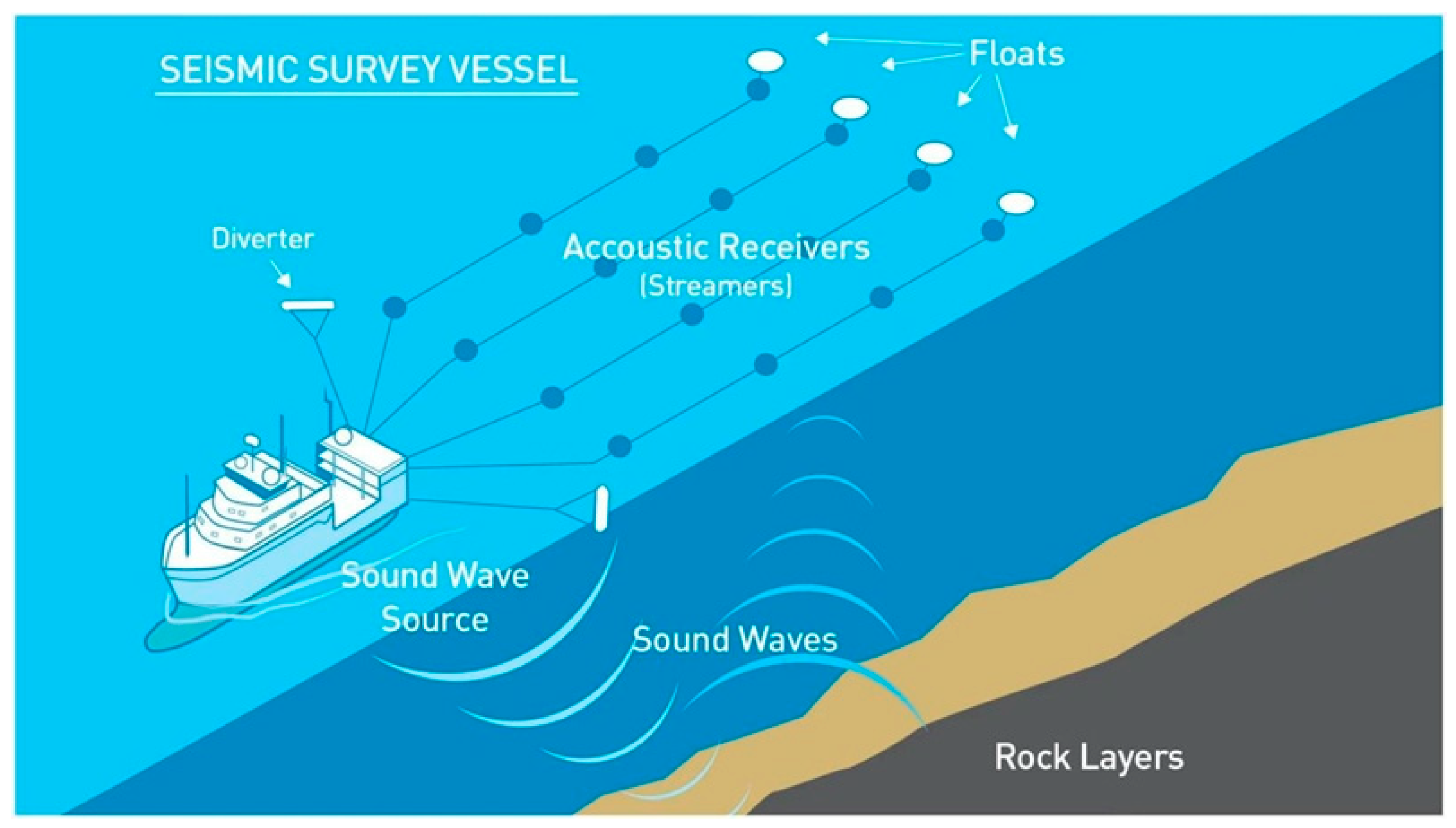
Figure 1. Schematic diagram of ship towing work.
Jmse 14 00696 g001
Figure 2. Schematic diagram of the overall analysis of the towing cable. Here, v refers to the direction of motion. x-y refers to the coordinate axes.
Jmse 14 00696 g002
Figure 3. Schematic of finite element analysis of towing cable.
Jmse 14 00696 g003
Figure 4. Schematic diagram of three-dimensional analysis of towing cable.
Jmse 14 00696 g004
Figure 5. Schematic diagram of the underwater towing cable touching the seabed force.
Jmse 14 00696 g005
Figure 6. (a) The initial state. The remaining three diagrams show the equilibrium state after the drag cable detaches from the seabed. (b) The condition when the seabed inclination is 15°; (c) the condition when the seabed inclination is 30°; (d) the condition when the seabed inclination is 45°. The blue area in the image represents the water surface. The green area represents the towline. The gray area represents the path the towline has already traveled.
Jmse 14 00696 g006
Figure 7. After the towing cable disengages from the seabed, the variation in top tension of the tow cable over time under different slope conditions.
Jmse 14 00696 g007
Figure 8. The x-direction position of the towed cable in Guan et al.’s simulation.
Jmse 14 00696 g008
Figure 9. The y-direction position of the towed cable in Guan et al.’s simulation.
Jmse 14 00696 g009
Figure 10. Schematic diagram of tension along the towing cable length. The abrupt rise indicates the point where the cable contacts the seabed.
Jmse 14 00696 g010
Figure 11. Distribution of Z-values along the x-direction in a stepped seabed. The blue area refers to the water surface.
Jmse 14 00696 g011
Figure 12. Stepped seabed model.
Jmse 14 00696 g012
Figure 13. Simulation of the motion process of a towing cable in contact with a stepped seabed. (a) The figure shows the cable starting from an initial flat position. (b) The figure shows the cable coming into contact with the seabed as it moves. The blue area refers to the water surface.
Jmse 14 00696 g013
Figure 14. Variation in dragline curvature along length, where (a) and (b) are enlargements, respectively.
Jmse 14 00696 g014
Figure 15. Curvature case in the length direction of the towing cable.
Jmse 14 00696 g015
Figure 16. Variations in curvature with water flow and temperature in Komperød’ s experiment.
Jmse 14 00696 g016
Figure 17. First 3D seabed modeling.
Jmse 14 00696 g017
Figure 18. Second 3D seabed modeling.
Jmse 14 00696 g018
Figure 19. (a) The simulation under the first seabed contact; (b) the simulation under the second type of seabed contact.
Jmse 14 00696 g019
Figure 20. The top tension of the towing cable is obtained under the first seabed contact.
Jmse 14 00696 g020
Figure 21. The top tension of the towing cable is obtained under the second seabed contact.
Jmse 14 00696 g021
Figure 22. Tip tension of the towing cable at different water depths in Zhang’s experiment.
Jmse 14 00696 g022
Figure 23. The first seafloor and the curvature of the traction cable over its length.
Jmse 14 00696 g023
Figure 24. The second seabed and the curvature of the traction cable over its length.
Jmse 14 00696 g024
Figure 25. Other application areas.
Jmse 14 00696 g025
Figure 26. Applications of underwater towing robots.
Jmse 14 00696 g026
Figure 27. Experimental data from Chee Meng Low, where (a) denotes a small seabed stiffness and (b) denotes a large ocean stiffness.
Jmse 14 00696 g027
Figure 28. Schematic diagram of Wu’s experimental equipment.
Jmse 14 00696 g028
Figure 29. (a) Represents a plot of the tension of the towing cable at different speeds, and (b) represents a plot of the variation in the towing cable battle force with time when the towing cable undergoes an impact, where the first inflection point is the moment of impact [158].
Jmse 14 00696 g029
Disclaimer/Publisher’s Note: The statements, opinions and data contained in all publications are solely those of the individual author(s) and contributor(s) and not of MDPI and/or the editor(s). MDPI and/or the editor(s) disclaim responsibility for any injury to people or property resulting from any ideas, methods, instructions or products referred to in the content.