


Abstract
Modeling the dynamic response of saturated marine soils is crucial yet computationally challenging for traditional methods. Meanwhile, purely data-driven models suffer from sparse data and lack of physical interpretability. To overcome these limitations, this study proposes an intelligent engineering framework based on a frequency-domain physics-informed neural network (FD-PINN) for the forward simulation and inverse parameter identification of saturated seabed soils. Constrained directly by physical laws during the learning process, FD-PINN remains highly reliable even when training data is sparse. By formulating the governing equations in the frequency domain, it directly predicts complex-valued displacement and pore-pressure phasors. Multiscale Fourier feature mappings mitigate spectral bias and capture boundary layers and high-frequency effects. For inverse problems, a phase-sensitive lock-in extraction strategy transforms time-domain measurements into robust frequency-domain targets, enabling the accurate and noise-tolerant identification of poroelastic parameters with clear physical meaning (nondimensional storage parameter S and permeability parameter ). Numerical experiments show that FD-PINN substantially outperforms conventional time-domain PINN, achieving relative errors of for single- and multi-frequency excitations typical of wave-induced loadings. In particular, is consistently recovered with sub-percent relative error, while S can be reliably identified with multi-frequency data. The framework offers a data-efficient, noise-robust approach for high-fidelity modeling and robust parameter inversion, which is particularly valuable in offshore environments where high-quality data is scarce.
1. Introduction
The dynamic response of saturated soils under external dynamic loading is a fundamental problem in marine geotechnics and offshore engineering. It has direct relevance to the long-term stability of offshore structures under wave loading, wave-induced seabed responses, and foundation design [1]. Accurate modeling of this dynamic response remains challenging due to the strong solid–fluid coupling inherent in marine sediments. The classical theoretical framework for this problem is Biot’s poroelasticity, which couples the elastic deformation of the soil skeleton with Darcy flow of the pore fluid [2], thereby capturing the interaction between displacement and pore pressure under harmonic or transient excitation [3,4]. However, traditional poroelastic numerical methods are often computationally expensive for multi-frequency analysis and inverse parameter identification. Meanwhile, purely data-driven models frequently lack physical interpretability and struggle to generalize under the sparse or noisy data conditions typically encountered in offshore environments.
Over the past decades, numerical methods such as the finite element method have been widely used to approximate the governing poroelastic equations in space and time. Despite their immense success and widespread adoption in engineering practice, traditional numerical approaches can sometimes be computationally expensive when simultaneously achieving high accuracy and robust parameter identification, especially for problems involving multi-frequency, broadband loads (e.g., ocean wave spectra) or limited observational data. Therefore, as numerical tools continue to advance, there is a parallel need to step into developing new artificial intelligence (AI)-based models. This provides researchers and engineers with diverse modeling options that can be deployed depending on the specific computational constraints and data availability [5]. In the field of geomechanics, deep neural networks (DNNs) have been successfully applied to constitutive modeling and seismic response prediction [6,7,8]. However, purely data-driven AI models often act as “black boxes”, lacking the physical interpretability required for safety-critical engineering decisions and failing to generalize under the sparse, noisy data conditions typical of field sites [9].
To synthesize the strengths of physical rigor and AI flexibility, physics-informed neural networks (PINNs) have emerged as a transformative paradigm in engineering applications [10,11]. By embedding governing partial differential equations (PDEs) into the loss function, PINN act as physics-regularized learners that can solve both forward and inverse problems with minimal labeled data. Recent studies have highlighted the potential of PINN for structural health monitoring, flexible fluid–structure interactions in the ocean, and modeling complex seabed behaviors [12,13]. Nevertheless, for dynamic problems, time-domain PINN are still affected by spectral bias: neural networks tend to learn low-frequency components first and converge slowly when solutions exhibit strong boundary layers or contain multiple dominant frequencies, which are common features in soil dynamics [14,15].
These limitations suggest that, for problems dominated by harmonic or multi-frequency excitation, a frequency-domain formulation may provide a more natural and efficient framework for physics-informed learning. To alleviate spectral bias, Tancik et al. [16] introduced Fourier feature embeddings (FFEs), which incorporate Fourier feature mappings into neural networks and enable more accurate convergence to PDE solutions. Building on this idea, Wang et al. [15] proposed multiscale Fourier feature mappings that project spatiotemporal coordinates into a high-dimensional feature space, thereby enhancing the representation of high-frequency details and multiscale structures. Subsequently, Song et al. [17] and Sallam et al. [18] employed PINN augmented with Fourier features to simulate multi-frequency seismic wavefields and nonlinear multi-frequency hydrodynamic problems, respectively.
Compared with direct time-domain regression, frequency-domain modeling allows the solution to be expressed in terms of complex-valued amplitudes at dominant frequencies, avoiding indirect inference of phase information from time histories and reducing phase-accumulation errors and frequency cross-coupling. Recent studies have demonstrated the advantages of frequency-domain PINN (FD-PINN) for elastic wave propagation and other multi-frequency physical systems [19,20], indicating their potential for geotechnical dynamic problems governed by poroelasticity.
Motivated by these developments, this study proposes a FD-PINN framework for modeling and inverse analysis of the dynamic response of one-dimensional saturated marine soils under harmonic loading. The time-domain poroelastic governing equations are reformulated in the frequency domain, enabling the direct modeling of complex-valued displacement and pore-pressure responses under harmonic loading. To improve the representation of multi-frequency and boundary-layer effects, frequency-domain physics-informed learning is combined with multiscale feature mappings. Frequency-domain solutions can be transformed back to time-domain responses when needed. For inverse problems, a phase-sensitive strategy is adopted to extract frequency-domain information directly from noisy time-domain measurements, leading to enhanced noise robustness and data efficiency in poroelastic parameter identification.
The primary novelty of this work lies in shifting the physics-informed learning paradigm for dynamic issue of saturated seabed from the time domain to the frequency domain, thereby intrinsically overcoming spectral bias and enabling noise-tolerant parameter inversion under highly sparse data. Based on this, the main contributions of this study are summarized as follows:
- Proposal of the FD-PINN framework: A frequency-domain physics-informed neural network is developed for high-fidelity modeling of saturated marine soils under dynamic loading, directly predicting complex-valued responses while being strictly constrained by physical laws.
- Introduction of MS-FFM to mitigate spectral bias: Multiscale Fourier feature mappings are incorporated to effectively alleviate spectral bias, capturing high-frequency effects and boundary layers crucial for multi-frequency wave analysis.
- Development of a lock-in extraction strategy for noise-tolerant inversion: A phase-sensitive strategy is proposed to extract robust frequency-domain targets from noisy time-domain measurements, enabling the accurate inversion of physically meaningful parameters (S and ) under sparse data conditions.
The study is organized as follows. Section 2 presents the governing equations, boundary conditions, and nondimensionalization. Section 3 introduces the PINN formulation and its enhancements, including multiscale Fourier features, the two-channel complex network, and the FD-PINN implementation. Section 4 reports forward examples and compares the accuracy and convergence behavior of time- and frequency-domain PINN. Section 5 discusses the modeling and solution strategies for inverse problems and presents identification results for S and under different sampling ratios and noise levels. Finally, Section 6 concludes the study.
2. Governing Equations
The governing equations for saturated soils follow Biot’s poroelastic theory [3,4,21,22]. To formulate the mathematical model, several fundamental assumptions are adopted: (1) the soil skeleton undergoes small elastic deformation; (2) the soil pores are fully saturated with water; (3) the pore fluid flow follows Darcy’s law; and (4) the physical properties of the solid and fluid constituents remain constant during the dynamic process. The total stress tensor , the effective stress , and the pore pressure p satisfy
where is the Biot coefficient and it is commonly evaluated by , where is the drained bulk modulus of the porous medium and is the bulk modulus of the solid grains. is the identity tensor. The linear elastic constitutive law is
where denotes the skeleton displacement and are the Lamé parameters. Neglecting body forces, the momentum balance reads
where ∇ denotes the gradient operator, denotes the second-order time derivative of the displacement vector and , with n representing the soil porosity, and and denoting the densities of the solid skeleton and pore fluid, respectively. Combining Equation (3) with Equation (1) gives
Accounting for the volumetric strain of the soil skeleton and Darcy flow, the fluid mass conservation equation is
where M is the Biot modulus and , where denotes the bulk modulus of the pore fluid. is the dynamic viscosity of the pore fluid, k is the intrinsic permeability of the soil skeleton, and represents the macroscopic fluid seepage velocity vector relative to the solid. Recombination yields
For the one-dimensional case with deformation and flow along x,
where subscripts denote partial derivatives. To promote numerical stability during training and improve parameter interpretability, Equations (7) and (8) are nondimensionalized following the characteristic scales in Table 1.
Table 1.
Nondimensionalization scales.
Define the nondimensional variables
which transform Equations (7) and (8) into
with nondimensional parameters
Here, S characterizes the relative compressibility of the solid and fluid (a nondimensional “storage coefficient”), whereas measures the ratio between the Darcy diffusion timescale and the skeleton wave timescale, indicating the relative importance of fluid diffusion. The time scale T normalizes the inertial and elastic terms in the momentum equation.
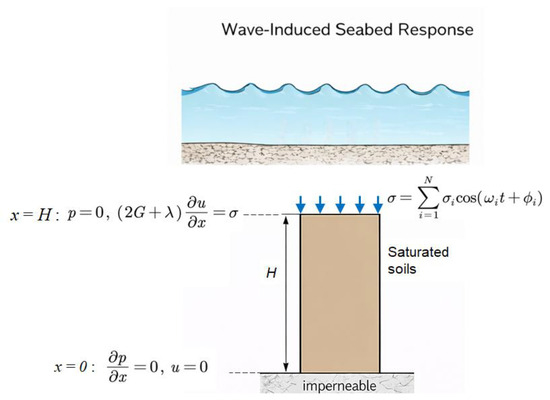
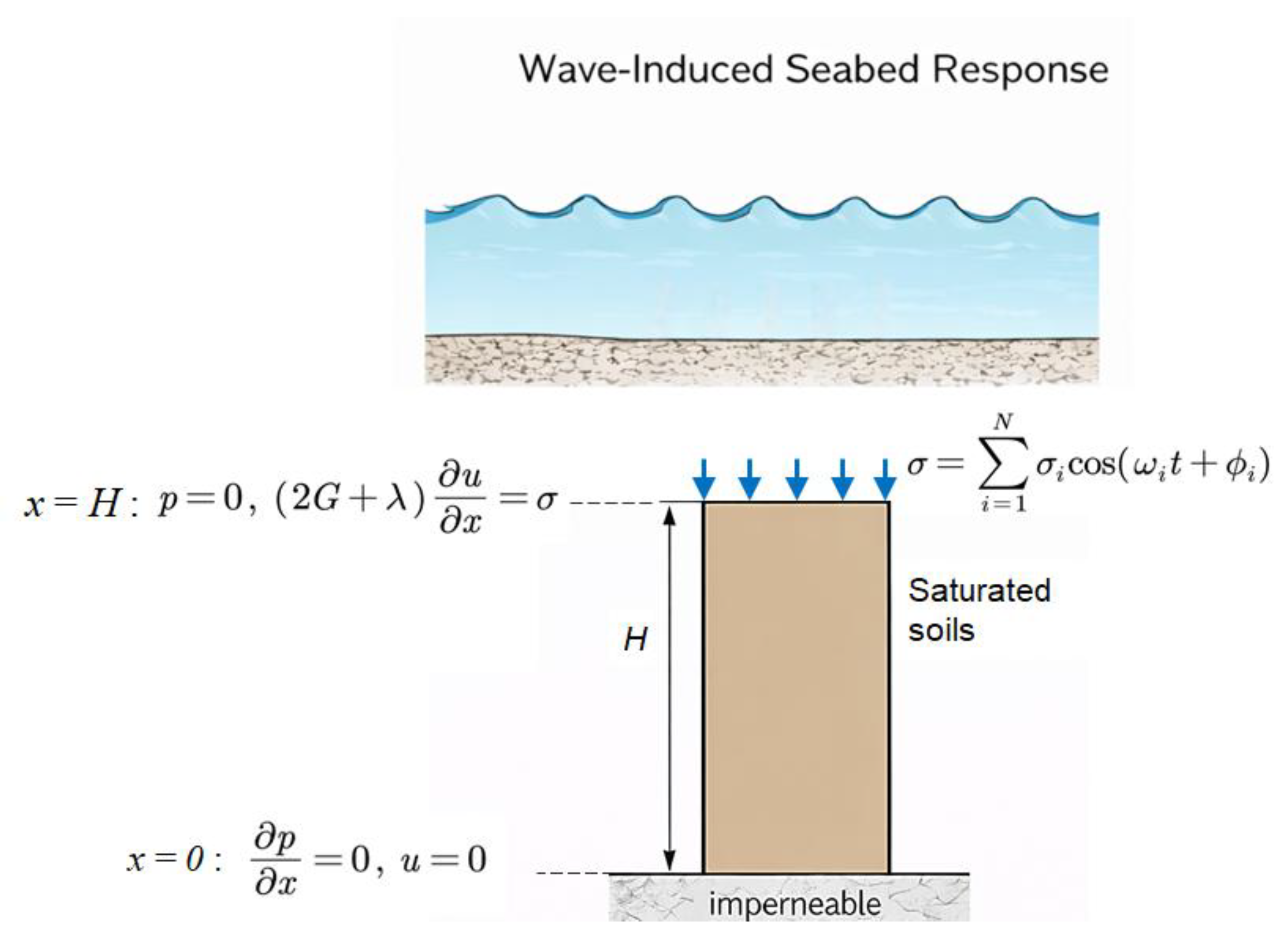
The boundary conditions for a one-dimensional saturated layer under harmonic or multi-frequency harmonic loading, which are essential for analyzing wave-induced seabed response and traffic-induced or cyclic surface loads, are illustrated in Figure 1. The top boundary () is subjected to a cosine stress and is connected to the exterior (zero pore pressure), while the bottom boundary () is fixed and impermeable.
Figure 1.
Schematic of the one-dimensional saturated soil layer and its boundary conditions.
The boundary conditions are given below. It should be explicitly noted that since the problem is formulated and solved in the frequency domain, the pressure and load originating from the water waves are inherently assumed to possess a harmonic nature. Consequently, the complex fluid flow above the seabed is idealized linearly as an equivalent boundary stress forcing, neglecting fully coupled nonlinear wave hydrodynamics:
After nondimensionalization,
where and . Unless otherwise indicated, the quantities labeled with and without an overbar will not be distinguished hereafter, and all variables are nondimensional. Frequency-domain modal decomposition and linear superposition are adopted for solving Biot’s equations. The detailed derivations are provided in Appendix A.
3. PINN and Enhancements
3.1. Physics-Informed Neural Networks (PINNs)
In general, physics-informed neural networks (PINNs) incorporate physical laws—typically partial differential equations (PDEs)—directly into the training process, distinguishing them from purely data-driven models [10,23]. By leveraging both observational data and physical constraints, PINNs produce predictions that adhere more closely to governing mechanisms and have therefore been widely applied in fluid mechanics, solid mechanics, geophysics, and materials science [24,25,26,27].
Consider a general PDE for :
where is a (possibly nonlinear) differential operator that may include higher-order derivatives, and denotes the boundary. Let a deep network approximate and define the PDE residual
All partial derivatives with respect to are stably computed via automatic differentiation. The trainable parameters affect both and . The objective is to minimize
where
Here are collocation points for the PDE residual, and are samples on the boundary or initial conditions. Positive weights balance optimization speed and relative importance.
Parameters are updated using stochastic gradient descent or its variants:
with learning rate . Mini-batch resampling mitigates overfitting and reduces the variance of error estimates. The training objective enforces the governing equations and boundary conditions at collocation and observation points.
3.2. Multiscale Fourier Feature Mapping
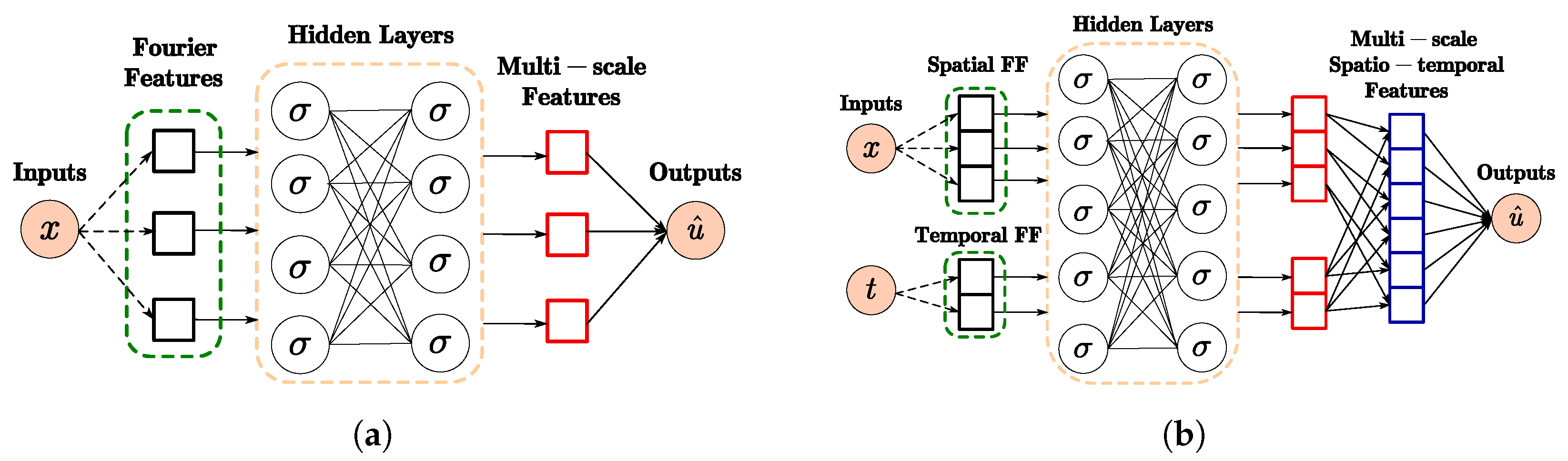
To alleviate PINN spectral bias and enhance cross-scale expressivity, multiscale Fourier feature mapping (MS-FFM) is adopted [16,28,29]. This approach explicitly encodes multiscale sinusoidal bases to map spatiotemporal coordinates into a high-dimensional feature space, strengthening the representation of high-frequency details and multiscale structures. Its basic form is
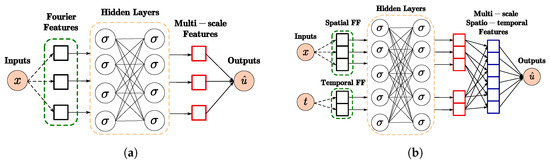
Here is the i-th scale Fourier mapping with frequency matrix ; M is the number of scales; L is the network depth; is the activation; are network parameters; and is the output. A schematic of multiscale Fourier feature mapping is shown in Figure 2a.
Figure 2.
Schematic of multiscale Fourier feature mapping (MS-FFM): (a) MS-FFM for the spatial coordinate x; (b) MS-FFM for space-time . Spatial or temporal coordinates are first mapped by Fourier features at multiple frequencies, processed by a shared-weight MLP, and finally fused along the feature dimension.
When both space x and time t are inputs, MS-FFM can be applied separately and fused along the feature dimension:
where ⊙ denotes the Hadamard (element-wise) product. This architecture captures multiscale spatiotemporal correlations and markedly improves the modeling of complex space–time relationships; see Figure 2b. In this study, the FD-PINN applies MS-FFM to the spatial coordinate x, whereas the TD-PINN applies MS-FFM to both x and t. Frequencies are sampled from band-limited Gaussian distributions: and , with and increasing geometrically across scales.
3.3. Network Architecture
Many problems in geophysics and vibration analysis naturally admit complex-valued formulations [30,31]. Relative to purely real-valued networks, complex modeling more naturally captures phase and rotational equivariances and facilitates coupling with frequency-domain operators [32,33]. Direct complex-domain modeling avoids frequent conversions between real/imaginary and magnitude/phase representations, thereby reducing nonlinear coupling and numerical instability, and it enables explicit constraints such as phase consistency and conjugate symmetry [30,33].
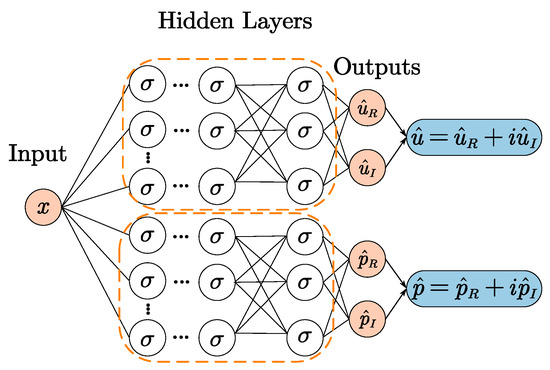
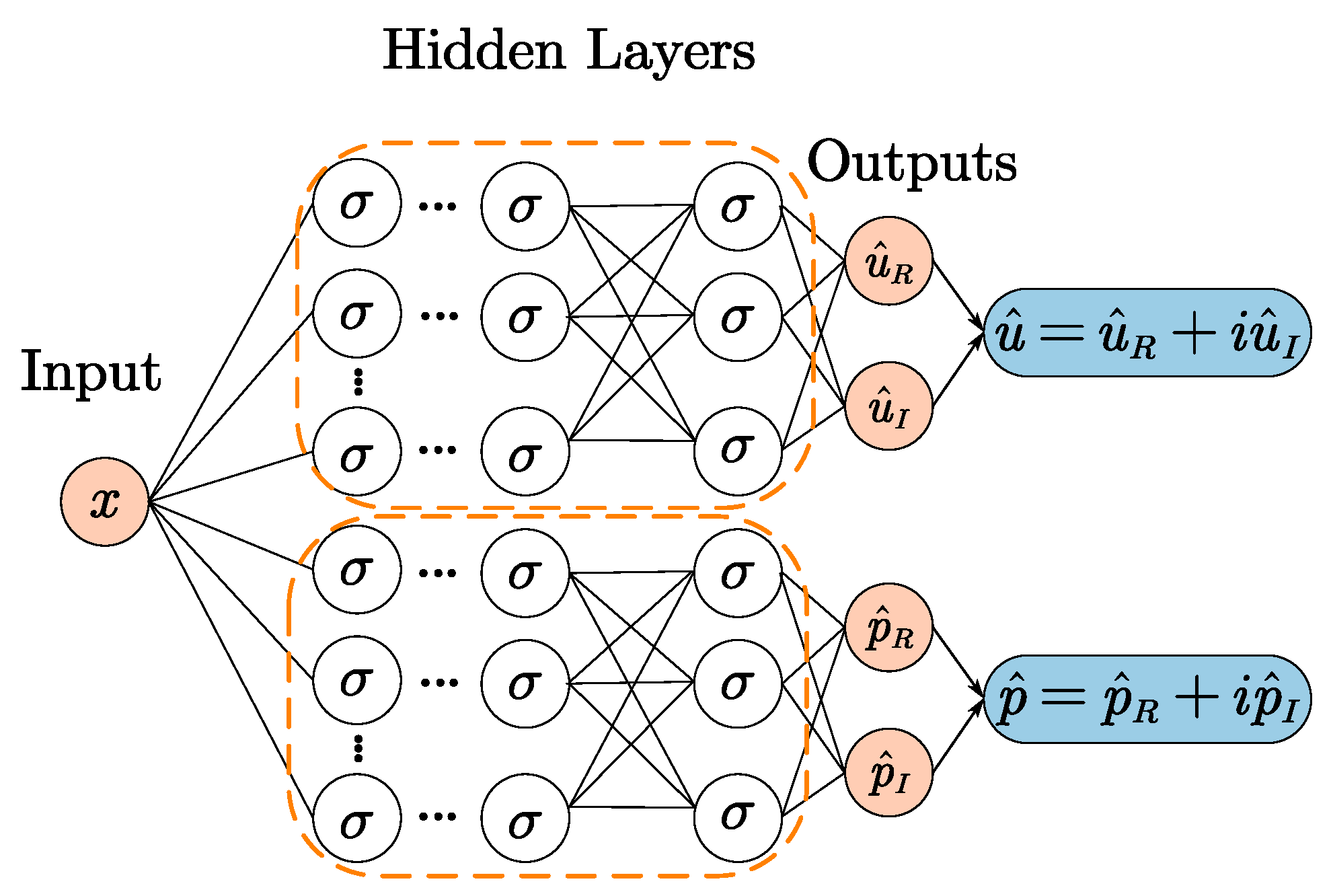
To solve for complex amplitudes directly in the frequency domain, a complex output design is employed: real-parameter networks output the real and imaginary parts of the complex fields. Two independent feedforward networks (MLPs) approximate the spatial distributions of the solid displacement and pore pressure:
The network predictions are
as illustrated in Figure 3. Residuals of the frequency-domain Biot equations require first- and second-order spatial derivatives of and . During training, automatic differentiation is applied to the four outputs:
and analogously for .
Figure 3.
Architecture of the complex-valued PINN. Two independent feedforward networks approximate the complex amplitudes of solid displacement and pore pressure. Each network takes x as input and outputs the real and imaginary components.
3.4. Frequency-Domain PINN
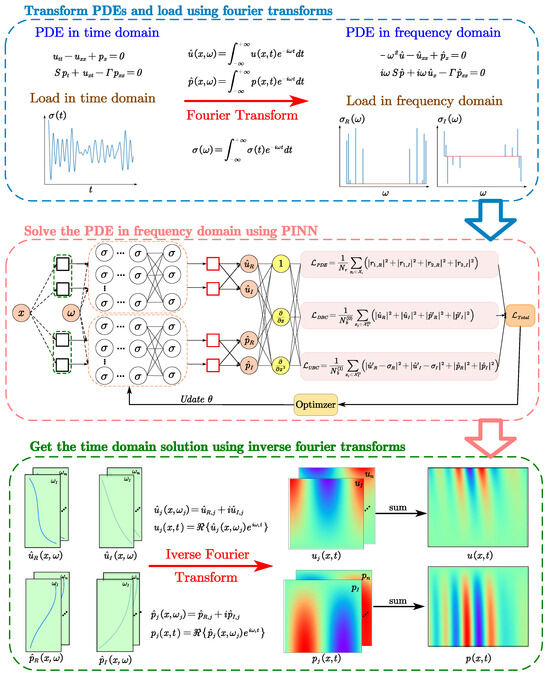
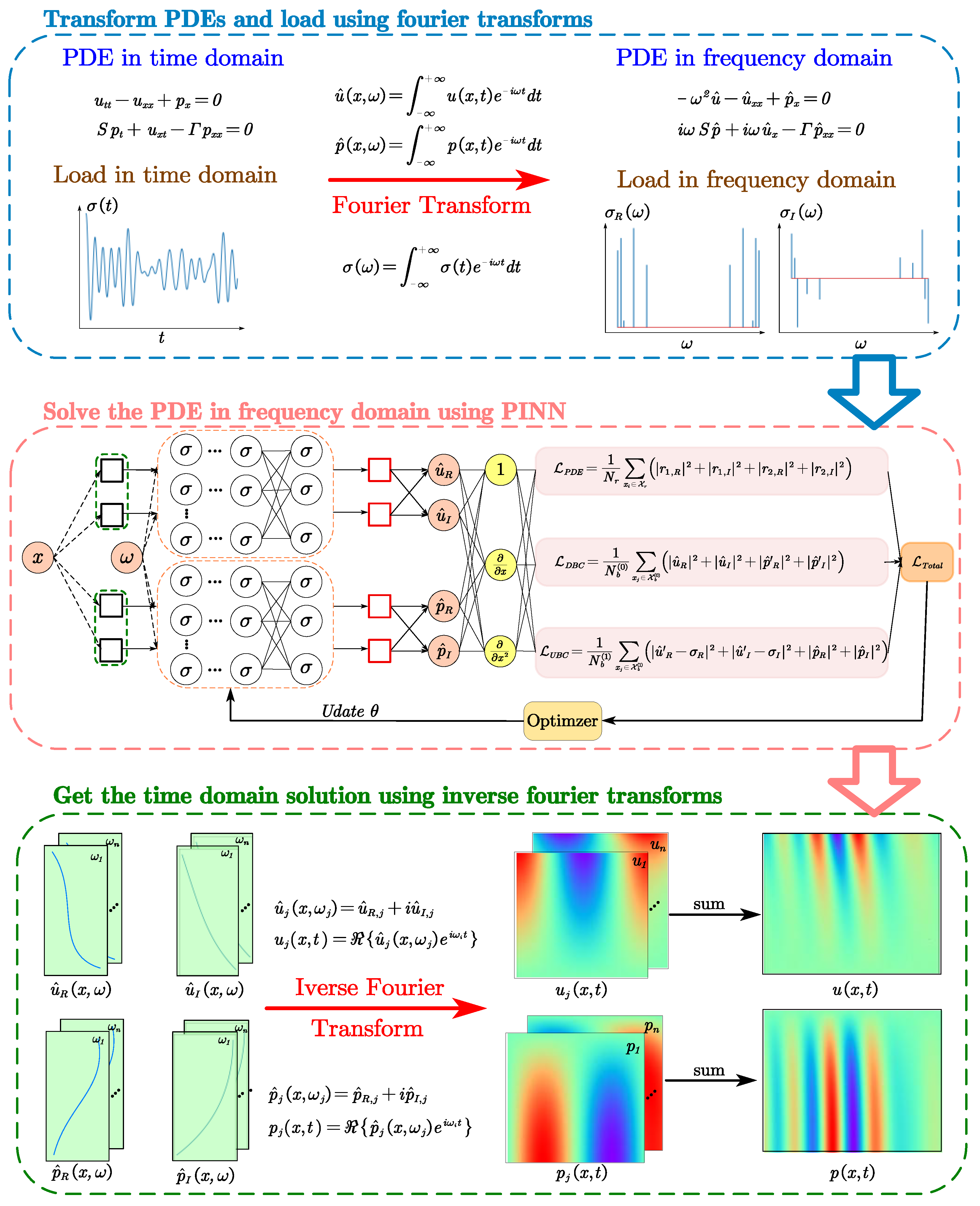
For the one-dimensional response of saturated soils under harmonic loading, a FD-PINN is introduced. The main idea is to transform the time-domain Biot equations into constant-coefficient ordinary differential equations (ODEs) in the frequency domain via the Fourier transform, solve these ODEs with a PINN to fit complex amplitudes, employ MS-FFM to alleviate spectral bias, and finally recover time-domain solutions through the inverse Fourier transform; Figure 4 shows the workflow of the FD-PINN.
Figure 4.
Workflow of the FD-PINN. The time-domain equations are transformed into constant-coefficient ODEs in the frequency domain. A PINN fits the complex amplitudes, which are then transformed back to the time domain via the inverse Fourier transform.
Apply the Fourier transform to the time-domain fields:
The nondimensional time-domain system Equations (10) and (11) become
with . Decomposing into real and imaginary parts,
and substituting into Equations (36) and (37) yields the real-valued PDE system
These relations define the FD-PINN loss as the sum of PDE residual and boundary condition terms. Single-frequency and multi-frequency loadings are considered; thus the angular frequency acts as a hyperparameter input to the network. For a given , the PINN solves Equations (36) and (37) to infer the complex amplitudes and . The time-domain response is then recovered via the inverse Fourier transform:
4. Forward Problems: Setup and Comparisons
4.1. Model Parameters
A representative clean, dense, medium-grained saturated sand is considered. To ensure transparency and physical consistency, the porous-effect parameters used in this study are systematically derived from fundamental soil properties. Assuming a typical elastic modulus MPa and Poisson’s ratio for medium-dense sand [34,35], the shear modulus and Lamé parameter are derived as MPa and MPa, respectively. Given a soil porosity , a fluid density kg/m3, and a solid grain density kg/m3, the mixture density evaluates exactly to kg/m3.
For the poroelastic coupling, the drained bulk modulus is calculated as MPa. Using standard physical values for the solid grains ( GPa) and pore water ( GPa), the Biot coefficient is explicitly calculated as . Subsequently, the Biot modulus is determined via , yielding GPa. Finally, the flow parameters, namely the intrinsic permeability ( m2) and dynamic viscosity ( Pa·s), are selected within the empirical ranges for the sandy soil and water, respectively [36]. The final physical parameters are listed in Table 2.
Table 2.
Physical parameters of the one-dimensional saturated specimen.
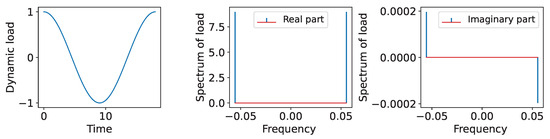
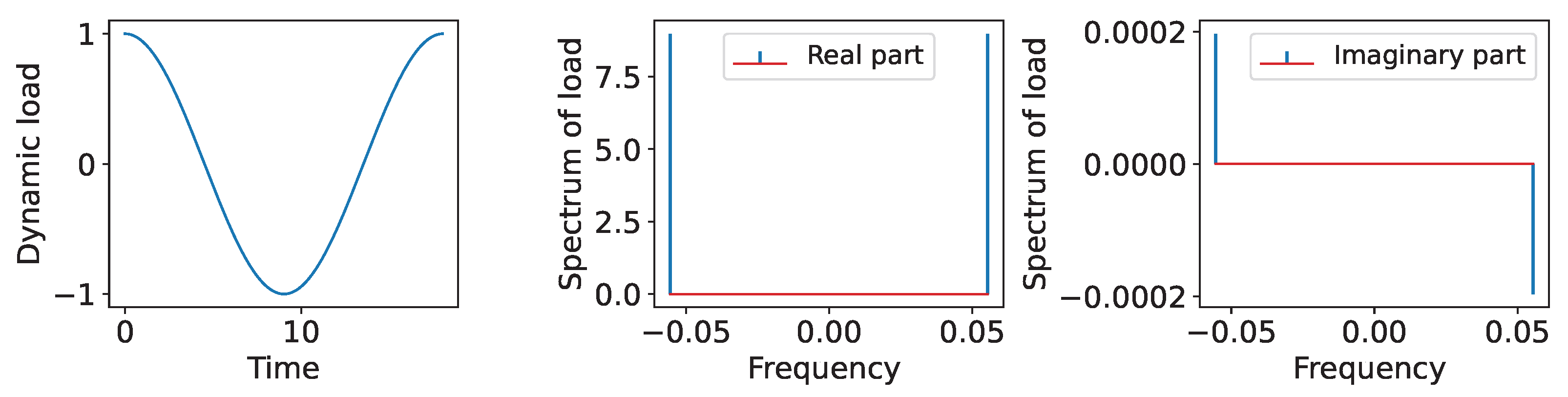
Two types of dynamic loading are examined: single-frequency harmonic excitation and multi-frequency harmonic excitation. For the single-frequency case, the angular frequency is and the amplitude is . The loading is
The nondimensional waveform and spectrum are shown in Figure 5.
Figure 5.
Single-frequency harmonic load: waveform (left), real part of the spectrum (middle), and imaginary part of the spectrum (right).
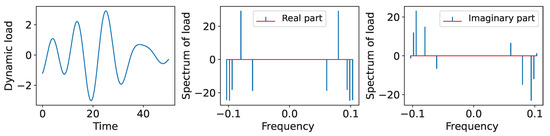
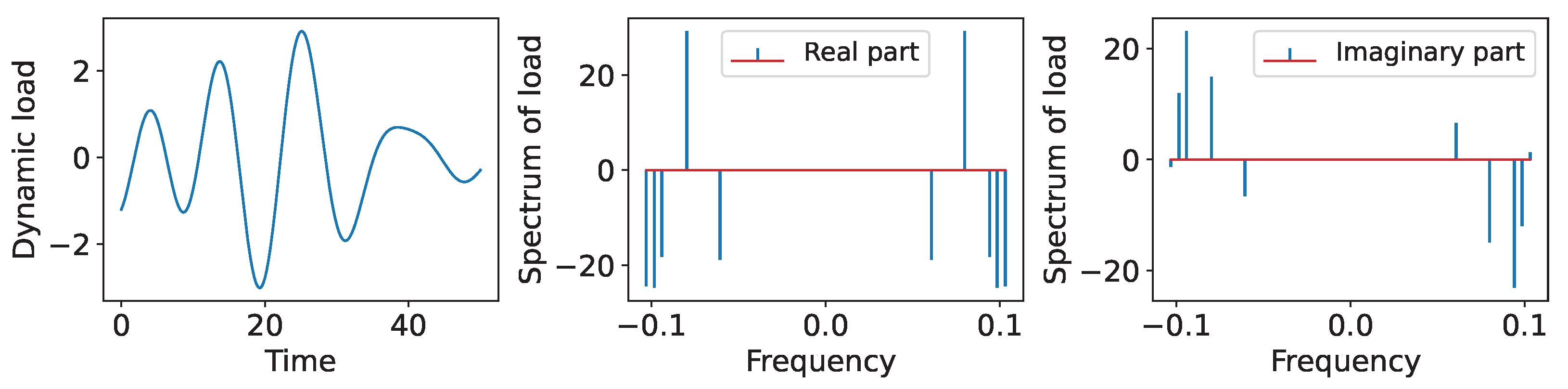
Conversely, the multi-frequency excitation is constructed to simulate the broadband nature of irregular ocean waves, corresponding to a specific frequency band of typical empirical wave spectra, such as the JONSWAP (Joint North Sea Wave Project) spectrum. The multi-frequency loading takes the following form:
where , , and denote the angular frequency, initial phase, and amplitude of the i-th harmonic, respectively. Parameters are sampled uniformly from the ranges , , and . The specific realization used is , , . The nondimensional waveform and spectrum are shown in Figure 6.
Figure 6.
Multi-frequency harmonic load: waveform (left), real part of the spectrum (middle), and imaginary part of the spectrum (right).
The displacement field and pore-pressure field are represented by two independent fully connected feedforward neural networks (FCNNs) with no parameter sharing. Each network has three hidden layers with 64 neurons per layer and uses the tanh activation. In the FD-PINN, the spatial coordinate x is processed by a MS-FFM with two scales and 32 frequencies per scale (zero-mean Gaussian with standard deviations 1 and 4), and the network outputs the real and imaginary parts of the complex field in two channels. In the TD-PINN, both x and t are processed by the same MS-FFM (two scales, 32 frequencies per scale; standard deviations 1 and 4). The loss definitions and training settings are identical for both PINN variants. Training uses Adam with an initial learning rate decayed by a factor of 0.9 every 5000 steps. For physics-based unsupervised training, 10,000 collocation points are sampled uniformly in space, from which a mini-batch of size 1000 is drawn at each step. Training runs for 40,000 steps. Weights are initialized with Xavier initialization, biases with zero-mean Gaussian noise, and tanh activations are used throughout.
To quantify accuracy, each model is evaluated on a grid over the computational domain. The performance metric is the relative error:
where and are the analytical and predicted values, N is the number of evaluation points, and prevents division by zero. All experiments are conducted on a workstation equipped with an Intel® Core™ i9-13900K (3.00 GHz), an NVIDIA GeForce RTX 4060 Ti GPU, and 32 GB of RAM.
4.2. Forward-Problem Results
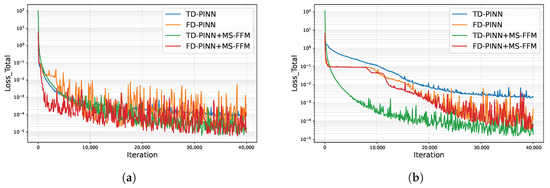
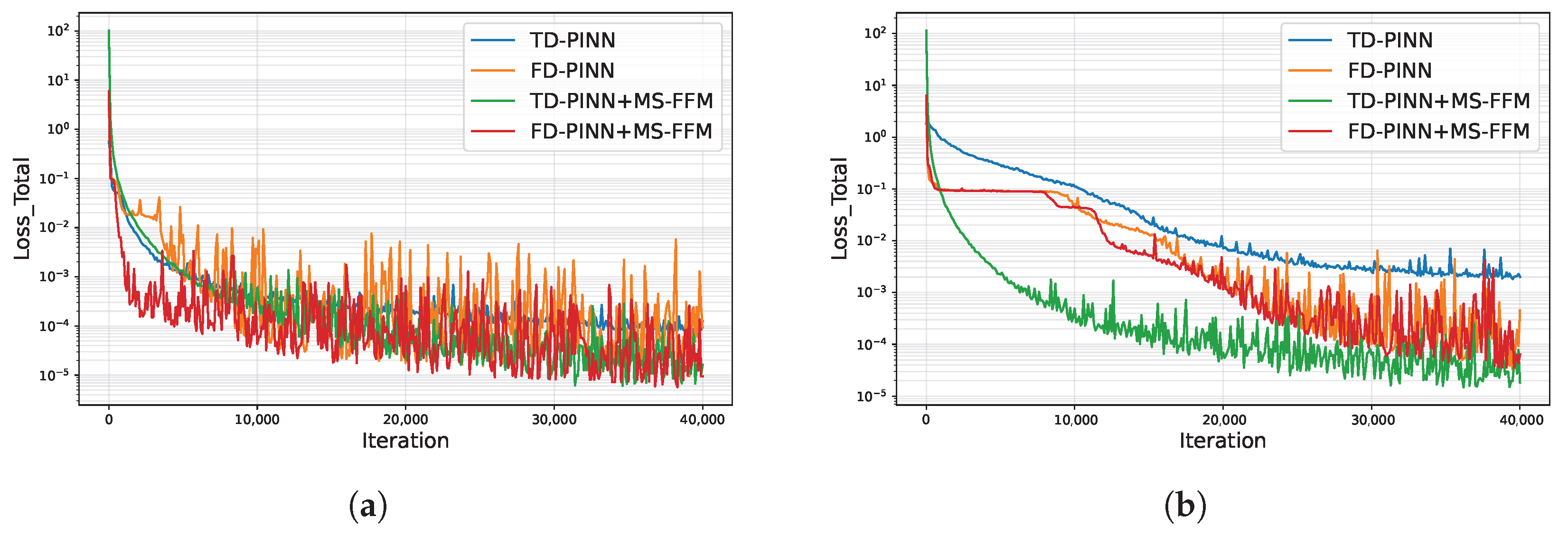
Figure 7 plots the training loss versus iterations. All models reach a plateau after approximately steps, indicating convergence. Table 3 summarizes the maximum absolute error and relative error for four models under single- and multi-frequency loading. For TD-PINN, errors are on the order of for single-frequency excitation and for multi-frequency excitation. In contrast, the FD-PINN family attains in both cases. Incorporating MS-FFM into the time-domain model improves accuracy by roughly one order of magnitude; adding MS-FFM to the frequency-domain model further reduces errors by one to two orders. Overall, compared to the analytical solutions derived in Appendix A, these errors are strictly confined within an acceptable tolerance for engineering applications, demonstrating that the proposed FD-PINN model effectively provides accurate forward solutions to the problem.
Figure 7.
Training loss versus iterations: (a) single-frequency excitation; (b) multi-frequency excitation. Losses are essentially converged by 40,000 steps.
Table 3.
Model-error comparison for one-dimensional single- and multi-frequency harmonic responses.
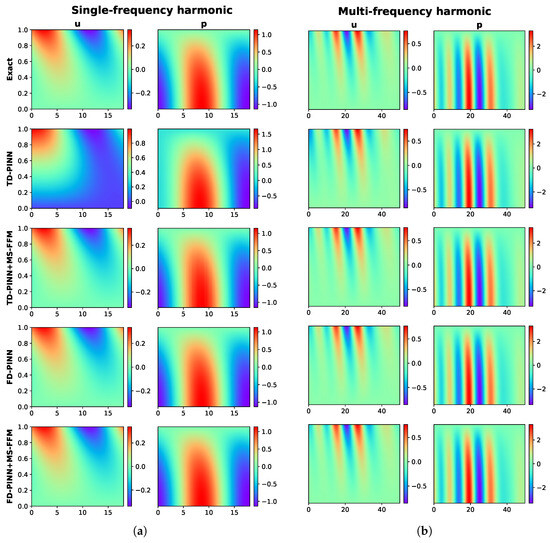
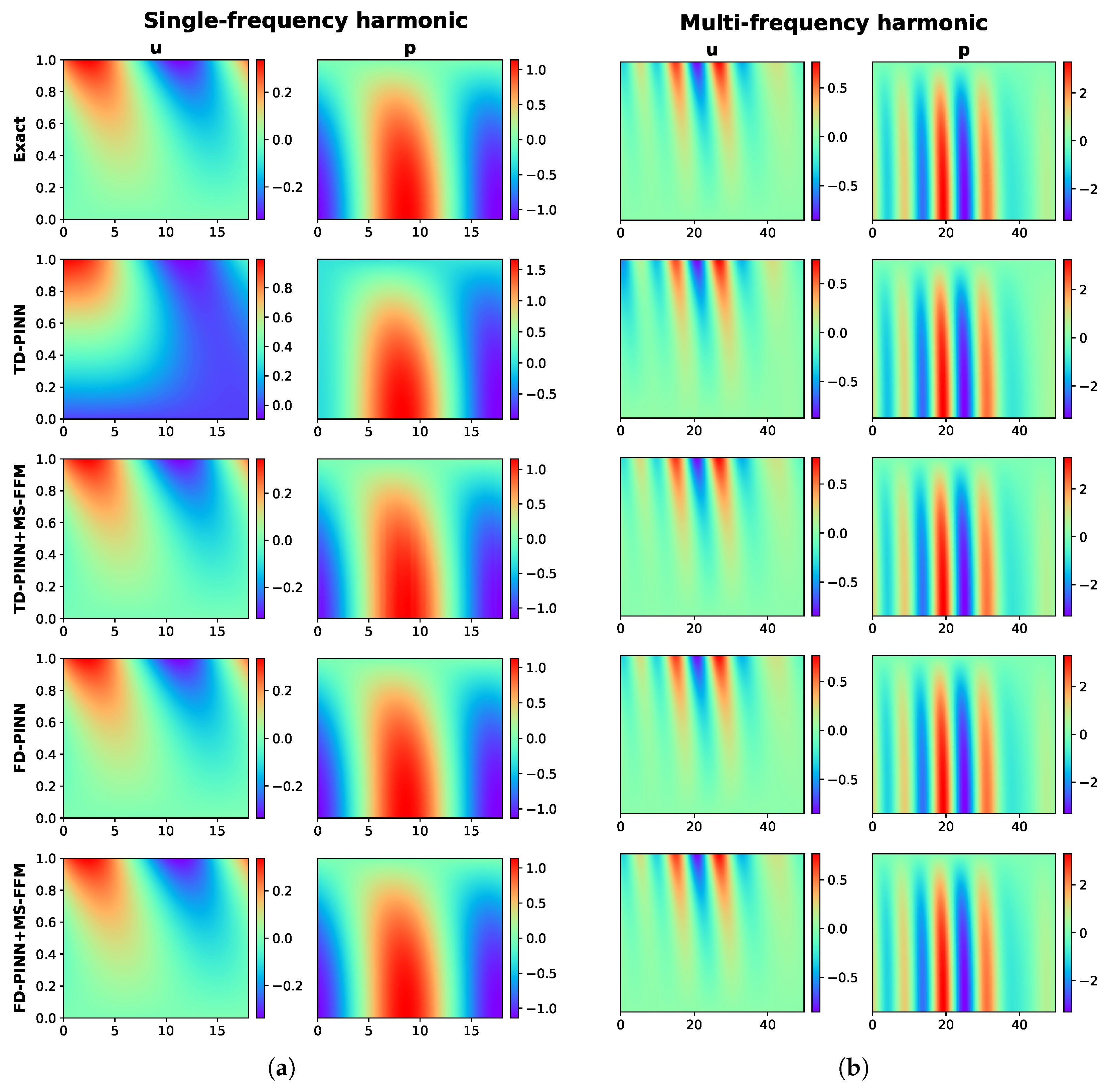
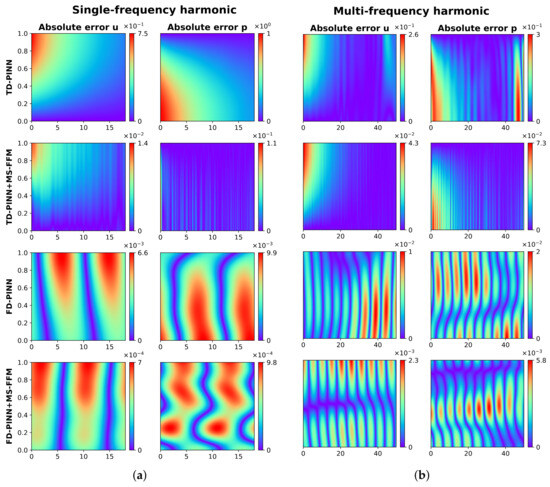
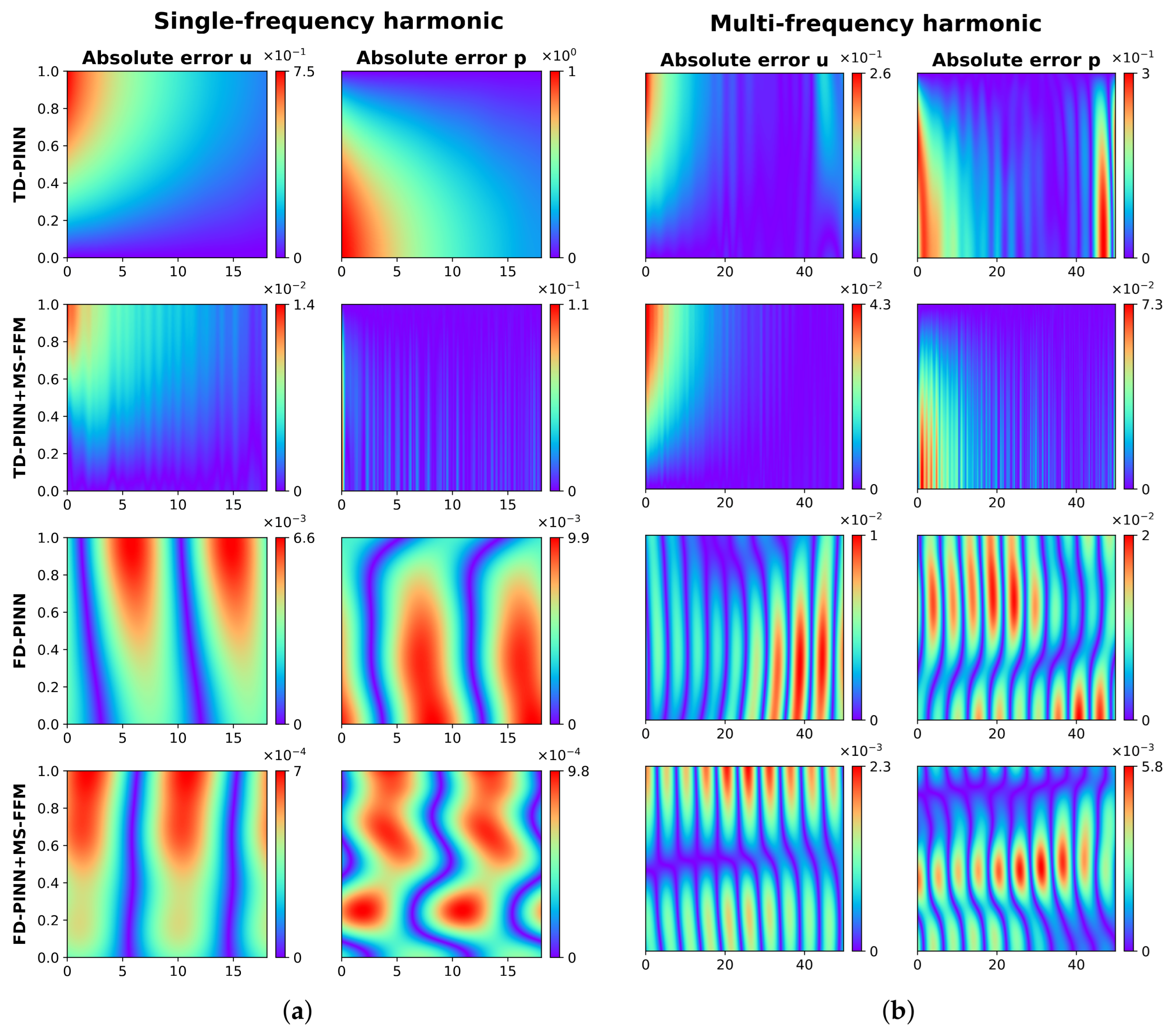
Figure 8 and Figure 9 present the two-dimensional fields and together with their error distributions respectively. Frequency-domain models outperform time-domain counterparts in both maximum absolute error and relative error. TD-PINN exhibits amplitude bias and phase lag, with errors accumulating over time; adding MS-FFM substantially mitigates spectral bias and improves amplitude-phase fidelity, though faint time-alignment streaks remain. FD-PINN agrees closely with the reference in all scenarios, because the steady-state harmonic response reduces the governing equations to a spatial boundary-value problem, thereby avoiding error accumulation from time integration. Incorporating MS-FFM in the frequency domain further suppresses residuals to low levels, rendering the predicted fields nearly indistinguishable from the ground truth.
Figure 8.
Displacement and pore-pressure fields for each model: (a) single-frequency excitation; (b) multi-frequency excitation.
Figure 9.
Errors in the displacement and pore-pressure fields: (a) single-frequency excitation; (b) multi-frequency excitation.
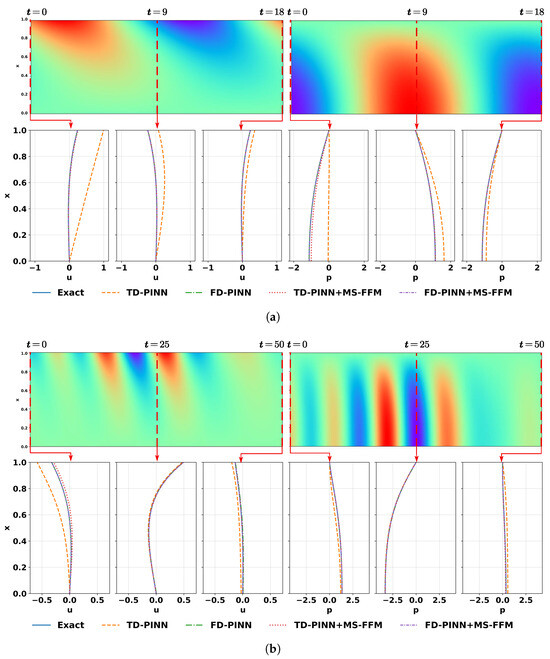
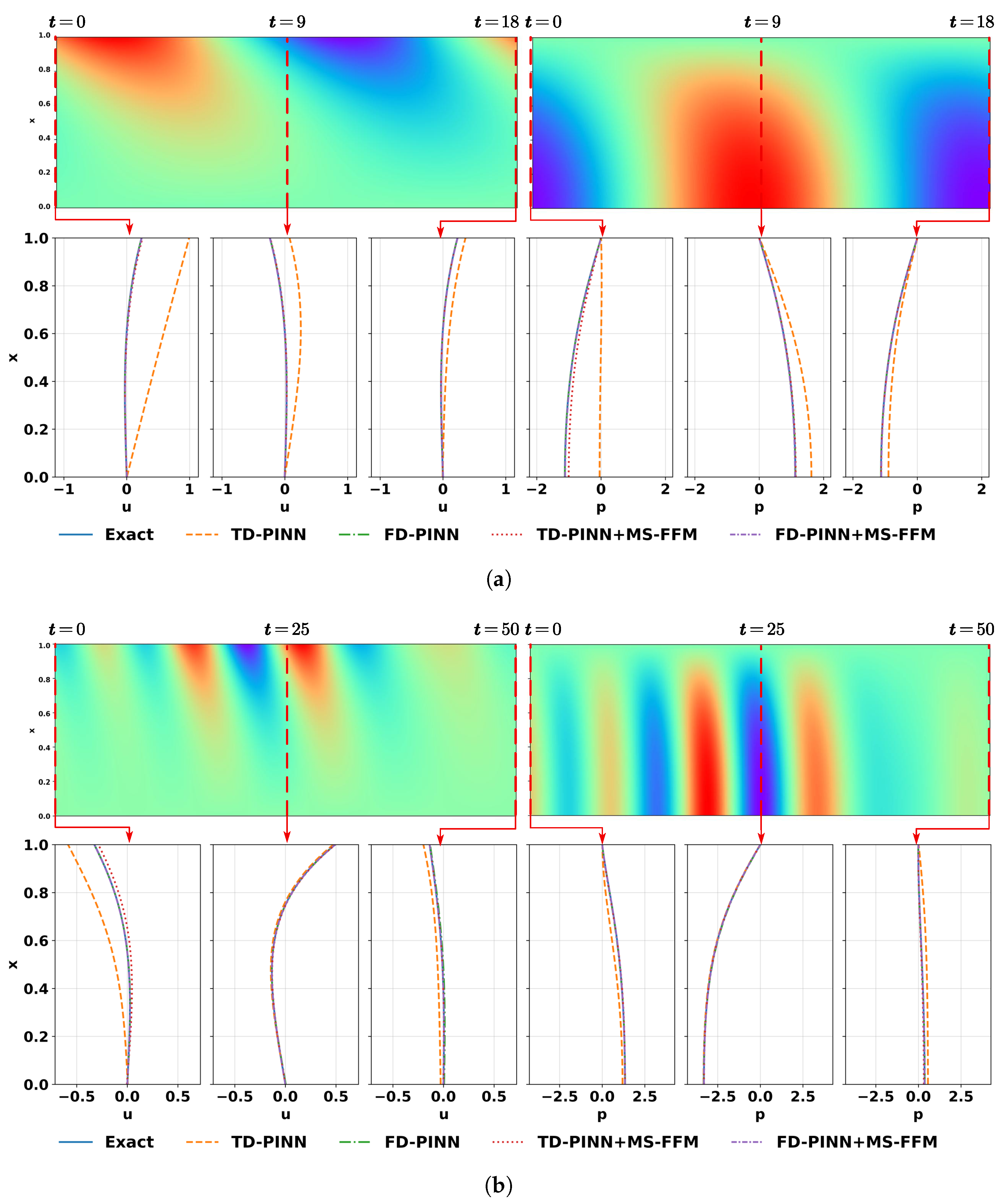
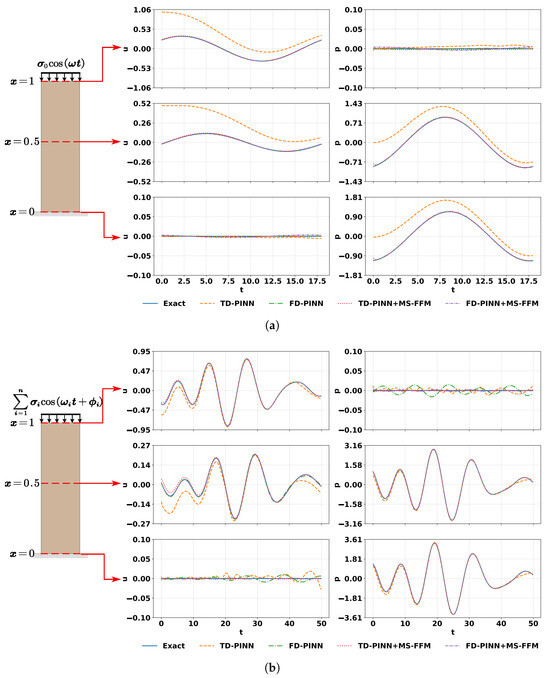
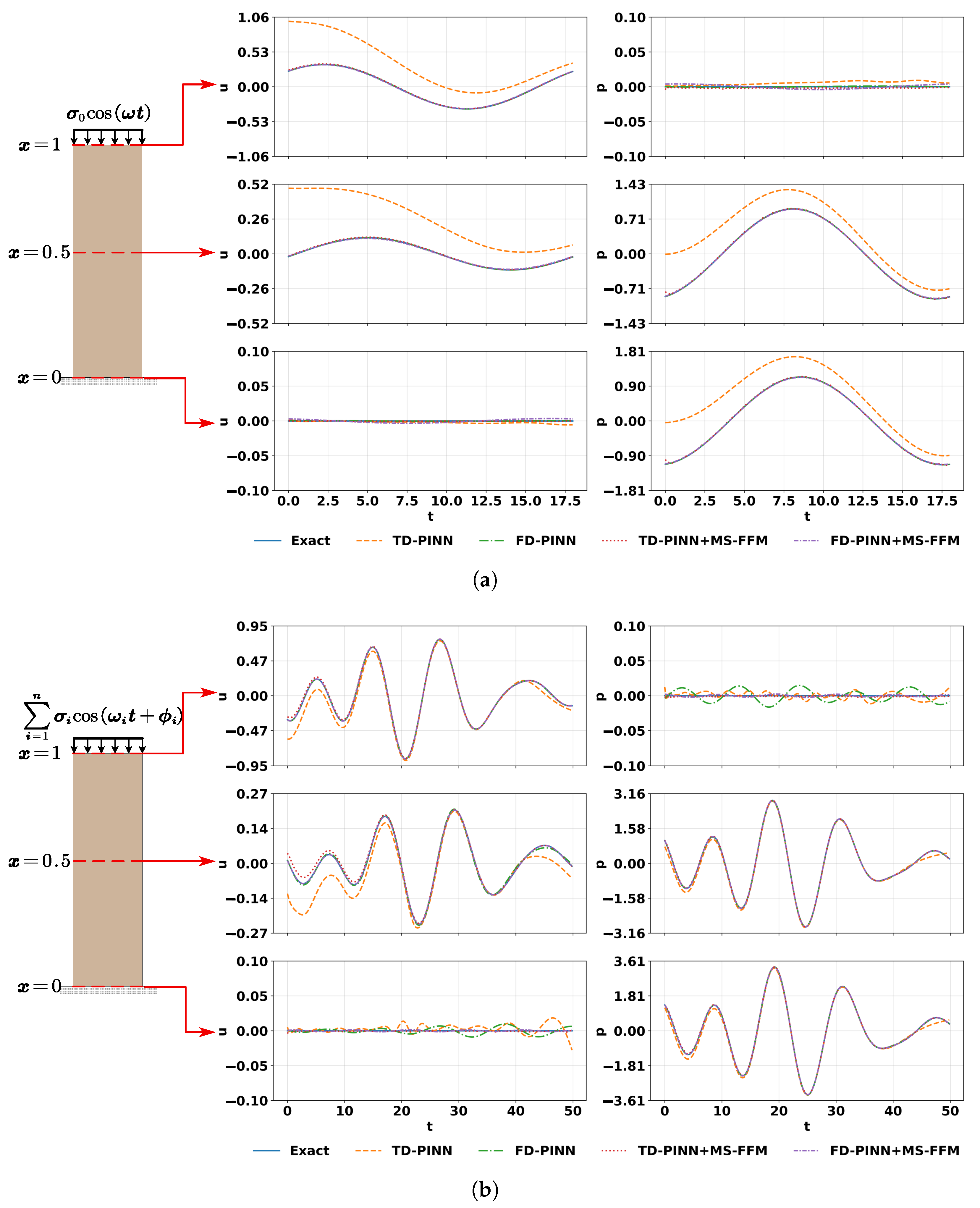
The time histories at fixed locations and spatial profiles at fixed times are given in Figure 10 and Figure 11, respectively. The TD-PINN curves deviate appreciably from the analytical solution and retain slight discrepancies even with MS-FFM, whereas the frequency-domain curves are virtually indistinguishable from the reference.
Figure 10.
Spatial profiles of u and p at fixed times: (a) single-frequency excitation; (b) multi-frequency excitation.
Figure 11.
Time histories of u and p at fixed locations: (a) single-frequency excitation; (b) multi-frequency excitation.
5. Inverse Problem: Design and Results
The inverse problem in geotechnical earthquake engineering typically seeks to estimate unknown constitutive parameters from incomplete field or experimental measurements [37,38]. Based on the partial response of a saturated soil layer under harmonic loading, two nondimensional Biot parameters are estimated: S and , which quantify elastic-storage properties and the strength of flow–solid coupling, respectively. Accurate identification of these parameters is essential for understanding soil dynamics and for predictive modeling. Following the forward-problem setup, S and are treated as unknowns and optimized jointly with the network weights as trainable variables. The total loss augments the physics and boundary terms with a data term:
where measures the discrepancy between predictions and observations. Minimizing iteratively updates S and until convergence.
5.1. Lock-In Extraction
In the FD-PINN, the time-domain displacement and pore pressure can be reconstructed from their phasors:
To train a two-channel complex-valued network using only time-domain measurements, a phase-sensitive detection (lock-in) strategy is adopted: from multi-time observations, the real and imaginary parts at each spatial location are extracted as targets for the data term [39,40]. For the single-frequency loading with known angular frequency , choose N instants uniformly over one period at a fixed x, and project observations onto the orthogonal basis :
and analogously from . For the multi-frequency loading, the least common period is typically long, making full-period sampling impractical; the direct use of Equations (55) and (56) then leads to spectral leakage in the estimated spectrum [41]. A more robust approach performs an orthogonal harmonic least-squares fit at each x for a prescribed frequency set , absorbing phases into cosine/sine coefficients [42]. With sample times , construct the design matrix :
and estimate the coefficient vector by
where . The pressure is treated in the same way.
5.2. Sampling, Noise, and Training Settings
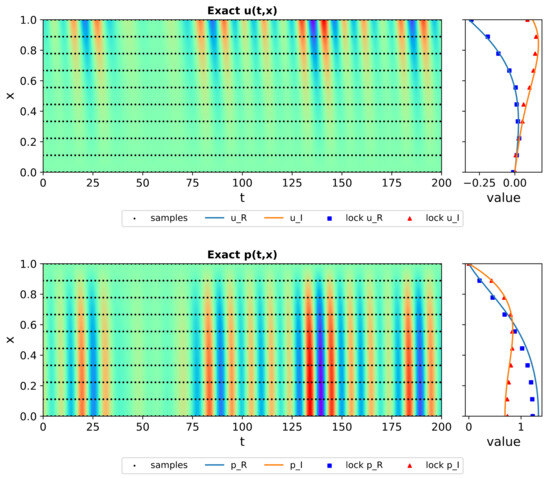
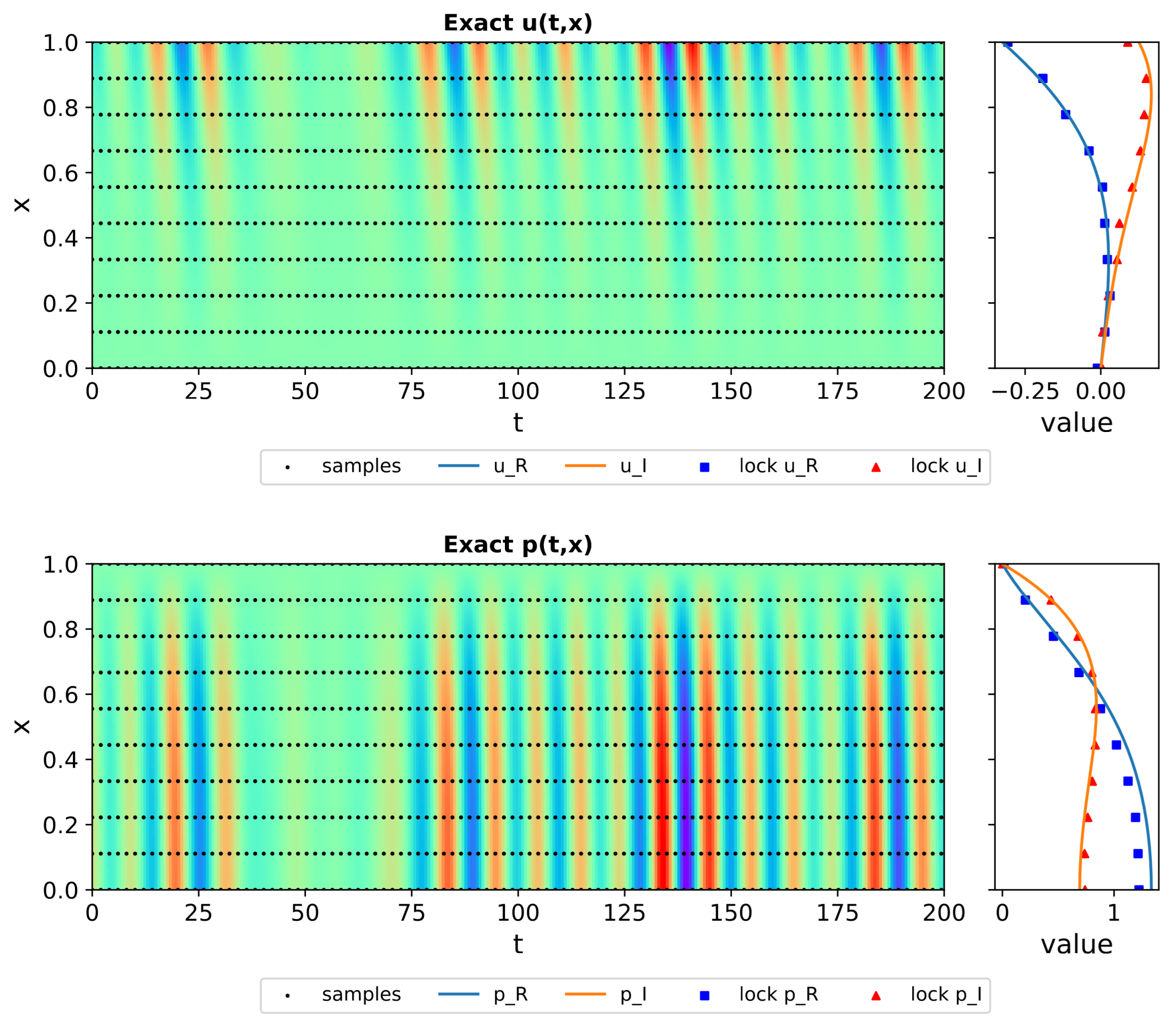
To assess identifiability and robustness, sampling reflects practical conditions: sparse in space and dense in time. Uniform sampling is used on . For single-frequency loading, the period is set to a full cycle () with time samples; for multi-frequency loading, with . The spatial sample counts are for all cases. Each sample pair provides . Measurement uncertainty is simulated by additive Gaussian noise:
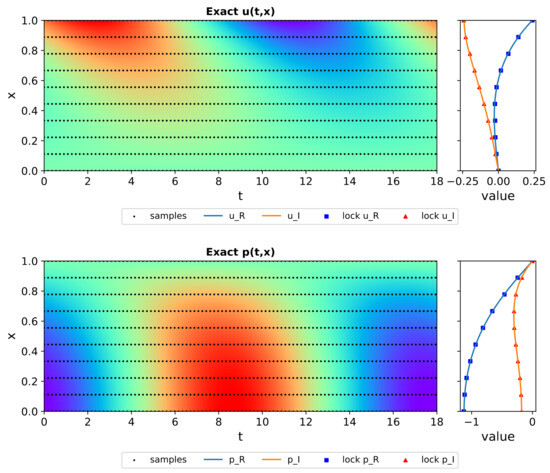
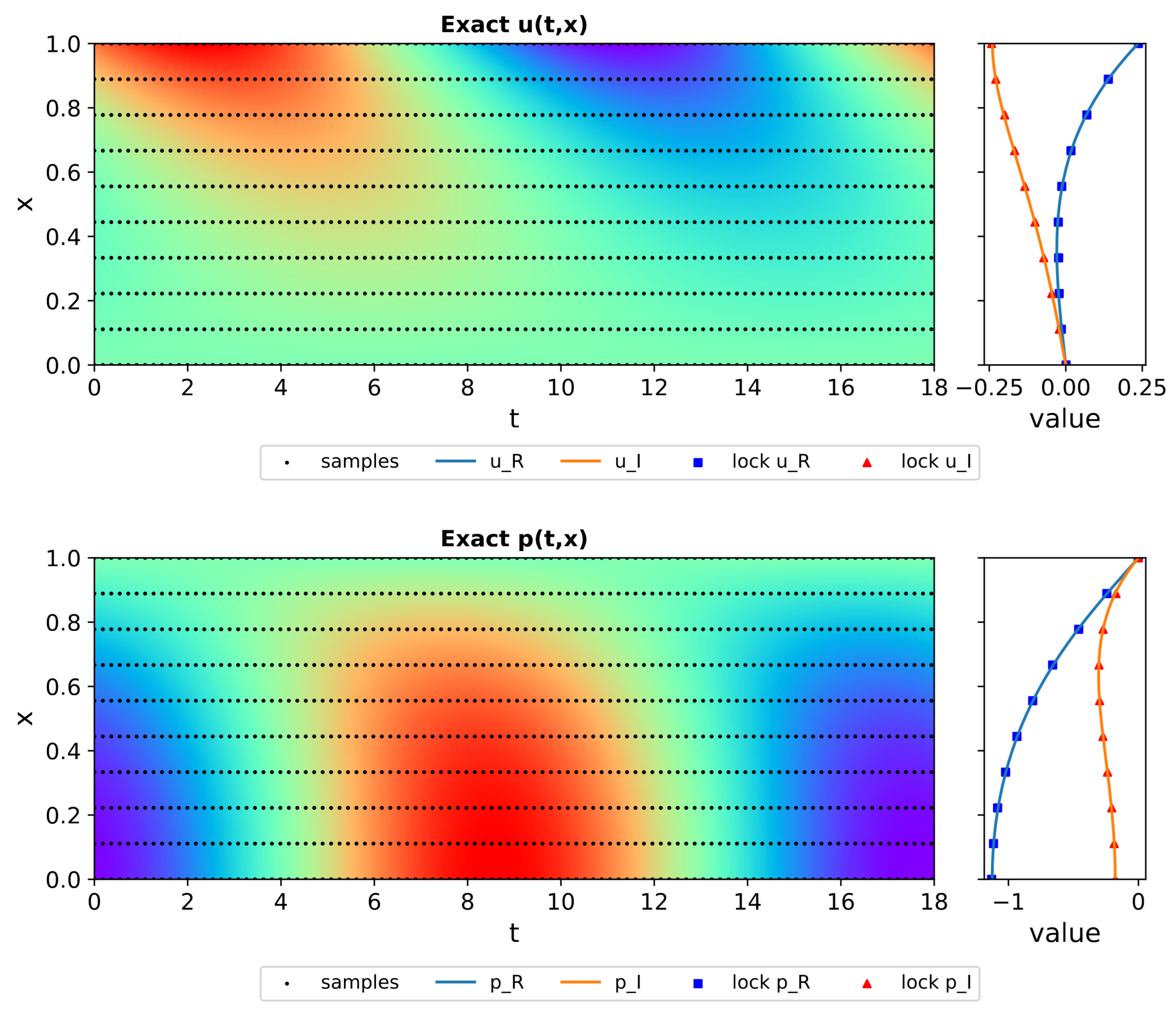
with controlling the noise level. Figure 12 and Figure 13 display the observation layouts (, , ) and the lock-in estimates versus ground truth for u and p. The network architecture and hyperparameters follow the forward problem. Parameters are initialized as , the learning rate is fixed at , and training proceeds for 20,000 steps.
Figure 12.
Sampling layout (, , ) and comparison of lock-in estimates with ground truth for u and p (single-frequency loading).
Figure 13.
Sampling layout (, , ) and comparison of lock-in estimates with ground truth for u and p (multi-frequency loading).
5.3. Sensitivity to Noise and Data Sparsity
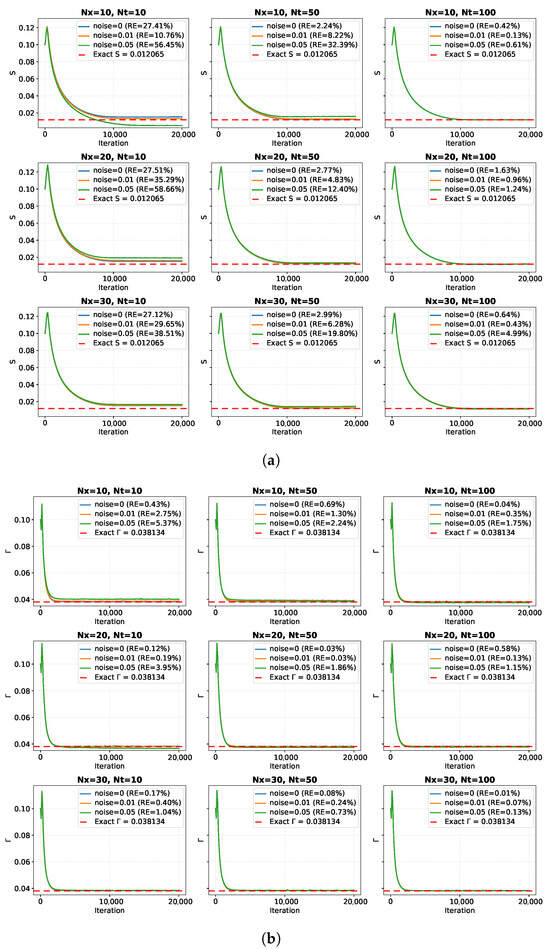
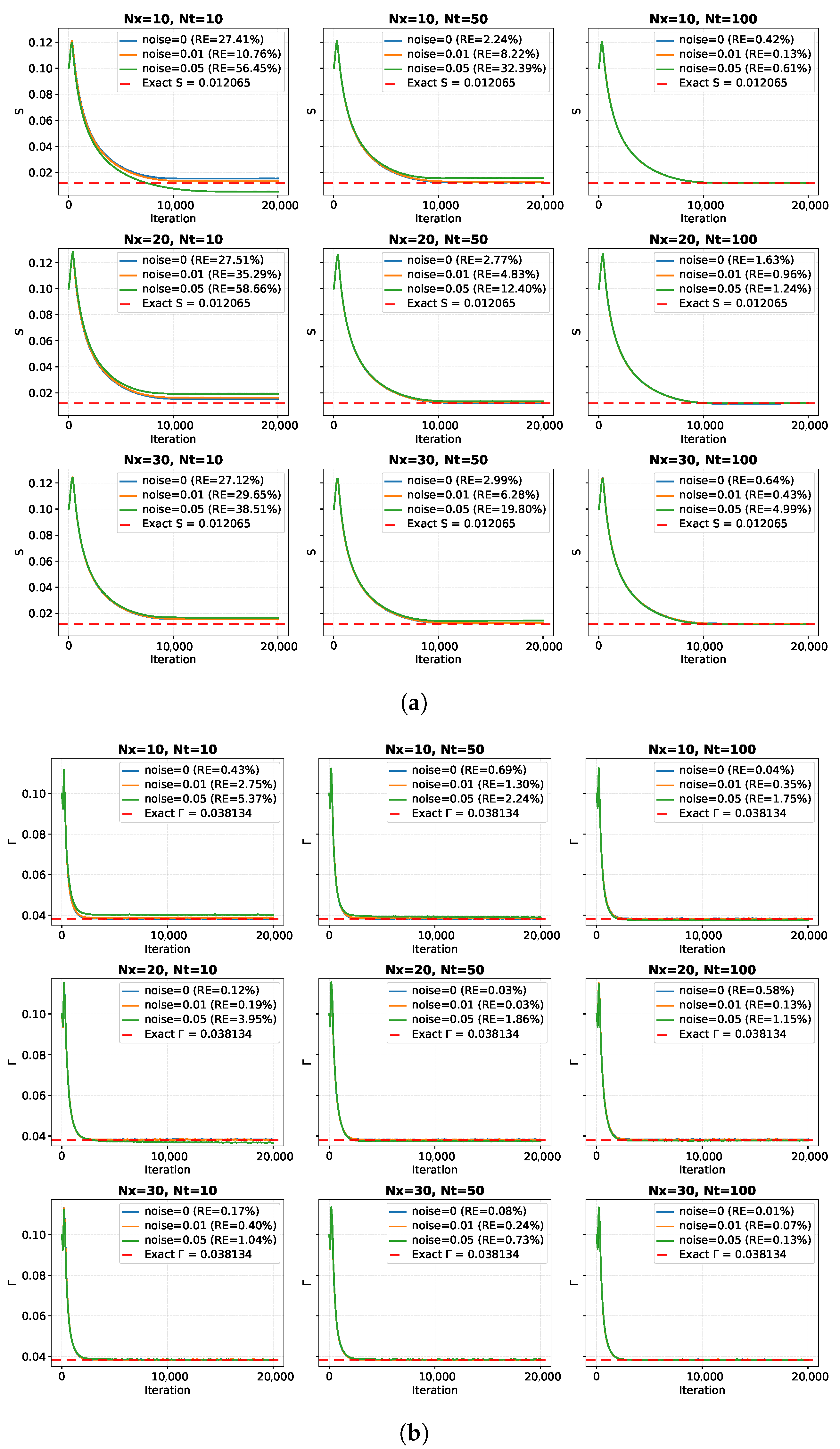
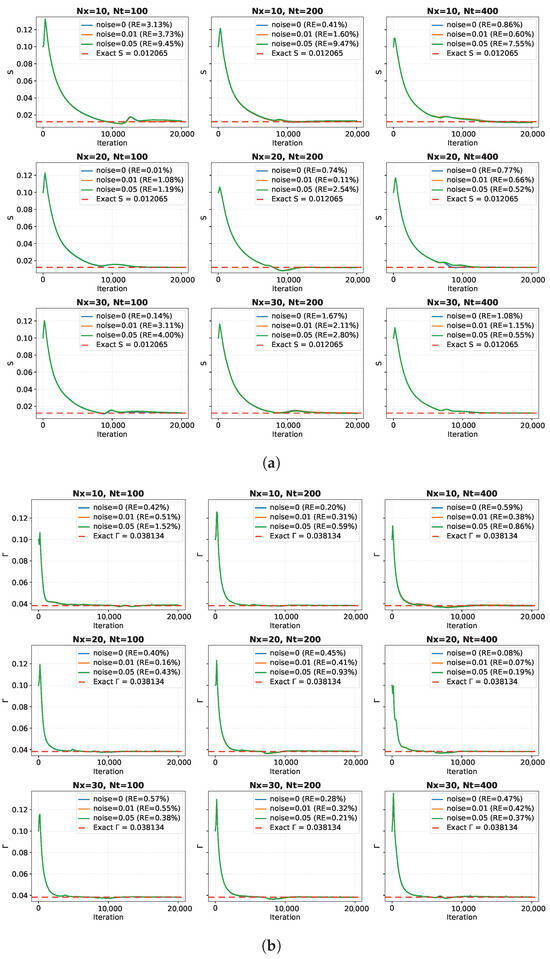
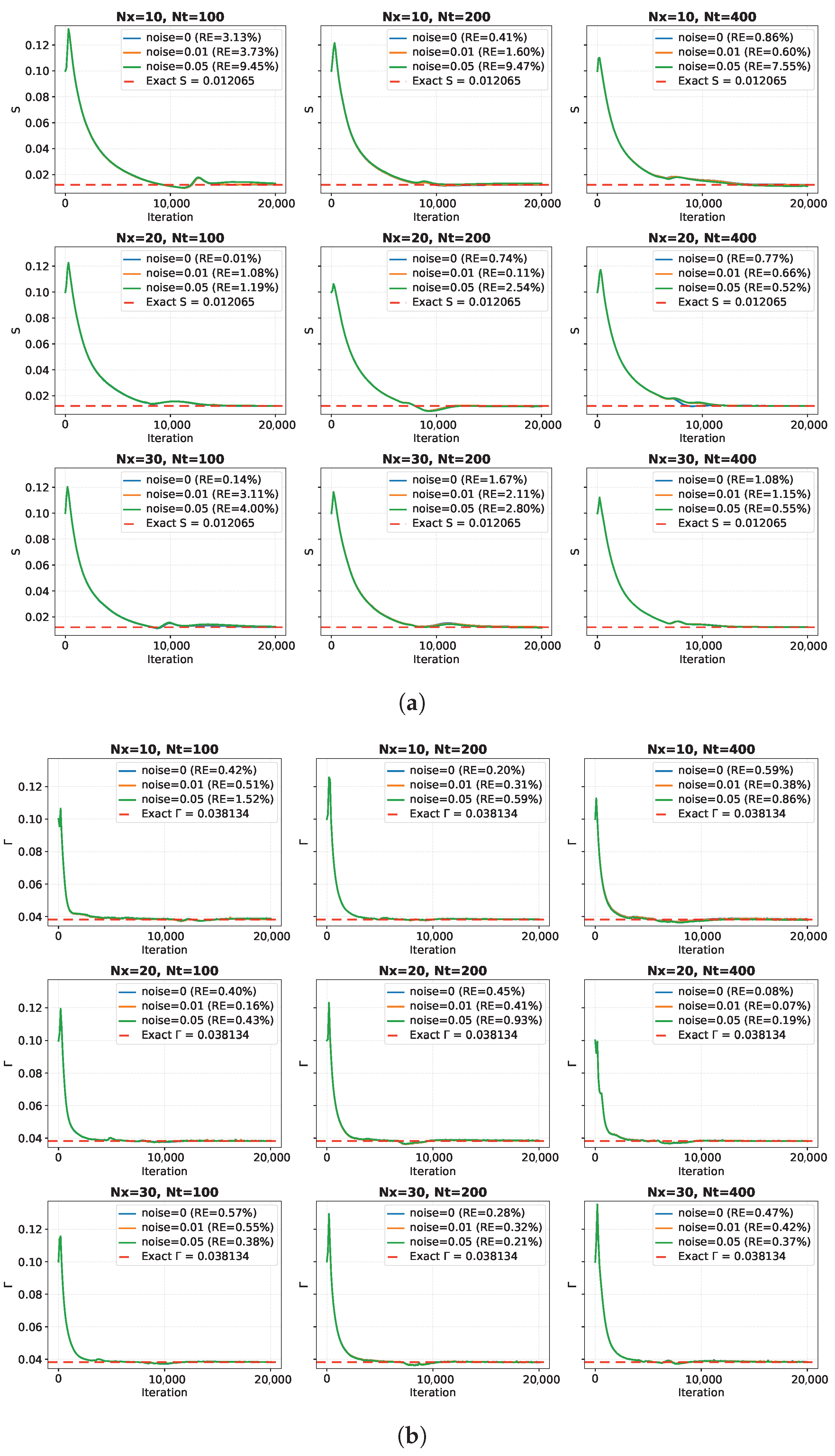
Figure 14 and Figure 15 show the convergence histories of S and under single- and multi-frequency loadings for different sampling densities and noise levels. After 20,000 steps, both parameters converge near their true values, indicating good identifiability under the tested settings. Compared to the exact ground-truth values, the final relative errors of the inverted parameters remain well within an acceptable margin, proving the effectiveness and robustness of the model in solving the inverse parameter identification problem.
Figure 14.
Convergence histories under single-frequency loading for different sampling densities and noise levels: (a) parameter S; (b) parameter .
Figure 15.
Convergence histories under multi-frequency loading for different sampling densities and noise levels: (a) parameter S; (b) parameter .
The relative errors are summarized in Table 4 and Table 5. It is revealed that a clear asymmetry in identifiability exists: the diffusion-like parameter is stably recovered across spatial/temporal sampling configurations and noise levels. Crucially, even under extremely sparse sampling (e.g., , ) and high measurement noise (, i.e., noise), is consistently identified with typically sub-percent to relative error. This robust identifiability directly addresses a major pain point in marine engineering—namely, the extreme difficulty and high cost of acquiring dense, high-quality monitoring data in offshore seabed environments. By contrast, the storage/compressibility-like parameter S is more sensitive to sampling and noise, especially for single-frequency excitation with sparse temporal sampling, where the relative error can grow substantially. This stems from the structure of the frequency-domain equations: in the adopted u-p formulation, multiplies the second spatial derivative and is therefore tightly constrained when the spatial fields are well fitted. In contrast, S appears in the imaginary component of the mass-balance-type equation and couples with the likewise imaginary term . The accurate recovery of S thus requires high-fidelity extraction of the in-phase and quadrature components of displacement and pore pressure (and their spatial derivatives) from time-domain observations.
Table 4.
Relative errors (%) under different sampling and noise levels (single-frequency loading).
Table 5.
Relative errors (%) under different sampling and noise levels (multi-frequency loading).
In the single-frequency case with very few time samples per spatial location (e.g., ), the variance of lock-in phasor estimates is high, weakening the information in the data term relative to the PDE and boundary terms. Multiple pairs can then yield comparably small PDE residuals, causing convergence to solutions with correct but biased S, which explains the or larger S errors in Table 4 for low . Increasing temporal samples to provides better coverage of the orthogonal basis, reduces phasor-estimation variance roughly as , strengthens the data constraint, and brings the S error below . Multi-frequency excitation further improves identifiability. First, the design matrix in the orthogonal harmonic least-squares fit is typically well conditioned, yielding phasor estimates that are more robust to noise. Second, FD-PINN must find a single pair that explains all frequency components concurrently, which removes the single-frequency non-uniqueness where imaginary parts may compensate each other, driving convergence toward the true parameters. This also accounts for the few-percent errors in Table 5 even with and sparse spatial sampling.
Collectively, the extensive validations in both forward and inverse scenarios explicitly demonstrate that the proposed model provides robust and effective solutions to the wave-induced seabed response problem. By reformulating the differential operator in the frequency domain and constraining the total loss function with strict physical laws, the model intrinsically avoids the error-accumulation issues inherent in time-stepping numerical methods. The discrepancies, whether in the predicted spatiotemporal fields compared to analytical solutions or in the inverted parameters compared to ground-truth values, fall strictly within acceptable engineering tolerances. This affirms that the FD-PINN framework is not merely a theoretical construct but a highly effective, practical tool capable of providing high-fidelity solutions for complex marine geotechnical engineering challenges under realistic data constraints.
6. Conclusions
This study presented an AI-enabled framework, a frequency-domain physics-informed neural network (FD-PINN), designed for the high-fidelity modeling and inverse parameter identification of the dynamic response of one-dimensional saturated marine soils under harmonic loading. The proposed framework uses a complex phasor representation and combines nondimensional poroelastic modeling with frequency-domain learning. Multiscale Fourier feature mappings are adopted to reduce spectral bias, while a lock-in-inspired strategy is utilized to extract frequency-domain targets from time-domain measurements, improving noise robustness without increasing network size or computational cost.
The main conclusions are summarized as follows:
- High-fidelity forward modeling: For both single- and multi-frequency excitations (simulating typical wave-induced loadings), the proposed FD-PINN substantially outperforms conventional time-domain PINN. Phase-accumulation errors associated with time integration are effectively avoided, and relative errors are consistently reduced to the order of .
- Robust inversion under sparse and noisy data: The framework exhibits exceptional noise tolerance and data efficiency during inverse analysis. Specifically, the diffusion-importance parameter is reliably identified and remains highly robust even under extremely sparse spatial–temporal sampling configurations (e.g., , ) and high noise levels (up to 5%. Although the storage parameter S is more sensitive to sampling density and frequency content, its identification accuracy improves significantly when multi-frequency excitation and sufficient phase coverage are utilized.
- Value for marine engineering applications: The FD-PINN framework can efficiently and accurately invert key poroelastic parameters (S and ) that characterize seabed liquefaction potential and drainage properties. This physically consistent capability is highly valuable for evaluating the wave-induced dynamic response of marine sediments and assessing the long-term service performance of offshore structure foundations, particularly in environments where high-quality field data is scarce.
Despite the promising results, the present model has certain limitations that warrant future research. The current framework is restricted to one-dimensional linear poroelasticity, which simplifies the multidimensional wave–seabed interactions and neglects potential nonlinear soil behaviors (e.g., plasticity or large deformations) under extreme wave conditions. Moving forward, the position of this FD-PINN model in scientific and engineering practice is envisioned as a foundational surrogate tool. Because it effectively bypasses the heavy computational overhead of traditional transient solvers, it holds great potential for integration into digital twin systems for offshore wind farms or marine platforms, enabling near real-time condition monitoring, rapid preliminary design evaluations, and the continuous updating of seabed geotechnical properties from ongoing sensor data.
Author Contributions
Conceptualization, W.C. and S.F.; methodology, W.C., H.T. and L.W.; software, W.C. and H.T.; validation, W.C. and L.W.; formal analysis, W.C.; investigation, W.C. and H.T.; resources, S.F.; data curation, W.C.; writing—original draft preparation, W.C. and H.T.; writing—review and editing, W.C., L.W. and S.F.; visualization, W.C.; supervision, W.C.; project administration, W.C.; funding acquisition, W.C. All authors have read and agreed to the published version of the manuscript.
Funding
This research is supported by the National Natural Science Foundation of China (Grant No. 52578451), and the Natural Science Foundation of Guangdong Province (Grant No. 2024A1515240016).
Data Availability Statement
The original contributions presented in this study are included in the article. Further inquiries can be directed to the corresponding authors.
Conflicts of Interest
The authors declare no conflicts of interest.
Abbreviations
The following abbreviations are used in this manuscript:
| AI | Artificial Intelligence |
| DNN | Deep Neural Network |
| PINN | Physics-Informed Neural Network |
| FD-PINN | Frequency-Domain Physics-Informed Neural Network |
| TD-PINN | Time-Domain Physics-Informed Neural Network |
| FFE | Fourier Feature Embeddings |
| MS-FFM | Multiscale Fourier Feature Mapping |
| PDE | Partial Differential Equation |
| ODE | Ordinary Differential Equation |
| MLP | Multilayer Perceptron |
Appendix A. Derivation of the One-Dimensional u-p Frequency-Domain Solution Under Multi-Frequency Harmonic Loading
This appendix derives the frequency-domain analytical solution for a one-dimensional saturated porous medium, used to validate the PINN results. Starting from the nondimensional Biot-type 1D coupled system, linearity is exploited to decompose a multi-frequency harmonic load into single-frequency subproblems; the final time-domain fields are obtained by linear superposition.
Appendix A.1. Governing Equations and Boundary Conditions
On the nondimensional interval , the frequency-domain governing equations read
where and are the displacement and pore-pressure phasors, is the nondimensional angular frequency, S is the storage-type nondimensional parameter, and is the permeability-viscosity-related nondimensional parameter. This system matches the frequency-domain PDEs used in the main text. The boundary conditions are
where the nondimensional total stress at the top boundary is
and is the complex stress phasor (including phase),
Appendix A.2. Characteristic Equation for a Single-Frequency Phasor Problem
For given , S, and , assume exponential trial solutions
Substituting into Equations (A1) and (A2) yields a homogeneous algebraic system in . Eliminating gives the quadratic characteristic equation
where .
Let be its roots,
and define the corresponding wavenumbers
with the branch chosen such that
to ensure non-divergent (decaying/non-growing) behavior over the interval.
Appendix A.3. Mode Decomposition and the p/u Ratio
For each , Equation (A1) gives the pressure-displacement ratio
Appendix A.4. A 2 × 2 System from the Top Boundary Conditions
At , impose
Let
Solving this system gives
Appendix A.5. Linear Superposition for Multi-Frequency Harmonic Loading
Because Equations (A1)–(A4) are linear, for a load
one obtains for each a frequency-domain solution
with top-boundary stress phasor
Collecting the M frequency-domain solutions,
the time-domain fields are reconstructed via the standard phasor formula:
This completes the derivation of the nondimensional one-dimensional u-p frequency-domain solution under multi-frequency harmonic loading, which serves as a reference for both forward and inverse FD-PINN studies.
References
- Mohapatra, S.C.; Guedes Soares, C. Wave–current interaction with a deformable bottom in a three-dimensional channel. Phys. Fluids 2025, 37, 057109. [Google Scholar] [CrossRef] [Scilit]
- Guo, Y.; Mohapatra, S.; Soares, C.G. Composite breakwater of a submerged horizontal flexible porous membrane with a lower rubble mound. Appl. Ocean. Res. 2020, 104, 102371. [Google Scholar] [CrossRef] [Scilit]
- Biot, M.A. Theory of Propagation of Elastic Waves in a Fluid-Saturated Porous Solid. I. Low-Frequency Range. J. Acoust. Soc. Am. 1956, 28, 168–178. [Google Scholar] [CrossRef] [Scilit]
- Biot, M.A. Theory of Propagation of Elastic Waves in a Fluid-Saturated Porous Solid. II. Higher Frequency Range. J. Acoust. Soc. Am. 1956, 28, 179–191. [Google Scholar] [CrossRef] [Scilit]
- Costabal, F.S.; Pezzuto, S.; Perdikaris, P. Δ-PINNs: Physics-informed neural networks on complex geometries. Eng. Appl. Artif. Intell. 2024, 127, 107324. [Google Scholar] [CrossRef] [Scilit]
- Zhang, P.; Yin, Z.Y.; Sheil, B. Interpretable data-driven constitutive modelling of soils with sparse data. Comput. Geotech. 2023, 160, 105511. [Google Scholar] [CrossRef] [Scilit]
- Liu, H.; Su, H.; Sun, L.; Dias-da Costa, D. State-of-the-art review on the use of AI-enhanced computational mechanics in geotechnical engineering. Artif. Intell. Rev. 2024, 57, 196. [Google Scholar] [CrossRef] [Scilit]
- Yuan, B.; Choo, C.S.; Yeo, L.Y.; Wang, Y.; Yang, Z.; Guan, Q.; Suryasentana, S.; Choo, J.; Shen, H.; Megia, M.; et al. Physics-informed machine learning in geotechnical engineering: A direction paper. Geomech. Geoengin. 2025, 20, 1128–1159. [Google Scholar] [CrossRef] [Scilit]
- Amiri-Simkooei, A.; Tiberius, C.; Lindenbergh, R. Deep learning in standard least-squares theory of linear models: Perspective, development and vision. Eng. Appl. Artif. Intell. 2024, 138, 109376. [Google Scholar] [CrossRef] [Scilit]
- Raissi, M.; Perdikaris, P.; Karniadakis, G.E. Physics-informed neural networks: A deep learning framework for solving forward and inverse problems involving nonlinear partial differential equations. J. Comput. Phys. 2019, 378, 686–707. [Google Scholar] [CrossRef] [Scilit]
- Luo, K.; Zhao, J.; Wang, Y.; Li, J.; Wen, J.; Liang, J.; Soekmadji, H.; Liao, S. Physics-informed neural networks for PDE problems: A comprehensive review. Artif. Intell. Rev. 2025, 58, 323. [Google Scholar] [CrossRef] [Scilit]
- Henkes, A.; Herrmann, L.; Wessels, H.; Kollmannsberger, S. Generative adversarial networks enable outlier detection and property monitoring for additive manufacturing of complex structures. Eng. Appl. Artif. Intell. 2024, 136, 108993. [Google Scholar] [CrossRef] [Scilit]
- Tavakoli, S.; Singh, M.; Hosseinzadeh, S.; Hu, Z.; Shao, Y.; Wang, S.; Huang, L.; Grammatikopoulos, A.; Li, Y.P.; Khojasteh, D.; et al. A review of flexible fluid-structure interactions in the ocean: Progress, challenges, and future directions. Ocean. Eng. 2025, 342, 122545. [Google Scholar] [CrossRef] [Scilit]
- Wang, S.; Teng, Y.; Perdikaris, P. Understanding and mitigating gradient flow pathologies in physics-informed neural networks. SIAM J. Sci. Comput. 2021, 43, A3055–A3081. [Google Scholar] [CrossRef] [Scilit]
- Wang, S.; Wang, H.; Perdikaris, P. On the eigenvector bias of Fourier feature networks: From regression to solving multi-scale PDEs with physics-informed neural networks. Comput. Methods Appl. Mech. Eng. 2021, 384, 113938. [Google Scholar] [CrossRef] [Scilit]
- Tancik, M.; Srinivasan, P.; Mildenhall, B.; Fridovich-Keil, S.; Raghavan, N.; Singhal, U.; Ramamoorthi, R.; Barron, J.; Ng, R. Fourier features let networks learn high frequency functions in low dimensional domains. Adv. Neural Inf. Process. Syst. 2020, 33, 7537–7547. [Google Scholar]
- Song, C.; Wang, Y. Simulating seismic multifrequency wavefields with the Fourier feature physics-informed neural network. Geophys. J. Int. 2023, 232, 1503–1514. [Google Scholar] [CrossRef] [Scilit]
- Sallam, O.; Fürth, M. On the use of Fourier Features-Physics Informed Neural Networks (FF-PINN) for forward and inverse fluid mechanics problems. Proc. Inst. Mech. Eng. Part M J. Eng. Marit. Environ. 2023, 237, 846–866. [Google Scholar] [CrossRef] [Scilit]
- Liang, R.; Liu, W.; Xu, L.; Qu, X.; Kaewunruen, S. Solving elastodynamics via physics-informed neural network frequency domain method. Int. J. Mech. Sci. 2023, 258, 108575. [Google Scholar] [CrossRef] [Scilit]
- Li, S.; Li, X.; Jiang, Y.; Yang, Q.; Lin, M.; Peng, L.; Yu, J. A novel frequency-domain physics-informed neural network for accurate prediction of 3D spatio-temporal wind fields in wind turbine applications. Appl. Energy 2025, 386, 125526. [Google Scholar] [CrossRef] [Scilit]
- Coussy, O. Poromechanics; Wiley: Chichester, UK, 2004. [Google Scholar] [CrossRef] [Scilit]
- Cheng, A.H.D. Poroelasticity; Theory and Applications of Transport in Porous Media; Springer: Cham, Switzerland, 2016. [Google Scholar] [CrossRef] [Scilit]
- Cuomo, S.; Schiano Di Cola, V.; Giampaolo, F.; Rozza, G.; Raissi, M.; Piccialli, F. Scientific Machine Learning Through Physics–Informed Neural Networks: Where We Are and What’s Next. J. Sci. Comput. 2022, 92, 88. [Google Scholar] [CrossRef] [Scilit]
- Raissi, M.; Yazdani, A.; Karniadakis, G.E. Hidden fluid mechanics: Learning velocity and pressure fields from flow visualizations. Science 2020, 367, 1026–1030. [Google Scholar] [CrossRef] [Scilit] [PubMed]
- Rasht-Behesht, M.; Huber, C.; Shukla, K.; Karniadakis, G.E. Physics-Informed Neural Networks (PINNs) for wave propagation and full waveform inversions. J. Geophys. Res. Solid Earth 2022, 127, e2021JB023120. [Google Scholar] [CrossRef] [Scilit]
- Bai, J.; Rabczuk, T.; Gupta, A.; Alzubaidi, L.; Gu, Y. A physics-informed neural network technique based on a modified loss function for computational 2D and 3D solid mechanics. Comput. Mech. 2023, 71, 543–562. [Google Scholar] [CrossRef] [Scilit]
- Zhang, E.; Dao, M.; Karniadakis, G.E.; Suresh, S. Analyses of internal structures and defects in materials using physics-informed neural networks. Sci. Adv. 2022, 8, eabk0644. [Google Scholar] [CrossRef] [Scilit]
- Mildenhall, B.; Srinivasan, P.P.; Tancik, M.; Barron, J.T.; Ramamoorthi, R.; Ng, R. NeRF: Representing Scenes as Neural Radiance Fields for View Synthesis. In European Conference on Computer Vision (ECCV); Springer: Cham, Switzerland, 2020; pp. 405–421. [Google Scholar] [CrossRef] [Scilit]
- Müller, T.; Evans, A.; Schied, C.; Keller, A. Instant neural graphics primitives with a multiresolution hash encoding. ACM Trans. Graph. (TOG) 2022, 41, 1–15. [Google Scholar] [CrossRef] [Scilit]
- Hirose, A. Complex-Valued Neural Networks; Studies in Computational Intelligence (SCI, Volume 32); Springer: Berlin/Heidelberg, Germany, 2006. [Google Scholar] [CrossRef] [Scilit]
- Dramsch, J.S.; Lüthje, M.; Christensen, A.N. Complex-valued neural networks for machine learning on non-stationary physical data. Comput. Geosci. 2021, 146, 104643. [Google Scholar] [CrossRef] [Scilit]
- Trabelsi, C.; Bilaniuk, O.; Zhang, Y.; Serdyuk, D.; Subramanian, S.; Santos, J.F.; Mehri, S.; Rostamzadeh, N.; Bengio, Y.; Pal, C.J. Deep complex networks. arXiv 2017, arXiv:1705.09792. [Google Scholar] [CrossRef] [Scilit]
- Lee, C.Y.; Hasegawa, H.; Gao, S. Complex-Valued Neural Networks: A Comprehensive Survey. IEEE/CAA J. Autom. Sin. 2022, 9, 1406–1426. [Google Scholar] [CrossRef] [Scilit]
- Chen, W.; Fang, D.; Chen, G.; Jeng, D.; Zhu, J.; Zhao, H. A simplified quasi-static analysis of wave-induced residual liquefaction of seabed around an immersed tunnel. Ocean. Eng. 2018, 148, 574–587. [Google Scholar] [CrossRef] [Scilit]
- Duan, L.; Liao, C.; Jeng, D.; Chen, L. 2D numerical study of wave and current-induced oscillatory non-cohesive soil liquefaction around a partially buried pipeline in a trench. Ocean. Eng. 2017, 135, 39–51. [Google Scholar] [CrossRef] [Scilit]
- Wang, X.; Jeng, D.; Lin, Y. Effects of a cover layer on wave-induced pore pressure around a buried pipe in an anisotropic seabed. Ocean. Eng. 2000, 27, 823–839. [Google Scholar] [CrossRef] [Scilit]
- Tarantola, A. Inverse Problem Theory and Methods for Model Parameter Estimation; SIAM: Philadelphia, PA, USA, 2005. [Google Scholar] [CrossRef] [Scilit]
- Aster, R.C.; Borchers, B.; Thurber, C.H. Parameter Estimation and Inverse Problems, 3rd ed.; Elsevier Academic Press: Amsterdam, The Netherlands, 2019. [Google Scholar]
- Advanced Projects Lab, University of Oregon. Lock-In Amplifier. 2016. Available online: https://june.uoregon.edu/mediawiki/index.php/Lock-in_Amplifier (accessed on 3 November 2025).
- Zurich Instruments AG. Principles of Lock-In Detection. 2016. Available online: https://www.zhinst.com/en/resources/principles-of-lock-in-detection (accessed on 3 November 2025).
- Bendat, J.S.; Piersol, A.G. Random Data: Analysis and Measurement Procedures, 4th ed.; Wiley Series in Probability and Statistics; John Wiley & Sons: Hoboken, NJ, USA, 2010. [Google Scholar] [CrossRef] [Scilit]
- Ghaderpour, E.; Liao, W.; Lamoureux, M.P. Antileakage least-squares spectral analysis for seismic data regularization and random noise attenuation. Geophysics 2018, 83, V157–V170. [Google Scholar] [CrossRef] [Scilit]

Disclaimer/Publisher’s Note: The statements, opinions and data contained in all publications are solely those of the individual author(s) and contributor(s) and not of MDPI and/or the editor(s). MDPI and/or the editor(s) disclaim responsibility for any injury to people or property resulting from any ideas, methods, instructions or products referred to in the content. |
© 2026 by the authors. Licensee MDPI, Basel, Switzerland. This article is an open access article distributed under the terms and conditions of the Creative Commons Attribution (CC BY) license.