Article

Anti-Sloshing Method of an Eccentric Floater with Its Suppression Mechanism

School of Naval Architecture, Dalian University of Technology, Dalian 116024, China
*
Author to whom correspondence should be addressed.
J. Mar. Sci. Eng. 2026, 14(7), 663; https://doi.org/10.3390/jmse14070663
Submission received: 22 February 2026 / Revised: 26 March 2026 / Accepted: 30 March 2026 / Published: 31 March 2026
(This article belongs to the Section Ocean Engineering)

Abstract

During the transportation and storage of liquefied natural gas (LNG), sloshing in partially filled cargo tanks poses significant risks to structural integrity and operational safety. Conventional anti-sloshing devices, such as internal baffles, are incompatible with membrane-type tanks due to strict requirements on internal geometry and material integrity. To address this challenge, this study proposes an eccentric foam floater (EFF), which enhances energy dissipation through controlled mass asymmetry without modifying the tank’s internal configuration. Building upon the buoyant-ball concept, the EFF introduces an offset between geometric center and center of mass, thereby promoting additional rotational motion, inter-floater and floater–wall friction, and fluid–structure interaction effects. Model experimental investigations using a six-degree-of-freedom motion platform, combined with discrete element method (DEM) simulations, demonstrate that the EFF consistently outperforms its homogeneous counterpart in suppressing sloshing-induced pressure fluctuations across a broad range of excitation conditions. The results highlight the potential of mass eccentricity as a design principle for passive, structure-preserving sloshing mitigation in membrane LNG tanks.

1. Introduction

LNG is widely used around the world thanks to its clean and efficient energy properties [1]. However, the sloshing phenomenon in LNG tanks of floating facilities during transportation and storage has emerged as a significant issue, posing potential risks to operational safety and potentially leading to energy dissipation and structural damage to LNG containment systems. Therefore, developing effective anti-sloshing techniques is critical to ensuring the safe and efficient transportation and storage of LNG.
Membrane-type tanks constitute the dominant containment solution for the maritime transportation and large-scale storage of LNG [2,3,4]. Their inner cryogenic barrier consists of a thin (0.7–1.2 mm) Invar membrane, engineered to maintain LNG at its saturation temperature of approximately −162 °C (111 K) while accommodating thermal contraction under extreme cold [5]. A critical operational challenge in such systems is liquid sloshing—the violent free-surface oscillation induced by external excitations (e.g., vessel motion or ground acceleration). Uncontrolled sloshing generates high-magnitude impact loads, localized pressure spikes, and cyclic structural stresses that threaten the integrity of both primary and secondary membranes, thereby compromising safety, service life, and regulatory compliance.
To mitigate sloshing, numerous passive damping strategies have been explored in conventional rigid-wall tanks (e.g., prismatic tanks). Xue et al. [6] proposed edge-mounted porous layers along the tank periphery and conducted high-fidelity numerical simulations using the IHFOAM porous solver in OpenFOAM. Their results revealed that the porous layer not only lowered the fundamental sloshing frequency but also eliminated jet-like pressure spikes observed in non-porous configurations and enhanced overall energy dissipation. A parametric study further identified optimal ranges for the thickness ratio, porosity, and mean pore diameter, offering practical design guidelines. Yu et al. [7] introduced a floating baffle plate, demonstrating effective reduction in both natural sloshing frequency and peak impact pressure; however, this approach necessitates auxiliary structural supports, rendering it incompatible with the space-constrained, membrane-integrated interior of membrane-type tanks. Chang et al. [8] developed a hybrid damping device integrating elastic materials with a liquid sloshing damper (LSD), where spring-induced hysteresis enabled tunable phase lag between structural displacement and restoring force—thereby effectively suppressing wave amplitude. Similarly, Cruz-Gómez et al. [9] experimentally demonstrated that hydrophobic surface treatment of the tank wall significantly increased viscous damping, reducing both impact load magnitude and free-surface wave height. While various conventional techniques, including baffles [10,11,12,13] and perforated screens [14], have proven effective in other LNG tank types, their implementation typically requires substantial internal structural modifications. For membrane-type tanks, such alterations may damage the Invar membrane or compromise the thermal and leak-tight integrity of the multilayer insulation system, making them impractical and potentially hazardous.
In this context, buoyant surface-floating elements have emerged as a promising class of membrane-compatible solutions. Kim et al. [15] pioneered the “floating blanket” concept. It consists of a mat of melamine foam cubes assembled via ball bearings and needles and alters the effective free-surface stiffness while dissipating wave energy through drag and deformation. Significant pressure reduction was achieved at low fill levels (<30%), though attenuation weakened markedly above 60% fill. Subsequent experimental investigation by Kim et al. [16] revealed a critical limitation: direct contact between floating elements and tank walls or ceiling could trigger anomalous impulsive pressures due to strong fluid–structure coupling, highlighting the necessity of optimizing element mass, stiffness, and geometry for stable operation. Sauret et al. [17] explored a liquid foam layer atop the LNG surface and reported substantial sloshing suppression even with sub-millimeter thicknesses. The dominant dissipation mechanisms were identified as wall–foam viscous friction, bulk foam shearing, and bubble–bubble interactions. However, foam collapse under sustained dynamic loading requires active replenishment, which introduces system complexity and reliability concerns that are unsuitable for marine LNG applications. Lee et al. [18] proposed a floating pad system targeting dual objectives, namely, sloshing suppression and boil-off reduction, but no experimental validation has yet been reported. Building on Sauret’s concept, Zhang et al. [19,20] developed a robust solid alternative in the form of monolayer and multilayer arrangements of buoyant polymeric foam spheres. Systematic experiments confirmed consistent damping across fill ratios (20–80%), with energy dissipation rather than frequency tuning as the dominant mechanism, and no structural modification was required. Kulitsa and Wood [21] independently proposed metallic hemispherical floats with stabilizing fins, originally designed for boil-off reduction but found to exhibit measurable sloshing suppression. Gurusamy [22] also used floats to conduct sloshing experiments, and the study showed that floats can effectively suppress sloshing in shallow water. Different motions of the floats, interactions between the floats, motion of the float–liquid interface, and liquid shear flow between the tank wall and the floats are the main mechanisms of energy dissipation. Justice et al. [23] conducted sloshing experiments in water using floats of different densities and found that when using heavy-density floats (density = 800 kg/m3), they had a better sloshing reduction effect than light-density floats and could change the natural frequency of the system.
These studies suggest that buoyant-body-based systems have the potential to mitigate sloshing and reduce evaporation simultaneously, indicating promising prospects for practical LNG applications. Various anti-sloshing strategies have been proposed for membrane tanks, including floating blankets, liquid foams, floating mats, floating plates, porous material layers attached to the tank interior and buoyant spheres. Each approach emphasizes different anti-sloshing mechanisms and application scenarios while also exhibiting inherent limitations. From technical and operational safety perspectives, buoyant sphere-based suppression techniques demonstrate notable application potential for membrane tanks because they do not require significant internal tank modifications. However, existing studies on buoyant spheres are insufficient to meet the stringent requirements for efficient sloshing suppression in membrane tanks. Specifically, the centers of mass and geometry of conventional homogeneous foam floaters (HFFs) coincide, resulting in sloshing dynamics dominated by the frictional dissipation of translational motion. Consequently, the available energy dissipation pathways are limited in terms of both diversity and intensity. Structural constraints restrict further improvements to sloshing suppression efficiency, particularly under high-amplitude and high-velocity sloshing conditions, where the reduction in impact pressure is insufficient to meet engineering safety requirements. This has become a major bottleneck, hindering the large-scale practical application of HFFs. To address the key deficiencies of existing buoyant-sphere-based approaches (single energy dissipation mechanism, limited mitigation efficiency and lack of effective structural optimization strategies), it is necessary to explore ways to enhance the interaction strength between floaters and the surrounding liquid, tank walls and neighboring floaters. This can be achieved by modifying the floaters’ mass distribution to intensify frictional effects, collision dynamics and fluid–structure coupling while maintaining a simple, practical structural design that does not alter the floaters’ intrinsic physical properties. This approach offers a promising way to overcome the limitations of current anti-sloshing mechanisms.
To advance beyond conventional buoyant solutions, this work introduces the EFF, a physically distinctive yet conceptually simple approach that leverages deliberate mass asymmetry to enhance energy dissipation. Unlike an HFF, whose motion is predominantly translational, the EFF generates sustained torque under dynamic excitation, leading to enhanced rolling, sliding, and collisional interactions both among floaters and between floaters and tank boundaries. These effects collectively strengthen frictional and impact-based energy dissipation pathways, thereby attenuating sloshing intensity without requiring structural modifications to the tank interior. This paper integrates physical experimentation with DEM-based mechanistic analysis to establish a unified understanding of how geometric–inertial coupling governs sloshing suppression performance and lays the foundation for scalable, physics-informed design of passive anti-sloshing systems.
It should be clarified that the EFF used in this study serves solely as a proof-of-concept platform and does not represent a final engineering solution. Their primary role is to provide a controllable, low-cost physical model for isolating and validating the fundamental effectiveness of the eccentric mass configuration (e.g., enhanced frictional torque generation, improved sloshing damping, and reduced impact forces under dynamic loading). The foam material itself is not intended to operate at cryogenic temperatures; rather, it acts as a mechanism carrier to demonstrate the transferability of the design principle. For practical deployment in LNG membrane tanks operating at −162 °C, the foam will be replaced by a purpose-designed cryogenic buffering structure. Candidate materials under active evaluation include hydrogenated nitrile rubber (HNBR) with tailored low-temperature plasticizers, fluor silicone elastomers, and advanced microcellular polyurethane (PU) foams featuring cryo-stable crosslinking networks. Material selection will be guided by full-scale cryogenic mechanical testing (tensile, compression, impact rebound) and thermal cycling validation.

2. Sloshing Experiments of the Scale Model

This section presents the physical experimental system designed to quantify sloshing suppression under controlled hydrodynamic conditions. We describe the scaled tank facility, instrumentation strategy, and floater configuration—including geometric dimensions, material density, and placement eccentricity—emphasizing how each parameter was selected to isolate and amplify the damping contribution of floater motion while maintaining dynamic relevance to full-scale applications.

2.1. Experimental Setup

The experiments are conducted using a six-degree-of-freedom (6-DOF) motion platform. The platform provided by Dalian Ruixin Swinging Platform Technology Co., Ltd. (Dalian, China) can perform the following motions and has the following maximum operating parameters:
(1)
Rotational motions, including roll, pitch and yaw, with an amplitude of ±5° and a period of 0.6 s.
(2)
Sway motion with an amplitude of ±100 mm and a period of 1.15 s.
(3)
A surge motion with an amplitude of ±100 mm and a period of 1.0 s.
(4)
The heave motion with an amplitude of ±100 mm and a period of 2.2 s.
The platform supports harmonic excitation at a maximum frequency of 100 Hz, with dimensions of 1 × 1 m.
A 6-DOF motion platform was selected to replicate the realistic multi-axis excitations experienced by LNG carriers at sea, where coupled roll–pitch–sway motions dominate sloshing dynamics under irregular waves [24,25,26]. While this study focuses on pure sway and pure roll for mechanistic clarity, the platform’s full 6-DOF capability ensures experimental scalability to combined motion scenarios—critical for validating anti-sloshing solutions under operational conditions.
The internal dimensions of the rectangular tank are 0.6 m in length, 0.1 m in width and 0.39 m in height. To ensure sufficient structural rigidity and prevent deformation under hydrodynamic impact, the tank walls are made of 0.02 m thick acrylic plates.
For flow visualization purposes, sodium fluorescein is added to the water to enhance contrast. Only a small amount of dye is needed to achieve a clear green color, without significantly altering the fluid’s physical properties.
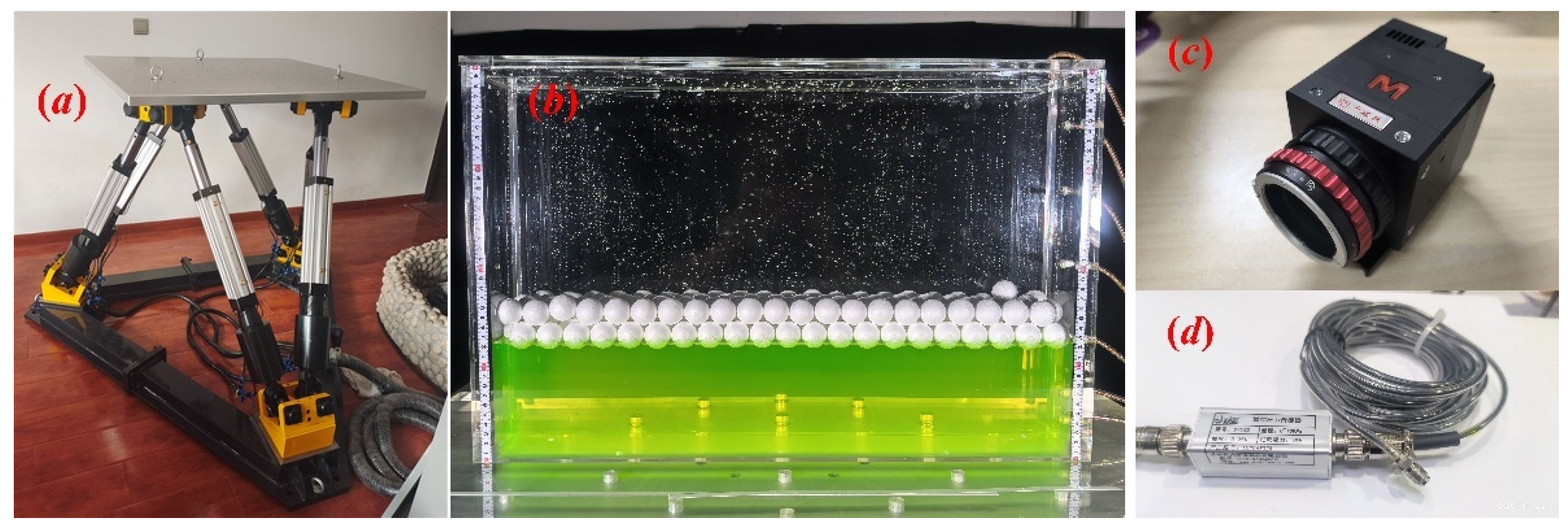
Free-surface evolution can be recorded using a Revealer High Speed Camera M210 (Hefei, China), which supports a maximum frame rate of 2000 fps. Pressure measurements were obtained using CY100 pressure sensors, which are manufactured by Chengdu SCIENIC Limited Company (Chengdu, China). The sensors have a measurement range of 0–10 kPa and a precision of 0.25%. All sensors were calibrated prior to the experiments using factory-certified procedures, followed by in situ zero-check and static pressure verification. The combined expanded uncertainty (k = 2) is estimated as ±0.5% FS (full-scale). A total of seven pressure sensors were employed. Six of these (CH1–CH6) are mounted on the same sidewall of the tank at heights of 3 cm, 6 cm, 12 cm, 20 cm, 28 cm and 35 cm above the tank bottom, respectively. The seventh sensor (CH7) is installed on the tank top near the edge, at a horizontal distance of 1.5 cm from the sidewall. All pressure signals were acquired at a sampling frequency of 128 Hz. The experimental equipment and monitoring instruments can be seen in Figure 1.
For each experimental condition (frequency, amplitude, and floater configuration), three independent repeated trials were conducted. Trials were separated by at least 15 min to ensure thermal and mechanical stabilization of the tank system. All pressure data is the mean value across the three repetitions.
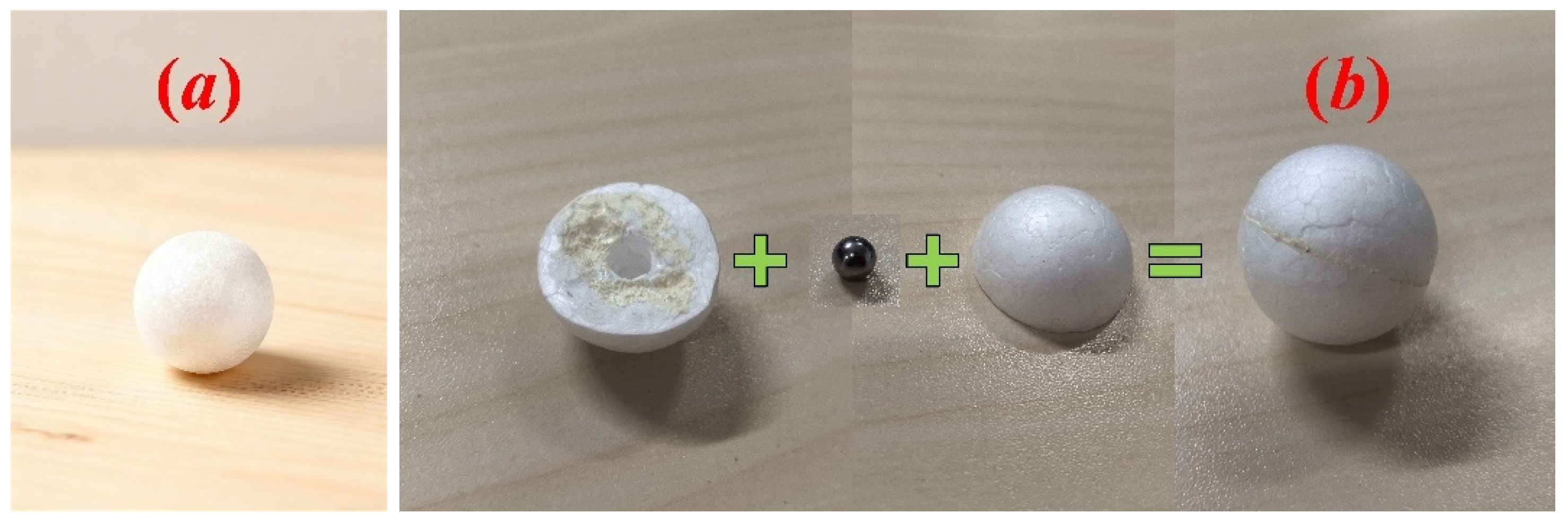
Two types of plastic foam spheres were used in the sloshing experiments. The first type was a homogeneous foam sphere with a diameter of 3 cm and a density of 25 kg/m3. The second consisted of a 3 cm diameter foam sphere assembled from two identical hemispheres and a 4 mm diameter steel ball, as illustrated in Figure 2b. One of the hemispheres was drilled to a depth equal to the diameter of the steel bead, enabling it to be embedded in one side of the sphere.
The first type of sphere can be regarded as an HFF. In contrast, the second type forms an EFF because the steel bead is embedded in only one hemisphere. This introduces an intentional offset between the center of mass and the geometric center. For convenience, the homogeneous and eccentric foam floaters are hereafter referred to as the HFF and the EFF, respectively. The new center of gravity of the eccentric sphere will be offset by about 0.17 cm compared to the center of gravity of the homogeneous sphere. This value will fluctuate slightly due to the influence of machining accuracy.

Similarity Criterion and Scaling Justification

All experiments were conducted under strict Froude similarity, ensuring dynamic similarity between the model-scale sloshing and full-scale LNG membrane tanks. The Froude number is defined as
F r = V g L
where V is the characteristic velocity (e.g., maximum free-surface velocity), g is gravitational acceleration, and L is the characteristic length (here taken as the tank width, L model   =   0.6   m ). For a typical 174,000 m3 membrane-type LNG carrier, the corresponding full-scale width is L full 45   m . Thus, the geometric scale ratio is λ   =   L full / L model   =   75 , and all kinematic quantities scale accordingly: time scales as λ 1 / 2   =   8.7 , velocities as λ 1 / 2   =   8.7 , and accelerations remain unchanged. While Reynolds ( R e   =   V L / ν ) and Weber ( W e   =   ρ V 2 L / σ ) numbers differ due to fluid property scaling, their influence on low-frequency, gravity-dominated sloshing—characteristic of LNG cargo motion in calm-to-moderate sea states—is negligible compared to inertial–gravitational forces. This justification aligns with established practice in sloshing research [27]. Consequently, the observed damping enhancement by eccentric floating units is directly scalable to full-size tanks under Froude-similar operating conditions.

2.2. Experimental Parameters

This study focuses on the influence of sway and roll motions on the sloshing flow field, considering the motion response of the floating device in waves and the sloshing characteristics of the tank. The equations of motion are assumed as Formulas (2) and (3).
x ( t ) = A sin ( 2 π T t )
β ( t ) = α sin ( 2 π T t )
where x represents instantaneous sway displacement, t denotes time, A represents sway amplitude, T represents excitation period, β represents instantaneous roll angle and α represents roll amplitude.
The natural period (T0) of the rectangular tank can be calculated using the following formula, as specified by the classification society [27]:
T 0   =   2 π g k n tanh ( k n H ) , n = 1 , 2 , 3 ,
where g is the gravitational acceleration and kn is the modal wave number, which is calculated as kn = nπ/L. Here, n is the modal order, L is the tank length and H is the liquid depth.
Furthermore, the natural frequency f0 is assumed as:
f 0 = g k n tanh ( k n H ) 2 π , n = 1 , 2 , 3 ,
Considering that a liquid depth of H corresponds to a dangerous water depth when H/L ≈ 0.3368 [28], the present study first focuses on the case where H = 0.20 m. With an experimental tank length of L = 0.6 m, H/L = 0.333 corresponds to a filling rate of approximately 50%. Additionally, the cases of H = 0.12 m (approximately a 30% filling rate) and H = 0.28 m (approximately a 70% filling rate) are considered, leading to calculated filling levels of H/L = 0.200 and 0.467, respectively. These correspond to moderate water depth conditions (0.1 ≤ H/L ≤ 0.25) and limited water depth conditions (0.25 ≤ H/L ≤ 1.00).
For the three typical liquid-level loading conditions, the first-order natural period and frequency of tank sloshing can be calculated using Formulas (4) and (5). The excitation period and frequency for sway and roll of the experimental platform are then designed based on these calculations in order to study the resonant sloshing conditions for each typical liquid level.

3. Results and Discussion

The anti-sloshing function of foam floaters stems from their ability to dissipate kinetic energy via interfacial friction with tank walls [20]. In an EFF, the center of mass is permanently offset from the geometric center, introducing inherent mass asymmetry. When subjected to external acceleration (e.g., from liquid sloshing), this offset generates oscillatory torque about the instantaneous contact points, promoting frequent transitions between rolling and sliding regimes. Such transitions increase the effective frictional work per unit displacement, thereby reducing the overall mobility of the floater.
To assess how eccentricity influences this mobility and its potential for enhanced energy dissipation, we performed DEM simulations on a dry, horizontal plane. Rather than modeling full fluid–structure interactions, we focused on a simplified yet mechanistically relevant scenario: the free rolling response of a single floater under initial angular perturbation.

3.1. Comparison of Energy Dissipation Between a Uniform Ball and an Eccentric Ball

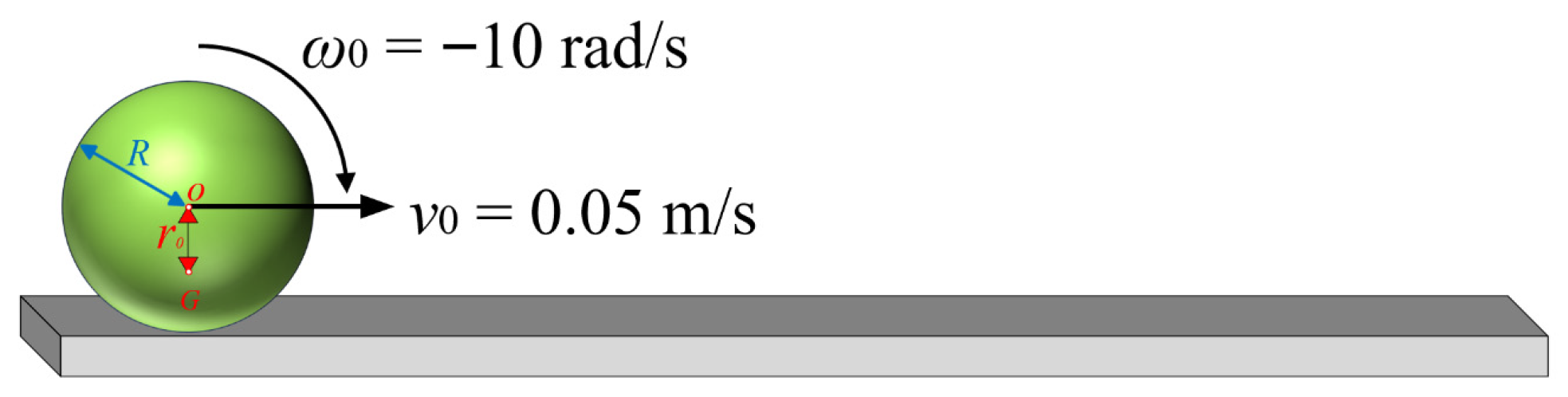
Consider a solid sphere with a radius of R = 0.05 m and an average density of ρ = 2500 kg/m3, where the distance between its center of mass G and geometric center O is r0, and the rate eecc (=r0/R) is referred to as the eccentricity. When the sphere moves with a translational velocity v0 = 0.005 m/s and an angular velocity ω0 = −10 rad/s on a horizontal surface, as shown as Figure 3, the maximum rolling distance is [29]
S = 0.7 R v 2 g f r
where R represents the radius of the sphere and v represents its initial velocity. g is the gravitational acceleration and fr is the rolling friction coefficient, and its value represents the ability of rolling angular velocity.
In previous work [30], the DEM method has been used to accurately simulate the situation of a single ball on the ground. Regarding the parameter settings of the DEM model, such as the stiffness coefficient, damping coefficient, friction coefficient, etc., they were kept consistent with previous work, referencing the work of Cundall et al. [31,32]. In this section, the rolling distance of the ball is calculated by changing the eccentricity, taking it as the influence of eccentricity on the energy dissipation of small ball rolling.
The center of a non-homogeneous sphere rolling along a horizontal plane is similar to a pendulum. When it comes to rest, the line connecting the center of mass and the center of the sphere becomes perpendicular to the horizontal plane. This means that the final rolling distance is always an integer multiple of the circumference. Consequently, different center-of-mass positions may result in the same final rolling distance due to the ‘backlash’ phenomenon. Therefore, using the final position of the center of mass as a measure of the eccentricity effect may not be accurate. Instead, the maximum rolling distance is used to assess the effect of the eccentric position on the motion. The parameter settings were based on the data provided by Zhao et al. [29].
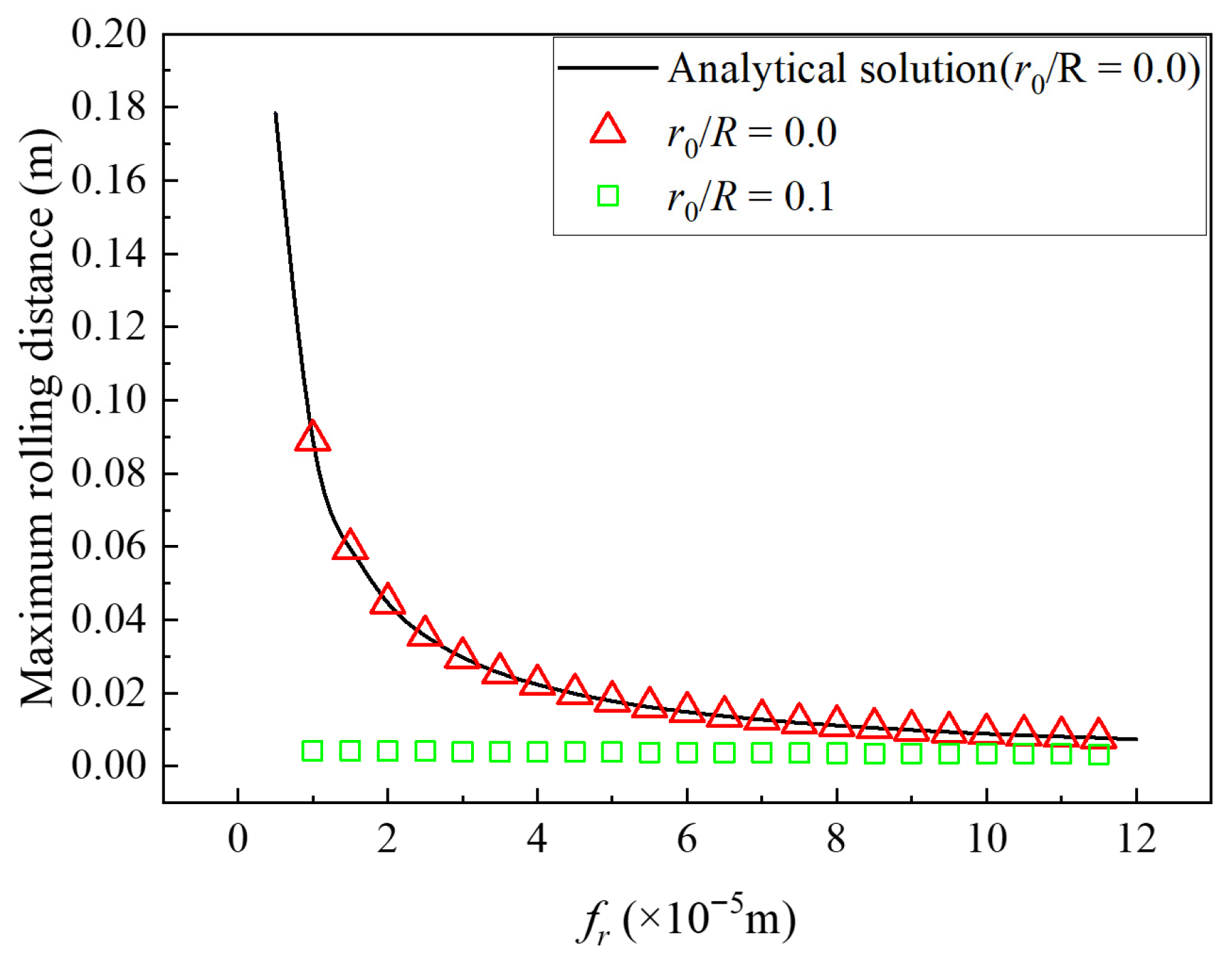
Figure 4 shows the maximum rolling distance for the HFF (with r0/R = 0.0) and the eccentric sphere (with r0/R = 0.1). Firstly, the rolling distance of the homogeneous sphere is consistent with the theoretical value, demonstrating the accuracy of the method. Secondly, the rolling distance of the eccentric sphere decreases as the rolling friction coefficient increases. For the same rolling friction coefficient, the maximum rolling distance of the eccentric sphere is significantly smaller than that of the homogeneous sphere.
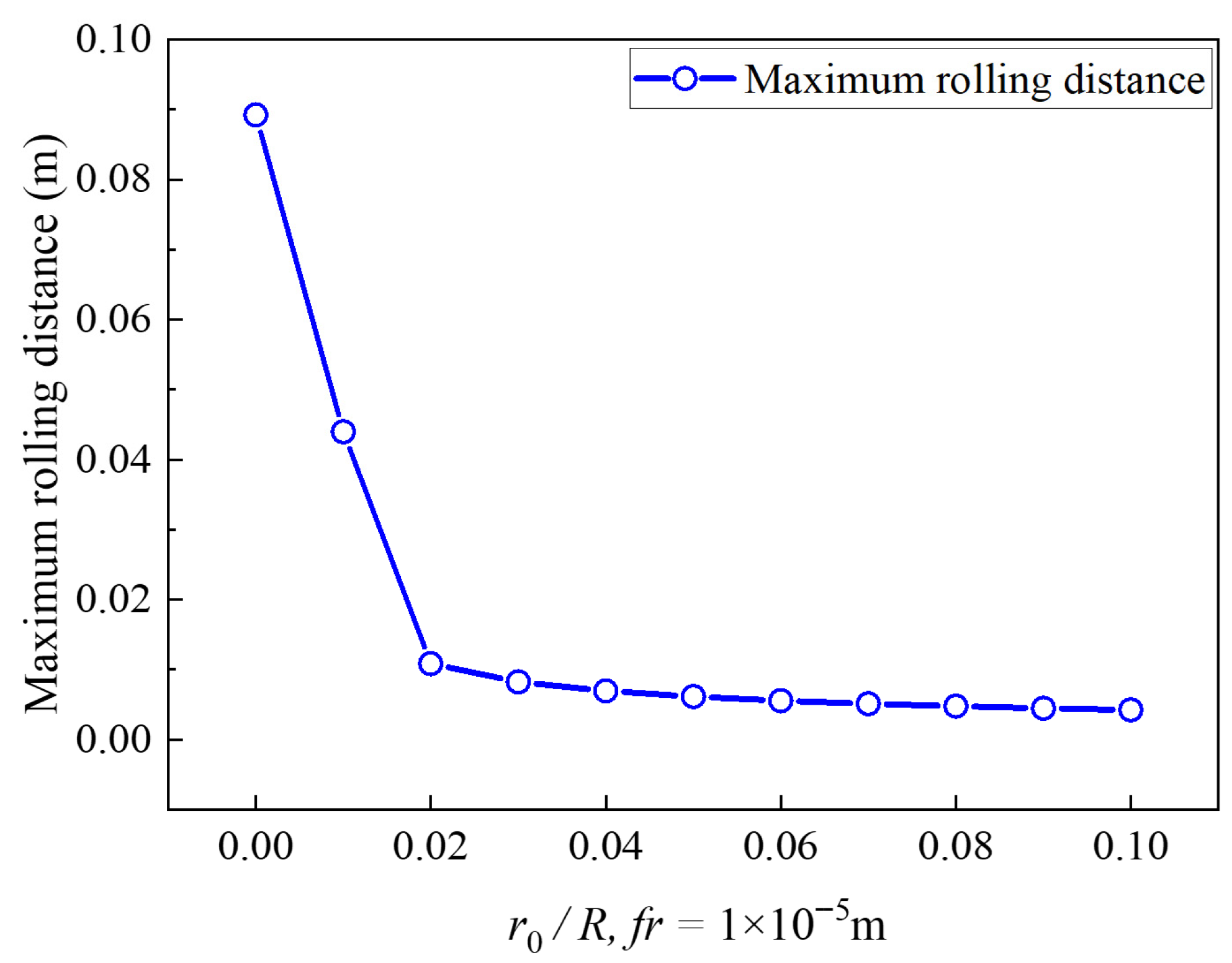
Furthermore, the influence of eccentricity on rolling distance was investigated. A friction coefficient of 1 × 10⁻⁵ m was selected, and the eccentricity ratio (r0/R) was varied from 0.0 to 0.1 with the type set as 0.01. As illustrated in Figure 5, even a small eccentricity ratio such as r0/R = 0.01 has a significant impact on the maximum rolling distance, reducing it by 50.69%. When r0/R = 0.1, the maximum rolling distance decreases by 95.23%.
The DEM simulations conducted on a dry, horizontal plane demonstrate that eccentricity promotes mechanical energy dissipation through enhanced rolling resistance, under material parameters adopted from Zhao et al. [29] for open-cell foam. Both the rolling friction coefficient and eccentricity act as positive regulators: higher values lead to faster decay of rotational kinetic energy. While this enhanced dry-ground mechanical dissipation does not directly equate to improved sloshing suppression in aquatic environments, it suggests that eccentric geometry may serve as a promising structural strategy to augment energy-dissipating capacity, which is a prerequisite for effective sloshing mitigation, and thus warrants targeted experimental investigation in fluid-immersed conditions.

3.2. Anti-Sloshing Characteristics Under Sway Motions

This section systematically investigates the anti-sloshing mechanisms and operational boundaries of foam floaters under sway excitation. Using a controlled parametric approach, it evaluates the dynamic pressure suppression performance at critical monitoring points, including ΔCH1 (bottom wall pressure difference), CH4max (free-surface pressure), and CH7max (top-wall pressure), across two key hazardous conditions: (i) varying sway amplitudes (A = 0.01–0.03 m, with excitation period matched to the natural period T0) and (ii) varying water depths (H = 0.12–0.28 m). Both the HFF and EFF are compared under 1–4-layer configurations.

3.2.1. Sloshing Pressures on Classic Positions Versus Different Sway Amplitudes

The water depth here is 0.20 m. The three sway amplitudes are set to A = 0.01 m, 0.02 m and 0.03 m. The excitation period T is set as the natural period T0. The number of foam floater layers ranges from one to four.
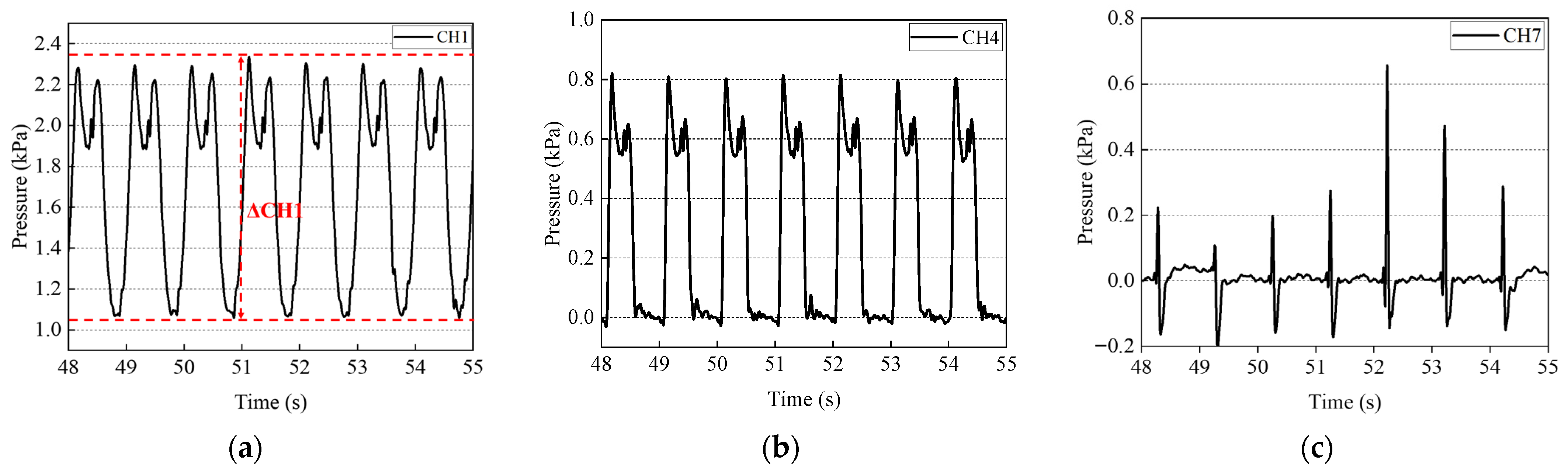
Figure 6 shows the pressure fluctuations during the steady-state phase at different sensor locations (CH1, CH4, and CH7) under a sway amplitude of A = 0.01 m. To compare the sloshing suppression performance of different configurations, the dynamic pressure difference at monitoring point CH1 (located at the bottom of the tank sidewall), defined as ΔCH1 = CH1_max − CH1_min, is used as the reference value. For the sensor CH4 located at the liquid depth and the sensor CH7 positioned at the top of the tank, the maximum pressures, CH4_max and CH7_max, are used for comparison.
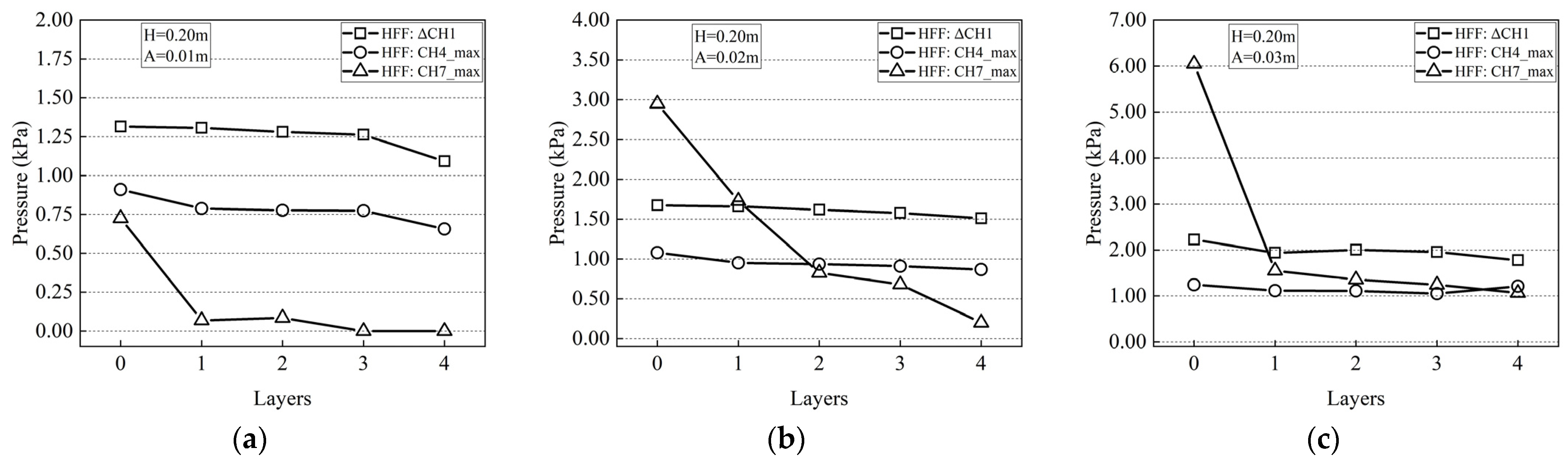
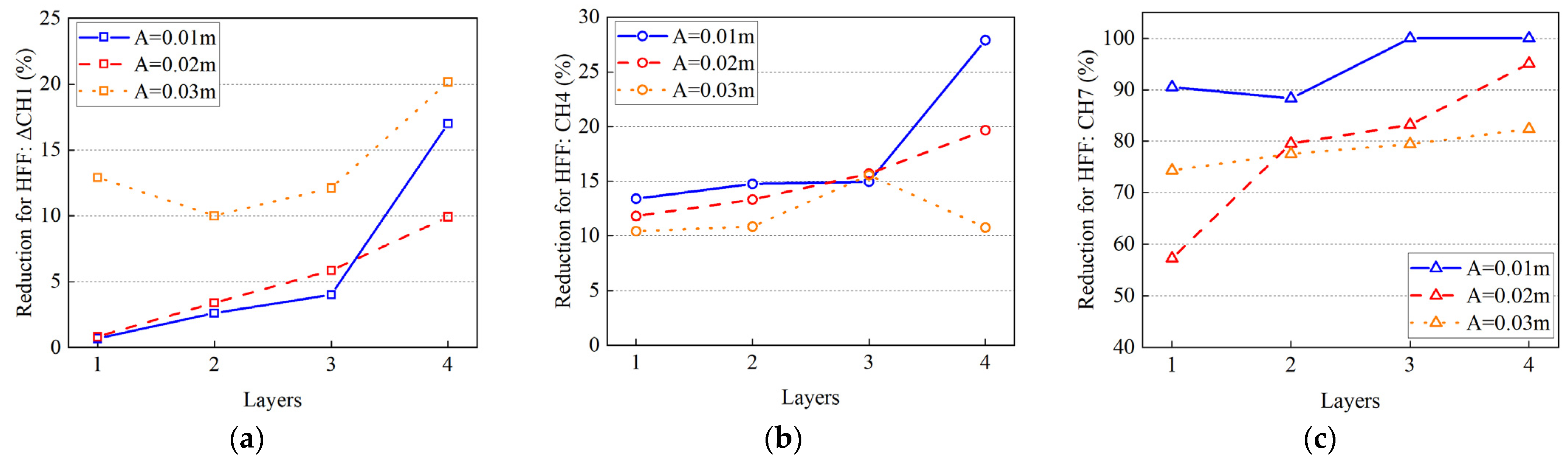
First, the anti-sloshing effects generated by HFFs are studied under sway conditions with different amplitudes. Figure 7 shows the sloshing pressure at various points for different sway amplitudes. The horizontal axis represents the number of layers of HFFs, and the vertical axis represents the sloshing pressure. Figure 8 shows the reduction in sloshing pressure at different monitoring points for different numbers of layers. The horizontal axis represents the number of layers, and the vertical axis denotes the relative difference in sloshing pressure, which is calculated as follows: (sloshing pressure with different layers—pressure without floater)/pressure without floater. Figure 8a shows that, for a sway amplitude of 0.01 m, the pressure variation for all three sensors decreases as the number of foam floater layers increases. Furthermore, when the number of layers reaches three or four, the liquid sloshing phenomenon is completely suppressed, and the pressure at sensor CH7 is zero.
When the sway amplitude increases to 0.02 m, the trend of pressure variation with the number of layers remains consistent with that observed at A = 0.01 m, as illustrated in Figure 8b. The pressure at CH7 shows the most significant change. Figure 8c shows that, as the number of layers increases from one to two, the reduction in pressure increases by 40.39%. When the number of layers reaches four, the pressure at CH7 decreases by more than 90%. This indicates the significant effect of increasing the number of layers.
When A = 0.03 m, an increase in sway amplitude does not lead to a steady decrease in pressure as the number of foam floater layers increases. As can be seen in Figure 8a, the reduction in pressure at CH1 compared to the no-foam condition first decreases and then increases as the number of layers increases. The reduction is smallest at two layers (10.01%) and reaches 20.17% at four layers. The reduction for one and three layers is almost the same. For CH4, when the number of layers is ≤3, there is a positive correlation between the number of layers and the reduction in pressure. However, when the number of layers reaches four, the reduction decreases. This may be because the excessive number of layers causes a slight rise in the water depth. For CH7, the reduction increases approximately linearly as the number of layers increases (see Figure 8c). However, the change from 74.36% at one layer to 82.39% at four layers is less significant than in the case of A = 0.02 m. This indicates that, as the sway amplitude increases, the effect of increasing the number of layers on the pressure at the top becomes less significant from one layer onwards.
This suggests that increasing the layer number of a HFF does not always effectively reduce the impact at higher sway amplitudes. This may be because the floaters primarily rely on friction to dissipate energy in the system and reduce the impact of sloshing. However, as the sway amplitude increases, the spheres gradually become more loosely packed. The gaps that appear between the spheres make it harder for the frictional forces to perform work. This can be seen in detail in the next snapshots, which show the water surface and floater distribution, in the subsequent part of this section.
Additionally, it is important to note that, in dangerous water depth conditions, the maximum pressure for three sway amplitudes occurs at the bottom or top of the tank, rather than near the water surface. Therefore, even though the variation seems irregular at the water surface monitoring point (CH4) in Figure 8b with increasing floater layers under a sway amplitude of 0.03 m, the results of ΔCH1 and CH7 still show that increasing the number of floater layers has a positive effect. It is therefore recommended that, for sway of the tank under dangerous water-depth conditions (H = 0.20 m), the anti-sloshing scheme should include at least two HFF layers.
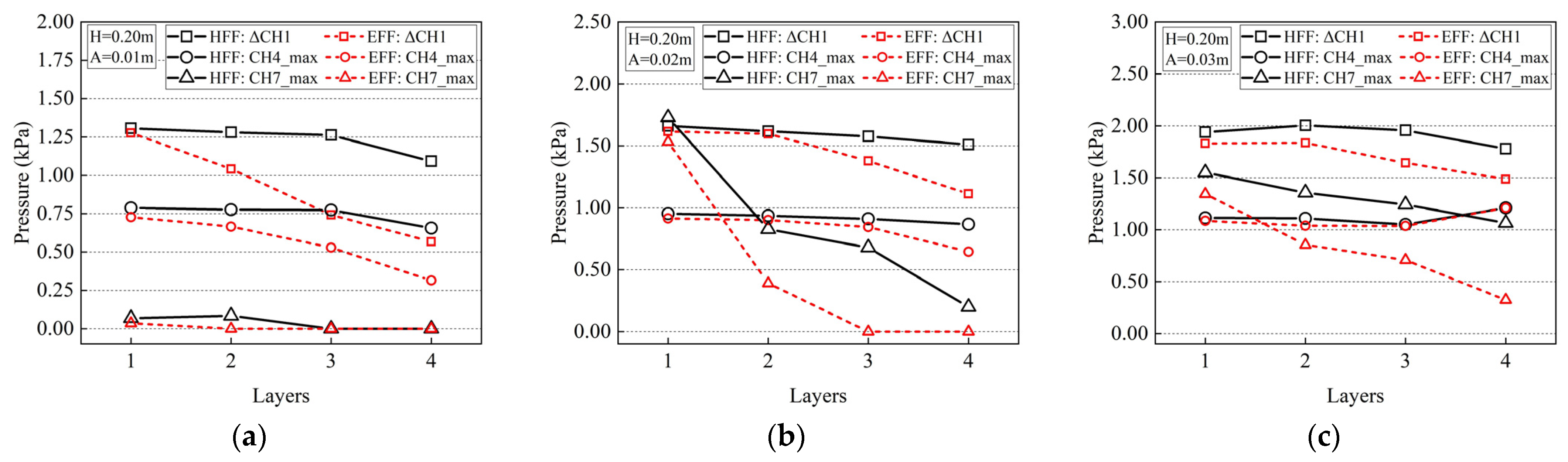
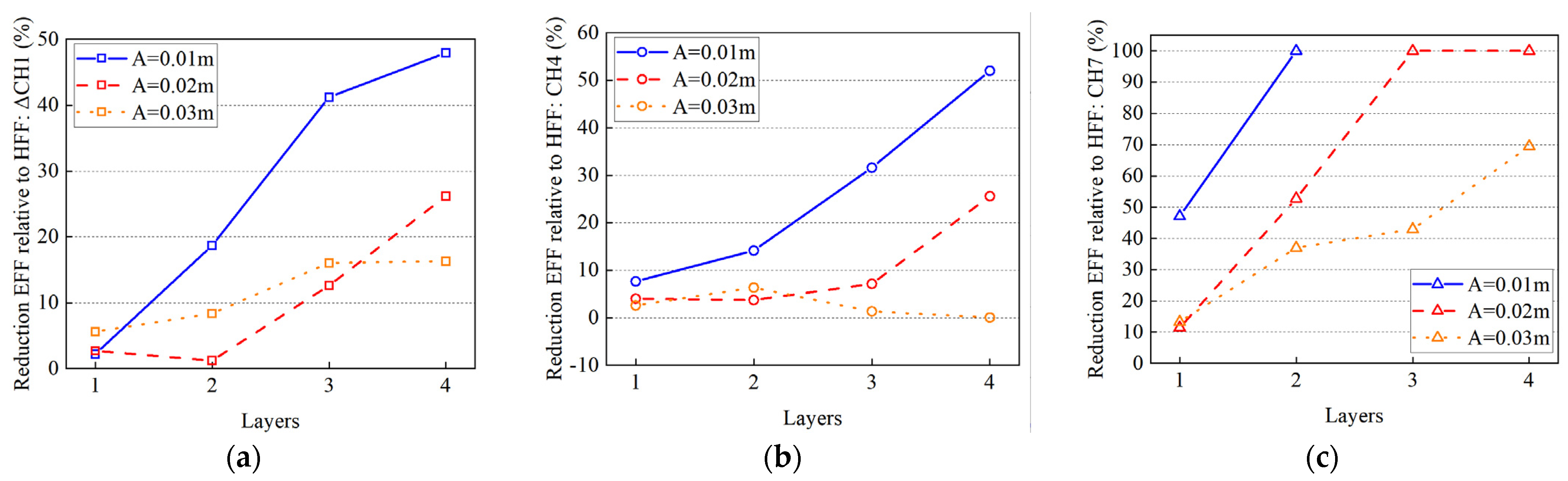
To compare the effects of reducing sloshing pressure induced by the EFF and HFF, Figure 9 shows a comparison of sloshing-induced pressures for the two types of floaters under classic conditions with different sway amplitudes and layer numbers. Figure 10 summarizes the percentage reduction in sloshing pressure achieved by the EFF compared to the HFF. The pressure reduction percentage is defined as
( P H F F P E F F ) / P H F F
where PHFF and PEFF denote the sloshing pressures when using the HFF and EFF, respectively, at the same number of layers.
It should be noted that, in Figure 10c, only two data points for layers 1 and 2 are presented for a sway amplitude of 0.01 m. This is because the pressures measured at the top monitoring location CH7 are zero for both the HFF and EFF when three and four floater layers are employed. Under these conditions, the percentage reduction in sloshing pressure cannot be evaluated because the denominator is zero, so this case is excluded from the statistical analysis.
As can be seen in Figure 9, for sway amplitudes of A = 0.01 m and A = 0.02 m, two or three layers of the EFF are sufficient to completely suppress the fluid sloshing, resulting in CH7 = 0.
For the HFF, complete suppression only occurs at A = 0.01 m when three layers are used. At A = 0.03 m, the EFF also exhibits better suppression, achieving a 94.63% reduction in CH7 compared to the condition without a foam floater when four layers are used.
For the monitoring point at the water depth in Figure 9b, at A = 0.02 m, it is observed that the CH4 pressures for both the HFF and EFF with 1–3 layers are similar. This trend is also evident in the pressure comparison at A = 0.03 m in Figure 9c, where the pressures for 1–4 layers are almost identical. The significant difference between the HFF and EFF is only evident at the smallest sway amplitude (A = 0.01 m). This is likely because, at larger sway amplitudes, the force acting on the CH4 monitoring point near the water surface is primarily due to the large-scale surface disturbance caused by the sway motion. This overshadows the differences between the HFF and EFF. Only when the foam floaters can suppress the fluid sloshing significantly do the differences between the HFF and EFF become apparent. This can also be seen in Figure 11b,c.
For ΔCH1, Figure 9 shows that, for small sway amplitudes (A = 0.01 m), the effect of the number of EFF layers is significant. For slightly larger sway amplitudes (A = 0.02 m and A = 0.03 m), the reduction effect for one to two layers is similar, with further reduction only occurring with three and four layers. For example, at A = 0.03 m, the reduction compared to the condition without floaters is 17.81% and 17.55% for one and two layers, respectively. For three and four layers, the reduction increases to 26.24% and 33.20%, respectively.
Additionally, as shown in Figure 10, except for Figure 10c, where at A = 0.03 m, a one-layer EFF demonstrates a relatively good reduction effect at CH7, the one-layer EFF and HFF are nearly identical for other monitoring points and sway amplitudes. This indicates that, at this point, the friction energy dissipation for both types of floaters is similar, with no significant difference. However, as can be observed from Figure 10a,c, as the number of layers increases, the EFF increasingly enhances the reduction effect at the two monitoring points with the highest pressure (CH1 and CH7), with energy dissipation from the EFF being higher than that of the HFF. Furthermore, this effect is more pronounced with smaller sway amplitudes. Therefore, for dangerous water depths, it is recommended that 3–4 layers of an EFF be used.
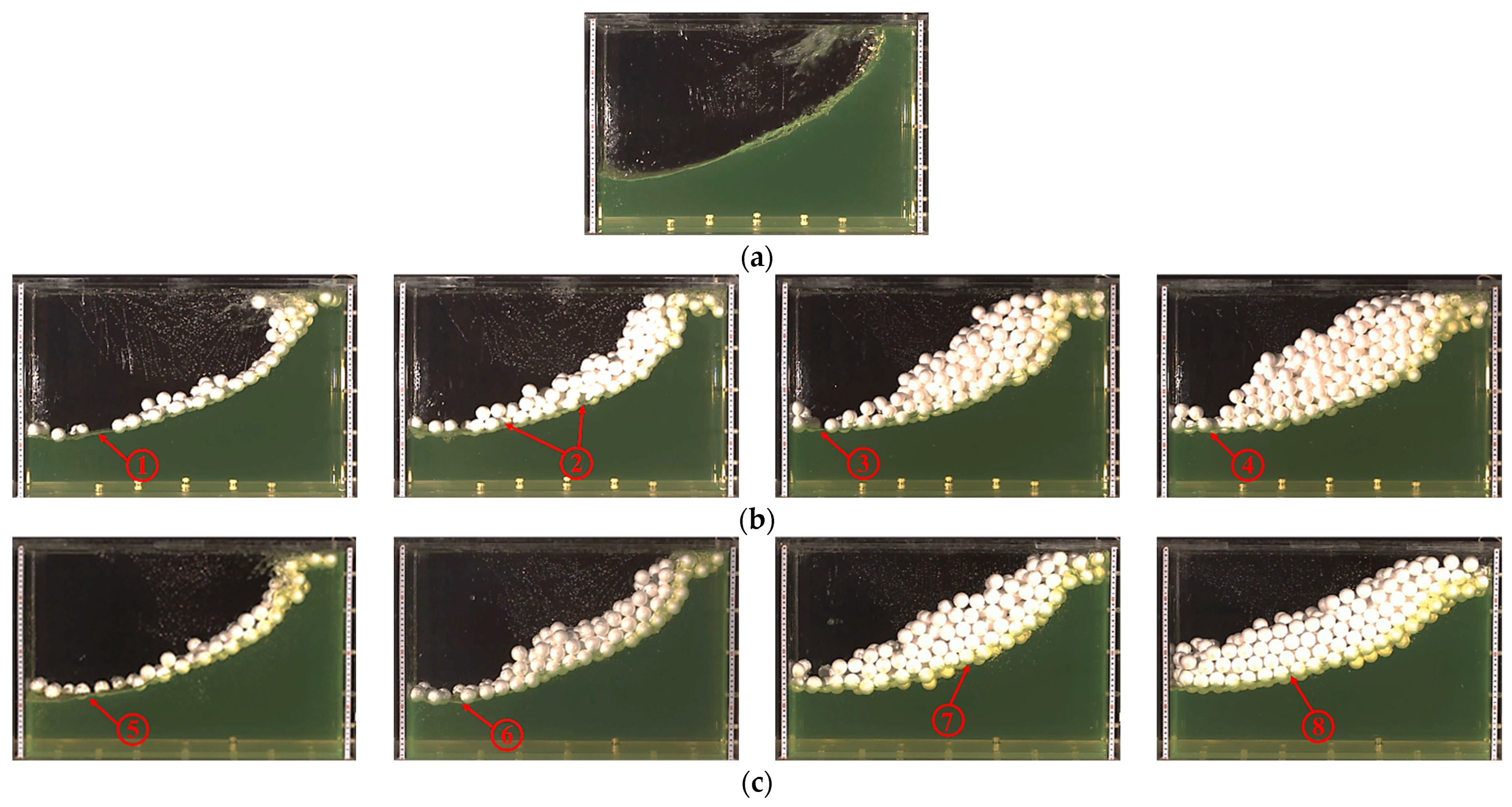
To explain these differences from a waveform perspective, Figure 11 shows snapshots of liquid sloshing at (n + 1/4)T for the HFF and EFF with 0–4 layers, with a sway amplitude of 0.02 m. Figure 11a shows a snapshot at (n + 1/4)T without any foam floaters. Figure 11b,c show snapshots of the HFF and EFF with one to four layers at the same moment.
For the one-layer configuration, there is no significant difference between the HFF and EFF, as evidenced by the similar pressure values measured. Regions ① and ⑤ are areas without foam floaters. This is because during the sloshing phase, the water surface will extend significantly along the tank wall, and its instantaneous length will exceed the initial free surface length L. As the initial layout length of the foam floaters is equal to L, it is inevitable that areas ① and ⑤ will remain uncovered. However, region ⑤ retains more foam floaters.
With two layers of floaters, the HFF exhibits many voids, as can be seen in region ②, meaning there is no friction energy dissipation here. By contrast, the EFF does not exhibit such voids, and there is only a small gap in the liquid return region ⑥, indicating that it produces more energy dissipation than the HFF.
For three layers, the HFF piles up significantly at the free surface slope, and small uncovered areas remain in the return region ③. However, even in areas where piling up is likely to occur, the EFF maintains a more uniform distribution across the entire free surface.
The difference becomes even more evident with four layers. Although the top area is filled with HFFs during the sloshing process, there are still uncovered water areas in the return region ④. The EFF maintains a uniform distribution across the entire area. These observations suggest that, for a large amplitude of sway motion, a single layer of EFFs does not significantly improve suppression compared to HFFs because both fail to cover the entire free surface completely. Consequently, the friction energy dissipation is not substantially different. However, multiple layers show a noticeable improvement with the EFF.

3.2.2. Sloshing Pressures Under Different Water Depths

This subsection introduces two additional water depths, 0.12 m and 0.28 m, for study. The sway amplitude is set to A = 0.01 m, and the excitation period is determined by the natural period of the water depth without foam floaters, as given by formula (4). For the 0.28 m water depth, three layers of foam floaters essentially cover the entire height of the tank; therefore, experiments were conducted with one to three layers only. The CH3 and CH5 sensors are positioned at heights corresponding to the respective water depths and are used to monitor the sloshing pressure at the free surface.
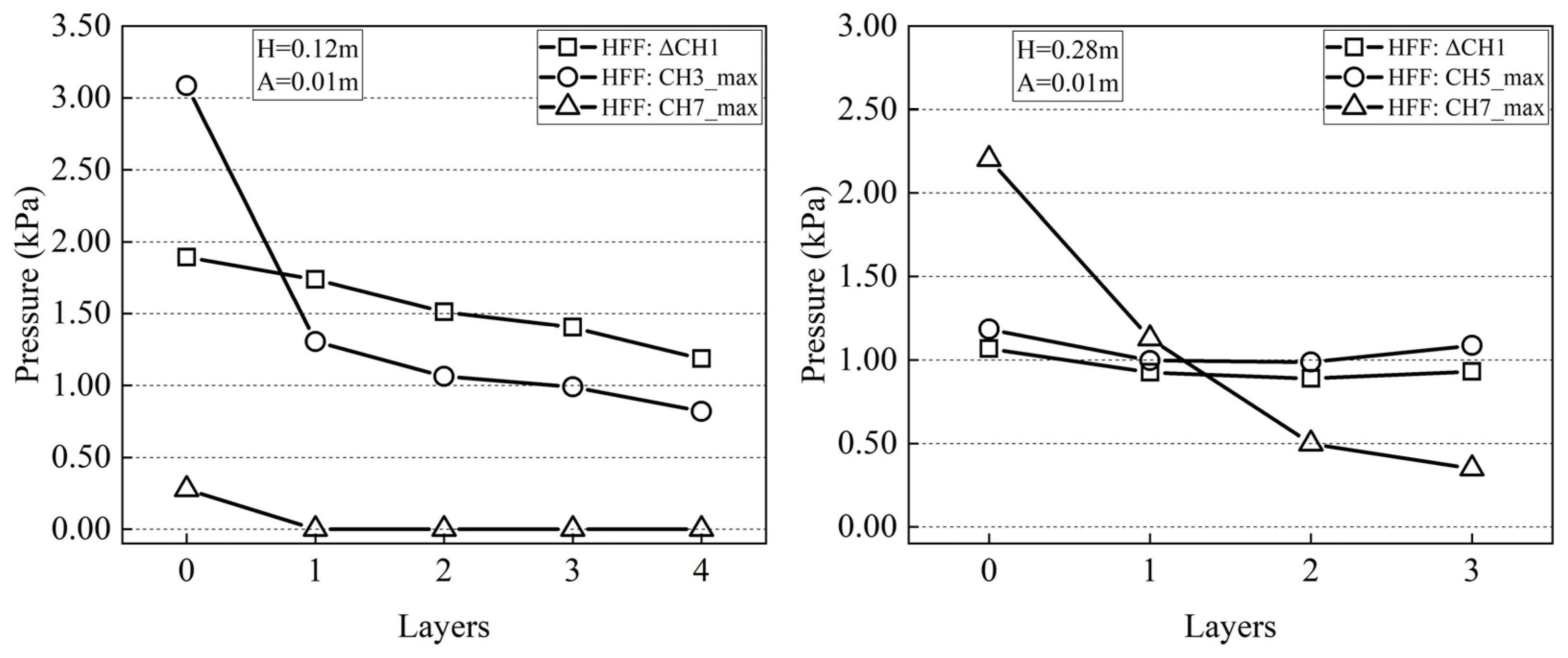
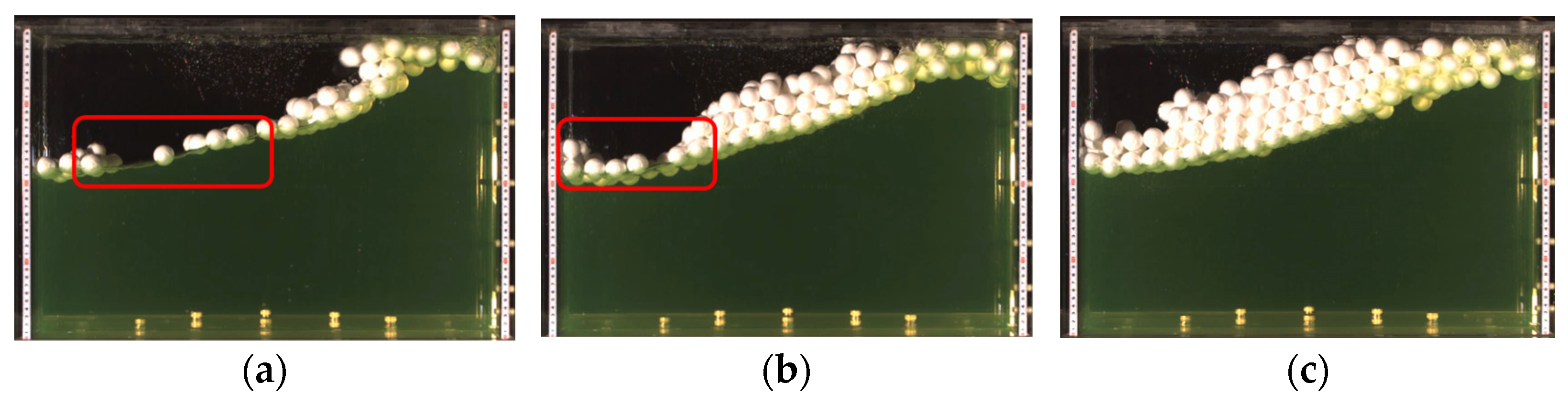
Firstly, Figure 12 illustrates the impact of the HFF on the sloshing phenomenon. For a water depth of H = 0.12 m, the pressure fluctuations ΔCH1 and CH3 decrease as the number of foam floater layers increases. As shown in Figure 13b, the sloshing phenomenon is completely suppressed when using two layers of foam floaters for CH7. For a water depth of H = 0.28 m, the top impact decreases as the number of layers increases. However, for the other two sensors (CH1 and CH5), the pressure reaches its minimum with two layers but increases slightly with three layers. This may be because the maximum number of foam floaters at the top is two layers, and accumulation occurs in the fluid extension zone (see Figure 14c). This creates a ‘foam wall’ effect that compresses the fluid and transmits some energy to the side wall and downward, thereby increasing the sloshing pressure on the wall and bottom. Additionally, since having too many floaters can elevate the water surface, it is necessary to consider the appropriate number of foam layers. For both moderate (H = 0.12 m) and limited (H = 0.28 m) water depth conditions, two to three layers of HFFs are recommended for sway motion.
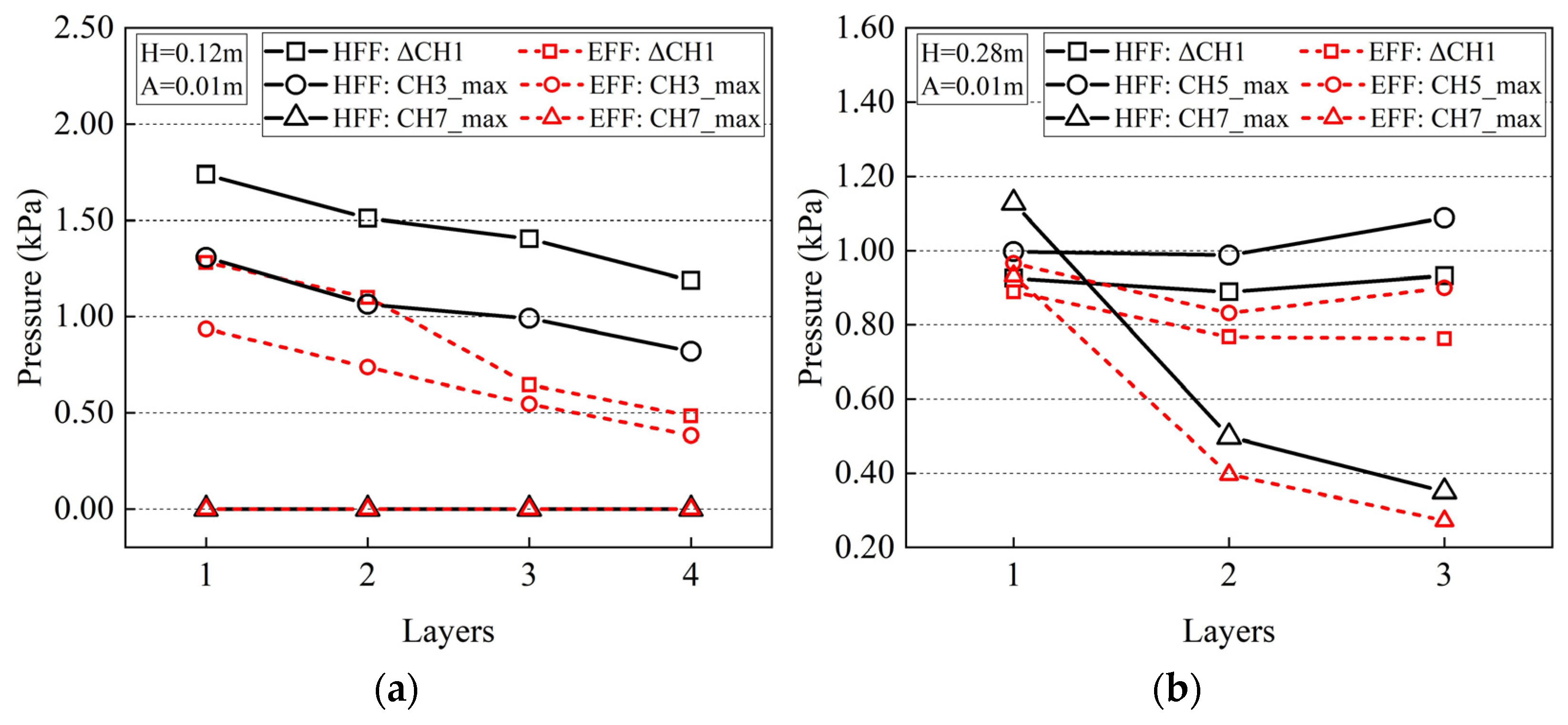
Figure 15 shows the difference in pressure between the HFF and EFF at two depths. For H = 0.12 m, the pressure fluctuations of the EFF with 1–4 layers are smaller than those of the HFF.
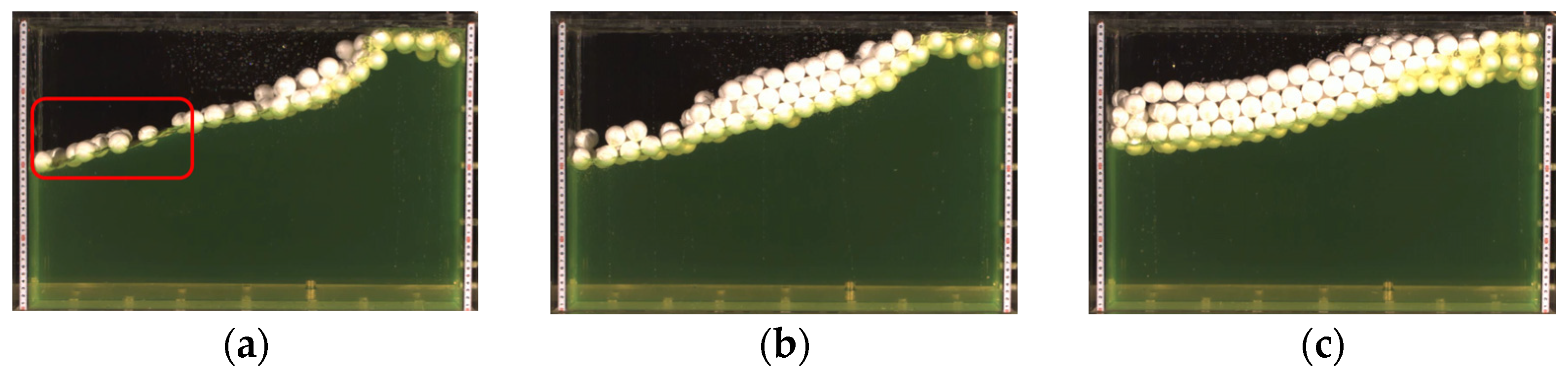
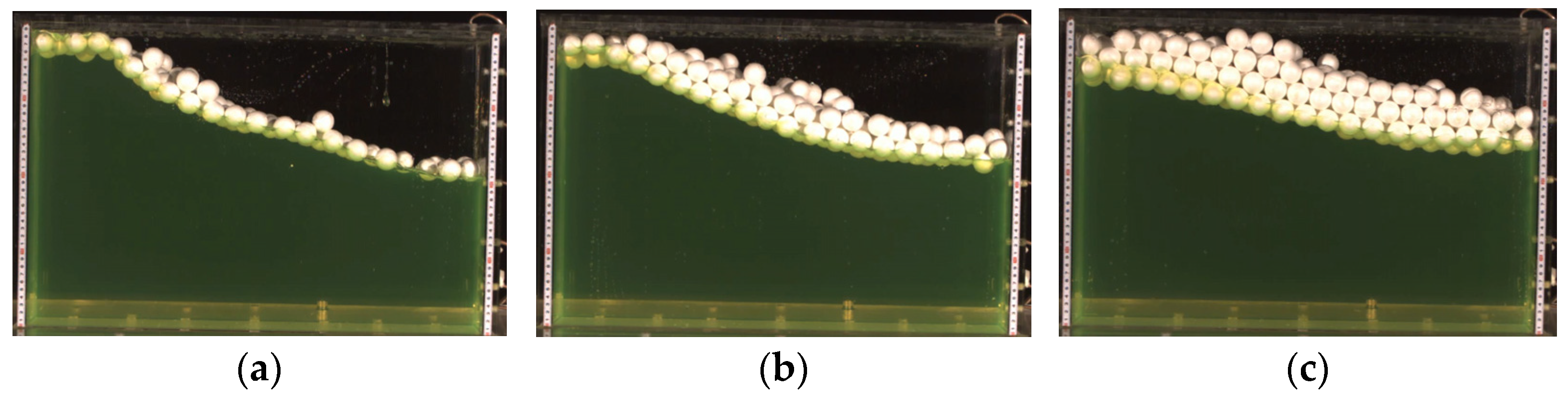
Figure 16 shows the impact of the fluid on the right wall at H = 0.12 m with one to four layers of the EFF at maximum surface elevation. Compared with Figure 13, it is evident that the maximum elevation in Figure 16 is lower. Furthermore, the arrangement of the floaters is more uniform with three and four layers, indicating that the friction effectively suppresses their relative motion, allowing the system’s energy to dissipate through friction. Based on these results, using three layers of EFFs is recommended.
For a high liquid level of H = 0.28 m and one layer of foam floaters, the ΔCH1 and CH5 pressures for both types of floaters are almost identical. A comparison of Figure 14a and Figure 17a shows that the foam balls are mainly concentrated near the fluid at the free surface and that the balls are sparsely distributed. Consequently, friction energy dissipation is minimal in the floating ball system, and the impact of both types of foam floaters is similar.
However, when the EFF reaches two layers, the ΔCH1 and ΔCH5 pressures are significantly lower than those for the HFF. As can be seen in Figure 17b, the EFFs are also more uniformly distributed, and there is no gap on the left side of the tank, unlike in Figure 14a.
Although the arrangement of the balls in Figure 17c is more uniform than that of the HFF (Figure 14c), when the EFF reaches three layers, the pressure of ΔCH1 does not decrease further and remains the same as when there were two layers. This suggests that, for high liquid levels, adding more EFFs does not reduce the sloshing pressure at the bottom of the fluid any further.
Overall, the EFF performs better at reducing sloshing pressure under various sway motions.
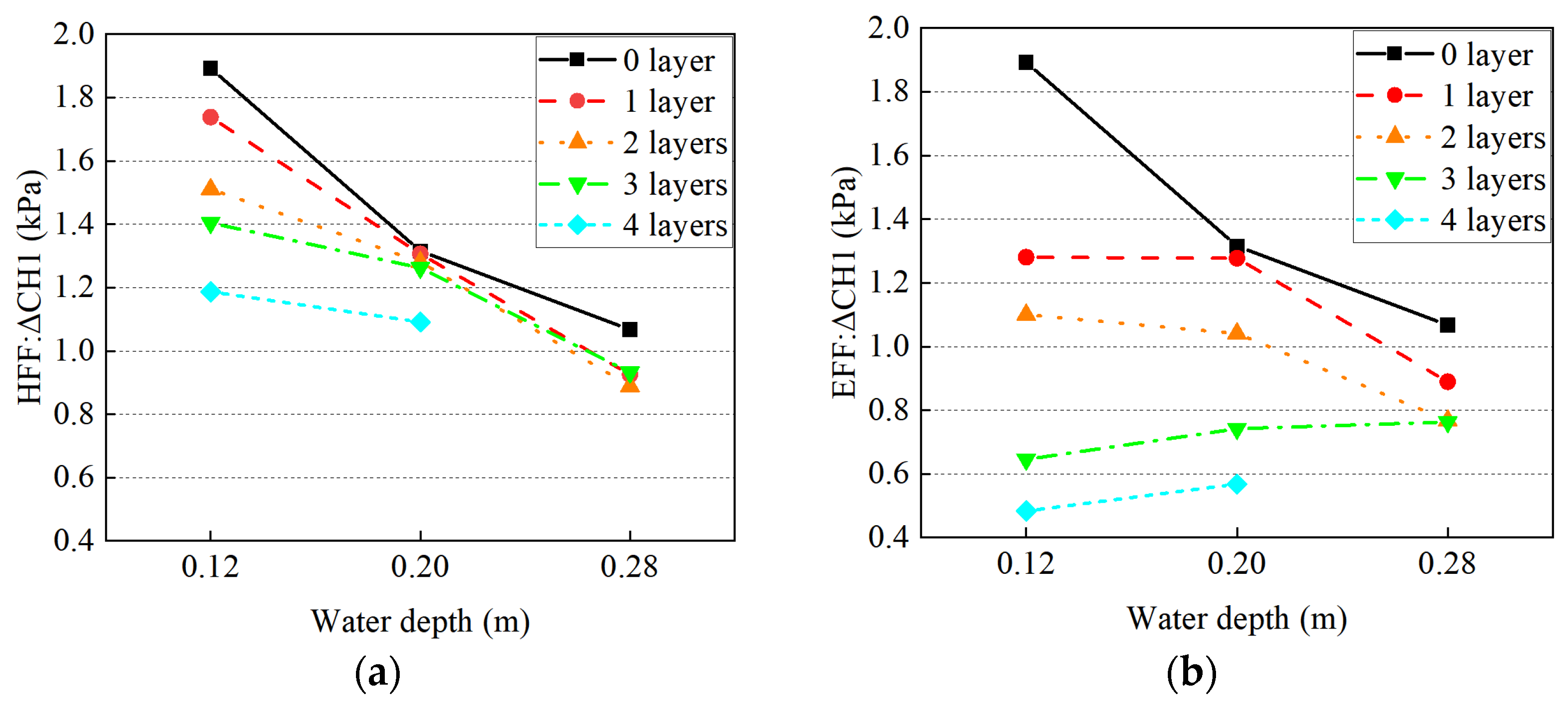
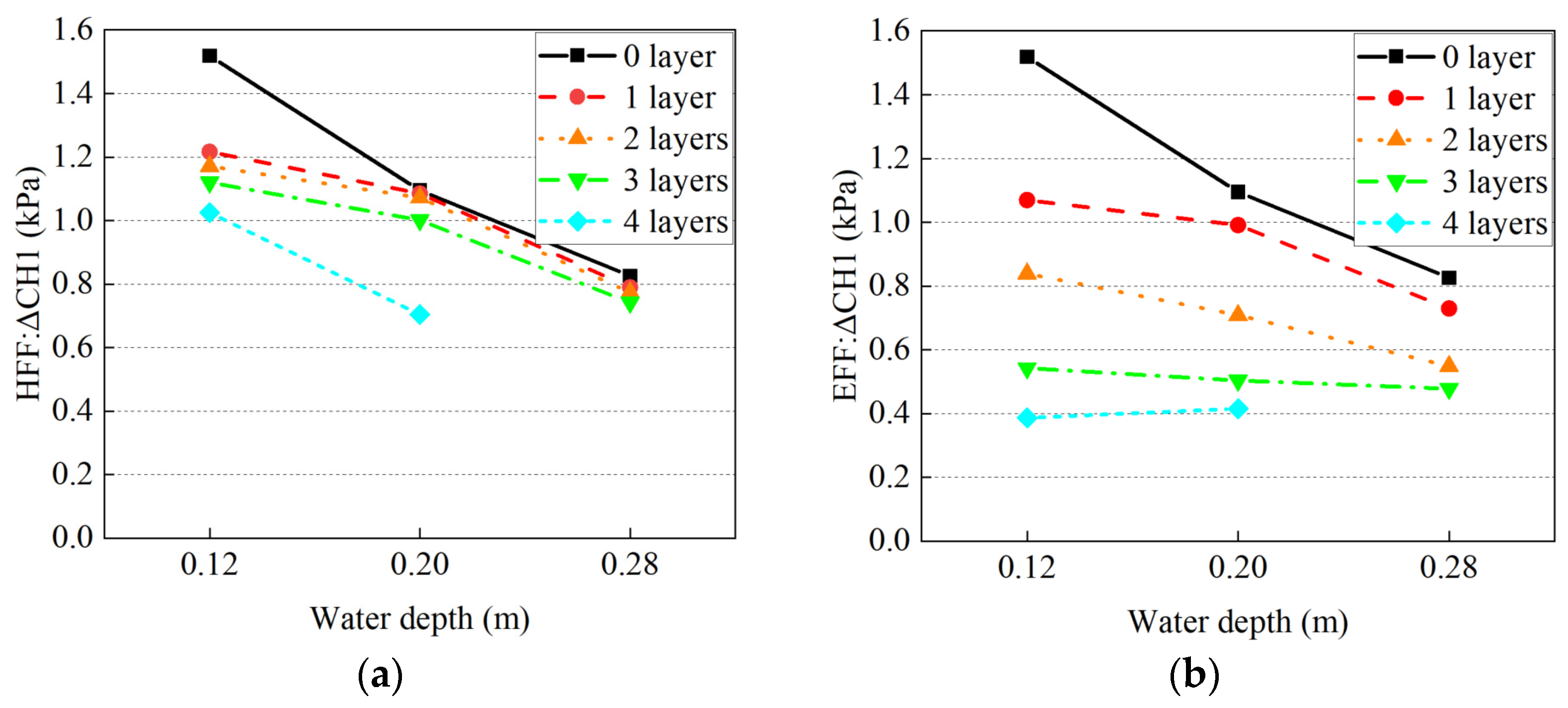
Furthermore, due to differences in free surface monitoring sensors corresponding to different water depths and the absence of impact phenomena under certain conditions, the CH1 sensor, which is always submerged, can be used to investigate the effect of water depth on sloshing with foam floaters. Figure 18a,b show the variation in ΔCH1 with water depth for the HFF and EFF at different layers under the same sway amplitude (A = 0.01 m) and their respective natural period motions. Please note that data for four layers of foam floaters is missing for the H = 0.28 m water depth condition. This is because the water depth was too high for the experiment to be conducted with four layers of foam floaters.
Figure 18a clearly shows that, as the water depth increases from shallow to deep, the influence of the number of layers of the HFF on the ΔCH1 pressure fluctuates, initially decreasing and then increasing. The curves representing the pressure difference for one to three layers of foam floaters gradually converge at a water depth of H = 0.20 m, indicating that the pressure difference is less sensitive to changes in the number of layers of HFFs at this depth than at other water depths, unless the number of layers increases to four.
For a moderate water depth of H = 0.12 m, the variation in ΔCH1 is the largest among the three water depths, proving that increasing the number of HFFs has the most significant impact on sloshing suppression with sway motions at low liquid levels. ΔCH1 shows a negative correlation with the layer number of foam floaters.
For a water depth of H = 0.28 m, increasing the number of foam floater layers does not necessarily reduce ΔCH1; two layers are most effective. Furthermore, ΔCH1 shows a monotonically decreasing trend with increasing water depth for each layer.
Figure 18b illustrates the impact of the number of EFF layers on the ΔCH1 pressure as the water depth rises from shallow to deep. This influence decreases from large to small layers, with the effect being most significant at H = 0.12 m and reducing at H = 0.28 m. However, unlike the nearly linear decrease in pressure with increasing water depth for one to three layers of HFFs, the sloshing pressure for one to two layers of EFFs can be considered nonlinear decay. For three to four layers of EFFs, there is a slight increase, suggesting that increasing the water depth may increase dynamic pressure fluctuations. This reflects a more complex fluid–structure coupling phenomenon caused by the restoring torque of EFFs themselves.
A comparison with Figure 18a shows that the suppression effect of sloshing pressure is generally better for the EFF than for the HFF, and that 2–3 layers would be appropriate.

3.3. Anti-Sloshing Characteristics Under Roll Motions

This section systematically characterizes the anti-sloshing performance of foam floaters under roll excitation across two critical operational regimes: (i) varying roll amplitudes (α = 0.5–2.0°, with T = T0) and (ii) varying water depths (H = 0.12–0.28 m). Using identical sensor placement as in Section 3.2, pressure suppression is quantified at ΔCH1 (bottom wall), CH4 (free surface), and CH7(tank top).

3.3.1. Sloshing Pressures on Classic Positions Versus Different Roll Amplitudes

In this subsection, the water depth is set to H = 0.20 m, and experiments are conducted at three roll angles: 0.5°, 1.0° and 2.0°. The excitation period, T, is set equal to the natural period, T0. The motion equation follows formula (3).
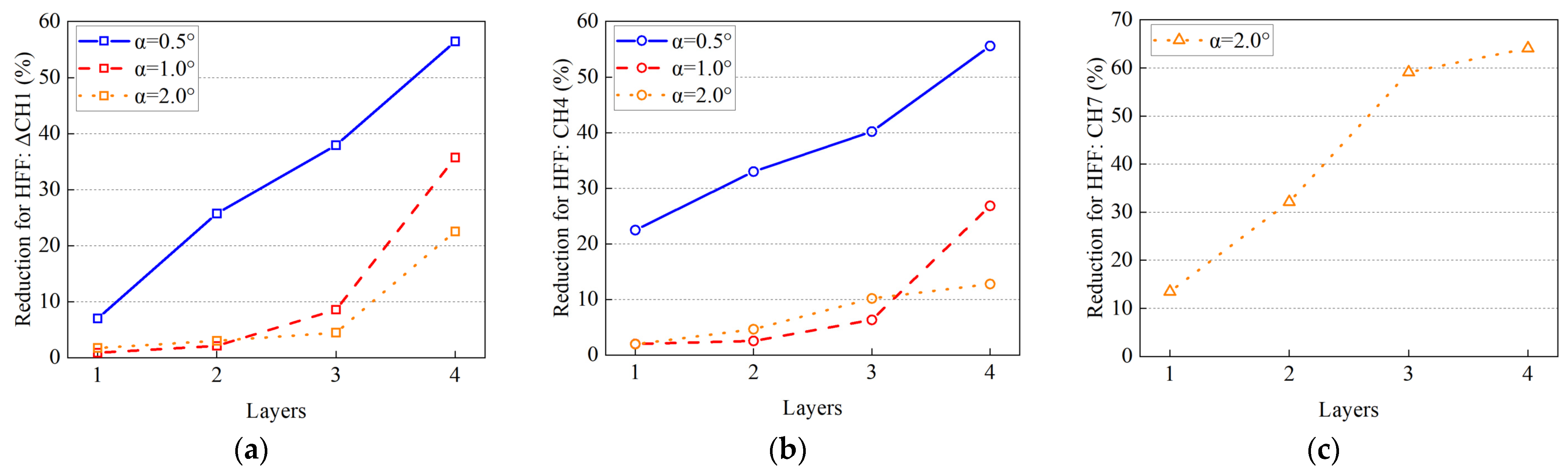
Figure 19 shows a comparison of the pressure for the HFF with 0 to four layers under different conditions. Figure 20 illustrates the percentage reduction in pressure at various monitoring points when using one to four layers of HFFs, compared to the condition without floaters. Figure 20c is missing two lines, corresponding to α = 0.5° and α = 1.0°. This is because sloshing to the top does not occur for α = 0.5°, meaning that the denominator for the pressure reduction percentage is 0.
For α = 1.0°, the pressure at CH7 for 1–4 layers of HFFs is 0, meaning that the reduction percentage is 100%, and it loses its comparative significance.
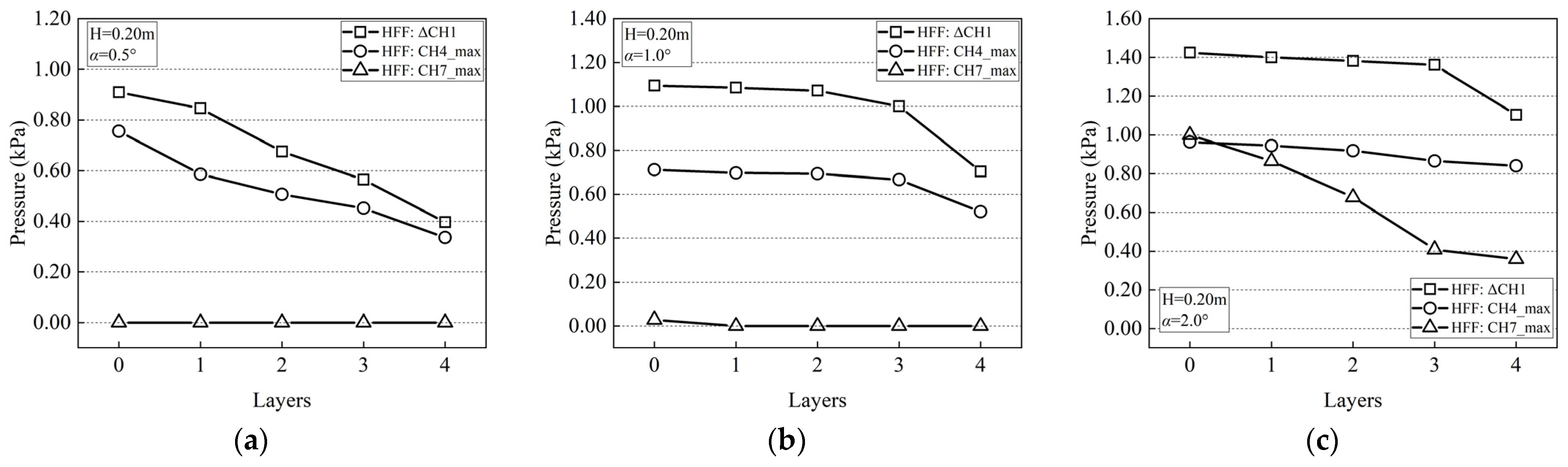
Figure 19a shows that, for a roll amplitude of α = 0.5°, the pressure difference (ΔCH1) at the bottom of the sidewall and the pressure at the liquid level (CH4) both decrease approximately linearly with an increasing number of HFF layers. Using four layers of foam floaters results in a 56.43% and 55.58% decrease in the pressure difference and pressure at the liquid level height, respectively. The pressure at CH7 remains at 0 throughout.
As can be seen in Figure 19b,c, increasing the layer number of the HFF from one to three layers has a limited effect on the pressure reduction at ΔCH1 and CH4 when the roll amplitude increases from 1.0° to 2.0°. Significant suppression of the sloshing phenomenon is only observed at α = 1.0°. For example, Figure 20a shows that when there are three layers of foam floaters and the roll amplitude is 1.0° or 2.0°, the reduction in ΔCH1 compared to the condition without floaters is only 8.56% or 4.44%, respectively. However, increasing the number of foam floater layers to four results in a significant decrease in ΔCH1 to 35.71% and 22.55%, respectively.
Therefore, it can be concluded that increasing the number of layers of HFFs is effective for small roll amplitudes at dangerous water depths. However, for relatively large roll angles, enough foam floater layers must be installed to achieve a noticeable reduction in roll motion; for example, four layers.
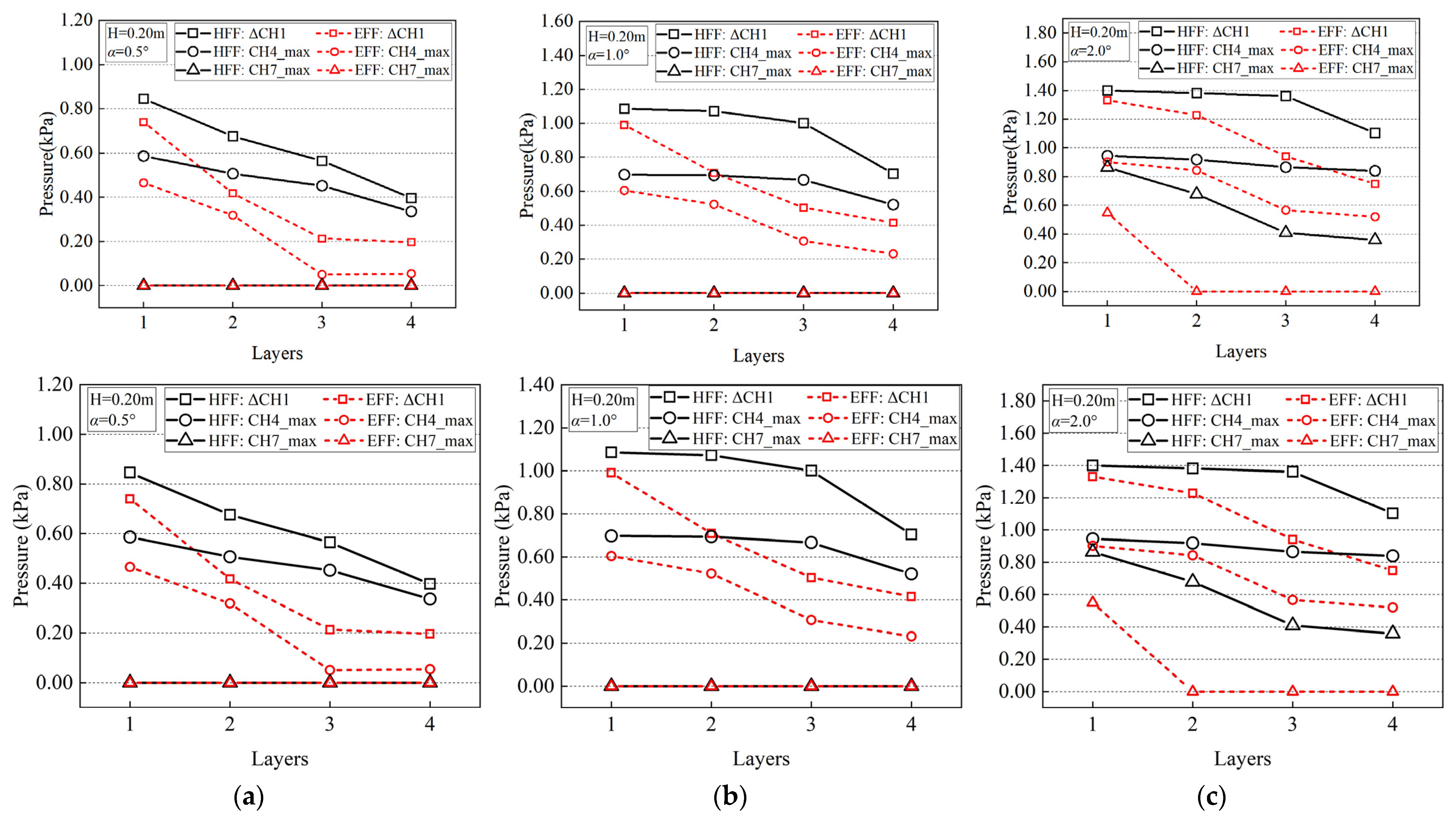
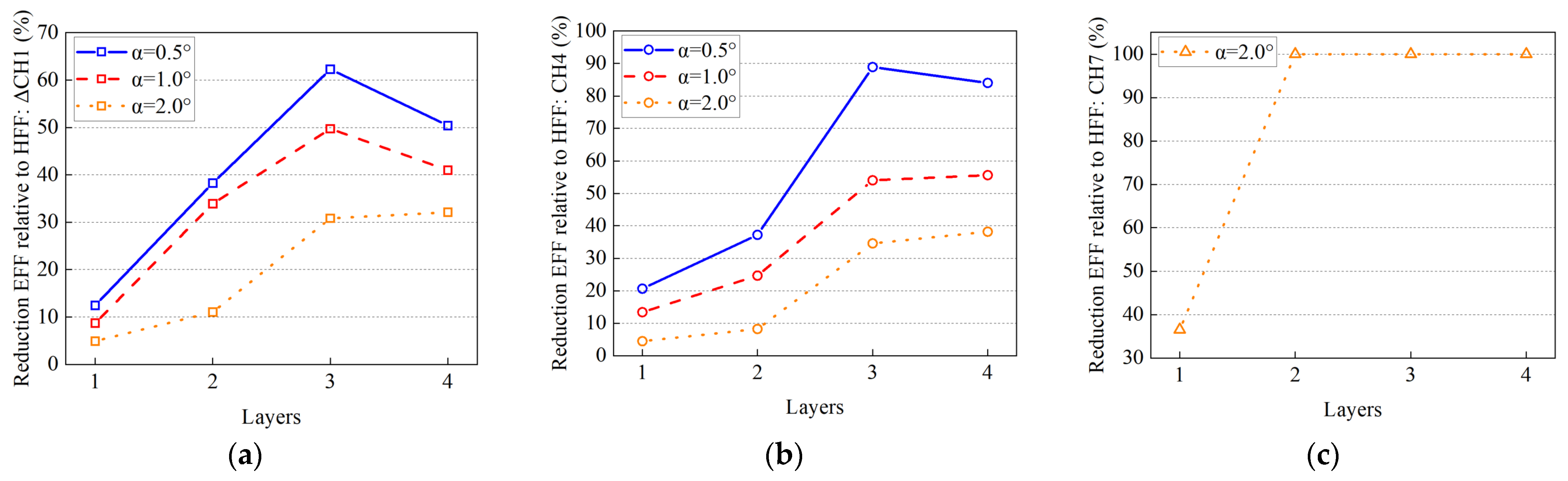
Experiments were conducted with the EFF under the same conditions. Figure 21 shows the pressure comparison for the two types of floaters at different roll angles. Figure 22 compares the pressure reduction for the EFF relative to the HFF at different monitoring points. The missing two lines in Figure 22c are due to the same reason as in Figure 20c.
Firstly, Figure 21 shows that EFF generally performs better than the HFF. Even when HFF performs poorly at larger roll angles, a smaller number of EFFs can effectively reduce the pressure. For example, Figure 21c shows that when the EFF reaches two layers at the maximum roll angle α = 2.0°, it completely suppresses the fluid surge with CH7 = 0. In contrast, four layers of HFFs fail to fully suppress it, reducing CH7 by 64.09% compared to the condition without floaters. Furthermore, with four layers of EFFs, ΔCH1 decreases by 47.42% compared to the condition without floaters.
Secondly, when there is one EFF layer, Figure 22a,b show that, as the roll angle increases, the pressure reduction for the EFF approaches that for the HFF. This is similar to the phenomenon observed in the sway case, where the lower friction between the spheres in the one-layer configuration leads to comparable performance. However, as the number of foam floater layers increases, the frictional dissipation of the EFF increases, leading to better sloshing suppression.
Additionally, Figure 22a,b show an abnormal ‘inflection point’ at three layers for a roll angle of α = 0.5°, where sloshing is well suppressed when the layer number of the EFF reaches three, with little difference between three and four layers. Meanwhile, the four-layer HFF performs better than the three-layer configuration. Figure 22a shows an abnormal ‘inflection point’ for a roll amplitude of 1.0°, where the sloshing pressure for the HFF shows little difference in the first three layers, with a significant decrease at four layers. Each additional layer of the EFF effectively reduces the pressure, with a smaller reduction between the third and fourth layers compared to the HFF.
Therefore, three layers of the EFF should be recommended for roll motions of the tank at dangerous water depths.
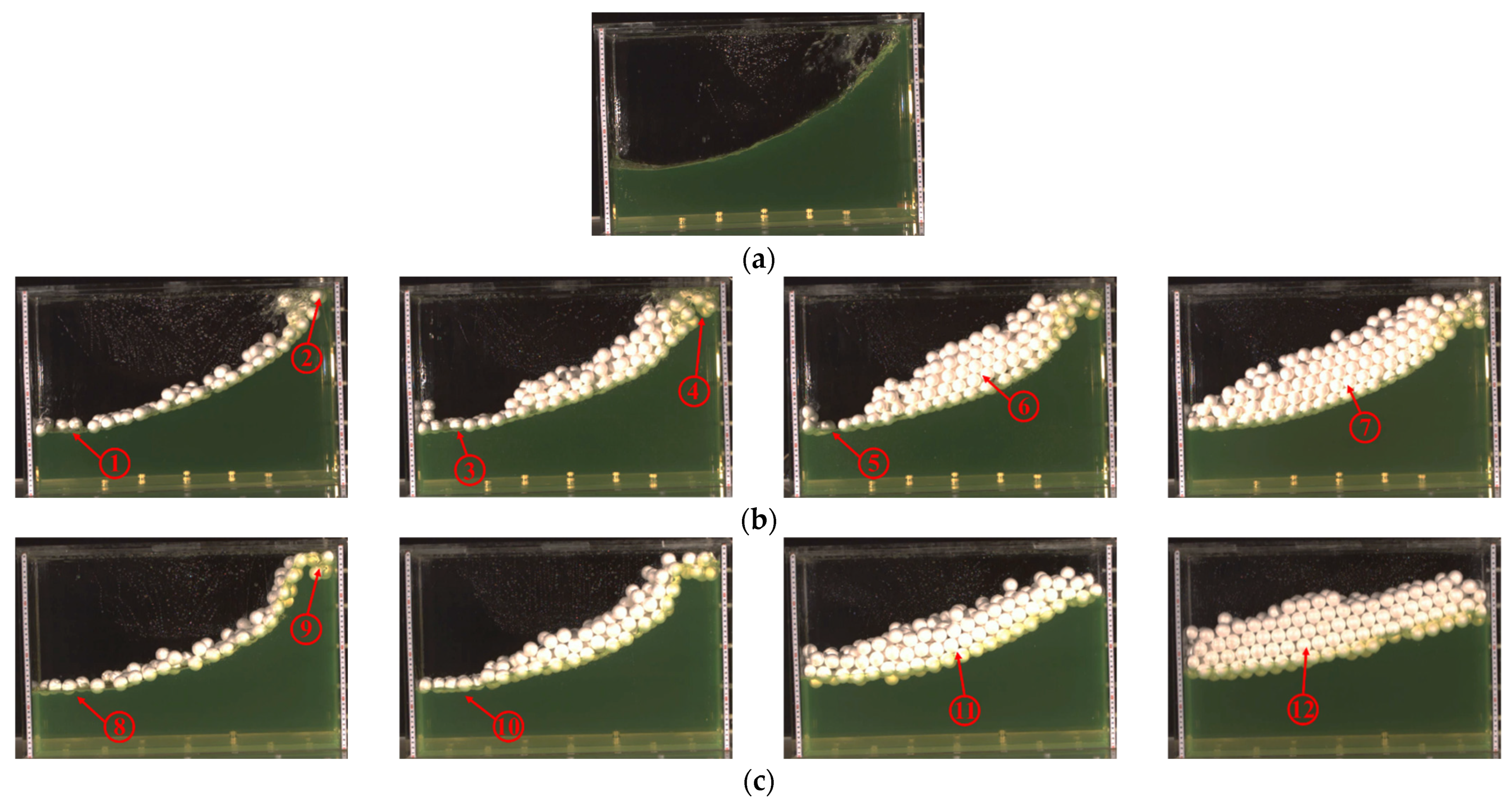
Figure 23 shows snapshots at the time of fluid surge at (n + 1/4)T for the HFF and EFF with 0–4 layers, at a roll angle of α = 2.0°. Figure 23a shows a snapshot at (n + 1/4)T without foam floaters. Figure 23b and Figure 23c show snapshots of 1–4 layers of HFFs and EFFs at the same moment, respectively.
For one layer of foam floaters, significant gaps are visible at the liquid surface for both the HFF and EFF, as can be seen in regions ① and ⑧. Additionally, a comparison of regions ② and ⑨ reveals that, during fluid sloshing, the EFF is more likely to accumulate at the top than the HFF. This creates a ‘buffer pad’ effect that reduces the impact pressure.
For two layers of foam floaters, the HFF forms a single-layer distribution with a length about 6.5 times that of the ball diameter in region ③, while the EFF in region ⑩ only has a distribution of about 4.5 ball diameters. When the foam balls form a slope due to the liquid and the tank’s inclination, their posture changes. Due to the offset of its center of mass, the EFF generates additional torque, making it prone to multi-point contact and local interlocking. This results in higher stacking strength, and once a stable configuration has formed, it is difficult to destroy it completely during reverse roll motion. This limits the extension of a single layer. This is clear in the three-layer and four-layer configurations, where stable structures have formed in regions ⑪ and ⑫, thereby restricting the fluid’s sloshing state.
In region ④ of the two-layer HFF, despite the presence of a ‘buffer pad’ structure, the EFF has completely suppressed the impact of the fluid on the top. In the three-layer HFF, a single-layer distribution appears again in region ⑤ because HFFs are more mobile. Additionally, region ⑥ exhibits a stacking structure comprising five foam ball layers, indicating that HFFs readily form substantial local stacks while leaving areas devoid of foam balls. This also explains why 1–3 layers of HFFs only have a limited effect on reducing ΔCH1 with a roll amplitude of α = 2.0°.
Using four layers of HFFs eliminates any exposed water due to the increased number of floaters. However, accumulation is still in region ⑦. The four-layer HFF threshold for large roll amplitudes arises from the combined requirement of (i) complete liquid surface coverage to eliminate impact zones, (ii) sufficient stability to withstand reverse-roll disruption, and (iii) a critical increase in frictional dissipation—evidenced by the abrupt pressure reduction in the ΔCH1 jump between three and four layers (Figure 21c). Fewer layers fail to sustain a coherent barrier under high-amplitude excitation. This means that the use of the HFF requires a higher quantity than that of the EFF.

3.3.2. Sloshing Pressures Under Different Water Depths

The effect of water depth on sloshing pressure under roll motions is also considered for two additional water depths: 0.12 m and 0.28 m. The roll amplitude is set to 1°. Experiments were conducted with one to four layers of both HFFs and EFFs for the water depth of H = 0.12 m, and with one to three layers of foam floaters for the water depth of H = 0.28 m. The sensor setup is the same as that described in Section 3.2.
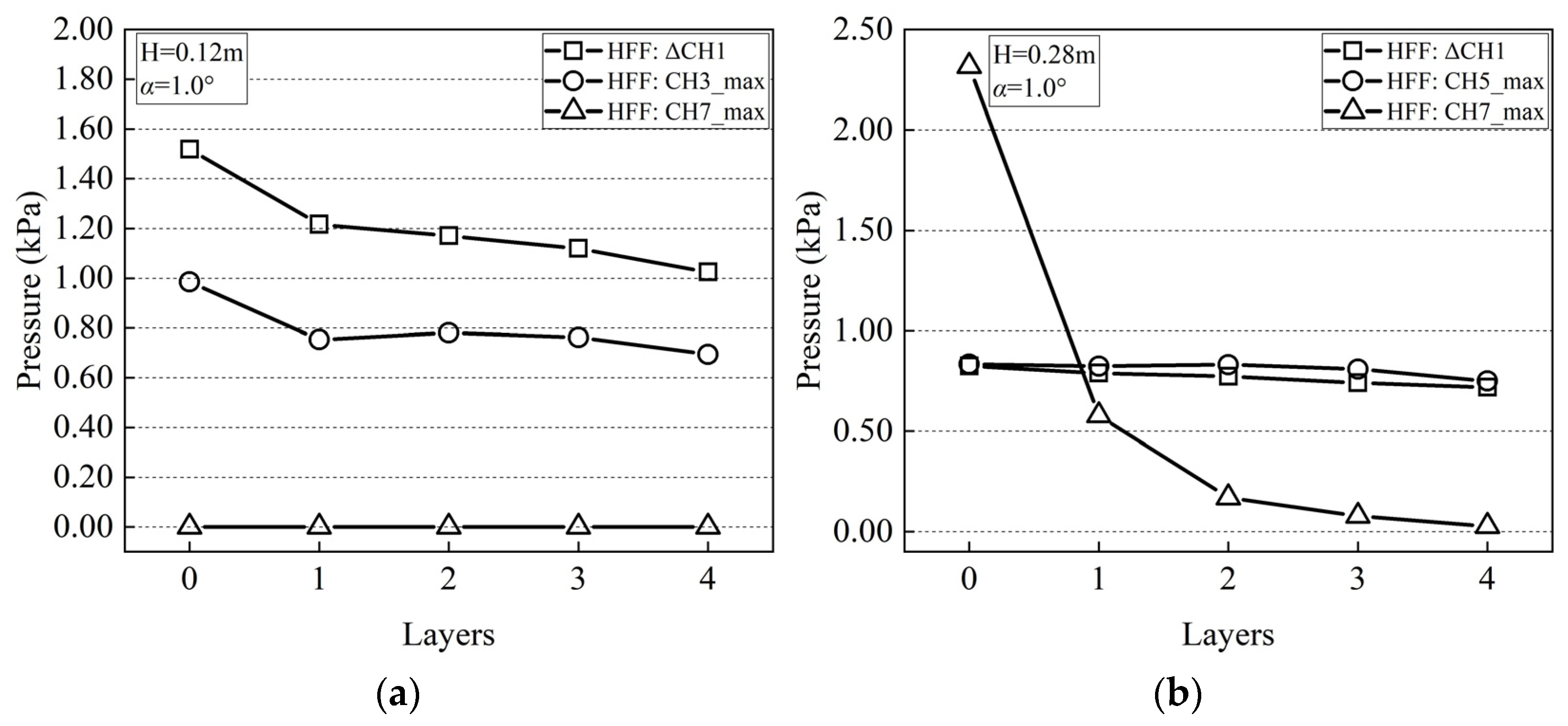
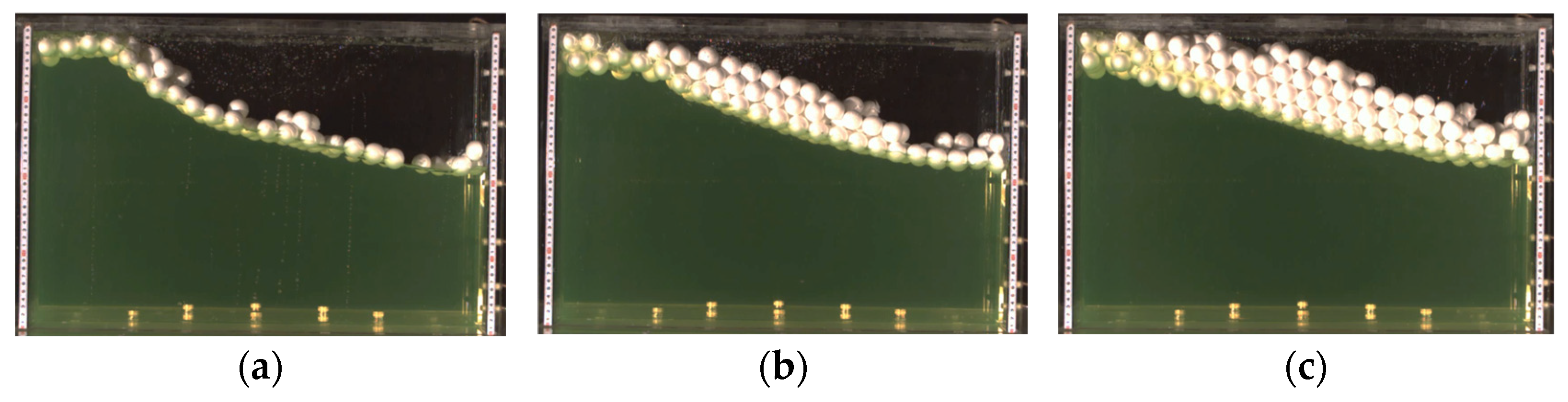
Figure 24 shows the effect that different numbers of HFF layers have on the sloshing pressure at two different water depths. And Figure 25 and Figure 26 show screenshots of HFFs with different layer numbers at the same time when H = 0.12m and H = 0.28m, respectively. For the moderate water depth condition (H = 0.12 m), a single layer of HFFs is sufficient to reduce the pressure. However, increasing the number of foam floater layers only has a limited effect on reducing ΔCH1, and there is no significant improvement in the pressure at the water surface. For the shallow water depth condition (H = 0.28 m), the effect of the HFF is even more limited, primarily restricting fluid sloshing.
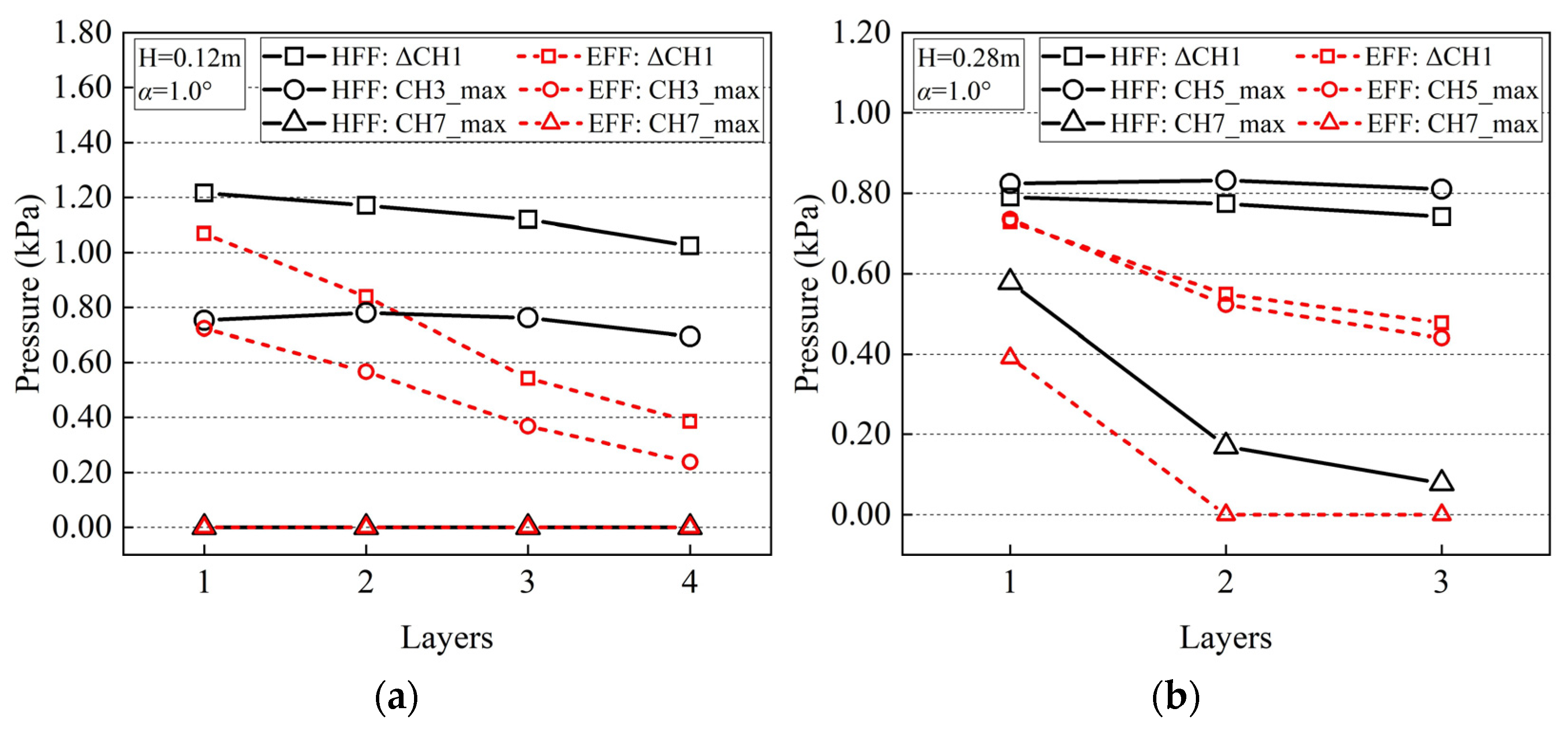
Figure 27 shows a pressure comparison between the EFF and HFF at these water depths. And Figure 28 and Figure 29 show screenshots of EFFs with different layer numbers at the same time when H = 0.12m and H = 0.28m, respectively. Firstly, for a moderate water depth (H = 0.12 m), the effect of the EFF compared to the HFF is significant, and this effect becomes more pronounced as the number of layers increases. Using four layers of EFFs results in a 74.56% decrease in ΔCH1 compared to the condition without floaters. Figure 28a shows that a single layer of EFF effectively suppresses fluid climbing the side wall when compared with Figure 25a, which uses a single layer of HFFs. When four layers of EFFs are used, the liquid surface rises only slightly.
In conditions of limited water depth (H = 0.28 m), the effect of one layer of EFFs is like that of HFFs, reducing ΔCH1 by 11.64% compared to conditions without floaters. Increasing the number of layers to two or three reduces ΔCH1 by 33.54% and 42.17%, respectively, demonstrating a significant effect of two to three layers. Figure 29 shows images of the highest liquid climbing location for different numbers of EFF layers. Fluid impact on the top is completely suppressed with two to three layers.
Figure 30 shows the effect of the water depth on the pressure of the ΔCH1 for the HFF and EFF. In Figure 30a, for one to three layers of HFFs, ΔCH1 decreases approximately linearly as the water depth increases, with consistent slopes, and the pressure reduction is limited. However, only at four layers do the slopes of the lines for H = 0.12 m and H = 0.20 m become steeper, indicating that a significant reduction in roll motion can only be achieved by increasing the number of HFFs.
As the layer number of EFFs increases in Figure 30b, the slope also increases. Although ΔCH1 decreases with an increasing number of layers, this also suggests that the correct number of layers must be selected. Otherwise, increasing the number of layers may increase the pressure. Based on the above analysis, two to three layers of EFFs are considered suitable for anti-sloshing under roll motions.

3.4. Analysis of Anti-Sloshing by Floaters Based on Free-Surface Elevation Evolution

While Section 3.2 and Section 3.3 comprehensively demonstrate the superior dissipative performance of the EFF over the HFF under sway and roll motions—primarily attributed to enhanced interfacial friction and uniform surface coverage—their potential inertial-stiffness effect on the system’s dynamic characteristics remains unexplored. Specifically, whether EFF configurations alter the fundamental sloshing natural frequency (f0)—a key parameter governing resonance susceptibility—has not been addressed.
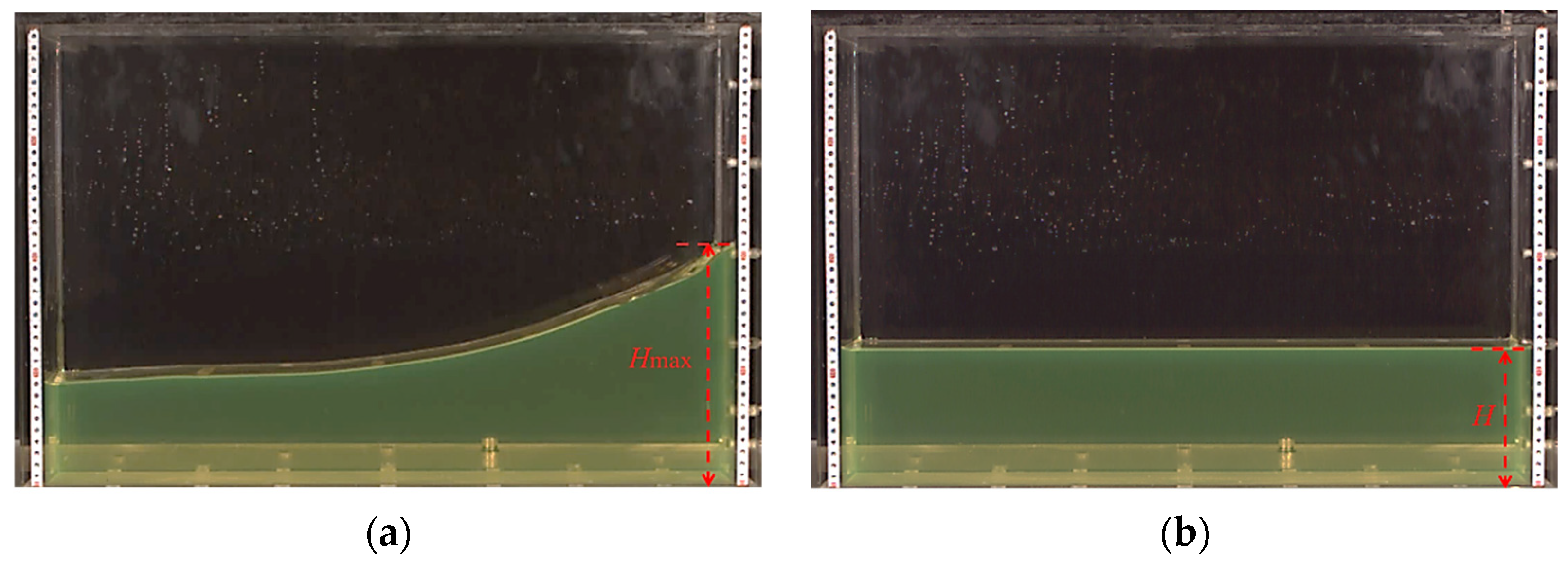
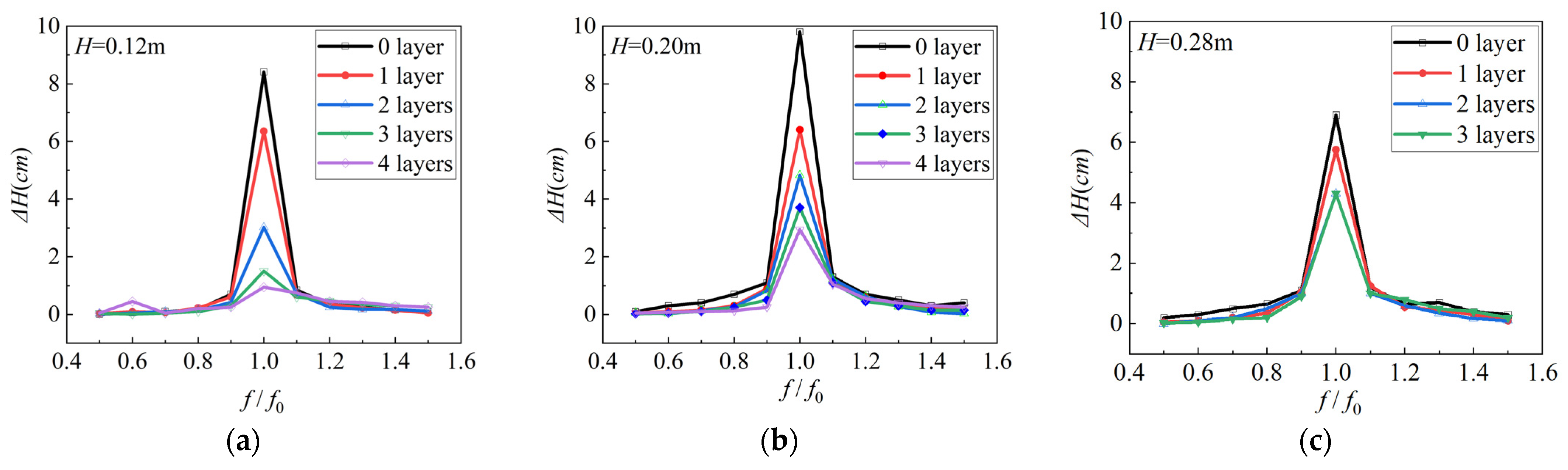
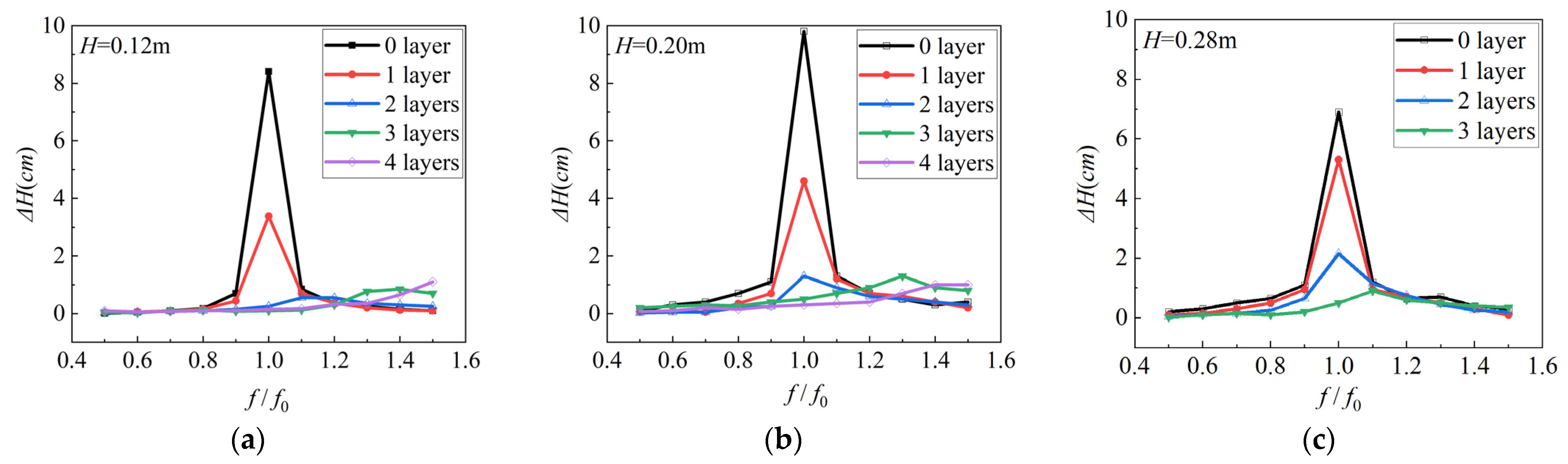
To close this gap, this section shifts focus from amplitude-domain suppression to frequency-domain modulation: a controlled sweep frequency experiment (0.5 f0 to 1.5 f0, step 0.1 f0) is conducted under sub-threshold sway excitation (A = 0.002 m, no bulk sloshing), using the maximum liquid climbing height (ΔH = Hmax−H, Figure 31) as a sensitive indicator of resonant response. This approach isolates the frequency-shifting capability of foam floaters, revealing a previously unrecognized mechanism—passive natural frequency tuning—that complements their established dissipative function.
Figure 32 shows the maximum climbing height of the HFF at various depths of water. As can be seen, for different water depths, the maximum climbing height for various quantities of HFFs occurs at a natural frequency of 1.0 f0. This suggests that increasing the number of layers of HFFs does not affect the system’s natural frequency. Sloshing suppression for the HFF is primarily achieved through frictional dissipation.
Figure 33 shows that at three different water depths, one layer of EFFs does not affect the system’s natural frequency. However, when the number of layers increases to two, the maximum climbing height at the shallowest water depth (H = 0.12 m) occurs at a frequency of 1.2f0, while no change occurs at higher water depths. When the number of layers increases to three, the maximum climbing height at all three water depths shifts to different frequencies: 1.4f0, 1.3f0 and 1.1f0 =, respectively. Additionally, as the water depth increases, the occurrence frequency moves closer to the natural frequency f0. When the number of foam floater layers is increased to four, no inflection points are observed for the maximum climbing height at H = 0.12 m and H = 0.2 m within the experimental frequency range. Therefore, not only does the EFF increase frictional dissipation, but it also changes the system’s natural frequency through multiple layers of foam floaters, with this change being most significant at low water depths.
It can be concluded that HFFs do not alter the natural frequency and primarily rely on frictional dissipation to minimize sloshing. The suppression effect of the EFF is reflected in two ways: Firstly, introducing eccentricity makes the floater distribution more uniform, thereby increasing the interaction time between the floaters. Secondly, EFFs increase energy dissipation between them, which significantly suppresses tank sloshing compared with HFFs. Furthermore, when the number of layers of EFFs reaches a certain level, the natural frequency of tank sloshing changes at different water depths. This shifts the natural frequency to a region of higher frequencies with less wave energy, thereby suppressing the sloshing phenomenon in the tank.

4. Conclusions

This study establishes that intentional mass eccentricity in buoyant floaters serves as an effective design lever for enhancing sloshing suppression in membrane-type LNG tanks. Rather than relying on rigid internal structures, the proposed EFF achieves superior performance by transforming inertial response into controllable rotational and frictional dissipation, mechanisms inherently compatible with flexible tank geometries and operational constraints. The synergy between experimental observation and DEM modeling reveals that the efficacy of the EFF stems not from isolated parameters but from the systemic coupling of buoyancy, inertia, contact mechanics, and boundary interactions. This insight shifts the design paradigm from empirical geometry optimization toward physics-guided inertial tailoring, a strategy with broader applicability to other fluid–structure interaction problems involving floating or submerged passive elements.
The main conclusions can be summarized as follows:
(1)
Both the HFF and EFF can suppress tank sloshing through energy dissipation under both sway and roll motions. The suppression effect of the EFF is significantly better than that of the HFF. In classic sway conditions at a dangerous water depth of H = 0.20 m and a sway amplitude of A = 0.03 m, four layers of EFFs reduce the dynamic pressure at the bottom (ΔCH1) by 33.20%, which is 13.03% higher than four layers of HFFs. They also reduce the pressure at the top (CH7) by 94.63%, which is 12.24% higher than four layers of HFFs, which reduce the pressure by 82.39%. Under roll conditions, at the maximum roll angle of 2.0°, two layers of EFFs can completely suppress fluid sloshing, whereas four layers of HFFs still exhibit surge phenomena. With four layers of EFFs, the reduction in ΔCH1 is 47.42%, which is 24.87% higher than with HFFs. This demonstrates the superior impact pressure suppression capabilities of the EFF.
(2)
The anti-sloshing effect of foam floaters varies with water depth and the number of layers. The EFF is more adaptable and requires fewer layers. For a moderate water depth of H = 0.12 m, 2–4 layers of EFFs are recommended for both sway and roll motions, as are three layers of HFFs. For a dangerous water depth of H = 0.20 m, three to four layers of EFFs are recommended for both sway and roll motions. For sway, three to four layers of HFFs are needed, while four layers are needed for roll motion to achieve better results. For limited water depth (H = 0.28 m), two to three layers of EFFs are recommended for both types of motion, while two layers of HFFs are recommended. Using too many layers may lead to increased localized pressure due to the ‘foam wall’ effect. Therefore, for different motion types (sway and roll) and water depths (low, moderate and high), 2–3 layers of HFFs and EFFs are recommended.
(3)
The anti-sloshing effect of the EFF fundamentally arises from the dual mechanism of ‘frictional dissipation enhancement + natural frequency regulation’. Firstly, the eccentric structure offsets the center of mass from the geometric center, generating additional torque during motion and enhancing the interlocking and local accumulation stability between the foam floaters. This makes the foam floater structure distribution more uniform under various conditions and increases the interaction time between floaters. Furthermore, the eccentric design significantly increases friction between the floaters and the tank wall, enhancing damping losses during interaction. The DEM simulations show that, with an eccentricity ratio of r0/R = 0.1, rolling energy dissipation is 95.23% higher than with the HFF. Secondly, multiple layers of EFFs can alter the system’s natural frequency. For a low water depth (H = 0.12 m), three layers of EFFs shift the natural frequency to 1.4 f0. By moving the tank’s natural sloshing frequency to a region of higher frequency with less wave energy, the sloshing induced by vessel motion can be effectively reduced. In contrast, HFFs only reduce sloshing through single frictional dissipation and do not alter the natural frequency. This is the core reason for the superior suppression effect of the EFF.
In summary, the EFF achieves effective sloshing suppression in LNG membrane tanks through a synergistic dual mechanism: frictional energy dissipation at the tank wall interface and passive regulation of the liquid’s natural frequency—without compromising structural integrity. Its simplified multilayer configuration enhances adaptability across diverse tank geometries and operating conditions, offering a safe, scalable, and cost-efficient solution for maritime LNG containment. While the present study employs prototype foam floaters for conceptual validation, the eccentric design principle is inherently material-agnostic; its engineering translation to cryogenic service will be realized using qualified elastomeric buffers—such as cryo-toughened polyurethane (PU) or hydrogenated nitrile butadiene rubber (HNBR)—whose mechanical resilience and thermal cycling performance at −162 °C (77 K) will be experimentally verified in follow-up work.
In addition to new tank designs, the proposed EFF floater system also shows potential for retrofitting existing LNG storage tanks. By introducing a layer of floaters on the liquid free surface, sloshing-induced wave amplitudes and impact pressures can be effectively mitigated without significant modification of the tank structure. This approach is particularly attractive for in-service tanks, where structural alterations are costly and technically challenging. From a practical perspective, the installation of EFFs can be achieved during scheduled maintenance periods, minimizing operational disruption. The modular nature of the floaters allows for flexible deployment and scalability depending on tank geometry and filling levels. Crucially, to ensure operational reliability in real-world LNG systems, four key engineering risks must be considered in further studies:
(1)
Cryogenic lifetime degradation, arising from embrittlement and fatigue under repeated thermal cycling;
(2)
Friction coefficient evolution, driven by surface wear during long-term rolling and impact;
(3)
Debris and splinter generation, due to foam erosion, fracture, or freeze–thaw-induced delamination, and their entrainment behavior in low-viscosity LNG flow;
(4)
Pipeline/valve clogging risk, stemming from fragment accumulation or floater dislodgement near critical components (e.g., level sensors, relief valves, or pump inlets).
Corresponding mitigation strategies, such as cryo-stable material formulation, wear-resistant surface functionalization, embedded magnetic retrieval capability, and upstream particle filtration, are areas that need to be considered in future work.

Author Contributions

Conceptualization, W.W. and C.G.; methodology, C.G.; software, C.G., Y.Z. and T.P.; validation, C.G.; formal analysis, W.W. and C.G.; investigation, C.G., B.J. and Y.Z.; resources, W.W.; data curation, C.G. and B.J.; writing—original draft preparation, C.G.; writing—review and editing, W.W.; visualization, C.G. and B.J.; supervision, W.W. and Y.H.; project administration, W.W.; funding acquisition, W.W. All authors have read and agreed to the published version of the manuscript.

Funding

National Natural Science Foundation of China (General Program) (Grant No. 52271259), Natural Science Foundation of Liaoning Province under grant no. 2024-MSBA-19, and National Natural Science Foundation of China (Grant No. 51679034).

Institutional Review Board Statement

Not applicable.

Informed Consent Statement

Not applicable.

Data Availability Statement

The data presented in this study are available in this article (tables and figures).

Acknowledgments

The authors would like to thank all the organizations that funded the research for this paper.

Conflicts of Interest

The authors declare no conflicts of interest. The funders had no role in the design of the study; in the collection, analyses, or interpretation of data; in the writing of the manuscript, or in the decision to publish the results.

References

  1. Duong, P.A.; Ryu, B.R.; Song, M.K.; Nam, D.; Kang, H. Thermodynamics Analysis of a Novel Designation of LNG Solid Oxide Fuel Cells Combined System with CO2 Capture Using LNG Cold Energy. J. Eng. Res. 2024, 12, 226–238. [Google Scholar] [CrossRef]
  2. Deybach, F. Membrane Technology for Offshore LNG; OnePetro: Richardson, TX, USA, 2003. [Google Scholar]
  3. Ishimaru, J.; Kawabata, K.; Morita, H.; Ikkai, H.; Suetake, Y. Building of Advanced Large Sized Membrane Type LNG Carrier. Mitsubishi Heavy Ind. Tech. Rev. 2004, 41, 1–7. [Google Scholar]
  4. Yan, Y.; Xu, Z.; Wei, W.; Ni, Z.; Sun, D. Numerical Investigation of Liquid Sloshing in FLNG Membrane Tanks with Various Bottom Slopes. J. Southeast Univ. (Engl. Ed.) 2020, 36, 292. [Google Scholar] [CrossRef]
  5. Deshpande, K.B.; Zimmerman, W.B.; Tennant, M.T.; Webster, M.B.; Lukaszewski, M.W. Optimization Methods for the Real-Time Inverse Problem Posed by Modelling of Liquefied Natural Gas Storage. Chem. Eng. J. 2011, 170, 44–52. [Google Scholar] [CrossRef][Green Version]
  6. Xue, M.-A.; Jiang, Z.; Hu, Y.-A.; Yuan, X. Numerical Study of Porous Material Layer Effects on Mitigating Sloshing in a Membrane LNG Tank. Ocean. Eng. 2020, 218, 108240. [Google Scholar] [CrossRef]
  7. Yu, Y.-M.; Ma, N.; Fan, S.-M.; Gu, X.-C. Experimental and Numerical Studies on Sloshing in a Membrane-Type LNG Tank with Two Floating Plates. Ocean. Eng. 2017, 129, 217–227. [Google Scholar] [CrossRef]
  8. Chang, P.; Xu, X.; Huang, Z.; Li, G. Design and Analysis of a Sloshing Liquid Damping Device with Elastic Baffle Vibrator. J. Phys. Conf. Ser. 2023, 2437, 012082. [Google Scholar] [CrossRef]
  9. Cruz-Gómez, R.C.; Cros, A.; Monzón, C.O.; Capetillo-Peréz, L.E. Damping of Liquid Sloshing Using Hydrophobic Walls in the Off-Impulse Regime. Appl. Sci. 2025, 15, 2841. [Google Scholar] [CrossRef]
  10. Liu, D.; Lin, P. Three-Dimensional Liquid Sloshing in a Tank with Baffles. Ocean. Eng. 2009, 36, 202–212. [Google Scholar] [CrossRef]
  11. Akyildiz, H. A Numerical Study of the Effects of the Vertical Baffle on Liquid Sloshing in Two-Dimensional Rectangular Tank. J. Sound Vib. 2012, 331, 41–52. [Google Scholar] [CrossRef]
  12. Xue, M.-A.; Zheng, J.; Lin, P.; Yuan, X. Experimental Study on Vertical Baffles of Different Configurations in Suppressing Sloshing Pressure. Ocean. Eng. 2017, 136, 178–189. [Google Scholar] [CrossRef]
  13. Korkmaz, F.C.; Güzel, B. On the Effects of the Number of Baffles in Sloshing Dynamics. Ships Offshore Struct. 2023, 18, 21–33. [Google Scholar] [CrossRef]
  14. Faltinsen, O.M.; Timokha, A.N. Natural Sloshing Frequencies and Modes in a Rectangular Tank with a Slat-Type Screen. J. Sound Vib. 2011, 330, 1490–1503. [Google Scholar] [CrossRef]
  15. Kim, M.-S.; Kim, J.-H.; Kim, S.-K.; Lee, J.-M. Experimental Investigation of Structural Response of Corrugated Steel Sheet Subjected to Repeated Impact Loading: Performance of LNG Cargo Containment System. Appl. Sci. 2019, 9, 1558. [Google Scholar] [CrossRef]
  16. Kim, Y.; Kim, S.-Y.; Ahn, Y.; Kim, K.-H.; Jeon, S.-E.; Suh, Y.-S.; Park, J.-J.; Hwangbo, S.-M. Model-Scale Sloshing Tests for an Anti-Sloshing Blanket System. Int. J. Offshore Polar Eng. 2013, 23, 254–262. [Google Scholar]
  17. Sauret, A.; Boulogne, F.; Cappello, J.; Dressaire, E.; Stone, H.A. Damping of Liquid Sloshing by Foams. Phys. Fluids 2015, 27, 022103. [Google Scholar] [CrossRef]
  18. Lee, M.M.S.; Chung, C.; Lee, S.-G. Sloshing Reduction Using Floating Mat for Floating LNG Cargo Containment System; OnePetro: Richardson, TX, USA, 2016. [Google Scholar]
  19. Zhang, C.; Su, P.; Ning, D.; Wang, Z. Experimental Study of Anti-Sloshing Foam Layers for FLNG Tanks; OnePetro: Richardson, TX, USA, 2018. [Google Scholar]
  20. Zhang, C.; Su, P.; Ning, D. Hydrodynamic Study of an Anti-Sloshing Technique Using Floating Foams. Ocean. Eng. 2019, 175, 62–70. [Google Scholar] [CrossRef]
  21. Kulitsa, M.; Wood, D.A. Soft Metal Blanket with Optional Anti-Sloshing Conceptual Designs to Improve Pressure Control for Floating and Land-Based Liquefied Natural Gas Tanks. Adv. Geo-Energy Res. 2019, 3, 424–447. [Google Scholar] [CrossRef][Green Version]
  22. Gurusamy, S. Damping of Liquid Sloshing by Floating Balls. Phys. Fluids 2023, 35, 112114. [Google Scholar] [CrossRef]
  23. Odoom, J.K.; Xue, M.-A.; Otoo, E. Mitigation of Liquid Sloshing in Tanks Using High-Density Solid Foam Spheres: A Numerical Modeling Approach. Eur. J. Mech.—B/Fluids 2025, 114, 204331. [Google Scholar] [CrossRef]
  24. Park, Y.-I.; Cho, J.-S.; Kim, J.-H. Structural Integrity Assessment of Independent Type-C Cylindrical Tanks Using Finite Element Analysis: Comparative Study Using Stainless Steel and Aluminum Alloy. Metals 2021, 11, 1632. [Google Scholar] [CrossRef]
  25. Chai, G.; Zhu, D. A Coupled FSI Simulation Study of Liquid Sloshing Dynamics and Anti-Sloshing Design in Railway Container Transport. Int. J. Comput. Sci. 2026, 53, 644–654. [Google Scholar]
  26. Zhang, Z.; Tao, A.; Cao, Z.; Wu, Q.; Xie, Y. The Coupling Effect of Internal and External Flow Fields on the Dynamic Response of Liquid Tank Sloshing. Ocean Eng. 2025, 322, 120466. [Google Scholar] [CrossRef]
  27. Faltinsen, O.M.; Timokha, A.N. Sloshing; Cambridge University Press: New York, NY, USA, 2009; ISBN 978-0-521-88111-1. [Google Scholar]
  28. Fultz, D. An Experimental Note on Finite-Amplitude Standing Gravity Waves. J. Fluid Mech. 1962, 13, 193–212. [Google Scholar] [CrossRef]
  29. Zhao, Y.-Z.; Cheng, Y.; Zheng, J.-Y. Three-equation linear spring-dashpot DEM model and the determination of contact parameters. J. Chin. J. Comput. Mech. 2009, 26, 239–244. [Google Scholar]
  30. Geng, C.; Wang, W.-H.; Piao, T.-W.; Chen, Y.-Q.; Heng, M.-Y.; Zhou, Z.-Q.; Yu, X.-J.; Huang, Y. Simulation of an Anti-Sloshing Technique Using Floating Foams Based on the Moving Particle Semi-Implicit Method—The Discrete Element Method Algorithm. Phys. Fluids 2024, 36, 123356. [Google Scholar] [CrossRef]
  31. Cundall, P.A.; Strack, O.D. A Discrete Numerical Model for Granular Assemblies. Geotechnique 1979, 1, 47–65. [Google Scholar] [CrossRef]
  32. Sun, Y.; Xi, G.; Sun, Z. A Generic Smoothed Wall Boundary in Multi-Resolution Particle Method for Fluid–Structure Interaction Problem. Comput. Methods Appl. Mech. Eng. 2021, 378, 113726. [Google Scholar] [CrossRef]
Figure 1. Experimental setup: (a) six-degree-of-freedom platform, (b) tank model, (c) high-speed camera, and (d) pressure sensors.
Jmse 14 00663 g001
Figure 2. Two types of foam floaters: (a) HFF, (b) EFF.
Jmse 14 00663 g002
Figure 3. Schematic of a sphere rolling along a wall.
Jmse 14 00663 g003
Figure 4. Maximum rolling distance of the two foam floaters with different friction coefficients fr.
Jmse 14 00663 g004
Figure 5. Maximum rolling distance of the EFF for different eccentricity ratios.
Jmse 14 00663 g005
Figure 6. Time history of the wall sloshing pressure at different sensors (the horizontal axis represents time (seconds), and the vertical axis represents pressure (kPa)). (a) CH1; (b) CH4 (c); CH7.
Jmse 14 00663 g006
Figure 7. Characteristic sloshing pressure for different numbers of HFF layers at different sway amplitudes (the horizontal axis represents the float layer number, and the vertical axis represents the pressure (kPa) of the monitoring point). (a) A = 0.01 m; (b) A = 0.02 m; (c) A = 0.03 m.
Jmse 14 00663 g007
Figure 8. Pressure reduction at different monitoring points for the HFF compared to the condition without floaters under sway conditions (the horizontal axis represents the number of float layers, and the vertical axis represents the percentage reduction in pressure with HFFs compared to when there are no floaters). (a) ΔCH1; (b) CH4; (c) CH7.
Jmse 14 00663 g008
Figure 9. Comparison of sloshing pressure between the HFF and EFF with different layers under various sway amplitudes (the horizontal axis represents the float layer number, and the vertical axis represents the pressure (kPa) of the monitoring point). (a) A = 0.01 m; (b) A = 0.02 m; (c) A = 0.03 m.
Jmse 14 00663 g009
Figure 10. Pressure reduction by the EFF relative to the HFF under different sway motions (the horizontal axis represents the number of float layers, and the vertical axis represents the percentage decrease in pressure between the EFF and HFF for the same number of layers). (a) ΔCH1; (b) CH4; (c) CH7.
Jmse 14 00663 g010
Figure 11. Water surface of floater distribution with 0~4 layers of foam floaters under sway motion (H = 0.20 m, A = 0.02 m, t = (n + 1/4)T): (a) 0 layers; (b) HFF: 1~4 layers; (c) EFF: 1~4 layers. (① to ⑧ refer to some typical characteristics of using floats with different numbers of layers at that moment).
Jmse 14 00663 g011
Figure 12. Pressure variation with different numbers of HFF layers under sway motion at differen water depths. (The horizontal axis represents the float layer number, and the vertical axis represents the pressure (kPa) of the monitoring point).
Jmse 14 00663 g012
Figure 13. Water surface and floater distribution of the HFF for 1~4 layers under sway motion (H = 0.12 m, A = 0.01 m): (a) 1 layer; (b) 2 layers; (c) 3 layers; (d) 4 layers.
Jmse 14 00663 g013
Figure 14. Water surface and floater distribution of the HFF for 1~3 layers under sway motion (H = 0.28 m, A = 0.01 m): (a) 1 layer; (b) 2 layers; (c) 3 layers.
Jmse 14 00663 g014
Figure 15. Comparison of sloshing pressure for the HFF and EFF under different floater layers and water depths (the horizontal axis represents the float layer number, and the vertical axis represents the pressure (kPa) of the monitoring point). (a) H = 0.12 m; (b) H = 0.28 m.
Jmse 14 00663 g015
Figure 16. Water surface and floater distribution of the EFF for 1~4 layers under sway motion (H = 0.12 m, A = 0.01 m): (a) 1 layer; (b) 2 layers; (c) 3 layers; (d) 4 layers.
Jmse 14 00663 g016
Figure 17. Water surface and floater distribution of the EFF for 1~3 layers under sway motion (H = 0.28 m, A = 0.01 m): (a) 1 layer; (b) 2 layers; (c) 3 layers. (The floats in the red squares are sparsely arranged).
Jmse 14 00663 g017
Figure 18. Variation in ΔCH1 pressure with different water depths. (a) HFF; (b) EFF.
Jmse 14 00663 g018
Figure 19. Sloshing pressure for different numbers of HFF layers under different roll amplitudes (the horizontal axis represents the float layer number, and the vertical axis represents the pressure (kPa) of the monitoring point). (a) α = 0.5°; (b) α = 1.0° (c) α = 2.0°.
Jmse 14 00663 g019
Figure 20. Pressure reduction at different monitoring points for the HFF compared to the condition without floaters under roll motions (the horizontal axis represents the number of float layers, and the vertical axis represents the percentage reduction in pressure with HFFs compared to when there are no floaters). (a) ΔCH1; (b) CH4; (c) CH7.
Jmse 14 00663 g020
Figure 21. Pressure comparison between the HFF and EFF with different layers under different roll angles (the horizontal axis represents the float layer number, and the vertical axis represents the pressure (kPa) of the monitoring point). (a) α = 0.5°; (b) α = 1.0°; (c) α = 2.0°.
Jmse 14 00663 g021
Figure 22. Pressure reduction for the EFF relative to the HFF under roll motions (the horizontal axis represents the number of float layers, and the vertical axis represents the percentage decrease in pressure between the EFF and HFF for the same number of layers). (a) ΔCH1; (b) CH4; (c) CH7.
Jmse 14 00663 g022
Figure 23. Water surface of floater distribution with 0~4 layers of foam floaters under roll motion (H = 0.20 m, α = 2.0°, t = (n + 1/4)T): (a) 0 layers; (b) HFF: 1~4 layers; (c) EFF: 1~4 layers. (① to ⑫ refer to some typical characteristics of using floats with different numbers of layers at that moment).
Jmse 14 00663 g023
Figure 24. Pressure variation with different numbers of HFF layers under roll motions at different water depths (the horizontal axis represents the float layer number, and the vertical axis represents the pressure (kPa) of the monitoring point). (a) H = 0.12 m; (b) H = 0.28 m.
Jmse 14 00663 g024
Figure 25. Water surface and floater distribution of HFFs for 1~4 layers under roll motions (H = 0.12 m, α = 1.0°): (a) 1 layer; (b) 2 layers; (c) 3 layers; (d) 4 layers.
Jmse 14 00663 g025
Figure 26. Water surface and floater distribution of HFFs for 1~3 layers under roll motions (H = 0.28 m, α = 1.0°): (a) 1 layer; (b) 2 layers; (c) 3 layers.
Jmse 14 00663 g026
Figure 27. Comparison of sloshing pressure for the HFF and EFF under different floater layers and water depths. (a) H = 0.12 m; (b) H = 0.28 m.
Jmse 14 00663 g027
Figure 28. Water surface and floater distribution of EFFs for 1~4 layers under roll motion (H = 0.12 m, α = 1.0°): (a) 1 layer; (b) 2 layers; (c) 3 layers; (d) 4 layers.
Jmse 14 00663 g028
Figure 29. Water surface and floater distribution of EFFs for 1~3 layers under roll motion (H = 0.28 m, α = 1.0°): (a) 1 layer; (b) 2 layers; (c) 3 layers.
Jmse 14 00663 g029
Figure 30. Variation in ΔCH1 pressure with different water depths. (a) HFF; (b) EFF.
Jmse 14 00663 g030
Figure 31. Method for calculating the maximum climbing height ΔH. (a) Maximum liquid height; (b) initial liquid height.
Jmse 14 00663 g031
Figure 32. Maximum climbing height of the liquid surface for the HFF. (a) H = 0.12 m; (b) H = 0.20 m; (c) H = 0.28 m.
Jmse 14 00663 g032
Figure 33. Maximum climbing height of the liquid surface for the EFF. (a) H = 0.12 m; (b) H = 0.20 m; (c) H = 0.28 m.
Jmse 14 00663 g033
Disclaimer/Publisher’s Note: The statements, opinions and data contained in all publications are solely those of the individual author(s) and contributor(s) and not of MDPI and/or the editor(s). MDPI and/or the editor(s) disclaim responsibility for any injury to people or property resulting from any ideas, methods, instructions or products referred to in the content.