Article

Empirical Formula for Estimating Collapse Pressure of Dented Sandwich Pipes

1
School of Petroleum Engineering, China University of Petroleum (East China), Qingdao 266580, China
2
Key Laboratory of Offshore Oil and Gas and Hydrate Development, China University of Petroleum (East China), Qingdao 266580, China
3
College of Pipeline and Civil Engineering, China University of Petroleum (East China), Qingdao 266580, China
4
Ocean Engineering Department, Federal University of Rio de Janeiro, Rio de Janeiro 21941-972, Brazil
*
Author to whom correspondence should be addressed.
J. Mar. Sci. Eng. 2026, 14(7), 631; https://doi.org/10.3390/jmse14070631
Submission received: 28 February 2026 / Revised: 23 March 2026 / Accepted: 27 March 2026 / Published: 30 March 2026

Abstract

Deepwater sandwich pipes (SPs) offer high collapse resistance and thermal insulation, making them promising for hydrocarbon transport under high-pressure and low-temperature conditions. However, mechanical damage such as local dents increases cross-sectional ovality and can substantially degrade their external pressure capacity. This study develops a numerical model using ABAQUS to assess the collapse pressure of dented deepwater SPs under hydrostatic loading. The model is validated against existing reference data. A total of 2316 FE models are constructed to investigate the effects of material properties, geometric configurations, and dent characteristics on collapse performance. Results show that the collapse pressure decreases significantly with increasing dent depth, and spherical dents have a more pronounced effect than planar dents. Enhanced collapse resistance is observed as both the thickness ratio and the core thickness of the sandwich structure increase. The use of higher-strength materials in the core layer and the internal and external layers also improves compressive capacity. Drawing on these results, a simplified formula for estimating the collapse pressure of dented sandwich pipes is proposed.

1. Introduction

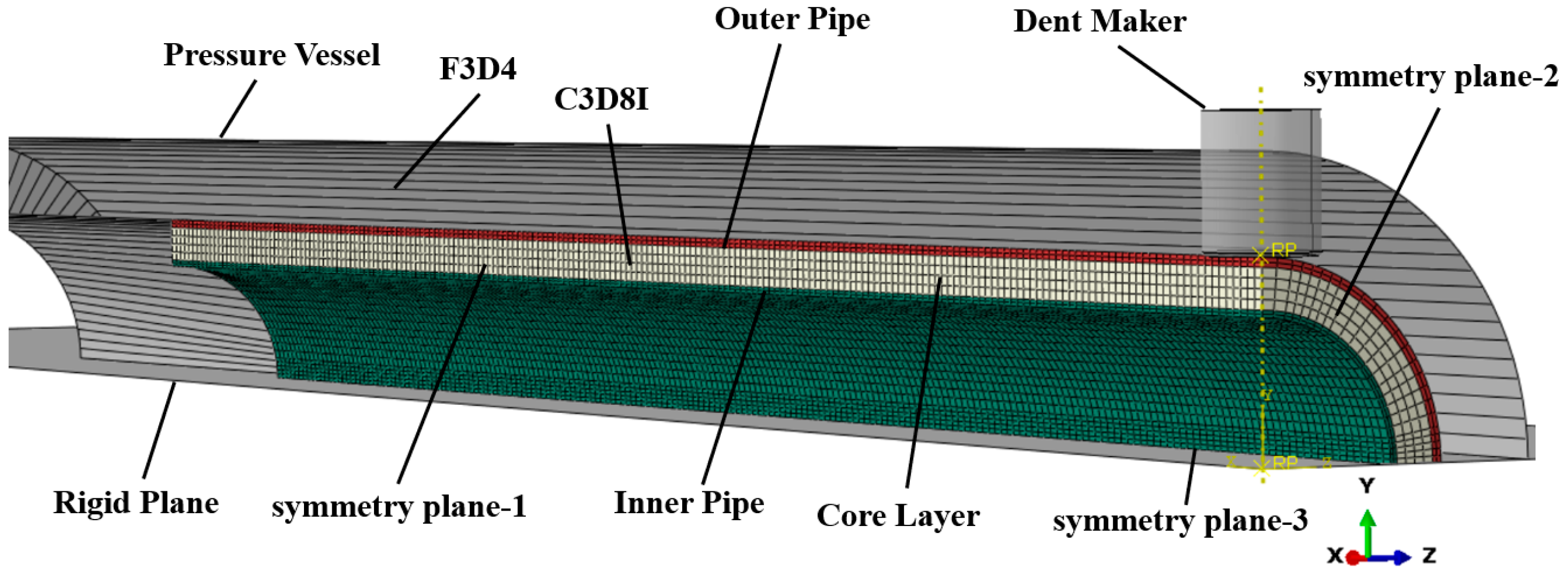
As global oil and gas development increasingly extends into deepwater and ultra-deepwater areas, the structural integrity and flow assurance performance of subsea pipeline systems face unprecedented challenges. Conventional single-wall pipelines and pipe-in-pipe (PIP) configurations have limitations in deepwater conditions characterized by low temperatures and high hydrostatic pressures. This creates an urgent need for the engineering community to develop new pipeline designs with better performance. For instance, the flexible risers [1,2,3] and reinforced thermoplastic pipes [4,5], among other composite pipeline technologies, have been introduced. Notably, the SP system [6,7], which exhibits excellent resistance to external pressure collapse and provides effective thermal insulation, has become a promising solution for deep sea oil and gas transport. The SP concept relies on composite material mechanics and features concentric inner and outer steel pipes, with a core material filling the space between them (see Figure 1). Typically, the core layer employs a polymer or fiber-reinforced cementitious composite, which offers both structural support and thermal insulation.
In the last several decades, numerous studies have concentrated on the structural integrity assessments of offshore pipelines. Important contributions by Kyriakides et al. [8,9,10,11], Netto et al. [12,13], and other researchers [14,15,16,17,18] have systematically studied collapse mechanisms, buckle propagation, and the design and performance of buckle arrestors for both single-walled pipelines and pipe-in-pipe (PIP) systems under various loading conditions. Many studies have also highlighted the high sensitivity of these traditional configurations to geometric imperfections. Notably, studies conducted by Guggenberger [19], Park and Kyriakides [20], and Fan et al. [21] have used combined experimental and numerical methods to explicitly measure how dents and corrosion defects affect collapse pressure. Additionally, the mechanisms behind indentation- and bending-induced failures have been thoroughly explored [22,23,24], with recent research emphasizing the importance of indenter geometry. For example, the studies by Ferraz and Netto [25], Ramasamy and Tuan Ya [26], and Ravaliya and Gupta [27] have confirmed that the indenter shape, from flat-ended to conical, significantly influences local strain concentrations, failure modes, and energy dissipation in thick-walled pipelines. Phuor et al. [28] developed an analytical expression for the fundamental frequency of long free spans. The results show that the proposed closed-form solution is efficient for the preliminary assessment of static deformation and vibration characteristics, particularly for long spans where conventional beam-based formulas lose accuracy. Phuor et al. [29] established an automated Python (version 2.7)–Abaqus (version 2023) framework to investigate pipelines equipped with buoyancy modules, showing that optimized buoyancy arrangements can effectively reduce deformation, stress, and resonance risk.
To overcome the limitations of traditional single-walled and pipe-in-pipe systems in deepwater applications, SPs have attracted considerable research interest due to their superior thermal insulation performance and enhanced structural strength. Early feasibility studies by Netto et al. [30], followed by extensive research into polymeric and cementitious core materials [31,32,33,34,35,36], have shown the high collapse resistance of SPs and confirmed reeling as a feasible installation method. Building on this experimental foundation, various analytical and numerical methods have been developed to evaluate the ultimate strength of SPs. Specifically, Hashemian and Mohareb [37,38], Xue et al. [39], and Jin et al. [40] introduced finite element, finite difference, and stress-function-based models, respectively, to systematically investigate the influence of geometric parameters and core material properties on structural behavior. More recently, comprehensive parametric studies by Yang et al. [41,42], Fu et al. [43,44], and other researchers [45,46] have translated these advanced theoretical and computational insights into simplified predictive formulas, significantly enhancing the accuracy of collapse pressure estimates for SPs with various core materials and initial geometric imperfections.
Beyond the global collapse resistance, the structural performance of SPs is significantly influenced by interlayer interface mechanisms and their corresponding behavior under complex loading conditions. The bonding characteristics between the inner/outer steel layers and the core material play a crucial role. Studies by Cheng et al. [47,48], Xu et al. [49], and other researchers [50,51,52,53,54] have consistently shown that improving interfacial adhesion and increasing the friction coefficient directly enhance collapse capacity. Additionally, risks from lateral loading and impact require specific performance standards for multilayer setups. Research into indentation effects on pipe strength [55,56,57,58,59,60] has shown significant strain differences between inner and outer pipes and has identified that the presence of internal pressure increases structural stiffness. In dynamic loading scenarios, studies by Chen et al. [61] and Lin et al. [62] highlight the combined effects of seabed compliance and impact velocity on damage development. Meanwhile, Yu et al. [63] found that collapse pressure is highly sensitive to particular loading paths involving axial tension. Existing studies on dented sandwich pipes have mostly focused on qualitative investigations into the effect of dents on pipe collapse pressure and lack in-depth quantitative research. It is highly challenging to propose prediction formulas under the combined action of multiple influencing factors. This study is conducted on the basis of existing qualitative research findings, aiming to provide a reference for the prediction of the collapse pressure of composite pipes.
This study develops a numerical model to estimate the collapse pressure of dented SPs. The model is validated by comparing its predictions with existing benchmark data from the literature. Through parametric analysis, the effects of material properties, geometric configurations, and dent characteristics on collapse behavior are analyzed. The results show that the collapse pressure decreases significantly with increasing dent depth. Increasing the thickness of the inner pipe, outer pipe, and core layer improves collapse resistance. Additionally, using higher-strength materials for the core layer and pipes enhances their ability to withstand compression. From these results, a simplified formula for the collapse pressure of dented sandwich pipe systems is derived.

2. Numerical Model and Results Verifications

2.1. Finite Element Model

In this study, ABAQUS (2022) was used to develop a three-dimensional finite element (FE) model. Using geometric symmetry, a quarter-section sandwich pipe model was built to improve computational efficiency. An indenter for dent formation and a supporting base plane were modeled; their elastic deformations and the related energy dissipation at contact interfaces were ignored, and both the indenter and base plane were simplified as rigid bodies. The pipe was discretized using 8-node linear hexahedral incompatible-mode elements (C3D8I), which offer better accuracy for displacement and stress predictions under moderate element distortion. The surrounding and internal fluid media were modeled using F3D4 elements, enabling a realistic simulation of the fluid environment and the effects of external and internal pressures on the pipe. Symmetry boundary conditions were imposed on Surfaces 1, 2, and 3 of the SP to ensure that dent formation reflected the actual pressure-bearing state of the structure. To prevent spurious rigid-body motions, displacement constraints were imposed on the pipe along the y- and z-axes, and the rigid base plane was fully fixed. Additionally, the fluid elements outside the high-pressure chamber were fixed to remain stationary, as shown schematically in Figure 1.

2.2. Material Properties

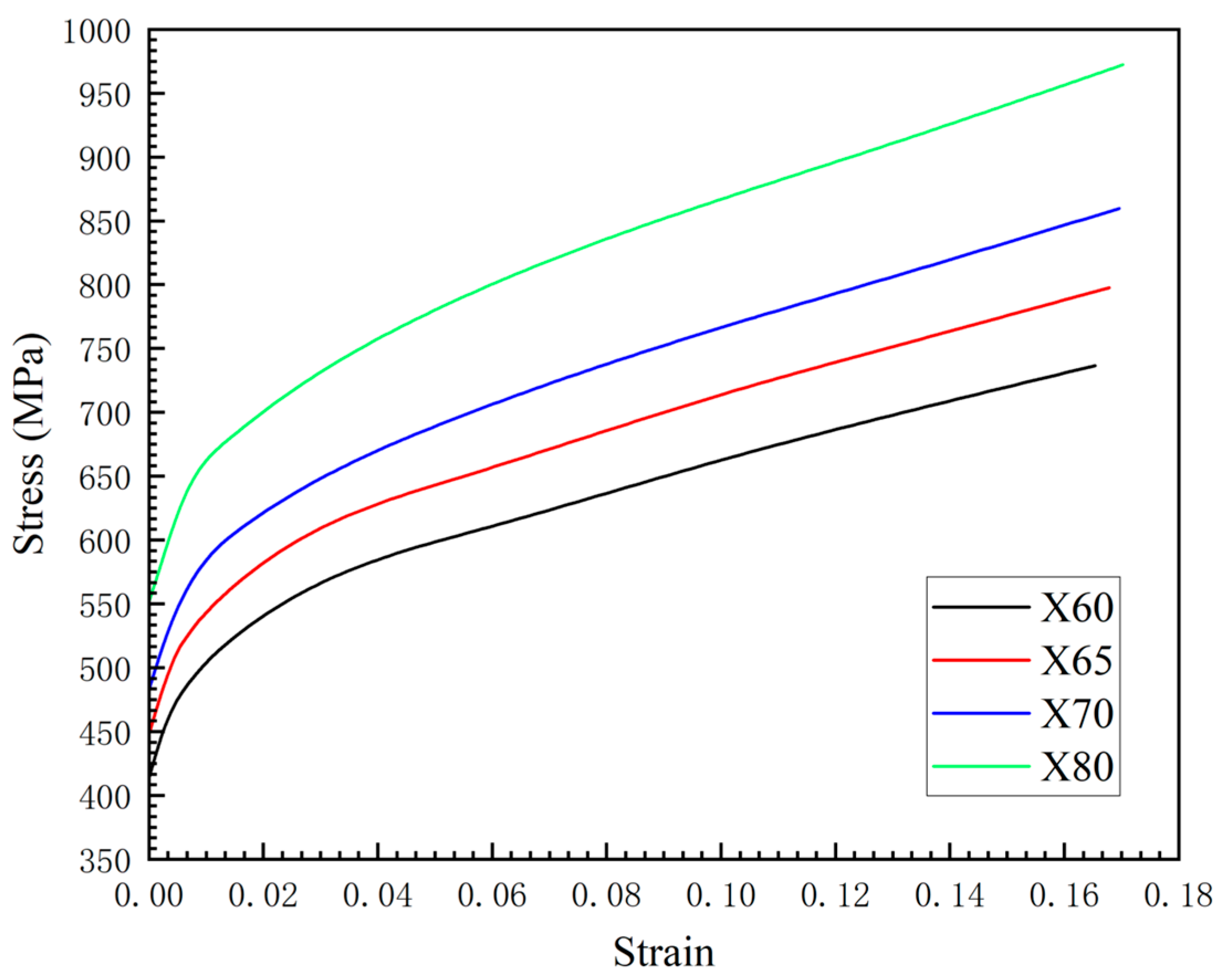
In this study, steel grades X60, X65, X70, and X80 are used as materials for the inner and outer pipes of the sandwich pipe systems. For these steel materials, a Young’s modulus of 207 GPa and a Poisson’s ratio of 0.3 are adopted in the analysis. The true stress-plastic strain relationships of the materials used for the inner and outer pipes are shown in Figure 2. High-density polyethylene (HDPE), polypropylene (PP), syndiotactic polypropylene (SPP), polyether ether ketone (PEEK), polycarbonate (PC), and expanded structural foam (ESF) are selected as candidate core materials, and their mechanical properties are summarized in Table 1.

2.3. Numerical Model Calibration

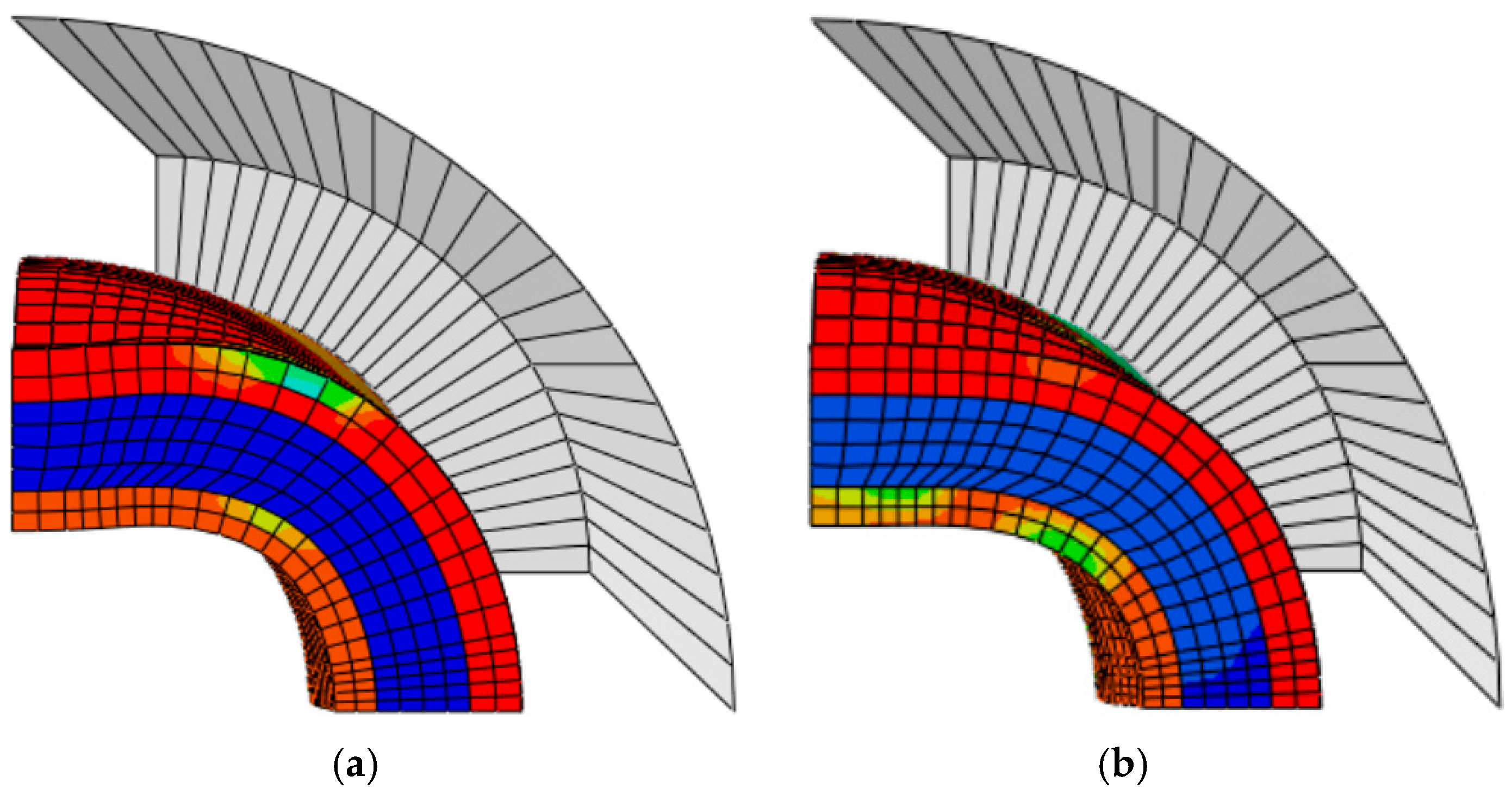
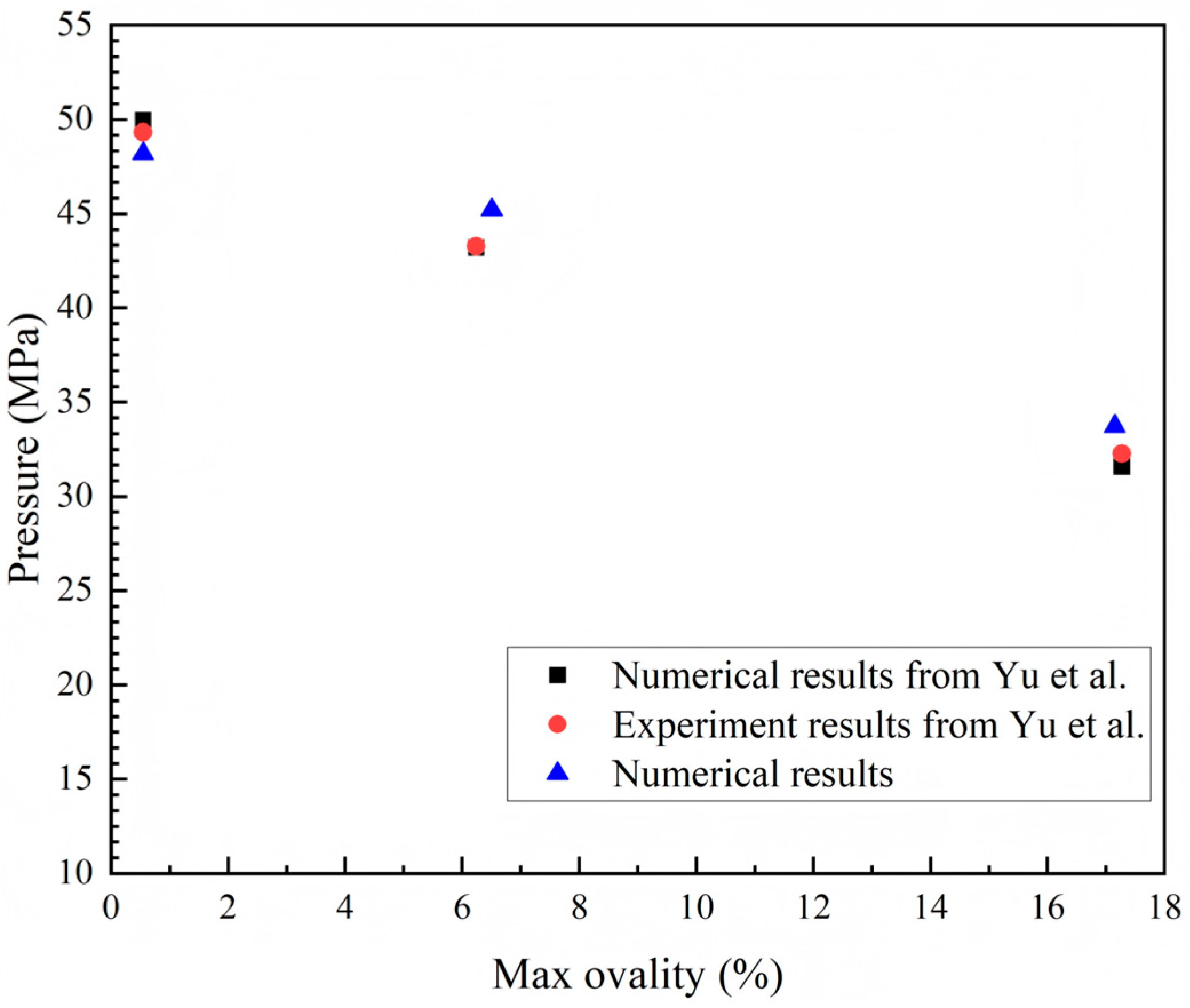
The experimental data reported in [56] were adopted to verify the developed numerical model, with the relevant parameters presented in Table 2. The response of the dented SP is illustrated in Figure 3. The final ovality of the SPs and collapse pressure were then obtained through a Python-based post-processing routine, and the results are shown in Figure 4. The comparison indicates that the collapse pressure predicted by the finite-element numerical model differs from the experimental measurements reported in Ref. [56] by at least 2.30% and by an average of 4.56%. Therefore, it can be confirmed that the proposed numerical model is adequately calibrated by the experimental data.
As shown in Figure 4, at a maximum ovality of 0.55%, the difference between the present model results and the experimental measurements presented in Ref. [56] is 2.30%. In comparison, the deviation relative to numerical results from the literature [56] is 3.53% [56]. When the maximum ovality reaches 6.24%, these deviations increase to 6.27% and 4.60%, respectively. For a maximum ovality of 17.27%, the deviations are 4.54% and 6.76%, respectively.
This study investigates various dent morphologies, pipe geometries, and material parameters. Since developing numerical models and processing associated data involves significant computational effort and repetitive tasks, a parametric modeling approach is used. This approach replaces fixed geometric properties with parametric variables. It enables the automated creation of input files, facilitating rapid and systematic structural modifications. When combined with Python (version 3.13.2) scripting, this method greatly enhances the efficiency of data extraction and subsequent numerical analysis.

2.4. Numerical Model Assumptions and Future Research Directions

The following assumptions are used in the numerical model developed in this study: This study primarily focuses on sandwich pipes with a high bond strength, in which the interlayer contact between the pipe components is assumed to be fully bonded. However, for sandwich pipes with high interlayer bonding strength in the engineering design, the simulation error of the collapse pressure is relatively small. Future research will focus on the collapse pressure of dented sandwich pipes under different interlayer interaction conditions and multi-field coupling effects, so as to make the model more consistent with the complex service environment in the deep sea and further provide theoretical support for the optimal structural design of lightweight and high-performance sandwich pipes.

3. Parametric Studies

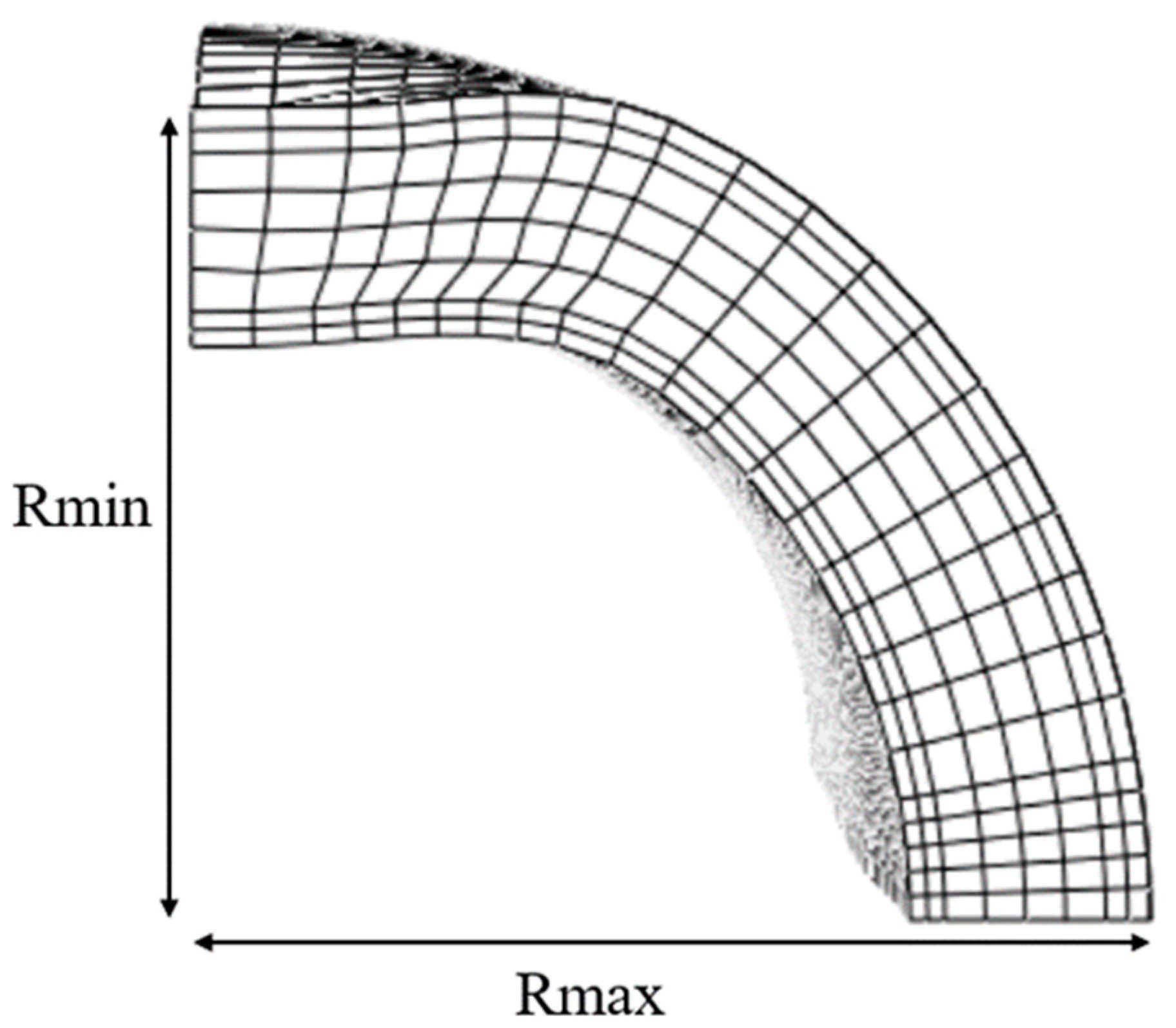
The depth, morphology, and characteristic dimension of dents are the three main parameters to consider when evaluating the collapse pressure of dented pipes. These parameters significantly alter the ovality of the pipes and, as a result, affect their collapse resistance. In this work, finite element models (FEMs) are developed to investigate the impact of these three parameters. As shown in Figure 5, following the indentation process, the minimum and maximum diameters are obtained, and the ovality is then calculated using Equation (1).
Δ = D max D min D max + D min

3.1. Influences of Dent Parameters on the Collapse of the SP

3.1.1. Influence of the Dent Depth

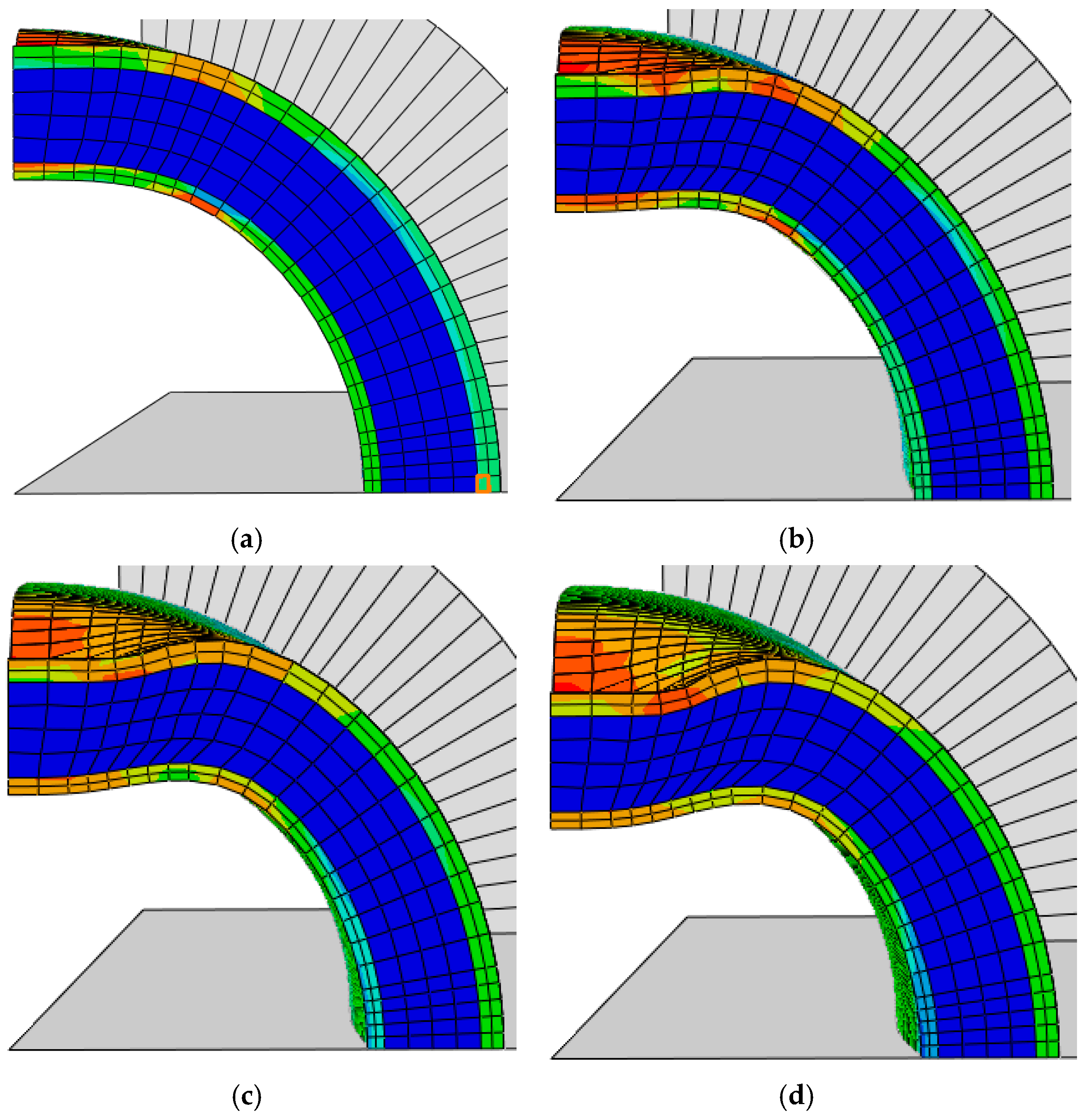
Dent depth is controlled by adjusting the indentation of the dent-forming tool. A rigid cylindrical indenter with a radius of 45 mm is used to investigate how dent depth affects the collapse pressure of sandwich pipe systems. In this numerical model, the outer pipe diameter is set to 304.8 mm, with outer and inner wall thicknesses of 7.62 mm and 5.715 mm, respectively. Both the inner and outer pipes have a thickness-to-diameter ratio of 0.025, and the inner-to-outer diameter ratio (Di/Do) is 0.75. Grade X65 steel is used for both pipes, while high-density polyethylene (HDPE) is adopted as the core material. The cross-sectional profiles of the pipes at different dent depths are shown in Figure 6.
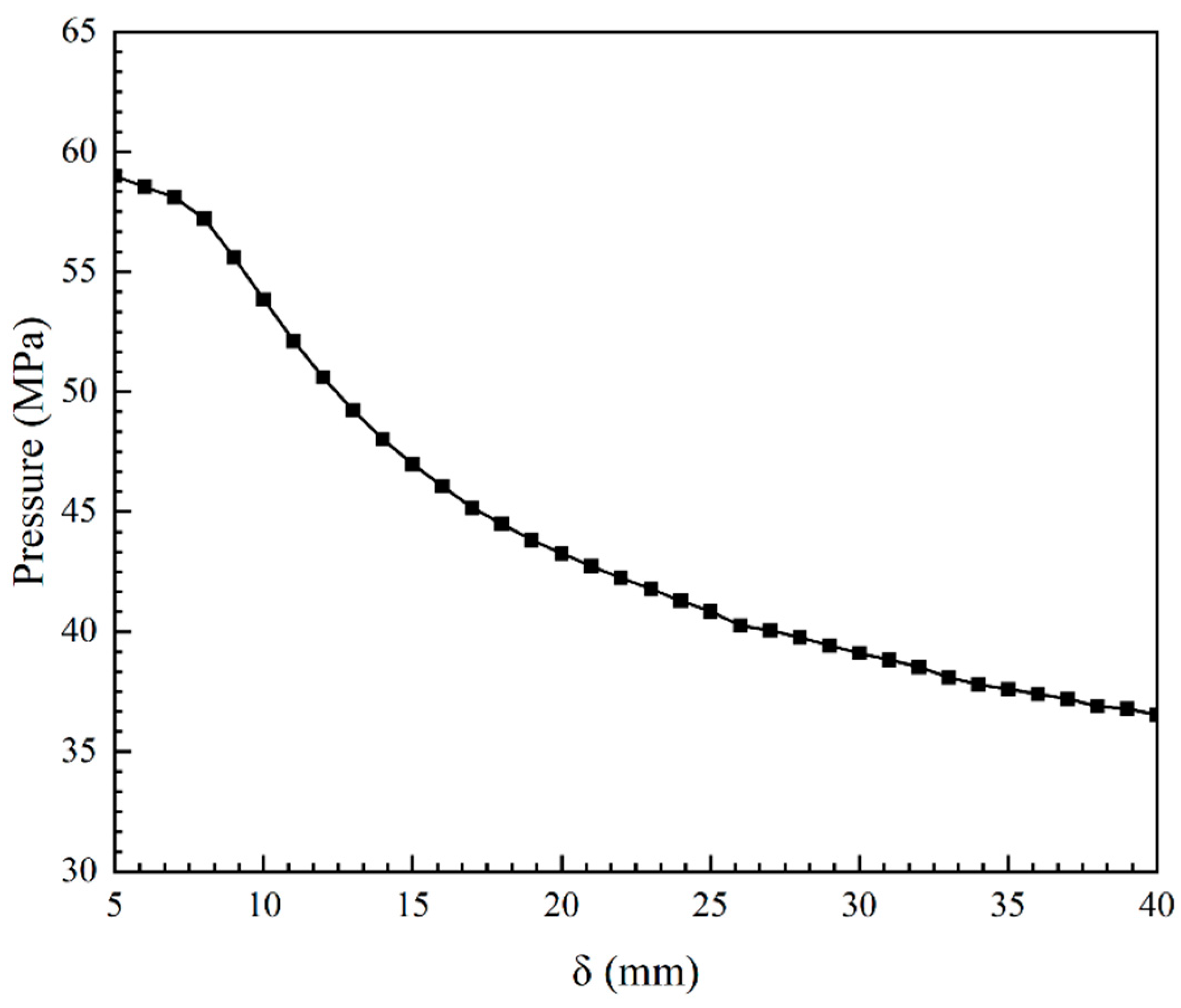
As shown in Figure 7, when the indentation depth increases from 5 mm to 40 mm, the collapse pressure of the SP decreases from 59.00 MPa to 36.53 MPa. This demonstrates that the compressive capacity of the SP exhibits a monotonic decrease as dent depth increases. The rate of reduction in the collapse pressure changes from initially slow to faster, then slows again. Once the maximum ovality exceeds 3%, the influence of further increases in dent depth on the compressive strength of the sandwich pipe systems progressively diminishes.

3.1.2. Influence of the Dent Geometric Configuration

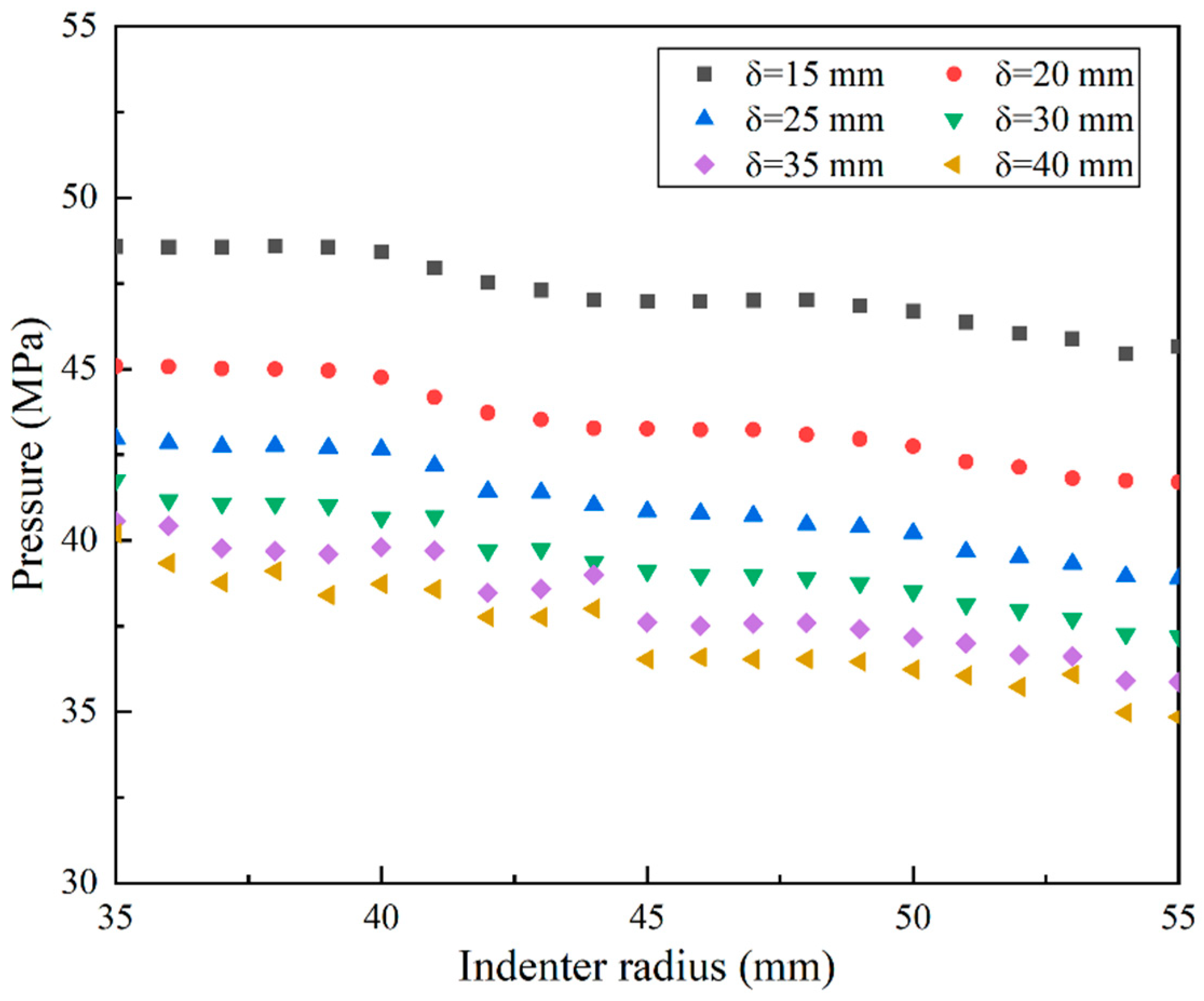
The influence of dent geometric parameters on collapse resistance under external pressure is investigated. The outer pipe is assigned a diameter of 304.8 mm, and its thickness-to-diameter ratio is 0.025, while the inner-to-outer radius ratio is 0.75, with an inner pipe thickness-to-diameter ratio of 0.025. The radii of the dent-inducing tool (dent maker) are set at 35 mm, 40 mm, 45 mm, 50 mm, and 55 mm. As shown in Figure 8, under the cylindrical dent maker condition, the indentation depth increases from 15 mm to 40 mm as the dent maker radius increases from 35 mm to 55 mm. The corresponding reductions in the collapse pressure of the SP are 6.02%, 7.53%, 9.51%, 10.91%, 11.59%, and 13.32%, respectively.
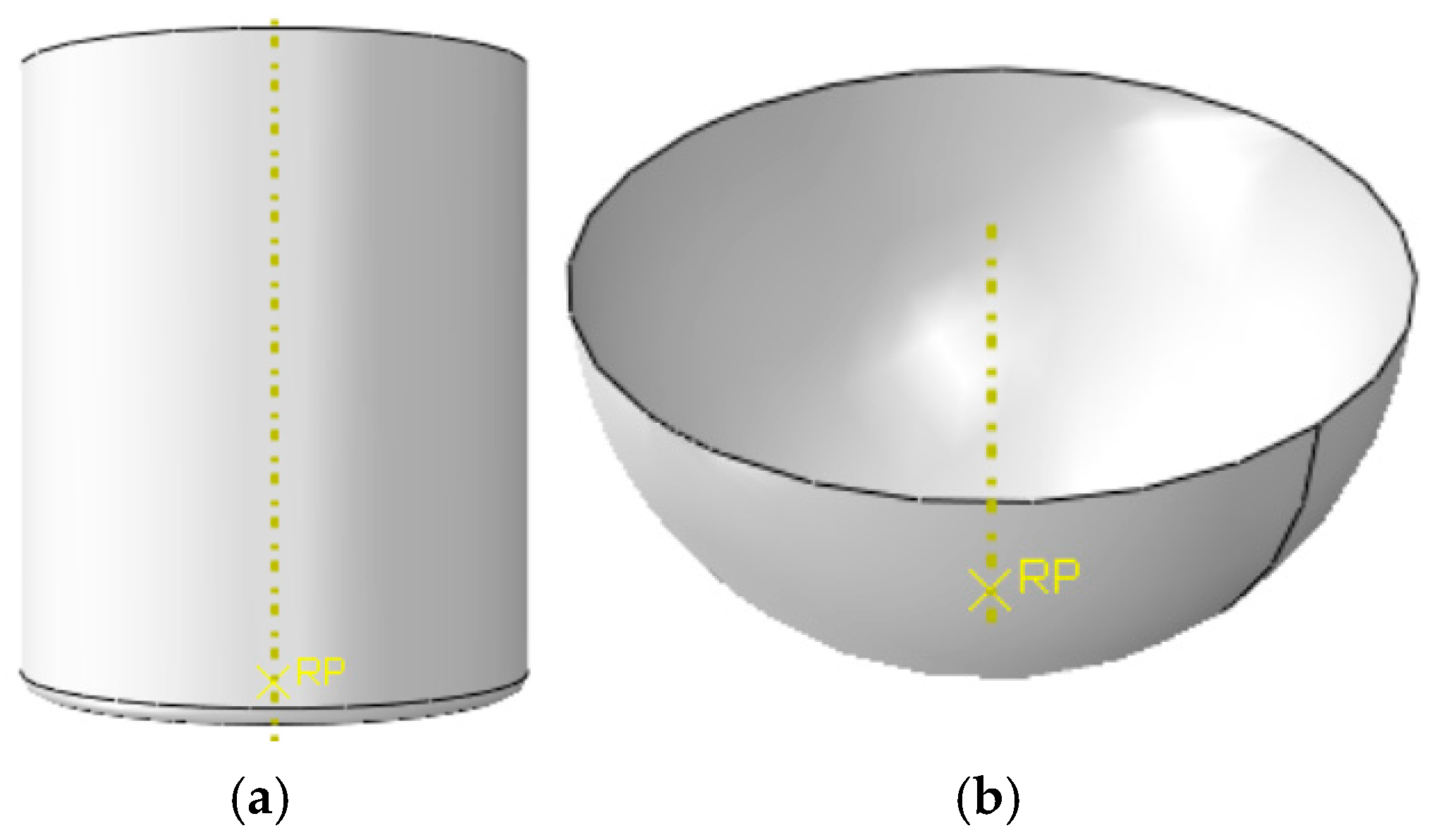
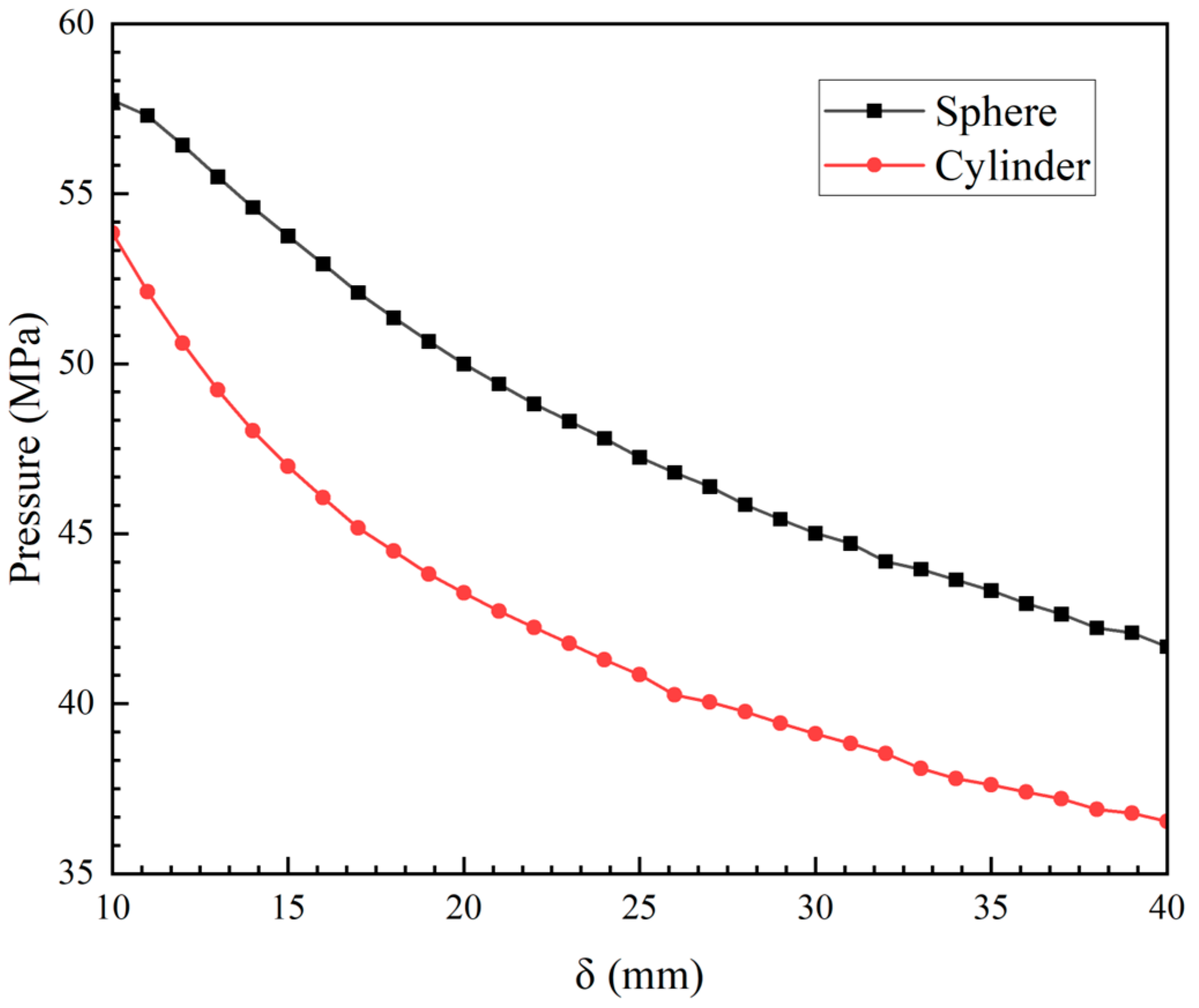
As presented in Figure 9, with the geometric and material parameters remaining constant, numerical models using both a rigid cylindrical dent former and a rigid spherical dent former, each with a radius of 45 mm, are developed. As depicted in Figure 10, for the same dent depth, the collapse pressure associated with the cylindrical dent former (planar dent) is lower than that of the spherical dent former. This indicates that the cylindrical dent former produces a larger affected dent region, leading to a more significant decrease in the collapse pressure of the SP. To develop a conservative predictive model, this study primarily focuses on the collapse pressure of the SP under a cylindrical dent former (planar dent) condition.

3.2. Influences of Geometric Parameters on the Collapse of SPs

3.2.1. Influence of the Inner Pipe Thickness-to-Diameter Ratio (ti/Di)

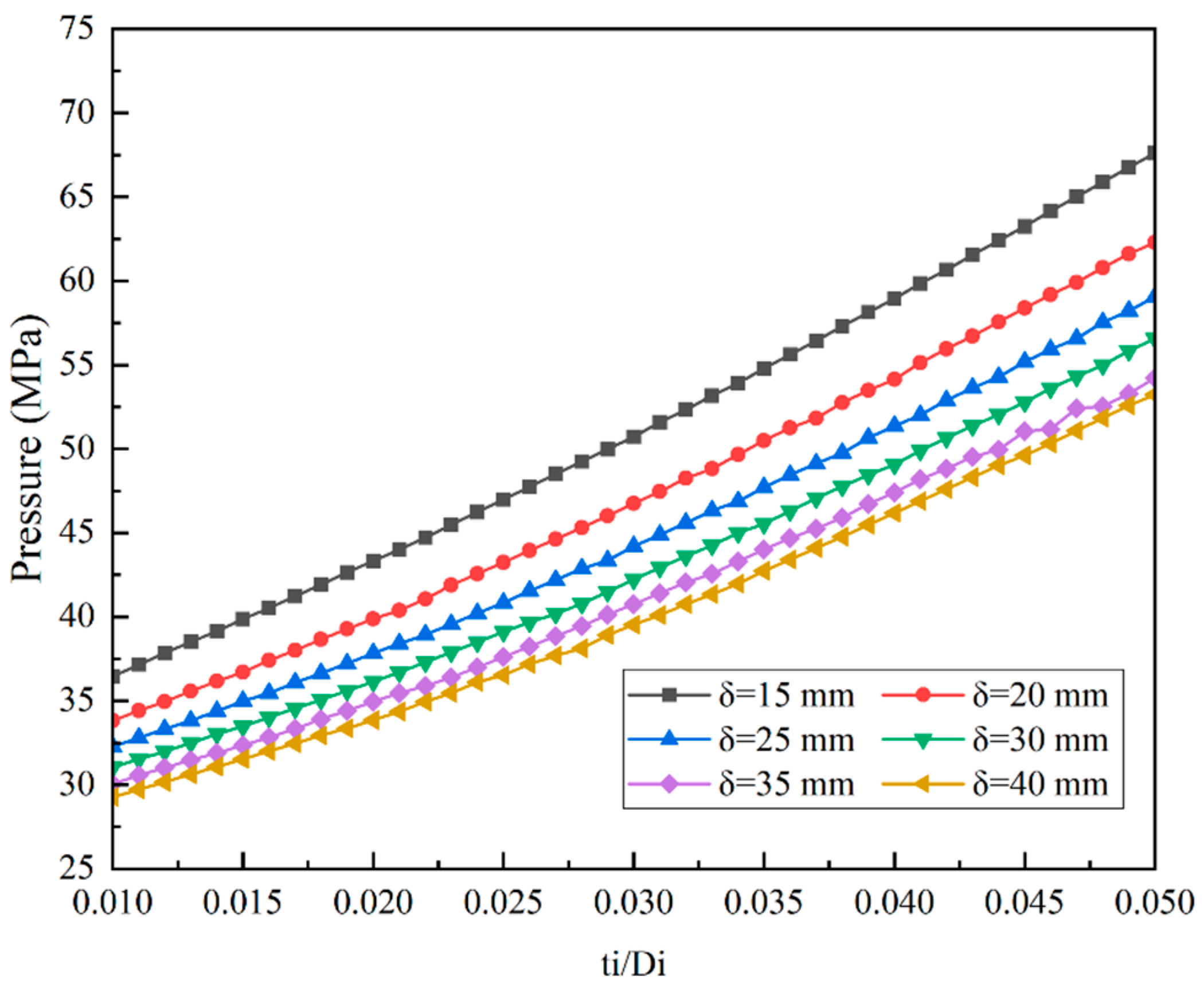
The influence of varying the inner pipe thickness-to-diameter ratio on the collapse pressure of dented sandwich pipes (SPs) is investigated. Numerical models are developed with an outer pipe diameter of 304.8 mm, an inner-to-outer radius ratio of 0.75, an outer-to-inner thickness ratio of 0.025, and an inner-to-outer thickness ratio varying from 0.01 to 0.05. As shown in Figure 11, raising the inner pipe thickness-to-diameter ratio enhances the collapse pressure of the SP. For a fixed indentation depth, when the inner pipe thickness-to-diameter ratio increases from 0.01 to 0.05, the corresponding collapse pressures of the SP are 31.153 MPa, 28.452 MPa, 26.782 MPa, 25.535 MPa, 24.163 MPa, and 23.967 MPa, respectively. These findings suggest that, as dent depth increases, the positive influence of a larger inner pipe thickness-to-diameter ratio on the collapse resistance of sandwich pipe systems gradually decreases.

3.2.2. Influence of the Core Thickness (Di/Do)

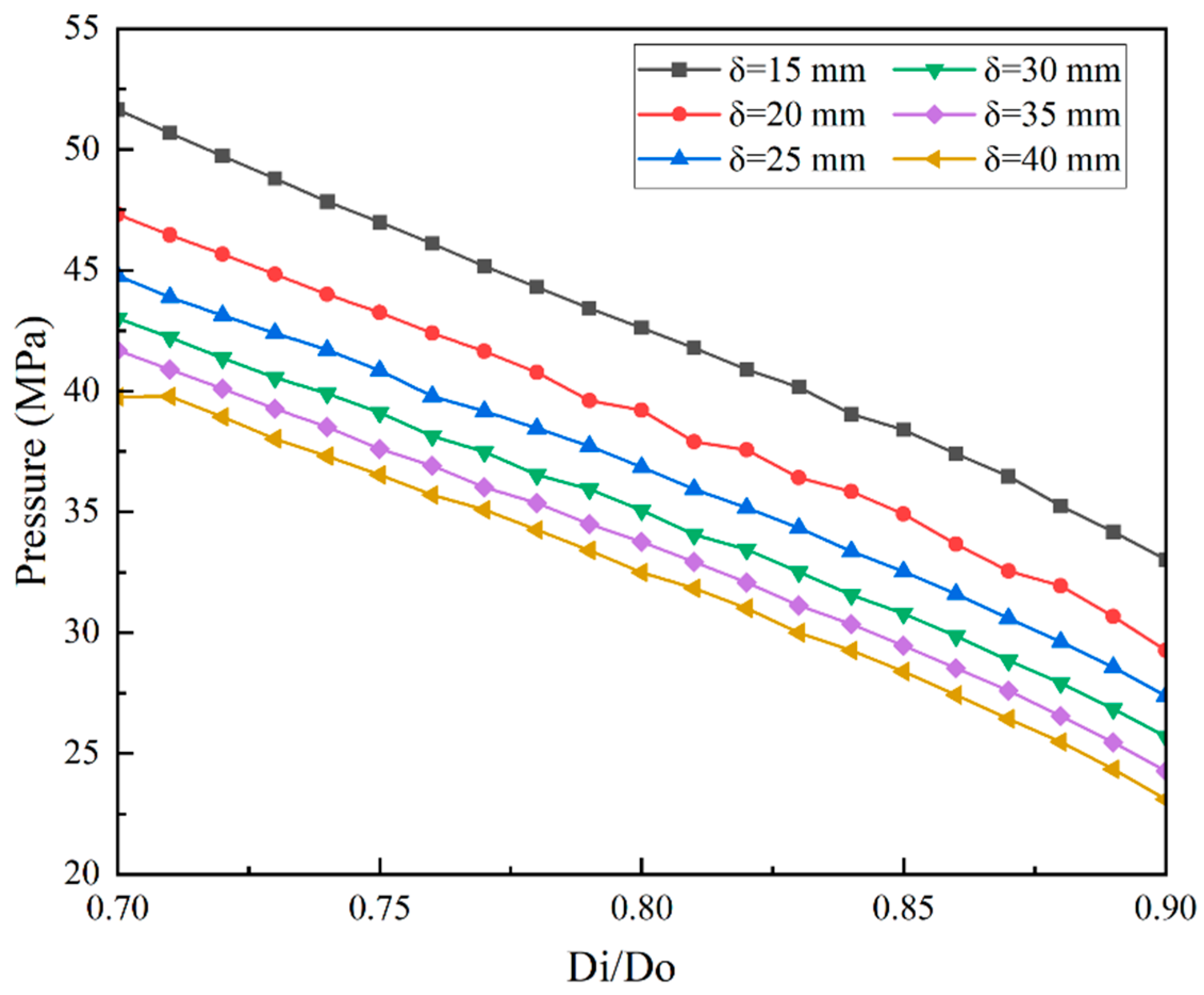
Core thickness is typically characterized by the inner-to-outer pipe radius ratio. In this study, models with an inner-to-outer diameter ratio (Di/Do) of 0.7–0.9 are developed to analyze how sandwich core thickness influences the collapse pressure of dented SPs. As shown in Figure 12, increasing the sandwich core thickness increases the collapse pressure. For a fixed indentation depth, the progressive increase in the Di/Do ratio from 0.7 to 0.9 leads to respective reductions in the SP’s collapse pressure of 18.620 MPa, 18.030 MPa, 17.372 MPa, 17.315 MPa, 17.401 MPa and 16.661 MPa. These findings indicate that, as dent depth increases, the influence exerted by sandwich core thickness on the SP’s collapse pressure changes merely slightly.

3.2.3. Influence of the Outer Pipe Thickness-to-Diameter Ratio (to/Do)

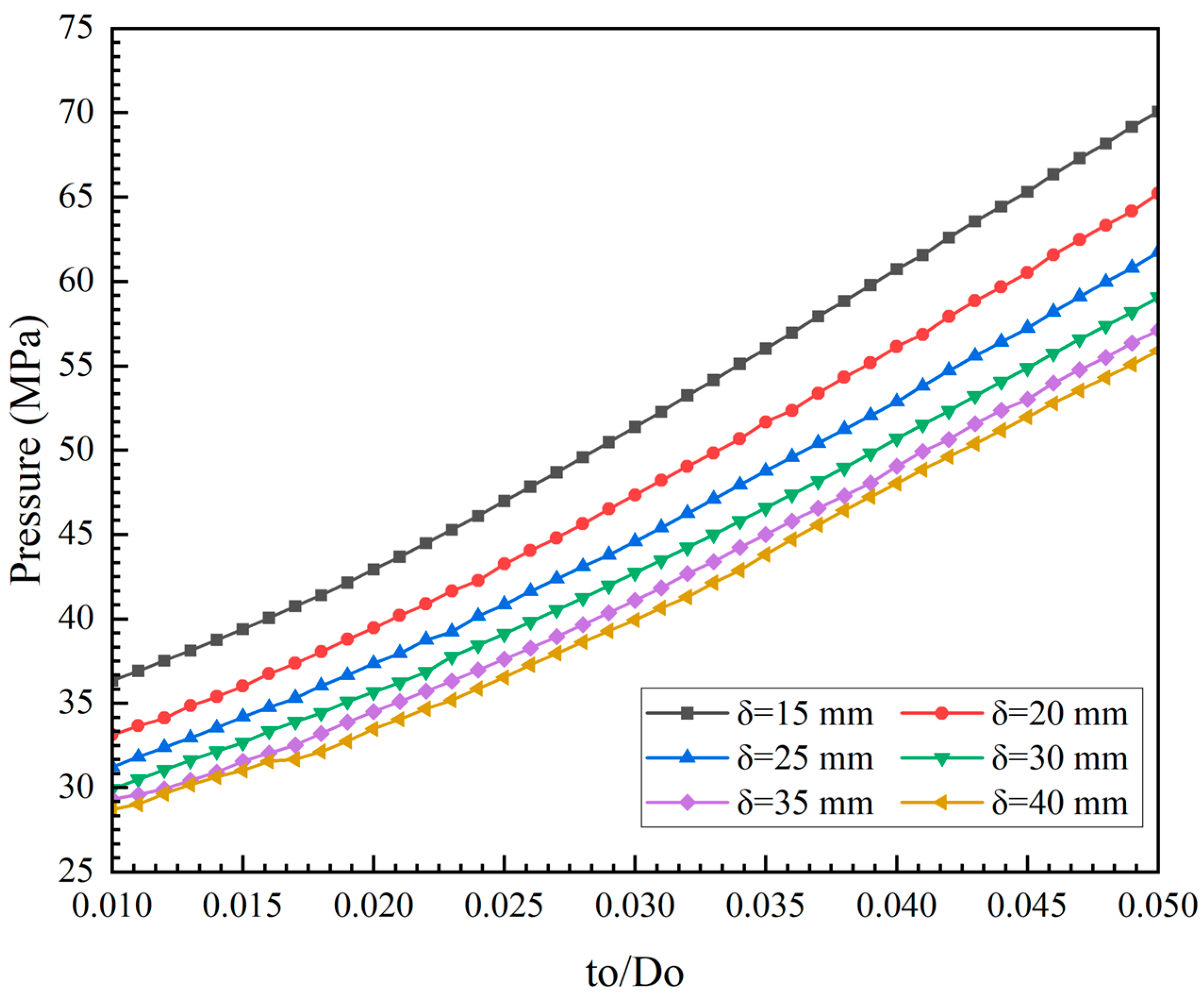
To examine the impact of the outer pipe thickness-to-diameter ratio (to/Do) on the SP’s collapse resistance under external pressure, the outer pipe radius is fixed at 304.8 mm. In contrast, the ratio varies from 0.01 to 0.05. As shown in Figure 13, increasing the outer pipe thickness-to-diameter ratio leads to an enhancement in the collapse pressure of the SP. For a given indentation depth, when the thickness-to-diameter ratio of the outer pipe increases from 0.01 to 0.05, the collapse pressures are 33.737 MPa, 32.091 MPa, 30.520 MPa, 29.159 MPa, 27.798 MPa, and 27.120 MPa, respectively. These results indicate that, with increasing dent depth, the reinforcing effect of the inner pipe’s thickness-to-diameter ratio on the collapse resistance of sandwich pipe systems gradually weakens.

3.2.4. Comparison of the Effects of Di/Do

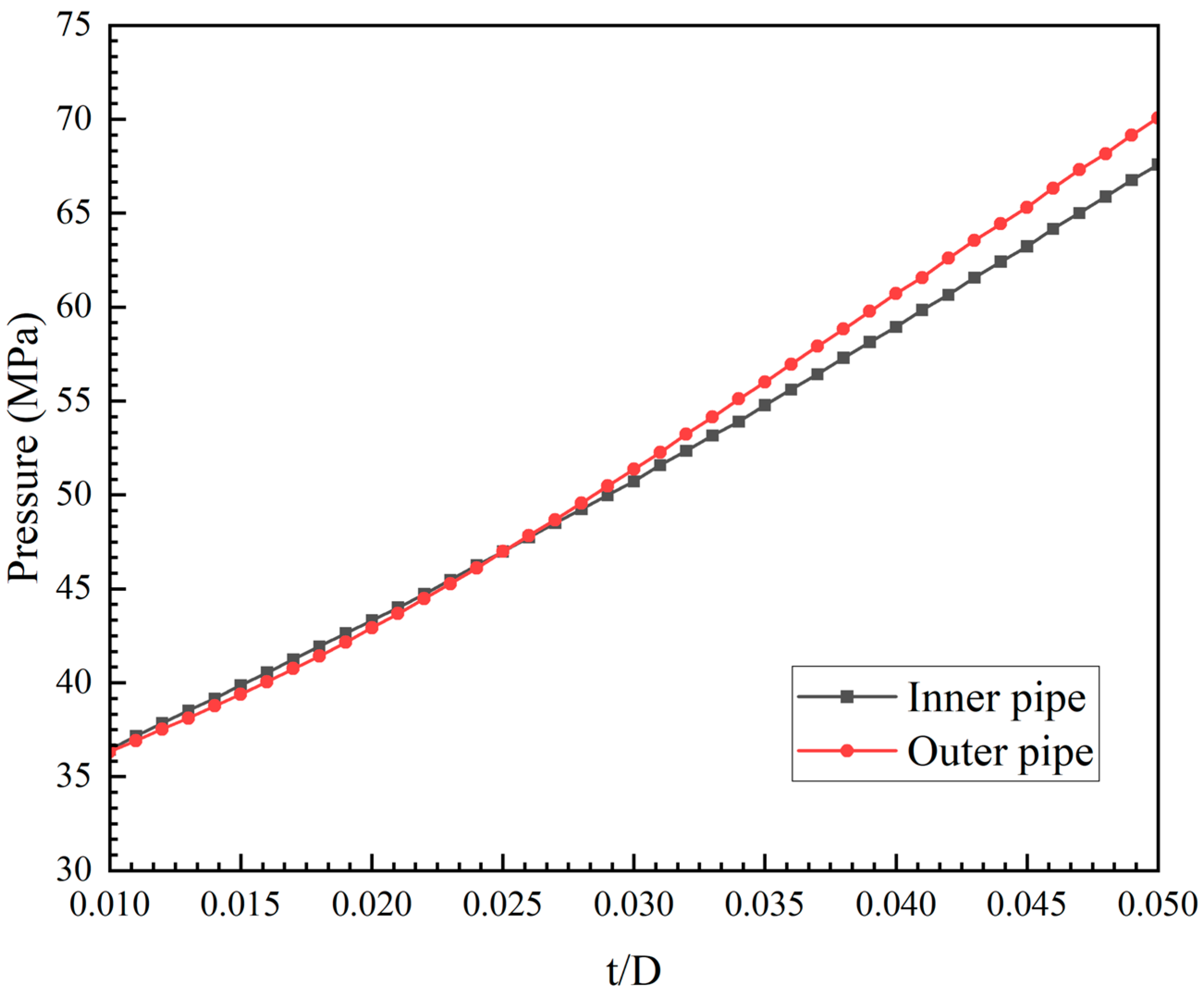
To evaluate the influence of these two parameters, a series of models is developed where the inner pipe thickness-to-diameter ratio ranges from 0.01 to 0.05. Meanwhile, the outer pipe thickness-to-diameter ratio and the inner-to-outer radius ratio are held constant at 0.025 and 0.75, respectively. Additionally, models are constructed in which the outer pipe thickness-to-diameter ratio varies from 0.01 to 0.05, with the inner pipe thickness-to-diameter ratio and the inner-to-outer radius ratio fixed at 0.025 and 0.75, respectively. Figure 14 shows that when the thickness-to-diameter ratio is below 0.025, the effects of changing the inner and outer pipe thicknesses on collapse behavior are similar. However, once the ratio exceeds 0.025, increasing the outer pipe thickness-to-diameter ratio yields a greater increase in collapse pressure than similar increases in the inner pipe thickness-to-diameter ratio.

3.3. Influences of Material Parameters on the Collapse of SPs

3.3.1. Influence of the Steel Pipe Material

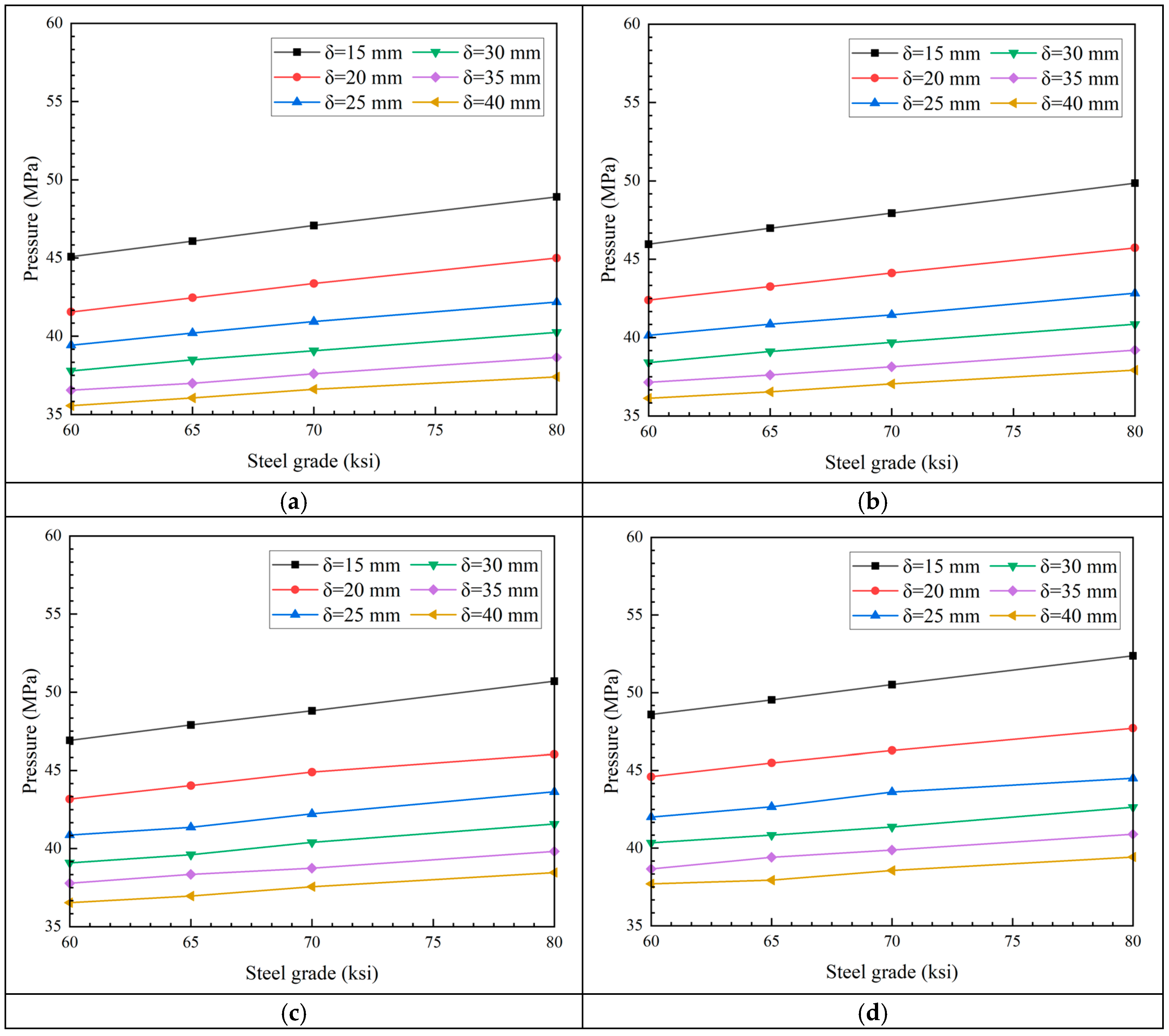
To clarify how different material selections for the inner and outer pipes affect the collapse pressure of dented SPs, four steel grades—X60, X65, X70, and X80—were selected for the inner pipe. Meanwhile, the sandwich core layer was consistently kept as HDPE in all configurations. This created four material groups. For each group, numerical simulations were conducted with the outer pipe material set to X60, X65, X70, and X80, respectively. The corresponding computational results are shown in Figure 15.
As shown in Figure 15, increasing the steel grade of either the inner or outer pipe results in a higher collapse pressure for the sandwich pipe systems, thereby improving its collapse resistance. When the inner pipe is X65 and the dent depth is 15 mm, increasing the outer pipe grade from X60 to X80 yields collapse pressures of 45.96 MPa, 46.984 MPa, 47.94 MPa, and 49.858 MPa, respectively, corresponding to a total increase of 8.48%. Conversely, with the outer pipe made of X65 and a 15 mm dent, increasing the inner pipe grade from X60 to X80 yields collapse pressures of 46.078 MPa, 46.984 MPa, 47.893 MPa, and 49.533 MPa, respectively, corresponding to a total increase of 7.5%. Overall, the simulation data indicate that variations in the steel grades of the inner and outer pipes result in only small changes in collapse pressure; thus, the impact of pipe steel grade on the collapse resistance of dented SPs is limited.

3.3.2. Influence of the Core Material

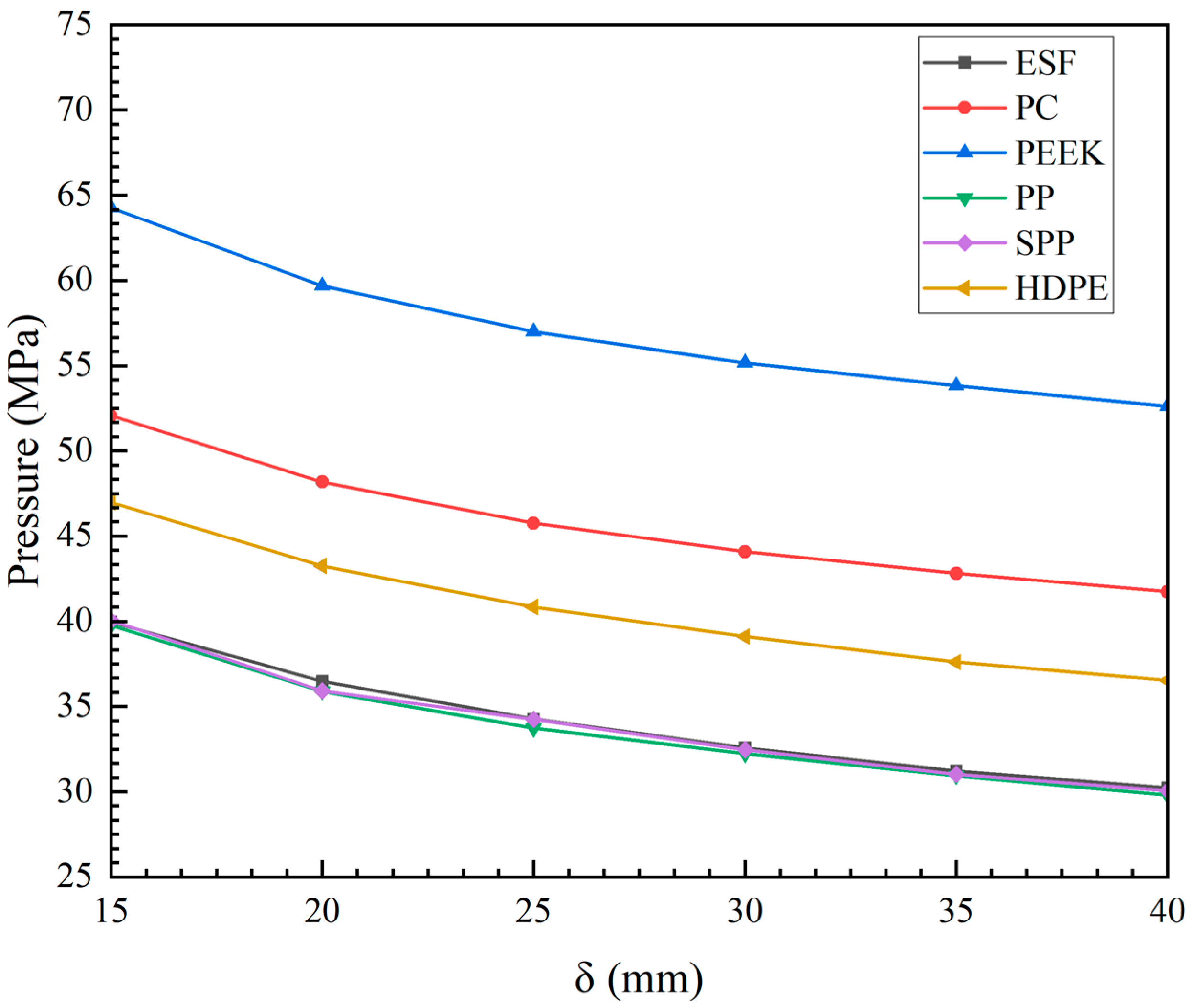
To evaluate how different sandwich core materials affect the collapse pressure of dented SPs, the outer diameter of the SP is maintained at a constant value of 304.8 mm, with an inner-to-outer radius ratio of 0.75 and a thickness-to-diameter ratio of 0.025 for both the inner and outer pipes. The indenter is modeled as a cylinder with a characteristic dimension of 45 mm. The inner and outer pipes are constructed from X65 steel. Numerical models are developed in which the sandwich core is independently designated as SPP, PEEK, PC, HDPE, PP, or ESF.
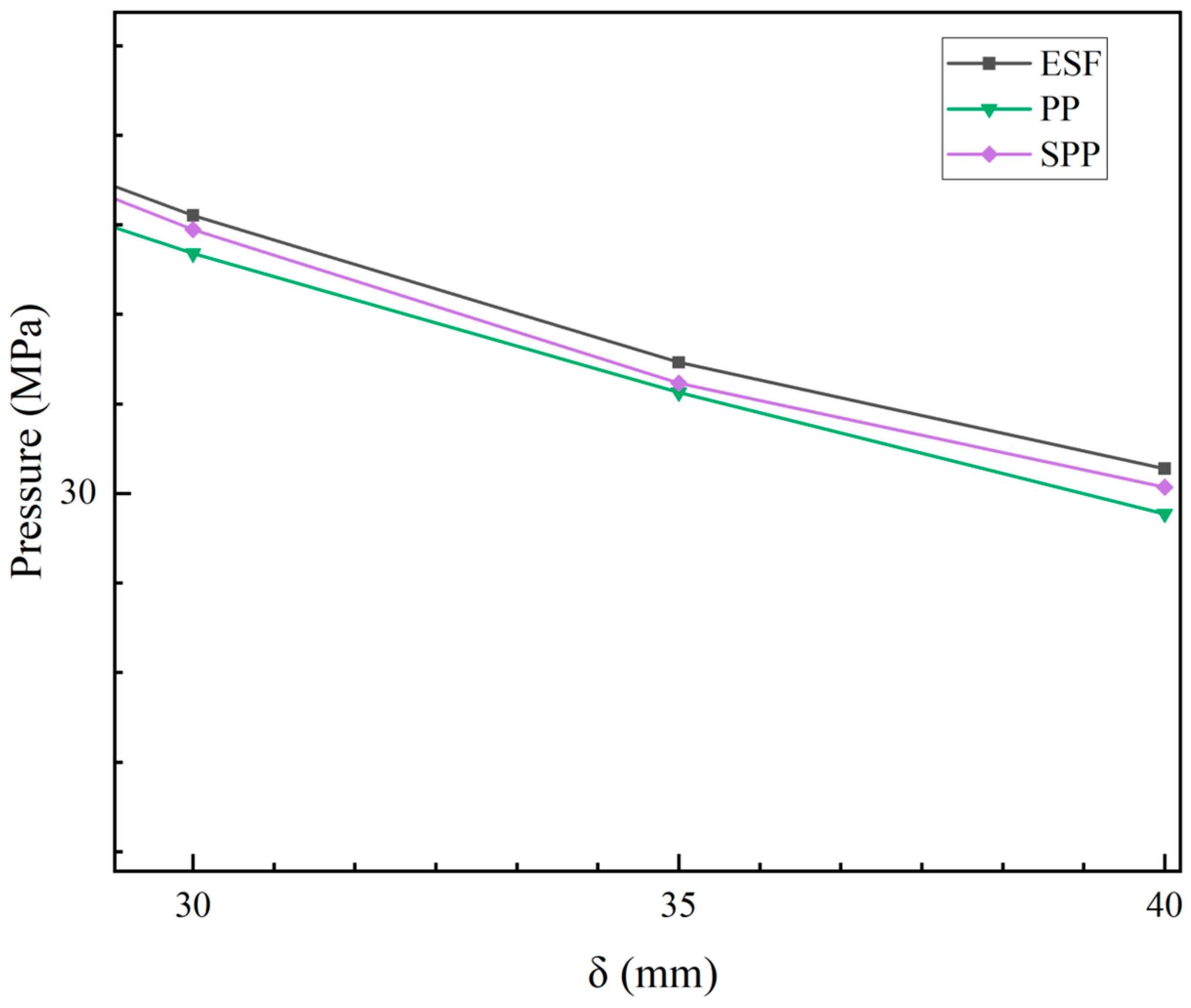
The computational results are depicted in Figure 16 and Figure 17. Among the examined dented SP configurations, the system utilizing PEEK as the core material attains the highest collapse pressure, followed in descending order by cores fabricated from PC and HDPE. Conversely, the collapse pressures associated with pipes incorporating PP, SPP, and ESF cores are comparatively low and exhibit similar magnitudes. This sequence is consistent with the relative values of the corresponding yield stresses, thereby indicating that the collapse pressure of sandwich pipes increases with increasing yield stress of the core material. Furthermore, the reduction in collapse pressure with increasing dent depth is approximately 10.4 MPa for all core materials, indicating that the deleterious effect of dent depth on the collapse resistance of sandwich pipes is only weakly dependent on the selected sandwich core material.

4. A Simplified and Empirical Equation

The combined effects of dent geometry, overall geometric features, and material properties determine the collapse pressure of dented SPs. However, due to the wide variability and complex combinations of material choices across the layers of an SP, conducting a detailed parametric analysis of all relevant material parameters is impractical. In this work, the influence of material properties is captured through the initial pressure response of sandwich pipes, thereby indirectly accounting for a broader range of material configurations. Consequently, the collapse pressure of the SP is impacted by the following factors. Following the dimensionless analysis and considering the main influencing parameters, Equation (2) can be simplified to the following form:
P c o d P c o = f ( D o t o , D i D o , t i t o , D c D o , t c t o , Δ ) .
However, when the ovality (Δ) approaches 0, the right-hand side of Equation (3) must approach 1, as this limit represents a pipe without any dent damage. Conversely, as ovality (Δ) increases, the right-hand side of Equation (3) should stay strictly below 1. Accordingly, Equation (3) can be restated in the subsequent simplified form:
P c o d P c o = 1 ( D o t o ) α 1 α 2 ( Δ ) α 3 ( D i D o ) α 4 ( t i t o ) α 5 + α 6 ( Δ ) α 7 ( D c D o ) α 8 ( t c t o ) α 9 .
Based on the validated numerical model, a parametric study is conducted to analyze the effects of dent, geometric, and material parameters on the collapse pressure of SPs within the ranges listed in Table 3. Since dent morphology significantly influences the collapse pressure of dented SPs and cannot be systematically quantified for all dent types, this work focuses on dents caused by a cylindrical indenter as the primary case and derives conservative empirical formulas. In total, 2316 numerical models are built. The numerical simulation results obtained from these models are subjected to regression analysis with the automated machine-learning software Eureqa (1.24.0.9367), which then derives the respective coefficients of Equation (4) as follows:
P c o d P c o = 1 ( D o t o ) 0.465 1.146 ( Δ ) 1.347 ( D i D o ) 1.127 ( t i t o ) 0.0562 3.819 ( Δ ) 2.471 ( D c D o ) 0.919 ( t c t o ) 0.491 .
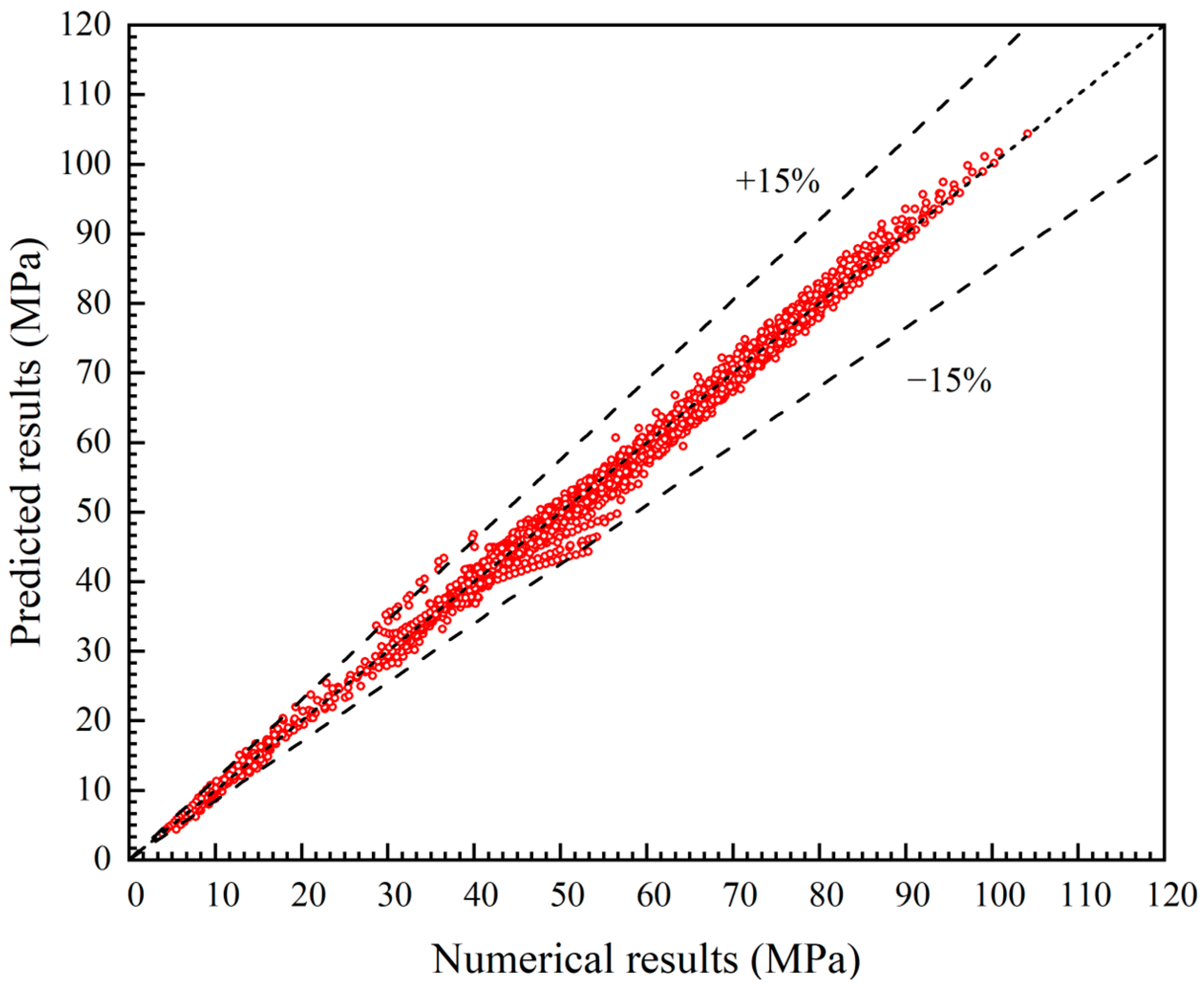
The correlation coefficient from the current data fitting is 0.9937, and the coefficient of determination (R2) is 0.9886. With numerical simulation results plotted on the x-axis and empirical formula predictions on the y-axis, a total of 2316 data points are presented in Figure 18. The mean relative error between the values calculated from the empirical formula and those from the numerical simulations is 2.64%. Compared with existing collapse pressure prediction models, the proposed formula fully considers the effects of indentation geometry. It incorporates indentation parameters that match actual operational conditions.
When the dent depth reaches 40 mm and the thickness-to-inner-diameter ratio, ti/Di, exceeds 0.04, the deviation in the collapse pressure predicted by Equation (4) exceeds 10%. For a dent depth of 40 mm and an outer-thickness-to-outer-diameter ratio, to/Do, below 0.013, a relatively large prediction error of approximately 14% is observed. The prediction formula is not applicable when the indentation depth exceeds 50 mm. However, considering that an indentation depth of 50 mm would already cause severe damage to the pipeline with these sizes under actual operating conditions, this paper does not conduct detailed simulation research on indentations with greater depths. This formula exhibits good applicability when ti/Di exceeds 0.005 and is below 0.04, to/Do exceeds 0.015 and is below 0.08, and the core layer thickness ranges from 8 to 32 mm. Significant differences in the predicted collapse pressures occur when the core layer material is ESF, PP, or SPP. In contrast, the prediction accuracy is acceptable when HDPE, PEEK, or PC is used as the core layer material. Overall, the formula applies to sandwich pipes with high interlayer bonding strength. The prediction error of the formula is within the allowable range when the pipe dimensions are within the proposed thresholds and the ratio of the pipe’s outer diameter to the dent depth is greater than 7. The empirical formula proposed in this study is also applied to experimental and numerical datasets reported in the literature [56]. A comparison of the values calculated from the empirical formula with those previously reported is summarized in Table 4.

5. Conclusions

In this work, a quarter symmetry finite element (FE) model of dented SPs subjected to external pressure is developed in ABAQUS and validated against experimental and numerical data reported in the literature. A total of 2316 FE models are constructed using parametric modeling and Python scripting to investigate the effects of dent geometry, global geometric parameters, and material properties on the collapse pressure of dented SPs. Using the numerical results, a simplified prediction equation for dented SP collapse pressure is proposed. The main findings are as follows:
(1) Dent parameters significantly influence collapse pressure: cylindrical indenters cause a greater reduction in collapse resistance than spherical indenters; the collapse pressure decreases steadily as dent depth increases; the sensitivity of compressive strength to dent depth lessens once pipe ovality exceeds 3%; and, when considered alone, the influence of the indenter radius on collapse pressure is relatively marginal.
(2) Geometric parameters are essential for the collapse resistance of SPs: Increasing the thickness-to-diameter ratios of both the inner and outer pipes, as well as the core thickness, results in higher collapse pressures. When the thickness-to-diameter ratio exceeds 0.025, the outer pipe plays a larger role in increasing collapse pressure. Additionally, the influence of sandwich core thickness on collapse pressure is essentially uncorrelated with dent depth.
(3) Material parameters have different effects on collapse pressure: The steel grades of the inner and outer pipes have only a minor impact, while the yield strength of the core material is positively linked to collapse pressure (cores made of PEEK reach the highest collapse pressures, whereas PP/SPP/ESF cores have the lowest). The negative effect of increased dent depth on collapse resistance is only weakly influenced by the choice of core material.
(4) A simplified empirical formula for dented SP collapse pressure is established, achieving a correlation coefficient of 0.9937 and an R2 of 0.9886. The average deviation from the numerical simulation results is 2.64%. The proposed formula also aligns well with the literature data. It thus provides a practical and efficient tool for assessing the structural integrity of dented SPs in engineering applications.

Author Contributions

Software and writing—original draft preparation, Z.Z.; software and writing—original draft preparation, Y.H.; writing—review and editing, supervision, and project administration, G.F.; writing—review and editing, M.S.; writing—review and editing and supervision, S.F.E. All authors have read and agreed to the published version of the manuscript.

Funding

This research was supported by the Key Research and Development Program of Shandong Province [2023CXGC010415, 2025TSGCCZZB0238 and 2022CXGC020405], the National Natural Science Foundation of China [52171288] and the National Training Program of Innovation and Entrepreneurship for Undergraduates [202510425027].

Data Availability Statement

The original contributions presented in this study are included in the article. Further inquiries can be directed to the corresponding author.

Conflicts of Interest

The authors declare no conflicts of interest.

Abbreviations

PCOcollapse pressure of intact SP
Didiameter of the inner layer
Dcdiameter of the core layer
tiwall thickness of the inner pipe
tcwall thickness of the core layer
σxyield stress
Dmaxmaximum diameter of a pipe cross-section
Pcodcollapse pressure of dented SP
Dodiameter of the outer layer
δindentation depth
towall thickness of the outer pipe
ExYoung’s modulus
Δmaxellipticity of defective sandwich pipes
Dminminimum diameter of a pipe cross-section
SPPsolid polypropylene
PCpolycarbonate
HDPFhigh-density polyimide foam
PPpolypropylene
PEEKpolyetheretherketone
ESFepoxy syntactic

References

  1. Liu, J.; Ma, J.; Vaz, M.A.; Duan, M. Viscoelastic damping of flexible risers: Theoretical model. Ocean Eng. 2019, 83, 37–47. [Google Scholar] [CrossRef]
  2. Liu, J.; Ma, J.; Vaz, M.A.; Duan, M. Axisymmetric structural behaviours of composite tensile armoured flexible pipes. Mar. Struct. 2020, 74, 103024. [Google Scholar] [CrossRef]
  3. Hu, P.; Liu, X.; Gao, H.; Liu, Z.; Li, Y.; Hu, X.; Chang, Y.; Chen, G.; Sun, M.; Guo, X. Three-dimensional VIV characteristics of a flexible riser considering parameters uncertainty. Mar. Struct. 2026, 108, 104037. [Google Scholar] [CrossRef]
  4. Wang, Y.; Lou, M.; Tong, B.; Wang, S. Effect of temperature on tensile properties of reinforced thermoplastic pipes. Compos. Struct. 2020, 241, 112119. [Google Scholar] [CrossRef]
  5. Wang, Y.; Lou, M.; Wang, Y. Stochastic analysis of failure pressure in reinforced thermoplastic pipes under axial loading and external pressure. Ocean Eng. 2021, 240, 109963. [Google Scholar] [CrossRef]
  6. An, C.; Su, J. Lumped models for transient thermal analysis of a multilayered composite pipeline with active heating. Appl. Therm. Eng. 2015, 87, 749–759. [Google Scholar] [CrossRef]
  7. An, C.; Duan, M.; Estefen, S.F.; Su, J. Structural and Thermal Analyses of Deepwater Pipes; Springer: Cham, Switzerland, 2021. [Google Scholar]
  8. Kyriakides, S.; Netto, T. On the dynamics of propagating buckles in pipelines. Int. J. Solids Struct. 2000, 37, 6843–6867. [Google Scholar] [CrossRef]
  9. Kyriakides, S. Buckle propagation in pipe-in-pipe systems. Part I. Experiments. Int. J. Solids Struct. 2002, 39, 351–366. [Google Scholar] [CrossRef]
  10. Kyriakides, S.; Vogler, T.J. Buckle propagation in pipe-in-pipe systems. Part II. analysis. Int. J. Solids Struct. 2002, 39, 367–392. [Google Scholar] [CrossRef]
  11. Kyriakides, S.; Netto, T. On the dynamic propagation and arrest of buckles in pipe-in-pipe systems. Int. J. Solids Struct. 2004, 41, 5463–5482. [Google Scholar] [CrossRef]
  12. Netto, T.; Kyriakides, S. Dynamic performance of integral buckle arrestors for offshore pipelines. Part I: Experiments. Int. J. Mech. Sci. 2000, 42, 1405–1423. [Google Scholar] [CrossRef]
  13. Netto, T.; Kyriakides, S. Dynamic performance of integral buckle arrestors for offshore pipelines. Part II: Analysis. Int. J. Mech. Sci. 2000, 42, 1425–1452. [Google Scholar] [CrossRef]
  14. Xue, J.; Fatt, M.S.H. Buckle propagation in pipelines with non-uniform thickness. Ocean Eng. 2001, 28, 1383–1392. [Google Scholar] [CrossRef]
  15. Xue, J.H. A non-linear finite-element analysis of buckle propagation in subsea corroded pipelines. Finite Elem. Anal. Des. 2006, 42, 1211–1219. [Google Scholar] [CrossRef]
  16. Gong, S.; Sun, B.; Bao, S.; Bai, Y. Buckle propagation of offshore pipelines under external pressure. Mar. Struct. 2012, 29, 115–130. [Google Scholar] [CrossRef]
  17. Gong, S.; Li, G. Buckle propagation of pipe-in-pipe systems under external pressure. Eng. Struct. 2015, 84, 207–222. [Google Scholar] [CrossRef]
  18. Yu, J.-X.; Duan, J.-H.; Sun, Z.-Z.; Yu, Y.; Wu, M.-N. The crossover mechanisms of integral buckle arrestors for offshore pipelines. Appl. Ocean Res. 2017, 67, 236–247. [Google Scholar] [CrossRef]
  19. Guggenberger, W. Buckling and postbuckling of imperfect cylindrical shells under external pressure. Thin-Walled Struct. 1995, 23, 351–366. [Google Scholar] [CrossRef]
  20. Park, T.D.; Kyriakides, S. On the collapse of dented cylinders under external pressure. Int. J. Mech. Sci. 1996, 38, 557–578. [Google Scholar] [CrossRef]
  21. Fan, Z.; Yu, J.; Sun, Z.; Wang, H. Effect of axial length parameters of ovality on the collapse pressure of offshore pipelines. Thin-Walled Struct. 2017, 116, 19–25. [Google Scholar] [CrossRef]
  22. Yu, C.; Qiu, B.; Hu, J.; Zhang, J. Mechanical behavior and evaluation of dented pipe caused by a cylindrical indenter. J. Fail. Anal. Prev. 2019, 19, 519–535. [Google Scholar] [CrossRef]
  23. Liu, M.; Zhou, H.G.; Wang, B.; Wang, Y.Y.; Bergman, J.; Ayton, B.; Stephens, M. Strain-Based Design and Assessment in Critical Areas of Pipeline Systems with Realistic Anomalies; Center for Reliable Energy Systems: Dublin, OH, USA, 2017. [Google Scholar]
  24. Cai, J.; Jiang, X.; Lodewijks, G.; Pei, Z.; Wu, W. Residual ultimate strength of damaged seamless metallic pipelines with metal loss. Mar. Struct. 2018, 58, 242–253. [Google Scholar] [CrossRef]
  25. Ferraz, C.; Netto, T.A. On the collapse pressure of dented pipelines for deepwater applications. Ocean Eng. 2025, 340, 122083. [Google Scholar] [CrossRef]
  26. Ramasamy, R.; Ya, T.T. Nonlinear finite element analysis of collapse and post-collapse behaviour in dented submarine pipelines. Appl. Ocean Res. 2014, 46, 116–123. [Google Scholar] [CrossRef]
  27. Ravaliya, N.R.; Gupta, P.K. Evaluating impact response of X65 pipelines under diverse impactor shapes: A numerical investigation. Eng. Fail. Anal. 2025, 182, 109997. [Google Scholar] [CrossRef]
  28. Phuor, T.; Trapper, P.A.; Ganz, A. An Analytical Expression for the Fundamental Frequency of a Long Free-Spanning Submarine Pipeline. Mathematics 2023, 11, 4481. [Google Scholar] [CrossRef]
  29. Phuor, T.; Trapper, P.A.; Urlainis, A.; Ganz, A. Computational Investigation of Long Free-Span Submarine Pipelines with Buoyancy Modules Using an Automated Python–Abaqus Framework. Mathematics 2025, 13, 1387. [Google Scholar] [CrossRef]
  30. Netto, T.A.; Santos, J.M.C.; Estefen, S.F. Sandwich pipes for ultra-deep waters. In Proceedings of the International Pipeline Conference, Calgary, AB, Canada, 29 September–3 October 2002; Volume 36207, pp. 2093–2101. [Google Scholar]
  31. Estefen, S.F.; Netto, T.A.; Pasqualino, I.P. Strength analyses of sandwich pipes for ultra-deep waters. J. Appl. Mech. Trans. ASME 2005, 72, 599–608. [Google Scholar] [CrossRef]
  32. Castello, X.; Estefen, S. Limit strength and reeling effects of sandwich pipes with bonded layers. Int. J. Mech. Sci. 2007, 49, 577–588. [Google Scholar] [CrossRef]
  33. An, C.; Castello, X.; Duan, M.; Toledo Filho, R.D.; Estefen, S.F. Ultimate strength behaviour of sandwich pipes filled with steel fiber reinforced concrete. Ocean Eng. 2012, 55, 125–135. [Google Scholar] [CrossRef]
  34. An, C.; Duan, M.; Toledo Filho, R.D.; Estefen, S.F. Collapse of sandwich pipes with PVA fiber reinforced cementitious composites core under external pressure. Ocean Eng. 2014, 82, 1–13. [Google Scholar] [CrossRef]
  35. An, C.; Duan, M.; Estefen, S.F.; Su, J. Sandwich pipe: Reel-lay installation effects. In Structural and Thermal Analyses of Deepwater Pipes; Springer International Publishing: Cham, Switzerland, 2015; p. OMAE2015-41089. [Google Scholar]
  36. He, T.; Duan, M.; Wang, J.; Lv, S.; An, C. On the external pressure capacity of deepwater sandwich pipes with inter-layer adhesion conditions. Appl. Ocean Res. 2015, 52, 115–124. [Google Scholar] [CrossRef]
  37. Hashemian, R.; Mohareb, M. Buckling finite element formulation for sandwich pipes under external pressure. Int. J. Press. Vessel. Pip. 2016, 147, 41–54. [Google Scholar] [CrossRef]
  38. Hashemina, R.; Mohareb, M. Finite difference model for the buckling analysis of sandwich pipes under external pressure. Ocean Eng. 2016, 122, 172–185. [Google Scholar] [CrossRef]
  39. Xue, J.; Wang, Y.; Yuan, D. A shear deformation theory for bending and buckling of undersea sandwich pipes. Compos. Struct. 2015, 132, 633–643. [Google Scholar] [CrossRef]
  40. Jin, Z.; Shen, X.; Yan, S.; Ye, H.; Gao, Z.; Chen, Z. A three-dimensional analytical solution for sandwich pipe systems under linearly varying external pressures. Ocean Eng. 2016, 124, 298–305. [Google Scholar] [CrossRef]
  41. Yang, J.; Paz, C.M.; Estefen, S.F.; Fu, G.; Lourenço, M.I. Collapse pressure of sandwich pipes with strain-hardening cementitious composite—Part 1: Experiments and parametric study. Thin-Walled Struct. 2020, 148, 106605. [Google Scholar] [CrossRef]
  42. Yang, J.; Estefen, S.F.; Fu, G.; Paz, C.M.; Lourenco, M.I. Collapse pressure of sandwich pipes with strain-hardening cementitious composite—Part 2: A suitable prediction equation. Thin-Walled Struct. 2020, 148, 106606. [Google Scholar] [CrossRef]
  43. Fu, G.; Paz, C.M.; Chujutalli, J.A.H.; Lourenço, M.I.; de Lima, D.B.; Li, Y.; Filho, R.T.; Estefen, S.F. Sandwich pipes with strain hardening cementitious composites (SHCC): Numerical analyses. In International Conference on Offshore Mechanics and Arctic Engineering; American Society of Mechanical Engineers: New York, NY, USA, 2014; p. OMAE2014-23507. [Google Scholar]
  44. Fu, G.; Estefen, S.F.; Lourenço, M.; Yang, J.; Paz, C.M.; Duan, M. Buckle propagation of damaged SHCC sandwich pipes: Experimental tests and numerical simulation. Mar. Struct. 2021, 77, 102976. [Google Scholar] [CrossRef]
  45. Li, R.; Chen, B.; Soares, C.G. Design equation for the effect of ovality on the collapse strength of sandwich pipes. Ocean Eng. 2021, 235, 109637. [Google Scholar] [CrossRef]
  46. Wang, M.; Gao, W.; Wang, F.; Zhao, X.; Zhang, J. Theoretical, numerical, and experimental analyses of the buckling of thin-walled sandwich cylindrical shells subjected to external pressure. Ocean Eng. 2025, 327, 120950. [Google Scholar] [CrossRef]
  47. Cheng, H.; Pinheiro, B.C.; Estefen, S.F.; Xu, L.; Paz, C.M.; Duan, M. Ultimate bending strength of sandwich pipes with actual interlayer behavior. Thin-Walled Struct. 2021, 161, 107476. [Google Scholar] [CrossRef]
  48. Cheng, H.; Paz, C.M.; Pinheiro, B.C.; Estefen, S.F. Experimentally based parameters applied to the concrete damage plasticity model for strain hardening cementitious composite in sandwich pipes. Mater. Struct. 2020, 53, 78. [Google Scholar] [CrossRef]
  49. Xu, Q.; Gong, S.; Hu, Q. Collapse analyses of sandwich pipes under external pressure considering inter-layer adhesion behaviour. Mar. Struct. 2016, 50, 72–94. [Google Scholar] [CrossRef]
  50. Fernández-Valdés, D.; Vázquez-Hernández, A.; Ortega-Herrera, J.; Ocampo-Ramírez, A.; Hernández, D. FEM-based evaluation of friction and initial imperfections effects on sandwich pipes local buckling. Mar. Struct. 2020, 72, 102769. [Google Scholar] [CrossRef]
  51. Arjomandi, K.; Taheri, F. A new look at the external pressure capacity of sandwich pipes. Mar. Struct. 2011, 24, 23–42. [Google Scholar] [CrossRef]
  52. Arjomandi, K.; Taheri, F. The influence of intra-layer adhesion configuration on the pressure capacity and optimized configuration of sandwich pipes. Ocean Eng. 2011, 38, 1869–1882. [Google Scholar] [CrossRef]
  53. Arjomandi, K.; Taheri, F. Stability and post-buckling response of sandwich pipes under hydrostatic external pressure. Int. J. Press. Vessel. Pip. 2011, 88, 138–148. [Google Scholar] [CrossRef]
  54. Wan, F.; Guan, F.; Zhou, C.; Liu, S.; Yang, T. Pressure capacity of sandwich pipe with cement-based core configuration under deep-water external pressure. J. Sandw. Struct. Mater. 2020, 22, 1292–1326. [Google Scholar] [CrossRef]
  55. Wan, F.; Guan, F.; Deng, Y.; Liu, S.; Liu, Y.; Huang, P. Indentation response of pressurized sandwich pipes filled with cement composite under lateral loading. Ocean Eng. 2021, 224, 108736. [Google Scholar] [CrossRef]
  56. Yu, J.; Xu, W.; Chen, N.Z.; Jiang, S.; Xu, S.; Li, H.; Han, M. Effect of dent defects on the collapse pressure of sandwich pipes. Thin-Walled Struct. 2022, 170, 108608. [Google Scholar] [CrossRef]
  57. Wan, F.; Tian, H.; Guan, F.; Qi, C.; Liao, J. On the spring-back and re-rounding mechanism of a plain dent on the sandwich pipe. Ocean Eng. 2024, 313, 119491. [Google Scholar] [CrossRef]
  58. Tian, H.; Guan, F.; Wan, F.; Lv, C. A dimensionless prediction model for the dent depth of the inner pipe in a sandwich pipe. Ocean Eng. 2025, 340, 122380. [Google Scholar] [CrossRef]
  59. Fu, G.; Li, S.; Lian, P.; Yang, J.; Estefen, S.F. Empirical formula of buckle propagation pressure for sandwich pipes with polymer core material. Mar. Struct. 2024, 94, 103564. [Google Scholar] [CrossRef]
  60. Liu, X.; Zhou, C.; Wan, F.; Tian, H.; Chen, W.; Guan, F. The difference in dent characteristics between the inner and outer tubes of sandwich pipes under lateral loading. Ocean Eng. 2023, 271, 113726. [Google Scholar] [CrossRef]
  61. Chen, W.; Wan, F.; Guan, F.; Liu, X.; Yang, Y.; Zhou, C. The effect of seabed flexibility on the impact damage behavior of submarine sandwich pipes. Appl. Ocean Res. 2024, 142, 103838. [Google Scholar] [CrossRef]
  62. Yuan, L.; Li, Z.; Luo, Q.; Wang, C. Experimental and theoretical studies on the lateral collapse of mechanically lined pipes. Mar. Struct. 2023, 90, 103404. [Google Scholar] [CrossRef]
  63. Yu, J.; Xu, W.; Chen, N.; Jiang, S.; Xu, S.; Han, M. Local Buckling Characteristics of Stainless-Steel Polypropylene Deep-Sea Sandwich Pipe under Axial Tension and External Pressure. Energies 2021, 14, 4886. [Google Scholar] [CrossRef]
Figure 1. Collapse pressure test model for dented sandwich pipes.
Jmse 14 00631 g001
Figure 2. Stress–strain curve of X-series steels.
Jmse 14 00631 g002
Figure 3. Deformation of sandwich pipes with: (a) max ovality is 6.24%, and (b) max ovality is 17.27%.
Jmse 14 00631 g003
Figure 4. Comparison of results between the literature data [56] and the present numerical results.
Jmse 14 00631 g004
Figure 5. Schematic of the diameters used for calculating ovality after indentation.
Jmse 14 00631 g005
Figure 6. Pipe profiles at different dent depths: (a) δ = 10 mm, (b) δ = 20 mm, (c) δ = 30 mm, and (d) δ = 40 mm.
Jmse 14 00631 g006
Figure 7. Variation trend of SP collapse pressure with different δ.
Jmse 14 00631 g007
Figure 8. Variation trend of SP collapse pressure with different dent maker radii.
Jmse 14 00631 g008
Figure 9. Dent maker model diagrams: (a) cylindrical dent maker and (b) spherical dent maker.
Jmse 14 00631 g009
Figure 10. Variation trend of SP collapse pressure with different dent types.
Jmse 14 00631 g010
Figure 11. The variation in the collapse pressure of the SP with different ti/Di.
Jmse 14 00631 g011
Figure 12. Variation in collapse pressure of SP with different steel grades.
Jmse 14 00631 g012
Figure 13. The variation in the collapse pressure of the SP with different to/Do.
Jmse 14 00631 g013
Figure 14. Comparison of the influence effects of ti/Di and to/Do.
Jmse 14 00631 g014
Figure 15. Variation curves of collapse pressure for dented SP with different inner and outer pipe materials: (a) inner pipe: X60; (b) inner pipe material: X65; (c) inner pipe material: X70; and (d) inner pipe material: X80.
Jmse 14 00631 g015
Figure 16. Variation in collapse pressure of SPs for different core materials.
Jmse 14 00631 g016
Figure 17. Locally magnified view of collapse pressure variation for different core materials.
Jmse 14 00631 g017
Figure 18. Comparison of the collapse pressure predicted by the numerical model and the formula.
Jmse 14 00631 g018
Table 1. Material properties of core layer.
MaterialDensity (Kg/m3)Yield Strength
(MPa)
Elastic Modulus (MPa)Poisson’s Ratio
HDPE5003511000.43
SPP9002310000.2
PEEK6466823310.18
PC6794415990.22
ESF7202215800.12
PP90021.813300.2
Table 2. Parameters of sandwich pipes (SPs) for model calibration [56].
CaseDo/mmto/mmDi/mmti/mmDc/mmtcMax Ovality/%
SP2-173.263.9851.113.0262.925.120.55
SP2-273.183.9851.023.0662.965.086.24
SP2-373.273.9551.053.0662.965.0817.27
Table 3. Parameter ranges for equation fitting.
Di/mmDo/mmti/DiDi/Doto/Doδ/mmDent Maker Radius/mmSteel
Grade
Core Layer
Material
213.36–386.08304.8–406.40.005–0.050.7–0.960.01–0.085–40 mm35–55 mmX60
X65
X70
X80
HDPE
ESF
SPP
PP
PEEK
PC
Table 4. Comparison of the predicted formula results and the literature results.
CaseΔ/%Results Presented by Ref. [56]
(MPa)
Predicted Results
(MPa)
Error/%
10.5549.9548.193.53
26.2443.2243.040.41
317.2731.5930.264.20
46.2443.2742.501.78
517.2732.2629.887.37
Disclaimer/Publisher’s Note: The statements, opinions and data contained in all publications are solely those of the individual author(s) and contributor(s) and not of MDPI and/or the editor(s). MDPI and/or the editor(s) disclaim responsibility for any injury to people or property resulting from any ideas, methods, instructions or products referred to in the content.