Article

Experimental Investigation on Vortex-Induced Vibration for a Two-Degree-of-Freedom Rigid Cylinder Under Subcritical Reynolds Numbers

1
School of Naval Architecture & Ocean Engineering, Dalian University of Technology, Dalian 116024, China
2
State Key Laboratory of Structural Analysis, Optimization and CAE Software for Industrial Equipment, Dalian University of Technology, Dalian 116023, China
*
Author to whom correspondence should be addressed.
J. Mar. Sci. Eng. 2026, 14(7), 629; https://doi.org/10.3390/jmse14070629
Submission received: 10 March 2026 / Revised: 26 March 2026 / Accepted: 27 March 2026 / Published: 29 March 2026
(This article belongs to the Section Ocean Engineering)

Abstract

In this study, systematic experiments are conducted on a vertical rigid cylinder with two degrees of freedom in the subcritical Reynolds-number regime. The selected flow conditions cover the excitation stage, the lock-in stage, and the post-lock-in stage of vortex-induced vibration. Structural displacements, hydrodynamic forces, and wake vorticity fields are measured simultaneously using laser displacement sensors, force transducers, and particle image velocimetry. The results show that the cross-flow motion remains dominant throughout the investigated range, while the in-line motion is activated through phase coupling within the lock-in region. A stage-dependent redistribution of hydrodynamic loading is identified. The loading first concentrates in the cross-flow direction during synchronization, then partially shifts toward the in-line direction under coupled motion, and finally becomes spatially dispersed as desynchronization develops. This directional redistribution moderates the peak cross-flow amplitude, broadens the lock-in region, and alters the sequence of force-coefficient peaks. The synchronized wake measurements reveal that the flow evolves from incoherent structures to organized vortex streets and then to fragmented and irregular patterns, directly reflecting the formation and collapse of directional load concentration. These findings establish a consistent linkage between hydrodynamic loading, structural response, and wake evolution, and provide experimental evidence for the coupled dynamics of two-degree-of-freedom vortex-induced vibration, offering physical insight for the design and assessment of realistic marine cylindrical structures.

1. Introduction

Marine rigid cylinders, as indispensable components of subsea resource exploitation systems, are characterized by high technical complexity, harsh operating conditions, and diverse structural forms. Their intrinsic dynamic behavior has therefore become a key focus of current research [1]. When fluid flows past a bluff body, vortices are shed periodically and alternately from both sides of the wake and convect downstream. The alternately shed vortices generate fluctuating hydrodynamic pressures on the structure, which may excite vibrations. Vortex-induced vibration (VIV) is consequently one of the most predominant forms of structural response and represents a classical yet challenging fluid–structure interaction problem. It is widely encountered in offshore engineering structures, particularly when the bluff body in the flow field is a circular cylinder [2]. Because VIV can significantly influence the dynamic response and fatigue life of cylindrical risers and, in turn, alter the surrounding flow field [3], mechanistic investigations of this coupled phenomenon remain essential. Although extensive studies have been conducted on VIV, most of them have focused on cylinders with a single degree of freedom. By contrast, the coupled cross-flow and in-line dynamics of two-degree-of-freedom cylinders, as well as their quantitative relationship with wake evolution, remain insufficiently clarified.
Research on the VIV of rigid cylinders is extensive, and experimental investigations remain among the most reliable approaches for obtaining validated and reproducible findings. Williamson conducted a series of pioneering experimental studies on single-degree-of-freedom (1-DOF) vertical cylinders [4,5,6,7,8,9], systematically examining cross-flow (CF) oscillations across a broad range of conditions and establishing the classical lock-in branches and wake modes that are now widely regarded as benchmarks. Kang [10] investigated a horizontal rigid cylinder across a range of frequency ratios and demonstrated that both the frequency ratio and the absolute natural frequency govern the oscillation amplitude. Fan [11] further studied the forced-oscillation responses of 1-DOF and two-degree-of-freedom (2-DOF) cylinders over different Reynolds numbers ( R e ) and compared them with free-vibration tests. Despite these efforts, most existing experiments primarily focus on structural responses, whereas systematic flow-field-based characterizations that directly connect wake evolution with the oscillatory dynamics of 2-DOF rigid cylinders remain limited.
Numerical simulations of rigid-cylinder VIV have also been widely pursued. Using fluid–structure interaction (FSI) models, Karthikeyan [12,13] analyzed the time-domain responses of hydrodynamic excitation and structural motion for both rigid and flexible cylinders. Nikoo [14] implemented low- R e corrections within a Reynolds-averaged Navier–Stokes framework equipped with the SST k–ω model and developed a two-way coupling algorithm. Liu [15] employed a time-domain numerical model to examine CF VIV responses of top-tensioned vertical cylinders. Although computational approaches provide valuable insights, they still face challenges in faithfully reproducing detailed wake evolution and strongly coupled nonlinear mechanisms, particularly under multi-degree-of-freedom conditions. Therefore, high-fidelity experimental measurements remain indispensable for clarifying the underlying physics.
Semi-empirical modeling has also become a widely used approach for VIV analysis. Representative examples include wake-oscillator models and hydrodynamic-force coefficient databases. Facchinetti [16] reviewed developments in wake-oscillator formulations, while Ogink and Metrikine [17] introduced frequency-coupling terms to predict both self-excited and forced oscillations. Thorsen [18,19,20] and co-workers proposed predictive models for synchronous lock-in based on hydrodynamic databases and Morison-type formulations, and Ulveseter [21,22,23] incorporated stochastic and higher-order harmonic terms to represent complex excitation components. Although these semi-empirical models offer computational efficiency, they generally rely on simplified assumptions and remain limited in reproducing the detailed evolution of wake structures, thereby motivating further experimental studies with direct flow-field measurements.
Beyond the above, other investigations on VIV are likewise of interest. In the riser field, Zhao [24] investigated the drag coefficients of paired flexible risers, aiming to prevent collisions in multi-riser systems and optimize spatial arrangement. Bai [25] examined the VIV characteristics of a water-intake riser (WIR) in uniform flow and developed a hydrodynamic load identification method for large-offset VIV. In the context of VIV suppression, Yan [26] compared the vibration responses of cylinders fitted with helical strakes with those of smooth cylinders. For cylinders with partial surface fouling, Zhu [27] reported flume experiments on VIV of cylinders partially covered by biofouling at different coverage ratios. Collectively, these studies underscore the prevalence and significance of VIV in marine engineering equipment.
With the continued development of vortex-induced vibration research, it has become clear that in-line (IL) motion plays an important role in practical structural responses. Previous studies [28,29,30] have shown that allowing IL freedom can modify hydrodynamic loading, vibration trajectories, and synchronization behavior. For example, the seminal work by Jauvtis and Williamson [31] systematically investigated two-degree-of-freedom VIV under low mass and damping conditions, and established a representative framework for understanding the effects of streamwise freedom on response branches and wake modes. Recent experimental studies have further extended 2-DOF VIV research to more diverse structural and environmental conditions. Shen [32] investigated the effects of key structural parameters on the 2-DOF VIV response of a circular cylinder and showed that variations in mass ratio, damping ratio, and frequency ratio can markedly alter response branches and synchronization behavior. Ashrafipour [33] experimentally demonstrated that hard marine fouling can significantly modify 2-DOF response characteristics, including the suppression of the super-upper branch under more realistic marine-related conditions. Aktosun [34] also examined force and wake behavior under combined IL–CF motion and highlighted the close coupling between force evolution and wake organization. These studies confirm that the transition from 1-DOF to 2-DOF systems is essential for capturing more realistic cylinder dynamics and further indicate that hydrodynamic loading, structural response, and wake evolution should be considered in a more integrated manner under 2-DOF conditions.
However, many existing investigations of 2-DOF systems either focus on displacement and force responses alone or rely mainly on numerical simulations. Experimental studies that simultaneously resolve structural motion, hydrodynamic forces, and wake evolution in a phase-consistent manner remain limited. As a result, although the qualitative association between wake patterns and vibration characteristics is well known, the stage-dependent interaction among hydrodynamic loading, structural response, and wake evolution remains insufficiently resolved, especially under structural conditions that are more relevant to practical marine applications.
Several knowledge gaps therefore remain. First, direct experimental evidence that links instantaneous wake structures with synchronized force and displacement signals within a unified framework is scarce. Second, compared with the response-branch and wake-mode emphasis in Ref. [31], the redistribution of hydrodynamic loading between the CF and IL directions during the excitation, lock-in, and post-lock-in stages has not been systematically clarified through synchronized experimental measurements. Third, it remains unclear how additional structural freedom modifies wake-mode transitions and reorganizes the synchronization pathway compared with classical 1-DOF behavior. These issues prevent a clear mechanistic interpretation of how 2-DOF coupling reshapes the vortex-induced vibration process.
To address these gaps, the experimental parameter range is selected to cover the excitation, lock-in, and post-lock-in stages within the subcritical Reynolds-number regime R e 2000 24,000 , where vortex shedding is stable and classical lock-in behavior is well documented. Although industrial marine applications often involve much higher Reynolds numbers, the present subcritical range is suitable for examining the fundamental coupling features of 2-DOF vortex-induced vibration under controlled conditions. In this sense, the present results provide a mechanistic basis for interpreting the stage-dependent coupling between CF and IL motions, the directional redistribution of hydrodynamic loading, and the associated wake-response correspondence in higher- R e marine environments. They also serve as a controlled reference for validating higher- R e numerical simulations and engineering prediction models. However, direct quantitative extrapolation of response amplitudes, lock-in boundaries, and wake-transition thresholds should be treated with caution. The selected reduced-velocity range allows direct comparison with benchmark experiments while enabling systematic identification of coupling-induced modifications in amplitude, frequency organization, and force evolution.
A dedicated experimental system is developed for a vertical rigid cylinder with two degrees of freedom. Structural displacements, hydrodynamic forces, and wake vorticity fields are measured simultaneously using laser displacement sensors, force transducers, and particle image velocimetry (PIV) [35,36]. This synchronized measurement framework makes it possible to track the evolution of amplitudes, frequency plateaus, force peaks, oscillation trajectories, and wake structures within the same dataset. Therefore, the novelty of the present study does not lie in revisiting the existence of macroscopic vibration branches in 2-DOF VIV. Instead, it lies in establishing a synchronized experimental framework that combines hydrodynamic-force signals, structural displacements, and PIV-based wake vorticity fields to clarify the stage-dependent coupling mechanism of the system. Rather than only confirming a qualitative wake-response correlation, the present study focuses more directly on how hydrodynamic loading is redistributed between the CF and IL directions and how this redistribution is linked to the evolution of structural response and wake organization across different VIV stages.
The main contributions of this study can be summarized in three aspects. First, the additional IL freedom reshapes the lock-in response through directional load redistribution, as reflected in the coordinated changes in amplitude, force characteristics, and frequency organization. Second, the coupled motion modifies wake evolution and promotes systematic changes in shedding behavior across different response stages. Third, the synchronized measurements reveal a stage-dependent coupling process in which the roles of CF and IL motions evolve with the development of synchronization and desynchronization. These results provide experimental evidence of how additional structural freedom reorganizes load pathways and synchronization structure in 2-DOF vortex-induced vibration, thereby extending the classical understanding based on 1-DOF behavior. In this sense, the present work is distinct from Ref. [31] not because it reports another 2-DOF response branch, but because it establishes a consistent linkage among hydrodynamic loading, structural response, and wake evolution under controlled experimental conditions.

2. The Experimental Methodology and Setup

2.1. Experimental Setup

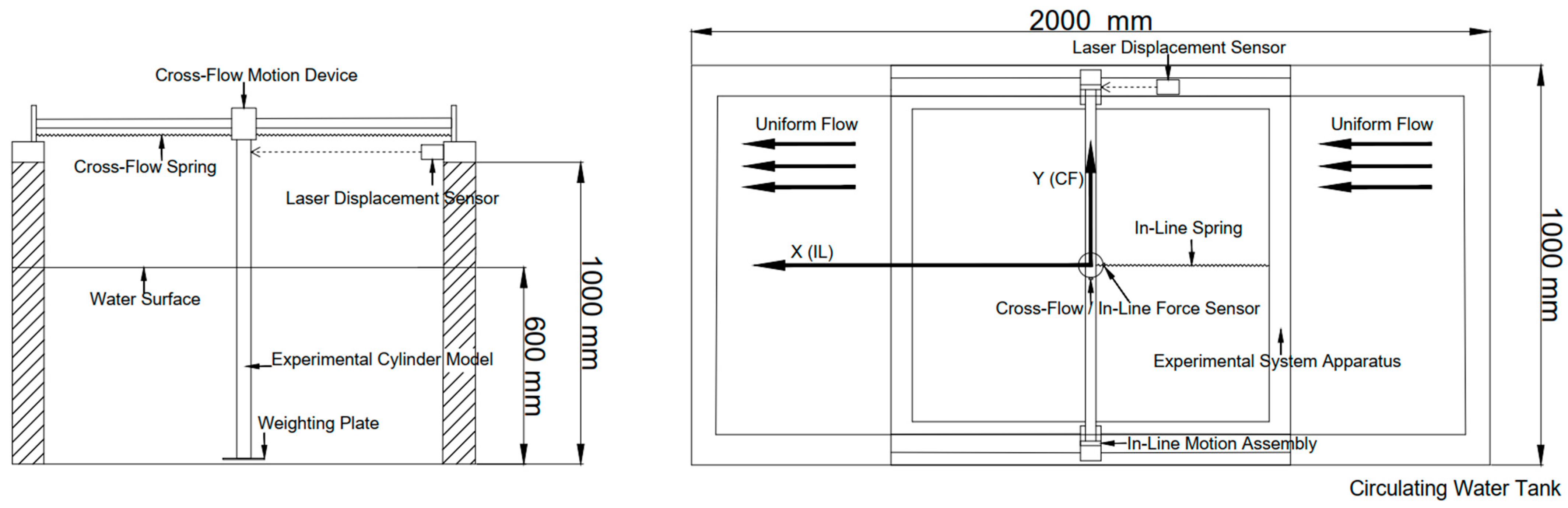
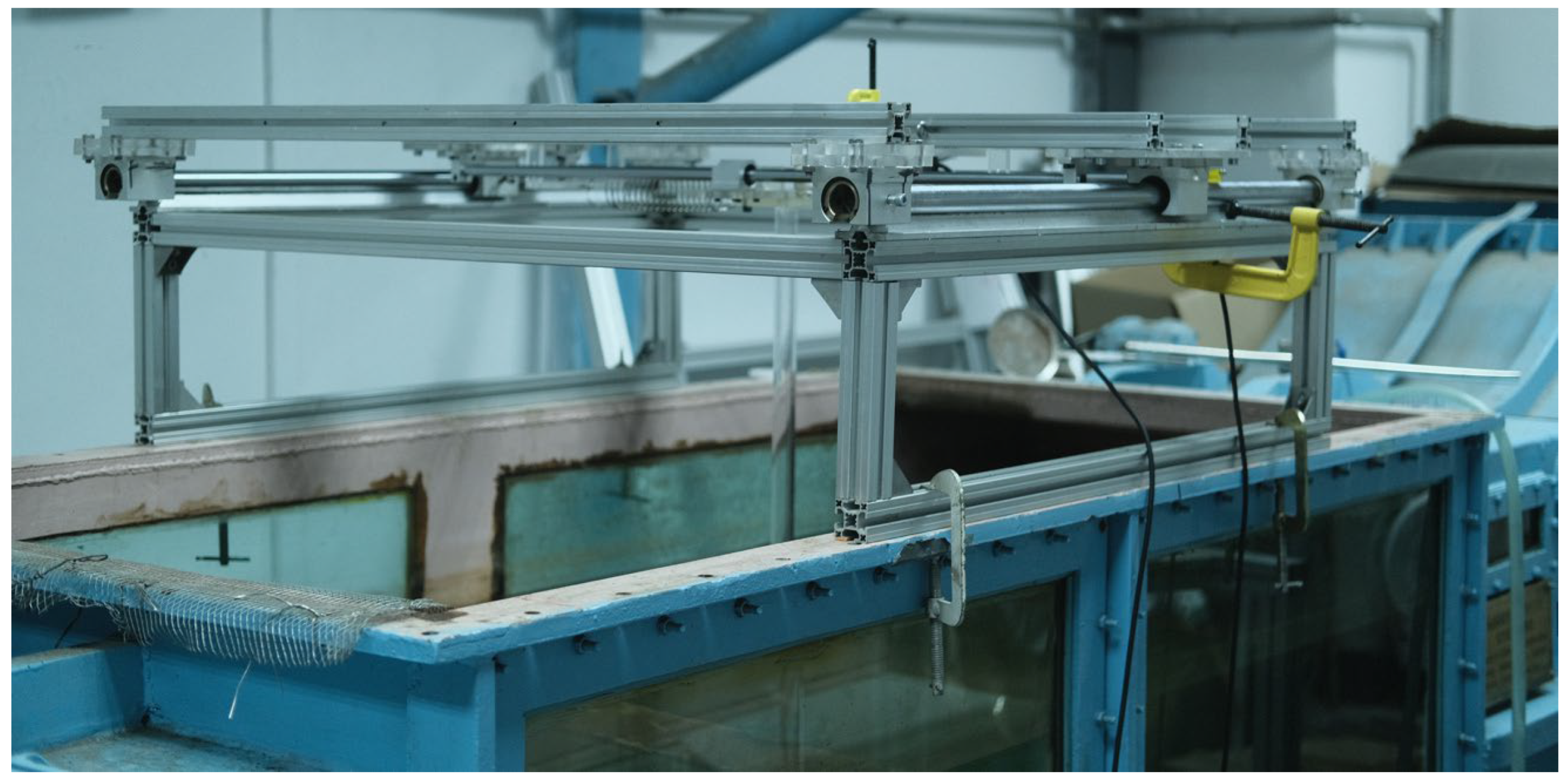
This experiment is conducted in the circulating water channel of Dalian University of Technology. The circulating water channel is shown in Figure 1 and Figure 2, with a test Section 2 m in length, 1 m in width, and 0.6 m in height. In this study, the flow direction is defined as the IL direction, while the oscillations of the cylinder perpendicular to the IL is defined as the CF direction. This experiment was conducted in the circulating water channel at Dalian University of Technology. The test rig is designed to enable 2-DOF oscillations of a vertical rigid cylinder and to allow the natural frequencies to be prescribed to match the target operating conditions:
  • This experimental system ensures a high level of safety and reliability, fully sufficient to withstand the structural strength requirements under the test conditions.
  • This experimental system is designed to incorporate the capability of controlling the structural natural frequency of the test cylinder to the prescribed value, thus ensuring that the experimental data and analytical results possess practical engineering relevance.
  • This experimental system should be integrated with high-precision instruments for measuring the dynamics of the test cylinder, with the present study primarily focusing on the measurement of amplitude data and hydrodynamic force data.
According to the above design principles, an experimental system is implemented in this study, as illustrated in Figure 1. The system enables 2-DOF oscillations of a vertical rigid cylinder through non-interfering sliding rails arranged independently in the CF and IL directions and equipped with corresponding spring elements, allowing the structural natural frequencies to be prescribed. Unlike conventional VIV setups that focus only on displacement measurement, the present system enables synchronized acquisition of structural motion, hydrodynamic force, and wake vorticity at the same vertical location. Details of the selection and arrangement of the test cylinder are provided in the following subsection.
The vibration responses of the cylinder in the CF and IL directions are measured using two laser displacement sensors. The CF sensor has a measuring range of 195 ± 100 mm with a spot size of 700 μm. The IL sensor has a measuring range of 85 ± 15 mm with a spot size of 200 μm. The sampling frequency is set at 500 Hz. Each laser sensor is aligned with the corresponding degree-of-freedom sliding block. The laser beam is projected directly onto the surface of the CF and IL sliders. When the cylinder oscillates, the sliders move together with the structural motion. The displacement of the slider represents the displacement of the cylinder in the corresponding direction. The sensor operates based on optical triangulation. The emitted laser beam is reflected by the target surface. The reflected light is received by an internal photodetector. The position of the reflected spot on the detector varies with the distance between the sensor and the target. This variation is converted into a voltage signal proportional to displacement after internal signal processing and calibration. The analog voltage output is transmitted to the data acquisition system. The signals are sampled at 500 Hz and converted into digital displacement data. For each test condition, the time history of displacement in both CF and IL directions is recorded and stored. These time-resolved displacement data are used to compute vibration amplitude, frequency, and phase relationships. The basic error does not exceed 0.04%. The linearity error does not exceed 0.05%. The return error does not exceed 0.02%. The repeatability error does not exceed 0.02%. These specifications ensure sufficient accuracy for resolving small-amplitude oscillations and phase coupling in the 2-DOF response.
Hydrodynamic forces in the CF and IL directions were recorded using two miniature pressure transducers. In the present study, the term hydrodynamic forces refers to the sensor-based dynamic force signals measured at the cylinder mid-span and aligned with the PIV measurement plane. These signals mainly represent the local pressure-dominated fluid-induced load fluctuations associated with the local wake evolution, and they are used to characterize the coupled force–response behavior of the system. Each sensor had a measuring range of 1 kg and a sampling frequency of 50 Hz, corresponding to a Nyquist frequency of 25 Hz. Based on the measured force data, the maximum dominant frequency in the present experiments was 1.969 Hz, which is far below the Nyquist limit. Therefore, the selected sampling rate was sufficient to capture the peak hydrodynamic load fluctuations associated with the VIV process without aliasing or noticeable loss of signal integrity. Consistent with this, the frequency parameter selection in the PIV measurements was also based on the Nyquist criterion.
The transducers were directly mounted on the cylinder below the free surface and were installed at the same vertical position as the PIV measurement plane. This arrangement reduced end-effect influences on the local measurement and ensured consistency between the force signal and the wake observation plane. After zero adjustment under still-water conditions, the dynamic output mainly reflected the instantaneous force fluctuation caused by the local flow evolution at the installation location.
The sensor operated based on strain-gauge measurement. When the sensor was subjected to external loading, the internal elastic element deformed, and this deformation changed the resistance of the strain gauges. The resistance change was then converted into a voltage signal through a Wheatstone bridge circuit. After calibration, the analog voltage output was transmitted to the data acquisition system, sampled at 50 Hz, and converted into digital data. The time-resolved hydrodynamic force signal in each direction was therefore obtained for every test case. Based on the displacement record under the maximum-amplitude condition, the corresponding acceleration level was about 0.38 m/s2. Even when the whole sensor mass was conservatively taken as 10 g, the corresponding inertia force was only on the order of 10 3 10 2   N . This shows that the additional inertial effect caused by structural vibration was expected to be limited under the present test conditions, and it was not sufficient to change the main physical meaning of the measured dynamic signal. Under the same test condition, the measured force signal also showed a non-in-phase temporal variation relative to the synchronized CF displacement response. This further indicates that the dynamic output was not simply caused by structurally synchronized inertial motion alone. These hydrodynamic force signals were then used together with the synchronized displacement and wake-evolution data to analyze the coupled fluid–structure interaction behavior. The basic error of the sensor did not exceed 0.01%. The linearity error did not exceed 0.02%. The return error did not exceed 0.02%. The repeatability error did not exceed 0.02%.
In addition, a PIV system is incorporated to capture vortex shedding and wake evolution in the vicinity of the cylinder, as described in the following subsection. The data acquisition system is responsible for collecting sensor signals and synchronously recording and storing the PIV images, enabling simultaneous measurement of structural responses and flow-field characteristics.
The experimental system is designed to maintain geometric symmetry and mass balance, thereby minimizing unintended trajectory deviations during testing while ensuring stable and repeatable 2-DOF oscillations of the vertical rigid cylinder.

2.2. Rigid Cylinder Model and Sensors

The experimental rigid cylinder model, designed in accordance with the research objectives and the dimensions of the water channel, has an outer diameter of 30 mm, an inner diameter of 20 mm, and a length of 1000 mm. The model is made of polymethyl methacrylate, with a thin metal counterweight disk installed at the bottom of the cylinder. The thickness of the disk does not exceed 5 mm, and it is positioned close to but not in contact with the bottom of the water channel. By installing and configuring the counterweight disk, the mass ratio m of the experimental cylinder can be adjusted to reach the designed value.
A small clearance is intentionally maintained between the counterweight disk and the bottom of the tank. Such a gap may induce local tip vortices and three-dimensional flow structures near the cylinder end. However, the present study focuses on the mid-span region of the cylinder, where displacement, force, and PIV measurements are conducted. The aspect ratio of the model is large ( L / D 33 ), and the end effects are therefore confined to a limited region near the bottom tip. Their influence on the wake development and vibration response within the measurement zone is considered negligible. Similar quasi-two-dimensional assumptions have been widely adopted in previous experimental studies of rigid cylinders with comparable geometries [6,9].
The natural frequency is prescribed through the equivalent stiffness of the supporting springs. Under the small-amplitude assumption, the system is treated as an equivalent linear oscillator,
f N = 1 2 π k m
where m is the effective structural mass and k is the equivalent stiffness. Accordingly, the IL and CF natural frequencies are prescribed to be identical in design by using the same equivalent stiffness k in both directions.
The designed structural natural frequency is realized by installing springs corresponding to the target stiffness of the specimen. Tension springs are employed, which provide restoring force when stretched beyond their original length. However, when compressed, the springs deform by bending and therefore do not generate any effective restoring force. To achieve the prescribed natural frequency in the CF direction, a spring is installed at each end of the cylinder. In the static state, both springs remain straight at their initial length, and during oscillation, only the spring on one side is stretched to provide the restoring force. In the IL direction, a single spring is installed at the center, with parameters identical to those of the springs used in CF. This design enables the experimental setup to reproduce key features of the local operating conditions, which improves the engineering relevance of the experiments. Within the small-amplitude oscillation range considered in the present study, this configuration is treated as an equivalent linear restoring system. Therefore, under the present equivalent-linear treatment, the same designed natural frequency is adopted for the IL and CF directions, rather than being introduced as two independently measured identical values. The structural damping ratio listed in Table 1 is determined from a free-decay test conducted in air on the same experimental apparatus, using the logarithmic decrement method, and it is used to characterize the structural damping level of the system. Since the CF and IL restoring systems are designed with identical spring parameters, the same calibrated structural damping ratio is adopted for both directions within the present equivalent-linear treatment.
Laser displacement sensors are employed to measure the oscillation amplitudes of the test cylinder. The sensors are mounted on the frame of the experimental system and record amplitude data at the same height in both the CF and IL. Miniature force transducers are employed to measure the hydrodynamic forces acting on the test cylinder in CF and IL. The transducers are waterproofed, securely fixed at the corresponding positions of the cylinder, and performance-tested to ensure they can withstand the experimental conditions without changes in position or orientation, which guarantees the reliability of the experimental data.
The experiments are carried out in fresh water at a temperature of approximately 20 °C. The main physical parameters used for non-dimensionalization are summarized in Table 1.

2.3. PIV System

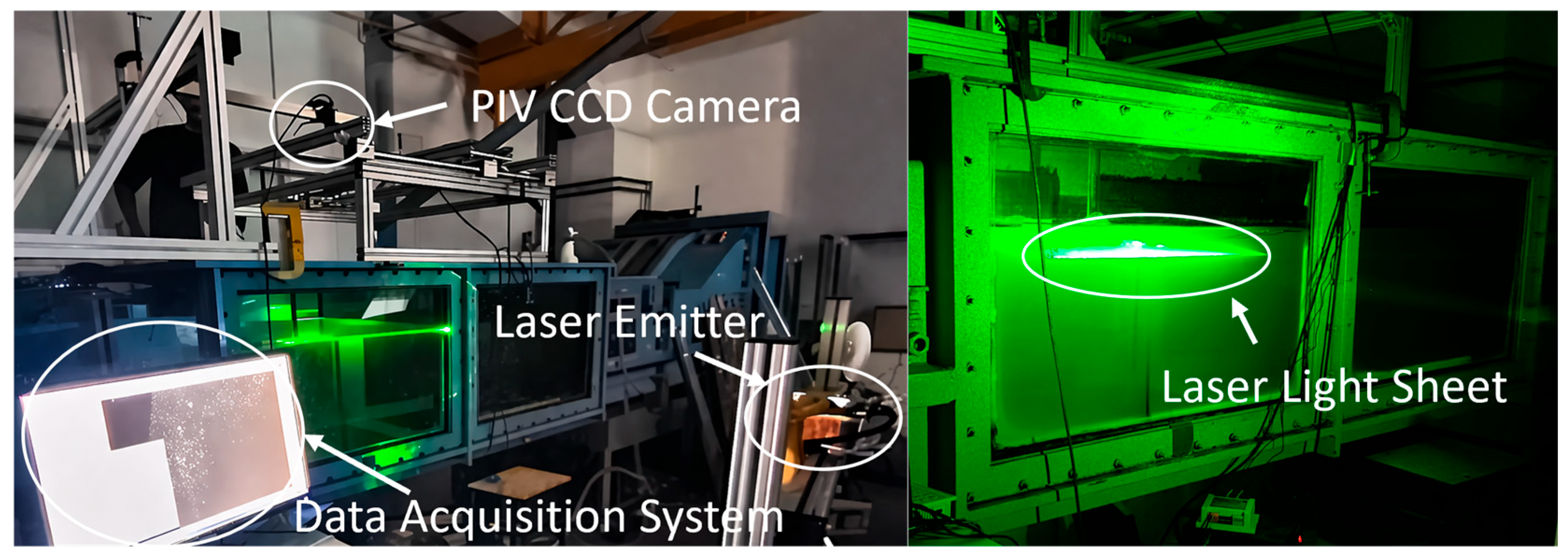
PIV is employed in the present study to capture the velocity field and wake evolution associated with vortex-induced vibration of the rigid cylinder. The PIV system consists of tracer particles, a laser illumination source, and a CCD camera, and provides quantitative flow-field information through image acquisition and post-processing. The CCD camera employed is a GS3-U3-60QS6C-C model manufactured by Point Grey, Richmond, BC, Canada, with a resolution of 1368 × 1096 pixels and a frame rate of 42 fps. A laser emitter (wavelength 532 nm, green light, output power 8 W) is used as the light source, and seeding particles with a mean diameter of 31   μ m and a density of 0.998 g/cm3 are uniformly dispersed in the flow. The corresponding maximum vortex-shedding frequency, estimated from the Strouhal number ( S t 0.2 ) under the highest flow velocity and cylinder diameter, is approximately 5.407 Hz. The selected sampling frame rate satisfies the Nyquist criterion and is sufficient to capture the temporal evolution of the wake dynamics. The PIV measurements are primarily intended to reveal the phase-resolved evolution of wake structures associated with the coupled vibration response, rather than to provide high-precision quantitative turbulence statistics.
The configuration of the PIV system in this experiment is shown in Figure 3, and is arranged as follows:
  • CCD camera is mounted securely above the water channel to ensure full coverage of the measurement region, with imaging parameters adjusted to ensure adequate spatial resolution and image clarity.
  • The laser emitter is positioned at the observation window outside the water channel, with its brightness adjusted to ensure clear imaging by the CCD camera, and the laser light sheet expanded to cover the measurement region.
  • The tracer particles are hollow glass spheres with a mean diameter of 31   μ m , characterized by excellent flow-following capability and scattering properties, with negligible particle–particle interaction under the present seeding conditions.

3. Experimental Data Processing Method

3.1. Definition of Non-Dimensional Parameters

The reliability and applicability of the experimental results are ensured by applying non-dimensional treatment to the physical quantities associated with the dynamic response of the test cylinder prior to data analysis. The definitions of the non-dimensional parameters and the corresponding treatment methods required in this experiment are summarized in Table 2.
In Table 2, m is the mass of the tested cylinder, D is the cylinder diameter, L is the submerged length of the cylinder, A is the vibration amplitude in each DOF, U is the flow velocity in the test condition, F D is the IL force acting on the cylinder, and F L is the CF force acting on the cylinder. For the non-dimensional frequency parameter, f N is the structural natural frequency of the tested cylinder, while f is the actual oscillation frequency during the motion process.
In the present experiments, the m and the structural natural frequency f N are prescribed as 2.4 and 1.28, respectively. The mass ratio m is selected as a representative value for 2-DOF circular-cylinder VIV experiments, so that the system can exhibit clear excitation, lock-in, and post-lock-in responses under the tested conditions, while maintaining comparability with representative experimental studies reported in the literature. The reliability of the experimental data is ensured through careful control of test conditions and consistent data acquisition procedures.

3.2. Uncertainty Analysis

To evaluate the reliability of the present measurements, an uncertainty analysis is carried out for the principal derived non-dimensional parameters, including the amplitude ratio A , frequency ratio f , force coefficients C L and C D , and Strouhal number S t . The uncertainties are estimated using the root-sum-square propagation method based on the accuracies of the displacement sensor, force transducer, flowmeter, and dimensional measurements.
For a derived quantity R = R ( x 1 , x 2 , , x n ) , the relative uncertainty is estimated by
u R R 2 = i = 1 n R x i x i R u x i x i 2
Here, R denotes the derived quantity of interest, x i denotes an independent measured variable, u R is the uncertainty of R , and u x i is the uncertainty of x i . In the present study, A is the measured oscillation amplitude, D is the cylinder diameter, f is the extracted response frequency, f N is the prescribed structural natural frequency, F is the measured force, U is the incoming flow velocity, and L is the characteristic length of the cylinder used in the force-coefficient definition.
According to the definitions of the non-dimensional parameters used in the present study, the corresponding uncertainty expressions can be written as
u A A = u A A 2 + u D D 2
where u A and u D are the uncertainties of the measured amplitude and cylinder diameter, respectively.
u f f = u f f 2 + u f N f N 2
where u f and u f N are the uncertainties of the extracted response frequency and the prescribed natural frequency, respectively.
u C C = u F F 2 + 2 u U U 2 + u D D 2 + u L L 2
where C denotes either C L or C D , and u F , u U , u D , and u L are the uncertainties of force, flow velocity, cylinder diameter, and characteristic length, respectively.
u S t S t = u f f 2 + u D D 2 + u U U 2
where the uncertainty of S t is jointly determined by the uncertainties of frequency, cylinder diameter, and flow velocity. In the present study, the frequency f used in S t is extracted from the displacement response signal, and its uncertainty is therefore estimated based on the sampling interval of the displacement measurement.
The combined uncertainties of the displacement and force measurements are obtained by applying the root-sum-square method to the basic error, linearity error, return error, and repeatability error of the corresponding sensors, as reported in the preceding instrumentation description. The uncertainty of the flow velocity is taken from the specification of the flowmeter. The cylinder diameter and characteristic length are re-measured using a vernier caliper with a resolution of 0.01 mm. For frequency-related quantities, a conservative estimate based on the displacement-signal sampling interval is adopted. Accordingly, the uncertainty of A is determined by the uncertainties of displacement and diameter, the uncertainty of f by the uncertainties of extracted frequency and prescribed natural frequency, the uncertainties of C L and C D by the uncertainties of force, flow velocity, diameter, and characteristic length, and the uncertainty of S t by the uncertainties of frequency, diameter, and flow velocity. The estimated relative uncertainties of the principal measurements and derived non-dimensional parameters are summarized in Table 3.
The uncertainty analysis presented above provides a quantitative basis for assessing the reliability and measurement precision of the present experimental results, and thereby supports the subsequent analysis of the coupled structural response, hydrodynamic loading, and wake evolution.

3.3. PIV Image Processing Method

Raw PIV images require appropriate preprocessing prior to velocity field reconstruction [37]. In the present study, the PIV images are processed using MATLAB R2021b, where CLAHE, high-pass filtering, and Wiener filtering are applied to enhance tracer particle visibility and suppress background noise.
Velocity fields are reconstructed by evaluating the displacement of tracer particles between two consecutive image frames using a multi-pass FFT deformation cross-correlation algorithm. In this procedure, interrogation windows are progressively refined across multiple passes to improve spatial resolution and vector accuracy, while partial window overlap is employed to maintain spatial continuity of the velocity field. The particle displacement within each interrogation region is determined from the peak location of the corresponding cross-correlation function.
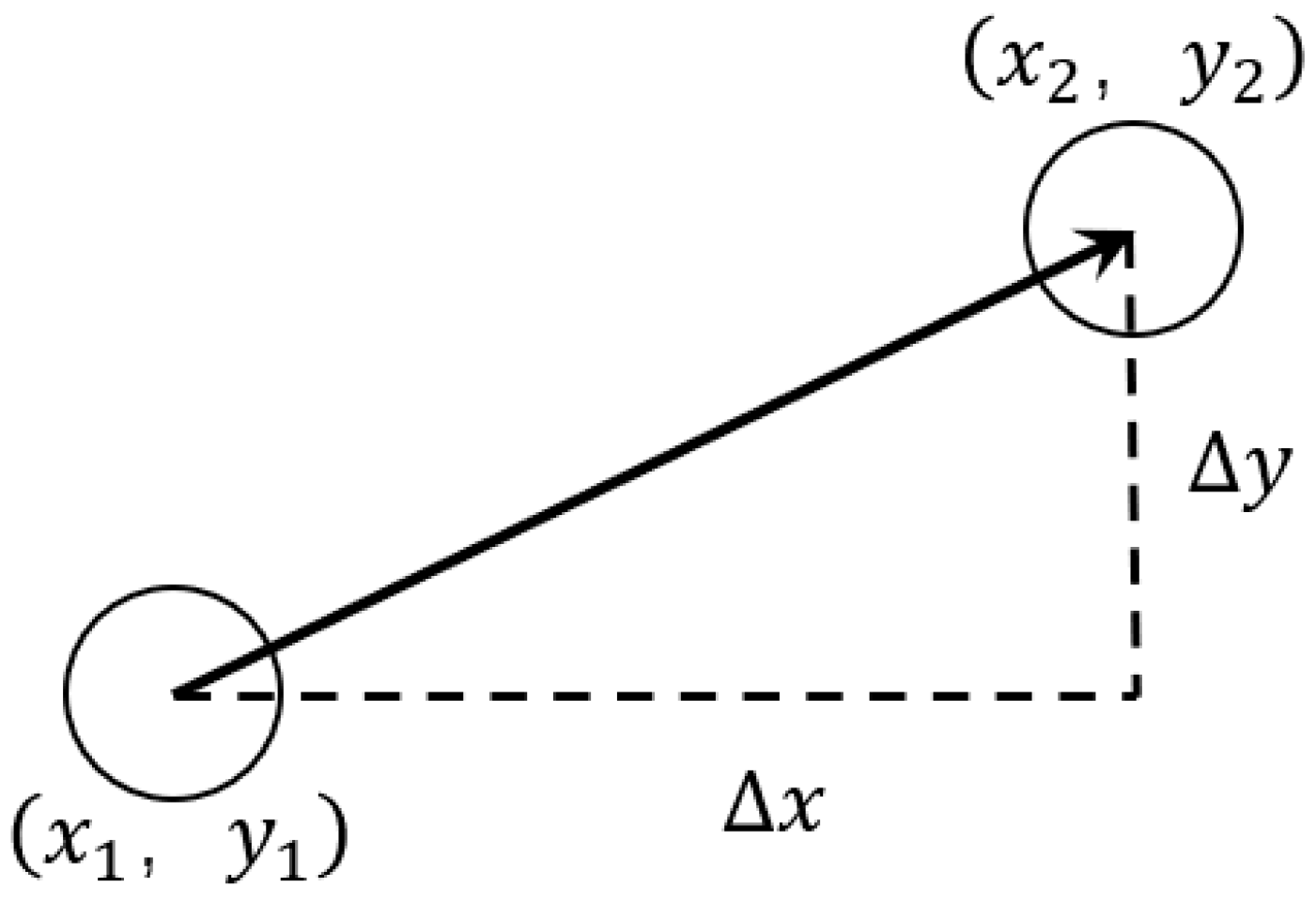
U = x 2 x 1 t 2 t 1 = x t ,   V = y 2 y 1 t 2 t 1 = y t
Based on the measured particle displacements in the x - and y -directions over a time interval t , the velocity components in the IL and CF directions are calculated according to Equation (7). A schematic illustration of the tracer particle displacement between two successive frames is shown in Figure 4.
Prior to the formal experiments, the PIV system is calibrated using reference markers to establish the conversion relationship between pixel coordinates in the camera field of view and the physical spatial scale. This calibration procedure ensures the quantitative accuracy and reliability of the velocity fields and derived flow quantities presented in this study.

4. Results and Discussions

4.1. Experiment Results of the Amplitude Response

This section provides a systematic comparative analysis of the non-dimensional amplitudes and frequencies from the 2-DOF experiments to characterize the dynamic response of the vertical rigid cylinder under VIV excitation. The non-dimensional amplitude results in CF are assessed by comparison with reference data from classical 1-DOF cylinder experiments, which provides a consistency check for the present measurements. Simultaneously, comparison of the IL response shows a distinct distribution of response amplitudes under 2-DOF conditions. Six representative cases are selected to characterize the typical stages of the VIV evolution process. The initial excitation stage ( U = 2.21 ) marks the onset of the VIV phenomenon, where the vibration amplitude gradually increases from rest while remaining relatively small. The early lock-in stage ( U = 4.19 ) is associated with the establishment of frequency synchronization between the structure and the flow, leading to a significant amplification of the vibration response and enhanced fluid-structure coupling. The core lock-in stage ( U = 5.23 ) is characterized by robust and stable synchronization between the vibration and vortex-shedding frequencies, producing nearly steady periodic oscillations and the most efficient energy exchange within the system, and is therefore treated as a representative phase in VIV studies. The late lock-in stage ( U = 7.08 ) exhibits increasing wake asymmetry and turbulence, indicating that the system is about to leave the lock-in region. The desynchronization stage ( U = 9.11 ) represents the termination of lock-in, during which vortex shedding returns to an unsynchronized state. The high-velocity stage ( U = 12.94 ) is dominated by turbulence, where vortex shedding becomes irregular and the VIV signature weakens markedly. The subsequent analyses of hydrodynamic responses and vortex-field evolution are also conducted based on the above stages.
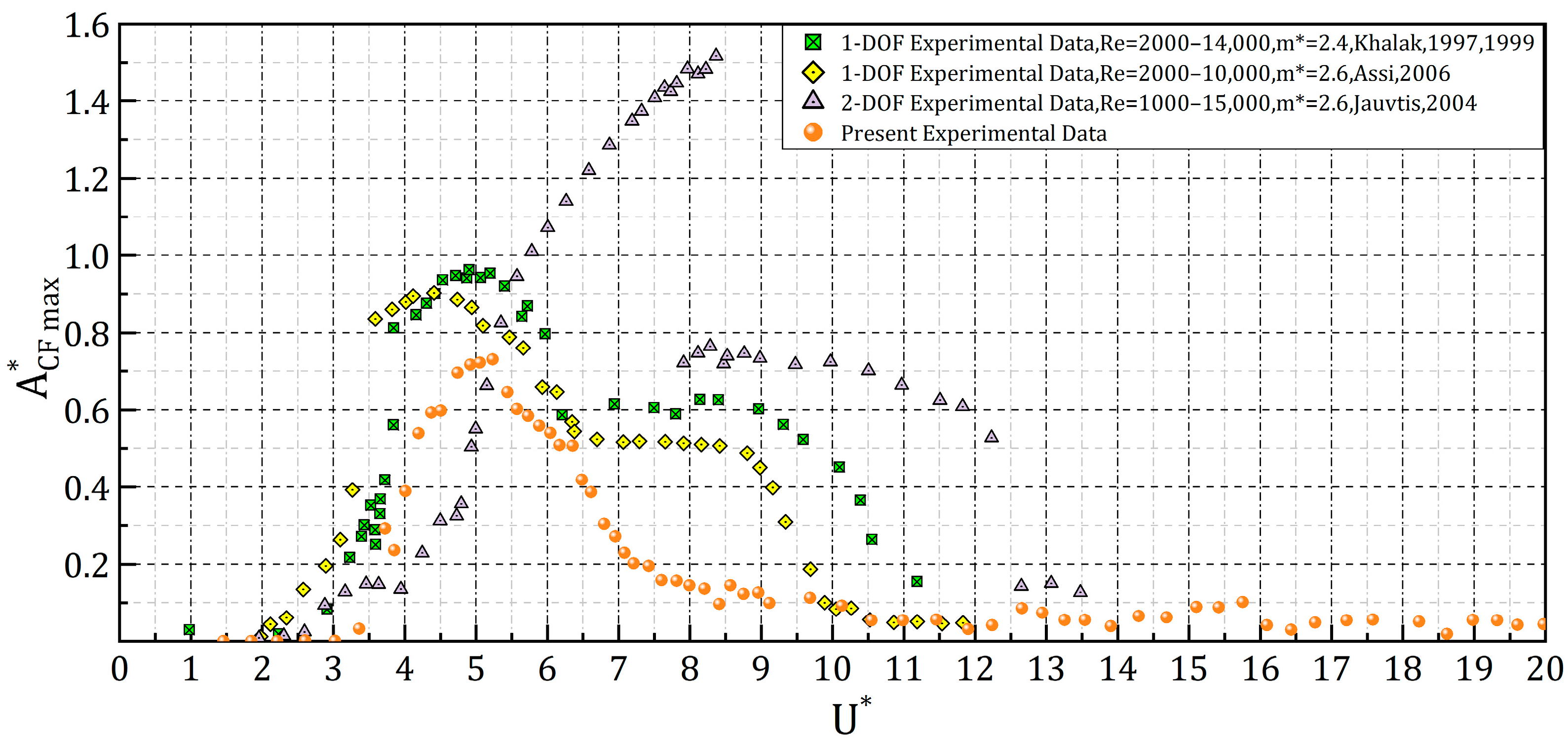
Figure 5 compares the maximum non-dimensional CF amplitude A C F   m a x of the present 2-DOF cylinder with previously published experimental results obtained at similar m [5,6,31,38]. In all cases, the amplitude increases with U , reaches a peak in the lock-in region, and then decreases as U increases further. The general lock-in trend is consistent. However, quantitative differences are evident. The 1-DOF experiments [5,6,38] show peak amplitudes close to unity. In the present results, the maximum value is about 0.7 at U 5.0 5.5 , and the lower branch is smoother with a more gradual amplitude growth. The 2-DOF experiments of Jauvtis and Williamson [31] show a higher peak level and the presence of a super-upper branch under low mass–damping conditions. In the present study, no super-upper mode is observed within the investigated parameter range. This difference is mainly related to the mass–damping parameter. When the mass–damping level is low, fluid energy input can more easily overcome structural dissipation, and additional upper branches can develop. When the mass–damping level increases, energy dissipation becomes more significant, and the response amplitude is moderated. In addition, the present configuration allows motion in both CF and IL directions. Part of the hydrodynamic energy is redistributed from CF motion to IL motion. This redistribution reduces the concentration of response energy in the CF direction and contributes to the lower peak amplitude compared with the low mass–damping 2-DOF case reported by Jauvtis and Williamson.
Figure 6 compares the maximum non-dimensional amplitudes in the CF direction and the IL direction. The CF amplitude is much larger than the IL amplitude over the full range of U . This shows that the CF motion dominates the VIV response. Inside the lock-in region, the IL amplitude rises at the same U where the CF amplitude approaches its peak. This indicates a clear CF–IL coupling. The hydrodynamic loading is not confined to the CF direction. Part of it is transferred to the IL direction through the coupled 2-DOF motion and the nonlinear flow–structure interaction. The IL motion is therefore not an independent response. It is mainly activated by the CF oscillation during lock-in. A useful comparison can be made with the 2-DOF experiments of Jauvtis and Williamson. Their data show stronger IL participation and different branch features. The main reason is the difference in the mass–damping parameter. A lower mass–damping level allows a larger response to develop and makes the IL component easier to sustain. A higher mass–damping level increases dissipation and reduces the IL amplitude. This difference is consistent with the present trend, where the IL amplitude remains smaller than the CF amplitude even when coupling is strongest. The force analysis and the PIV results discussed later are used to support this coupling and the related wake changes.
Frequency is a key variable in this experiment. The cylinder is designed with the same natural frequency in CF and IL. Therefore, the evolution of frequency with U is important. Figure 7 shows the non-dimensional CF and IL frequencies as functions of U . In the lock-in range, approximately U = 4.5 8.5 , the CF frequency forms a clear plateau. In this interval, the dominant CF frequency remains close to the structural natural frequency. This behavior represents classical VIV lock-in. Outside this range, the CF frequency increases with U . It gradually follows the linear trend predicted by the Strouhal relation. The IL frequency behaves differently. Near the onset of lock-in, it approaches the CF frequency. In the middle and late lock-in stages, deviations appear. The IL frequency does not remain strictly constant. This indicates that the IL motion is mainly driven by the CF oscillation, but it is also affected by CF–IL coupling and flow nonlinearity. As a result, its frequency response is more variable. The ratio f C L / f I L   decreases from 0.8781 at the initial excitation stage to 0.5640 in the late lock-in stage. During desynchronization, the ratio increases to 0.6410. This change reflects stronger IL participation inside the lock-in region, while CF remains dominant. A comparison with the 2-DOF experiments of Jauvtis and Williamson shows different frequency branch characteristics. In their study, stronger IL participation and additional frequency features were observed. The main cause is the difference in the mass–damping parameter. Lower mass–damping conditions allow IL motion to persist and develop more complex frequency components. In the present system, the mass–damping level is higher. Structural dissipation limits the growth of IL oscillation. Therefore, the IL frequency curve is less extended and remains secondary to the CF plateau.
The results in Figure 5, Figure 6 and Figure 7 collectively reveal a stage-dependent hydrodynamic load-redistribution mechanism in the present 2-DOF system, rather than isolated amplitude or frequency variations. First, Figure 5 shows that the CF amplitude reaches a moderated peak and exhibits a smoother lower branch compared with both classical 1-DOF cases and the low mass–damping 2-DOF configuration of Jauvtis and Williamson. This reduction is not merely quantitative. It indicates that the hydrodynamic load induced by vortex shedding is no longer concentrated solely in the CF direction. Instead, under coupled 2-DOF conditions, part of the load is redistributed between directions, which limits CF peak growth and reshapes the branch structure. Second, Figure 6 demonstrates that IL motion does not emerge as an independent excitation branch. Although CF motion remains dominant, the IL amplitude increases distinctly inside the lock-in region. This increase reflects a coupling-induced load-transfer pathway in which hydrodynamic loading is partially redirected from CF to IL through structural interaction. The response therefore departs from the single-direction load balance that characterizes 1-DOF systems. Third, Figure 7 shows that the CF frequency forms a stable lock-in plateau, while the IL frequency exhibits stronger variability. The CF component governs the primary synchronization rhythm, whereas the IL component reflects nonlinear inter-DOF coupling. The absence of a comparable IL frequency plateau explains why IL amplitude growth is accompanied by increased frequency variability. Compared with low mass–damping configurations reported in earlier studies, the present system operates under a different load balance. The combined effects of structural dissipation and bidirectional motion prevent excessive load concentration in CF and suppress the development of additional upper branches. As a result, amplitude growth remains moderated, synchronization remains CF-dominated, and no super-upper branch appears within the investigated parameter range. Taken together, the moderated CF peak, the coupling-induced IL activation, and the distinct CF–IL frequency behavior constitute a unified dynamic mechanism governed by hydrodynamic load redistribution. The additional structural freedom reshapes the directional distribution of hydrodynamic loading and modifies the synchronization structure of vortex-induced vibration. This quantitative linkage between amplitude moderation, frequency organization, and directional load redistribution clarifies how 2-DOF coupling alters the classical VIV response framework.
During the VIV process, periodic vortex shedding in the wake causes the surface pressure on the cylinder to reverse periodically along the CF direction, forming the dominant oscillatory component of the lift coefficient C L . Consequently, the dominant frequency of C L corresponds closely to the vortex-shedding frequency, making f C L a reliable observable proxy for the vortex-shedding frequency. Compared with directly extracting the shedding frequency from the flow field, the lift signal provides a higher signal-to-noise ratio and stronger correlation with structural response, making it particularly suitable for quantitative analysis of energy transfer and coupling mechanisms in VIV. Table 4 presents the non-dimensional frequency results for representative VIV stages. Combined with Figure 7, it can be observed that the vibration frequencies of the structure and hydrodynamic forces in the2-DOF rigid cylinder exhibit systematic evolution across different VIV stages, which differs significantly from that of a single-DOF system. In the CF direction, the structural non-dimensional frequency f C F and the dominant lift frequency f C L remain highly consistent within the lock-in region, with a frequency difference below 0.01; notably, during the core lock-in stage ( U = 5.23 ), the relative deviation is only 0.34%. This consistency suggests that the wake vortex shedding is effectively modulated by the CF structural response, approaching near-synchronization. Unlike the idealized single-DOF theory predicting perfect lock-in at f = 1.0 , the experimental results show a maximum frequency ratio of about 87%, revealing a sub-lock-in deviation caused by damping and three-dimensional wake effects that cannot be neglected in real flow conditions.
The IL response exhibits a pronounced flow–structure coupling enhancement, with its structural vibration frequency increasing from 0.87623 in the initial excitation stage to 1.28701 (+46.9%) in the core lock-in stage, and further reaching 1.53826 (+75.6% relative to the initial stage) in the late lock-in stage. The corresponding frequency deviation from the natural frequency reaches up to +53.8%, indicating a significant amplification and high-frequency shift of the IL response driven by inter-DOF energy transfer. Meanwhile, the dominant drag coefficient frequency f C D remains highly consistent with the IL structural frequency, with a relative deviation below 0.22% (as low as 0.013%) except for the initial excitation case. This consistency supports the view that nonlinear hydrodynamic loading in the IL direction tends to act as a primary energy-output channel in the present cases. Moreover, the harmonic relation f C D 2 f C L further validates the nonlinear modulation and load redistribution mechanisms inherent in 2-DOF VIV. Compared with classical single-DOF theoretical predictions, the present results reveal distinct discrepancies in lock-in range, frequency amplitude, and response coherence, highlighting the higher-order coupling and nonlinear effects that may be associated with realistic experimental conditions.
The oscillation trajectories provide a phase-space description of the 2-DOF VIV response. Six representative reduced velocities are selected, and the CF–IL trajectories are shown together with LOWESS fitted curves. Similar trajectory evolutions have been widely reported in previous 2-DOF studies, where line-like motion, elliptical loops, and contracted clusters correspond to the excitation, lock-in, and desynchronization stages [6,9,31,39]. However, the present study does not only reproduce these geometric patterns. It further examines how the evolution of trajectory shape and enclosed area reflects stage-dependent load redistribution and coupling strength in the 2-DOF system, thereby clarifying how CF-dominant motion activates IL motion during lock-in and how this coupling weakens after desynchronization.
At low U (Figure 8a,b), the trajectories collapse into nearly straight lines aligned with the CF axis, and the IL displacement remains very small. Similar line-like trajectories have been reported in weak-coupling regimes of 2-DOF cylinders. In the present case, this pattern indicates that hydrodynamic loading acts mainly in the CF direction, structural coupling is weak, and IL motion remains passive. The response therefore approaches a 1-DOF CF-dominated VIV mode. When the system enters the lock-in region (Figure 8c), the trajectories expand rapidly and form large closed loops with smooth elliptical shapes, which are also characteristic of strong lock-in reported in earlier experiments. In the present system, the increase in IL amplitude occurs simultaneously with the CF peak region identified in Figure 5, indicating that part of the hydrodynamic loading driving CF motion is redistributed to IL motion through structural interaction. The enlargement of the enclosed phase-plane area reflects increased participation of IL in the synchronized VIV response. Compared with the low mass–damping configuration reported by Jauvtis and Williamson, the present trajectories remain more compact and do not exhibit excessively large loops or additional upper branches, suggesting moderated amplitude growth under the current structural configuration. Near the end of the lock-in region (Figure 8d), the loops shrink and transform into a narrow V-shaped pattern. Similar degenerated trajectories have been observed close to desynchronization in previous studies. In the present case, the reduction of enclosed area corresponds to decreasing IL amplitude and gradual loss of synchronization, while CF motion still dominates. In the desynchronization region (Figure 8e,f), the trajectories contract further and cluster near the origin, consistent with non-synchronized responses documented in earlier VIV research. Both CF and IL amplitudes become small, and the motion becomes weak and irregular. Unlike the low mass–damping system, the present configuration does not develop complex additional branches, and the response decays smoothly as synchronization is lost. Overall, the trajectory evolution from straight-line motion to large closed loops and finally to contracted clusters demonstrates how coupling develops and then weakens with increasing U . The CF motion remains dominant, while IL motion is activated inside the lock-in region through load redistribution and decreases after desynchronization. The trajectory variation therefore provides phase-space evidence of controlled coupling intensity and stage-dependent load redistribution in the present 2-DOF VIV system.
Figure 9 compiles the LOWESS fitted curves under all representative conditions and presents a compact phase-space representation of trajectory evolution with increasing U . The variation of trajectory size, inclination, and enclosed area reflects systematic changes in coupling intensity and hydrodynamic load redistribution within the 2-DOF system. At low U , the fitted curve remains close to a straight line along the CF axis. The IL component is negligible. This indicates that hydrodynamic loading acts primarily in the CF direction and structural coupling is weak. As U increases into the lock-in region, the fitted curve expands into a pronounced inclined elliptical loop. The enlargement of the enclosed area corresponds directly to the CF amplitude peak shown in Figure 5 and the frequency synchronization plateau shown in Figure 7. This indicates that the strongest CF–IL interaction occurs within the lock-in range. The inclination of the loop reflects phase coupling between the two DOF and demonstrates that part of the hydrodynamic energy driving CF oscillation is redistributed to IL motion. With further increase in U , the loop contracts and gradually approaches a narrow pattern. The reduction of enclosed area is consistent with the decay of IL amplitude and the loss of frequency synchronization beyond lock-in. Unlike low mass–damping 2-DOF systems reported in earlier literature, the present system does not develop excessively enlarged loops or additional branches. Instead, the trajectory evolution remains controlled and smooth. Therefore, Figure 9 integrates phase-space geometry with amplitude and frequency behavior, providing direct evidence that amplitude moderation, IL activation, and synchronization loss are linked through stage-dependent energy redistribution in the present 2-DOF configuration.

4.2. Experiment Results of the Hydrodynamic Force

The hydrodynamic force acting on the structure governs the amplitude and frequency characteristics of the oscillations and directly reflects the governing principles of fluid–structure interaction. In this section, the non-dimensional lift and drag are presented to illustrate the patterns and differences in the hydrodynamic response of the 2-DOF rigid cylinder. The modulation of the hydrodynamic-force peak magnitude and plateau width by hydrodynamic load redistribution and coupling within a 2-DOF rigid cylinder oscillations is discussed and interpreted based on the measured responses. These findings provide mechanics-based evidence for analyzing the dynamical response and VIV of the 2-DOF rigid cylinder oscillations.
Figure 10 presents the evolution of the maximum hydrodynamic force coefficients with increasing U . Upon entering the lock-in region, C L   m a x rises sharply and exhibits a pronounced primary peak in the low–to–intermediate U range, indicating phase coherence between CF vortex shedding and the structural natural frequency, which drives the C L fluctuations to their maximum. With further increases in U , the coherence of the CF and IL responses diminishes, and C L   m a x decays rapidly toward a low level. By contrast, the peak of C D   m a x is delayed and, over higher U , develops into a broad and persistent high-value plateau within which mild undulations and local secondary maxima are observed. This behavior reflects persistent amplification of the relative-velocity contribution in the IL under coupling, accompanied by superposed multi-modal components.
The systematic difference in peak sequence and curve morphology shown in Figure 10 provides direct quantitative support for the stage-dependent hydrodynamic load-redistribution mechanism identified in Figure 5, Figure 6 and Figure 7. The CF-dominated oscillations strengthen first and decay earlier, while the IL-related response exhibits delayed amplification and persists over a broader U interval. This sequential evolution is not a trivial manifestation of CF–IL coupling. It reflects a directional redistribution of hydrodynamic loading during the lock-in process. Specifically, the early and sharp peak in C L   m a x indicates that hydrodynamic loading initially concentrates in the CF direction as synchronization is established. As U increases further, the rapid decay of C L   m a x together with the delayed and plateau-like development of C D   m a x indicates that part of the hydrodynamic load is progressively sustained in the IL direction. The broader high-level band of C D   m a x demonstrates that IL-associated loading remains effective even after the CF component begins to weaken. These load-sequence characteristics are consistent with the frequency organization shown in Figure 7, where the CF frequency forms a stable lock-in plateau while the IL frequency exhibits greater variability. They also agree with the trajectory expansion and contraction observed in Figure 8 and Figure 9 and the wake-structure evolution discussed in the subsequent PIV analysis. Together, these results establish a coherent load–response–wake linkage: CF dominance governs the onset of synchronization, IL coupling becomes amplified within lock-in, and hydrodynamic loading is directionally redistributed as the system transitions toward desynchronization.
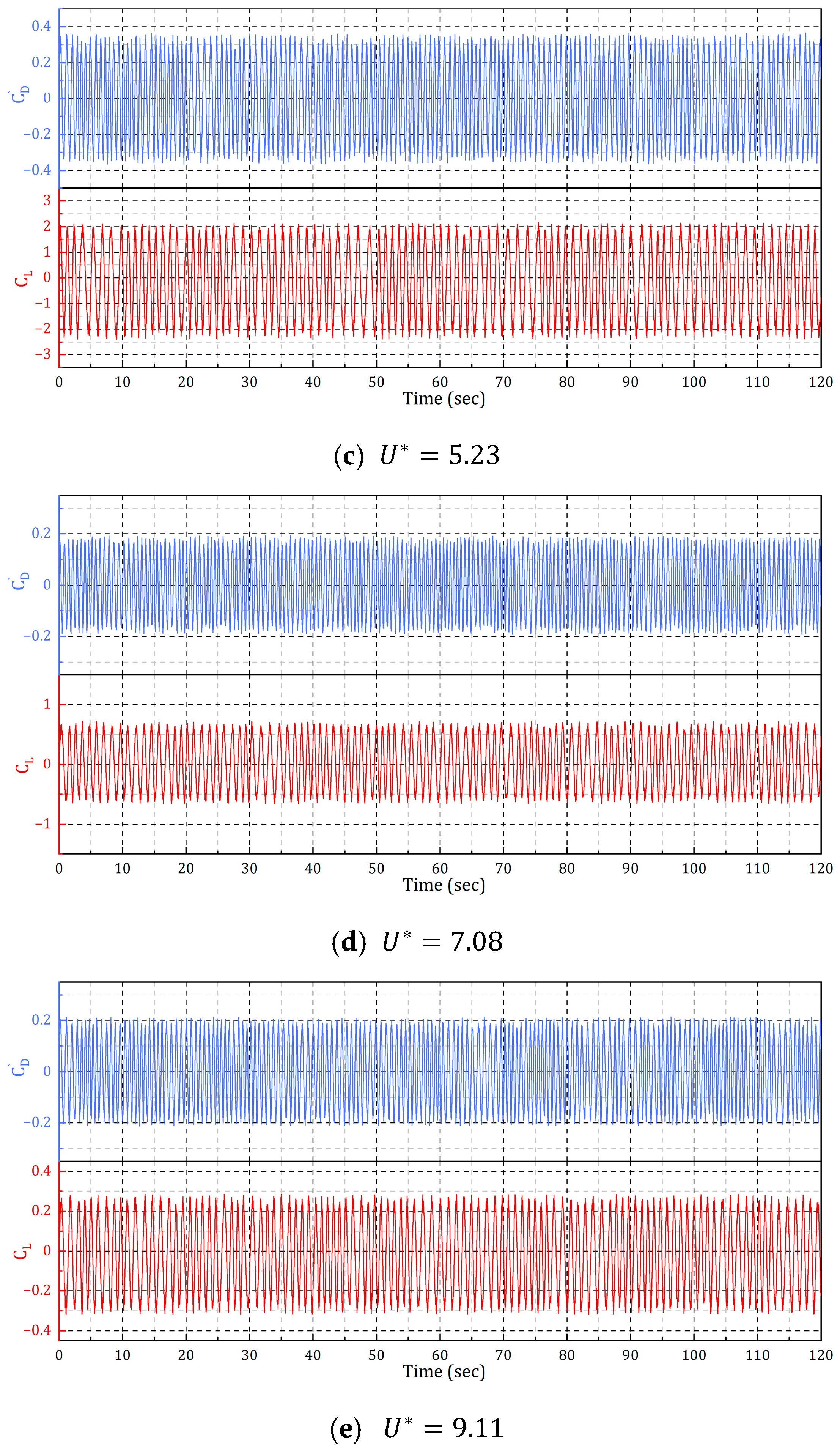
Figure 11 presents the time histories of C L and the fluctuating component of C D for five representative reduced velocities. For clarity, the mean value of C D is subtracted before plotting, and only the oscillatory component is shown to better resolve the temporal fluctuations. For each condition, a temporally steady segment of the signal is selected for analysis to ensure statistical representativeness. At low U (Figure 11a), both C L and C D exhibit small-amplitude fluctuations with weak periodicity. The signals show limited coherence and low energy content, which corresponds to the small vibration amplitudes observed in Figure 5 and indicates weak fluid–structure interaction. In the early lock-in region (Figure 11b), the oscillation amplitude of C L increases rapidly and a clear periodic pattern emerges. The enhancement of C L occurs earlier and more prominently than that of C D , which is consistent with the peak-sequence difference shown in Figure 10. The strengthening of lift fluctuations reflects the onset of phase synchronization between vortex shedding and the structural natural frequency. Within the core lock-in region (Figure 11c), the largest oscillations are observed. Both coefficients display high-amplitude and temporally stable periodic behavior over long time intervals. The strong coherence of C L confirms the frequency plateau identified in Figure 7, while the sustained oscillatory component of C D indicates continued coupling effects in the IL direction. This stage corresponds to the maximum vibration amplitudes and the strongest CF–IL interaction, as previously identified in the displacement and trajectory analyses. Near the end of the lock-in region (Figure 11d), the fluctuation amplitudes of both coefficients decrease. The periodicity becomes less stable and slight amplitude modulation appears. The decay of C L is more pronounced, while the oscillatory component of C D remains relatively persistent for a longer interval. This temporal difference aligns with the broader plateau-like behavior of C D observed in Figure 10 and provides time-domain evidence of stage-dependent load redistribution. In the desynchronization stage (Figure 11e), the oscillations further weaken and approach small, irregular fluctuations around zero. The coherence between fluid forcing and structural response is lost. Both coefficients exhibit reduced amplitude and diminished periodic stability, consistent with the collapse of the lock-in plateau in Figure 7 and the contraction of phase trajectories shown in Figure 9.
Overall, the evolution of the force signals from weak fluctuations to strong synchronized oscillations and finally to attenuated irregular behavior is consistent with the staged changes of vibration amplitude and frequency. The earlier amplification of C L and the comparatively sustained oscillation of C D provide direct time-domain support for the peak-sequence difference and load redistribution mechanism identified in Figure 10. Together with the displacement, frequency, and trajectory analyses, these results establish a coherent evidence chain linking force evolution, synchronization dynamics, and stage-dependent coupling behavior in the present 2-DOF VIV system.

4.3. PIV Vorticity Field Analysis

The preceding analysis of structural oscillation amplitudes and hydrodynamic force responses provides an interpretation of the dynamical response behavior of the 2-DOF rigid cylinder. However, a comprehensive analysis of VIV necessitates an examination from the perspective of the flow field. Therefore, a comparative analysis of the vorticity field under representative conditions provides a direct reflection of the changes in wake patterns at different stages. It also is consistent with the results of amplitude, frequency, and force coefficients, supporting the coupling mechanism between CF and IL responses.
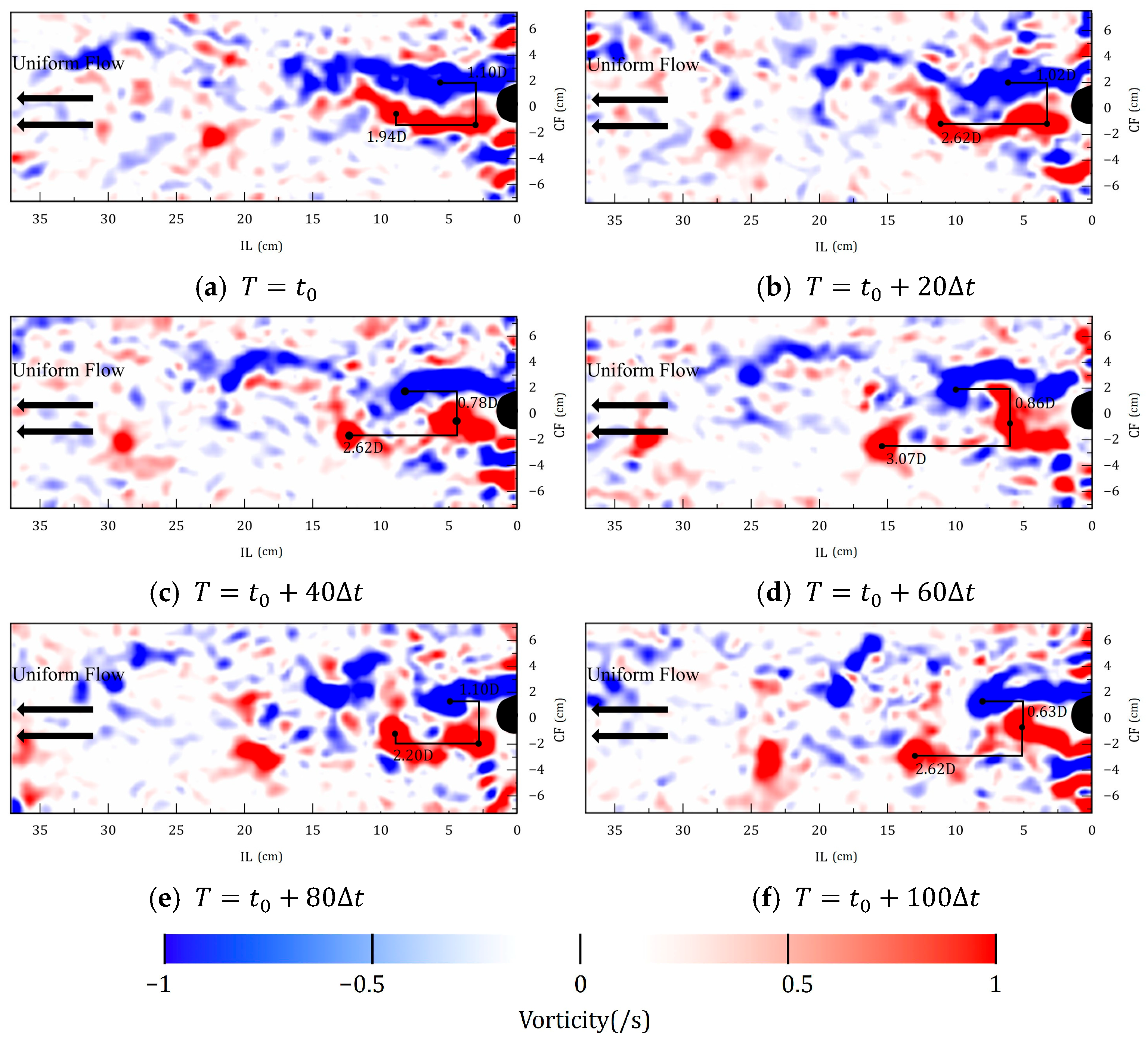
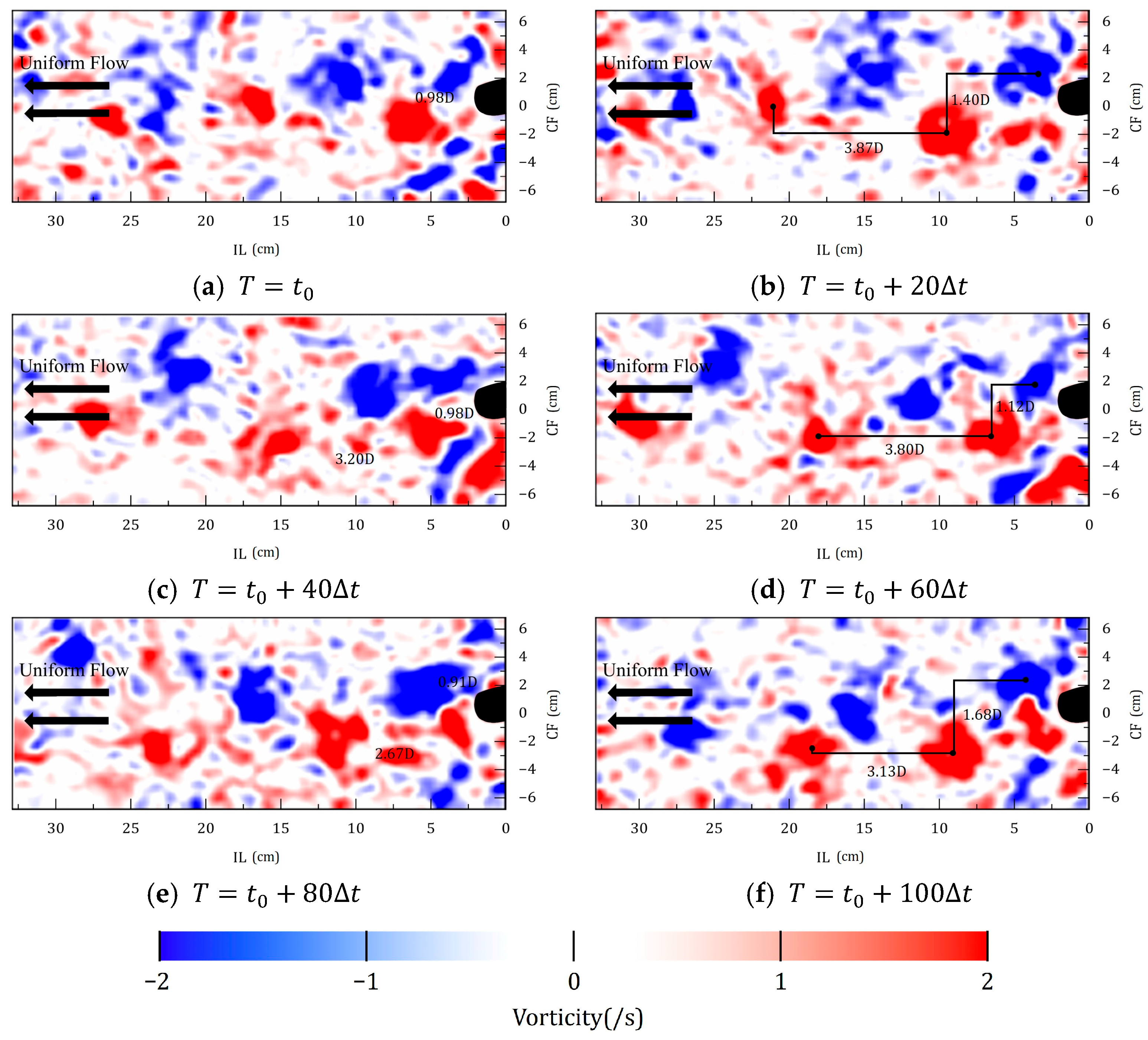
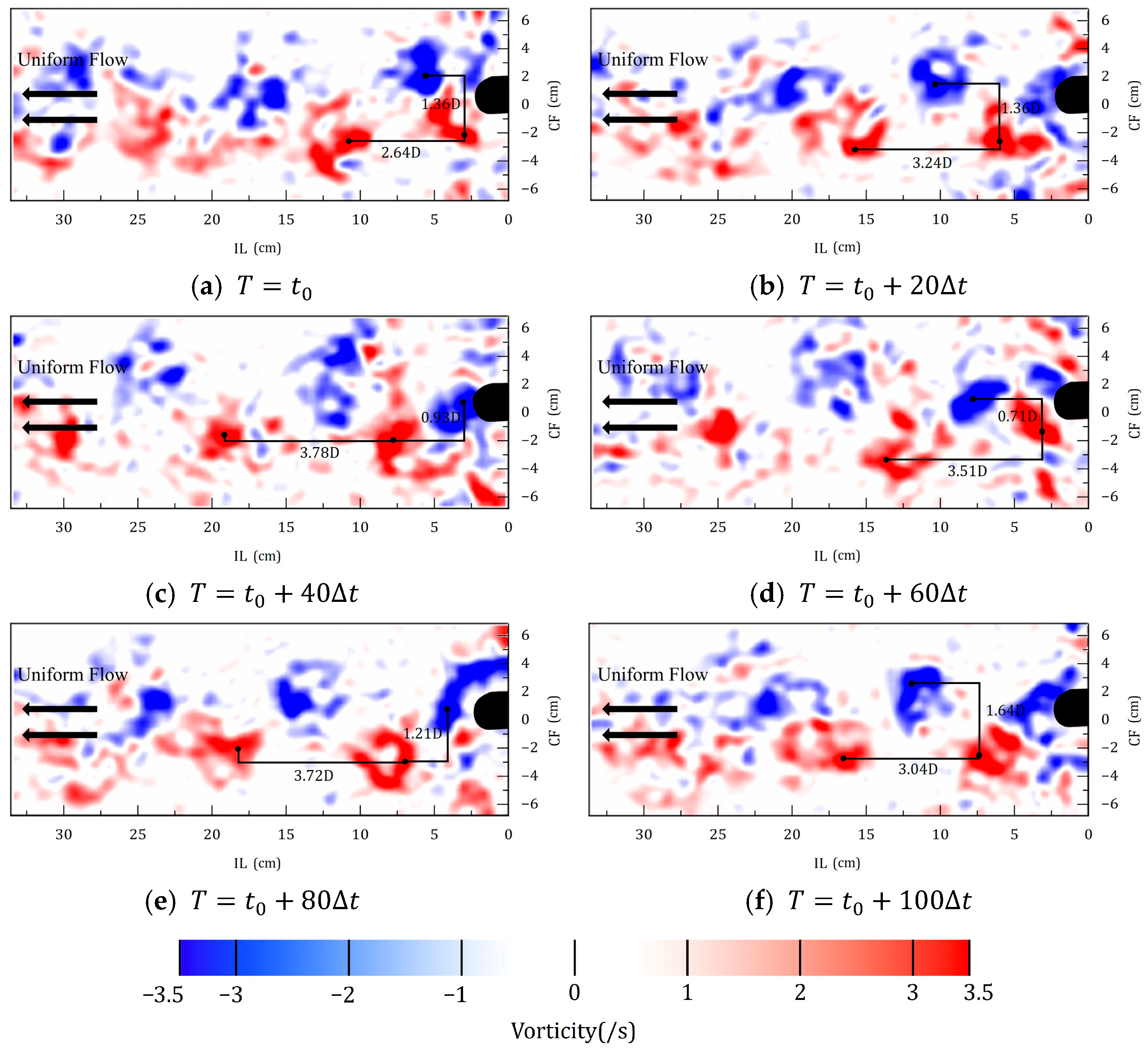
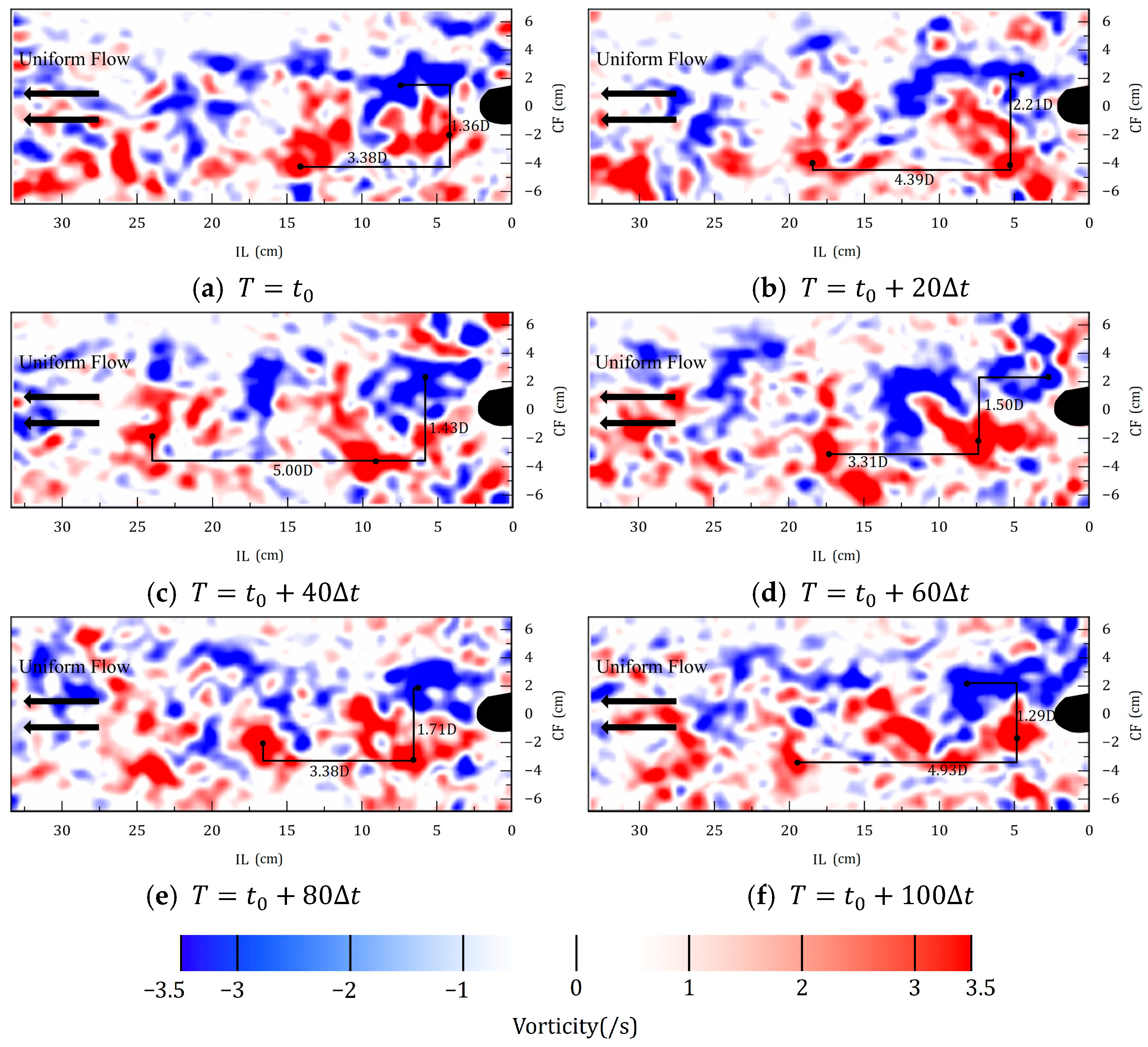
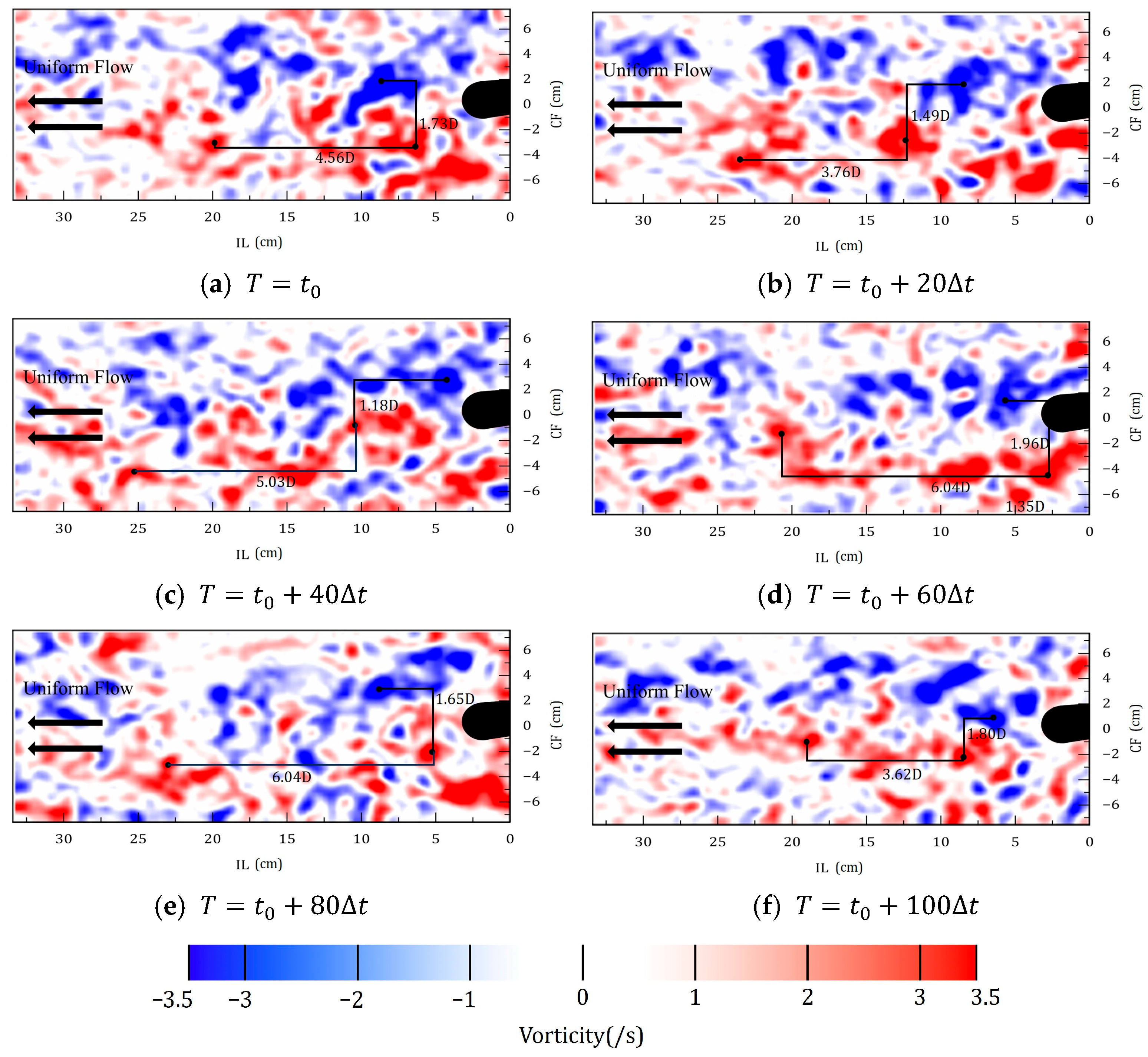
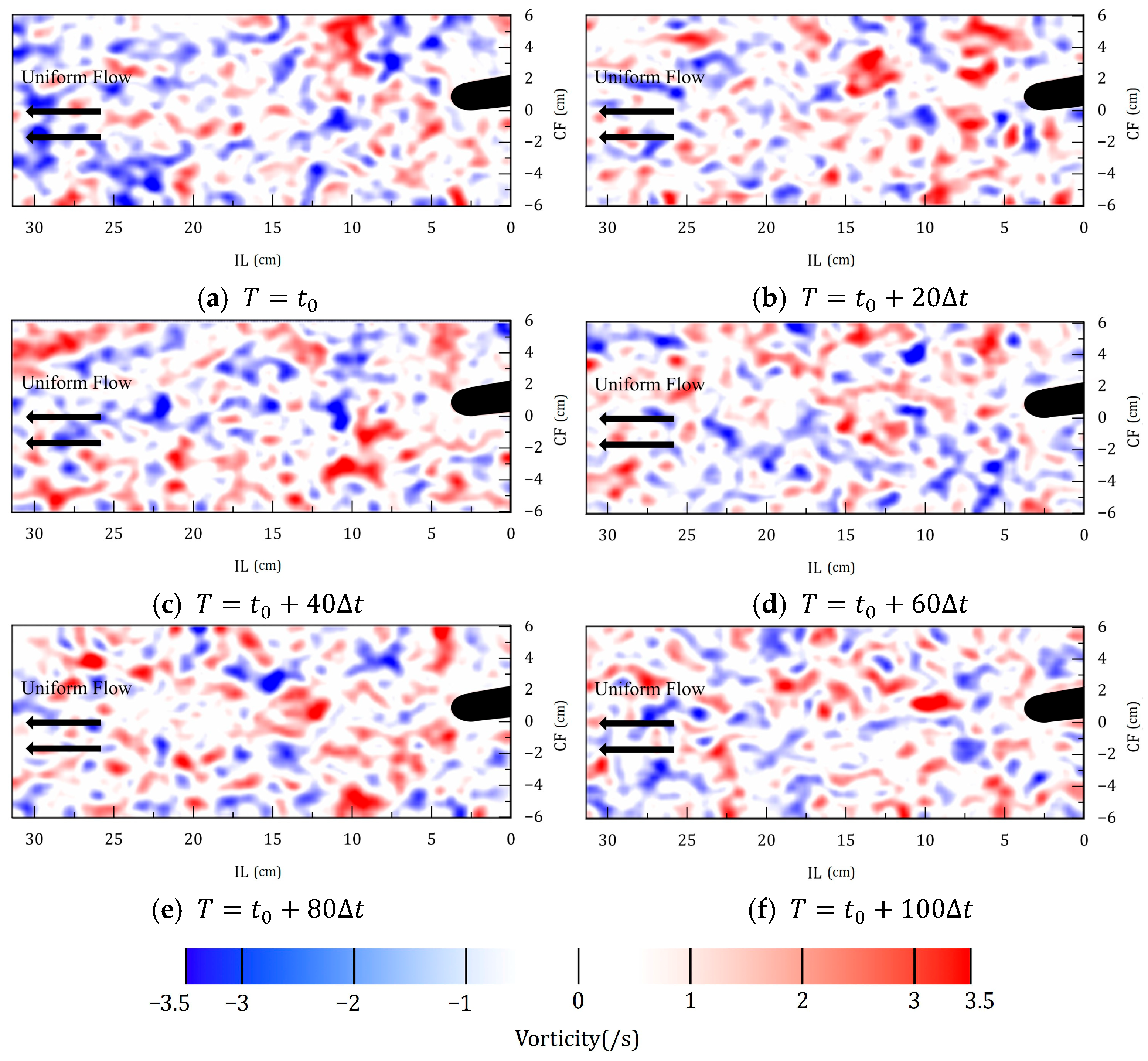
Figure 12, Figure 13, Figure 14, Figure 15 and Figure 16 presents the six representative conditions, corresponding to the analysis in Figure 8, as discussed above. For each case, six instantaneous vorticity fields separated by 20 t ( t = ( 1 / 42 ) s ) are selected to illustrate the temporal evolution of the wake. The direction of the uniform flow is indicated by the black arrows, the spatial scale is marked, and the region occupied by the cylinder is masked. Owing to the perspective distortion of the wide-angle PIV camera and the subsequent image-processing procedure, the masked projection of the cylinder appears elongated rather than circular in the field of view. This black region therefore represents the optical projection of the cylinder rather than its true geometric cross-section. The wake structures observed here can be interpreted using the classical vortex-shedding modes widely reported for circular cylinders, where two single vortices per cycle (2S mode) and vortex pairing or double-vortex shedding (2P mode) are typically identified [4,6].
At the onset stage (Figure 12), the vorticity fields are dominated by isolated and irregular vortices, and no continuous alternating vortex street is formed. The wake coherence is weak, and the peak vorticity magnitude remains below about 1.0. The measured streamwise shedding wavelength is λ I L 2.6 D ± 0.3 D , and the transverse spacing is S 1.0 D ± 0.3 D , which indicates a narrow and sparse wake band. These features correspond to a weak and disordered 2S-type shedding pattern rather than a fully developed alternating vortex street, and no clear vortex pairing associated with a 2P mode is observed. The absence of a coherent alternating vortex street indicates that hydrodynamic loading remains weak and does not preferentially concentrate in either direction at this stage, which explains the negligible IL activation observed in the displacement and force responses. In other words, the wake does not yet generate a directional load imbalance capable of sustaining coupled motion. This flow state is consistent with the small CF and IL vibration amplitudes and the low-amplitude fluctuations of the hydrodynamic forces at this stage. Compared with previously reported low mass–damping 2-DOF configurations, no early formation of organized paired vortices or amplified wake structures is observed under the present structural conditions. This indicates that additional structural freedom alone does not automatically lead to enhanced wake coherence or load concentration in the pre-lock-in regime.
Early in the lock-in region (Figure 13), gradually forming band-like shear layers become visible in the wake. Although the bands are not yet fully continuous, the vorticity fields at successive time instants exhibit a clear spatial shift, indicating the emergence of periodic vortex shedding. Similar partially organized wakes and the progressive establishment of coherence have been widely reported during the early lock-in stage of rigid cylinders. The peak vorticity magnitude increases to about ω 2.0 , which indicates strengthened momentum exchange. The measured streamwise shedding wavelength increases to λ I L 3.3 D ± 0.3 D , and the transverse spacing becomes S 1.2 D ± 0.2 D , both larger than those at the onset stage, reflecting an expanded shedding scale and a wider wake. The wake structure remains predominantly a 2S-type shedding pattern, while local instabilities and weak vortex pairing begin to appear. The emergence of spatially aligned shear layers and the increase in shedding wavelength indicate that hydrodynamic loading is no longer distributed isotropically. Instead, a directional concentration of loading begins to develop along the CF direction as synchronization strengthens. This directional organization of the wake explains the rapid growth of CF vibration amplitude observed in Figure 5 and the initial amplification of IL motion shown in Figure 6. At this stage, the load imbalance generated by periodic shedding becomes sufficiently coherent to activate structural coupling, although full plateau behavior in frequency has not yet formed. Unlike low mass–damping 2-DOF configurations reported in the literature, the present wake does not immediately develop into a fully paired or highly coherent vortex street. The structural parameter range considered here moderates wake amplification and delays the formation of strongly organized paired vortices. This behavior is consistent with the moderated CF peak amplitude and the absence of an early super-upper branch identified in the amplitude analysis.
Within the core of the lock-in region (Figure 14), the vorticity fields exhibit clearly continuous and well-organized vortex street bands. The wake shows strong spatial and temporal coherence, and successive frames display nearly uniform phase progression, which indicates stable and periodic vortex shedding. Such highly ordered wakes are widely reported during the classical lock-in stage of circular cylinders under strong synchronization. The peak vorticity magnitude increases to about ω 3.5 , which is higher than that in the early lock-in stage. The measured streamwise shedding wavelength remains around λ I L 3.6 D ± 0.3 D , and the transverse spacing is S 1.2 D ± 0.4 D , indicating a relatively stable shedding scale. The wake remains predominantly 2S-type but approaches a transitional state with intermittent pairing of same-signed vortices, marking the highest level of wake organization observed in the present parameter range. At this stage, the strong alignment of vortex cores indicates a pronounced directional concentration of hydrodynamic loading in the CF direction. The coherent shedding generates a sustained load imbalance that drives the maximum CF vibration amplitude reported in Figure 5. Meanwhile, the stable periodic wake provides a consistent coupling pathway that amplifies IL motion, as shown in Figure 6, while the primary synchronization rhythm remains governed by the CF frequency plateau in Figure 7. The organized vortex street at this condition corresponds to the peak stage of the load-redistribution process. The early dominance of CF loading and the subsequent persistence of IL-associated loading, reflected in the force-peak sequence shown in Figure 10, are physically manifested in the spatial coherence and sustained structure of the wake. This condition therefore represents the strongest CF–IL coupling and the maximum directional load concentration before the system transitions toward desynchronization.
As lock-in progresses into its later stage (Figure 15), the vortex street bands persist but become less distinct and more fragmented. The coherence between successive frames decreases, and local rupture and merging of vortex cores are frequently observed, indicating a gradual loss of synchronization. Similar weakening and breakdown of the wake structure have been widely reported during the late lock-in or desynchronization stage of circular cylinders. The peak vorticity magnitude remains high at about ω   3.5 , but its spatial distribution becomes irregular. The measured streamwise shedding wavelength increases to λ I L 4.2 D ± 0.4 D , and the transverse spacing expands to S 1.5 D ± 0.2 D , both larger than those in the core lock-in stage, which indicates an enlarged and less compact wake. The shedding pattern shifts toward a mixed mode that is predominantly 2P-type with intermittent 2S features. Paired vortices are generated within each cycle, but their alignment and coherence are unstable. This mixed and fragmented structure reflects a breakdown of the organized load pathway that previously sustained strong CF-dominated synchronization. This wake evolution corresponds directly to the reduction of CF and IL vibration amplitudes observed in Figure 5 and Figure 6. The CF frequency plateau shown in Figure 7 begins to destabilize, and the sequential load pattern identified in Figure 10 enters its decay stage. The previously concentrated hydrodynamic loading in the CF direction becomes spatially dispersed, and the IL-associated loading no longer receives sustained coupling support. Therefore, this condition represents the onset of directional load weakening. The coherent load concentration that governed the core lock-in stage deteriorates, and the coupled CF–IL response gradually transitions toward desynchronization. The wake no longer sustains a stable load imbalance, which explains the attenuation of vibration amplitudes and force fluctuations at this stage
Throughout the desynchronization stage (Figure 16), the vorticity field becomes fragmented and dispersed. The previously continuous vortex street breaks down, and only short and discontinuous band-like structures remain locally. The differences between successive frames increase, indicating weak temporal coherence and irregular shedding. Similar disordered wakes and the loss of periodicity have been widely reported for rigid cylinders after the collapse of lock-in. The peak vorticity magnitude remains around ω   3.5 , but its spatial distribution becomes highly nonuniform. The measured streamwise shedding wavelength further increases to λ I L 5.0 D ± 0.5 D , and the transverse spacing expands to S 1.6 D ± 0.2 D , indicating a broadened and diffuse wake. The shedding pattern becomes irregular and mixed. Paired vortices appear intermittently, but their spatial organization is unstable. No persistent 2S or 2P structure dominates the wake. This irregular distribution indicates that hydrodynamic loading is no longer directionally concentrated. Instead, the load becomes spatially dispersed and temporally incoherent. This flow state corresponds directly to the reduction of CF and IL vibration amplitudes shown in Figure 5 and Figure 6. The CF frequency plateau observed in Figure 7 disappears, and the sequential load pattern identified in Figure 10 completes its decay process. The directional load concentration that governed the lock-in stages is fully dismantled. Without a coherent load imbalance, neither CF nor IL motion can sustain synchronized oscillation. Therefore, this condition represents the complete collapse of the stage-dependent load-redistribution mechanism. The wake no longer provides a stable pathway for coupled CF–IL dynamics. The system transitions into a load-dispersed, desynchronized regime, where structural responses are weak and irregular.
Under the high U condition (Figure 17), the vorticity field becomes strongly dispersed and fragmented, and no persistent band-like vortex street is observed. The differences between successive frames are large, indicating very weak temporal coherence and highly irregular shedding. Similar disordered wake structures at high U , after the collapse of lock-in, have been widely reported for rigid cylinders. The vorticity magnitude remains locally strong, but the spatial distribution is patchy and asymmetric, with clustered small-scale vortical regions that decay rapidly downstream. Because coherent vortex cores are not consistently identifiable in space and time, the shedding wavelength λ I L and the transverse spacing S cannot be determined with sufficient confidence for this case. The shedding pattern does not exhibit persistent 2S or 2P characteristics. Instead, irregular multi-scale vortical structures dominate the flow field. Without organized vortex alignment, hydrodynamic loading becomes spatially and temporally incoherent. There is no directional load concentration capable of sustaining coupled oscillation. This wake state corresponds directly to the minimal CF and IL vibration amplitudes observed in Figure 5 and Figure 6, the disappearance of frequency locking in Figure 7, and the low force levels in Figure 10 and Figure 11. The stage-dependent load-redistribution process identified in the lock-in regime has fully terminated. The wake no longer provides a structured load pathway, and the 2-DOF system behaves as a weakly forced, desynchronized oscillator. This condition represents the complete breakdown of directional load organization and marks the final transition into a load-dispersed, post-lock-in regime.
Table 5 presents the mean vortex-shedding wavelength λ I L and transverse spacing S obtained from the vorticity-field evolution at typical VIV stages. With increasing U , both λ I L and S exhibit a consistent growth trend, revealing the progressive transition of the wake structure from a compact and orderly pattern to a broadened and irregular state. At the initial excitation stage ( U = 2.21 ), λ I L = 2.48 D and S = 0.92 D ; the shedding follows a typical 2S pattern, with a narrow wake, concentrated energy, and weak vorticity coherence. As the system enters the early and core lock-in stages ( U = 4.19 5.23 ), λ I L increases to 3.34 D 3.54 D and S stabilizes around 1.2 D ; the vortices become more regularly arranged and symmetric, vorticity intensity rises markedly, and the force/response frequencies exhibit close agreement within the lock-in region, indicating a high degree of synchronization, corresponding to enhanced flow–structure coupling. With further increase in flow velocity to the late lock-in stage ( U = 7.08 ), λ I L and S grow to 4.19 D and 1.58 D , respectively, showing a transition from the 2S to 2P shedding pattern. The wake becomes wider, the vortex pairing and entrainment intensify, but local coherence begins to decline. In the desynchronization stage ( U = 9.11 ), λ I L and S further increase to 5.02 D and 1.63 D , and the periodic shedding structure gradually disappears as the wake evolves from an ordered to a chaotic distribution, indicating that the system has left the lock-in region. Overall, the synchronous increase of λ I L and S reflects the expansion of the dominant wake scale with increasing flow velocity, while the progressive loss of coherence captures the typical evolution of VIV from excitation through lock-in to desynchronization.
Through a systematic comparison of the vorticity fields across different reduced velocities, a clear evolution of wake organization is identified. At low U , the wake is spatially scattered and temporally incoherent, and no directional concentration of hydrodynamic loading is observed. As the system enters the lock-in region, coherent band-like vortex streets form, and vortex cores align in a sustained spatial pattern. This organization indicates the establishment of a directional load concentration, which supports strong CF-dominated synchronization and activates IL motion through structural coupling. Within the core lock-in stage, the wake coherence and spatial alignment reach their maximum, corresponding to the peak CF amplitude and the most pronounced CF–IL interaction. As U increases further, the organized vortex street gradually fragments. The shedding wavelength enlarges, the transverse spacing increases, and vortex alignment weakens. This transition reflects the progressive decay of directional load concentration and the destabilization of synchronization. In the fully desynchronized regime, coherent vortex alignment disappears entirely, and hydrodynamic loading becomes spatially and temporally dispersed. No sustained load imbalance remains to support coupled oscillation. This staged wake evolution directly corresponds to the measured variations of CF and IL amplitudes, frequency organization, and force-coefficient peaks. Together, the results establish a consistent load–response–wake linkage: directional load organization forms during lock-in, strengthens at peak synchronization, weakens during late lock-in, and collapses in the post-lock-in regime. The PIV measurements therefore provide direct experimental evidence of a stage-dependent load-redistribution mechanism governing the coupled dynamics of the 2-DOF system.


5. Conclusions and Outlooks

This study developed an experimental system for synchronized measurements of structural displacement, hydrodynamic forces, and wake vorticity of a vertical 2-DOF rigid cylinder in the subcritical R e regime. The measured responses agree well with classical 1-DOF and 2-DOF benchmark data, which confirms the reliability of the setup. At the same time, clear quantitative differences are identified when compared with previously reported low mass–damping 2-DOF cases, particularly in peak amplitude level, branch structure, and frequency behavior. These differences reflect a stage-dependent redistribution of hydrodynamic loading between the CF and IL directions under the present structural conditions. By integrating amplitude, frequency, force, trajectory, and wake analyses within a synchronized framework, the study establishes a coherent load–response–wake linkage that clarifies how additional structural freedom reshapes the lock-in process and modifies the synchronization pathway in 2-DOF VIV. The main findings are summarized as follows:
  • The results show that CF motion remains the dominant response over the entire investigated U range. IL motion is not independently self-excited. It is activated through phase coupling with CF oscillation. The emergence and growth of IL motion are accompanied by measurable differences in peak sequence and persistence between C L and C D . This provides quantitative evidence that hydrodynamic loading is redistributed between the two directions under 2-DOF conditions. The additional structural freedom therefore modifies the force balance of the system rather than simply increasing response amplitude.
  • A distinct lock-in behavior of the IL component is identified. Within the lock-in region, IL oscillation strengthens synchronously with CF motion. After desynchronization, IL amplitude rapidly decreases and becomes negligible. This staged evolution is consistent with the frequency plateau and its subsequent collapse observed in the non-dimensional frequency analysis. The results demonstrate that IL dynamics are strongly governed by the coherence between vortex shedding and structural motion. Compared with previously reported low mass–damping cases, no super-upper branch develops in the present parameter range. The response remains moderated and controlled.
  • Under 2-DOF conditions, the lift coefficient peak appears earlier and decays faster, while drag fluctuations exhibit delayed amplification and persist over a wider U interval. The time histories further confirm that lift enhancement precedes sustained drag oscillation. Together with the amplitude and frequency results, these observations establish a consistent stage-dependent load redistribution process. The phenomenon is not merely qualitative CF–IL coupling, but a quantifiable evolution reflected simultaneously in displacement, force magnitude, peak sequence, and temporal coherence.
  • The synchronized PIV measurements directly connect wake morphology with structural response. The wake transitions consistently across excitation, lock-in, and desynchronization stages. These wake changes correspond to amplitude growth, frequency synchronization, and force redistribution observed in the structural signals. Previous 2-DOF studies have mainly reported displacement and force data. Experimental datasets that further integrate phase-consistent wake information to quantitatively link wake structure, hydrodynamic loading, and coupled motion remain limited. The present synchronized measurements therefore establish a wake–force–motion evidence chain within a controlled mass–damping regime. This clarifies how wake evolution governs coupled CF–IL dynamics in a vertical 2-DOF rigid cylinder and provides experimentally verified insight into stage-dependent fluid–structure interaction behavior.
This study compares the non-dimensional amplitude response, dynamic characteristics, and PIV vorticity field experimental results, revealing a strong consistency among these experimental results. The structural dynamics and flow field characteristics form a unified system. The present conclusions are valid within the selected parameter range. The experiments are conducted in the subcritical R e regime, where stable vortex shedding and classical lock-in responses are well established. The U range covers the excitation, lock-in, and post-lock-in stages of VIV. Therefore, the observed CF–IL coupling, load redistribution, and wake evolution represent typical behavior of 2-DOF rigid-cylinder VIV and can be reliably compared with existing benchmark studies.
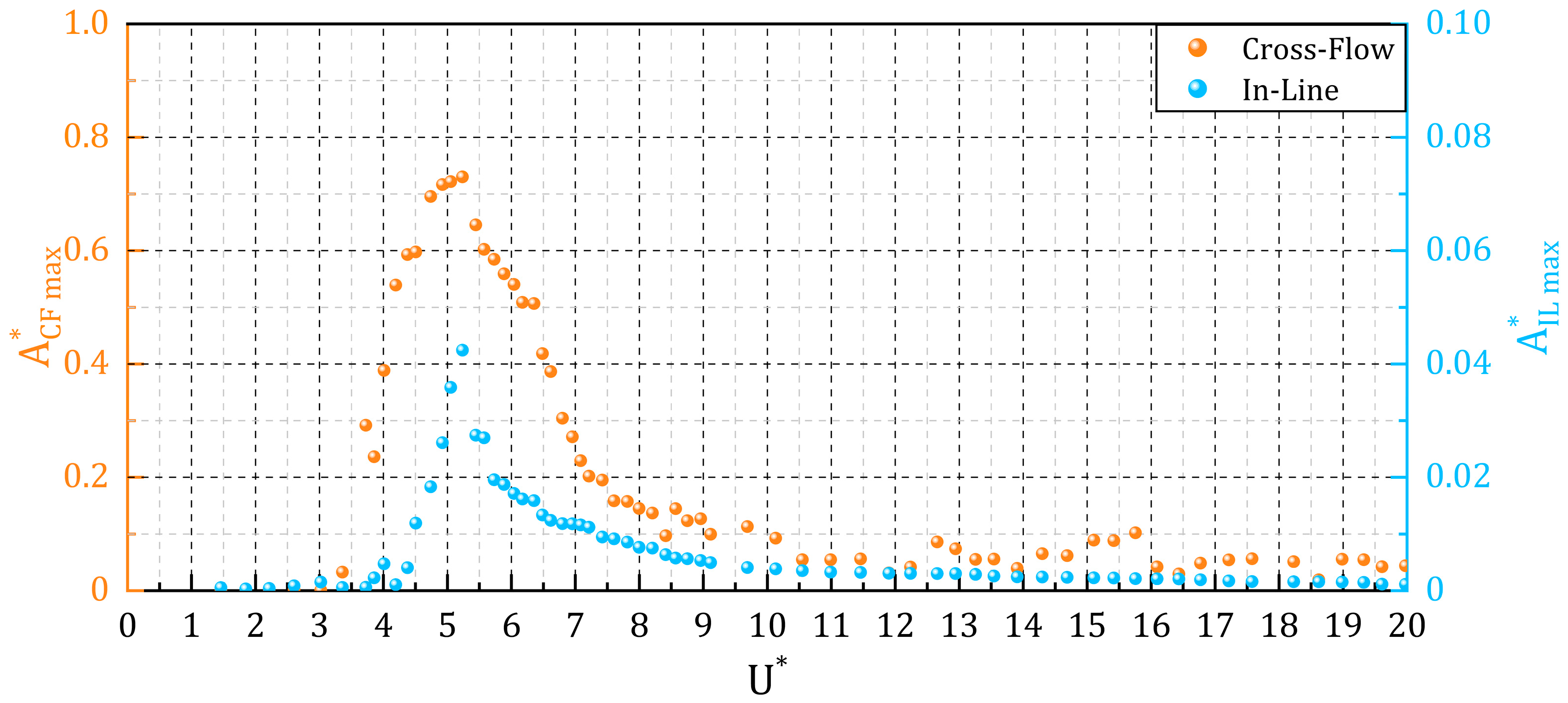
However, certain limitations remain. First, the R e range covered in the present study does not fully extend to the higher- R e conditions typical of many industrial marine applications, which limits the direct quantitative generalization of the current results. Although the qualitative coupling relationships identified here may still provide useful physical guidance, the specific quantitative results, such as response amplitudes, lock-in boundaries, and wake-transition details, should be interpreted with caution when extended to much higher R e environments. Second, the tested object is restricted to a single rigid cylinder, and thus the effects of different structural types or flexible conditions on fluid–structure interactions have not been investigated. In addition, the current setup allows the laser sheet to illuminate only a single cross-section of the vorticity field, which constrains the ability to compare flow evolution at different vertical locations.
Future work will address these limitations along two main directions. The first involves extending and improving the experimental setup to cover a wider R e range, enable multi-cross-section flow measurements, and incorporate different structural configurations. The second focuses on conducting systematic experiments on self-excited oscillations of a 2-DOF rigid cylinder based on the improved setup, aiming to further reveal the intrinsic relationship between flow field characteristics and dynamic responses, and to provide experimental evidence for subsequent theoretical modeling and engineering design.

Author Contributions

Conceptualization, J.W.; methodology, J.W. and G.J.; software, J.W.; validation, J.W. and G.J.; formal analysis, J.W.; investigation, J.W., T.Z. and Z.Z.; resources, L.Z., Z.Y. and G.J.; data curation, J.W., T.Z. and Z.Z.; writing—original draft preparation, J.W.; writing—review and editing, J.W., L.Z. and G.J.; visualization, J.W.; funding acquisition, L.Z. and G.J. All authors have read and agreed to the published version of the manuscript.

Funding

This project was supported by National Key Research and Development Program of China (2022YFC2806703, 2023YFC2811302), National Natural Science Foundation of China (52301362), Natural Science Foundation of Liaoning Province (2025-MS-008), Dalian Science and Technology Bureau (2024RQ060). The authors would like to thank their support.

Data Availability Statement

The data supporting this study’s findings are available from the corresponding author upon reasonable request.

Conflicts of Interest

The authors declare no conflicts of interest.

References

  1. Karim, M.F.; Yudha, W.D. Poliheuristic Theory and Indonesia’s Absence in Deep-Sea Mining (DSM). J. Curr. Southeast Asian Aff. 2021, 40, 461–483. [Google Scholar] [CrossRef]
  2. Sarpkaya, T. A critical review of the intrinsic nature of vortex-induced vibrations. J. Fluids Struct. 2004, 19, 389–447. [Google Scholar] [CrossRef]
  3. Zheng, H.; Price, R.E.; Modarres-Sadeghi, Y.; Triantafyllou, M.S. On fatigue damage of long flexible cylinders due to the higher harmonic force components and chaotic vortex-induced vibrations. Ocean Eng. 2014, 88, 318–329. [Google Scholar] [CrossRef]
  4. Khalak, A.; Williamson, C. Dynamics of a hydroelastic cylinder with very low mass and damping. J. Fluids Struct. 1996, 10, 455–472. [Google Scholar] [CrossRef]
  5. Khalak, A.; Williamson, C. Fluid forces and dynamics of a hydroelastic structure with very low mass and damping. J. Fluids Struct. 1997, 11, 973–982. [Google Scholar] [CrossRef]
  6. Khalak, A.; Williamson, C. Motions, forces and mode transitions in vortex-induced vibrations at low mass-damping. J. Fluids Struct. 1999, 13, 813–851. [Google Scholar] [CrossRef]
  7. Mackowski, A.W.; Williamson, C.H.K. An experimental investigation of vortex-induced vibration with nonlinear restoring forces. Phys. Fluids 2013, 25, 087101. [Google Scholar] [CrossRef]
  8. Williamson, C.H.K.; Govardhan, R. A brief review of recent results in vortex-induced vibrations. J. Wind Eng. Ind. Aerod. 2008, 96, 713–735. [Google Scholar] [CrossRef]
  9. Williamson, C.; Govardhan, R. Vortex-induced vibrations. Annu. Rev. Fluid Mech. 2004, 36, 413–455. [Google Scholar] [CrossRef]
  10. Kang, Z.; Jia, L. An experiment study of a cylinder’s two degree of freedom VIV trajectories. Ocean Eng. 2013, 70, 129–140. [Google Scholar] [CrossRef]
  11. Fan, D.; Triantafyllou, M.S. Vortex-induced forces of crossflow and inline oscillating bluff bodies at moderate Reynolds numbers. Mar. Struct. 2022, 86, 103305. [Google Scholar] [CrossRef]
  12. Karthikeyan, S.; Nallayarasu, S. CFD simulation of vortex-induced vibration of an elastic cylinder in subcritical flow regime using a two-way coupled model validated by experiment. Ocean Eng. 2023, 273, 113956. [Google Scholar] [CrossRef]
  13. Karthikeyan, S.; Nallayarasu, S.; Liu, Y. Time-domain analysis of vortex-induced vibration of flexible cantilever cylinder using CFD simulation. Ocean Eng. 2024, 311, 118875. [Google Scholar] [CrossRef]
  14. Nikoo, H.M.; Bi, K.; Hao, H. Three-dimensional vortex-induced vibration of a circular cylinder at subcritical Reynolds numbers with low-Re correction. Mar. Struct. 2019, 66, 288–306. [Google Scholar] [CrossRef]
  15. Liu, G.; Li, H.; Qiu, Z.; Li, Z. A comprehensive numerical analysis of cross-flow vortex-induced vibrations for top tension risers under different flows. Phys. Fluids 2020, 32, 027102. [Google Scholar] [CrossRef]
  16. Facchinetti, M.L.; de Langre, E.; Biolley, F. Coupling of structure and wake oscillators in vortex-induced vibrations. J. Fluids Struct. 2004, 19, 123–140. [Google Scholar] [CrossRef]
  17. Ogink, R.H.M.; Metrikine, A.V. A wake oscillator with frequency dependent coupling for the modeling of vortex-induced vibration. J. Sound Vib. 2010, 329, 5452–5473. [Google Scholar] [CrossRef]
  18. Thorsen, M.J.; Saevik, S.; Larsen, C.M. Fatigue damage from time domain simulation of combined in-line and cross-flow vortex-induced vibrations. Mar. Struct. 2015, 41, 200–222. [Google Scholar] [CrossRef]
  19. Thorsen, M.J.; Saevik, S.; Larsen, C.M. Time domain simulation of vortex-induced vibrations in stationary and oscillating flows. J. Fluids Struct. 2016, 61, 1–19. [Google Scholar] [CrossRef]
  20. Thorsen, M.J.; Saevik, S.; Larsen, C.M. Non-linear time domain analysis of cross-flow vortex-induced vibrations. Mar. Struct. 2017, 51, 134–151. [Google Scholar] [CrossRef]
  21. Ulveseter, J.V.; Thorsen, M.J.; Saevik, S.; Larsen, C.M. Stochastic modelling of cross-flow vortex-induced vibrations. Mar. Struct. 2017, 56, 260–280. [Google Scholar] [CrossRef]
  22. Ulveseter, J.V.; Thorsen, M.J.; Saevik, S.; Larsen, C.M. Time domain simulation of riser VIV in current and irregular waves. Mar. Struct. 2018, 60, 241–260. [Google Scholar] [CrossRef]
  23. Ulveseter, J.; Thorsen, M.J.; Saevik, S.; Larsen, C.M. Simulating fundamental and higher harmonic VIV of slender structures. Appl. Ocean Res. 2019, 90, 101856. [Google Scholar] [CrossRef]
  24. Zhao, B.; Zhang, M.; Fu, S.; Fu, X.; Ren, H.; Xu, Y. Drag coefficients of double unequal-diameter flexible cylinders in tandem undergoing vortex/wake-induced vibrations. Ocean Eng. 2023, 270, 113642. [Google Scholar] [CrossRef]
  25. Bai, Y.; Zhang, M.; Fu, S.; Xu, Y.; Ren, H.; Wang, J. Experimental investigation on hydrodynamic characteristics of water intake riser undergoing vortex-induced vibration in uniform flow. Ocean Eng. 2024, 305, 117966. [Google Scholar] [CrossRef]
  26. Yan, S.; Jia, K.; Xu, W.; Ma, Y. An experimental study on vortex-induced vibration suppression for submarine multispan pipelines. Ocean Eng. 2023, 271, 113678. [Google Scholar] [CrossRef]
  27. Zhu, H.; Li, Y.; Hao, H.; Alam, M.M.; Zhou, T.; Tang, T. Experimental investigation on the vortex-induced vibration of a circular cylinder partially covered with moss. Ocean Eng. 2024, 298, 117198. [Google Scholar] [CrossRef]
  28. Blevins, R.D.; Coughran, C.S. Experimental Investigation of Vortex-Induced Vibration in One and Two Dimensions with Variable Mass, Damping, and Reynolds Number. J. Fluids Eng. 2009, 131, 101202–101207. [Google Scholar] [CrossRef]
  29. He, Y.; Li, Z.; Xiong, X.; Su, J. Coupled in-line and cross-flow vortex-induced vibration responses of a fluid-conveying riser with a variable tension. Appl. Ocean. Res. 2025, 162, 104700. [Google Scholar] [CrossRef]
  30. Huang, Z.; Deng, Z.; Liu, D.; Bai, Y. Numerical simulation for VIV of a long flexible cylinder in the time domain. Ships Offshore Struct. 2018, 13, 214–227. [Google Scholar] [CrossRef]
  31. Jauvtis, N.; Williamson, C. The effect of two degrees of freedom on vortex-induced vibration at low mass and damping. J. Fluid Mech. 2004, 509, 23–62. [Google Scholar] [CrossRef]
  32. Shen, J.; Fu, S.; Fu, X.; Deng, P.; Niu, Z.; Moan, T. A hybrid experimental investigation of structural parameter effects on 2-DOF vortex-induced vibrations of a circular cylinder. J. Ocean Eng. Sci. 2025, 11, 191–203. [Google Scholar] [CrossRef]
  33. Ashrafipour, H.; Zeinoddini, M.; Tamimi, V.; Rashki, M.R.; Jadidi, P. Two-degrees-of-freedom vortex-induced vibration of cylinders covered with hard marine fouling. Int. J. Mech. Sci. 2022, 233, 107624. [Google Scholar] [CrossRef]
  34. Aktosun, E.; Gedikli, E.D.; Dahl, J.M. Observed wake branches from the 2-DOF forced motion of a circular cylinder in a free stream. J. Fluids Struct. 2024, 124, 104035. [Google Scholar] [CrossRef]
  35. Bampouli, A.; Goris, Q.; Van Olmen, J.; Solmaz, S.; Hussain, M.N.; Stefanidis, G.D.; Van Gerven, T. Understanding the ultrasound field of high viscosity mixtures: Experimental and numerical investigation of a lab scale batch reactor. Ultrason. Sonochem. 2023, 97, 106444. [Google Scholar] [CrossRef]
  36. Skelland, A.; Kanel, J.S. Transient Drop Size in Agitated Liquid-Liquid Systems, as Influenced by the Direction of Mass—Transfer and Surfactant Concentration. Ind. Eng. Chem. Res. 1992, 31, 2556–2563. [Google Scholar] [CrossRef]
  37. Westerweel, J.; Elsinga, G.E.; Adrian, R.J. Particle Image Velocimetry for Complex and Turbulent Flows. Annu. Rev. Fluid Mech. 2013, 45, 369–396. [Google Scholar] [CrossRef]
  38. Assi, G.R.S.; Meneghini, J.R.; Aranha, J.A.P.; Bearman, P.W.; Casaprima, E. Experimental investigation of flow-induced vibration interference between two circular cylinders. J. Fluids Struct. 2006, 22, 819–827. [Google Scholar] [CrossRef]
  39. Dahl, J.M.; Hover, F.S.; Triantafyllou, M.S.; Oakley, O.H. Dual resonance in vortex-induced vibrations at subcritical and supercritical Reynolds numbers. J. Fluid Mech. 2010, 643, 395–424. [Google Scholar] [CrossRef]
Figure 1. Experimental configuration in the circulating water tank. (left) cross-section view of the vertical rigid cylinder and spring–slider system. (right) top view showing the flow direction and the IL and CF coordinate system.
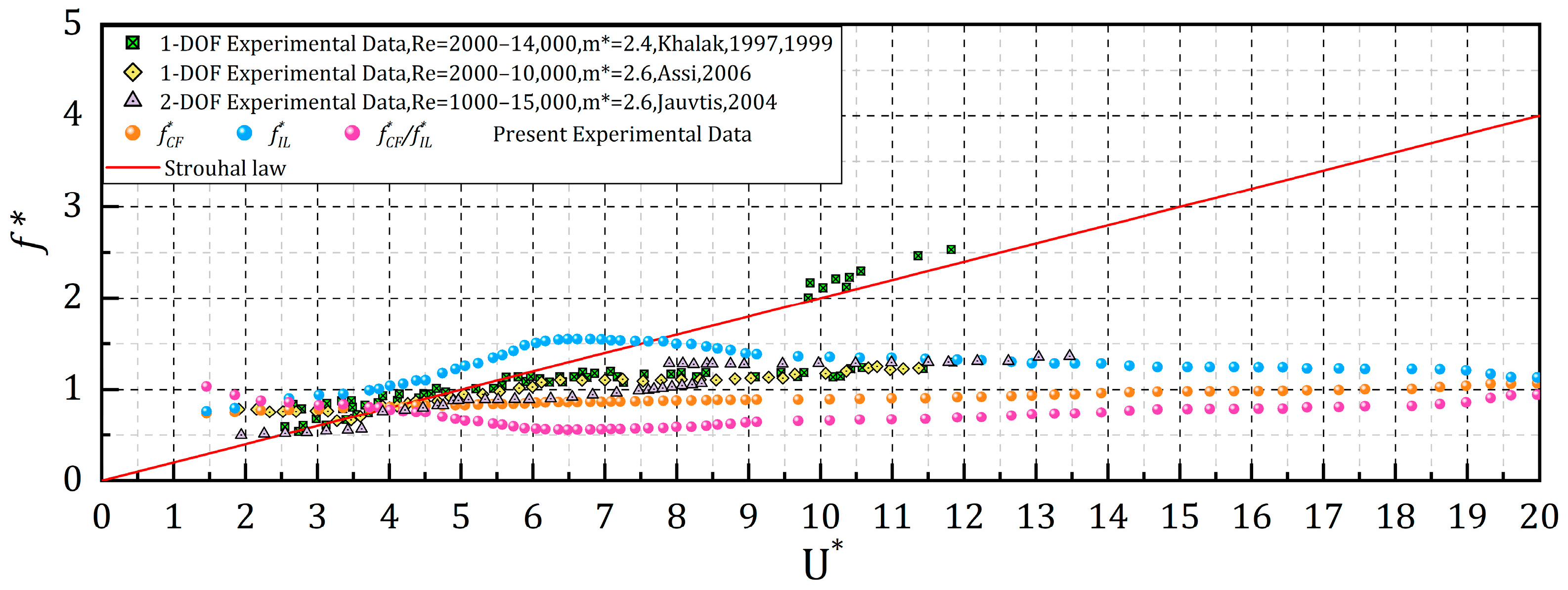
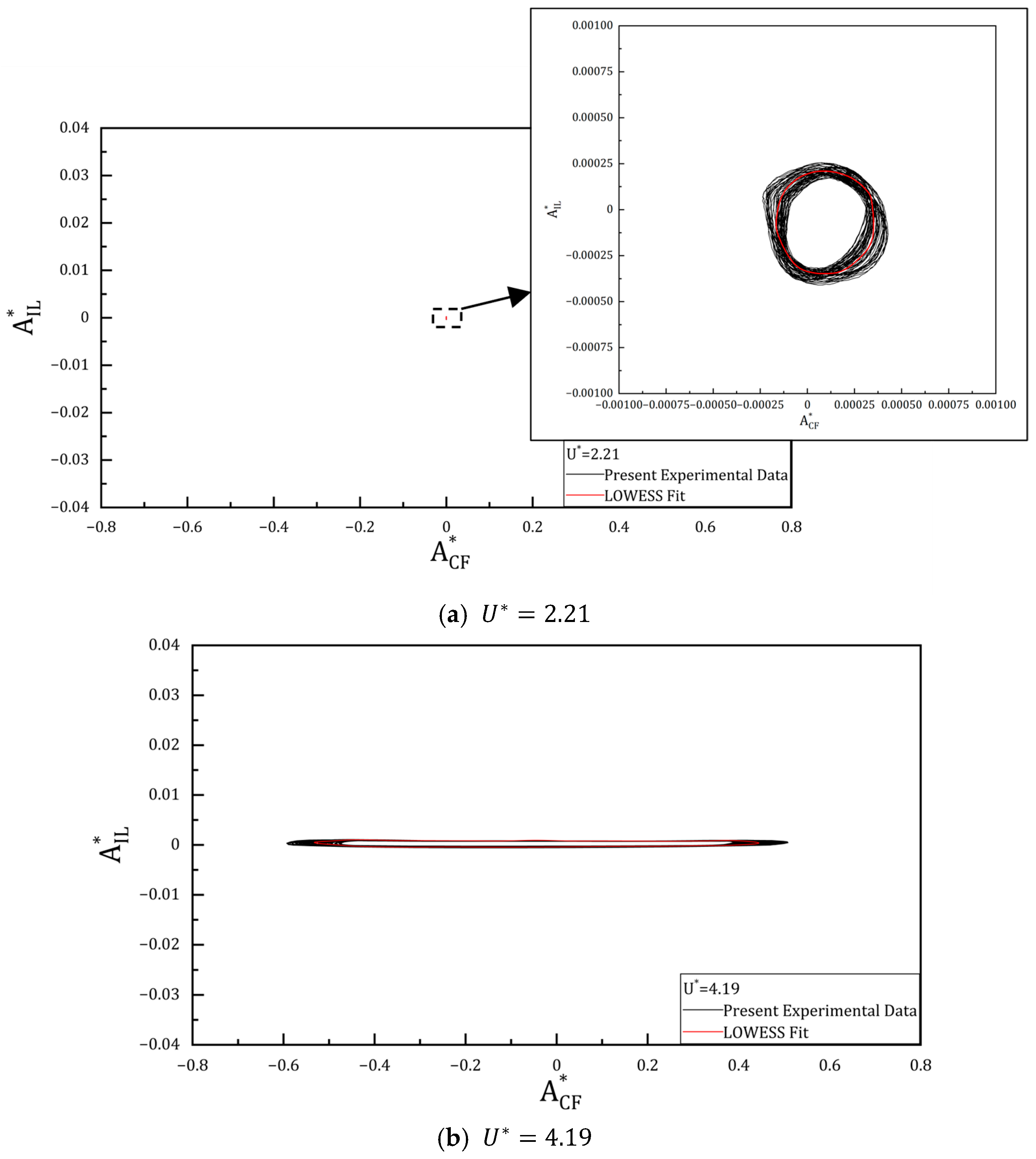
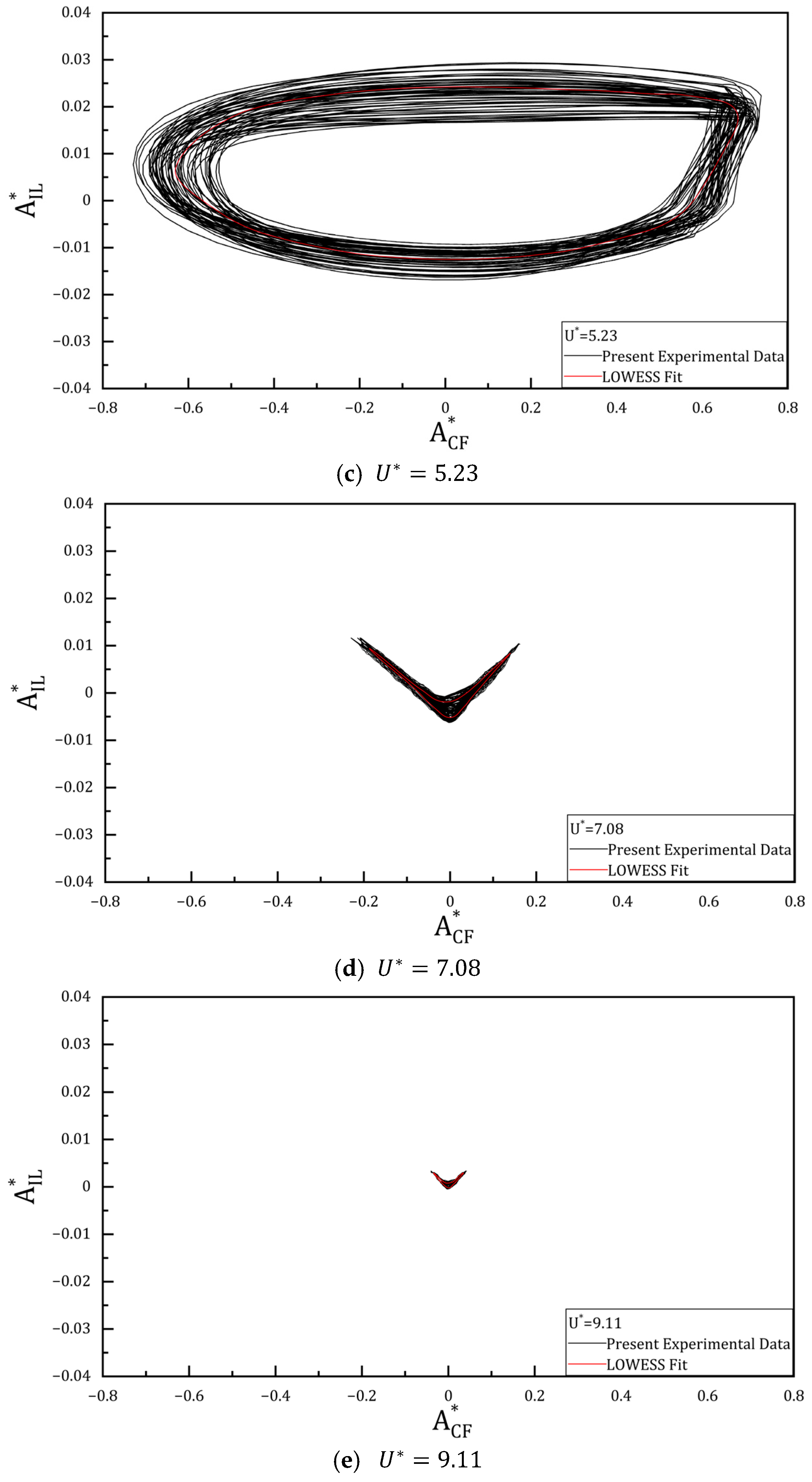
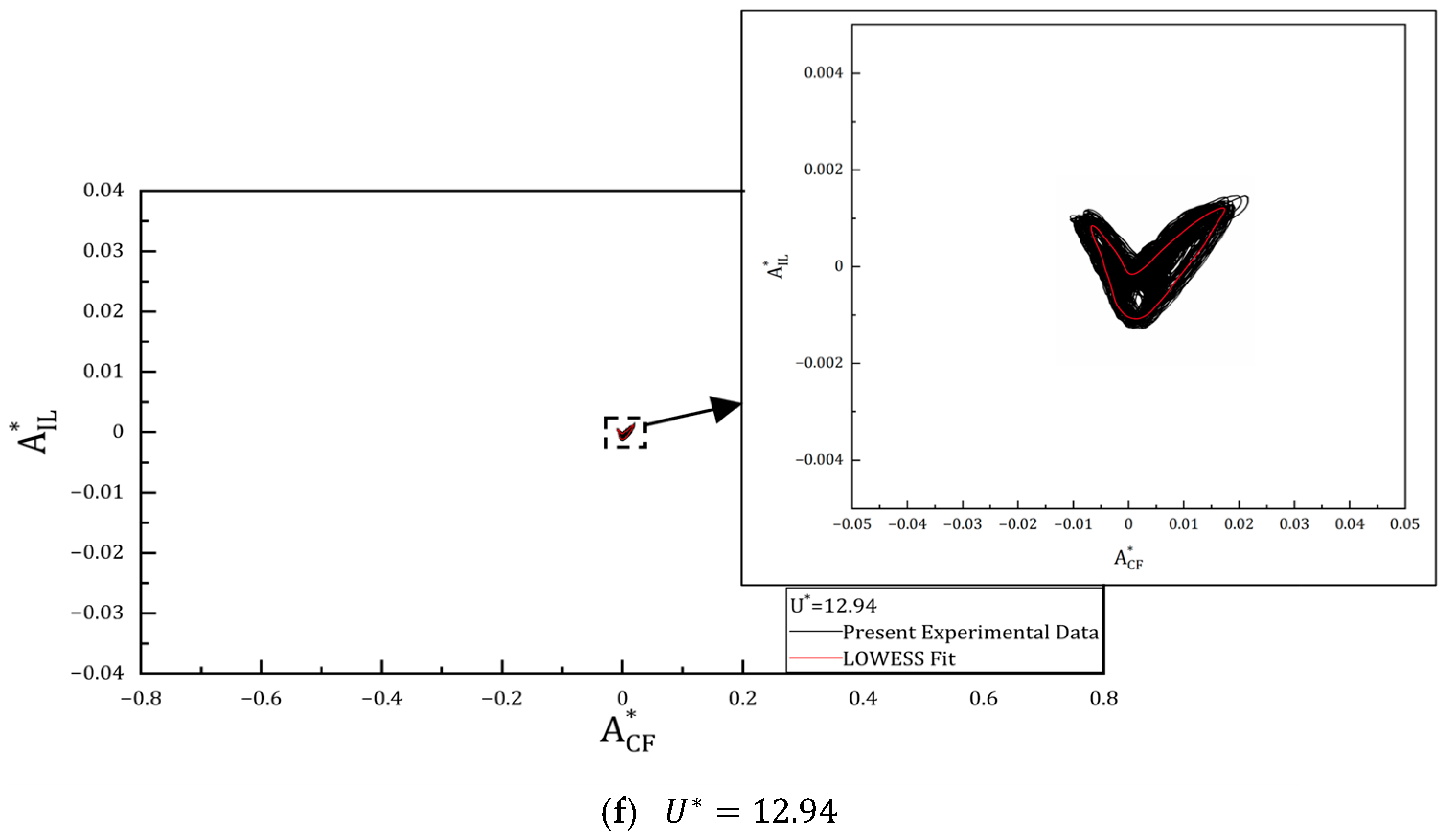
Jmse 14 00629 g001
Figure 2. Photograph of the experimental system installed in the circulating water tank, including the support frame, sliding rails, and motion assemblies for the 2-DOF vibration tests.
Jmse 14 00629 g002
Figure 3. PIV system of the experimental setup, including the CCD camera, laser emitter, laser light sheet, and data acquisition system.
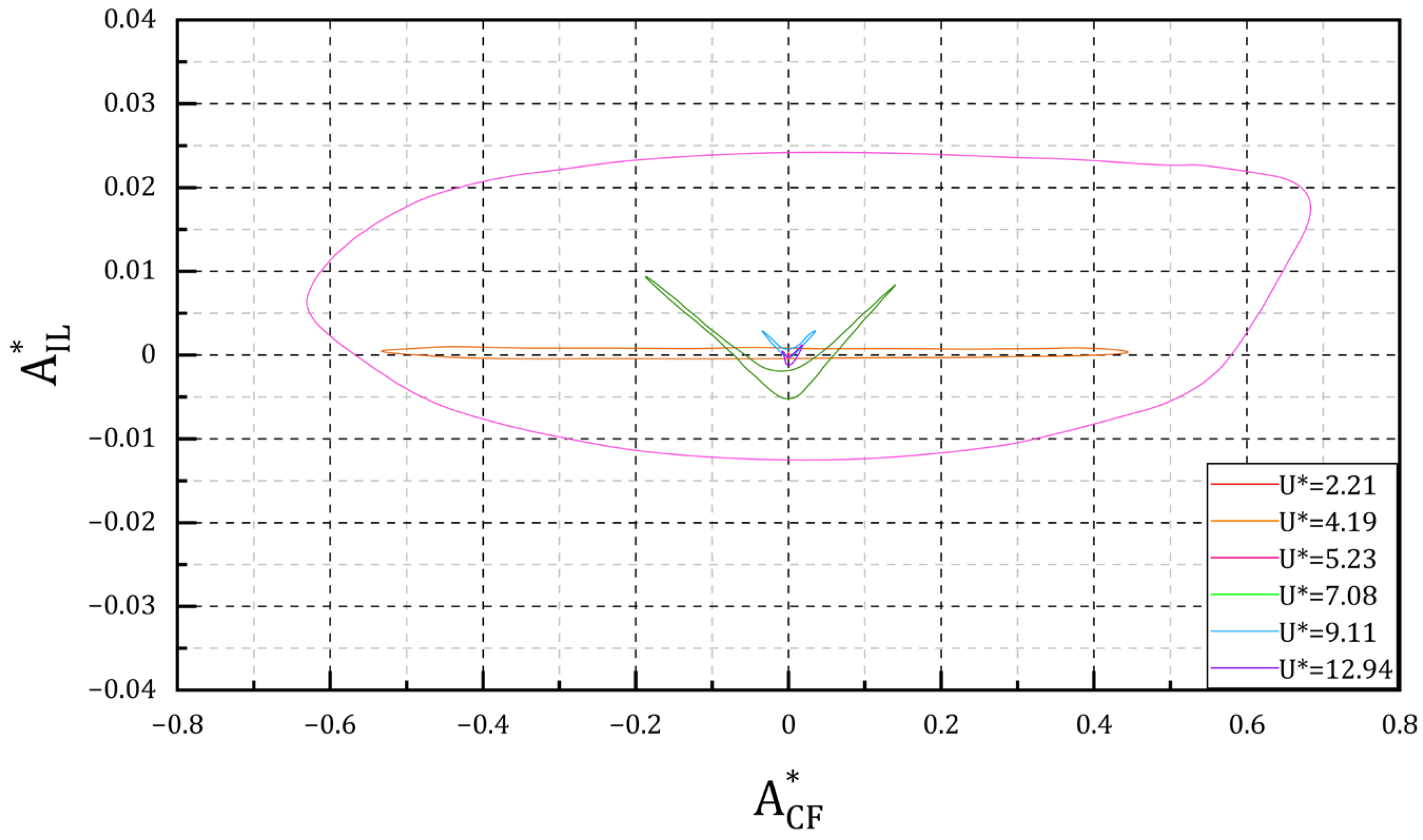
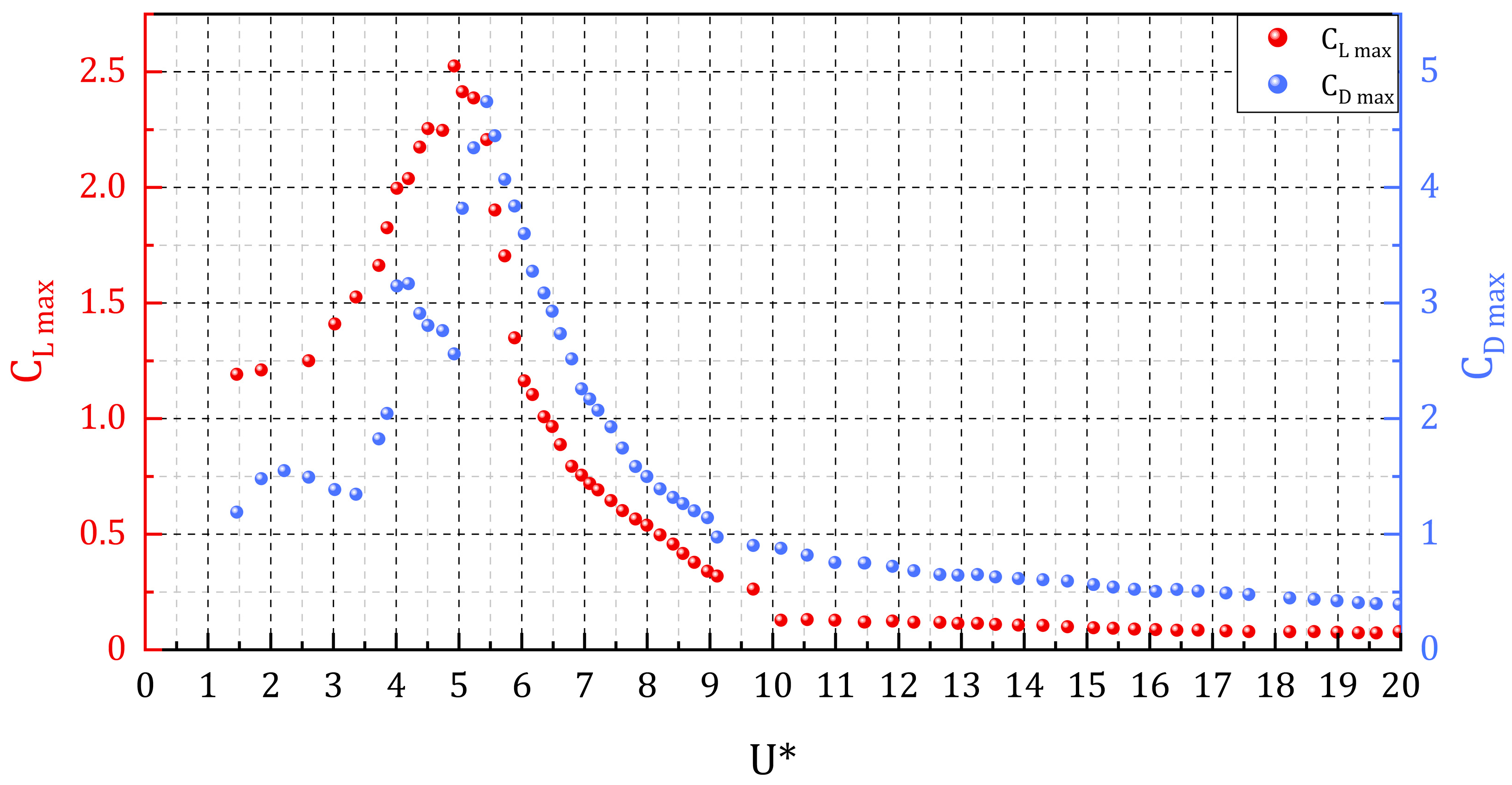
Jmse 14 00629 g003
Figure 4. Schematic diagram of tracer particle displacement between two consecutive images.
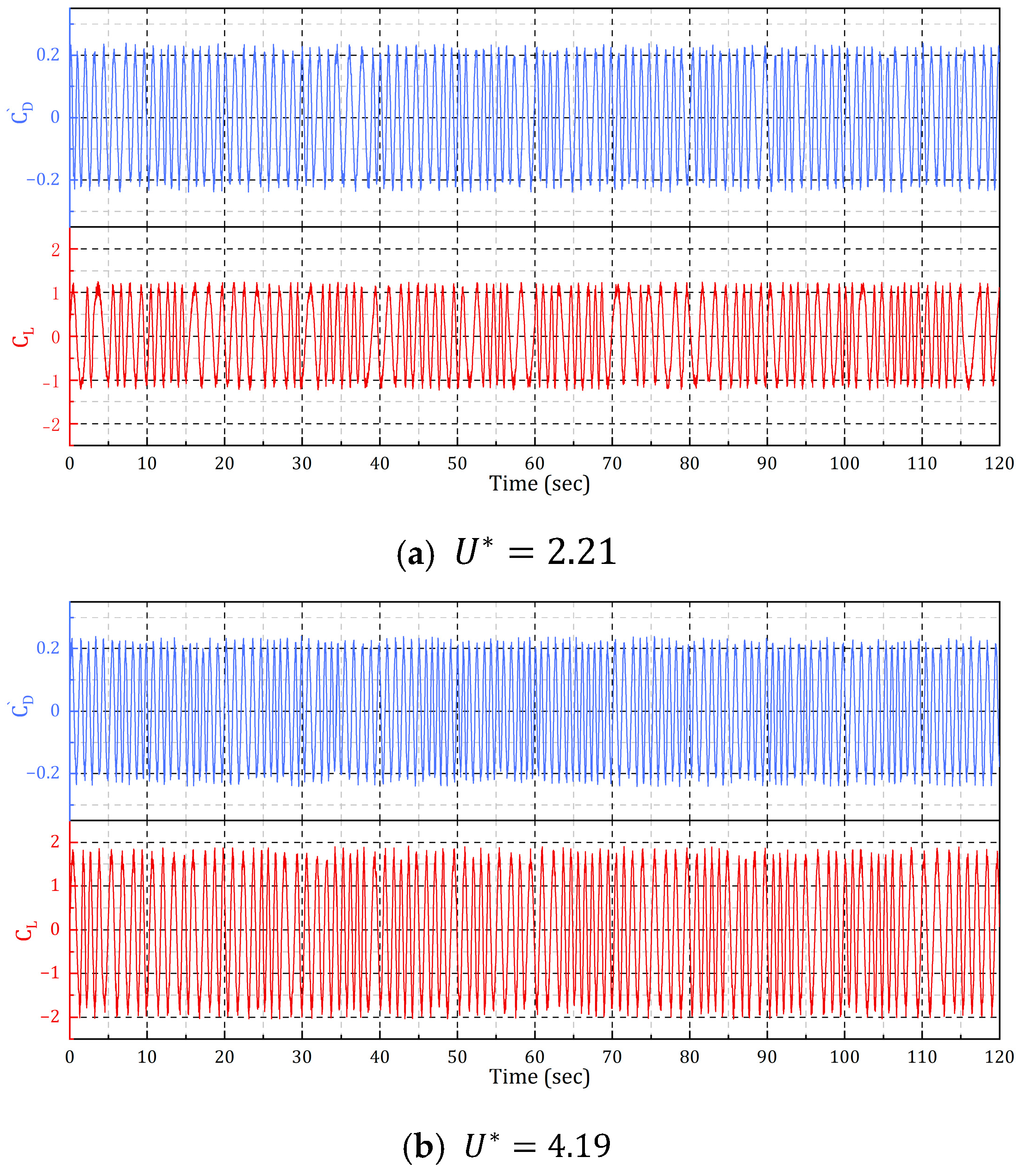
Jmse 14 00629 g004
Figure 5. Maximum non-dimensional CF amplitude plotted against U . The present experimental results are compared with reference data [5,6,31,38] from the literature.
Jmse 14 00629 g005
Figure 6. Maximum non-dimensional amplitudes in the CF and IL directions plotted against U .
Jmse 14 00629 g006
Figure 7. Non-dimensional oscillation frequencies in the CF and IL directions as functions of U . Reference experimental data [5,6,31,38] and the Strouhal-law line are included for comparison.
Jmse 14 00629 g007
Figure 8. Oscillation trajectories of the cylinder in the CF–IL plane at representative reduced velocities. The horizontal axis denotes CF displacement and the vertical axis denotes IL displacement.
Jmse 14 00629 g008aJmse 14 00629 g008bJmse 14 00629 g008c
Figure 9. Fitted oscillation trajectories of the cylinder at different reduced velocities obtained from LOWESS smoothing of the measured CF and IL displacements.
Jmse 14 00629 g009
Figure 10. Maximum C L   m a x and C D   m a x plotted against U for the present 2-DOF cylinder.
Jmse 14 00629 g010
Figure 11. Time histories of C L (red line) and C D (blue line) for a representative operating condition.
Jmse 14 00629 g011aJmse 14 00629 g011b
Figure 12. Instantaneous PIV vorticity fields at U = 2.21 .
Jmse 14 00629 g012
Figure 13. Instantaneous PIV vorticity fields at U = 4.19 .
Jmse 14 00629 g013
Figure 14. Instantaneous PIV vorticity fields at U = 5.23 .
Jmse 14 00629 g014
Figure 15. Instantaneous PIV vorticity fields at U = 7.08 .
Jmse 14 00629 g015
Figure 16. Instantaneous PIV vorticity fields at U = 9.11 .
Jmse 14 00629 g016
Figure 17. Instantaneous PIV vorticity fields at U = 12.94 .
Jmse 14 00629 g017
Table 1. Physical and structural parameters of the experimental cylinder model used in the present study.
QuantitySymbolValueUnit
Diameter of cylinder model D 30 mm
Total length of cylinder model L 1000 mm
Submergence depth of model axis h 600 mm
Effective structural mass m 1.0655 kg
Mass ratio m 2.4
Equivalent stiffness k 68.867 N/m
Natural frequency in still water f N 1.28 Hz
Damping ratio ζ 0.0045
Water density (≈20 °C) ρ 1000 kg/m3
Kinematic viscosity (≈20 °C) υ 1.0 × 10 6 m2/s
Table 2. Definitions of the non-dimensional parameters, including symbols and corresponding normalization formulas used in the present study.
DefinitionSymbolNon-Dimensional Method
Mass ratio m m π ρ D 2 L / 4
Amplitude ratio A A D
Frequency ratio f f f N
Velocity ratio U U f N D
Reynolds number R e ρ U D v
Strouhal number S t f D U
Drag coefficient C D F D 1 2 ρ U 2 D L
Lift coefficient C L F L 1 2 ρ U 2 D L
Table 3. Estimated relative uncertainties of the principal measurements and derived non-dimensional parameters.
CategoryQuantityDefinition/BasisEstimated Relative
Uncertainty
Primary measurement A Measured by laser
displacement sensor
±0.07%
Primary measurement F Measured by force
transducer
±0.04%
Primary measurement U Measured by flowmeter±1.50%
Primary measurement D Re-measured by vernier caliper (0.01 mm)±0.03%
Primary measurement L Re-measured by vernier caliper (0.01 mm)±0.001%
Primary measurement f Extracted from displacement response signals±0.26%
Derived parameter A A D ±0.08%
Derived parameter f f f N ±0.26%
Derived parameter C L ,   C D F 1 2 ρ U 2 D L ±3.00%
Derived parameter S t f D U ±1.52%
Table 4. Non-dimensional structural and force frequencies at representative reduced velocities corresponding to typical VIV stages.
Case f C F * f I L * f C L * f C D *
U = 2.21 (initial excitation)0.769420.876230.780490.90086
U = 4.19 (early lock-in)0.807841.064060.808251.06544
U = 5.23 (core lock-in)0.837391.287010.840231.28978
U = 7.08 (late lock-in)0.867601.538260.868471.53846
U = 9.11 (desynchronization)0.888931.386720.890201.38772
Table 5. Mean vortex-shedding wavelength λ I L and transverse spacing S measured from PIV data at representative U .
Case λ I L S
U = 2.21 (initial excitation)2.48D0.92D
U = 4.19 (early lock-in)3.34D1.18D
U = 5.23 (core lock-in)3.54D1.20D
U = 7.08 (late lock-in)4.19D1.58D
U = 9.11 (desynchronization)5.02D1.63D
Disclaimer/Publisher’s Note: The statements, opinions and data contained in all publications are solely those of the individual author(s) and contributor(s) and not of MDPI and/or the editor(s). MDPI and/or the editor(s) disclaim responsibility for any injury to people or property resulting from any ideas, methods, instructions or products referred to in the content.