Article

Numerical Investigation on Hydrodynamic Characteristics of Variable Flexible Tube Underwater Object Suction Robot

1
Engineering and Physical Science, University of Southampton, Southampton SO17 1BJ, UK
2
College of Shipbuilding Engineering, Harbin Engineering University, Harbin 150001, China
3
College of Intelligent Systems Science and Engineering, Harbin Engineering University, Harbin 150001, China
*
Author to whom correspondence should be addressed.
J. Mar. Sci. Eng. 2026, 14(7), 624; https://doi.org/10.3390/jmse14070624
Submission received: 6 February 2026 / Revised: 18 March 2026 / Accepted: 19 March 2026 / Published: 27 March 2026
(This article belongs to the Special Issue Infrastructure for Offshore Aquaculture Farms)

Abstract

Remotely operated underwater vehicles (ROVs) play a significant role in the domain of underwater robotics, as observed in the field of deep-sea aquaculture. However, conventional stationary suction-tube underwater collection robots often struggle to efficiently collect target organisms located within complex reef environments. To address this limitation, this paper proposes an underwater object suction robot with a variable flexible tube. For vision-based object recognition tasks, stable vehicle motion is essential, as hydrodynamic disturbances can significantly degrade visual accuracy. Therefore, a systematic numerical investigation is conducted into the hydrodynamic characteristics of the ROV under different suction-tube shapes. Computational fluid dynamics (CFD) simulations are used to evaluate the resistance acting on the vehicle. The results provide guidance for motion control strategies aimed at reducing disturbance effects and improving the robustness of underwater robotic vision.

1. Introduction

The ocean is a major source of mineral resources and seafood, with global aquaculture production reaching 130.9 million tons in 2022, valued at USD 312.8 billion and accounting for 59% of global fisheries and aquaculture [1]. Coastal marine fishery farms play a key role in this growth while supporting environmental sustainability. Traditional marine farming faces significant challenges [2]. Prolonged exposure to the underwater environment increases the risk of chronic occupational diseases. As a result, research on underwater object collection robots is urgent.
At present, underwater robots for collecting subsea objects can generally be categorised into mechanical-grasping types and suction-tube types. The grasping-type ROV is typically equipped with a mechanical arm or other grasping devices designed to capture marine organisms. However, the manipulator usually has a rigid end actuator, and it is hard to control the grasping force accurately [3]. For example, the Falcon ROV by Seaeye can generate lifting and gripping forces up to 500 lbf and is not optimal for delicate specimen collection [4]. Recently, soft grippers have been used increasingly as end actuators, but they also face limitations such as low output force, and pneumatic or hydraulic grippers may not adapt to high ambient pressure. Soft grippers require substantial actuation and control components to withstand water pressure and achieve the desired dynamic performance [5,6]. To prevent damage to organisms, suction samplers are a more non-destructive collection method and have become a critical focus of ongoing research.
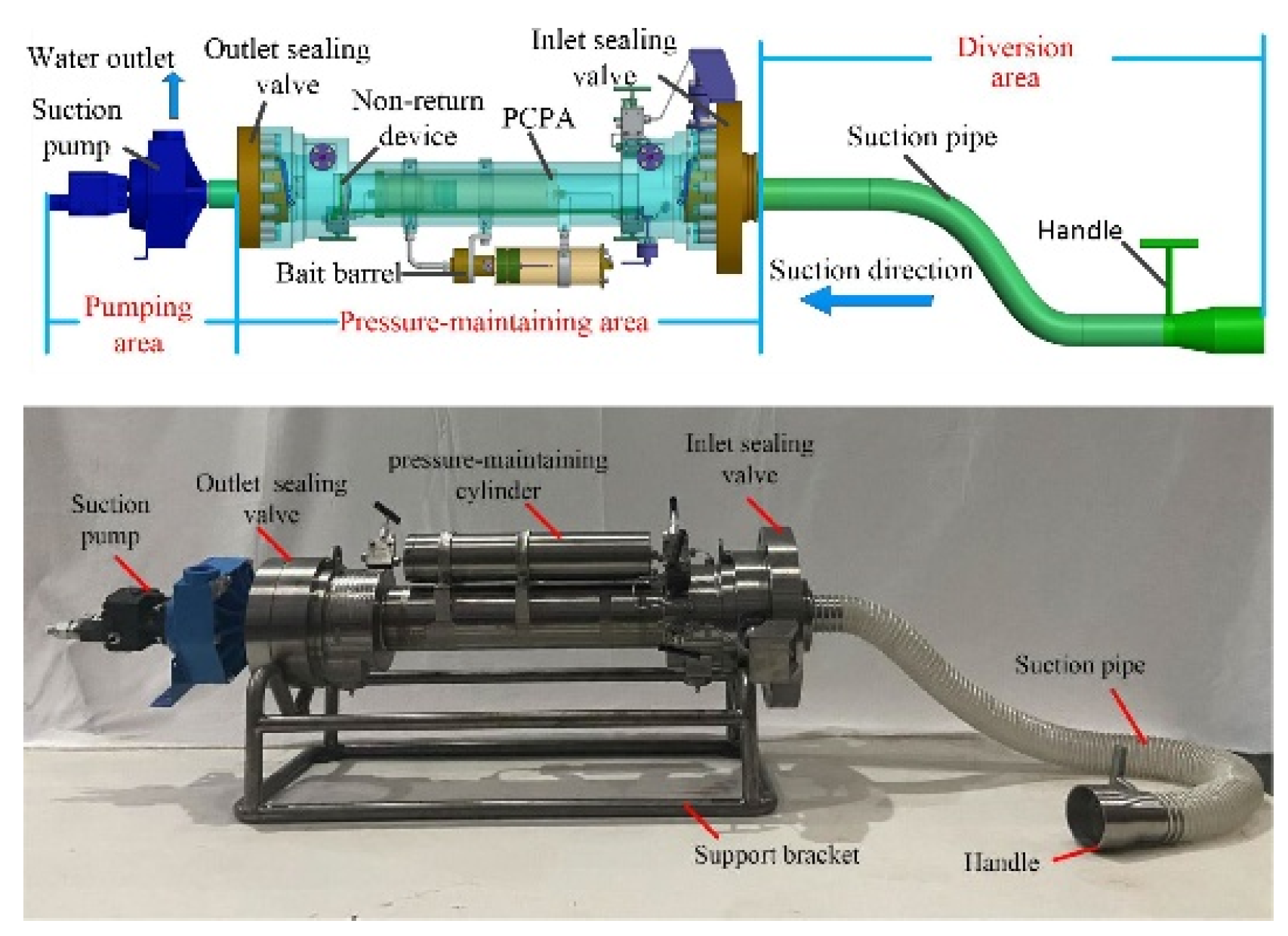
A suction sampler is a device that uses a pump connected to a nozzle to collect soft-bodied organisms. In contrast, mainstream underwater grippers are designed for heavy-load tasks typical of the industrial sector [7]. Recent studies on suction tube underwater robots mainly focus on the collection of underwater creatures. Liu et al. (2022) [8] designed a deep-sea, low-damage, and pressure-keeping biological sampler based on a Hydraulic Suction Macro-Biological Pressure Sampler (HSMPS), in which a suction pump generates negative pressure to capture benthic organisms. The HSMPS (Figure 1) can be carried on manned or unmanned submersibles for operation [9]. Shillito, B et al. (2022) [10,11] designed the PERISCOP system Pressurised Recovery Device (PRD), which uses a pump-driven suction tube mounted on an ROV or submersible to generate localised negative pressure at the tube inlet. This suction flow entrains the target organism together with ambient seawater and transports it into a sampling cell. The target object in the sampling cell is then transferred to the PRD with a pressure-retaining mechanism, which can enable the capture of underwater creatures in the high-pressure deep sea [9,10]. From the recent literature on suction-tube underwater robots, mainstream suction samplers used in ROVs are always fixed on the robot with low freedom. This kind of design fails to adapt well to the mission of efficiently sucking up target objects hiding in reef environments. Compared with grasp-type soft arms, such as those reported by Liu et al. [8], flexible suction tubes that can be manipulated by servo motors have higher response speed and collection speed. Therefore, this paper proposes a variable flexible tube underwater object suction robot with multiple degrees of freedom to capture benthic organisms hidden in reef environments.
The flow dynamics within coral reef systems are strongly influenced by their irregular branching morphologies across multiple spatial scales. In shallow coastal regions with rough surfaces, such as reef or rocky environments, frictional stress at the seabed becomes a dominant factor governing momentum transfer and energy dissipation [12,13]. Thus, to improve the accuracy of capturing benthic organisms, the study of the influence of the reef environment on the variable flexible tube underwater object suction robot seems extremely important. The mainstream methods include experiment-based methods, analytical and semi-empirical (ASE) methods, and numerical methods [14]. The numerical method is a practical and efficient way to obtain hydrodynamic coefficients of underwater robots with precisely constructed mathematical models [15]. Lin et al., based on the RANS solver with SST k - ω k − ω turbulence closure, applied a dynamic mesh model successfully to the PMM test simulations of an underwater vehicle [16].
Numerical simulations were performed using Fluent in ANSYS™ Workbench (ANSYS, Inc., Canonsburg, PA, USA). The SST k - ω turbulence model was adopted to improve computational stability and prediction accuracy. Steady motion simulations are simulated at different variable flexible tube angle. The mechanical structure introduction of the variable flexible tube underwater object suction robot and its dynamic model, including hydrodynamic effects, are covered in Section 2.
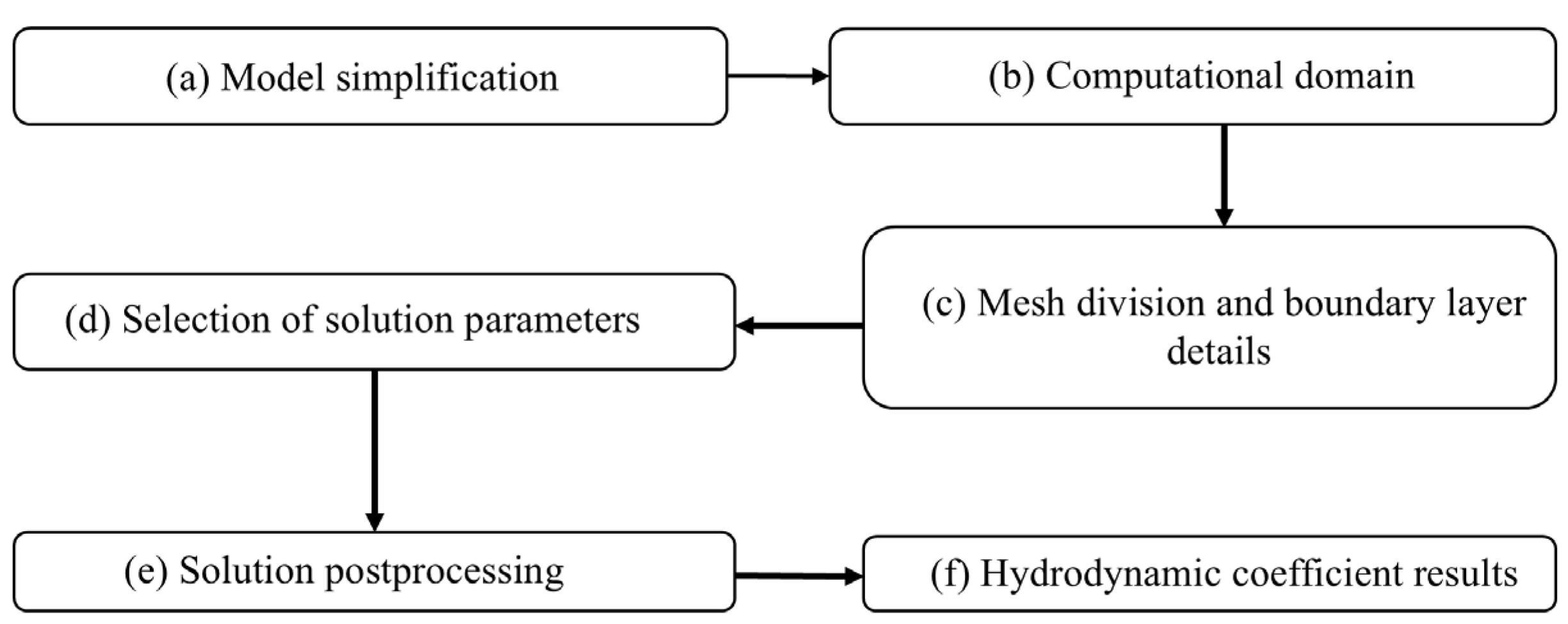
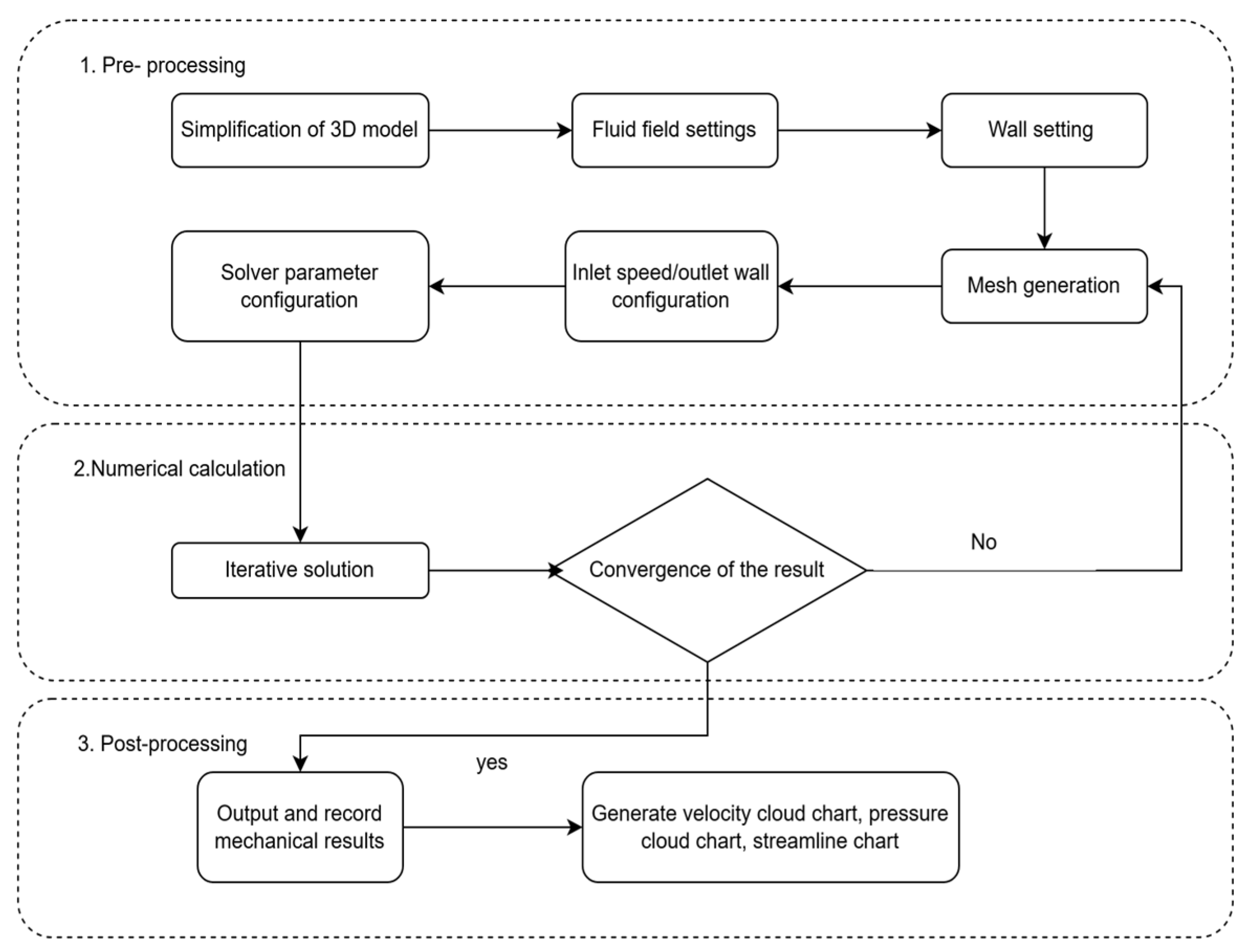
The study flow diagram is shown in Figure 2.

2. Mechanical Structure and Modelling

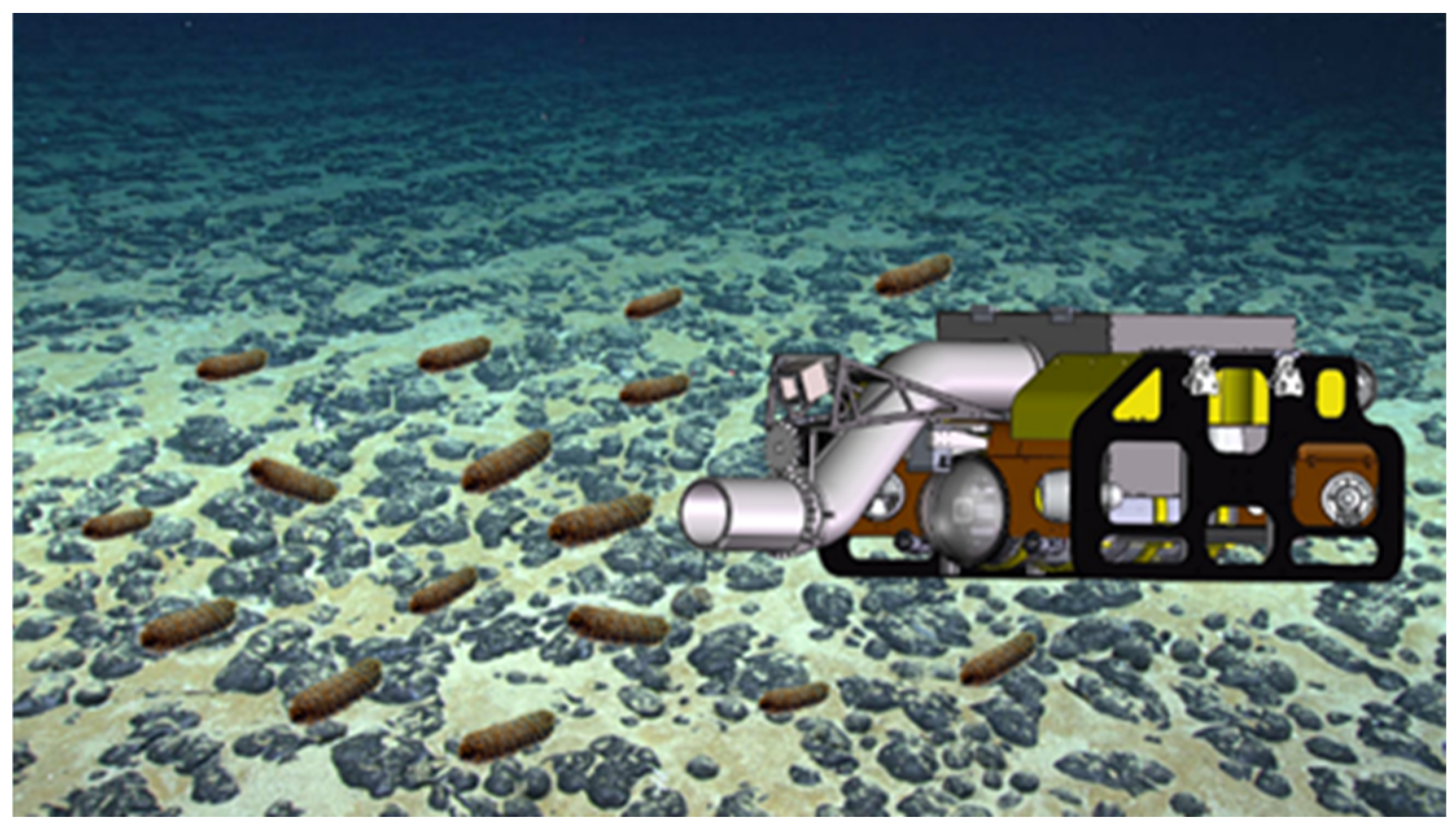
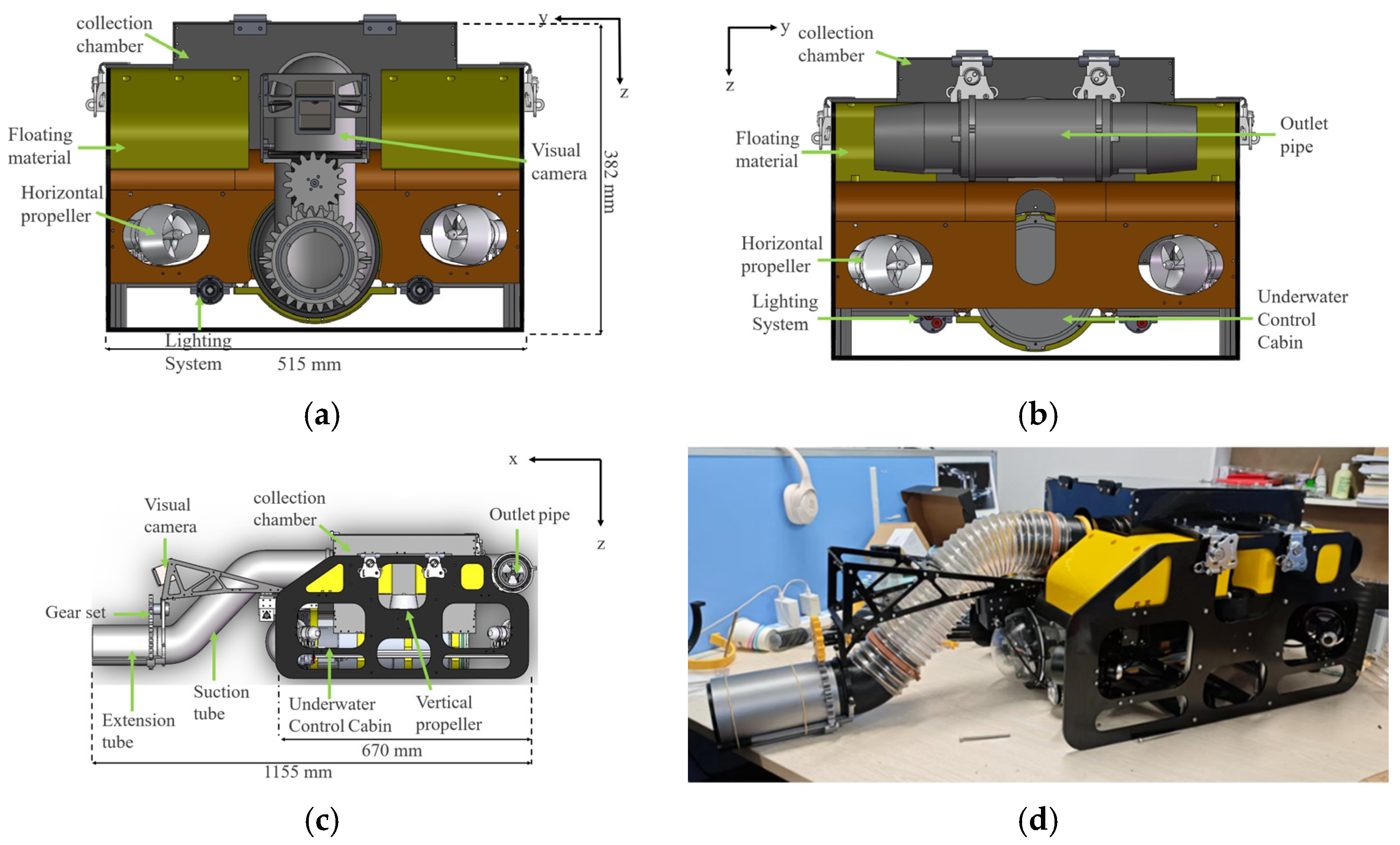
The concept diagram of the working environment of the ROV system is shown in Figure 3. The ROV is assumed to operate in a coastal seabed environment at a depth of 10–30 m, where moderate currents (0.2–1 m/s) are commonly encountered. During operation, the vehicle maintains stability while adjusting the bending angle of the variable flexible suction tube to approach target organisms located on the seabed. The main parameters of the ROV are as follows: Main dimensions: Length 1155 mm, Width 515 mm, Height 380 mm; Propulsion system: Four horizontal thrusters, two vertical thrusters, and two water pump thrusters; Total power 1068 W; Empty weight: Around 26 kg; Fishing capacity: Based on the negative pressure principle, it can suck sea cucumbers. The fishing capacity per time is approximately 30 kg when entering water independently.
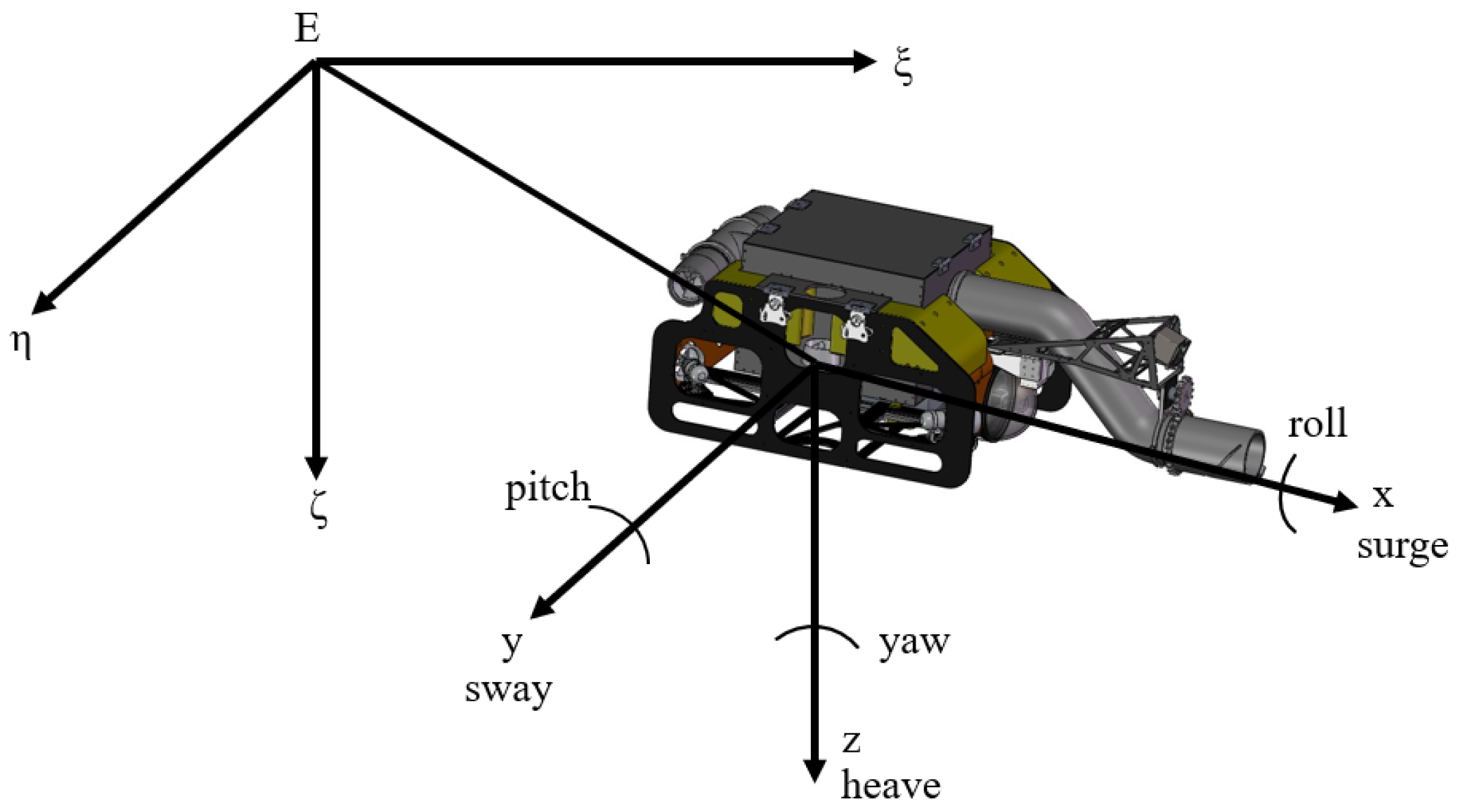
As shown in Figure 4, the fixed coordinate system E − η ξ ζ is the inertial coordinate system for the ROV, with the Earth as the reference. The E ξ axis points to the centre of the Earth, the E ζ axis aligns with the main course of the ROV, and the E η axis is defined using the right- hand rule. The moving coordinate system O-xyz is set on the ROV body, with the ROV’s centre of gravity as the origin of the coordinate system. The Ox axis points forward along the ROV’s longitudinal profile, the Oy axis points to the right of the ROV, and the Oz axis points downward. The O-xyz system forms a right-handed rectangular coordinate system.
Figure 5 shows the overall mechanical structure of the variable flexible tube underwater object suction robot. In this paper, the underwater robot is assumed to operate at a distance from the seabed in a reef environment, which is simplified as an open water environment.
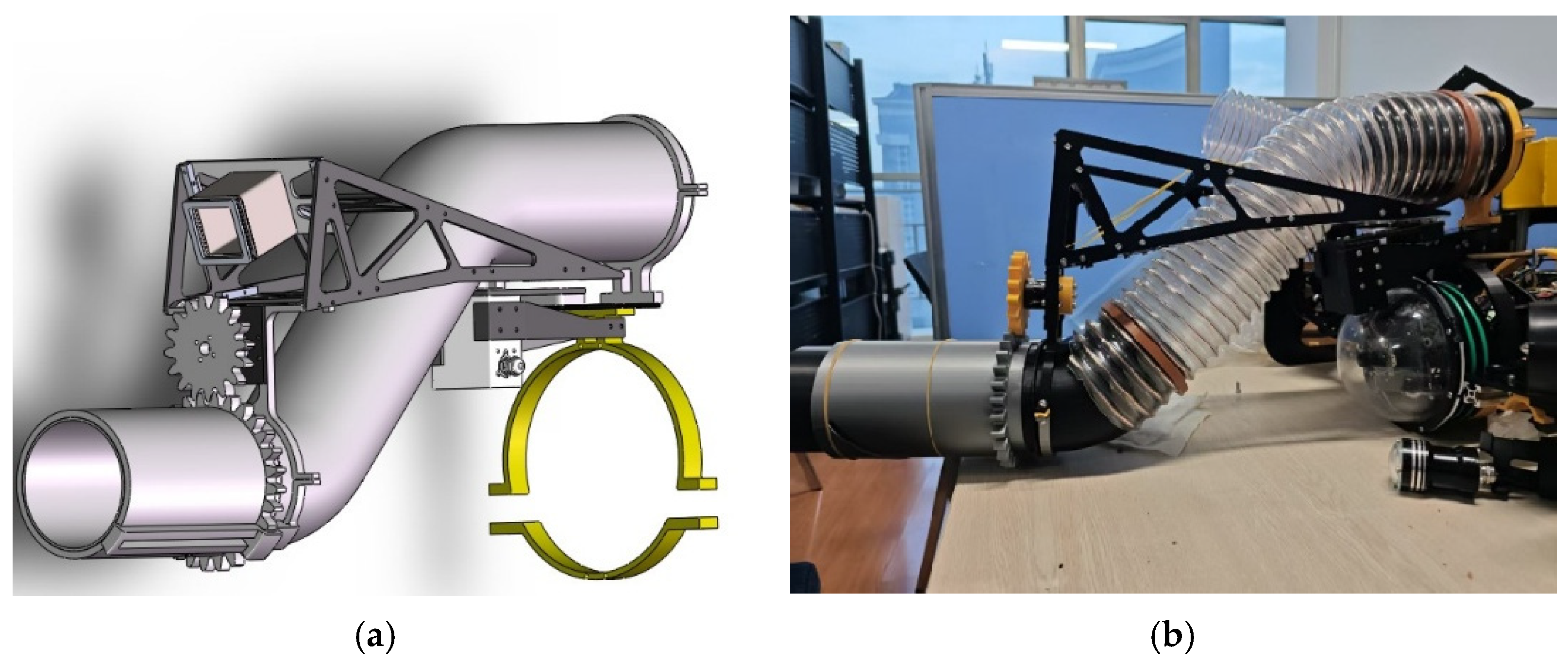
The innovative mechanism designed for the sea cucumber suction robot in this paper is a servo-driven flexible suction tube system. The schematic diagram of the rotation and extension mechanism of the suction tube is presented in Figure 6.
Compared with a conventional stationary suction tube that is rigidly fixed to the ROV frame and relies on full-body repositioning to align with targets, the proposed variable flexible suction tube incorporates independent yaw rotation and telescopic extension. This allows the suction port to adjust its orientation and reach locally without moving the entire vehicle, thereby improving accessibility to reef crevices, reducing hydrodynamic disturbance, and enhancing collection efficiency while maintaining structural simplicity.
Table 1 summarises the six-degrees-of-freedom kinematic variables of the underwater robot, including the corresponding forces and moments, velocities, accelerations, and positions/Euler angles.
The transformation relationship from the fixed coordinate system to the moving coordinate system is derived using the roll angle φ, pitch angle θ and heading angle ψ of the ROV in the moving coordinate system.
ξ η ζ = S x y z
S = c o s ψ s i n ψ 0 s i n ψ c o s ψ 0 0 0 1 c o s θ s i n θ 0 0 1 0 s i n θ c o s θ 1 c o s φ 0 s i n φ 0 1 0 s i n φ 0 c o s φ
c o s ψ c o s θ c o s ψ s i n θ s i n φ s i n ψ c o s φ c o s ψ s i n θ c o s φ + s i n ψ s i n φ s i n ψ c o s θ s i n ψ s i n θ s i n φ + c o s ψ c o s φ s i n ψ s i n θ c o s φ c o s ψ s i n φ s i n θ c o s θ s i n φ c o s θ c o s φ
S T = S 1
The transformation matrix S represents the transformation relationship between the fixed coordinate system and the moving coordinate system. Since both coordinate systems are orthogonal, the transpose of the transformation matrix S is equal to its inverse.
Assuming the ROV moves along a given coordinate direction with speed U, the viscous hydrodynamic formulation is simplified to include both first-order and second-order hydrodynamic terms as Equations (5) and (6).
The viscous hydrodynamic expressions for the motions occurring in only a single direction are rewritten as Equation (7). In the rewritten expressions, the coefficients of the hydrodynamic terms will not be affected by the direction of the velocity. Taking the longitudinal force during the longitudinal straight motion as an example, the rewritten expression for the longitudinal force is given in Equation (8).
F D U = F U U + F U U U 2
F D ( U ) = { F U + U + F U U + U 2 U 0   F U U + F U U U 2 U < 0
F D U = F U U + F U U + F U U U U + F U U U 2
X u = X u u + X u u + X u u u u + X u u u 2
In the hydrodynamic formulation, both first-order (linear) and second-order (quadratic) velocity terms are included. The linear terms (e.g., X u ) represent viscous damping effects that are approximately proportional to velocity. These terms are mainly associated with boundary-layer shear stress and attached flow behaviour, and they are typically more significant at lower velocities.
The quadratic terms (e.g., X u ) correspond to pressure-drag-dominated components that scale with the square of velocity. They are related to flow separation, wake formation, and the effects of projected frontal area. At moderate to higher Reynolds numbers, these quadratic terms usually dominate the total hydrodynamic resistance.
The coordinate transformation described above establishes the relationship between the inertial reference frame and the body-fixed frame of the ROV, allowing the vehicle motion to be expressed in terms of six degrees of freedom (surge, sway, heave, roll, pitch, and yaw). In underwater vehicle dynamics, hydrodynamic forces and moments acting on the body are commonly formulated in the body-fixed frame as functions of the vehicle velocity. For moderate Reynolds number flows typical of small open-frame ROVs, the viscous hydrodynamic damping can be approximated using a combination of linear and quadratic velocity-dependent terms. The linear terms mainly describe viscous friction in the boundary layer, whereas the quadratic terms are mainly associated with pressure drag and wake effects. Therefore, based on the established 6-DOF kinematic description, the hydrodynamic forces and moments are expressed using a simplified viscous damping model that includes both first-order and second-order velocity terms, as presented in Equations (5)–(8).

3. Methodology

3.1. Governing Equations

The direct flight hydrodynamic model was built using the CFD method. The CFD software ANSYS Fluent 2025 R2 (ANSYS, Inc., Canonsburg, PA, USA) was selected for its accuracy and reliability. The underwater robot is assumed to be fully immersed during operation. The Navier–Stokes (NS) equation was adopted as the governing equation for simulating the flow field around the underwater robot. The momentum and continuity equations can be written as follows for an incompressible Newtonian fluid [17,18].
u i t + u j ¯ u i x j = 1 ρ p x i + ν u i x j x j ; u j x j = 0 i = 1,2 , 3     when   (   · = 0 )
ρ u i t + u i u j _ _ _ _ _ _ x j = p x i + x j v u i x j + u j x i 2 3 δ i j u i x i + x j ρ u i u j _ _ _ _ _ _ i , j   = 1 , 2 , 3
Here, u i and u j are the fluid velocity components along the i and j directions, respectively; x i is the Cartesian spatial coordinate; ρ denotes the fluid density; p is the pressure term; t represents physical time; ν is the dynamic viscosity; δ is the Kronecker delta; and ρ u i u j _ _ _ _ _ _   corresponds to the Reynolds stress tensor under the Boussinesq hypothesis.
In this paper, the shear stress transport (SST) k ω model is used to close the numerical solution. The k ω model takes into account the transfer of turbulent shear stress. The model can predict the flow separation at the initial stage of development and in the presence of a negative pressure gradient. It demonstrates strong applicability in dealing with different boundary layers [19]. The SST k - ω model applies the k - ω approach in the near-wall region and the k - ε approach in the outer flow region. The transport equations governing the SST k - ω model can be written as follows [20]:
t ρ k + x i ρ k u i = x j Γ k k x j + G k Y k
t ( ρ ω ) + x i ( ρ ω u i ) = x j Γ ω ω x j + G ω Y ω + D ω
In these equations, Γ k and Γ ω denote the effective diffusivities of the turbulent kinetic energy k and the specific dissipation rate ω . G k and G ω represent the production of k and ω, respectively. Y k and Y ω correspond to their respective dissipation terms. D ω is the cross-diffusion term introduced in the SST formulation, which improves the model’s performance in adverse-pressure-gradient and separated flow regions by blending the standard k - ω models.

3.2. Numerical Solution

The basic numerical simulation process of this research is presented in Figure 7, and the important steps will be further shown in the following chapters.

3.3. Model Simplification

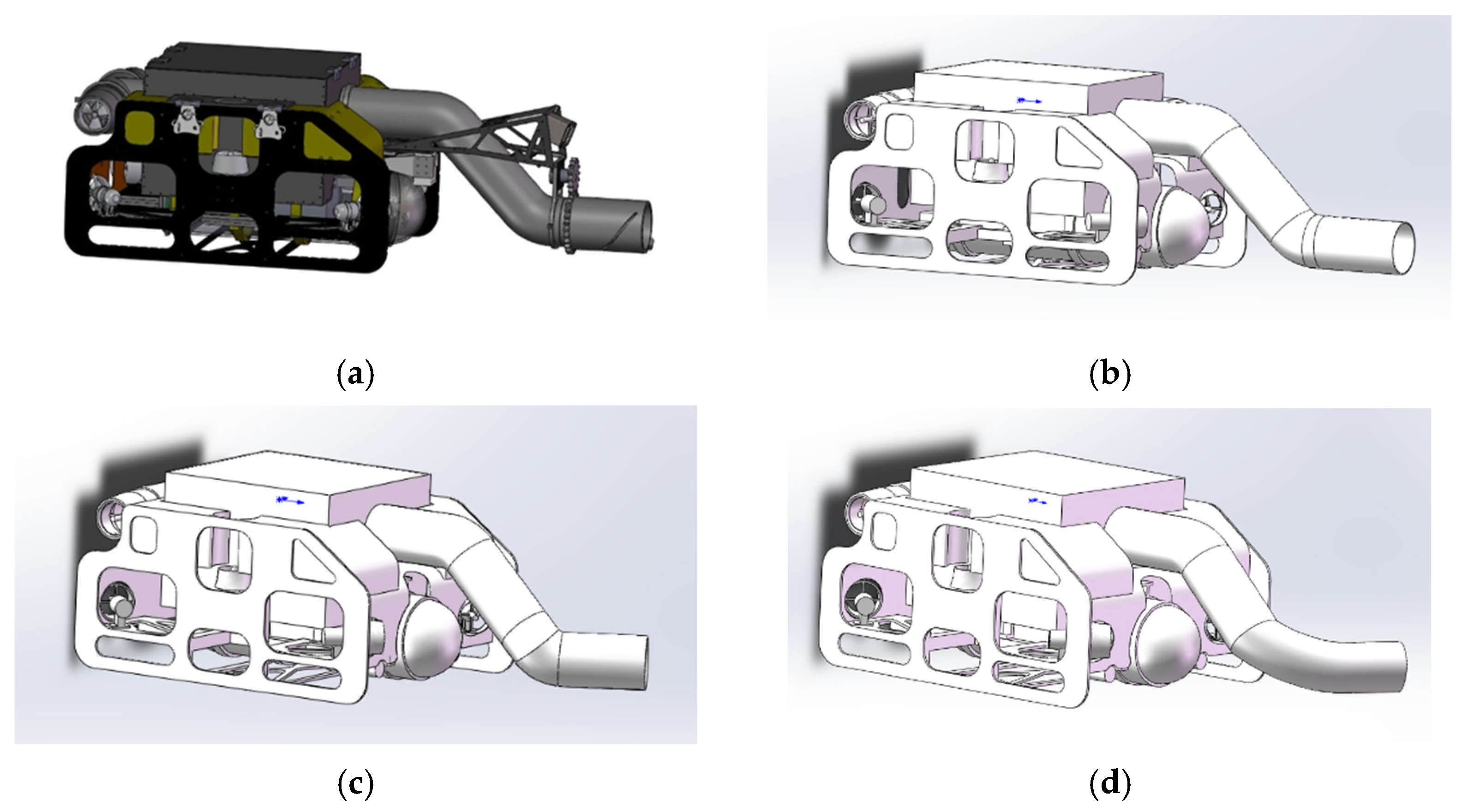
The underwater object suction robot has a frame structure with a complexly geometry. Direct meshing of the full geometry cannot provide reliable hydrodynamic force predictions, because it results in poor mesh quality and numerous surface-penetration issues. The model was therefore simplified. As shown in Figure 8, the simplified form eliminates other tiny components, threaded holes in the frame plates, and connection bolts. Removing the blades and keeping the diffuser cover helped also simplified the propeller as well.
In this study, the detailed rotational flow generated by the propeller blades was not explicitly simulated. The thrust produced by the thrusters was treated as an external control input in the dynamic model, while the CFD simulations focused on evaluating the hydrodynamic forces induced by the incoming flow acting on the ROV hull [16]. Therefore, the propeller blades were removed to improve mesh quality and computational efficiency, while the diffuser cover was retained to preserve the main geometric blockage effect of the thruster housing.
Furthermore, the box intake and nozzle models were optimized and merged into a single component. To focus on the numerical simulation of the variable flexible tube, the model was simplified into three suction-tube configurations with different bending degrees. In the model simplification procedure, two typical bending angles, 30° and 60°, were selected for the variable flexible tube. The maximum bending angle of 60 degrees was determined based on the mechanical design limits of the servo-driven joint and preliminary structural assessment to avoid excessive stress concentration and instability during operation. The 30° bending angle was selected as the intermediate configuration between 0° and 60° to characterise moderate and pronounced tube deflections. These angles cover typical operational postures encountered during benthic sampling tasks, while being sufficiently distinct to study the nonlinear influence of different tube shape of tube on hydrodynamic forces and moments. At the same time, they ensure numerical convergence and mesh quality in CFD simulations [21,22].

3.4. Boundary Condition

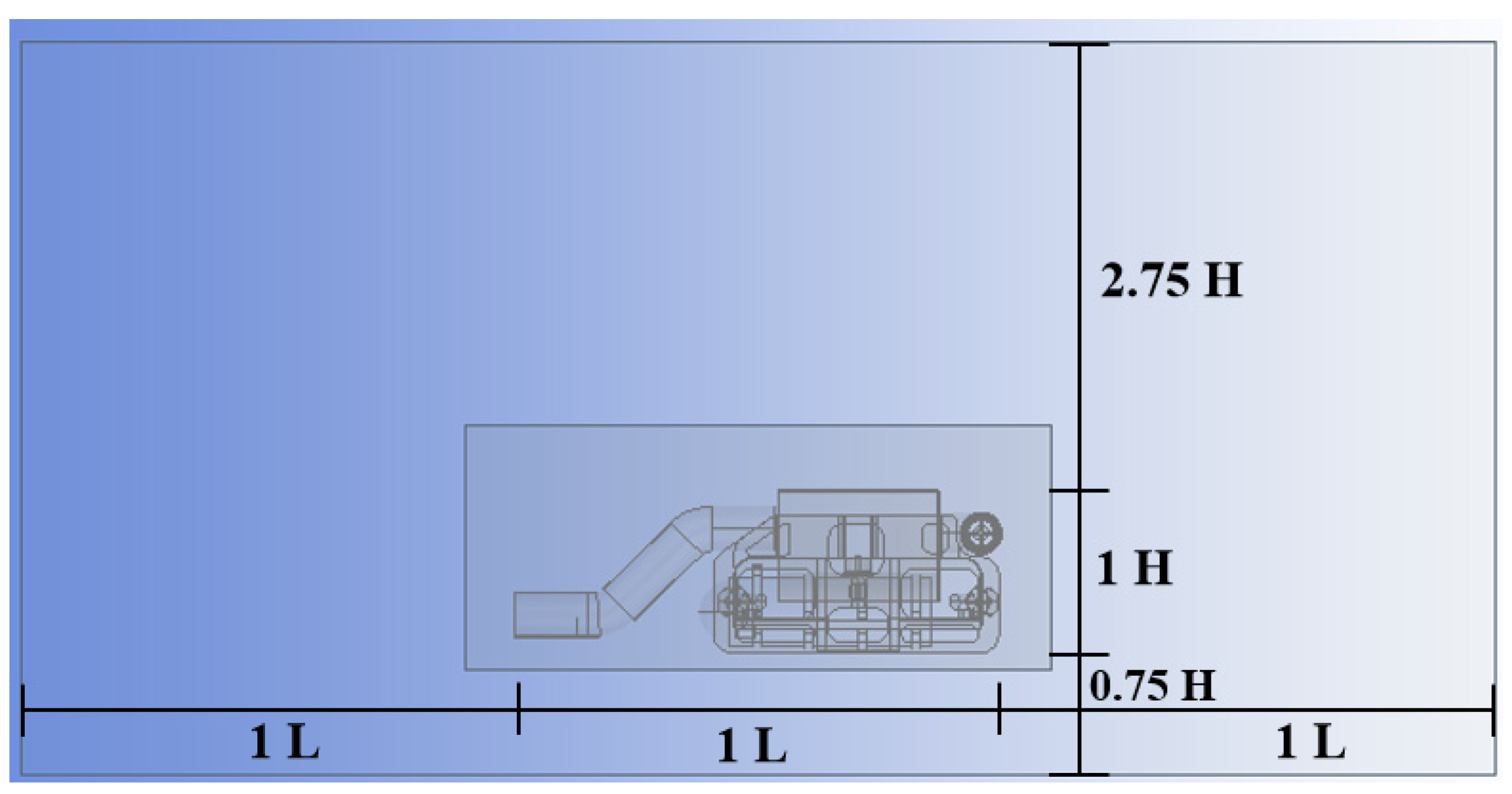
The computational domain was defined as a rectangular fluid region surrounding the ROV model, with dimensions scaled relative to the vehicle length (L), width (B), and height (H). It can ensure sufficient distance from the boundaries to minimise blockage and reflection effects. A uniform velocity inlet boundary condition was applied at the upstream surface, with inlet velocities ranging from −1 m/s to 1 m/s depending on the motion scenario (longitudinal, lateral, or vertical). The downstream boundary was defined as a pressure outlet with zero-gauge pressure.
In order to study the hydrodynamic characteristics of the ROV and the influence of the suction tube configuration, the simulations were conducted in an open-water computational domain with uniform inflow conditions. Environmental factors such as reef roughness and ambient turbulence were not included in the present model and will be investigated in future studies.
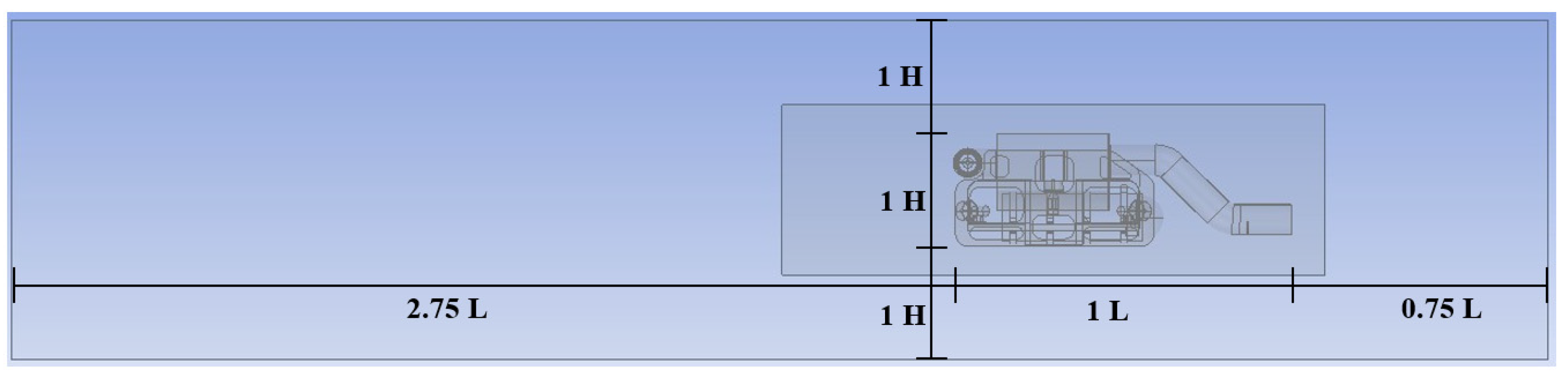
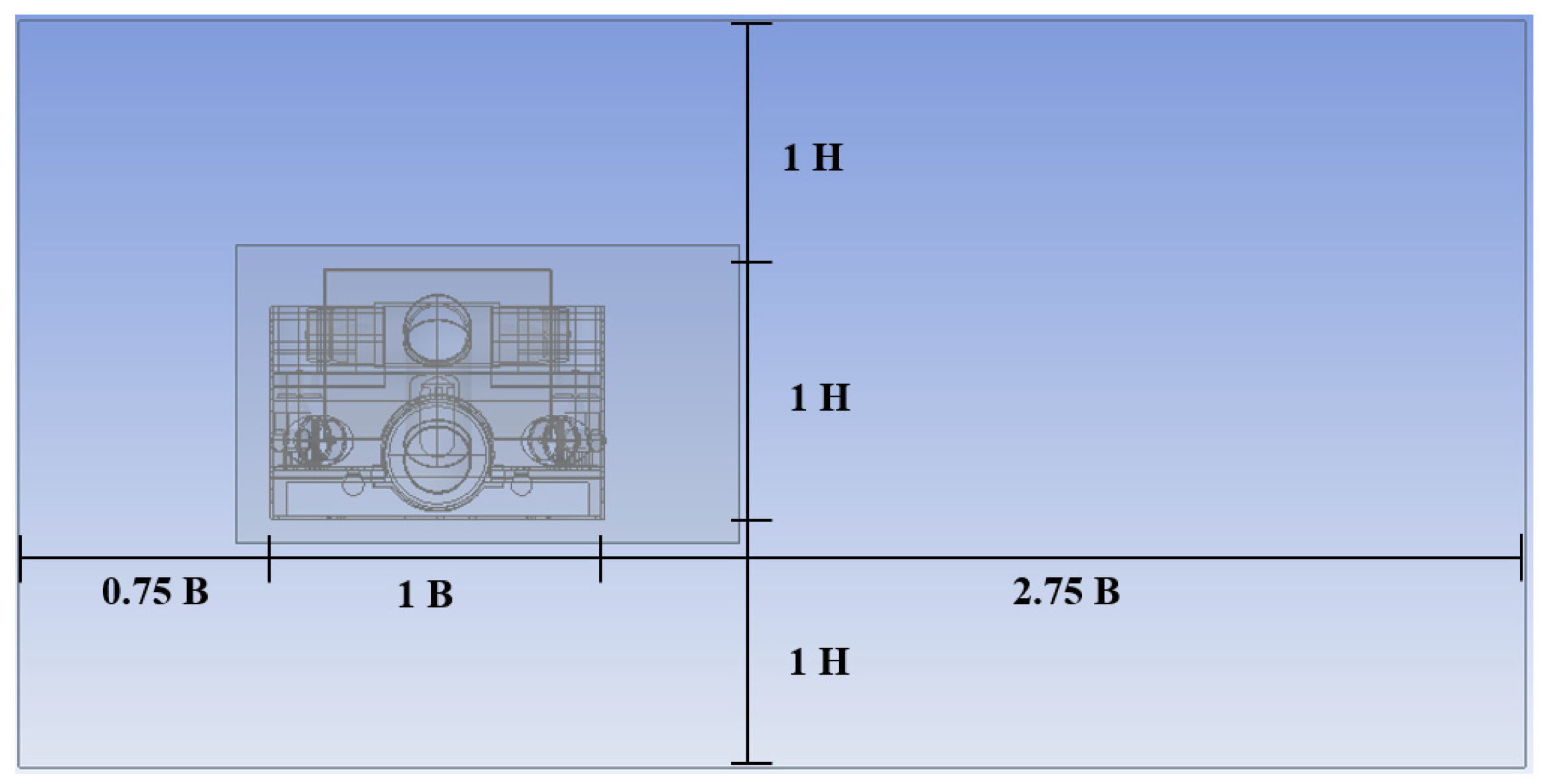
Three computational fluid domains, each consisting of an inner zone and an outer zone, were designed to simulate the three motion cases of the underwater robot, with inflow applied in the longitudinal (Figure 9), lateral (Figure 10), and vertical (Figure 11) directions. When calculating the straight-line motion of the vehicle, the computational domain for longitudinal motion is a rectangular region with dimensions of 4.5 L in length, 2.5 B in width and 3 H in height. The computational domain is divided into an inner domain and outer domain. The region of the inner domain is 0.1 L and 0.5 L, 0.125 B and 0.25 H, while the outer domain extends from 0.75 L to 2.75 L, 0.75 B and 1 H [23].
The computational domain of lateral motion is a rectangular region with dimensions of 2.5 L in length, 4.5 B in width and 3 H in height. The computational domain is divided into an inner domain and an outer domain. The inner domain extends 0.1 L upstream and 0.1 L downstream, 0.1 B and 0.4 B in the lateral direction, and 0.1 H in the vertical direction, whereas the outer domain extends to 0.75 L, 0.75 B and 2.75 B, and 1 H.
The computational domain of vertical motion is a rectangular region with dimensions of 3 L in length, 2.5 B in width, and 4.5 H in height. The computational domain is divided into an inner domain and an outer domain. The inner domain extends 0.1 L upstream and 0.1 L downstream, 0.1 B in the lateral direction, and 0.1 H and 0.4 H in the vertical direction, while the outer domain extends to 1 L, 0.75 B, 0.75 H and 2.75 H.

3.5. Mesh Generation

This paper uses the curvature and the proximity size functions in the surface mesh generation for the underwater suction tube robot. The growth rate was set to 1.2 to improve face-mesh quality, and the surface quality limit was set to 0.7. A face-sizing method was used to control the surface mesh size of the underwater suction-tube robot, while a volume-sizing method was used to control the mesh size of the computational fluid domain. The volume was filled with polyhedral cells and used a global sizing method; the growth rate was also 1.2. To improve the volume mesh, the orthogonal quality method was adopted to constrain cell quality.
In addition, the target y + value was set to 1, which necessitated a small first-layer thickness in the boundary-layer mesh. Accordingly, sufficient inflation layers were introduced to maintain a smooth boundary-layer transition. For the ROV model, the first-layer mesh size was specified as 0.0005 m, yielding approximately five boundary-layer layers and achieving a balance between computational efficiency and mesh quality [24,25,26].
The first-layer boundary-layer thickness, y H , can be estimated according to the following procedure. First, the Reynolds number of the ROV model is calculated as:
R e = ρ U L ν
where U is the velocity of the free flow, L is the length of the ROV, and μ is the dynamic viscosity of the flow. And the surface friction coefficient of the model can be estimated with
C f = [ 2 l o g 10 ( R e ) 0.65 ] 2.3
The wall shear stress τ w can then be determined as follows:
τ w = 1 2 ρ U 2 C f
The friction velocity is
u τ = τ w ρ
Since the y + value can be obtained from the following equation, the height of the centre point in the first layer of the mesh, y p , can be derived as
y + = ρ y p u τ m u     y p = y + μ ρ u τ
Finally, the height of the first layer of the boundary layer can be calculated with 3.10
y H = 2 y p
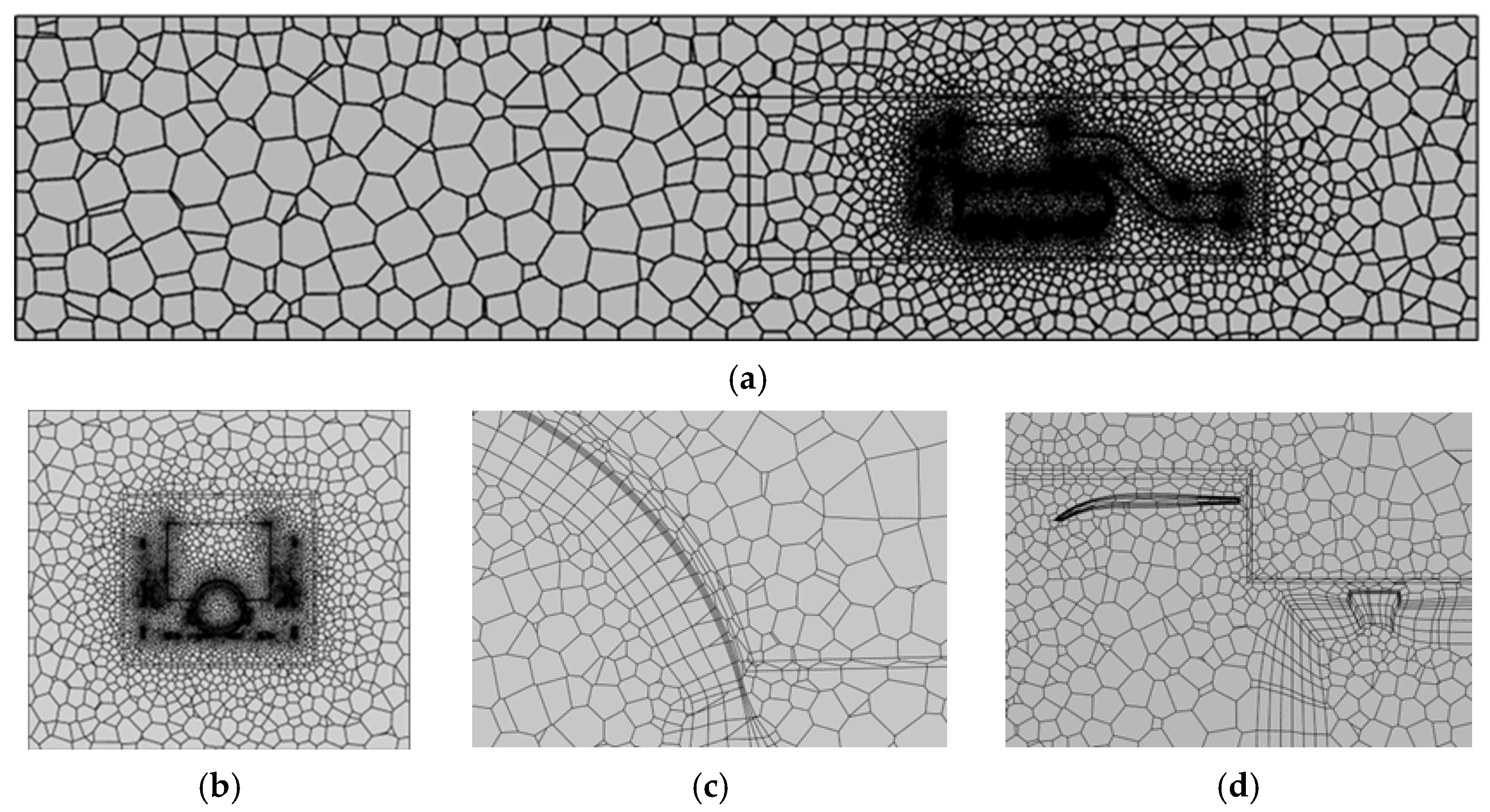
To study the first boundary layer thickness, the results obtained using ν ≈ 1.05 × 10⁻⁶  m 2 / s for the three angles of the suction tube are shown in Table 2. In this study, taking longitudinal motion as an example, the mesh transition and the surface mesh distribution with the inflation layers defined by the first-layer thickness around the geometry are illustrated in Figure 12. The Reynolds number is calculated at a velocity of 1 m/s along the negative y axis.
Figure 12 shows the mesh distribution and local refinement around the ROV model. The mesh is refined near the hull and suction tube, with well-resolved boundary layers to ensure accurate prediction of flow features.
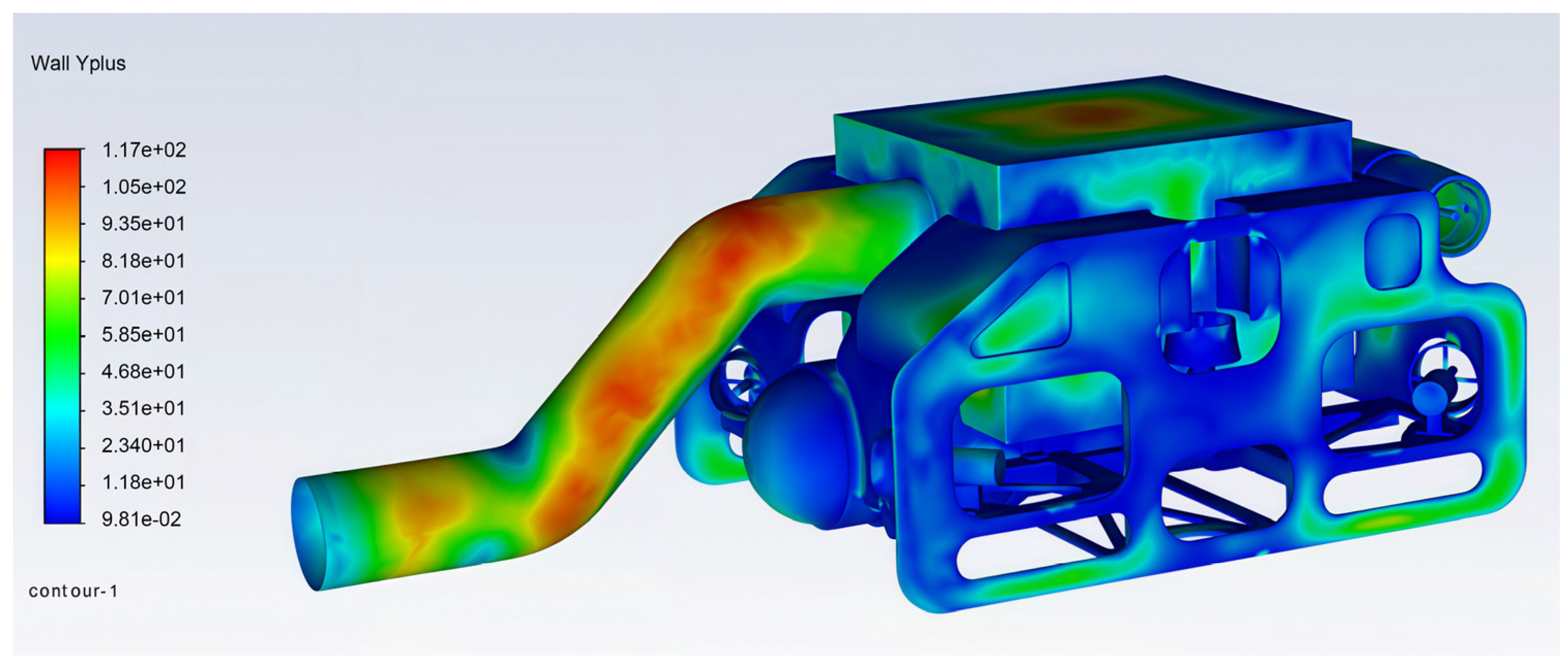
After mesh refinement and near-wall verification, the final production mesh adopted for the CFD simulations used a face mesh size of 0.5 mm. The total grid number was approximately 3.5 million cells, with slight variations among the 0°, 30°, and 60° suction-tube configurations due to geometric differences. During the study of the face mesh sizing and body mesh sizing, some issues in generating the boundary layer were resolved. The y+ is maintained at approximately 1 for the SST k - ω model, which belongs to the low Reynolds number turbulence model. Figure 13 shows the distribution of the y+ value over the surface of the underwater robot’s model.

3.6. Mesh Independence Study

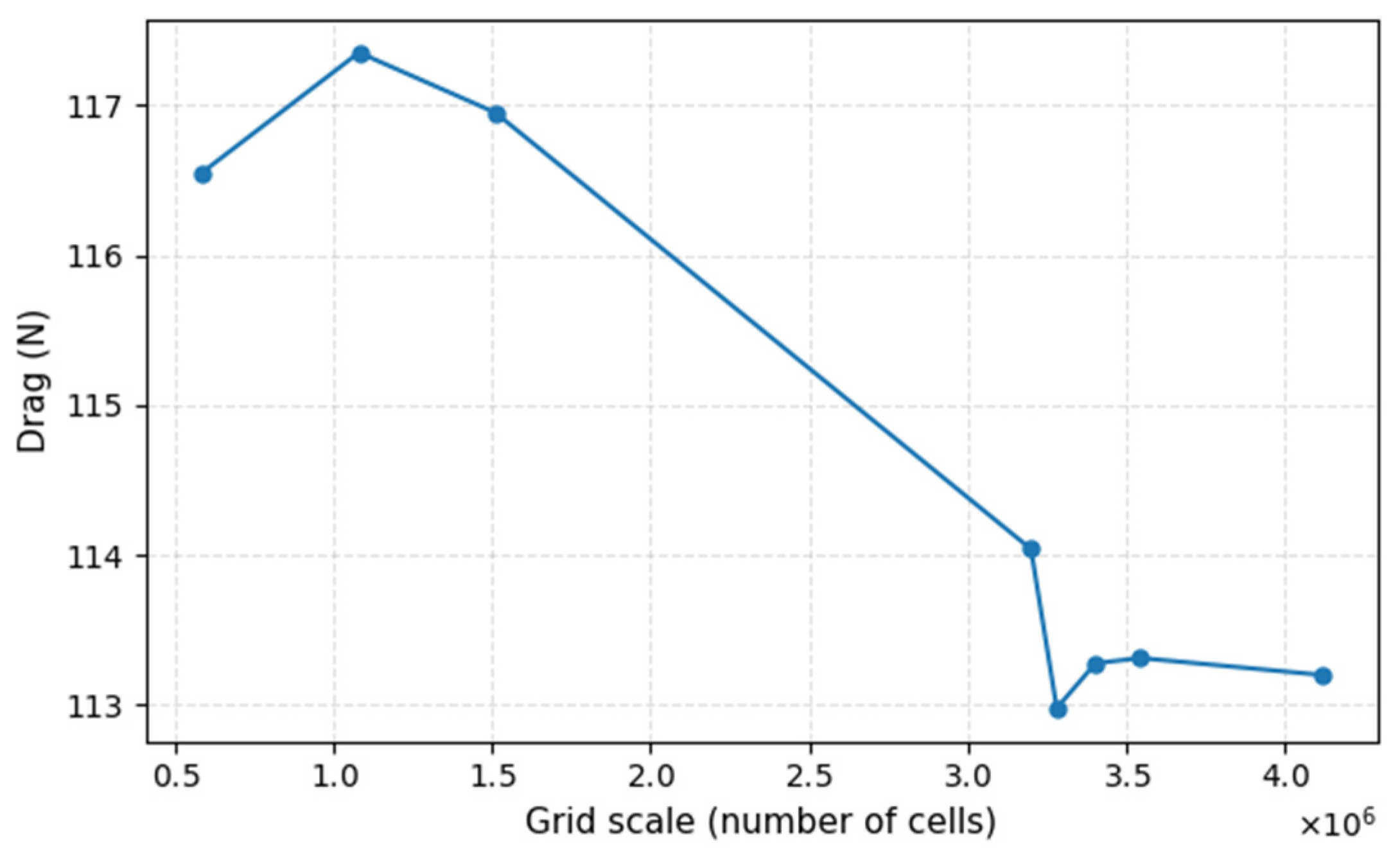
A proper grid scale is important for the numerical simulation results. The computational load and solution accuracy of the solution highly depend on the number of cells [27]. In this study, the analysis was conducted under the condition of longitudinal straight motion of the ROV with a 0° suction-tube angle along negative y axis at 1 m/s. Mesh independence was assessed based on five simulations using five different face mesh sizes. The corresponding drag force results for the ROV were obtained, and the specific simulation conditions are presented in Table 3.
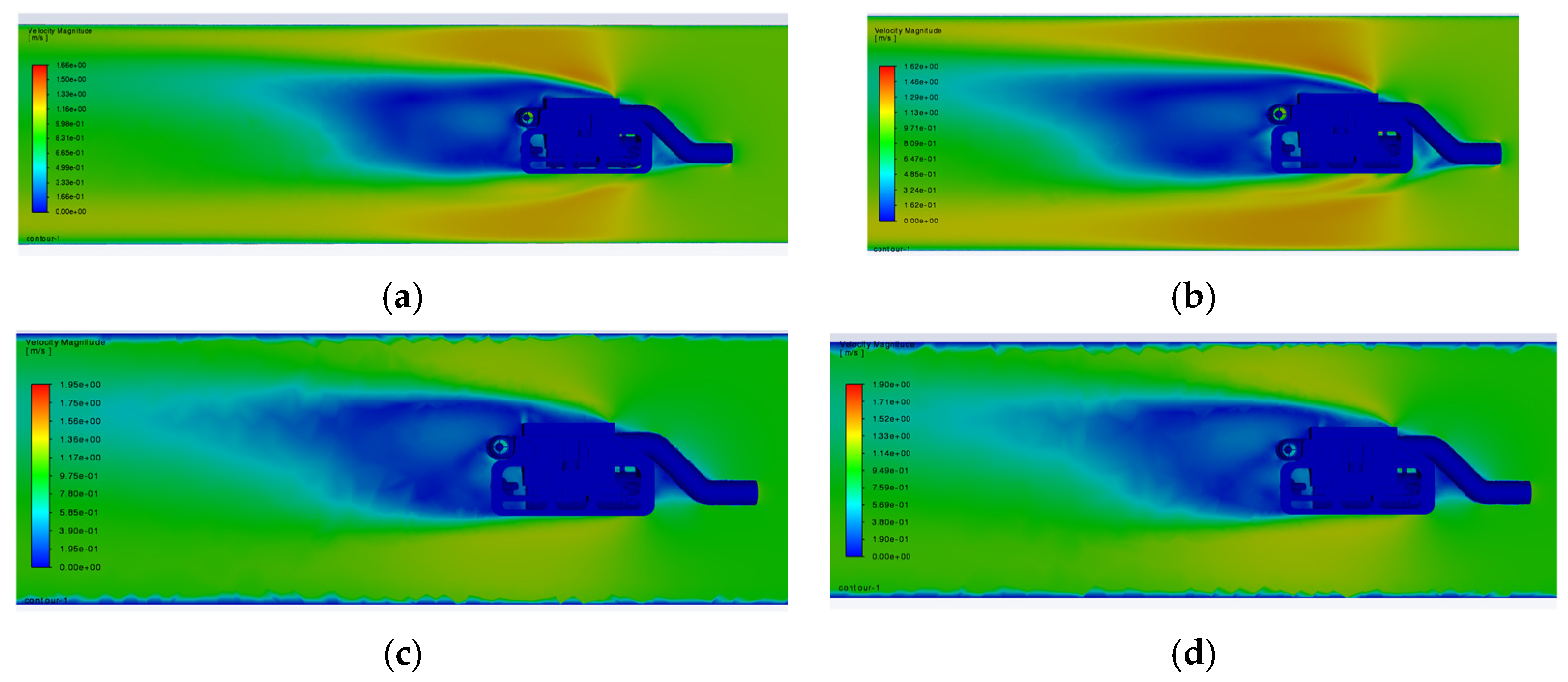
As shown in Figure 14, the velocity contours illustrate the flow field around the ROV under different mesh sizes, with the wake region clearly captured behind the vehicle.
Based on the above solution data, when the surface mesh size is increased to 8 mm, the boundary layer cannot be generated properly because the thickness of a single mesh element exceeds the maximum thickness of the plate material used in the ROV frame. As a result, the successive relative error generally decreases as the mesh is refined. Although noticeable variation is still observed between the 1.0 mm and 0.8 mm meshes, where the error reaches 2.461%, the error drops below 1% once the mesh size is refined to 0.7 mm. It then further decreases to 0.259%, 0.031%, and 0.100% for the 0.7–0.6 mm, 0.6–0.5 mm, and 0.5–0.4 mm mesh transitions, respectively. These results show that the predicted drag becomes increasingly stable as the mesh is refined, indicating that the solution has essentially converged. The trend of longitudinal damping with the change of mesh number is shown in Figure 15.

3.7. Study of Effect of the Turbulent Model

To analyse the effect of the different Reynolds-averaged Navier–Stokes (RANS) turbulence models on the results, simulations were conducted for the ROV with a 0° suction-tube angle undergoing straight longitudinal motion along the negative y axis at 1 m/s.
As shown in Table 4, the predicted drag values obtained by the four turbulence models are generally close to each other. The SST k - ω and SST k - ε models give very similar results, with a difference of less than 0.5%, indicating good consistency between these two models for the present flow condition. In comparison, the Spalart–Allmaras model predicts a slightly higher drag, whereas the Reynolds Stress Model predicts a slightly lower value.

3.8. Sensitivity Study to Grid Parameters and Flow Velocity

To evaluate the sensitivity of the numerical setup to both grid parameters and flow velocity, a parametric study was conducted under the condition of longitudinal straight motion of the ROV along the negative y -axis. As shown in Table 5, the velocity was varied from 0.2 to 1.0 m/s, while the face mesh size was kept constant at 0.5 mm. The Reynolds number was calculated using a characteristic length of L = 1.155 m and a kinematic viscosity of ν = 1.05 × 10 6 m 2 /s. Based on a target near-wall resolution of y + = 1 , the corresponding first-layer inflation height y H was determined for each velocity condition according to Equations (13)–(18).
As a result, the near-wall mesh becomes finer, leading to an increase in the total cell number. Because this increase is gradual and regular, the mesh variation can be considered reasonable and numerically stable within the investigated range.

3.9. Numerical Method

Pressure–velocity coupling is handled using the semi-implicit method for pressure-linked equations-consistent (SIMPLEC) algorithm, which is employed within a pressure-based segregated solver to enhance convergence. A second-order implicit scheme is adopted for the transient formulation to accurately resolve unsteady flow behaviour. A second-order upwind scheme is used to discretize the convective terms in both the momentum equations and the turbulence transport equations, while a second-order central difference scheme is applied to the diffusive fluxes. The residuals of 10 5 are fixed to satisfy the convergence criteria for both the continuity and momentum equations. The specific settings of the solution parameters and mesh parameters are shown in Table 6.

4. CFD Simulation and the Result for Numerical Study

4.1. Longitudinal Direct Flight Calculation and Result Analysis

The main monitored physical quantities include longitudinal force X, vertical force Z and pitch moment M. The speed inlet is set from −1 m/s to 1 m/s with sampling at intervals of 0.2 m/s. The sampling data are as follows in Table 7.
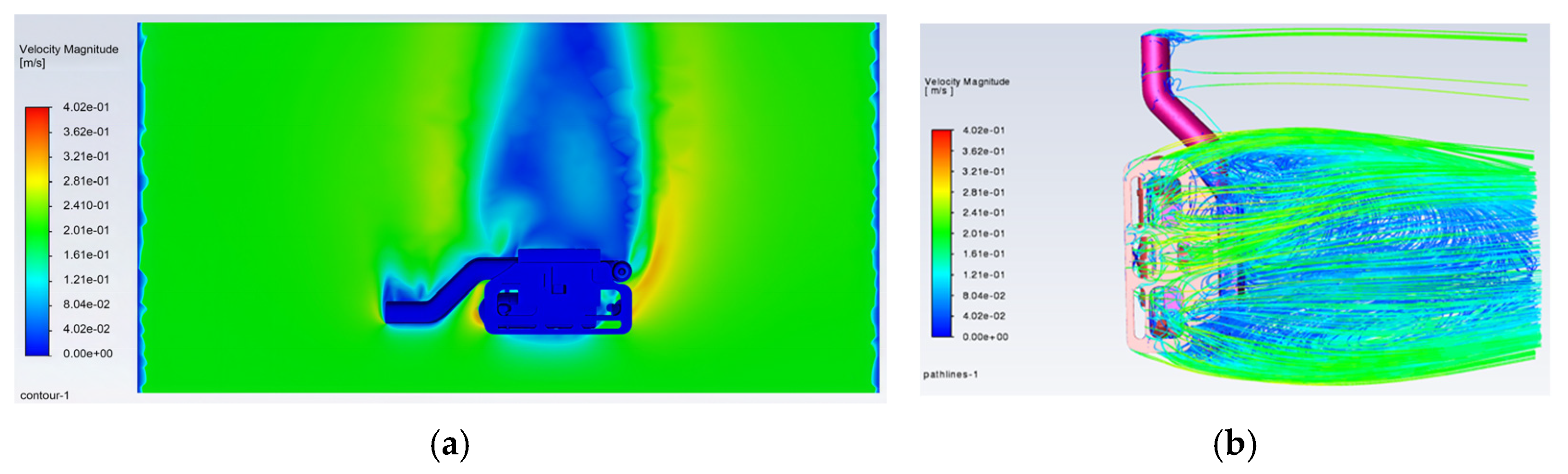
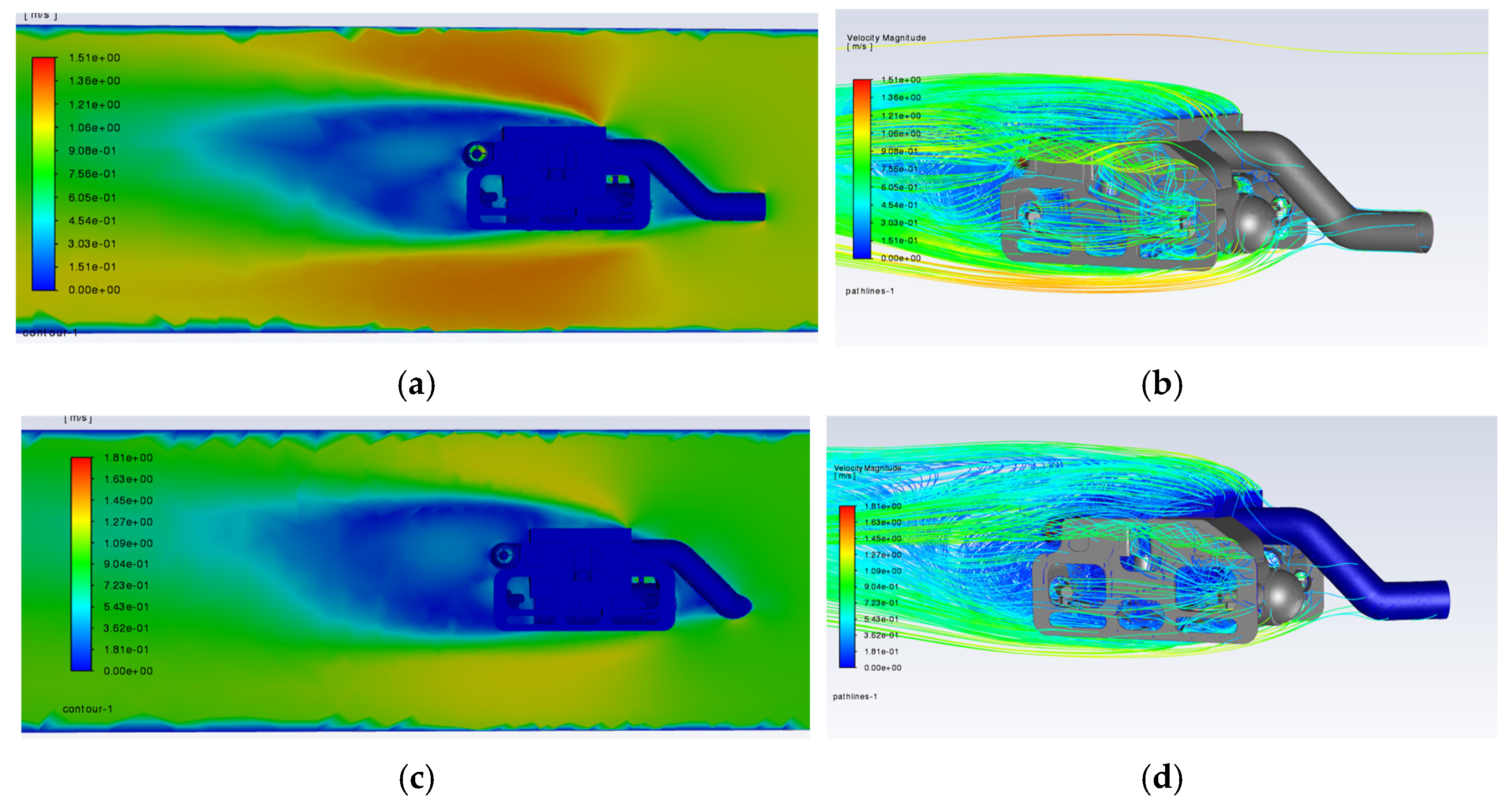
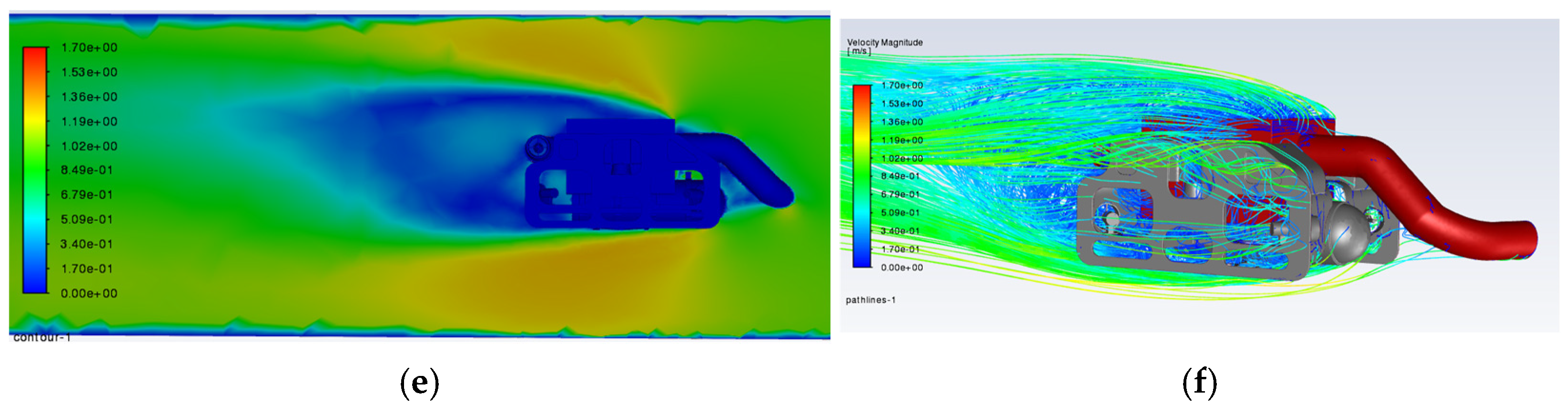
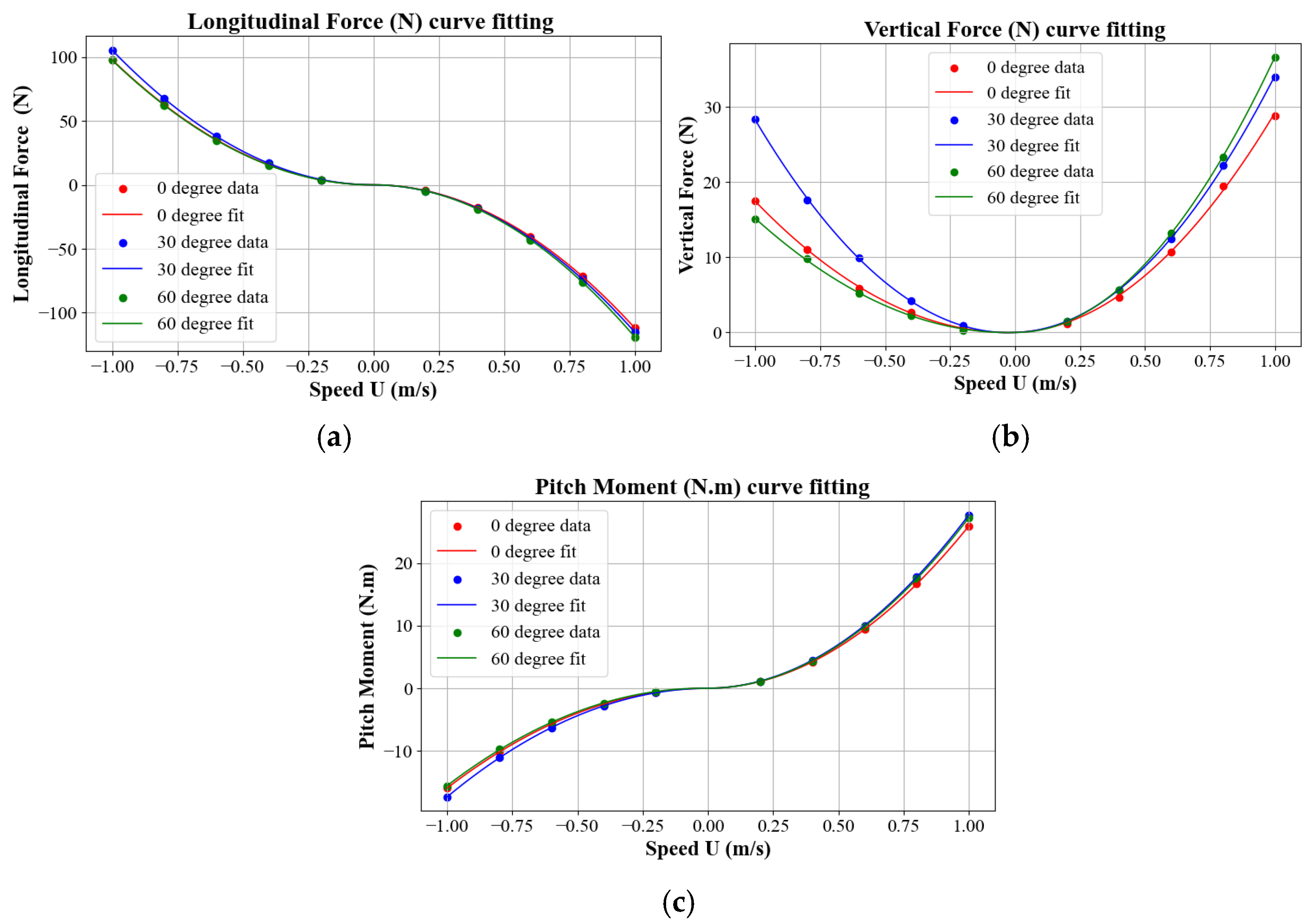
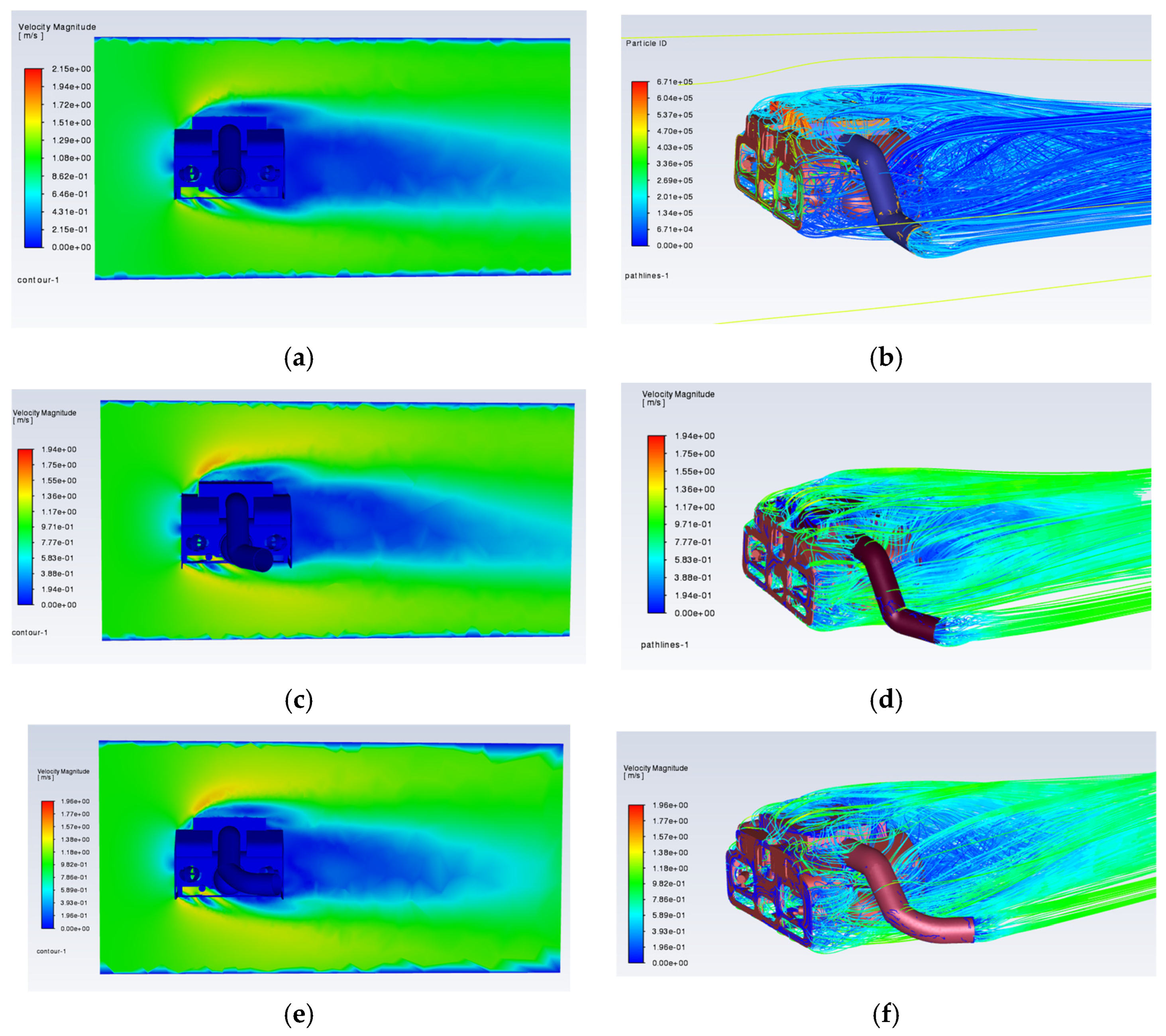
During longitudinal straight motion at a speed of 1 m/s, the ROV experiences a sailing resistance of approximately 111.8 N, 115.1 N and 118.9 N at the three bending angles. Compared with the thrust provided by the horizontal thrusters during the straight motion (123 N), there is still considerable redundancy. The thrusters can meet the operation requirements. The data of longitudinal force X, vertical force Z and pitching moment M were fitted using the least squares method, and the hydrodynamic coefficients were calculated. The velocity cloud chart and the fitting curve chart of the force in this situation are shown in Figure 16 and Figure 17.
The curve fitted by the least squares method can lead to the expression of viscous hydrodynamics F D ( U ) = F U U + F U U + F U U U U + F U U U 2 with longitudinal force X, vertical force Z and pitch moment M. And four parameters can be obtained, which are X U   X U   X U U and X U U ; Z U   Z u   Z U U and Z U U ; and M U   M u   M U U and M U U . Table 8 presents the calculation results of the required hydrodynamic forces.

4.2. Analysis of Lateral Direct Flight Calculation and Results

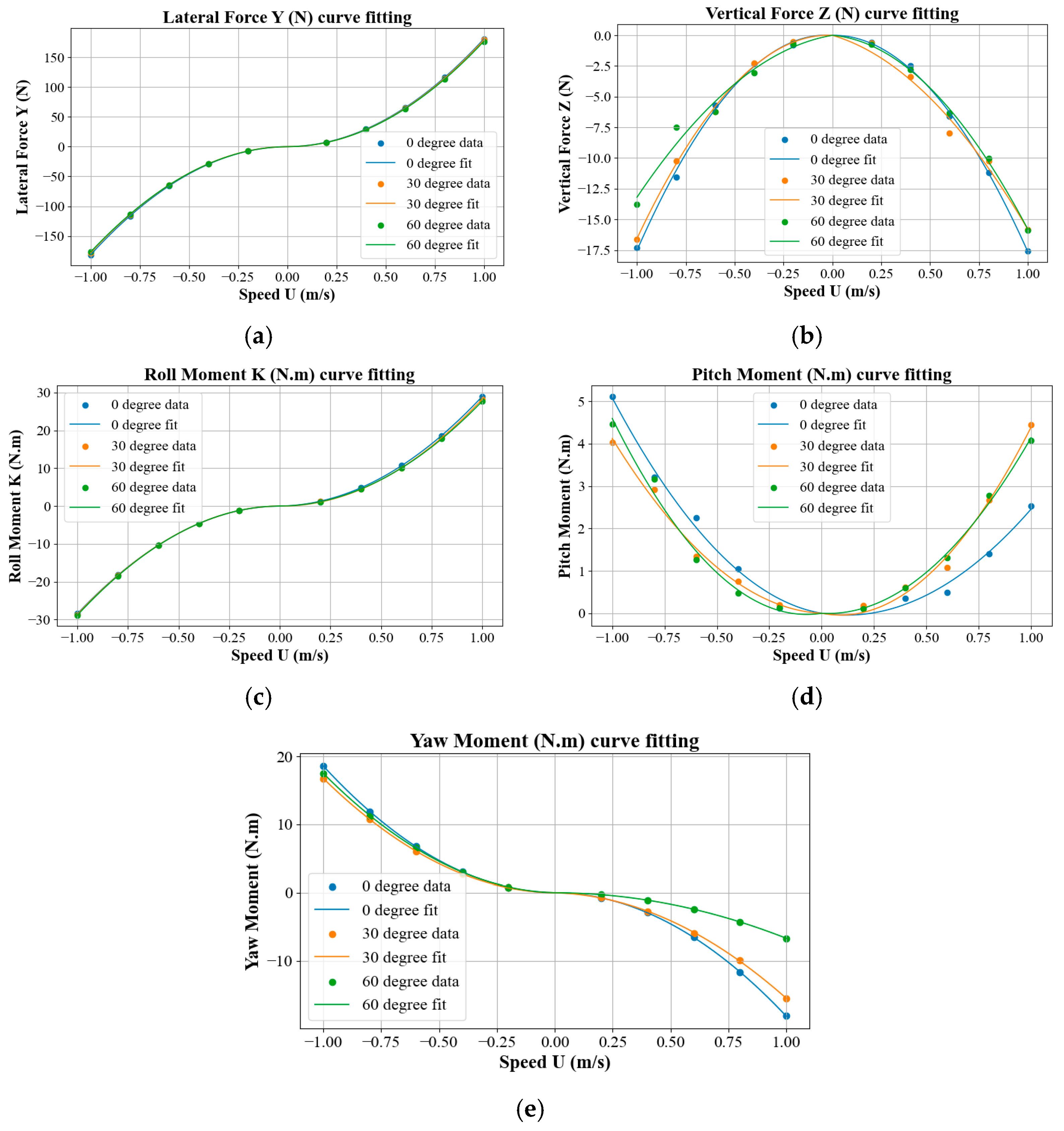
The physical quantities monitored during the calculation include the lateral force Y, vertical force Z, roll moment K, pitch moment M and yaw moment N. The longitudinal force is ignored as it is relatively small compared with the lateral force. By fitting and calculating the hydrodynamic data, relevant hydrodynamic coefficients can be obtained. The sampling data are presented in Table 9. The velocity cloud chart and the fitting curve chart of the force in this situation are shown in Figure 18 and Figure 19.
The cruise speed during the lateral movement process is planned to be 1 knot. In the hydrodynamic calculation, the ROV subjected to 0.6 m/s movement experiences lateral forces of approximately 66.01 N, 64.73 N and 63.68 N, which are much less than the maximum thrust of the thruster. The fitting curve of lateral force Y, vertical force Z, roll moment K, pitch moment M and yaw moment N used the expression of viscous hydrodynamics F D U = F U U + F U U + F U U U U + F U U U 2 . For this, we calculated Y V , Y V V , Y V V and Y V V ; z V , Z V V , Z V V and Z V V ;   K V ,   K V V , K V V and K V V ;   M V , M V V , M V V and M V V ; and N V , N V V , N V V and N V V . Table 10 presents the calculation results of the required hydrodynamic forces.

4.3. Analysis of Vertical Direct Navigation Calculation Results

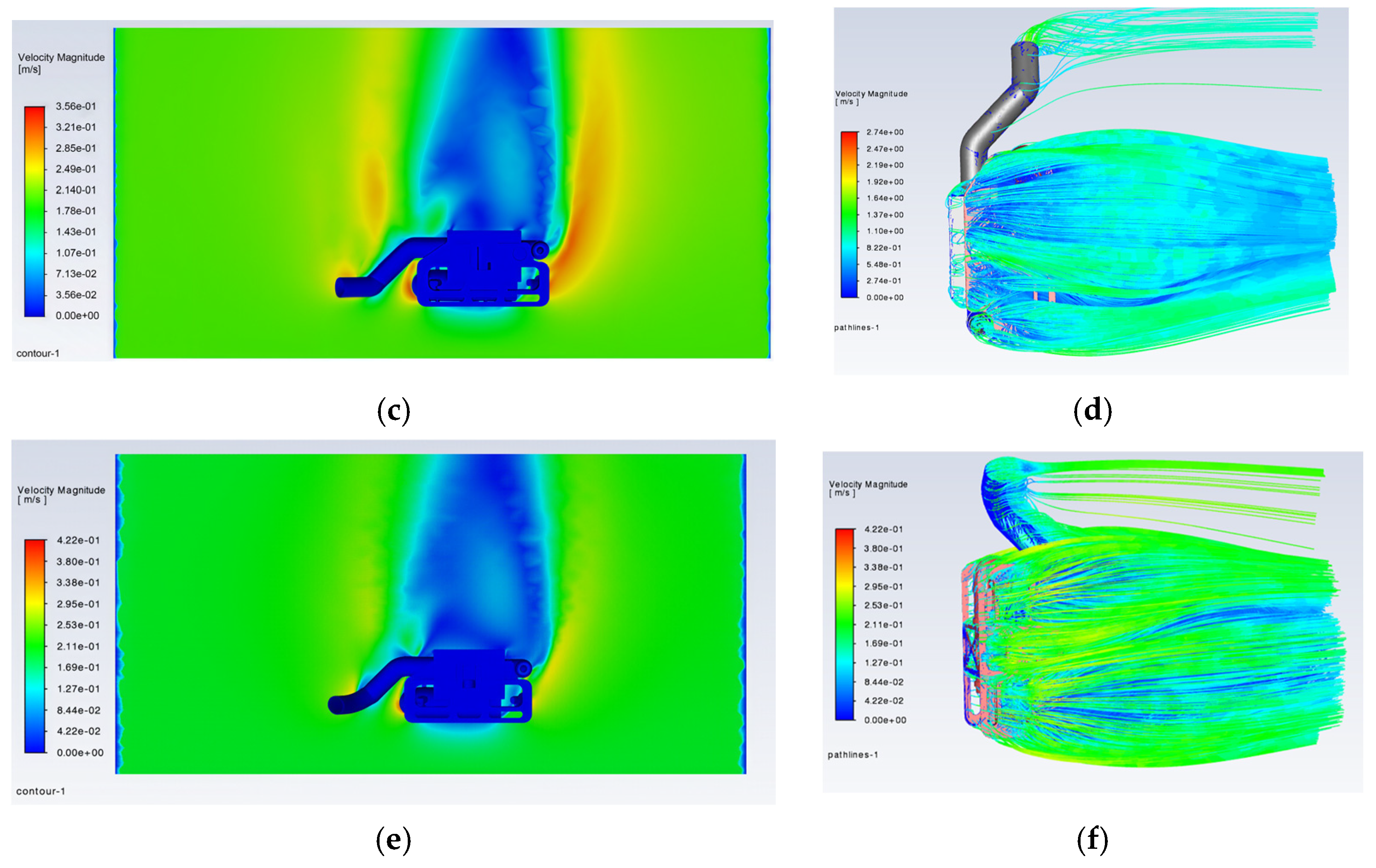
During the vertical pitch and roll motion, the ROV body model was rotated by +90° and −90°, respectively, enabling the simulation of the ROV head and bottom part facing the velocity inlet, thereby achieving upward and downward movements. The sampling data are presented in Table 11. The velocity cloud chart and the fitting curve chart of the force in this situation are shown in Figure 20 and Figure 21.
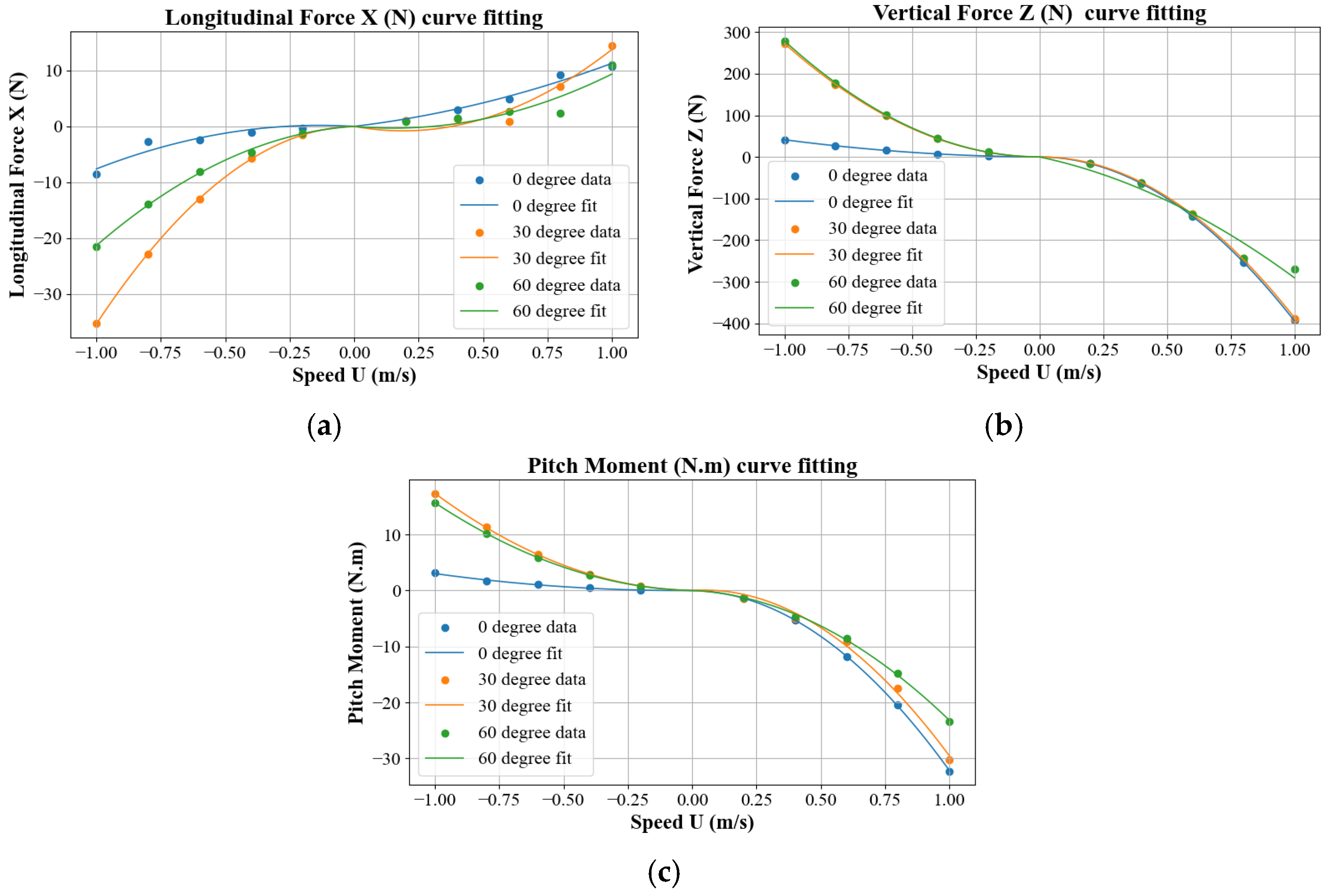
The vertical motion of the ROV under a water current velocity of 0.2 m/s in the hydrodynamic computation is subjected to resistances of approximately 16.2 N, 16.2 N and 16.1 N at the three tube angles. Assuming the ROV is fully loaded with marine organisms, and assuming the density of the collected organisms is 1.2 g/ c m 3 for estimation, the thrust needed for the ascent procedure does not exceed 47 N. The vertical thruster can, meanwhile, offer 60 N of thrust, which will satisfy the ascent thrust requirement at 0.2 m/s speed. The least square approach fits the pitch moment, vertical force, and longitudinal force in the heave motion; thus, the pertinent hydrodynamic coefficients were obtained as shown in Table 12.
The expression of viscous fluid dynamics, F D U = F U U + F U U + F U U U U + F U U U 2 , can be obtained by fitting the curve through the least square method with longitudinal force X, vertical force Z and pitch moment M. And four parameters can be obtained, which are X W   X W   X W W and X W W ; Z W   Z W   Z W W and Z W W ; a n d   M W   M W   M W W and M W W .

4.4. Comparison of Hydrodynamic Coefficients Calculated by ROV

We selected several open-deck ROVs with main dimensions similar to this ROV for use. The calculation results are compared as shown in Table 13.
Table 13 shows that, despite structural differences and scale variations among the selected open-frame ROVs, the calculated hydrodynamic coefficients exhibit comparable orders of magnitude and consistent sign trends. These similarities show that the present CFD predictions are physically consistent with previously reported hydrodynamic characteristics of similar ROV platforms.
Although the absolute values of some coefficients differ due to variations in vehicle geometry and appendage configuration, the overall magnitude and sign of the dominant terms remain consistent with literature data. In particular, the quadratic surge drag coefficient shows a similar order of magnitude to those reported in previous ROV studies, confirming that longitudinal resistance is primarily governed by pressure drag and wake formation. Differences in some lateral and vertical coefficients are likely related to the flexible suction-tube structure, which modifies the projected area distribution and introduces configuration-dependent hydrodynamic asymmetry. These comparisons indicate that the present CFD-derived coefficients are physically reasonable and consistent with established hydrodynamic characteristics of open-frame underwater vehicles.

5. Discussion

Table 13 compares the identified hydrodynamic coefficients of the present ROV with those reported for open-frame ROVs of comparable scale from Harbin Engineering University [28] and Shanghai Jiao Tong University [29]. Although structural configurations and principal dimensions differ among the three platforms, several consistent trends can be observed.
The quadratic drag term in the surge direction ( X u ) exhibits the same negative sign across comparable cases and remains within the same order of magnitude (101–102). This consistency indicates that longitudinal resistance is predominantly governed by pressure drag associated with bluff-body wake formation, which is characteristic of open-frame ROV geometries. This indicates that the robot’s forward motion is mainly affected by form drag associated with wake development rather than by viscous friction alone. Therefore, the required propulsion effort is expected to increase primarily with changes in exposed frontal geometry.
The linear damping terms (e.g., X u , Z w ) are significantly smaller in magnitude than the quadratic components, confirming that viscous shear effects play a secondary role compared to form drag at the operating Reynolds number range. This trend is also consistent with previously published ROV hydrodynamic studies. This result further suggests that the overall hydrodynamic response of the robot is more sensitive to posture variation and projected-area redistribution than to small changes in boundary-layer shear, which is important for understanding its manoeuvring behaviour during sampling tasks.
Variations in vertical and lateral coefficients (e.g., Z w ) can be attributed to differences in projected area distribution and suction tube configuration. The present ROV shows larger absolute values in certain vertical quadratic terms, which may result from the flexible suction tube increasing vertical projected area and modifying wake interaction. Physically, this means that tube bending not only changes the external geometry of the robot but also alters the force–moment coupling characteristics that govern its attitude response under cross-flow conditions. In practical operation, larger vertical and lateral quadratic coefficients imply that the robot may experience stronger disturbance forces and moments in side-flow and vertical inflow, thereby increasing control effort and reducing motion stability during precise collection operations.
Although the numerical values differ due to geometric and scaling differences. The overall coefficient magnitude level and sign consistency suggest that the present CFD predictions are physically reasonable and comparable to established literature data for open-frame underwater vehicles. The flexible tube mechanism does not fundamentally change the dominant drag characteristics, but mainly influences configuration-dependent asymmetry under cross-flow conditions.

6. Conclusions

This article presents a numerical investigation of the hydrodynamic characteristics of a variable flexible tube underwater object suction robot based on computational fluid dynamics (CFD) using ANSYS Fluent. A series of steady-state simulations were carried out under longitudinal, lateral, and vertical flow conditions to evaluate the influence of suction tube bending angle on hydrodynamic forces and moments. Three representative tube configurations (0°, 30°, and 60°) were analysed, and viscous hydrodynamic coefficients were identified through least-squares fitting of the simulation results.
To ensure numerical reliability, mesh-independence verification and near-wall resolution control were implemented. The mesh independence results enhance the robustness of the extracted hydrodynamic data. The results show that, during longitudinal motion, the longitudinal drag force and pitching moment are only weakly affected by changes in the suction tube bending angle. Although a slight increase in drag is observed with increasing bending angle, the variation remains within the available propulsion margin, indicating that geometric reconfiguration of the flexible tube does not significantly deteriorate longitudinal hydrodynamic performance. This indicates that when the underwater robot conducts collection operations using flexible tubes under the influence of longitudinal direction inflow, the propeller adjustment does not need to consider the influence of longitudinal forces and pitch moments, but only needs to consider the influence of vertical forces. When the underwater robot is in lateral inflow, both hydrodynamic forces and moments are significantly influenced when the incoming flow direction opposes the bending direction of the flexible tube, which can lead to increased lateral resistance and moment coupling. For vertical motion, the suction-tube angle has an impact on both drag force and pitching moment. This phenomenon reveals a pronounced direction-dependent hydrodynamic asymmetry induced by tube deformation, particularly under cross-flow conditions where flow–structure interaction effects become more significant.
These contributions demonstrate that the flexible suction tube introduces direction-dependent hydrodynamic asymmetry, which must be explicitly considered in the design of motion control and attitude stabilisation strategies. Unlike a conventional rigid suction tube, the proposed flexible mechanism changes the suction tube angle, which affects the hydrodynamic force and moment distribution of the robot. The extracted hydrodynamic coefficients provide a quantitative basis for controller design, simulation modelling, and dynamic performance prediction of suction-based underwater robots operating in complex benthic environments.
The present results represent CFD-based predictions obtained under prescribed numerical conditions and have not yet been validated experimentally. So, the identified hydrodynamic coefficients should be interpreted as a numerical reference for mechanism evaluation, dynamic modelling, and future experimental verification. Future work will focus on unsteady flow simulations, coupling the suction-induced internal flow with the external hydrodynamic field, and experimental validation through towing-tank tests. Dedicated force and moment measurements using a multi-axis load cell will be conducted to quantitatively compare experimental results with CFD predictions, enabling calibration and uncertainty assessment of the extracted hydrodynamic coefficients. In addition, integrating the obtained hydrodynamic model into a closed-loop control framework will further support stable visual perception and precise manipulation during reef-environment sampling tasks. The validated model will also be incorporated into dynamic simulation environments to improve motion prediction accuracy and enhance robustness under cross-flow and disturbance conditions.

Author Contributions

Conceptualization, Y.Z. and Q.C.; methodology, J.Y.; software, Y.Z.; validation, W.Z., S.L. and Y.Z.; formal analysis, Q.C.; investigation, Y.Z.; resources, J.Y.; data curation, Y.Z.; writing—original draft preparation, Y.Z.; writing—review and editing, W.Z.; visualization, S.L.; supervision, F.H.; project administration, F.H.; funding acquisition, F.H. All authors have read and agreed to the published version of the manuscript.

Funding

This research was funded by National Natural Science Foundation of China, (grant number 52472427) and Supported by National Key Laboratory of Ship Structural Safety (Naklas-2025KF003).

Data Availability Statement

The original contributions presented in this study are included in the article. Further inquiries can be directed to the corresponding author.

Conflicts of Interest

The authors declare no conflicts of interest.

Abbreviations

The following abbreviations are used in this manuscript:
ROVRemotely operated underwater vehicle
CFDComputational Fluid Dynamics
HSMPSHydraulic Suction Macro-Biological Pressure Sampler
PRDPressurised Recovery Device
ASEAnalytical and Semi-Empirical
NSNavier–Stokes
SSTShear Stress Transport
SIMPLECSemi-Implicit Method for Pressure-Linked Equations-Consistent
RANSReynolds-averaged Navier–Stokes

References

  1. FAO. In Brief to The State of World Fisheries and Aquaculture 2024; FAO: Rome, Italy, 2024. [Google Scholar] [CrossRef]
  2. Purcell, S.W.; Ngaluafe, P.; Aram, K.T.; Lalavanua, W. Trends in small-scale artisanal fishing of sea cucumbers in Oceania. Fish. Res. 2016, 183, 99–110. [Google Scholar] [CrossRef]
  3. McLean, D.L.; Parsons, M.J.G.; Gates, A.R.; Benfield, M.C.; Bond, T.; Booth, D.J.; Bunce, M.; Fowler, A.M.; Harvey, E.S.; Macreadie, P.I.; et al. Enhancing the Scientific Value of Industry Remotely Operated Vehicles (ROVs) in Our Oceans. Front. Mar. Sci. 2020, 7, 220. [Google Scholar] [CrossRef]
  4. Galloway, K.C.; Becker, K.P.; Phillips, B.; Kirby, J.; Licht, S.; Tchernov, D.; Wood, R.J.; Gruber, D.F. Soft Robotic Grippers for Biological Sampling on Deep Reefs. Soft Robot. 2016, 3, 23–33. [Google Scholar] [CrossRef] [PubMed]
  5. Shen, Z.; Zhong, H.; Xu, E.; Zhang, R.; Yip, K.C.; Chan, L.L.; Chan, L.L.; Pan, J.; Wang, W.; Wang, Z. An Underwater Robotic Manipulator with Soft Bladders and Compact Depth-Independent Actuation. Soft Robot. 2020, 7, 535–549. [Google Scholar] [CrossRef] [PubMed]
  6. Polygerinos, P.; Correll, N.; Morin, S.A.; Mosadegh, B.; Onal, C.D.; Petersen, K.; Cianchetti, M.; Tolley, M.T.; Shepherd, R.F. Soft Robotics: Review of Fluid-Driven Intrinsically Soft Devices; Manufacturing, Sensing, Control, and Applications in Human-Robot Interaction. Adv. Eng. Mater. 2017, 19, 1700016. [Google Scholar] [CrossRef]
  7. Mazzeo, A.; Aguzzi, J.; Calisti, M.; Canese, S.; Vecchi, F.; Stefanni, S.; Controzzi, M. Marine Robotics for Deep-Sea Specimen Collection: A Systematic Review of Underwater Grippers. Sensors 2022, 22, 648. [Google Scholar] [CrossRef] [PubMed]
  8. Liu, G.; Jin, Y.; Peng, Y.; Liu, D.; Wan, B. A novel active deep-sea low-damage pressure-retaining organisms sampler. Front. Mar. Sci. 2022, 9, 1028052. [Google Scholar] [CrossRef]
  9. Liu, J.; Zhu, Z.; Wen, L. Underwater soft arm grasping with simplified control using octopus-inspired bending propagation. npj Robot. 2026, 4, 2. [Google Scholar] [CrossRef]
  10. Shillito, B.; Amand, L.; Hamel, G. Update of the PERISCOP system for isobaric sampling of deep-sea fauna. Deep Sea Res. Part I Oceanogr. Res. Pap. 2022, 193, 103956. [Google Scholar] [CrossRef]
  11. Shillito, B.; Hamel, G.; Duchi, C.; Cottin, D.; Sarrazin, J.; Sarradin, P.-M.; Ravaux, J.; Gaill, F. Live capture of megafauna from 2300 m depth, using a newly designed Pressurized Recovery Device. Deep Sea Res. Part I Oceanogr. Res. Pap. 2008, 55, 881–889. [Google Scholar] [CrossRef]
  12. Rogers, J.S.; Maticka, S.A.; Chirayath, V.; Woodson, C.B.; Alonso, J.J.; Monismith, S.G. Connecting Flow over Complex Terrain to Hydrodynamic Roughness on a Coral Reef. J. Phys. Oceanogr. 2018, 48, 1567–1587. [Google Scholar] [CrossRef]
  13. Reidenbach, M.A.; Monismith, S.G.; Koseff, J.R.; Yahel, G.; Genin, A. Boundary layer turbulence and flow structure over a fringing coral reef. Limnol. Oceanogr. 2006, 51, 1956–1968. [Google Scholar] [CrossRef]
  14. Zhang, G.; Lin, Y.; Huang, J.; Hong, L.; Wang, X. Hydrodynamic Coefficient Estimation of Small Autonomous Underwater Vehicle. In International Conference on Intelligent Robotics and Applications; Springer International Publishing: Cham, Switzerland, 2021; pp. 115–125. [Google Scholar] [CrossRef]
  15. Hong, L.; Wang, X.; Zhang, D.; Xu, H. Numerical Study on Hydrodynamic Coefficient Estimation of an Underactuated Underwater Vehicle. J. Mar. Sci. Eng. 2022, 10, 1049. [Google Scholar] [CrossRef]
  16. Lin, Y.-H.; Chiu, Y.-C. The estimation of hydrodynamic coefficients of an autonomous underwater vehicle by comparing a dynamic mesh model with a horizontal planar motion mechanism experiment. Ocean Eng. 2022, 249, 110847. [Google Scholar] [CrossRef]
  17. Do, K.D.; Pan, J. Control of Ships and Underwater Vehicles; Springer Science & Business Media: Heidelberg, Germany, 2009. [Google Scholar]
  18. Wu, J.; Yang, X.; Xu, S.; Han, X. Numerical investigation on underwater towed system dynamics using a novel hydrodynamic model. Ocean Eng. 2022, 247, 110632. [Google Scholar] [CrossRef]
  19. Ferziger, J.H.; Perić, M.; Street, R.L. Computational Methods for Fluid Dynamics; Springer: Berlin, Germany, 2019. [Google Scholar]
  20. Menter, F.R. Two-equation eddy-viscosity turbulence models for engineering applications. AIAA J. 1994, 32, 1598–1605. [Google Scholar] [CrossRef]
  21. Li, Q.; Cao, Y.; Li, B.; Ingram, D.M.; Kiprakis, A. Numerical Modelling and Experimental Testing of the Hydrodynamic Characteristics for an Open-Frame Remotely Operated Vehicle. J. Mar. Sci. Eng. 2020, 8, 688. [Google Scholar] [CrossRef]
  22. Yamamoto, C.T.; Fregonesi, R.A.; Meneghini, J.R.; Saltara, F. Numerical Simulations of the Flow Around Flexible Cylinders. In Proceedings of the ASME 2002 21st International Conference on Offshore Mechanics and Arctic Engineering, Oslo, Norway, 23–28 June 2002. [Google Scholar] [CrossRef]
  23. Li, H.; Zhang, J.; Han, F.; Zhu, H.; Zhu, R.; Yao, J. Integrated Design of Internal and External Flow Fields for Sea Cucumber Fishing ROV. IOP Conf. Ser. Earth Environ. Sci. 2020, 440, 052047. [Google Scholar] [CrossRef]
  24. Zhang, D.; Wang, X.; Zhao, M.; Hong, L.; Li, X. Numerical Investigation on Hydrodynamic Characteristics and Drag Influence of an Open-Frame Remotely Operated Underwater Vehicle. J. Mar. Sci. Eng. 2023, 11, 2143. [Google Scholar] [CrossRef]
  25. Li, Y.; Huang, H.; Duan, D.; Shen, S.; Zhou, D.; Liu, S. Non-Condensation Turbulence Models with Different Near-Wall Treatments and Solvers Comparative Research for Three-Dimensional Steam Ejectors. Energies 2024, 17, 5586. [Google Scholar] [CrossRef]
  26. Han, Y.; Wang, X.D.; Sun, H.; Zhang, G.; Guo, L.; Tu, J. CFD simulation on the boundary layer separation in the steam ejector and its influence on the pumping performance. Energy 2019, 167, 469–483. [Google Scholar] [CrossRef]
  27. Luo, W.; Guo, X.; Dai, J.; Rao, T. Hull optimization of an underwater vehicle based on dynamic surrogate model. Ocean Eng. 2021, 230, 109050. [Google Scholar] [CrossRef]
  28. Xu, S.J.; Han, D.F.; Ma, Q.W. Hydrodynamic forces and moments acting on a remotely operate vehicle with an asymmetric shape moving in a vertical plane. Eur. J. Mech.-B/Fluids 2015, 54, 1–9. [Google Scholar] [CrossRef]
  29. Fan, S.; Lian, L.; Ren, P. Research on hydrodynamics model test for deepsea open-framed remotely operated vehicle. China Ocean Eng. 2012, 26, 329–339. [Google Scholar] [CrossRef]
Figure 1. Structure of the HSMPS designed by Liu et al. (2022) [8].
Jmse 14 00624 g001
Figure 2. Overall CFD research workflow for the variable flexible tube ROV.
Jmse 14 00624 g002
Figure 3. Concept drawing of underwater object suction robot.
Jmse 14 00624 g003
Figure 4. ROV body coordinates and fixed coordinates.
Jmse 14 00624 g004
Figure 5. Overall mechanical structure of the underwater object suction robot: (a) front view; (b) rear view; (c) side view; (d) prototype of the underwater robot.
Jmse 14 00624 g005
Figure 6. Modelling and prototype verification of variable flexible pipe systems. (a) Model of suction tube; (b) prototype of suction tube.
Jmse 14 00624 g006
Figure 7. Numerical process of the research.
Jmse 14 00624 g007
Figure 8. Simplified model of ROV. (a) Original model of ROV; (b) simplified model at 0-degree tube; (c) simplified model at 30-degree tube; (d) simplified model at 60-degree tube.
Jmse 14 00624 g008
Figure 9. The computational domain of longitudinal motion with 4.5 L length, 2.5 B width and 3 H height.
Jmse 14 00624 g009
Figure 10. The computational domain of lateral motion with 2.5 L length, 4.5 B width and 3 H height.
Jmse 14 00624 g010
Figure 11. The computational domain of vertical motion with 3 L length, 2.5 B width and 4.5 H height.
Jmse 14 00624 g011
Figure 12. Mesh detail of the ROV model. (a) Cross-section left view; (b) cross-section front view; (c,d) boundary details.
Jmse 14 00624 g012
Figure 13. The distribution of y+ value over the ROV surface.
Jmse 14 00624 g013
Figure 14. Velocity contour figure at four different grid numbers (1 m/s). (a) Face mesh size at 0.5 mm; (b) face mesh size at 0.8 mm; (c) face mesh size at 1 mm; (d) face mesh size at 5 mm.
Jmse 14 00624 g014
Figure 15. Trend of longitudinal direction drag with the change of grid number.
Jmse 14 00624 g015
Figure 16. Comparison of flow field streamlines around the underwater vehicle model at 1 m/s with longitudinal direct flight calculation. (a,c,e) Velocity contour diagram at 0, 30 and 60 suction tube degrees; (b,d,f) flow field streamlines diagram at 0, 30 and 60 suction tube degrees.
Jmse 14 00624 g016aJmse 14 00624 g016b
Figure 17. Longitudinal direct navigation hydrodynamic fitting diagram for 3 degrees. (a) Fitting curve for longitudinal direction force; (b) fitting curve for vertical direction force; (c) fitting curve for pitch moment.
Jmse 14 00624 g017
Figure 18. Comparison of flow field streamlines around the underwater vehicle model at 1 m/s with lateral direct flight calculation. (a,c,e) Velocity contour diagram at 0, 30 and 60 suction tube degrees; (b,d,f) flow field streamlines diagram at 0, 30 and 60 suction tube degrees.
Jmse 14 00624 g018
Figure 19. The fitting diagram of the lateral term for transverse direct navigation. (a) Fitting curve for longitudinal direction force; (b) fitting curve for vertical direction force; (c) fitting curve for roll moment; (d) fitting curve for pitch moment; (e) fitting curve for yaw moment.
Jmse 14 00624 g019
Figure 20. Comparison of flow field streamlines around the underwater vehicle model at 0.4 m/s with vertical direct navigation calculation. (a,c,e) Velocity contour diagram at 0, 30 and 60 suction tube degrees; (b,d,f) flow field streamlines diagram at 0, 30 and 60 suction tube degrees.
Jmse 14 00624 g020aJmse 14 00624 g020b
Figure 21. The fitting diagram of the lateral term for vertical direct navigation. (a) Fitting curve for longitudinal direction force; (b) fitting curve for vertical direction force; (c) fitting curve for pitch moment.
Jmse 14 00624 g021
Table 1. Six-degrees-of-freedom kinematic variables of the underwater robot.
Movement
Attitude
Force and
Moment
Linear Velocity
Angular Velocity
Acceleration/
Angular Acceleration
Position
/Euler Angle
Longitudinal motion (Surge)XuU’x
Lateral motion (sway)Yvv’y
Vertical motion (heave)Zww’z
Rolling motion (roll)Kpp’φ
Pitching motion (pitch)Mqq’θ
Yawing motion (yaw)Nrr’ψ
Table 2. First layer for underwater robot at different suction tube angle.
Suction Tube AngleLength of Vehicle (m)Reynolds Number Inflation   Layer   Height   y H (mm)Grid Scale (Cells)
01.1551.10 × 1060.04963,545,141
301.1241.07 × 1060.04943,535,296
601.1281.07 × 1060.04943,632,268
Table 3. Changes in longitudinal direction drag with variation of grid numbers.
Face Mesh Sizing (mm)Grid Scale
(Cells Number)
Drag with No Direction
(N)
0.44,117,429113.201
0.53,545,141113.314
0.63,403,452113.279
0.73,281,082112.986
0.83,218,420114.047
11,557,273116.925
31,087,528117.360
5585,145116.572
8abnormal grid/
Table 4. Comparison with results of different turbulent model.
Turbulent ModelDrag with Absolute Value (N)
SST k − ω113.314
SST k − ε113.821
Spalart–Allmaras116.010
Reynolds Stress Model111.451
Table 5. Study of grid parameters and flow velocity.
VelocityFace Mesh Sizing (mm)Reynolds Number Inflation   Layer   Height   y H Grid Scale (Cells Number)
0.20.52.20 × 1050.21062,679,991
0.40.54.40 × 1050.11263,025,761
0.60.56.60 × 1050.07793,230,464
0.80.58.80 × 1050.06003,403,409
10.51.10 × 1060.04963,545,141
Table 6. Selection of solution parameters and mesh parameters.
ParameterSetting
Near-wall treatmentLow-Re treatment with y+ ≈ 1
Face mesh sizing0.5 mm
Surface mesh growth rate1.2
MaterialsSea waterDensity 1025 kg/m^3
Viscosity 0.0015 kg/(m·s)
Turbulence modelSST k - ω
Solution method schemeSIMPLEC
Spatial Discretization schemeGradientLeast Square Cell Based
PressureSecond-order
MomentumSecond-order Upwind
Turbulent Kinetic EnergySecond-order Upwind
Specific Dissipation RateSecond-order Upwind
Boundary conditionsNo-slip wall
Number of iterations5000
Table 7. Longitudinal direct flight data sampling.
AngleSpeed (m/s)Longitudinal Force X (N)Vertical Force Z (N) Pitch   Moment   ( N m . )Speed (m/s)Vertical Force Z (N) Pitch   Moment   ( N m . )Longitudinal Force X (N)
0 degrees1−111.7428.8525.88−0.23.900.64−0.62
0.8−71.7019.4416.74−0.415.592.641−2.52
0.6−40.2810.719.40−0.635.165.92−5.73
0.4−17.984.704.20−0.862.5111.04−10.15
0.2−4.451.111.04−197.7517.46−15.95
30 degrees1−115.1034.0027.67−0.24.060.91−0.65
0.8−73.6222.2117.79−0.416.834.21−2.79
0.6−41.7312.4110.03−0.637.709.90−6.35
0.4−18.645.654.50−0.867.4917.56−11.11
0.2−4.721.441.13−1105.1928.38−17.33
60 degrees1−118.8836.6327.23−0.23.860.31−0.56
0.8−75.8723.2817.49−0.415.422.20−2.38
0.6−42.9713.279.87−0.634.635.23−5.43
0.4−19.095.684.35−0.861.989.79−9.73
0.2−4.801.481.12−197.5515.03−15.61
Table 8. Calculation of hydrodynamic coefficients for longitudinal direct navigation.
X U ( N m s ) X U   ( N m s ) X U U ( N m s ) X U U ( N m s )
0 degrees−0.229−0.078−104.689−6.797
30 degrees−0.623−0.29−109.862−4.262
60 degrees−0.7940.496−108.605−9.891
Z u ( N m s ) Z U ( N m s ) Z U U ( N m s ) Z U U ( N m s )
0 degrees0.0530.9594.91423.255
30 degrees−0.3341.2281.70431.516
60 degrees−0.5540.31110.40626.433
M u ( N m s 2 ) M U ( N m s 2 ) M U U ( N m s 2 ) M U U ( N m s 2 )
0 degrees0.2150.09320.8414.777
30 degrees0.0730.21222.3015.100
60 degrees0.402−0.2621.6585.451
Table 9. Lateral direct flight data sampling.
AngleSpeed v (m/s)Lateral Force Y (N)Vertical Force Z (N) Roll   Moment   K   ( N m ) Pitch   Moment   M   ( N m )Yaw
Moment   N   ( N m )
0 degrees1181.05−17.5528.982.53−18.12
0.8116.27−11.2118.621.40−11.68
0.666.01−6.5910.740.49−6.54
0.429.52−2.504.790.35−2.92
0.27.47−0.601.220.13−0.76
−0.2−7.56−0.79−1.210.110.81
−0.4−29.33−2.31−4.641.053.04
−0.6−65.77−5.72−10.332.266.79
−0.8−116.36−11.56−18.203.2011.85
−1−181.56−17.32−28.445.1118.61
30 degrees1179.47−15.8228.324.44−15.57
0.8114.32−10.2517.992.67−9.89
0.664.73−7.9510.011.08−5.93
0.428.82−3.364.450.62−2.73
0.27.34−0.651.160.19−0.72
−0.2−7.29−0.54−1.190.200.72
−0.4−28.66−2.28−4.620.752.72
−0.6−64.15−6.22−10.311.346.09
−0.8−114.25−10.22−18.332.9110.75
−1−178.18−16.63−28.634.0316.75
60 degrees1176.95−15.8827.694.07−6.69
0.8113.58−10.0217.802.77−4.28
0.663.68−6.329.991.31−2.41
0.428.40−2.804.460.60−1.10
0.27.14−0.751.140.11−0.29
−0.2−7.25−0.68−1.190.140.77
−0.4−28.49−3.03−4.620.482.97
−0.6−64.15−6.23−10.291.266.60
−0.8−113.53−7.47−18.503.1611.26
−1−176.80−13.76−28.814.4617.51
Table 10. Calculation of hydrodynamic coefficients for lateral direct navigation.
Y V ( N m s ) Y V   ( N m s ) Y V V   ( N m s ) Y V V ( N m s )
0 degrees0.5462.003179.312−0.773
30 degrees−0.1450.408178.3200.671
60 degrees−0.5530.887176.0730.635
Z V ( N m s ) Z V ( N m s ) Z V V ( N m s ) Z V V ( N m s )
0 degrees0.700−0.4450.402−18.266
30 degrees−1.992−2.6323.019−14.182
60 degrees−2.0130.659−1.953−12.477
K V ( N m s 2 ) K V ( N m s 2 ) K V V ( N m s 2 ) K V V ( N m s 2 )
0 degrees0.2190.57728.1230.061
30 degrees−0.279−0.15428.6010.106
60 degrees0.0830.06828.195−0.638
M V ( N m s 2 ) M V ( N m s 2 ) M V V ( N m s 2 ) M V V ( N m s 2 )
0 degree0.033−0.788−0.5243.734
30 degrees−0.371−0.5890.7224.623
60 degrees−0.5260.245−0.4734.891
N V ( N m s 2 ) N V ( N m s 2 ) N V V ( N m s 2 ) N V V ( N m s 2 )
0 degrees0.063−0.202−18.1540.157
30 degrees−0.357−0.574−15.5520.981
60 degrees0.375−0.436−11.6555.031
Table 11. Vertical direct flight data sampling.
AngleSpeed w (m/s)Longitudinal Force X (N)Vertical Force Z (N) Pitching   Moment   M   ( N m )
0 degrees110.72 −393.67−32.25
0.89.31 −253.38 −20.36
0.64.96−142.34−11.88
0.43.02 −64.07 −5.30
0.20.99 −16.17 −1.43
−0.2−0.35 1.87 0.13
−0.4−1.13 7.02 0.48
−0.6−2.35 15.42 1.05
−0.8−2.67 27.16 1.63
−1−8.53 41.02 3.13
30 degrees114.51 −387.68 −30.22
0.87.13 −244.18 −17.44
0.60.85 −137.43 −9.08
0.41.32 −62.43 −4.98
0.20.98 −16.11 −1.38
−0.2−1.5011.13 0.75
−0.4−5.74 43.82 2.88
−0.6−13.00 98.06 6.44
−0.8−22.87 173.83 11.31
−1−35.30 272.72 17.25
60 degrees1−11.02 −269.66 −23.39
0.8−2.32 −242.56 −14.86
0.6−1.45 −138.22 −8.49
0.42.68 −62.01 −4.74
0.20.92 −16.07 −1.34
−0.2−1.14 11.45 0.73
−0.4−4.60 44.79 2.79
−0.6−8.06 100.34 5.87
−0.8−13.95 178.13 10.16
−1−21.46 278.92 15.64
Table 12. Calculation of hydrodynamic coefficients for vertical direct navigation.
X w ( N m s ) X w ( N m s ) X w w ( N m s ) X w w ( N m s )
0 degrees4.1611.4018.051−2.32
30 degrees−4.611−3.80828.384−6.183
60 degrees−3.461−0.64215.997−2.515
Z w ( N m s ) z w ( N m s ) Z w w ( N m s ) Z w w ( N m s )
0 degrees−0.74−3.118−214.471−175.613
30 degrees0.515−0.569−159.19−10.999
60 degrees−64.726−65.041−219.53158.880
M w ( N m s 2 ) M w ( N m s 2 ) M w w ( N m s 2 ) M w w ( N m s 2 )
0 degrees−0.485−0.16−17.402−14.069
30 degrees1.8541.128−24.536−7.945
60 degrees−0.577−1.574−17.823.182
Table 13. Result comparison with other similar ROVs.
NameROV in This Project Jmse 14 00624 i001ROV from Harbin Engineering University [28] Jmse 14 00624 i002ROV from Shanghai Jiao Tong University [29]Jmse 14 00624 i003
Parameters
ROV main scale1.16 × 0.52 × 0.38 m0.875 × 0.5 × 0. 5 m1.875 × 1.125 × 1.063 m
X U 0.0229−7/
X U 0.078−4.46/
X U U −104.689−122−0.2782
X U U −6.7979.40−0.2803
Y v 0.546//
Y v v 0.0773/−0.6233
Z w −64.726−1.09/
z w −65.041−0.663/
Z w w −219.531−12.7/
Disclaimer/Publisher’s Note: The statements, opinions and data contained in all publications are solely those of the individual author(s) and contributor(s) and not of MDPI and/or the editor(s). MDPI and/or the editor(s) disclaim responsibility for any injury to people or property resulting from any ideas, methods, instructions or products referred to in the content.