Article

Impact Response of Compression–Torsion Lattice Structures Under Underwater Shock Wave Load

1
School of Naval Architecture, Ocean and Energy Power Engineering, Wuhan University of Technology, Wuhan 430064, China
2
Marine Science and Technology Domain, Beijing Institute of Technology, Zhuhai 519088, China
3
China Ship Development and Design Center, Wuhan 430064, China
*
Authors to whom correspondence should be addressed.
J. Mar. Sci. Eng. 2026, 14(7), 619; https://doi.org/10.3390/jmse14070619
Submission received: 3 March 2026 / Revised: 23 March 2026 / Accepted: 25 March 2026 / Published: 27 March 2026
(This article belongs to the Special Issue Reliability and Risk Analysis for Ships and Offshore Structures)

Abstract

Compression–torsion lattice structures (CTLS) exhibit coupled compressive–torsional deformation, yet their response under underwater shock loading remains to be further investigated. In this study, sandwich structures with CTLS cores were investigated through a combination of shock tube experiments, digital image correlation (DIC), and nonlinear finite element analysis. The underwater shock response and protective performance were evaluated based on rear-plate kinetic energy, central deflection, and plastic deformation. The results indicate that, at the same relative density, CTLS sandwich structures reduce the rear-plate kinetic energy by more than 42% and the peak deflection by 12.4%, compared with sandwich structures employing traditional straight lattice structures (TSLS). Under identical compressive stiffness, CTLS provide superior protective performance to TSLS, and this advantage becomes more pronounced with increasing ligament diameter. Furthermore, CTLS sandwich structures extend the tunable range of the core energy absorption ratio from 33–35% to 24–38%, reflecting enhanced flexibility in energy distribution within the structure.

1. Introduction

Naval vessels are always subjected to underwater explosions, and their structural safety is a critical issue. To improve the anti-explosive performance, traditional methods including increasing thickness [1,2], adopting stiffened rings [3,4], and configuring sandwich designs [5] can achieve higher energy absorption through plastic deformation. However, these approaches significantly increase structural weight, and it is difficult to reach a balance between resistance and lightweight requirements.
Generally, the anti-explosive capacity is highly associated with the structural configuration, which can govern the propagation of stress waves and deformation modes. Recent studies indicate that the design of structures with special cells is promising for achieving higher performance [6,7]. In this aspect, the chiral compression–torsion lattice metamaterials exhibit unconventional deformation behavior, showing high potential in protection areas [8,9,10]. To elucidate the mechanical characteristics and deformation mechanisms of chiral compression–torsion lattice metamaterials, diverse approaches have been employed. In-plane studies have revealed the elastic constitutive behavior of these structures. Prall and Lakes [11] demonstrated the in-plane isotropy of hexagonal chiral metamaterials under small-deformation assumptions and reported their unconventional negative Poisson’s ratio. Using Castigliano’s second theorem, Mousanezhad D et al. [12] derived expressions for the elastic and shear moduli of three- and four-ligament chiral metamaterials, showing that four-ligament structures exhibit pronounced anisotropy, a negative Poisson’s ratio, and a low shear modulus.
Research on out-of-plane mechanical properties has primarily focused on yield and failure modes. Spadoni, Ruzzene, and Scarpa [13] analyzed the global buckling behavior and critical load of six-ligament chiral superstructures under out-of-plane loading based on thin-panel linear buckling theory, and further studied local buckling modes and plastic evolution through numerical simulation. Scarpa et al. [14] combined theoretical, numerical, and experimental approaches to investigate the out-of-plane behavior of six-ligament chiral superstructures, identifying failure modes under large deformations and showing that the deformation of circular ring nodes is governed by their intrinsic geometry rather than by ligament constraints.
Various lattice configurations with negative Poisson’s ratio effects have been developed to investigate auxetic behaviors. Based on geometric features and deformation mechanisms, two-dimensional lattices can be categorized as re-entrant honeycomb [15], arrowhead [16], and chiral models [17]. By precisely adjusting the gradient parameters, a honeycomb structure with adjustable mechanical properties can be designed, exhibiting good energy absorption characteristics under dynamic loading [18]. Xiao et al. [19] examined the impact response of auxetic metal lattices under low, medium, and high compression loads. Chen et al. [20] proposed a composite structure based on single-layer chiral metamaterials and analyzed its deformation process and energy dissipation characteristics under impact loading using numerical simulations.
Current experimental research on the mechanical properties of chiral compression-torsion lattice metamaterials has mainly concentrated on quasi-static [21] and contact-based dynamic loading conditions [22,23], while their response under underwater shock loading remains to be further investigated.
This work investigates the dynamic responses of compression–torsion lattice structures under underwater explosion loading. Shock tube experiments were first performed on sandwich panels to characterize their deformation behavior. A nonlinear finite element model was then established and validated against the experimental data. Subsequently, numerical simulations were conducted to further analyze the structural dynamic responses. The effects of loading conditions and structural configurations on the kinetic energy, deflection, and plastic deformation of the structures were examined.

2. Methodology

2.1. Experimental Approach

2.1.1. Structural Design

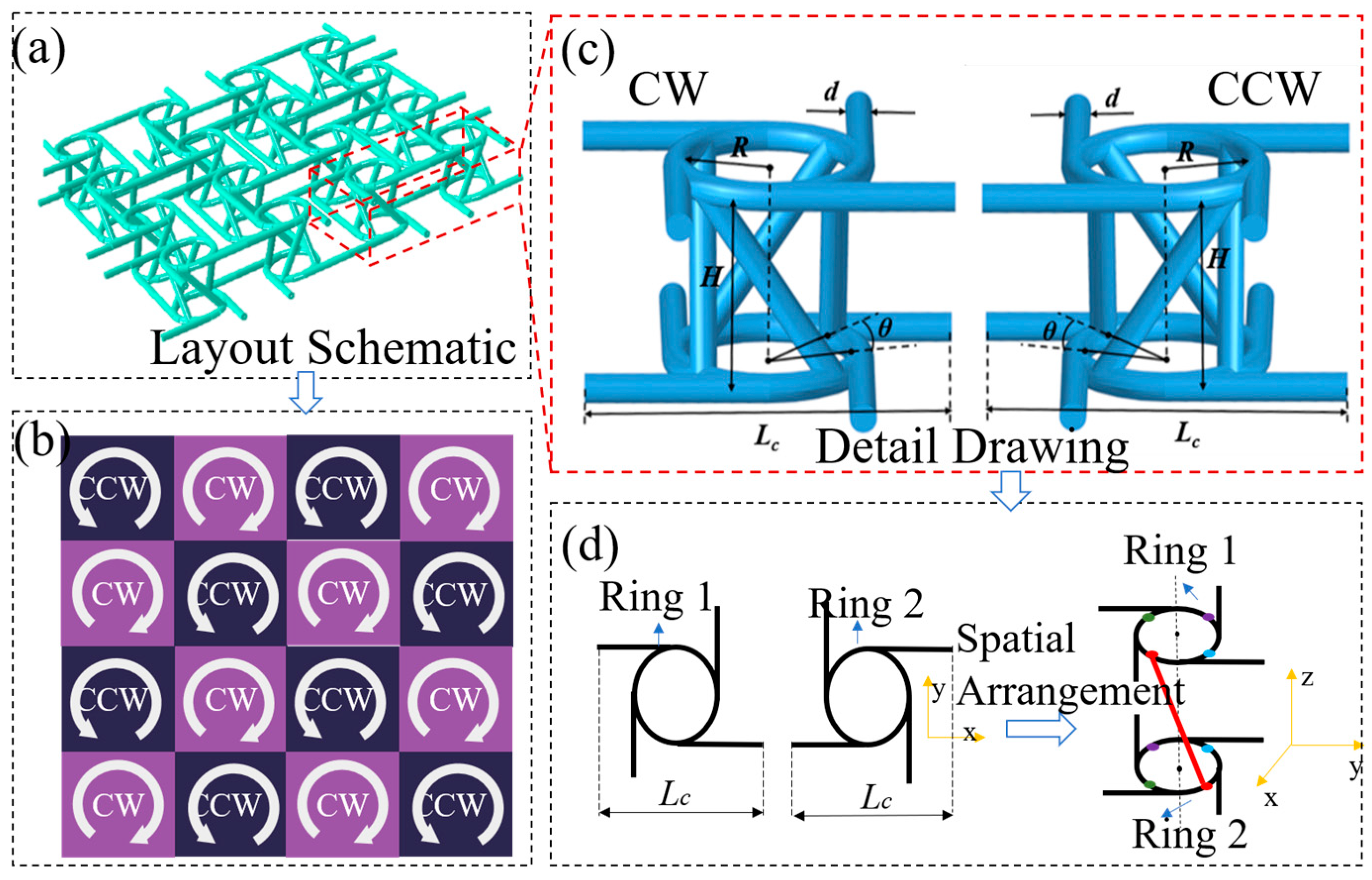
The CTLS core is constructed by arranging chiral cells in a prescribed configuration, as shown in Figure 1a,b. The overall dimensions are 80 mm × 80 mm × 10 mm, and it consists of 16 unit cells. From the planar view, two types of chiral cells are periodically arranged, namely clockwise (CW) and counter-clockwise (CCW) cells. Considering symmetry features, the two cells are mirror images of each other and exhibit opposite torsional responses under compression, as plotted in Figure 1c. The geometrical features of the CTLS cell are illustrated in Figure 1d. The upper and lower parallel rings are connected by four inclined ligaments. The ring radius is R = 5 mm, and the ligament length and diameter are Lc = 20 mm and d = 3 mm. All structural members, including the rings and ligaments, have circular cross-sections. The torsion angle of the unit is defined as θ = 45°.

2.1.2. Specimen Fabrication and Experimental Setup

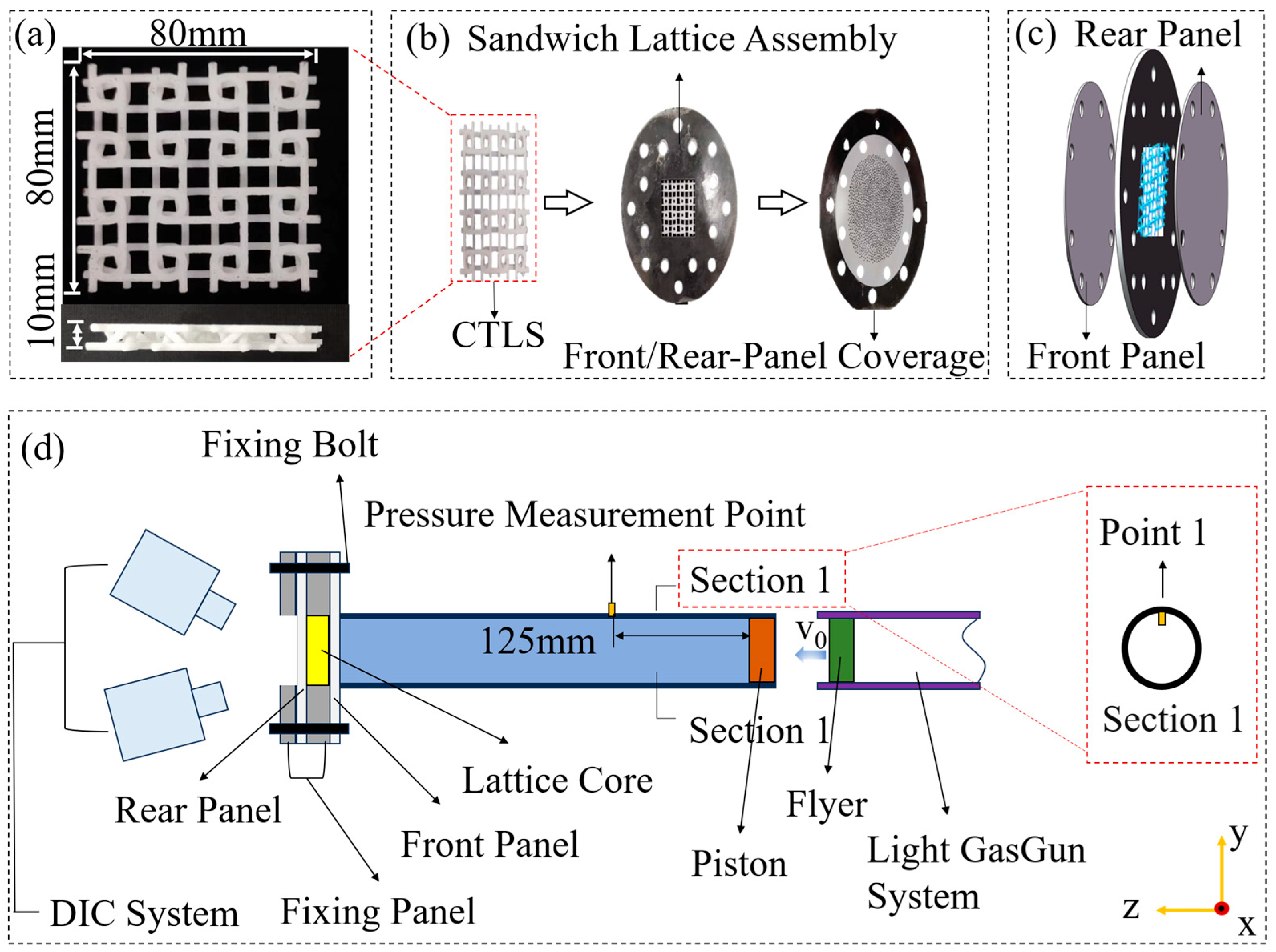
The sandwich specimens with CTLS cores were fabricated and assembled as illustrated in Figure 2a–c. The CTLS specimen was manufactured with the raw material nylon powder (FS3300PA, Future Factory, Beijing, China)) by using a FARSOON-401 selective laser sintering system (Future Factory, China), as shown in Figure 2a. The CTLS was then assembled with two Al 1100-O panels with a wall thickness of 1 mm to construct the sandwich structure, and the assembly process is presented in Figure 2b,c.
The initial velocity of the flyer was generated by the directional release of compressed gas and controlled by the gas chamber pressure. Upon impact, a plane shock wave was generated in the water column and propagated along the tube. As indicated in Figure 2d, the pressure measurement point was located 125 mm from the piston to record the incident pressure history. The sandwich panel specimen was mounted at the end of the tube, where it was subjected to the transmitted shock loading.
The specimen was rigidly fixed between two fixing panels, as shown in Figure 2d, to ensure a fixed boundary condition. The fixing panels were made of 10 mm thick Q345 steel and designed with a central square opening of 80 mm × 80 mm, which served as the observation window for deformation measurement using DIC. The front and rear panels of the specimen were fastened to the fixing panels using fixing bolts, forming a rigid connection that ensured effective load transfer and boundary constraint during impact.
A stereo 3D-DIC system (Correlated Solutions Inc., Columbia, SC, USA) was used to measure the full-field deformation and strain of the rear panel. Two synchronized high-speed cameras (Phantom V1212, Vision Research, Wayne, NJ, USA) operated at 16,000 fps with a resolution of 1024 × 1024 pixels, and polarizing filters were applied to reduce reflections. The system was calibrated using a standard calibration plate, with a camera spacing of 197 mm, an included angle of 7°, and a calibration error below 0.03 pixels. DIC analysis was performed using a subset size of 21 × 21 pixels and a step size of 5 pixels, and the speckle pattern (3–5 pixels) ensured reliable correlation under large deformation
A pressure sensor with a sampling frequency of 1 MHz was installed at a distance of 125 mm from the piston to record the incident pressure history. All components were rigidly mounted to ensure alignment between the shock tube axis and the specimen center.

2.2. Finite Element Model

The material properties of the 3D-printed core fabricated from FS3300PA nylon powder were adopted from Zhang et al. [24], with a Young’s modulus of 1.5 GPa, a Poisson’s ratio of 0.3, and a density of 1.05 g/cm3.
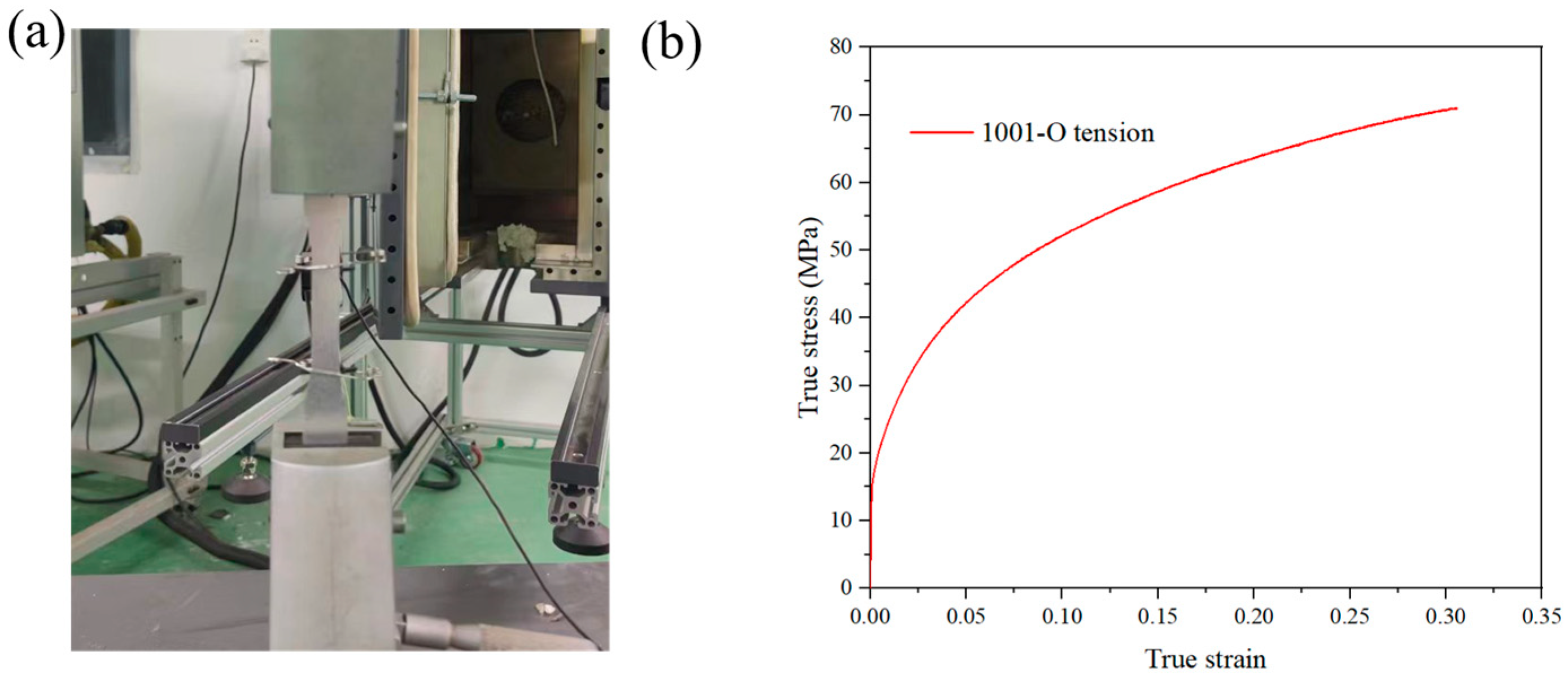
The material parameters of the 1100-O aluminum alloy were determined through uniaxial tensile tests conducted using an MTS testing machine (MTS Systems Corporation, Eden Prairie, MN, USA). The experimental setup is shown in Figure 3a, where the specimens were loaded at a constant displacement rate of 1 mm/min until fracture. The true stress–plastic strain curve is presented in Figure 3b and implemented in an isotropic hardening plasticity model for the finite element simulations. The Young’s modulus and Poisson’s ratio of the 1100-O aluminum alloy were taken as 73 GPa and 0.33, respectively, with a density of 2.71 g/cm3.
The pressure field of water is defined by the Mie–Grüneisen equation of state [25], which can be described as
P = ρ 0 C 0 2 η ( 1 s η ) 2 ( 1 Γ 0 η 2 ) + Γ 0 ρ 0 E m
where E m is the internal energy density of water; C 0 is the speed of sound; Γ 0 is the Grüneisen parameter in the reference state; ρ 0 is the reference density of water; η is the compressive strain per unit volume; and s is the strain constant. The state equation parameters of water [26] are shown in Table 1.
Due to the negligible deformation of the shock tube and fixed steel panel, the plastic-deformation-related parameters are not considered, and the material parameters are shown in Table 2.
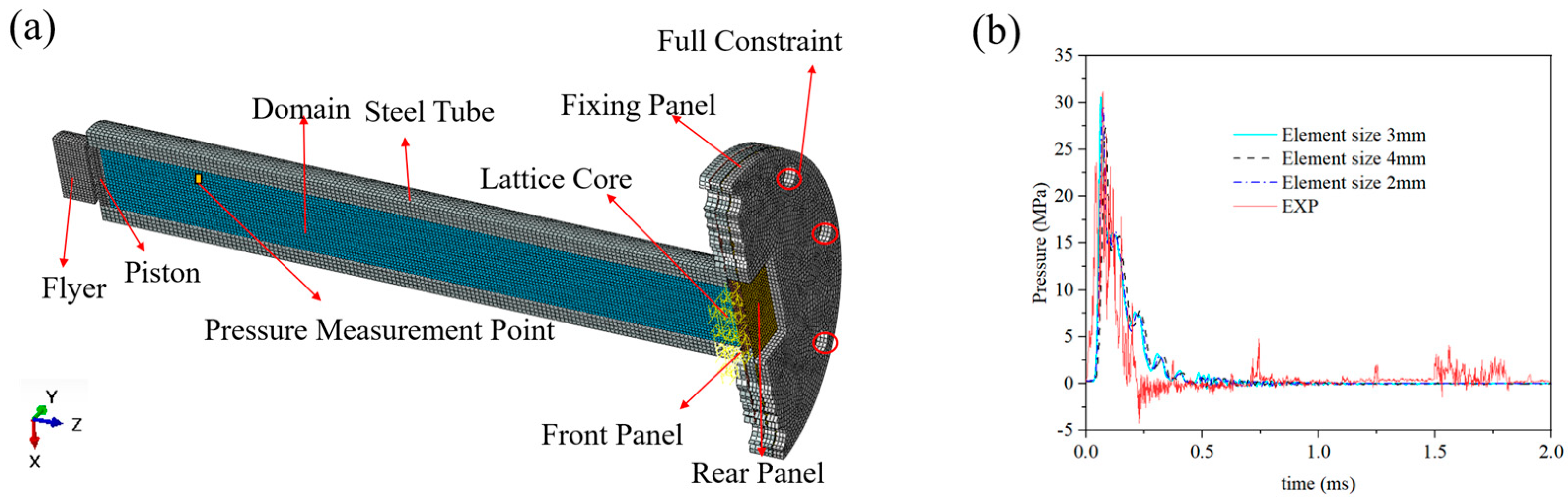
The finite element model, developed in HyperMesh 14.0 (Altair Engineering Inc., Troy, MI, USA), is shown in Figure 4a, maintaining geometric consistency with the experimental setup. The CTLS core was discretized using B31 beam elements with a mesh size of 0.8 mm, while the front and rear panels were modeled using S4R shell elements with a mesh size of 3 mm. The water domain inside the shock tube was discretized using EC3D8R Eulerian elements with a mesh size of 3 mm. The solid components, including the flyer plate, piston, steel pipe, and clamping plates, were modeled using C3D8R hexahedral elements with a mesh size of 4 mm.
The simulations were performed in Abaqus/Explicit 2016 (Dassault Systèmes, Vélizy-Villacoublay, France) using the coupled Eulerian–Lagrangian approach to capture the fluid–structure interaction and large deformation behavior. In the model, the flyer plate (0.65 kg) impacts the piston (0.44 kg) with an initial velocity of 25.4 m/s, generating a stress wave that propagates into the water domain and evolves into a shock wave. The interaction between the water and structural components is captured through the coupled Eulerian–Lagrangian formulation.
The front and rear panels, including the bolt hole regions, were constrained to represent fully clamped boundary conditions, consistent with the experimental fixture. The shock tube structure was fixed through reference points to prevent rigid body motion. General contact was defined for all interacting surfaces with a friction coefficient of 0.2 [23]. The locations of pressure monitoring points were consistent with the experimental setup, as shown in Figure 4a. These boundary conditions ensure consistency between the numerical model and the experimental setup.
To ensure the reliability of the numerical results, a mesh convergence study was conducted for the Eulerian mesh in the water domain. Three mesh sizes (2 mm, 3 mm, and 4 mm) were examined, and the corresponding pressure–time histories are shown in Figure 4b. The peak pressure errors, compared with experimental measurements, were 1.06% for 2 mm, 2.4% for 3 mm, and 12.87% for 4 mm. Considering both computational efficiency and accuracy, the 3 mm mesh was selected as the optimal discretization for the water domain in subsequent simulations.

2.3. Numerical Scheme

In protective engineering applications, the rear panel of a sandwich structure is in direct contact with the protected target, and its response is a key indicator of protective performance [27]. Therefore, three indicators, namely rear-panel kinetic energy, peak deflection, and energy absorption, are adopted to evaluate the protective performance of the proposed structures.
The CTLS configuration is taken as the baseline reference, and two types of TSLS are constructed for comparison. Under the condition of equal relative density, CTLS is compared with TSLS. Due to the longer ligament length in CTLS, a larger mass is obtained at the same ligament diameter, and the ring cross-sectional diameter in TSLS is correspondingly adjusted to ensure identical relative density.
In addition, an equal compressive stiffness case (TSLS-1) is introduced by adjusting the ligament diameter, allowing the respective contributions of structural stiffness and compression–torsion coupling to be distinguished. The geometric parameters and comparison schemes of all configurations are summarized in Table 3.

3. Results and Discussion

3.1. FE Model Validation

3.1.1. Pressure Response Comparison

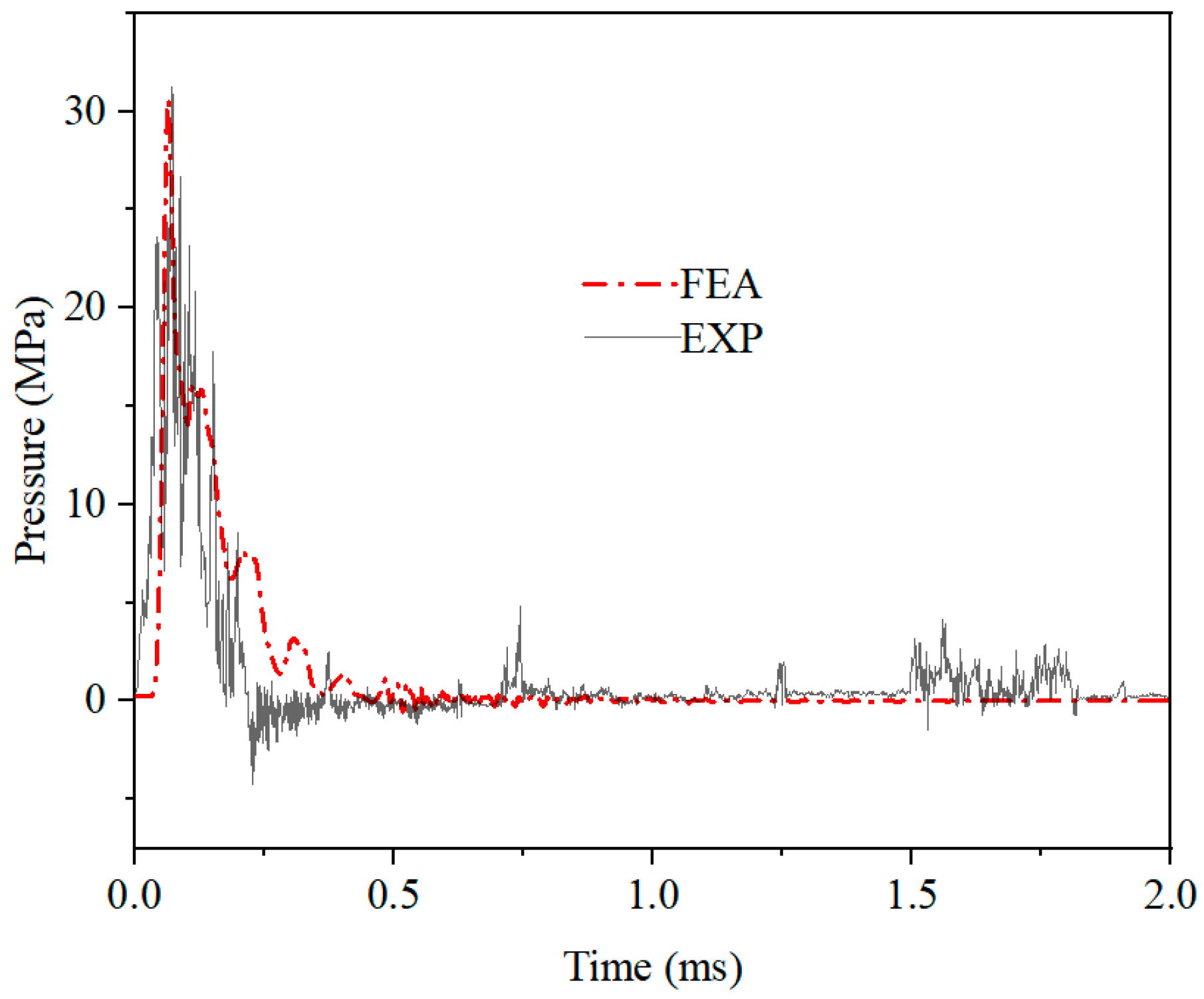
As shown in Figure 5, the pressure–time history at measurement point 1 exhibits good agreement between experimental and numerical results. The simulated peak pressure is 30.47 MPa, differing by only 2.4% from the experimental peak of 31.22 MPa, and the pulse duration is essentially consistent.
In the waveform comparison, a small precursor peak appears before the main peak in the experimental curve, which is not captured by the numerical simulation. This phenomenon is primarily due to slight gravitational displacement of the flyer during the experiment, causing early stress waves from contact with the tube wall, whereas the numerical model adopts an idealized axisymmetric assumption and does not account for this effect.
During the pressure attenuation stage, both curves show peaks caused by wave reflections, but the experimental data exhibit more pronounced high-frequency oscillations, likely associated with turbulence, cavitation, and structural vibrations in the experimental environment, whereas the numerical simulation represents attenuation smoothly through a continuum-based approach.
Overall, despite minor discrepancies between the experiment and the idealized model, the numerical simulation successfully reproduces the main characteristics of the pressure response, including the peak amplitude and overall oscillation trend, thereby validating the effectiveness of the loading conditions in the finite element model.

3.1.2. Deformation Cloud Map and Deflection Curve

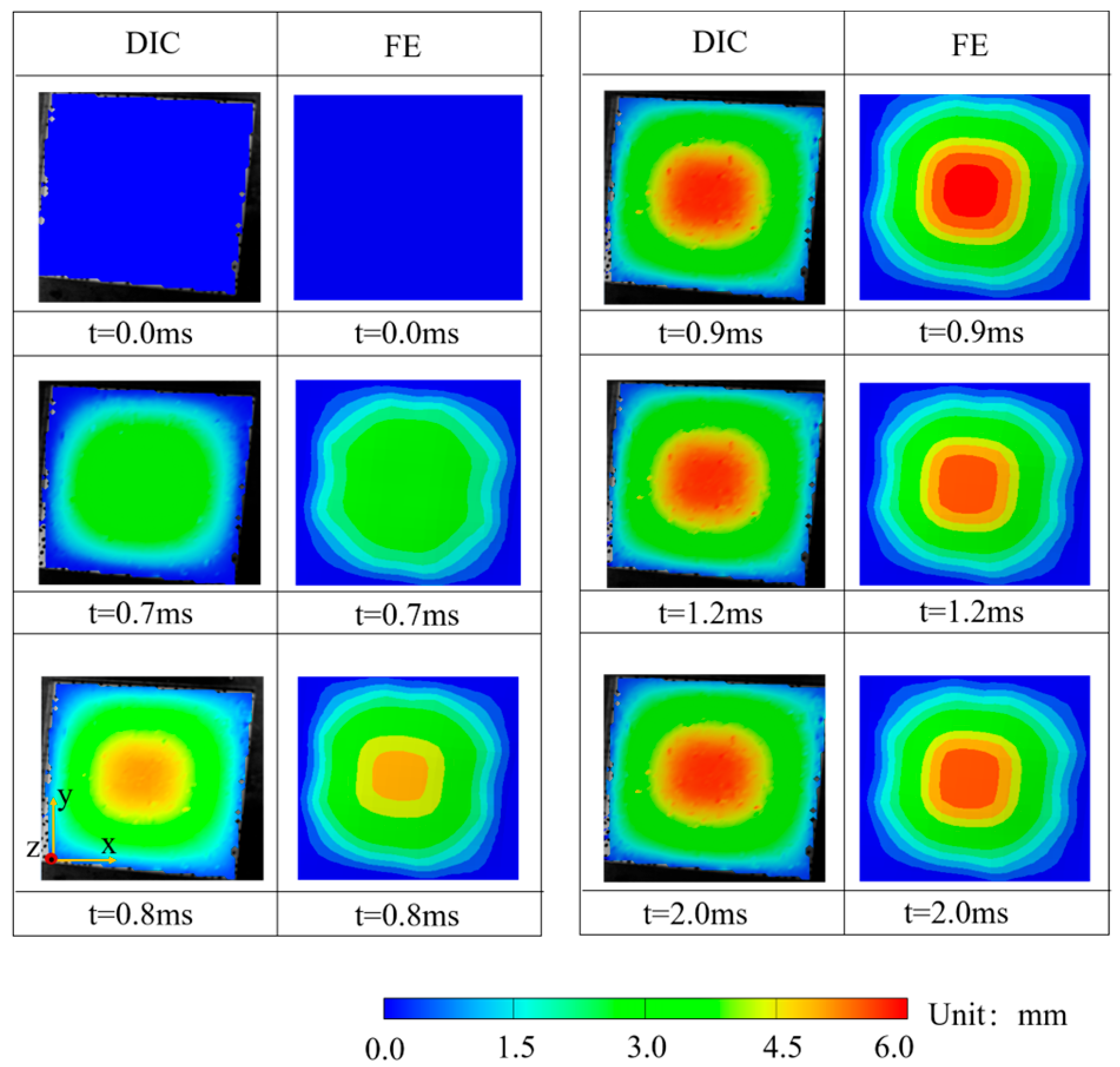
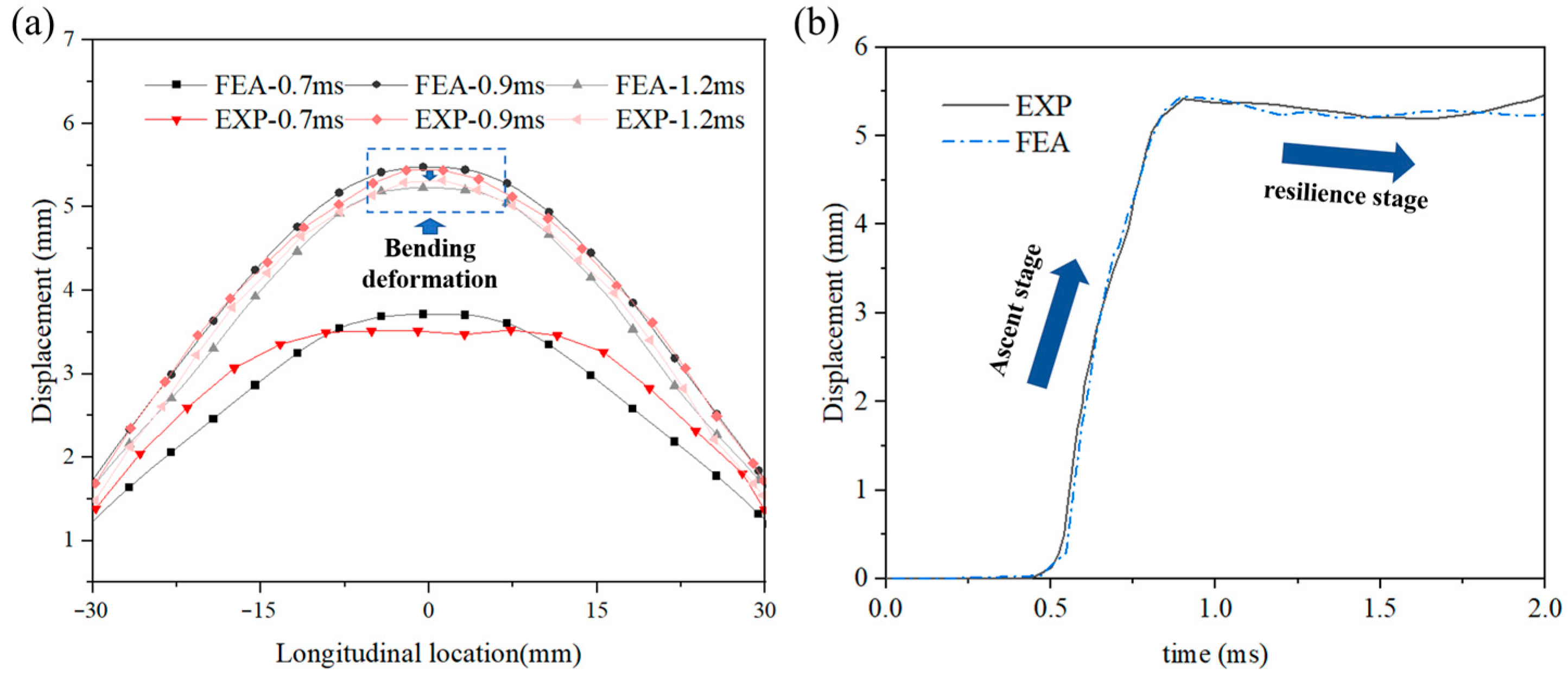
The DIC measurements and numerical deformation cloud maps of the rear panel (Figure 6) show that significant deformation began around 0.7 ms. Between 0.7 and 0.9 ms, the overall displacement increased rapidly and reached its peak, followed by a slight rebound from 0.9 to 1.2 ms. After 1.2 ms, the displacement remained essentially stable.
Figure 7 compares the experimental and simulated rear-panel deflections at the central point and along the central line. The experimental maximum deflection is 5.41 mm, while the simulated value is 5.48 mm, corresponding to a relative error of 1.29%. During peak deformation in the experiment, contact between the front panel and the steel tube plate created a gap, allowing partial water discharge, which was not considered in the numerical simulation. This led to slight differences during the rebound stage: at 1.2 ms, the experimental deflection was 5.35 mm, while the simulation predicted 5.17 mm, with a relative error of approximately 3.36%.

3.2. Deformation Behavior and Mechanism Analysis

3.2.1. Deformation Behavior

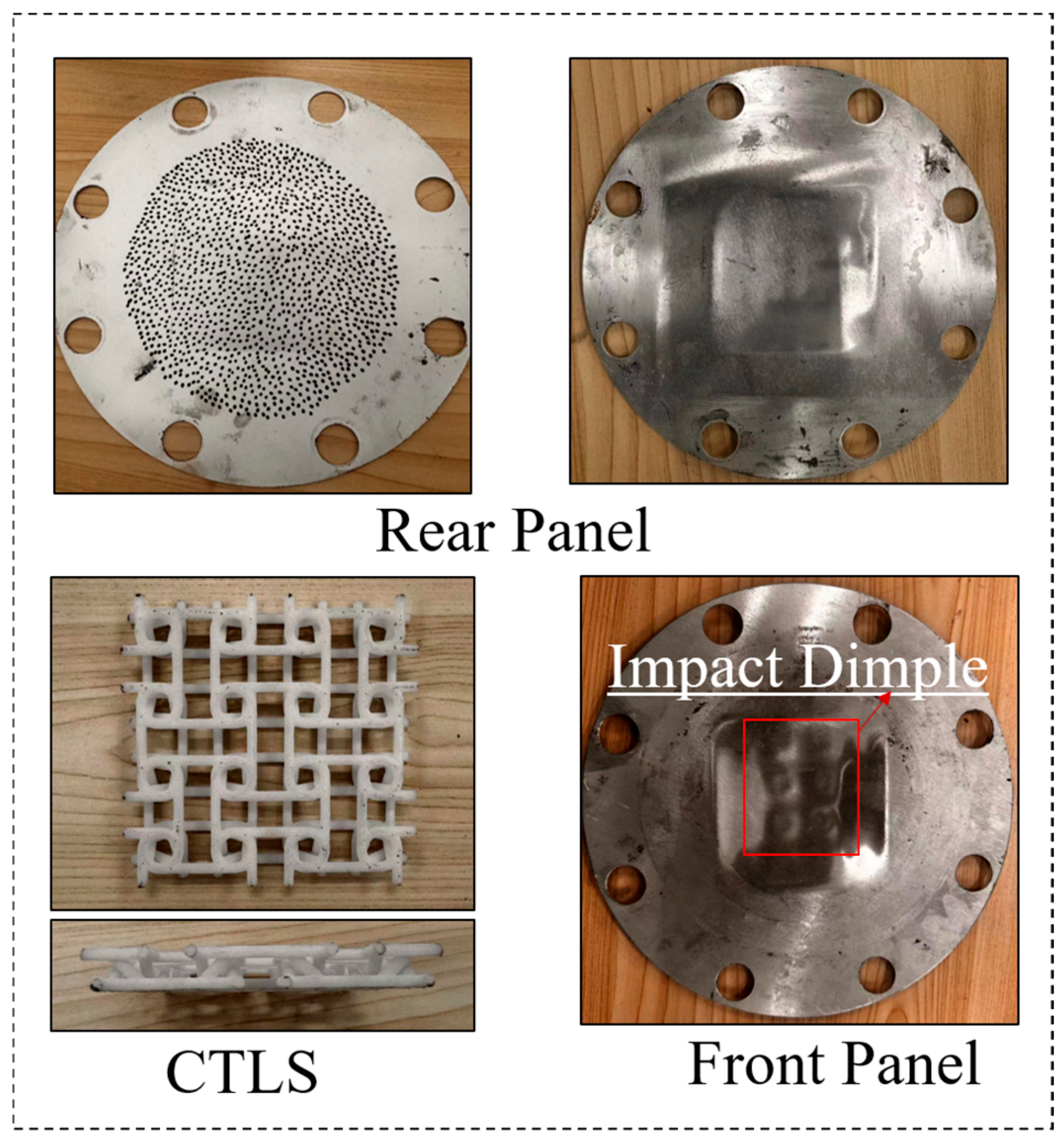
The post-loading deformation of the sandwich panels with CTLS cores is shown in Figure 8. The non-rigid zones of the 80 × 80 mm Al 1100-O front and rear panels exhibited plastic deformation, while no fracture was observed due to the high ductility of the alloy. After unloading, the core structure appeared nearly undeformed, which is mainly attributed to the recoverable deformation of the nylon material. The speckle pattern on the rear panel remained intact, ensuring the reliability of the DIC measurements.
Notably, pronounced indentations are observed on the front panel (impact face) due to its direct interaction with the core structure, whereas the rear panel shows only minor deformation. The overall deformation of the front panel is significantly greater than that of the rear panel, indicating that the core structure effectively attenuates the transmitted impact and provides protection for the rear panel.
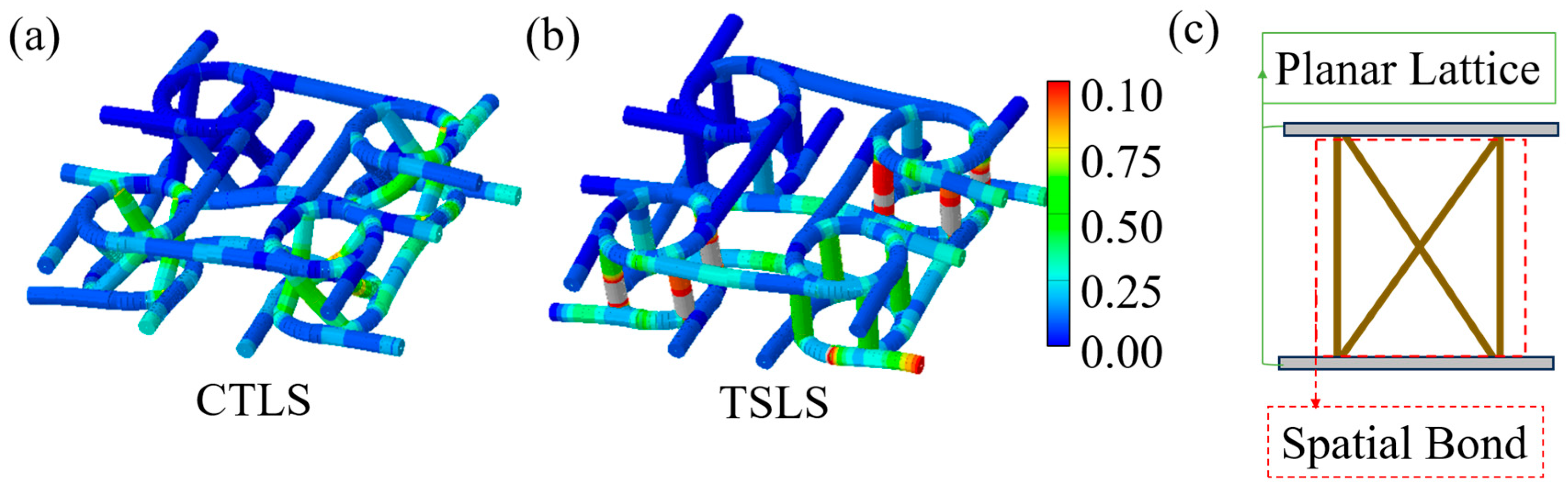
Figure 9 presents the equivalent plastic strain (PEEQ) contours for a quarter of the core layer with a ligament diameter of 1.8 mm. Results indicate that the overall PEEQ of the CTLS is significantly lower than that of the TSLS, and the plastic strain distribution is more uniform, which avoids localized stress concentration. Under this deformation mode, the energy dissipation mechanism shifts from axial compression to bending of the inclined ligaments. Consequently, the compression–torsion coupled design promotes torsional deformation in structures, facilitating stress redistribution and guiding stress wave propagation.
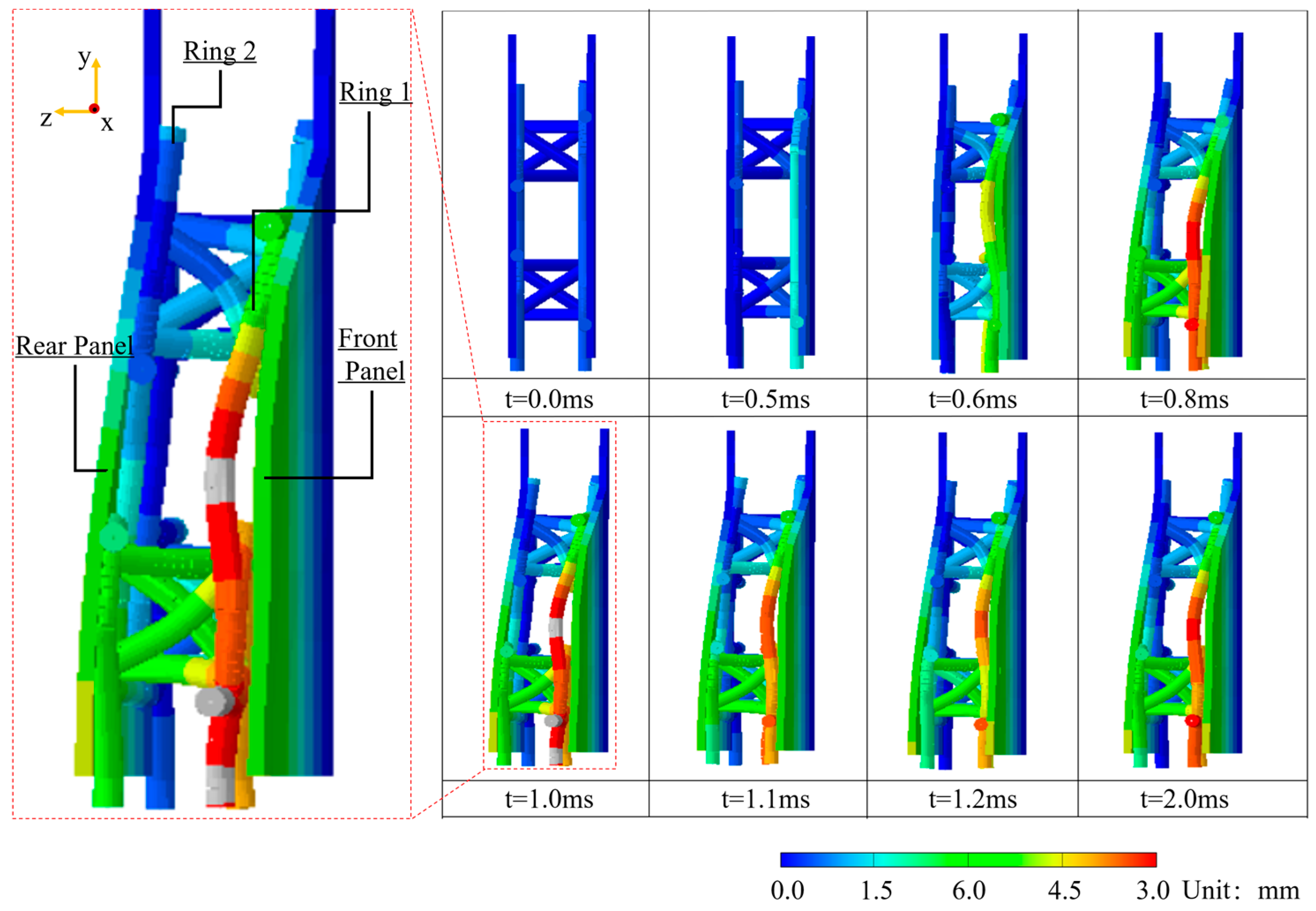
The deformation and load-transfer process of the CTLS structure is illustrated by the displacement contours of the quarter-core layer in Figure 10. During the initial impact stage (0–0.5 ms), the structure does not respond, since the pressure wave has not reached the front panel. From 0.5 ms onward, the impact load is transmitted from the front panel to the core layer, with the upper lattice deforming first and exhibiting local separation. Between 0.6 and 1.0 ms, this separation progressively develops and reaches its maximum, reflecting the cushioning and decoupling effect of the core layer during loading. In the 1.1–2.0 ms stage, the degree of separation gradually decreases, and the structure tends to stabilize.
Notably, the displacement of the upper ring (Ring 1) in contact with the front panel is significantly greater than that of the lower ring (Ring 2) in contact with the rear panel, and no interfacial separation occurs on the rear-panel side. This indicates that the CTLS core layer effectively mitigates the impact intensity transmitted to the rear panel during the impact process.
The displacement results further show that the impact load is transmitted in a delayed and progressive manner. Temporary separation occurs between structural components, indicating a decoupling effect during loading. As a result, the displacement on the rear side is significantly reduced, demonstrating that the CTLS core effectively attenuates the transmitted shock.

3.2.2. Kinetic Energy Analysis

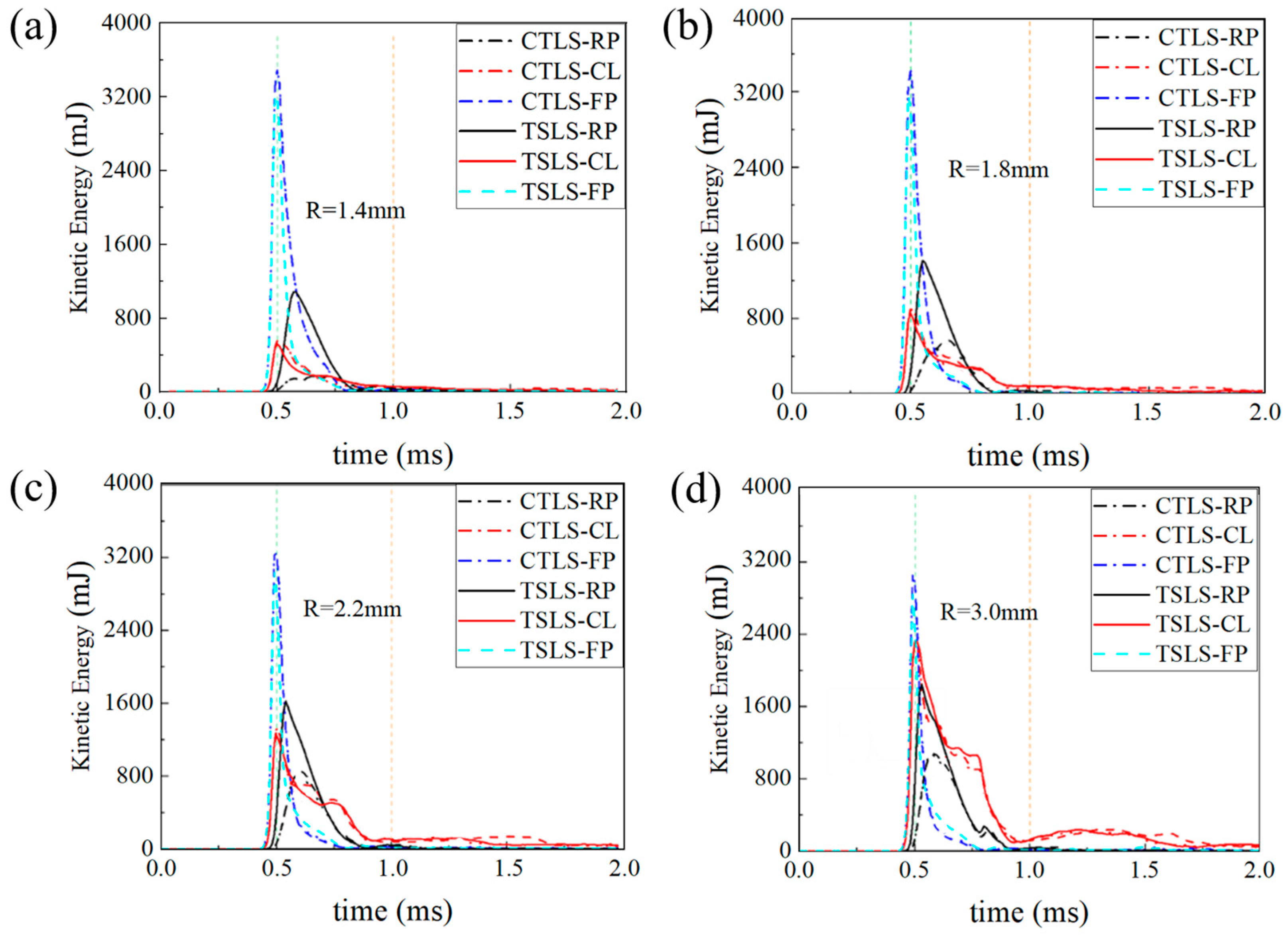
Figure 11 shows the kinetic energy (KE) curves of the rear panel (RP), core layer (CL), and front panel (FP) under impact. The results indicate that during 0–0.45 ms, all components remained nearly stationary. Between 0.45 and 0.5 ms, the FP’s kinetic energy increased sharply, reaching a peak at 0.5 ms, and then decayed rapidly, approaching zero around 0.8 ms. The CL also reached its KE peak at 0.5 ms; however, only the model with a 1.4 mm ligament diameter reduced its KE to zero by 2.0 ms, while the other models retained residual energy. By 1.0 ms, the FP had stopped moving, whereas the CL still retained kinetic energy, indicating post-impact vibrations consistent with the deformation observed in Figure 10.
Table 4 presents the rear-panel kinetic energy ratio and total energy absorption ratio for CTLS and TSLS. The results show that the total energy absorption of CTLS is slightly lower than that of TSLS, with the difference increasing as the ligament diameter increases. However, the kinetic energy transmitted to the rear panel is consistently lower for CTLS. For a ligament diameter of 1.4 mm, the kinetic energy transmitted from CTLS to the rear panel is only 15.2% of that for TSLS; as the core density increases, this buffering effect decreases. Even so, at a 3.0 mm ligament diameter, the kinetic energy transmitted to the rear panel by CTLS is still reduced by 42% compared with TSLS. These results indicate that CTLS, while slightly sacrificing total energy absorption, significantly enhances rear-panel protection, with this advantage being particularly pronounced at smaller ligament diameters.
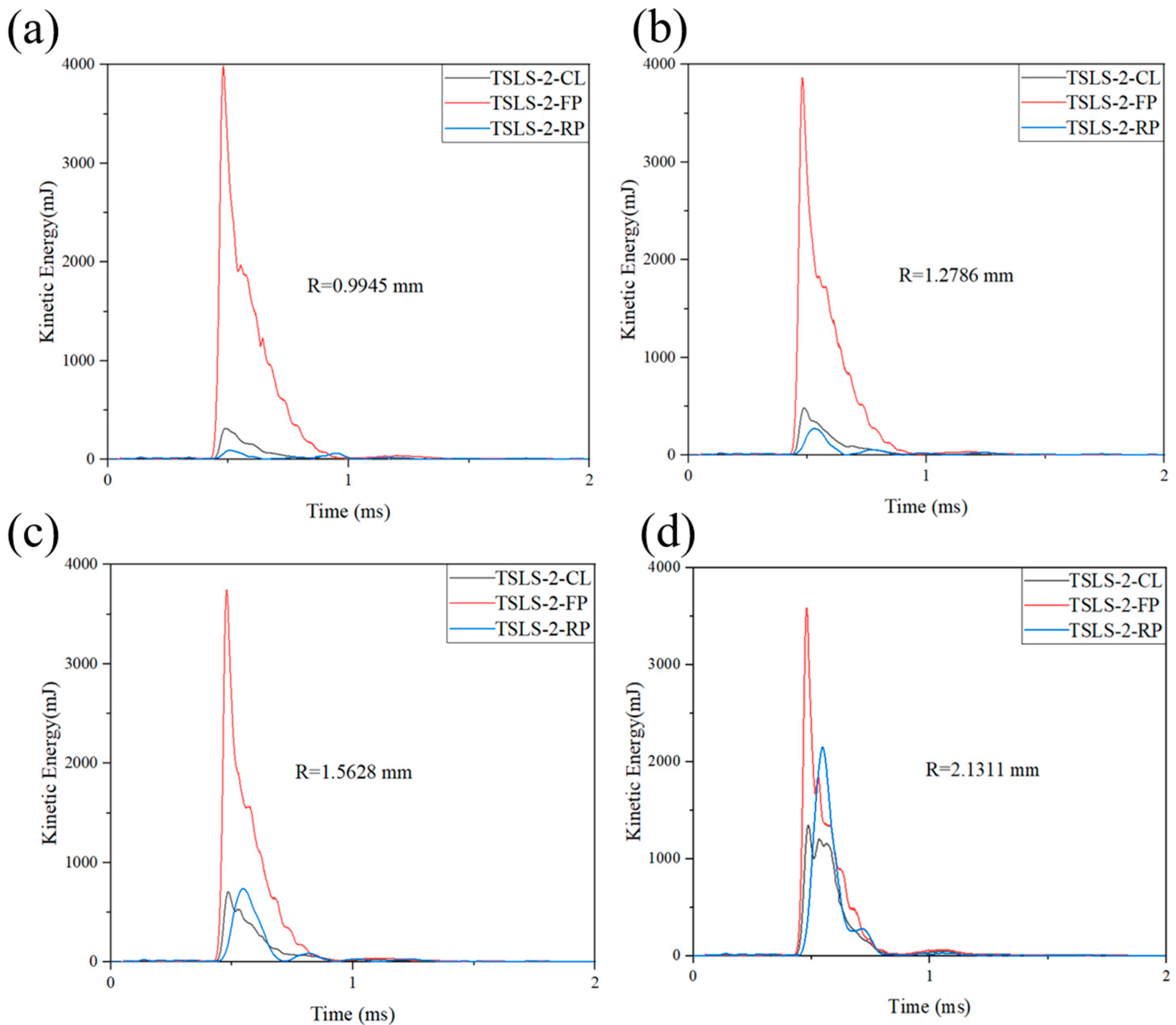
Figure 12 shows the kinetic energy time histories of different components (front panel, core layer, and rear panel) in TSLS with different ligament diameters but the same compressive stiffness as CTLS under impact loading.
The compressive stiffness calculation formula for CTLS core structures and TSLS core structures is as follows [28]:
k F = π n E s d 2 [ 4 l 2 s i n 2 θ + 3 d 2 c o s 2 θ + 6 λ ( 1 + ν ) d 2 s i n 2 θ ] 4 l 4 l 2 + 6 λ ( 1 + ν ) d 2
where k F is the axial compression stiffness, l is the length of the diagonal ligament, θ is the inclination angle of the diagonal ligament, d is the diameter of the inclined ligament section, n is the number of diagonal ligaments in each cell (n = 4 as shown in Figure 1c), ν is the Poisson’s ratio, and E s is the Young’s modulus. λ is a correction factor considering inhomogeneous distribution of shear force across the section.
Since the deformation of the structure under investigation is primarily due to bending, the Euler–Bernoulli beam theory is adopted, which justifiably neglects the influence of shear deformation:
k F = π E s d 2 [ 4 l 2 s i n 2 θ + 3 d 2 c o s 2 θ ] 4 l 3
The diameters of the diagonal members for the TSLS, which possesses the same compressive stiffness as the CTLS, were calculated using Equation (3) and are summarized in Table 5.
Table 5 presents the specific kinetic energy of CTLS and TSLS-1 under the same stiffness conditions. The analysis indicates that, at equal compressive stiffness, the rear-panel specific kinetic energy of CTLS is significantly lower than that of TSLS-1; as the ligament diameter increases, the ratio further decreases, reaching a minimum of 47.64% for the CTLS with a 3.0 mm ligament diameter, indicating that the compression–torsion coupling effect of CTLS contributes more significantly at larger ligament diameter.

3.2.3. Maximum Center-Point Deflection of the Rear Panel

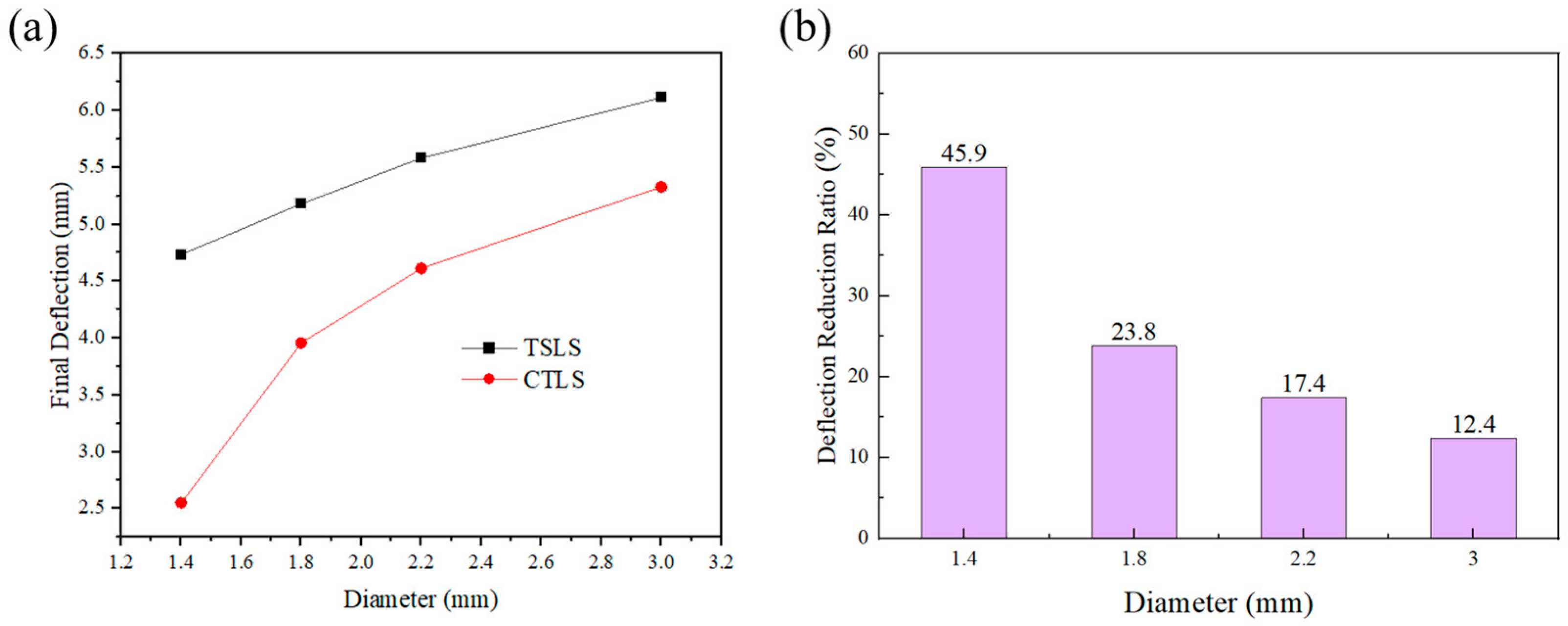
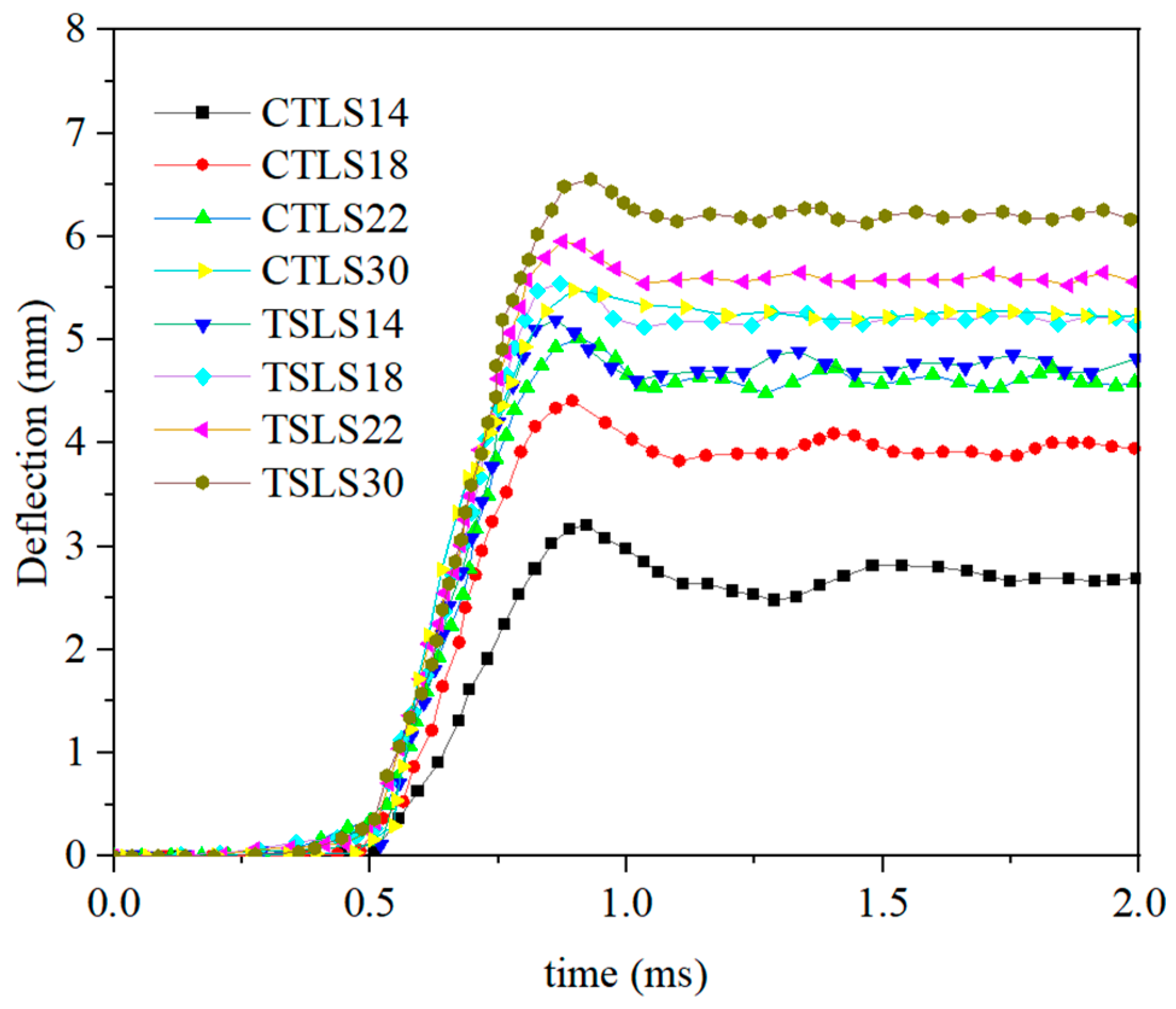
Figure 13 presents the center-point deflection curves of the rear panel (RP) for eight sandwich panels. The results show that RP deflection increases significantly with increasing core ligament diameter. At the same relative density, the RP deflection of CTLS panels is noticeably lower than that of TSLS panels, although the difference gradually decreases as the core density increases.
To quantitatively assess the influence of core-layer (CL) density on the rear panel (RP) deflection, the average center-point deflection of each RP was extracted during the deformation stabilization stage (1.2–2.0 ms) for comparison (Figure 14). The results show that, as the core ligament diameter increases, the RP deflection of TSLS panels rises only slightly, whereas that of CTLS panels increases significantly in the 1.4–2.2 mm diameter range. For a 1.4 mm ligament diameter, the RP deflection of CTLS panels is 45.9% lower than that of TSLS; as the ligament diameter increases, the deflections of the two structures gradually converge, and at 3.0 mm, the CTLS deflection is only 12.4% lower, indicating that the deflection reduction effect of CTLS is most pronounced at smaller ligament diameter.

3.2.4. Energy Distribution and Structural Safety

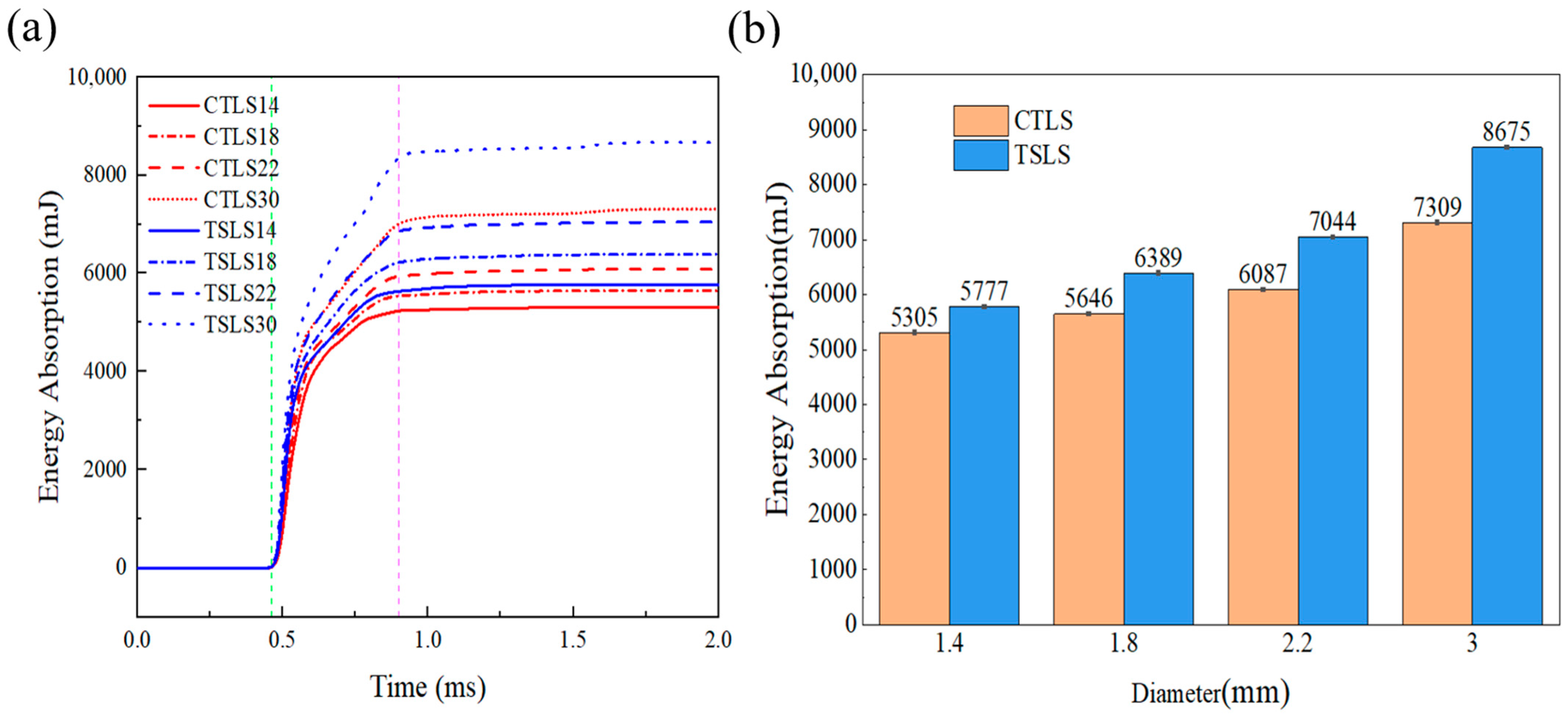
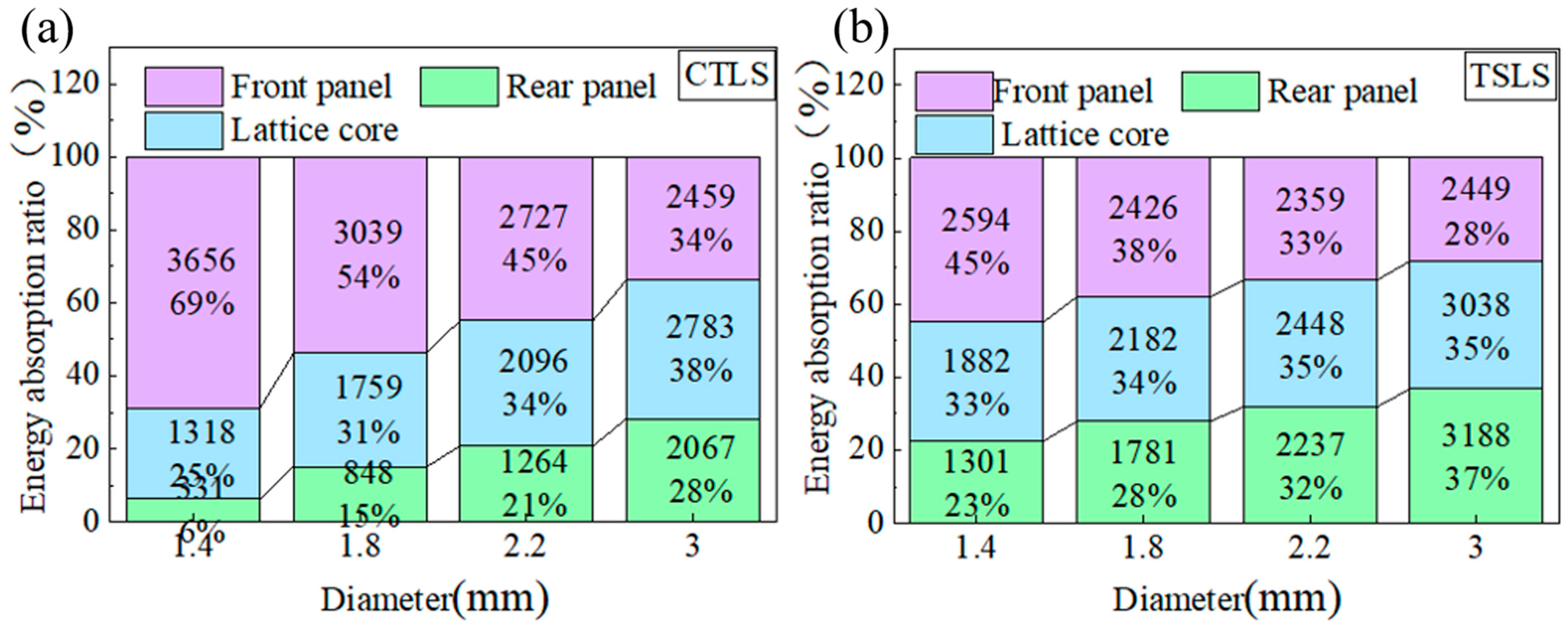
Figure 15 shows the total plastic energy absorption histories of CTLS and TSLS with different ligament diameters. The total absorbed energy of CTLS is slightly lower than that of TSLS, with the difference remaining within 16%. However, for sandwich structures subjected to underwater shock loading, structural safety depends not only on the overall energy absorption capacity but also on how the absorbed energy is distributed among structural components. In particular, the proportion of plastic energy absorbed by the rear panel is used to characterize the level of impact loading acting on the rear face.
As shown in Figure 16, the rear-panel plastic energy proportion of CTLS is consistently lower than that of TSLS for all investigated ligament diameters. Notably, for a ligament diameter of 1.4 mm, the rear-panel energy proportion of CTLS is as low as 6%. The low rear-panel energy proportion indicates that most of the impact energy in the CTLS configuration is dissipated by the front panel and the lattice core before it reaches the rear face. As a result, the rear panel carries a lower level of impact loading, which reduces the shock demand on the protected region.
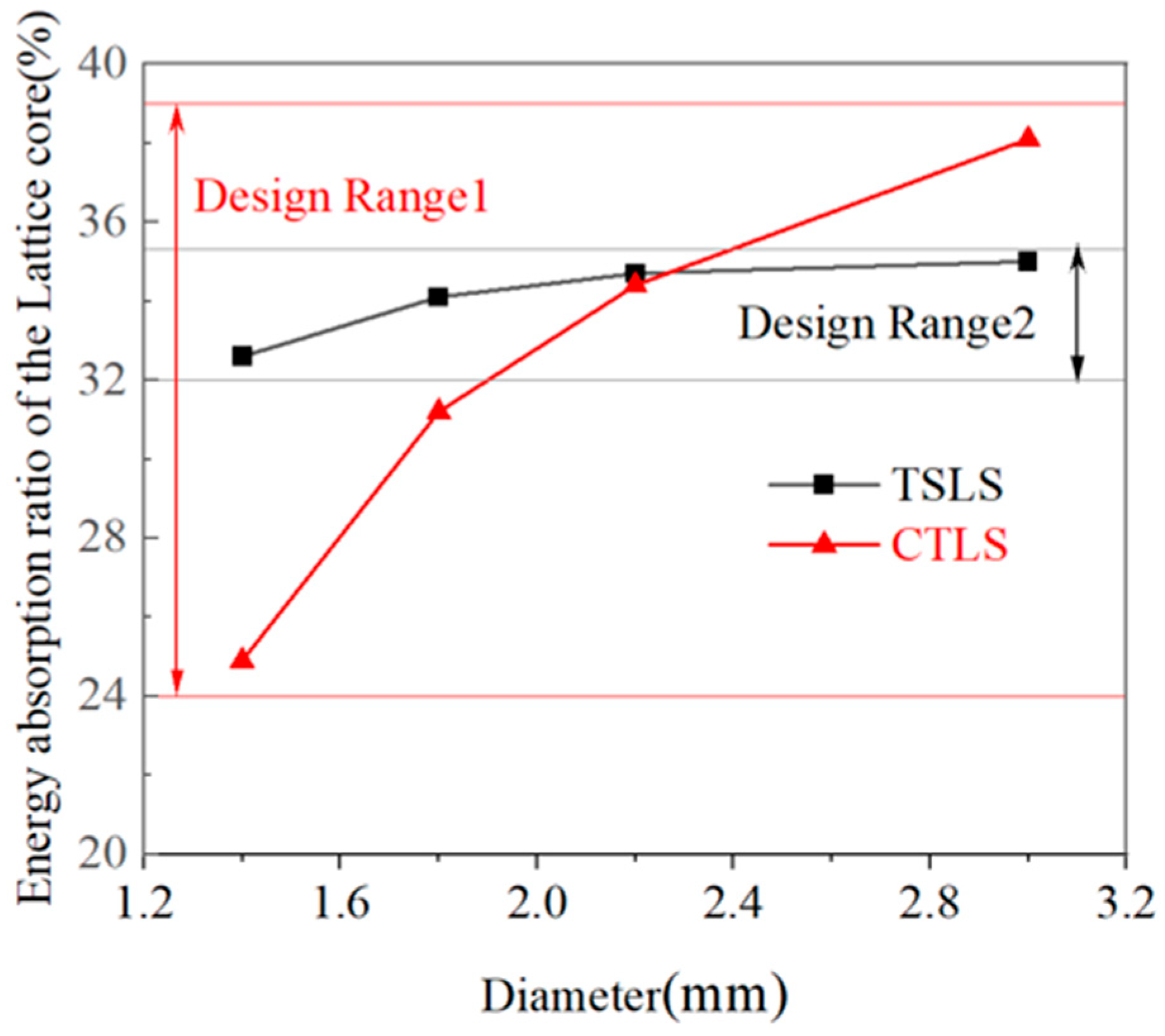
Figure 17 further shows that the energy absorption proportion of the CTLS core varies within a range of 24–38%, which is noticeably broader than that of TSLS (33–35%). The wider variation in the energy absorption proportion of the CTLS core shows that its energy absorption level can be adjusted over a broader range. As more energy is dissipated within the core, the energy carried by the rear panel decreases.
Overall, although CTLS does not achieve the highest total energy absorption, it reduces the impact energy reaching the rear panel, which is beneficial for structural safety under shock loading.

4. Conclusions

This study combined shock tube experiments with finite element simulations to investigate the response and protective performance of compression–torsion lattice structure (CTLS) sandwich panels under underwater shock loading, and compared them with traditional straight lattice structure (TSLS) panels. The main conclusions are as follows:
  • Compared with TSLS, CTLS sandwich panels with the same relative density reduce the rear-plate kinetic energy by more than 42% and the peak deflection by 12.4%.
  • Under identical compressive stiffness, the rear panel protected by CTLS exhibits lower specific kinetic energy than in TSLS. The protective performance further improves with increasing ligament diameter, indicating that the compression–torsion coupling deformation is the primary contributor to the enhanced protection.
  • Compared with TSLS cores, CTLS panels expand the lattice core-layer energy absorption ratio from 33–35% to 24–38%, reflecting enhanced flexibility in energy distribution within the structure.
Future work will focus on further optimization of the structural configuration and a deeper investigation of stress wave regulation and deformation mechanisms under different impact conditions. In addition, the applicability of the proposed design in more complex loading scenarios will be explored.

Author Contributions

K.L.: Writing—original draft, Investigation. Z.H.: Writing—review and editing, Funding acquisition. Y.J.: Writing—review and editing. J.L.: Methodology, Conceptualization. Z.C.: Writing—review and editing, Funding acquisition. Y.L.: Supervision, Writing—review and editing. All authors have read and agreed to the published version of the manuscript.

Funding

This research was funded by the National Natural Science Foundation of China (NSFC, Nos. 12302458, 52225108, 52171290, and 52301384), the National Key R&D Program of China (No. 2022YFB3806100), and the opening project of the State Key Laboratory of Explosion Science and Safety Protection (No. KFJJ24-09). The APC was funded by the authors.

Data Availability Statement

The original contributions presented in this study are included in the article. Further inquiries can be directed to the corresponding author.

Acknowledgments

The authors would like to thank the State Key Laboratory of Explosion Science and Safety Protection, Beijing Institute of Technology, for providing experimental support.

Conflicts of Interest

Author Jiajing Lei was employed by the China Ship Development and Design Center. The remaining authors declare that the research was conducted in the absence of any commercial or financial relationships that could be construed as a potential conflict of interest.

Abbreviations

CTLSCompression–torsion lattice structure
TSLSTraditional sandwich lattice structure
PEEQEquivalent plastic strain
CW Clockwise
CCW Counter-clockwise
DICDigital image correlation
FEFinite element
RPRear panel
CL Core layer
FP Front panel
KE Kinetic energy

References

  1. Imbalzano, G.; Linforth, S.; Ngo, T.D.; Lee, P.; Tran, P. Blast resistance of auxetic and honeycomb sandwich panels: Comparisons and parametric designs. Compos. Struct. 2018, 183, 242–261. [Google Scholar] [CrossRef]
  2. Zheng, C.; Wang, M.; Wang, Y.; Liao, Y.; Kong, X.; Wu, W. Numerical Investigation on Dynamic Response of Carbon Fiber Honeycomb Sandwich Panels Subject to Underwater Impact Load. J. Mar. Sci. Eng. 2024, 12, 1513. [Google Scholar] [CrossRef]
  3. Bao, W.; Zhang, B.; Wang, Y.; Yang, Y.; Wang, B.; Qiu, Z.; Cao, H.; Fan, H. Close-in blast responses of bowstring fold-line-core sandwich panels. Thin-Walled Struct. 2024, 199, 111809. [Google Scholar] [CrossRef]
  4. He, L.; Li, T.; Zhong, D.; Tao, H.; Peng, Y.; Chen, S. Blast Resistance in Sandwich Structures Based on TPMS. Buildings 2023, 13, 2835. [Google Scholar] [CrossRef]
  5. Jing, L.; Zhao, L. Blast resistance and energy absorption of sandwich panels with layered gradient metallic foam cores. J. Sandw. Struct. Mater. 2019, 21, 464–482. [Google Scholar] [CrossRef]
  6. Yu, L.; Xiao, X.; Zhu, X.; Liu, J.; Sun, G.; Xu, Y.; Yang, S.; Jiang, C.; Geng, D. Mechanical Performance and Energy Absorption of Ti6Al4V I-WP Lattice Metamaterials Manufactured via Selective Laser Melting. Materials 2025, 18, 4626. [Google Scholar] [CrossRef]
  7. Zhang, Y.; Li, N. Data-driven design for additive manufacturing of energy absorption lattice structures with variable density. Mater. Des. 2025, 259, 114761. [Google Scholar] [CrossRef]
  8. Alderson, A.; Alderson, K.; Attard, D.; Evans, K.; Gatt, R.; Grima, J.; Miller, W.; Ravirala, N.; Smith, C.; Zied, K. Elastic constants of 3-, 4- and 6-connected chiral and anti-chiral honeycombs subject to uniaxial in-plane loading. Compos. Sci. Technol. 2010, 70, 1042–1048. [Google Scholar] [CrossRef]
  9. Geng, X.; Lu, Y.; Liu, C.; Li, W.; Yue, Z. Fracture characteristic analysis of cellular lattice structures under tensile load. Int. J. Solids Struct. 2019, 163, 170–177. [Google Scholar] [CrossRef]
  10. Meng, L.; Zhong, M.; Gao, Y.; Gao, T.; Hou, Y.; Zhu, J.; Breitkopf, P.; Zhang, W. Impact resisting mechanism of tension–torsion coupling metamaterials. Int. J. Mech. Sci. 2024, 272, 109100. [Google Scholar] [CrossRef]
  11. Prall, D.; Lakes, R.S. Properties of a chiral honeycomb with a poisson’s ratio of—1. Int. J. Mech. Sci. 1997, 39, 305–314. [Google Scholar] [CrossRef]
  12. Mousanezhad, D.; Haghpanah, B.; Ghosh, R.; Hamouda, A.M.; Nayeb-Hashemi, H.; Vaziri, A. Elastic properties of chiral, anti-chiral, and hierarchical honeycombs: A simple energy-based approach. Theor. Appl. Mech. Lett. 2016, 6, 81–96. [Google Scholar] [CrossRef]
  13. Spadoni, A.; Ruzzene, M.; Scarpa, F. Global and local linear buckling behavior of a chiral cellular structure. Phys. Status Solidi (B) 2005, 242, 695–709. [Google Scholar] [CrossRef]
  14. Scarpa, F.; Blain, S.; Lew, T.; Perrott, D.; Ruzzene, M.; Yates, J. Elastic buckling of hexagonal chiral cell honeycombs. Compos. Part A Appl. Sci. Manuf. 2007, 38, 280–289. [Google Scholar] [CrossRef]
  15. Zorzetto, L.; Ruffoni, D. Re-entrant inclusions in cellular solids: From defects to reinforcements. Compos. Struct. 2017, 176, 195–204. [Google Scholar] [CrossRef]
  16. Grima, J.N.; Gatt, R.; Alderson, A.; Evans, K.E. On the potential of connected stars as auxetic systems. Mol. Simul. 2005, 31, 925–935. [Google Scholar] [CrossRef]
  17. Wu, W.; Hu, W.; Qian, G.; Liao, H.; Xu, X.; Berto, F. Mechanical design and multifunctional applications of chiral mechanical metamaterials: A review. Mater. Des. 2019, 180, 107950. [Google Scholar] [CrossRef]
  18. Zhang, X.-C.; Liu, N.-N.; An, C.-C.; Wu, H.-X.; Li, N.; Hao, K.-M. Dynamic crushing behaviors and enhanced energy absorption of bio-inspired hierarchical honeycombs with different topologies. Def. Technol. 2023, 22, 99–111. [Google Scholar] [CrossRef]
  19. Xiao, D.; Kang, X.; Li, Y.; Wu, W.; Lu, J.; Zhao, G.; Fang, D. Insight into the negative Poisson’s ratio effect of metallic auxetic reentrant honeycomb under dynamic compression. Mater. Sci. Eng. A 2019, 763, 138151. [Google Scholar] [CrossRef]
  20. Chen, G.; Cheng, Y.; Zhang, P.; Liu, J.; Chen, C.; Cai, S. Design and modelling of auxetic double arrowhead honeycomb core sandwich panels for performance improvement under air blast loading. J. Sandw. Struct. Mater. 2021, 23, 3574–3605. [Google Scholar] [CrossRef]
  21. Montazeri, A.; Homafar, F.; Mahnama, M. A novel 3D compression-torsion mechanical metamaterial with cubic cells based on askew star mechanism: Design, simulation, and experimental validations. Mech. Adv. Mater. Struct. 2024, 31, 2069–2078. [Google Scholar] [CrossRef]
  22. Ou, H.; Hu, L.; Wang, Y.; Liu, C. High-efficient and reusable impact mitigation metamaterial based on compression-torsion coupling mechanism. J. Mech. Phys. Solids 2024, 186, 105594. [Google Scholar] [CrossRef]
  23. Timercan, A.; Terriault, P.; Brailovski, V. Axial tension/compression and torsional loading of diamond and gyroid lattice structures for biomedical implants: Simulation and experiment. Mater. Des. 2023, 225, 111585. [Google Scholar] [CrossRef]
  24. Zhang, T.; Huang, Z.; Li, Y.; Xu, Z.; Zhou, Z.; Chen, Z. Compressive mechanical behaviors of PPR and NPR chiral compression–twist coupling lattice structures under quasi-static and dynamic loads. Thin-Walled Struct. 2023, 182, 110234. [Google Scholar] [CrossRef]
  25. He, X.; Huang, Z.; Chen, Z.; Li, Y. Dynamic response of CFRP-lattice sandwich structures subjected to underwater shock wave loading. Thin-Walled Struct. 2022, 181, 109537. [Google Scholar] [CrossRef]
  26. Zhu, P.; Rong, J.; Wang, S.; Chen, Z.; Jiang, Z. Dynamic response of polymethacrylimide foam sandwich structures with different core layers under water impact loading. Def. Technol. 2025, 49, 203–222. [Google Scholar] [CrossRef]
  27. Mori, L.F.; Queheillalt, D.T.; Wadley, H.N.G.; Espinosa, H.D. Deformation and Failure Modes of I-Core Sandwich Structures Subjected to Underwater Impulsive Loads. Exp. Mech. 2009, 49, 257–275. [Google Scholar] [CrossRef]
  28. Yang, C.; Yang, K.; Tian, Y.; Fu, M.; Hu, L. Theoretical analysis on the stiffness of compression-torsion coupling metamaterials. Extrem. Mech. Lett. 2021, 46, 101336. [Google Scholar] [CrossRef]
Figure 1. (a) Overall view of the CTLS core; (b) Layout schematic of the core; (c) Schematic of CW and CCW unit cells; (d) Structural schematic of a unit cell and its connecting ligaments.
Jmse 14 00619 g001
Figure 2. (a) CTLS specimen; (b) Assembly schematic of CTLS and panels; (c) Physical assembly process of CTLS and panels; (d) Experimental loading device.
Jmse 14 00619 g002
Figure 3. (a) Uniaxial tensile test; (b) Stress–strain curve of 1100-O aluminum alloy.
Jmse 14 00619 g003
Figure 4. (a) Finite element model of loading device. (b) Pressure–time history curves.
Jmse 14 00619 g004
Figure 5. The pressure curves obtained from the simulation and actual experiments.
Jmse 14 00619 g005
Figure 6. DIC deformation contours and FE displacement contours for the rear panel.
Jmse 14 00619 g006
Figure 7. Comparison of displacement curves from experiments and simulations: (a) along the centerline of the rear panel; (b) at the central point of the rear panel.
Jmse 14 00619 g007
Figure 8. Deformation results of the sandwich panels with CTLS core in the test.
Jmse 14 00619 g008
Figure 9. Equivalent plastic strain contours of the quarter-core structure (for a ligament diameter of 1.8 mm). (a) CTLS. (b) TSLS. (c) Left view of the unit cell.
Jmse 14 00619 g009
Figure 10. The deformation contour of the quarter-CTLS at different times.
Jmse 14 00619 g010
Figure 11. Kinetic energy curves for different ligament diameters: (a) 1.4 mm; (b) 1.8 mm; (c) 2.2 mm; (d) 3.0 mm. The dashed vertical lines define the time interval selected for comparison of the kinetic energy responses.
Jmse 14 00619 g011
Figure 12. Kinetic energy curves of components for different ligament diameters: (a) 0.9945 mm; (b) 1.2786 mm; (c) 1.5628 mm; (d) 2.1311 mm.
Jmse 14 00619 g012
Figure 13. Central deflection curves of all sandwich structures’ rear panels.
Jmse 14 00619 g013
Figure 14. (a) The average deflection trend obtained from tests and simulations; (b) the deflection reduction ratio of the CTLS compared with TSLS.
Jmse 14 00619 g014
Figure 15. (a) Comparison of total plastic energy absorption curves. The dashed vertical lines in (a) indicate representative time instants corresponding to the initiation of deformation and the subsequent stabilization stage. (b) Comparison of total plastic energy absorption values.
Jmse 14 00619 g015
Figure 16. Plastic energy absorption ratio of each component of the models: (a) CTLS; (b) TSLS.
Jmse 14 00619 g016
Figure 17. Plastic energy absorption design range for different core-layer structures. The red and grey arrows indicate schematic design ranges for illustration purposes only.
Jmse 14 00619 g017
Table 1. The state equation parameters of water.
Parameterρ0 (kg/m3)C0 (m/s)Γ0sEm (kJ/kg)
Numerical value998.514800.11.92357.1
Table 2. Q345 steel parameters.
Parameterρ0 (kg/m3)νE (GPa)
Numerical value78500.3210
Table 3. Geometric parameters and comparison scheme of lattice core structures.
Core TypeComparison Scheme Ligament   Diameter   d 1 (mm) Ring   Cross - Sec tional   Diameter   d 2 (mm)Relative DensityCompressive Stiffness
CTLSReference group1.401.40SameDifferent
CTLS1.801.80SameDifferent
CTLS2.202.20SameDifferent
CTLS3.003.00SameDifferent
TSLSSame ligament diameter and relative density1.401.55SameDifferent
TSLS1.801.99SameDifferent
TSLS2.202.44SameDifferent
TSLS3.003.32SameDifferent
TSLS-1Same compressive stiffness0.99450.9945DifferentSame
TSLS-11.27861.2786DifferentSame
TSLS-11.56281.5628DifferentSame
TSLS-12.13112.1311DifferentSame
Table 4. Rear-panel kinetic energy ratio and total plastic energy absorption ratio of CTLS relative to TSLS.
Ligament Diameter
(mm)
Rear Panel KE Ratio
(CTLS/TSLS)
Total Energy Absorption Ratio (CTLS/TSLS)
1.415.2%91.8%
1.837.0%88.4%
2.250.9%86.4%
3.058.0%84.3%
Table 5. Specific rear-panel kinetic energy comparison between CTLS and TSLS-1 under equal compressive stiffness.
Ligament Diameter of CTLS
(mm)
Ligament Diameter of TSLS-1 (mm)Specific Kinetic Energy of CTLS (J/g)Specific Kinetic Energy of
TSLS-1 (J/g)
Specific Kinetic Energy Ratio (CTLS
/TSLS-1)
1.40.9945407.95525.7188.60%
1.81.2786568.95857.5066.35%
2.21.5628696.131388.6650.13%
3.02.13111057.812220.4347.64%
Disclaimer/Publisher’s Note: The statements, opinions and data contained in all publications are solely those of the individual author(s) and contributor(s) and not of MDPI and/or the editor(s). MDPI and/or the editor(s) disclaim responsibility for any injury to people or property resulting from any ideas, methods, instructions or products referred to in the content.