


Abstract
Beach nourishment is a widely adopted nature-based solution for coastal erosion; however, its design efficacy and morphodynamic resilience under extreme wave conditions remain inadequately quantified, posing challenges for coastal hazard assessment. This study integrates physical-model experiments and XBeach numerical simulations to investigate the hydrodynamic and morphodynamic behavior of nourished beaches subjected to typhoon-driven extreme wave conditions at a headland-bay beach on Meizhou Island, China. Physical-model experiments were conducted to examine shoreline response and sediment redistribution under extreme waves for three nourishment tests. XBeach simulations resolved wave-induced currents, water-level variations, and sediment transport processes, enabling continuous tracking of nearshore hydrodynamics and beach profile evolution for three nourishment tests during Typhoon Doksuri. Results indicate that nourishment geometry and groin configuration play a dominant role in wave breaking patterns, sediment transport pathways and erosion–deposition distributions. Groin positions strongly influence alongshore sediment transport. Relocating the groin to an accretional zone reduces lee-side erosion and promotes a more stable shoreline. Steeper nourishment foreshore slopes promote offshore wave shoaling and breaking, enhancing fast wave-energy dissipation, shifting erosion seaward and limiting landward erosion extent. Consistent responses from both experimental and numerical results demonstrate that nourishment stability under extreme wave conditions is better characterized by the combined effects of erosion extent, erosion length, erosion depth, erosion volume, and alongshore and cross-shore sediment redistribution. The integrated physical–numerical approach provides a practical framework for assessing beach nourishment stability during coastal hazard events and offers guidance for the design and evaluation of resilient beach nourishment in wave-dominated, typhoon-prone coastal regions.
1. Introduction
Coastal erosion has intensified worldwide under ongoing climate change, posing increasing threats to sandy beaches and adjacent coastal infrastructure [1,2]. Rising sea surface temperatures have contributed to stronger and more frequent tropical cyclones, whose associated storm surges and extreme wave conditions can induce rapid and severe beach erosion within short time periods [3,4], often leading to abrupt shoreline retreat and loss of beach width. Enhancing the resilience of sandy coasts under extreme wave forcing has therefore become a critical issue in coastal hazard assessment and shoreline management.
Beach nourishment is widely recognized as a nature-based solution for mitigating coastal erosion by supplementing sediment to restore beach width and nearshore sediment balance while maintaining ecological compatibility [5,6,7,8,9]. It offers greater engineering flexibility and environmental benefits and can be combined with soft measures such as submerged structures [10] and groins [11] to regulate nearshore wave-energy distribution and sediment transport pathways, further enhancing beach stability. However, the effectiveness of beach nourishment strongly depends on nourishment volume, geometric configuration, and local hydrodynamic conditions. Insufficient nourishment may fail to provide protection, whereas excessive sediment placement increases economic costs and may disturb coastal ecosystems. Consequently, under complex hydrodynamic conditions, determining the appropriate nourishment volume, spatial placement, and associated structures remains challenging in nourishment design and assessment. Extensive studies on beach nourishment have been conducted [12,13,14], and standardized guidelines [15,16] such as the Coastal Engineering Manual [17] provide systematic support for project design. Nevertheless, due to pronounced site-specific differences in beach morphology, hydrodynamic conditions, and sediment characteristics, the stability of nourishment projects cannot be reliably assessed using uniform empirical formulas. This limitation becomes particularly critical under extreme wave conditions, where nourishment rationality, sediment transport mechanisms, and the performance of restoration strategies remain insufficiently understood and require targeted investigation.
Previous studies on beach nourishment have employed field observations, physical-model experiments, and numerical simulations. Field monitoring using topographic surveys [18,19,20] and remote sensing [21] provides valuable information on shoreline change and beach evolution but is often limited during extreme events. Physical-model experiments provide a direct and intuitive method to reproduce nearshore hydrodynamic and sediment transport processes under controlled conditions, allowing explicit observation of beach responses to both normal and extreme wave forcing. Reduced-scale physical models can capture complex nonlinear processes without simplifying the governing equations, such as wave breaking, turbulence-driven sediment suspension, and localized scour [22]. This is particularly valuable for evaluating the feasibility and durability of beach nourishment designs under high-energy conditions. Many beach nourishment studies have been conducted in 2D wave flumes, primarily focusing on cross-shore beach profile evolution and sediment transport mechanisms [23,24,25,26]. In contrast, 3D movable-bed experiments performed in wave basins can simulate both cross-shore and alongshore sediment transport, providing an improved representation of spatially heterogeneous erosion and deposition under extreme wave conditions [27,28,29]. 3D physical models are subject to inherent limitations, including scale effects, sediment similarity constraints, boundary influences, and practical restrictions on reproducing extreme forcing [30], highlighting the need for complementary numerical modeling.
Numerical models based on the coastal hydrodynamic and morphodynamic theory offer effective approaches to simulate wave–current–sediment interactions over a wide range of conditions. Hydrodynamic models such as FVCOM [31] and Delft3D [32] are capable of resolving the spatial distributions of currents, water levels, and wave-driven circulation in nourishment areas, particularly in regions with complex coastlines and bathymetry. Wave models including SWAN [33] and phase-resolving models such as FUNWAVE-TVD [34] and NearCoM [35] further enable detailed representation of wave transformation, breaking, and nearshore wave–current interactions. For morphodynamic processes, a variety of models have been developed to describe beach erosion and accretion under different forcing conditions. Cross-shore profile evolution models such as CSHORE [36] and SBEACH [37] have been widely applied to investigate prototype-scale storm-induced beach erosion, while long-term shoreline evolution is often assessed using models such as GENESIS [38]. Among them, XBeach [39] has been extensively used to simulate two-dimensional coastal morphodynamic evolution during storms, allowing representation of alongshore variability in wave breaking, wave-driven currents, sediment transport, and beach evolution [40,41,42,43,44]. Nevertheless, numerical predictions are subject to uncertainties related to parameter selection, boundary conditions, and model assumptions, which necessitate validation against experimental observations.
In this study, a combined three-dimensional physical-model experiment and numerical simulation approach is used to investigate the stability of beach nourishment under typhoon-driven extreme wave conditions along a headland-bay beach on Meizhou Island, China. Section 2 describes the study site, experimental and numerical modeling frameworks, and nourishment configurations. Section 3 and Section 4 present and discuss the experimental and numerical results, focusing on shoreline response, hydrodynamic–morphodynamic processes, and nourishment stability under extreme wave forcing. Section 5 summarizes the main findings.
2. Methods
2.1. Study Site
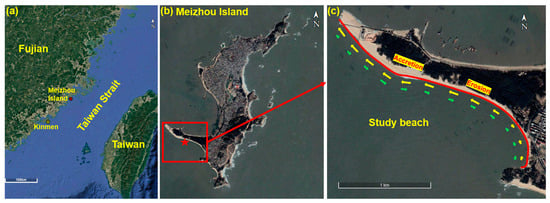
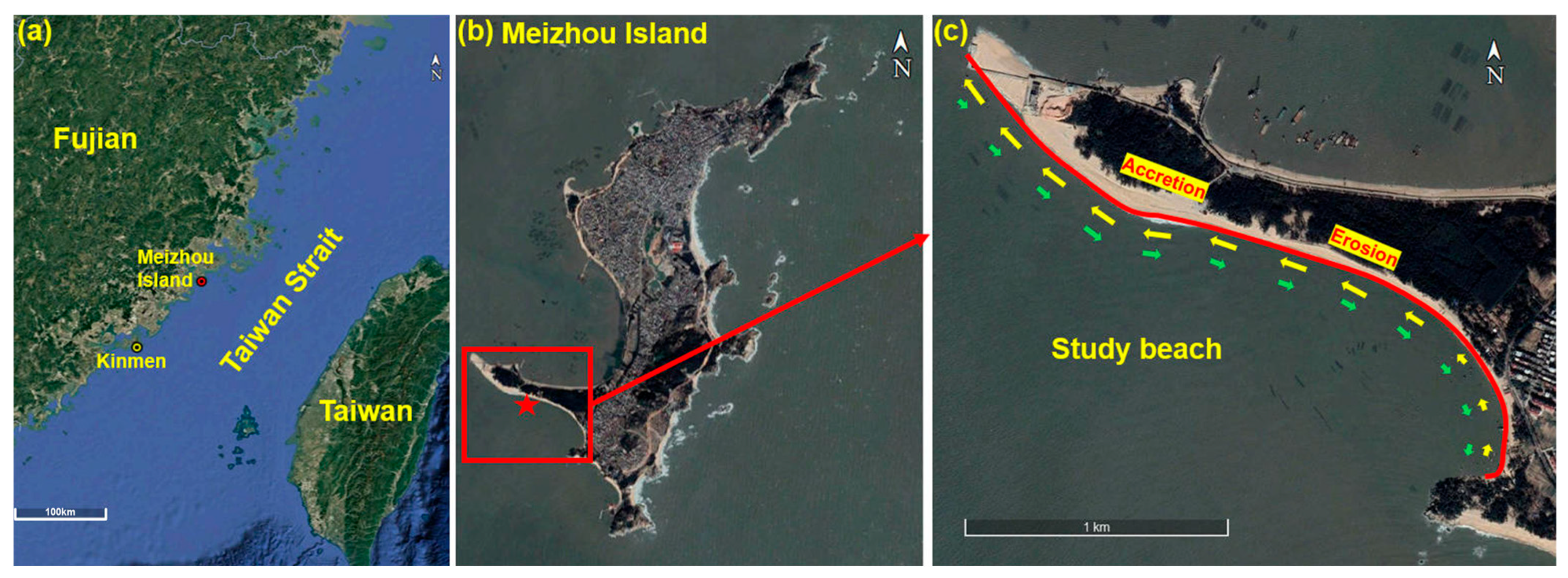
The study area is located on the southwestern headland of Meizhou Island, Fujian Province, China, and is characterized by a headland-bay coast (Figure 1). The beach is predominantly influenced by southeast to south (SE-S) waves, generating persistent east-to-west alongshore sand transport and a westward-extending sand spit. A pier is constructed on the sand spit, with a navigation channel located approximately 40 m seaward. Westward sand transport induces siltation around the pier and within the channel, requiring regular dredging, while the dredged material is not returned to the beach. In addition, the eastern headland restricts sand input from adjacent beaches. As shown in Figure 1c, severe erosion occurs along the eastern and central beach sections, whereas the western segment exhibits significant accretion, particularly near the pier, resulting in a dynamically unbalanced beach system characterized by net alongshore sand loss.
Figure 1.
Study site. (a) Location of Meizhou Island in Fujian Province, China, in the northern Taiwan Strait; (b) Meizhou Island and study beach location; (c) study beach with conceptual morphodynamic pattern. Base map from Google Earth Pro.
The study site is classified as a macro-tidal beach, with a mean tidal range of 4.97 m and a maximum tidal range of 7.76 m. The mean high water springs (MHWS), mean high water (MHW), mean sea level (MSL), mean low water (MLW), and mean low water springs (MLWS) are 4.07 m, 2.70 m, 0.25 m, −2.27 m, and −3.69 m, respectively, and the 50-year return-period extreme high water level (EHWL50) reaches 5.03 m. The annual mean nearshore significant wave height is 0.44 m, with a mean spectral peak period of 4.90 s. Wave directions are predominantly distributed between SE and S. Beach sediments mainly consist of medium to fine sand, with a median grain size (D50) of approximately 0.35 mm.
Meizhou Island, located in the northern Taiwan Strait, is affected by approximately 2–4 typhoons annually, with maximum wind speeds exceeding 30 m/s. During Typhoon Doksuri, one of the strongest typhoons affecting Fujian in recent years and comparable to a 50-year return-period event, the significant wave heights along the Fujian coast increased from 1 m to about 5 m, with offshore waves reaching nearly 10 m [45]. The nearshore spectral peak periods approached 10 s and swells were notably dominant during the event, with swell heights of approximately 3 m. Observed wave and water-level data are available from the Kinmen Weather Station operated by the Central Weather Administration (CWA) [46], located in Kinmen (Figure 1a), and provides representative offshore hydrodynamic conditions for the northern Taiwan Strait.
2.2. Physical Model and Validation
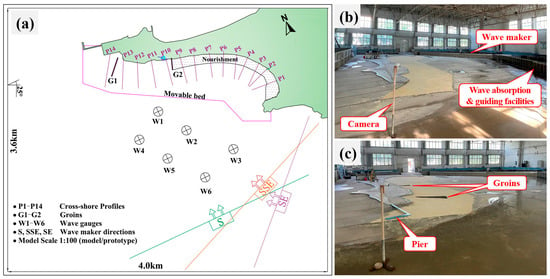
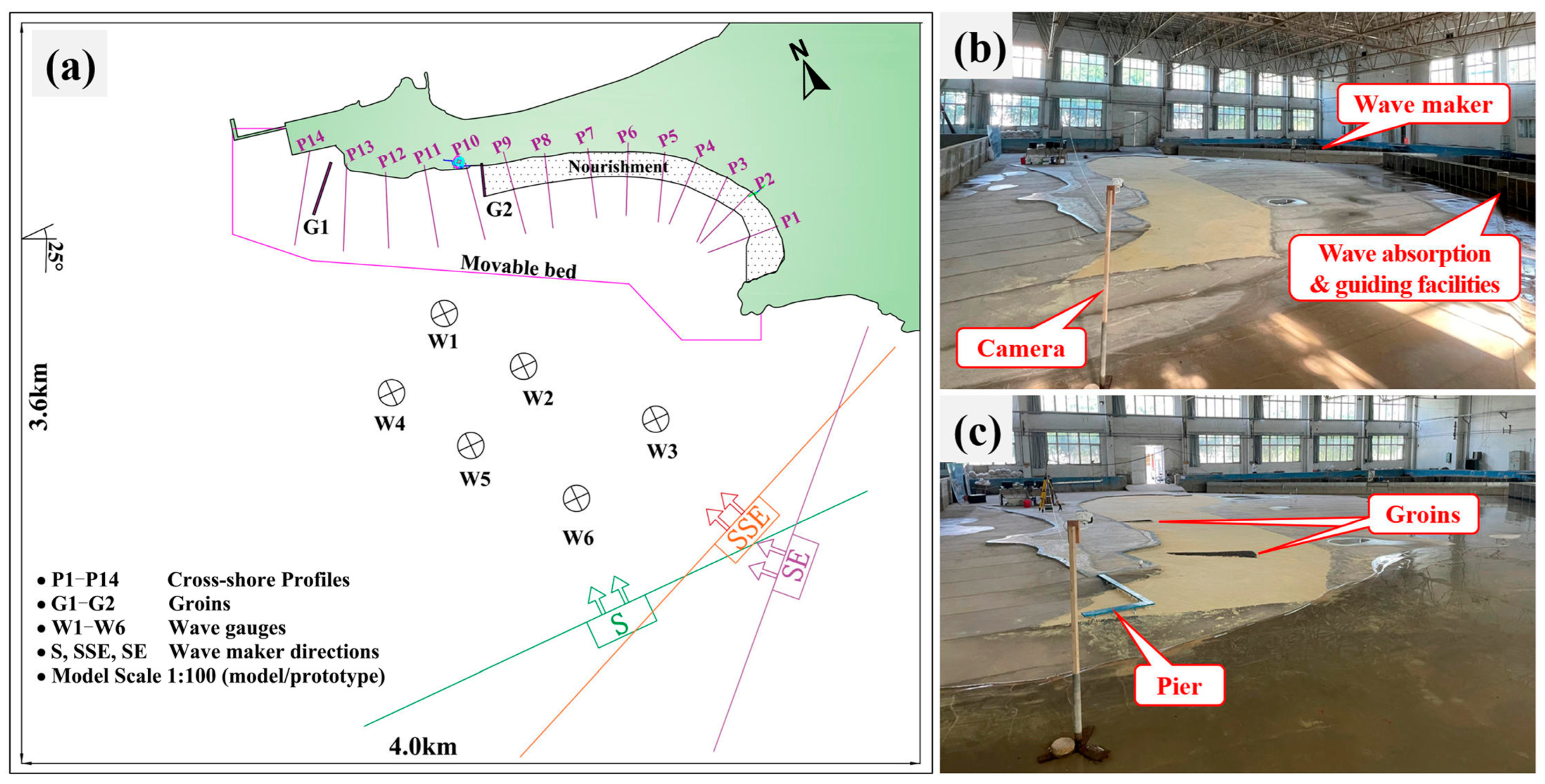
An experiment was conducted in a wave basin that was 40 m long, 36 m wide, and 1.5 m high, as shown in Figure 2. The experiments followed Froude similarity with horizontal and vertical scales of 1:100 (model:prototype). Model bathymetry was constructed based on geometric similarity using stake-point and cross-sectional methods. Island margins and offshore bathymetry were built as a fixed bed using cement mortar, while a movable bed was established landward of the closure depth using model sediment. Bed elevations were controlled within ±1 mm. The movable-bed sediment consisted of lightweight plastic sand (D50 = 0.35 mm; density = 1.2 g/cm3). Sediment similarity between the model and prototype was evaluated using initiation and settling tests based on Shields parameter and fall-velocity scaling. The results indicate that the critical Shields parameter and settling behavior of the model sediment are comparable to those of prototype sand, ensuring a reasonable representation of sediment mobility in the movable-bed experiments.
Figure 2.
Layout of physical model and photographs of the experimental setup. (a) Model layout with initial nourishment test; (b) experimental setup for model validation; (c) experimental setup for initial nourishment test.
Irregular waves with a JONSWAP spectrum were generated using a 25 m long movable paddle-type wave maker. The system can generate waves with significant wave heights ranging from 0.01 to 0.30 m and spectral wave periods of 0.5–2.0 s and produces waves from a single incident direction. Wave absorption and guiding facilities were placed along the model boundaries to reduce wave reflection and diffraction effects. Incident waves were validated using six wave gauges (W1–W6 in Figure 2) deployed at the water depths of −15 m and −10 m. Representative waves were derived from one-year numerically simulated wave time series at six corresponding locations. A direct synthesis method for representative waves was applied as Equation (1), in which wave directions exceeding a specified wave-height threshold were weighted by their occurrence frequencies.
where is weight height, is the wave direction, and is occurrence frequency corresponding to and . The representative wave height for one-year statistics ranged from 0.637 to 0.651 m, the representative wave period from 3.63 to 3.71 s, and the representative wave direction from 154.4° to 189.4°.
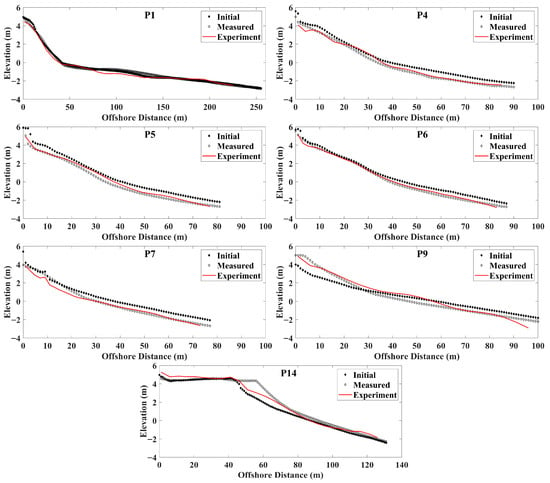
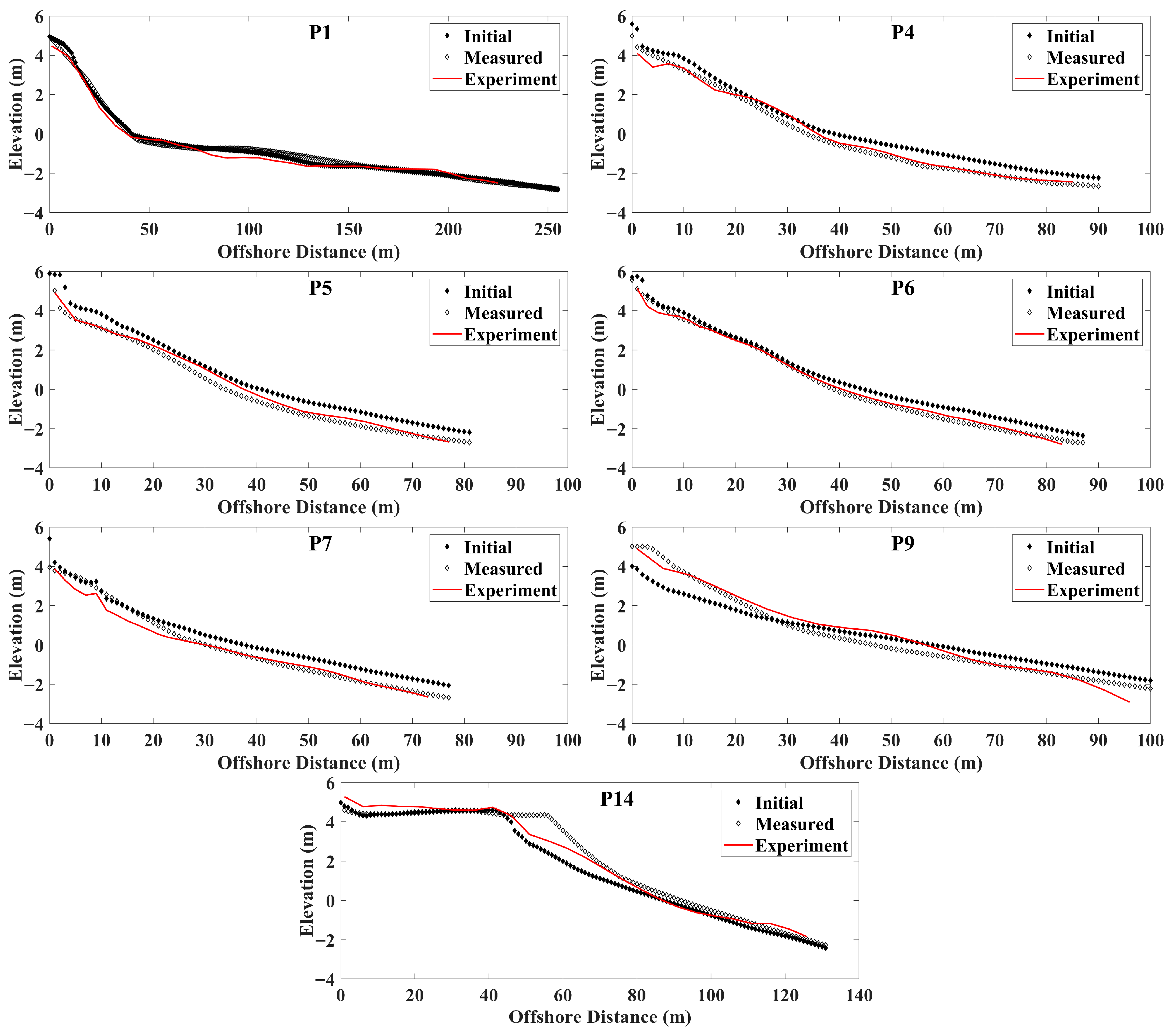
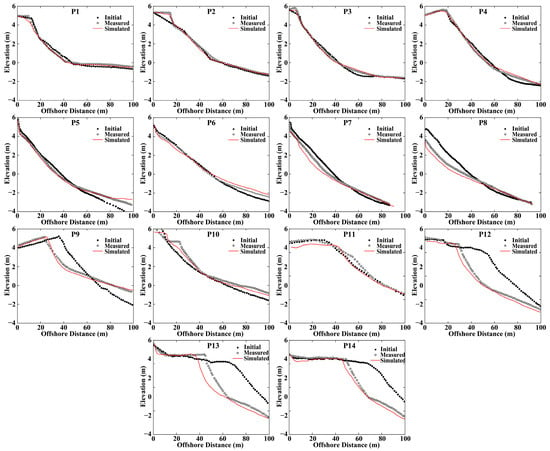
Cameras were installed to observe the hydrodynamic conditions and morphological changes around the pier area. Water levels were continuously recorded using high-precision water-level sensors over a tidal range from MLWS (−3.69 m) to MHWS (4.07 m). Morphological changes were measured along 14 cross-shore profiles using a laser profiler. Field bathymetric data collected during routine hydrographic surveys in August 2021 and August 2022 were used for experimental validation. The experiments reproduced an annual hydrodynamic cycle through cyclic combinations of representative waves and water levels. During the validation stage, the wave-maker direction was adjusted within the dominant S–SE sector to determine representative incident wave conditions. The final experiments adopted a single representative wave direction, corresponding to the SSE direction under normal wave conditions and S direction under extreme wave conditions, consistent with the representative wave direction calculated from Equation (1). Model results generally agree with observed morphological changes, with slightly underestimated deposition near the pier. The mean error in annual erosion–accretion variation was within 20% for seven cross-shore profiles, as shown in Figure 3. The experiments were limited to a single representative wave direction, whereas the numerical simulations were applied to resolve directional variability.
Figure 3.
Experimental validation of erosion and deposition along typical cross-shore beach profiles, comparing initial, measured, and physical-model profiles after one year of normal wave conditions.
2.3. Numerical Model and Validation
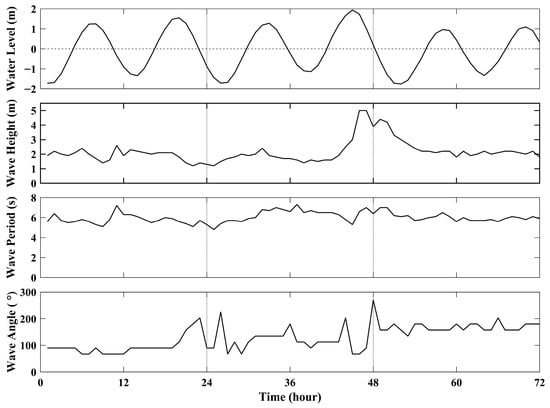
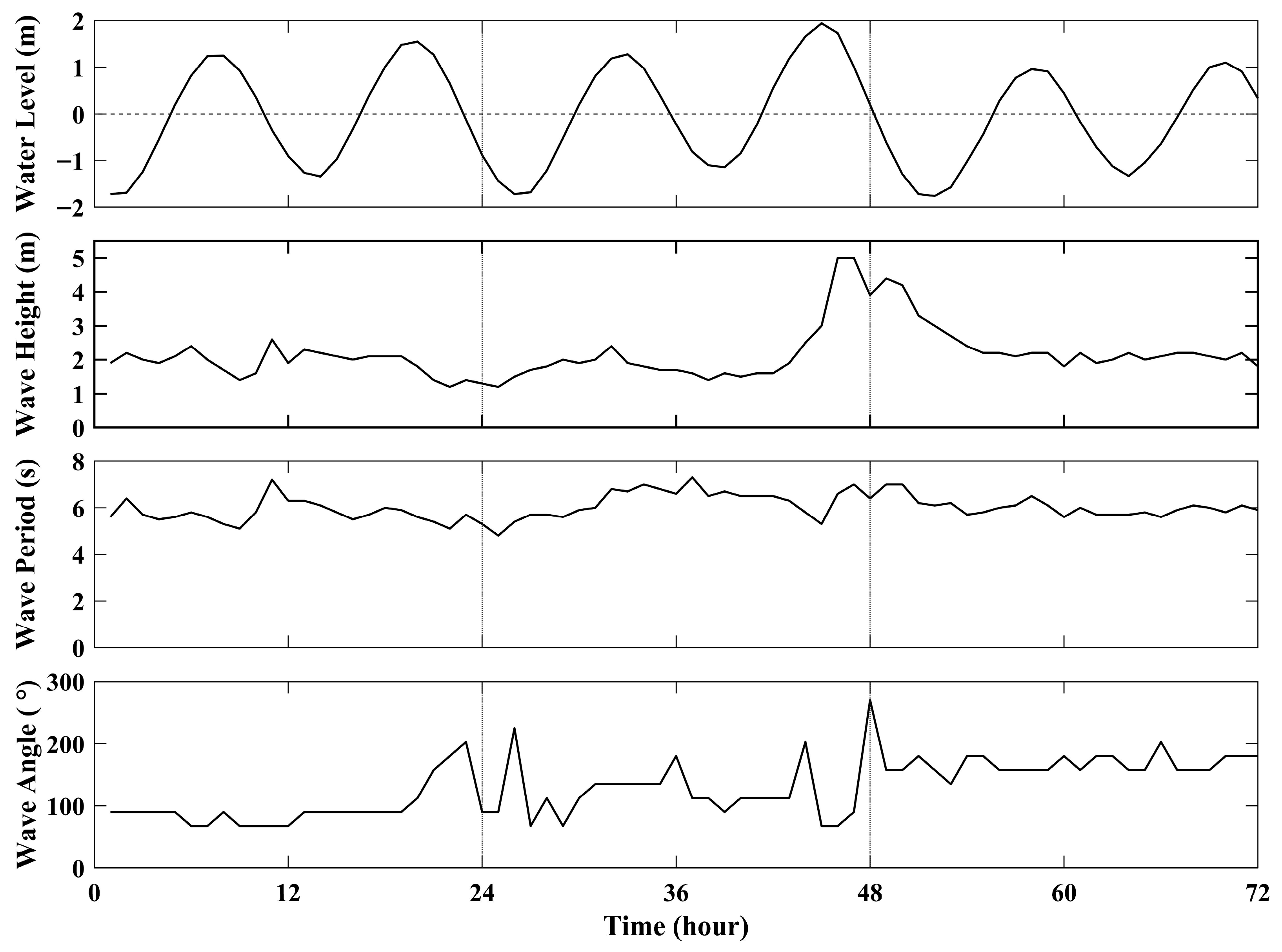
A two-dimensional XBeach model was established to simulate nearshore hydrodynamics and beach morphodynamic responses under extreme wave conditions. The model domain was constructed using measured bathymetric data from field surveys conducted in August 2022 and covered approximately 1.95 km of the nourished shoreline. Simulations focused on Typhoon Doksuri and spanned a continuous 72 h period from 26 to 28 July 2023, covering pre-, during-, and post-typhoon conditions. Hourly wave height, period, direction, and water level were prescribed as boundary conditions. Data were obtained from the Kinmen Weather Station at a water depth of −15 m, located about 100 km from the study site within the northern Taiwan Strait. As both Meizhou Island and Kinmen Island are offshore island environments exposed to similar regional wave conditions, the observed data are considered representative of the offshore wave forcing used in numerical simulations. During Typhoon Doksuri, the significant wave height ranged from 1.2 m to 5.0 m, the spectral peak period from 4.8 s to 7.2 s, and the tidal water level from −1.76 m to 1.94 m. The corresponding hydrodynamic time series used in the simulations are shown in Figure 4.
Figure 4.
Time series of water level, wave height, wave period, and wave direction during Typhoon Doksuri (26–28 July 2023). Data from Kinmen Weather Station (CWA).
The XBeach model was operated in surfbeat mode, which resolves short-wave groups and associated infragravity waves and is suitable for simulating storm-induced wave breaking, wave-driven currents, sediment transport, and bed evolution. Fourteen post-typhoon-measured cross-shore profiles were used for model validation. Model parameters were selected based on commonly adopted values reported in previous storm-driven beach morphodynamic studies [47]. The bed-slope influence coefficient was set to α = 1.6, and the avalanching scheme was activated to simulate sediment redistribution on steep slopes. A Neumann boundary condition was applied at the wave boundary, while the time step was controlled using a Courant–Friedrichs–Lewy (CFL) number of 0.7 to ensure numerical stability. In addition, a morphological acceleration factor of 10 was used to improve computational efficiency.
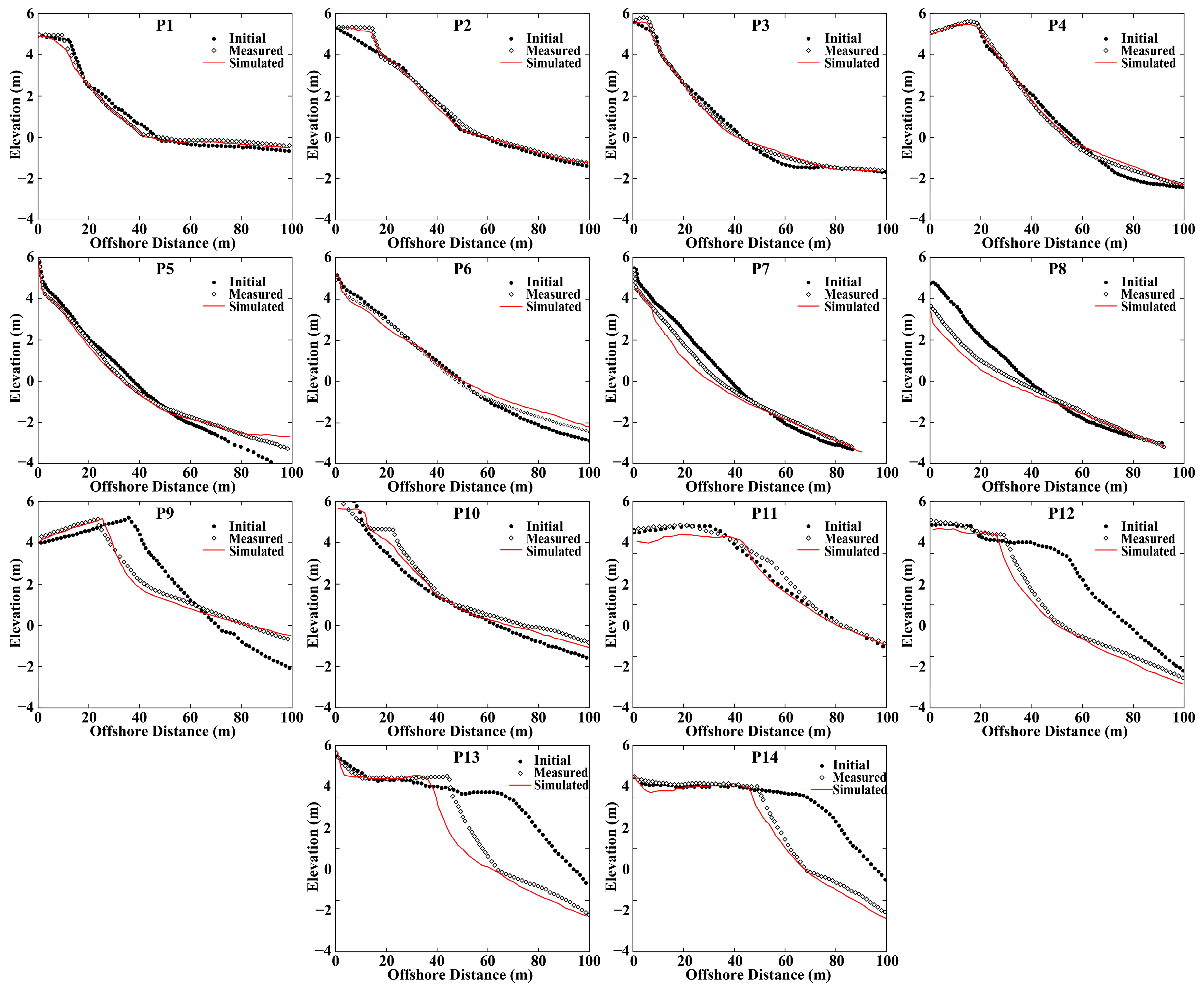
Model validation results are presented in Figure 5, which compares simulated and measured post-typhoon beach profiles. The model shows good agreement in reproducing erosion and deposition patterns along profiles P1–P6. Erosion and shoreline retreat are slightly overestimated at profiles P7–P10 and P12–P14, while deposition observed at profile P11 is not fully captured. To quantitatively evaluate model performance, the root mean square error (RMSE) between simulated and measured bed elevations in each cross-shore profile was calculated as
where zsim and zobs denote simulated and measured bed elevations, respectively, and n is the number of data points in each profile. RMSE values for profiles P1–P5 range from 0.09 m to 0.10 m, while profiles P6–P10 range from 0.10 m to 0.13 m. Slightly larger deviations occur in the offshore profiles (P12–P14), where RMSE values range from 0.12 m to 0.15 m. The average RMSE across all profiles is 0.11 m, indicating a satisfactory model performance. Despite minor discrepancies, the model reliably reproduces storm-driven beach morphodynamic responses and provides a robust basis for subsequent analyses of nourishment scenarios. The adopted parameter values fall within the range commonly used in previous XBeach applications and are therefore considered reasonable for reproducing storm-driven morphodynamic processes.
Figure 5.
Comparison of initial, measured and simulated post-typhoon beach profiles along 14 cross-shore lines.
2.4. Nourishment Test Scenarios
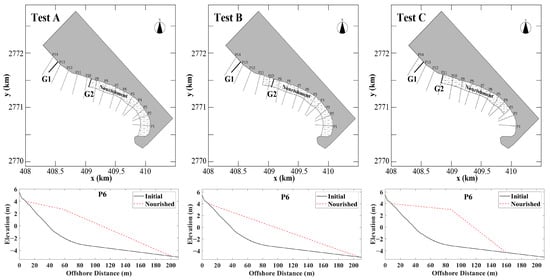
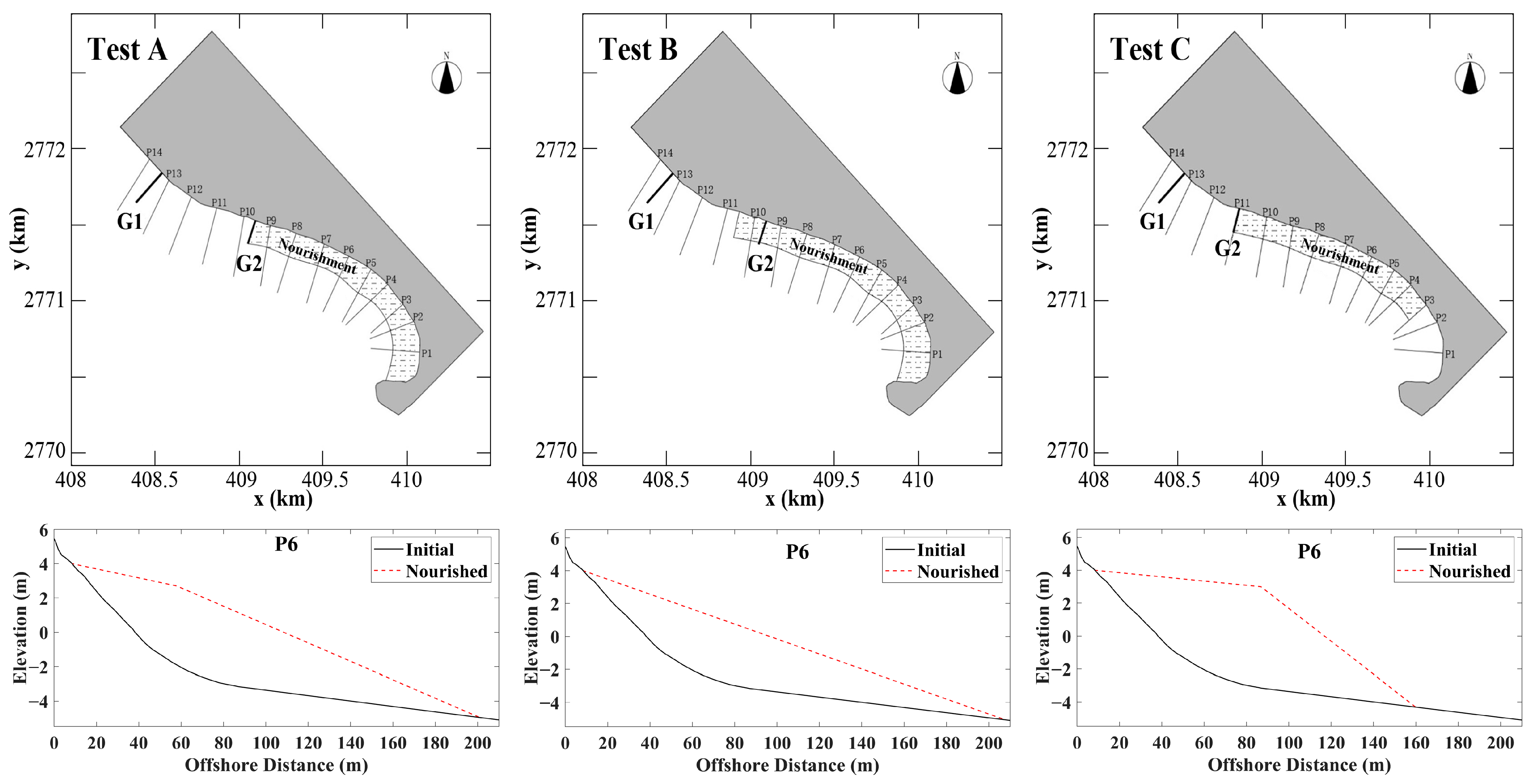
This study focuses on three representative nourishment tests combined with groin structures, while other tested configurations are not discussed herein. The three tests in Figure 6 were progressively developed through planar optimization based on physical-model experiments under normal wave conditions. Test A represents the initial design layout, in which a 250 m long groin (G1) was constructed east of the pier and a 100 m long groin (G2) was located between profiles P9 and P10. Beach nourishment was placed between the eastern headland and G2. Experiment results indicated pronounced scour on the lee side of G2 because of wave shadowing and diffraction effects associated with the groin configuration. To mitigate lee-side erosion, Test B extended the nourishment footprint approximately 260 m westward of G2, toward profile P11. However, this modification did not effectively reduce scour behind G2. Based on the observed sand accumulation near profile P11 and the relatively minor morphological changes near the eastern headland, Test C further optimized the layout by relocating G2 westward to profile P11 and adjusting the nourishment placement starting from profile P3, resulting in a marked reduction in lee-side erosion.
Figure 6.
Plan layouts of the three nourishment tests showing locations of 14 cross-shore profiles, groins G1 and G2, and nourishment areas, together with the corresponding representative cross-shore profile P6. Initial and nourished refer to the pre- and post-nourishment profiles.
The three tests differ primarily in nourishment extent, beach slope, fill volume, and groin G2 location, while the groin G1 configuration remains unchanged. Key design parameters for the three nourishment tests are tabulated in Table 1. The total fill volumes for Tests A, B, and C are approximately 0.75, 0.60, and 0.65 million m3, respectively. In all tests, the nourishment profile was initiated landward from an elevation of +4.0 m. Test A extended the berm seaward by approximately 40 m at MHW (+2.7 m), followed by a foreshore slope of about 1:19. Test B adopted a uniform foreshore slope of 1:22 with the berm extended seaward by an average of 20 m at MHW (+2.7 m), representing the gentlest profile among the three tests. Test C extended the berm seaward by approximately 60 m at MHW (+2.7 m), and the foreshore was reshaped to a steeper slope of 1:10. These scenarios were designed to systematically evaluate the influence of nourishment geometry and groin positioning on beach morphodynamic response and nourishment stability under extreme wave conditions.
Table 1.
Design parameters of nourishment geometry and groin configuration for three tests.
3. Physical-Model Results and Discussion
Physical-model experiments were conducted to observe wave transformation, nearshore energy dissipation, and cross-shore and alongshore morphological adjustment under waves and storm surges. Three nourishment tests were performed under extreme wave conditions. Water levels were prescribed as a cyclic combination of EHWL50, MHL and MSL. Wave forcing was defined using the 50-year return-period significant wave heights (5.62–5.93 m) and peak periods (8.44–8.86 s) derived from six wave-gauge locations (Figure 2). Irregular waves were generated to represent natural variability. Based on the morphodynamic time scale obtained from the annual-condition validation, the extreme-wave experiments were conducted with a shortened laboratory duration under constant extreme wave forcing. Each test simulated approximately 25 h of prototype beach evolution. The south direction (S) was adopted as the incident direction considering dominant wave-direction frequency, alongshore sand transport, and headland sheltering effects.
3.1. Shoreline Response Under Extreme Wave Conditions
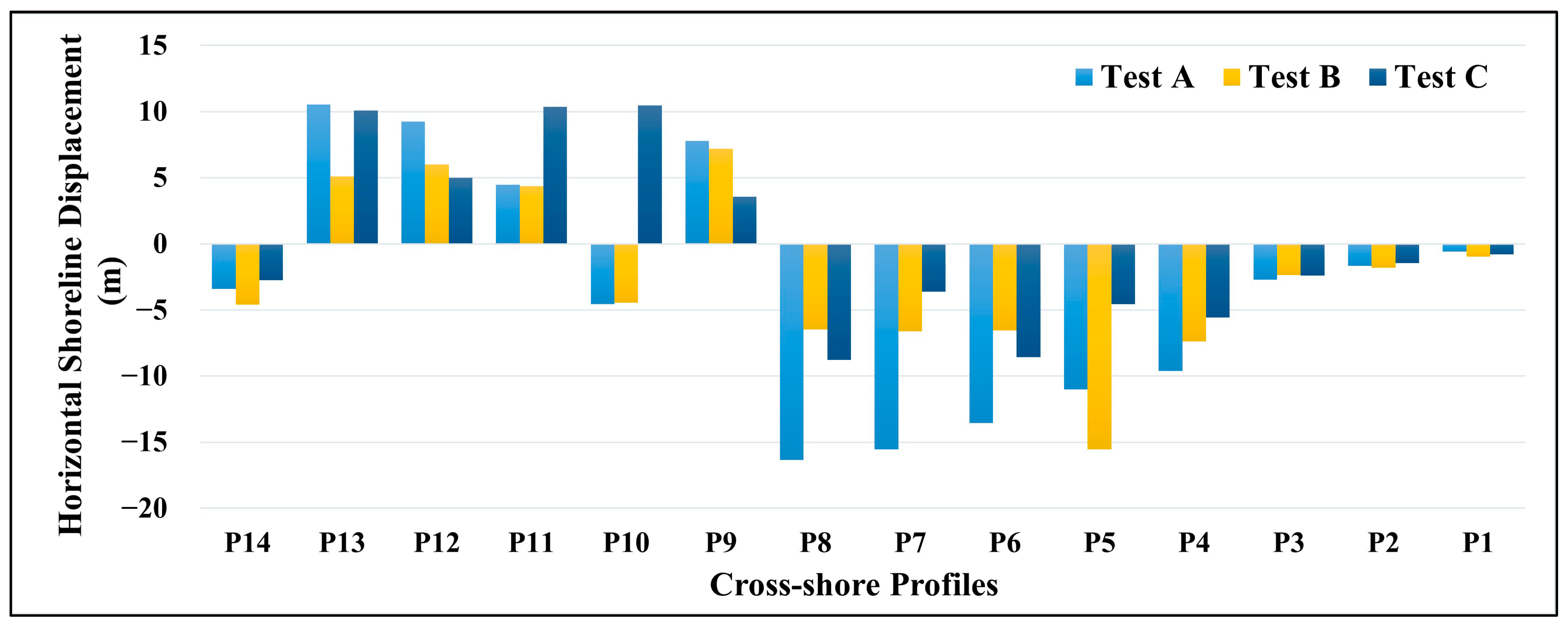
Measured horizontal shoreline displacement along 14 cross-shore profiles for the three tests under 25 h of extreme wave conditions are shown in Figure 7, where positive and negative values represent shoreline accretion and retreat, respectively. Shoreline changes remain relatively minor in all tests at profiles P1–P2, located near the eastern headland, reflecting the strong wave sheltering effect of the headland. Pronounced shoreline recession occurs in the eastern beach section between profiles P3 and P8, indicating that this area represents the primary erosion hotspot under extreme waves. In Tests A and B, groin G2 is located between profiles P9 and P10, causing shoreline accretion at profile P9 as the east-to-west alongshore sand transport is intercepted by groin G2. However, significant erosion consistently develops on the lee side of G2, and profile P10 continues to erode despite nourishment extension in Test B. In Test C, the relocation of groin G2 to profile P11 caused alongshore-transported sand to accumulate between profiles P9 and P11, forming a continuous accretional shoreline. No pronounced erosion is observed at profile P12 that is downdrift of G2. The persistent lee-side erosion in Tests A and B leads to an unstable beach section, whereas the P11–P12 section in Test C evolves toward a more stable configuration. This contrast highlights the importance of coordinating nourishment placement with appropriate groin positioning.
Figure 7.
Measured horizontal shoreline displacement indicating shoreline accretion (positive) and retreat (negative) along profiles P1-P14 for three tests under extreme wave conditions.
Minor shoreline retreat is also observed on the lee side of the main groin (G1), where previously pronounced siltation begins to transition into mild erosion. Deposition occurs on the updrift side of G1. A small portion of deposited sand is transported to the lee side of the groin by wave overtopping. The main groin effectively intercepts alongshore sand transport and retains more sand within the headland-bay system, therefore, enhancing the overall stability of the beach.
3.2. Cross-Shore and Alongshore Sand Redistribution
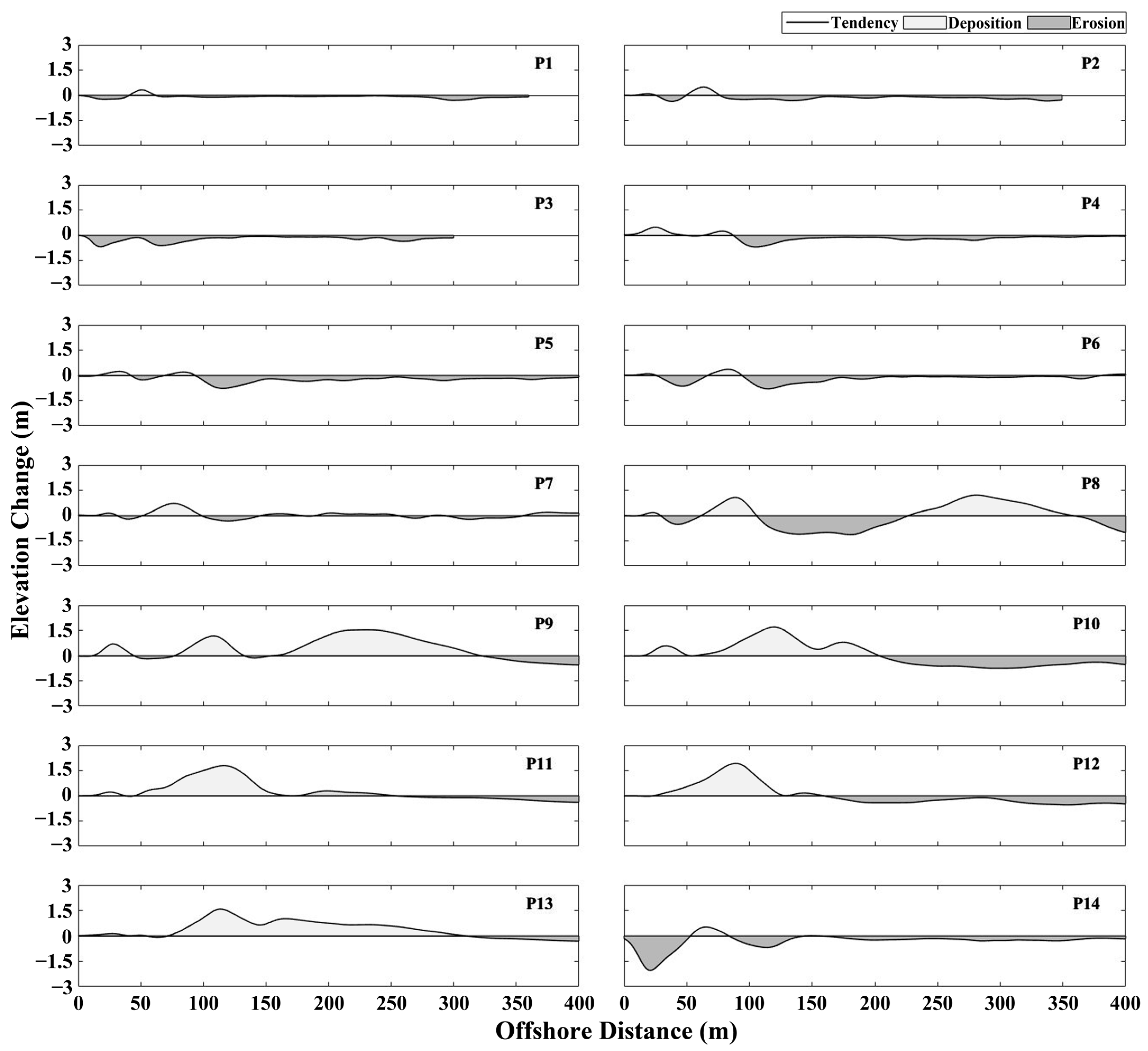
Detailed erosion and accretion patterns along 14 cross-shore profiles for Test C are shown in Figure 8. Minimal morphological change occurs at profiles P1–P2, consistent with the wave sheltering effect of the headland. The eastern beach section (P3–P8) exhibits dominant erosion, reflecting net sand loss driven by alongshore transport. At profile P8, the maximum accretion and erosion reach 1.20 m and −1.13 m, respectively. The central beach section (P9–P11) is characterized by net accretion, as sand eroded from the P3–P8 section is transported westward, and deposited in this region under extreme waves. At profile P11, the maximum accretion reaches 1.79 m, while erosion is limited to −0.39 m. The western beach section (P12–P13) shows nearshore deposition and offshore erosion, with maximum accretion and erosion of 1.92 m and −0.54 m at profile P12. Near the pier (P14), erosion dominates, with a maximum erosion of −2.03 m and maximum accretion of 0.52 m, reflecting the strong hydrodynamic influence near groin G1.
Figure 8.
Cross-shore erosion and deposition patterns along profiles P1–P14 for Test C.
In Test C, groin G2 is located at profile P11, while groin G1 is positioned between profiles P13 and P14. As a result, the P9–P13 segment forms a broad nearshore accretion zone between the two groins. The spacing between the two groins is sufficient to promote sediment retention within the intervening beach section and reduce localized erosion. Consequently, G1 effectively intercepts east-to-west sediment transport and prevents nourishment sand from migrating into the pier area and navigation channel, contributing to overall nourishment retention and beach stability.
4. Numerical Simulation Results and Discussion
Numerical simulations for the three tests employed the same 72 h wave and water-level conditions in Figure 4 used for model validation during Typhoon Doksuri. The validated XBeach model was applied to quantify nearshore hydrodynamic responses and assess nourishment stability under extreme wave conditions.
4.1. Hydrodynamic Responses Under Extreme Wave Conditions
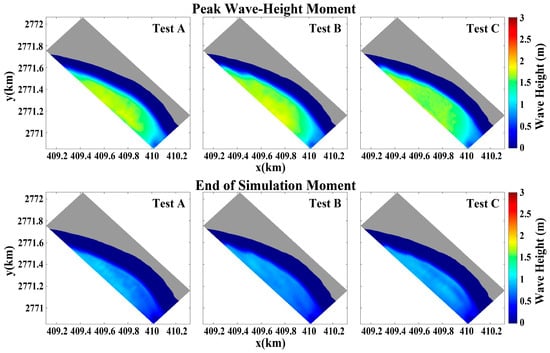
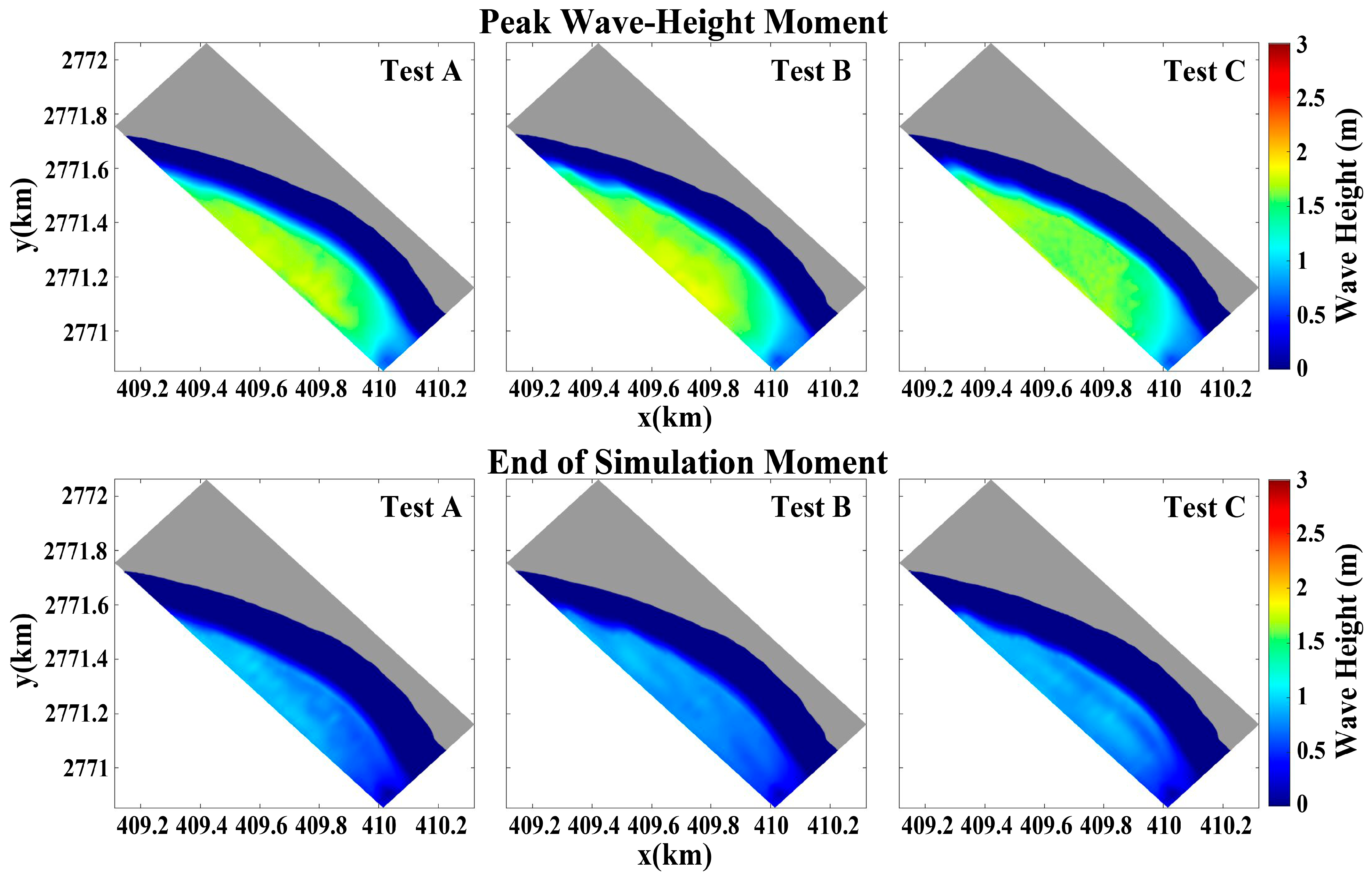
Two representative time moments were selected to analyze nearshore hydrodynamics under the three nourishment tests: the peak wave-height moment and the end of the simulation, corresponding to the most energetic stage of the storm and the post-storm residual hydrodynamic conditions, respectively. The beach sections along profiles P2–P10 were presented, including the primary erosion zones (P3–P8). Spatial distributions of significant wave heights at these two moments are shown in Figure 9. At the peak wave-height moment, significant wave heights within the nourishment area, corresponding to water depths shallower than −4 m, range from approximately 1.5 to 1.7 m for all three tests. Elevated wave energy is concentrated near the toes of the nourishment foreshore slopes, where wave breaking occurs and energy is rapidly dissipated. The nourishment profiles contribute substantially to wave-energy attenuation. By the end of the simulation, wave heights decrease markedly, with most areas falling below 0.5 m, corresponding to a reduction of about 40–50%. Alongshore variations are also noticeable. In the headland area, waves break farther offshore due to diffraction and sheltering effects, whereas near profile P9, wave breaking occurs closer to the shoreline, increasing the potential for erosion. By the end of the simulation, the alongshore wave-height distribution becomes more uniform, except near the headland. Differences in the significant wave heights among the three tests are small at the peak wave-height moment, with variations of approximately 0.2 m. By the end of the simulation, these differences become nearly indistinguishable under post-storm conditions.
Figure 9.
Spatial distribution of significant wave height at peak wave-height moment and at end of simulation for three tests.
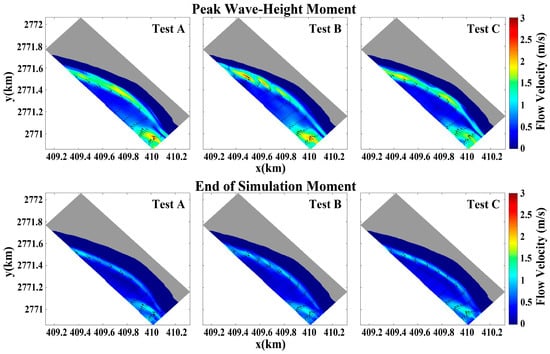
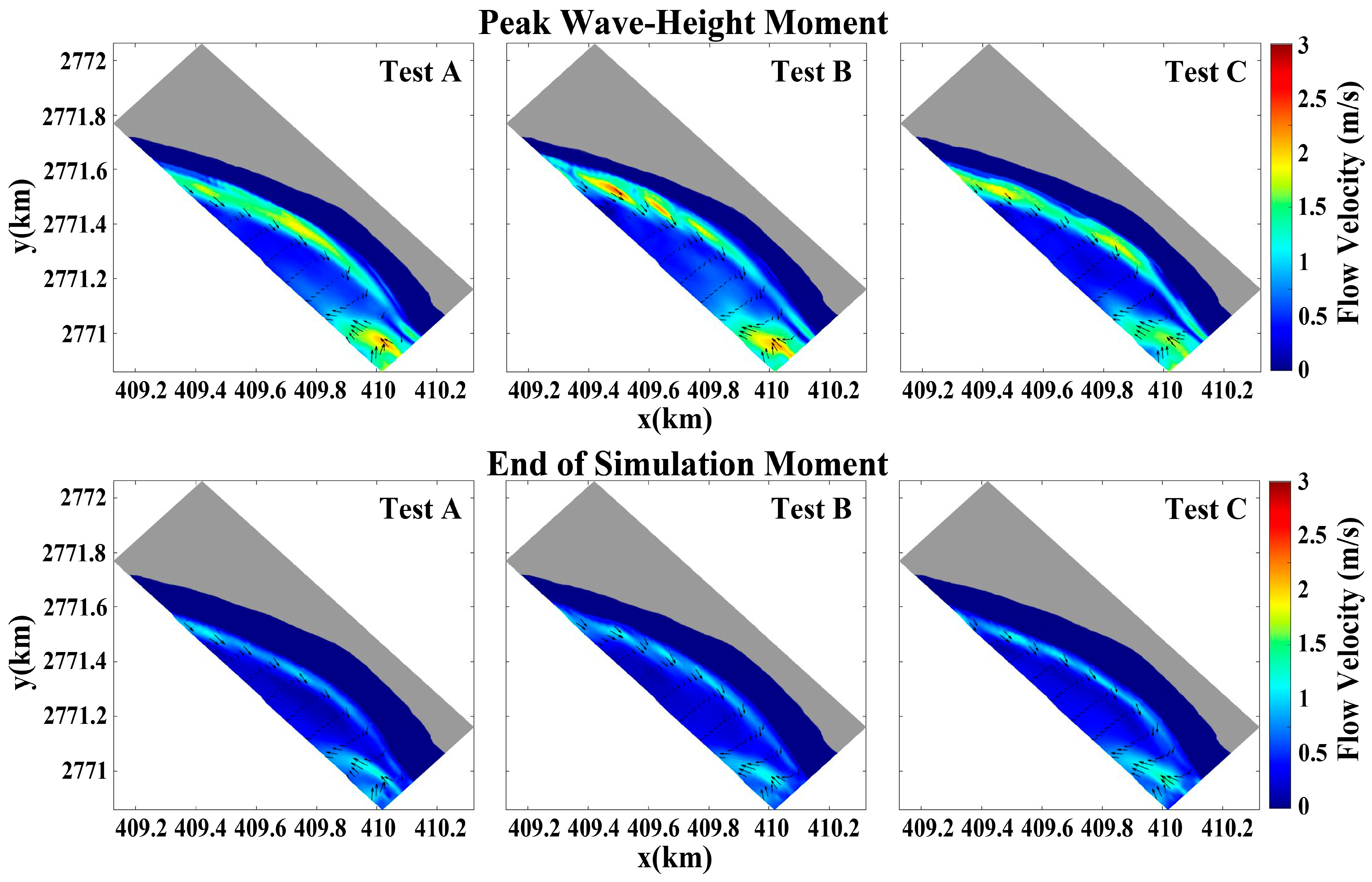
Figure 10 shows the spatial distribution of flow velocity at the peak wave-height moment and at the end of the simulation for the three tests. At the peak wave-height moment, as waves propagate toward nearshore, the flow velocity increases in the surf zone and then decreases rapidly after wave breaking. Outside the nourishment area, peak velocities reach about 1.7 m/s in Tests A and C, while Test B shows a higher maximum velocity of approximately 2.5 m/s. The elevated velocities are mainly concentrated between profiles P6 and P8 (x = 409.4 − 409.5 m, as indicated in Figure 6). Within the nourishment area, the maximum velocities are approximately 1.4 m/s in Test A, 1.8 m/s in Test B, and 1.6 m/s in Test C. In the alongshore direction, a broader low-velocity zone is observed near the headland, whereas the low-velocity region becomes narrower toward P10, indicating a stronger hydrodynamic activity in the central beach section. Near groin G2, the nearshore flow is deflected eastward and directed offshore, forming return currents and a divergent flow induced by the nourishment berm and groin. By the end of the simulation, velocities decrease to below 0.5 m/s across most of the domain, reflecting the weakening of storm forcing. However, velocities near the toes of the nourishment foreshore slopes remain around 1.0 m/s. The foreshore-slope toe area continues to experience a relatively strong hydrodynamic force and may therefore be prone to post-storm sediment adjustment.
Figure 10.
Spatial distribution of flow velocity at peak wave-height moment and at end of simulation for three tests. Arrows indicate the flow velocity direction.
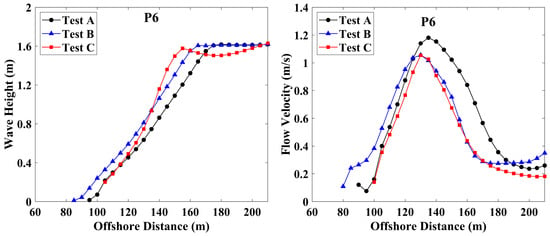
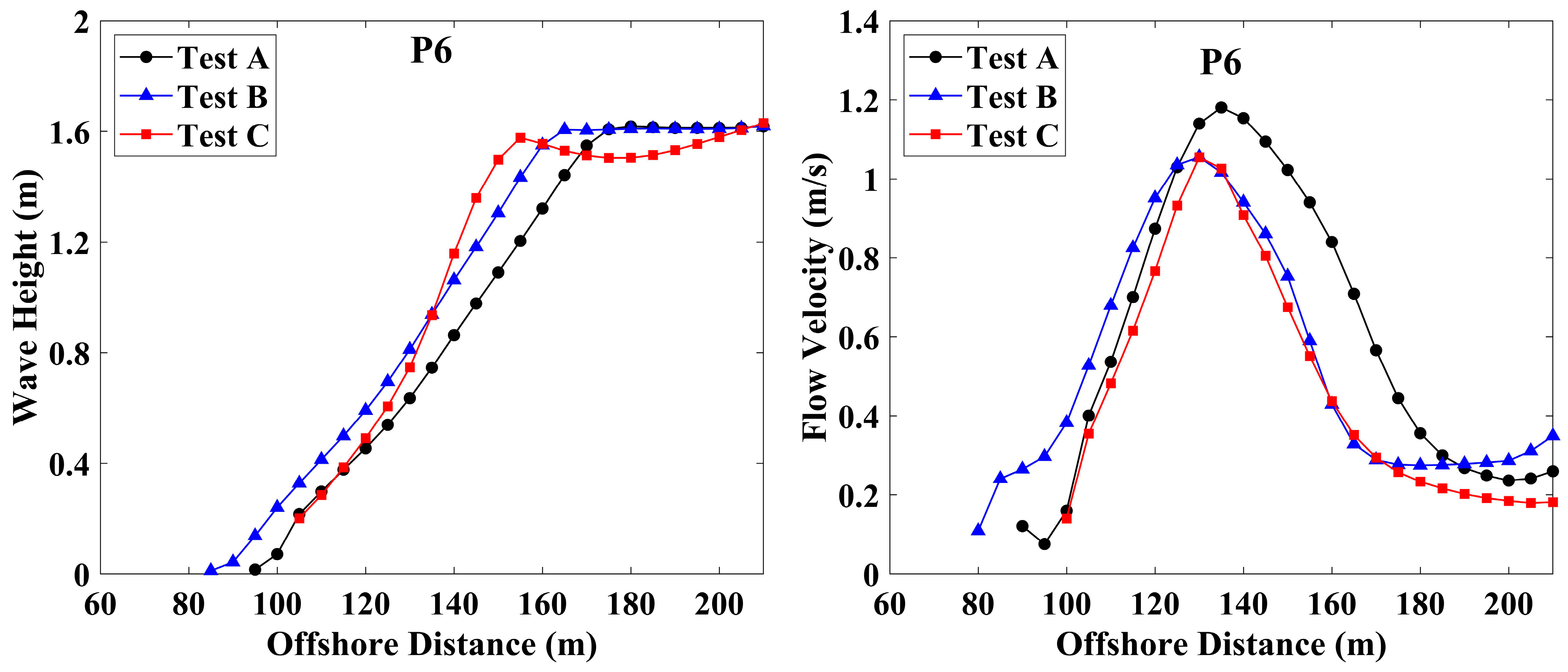
To facilitate a direct comparison of nearshore hydrodynamic responses among the three nourishment tests, wave height and flow velocity at the peak wave-height moment were extracted from the representative cross-shore profile P6, shown in Figure 11. The profile orientation and horizontal distance are consistent with those shown in Figure 5. In Tests A and B, wave heights remain relatively stable during shoreward wave propagation between x = 210 m and 180 m, and then decrease sharply at about x = 160 m and x = 170 m, respectively. The wave-height decay in these two tests is relatively gradual and uniform, reflecting their gentler foreshore slopes, which are close to the equilibrium profile slope of 1:19. In contrast, Test C, with a steeper foreshore slope of 1:10, promotes wave shoaling and run-up as waves approach the shore, followed by wave breaking. Consequently, Test C exhibits the most rapid wave-height decay. Test B, with the gentlest slope (1:22), shows wave heights continuing shoreward to approximately x = 85 m after wave breaking; while Test A, with a slope of 1:19, displays wave heights that persist to about x = 95 m. The flow velocity along the profile increases toward the nearshore and then decreases rapidly after wave breaking, with peak velocities occurring at approximately 130 m offshore. Test A presents the highest peak velocity, Test B shows the slowest velocity decay, and Test C exhibits the fastest velocity attenuation, consistent with the wave-height patterns. Comparison among the three foreshore slopes indicates that steeper slopes (Test C, 1:10) enhance wave-energy dissipation and reduce nearshore hydrodynamic intensity, whereas gentler slopes (Test B, 1:22) allow wave heights to continue increasing toward the shoreline, leading to intensified nearshore hydrodynamics and a higher potential for beach erosion.
Figure 11.
Variations in wave height and flow velocity along cross-shore profile P6 at peak wave-height moment for three tests.
4.2. Morphodynamic Evolution
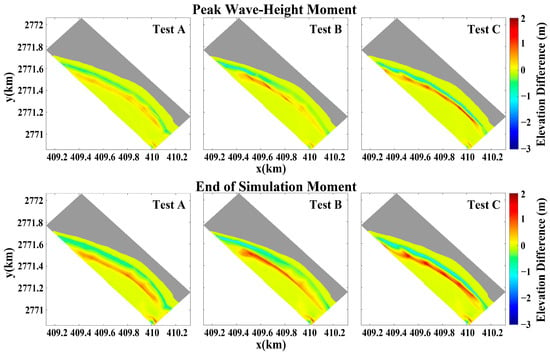
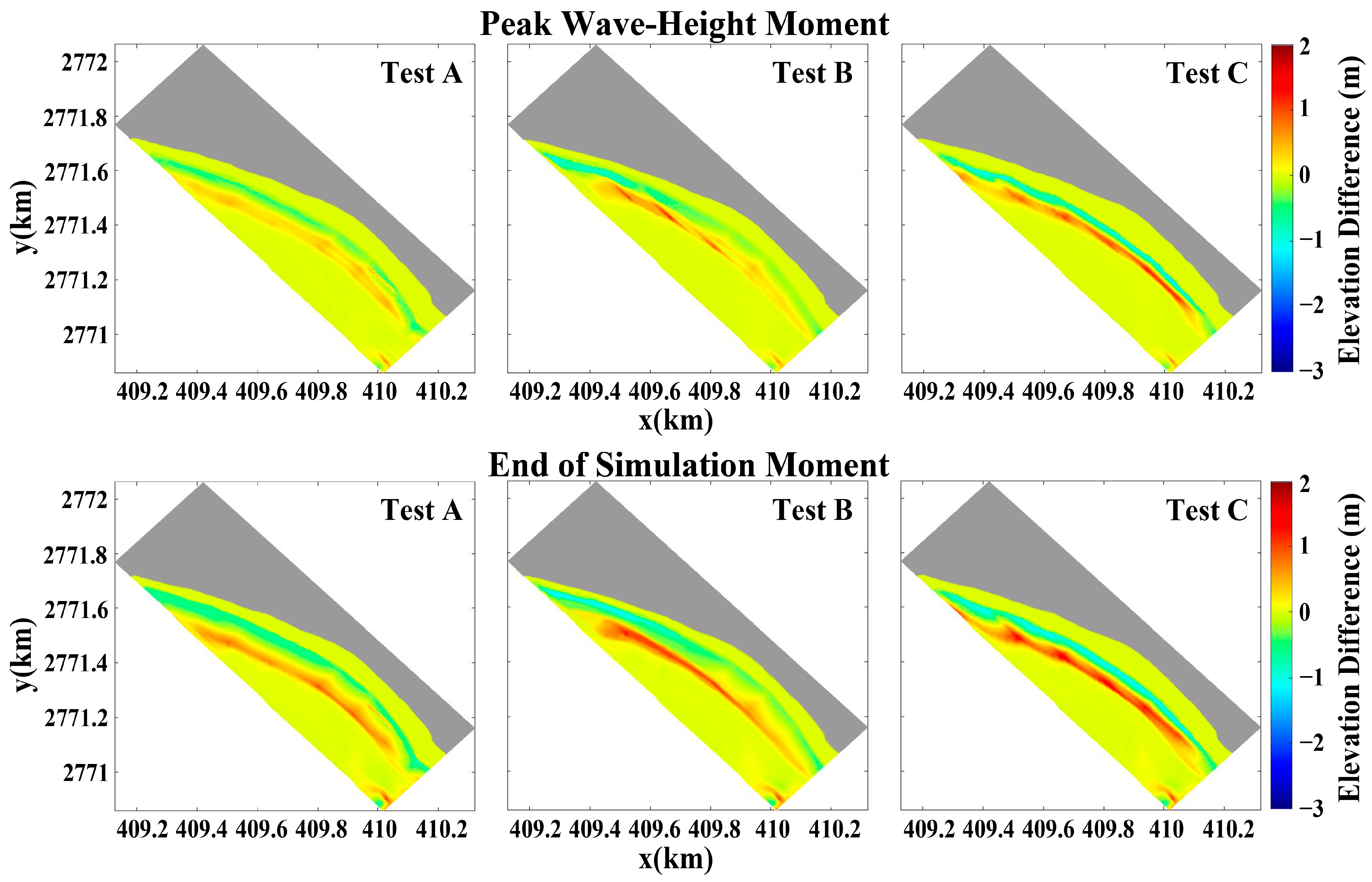
Figure 12 illustrates nearshore erosion–deposition patterns along the beach section between profiles P2 and P10 for the three nourishment tests at the peak wave-height moment and at the end of the simulation. All tests exhibit a general pattern of onshore erosion and offshore deposition. At the peak wave-height moment, Tests A and B display relatively extensive erosion–deposition zones with smaller elevation differences, indicating a small erosion depth and deposition thickness. In contrast, Test C shows a more confined erosion–deposition area but larger elevation changes. By the end of the simulation, the maximum erosion and deposition reach approximately −1.0 m and 1.1 m in Test A, and −0.8 m and 1.1 m in Test B. Test C exhibits the largest erosion depth (−1.5 m), which is mainly concentrated near the offshore breaker zone rather than across the entire foreshore. In terms of the spatial distribution for the three tests, the most pronounced morphodynamic changes occur near groin G2 (between P9 and P10), while the eastern beach segment shows relatively minor variations. This pattern is consistent with the physical-model experiment results, supporting the reliability of the numerical simulations.
Figure 12.
Elevation differences at peak wave-height moment and at end of simulation along profiles P2–P10 for three tests.
Table 2 summarizes the erosion extent, erosion length and maximum erosion depth in cross-shore profiles P3–P10. Erosion extent is defined by the offshore distances to the start and end points of the erosion region. Erosion length represents the distance between these two points. Erosion in Test B initiates closer to the shoreline, whereas erosion in Test C generally occurs farther offshore, suggesting earlier wave breaking, rapid wave-energy dissipation, and morphodynamic adjustment near the breaker zone. The erosion lengths in Tests A and B are greater than those in Test C for most profiles, except at profile P10. The relatively longer erosion length at P10 is associated with its position immediately updrift of the relocated groin G2 at P11. In Test B, erosion lengths exceed 70 m along profiles P6–P8 and reach approximately 90 m at profile P9, demonstrating widespread foreshore erosion and shoreline retreat. This pattern corresponds to higher nearshore wave heights and wave breaking occurring closer to the shoreline. In terms of erosion depth along profiles P3–P10, Tests A and B show maximum values generally below 1.0 m, with much smaller erosion depths of less than 0.5 m at profiles P3–P5. Test C exhibits maximum erosion depths exceeding 1.0 m in most profiles.
Table 2.
Erosion zone statistics for each cross-section for three tests.
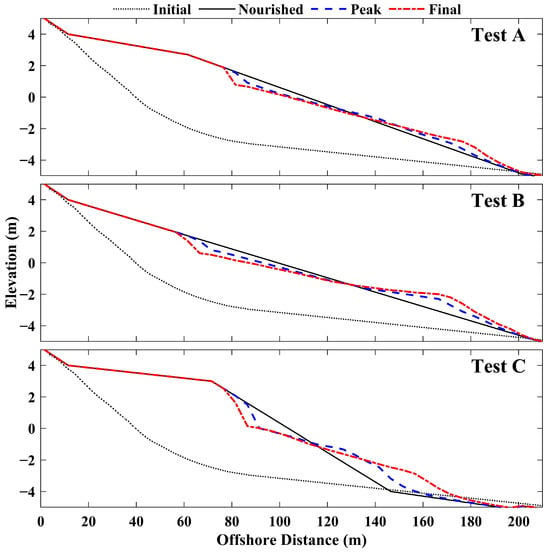
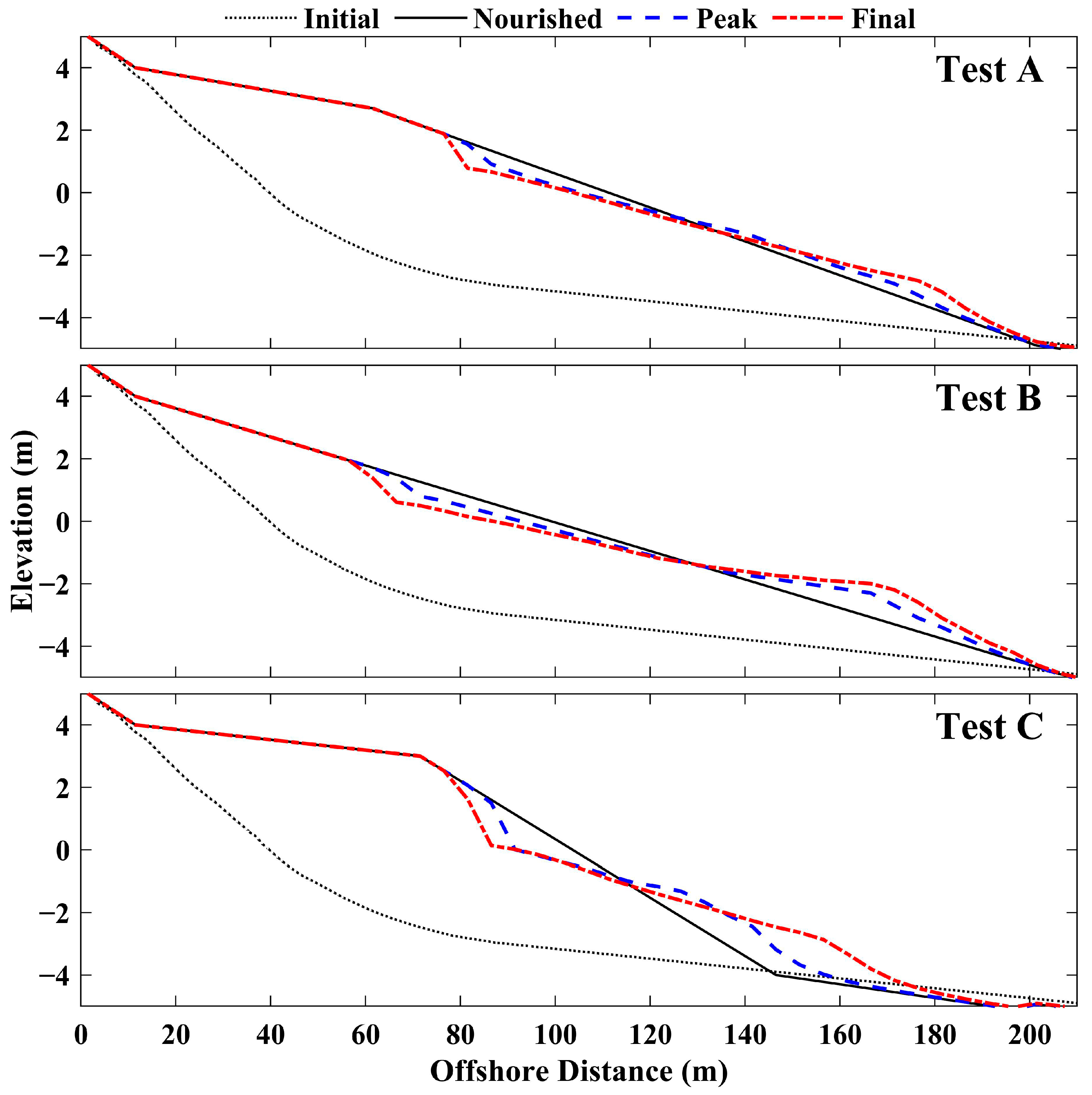
To further quantify the storm-induced morphodynamic response, beach evolutions along profile P6 for the three nourishment tests at the peak wave-height moment and at the end of the simulation are presented in Figure 13. Table 3 summarizes the corresponding deposited sediment volume , eroded sediment volume , and net sediment transport volume along profile P6. Tests A and B, characterized by gentler foreshore slopes, exhibit broader erosion extent, with the largest eroded volume 30.8 m3/m occurring in Test B at the end of the simulation. Test C shows deeper but more spatially confined erosion and the smallest berm retreat along profile P6. This pattern reflects the steeper nourishment slope in Test C, which promotes offshore wave shoaling and breaking, accelerates wave-energy dissipation, and shifts erosion seaward while limiting its landward extent. Similar relationships between beach slope and storm-driven coastal responses have been reported in multi-decadal shoreline analyses of 390 cross-shore transects, which indicate that steeper beach faces may reduce the magnitude of storm-induced retreat through earlier wave-energy dissipation [48]. The positive net sediment balance () at profile P6 further suggests a local sediment input associated with alongshore transport.
Figure 13.
Variations in the cross-shore profile along P6 at peak wave-height moment and at end of simulation for three tests. Initial and nourished refer to the pre- and post-nourishment profiles; peak and final refer to profiles at peak wave-height moment and at end of simulation, respectively.
Table 3.
Deposited (), eroded (), and total net () sediment transport volumes (m3/m) along cross-shore profile P6 at the peak wave-height moment and at the end of simulation for three tests.
4.3. Comparison Between Physical and Numerical Results and Implications for Nourishment Stability
The physical experiments and numerical simulations provide a complementary evaluation for nourishment behavior under extreme wave conditions. In the physical experiments, a constant extreme wave condition was applied using the 50-year return-period wave height and period, with a prototype-equivalent duration of approximately 25 h. The numerical simulations reproduced the time-varying 72 h storm process of Typhoon Doksuri, including pre-, during-, and post-typhoon stages, with wave heights increasing from about 1 m to approximately 5 m and then decreasing. Although the two approaches differ in forcing definition and duration, both are intended to capture the dominant hydrodynamic and morphodynamic processes governing nourishment response under high-energy conditions. Overall, the two approaches show consistent spatial patterns of erosion and deposition. Both indicate that the main erosion zone is located along the eastern and central sections of the nourished beach (profiles P3–P8), whereas sediment tends to accumulate in the central-western section near the groin structures.
Nourishment stability under extreme wave conditions should be assessed using the combined observations from the numerical simulations and physical experiments rather than a single morphodynamic indicator. The numerical simulations resolve cross-shore responses such as erosion extent, erosion depth, erosion volume, and sediment redistribution, indicating that maximum erosion depth alone is insufficient to represent nourishment stability. Although Test C exhibits relatively large, localized erosion depth, the erosion zone remains more confined and concentrated offshore. The physical experiments further provide a horizontal shoreline response, showing that relocating groin G2 westward to profile P11 promotes sediment accumulation between profiles P9 and P11 and reduces persistent lee-side erosion. Together, these results suggest that nourishment stability depends not only on cross-shore morphodynamic adjustment but also on the spatial coordination between nourishment placement and groin configuration.
Several limitations should be acknowledged. The physical-model experiments were conducted using a single representative wave direction and simplified cyclic water-level conditions, which cannot fully reproduce the directional and temporal variability of real storm forcing. The numerical simulations reasonably reproduce the dominant cross-shore morphodynamic responses, but the morphological characteristics between profiles P11 and P14, where the influences of the groins and pier become more pronounced, are not fully captured. Nevertheless, the general agreement between the two approaches indicates that the integrated framework captures the dominant mechanisms controlling nourishment behavior under extreme wave conditions and provides a reliable basis for nourishment evaluation in typhoon-prone headland-bay beaches. Such an integrated framework may also support shoreline vulnerability assessments and coastal disaster risk reduction by linking storm-driven erosion–accretion responses with spatially explicit shoreline indicators [49]. Biological processes and long-term geological changes were not considered in the present study. Future research could incorporate longer simulation periods and ecological factors to further improve the assessment of nourishment stability.
5. Conclusions
This study investigated the stability of beach nourishment under typhoon-driven extreme wave conditions by integrating three-dimensional physical-model experiments and XBeach numerical simulations at a headland-bay beach on Meizhou Island, China. Three representative nourishment schemes combined with groin structures were evaluated in terms of shoreline response, hydrodynamic behavior, and beach evolution.
Physical-model experiments demonstrate that nourishment performance is strongly controlled by groin configuration and nourishment geometry. Groin G2 in Tests A and B, located between profiles P9 and P10, produces severe lee-side erosion. Relocating G2 to the accretional zone (Test C) effectively reduces lee-side erosion, and promotes a more stable shoreline configuration compared with Tests A and B. The main groin G1 effectively intercepts east-to-west sediment transport and retains sand within the headland-bay beach system. Numerical simulations further illustrate that the nourishment foreshore slope plays a key role in regulating nearshore hydrodynamics and sediment transport under extreme wave conditions. Steeper foreshore slopes promote wave shoaling and breaking, accelerating wave-energy dissipation. Test C exhibits the rapid wave-energy decay and the shortest erosion extent, whereas the gentler slope in Test B allows wave energy to reach the shoreline, resulting in stronger nearshore currents and more extensive erosion.
The combined experimental and numerical results indicate that nourishment stability under extreme wave conditions cannot be evaluated using maximum erosion depth alone. Instead, it should be assessed using combined indicators, including erosion extent, erosion depth, erosion volume, sediment redistribution patterns, and planform controls associated with groin configuration. The integrated experimental–numerical framework provides practical guidance for optimizing nourishment and groin configurations on headland-bay beaches exposed to extreme wave events. The framework may also be applied to other beach nourishment projects after further refinement to account for site-specific hydrodynamic, morphodynamic, and engineering conditions.
Author Contributions
Conceptualization, T.Z. and B.H.; methodology, T.Z., B.H. and H.W.; software, B.H. and H.W.; validation, T.Z., B.H. and H.W.; formal analysis, T.Z. and B.H.; investigation, L.G.; resources, R.J.; data curation, R.J.; writing—original draft preparation, T.Z.; writing—review and editing, H.C. and B.G.; visualization, T.Z.; supervision, H.C., B.G. and L.G.; project administration, B.G.; funding acquisition, H.C. All authors have read and agreed to the published version of the manuscript.
Funding
This work was financially supported by the National Key Research and Development Program of China (2023YFE0126300, 2024YFB2606202, 2025YFE0117200) and the Basic Funding of the Central Public Research Institutes (TKS20240502, TKS20250302).
Data Availability Statement
The original contributions presented in this study are included in the article. Further inquiries can be directed to the corresponding authors.
Acknowledgments
The authors are very much grateful to the three anonymous reviewers for their constructive comments that significantly improved the quality of this paper. Our intern master’s students, Bo Hu, Meng Chen, and Jinbo Shi, are acknowledged for their contributions in conducting laboratory experiments.
Conflicts of Interest
Author Bo Hu is employed by the company China Energy Engineering Group Jiangsu Power Design Institute Co., Ltd. The remaining authors declare that the research was conducted in the absence of any commercial or financial relationships that could be construed as a potential conflicts of interest. The funders had no role in the design of the study; in the collection, analyses, or interpretation of data; in the writing of the manuscript; or in the decision to publish the results.
References
- Defeo, O.; McLachlan, A.; Schoeman, D.S.; Schlacher, T.A.; Dugan, J.; Jones, A.; Lastra, M.; Scapini, F. Threats to sandy beach ecosystems: A review. Estuar. Coast. Shelf Sci. 2009, 81, 1–12. [Google Scholar] [CrossRef] [Scilit]
- Vousdoukas, M.I.; Ranasinghe, R.; Mentaschi, L.; Plomaritis, T.A.; Athanasiou, P.; Luijendijk, A.; Feyen, L. Sandy coastlines under threat of erosion. Nat. Clim. Change 2020, 10, 260–263. [Google Scholar] [CrossRef] [Scilit]
- Morton, R.A.; Sallenger, A.H., Jr. Morphological impacts of extreme storms on sandy beaches and barriers. J. Coast. Res. 2003, 19, 560–573. [Google Scholar]
- Chen, Y.; Huang, W.; Xu, S. Frequency analysis of extreme water levels affected by sea-level rise in east and southeast coasts of China. J. Coast. Res. 2014, 68, 105–112. [Google Scholar] [CrossRef] [Scilit]
- Hanson, H.; Brampton, A.; Capobianco, M.; Dette, H.H.; Lamm, L.; Laustrup, C.; Lechuga, A.; Spanhoff, R. Beach nourishment projects, practices, and objectives-a European overview. Coast. Eng. 2002, 47, 81–111. [Google Scholar] [CrossRef] [Scilit]
- Cooke, C.B.; Jones, R.A.; Goodwin, D.I.; Bishop, M.J. Nourishment practices on Australian sandy beaches: A review. J. Environ. Manag. 2012, 113, 319–327. [Google Scholar] [CrossRef] [Scilit]
- Pinto, C.A.; Silveira, T.M.; Teixeira, S.B. Beach nourishment practice in mainland Portugal (1950-2017): Overview and retrospective. Ocean Coast. Manag. 2020, 192, 105211. [Google Scholar] [CrossRef] [Scilit]
- Liu, G.; Cai, F.; Qi, H.S.; Liu, J.; Lei, G.; Zhu, J.; Cao, H.; Zheng, J.; Zhao, S.; Yu, F. A summary of beach nourishment in China: The past decade of practices. Shore Beach 2020, 88, 65–73. [Google Scholar] [CrossRef] [Scilit]
- Elko, N.; Briggs, T.R.; Benedet, L.; Robertson, Q.; Gordon, T.; Webb, B.M.; Garvey, K. A century of U.S. beach nourishment. Ocean Coast. Manag. 2021, 199, 105406. [Google Scholar] [CrossRef] [Scilit]
- Vieira, B.F.V.; Pinho, J.L.S.; Barros, J.A.O.; Antunes do Carmo, J.S. Hydrodynamics and morphodynamics performance assessment of three coastal protection structures. J. Mar. Sci. Eng. 2020, 8, 175. [Google Scholar] [CrossRef] [Scilit]
- Zhu, J.; Cai, F.; Liu, J.; Liu, G.; Qi, H.; Lei, G.; Zheng, J.; Cao, H. Application of groin system in beach nourishment. Ocean Eng. 2021, 39, 152–165. (In Chinese) [Google Scholar] [CrossRef]
- Dean, R.G. Beach Nourishment: Theory and Practice; World Scientific Publishing Company: Singapore, 2003. [Google Scholar] [CrossRef]
- Dean, R.G.; Dalrymple, R.A. Coastal Processes with Engineering Applications; Cambridge University Press: Cambridge, UK, 2001. [Google Scholar] [CrossRef] [Scilit]
- Cai, F.; Liu, G. Beach nourishment development and technological innovations in China: An overview. J. Appl. Oceanogr. 2019, 38, 452–463. (In Chinese) [Google Scholar] [CrossRef]
- Coastal Engineering Research Center (CERC). Shore Protection Manual; U.S. Army Corps of Engineers: Washington, DC, USA, 1984.
- Cai, F. Chinese Beach Nourishment Manual; Ocean Press: Beijing, China, 2015. (In Chinese) [Google Scholar]
- U.S. Army Corps of Engineers (USACE). Coastal Engineering Manual; U.S. Army Corps of Engineers: Washington, DC, USA, 2003.
- Liu, G.; Cai, F.; Qi, H.; Zhu, J.; Liu, J. Morphodynamic evolution and adaptability of nourished beaches. J. Coast. Res. 2019, 35, 737–750. [Google Scholar] [CrossRef] [Scilit]
- Liu, G.; Qi, H.; Cai, F.; Zhu, J.; Lei, G.; Liu, J.; Zhao, S.; Cao, C. Morphodynamic Evolution of Post-Nourishment Beach Scarps in Low-Energy and Micro-Tidal Environment. J. Mar. Sci. Eng. 2021, 9, 303. [Google Scholar] [CrossRef] [Scilit]
- Adell, A.; Kroon, A.; Almström, B.; Larson, M.; Hallin, C. Observed beach nourishment development in a semi-enclosed coastal embayment. Geomorphology 2024, 462, 109324. [Google Scholar] [CrossRef] [Scilit]
- Wang, Y.H.; Zeng, C.J.; Lu, P.D.; Chen, K.F. Beach erosion and nourishment in the east section of Sanya Bay. China J. Nat. Resour. 2022, 37, 1049–1060. (In Chinese) [Google Scholar] [CrossRef] [Scilit]
- Hughes, S.A. Physical Models and Laboratory Techniques in Coastal Engineering; World Scientific: Singapore, 1993; 570p. [Google Scholar]
- Beuzen, T.; Turner, I.L.; Blenkinsopp, C.E.; Atkinson, A.; Flocard, F.; Baldock, T.E. Physical model study of beach profile evolution by sea level rise in the presence of seawalls. Coast. Eng. 2018, 136, 172–182. [Google Scholar] [CrossRef] [Scilit]
- Kobayashi, N.; Zhu, T.; Mallavarapu, S. Equilibrium beach profile with net cross-shore sand transport. J. Waterw. Port Coast. Ocean Eng. 2018, 144, 04018016. [Google Scholar] [CrossRef] [Scilit]
- Wang, J.; You, Z.J.; Liang, B. Laboratory investigation of coastal beach erosion processes under storm waves of slowly varying height. Mar. Geol. 2020, 430, 106321. [Google Scholar] [CrossRef] [Scilit]
- Li, Y.; Zhang, C.; Cai, Y.; Xie, M.; Qi, H.; Wang, Y. Wave Dissipation and sediment transport patterns during shoreface nourishment towards equilibrium. J. Mar. Sci. Eng. 2021, 9, 535. [Google Scholar] [CrossRef] [Scilit]
- Vera-Cruz, D. Artificial nourishment of Copacabana beach. In Coastal Engineering; American Society of Civil Engineers: Reston, VA, USA, 1972; pp. 1451–1463. [Google Scholar]
- Guimarães, A.; Lima, M.; Coelho, C.; Silva, R.; Veloso-Gomes, F. Groin impacts on updrift morphology: Physical and numerical study. Coast. Eng. 2016, 109, 63–75. [Google Scholar] [CrossRef] [Scilit]
- Smith, E.R.; Mohr, M.C.; Chader, S.A. Laboratory experiments on beach change due to nearshore mound placement. Coast. Eng. 2017, 121, 119–128. [Google Scholar] [CrossRef] [Scilit]
- Guimarães, A.; Coelho, C.; Veloso-Gomes, F.; Silva, P.A. 3D Physical modeling of an artificial beach nourishment: Laboratory procedures and nourishment performance. J. Mar. Sci. Eng. 2021, 9, 613. [Google Scholar] [CrossRef] [Scilit]
- Chen, C.; Beardsley, R.; Cowles, G. An unstructured grid, finite-volume coastal ocean model (FVCOM) system. Oceanography 2006, 19, 78–89. [Google Scholar] [CrossRef] [Scilit]
- Lesser, G.R.; Roelvink, J.V.; van Kester, J.T.M.; Stelling, G.S. Development and validation of a three-dimensional morphological model. Coast. Eng. 2004, 51, 883–915. [Google Scholar] [CrossRef] [Scilit]
- Booij, N.R.R.C.; Ris, R.C.; Holthuijsen, L.H. A third-generation wave model for coastal regions: 1. Model description and validation. J. Geophys. Res. Ocean. 1999, 104, 7649–7666. [Google Scholar] [CrossRef] [Scilit]
- Shi, F.; Kirby, J.T.; Harris, J.C.; Geiman, J.D.; Grilli, S.T. A high-order adaptive time-stepping TVD solver for Boussinesq modeling of breaking waves and coastal inundation. Ocean Model. 2012, 43, 36–51. [Google Scholar] [CrossRef] [Scilit]
- Chen, J.L.; Shi, F.; Hsu, T.J.; Kirby, J.T. NearCoM-TVD—A quasi-3D nearshore circulation and sediment transport model. Coast. Eng. 2014, 91, 200–212. [Google Scholar] [CrossRef] [Scilit]
- Kobayashi, N.; Zhu, T.; Laksanalamai, J. Beach erosion and coastal structure damage by storm surge and waves. In Coastal Disasters; World Scientific Publishing Company: Singapore, 2025; pp. 129–170. [Google Scholar] [CrossRef] [Scilit]
- Larson, M.; Kraus, N.C. SBEACH: Numerical Model for Simulating Storm-Induced Beach Change. Report 1, Empirical Foundation and Model Development; Technical Report CERC-89-9; U.S Army Engineer Waterways Experiment Station, Coastal Engineering Research Center: Washington, DC, USA, 1989.
- Hanson, H. GENESIS: A generalized shoreline change numerical model. J. Coast. Res. 1989, 5, 1–27. [Google Scholar]
- Roelvink, D.; Reniers, A.; van Dongeren, A.; van Thiel de Vries, J.; McCall, R.; Lescinski, J. Modelling storm impacts on beaches, dunes and barrier islands. Coast. Eng. 2009, 56, 1133–1152. [Google Scholar] [CrossRef] [Scilit]
- McCall, R.T.; Van Thiel de Vries, J.S.M.; Plant, N.G.; Van Dongeren, A.R.; Roelvink, J.A.; Thompson, D.M.; Reniers, A.J.H.M. Two-dimensional time dependent hurricane overwash and erosion modeling at Santa Rosa Island. Coast. Eng. 2010, 57, 668–683. [Google Scholar] [CrossRef] [Scilit]
- Lindemer, C.A.; Plant, N.G.; Puleo, J.A.; Thompson, D.M.; Wamsley, T.V. Numerical simulation of a low-lying barrier island’s morphological response to Hurricane Katrina. Coast. Eng. 2010, 57, 985–995. [Google Scholar] [CrossRef] [Scilit]
- Mickey, R.C.; Dalyander, P.S.; McCall, R.; Passeri, D.L. Sensitivity of Storm Response to Antecedent Topography in the XBeach Model. J. Mar. Sci. Eng. 2020, 8, 829. [Google Scholar] [CrossRef] [Scilit]
- Kombiadou, K.; Costas, S.; Roelvink, D. Simulating destructive and constructive morphodynamic processes in steep beaches. J. Mar. Sci. Eng. 2021, 9, 86. [Google Scholar] [CrossRef] [Scilit]
- Xing, H.; Li, P.; Zhang, L.; Xue, H.; Shi, H.; You, Z. Numerical simulation of the beach response mechanism under typhoon lekima: A case study of the southern beach of Chudao. J. Mar. Sci. Eng. 2023, 11, 1156. [Google Scholar] [CrossRef] [Scilit]
- Zhang, L.; Xu, J.; Liu, X.; Zhang, D.; Gao, Z.; Fang, H.; Ji, Y. Wind, wave, and current variations in the Taiwan Strait induced by Typhoon Doksuri in 2023. J. Appl. Meteorol. Sci. 2025, 36, 665–680. (In Chinese) [Google Scholar] [CrossRef]
- Central Weather Administration (CWA). Wave and Tide Observation Data from Kinmen Weather Station. Available online: https://www.cwa.gov.tw/V8/C/P/watch_waves.html (accessed on 3 August 2023).
- Liu, X.; Kuang, C.; Huang, S.; He, L.; Han, X. Modelling and evaluation of beach morphodynamic behavior: A case study of Dongsha Beach in eastern China. Ocean Coast. Manag. 2023, 240, 106661. [Google Scholar] [CrossRef] [Scilit]
- Durap, A. Beachface steepness modulates erosion but not recovery: Multi-decadal spatiotemporal shoreline evidence across 390 transects. J. Sea Res. 2025, 208, 102644. [Google Scholar] [CrossRef] [Scilit]
- Durap, A. Multi-decadal spatiotemporal shoreline vulnerability assessment: Integrating erosion–accretion dynamics for disaster risk reduction across 90 coastal transects. Nat. Hazards 2025, 121, 22981–23019. [Google Scholar] [CrossRef] [Scilit]

Disclaimer/Publisher’s Note: The statements, opinions and data contained in all publications are solely those of the individual author(s) and contributor(s) and not of MDPI and/or the editor(s). MDPI and/or the editor(s) disclaim responsibility for any injury to people or property resulting from any ideas, methods, instructions or products referred to in the content. |
© 2026 by the authors. Licensee MDPI, Basel, Switzerland. This article is an open access article distributed under the terms and conditions of the Creative Commons Attribution (CC BY) license.