Predicting Coastal Flooding and Overtopping with Machine Learning: Review and Future Prospects

 , ,
, , 

Abstract
1. Introduction
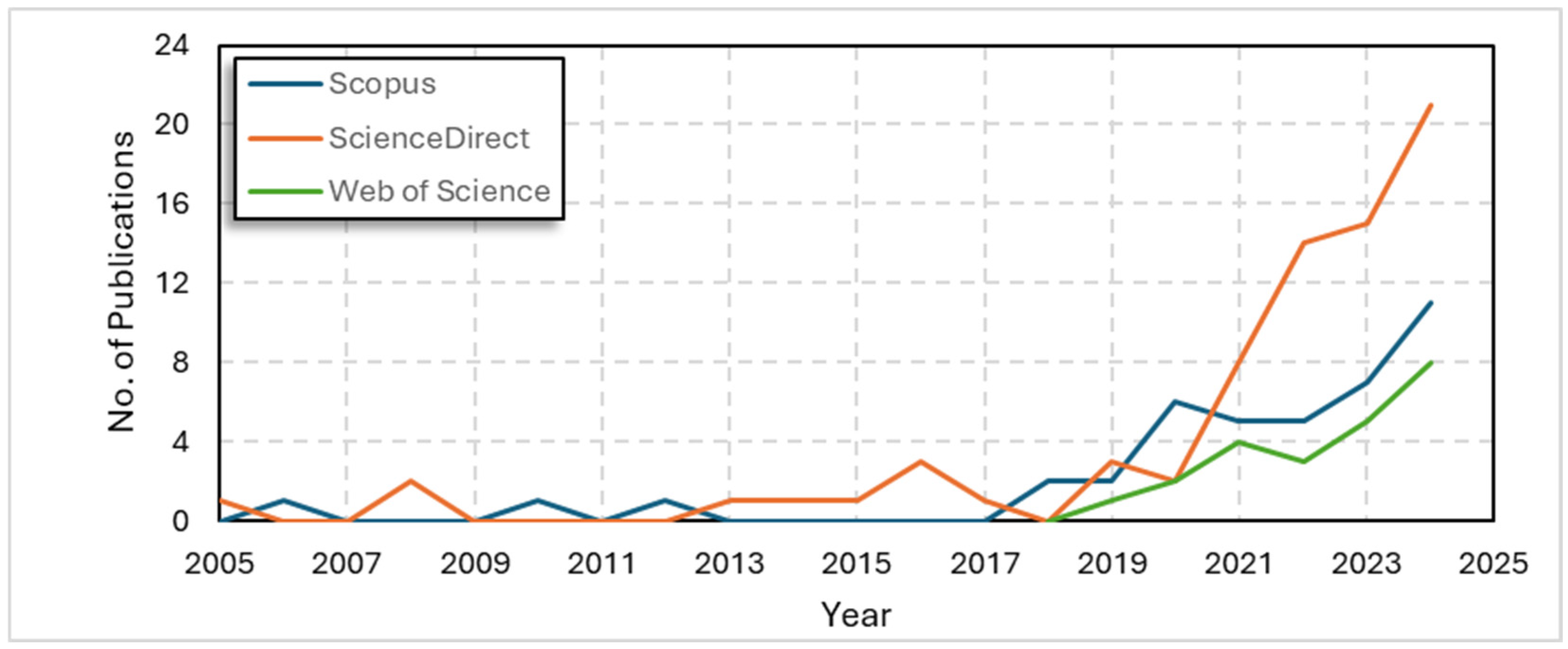
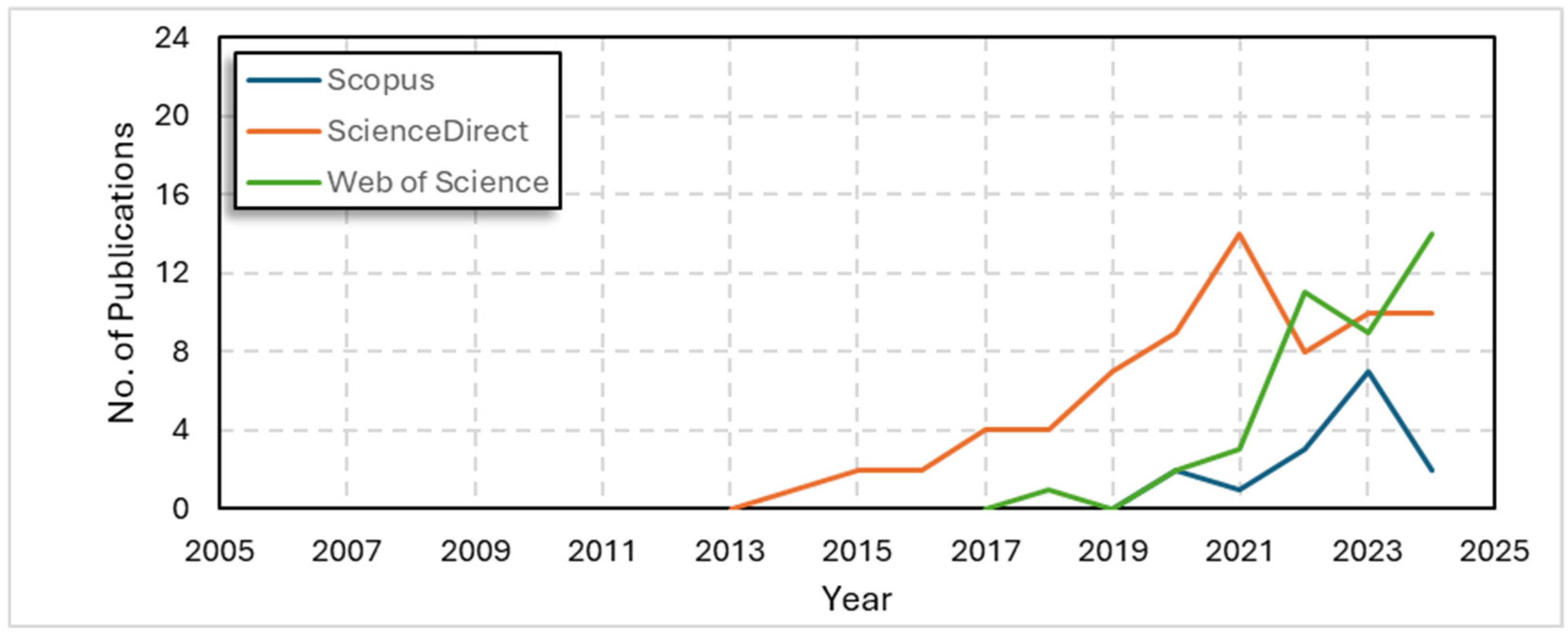
2. Methodology and Bibliographic Analysis
- (“Machine learning” OR “artificial intelligence”) AND overtopping AND prediction;
- (Susceptibility OR map*) AND “Machine learning” AND coastal AND (flood OR inundation) AND NOT (risk OR hazard).
- Inclusion criteria: studies focused on coastal overtopping prediction; coastal flood susceptibility; flood-extent mapping from coastal storm events; studies using ML models applicable to coastal hydrodynamics or remote sensing.
- Exclusion criteria: studies on risk or vulnerability assessment; focused exclusively on pluvial flooding unless they introduced methodological advances directly transferable to coastal contexts; using similar ML models on identical datasets without additional methodological contributions; hazard-mapping studies emphasizing social vulnerability indices.

| Coastal Overtopping | Coastal Flooding | |||||||||
|---|---|---|---|---|---|---|---|---|---|---|
| SD | Sc | WoS | Total | Used | SD | Sc | WoS | Total | Used | |
| Articles | 70 | 28 | 19 | 117 | 19 | 69 | 13 | 35 | 117 | 29 |
| Review articles | 2 | 1 | 1 | 4 | 3 | 2 | 1 | 3 | 6 | 2 |
| Others | 1 | 12 | 3 | 16 | 2 | 0 | 1 | 2 | 3 | 0 |
3. Application of ML in Coastal Flooding and Overtopping Studies
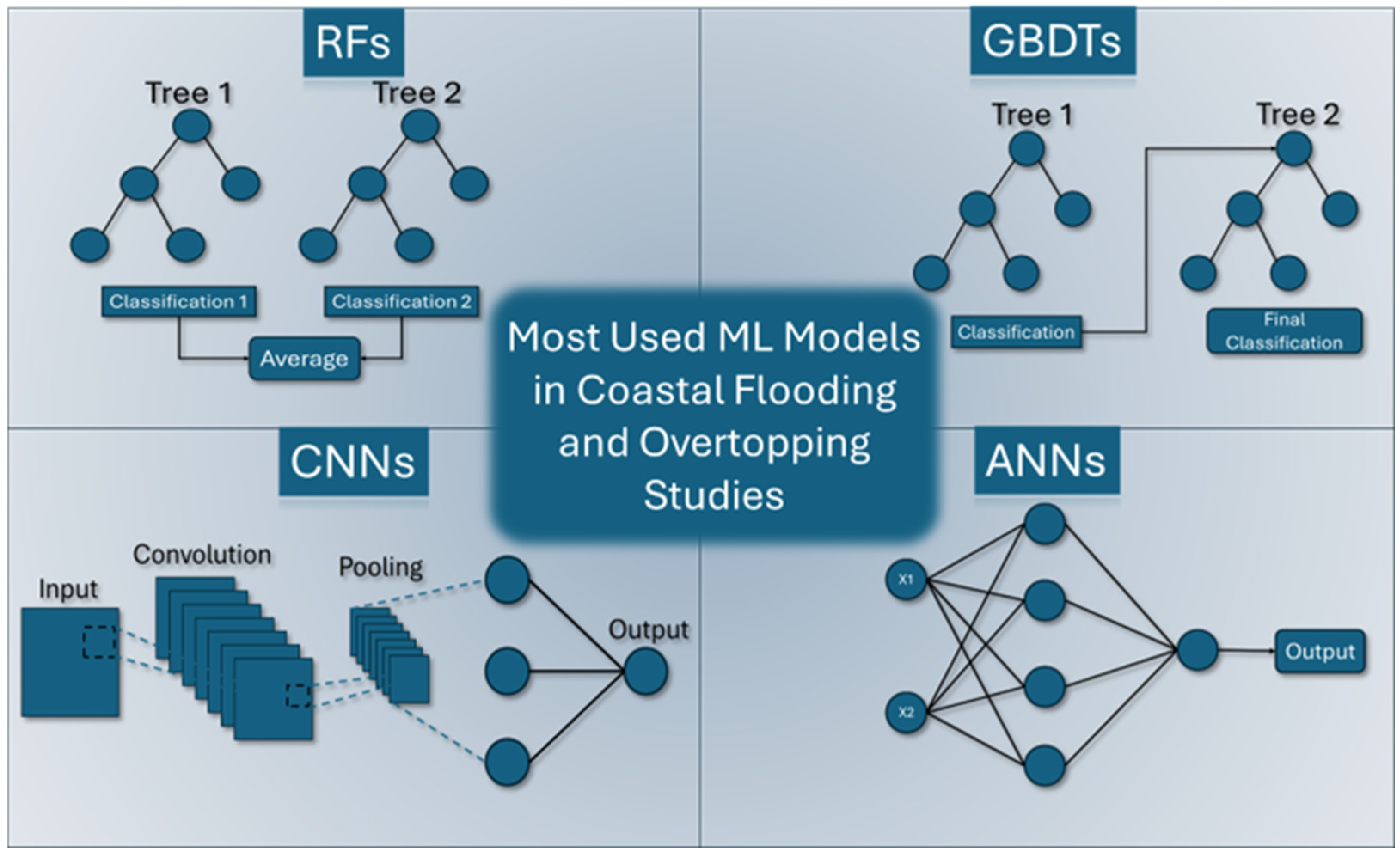
3.1. Brief Description of ML Models
3.2. Evaluation Metrics
3.3. Predicting Coastal Overtopping
3.4. Predicting Coastal Flooding
3.4.1. Studies Related to Coastal Flooding
3.4.2. Non-Coastal Flood Studies Relevant to Coastal Applications
3.4.3. Summary of Reviewed Flood-Related Studies
4. Discussion
4.1. ML Applications in Coastal Overtopping
4.2. ML Applications in Coastal Flooding
4.3. Fundamental Scientific Challenges and Open Questions
4.4. Coastal Engineering-Specific Future Prospects
5. Conclusions
Author Contributions
Funding
Data Availability Statement
Acknowledgments
Conflicts of Interest
Abbreviations
| AB | Adaptive Boost and Bagging |
| AdaBoost | Adaptive Boost |
| Ac | Accuracy |
| AHP | Analytical Hierarchy Process |
| AI | Artificial Intelligence |
| ANN | Artificial Neural Network |
| AP | Average Precision |
| ARD | Analysis-Ready data |
| AUC | Area Under the Curve |
| BPNN | Backpropagation Neural Network |
| BRT | Boosted Regression Tree |
| CCNN | Cascade Correlation Neural Networks |
| CDs | Coastal Defense Structures |
| CEMSRM | Copernicus Emergency Management Service Rapid Mapping |
| cGAN | conditional Generative Adversarial Network |
| CNNs | Convolutional Neural Networks |
| cRMSE | Centered Root-Mean-Squared Error |
| DDMMS | Department of Disaster Management, Maharashtra State |
| DEM | Digital Elevation Models |
| DN | Data Normalization |
| DT | Decision Tree |
| FEMA | Federal Emergency Management Agency |
| FSL | Froude’s Similarity Law scaling |
| GAN | Generative Adversarial Network |
| GBDTs | Gradient Boosting Decision Trees |
| GBM | Gradient Boosting Machine |
| GE | Google Earth |
| GIS | Geographic Information System |
| GPR | Gaussian Process Regression |
| GRNN | General Regression Neural Networks |
| HCFCD | Harris County Flood Control District |
| HRSD | Hampton Roads Sanitation District |
| IoT | Internet of Things |
| IoU | Intersection over Union |
| KNN | K-Nearest Neighbors |
| KNNIM | K-Nearest Neighbor Imputation Method |
| LB | LogitBoost |
| LIME | Local Interpretable Model-Agnostic Explanations |
| LR | Linear Regression |
| LSTM | Long Short-Term Memory |
| LUP | Land Use Planning |
| MAE | Mean Absolute Error |
| ML | Machine Learning |
| MDA | Maximum Dissimilarity Algorithm |
| MLP | Multilayer Perceptron |
| MOD | Mean Overtopping Discharge |
| MPNN | Multilayer Perceptron Neural Networks |
| MSE | Mean Squared Error |
| NB | Naïve Bayes |
| NBSS | National Bureau of Soil Survey |
| NLCD | National Land Cover Database |
| NOAA | National Oceanic and Atmospheric Administration |
| OAc | Overall Accuracy |
| OSM | OpenStreetMap |
| PCA | Principal Component Analysis |
| PI | Permutation Importance |
| PR | Polynomial Regression |
| Pr | Precision |
| R2 | Coefficient of Determination |
| RANS | Reynolds-Averaged Navier–Stokes |
| RFE | Recursive Feature Elimination |
| ResNet | Residual Neural Network |
| RFs | Random Forests |
| RMSE | Root Mean Squared Error |
| ROC | Receiver Operating Characteristic curve |
| RTF | Rotation Tree |
| SAR | Synthetic Aperture Radar |
| Sc | Scopus |
| SD | ScienceDirect |
| SHAP | SHapley Additive exPlanation |
| SOM | Self-Organized Maps |
| SPNWH | Structure Parameter Normalized by Wave Height |
| SRTM | Shuttle Radar Topography Mission |
| STORM | System to Track, Organize, Record, and Map |
| SVM | Support Vector Machine |
| SVR | Support Vector Regression |
| UAV | Unmanned Aerial Vehicles |
| UNOSAT | United Nations Satellite Centre |
| USGS | United States Geological Survey |
| VDSMGI | Vietnam Department of Survey, Mapping, and Geographic Information |
| WFR | Weight Factor Reduction |
| WoS | Web of Science |
| WRM | Wrapper Reduction Method |
| XAI | eXplainable Artificial Intelligence |
| XBNH | Xbeach’s Non-Hydrostatic Mode |
| XBSB | Xbeach’s Surfbeat Mode |
| XGB | eXtreme Gradient Boosting |
| XT | Extreme Randomized Tree |
References
- Xie, D.; Zou, Q.-P.; Mignone, A.; MacRae, J.D. Coastal Flooding from Wave Overtopping and Sea Level Rise Adaptation in the Northeastern USA. Coast. Eng. 2019, 150, 39–58. [Google Scholar] [CrossRef]
- Qiang, Y.; He, J.; Xiao, T.; Lu, W.; Li, J.; Zhang, L. Coastal Town Flooding Upon Compound Rainfall–Wave Overtopping–Storm Surge During Extreme Tropical Cyclones in Hong Kong. J. Hydrol. Reg. Stud. 2021, 37, 100890. [Google Scholar] [CrossRef]
- Carneiro-Barros, J.E.; Plomaritis, T.A.; Fazeres-Ferradosa, T.; Rosa-Santos, P.; Taveira-Pinto, F. Coastal Flood Mapping with Two Approaches Based on Observations at Furadouro, Northern Portugal. Remote Sens. 2023, 15, 5215. [Google Scholar] [CrossRef]
- Kirezci, E.; Young, I.R.; Ranasinghe, R.; Muis, S.; Nicholls, R.J.; Lincke, D.; Hinkel, J. Projections of Global-Scale Extreme Sea Levels and Resulting Episodic Coastal Flooding Over the 21st Century. Sci. Rep. 2020, 10, 11629. [Google Scholar] [CrossRef]
- Symonds, G.; Huntley, D.A.; Bowen, A.J. Two-Dimensional Surf Beat: Long Wave Generation by a Time-Varying Breakpoint. J. Geophys. Res. Ocean. 1982, 87, 492–498. [Google Scholar] [CrossRef]
- De Bakker, A.T.M.; Tissier, M.F.S.; Ruessink, B.G. Shoreline Dissipation of Infragravity Waves. Cont. Shelf Res. 2014, 72, 73–82. [Google Scholar] [CrossRef]
- Dodet, G.; Melet, A.; Ardhuin, F.; Bertin, X.; Idier, D.; Almar, R. The Contribution of Wind-Generated Waves to Coastal Sea-Level Changes. Surv. Geophys. 2019, 40, 1563–1601. [Google Scholar] [CrossRef]
- Central Water Commission. Status Report on Coastal Protection & Development in India; Government of India: New Delhi, India, 2016.
- IPCC. Technical Summary. In IPCC Special Report on the Ocean and Cryosphere in a Changing Climate; Pörtner, H.-O., Roberts, D.C., Masson-Delmotte, V., Zhai, P., Poloczanska, E., Mintenbeck, K., Tignor, M., Alegría, A., Nicolai, M., Okem, A., et al., Eds.; Cambridge University Press: Cambridge, UK; New York, NY, USA, 2019; pp. 39–69. [Google Scholar] [CrossRef]
- Koosheh, A.; Etemad-Shahidi, A.; Cartwright, N.; Tomlinson, R.; van Gent, M.R.A. Individual Wave Overtopping at Coastal Structures: A Critical Review and the Existing Challenges. Appl. Ocean Res. 2021, 106, 102476. [Google Scholar] [CrossRef]
- van der Meer, J.; Pullen, T.; Allsop, W.; Bruce, T.; Schüttrumpf, H.; Kortenhaus, A. Prediction of Overtopping. In Handbook of Coastal and Ocean Engineering; Kim, Y.C., Ed.; World Scientific: Singapore, 2009; pp. 341–382. [Google Scholar] [CrossRef]
- Geeraerts, J.; Troch, P.; De Rouck, J.; Verhaeghe, H.; Bouma, J.J. Wave Overtopping at Coastal Structures: Prediction Tools and Related Hazard Analysis. J. Clean. Prod. 2007, 15, 1514–1521. [Google Scholar] [CrossRef]
- Contardo, S.; Lowe, R.J.; Hansen, J.E.; Rijnsdorp, D.P.; Dufois, F.; Symonds, G. Free and Forced Components of Shoaling Long Waves in the Absence of Short-Wave Breaking. J. Phys. Oceanogr. 2021, 51, 1465–1487. [Google Scholar] [CrossRef]
- Lowe, R.J.; Altomare, C.; Buckley, M.L.; da Silva, R.F.; Hansen, J.E.; Rijnsdorp, D.P.; Domínguez, J.M.; Crespo, A.J.C. Smoothed Particle Hydrodynamics Simulations of Reef Surf Zone Processes Driven by Plunging Irregular Waves. Ocean Model. 2022, 171, 101945. [Google Scholar] [CrossRef]
- EurOtop. Manual on Wave Overtopping of Sea Defences and Related Structures; van der Meer, J.W., Allsop, N.W.H., Bruce, T., de Rouck, J., Kortenhaus, A., Pullen, T., Schüttrumpf, H., Troch, P., Zanuttigh, B., Eds.; EurOtop Consortium: Delft, The Netherlands, 2018; Available online: www.overtopping-manual.com (accessed on 20 October 2025).
- Pullen, T.; Bruce, T.; Simm, J.; Allsop, W.; Kortenhaus, A. EurOtop: Manual on Wave Overtopping of Sea Defences and Related Structures—An Overtopping Manual Largely Based on European Research, but for Worldwide Application, 2nd ed.; Environment Agency: Bristol, UK, 2019.
- Den Bieman, J.P.; de Ridder, M.P.; van Gent, M.R.A. Deep Learning Video Analysis as Measurement Technique in Physical Models. Coast. Eng. 2020, 158, 103689. [Google Scholar] [CrossRef]
- Asiri, M.M.; Aldehim, G.; Alruwais, N.; Allafi, R.; Alzahrani, I.; Nouri, A.M.; Assiri, M.; Ahmed, N.A. Coastal Flood Risk Assessment Using Ensemble Multi-Criteria Decision-Making with Machine Learning Approaches. Environ. Res. 2024, 245, 118042. [Google Scholar] [CrossRef] [PubMed]
- Mosavi, A.; Ozturk, P.; Chau, K. Flood Prediction Using Machine Learning Models: Literature Review. Water 2018, 10, 1536. [Google Scholar] [CrossRef]
- Alshahri, A.H.; Elbisy, M.S. Assessment of Using Artificial Neural Network and Support Vector Machine Techniques for Predicting Wave-Overtopping Discharges at Coastal Structures. J. Mar. Sci. Eng. 2023, 11, 539. [Google Scholar] [CrossRef]
- Elbisy, M.S. Estimation of Wave Overtopping Discharges at Coastal Structures with Combined Slopes Using Machine Learning Techniques. Eng. Technol. Appl. Sci. Res. 2024, 14, 14033–14038. [Google Scholar] [CrossRef]
- Willard, J.; Jia, X.; Xu, S.; Steinbach, M.; Kumar, V. Integrating Physics-Based Modeling with Machine Learning: A Survey. arXiv 2020, arXiv:2003.04919. [Google Scholar]
- Abouhalima, M.; das Neves, L.; Taveira-Pinto, F.; Rosa-Santos, P. Machine Learning in Coastal Engineering: Applications, Challenges, and Perspectives. J. Mar. Sci. Eng. 2024, 12, 638. [Google Scholar] [CrossRef]
- Babati, A.H.; Isa, Z.; Abdussalam, A.F.; Baba, S.U.; Mustapha, B.B.; Musa, A.S. Application of Machine Learning for Coastal Flooding. Discov. Cities 2025, 2, 80. [Google Scholar] [CrossRef]
- Rudin, C. Stop Explaining Black Box Machine Learning Models for High Stakes Decisions and Use Interpretable Models Instead. Nat. Mach. Intell. 2019, 1, 206–215. [Google Scholar] [CrossRef]
- Qin, Y.; Su, C.; Chu, D.; Zhang, J.; Song, J. A Review of Application of Machine Learning in Storm Surge Problems. J. Mar. Sci. Eng. 2023, 11, 1729. [Google Scholar] [CrossRef]
- Goldstein, E.B.; Coco, G.; Plant, N.G. A Review of Machine Learning Applications to Coastal Sediment Transport and Morphodynamics. Earth-Sci. Rev. 2019, 194, 97–108. [Google Scholar] [CrossRef]
- Clemente, D.; Teixeira-Duarte, F.; Rosa-Santos, P.; Taveira-Pinto, F. Advancements on Optimization Algorithms Applied to Wave Energy Assessment: An Overview on Wave Climate and Energy Resource. Energies 2023, 16, 4660. [Google Scholar] [CrossRef]
- Habib, M.A.; O’Sullivan, J.J.; Salauddin, M. Prediction of Wave Overtopping Characteristics at Coastal Flood Defences Using Machine Learning Algorithms: A Systematic Review. IOP Conf. Ser. Earth Environ. Sci. 2022, 1072, 012003. [Google Scholar] [CrossRef]
- Emmanuel, I.A.; Ojewumi, M.; Huang, W. A Comprehensive Review of AI and ML Applications in Coastal Engineering. Preprints 2025, 2025010600. [Google Scholar] [CrossRef]
- Garzon, J.L.; Ferreira, O.; Plomaritis, T.A.; Zózimo, A.C.; Fortes, C.J.E.M.; Pinheiro, L.V. Development of a Bayesian Network-Based Early Warning System for Storm-Driven Coastal Erosion. Coast. Eng. 2024, 189, 104460. [Google Scholar] [CrossRef]
- James, G.; Witten, D.; Hastie, T.; Tibshirani, R. An Introduction to Statistical Learning: With Applications in R, 2nd ed.; Springer: New York, NY, USA, 2021. [Google Scholar] [CrossRef]
- Breiman, L. Random Forests. Mach. Learn. 2001, 45, 5–32. [Google Scholar] [CrossRef]
- Bishop, C.M. Pattern Recognition and Machine Learning; Springer: New York, NY, USA, 2006. [Google Scholar]
- LeCun, Y.; Bengio, Y.; Hinton, G. Deep Learning. Nature 2015, 521, 436–444. [Google Scholar] [CrossRef]
- Schmidhuber, J. Deep Learning in Neural Networks: An Overview. Neural Netw. 2015, 61, 85–117. [Google Scholar] [CrossRef]
- Goodfellow, I.; Bengio, Y.; Courville, A. Deep Learning; MIT Press: Cambridge, MA, USA, 2016. [Google Scholar]
- He, K.; Zhang, X.; Ren, S.; Sun, J. Deep Residual Learning for Image Recognition. In Proceedings of the IEEE Conference on Computer Vision and Pattern Recognition, Las Vegas, NV, USA, 27–30 June 2016; pp. 770–778. [Google Scholar]
- Friedman, J.H. Greedy Function Approximation: A Gradient Boosting Machine. Ann. Stat. 2001, 29, 1189–1232. [Google Scholar] [CrossRef]
- Chen, T.; Guestrin, C. XGBoost: A Scalable Tree Boosting System. In Proceedings of the 22nd ACM SIGKDD International Conference on Knowledge Discovery and Data Mining, San Francisco, CA, USA, 13–17 August 2016; pp. 785–794. [Google Scholar]
- Ke, G.; Meng, Q.; Finley, T.; Wang, T.; Chen, W.; Ma, W.; Ye, Q.; Liu, T.Y. LightGBM: A Highly Efficient Gradient Boosting Decision Tree. Adv. Neural Inf. Process. Syst. 2017, 30, 3146–3154. [Google Scholar]
- Probst, P.; Wright, M.N.; Boulesteix, A.L. Hyperparameters and Tuning Strategies for Random Forest. Wiley Interdiscip. Rev. Data Min. Knowl. Discov. 2019, 9, e1301. [Google Scholar] [CrossRef]
- Krizhevsky, A.; Sutskever, I.; Hinton, G.E. ImageNet Classification with Deep Convolutional Neural Networks. Adv. Neural Inf. Process. Syst. 2012, 25, 1097–1105. [Google Scholar] [CrossRef]
- Simonyan, K.; Zisserman, A. Very Deep Convolutional Networks for Large-Scale Image Recognition. arXiv 2014, arXiv:1409.1556. [Google Scholar]
- Chollet, F. Xception: Deep Learning with Depthwise Separable Convolutions. In Proceedings of the IEEE Conference on Computer Vision and Pattern Recognition, Honolulu, HI, USA, 21–26 July 2017; pp. 1251–1258. [Google Scholar]
- Cutler, D.R.; Edwards, T.C., Jr.; Beard, K.H.; Cutler, A.; Hess, K.T.; Gibson, J.; Lawler, J.J. Random Forests for Classification in Ecology. Ecology 2007, 88, 2783–2792. [Google Scholar] [CrossRef] [PubMed]
- Biau, G.; Scornet, E. A Random Forest Guided Tour. Test 2016, 25, 197–227. [Google Scholar] [CrossRef]
- Den Bieman, J.P.; van Gent, M.R.A.; van den Boogaard, H.F.P. Wave Overtopping Predictions Using an Advanced Machine Learning Technique. Coast. Eng. 2021, 166, 103830. [Google Scholar] [CrossRef]
- Kim, T.; Lee, W.-D. Review on Applications of Machine Learning in Coastal and Ocean Engineering. J. Ocean Eng. Technol. 2022, 36, 194–210. [Google Scholar] [CrossRef]
- Habib, M.A.; O’Sullivan, J.J.; Abolfathi, S.; Salauddin, M. Enhanced Wave Overtopping Simulation at Vertical Breakwaters Using Machine Learning Algorithms. PLoS ONE 2023, 18, e0289318. [Google Scholar] [CrossRef]
- van Gent, M.R.A.; van den Boogaard, H.F.P.; Pozueta, B.; Medina, J.R. Neural Network Modelling of Wave Overtopping at Coastal Structures. Coast. Eng. 2007, 54, 586–593. [Google Scholar] [CrossRef]
- Steendam, G.J.; van der Meer, J.W.; Verhaeghe, H.; Besley, P.; Franco, L.; van Gent, M.R.A. The International Database on Wave Overtopping. Coast. Eng. 2004, 1, 4301–4313. [Google Scholar] [CrossRef]
- den Bieman, J.P.; Wilms, J.M.; van den Boogaard, H.F.P.; van Gent, M.R.A. Prediction of Mean Wave Overtopping Discharge Using Gradient Boosting Decision Trees. Water 2020, 12, 1703. [Google Scholar] [CrossRef]
- Hosseinzadeh, S.; Etemad-Shahidi, A.; Koosheh, A. Prediction of Mean Wave Overtopping at Simple Sloped Breakwaters Using Kernel-Based Methods. J. Hydroinform. 2021, 23, 1030–1049. [Google Scholar] [CrossRef]
- Jafari, E.; Etemad-Shahidi, A. Derivation of a New Model for Prediction of Wave Overtopping at Rubble Mound Structures. J. Waterw. Port Coast. Ocean. Eng. 2012, 138, 42–52. [Google Scholar] [CrossRef]
- Formentin, S.M.; Zanuttigh, B.; van der Meer, J.W. A Neural Network Tool for Predicting Wave Reflection, Overtopping and Transmission. Coast. Eng. J. 2017, 59, 1750006-1–1750006-31. [Google Scholar] [CrossRef]
- Kim, T.; Lee, W.-D. Prediction of Wave Overtopping Discharges at Coastal Structures Using Interpretable Machine Learning. Coast. Eng. J. 2023, 65, 433–449. [Google Scholar] [CrossRef]
- Tsai, Y.-T.; Tsai, C.-P. Predictions of Wave Overtopping Using Deep Learning Neural Networks. J. Mar. Sci. Eng. 2023, 11, 1925. [Google Scholar] [CrossRef]
- Alvarellos, A.; Figuero, A.; Rodríguez-Yáñez, S.; Sande, J.; Peña, E.; Rosa-Santos, P.; Rabuñal, J. Deep Learning-Based Wave Overtopping Prediction. Appl. Sci. 2024, 14, 2611. [Google Scholar] [CrossRef]
- Carro, H.; Sande, J.; Figuero, A.; Alvarellos, A.; Peña, E.; Rabuñal, J.; Guerra, A.; Pérez, J.D. Machine Learning Tool for Wave Overtopping Prediction Based on the Safety-Operability Ratio. Ocean Eng. 2024, 312, 119006. [Google Scholar] [CrossRef]
- Technical Advisory Committee for Flood Defence in The Netherlands (TAW). Wave Run-Up and Wave Overtopping at Dikes; Technical Report; TAW: Delft, The Netherlands, 2002. [Google Scholar]
- Lee, S.B.; Suh, K.-D. Development of Wave Overtopping Formulas for Inclined Seawalls Using GMDH Algorithm. KSCE J. Civ. Eng. 2019, 23, 1899–1910. [Google Scholar] [CrossRef]
- Etemad-Shahidi, A.; Shaeri, S.; Jafari, E. Prediction of Wave Overtopping at Vertical Structures. Coast. Eng. 2016, 109, 42–52. [Google Scholar] [CrossRef]
- Zanuttigh, B.; Formentin, S.M.; van der Meer, J.W. Prediction of Extreme and Tolerable Wave Overtopping Discharges Through an Advanced Neural Network. Ocean Eng. 2016, 127, 7–22. [Google Scholar] [CrossRef]
- Elbisy, M.S. Machine Learning Techniques for Estimating Wave-Overtopping Discharges at Coastal Structures. Ocean Eng. 2023, 273, 113972. [Google Scholar] [CrossRef]
- Oliver, J.M.; Esteban, M.D.; López-Gutiérrez, J.-S.; Negro, V.; Neves, M.G. Optimizing Wave Overtopping Energy Converters by ANN Modelling: Evaluating the Overtopping Rate Forecasting as the First Step. Sustainability 2021, 13, 1483. [Google Scholar] [CrossRef]
- Verhaeghe, H.; De Rouck, J.; van der Meer, J. Combined Classifier–Quantifier Model: A Two-Phase Neural Model for Prediction of Wave Overtopping at Coastal Structures. Coast. Eng. 2008, 55, 357–374. [Google Scholar] [CrossRef]
- Zanuttigh, B.; Formentin, S.M.; van der Meer, J.W. Advances in Modelling Wave-Structure Interaction. Coast. Eng. 2014, 34, 1–14. [Google Scholar] [CrossRef]
- Mares-Nasarre, P.; Molines, J.; Gómez-Martín, M.E.; Medina, J.R. Explicit Neural Network-Derived Formula for Overtopping Flow on Mound Breakwaters in Depth-Limited Breaking Wave Conditions. Coast. Eng. 2021, 164, 103810. [Google Scholar] [CrossRef]
- Qin, J.; Gao, L.; Lin, K.; Shen, P. A Novel and Efficient Method for Real-Time Simulating Spatial and Temporal Evolution of Coastal Urban Pluvial Flood Without Drainage Network. Environ. Model. Softw. 2024, 172, 105888. [Google Scholar] [CrossRef]
- Liu, B.; Li, X.; Zheng, G. Coastal Inundation Mapping From Bitemporal and Dual-Polarization SAR Imagery Based on Deep Convolutional Neural Networks. J. Geophys. Res. Ocean. 2019, 124, 9101–9113. [Google Scholar] [CrossRef]
- Peng, B.; Meng, Z.; Huang, Q.; Wang, C. Patch Similarity Convolutional Neural Network for Urban Flood Extent Mapping Using Bi-Temporal Satellite Multispectral Imagery. Remote Sens. 2019, 11, 2492. [Google Scholar] [CrossRef]
- Hasan, M.H.; Ahmed, A.; Nafee, K.M.; Hossen, M.A. Use of Machine Learning Algorithms to Assess Flood Susceptibility in the Coastal Area of Bangladesh. Ocean Coast. Manag. 2023, 236, 106503. [Google Scholar] [CrossRef]
- Zahura, F.T.; Goodall, J.L. Predicting Combined Tidal and Pluvial Flood Inundation Using a Machine Learning Surrogate Model. J. Hydrol. Reg. Stud. 2022, 41, 101087. [Google Scholar] [CrossRef]
- Saravanan, S.; Abijith, D. Flood Susceptibility Mapping of Northeast Coastal Districts of Tamil Nadu, India Using Multi-Source Geospatial Data and Machine Learning Techniques. Geocarto Int. 2022, 37, 15252–15281. [Google Scholar] [CrossRef]
- Samek, W.; Wiegand, T.; Müller, K.R. Explainable Artificial Intelligence: Understanding, Visualizing and Interpreting Deep Learning Models. arXiv 2017, arXiv:1708.08296. [Google Scholar] [CrossRef]
- Naeini, S.S.; Snaiki, R. A Physics-Informed Machine Learning Model for Time-Dependent Wave Runup Prediction. Ocean Eng. 2024, 295, 116986. [Google Scholar] [CrossRef]
- Vu, V.T.; Nguyen, H.D.; Vu, P.L.; Ha, M.C.; Bui, V.D.; Nguyen, T.O.; Hoang, V.H.; Nguyen, T.K.H. Predicting Land Use Effects on Flood Susceptibility Using Machine Learning and Remote Sensing in Coastal Vietnam. Water Pract. Technol. 2023, 18, 1543–1555. [Google Scholar] [CrossRef]
- Prasad, P.; Loveson, V.J.; Das, B.; Kotha, M. Novel Ensemble Machine Learning Models in Flood Susceptibility Mapping. Geocarto Int. 2021, 37, 4571–4593. [Google Scholar] [CrossRef]
- Shastry, A.; Carter, E.; Coltin, B.; Sleeter, R.; McMichael, S.; Eggleston, J. Mapping Floods from Remote Sensing Data and Quantifying the Effects of Surface Obstruction by Clouds and Vegetation. Remote Sens. Environ. 2023, 291, 113556. [Google Scholar] [CrossRef]
- Nemni, E.; Bullock, J.; Belabbes, S.; Bromley, L. Fully Convolutional Neural Network for Rapid Flood Segmentation in Synthetic Aperture Radar Imagery. Remote Sens. 2020, 12, 2532. [Google Scholar] [CrossRef]
- Kang, W.; Xiang, Y.; Wang, F.; Wan, L.; You, H. Flood Detection in Gaofen-3 SAR Images via Fully Convolutional Networks. Sensors 2018, 18, 2915. [Google Scholar] [CrossRef]
- Sarker, C.; Mejias, L.; Maire, F.; Woodley, A. Flood Mapping with Convolutional Neural Networks Using Spatio-Contextual Pixel Information. Remote Sens. 2019, 11, 2331. [Google Scholar] [CrossRef]
- Hochreiter, S.; Schmidhuber, J. Long Short-Term Memory. Neural Comput. 1997, 9, 1735–1780. [Google Scholar] [CrossRef] [PubMed]
- Li, J.; Wu, G.; Zhang, Y.; Shi, W. Optimizing Flood Predictions by Integrating LSTM and Physical-Based Models with Mixed Historical and Simulated Data. Heliyon 2024, 10, e33669. [Google Scholar] [CrossRef] [PubMed]
- Jolliffe, I.T.; Cadima, J. Principal Component Analysis: A Review and Recent Developments. Philos. Trans. R. Soc. A Math. Phys. Eng. Sci. 2016, 374, 20150202. [Google Scholar] [CrossRef]
- Hidayah, E.; Indarto; Lee, W.K.; Halik, G.; Pradhan, B. Assessing Coastal Flood Susceptibility in East Java, Indonesia: Comparison of Statistical Bivariate and Machine Learning Techniques. Water 2022, 14, 3869. [Google Scholar] [CrossRef]
- Dong, S.; Yu, T.; Farahmand, H.; Mostafavi, A. A Hybrid Deep Learning Model for Predictive Flood Warning and Situation Awareness Using Channel Network Sensors Data. Comput.-Aided Civ. Infrastruct. Eng. 2021, 36, 402–420. [Google Scholar] [CrossRef]
- William, P.; Oyebode, O.J.; Ramu, G.; Lakhanpal, S.; Gupta, K.K.; Al-Jawahry, H.M. Framework for IoT-Based Real-Time Monitoring System of Rainfall Water Level for Flood Prediction Using LSTM Network. In Proceedings of the 2023 3rd International Conference on Pervasive Computing and Social Networking (ICPCSN), Salem, India, 7–8 June 2023; pp. 1321–1326. [Google Scholar]
- Gunning, D.; Aha, D.W. DARPA’s Explainable Artificial Intelligence (XAI) Program. AI Mag. 2019, 40, 44–58. [Google Scholar] [CrossRef]
- Salatin, R.; Chen, Q.; Raubenheimer, B.; Elgar, S.; Gorrell, L.; Li, X. A New Framework for Quantifying Alongshore Variability of Swash Motion Using Fully Convolutional Networks. Coast. Eng. 2024, 192, 104542. [Google Scholar] [CrossRef]
- Hou, J.; Li, X.; Bai, G.; Wang, X.; Zhang, Z.; Yang, L.; Du, Y.; Ma, Y.; Fu, D.; Zhang, X. A Deep Learning Technique-Based Flood Propagation Experiment. J. Flood Risk Manag. 2021, 14, e12718. [Google Scholar] [CrossRef]
- Gebrehiwot, A.; Hashemi-Beni, L.; Thompson, G.; Kordjamshidi, P.; Langan, T.E. Deep Convolutional Neural Network for Flood Extent Mapping Using Unmanned Aerial Vehicles Data. Sensors 2019, 19, 1486. [Google Scholar] [CrossRef]
- Ichim, L.; Popescu, D. Segmentation of Vegetation and Flood from Aerial Images Based on Decision Fusion of Neural Networks. Remote Sens. 2020, 12, 2490. [Google Scholar] [CrossRef]
- Muñoz, D.F.; Muñoz, P.; Moftakhari, H.; Moradkhani, H. From Local to Regional Compound Flood Mapping with Deep Learning and Data Fusion Techniques. Sci. Total Environ. 2021, 782, 146927. [Google Scholar] [CrossRef]
- Di Bacco, M.; Contento, A.; Scorzini, A.R. Exploring the Compound Nature of Coastal Flooding by Tropical Cyclones: A Machine Learning Framework. J. Hydrol. 2024, 645, 132262. [Google Scholar] [CrossRef]
- Nhangumbe, M.; Nascetti, A.; Georganos, S.; Ban, Y. Supervised and Unsupervised Machine Learning Approaches Using Sentinel Data for Flood Mapping and Damage Assessment in Mozambique. Remote Sens. Appl. Soc. Environ. 2023, 32, 101015. [Google Scholar] [CrossRef]
- Dodangeh, E.; Choubin, B.; Eigdir, A.N.; Nabipour, N.; Panahi, M.; Shamshirband, S.; Mosavi, A. Integrated Machine Learning Methods with Resampling Algorithms for Flood Susceptibility Prediction. Sci. Total Environ. 2020, 705, 135983. [Google Scholar] [CrossRef]
- Ramayanti, S.; Nur, A.S.; Syifa, M.; Panahi, M.; Achmad, A.R.; Park, S.; Lee, C.W. Performance Comparison of Two Deep Learning Models for Flood Susceptibility Map in Beira Area, Mozambique. Egypt. J. Remote Sens. Space Sci. 2022, 25, 1025–1036. [Google Scholar] [CrossRef]
- Sanders, W.; Li, D.; Li, W.; Fang, Z.N. Data-Driven Flood Alert System (FAS) Using Extreme Gradient Boosting (XGBoost) to Forecast Flood Stages. Water 2022, 14, 747. [Google Scholar] [CrossRef]
- Tu, H.; Moura, S.; Wang, Y.; Fang, H. Integrating Physics-Based Modeling with Machine Learning for Lithium-Ion Batteries. Appl. Energy 2023, 329, 120289. [Google Scholar] [CrossRef]
- Khosravi, K.; Ali, M.; Heddam, S. Near Real-Time Significant Wave Height Prediction Along the Coastline of Queensland Using Advanced Hybrid Machine Learning Models. Int. J. Environ. Sci. Technol. 2024, 22, 5309–5326. [Google Scholar] [CrossRef]
- Chang, C.-H.; Rahmad, R.; Wu, S.-J.; Hsu, C.-T.; Chung, P.-H. Enhancing Flood Verification Using Signal Detection Theory (SDT) and IoT Sensors: A Spatial Scale Evaluation. J. Hydrol. 2024, 636, 131308. [Google Scholar] [CrossRef]
- Helmrich, A.M.; Ruddell, B.L.; Bessem, K.; Chester, M.V.; Chohan, N.; Doerry, E.; Eppinger, J.; Garcia, M.; Goodall, J.L.; Lowry, C.; et al. Opportunities for Crowdsourcing in Urban Flood Monitoring. Environ. Model. Softw. 2021, 143, 105124. [Google Scholar] [CrossRef]
- Vitousek, S.; Buscombe, D.; Vos, K.; Barnard, P.L.; Ritchie, A.C.; Warrick, J.A. The Future of Coastal Monitoring Through Satellite Remote Sensing. Camb. Prism. Coast. Futures 2023, 1, e10. [Google Scholar] [CrossRef]
- Hashemi-Beni, L.; Puthenparampil, M.; Jamali, A. A Low-Cost IoT-Based Deep Learning Method of Water Gauge Measurement for Flood Monitoring. Geomat. Nat. Hazards Risk 2024, 15, 2364777. [Google Scholar] [CrossRef]
- Farooq, M.S.; Tehseen, R.; Qureshi, J.N.; Omer, U.; Yaqoob, R.; Tanweer, H.A.; Atal, Z. FFM: Flood Forecasting Model Using Federated Learning. IEEE Access 2023, 11, 24472–24483. [Google Scholar] [CrossRef]
- Qi, P.; Chiaro, D.; Guzzo, A.; Ianni, M.; Fortino, G.; Piccialli, F. Model Aggregation Techniques in Federated Learning: A Comprehensive Survey. Future Gener. Comput. Syst. 2024, 150, 272–293. [Google Scholar] [CrossRef]
- Barredo Arrieta, A.; Díaz-Rodríguez, N.; Del Ser, J.; Bennetot, A.; Tabik, S.; Barbado, A.; Garcia, S.; Gil-Lopez, S.; Molina, D.; Benjamins, R.; et al. Explainable Artificial Intelligence (XAI): Concepts, Taxonomies, Opportunities and Challenges Toward Responsible AI. Inf. Fusion 2020, 58, 82–115. [Google Scholar] [CrossRef]
- Doshi-Velez, F.; Kim, B. Towards a Rigorous Science of Interpretable Machine Learning. arXiv 2018, arXiv:1702.08608. [Google Scholar]
- Adadi, A.; Berrada, M. Peeking Inside the Black-Box: A Survey on Explainable Artificial Intelligence (XAI). IEEE Access 2018, 6, 52138–52160. [Google Scholar] [CrossRef]





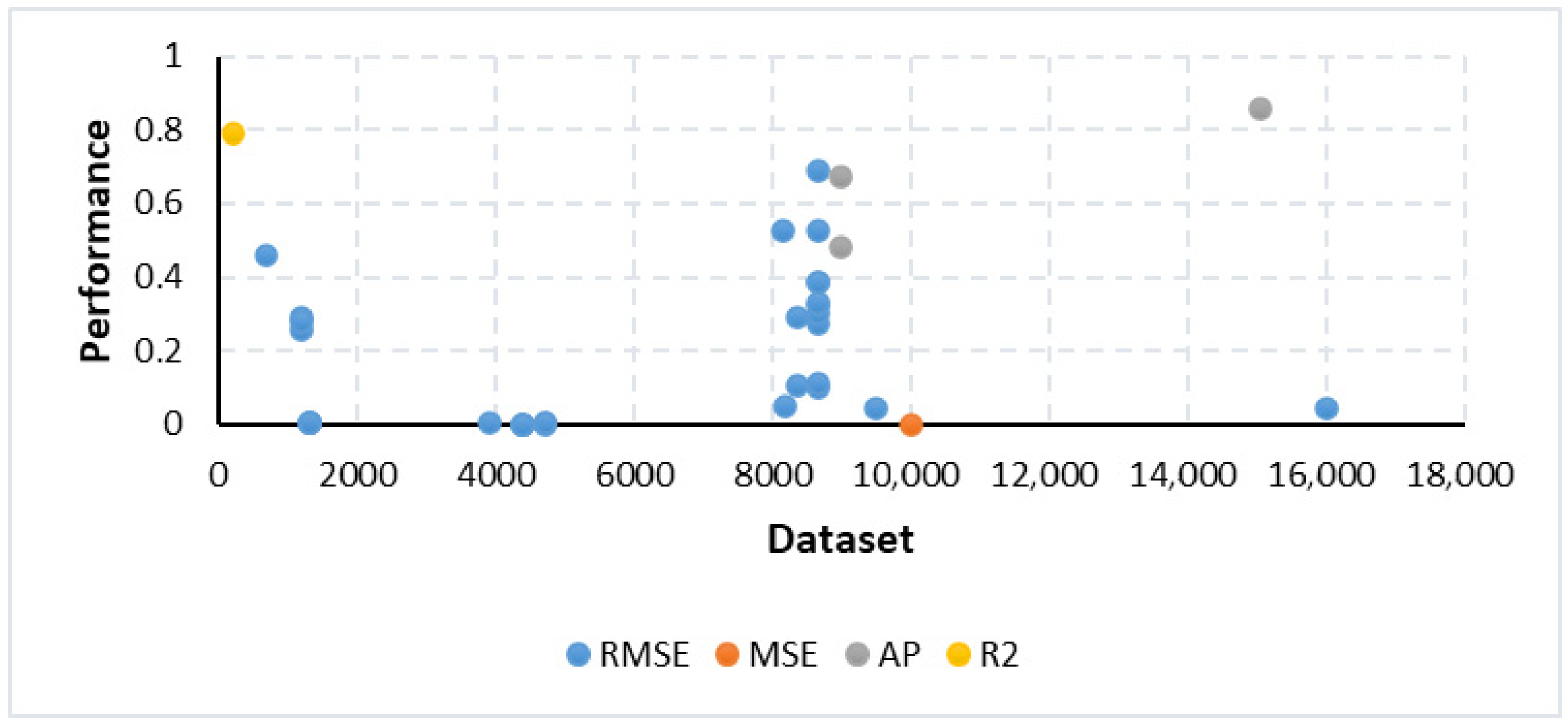


| Authors | ML Models/ Algorithm | Data Size and Variables | Data Preprocessing Methods | Performance |
|---|---|---|---|---|
| van Gent et al. [51] | ANN [Various structures] | 8372 (train) 14 features 1 output (MOD) | WFR; FSL; Log(q) | RMSE = 0.29 |
| den Bieman et al. [53] | XGB [Various structures] | 8372 (train) 14 features 1 output (MOD) | WFR; FSL; Log(q); PI (feature generation) | RMSE = 0.168–0.104 |
| den Bieman et al. [48] | XGB [Various structures] | 6943 (train) and 1736 (Test) 15 features 1 output (MOD) | WFR; FSL; Log(q); PI (feature generation) | RMSE = 0.284–0.098 |
| Hosseinzadeh et al. [54] | SVR and GPR [Simple sloped breakwater] | 1220 (70% train and 30% test) 12 features 1 output (MOD) | WFR; FSL; Log(q); SPNWH | cRMSE = 0.260 |
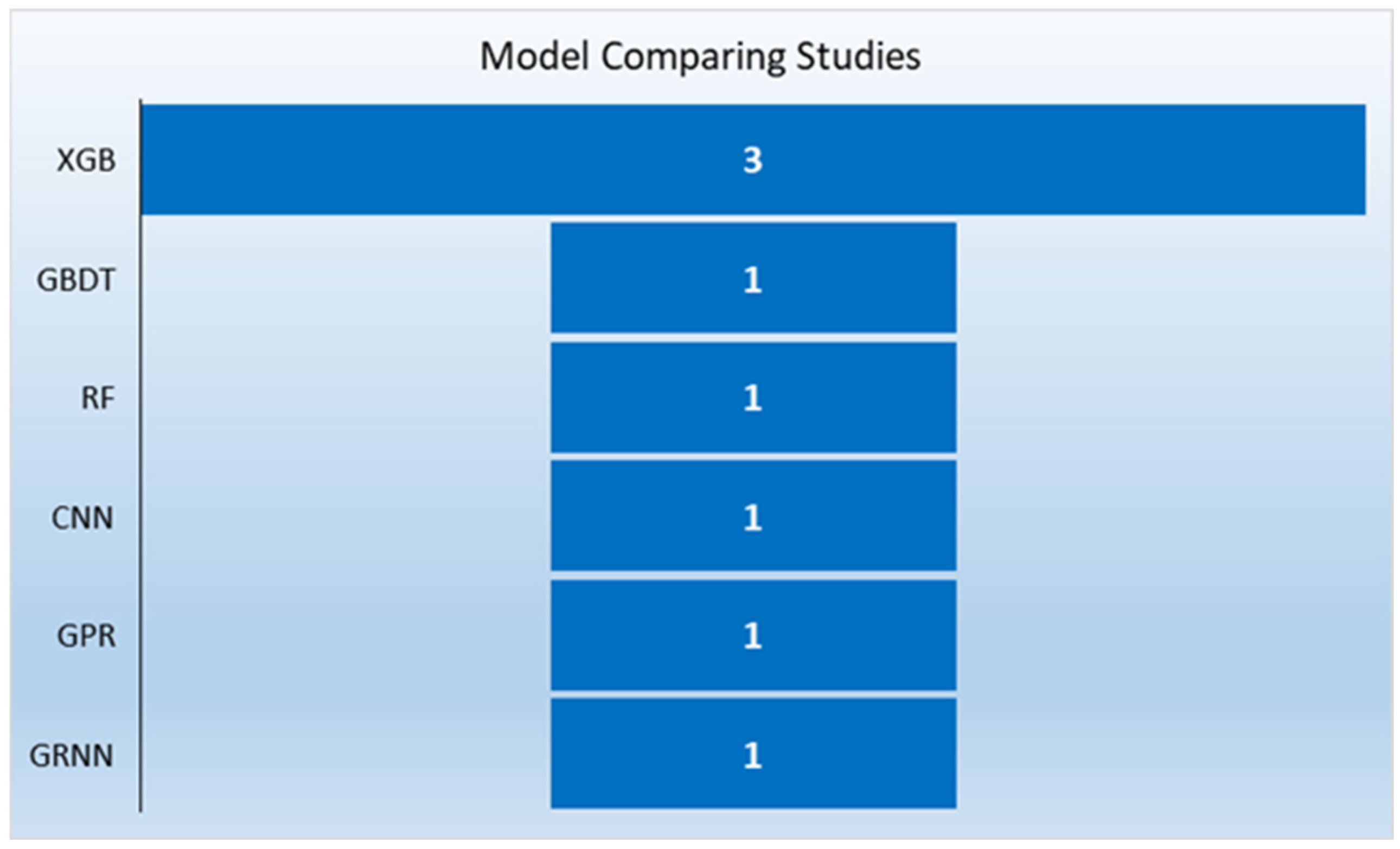
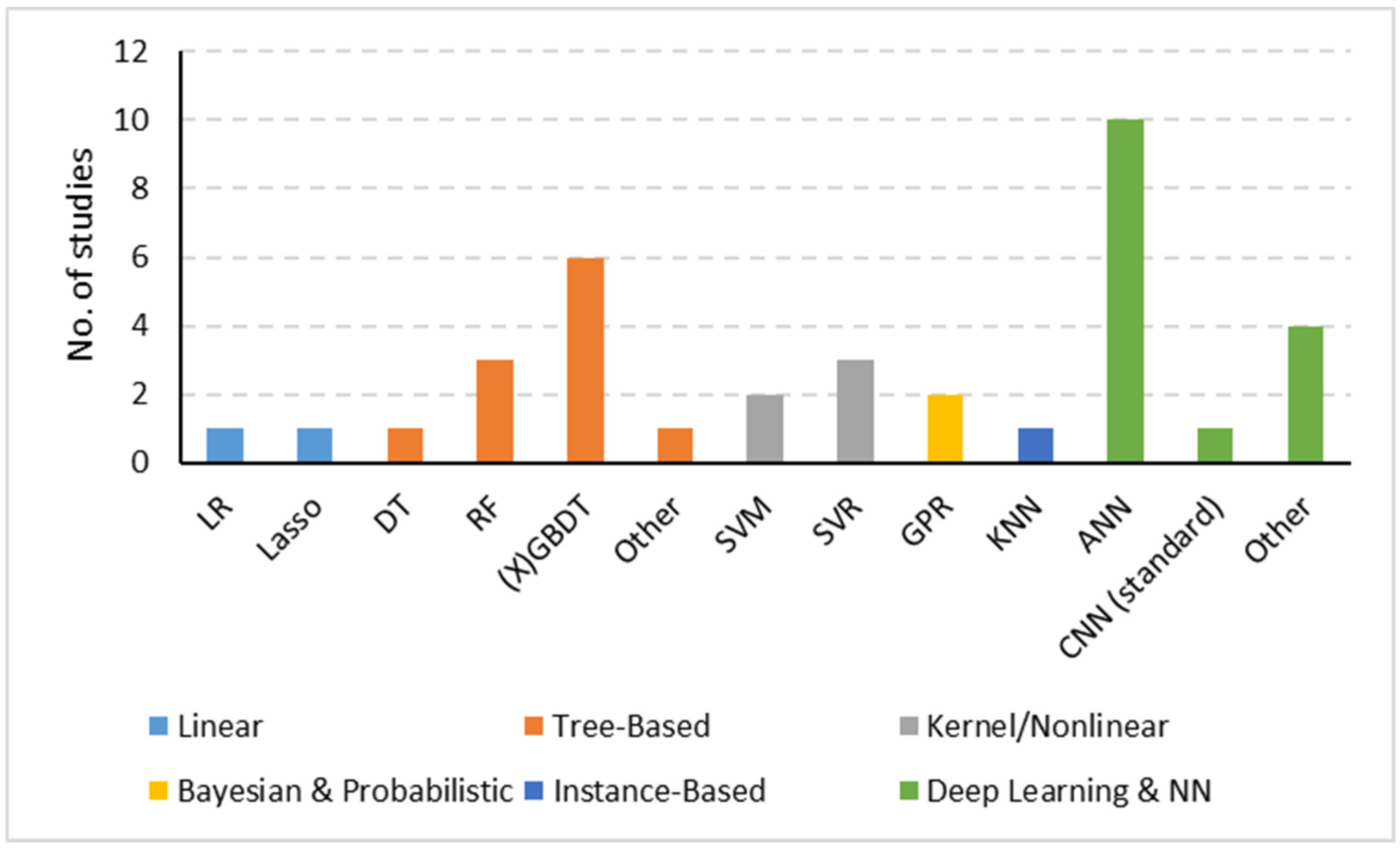
| Kim and Lee [57] | XGB, GPR, SVR, AdaBoost, RF, ANN, Lasso, and linear regressor [Mixed structure] | 8679 (80% train and 20% test) 17 features 1 output (MOD) | WFR; FSL; Log(q); DN into a [0, 1] range | RMSE = 0.691–0.276 |
| Tsai and Tsai [58] | CNN [Various structures and mixed structures] | 8653 (80% train and 20% test) 16 features 1 output (MOD) | WFR; DN into a [0, 1] range; SPNWH | RMSE = 0.112 |
| Zanuttigh et al. [64] | ANN [Various structures] | 8633 (train) and 871 (test) 15 features 1 output (MOD) | WFR; DN into a [0, 1] range; SPNWH | RMSE = 0.090–0.047 |
| Alshahri & Elbisy [20]; Elbisy [65] | MPNN, CCNN, GRNN, and SVM [Simple straight sloped] | 4401 (train) 12 features 1 output (MOD) | WFR; FSL; SPNWH; DN into a [0, 1] range; Log(q) | RMSE = 0.001–0.0003 |
| Habib et al. [50] | RF, XGB, SVR, and ANN [Vertical seawalls] | 1318 (70% train) (30% test) 20 features 1 output (MOD) | PCA; WRMs; KNNIMs | RMSE = 0.0031–0.0025 |
| Elbisy [21] | DT, GBDT, and SVM [Rubble mound breakwater] | 4737 13 features 1 output (MOD) | SPNWH | RMSE = 0.0043–0.002 |
| Formentin et al. [56] | ANN [Various structures] | 8194 15 features 1 output (MOD) | WFR; DN into a [0, 1] range; SPNWH; Log(q) | RMSE = 0.05–0.03 |
| Etemad-Shahidi et al. [63] | M5′ model tree [Vertical smooth structure] | 688 (2/3 train and 1/3 test) 12 features 1 output (MOD) | WFR; Tests of incident waves with an incident angle > 5°, non-smooth/permeable structures, and inclined structures with cot(α) > 0.1 were excluded | RMSE = 0.46–0.39 |
| Oliver et al. [66] | ANN [Sloping breakwater and seawall] | 9997 (70% train, 15% test, and 15% validate) 15 features 1 output (MOD) | PCA; SOM; FSL | MSE = 3.85 × 10⁻⁵–3.82 × 10⁻⁵ |
| Verhaeghe et al. [67] | ANNs [Various structures] | 8154 (85% train and 15% test) 13 features 1 output (MOD and binary values for the other model) | WFR; Log(q); FSL | RMSE = 0.8442–0.5249 |
| Lee and Suh [62] | GMDH algorithm [Inclined seawalls without a berm] | 3609 + 303 dataset with oblique wave (70% train and 30% test) 5 to 6 features 1 output (MOD) | WFR; FSL; SPNWH | nRMSE = 0.0155–0.0030 |
| Zanuttigh et al. [68] | ANN [Various structures] | 16,000, 50 different random splits of data into train, test, and validation 13 features 3 outputs (MOD) | WFR; FSL; SPNWH; DN into a [0, 1] range; Log(q) | RMSE = 0.046–0.028 |
| Alvarellos et al. [59] | ANN [vertical, composite, and sloping breakwater] | Data 1 and 2: 8989 Data 3: 15,064 (75% train and 25% test) 10 features 1 output (binary: probability of overtopping event) | Merged and used the sine and cosine for the 0–360 degree range values. | AP = 0.48–0.86 |
| Mares-Nasarre et al. [69] | ANN [Mound breakwaters] | 235 (70% train, 15% test, and 15% validate) 4 features 2 outputs (OLT and OFV exceeded by 2% of the incoming waves) | DN by other experimental parameters | R2 = 0.789–0.903 |
| Carro et al. [60] | RF [Mixed rubble mound] | 38,265 (train) 9487 (test) 7 features 1 output (MOD) | MDA is used to separate data into training and testing | Recall = 0.89–0.95 |
| Category | Description or Common Techniques |
|---|---|
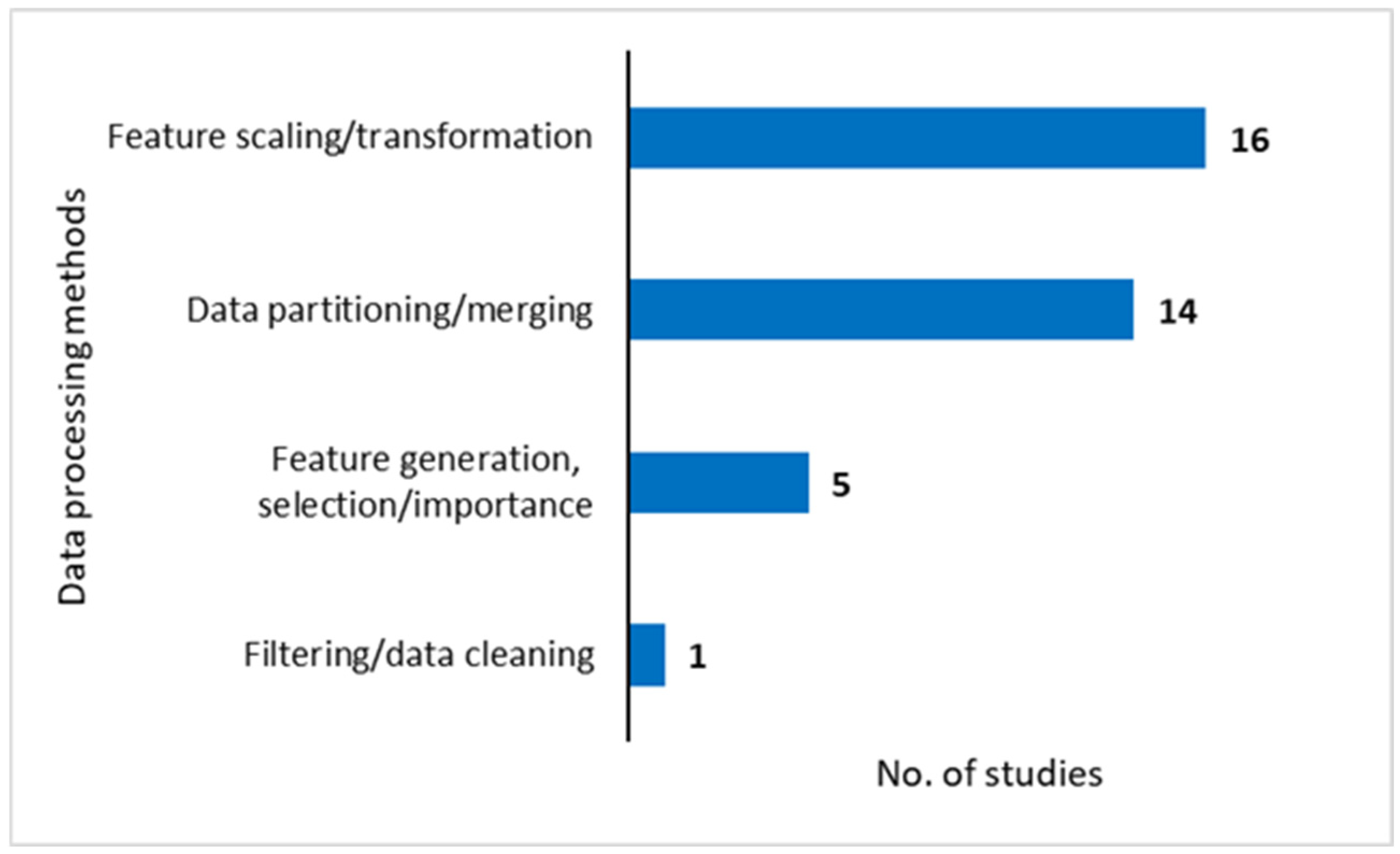
| Feature scaling or transformation | Weight factor reduction (WFR), Froude similarity law (FSL), log-transformations (Log(q)), structure parameter normalization by wave height (SPNWH), data normalization (DN to [0, 1] range), sine–cosine feature transformation, or standard scaling |
| Data partitioning or merging | Dataset division (for training/test, data merging across datasets) |
| Feature generation, selection, or importance | Permutation importance (PI), principal component analysis (PCA), self-organized maps (SOM), wrapper reduction method (WRM), maximum dissimilarity algorithm (MDA), KNN imputation method (KNNIM), and manual feature elimination or synthesis |
| Filtering or data cleaning | Exclusion of outliers, removing non-suitable cases (e.g., waves with incident angle > 5° or non-smooth structures) |
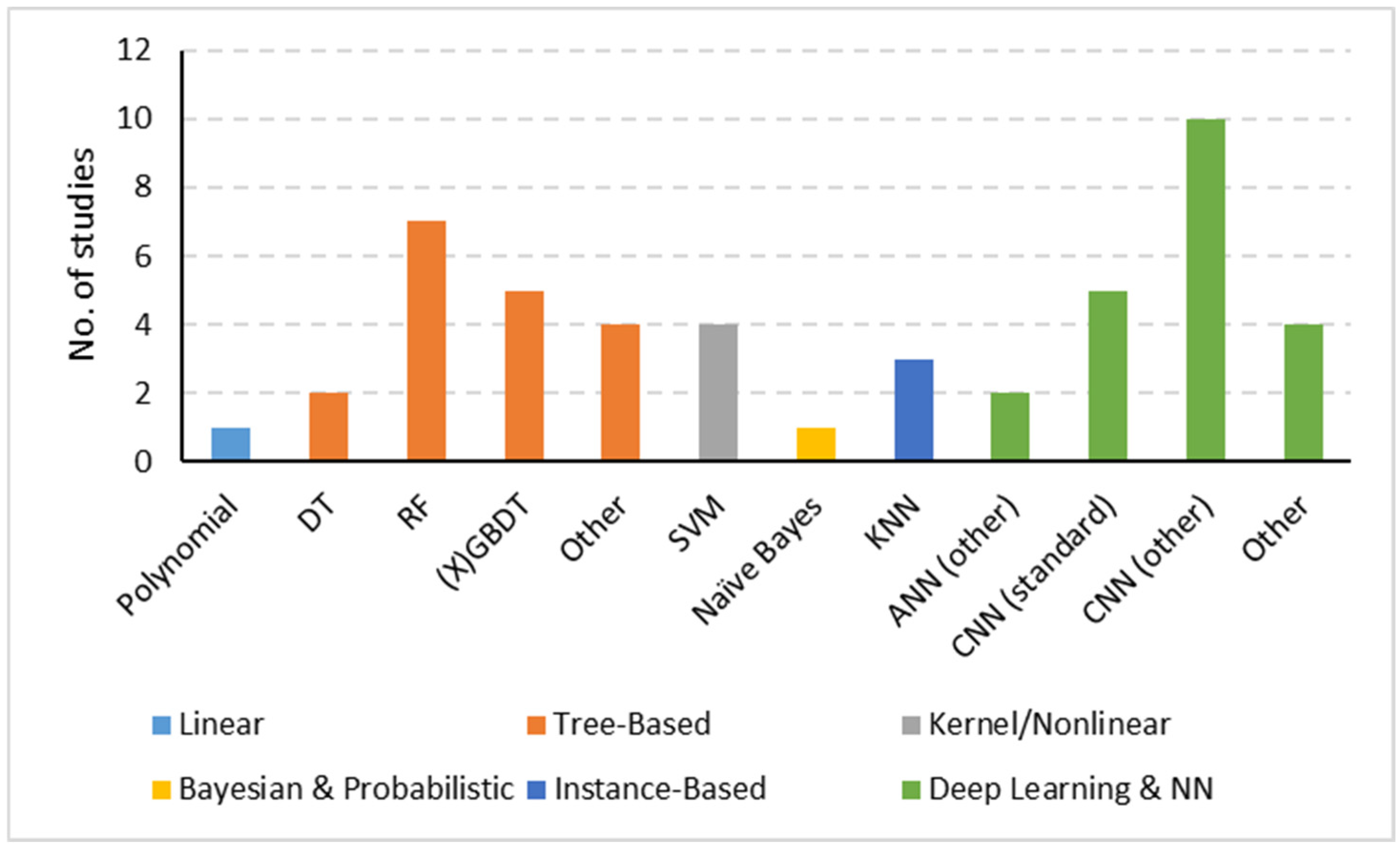
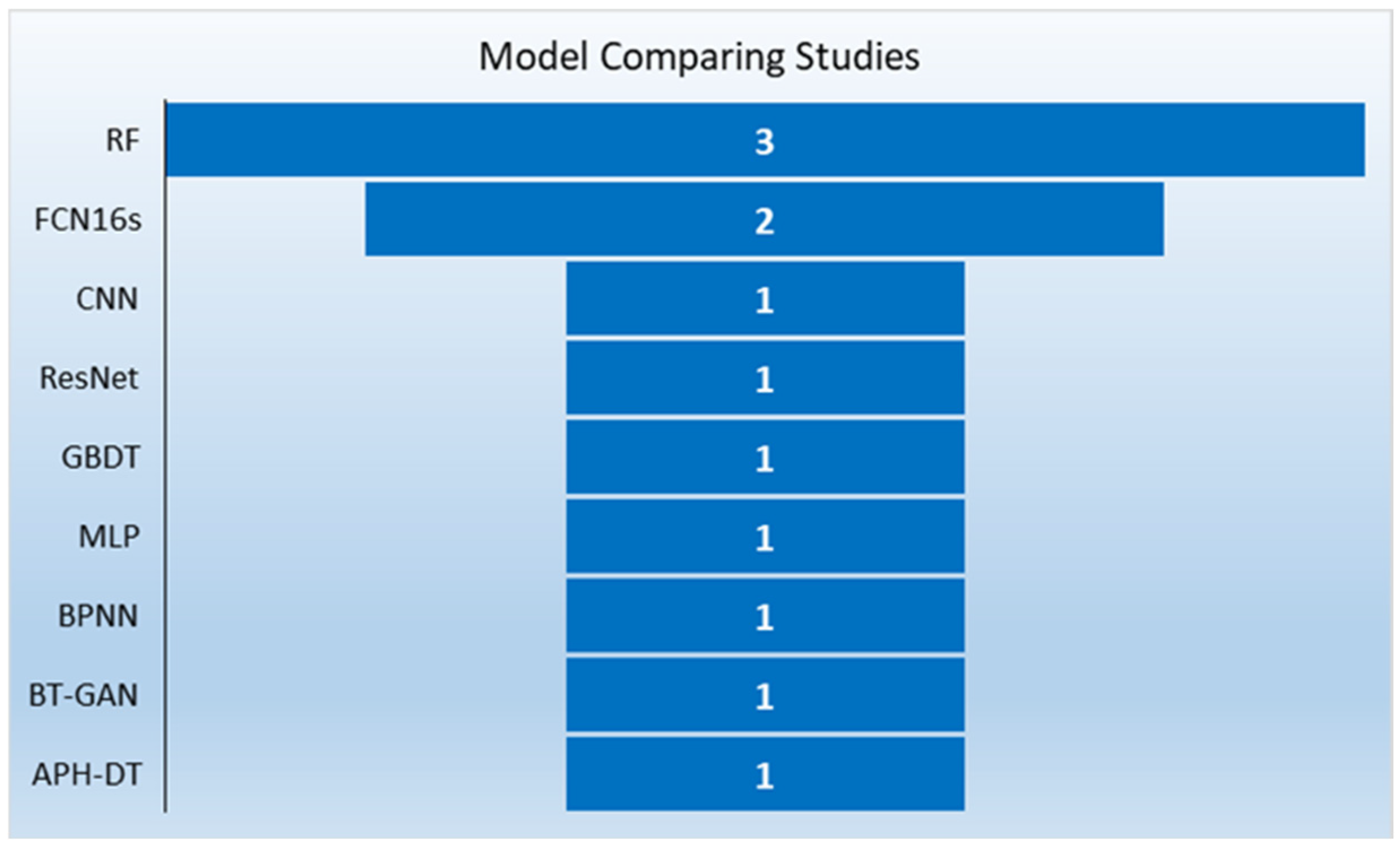
| Author | Model/Algorithm | Data Source/Type | Data Preprocessing or Techniques | Performance |
|---|---|---|---|---|
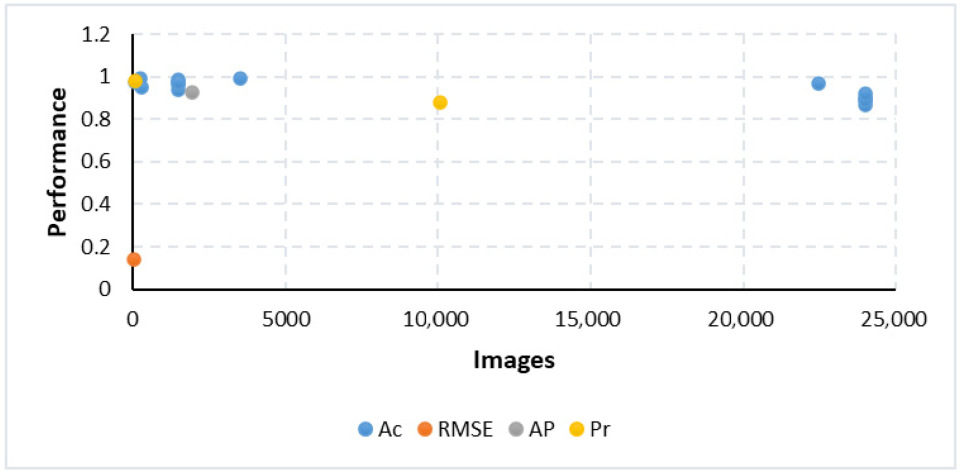
| den Bieman et al. [17] | SegNet CNN [Measuring surface elevation, wave runup, and bed level development] | 760 video imagery from physical model test (25% test) | Image segmentation and augmentation | Ac = 95.2–99.3% |
| Salatin et al. [91] | V-BeachNet FCN [Swash spectra, significant wave heights, and wave-driven setup] | Observations: Scanning lidar system (32 images) | Video segmentation, image rectification and enhancement | RMSE = 0.33–0.14 |
| Naeini and Snaiki [77] | cGAN [Wave runup for coastal flooding] | Wave runup time-series data generated from XBSB and XBNH | Data transformation into an RGB image, a random mirroring technique, and image normalization | MAE = 0.01–0.0001 |
| Hasan et al. [73] | RF, XGB, & KNN [Flood susceptibility mapping] | 400 observations with 9 variables (30% test) | Flood controlling factors processed on ArcGIS | Ac = 85.5–86.7% |
| Hou et al. [92] | Mask R-CNN (ResNet-101 + RPN) [Flood extent mapping] | 1930 images from physical model tests (40% test) | Image labeling and segmentation | AP = 0.927 |
| Gebrehiwot et al. [93] | VGG-based FCN-16s [Flood extent mapping] | UAV images (100 samples) | Image labeling and segmentation | Ac = 97.5% |
| Ichim & Popescu [94] | YOLO, GAN, AlexNet, LeNet, and ResNet [Segmentation of vegetation and flood extension] | UAV images. 24,000 samples (30% validation) | Image labeling and segmentation | OAc = 85.9–94.4% |
| Peng et al. [72] | CNN (PSNet), SVM, DT, RF, and Adaboost [Flood extent mapping] | Satellite multispectral surface reflectance imagery and aerial VHR by NOAA. (1500 training samples) | Image labeling and segmentation | OAc = 93–98% |
| Sarker et al. [83] | F-CNNs [Flood extent mapping] | 14 Landsat satellite images (generated 4.5 million patches) | Normalizing pixel intensity values of images and labeling | OAc = 80–92% |
| Muñoz et al. [95] | CNN [Flood extent mapping] | Landsat ARD, dual-polarized SAR data, and coastal DEMs. 22,476 patch images (20% validation) | Data fusion (cloud/shadow removal, speckle filtering, rescaling) and rescaling of images | OAc = 97% |
| Liu et al. [71] | CNN [Flood extent mapping] | Six pairs of Sentinel-1 SAR images (10,049 patches) from CEMSRM, GE, and OSM. | Orbit file, Sliding-window filtering, Radiometric calibration, Range-Doppler terrain correction | Pr = 88% |
| Kang et al. [82] | FCN (VGG16) [Flood extent mapping] | 8 Geofen-3 SAR images divided into 3528 samples | GF-3 data converted to digital numbers and scaled | Ac = 99.1–99.6% |
| Zahura and Goodall [74] | RF [Flood extent mapping and depth] | Virginia HRSD and NOAA (rainfall and tide level). City of Norfolk’s STORM. 16 rainfall and 8 tidal events (20% test). | Feature generation and Interpolation | Pr = 72–92% |
| Qin et al. [70] | BPNN, PR, DT, RF, & KNN [Generate point waterlogging depth] | Observation from the monitoring station | Stratified random sampling and clustering method. Reduction factor determination process. | RMSE = 0.539–0.003 |
| Di Bacco et al. [96] | XT and RF [Flood extent mapping and depth] | 10 features with 5000 location points. Meteorological, hydrological, and observed impact data from USGS and FEMA | Permutation Feature Importance | MSE = 0.66–0.47 |
| Shastry et al. [80] | CNN [Flood extent mapping] | Maxar WorldView 2/3 (Satellite). Five spatiotemporal strata. USGS Flood, NLCD, and cloud masks. 80 WV images for training and 20 for validation | Used flood models with remote sensing data to get the most realistic flood extents. Data labeling and segmentation | Pr = 98% |
| Dong et al. [88] | FastGRNN-FCN [Flood warning and inundation probability] | Data from HCFCD 9 variables 80,997 data instances | The flood data is divided into a multivariate time series and used as the model input. Data labeling and feature selection | Ac = 95.8–97.8% |
| Nemni et al. [81] | CNN (XNet, U-Net & ResNet) [Flood extent mapping] | UNOSAT Flood Dataset, Copernicus Sentinel-1 SAR imagery. Train, test, & validate (80:10:10) | Orthorectification, calibration, speckle filtering, tiling, compression, and normalizing | Ac = 91–97% |
| Nhangumbe et al. [97] | SVM, RF & Boosted Tree [Flood extent mapping] | DrivenData Labs based on Sentinel-1 (S1) SAR imagery and cloud to street | Focal mean filter and data labeling | IoU = 0.568 |
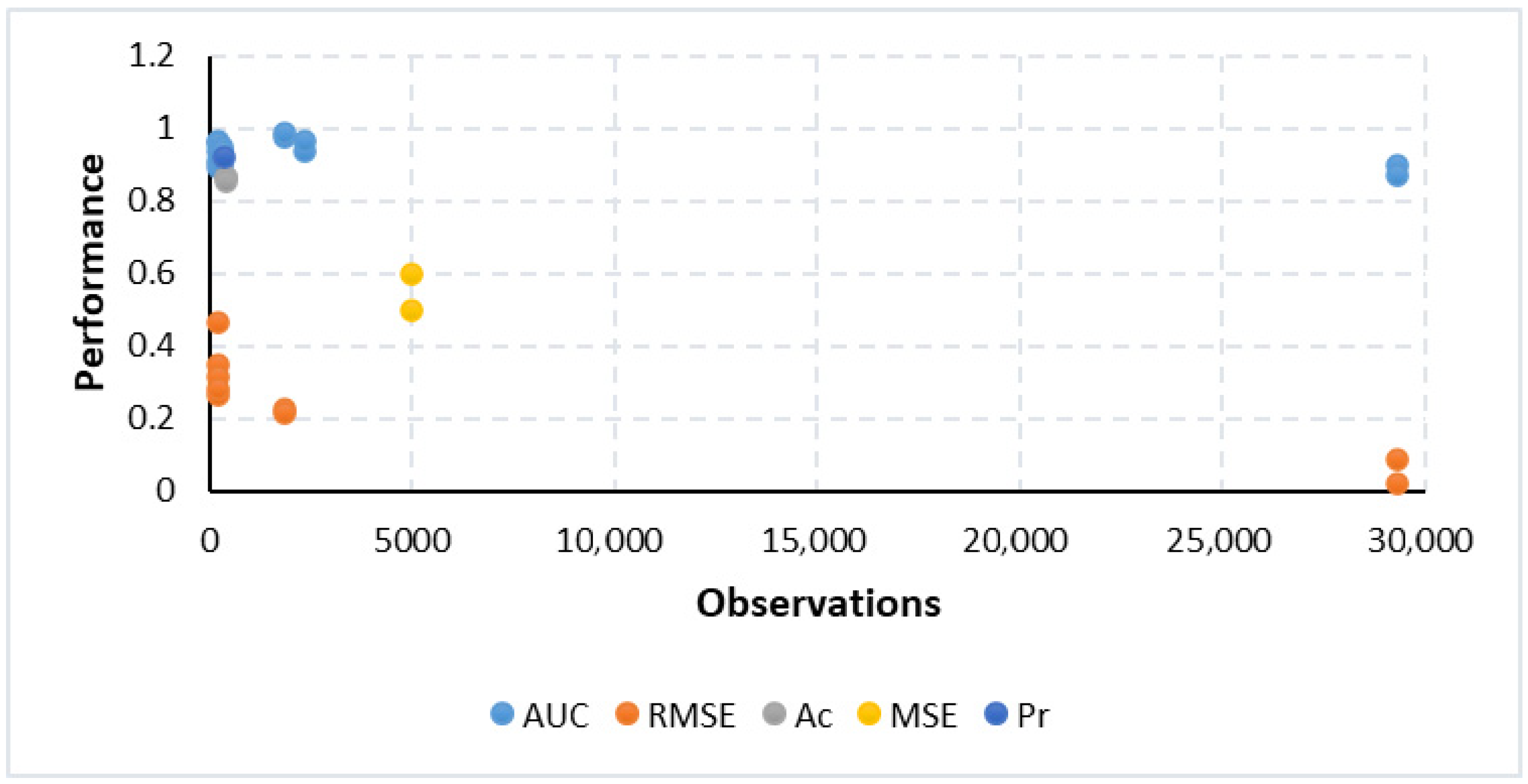
| Hidayah et al. [87] | MLP & RF [Flood susceptibility mapping] | 11 Flood factors from periodic flood polygons (2010–2020) 2368 data points (30% validation) | Normalized difference vegetation index and Feature selection methods. | AUC = 0.921–0.967 |
| Dodangeh et al. [98] | GAM, BTR & MARS (integrating RS and BT) [Flood susceptibility] | Data from Iran Meteorological Organization (294 data points) | Variables were transformed into a raster format | AUC = 0.95–0.98 |
| Ramayanti et al. [99] | GNDH & CNN [Flood susceptibility mapping] | SAR Sentinel-1 satellite images, GIS. 29,291 flood data points (50:50 train & test). DEM data gathered from the SRTM | Selection of flood conditioning factors, geometric and radiometric correction; A supervised classification technique; All factors reclassified by ArcMap software | AUC = 0.87–0.90 |
| Saravanan & Abijith [75] | GBM, XGB, RTF, SVM, & NB [Flood susceptibility mapping] | Sentinel-1 satellite images, Landsat 8 from GEE Chirps from GEE SRTM. NBSS and LUP (70:30 train & test) | Recursive feature elimination, data normalization, and labeling | AUC = 0.8–0.92 |
| Prasad et al. [79] | RTF, NSC, KNN, BRT, & LB [Flood susceptibility mapping] | DDMMS and Landsat images. 210 flood locations, satellite images, and field surveys. (30% test) | Factor selection by the Boruta algorithm. Weight of Evidence floods (WoE) | AUC = 0.892–0.966 |
| Vu et al. [78] | SVM & RF [Flood susceptibility mapping] | VDSMGI Sentinel 1A images. 1864 flood locations and 11 conditional factors. (30% validation) | Data normalization, factors transformed into raster format at 10 m resolution | AUC = 0.97–0.98 |
| Asiri et al. [18] | AHP-SVM & AHP-DT ensembles [Flood susceptibility mapping] | Various datasets and data sources for coastal flooding risk factors, such as flood hazard, social vulnerability, and exposure | Multi-Collinearity Test Weight Indicators Proxy Variables normalization (MinMax) | AUC = 0.75–0.98 |
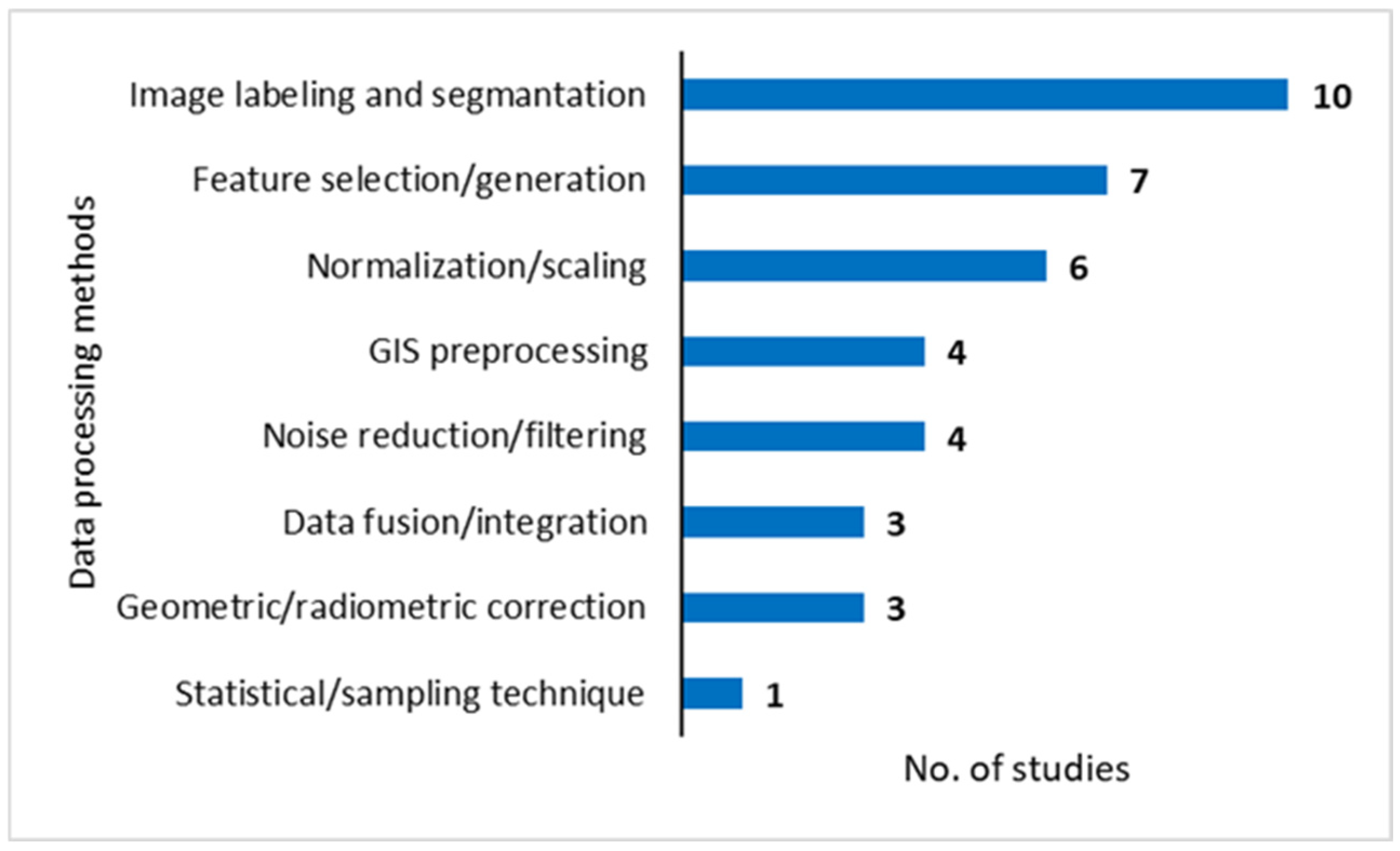
| Category | Description or Common Techniques |
|---|---|
| Image labeling and segmentation | Manual or automated flood extent labeling, image segmentation |
| Feature selection or generation | Recursive feature elimination, Boruta, permutation importance, or manually derived conditioning factors |
| Normalization or scaling | Normalizing variables or pixel intensities, Min–Max, or standardization |
| GIS preprocessing | Data rasterization, factor reclassification, ArcGIS processing |
| Noise reduction or filtering | Speckle filtering, sliding-window or focal mean filters, image rectification, cloud/shadow removal |
| Data fusion or integration | Combining multisource data (SAR, DEM, optical), feature merging |
| Geometric or radiometric correction | Radiometric calibration, orbit correction, terrain correction, geometric correction |
| Statistical or sampling technique | Stratified sampling, clustering, and reduction factor estimation |
Disclaimer/Publisher’s Note: The statements, opinions and data contained in all publications are solely those of the individual author(s) and contributor(s) and not of MDPI and/or the editor(s). MDPI and/or the editor(s) disclaim responsibility for any injury to people or property resulting from any ideas, methods, instructions or products referred to in the content. |
© 2025 by the authors. Licensee MDPI, Basel, Switzerland. This article is an open access article distributed under the terms and conditions of the Creative Commons Attribution (CC BY) license (https://creativecommons.org/licenses/by/4.0/).
Share and Cite
Duiker, M.L.; Ramos, V.; Taveira-Pinto, F.; Rosa-Santos, P. Predicting Coastal Flooding and Overtopping with Machine Learning: Review and Future Prospects. J. Mar. Sci. Eng. 2025, 13, 2384. https://doi.org/10.3390/jmse13122384
Duiker ML, Ramos V, Taveira-Pinto F, Rosa-Santos P. Predicting Coastal Flooding and Overtopping with Machine Learning: Review and Future Prospects. Journal of Marine Science and Engineering. 2025; 13(12):2384. https://doi.org/10.3390/jmse13122384
Chicago/Turabian StyleDuiker, Moeketsi L., Victor Ramos, Francisco Taveira-Pinto, and Paulo Rosa-Santos. 2025. "Predicting Coastal Flooding and Overtopping with Machine Learning: Review and Future Prospects" Journal of Marine Science and Engineering 13, no. 12: 2384. https://doi.org/10.3390/jmse13122384
APA StyleDuiker, M. L., Ramos, V., Taveira-Pinto, F., & Rosa-Santos, P. (2025). Predicting Coastal Flooding and Overtopping with Machine Learning: Review and Future Prospects. Journal of Marine Science and Engineering, 13(12), 2384. https://doi.org/10.3390/jmse13122384