
Article

A Comparison of Sedimentary Characteristics and Architecture Between Sand-Rich and Mud-Rich Deltas: Insights from Flume Experiments

1
School of Geosciences, Yangtze University, Wuhan 430100, China
2
PetroChina Research Institute of Petroleum Exploration and Development, Beijing 100080, China
*
Author to whom correspondence should be addressed.
J. Mar. Sci. Eng. 2026, 14(7), 593; https://doi.org/10.3390/jmse14070593
Submission received: 27 February 2026 / Revised: 22 March 2026 / Accepted: 23 March 2026 / Published: 24 March 2026

Abstract

Existing studies have extensively investigated sand-rich shallow-water deltas. However, the sedimentary characteristics and internal architecture of mud-rich deltas remain poorly understood. In this study, two comparative flume experiments were conducted with sand–mud ratio as the key variable. High-resolution topographic data were acquired using a laser scanner to extract geometric parameters of the architectural elements. Three-dimensional architectural models were established and validated against the Ganjiang Delta (sand-rich) and the Ouchi River Delta (mud-rich) in China. The results reveal contrasting depositional styles: sand-rich deltas develop dense, laterally migrating braided channels with broad fan-shaped morphologies, forming blanket-like geometries that consist of vertically stacked and laterally amalgamated channel complexes with good connectivity; mud-rich deltas are characterized by stable channels with limited bifurcation, forming elongated finger-like morphologies with isolated, ribbon-like channel–mouth bar complexes that exhibit strong lateral heterogeneity and poor connectivity. These contrasting behaviors are governed by sediment cohesion: non-cohesive sands promote channel migration and dispersion, whereas cohesive silt and mud stabilize channels and focus sediment transport along main conduits. The experimental models successfully reproduce natural delta end-members, confirming the universal control of the sand–mud ratio. The established quantitative relationships provide a predictive basis for subsurface reservoir characterization and the formulation of differentiated development strategies.

1. Introduction

As the critical sedimentary systems where rivers meet basins, deltas are among the most active areas of material deposition on Earth [1,2]. These systems not only preserve invaluable records of watershed erosion, sediment transport, and sea-level changes, but also serve as vital reservoirs for global oil and gas resources [2,3]. Based on the primary factors governing delta formation and development, particularly the sand-to-mud ratio of sediments supplied by the feeder channel, deltas can be classified into sand-rich and mud-rich types [4,5]. The sand–mud ratio in sediment supply and the associated sediment viscosity exert critical control over deltaic sedimentary characteristics and evolutionary processes. This influence manifests primarily in the following aspects. First, the sand–mud ratio directly influences delta morphology [5,6]. Sand-rich deltas typically form distinct fan-shaped structures [5], termed by various scholars as superimposed deltas [7], distributary sandbar deltas [3,8]. Classic examples include the modern Ganjiang Delta in Poyang Lake, Jiangxi Province, China [9,10] and the shallow-water deltas of the Triassic Yanchang Formation in the Ordos Basin [11]. Mud-rich delta sediments exhibit fine grain size and high cohesion, allowing distributary channels to extend far into the lake. These correspond to finger-like deltas [8,12] and shallow-water deltas with branched channels [3]. Secondly, the sand–mud ratio governs deltaic dynamics and sedimentation mechanisms. A high sand–mud ratio reduces sediment cohesion, facilitating channel migration and meandering to form extensive deltaic complexes [5]. Conversely, a low sand–mud ratio enhances sediment cohesion, stabilizing channels and producing elongated deltaic forms [5,13]. A typical modern mud-rich shallow delta is the Ouqi River Delta in Dongting Lake, Hunan Province, China [3]. Third, the sand–mud ratio determines deltaic sedimentary structures and reservoir properties. Sand-rich deltas typically develop thick, interconnected sand bodies with good connectivity. Conversely, mud-rich deltas are dominated by mudstones and siltstones, with sand bodies often isolated and exhibiting pronounced reservoir heterogeneity. These differences directly influence hydrocarbon exploration strategies and development outcomes [11].
Significant advances have been made in understanding delta formation mechanisms [14,15,16]. However, traditional field and modern monitoring methods face limitations, such as high cost, low resolution, and an inability to capture long-term evolutionary processes. To overcome these limitations, numerical simulation techniques offer the unique ad-vantage of reproducing long-term evolutionary processes under controlled conditions. Consequently, technologies such as Delft3D [5,17,18] and DIONISOS [19] have been widely applied in delta research. These methods simulate delta formation and evolution by solving equations governing water flow and sediment transport. However, existing numerical simulation methods, particularly the widely used Delft3D software, exhibit certain limitations during simulation. For instance, Wang et al. [17] demonstrated in their study of tidal channel modeling that process-based models like Delft3D tend to over-scour channels and under-represent topographic diversity in long-term simulations due to neglecting feedback mechanisms between bottom evolution and sediment sorting. Such limitations suggest that models may face greater challenges when simulating more complex delta systems governed by fine-grained sediment transport and deposition.
Previous research has explored delta morphodynamics through flume experiments and numerical simulations [5,6,13,15,20]. Studies on mud-rich shallow-water deltas have primarily focused on numerical modeling, while flume experiments on mud-rich deltas remain relatively limited. Hoyal and Sheets [21] and Straub et al. [22] conducted experiments on cohesive deltas, mainly discussing channel evolution processes and shoreline dynamics. However, systematic experimental investigations focusing on the internal architectural characteristics of mud-rich deltas are scarce—a gap this study aims to fill. Furthermore, although previous research has examined delta evolution under different sediment supply conditions, comparative experiments with sediment supply as the key variable under identical basinal settings and external conditions are still uncommon.
Therefore, this study employs flume experiments to explore in depth the sedimentary characteristics and evolutionary patterns of sand-rich versus mud-rich shallow-water deltas. The main contributions of this experiment are threefold: (1) Compared to numerical simulation methods, which face issues such as excessive channel incision and insufficient representation of topographic diversity [17], flume experiments can more realistically reproduce the physical interaction processes between flow and sediment [23], effectively compensating for the limitations of numerical simulations in modeling fine-grained sediment transport and deposition. (2) By conducting flume experiments on mud-rich deltas and focusing on their internal architectural characteristics, this study reveals sedimentary structures in mud-rich deltas that are distinct from those in sand-rich deltas. (3) Through controlled comparative experiments with the sediment sand–mud ratio as the key variable under identical basinal settings and external conditions, this study systematically elucidates the control exerted by the sand–mud ratio on delta-front architecture, sand body distribution, and reservoir heterogeneity. This provides new insights into the contrasting depositional architectures of sand-rich and mud-rich shallow-water deltas, and offers a geological basis for predicting and developing analogous subsurface reservoirs. The above research will deepen the understanding of lacustrine delta sedimentary processes and lay a theoretical foundation for hydrocarbon exploration and reservoir evaluation.

2. Experimental Methods

2.1. Experimental Setup and Initial Topography

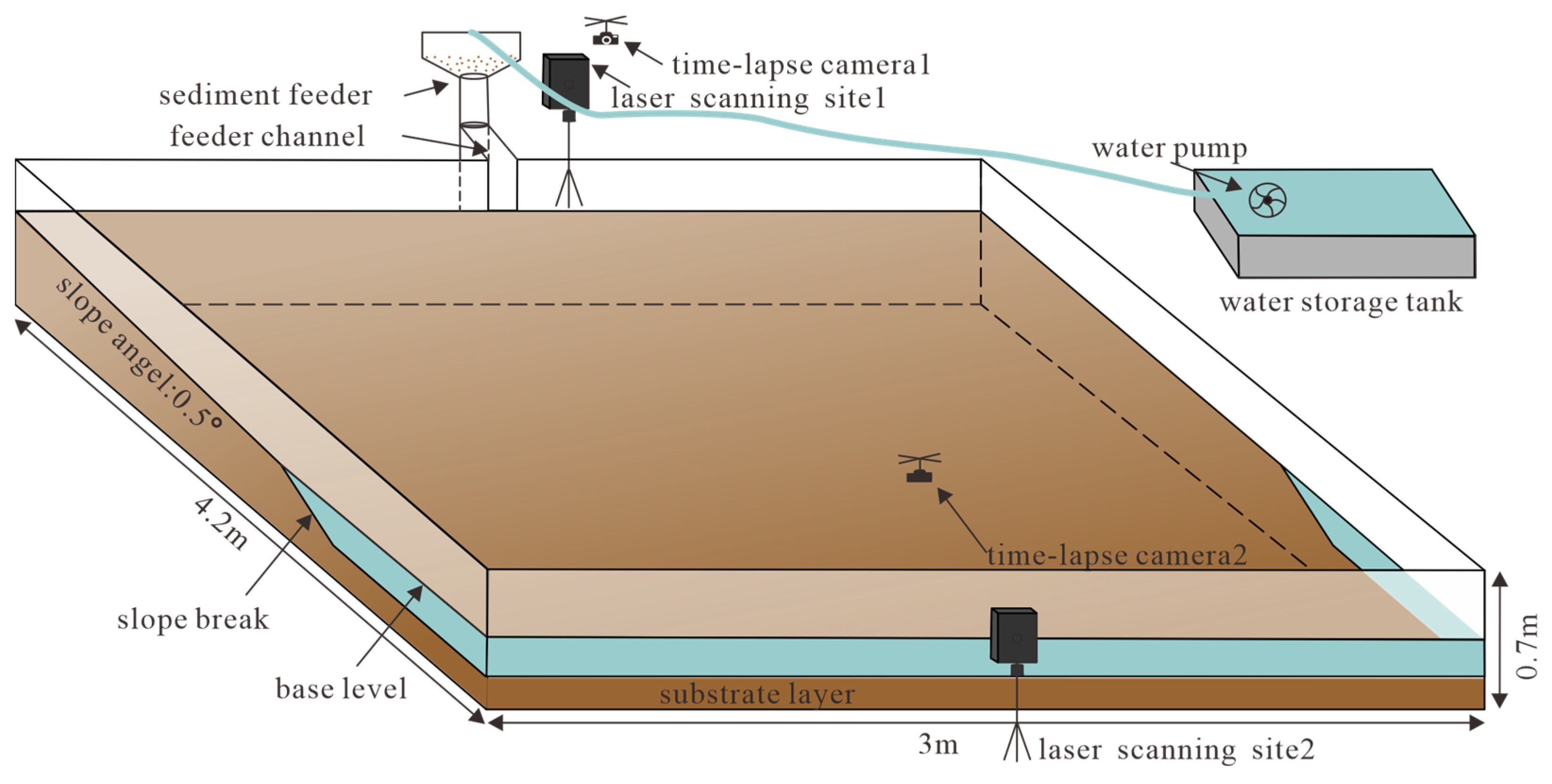
The experiment was conducted in the intelligent flume simulation laboratory of the School of Geosciences, Yangtze University. A dedicated experimental system was de-signed and built to simulate the sedimentary environment and monitor the evolution of shallow-water deltas (Figure 1). The system comprised an elongated flume, sediment and water supply systems, a water-level control mechanism, image recording devices (Canon EOS 6D Mark II, Canon Inc., Tokyo, Japan), and a high-precision 3D laser scanner (FARO -S70, FARO Technologies Inc., Lake Mary, FL, USA). The experiments were conducted in a flume (4.2 m long, 3 m wide, and 0.7 m high). The water level was held constant, and the sediment bed was configured as a wedge, thinning from the inlet towards the distal end of the basin. Unlike previous flat-bottomed experiments, a slope break was incorporated at the delta front in our flume setup to simulate shallow delta evolution. This design allowed for clear observation of the topographic evolution of both distributary channels and the delta plain. The overall slope of 0.5° is on the same order of magnitude as the paleogeomorphic gradients reported for ancient shallow-water deltas in the Songliao Basin [24] and the Ordos Basin [11,25], as well as those in most modern shallow-water deltaic basins [3,10,12].

2.2. Boundary Conditions

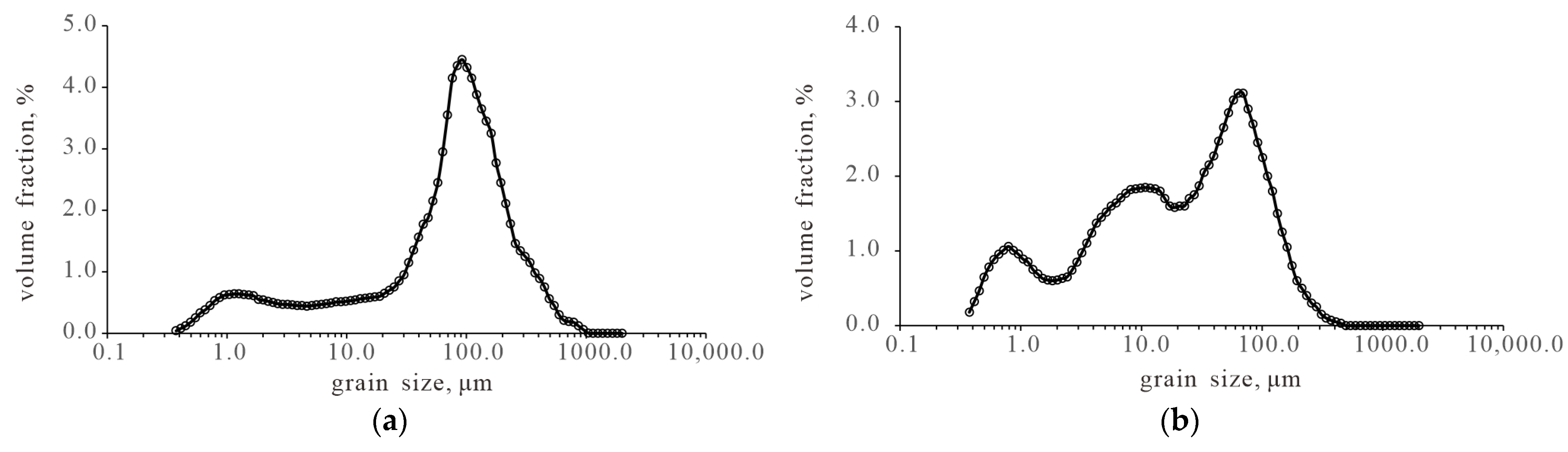
To investigate the differences in sedimentary architecture between sand-rich and mud-rich shallow deltas, two comparative flume experiments were designed. To this end, identical flumes with consistent substrate slopes and basin structures were used to simulate equivalent lake basin backgrounds. For the Sand-Rich Delta Group (SRDG), fine quartz sand served as the primary sediment source (Figure 2a), supplied at 4 g/s with a water flow of 0.4 L/s. The Mud-Rich Delta Group (MRDG) used quartz silt as the primary source (Figure 2b), with corresponding rates of 0.96 g/s and 0.385 L/s. Both sediment types consist of angular to sub-rounded quartz grains. Since silt settles much more rapidly in flume experiments than under natural conditions, polyacrylamide (PAM) was added to the water in the MRDG to increase its dynamic viscosity [21]. This simulated the suspension and transport of fine particles in natural water bodies, thereby improving the scalability of the laboratory model. Following the methodology of Hoyal and Sheets [21] and Straub et al. [22], the polymer acts as a general proxy for the cohesive effects of vegetation and dewatered clays, thereby increasing substrate strength and accelerating the onset of cohesion to match the rapid morphodynamic evolution rates inherent in small-scale experiments. This approach enables the formation of deltas with strong channelization at subcritical Froude numbers, which is characteristic of natural mud-rich systems. The SRDG was run for 138 h, with cycles lasting 2 h. The MRDG was run for 100 cycles, each lasting 1 h, to observe delta evolution and final morphology under differing sedimentary conditions. Key parameters for both experiments are summarized in Table 1.

2.3. Data Collection and Processing

To capture imagery and topographic data during delta evolution, time-lapse cameras were installed above the flume to record the sedimentation process in real time. Additionally, one georeferencing control point and two laser scanning stations were established. After each experimental run, the deposit was scanned using a FARO-S70 laser scanner to acquire sub-millimeter-resolution 3D coordinates, images, and topographic data.
The 3D scanner cannot accurately determine the depth of submerged sediment surfaces through water. Therefore, the flume was drained prior to each scanning session. The raw data obtained from the scanner consists of point clouds containing spatial coordinates (X, Y, Z). These data were meshed and then processed using specially developed software for error analysis and correction [15]. Systematic measurement errors were identified and periodically corrected based on calibration markers at the edges of the experimental setup, resulting in a calibrated data volume. The final dataset includes coordinates, grid indices, simulation sequence numbers, elevations, and imagery, which can be used to generate topographic maps, sedimentation increment maps, and cross-sectional profiles for further quantitative sedimentological analysis. After processing with the specially developed software, refined geomorphic features, elevations, and image information are obtained, providing quantitative support for analyzing sedimentary evolution and internal architecture.
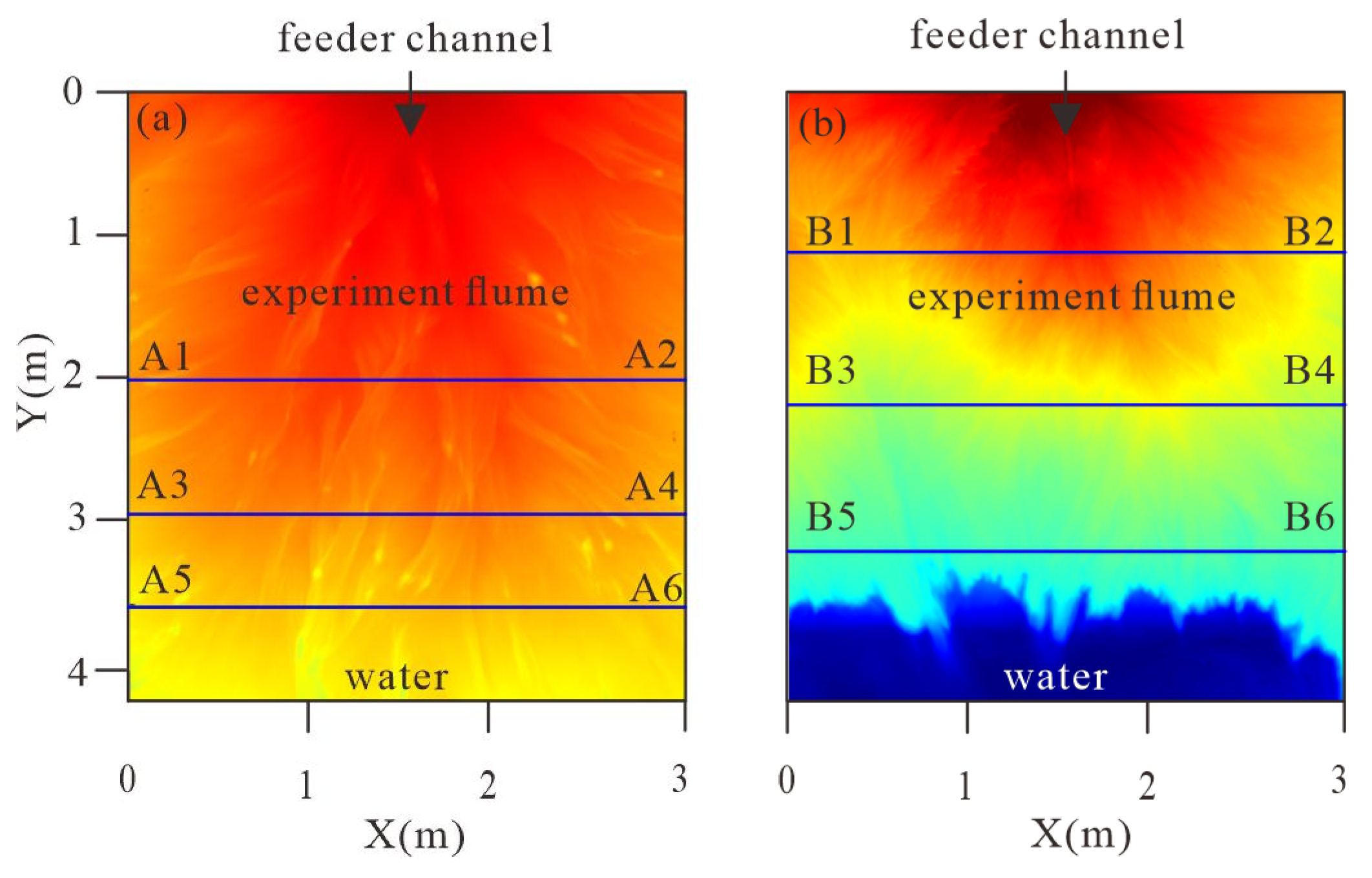
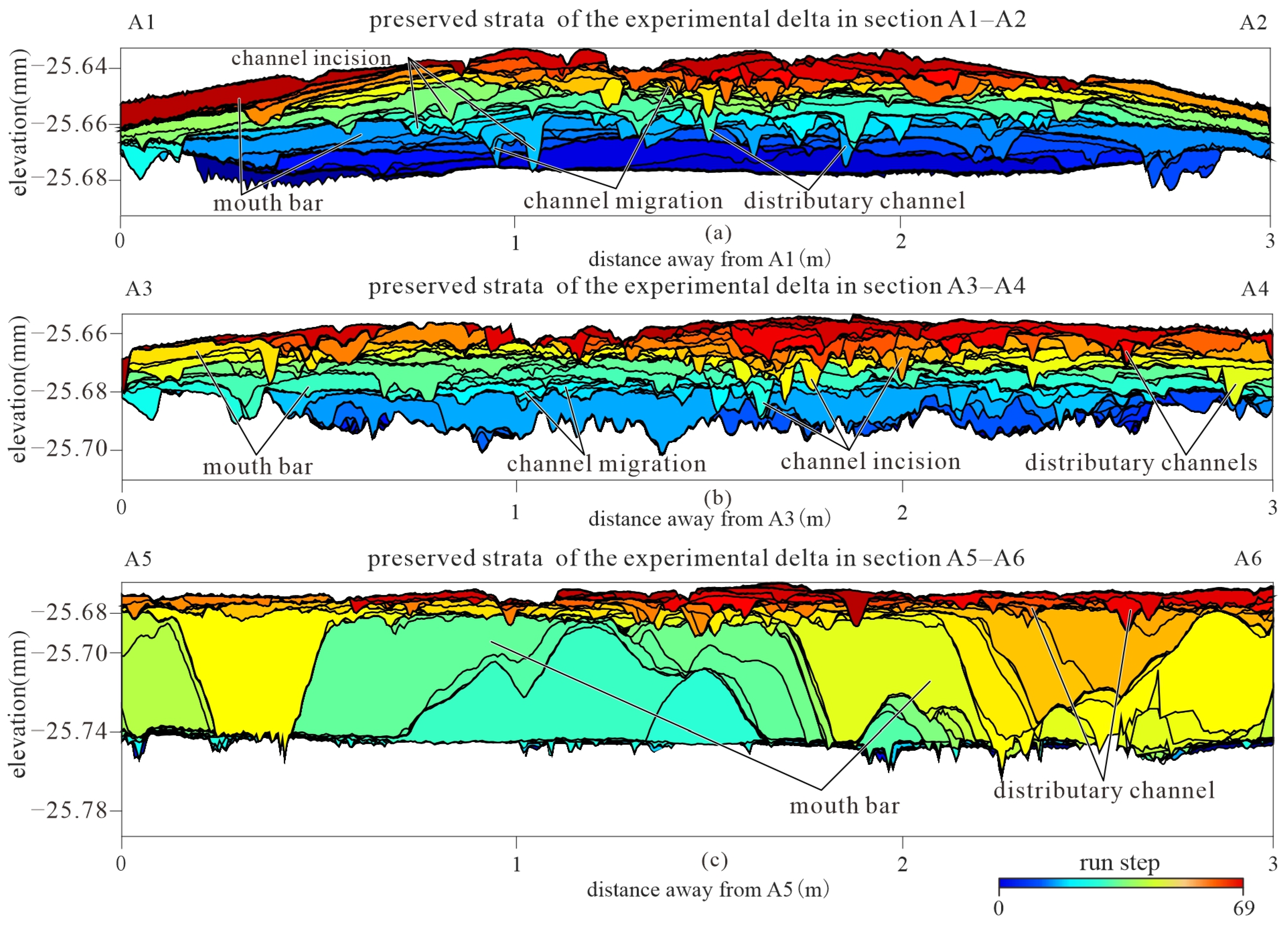
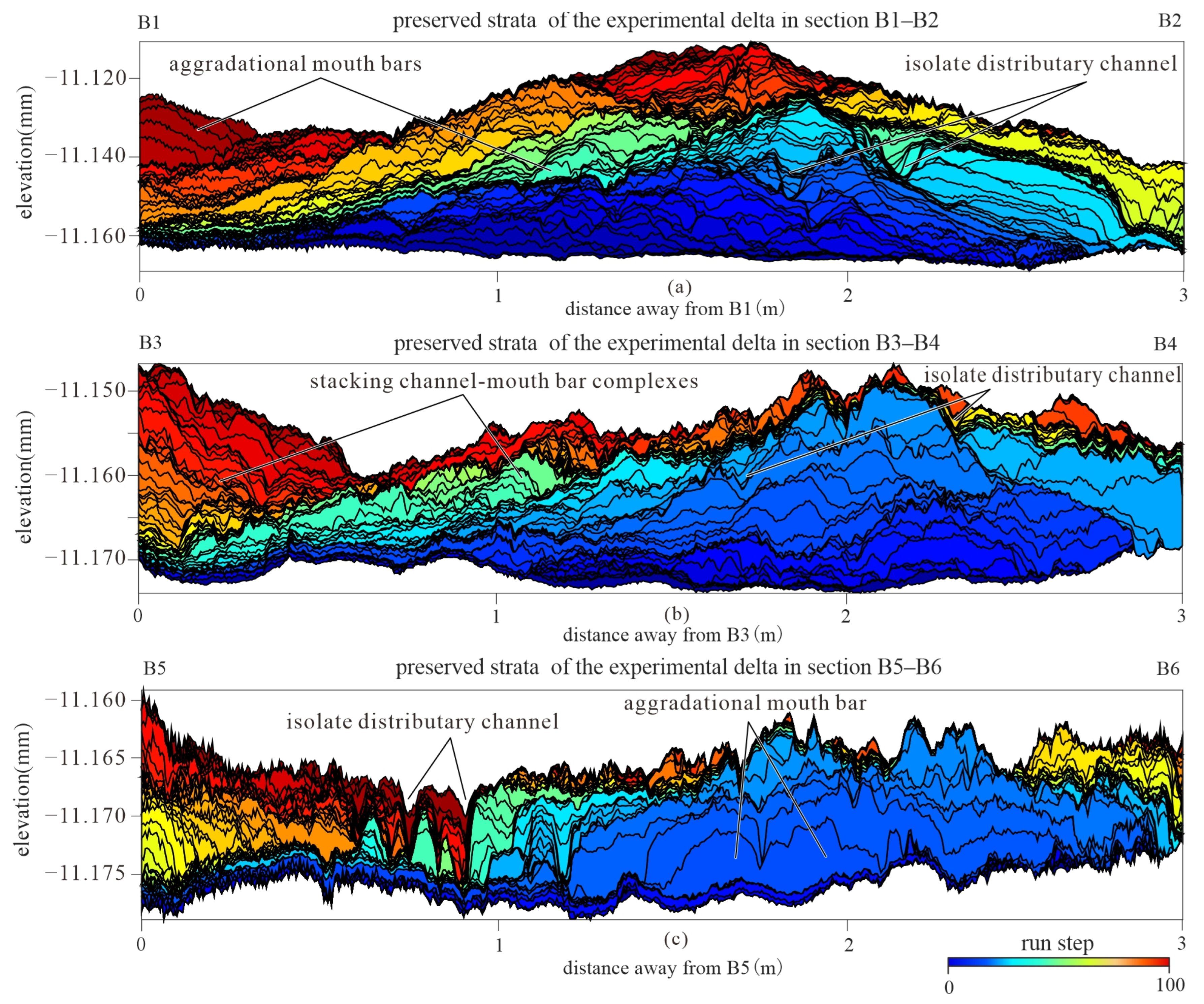
To compare the internal architecture of the two delta types, this study selected three characteristic locations (proximal, middle, and distal zones) in each delta based on digital elevation models (DEMs). Transverse sections perpendicular to the flow direction were then plotted for these locations. The specific layout is shown in Figure 3. In this figure, sections A1–A2, A3–A4, and A5–A6 represent the proximal, middle, and distal zones of the SRDG, respectively; while sections B1–B2, B3–B4, and B5–B6 represent the corresponding zones of the MRDG. These sections will be analyzed in detail in the following architectural analysis.

3. Results

3.1. Observations on Channel Behavior, Sedimentary Evolution and Final Morphology

Simulation results reveal markedly distinct evolutionary characteristics among sand-rich and mud-rich shallow-water deltas, primarily manifested in the distribution patterns and developmental density of distributary channels, overall delta morphology, and differential sediment thickness distribution.

3.1.1. Sand-Rich Delta Group

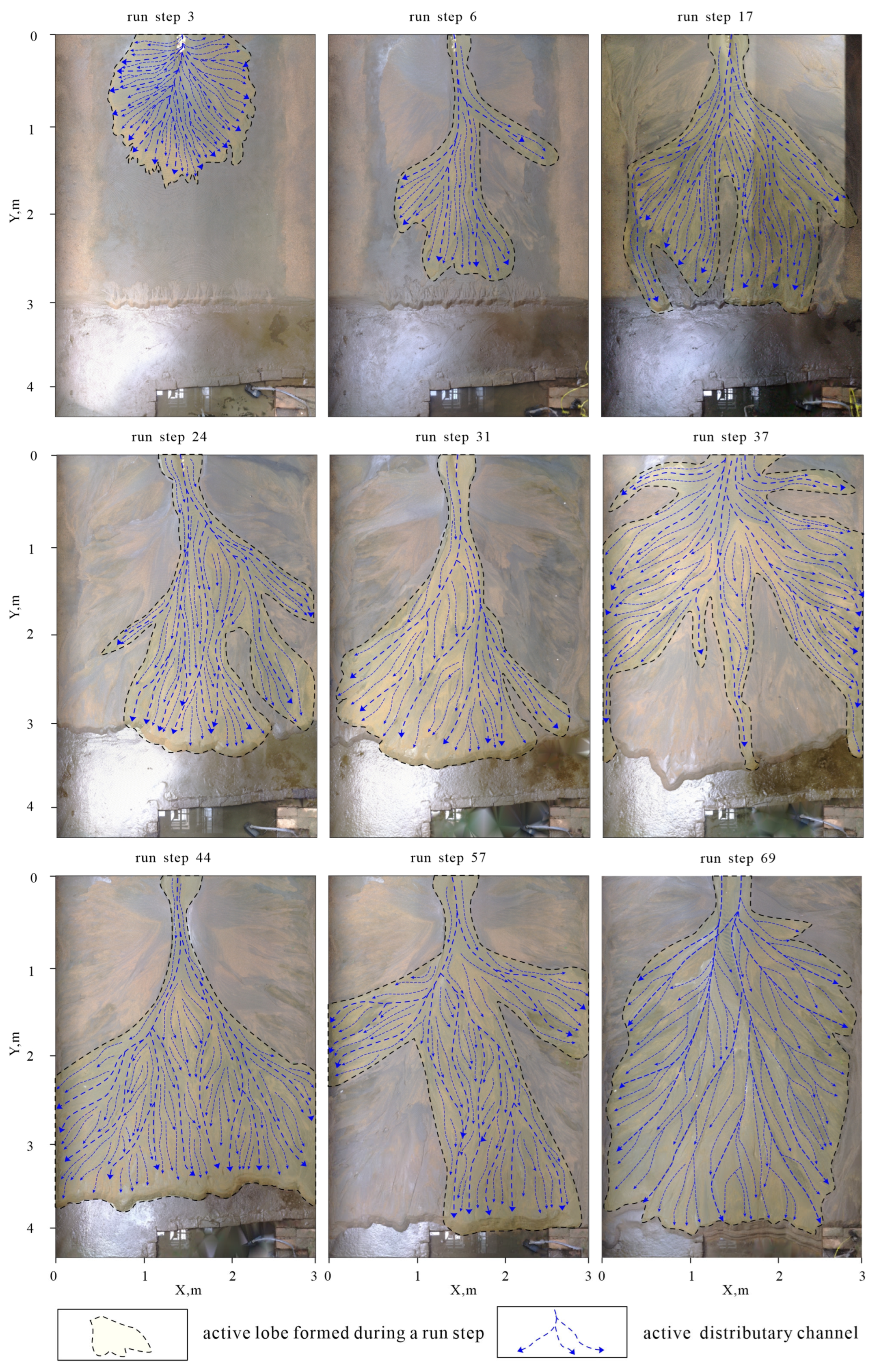
The SRDG developed an exceptionally dense distributary channel network. Its evolution began with rapid estuary sedimentation and channel bifurcation, forming initial radial patterns [26]. During the differential growth phase, uneven channel development and frequent avulsions became dominant processes. With no fixed main channel, dominance shifted dynamically among branches, causing lateral migration of the depocenter [27]. This active channel succession ultimately produced a dense, interconnected network. In the stable phase, although individual channels remained highly mobile, the overall system spatial distribution stabilized, forming composite sand bodies characterized by vertical stacking and lateral splicing (Figure 4).
Consequently, the experiment formed a typical large-scale, fan-shaped shallow-water delta. Its evolutionary process reflects a fluvial-dominated sedimentary response under high sediment load conditions, particularly with high sand content (Figure 4).
These dynamics directly shape the delta’s macroscopic form [28]. Pronounced lateral migration and channel distribution facilitate widespread sediment dispersal, preventing exclusive distal progradation. This results in comparable longitudinal and lateral expansion rates, ultimately yielding its broad, fan-shaped morphology. The resulting deposit displays a relatively uniform thickness distribution, forming interconnected sand bodies with a blanket-like geometry and complex internal architecture.

3.1.2. Mud-Rich Delta Group

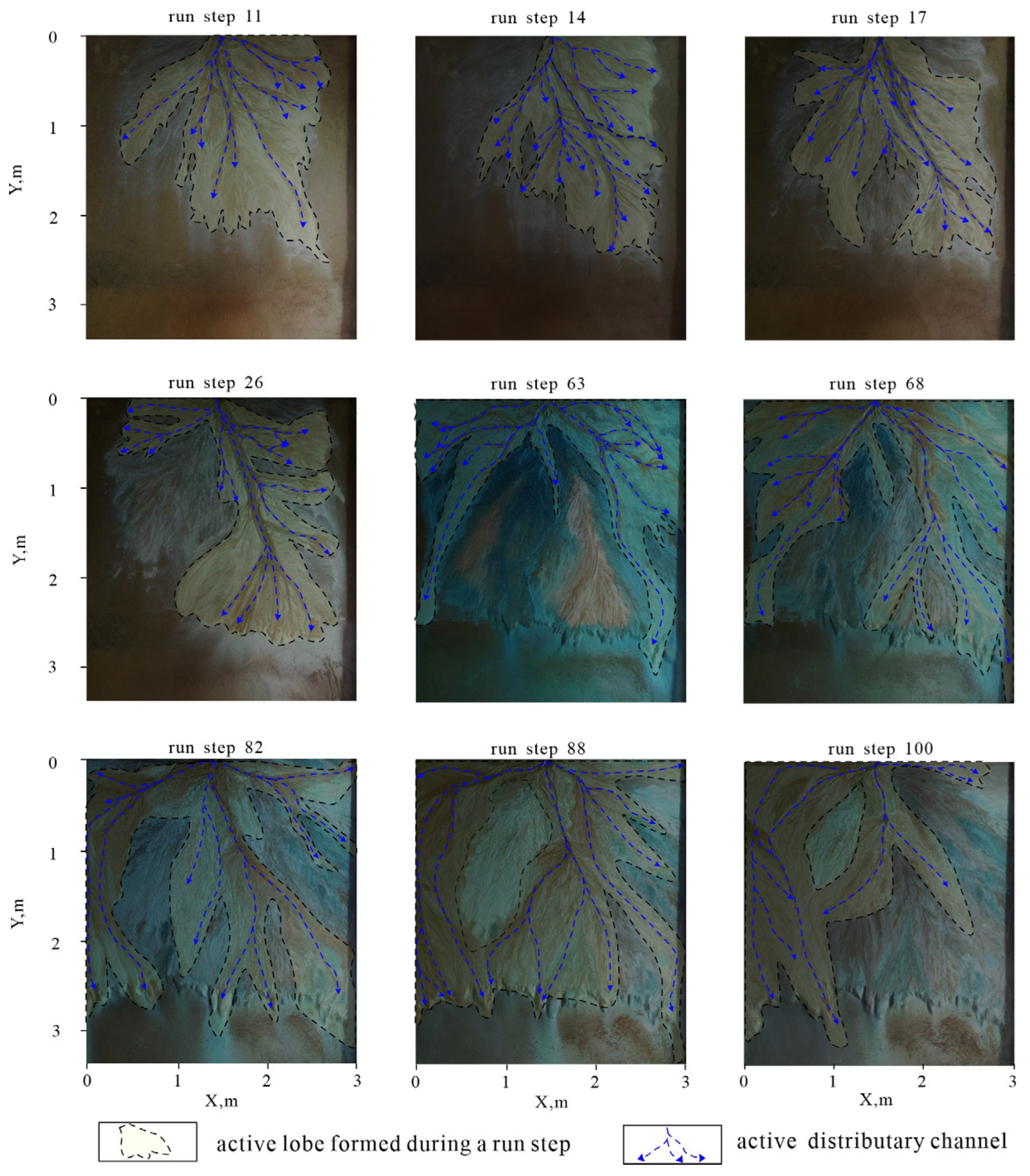
In contrast to the SRDG, the distributary channel system in the MRDG is structurally simple. After the brief development of initial radial channels, the flow converged into a limited set of dominant distributaries. The high cohesion of the muddy sediments imparts significant erosion resistance to the banks, which suppresses lateral migration and avulsion. Newly formed secondary channels fail to be maintained due to insufficient flow strength and scouring capacity. Thus, unable to form a widely interlaced network, the system evolves into a pattern of fewer, stable, and elongated distributary channels (Figure 5).
The experiment ultimately formed a small, narrow, finger-like shallow delta, thereby highlighting the dominant control of high fine-grained content on sediment transport and depositional patterns (Figure 5).
This confined flow and sediment transport pattern concentrated deposition at the main channel’s front and sides. Consequently, the delta’s longitudinal progradation rate significantly outpaced lateral expansion, producing a distinctly elongated, finger-like morphology. Sediment thickness is highly heterogeneous, with thick bands concentrated along the main trunk and distributaries, while inter-channel areas received minimal deposition. Consequently, sand bodies at the delta front are often isolated or exhibit poor lateral connectivity, contrasting starkly with the extensive, blanket-like sands of fan-shaped deltas.

3.1.3. Contrasting Styles of Delta Evolution

The two comparative experiments produced distinct end-member morphologies at the delta front. The SRDG formed a large, fan-shaped delta, whereas the MRDG developed a small, elongated finger-like delta. The fan-shaped delta evolved through distinct stages: it began with radiating channel networks, progressed through a phase of differential growth and frequent avulsion to form a dense, interconnected network with widespread mouth bars, and ultimately achieved a broad fan-like morphology [28]. Sediment accumulation occurred primarily through lateral accretion and vertical stacking, resulting in significant lateral expansion. In contrast, the elongated, finger-like delta also initiated with radial channels, but flow rapidly concentrated into a few stable, prograding distributaries. Secondary channels were transient, leading to a system dominated by longitudinal extension. The resulting morphology was narrow and finger-like, with a progradation rate far exceeding the lateral expansion rate. Sediments were preferentially deposited along the main distributary channels (Table 2).

3.2. Sedimentary Architecture

3.2.1. Variations in Shallow-Water Delta Accretion

The architecture and evolution of shallow-water deltaic systems are governed by a dynamic equilibrium between erosion and deposition. The core of this process involves the migration and oscillation of distributary channels and the associated sedimentation of mouth bars. To quantify these dynamics, we calculated the detrended topographic difference between successive depositional cycles to derive the sediment thickness increment (STI) for a single phase. This approach not only maps the distribution of sediment thickness for each phase but also enables the calculation of the preserved sediment volume, thus providing a quantitative characterization of the scale and preservation potential of a single-phase channel–mouth bar complex. By stacking these increments in 3D, we reconstructed the final delta complex, which provides key data for deciphering its complete evolutionary history.
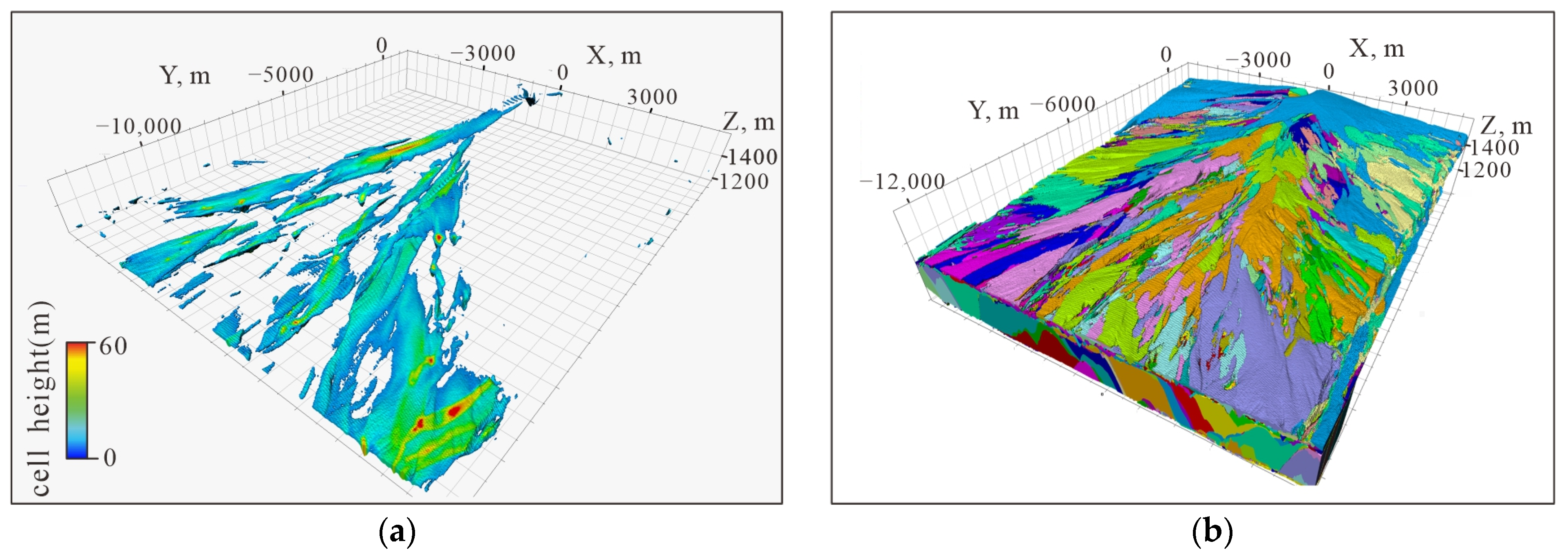
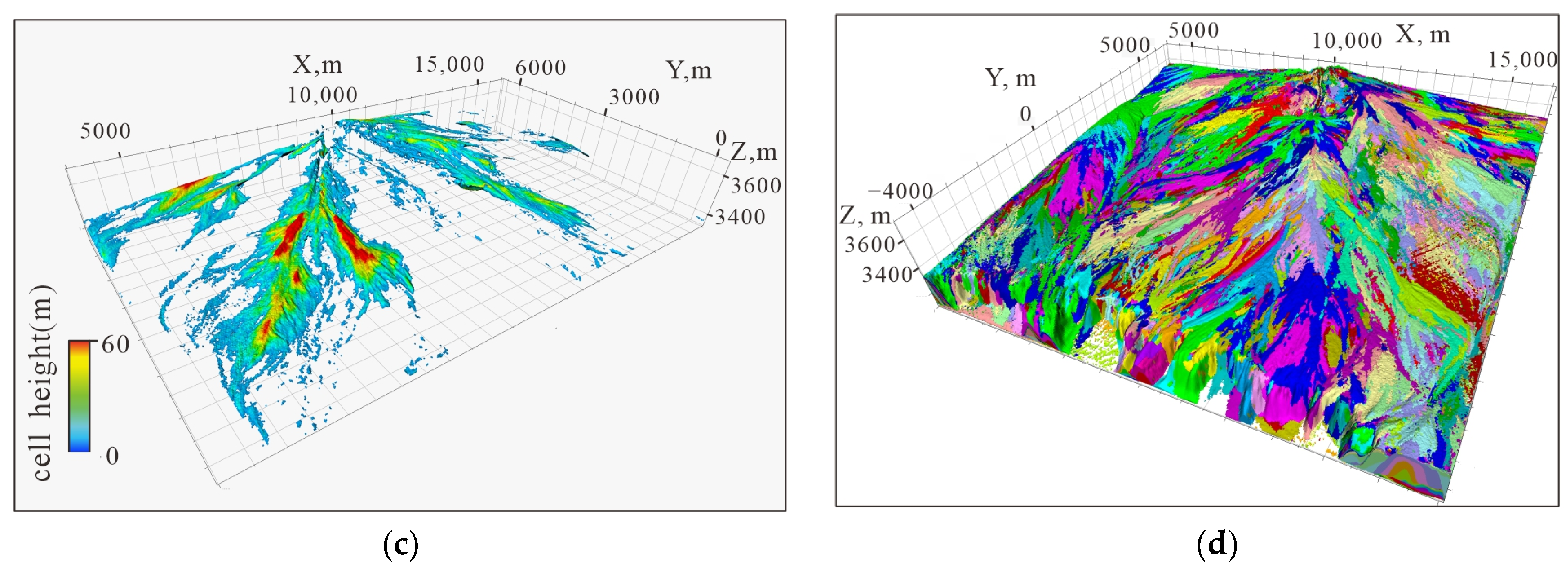
The sand-rich delta is primarily composed of large-scale, clustered, and multi-branched channel–mouth bar complexes. Single-phase sedimentary units are distributed radially along the distributary channels. Due to rapid lateral channel migration, individual channel–mouth bar complex displays a wide and flat morphology (Figure 6a). During multi-phase superposition, later-stage distributary channels frequently scoured significantly into pre-existing sand bodies. The erosion-to-deposition volume ratio was approximately 1:3, leading to poor preservation of the initial single-phase deposits. This process is characterized by scouring and subsequent vertical stacking, coupled with lateral splicing. Earlier deposits are extensively reworked by erosion and then assembled through the deposition of newer sediments. Ultimately, the multi-phase channel–mouth bar units are assembled through this cyclical erosion-filling process, forming thick, composite sand bodies. These sand bodies are characterized by continuous macroscopic distribution and complex internal heterogeneity (Figure 6b).
The mud-rich shallow-water delta is characterized by narrow, elongated, finger-like channel–mouth bar complex as its fundamental architectural elements. Upon entering the standing water body, the river’s hydrodynamic energy experiences a rapid decline, prompting sediment deposition along the flanks of the main channel to form these distinctive bar forms. Multiple channel–mouth bar complexes commonly share a single bifurcation point, while the distributary channels themselves remain relatively stable. Sedimentation is dominated by vertical aggradation. The main distributary channel constitutes the depocenter for each sedimentary phase, with thinner sediments also preserved in secondary channels (Figure 6c). During multi-phase superposition, the minimal migration of distributary channels results in later deposits draping directly over earlier ones. This process preserves individual sedimentary units with high integrity, clear vertical stacking relationships, and excellent stratigraphic continuity (Figure 6d).

3.2.2. Architectural Characteristics of the Sand-Rich Shallow-Water Delta

Building on the quantitative methods outlined in Section 2.3, the internal architecture and evolution of the sand-rich delta were further analyzed. High-resolution laser-scanned topographic data from the flume experiments enabled detailed interpretation of the internal architecture. Consistent with the methodology, the detrended topographic data for each phase accentuated the morphology and distribution of channels and associated mouth bars, revealing the evolutionary pathway of the delta system.
With progressive experimental phases, the delta exhibited significant transformation. In plan view, it evolved from a simple, nascent form into a large, composite lobate complexes of channel and mouth bars with intricate internal structure. In cross-section, the stratigraphic architecture transitioned from initial, simple vertical stacking to progressively more complex configurations dominated by channelized erosion, scour-and-fill, and lateral splicing.
The Downstream evolution of the depositional architecture from the proximal (near the sediment source) to distal (toward the lacustrine basin) delta is characterized as follows: In the proximal profile (Figure 7a), distributary channels are represented by multi-storey, broadly incised, and thick sand bodies, resulting from repeated erosion and deposition during channel migration. Thick proximal mouth bar deposits flank these channel complexes.
On the mid-stream section (Figure 7b), the distributary channels still exhibit evidence of lateral migration and incision, but their scale is significantly reduced compared to the upstream sections (Figure 7a). This indicates that channel bifurcation leads to a decrease in channel dimensions. Relatively large mouth bar deposits continue to develop on the flanks of these channels. These mouth bars are often incised by other distributary channels, resulting in the presence of multiple channels within a single channel–mouth bar complex, a characteristic consistent with modern deltaic deposition. Compared to the proximal section (Figure 7a), the channel–mouth bar association in the mid-stream section (Figure 7b) are smaller in scale but exhibit a greater number of depositional episodes.
The distal section (Figure 7c) reveals large-scale mouth bar complexes that formed at the depositional break in the distal delta front. These complexes, predominantly located in the lower part of the sections, date back to the earlier phases of delta development. With continued delta progradation, this depositional environment rapidly aggraded and flattened. Subsequently, the sedimentary record shows continued development of channel–mouth bar complex, which are notably reduced in scale relative to their proximal counterpart (Figure 7a).

3.2.3. Architectural Characteristics of the Mud-Rich Shallow-Water Delta

The mud-rich shallow-water delta is primarily composed of narrow, elongated channel–mouth bar complexes. In plan view, the delta evolves from a simple initial form into a composite of internally complex, elongated channel-bar complexes. In cross-section, the deposits transition from simple vertical stacking to more intricate architectures due to channelized erosion and cut-and-fill processes.
Section analysis reveals significant proximal-to-distal variation in the sedimentary architecture of the mud-rich delta as well.
In the proximal section (Figure 8a), the channel–mouth bar complexes are relatively larger than those in the mid and distal sections but smaller than their counterparts in the sand-rich delta (Figure 7a). Distributary channels are predominantly small and isolated, exhibiting negligible lateral migration. Channel filling and abandonment typically occur through vertical aggradation. Sedimentary thickening centers are aligned along the main distributary channels, resulting in significant lateral variation in stratigraphic thickness, contrasting with the thick, blanket-like strata of sand-rich deltas.
The mid-stream section (Figure 8b) shares similar characteristics with the proximal section. Distributary channels are mostly isolated, and mouth bars show vertical stacking. The scale of the channel–mouth bar complexes further diminishes, and their internal structure remains relatively simple, incomparable to the large-scale, extensively interconnected channel–mouth bar complexes of the sand-rich delta.
In the distal section (Figure 8c), larger-scale mouth bars develop at the depositional slope break, but their size remains considerably smaller than those in the sand-rich delta system.
In summary, the distributary channels in the mud-rich shallow-water delta are characterized by limited number, small scale, and restricted lateral migration, which hinders the development of wide, continuous channel sand bodies. Simultaneously, the channel–mouth bar complexes are limited in scale and exhibit low vertical stacking density, resulting in poor large-scale vertical connectivity of the sand bodies.

3.3. Quantitative Geological Knowledge Extraction and Analysis

3.3.1. Extraction Methodology of Quantitative Parameters

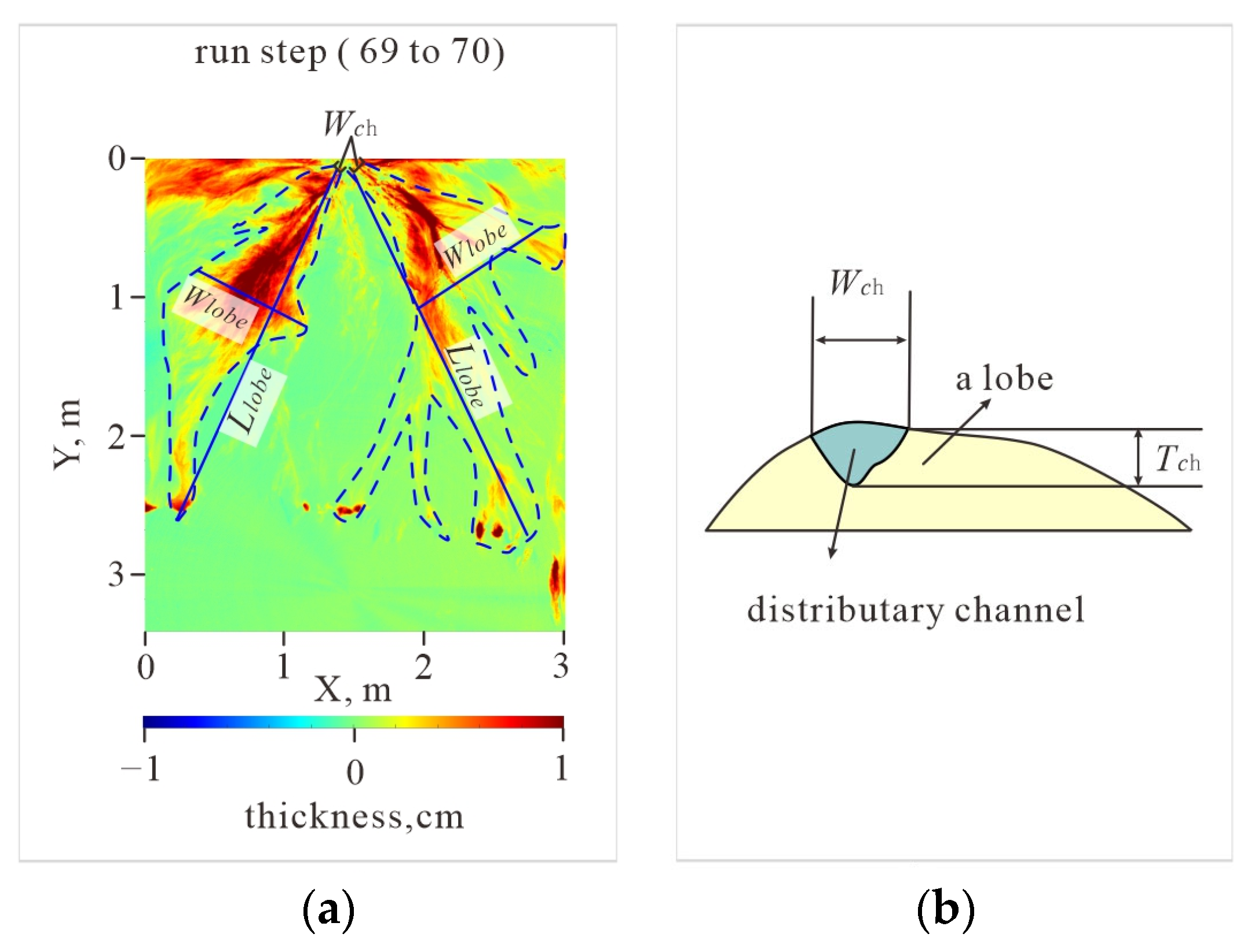
Flume experiments were used to systematically reconstruct the sedimentary evolution and architectural patterns of two end-member shallow-water delta types. By analyzing sediment thickness distribution and stratigraphic profiles, the boundaries of units such as distributary channels and mouth bars were identified, enabling direct measurement of scale data including the width, length, and thickness of target units. Planar geometric parameters were extracted, including lobe length (Llobe) and width (Wlobe), as well as distributary channel width within lobes (Wch) (Figure 9a). Here, a lobe refers to the sedimentary unit formed during each discrete simulation cycle, comprising a distributary channel and its associated mouth bars. These measurements enabled the calculation of the lobe length-to-width ratio (Llobe/Wlobe) and the lobe-to-channel width ratio (Wlobe/Wch). Vertically, the channel width (Wch) and depth (Tch) (Figure 9b) were extracted. This allowed for the calculation of the channel width-to-depth ratio (Wch/Tch), quantifying sand body dimensions and establishing a prototype geological knowledge database for shallow-water deltas. This knowledge base can be applied to reservoir studies of shallow-water deltas in various lacustrine basins, providing quantitative geological constraints for detailed reservoir architecture characterization and the prediction of favorable exploration zones.

3.3.2. Planar Geometric Characteristics and Differences

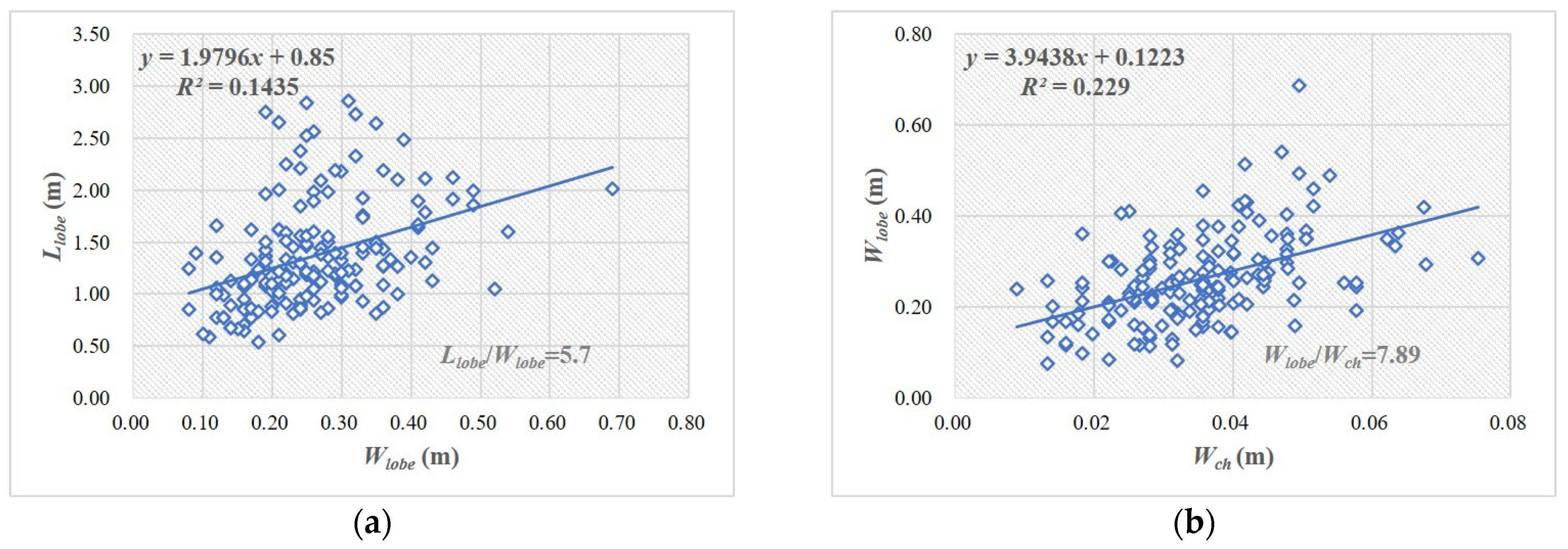
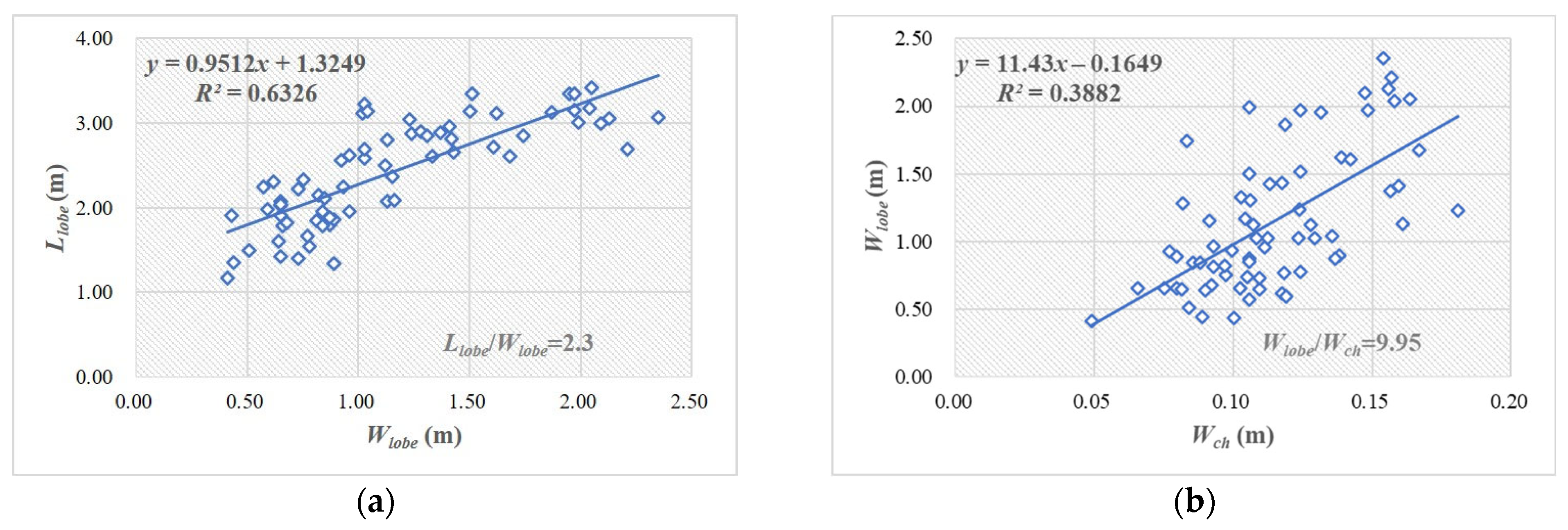
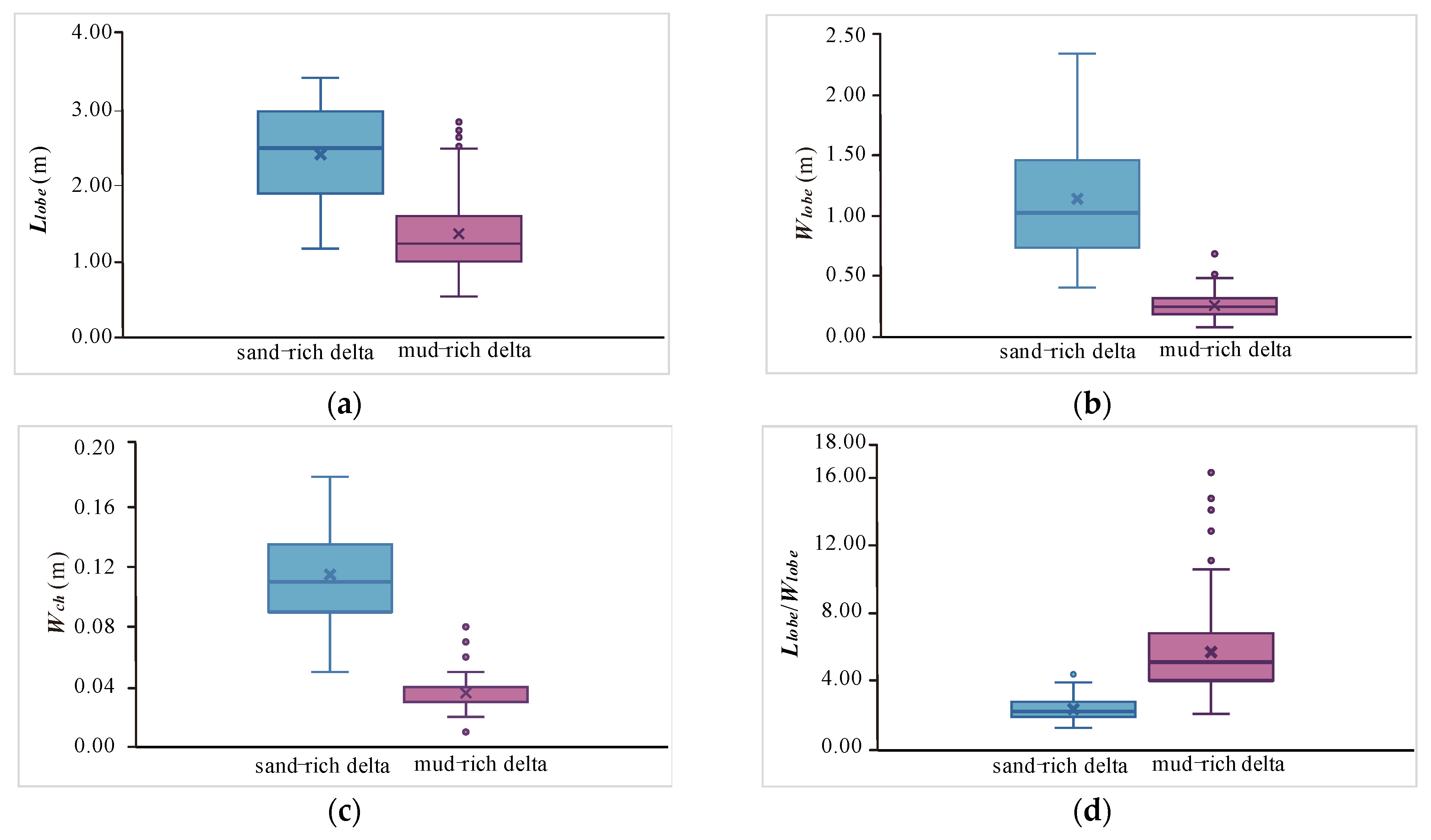
Quantitative analysis of planar geometries revealed distinct differences between the two delta types. Lobes in SRDG exhibit a lower Llobe/Wlobe (mean = 2.3) (Figure 10a), and show a higher Wlobe/Wch (mean = 9.95) (Figure 10b). In contrast, lobes in MRDG display a higher Llobe/Wlobe (mean = 5.7) (Figure 11a), and have a lower Wlobe/Wch (mean = 7.89) (Figure 11b). Furthermore, lobes in SRDG are generally wider, longer, and larger in scale (Figure 12a,b), extending from the delta plain to the foreset slope break, with significantly wider distributary channels (Figure 12c), yet they maintain a lower Llobe/Wlobe compared to lobes in MRDG (Figure 12d).

3.3.3. Vertical Geometric Characteristics and Differences

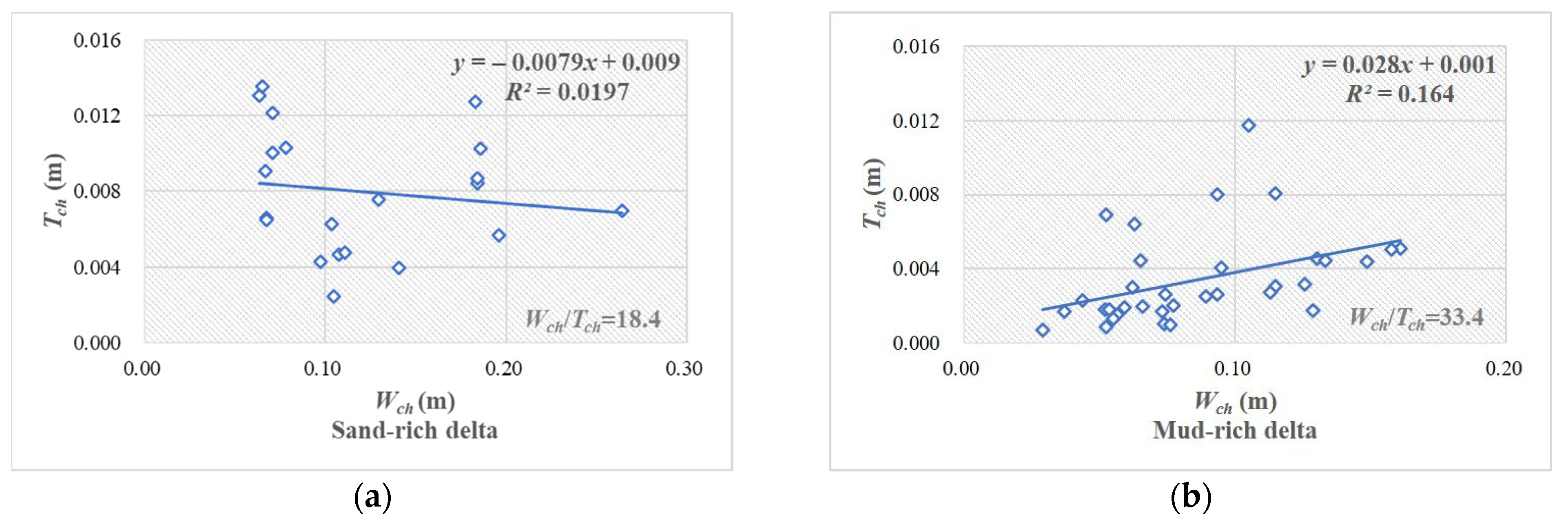
The vertical dimensional analysis further highlighted the contrast between the two delta types. Analysis of the channel sand bodies revealed a distinct pattern: channels in the SRDG have a smaller width-to-depth ratio (mean = 18.4) (Figure 13a), while those in the MRDG exhibit a greater ratio (mean = 33.4) (Figure 13b).

4. Discussion

4.1. Reliability Validation Using Modern Delta Analogues

The flume experiments demonstrate the fundamental control of the sand–mud ratio on deltaic morphology and architecture. To validate these findings, the results were benchmarked against typical modern shallow-water deltas. The comparison results indicate that the experiments successfully reproduced the two end-member delta morphologies found in nature: sand-rich and mud-rich deltas.
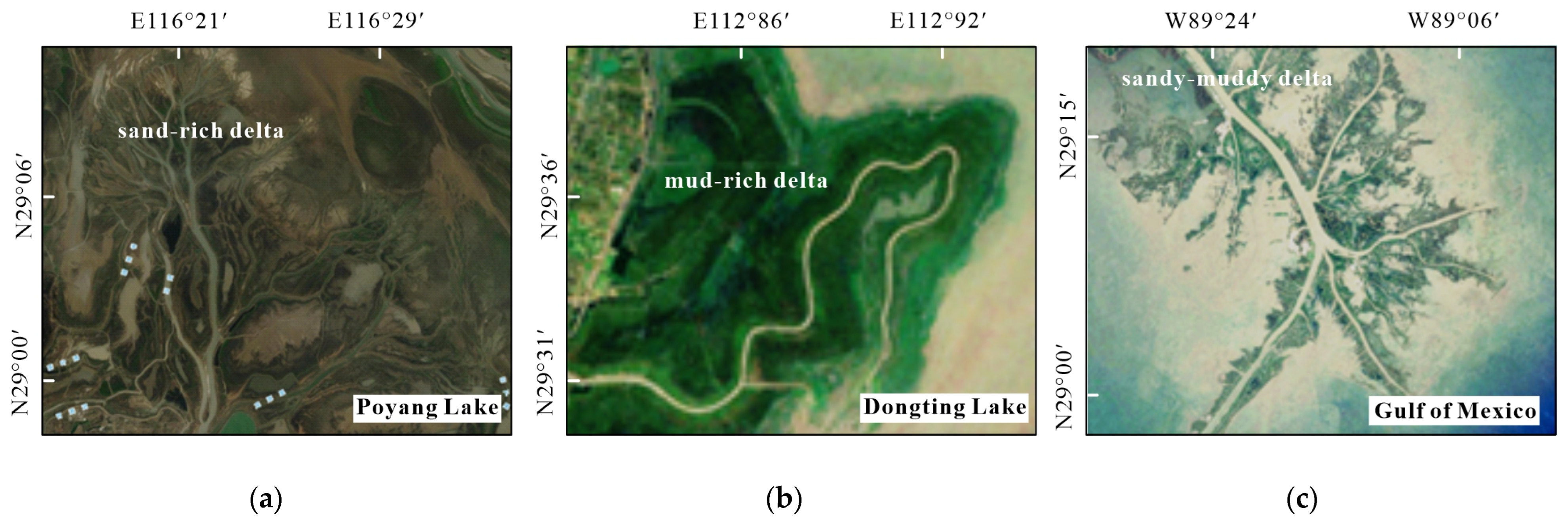
First, the morphologies generated in our experiments show strong agreement with modern delta analogues. The SRDG developed a broad, fan-shaped morphology characterized by a dense network of highly mobile and bifurcating channels and widely distributed mouth bars. This specific pattern matches the morphology of the modern Ganjiang delta (Figure 14a). It corresponds to the distributary-mouth bar delta type as described by Wu et al. [8], Zhang et al. [3], and Xu et al. [29], which is equivalent to the overlapping delta type established in earlier studies by Yin et al. [7]. The MRDG produced a distinct, narrow, and elongated morphology, featuring a stable, extending channel with isolated bars. This pattern is replicated in the modern Ouchi River delta (Figure 14b), a quintessential mud-rich shallow-water delta. The fine-grained, cohesive nature of its sediments confers high bank stability, facilitating the prolonged, long-distance progradation of distributary channels observed in both the experiment and the natural analogue [21,22]. Based on these characteristics, this morphological type has been categorized as a finger-bar type [8,12] or a distributary-channel type [3]. The Mississippi River delta (Figure 14c) serves as a natural example of a sandy–muddy transitional shallow delta [30]. Its hierarchical bifurcations and complex channel-bar systems corroborate the universal patterns identified in our experiments [31]. The systematic consistency in large-scale morphology confirms that our experimental setup effectively simulates natural delta formation.
Second, the experiments reveal quantifiable patterns in channel behavior that provide objective criteria for classifying modern deltas. As shown in Figure 4 and Figure 5, sand-rich deltas develop a high number of active channels due to vigorous bifurcation, whereas mud-rich deltas extend predominantly unidirectionally with fewer branches. This finding is consistent with observations of modern systems: the Ganjiang Delta exhibits a high-density, dendritic channel network [9,10,29], while the finger-like Ouchi River delta is characterized by a low-density, trunk-dominated system. These contrasts demonstrate that active channel count or shoreline channel density can serve as effective quantitative parameters for distinguishing shallow-water delta types. By capturing not only the macroscopic forms but also the underlying dynamics, the experiments validate their own reliability at a mechanistic level.
Finally, the results of this experiment are in line with previous numerical simulations, collectively affirming the controlling role of the sand–mud ratio. For instance, prior modeling has indicated that even a 10% clay content can increase sediment cohesion and bank resistance, shifting delta morphology from fan-shaped to bird-foot-like [6]. Our physical experiment visually replicates this morphological transformation and further quantifies the associated differences in channel network structure. Thus, it provides tangible mechanistic support and empirical validation for earlier numerical inferences.
In summary, the reasonableness and reliability of our experimental design are confirmed through comparisons with global delta analogues at three distinct levels: macroscopic morphology, quantitative channel-network metrics, and intrinsic dynamics. The sedimentation patterns and internal architectures derived from these experiments hold direct relevance for predicting the geometry and distribution of subsurface deltaic reservoirs.

4.2. The Universality of Sand–Mud Ratio Controls in Shallow-Water Deltas

The experimental results and their validation against modern analogues (Section 4.1) demonstrate a deterministic relationship between the sand–mud ratio and deltaic architecture. This section argues that this relationship is not merely correlative but is governed by a universal causal mechanism—the control of sediment cohesion on bank stability and channel dynamics—which produces predictable and widely applicable stratigraphic patterns.
The core of this mechanism lies in how the sand–mud ratio fundamentally regulates distributary channel behavior. A high sand–mud ratio results in non-cohesive banks that are readily eroded [4,16,32]. This promotes flow dispersion, frequent channel migration and reoccupation, and vigorous bifurcation, to form a densely interconnected, dendritic network. In contrast, a low sand–mud ratio enhances cohesive bank strength [13], which confines the flow [4]. This suppresses lateral migration and favors sustained, long-distance progradation of a few stable channels. A critical process in mud-rich systems is asymmetric bifurcation, where the preferential avulsion of one channel branch, coupled with the stabilization of the other, is a key dynamical process responsible for transforming fan-shaped deltas into elongated, finger-like or branching forms. Consequently, as the sand–mud ratio decreases, measurable network metrics—such as channel density, the number of active channels, and the hierarchy of bifurcations—decrease systematically.
These differences in channel dynamics, in turn, dictate distinct reservoir architectures and heterogeneity patterns. In sand-rich systems, the pervasive migration and stacking of channels result in poorly preserved, amalgamated mouth bars that form extensive, laterally connected sand bodies. Here, the primary heterogeneity is vertical, manifested as internal permeability barriers. Conversely, in mud-rich systems, stable channels allow for the full, vertical accretion of well-preserved mouth bars. However, these high-quality sand bodies become laterally isolated by muddy abandoned channels and floodplain deposits, creating a system dominated by strong areal heterogeneity.
Critically, this causal chain is validated by its recurrence across a wide spectrum of basin types and geological ages. The archetypal sand-rich shallow-water deltas of the Triassic Yanchang Formation in the Ordos Basin [11] are characterized by widely distributed and interconnected sand sheets, consistent with the SRDG model. Conversely, the mud-rich, finger-like deltas observed in the Neogene Minghuazhen Formation of the Bohai Bay Basin [33] exhibit the stable, elongated channels and isolated sand bodies replicated by the MRDG. This pattern, repeated from Cenozoic to Mesozoic and older stratigraphic records, confirms that the sand–mud ratio control is a fundamental attribute of shallow-water deltaic systems.
Therefore, positioning a study target within this sand–mud ratio spectrum and identifying its end-member affinity is a prerequisite for building accurate depositional models, predicting high-quality reservoir distribution, and understanding reservoir heterogeneity in subsurface exploration.

4.3. Further Implications for Petroleum Exploration and Development

This study, through a pair of comparative flume experiments, reveals significant differences in the sedimentary architecture of shallow-water deltas with contrasting sediment sources—the sand-rich and mud-rich end members. While conventional understanding has largely focused on variations between deltas in different basins, this research demonstrates that even within a single large lacustrine basin, a large shallow-water delta system can develop pronounced heterogeneity due to its inherent bifurcation dynamics. This provides new insights for understanding the complex structure of large shallow-water delta systems and for formulating refined development strategies.
The bifurcation-driven mechanism is the fundamental process for the progradation of fluvial-dominated shallow-water deltas. In this process, mouth bars formed at channel termini split the flow into two sub-channels, a bifurcation that is inherently asymmetric. Typically, one sub-channel becomes dominant—wider, accommodating greater discharge and coarser sediment—while the other remains subordinate, carrying less flow and finer sediment. This divergence initiates a feedback loop, resulting in the development of independent lobes with distinct sand-to-mud ratios, morphologies, and internal architectures within the same large shallow-water delta system, even under identical lacustrine conditions and uniform basin settings.
Consequently, large shallow-water deltas cannot be simplified as a homogeneous “layer-cake” model, nor should a single depositional model be uniformly applied across their entire extent. Recognizing this inherent heterogeneity is crucial. Exploration and development strategies must adopt differentiated facies models tailored to specific blocks and stratigraphic intervals to achieve precise reservoir characterization and prediction.

5. Conclusions

  • Key controlling factor: The sand–mud ratio of sediments is a key internal factor controlling the developmental type of shallow-water deltas. Sand-rich sediments (non-cohesive) promoted frequent migration and avulsion of distributary channels, forming dense dendritic channel networks and broad fan-shaped deltas. In contrast, mud-rich sediments (cohesive) enhanced bank stability, which restricted lateral channel migration, allowing rivers to maintain a single main channel for long-distance progradation, ultimately forming elongated finger-like deltas.
  • Internal architecture: Sand-rich deltas are composed of multi-phase “channel–mouth bar complexes” formed by vertical stacking and lateral amalgamation. Their sand bodies exhibit blanket-like continuous distribution with good connectivity but complex internal heterogeneity. Mud-rich deltas, however, consist of isolated, ribbon-like complexes, with sand bodies concentrated along the main channels. They display clear vertical stacking relationships but poor lateral continuity, exhibiting strong lateral heterogeneity.
  • Validation and implications: Validation against the sand-rich Ganjiang Delta and the mud-rich Ouchi River Delta demonstrates high consistency between the experimental models and natural prototypes, confirming the universality of sand–mud ratio control on delta autogenic evolution. Quantitative parameters extracted from this study, such as channel width-to-depth ratio and lobe length-to-width ratio, provide a predictive basis for subsurface reservoir characterization and underscore the inherent heterogeneity within large delta systems, necessitating differentiated exploration and development strategies tailored to specific blocks.

Author Contributions

Conceptualization, T.Y., J.L. and W.F.; methodology, J.L., Y.W. and S.L.; software, W.F.; validation, T.Y., J.L. and W.F.; formal experiment and analysis, J.L., Z.Z. and W.F.; investigation, J.L., S.L., Y.W., Z.Z. and W.F.; resources, J.L. and S.L.; data curation, J.L., W.F., T.Y. and S.L.; writing—original draft, J.L.; writing—review and editing, J.L., S.L. and W.F.; visualization, J.L. and W.F.; supervision, T.Y., Y.W., Y.Q. and W.F.; project administration, T.Y., J.L. and W.F.; funding acquisition, J.L., W.F. and T.Y. All authors have read and agreed to the published version of the manuscript.

Funding

This study was supported by the National Natural Science Foundation of China (No. 42130813).

Data Availability Statement

The original contributions presented in the study are included in the article, further inquiries can be directed to the corresponding author.

Conflicts of Interest

Authors Youjing Wang and You Qi were employed by the company PetroChina Research Institute of Petroleum Exploration and Development. The remaining authors declare that the research was conducted in the absence of any commercial or financial relationships that could be construed as a potential conflict of interest.

References

  1. Caldwell, R.L.; Edmonds, D.A.; Baumgardner, S.; Paola, C.; Roy, S.; Nienhuis, J.H. A global delta dataset and the environmental variables that predict delta formation on marine coastlines. Earth Surf. Dynam. 2019, 7, 773–787. [Google Scholar] [CrossRef]
  2. Bhattacharya, J.P.; Howell, C.D.; MacEachern, J.A.; Walsh, J.P. Bioturbation, sedimentation rates, and preservation of flood events in deltas. Palaeogeogr. Palaeoclimatol. Palaeoecol. 2020, 560, 110049. [Google Scholar] [CrossRef]
  3. Zhang, C.M.; Yin, T.J.; Zhu, Y.J.; Ke, L.M. Shallow water delta sedimentary model. J. Sediment. Res. 2010, 28, 933–944. [Google Scholar]
  4. Orton, G.J.; Reading, H.G. Variability of deltaic processes in terms of sediment supply, with particular emphasis on grain size. Sedimentology 1993, 40, 475–512. [Google Scholar] [CrossRef]
  5. Burpee, A.P.; Slingerland, R.L.; Edmonds, D.A.; Parsons, D.; Best, J.; Cederberg, J.; McGuffin, A.; Caldwell, R.; Nijhuis, A.; Royce, J. Grain–size controls on the morphology and internal geometry of river–dominated deltas. J. Sed. Res. 2015, 85, 699–714. [Google Scholar] [CrossRef]
  6. Edmonds, D.A.; Slingerland, R.L. Significant effect of sediment cohesion on delta morphology. Nat. Geosci. 2010, 3, 105–109. [Google Scholar] [CrossRef]
  7. Yin, T.J.; Li, X.Y.; Zhang, C.M.; Zhu, Y.J.; Gong, F.H. Morphological characteristics of sedimentary sandbodies in modern shallow lake basin deltas: A case study of Dongting Lake and Poyang Lake. J. Pet. Nat. Gas Technol. 2012, 34, 1–7+166. [Google Scholar]
  8. Wu, S.H.; Xu, Z.H.; Liu, Z. Depositional architecture of fluvial-dominated shoal water delta. J. Palaeogeogr. 2019, 21, 202–215. [Google Scholar]
  9. Duan, D.P.; Hou, J.G.; Liu, Y.M.; Wang, C.G.; Gao, J. Quantitative research of fluvial–dominated delta front sedimentary system: A case study of Poyang Lake delta. Acta Sedimentol. Sin. 2014, 32, 270–277. [Google Scholar]
  10. Jin, Z.K.; Li, Y.; Gao, B.S.; Song, B.Q.; He, Y.H.; Shi, L.; Li, G.Z. Depositional model of modern gentle-slope delta: A case study from Ganjiang Delta in Poyang Lake. Acta Geol. Sin. 2014, 32, 710–723. [Google Scholar]
  11. Liu, H.; Qiu, Z.; Xu, L.; Wang, F.; Tong, Q.; Lin, J.H.; Yin, S.; Wang, W.Q. Distribution of shallow water delta sand bodies and the genesis of thick layer sand bodies of the Triassic Yanchang Formation, Longdong Area, Ordos Basin. Pet. Explor. Dev. 2021, 48, 123–135. [Google Scholar] [CrossRef]
  12. Xu, Z.H.; Yang, S.; Zhang, T.Y.; Wu, S.H.; Zhang, K.; Chen, M.; Yang, Z.; Gao, Z.J.; Zhang, C.M. Sharp change of the channel bar pattern within the river delta: Insights from modern Ganjiang River delta in Jiangxi province, China. Interpretation 2023, 11, SA105–SA114. [Google Scholar] [CrossRef]
  13. Caldwell, R.L.; Edmonds, D.A. The effects of sediment properties on deltaic processes and morphologies: A numerical modeling study. J. Geophys. Res. Earth Surf. 2024, 119, 961–982. [Google Scholar]
  14. Edmonds, D.A.; Shaw, J.B.; Mohrig, D. Topset-dominated deltas: A new model for river delta stratigraphy. Geology 2011, 39, 1175–1178. [Google Scholar] [CrossRef]
  15. Feng, W.J.; Zhang, C.M.; Yin, T.J.; Yin, Y.S.; Liu, J.L.; Zhu, R.; Xu, Q.H.; Chen, Z. Sedimentary characteristics and internal architecture of a river-dominated delta controlled by autogenic process: Implications from a flume tank experiment. Pet. Sci. 2019, 16, 1237–1254. [Google Scholar] [CrossRef]
  16. Wang, L.X.; Xiong, G.; Yin, Y.S.; Feng, W.J.; Li, J.; Xie, P.F.; Hu, X.; Wang, X.X. Implications of Flume Simulation for the Architectural Analysis of Shallow-Water Deltas: A Case Study from the S Oilfield, Offshore China. J. Mar. Sci. Eng. 2025, 13, 2095. [Google Scholar] [CrossRef]
  17. Wang, Y.W.; Yu, Q.; Jiao, J.; Tonnon, P.K.; Wang, Z.B.; Gao, S. Coupling bedform roughness and sediment grain-size sorting in modelling of tidal inlet incision. Mar. Geol. 2016, 381, 128–141. [Google Scholar] [CrossRef]
  18. Jenkins, R.L., III; Smith, C.G.; Passeri, D.L.; Ellis, A.M. Model Sensitivity Analysis for Coastal Morphodynamics: Investigating Sediment Parameters and Bed Composition in Delft3D. J. Mar. Sci. Eng. 2024, 12, 2108. [Google Scholar] [CrossRef]
  19. Hawie, N.; Covault, J.A.; Sylvester, Z. Grain-size and discharge controls on submarine-fan depositional patterns from forward stratigraphic models. Front. Earth Sci. 2019, 7, 334. [Google Scholar] [CrossRef]
  20. Wang, J.H.; Muto, T.; Urata, K.; Sato, T.; Naruse, H. Morphodynamics of river deltas in response to different basin water depths: An experimental examination of the Grade Index model. Geophys. Res. Lett. 2019, 46, 5265–5273. [Google Scholar] [CrossRef]
  21. Hoyal, D.C.J.D.; Sheets, B.A. Morphodynamic evolution of experimental cohesive deltas. J. Geophys. Res. 2009, 114, F02009. [Google Scholar] [CrossRef]
  22. Straub, K.M.; Li, Q.; Benson, W.M. Influence of sediment cohesion on deltaic shoreline dynamics and bulk sediment retention: A laboratory study. Geophys. Res. Lett. 2015, 42, 9808–9815. [Google Scholar] [CrossRef]
  23. Bryant, M.; Falk, P.; Paola, C. Experimental study of avulsion frequency and rate of deposition. Geology 1995, 23, 365–368. [Google Scholar] [CrossRef]
  24. Zhang, L.; Bao, Z.D.; Yan, L.B.; Chen, Y.M.; Lin, X.H.; Dou, L.X.; Kong, B. Genetic types and sedimentary model of sandbodies in a shallow-water delta: A case study of the first Member of Cretaceous Yaojia Formation in Qian’an area, south of Songliao Basin, NE China. Pet. Explor. Dev. 2017, 44, 770–779. [Google Scholar] [CrossRef]
  25. Fu, C.; Yu, X.H.; Li, S.L. Multiple sediment source infill in a low-accommodation basin: Implications for the late Paleozoic sediment routing system in the southeastern Ordos Basin. Geol. Mag. 2023, 160, 1649–1672. [Google Scholar] [CrossRef]
  26. Edmonds, D.A.; Slingerland, R.L. Mechanics of river-mouth bar formation: Implications for the morphodynamics of delta distributary networks. J. Geophys. Res. Earth Surf. 2007, 112, F02034. [Google Scholar] [CrossRef]
  27. Federici, B.; Paola, C. Dynamics of channel bifurcation in non-cohesive sediments. Water Resour. Res. 2003, 39, 1162. [Google Scholar] [CrossRef]
  28. Qi, Y.; Wang, Y.J.; Qin, G.S.; Song, Y.C.; Zhang, H.L.; Meng, F.L. Sedimentary evolutionary processes, architecture, and sedimentary model of a lobate shallow-water delta: Insights from flume simulation experiments. Front. Earth Sci. 2024, 1, 1393211. [Google Scholar] [CrossRef]
  29. Xu, Z.H.; Deng, H.; Wu, S.H.; Yue, D.L.; Liu, Y.M.; Li, Q. Depositional architecture and formative mechanism of dendritic bars within river-dominated shallow-water delta front. J. Palaeogeogr. 2024, 26, 1338–1351. [Google Scholar]
  30. Day, J.W.; Britsch, L.D.; Hawes, S.R.; Shaffer, G.P.; Reed, D.J.; Cahoon, D. Pattern and process of land loss in the Mississippi Delta: A spatial and temporal analysis of wetland habitat change. Estuaries 2000, 23, 425–438. [Google Scholar] [CrossRef]
  31. Aslan, A.; Autin, W.J.; Blum, M.D. Causes of river avulsion: Insights from the late Holocene avulsion history of the Mississippi River, USA. J. Sediment. Res. 2005, 75, 650–664. [Google Scholar] [CrossRef]
  32. Falcini, F.; Jerolmack, D.J. A potential vorticity theory for the formation of elongate channels in river deltas and lakes. J. Geophys. Res. 2010, 115, F04038. [Google Scholar] [CrossRef]
  33. Xu, Z.H.; Wu, S.H.; Liu, Z.; Zhao, J.S.; Geng, H.L.; Wu, J.C.; Zhang, T.Y.; Liu, Z.W. Sandbody architecture of the bar finger within shoal water delta front: Insights from the Lower Member of Minghuazhen Formation, Neogene, Bohai BZ25 Oilfield, Bohai Bay Basin, East China. Pet. Explor. Dev. 2019, 46, 322–333. [Google Scholar] [CrossRef]
Figure 1. Schematic diagram of the experimental set-up.
Jmse 14 00593 g001
Figure 2. Grain size distribution of the supplied sediments and bedform materials. (a) Grain size distribution for the Sand-Rich Delta Group (SRDG). (b) Grain size distribution for the Mud-Rich Delta Group (MRDG).
Jmse 14 00593 g002
Figure 3. Locations and labels of analyzed transverse sections on DEMs. (a) Section locations in the Sand-Rich Delta Group (SRDG). (b) Section locations in the Mud-Rich Delta Group (MRDG).
Jmse 14 00593 g003
Figure 4. Orthorectified images documenting the morphological evolution of the sand-rich shallow water delta in the SRDG.
Jmse 14 00593 g004
Figure 5. Orthorectified images documenting the morphological evolution of the mud-rich shallow water delta in the MRDG.
Jmse 14 00593 g005
Figure 6. 3D architectural models of single-phase units and multi-phase stacking patterns in two types of shallow-water deltas (enlarged to natural scale). (a) Single-phase model of the sand-rich delta. (b) Multi-phase stacking model of the sand-rich delta (each color represents a phase). (c) Single-phase model of the mud-rich delta. (d) Multi-phase stacking model of the mud-rich delta (each color represents a phase).
Jmse 14 00593 g006aJmse 14 00593 g006b
Figure 7. Architecture of the experimental sand-rich shallow-water delta. (a) Preserved strata of the experimental delta in section A1–A2. (b) Preserved strata of the experimental delta in section A3–A4. (c) Preserved strata of the experimental delta in section A5–A6.
Jmse 14 00593 g007
Figure 8. Architecture of the experimental mud-rich shallow-water delta. (a) Preserved strata of the experimental delta in section B1–B2. (b) Preserved strata of the experimental delta in section B3–B4. (c) Preserved strata of the experimental delta in section B5–B6.
Jmse 14 00593 g008
Figure 9. Methodology for extracting quantitative geological parameters from flume experiments of shallow-water deltas. (a) Planar geometric parameters (Llobe, Wlobe, Wch) measured on an incremental deposition map (MRDG, cycle 69–70). (b) Vertical geometric parameters (Wch, Tch) measured on a schematic stratigraphic section.
Jmse 14 00593 g009
Figure 10. Relationships between key planform geometric parameters in the sand-rich delta. (a) Wlobe vs. Llobe; (b) Wch vs. Wlobe.
Jmse 14 00593 g010
Figure 11. Relationships between key planform geometric parameters in the mud-rich delta. (a) Wlobe vs. Llobe; (b) Wch vs. Wlobe.
Jmse 14 00593 g011
Figure 12. Comparative analysis of key planform geometric parameters (Llobe, Wlobe, Wch, and Llobe/Wlobe) between the two delta types. (a) Box plots of Llobe for the two delta types. (b) Box plots of Wlobe for the two delta types. (c) Box plots of Wch for the two delta types. (d) Box plots of Llobe/Wlobe for the two delta types.
Jmse 14 00593 g012
Figure 13. Comparison of channel width-to-depth ratios (Wch/Tch) between the two delta types. (a) Channel width-to-depth ratios (Wch/Tch) of sand-rich shallow-water delta. (b) Channel width-to-depth ratios (Wch/Tch) of mud-rich shallow-water delta.
Jmse 14 00593 g013
Figure 14. Satellite images of three typical types of shallow water delta. (a) Ganjiang Delta, Poyang Lake, a sand-rich delta. (b) Ouchi River Delta, Dongting Lake, a mud-rich delta. (c) Mississippi Delta, Gulf of Mexico, a sandy–muddy delta.
Jmse 14 00593 g014
Table 1. Boundary condition of the flume experiments.
ParameterSRDGMRDG
bedform slope0.5°0.5°
d50 of supplied sediment92 μm35 μm
water discharge0.4 L/s0.385 L/s
sediment supply rate4 g/s0.96 g/s
polymer additionnoyes (Polyacrylamide, PAM)
experimental duration138 h100 h
Table 2. Differences in deltaic sedimentary evolution between the two sets of flume simulation experiments.
ParameterSRDGMRDG
growth patternsignificant lateral expansion in early stage with slowed marginal growth later; relatively balanced longitudinal and lateral progradation.dominated by sustained longitudinal extension; longitudinal propagation rate significantly exceeded the lateral expansion rate, with areal growth slowing markedly once initial radial channels formed, while the overall morphology continued to elongate.
stable phase characteristicsstable morphology with high internal dynamics; stable overall depositional architecture with rapid, frequent migration of distributary channels and constant reorganization of channel–mouth bar configurations.sustained elongation with relative internal stability; continuous longitudinal extension of the overall form; a relatively stable main channel system; secondary channels exhibiting instability yet having minor impact on delta growth.
sediment distribution patterndispersive sedimentation; sediments transported through numerous distributary channels and deposited around multiple mouth bars; resulting in widely dispersed depocenters.highly focused sedimentation; most sediments rapidly accumulated along main distributary channels; formed elongated mouth bars along the main distributary channels.
distributary channel characteristicscomplex dendritic system; high channel density with numerous active channels; frequent channel migration, avulsion, and reoccupation.main-channel dominated system; low channel count with 1 to several main channels being absolutely dominant; secondary channels were small-scale, weakly incised, and prone to avulsion and abandonment.
mouth bar characteristicsmulti-scaled and widely distributed; mouth bars readily formed at various channel termini; bars were moderate in size and broadly distributed.elongated and channel-attached; primarily formed narrow mouth bars tightly aligned with and controlled by the main distributary channels.
final morphologylarge, broad, fan-like delta.small, elongated, finger-like delta.
Disclaimer/Publisher’s Note: The statements, opinions and data contained in all publications are solely those of the individual author(s) and contributor(s) and not of MDPI and/or the editor(s). MDPI and/or the editor(s) disclaim responsibility for any injury to people or property resulting from any ideas, methods, instructions or products referred to in the content.