1. Introduction
The mesopelagic zone, extending approximately from 200 to 1000 m depth, represents one of the largest yet least directly observed ecosystems in the global ocean. This layer supports immense biological biomass and plays a central role in global biogeochemical cycles, particularly through its contribution to the biological carbon pump. Lanternfishes (family Myctophidae) dominate mesopelagic fish assemblages worldwide and are recognized as key mediators of energy and carbon transfer between surface and deep waters through extensive diel vertical migration [
1,
2]. Despite their numerical dominance and ecological importance, fundamental life-history parameters of many myctophid species, including age structure, growth rates, and longevity, remain poorly quantified, especially in the Northwest Pacific Ocean.
Previous studies on species of the genus
Diaphus have examined age, growth, and life-history traits in various oceanic regions, including the Atlantic and parts of the Pacific [
3,
4,
5]. However, studies explicitly focusing on
Diaphus gigas and
Diaphus perspicillatus remain limited and are often based on length–frequency analyses or indirect growth proxies rather than increment-based otolith microstructure. As a result, high-resolution, daily age estimates and direct interspecific comparisons of growth strategies for these two sympatric species are still scarce, particularly in the Northwest Pacific.
A primary reason for undertaking the present study lies in the persistent methodological limitations associated with conventional approaches used to infer growth and population dynamics of mesopelagic fishes. Length–frequency analysis, which is widely applied in fisheries science, often fails to resolve age structure in myctophids due to overlapping cohorts, size-selective sampling, and high natural mortality [
3,
6]. These constraints lead to substantial uncertainty in growth estimates and hinder robust comparisons among species or regions. Consequently, there is a strong need for increment-based age determination methods that can provide direct, high-resolution estimates of individual growth histories.
Otolith microstructure analysis offers a reliable and biologically grounded solution to these challenges. Sagittal otoliths accrete calcium carbonate in a chronological sequence, forming growth increments that are commonly deposited on a daily basis in teleost fishes [
7,
8]. Enumeration and measurement of these increments enable precise estimation of age, growth rate, and ontogenetic shifts in energy allocation. For mesopelagic fishes, where direct observation is limited, otolith microstructure provides one of the few means to reconstruct individual life histories with temporal resolution at the scale of days to weeks.
The present study addresses a clear and well-defined knowledge gap for two ecologically important species,
D. gigas and
D. perspicillatus, which are dominant components of lanternfish assemblages in the Northwest Pacific. Although species of the genus Diaphus have been investigated in other oceanic regions, Detailed age and growth information for these two species in the Northwest Pacific remains limited. In particular, high-resolution, increment-based age estimates and species-level growth trajectories are largely unavailable, as existing studies often focus on single species or rely on indirect growth proxies such as length–frequency data, which do not resolve daily growth variability or allow direct interspecific comparisons [
7].
Otolith increment width is widely used as a proxy for somatic growth rate in fishes, including mesopelagic species, because daily increment deposition generally reflects growth-related physiological processes. However, this relationship may weaken under certain environmental or physiological conditions, such as variability in temperature, food availability, or metabolic stress, and should therefore be interpreted within an ecological context. By directly comparing two sympatric species with contrasting body sizes and life-history traits using increment-based otolith microstructure, this study provides a framework for evaluating interspecific variability in growth strategies within a shared mesopelagic environment.
This paper is designed to provide readers with information that is both accessible and scientifically rigorous. Specifically, the study presents: (1) clear, increment-based age estimates for D. gigas and D. perspicillatus; (2) detailed descriptions of otolith microstructure that can be readily interpreted in relation to ontogenetic development; (3) species-specific growth trajectories derived from established nonlinear growth models; and (4) a comparative framework that highlights differences in life-history strategies between the two species. Results are presented in a figure-based manner to facilitate straightforward interpretation of growth patterns and age distributions. By concentrating on age determination, growth dynamics, and microstructural characteristics, this paper provides a coherent and focused contribution to mesopelagic fish ecology and establishes a robust baseline for future integrative studies in the Northwest Pacific Ocean.
2. Materials and Methods
2.1. Study Area and Sample Collection
Specimens of
D. gigas and
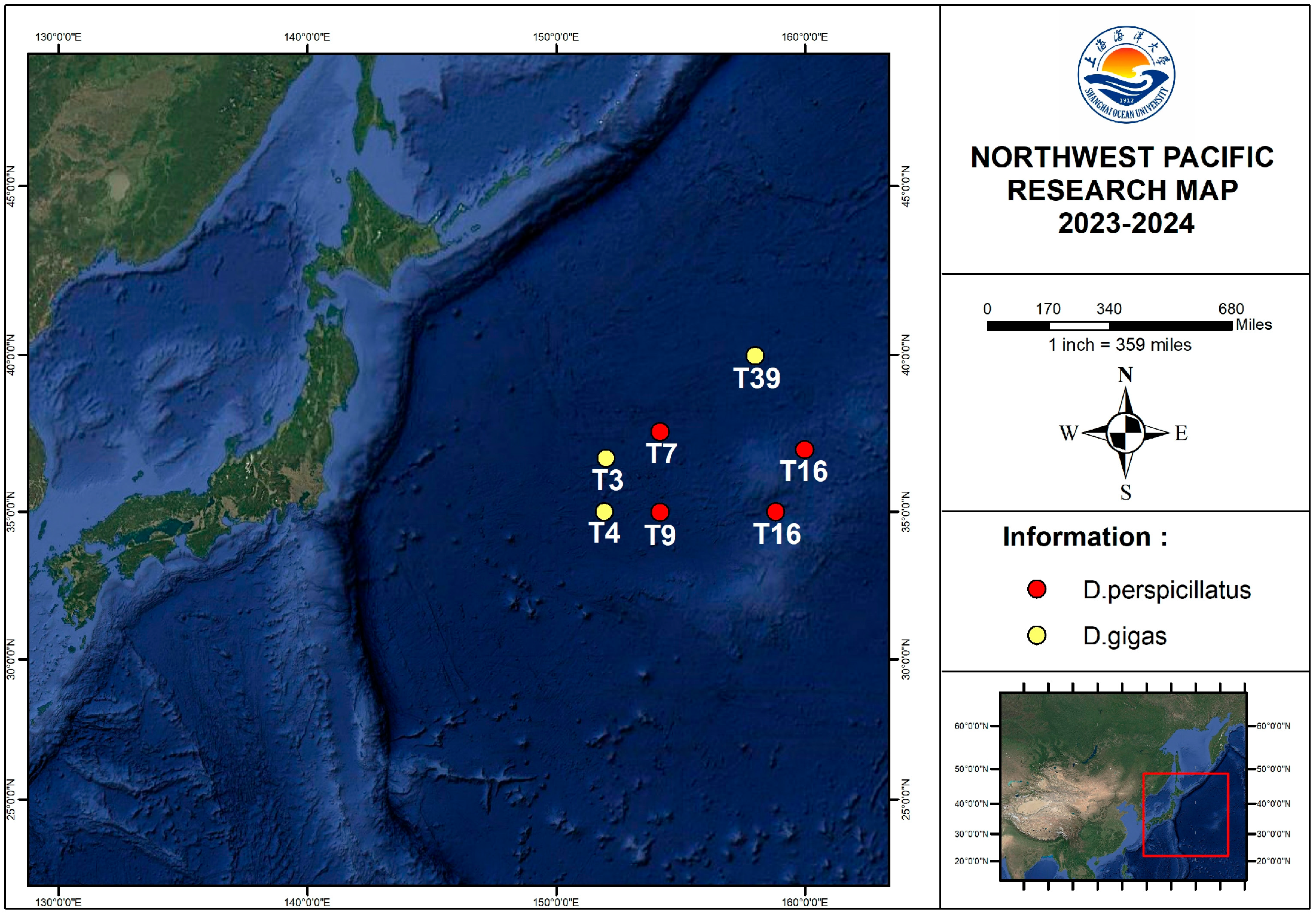
D. perspicillatus were collected during dedicated oceanographic surveys conducted in the Northwest Pacific Ocean between 2023 and 2024 (
Figure 1). Sampling targeted the mesopelagic zone, corresponding to depths typically occupied by lanternfish during diel vertical migration. The sampling employed a four-panel midwater trawl net with overall dimensions of approximately 434 m × 971 m, consisting of large mesh panels at the mouth, machine-knitted netting in the body, and a single cod-end structure consistent with standard midwater trawl configurations used in regional pelagic surveys. The net was equipped with dual foils and operated via a single sweep-line connection system, enabling effective pelagic sampling over a depth range of 0–500 m [
1,
2]. Trawling operations were conducted predominantly at night to reduce avoidance behavior associated with diel vertical migration; however, despite this approach, very small larvae and larger, fast-swimming individuals may remain underrepresented, and such potential size-selective bias is considered when interpreting the results.
Immediately after capture, specimens were sorted onboard and identified to species level following established taxonomic descriptions for the genus
Diaphus [
9]. Fork Length (FL) was measured to the nearest 0.1 mm using digital calipers (accuracy 0.1 mm, Mitutoyo, Kawasaki, Japan), and wet body weight was recorded to the nearest 0.01 g. All specimens were frozen onboard and transported to the laboratory for subsequent otolith extraction and analysis.
Biological parameters of
D. perspicillatus and
D. gigas specimens were recorded, including total fork length (mm) and body mass (g) (
Table 1 and
Table 2). Otoliths were carefully extracted through head dissection and stored in 1.5 mL microcentrifuge (Eppendorf, Hamburg, Germany) tubes containing 75% ethanol (Merck, Darmstadt, Germany) to preserve their integrity.
2.2. Otolith Extraction and Preparation
Sagittal otoliths were removed from each specimen under a stereomicroscope (Leica Microsystems, Wetzlar, Germany) using non-metallic forceps to minimize surface damage. Extracted otoliths were cleaned of adhering tissues with distilled water and air-dried prior to preparation. For microstructure analysis, otoliths were embedded in epoxy resin and sectioned through the core along the transverse plane using a low-speed diamond saw (Buehler, Lake Bluff, IL, USA).
Thin sections were mounted on glass slides with thermoplastic resin and polished sequentially with progressively finer grit lapping films until daily growth increments were clearly resolved. Prepared sections were examined under a compound microscope equipped with transmitted light illumination and a digital imaging system. Otolith preparation procedures followed standardized protocols commonly applied in daily increment studies of teleost fishes [
7,
10].
2.3. Age Determination and Increment Analysis
Age determination was based on enumeration of daily growth increments along a consistent reading axis from the otolith core to the outer margin. Increment deposition was assumed to occur on a daily basis, an assumption that has been widely validated for myctophid fishes and other pelagic teleosts [
8,
11]. To reduce reader bias and improve precision, increment counts were conducted by the same reader on three independent occasions, with a minimum interval of two weeks between successive readings. The mean of the three counts was used as the final age estimate for each individual. Reading precision was evaluated using the coefficient of variation (CV) among repeated counts, following established guidelines for otolith-based age studies [
8]. Otoliths exhibiting ambiguous increment patterns, unclear cores, or preparation artifacts were excluded from further analyses.
Increment width was measured at regular intervals along the growth axis to characterize ontogenetic changes in growth rate. Changes in increment spacing and microstructural appearance were used to identify transitions among larval, juvenile, and adult growth phases.
2.4. Growth Model Estimation
Somatic growth of
D. gigas and
D. perspicillatus was reconstructed by fitting otolith-based age–length data to multiple nonlinear growth models. The use of daily increment–derived age estimates provides a high-resolution temporal framework for evaluating growth trajectories, which is particularly important for mesopelagic fishes where length–frequency approaches often fail to resolve cohort structure [
3,
6,
8].
A multi-model approach was adopted to account for potential differences in growth form and life-history strategy between species. Reliance on a single growth model may bias parameter estimation, especially when species exhibit contrasting growth duration, maturation timing, or asymptotic size [
12,
13]. Therefore, three widely applied growth functions in fisheries and otolith studies were selected: the von Bertalanffy Growth Function (VBGF), the Gompertz model, and the Logistic model [
14,
15,
16].
The von Bertalanffy Growth Function was expressed as:
where
is the fork length (mm) at age
(days),
is the theoretical asymptotic length,
is the growth coefficient, and
is the hypothetical age at zero length [
12,
14].
The Gompertz growth model was defined as:
where
represents the growth rate parameter and
is the age at the inflection point [
15,
16].
The Logistic growth model was expressed as:
where
is the intrinsic growth rate and
denotes the inflection age [
14].
Model performance was evaluated using the coefficient of determination () and the bias-corrected Akaike’s Information Criterion (AICc), which accounts for small-sample bias in model selection [
11,
15]. The model with the lowest AICc value was selected as the most parsimonious representation of growth for each species, following standard fisheries growth analysis practice and consistent with Chen et al. (1992) [
16].
2.5. Growth Rate Estimation
Growth rate was quantified using both model-derived instantaneous growth speed and discrete absolute growth rate metrics to characterize somatic growth dynamics across ontogenetic stages. Growth speed was defined mathematically as the first derivative of length with respect to age, providing a continuous estimate of length increase per unit time (mm·day
−1). This derivative-based approach is commonly applied in otolith-based growth studies to identify periods of rapid growth and subsequent growth deceleration [
8,
11].
For the von Bertalanffy Growth Function, instantaneous growth speed was expressed as:
These formulations allow direct comparison of growth dynamics among models and facilitate identification of peak growth periods, which are biologically meaningful indicators of juvenile development and energy allocation [
6,
7]. In addition to instantaneous growth speed, absolute growth rate (AGR) was not calculated explicitly using a fixed time interval (Δ
t). Instead, growth patterns were evaluated descriptively based on age–length relationships and fitted growth curves derived from daily otolith age estimates. As such, references to growth rate in this study reflect relative differences in growth trajectories rather than formally computed AGR values.
Early-life growth was interpreted primarily from the rising phase of instantaneous growth curves and from widening otolith increment patterns, corresponding to larval and juvenile stages. This interpretation follows established conceptual links between increment width, metabolic activity, and somatic growth in otolith microstructure studies [
7,
17].
2.6. Statistical Analysis
This study adopts a descriptive and model-based analytical framework, consistent with the primary objective of reconstructing age structure and growth dynamics rather than testing specific hypotheses. Such an approach is widely applied in otolith microstructure and life-history studies of mesopelagic fishes, where high natural variability and sampling constraints limit the applicability of formal inferential statistics [
6,
18].
All data processing, growth model fitting, and visualization were conducted using Python (version 3.13). Core scientific libraries included NumPy (v2.2.6) and Pandas (v2.2.6) for data handling, SciPy (v1.16.3) for nonlinear optimization, and Matplotlib (v3.10.7) for graphical visualization [
18,
19]. Raw biological data, including individual age estimates and fork length measurements, were initially organized in spreadsheet format and subsequently imported into Python as comma-separated values (CSV) files for analysis.
Prior to model fitting, age–length datasets were screened to exclude individuals with ambiguous otolith readings or incomplete measurements, and data were grouped by species and sampling year for comparative analyses. Nonlinear growth models were fitted using functions in the scipy.optimize module, primarily curve_fit, which estimates model parameters by minimizing the sum of squared residuals between observed and predicted lengths. This objective function corresponds to maximum likelihood estimation under the assumption of normally distributed errors. Biologically realistic bounds were applied to constrain parameter estimation, including positive growth coefficients and asymptotic lengths exceeding observed maximum sizes.
Age–length relationships were visualized using scatter plots with fitted growth curves overlaid, and length-frequency and age-frequency distributions were constructed using fixed class intervals to facilitate comparison between species and sampling years. Length-frequency histograms were generated using a bin width of 5 mm, while age-frequency histograms were constructed using 30-day age classes. To distinguish biologically meaningful individual growth variability from potential measurement error, several quality-control procedures were applied. Otolith ages were determined through repeated increment counts, and only specimens with consistent age estimates were retained for analysis. Length measurements were obtained following standardized protocols to minimize measurement uncertainty. Variability observed around fitted growth curves was therefore interpreted as biologically meaningful when it exceeded the expected range of counting or measurement error and showed consistent patterns across individuals, species, and sampling years, rather than random scatter attributable to observational uncertainty.
4. Discussion
4.1. Otolith Microstructure as a Record of Ontogenetic Growth
Sagittal otolith microstructure provides a reliable and high-resolution record of individual growth histories in mesopelagic fishes, reducing uncertainty associated with cohort overlap that commonly limits length–frequency approaches [
5,
6]. Increment-based age determination allows ontogenetic growth processes to be reconstructed with daily resolution, which is particularly valuable for lanternfishes characterized by rapid early growth and high natural mortality [
3,
4].
The clear correspondence between otolith microstructural patterns and age–length relationships observed in this study indicates that otolith microstructure serves as an independent and biologically meaningful archive of somatic growth trajectories. Differences in increment expression between
D. perspicillatus and
D. gigas are consistent with interspecific variation in growth rate dynamics and longevity, supporting the interpretation that these species follow fundamentally different growth strategies [
5,
6].
Such correspondence between otolith microstructure and growth dynamics has been widely documented in myctophid and other pelagic fishes, where changes in increment spacing reflect shifts in metabolic demand, energy allocation, and ontogenetic habitat use [
4,
7,
8]. In this context, otolith microstructure functions not only as a chronological marker but also as an integrative record linking individual growth history with broader life-history strategy [
3,
6].
4.2. Environmental Drivers of Individual Growth Variability
Individual growth variability observed in both D. perspicillatus and D. gigas is commonly associated with heterogeneous environmental conditions experienced since early life stages. Variability in food availability, temperature regimes, and oceanographic processes such as current strength and productivity gradients can result in divergent growth trajectories among individuals originating from the same cohort. In the present study, no concurrent in situ environmental measurements (e.g., temperature or chlorophyll-a) were collected during the surveys; therefore, interpretations linking observed growth patterns to environmental variability are based on previously published oceanographic and ecological studies from the Northwest Pacific.
In mesopelagic fishes, early-life growth is particularly sensitive to prey density and quality, as larval and early juvenile stages rely heavily on zooplankton availability and encounter rates [
18,
20]. Individuals experiencing higher prey availability or more favorable thermal conditions tend to exhibit faster growth, which can subsequently amplify size differences later in life. Temperature further modulates metabolic rate, with warmer conditions accelerating growth up to species-specific optima, whereas suboptimal temperatures constrain somatic development [
6,
11]. Once established during early ontogeny, these growth differences often persist and become increasingly pronounced over time, providing a plausible explanation for the greater dispersion around growth curves observed in older individuals of
D. gigas.
The contrasting life-history strategies observed in D. perspicillatus and D. gigas can also be interpreted within broader ecological theory. The relatively rapid early growth, early maturation, and short lifespan of D. perspicillatus are consistent with a fast-paced life-history strategy often associated with r-selected traits or fast pace-of-life syndromes in pelagic fishes. In contrast, the prolonged growth, delayed maturation, and greater longevity of D. gigas align more closely with a slower life-history strategy, reflecting characteristics commonly linked to K-selected traits or slow pace-of-life syndromes. These interpretations are intended as conceptual frameworks rather than strict classifications, recognizing that mesopelagic fishes may occupy intermediate positions along these theoretical continua.
Beyond environmental and energetic constraints, size-selective mortality may also contribute to the observed scarcity of very large individuals in both species. Larger mesopelagic fishes are often more conspicuous to visual predators and may experience elevated predation pressure from higher trophic-level consumers. Selective removal of larger size classes through predation can truncate size distributions even when growth potential remains high, thereby reinforcing observed upper size limits. Such predation-driven mortality has been widely recognized as an important structuring mechanism in mesopelagic fish populations and may act together with energetic constraints to shape population size structure.
4.3. Growth Deceleration After Sexual Maturation and Restricted Length Range in D. perspicillatus despite Broad Potential Size
The observed reduction in growth rate after a certain age reflects a fundamental life-history trade-off between somatic growth and reproductive investment. As fish approach sexual maturity, a progressively larger proportion of assimilated energy is allocated toward gonadal development, gamete production, and reproductive behavior rather than body growth [
12,
14].
This shift is particularly evident in species such as
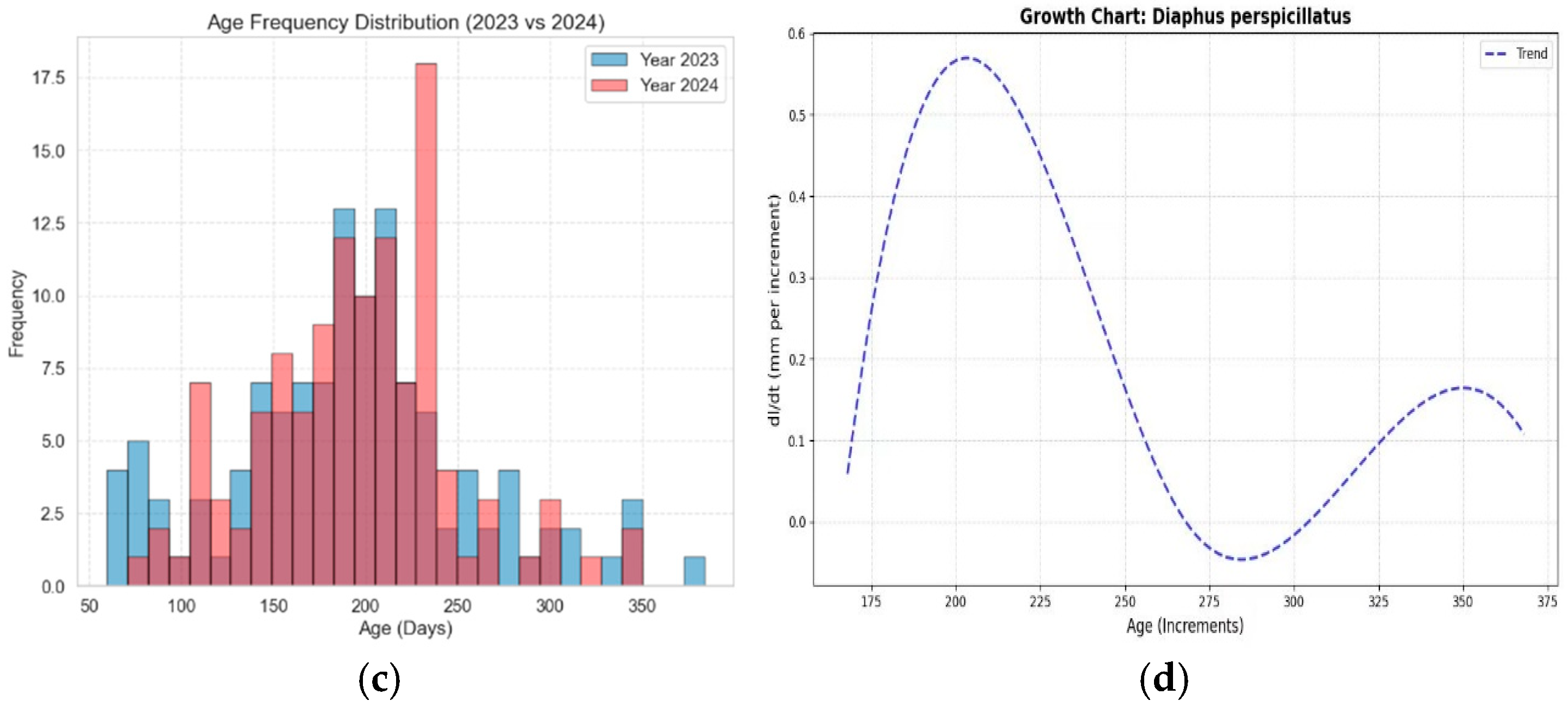
D. perspicillatus, where growth speed declines rapidly after the juvenile phase. Reduced somatic growth following maturation is a common pattern across teleost fishes and is considered a key driver of asymptotic growth behavior described by the von Bertalanffy Growth Function [
8].
Although
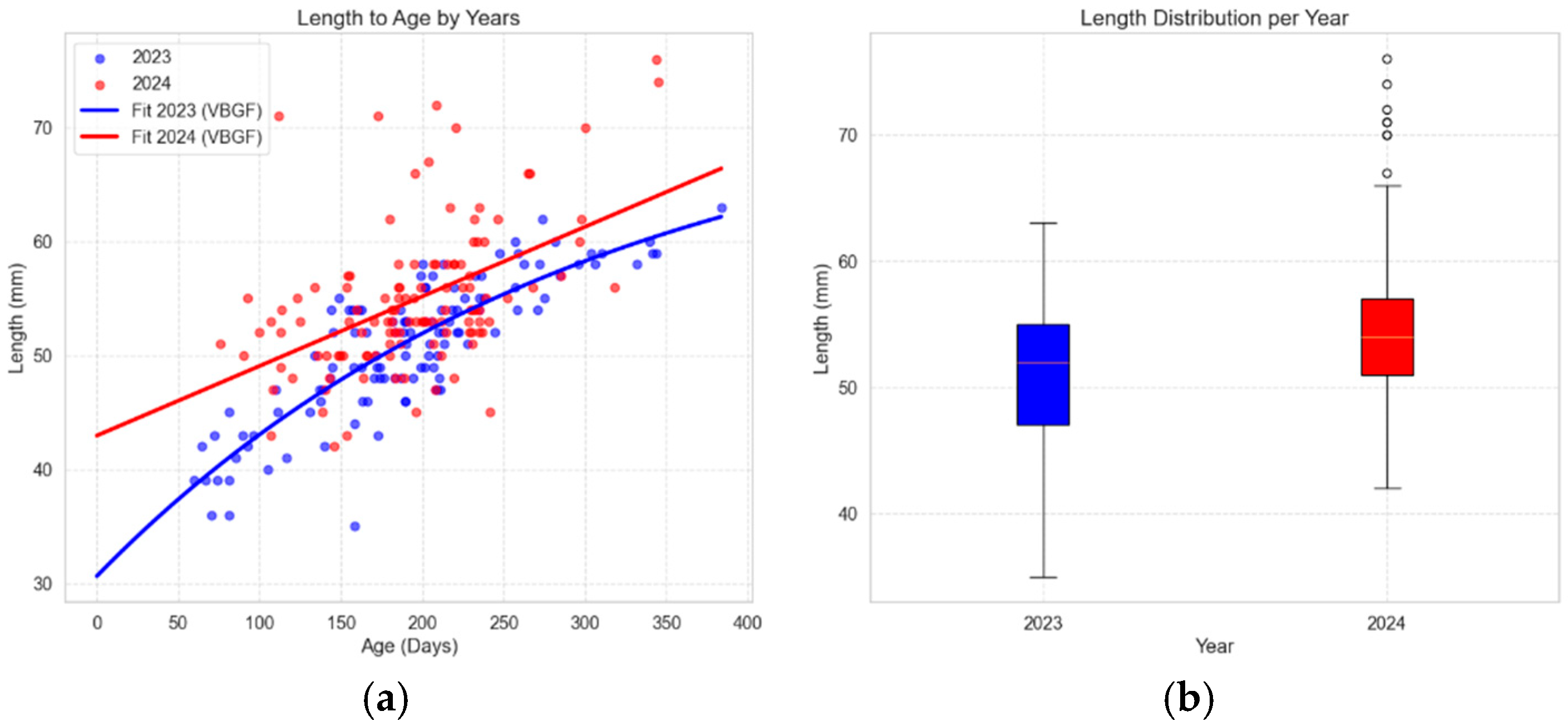
D. perspicillatus exhibits a total observed length range of 35–76 mm, the majority of individuals are concentrated within a narrower interval of 45–60 mm. This pattern reflects the interaction between rapid early growth and early growth stabilization. Once individuals reach sexual maturity, further length increments are minimal, resulting in size convergence within a limited range. Consequently, the extreme lower and upper size classes are poorly represented, producing a compact central distribution. Such length compression is typical of short-lived pelagic fishes with early maturation [
6,
11].
4.4. Unimodal Length Distribution Dominated by Sub-Adults and Young Adults
The unimodal length-frequency distribution of
D. perspicillatus is indicative of a population dominated by sub-adult and young adult individuals. In species with high recruitment variability and relatively short lifespan, a single strong cohort often dominates the population structure at any given time, producing unimodal distributions [
6]. Early juvenile stages may have higher mortality rates and be less catchable, while older adults might migrate to deeper habitats, further strengthening the prevalence of intermediate size classes in samples [
3].
4.5. Life-History Implications of Growth Differentiation
The results indicate that D. perspicillatus and D. gigas exhibit distinct growth strategies that are consistently expressed across age structure, age–length relationships, and growth speed patterns. These differences reflect contrasting life-history strategies rather than methodological artifacts, as they are supported by multiple independent growth descriptors derived from otolith microstructure analysis.
The predominance of individuals aged approximately 100–200 days in the catch likely reflects a combination of ontogenetic habitat shifts and sampling selectivity. During early juvenile stages, mesopelagic fishes typically occupy shallower depth layers and exhibit stronger diel vertical migration amplitudes, which increase their susceptibility to sampling gears [
11]. As individuals grow older, they may inhabit deeper layers or modify their migration behavior, reducing encounter probability with the gear used in this study. Although fishing-induced mortality can contribute to age truncation in exploited populations, the sampling context and species considered here suggest that habitat-related availability, rather than direct fishing pressure, is the primary driver of the observed age composition [
4,
5]
D. perspicillatus is characterized by rapid early growth followed by early growth deceleration, resulting in a relatively narrow adult size range and a compressed age distribution. This growth pattern is consistent with life-history strategies commonly observed in small-bodied mesopelagic fishes, where early somatic growth enhances survival during vulnerable juvenile stages and supports rapid population turnover. Early growth stabilization likely reflects a shift in energy allocation from somatic growth toward reproduction and maintenance after maturation, thereby limiting further increases in body length [
6,
11].
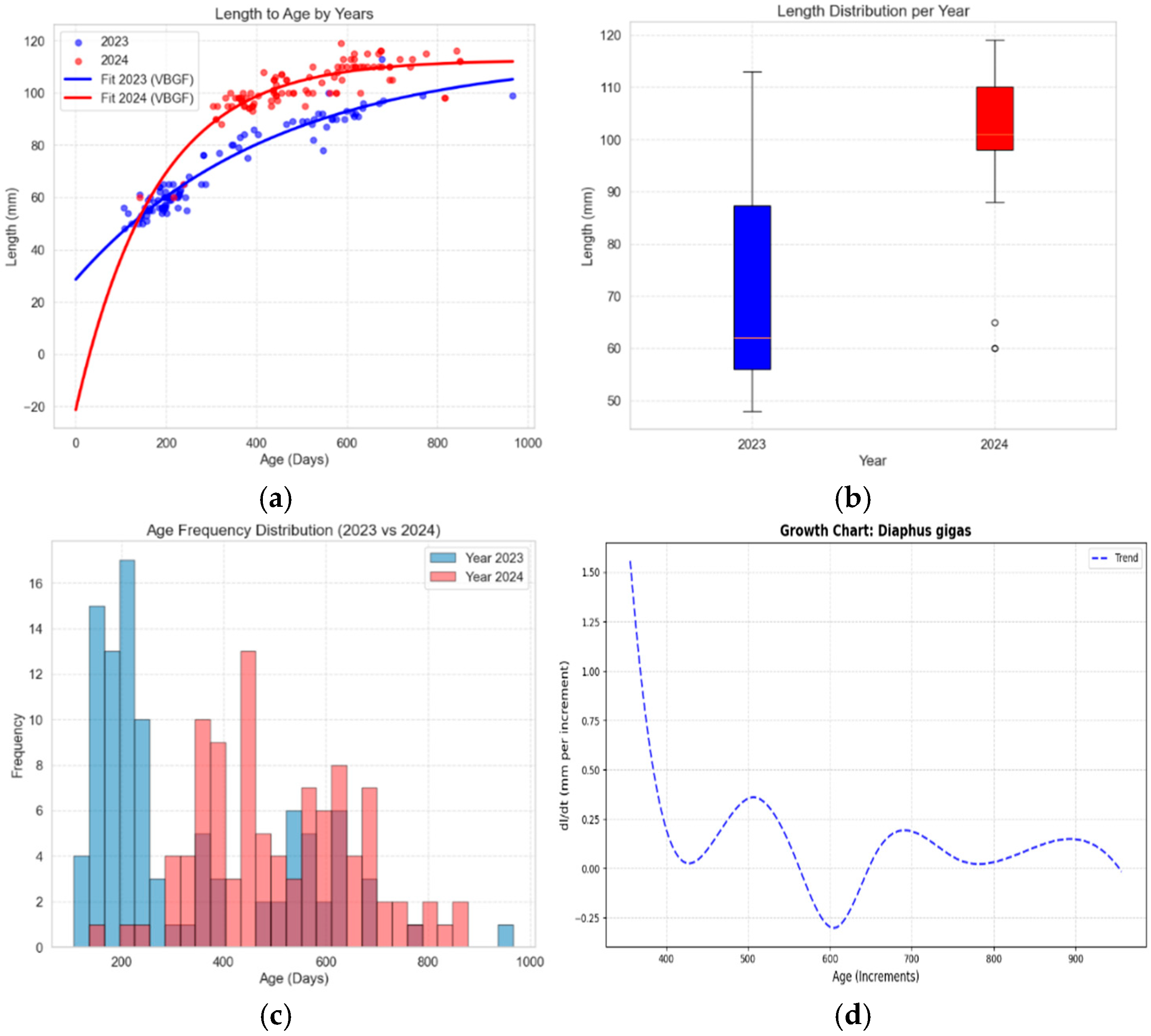
D. gigas, by comparison, exhibits faster early growth, prolonged somatic development, and greater longevity. Early-life growth advantages in this species may be associated with a higher trophic position, a broader prey spectrum, and more efficient energy acquisition during larval and juvenile stages [
3]. Faster early growth increases survival probability by allowing individuals to reach size refuges from predation earlier in life, which in turn contributes to extended lifespan. Favorable current systems and nutrient-rich environments experienced during early development may further enhance growth rates and reinforce these advantages [
6,
20]
The wide length range observed in
D. gigas (48–119 mm) reflects its larger body size, extended lifespan, and prolonged growth period. Greater inter-individual variability accumulates over time as individuals experience different environmental histories, leading to increased size heterogeneity at older ages. Such broad size distributions are characteristic of longer-lived mesopelagic fishes with flexible growth trajectories [
3]. The consistently larger size of
D. gigas relative to
D. perspicillatus is further supported by species-specific morphological traits, including a more robust body form and skeletal structure, which enable greater somatic growth and a larger maximum size within the genus
Diaphus [
18,
19].
Interannual differences in body size structure, particularly the higher average size observed in 2024 compared to 2023, are most plausibly explained by variation in cohort composition rather than intrinsic changes in growth dynamics. Stronger recruitment or higher survival of cohorts originating prior to 2024 would result in a greater proportion of older and larger individuals in the population. Such interannual variability is a common feature of mesopelagic fish populations and is often linked to fluctuations in environmental conditions that influence larval survival and early growth [
8,
20].
4.6. Interpretation of Asymptotic Growth Patterns (VBGF)
Differences in von Bertalanffy asymptotic length parameters between species reflect intrinsic differences in growth strategy. Higher asymptotic values indicate prolonged somatic growth potential, while lower asymptotes reflect early growth cessation.
In
D. gigas, higher asymptotic length is accompanied by sustained growth over time, resulting in a gradual approach to the asymptote. In contrast,
D. perspicillatus exhibits lower asymptotic length with rapid early growth and early stabilization. Such parameter contrasts are consistent with classical interpretations of VBGF in relation to life-history traits [
12,
14]
5. Conclusions
This study provides a detailed reconstruction of the age structure and growth dynamics of D. gigas and D. perspicillatus in the Northwest Pacific Ocean based on sagittal otolith microstructure analysis. Daily increment counts enabled high-resolution age estimation and revealed clear interspecific differences in growth strategy, longevity, and size structure.
D. perspicillatus exhibited rapid early somatic growth, a compressed age distribution, and an early approach to asymptotic length, indicating a short-lived life-history strategy characterized by early growth deceleration and high population turnover.
D. gigas showed prolonged somatic growth, a broader age spectrum, greater inter-individual variability, and substantially larger maximum body size, reflecting delayed maturation and extended lifespan. These contrasting growth strategies were consistently supported by age–length relationships, growth-speed analyses, and otolith microstructural characteristics across ontogenetic stages [
5,
21,
22].
The predominance of younger age classes in the catch was interpreted primarily as a consequence of ontogenetic habitat shifts and sampling availability rather than direct fishing pressure, highlighting the importance of considering behavioral and vertical distribution patterns when interpreting mesopelagic population structure. Interannual differences in size and age composition were best explained by variation in cohort structure and survival rather than intrinsic changes in growth dynamics [
23,
24].
The results demonstrate that closely related myctophid species occupying the same mesopelagic environment can exhibit fundamentally different life-history strategies. By providing increment-based age estimates, growth trajectories, and growth-rate dynamics for two dominant
Diaphus species, this study establishes a robust baseline for understanding mesopelagic fish growth ecology in the Northwest Pacific. These findings contribute to improved characterization of mesopelagic life histories and provide essential information for future integrative studies linking growth, habitat use, and ecosystem function [
3,
8,
17].