Deep-Sea Hydrothermal Vent and Impact-Generated Hydrothermal Vent Systems: Insights into the Origin of Life

Abstract
1. Introduction
2. Origin-of-Life Hypotheses
3. Deep-Sea Hydrothermal Vent Systems
3.1. 9°50′ North, East Pacific Rise
3.2. Guaymas Basin, Gulf of California
3.3. Lost City, Mid-Atlantic Ridge
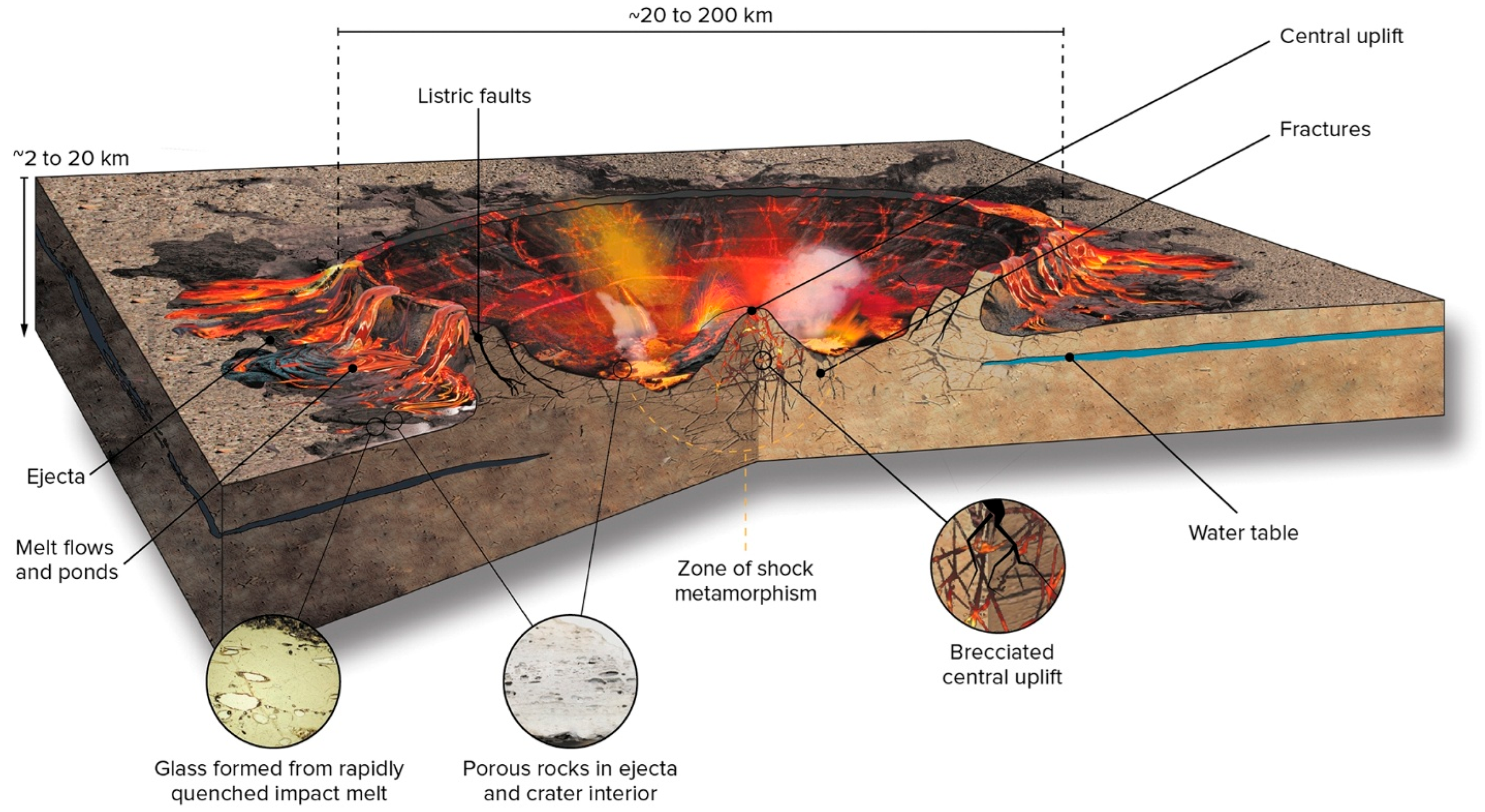
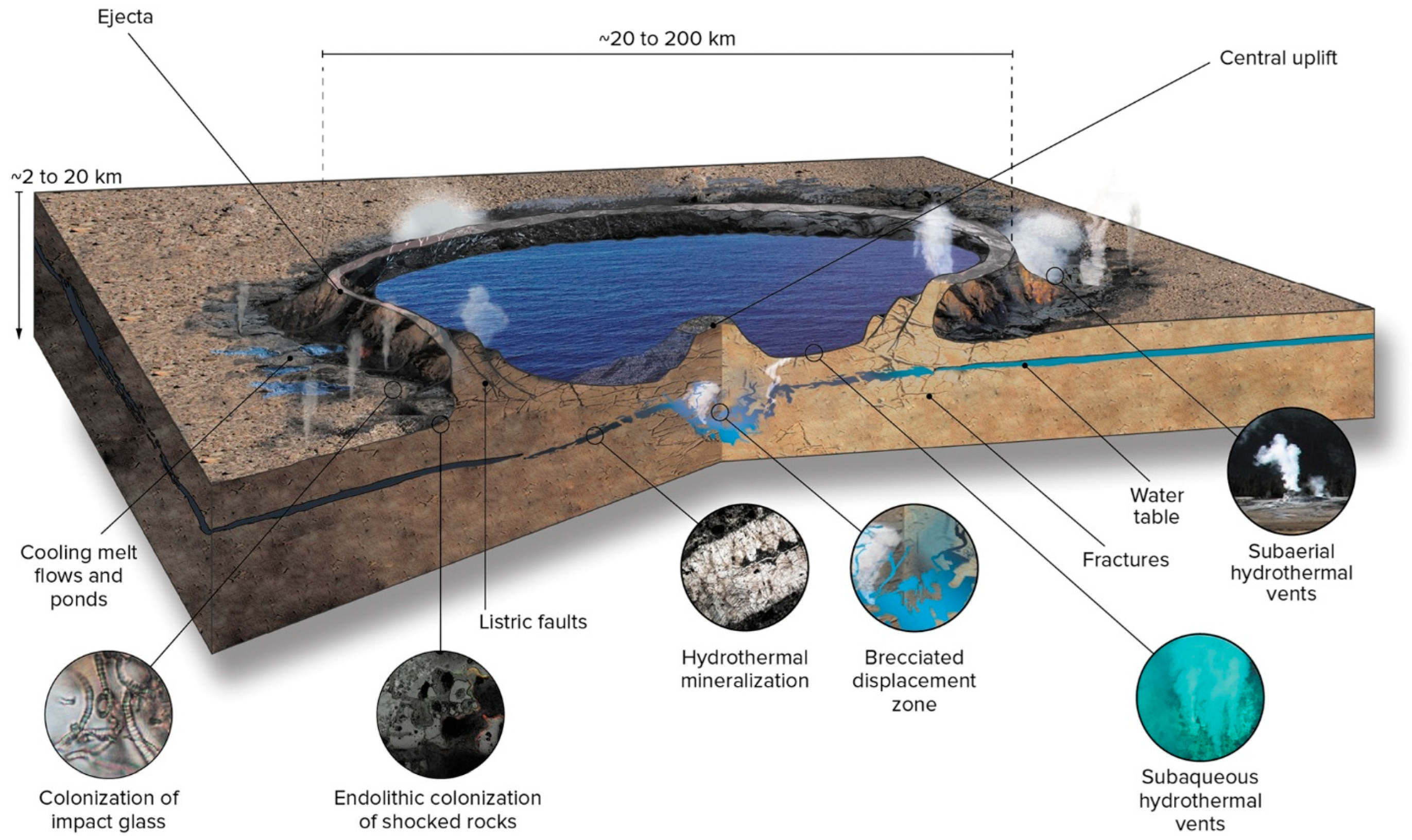
4. Impact-Generated Hydrothermal Vents
4.1. The Haughton Impact Structure, Canada
4.2. Lonar Lake, India
4.3. Chicxulub Impact Crater, Gulf of Mexico
5. Discussion
5.1. Comparing Deep-Sea Hydrothermal Vents to Impact-Generated Hydrothermal Systems in the Scope of Origin-of-Life Hypotheses
5.2. Current Debate Favoring Impact-Generated Hydrothermal Systems over Deep-Sea Vents
5.3. Application Beyond Earth
6. Conclusions
Author Contributions
Funding
Data Availability Statement
Acknowledgments
Conflicts of Interest
References
- Ballard, R.D. Notes on a major oceanographic find. Oceanus 1977, 20, 35–44. [Google Scholar]
- Corliss, J.; Dymond, J.; Gordon, L.; Edmond, J.; von Herzen, R.; Ballard, R.; Green, K.; Williams, D.; Bainbridge, A.; Crane, K.; et al. Submarine Thermal Springs on the Galápagos Rift. Science 1979, 203, 1073–1083. [Google Scholar] [CrossRef]
- Lonsdale, P. Structural geomorphology of a fast-spreading rise crest: The East Pacific Rise near 3°25′ S. Mar. Geophys. Res. 1977, 3, 251–293. [Google Scholar] [CrossRef]
- Ricci, F.; Greening, C. Chemosynthesis: A neglected foundation of marine ecology and biogeochemistry. Trends. Microbiol. 2024, 32, 631–639. [Google Scholar] [CrossRef]
- Jannasch, H.W. Chemosynthesis: The nutritional basis for life at deep-sea vents. Oceanus 1984, 27, 73–78. [Google Scholar]
- Jannasch, H.W. Review Lecture—The chemosynthetic support of life and the microbial diversity at deep-sea hydrothermal vents. Proc. R. Soc. Lond. B-Biol. Sci. 1985, 225, 277–297. [Google Scholar] [CrossRef]
- Jannasch, H.W.; Wirsen, C.O. Chemosynthetic Primary Production at East Pacific Sea Floor Spreading Centers. BioSci. 1979, 29, 592–598. [Google Scholar] [CrossRef]
- Baross, J.A.; Hoffman, S.E. Submarine hydrothermal vents and associated gradient environments as sites for the origin and evolution of life. Orig. Life. Evol. Biosph. 1985, 15, 327–345. [Google Scholar] [CrossRef]
- Powner, M.W.; Sutherland, J.D. Prebiotic chemistry: A new modus operandi. Philos. Trans. R. Soc. Lond. B Biol. Sci. 2011, 366, 2870–2877. [Google Scholar] [CrossRef] [PubMed]
- Patel, B.H.; Percivalle, C.; Ritson, D.J.; Duffy, C.D.; Sutherland, J.D. Common origins of RNA, protein and lipid precursors in a cyanosulfidic protometabolism. Nat. Chem. 2015, 7, 301–307. [Google Scholar] [CrossRef]
- Šponer, J.E.; Šponer, J.; Nováková, O.; Brabec, V.; Šedo, O.; Zdráhal, Z.; Costanzo, G.; Pino, S.; Saladino, R.; Di Mauro, E. Emergence of the First Catalytic Oligonucleotides in a Formamide-Based Origin Scenario. Chemistry 2016, 22, 3572–3586. [Google Scholar] [CrossRef]
- Sasselov, D.; Grotzinger, J.; Sutherland, J. The origin of life as a planetary phenomenon. Sci. Adv. 2020, 6, 6. [Google Scholar] [CrossRef]
- Erickson, T.; Kirkland, C.; Timms, N.; Cavosie, A.; Davison, T. Precise radiometric age establishes Yarrabubba, Western Australia, as Earth’s oldest recognised meteorite impact structure. Nat. Commun. 2020, 11, 300. [Google Scholar] [CrossRef]
- Kirkland, C.; Johnson, T.; Kaempf, J.; Ribeiro, B.; Zametzer, A.; Smithies, R.H.; McDonald, B. A Paleoarchaean impact crater in the Pilbara Craton, Western Australia. Nat. Commun. 2025, 16, 2224. [Google Scholar] [CrossRef]
- Osinski, G.; Cockell, C.; Pontefract, A.; Sapers, H.M. The Role of Meteorite Impacts in the Origin of Life. Astrobiology 2020, 20, 9. [Google Scholar] [CrossRef]
- Lowe, D.; Byerly, G. The terrestrial record of Late Heavy Bombardment. New Astro. Rev. 2018, 81, 39–61. [Google Scholar] [CrossRef]
- Pearce, B.; Tupper, A.; Pudritz, R.; Higgs, P. Constraining the Time Interval for the Origin of Life on Earth. Astrobiology 2018, 18, 343–364. [Google Scholar] [CrossRef] [PubMed]
- Schopf, J.W.; Packer, B. Early Archean (3.3-Billion to 3.5-Billion-Year-Old) Microfossils from Warrawoona Group, Australia. Science 1987, 237, 70–73. [Google Scholar] [CrossRef] [PubMed]
- Noffke, N.; Christian, D.; Wacey, D.; Hazen, R.M. Microbially induced sedimentary structures recording an ancient ecosystem in the ca. 3.48 billion-year-old Dresser Formation, Pilbara, Western Australia. Astrobiology 2013, 13, 12. [Google Scholar] [CrossRef] [PubMed]
- Mojzsis, S.; Arrhenius, G.; McKeegan, K.; Harrison, T.M.; Nutman, A.P.; Friend, C.R.L. Evidence for life on Earth before 3,800 million years ago. Nature 1996, 384, 55–59. [Google Scholar] [CrossRef]
- Schleiden, M.J. Beiträge zur Phytogenesis. Arch. Für Anat. Physiol. Und Wiss. Medici. 1838, 13, 137–176. [Google Scholar]
- Schwann, T. Mikroskopische Untersuchungen über die Übereinstimmung in der Struktur und dem Wachstum der Thiere und Pflanzen; Sander’schen Buchhandlung: Berlin, Germany, 1839. [Google Scholar]
- Darwin, C.R. On the Origin of Species by Means of Natural Selection, or the Preservation of Favoured Races in the Struggle for Life, 1st ed.; John Murray: London, UK, 1859. [Google Scholar]
- Pasteur, L. Memoirs sur les corpuscles organises qui existent dans l’atmosphere. Examen de la doctrine des generations spontanees. Ann. Sci. Nat. 1861, 16, 5–98. [Google Scholar]
- Winogradsky, S. Ueber Schwefelbacterien. Bot. Zeit. 1887, 45, 489–610. [Google Scholar]
- Dworkin, M.; Gutnick, D. Sergei Winogradsky: A founder of modern microbiology and the first microbial ecologist. FEMS Microbiol. Rev. 2012, 36, 364–379. [Google Scholar] [CrossRef]
- Oparin, A.I. The Origin of Life; Izd. Moskovskii Rabochii: Moscow, Russia, 1924. [Google Scholar]
- Haldane, J.B.S. The Origin of Life. Ration. Annu. 1929, 148, 3–10. [Google Scholar]
- Miller, S.L. A production of amino acids under possible primitive Earth conditions. Science 1953, 117, 528–529. [Google Scholar] [CrossRef] [PubMed]
- Miller, S.L.; Urey, H.C. Organic compound synthesis on the primitive Earth. Science 1959, 130, 245–251. [Google Scholar] [CrossRef] [PubMed]
- Rich, A. On the problems of evolution and biochemical information transfer. In Horizons in Biochemistry; Kasha, M., Pullman, B., Eds.; Academic Press: New York, NY, USA, 1962; pp. 103–126. [Google Scholar]
- Orgel, L. The origin of life—A review of facts and speculations. Trends. Biochem. Sci. 1998, 23, 491–495. [Google Scholar] [CrossRef]
- Crick, F.H.C. The origin of the genetic code. J. Mol. Biol. 1968, 38, 367–379. [Google Scholar] [CrossRef]
- Orgel, L.E. Evolution of the genetic apparatus. J. Mol. Biol. 1968, 38, 381–393. [Google Scholar] [CrossRef]
- Gilbert, W. Origin of life: The RNA world. Nature 1986, 319, 618. [Google Scholar] [CrossRef]
- Cech, T. Catalytic RNA: Structure and Mechanism. Biochem. Soc. Trans. 1993, 21, 229–234. [Google Scholar] [CrossRef]
- Eigen, M.; Schuster, P. Stages of emerging life—Five principles of early organization. Stages of emerging life-five principles of early organization. J. Mol. Evol. 1982, 19, 47–61. [Google Scholar] [CrossRef]
- Beaudry, A.A.; Joyce, G.F. Directed evolution of an RNA enzyme. Science 1992, 257, 635–641. [Google Scholar] [CrossRef] [PubMed]
- Wilson, D.; Szostak, J. In Vitro Selection of Functional Nucleic Acids. Ann. Rev. Biochem. 1999, 68, 611–647. [Google Scholar] [CrossRef] [PubMed]
- Sagan, C. The origin of life in a cosmic context. Orig. Life Evol. Biosph. 1974, 5, 497–505. [Google Scholar] [CrossRef]
- Cech, T. Crawling Out of the RNA World. Cell 2009, 136, 599–602. [Google Scholar] [CrossRef]
- Schimmel, P. The RNP bridge between two worlds. Nat. Rev. Mol. Cell Biol. 2011, 12, 135. [Google Scholar] [CrossRef]
- Nielsen, P.; Egholm, M.; Berg, R.; Buchardt, O. Sequence-Selective Recognition of DNA by Strand Displacement with a Thymine-Substituted Polyamide. Science 1991, 254, 1497–1500. [Google Scholar] [CrossRef] [PubMed]
- Wittung, P.; Nielsen, P.; Buchardt, O.; Egholm, M.; Norde’n, B. DNA-like double helix formed by peptide nucleic acid. Nature 1994, 368, 561–563. [Google Scholar] [CrossRef]
- Eschenmoser, A. Chemical etiology of nucleic acid structure. Science 1999, 284, 2118–2124. [Google Scholar] [CrossRef]
- Cavalier-Smith, T. Membrane heredity, symbiogenesis, and the multiple origins of algae. In Biodiversity and Evolution; Arai, R., Kato, M., Doi, Y., Eds.; The National Science Museum Foundation: Tokyo, Japan, 1995; pp. 75–114. [Google Scholar]
- Szathmáry, E. Chemes, Genes, Memes: A revised classification of replicators. Lectures Math. Life Sci. 1999, 26, 1–10. [Google Scholar]
- Segrè, D.; Ben-Eli, D.; Deamer, D.; Lancet, D. The Lipid World. Orig. Life Evol. Biosph. 2001, 31, 119–145. [Google Scholar] [CrossRef]
- Szostak, J.; Bartel, D.; Luisi, P.L. Synthesizing life. Nature 2001, 409, 387–390. [Google Scholar] [CrossRef]
- Kandler, O. The early diversification of life. In Nobel Symposium No. 84. Early Life on Earth; Bengtson, S., Ed.; Columbia University Press: New York, NY, USA, 1994; pp. 152–160. [Google Scholar]
- Woese, C.R. On the evolution of cells. Proc. Natl. Acad. Sci. USA 2002, 99, 8742–8747. [Google Scholar] [CrossRef] [PubMed]
- Yčas, M. A note on the origin of life. Proc. Natl. Acad. Sci. USA 1955, 41, 714–716. [Google Scholar] [CrossRef]
- Wächtershäuser, G. Before enzymes and templates: Theory of surface metabolism. Microbiol. Rev. 1988, 52, 452–484. [Google Scholar] [CrossRef]
- Kloprogge, J.T.; Hartman, H. Clays and the Origin of Life: The Experiments. Life 2022, 12, 259. [Google Scholar] [CrossRef] [PubMed]
- Kauffman, S. Autocatalytic sets of proteins. J. Theor. Biol. 1986, 119, 1–24. [Google Scholar] [CrossRef]
- Hordijk, W.; Steel, M. Autocatalytic sets in polymer networks with variable catalysis distributions. J. Math. Chem. 2016, 54, 1997–2021. [Google Scholar] [CrossRef]
- Steel, M.; Hordijk, W.; Xavier, J.C. Autocatalytic networks in biology: Structural theory and algorithms. J. R. Soc. Interface 2019, 16, 151. [Google Scholar] [CrossRef]
- Hordijk, W.; Steel, M. Autocatalytic Networks at the Basis of Life’s Origin and Organization. Life 2018, 8, 62. [Google Scholar] [CrossRef]
- Calvin, M. The Origin of Life on Earth and Elsewhere. Perspect. Biol. Med. 1962, 5, 399–422. [Google Scholar] [CrossRef]
- de Duve, C. Life as a cosmic imperative? Philos. Trans. A. Math. Phys. Eng. Sci. 2011, 369, 620–623. [Google Scholar] [CrossRef]
- Eschenmoser, A. The search for the chemistry of life’s origin. Tetrahedron 2007, 63, 12821–12844. [Google Scholar] [CrossRef]
- Zagórski, Z. Radiation chemistry and origins of life on earth. Radiat. Phys. Chem. 2003, 66, 329–334. [Google Scholar] [CrossRef]
- Bizzarri, B.; Šponer, J.E.; Šponer, J.; Cassone, G.; Kapralov, M.; Timoshenko, G.; Krasavin, E.; Fanelli, G.; Timperio, A.M.; Di Mauro, E.; et al. Meteorite-Assisted Phosphorylation of Adenosine Under Proton Irradiation Conditions. ChemSystemsChem 2019, 2, 3. [Google Scholar] [CrossRef]
- Li, Y.; Kitadai, N.; Nakamura, R. Chemical Diversity of Metal Sulfide Minerals and Its Implications for the Origin of Life. Life 2018, 8, 46. [Google Scholar] [CrossRef] [PubMed]
- Whicher, A.; Camprubi, E.; Pinna, S.; Herschy, B.; Lane, N. Acetyl Phosphate as a Primordial Energy Currency at the Origin of Life. Orig. Life Evol. Biosph. 2018, 48, 159–179. [Google Scholar] [CrossRef]
- Ljungdahl, L.G.; Wood, H. Total synthesis of acetate from CO2 by heterotrophic bacteria. Ann. Rev. Microbiol. 1969, 23, 515–538. [Google Scholar] [CrossRef]
- Ljungdahl, L.G. The autotrophic pathway of acetate synthesis in acetogenic bacteria. Ann. Rev. Microbiol. 1986, 40, 415–450. [Google Scholar] [CrossRef]
- Ljungdahl, L.G. A life with acetogens, thermophiles, and cellulolytic anaerobes. Ann. Rev. Microbiol. 2009, 63, 1–25. [Google Scholar] [CrossRef]
- Solé, R.; Kempes, C.; Stepney, S. Origins of life: The possible and the actual. Philos. Trans. R. Soc. Lond. B-Biol. Sci. 2025, 380, 1936. [Google Scholar] [CrossRef]
- Karl, D.M.; Worsen, C.O.; Jannasch, H.W. Deep-Sea Primary Production at the Galápagos Hydrothermal Vents. Science 1980, 207, 1345–1347. [Google Scholar] [CrossRef]
- Sclater, J.; Klitgord, K. A detailed heat flow, topographic, and magnetic survey across the Galapagos Spreading Center at 86°W. J. Geophys. Res. 1973, 78, 6951–6975. [Google Scholar] [CrossRef]
- Beaulieu, S.; Baker, E.; German, C.; Maffei, A. An authoritative global database for active submarine hydrothermal vent fields. Geochem. Geophys. Geosys. 2013, 14, 4892–4905. [Google Scholar] [CrossRef]
- Alfaro-Lucas, J.; Chapman, A.S.A.; Tunnicliffe, V.; Bates, A.E. High functional vulnerability across the world’s deep-sea hydrothermal vent communities. Proc. Natl. Acad. Sci. USA 2024, 121, 45. [Google Scholar] [CrossRef]
- Murdock, S.; Tunnicliffe, V.; Boschen-Rose, R.; Juniper, S. Emergent “core communities” of microbes, meiofauna and macrofauna at hydrothermal vents. ISME Commun. 2021, 1, 27. [Google Scholar] [CrossRef] [PubMed]
- Tarasov, V.; Gebruk, A.; Mironov, A.; Moskalev, L. Deep-sea and shallow-water hydrothermal vent communities: Two different phenomena? Chem. Geo. 2005, 224, 5–39. [Google Scholar] [CrossRef]
- Tunnicliffe, V.; Embley, R.; Holden, J.; Butterfield, D.; Massoth, G.; Juniper, K. Biological colonization of new hydrothermal vents following an eruption on Juan de Fuca Ridge. Deep Sea Res. I Oceanogr. Res. Pap. 1997, 44, 1627–1644. [Google Scholar] [CrossRef]
- Thornburg, C.; Zabriskie, M.; McPhail, K. Deep-Sea Hydrothermal Vents: Potential Hot Spots for Natural Products Discovery? J. Nat. Prod. 2010, 73, 489–499. [Google Scholar] [CrossRef] [PubMed]
- Van Dover, C.L.; German, C.R.; Speer, K.G.; Parson, L.M.; Vrijenhoek, R.C. Evolution and Biogeography of Deep-Sea Vent and Seep Invertebrates. Science 2002, 295, 1253–1257. [Google Scholar] [CrossRef] [PubMed]
- Alt, J. Subseafloor processes in mid-ocean ridge hydrothermal systems. In Seafloor Hydrothermal Systems: Physical, Chemical, Biological, and Geological Interactions; Humphris, S.E., Zierenberg, R.A., Mullineaux, L.S., Thomson, R.E., Eds.; American Geophysical Union: Washington, DC, USA, 1995; Volume 91, pp. 85–114. [Google Scholar]
- Tivey, M.K. The Formation of Mineral Deposits at Mid-Ocean Ridges. Oceanus 1998, 41, 2. [Google Scholar]
- Tivey, M.K. Generation of seafloor hydrothermal vent fluids and associated mineral deposits. Oceanography 2007, 20, 50–65. [Google Scholar] [CrossRef]
- Hannington, M.; Jamieson, J.; Monecke, T.; Petersen, S.; Beaulieu, S. The abundance of seafloor massive sulfide deposits. Geology 2011, 39, 1155–1158. [Google Scholar] [CrossRef]
- Hein, J.; Mizell, K.; Koschinsky, A.; Conrad, T. Deep-ocean mineral deposits as a source of critical metals for high- and green-technology applications: Comparison with land-based resources. Ore. Geol. Rev. 2011, 51, 1–14. [Google Scholar] [CrossRef]
- Van Dover, C.L. Inactive Sulfide Ecosystems in the Deep Sea: A Review. Front. Mar. Sci. 2019, 6, 461. [Google Scholar] [CrossRef]
- Van Dover, C.L.; Colaço, A.; Collins, P.; Croot, P.; Metaxas, A.; Murton, B.; Swaddling, A.; Boschen-Rose, R.; Carlsson, J.; Cuyvers, L.; et al. Research is needed to inform environmental management of hydrothermally inactive and extinct polymetallic sulfide (PMS) deposits. Mar. Policy 2020, 121, 104183. [Google Scholar] [CrossRef]
- Van Dover, C.L. Impacts of anthropogenic disturbances at deep-sea hydrothermal vent ecosystems: A review. Mar. Environ. Res. 2014, 102, 59–72. [Google Scholar] [CrossRef]
- Smith, C.; Tunnicliffe, V.; Colaço, A.; Drazen, J.; Gollner, S.; Levin, L.; Mestre, N.; Metaxas, A.; Molodtsova, T.; Morato, T.; et al. Deep-Sea Misconceptions Cause Underestimation of Seabed-Mining Impacts. Trends Ecol. Evol. 2020, 35, 853–857. [Google Scholar] [CrossRef]
- Eme, L.; Tamarit, D.; Caceres, E.; Stairs, C.; De Anda, V.; Schön, M.; Seitz, K.; Dombrowski, N.; Lewis, W.; Homa, F.; et al. Inference and reconstruction of the heimdallarchaeial ancestry of eukaryotes. Nature 2023, 618, 992–999. [Google Scholar] [CrossRef]
- Rodrigues-Oliveira, T.; Wollweber, F.; Ponce-Toledo, R.; Xu, J.; Rittmann, S.; Klingl, A.; Pilhofer, M.; Schleper, C. Actin cytoskeleton and complex cell architecture in an Asgard archaeon. Nature 2022, 613, 332–339. [Google Scholar] [CrossRef]
- Weiss, M.; Sousa, F.; Mrnjavac, N.; Neukirchen, S.; Roettger, M.; Nelson-Sathi, S.; Martin, W. The physiology and habitat of the last universal common ancestor. Nat. Microbiol. 2016, 1, 16116. [Google Scholar] [CrossRef]
- Takai, K.; Komatsu, T.; Inagaki, F.; Horikoshi, K. Distribution of Archaea in a Black Smoker Chimney Structure. Appl. Environ. Microbiol. 2001, 67, 3618–3629. [Google Scholar] [CrossRef]
- Wirth, R.; Luckner, M.; Wanner, G. Validation of a Hypothesis: Colonization of Black Smokers by Hyperthermophilic Microorganisms. Front. Microbiol. 2018, 9, 524. [Google Scholar] [CrossRef] [PubMed]
- Takai, K.; Gamo, T.; Tsunogai, U.; Nakayama, N.; Hirayama, H.; Nealson, K.; Horikoshi, K. Geochemical and microbiological evidence for a hydrogen-based, hyperthermophilic subsurface lithoautotrophic microbial ecosystem (HyperSLiME) beneath an active deep-sea hydrothermal field. Extremophiles 2004, 8, 269–282. [Google Scholar] [CrossRef] [PubMed]
- Takai, K.; Nakamura, K.; Toki, T.; Tsunogai, U.; Miyazaki, M.; Miyazaki, J.; Hirayama, H.; Nakagawa, S.; Nunoura, T.; Horikoshi, K. Cell proliferation at 122 °C and isotopically heavy CH4 production by a hyperthermophilic methanogen under high-pressure cultivation. Proc. Natl. Acad. Sci. USA 2008, 105, 10949–10954. [Google Scholar] [CrossRef]
- Kashefi, K.; Lovely, D. Extending the upper temperature limit for life. Science 2003, 301, 5635. [Google Scholar] [CrossRef]
- Blöchl, E.; Rachel, R.; Hafenbradl, D.; Jannasch, H.; Stetter, K.; Burggraf, S. Pyrolobus fumarii, gen. and sp. nov., represents a novel group of archaea, extending the upper temperature limit for life to 113 °C. Extremophiles 1997, 1, 14–21. [Google Scholar] [CrossRef]
- Truong, C.; Bernard, S.; Baudin, F.; Gorlas, A.; Guyot, F. Carbon-containing pyrite spherules: Mineral biosignatures in black smokers? Eur. J. Miner. 2024, 36, 813–830. [Google Scholar] [CrossRef]
- Bemis, K.; Lowell, R.; Farough, A. Diffuse Flow on and Around Hydrothermal Vents at Mid-Ocean Ridges. Oceanography 2015, 25, 182–191. [Google Scholar] [CrossRef]
- Girguis, P.; Lee, R. Thermal Preference and Tolerance of Alvinellids. Science 2006, 312, 231. [Google Scholar] [CrossRef]
- Levin, L.; Baco, A.; Bowden, D.; Colaco, A.; Cordes, E.; Cunha, M.; Demopoulos, A.; Gobin, J.; Grupe, B.; Le, J.; et al. Hydrothermal Vents and Methane Seeps: Rethinking the Sphere of Influence. Front. Mar. Sci. 2016, 3, 72. [Google Scholar] [CrossRef]
- Shank, T.M.; Fornari, D.J.; Von Damm, K.L.; Lilley, M.D.; Haymon, R.M.; Lutz, R.A. Temporal and spatial patterns of biological community development at nascent deep-sea hydrothermal vents along the East Pacific Rise, (9°50 N, East Pacific Rise). Deep Sea Res. Part II 1998, 45, 465–515. [Google Scholar] [CrossRef]
- Haymon, R.M.; Fornari, D.J.; Von Damm, K.L.; Lilley, M.D.; Perfit, M.R.; Edmond, J.M.; Shanks, W.C., III; Lutz, R.A.; Grebmeier, J.; Carbotte, S.; et al. Volcanic eruption of the mid-ocean ridge along the East Pacific Rise crest at 9°45–52′ N: Direct submersible observations of seafloor phenomena associated with an eruption event in April, 1991. Earth Planet. Sci. Lett. 1932, 119, 85–101. [Google Scholar] [CrossRef]
- Crowell, B.; Lowell, R.; Von Damm, K. A model for the production of sulfur floc and “snowblower” events at mid-ocean ridges. Geochem. Geophys. Geosys. 2008, 9, 10. [Google Scholar] [CrossRef]
- Matabos, M.; Barreyre, T.; Juniper, K.; Cannat, M.; Kelley, D.; Alfaro-Lucas, J.; Chavagnac, V.; Colaço, A.; Escartin, J.; Escobar, E.; et al. Integrating Multidisciplinary Observations in Vent Environments (IMOVE): Decadal Progress in Deep-Sea Observatories at Hydrothermal Vents. Front. Mar. Sci. 2022, 12, 9. [Google Scholar] [CrossRef]
- Holden, J.; Summit, M.; Baross, J. Thermophilic and hyperthermophilic microorganisms in 3–30 °C hydrothermal fluids following a deep-sea volcanic eruption. FEMS Microbiol. Ecol. 1998, 25, 33–41. [Google Scholar] [CrossRef]
- Dick, G.; Anantharaman, K.; Baker, B.; Li, M.; Reed, D.; Sheik, C. The microbiology of deep-sea hydrothermal vent plumes: Ecological and biogeographic linkages to seafloor and water column habitats. Front. Microbiol. 2013, 4, 124. [Google Scholar] [CrossRef]
- Meyer, J.; Akerman, N.; Proskurowski, G.; Huber. Microbiological characterization of post-eruption “snowblower” vents at Axial Seamount, Juan de Fuca Ridge. Front. Microbiol. 2013, 4, 153. [Google Scholar] [CrossRef] [PubMed]
- Amend, J.; Mccollom, T.; Hentscher, M.; Bach, W. Catabolic and anabolic energy for chemolithoautotrophs in deep-sea hydrothermal systems hosted in different rock types. Geochim. Cosmochim. Acta 2011, 75, 5736–5748. [Google Scholar] [CrossRef]
- Lutz, R.; Kennish, M. Ecology of deep-sea hydrothermal vent communities: A review. Rev. Geophys. 1993, 31, 211–242. [Google Scholar] [CrossRef]
- Perez, M.; Sun, J.; Xu, Q.; Qian, P. Structure and Connectivity of Hydrothermal Vent Communities Along the Mid-Ocean Ridges in the West Indian Ocean: A Review. Front. Mar. Sci. 2021, 8, 744874. [Google Scholar] [CrossRef]
- Zhou, Z.; St. John, E.; Anantharaman, K.; Reysenbach, A. Global patterns of diversity and metabolism of microbial communities in deep-sea hydrothermal vent deposits. Microbiome 2022, 10, 241. [Google Scholar] [CrossRef]
- Adam, N.; Perner, M. Microbially mediated hydrogen cycling in deep-sea hydrothermal vents. Front. Microbiol. 2018, 9, 2873. [Google Scholar] [CrossRef]
- Ver Eecke, H.C.; Butterfield, D.A.; Huber, J.A.; Lilley, M.D.; Olson, E.J.; Roe, K.K. Hydrogen-limited growth of hyperthermophilic methanogens at deep-sea hydrothermal vents. Proc. Natl. Acad. Sci. USA 2012, 109, 13674–13679. [Google Scholar] [CrossRef] [PubMed]
- Zeng, X.; Alain, K.; Shao, Z. Microorganisms from deep-sea hydrothermal vents. Mar. Life Sci. Technol. 2021, 3, 204–230. [Google Scholar] [CrossRef] [PubMed]
- Cerqueira, T.; Barroso, C.; Froufe, H.; Egas, C.; Bettencourt, R. Metagenomic Signatures of Microbial Communities in Deep-Sea Hydrothermal Sediments of Azores Vent Fields. Microb. Ecol. 2018, 76, 387–403. [Google Scholar] [CrossRef]
- Garcia, J.; Patel, B.; Ollivier, B. Taxonomic, Phylogenetic, and Ecological Diversity of Methanogenic Archaea. Anaerobe 2000, 6, 205. [Google Scholar] [CrossRef] [PubMed]
- Jeanthon, C.; L’Haridon, S.; Reysenbach, A.; Corre1, E.; Vernet, M.; Messner, P.; Sleytr, U.; Prieur, D. Methanococcus vulcanius sp. nov., a novel hyperthermophilic methanogen isolated from East Pacific Rise, and identification of Methanococcus sp. DSM 4213Tas Methanococcus fervens sp. nov. Int. J. Syst. Evol. Microbiol. 1999, 49, 2. [Google Scholar] [CrossRef] [PubMed]
- Wankel, S.D.; Adams, M.M.; Johnston, D.T.; Hansel, C.M.; Joye, S.B.; Girguis, P.R. Anaerobic methane oxidation in metalliferous hydrothermal sediments: Influence on carbon flux and decoupling from sulfate reduction. Enviro. Microbiol. 2012, 14, 2726–2740. [Google Scholar] [CrossRef]
- Brazelton, W.; Nelson, B.; Schrenk, M. Metagenomic evidence for H2 oxidation and H2 production by serpentinite-hosted subsurface microbial communities. Front. Microbiol. 2012, 2, 16008. [Google Scholar] [CrossRef] [PubMed]
- Ding, J.; Zhang, Y.; Wang, H.; Jian, H.; Leng, H.; Xiao, X. Microbial Community Structure of Deep-sea Hydrothermal Vents on the Ultraslow Spreading Southwest Indian Ridge. Front. Microbiol. 2017, 8, 1012. [Google Scholar] [CrossRef]
- Flores, G.E.; Campbell, J.H.; Kirshtein, J.D.; Meneghin, J.; Podar, M.; Steinberg, J.I.; Seewald, J.S.; Tivey, M.K.; Voytek, M.A.; Yang, Z.K.; et al. Microbial community structure of hydrothermal deposits from geochemically different vent fields along the Mid-Atlantic Ridge. Enviro. Microbiol. 2011, 13, 2158–2171. [Google Scholar] [CrossRef] [PubMed]
- McCollom, T.; Seewald, J. Abiotic Synthesis of Organic Compounds in Deep-Sea Hydrothermal Environments. Chem. Rev. 2007, 107, 382–401. [Google Scholar] [CrossRef]
- Mori, K.; Yamaguchi, K.; Hanada, S. Sulfurovum denitrificans sp. nov., an obligately chemolithoautotrophic sulfur-oxidizing epsilonproteobacterium isolated from a hydrothermal field. Int. J. Syst. Evol. Microbiol. 2018, 68, 7. [Google Scholar] [CrossRef]
- Pitcher, A.; Rychlik, N.; Hopmans, E.; Spieck, E.; Rijpstra, I.; Ossebaar, J.; Schouten, S.; Wagner, M.; Damsté, S. Crenarchaeol dominates the membrane lipids of Candidatus Nitrososphaera gargensis, a thermophilic Group I.1b Archaeon. ISME J. 2010, 4, 542–552. [Google Scholar] [CrossRef]
- Mehta, M.; Butterfield, D.; Baross, J. Phylogenetic Diversity of Nitrogenase (nifH) Genes in Deep-Sea and Hydrothermal Vent Environments of the Juan de Fuca Ridge. Appl. Environ. Microbiol. 2003, 69, 960–970. [Google Scholar] [CrossRef]
- Mehta, M.; Baross, J. Nitrogen Fixation at 92 °C by a Hydrothermal Vent Archaeon. Science 2006, 314, 1783–1786. [Google Scholar] [CrossRef] [PubMed]
- Wu, Y.; Cao, Y.; Wang, C.; Wu, M.; Aharon, O.; Xu, X. Microbial community structure and nitrogenase gene diversity of sediment from a deep-sea hydrothermal vent field on the Southwest Indian Ridge. Acta Oceanol. Sin. 2014, 33, 94–104. [Google Scholar] [CrossRef]
- Xu, W.; Li, M.; Ding, J.; Gu, J.; Luo, Z. Bacteria dominate the ammonia-oxidizing community in a hydrothermal vent site at the Mid-Atlantic Ridge of the South Atlantic Ocean. Appl. Microbiol. Biotechnol. 2014, 98, 7993–8004. [Google Scholar] [CrossRef]
- Edwards, K.; Rogers, D.; Wirsen, C.; McCollom, T. Isolation and Characterization of Novel Psychrophilic, Neutrophilic, Fe-Oxidizing, Chemolithoautotrophic α- and γ-Proteobacteria from the Deep Sea. Appl. Environ. Microbiol. 2003, 69, 2906–2913. [Google Scholar] [CrossRef]
- Slobodkina, G.; Reysenbach, A.; Panteleeva, A.; Kostrikina, N.; Wagner, D.; Bonch-Osmolovskaya, E.; Slobodkin, A. Deferrisoma camini gen. nov., sp. nov., a moderately thermophilic, dissimilatory iron(III)-reducing bacterium from a deep-sea hydrothermal vent that forms a distinct phylogenetic branch in the Deltaproteobacteria. Int. J. Syst. Evol. Microbiol. 2012, 62, 10. [Google Scholar] [CrossRef]
- Dasgupta, S.; Peng, X.; Ta, K. Interaction between Microbes, Minerals, and Fluids in Deep-Sea Hydrothermal Systems. Minerals 2021, 11, 1324. [Google Scholar] [CrossRef]
- Jannasch, H.; Mottl, M. Geomicrobiology of Deep-Sea Hydrothermal Vents. Science 1985, 229, 717–725. [Google Scholar] [CrossRef] [PubMed]
- Nakagawa, S.; Takai, K. Deep-sea vent chemoautotrophs: Diversity, biochemistry and ecological significance. FEMS Microbiol. Ecol. 2008, 65, 1–14. [Google Scholar] [CrossRef] [PubMed]
- Schopf, J.W. Precambrian Paleobiology: Problems and Perspectives. Annu. Rev. Earth Planet. Sci. 1975, 3, 213–249. [Google Scholar] [CrossRef]
- Corliss, J.B.; Baross, J.; Hoffman, S.E. An Hypothesis Concerning the Relationship Between Submarine Hot Springs and the Origin of Life on Earth. 1981. Available online: https://archimer.ifremer.fr/doc/00245/35661/ (accessed on 19 January 2026).
- Jones, M. Riftia pachyptila Jones: Observations on the Vestimentiferan Worm from the Galápagos Rift. Science 1981, 213, 333–336. [Google Scholar] [CrossRef]
- Rimskaya-Korsakova, N.; Galkin, S.; Malakhov, V. The anatomy of the blood vascular system of the giant vestimentiferan tubeworm Riftia pachyptila (Siboglinidae, Annelida). J. Morphol. 2017, 278, 810–827. [Google Scholar] [CrossRef]
- Lutz, R.; Shank, T.; Fornari, D.; Haymon, R.; Lilley, M.; Von Damm, K.; Desbruyeres, D. Rapid growth at deep-sea vents. Nature 1994, 371, 663–664. [Google Scholar] [CrossRef]
- Sun, Q.; Yuan, Z.; Sun, Y.; Sun, L. Integrated multi-approaches reveal unique metabolic mechanisms of Vestimentifera to adapt to deep sea. Microbiome 2024, 12, 241. [Google Scholar] [CrossRef]
- Miyamoto, T.; Amrein, H. Gluconeogenesis: An ancient biochemical pathway with a new twist. Fly 2017, 11, 218–223. [Google Scholar] [CrossRef] [PubMed]
- Li, Z.G.; Luo, L.J.; Zhu, L.P. Involvement of trehalose in hydrogen sulfide donor sodium hydrosulfide-induced the acquisition of heat tolerance in maize (Zea mays L.) seedlings. Bot. Stud. 2014, 55, 20. [Google Scholar] [CrossRef]
- Girguis, P.; Childress, J. Metabolite uptake, stoichiometry and chemoautotrophic function of the hydrothermal vent tubeworm Riftia pachyptila: Responses to environmental variations in substrate concentrations and temperature. J. Exp. Biol. 2006, 209, 3516–3528. [Google Scholar] [CrossRef] [PubMed]
- Berndt, C.; Hensen, C.; Mortera-Gutierrez, C.; Sarkar, S.; Geilert, S.; Schmidt, M.; Liebetrau, V.; Kipfer, R.; Scholz, F.; Doll, M.; et al. Rifting under steam—How rift magmatism triggers methane venting from sedimentary basins. Geology 2016, 44, 767–770. [Google Scholar] [CrossRef]
- Lonsdale, P.; Backer, K. Hydrothermal plumes, hot springs, and conductive heat flow in the Southern Trough of Guaymas Basin. Earth Planet. Sci. Lett. 1985, 73, 211–225. [Google Scholar] [CrossRef]
- Von Damm, K.L.; Edmond, J.M.; Measures, C.I.; Grant, B. Chemistry of submarine hydrothermal solutions at Guaymas Basin, Gulf of California. Geochim. Cosmochim. Acta 1985, 49, 2221–2237. [Google Scholar] [CrossRef]
- Geilert, S.; Hensen, C.; Schmidt, M.; Liebetrau, V.; Scholz, F.; Doll, M.; Deng, L.; Fiskal, A.; Lever, M.A.; Su, C.-C.; et al. On the formation of hydrothermal vents and cold seeps in the Guaymas Basin, Gulf of California. Biogeosciences 2018, 15, 5715–5731. [Google Scholar] [CrossRef]
- Teske, A.; de Beer, D.; McKay, L.; Tivey, M.; Biddle, J.; Hoer, D.; Lloyd, K.; Lever, M.; Røy, H.; Albert, D.; et al. The Guaymas Basin Hiking Guide to Hydrothermal Mounds, Chimneys, and Microbial Mats: Complex Seafloor Expressions of Subsurface Hydrothermal Circulation. Front. Microbiol. 2016, 7, 75. [Google Scholar] [CrossRef]
- Edgcomb, V.; Kysela, D.; Teske, A.; de Vera Gomez, A.; Sogin, M. Benthic eukaryotic diversity in the Guaymas Basin hydrothermal vent environment. Proc. Natl. Acad. Sci. USA 2002, 99, 7658–7662. [Google Scholar] [CrossRef]
- Lopez-Garrido, P.; Barry, J.; Gonzlez-Gordillo, J.; Escobar-Briones, E. ROV’s Video Recordings as a Tool to Estimate Variation in Megabenthic Epifauna Diversity and Community Composition in the Guaymas Basin. Front. Mar. Sci. 2020, 7, 154. [Google Scholar] [CrossRef]
- Jørgensen, B.; Boetius, A. Feast and famine—Microbial life in the deep-sea bed. Nat. Rev. Microbiol. 2007, 5, 770–781. [Google Scholar] [CrossRef] [PubMed]
- Su, L.; Teske, A.; MacGregor, B.; McKay, L.; Mendlovitz, H.; Albert, D.; Ma, Z.; Li, J. Thermal Selection of Microbial Communities and Preservation of Microbial Function in Guaymas Basin Hydrothermal Sediments. Appl. Environ. Microbiol. 2023, 89, e0001823. [Google Scholar] [CrossRef] [PubMed]
- Teske, A.; Wegener, G.; Chanton, J.; White, D.; MacGregor, B.; Hoer, D.; de Beer, D.; Zhuang, G.; Saxton, M.; Joye, S.; et al. Microbial Communities Under Distinct Thermal and Geochemical Regimes in Axial and Off-Axis Sediments of Guaymas Basin. Front. Microbiol. 2021, 12, 633649. [Google Scholar] [CrossRef]
- Calvert, S.E. Accumulation of Diatomaceous Silica in the Sediments of the Gulf of California. Geol. Soc. Am. Bull. 1966, 77, 569–596. [Google Scholar] [CrossRef]
- Jannasch, H.; Nelson, D.; Wirsen, C. Massive natural occurrence of unusually large bacteria (Beggiatoa sp.) at a hydrothermal deep-sea vent site. Nature 1989, 342, 834–836. [Google Scholar] [CrossRef]
- McKay, L.; MacGregor, B.; Biddle, J.; Albert, D.; Mendlovitz, H.; Hoer, D.; Lipp, J.; Lloyd, K.; Teske, A. Spatial heterogeneity and underlying geochemistry of phylogenetically diverse orange and white Beggiatoa mats in Guaymas Basin hydrothermal sediments. Deep Sea Res. I Oceanogr. Res. Pap. 2012, 67, 21–31. [Google Scholar] [CrossRef]
- Nelson, D.; Wirsen, C.; Jannasch, H. Characterization of Large, Autotrophic Beggiatoa spp. Abundant at Hydrothermal Vents of the Guaymas Basin. Appl. Environ. Microbiol. 1989, 55, 2909–2917. [Google Scholar] [CrossRef]
- Jeanthon, C.; L’Haridon, S.; Cueff, V.; Banta, A.; Reysenbach, A.; Prieur, D. Thermodesulfobacterium hydrogeniphilum sp. nov., a thermophilic, chemolithoautotrophic, sulfate-reducing bacterium isolated from a deep-sea hydrothermal vent at Guaymas Basin, and emendation of the genus Thermodesulfobacterium. Int. J. Syst. Evol. Microbiol. 2002, 52, 3. [Google Scholar] [CrossRef]
- Khelifi, N.; Grossi, V.; Hamdi, M.; Dolla, A.; Tholozan, J.; Ollivier, B.; Hirschler-Réa, A. Anaerobic Oxidation of Fatty Acids and Alkenes by the Hyperthermophilic Sulfate-Reducing Archaeon Archaeoglobus fulgidus. Appl. Environ. Microbiol. 2010, 76, 3057–3060. [Google Scholar] [CrossRef]
- Cruaud, P.; Vigneron, A.; Pignet, P.; Caprais, J.-C.; Lesongeur, F.; Toffin, L.; Godfroy, A.; Cambon-Bonavita, M.-A. Comparative Study of Guaymas Basin Microbiomes: Cold Seeps vs. Hydrothermal Vents Sediments. Front. Mar. Sci. 2017, 4, 417. [Google Scholar] [CrossRef]
- Knittel, K.; Boetius, A. Anaerobic oxidation of methane: Progress with an unknown process. Annu. Rev. Microbiol. 2009, 63, 311–334. [Google Scholar] [CrossRef]
- Sibuet, M.; Olu, K. Biogeography, biodiversity and fluid dependence of deep-sea cold-seep communities at active and passive margins. Deep Sea Res. II Top. Stud. Oceanogr. 1998, 45, 517–567. [Google Scholar] [CrossRef]
- Singh, R.; Guzman, M.; Bose, A. Anaerobic Oxidation of Ethane, Propane, and Butane by Marine Microbes: A Mini Review. Front. Microbiol. 2017, 8, 2056. [Google Scholar] [CrossRef]
- Vigneron, A.; Cruaud, P.; Pignet, P.; Caprais, J.; Cambon-Bonavita, M.; Godfroy, A.; Toffin, L. Archaeal and anaerobic methane oxidizer communities in the Sonora Margin cold seeps, Guaymas Basin (Gulf of California). ISME J. 2013, 7, 1595–1608. [Google Scholar] [CrossRef]
- Boetius, A.; Ravenschlag, K.; Schubert, C.; Rickert, D.; Widdel, F.; Gieseke, A.; Amann, R.; Jørgensen, B.; Witte, U.; Pfannkuche, O. A marine microbial consortium apparently mediating anaerobic oxidation of methane. Nature 2000, 407, 623–626. [Google Scholar] [CrossRef] [PubMed]
- Lagostina, L.; Frandsen, S.; MacGregor, B.; Glombitza, C.; Deng, L.; Fiskal, A.; Li, J.; Doll, M.; Geilert, S.; Schmidt, M.; et al. Interactions between temperature and energy supply drive microbial communities in hydrothermal sediment. Commun. Biol. 2021, 25, 4. [Google Scholar] [CrossRef]
- Hahn, C.; Laso-Pérez, R.; Vulcano, F.; Vaziourakis, K.; Stokke, R.; Steen, I.; Teske, A.; Boetius, A.; Liebeke, M.; Amann, R.; et al. “Candidatus Ethanoperedens,” a Thermophilic Genus of Archaea Mediating the Anaerobic Oxidation of Ethane. mBio 2020, 11, e00600-20. [Google Scholar] [CrossRef] [PubMed]
- Holler, T.; Widdel, F.; Knittel, K.; Amann, R.; Kellermann, M.; Hinrichs, K.; Teske, A.; Boetius, A.; Wegener, G. Thermophilic anaerobic oxidation of methane by marine microbial consortia. ISME J. 2011, 5, 1946–1956. [Google Scholar] [CrossRef]
- Laso-Pérez, R.; Wegener, G.; Knittel, K.; Widdel, F.; Harding, K.; Krukenberg, V.; Meier, D.; Richter, M.; Tegetmeyer, H.; Riedel, D.; et al. Thermophilic archaea activate butane via alkyl-coenzyme M formation. Nature 2016, 539, 396–401. [Google Scholar] [CrossRef] [PubMed]
- Teske, A. The Guaymas Basin—A hot spot for hydrothermal generation and anaerobic microbial degradation of hydrocarbons. Int. Biodeterior. Biodegrad. 2024, 186, 105700. [Google Scholar] [CrossRef]
- Dombrowski, N.; Teske, A.P.; Baker, B.J. Expansive microbial metabolic versatility and biodiversity in dynamic Guaymas Basin hydrothermal sediments. Nat. Commun. 2018, 9, 4999. [Google Scholar] [CrossRef]
- Kelley, D.; Karson, J.; Blackman, D.; Früh-Green, G.; Butterfield, D.; Lilley, M.; Olson, E.; Schrenk, M.; Roe, K.; Lebon, G.; et al. An off-axis hydrothermal vent field near the Mid-Atlantic Ridge at 30° N. Nature 2001, 412, 145–149. [Google Scholar] [CrossRef]
- Kelley, D.; Früh-Green, G.; Karson, J.; Ludwig, K. The Lost City Hydrothermal Field Revisited. Oceanography 2007, 20, 90–99. [Google Scholar] [CrossRef]
- Denny, A.; Kelley, D.; Früh-Green, G. Geologic evolution of the Lost City Hydrothermal Field. Geochem. Geophys. Geosys 2015, 17, 375–394. [Google Scholar] [CrossRef]
- Lang, S.; Brazelton, W. Habitability of the marine serpentinite subsurface: A case study of the Lost City hydrothermal field. Philos. Trans. R. Soc. A Math. Phys. Eng. Sci. 2020, 378, 20180429. [Google Scholar] [CrossRef]
- Cardoso, S.; Cartwright, J. On the differing growth mechanisms of black-smoker and Lost City-type hydrothermal vents. Proc. R. Soc. A Math. Phys. Eng. Sci. 2017, 473, 20170387. [Google Scholar] [CrossRef] [PubMed]
- Früh-Green, G.; Kelley, D.; Bernasconi, S.; Karson, J.; Ludwig, K.; Butterfield, D.; Boschi, C. 30,000 years of hydrothermal activity at the Lost City vent field. Science 2003, 301, 495–498. [Google Scholar] [CrossRef] [PubMed]
- Holm, N.; Oze, C.; Mousis, O.; Waite, J.H.; Guilbert-Lepoutre, A. Serpentinization and the Formation of H2 and CH4 on Celestial Bodies (Planets, Moons, Comets). Astrobiology 2015, 15, 7. [Google Scholar] [CrossRef]
- Schrenk, M.; Brazelton, W.; Lang, S. Serpentinization, Carbon, and Deep Life. Rev. Mineral. Geochem. 2013, 75, 575–606. [Google Scholar] [CrossRef]
- Karmina, A.; Fruh-Green, G.; Bernasconi, S.; Rickli, J.; Lang, S.; Lilley, M. Fluid mixing and spatial geochemical variability in the Lost City hydrothermal field chimneys. ESS Open Arch. 2023. [Google Scholar] [CrossRef]
- Ludwig, K.; Kelley, D.; Butterfield, D.; Nelson, B.; Früh-Green, G. Formation and evolution of carbonate chimneys at the Lost City Hydrothermal Field. Geochim. Cosmochim. Acta 2006, 70, 3625–3645. [Google Scholar] [CrossRef]
- Bradley, A.; Summons, R. Multiple origins of methane at the Lost City Hydrothermal Field. Earth Planet. Sci. Let. 2010, 297, 34–41. [Google Scholar] [CrossRef]
- Okland, I.; Huang, S.; Dahle, H.; Thorseth, I.H.; Pedersen, R.B. Low temperature alteration of serpentinized ultramafic rock and implications for microbial life. Chem. Geol. 2012, 318–319, 75–87. [Google Scholar] [CrossRef]
- Kelley, D.; Karson, J.; Früh-Green, G.; Yoerger, D.; Shank, T.; Butterfield, D.; Hayes, J.; Schrenk, M.; Olson, E.; Proskurowski, G.; et al. A serpentinite-hosted ecosystem: The Lost City hydrothermal field. Science 2005, 307, 5714. [Google Scholar] [CrossRef]
- Brazelton, W.; Mehta, M.; Kelley, D.; Baross, J. Physiological Differentiation within a Single-Species Biofilm Fueled by Serpentinization. mBio 2011, 2, e00127-11. [Google Scholar] [CrossRef]
- Lang, S.; Butterfield, D.; Schulte, M.; Kelley, D.; Lilley, M. Elevated concentrations of formate, acetate and dissolved organic carbon found at the Lost City hydrothermal field. Geochim. Cosmochim. Acta 2010, 74, 941–952. [Google Scholar] [CrossRef]
- Schrenk, M.; Kelley, D.; Bolton, S.; Baross, J. Low archaeal diversity linked to subseafloor geochemical processes at the Lost City Hydrothermal Field, Mid-Atlantic Ridge. Environ. Microbiol. 2004, 6, 1086–1095. [Google Scholar] [CrossRef]
- Brazelton, W.; Schrenk, M.; Kelley, D.; Baross, J. Methane- and Sulfur-Metabolizing Microbial Communities Dominate the Lost City Hydrothermal Field Ecosystem. Appl. Environ. Microbiol. 2006, 72, 6257–6270. [Google Scholar] [CrossRef]
- Martin, W.; Russell, M. On the origin of biochemistry at an alkaline hydrothermal vent. Phil. Trans. R. Soc. B 2007, 362, 1887–1926. [Google Scholar] [CrossRef]
- Sojo, V.; Herschy, B.; Whicher, A.; Camprubi, E.; Lane, N. The origin of life in alkaline hydrothermal vents. Astrobiology 2016, 16, 181–197. [Google Scholar] [CrossRef]
- Barge, L.; Branscomb, E.; Brucato, J.; Cardoso, S.; Cartwright, J.; Danielache, S.; Galante, D.; Kee, T.; Miguel, Y.; Mojzsis, S.; et al. Thermodynamics, Disequilibrium, Evolution: Far-From-Equilibrium Geological and Chemical Considerations for Origin-Of-Life Research. Orig. Life Evol. Biosph. 2017, 47, 39–56. [Google Scholar] [CrossRef] [PubMed]
- Martin, W. Early evolution without a tree of life. Biol. Direct 2011, 6, 36. [Google Scholar] [CrossRef]
- Preiner, M.; Xavier, J.; Sousa, F.; Zimorski, V.; Neubeck, A.; Lang, S.; Greenwell, H.; Kleinermanns, K.; Tüysüz, H.; McCollom, T.; et al. Serpentinization: Connecting Geochemistry, Ancient Metabolism and Industrial Hydrogenation. Life 2018, 8, 41. [Google Scholar] [CrossRef]
- Russell, M.; Hall, A.; Martin, W. Serpentinization as a source of energy at the origin of life. Geobiology 2010, 8, 355–371. [Google Scholar] [CrossRef]
- Schwander, L.; Brabender, M.; Mrnjavac, N.; Wimmer, J.; Preiner, M.; Martin, W. Serpentinization as the source of energy, electrons, organics, catalysts, nutrients and pH gradients for the origin of LUCA and life. Front. Microbiol. 2023, 14, 1257597. [Google Scholar] [CrossRef]
- Spray, J. Frictional Melting Processes in Planetary Materials: From Hypervelocity Impact to Earthquakes. Annu. Rev. Earth Planet. Sci. 2010, 38, 221–254. [Google Scholar] [CrossRef]
- Osinski, G.; Tornabene, L.; Banerjee, N.; Cockell, C.; Flemming, R.; Izawa, M.; McCutcheon, J.; Parnell, J.; Preston, L.; Pickersgill, A.; et al. Impact-generated hydrothermal systems on Earth and Mars. Icarus 2013, 224, 347–363. [Google Scholar] [CrossRef]
- Naumov, M.V. Principal features of impact-generated hydrothermal circulation systems: Mineralogical and geochemical evidence. Geofluids 2005, 5, 165–184. [Google Scholar] [CrossRef]
- Müntener, O. Serpentine and serpentinization: A link between planet formation and life. Geology 2010, 38, 959–960. [Google Scholar] [CrossRef]
- Sleep, N.; Bird, D.; Pope, E. Serpentinite and the dawn of life. Philos. Trans. R. Soc. Lond. B Biol. Sci. 2011, 366, 2857–2869. [Google Scholar] [CrossRef]
- Erickson, T.; Kirkland, C.; Jourdan, F.; Schmieder, M.; Hartnady, M.; Cox, M.; Timms, N. Resolving the age of the Haughton impact structure using coupled 40Ar/39Ar and U-Pb geochronology. Geochim. Cosmochim. Acta 2021, 304, 68–82. [Google Scholar] [CrossRef]
- Bischoff, L.; Oskierski, W. The Surface Structure of the Haughton Impact Crater, Devon Island, Canada. Meteoritics 1988, 23, 209–220. [Google Scholar] [CrossRef]
- Osinski, G.; Lee, P.; Parnell, J.; Spray, J.G.; Baron, M. A case study of impact-induced hydrothermal activity: The Haughton impact structure, Devon Island, Canadian High Arctic. Meteorit. Planet. Sci. 2005, 40, 1859–1877. [Google Scholar] [CrossRef]
- Osinski, G.; Spray, J.; Lee, P. Impact-induced hydrothermal activity within the Haughton impact structure, arctic Canada: Generation of a transient, warm, wet oasis. Meteorit. Planet. Sci. 2010, 36, 731–745. [Google Scholar] [CrossRef]
- Hagerty, J.; Newsom, H. Hydrothermal alteration at the Lonar Lake impact structure, India: Implications for impact cratering on Mars. Meteorit. Planet. Sci. 2010, 38, 365–381. [Google Scholar] [CrossRef]
- Wani, A.; Surakasi, V.; Siddharth, J.; Raghavan, R.G.; Patole, M.; Ranade, D.; Shouche, Y. Molecular analyses of microbial diversity associated with the Lonar soda lake in India: An impact crater in a basalt area. Res. Microbiol. 2006, 157, 928–937. [Google Scholar] [CrossRef]
- Paul, D.; Kumbhare, S.; Mhatre, S.; Mhatre, S.; Chowdhury, S.; Shetty, S.; Marathe, N.; Bhute, S.; Shouche, Y. Exploration of Microbial Diversity and Community Structure of Lonar Lake: The Only Hypersaline Meteorite Crater Lake within Basalt Rock. Front. Microbiol. 2016, 6, 1553. [Google Scholar] [CrossRef]
- Hawks, J.; Hunley, K.; Lee, S.A.; Wolpoff, M. Population Bottlenecks and Pleistocene Human Evolution. Mol. Biol. Evol. 2000, 17, 2–22. [Google Scholar] [CrossRef]
- Rampino, M. Relationship between impact-crater size and severity of related extinction episodes. Earth Sci. Rev. 2020, 201, 102990. [Google Scholar] [CrossRef]
- Chiarenza, A.; Brusatte, S. Dinosaurs, Extinction Theories for. In Encyclopedia of Biodiversity, 3rd ed.; Elsevier: Amsterdam, The Netherlands, 2024; Volume 2, pp. 298–309. [Google Scholar] [CrossRef]
- Schulte, P.; Alegret, L.; Arenillas, I.; Arz, J.; Barton, P.; Bown, P.; Bralower, T.; Christeson, G.; Claeys, P.; Cockell, C.; et al. The Chicxulub Asteroid Impact and Mass Extinction at the Cretaceous-Paleogene Boundary. Science 2010, 327, 1214–1218. [Google Scholar] [CrossRef]
- Penfield, G.T.; Camargo-Zanoguera, A. Definition of a major igneous zone in the central Yucatán platform with aeromagnetics and gravity. SEG Tech. Program Abstr. 1981, 51, 37. [Google Scholar]
- Alvarez, L.W.; Alvarez, W.; Asaro, F.; Michel, H. Extraterrestrial cause for the cretaceous-tertiary extinction. Science 1980, 208, 1095–1108. [Google Scholar] [CrossRef]
- Hildebrand, A.; Penfield, G.; Kring, D.; Pilkington, M.; Camargo, Z.A.; Jacobsen, S.; Boynton, W. Chicxulub Crater: A possible Cretaceous/Tertiary boundary impact crater on the Yucatán Peninsula, Mexico. Geology 1991, 19, 867–871. [Google Scholar] [CrossRef]
- Swisher, C., III; Grajales-Nishimura, J.; Montanari, A.; Margolis, S.; Claeys, P.; Alvarez, W.; Renne, P.; Cedillo-Pardoa, E.; Maurrasse, F.; Curtis, G.; et al. Coeval 40Ar/39Ar Ages of 65.0 Million Years Ago from Chicxulub Crater Melt Rock and Cretaceous-Tertiary Boundary Tektites. Science 1992, 257, 954–958. [Google Scholar] [CrossRef]
- Collins, G.; Patel, N.; Davison, T.; Rae, A.; Morgan, J.; Gulick, S.; IODP-ICDP Expedition 364 Science Party; Artemieva, N.; Bralower, T. A steeply-inclined trajectory for the Chicxulub impact. Nat. Commun. 2020, 11, 1480. [Google Scholar] [CrossRef]
- Ivanov, B. Numerical Modeling of the Largest Terrestrial Meteorite Craters. Sol. Syst. Res. 2005, 39, 381–409. [Google Scholar] [CrossRef]
- Osinski, G.; Grieve, R.; Ferrière, L.; Losiak, A.; Pickersgill, A.; Cavosie, A.; Hibbard, S.; Hill, P.; Bermudez, J.; Marion, C.; et al. Impact Earth: A review of the terrestrial impact record. Earth Sci. Rev. 2022, 232, 104112. [Google Scholar] [CrossRef]
- Gulick, S.; Christeson, G.L.; Barton, P.J.; Grieve, R.A.F.; Morgan, J.V.; Urrutia-Fucugauchi, J. Geophysical characterization of the Chicxulub impact crater. Rev. Geophys. 2013, 51, 31–52. [Google Scholar] [CrossRef]
- Gulick, S.P.S.; Bralower, T.J.; Ormö, J.; Hall, B.; Grice, K.; Schaefer, B.; Lyons, S.; Freeman, K.H.; Morgan, J.V.; Artemieva, N.; et al. The first day of the Cenozoic. Proc. Natl. Acad. Sci. USA 2019, 116, 19342–19351. [Google Scholar] [CrossRef]
- Morgan, J.; Warner, M.; the Chicxulub Working Group; Brittan, J.; Buffler, R.; Camargo, A.; Christeson, G.; Denton, P.; Hildebrand, A.; Hobbs, R.; et al. Size and morphology of the Chicxulub impact crater. Nature 1997, 390, 472–476. [Google Scholar] [CrossRef]
- James, S.; Chandran, S.; Aswathi, J.; Padmakumar, D.; Sajinkumar, K. Geologic, geomorphic, tectonic, and paleoclimatic controls on the distribution and preservation of Chicxulub distal ejecta: A global perspective. Earth Sci. Rev. 2023, 244, 104545. [Google Scholar] [CrossRef]
- Bourgeois, J.; Hansen, T.; Wiberg, P.; Kauffman, E. A Tsunami Deposit at the Cretaceous-Tertiary Boundary in Texas. Science 1988, 241, 567–570. [Google Scholar] [CrossRef]
- Dypvik, H.; Jansa, L. Sedimentary signatures and processes during marine bolide impacts: A review. Sediment. Geol. 2003, 161, 309–337. [Google Scholar] [CrossRef]
- Kinsland, G.; Egedahl, K.; Strong, M.; Ivy, R. Chicxulub impact tsunami megaripples in the subsurface of Louisiana: Imaged in petroleum industry seismic data. Earth Planet. Sci. Let. 2021, 570, 117063. [Google Scholar] [CrossRef]
- Range, M.; Arbic, B.; Johnson, B.; Moore, T.; Titov, V.; Adcroft, A.; Ansong, J.; Hollis, C.; Ritsema, J.; Scotese, C.; et al. The Chicxulub Impact Produced a Powerful Global Tsunami. AGU Advs. 2022, 3, 5. [Google Scholar] [CrossRef]
- Bralower, T.; Paull, C.; Leckie, R. The Cretaceous-Tertiary boundary cocktail: Chicxulub impact triggers margin collapse and extensive sediment gravity flows. Geology 1998, 26, 331–334. [Google Scholar] [CrossRef]
- Segev, A.; Wetzler, N.; O’Neill, C.; Rosenbaum, G. A plate geodynamic game changer: Effects of the 66 Ma Chicxulub asteroid collision. Geosci. Front. 2025, 16, 102032. [Google Scholar] [CrossRef]
- Bardeen, C.; Garcia, R.; Toon, O.; Conley, A. On transient climate change at the Cretaceous−Paleogene boundary due to atmospheric soot injections. Proc. Natl. Acad. Sci. USA 2017, 114, 36. [Google Scholar] [CrossRef]
- Morgan, J.; Artemieva, N.; Goldin, T. Revisiting wildfires at the K-Pg boundary. J. Geophys. Res. Beogeosci. 2013, 118, 1508–1520. [Google Scholar] [CrossRef]
- Artemieva, N.; Morgan, J.; Expedition 364 Science Party. Quantifying the Release of Climate-Active Gases by Large Meteorite Impacts with a Case Study of Chicxulub. Geophys. Res. Let. 2017, 44, 10180–10188. [Google Scholar] [CrossRef]
- Brugger, J.; Feulner, G.; Petri, S. Baby, it’s cold outside: Climate model simulations of the effects of the asteroid impact at the end of the Cretaceous. Geophys. Res. Let. 2016, 44, 419–427. [Google Scholar] [CrossRef]
- Morgan, J.; Warner, M.; Collins, G.; Melosh, H.; Christeson, G. Peak-ring formation in large impact craters: Geophysical constraints from Chicxulub. Earth Planet. Sci. Let. 2000, 183, 347–354. [Google Scholar] [CrossRef]
- Rowe, A.; Wilkinson, J.; Coles, B.; Morgan, J. Chicxulub: Testing for post-impact hydrothermal input into the Tertiary ocean. Meteorit. Planet. Sci. 2010, 39, 1223–1231. [Google Scholar] [CrossRef]
- Zhao, J.; Xiao, L.; Xiao, Z.; Morgan, J.; Osinski, G.; Neal, C.; Gulick, S.; Riller, U.; Claeys, P.; Zhao, S.; et al. Shock-deformed zircon from the Chicxulub impact crater and implications for cratering process. Geology 2021, 49, 755–760. [Google Scholar] [CrossRef]
- Vermeesch, P.; Morgan, J. Structural uplift beneath the Chicxulub impact structure. J. Geophys. Res. Solid. Earth 2008, 113. [Google Scholar] [CrossRef]
- Christou, E.; Bach, W. Post Impact Hydrothermal Activity. Thermodynamic Simulations on the Chicxulub Crater & Habitability Assessment. EPSC Abs. 2018, 12, EPSC2018-1175-1. [Google Scholar]
- Kring, D. Impact events and their effect on the origin, evolution, and distribution of life. GSA Today 2000, 10, 1–7. [Google Scholar]
- Kring, D. Environmental consequences of impact cratering events as a function of ambient conditions on Earth. Astrobiology 2003, 3, 133–152. [Google Scholar] [CrossRef]
- Kring, D.; Tikoo, S.; Schmieder, M.; Riller, U.; Rebolledo-Vieyra, M.; Simpson, S.; Osinski, G.; Gattacceca, J.; Wittmann, A.; Verhagen, M.; et al. Probing the hydrothermal system of the Chicxulub impact crater. Sci. Adv. 2020, 6, eaaz3053. [Google Scholar] [CrossRef]
- Zürcher, L.; Kring, D. Hydrothermal alteration in the core of the Yaxcopoil-1 borehole, Chicxulub impact structure, Mexico. Meteorit. Planet. Sci. 2010, 39, 1199–1221. [Google Scholar] [CrossRef]
- Kring, D.; Whitehouse, M.; Schmieder, M. Microbial Sulfur Isotope Fractionation in the Chicxulub Hydrothermal System. Astrobiology 2021, 21, 1. [Google Scholar] [CrossRef]
- Abramov, O.; Kring, D. Numerical modeling of impact-induced hydrothermal activity at the Chicxulub crater. Meteorit. Planet. Sci. 2010, 42, 93–112. [Google Scholar] [CrossRef]
- Barge, L.; Price, E. Diverse geochemical conditions for prebiotic chemistry in shallow-sea alkaline hydrothermal vents. Nat. Geosci. 2022, 15, 976–981. [Google Scholar] [CrossRef]
- Bizzarri, B.; Saladino, R.; Delfino, I.; García-Ruiz, J.M.; Di Mauro, E. Prebiotic Organic Chemistry of Formamide and the Origin of Life in Planetary Conditions: What We Know and What Is the Future. Int. J. Mol. Sci. 2021, 22, 917. [Google Scholar] [CrossRef]
- Leslie, O. Prebiotic Chemistry and the Origin of the RNA World. Crit. Rev. Biochem. Mol. Biol. 2004, 39, 99–123. [Google Scholar] [CrossRef]
- Ooka, H.; McGlynn, S.; Nakamura, R. Electrochemistry at Deep-Sea Hydrothermal Vents: Utilization of the Thermodynamic Driving Force towards the Autotrophic Origin of Life. ChemElectroChem 2018, 6, 1316–1323. [Google Scholar] [CrossRef]
- Saladino, R.; Crestini, C.; Pino, S.; Costanzo, G.; Di Mauro, E. Formamide and the origin of life. Phys. Life Rev. 2012, 9, 84–104. [Google Scholar] [CrossRef] [PubMed]
- Burcar, B.T.; Barge, L.M.; Trail, D.; Watson, E.B.; Russell, M.J.; McGown, L.B. RNA oligomerization in laboratory analogues of alkaline hydrothermal vent systems. Astrobiology 2015, 15, 509–522. [Google Scholar] [CrossRef]
- Huber, C.; Wächtershäuser, G. Activated acetic acid by carbon fixation on (Fe, Ni)S under primordial conditions. Science 1997, 276, 245–247. [Google Scholar] [CrossRef]
- Kitadai, N.; Nakamura, R.; Yamamoto, M.; Takai, K.; Li, Y.; Yamaguchi, A.; Gilbert, A.; Ueno, Y.; Yoshida, N.; Oono, Y. Geoelectrochemical CO production: Implications for the autotrophic origin of life. Sci. Adv. 2018, 4, 7265. [Google Scholar] [CrossRef]
- Shibuya, T.; Takai, K. Liquid and supercritical CO2 as an organic solvent in Hadean seafloor hydrothermal systems: Implications for prebiotic chemical evolution. Prog. Earth Planet. Sci. 2022, 9, 60. [Google Scholar] [CrossRef]
- Simoneit, B.R.T. Prebiotic organic synthesis under hydrothermal conditions: An overview. Adv. Space Res. 2004, 33, 88–94. [Google Scholar] [CrossRef]
- Yanagawa, H.; Kojima, K. Thermophilic microspheres of peptide-like polymers and silicates formed at 250 °C. J. Biochem. 1985, 97, 1521–1524. [Google Scholar] [CrossRef]
- Seewald, J.; Zolotov, M.; McCollom, T. Experimental investigation of single carbon compounds under hydrothermal conditions. Geochim. Cosmochim. Acta 2006, 70, 446–460. [Google Scholar] [CrossRef]
- Huber, C.; Wächtershäuser, G. α-Hydroxy and α-Amino Acids Under Possible Hadean, Volcanic Origin-of-Life Conditions. Science 2006, 314, 630–632. [Google Scholar] [CrossRef] [PubMed]
- Huber, C.; Wächtershäuser, G. Peptides by Activation of Amino Acids with CO on (Ni,Fe)S Surfaces: Implications for the Origin of Life. Science 1998, 281, 670–672. [Google Scholar] [CrossRef]
- Dreamer, D. Perspective: Protocells and the Path to Minimal Life. J. Mol. Evol. 2024, 92, 530–538. [Google Scholar] [CrossRef]
- Kempes, C.; Krakauer, D. The Multiple Paths to Multiple Life. J. Mol. Evol. 2021, 89, 415–426. [Google Scholar] [CrossRef]
- Cheng, R.; Li, X.; Jiang, L.; Gong, L.; Geslin, C.; Shao, Z. Virus diversity and interactions with hosts in deep-sea hydrothermal vents. Microbiome 2022, 10, 235. [Google Scholar] [CrossRef]
- Grandy, J.; Onat, B.; Tunnicliffe, V.; Butterfield, D.; Pawliszyn, J. Unique Solid Phase Microextraction Sampler Reveals Distinctive Biogeochemical Profiles among Various Deep-Sea Hydrothermal Vents. Sci. Rep. 2020, 10, 1360. [Google Scholar] [CrossRef]
- Grosche, A.; Selci, M.; Smedile, F.; Giovannelli, D.; Borin, S.; Le Bris, N.; Vetriani, C. The chemosynthetic biofilm microbiome of deep-sea hydrothermal vents across space and time. Environ. Microbiome 2025, 20, 88. [Google Scholar] [CrossRef]
- Lee, H.; Okumura, T.; Ooka, H.; Adachi, K.; Hikima, T.; Hirata, K.; Kawano, H.; Matsuura, H.; Yamamoto, M.; Yamamoto, M.; et al. Osmotic energy conversion in serpentinite-hosted deep-sea hydrothermal vents. Nat. Commun. 2024, 15, 8193. [Google Scholar] [CrossRef]
- Russell, M.; Hall, A.; Cairns-Smith, A.; Braterman, P. Submarine hot springs and the origin of life. Nature 1988, 336, 117. [Google Scholar] [CrossRef]
- Claeys, P.; Morbidelli, A. Late Heavy Bombardment. In Encyclopedia of Astrobiology, 1st ed.; Springer: Berlin, Germany, 2011. [Google Scholar] [CrossRef]
- Schidlowski, M.; Appel, P.; Eichmann, R.; Junge, C. Carbon isotope geochemistry of the 3.7 × 10⁹-yr-old Isua sediments, West Greenland: Implications for the Archaean carbon and oxygen cycles. Geochim. Cosmochim. Acta 1979, 43, 189–199. [Google Scholar] [CrossRef]
- Ryder, G. Mass flux in the ancient Earth-Moon system and benign implications for the origin of life on Earth. J. Geophys. Res. Planets 2002, 107, E4. [Google Scholar] [CrossRef]
- Das, T.; Ghule, S.; Vanka, K. Insights into the Origin of Life: Did It Begin from HCN and H2O? ACS Cent. Sci. 2019, 5, 1532–1540. [Google Scholar] [CrossRef]
- Ritson, D.; Sutherland, J. Prebiotic synthesis of simple sugars by photoredox systems chemistry. Nat. Chem. 2012, 4, 895–899. [Google Scholar] [CrossRef] [PubMed]
- Ritson, D.; Sutherland, J. Synthesis of Aldehydic Ribonucleotide and Amino Acid Precursors by Photoredox Chemistry. Angewandte Chemie Int. Ed. 2013, 52, 5845–5847. [Google Scholar] [CrossRef]
- Yaylanyan, V.; Harty-Majors, S.; Ismail, A. Investigation of dl-glyceraldehyde–dihydroxyacetone interconversion by FTIR spectroscopy. Carbohydrate Res. 1999, 318, 20–25. [Google Scholar] [CrossRef]
- Saladino, R.; Botta, G.; Delfino, M.; di Mauro, E. Meteorites as Catalysts for Prebiotic Chemistry. Chem. Eur. J. 2013, 19, 16916–16922. [Google Scholar] [CrossRef] [PubMed]
- Karl, D.M.; McMurtry, G.M.; Malahoff, A.; Garcia, M.O. Loihi Seamount, Hawaii: A mid-plate volcano with a distinctive hydrothermal system. Nature 1988, 335, 532–535. [Google Scholar] [CrossRef]
- Hou, J.; Sievert, S.; Wang, Y.; Seewald, J.; Natarajan, V.P.; Wang, F.; Xiao, X. Microbial succession during the transition from active to inactive stages of deep-sea hydrothermal vent sulfide chimneys. Microbiome 2020, 8, 102. [Google Scholar] [CrossRef]
- Trowbridge, A.J.; Marchi, S.; Osinski, G.; Taron, J. Modeling of the Impact-Generated Hydrothermal System at the Haughton Impact Structure. J. GeoPhys. Res. Planets 2024, 129, 7. [Google Scholar] [CrossRef]
- Maruyama, S.; Kurokawa, K.; Ebisuzaki, T.; Sawaki, Y.; Suda, K.; Santosh, M. Nine requirements for the origin of Earth’s life: Not at the hydrothermal vent, but in a nuclear geyser system. Geosci. Front. 2019, 10, 1337–1357. [Google Scholar] [CrossRef]
- Mulkidjanian, A.; Bychkov, A.; Dibrova, D.; Galperin, M.; Koonin, E. Origin of first cells at terrestrial, anoxic geothermal fields. Earth Atmos. Planet. Sci. 2012, 109, E821–E830. [Google Scholar] [CrossRef]
- Benner, S.; Kim, H.; Carrigan, M. Asphalt, Water, and the Prebiotic Synthesis of Ribose, Ribonucleosides, and RNA. Acc. Chem. Res. 2012, 45, 2025–2034. [Google Scholar] [CrossRef]
- Russell, M. The “Water Problem”(sic), the Illusory Pond and Life’s Submarine Emergence—A Review. Life 2021, 11, 429. [Google Scholar] [CrossRef] [PubMed]
- Benner, S. Paradoxes in the origin of life. Orig. Life Evol. Biosph. 2014, 44, 339–343. [Google Scholar] [CrossRef]
- Damer, B.; Deamer, D. The Hot Spring Hypothesis for an Origin of Life. Astrobiology 2020, 20, 4. [Google Scholar] [CrossRef] [PubMed]
- Deamer, D.; Damer, B.; Kompanichenko, V. Hydrothermal Chemistry and the Origin of Cellular Life. Astrobiology 2019, 19, 12. [Google Scholar] [CrossRef]
- Zhang, X.; Li, L.; Du, Z.; Hao, X.; Cao, L.; Luan, Z.; Wang, B.; Xi, S.; Lian, C.; Yan, J.; et al. Discovery of supercritical carbon dioxide in a hydrothermal system. Sci. Bull. 2020, 65, 958–964. [Google Scholar] [CrossRef]
- Takahashi, T.; Takahangi, W.; Tasumi, E.; Makabe, A.; Taguchi, K.; Thornton, B.; Takai, K. In Situ Measurement of Liquid and Gas CO2 with High Purity at Deep-Sea Hydrothermal Vents in the Mariana Arc Using Raman Spectroscopy. ACS Earth Space Chem. 2023, 7, 2489–2497. [Google Scholar] [CrossRef]
- Kitadai, N.; Shibuya, T.; Ueda, H.; Tasumi, E.; Okada, S.; Takai, K. Supercritical carbon dioxide likely served as a prebiotic source of methanethiol in primordial ocean hydrothermal systems. Commun. Earth Environ. 2024, 5, 539. [Google Scholar] [CrossRef]
- Szostak, J. On the origin of life. Medicina 2016, 76, 199–203. [Google Scholar] [PubMed]
- Mutschler, H.; Wochner, A.; Holliger, P. Freeze-thaw cycles as drivers of complex ribozyme assembly. Nat. Chem. 2015, 7, 502–508. [Google Scholar] [CrossRef]
- Becker, S.; Schneider, C.; Okamura, H.; Crisp, A.; Amatov, T.; Dejmek, M.; Carell, T. Wet-dry cycles enable the parallel origin of canonical and non-canonical nucleosides by continuous synthesis. Nat. Commun. 2018, 9, 163. [Google Scholar] [CrossRef]
- Song, X.; Simonis, P.; Deamer, D.; Zare, R. Wet-dry cycles cause nucleic acid monomers to polymerize into long chains. Proc. Natl. Acad. Sci. USA 2024, 121, 49. [Google Scholar] [CrossRef]
- Rego, E.S.; Busigny, V.; Lalonde, S.V.; Rossignol, C.; Babinski, M.; Philippot, P. Low-phosphorus concentrations and important ferric hydroxide scavenging in Archean seawater. PNAS Nexus 2023, 2, 3. [Google Scholar] [CrossRef] [PubMed]
- Ferus, M.; Kníek, A.; Petera, L.; Pastorek, A.; Hrnčířová, J.; Jankovič, L.; Ivanek, O.; Šponer, J.; Křivková, A.; Saeidfirozeh, H.; et al. Formamide-Based Post-impact Thermal Prebiotic Synthesis in Simulated Craters: Intermediates, Products and Mechanism. Front. Astron. Space Sci. 2022, 9, 882145. [Google Scholar] [CrossRef]
- Cockell, C. The origin and emergence of life under impact bombardment. Philos. Trans. R. Soc. Lond. B-Biol. Sci. 2006, 361, 1845–1856. [Google Scholar] [CrossRef]
- Saladino, R.; Botta, L.; Di Mauro, E. The Prevailing Catalytic Role of Meteorites in Formamide Prebiotic Processes. Life 2018, 8, 6. [Google Scholar] [CrossRef]
- Pastorek, A.; Hrnčířová, J.; Jankovič, L.; Nejdl, L.; Civiš, S.; Ivanek, O.; Shestivska, V.; Knížek, A.; Kubelík, P.; Šponer, J.; et al. Prebiotic synthesis at impact craters: The role of Fe-clays and iron meteorites. Chem. Commun. 2019, 55, 10563–10566. [Google Scholar] [CrossRef] [PubMed]
- Sutherland, J. The Origin of Life—Out of the Blue. Angew. Chem. 2016, 55, 104–121. [Google Scholar] [CrossRef]
- Cassone, G.; Saija, F.; Šponer, J.; Šponer, J.E.; Ferus, M.; Krus, M.; Ciaravella, A.; Jiménez-Escobar, A.; Cecchi-Pestellini, C. Dust Motions in Magnetized Turbulence: Source of Chemical Complexity. Astrophys. J. Lett. 2018, 866, L23. [Google Scholar] [CrossRef]
- Barge, L.; White, L. Experimentally Testing Hydrothermal Vent Origin of Life on Enceladus and Other Icy/Ocean Worlds. Astrobiology 2017, 17, 9. [Google Scholar] [CrossRef] [PubMed]
- Deamer, D.; Damer, B. Can Life Begin on Enceladus? A Perspective from Hydrothermal Chemistry. Astrobiology 2017, 17, 815–954. [Google Scholar] [CrossRef]
- Goodman, J.; Lenferink, E. Numerical simulations of marine hydrothermal plumes for Europa and other icy worlds. Icarus 2012, 221, 970–983. [Google Scholar] [CrossRef]
- Hsu, H.; Postberg, F.; Sekine, Y.; Shibuya, T.; Kempf, S.; Horányi, M.; Juhász, A.; Altobelli, N.; Suzuki, K.; Masaki, Y.; et al. Ongoing hydrothermal activities within Enceladus. Nature 2015, 519, 207–210. [Google Scholar] [CrossRef]
- Lowell, R.; DuBose, M. Hydrothermal systems on Europa. Geophys. Res. Lett. 2005, 32, 5. [Google Scholar] [CrossRef]
- Thomson, R.; Delaney, J. Evidence for a weakly stratified Europan ocean sustained by seafloor heat flux. J. Geophys. Res. 2001, 106, 12355–12365. [Google Scholar] [CrossRef]
- Waite, J.H.; Glein, C.; Perryman, R.; Teolis, B.; Magee, B.; Miller, G.; Grimes, J.; Perry, M.; Miller, K.; Bouquet, A.; et al. Cassini finds molecular hydrogen in the Enceladus plume: Evidence for hydrothermal processes. Science 2017, 356, 155–159. [Google Scholar] [CrossRef]
- McCollom, T.M. Methanogenesis as a potential source of chemical energy for primary biomass production by autotrophic organisms in hydrothermal systems on Europa. J. Geophys. Res. 1999, 104, 30729–30742. [Google Scholar] [CrossRef]
- Clifford, S. A model for the hydrologic and climatic behavior of water on Mars. J. Geophys. Res. Planets 1993, 98, 10973–11016. [Google Scholar] [CrossRef]
- Ehlmann, B.; Edwards, C. Mineralogy of the Martian Surface. Annu. Rev. Earth Planet. Sci. 2014, 42, 291–315. [Google Scholar] [CrossRef]
- Montmessin, F.; Fedorova, A.; Alday, J.; Aoki, S.; Chaffin, M.; Chaufray, J.-Y.; Encrenaz, T.; Fouchet, T.; Knutsen, E.W.; Korablev, O.; et al. Mars’ Water Cycle and Escape: A View from Mars Express and Beyond. Space Sci. Rev. 2024, 220, 77. [Google Scholar] [CrossRef]
- Wernicke, L.; Jakosky, B. Martian Hydrated Minerals: A Significant Water Sink. J. Geophys. Res. Planets 2021, 126, 3. [Google Scholar] [CrossRef]
- Carter, J.; Poulet, F.; Bibring, J.-P.; Mangold, N.; Murchie, S. Hydrous minerals on Mars as seen by the CRISM and OMEGA imaging spectrometers: Updated global view. J. Geophys. Res. Planets 2013, 118, 831–858. [Google Scholar] [CrossRef]
- Thomas-Keprta, K.L.; Clemett, S.J.; Bazylinski, D.; Kirschvink, J.; McKay, D.; Wentworth, S.; Vali, H.; Gibson, E.; Romanek, C.S. Truncated hexa-octahedral magnetite crystals in ALH84001: Presumptive biosignatures. Proc. Natl. Acad. Sci. USA 2021, 8, 2164–2169. [Google Scholar] [CrossRef]
- Thomas-Keprta, K.L.; Clemett, S.J.; Bazylinski, D.; Kirschvink, J.; McKay, D.; Wentworth, S.; Vali, H.; Gibson, E.; Romanek, C.S. Magnetofossils from Ancient Mars: A Robust Biosignature in the Martian Meteorite ALH84001. Appl. Environ. Microbiol. 2002, 68, 8. [Google Scholar] [CrossRef]


| Environmental Factors | Deep-Sea Hydrothermal Vent System | Impact-Generated Hydrothermal Vent System |
|---|---|---|
| Energy source | Yes | Yes |
| Supply of nutrients | Yes a | Yes |
| Supply of elements | Yes | Yes |
| Supply and usable concentration of reducing gas | Yes | Yes |
| Cycling (dry/wet, phase change) | Yes b | Yes |
| Low salinity (Na-poor) water | No c | Yes |
| Non-toxic water environment | No d | Yes |
| Diverse conditions in environment | Yes | Yes |
Disclaimer/Publisher’s Note: The statements, opinions and data contained in all publications are solely those of the individual author(s) and contributor(s) and not of MDPI and/or the editor(s). MDPI and/or the editor(s) disclaim responsibility for any injury to people or property resulting from any ideas, methods, instructions or products referred to in the content. |
© 2026 by the authors. Licensee MDPI, Basel, Switzerland. This article is an open access article distributed under the terms and conditions of the Creative Commons Attribution (CC BY) license.
Share and Cite
Cinquemani, S.M.; Lutz, R.A. Deep-Sea Hydrothermal Vent and Impact-Generated Hydrothermal Vent Systems: Insights into the Origin of Life. J. Mar. Sci. Eng. 2026, 14, 486. https://doi.org/10.3390/jmse14050486
Cinquemani SM, Lutz RA. Deep-Sea Hydrothermal Vent and Impact-Generated Hydrothermal Vent Systems: Insights into the Origin of Life. Journal of Marine Science and Engineering. 2026; 14(5):486. https://doi.org/10.3390/jmse14050486
Chicago/Turabian StyleCinquemani, Shea M., and Richard A. Lutz. 2026. "Deep-Sea Hydrothermal Vent and Impact-Generated Hydrothermal Vent Systems: Insights into the Origin of Life" Journal of Marine Science and Engineering 14, no. 5: 486. https://doi.org/10.3390/jmse14050486
APA StyleCinquemani, S. M., & Lutz, R. A. (2026). Deep-Sea Hydrothermal Vent and Impact-Generated Hydrothermal Vent Systems: Insights into the Origin of Life. Journal of Marine Science and Engineering, 14(5), 486. https://doi.org/10.3390/jmse14050486