Article

Corrosion Rates Assessment in the Mixed Zone of Coastal Karst Caves by Means of Mass-Loss Rock Tablets (Sa Gleda Cave, Mallorca, Western Mediterranean)


Earth Sciences Research Group, Department of Biology, University of the Balearic Islands, Ctra. Valldemossa km 7.5, 07122 Palma, Balearic Islands, Spain
*
Author to whom correspondence should be addressed.
J. Mar. Sci. Eng. 2026, 14(5), 469; https://doi.org/10.3390/jmse14050469
Submission received: 9 January 2026 / Revised: 24 February 2026 / Accepted: 25 February 2026 / Published: 28 February 2026
(This article belongs to the Topic Recent Advances in Iberian Coastal Geomorphology)

Abstract

Limestone corrosion and coastal karst cave (flank margin cave) enlargement are closely related by the mixing zone between meteoric and seawater, yet quantitative data on corrosion rates in these environments remain scarce. Recent speleodiving exploration in flanking margin caves in Mallorca revealed numerous submerged cavities with different haloclines between 0 and 25 m below m.s.l. To investigate rock-decay mechanisms along these haloclines, exposure trials were conducted in Cova de sa Gleda. Three sets of water-loss rock tablets (WLRT), composed of bioclastic calcarenite limestone and crystalline aragonite (aragonite crystal aggregates), were deployed along a water-column depth profile ranging from 5 to 16 m. After 749 exposure days, tablets were explored by SEM and XRD. Differences in mass show that calcarenite tablets lost an average of 1.89% of their initial mass, while aragonite tablets have lost 8.05%. Corrosion rates varied along haloclines: at 5 m depth (10 to 16 PSU), rates were 3.10% for calcarenites and 11.08% for aragonite; at 10 m (19 to 29 PSU), corrosion increased respectively to 10.8% and 17.93%; at 16 m (>35 PSU, seawater), corrosion decreased to 1.97% and 3.48%, respectively. These haloclines coincide with the height position of notches and other observable corrosion features within the cave. Consequently, these corrosion features present along the cave can be interpreted as proxies of the former position of the groundwater mixing zone.

1. Introduction

The development of caves related within the mixing zone of fresh and saline groundwaters in coastal carbonate areas is a well-understood phenomenon ([1,2] among others). During the last years there has been growing interest in the scientific literature on this topic because coastal karst formation has great applications related to the porosity development in oil reservoirs and/or in hydrogeology applied research [3,4]. Additionally, coastal karst evolution, in the framework of the sea level changes related to the Quaternary paleoclimates, is also a challenge of great interest regarding the global climatic change studies [5,6]. Much of the recent research is focused on the hydrological and geochemical processes acting in the mixing zone (e.g., [7,8,9]); or on the role of mixing zones as a speleogenetic mechanism in the coastal karst development (e.g., [10]). Despite some wider morphological and genetic models for coastal cave formation and enlargement have been proposed—such as the Flank Margin Karst Model [11,12] or the Carbonate Island Karst Model [13]—the characterization of the intensity and magnitude of mixing zone corrosion have been neglected. Few real data have been obtained related to the mixing zone’s corrosion rates [14]. Sanz et al. [15] state that dissolution of carbonates has been commonly predicted by geochemical models at seawater–freshwater mixing zone of coastal aquifers, but field evidence is inconclusive in both terms, dissolution and lack of dissolution.
The use of limestone tablets to quantify the rate of corrosion due to karstic processes is a common procedure in the scientific literature. The method consists of suspending a piece of rock placed in a mesh bag, to avoid the abrasive action of particles, during a determined time period permitting the dissolution on the tablet. The effect is quantified through the difference in mass previous and after exposure [16]. Introduced by Trudgill [17] and Gams [18], this technique has been used to assess the karstic landscape denudation [19,20,21] or the rock decay in historical buildings, facades or gravestones [22,23]. It has also been used to assess more specific processes, such as the subsoil weathering [24] or the different processes acting on the coastal karren (among others [25,26]). Galdenzi [27] had also used this method to measure the active corrosion in cave environments due to sulphide waters.
Considering this background, this paper’s main aim is to quantify the corrosion rates at the mixing zone using mass-loss rock tablets and relate this pattern to the visible corrosion levels present in the flooded passages of many coastal karst caves (among them flank margin caves) along the south-eastern coast of Mallorca.

2. Regional Setting and Cave Description

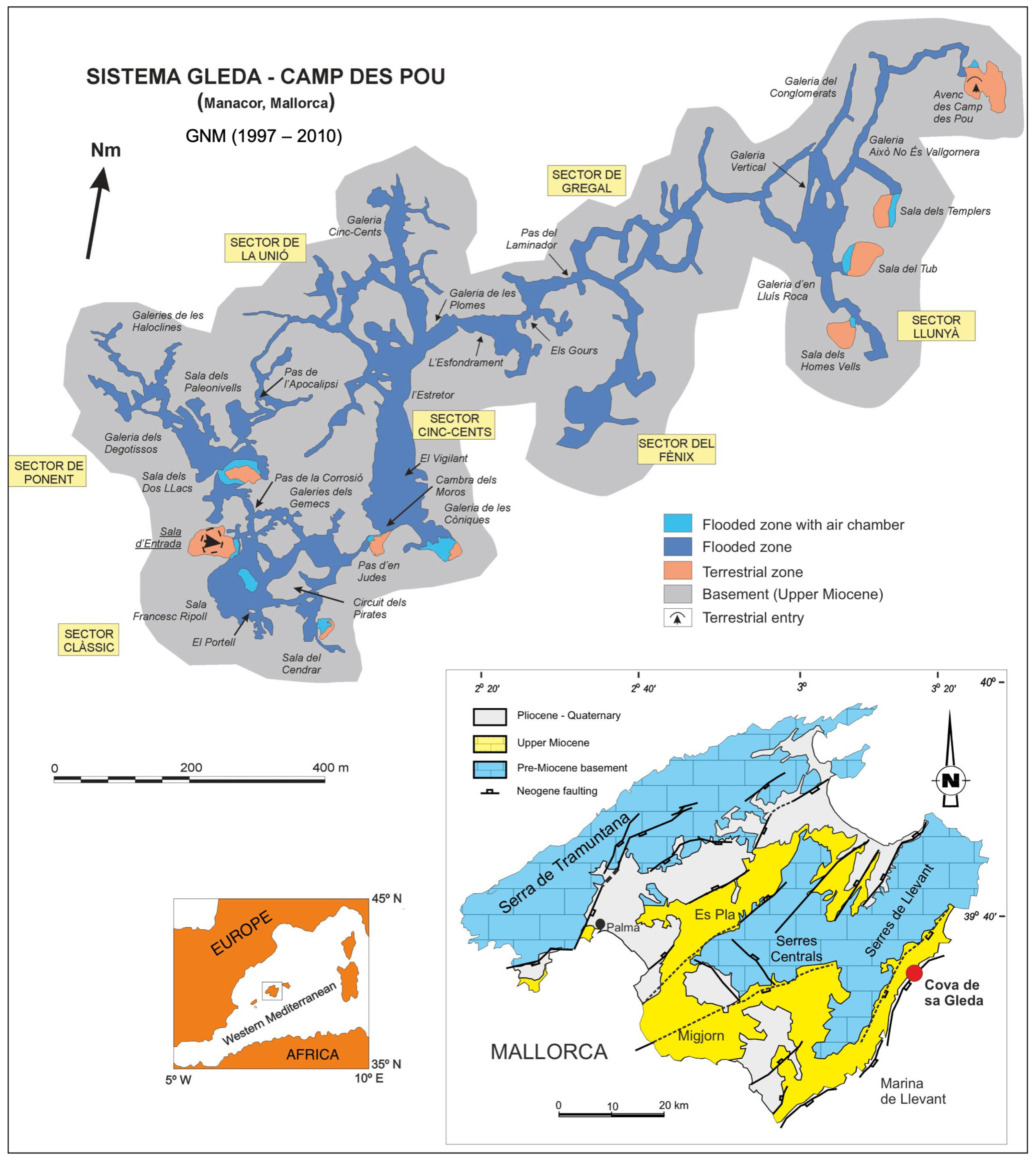
Mallorca’s coastal karst is highly developed due to the extension and the omnipresence of carbonate rocks along the coast. They include different types of cavities and karst remnants, as well as highly developed coastal karren features [28]. One of the sectors with the largest number of coastal karst cavities [29] is located in the south (Migjorn) and south-eastern (Llevant) part of Mallorca (Figure 1). This area corresponds to a post-orogenic carbonate platform, Upper Miocene in age, that surrounds the alpine structured mountain range known as Serres de Llevant. From a geomorphologic point of view, the carbonate platform is characterized by a structural flat-lying littoral plateau ending at the coast by vertical cliffs larger than 10 m in height. This coastal morphology is mainly due to the extensional tectonic activity (normal faults) that had affected the Upper Miocene platform since the Neogene [30].
The platform was formed due to the progradation of a Tortonian-Messinian reef complex [32], usually less than 100 m in thickness, that builds a complex series of alternate facies (reef front, outer and inner lagoon facies) that present different rock textures (limestone, calcarenites and/or calcisiltites). This variability conditions the evolution of voids and conduits of the caves, as well as their hydrology. In that sense, the Miocene carbonate platform is in direct contact with the sea all along the south and south-eastern coasts, permitting the interaction between meteoric and seawater. In this context, most of the conduits and galleries present conspicuous corrosion features that can be followed through the horizontal development of the caves. This platform can be considered as an eogenetic karst in the sense of Vacher and Mylroie [12,29] due to the rock carbonate composition—mostly limestone and calcarenites—that show a high primary porosity, as well as because the age of their rocks (Upper Miocene) showing abundant karst features developed on the unit. At some point, it has some resemblances with the Carbonate Island Karst Model [33] but without an impervious basement that in this case can contribute to the recharge with hypogenic waters [34]. Otherwise Mallorcan eogenetic coastal karst caves do not fit strictly in the Carbonate Island Karst Model, since this model lacks a specific type based on long-lasting collapse of mixing-solution cavities, triggered by the influence of recurrent sea level fluctuations and the associated displacement of the coastal water table [29].
One of the representative cavities of this region is Cova de sa Gleda, which is located in the Manacor municipality, 1.7 km from the coast and with an entrance (collapse doline) at 36 m a.m.s.l [35]. From a speleogenetic point of view, the cave represents a characteristic littoral cave developed in the mixing zone of the Mallorcan eogenetic endokarst.
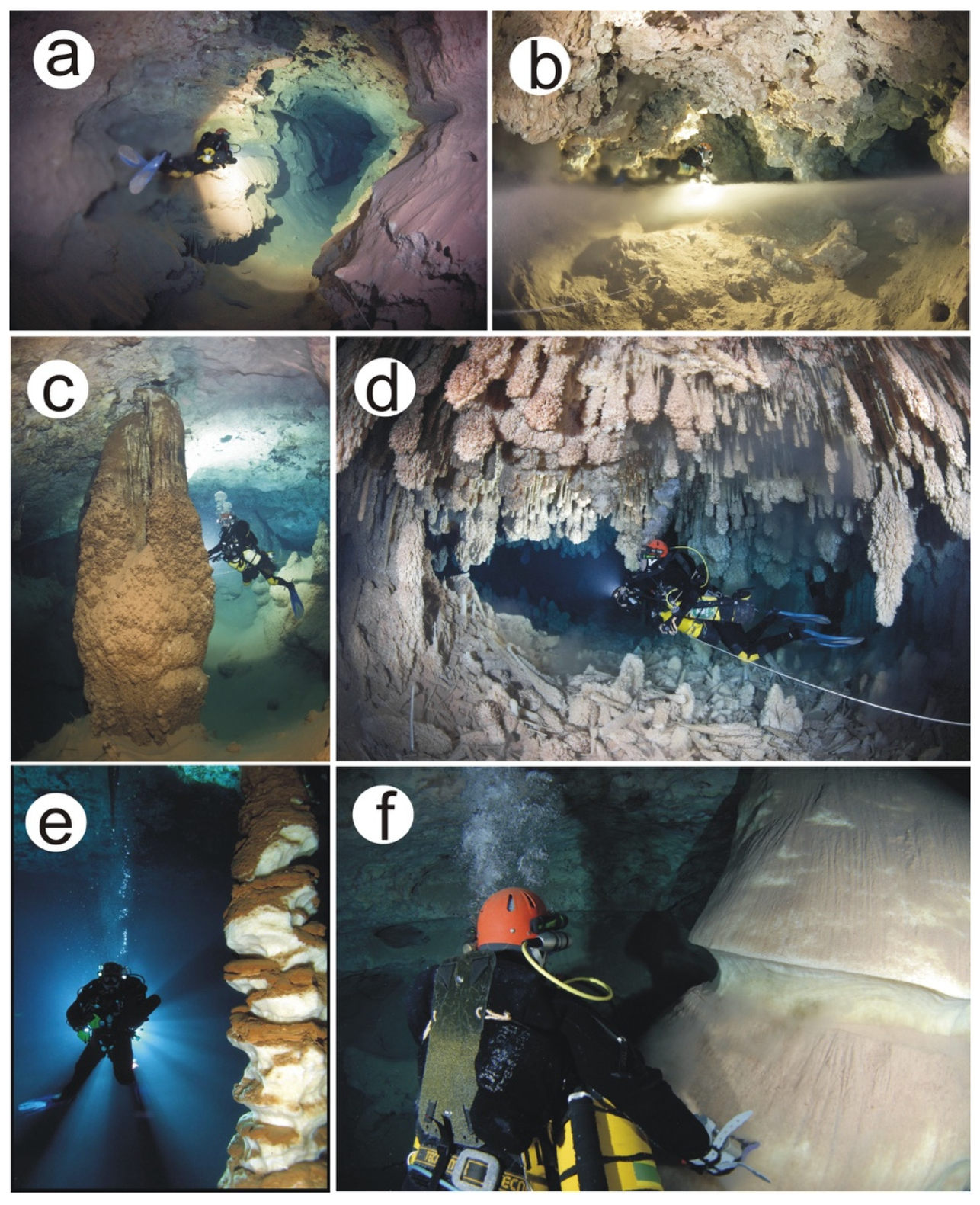
The cave is carved in the alternating Upper Miocene limestones, calcarenites and calcisiltites partly dolomitized [30,35]. The last survey length of the cave system reached 13.5 km and a maximum depth of −25 m [35], being one of the longest underwater littoral caves known in Europe. The cave presents a series of breakdown chambers, at least eight [35], that are connected by both structurally controlled galleries and by phreatic conduits (Figure 2a). These chambers show circular, elliptic or even irregular sections. A large part of the cave is flooded and characterized by a salinity gradient that increases with the depth from brackish to seawater salinity separated by well-defined haloclines (Figure 2b).
In some parts, mostly related to the external entrances of the cave, the floor is covered by red siliciclastic muddy sediments (Figure 2c); in others, the galleries exhibit muddy carbonate sedimentation related to the deposition of the granular decomposition of the Miocene calcarenite rock walls and also to the accumulation of floating calcite rafts where pools are present. Mixing of those two types of sediments, as well as the presence of rock fragments due to breakdown processes, are also present. Speleothems with a variety of forms are present all along the cave, although showing an irregular distribution. It is especially important the presence of abundant phreatic overgrowths on speleothems (POS) (Figure 2d) caused by epiaquatic precipitation that is located at different heights of the cave registering the Quaternary sea-level oscillations [6,28].
One of the most outstanding features of the cave is the presence of corrosion features. A great variety of corrosion morphologies can be observed depending on if they are developed on primary formations or in breakdown areas. The more characteristic corresponds to the corrosion notches that can be found affecting both speleothems and the wall bedrock (Figure 2e,f).

3. Materials and Methods

3.1. Weight-Loss Rock Tablets Trial

To evaluate the corrosion rates in the mixing zone of this littoral cave, a rock-tablet exposure trial was conducted between December 2011 and January 2014, extending 749 days, using both disk and cube samples of Upper Miocene calcarenites and aragonite. The rock tablets were exposed along a vertical profile, experiencing different geochemical water conditions in depth. The corrosion rates were obtained assessing the mass loss of the rock tablets [16,23].
Two types of rock tablets were used in order to evaluate the role of mineralogy and texture in corrosion. One set of tablets has been obtained from calcarenite rocks and another from a dead speleothem with aragonite mineralogy. Both rocks correspond to the main lithological characteristics of the cave walls and speleothemic decoration. Before exposition, tablets were cleaned with distilled water and weighed with a 0.0001 g precision balance (Mettler Toledo AB204-S/FACT, Greifensee, Switzerland) and numbered after drying in an oven at 105 °C for 24 h.
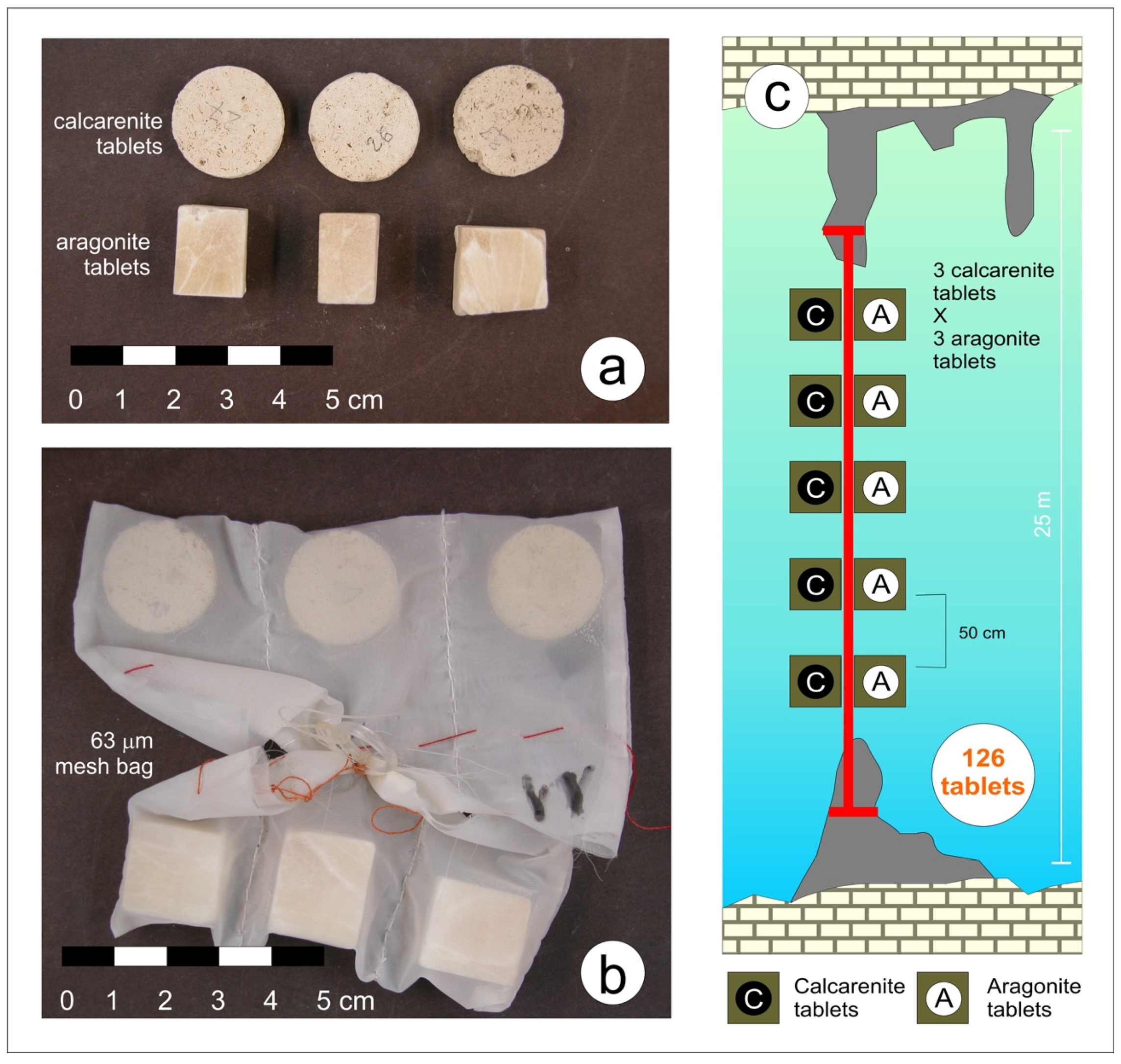
One set of tablets was prepared from a calcarenite block taken from a local outcrop Upper Miocene in age. The tablets were obtained by drilling with a 20 mm section diameter and then cut in slices about 4 mm thick. The XRD analysis reported a mineralogy consisting mainly of dolomite. The semi-quantitative elemental composition made by SEM-EDX reported mean values (C. atom) of Ca: 51.37%, Mg: 39.61%, Si: 3.86%, S: 2.78% and Al: 1.98%. Texturally the rock corresponds to a medium to fine sands bioclastic packstone representing the lagoon facies of the Reef Unit of the Upper Miocene [33] that crop out in the area. Calcarenite disks, that were weighed previously to their installation into the cave, resulted in non-uniform mass due to the difficulties cutting them precisely with the same dimension volume. The mean mass value per unit was 2.85 g with a maximum of 3.80 g and a minimum of 1.87 g (Figure 3a). Rocks from the same outcrop were used to confection tablets for former experiments and bulk porosity was estimated in 28.47%, and the mean bulk density of calcarenite tablets was estimated in 1.54 g·cm3.
The second set of rock tablets was prepared from a dead speleothem, collected at the cave, and cut into cubes roughly about 15 × 15 × 10 mm. In the same way, the XRD analysis confirmed that aragonite was the only mineral present in the cubes. Their semi-quantitative elemental composition made by SEM-EDX reported mean values (C. atom) of Ca: 98.21% and Sr: 1.79%. Texturally the aragonite tablets corresponded to aggregates formed by acicular aragonite crystals near 1 cm long and around 35 µm in width showing a parallel fabric and an external globular morphology. The mean mass value for the aragonite cubes was 7.11 g with a maximum of 12.36 g and a minimum of 4.32 g. The mean bulk density of aragonite tablets was 2.49 g·cm3.
Once cut, weighed and dried, a total of 84 tablets were inserted in mesh bags (63 µm) to avoid any possible abrasive mechanical processes, although it was not expected in the cave environment. Each bag had three separate compartments that contained one calcarenite disk or one aragonite cube (Figure 3b).
All bags were suspended vertically from a nylon wire with the bags attached by means of a plastic ring. To verify the local corrosion according to the depth and the known presence of haloclines, the vertical distribution of the samples was placed at 50 cm intervals. Therefore, at each interval there was one bag of calcarenite disks (three replicates) and one bag of aragonite cubes (three replicates). Due to the morphological characteristics of the cave and the presence of haloclines, the vertical profile was divided into three different sections (from 5 to 7 m, from 9.3 to 11.1 m and from 13.3 to 15.9 m depth) to accommodate the topographical characteristics of the cave and the known distribution of haloclines. The first and last set of tablets were installed at 5 and 15.9 m depth, respectively (Figure 3c).
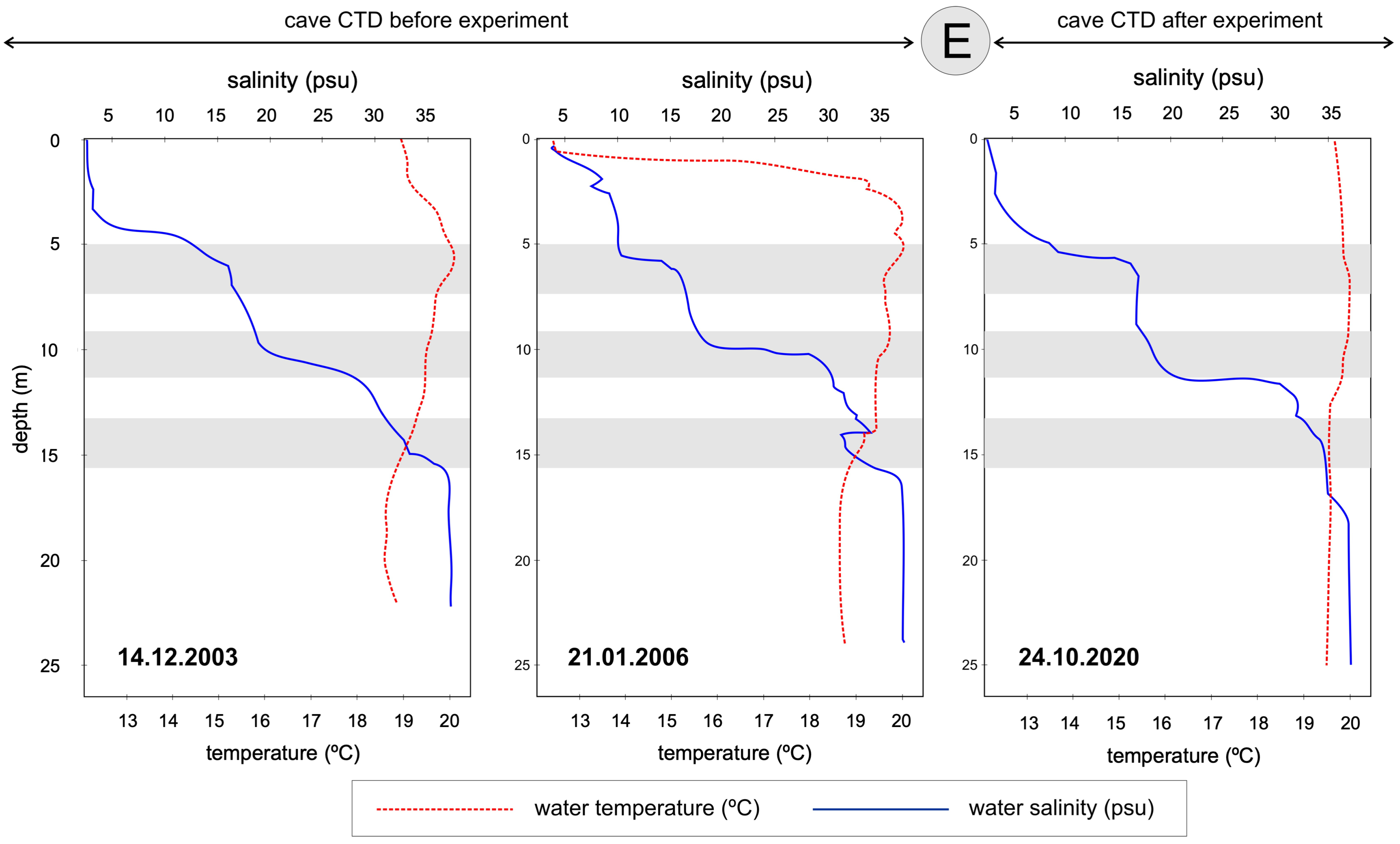
Scuba divers made the emplacement of the tablet sets. They placed the wire with the tablets on 17 December 2011 and they were collected on 4 January 2014. The total time of exposition was slightly more than two years (749 days). As the cave is protected under regional environmental legislation, access is restricted and permitted only for scientific research. No diving or exploratory activities were conducted in the galleries where the experiment took place, in order to avoid mixing or disturbing the water column. As shown in Figure 4, the position of the haloclines remained relatively stable before and after the experiment. Similar stability has also been observed in other coastal caves in the region [36].
Once retrieved, tablets were transported to the laboratory where they were dried and carefully cleaned to eliminate salt precipitation. Tablets were weighed again and the mass loss for each of the tablets was calculated in respect to the initial mass. The rock-mass loss was calculated as the average value for three tablets from each bag and was expressed in mg·cm−2·a−1. Using the density of the rock and the disk or cube volume, it was also possible to provide the corrosion rate in mm·a−1, according to Trudgill [17], and to m·cm−2·a−1 in order to assess the solution related to surface exposure. Non-parametric statistics tests for comparing means (Kruskal–Wallis) have been implemented in order to evaluate corrosion patterns against depth. To describe the rock surface texture and the corrosion effects on the surface of the tablets qualitatively, they were analyzed with a Scanning Electron Microscopy (SEM-Hitachi S.3400N, Tokyo, Japan). Additionally, EDX microanalyses were made utilizing a Brucker AXS Flash 4010 device attached to the SEM to know the chemical composition of the weathered features.

3.2. Water Geochemistry and Morphological Observations

To describe the water’s geochemical characteristics in the flooded cave, a vertical profile of conductivity and temperature was performed using an AANDERAA CTD from the surface to 25 m in depth. The CTD measured water temperature (°C) and salinity (PSU). Considering the morphology of the cave system and the chambers’ nature, it was necessary to add several vertical transects belonging to different chambers and passages to integrate the whole morphology of the flooded cave.
Additionally, during the scuba-diving exploration of cave galleries, the different types of corrosion levels were described, and the observed levels of conspicuous corrosion were measured in terms of groove–notch penetration and depth below mean sea level.

4. Results

4.1. Cave Hydrology and CTD Profiles

Different temperature and conductivity profiles were made, previously to the installation (2003 and 2006) and after the retrieval of the tablets trial (2020), in the flooded passages. Figure 5 shows the temperature, conductivity, and depth measured throughout the cave to have a vertical profile from the surface until reaching the cave’s maximum depth (Figure 4).
Both the CTD profiles before the experiment and those after exhibit very similar patterns. From this register that expands from roughly seventeen years, we can conclude that this system is relatively stable and haloclines remain more or less constant at the same depth. CTD profiles temperature is very constant throughout all of the profiles with a maximum range of only 1.3 °C in wintertime measures. The minimum value was 18.7 °C in the deepest zone, and the maximum of 20 °C was coincident with the presence of the first halocline. The upper body of the water mass experienced a more considerable variation in temperature than the bottom; this trend reflected the outside atmosphere’s influence in the cave because the flooded upper chamber is in contact with the larger-size entrance of the cave (Sala d’Entrada at Figure 1). For this reason, the temperature registered a minimum value of 12.4 °C at the surface, but at 2 m in depth it reached 19 °C. From this depth, the thermocline does not experience differences between the different surveys, resting between 19 °C and 20 °C.
Along the water profile, four clearly visible haloclines or pycnoclines were present. Ranging from the lowest salinity values on the surface water (freshwater with less than 4 PSU—practical salinity units) to higher values at 16 m depth (seawater giving 35 PSU), abrupt changes in salinity occurred at different depths showing five different salinity beds with a good stratification (Figure 5). From the freshwater at the surface, the salinity increased slowly to 10.5 PSU at 5 m depth where salinity suffered an abrupt increase to 16 PSU. This change corresponded to the first halocline that coincided with the slight change in temperature. At this depth, salinity increased gradually until 19 PSU at 11 m depth, where there was again a new change reaching 29 PSU. This new abrupt change corresponded to the most critical halocline along the profile. There was a gradual increase in salinity from this depth till reaching a 15 m depth where a new small halocline was observed just before attaining without a doubt seawater (35 PSU) at 16 m depth.

4.2. Rock Tablets and Blocks Exposure Trial

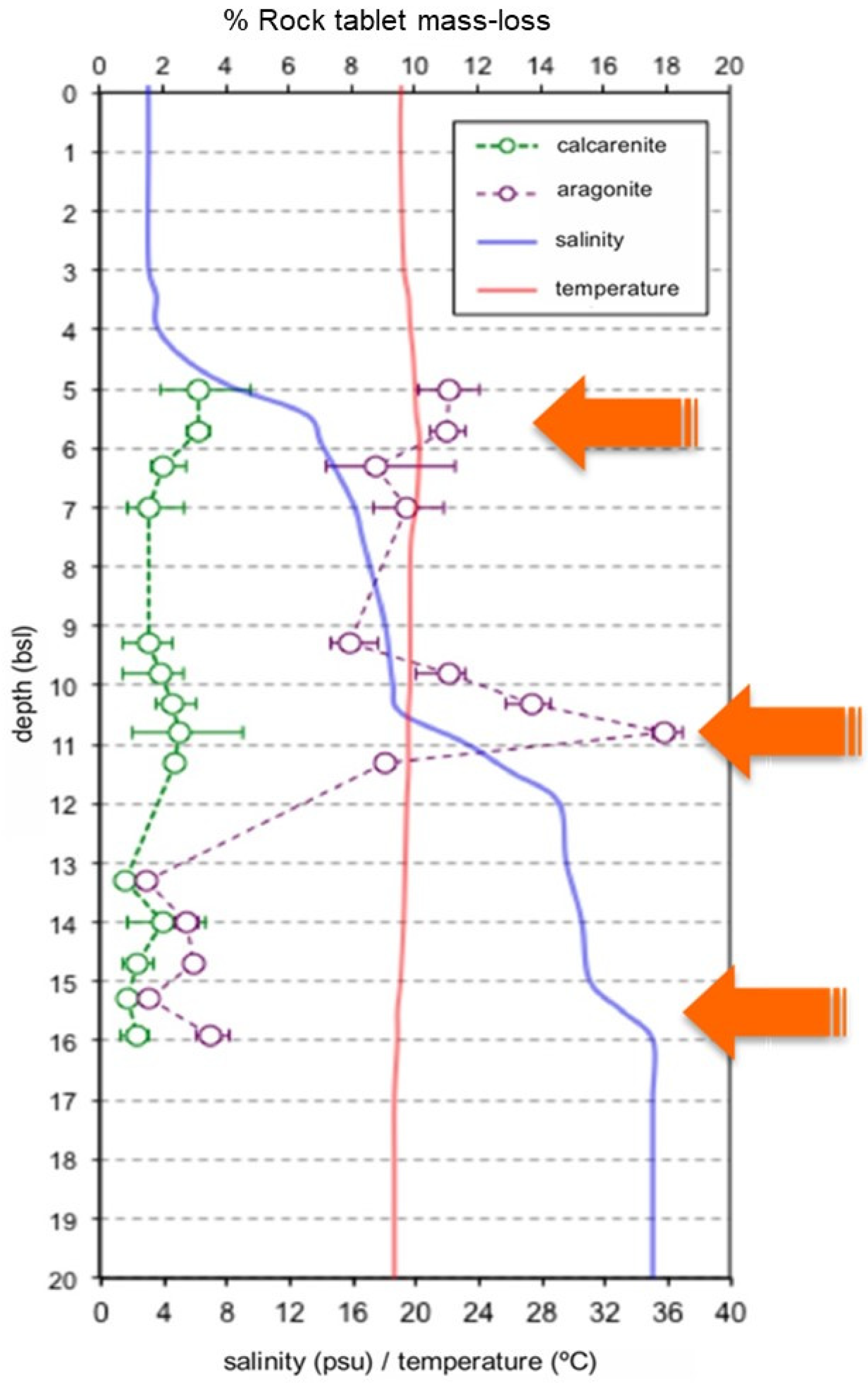
Examination of rock tablets after an exposure trial of 749 days, roughly 2 years, revealed differences in mass along the cave flooded depth profile and differences among the type of tablets. The tablet’s mass loss is expressed as a percentage of the initial mass of the samples. This is supported by Figure 5, which shows the percentage of tablets’ initial mass loss for calcarenite disks and aragonite cubes at different depths. Calcarenite tablets had lost on average 1.89% of the initial mass, although values range from 0.66 to 4.82% (Table 1). In comparison, aragonite tablets had lost on average the 8.05% of their initial mass, with a minimum of 1.32% and a maximum of 18.51% (Table 1). In terms of corrosion rates, calcarenite tablets had lost on average 0.006 mm·cm−2·a−1, and values range from 0.0005 to 0.0147 mm·cm−2·a−1 (Table 2); whereas aragonite tablets had lost on average 0.0433 mm·cm−2·a−1, ranging from 0.0077 to 0.0968 mm·cm−2·a−1 (Table 2).
Differences in corrosion rates between calcarenite tablets and aragonite tablets were statistically significant (p < 0.05) (Table 3). On average, aragonite tablets’ corrosion was at least five times higher than calcarenite tablets.
Nevertheless, there were differences along the depth profile. The first halocline appeared around 5 m depth, where salinity changed from 10.5 to 16 PSU. There, corrosion rates attended average values of 3.10% and 0.0087 mm·cm−2·a−1 for calcarenites and 11.08% and 0.0528 mm·cm−2·a−1 for aragonite tablets (Table 1 and Table 2). At 10 m in depth, the salinity changed from 19 to 29 PSU and corrosion in calcarenites rose to 2.53% and 0.0079 mm·cm−2·a−1, whereas in aragonite, the average arrived at 17.93% and 0.0719 mm·cm−2·a−1 (Table 1 and Table 2). At 16 m in depth, water mass corresponded to seawater, with salinity values larger than 35 PSU, and there the corrosion values decreased in both calcarenite and aragonite, being the average mass loss values of 1.97% and 0.0077 mm·cm−2·a−1 for calcarenite tablets and 3.48% and 0.0171 mm·cm−2·a−1 for aragonite tablets (Table 1 and Table 2).
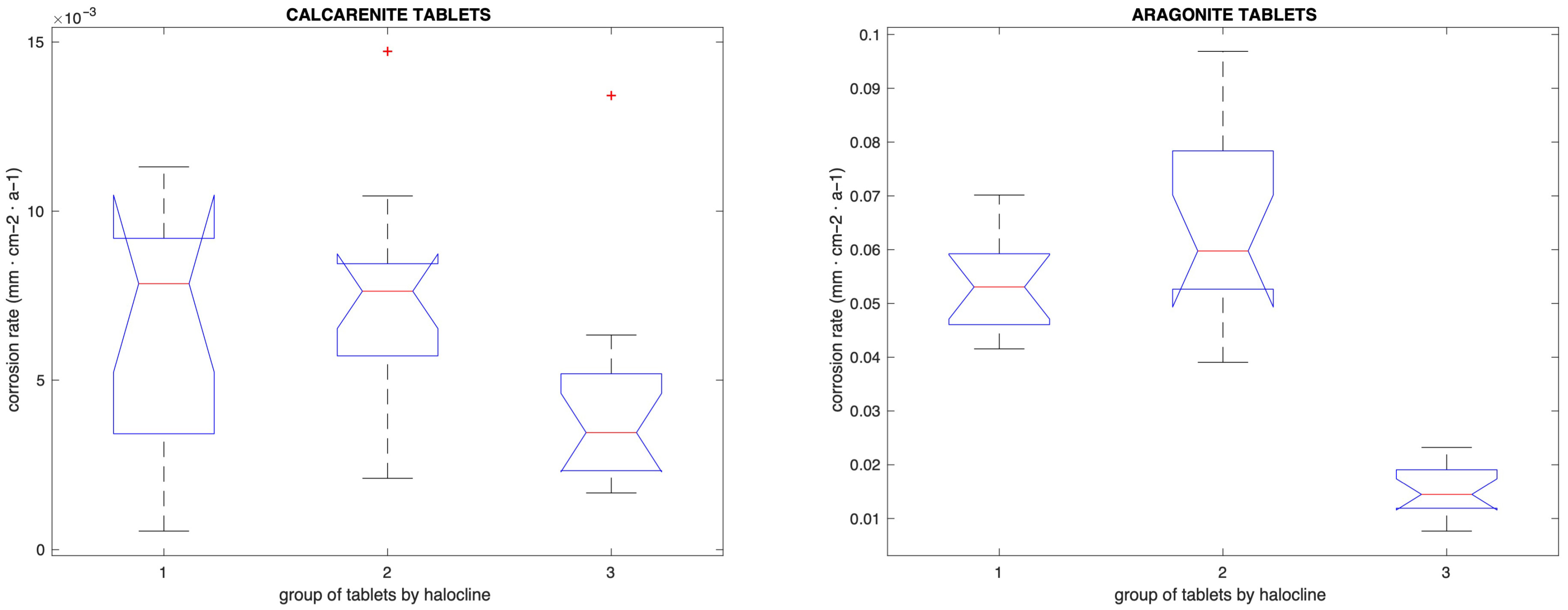
In fact, calcarenite tablets show significant differences in corrosion rates among samples deployed at different depths (p < 0.05), despite the contrast values lying close to the rejection threshold. The mean corrosion rate tends to be lower at the deepest deployment level, which differs significantly from those recorded for tablets placed at the first and second haloclines (Table 3 and Table 4). In the case of aragonite tablets, significant differences in corrosion rates are also clearly observed among samples deployed at different depths (p < 0.05) (Table 3 and Table 4). These samples display a spatial pattern similar to that of the calcarenite tablets; however, in this last case, the distribution tails do not overlap (Figure 6).
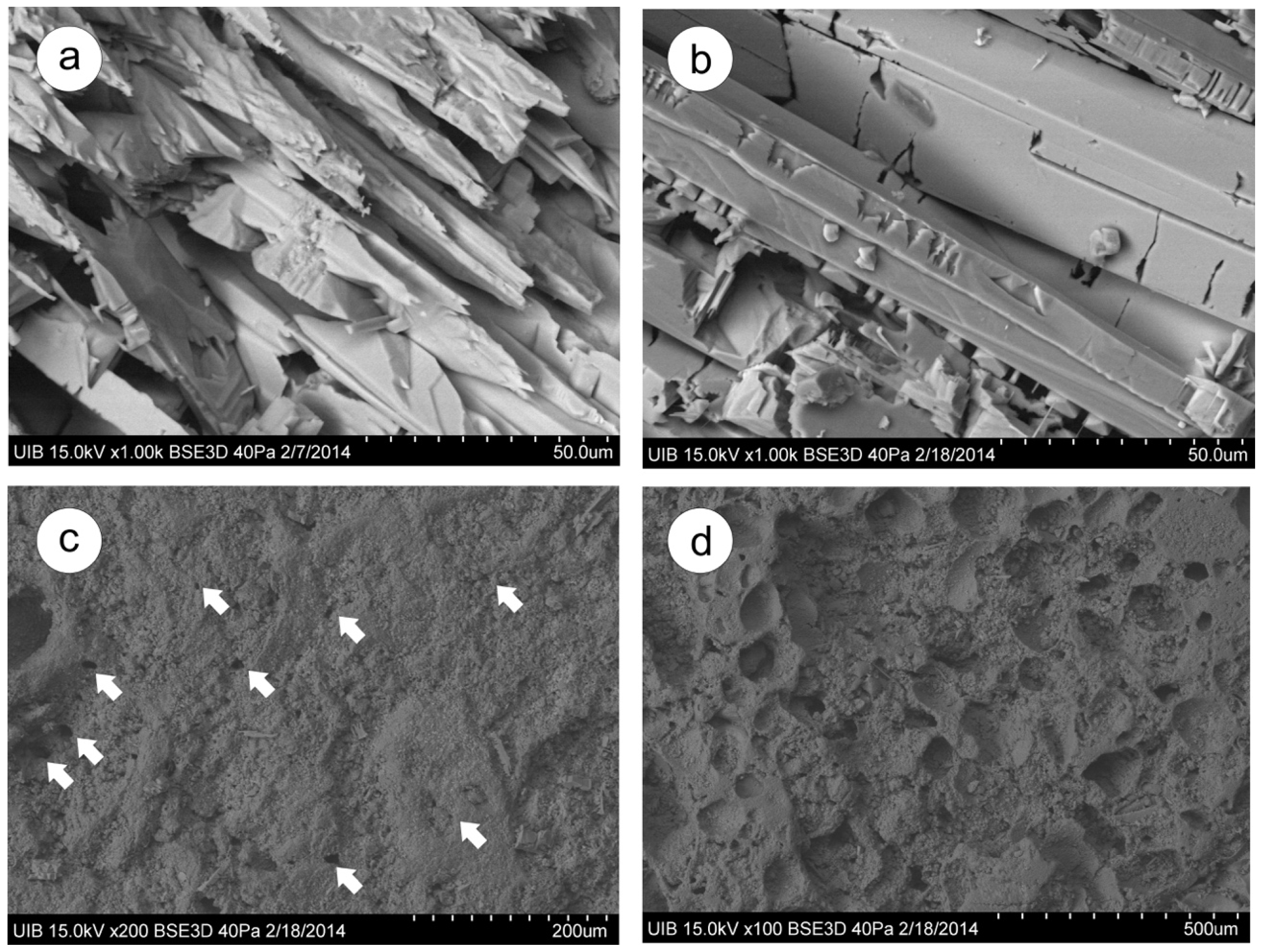
Over the two-year period, differences in mass showed higher values recorded at depths around 10 m, compared to those located above and below this halocline. Qualitative SEM micromorphological tablet observations showed nano-scale corrosion features, including crystal-controlled solution and subdued solution and/or generalized smoother edges and surface typically related to the solution. However, the more considerable amount of evidence of weathering affected the aragonite tablets, these samples until 12 m in depth exhibit V-in-V nanomorphologies typical of crystal geometry controlled, and below this depth the relative abundance of these nanoforms is less conspicuous (Figure 7a,b). Otherwise, calcarenite tablets exhibit less evidence of solution in comparison with aragonite samples. There is sparse evidence of nanofeature weathering in this subset of samples, including smother edges and evidence of grain detachment (Figure 7d) or clear pitting due to solution (Figure 7c) which affect mainly the samples located at the first halocline. SEM images revealed no biofilm coverage or evidence of biological colonization on the surfaces or within the microroughness of either the aragonite or calcarenite tablets. Nevertheless, some nanoscale features typically associated with biological activity (biopits) were observed on a small number of calcarenite tablets, although these occurred only sparsely and at low frequency (e.g., Figure 7c).

4.3. Corrosion Features at Cova De Sa Gleda

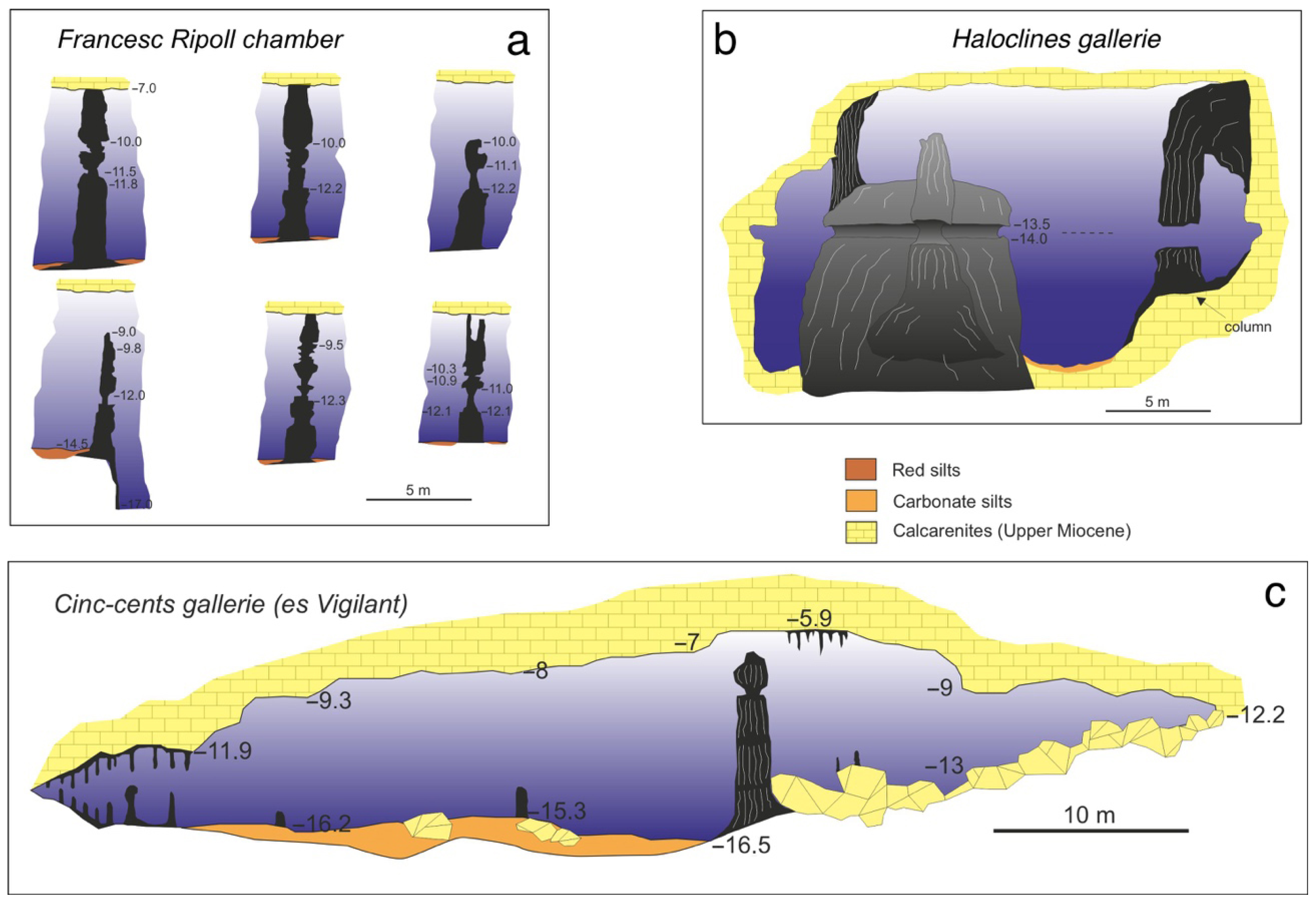
At Cova de sa Gleda cave walls and speleothems from flooded chambers and passages exhibit abundant corrosion notches (Figure 2e,f). They consist of horizontal grooves from 0.5 to 3 m in depth and 0.3 to 1 m in width. Very often, corrosion notches show lateral continuity along galleries and chamber walls. It is noticeable that at Galeria de les Haloclines (Figure 8b), corrosion notches remain clearly visible along more than 150 m of the gallery at 13.5 to 14 m in depth. One of the most outstanding corrosion notches can be observed at the Francesc Ripoll chamber that affects previous speleothems, mostly columns. In this chamber, several notches at different depths are clearly visible, even arriving to dissect the column’s entire width (Figure 8a).
Detailed cave mappings and topographical sections reveal that there are at least three levels with a persistent presence of well-developed corrosion notches, around −9.5 to −10 m, at −12 m and over −14 m in depth. Although not as well preserved as the former ones, there are also corrosion notches at −15 and −18 m in depth (Figure 8c). Other secondary corrosion features, such as rock spans and pillars, bridges, solution facets, arches, rock pendants, rocky jacks and pendants, cers, and a diversity of pockets (e.g., wall, ceiling, and floor pockets) are also present.

5. Discussion

Differences in mass of 84 rock tablets exposed during a two-year period have shown an increase in corrosion rates related to water salinity gradients in the littoral endokarst of Mallorca Island. Although the tablets were installed in three different sectors of the cave, a more extensive sampling design with a greater number of replicates would allow more robust conclusions to be drawn. However, given the logistical challenges of working in this environment and the absence of comparable observational datasets, the results presented here nevertheless represent a significant advance, despite the inherent natural variability of cave systems.
Against this background, calcarenite tablets have lost on average 1.89% of their initial mass, although values range from 0.66 to 4.82%. In contrast, aragonite tablets have lost on average 8.05% and their initial mass with a minimum of 1.32% and a maximum of 18.51%. On average, aragonite tablets corrosion is at least five times higher than calcarenite tablets. Nevertheless, there are significant differences along the depth profile for both calcarenite and aragonite tablets. At 10 m in depth, the salinity changes from 19 to 29 PSU, and corrosion in calcarenites rises to 10.8%, whereas in aragonite, the average reaches 17.93%. At 16 m in depth, the water mass corresponds to seawater, with salinity values higher than 35 PSU, and their corrosion values decrease in both calcarenite and aragonite, with average values of 1.97% and 3.48% respectively. The lowest corrosion rates from this experiment are related to both cave depths, where mixing water is dominated by freshwater (<12 PSU), and cave depths dominated by marine water (~35 PSU).
When two limestone waters mix, according to the end-member solution and the relative abundances of products in the volume of water, several chemical reactions affecting carbonate solubility produce ionic activities that vary in a non-linear way with the mass concentration of ions in the solution [7]. These chemical interactions yield a number of mixing effects, such as the PCO2 effect, the ionic strength effect or the temperature effect [37] that cause the final mixture to be undersaturated or supersaturated.
From Figure 5 it is clear that the temperature remains roughly constant at around 19 °C. Periodically, the cave’s upper water layers can be cooled, as in other coastal caves along the same physiographical unit, because of the input of percolation water after intense rainfall events [38]. Therefore, the temperature can be excluded in order to explain major differences in corrosion rate variability along the vertical gradient.
Herman et al. [39] and Boop et al. [38] found the groundwaters at south-eastern Mallorca Island dominated by mixing, dissolution and precipitation of carbonate minerals, and dissolution and degassing of CO2. According to this background, the addition of salts from the high ionic strength seawater to fresh groundwater causes carbonate rocks to become more soluble, the so-called ionic-strength effect [2]. The experiment at Sa Gleda cave (Figure 3) empirically shows that solution, in the form of rock-tablet corrosion, for both calcarenites and aragonite tablets, is higher at the second halocline (11% mass loss in average for calcarenite tablets and 19% for aragonite ones), over 10 to 12 m in depth. The third halocline, roughly 16 m in depth, shows salinity values around 35 PSU that correspond to sea water; then at 10–12 m in depth, we found salinities between around 19 and 26 PSU. Corrosion rates are higher where salinities reach around 24 PSU. That means a decrease of 31% in salinity respect of marine water. At the first halocline, 5 m in depth, the corrosion rates are much lower than in the second one (3% mass loss in average for calcarenite tablets and 11% for aragonite ones), coinciding with a decrease of 60% in salinity with respect to seawater. The experiment shows that rock corrosion is associated with salinity, reaching a maximum at 24 PSU and decreasing sharply at higher salinities. Therefore, this experiment is one of the first field evidence of mixing-zone solutions. This experiment did not characterize the PCO2 at different depths because the main goal was to provide empirical data on corrosion. For this reason, it is not possible to introduce the role of local PCO2 in the discussion; nevertheless, the high sensitivity of calcite dissolution to small variations in the local PCO2 should be noted and could explain intra-level variability.
It is well known that aragonite is more soluble than calcite (solubility products for aragonite, Karag = 10−8.25 and calcite Kcc = 10−8.41 at 10 °C) [40]. In this sense, our data reveals that in Cova de sa Gleda, on average, the aragonite tablets had experienced corrosion with a mass loss at least five times higher than the calcarenite ones.
The results highlight the importance of the mixing zone solution in the evolution of underwater conduits and the decay of cave walls associated with speleothems, although this is not the only agent in shaping these morphologies. Most of the corrosion notches described in the cave coincide with the described haloclines’ present position (Figure 8). Despite the potential of solution from the upper levels flooded by freshwater, cave exploration at Sa Gleda Cave [35], as well as in other similar caves [41,42], does not exhibit corrosion notches at the epiphreatic level. However, there are many of them at different depths in flooded galleries and chambers. There are many other corrosion notches less well developed at different depth levels that contribute to this point. The groundwater mixing zone, during Plio-Quaternary, may have fluctuated through time as a result of relative sea-level change. Precise curves of sea level variation have been provided by Dumitru et al. [5], Polyak et al. [6] from phreatic-overgrowth speleothems (POS) from those caves, and evidence of former highstands and lowstands have been described. Therefore, these corrosion notches well preserved in columns or cave walls at different levels from the stable position of present haloclines (Figure 2e,f and Figure 8) could be understood as proxies of the former position of the groundwater mixing zone.

6. Conclusions

Rock tablets provided an effective experimental approach for assessing corrosion processes associated with haloclines within submerged passages of the mixing zone of the littoral aquifer along the eastern coast of Mallorca Island. Mass-loss measurements from 84 rock tablets exposed over a two-year period, combined with CTD surveys of water masses, demonstrate that salinity gradients are associated with limestone corrosion rates in the coastal endokarst.
Calcarenite tablets lost, on average, 1.89% of their initial mass (range: 0.66–4.82%), whereas aragonite tablets exhibited substantially higher losses, averaging 8.05% (range: 1.31–18.51%). Corrosion rates varied with depth, with maximum values associated with salinities of approximately 24 PSU at depths of 10–12 m. Under these conditions, calcarenite corrosion reached up to 10.8%, while aragonite tablets recorded mean losses of up to 17.93%. These results provide the first experimental field evidence demonstrating the role of aggressive mixing waters as a primary driver of corrosion in coastal karst cavities.
The occurrence of well-developed corrosion notches coinciding with the present halocline position further constrains cave morphogenesis. The association of the 24 PSU halocline with the deepest and largest notches suggests that corrosion notches preserved on cave walls and speleothems, including columns, may serve as reliable proxies for former halocline positions, although CO2 stratification or biological activity, among others, can also contribute to the enlargement of these features.

Author Contributions

Conceptualization, L.G.-P., J.J.F. and F.G.; methodology, L.G.-P. and J.J.F.; Experiment deployment at cave and conductivity and temperature profiles F.G.; A.E., L.G.-P., J.J.F. formal analysis, J.J.F. and L.G.-P.; investigation, A.E., F.G., J.J.F. and L.G.-P.; resources, F.G.; data curation, F.G., J.J.F. and L.G.-P.; writing—original draft preparation, L.G.-P. and A.E.; writing—review and editing, A.E.; visualization, A.E.; supervision, J.J.F. and L.G.-P.; project administration, J.J.F.; funding acquisition, J.J.F. All authors have read and agreed to the published version of the manuscript.

Funding

This research was funded by Agencia Estatal de Investigación (AEI), grant numbers CGL2013-48441-P, CGL2016-79246-P, and PID2020-112720GB-I00.

Data Availability Statement

The raw data supporting the conclusions of this article will be made available by the authors on request.

Acknowledgments

This paper is a result of research made by the financial support of the MINECO CGL2013-48441-P, CGL2016-79246-P and PID2020-112720GB-I00 (AEI-FEDER, UE) grants. Thanks to Joan Cifre and Ferran Hierro for helping us with the analyses that were carried out on equipment from Serveis Científico-Tècnics of the Universitat de les Illes Balears. We are grateful to the Conselleria de Medi Ambient del Govern Balear for granting permission to carry out this study. We also want to thank to the scuba divers of Societat Espeleològica Balear for helping us in the underwater speleological procedures. We thank comments and English smoothing from M. Compa.

Conflicts of Interest

The authors declare no conflicts of interest.

References

  1. Bogli, A. Mischungskorrossion: Ein Beitrag zur Verkarstungsproblem. Erdkunde 1964, 18, 83–92. [Google Scholar] [CrossRef]
  2. Smart, P.L.; Dawans, J.M.; Whitaker, F. Carbonate dissolution in a modern mixing zone. Nature 1988, 335, 811–813. [Google Scholar] [CrossRef]
  3. Beedows, P.A.; Smart, P.L.; Whitaker, F.F.; Smith, S.L. Decoupled fresh-line groundwater circulation of a coastal carbonate aquifer: Spatial patterns of temperature and specific electrical conductivity. J. Hydrol. 2007, 346, 18–32. [Google Scholar] [CrossRef]
  4. Rezaei, M.; Sanz, E.; Raeisi, E.; Ayora, C.; Vázquez-Suñe, E.; Carrera, J. Reactive transport modeling of calcite dissolution in the freshwater mixing zone. J. Hydrol. 2005, 311, 282–298. [Google Scholar] [CrossRef]
  5. Dumitriu, O.A.; Anstermann, J.; Ployak, V.J.; Fornós, J.J.; Asmeron, Y.; Ginés, J.; Ginés, A.; Onac, B.P. Constrains on global mean sea level during Pliocene warmth. Nature 2019, 574, 233–236. [Google Scholar] [CrossRef]
  6. Polyak, V.; Onac, B.P.; Fornós, J.J.; Hay, C.; Asmeron, Y.; Dorale, J.A.; Ginés, J.; Tuccimei, P.; Ginés, A. A highly resolved record of the relative sea-level in the Western Mediterranean Sea during the last interglacial period. Nat. Geosci. 2018, 11, 860–864. [Google Scholar] [CrossRef]
  7. Fratesi, B. Hydrology and geochemistry of the freshwater lens in coastal karst. In Coastal Karst Landforms; Lace, M.J., Mylroie, J.E., Eds.; Springer Science: Dordrecht, The Netherlands, 2013; pp. 59–75. [Google Scholar]
  8. Li Vigni, L.; Daskalopoulou, K.; Calabrese, S.; Brusca, L.; Bellomo, S.; Cardellini, C.; Kyriakopolus, K.; Brugnone, F.; Parello, F.; D’Allessandro, W. Hellenic karst waters: Geogenic and anthropogenic processes affecting their geochemistry and quality. Sci. Rep. 2023, 13, 11191. [Google Scholar] [CrossRef]
  9. Bandara, U.G.C.; Diyabalanage, S.; Barths, J.A.C.; Chandrajith, R. Geochemical and isotope characterization of groundwater and assessment of surface water mixing in the coastal karst aquifer basin in northwestern Sri Lanka. Appl. Geochem 2024, 170, 106098. [Google Scholar] [CrossRef]
  10. Mylroie, J.E. Coastal karst development in carbonate rocks. In Coastal Karst Landforms; Lace, M.J., Mylroie, J.E., Eds.; Springer Science: Dordrecht, The Netherlands, 2013; pp. 77–109. [Google Scholar]
  11. Mylroie, J.E.; Carew, J.L. The flank margin model for dissolution cave in carbonate platforms. Earth Surf. Process. Landf. 1990, 15, 413–424. [Google Scholar] [CrossRef]
  12. Vacher, H.L.; Mylroie, J.E. Eogenetic Karst from the perspective of an equivalent porous medium. Carbonates Evaporites 2002, 17, 182–196. [Google Scholar] [CrossRef]
  13. Mylroie, J.E.; Mylroie, J.R. Development of the Carbonate Island Karst Model. J. Cave Karst Stud. 2007, 69, 59–75. [Google Scholar]
  14. Beddows, P.A. Groundwater Hydrology of a Coastal Conduit Carbonate Aquifer: Caribbean Coast of the Yucatán Peninsula, México. Ph.D. Thesis, School of Geographical Sciences, University of Bristol, Bristol, UK, 2004. [Google Scholar]
  15. Sanz, E.; Ayora, C.; Carrera, J. Calcite dissolution by mixing waters: Geochemical modelling and flow-through experiments. Geol. Acta 2011, 9, 67–77. [Google Scholar] [CrossRef]
  16. Moses, C.A. Field rock block exposure trials. Z. Fur Geomorphol. Suppl. 2000, 120, 33–50. [Google Scholar]
  17. Trudgill, S.T. Measurement of erosional weight loss of rock tablets. British Geo-graphical Research Group. Tech. Bull. 1975, 17, 13–19. [Google Scholar]
  18. Gams, I. International comparative measurement of surface solution by means of standard limestone tablets. Razpr. Iv. Razreda 1985, 26, 361–386. [Google Scholar]
  19. Crabtree, R.W.; Trudgill, S.T. Chemical denudation on a magnesian limestone hillslope, field evidence and implications for modelling. Earth Surf. Process. Landf. 1985, 10, 331–341. [Google Scholar] [CrossRef]
  20. Jennings, J.N. Further results from limestone tablet experiments at Cooleman Plain. Aust. Geogr. Stud. 1981, 19, 224–227. [Google Scholar] [CrossRef]
  21. Krklec, K.; Domínguez-Villar, D.; Carrasco, R.M.; Pedraza, J. Current denudation rates in dolostone karst from Central Spain: Implications for the formation of unroofed caves. Geomorphology 2016, 264, 1–11. [Google Scholar] [CrossRef]
  22. Moses, C.A. Methods for investigating stone decay mechanisms in polluted and ‘clean’ environments. Northern Ireland. In Processes of Urban Stone Decay; Smith, B.J., Warke, P.A., Eds.; Donhead: London, UK, 1996; pp. 212–217. [Google Scholar]
  23. Trudgill, S.T.; Viles, H.A.; Cooke, R.U.; Inkpen, R. Rate of stone loss at St. Pauls’s Cathedral, London. Atmos. Environ. 1990, 24B, 361–363. [Google Scholar] [CrossRef]
  24. Matsukura, Y.; Hirose, T. Five-year measurements of rock tablet weathering on a forested hillslope in a humid temperate region. Eng. Geol. 1999, 55, 69–76. [Google Scholar] [CrossRef]
  25. Naylor, L.A.; Viles, H.A. A new technique for evaluating short-term rates of coastal bioerosion and bioprotection. Geomorphology 2002, 47, 31–44. [Google Scholar] [CrossRef]
  26. Viles, H.A.; Spencer, T.; Teleki, K.; Cox, C. Observations on 16 years of microfloral recolonization from limestone surfaces, Aldabra Atoll, Indian Ocean: Implications for biological weathering. Earth Surf. Process. Landf. 2000, 25, 1355–1370. [Google Scholar] [CrossRef]
  27. Galdenzi, S. Corrosion of limestone tablets in sulfidic ground-water: Measurements and speleogenetic implications. Int. J. Speleol. 2012, 41, 149–159. [Google Scholar] [CrossRef]
  28. Ginés, J. El Karst Litoral en el Levante de Mallorca: Una Aproximación al Conocimiento de su Morfogénesis y Cronología. Ph.D. Thesis, Department of Earth Sciences, University of the Balearic Islands, Palma, Spain, 2000. [Google Scholar]
  29. Ginés, A.; Ginés, J. Eogenetic karst, glacioeustatic cave pools and anchialine environments on Mallorca Island. A discussion of coastal speleogenesis. Int. J. Speleol. 2007, 36, 57–67. [Google Scholar] [CrossRef]
  30. Fornós, J.J.; Pomar, L.; Ramos, E. Tertiary: Balearic Islands. In The Geology of Spain; Gibbons, W., Moreno, T., Eds.; Geological Society of London: London, UK, 2002; pp. 327–334. [Google Scholar]
  31. Gràcia, F.; Clamor, B.; Gamundí, P.; Fornós, J.J. El sistema de cavitats Gleda—Camp des Pou (Manacor, Mallorca). Endins 2010, 34, 35–68. [Google Scholar]
  32. Pomar, L. Reef geometries, erosion surfaces and high-frequency sea-level changes, upper Miocene Reef Complex, Mallorca, Spain. Sedimentology 1991, 38, 243–270. [Google Scholar] [CrossRef]
  33. Jenson, J.W.; Keel, T.M.; Mylroie, J.R.; Mylroie, J.E.; Stafford, K.W.; TaborošI, D.; Wexel, C. Karst of the Mariana Islands: The interaction of tectonics, glacio-eustasy, and freshwater/seawater mixing in island carbonates. In Perspectives on Karst Geomorphology, Hydrology and Geochemistry; Harmon, R.S., Wicks, C., Eds.; Geological Society of America Special Paper: Boulder, CO, USA, 2006; Volume 404, pp. 129–138. [Google Scholar]
  34. Fornós, J.J.; Merino, A.; Ginés, J.; Ginés, A.; Gràcia, F. Solutional features and cave deposits related to hypogene speleogenetic processes in a littoral cave of Mallorca Island (western Mediterranean). Carbonates Evaporites 2011, 26, 69–81. [Google Scholar] [CrossRef]
  35. Gràcia, F.; Fornós, J.J.; Clamor, B.; Febrer, M.; Gamundí, P.; La Cova de sa Gleda, I. Sector Clàssic, Sector de Ponent i Sector Cinc-cents (Manacor, Mallorca: Geomorfologia, espeleogènesis, sedimentología i hidrología). Endins 2007, 31, 43–96. [Google Scholar]
  36. Ginés, J.; Ginés, A.; Fornós, J.J.; Tuccimei, P.; Onac, B.P.; Gràcia, F. Phreatic Overgrowths on Speleothems (POS) from Mallorca, Spain: Updating forty years of research. In Mallorca: A Mediterranean Benchmark for Quaternary Studies; Ginés, A., Ginés, J., Gómez-Pujol, L., Onac, B.P., Fornós, J.J., Eds.; Societat d’Història Natural de les Balears: Palma, Spain, 2012; pp. 111–146. [Google Scholar]
  37. Jankowski, J.; Jacobson, G. Hydrochemistry of groundwater-seawater mixing zone, Nauru Island, central Pacifici Ocean. BMR J. Aust. Geol. Geophys. 1991, 12, 51–64. [Google Scholar]
  38. Boop, L.M.; Wynn, J.G.; Thompson, G.; Fornos, J.J.; Onac, B.P. Interactions between surface conditions, the Mediterranean Sea, and cave climate within two littoral caves in Mallorca: Implications for the formation of Phreatic Overgrowths on Speleothems. J. Cave Karst Stud. 2017, 79, 59–72. [Google Scholar] [CrossRef]
  39. Herman, J.S.; Back, W.; Pomar, L. Geochemistry of groundwater in the mixing zone along the East Coast of Mallorca, Spain. In IAHS Karst Water Resources; IAHS: Ankara, Turkey, 1985; pp. 467–479. [Google Scholar]
  40. Fairchild, I.J.; Baker, A. Speleothem Science. From Processes to Past Environments; Wiley-Blackwell: Chichester, UK, 2012. [Google Scholar]
  41. Gràcia, F.; Jaume, D.; Ramis, D.; Fornós, J.J.; Bover, P.; Clamor, B.; Gual, M.A.; Vadell, M. Les coves de Cala Anguila (Manacor, Mallorca). II: La Cova Genovesa o Cova d’en Bessó. Espeleogènesi, geomorfologia, hidrologia, sedimentologia, fauna, paleontologia, arqueologia i conservació. Endins 2003, 25, 43–86. [Google Scholar]
  42. Trias, M. La cova des Moro (Manacor, Mallorca). Alguns destacats aspectes de la seva morfologia. Endins 2000, 23, 73–78. [Google Scholar]
Figure 1. Study site location and map of the cave (Gleda-Camp des Pou cave system, modified from Gràcia et al. [31]). The arrow enclosed by a dashed circle indicates the terrestrial entrance to the cavity through a collapse doline.
Jmse 14 00469 g001
Figure 2. Morphological features of sa Gleda cave. (a) Phreatic conduit in the Haloclines gallery (Ponent sector) (photo by A. Cirer). (b) Well-defined haloclines where water turbidity separates brackish from seawater in a flooded conduit at the Haloclines gallery (Ponent sector) (photo by A. Cirer). (c) Stalagmitic massif in Sector de Ponent where the cave floor is covered by red siliciclastic muddy sediments and white rests or calcarenite rocks and floating calcite rafts (photo by A. Cirer). (d) Phreatic overgrowth on speleothems (POS) are abundant along the cave (photo by A. Cirer; Circuit dels Pirates, Classic sector). (e) Corrosion notches affecting speleothem columns (photo by F. Vasseur) in Francesc Ripoll chamber (Classic sector). And (f) cave-wall bedrock (photo by A. Cirer) in the Haloclines gallery (Ponent sector).
Jmse 14 00469 g002
Figure 3. Mass-loss rock tablets exposure trial features. (a) Calcarenite tablets were circular in shape with a 20 mm diameter and 4 mm in thick. Aragonite tablets were cut in cubes of 15 × 15 × 10 mm. (b) Tablets were places in 63 µm mesh bag with 3 replicates for each level and lithology. (c) All bags were suspended vertically separated 50 cm from 5 m to 15 m in depth.
Jmse 14 00469 g003
Figure 4. Pre- and post-experiment cave water temperature and salinity profiles. Gray bands indicate the location of the major haloclines in depth along the cave. Grey shadows indicate the major changes in salinity along the profile.
Jmse 14 00469 g004
Figure 5. Rock tablet mass-loss against water geochemistry along the depth profile at sa Gleda Cave. Yellow arrows indicate the three major changes in salinity along the analyzed profile.
Jmse 14 00469 g005
Figure 6. Boxplots of tablets corrosion rates grouped by halocline. Plus signs correspond to anomalous values.
Jmse 14 00469 g006
Figure 7. Corrosion nanomorphologies from exposed mass-loss rock tablets at sa Gleda cave. (a) and (b) Typically crystal geometry-controlled V-in-V forms, related to solution, from aragonite tablets emplaced at 12 m in depth. (c) Arrows identify the presence of solution nanopits and (d) evidence of grain detachment and smoother edges in calcarenite tablets placed at 6 m in depth.
Jmse 14 00469 g007
Figure 8. (a) Corrosion notches shaping speleothem columns at different depths at Francesc Ripoll Chamber. (b) 14 m in depth corrosion notch level affecting both cave-wall bedrock and columns. Notice that some columns have been completely dissected. (c) Different levels of corrosion notches at Cinc-cents gallery. Modified from Gràcia et al. [35]. Check Figure 1 for galleries location.
Jmse 14 00469 g008
Table 1. Rock tablets Average mass-loss (in %) after exposition.
Depth
Level
MLRT
Set
Calcarenite Tablets
(Mass Loss in %)
Aragonite Tablets
(Mass Loss in %)
MeanSt. Dev.Min.MaxMeanSt. Dev.Min.Max
1st
halocline
13.101.531.934.8211.080.9810.1012.05
22.161.760.173.5211.010.5610.5211.62
32.040.621.612.748.792.207.1811.29
41.530.990.852.679.781.118.7010.92
2nd
halocline
51.540.780.742.307.920.807.358.84
61.951.060.732.6511.090.8810.0611.61
72.300.671.823.0613.690.7312.8914.32
82.531.811.024.5417.930.5117.5518.51
92.531.811.024.5417.930.5117.5518.51
3rd
Halocline
100.780.110.660.881.460.151.321.62
111.971.250.903.342.770.382.393.16
121.150.510.731.713.010.162.833.14
130.860.160.761.041.590.151.441.74
141.150.460.671.593.480.573.094.14
Table 2. Tablets corrosion rates (mm·cm−2·a−1) after exposition.
Depth
Level
MLRT
Set
Calcarenite Tablets
(mm·cm−2·a−1)
Aragonite Tablets
(mm·cm−2·a−1)
MeanSt. Dev.Min.MaxMeanSt. Dev.Min.Max
1st
halocline
10.00870.00150.00740.01040.05280.00800.04360.0576
20.00680.00560.00050.01130.06200.00780.05470.0702
30.00610.00260.00370.00880.05100.00860.04510.0609
40.00510.00380.00270.00960.04670.00490.04160.0514
2nd
halocline
50.00520.00290.00210.00790.04630.00680.03910.0525
60.00670.00390.00220.00920.06200.00770.05310.0665
70.00750.00260.00580.01050.08580.00960.07990.0969
80.00790.00600.00330.01470.07190.01050.05980.0788
90.00790.00600.00330.01470.07190.01050.05980.0788
3rd
halocline
100.00260.00090.00170.00340.01330.00120.01210.0145
110.00770.00520.00320.01340.02270.00080.02180.0232
120.00380.00200.00200.00590.01370.00270.01190.0169
130.00290.00080.00220.00380.00870.00140.00770.0104
140.00380.00170.00220.00560.01710.00260.01450.0197
Table 3. Kruskal–Wallis statistical comparison between calcarenite tablets grouped by halocline.
SourceSSDfMSChi-SqProbability
Groups1069.052534.5257.10.0287
Error5100.9539130.794
Total617041
GroupControl GroupLower limit DifferenceUpper LimitProbability
1st halocline2nd halocline−11.4519−0.316710.81850.9976
1st halocline3rd halocline−0.785210.350021.48520.0749
2nd halocline3rd halocline0.168310.666721.16500.0454
Table 4. Kruskal–Wallis statistical comparison between aragonite tablets grouped by halocline.
Source of VariationSum of SquaresDegrees of FreedomMean SquareChi-Sq Ratiop-Value
Groups4469.122234.5529.73.56294 × 10−7
Error1701.43943.63
Total6170.541
GroupControl GroupLower limit DifferenceUpper Limitp-value
1st halocline2nd halocline−16.8357−5.700005.43570.4533
1st halocline3rd halocline6.697717.833328.96900.0005
2nd halocline3rd halocline130.34523.533334.03210.0005
Disclaimer/Publisher’s Note: The statements, opinions and data contained in all publications are solely those of the individual author(s) and contributor(s) and not of MDPI and/or the editor(s). MDPI and/or the editor(s) disclaim responsibility for any injury to people or property resulting from any ideas, methods, instructions or products referred to in the content.