1. Introduction
In the context of intelligent and green transformation in the industry, automated container terminals (ACTs) serve as critical nodes in modern shipping systems. Their operational performance directly determines a port’s overall competitiveness and sustainability. Improving terminal operational efficiency and reducing energy consumption have become core development goals.
Among ACT subsystems, the horizontal transportation system connecting the quay and the yard is responsible for frequent container movements. Its structural configuration and operating mode directly influence ACT efficiency and energy consumption, making it a key factor affecting overall ACT performance [
1]. With the rapid automation and electrification of ports, unmanned transport equipment, including automated guided vehicles (AGVs), intelligent guided vehicles (IGVs), autonomous robotic trucks (ARTs), and unmanned internal trucks (ITs), has been increasingly deployed. Among horizontal transportation options, ITs exhibit advantages in cost efficiency, scalability, and compatibility with existing terminal infrastructure [
2].
As shown in
Table 1, existing China’s ACTs are generally arranged with either vertical or parallel yard layouts. In vertical layouts, the yard blocks are perpendicular to the quay. Internal and external transport vehicles operate in physically separated areas with no route intersection and straightforward dispatching logic—examples include Qingdao Qianwan ACT and Yangshan Port Phase IV. Although this configuration eliminates vehicle interference, it occupies more space and limits flexibility. In contrast, the parallel layout arranges yard blocks parallel to the quay, effectively reducing quay crane travel distances, improving land-use efficiency, and lowering initial construction costs. This configuration has become a major trend in new and renovated terminals, such as Tianjin Beijiang Terminal Section C, and Guangzhou Nansha Phase IV. Especially as autonomous driving replaces magnetic-nail navigation systems, shared-lane operations between ITs and manned external container trucks (ETs) within parallel layouts have become technically feasible, breaking traditional physical separation and enabling mixed-traffic operations.
Currently, most parallel-layout terminals manage ITs and ETs through spatiotemporal separation. With the advancement of autonomous driving technologies, terminals are increasingly shifting toward mixed-traffic operations. Mixed traffic allows vehicles to share lane resources and improve operational flexibility. However, increased vehicle interactions raise the system complexity, making lane configuration design and performance evaluation more challenging, which are difficult to describe accurately using traditional analytical models. To address this, the simulation provides an effective tool for analyzing mixed-traffic operations by detailed modeling of vehicle behaviors and interactions [
3], allowing system performance under different lane configurations to be quantitatively evaluated.
Therefore, this study focuses on mixed-traffic scenarios in parallel-layout ACTs. Based on the existing segregated unidirectional lane configuration, two evolved lane configurations are proposed, namely mixed unidirectional and mixed bidirectional configurations. Under these configurations, mixed-traffic operations generate various conflict patterns at lane intersections, including crossing conflicts between vehicles from different directions, merging conflicts when vehicles from different directions enter the same exit path, and diverging conflicts when vehicles from the same entry path head to different exits. These conflicts, if not properly managed, can lead to vehicle deadlocks. To address this, a path interaction point (PIP) modeling method is developed under traffic conflicts to characterize lane-level motion behaviors and conflict relationships via a conflict matrix, based on which a corresponding access strategy is designed. To evaluate the performance of different lane configurations under such dynamic and complex mixed-traffic conditions, a multi-agent simulation model and a comprehensive performance evaluation framework are developed to quantitatively assess operational efficiency and energy consumption under different configurations, providing a methodological basis for the design and evaluation of mixed-traffic lane configurations in ACTs.
The subsequent sections of this paper are organized as follows:
Section 2 reviews related research.
Section 3 describes the key problems and models in mixed-traffic operations of ACTs.
Section 4 details the multi-agent methodology and evaluation framework.
Section 5 evaluates simulation results and sensitivity analysis.
Section 6 concludes the paper.
2. Literature Review
2.1. Research on Mixed-Traffic Performance
With the advancement of automation technology, unmanned vehicles are increasingly common in transportation scenarios. Mixed-traffic performance is influenced by multiple factors, which has drawn increasing research attention.
Several studies have examined how vehicle characteristics and control strategies affect mixed-traffic performance. Lu et al. [
4] developed a stochastic traffic model integrating human-driven vehicles, autonomous vehicles, and semi-autonomous vehicles, and investigated the impacts of vehicle heterogeneity and uncertainty on traffic flow, demonstrating that higher autonomous vehicle penetration rates can enhance system stability. Dong et al. [
5] established a hybrid vehicle formation model incorporating diverse driving behaviors, and analyzed the effects of fleet size, autonomous vehicle penetration rate, and driving patterns on energy efficiency and traffic performance. Qin et al. [
6] developed an autonomous vehicle car-following strategy to reduce emissions in mixed traffic and established a simulation framework for emission analysis. Wang et al. [
7] showed that dynamic priority strategies in terminal mixed truck scheduling significantly improve operational efficiency.
Lane configuration has also been investigated for its impact on mixed-traffic performance. Chen et al. [
8] proposed a two-dimensional lane configuration approach for autonomous vehicle dedicated lanes in urban networks, optimizing both lane quantity and directional functionality at intersections. Their lane-specific user equilibrium model demonstrates that proper configuration reduces travel costs and improves network efficiency. Zhao et al. [
9] developed a resilience-based bi-level programming model for dedicated autonomous vehicle lane configuration, revealing that CAV penetration rate and resilience thresholds have differentiated effects on optimal configuration strategies. Qin et al. [
10] introduced four lane authority strategies for connected vehicle platoons on freeways, analytically deriving discharge flow under different configurations and confirming that the lane configuration must adapt to traffic composition to maximize capacity. Granà et al. [
11] analyzed the safety impact of interchange lane configurations in urban freeways using microscopic simulation, finding that auxiliary lanes improve safety while mixed traffic at ramps may increase conflicts. Yu et al. [
12] investigated lane configuration strategies at toll plazas for varying autonomous vehicle proportions, providing optimal lane combinations and revealing that a 10% increase in AVs reduces delays by 9%.
Existing studies have achieved substantial progress in mixed-traffic stability and energy optimization; however, research focusing on ACT-specific mixed-traffic characteristics remains limited.
2.2. Research on ACT Performance Evaluation
With low-carbon and high-efficiency development goals becoming central to port development, energy consumption and operational efficiency have emerged as key indicators of ACT competitiveness. Existing studies can be classified into mathematical modeling and optimization, and simulation-based dynamic performance evaluation.
In the research on mathematical modeling and optimization. Iris et al. [
13] demonstrated that coordinating container assignment with vehicle scheduling is an effective approach to enhancing operational efficiency. Fereidoonian et al. [
14] proposed a mathematical programming model to optimize ship loading and unloading sequences at ACTs, considering container flow times, truck specifications, and pollution levels to improve operational efficiency. Giulianetti et al. [
15] focused on optimizing yard crane handling processes by establishing priority rules to reduce unnecessary movements, thereby lowering energy consumption and delays. Iris et al. [
16] proposes a mixed-integer linear programming model integrating operations planning and energy management to optimize port microgrid energy dispatch under uncertainty. Ma et al. [
17] investigated the coordinated scheduling of AGVs and ARMGs in U-shaped terminals, proposing a hybrid speed optimization strategy to reduce energy consumption and a chaotic reverse learning-based genetic algorithm. Zhang et al. [
18] evaluated terminal static and dynamic efficiency using a Super-SBM model with slack variables and the Malmquist index method. Li et al. [
19] introduced a network DEA cross-efficiency model considering ACT structural characteristics, greenhouse gas emissions, and inter-terminal competition to evaluate terminal operational efficiency.
In the research on simulation-based dynamic performance analysis. Xu et al. [
20] compared operational costs and energy consumption under different terminal layouts using multi-agent simulation and a time-driven activity-based costing approach. Gao et al. [
21] employed digital twin technology to analyze energy consumption differences between centralized and decentralized operation strategies and to visualize ASC operational states. Carboni et al. [
3] proposed a simulation-based method to evaluate terminal management strategies and extended it to a transient emission model linked to step-by-step traffic data. Van Battum et al. [
22] designed a bottleneck mitigation cycle including classification, detection, and mitigation, considering various infrastructure and operational bottlenecks.
Nevertheless, capturing micro-level interactions between ITs and ETs under mixed-traffic conditions remains challenging for traditional analytical models.
2.3. Applications of Simulation Technology at ACTs
As container terminals expand in scale and operational complexity increases, simulation technology has become an indispensable tool for terminal planning, design, and operational optimization due to its advantages in modeling complex system dynamics and evaluating operational strategies. Existing studies mainly focus on planning and evaluation, equipment scheduling and process optimization, as well as system performance and reliability analysis.
In the research on planning and evaluation. Carrasco et al. [
23] proposed an integrated simulation framework to assess container yard layouts by considering equipment utilization, truck turnaround time, and collision risks, highlighting trade-offs between efficiency and safety. Yang et al. [
24] optimized AGV charging strategies for U-shaped ACTs through simulation modeling. Triska et al. [
25] developed a Monte Carlo simulation-based approach for port capacity assessment and expansion planning, supporting long-term configuration decisions for key resources such as berths and yards and extending layout evaluation from static comparison to dynamic capacity planning.
In the research on equipment scheduling and process optimization. Yang et al. [
26] developed a fine-grained multi-agent simulation model to address task allocation and charging scheduling of intelligent guided vehicles and validated a deep reinforcement learning-based optimization method. Fu et al. [
27] applied simulation techniques to optimize sea–rail intermodal clearance operations at Beilun Port of Ningbo-Zhoushan Port, aiming to improve operational efficiency and cost-effectiveness. Moszyk et al. [
28] conducted simulation tests on different yard vehicle routing strategies at a Baltic hub terminal, increasing quay crane productivity by approximately 10%. Du et al. [
29] integrated Petri nets with ExtendSim simulation tools, using Petri nets for formal modeling to ensure logical reliability and simulation for dynamic analysis and optimization, significantly enhancing berth handling capacity.
In research on system performance and reliability analysis. Rosca et al. [
30] employed discrete event simulation to analyze the impacts of critical equipment reliability on terminal operations, identifying risks of operational paralysis under high failure intensity. Bett et al. [
31] combined simulation-based optimization with a simulation-driven framework to evaluate truck reservation systems and their effects on yard congestion and gate operation costs. Wang et al. [
32] applied an interactive simulation to predict container arrival times for terminal construction decision support. Shao et al. [
33] developed a discrete event model of a three-phase queuing system to evaluate the congestion mitigation effectiveness of an interactive truck reservation system.
However, modeling fine-grained dynamic interactions in ACT mixed-traffic environments still requires high-fidelity agent-level representation.
2.4. Literature Review Summary and Contributions of This Study
Although mixed-traffic research has achieved substantial progress, only limited studies focus on ACTs [
7], whereas most investigations examine urban roads [
4,
8,
9] and freeways [
10,
11,
12]. In these open road networks, lane configuration significantly affects both individual and collective vehicle performance [
8,
9,
10,
11,
12]. However, ACTs operate in a closed-loop and space-constrained environment, fundamentally different from urban and freeway systems. Urban studies emphasize speed randomness and traffic-flow fluctuations [
4], while ACT vehicles operate at relatively low and stable speeds, making stochastic speed variation less dominant. Moreover, urban intersections rely on signal control for spatiotemporal separation [
8], and freeway systems primarily involve merging conflicts [
11]. In contrast, ACTs typically function without signal control to maintain operational continuity. Dense yard-block layouts generate high-frequency intersections where crossing, merging, and diverging conflicts coexist. Therefore, lane configuration and conflict-control strategies developed for open networks cannot be directly applied to ACT mixed-traffic systems, necessitating configuration-oriented performance analysis tailored to terminal environments.
Existing ACT performance research can be broadly divided into mathematical optimization models [
13,
14,
15,
16,
17,
18,
19] and simulation-based dynamic analyses [
3,
20,
21,
22]. Optimization approaches typically aim to derive theoretically optimal solutions for scheduling and task allocation problems under simplified assumptions. While such models are valuable for identifying performance upper bounds, they often abstract away the complex and dynamic interactions inherent in mixed-traffic environments. In contrast, simulation-based methods explicitly represent vehicle-level behaviors and conflict interactions, making them more suitable for capturing the operational dynamics of mixed IT–ET traffic in automated container terminals. Nevertheless, most existing performance studies tend to focus on single-dimensional indicators. An integrated evaluation framework that simultaneously considers individual operational stability and system-level coordination remains underexplored.
Further reviewing simulation applications in ACTs, studies generally fall into planning and evaluation [
23,
24,
25], equipment scheduling and process optimization [
26,
27,
28,
29], and system performance and reliability analysis [
30,
31,
32,
33]. Network-based abstractions [
29,
31] focus on overall flow and structural efficiency but provide limited insight into agent-level dynamics. In contrast, multi-agent discrete simulation models [
25,
26,
27,
28,
30,
31,
34] explicitly represent state evolution, behavioral decision-making, and interaction processes, making them suitable for analyzing mixed-traffic ACTs.
Regarding conflict management of ACT, existing approaches remain heterogeneous. Wang et al. [
7] only introduced priority rules between ITs and ETs. Carboni et al. [
3] adopted generic car-following and right-of-way models in Aimsun, without distinguishing IT and ET task characteristics, limiting scenario-specific adaptability. Consequently, a structurally explicit and scenario-adaptive conflict-control framework for ACT mixed traffic remains underexplored.
The main contributions of this study are as follows:
- (1)
Targeting the mixed-traffic phenomena in parallel-layout ACTs. This study proposes two new lane configurations: mixed unidirectional and mixed bidirectional, which are developed based on the existing segregated unidirectional configuration.
- (2)
A PIP-based conflict modeling framework is developed to represent intersection structures and operational states. On this basis, mixed-traffic access strategies are formulated by explicitly incorporating classification between IT and ET, task-priority hierarchy, and heterogeneous path behaviors.
- (3)
A multi-agent simulation model adaptable to different lane configurations is constructed, coupled with a multi-dimensional performance evaluation model at both individual and system levels.
3. Problem Description and Modeling
3.1. Mixed-Traffic Conditions in ACT
3.1.1. Mechanism of Mixed Traffic and Current Operational Strategies
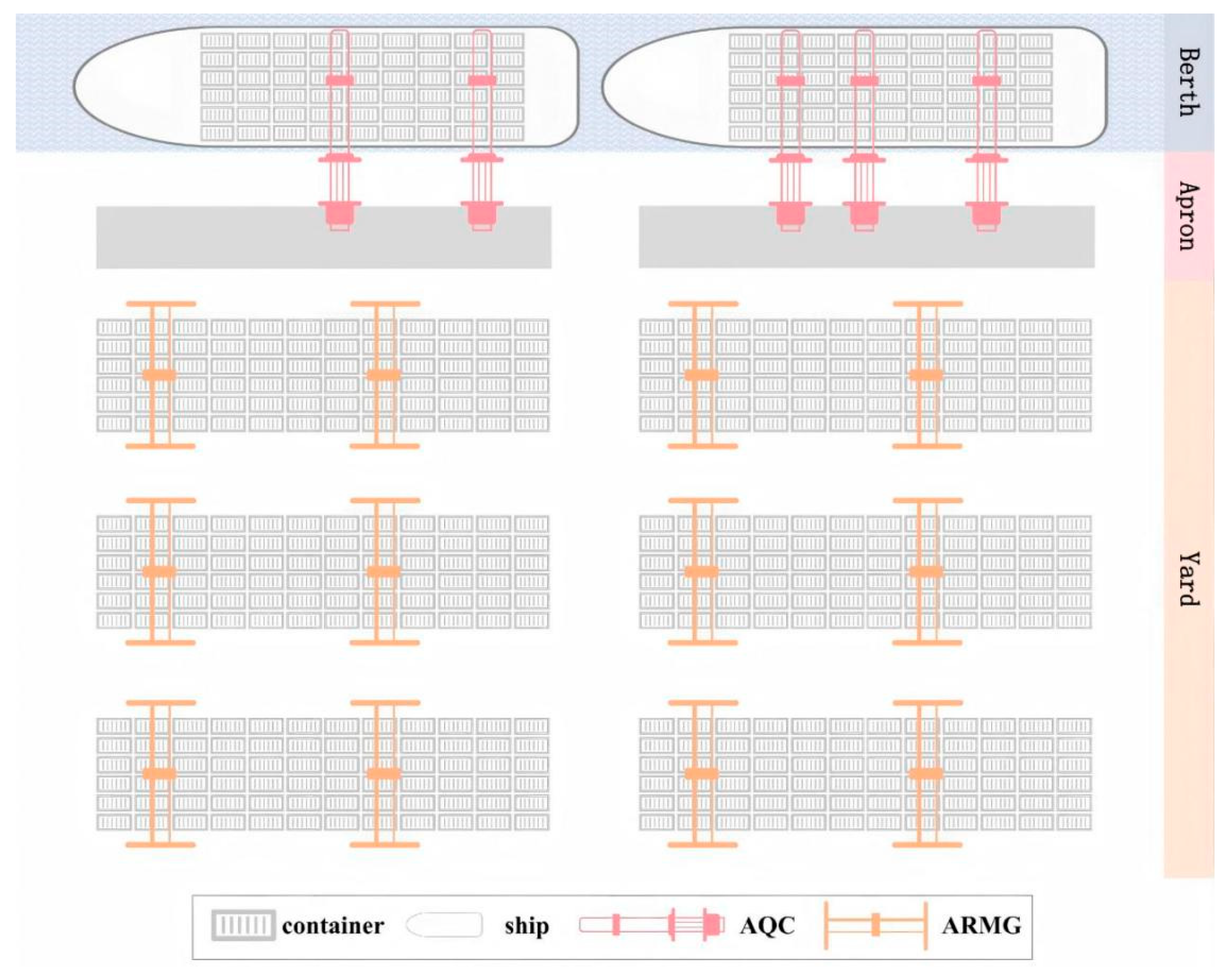
The spatial layout of an ACT plays a decisive role in shaping traffic mixing behavior. In a vertical layout, the ARMGs are positioned perpendicular to the quay, forming a naturally separated operating environment. Under this configuration, ETs are restricted to designated handover zones located at the rear of the yard and may only travel parallel to the quay, while ITs operate within internal transport corridors in a perpendicular direction. The movement trajectories of the two vehicle types are orthogonal, effectively eliminating overlapping paths and avoiding potential traffic conflicts. In contrast, in a parallel layout, the ARMGs are positioned parallel to the quay, as shown in
Figure 1. This design introduces mixed-traffic interactions between ITs and ETs, primarily concentrated within the yard-block area. ETs must enter the stacking zone beneath ARMGs and operate on the same transportation network as ITs, leading to shared space usage and potential routing conflicts.
Currently, parallel-layout ACTs generally adopt one of two strategies. One approach, represented by Guangzhou Nansha, utilizes a dedicated handover zone at the rear of the yard to perform standardized transfers between ITs and ETs. This method physically separates the vehicle classes and fully eliminates mixed-traffic occurrences. The second approach, adopted by Tianjin Beijiang and Shenzhen Yantian, permits controlled coexistence of ITs and ETs within shared operating areas using lane-based directional traffic rules. While mixed flow still occurs, conflicts are mitigated using electronic gating or signal-based temporal separation rather than complete physical isolation.
3.1.2. ACT Mixed-Traffic Lane Configuration
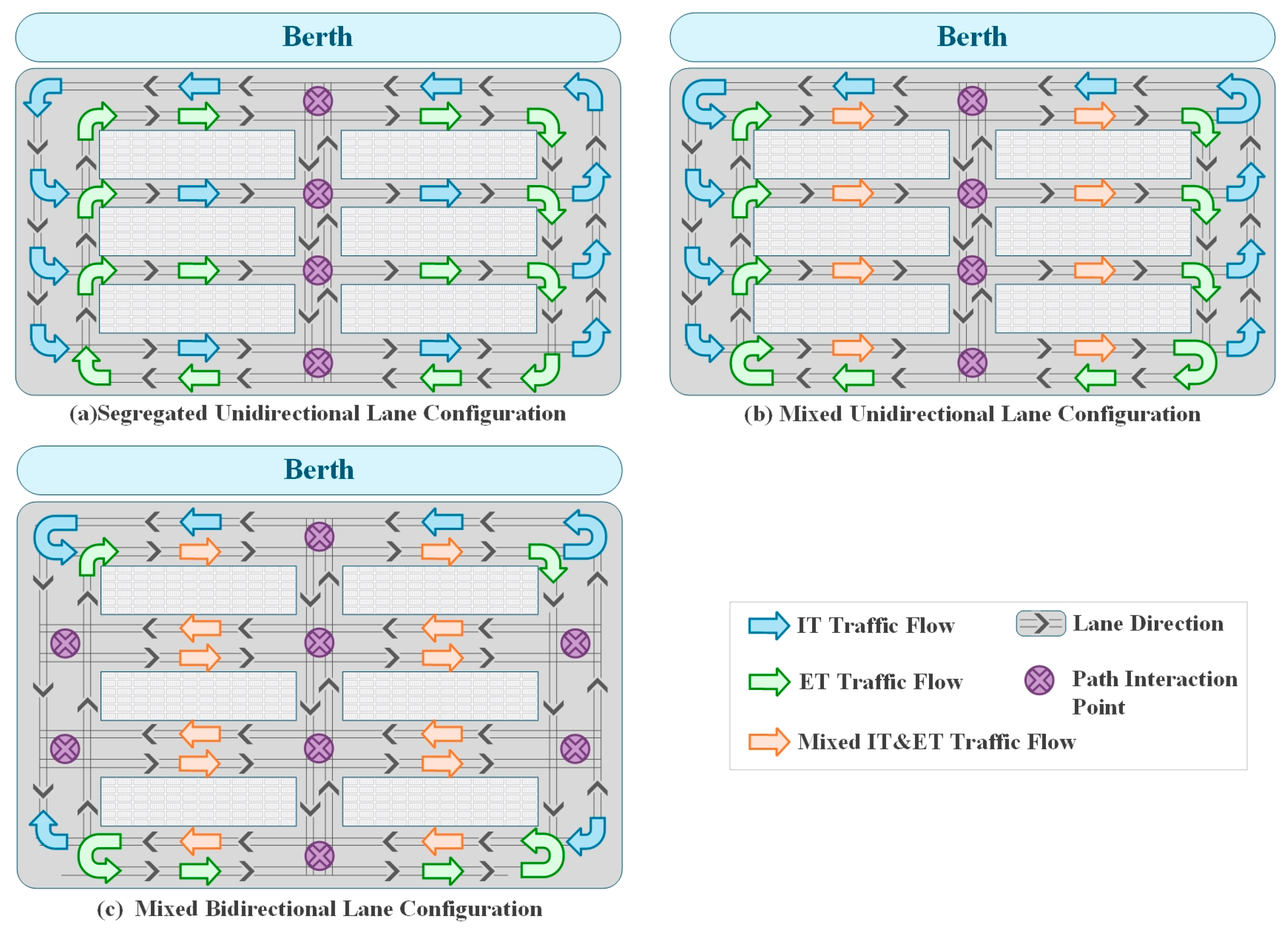
At present, parallel-layout ACTs typically apply a partially mixed strategy based on segregated unidirectional lane configuration (LSU), as illustrated in
Figure 2a. In this configuration, separate one-way lanes are arranged along both sides of the stacking block: ITs circulate counterclockwise while ETs travel clockwise. Interactions occur only at designated intersection points, where temporal control strategies such as signaling or intelligent gates are used.
With the advancement of unmanned vehicle technology, fully mixed-traffic operation in ACTs has become increasingly feasible. To explore future operational modes, this study proposes two improved full mixed-traffic configurations. The mixed unidirectional lane configuration (LMU), shown in
Figure 2b, removes vehicle category restrictions and establishes a unified roadway where both ITs and ETs travel in a single enforced direction. Extending this concept, the mixed bidirectional lane configuration (LMB), shown in
Figure 2c, removes directional constraints entirely, enabling bidirectional traffic flow. Under this scenario, both vehicle types share the same roadway while independently selecting travel direction based on shortest-path routing.
3.2. IT Access Strategy at Mixed-Traffic Path Interaction Points
3.2.1. Characterization of Path Interaction Points
In ACTs, intersections of horizontal and vertical lanes form critical nodes defined as path interaction points (PIPs). As shown in
Table 2, we standardize the structures and conflict behaviors within PIPs. In LSU and LMU configurations, intersections primarily follow the
structure; in the LMB configuration, they primarily follow the
structure. Path behavior
characterizes movement trajectories between four directions. Conflicts at PIPs are classified into three types, which occur when the trajectories of two vehicles are different and spatially overlap. These conflicts are denoted by
, where
:
represents merging conflict, referring to vehicles from different entries heading to the same exit;
represents diverging conflict, referring to vehicles from the same entry heading to different exits;
represents crossing conflict, referring to vehicles from different entries heading to different exits with intersecting trajectories. For example, the interaction between path
and
is classified as a crossing conflict, denoted as
.
3.2.2. Conflict-Access Matrix Model for ITs at PIP
In ACT mixed-traffic systems, PIPs are both route intersection points for ITs and ETs and critical decision-control areas. Since ETs are non-controllable entities, they are granted priority access rights. ITs, as controllable units, must make access decisions that avoid interference with ET movement. This study develops a PIP conflict-access matrix model, which determines whether a specific path is accessible using vector operations.
Let the set of possible path behaviors be:
To formalize path behavior as vector operations, define a path vector mapping function:
where
is a one-hot encoded unit vector.
For a current requested path
P and an already requested or occupied path
P*, their vector forms are
The conflict relationships are represented using a conflict-access matrix
. In this matrix,
Ci,j indicates the relationship between path behaviors
Ai and
Aj: if the pair (
Ai,
Aj) belongs to any conflict type {
,
,
}, then
Ci,j = 0, denoting a conflict; otherwise,
Ci,j = 1, denoting no conflict. The complete matrix is shown as follows:
Define a access judgment
function to determine whether
P is accessible when
P* is occupied:
The conflict path
set represents the paths in the current PIP area that have been occupied by other Its:
The feasibility of path execution for ITs in the PIP area is determined by the execution function
E based on
C and
RP:
where
E = 1: path request approved, IT may enter the PIP area;
E = 0: path rejected, IT must stop or wait;
If RP = Ø, then E = 1;
If an ET is detected entering or traversing the PIP area, then a forced override condition applies: E = 0 meaning the IT must stop until the ET fully leaves the PIP area.
3.2.3. IT Access Strategy at PIP
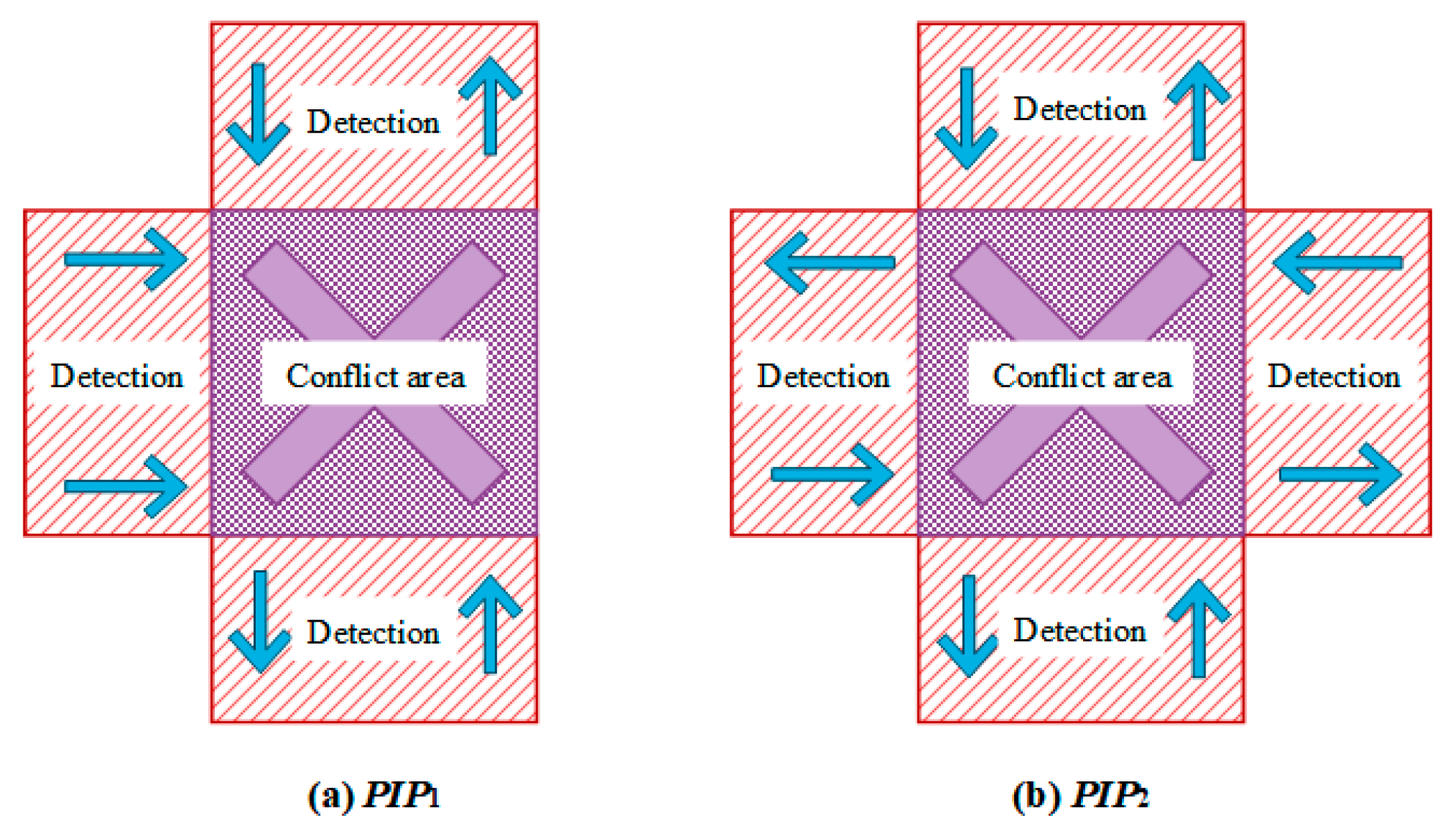
Each PIP is equipped with an upstream detection area that continuously monitors vehicles and enables real-time control of IT access. Using the virtual simulation environment, local models of PIP regions are constructed according to PIP types: for PPI
1, detection areas are arranged as shown in
Figure 3a; for PPI
2, they are arranged as in
Figure 3b.
When an IT enters the detection area, it transmits its intended path behavior information to the PIP control unit. The system then retrieves the real-time occupancy status of all paths within that PIP to construct the conflict path set. Based on the continuously updated state, the system first verifies if any vehicles are present in the PIP area. If no other vehicle is present, the system returns = 1, allowing access. If an ET is detected, the system enforces = 0 to maintain ET priority. If only ITs are present, the system checks whether multiple ITs are requesting simultaneously. If only the current IT is requesting, the system directly evaluates path compatibility using the conflict matrix C and returns the path execution function E to determine accessibility. If multiple ITs are requesting simultaneously, these ITs are sorted by task reception time. The IT with the earliest task is granted entry to the PIP first; after this IT accesses, the subsequent ITs proceed in order, each evaluating path compatibility using the conflict matrix C and returning the path execution function E to determine accessibility.
4. Methodology
4.1. Multi-Agent Model for ACT Operations
To simulate the operational workflow and equipment collaboration within ACTs, this study employs multi-agent system theory to model the key operational entities. In this system, each piece of equipment is modeled as an autonomous agent with independent decision-making and interaction capabilities. These agents collaborate to accomplish container-handling tasks. The model focuses on the operational process; its parameters can be adjusted for different ACT configurations.
This section defines the attributes, behavioral rules, and interaction logic of these agents, which serve as the core theoretical foundation for constructing the subsequent Unity-based simulation model for a parallel-layout ACT.
4.1.1. Multi-Agent Set Variables and Parameters
- (1)
Agent Sets
| CT: | Set of container agents. Each container agent is represented as cti (S1, CID). |
| IT: | Set of IT agents. Each is represented as iti(S2, HP), i = 1,2,3…NIT. |
| AQC: | Set of automated quay crane (AQC) agents. Each is represented as aqci(S3), i = 1,2,3…NAQC. |
| ARMG: | Set of automated rail-mounted gantry crane (ARMG) agents. Each is represented as armgi(S4), i = 1,2,3…NARMG. |
| BSS: | Set of battery swapping station (BSS) agents for ITs, represented as bssi(iti), i = 1,2,3…NBSS. |
- (2)
Agent State Variables
| S1: | Container status, where S1 = in indicates an import container, S1 = out indicates an export container. |
| S2: | Container carried by an IT, S2 = cti; if unloaded, S2 = 0. |
| S3: | Container currently handled by AQC, S3 = cti; if idle, S3 = 0. |
| S4: | Container currently handled by ARMG, S4 = cti; if idle, S4 = 0. |
| CID: | Unique container identification number. |
| HP: | Set of handling points, hp ∈ HP. |
- (3)
Agent Attribute Parameters
| vIT: | Travel speed of ITs. |
| : | Unit energy consumption of ITs under full load. |
| : | Unit energy consumption of ITs under empty load. |
| : | Unit energy consumption of ITs during idling. |
- (4)
System Sets
| L: | Set of container tasks. |
| SL: | Set of container storage positions on the vessel, (1,2,3…sl) ∈ SL. |
- (5)
System Parameters
| NIT: | Number of ITs. |
| NBSS: | Number of BSSs. |
| NAQC: | Number of AQCs. |
| NARMG: | Number of AQCs. |
| : | Number of tasks assigned to IT it, it ∈ IT. |
| P1, P2: | Large positive constants satisfying, P1 > P2. |
- (6)
Task Time Parameters
During ACT operations, ITs, AQCs, and ARMGs must cooperate to complete container-handling tasks. Each equipment’s process can be decomposed into a series of subtasks, defined as follows:
| α1: | AQC waits for task assignment l. |
| α2: | AQC moves to handling point. |
| α3: | AQC waits for container arrival. |
| α4: | AQC loads container. |
| α5: | AQC unloads container. |
| β1: | IT waits for task assignment l. |
| β2: | IT moves to ARMG. |
| β3: | IT waits for ARMG (export task). |
| β4: | IT waits for AQC (import task). |
| β5: | IT receives container from ARMG. |
| β6: | IT receives container from AQC. |
| β7: | IT moves to AQC. |
| β8: | IT waits for AQC (export task). |
| β9: | IT waits for ARMG (import task). |
| β10: | AQC receives container from IT. |
| β11: | ARMG receives container from IT. |
| γ1: | ARMG waits for task assignment l. |
| γ2: | ARMG moves to handling point. |
| γ3: | ARMG waits for container arrival. |
| γ4: | ARMG loads container. |
| γ5: | ARMG unloads container. |
For any container task
l:
| : | Time consumed by subtask k when equipment completes task l, k = α1…α5, β1…β11, γ1…γ5, l ∈ L. |
- (7)
Decision Variables
0–1 variable:
| : | If equipment performs subtask k of task l, = 1; otherwise, = 0. |
| : | If iti is swapping, = 1; otherwise, = 0. |
Non-0–1 variables:
| : | Start time of AQCx performing task l (loading process). |
| : | Start time of AQCx performing task l (unloading process). |
| : | Start time of ITy performing task l (loading process). |
| : | Start time of ITy performing task l (unloading process). |
| : | Start time of ARMGz performing task l (loading process). |
| : | Start time of ARMGz performing task l (unloading process). |
| : | Start time of iti battery swapping. |
| : | Finish time of iti battery swapping. |
| : | Task start time of agent∈{iti, aqci, armgi}. |
| : | Task finish time of agent∈{iti, aqci, armgi}. |
| : | Battery levels of ITy at the time of being assigned task l. |
| : | Battery levels of ITy after completing import task l. |
| : | Battery levels of ITy after completing export task l. |
| : | Minimum allowable battery level of an IT to execute a task. |
4.1.2. Multi-Agent Constraints
- (1)
Constraints on operational process:
Constraint (1) ensures that in the unloading process, the AQC can start unloading only after the IT arrives at the designated handling point. Constraint (2) ensures that in the loading process, the AQC starts loading after the IT’s arrival. Constraint (3) specifies that during unloading, the ARMG begins its operation after the IT arrives. Constraint (4) enforces that during loading, the ARMG begins its operation after the IT’s arrival. Constraint (5) represents the unloading process where an IT transfers the container from the AQC’s handling point to the ARMG’s handling point during unloading. Constraint (6) represents the loading process where an IT carries the container from the ARMG’s handling point to the AQC’s handling point during loading.
- (2)
Constraints on continuous operations:
Constraint (7) indicates that in a continuous unloading sequence, once an IT delivers container l to the ARMG’s handling point, it must return to the AQC’s location to handle the next container l + 1. Constraint (8) similarly ensures that in a continuous loading sequence, after the IT delivers container l to the AQC’s point, it must return to the ARMG’s point to collect the next container l + 1.
- (3)
Constraints on agent interactions:
Constraint (9) ensures that no two ITs occupy the same handling point at the same time. Constraints (10) and (11) define the temporal sequence between AQC and IT during loading/unloading processes. Constraints (12) and (13) describe the temporal coupling between IT and ARMG operations. Constraints (14) and (15) guarantee that an IT can start the next container task only after the unloading equipment has retrieved the current container. Constraints (16) and (17) enforce the same logic for ARMG and AQC operations under continuous handling. Constraint (18) ensures that each ship slot can be associated with only one container-handling operation at a time. Constraint (19) enforces that the end time of battery swapping must occur after the start time. Constraint (20) imposes capacity constraints on battery swapping stations, ensuring that the number of ITs under swapping does not exceed the number of battery swapping stations. Constraints (21) and (22) are the energy update formulas for ITs upon task completion, corresponding to the process for import containers and export containers respectively, used to calculate the remaining battery level after each task. Constraints (23) and (24) define the safety boundaries for IT battery levels, ensuring that the battery level before starting a task and after completing a task are both above the minimum safety threshold. If the post-task battery level falls below this threshold, the IT must proceed to a battery swapping station for replacement before undertaking subsequent tasks.
4.2. Performance Evaluation Model for ITs
4.2.1. Basic Performance Indicator for ITs
This section establishes a fundamental performance indicator system for ITs from three dimensions to support performance evaluation using simulation data.
(1) For each
iti∈
IT and each assigned container task
l, the travel time, distance, and energy consumption are defined as follows:
Equations (25)–(28) represent the full-load travel time, empty-load travel time, idle operating time, and total operating time of iti for task l, respectively. Equation (29) represents the total travel distance, and Equation (30) represents the total energy consumption of iti for task l.
(2) For each
iti∈
IT, the cumulative indicators over all assigned tasks throughout the entire simulation period are defined as follows:
Equations (31)–(33) represent the cumulative travel distance, cumulative energy consumption, and total number of completed tasks for iti throughout the simulation, respectively.
4.2.2. IT Operational Performance Evaluation Method
This section evaluates the operational performance of individual ITs throughout the entire simulation period based on efficiency and stability indicators, reflecting their usage patterns and operational consistency.
- (1)
Efficiency indicators:
Equation (34) represents the proportion of productive travel time, indicating time utilization efficiency. Equation (35) represents the number of container tasks completed per unit distance, reflecting spatial task density. Equation (36) represents the number of tasks completed per unit time, indicating operation intensity and transport efficiency. Equation (37) represents the number of tasks completed per unit energy consumption, indicating the energy efficiency level of an IT.
- (2)
Stability indicators:
Equation (38) measures the fluctuation of travel distance per task. Equation (39) measures the fluctuation of energy consumption per task. Equation (40) represents travel consistency of IT operations. Equation (41) represents energy consumption stability. A smaller fluctuation rate and a larger stability value indicate higher operational consistency.
4.2.3. System Coordination Evaluation Method
This section evaluates the overall IT fleet performance from a system perspective throughout the entire simulation period, focusing on the coordination, fairness, and structural consistency of the task and energy distribution.
- (1)
System balance indicators:
Equations (42) and (43) represent the coefficient of variation (CV) of task allocation and energy consumption across the IT fleet. A lower coefficient of variation indicates higher consistency and coordination within the system.
- (2)
System fairness indicators:
Equations (44) and (45) represent the Gini coefficients (G) of task distribution and energy consumption. A lower Gini index reflects a more equitable distribution among ITs.
- (3)
System structure differentiation indicators:
: cumulative IT ratio;
: cumulative task ratio;
: cumulative energy consumption ratio;
and correspond to the task count and the energy consumption value of the j-th IT after ascending order, respectively.
Equations (46) and (47) represent the Zenga index (Z) for task and energy allocation, respectively. A lower Zenga index indicates lower structural disparity among ITs and a more cohesive system performance pattern.
4.3. Simulation Model of ACT Operations
Based on the proposed multi-agent model and performance evaluation model, this section elaborates on the development of a full operational simulation model using Unity 2023.1.0f1c1 and MySQL (version 8.0.42).
Table 3 summarizes the mapping between the multi-agent model elements and their implementation in the simulation model.
4.3.1. Framework and Design of ACT Simulation Model
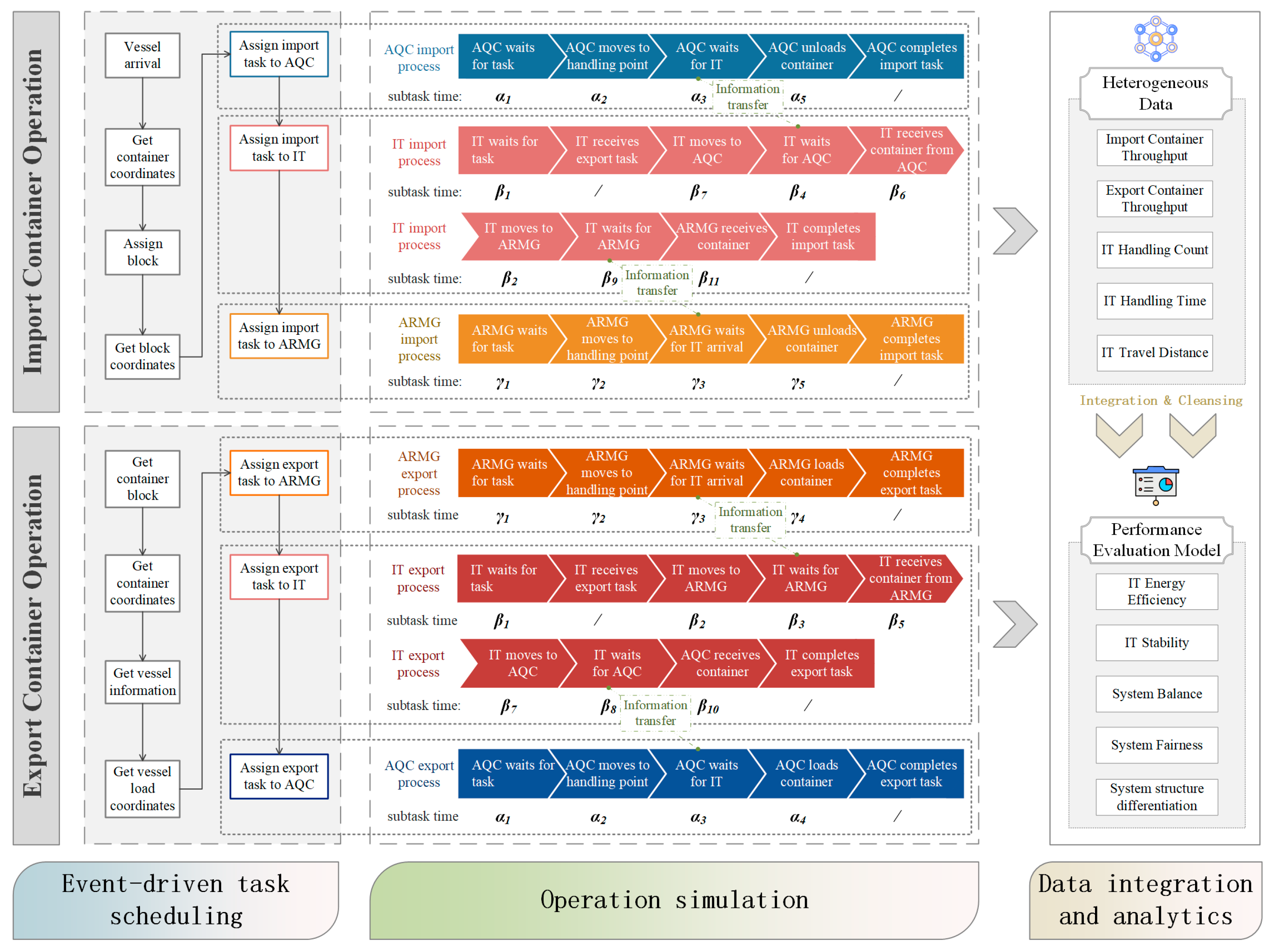
The model simulates coordinated operations among ITs, AQCs, and ARMGs under simultaneous loading and unloading conditions, with different workflows applied for import and export containers in a three-layer framework, as shown in
Figure 4.
In the event-driven task scheduling layer, container tasks are generated according to predefined sequences, and the real-time status of all equipment is monitored. A centralized scheduler dynamically assigns tasks to available ITs, AQCs, and ARMGs.
In the operation simulation layer, the model executes workflows based on the multi-agent system. When the simulation starts, the vessel arrives at berth and associated container tasks are generated. The operation logic is shown in
Figure 4.
If the task is an import container, the unloading process is as follows: (1) The AQC unloads the container from the vessel and transfers it to the IT at the quay handling point; (2) The IT transports the container to the designated yard handling position and waits if the position is occupied; (3) The ARMG receives the container from the IT and places it into the assigned storage location.
If the task is an export container, the loading process is executed as follows: (1) the ARMG retrieves the container from the yard and loads it onto the IT; (2) the IT transports the container to the quay crane handling point and queues if necessary; and (3) the AQC receives the container from the IT and loads it onto the vessel.
The data integration and processing layer aggregates simulation outputs and calculates the performance indicator.
4.3.2. Data Architecture of ACT Simulation Model
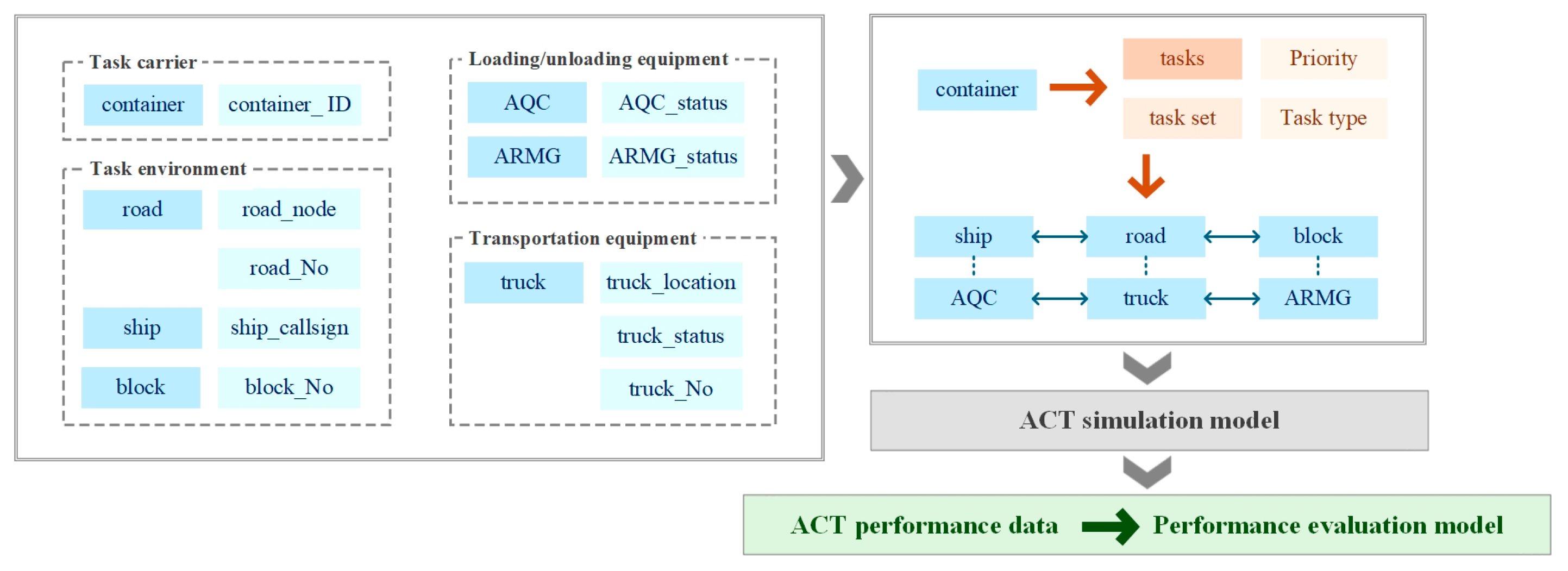
The simulation model adopts a structured data architecture to manage information related to container tasks, equipment states, routing, and performance outputs. MySQL is used as the backend database, with Navicat for data management. The overall data architecture is shown in
Figure 5.
The container data table records container identifiers and status information to track container movements during different operation modes. The equipment data table stores the identifiers, types, locations, task states, and battery levels of ITs, AQCs, and ARMGs. Task-related data define task types, priorities, and execution states to support task scheduling. The path-planning data table stores route sequences, travel distances, and estimated travel times for IT movements. The performance evaluation data table records task execution time, travel distance, and energy consumption for each IT. A simulation state table maintains system status for synchronization during runtime.
4.3.3. IT Scheduling Mechanism of ACT Simulation Model
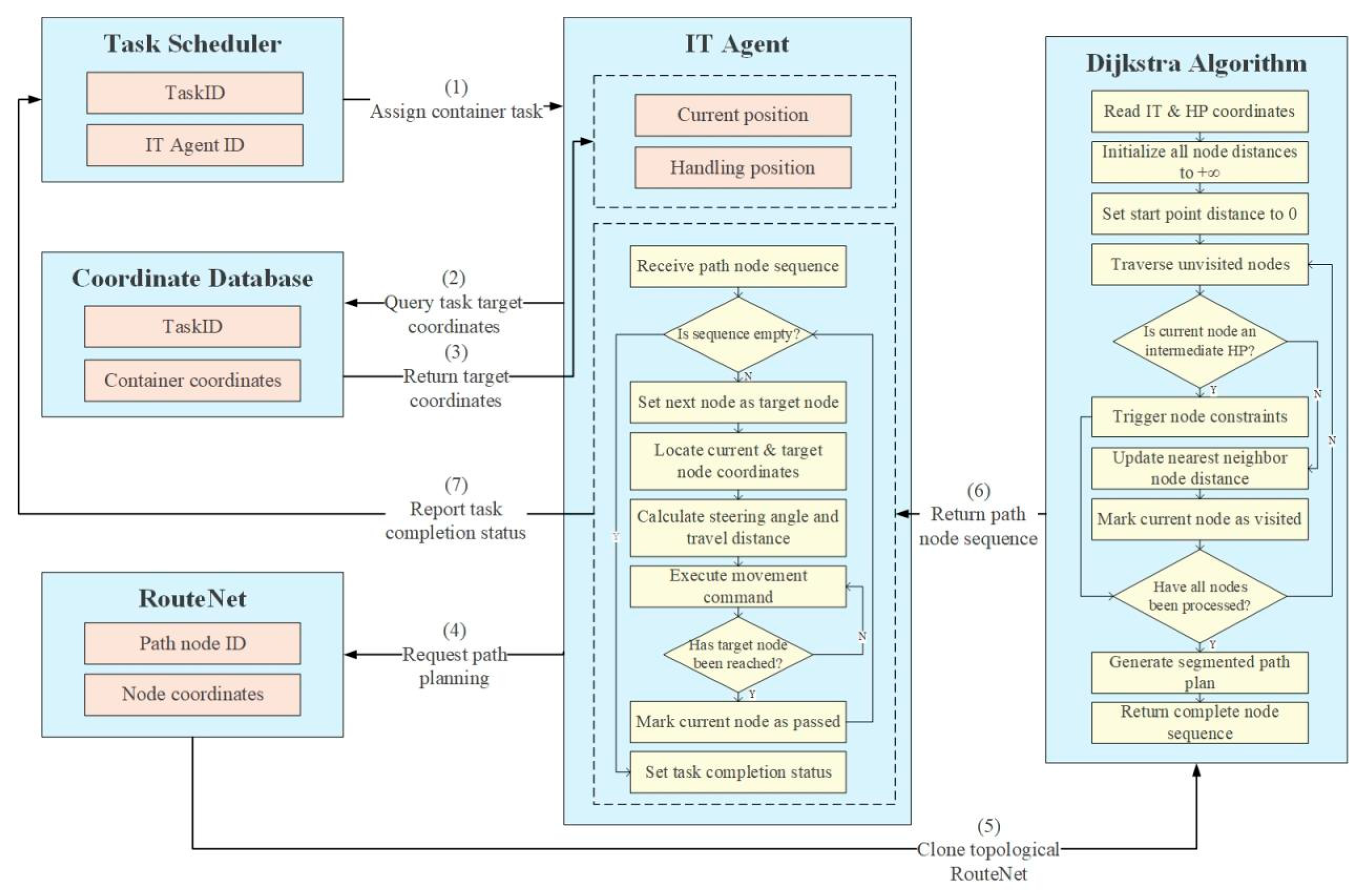
The task scheduling of ITs adopts a closed-loop execution structure driven by command instructions and execution feedback, and the scheduling and execution process is illustrated in
Figure 6.
The scheduling and execution procedure is summarized as follows: (1) The task scheduler assigns a container task to an available IT according to task priority and current workload. (2) The IT requests the target handling coordinates associated with the task. (3) The database returns the corresponding coordinates. (4) Based on the target location and load state, the IT requests route planning. (5) RouteNet copies the transportation network and submits the request to the Dijkstra-based path-planning module. (6) The Dijkstra module computes the shortest feasible route and returns an ordered list of navigation nodes. (7) The IT follows the planned route to execute the task and reports its completion status to the scheduler, which updates the task state and releases the IT for subsequent assignments.
4.3.4. Scene Modeling of ACT Simulation Model
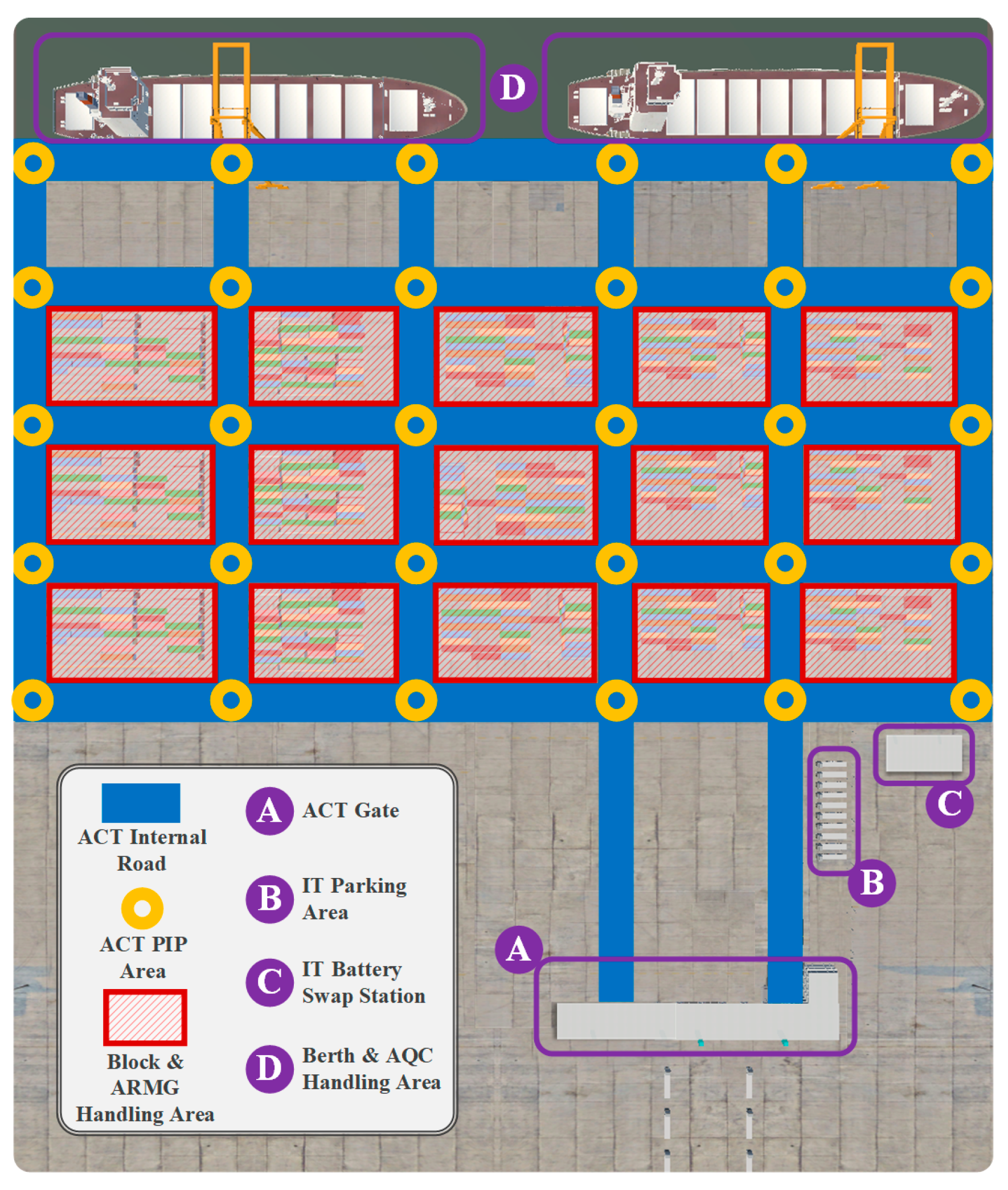
A full 3D simulation environment was developed in Unity, as shown in
Figure 7. The model replicates the physical structure of a typical parallel-layout ACT, including berth lines, AQCs, container yard, ARMGs, horizontal transport lines, and battery swapping station.
The simulation model is designed to accommodate different lane configurations. In the LSU and LMU configurations, horizontal lanes are constrained to unidirectional traffic, whereas vertical lanes retain bidirectional functionality. Conversely, the LMB configuration permits bidirectional operation on all lanes.
5. Results and Analysis
Based on the proposed models, this chapter evaluates the simulation results of ACT operations under mixed-traffic conditions and compares performance under different lane configurations. The simulation system was implemented in Unity 2023.1.0f1c1 using C# (version 8.0), with data management and interaction supported by a MySQL database (version 8.0.42). All experiments were conducted on a computer equipped with an Intel® Core™ i5-12600KF CPU, NVIDIA® GeForce RTX™ 4070 GPU and 16 GB RAM.
5.1. Experiment Settings
5.1.1. Simulation Model Settings
The simulation model is developed based on the parallel-layout configuration commonly used in ACTs, such as Tianjin Beijiang Terminal Section C and Shenzhen Yantian Port. In this simulation, all ITs are modeled as electric vehicles, and the ACT operates under nominal conditions.
The baseline LSU configuration represents the actual mixed-traffic operation logic currently adopted in these terminals [
2,
3]. The LMU and LMB configurations are proposed in this study as alternative designs for future mixed-traffic operations. All simulation parameters are adopted from values reported in the literature [
26,
27,
31] to ensure that the model reflects realistic operational characteristics. A summary of these parameters is provided in
Table 4.
5.1.2. Simulation Task Parameters
For the ratio of import to export containers, previous studies indicate variation among ports, yet an overall tendency toward balance. Jin [
34] reports a stable 50%:50% ratio at Phase II of Ningbo–Zhoushan Beilun Terminal. Long-term statistics at Bangkok Port [
35] show slightly higher import volume (57%:43%). PSA Genova Prà Terminal, Italy [
3], exhibits a modest export-dominant structure (45%:55%). Despite differences across ports, container flows typically remain balanced. Thus, this study adopts a 50:50 ratio for import and export tasks, providing both representativeness and a neutral evaluation baseline.
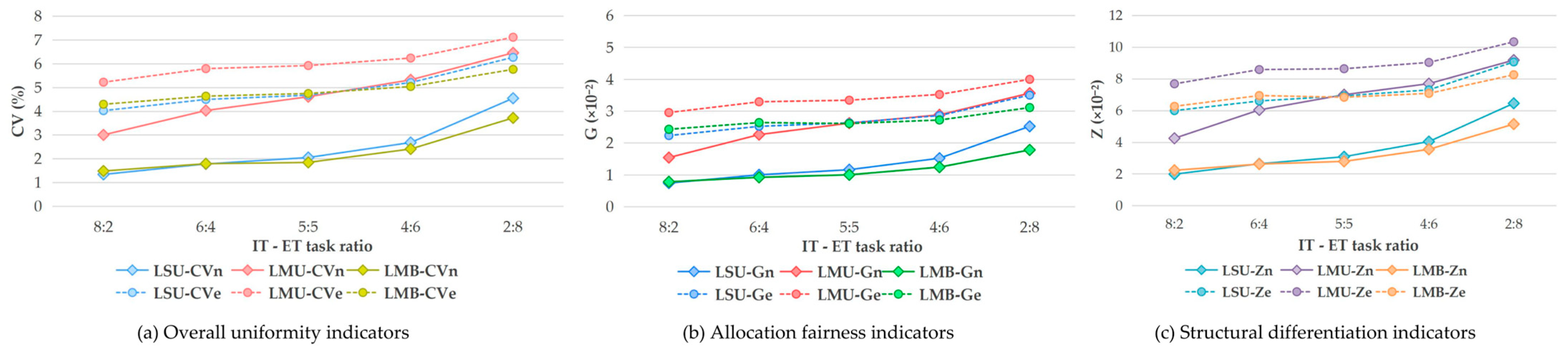
For IT/ET task allocation, the primary experiments adopt a 5:5 ratio to reflect cooperative operations between internal and external trucks. To analyze the impact of workload distribution, a sensitivity analysis tests multiple additional task-assignment configurations ranging from 8:2 to 2:8 (including 8:2, 6:4, 4:6, 2:8) to systematically compare performance under varying assignment policies.
To simulate a continuous and realistic operational environment and ensure that vehicles undergo multiple full operational cycles, the total number of tasks assigned to ITs was set to 1000 container tasks, ensuring statistical validity and repeatability.
5.2. Operational Workload Characteristics of ITs
This section analyzes the operational workload characteristics of ITs under different lane configurations from three dimensions: total task volume, cumulative travel distance, and average task distance. The total number of tasks and cumulative travel distance, both obtained directly from the simulation model, represent the operational intensity during execution, while task-distance efficiency is calculated by Equation (35) to quantify the spatial utilization efficiency of IT operations.
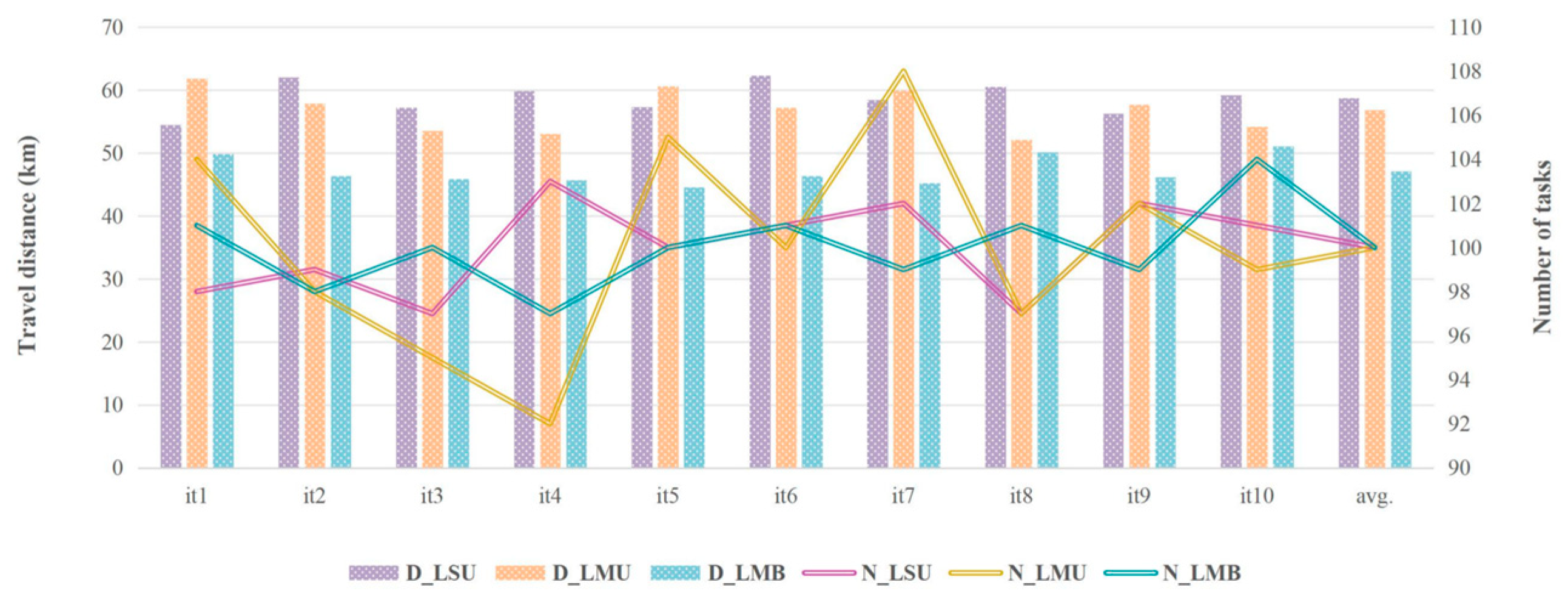
Figure 8 illustrates the comparison of total task volume and travel distance of ITs under the three lane configurations. In terms of task number, while the counts for individual ITs vary, their overall ranges are similar across configurations. This indicates that changes in lane configuration have a limited impact on the balance of workload distribution. Regarding cumulative travel distance, the total travel distance under the LMB configuration is significantly reduced compared to both LSU and LMU. Compared with LMU, the LMB configuration reduces the average travel distance by approximately 17.0%, while a more substantial reduction of 19.7% is observed relative to LSU. This reduction primarily originates from the bidirectional traffic organization in LMB, which shortens detour paths and decreases conflict-induced rerouting. Consequently, unnecessary travel is effectively reduced, leading to lower overall operational intensity.
Table 5 presents the task-distance efficiency of the ITs. The results reveal a clear stepwise increase from LSU to LMU and LMB, with LMB demonstrating markedly higher task-distance efficiency, more distinctly reflecting the structural benefit of reduced travel distance.
Overall, the LMB configuration demonstrates superior performance in terms of workload characteristics by reducing routing distances, while significantly reducing travel distances and enabling more tasks to be completed per unit distance traveled, thereby enhancing task-distance efficiency.
5.3. Analysis of Energy Consumption and Time Structure of ITs
This section analyzes the operational characteristics of ITs under different configurations from two dimensions: time utilization efficiency and energy consumption efficiency. Time utilization rate, operational intensity, and energy efficiency, which are defined by Equations (34), (36) and (37), respectively, are computed for each IT based on the loaded, empty, and idling times aggregated from Equations (25)–(27), the total operating time aggregated from Equations (28) and (31), and the total energy consumption aggregated from Equations (30) and (33).
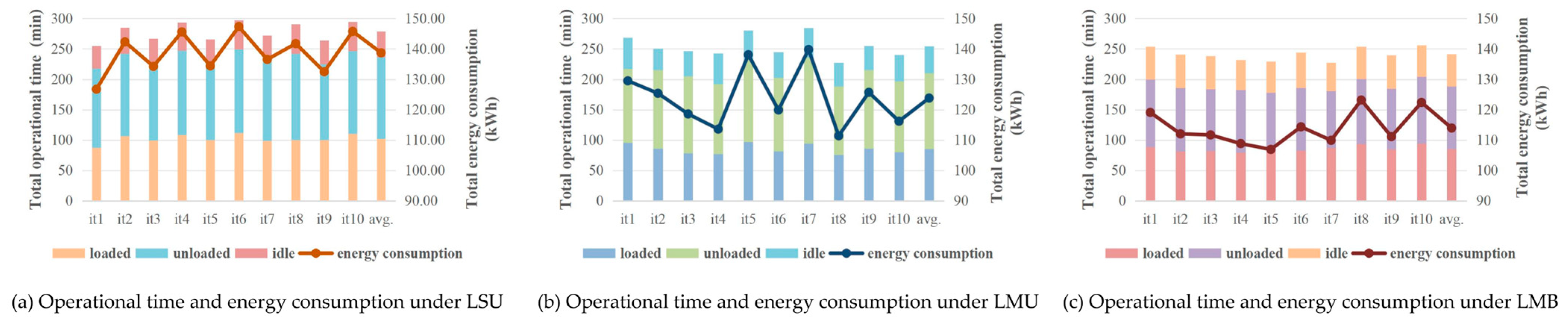
Figure 9 illustrates the comparison of operational time allocation and energy consumption of ITs under the three configurations. The distribution patterns show clear differences: the LSU configuration features a concentrated total operational time, while LMU exhibits greater dispersion. Both LSU and LMU show high proportions of time spent on loaded and unloaded travel. In contrast, the LMB configuration is characterized by extended idling time. The increase in idle time primarily results from conflict at PIPs and waiting during handling operations under the same scheduling strategy. Although idling time increases, the significant reduction in other time results in lower overall energy consumption.
Table 6 presents the comparison of time utilization and energy performance indicators. The results confirm that the LMB configuration delivers the best overall performance, with operational intensity increasing by 14.8% and 13.2% and energy efficiency improving by 22.2% and 17.3% compared with LSU and LMU, respectively, while time utilization remains largely unchanged. In contrast, the time utilization rate remains relatively stable across configurations. Notably, the extent of energy efficiency gain surpasses that of operational intensity, suggesting that the primary advantage of the LMB configuration stems from optimized energy-use patterns rather than merely higher workload throughput.
5.4. Stability Analysis of IT Operations
This section evaluates the operational stability at the single-task level by analyzing fluctuations in travel distance and energy consumption. For each IT, the minimum, maximum, and mean values of single-task travel distance and energy consumption are extracted from the simulation records. The stability coefficients defined by Equations (38)–(41) are calculated to quantify the dispersion characteristics.
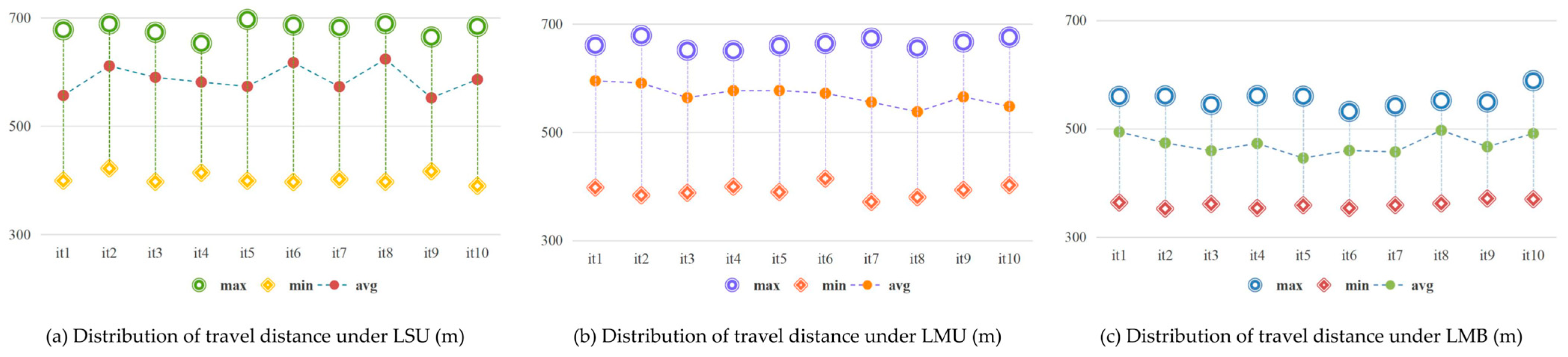
Figure 10 illustrates the distribution of single-task travel distances for ITs under the three configurations. Under the LSU and LMU configurations, the task distance spans are longer, indicating greater variability in routing paths. In contrast, the LMB configuration reduces the average task distance and shifts the overall distribution toward shorter paths, with a relatively narrower span, reflecting a more consistent routing pattern.
Table 7 further quantifies these fluctuation characteristics using the stability coefficient of travel distance. Consistent with the observations in
Figure 10, the LMB configuration exhibits a more favorable dispersion structure at the task level, indicating that extreme routing cases are effectively mitigated. This suggests that the lane configuration in LMB not only shortens average travel distances but also regulates routing variability.
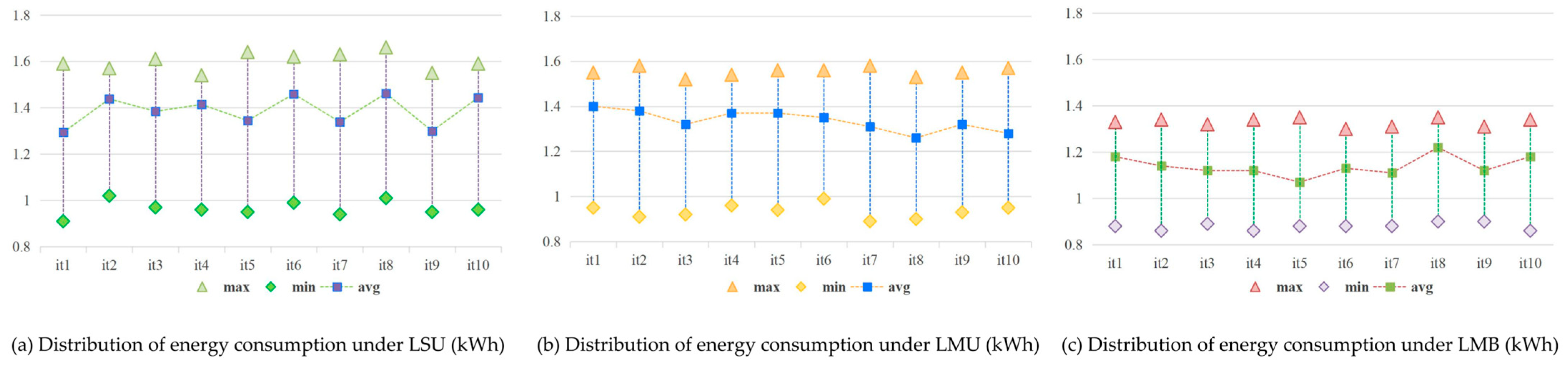
Figure 11 presents the distribution characteristics of energy consumption per task of ITs. Similar to the travel distance results, both the LSU and LMU configurations exhibit higher average energy consumption per task and greater variation among ITs, reflecting their sensitivity to task location and routing complexity. In contrast, the LMB configuration achieves lower per-task energy consumption and a more concentrated distribution range, indicating that the energy demand of individual tasks is effectively controlled. As shown in
Table 7, the stability coefficients of energy consumption further confirm that, compared with LMU, the LMB configuration exhibits a more regulated fluctuation structure. This suggests that the improvements under the LMB configuration are not limited to a reduction in average energy consumption, but also involve better control over task-level energy variability.
In summary, the LMB configuration significantly enhances the operational stability of ITs while reducing travel distance and energy consumption, it effectively improves system reliability and operational performance.
5.5. Coordination Analysis of the IT System
This section analyzes the coordination characteristics of the IT system under the three configurations by evaluating overall system uniformity, allocation fairness, and structural differentiation, with all corresponding metrics calculated using Equations (42)–(47).
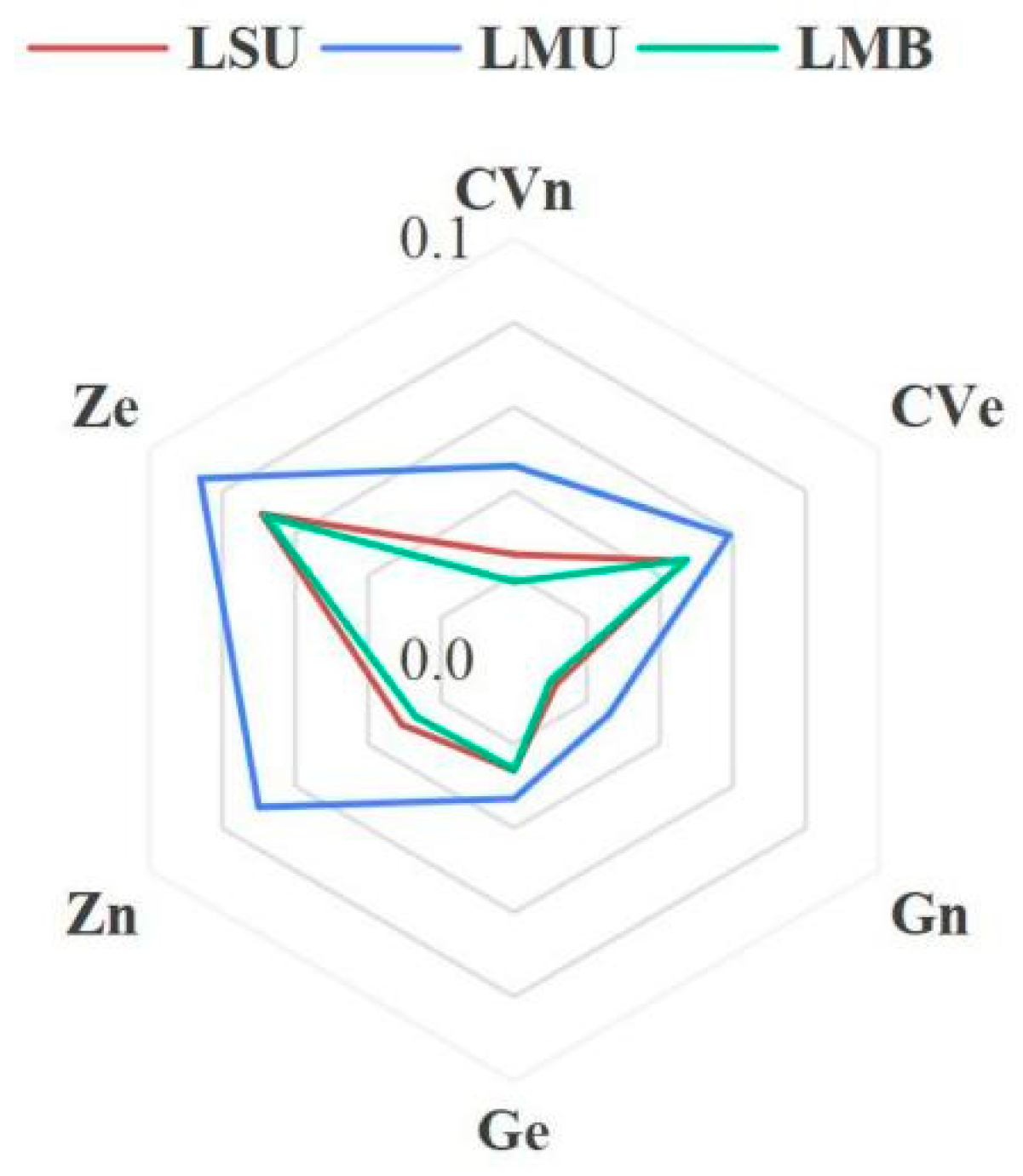
Figure 12 presents the comparison of system coordination indicators across the three configurations. Both the LSU and LMB configurations achieve similarly high performance on all coordination metrics, significantly outperforming the LMU configuration. Although the LMU configuration shows slightly better individual IT performance than LSU in certain efficiency metrics, it exhibits higher dispersion coefficients in task-related coordination, indicating greater imbalance and structural differentiation among ITs. In contrast, LSU maintains a more uniform distribution pattern, while LMB achieves the lowest dispersion values overall. This pattern confirms that while LSU and LMB both ensure well-coordinated system operations, LMB further enhances coordination without sacrificing individual efficiency.
5.6. Sensitivity Analysis
This section conducts a sensitivity analysis to examine how different IT–ET task allocation ratios (ranging from 8:2 to 2:8) influence overall system coordination performance, reflecting system-level responses under varying traffic compositions.
Figure 13 illustrates the variation trends in system coordination indicators as the task allocation ratio between ITs and ETs changes. The results show a clear common trend: as the share of tasks assigned to external trucks increases, key coordination metrics including overall uniformity, allocation fairness, and structural differentiation all exhibit a decline across the three configurations. When the share of external truck tasks is relatively low, the LSU configuration demonstrates slightly better coordination performance, although the gap between LSU and LMU remains limited. As the proportion of ET tasks increases, the LMB configuration gradually exhibits a more pronounced advantage, maintaining lower dispersion and better coordination balance. Throughout all allocation scenarios, the LMU configuration consistently performs weaker than LSU and LMB, and its indicators deteriorate more rapidly as ET participation rises. The magnitude of change in LMU is the largest among the three configurations, indicating comparatively poor robustness to traffic composition shifts. By contrast, LSU and LMB show similar overall stability trends, while LMB maintains the best coordination performance under high ET penetration levels.
Furthermore, the analysis confirms that task-related coordination metrics are consistently more sensitive to these allocation shifts than energy-related ones, suggesting that energy coordination is more sensitive to changes in external truck participation.
Overall, both the LSU and LMB configurations demonstrate strong adaptability, maintaining relatively stable system coordination even as the external truck task share grows. The partially shared, unidirectional LMU configuration, however, exhibits a clear vulnerability to increased external truck involvement, leading to a more pronounced and rapid loss of coordination.
6. Conclusions
This study addresses the core evolution trend of ACTs toward fully mixed-traffic operations and systematically investigates the challenges arising from collaborative operation between ITs and ETs under shared transportation networks. A complete framework integrating theoretical modeling, traffic control design, multi-agent modeling, and simulation-based performance evaluation is established.
First, at the level of problem definition and design strategies, the mixing mechanism under parallel-layout ACTs was analyzed in depth. Based on the existing segregated unidirectional configuration, two fully mixed-traffic configurations—mixed unidirectional and mixed bidirectional—were proposed, providing new operational patterns and forming the foundation for path-conflict control and comparative evaluation. In core control logic, the study introduces PIPs as key formal modeling units for transportation network intersections. A conflict matrix and vector-based decision model were developed to evaluate crossing rights, and a mathematically defined execution function was implemented to enable conflict-free IT traversal under the principle of guaranteeing ET priority for safety assurance.
In terms of modeling and evaluation system construction, a multi-agent-based operational framework was developed, modeling the attributes, states, and behavioral rules of key resources such as ITs, AQCs, and ARMGs. A complete set of operational, continuous-task, and inter-agent coordination constraints was formalized. Based on Unity and a MySQL task–state database, a high-fidelity 3D simulation platform was developed, enabling end-to-end closed-loop simulation covering task generation, scheduling, routing, execution, and feedback. A multi-dimensional performance evaluation framework was also constructed, incorporating metrics of baseline performance, operational efficiency, operational stability, and system coordination. Beyond traditional indicators, statistical metrics including variance, coefficient of variation, Gini index, and Zenga index were introduced to evaluate both individual behavioral stability and system-level fairness, balance, and structural differentiation.
Simulation results show clear differences among the three configurations. The LSU configuration exhibits the most stable and coordinated behavior because internal and external flows are physically separated, which limits the formation of complex conflicts. However, this also restricts routing flexibility and leads to longer empty travel in some cases. The LMU configuration allows ITs and ETs to share lanes in a single direction, which improves individual vehicle efficiency and reduces energy use, but this comes at the cost of weaker system-level coordination, especially when IT–ET ratios change. The LMB configuration further permits bidirectional movements, which, despite increasing idling time due to more conflicts, significantly reduces detour distances and empty travel, thereby lowering overall energy consumption while maintaining relatively stable coordination. Under different IT–ET ratios, LMB shows better robustness than LMU.
Overall, the study not only proposes a mixed-traffic operational approach combining PIP-based control and multi-agent simulation but also establishes a replicable theoretical and methodological foundation for roadway design, traffic control, scheduling optimization, and operational evaluation in next-generation fully mixed-traffic ACTs. The study provides theoretical insights, methodological tools, and empirical evidence that support the transition of mixed-traffic ACT operations from conceptual frameworks to practical engineering deployment.
Future research could extend this study by incorporating operational uncertainties and evaluating mixed fleets of electric and conventional vehicles. A broader system-level assessment, including economic and environmental metrics across all terminal equipment, would further support sustainable and robust decision-making for port development. In addition, analytical optimization models could be integrated within the simulation framework and benchmarked using commercial solvers to provide complementary theoretical perspectives.
Author Contributions
Conceptualization, K.X. and J.L.; methodology, K.X. and J.L.; software, K.X.; validation, J.L. and B.X.; formal analysis, K.X.; investigation, K.X.; resources, B.X.; data curation, K.X.; writing—original draft preparation, K.X. and B.X.; writing—review and editing, J.L.; visualization, K.X.; supervision, B.X. and J.L.; project administration, K.X. and J.L.; funding acquisition, J.L. All authors have read and agreed to the published version of the manuscript.
Funding
This research was funded by the National Natural Science Foundation of China (52102466, 52572479), Humanities and Social Science Fund of Ministry of Education of the People’s Republic of China (25YJA630041).
Institutional Review Board Statement
Not applicable.
Informed Consent Statement
Not applicable.
Data Availability Statement
The original contributions presented in this study are included in the article. Further inquiries can be directed to the corresponding author.
Conflicts of Interest
The authors declare that there are no conflicts of interest in this publication.
Abbreviations
The following abbreviations are used in this manuscript:
| ACT | Automated Container Terminal |
| IT | Internal Container Truck |
| ET | External Container Truck |
| PIP | Path Interaction Point |
| LSU | Segregated Unidirectional Lane Configuration |
| LMU | Mixed Unidirectional Lane Configuration |
| LMB | Mixed Bidirectional Lane Configuration |
| AGV | Automated Guided Vehicle |
| IGV | Intelligent Guided Vehicle |
| ART | Autonomous Robotic Truck |
| AQC | Automated Quay Crane |
| ARMG | Automated Rail-Mounted Gantry Crane |
| BSS | Battery Swapping Station |
| CV | Coefficient of Variation |
| G | Gini Coefficient |
| Z | Zenga Index |
References
- Li, X.; Wu, L.; Lang, H.; Jin, Z.; He, P. A critical literature review on layout designs and handling technology in traditional and automated container terminals. Transp. Econ. Manag. 2025, 3, 269–280. [Google Scholar] [CrossRef]
- Chu, L.; Gao, Z.; Dang, S.; Zhang, J.; Yu, Q. Optimization of Joint Scheduling for Automated Guided Vehicles and Unmanned Container Trucks at Automated Container Terminals Considering Conflicts. J. Mar. Sci. Eng. 2024, 12, 1190. [Google Scholar] [CrossRef]
- Carboni, A.; Deflorio, F.; Caballini, C.; Cangelosi, S. Advances in terminal management: Simulation of vehicle traffic in container terminals. Marit. Econ. Logist. 2024, 27, 500–524. [Google Scholar] [CrossRef]
- Lu, L.; Zheng, F.; Liu, X. Uncertainty, Efficiency, and Stability of Mixed Traffic Flow: Stochastic Model-Based Analyses. Transp. Res. Rec. 2024, 2678, 336–357. [Google Scholar] [CrossRef]
- Dong, H.; Shi, J.; Zhuang, W.; Li, Z.; Song, Z. Analyzing the impact of mixed vehicle platoon formations on vehicle energy and traffic efficiencies. Appl. Energy 2025, 377, 124448. [Google Scholar] [CrossRef]
- Qin, Y.; Xiao, T.; He, Z. Emissions-reduction strategy for connected autonomous vehicles on mixed traffic freeways. Physica A 2024, 653, 130113. [Google Scholar] [CrossRef]
- Wang, W.; He, F.; Hu, J.; Wang, C.; Zhang, Y. A Simulation-Based Optimization Framework for Collaborative Scheduling of Autonomous and Human-Driven Trucks in Mixed-Traffic Container Terminal Environments. J. Mar. Sci. Eng. 2025, 13, 2299. [Google Scholar] [CrossRef]
- Chen, X.; Zhang, F.; Guan, H.; Meng, Q. Two-dimensional lane configuration design approach for Autonomous Vehicle Dedicated Lanes in urban networks. Transp. Res. Part E Logist. Transp. Rev. 2025, 194, 103938. [Google Scholar] [CrossRef]
- Zhao, T.; Sun, Z.; Wang, J.; Tang, Y.; Varga, L.; Skibniewski, M.J. Resilience-based transportation system planning optimization through dedicated autonomous vehicle lanes configuration. Transp. Res. Part E Logist. Transp. Rev. 2025, 194, 103939. [Google Scholar] [CrossRef]
- Qin, Y.; Xie, L.; Gong, S.; Ding, F.; Tang, H. An optimal lane configuration management scheme for a mixed traffic freeway with connected vehicle platoons. Phys. A Stat. Mech. Its Appl. 2024, 634, 129444. [Google Scholar] [CrossRef]
- Granà, A.; Curto, S.; Petralia, A.; Giuffrè, T. Connected Automated and Human-Driven Vehicle Mixed Traffic in Urban Freeway Interchanges: Safety Analysis and Design Assumptions. Vehicles 2024, 6, 693–716. [Google Scholar] [CrossRef]
- Yu, B.; Mwaba, D. Toll Plaza Lane Choice and Lane Configuration Strategy for Autonomous Vehicles in Mixed Traffic. J. Transp. Eng. Part A Syst. 2020, 146, 04020133. [Google Scholar] [CrossRef]
- Iris, Ç.; Christensen, J.; Pacino, D.; Røpke, S. Flexible ship loading problem with transfer vehicle assignment and scheduling. Transp. Res. Part B Methodol. 2018, 111, 113–134. [Google Scholar] [CrossRef]
- Fereidoonian, F.; Sadjadi, S.J.; Heydari, M.; Mirzapour Al e Hashem, S.M.J. A timely efficient and emissions-aware multiobjective truck-sharing integrated scheduling model in container terminals. Proc. Inst. Mech. Eng. Part M J. Eng. Marit. Environ. 2024, 238, 982–1008. [Google Scholar] [CrossRef]
- Giulianetti, A.; Sciomachen, A. Priority rules for handling containers to improve energy consumption and terminal efficiency. Marit. Econ. Logist. 2024, 27, 476–499. [Google Scholar] [CrossRef]
- Iris, Ç.; Lee, L.J.S. Optimal energy management and operations planning in seaports with smart grid while harnessing renewable energy under uncertainty. Omega 2021, 103, 102445. [Google Scholar] [CrossRef]
- Ma, M.; Yu, F.; Xie, T.; Yang, Y. A hybrid speed optimization strategy based coordinated scheduling between AGVs and yard cranes in U-shaped container terminal. Comput. Ind. Eng. 2024, 198, 110712. [Google Scholar] [CrossRef]
- Zhang, J.; Deng, S.; Kim, Y.; Zheng, X. A Comparative Analysis of Performance Efficiency for the Container Terminals in China and Korea. J. Mar. Sci. Eng. 2024, 12, 1568. [Google Scholar] [CrossRef]
- Li, L.; Liu, J.; Yang, J.; Ma, X.; Yuan, H. Investigating the efficiency of container terminals through a network DEA cross efficiency approach. Res. Transp. Bus. Manag. 2024, 53, 101107. [Google Scholar] [CrossRef]
- Xu, B.; Wang, H.; Li, J. Evaluation of operation cost and energy consumption of ports: Comparative study on different container terminal layouts. Simul. Model. Pract. Theory 2023, 127, 102792. [Google Scholar] [CrossRef]
- Gao, Y.; Chang, D.; Chen, C. A digital twin-based approach for optimizing operation energy consumption at automated container terminals. J. Clean. Prod. 2023, 385, 135782. [Google Scholar] [CrossRef]
- van Battum, C.H.H.; Wiegmans, B.; Atasoy, B.; van Wingerden, E.; de Waal, A.; Tavasszy, L.A. Performance improvements in container terminals through the bottleneck mitigation cycle. Marit. Econ. Logist. 2023, 25, 174–195. [Google Scholar] [CrossRef]
- Carrasco, V.C.; Palma, D.C.; Herrera, M.S. From efficiency to safety: A simulation-based framework for evaluating empty-container terminal layouts. J. Mar. Sci. Eng. 2025, 13, 1424. [Google Scholar] [CrossRef]
- Yang, Y.; Liang, J.; Feng, J. Simulation and optimization of automated guided vehicle charging strategy for U-shaped automated container terminal based on improved proximal policy optimization. Systems 2024, 12, 472. [Google Scholar] [CrossRef]
- Triska, Y.; Frazzon, M.E.; Silva, D.M.V. Proposition of a simulation-based method for port capacity assessment and expansion planning. Simul. Model. Pract. Theory 2020, 103, 102098. [Google Scholar] [CrossRef]
- Yang, C.; Zhang, Y.; Wang, J.; He, L.; Wu, H. A deep reinforcement learning based multi-agent simulation optimization approach for IGV bidirectional task allocation and charging joint scheduling in automated container terminals. Comput. Oper. Res. 2025, 183, 107189. [Google Scholar] [CrossRef]
- Fu, X. Simulation study on sea-rail intermodal diversion operation of container terminal in the Beilun Port area of Ningbo Zhoushan Port. Sci. Soc. Res. 2024, 6, 86–96. [Google Scholar] [CrossRef]
- Moszyk, K.; Janowczyk, O.; Deja, M. Simulation-based approach to a more efficient handling strategy for a container terminal storage yard: Case study of the Baltic Hub Container Terminal. Pol. Marit. Res. 2024, 31, 121–131. [Google Scholar] [CrossRef]
- Du, D.; Liu, T.; Guo, C. Analysis of container terminal handling system based on Petri Net and ExtendSim. Promet Traffic Transp. 2023, 35, 87–105. [Google Scholar] [CrossRef]
- Rosca, E.; Rusca, F.; Carlan, V.; Stefanov, O.; Dinu, O.; Rusca, A. Assessing the influence of equipment reliability over the activity inside maritime container terminals through discrete-event simulation. Systems 2025, 13, 213. [Google Scholar] [CrossRef]
- Bett, D.K.; Ali, I.; Gheith, M.; Eltawil, A. Simulation-based optimization of truck appointment systems in container terminals: A dual transactions approach with improved congestion factor representation. Logistics 2024, 8, 80. [Google Scholar] [CrossRef]
- Wang, R.; Li, J.; Bai, R. Prediction and analysis of container terminal logistics arrival time based on simulation interactive modeling: A case study of Ningbo Port. Mathematics 2023, 11, 3271. [Google Scholar] [CrossRef]
- Shao, Q.; Huang, M.; Zhang, S.; Zhang, Y. Simulation of truck arrivals at container terminal based on the interactive truck appointment system. Int. J. Shipp. Transp. Logist. 2022, 14, 141–171. [Google Scholar] [CrossRef]
- Jin, J.; Ma, M.; Jin, H.; Cui, T.; Bai, R. Container terminal daily gate in and gate out forecasting using machine learning methods. Transp. Policy 2023, 132, 163–174. [Google Scholar] [CrossRef]
- Gosasang, V.; Yip, T.L.; Chandraprakaikul, W. Long-term container throughput forecast and equipment planning: The case of Bangkok Port. Marit. Bus. Rev. 2018, 3, 53–69. [Google Scholar] [CrossRef]
| Disclaimer/Publisher’s Note: The statements, opinions and data contained in all publications are solely those of the individual author(s) and contributor(s) and not of MDPI and/or the editor(s). MDPI and/or the editor(s) disclaim responsibility for any injury to people or property resulting from any ideas, methods, instructions or products referred to in the content. |