Probabilistic Structural Design of Detachable Mooring Apparatus for 10 MW Floating Offshore Wind Turbine Using Reliability-Based Robust Optimization



Abstract
1. Introduction
2. Structural Strength Assessment of FCS Design
3. Reliability-Based Robust Design Optimization
3.1. Theoretical Background
3.2. RBRO Results and Discussion
4. Conclusions
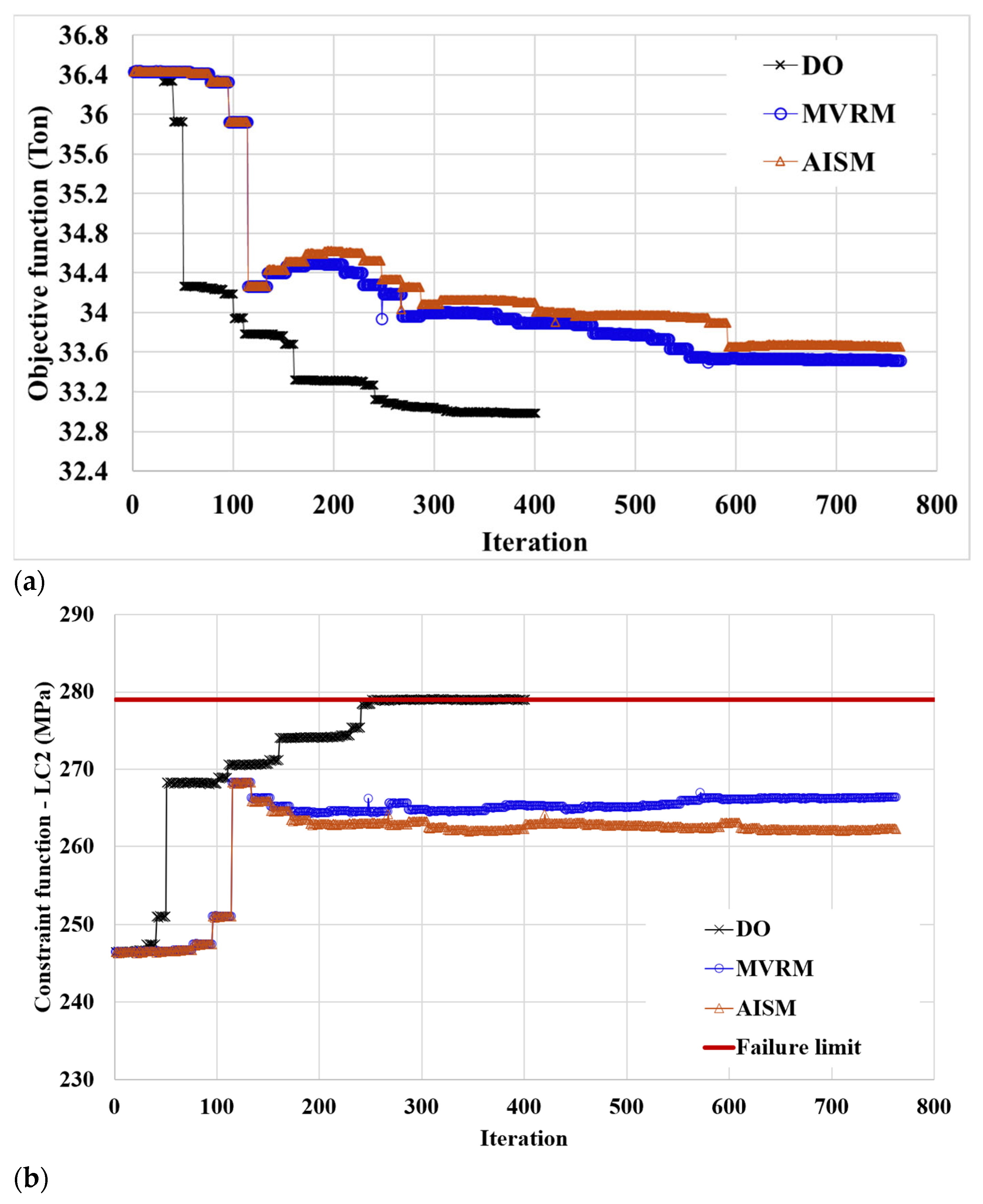
- While Deterministic Optimization (DO) achieved the highest weight reduction of approximately 9.5% compared to the initial design, it was confirmed to have a high risk of exceeding structural safety limits under specific load conditions (LC2) due to the lack of uncertainty consideration. In contrast, the RBRO technique proposed in this study successfully derived a design that guarantees stable performance even under the variability of design variables by setting a target reliability (β = 3.0) for strength and a 3-sigma level of robustness as constraints.
- Comparing the optimization results according to reliability analysis techniques, the MVRM-based RBRO achieved an 8.0% weight reduction, while the AISM-based RBRO achieved a 7.6% reduction. Although AISM presented the most conservative design due to its high accuracy in tail distribution, the MVRM-based design also sufficiently satisfied the target reliability while achieving a lightweight effect close to the DO result. This suggests that a probabilistic approach is essential to maximize economic feasibility while ensuring structural safety.
- Analyzing the trade-off between computational cost and accuracy, this study concludes that the MVRM-based RBRO technique is the most rational and practically efficient design strategy for large-scale offshore structures, including FOWT components: compared to the high-precision but computationally intensive AISM, MVRM offers substantially higher numerical efficiency while maintaining comparable reliability, making it a scalable and universally applicable methodology for reducing time and cost in the initial design phase of complex offshore systems.
- This study focused on structural response analysis under static load conditions. However, in real-world marine environments, dynamic behavior and fatigue damage due to wave and wind loads are key design factors. Although this paper does not directly address these dynamic and fatigue behaviors, future research will extend this research to ensure structural safety throughout the lifecycle of floating offshore wind turbine (FOWT) mooring systems by performing fatigue reliability-based optimal design using a surrogate model coupled with time-domain dynamic analysis.
Author Contributions
Funding
Data Availability Statement
Conflicts of Interest
References
- Patyniak, K.; Collu, M.; Jonkman, J.; Hall, M.; Barter, G.; Zalkind, D.; Coraddu, A. Investigation into the instantaneous centre of rotation for enhanced design of floating offshore wind turbines. Wind Energ. Sci. 2025, 10, 2051–2077. [Google Scholar] [CrossRef]
- Kim, J.; Park, K.-S.; Cha, I.; Choung, J. Structural Integrity Assessments of an IMO Type C LCO2 Cargo Tank. J. Mar. Sci. Eng. 2025, 13, 1479. [Google Scholar] [CrossRef]
- Wen, X.; Ong, M.C. Dynamic analysis of submersible gravity-type fish cages with single-point mooring design. J. Ocean Eng. Sci. 2025, 10, 1155–1171. [Google Scholar] [CrossRef]
- Wang, L.; Kolios, A.; Liu, X.; Venetsanos, D.; Rui, C. Reliability of offshore wind turbine support structures: A state-of-the-art review. Renew. Sustain. Energy Rev. 2022, 161, 112250. [Google Scholar] [CrossRef]
- Chen, J.; Kim, M.-H. Review of Recent Offshore Wind Turbine Research and Optimization Methodologies in Their Design. J. Mar. Sci. Eng. 2022, 10, 28. [Google Scholar] [CrossRef]
- Leimeister, M.; Kolios, A. Reliability-based design optimization of a spar-type floating offshore wind turbine support structure. Reliab. Eng. Syst. Saf. 2021, 213, 107666. [Google Scholar] [CrossRef]
- Stieng, L.E.S.; Muskulus, M. Reliability-based design optimization of offshore wind turbine support structures using analytical sensitivities and factorized uncertainty modeling. Wind Energy Sci. 2020, 5, 171–198. [Google Scholar] [CrossRef]
- Okoro, A.; Khan, F.; Ahmed, S. Dependency effect on the reliability-based design optimization of complex offshore structure. Reliab. Eng. Syst. Saf. 2023, 231, 109026. [Google Scholar] [CrossRef]
- Chang, T.; Peng, Y. Multidisciplinary reliability-based design optimization of floating offshore wind turbine support structure and tuned mass-damper-inerter. Reliab. Eng. Syst. Saf. 2026, 266, 111715. [Google Scholar] [CrossRef]
- Yu, C.; Lv, X.; Huang, D.; Jiang, D. Reliability-based design optimization of offshore wind turbine support structures using RBF surrogate model. Front. Struct. Civ. Eng. 2023, 17, 1086–1099. [Google Scholar] [CrossRef]
- Li, D.; Sang, Y.; Lv, Z.; Wu, K.; Lai, Z. Dynamic response analysis of wind turbine tower with high aspect ratio: Wind tunnel tests and CFD simulation. Thin-Walled Struct. 2025, 211, 113113. [Google Scholar] [CrossRef]
- Li, D.; Fang, S.; Sun, C.; Xu, F.; Zhao, J.; Lai, Z. Aeroelastic wind tunnel study and numerical simulation of Concrete-Filled Double-Skin Tubular (CFDST) wind turbine system. Structures 2025, 74, 108581. [Google Scholar] [CrossRef]
- DNV-OS-E301; Position Mooring. Det Norske Veritas: Bærum, Norway, 2021.
- DNV-ST-0119; Floating Wind Turbine Structures. Det Norske Veritas: Bærum, Norway, 2021.
- DNV-OS-C101; Structural Design of Offshore Units. Det Norske Veritas: Bærum, Norway, 2024.
- Institute for Advanced Engineering. Integrated Load Analysis Report; DMS-IA-GEN-DOC-REP-0005; Institute for Advanced Engineering: Yongin, Republic of Korea, 2023. [Google Scholar]
- Shittu, A.A.; Mehmanparast, A.; Wang, L.; Salonitis, K.; Kolios, A. Comparative Study of Structural Reliability Assessment Methods for Offshore Wind Turbine Jacket Support Structures. Appl. Sci. 2020, 10, 860. [Google Scholar] [CrossRef]
- Song, C.Y.; Lee, J.; Choung, J. Reliability-based design optimization of an FPSO riser support using moving least squares response surface meta-models. Ocean Eng. 2011, 38, 304–318. [Google Scholar] [CrossRef]
- Song, C.Y. Probabilistic design optimization of shipboard radar mast by adopting RBFN meta-model and various reliability methods. Int. J. Nav. Archit. Ocean Eng. 2025, 17, 100667. [Google Scholar] [CrossRef]
- Lee, K.; Song, C.Y. Structural Model Test for Strength Performance Evaluation of Disconnectable Mooring Apparatuses Installed on Floating-Type Offshore Wind Turbine. J. Mar. Sci. Eng. 2023, 11, 1085. [Google Scholar] [CrossRef]
- Altair Engineering Inc. HyperWorks User Guide; Altair Engineering: Troy, MI, USA, 2021. [Google Scholar]
- Simulia Dassault Systems. Abaqus User Manual; Dassault Systèmes: Richardson, TX, USA, 2020. [Google Scholar]
- Phadke, M.S. Quality Engineering Using Robust Design; Prentice Hall: Englewood Cliffs, NJ, USA, 1989. [Google Scholar]
- Haftka, R.T.; Gürdal, Z. Elements of Structural Optimization; Kluwer Academic Publishers: Dordrecht, The Netherlands, 1991. [Google Scholar]
- Hsieh, C.C.; Oh, K.P. MARS: A Computer-Based Method for Achieving Robust Systems. In Proceedings of the FISITA Conference: The Integration of Design and Manufacture, London, UK, 7–11 June 1992; Volume 1, pp. 115–120. [Google Scholar]
- Song, C.Y. Probabilistic Structure Design of Automatic Salt Collector Using Reliability Based Robust Optimization. J. Korean Soc. Ind. Converg. 2020, 23, 799–807. [Google Scholar]
- Song, C.Y. Enhanced Robust Design Optimization in Seat Belt Anchorage Strength for Front Crash Safety of Multi-Purpose Vehicle. Appl. Sci. 2021, 11, 1023. [Google Scholar] [CrossRef]
- Korean Agency for Technology and Standards. KS D 3500: Carbon Steel Plates for Pressure Purposes; Korean Agency for Technology and Standards: Eumseong, Republic of Korea, 2019. [Google Scholar]





| # of Load Case | DWR | DIA | Force | Operation Condition |
|---|---|---|---|---|
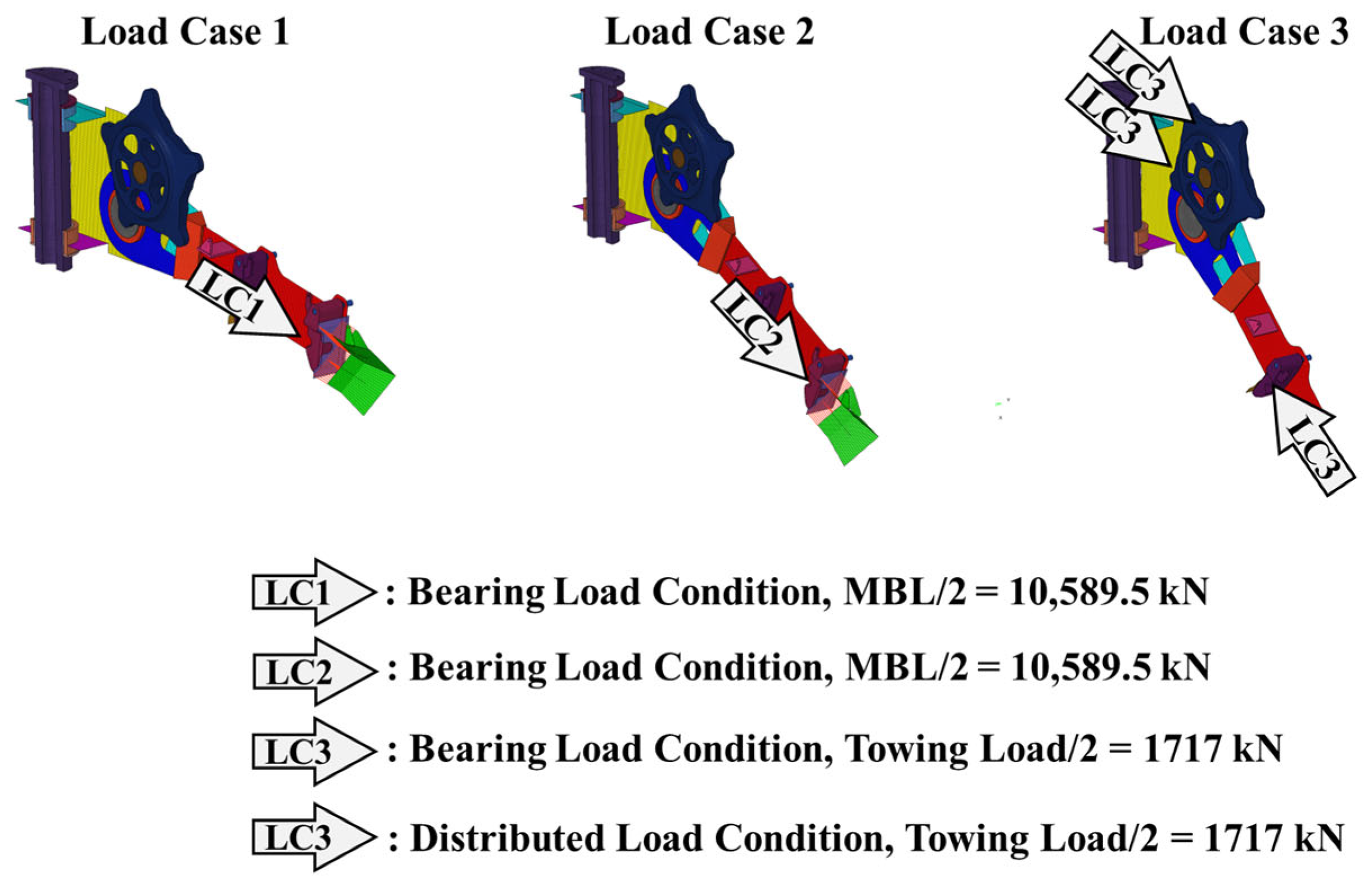
| LC1 | 0° | 10° | 21,179 kN | Mooring |
| LC2 | 0° | 29° | 21,179 kN | Mooring |
| LC3 | 0° | 46° | 3434 kN | Towing |
| Material Name | Density [Ton/mm3] | Elastic Modulus [MPa] | Poisson’s Ratio | Yield Stress [MPa] |
|---|---|---|---|---|
| A694F70 (A694) | 7.85 × 10⁻⁹ | 209,000 | 0.3 | 485 |
| DH36 (DH) | 7.85 × 10⁻⁹ | 209,000 | 0.3 | 310 |
| SCM440 (SCM) | 7.85 × 10⁻⁹ | 209,000 | 0.3 | 834 |
| A148 | 7.85 × 10⁻⁹ | 209,000 | 0.3 | 585 |
| OILESS500-ABR(ABR) | 7.4 × 10⁻⁹ | 126,000 | 0.3 | 617 |
| # of Load Case | Max. Von-Mises Stress (MPa) | Structure Safety | ||||
|---|---|---|---|---|---|---|
| A694 | DH36 | SCM | A148 | ABR | ||
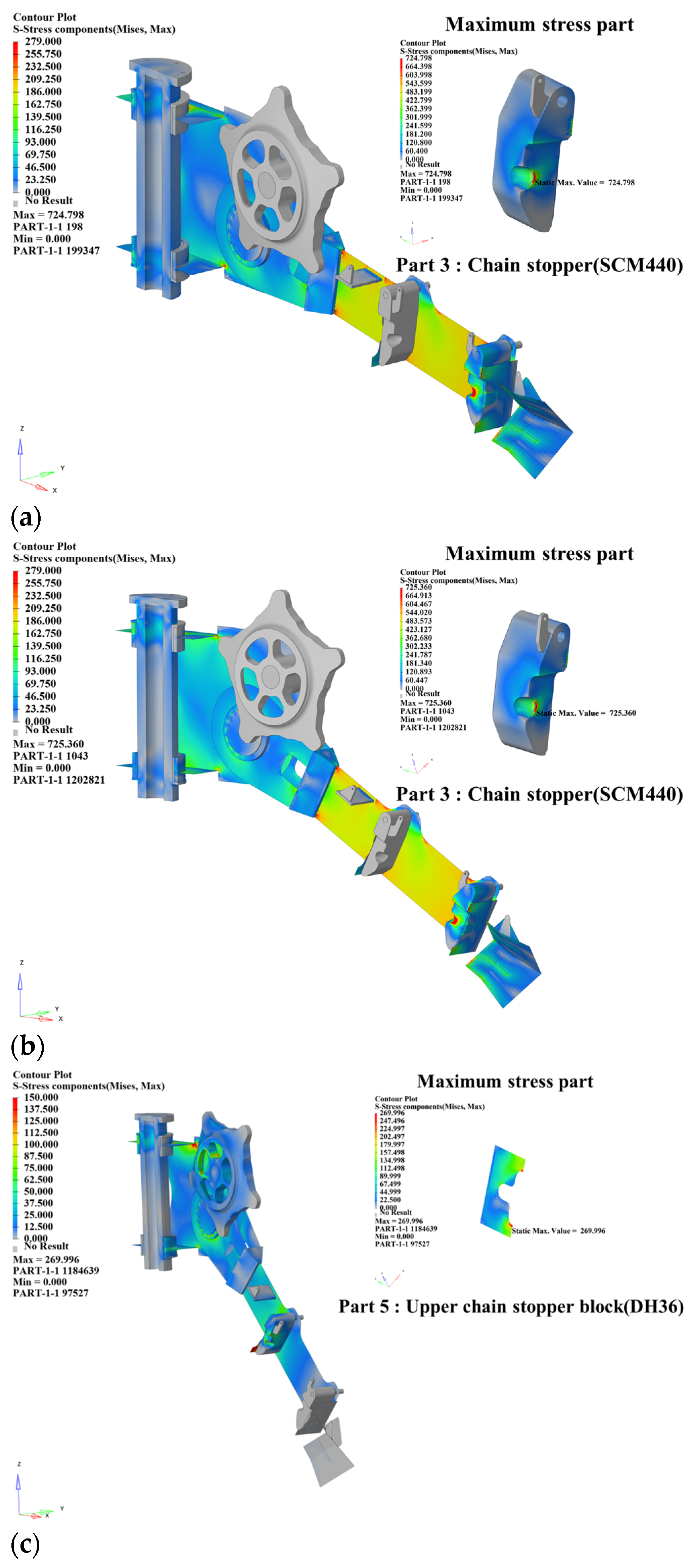
| LC1 | 291.5 | 220.5 | 725.6 | 7.9 | 220.8 | OK |
| (Part 15) | (Part 7) | (Part 3) | (Part 10) | (Part 13) | ||
| LC2 | 290.7 | 221.3 | 725.8 | 8.8 | 199.6 | OK |
| (Part 15) | (Part 7) | (Part 3) | (Part 10) | (Part 13) | ||
| LC3 | 120.6 | 122.7 | 406.8 | 168.2 | 54.5 | OK |
| (Part 18) | (Part 14) | (Part 11) | (Part 10) | (Part 12) | ||
| Random Variable | RSD [mm] | Distribution Type | Design Variable | Mean [mm] |
|---|---|---|---|---|
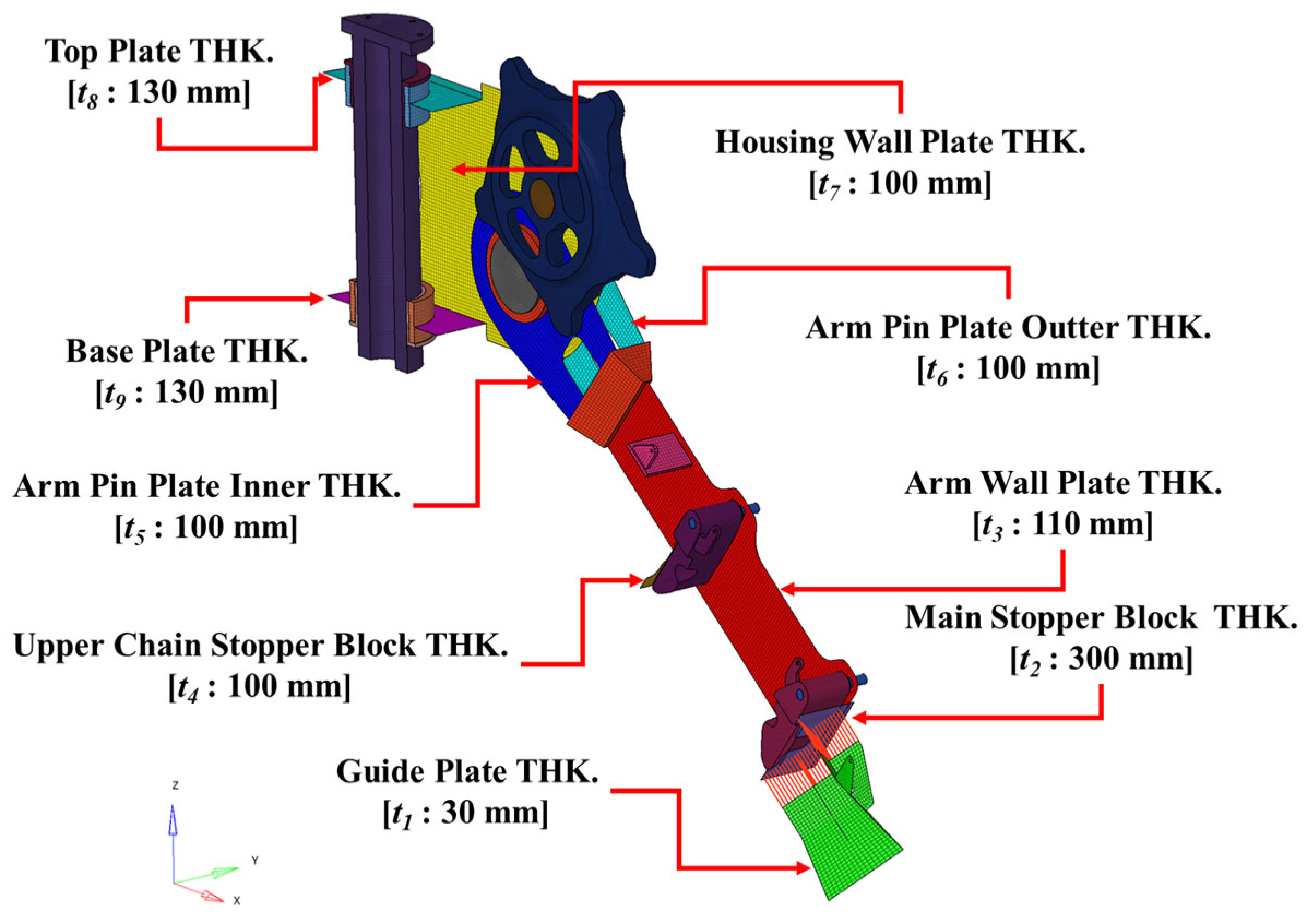
| X1 | 0.55 | Normal | t1 | 30 |
| X2 | 2.1 | Normal | t2 | 300 |
| X3 | 1.7 | Normal | t3 | 110 |
| X4 | 1.3 | Normal | t4 | 100 |
| X5 | 1.5 | Normal | t5 | 100 |
| X6 | 1.5 | Normal | t6 | 100 |
| X7 | 1.7 | Normal | t7 | 100 |
| X8 | 1.3 | Normal | t8 | 130 |
| X9 | 1.3 | Normal | t9 | 130 |
| Random Variable | RBRO (Sigma Level) | DO | |
|---|---|---|---|
| MVRM | AISM | SAO | |
| X1 | 28.8 (3.0) | 29.9 (3.0) | 25.0 |
| X2 | 299.2 (3.1) | 304.2 (3.0) | 284.5 |
| X3 | 88.4 (3.0) | 88.9 (3.0) | 88.0 |
| X4 | 94.2 (3.2) | 94.9 (3.1) | 87.5 |
| X5 | 80.0 (3.1) | 80.0 (3.1) | 80.0 |
| X6 | 80.0 (3.0) | 81.1 (3.2) | 80.0 |
| X7 | 80.9 (3.0) | 81.2 (3.0) | 80.0 |
| X8 | 126.7 (3.0) | 126.8 (3.4) | 104.0 |
| X9 | 122.2 (3.2) | 125.4 (3.0) | 104.7 |
| Method | Constraints (MPa) | Obj. [Ton] | # of F.E (1) | ||
|---|---|---|---|---|---|
| LC1 | LC2 | LC3 | |||
| RBRO (MVRM) | 262.0 | 266.3 | 220.7 | 33.4 | 7630 |
| RBRO (AISM) | 258.4 | 262.2 | 220.1 | 33.6 | 14,497 |
| DO (SAO) | 274.3 | 278.9 | 219.0 | 33.0 | 401 |
Disclaimer/Publisher’s Note: The statements, opinions and data contained in all publications are solely those of the individual author(s) and contributor(s) and not of MDPI and/or the editor(s). MDPI and/or the editor(s) disclaim responsibility for any injury to people or property resulting from any ideas, methods, instructions or products referred to in the content. |
© 2026 by the authors. Licensee MDPI, Basel, Switzerland. This article is an open access article distributed under the terms and conditions of the Creative Commons Attribution (CC BY) license.
Share and Cite
Cheong, M.-S.; Song, C.-Y. Probabilistic Structural Design of Detachable Mooring Apparatus for 10 MW Floating Offshore Wind Turbine Using Reliability-Based Robust Optimization. J. Mar. Sci. Eng. 2026, 14, 437. https://doi.org/10.3390/jmse14050437
Cheong M-S, Song C-Y. Probabilistic Structural Design of Detachable Mooring Apparatus for 10 MW Floating Offshore Wind Turbine Using Reliability-Based Robust Optimization. Journal of Marine Science and Engineering. 2026; 14(5):437. https://doi.org/10.3390/jmse14050437
Chicago/Turabian StyleCheong, Min-Seok, and Chang-Yong Song. 2026. "Probabilistic Structural Design of Detachable Mooring Apparatus for 10 MW Floating Offshore Wind Turbine Using Reliability-Based Robust Optimization" Journal of Marine Science and Engineering 14, no. 5: 437. https://doi.org/10.3390/jmse14050437
APA StyleCheong, M.-S., & Song, C.-Y. (2026). Probabilistic Structural Design of Detachable Mooring Apparatus for 10 MW Floating Offshore Wind Turbine Using Reliability-Based Robust Optimization. Journal of Marine Science and Engineering, 14(5), 437. https://doi.org/10.3390/jmse14050437